
Home » Uncategorized (Page 6)
Category Archives: Uncategorized
20160625 – Cure- Mind and Body

MAIN IDEA:
The main idea of this book is to demonstrate close connection between mind and body, show its power in defining health and overall wellbeing of the person, and review some probable mechanisms of these connections.
DETAILS:
INTRODUCTION
It starts with reference to homeopathy to illustrate science/non-science duopoly and then goes to author’s qualifications as scientist. After that it goes to the purpose of this book: to review mind-body connections and healing power represented by placebo and similar well-documented phenomenon.
- FAKING IT: WHY NOTHING WORKS
This retells the story of non-working medicine for autism: secretin and how despite the lack of evidence of its effectiveness parents did everything to get it for their children. Another story is about false surgery that nevertheless successfully healed some individuals from back pain. Then it discusses overall effect of placebo and how it clearly demonstrates connection between mind and body including self-healing.
- A DEVIANT IDEA WHEN MEANING IS EVERYTHING
This is about another disease – IBS (Irritable bowels syndrome), which despite impacting physiological functions seemingly outside of conscious control nevertheless was cured by placebo. This chapter also discusses negative placebo or nocebo effect such as cases of mass poisoning when no real poison was found. It also provides illustration of similar effect with voodoo curse when individual’s believe in it causes very real physiological effects.
- PAVLOV’S POWER HOW TO TRAIN YOUR IMMUNE SYSTEM
This chapter looks in more detail on physiological effect of though starting with simple example of looking at lemon and feeling sour. From here author goes into discussion of training conditional reflexes and how they allow substitute at least partially a very strong and negative impact of some medicines used in extreme cases like chemotherapy. Moreover conditional reflexes training via connections between nervous and immune systems allow training immune system to become more resistant to various illnesses.
- HGHTING FATIGUE THE ULTIMATE PRISON BREAK
This is about unbelievable physiological achievements of top-level athletes obtained via mind’s conditioning. It includes human ability to claim Everest without oxygen, swim across ocean and similar feats. Author also reviews sleep disorders and a couple of therapies that handle it via mind-body connection: Graded Exercise Therapy (GET) and Cognitive Behavioral Therapy (CBT).
- IN A TRANCE: IMAGINE YOUR GUT AS A RIVER
This is about the use of hypnotherapy and how it demonstrates once again strong link between mind and body, regardless of whether bodily functions in question are normally under conscious control or not.
- RETHINKING PAIN INTO THE ICE CANYON
This is a look at application of mind – body technics to the chronic pain. As in other cases use of powerful drugs causes negative consequences that could be alleviated by use of computer generated virtual reality. It also presents other experiments including “rubber hand” and mirror treatment of phantom pain.
- TALK TO ME: WHY CARING MATTERS
Here author reviews pain problems with childbirth including her own experience. From there she pivots to impact of not only individual’s mind, but also of people who take care about this individual. In short personalized approach produce much better results in healthcare than assembly line approach.
- FIGHT OR FLIGHT THOUGHTS THAT KILL
This chapter about impact of various stress situations on health is another demonstration of influence of mind on body. It looks at stress caused by emergency events, but also on the long term continuing stress as result of family problem or poverty and inequality. Interesting physiological result of stress presented such as reshaping of brain after 9/11 in otherwise healthy adults leaving nearby World Trade Center. Stress also causes unhealthy behavior such as smoking or overeating.
- ENJOY THE MOMENT HOW TO CHANGE YOUR BRAIN
This chapter is about validity of meditation as a method of improving functioning of the brain with demonstrable positive impact on the body. It also discusses mindfulness-based stress reduction (MBSR) technic and mindfulness-based cognitive therapy (MBCT). An interesting research with Buddhist monks with high level of meditative experience demonstrated that they have physiological difference: higher thickness of cerebral cortex.
- FOUNTAIN OF YOUTH THE SECRET POWER OF FRIENDS
This is a review of another powerful technic of improving condition of body via mind: impact of close friendly relations with other people. Research review provided that demonstrated impact of loneliness on expression of genes with result confirming negative implication for health if person is lonely. However when it comes to formal research results are mixed. The final part of the chapter is about early intervention for families to alleviate stress for poor children.
- GOING ELECTRIC: NERVES THAT CURE
This is about biofeedback when individuals can see electronic representation of some uncontrollable physiological function of their body like heart rate and learn to control it. It also discusses a bit chemical/electrical mechanism of this phenomenon.
- LOOKING FOR GOD THE REAL MIRACLE OF LOURDES
The final chapter looks at religion as somewhat conduit between mind and body allowing mind to influence body via preying and strong believe regardless whether these believes are true or not.
MY TAKE ON IT:
There is no doubt in mine mind that human body is highly interconnected system and any part of it has at least some influence on overall wellbeing of the whole. I believe that our brain is just a small part of controlling information system distributed throughout the body. Therefore as long as something is within technical capability of biological system to control itself via production of proteins, or electrical signals, or muscle movements; it will use these tools to achieve improvement from whatever condition the system is into whatever condition the system prefer to be. However such functionality is limited, otherwise we would not need medicine or any other external intervention. For example I believe that if one has appendix, the surgery is much better bet than meditation, even for Buddhist monks.
20160618 – A Foot in the Riverine

MAIN IDEA:
The main idea here is to look at the change as cultural and historical process and what direction it leads to. The causes of change are closely linked to human nature and come naturally to humanity, therefore explanation should be found in cultural development. There is strong push here against attempts to explain cultural change and development via evolutionary processes, which however only weakly supported by alternative explanation: cultural and social learning. Author also believes that change will slow down, but does not provide strong support of this believe.
DETAILS:
Introduction: The weird planet
This book is a look at culture as set of patterns of mental behavior acquired by learners from teachers and modeled on examples, which is part of nature not necessarily limited to humans, but rather typical for nearly all creatures. The book is specifically looking at change and how it happens. The book is informally divided into 3 parts Chapters 1-3 are about history of Western philosophical analysis of change chapter 4: review of game changing methodological research; chapters 5-6 are presentation of author’s theory of change; chapter 7 is an explanation why such theory is critical for understanding of current situation; finally chapter 8 is a speculation on how change itself could change producing wide variety of possible futures.
- Challenging Change
Author dates the first attempts to understand change to Stone Age paintings found in caves. He seems to believe that this art was designed to stop time and stay unchangeable forever. After that he looks at Greek and Roman ancient world with initial philosophical approach to this issues from Zeno’s paradoxes to Augustine at the times of falling Rome. The review goes all the way to our times when change become a subject of historical science, the process driven by two main factors: raise of nation-state and formation of history departments in universities and their population by lawyers, theologians, and classicist.
- The Frustration of Science
This is an interesting take on nature vs. culture in contexts of “doing what comes naturally”. Author tries to identify what in the world of emotions, gestures, traditions, and such comes naturally and therefore is consistent across different populations, and countries. It is not an easy task, especially if one takes into account ability of culture to have impact on bodies: a good example is variance in digestibility of lactose. Somehow author managed include here wide variety of phenomenon from slavery to skin color, to Darwinism, and to Marxism. The final point here is that ideas of evolution provide a very good tool for understanding just about everything, but should be used carefully always keeping in mind such deviations as eugenics and Nazism.
- The Great Reconvergence
This is description of late XX century ideological development when mountains of evidence forced significant numbers of intellectuals to overcome primitive eversion to biological explanations of sociological phenomenon and begin the process of reconvergence of history and biology, including development of understanding of interconnectedness of the world via environmental studies. The final and most important note here is that neither memetics nor sociobiology succeeded in explaining the culture.
- The Chimpanzees’ Tea Party
This chapter is about the most resent research that convincingly demonstrated existence of non-human cultures as among chimps, which for all purposes do not really differentiate from cultures of human societies. Moreover not only cultures, but non-human individuals also possess what is considered purely human characteristics: individuality, inventiveness, and capacity to discover new technics.
- The Limits of Evolution
This is an interesting and kind of non-conformist approach to history as the area where evolutionary thinking is not applicable. Author claims that we witness development knowledge that stresses non-selective forces in history and even genetics. Author specifically applies this to cultural development strongly rejecting ideas of memetics. Overall in the battle between evolutionary and non-evolutionary explanations of culture author seems to be in non-evolutionary camp, even if he claims to see opportunity for reconciliation between two views. A very interesting part of this is that author somehow believes that uniqueness of a group or culture and random character of path to the present somehow denies evolutionary approach. In support of his view author points to what he calls 4 fallacies:
- Humans are animals as others
- Cultures and populations are interchangeable units of study
- Omission of cultural and social learning from development
- Final fallacy: that evolution is only true if it explains everything.
I guess author does not deny evolution; he just against mixing evolution with change that in his opinion is a very different process. The most important point here is that cultural development in author’s opinion does not comply with evolutionary model. Author brings about a number of examples from war to farming that he believes lead to destruction of society either through mutual annihilation or environmental catastrophe, somehow believing that it denies survival of the fittest thesis.
- The Imaginative Animal
This chapter is about the dynamism of culture. It starts with discussion of constructive collective memory that usually has little to do with realities of the past, pretty much similarly to how it happens with individual memory. The chapter includes review of research of human and non-human memory coming to conclusion that non-human memory often factually more effective than human. After that author turns vector of imagination from past (memory) to the future when it generate ideas, hopes, and eventually planning with consequent actions directed to achieving desirable future state. As illustration author reviews history of trade, navigation, and exploration that over relatively short few centuries brought humanity together into one communication rich and interconnected entity.
- Facing Acceleration
Here author is looking at current acceleration of change and reasons for it. He looks at dramatic changes in language and cultural attitudes that he observed in one specific population – Englishmen over his own live: from queen English and stiff upper lip to mess of a language and highly sensitive weeping men. Among causes he lists environmental change, multiplication of population, climate change, deregulation, capitalist greed, and multiple other horrors. As attempt to explain this acceleration author brings ideas of Rene Girard who attributed massive change in culture to human tendency to mimic other humans so looking at somebody doing something individual tends do the same, consequently creating consumerism, economic bubbles, political movements, cultural fashions and such.
- Towards the Planet of the Apes
The final chapter presents the idea that not only change happens all the time, but also even nature of change itself could change removing such features as scientific certainty (substituted by sequence of paradigms), factual analysis being pushed out by postmodernist sensibility responses, dramatically changing meaning of history, orderly and susceptible to calculation and planning predictable world substituted by chaos theory when nobody can predict which butterfly’s wing flop could cause hurricane. Despite this entire narrative author believes that there is a chance to break barrier between science and other cultural phenomenon on the basis of equality, so evolutionism and culturalism could coexist. At the end author speculates about future concluding that “planet of apes” outcome is within realm of possibilities, but he believes more in slowing of the change and arriving to some relatively constant condition.
MY TAKE ON IT:
I think that change always happened, but at very glacial pace because human groups were isolated and too busy surviving in straggle against environment and each other. Only during last few thousand years when agriculture provided enough resources to allocate significant number of men-hours to ideological, technological, and cultural development we could observe process of conversion of multitude of small human societies into one entity via processes of wars, trade, and cultural interaction selecting the most viable patterns of behavior. Contrary to author I think that evolutionary methods are fully applicable to cultural development and should be effective tool for understanding why some features thrive, while others parish. I would agree however that eventually speed of cultural change will slow down, but only because expansion of individual freedom would make culture so diverse and tolerant that it would cover just about any conceivable variation of individual behavior providing that it is strongly supported by absolute intolerance of intolerance and completely suppress violent attempts to influence other people’s behavior.
20160611 Republic of Spin

MAIN IDEA:
The main idea of this book is to review history of organized political public relations operations, their methodology, and results. The main conclusion is that politically skewed distortion of events, facts, and statements was increased continuously and achieved such high levels that it become practically impossible do derive picture of reality consistent with real facts based on flow if (dis) information produced by political campaigns and affiliated media.
DETAILS:
PART I: THE AGE OF PUBLICITY: 1.Theodore Roosevelt and the Public Presidency; 2.William McKinley and the Passing of the Old Order; 3.The Rise of Public Opinion; 4.”The Fair-Haired”; 5.Muckraking and Its Critics; 6.The Passion of Upton Sinclair
- The Dawn of Public Relations; 8.Wilson Speaks; 9.Pitiless Publicity; 10.The Press Agents’ War; 11.The Journey of George Creel; 12. Disillusionment
This is review of initial formation of political spin that was really born quite non-incidentally with the first public presidency of Teddy Roosevelt. Author reviews Teddy’s publicity operation that started well before achieving presidency and hit high mark during his tenure allowing him to overcome low level of support from GOP establishment by connecting directly with masses. This part also includes review of McKinley’s use of publicity especially new media of movie documentary that provided visual access to masses. It coincided with dramatic increase in numbers of correspondents in DC that tripled from 58 to 171 from 1868 to 1900. However McKinley operation was relatively low scale with limited objectives appropriate for small federal government that had little impact on lives of regular people. However it was changing fast and author traces personalities and methods of public relation operations that allowed massive government expansion into businesses driven by muckraking journalism exposing “evils” and demanding bureaucratic intervention to protect consumers, small businesses, and everything else they could come up with in order to obtain more power. Needless to say that implementing draft, going into war, and drastically limiting American freedoms that occurred during this period would not be possible without massive successful brainwashing operation conducted by “progressive” intelligentsia. Finally a significant share of discussion here is the story of formal government public relation organizations, relevant personalities, quite fascinating semantic struggle to differentiate government spin effort from propaganda (that carried very negative connotation), and, finally, initial planting of healthy seeds of mass cynicism as result of all above.
PART II: THE AGE OF BALLYH00 13. Return to Normalcy; 14.Walter Lippmann and the Problem of the Majority; 15.The Likes and Dislikes of H. L. Mencken; 16.Bruce Barton and the Soul of the 1920s; 17.”Silent Cal”; 18.The Overt Acts of Edward Bernays; 19.Master of Emergencies;
This part covers relatively short period of temporary return to more or less traditional American values of small federal government, minimization of permanent military establishment, and consequently minimization of government intervention into economy and everyday lives of Americans. However the process of information spin to assure support of population to agenda of political class was continued unabated: Harding brought in professional speech writing, Coolidge expanded press conferences and radio talks, and Hoover established permanent White House press office and started continuous production of movies and other propaganda materials to keep public support. As it could be expected at this point public relations operation extensively used individuals with advertisement background who widely implemented advertisement methods to sell political ideas.
PART HI: THE AGE OF COMMUNICATION: 20.Tuned to Roosevelt; 21.Nazism and Propaganda; 22.The Dark Side of Radio; 23.Campaigns, Inc.; 24.The Wizard of Washington; 25.The Road to War; 26.The Facts and Figures of Archibald MacLeish; 27.Propaganda and the “Good War”;
This is about highly effective use of radio for propaganda by all sides during 1930s and 40s. Obviously in USA it was FDR with his fireside chats that in reality were highly sophisticated performances with planning, speechwriters, and thorough rehearsals. It also somewhat touched on continuing philosophical development of ideas of public relations and mass communications as necessary tools for democracy. On totalitarian side it reviews Hitler’s masterful use of mass communications to promote ideas of National Socialism and anti-Semitism. It also reviews in quite interesting details ideological support for war in America from earliest moments when population was fully isolationist to propagandist support for continuing war effort.
PART IV: THE AGE OF NEWS MANAGEMENT: 28.The Underestimation of Harry Truman; 29.George Gallup’s Democracy; 30.Psychological Warfare; 31.Eisenhower Answers America; 32.Salesmanship and Secrecy; 33.The TV President; 34.”Atoms for Peace”; 35.Vance Packard and the Anxiety of Persuasion
This part covers initial after war period, specifically reviewing Truman’s ideological activity in mass communications, it is quite convincingly demonstrated here that Truman was far more effective than he usually gets credit for. This demonstrated by using both Truman internal and external communications directed at winning propaganda war against Soviet Union. The second half of this part looks at Eisenhower administration and its various initiatives in this war with stress on the new media of TV, development of polling methodology that assured improved feedback from population, and glossy magazines that provided both education and propagandist food for public consumption.
PART V: THE AGE OF IMAGE MAKING: 36.The Unmaking of Presidential Mystique; 37.The Great Debates; 38.The Politics of Image; 39.The Kennedy Moment; 40.News Management in Camelot; 41.Crisis 42.”Let Us Continue”; 43.The Credibility Gap; 44.The New Politics;
The new era come in 1960s with Kennedy presidency when ideas were moved somewhat into background and substituted by images. This new environment opened unheard of possibilities of selling to the public packaging in lieu of substance. This part reviews multiple crises of Kennedy administration and its eventual failure to manage the news that led to increasing credibility gap between public and administration filled by news providers.
PART VI: THE AGE OF SPIN: 45.The Permanent Campaign Arrives; 46.The Reagan Apotheosis; 47.Spinning Out of Control; 48.George W. Bush and the “Truthiness” Problem; 49. Barack Obama and the Spin of No Spin.
The final part traces final development of contemporary spin through the last 5 administrations from Reagan to Obama when it is characterized by increasing sophistication in wordsmithing with decreasing effectiveness of results. In short not only credibility of consecutive administrations declined dramatically, but also credibility of news provided went the same way: down the drain.
MY TAKE ON IT:
This is an interesting historical review of public relations tracing continuing and seems to be unstoppable decrease in elite’s ability to convince population to support elite’s ideas and endeavors. I believe that it is a very natural process with people getting practically unlimited access to all conceivable information with nationalization and even globalization of individual live when individual’s well being depends not only and even not that much on local circumstances, as it used to be in times past, but more and more on global circumstances of international political, economic, and even psychological and ideological environment. It remains to be seen how well elite would be able to managed dramatic increase in ability to access information, time to digest it, and level of dependency of individual well being on general political and economical situation in the country and even in the world. My guess would be that elite will fail and subsequent development will lead to severe decrease in elite’s influence and quite possible increase of individual freedom, but not before a sequence of serious political battles between elite and populist movement significantly impact environment in the country.
20160604 – Equality
MAIN IDEA:
The main idea of this book is that equality is the relatively new notion, which was initially created in Greek city-states in extremely limited form, but really grew into maturity over the last 4 centuries in the Western world. The review of recent attempts to achieve equality either in form of equality before god, nation, or supreme leadership for all or equality for specifically defined group of people mainly ended in bloody mess. The same probably await contemporary political correctness and minority special rights movement, albeit there is hope that the mess will be a bit less bloody and wasteful.
DETAILS:
Introduction
The introduction presents this book as discussion of relationship between liberty, justice and equality. The first two are widely discussed since time of Plato, but the last one is somewhat new addition and this book designed to trace its formation, maturity, and domination of political and philosophical discourse at the early part of XXI century.
- Whence Inequality?
Author begins discussion of equality from animal levels, specifically our close relatives – primates, then moves to hunter-gatherers. He looks at different types of inequality: sex, age, skills, and so on and comes to the very reasonable conclusion that not even in chimpanzee’s society, leaving alone all known human societies any two individuals where equal to each other, so generally speaking inequality is the norm and deviation from this norm is recently invented new notion specific to human development.
- The Greek Mirage
This chapter is pretty detailed look at invention of this notion in ancient Greece and contemporary interpretation of Greek history through lenses of equality. Especially demonstrative is comparative application of this notion in Sparta and Athens.
- The Proud Tower
This chapter continues discussion of equality into the next development: Rome, its colonies and then European feudal states. It also briefly mentions China and Muslim countries. This brings us to discussion of equality in societies based on monotheism with their notion of equality of all before God.
- Islands in the Sea
Here author suggest an interesting idea that equality was traditionally poorly understood so it did not generate lots of support, however oppression was well understood and caused resistance to flare up on more or less regular basis, albeit leading most often either to change of personality of oppressors or its form, but not to removal of oppression. In this chapter author briefly reviews history of revolts against oppression, pivoting then to phenomenon of monasteries as islands of equality in the sea of structured inequality in medieval Europe. Author also looks at ideological development of equality idea in various utopias around the world.
- Liberal Equality
This is discussion of Liberal equality of Western Enlightenment and its notion of independence and freedom for individuals, paradoxically derived from absolutist ideas of Hobbs with Leviathan oppressing everybody equally in order to prevent war of everybody against everybody. The pick of this movement was in late XIX century when despite formally autocratic and aristocratic forms of government people of Europe generally enjoyed unprecedented political and economic freedoms and equality before the law.
- Socialist Equality
It led to demand of even more freedom with new utopias with strong collectivistic ideology paradoxically leading to totalitarian socialism practically annihilating liberal democracy in XX century, until these utopias somewhat retreated as result of extreme suffering of people caused by disasters created by various forms of socialism ideology.
- The Rise and fall of Racism
This chapter looks at racism as another form of inequality from its beginning as typical for all tribal societies understanding of “us” as human and “them” as subhuman all the way to late XIX century’s ideological development of Social Darwinism and its culmination in Nazi ideology and practice of middle XX century. Despite formal rejection of this ideology by just about everybody, in reality race based massacres continued to our day with no sign of completely disappearing in Africa and Middle East where it is also supplanted by religious hate. Final somewhat touching note in this chapter is that at least these people have some equality on their lips and quite equal Kalashnikovs in their hands.
- Minorities Into Majorities
This chapter is an interesting look at contemporary society-wide equality movements such as feminism, homosexuality, and disability. After review of these movement author discusses multiple anti-discrimination measures, noting at the end that it seems to be going out of hand, making into the most discriminating against and suppressed group white able-bodied, heterosexual men. Author seems to hint, albeit very weakly, that it may not be such a good idea because these men after all are in control of violent powers of society and history shows that it is not necessarily a good idea to discriminate against people with overwhelming power.
- Brave New World
This is about contemporary world when idea of equality made some very strange turns. The centuries old idea of equality is being substituted by idea of equality with adjustments to compensate for whatever real or imaginative deficiencies inflicted some group of people. Typical examples are racial and sexual affirmative actions that kind of directed to achieve equal results by making opportunities unequal.
- Death and Beyond
This is about the death as being a great equalizer. However it clearly demonstrates that while non-existence is equal for everybody, the attitude of living to dead is as unequal as society itself. Moreover with contemporary technology it becoming conceivable that death itself could become avoidable providing for virtually permanent live for some who can afford it. Author ends this chapter with somewhat curious observation that monotheistic religions that put in foundation equality of everybody before god, nevertheless often preach after life where some people go to paradise and some to hell, turning it into as unequal situation as human imagination can achieve.
- The Promise and the Threat
The final chapter points out that nature provides for infinite variations of inequality and that the striving for equality is somewhat new notion that humanity came up with. So far this notion most often was used to remove old regime of inequality and substitute it with the new one where tyrants removed and revolutionaries become the new tyrants. This outcome is not a fluke. It is a necessity because equality has infinite amount of variations, often contradictory, so when one increases another correspondingly decreases. Finally dream of equality claimed huge price in blood and treasure when implemented by people like Lenin, Stalin, Hitler, and such. It does not look that if giving opportunity to do everything they want contemporary supporters of political correctness would be any better.
MY TAKE ON IT:
It is an interesting review of notion of equality, its history, and contemporary condition. I fully agree with the idea that equality is unnatural, but I believe it is necessary because it provides for at least some safeguard against individual alienation and humiliation that could lead to war against society. My solution is provide for equality of rights for natural resources that would provide everybody with ability to be compensated for use of his/her share of natural resources via the free market, assuring that everybody has resources to pursue happiness in his/her own way with huge inequality of outcomes fully compensated by relative equality of available inputs.
20160527 -Partisan Hearts and Minds

MAIN IDEA:
The main idea is that party affiliation is a stable characteristic of individuals and significant part of their identity. It mainly remains stable over the live time with changes relatively easy occurring in young age and much more difficult albeit possible later in live, especially if party’s ideological structure changed. At the same time party affiliation only partially predict voting behavior leaving a lot in flux, enough to make stability of control over state power lower than it would be warranted by party affiliation.
DETAILS:
Preface
This book is about stability of partisan affiliations. The conception of such affiliation characterizes it as party identification as voter’s running tally of the parties’ competence and ideological appeal. In this party identification also serves as a perceptual screen. However it is more than party identification, it is also identification with social groups that linked to the party therefore it is quite stable condition of voter’s mind. However if party perceived as incompetent in achieving objectives of affiliated social groups it could be discarded or reinstated.
- Introduction,
Very important point here is that partisanship has low dependency on usual demographics, but high dependency on parental affiliation. However perceiving oneself as Democrat or Republican does not create automatic loyalty to the party’s current candidate, only some inclination. Consequently in just about any election some minority of Democrats votes for Republicans and visa versa. However there is high level of political significance of stability of partisan affiliation. Partisan attachment to the party is akin to religious identification. But it is not perfectly static. As it is with religious affiliation the change is possible including mass conversion as it happened during the Great Depression when Republican Party lost its partisan majority position and with it nearly all political influence. Different process seems to be happening after WWII when Democratic Party slowly loosing its dominant position, but not to Republicans but to Independents.
- Partisan Groups as Objects of Identification,
This is about partisan affiliation being an important part of personal identity and therefore is not easily changeable and it looks at definition and measurement of partisan identification. An interesting thing about it is that correlation between party identification and stand on issues traditionally was not as strong as one could expect. Authors provide data only until 1996 so it does not show current polarization, but it is still interesting to look at:
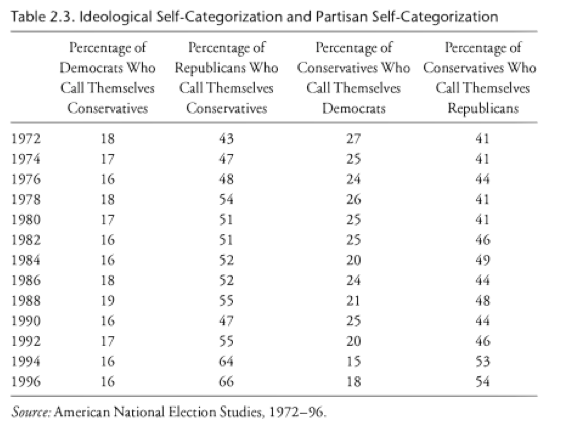
Nevertheless despite cross party line voting is not unusual it still remains very limited with Party affiliation playing defining role in attitude to issues.
- A Closer Look at Partisan Stability
Author defines partisan stability as high level of correlation of party affiliation over time. Here they go into statistical details of their methods. This is traced not only through live of individual, but also across generations comparatively with religious affiliation:

- Partisan Stability: Evidence from Aggregate Data,
This is about partisan balance of electorate overall and its slow change. Specifically it analyses cross party voting patterns:
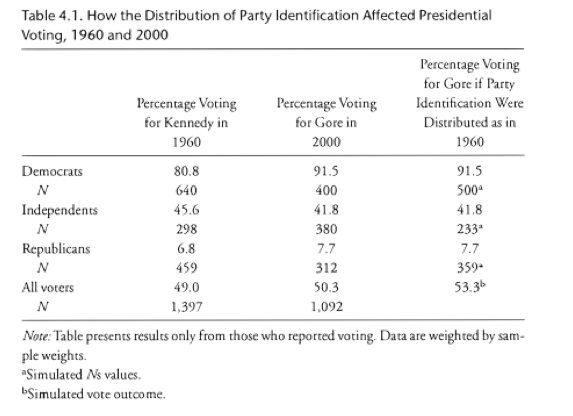
In summary authors stress high level of dependency on political events referring to high level of cross party attraction of Johnson in 1964 and Reagan and repelling of Nixon in1974 and Carter in 1980.
- Partisan Stability and Voter Learning
This is an analysis of what stable attachments mean for party identification. It is again detailed review of statistical models. The general inference that learning is not easy and mainly occurs thru generational change when young people relatively open to ideological influence different than one dominating their family.
- Party Realignment in the American South
This is a case study of partisan affiliation change of Southerners between Democrats and Republicans in America after WWII. Very interesting point here is that switch of southern voters from D to R did not occur at once due to civil rights laws, but rather had was a two step process with the second step being Reagan revolution completed from 1082 to 1992.
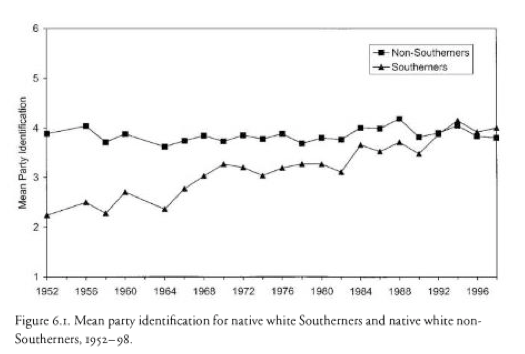
- Partisan Stability outside the United States
This is case study of identification change in Italy after collapse of communism
- How Partisan Attachments Structure Politics
The final chapter is about impact that partisan affiliation has on electoral competition. Authors seem to estimate it at the level of 75% probability of person to vote for the party of his/her affiliation. However it leaves plenty of space for electoral variance, especially if one takes into account current 40% of unaffiliated voters. At the same time stability of party affiliation makes it very difficult to achieve electoral success for anybody outside existing two parties political system.
MY TAKE ON IT:
This is a nice analysis of party affiliation, its change over time, and its impact on voting. However I think that this analysis is somewhat outdated because party affiliation is artifact of old times and will decrease significantly in the future because the huge progress in communication and social network make party redundant and would allow people concentrate on issues they are concerned with at the expense of coherent and comprehensive ideology presented by parties. The voting behavior will depend a lot less on formal or even informal affiliation than on individual estimate which set of candidates would be most probable to deliver on issues of his/her concern.
20160520 UltraSociety

MAIN IDEA:
The main idea of this book is that human history is the story of evolutionary process of cooperation and competition at two somewhat separate levels: between individuals and societies that led to continuous increase in scale and power of humanity often via critical events of distractive creation.
DETAILS:
Chapter 1. The Puzzle of Ultrasociality:
From Gobekli Tepe to the International Space Station
Author defines Ultrasociality as ability of humans to cooperate in very large groups of strangers. As examples he provides International Space Station, CERN, and other huge UN or multistate projects. The research in cooperation includes development of Seshat Global History Databank that would contain all known facts and numbers relevant to human societies’ past. Here is a nice representation of increase in scale of cooperation over the time:
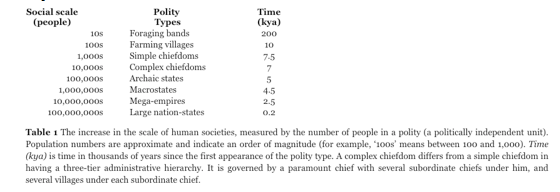
Author also discusses increased matematization of history and attempts to make it more into hard science of human development with Cliodynamic models producing insights in the past and future of human societies. One such attempt that author works on is based on competition between societies, mainly military competition as driver of increase in the scale and complexity of societies. So far this model seems to be quite good in retroactively predicting raise and fall of societies as long as military competition involved, but fail to predict anything when it is switched off. At the end of chapter author posits that cooperation is extremely fragile and competition is what caused development of large military powerful societies.
Chapter 2. Destructive Creation
How cultural evolution creates large, peaceful, and wealthy ultrasocieties
Here author looks at examples of competition between different societies such as American Indians and European settlers and then moves on to define field of Cultural Evolution that is forming practically right now. However it is not only competition that defines evolution; it is also cooperation both between individuals and societies.
Chapter 3. The Cooperator’s Dilemma
Selfish genes, “greed is good,” and the Enron fiasco
This chapter starts with some interesting detour into contemporary American politics and its ideological underpinning in libertarian ideas of Ayn Rand and economic ideas of Misses and Hayek, which in author’s mind somehow tied to real corporate crooks like Enron’s Skilling and fictional like Gordon Gekko. One of the funniest things here is a direct link author sees between Selfish Gene of Dawkins and Skilling’s machinations. However much more interesting is core of the chapter: discussion about the cost of cooperation and how evolution at the final count defines optimal for survival mix of cooperation / competition. Author also looks here at kin selection and reciprocal altruism as alternative of group selection, but finds both ideas wanting. The final part is directed against ideas of morality as byproduct or even mistake of evolution when people genetically inclined to help others nearby because they normally were always kin in hunter-gatherers societies, even if they are not kin in the contemporary one.
Chapter 4. Cooperate to Compete
What team sports teach us about cooperation
This is somewhat technical use of team sports to analyze interplay between team benefit and individual benefit when good player often have to sacrifice for the team. Author even provides a nice formula for development of cooperative traits:

Chapter 5. ‘God Made Men, but Sam Colt Made Them Equal’
How early humans suppressed alpha males.
There is always tension between individual and group benefits and this chapter looks at traditional ways to suppress individual who does not comply with what is considered best for the group. Author starts with idea that hunter-gatherers societies are egalitarian due to revers dominance: that is when attempts to dominate by one individual over others lead to cooperative resistance with use of projectiles giving humans clear advantage comparatively to gorillas because they allow simultaneous attack of majority of weak against minority of strong. The technological development of such attitudes eventually led to “the Great Equalizer” that allow even a very weak women to put bullet into very strong man, dramatically decreasing actual need to do it and providing strong reason for peaceful cooperation.
Chapter 6. The Human Ways of War
War as a force of Destructive Creation
This chapter is looking at the specifically human way of war, which no other animals use: extensive application of projectiles to kill at the distance. The evolution of projectiles from stones to intercontinental missiles had significant impact on social evolution of human societies.
Chapter 7- The Rise of God-Kings
The alpha male strikes back
This is about massive implementation of agriculture that led to increase in military competition between societies because of stationary nature of resource acquisition and ability to save resources over time: functionality that was lacking in hunter-gatherers societies. Consequently this military competition caused creation and evolution of the state as the system best suitable for concentration and mobilization of resources for military straggle under unified command of hierarchical elite or alpha males.
Chapter 8. The Iron Law of Oligarchy
Why power inevitably corrupts
This is review of ideas about state formation. It references Franz Oppenheimer and Ibn Khaldun. However author rejects Oppenheimer idea of conquest as main method of state formation relaying rather on internal formation of hierarchical structures. This is what is considered the iron law of oligarchy: powers obtained by military leaders during war with external opponents are retained after the end of war to suppress internal, providing formation of permanent oligarchy and eventually aristocracy.
Chapter 9. The Pivot of History
The spiritual awakening of the Axial Age
After discussing in precious chapter law of oligarchy and formation of the state with practical elimination of human egalitarism, that was the rule in hunter-gathering societies for millions of years, author posits the question: how come that the later development of military technology and society brought back egalitarism and new democratic forms of society organization. Author relates it to Axial Age 800-200 BCE when major new ideological constructs were built around the world: Confucius, Jewish monotheism, Buddhism, and Zoroastrism, with all of them promoting egalitarian ethics. Author sees this development as foundation for large-scale “Axial” empires that combine multiple ethnicities into one powerful entity. However the root cause was the military development in use of horses. It forced creation of big enough entities so to limit fighting against military effective nomads to borders, providing relative peace for internals. Eventually it also created condition for Enlightenment.
Chapter 10. Zigzags of Human Evolution
And the science of history
The last chapter summarizes the set of ideas presented in this book and provides their very nice graphical presentation:

t seems that at this point competition between societies moved away from military domain into economic and societal, practically competing for superiority in quality of live.
MY TAKE ON IT:
I think that evolution is the best-known method to analyze not only biological development, but any process which combines two steps: change and filtering. The model of cultural evolution seems to provide a very good framework for understanding history and it would be interesting to see what would come out from development of massive databases of archeological and other historical data. I believe that it could eventually turn history into real science with ability to build hypotheses and test them against materially significant amount of data. However I also think that part about development of ideas and know-hows needs more attention because whatever are circumstances, the human thought comes before human action and this variance of thought and created memes actually moves individuals and later societies in one direction or another.
20160513 Humans are Underrated

MAIN IDEA:
The main idea is that computers and software are becoming so powerful and effective in all areas of live that they are more and more capable to substitute human labor not only for the middle level clerical jobs, something they do for a half of century, but also in all kinds of intellectual and manual activities that they were not that capable to do so far. However it does not mean that humans are obsolete, but rather that humans will have to apply themselves to radically different activities such as interacting with each other, defining objectives and general ways to achieve them, and overall to doing purely human things.
DETAILS:
CHAPTER ONE: COMPUTERS ARE IMPROVING FASTER THAN YOU ARE
As Technology Becomes More Awesomely Able, What Will Be the High-Value Human Skills of Tomorrow?
This is a brief review of dramatic improvement of computer functionality over last 50 years. Whether it is Chess or Jeopardy computers are now champions, not humans. So author raises a question: What can people do better than computers?
CHAPTER TWO: GAUGING THE CHALLENGE
A Growing Army of Experts Wonder If Just Maybe the Luddites Aren’t Wrong Anymore.
This is review of all areas where computers become better than people. It used to be that computers could not do low level manual jobs because it requires dexterity and flexibility, as well as high level intellectual work because it requires complex reasoning. However lately the higher level of functionality opened door for computers in these areas. From driverless cars to computerized legal research and robotic surgery humans are pushed out by better performing computerized equipment.
CHAPTER THREE: THE SURPRISING VALUE IN OUR DEEPEST NATURE
Why Being a Great Performer Is Becoming Less About What We Know and More About What We’re Like.
Here author makes case that our human brains are optimized by evolution for survival in groups, therefore social relations, cooperation, and human-to-human interactions could not be possibly automated. So the way of future author sees in switching from being knowledge workers to being relationship workers. Correspondingly the meaning of great performance changing from being able to produce material or intellectual goods and services to being able to build successful relationships.
CHAPTER FOUR: WHY THE SKILLS WE NEED ARE WITHERING
Technology Is Changing More Than Just Work. It’s Also Changing Us, Mostly in the Wrong Ways.
This chapter is review of current situation when our social skills are generally in decline, often relegated to social media that substituted personal relationship. Author believes that this process should be not just stopped, but reversed and we should concentrate on development of social skills. In the following chapters he looks in detail at specific skills that should be promoted to be successful in the new world.
CHAPTER FIVE: “THE CRITICAL 21ST-CENTURY SKILL”
Empathy Is the Key to Humans’ Most Crucial Abilities. It’s Even More Powerful Than We Realize.
This is about the most important skill that humans possess, but robots in author’s opinion cold not: empathy. An interesting part of it is idea that we emphasize to survive because humans survive in a group and could not make it without the group. Also important idea here is that empathy is a skill not a trait so in could be learned as any other skill.
CHAPTER SIX: EMPATHY LESSONS FROM COMBAT
How the U.S. Military Learned to Build Human Skills that Trump Technology, and What It Means for All of Us.
This chapter describes highly effective application of empathy in military that could be expressed as: the fight is about our pilot versus their pilot, not our plane versus their plane. This idea fully implemented into military training made American military highly effective even in situations where there is no clear technological or numerical advantage over adversary.
CHAPTER SEVEN: WHAT REALLY MAKES TEAMS WORK
It Isn’t What Team Members (Or Leaders) Usually Think. Instead, It’s deeply Human Processes That Most Teams Ignore.
This chapter is about another exclusively human trait: team play. It looks at such things as team IQ that considered higher than IQ of any individual within the team. It is also about need for direct person-to-person communications because on-line communications are not capable to transmit full scale of communications between humans.
CHAPTER EIGHT: THE EXTRAORDINARY POWER OF STORY
Why the Right Kind of Narrative, Told by a Person, Is Mightier Than Logic.
The next exclusively human skill is ability to create stories and communicated complex ideas via story telling. One of the most interesting things here is idea of “Neural Coupling” via some narrative.
CHAPTER NINE: THE HUMAN ESSENCE OF INNOVATION AND CREATIVITY
Computers Can Create, but People Skillfully Interacting Solve the Most Important Human Problems.
This chapter somewhat rejects usual believe that computers could not create the new intellectual products. On the contrary computers now create new poems, music, and much more with pretty good quality so that even experts have hard time to find difference if compared with human creations. However author believes that the higher level of creativity comes not from individual efforts that computers are quite capable to emulate, but from interaction between people that computers could not do by definition. Moreover the decisions what problems to solve or what objective to achieve will always remain human prerogative and would always require extensive interaction between people.
CHAPTER TEN: IS IT A WOMAN’S WORLD?
In the Most Valuable Skills of the Coming Economy Women Hold Strong Advantages over Men.
This chapter is about gender differences. After analyzing gender specifics author comes to conclusion that female dominance in interaction and overall communication skills leads to significant advantages in contemporary world. He seems to believe that it is possible to provide male with extensive training in empathy and communications could at least somewhat level playing field
CHAPTER ELEVEN: WINNING IN THE HUMAN DOMAIN
Some Will Love a World That Values Deep Human Interaction. Others Won’t. But Everyone Will Need to Get Better–And Can.
The final chapter is somewhat optimistic, claiming that despite increase in computer power and functionality there always be exclusively human activities and that it is possible to train people to be so good in communications and interactions as to create enough value for a good productive live.
MY TAKE ON IT:
I generally agree with the thesis of this book that there is no area of physical or intellectual activity that computers could not do as well or better than humans. However I do not think that it would be just a change in type of activity with preponderance of human interaction over anything else. I would rather expect the very nature of activity change from the vast majority working to achieve somebody else objectives in exchange for pay and/or resources to much more self-directed activities to achieve own individual objective. In this case every individual would be able for example to setup scientific research objectives at the scale now available only to the top-level individuals in big organizations when instead of thousands of individuals working towards this objective it would be a few powerful computers doing the same.
20160506 Phishing for Phools

MAIN IDEA:
The main idea of this book is that traditional economics that extensively using notion of supply and demand equilibrium is not sufficient for describing real live market economy because it is missing such phenomenon as cheating, misrepresentations, and multiple forms of using psychology in order to transfer resources from consumers to businesses without fair exchange for goods and services. Unsurprisingly authors see the best remedy in government intervention and strict control over market by experts like themselves who are too smart to be deceived of capitalists’ phishing practices, always have noble intentions to protect consumers, never use self-interest in their regulatory decisions, and, most important, always know what consumers need better than consumers themselves.
DETAILS:
INTRODUCTION Expect to Be Manipulated: Phishing Equilibrium
The introduction does introduces the notion of Phishing Equilibrium that in authors opinion overrides market equilibrium in contemporary environment. They provide two examples: Cinnabon stands and Health clubs. The first one sells tasty, but unhealthy food and the second sell long-term subscriptions knowing that people’s exercise regime decisions usually fail overtime so they pay for intention to use health clubs in the future rather than for actual use. Authors also introduce notion of the Monkey-on-the-Shoulder meaning staff that people want, but in authors’ opinion do not need. They believe that on sober evaluation most people would not follow the Monkey’s lead, but advertisement, overall culture, and, very important, general stupidity of people, makes them to become Phools, easily deceived by evil marketers.
PART ONE Unpaid Bills and Financial Crash
Part one designed to demonstrate that Phishing Equilibrium plays significant role in our lives.
CHAPTER ONE: Temptation Strews Our Path
This chapter uses Suze Orman and her televised advise to discuss need to adjust one’s consumerism to the level of income and avoid being seduces by marketers to overspent.
CHAPTER TWO: Reputation Mining and Financial Crisis
This one discusses reputation mining when seller builds reputation by doing well by customer, but then sells rotten product using this previously built reputation. Somehow author link it to banks and rating agencies that had incentive to give good rating to low quality securities such as subprime mortgages.
PART TWO Phishing in Many Contexts
Here author go into more details of Phishing Equilibrium: advertisement and marketing, real estate and car sales, credit cards, lobbying and politics, food and drags, alcohol and tobacco, and two specific financial markets. They also discuss here Credit Default Swaps. This part represents the bulk of this book.
CHAPTER THREE Advertisers Discover How to Zoom In on Our Weak Spots
This is about advertisers using knowledge of human psychology and storytelling to sell their products. It provides nice, albeit brief and hostile, history of advertisement in America ending with discussion of advertisement’s penetration of political process.
For the following few chapters their headers say it all. They provide some specific examples of phishing in every area.
CHAPTER FOUR Rip-offs Regarding Cars, Houses, and Credit Cards; CHAPTER FIVE Phishing in Politics; CHAPTER SIX: Phood, Pharma, and Phishing; CHAPTER SEVEN: Innovation: The Good, the Bad, and the Ugly; CHAPTER EIGHT: Tobacco and Alcohol;
CHAPTER NINE: Bankruptcy for Profit; CHAPTER TEN: Michael Milken Phishes with Junk Bonds as Bait
These two chapters represent a very impressive trick. Authors discuss banking and investment industry with special attention to its failure: S&L scandal, Junk bonds and Michael Milken, and do it without really mentioning government role in all this shenanigans. They seems to be oblivious to the fact that all phishing was possible only because of government intervention and that bureaucrats and politicians always setup rules as benefit people who do it, that is themselves.
CHAPTER ELEVEN: The Resistance and Its Heroes
This chapter is about people who authors consider heroes of fight against phishing; they are mainly politicians, bureaucrats, and their supporters. They also mention business groups who setup standards for honesty, but they seem to be oblivious that such group, especially when government supports them, usually serve interests of their members rather than customers and often used just to suppress competition.
PART III Conclusion and Afterword
Here authors discuss an application of their Phishing Equilibrium ideas to current political environment in America using example from 3 different areas of economic policy.
CONCLUSION: EXAMPLES AND GENERAL LESONS: New Story in America and Its Consequences
Here they iterate their believe that people are “phishible” because they tell themselves and listen to stories consequently making bad decisions they would never made outside the framework of the story. Consequently authors seem to believe that people too vulnerable to these stories to be trusted make decisions for themselves. On other hand authors themselves have a story they want to promote and this is story of progressive quasi-socialist movement that started in late XIX and obtained dominance in 1930. This story is about big benevolent government that protects people from all kind of phishing, but most of all from themselves. Authors lament historical failure of this movement to deliver on its promises and appearance and strengthening of the new story, which is about big bad government that sucks out resources and energy from people leaving them much worst off than before. They narrate 3 stories that they believe support the thesis that benevolent government story is true, but big bad government story is false: Social security, Securities regulation, and Citizens United.
AFTERWORD The Significance of Phishing Equilibrium
In afterword author restate an obvious fact that there is basically nothing new in their doctrine of phishing equilibrium. Somewhat surprisingly they admit that contemporary relatively free-market economy is huge blessing for every living person and everything bad they described in their detailed analysis of phishing is just marginal deterioration of our economic live, albeit still consequential for our wellbeing.
MY TAKE ON IT:
This is a somewhat curious, but not significant narrative of economists who are too good economists to call for socialism, but intellectually too deeply emerged into leftists way of thinking. It causes some funny contradiction when authors consistently blame market forces for failures of highly regulated parts of economy where market forces especially restricted by bureaucracy like finance and securities. There is however a legitimate concern about phishing, which has nothing to do with regulation. This concern is inadequate ability to evaluate reputation in wide and anonymous market when people conduct one time transaction with no real ability to know previous transaction’s outcomes. In my opinion there is an important role of organized violent hierarchical organization (government), but it is not regulation, but rather data collection and presentation about history of transaction participants as individuals. The need for coercion comes from the simple fact that people tend to hide inconvenient truthful information so without coercion it would be impossible to get. In short my opposition to authors could be expressed in simple terms: they believe and support controlling and regulating role for government in economics, while I believe in limited and strictly advisory role.
20160430 Mass Flourishing

MAIN IDEA:
The main idea of this book is to review economic and political logic of western society development from relatively unabridged capitalism through socialist and corporatist systems of XX century to contemporary modern welfare economics, which combines relative material wellbeing with stagnation and psychological deterioration of human lives. The author seems to believe that the way out is expansion and improvement of education, encouragement of innovation, and creation of new dynamic environment via decrease in regulations and taxation.
DETAILS:
Introduction: Advent of the Modern Economies
It starts with review of history of development of economic knowledge. After brief reference to previous periods author starts with XIX century because it was period when people in developed countries started working for market rather than for direct consumption in order to meet their own needs. He looks first at mercantile approach to economics that was typical before 1820, but then was supplemented by different approach – free trade with explosive growth in productivity and output. Author is skeptical about usual explanation of this by economy of scale and/or increase in capital stock. He believes that much more important was development of economic knowledge: what market needs and how to meet these needs. Moreover this economic knowledge was acquired by millions of people of all intellectual levels in process of participating in market economy that rewarded useful innovation either technological, or in business process or whatever as long as this innovation provided good return on investment.
PART ONE: The Experience of the Modern Economy
This part looks at how modern economies come about and what caused dramatic change in the way people do things.
- How Modem Economies Got Their Dynamism
Author reviews the very concept of dynamism and then applies its method to understand formation of modern economies. Then he looks at “Inner working” of modern economies as system of innovations and at social system that allows it via competition, property rights, limitations on external control of business and technological decisions.
- Material Effects of the Modem Economies
This chapter is about tremendous growth of productivity and wages, but also about non-linear connection between these two characteristics. Overall, contrary to Marxist conceptions, this connection is strong and positive. For example ratio of wages to national output per capita grew from 191 in 1830 to 230 in 1910 in Britain and 199 in 1870s to 208 in France. However gains in overall resource availability were offset by increase in unreliability of income due to unemployment and impact on quality of live due to the nature of industrial labor. Overall material conditions of live changed dramatically with industrialization.
- The Experience of Modem Life
This is about changes in arts, philosophy, entertainment that occurred due to change in methods of resource production and acquisition in industrial society. It was not one directional change, but rather positive feedback loop when art impacted people’s attitudes and consequently caused changes in politics and business.
- How Modem Economies Formed
This is an analysis of what author calls “chronically innovative economies”, the ones typical for capitalistic development based on combination of Freedom, Property and Finance. Author also analyses political institutions necessary for maintaining all 3 components, making the case of Representative democracy being the only known system more or less effectively supporting all of them. At the end of chapter author summarizing his case for modern economics being a stunning success in both material and non-material dimensions. He also stresses huge difference between contemporary economy and mercantile economies of previous centuries.
PART TWO: Against the Modern Economy
This part about perceived evils of capitalism starts with a couple of charming quotes from Einstein and Lenin about need for socialism setup against quote from Craig Venter: “You don’t understand something until you built it”.
- The Lure of Socialism
Here author looks at discontents of capitalism and reasons for their unhappiness from cyclical character of economy to financial bubbles and initial absence of safety net. After that he looks at the Idea of socialism as a radical cure of capitalism’s ills. Unlike typical academic writers author provides a brief review of economic thought rejecting the very idea of socialism as unworkable due to human nature that required initiative for people to be effective and efficient (von Mises) and not less important just plain impossibility of valid economic calculation in socialist system where distributed knowledge is not applied in decision making (von Hayek). The failures of socialism were convincingly confirmed by its real live implementation in many countries and at the cost of hundreds of millions of human lives.
- The Third Way: Corporatism Right and Left
This chapter analyses the bastard child of socialism – corporatism as theoretical idea, its initial implementation in fascist Italy, and its consequential reincarnation as welfare state that more or less conquered western world, bringing with it suppression of innovation and slowing of economic growth. The key idea of corporatism is limitation of economic freedom by government bureaucracy that defines strategic directions, redistributes resources at will, and supposedly assure harmonization of interests in society overall without interfering in details of running business.
- Weighing the Rivals on Their Terms
In this chapter author compares different types of economic systems based on historical data. For socialism author uses its relatively benign form as public business in western countries, demonstrating nevertheless that even in this case in is greatly underperforms, failing to create superior levels of production. Similar look at corporatist economies clearly shows that while not as bad as socialist, these economies seriously underperform in area of innovation. Needless to say, that both these systems are producing extremely high levels of corruption.
- The Satisfaction of Nations
The last chapter of this part looks at the final result of economic system: people’s satisfaction with their lives. Author provides some interesting statistics including this one:

He also analyses relation between satisfaction and cultural characteristics such as modernism and traditionalism:

PART THREE: Decay and Refounding
- Markers of Post-1960s Decline
This chapter is about decline of growth and prosperity of the West after 1960s. Here is a nice graph demonstrating this point:
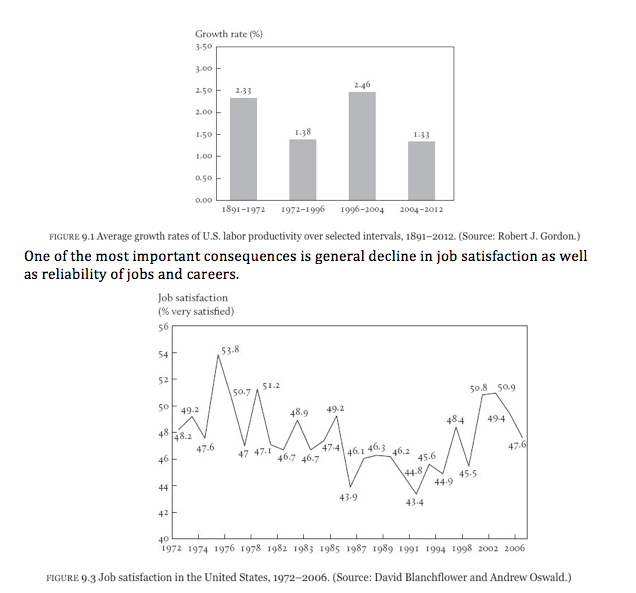
- Understanding the Post-1960s Decline
This chapter goes into analysis of reasons for decline and comes up with the following:
- Structural faults in large Firms, Mutual Funds, and Banks
- The “Money Culture: Self-importance, Doing and Thinking”
- A Broader Nexus Between the State and Economy
All above limit value of work and efforts, leading to decrease in participation in work force and wage to wealth ratio:
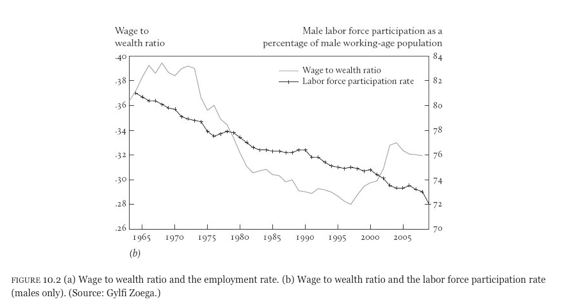
- The Good Life: Aristotle and the Moderns
This chapter is somewhat deviation to philosophical issue of the meaning of good live. Author briefly reviews Humanitarian, Pragmatic, Aristotelian, and Vitalistian concepts of good live and stresses that all of them require good economy as necessary condition, stressing however that it is not enough because even good economy could fail to support good live if it has embedded inequalities and unfairness.
- The Good and the Just
The final chapter goes into more detailed discussion of justice in economy, especially in relation to huge diversity of human individuals and their multiple natures. It compares all discussed forms of economies: capitalist, socialist, and corporatists, inferring that the modern capitalist economy or in other words moderate welfare state is the system most conductive to human flourishing if correctly tuned for that. Author seems to be inclined to support economic freedom of capitalism, but find it insufficient because of limited access to resources for majority of people. He seems to be considers America as more shifted to the freedom at the expense of resources (welfare), while Europe as more shifted to resource redistribution at the expense of economic freedom. The former leads to overwork and unhappiness, while the latter to economic stagnation.
Epilogue: Regaining the Modem
At the end author looks at recent events including crisis of 2008 and discusses the way to the future that he believes should include an innovative combination of traditional capitalist values and modern welfare for everybody values.
MY TAKE ON IT:
I find the factual part of this book interesting, albeit quite familiar. However general recommendations for way out to the better future seems to me quite insufficient. I believe that in order to get out of this dead end we need not just a bit of tinkering with the system, but complete restructuring of the system, which I see as implementation of equal property right for natural resources for everybody with individuals most effective in use of natural resources renting rights for such use from individuals less effective, turning them from passive recipients of loot robbed by the state via taxes into active sellers of valuable commodity. I also believe that all regulations should be substituted by state provided information about all relevant issues to sellers and buyers, limiting therefore use of government violence to protection of property and acquisition of information that individual prefer not to disclose. I guess the most important idea in this book is that status quo is not sustainable on the long run and the great changes are required.
20160423 Foragers, Farmers and Fossil Fuels

MAIN IDEA:
The main idea of this book is that human culture and corresponding values are to the large extent defined by the method of energy acquisition and level of energy consumption that are typical for a given society. The 3 main methods are:
- Foraging, when energy just collected from nature by the way of hunting and gathering. This method is conductive to egalitarian cultures with high levels of cooperation including cooperation in bringing down anybody who is trying to use physical or some other kind of superiority to suppress other people.
- Farming, when energy obtained from cultivated crops and domesticated animals. This method, while generally detrimental to individual well-being nevertheless provides for a big hierarchically organized societies that command superior military power easily capable to push away foragers from any territory farmers want to acquire for themselves. Correspondingly such society built on strict hierarchy that is normally accepted by all members of society from king to the slave with somewhat contractual relationship between different layers of society with top of hierarchy either directly connected to gods or being considered gods themselves.
- Fossil fuel users obviously obtain energy from fossil fuels in amount by far superior to two other methods and use industrial methods to produce goods and services. Such societies strictly limit use of force either in form of wars between societies or internal unregulated violence since industrial methods of violence become too damaging to all sides of conflict. Consequently values of such society return to egalitarian roots despite continuing hierarchical structure of society that becomes much less rigid and formal. These societies also implement new notions of human rights and necessity of general welfare for all as necessary core values without which society would become unsustainable.
DETAILS:
Chapter 1. EACH AGE GETS THE THOUGHT IT NEEDS
The book starts with an episode from author’s youth when he participated in archeological expedition in Greece and encountered such attitude to women by locals that was completely incomprehensible to him: man’s attitude to his wife as if she was less than human. He constantly returns to this episode to demonstrate how alien could be approach of different culture for individual. This book is an attempt to classify at high level all human cultures over period of 20000 years as belonging to one of 3 qualitatively different group: Cultures of Foragers, Farmers, and Fossil fuel users depending on method of energy acquisition and amount of energy used. Author makes point that generally each culture’s features are very similar to any other culture’s features in the same group and qualitatively different from any culture from another group in its system of values. Moreover these systems of values developed evolutionary and are the most effective in supporting survival based on each method of energy acquisition and use. Author also provides a few interesting graphs based on World Values Survey. Here is the most interesting one:

Chapter 2. FORACERS
Author defines foragers as people living of the nature by collecting all necessities of live by using hunting and gathering. He provides a nice table of geography of archeological evidence of such societies:
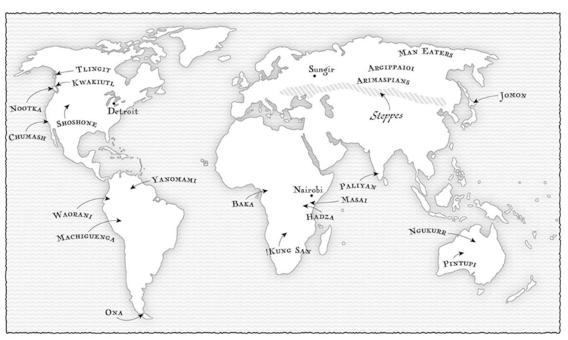
Obviously they are highly depended on climate and nature. While these societies practically disappeared, their values and culture are identified via archeological evidence and anthropological research over last hundred years when they were in process of being eliminated by contemporary civilization. These values are highly egalitarian, with nobody being superior to anybody else, high appreciation of sharing as consequence of superiority of cooperative efforts and impossibility of savings.
Chapter 3. FARMERS
For farmers, whose economy based on cultivation, author provides three-pointed star with core being peasants and points representing somewhat peripheral offshoots of farming society:

Farming societies well familiar not only by archeological data, but because they left tremendous amount of written sources, literature, and art. Moreover they are still with us and as recently as 100 years ago they represented the vast majority of humanity. Correspondingly their culture and values defined by strict hierarchy with every individual assigned to some station with low probability of change and strict enforcement of cultural norm. Author makes an interesting point that this method despite depriving individuals of good live: massive evidence shows that farmers have less nutrition, work more, have low levels of health and high levels of mortality; nevertheless allowed humanity to expand and take over all ecological niches that more or less available, while periodically hitting Malthusian limitations. Here is an interesting evaluation of levels of energy consumption:

Another nice graph represent typical structure of agrarian society:

Chapter 4. FOSSIL FUELS
Finally his discussion of Fossil fuel users is supported by practically infinite amount of data because that is what contemporary societies are. The main feature of such societies is their industrial character and consequently tremendous technological and military superiority over other forms of society. It leads to extreme division of labor and expansion of exchange of labor, capital, good, and services either in voluntary form of market or in coercive form of various types of socialism. Author claims that generally values of this kind of society tend to be more egalitarian and he provides some data to support this idea from pint of view of energy capture:
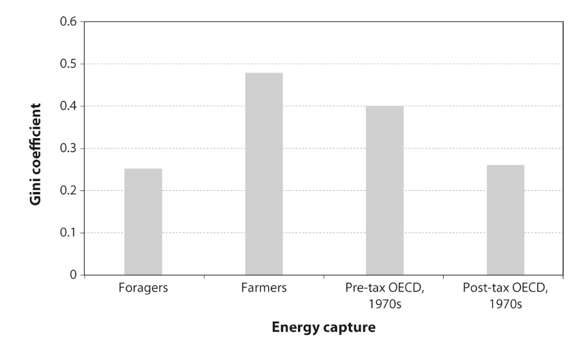
At the end of chapter author summarizes all three type in a couple of nice graphs:

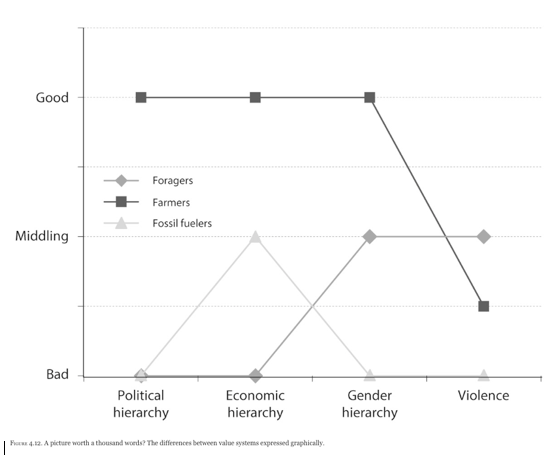
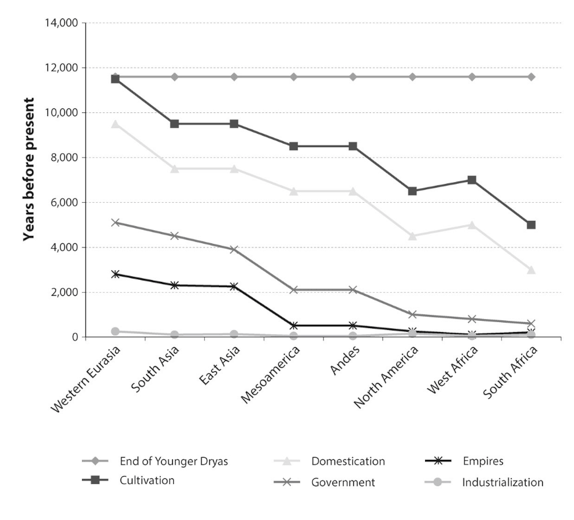
COMMENTS: The remaining 5 chapters of the book present views of author opponents and his response.
Chapter 6. ON THE IDEOLOGY OF IMAGINING THAT “EACH AGE GETS THE THOUGHT IT NEEDS” RICHARD SEAFOOD; Chapter 7. BUT WHAT WAS IT RFALLY LIKE? THE LIMITATIONS OF MEASURING HISTORICAL VALUES JONATHAN D. SPENCE; Chapter 8. ETERNAL VALUES, EVOLVING VALUES, AND THE VALUE OF THE SELF CHRISTINE M. KORSGAARD; Chapter 9. WHEN THE LIGHTS GO OUT: HUMAN VALUES AFTER THE COLLAPSE OF CIVILIZATION. MARGARET ATWOOD
RESPONSE: CHAPTER 10.MY CORRECT VIEWS ON EVERYTHING IAN MORRIS
MY TAKE ON IT:
I like author’s idea to link energy consumption with society’s values via method of energy acquisitions and evolutionary selection of values most conductive for every method. I think that he provided quite good set of examples demonstrating how similar level of energy consumption and method of acquisition led to similar structure of societies and its values regardless of geography, race, and other considerations. The only thing I find missing is a good discussion of future development when energy becomes abundant. What kind of values this situation would cause to develop. Another interesting point missing is a discussion of current effort by elites of contemporary western societies to limit energy consumption by masses under guise of global cooling or warming or whatever. I think that it linked mainly to unconscious, but very strong and probably correct perception by current fossil fuel elites that elimination of energy limitations would cause such dramatic increase in freedom and change on values that they will be bound to loose their elite status and with it power over other people.
20160416 Why Europe Conquer the World

MAIN IDEA:
The main idea of this book is that European countries due to their political history that included constant relatively low intensity and low cost to rulers wars developed what author calls the Tournament model that basically represented an open and competitive market for military activities, that, as markets normally do, was extremely beneficial to creating effective and efficient military goods and services superior to any that other regions could provide.
DETAILS:
Chapter I. Introduction
Here author posits a question: how come that Europe, which was well behind of countries like China in just about everything in 1500 practically conquered the world including China by 1900? He looks at typical answers: diseases and gunpowder technology but finds it inconvincible enough to look for additional causes. He suggests that huge military advantage that allowed such a feat came from specific European way of multiple low stakes military conflicts that he calls the Tournament. This Tournament allowed for honing technology and fighting methodology to such superior level that non-European countries could not compete.
Chapter 2. How the Tournament in Early Modern Europe Made Conquest Possible
The first point in supporting the Tournament idea is statistics of frequency of wars and expenses on military presented in a couple of tables:

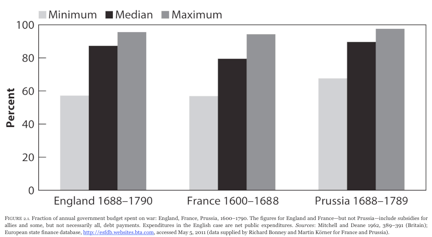
At the same time an important factor was low cost of war for rulers supported by this data:

Correspondingly from economics point of view the Tournament could be considered as market competition for military technology and, as usual, such competition led to decrease in price and increase in quality. This point is supported by example with handguns:
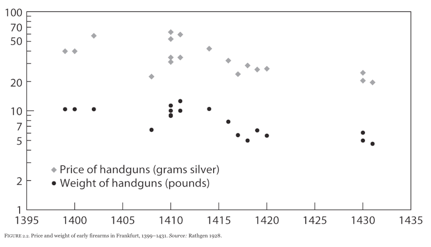
Author summarizes key points of the Tournament model as following:

Another couple of tables demonstrates increase in productivity of military labor and decrease in cost of military equipment relative to non-military goods:


Chapter 3. Why the Rest of Eurasia Fell Behind
This is an analysis of competition: what are the reasons why China, India, Russia, and Ottomans fall behind? The answer author provides: various deviations from the Tournament model: small frequency or different character of wars and consequently failure to stay at par with Europe technologically.
Chapter 4. Ultimate Causes: Explaining the Difference between Western Europe and the Rest of Eurasia
This is a more detailed look at causes, starting with geography: Europe was less not more mountainous than China so it could mountains could not explain higher levels of political fragmentation. Similar analysis provided for low relevance of shorelines. Neither kinship ties between rulers could be considered as a valid explanation. The inference author eventually comes to is that the culprit was political and ideological history of Europe, especially Christianity’s separation of church and state with consequent reformations and religious wars. Probably the most important, albeit not necessary preordained result, was the failure of any of European powers to achieve dominance leading to the continuing Tournament unlike China where dominance of winner removed urgency from the needs of military development.
Chapter 5. From the Gunpowder Technology to Private Expeditions
This is an interesting quirk on European military dominance. It relates to 2 very important features: gunpowder technology and private military colonial adventures. It seems to be the keys to European success: gunpowder because it is very susceptible to technological improvement and tend to have tremendous force multiplier effect practically substituting quantity of people with firepower; while privateering in colonization allowed to do it cheaply, effectively, and with minimal bureaucratic overhead as it is normally done in any private industry. Author also looks at counterfactual speculation of some European country becoming a hegemon, practically eliminating the Tournament and making Europe not different from unified China and consequently incapable to conquer the world.
Chapter 6. Technological Change and Armed Peace in Nineteenth-Century! Europe
In this chapter author traces the decrease in militancy of European countries in XIX century. He does it analyzing use of world “glory” in French and British publications of this period that decreased dramatically. At the same time improvement in military technology and growth in military expenses was continuing unabated. During this period the world conquest was practically completed with just about any landmass divided between European countries.
Chapter 7. Conclusion: The Price of Conquest
In conclusion author discusses price of conquest and eventual clash between European countries of WWI and WWII that led to collapse of European powers and disappearance of their colonial empires. He also once more revisits and rejects other explanations of Europe military dominance such as geography and culture, reaffirming his believes in validity of the Tournament and gunpowder model.
MY TAKE ON IT:
I think it is a nice and quite convincing presentation of reasons for European dominance. I believe, however, that one of the most important reasons for European dominance was underrated in author’s model. This reason is relative freedom to act that was and still is a very special characteristic of European or more widely Western cultures. Author partially touches it in discussion of private colonizing activities, but not sufficiently in my opinion because without this relative freedom not only private companies that colonized world on behalf of European countries would not exists, but also military technology would not developed or stalled as it did happened in big bureaucratic states such as China or Russia. I think it would be fair to say that European conquest of the world was a product of European relative freedom to act in pursuit of wealth whether by obtaining some overseas plantation or producing cheap and highly marketable guns.
20160409 Invention of Science
MAIN IDEA:
The main idea of this book is to trace process of invention of science that in author’s opinion occurred between 1574 and 1704 as consequence of geographical discoveries and their impact on astronomy. These events completely changed western understanding of the world, universe, and live, providing intellectual foundation for industrial revolution and eventually for development of contemporary world.
DETAILS:
INTRODUCTION
Author defines science as building sophisticated theories based on a substantial body of evidence that could make reliable predictions. He relates the beginning of this way of thinking to Tycho Brahe’s discovery of Nova in 1574. Consequently it was firmly established with Newton’s “Optics” published in 1704. This book analyzes various ways of thinking before 1574, and then deals with core period from 1574 to 1704 when scientific approach was developed and, finally, looks at it impact afterworld.
- Modern Minds
This chapter is about different ways of thinking and qualitative difference between modern scientific approach and other approaches. Author uses an interesting way of looking at the set of believes and approaches that well educated European would have back in 1600. This exercise demonstrates a fascinating difference from contemporary thinking with most striking characteristic being an attitude to what could or could not be considered the truth. Basically Brahe discovery of the new thinking comes down to ability to believe own eyes more than ideas transferred via education, something that uneducated common people take for granted and call common sense, while highly educated people to this day tend to discard as way too primitive approach to the world.
- The Idea of the Scientific Revolution
Here author reviews the genesis of idea of scientific revolution that was surprisingly new and was really developed only as recently as 1940s as the brainchild of Alexander Koyre and Herbert Butterfield, later adapted by Thomas Kuhn, and eventually extended to the notion of science development as sequential change in paradigms. It also contains an interesting lexicographic analysis of used terms and notions starting with the word “science” itself.
PART ONE The Heavens and the Earth
This part reviews 3 intellectual revolutions that change our perception of the world:
- Columbus discovery of America that implanted the very notion of discovery into minds of people
- Copernican revolution that created notion of globe and stars as bodies
- Tycho Brahe’s revolution that used Nova and telescope to destroy previously dominant idea of crystalline sphere surrounding Earth.
- Inventing Discovery
The main story here is that before Columbus the idea of discovery was impossible because somebody knew everything, if not now then in ancient time, so the world is unchangeable and there is no new knowledge to discover. Discovery of America proved quite convincingly that not everything is or was known, intellectually opening way for the new discoveries. Author also discusses Bacon’s philosophy of science that was developed as consequence of discovery of discovery.
- Planet Earth
This is a fascinated history of continuously changing and expanding notion of Earth until astronomers established its true form and nature.
PART TWO: Seeing is Believing
This part covers change in representation of knowledge from fifteenth to eighteenth century and development of knowledge acquisition tools such as telescope and microscope that facilitated this change.
- The Mathematization of the World
This chapter looks at impact of geometrical perspective developed by graphic artists on perception of space with following on practical application of mathematical and geometrical concepts in various areas of live from building construction and architecture to use of calculations in artillery ballistics.
- Gulliver’s Worlds
This chapter provides more detailed account of tools of knowledge that expanded human senses to rich distanced starts and planets with telescope and opened for observation miniature world of bacteria and details of materials with microscope.
PART THREE Making Knowledge
This if the key part of the book and it discusses the new special language that was developed to convey scientific ideas and notions and how it came about.
- Facts
The most important part of science is recognition and understanding of existence of a fact – the thing that did really occur or was actually the case. Here author again going to astronomy, specifically Kepler to demonstrate the early establishment of notion of fact as necessary tool for science. He also discusses disestablishment of “fact” using example of Giambattista Della Porta whose work “Natural Magic” was bestseller in between 1560 and 1660. Afterword author moves to the philosophical discussion, and consequently to modern understanding of a fact.
- Experiments
Author’s discussion of another key notional foundation of science – experiment uses Pascal’s work and philosophical application of this notion by Francis Bacon. As practical consequences of establishment of this new scientific notion author briefly reviews end of alchemy as a viable area of application of intellectual effort.
- Laws
This is about laws of nature and correspondingly Descartes’ philosophy. Probably the most important here is the notion of Nature’s laws as an unchangeable condition of live and environment. Originally it was perceived as just another case of God’s laws something like “ you shell not kill”, only it was setup in nature and could not be violated. However due to some extent to protestant’s theology the god got decoupled from nature’s laws that become considered as their own logical and philosophical entity.
- Hypotheses/Theories
This is about notions of hypotheses vs. theories. It used idea of science defined by James Conant who was Kuhn’s mentor as iterative process of analysis of facts leading to synthesis of theories in turn leading to design of experiments to produce new facts, include them into analysis and consequently expand, change, or reject theories and substitute them with the new ones.
- Evidence and Judgment
The final chapter of this part starts with static definition of science as knowledge based on evidence and then proceeds to discuss nature of evidence and it’s dependence on judgment. It brings into discussion John Locke and his “Essay Concerning Humane Understanding”. Overall it is a very detailed discussion of the notion of “evidence” in its multiple incarnations from casual use to legal and scientific special uses. At the end it looks at evidence in its relation to experiment and consequently to idea of science as the only intellectual tool with relatively reliable predictable power.
PART FOUR Birth of the Modern
This part is reviewing consequences of scientific revolution: Industrial revolution and intellectual delegitimizing of magic, demons, and similar entities that failed to obtain scientific confirmation.
- Machines
Here author traces link between revolutions in the way of thinking and revolution in the way of doing things. Machines including steam engine where known for a long time, but only new scientific way of thinking, specifically mechanistic view of universe allowed their application for productive purposes.
- The Disenchantment of the World
This chapter narrates how new scientific thinking invalidated traditional magical believes by applying requirements of experimental confirmation. The mass remaking of culture to exclude magic from general worldviews was relatively successful, albeit we still have difficulties with using scientific approach consistently especially when people’s prosperity depend on promoting non-scientific fads.
- Knowledge is Power
Here author makes quite convincing case that relationship between scientific knowledge, practical knowledge, and philosophy is far from straightforward. In its nonlinearity this relationship is extremely complicated, but generally could be based on philosophy coming first and opening way for non-formal quasi-scientific thinking and acting with experimentation much close to tinkering than to ex ante thought through formal activity, while actually working machines prompting search for formal scientific understanding of nature of machines, in turn opening way to the next level of complexity and utility of the machines.
CONCLUSION The Invention of Science
The final chapter discusses consequences of recognizing reality of scientific revolution.
- In Defiance of Nature
Here author discusses progress as purely scientific characteristic of knowledge and technology, while denying it as characteristic for humanities. He looks at various philosophical approaches to science: relativists, holists, determinists, constructivism, naïve relists, postmodernists, and such.
- These Postmodern Days
Here author discusses his role and philosophy as historian, stressing impossibility of neutral perception of the past due to impossibility to discard existing knowledge. His important concern is not to write teleological narrative since he does not believe in such approach.
- ‘What Do I Know?’
This chapter presents the final conclusion that science – the experimental method interlocking theory and practical technology completely change our approach to the world and consequently become so much foundational part of our intellectual lives as to be invisible.
MY TAKE ON IT:
I think this book a little bit overemphasizes role of geographical discoveries and astronomy in development of scientific way of thinking. I would look more at overall specifics of development of western society that was characterized by high level of competition in all areas especially in military areas with multiple wars with no final victory for anybody, continuously changing alliances, and high level of dependency on technology for outcome of conflicts, making it very important to evaluate reality as it is regardless of preexisting conceptions and/or misconceptions that one has. I would also pay more attention to ideological or more precisely theological competition that was instrumental in development of intellectual tools that eventually were used in scientific revolution.
20160402 The Health Gap
MAIN IDEA:
The author of this book is also author of the famous Whitehall study of British civil servants that convincingly demonstrated direct correlation between individual’s health outcomes over long time with this individual’s place in the bureaucratic hierarchy: the lower place in hierarchy the less healthy is the individual. These findings demonstrated that typical justification for perks for high-level bureaucrats based on their “sacrifices” and “burden of responsibility” has no value whatsoever. However despite this prove of high cost of hierarchy for its low-level members author seems to see way for improvement in collectivistic solutions such as government healthcare, higher control over individuals by bureaucracy and similar measures.
DETAILS:
Introduction
This starts with the story of author’s discovery of direct mind-body-health connection back in his youth when he was a doctor in Australia hospital. The core of discovery: the stress damages physical health and the good material and psychological conditions of live are necessary for good health. Therefore author objective is “Rise up… against the organization of misery”
- The Organization of Misery.
Here author refers to research results for different social strata in Glasgow that demonstrated health and mortality dependency on belonging to one strata of society or another. As one could expect more wealth directly linked to more health. Then this analysis is expanded from one city to different countries demonstrating that it generally applied across the world, however with a caveat that lower strata in rich country could have worse health outcome than top strata in poor country. In short the correlation is not strong between wealth and health of countries on average. Here is a nice graph for this:
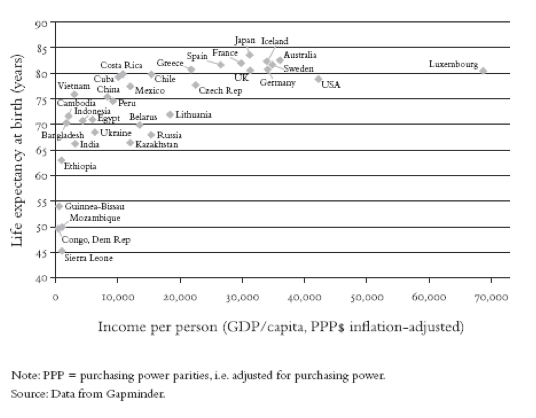
The conclusion at the end of chapter is that it is not only absolute, but also relative wealth that counts for health outcome.
- Whose Responsibility
This is about responsibility for one’s health. Author conclusion is that it should be shared. Individual responsibility should be heavily supplemented by free medical services. I really like the rules for healthy living provided by author, even if he believes that much of it does not depends on individuals, but rather on circumstances of their lives:
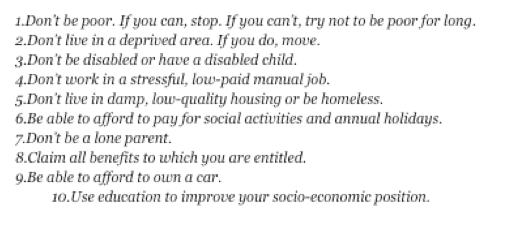
- Fair Society, Healthy. Lives
This chapter includes discussion on understanding of fairness and justice. It is using ideas of John Rawls, utilitarian Jeremy Bentham, freedom and equality of opportunity, deserving vs. undeserving poor, and such. The key point here is that live inequalities have really tangible consequences in health outcomes. Most interesting is author’s conclusion that the best way to social justice is to maximize freedom and create conditions for people to have control over their lives. At the end of chapter author points out that even if economic status and health influence each other, the main concern should be directed to economics impact on health and therefore effort should be directed at improvement of economic situation of people.
- Equity from the Start
This is about impact of childhood circumstances on health and wealth acquisition in adulthood. Here is a very interesting graph for IQ:

The inference here is that low economic status in childhood has significant impact on all outcomes and in order to achieve real equality of opportunity society should break the link between poverty and early childhood development.
- Education and Empowerment
The key point of this chapter is that education and knowledge is not only power, but also health:
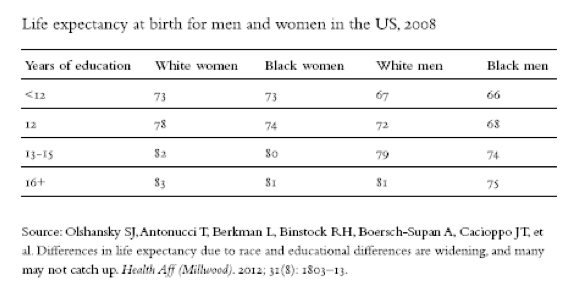
- Working to Live
This is analysis of relationship between work and health. Unsurprisingly the conclusion is that hard and routine work with high stress and low security is very unhealthy. However unemployment is even unhealthier. Finally the demanding job with high level of satisfaction providing high income is very healthy, even necessary.
- Do Not Go Gentle
This chapter about age and health starts with a very good advice from Shakespeare: one should not get old until he has got wise. Then it goes into analysis of social economic influence on age and health and demonstrates that it is quite significant:

The conclusion here is that wealth, psychologically rewarding work, and political power provide for better health for older people in developed countries.
- Building Resilient Communities
This chapter is about impact of community that individual belongs to on individual’s health both physical and mental. It is not good enough to be wealthy and healthy, it is also important to belong to wealthy and healthy community. Otherwise one’s own well being is always unreliable.
- Fair Societies
This is about author understanding of good and bad societies. Author seems to give credit to right wing ideology for good economy, but insists that unbridled markets are bad especially for education and health. At the same time he is very cautious not to support such isms as socialism and communism in view of proved disastrous experience with these systems in XX century. As one would expect, his ideal or something close to it is Nordic (Sweden or Denmark) welfare state with strong caring government keeping check on capitalism.
- Living Fairly in the World
This chapter is about worldwide health outcomes and their relation to globalization, trade, and overall economics of various countries. Author uses UN Human development report to come to preordained inference that health directly, positively, and causally related to public spending on healthcare and education. This is followed by discussion of third world and need for global governance to achieve positive results, meaning more equality.
- The Organization of Hope
The last chapter is about author activities in international organizations that promote ideas of society organization beneficial for health of its members. It refers to author 3 reports: “Closing gap in a generation”, “Fair society, healthy lives”, and European Review of Social Determinants and Health Divide”. The key point here is that, in author’s opinion based on evidence, the inequality in income and wealth directly causes inequality in health outcome, so in order to improve latter one had to improve former first. Author seems to believe that it could be achievable by Social-democratic means, that is by growing bureaucracy that would have increasing control over economics and human lives in order to make these lives healthier.
MY TAKE ON IT:
I find this book very interesting as source of data and quite primitive as source of recommendations. There is an interesting and, seems to be unavoidable for socialistically minded people contradiction between author’s data in recommendations. His data demonstrate that it is quite unhealthy to be a low level bureaucrat in huge bureaucratic machine even in wealthy country, while his recommendations are directed to increase in bureaucracies not only at the local, but also on the global level. There is also a typical approach to big governmental bureaucracy as some benevolent entity dedicated to common good with complete disregard of existing experience that all bureaucracies are always just mechanism to achieving goals of human individuals who control them. Needless to say that goals and objective of these individual usually fully dedicated to their own well being, with formal “objectives of bureaucracies” being just a façade useful for convincing people transfer resources to them. I believe that big bureaucracies could not possibly be healthy even if they objectives include “common health”. The only way individuals could be healthy is if they have necessary resources available to them on individual basis including ability to decide how these resources are used. Without this ability whatever amount of “public resources” spent on “common health” will eventually be converted into resources spent on wealth and prosperity of bureaucrats in control of these resources.
20160326 Learning by Doing

MAIN IDEA:
The main idea of this book is that inventions that have impact on civilization, even small ones, are not a product of lone geniuses, but rather complex results of various efforts of multiple people doing some improvements big and small. We should understand the complex nature of inventions and promote all individuals’ active participation in the process regardless of how insignificant their role looks like. Moreover, not only inventions, but also all and any meaningful improvement in processes and technology require skills, efforts, and deserve good remuneration because skills level requirements while different in reality are much less significant than usually perceived and even what is considered low level unskilled job still provide necessary component into the Prosperity of Nations.
DETAILS:
PART I. TECHNOLOGY
- More Than Inventions
Author uses the development of textile industry in USA as source of information for process of development and implementation of ideas. He starts with looking at quality of people employed in this industry over its live cycle and finds that it changed quite dramatically over time. During initial phases it was very high with relatively highly educated girls employed even in low-level jobs, but with development of tools, processes, and technics demand for high quality people decreased. He looks at 4 conceptual distinctions of technology implementation:
- Technology vs. Original Inventions
- Mass vs. Elite Knowledge
- Knowledge vs. Ideas
- Dynamic vs. Static Technical Knowledge.
- The Skills of the Unskilled
Here author analyses learning curve and concludes that the most important part of learning is doing. Here is a nice graph to demonstrate this:
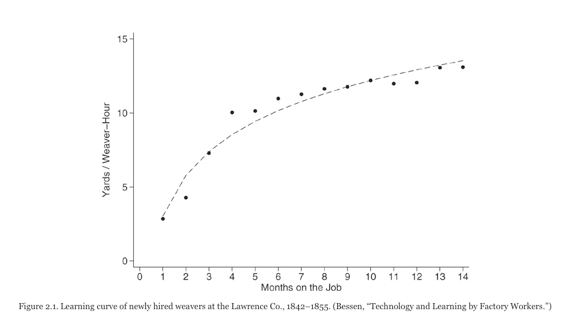
There is important caveat here that it is not possible to achieve results via theoretical learning only.
- Revolutions in Slow Motion
Here author supports his thesis by presenting data that scientific / industrial revolutions generally are not really short-term events, but rather long tern developments. Here is a nice table demonstrating this:

- Standard Knowledge
This chapter is about standardization of knowledge. It begins with story of periodic table, which greatly simplified learning of chemistry and analysis of chemical processes. Then he looks at live cycle of knowledge and at process of establishment of dominant design, as usual using example of QWERTY. Another very interesting point in this chapter is that future development is unknown and could not be predicted even by the best experts as it demonstrated by example with AOL and Time Warner.
PART II. WAGES
- When Does Technology Raise Wages?
This chapter looks at dynamics of wage changes in relation to technology implementation and maturity, again using example of textile industry. The most important part here is discussion of relation between wages and unique and not easily transferrable or obtainable skills. Individuals with such skill normally get nice premium on their use.
- How the Weavers Got Good Wag
This chapter uses history of weavers and how their wages changed based on skills. Here a small table summarizing it:

- The Transition Today: Scarce Skills, Not Scarce Jobs
The main point of this chapter is that so far robots do not push people out of work, despite logical inference that it should eventually happen. Even bank teller did not really disappear; only their number just stopped growing. People just had to switch to different occupations and the main problem is skill mismatch when job market demands are changing faster than people are capable to meet them.
PART III. TECHNOLOGY POLICY
- Does Technology Require More College Diplomas?
This chapter looks at notion of formal higher education being the key for success. It used to be true when jobs where less specialized so any college graduates had general skills required. Now however general college education is not enough, market requires specific skills that people fail to acquire because resources are directed to colleges. Here is a nice table demonstrating this:

- Whose Knowledge Economy?
This is about current situation when everybody becomes a knowledge worker, whatever area he/she is working in. It looks specifically at manufacturing and concludes that huge growth of productivity is the main cause. It uses recent history of steel production of demonstrative the case.
- Procuring new Knowledge
This chapter looks positively at government procurement programs as a way to build useful specific and applicable knowledge for population. The cases here are from defense and health industries.
- The Forgotten History of Knowledge Sharing
This chapter is very interesting by its analysis of knowledge sharing between inventors and innovators. Author makes pretty convincing case for a fresh look at patent laws and cases when strict intellectual property could be not that good for innovation.
- Patents and Early-Stage Knowledge
This is continuation of intellectual property discussion with main point that explosion of litigation brings a serious threat to process of the new knowledge creation. Here is the related graph:

- The Political Economy of Technical Knowledge
This chapter is about legal and political approaches to innovation in Japan and USA and how it could promote of stun development.
- The Skills of the Many and the Prosperity of Nations
The final brief chapter is the restatement of main thesis of the book that knowledge and skills widely distributed among population and new useful knowledge is not developed by superior geniuses, but rather is result of conscious or more often unconscious cooperative efforts of people each of which just trying to improve their own live and be more effective and efficient in doing whatever they are doing. The result of these efforts is prosperity of population or lack thereof when political and/or ideological circumstances prevent people from doing it.
MY TAKE ON IT:
I am petty much in synch with ideas of this book. I also believe in superior effectiveness and eventual efficiency of independent efforts of free people comparatively to top down directed and bureaucratically organized effort of people included into hierarchical structures. The only partial disagreement I have is with idea that the new technology just shuffles people from one activity to another without removing need in their work. I strongly believe that ongoing development of computer technology and especially Artificial Intelligence eventually would lead to complete elimination of humans from routine activities in all areas from manufacturing to R&D research. It is bound to happen and for foreseeable future it would be stressful and painful process of finding new methods for functioning of human society without sale of labor as its economic foundation. Humanity was relatively successful in its switches from hunting gathering to militaristic-agricultural and then to industrial and informational methods, so it should manage to do well while switching to labor-less economic foundation when all human activities are voluntary and not dependent neither on direct coercion of slave or indirect coercion of wage earner.
20160319 Cybersecurity and Cyberwar

MAIN IDEA:
The main idea here is to review Internet technology and its vulnerabilities to informational crimes such as stealing valuable data, taking control over information flows, especially such sensitive as classified data or money flow, and even taking over control via computer network over power grid, transportation and information networks. The auxiliary objectives to the idea to raise awareness of the threat are proposals that authors offer in order to handle these problems.
DETAILS:
INTRODUCTION
Why Write a Book about Cybersecurity and Cyberwar? Why Is There Cybersecurity Knowledge and Why Does It Matter? How Did You Write the Book and What Do You Hope to Accomplish?
This introduction is mainly about reasons for writing this book: poor understanding of nature of Cybersecurity, threats caused by its deficiencies, and methods to improve it. The objective is to promote conscious understanding of related issues that would lead to improvement in technology, behavioral patterns, and legal framework for new Internet world.
PART I HOW IT ALL WORKS
The World Wide What? Defining Cyberspace. Where Did This “Cyber Stuff’ Come from Anyway? A Short History of the Interne; How Does the Internet Actually Work? Who Runs It? Understanding Internet Governance; On the Internet, How Do They Know Whether You Are a Dog? Identity and Authentication; What Do We Mean by “Security” Anyway? What Are the Threats? One Phish, Two Phish, Red Phish, and Cyber Phish: What Are Vulnerabihties? How Do We Trust in Cyberspace? Focus: What Happened in WikiLeaks? What Is an Advanced Persistent Threat (APT)?
How Do We Keep the Bad Guys Out? The Basics of Computer Defense; Who Is the Weakest Link? Human Factors;
This chapter contains highly simplified technical details of Internet, TCPIP and how it works functionally. The key point here is that the way Internet designed, it is very difficult differentiate between data and executable code and most important contemporary systems designed execute code that comes with message. This is the root cause of hackerism, data theft, and cyber attacks. However the conclusion author infers is that the weakest link of computer / human interactive system is human, not computer. It is human who fails to setup strong password, divulge information they are not supposed to divulge, get cheated by phishing and other methods of social engineering.
PART H WHY IT MATTERS
What Is the Meaning of Cyber attack? The Importance of Terms and Frameworks; Whodunit? The Problem of Attribution; What Is Hactivism? Focus: Who Is Anonymous? The Crimes of Tomorrow, Today: What Is Cybercrime? Shady RATs and Cyberspies: What Is Cyber Espionage?
How Afraid Should We Be of Cyberterrorism? So How Do Terrorists Actually Use the Web?
What about Cyber Counterterrorism? Security Risk or Human Right? Foreign Policy and the Internet; Focus: What Is Tor and Why Does Peeling Back the Onion Matter? Who Are Patriotic Hackers? Focus: What Was Stuxnet? What Is the Hidden Lesson of Stuxnet? The Ethics of Cyber weapons; “Cyberwar What Are Zeros and Ones good for?” Defining Cyberwar; A War by Any Other Name? The Legal Side of Cyber Conflict; What Might a “Cyberwar” Actually Look Like? Computer Network Operations; Focus: What Is the US Military Approach to Cyberwar? Focus: What Is the Chinese Approach to Cyberwar? What about Deterrence in an Era of Cyberwar?
Why Is Threat Assessment So Hard in Cyberspace? Does the Cybersecurity World Favor the Weak or the Strong? Who Has the Advantage, the Offense or the Defense? A New Kind of Arms Race: What Are the Dangers of Cyber Proliferation? Are There Lessons from Past Arms Races?
Behind the Scenes: Is There a Cyber-Industrial Complex?
This chapter is detailed review of all potential problems that could come from Internet, various viruses, dark net – Tor, and review of potential state led attacks with especial attention to Chinese activities.
PART III WHAT CAN WE DO?
Don’t Get Fooled: Why Can’t We Just Build a New, More Secure Internet? Rethink Security: What Is Resilience, and Why Is It Important? Reframe the Problem (and the Solution): What Can We Learn from Public Health? Learn from History: What Can (Real) Pirates Teach Us about Cyber security? Protect World Wide Governance for the World Wide Web: What Is the Role of International Institutions? “Graft” the Rule of Law: Do We Need a Cyberspace Treaty? Understand the Limits of the State in Cyberspace: Why Can’t the Government Handle It? Rethink Government’s Role: How Can We Better Organize for Cybersecurity? Approach It as a Public-Private Problem: How Do We Better Coordinate Defense? Exercise Is Good for You: How Can We Better Prepare for Cyber Incidents? Build Cybersecurity Incentives: Why Should I Do What You Want? Learn to Share: How Can We Better Collaborate on Information? Demand Disclosure: What Is the Role of Transparency? Get “Vigorous” about Responsibility: How Can We Create Accountability for Security? Find the IT Crowd: How Do We Solve the Cyber People Problem?
Do Your Part: How Can I Protect Myself (and the Internet)?
The final part is pretty much about various options of making Internet more secure. It goes into details of international agreements existing and potential, role of transparency and incentives for good Internet behavior.
CONCLUSIONS
Where Is Cybersecurity Headed Next? What Do I Really Need to Know in the End?
This is look at Internet future with cloud, switch to mobile devises, Internet of things, and attempts of all kind of current evildoers like Chinese government and aspiring evildoers like Obama totalitarians to bring Internet under government control.
MY TAKE ON IT:
It is all nice, timely, and important, but I cannot understand why it is not possible to change computer systems in such way that they would run code downloaded exclusively from known source keep it in protected area of memory, and execute on demand, rather then treat all input data as potentially executable code. Obviously such redesign would require a lot of effort and would make system less flexible, but if arriving data allowed only reference to code already registered on computer, all hacking become plainly impossible. I am quite sure that something like this is the work and if it would be not Internet 2.0, then it would be Internet 25.5, but eventually free for all will end and Internet would become more secure then any facility where one could walk in in person in order to cause any harm.
20160312 Destiny Disrupted

MAIN IDEA:
The main idea of this book is presented in introduction as an attempt to provide western reader with a narrative of Islam both as religion and as civilization from point of view of a Muslim born and raised in Afghanistan, who is well versed in traditions and history of this civilization, but, nevertheless, spent most if his adult live as teacher in American university becoming well familiar with people and ideas of the West. The point is made that Islam as so big and rich culturally, religiously, and historically it deserves to be taken seriously.
DETAILS:
Introduction
Chapter 1 – The Middle World: THE MIDDLE WORLD BEFORE ISLAM
Here author reviews somewhat unusual look at geographical and cultural history of humanity as parallel history of Mediterranean world of Greece and Romans that produced Western civilization based on sea going trade and Middle world of landmass to the East based on caravan roads that produced Islamic world. This chapter deals with pre-Islam history that occurred on this landmass.
Chapter 2 – The Hijra
This is history of Muhammad and his creation of Islam religion that proved to be capable unify Arab tribes, stop internecine warfare, and create highly effective military-ideological entity capable to conquer not only weaker tribes nearby, but also incorporate massive remnants of the empires of the past. The beginning of this entity is considered startup year or Hijra (0 AH) – the year when Muhammad ran away from Mecca to Medina to avoid suppression by local tribes and find the place to consolidate his military-religious community designed to bring the world into submission. The expansion started with return back to Mecca in AH6 and its complete conquest in 8 AH.
Chapter 3 – Birth of the Khalifate
THE FIRST KHALIFA (12 – 14 AH)
This chapter is about history after Muhammad’s death. It begins with fight over inheritance between Abu Bakr, older and richer member of community, Omar more militaristic leader, and Ali, Muhammad’s adapted son and son in law. Abu Bakr was given preference over Ali due to his age and overall respect that he enjoyed in community. The key however was not selection of Abu Bakr, but his attempt to establish unity of Islam as social project inseparable from religion complete unification of religious and secular roles of top leader – Khalifa. This was enforced by strict ban on leaving Islam with death being the punishment for apostasy.
THE SECOND KHALIFA: 14 – 24 AH
Just two years after Muhammad Abu Bakr died with Omar taking over new Islamic entity and initiating successful war of conquest over nearby Byzantine and Sassanid Empires that were so existed by fights between themselves that they were not capable to resist newcomer with huge religious zeal and attractive ideology that elevated burden of taxes and pretty much left people alone in their believes, however creating significant enticements for conversion to Islam. By the time of Omar’s death Islamic community – Umma was in possession of significant and growing territory.
Chapter 4 – Schism
THE THIRD KHALIFA (22-34 AH, 642-656 CE)
This one – Othman was another relative of Muhammad, the rich man who became austere after conversion. Once again Ali was passed over. Othman lift ban for Muslims on buying land in conquered countries and appointed his cousin Mua’wiya who start typical regime of exploitation, all of this resulting in riot, killing of Othman and installment of Ali as fourth Khalifa.
THE FOURTH KHALIFA (35-41 AH, 656 – 661 CE)
This resulted in civil war in which Ali lost and was eventually assassinated with Mua’wiya coming to power as 4th Khalifa after settling with Ali’s son Hassan with monetary bailout. This pretty much ended religious period and started Umayyads Empire.
Chapter 5 – Empire of the Umayyads (40-120 AH)
Despite Hassan’s settlement, his brother Hussein and his supporters considered him true Khalifa so eventually civil war continues until Hussein and his supporters were massacred at Karbala. This initiated Islam division into Shi’a and Sunni with majority Sunnis considering Muhammad just a messenger so his bloodline was irrelevant for selection of leader. The only important thing in addition to message he delivered (Koran) was example of living (Sunna recorded in Hadith), while for Shi’a there is always one and only Imam who carries mystical substance passed from Allah to Muhammad and then to each current Imam. For Sunnis their own live is the only thing that counts in achieving the bliss, for Shi’a own effort is not enough, the road to bliss goes through submission to leadership of current Imam. Umayyads took in Islam as ideological / religious foundation and build empire with normal state of perpetual war.
Chapter 6 – The Abbasid Age (120 – 350 AH)
At 120 AH new revolution and civil war swept away Umayyads and clan Banu Hashim established the new dynasty that started with Khalifa Abbas – Abbasid. They build Bagdad as the new trade, cultural, and administrative center. Abbasids were very supportive to trade and tolerant to diversity of people so they achieved relative long-term prosperity.
Chapter 7 – Scholars, Philosophers, and Sufis
This chapter is about ideological development of Islam with its 3 directions that fight between themselves for supremacy with Scholars or more precise Clerics winning and consequently stopping development of Islam into religion consistent with contemporary civilization. This unfortunate development pretty much cut off possibility of coexistence with religions and ideologies of other people, leave alone space for existence of individual believes within Islam dominated countries.
THE SCHOLARS
These are community of religious specialists (Ulama) who are self selected through diligent study of texts and acceptance by other clerics. As one would expect they are fully dedicated to sanctity of the text and reject reality if it contradicts texts. Moreover they happily use force against anybody who they consider out of compliance with the text.
THE PHILOSOPHERS
This somewhat parallel to Western enlightenment attempt to open way for science, which unlike its western counterpart was completely defeated by clerics around 200 AH.
THE SUFIS
This is mainly mystical movement within Islam in search of happiness through unity with god. Probably the most outstanding thinker in this movement was Ghazali who managed accommodate Sufism with ulama and then in alliance with ulama was able to completely defeat philosophers.
Chapter 8 – Enter the Turks
This chapter is about Turkish invasion. Turks came from Central Asia and took over Islamic world severely weakened by continuing struggle between Fatimid Khalifate in Cairo and Abbasid Khalifate in Baghdad. Seljuk empire established by Turks by the end of millennium was covering significant parts of Islamic population, but universal community of Islam was divided into Shia, Sunni, and all kinds of other sects with some quite weird such as Assassins who pursued political goals via murder as a standard method. Then came catastrophic evens of invasions.
Chapter 9 – Havoc
ASSAULT FROM THE WEST
Author defines crusades as a relatively small catastrophe that limited geographically and was really not that significant for Islamic world.
ASSAULT FROM THE EAST
Much more significant was Mongol invasion when Chengez Khan sacked Baghdad and practically took over all areas with Muslim population suppressing resistance with extreme cruelty. However, similarly to China and other areas of Mongol conquest, they were susceptible to accepting religions and norms of conquered societies so starting in 1257 CE they slowly converted to Islam.
Chapter 10 – Rebirth
The Mongolian onslaught caused difficult theological questions since Allah should guarantee victory to members of one and only true religion, but he let them fail. Syrian lawyer Ibn Taymiyah founder of Salafism provided the answer: Muslims deviated from strict Islamic traditions, accepted too many innovations, and failed to wage jihad against infidels with sufficient zealotry. The correct way for the future is to go back to 7 century, Koran, Sharia, and perpetual war against non-Muslims. Another response came from Sufism with its brotherhoods and mysticism.
THE OTTOMANS (ABOUT 700 TO 1341 AH)
Here author provides brief history of Ottomans with their struggle against Byzantine and attacks against Europe. Eventually they took Constantinople ending 1000 years of Roman Empire, but failed to conquer Christian Europe beyond this. Correspondingly Safavids stopped their eastern expansion.
THE SAFAVIDS (906-1138 AH)
Safavids were continuation of Persian Empire ideologically based on Shi’a Islam.
THE MOGHULS (ROUGHLY 900 TO 1273 AH)
Even further to the east in India was Moghuls Empire that was inherently weak because it had significant share of population Hindu not easily convertible to Islam. However at high point around 1600 CE it achieved status of one of the biggest empires in the world.
Chapter 11 – Meanwhile in Europe (689-1008 AH or 1291 – 1600 CE)
While Islamic world rejected innovation and development, Christian Europe embraced it and here author looks at history of Reformation, discovery of new world, expansion of maritime trade, and initial steps of industrial and scientific revolutions.
Chapter 12 – West Comes East (905-1266 AH or 1500 – 1850 CE)
This is about colonial expansion of European countries throughout the world crashing or forcing to comply local populations with demand for resources, colonies, and control over trade.
Chapter 13 – The Reform Movements (1737-1918 CE)
Here author discusses parallel with Christianity or more precisely lack thereof since Islam never had anything like Reformation. He believes that it is because reformation was a rebellion against the Church, while Islam does not have such institution. Islam, however has its own movements, but they are completely different than Western. If Christians rebelled against priests and their bureaucracy to go ahead to more freedom and industrial revolution, Muslims rebel against leadership formal or informal like ulama that led to weakness.
WAHHABISM
Here author looks at Wahhabi movement that could be characterized as “Back to Muhammad, Jihad, and conquest ideas. Supported by alliance with Saudis they quietly maintained their continuing presence.
THE ALIGARH MOVEMENT: SECULAR MODERNISM
This movement linked with Sayyid Ahmad and was mainly directed at accommodating Islam and civilized world with stress on becoming civilized.
ISLAMIST MODERNISM
This movement was the most popular and linked with Sayyid Jamaluddin. This movement was directed more at modernization rather than civilization with insistence on primacy of Islam.
Chapter 14 – Industry, Constitutions, and Nationalism (1750-1918)
This chapter is about developments preceding WWI when Islamic world picked up ideas of nationalism, progress, and constitution. It eventually led to Arab revolt and dissolution of remnants Ottoman during WWI
Chapter 15 – Rise of the Secular Modernists (1918-1939)
The first ¾ of XX century were time of secular modernists who pretty much took over Islamic world installing diverse secular systems from Ataturk in Turkey to Shah in Iran, and later Nasser in Egypt or Saddam in Iraq. All of them had common feature of accepting at least partially European ideas of National Socialism and promising to build prosperity and power on this bases.
Chapter 16 – The Crisis of Modernity (1939-1966)
However all these secular rulers clearly failed to bring either prosperity or power comparable to the West so they lost any allure for masses. The most damaging was probably repetitive failure of combined Arab forces to massacre Jews in Palestine and even worse establishment of Israel. This conveyed complete impotence of Islamic modernism to assert superiority of Islam and led to massive rejection of modernism in the name of Islam.
Chapter 17 – The Tide Turns (1950-2001)
The latest part of XX century was characterized by increasing substitution of secular regimes with Islamic starting with Iranian mullahs and all the way to current recreation of Caliphate. All this was fed by terrorism as main tool of Islamic reassertion in the world.
Afterword (After 2001)
Author believes that review of this period is too early for history, so it belongs to journalism. However author points out that Western attempt to transplant democracy to Islamic world plainly failed because it implies individualization of society that completely contradicts communal nature of Islam. As communal society Islam combined religion, way of live, and political structures of society. It requires submission and would not tolerate dissent, while western society left religious uniformity behind and celebrates individualism and freedom. These two approaches are not compatible. As example author poses question: how one can reconcile believe that society should be absolutely divided into male and female area, with believe that men and women are individual and independent actors who define for themselves areas and types of activities.
MY TAKE ON IT:
I agree that Islam and its history are not separate, but integral part of human history and that its communal nature is completely incompatible with western individualistic view of the world. This leaves us with little options because while western nature has no problem with toleration of different society, Islam does not allow for toleration, only submission. That means inevitable war the severity of which is completely defined by weakness of Islamic societies. As long as they are weak they will see temporary accommodation or at least non-aggression as necessity and behave relatively peacefully, but as soon as they feel strong enough, their aggression will be inevitable. In my opinion, since preemptive aggression and resolute suppression is inconsistent with western humanitarian values, while submitting to Islam is not possible without civilizational, moral, and intellectual self-destruction, the West has little choice but to deal with it by establishing borders around Islamic world impenetrable for military or any other potentially dangerous technology and leave opening exclusively for people who are willing to leave original Islam behind and join decadent, humanitarian, and individualistic western world. Obviously any attack should be retaliated in such way that attackers and their supporters, either material or inspirational, lost any conceivable ability attack or inspire somebody else to attack again.
20160305 The Changing Face of War
MAIN IDEA:
The main idea of this book is to review XX century warfare from its initial pattern of multimillion armies clashing on wide fronts in WWI to total war between alliance of Democracy and Soviet Totalitarism against German and Japanese totalitarism with Cold war and late XX century Islamist insurgency at the end of the century. The main inference is that war between developed countries become impossible due to the nuclear weapons, while suppression of insurgencies is very tricky and could be done either through high cruelty of suppression or expensive high level of population accommodation. The significant point is that XX century warfare is of little use in XXI century where armed conflict occurs between population of developed world and barbaric Islamic fundamentalists that are not even at the gates, but rather inside of our cities and could win if we fail to wake up.
DETAILS:
Introduction
This book is about war in XXI century as the product of military developments and wars of XX century. It is poses the question why contemporary armies of highly developed western countries like USA while being capable win on the battlefield incredibly quick and with minimal loses seems to be fail when it comes to contain terrorism and let poorly organized and widely distributed forces of insurgents overrun whole countries and even entire continents.
Chapter 1: Prelude, 1900-14: 1.1 States, Armies and Navies; 1.2 Visions of War; 1.3 Resisters and Enthusiasts; 1.4 The Balance of Power; 1.5.War Plans; 1.6 Facts and Counter facts.
This chapter is look at initial period of military history of XX century with its multimillion conscript armies, huge industrial machinery, and high reliance on rigid railroad transportation system. The key to understanding of pre WWI period and consequently path to the war is understanding of industrial character of war and believe common for leaders of all countries that concentration of people and material would provide for overwhelming advantage and consequently victory. This caused all of them to put effort into planning of mobilization and transportation forces to frontline and created situation in which any delay of initiating this activity would lead to loss, while once initiated it would be impossible to stop. Another key feature of prewar situation was mass enthusiasm among population of all countries that were raised on stories of glorious past in very peaceful period with no knowledge of cruel reality of war. The final consideration is balance of power between countries and their forces that remained fluid to the very brink of hostilities causing leaders to rush ahead any time when they believed they have temporary advantage.
Chapter 2: World War I, 1914-18: 2.1 Opening Moves; 2.2 From Movement to Attrition; 2.3. The War at Sea; 2.4 A Continent in Flames; Technology Takes Over; 2.6 The Beginning and the End
Here author retells the story of WWI mainly as progressive movement from enthusiasm and active maneuvering to stalemate in unchanging positions with constant annihilation of people on the large scale due to technological superiority of defense over offence practically in all areas. Eventually the outcome of war was decided by economic superiority of Allies when USA joined them. Nevertheless the search for exit from stalemate brought in new technologies like tanks and aviation that would become foundation of mobile wars in the middle of century.
Chapter 3: The Twenty Years’ Truce: 3.1 Powers, Aspirations, and Attitudes; 3.2 The Military Thinkers; 3.3 Innovation: From Theory to Practice; 3.4 Civilized Wars; 3.5 Uncivilized Wars; 3.6 The Unraveling of Peace
Here author reviews interwar period with its dramatic technological developments and not less dramatic psychological developments. On technological side mechanized forces and aviation expansion opened possibility of wide maneuverability of troops and their deep penetration into enemy territory, encirclement, and destruction of less mobile opponent. Author looks at doctrines of Douhet for massive air war, Fuller for massive movement of tanks and mechanized forces, and, most important, Ludendorff for total war with complete subordination of economy and all country resources to military purpose as the only way to victory. Author also looks at concept of civilized war when fighting going according to the rules including sparing non-combatants, humane treatment of POW, restrictions on some types of weapons versus uncivilized war when everything allowed and no limitations apply. Author briefly points, but not explore that much psychological condition, when German population never accepted their loss because fighting never really got to German territory causing people to believe the idea of “knife in the back” and eager to revenge, while France and Britain, which got nothing valuable from their victory after much losses and suffering, went pacific and start pursuing disarmament and appeasement with highly predictable results. At the end of chapter author looks at actual political developments that eventually led to hostilities.
Chapter 4: World War II, 1939-45: 4.1 The Blitzkrieg Era; 4.2 Global War; 4.3 Total War; 4.4 Esoteric War; 4.5 Closing the Ring; 4.6 The Road to Hiroshima;
The chapter on WWII is concentrating on implementation of blitzkrieg war in 1939-1941 as real live implementation of military ideas developed in 1920s and 30s. However despite initial success this type of war failed to achieve victory at the end when huge resources on the global scale get involved. The total war with al resources of combatants including their civil population get involved the fast movement of forces on wide terrain with objective to break will of enemy was just not enough for victory because fighting would not stop until majority of active population killed or captured. Another interesting characteristic of the war stressed in this chapter is its esoteric character when much depended on technological, managerial, and operational skill of millions of participants from top leader to lowery repair technicians without which tanks would not move and plains would not fly. Author assigns quite a bit of attention to complexities of coalition warfare that demanded effective diplomatic skills to coordinate efforts multimillion groups of people of various cultures around the world. The final point here is made about qualitative difference between European theater where combatants clearly understood their cultural, religious, and historical commonality versus Pacific theater where enemy had different race, religion, culture, and just about everything else, leading to much more cruel and hateful attitudes on all levels.
Chapter 5: In the Shadow of the Bomb: 5.1 Looking Backward; 5.2 From War Fighting to Deterrence; 5.3 From Proliferation to Stalemate; 5.4 The Conduct of Conventional War; 5.5 Evolution, Revolution, and Failure; 5.6 Think-Tank War;
Eventual conclusion of the WWII with use of nuclear weapon instantly made obsolete all previous strategic thinking rendering war between top-level technologically proficient countries practically suicidal proposition leading to new type of warfare – Cold War. This chapter reviews brief history of Cold War with special attention to limited use of conventional hot war in some theaters. One interesting subchapter here is dedicated to analysis of think- tanks activities mainly at the West that is identified as war of ideas both strategic and tactical.
Chapter 6: The New World Disorder 1991 to the Present: 6.1 On Nazis, Terrorism, and Counterterrorism; 6.2 The Record of Failure; 6.3. Case I: The British in Northern Ireland; 6.4 Case II: Assad in Hama; Case III: The Americans in Iraq; 6.6 Barbarians at the Gate
The period after 1991 reviewed here with its civil wars and terrorism discusses difficulties of dealing with it and presents somewhat unusual point of view that pure force and cruelty does not work in these situations using as example inability of Germany completely suppress resistance in all occupied territories. Author supports this idea with reference to American failure in Vietnam and Soviet failure in Afghanistan. Generally author views counter insurgency conflicts around the world as failure, but nevertheless he reviews two conflicts when suppression of rebellion was successful. The first one was Britain in Northern Ireland when success was achieved by accommodating local population as much as possible and the second was Assad senior in Hama where success was achieved mainly by unlimited use of brute force. Author reviews two conflicts that were practically ended in stalemate: Arab-Palestinian conflict and Americans in Iraq.
Chapter 7: The First and the Last.
This is the brief restatement of previous chapters, retracing transformation from war as national effort with multimillion armies at the first half of XX century into small, however global skirmishes of war against contemporary terrorism when enemy is very week and very annoying resulting in achieving some objective for terrorist side that would not be possible otherwise.
Epilogue
Here author discusses our current war not as just war against terrorism, but rather war that radical Islamist wage against Western values and culture with frontline coming through every European city posing real threat to the West, while money go to developing more and more sophisticated weapons that just not usable in this war. At the end author calls developed world to wake up and fight this war with alternative to failure to destroy terrorist would be terrorists destroying us.
MY TAKE ON IT:
It is a nice brief history of military history of XX century, but I think that a couple things are not correct. First of all author seems to believe that insurgency could not be suppressed and time would support increase and maybe even eventual victory of insurgents. I think that author is missing a little known but significant history of resistance movements in Baltic States and Western Ukraine that lasted up to 8-10 years after WWII. Both insurgencies were defeated through combination of cruelty, isolation from external world, and some, albeit very limited steps to allow improvements of living conditions for population. This demonstrates that impossibility to defeat popular movement if highly exaggerated. Correspondingly all defeats of Americans in Vietnam of Soviets in Afghanistan resulted in huge flow of support from supplies to psychological support to nuclear cover if needed provided by Soviets to North Vietnam and by Americans to Afghanistan. Without this support both insurgencies would be defeated within 5-7 years. The second point that Islamic fundamentalism represents existential threat and has already advanced inside our cities is true, but only due to weakness of western elite that refuses to wage war in defense of its civilization. Eventually, quite possible after nuclear explosion in some big western cities such as New York or Paris, this elite would be obliterated as treasonous and substituted by another leadership that would wage war against Islamic forces by taking away their resources such as oils, forcing them convert to some form of peaceful Islam or any other religion and, most important, to tolerate all other religions in their midst or eliminating them all together from the face of the earth. The severity of this war, level of tragic consequences, and number of victims would heavily depend on timing. The earlier it starts and more decidedly it would be conducted, the less people will suffer.
20160227 The Person and The Situation
MAIN IDEA:
The main idea is to review history and achievements of social psychology and confirm its applicability to decision making in various areas of live, especially political measures to improve society. The core of it is the notion that humans act not according to some genetically preset traits, but rather according to situation in conjunction with perception of objective facts translated via cultural influence and previous experience into such understanding of reality that causes a specific set of actions to be used to achieve individual’s objectives. The main inference is that humans are malleable and could be relatively easy directed in some “beneficial” direction.
DETAILS:
1 INTRODUCTION
The Lessons and Challenges of Social Psychology: The Weakness of Individual Differences; The Power of Situations; The Subtlety of Situations; The Predictability of Human Behavior; The Conflict Between the Lessons of Social Psychology and the Experience of Everyday Life;
Students who go through systematic studies of experimental social psychology experience drastic changes in their understanding of human behavior and learn to recognize deficiencies of pop psychology that all of us learn from childhood. These deficiencies demonstrate themselves in regular overestimate of individual differences as causes of actions and results, grave underestimate of role of situation that one is acting within, and, very important, greatly overestimate influence of earlier events and interferences on actual outcome of human lives. The most interesting discovery is fundamental unpredictability of human social behavior.
The Tripod on Which Social Psychology Rests: The Principle of Situationism; The Principle of Construal; The Concept of Tension Systems;
- Principle of Situationism: Social context creates potent forces producing or constraining behavior
- The Principle of Construal: The impact of “objective” situation depends on subjective meaning that actor assign to this situation, which in turn is product of complex construal process shaped by actor’s personality and previous experiences.
- The Concept of Tension Systems: individuals and collectives must be understood as systems in the state of tension between multiple coexisting facts, that present dynamic equilibrium when state of every part depends on state of any other part. This causes overall system unpredictability when small variation in stimuli could lead to massive change in the state of the system if its internal tension put it on the brink.
Predictability and Indeterminacy: Prediction by Social Scientists; Prediction by Laypeople;
Based on the tripod model authors assert that scientific prediction of behavior is as impossible as precise prediction of location/momentum in physics. In short they basically state that principle of uncertainty applies to human behavior as well as to quantum mechanics. At the same time lay people’s prediction of behavior often confirmed by events just because of continuity and tendency to be consistent in action.
The Problem of Effect Size: Statistical Criteria of Size; Pragmatic Criteria of Size; Expectation Criteria of Size
Here author discuss criteria of size of effect with specific stress on relative character of all psychological effects.
2 THE POWER OF THE SITUATION
Social Influence and Group Processes
Uniformity Pressures in the Laboratory: Sherif’s “Autokinetic” Studies and the Asch Paradigm; The Bennington Studies; Sherif’s Studies of Intergroup Competition and Conflict; Inhibition of Bystander Intervention; Why Is Social Influence So Powerful?
The power of situation expressed by significant variation of behavior in-group versus individual behavior. Sherif experimentally demonstrated impact of group norm on individual that he called Autokinetic: individual’s estimate of an event changes when in-group to adjust to prevailing opinion. Ash paradigm demonstrated limits of such accommodation, which was heavily dependent on absence of rebels. Individual is much more comfortable to be in small minority of opinion than completely alone. Bennington studies are about such small group that provide sort of isolation, allowing individual to maintain illusion of being as everybody else even if outside the small group vast majority of people has different believes. This was analyzed based on political attitudes that students acquire in colleges, where they undergoing strong liberal brain washing through group influence. Finally author discusses studies of intergroup conflict and competition and how easy and nearly automatically people create groups and develop strong attachment to them. This attachment forces individuals when encountering cognitive dissonance between their views and group norms make one of 3 choices: influence group, change one’s views, or leave group. All this creates social tensions most often leading to uncritical acceptance of prevailing views of the group.
Channel Factors: On Selling War Bonds; Time to Be a Good Samaritan; Effects of Minimal Compliance; Putting It All Together: Stanley Milgram and the Banality of Evil;
Here author discusses channel factors that is ability of situation define specific behavior. Examples discussed are: war bonds, “Good Samaritan” experiment, and Milgram prison experiment. Also reviewed is “foot in the door” manipulation technic.
3 CONSTRUING THE SOCIAL WORID
Subjectivist Considerations in Objective Behaviorism: Relativity in Judgment and Motivation Phenomena; Some Nonobvious Motivational Consequences of Reward
It starts with discussion of behaviorism and its attempt to understand people by using only observable activities. This attempt clearly failed, defeated by relativity of judgment in relation to previous experience, which pointed to human ability to adapt. This led to discussion of framing effects and issues of relative prosperity and/or depravity when the same objective input causes drastically different output.
The Construal Quest/on/n Social Psychology: Solomon Asch and the “Object of Judgment”; Partisanship and Perception; The Tools of Construal
Here it goes into discussion of construals or impressions and personal attributes, which in turns has significant impact on interpretation of newly received information. It is nicely demonstrated by popular and extensively researched instances of political partisanship and its influence on perception and behavior. Finally it looks at tools of construal such as labeling, categorization, construction of knowledge structures, and dynamic modeling of social environment.
The Attribution Process: Normative and Descriptive Principles of Causal Attribution Attributions Regarding the Self
Here authors describe the attribution process when people assign causal relationships in process of their attempts to understand social situations, and behavior. They reference work of Harold Kelley who proposed normative and descriptive principles that guide people in process of attribution. This approach also applied to self-perception and self-attribution, leading consequently to “attribution” theory of emotions and attitudes. Interestingly enough these processes remain hidden from self because we do not really have conscious access to our own cognitive processes.
Failure to Allow for the Uncertainties of Construal: The False Consensus Effect; Overconfident Social and Personal Predictions; Situational Construal and the Fundamental Attribution Error;
This one is about failure of attribution due to uncertainty of construal and typical overstatement commonality of own attitudes and perceptions. Obviously it routinely causes overconfidence in predictions and eventually fundamental attribution error when people assign causes to actions and behavior of other people that have nothing to do with real causes of their behavior and everything to do with observers perception of modeling of these people.
4 THE SEARCH FOR PERSONAL CONSISTENCY
An Overview of Conventional Theories of Personality; The Scientific Findings and the Debate: The Challenge of 1968; Empirical Studies of Cross-Situational Consistency; Implications of the Empirical Challenge;
This chapter is about attempts to find consistency in human behavior that would go beyond combination of objective situation and subjective construals. It looks at various theories of personalities that claim to find consistency in behavior and empirical evidence that fail to find such consistency. In 1968 Walter Mischel and Donald Peterson found that correlation between objective behavioral measures to be very low and challenged supporters of stable personality to explain this. Authors review such attempts in relation to consistency of extraversion, honesty, and dependency. Somewhat interesting link found between bias and consistency of behavior because biases tend to shape perceptions, therefore by changing biases one change behavior despite the fact that person remains the same.
Professional Responses to the Challenge of 1968
Bem’s Revival of the Nomothetic-Idiographic Distinction; Methodological Objections and Alternative Empirical Approaches; Epstein’s Claims for the Power of Aggregation
This is a brief review of empirical research conducted in response to the challenge of 1968.
Making Sense of “Consistency” Correlations: Predictions Based on Single Observations; Predictions Based on Multiple Observations; The Relative Likelihood of Extreme Behaviors;
This is somewhat technical analysis of methodology of making behavioral predictions.
5 LAY PERSONOLOGY AND LAY SOCIAL PSYCHOLOGY
This chapter looks at conscious and more often unconscious use of phycology by regular people in their attempts to understand and predict behavior of others.
Qualitative Aspects of Lay Personality Theory; Quantitative Aspects of Lay Personality Theory
Here authors look at several empirical experiments demonstrating that lay people mainly use dispositional constructs of trait type. Both qualitative and quantitative approaches reviewed.
Lay Dispositionism and the Fundamental Attribution Error: Inferring
Dispositions from Situationally Produced Behavior; Slighting the Situation and Context in Favor of Dispositions; Overconfidence in Predictions Based on Dispositions; Dispositionism and the Interview Illusion; When Are Dispositional Data Useful?
This is a brief description of empirical support for all types Attribution error listed above.
The Sources of Lay Dispositionism: Perception and the Dispositionist Bias;
Differing Causal Attributions for Actors and Observers; Construal and the Dispositionist Bias; Statistics and the Dispositionist Bias; How Could We Be So Wrong?
Here authors look at all these errors of lay psychology, which nevertheless produces a good enough ability to predict behavior of strangers consequently generating at least some evolutionary benefits. Interestingly they draw a clear border separating psychology of prediction for intimates in persons live, which work according to different rules than for strangers.
6 THE COHERENCE OF EVERY DAYS OCIAL EXPERINCE
Scientific Disentangling versus Real-World Confounding: Scientific Disentangling of Person and Situation; Real-World Confounding of Person and Situation; Audience-Induced Consistency and Predictability.
This is a more detailed look at seemingly inconsistent real live experience of predicting behavior based on traits and scientific empirical studies that show high dependency on situation and low levels of consistency. Authors seems to see reasons for this in scientific methodology that carefully separates person and situation, while in real live it is just plain impossible. One interesting point is that because other people expect consistency, individuals behave according to usual patterns even if they would prefer to do otherwise.
When People Create Their Own Environments: Choosing and Altering Situations; Responsiveness to Others’ Needs for Predictability
This is about people driving situation into direction they expect it to move. Experimental results demonstrate that typically cooperative or non-cooperative behavior causes counterpart reply in kind, leading to confirmation of expectations. Another point is made that people often commit upfront to some kind of behavior and then follow through whether they want it or not in order to maintain relationships.
Continuity of Behavior over the Lifespan
Here authors are dealing with seemingly contradictory to person / situation supremacy fact that individual behavior usually quite consistent over lifespan of individual. The explanation they come up with is combination of need to maintain specific image of self for external consumption and general stability of situation, which makes individual to apply consistently the patterns of behavior that were successful in the past.
Situations, Construals, and Personality: The Utility of Lay Personology Reconsidered; The Search for More Powerful Conceptions of Personality
Here authors present their view on limited usefulness of lay psychology, insufficiency of traditional trait psychology, and need to move beyond in direction of more scientifically provable psychological approaches in 5 different areas such as:
- Goals and Preferences
- Competencies and capacities
- Subjective representation of situations
- Attributional styles and perceptions of personal efficacy
- Conceptions of self
7 THE SOCIAL PSYCHOLOGY OF CULTURE
Situational Determinants of Culture: Effects of Ecology, Economy, and Technology; The Situation of the “Middleman” Minority
This chapter is about external factors that to large extent define behavior not only individuals, but also development of culture that individuals born into and raised that in turn define rule of behavior, expectations, and reactions to behavior of other people. Authors look at three well described in details specific cultures: American Plain Indians culture, American general culture as described by Tocqueville, and generic culture of “middleman minority” such as Jews in Europe or Chinese in Malaysia.
Culture, Ideology, and Construal: The Protestant Vision and the Growth of Capitalism; Associationism and Economic Development; Collectivism versus Individualism; Social Context and Attribution in East and West; Social Class and Locus of Control; Regional Differences in the United States as Cultural Differences; Enforcement of Cultural Norms
Here authors look at role of culture on construal – the second leg of social psychology tripod. This is look at how different cultures foster individualistic versus collectivistic approach to the world. As usual it is based on West vs. East cultural differences, Protestant ethic as related to capitalism, and such. It also somewhat unusually discusses regional cultural differences in America and ways and methods used to enforce cultural norms.
Cultures as Tension Systems: Cultural Change in America; Blacks and Whites in the American South; Traditional Japanese Culture and Capitalism;
This is discussion of how tension within culture impact people and how need to resolve these tensions lead to change and transformation of culture. The cases selected for review are Irish and Blacks in America, and story of Japanese accommodating their culture to capitalism.
Traits, Ethnicities, and the Coordinates of Individual Differences: Can Ethnicities Substitute for Traits? Why Is Ethnicity an Increasingly Important Factor in Modern Life?
This is about persistence of cultural traits in minds and behavior of individual even long after external circumstances that caused formation of these traits in culture long gone. It in turn leads to appreciation of ethnicity as an important factor of contemporary live. Authors seem to be disturbed by recent history of simultaneous convergence of economic and political system around more or less democratic market based environment and increased divisions between ethnicities within countries and between countries.
8 APPLYING SOCIAL PSYCHOLOGY
Methodological Lessons for Research Practitioners and Consumers: The Value of “True Experiments”; The Hawthorne Saga
This is somewhat more technical review of methodology of psychological research, its successes and multiple shortcomings.
When “Big.” Interventions Fail: Situationism, Liberalism, and the Politics of Intervention; A Case History: The Cambridge-Somerville Youth Study
Here is a few cautioning tales about attempts to use psychology as tool in political meddling in lives of people. It retells a couple of stories of failed large-scale interventions.
When “Small” Interventions, Succeed: Lewinian Discussion Groups and Democratic Procedures; “Modeling” Effects on Prosocial Behavior; Interventions that Encourage Minority-Student Success; Distal versus Proximal Interventions
Correspondingly here author provides review of “successful” interventions on the small scale.
Labeling and Attribution Effects in the Classroom: Social Labels and Self-Fulfilling Expectations; Labeling versus Exhortation to Achieve Behavior Change; Motivational Consequences of Superfluous Inducements; Attributions for Classroom Success and Failure;
This is a very interesting and important part on influence of self-perception and framing and overall psychological conditioning on human actions and, most important, results. The exciting part is derived from experiment with random assignment of “talented versus less than talented” frame to children with consequent results of higher levels of success for “talented”. The malleability of human achievement by level of expectation opens an interesting path for improvement.
Subjective Perceptions and Objective Health Consequences: Placebo Effects and Reverse Placebo Effects; The Beneficial Effect of Forewarning and Coping Information; The Health Consequences of Perceived Efficacy and Control
Here author discusses an impact of psychology of perception on results using placebo effects, demonstrating its significance, correspondingly expanding notion of practical value of this discipline.
Everyday Application of Social Psychology
The final part is somewhat philosophical, discussing constrained vs. unconstrained notions of human nature and moving quite decisively to the side of unconstrained view as much more consistent with knowledge obtained from empirical psychological research.
MY TAKE ON IT:
As much as I like psychological research and find it enchanting to look at results of experiments in these areas, I find it disturbing and even unacceptable that effective psychological manipulation developed based on this science is becoming tool in the hands of politicians and bureaucrats. For me the freedom of individual to live any way this individual desires is the highest possible value in itself and should not be infringed by external interference. Certainly it is inevitable while human being is formed during childhood and maturation, but it is unacceptable when it is used to direct actions of mature adults. It is always good to remember that previous generations of engineers of human soul burned human bodies on the stake because they sincerely believed that they saving souls of these bodies. That’s why I do not accept normality of the attitude when somebody else, either bureaucrat or politician would use tools developed from psychological research to manipulate people to act the way they want.
20160220 The Evolution of Everything
MAIN IDEA:
The main idea of this book is that evolution is not something limited to survival of biological entities after their change via random modifications in DNA, but rather all encompassing process covering existence, change, and development of all known entities including human cultures. This process occurs slightly differently and at different speed in various areas, but the logic of the process is always the same: maintenance of somewhat wide variety of features and processes in stable environment with survival of only part of them when environment changes significantly enough for the least consistent with new environment entities not to be able to reproduce themselves, resulting in the next generation’s range of features being shifted to fit the new environment.
DETAILS:
Prologue: The General Theory of Evolution
Here author discusses application of evolutionary principles to society, culture, and history overall, concluding that it all is result of human actions, but not human planning, therefore being driven more by evolutionary processes than by intelligent design of geniuses and great individuals. This book is pretty much review of various areas of human knowledge and activities demonstrating consistent movement of ideas away from skyhook (intelligent design explanations) to cranes (evolutionary processes occurring without any plan and/or intelligent design).
1 The Evolution of the Universe
This is a brief review of development of human knowledge and understanding of physical world around them that starting with Lucretius and centuries later promoted by Newton removed one by one skyhooks of supreme intelligence in its explanation and modeling, resulting in human ability dramatically change world via application of technology.
2 The Evolution of Morality
This is about evolution of morality from set of rules allegedly established by superior being to its understanding as set of rules established by people with consequent ability to change morality dramatically for example from rejection of homosexuality to rejection of individuals who refuse accept homosexuality within one generation. There is also interesting discussion of common law which is defining lives of people in Anglo-Saxon cultures to much higher extent than formal laws establish by written codes. It is reviewed in contrast to French driven cultures of continental Europe where written code rules supreme.
3 The Evolution of Life
This is a brief look at development of ideas of evolutionary biology with main protagonists being Darwin, Gould, Dawkins, and Wallace. It has somewhat interesting point at the end of chapter that we are probably on the brink of switch to culture driven genetic evolution when human would be able to chose and design biological features of their children.
4 The Evolution of Genes
This is discussion of genetic evolution including our limited understanding of genes working. Especially interesting point is that what was considered a junk DNA just a dozen years ago looks more and more as quite functional part of the biological processes. It also points to the new understanding of dynamics of gene expression that links nature and nurture in way unimaginable before, making this old dispute practically meaningless.
5 The Evolution of Culture
This is a look at human evolution in cultures going through specific points: evolutions of language, cities, marriage, and institutions overall.
6 The Evolution of the Economy
In discussion of evolution of economy author seems to be inclined to support “invisible hand” set of views proposed by Adam Smith. Authors even calls him Adam Darwin to stress the idea that market economy is evolutionary process that is moving with lightening speed driven by changes in consumer needs and wishes. Author’s example from history of friendly societies providing medical services versus national healthcare provided by Leviathan correctly points to deficiencies of Leviathan’s services, but does not look at reasons of why inferior solution won handedly in Europe and made huge gains in USA over the last century.
7 The Evolution of Technology.
The chapter on technology is somewhat surprising because it avoids enumeration of technology achievements, but rather looks at link between technology and science finding that it is technology and human needs driving science, including fundamental science, not other way around as we all taught at school. It is supported by research and just plain observation that government spending of public money did not produce that many benefits, but rather starved real science of resources.
8 The Evolution of the Mind
This chapter is about development of ideas about human mind or more specifically about mind vs. body. It goes thru ideas of Spinoza and idea of little homunculus in the head representing self then moving all the way to current understanding of neural networks. Strangely enough it also discusses issue of determination vs. free will despite what seems to be a logical inference from neural network model – it is as meaningless question as nature vs. nurture.
9 The Evolution of Personality
This chapter somewhat based on work of Judith Harris on twins and traces evolution of attitudes in human behavior in such key areas as violence and sexuality. The key here is practical decline of social, cultural, and paternal determinism in human behavior that is crowded out by individual freedom as dominant cultural feature.
10 The Evolution of Education
The chapter on education traces evolution of contemporary education thru Prussian militarized system design to condition individuals for role as soldiers and little cogs in industrial machine to its current mainly dysfunctional state as system serving mainly to transfer resources via government violence from productive people to educational bureaucrats. It ends with clear statement of hope that it will evolve in something more meaningful.
11 The Evolution of Population
Here author analyses evolution of attitudes to population growth starting with Malthusian fear of mass starvation, which, while rendered definitely wrong by advances agricultural productivity and changes in cultural attitudes, still serve as a great source of income go governmental “scientists”. Then it goes on discussing tragedies of implementation population growth restrictions in totalitarian China and quasi-democratic third world caused by uncritical attitude of elites in these countries to theories promoted by governmental “scientists” of the West. Luckily for the people of Western democratic countries their elite has not enough political power to cause similar damage to them.
12 The Evolution of Leadership
This chapter traces evolution of management and leadership from general believes in top down management and leadership by great individuals to amazing fact that economy prospers and any population does much better overall when there is little if any centralized control and individuals free to act doing whatever they need to improve their lives on their own. The great example reviewed is Hong Cong vs. Mainland China.
13 The Evolution of Government
This is a very brief of ideological history of evolution of attitudes to government that is still in the middle of struggle between various forms of fascism including liberal fascism that look at government as supreme being capable to solve all problems and more libertarian / American Conservative approach that looks at government as necessary evil that should be limited to areas where use of violence is necessary. There is an interesting reference to research on nature of government as violent machine of order based on gang development in American prisons.
14 The Evolution of Religion
This chapter looks at religious ideologies as a powerful explanatory tool that helps handle multiple unknowns in human live and cope with their consequences. There is nice touch about climate change god currently worshipped by elite in developed countries.
15 The Evolution of Money.
This chapter on money nature and evolution discusses successful system of Scottish system of independent free market money issue that provide high levels of monetary stability from 1716 to 1844 when Scotts were forced to move to British currency. It is obvious that in XIX and XX centuries monetary system went through development of central banking in practically all developed country with hugely detrimental consequences for economy. Author discusses inferiority of central banking and expresses hopes that new mobile electronic money would help to overcome the current monetary problems.
16 The Evolution of the Internet
This is discussion of Internet evolution with stress on development of block chains and history of Bitcoins.
Epilogue: The Evolution of the Future
Author seems to believe that future as well as past belongs to evolutionary processes in all areas and creationists of all shades from religious Supernaturalists to central planners have very little ability to influence it. Obviously they still have a lot of coercive power, but it is a far cry from levels of power they held in the past.
MY TAKE ON IT:
I also believe in evolutionary self-development of everything so this book is a nice confirmation to my approach, which is a good thing. However I think that struggle is far from over and we’ll have decades, but not centuries fighting creationists of all sorts. The reason for this is human nature we have as hunter-gatherers highly dependent on environment with little to none ability to influence it so we always needed help of gods or great leaders to cope with it. Luckily we now have so much more technology and knowledge that we becoming quite good in handling environment so, I believe after some time of getting used to it, the vast majority of people will come to conclusion that we do not need creationist method of thinking anymore.
20160213 Made to Stick
MAIN IDEA:
The main idea of this book is that it is possible, while unusual, to communicate ideas and information in such way that they stick in the memory. Such marvelous feat of communication skills is actually not that impossible to achieve, providing one uses 6 key principles of communications that author provides:
- Simplicity
- Unexpectedness
- Concreteness
- Credibility
- Emotions
- Stories
Authors provide mnemonic so one could always remember the key: SUCCES.
DETAILS:
INTRODUCTION: WHAT STICKS?
In introduction authors retell a couple of stories that stick in the memory such as story of the stolen kidney and discuss the very notion of stickiness, meaning that communicated ideas stick in people’s memory and can prompt them to act in the way intended by communicator: for example decrease consumption of popcorn in movie theaters.
CHAPTER 1. SIMPLE
In discussion of Simplicity authors provide example of simple communication transmitting huge information in practically one word such as: “Low-fare Airline for Southwest”, prompting its employees to pay most attention to costs of service. Consequently authors provide tips of how to achieve it:
- Put lead upfront of message and spent most efforts on its polishing
- Preferably compress essence of message into small space like “It’s economy, stupid”
- Avoid decision paralysis: it is better to make wrong decision than nothing at all
- Communicate one meme at the time. Too many memes will fight for the place in memory with high probability of none winning.
The chapter also includes what authors called Idea Clinic: example of how to convert ineffective message into effective. The final point is that a perfect example of simplicity use in communications is represented by the various proverbs that convey sometimes very complex ideas in very simple way.
CHAPTER 2. UNEXPECTED
This chapter is about use of unexpected in order to get attention of receivers. Without success in getting attention, there is now way to get message through regardless of how well it designed and how important it is. As typical, authors provide a number of examples and Clinic. A very impressive example from journalism 101 is “It will be no school on Thursday” story. The chapter also discusses methods of how to maintain attention after it was obtained and use of “Gap Theory” of Curiosity in order to achieve this.
CHAPTER 3. CONCRETE
Authors start chapter on “concrete” by retelling “sour grapes” fable to demonstrate masterful use of very concrete material – grapes for communicating a complex idea of self-deception in service of self-image. The authors go into discussion of concrete versus abstract using such examples as “concrete V8 engine” vs. “abstract high-performance engine”. In this framework they present “the Velcro theory of Memory” and discuss advantage of concrete notions and images for memory retention of ideas, improvement in coordination between people, and such. As illustration they provide “clinic” example and discuss success story.
CHAPTER 4. CREDIBLE
The discussion of credibility is build on example of discovery of bacterial nature of ulcer after decades of everybody’s believing in its psychological character by two low level doctors and how this discovery was communicated to wider medical community using highly dramatic methods of increasing credibility. Then it goes into methods of increasing credibility: use power of vivid details, comply with Human-scale principle, and obtain testable credentials. Authors also pay special attention to statistics suggesting using it sparingly and more as tool of comparison rather then numerical presentation. A very nice example provided in “clinic”. Instead of statement probability of shark attack is so and so, it could be “death from accident with deer is hundred times more probable than from shark attack”.
CHAPTER 5. EMOTIONAL
Emotional content of message is highly important not that much for convincing people as for making them act on the content of message. This is achieved by linking message to preexisting ideas with high emotional content: children and childhood, parents and elders, and self-respect and self-interest. A very interesting example is answer to “Why to I need study algebra?” by planting emotional message: “Algebra is mental weight lifting so you’ll get a lot smarter in all areas by exercising your brain”.
CHAPTER 6. STORIES
The final part is about recommendation to arrange message as a story. The story is typically a form of entertainment and, if well designed, tend to dramatically improve retention of message because the human brain is developed to place all events and occurrences within a story logically consistent and preferably with content eliciting strong associations and emotional reaction. One important idea authors convey is to use real live stories rather then some concocted narrative. It is because real live stories are not only rich in details that are difficult to invent and then remember, but also because such stories quite often resonate with people’s own experience if not directly, then by easily fitting into it as possibility. So stress for inclusion of a story moves from invention to spotting them in real live. As example authors provide story of a guy who lost lots of weight by eating Submarine sandwiches.
EPILOGUE. WHAT STICKS
At the end authors reference to their experience as lecturers and link steps by steps objective of communication to lecture audience to their SUCCESS framework in very nice and memorable way:
Objective Method
- Pay Attention: UNEXPECTED
- Understand and remember CONCRETE
- Agree / Believe CREDIBLE
- Care EMOTIONAL
- Be able to act on it STORY
MY TAKE ON IT:
I find this book potentially useful for just about anybody who has something to say and wants people to hear and remember it. Moreover with its very good examples and “clinic” analysis it could have value as reference material / check list when preparing whatever message one wants to deliver. Certainly examples of how this works are pretty good, but it is hard to say how big is share of framework in this success versus just plain luck and circumstance of audience being ready to accept the message. In any case the idea to organize message in this framework looks promising to me.
20160206 The Hundred Years Marathon
MAIN IDEA:
The main idea is simple: China is the growing political, economic, and military threat to Western Democratic world due to its totalitarian character deeply enrooted in its culture and history. This threat is not immediate, but real, growing, and all but inevitable in the future. It comes from the world view of Chinese leadership and majority of people in which world is perceived in hierarchical terms where somebody always is a hegemon at the top and the only legitimate hegemon is China. The last couple of centuries and up until now, with West having overwhelming power, are considered an aberration that is in remedial processes to be completed by 2049 – 100 years anniversary of Chinese communist revolution.
DETAILS:
Introduction: Wishful Thinking
Here author describes his history as an eminent American expert on China and his slow evolution over decades that led him from very pro-China position when it was seen as moving in the same direction as West and destined to join Western democracies as fully pledged member of civilized democratic world, to the new and more realistic understanding that Chine is moving to its own drum that has nothing to do with democracy and which final objective is not to join, but rather subdue Western world to its will. Author articulate 5 basic assumption that were driving him and many other experts in wrong direction:
False Assumption 1: Engagement brings complete cooperation
False Assumption 2: China is on the road to democracy
False Assumption 3: China is the fragile flower
False Assumption 4: China wants to be and is just like us
False Assumption 5: China’s hawks are week
- The China Dream
This chapter starts with idea of Chinese Dream presented by current leadership as mainly benign collectivistic alternative to individualistic and materialistic American Dream. Author looks under the hood of this idea and sees a very different picture of the Chinese Dream as dream of being a hegemon in strictly hierarchical world. As a very recent historical example author looks at Chinese – Soviet relationship from early 1940s to 1970, when Chinese suck out all help they could: financial, economic, military, and technological and then turned over on their ally as soon as they felt to be strong enough to do it.
- Warring States
This is a brief review of cultural roots of contemporary Chinese attitudes, which author sees in history and stories of warring states. This rich history and literature developed around it generated rules that Chinese strongly adhere during what he calls Hundred-Year Marathon (19949-2049 they dead set to win:
- Induce complacency to avoid alerting your opponent.
- Manipulate your opponent advisers.
- Be patient – for decades, or longer to achieve victory.
- Steal your opponent’s ideas and technology
- Military might is not the critical factor for winning long-term competition
- Recognize that hegemon will take extreme actions to retain its dominant position
- Never lose sight of shi (deceiving other to act in your interest)
- Establish and employ metrics for measuring situation and progress to the objective
- Always be vigilant to avoid being deceived by others
- Only China Could Go to Nixon
This is somewhat contrarian to tradition look at US-China re-approach of 1970s when active part is not Nixon, but rather Chinese leaders who successfully used USA as protector against Soviet Union and opened way to attach themselves to a new host from which they could suck out financial and technological assistance without giving in anything really important to them, like their totalitarian power.
- Mr. White and Ms. Green
This chapter is not that much about China as about American elite’s attitude to China discussed using real story of two Chinese defectors one – Mr. White had truly rejected Chinese totalitarism and another one Ms. Green was a Chinese spy sent to promote disinformation. Despite events consistently confirming predictions and warnings of Mr. White and similarly consistently showing falsity of information from Ms. Green, American diplomatic and intelligence elite continued support and listened to Ms. Green, while rejecting Mr. White.
- America, the Great Satan
This is about Chinese version of typical for all totalitarians attitude to America as the main cause of their troubles. In this case it is Tiananmen Square events. Author finds interesting extent to which Chinese overestimate their importance in American political decisions and actions.
- China’s Message Police
This chapter is about what is commonly known in communist world as ideological struggle. It’s typical expression presented by tight message control inside and attempts to impose such control outside Chine via rewards and punishments to journalists and other opinion makers.
- The Assassin’s Mace
This chapter is about military aspects of future confrontation between USA and China. It lists Chinese fears of specific versions of American military intervention and potential response against them directed to various methods to neutralize American technological, Naval, and Air power superiority.
- The Capitalist Charade
Here author somewhat removes veil of deception from Chinese economic policy, which is typically presented as movement to expansion of economic freedom and private enterprise. In reality Chinese leadership sees such developments as tools of limited use necessary to obtain technology and investment. As soon as gap with America is closed, Chinese would move to massive expansion of government sector at the expense of private sector leading to quick achievement of overwhelming economic superiority.
- A China World Order in 2049
Here author looks at the world that could be if China successfully wins marathon. It would be the world where American values of individualism and freedom substituted by values of collectivism, hierarchy, and submission. That would be “harmonious world” with strict hierarchy and Chinese leadership at the top.
- Warning Shots
In this chapter author reviews recent events demonstrating that Chinese leadership seems to begin believing that they are ahead of schedule in this marathon, consequently demonstrating increasing aggressive activities in South China See, expanding influence in Africa, conducting barely masked cyber war, and exerting pressure against any media who dare criticize them elsewhere in the world.
- America as a Warring State
The final chapter is somewhat optimistic based on American history of confronting previous threats from totalitarian regimes with aspiration to world dominations such as Japanese Imperialists, German Nazis and Soviet communists. In typically American way author suggests 12 steps program to deal with Chinese hegemonic aspirations:
- Recognize the Problem
- Keep Track of your Gifts
- Measure Competitiveness
- Develop Competitiveness Strategy
- Find Common Ground at Home
- Build a Vertical Coalition of Nations
- Protect The Political Dissidents
- Stand up to Anti American Competitive Conduct
- Identify and Shame Polluters
- Expose Corruption and Censorship
- Support Prodemocracy reformers
- Monitor and Influence Debates between China’s Hawks and Reformers.
However the most important thing should come first: recognize that we are competing in Marathon and that if we lose in this competition then our way of live, our freedom, and prosperity will go away.
MY TAKE ON IT:
I completely share author’s concerns about Chinese totalitarian intent, actions, and success to date. However I am much more optimistic, probably because I have very intimate knowledge of internal live of similar mature totalitarian system and understand its intrinsic weakness often hidden for outsiders, even if they deeply involved in learning and analysis of such system. There are several main weaknesses of totalitarians like contemporary China. The first one is internal – it could never deliver on promises of better life for its people because of intrinsic corruption of the system that drives up cost of transactions and distorts decision-making, rending fulfillment of promises to population of better live just impossible. The second one is external – deep dependency on external world to provide resources and technology to enable totalitarians to compete successfully. As soon as Chinese action cause recognition of Chinese intentions, the flow of investment, technology, and trade would dry out in no time leaving China to its own devices that would not be sufficient to compete effectively. The third weakness is that any attempt of using whatever advantages China seemingly has in economic area to monopolize anything and dictate rules of game would inevitably encounter economic reaction quite detrimental to any such attempt. Gould example is recent story of rare earth metals.
Finally history demonstrated that in previous confrontations America was always recognizing growing danger extremely slow, mainly because the majority of people are too busy living their own lives and do not pay attention. Even when significant number of intellectuals in America starts pointing to it, the reaction mainly is “Let’s wait and it will go away”, which obviously never eve happened. It was always required to have a big shock either in form of loosing Pacific Fleet at Pearl Harbor or sudden recognition that Soviets took over all of Easter Europe and attached it to their Empire for Americans to recognize danger to their way of live and respond forcefully. However when such response came it always was successful in destroying enemy either via unrestricted war or slow moving economic and technological attrition. It is not possible to tell which way it will turn out with China, but I am sure that eventually America will win Marathon and China join civilized western, individualistic and free world.
20160130 Doomed to Succeed

MAIN IDEA:
The main idea is to demonstrate, using historical narrative, that despite consistent treatment of Israel by every administration as nuisance that prevents better relations with resources and population rich Muslim world, US-Israel relations somehow tend to be good and close due either to large number of Jews among politically active Americans, or geopolitical expediency during Cold War, or some other unpredictable benefits to America from these relations. Another significant consideration is that in reality Arab kings and dictators most of all concerned with their own survival and ready cooperate with everybody including Israel and devil if this is what needed to assure it. This survival concern actually invalidates all traditional concerns of American elite about Arab’s being less inclined to cooperate with USA if America maintain close relations with Israel. This issue just is not that relevant for their main concern.
DETAILS:
L The Evolution of U.S. Policy Toward Israel
This chapter is about Truman and his administration attitude to Middle East. Generally it was combination of sympathy with hostility typical for all future attitudes. On one hand Truman felt for Jews so much that he extended recognition to Israel. However not so much that to sell them weapons to defend themselves, keeping embargo and even threatening to forbid individual Americans to provide supplies to Israel at their own expense. Even so, it was too much for the State department that was strongly against formal recognition, leave alone any help. Israel was saved by Stalin’s order to Czechoslovakia to supply weapons. It seems to be that at this point only Cold war consideration of allowing Israel to become Stalin’s outpost on Middle East somewhat cooled anti-Semitism of American diplomatic and national security elite.
- The Eisenhower Administration and the Pursuit of Arab Allies
With the threat of pushing Israel into Soviet camp left behind, Eisenhower administration moved strongly to Arab side interfering on behalf Egypt when British, French, and Israel invaded Suez after canal’s nationalization. As usual Arabs paid with ingratitude by establishing close military and political relations with Soviet camp.
- The Kennedy Administration: Breaking Taboos and Pursuing a New Balance.
Despite generally continuing pro-Arab policies and even providing huge economic help to Egypt, Kennedy administration also extended links to Israel and even sold advanced weapons, albeit without much enthusiasm and trying to use these sales to stop Israel’s nuclear program. Overall Kennedy administration was much more attentive to American Jewish community because their support for Democratic Party was very important during election and seeing support of Israel as benefit to this community.
- Lyndon Baines Johnson: Emotional Ties but Constrained by Vietnam
Even more positive relations become during Johnson administration mainly because Johnson believed that Israel is an asset in Cold War games. However American support did not extended to such length as to enforce previous treaties and promises that Straits of Tiran remain open for Israel. Johnson administration also worked very hard to prevent Israel from attacking first at minimum delaying Israel action. However at this point Israel started to be more and more like an ally albeit not equal, poorly treated, but reliable because it had nowhere else to go.
- Nixon and Ford: Dysfunction, War, and Interim Agreements
As usual American administration started by trying to accommodate Arabs and as usual it failed. However logic of Cold War in which Arabs tended to support Soviets forced Nixon administration to support Israel. This support nevertheless was quite limited, so for example for the first days of 1973 war there was no American supplies to Israel for the first few day and only when it become clear that Israel could lose, US brought in massive shipments of weapons and ammunition dwarfing Soviet effort. As always this support was supplanted with strong pressure on Israel to agree to cease-fire when it start winning. However US responded strongly when Soviet Union threatened direct intervention, demonstrating once again that Israel survival is supported by US, while Israel’s winning not that much.
- The Carter Presidency: The Pursuit of Peace and Constant Tension with Israel
Carter’s administration was the most anti-Semitic until recently. Carter strongly supported Palestinians seemingly believing that their human rights include killing Jews and pushing them out of Arab lands. Carter even tried to sabotage Egypt-Israel separate peace by inserting Palestinian question in negation, but eventually he not only accepted it, but also was instrumental in achieving agreement. Somehow author links Carter’s attitude to his guilt for not participating in civil rights movement that he tried to suppress by supporting Palestinians, but it does not sound as something meaningful.
- The Reagan Administration and the Policy of Duality
Generally supportive to Israel Regan administration was as usual much more inclined to listen to Arab’s concerns legitimate or not than to Israel’s. Hence rebuke for attack against Iraqi nuclear program, rejection of Israel concerns about providing high tech military equipment to Saudis and such. It is an interesting fact that one of the strongest anti-Israel voices in administration was half-Jewish Weinberger. Overall Reagan administration managed to keep good relations with Arabs and support Israel security needs at the same time, the feat considered impossible by many within and without administration.
- George H. W. Bush and Israel: Discord and Responsiveness
Contrary to Reagan Bush had no good feelings to Israel and typically for American elite of his generation was slightly anti-Semitic with trace of contempt to these pushing Jews. It showed in his attitude to multiple Jewish issues especially during Gulf war when Bush applied pressure to prevent Israel retaliation against direct attacks by Saddam. It also was on display when Bush used loan guaranties for resettlement of Soviet Jews in Israel to put pressure to stop settlements. Author characterizes this period as “substance was good, the tone was difficult, and the readiness to disagree in public clear”.
- The Clinton Administration and Israel: Strategic Partners for Peace
The Clinton administration got deeply involved in Israel conflict with Arabs on the side of leftist peace movement, which was widely supported by leftist American Jews affiliated with Democratic Party. This resulted in Oslo agreement when terrorist PLO was recognized as legitimate player and received territory of West Bank and Gaza in exchange for feel good mainly meaningless declarations. The fact these declarations were meaningless was obvious from the beginning due to deep reluctance of PLO even to repeat these declaration in Arabic, leave alone to live up to them. Despite campaign of terror against Jews unleashed by PLO as soon as its leaders felt entrenched enough in newly acquired territories that lead to higher number of Jewish “victims of peace” than number of Jewish victims of all previous wars, Clinton administration and Israeli left kept pushing for final negotiated solution all the way until Arafat firmly rejected it at Camp David. The final political result of Clinton’s effort was practical destruction of Israeli peaceful left in polls from which they still did not recover 20 years later.
- Bush 41: Terror, Partnership, and Bureaucratic Divisions
Contrary to his father Bush junior, being evangelical, was much more sympathetic to Israel, which did not prevented his administration from knee jerk reaction to support Arab demands and consistently demand Israel to go extra ten miles in each negotiation. After 9/11 attack it even come to the point when blaming Israel for Arab terror generated forceful rebuke from Sharon, who stated that Israel would not accept fate of Czechoslovakia in 1938. This demonstrated that there is only so much that Israel would sacrifice for peace and it does not include national suicide. As usual when White House was somewhat more sympathetic to Israel it was compensated by increase in anti-Israel feelings and actions from the State department.
- Obama and Israel: Support for Security, Little Chemistry, and Constant
Challenges.
The final administration reviewed in the book – Obama’s is given all conceivable and some inconceivable benefits of doubt, but even if author was important part of this administration, he admits that friction with Israel were guaranteed by Obama’s priorities and attitudes that include deep sympathy to Muslim world and determination to free it from Western influence. Interestingly enough the author does not deny Obama’s sympathy, but claims that security cooperation was increased and quite significantly under Obama. Author also allocates lots of space to internal dynamics of pro and anti Israel struggle of factions within administration claiming that steadily deteriorating relations due mainly to change of advisers. Contrary to previous administrations White House under Obama and State Department traditionally populated by Muslim sympathizers are now clearly on the same page and work hand in glove to advance the agenda of suppressing and eventually eliminating Israel.
- Lessons from the Past and Implications for the Future
Author restates here his believes that whatever differences exist between USA and Israel, they will be dealt with in mutually accepted way and relations will remain strong as far as eye can see, especially after author’s expected rejection of Obama pro-Islamic approach by the next administration of either party. However author demonstrates that he is not that sure about this “doomed to succeed” thing by giving such recommendations as investing in education of American minorities about Israel, stressing non-partisan character of Israel related issues, and such. Paradoxically, it seems that at least some reason to expect improvement in US-Israel relations is turmoil at Middle East where different shades of Islamic supremacist movement continue savage war against each other, old-fashioned Middle East kingdoms, leftover secular dictatorships, and Western world. Within this bloody mess USA will have to keep its good relations with Israel because there is nobody else there with stable democratic system, civilized western oriented population, and military/intelligence capability to provide reliable support to American interests in the region.
MY TAKE ON IT:
This long history of American – Israel relations is pretty interesting and contains some new information that I was not familiar with before. Unfortunately nearly all of this information is pretty consistently indicates that these relations always were complex and difficult mainly because American politicians in power normally look at Israel as unwanted ally useful only due to some temporary reasons either internal or external with lots of negatives quite deleterious to this usefulness. I am not that optimistic about inevitability of success in these relations. With Muslim population in US growing, leftists including many American Jews becoming increasingly anti-Semitic, memory of Holocaust becoming more and more distant, and general tendency of humanity to blame Jews for everything, there is only one hope for Israel: to become so rich and technologically powerful that it could stand alone without support from outside either economic or political or military. Such support was historically provided by Soviets in 1948, France from 1950s until late 1960s, USA from 1970s until recently, but it seems to be no other place for similar support to come in the future. Certainly Israel is trying to prepare for abandonment by USA and works hard to establish strong relationship with China and India, but I would not bet on success in this endeavor. Therefore logically the achievement by Israel of ability to survive on its own is becoming paramount. The alternative to Israel’s survival self-sufficiency economically and military even against the whole world is annihilation. On other hand if survivability reliably achieved, Israel could be treated as equal partner if it can provide what others need. However I also have hope that not only USA, but the whole Western world will recognize that it has no choice but either fight and win its currently barely recognized war against movement for Islamic Supremacy or parish. I believe that eventually when presented with choice either convert to Islam, die, or fight seriously, the West will start fighting to win and winning would mean to bring Islamic world to civilization so Muslims would not only tolerate, but consider it normal and unremarkable that elsewhere in Muslim countries individuals will freely select what religion if any to belong to and Church or Hindu Temple or Atheist club or even synagogue would function in Mecca without any harassment whatsoever.
20160123 Good Profit
MAIN IDEA:
This book is part biography, part managerial philosophy, and part case studies of applications of this philosophy. The key overriding feature of this philosophy is respect for other people and understanding that they always act in their own interest anyway, so after effective selection of people with values and abilities in sync with company needs, the best way to achieve good results is to give these people freedom to decide and act as they see fit, providing that overall results are good and inevitable mistakes done in good faith and are source of analysis and new knowledge. The last, but not least feature of this philosophy is to provide big incentive to act in the interests of company and unlink value of incentives from formal position of individual in the company hierarchy. Practically it is a very interesting approach to deburaucratisation of large-scale organization with resulting huge increase in productivity of business and well being of its participants either owners, employees, or customers.
DETAILS:
PART I
INTRODUCTION: A Win-Win Philosophy: This chapter describes an essence of the Koch business philosophy, which implementation led to spectacular results. Koch calls it Market Based Management (MBM) and it includes five dimensions: Virtue, Vision and Talents, Knowledge Processes, Decision Rights, and Incentives.
CHAPTER 1: The Glorious Feeling of Accomplishment. Life Lessons from My Father: This is narrative of Koch’s father Fred live with an interesting reference of his experience in Soviet Union that made him live long anticommunist.
CHAPTER 2: Koch After Fred. Building with Stones That Fit: This is story of Koch’s taking business over from his father and initial experiences that help in his development of MBM business philosophy.
CHAPTER 3: Queens, Factory Girls, and Schumpeter. The Incredible (Sometimes Terrifying) Benefits of Creative Destruction: This chapter is a small deviation into general theory of economics mainly expressing Koch’s libertarian approach developed not only from his father’s stories, but also from serious reading and clear-eyed analysis of reality. Here is a nice graph Koch included demonstrating link between economic freedom and prosperity:
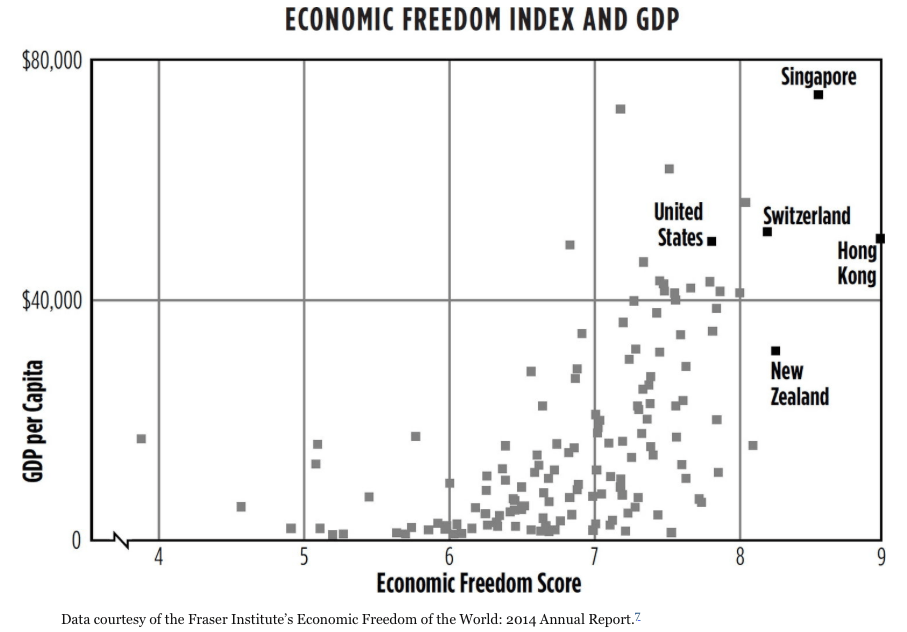
Important thing in this chapter is Koch’s story of being on the wrong side of “Creative destruction”, surviving it, and learning lessons from it.
CHAPTER 4: Overcoming Bureaucracy and Stagnation. Economic Concepts to Set You Free: This is another discussion of economic philosophy as foundation of MBM philosophy and brief story of its implementation at Koch Enterprises.
CHAPTER 5: Learning from Adversity. Koch’s Major Failures in Applying MBM: This chapter is unusual in its concentration on Koch failures during MBM implementation. While brief, it is very useful in understanding of this philosophy and challenges in encounters in real live.
PART II
In this part Koch goes into details of his 5 components of MBM using one chapter per each.
CHAPTER 6: Vision. Guide to an Unknown Future: Business vision should be driven by future consumption because it is the only reason and meaning for production. Since future consumption patterns are unknowable the success of business depends on its leaders ability to envision as close as possible what it could be, what will be future consumer needs, how they could profitably satisfied, and what investments should be made now to be able to do it. Since future consumption is defined by future needs of consumers, the vision should be concentrated on people not things. Another point is that vision should be based on business capability not industry trends. As elsewhere Koch provides specific examples of how they did it.
CHAPTER 7: Virtue and Talents. Values First: In this chapter Koch makes important point about selection of people. The key here is that integrity and values are more important that talent and credentials. He provides 10 guiding principals for such selection and looks in details at how they applied in practice.
CHAPTER 8: Knowledge Processes. Using information to Produce Results: Koch is clear about his understanding of business as knowledge based activity so he made the Knowledge process an important part of MBM. It includes clearly defined knowledge sharing processes, external networks building, spared use of consultants, and, most important, process of conversion information into results. For sales and pricing he provides a nice diagram, representing core of his analytical framework:

CHAPTER 9: Decision Rights. Property Rights Inside the Organization: This part of MBM is probably the most important and unusual because it represents an attempt to turn Koch’s employees into virtual business owners by assigning clear-cut resources, duties, decision-making authority, and responsibilities to individuals. The result is maximization of individual involvement and effort in achieving result. Obviously it also minimizes tragedy of commons within the company.
CHAPTER 10: Incentives. Motivating the Right Behavior: The final part of MBM has somewhat psychological foundation derived from ideas of Maslow. The point is to use company not only as source of income for employees, but create such strong opportunities for self-actualization within the company that participation in the company business would be a significant source of meaning of live for everybody. The most interesting part of this is how it is done at Koch Enterprises.
PART III
CHAPTER 11: Spontaneous Order in Action. Four Case Studies in Market-Based Management: This is review of 4 real live cases with detailed break down into 5 MBM dimensions.
CHAPTER 12: Conclusion. The Real Bottom Line:
The final chapter is about implementation of MBM, how to succeed in it and what mistakes to avoid.
MY TAKE ON IT:
I am not get excited that often, but it is an exciting book. It is so nice to see somebody clearly formulating business philosophy based on virtual individual ownership within big organization and, much more important, being capable actually implement it in real live with such spectacular results. It is no wonder that Koch incite such open hate in all leftists whose core believe is based on primacy of collective and suppression of individual. Their reason for being is based on idea of higher productivity of the top down command system led by the best and brightest where individuals at the lower levels of hierarchy are not that important, while individual at the bottom are outright expendable. I think that Koch’s demonstration of by far superior business result is much more important reason for this hate, than money Koch gives to libertarian causes. At this point in time despite being in his 80s Koch seems begin to understand that in attacks against him from leftists and their media he encounters not misunderstanding between people who all want prosperity for everybody, but have difference in opinion how achieve it. Quite contrary he and we all should understand that when dealing with leftists we deal with power crazy people whose motivation is to be among best and brightest on the top and enjoy all perks that these positions would bring in top down command and control hierarchical society. We are not in dispute about opinions, but in civil war, even if so far it is non-shooting war, mainly because American culture is still highly individualistic and even libertarian, making leftists relatively week. However if leftists able fully utilize their current dominance in education and mass media, then concentration camps and basements with bullet to head as it was in Soviet Union or Communist China would not be that far away.
20160116 The Great Escape
MAIN IDEA:
Over the last several hundred years humanity achieved the great breakthrough in its ability to produce necessities for human live on continuously increasing scale and overcame previously deadly health and sanitary problems. There is potential setback for this development due to increasing inequality of income both within countries and between rich and poor countries. There is need to tackle both of these problems that author believes could be done by decreasing inequality and changing the way of how aid provided to developing world.
DETAILS:
Preface
This book is about humanity’s escape from poverty and deprivation and author starts with movie analogy – escape from captivity in WWII and continue with his and his family story of escaping from poverty, diseases and early death, into contemporary affluence over just a few generations.
Introduction: What This Book Is About
Author’s stated intention is to look at what happened that allowed humanity escape from deprivation and how it is deeply connected to the growth in inequality. It is not only about money and resources, but also about health and general quality of live. A big part of discussion also involves consequences of inequality and general look at link between national income and national happiness.
- The Wellbeing of the World
Author begins the detailed analysis with relations between health and wealth and then looks at correlation between income and live expectancy in different countries. Generally both health and wealth improved in XX century, but with significant interruptions caused by World Wars and socialist experiments in Russia, China, and all over the world. At the end of chapter he looks at relationship between GDP per capita and population perception of happiness with happiness increasing until $3,200, then staying flat until about $15,000, after which it going quite dramatically up again.
PART I LIFE AND DEATH
- From Prehistory to 1945
This is review of historical change in mortality, health and live quality since prehistoric time with special stress on development in USA in XIX and the first half of XX centuries. It is best represented by the graph:

- Escaping Death in the Tropics
This chapter about mortality, its type and levels as related to income:

- Health in the Modern World
This is about health and live expectancy, again in relation to income. Here is an interesting graph for correlation between bio parameters such as height and income:

PART II MONEY
- Material Wellbeing in the United States
It is a review of economic development of USA, but main point is presented in graph of income inequality historical dependency on political events:

Author makes point that inequality outgrowing into plutocracy could choke economic development and consequently cause political instability.
6.Globalization and the Greatest Escape
Here author expands discussion from US to whole world. He notes that recent development allowed huge numbers of people around the world escape poverty and misery. However measurement of exact change is nearly impossible because of wide variety of human needs and demands dependent on culture, climate, and million other things. Correspondingly comparison of economic well being between countries is practically not possible for the same reasons. However, despite lack of reliable measurement, author pretty sure that global income inequality if growing and it creates tension between developed rich countries and the rest of the world.
PART Ill HELP
- How to Help Those Left Behind
This part is about western aid to developing world. Despite huge amount of resources spent, it is not particularly effective. More often than not it comes down to western bureaucrats taxing population to transfer wealth to bureaucrats and politicians in developing countries. Author reviews causes of this problem and multiple proposed solution, but does not see any specific way to overcome it.
Postscript: What Comes Next?
The final world is relatively optimistic when author expects that process of improvement will continue, albeit not without setback and in unequal tempo in different times and places.
MY TAKE ON IT:
It is nice to see such well-documented and detailed description of process of improvement in human lives over extended period of time that shows no real indications of stopping or reversing. Information contained in this book confirms my opinion that we are still on the road of improvement, but it is not guarantied that we’ll continue on this road in the future. We still have to achieve more progress in developing world, but the most important improvement should occur in developed world where the quality of live pretty much stopped increasing in the last couple decades, despite dramatic improvement in technology. This stoppage has very little to do with capacities of developed societies to produce goods and services and everything to do with society institutions that define process of resource creation and allocation to individuals. Current processes often leave people unhappy even if they are doing not that bad materially, because humans need movement to the better and these movement is lacking. Moreover there is no such thing as constancy in quality of live so if it is not improving, then it is deteriorating. Normally people are not inclined to tolerate such deterioration, especially when they see other people doing better and better. Consequently we have to change existing processes and institutions to renew improvements in quality of live, that does not necessarily means improvement in availability of material resources exclusively. The alternative to such dramatic improvement, I am afraid could be self-destruction of civilization.
20160109 Institutions

MAIN IDEA:
Human institutions are immaterial constructs of human mind that define rules of behavior and cooperation, providing kind of software on which human society runs. Institutions based on technology achieved by society and in turn define to significant extent cost of transactions in this society, making it more or less prosperous comparatively to the level supported by given level of technology. Institutions are highly path-dependent and therefore could be quite different in different societies even if they are at the same technological level, leading to quite different results in terms of lives people live in these societies. Institutions are constantly changing, however it is mainly incremental change at the margins that becomes obvious only during brief disruptive changes such as revolutions when old hollowed out institutions give way to the new ones, more or less fully developed within framework of old. Institutional analysis had to be much more fully included into economic analysis for us even to begin understand why some societies are highly prosperous, while others disastrous even at the same level of technology and similar level of natural resources availability.
DETAILS:
Part I Institutions
1 An introduction to institutions and institutional change
Author defines institutions as rules of game in the society. Obviously rules of game strongly impact outcome that is economic and societal performance of society. Author differentiates institution from organizations, the former defining what people can or cannot do, while latter are groupings of people combined in order to achieve something. Author also stresses need to separate rules of game from strategies of game. Obviously different institutions lead to different outcomes and one of main interests here is how it happens and why and how institutions change. Author clearly understands that institutions created by individuals and in turn put restriction on actions of individuals, therefore creating very interesting dynamics of human interactions.
2 Cooperation: the theoretical problem
Here author explores the theoretical foundations of institutions – need for human cooperation. Cooperation is defining factor in economic performance, but it is difficult to sustain in non-repeating situations. Author reviews work of several researches of cooperation and concludes that institutions create environment when all situation could be treated as repetitive by substituting experience from encounters by compliance with institutional rules.
3 The behavioral assumptions in a theory of institutions
Here author looks at behavioral assumption normally used and suggests modifications. He reviews 7 neoclassical behavioral assumptions and their deficiencies. The key to understand these deficiencies comes from two aspects of human behavior: motivation and deciphering the environment.
4 A transaction cost theory of exchange
This chapter is about costs of transactions and role of institutions in defining these costs. The case made here is that robust institutions dramatically decrease cost of transactions for example institution of private property assure individual that investment into planting seeds would benefit him without huge expense of continuously watching and defending planted field. The benefits of such institution as money seem to be obvious and tremendous.
5 Informal constraints
Here author looks at institution as set of informal constrains, which seems to encompass much wider area of human activities than formal constrains and play very important role in human relations. The most important role is probably facilitation of development and change of institutions via mechanism of culture, which is at the end is just a totality of informal constrains and established perception that define behavior of individuals.
6 Formal constraints
Correspondingly this chapter is about role of institutions as formal constrains on human action. The formal constrains such as laws and regulations are just a formalized expression of informal constrains of culture. The formal constrains much less susceptible to enforcement than informal and therefore play outsized role in work of institutions.
- Enforcement
This chapter is about enforcement of constrains, which actually defines effectiveness of institutions. Here author separately looks at self-enforcement of contracts and external enforcement both of which necessary for institutions ability to decrease cost of transactions.
- Institutions and transaction and transformation costs
Here author combines together results of previous discussion to finalize role of institutions in defining production and transaction costs.
Part II Institutional change
- Organizations, learning, and institutional change
This is about interaction between organizations and institutions. Especially important is interaction between organization and institutions when organization slowly changes institutions while developing of institution in turn could not only change, but also could destroy organizations. Author also looks in detail at the interplay between tacit and articulated explicit knowledge and how it impacts institutions, organizations, and, eventually, transaction costs.
- Stability and institutional change
This chapter is about stability of institutions and causes of their loosing this stability. Every institution carries inside causes of future change. The agent of change responds to incentives embodied into institutional framework. Author presents an interesting idea that change is caused by variation in relative prices that modify incentives within institutional framework until these incentives lead to dissatisfaction with existing framework and consequently to institutional change. The most important thing about change is that it is always incremental and consists in slow modification of institutional framework on the margins until at some point old framework is practically emptied out and falls, opening way for the new one. One necessary factor in this process is generation of ideology for the new framework within old one and significant group of people with deep ideological commitment to it.
- The path of institutional change
This is very interesting discussion of institutional change and its dependency on historical path of society’s development. This discussion as usually uses example of QWERTY to demonstrate path dependency in technology, but it expands this idea to all forms of institutions including political ones. Some examples in these areas are American Revolution with its Constitution and institutional revolution in Western Europe in XIX century when property rights substituted feudal rights as main method of resource allocation. An important note here is that similar changes in relative prices in two different societies lead to different institutional changes because they are path dependent and all societies have different paths. As example of this thesis author looks at the colonization of America by Spain and Britain. It was conducted according to the two different paths: one defined by Spanish and another by British society, leading correspondingly to institutions of Latin America and institutions of United States and Canada.
Part III Economic performance
12 Institutions, economic theory, and economic performance
This is more detailed look at theoretical implications of institutions on economic performance of society. Analysis of institutions is complex because, being just constructs of human mind, they could not be measured. However economic development of society could be used as proxy for analysis of institutional effectiveness. Eventually better institutions lead to lower transaction costs making for richer and more prosperous society. Author again looks at comparison of British-North American Path versus Spanish – South American for detailed analysis.
13 Stability and change in economic history
This chapter is about institutional change and its impact on complex and dynamic western economies and how it caused economic growth. This is a very brief overview of historical institutional changes and their link to technological changes over all known stages of development of human societies.
14 Incorporating institutional analyses into economic history: prospects and puzzles
The final chapter is about implementing result of institutional analysis into framework of overall economic analysis and some historical application that could follow from such development.
MY TAKE ON IT:
I find ideas presented in this book highly consistent with what I know about history, economic development, and human psychology. I think that the next step should go beyond just analysis of the past, but rather develop a conscious approach to design of institution including their periodic updates in order to keep them at the most effective and efficient status according to currently achieved level of technology. Obviously any conscious design will always be clumsy and unsatisfactory because of the huge difference in ability of human mind to process complexity of the world represented in language and images and actual complexity of real world, which is higher by orders of magnitude. This posits need to maximizing freedom of individuals and groups to test various theories / ideologies in various places and freedom of competition between them so individuals could pick ones they like more. The key here should be avoiding violent competition that always imposed huge costs on institutional change.
20160102 The seven sins of Memory

MAIN IDEA
The main idea is to summarize current knowledge about workings of human memory, and what kind of deficiencies it has. The bulk of text is allocated to discussion of 7 specific features of human memory and problems in causes in contemporary live. The overriding notion, however, is that human memory is completely different from artificial carriers of sounds and images of the past such as photos. It has reconstructive rather than recording and reproducing character, meaning that human memory is recreated every time at the moment of remembering and includes not only reactivation of neural networks created at the moment in past, but multiple networks created much later, opening memory to manipulation and making it unreliable. However it is not a bug, but feature very important for human evolutionary fitness.
DETAILS:
Introduction: A Blessing Bestowed by the Gods
It starts with the story of a writer who unexpectedly encounters woman and learns that she sincerely believes that they were lovers once in the town of Yumiura. He does not remember women, but initially believes her only to find out later that such town does not exists, so her claims could not be true. From here author moves to other examples of memory failures, consequently coming up with seven key transgressions: Transience, Absent-mindedness, Blocking, Misattribution, Suggestibility, Bias, and Persistence. This book is a detailed look at memory transgressions based on results of latest research and logic of evolutionary fitness applied to explain these results.
- The Sin of Transience
The chapter on transience looks at foundational research of Ebbinghaus who produced experimental evidence of transience long time ago in 1885. This followed by formal diary based research to demonstrate reconstructive character of human memory and our ability to reshuffle, include, and/or exclude actual artifacts of our lives that left traces in the memory into this process. As example author reviews cases of Bill and Monica, various memory problems of baby boomers with research based on age groups comparison on memory tests. Afterword discussion goes into technical side of memory formation based on fMRI technology. At the end author provides some mnemonics to decrease memory transience.
- The Sin of Absent-mindedness
The second sin of memory is absent-mindedness nicely demonstrated by example of inability of National Memory Champion who is capable to remember huge amounts of information, at the same time forgetting to carry on simple tasks. The simple explanation seemingly supported by fMRI is the human tendency to automate familiar tasks by pushing them into unconscious. In short absent mindedness highly linked to attention paid or not paid to a subject. It also linked to event based prospective memory. In other words if intention to do something linked to an event that supposed to occur in the future, the possibility of realizing this intent usually increased. Another effective tool is to post reminders and to do planning.
- The Sin of Blocking
Blocking is inability to access something that one knows that he knows, but just cannot retreat from memory at the moment. Typical examples are names of people and objects. Often individual not only knows, but also can describe in details different characteristics, but fails to reproduce the name of an object. Author also discussing issue of suppressing painful memories, eventually concluding that recent phenomenal interest in this issue somewhat unjustified since there is very little scientific support of reality of suppression in healthy people, however it was demonstrated in individuals with damaged brains.
- The Sin of Misattribution
A typical misattribution case is when people remember things that never really happened. The experimental research demonstrated that it happens when brain files up gapes in the memory with something that logically fit based on previous experience. It is often the case with eyewitnesses of crimes. The real perception of events in this case is always fragmented and unclear because attention is not concentrated on details that witness is asked about during interrogation, so brain adds whatever is necessary to build complete picture. Author describes very interesting studies using fMRI and PET scanning in attempt to separate actual memory from later additions and misattributions. Similar problem occur when individual has brain damage causing difficulties in image recognition and/or false recognition such as seeing movie starts everywhere. Another interesting example is subconscious plagiarizing when people forget that they actually encountered some ideas and even texts in other individuals’ works and sincerely believe that they produce these ideas themselves.
- The Sin of Suggestibility
This is probably one of the most difficult to accept features of human brain when false memories could be planted intentionally or unintentionally so a person believes that something happened, which never really did. It is widely used in police investigation often leading to miscarriage of justice. Author discusses in details a famous case in 1990s when teachers were imprisoned after investigators managed to plant false memories of sexual abuse into minds of their students.
- The Sin of Bias
This problem as many other relates to the nature of memory as continuously constructive process when result is highly susceptible to impact of the new information obtained well after events under review. Author provides multiple examples from Ross Perot supporters’ modified memories of what they believed before his drop out from election bid, to memories of pre-game anticipation of Red Sox fans. In all cases the after event memories of pre-event believes are markedly different from actually recorded pre-game attitudes and believes. The typical human approach: “I knew it all along”. The sin of bias relates not only to the memory, but also to real time attitude and processing of perceptions. Author provides a wonderful example of impact of received information on behavior when inconsistency of such information with bias overrides biased attitude. The story goes like this: being a black man and walking at the night on the street in nice area author noticed fear that he generated in people he encountered who tried to avoid approaching him. However after he started whistling some melody from Vivaldi, the attitude changed dramatically. Instead of fear and vigilance he saw smiles and sympathetic interest. Obviously nothing changed in color of his skin, or dress, or anything, except that sound of baroque music sent signal that author is member of educated, non-violent, and friendly American middle class, rather then member of inner city violent lower class. Author also brings in split-brain studies to demonstrate that bias it one of regular methods of brain to make sense of environment with high levels of informational deficiencies.
- The Sin of Persistence
This one is about persistent memories that people have difficult time ridding off. Often it linked to traumatic events that had dramatic impact on individuals’ lives and consequently is continuously rerun in the memory in search of solution of the problem decreasing or even removing this impact. This memory feature is highly related to PTSD when memories practically torture people until some resolution is found.
- The Seven Sins: Vices or Virtues? End Matter
In the final chapter author not only suggests that all reviewed memory sins are also virtues from evolutionary point of view and goes on to demonstrate how all these sins could be instrumental in human survival and promote evolutionary fitness.
MY TAKE ON IT:
It is very nice catalog of performance consequences of the simple fact that human memory technically is just reactivation on demand of randomly connected neural networks related to remembering event or fact. Consequently all memory sins look consistent with this idea and support evolutionary fitness. Here is how it happens in my opinion:
- Transience – every bio-electro-chemical network tends to deteriorate over time and without constant reactivation its ability to recreate original signal deteriorate correspondingly.
- Absent-mindedness – The is quite a narrow bandwidth between human receptors and environment therefore attention is very important in order to pick up key features of environmental situation at any moment. As soon as something ceases to be such key feature, it is out of memory and gets missed.
- Blocking – this is just a consequence of incomplete activation of neural network related to specific memory. The typical cause would be that instead of being invoked by unconscious mind and taking time before bringing it to the forefront, memory if consciously activated, for example in response to external questions. In this case brain just did not have time to fully activate all parts of related network.
- Misattribution – this one is probably the most interesting feature of human brain because it somewhat proves that memory is reconstruction, rather than retraction of previous state. In short activation of network related to memory at the time of its creation also activates related networks created much later.
- Suggestibility – It probably has the same mechanism as Misattribution with difference being conscious implant of additions and/or substitutions to existing memory network by external interlocutor.
- Bias – this is a wonderful and very important tool absolutely necessary in dealing with unknown. Without bias, correctly understood as ability to build future scenario of outcome from encountering unknown based on previously accumulated information, it would not be possible to survive. For example a human in natural environment who encountered unknown individual of big cat species would be fine if acts according to bias against big cats being predators, but would probably not live long if try to overcome bias and treat the cat too friendly.
- Persistence – Finally persistence of memory is probably a result of activation of critical networks related to survival that basically command to replay the painful memory again and again in order to find reliable solution in case of encountering situation again. Interestingly enough it seems that latest and most successful approach to treating PTSD is to replay situation multiple times until it become somewhat routine and response to it well defined. As soon as this response fully incorporated in survival toolkit, the emotional networks critical for survival cease to be activated when related memory invoked.
In short our memory is just part of survival machinery of hunter gatherers which works just fine as selected by evolutionary process, but need some external enhancements to make it effective in contemporary live.
20151226 What Intelligence Tests Miss

MAIN IDEA:
The main idea here is that standard IQ testing does not provide effective measurement of human intellectual abilities because it is missing measure of rationality, the feature that is much more important in effective decision making than ability to quickly solve simple problems or have high ability for patterns recognition. The bulk of book is dedicated to review and analysis of Dysrationalia – a condition when high IQ people fail to make rational decisions. At the end a number of ideas of how to improve levels of rationality in decision-making is discussed.
DETAILS:
ONE: Inside George W. Bush’s Mind: Hints at What lQ Tests Miss
The chapter starts with question how come that George Bush generally considered intellectually inferior had quite high IQ score and successfully graduated from the top educational establishments. The answer, author comes up with, is that tests measure only highly formalized intellectual abilities, while missing not only emotional and other types of intelligence, but most important intelligence as ability to think rationally. Author suggests name for this problem: Dysrationalia and insist that it is a form of mental deficiency that Bush is suffering from.
Two: Dysrationalia: Separating Rationality and Intelligence
Here author is trying defining and separating Rationality and Intelligence using multiple examples of each feature in action. In process he proposes a curious definition of what exactly IQ tests measure and calling it MAMBIT (Mental Abilities Measured by Intelligence Tests), claiming that it has nothing to do with rationality. After that he looks at Dysrationalia as an Intuition Pump.
THREE: The Reflective Mind, the Algorithmic Mind, and the Autonomous Mind
Here author claims that all major issues related to intelligence were answered at least in the first approximation and discussion moved on to detailed examination of two types of intellectual processing: Type 1 – fast unconscious processing that includes huge majority of all activities conducted in parallel by multiple subsystems of the brain and nervous system and Type 2 – slow moving conscious serial processing at much more abstract level capable override results of Type 1 processing if needed. He provides a model of Dual-Process that he then encapsulates into tripartite framework of various minds:


At the end of chapter he introduces notion of Mindware, which is analogous to software used for processing by each type of mind:
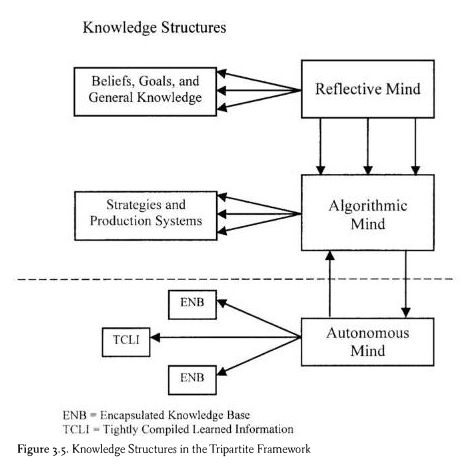
FOUR: Cutting Intelligence Down to Size
This is an attempt to devalue typical American attitude to overestimate value of Intelligence as defined by MAMBIT and use it for selection of people for positions of influence. Author believes that it is incorrect attitude and it is very important to separate and treat correspondingly in different ways MAMBIT intelligence and rationality.
FIVE: Why Intelligent People Doing Foolish Things Is No Surprise
At the beginning of chapter author provides a number of examples when seemingly smart and educated people make stupid mistakes and lose money in stock market. As explanation he introduces idea of humans being a cognitive misers, when needs for cognitive processing required to cope with live exceed cognitive abilities of human brain forcing humans to look for short cuts in cognition, sacrificing quality of cognition in process. This loss of quality expresses itself in widely spread Dysrationalia. The intellectual tools of rational cognition: probabilistic thinking, scientific reasoning, and logic consume too many cognitive resources and therefore had to be used sparingly and applied only in limited area of professional and personal activities where the outcome is critical, while all other areas could be left to believes acquired through cultural socialization regardless of validity and rationality of these believes.
SIX: The Cognitive Miser: Ways to Avoid Thinking
This chapter concentrates on methods of simplification of thinking processes such as:
- Attribute Substitution
- Vividness, Salience, and Accessibility
- Heuristic processing
- Cognitive shortcuts such as anchoring
- Groupthink
- Status Quo Bias
At the end author discusses environment, which could be hostile or benign for use of Heuristics.
SEVEN: Framing and the Cognitive Miser
This is a detailed view at one of the most important deficiency of cognitive miser: susceptibility to Framing Effects. A very interesting finding is that it generally the same for highly intelligent and educated individuals and for not that intelligent. However when people told that there is need to pay serious attention, intelligent individuals are quite capable to overcome Framing Effects.
EIGHT: Myside Processing: Heads I Win-Tails I Win Too
This is about a special case of permanent Framing when belonging to a group or holding specific view that frames all analysis. In short whatever side of any controversy individual belongs to, is treated differently than other side. Author calls it Myside Processing and looks at some specific examples.
NINE: A Different Pitfall of the Cognitive Miser: Thinking a Lot, but Losing
This is about complexities of logical rational thinking caused by human’s difficulties with Boolean problems, but also tendency to ignore this logic due to interference from emotional side of the brain.
TEN: Mindware Gaps
This is about Mindware (rules, knowledge, and strategies) bugs and how they can cause problems. Author considers such human traits as inability consistently use probabilistic methods, incomprehension and failure to use Bayes theorem for conditional probabilities, failure to analyze alternative hypotheses, and inability to use effectively falsifiability criteria as bugs that cause multiple failure to evaluate environment rationally, leading in extreme cases to Dysrationalia.
ELEVEN: Contaminated Mindware
This is somewhat extension of previous chapter on Mindware, discussing fallacy that tend to be widely distributed in population via contamination when individuals transfer memes between themselves. As example author discusses collapse of Albania economy due to epidemics of pyramid schemes. This form of malfunction is especially popular among individuals with high IQ who often susceptible to contamination due to their striving to be “in” on whatever new and popular Mindware is expanding.
TWELVE: How Many Ways Can Thinking Go Wrong? Taxonomy of Irrational Thinking Tendencies and Their Relation to Intelligence
Here author discusses various characteristics of thinking failures and provides a couple of nice diagrams for their taxonomy:

THIRTEEN: The Social Benefits of Increasing Human Rationality–and Meliorating Irrationality
In the last chapter author comes up not only with notion that Dysrationalia is if not completely curable, but at least could be at least somewhat remediated. Obviously education and training in use of statistical methods would help. Also some environmental modifications could push people to more effective behavior, example – smaller portions of food as substitute of dieting. He also mentions “Nudge” methods calling them “libertarian paternalism” and invoking standard success story with 401K defaults for retirement. Finally author discusses needs to modify society’s selection mechanism to assure higher levels rationality of decision makers.
MY TAKE ON IT:
This is another approach to discoveries of behavioral economics. It concentrates on division between algorithmic and reflective methods of problem solving. I find this approach interesting because it is not only proposes more reasonable model of interactions between unconscious (autonomous) minds using override mechanism. I like this approach, but I think that ideas of Dysrationalia and Humans as Cognitive Misers are counterproductive. Author makes assumption that there is some objective rational way to behave in all circumstances and formal knowledge such as statistical methods could lead to consistently effective decision-making. It is a typical for academicians who tend to forget that their experience most often obtained in oversimplified environment and as such is not really applicable to complex real live situations. Rather than typical and somewhat boring ideas of how help regular people to overcome their irrationality I would like to see a serious attempt to understand how human irrationality or Dysrationalia in author’s parlance provide for evolutionary advantage for individual not only in historical hunter gatherers society, but also in contemporary society that we live in. After all George Bush extensively used in this book as nearly perfect example of Dysrationalia managed to achieve the very top of our society getting himself elected president in environment of high popularity of outgoing Democratic president, good economy, and peaceful time, which was not a trivial achievement.
20151219 Subliminal
MAIN IDEA:
The main idea of this book, which is quite well supported by research and experimentation, is that our relation to reality is quite tenuous. Our actions are defined not only and even not mainly by our conscious selves, but by the combination of unconscious, subliminal activities of our brain with consciousness being a secondary sense making device at best. The supporting discussion demonstrates our lack of understanding of our own actions, reconstructive rather than reproductive nature of our memories, our unconscious use of stereotyping, in-group vs. out-group allocations, and regular prompting of our actions by emotions that result from unconscious processing of environmental signals. The inference from all this understanding is that to achieve good result we should consciously take unto consideration supremacy of our unconscious self and adjust our actions so they would be more based on scientific, rather than lawyerly approach to reality.
DETAILS:
PART I THE TWO-TIERED BRAIN
1 The New Unconscious: The hidden role of our subliminal selves … what it means when you don’t call gout mother
This is about difficulty for external observer to differentiate between conscious and unconscious actions. Typically humans inclined to assigned conscious motivation to just about any actions even if they done by animals. The latest achievement of science allows for a direct observation of brain activities leading to the new understanding of unconscious based on measurements. It also includes statistical measurements. Author provides example of unconscious behavior when people select spouse with the same surname out of proportion with statistical predictions. Additional examples are perceived quality of wine depending on stated price, stock market price movements depending on ease of company name pronunciation.
2 Senses Plus Mind Equals Reality: The two-tier system of the brain … how you can see something without knowing it
This is about discovered scientific reality that everything we perceive is not actual simple fact, but rather construct of our brain based on unconscious processing of bits and pieces of information collected by our senses in somewhat haphazard way. It provides nice examples of just such processing for vision. It also contains a simple exercise allowing observing one’s own blind spot.
3 Remembering and Forgetting: How the brain builds memories … why we sometimes remember what never happened
This is an application of similar findings to human memories, which turned out to be not a stable imprint of fact, but rather continuously reconstructed presentation of traces of initial activation of neural network easily influenced by follow up input all the way to changing initial memory to something different. The chapter also discusses an unusual case of Solomon Shereshevsky who remembered every detail of everything he ever sow, leading to difficulties with recognition of people and place because nothing stay the same in all details over time. There is also description of substitution experiments when one person is substituted by another during brief interruption in interaction that majority of people fail to notice.
4 The Importance of Being Social: The fundamental role of human social character … why Tylenol can mend a broken heart
This is about vital need to be connected with other people in order to survive all kinds of challenges not only physical, but also psychological. It includes discussion on use of fMRI in analysis of social behavior.
PART II THE SOCIAL UNCONSCIOUS
5 Reading People: How we communicate without speaking … how to know who’s the boss by watching her eyes
This chapter about non-verbal communication, interestingly enough starts with the story of intelligent horse that could do math and such. Eventually it was proved that horse just picked up non-verbal signal from people to do its tricks. Author reviews application of similar technics in communications between people often at subliminal level.
6 Judging People by Their Covers: What we read into looks, voice, and touch … how to win voters, attract a date, or beguile a female cowbird
This chapter expands discussion of non-verbal communications beyond information transfer to image creation when people use their exterior, sound signals, and touch to establish connection that allows obtain benefits from other people’s reaction to this image either in form of bigger tip, or election vote, or purchase of goods and services. The great experiment related to it had demonstrated that people are able to identify with about 60% probability the winner of election by look at his/her picture without any knowledge about candidate.
7 Sorting People and Things: Why we categorize things and stereotype people … what Lincoln, Gandhi, and Che Guevara had in common
This is a great look at human ability to extracting meaning from multitude of signals by categorizing people, materials, and events by using stereotypes, classifications, and prejudices. All this is a great help at the initial encounters, but is consistently loosing its value with accumulation of more information about specific object or person under consideration.
8 In-Groups and Out-Groups: The dynamics of us and them … the science behind Lord of the Flies
This chapter is about human natural inclination to form groups and immediately allocate positive characteristics to in-group and negative to out-group members. Whether they are randomly selected boys with practically identical background divided into two teams or sophisticated adult members of some profession, the result is always similar: “us against them” and readiness to do anything bar nothing to promote in-group and suppress out-group.
9 Feelings: The nature of emotions … why the prospect of falling hundreds of feet onto large boulders has the same effect as t flirtatious smile and a black silk nightgown
This chapter starts with discussion of a case of multiple personality when the person had completely different emotional profiles for each of personalities. The discussion goes into the link between physical arousal and emotion demonstrating via experiment that such link is quite strong even if people do not understand the reason. In short, emotions are often driven by unrecognizable conditions of the body with conscious analysis following far behind and mainly used for justification of action, rather than its cause.
10 Self: How our ego defends its honor … why schedules are overly optimistic and failed CEOs feel they deserve golden parachutes
This is about building a positive self-image from whatever material one has at hands. Obviously it is done with great application of self-justification, self-pity, adjusting of facts to narratives and other similar staff. Author refers to idea that we have two approaches to the truth: one is scientific based on fact and experiment and another lawyerly based on assumption of the truth and careful selection of facts to support this assumption. Our brain normally uses lawyerly approach as default. Author also provides dual view pictures when person can see one or another vision and expands it to the whole lot of live situation stating that our perception of the fact is highly dependent on predisposition for or against this fact.
MY TAKE ON IT:
This book is one of many based on technological breakthrough of fMRI and such, that allowed seeing what parts of brain are activated in different experimental situations created specifically to test various abilities of the brain. After all this information it is hard or even impossible to deny that our own conscious self is just a thin layer of self-awareness on the top of huge self-unawareness. As far as I am concern, it is not just something that is nice to know, but it is also a great explanatory tool useful not only for understanding of what happened in my live for previous decades, but also for planning and acting in the future. In short, from the point of view of information system, the self is a way more complicated contraption than it looks and, therefore, the simple command and control system would not work effectively even at the level of one individual.
20151212 The folly of fools

MAIN IDEA:
Evolution equipped humans as well as many other animals with ability to conduct deception and self-deception activities in such way that these distortions of reality actually become highly effective tool in struggle for survival. It allows getting somebody for a dinner and/or avoiding becoming the dinner for somebody in the wild. It also allows smoothing human relations within family, while obtaining success in mating and winning competition for resources against other groups and individuals. It also plays not a small part in achieving group cohesiveness. From author experience with social sciences establishment in US, it is clear that it is not a small help in obtaining grants, tenure, and other basic needs of professorial existence.
DETAILS:
CHAFFER 1 – The Evolutionary Logic of Self-Deception: THE EVOLUTION OF SELF-DECEPTION; DECEPTION IS EVERYWHERE; WHAT IS SELF-DECEPTION? DETECTING DECEPTION IN HUMANS VIA COGNIITVE LOAD; SELF-DECEFFION IS OLDER THAN LANGUAGE; NINE CATEGORIES OF SELF-DECEFFION; THE HALLMARKS OF SELF-DECEPTION
Here author establishes the need and main logic of self-deception: the need comes from the fact that we do not perceive reality directly, but rather build it into some coherent picture inside of our brain by using bits and pieces of information collected by our senses greatly supplemented by previous experiences, general views and believes. So in order to use perceived reality effectively we need to believe that it is the same as actual reality, which is impossible without self-deception. Another role of self-deception is to be a tool for effective deception of other, which is difficult to do if one does not believe own lies. This is connected to idea of cognitive overload. If one believes what he says he does not have to remember multiple versions of this and, even more difficult, remember which version activate in various circumstances. Author discusses 9 categories of self-deception and traces its evolutionary roots.
CHAFFER 2 – Deception in Nature: THE COEVOLUTIONARY STRUGGLE BETWEEN DECEIVER AND DECEIVED; FREQUENCY-DEPENDENT SELECFION IN BUTTTERFLIES; AN EPIC COEVOLUTIONARY STRUGGLE; INTEIIIGENCE AND DECEPTION; FEMALE MIMICS; FALSE ALARM CALLS; CAMOUFLAGE; DEATH AND NEAR-DEATH ACTS; RANDOMNESS AS A STRATEGY; DECEPTION MAY INDUCE ANGER; ANIMALS MAY BE CONSCIOUS OF DECEPTION; DECEPTION AS AN EVOLUTIONARY GAME; A DEEPER THEORY OF DECEPTION
Here author discusses use of deception in nature providing some vivid examples from the world of wild animals and other living things. He also discusses deception as part of co-evolutionary struggles between multiple species.
CHAPTER 3 – Neurophysiology and Levels of Imposed Self-Deception: THE NEUROPHYSIOLOGY OF CONSCIOUS KNOWLEDGE; THE NEUROPHYSIOLOGY OF THOUGHT SUPPRESSION; THE IRONY OF TRYING TO SUPPRESS ONE’S THOUGHTS; IMPROVING DECEPTION THROUGH NEURAL INHIBITION; UNCONSCIOUS SELF-RECOGNITION SHOWS SELF-DECEPTION; CAN ONE HALF OF THE BRAIN HIDE FROM THE OTHER? IMPOSED SELF-DECEPTION; IMPLICIT VERSUS EXPLICIT SELF-ESTEEM; FALSE CONFESSIONS, TORTURE, AND FLATTERY; FALSE MEMORIES OF CHILD ABUSE;
IS SELF-DECEPTION THE PSYCHE’S IMMUNE SYSTEM? THE PLACEBO EFFECT
In this chapter author looks at contemporary technology that allowed analyzing activities of different parts of brain during process of thinking. Result was the mapping of brain to specific activities and processes including various forms of deception. Another interesting point here is the role of deception in interaction between conscious and unconscious parts of the brain. Author analyzes role of self-deception in building of self-esteem, use of flattery, false memories, placebo effect, and other similar phenomenon. One important idea here is that self-deception is used as psyche immune system, hiding harsh reality from conscious mind.
CHAFFER 4 – Self-Deception in the Family–and the Split Self: PARENT/OFFSPRING CONFLICT; CASES OF EXTREME ABUSE; GENOMIC IMPRINTING; INTERNAL CONFLICT FROM OPPOSITELY IMPRINTED GENES; PARENTAL MANIPULATION AND IMPRINTING; THE EFFECT OF MARITAL CONFLICT ON GENETIC CONFLICT; IMPRITING AND SELF-DECEPTION; DECEPTION IN CHILDREN; PARENTAL EFFECTS ON CHILDREN’S DECEPTION
This chapter is about deception between parents and children and its role in assuring evolutionary fitness of the species. Humans need a long-term care provided to them by adults in order to achieve such level of maturity when they could survive, which creates necessity of maintaining complex relationships. The deception and self-deception are tools that are necessary to maintain this relationship. Moreover each individual actually split into multiple selves with sometimes-conflicting interests for example conflict between survival of self and survival of children in circumstances of extreme resource limitations.
CHAFFER 5 – Deceit, Self-Deception, and Sex: WHY SEX? TWO SEXES–TWO COEVOLVING SPECIES; DECEPTION AND SELF-DECEPTION AT COURTSHIP WHOSE BABY IS IT? MALE RESPONSE TO FEMALE INFIDELITY; DECEIT AND A WOMAN’S MONTHLY CYCLE; MEN’S SELF-DECEIT ABOUT FEMALE INTEREST; MALE DENIAL OF HOMOSEXUAL TENDENCIES; IS SELF-DECEPTION GOOD OR BAD FOR MARRIAGE? THE APPEAL AND DANGER OF FANTASY; THE PAIN OF BETRAYAL
This is about role of deception and self-deception in sexual relationships including infidelity and betrayal. One very interesting point is that human routinely rewrite they own history and it could be used as predictor for the future of marriage. Those who use negative rewriting would not stay together in the future.
CHAFFER 6 – The Immunology of Self-Deception: THE IMMUNE SYSTEM IS EXPENSIVE; THE IMPORTANCE OF SLEEP; TRADE-OFFS WITH IMMUNITY; WRITING ABOUT TRAUMA IMPROVES IMMUNE FUNCTION; HOMOSEXUALITY AND THE EFFECTS OF DENIAL; POSITIVE AFFECT AND IMMUNE FUNCTION; THE EFFECTS OF MUSIC; POSITIVITY IN OLD AGE; AN IMMUNOLOGICAL THEORY OF HAPPINESS
This is another approach to self-deception as immunity mechanism protecting individuals against psychological stress. Author looks at comparison with regular immune system in terms of energy consumption, at the sleep as the part of immunological process, and the general lifestyle circumstances as easer protecting psyche such as marriage, or undermining it such as drags. He also discusses competition for resources between biological and psychological immune systems, technics of overcoming effects of stress such as writing and music, positivity of the old age, and finally presents immunological theory of happiness.
CHAFFER 7 – The Psychology of Self-Deception: AVOIDING SOME INFORMATION AND SEEKING OUT OTHER; BIASED ENCODING AND INTERPRETATION OF INFORMATION; BIASED MEMORY; RATIONALIZATION AND BIASED REPORTING; PREDICTING FUTURE FEELINGS; ARE ALL BIASES DUE TO SELF-DECEPTION? DENIAL AND PROJECTION; DENIAL IS SELF-REINFORCING; YOU’R AGGRESSION, MY SELF-DEFENSE; COGNITIVE DISSONANCE AND SELF-JUSTIFICATION; SOCIAL EFFECTS OF COGNITIVE DISSONANCE REDUCTION; COGNITIVE DISSONANCE IN MONKEYS AND YOUNG CHILDREN
This chapter is review of specific technics of self-deception, which basically comes down to various forms of information manipulation starting from selectivity of attention and memorization of inputs and all the way through rationalization of inconvenient facts. All this is often done with a specific purpose to decrease or even eliminate cognitive dissonance.
CHAFFER 8 – Self-Deception in Everyday Life: SEX DIFFERENCES IN OVERCONFIDENCE; METAPHORS IN THE STOCK MARKET; MANIPULATIVE METAPHORS IN LIFE; THE NAME-LETTER EFFECT; DECEIVING DOWN AND DUMMYING UP; FACEISM; SPAM AGAINST ANTI-SPAM; HUMOR, LAUGHTER, AND SELF-DECEPTION; DRUGS AND SELF-DECEPTION; VULNERABILITY TO MANIPULATION BY OTHERS; PROFESSIONAL CON ARTISTS; LIE-DETECTOR TESTS
This chapter looks at trivial use of self-deception in regular life starting with specifics of its use by opposite sexes, its use in professions with high levels of unpredictability, and various technics of verbal and visual shortcuts used to deceive oneself into believe of better understanding of the environment than is warranted by reality. Author also touches on secrets of con artists success and lie detector technology.
CHAPTER 9 – Self-Deception in Aviation and Space Disasters: AIR FLORIDA FLIGHT 90–DOOMED BY SELF-DECEPTION? DISASTER 37000 FEET ABOVE THE AMAZON; ELDAR TAKES COMMAND – AEROFLOT FLIGHT 593; SIMPLE PILOT ERROR–OR PILOT FATIGUE? ICE OVERPOWERS THE PILOTS; AIRLINES OVERPOWER THE FAA; THE US APPROACH TO SAFETY HELPS CAUSE 9/11; THE CHALLENGER DISASTER; THE COLUMBIA DISASTER; EGYPT AND EGYPTAIR DENY ALL; SAVED BY LACK OF SELF-DECEPTION?
This is somewhat curious application of author’s ideas to analysis of air disasters.
CHAPTER 10 – False Historical Narratives: THE US FALSE HISTORICAL NARRATIVE; CONTROL THROUGH SMALL WARS AND INSTALLED PROXIES; US HISTORY TEXTBOOKS; LARGER VIEW OF US HISTORY; THE REWRITING OF JAPANESE HISTORY; TURKEY’S HOLOCAUST DENIAL; A LAND WITHOUT PEOPLE FOR A PEOPLE WITHOUT LAND THE FOUNDING OF THE STATE OF ISRAEL; VOLUNTARY FLIGHT OR ETHNIC CLEANSING? ARAB DECEIT AND SELF-DECEPTION; CHRISTIAN ZIONISM; WHY FALSE HISTORICAL NARRATIVES?
This is demonstration of author’s great vulnerability to self-deception when he critics various historical evens firmly standing on his anti-American, anti-Western, and anti-Semitic political views typical for western academia formed to the high degree by communist propaganda of 1950s and 60s.
CHAFFER 11 – Self-Deception and War: CHIMPANZEE RAIDING -> HUMAN WARFARE; SELF-DECEPTION ENCOURAGES WARFARE; DEROGATION OF OTHERS -> FATAL OVERCONFIDENCE; THE 2003 US WAR ON IRAQ; CREATING KNOWLEDGE AND THEN WALLING IT OFF; CAN WARS BE WON THROUGH BOMBING? BOMBING TO ERADICATE HISTORY AND TO REINFORCE IT; CARNAGE IN GAZA; SELF-DECEPTION AND THE HISTORY OF WAR
This is continuation of the same only applied to wars. Probably the only interesting point here is that author claims impossibility of winning war from the air simultaneously pointing to exception of victory over Japan, which actually was achieved from the air. Somehow despite clearly recognizing this case author manages self-deceive himself into ignoring fact that experience demonstrate that only limited war with use of power severely restricted by “humanitarian” considerations failed and ignoring fact that war with one overriding consideration to achieve victory did not fail to deliver victory via exclusive use of airpower.
CHAPTER 12 – Religion and Self-Deception: COOPERATION WITHIN THE GROUP; RELIGION: A RECIPE FOR SELF-DECEPTION; RELIGION AND HEALTH; PARASITES AND RELIGIOUS DIVERSITY; WHY THE BIAS AGAINST WOMEN? POWER CORRUPTS; RELIGIONS IMPOSE MATING SYSTEMS; RELIGION PREACHES AGAINST SELF-DECEPTION; INTERCESSORY PRAYER – DOES IT WORK? RELIGION AND SUPPORT FOR SUICIDE ATTACKS; RELIGION -> SELF-RIGHTEOUSNESS -> WARFARE
This part also has deep imprint of author religious views, which in this case is atheism, but it makes a lot more sense because his thesis of religion as self-deception use to increase group benefits seems to have a good factual foundation in history of all religious of all peoples including notorious cases of atheistic totalitarian states like Soviet Union and Nazi Germany.
CHAPTER 13 – Self-Deception and the Structure of the Social Sciences: PRECEDENCE OF JUSTICE OVER TRUTH? SUCCESS OF SCIENCE IS BASED ON ANTI-SELF-DECEPTION DEVICES; THE MORE SOCIAL THE DISCIPLINE, THE MORE RETARDED ITS DEVELOPMENT; SELF-DECEPTION IN BIOLOGY; IS ECONOMICS A SCIENCE? CULTURAL ANTHROPOLOGY; PSYCHOLOGY; PSYCHOANALYSIS: SELF-DECEPTION IN THE STUDY OF SELF-DECEPT; SELF-DECEPTION DEFORMS DISCIPLINES
This is a charming look at area author’s expertise: social non-sciences such as economics, cultural anthropology, psychology, and even some PC that drive many approaches in biology.
CHAPTER 14 – Find Self-Deception in Our Own Lives: TO FIGHT ONE’S OWN SELF-DECEPTION OR NOT? A SERIES OF MINOR VICTORIES FOLLOWED BY A MAJOR DISASTER; SIGNALS OF UNDERLYING MENTAL SCREW-UPS; CORRECTING FOR OUR OWN BIASES; WHY ARE WE SO COMPULSIVE? THE VALUE OF BEING CONSCIOUS; THE DANGER OF FANTASY IN PROPAGATING DECEPTION; THE BENEFITS OF PRAYER AND MEDITATION; VALUE OF FRIENDS AND COUNSELORS; AN INVITATION TO SELF-DECEPTION AND PERSONAL DISASTER; A NEVER-ENDING EXTRAVAGANZA
In this final chapter author analyses his own live, various uses of self-deception and his struggle to discover and remove them. He also provides somewhat philosophical deliberation of whether one should fight self-deception and on value of being conscious. His final world is that deception and self-deception turns world into never ending extravaganza, which is fun to watch.
MY TAKE ON IT:
I view self-deception and deception in the same light as author as necessary tools of survival and procreation developed within process of evolution. Even now when we are pretty much overcame evolutionary pressures by obtaining reliable supplies of all necessities, it still plays a huge role in getting amounts of resources beyond necessities. In short one can obtain welfare check with little to none deception and self-deception, but university tenure, rich grants, and other perks could be achieved only by masters of this art. One thing that left me somewhat irritated is author’s blatant anti-Americanism and anti-Semitism, but this is something that should be expected from dedicated leftist close to black panthers, so it does not diminish logic and information provided in regard to subject matter in meaningful chapters, and actually provide a nice example of self-deception in political chapters.
20151205 Maestripieri,Dario-Games primate play
MAIN IDEA:
There are huge numbers of similarities between human and animal behavior that developed from evolutionary history that all living creatures went through. There is nothing that would drastically differentiate humans from other animals that would not be explained by analysis of our evolutionary development as primate, despite our achieving higher levels of self-awareness, communication, cooperation, and organization. This does not make humans any less valuable and unique, their lives are still worth living, and their happiness still worth to pursue, even if there is nothing supernatural in humans, their bodies, minds, and behavior.
DETAILS:
Introduction
People interact with other people to specific patterns and rules of game. Author’s extensive experience with primates allowed to look at similar patterns and rules used by our close biological relatives and demonstrate that these pattern and rules are not really that different between chimps and us.
Chapter 1: Dilemmas in the Elevator
This chapter starts with description of typical human behavior in elevator, which is closed space with other humans. Author traces this behavior to our evolutionary history when encounter with stranger of our species in close space is most often a dangerous situation that calls for establishment of dominance hierarchy either through fight or negotiation. Author provides a charming description of monkeys’ behavior in experiments designed to imitate this situation.
Chapter 2: The Obsession with Dominance
This is detailed and quite interesting analysis of dominance discovery process and how different animals, including human, do it. Very interesting is the discussion about change in chemistry of organism depending on the place in dominance hierarchy. In short dominant animals are healthier and happier than subordinates whether the environment is colony of chimps or some governmental bureaucracy.
Chapter 3: We Are All Mafiosi
This chapter describes author’s own experience of human dominance games obtained initially in his country of origin Italy’s military, then in its academia, and eventually in USA academia. All these environments are more or less saturated with nepotism and group survival networks with Italy definitely more and USA less saturated, albeit American academia is catching up. Examples of similar behavior and patterns from lives of non-human animals provided with discussion of their evolutionary meaning.
Chapter 4: Climbing the Ladder
This chapter moves from discussing support that individual get from his group, either nepotism of any other reason for support, to individual’s attempt of making it by own effort and luck. To demonstrate how it is achieved or failed author looks at 3 stories of human career:
- A compliant individual slowly moving along career path with very small achievement.
- Slash and burn revolutionary who prematurely rebel against superiors resulting in defeat.
- Smart Machiavellian strategist capable achieving big career breakthrough via manipulation, deception, and other time tested methods of bureaucratic advancement.
Consequently author reviews quite similar actions in the world of chimps, demonstrating quite convincingly how close are chimp’s world and human bureaucratic hierarchies.
Chapter 5: Cooperate in the Spotlight, Compete in the Dark
This chapter is about transparency or more precise about human and chimp ability to take into account other individuals and adjust own action in such way that would generate positive and beneficial image in their eyes. Some interesting experiments demonstrate that this feature is so deep seated in sub-consciousness that even such simple things as poster with human eyes watching has noticeable impact on behavior. Correspondingly when nobody sees it, behavior changes in different way with individual trying to obtain benefits even at the expense of causing damage to others. Author provides some interesting examples of this.
Chapter 6: The Economics and Evolutionary Biology of Love
This is quite an interesting take on love from point of view of economics, not necessarily simple monetary economics, but rather from point of view resource accumulation and application in order to produce and support next generation. Basically love is a bonding mechanism to create stable economic unit necessary to assure adequate resource flow to a child with live expectancy of the unit linked to the time required for child to achieve a minimal level of self-sufficiency.
Chapter 7: Testing the Bond
This is about bonds between animals and methods of these bods establishment and continuing testing, but even more about handicap principal developed by Amotz Zahavi explaining meaning of peacock ‘s tail and other examples of counter logical use of handicap as the sign of evolutionary fitness.
Chapter 8: Shopping for Partners in the Biology Market
This chapter about multiple and extremely diverse forms of cooperation in creating the next generation of species from human mating market to animal’s mating market, even about book author – publisher – agent market, all working according to similar principles defined by evolution.
Chapter 9: The Evolution of Human Social Behavior
The final chapter is about human behavior and its evolutionary roots. Author believes that evolution not only defined our biology, but also to high extent caused development of a variety of behavioral algorithms that control our behavior with emotions being activators and coordinators of these algorithms execution.
Epilogue
The epilog somewhat unexpectedly raises issue of meaning of live using a tragic accident of highly intellectual man who so much submerged into philosophical search of meaning of live, that he committed suicide after coming to conclusion that sociobiology is pretty much correctly defines human as just another, maybe glorified and self-conscious, but still an animal rendering live pretty much meaningless for somebody in search of deep meaning. Author pretty much rejects this attitude and sees no problem with all these philosophical problems, stating that meaning of live is pretty much the live itself and there is no point of freaking out because we are animals.
MY TAKE ON IT:
This book provides a wealth of observations, experiments, and analysis supporting my believes that we humans are animals developed via evolutionary process to become self-conscious and capable to amazing fits of cooperation and communication that by now allowed us to create an artificial environment for comfortable live, well protected from dangers inherent in our natural habitat as it existed for millions of years. By now we pretty much got evolution under control so we do not depend on survival of fittest any more. However we are in danger of self-destruction unless we’ll find way to handle unhappiness and loss of meaning when original meanings of live: get food, not die from exposure, and have sex is way too easy to achieve, making some people restless. I hope that switch of meaning of live from pursuit of surviving to pursuit of happiness would be eventually completed successfully making our current worries just a curiosity of the past.
20151128 Our Enemy the State

MAIN IDEA:
The State is a tool for violent suppression of one group of people by another with massive transfer of resources from producers to the State’s clients. The State grows within Society pretty much like cancer grows within organism with the similar result achieved over time. There is no way to stop it, but it still worth to try to understand process and write about it for individuals with interest in understanding of society history and future.
DETAILS:
Part One
- Author introduces notions of difference, conflict, and distribution of power between the State and Society. The State in this case is government with its hierarchy of bureaucrats and violent machinery of army and police continuously obtains more and more power pushing out Society from different areas by using mechanism of emergencies and protection from various threads.
- This chapter is about USA specific indexes of increase in the State power: Concentration of power at the federal level; Dramatic increase in numbers of bureaucrats at all levels; Conversion of poverty and government provided assistance into permanent political asset for the State
- This is a brief review of the State growth with emphasis on history, which clearly demonstrates that it is not a new process brought in by the New Deal, but rather continuing development from the very beginning of the republic. Author also stresses the generic nature of this process common for all humanity and easily recognizable in all its variations existing at the time whether it is Italian Fascism, Russian Bolshevism, or German Hitlerism.
- This is a look at the specifics of the process of the State taking power from Society as it occurred in Western democracies: USA and Great Britain. The key difference is that in democracies no spectacular revolution similar to Hitler’s or Lenin’s occurred and the State grab on power is conducted in stealthy way, successfully trying to avoid cultural resistance. It also stresses indoctrination of youth as one of the post important tools of the State expansion.
- This is an interesting discussion on nature of societal change with stress on cultural socialization that instills specific attitudes to the State, Society, and power in people’s mind so some conditions of live perceived as normal and dramatic change in such conditions leads to revolutions and change. The examples are: conversion of colonial America into republic via revolution against Britain, monarchical Russia into collectivistic via revolution against Russian upper classes, Germany and Italy from constitutional states into totalitarian.
Part Two
- This chapter represents a more detailed discussion about two different method of organization that author calls Society and State with reference to Thomas Paine and Jefferson’s contemplation on organization of Indian tribes that represented Society without the State.
- Here author goes even further back into history discussing Aristotle who, author believes, confused state and government. Author then expresses the opinion that the State is based on banditry, war, and confiscation. The important point here is that the State is predicated on existence of wealth to steal or rob. If there is no such wealth as in prehistoric hunter-gatherer societies, there is no place for the State.
- This part is about Herbert Spencer and his analysis of the State with specific examples of British state encroaching on British Society. From these examples the State comes out not as some acting entity, but rather as a tool in form of bureaucratic hierarchy that violently redistributes resources to benefit controllers of this hierarchy. Theoretically aristocratic state uses force in interest of aristocracy, merchant state in interests of merchants, and proletarian state in interests of proletarians.
- Here author looks at the reality of the State when it is quite obvious that it is bureaucratic hierarchy and regardless of formal arrangements it always uses its power in interests of bureaucrats. The danger of this is that in its growth and aggrandizement the State is devour Society that could mean its destruction similar to destruction of Rome and contemporary Europe is moving closer and closer to the point of no return.
Part Three
- This part is about the State’s development in America. The interesting point here is that American colonial institutions were to large extent of Dutch origin rather than British. These institutions were geared up to serve merchants rather than aristocracy. Author discusses in details what he calls Merchant-State that opened road for individualism in all areas of live including religious live and eventually leading to ideas of popular sovereignty.
- Here author reviews history of American institution and influence of the fact that British state and its American subjects were separated by ocean and it was really impossible for this State to have close control in such circumstances. It was also complicated by civil war in England and by the fact that semi-private entities such as Massachusetts Bay Company were real power in colonies at the beginning.
- Here author discusses the idea that natural rights and popular sovereignty not necessarily were philosophy of American Merchant-State at the beginning. Rather it was quite undemocratic based on practices of Bay Company and provided support for state religion. However author also reviews role of the people of Rhode Island and their subversive promotion of democratic ideas, that eventually took root everywhere in America.
Part Four
- This is continuing discussion about history of the State in America where violent nature of the State as tool of robbery was somewhat limited because of huge amount of available land and small numbers of population made land speculation relatively poor method of exploitation.
- Here author looks at causes of American Revolution and comes to a tentative conclusion that main cause was English attempt to limit westward expansion and acquisition of the new land for increasing population. Overall however it was clash between existing British State violently protecting interests of British upper classes and fledgling American States violently protecting interests of Colonial upper classes.
- This is an interesting look at contradiction of ideas expressed in Declaration of Independence versus actual practices of colonial leadership, and Constitution of 1789, both of which practically ignored these ideas.
Part Five
- Here author looks at the idea of the State and its application by mass-men who kind of support this idea and happy to see use of State power to support their interest. However in reality the State slowly takes over society killing it as parasite kills a living organism.
- This is look at the mechanics of power play of 13 initial states of America with specific stress on absence of any attempts to support ideal of the Declaration of Independence.
- This is the review of multiple interests and ideas that drove 13 states together leading to creation of union that become much more powerful state than was possible in previous arrangement.
- This is a look at the American party system that even in its infancy demonstrated an interesting variance of attitude to strict constitution depending on position of the Party. Party in power neglects constitution and Party out of power demands strict adherence.
Part Six
- This is a discussion of seemingly parallel development of people’s attitude to the state to historical development of attitude to the Church: initially unrestricted support with slowly growing enervation. This enervation develops as result of continuing intervention of the state into multiple economic activities sometime leading to improvement, but much more often to deterioration of quality of live.
- Here author discusses ethical approach to the state that he characterizes as ignorance and delusion combined with moral debility and myopic self-interest. This follows from general lack of understanding of the nature of the State as anti-social institution. Author believes that the State growth is a natural condition of humanity and it will continue until the State completely destroy Society similarly to what happened many times before with ancient civilizations.
- In the final chapter author expresses believe that Western society went too far in the process of destruction by the growing State. But he still believes that it worth to write such essays for some individuals who enjoy understanding of the world, even if there is no practical way to correct its problems.
My Take on it:
I think it is a very nice and neat essay about the State nature and characteristics. It is very much close to my understanding of this thing, but the big difference is that authors believes that process of state growth and killing society is non-stoppable, while I think that it is just an intermediate part of process and society has great chance of recovering mainly due to development of new information processing technology resulting in complete change in relations between humans and environment on one hand and different groups of humans on another. Obviously it remains to be seen, which one of these two believes will eventually pan out.
20151121 – On the Origin of Tepees

MAIN IDEA:
The main idea here is to analyze evolution of memes in noosphere as self-directed actors similar to genes using for illustration variations of teepees design in Indian tribes. This analysis provided using background of travel through great planes and discussions of their history. Author also makes an interesting suggestion that memes are taking over from genes the role of main object of evolution.
DETAILS:
Part I: Only Human
Chapter 1: Weirdoes: Misting Up; The Top Five Weirdest Wonders in All Creation; Super-Natural?
At the beginning author establishes his philosophical views on the world stating that everybody looks at the world through some goggles and his are Darwinian goggles. However not everything fits into Darwinian model and he provides top 5 deviations with humans being at the top place because author considers human brains a huge overkill for needs of survival.
Chapter 2: The New World: The Great Indoors; Sandwich Selection; Little Lars on the Prairie; The Road to the Ultimate Problem Solver; Future-proof; A World of Our Own; Into the New World;
Here author presents the new artificial world that humans created for themselves and then provides his classification of live depending on method of evolution:
- “Darwinian” Creatures: regular evolution with change occurring at genetic level and selection by survival of next generation
- “Skinnerian” Creatures: evolution occurs at the level of randomly changing behavior with beneficial patterns continues and harmful patterns not repeated. In other words behavior trial and error.
- “Popperian” Creatures: evolution is still at the behavior level, but trial and error is supplied by preliminary modeling of the future in the brain or in other word by planning. That’s where a big brain becomes really useful: better memory and analytical abilities provide for better modeling of future outcome of actions.
- “Donnettian” Creatures: evolution occurs not at the level of one brain, but at the level of multitude of brains interconnected via language, visuals, and now via Internet. For these creatures the survival occurs not at the level of individual, carrying behavior pattern of models of the world, but at the level of memes that represent such patterns and models.
Part II: What’s the Idea?
Chapter 3: Evolution, Minnesota: Is the Force with Us, Always? Mr. Darwin’s Idea; Finch Mob; Barn in the USA;
Here author discusses and applies Darwin ideas to the meme of barn construction pattern in Minnesota.
Chapter 4: Variation, North Dakota: Plains Sailing; Barn Different; A Port on the Plains; “Home Sweet Home”;
The same analysis continues as author travels through Great Plains where it expands to include not only barns, but also teepees.
Chapter 5: Inheritance, South Dakota: Biological Brothers, Cultural Cousins; The Front of the Barn; Dead Man’s Hand; Tepee or Not Tepee; Big County, Big Picture;
Since author travels with his brother, analysis expanded to similarity and variation of presenting ideas of supremacy of cultural development over biological inheritance. The same extended to barns and teepees analysis.
Chapter 6: Selection, Wyoming: Mindless+; The Evolution of the Cowboy Hat, Served Three Way; The Idea;
Here author looks at evolution of Stetson hat and comes to conclusion that nobody really invented cowboy hat, or rather that hat invented itself by preserving features consistent with cowboy’s patterns of selection, regardless of reasons given for this.
Part III: History Lessen
Chapter 7- Mind Out: Goggles Off; Watchmaking; Differently Dull Flipbooks;
Auto-born;
Here author is claiming to look at the world without Darwinian goggles, which he believes limit our ability to understand evolution of ideas in noosphere. He begins with the story of theologian William Paley who came up with analogy of watchmaker to reaffirm need for a god as intelligent designer of complex biological world, causing Darwin to provide detailed analysis of evolutionary development of human eyes by presenting multiple light perceiving organs of various complexity that could be encountered in nature. Then author comes up with his own analogy of evolution as flipbook each page of which could be representing variation in evolution of a specific individual starting with original cell with huge share of pages at the beginning common to all animals. Then he applies this analogy to barns, which could also have their own flipbook.
Chapter 8: How the West Was Won I: Finding the Edges: Hear the Herd? Trail and Error; The Southern Herd; The Nature of Panic; The Northern Herd;
Chapter 9″ How the West Was Won II: June 25, 1876: Culture’s Last Stand; Getting to the Phone; A Space for Design; A Space for Genius;
Chapter 10: How the West Was Won III: America Making: The Maul of America;
Making America; The Secret of Sitting Bull’s Tepee;
These 3 chapters are retelling histories of American movement westward with accompanying pushover and even destruction of Indian cultures. It is also retelling history of buffalo herd annihilation. This is used to build analogy with ideas that author considers to possess similar qualities to animals and as such are being developed and changed by evolutionary process only with changes being much more frequent and flexible.
Part IV: Who’s Driving?
Chapter 11: A Beginner’s Guide to Tepee Taxonomy: Among the Crow; Sort it Out; Tongues in a Twist; Drummers in the Dark; A Pattern of lslands; Poles Apart;
Chapter 12: Bound by Imagination: The World Turned Upside Down; The Medicine Wheel; Imagineering; Life’s Ratchet; Building a Super-super-super organism; Flipping Gulls; The Yellowstone Blues; Life Is Simple;
Chapter 13: The Genes of Culture: A Model Idea; Blackfoot Country; The Idea Behind These Goggles; The Indian Tipi; On the Origin of (These) Tepees
These 3 chapters are combination of discussion about nature of life and attempt to apply it to ideas of teepee construction. It is then extended to notions of superorganizm that includes multitude of DNA and Memes combined into one entity. Obviously it could be built in bigger and bigger entities until some multi-super organism includes everything conceivable. The supporting illustration is provided by teepees.
Part V: Mysteries Solved
Chapter 14: The Past: The Dawn of the Smelly Heads; Border Crossings; Food for Thought; The Art of Aping; Head-Smashed-In Humaneering; A Symbol Creature; Reason to Believe; The Ghost of an Idea;
For some reason author initially deviates into discussion of olfaction – ability to recognize smell specific to mammals. He seems to believe that it was one of important factors for development of the brain and that it allowed mammals to take earth over when dinosaurs were removed, opening multiple ecological niches. Then he follows through evolution process that resulted in creation of symbolic world of noosphere. From this point it is meme that is main subject of evolution and human hosts are just a necessary support system for memes for now, which may or may not be necessary for their existence and further evolution in the future.
Chapter 15: The Present: Welcome to the Jungle; Idea Ecology; The (Post) Modern World; The Truth
This is final summarization of author ideas based on current environment with projection into the future when “meme life would triumph over gene live”. The final truth author believes in is that memes already took world over to such extent that we all have goggles that distort reality to adjust it to command of memes occupying our brains and the only way put is to communicate intensively with other people who have different goggles in order to break free from memes’ control.
MY TAKE ON IT:
I find ideas of this book somewhat interesting, albeit not really consistent with reality. The reality is that memes are just a notion existing in human brains in form of neuron connections and levels of their conductivity, making them extremely flexible easily changeable via signals received from senses and changes in internal material conditions of the brain. Genes, however, are not easily changeable and correspondingly to high extent define structure and functionality of animals making their evolutionary process slow and maintaining high levels of stability. We humans and other animals with all our complexity and huge amount of unconscious processing are still one and only entities that consciously build representation of the environment in our brains and act to move from our current situation to whatever situation we consider an improvement over the current. Neither genes nor memes have such ability and I am not sure that attempts to analyze development and evolution as if they were self-directing entities are that useful.
20151114 The Rule of Nobody

MAIN IDEA:
The main idea is that American government system arrived to the point of paralysis when bureaucracy greatly impedes nearly all activities, dramatically decreasing quality of live. This is result of huge overuse of laws and regulations, which prevents people from applying initiative and practically removes individual responsibility of bureaucrats. There is no easy remedy, so it could be done only via addition of 5 new amendments to constitution that author proposes.
DETAILS:
PREFACE
This starts with example of a tree that fall into the creek. It had to be removed, but some official recalled that it is C-1 type creek so it took many days for bureaucracy to approve tree removal. This is as fine example as any of bureaucracy’s paralyzing impact on American everyday live.
Part I The Rule of Nobody
THE RULE OF NOBODY
Here author provides more examples of bureaucratic activities or more precisely lack thereof and makes 2 propositions:
- America has lost the ability to make public choices
- Doing anything well requires human energy and judgment, but if left to bureaucracy all energy goes to career building and nothing is left for getting something actually done.
Author supports the first proposition by describing huge negative impact of regulation on ability to do what needs to be done. The second proposition is stating the obvious fact government regulation redirects human energy to jumping through bureaucratic hoops in order to get permission to do something instead of actually doing something. Consequently it becomes a lot easier to avoid doing this something
RETHINKING THE RULE OF LAW
This is discussion of lawyerization of American live and tendency of democratic government to create insurmountable mountains of legal rule to limit ability to act for public officials. Here author makes another two propositions:
- Regulating with precise dictates undermines the goals of law in most social activities
- Compulsive distrust of human choice is anti-democratic
REGULATING BY PERSONAL RESPONSIBILITY
As effective alternative the author proposes is to give much more space for decision making to government officials setting up clear objectives and leaving them to decide and act as they wish in order to achieve objectives. As example he provides Australian reregulation of nursing houses, which materially improved lives of their customers by giving more discretion to bureaucrats. Two propositions are:
- Regulating by principles revives human responsibility
- Regulators should focus on results, not punishment
THE FRAMEWORK OF LAW, PROPERLY UNDERSTOOD
Here author discusses boundaries of law that in his opinion defined in America way too narrow limiting human ability to act according to specific requirements. The proposition is:
- Official authority requires an open area of choice defined by legal boundaries
This would mean practical expansion of legal boundaries allowing bureaucrats more space for actions.
ENDING BUREAUCRATIC AMORALITY
The traditional American attitude is that ideology of bureaucracy is that it has no ideology. The same applies to morality: bureaucracy should be amoral. Neither of these two ideas is conceivable in reality. This leads author to the next two propositions:
- Public choices that avoid values soon embody bad values
- No act of government is morally valid unless it can be justified as being in the common interest
HISTORY OF HUMAN CHOICE IN AMERICAN LAW
This is a brief, but interesting review of relations between human action of judges and law either codified or common. It starts with original constitutional discussion when Madison stressed that piece of paper could not possibly govern, but it rather men who do it, but constitution should provide framework for such action and keep them within commonly accepted rules. Author then goes into history discussion creation of administrative law and regulations as methods of governing without responsibility.
GOVERNMENT BY REAL PEOPLE, NOT THEORIES
After reviewing process of governing, which is always done by real people, author comes up with 3 more propositions:
- Law must empower officials to apply social norm
- Authority properly understood dramatically expands freedom
- American Government must be rebuilt on the principle of human responsibility
Part II Restoring Human Control of Democracy.
DEMOCRACY WITHOUT LEADERS
This chapter starts with an example of infinite continuity of governmental programs due to impossibility of decision makers to stop them, even if there is 0 chance of such program to be approved now. Then it goes to abdication by Congress of its constitutional responsibility to legislate and transfer of this responsibility to bureaucracy. This situation practically led to triumph of lawlessness because infinite number of laws and regulations and their huge complexity practically allow bureaucrats to do whatever they want.
A NEW CHARTER FOR PUBLIC LEADERSHIP
Here author is trying to show that this situation could not possibly keep going for a long time and dramatic changes are coming. He makes a few more propositions:
- Clean house: Congress should appoint independent commissions to propose simplified codes in each area
- All laws with budgetary impact should sunset periodically
- The President must have effective powers restored
- Judges must act as gatekeepers, dismissing invalid claims
CITIZEN SUPERVISION OF GOVERNMENT
Author believes that traditional democratic election and free press do not provide citizens with sufficient control over government and proposes additional measures:
- America needs a Council of citizens to oversee government
- Fixing democracy is a moral imperative for citizens, not just for public officials
Appendix: Bill of Responsibilities–Proposed Amendments to the Constitution
Amendment XXVIII: Sunset of laws
Amendment XXIX: Increase in presidential authority including line item veto
Amendment XXX: Complete presidential power over personnel in executive branch
Amendment XXXI: Limitations on lawsuits
Amendment XXXII: Establishment of Council of Citizens to oversee government
MY TAKE ON IT:
It is very good analysis supported by numerous examples of government going wild. I agree that situation will lead to drastic measures and I believe it would be more drastic than anybody can imagine now. I would guess that it would be on the scale of New Deal if not bigger because it would have to clear huge pile of laws, regulations, and, most important, change established habits of mind. Hopefully it would lead to completely new legal arrangement for society with a lot more freedom to act than Americans have now. The alternative of continuing on the same path for a long time seems to be unfeasible, because it would lead to continuing deterioration of quality of live and Americans are not known for accepting such outcomes without fight.
20151107 Strangers to Ourselves

MAIN IDEA:
The main idea is that human personality includes two pieces: conscious self and adaptive unconscious, which are somewhat loosely linked. Of these two the unconscious includes a multitude of processes managing not only low level controlling functions, but also emotions, attitudes, and is responsible for a significant share of decision making. The conscious self is mainly limited to formal long term planning and justification of whatever person did as result of complex unconscious processes. The clear understanding of this could help individuals not only understand how their brain works and what kind of personality they really have, but also modify this personality into direction they want using roundabout processes like “ to do in order to be”.
DETAILS:
Preface
This book is about self-knowledge or, more precisely about our current understanding of interplay between conscious and unconscious in human decision-making, actions, and behavior. It goes way beyond Freud’s ideas, retaining practically only his notion of unconscious being much more significant part of personality than it was perceived before.
1 Freud’s Genius, Freud’s Myopia
Here author discusses unconscious in contrast to Freud as adaptive unconscious that is a number of autonomous and semi-autonomous systems in the brain and nervous system that manage a multitude of parallel processes in such way as to assure an adequate response of the human individuals to inputs representing continually changing environment. Here is a brief catalog of such processes:
- Lower order mental processes that occur outside awareness
- Divided attention processes
- Automaticity of thought
- Unconscious prejudice
- Lack of awareness of one’s own feelings
- Nonconscious self
The implication of all this is that it is not possible to achieve self-insight without taking into account all these unconscious processes going on in our minds. Author believes that it could not be achieved by introspection, but could be obtained by carefully analyzing our own behavior and how others react to us.
2 The Adaptive Unconscious
This is a more detailed look at adaptive unconscious that author defines as evolutionary adaptation. Adaptive unconscious here is viewed as background processor of 11Mbit/sec perceived by our senses and supporting the following functions:
- Pattern Detection
- Relevance Filter
- Interpretation of inputs based on previously acquired knowledge
- Evaluation of inputs and production of feelings and emotions
- Unconscious goal settings
3 Who’s in Charge?
Here author briefly discusses philosophical implications and provides a neat list of properties for comparing adaptive unconscious vs. consciousness:
4 Knowing Who We Are
This is unconventional look at psychological traits research, stating that personality contains two relatively independent parts: conscious construal of self and adaptive unconscious that are not necessarily in synch. This is demonstrated by low correlation between personality traits indirectly defined via questionnaires and observed behavior of individuals and opinion by others. These two parts control different types of actions: adaptive unconscious controls spontaneous responses, while conscious self normally controls complex planned responses. Author provides some guidance for external assessment of behavior:
- Scanning patterns: Chronic Accessibility
- Transference: seeing old in new
- Working models of attachment
- Dual motives and Goals
- Variance between self-evaluation and evaluation by others
5 Knowing Why
This chapter is about causes of our actions, which in reality are often hidden in some areas of the brain inaccessible to our consciousness. In such cases consciousness often used to generate a plausible story for reasons of our actions, which is typically has nothing to do with real reasons. A good example is experiment that is involving people with divided brain, when information causing action is presented to one part of brain, while remaining is unknown to another, which quickly invents causal story. Experiments show that causal explanation of own action is often not better, than explanation of action of strangers.
6 Knowing How We Feel
Similarly to actions emotions and feelings are often product of adaptive consciousness generated without knowledge of conscious self. Author believes that in this area psychoanalysis could be useful, helping people to understand their own feeling. Author discusses two main uses for this: unconscious early warning system and love / hate attitudes. He present description of experiments demonstrating that it is quite possible for people to believe that they have one feeling, when they actually have another one.
7 Knowing How We Will Feel
This chapter continues discussion of emotions only this time not current, but anticipation of the future. People typically either over or under estimate their future condition as consequence of some event. Neither winners of lotteries nor victims of disable event experience long-term happiness or suffering they expect. The effects are typically wearing out over relatively short time returning people to their typical emotional condition before event demonstrating high levels of resilience.
8 Introspection and Self-Narratives
This is about attempts to discover one’s own personality and unconsciousness through introspection. It goes back to Freud and his idea of archeological digging in individual’s history and memory to discover suppressed memories and emotions. It is illustrated by example from real estate experience when a good professional would never except buyers description of what he wants, but would lead buyer through process of discovery by showing different houses and carefully registering unconscious reaction until the unconscious set of requirements identified and appropriate would be sold. Similarly author is highly skeptical about requirement lists and sees psychoanalysis as discovery process to identify emotional needs and causes of problems.
9 Looking Outward to Know Ourselves
This is about using various objective methods such as time of reaction to subliminal messages to identify individual’s unconscious attitudes. For example it become popular to test racial attitude by pairing views of white and black faces with good and bad words. For example pair black and robbery and white and neighbor considered as fit together causing quick reaction, while white and robbery causes slow reaction. Also important for self-understanding is careful analysis of reaction of other people to us. Typically our own evaluation would be either over or under mark.
10 Observing and Changing Our Behavior
The final chapter is about observing our own behavior as the most important source of self-knowledge. A good quote for this from E.M. Foster: “How can I tell what I think until I see what I say?” In addition author looks at process of self-fabrication when person actually becoming what he/she is doing as in “do good, be good”. On other side of self-fabrication is fundamental attribution error when people attribute their actions to external circumstances. All this creates an opportunity to mold ourselves into whatever our conscious self wants us to be by doing, consequently training out adaptive unconsciousness to be what we want it to be. As example the author’s ability to overcome introversion by consciously forcing himself communicate with other people led to increased easiness of doing it and change of personality to be higher on extraversion than before his conscious effort.
MY TAKE ON IT:
I pretty much agree with notion of complex personality model with conscious and adaptive unconscious being semi-independent parts. I think that this understanding creates opportunity for people to use indirect methods such as analysis of behavior and feedbacks from others in order to improve understanding of adaptive unconscious and train it to some tricks that our conscious self wants us to be able to do. The methods of reaching to one’s adaptive conscious and taming it should become a big part of education for any human being.
20151031 Misbehaving

MAIN IDEA:
The main idea of this book is that contemporary economics, especially mathematical economics based on unrealistic assumption that human beings are nearly perfect calculating entities (ECONs) that are nearly always capable to identify the best way to maximize monetary returns and consistently act to achieve it. The reality is humans are poor calculators and more often than not act or fail to act in contradictory ways quite often contrary to their best monetary interest. The real economy of humans consequently works quite differently from theoretical economy of ECONs, so makers of public policy should take it into account and act correspondingly to achieve best results.
DETAILS:
- BEGINNINGS: 1970-78
- Supposedly Irrelevant Factors
In this chapter author describes how he discovered that real people behave unreasonably if compared to ECONs and that Supposedly Irrelevant Factors have huge effect on peoples’ attitudes. He provides examples such as: Students perceive results completely differently if results presented as 80 out of 137 that 60 out of 100. Mathematically it is the same, but psychologically 80 points are good and 60 points are bad because people unconsciously retain benchmark of 100 in both cases. After example author presents his view of humans and then asserts that SI Factors in reality are very important to understand human behavior.
- The Endowment Effect
Here author moves to specific types of human behavior inconsistent with expected behavior of ECONs, such as endowment effect when people value the same thing much higher when they own it than when they do not.
- The List
Here author describes his initial discovery of work by Kahneman and Tversky about shortcut heuristics people use in their economic decisions and predictable errors they make in the process.
- Value Theory
Here author provides more detailed analysis of value estimates supporting idea that people put significant higher value on loss than on gain of the same amount of money.
- California Dreamin’
This chapter is about author experience at Stanford and initial interactions with the first behavioral economists Kahneman and Tversky.
- The Gauntlet
This is about his experience at Cornell, author’s acceptance of behavioral economics and debates with traditional economists about key notions such as: Incentives, Learning, and especially Markets’ ability to correct human behavior by rewarding ECONs and punishing non-ECONs. Author is reasoning that it is not true and provides example such as GM that is consistently run poorly, but is still around overcoming market forces that supposed to do it away.
- MENTAL ACCOUNTING: 1979-85
- Bargains and Rip-Offs
This is about mental accounting that occurs in the mind of humans and it is somewhat different than regular accounting that would be practices by ECONs. As example author uses coupons purchase of the same product from two different sources at different prices only because one of the sellers is upscale even when purchase occurs remote and there are no additional advantages provided by upscale seller.
- Sunk Costs
Similarly author discusses notion of sunk costs meaningful and acceptable for ECONs, but nearly completely alien to humans, even economically educated humans.
- Buckets and Budgets
This time author looks at mental accounts that are important for human, but somewhat irrelevant for ECONs who understand that money is fungible.
- At the Poker Table
This is similar difference when for humans history is important, for example poker players behave differently depending on whether they are winning or not, while for ECONs it is clear that every round of game is independent and history should be not relevant for decisions.
III. SELF-CONTROL: 1975-88
- Willpower? No Problem
Another difference is human difficulty with will power that sometime forces them to act preliminary to restrict their own freedom of action in the future. There is practically infinite will power in possession of ECONs so if human children have really difficult problem in marshmallow test, ECON children would presumably have no problem at all waiting for reward, providing net present value of 2 marshmallow in 20 minutes is higher then NPV of one marshmallow right now.
- The Planner and the Doer
This a little bit more detailed view at the use of planning to compensate for will power deficiencies. When human plays two roles: planner and doer, the planner creates limitations for future actions in order to force doer act more like ECON and avoid action under spur of the moment.
INTERLUDE
- Misbehaving in the Real World
This chapter is illustration of behavioral economics ideas based on author experience with consulting for Greek Peak resort and for GM. In the first case intervention was successful in saving the company by changing ticketing option based on patterns of human behavior, while the second, dealing with seasonal auto sales was not tried due to complexities of decision making by GM’s bureaucracy, despite sincere interest of some senior bureaucrats.
- WORKING WITH DANNY: 1984-85
- What Seems Fair?
This is about another drastic difference between humans and ECONs. It presents results of research showing that for humans fairness is very important and they would even accept loses to punish unfair counterparts. Obviously for ECONs the very notion of fairness is meaningless.
- Fairness Games
This is description of games used to test attitudes to fairness in various experiments.
- Mugs
This is about an interesting point discovered and later confirmed in multiple experiments that when people deal with meaningless tokens they behave more as ECONs, however the same experiments with something meaningful, for example when mugs with university logo used instead of tokens, they behave more like humans demonstrating endowment effect.
- ENGAGING WITH THE ECONOMICS PROFESSION: 1986-94
- The Debate Begins; 18. Anomalies; 19. Forming a Team; 20. Narrow Framing on the Upper East Side
This part is mainly about professional struggle that evolved between classical economists especially Chicago school and behavior economists around newly discovered anomalies in economic behavior. It also includes discussion of specific anomalies, and personalities from all sides involved in this struggle.
- FINANCE: 1983-2003
This part is about application of behavior economics analysis in financial area, the area where ECON attitude should be dominant.
- The Beauty Contest
This chapter includes discussion of efficient market theory, its impact, and consistent failure of this theory to explain human action in financial markets. It also includes an interesting discussion about multiple layers of thinking involved predicting other people’s actions such as If my opponent do A, I’ll do B, but if he is smart he would expect B and therefore he will do C not A, so I should prepare to do D instead of B and so on in infinite iterations.
- Does the Stock Market Overreact?
This is about predictability of stock market, or more precisely about its impossibility. Specifically it looks at overreaction to events.
- The Reaction to Overreaction
Correspondingly this is about reaction to overreaction, which can clearly cause serious problems – example provided: failure of CAPM.
- The Price Is Not Right
This is an interesting analysis of stock market over/under pricing as related to real price presented by present value of dividends:

- The Battle of Closed-End Funds
This is a discussion about human illogical behavior in close-end fund trading when market price little related to fund’s asset value.
- Fruit Flies, Icebergs and Negative Stock Prices
This is another wonderful demonstration of human lack of logic based on stock prices of 3M and it’s subsidiary Palm when stock price of subsidiary (Palm) was much higher than price of 3M that actually included subsidiary.
VII. WELCOME TO CHICAGO: 1995-PRESENT
- Law Schooling; 28. The Offices; 29. Football; 30. Game Shows
It is about author experience in Chicago and another set of real live examples of human behavior with drastic differentiation from ECON’s expected behavior.
VIII. HELPING OUT: 2004-PRESENT
- Save More Tomorrow; 32. Going Public; 33. Nudging in the UK
This is description of somewhat triumphal movement of behavioral economics into public conscious with publication of its findings getting wide popularity, important authors getting Nobel prices, and governments of Western countries happily jumping on its bandwagon in hope finally to get tool to nudge unwashed masses into behavior patterns deemed appropriate for them by elite bureaucrats and politicians.
Conclusion: What Is Next?
Author is very optimistic about future of economic of science overall and about inclusion of behavior economics into mainstream. He believes that future would bring dramatic improvement in economic data collection, economic education, and improved decision-making by everybody from individuals to governments.
MY TAKE ON IT:
I pretty much share author’s conviction that human beings are behaving quite differently from assumed ECONs who maximize monetary return in any situation. What I disagree with is the very notion that there is some correct mode of behavior that humans should be trained to understand and, if necessary should, be nudged or even forced to apply in their lives by some external entity either corporate or government bureaucracy. I believe that there is infinite variety of human objectives, goals, and wishes so there is no external entity that would have legitimate right to interfere with individual’s actions in strive to achieve these objectives as long as these action involve no violence, coercion, and deception. People should be educated to understand how economy works at both levels: individual where behavioral economics is supreme and ECON economics where simple accounting considerations play paramount role in business decision-making. I would fully support such education, especially if it goes beyond formal and becomes continuing support so individuals are provided with real time computer-generated analysis of their intended decisions based on ECONs approach to the world. However I absolutely reject idea of government using behavioral economics to nudge individuals into something they would not want to go.
20151024 Aha!

MAIN IDEA:
The main idea is that human mind works in a very complex way when great many activities occur via interplay between conscious and unconscious parts of human mind resulting in “Aha” moments when after significant conscious effort to accumulate and analyze problem and related data the unconscious part of mind conducts background processing, which generates required solution. Examples of such solutions are provided in multiple areas from religion to math with more or less detailed discussion of how it happened.
DETAILS:
PART ONE: THE AHA MOMENT IN RELIGION
Chapter 1: Seeing the Light
This is presentation of a few selected cases of religious revelations. The first one is C.S. Lewis sudden conversion from an atheist into deeply religious Christian. Another, much more consequential case, is Mohammed’s revelation leading to creation of Islam, and finally, Josef Smith’s founding of Mormon religion. All these cases presented as religious Aha moments.
Chapter 2: Vision or Hallucination?
This is discussion of nature of such revelations whether they are visions or hallucinations. Biological foundation for such staff to be hallucinations is pretty solid. The various conditions when human brain undergoing some kind of stress such as lack of oxygen or impact of chemicals derived from mushrooms or drugs can easily produce fully blown and highly convincing mental presentations of anything from aliens to Gabriel. It would also apply to some health and mental conditions such as schizophrenia or epilepsy.
Chapter 3: Other People’s Visions
The most interesting process, however is not that some people come up with grand vision of direct contact with superior powers or god, but rather why and under what conditions such vision become accepted by significant numbers of other people and develops into religion. After all, being omnipotent, god should have no problem communicating with all people in the world, rather than with selected individuals. However it is not the case and any religion starts with one individual who converts some people close to him and then many others join the club attracted by vision and growing power of numbers. Typically the founder of religion gets discarded at this point and much more pragmatic and effective individuals codify it in some standard form as holy book and use it to obtain prestige and power over true believers.
PART TWO
THE AHA MOMENT IN MORALITY
Chapter 4: The Two Kinds of Moral Epiphany.
This part is about another type of Aha moment – moral epiphany. Examples are Gandhi with his sudden rejection of colonialism and racism and Thomas Clarkson who started crusade against slavery in USA. The trigger for Gandhi was direct experience of inferior racial status; while for Clarkson it was intellectual work involved in essay competition for a prize. Author also presents his own moral epiphany that led him to become vegetarian. The main point here is that such epiphany comes as resolution of cognitive dissonance intolerable for some people.
Chapter 5: Moral Feelings and Moral Codes
This chapter is about morality as code of behavior developed in humans based on both their genetics and socialization. Such code makes some actions impossible regardless of circumstances, even if there are no logical or practical reasons for such rejection. Author believes that moral feelings are imbedded deeply in our psyche all the way down to the limbic system. He provides review of a few typical psychological tests demonstrating working of such moral feelings.
Chapter 6: The Problem with Moral Reformers
This chapter is about secondary moral epiphany that pushes individual to try change the world, with the primary being urged to change oneself. Obviously people do not like their morals and/or views challenged so it is no wonder that such moral reformers have a difficult time. Author discusses two challengers to existing views: Socrates in ancient Greece and Christopher Hitchens in our time. Author does not provide analysis of under which conditions such contrarians cease to be just a source of irritation for other people and becomes source of admiration and generate converts to their views, eventually leading to domination of their ideas. My guess would be that whatever nudges contrarian and drives him to rebel also nudges many other people and contrarian’s actions allow other people to free themselves from restrictions by joining the movement. The key here is resonance with subliminal unhappiness of masses. If such resonance exists, the moral change happens in the society. If not, then contrarian just perishes, but not necessarily together with his ideas, which could contaminate other people and become dominant long after original contrarian is gone.
PART THREE
THE AHA MOMENT IN SCIENCE
Chapter 7: The Joy of Discovery
This is about joys of scientific discovery type of Aha moment. However this is different from religious or moral discoveries in general acceptance of inevitability of scientific Aha moments, because they represent just expansion of understanding of objectively existing world so such discoveries one way or another would be eventually done regardless of actual individuals doing it.
Chapter 8: On Keeping an Open Mind
Here author again bring idea of cognitive dissonance as driving force of Aha moment, only this time in scientific discoveries. In this particular case accumulation of new facts typically at some point demonstrate inconsistencies in existing paradigm, causing such dissonance to become increasingly intolerable and leading to invention of the new paradigm that successfully resolves the issue.
Chapter 9: Dealing with Rejection
The final chapter of scientific Aha moments deals with rejection of new ideas in science when promoters of such ideas suffer various levels of intensity punishment by establishment ranging from the death in labor camp for not supporting enough soviet biological “science” that was rejecting genetics to not getting tenure in American university for not complying with prevailing opinion of majority of professors. Sometimes innovators can overcome it, but generally according to old saying science progresses from funeral to funeral.
PART FOUR
The Aha Moment in Mathematics
Chapter 10: Moments of Pure Insight
Aha moments in mathematics have different nature due to the characteristics of math as purely abstract logical contraction that could not possibly be driven by any authority whatsoever. Mathematical ideas either logical and internally non-contradictory or not, so Aha moments are relatively easily accepted, but at high levels of complexity it is open to delayed discovery of errors in logic and therefore could always be rejected.
Chapter 11: The Magic of Incubation
This is about process of mathematical discovery that contains 4 phases: preparation, incubation, illumination, and verification. Author discuses all these phases in details demonstrating high levels of complexity for each phase requiring long time, sometime many years to complete.
Chapter 12: The After-Math
This is a review of one particular case of mathematical discovery related to notion of infinity and continuum hypothesis that was analyzed and discussed for nearly a century until it was proved that this hypothesis could not be proved.
PART FIVE
THE AHA MOMENT IN THE ARTS
Chapter 13: Lots of Little Ahas
This is a number of examples from arts when multiple small Aha moment leads to creation of valuable artifacts. Author compares it with math where logical construction of solution could have esthetical value for mathematicians. The bottom line is that sequential Aha moments in process of art creation are source of happiness for artist regardless of value estimate of this art by others.
Chapter 14: On Managing One’s Muse
This chapter is somewhat technical about methods of getting into the flow when multiple aha moments are generated.
Chapter 15: But Is It Art?
This chapter is looking in more details at interplay between art produced by artists and perception of this art my other people, especially authorities and government. It illustrates it with stories of Monet and Andres Serrano of Piss Chris fame. Author seems to be supportive to idea of government subsidizing art, but somewhat rebel against government persecuting or even killing artists for unacceptable art. He seems to be not completely clear about simple fact that both approaches are being two sides of the same coin – government violence in the first case by robbing bystanders to subsidize artist and in the second case by using violence against against artist.
Conclusion: Food for Thought
The final conclusion is that Aha moments are pretty much represent unique quality of humans that no other animas possess and that these moments are product of interplay between conscious and unconscious processes in human mind.
MY TAKE ON IT:
Ideas presented in this book are quite consistent with my believe that human brain is a complex network of analog computers without any centralized all-controlling unit whatsoever, where the conscious mind is just one of these computers working mainly in areas of communication with other humans, environment modeling, long term planning, and defining high level objectives to achieve. The actual achievement in form of finding solution for series of problems is occurring via mainly unconscious process of activation of multiple semi-independent neural networks (analog computers), which present solution to conscious mind in form ready to use. Since all this processing occur unconsciously it is not easy and requires lots of work and complete immergence into the problem in order to make one’s unconscious part of brain to work hard and eventually produce Aha moment. Finally, I do not agree that Aha moments are differentiate humans from animals. The chimpanzee that just discovered a way to open glass box with banana in it probably experience the same type of brain stimulation and human making new religious, moral, or scientific discovery. The only difference is probably that for humans this discovery becomes permanent addition to species wide database of ideas and knowhow, while for chimp it remains personal with minimal transfer of idea to nearby chimp via direct observation. However I would not exclude possibility that well designed experiment could prove chimp’s ability to transfer new idea via indirect communications, leaving humanity with even less differentiation from our close relatives, than it is commonly perceived now.
20151017 Machinery of Freedom

MAIN IDEA:
The main idea of this book is to present consistent set of libertarian approach to practically all main functions of contemporary society and demonstrate how this approach could leads to much better society than we live in now. The key foundation of this libertarian approach is private property and use of privately controlled entities to fulfill all functions that currently done by governments not only in economic, educational, environmental, safety net, and similar areas, but also in area of use of violence necessary to protect country, maintain order, and support effective legal system.
DETAILS:
Part I: In Defense Of Property
- In Defense Of Property
This is a brief review of meaning of property and its link to human rights. Basically it is about human rights to property. It also reviews notions of public property versus private property and different forms of property from land to airways. It also looks at market as a place for property exchange and government interference with exchange and other activities, consequently reviewing socialism as a system of coercion incompatible with human freedom that necessarily includes uncontrolled behavior and free exchange..
- A Necessary Digression: This is discussion about connection between effort and returns where author makes a point that in private property based free market society everybody gets what he deserves based on need for result of his/her activity.
- Love Is Not Enough: This is about free market exchange while being selfish, nevertheless provides necessary goods and services to everybody unlike any other system either religious love based charity or socialist expert led allocation of resources that typically leaves people at best underserved and at worse dead, like Ukrainian peasants who were starved by communists who confiscated their food and sold it on the world markets to finance industrialization.
Interlude: This is a brief note noting that reality is always different from theoretical analysis. In theory one can talk about pure private property vs. public property when in reality everything is always mixed in unpredictable proportions.
- Robin Hood Sells Out: This is an interesting point that majority of programs of welfare society in reality does not transfer resources from rich to poor, but quite opposite from poor to people who are better off. The typical example is social security that transfers resources from relatively poor young to relatively well to do seniors.
- The Rich Get Richer And The Poor Get Richer: The point here is that in free market society without government intervention while rich are getting richer, the poor have a lot more resources as result, so despite relative increase in inequality, the conditions of the poor are getting better all the time.
- Monopoly I: How To Lose Your Shirt: This is a very interesting and quite convincing discussion of impossibility to seriously benefit from monopoly on free market with multiple examples of how attempt to benefit from monopoly hurts monopolist at the long run.
- Monopoly II: State Monopoly For Fun And Profit: The second part of monopoly discussion relates to monopoly enforced by government. These ones are really profitable in all their varieties because they all amount to limitation of free market and artificially restrict supply, forcing customers overpay.
8.Exploitation and Interest: This is a brief discussion of Marx’s theory of value and consequently critic of idea of exploitation with derived notion of unfairness of inheritance tax.
- I Don’t Need Nothing: This is critic of use of notion of need as justification for claim on resources created by other people. As soon as needs are satisfied via government intervention, the individual ability to define own needs disappear, necessarily substituted by government decisions which needs are legitimate and which are not. Obviously such decision making process completely denies individual’s freedom.
Part II: Libertarian Grab Bag Or How To Sell The State In Small Pieces Paranoia
- Sell The Schools: This is about school vouchers as libertarian solution for education.
- A Radical Critique Of American Universities: This is critique of universities, as organizations in which interest of worker (teacher) does not really relate to the task of teaching. It is directed at obtaining tenure via publishing articles in professional journals and building career enhancing relationships.
- The Impossibility Of A University: Contemporary universities become political organization and as such they are promoting political solutions beneficial for them, which always include resource transfer to universities to train bureaucrats and overall growth of government in order to provide jobs for increased ranks of trained bureaucrats.
- Adam Smith U.: This is author suggestion for restructuring universities to make them flexible, market oriented, and capable to train professionals with skills valuable on free market.
- Open The Gates: This is libertarian solution for immigration: open gates. Author believes that as long as government expense is at or below taxes paid by immigrant, everything will be fine.
- Sell The Streets: This is suggestion to privatize streets and roads and make people pay for their use. It was written before GPS so technologically it become even more feasible now.
- 99 and 44/100ths Percent Built: This is suggestion to reshuffle city transportation system. It is outdated, but could be characterized as expansion of idea behind the Uber.
- A First Step: Here author discusses drastic localization of government as the feasible step in direction of libertarian future.
- Counterattack: This is about capitalism’s counterattack against big government, which always decreases quality of life when it expands in another area. This opens opportunity to legal action government supported against monopolies that hurt people.
- Might Have Been: This is about hypothetical development of space industry sans government intervention. It is quite possible that it would developed much faster and in more efficient way if it were private money used to try many different ways to achieve success and in process finding the most effective way. As it were, it become one and only way of development selected by bureaucracy that was used and whether it was efficient or not would forever remain unknown. Author even comes up with Friedman’s law: government invests twice as much as private sector to achieve the same result.
- Is William F. Buckley A Contagious Disease? 21. It’s My Life: These chapters directed against conservatives’ proclivity to criminalize non-violent behavior such as use of narcotics and overall government interference in medicine and other areas to save people from themselves. Obviously such interference is completely against libertarian ideas.
- The Rights Of Youth: This one is about libertarian attitude to children’s rights.
- Creeping Capitalism 24. If You Want It, Buy It 25. Scarce Means Finite 26. Pollution 27. Buckshot For A Socialist Friend
This group of chapters is about tendency of capitalism to fill up for multiple deficiencies of real socialism of XX century. It uses example of Czechoslovakia to demonstrate how it happens. It also discusses how socialism fails in different areas and, very important, it states that capitalism does not impose any restriction on people who want socialism except preventing them from taking property and lives of people who do not want socialism. After all millions of socialists and sympathizers can combine their property, set up whatever organization they want to and live according to their ideas.
Part III: Anarchy Is Not Chaos: Anarchy
- What Is Anarchy? What Is Government? 29. Police Courts, And Laws–On The Market 30. The Stability Problem 31. Is Anarcho-Capitalism Libertarian?
- And, As A Free Bonus 33. Socialism, Limited Government, Anarchy and Bikinis 34. National Defense: The Hard Problem 35. In Which Prediction Is Reduced To Speculation 36. Why Anarchy? 37. Revolution Is The Hell Of It
- The Economics Of Theft, Or The Nonexistence Of The Ruling Class 39. The Right Side Of The Public Good Trap 40. How To Get There From Here
These chapters present discussion about hypothetical libertarian society where everything including violent organizations of army, police, and legal system are in private hands and ruled by free market rules. Also is discussed a strategy of transfer from current society to libertarian one.
Part IV: For Libertarians: An Expanded Postscript
- Problems 42. Where I stand 43. Answers: Economic Analysis Of Law Enforcement 44. Medieval Iceland, And Libertarianism 45. Is There Libertarian Foreign Policy? 46. The Market for Money 47. Anarchist Politics: Concerning The Libertarian Part 48. G.K. Chesterton-An Author Review
This is continuation of review of fine points of libertarian position on implementation of substitutes for government functions of violence and economic control via money supply with libertarian solutions based on private property right.
Part V: Further Thoughts
- The First Legal System 50. Anarcho-Capitalism: The Kindergarten Version 51. Bargaining into Anarchic Order 52. A Positive Account of Rights: This part provides more detail on author views on non-governmental legal system, individual rights and libertarian approach to these issues.
- Market Failure, an Argument for and Against Government 54. Anarchy and Efficient Law 55. Default Rules and Stability 56. The Hard Problem II: Author defines Market Failure as situation when individual rational decision leads to irrational decision by the group. Example provided is soldier’s behavior on battlefield that if runs away alone would save his live without significant change in outcome, but if everybody runs battle would be lost and defeated army including this soldier massacred. Group cohesiveness is a hard problem for libertarians so author provides his ideas of solution.
- Initial Appropriation: This discussion is about libertarian ideas of initial creation of private property as moral foundation of libertarian society. Author reviews different approaches to this issue.
- Welfare and Immigration:
This is brief discussion about link between welfare and immigration: the best approach is unlimited immigration on condition that welfare state is dismantled.
Part VI: New Stuff
- Problems with Ayn Rand’s Derivation of Ought from Is 60. The Economics of Virtue and Vice 61. An Argument I lost: Here author discusses moral philosophy of libertarianism and critics Ayn Rand’s objectivism for logical deficiencies of its moral argument about life and death. Then he provides kind of economical point of view on vice and virtue.
- Capitalist Trucks 63. The Conservative Mistake 64. The Misuse of Externality Arguments:
These chapters somewhat repeat earlier discussion on necessity of government for control of use of common goods like roads and attempt to demonstrate that libertarian society could handle this and no government would be required for this.
- Unschooling: A Libertarian Approach to Children
This chapter is about author’s highly successful experience with educating and training his children at home.
- Welcome to the Future
The final chapter presents author’s hope that libertarian order will be achieved sometime in the future and the world of strong property rights, minimal to non-existing government, and free market is eventually coming on the long run.
MY TAKE ON IT:
I consider myself rights libertarian so my main difference with author is limited to private property – author believes in its sanctity, while I believe that property is just effective and efficient mechanism to control and use resources based on violence and coercion and as such has no sanctity whatsoever. However being the best mechanism invented to support human lives and society of humans, private property need a small enhancement in form of equal rights for natural resources for everybody so an actual property owner who controls property in amount more than average would have to purchase rental rights for such excess from people who own and/or use less. This enhancement removes the reason for welfare state, which legitimacy comes from need to support people who are propertyless and unable to make living by selling labor, because with equal rights for resources nobody is propertyless.
Another significant, but much less important difference is that author believes in viability of private army, police, and legal system, while I believe in necessity, of government in possession of overwhelming violent power capable to suppress any competition. I think that democracy in conjunction with bureaucratization of violent organizations of army and police when individual leaders could not obtain effective control over these organizations proved to be quite sufficient mechanism capable to prevent coups and use of violence in order extract rents directly. In my opinion multiple private armies and police organizations would be less effective in protection from external threat and prone to fights between themselves. Other than these issues I agree with just about everything in this book.
20151010 Get the Truth

MAIN IDEA:
The main idea is to demonstrate that contemporary knowledge of human psychology allowed developing methods of interrogation that are both effective and humane, making traditional methods of torture and violent psychological pressure outdated and rendering discussion of “to torture or not to torture” meaningless.
DETAILS:
- Of Espionage and Infomercials: The Extraordinary Power of Short-Term Thinking
It starts with the story of discovery of a spy inside CIA during routine polygraph test when one of authors discovered inconsistencies that caused him to initiate detailed interview. The result was unexpected confession in treason. This amazing result was achieved by exploiting Four Factors of Short-Term thinking:
- Inherent vulnerability to influence
- Repetition
- Loss of Independent Thinking
- Lack of immediately identifiable consequences
- The Best-Case/Worst-Case Continuum
In this chapter authors continue review of these technics using another example of discovering treason through interview. This time the technic involved is Interrogation / Elicitation: a process that is designed to influence or persuade an individual to reveal information that he has reason to want to conceal. This technic uses continuum of Worst/Best Case scenario when interrogator cautiously prompting interviewee to move along this continuum.
- Transitioning to Interrogation Mode: The DOC and the DOG
This chapter is about important moment in investigation – transition to interrogation mode. In this mode investigator gradually increases pressure making statements that not everything is clear and vaguely indicating that while suspicion is growing, there is still a chance to get away if good explanation provided. This forces suspect to talk and provide more material for discovery of inconsistencies and elements of actual truth.
- Uncovering a Spy: The Art of Creating the Monologue
Contrary to typical idea of interrogation, the real interrogation phase starts with monolog of interrogator. This chapter uses example of real cases to demonstrate how such monolog should be built in order to be effective.
- How to Deliver Your Monologue
This chapter is about art of delivering monolog. The most important part of it seems to by subdue fear of the person under interrogation and provide opening for this person to expose truth and all justifications this person has for his/her actions, however ridiculous they are. It achieved by delivering monolog slowly in subdued voice and constantly engaging object, but without confronting him. The key is convincing object that there is relatively easy way out, that interrogator is trying to find this way and generally wants to help him, and that this way necessary includes full confession of the truth.
- How to Tailor Your Monologue
This is more specific “how to” information about designing monolog. Here are key elements:
- Rationalize the actions
- Project the blame
- Minimize seriousness
- Socialize situation
- Emphasize the truth
- How to Handle Resistance During Your Monologue
This chapter is about handling resistance. The resistance typically includes convincing statements, emotions, and/or denials. Convincing statements are neutralizing them by accepting everything that is true, while logically separating truthful part of statement from what it is trying to cover up and demonstrating that it did not work. Emotions are difficult to handle, but the key is not to respond emotionally, but rather demonstrate sympathy combined with calm assurance that emotions unfortunately do not relate to the matter and therefore could not possibly work. The method of quashing denials as with other methods of resistance is to demonstrate that it did not work by gestures and articulation, at the same time using objects’ first name and supportive approach as trying to help out from unbelievable denial by disclosing the truth.
- Going for the Gold: Collecting Nuggets of Information
This chapter is about importance of homework in preparation for interrogation. Without collecting enough applicable information to see inconsistencies and holes in object’s version of events and behavior, interrogation would fail.
- Crafting a Sincere, Empathetic Monologue: Fiction As an Option
This chapter is about use of deception in interrogation for various purposes often just to establish rapport with the object and convince him/her that interrogator understands the problems and basically is on the object’s side, trying to find way out. The typical deception is to accommodate interrogators’ personality and history to personality and history of the object. For example dealing with divorcee it help to tell that interrogator is also divorced, even if in reality the interrogator never was married in the first place. The tricky part is not overplaying it. It would probably be not advisable to tell chess master under interrogation that you are avid chess player if the closest to chess game you ever played were checkers.
- Do No Harm
This is about effectiveness of approach when interrogator sincerely looking for best possible outcome for everybody involved, including the object of interrogation, obviously not at the expense of interrogation’s success. The key phrase here: you are a good person even if you did some awful things, so let’s find a way to leave this things behind by confessing and improving chances for leniency in punishment. The key behavioral characteristic of interrogator is ability to do it sincerely.
- An Elicitation Case Study.
This is a case study of confession elicitation from individual who was pretty successful in convincing everybody in his innocence with no evidence to contrary in existence. It was achieved by pressing key points of the object’s psyche.
- If O. J. Simpson Did It: The Interrogation That Might Have Been
This is another case study only not real, but rather “what if” case, when authors speculate about what would happen if they were able interrogate O.J. Simpson. They believe that they would be able extract confession with relative ease and probably in one setting.
- The Elephant in the Room
The final chapter is an attempt to make a case in political issue of using torture in interrogation. The key point here is that effective interrogator does not need torture as interrogation tool, moreover it is typically counterproductive, making object to lock in and reject any cooperation. As example they provide story of Abu Zubaydah as H. Safran related it in his book. Author do not deny effectiveness of torture in extracting information, they rather point out that information provided would be not truthful and would cause moral damage to interrogator and humanitarian western society.
MY TAKE ON IT:
Long time ago I had a wonderful experience of being investigated by KGB and had to say that they used similar humane method, however severely backed up with threats, albeit indirect, of serious physical harm in the future. Interesting thing about it was that I had nothing to hide and all case was about me writing something that I would obviously gladly give to everybody who would ask casually. Interestingly enough attempt to get it via intimidation caused me to resist at least for a while. Based on this experience I would definitely agree that in trivial case of criminal or inappropriate behavior soft psychological pressure would work perfectly. However I seriously doubt that humane conversation would elicit specific actionable truth from terrorist in “ticking bomb” case. The most probable behavior by somebody who is prepared to die for a cause would be complete refusal to talk with infidel. History of torture goes back for centuries and demonstrated its usefulness in making people to confess anything and tell everything, albeit not always and not truthfully. In short it is disgusting, but well-known tool of interrogation and as such, its automatic exclusion diminishes assortment of tool interrogator can use. As to the issue of morality of torture, I do not understand how somebody could seriously claim that it is immoral to prevent torture of thousands potential victims of terror who could be burned alive as it happened on 9-11-2001 even at the cost of inhumane treatment for terrorists. Unfortunately in real live win-win solutions inherent to business driven cultures such as western culture is not always possible and win-lose solutions inherent to conquest driven cultures and ideologies such as traditional Islam and various mutations of National/International socialism are often the only conceivable methods to achieve objectives of members of these cultures and ideologies.
20151003 Shattered Consensus

MAIN IDEA:
The main idea of this book is that America throughout its history went through 3 major revolutions each of which dramatically changed society despite mainly retaining formal features such as constitution and democracy. The first revolution was the triumph of agricultural democratic republic of Jefferson over mercantile republic of Hamilton in 1800. It established dual agrarian democracy based on uneasy union independent farmers of the North and plantation owners and slaveholders of the South. It lasted for 60 years and was destroyed in bloody Civil war (the second revolution) when contradictions between sections of the union exploded and led to conquest of South by the North. The consequences of this revolution destroyed slaveholding agricultural south and opened way for industrialization, pushing into secondary role independent farmers f the North. The development of following 70 years brought into play two new dominant forces: industrial capital and hired labor. The tension between these two forces came to the boiling point in 1930s as result of great depression and were resolved by the 3d revolution: New Deal. This revolution brought in new powerful force – ideologically liberal government bureaucracy, which to high degree subdued both labor and capital and established control over the country. This arrangement seems to be falling apart under weight of government regulation and increases in power of bureaucracy that created unsustainable welfare state and limited productive abilities of the country. Author believes that we are on the brink of the 4th revolution, which will resolve this crisis, but he does not know how it would be resolved.
DETAILS:
Introduction
The introduction presents this book as analysis of change in American political landscape that moved from general consensus between two main political parties on Keynesian approach to economy, growing welfare state, increases in government regulations, and resistance to Soviet communist expansion to two widely polar views with Democrats moving far to the left especially in international and security issues all the way to accommodating anti-American Islamic theocrats, while republicans moving to the right in economic issues away from Keynesianism to free markets, much stronger security posture, including actual wars if necessary. More important the whole population seems to be broken into two camps with levels of hostility unseen for a long time. The main point authors made is that old consensus does not exists anymore and we are at the brink of huge changes comparable with Civil War and New Deal in the scale of its consequences.
PART I. THE POLITICAL ECONOMY OF THE POSTWAR ORDER
- John Maynard Keynes and the Collapse of the Old Order
This is retelling of Keynes’ story and main ideas of his work that pretty much came down to notion that free markets failed because economies become too complicated and only wise government management remediating these failures could save capitalism from its deficiencies.
- The Keynesian Revolution in Political Economy
In this chapter author reviews real live history of implementation of Keynes ideas over 75 years. Initially it was seemingly successful, creating illusion of control over economy, but eventually it failed bringing us deep recession that is currently moving into secular stagnation. Interestingly Keynesian era lasted 75, approximately the same as preceding it Laissez Faire era.
- The New Deal Metaphor
This is analysis of attempts to use New Deal as metaphor for contemporary period circulated by Keynesians who still fail to accept reality of real New Deal failure to restart economy and continue crediting it with after war boom that was in reality created by need to restore economies in countries nearly completely destroyed by the war. As soon as recovery was accomplished by early 1970s, a Keynesian policy led to stagflation that was overcome only by ‘s market revolution of 1980s.
4.American Capitalism and the ‘Inequality Crisis’
This is look at inequality “problem” popularized by occupy movement and supported by Piketty analysis of income distribution between labor and capital.
- America’s Fourth Revolution
The final chapter of this part analyses current economic and political situation in America with its polarization of various group of population many of them rent seeking and/or redistribution oriented. In author opinion situation is clearly developing in direction of 4th revolution that would radically change American society similarly to changes brought in by previous revolutions:
- Democratic-expansionist regime that starting in 1800 destroyed attempts to limit settlers’ expansion and establish big government federalist state. This regime slowly deteriorated under pressure of sectional divide between North and South and eventually was destroyed by Civil War
- Republican-capitalist regime from 1865 until 1930 that expanded unlimited capitalism throughout the country, destroying in process old farmers’ republic and substituting it with industrial democracy. This regime deteriorated at the end of XIX century, being incapable accommodate city dwelling labor that lead to polarization, union battles and progressive movement to control business. This regime was destroyed by the Great depression
- Democratic –welfare regime established by New Deal and economically based on Keynesian ideas. This regime started falling apart in 1970s and was corrected and approved, but not radically changed by Reagan revolution. Now this regime is quickly moving to destruction incapable to meet new challenges of automation and globalization.
As usual in such situation at the brink of next 4th revolution it is absolutely unpredictable what will be next. The only clear thing is that it is not going to continue as it is now.
PART II. LIBERALISM AND CONSERVATISM
- Liberalism at High Tide
This is about apex of liberal ideas achieved in 1960 when just about everybody was Keynesian in economics, liberal supporter of anti-poverty programs and racial quotas, feminism, and radical changes in culture. Even conservatives supported all of this, albeit claiming that they would be better managers of welfare state. After the small scare of McCarthyism in late 1940s liberals practically won ideological struggle, eventually moving to establish any non-conformism as expression of irrationality and defining republicans as anti-intellectual “stupid party”.
- Conservative Nation
This is another side of the story of American intellectual development in which economic ideas of Misses and Hayek took hold, Bill Buckley created popular periodical promoting conservative ideas, Ayn Rand produced anti-liberal novels promoting unabridged capitalism, and Barry Goldwater and Ronald Reagan start taking over republican party, pushing out semi-liberal trust fund rich republicans of Rockefeller type.
- Is Conservatism Dead? 9. Is Liberalism Dead?
This 2 chapters designed to refute ideas that either Liberalism or Conservatism is dead periodically popping up every time when one or another side has significant improvement in its electoral standing. In reality country is deeply divided with 1/3 of population mainly more productive people receiving a lot less from government than they lose to government intervention moving to conservatism, 1/3 of mainly government provided rent receivers and seekers moving to liberalism, and 1/3 of people with lower productivity level and significant share of resources available to them being provided by government continuously vacillating between two sides. So far both movements are alive, well, and demonstrated remarkable ability to bounce back after electoral defeats. Nevertheless the depth of separation growing and both sides are working hard either to increase productive opportunity for people in the middle for conservatives, or increase amount of government supported resource transfer to their clientele for liberals.
- Investing in Conservative Ideas
This is story of conservative movement, which being pushed out from officially supported intellectual positions of influence in mass media, education, academy, and arts, developed separate parallel intellectual infrastructure in think tanks, independent foundations, talk radio, cable TV and local political structures of republican party. Eventually conservatism moved from outside into mainstream of political debates with huge support from liberal politicians who consistently provide examples of complete failure of vast majority of their attempts to implement liberal idea in real life.
PART Ill. THE KENNEDY LEGEND AND THE LIBERAL IDEAL
- The Kennedy, Legend; 12. JFK & Camelot; 13. Revisiting the Kennedy; Assassination after Fifty Years; 14. Was JFK a Conservative?
This part is dedicated to John Kennedy, his presidency, and liberal idolatry build around this story. It also restates amazing story of myth creation in which noble liberal Camelot was cut down by evil environment of America saturated with right wing conspirators. Author believes that this myth was a spark that ignited fire in the belly of liberal movement forcing it push ahead with major changes in American life. Never mind that by usual measurement Kennedy was quite conservative in this ideology and action, being democrat mainly due to his background as Irish Catholic. It is also discusses an amazing feat of ideological myth building when liberals managed to hung blame for Kennedy’s assassination on right wing, despite the fact that killer Oswald was far left individual with history of worshipping Castro and defecting to USSR.
PART IV. THE POLITICS OF HIGHER EDUCATION
- The Left University; 16. Reflections on The Closing of the American Mind;
- What’s Wrong with Our Universities? 18. Columbia Beats Harvard; 19. Liberalism versus Humanism
This part is about leftists taking over American universities and turning them into indoctrination centers of liberalism. It retells in details the story and positions stated in famous book by Bloom “Closing of American mind” published in 1987. In the following 30 years this process moved a lot further turning not only university, but the whole educational system run by government into ideological bastion of leftism, protecting prosperity of credentialed individuals within this system by turning young people into foot soldiers of democratic party.
Epilogue
Here author restates the main thesis of this book that American postwar consensus supporting limited capitalism with welfare state for all practical purposes is dissolved, leaving country divided between two camps:
Left, politically represented by united, under Obama Democratic Party, which main objective is expansion of predatory government and limitation of all economic and political freedom for everybody else.
Right, politically represented by Republican Party more or less combining traditional conservative wing and libertarian wing both of which mainly agreed on policy promoting decrease in size and influence of government in economy, but divided on government role in culture and values.
Author believes that the most probable outcome would be the next fourth revolution when one of these two camps win decisive victory forcing another camp to accommodate their positions to the new secondary role similarly to what happened in 1930s with New Deal.
MY TAKE ON IT:
I mainly in agreement with ideas expressed in this book and find framework of periodic revolutions quite plausible. The consensus of New Deal that prospered after the war is dead as well as Keynesian understanding of economy, and socialist ideas of government control over production. However I would expand the view of crisis from America to the whole world and would call it crisis of capitalist method of production based on government or business control over resources and labor sales by individuals situated outside of government bureaucracy and business managing hierarchies. This crisis caused by progress in communication, transportation, and data processing brings the whole world into one global market and increasingly makes human labor redundant for production of goods and services. I think that the revolution resolving this crisis is bound to occur in America and then expand itself throughout the world moving it into much more libertarian place than it could be imagined now. I think that preceding this revolution would be restructuring of the Right wing ideology in such way that would bring wide masses of middle class to their side by providing feasible alternative to limited government support of their needs. As soon as this restructuring completed, the 4th revolution leading to newly energize, highly productive and inclusive capitalism would be unstoppable. The alternative scenario of consolidation and victory of the Left wing ideology seems quite unfeasible to me, mainly because this ideology could not possibly satisfy deeply seated human needs for self-control, self-direction, and pursuit of happiness, even if at current levels of productivity it could satisfy minimalist needs in food, shelter, and entertainment.
20150926 Internet is not the answer

MAIN IDEA:
The main idea of this book derived from author’s disappointment with Internet as the new media of exchange for goods, services, and ideas. Instead of mass prosperity with dramatic increase of small business included into global market place Internet brought us a few big companies that dominate various areas of internet such as Google for search and advertisement or Amazon for online retail. The great increase in productivity and decrease in transaction costs brought in by Internet caused decrease in jobs for middle class and consequentially change in population breakdown from haves a lot, haves quite a bit, and have nothings into billionaires and nobodies. The remedy proposed is trivial: government regulation and tax increases.
DETAILS:
Preface: The Question
At the beginning author catalogues all things good that Internet was supposed to promote: more and better jobs via self-employment with access to global markets, more tolerance through social network, open and direct global communication between people from different countries, cultures, and dramatically decreased costs of business transactions and communication. Then he plainly affirms that none of this happened as predicted, instead Internet brought lots of bad things like loss of jobs to global market, loss of privacy, global monopolies, and such. In short: the Internet is not the answer.
Introduction: THE BUILDING OF THE MESSAGE
The introduction starts with description of the Battery club in San Francisco that represents a special case of culture where young billionaires pretend to be non-elite at the same time boldly waiving their elite credentials. From here author makes his point that after we build the Internet, the Internet start rebuilding us, meaning society and its mores.
Chapter One THE NETWORK
This chapter is very short retelling of the history of Internet creation.
Chapter Two THE MONEY
The main point of this chapter is to demonstrate that far from opening era of distributed capitalism, the Internet created much more concentrated global capitalism with a few monopolies like Google and Amazon outcompeting everybody else in monetizing Internet and creating world of a superrich fraction of 1% versus impoverished everybody else with practically very few in the middle.
Chapter Three THE BROKEN CENTER
This is discussion of disappearing of middle class using example of what used to be super global corporation, but currently bankrupt Kodak. In the old glory days it employed hundreds of thousands of middle class people who did imaging services for billions of consumers. Now much better imagining services at much lower cost are provided by just a few dozens of employees of Internet companies with bulk of revenues going not to rich owners of Kodak and its middle class multitudes of employees, but to superrich owners of internet companies and practically nobody else.
Chapter Four THE PERSONAL REVOLUTION
This is a more detailed look at Instagram as one of substitutes of Kodak in the new era. This company provides instant computer enhanced imagining that allow people to get better than reality images of themselves and everything they would like to imagine. Author seems to believe that such enhancement causes serious damage to out personalities and to overall culture pushing out reality, substituting it with dreams, and pushing people into narcissism.
Chapter Five THE CATASTROPHE OF ABUNDANCE
This chapter is based on author experience as music lover in big records stores of London and then as start up Internet Company owner in music records industry. The big hope of many such companies over time turned into disappointment and frustration. This experience was very tough because initial hope that Internet will expand music business did not materialized. Just the opposite, while consumption of music hugely increased it did not created similar revenues flow for multitude of companies, but rather dramatically decreased amount of money paid for music due to simplicity of legal and/or illegal distribution that become unstoppable because of Internet.
Chapter Six THE ONE PERCENT ECONOMY
This is continuation of discussion of new business model in distribution of all things convertible to digital form. The main point here is that instead of old Pareto rule when 20% of companies produce 80% of everything, digitalization turned into 1% producing 99% with corresponding loss of jobs and business and thousands middle class business owners with millions of employees loosing business to a dozen of billionaires with a couple hundreds employees at most. At the end author points out that with 3D printing even production of all thing material could follow the path of music and books.
Chapter Seven CRYSTAL MAN
This chapter looks at lost of privacy due to Internet and powerful super databases, comparing it to the old East German Stasi that tried to control people with a primitive technology of 1970s. It also brings in Jeremy Bentham and his idea of Panopticon with everybody always being under surveillance, pointing out that that’s where we are getting with companies and government tracing everybody all the time.
Chapter Eight EPIC FAIL
Here author expresses his bitterness directed at all these successful billionaires who made fortune in Internet in their 20s and have gall to promote failure as precondition for success. He obviously believes and probably correctly that failure is far from reliable path to success, but rather station in itself and quite often the final station for many. The final discussion in this chapter is about kind of secession practiced by rich and powerful who practically separate themselves from general population in isolated super luxurious world, leaving everybody else struggle in devastated world of middle class practically destroyed by Internet and its super cheap services.
Conclusion THE ANSWER
As one could expect, author sees the answer in big and powerful government that will stop libertarian juggernaut of Internet and tax superrich 1% into decency, distributing resources to 99% who were hurt by Internet.
MY TAKE ON IT:
I found factual part of this book that is describing fate of musical industry, author interactions in Silicon Valley interesting and curious, but analytical part is missing a lot. Author spends lots of space lamenting losses of middle class from disappearance of old style monopolies like Kodak and its hundred of thousands of jobs, but pays very little on other side of equation: dramatic decrease of prices and increase in functionality for all kinds of imagining service not available before that improve lives of everybody who is using these services including middle and lower classes. One thing I completely agree with author thou, is that Internet is not the Answer. I believe it is just a tool, nothing more and nothing less and tools change society, but do not define how it would change. Finally ideal of big government, big regulation, and big taxes, in my opinion is even less of an answer than Internet. This ideal is nothing more than a way to decrease quality of live for everybody except of a small cadre of politicians and bureaucrats, which would not help middle class in any way, shape, or form. The evil billionaires at least produced real goods and services that made them billionaires, while bureaucrats and politicians are purely parasitic creatures who only impede production of goods and services.
20150918 The Hidden Agenda of the Political Mind
MAIN IDEA:
People’s political views and differences are not result of their psychological predisposition, but rather expression of their deep interests created by their belonging to specific racial, social, and economic groups within society, their religious and philosophical background, and their lifestyles. With all these circumstances being not easily changeable, the chance of reconciliation on many of current political differences are very small so the struggle will continue as long as there is no significant changes in underlying parameters for enough people on one side of the disputes acquire overwhelming majority and to be able settling issues the way they want.
DETAILS:
PART I: Political Minds
Chapter 1: Agendas in Action
This chapter starts with review of 2012 election and Romney’s evaluation of his defeat as result of Obama’s ability to give out government goodies to supporters in form of welfare and other programs. From there it goes to confirmation with statistical data that self-interest does play a big role in voters behavior, only analysts often miss complexity of this self-interest. Authors provide an interesting name for this: Direct Explanation Renaming Syndrome (DERP), which means circular explanation of behavior based on answers to questions describing this behavior.. For example people who respond that they prefer to be with other people assigned label of extraverts with following explanation of their behavior directed to meet others explained by them being extraverts. The DERP syndrome if widely used in explanations of political behavior. Authors define their objective as to find explanations to political behavior in real interests of individuals and avoid labeling that leads to DERP.
Chapter 2: Investigating Interests
This is about what it means to advance individual’s interest and how much more complicated it is in reality than in academic and analytical writings where interest defaulted to narrow economic gain. At the beginning of the chapter authors review 5 claims that seemingly deny self-interest as an engine of political attitudes and action. They find that only one is actually true, 3 clearly false and one unclear. After that authors discuss nature of self-interest and find that it is extremely complex and very difficult to identify. Consequently they suggest substituting “interest” with “fitness” – something that advances person in his/her family everyday goals. Finally author point out that humans are social animals and live is a team sport environment so individual interest is highly correlated with advancement of group that individual belongs to and, since individual belongs to multiple groups sometimes with conflicting interests, the final combined vector of political action could be quite difficult to reconcile with separate components.
Chapter 3: Machiavellian Minds
This chapter starts with analysis of how mind works based on the latest achievement of neuroscience leading to conclusion that our conscious understanding of our own actions is often incorrect and is similar to works of public relations department, which main activity is not decision making, but rather decision justification for ourselves and external world. In reality our mind always directs our political positions and actions to be consistent with our self-interest. As example author reviews abortion issue trying to demonstrate that anti-abortion forces are driven not by purely religious or humanitarian motivation, but rather by self-interest of Ring-bearers, people who want to protect their monogamous way of live from supporters of free love by increasing cost of free love lifestyle. Correspondingly pro-abortion forces are not really that much care about women right to choose as about decreasing cost of free love lifestyle.
PART II: Political Issues
In this part authors look at specific political issues searching for underlying self-interest that defines positions of sides on these issues
Chapter 4: Fighting over Sex: Lifestyle Issues and Religion.
In this chapter issue under review is abortion and sides that support it and/or fight it directly linked to Freewheelers who are trying to protect their lifestyle and Ring-Bearers who are trying protecting their families from sexual predators. Authors extensively use these two morally incompatible groups and here is their definition:

Chapter 5: Rules of the Game: Group Identifies and Human Capital
This chapter is about another set of hot issues: group identities and related discrimination and affirmative actions that authors being liberal could not possibly recognize as being the same thing. However the bottom line here is that they link it to human capital with logic of interest working in such way: individuals with low level of human capital support group based discrimination if their group have advantage because it improves their chances, while individual with high level of human capital prefer equality because their human capital supports their chances of winning in fair competition. Being complex creatures people could have different interest in different areas so they could support discrimination in one are and fight for equality in another without feeling the slightest remorse from contradiction.
Chapter 6: Money Matters: Redistribution and Hard-Times Programs
This chapter reviews economic interests of different groups and political positions derived from these interests. Here is a nice summary they provide:

Authors also discuss here American exceptionalism represented by different break down between liberals and conservatives in USA and other countries depending on wealth and education with Americans of low wealth and education being materially more conservative than people at the same station in other countries.
PART III: Political Coalitions
Chapter 7: The Many Shades of Red and Blue
This chapter is about what makes people democrats or republicans and it is based on review of Harvard class of 1977. These are all rich and prosperous people and authors seem to find it paradoxical that they are 6 to 1 Democrats. Authors’ explanation is that these people are high human capital individuals and such people are inclined to be Democrats. Here result of their analysis as to predictive parameters to be a democrat:

Another set of predictive parameters is income and church attendance:
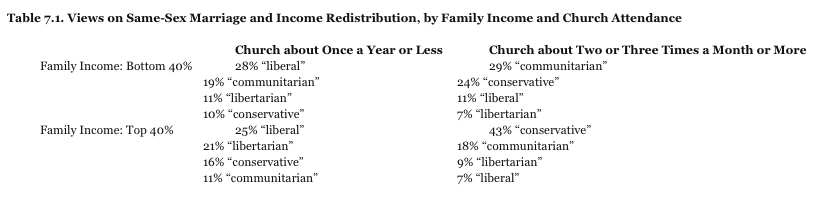
Chapter 8: The Republican Coalition
Here authors review republican coalition that they believe consist of partial inclusion from these groups:
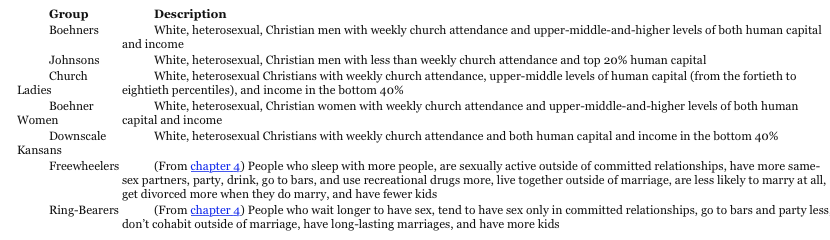
Chapter 9: The Democratic Coalition
Here authors similarly review democratic coalition collected from the following groups:

PART IV: Political Challenge
Chapter 10: An Uncomfortable Take on Political Positions
This final chapter summarizes authors main thesis that political views are derived from direct interests of individuals whether they are consciously recognized or not and therefore generally these views are quite predictable based on economic position, human capital possession, and lifestyle of individual. The main inference from this analysis is that first and foremost that we cannot “all get along” and reconcile our difference because they based on deeply seated and not easily modifiable substance of our lives.
MY TAKE ON IT:
I completely agree with idea that we all have political view based on our position in society and lifestyle. I also agree that we all driven by self-interest disguised as noble reasons by our self-deception. The only issue I have with this analysis is authors’ position on human capital as direct function of education. I see human capital as much more complicated parameter related not that much to educational credentials, but rather to individual ability to successfully sell intellectual services. This approach would allow understand that seemingly paradoxical situation when very rich graduates of Harvard 77 are overwhelmingly democrats is no paradox at all because ability of these individuals to sell their services as highly paid lawyers, corporate and government officials, and such is highly dependent on government intervention, with democrats as party of big government clearly protecting well being of these people by expanding government. Even doctors and educators who are seemingly provide direct services to people are highly dependent on government intervention to force healthy people without children in school to pay high taxes so these professionals could charge exorbitant prices for their services. Without government intervention these services would be priced by market pretty much within financial abilities of people who actually require such services and these people would be inclined to drive hard in search of bargains. With government intervention force is used to confiscate money through tax and bureaucrats who allocate loot for acquisition of these services also benefit from high prices because it increases their share.
Similarly paradoxical issue with Kansas when low income working people prefer republicans would be better explained not by religious believes of these groups, but rather by their much higher ability to obtain wealth via selling their non-credentialed services and produced goods on free market without government intervention than on market limited by government intervention with its licensing, reporting, and compliance requirements they find very difficult to satisfy.
20150911 Who gets What

MAIN IDEA:
The main idea of this book is that markets are not necessarily intrinsically effective when they are created spontaneously and quite often they fail in fulfilling their function of supporting efficient exchange of good and services, especially in a case of matching markets when subjects of exchange have unique parameters that should match for exchange to occur. Consequently in such cases of complex matching markets the conscious design of market place and its processes is required. It leads to main point of this book that the new and very important area of applied economics should be developed for markets design and implementation.
DETAILS:
MARKETS ARE EVERYWHERE: Introduction: Every Market Tells a Story
This is review of markets as the places of exchange real or virtual with stress on difference between commodities market and matching markets. Very important point is that markets effectiveness and efficiency highly dependent on market design that often done informally without clear understanding what needs to be achieved and how. Author stresses 2 parameters of the market: thickness and congestion. Well-designed market should be thick and uncongested.
Markets for Breakfast and Through the Day.
This is discussion of commodities market and history of their development. Author using history of grain and coffee markets to demonstrate that it typically starts as matching market when every farmer sells specific batch of grain that overtime develops into commodity market when batches are mixed and grain sorted by some relevant parameters into trenches of consistent grades, making it a lot easier to trade. Author also discusses how contemporary communication technology such as Internet and mobile devices made very thick market for just about everything conceivable.
Lifesaving Exchanges
This chapter is about a very specific market that author helped to design: non-monetary market of kidney exchange. The problem was that it is highly complex matching marked severely impeded by government ban on organ sales. As result kidney provided exclusively on voluntary basis, typically by people who want to save their relatives. The problem of medical compatibility between donors and recipients makes this process highly complicated. Author describes in details challenges and solutions that allowed developing sophisticated multistep and multilayer market place effectively supporting kidney exchanges.
THWARTED DESIRES: HOW MARKETPLACES FAIL: Too Soon
Part two is dedicated to market failures and their typical causes. In this chapter author uses history of Oklahoma land rush and its sooners to look at market failure caused by timing issues when market participants arrive at different times causing exchanges to occur too soon, consequently being by far less efficient than if all participants were present at the same time. Another interesting example of too soon exchange is marriage market for women that dramatically changed from 1950s to our time. Similar issues are demonstrated for doctors versus residents matching exchanges. Author also demonstrates how cultural preferences specific for doctors’ specialty lead to different outcome for similar market design that worked fine for one specialty, but not for another.
Too Fast: The Greed for Speed
This is about market failure caused by being to fast. This is discussed using NYSE and CME exchanges when at one point it was possible to make money by cutting millisecond from speed of exchange. Another interesting example discussed is matching market for court judges and students when students are looking for the most prestigious judge to clerk for, while judges look for the best students. Interesting detail is exploding clerkship offers, which are issued with expiration time that sometime counted in minutes.
Congestion: Why Thicker Needs to Be Quicker
This chapter is about search for goldilocks point when market designed to be not too fast and not too slow. It reviewed using example of Airbnb, which brings to the market underutilized living space and StubNub, which brought to the market old staff from the attics and basements. However most interesting is review of New York school placement matching market and how similar markets should handle congestion.
Too Risky: Trust, Safety, and Simplicity
This chapter is about key characteristics of the market without which it has hard time to stay open, especially trust and safety. It goes through discussion of value of good name and necessity to maintain information flow within effective parameters because too little information would prevent transactions from happening and too much would limit privacy, consequently creating safety issues. It also reviews Boston School assignment market that works differently from New York.
DESIGN INVENTIONS TO MAKE MARKETS SMARTER, THICKER, AND FASTER The Match: Strong Medicine for New Doctors
This is review of algorithms used to create market for new doctors assignments, which mathematically proved to produce optimum solution for individuals. However when encountering real live complexity such as assignment of couples, it requires quite a bit of tinkering and can deliver only good enough, but not necessarily optimal results. There is also an interesting discussion about centralized marketplaces versus central planning. As result the Rural Hospital Theorem was developed proving that it is not possible achieve stable outcome by changing market rules to achieve predetermine result if people do not want it.
Back to School
This is another recap of school assignment market functioning in New York and Boston with inevitable conclusion that no market design could compensate for insufficient supply of good schools.
Signaling
This chapter is about very important part of any matching market: Signaling. The signals or, in other words, broadcasting information about possibility of match and most important probability that effort invested into exploring such match should not be wasted. Author reviews signaling in such important market as college admissions, job search, and love and marriage. Quite a bit of space assigned to analysis of auctions as signaling systems for matching markets.
FORBIDDEN MARKETS AND FREE MARKETS: Repugnant, Forbidden… and Desired
This chapter looks at legality and morality of some transactions that majority finds repugnant. An interesting point is made that sometimes transactions are considered to be fine as long as they are conducted in non-monetary form, but become repugnant when money added. Obviously kidney exchange is one of such transactions and author reviews implication of this attitude.
Free Markets and Market Design
This chapter is kind of summary of the book with inference that free markets are the best we have, but not perfect and therefore prone to failure from time to time. However it should not be the reason to switch from market to central planning, which is consistently inferior to the market. It rather reason to consciously design market to meet requirements of its participants in effectiveness and efficiency of exchange process. Author sees role of economists as market design engineers because market is not some natural phenomenon, but rather human artifact most often developed spontaneously. The conscious design quite possibly could provide for significant improvement in market design.
MY TAKE ON IT:
As far as I am concern it is the great book filled with very good ideas and interesting examples of implementation of these ideas in real live. I think that development of market engineering for complex matching market has great future as practical area of application for economic and psychological knowledge currently being developed on the large scale. I’d like to see multitude of well-designed markets substituting cumbersome bureaucratic mechanisms of big government and big corporations, eventually pushing out of our lives these monstrosities.
20150904 Our Kids American Dream in Crisis

MAIN IDEA:
The idea of this book is to present statistical research showing increasing division of America into classes of people with unequal opportunities and support this research with real live stories from lives of people belonging to different classes in order to demonstrate that this separation is relatively new phenomenon practically unknown in America of 1950s and 1960s. Author believes that this process is very unhealthy for wellbeing of the society and threatens not only to economic development, but also to democratic political system.
DETAILS:
Chapter I: THE AMERICAN DREAM: MYTHS AND REALHTIES
This chapter starts with author’s recollection of his high school town in Port Clinton Ohio and brief review of several live stories of his classmates some of them from rich and some from poor families. This review demonstrates one of the main points of this book that America of 1950s provided clear path to success as achievement of solid middle class live for everybody, providing they worked hard and played by the rules. After that author compares it with similar lives of people in XXI century and concludes that it is not the case anymore because country clearly divided into rich and poor with poor having very little chance to improve their lives. He provides comparative maps for this town showing that instead of mixing rich as it used to be in 1950s, poor moved to separate place geographically:
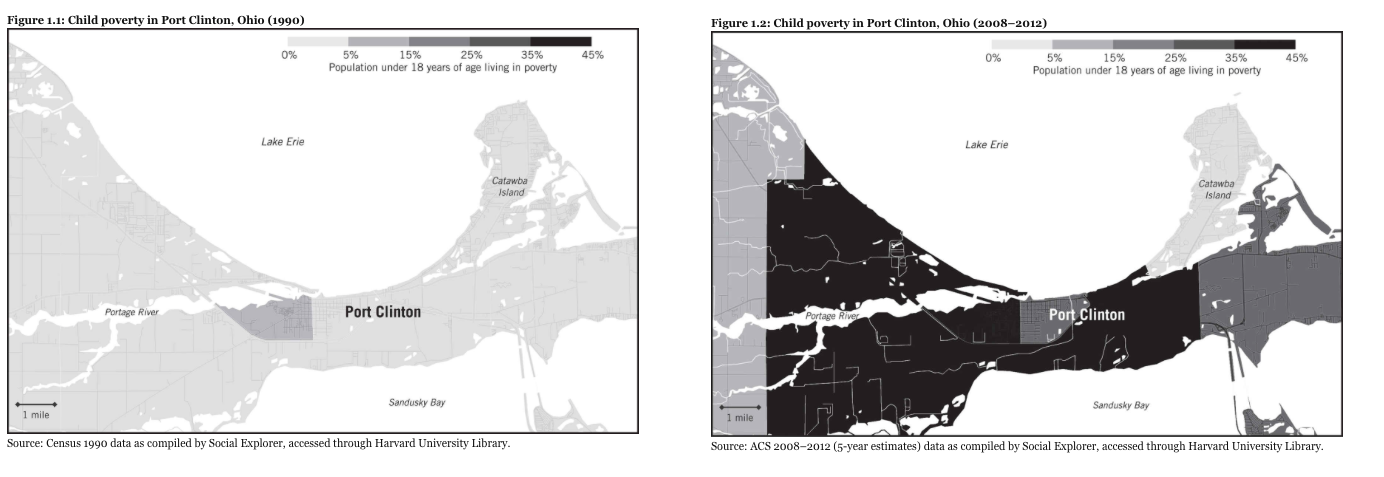
He traces this separation to income inequality, which is highly correlated with education and family structure:
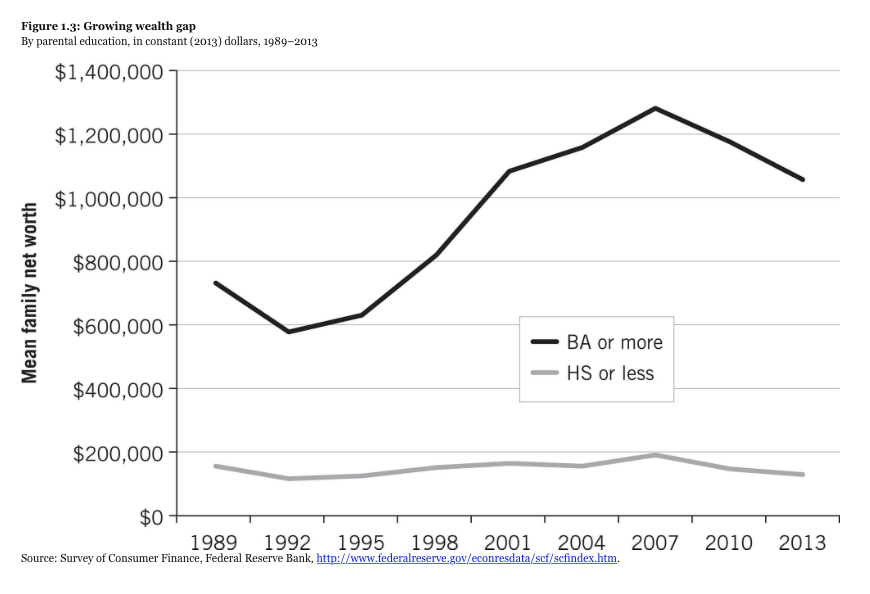
Chapter 2: FAMILIES
In this chapter author uses another small town Bend, Oregon to discuss changes in family structures demonstrating that sexual revolution destroyed family structures of uneducated people, but did not have such impact on family structures of educated people, creating huge difference in lives of children whose chances for good live are dramatically decreasing without support of strong families. Here are data provided for children in complete families depending on education of parents:

Chapter 3: PARENTING
This chapter is a very interesting review of differences between parenting of educated and successful versus uneducated and unsuccessful. The graphs provided demonstrate that educated parents raise children in traditions of American culture with high value put on self-reliance and self-control, while uneducated poor transfer values of welfare state: obedience and external control by authority figures:

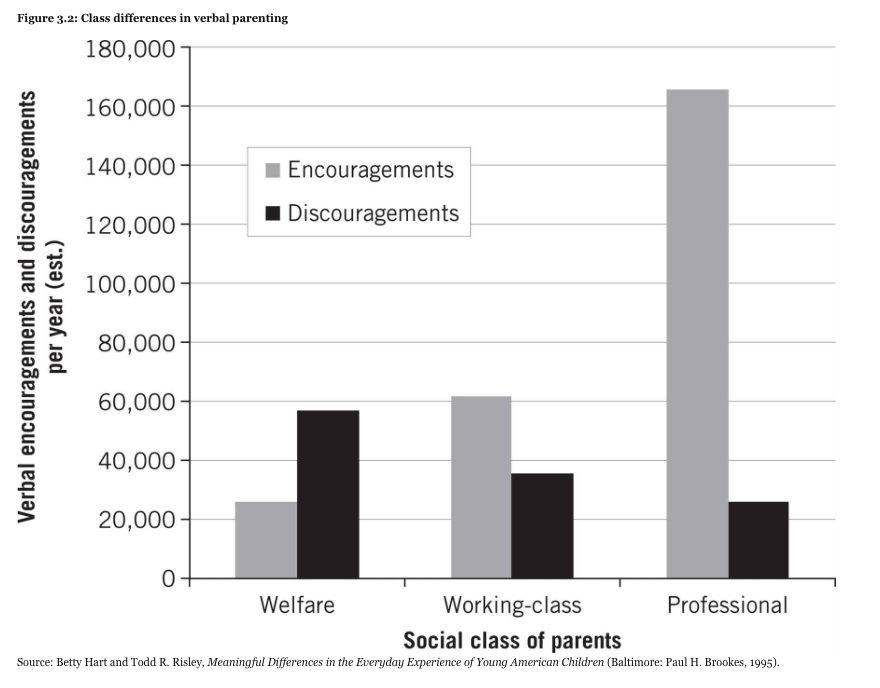
Chapter 4: SCHOOLING
This chapter is about education with explicit assumption that higher education means higher income and better life. It includes comparison of two high schools on of them rich and another poor:
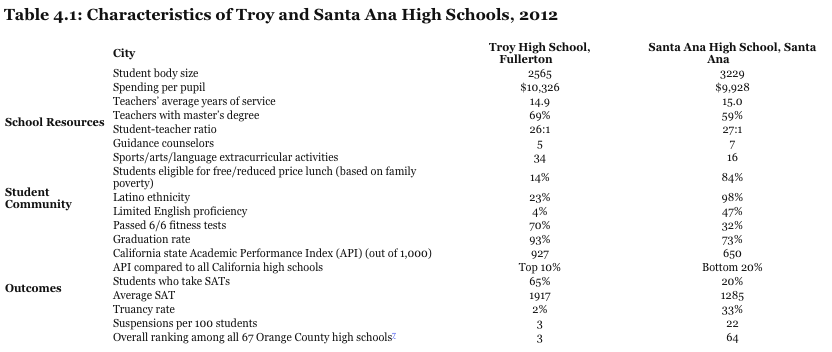
Interesting fact is that money per student are pretty much the same, teacher per student ratio is the same, quality of teachers also the same, but outputs are dramatically different. This difference is persistent throughout total range of educational achievement indicating its dependence on family:
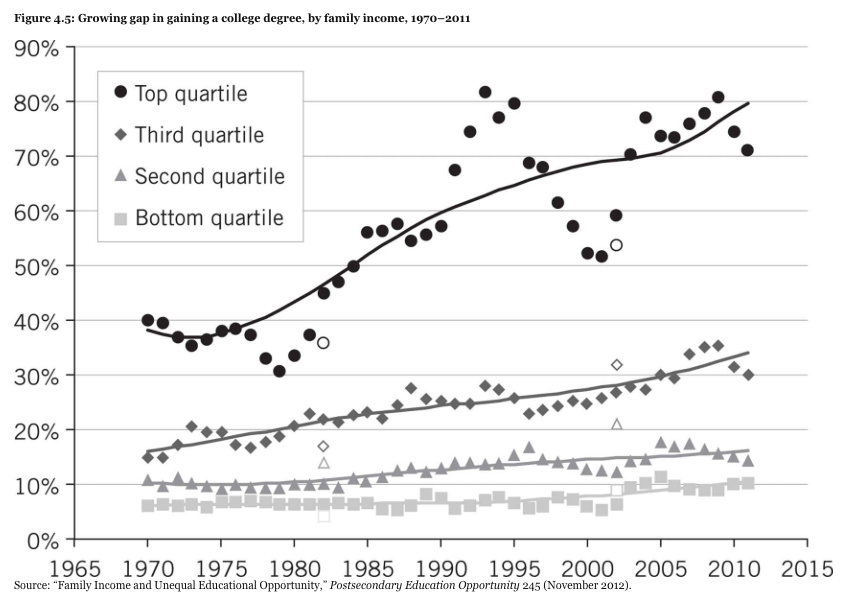
Chapter 5: COMMUNITY
This chapter looks at another parameter: social network outside of family and quality of this network with inescapable inference that it also has significant impact on outcome:
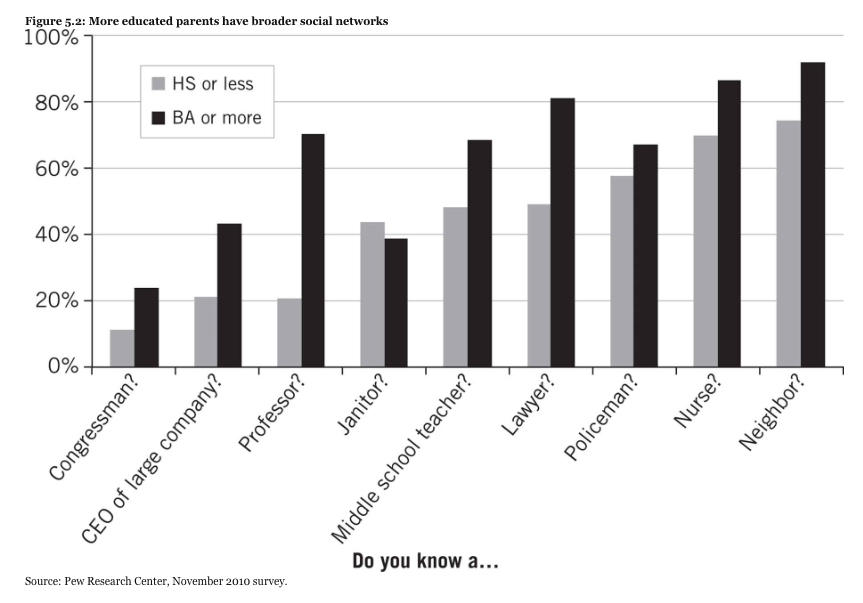
Chapter 6: WHAT IS TO BE DONE?
This is discussion about causes and recommendation and author seems to believe that one of the most important is separation of classes into different communities that do not communicate with each other and do not know how other part lives. Author is making case that it results in unequal opportunity and that this situation has do be fixed because it represents problem for economic development and for democracy itself, besides it is moral obligation of upper classes. Author provides list of areas and what he believes should be done in each of them.
MY TAKE ON IT:
I believe that process of country breaking down is well underway and could not be stopped without significant changes in the whole way of how we create and allocate resources. America of 1950s become much more egalitarian country than it was at the beginning of XX century due to two very special circumstances. One was ongoing process of substitution of plutocrats by bureaucrats as main force of society when plutocrats were on the way down in their ability to grab wealth, while bureaucrats still were on their way up in such ability so both these groups were somewhere above middle class, but not to such extent as it was before 1930 for plutocracy when government intervention was small and after 1960s for bureaucracy when government intervention become huge. Another one was the fact that Europe and world was practically in ruins after WWII and everybody everywhere desperately needed everything, so America, being untouched by destruction, had very good jobs for everybody who wanted to work and did not have or need welfare state for people who did not want to. Both these circumstances are long gone. Bureaucrats are firmly in control of government, which in turn is in control of just about everything with plutocrats playing just supporting secondary role. Plus the world expanded dramatically with free trade and dissolution of socialist model, bringing in huge amounts of cheap labor and pushing out of productive activities uncompetitive low skills Americans to such extent that their children find themselves in isolated communities with environment not conductive for skills acquisition. The key to solution would be such change in the system that would provide people with additional resources directly linked to their effort so the way up would be unimpeded. The current welfare state that provide resources independently of effort is bound to fail because humans are not animals and need much more than food and protection from elements.
20150828 Principles For A Free Society

MAIN IDEA:
This is a very interesting attempt to review contemporary legal environment with its history of moving into direction of increasing state power and government intervention in all areas of life. However the main idea is not just to document it, but rather find some way to reconcile it with Laissez-Faire ideas that author believes are the best for economy and prosperity. Author seems to believe that these free market ideas in their simplistic form could not support effective functioning of society in contemporary complex environment, so the state power had to be used in multitude of situations to overcome these limitations, and he reviews such situations in this book.
DETAILS:
Introduction: Reinvigorating Laissez-Faire
This is foundational part of the book with discussion of Laissez-Faire as concept often misunderstood as free for all with glorification of individual at the expense of society, instead of the best way to organize economy in common interest, which it actually is.
1.Natural Law: The Utilitarian Connection: Permanence and Change; Benevolence of Strangers; Sharing within the Family; Individual Autonomy; First Possession; Custom as a Source of Law
This chapter reviews two approaches to legitimacy of society organization: natural law approach which states that people have inherent unalienable rights and utilitarian approach which states that people should organized society in such way as to provide maximum benefits to maximum numbers. Generally author critic natural rights approach as foundation of Laissez-Faire and suggests that much better foundation could be build on notion of private property as more effective way to incentivize individuals to produce and cooperate for common benefit, than any other method.
- Social Norms versus Legal Commands: The Prisoner’s Dilemma Game; Hart’s Failed Distinction between legal and Social Norms; Sorting Sanctions; Two-Tier Sanctions; The Dependence of Social Norms on Law; Coercive Social Norms;
This chapter analyzes interaction between laws and social norms that provide a very sound base for human interaction either at market place or in other areas of human live. Author also provides critic of contemporary trend of increasing government power and influence by pushing legal norms into areas that traditionally were domain of social norms.
- Harm: The Gateway to Liability: Harm to Self; Harm to Others; A Shield of Liberty in the Late Nineteenth Century; A Sward against Liberty in the Twentieth Century; Looking to the Future;
Here author analyses notion of harm and its application in contemporary world. The most salient is discussion about difference between harm by aggression and harm by competition. While both types could cause pain and suffering for individuals, only the former causes negative consequences for society by causing interactions being a negative sum game, while the latter is actually beneficial because absent fraud and aggression competition is the only way to discover the best way to do things and move society overall in this direction. However despite generally supporting idea of unabridged competition sans aggression, author nevertheless supports idea of limited antitrust laws that restrict competition under some very specific circumstances.
- The Benefit Principle: Baseline Users; Positive and Negative Externalities; The Categories of Restitution; The Public Face of the Benefit Principle
This chapter looks at benefits that people did not ask for, but forced to be paid for. This is logical foundation of theories of social contract. This idea has very limited use in common law, but widely used by statists to justify their use of coercion to extract resources from productive people.
5.Altruism: Its Uses and Limits: Altruism and Self-interest; The Modest Uses of Selective Altruism; Altruism and Communitarianism; The Pretense of Altruism;
This is discussion of altruism and more important use of altruism as cudgel against Laissez-Faire despite the simple fact that it does not require or even promote greed and material self-interest. All it requires is to remove government force from resources production and allocation, leaving it to voluntary decisions of people. The typical result of government forced altruism is resource transfer from poor to rich under banner of help to the poor.
- Forfeiture: The Flip Side of Rights: The Common Law of Forfeiture in the Nineteenth Century; The Twentieth Century Welfare State;
This is kind of continuation of discussion of forced altruism, but it is conducted in terms of negative and positive rights, with negative rights being right to property, contract enforcement, and other legal tools to allow people to keep resources they produced. The positive rights that represent form of forced altruism that created basis for welfare state is basically rights to product of labor of other people. In addition to this the contemporary legal system often supports idea of individual’s right to be protected from own errors, mistakes, and even plain self-destructive behavior. However it creates huge complexity because protection of one person at the expense of another would cause push back from the loser, resulting in attempt to find some equilibrium that would take into account balance of power between constituencies.
- Boundaries: Firm and Fuzzy: Boundaries of Self; Boundaries of Land; Successive Holders of the Same Property; Invasions of Privacy; Boundaries in the Air Waves;
This chapter is about probably the most difficult issue facing libertarians who believe that individual’s freedom ends at the point of other individual’s freedom – the issue of boundaries. The biggest problem is that these boundaries are not purely physical; they also could include communications not only between individuals involved, but also between individual and third party in relation to another individual.
- Prom Rights to Remedies: The Sanctity of Contract; Property and Necessity; Damages, Injunctions, and Permits; The Constitutional Dimensions of Entitlements; From Remedies Back to Rights;
This chapter explores connection between rights created by legal system and remedies used to enforce these rights with conclusion that absolute conceptions of private property are valid in main, but with exception of special cases of necessity when property rights could be forcibly substituted with compensation rights.
- Common Property: A Peaceful Coexistence of Private and Common Property; The Constitutional Complications;
This chapter is about common property such as air and water and impossibility of dividing it into private domains.
- Common Carriers: The English Background; Late Ninetieth-Century American Developments; Interconnections; Rate Regulation; Contemporary Constitutional Issues;
This final chapter continues discussion of commons concentrating on their specific incarnation in what commonly is considered monopolistic arrangements such as railroads, radio spectrums, utilities and similar enterprises when competition believed to be next to impossible. Author believes that it warranties government interference to enforce general availability of service for everybody at affordable rates.
EPILOGUE A Return to Fundamentals
The final discussion is about necessity to adjust Laissez Faire ideas to contemporary complex society and economy when limiting state intervention is not enough and the used of state force could be justified for multitude of situations discussed in previous chapters of this book. The bottom line is necessity to find proper legal framework for state power to be “strong enough to hold us together, but not so strong as to reap us apart.
MY TAKE ON IT:
It is a very interesting approach and I found in this book quite a few examples of issues for which Laissez- Faire solution seems to be impossible or at least extremely difficult. Nevertheless none of discussed situations warranties, in my opinion, need for state power beyond prevention and/or retaliation for aggressive use of force or deception. I think that reason for my disagreement comes from different approach. Author seems to be looking at every situation from point of view of legal scholar that he is, meaning that he is looking to develop legal algorithm for solution that would fit any conceivable situation and could be enforced by external state power. I, on other hand, believe that many of these situations are so complex that such solution could not possibly exists, so all issues should be resolved between participants any way they want to on condition of non-use of aggressive force and deception. The caveat here is that I believe that equality and marketability of rights for resources and equality of borders between individuals would support such resolution if supported by availability of truthful information about issues and hand and past history of participants.
20150821 The Forgotten Depression

MAIN IDEA:
The main idea of this book is to demonstrate that usual condemnation of Laissez Faire approach to economy as cause of the Great Depression is based on false narrative. This narrative presents late 20s as period of unabridged capitalism that led inevitably to disaster. Instead of just critiquing this narrative directly author looks at previous depression of 1920-21 when capitalism was a lot less constrained than 10 years later. In 1920-21 the federal government was run by debilitated Wilson who was not capable and later on by hands off Harding who was unwilling to interfere, resulting in much more Laissez Faire than under “great engineer” Hoover. Author quite convincingly demonstrates that 1920-21 depression was as severe or even more so than 1929, but without government intervention prices and wages dramatically went down, unemployment went up resulting in quick achievement of equilibrium and dramatically fast recovery.
DETAILS:
- The Great Inflation
This chapter is about events preceding depression of 1920. It starts with events of WWI and wartime inflation that followed by contraction of production as result of cancelation of war orders in 1918.However instead of depression it was followed by boom due to consumer demand delayed by war and growth of Europe needs for reconstruction at least partially financed by US Treasury loans. However all this demand supported by money outrun production abilities, leading to inflation of 18.6% in 1918 and 13.8 in 1919. These problems caused significant labor disturbances and strikes. Another consequence was illusion of wealth making lots of people especially farmers borrow too much and overinvest into expansion.
- Coin of the Realm
This chapter is about monetary issues of the period starting from 1880 to 1900 when sticking to gold standard combined with fast growth in productivity produced significant deflation before it was substituted by inflation of progressive era. Despite dollar being convertible into gold, the money supply grew dramatically due to influx of European gold attracted by high interest rates. Author also discusses economic thinking of the period especially ideas of Fisher.
- Money at War
This is discussion of role of Federal Reserve with its gold supported notes in financing the war. It also reviews money movements during the war with initial withdrawals by Europeans at the beginning of war that followed by massive transfers to USA as payments for war materials. FEDs also increased money supply by supporting government Liberty bonds.
- Laissez-Faire by Accident
This is analysis of situation after WWI when due to sum of unexpected events American economy had chance to work in mode close the Laissez-Faire. Probably one of the most important events was temporary decapitation of American bureaucracy, due to Wilson’s stroke. As prelude author reviews two attempts of hands on control over economy: failed attempt to substitute Du Pond company with government controlled production for powder and Harry Garfield’s attempt to manage fuel that also failed spectacularly.
- A Depression in Fact
This chapter provides statistical justification to idea that slowdown of 1920 was indeed depression quite comparable to Great depression 1929. It also reviews and reject attempt by Christina Romer to decrease its scale and significance. The numbers for GNP is decline by 24% and unemployment 15%. Author brings in analysis of different industries from automotive to agriculture to support his point.
- City Bank on the Carpet
This is story of National City bank and Fed’s Comptroller of Currency John Williams who was overconfident in stability of banks just before depression. In reality many banks were overextended and National City was deeply in betting on sugar prices. Williams pressed the bank with investigations of not only its solvency, but also of corrupted practices.
- Egging On Deflation
Here author reviews Feds expansion of money supply to fight deflation with more than 100% of banks’ required reserves were provided by Fed on loan. However Feds abilities were limited by requirements to keep gold as reserve for Fed banks. Eventually they had to vacillate between fighting deflation with increase of money supply and inflation with increase of rate to 6%
- A Debacle “Without Parallel”
This is review of depression depth in terms of crash in commodity prices and stock market, which lost 39% of its value. Taking all together, the decline was unprecedented.
- The Comptroller on the Offensive
This is review of action of outgoing Comptroller Williams who was trying preventing increase in rate to 7% in addition to dealing with banks and trusts some of which like Guaranty he was fighting.
- A Kind Word for Misfortune
This is review of typical approach of American at the time to phenomenon of depression. It was considered a natural process of readjustment of economy to changing circumstances that had to occur for it to remain healthy. There is nothing to be done and one just had to go through it. The idea that massive government intervention could remove depression was already around, but it did not obtain massive support yet.
- Not the Government’s Affair
This is review of political environment and ideology in 1920 when both political parties consider economy mainly out of scope for political actions limiting such actions to monetary policies. Republicans hit Democrats with accusation of making dollar worth 50 cents and that was about it. Both parties complained about high cost of living, but Harding won overwhelmingly after promising do nothing with his slogan of “returning to normalcy”.
- Cut from Cleveland’s Cloth
This chapter is about initial actions of Harding presidency. As promised they cut down government expenses and resisted demands for public payments to veterans what later turned into demand for bonus.
- A Kind of Recovery Program
This is very brief review of Treasury secretary Andrew Melon actions directed at decrease of marginal tax rates. This counterintuitive move led to dramatic increase in tax revenues, as Melon had expected.
- Wages Chase Prices
This chapter starts with review of stock market movements prior to election then discusses process of deflation when downfall of prices led to decrease in wages. It caused significant disturbance by labor movement despite the fact that prices went down much faster than wages so real purchasing power grew. All that Harding administration did was to provide arbitrage services in extreme cases of union vs. management fights.
- Shrewd Judge Gary
This is story of Judge Gary namesake of steel town in Indiana. After presiding over multiple commercial cases, usually being supportive to business, Gary left law to become president of Federal Steel Corporation and was quite successful in withering economic downturn in part because he managed to make significant share of employees into shareholders, achieving improvement in morale and dedication of workforce.
- “A Higher Sense of Service”
This is continuation of analysts of political attitudes to the role of government in economics. Despite republicans being pro business and democrats being pro government, both sides saw business cycles as inevitable natural phenomenon. Even so the seeds of future government expansion were planted inside both parties with Harding proposing creation of public welfare department and Hoover busy building all kind of schemas for government intervention just about everywhere.
- Gold Pours into America
This is review of international economic position of United States at the time. As consequence of WWI it was highly advantageous, with USA exporting nearly double of its import and gold flowing into America from Europe. Eventually it stopped deflation and monetary situation started to turn around in early 1920.
- “Back to Barbarism?”
This chapter provides some examples of how American companies managed to get through this short depression by managing inventories, prices, and labor. Examples provided for DuPont, White Motor Company – the biggest trucks manufacturer at the time, and Sears. Overall American business had dramatic decrease in profits in 1921, which pretty much rebound in 1922. Author also discusses home construction and agricultural sectors.
- America on the Bargain Counter
This is analysis of impact of depression on various businesses with conclusion that it was very tough on businesses encumbered with excess inventory and rigid contracts and they suffered, while more flexible and liquidity rich business not only survived, but also prospered. By the end of 1921 depression was over and roaring 20s had begun.
- All for Stability
This is description of results and impact of this deep, but brief and self-healing depression. On one hand it proved that economy would self adjust if left alone, while on the other hand it demonstrated depth of pain and suffering that could be caused by even brief downturn. It caused search for controlling mechanisms capable to avoid this pain by using government power. The most well known were Keynes’ ideas of government intervention in business cycles by increasing spending during downturn. In America it was Fisher’s ideas of stabilization by controlling money supply. Eventually it became part of Feds mandate, when mechanism of purchasing Treasury securities by Fed was put in place.
Epilogue: A Triumph, in Its Way
Here author provides summery of events and consequences and discusses fate of main players.
MY TAKE ON IT:
I think it is a pretty good analysis of factual data and events of depression of 1920-21. It slightly overburdened by history of banks and monetary policy of Fed, but other than that it is a good narrative of period. Certainly each period in history unique so it is not possible to prove counterfactual ideas what would happen if in 1929 Hoover did what Harding did in 1920, that is exactly nothing, but in my opinion comparison of these two depressions provides good illustration of conceivable outcome. I personally believe that the issue here is more philosophical than political and it is idea that super complex information system that includes hundred of millions of self-directed human beings is not possible control and manage effectively via centralized hierarchical system of several hundred thousands of bureaucrats. The only way such system could possibly function effectively and efficiently is via self-regulated system of market economy, which is while not perfect, but at least functional, while bureaucratic system either in its deadly form of central planning or less severe form of regulatory state is typically dysfunctional.
20150814 Political Order and Decay

MAIN IDEA:
The main idea is to identify based on history typical signs of political decay in contemporary societies. These signs are: dramatic decrease of income growth in developed countries, gridlock of democratic polities in solution of various problems, increase in bureaucracies and decrease in their effectiveness. Societies are reviewed based on different paths of development: OECD, Latin America, Sub-Saharan Africa, and East Asia. Despite Asian model of limited market capitalism under authoritarian rule still being on the rise and OECD model of democracy with free market severely impeded by bureaucratic welfare state being in decline, author seems to believe that East Asian model is not sustainable on the long run and OECD model with democracy has more potential for growth and improvements in human life.
DETAILS:
PART I: THE STATE
- What Is Political Development?
Here author refreshes his definition of political development as total of 3 components: the state, rule of law, and accountability. He stresses the difference between rule of law and rule by law with latter often being a necessary predecessor of the former, but by far not the same. He also briefly points at sources of political decay and presents plan of the book as continuation and expansion of ideas presented in the first volume to the world development after Industrial revolution.
2.The Dimensions of Development
Here author presents data about dramatic change in technological and economy environment and is trying to place political development into framework of overall development of humanity in all relevant areas:

- Bureaucracy
Here author correctly posits that the state is bureaucracy and reviews attempts to measure quality of the bureaucracy across the scope of state functions:


- Prussia Builds a State
In this chapter author reviews history of state development in Prussia: the commonly accepted gold standard of bureaucratic welfare state.
- Corruption
Here author reviews phenomenon of corruption as inalienable part of any government and how it impacts development of the state. He differentiates corruption into 2 distinct forms: Patronage and Clientelism. He discusses patronage as more damaging form that is at odds with democracy and impedes development of accountability. He seems to consider Clientelism much more benign form of corruption that actually could be considered a primitive form of democracy that recedes with economic development when voters are too rich and educated to sell their votes to politician in exchange for some small potatoes. In this case the whole population practically becomes clientele because politician has to satisfy increasingly bigger share of voters to get elected.
- The Birthplace of Democracy
Here author discusses his thesis that early development of democracy, when country is still very poor, leads to development of low trust society and formation of rigid clientele / politicians combinations, preventing effective development of polity. He uses Southern Italy and Greece as examples.
- Italy and the Low-Trust Equilibrium
This is more detailed look at Italy where North and South had very different paths of development with South consistently remaining low-trust corrupted entity, while North developing into much more modern and effective capitalist polity. The special attention is given to issue of low versus high trust societies and how former causes severe problems for development.
- Patronages and Reform
This chapter is about American and British development. Both democracies started with government bureaucracies based on patronage, but only America developed fully blown clientele system. British implemented Northcote-Trevelyan reforms in 1854 that ended patronage and implemented system of examinations. This effectively removed aristocracy out of bureaucratic hierarchy and opened door for “meritocratic” elite. In America system of checks and balances prevented decisive reform from the top leading to transformation of patronage system into clientele system. Author sees it as “inherent tension” between democracy and “good governance”, with America being more democratic leading to it being poorly governed.
- The United States Invents Clientelism
This chapter is detailed look at American development and its differentiation from all other countries as result of maintaining ancient rules of separation of powers, checks, and balances that greatly complicate functioning of modern bureaucracy. In XIX century and a good part of XX century it led to municipal party politics with whole slides of population becoming clientele of city party machines such as Tammany hall.
- The End of the Spoils System
This is continuation of review of American development when the rising bureaucracy in turn defeated the spoils system established with Andrew Jackson’s victory over quasi-aristocratic patronage system that existed from beginning of republic. The Pendleton act of 1883 was a landmark in multi-year efforts to import European ideas of bureaucracy and rule by meritocratic elite. However it took another 60 years before bureaucracy, especially federal bureaucracy in alliance with progressive movement become absolutely dominant force in American society.
- Railroads, Forests, and American State Building
This is review of specific battles and victories of bureaucracy in railroad dealings with plutocracy and in building exemplary bureaucracy of Forest Service. Author looks at this from point of view of Principal/Agent framework, stressing that capture of public resources by special interest had never been far away from everyday reality.
- Nation Building
This is review of role of nationalism and identity politics in nation building. It provides an interesting classification of routes to national identity:
- Territorial expansion
- Genocide or ethnic cleansing to create homogeneous population on national territory
- Cultural Assimilation
- Adjustment of national identities to political realities.
- Good Government, Bad Government
This is discussion about quality of government with special attention of its variance and its dependence of the path of development. Author seems to believe that the best way is building a strong state first with rule by law supporting economic development and only later and gradually switch to rule of law and democracy (German way), with American way of starting with rule of law, effective market economy, and democracy and only later adding strong state being inferior, and Greek / South Italian way of starting with democracy and never really getting neither to the rule of law nor to the free market economy, being quite a lousy way to proceed.
PART II: FOREIGN INSTITUTIONS
- Nigeria
This is a brief case study of Nigeria as a typical example of undeveloped society where deep corruption and absence of democracy keep people in poverty despite or maybe even because of wealth of its natural resources.
- Geography
This chapter is discussion of influence of geography with reference to work of Montesquieu on nature of laws and contemporary economist Jeffrey Sachs and anthropologist Jarred Diamond both of whom seems to overstate this influence. Here author also defines 3 regions he will use to discuss political development: Latin America, Sub-Saharan Africa, and East Asia
- Silver, Gold, and Sugar
This chapter is about development in Latin America where Spain at least partially transferred its institutions by imposing them on local population of mixed ethnicity and culture, creating in process policy week in both accountability and rule of law.
- That Didn’t Bark
The main point of this chapter is that in China’s as well as in Europe’s extensive wars facilitated creation of powerful states, especially in comparison with peaceful development of Latin America that paradoxically led to problems caused by weakness of the state.
- The Clean Slate
This is review of two exceptions to typical development of Latin American countries: Costa Rica that despite all odds did not become “banana republic” and Argentina that started very well and was on its way to becoming Denmark when it degraded dramatically to typical Latin American level of corruption and stagnation.
- Storms in Africa
This chapter is about reasons for weakness of Sub-Saharan states coming from absence of any developed states.
- Indirect Rule
This is continuation of the discussion with stress on corruption development during colonial period when very small numbers of European administrators dealt with local tribal kings.
- Institutions, Domestic or Imported
This chapter is about another type of powerful external intervention implemented by United States and Japan. It is also form of indirect rule, but mainly via international financial and political organizations.
- Lingua Franca
This chapter is about importance of creating national identity for political development. It reviews success story in Indonesia and Tanzania in comparison with failure in Nigeria and Kenya.
- The Strong Asian State
Contrary to Latin America and Africa, Asian Countries had highly developed and powerful states long before colonial intervention. Despite being technologically far behind these policies where able survive colonialism and in case of Japan even repulse it at early stages. Author also reviews an interesting case in Japan before and during WWII when military bureaucracy went completely out of control by existing structures of the state, leading to nearly complete destruction of the country.
- The Struggle for Law in China
This is review of XX century metamorphoses of highly bureaucratic Chinese state going through revolutions, civil war, totalitarian communist rule by Mao, and eventually arriving to bureaucratic rule by law combined with relatively free market of contemporary China.
- The Reinvention of the Chinese State
This is continuation of discussion on China, with stress on specific problem of bad imperator and challenge that complex bureaucracy represents for accountability. Author seems to believe that it will be eventually resolved via some form of democratic development.
- Three Regions
This is summary of 3 regions discussion with some interesting data presented for comparison:

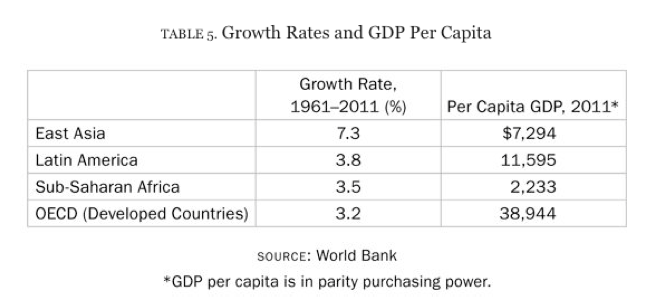
PART III: DEMOCRACY
- Why Did Democracy Spread?
This is about the reasons for democracy’s expansion around the world. Author seems to be connecting it to division of labor, expansion of market, and individualization of population that participates in it. Consequently it led to expansion of political participation in the struggle over control of the state, which at the long run defines resource allocations and transfer. Here is graphic representation of these ideas:

- The Long Road to Democracy
This is a brief history of democratic expansion with some data:
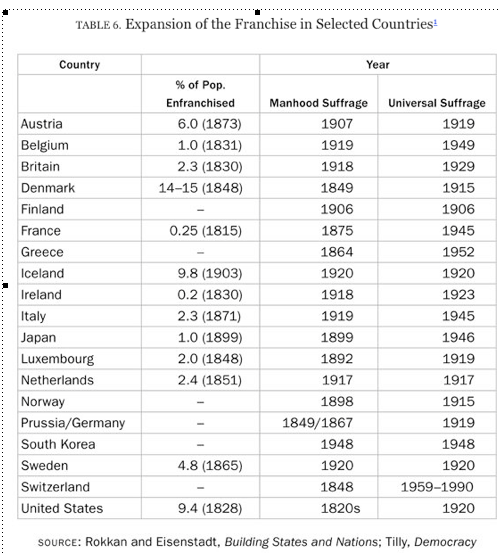
- From 1848 to the Arab Spring
This chapter is attempt to link democratic movements in Europe in XIX century with recent Arab Spring with pretty sad conclusion that as European movement turned into nationalistic nightmare so Arab spring has all signs of turning into movement of religious supremacy of Islam because economic foundation of stable democracy is yet to be achieved.
- The Middle Class and Democracy’s Future
This chapter is about middle class, its role in democratization and politics. Most important it recognizes problem of disappearance of middle class as result of technological advancement including transportation and communications that allowed cheap immigrant labor inside developed country or cheap foreign labor in offshore installations directly compete with local middle class. Author believes that the only solution capable to save middle class is expansion of education.
PART IV: POLITICAL DECAY
- Political Decay
This chapter provides a shining example of political decay using US Forest Service, which went from exemplary government agency to unruly congregation of bureaucratic hierarchies serving mainly to provide living for its bureaucrats, lobbyists, and special interests protected by them. At the end of chapter author provides generalization of political decay process using historical examples, but most important looking at what author believes deficiencies of Madisonian version of democracy with its checks and balances that far from being reliable safeguards against corruption.
- A State of Courts and Parties
This chapter looks at judicial capture of administrative process, which often gets ground down to stoppage by checks and balances in hands of competing parties with polar ideologies. It provides an interesting table for Ratio of Tax revenues to GDP:

- Congress and the Repatrimonialization of American Politics
This is closer look at capture of legislature by special interests, as it is done in USA, working via lobbying process and how it accelerates political decay.
- America the Vetocracy
That’s how author characterized contemporary decay of American polity where quite a few groups have veto power and practically nobody can get things done as result. Author provides a very nice graph for this process:

Author also discusses difference of United States from other countries and organization like EU coming to conclusion that America is trapped in bad equilibrium of Vetocracy. The Madisonian republic slowed advance of welfare state and author understands that Americans consider it a blessing. However the same factors made it difficult to rebuild system now when such state proved its inefficiency.
- Autonomy and Subordination
This chapter is about differences between governance of private business and government bureaucracies, stressing a need to find a balance between enterprises and democratic control. It also discusses issue of bureaucratic control, capacity of the state, and their relation to quality of government. It is supplied with a nice graph:

- Political Orders and Political Decay
The last chapter somewhat summarizes author’s ideas presented in two books on political order and decay. It also presents a brief look at the future development when author discusses alternatives to democracy, especially Chinese model, eventually coming to conclusion that despite all problems democracy is still the best model available even if there is no guaranty that it will eventually win everywhere. There are just too many unpredictable random events and turns that could derail even highly developed society into political decay and degradation. Nevertheless democracy contains a very strong universal appeal attracting more and more peoples and countries to its side.
MY TAKE ON IT:
I find this book very interesting not only due to the thorough research and wealth of data accumulated, but also because it is all plugged in well thought through model of development of society and its polity. My main difference with the author probably relates to his disgust with Madisonian Democracy with its checks and balances that prevent effective government actions. I do not believe in wise politicians and all knowing and benevolent bureaucrats who would fix all problems if not overburdened with checks and balances. I believe in self-centered power hungry politicians and bureaucrats whose main purpose is to control other people’s lives for psychological satisfaction and transfer as many resources to selves for material satisfaction using government power. Moreover, I believe that no system of checks and balances would be able to contain these people in their strive to satisfy their own needs and wishes at the expense of everybody else, so the only solution is to restrict role of government and therefore violence, coercion, deception, and indoctrination to absolute minimum of protection against violence, coercion, deception, and indoctrination by other players: foreign governments, criminals, and crooks. In other words the best way to prevent political decay is to diminish importance of political power in all areas of our lives.
20150807 – A History of Strategy
MAIN IDEA:
This is review of military strategic thinking throughout all known history from ancient Chinese to our days. The idea is to trace development of military thinking, provide brief review of ideas and individuals who did this thinking.
DETAILS:
- Chinese Military Thought
Chinese approach to the war is as to an evil, even if sometimes necessary. It is violation of cosmic harmony and should be resolved as soon as possible via victory of the most virtuous. San Tzu defines virtue as harmony between leaders and people via strict discipline. The perfect army is so disciplined as not to require neither rewards no punishment. Tai Kung developed detailed structure for military control and planning and logistics requirements. Most important in Chinese strategy purposes is to minimize violence because it violates harmony. The victory should be achieved by superior intelligence and logistics placing adversary in position when he has no choice but surrender. Author highly appreciates Chinese military writings as unsurpassed in their sophistication.
- From Antiquity to the Middle Ages
For this part author selected Thucydides, Sallust, Caser, and Josephus as unsurpassed military historians. However he considers western strategic thinkers much less sophisticated and effective than Chinese. He discusses works of Aeneas (4th Century BC before Alexander) author of writings on military preparations, war finances, and other strategic issues. Later writer Asclepiodotus (1 century BC) produced works on tactics of phalanx, however they were pretty much outdated by this time. Author reviews a few other thinkers, the most outstanding being Flavius Renatus Vegetius (4 century AD) and his “Summary of Military Matters”. Byzantine Empire produced “Strategikon” (around 600) presenting top achievement of its military with ideas and methods later successfully used in struggle against Arabs. Much later around 900 it produced much less important “Tacticon”. Author considers totality of this literature inferior to Chinese because it did not produce coherent philosophy of war.
- 1500 to 1763
This period includes works of Machiavelli in which he developed idea of using conscripts as source of mass military manpower, however he underestimated artillery. Machiavelli become quite popular, but his military ideas were not applied in real world by anybody. After that author discusses a few other thinkers including Montecuccoli, Puysegur, Maurice De Saxe, and Frederick the Great, none of them really significant. Unlike many others, Frederick did apply his ideas in practice in Prussian wars with various levels of success.
- From Guibert to Clausewitz
This period from 1763 includes work of Gilbert based on analysis of 7 years war eventually resulting in ordinance of 1791 with which French army fought in Napoleonic wars. It included recommendation of moving troops in independent columns with lots of attention to maneuvers. In 1799 the first treatise on strategy: Spirit of Modern System of War” was produced by von Bulow. In it Bulow discussed use of geography, maps, and military staff to conduct proper preparations, analysis, logistical, and military movements based of plans. On French side promoter of ideas of war as movements of people and material through 2-dimensional space was Antoine Jomini who added multiple military concepts including theater of operations, bases and numerical representation of troops capabilities, and setting up specific objectives and lines of operations. Finally significant amount of material in this chapter allocated to Clausewitz who analyzed war and its purpose based on history and experience of Napoleonic wars. The quality of this analysis and ideas put Clausewitz at par with Chinese writing.
- The Nineteenth Century
Starting with Bulow and Clausewitz the military writing moved in more professional direction with soldiers writing for soldiers and away from mythological an historical approach. It was overall change in approach to writing caused by Enlightenment, but also by dramatic changes in military technology. Old prevalence of military formation in battle similar to parades became suicidal for troops and therefore not sustainable. In this relation author reviews work of French officer Charles du Picq, who proposed to move away from fighting in formations and switch to skirmishes with relative small, but self-sufficient combination of troops. However these regiments should be strictly controlled from one source and directed to dynamically attack or withdraw or move according to overall strategic intention of top commander. Unfortunately for millions of people fighting in WWI these ideas did not make it through into thick heads of generals for a very long time. Another outstanding thinker of this period was Prussian general Helmuth von Moltke. His work was not only theoretical, but also practical and directed at handling dramatically increased numbers of troops and needs for supplies. He handled it through creation of General Staff and development of detailed mobilization planning for multimillion armies, their movements and logistics. If Moltke developed tools for making effective army, another German general for Schlieffen developed operational ideas where to move this army and detailed strategic plans for war on two fronts West against France and East against Russia. These plans became foundation of German strategy in WWI.
- War at Sea
This chapter is about naval operations that normally attract a lot less attention than land armies. The eminent thinker in this area was an American Dennis Mahan. His approach was based on history and on analysis of operations of British Navy. Overall it came down to idea that achieving two connected goals: interrupt enemy maritime commerce and transportation and protect one’s own would lead to decisive advantage in any conflict of contemporary powers highly dependent on shipping of men and material in their ability to make war. Mohan believed that this objective could be achieved by gaining “command of the sea” through winning battle of battleships. The other strategy was commerce protection or interruption: battle of convoys Mahan considered secondary, if at all relevant because he believed that winning fight of battleships would allow blockade enemy ports and completely stop its commerce. Another thinker Julian Corbett actually was rich lawyer who just enjoyed developing ideas about naval strategy. He believed that land war is primary and naval operations are secondary and needed mainly to support armies. His writings are mainly case analysis of existing wars in support of this idea.
- The Interwar Period
The period between WWI and WWII was rich in strategic thinkers who tried to accommodate new technologies of warplanes, tanks, mechanized troops, and wireless communications into coherent strategic model of winning war. The most prominent were: Italian general Guilio Douhet – promoter of supreme role of airpower including its ability to win war alone. He greatly overestimated capability of technology of his time and underestimated ability of civil population to survive regular bombing, but his views were vindicated in WWII by American victory over Japan after using just two nuclear bombs. Another thinker British general John Fuller was proponent of rapid movement of mechanized troops and developed ideas that later become known in their practical application as blitzkrieg. Fuller was closely associated with Liddell Hart who promoted multidimensional attacks directed not at taking territory, but rather to disrupt enemy structure and operation making him incapable for organized resistance. Finally author includes in his review WWI German commander Ludendorff who in this period developed concept of total war that required totalitarian state in order to obtain complete control over population and all resources of the country, control that was not available to him in authoritarian German monarchy during WWI. Eventually the Ludendorff’s vision became reality of WWII.
- 1945 to the Present
The last chapter is dedicated pretty much to the world with nuclear weapons and development of MAD strategy of making war impossible to accept. Author also discusses Reagan’s strategic defense initiative and concludes that it did not really change MAD calculation since SDI tools are not possible to test on full scale while consequences of even small deficiencies in protection could be catastrophic. Therefore as of now the military confrontation is conceivable only at the small scale of terror versus anti-terrorism operations, and small wars with limited objectives.
MY TAKE ON IT:
It is very nice and concise review of writings about strategy, but it is not history of strategy. Strategy, as just everything else, has theoretical aspect of people writing about what should be done and practical aspect of how it was actually done. The writings review presented pretty well, but much more important and interesting to me aspect of practical application of strategy as it was developed and used by people who actually did, was left something out of scope. It is too bad, because the practical application is the most interesting part of history.
20150731 World Order

MAIN IDEA:
The main idea of this book is to define meaning of world order and review history and parameters of most important world orders that existed so far:
- Westphalian world order based on balance of powers created after 30 years war
- Its metamorphosis after French revolution, Vienna Congress, and all the way to after the Cold war
- Islamic world order as it was developed with initial conquests, decline and contemporary revival in form of Islamist movement
- Asian, especially Chinese and Japanese historical development of world orders
- American dominated world order and America strife to achieve universal principles of world order based on independency and trade
The main inference from all this is that we are at the beginning of dramatic change from current world order that become unsustainable to something new, but not yet known.
DETAILS:
INTRODUCTION: The Question of World Order
Varieties of World Order; Legitimacy and Power
World order to the extent it exists today was established by victorious Western democracies after WWII. It did not take into account other cultures and other ideas of world order and consequently, due decrease of influence of western democracies, it started to unravel. When it happened, after Western retreat from colonialism and use of force to control the world, other cultures and countries like China, India, and Islamic world challenged existing order leading to its modification.
Author differentiates several world order models developed by humanity:
- European world order created by Westphalian peace based of balance of powers with non-interference into internal affairs of states
- Chinese world order based on supremacy of Chinese culture and state which is put in the center of universe with all other being barbarians practically non-relevant to overall development of humanity and not even worthy of conquest
- Islamic world order based on supremacy of religion of Islam with all other world being subject to conquest, conversion to true religion or annihilation
Current world order of balance of power and noninterference is challenged from all sides including west, which challenges it in the name of human rights and environmentalism. Historically the world order could stand only if it is based on both power and legitimacy, which is very hard to achieve because of difference in values for different people causing them to question legitimacy, while changes in power causes rising countries to test their power.
CHAFFER 1: Europe: The Pluralistic International Order
The Uniqueness of the European Order; The Thirty Years’ War: What Is Legitimacy? The Peace of Westphalia; The Operation of the Westphalian System; The French Revolution and Its Aftermath;
This is about uniqueness of European world order born in Westphalia as result of 30 years war when nobody managed to win. It is based on balance of power when instead of winning all sides position themselves in such way that nobody has reasonable hope to win so the war is avoided. This system lasted until after French revolution when new method of mobilization of all country resources including mass conscription gave France upper hand in fight with all of Europe, at least for a while.
CHAFFER 2: The European Balance-of-Power System and Its End
The Russian Enigma; The Congress of Vienna; The Premises of International Order; Metternich and Bismarck; The Dilemmas of the Balance of Power; Legitimacy and Power Between the World Wars; The Postwar European Order; The Future of Europe;
This chapter is about restoration of Westphalian order by Vienna Congress and its extension for another hundred years up until WWI. It allocates special attention to Russia that was part of balance of power in both Europe and Asia, but then it continuously developed nationalistic narrative of being the third Rome destined to conquer and unify vast expanse of land from Europe to America. Another important part of this discussion about Vienna Congress is its redrawing of legitimacy landscape of Europe from dynastical lands of kings where marriages could lead to merge of countries as reliably as conquests, to ethno-linguistic map when legitimacy would come from ethnicity and language of people living on the land. It created potential for dissolution of multi ethnic empires like Austro-Hungary and merge of multiple principalities of Germany into one powerful state. Eventually this creation and consequent growth of nationalism led to another 31 years World War from 1914 to 1945 with intermission from 1919 to 1938. After that it was somewhat substituted with Ideological Cold War with intermediate actual wars testing continuing balance of power not only in geopolitical meaning, but also in military-technological meaning. At the end of this chapter author briefly discusses future of Europe and attempts to create European Union as tool for peaceful economic, cultural, and, on the long run, political unification.
CHAFFER 3: Islamism and the Middle East: A World in Disorder
The Islamic World Order; The Ottoman Empire: The Sick Man of Europe; The Westphalian System and the Islamic World; Islamism: The Revolutionary Tide-Two Philosophical Interpretations; The Arab Spring and the Syrian Cataclysm; The Palestinian Issue and International Order; Saudi Arabia; The Decline of the State?
This chapter is about Islamic world order as it was initially created and developed on the Arab – Sunni side. Contrary to Westphalian world order developed in Europe and based on balance of power, the Islamic world order is based on conquest and conversion of the world to Islamic faith by all means necessary. This idea worked fine initially and allowed Arabs to expand their religion into old Christian places in Middle East and all the way to India, but was eventually pushed back and stopped after 900 years of expansion. Eventually Islamic countries failed in competition with Western Europe leading to lose of power practically everywhere with the last Islamic Caliphate – Ottomans turning into semi-secular, semi-democratic and semi-European Turkey. Author looks at current resurgence of Islamic ideology, consequences of Arab Spring, Palestinian conflict, and position of rich monarchies of the region. He seems to be coming to conclusion that reenergized Islamic ideology of conquest not only rejects Westphalian ideas of peace with balance of power, but even legitimacy of contemporary states. For them the only acceptable future is complete victory of Islam and submission of everybody else.
CHAFFER 4: The United States and Iran: Approaches to Order
The Tradition of Iranian Statecraft; The Khomeini Revolution; Nuclear Proliferation and Iran; Vision and Reality;
This chapter is about other side of Islam – Iranian Shia republic closely linked to tradition and history of Persian Empire. It discusses Iranian objectives of becoming dominant initially in Middle East and eventually supreme Islamic power conquering the world. Author believes that such objectives are overreaching and eventually they will have to decide whether they will be country or cause.
CHAPTER 5: The Multiplicity of Asia
Asia and Europe: Different Concepts of Balance of Power;
Japan; India; What Is an Asian Regional Order?
This chapter is about non China Asia, primarily Japan and India. It briefly reviews history, especially period of European dominance and attitudes in these countries that appeared as result. Overall the estimate here is that they are mainly open for Westphalian approach with a covenant that balance of power includes external power like USA, contrary to traditional balance inside of region.
CHAFFER 6: Toward an Asian Order: Confrontation or Partnership? Asia’s International Order and China; China and World Order; A Longer Perspective;
This chapter dedicated to China and its newly acquired dynamism and power. It is now coming out from centuries of isolation initially self-imposed by arrogance and contempt for barbarians that eventually led to humiliations of XIX century, and then by communist dictatorship with its unrealistic pretenses for Big jump ahead. Author believes that the best approach is skillful combination of balance of powers with partnership needed to avoid confrontation and fears of hegemony. Alternative would be a disaster.
CHAPTER 7: “Acting for All Mankind”: The United States and Its Concept of Order
America on the World Stage; Theodore Roosevelt: America as a World Power; Woodrow Wilson: America as the World’s Conscience; Franklin Roosevelt and the New World Order
This chapter is the first part of discussion about America and its reluctant role on the world stage as superpower. American culture and traditions are not very conductive to ideas of balance of power, it has strong messianic trait with believe that everybody in the world wants to live like Americans and continuously revived attempts to promote itself, albeit not via conquest, but via typical American process of marketing. This chapter also looks at the weak attempts of Teddy Roosevelt to initiate building of Empire, which were given up rather quickly and substituted by abortive attempts by Woodrow Wilson to promote democracy.
CHAPTER 8: The United States: Ambivalent Superpower
The Beginning of the Cold War; Strategies of a Cold War Order; The Korean War; Vietnam and the Breakdown of the National Consensus; Richard Nixon and International Order; The Beginning of Renewal; Ronald Reagan and the End of the Cold War; The Afghanistan and Iraq Wars; The Purpose and the Possible;
This is review of American wars and politics after WWII to present. It includes some history of Cold War, its hot outbursts, and change in attitudes of American population to foreign involvements. The results are dismal with only one out of five wars (First Iraq) America achieving its objectives. Author provides a wonderful quote from George Shultz: “Americans, being a moral people, want their foreign policy to reflect their values. But Americans as practical people want their policy to be effective.” Author believes that this contest between idealism and realism is not going away as key feature of American politics.
CHAFFER 9: Technology. Equilibrium, and Human Consciousness World Order in the Nuclear Age; The Challenge of Nuclear Proliferation; Cyber Technology and World Order; The Human Factor; Foreign Policy in the Digital Era;
This final chapter is about new technologies and how they would influence world politics. It contains some interesting points, but in reality nobody knows.
CONCLUSION: World Order in Our Time?
The Evolution of International Order; Where Do We Go from Here?
The current world order as it was established after WWII and end of Cold war is going to change because economic and military powers of different countries had changed with raise of Asia especially China and relative decline of Europe. The change will have to occur in one of two ways either it will be redefinition of legitimacy or shift in balance of power. The former would be similar to initial raise of Islam or consequences of French revolution and the latter would be like end of Cold War with dissolution of USSR. It is up to United States to find way to support this change in such way as to avoid confrontation and hopefully arrive to general acceptance by powerful players universal principles, while retaining and recognizing reality of diversity of cultures and histories.
MY TAKE ON IT:
I found this book highly consistent with what I know about history and international relations and I fully agree that it all going to change and pretty soon. I also agree that “The Meaning of History” should be discovered, not declared. However I do not put lots of meaning into search for meaning for anything, so I take it as “Let’s wait and see what will happen”. On other hand I do not think that decline of the West, even if relative, is such inevitability. On contrary, I do not believe that current economic raise of Chinese autocracy is sustainable because it is mainly based on attachment to western markets as supplier of cheap labor with no environmental limitations in exchange for flow of investment and technology. This flow is bound to stop due to decrease in need for cheap labor because of automation and coming dramatic interruption of technology flow due to Chinese use of newly acquired technological ability for military purposes and massive violation of intellectual property rights. I expect massive automation to concentrate western attention on remodeling society on a new basis that would resolve problems of disappearing need in low quality labor and unsustainable welfare state. Result of this would be rejuvenation of Western, especially American civilization and the new World Order reestablished on the basis of core values of this civilization: individual freedoms, property rights, and free markets.
20150724 Excellent sheep
MAIN IDEA:
The elite college education in America is broken. It is based on quasi-meritocratic admission system that selects applicants using tests and formal criteria that give priority to well-healed and hard working children of wealthy parents who pay for training, test preparations, and work these children so hard to excel that they become neurotic, psychotic, and miserable even if they do get into Ivy League. Consequently they become oriented to material success so they go into finance and law, rather than to do-good non-profits. Another big issue is decrease in quality of education that went away from great books and emphasis on learning how to think in order to train for less abstract practical skills like STEM. The obvious solution for author is to provide more money so more children could have access to intellect developing liberal arts education to prepare well rounded individuals and pay for this by raising taxes on 1%.
DETAILS:
PART 1. Sheep
- The Students
The students are overworked and stressed by need to get all points checked as required for admission into top-level universities. They are highly trained in test taking, bag all required activities, and as result are over-programmed and often are at the brink of psychological meltdown. They are highly oriented to external success trappings at the expense of free development, leading to what author calls credentialism: accumulation of credits for activities person is not really interested in. These people are trained to compete and win and therefore seek external approval and appreciation over others in everything they do. Consequently they prefer careers in finance and consulting that lead to high monetary returns.
- The History
In this chapter author goes through history of development of admission process in XX century from admission based on status: WASP elite selected mainly by family status to meritocratic elite selected by ability to pass tests supplanted with high level of conformity to formal requirements however meaningful or meaningless these requirements are. It also touches such issue as university ranking and strives for top selectivity numbers. The short characteristic of resulting product of higher education became the name of this book: excellent sheep.
- The Training
The training students are going through is increasingly result oriented with objective to produce highly compensated lawyers and doctors, in process suppressing natural inclinations of individuals. Consequently it produces high level of stress and unhappiness.
- The Institutions
Author traces all these problems to historical change in education that occurred at the end of XIX century when top universities start moving away from English model of education designed mainly for financially independent elite and directed to produce widely educated ladies and gentlemen capable to lead, quite independently, their households, businesses, and government. The new direction was German model of highly specialized education designed for individuals with insignificant levels of initial wealth and directed to produce effective bureaucrats capable to successfully clime up within bureaucratic hierarchy in process obtaining wealth and power. Author designates two institutions as representing each of these modes: Liberal Arts college for English mode and Research University for German. There is continuing tension between these two modes within educational system with German mode becoming consistently more and more prevailing due, to significant extent, necessity to obtain financial return on education to repay loan and succeed. Finally author sees a negative side of dramatic expansion of high education after WWII in change of institutional approach to the students from highly humanitarian human development process to business process of producing effective money producing alumni out of raw material of a student.
PART 2. Self.
- What Is College For?
This is discussion of meaning of college education. Traditionally it was to teach a young generation “how to think”. The latest development in cost, loans, and attitudes brought a significant change. Now college is considered an investment and the meaning of college become to get good financial return on money paid for the college.
- Inventing Your Life
Here author provides a more meaningful suggestion on how to use college years: invent one’s life. It includes first of all developing good knowledge of self and defining, based on this knowledge, what direction in life to take. The second is developing ability to act even if it includes risk of failure. Overall this is the most important thing if one to avoid work that he/she hates and live good, enjoyable life.
- Leadership
All colleges claim to turn people into leaders and all look for students with “leadership potential”. Author somewhat rebel against this idea and suggests that it would be more important to train citizens, while leadership is secondary at best.
PART 3. Schools
- Great Books
This is a very interesting critic of contemporary movements of college education away from liberal art to practical areas of STEM. I think author makes a good sense when he writes about limited application of technological and practical knowledge compared with knowledge of how to think, how to build argument, and how communicate that supposed to come from liberal arts and great books. He also stresses that there is nothing antithetical between these areas of knowledge, they supplement each other, but basics of effective thinking and communications should come from humanities.
- Spirit Guides
This chapter is about another important part of college education that is dramatically diminishing lately: direct communication with teacher and mentoring of young people. The current environment with its dramatic increase of number of students and shifting of actual teaching from professors to assistants and adjuncts, mentoring becoming a lot more difficult, while with Massive Open Online Courses (MOOC) just plain impossible turning education from process of formation of personality into process of knowledge transfer.
- Your Guide to the Rankings
This small chapter is about general meaningless of ranking by some formal parameters that can easily be and are manipulated. Obviously there are material differences between colleges at different level in quality of teachers and not less important of students, but within group of colleges at the same level differences are not significant. Author actually expresses preference for second tier colleges.
PART 4. Society.
- Welcome to the Club
In this chapter author going a bit out of main theme of this book to contemplate about overall state of American society with its growing inequality, decrease in intergenerational class mobility, and other negative trends. He especially concerned with elite colleges cultivating conscious perception of its students of their own intellectual superiority. Interestingly enough he also provides some information about comparatively much higher grade-inflation in elite schools. This information put under question if these best and brightest are really that smart or they just benefited from mammy and daddy alumni status, wealth, connections, and/or skin color to get into elite colleges and then just glide on through life coddled in super safety super net of their status getting rewards without any proportion to achievement and getting their failure swept under the rug every time they need it.
- The Self-Overcoming of the Hereditary Meritocracy
In final chapter author expresses his opinion about what needs to be done to overcome hereditary meritocracy. He starts with expressing disbelieve in genetic character of intelligence based on statement that people like Charles Murray are bad, without even discussing data provided in Murray’s books. Much more reasonable is his statement about “Meritocratic” elite suffering epidemics of Ivy Retardation when people like Romney or Obama just plainly incapable to make emotional connection with regular people. When he makes case for change he give an interesting quote from Baltzell’s “The Protestant Establishment”: “History is graveyard of classes which have preferred caste privilege to leadership”. Author’s suggestions for remedy: change educational system to mitigate the class system through changing admission process making it based on class affirmative actions, weight SAT by socioeconomic factors, stop consider failures in applicant history as disqualifying, and a few other changes. As it could be expected big on his list is increase in direct taxes to expand high quality education for everybody and these taxes should be paid by 1%.
The final word however is that “the elite purchased self-perpetuation at the price of their children happiness” because they make elite education condition of prosperity and force their children to work too hard to obtain this education resulting in misery and psychological disorders.
MY TAKE ON IT:
This book is pretty good as eyewitness evidence for conditions of elite college education that builds meritocracy not on the merits of real live actions, but on the merits of testing, meeting formal requirements, and supreme value of conformism in search of good place in hierarchy of government or big corporations. I went though experience of college education in USA at the level of executive business school that had somewhat different dynamics, but from what I saw the narrative of this book rings the bell. I think that most important point here is that education for development of intellect significantly pushed out by education for obtaining top-notch credentials. The former is good for living in free market society when superior thinking and decision making abilities provide superior material and psychological returns, while latter is good for living in big government / big corporation environment where completely different skills set is required for prosperity that is good for success in office politics, but not that good for psychological well being. Unfortunately author’s leftist solution of big taxes for more liberal arts does not sound reasonable or plausible, not the least because higher public expense on education proved to be a failure many times over.
20150717 We the People

MAIN IDEA:
The main idea is that USA deviated from constitution and expanded government to such extent that it is impossible to come back to the rule of law and constitutional republic as founders designed it. However not everything is lost because the huge bureaucratic machinery that rules USA, practically by decrees, is highly inefficient, overcomplicated, and has a zillion of contradictory rules and directions. It opens this system to effective push back from organized civil disobedience that potentially could start dismounting bureaucracy and initiate slow movement back to constitutional republic. It could be done within law by actively resisting the most egregious violations with legal and financial support of non-governmental organizations and funds created specifically for these purposes.
DETAILS:
PART I: COMING TO TERMS WITH WHERE WE STAND
Chapter 1: A Broken Constitution
This is a brief history of destruction of American Constitution that was slowly occurring since the beginning of the Republic, but really took off in the era of New Deal when legal revolution of Roosevelt administration successfully attacked what still remained of state rights and practically removed any restrictions on government spending and regulations. Author believes that this revolution is not reversible because too many people now depend on government for resources for everything from social security to protection of environment, therefore no political party would be able to obtain support of majority if it tries to stop these resource flows.
Chapter 2: A Lawless Legal System
Here the point is made that despite incessant declaration of adherence to the rule of law by all politicians, in reality we live in practically lawless society because laws and regulations are too complex and contradictory for anybody to know and understand, process is too slow and expensive for people of reasonable means to be able to contest any violations by bureaucracy. It is also consequence of moral bankruptcy of legal profession when lawyers abandoned self-restrain causing explosion of litigation.
Chapter 3: An Extralegal State Within the State
This chapter is about regulatory state and administrative courts that all but eliminated Constitutional order of law creation and enforcement by creating parallel unconstitutional system of agency regulations and even administrative courts with power to enforce regulation as laws.
Chapter 4: A Systemically Corrupt Political System
This chapter is about political corruption that made it all but impossible serious reform of regulatory state and history of maturation of corruption in USA. This corruption is directly connected to amount of resources acquired by the state from productive part of population, which politicians have opportunity to distribute to their clientele. Since this clientele includes both rich and poor, providing money and votes, to make change is practically impossible. The deal is simple: rich get protection from competition and government contracts in exchange for financial support of politicians’ ambitions while in office and making them wealthy through lobbying and/or consulting after leaving office. The deal with poor is also not complicated: they vote for those who support more of welfare for them.
Chapter 5: Institutional Sclerosis and Advanced Democracy
Here author reviews in details why it is not possible to limit federal power via normal political process. The reason is well-established dynamics of collective action in advanced democracies when special interests include practically everybody making it impossible to remove redistribution and limiting political competition to competition between allied groups of special interests.
PART II OPENING A New FRONT
Chapter 6: On the Choice of Civil Disobedience
First author make case for legitimacy lost based on traditional American understanding of government legitimacy as voluntary agreement of governed. The federal government lost its legitimacy in theory during legal revolution of 1937-1942 and lost it in practice in 1960s. He estimate that only 10-20% of Americans would agree with this opinion, but he points out that the level of trust in government doing right thing fallen to even lower level. In practice Americans had 3 compacts that provided legitimacy for government:
- Americans would expect from government to limit itself to protection from enemies foreign and domestic.
- Government would not impose its position on moral issues. Prohibition is provided as example of correct resolution of moral issue via constitutional amendment.
- Government let Americans to have pride in themselves and would not interfere in private affairs.
Government violated all three in 1960s. Author provides details for these violations and states that it eliminated legitimacy of federal government.
Chapter 7: The Ground Rules for Civil Disobedience
Here author defines rules for civil disobedience: which laws and regulation should be and which should not be subject to disobedience. He also details how exactly such disobedience could be conducted. The main objective is to move to practical implementation of rule: “No Harm, No Foul”, by ignoring laws and regulations that have no relation to preventing harm to the people.
Chapter 8: Help for Ordinary Americans
This is analysis of federal government enforcement capacity based on numbers of attorneys, administrative judges, and other personal. Author believes that since these numbers are small the probability of ordinary Americans to be persecuted for disobedience is small and could be compensated by creating safety and support net in form of “Madison” funds to pay fines and compensate losses from government actions.
Chapter 9: Treating Government as an Insurable Hazard
In this chapter author reviews approach to government as insurable hazard and analyses one specific case of potential disobedience: inspection of dental offices. He believes that it would be possible to repulse government counterattack via expanded litigation and support of public opinion.
Chapter 10: From Systematic Civil Disobedience to a “No Harm, No Foul” Regulatory Regime
This is analysis of another potential movement to “No Harm, No Foul” regime based on assumption that it is possible to get courts to change approach to “Arbitrary and Capricious” clause of typical regulations. He even presents some evidence that such strategy could work.
Chapter 11: A Necessary Crisis
Here author reviews a conceivable scenario when failed regulatory state could lead courts to move back towards written constitution ignoring, if necessary, stare decisis based on 80 years of leftist big government supporting cases. He even provides a hypothetical scenario for such situation.
PART Ill A Propitious MOMENT
Chapter 12: The Return of Diversified America
This is a very interesting brief review of the history of ideological diversity in America. Below is table representing ideologies and attitudes of 4 founding groups of America:
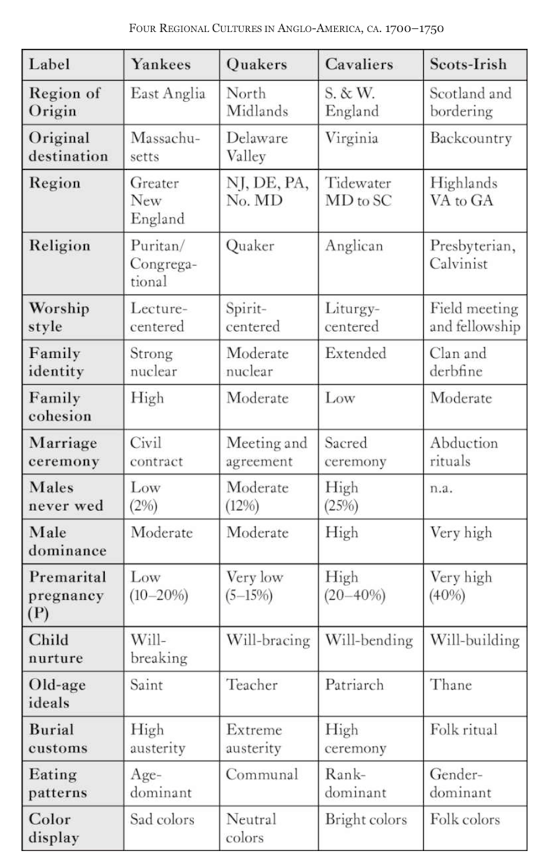

It did not have less diversity afterward with Germans, Irish, Jews, and many others landing in this country. Actually mid XX century period if highly uncharacteristic, relatively short, and practically ended by now, bringing wide diversity and consequently instability. The original constitution was so effective because it provided framework for mainly peaceful coexistence of these diverse groups that regulatory redistributionist state could not provide. The return to original rules of game and dismantling of such state could be one and only way to avoid not necessarily peaceful fight for spoils of redistribution.
Chapter 13: The Best of Times
Author believes that we live in the best time when it becoming possible to move on to expansion of liberty as it was understood in original American republic and in this chapter he reviews various factor that support this believe:
- Technology, especially Internet opened option of government oversight by public
- Visual evidence restricting government officials due to omnipresence of cameras
- Internet based companies matching sellers and buyers outside of government controlled areas
- Easy access to documents related to government actions and ability visually demonstrate negative consequences of these action, incompetence and corruption of government officials
- The alienation of productive people resulted from continuing increase of their financial burden required to pay for government indulgence
- The alienation of big business, which finds itself under continuing attack from government for both looting and scapegoating
- Increasing tensions between federals government and state / local government on other side especially in area of environmental restrictions
- Frustration of low level bureaucrats with their positions and opportunities
Chapter 14: Once the Curtain Has Been Pulled Aside
Here author presents a number of logical inferences for where we should be economically and politically at current and projected future level of technological achievements if we can limit or, even better, eliminate deleterious result of activities of “Government of the Factions, by the Factions, and for the Factions.” He is optimistic that growing diversity of America will make it to overcome current government logjam and that America, as we know it, will remain the land of the free.
MY TAKE ON IT:
I fully agree with author’s analysis of deadly threat for America’s soul created by dramatic expansion of big government into all areas of live pushing away free markets and personal freedom of the people. However I do not think that such remedy, as civil disobedience would work to push government back. People who control government: Bureaucrats and Politicians are pretty smart and highly capable to develop counter measures limiting or even just plainly outlawing Madison Funds, making it illegal for one person or organization to pay fine for another person, or even criminalizing disobedience. I think that development will go its usual way: revolution of groups of individuals who feel dispossessed and exploited by current regime against people who mainly benefit from this. We currently at the point in our development when majority of people who are hurt by regime believe that they benefit from it. This includes recipients of government handouts whether in form of welfare, low level bureaucratic government jobs, or government contracts. For time being real beneficiaries of the regime: high-level bureaucrats and government-connected plutocrats would be able to continue its offensive against America. The forces resisting them: free market plutocrats and productive individuals are getting progressively weaker for now because they are undermined by cheap foreign competition, automation of labor, and government intervention. However it will stop and pretty soon when government bureaucracy will keep increasingly proving in more and more areas that it is not capable to meet needs and wishes of individuals, turning even those who lives off government handouts against government. It would happen a lot sooner if these people would have other source of resources than sales or labor or government handouts.
20150710 Siedentop – Inventing the Individual

MAIN IDEA:
The history of Western civilization shows that contemporary notion of individual and his/her natural rights is not innate for human species, but rather process of long cultural development of the Western world based on Christianity. The common for all humanity approach is not individual, but rather family based, including family gods, family hierarchy, and rigid roles for everybody highly dependent on age, sex, and other mainly inborn parameters. The process of creation of idea of individual was highly dependent on separation of temporal and spiritual world developed by Christianity as consequence of feudal development in Western Europe with its interplaying multitude of entities both religious and secular none of which could obtain continuing dominance. This separation opened way for the idea of moral equality under god, that was core Christian believe, to expand into all areas of Western civilization prompting establishment of nation states and wide accepion of notions of individual and individual rights.
DETAILS:
Prologue: What is the West About?
The answer to this question has to be based on two assumptions: The first assumption is that it should be based on the long view of moral and religious development that formed distinct Western attitude to key questions of what is moral center and highest value of civilization. The second assumption is that such believes are extremely important, actually more important than material basis of civilization. Author sees the key differentiation of the West from other civilizations in its positioning of individual at the center with direct connection to the god or nature with no middle man in between, leading to separation of state and temporal world with its necessarily hierarchical structure from spiritual world where all individuals are equal before the god. This separation in author’s opinion came from Christianity and eventually spilled over from spiritual area into material world creating civil society, democracy, and human rights.
The World of Antiquity:
- The Ancient Family 2. The Ancient City 3. The Ancient Cosmos
The ancient family as it developed from bands of hunter-gatherers was self-contained entity that included not only material self-sufficiency, but also complete spiritual structure including family specific gods, normally ancestors, usually believed to be actively involved in current affairs and capable rewarding or punishing people. The top man – father was the only controlling authority with direct connection to ancestors. Any person had value only as a member of the family with specific place in the structure and no value as individual whatsoever. The city emerged as conglomeration of families and as such had to have its own superstructure including its own gods who did not substitute family gods, but rather represented super family – hence making universe with some family gods more powerful than others and city-wide gods controlling and protecting the city as whole. From here came citizenship as form of belonging to superfamily of the city by the virtue of belonging to one of founding families of patricians. The plebeians were latecomers who joined city without family and therefore were not included in any of existing families, had no family altar, no ancestors, and consequently no gods. This family based multilayered structure was based on philosophy of superiority of family and critical value of its competition with other families, including military competition that was a make or break activity with labor and commerce denigrated as inferior activity that could not add to the glory of the family or city. The ancient world was built on inequality of individuals within family and inequality of families within polity. The ancient Cosmos was built in the same way.
A Moral Revolution:
- The World Turned Upside Down: Paul 5. The Truth Within: Moral Equality. 6. Heroism Redefined. 7. A New Form of Association: Monasticism. 8. The Weakness of the Will: Augustine
This part is about moral revolution brought in by Christianity. It starts with discussion about Paul promoting new notion of human equality before god, most important it was the first time when moral equality was unrelated to the family and background. It was built on Jewish religions innovation: monotheism and nonlinear understanding of time as in contrast to usual cyclical understanding. The new relation between people and god created by Christianity was different from Jewish understanding of God as somewhat tribal leader of “chosen” people. It was expanded to all of humanity, creating direct relationship between god and any individual who wanted to accept it. Paul substituted natural inequality with new moral equality of all individuals. This part also traces development of Christianity in Roman Empire from initial rejection and martyrdom to increasing popularity. It traces formation of Monasticism as a new form of association completely egalitarian and, most important, separated from traditional family and its polytheism. Finally it discusses Augustine and his notions of complexity of human will as a motive force representing power of the soul distinct from intellect.
Towards the Idea of Fundamental Law:
- Shaping New Attitudes and Habits 10. Distinguishing Spiritual from Temporal Power 11. Barbarian Codes, Roman law and Christian Intuitions 12.The Carolingian Compromise
This part continues discussion about separation of spiritual and temporal power, stressing completely different approaches to temporal accommodation of human action. Even if an individual practically could not exist outside of his/her predefine station in life and had to act according to whatever wee existing rules of game, the spiritual power of this individual was making him/her equal with others in relationship to the god. Consequently author reviews in this part historical development up to the point of Carolingian Compromise, dividing these temporal and spiritual between feudal lords and kings and Christian elite of bishops and popes.
Europe Acquires its Identity:
- Why Feudalism did not recreate Ancient Slavery 14. Fostering the ‘Peace of God’ 15. The Papal Revolution: A Constitution for Europe? 16. Natural Law and Natural Rights
The analysis if Europe uniqueness rises an interesting question about slavery. Why medieval Europe did not have slavery, but rather used serfdom? The answer seems to be moral equality coming from Christianity with its equality of souls in combination with small farm method of agriculture. Author also points to difference between peasants uprisings from slaves revolt. The former were inclined to create representative governing bodies, while latter were directed to getting away. Another unusual characteristic was formation of professional clergy and separate distinct hierarchy in society dedicated to management of souls versus management of bodies by feudal authorities. This chapter also reviews contest between religion authority of pope Gregory and German Emperor Henry IV secular power. Amazing part of outcome was general accepion of the idea that king’s soul is not materially different from other souls and would be treated in similar way by god. The consequent popes and kings continued this contest eventually developing legal framework based on partial revival of Roman law and removal of a king from soul to god connection.
A New Model of Government:
- The Centralization and the New Sense of Justice 18. The Democratizing of Reason, 19. Steps towards the Creation of Nation-States, 20. Urban Insurrections
This part is about development of law by canon lawyers who promoted secular law defining violations of such law as something separate than sin, creating separate areas for material and spiritual controlling systems for human behavior. They also introduced four fundamental changes in corporate law:
- Any organized group can be corporation instead of corporate privileges being granted by king.
- Corporation could create its own laws for its members, unlike traditional Roman law created by public authority only
- Requirement of consent of members for decision-making meant change flow of authority from the bottom up.
- They rejected Roman approach “what pertains to a corporation does not pertain to its members” turning corporate property formally into common property of its members.
Then author describes long history of expansion of ideas of separation of material and spiritual spheres implemented by popes from 1000 to 1300 as democratization of reason leading to development of notion of natural rights with consequential formation of nation-states moving identity of state away from a king to population and territory. Finally it reviews long process of incorporation of urban centers into these states with equalizing effect on individual rights and important role in new entities of new class created during this process: property/market oriented middle class intermediate between old castes of feudal society.
The Birth Pangs of Modern liberty:
- Popular Aspirations and the Friars 22. The Defense of Egalitarian Moral Intuitions 23. God’s Freedom and Human Freedom Joined: Ockham 24. Struggling for Representative Government in the Church 25. Dispensing with the Renaissance
This is discussion about process through which egalitarian moral institutions created by Christianity permeated individual attitudes and believes, leading to development of notion of individual freedom and representative government tasked with and legitimized for protection of natural rights.
Epilogue: Christianity and Secularism
Here author makes point that secularism is pretty much natural product of Christianity and usual popular believe that Christianity consistently and fiercely fought against development and expansion of science is incorrect, practically ignoring historical record of development of these ideas. This misconception at least partially based on presentation of ancient world as secular, when in reality it was world of family specific gods / ancestors providing supernatural support for family members. Author believes that key feature of secularism is its believe in moral equality of humans resulting in their ability to make their own decisions and have opportunity for free actions. As such it could not possibly contradict individual decisions about religious believes and actions providing they are voluntary and are not forced in any way.
MY TAKE ON IT:
It is a very interesting and new for me approach to development of idea of individual as an entity separate and different from family, tribe, and such. I am not sure that I buy idea that only Christianity with its moral equality before god and separate spheres for temporal and spiritual was sole or even main source of this idea. I would rather think that this idea is natural development in any culture that occurs with development of bigger populations, wider markets, and, very important, increased mobility of people within some big enough territorial entity under unified military control over population. When scale getting big enough, there is no way that family structure with its family god would provide material and spiritual support for fast moving people in even relatively primitive market economy because number of contact, alliances, and transaction with huge diversity of people would require spiritual and legal environment capable to provide common ground acceptable for everybody, that could not be possibly done with family gods. In this environment the spiritual environment had to move with individual pretty much as Jewish god would move with Jewish merchant wherever this merchant would travel, even if there is no Jewish community, leave alone family structured Jewish community in the new place. It would be interesting to trace development of notion of individual in Eastern countries where influence of Christianity was minimal for example during vast and loosely controlled Mongolian empire of XIII – XIV centuries with tremendous movements of diverse people, goods, and services throughout huge territories. Anyway it seems that all cultures had concept of human as an inseparable part of bigger entity, while still recognizing that it as a separate thinking, feeling, and acting entity driven by internal forces.
20150703 Hidden in the Plain sight

MAIN IDEA:
The main idea of this book is that financial crisis of 2008 was produced by government intervention in economy. The prerequisite for it was first of all government push to expand home ownership via political methods by legislating “affordable housing” and then setting up goals for lending to people who traditionally would be considered unqualified for loans and forcing banks to meet these goal and GSE to buy loans to such people using dramatically decreased underwriting standards, consequently developing housing bubble. The secondary prerequisite was the change in accounting rules requiring to price assets to market that made assets dependent bank reserves highly volatile and dependent on housing market valuation. The crisis itself was caused by inconsistent reaction of government to manageable problems of investment banks created by liquidity crunch resulted from drop in housing prices. The initial rescue of Bear Stearns and following up refusal to rescue Lehman created huge gap in abilities to predict financial developments for financial managers, causing them to froze credit and run to liquidity in order to avoid bankruptcy.
DETAILS:
PARTI: THE BASICS
1 Introduction: What Really Caused the World’s Worst Financial Crisis and Why It Could Happen Again
The left worked hard to build false narrative about financial crisis of 2008. This narrative blames deregulation for causing the crisis. Author rejects this idea and points to actual causes:
- Government push for affordable housing goals that in practice forced banks to issue loans to people who were not qualified for these loan according to time tested underwriting standards
- This caused banks to decrease standards in order to meet government goals
- GSEs (Funny and Freddy) were also pushed by government so they start buying subprime mortgages
- This situation increased money flow into housing market, creating bubble with housing pricing nearly doubling.
- The second cause was change in accounting rules forcing asset reassessment to market, therefore creating hazard of liquidity crisis that eventually occurred when value of mortgage assets on books plummeted with burst of housing bubble.
- Moral hazard caused by inconsistent, even chaotic behavior of Feds and Treasury who first interfered with Bear creating expectation of government support for big investment banks and then let Lehman fail, creating situation of unpredictability that froze credit throughout the market.
2 The Difference between Prime and Nontraditional Mortgages: The Importance of Sound Underwriting Standards
Here author discusses traditional prime mortgages: 20% down, FICO >660, and DTI (Debt to Income) < 38%. He provides very enlightening table of default percentage in relation to variation of these parameters with Prime default rate 0.55% and Subprime from 0.98% to 7% depending on combination of subprime parameters.
3 The Financial Crisis Inquiry Commission Report and Other Explanations for the Crisis: Why Conventional Explanations for the Crisis Are Inadequate
This is about work of commission to analyze crisis that author participated in and reasons for his rejection of the report and other alternatives for causes of crises:
- Commission ignored Pinto’s report that demonstrated mass acquisition of subprime loans by GSE under pressure of government goals for affordable housing. Author believes that this report pointed to correct cause: dramatic increase of subprime loans on the books
- Low rates and foreign funds inflow: Author rejects it as insufficient in volume to cause bubble.
- Deregulation – per author there were no significant deregulation, because main deregulation – removal of Glass-Steagall led to creation of subsidiaries for depository business that were too small 1-5% of assets to have significant impact.
Author analyses other changes in legislative environment and concludes that they also could not have such impact. He also reviews multiple other explanations, but concludes that they are not adequate for scale of the crisis.
4 A Short History of Housing Finance in the U.S.: How and Why Housing Finance Was Substantially Changed in 1992
This is a brief history of American housing market after WWII that was very stable and successful until 1992 when housing bubble started to develop. Author blames growth of bubble on government intervention aimed to expand house ownership among unqualified people that started with Community reinvestment act.
PART II: GOVERNMENT HOUSING POLICIES TAKE EFFECT
5 HUD’s Central Role: How HUD Used the Affordable-Housing Goals to Reduce Underwriting Standards
This is about HUD as a tool to implement government policy of affordable housing that was implemented via % goal for banks and GSEs. Author provides graph demonstrating cumulative increase in subprime loans and growth of prices:
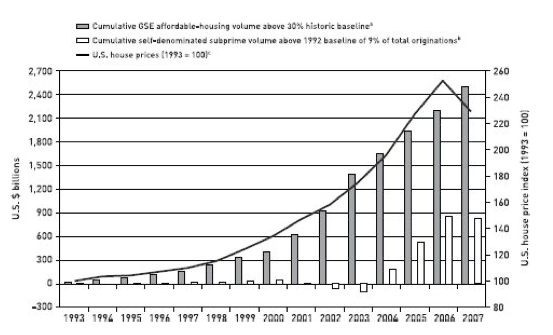
6 The Decline in Underwriting Standards: How the Affordable-Housing Goals Forced on Increase in Nontraditional Mortgages
This chapter describes process of political interference into mortgage market and how it caused decline of underwriting standards. The table below demonstrates increase of low quality loans on GSE’s books:

7 Force Fed: Why the Affordable-Housing Goals, and Not Market Share or Profit, Were the Sole Reason the GSEs Acquired Nontraditional Mortgages
This is detailed discussion of GSEs as political creatures. This nature defined GSE priorities when meeting political goals was much higher priority than any market related considerations. It is also provides logic of why any claims for GSE working to maintain market share are plainly incorrect.
8 Going Viral: Why and How Reduced Underwriting Standards Spread to the Wider Market
This chapter discusses how GSE behavior impacted wider market. This influence in combination with political pressure on banks practically forced non-government organizations follow suite. Here is the graph for this:

There is also a very interesting table from Freddy presenting ratio of default for various deviations from prime conditions:
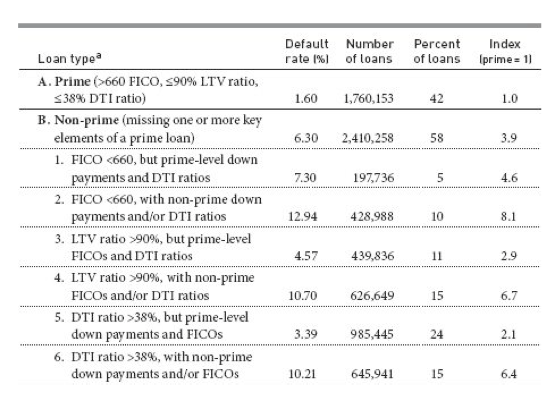
PART III: THE FINANCIAL CRISIS AND ITS ACCELERANTS
9 The Great Housing Price Bubble: How Loosened Underwriting Standards Stimulated Its Growth
This chapter discusses overall nature of bubble and specifics of USA housing bubble of 2008 claiming that reason of unusual scope of this bubble (9 times bigger than any previous one and global rather than local) was political interference to dramatically decrease underwriting requirements and with it amount of money flow into mortgage market.
10 Flying Blind into a Storm: How the GSEs’ Failure to Disclose Their Acquisition of Nontraditional Mortgages Magnified the Crisis
This chapters describes various statistical and accounting technics that made growing bubble practically invisible for decision makers in both public and private sectors. Mainly it was done via classification of subprime loans as prime often using previous GSE criteria for loan purchases that were not operational any more in reality.
11 31 Million Nontraditional Mortgages Precipitate a Crisis: Why Even Government-Backed Mortgage Securities Were Contributors
This chapter discusses volume of bubble and some additional reasons for people missing it. First and foremost it was caused by dramatic inflation of housing prices that masked the problem by decreasing levels of defaults and delinquencies due to use of equity loans. It lasted as long as prices kept going up. As soon as prices stopped individuals with unaffordable loans stopped paying and bubble burst.
12 Fair-Value Accounting Scales Up the Crisis: How Mark-to-Market Accounting Made Financial Firms Look Weak or Unstable
This chapter discusses another precondition for financial crisis – switch to Mark-to-market accounting. It comes down to simple notion that bank reserves in form of marketable assets are highly vulnerable to price movements for these assets causing dramatic decline in reserves if price dropped significantly. With significant share of reserves tied up in housing related assets, burst of bubble immediately undermined liquidity of reserves of otherwise healthy institutions, pushing them into bankruptcy.
PART IV: FROM BAD TO WORSE
13 From Bad to Worse: How Government Blunders Turned a Mortgage Meltdown Into an Investor Panic and Financial Crisis
Here author presents crises development as consequence of government interference / noninterference that started first with unnecessary rescue of Bear Stearns that created market expectation for government interference on behalf of any significant player. As result management of Lehman brothers based its strategy on this assumption and did not apply emergency efforts to stop deterioration of liquidity position due to mortgage asset devaluation to market. The result of this strategy opened Lehman for bankruptcy and, when expected government interference did not occur, Lehman went down. The unexpected inaction of government practically froze credit everywhere because everybody recognized liquidity situation caused by the burst of bubble and nobody knew what expect from government. Author analyses in details all reasons that where provided for this interference / noninterference and concludes that these reasons are not valid.
14 The False Narrative and the Future: Why the Failure to Understand the Causes of the Crisis May Lead to Another
The final chapter discusses various false narratives provided to justify government action and assign responsibility for crisis elsewhere. It provides support for author ideas that these false narrative prevented effective learning from this experience and left open road to the next crisis that could occur for the same reasons as the last one: government push for increase in landing to political constituencies that could not and would not pay their debts in the future. It remains to be seen if this next attempt to sabotage American economy will be as successful as the previous one.
MY TAKE ON IT:
I found evidence provided by author and his logic very convincing and sequence of event leading to crisis highly feasible. Bubble burst causing decrease in mortgage related assets prices in turn leading to reserves liquidity crunch as result of mark-to-market accounting accompanied by Feds rescue of Bear Stearns and refuse to rescue Lehman made behavior of managers who froze all the credit logical and justifiable. I also think that his critic of various alternative justifications and explanations looks pretty robust and well documented. However I do not share fear of the next crisis developing in similar way mainly because it would require the same political approach based on liberal ideology and implemented by two consecutive presidents Clinton and Bush. I think that political power is going to shift and quite dramatically making repetition of crisis with the same causes unlikely.
20150628 Ideas with Consequences
MAIN IDEA:
This book is a detailed analysis of activities of Federalist society in development of legal ideas related to the Originalist reading of US Constitution and, most important, of how these ideas were introduced and took root among the generation of lawyers who in process of development of their careers moved throughout the system achieving key positions and judges, litigators, and Supremes, eventually making consequential legal decisions based on these ideas. Author in great details reviews this process in its historical development for recent key decisions of Supreme Court that confirmed First Amendment Rights as related to political campaign financing in Citizen United and the Second Amendment right as individual right, rather than collective. Finally it discusses key constitutional issues of separation of power and role of judiciary that are strongly promoted by Federalist Society as “Duty to say what the Law is, not what it should be”, thus dispatching theory of “Living Constitution” to dustbin of history, if this effort is successful.
DETAILS:
Introduction: 1. Understanding Federalist Society Network Influence
This book is about Federalist Society that was created in 1982 by young conservative lawyers and is identified here as Political Epistemic Network. The criteria for this identification provided in the table:

The introduction discusses influence of the society and its impact on judiciary “counterrevolution” that over last few dozen years moved America’s legal profession somewhat back to original constitution, albeit just a little bit. Here is graph representing such influence:

PART I: The State Exists, to Preserve Freedom
- The Right of the People to Keep and Bear Arms: Lost and Found
This chapter provides some history and analysis of impact of members and associates of Federalist society on change in reading of Second amendment from collective rights as it was promoted by leftists to individual right as it was reaffirmed by current Supreme Court in Heller. Author provides detailed description and specific input by personalities linked to Federalist society who had impact on the decision including 4 Supremes.
- Judicial Activism, Inc.: The First Amendment, Campaign Finance, and Citizens United
This chapter reviews another hot spot of left-right struggle: application of the First Amendment to Campaign Financing reform. As in the previous case, author works through specific individuals and their input in legal discussion that led to Citizen United and identification of Corporations as entities for which the First Amendment applies as it is related to financing of political campaigns. Here author also provides the same graph populated with numbers of individuals associated with Federalist Society who participated in Citizens United.
PART II: The Separation of Governmental Powers Is Central to Our Constitution 4. Federalism and the Commerce Power: Returning to “First Principles”
This is about somewhat successful effort of members of federalist society to roll back unlimited power of Federal government created during New Deal by using Interstate Commerce Clause of the Constitution as generic tool to push “whatever you want” type of laws. The first success was in 1992 with New York v. US, then in Lopez (1995), and Morrison (2000). Author discusses personalities in Federalist Society who specialize on Commerce clause and their “Textualist-Originalist” interpretation of the Constitution and their intention to move legal environment to pre 1937 judicial revolution that practically destroyed constitutional limits on Federal government. Author present development of this movement via somewhat detailed analysis of these 3 cases.
- State Sovereignty and the Tenth Amendment: The Anti-Commandeering Doctrine
This chapter is about X amendment that for a long time was a dead letter of “Written Constitution”, meaningless in the environment of triumph of leftist “Living Constitution”. The cases reviewed here: Printz (1997) and Sebelius (2012) represent successful attempts to revive state sovereignty.
PART III: It Is Emphatically the Province and Duty of the Judiciary Branch to Say.
What the Law IS, Not What It Should Be
- Saying What the Law Is: The Federalist Society and the Conservative Counterrevolution
The last chapter is about role and meaning of judiciary, describing struggle of Federalist society members against leftist doctrine of judiciary as a tool of implementing their “progressive” ideals in circumstances when people and elected legislature do not support or even reject these ideas, something that Warren Court was famous for. An interesting point here is made about specificity of American Jurisprudence when judicial decision-making has to include written reasoning for the decision, unlike legislative decision-making. General idea promoted by Federalist society is the supremacy of written Constitution and it’s meaning over precedents that dramatically decreases power of stare decisis, consequently opening New Deal judicial revolution for dismantling. The actions of Federalist Society directed at creating a climate conductive for the constitutional change by:
- Getting the right cast of characters on the Supreme Court
- Acting as vigilant and vocal judicial audience
- Changing the debate and reducing the stigma of once-radical ideas and theories
Epilogue: An Agenda for Future Research: Looking Back, Looking Forward
The epilogue reviews attempt by left wing to create counterpart to Federalist Society that would defend their achievements in destruction of original Constitution and substitute rule of law with their own rule. Such counterpart – American Constitutional Society (ACS) was founded in 2001 and author suggest for future research look at progress of this organization in acquiring similar or even higher level of authority and influence in judicial decision making. So far two justices appointed by Obama did not have strong connections with ACS. Sotomayor was practically unknown to ACS, while Kagan did successful presentation to both ACS and Federalist Society. Moreover Obama failed to get congress approval for ACS activist Liu appointment to Ninth Circuit Court of Appeals seems to be specifically as result of his activism and expressed intention to use this position to promote leftist ideas.
MY TAKE ON IT:
For me the struggle between leftist ideas of living constitution and rightist ideas of original unchangeable (dead) constitution is highly enchanting. Generally I am in agreement with chairman Mao that “power is coming from the barrel of gun”, but the funny part is that gun is always in the hands of men and legal system, judicial ideas, and philosophical ideals pretty much define what is going on in the heads of these men and consequently where the barrel of gun will be pointed to. So far based on history and analysis of this book it looks like Originalist ideas of Federalist society represent more logical and more consistent with ideals of American culture approach and therefore command strong influence on outcome of competition in more than a few specific constitutional disputes. On the other hand majority of legal profession including professors and students seasoned in New Deal ideology are on the side of ACS and Living Constitution with unlimited power for government. So the balance of power is between minority associated with Federalist Society and their superior ideas meaning more in sync with American tradition and culture, and numerical majority dedicated to the New Deal with inferior ideas contradicting American tradition and culture. I guess watching with struggle would be highly entertaining for a foreseeable future. Especially interesting and unique to America is the situation when people with guns (military and police) are deeply supportive of traditional American culture, but tolerate leftist direction in government destroying this culture. The reason for this tolerance is traditional culture’s huge respect to democratic rule and law. Leftists, on other hand consistently push outside existing law and democratic traditions overriding them each time when they have power to do so either due to capturing democratically elected positions of power or legal authority to interpret law. I think that this contradiction could not continue forever and will have to be resolved.
20150620 Me Myself and Us
MAIN IDEA:
This wonderful book was written to implement a great idea: to present recently developed knowledge in psychology ranging from big five to accommodation to environment, and use this psychological knowledge as tool to advice on how to achieve high levels of wellbeing.
DETAILS:
ONE: First Blushes and Second Thoughts
This chapter is about how people think about themselves and others, what psychologist call “personal constructs”. It starts with a story of obnoxious man in restaurant and goes on to look at spectator’s approach of assigning psychological features to this unknown man. From this example it goes to notion of “frozen relationships” something like familiar face that one regularly meet in elevator, but has no intention to communicate with. The “personal constructs” define to the large degree individual’s attitude to self and to other people. Author presents example of a person who build his personality around one-dimensional construct as a military person and consequently fell apart after being rejected by ROTC.
Another interesting point here is a suggested division of people into things specialist and persons specialist, the first one looking at materialistic presentations of the person including fMRI and other tools and another one looking at psychological presentation extracted via conversations and questionnaires. At the end of chapter author reviews a case of personality evaluation with conclusion about “importance of having sufficient degrees of freedom in our comprehension of creatures – including ourselves”. This is achieved by looking at people through prism of two distinctive characteristics: fixed stable traits that are typical to what we are and free traits that we can use to override our stable traits in order to achieve some objectives.
TWO: Stable Traits and Well-Being: Set Like Plaster?
Here author reviews and critics Myers Briggs Types Indicator (MBTI) and discusses Big Five Personality Inventory (TIPI) in details for each characteristic:
- Consciousness: Structure, Chaos, and All That Jazz
- Agreeableness: The Promise and Problems of Being Pleasant
- Neuroticism: Sensitivity and Sensibility
- Openness to Experience: Receptivity vs. Resistance
- Extraversion: Arousal and Affect
THREE Free Traits: On Acting Out of Character
This chapter is about human ability to accommodate to situation regardless of how much it fit for fixed personality traits. The actual behavior depends on three motivational sources:
- Biogenic sources that arise from genetic make up of the person
- Sociogenic Sources that arise from process of socialization and depend on culture. As example author uses extraversion as specifically American cultural trait versus introversion typical for Asian cultures.
- Idiogenic Sources: Personal Projects and Free Traits.
The last one is typical when Personal projects require use of traits that are not typical for a person such as when deeply introverted person has to do public speaking. Everybody does it on regular basis by using free traits, but they have psychological costs and negative impact on health. Author reviews dynamics of this process and suggests technics that could decrease negative impact of acting out of character such as Restorative Niches where person can relax by going to natural way of acting.
FOUR: Mutable Selves: Personality and Situations
This is about personal propensity for situational accommodation. It is measured by self-monitoring (SM) scale. People with high SM concerned with how others see them and therefore are driven by situation, while people with Low SM mainly concerned with self-perception and therefore are driven by their own values. Mark Snyder created this self-monitoring scale. The chapter reviews specifics of behavior of HSM vs. LSM people and situation when one or another set of features provides advantage. However author differentiate SM from Big Five as non-fixed feature, it is rather personal trend, with person moving relatively easy between LSM and HSM depending on severity of stakes in a situation.
FIVE: Control, Agency, and the Shape of a Life
This chapter is about person’s internal or external orientation. Internals believe that their life outcome depend mainly on their effort, while externals believe in primacy of circumstances. These are mainly flexible traits so author reviews it in relation to a bunch of parameters and situations such as:
- Resistance to Social Influence
- Risk Taking
- Linking Ends to Means
- Delay of Gratification
- Stress Control and Buttons (hooked or not)
- Anxiety from loosing control
- Adaptive Illusions and Strategic Spin
SIX: Hale and Hardy: Personality and Health
This is about link between personalities type. It reviews Holmes-Rahe scale of stressful live changes and how they inflict health. Turned out that stressful events have very different impact on different people, with individuals high on 3C: Control, Commitment, and Challenge as core aspects of their personality being stress resistant. Another example are type A super active personalities who are highly vulnerable to coronary disease, actually posing thread not only to themselves, but also to surrounding people. For these type A people even high 3C paradoxically can both enhance and endanger their health when they overcommit themselves, or try control uncontrollable, or take challenge that is not possible to meet.
Finally author provides very brief review of work of Aaron Antonovsky who came up with notion of salutogenic process when object of medical research is not illness, but condition of health. He found that health if connected with person’s Sense of Coherence (SOC), defined as “the extent to which one has a pervasive, enduring, though dynamic feeling of confidence that one’s environment is predictable and that things will work out as well as reasonably can be expected”.
SEVEN: Personality and Creativity: The Myth of the Solo Hero
This chapter looks at link between personality and creativity using materials from the Institute for Personality Assessment and Research (IPAR). This research was conducted based on two groups of architects one identified as highly creative and another one with similar professional characteristics, but not considered highly creative by peers. The results were:
- Highly creative were not considerably more intelligent than control group
- They had more freedom in early development and their families moved often bringing to their lives change in environment and experience of accommodation
- Their interests were matching interests of professionals with high level of non-trivial information processing jobs like lawyers, authors, or musicians, but differentiated from professionals with trivial information processing requirements like bankers or police.
- They were more likely Introverts per MBTI, be more Perceiving rather than Judging, significantly more Intuitive. Finally Thinking was more typical for people creative in science than in arts, with creative architects divided 50-50.
Very interesting was approach to complexity with preference to complexity at the beginning of creative project and preference for simplicity at the completion phase. Author also reviews relation between creativity and eccentricity, psychopathology, and wellbeing.
EIGHT: Where Are You? Personality in Place
This chapter is about link between personalities and places. It starts with description of debates between deconstructionist architect and architect supporter of small preindustrial towns as ideal communal living. From here it goes to discussion of design of living spaces and cities and how one person’s utopia could be another person’s dystopia and presents Environmental Response Inventory (ERI), which scores on 8 different dispositions toward physical environment:
- Pastoralism (PA)
- Urbanism (UR)
- Environment Adaptation (EA)
- Stimulus Seeking (SS)
- Environmental Trust (ET)
- Antiquarianism (AN)
- Need for Privacy (NP)
- Mechanical Orientation (MO)
This follows by quite sketchy analysis of suitability of different locations in USA for different types of Big 5 personalities. Final part of the chapter discusses different attitudes to Cyberia, meaning Social Media of Twitter, Facebook, and such.
NINE: Personal Projects: The Happiness of Pursuit
This chapter is about Personal Projects, the notion that includes practically everything that individual is doing intentionally. The bottom line of this discussion: Personal project are very important because they give meaning to the live and it is highly connected to the wellbeing of the person.
TEN Self-Reflections: The Art of Well-Being
The final chapter kind of links everything together in some semblance of formula for the Art of Wellbeing. It includes:
- Sustainable Pursuit of Core Projects
- Continuing Revisiting of Personal Constructs to assure they are not getting on the way of wellbeing
- Context Monitoring: Scanning, Seeking, and Shaping Our Environments
- Self-Reflections: Reconciling and Revitalizing
It ends with a beautiful metaphor of live as a dance when partners know each other to the slightest detail because these partners are: Me, Myself, and US.
MY TAKE ON IT:
I think that it is a great collection of psychological knowledge and, more important, demonstration of application of this knowledge to the process of self-discovery. I found it very consistent with what I learned not only from books, but also from real live experiences, which pretty much confirming validity of the knowledge presented in this book.
20150613 Twilight of Elite

MAIN IDEA:
The main idea of this book is pretty simple: American society was built on idea of meritocracy, but it led to creation of elite that now controls just about everything. This meritocratic elite created the huge inequality of income, wealth, and opportunity between its members and everybody else, causing degradation of society institutions and disappearance of equality of opportunity. The remedy that would resolve the problem author sees in government action to increase equality via taxation and control over population, prompted by popular insurrectionist movements such as Tea parties and Occupy Wall Street. He believes that it is a natural process of dynamic democratic society and that result will be the new era of equality.
DETAILS:
Chapter One: THE NAKED EMPERORS
This chapter starts with the sentence: “America feels broken” and continues through laundry list of what is had been wrong with America lately from TARP and financial crisis to the way Americans feel about their life, stressing that this feeling of things going wrong is common on the left and on the right of political specter. It also demonstrates author disappointment with Obama administration as too cautious and too deferent to authority. Author perceives Obama’s rise as triumph of meritocracy at the time when Americans trust in institutions of society hit the all time low (How somebody can see meritocracy in a product of affirmative action is beyond my understanding). Consequently author identifies two types of attitudes to this calamity: insurrectionists and Institutionalists. The former believe that institutions of American society are broken and should be drastically changed; while the latter believe that these institutions just need some repair and maintenance. Author stresses that this situation occurred at the same time when American ruling elite changed from narrow group of WASPs to narrow group of individuals selected on the merits of their achievement – product of meritocratic rule established as result of anti-establishment revolution of 1960s. Finally author stresses his dual attitude to situation when he supports insurrectionist ideas, but afraid that big changes could go in direction that he would not like. On the top of it he seems to be just plain scared that the only institution that Americans still trust are army and police – not a good thing for a leftist revolutionary.
Chapter Two: MERITOCRACY AND ITS DISCONTENTS
This chapter is about meritocracy in America as foundation of its culture and American Dream. It is discussed using example of highly selective Hunter school in Manhattan – well-defined road to top colleges and correspondingly top-level career. Author himself is the alumnus of this school so he presumably knows what he is talking about. Then author moves to social theorist Robert Michels who concluded that democracy is not practically possible because it always moves to oligarchy, when meritocratic leaders, elected or not, take over control of the state machinery and do whatever they want. So in order to remain in realm of democracy meritocracy has to comply with 2 principles: Principle of Difference and Principle of Mobility, assuring continuing competitive selection process. The problem is that unequal outcomes make equal opportunities impossible because winners create better start up opportunities for their children. Author believes that it pretty much happened in America by 2012 due to inequality of income, despite Americans’ believe that success depends more on person than on background.
Chapter Three: MORAL HAZARDS
It starts with description of suicidal attack on government building by self-employed consultant who was harassed by IRS because of a law created in 1986 specifically for tax break for IBM at the expense of self-employed software developers. Then author goes through a number of cases from Enron to financial crisis pretty much supporting anti-big business approaches of both Tea parties and Occupy movement and lamenting a fundamental inequality of accountability.
Chapter Four WHO KNOWS?
This chapter is about role of experts and inability of regular person to evaluate quality of expert advice. As rules of thumb for decision making author analyses tools available for regular person:
- Consensus about something such as gravity with example of it failing as in housing bubble;
- Proximity to the source of information with example of media when journalists’ proximity to sources supposed to assure validity of information, and again with negative example of Iraq WMD and Financial Crises when it failed.
- Good Faith into people we get information from. Once again author demonstrates that it is not enough on example of sex scandals of Catholic Church. In addition author laments expansion of secrecy that makes information inaccessible in order to support unwarranted faith in American institution. As one would expect it is supported by quite positive view of WikiLeaks affair. Eventually the conclusion is that progress depends on interaction between Institutionalists and Insurrectionists with former keeping eye on integrity of institutions and latter being “stewards of public life”.
Chapter Five WINNERS
This chapter is about American elite and what it is made off. It starts with complain against right wing politics who loudly claims to be victimized by media and intellectual elite, while in reality being themselves part of elite. Then author goes into theory and literature about elite with reference to Robert Michels, Pareto, Ortega y Gasset, and C Wright Mills. Eventually author comes up with definition of sources for elite status: Money, Platform, and Networks. Finally he reviews 1% pathologies and cult of smartness typical for American “meritocratic” elite.
Chapter Six OUT OF TOUCH
This about the distance that separate elite from regular people and how it is often intentionally hidden in order either to obtain votes by politicians or assure loyalty of sports fans, or convince people to work harder in interest of corporation. It is also about these attempts more and more often falling flat and failing to achieve these goals, eventually leading to massive alienation of people from institution and creation of Tea Parties and Occupy movements. Finally author goes through list of late crises from Iraq war to New Orleans, and Financial Crisis to demonstrate how this distance makes elite fail.
Chapter Seven REFORMATION
In this final chapter author proposes his solution for what he perceives as failure of meritocracy in America. This solution is “make America more equal”. He identifies two “eras of equality”, one from end of WWII until early 1970s and another one from late 1970s till now. The first era was the era of manufacturing prosperity with jobs for everybody that ended with Europe and Japan recovery after the war and end of American dominance of world markets. The second era is the era of meritocratic prosperity of educated people with wide availability of education for everybody capable to succeed. This era is ending now because according to the author inequality achieved through meritocracy is bound to kill meritocracy by providing unequal opportunity to children of high achievers, making gap wider and depriving children of underachievers of equal opportunities. Author sees the remedy in grass roots mass movement forcing renegotiation of social contract and reform existing institutions to decrease inequality.
MY TAKE ON IT:
MSNBC leftist pundit wrote this book, but, somewhat surprisingly, it is directed against the elite and calls to grassroots movement to dismantle this elite. Being leftist author directs his invectives mainly against private businesses and evil deeds of republican administrations, but it is interesting to note that he seems to understand the growing instability of existing arrangements and seeks to resolve it by changing social contract in order to decrease inequality in society. He is disgusted seeing inequality created in private business when hedge fund manager earns millions by making billions of profits for the fund, but seems to be perfectly fine when politicians and/or bureaucrats spend millions of public money on their upkeep in stile in return for directing billions of public money to their friends and supporters either for increasing their wealth or for supporting their causes, which is pretty much the same. From my point of view inequality is irrelevant, but the way it achieved is not just relevant, but is of paramount concern for prosperity of society.
From here follows that public sector superrich are evil because their wealth achieved by violently robbing productive people, while private sector superrich are relatively benign because even in worst case scenario they achieved their wealth by non-violently cheating their customers, while in more usual scenario they achieved it by producing goods and services that their customers buy voluntarily.
20150606 GDP

MAIN IDEA:
This book is the detailed review of GDP, its history, method of calculations and most important its deficiencies. The main idea is that flaws are real, very significant, and there is no known way to fix them. The review of various alternatives demonstrates that they are even more flawed than GDP so there is no alternative but continue its use in foreseeable future despite all warts.
DETAILS:
ONE: From the Eighteenth Century to the 1930s: War and Depression
This chapter is description of early attempts to calculate economic resources of the country. These attempts were caused mainly by the need to estimate resource availability for military actions. It started with William Petty in 1665 that produced population, income, and expenditure calculations for England, providing information necessary for effective taxation. Then it jumps to XX century when contemporary national accounts had been established during 1930 in UK and USA. One interesting quirk here is that father of American economic statistics Simon Kuznets wanted to exclude government military expenses, advertisement, and financial speculation as items that decrease wealth rather than increase it. He lost and now GDP includes all government expenses and other non-valuable staff making it quite inadequate tool for measurement of economic wellbeing of the country. Other countries such as USSR and Germany also developed GDP, but with some very specific caveats. For example USSR would not count value of services since services are not material and therefore according to Marxist orthodoxy has no value. This chapter also provides definitions of GDP and its tabular and graphic representations for all approaches: Value-added, Income, and final demand. Finally it analyses some inherent difficulties in GDP calculations related to technological developments, natural resources potential, and, most important, subjective character of this tool. As example of far reaching consequences of miscalculation author presents history of Britain “non-crisis” of 1976.
TWO: 1945 to 1975: The Golden Age
This is review of GDP golden age period when it was not only calculated for internal use, but also served as an important tool of comparison of economic effectiveness of various countries and even more important economic systems, serving as important tool in ideological struggle of cold war. As part of this discussion exchange rates and purchasing power parity are also analyzed. Interestingly enough it ends with admission that it was all not only highly approximate, but also subject to serial cheating both intentional and not by communist camp, which economic structure was designed to produce numbers for reporting to leadership and propaganda for masses, rather than for actual estimates of real goods and services production.
THREE: The Legacy of the 1970s: A Crisis of Capitalism
This chapter is about crisis of capitalism in 1970s presenting four challenges to existing approach:
- End of effective economic growth after Arab attack on western energy market
- Intensity of Cold war demanding huge military expenses, while communist propaganda within and without West generated misinformation, in order to undermine overall moral of western societies by creating false impression of Soviet economic superiority
- Environmentalist attack on industrial society adding additional burden on efficiency of production.
- Continuing drug on Western economy from perceived need to provide subsistence for developing countries that have no viable economy to speak of.
All this resulted in stagflation, loss of faith in Keynesian measures and overall moral and ideological bearings of West.
FOUR: 1995 to 2005: The New Paradigm
The failure of Keynesianism in 1970s led to change of paradigm to monetarism. This time it was based more or less on factual evidence from GDP data from increasing number of countries. These data supported Solow’s idea of technology as driver of economic growth and were based on data set created by Alan Maddison. As example author provides history if computer technology when for decades businesses increasingly invested into computers, while economists could not find any evidence that this investment make any sense whatsoever. Only during 2000s economists succeeded in identifying increase in productivity growth from 1.38 in 1972-1996 to 2.46 in 1996-2004. Author also reviews difficulty in measuring value of services and variety that exploded in all areas of business. Economists even come up with Hedonic index trying to measure improvement in quality and functionality of various products. Computers again used as example because it is quite striking how huge is difference in functionality between computer of 1990 and computer of 2010 sold at the same price.
FIVE: Our Times: The Great Crash
This chapter is about financial crash of 2007 that to significant extent was caused by economists’ inability to calculate real value of financial assets leading to dramatic overestimates during the boom. It also discusses inability to provide valid data that would include totality of economy including informal and household input. There is a charming quote from Robert Stone about arbitrariness of economic calculations: “… commercial products valued at market price, government services at cost, and household activities are simply ignored.” It also discusses “Production boundary” that in theory separates productive activities from non-productive, but in reality is just a bunch of arbitrary decision about what goes into calculations and what stays out. Finally it looks at relationship between GDP and other economic data and welfare of society. So far attempt to measure this welfare with various indexes including MEW and iSEW are far from perfect. Another attempt to measure economic wellbeing of society are various dashboard that include multitude of indicators. So far with all deficiencies of GDP nothing else was accepted as viable alternative to it.
SIX: The Future: Twenty-first-Century GDP
The last chapter is a look at the future development and analysis of specific challenges that GDP or any other measurement would face while creating meaningful indicator of economic welfare of society. These challenges are:
- Dramatically growing complexity of economy
- Difficulty of evaluating productivity especially in services
- Intangibility of products such as new knowledge that could not be measured in any meaningful way
- Sustainably of productive processes and their impact on environment.
The final conclusion is that GDP is a deeply flawed tool, but it is still a bright light shining through the fog of economic data and there is nothing else comparable to it.
MY TAKE ON IT:
This is a wonderful account of GDP as economic tools and it’s many deficiencies. I am strong believer in old wisdom of software engineering more than applicable in this case: “Garbage in – garbage out”. Our quasi-socialistic intellectuals and politicians keep trying to manage economy based on garbage based information like GDP and unsurprisingly continue produce garbage quality results. I believe it is absolutely not possible to measure economy in any meaningful way by calculating inputs and outputs for the simple reason that both inputs and outputs contain a lot more intangible, than tangible components.
Moreover I do not think it even make sense to try measure economy because the only reason for such measurement is to use it for management, but economy being practically livelihood of people could not and should not be measured. I believe that instead of look at economy as at machine to be managed by elites, much more productive way would be to look at it as an unmanageable conglomeration of people and resources, and all that conceivably could be done is to set some rules of game that would facilitate maximization of resource availability for people to pursue satisfaction of their needs.
20150530 Tales from the Both Sides of the Brain
MAIN IDEA:
This book combines review author’s life history and his scientific experience. Most interesting are stories about scientific discoveries related to the functioning of a human brain especially the separation of duties between its left and right hemispheres. The method of research was direct experiment with individuals who due to an illness had these parts surgically separated and functioning as two brains in the same body.
DETAILS:
Part 1 Discovering the Brain.
Chapter 1 Diving Into Science
This chapter is about history of author’s initial involvement with Caltech program in psychology and its outgrowing into neurobiological research. It is also an interesting review of California scene of higher education, scientific research, and even politics in 1960s.
Chapter 2 Discovering the Mind Divided
This is description of initial split-brain research conducted in early 1960s and personalities of leading scientists who participated in this development, their achievement, attitudes, and squabbles. The important discussion here is about difference in scientific research then and now, including continuing growth of dependency on government grants and bureaucratic approvals. Based in this it looks like achievements of 1960s would not be possible today due to bureaucratic red tape. It is also a description of important discoveries such as relative independence of some functions of left and right parts of the brain such as visual perception, combined with significant specialization in some other areas such as speech being nearly exclusively domain of left hemisphere. At the same time some sensory-motor integration was working across semi-spheres. An very interesting experiment demonstrated that some split-brain patients were able to control ipsilateral arm, but not hand, while just about everybody had good control of contralateral hand and arm. The outcome of this puzzle was the great discovery of absence of hierarchical central control system that researches expected to find in the brain. It turned out that it is rather loose combination of the multitude of semi-autonomous and sometime completely autonomous systems only partially synchronized.
Chapter 3 Searching for the Brain’s Morse code
This chapter reviews attempt to find communication code used within brain leading to discovery that such code does not exists. In reality coordination is achieved by using cueing strategy that allowed hemispheres transfer information via external cues even if they were surgically separated. This chapter also describes interaction and cooperation with David Premack and his development of “theory of mind”, meaning ability of a mind to continuously develop and test a theory about status of another mind. The ability to create and use theory of mind could be found in animals, but only to very limited extent. It fully blossoms only in humans and could be considered a very important point of differentiation between humans and other animals.
Part 2 Hemispheres Together and Apart
Chapter 4 Unmasking More Modules
This chapter moves to motivation mechanisms. The experiment was with rats who where fixed to be either want to drink or to run and indifferent to other activity so the setup was to incite rat to do what it does not like in order to get ability to do what it likes. As one would expect animals learned connection and successfully used means to ends procedures. It also describes a number of experiments using people with split brain to identify links between various methods of perception as related to use of right or left hemisphere. Another interesting experiment was with role of emotions. Left hemisphere was trained to make selection by using feedback for right and wrong, while right was not. Initially trained hemisphere quickly learned to make correct choice while untrained, as expected, did not. However after provided emotional feedback allowed untrained hemisphere to learn what is expected and select right answer. Another important discovery was identifying “interpreter” in left hemisphere. When split-brain patient had some stimuli presented to right hemisphere to make him do something and then asked why he did it, the left hemisphere responsible for logic and language processing had no knowledge about the stimuli so it would come up with some logical, even if complicate and twisted explanation of action through conscious intention that was obviously not the case. So instead of a little controller and “leader” in our head we actually have just a spin master who is continuously trying to make sense from whatever we do.
Chapter 5 Brain Imaging Confirms Split Brain Surgeries
This starts with review of experiment demonstrating “double simultaneous extinction” that allowed to demonstrate role of unconscious in making conscious decision even if person does not understand this role. From here author goes to the creation of cognitive neuroscience that he defines as “the study of how the brain creates the mind”. Here is diagram to illustrate this approach:
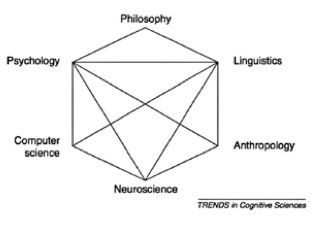
The final part describes arrival of MRI and with it some limited ability to see what’s going on inside living brain.
Chapter 6 Still Split
This chapter is about farther development based on advances in fMRI, PET and other technologies. Then it followed by description of the next adventure when new experiments seem to be demonstrated connections between hemispheres of split brain. Eventually it was proved experimentally that it was cueing and other non-direct method of communications developed by patients with long experience of being tested that explained 78% accuracy of responses. Another series of experiments directed to mechanism of attentions demonstrated that each hemisphere had its own mechanism of attention control, but at the end attention was unifocal due to demand of resources when attention was on. Finally the chapter describes experiments with patients who had only partially split brain.
Part 3 Evolution and Integration
Chapter 7 The Right Brain Has Something to Say
This one is about new technology that allowed to record brain electric activity and its timing in different parts of brain during experiments. Based on this experiments they were able to identify synchronization mechanism of the brain. Another interesting phenomenon discovered was ability of right hemisphere slowly developing language ability after the split, even if this ability was limited. However it was based more on ability to transfer cues to the left hemisphere than actual development of the new functionality by the right hemisphere. This chapter also describes participation of psychologists in split-brain research that allowed identifying patterns of semantic and episodic memory with both hemispheres capable to do it, but each doing better in its area of specialization: right for visual data and left for verbal.
Chapter 8 Stately living and Call to Service
This chapter contains additional discussion of “interpreter” – the brain mechanics of making sense out of received information regardless of its having sense in the first place. There is an interesting discussion of human propensity to making mistakes as evolutionary advantage of making action possible even when information is incomplete or misleading. This chapter also describes initiation of Human brain mapping project based on dramatically increased capability of computers and neuroimaging.
Part 4 Brain Layers
Chapter 9 Layers and Dynamics: Seeking New Perspectives
The final chapter includes summary of the Brain principles:
- Brain comes with a lot of inherent programs – neurospecificity to handle environment
- Processes of underlying behavior, cognition, and even consciousness are highly modular and work in parallel.
- It has high levels of redundancy and plasticity to resist small to moderate damage.
- Lots of brain processes are not accessible to conscious perception so brain splitting that removes connection between hemispheres makes sensual right hemisphere inaccessible for logical left hemisphere and vice versa creating two conscious entities in one body each perceiving that nothing changed.
- Modularity of control functions is not limited to brain, but rather extended to all systems of the body making it into distributed network of analog control systems.
- Brain is built on an emergence principal when lower level complex systems organize into a new structure, with new properties that did not exist before.
- One issue author believes is still open is application of Supersede notion to the brain, which means that there could be no difference in high level function of the system unless there is some difference in physical condition of underlying lower level systems.
- Brain has layered architecture with different layers being semi-independent.
Author provides a nice metaphor for a brain: symphony orchestra with array of instruments organized into complex sequence of actions creating music, but cautions that in case of brain there is no central control to direct this orchestra.
MY TAKE ON IT:
From my point of view author’s lifetime of experimentation with split-brain patients provides a great insight into working of human brain that is very much consistent with my view at it. I believe that there is no mind/brain duality whatsoever, but rather fully material complex network of semi-autonomous biological analog systems working at some level of synchronization developed through continuing experimentation / system training when millions of experiments result in development of proper response to a multitude of environmental situations. On the higher level of consciousness brain is a complex instrument for past explanation building / future prediction development / communication and coordination with other brains to synchronize explanation-prediction-action / results analysis / explanation-prediction update for next action. All this together evolutionary justify complexity and cost of brain maintenance due to superior ability it provides for adjusting to continuously changing environment via complex cooperative actions.
20150522 The Price of Inequality

MAIN IDEA:
It is simple: The income inequality is bad because it decreases productivity of society, causes social tensions, undermines rule of law, and even puts democracy in peril. The main causes of inequality are rent seeking, unregulated or under regulated markets, and misguided policies of balanced budgets and suppression of inflation. The remedy to decrease inequality is more government regulation of market, loose monetary policy, and massive wealth redistribution via government transfer programs.
DETAILS:
Chapter One: AMERICA’S 1 Percent Problem
Author defines difference in income and wealth as America’s biggest problem and then makes main points of this chapter:
- Prosperity of the last 30 years did not do a lot for poor because they are still poor. It did a lot for rich so they did become richer.
- Unemployment increased and safety net is not capable to handle it
- Standard of living declined.
- Opportunity is not equal because majority of poor kids grow up to be poor adults, and the same applies to rich.
- Internationally US is behind of other countries in equality and opportunity as defined by Gini coefficient
All this analysis is done on monetary basis and abstract shares of population without any attempt to look at personalities such as if today’s richest 1% are the same people that they were 10 years ago, or what actual goods and services available to today poor? Nice example of this analysis is statement at the conclusion of the chapter that obesity-suffering poor today are worse off than hungry poor of the beginning of XX century.
Chapter Two: Rent Seeking and Making of Unequal Society
This is a nice chapter about rent seeking through government support and monopolies. While author attacks Chicago school for claiming that free market would destroy monopoly he seems to be unable to provide example of monopoly in really free market environment. For example his discussion of Microsoft monopoly on Windows does not explains that it was result of government intervention and that this monopoly failed to survive appearance of new technologies from open source operating system to Web based applications and mobile computing.
Chapter Three: Markets and Inequality
At the beginning of this chapter author declares intention to demonstrate how market creates inequality, but he still had to bring government as the force that defines market and therefore makes all discussion about market causing inequality mute. After that he is trying to rebuff attempts to justify inequality by presenting it a source of incentive for oversized effort to achieve prosperity. He also partially accepts role of technology in creating ability for some people produce a lot more than other people, but somehow he does not feel that it justifies for these people getting very high remuneration as well. Surprisingly he clearly sees that in reality government causes inequality, but he meshes it with unidentified “broader social forces”.
Chapter Four: Why it Matters?
The point here is that inequality matters because it makes system less productive by removing initiative at the lower level of society, especially when inequality is result of rent seeking. Somehow author relate it to tax cuts and deregulation obviously believing that government intervention could remove accesses despite presenting multiple facts that it was government, or more precise politicians whose intervention created bubbles, rent allocation in forms of subsidies or preferential taxation, and regulation designed to promote politicians’ agenda regardless of economic soundness of these measures. Author makes a point that inequality arises because private rewards are different from social returns due to difficulties of adapting “good policies” in United Sates where majority believes in free market rather than in benevolent and wise politicians.
Chapter Five: A Democracy in Peril
This chapter is combination of two points. One is that inequality undermines democracy through unequal access to political actions for rich and poor, making poor to lose trust in the system and potentially rebel. Another one points to the evils of globalization as it is practiced now, mainly in interests of rich and influential people.
Chapter Six: 1984 Is Upon Us
This chapter is about psychological aspects of politics and economics. The main point here is that perceptions and believes are malleable and rich and powerful frame believes of majority in such way that Americans support mainly free market capitalism instead of what author seems to believes is much better system: limited capitalism with market heavily regulated by wise elite. Obviously this evil manipulation is powerless against acute intellect of the author who can see through it, unlike typical Americans of smaller intelligence.
Chapter Seven: Justice for All? How Inequality is eroding the Rule of Law
Here author goes through impact of changes in legal system that are directed to benefit rich at expense of everybody else such as Predatory lending, Bankruptcy laws, Student loans, and Securities fraud.
Chapter Eight: The Battle of the Budget
This chapter is about budget, more precisely about which government expenses author believes are good and should be expanded: all forms of wealth transfer and infrastructure maintenance, and which are bad: military. Obviously the worst evil of all is austerity that deprives noble government of means to spend money. Lots of space here dedicated to justification of Obama’s stimulus mainly based on bulletproofed logic: It did not work as we said it would, but it was great and worked marvelously because otherwise everything would be even worse than it is.
Chapter Nine: A Macroeconomic Policy and a Central Bank by and for 1%
This chapter is mainly about FEDs policy with critic directed against policy of inflation containment. In author’s opinion monetary policy should be directed first and foremost against inequality and inflation be damned. The logic here is simple: inflation hurts people who have money now such as bondholders and lenders and help debtors and other people who do not have money.
Chapter Ten: The Way Forward: Another World Is Possible
The final chapter contains a number of proposals that author believes would dramatically improve American economy and decrease inequality. They are:
- Curb excesses at the top via more government intervention into financial organizations landing policies including compensation policy combined with clear rejection of any future bailouts
- Tax reform increasing progressive character of income taxes, estate tax, and closing loopholes.
- Additional wealth transfer to low-income population via expansion of government education, healthcare, and other transfers in all conceivable forms.
- Restrict globalization and trade
- Political reforms restricting use of money to promote political views for rich and corporations.
The final point author makes is about choice of alternatives for future: either America of haves and have-nots, or America of haves continuously having less for benefit of have-nots leading to happy time with liberty and justice for all.
MY TAKE ON IT:
There is an interesting contradiction in this entire thing about inequality: author constantly points at government as source of rents for rich, restrictions on poor, bad monetary and budgetary policies, and so on; while at the same time demanding more government intervention in economy including direct control over healthcare sector in edition to education, wealth redistribution, restrictions on political participation for rich and similar movements in direction of unlimited government. However this contradiction is easy to understand if one looks at position of author in the society as academician living off government educational expenses and grants. He seems to be saying that what is going on is not right and leads to dismal results because government is not robbing productive people enough and, even more important, it directs loot into hands of plutocrats rather than bureaucrats and academicians as himself. So it is not about government being too big or too small, but about who controls it so if right people in power, then government should be unlimited, huge, powerful, and unrestricted providing wise distribution of resources to eliminate inequality. In short it is typical progressive mutation of socialist ideas with productive part (economic superiority of socialism over capitalism) dropped due to overwhelming evidence of socialism failure in XX century. Author, as all other progressives, wants capitalism to stick around and keep generating wealth so superior intellectuals have something to redistribute for the best of all members of society. Too bad it is not going to happen as it did not happen in all previous socialist experiments because human beings hate to work without incentive so outcome of author’s ideas is quite predictable: stagnation, misery, and increase of all racial, class, religious, and other tensions in society with the latest demonstration of which provided by Obama’s administration. What is puzzling is why author believe that resulting explosion would not hurt and rather badly people like him. The experience of either international socialism of Chinese or Soviet type or National Socialism of German type demonstrated that their supporters from Academy fared not that well winding up at best in rural areas for reeducation or at worst in concentration camps. I guess history is not strong side of such progressives.
20150515 Violence and Social Orders
MAIN IDEA:
The main idea of this book is that the typical approach to understanding history and development of the state and society is insufficient for explanation of many known facts and developments and the new framework for analysis in social sciences is required if we want to understand them. Author provides such framework with Idea of qualitative difference between two types of societies: Natural Order of Limited Access typical for the vast majority of societies when it is controlled by violence of dominant group of elite and Open Access Order when society is not directly controlled by any group, but rather is continuously in process of compromises and accommodations between multiple groups not only elite, but practically of everybody with access to information and organization open for all.
DETAILS:
- The Conceptual Framework: 1.1 Introduction; 1.2 The Concept of Social Orders: Violence, Institutions, and Organizations; 1.3 The Logic of the Natural State; 1.4 The Logic of the Open Access Order; 1.5 The Logic of the Transition from Natural States to Open Access Orders; 1.6 A Note on Beliefs; 1.7 The Plan
This book is built on the concept of social order of organization of human society. The original way of organization existed in hunter-gatherer societies. Author calls it foraging order and does not allocate lots of attention to it because it is pretty much gone. The concern of this book is with two contemporary social orders. One is society organization that author calls Natural State or limited access order. It was created as consequence of agrarian revolution about 10,000 years ago. This order based mainly on personal relationships and individual has or does not have access to power and resources based on his/her belonging to various groups divided by family connections, religion, locality, and such. The third order author identifies is the open access order created as consequence of industrial revolution. In this order personal relationship while still matter, nevertheless lose paramount significance opening way for impersonal interactions based only on mutual benefits derived from these interactions. Instead of individual whose value defined by belonging in limited access societies we have individual whose value defined by this individual qualities and abilities with little if any regard to background. Author also provides evidence of correlation between type of social organization and material prosperity of society with more open access society significantly richer than limited access societies. Interestingly enough the difference could be traced not to higher economic growth of open access societies overall, but to their ability to retain achieved economic levels even in bad times. Author provides initial overview of logic for Natural Order, Open Access Order, and Transition from one to another.
- The Natural State: 2.1 Introduction; 2.2 Commonalities: Characteristics of Limited Access Orders; 2.3 Differences: A Typology of Natural States; 2.4 Privileges Rights, and Elite Dynamics; 2.5 Origins: The Problem Scale and Violence; 2.6 Natural State Dynamics: Fragile to Basic Natural States; 2.7 Moving to Mature Natural States: Disorder, Organization, and the Medieval Church; 2.8 Mature Natural States: France and England in the Sixteenth, Seventeenth, and Eighteenth Centuries; 2.9 Natural States; Appendix: Skeletal Evidence and Empirical Results
This chapter is an analysis of Natural state, which is the state with preponderance of limited access order. The key feature of such state is that it is always based on violent dominant coalition that limits access to resources to everybody. All Natural orders of limited access have typical characteristics: they limit access to organizational forms and trying to control trade in order to support rent extraction for members of dominant coalition. Author also defines three types of natural states: fragile, basic, and mature. Fragile are natural states in which dominant coalition does not possess overwhelming power to suppress all competition leading to ongoing violent struggle. Majority of all states start in this way when close by tribes coalesce into one entity. The basic natural states have stable and durable organizational structure with well-defined elites and rules of succession. The rule of the dominant coalition generally accepted by population as legitimate. The mature state is farther extension of basic state when dominant coalition allows creation of elite organizations outside of state. It typically creates codified laws and organizations to support it with increasingly wide share of population acquiring status of legal entity and capability to use laws for their benefit. Author reviews history of Carolinians, Aztecs, Rome, France, and England to illustrate his model including transformational development from fragile to basic to mature Natural state.
- The Natural State Applied: English Land Law: 3.1 Introduction; 3.2 The Chronology; 3.3 The Courts, Legal Concepts, and the Law of Property; 3.4 Bastard Feudalism; 3.5 Bastard Feudalism and the Impersonalization of Property
In chapter author applies concept of Natural state to England in more details reviewing English Land Law, development of court system, and Impersonalization of property with progress of feudalism. This chapter also contains a very interesting statistical data on class structure and income distribution of England as a mature state of Natural order in 1692.

- Open Access Orders; 4.1 Introduction; 4.2 Commonalities: Characteristics of an Open Access Order; 4.3 Institutions, Beliefs, and Incentives Supporting Open Access; 4.4 Incorporation: The Extension of Citizenship; 4.5 Control of Violence in Open Access Orders; 4.6 Growth of Government; 4.7 Forces of Short Run Stability; 4.8 Forces of Long Run Stability: Adaptive Efficiency; 4.9 Why Institutions Work Differently under Open Access than Limited Access; 4.10 A New “Logic of Collective Action” and Theory of Rent-Seeking; 4.11 Democracy and Redistribution; 4.12 Adaptive Efficiency and the Seeming Independence of Economics and Politics in Open Access Orders;
This chapter is detailed discussion of Open Orders, which is kind of description of contemporary developed Western societies. Its main characteristics defined as having open access for individuals to organizations, impersonal control over violence, protected property rights and generally preponderance of rule of law, competitive elections leading to restriction on rent seeking by political means, and, finally, relative autonomy of market economy. One interesting and non-trivial part of this discussion is author’s understanding of role of creative destruction in prevention of monopolies, something that usually missed, substituted by unwarranted believe that government prevents and controls monopolies by regulation. There is a very interesting point made about Open Access framework that it explains why relatively free market continue survive in developed western countries despite proliferation and power of bureaucracies and rent seeking special interests. This point is that Open Access to organization allows creation of wide variety of conflicting special interest groups that happily expose and undermine each other’s rent opportunities leading to continuing political equilibrium, restricting overall rent extraction in society, and leaving space for free market. Another difference of Open Access framework from general approach is that it does not consider Democracy as conduit for income redistribution. It is considered more as the tool to create complimentary to market sources of goods and services that some groups of population have difficulty obtaining from market system such as social insurance, infrastructure, and such. In short author believes that this complementarity substitute of market with limited government changes the zero sum game of redistribution into positive sum game of public goods generation.
- The Transition from Limited to Open Access Orders: The Doorstep Condition:
5.1 Introduction; 5.2 Personality and Impersonality: The Doorstep Conditions; 5.3 Condition #1: Rule of Law for Elites; 5.4 Doorstep Condition #2: Perpetually Lived Organizations in the Public and Private Spheres; 5.5 Doorstep Condition #3: Consolidated Control of Military; 5.6 The British Navy and the British State; 5.7 Time, Order, an Institutional Forms;
This chapter is about when and how transition from Natural to Open access orders occur with special attention to doorstep conditions for such transition:
Step 1: Establishment of Rule of Law for Elites
Step 2: Establishment of Permanently lived Organization in the Public and Private Spheres with continuously widening access to such organizations for everybody
Step 3: Consolidated Control over Military that prevents any possibility of armed clashes for dominance between various groups of elite.
All these conditions are intertwined and build on one another.
- The Transition Proper: 6.1 Institutionalizing Open Access; 6.2 Fear of Faction; 6.3 Events; 6.4 Parties and Corporations; 6.5 Transition to Open Access in Britain; 6.6 Transition to Open Access in France; 6.7 Transition to Open Access in the United States; 6.8 Institutionalizing Open Access: Why the West?
This chapter is review of actual process of transition as it occurred historically in the most advanced countries of Open Access Order: Britain, United States, and France.
- A New Research Agenda for the Social Sciences: 7.1 The Framing Problems; 7.2 The Conceptual Framework; 7.3 A New Approach to the Social Sciences: Violence, Institutions, Organizations, and Beliefs; 7.4 A New Approach to the Social Sciences: Development and Democracy; 7.5 Toward a Theory of the State; 7.6 Violence and Social Orders: The Way Ahead;
The final chapter is about suggestions for use of the new framework of Natural Order developing into Open Access Order for research agenda in Social Sciences. This includes concentration of research on use of violence, lifecycle of Institutions, Organizations, and Believes that drive human actions.
MY TAKE ON IT:
I found the new concept of access orders (Limited versus Open) very interesting and well thought through. I think application of this framework to historical research would be very enlightening and its application to current situation especially in relation to developing world could lead to a very practical recommendation in regard to how to use both aid money and violent intervention in order to achieve real progress in their situation. These requirements become imperative if we want to stop civil and religious wars, economic and other man-made disasters in the third worlds that spills out into lives of people of the First world in form of terrorism, flows of refugees, and continuing need for humanitarian aid.
20150508 Libertarian Mind
MAIN IDEA:
The main idea of this book is to thoroughly describe the main points of libertarian ideology and discuss contemporary issues, problems, and solutions that could be derived using consistent application of this ideology.
DETAILS:
- The Coming Libertarian Age
This chapter is an attempt to explain libertarianism as philosophy of freedom and define link of freedom with economic prosperity based on historical data. It is also about libertarianism as specifically American philosophy based on national character of Americans as children of immigrants creating the new world from a scratch. It also discusses contemporary decline of American creed and political fights between conservatives and liberals currently under way. Author presents fundamental ideas of Libertarianism and positions this philosophy in 2-dimensional space of Economic Freedom and Personal Freedom versus one-dimensional left-right continuum typically used. In this space Libertarianism is high on both dimensions while Conservatism is high on Economic Freedom and low on Personal and contemporary Left Liberalism is high on Personal and low on Economic Freedom. Author believes that eventually people prefer Freedom in all areas so Libertarianism will grow to be the dominant ideology of America.
- The Roots of Libertarianism
This is review of history of Libertarianism starting with 6 century BC Chinese philosopher Lao-tzu, then it goes into discussing old testament where God cautions people against kings, and finally it is looking at relatively contemporary ideas of Pluralism, Religious Tolerance, and Natural Laws. Review of contemporary history of implementation of these ideas is based on European and especially English and American history as it should be, because nowhere else they had any serious influence until very recently. In view of this history author discusses classical Liberalism of XIX century and its decline at the beginning of XX century. Final discussion is about Ayn Rand as promoter of Libertarianism in Philosophy, popularization of these ideas among population, and impact of Austrian School of Economics that provided strong support to the idea of freedom as the only effective method to achieve economic prosperity.
- What Rights do We Have?
This is discussion about rights and from libertarian point of view the valid rights relate to right for self-ownership and what people can or cannot do to each other without violating these rights. Author reviews not only libertarian position of basic self-ownership right, but also alternatives: rights by some people over others from monarchy when a king is the owner of everybody to communism when formally everybody owns everybody. For libertarians rights means first and foremost equality of rights, but only as equality before the law and equality of opportunity, but not equality of results. The right for private property augments the most important right for self-ownership because the property is extension of self. However original acquisition of property is treated in completely fantastic way as a right of the first comer to declare whatever is not owned by anybody as his property. Author also provides details of Nozick’s theory of justice:
- Person who acquires a holding in accordance with principle of justice in acquisition is entitled to this holding.
- Person who acquires a holding in accordance with principle of justice in transfer, from someone else entitled to the holding, is entitled to the holding.
- No one is entitled to a holding except by applications of 1 and 2
The complete principle of distributive justice would say simply that a distribution is just if everyone is entitled to the holdings they possess under the distribution
Author supplements libertarian definition of natural rights with the Nonaggression Axiom: No one has the right to initiate aggression against the person or property of anyone else.
Through the balance of the chapter author discusses application of natural rights and their limitations.
- The Dignity of Individual
This chapter starts with discussion of trust and complex network of associations to assure validity of this trust as basis of contemporary economy using example of worldwide ATM network. From here analysis goes to individual as the basic unit of libertarian social analysis. It goes through history of expansion throughout American history of notion of individual with rights to all human beings and then reviews contemporary condition of individual in American society and attacks against individual rights from all kinds of collectivists who seek to establish group rights as superior to individual’s.
- Pluralism and Toleration
Pluralism here includes moral pluralism when morality of individuals derived from diverse religious and philosophical backgrounds. Contrary to both liberal and conservative attitudes libertarians believe that the only legitimate role for government is to establish such rules of interaction that everybody could practice his/her morals without interfering with others. Such rules necessarily should include religious tolerance and separation of conscience and state,
- Law and the Constitution
The libertarian attitude to law is based on simple rules: Do not hit other people, do not take their staff, and keep your promises. Author also provides a bit more sophisticated requirements for laws based on Hayek’s “Constitution of Liberty”:
- The laws must apply to everyone including rulers
- No one is above the law.
- Power should be divided.
- The law should be made by one body and administered by other.
- The independent judiciary should control administration of the law
- The administrators of the law should have minimal discretion.
The following up after these definitions is the review of contemporary conditions in USA demonstrates significant deviations from these rules, rending contemporary America in material breach of the Constitution.
- Civil Society
Libertarians believe that government should be limited and main support for human’s pursuit of happiness should come from the Civil Society defined as pretty much all voluntary associations either commercial or not. Author reviews different types of voluntary association and their various functions including all sorts of cooperation, mutual aid, and charity.
- The Market Process
This is about libertarian attitudes to the Market. It is reviewed as usual in relation to dominant ideas of XX century: socialism and central planning. Author expresses the Hayekian idea of impossibility of central planning at the society level and posits that planning is possible and necessary at the low level of complexity such as individual enterprise. From this point of view he reviews usual market related issues: information processing and coordination, division of labor, competition, entrepreneurship, prices including price controls, economic growth, jobs, regulation, taxation, and free trade. Finally he takes page from Frederic Bastiat and discusses “what is seen and what is unseen”.
- What Big Government is all About
Author reviews growth of government and increased prosperity of bureaucracy in Washington and concludes that it is not different in any way shape or form from all other governments in the world history, which in their essence are just a group of bandits. The democratic character of American government does not make it into “government of us”, but rather just provide people with a limited choice of which group of bandits would use direct violence to satisfy their needs for the next period of time. One of the most important points libertarians make is that people incorrectly assign government characteristics of benevolent individuals, when in reality it is just a bunch of politicians and bureaucrats as flowed as any other group of humans and not particularly different from groups of politicians and bureaucrats in control of corporations. He also reviews process of special interests obtaining what they want because of government’s ability to concentrate loot by taking so little from many that they would not resist and gives it to a few making it highly justifiable for a few to fight for. It leads inevitably to situation when everybody is a loser and everybody is a winner of this redistribution process except from politicians and bureaucrats with sticky fingers who are winning all the time. There is also a very interesting reference to work of Amilcare Puviani who identified 11 strategies governments use for robbing people without igniting any serious resistance. Author also discusses tremendous support provided to politicians and bureaucrats by intellectuals in art, education, entertainment, science, and other areas of intellectual pursuit that has little or no value on the free market and exchange for a share of the loot. Without such support allowing building ideological justifications the robbery on existing scale would not be possible. The final point in this chapter is that government based parasite economy is growing exponentially and getting close to choking real economy by the minute.
- Contemporary Issues
Here author reviews contemporary issues the libertarians have to deal with if they to achieve success. Number one is to restore economic growth, which he believes could be done by adhering to libertarian principles: individual responsibility, rule of law, and property rights. The second most important is cutting budget, meaning decrease in size in power of government. After that author goes through the list of issues from inequality to healthcare and presents brief libertarian recommendation for each of them.
- The Obsolete State
Here author discusses what he believes is incorrect notion of market failure. Too often people understand this term as failure of market supply them with what they want at price they would agree to pay. When it does not happen they ready to ask government to interfere and provide goods and services using force either via nationalization, or price control, or subsidy, or something else of this nature. Author quite reasonably points out that typically when it happens people do not really get what they want, instead they get government created low quality and insufficient quantity goods and services that could not match similar goods and services provided by market. He provides laundry list of such situation in education, healthcare, and other areas where people run away from government to market sometimes even if they have to run to the dangerous black market where government could use violence against them just for participating in this market.
- The Libertarian Future
The final chapter formulates the believe in bright libertarian future that is getting closer and closer with each government failure to deliver on its promises and each increase in deprivation caused by government takeovers of various areas economy. Author makes important point that libertarians do not believe and do not suggest utopia as it did communists and socialists of all types. Libertarians propose framework for free people going about their business with voluntary exchange and cooperation, the situation that inevitably becomes framework for utopia the form and details of which is not possible to imagine.
MY TAKE ON IT:
I consider my ideology as closed to libertarianism as I can possibly be close to ideology of any other human being who is not I at this time (I would definitely have a huge fight with me as I was at some other times of my life). However I am the Equal Rights Libertarian meaning that I do not except idea of validity and fairness of current distribution of private property especially for natural resources. I believe that whatever this distribution is it is much more result of violence, banditry, and robbery, than some idealistic original discoverer of use for some natural resources and therefore owner of property on this resource with consequent fair transfer from hand to hand over generations. However I do not believe that this existing unfairness could be somehow corrected by additional acts of banditry and robbery in transferring and/or redistributing these property rights. As to nationalization of property history decidedly demonstrated that violent transfer of resources into hands of bureaucrats and politicians would do nothing but create more misery and suffering for vast majority of people. So my remedy is to leave property owners in control of their property, but declare equal rights of everybody for natural resources, and not as formality, but as practical method of providing everybody with something to trade on and live off with people who use less than average being able to sell these rights to people who use more than average. I believe that it would make everybody property owner and therefore defender of property, free markets, and ideologically libertarian. Without some kind of similar reform vast majority of people, who do not have any property to speak of and who had to sell their labor for living at exceedingly lower price because of competition from automation, would never support libertarian idea of sanctity of private property, rule of law, and free market all of which for them are nice thing in theory, but having no relation to their real live on practice. .
20150501 The New Class Conflict

MAIN IDEA:
The main idea of this book is that the new class – the Clerisy in alliance with High Tech Oligarchs is taking over America and trying to destroy traditional American middle class and its dreams about house, good job, family, and suburban live. This new class conducts ideological war against American Middle class dream and trying substitute it with some kind of minimal environmental impact existence with low levels of consumption and high level of reliance on government. While this attack was successful so far, it seems that this success is coming to the end. The next generation begins to express its alliance to traditional American dream despite years of indoctrination in schools and universities. The real live consequence of expensive education not delivering good job and necessity of coming back to parents’ house to live in childhood room will probably override indoctrination leading to resurrection of America and defeat of Clerisy and High Tech Oligarch in their quest to subdue it.
DETAILS:
- The New Class Order
This chapter is about changing class structure in America. The main features are:
- Rise of new high tech oligarchs who do not need a lot of workers to create their products and therefore get to keep newly created wealth without sharing it with unionized militant workforce
- Expansion of Clerisy and Gentry Liberalism – groups sustained by government either as government employees or recipients of government transfers to education, science, art, and similar activities that would have little value on free market.
- Two groups above push changing attitude to growth mainly directed against improvement of life for other people. A good example are liberals who after obtaining nice housing out of city fight against urban sprawl and demand government to protect their good life by forcing these “others” to live in overcrowded cities.
- Traditional backbone of America – Yeomanry: small business owners, middle level workers, and independent professionals are loosing ground under attack from these new forces against their livelihood. This attack is not only economic, but also ideological attack against their American Dream, middle class way of live, and their religion.
- New oligarchs and statists also expand lowest and poor layers of population by using multitude of welfare programs, and opening door for massive illegal immigration in hope to obtain reliable voting block with numerical advantage over middle class.
- Valley of the Oligarchs
This chapter analyses the new high tech oligarchs, their background and attitudes. It also looks at source of their power that author calls technocoolies – educated people from third word countries massively imported into Silicon Valley who attracted by American dream and are much cheaper and a lot more dependent on companies than similarly qualified Americans. Author also look at the huge divide created by this new development in Silicon Valley when small part of population is extremely rich, while vast majority especially immigrants extremely poor with very little in between unlike regular America.
3.The New Clerisy.
This chapter is describing the new class that author identifies as clerisy – educated people employed in various forms of white color jobs related to government bureaucracy, media, education, science, entertainment and similar highly subsidized areas. Generally this class very much similar to old religious classes of clerics in premodern society fulfilling the similar function of justifying and supporting existing order and indoctrinating young people. They also constantly in conflict with free market forces of society that they despise and consider undeserving to keep wealth they created. Author also discusses singularity as a Clerisy’s Dream of High-Tech Nirvana where deserving people merge with computers in all-powerful combination while undeserving people become superfluous mass reduced to human animals.
- The Proletarianization of the Middle Class
This chapter describes ongoing process of degradation of middle class (Yeomanry) that includes elimination of small independent businesses and semi-qualified jobs that used to provide for middle class income. It includes some history of this class from its beginning as farmers in the country of easy available land, then its blossoming in the middle of XX century as middle class employees of big unionized companies and owners of small businesses, and finally its dramatic decline at the end of XX and beginning of XXI century due to automatization and globalization of production. The Clerisy’s vision of future live for this class author provides reference to Obama’s propaganda clip “Live of Julia” where each step in the live of woman depends on government and all decisions in this live made by wise bureaucrats.
- Geography of Inequality
This chapter is about growing fight between clerisy and yeomanry for living space. Clerisy is working hard to convince or force yeomanry into crowded cities claiming that it is “progress” and living in small spaces without car is the best way to save environment and achieve economic progress. They practically declared war on Suburbia and “urban sprawl”. Interestingly enough they do not apply it to themselves preferring spacious living from big suburban houses for lower levels of clerisy to the huge estates for the members at the top.
- A Screwed Generation?
This chapter takes on the generational problems encountered by Millenials who seems to be moving in direction of becoming the first generation of Americans who have it worse than their parents – baby boomers. Everything from destruction of family and disappearance of middle class jobs to extended live span of their parents and correspondingly declined Social security and Medicare, and especially raise in globalization seems to be working against them. However the most painful is lost of traditional path to the top via education. It became very expensive and does not bring such returns as it used to be, leaving the new generation with degrees and huge debt, but without professional jobs and staff that used to be coming with these jobs: homeownership and middle class lifestyle. However at the end of chapter author noted that Clerisy’s propaganda seems to be failing miserably and young generation still wants its American dream with all its attachments: home, family, children, and suburban living.
- Renewing Aspiration
The final chapter is brief review of multiple previous crises of capitalism and how each time capitalism would come out of this restructured, renewed, and stronger than ever. Author hopes and believes that it is going to happen again and to make it happen the decisive ideological and cultural war against clerisy should be waged. The victory would probably include wide suburban middle class running tremendous amount of independent self-employed businesses and pushing aside high tech oligarchs with their environmental and middle-class killing agendas.
MY TAKE ON IT:
Generally speaking I agree with analysis of current situation especially as to the role of High Tech Oligarchs and Clerisy. However I see it not as a new phenomenon, but a continuation of all American tradition of middle class bureaucracy that just moved from middle management position in various private enterprises to Clerisy positions in governmental and government dependent organizations. The biggest problem in my opinion is actually psychological. If in the old system all these middle managers and professionals were a necessary component of the productive machine, the clerisy is pretty obviously is not productive, consistently demonstrating its uselessness to everybody capable to see. It dramatically decreases agreeableness of actually productive people to confiscatory taxes or unsustainable debts necessary to feed the clerisy. Ideological attack by clerisy on religion, culture, lifestyle, and families of these people hardly could be considered a smart strategy for clerisy prosperity or even survival even if it’s numbers continue to grow. The old paradigm of propertied man buying labor from non-propertied and all paying taxes for social safety net and relatively small clerisy overhead is disappearing. The new paradigm that would give meaning to people’s live and resources to make this live into American Dream is needed and Singularity is not it.
20150424 Political Ideologies and Parties
MAIN IDEA:
The main idea of this book is that ideologies and parties are not the same. Ideologies are coalitions of people with relatively closed set of ideas, while parties are coalitions of people in pursuit of democratically assigned political power. American society went through long process of development when ideologies grew into internally consistent sets of ideas and took over parties making them into conduits of specific ideologies and creating polarization and gridlock in that results from division of power in American system. This book is the review of this process.
DETAILS:
- Introduction: Distilling Their Frenzy from Some Academic Scribblier
This starts with introduction of two men who were not men of action, but whose ideas created foundation for a lot of political actions in XX century. The first was Herbert Croly who built ideological foundation of contemporary left progressivism and second was William Buckley who built ideological foundation of right conservatism. Author characterizes these ideologies as “Jeffersonian Ends with Hamiltonian Means” for Croly and “Standing Athwart History Yelling Stop” for Buckley. From here author goes to the main thesis of this book that ideology and political party are different and in American history mostly where not internally consistent until recently.
- The Coalition Merchants: Ideologies, Parties, and Their Interaction
Here author defines Ideologies and Parties as different types of coalitions that influence each other, but include individuals with different views and approaches because they pursue different purposes. The ideology seeks to increase number of individuals adhered to its ideas and therefore necessarily purify these ideas, make them attractive, and pushes out renegades who deviate from these ideas. Political parties seek winning coalitions in order to obtain majority of voters and therefore easily tolerate deviations from purity as long as ideas are not completely subverted. Moreover political parties could and did maintain coalitions with wide variety of contradictory ideas as long as obtained power benefited all its constituents.
- Creative Synthesis: Why Ideology?
This chapter provides details about mechanism of formation of ideological coalitions. Author defines ideology as set of policy preferences derived from personal make up of individuals, both genetically and culturally, combined with their interests broadly understood. Author believes that ideology formed via process of Rawlian reflective equilibrium when ideology switches from deduction to induction and back to reach judgment about “right and wrong”. He also defines “long coalition” based on preference matrix from game theory. Author also provides illustration of key features of ideologies:
- Ideologies would apply principles and connect issues from one context to another
- Ideologies would care as much about Who is Right as about What is Right
- Ideologies would focus on resolving internal conflicts and sorting out what it means to hold the ideology.
- The Independent Development of Ideology
This chapter is about development and change in ideology. It attempts to measure this process by using statistical analysis of correlation between various ideological issues and change of these correlations over the time. It demonstrates how the ideological positions crystallized into internally consistent set of ideas with correlation growing continuously over the time. The process is traced from the middle of XIX century till present time. This review covers hundreds issues, thousands pundits, and opinions. A very interesting list of ideological issues in discussion by decade is provided starting from1910 with analysis of how these issues were incorporated into ideological coalitions.
- Ideology Remakes the Parties
The next step is analysis of how ideological coalitions practically took over parties turning them from mainly partisan organizations combining various ideologies and dedicated to moving partisans into position of power into ideological organizations working to implement ideology. It also reviews development of progressive ideology as initially non-partisan ideology versus Liberalism and Conservatism.
- Issue Politics in Ideological Context
This is review of development and politization of two issues: Race and Abortion.
- Ideological Parties and Polarization
This chapter analyzes contemporary polarization of American polity as consequence of ideologies taking over political parties that in turn was result of growing irreconcilable divisions between intellectuals. It has an interesting graphical representation of the process based on pundits’ ideal points changes from 1910 to 1990..
- Conclusion: Toward the Study of Creative Synthesis
The conclusion is about implication of research results provided in this book. It looks like we’ll have relatively long period of paralyzed government because American system designed to support action only when at least some part of minority supports them.
MY TAKE ON IT:
This is an interesting review of political development of American democracy. It looks like this system went through process of development and organization from initial small time corruption mechanism when politics mainly were used to obtain access to limited power government and take away some goodies for friends and family with ideological underpinning playing relatively insignificant role, to the big and practically unlimited power government when corruption is expanded from stealing to controlling allowing politicians to implement whatever grand ideological schemes they can come up with using majority of resources available for society. At this point it is somewhat restricted by American system of division of power so highly polarized parties of somewhat equal power and representation are able to keep divided government from acting. But it will last only until one of the parties will be able to obtain electoral supremacy and start implementing its ideology on the mass scale. It is a big question whether loosing side would continue to adhere to democratic process if their ideological believes are being crashed and their way of live is being destroyed.
20150417 The Mind and the Market

MAIN IDEA:
This book is review of intellectual attitudes to market and capitalism in Western thought. It starts with defining who are the people producing intellectual environment, form attitudes of population, and eventually define issues and approaches to their resolution. The scope of this book is from the late XVII century through the end of XX century and it includes all main intellectual currents related to capitalism either positive or negative.
DETAILS:
INTRODUCTION
The introduction describes genesis of this book and defines main notion used in it: capitalism- the system based on market exchange and private property of legally equal individuals. Obviously it exists only to the extent in conditions when the state with its violent machinery supports and protects two keystones of capitalism: equality before law and private property of individuals.
CHAPTER ONE- HISTORICAL BACKDROP: RIGHTS, RIGHTEOUSNESS, AND VIRTUE
This is historical review of relationship between morality and commerce. Ever since ancient Greeks and all the way through development of Christian civilizations this relationship was pretty bad. The main issues and suspicions always were around real intentions and honesty of the commerce participants. The profit as intent of activity was considered impure and activity itself was considered suspicious because of common attitude that there is a given amount of wealth so any commercial activity leading to increase in wealth of one person was at the expense of another. However it was somewhat compensated by accepion of property rights as legitimate part of god’s creation. Eventually medieval Church found equilibrium in pushing unacceptable part of commerce such as usury to outsides such as Jews while making legal system and property rights into noble institutions.
CHAPTER TWO – VOLTAIRE: “A MERCHANT OF A NOBLE KIND”: The Rise of the Intellectual; Exchange and Toleration: The Political Argument; Intellectual Speculation; The Defense of Luxury; Avarice and the Jew: The Limits of Enlightenment
This chapter is about new type of a person – intellectual who is professional thinker and is capable to make living by selling his/her books, ideas, opinions, and lessons. It is written based on the life and writings of Voltaire who had quite positive views of capitalism and commerce. He strongly defended market exchange and believed that it creates tolerance and prosperity. However being also a businessman and dealing in real world he had quite a few nasty encounters with other businessmen and was not really impressed with their honesty and integrity. Neither they were impressed with his personal qualities. It was probably one of main reasons for him to develop strong anti-Semitic views since many of these people were Jewish.
CHAPTER THREE – ADAM SMITH: MORAL PHILOSOPHY AND POIITICAL ECONOMY: Smith’s Life and Milieu; The Consumer Revolution; Explaining the Market; The Legislator and the Merchant; The Moral Balance Sheet of Commercial Society; The Visible Hand of the State; Virtues Inferior and Superior
This is review of live and writing of Adam Smith – the first serious analyst of capitalism as economic system. Somehow it is usually missed that Smith was not an economist, but rather a moral philosopher and his analysis of capitalism concluded that it is not just an effective system of production and distribution, but, even more important, it is a superior moral system because it dramatically decreased violence in interactions between people and promoted tolerance by creating condition when well being of people in society mutually reinforcing.
CHAPTER FOUR- JUSTUS MOSER: THE MARKET AS DESTROYER OF CULTURE: The Virtues of Knowing One’s Place; Destroying the Local Culture; Creating the Poor; Commerce and the Eclipse of Virtue
Much less known, but really important conservative thinker Justus Moser reviewed in this chapter had quite a negative view of capitalism not least because of its meritocracy that destroyed well-organized and stable hierarchical societies. The list of capitalism’s crimes in his opinion was long and, interestingly enough, still repeated by many leftists: destruction of culture, disruption of orderly functioning of society, promotion and enrichment of undeserving people, and eventually destruction of virtue.
CHAPTER FIVE – EDMUND BURKE: COMMERCE, CONSERVATISM, AND THE INTELLECTUALS: The Intellectual in Politics; The Market for “Intelligence” and “Public Opinion”; The Critic of Abstract Reason; Burke as Supporter of Commerce; Burke and the British East Indian Company; Burke’s Analysis of the French Revolution; The Noncontractual Basis of Commercial Society
Another conservative thinker – Burke, represents quite different approach to capitalism. He not only accepted free market approach in production of goods and services, but also expanded it into the area of ideas and politics promoting market place of ideas. His conservatism was also constructive when he provided critique of abstract reason stressing its limitations and impossibility to match complexity of reality. He also pointed out non-contractual nature of society rejecting popular at the time ideas of Rousseau.
CHAFFER SIX – HEGEL: A LIFE WORTH CHOOSING: Feeling at Home in the Modern World; The Setting of The Philosophy of Right; Individuality and Universality; Civil Society and its Discontents; Beyond Civil Society; The General Estate and the Role of the Philosopher
The next thinker – Hegel reviewed here is interesting by simultaneous affirmation of market and somewhat worshipping attitude to the state. The main reason for this was his understanding of society as entity created and held together by the state and his rejection of ideas of natural rights. He also saw property as result of historical process rather than natural right of men. Consequently while understanding positive role of market in economy, Hegel viewed state and civil service as superior entity that should control and direct market forces. Naturally at the top of this hierarchy he saw philosophers as himself explaining and pointing out right direction for state to act.
CHAPTER SEVEN- KARL MARX: FROM JEWISH USURY TO UNIVERSAL VAMPIRISM: Marx’ Jewish Problem an His Labor Problem; From Hegelianism to Communism; Engels’ Critique of Political Economy; Jewdom Transferred; Beyond Particular Identity: The Communist Manifesto; From Usury to Vampirism: Capital; The Aftermath
Obviously nobody had more influence in building intellectual basis for attitude to capitalism than Marx and Engels. Their main ideas were expressed in Communist Manifesto and did not change that much until the end of their lives. Key parts of their ideas: labor theory of value and correspondent theory of labor exploitation by capital, continuous worsening of conditions for labor classes, proletarian revolution with complete nationalization of private property followed by dramatic increase in productivity that would allow ridding of division of labor and return to earthly paradise that they believed existed in form of primitive communism, all these proved to be wrong, however they still remaining popular among pseudo intellectual products of western universities. Author also allocates lots of space to discussion of Marx’s anti-Semitism as expression of his believe in direct link from Jewish religion and culture to capitalism and it’s most ugly in his opinion form-usury. Author points out that Marxism spawn two main political movements: communist movement – virulent and deadly murderous produced Soviet and Chinese communist systems that practically self-destruct by the end of XX century due to economic non-performance, while other relatively benign social democratic movement is still with us, albeit in continuously weakening form.
CHAPTER EIGHT – MATHEW ARNOLD: WEANING THE PHILISTINE FROM THE DRUG OF BUSINESS: Life Among the Philistines and Hebraists; Arnold’s Critique; The Roles of the Intellectual
This chapter is about a lot less known contemporary of Marx – Arnold, who actually produced much more potent anti-capitalism ideas. The main potency of his ideas came from his suggestion to leave commerce more or less alone and direct main efforts to domination of intellectual areas of society especially education and control over government. His vision was of society with lowly materialistic part producing wealth, while superior intellectuals would form upper class controlling and directing use of this wealth in “common interest” including limiting levels of production is they feel it necessary. Arnold ideas, while initially overshadowed by Marxism, seems to be feeding current elitist anti-capitalism movements around western world substituting to large extent discredited ideas of socialism.
CHAFFER NINE – WEBER, SIMMEL, AND SOMBART: COMMUNITY, INDIVIDUAIX1T, AND RATIONAITY: Setting the Terms; Commercial Transformation; Weber: Efficiency and Disenchantment; Simmel: Money and Individuality; The Dialectics of Means and Ends; Sombart: Blaming it on Jews; The World War as Turning Point
This chapter looks at three German thinkers who provided influential prospective on capitalism and its development. Weber linked capitalism to Protestantism and its ethics. He maintained that capitalism was the most effective method of production, but culturally deficient because it distracted people from pursuing greatness of their nation. Simmel also mainly supported capitalism but he believed that it represents triumph of means over ends. He believed that by making people to spend lots of intellectual efforts on making money capitalism diminished their ability to spend these efforts to achieve nobler objectives. The third German thinker Sombart hated capitalism. As usual it comes together with hate to the most capitalistic people – Jews, destroyers of everything beautiful, cultural, and with their attraction to lowly commercial activities antithesis to noble militaristic high culture of German people.
CHAPTER TEN – LUKACS AND FREYER: FROM THE QUEST FOR COMMUNITY TO THE TEMPTATIONS OF TOTALITY: From Intellectual to Revolutionary; Educator of the Revolution; The Party as Community; Freyer: Alienation and the Quest for Community; The Particularist Critique of the Market; War, the State, and the Preservation of Cultural Particularity; Revolution from the Right?
This chapter is about another couple of German thinkers – enemies of capitalism. Both of them hated economic and political freedom of common men, both of them supported big government control over economy, both of them had vision of united community led to progress by wise leaders. The small difference was that one of them Lukacs was Jewish and another one Freyer was not. Consequently one of these philosophical twins, the Jewish one, become communist and another one – national-socialist. One particularly interesting legacy of the communist thinker Lukacs is idea of capitalism as system of illusion that deprives regular people of ability to understand their own interests. So these poor souls mistakenly believe that their best interest is to have good home, abundance of goods and services, and good live overall, while in reality their real interest is to work themselves to death on some great project of communism. Obviously only individuals with superior intellectuals power are capable to understand this real interest and lead stupid masses in correct direction. For both of these guys there is no limitation on methods used to achieve their “noble” goals so deception, violence, and anything else conceivable is a fair play.
CHAPTER ELEVEN- SCHUMPETER: INNOVATION AND RESENTMENT
Creativity and Resentment in Schumpeter’s Early Writings; The Birth of Irony form Catastrophe; From Prosperity to Depressions; Schumpeter’s Analysis of the Depression and New Deal; Capitalism, Socialism, and Democracy; The Role of Intellectuals
This chapter is a very interesting view at Schumpeter that I really did not think about when reading his works. While being very strong defender of capitalism and promoter of idea of creative destruction Schumpeter writes a lot about inevitability of socialism and how it could work (Interestingly he was not able to find way for socialism to work well economically). The point made here is that Schumpeter actually used irony to get through intellectual defenses of socialism and big government ideas build in through educational system of indoctrination into minds of vast majority of people.
CHAPTER TWELVE – FROM KEYNES TO MARCUSE: AFFLUENCE AND ITS DISCONTENTS: The Paradox of Keynes; The New Affluence and the End of Ideology; The European Roots of Markuse’s Thought; Redefining Oppression as Repression. Domination Through Sex and Affluence
This chapter reviews ideas of Keynes and Marcuse. The first one creating pseudo scientific justification of big government that intellectuals were looking for to justify their continuous struggle to grab more power, while the second one developing somewhat weird combination of sexual obsession with economical and political issues. Both these thinkers are intellectually of low grade, but they both got fame and money by meeting not too discrete needs in intellectual justification and sophistry of government bureaucrat and hormonally challenged teenage baby boomers. It makes sense that when baby boomers get older and somewhat less obsessed with sex, Marcuse was discarded, while Keynes ideas alive and well despite being proved wrong many times over both in theory and practice. The obvious reason for continuing presence of these failed ideas is their value for government bureaucracies as justification of their resource redistribution activities.
CHAFFER THIRTEEN – FRIEDRICH HAYEK: UNTIMELY LIBERAL: The Making of a Liberal; Vienne Liberalism, the Jews, and the Defense of Creative Minorities; Rent Control and the Hazards of State Intervention; Socialism, Planning, and the Functions of the Market; The Critique of “Social Justice” and the Hazards of the Welfare State; The Intellectuals Again. The Hayekian Moment; The Tensions and Limits of Hayek’s Thought
The final chapter is about Frederick Hayek and his ideas about technical impossibility of socialism as effective economic system due to complexity of knowledge and information flows in contemporary society, the problem resolved quite satisfactory by capitalism using free pricing of goods and services. It does mention Ludwig Von Mises as economist who was the first conclusively proving this in his works, but allocates a lot more attention to Hayek as the most effective promoter of the view of capitalism as the greatly superior economic system and free market as one and only method of effective and efficient resource allocation. Hayek also provided effective critic of welfare state developing intellectual ammunition for conservative movement of 1980s that partially reversed economic decline of western democracies. Author also stresses Hayek’s shortcoming especially in his exaggeration of consequences of limitation on market forces. So far welfare state and growth of bureaucracies did not bring us back to serfdom, it just made economy sclerotic, population well fed, but limited in its endeavors by economic stagnation caused by regulations, even if somewhat compensated by flow of new technological toys providing entertainment and distraction.
CONCLUSION
In conclusion author provides a few pages of very good and brief review of intellectual thought in some 20 points from “Centrality of the Market” to “Vital Tensions” of human lives and their change in capitalist societies.
MY TAKE ON IT:
It is a great review of capitalism related western thought for last 300 some years written from point of view sympathetic to capitalism, but with deep understanding of anxieties of capitalism enemies that causes continuing attacks against this economic system despite the fact that it brought unimaginable before prosperity to everybody in the world. Ironically time and again this prosperity is turned against capitalism mainly for the reason of not everybody being equally prosperous at the same time. However every time when this enmity takes over and capitalism system restricted or even destroyed in some country it always resulted in dramatic decrease in quality of life for people in this country leading sometimes after decades of misery to return to capitalism in one form or another. I believe that the only way out of this conundrum is such change in society organization that would give everyone unalienable property and therefore stake in capitalist system.
20150410 Sapience
MAIN IDEA:
The main idea of this book is to review history of humanity with stress on key points of human development that made humans the most successful animal known. These points are:
- Cognitive revolution that created abstract thinking allowing supreme levels of cooperation and communication;
- Agricultural Revolution that created environment for empire building and increase in numbers of humans way beyond natural capacity of environment;
- Discovery of ignorance and Scientific revolution that radically improved quality of human lives.
Final conclusion is that humans practically become gods limited in their abilities only by natural laws and while it is not possible to predict where we are going, it could be said that evolutionary history of humanity ended and we are at the beginning of consciously directed development.
DETAILS:
Part One: The Cognitive Revolution
- An Animal of No Significance
This is a brief review of our limited knowledge about existence of different humanoids. Homo Sapience was far from the only one among many apes with big brains, some of them with the bigger one than Sapience. The point is made that with high cost of big brain all these apes could been developed only due to higher survival efficiency caused by this brain and expressed in cooking and other uses of fire. It drastically decreased time and effort needed for feeding. Somehow Sapience were able to benefit from this more than any other species and within relatively short time of less than 70,000 years they settled everywhere around the world exterminating and interbreeding with other brainy apes.
- The Tree of Knowledge
Here it becomes interesting because it introduces an idea of Cognitive revolution that allowed Sapience to create abstract entities capable to coordinate and direct actions of individuals in organized manner. Author provides an interesting table to presents it features and consequences:

- A Day in the Life of Adam and Eve
This is a brief review of what is known about prehistoric societies otherwise known as bands of hunter-gatherers. The main point here is that it was way of live for which we are the most adjusted by evolution of our bodies from our digestive tract and attraction to high calorie food to our social brain effectively supporting complex relationships in groups of up to 150 individuals. It was sustainable, but really tough existence that is only partially could be understood due to absence of artifacts. Part of it is that even if we can find some artifacts they are often support contradictory narratives even in such simple issue as whether war or peace prevailed in live of prehistoric people. There are archeological places with skeletons indicating death from natural causes, but there also places with evidence of massacres. From cognitive revolution point of view an important fact is evidence of art dated to 15,000-20,000 years and demonstrating that at least some abstract ideas start forming in human minds about this period of time.
- The Flood
The final chapter of this part discusses expansion of humanity throughout the world. While still maintaining structure of small bands and still relying on hunting and gathering humans become so good at it that they were able to move everywhere in the world in process extinguishing multiple species of big mammals who were good targets for coordinated hunting by the group of humans with decent planning and communication capabilities.
Part Two: The Agricultural Revolution
- History’s Biggest Fraud
This chapter is about transition to agriculture. Interestingly enough it presented agriculture as a big fraud that nature inflicted upon humanity. The promise of agriculture was easier living due to ability to grow more food, but biological nature of humanity caused humans to multiply as soon as more food become available pushing them into Malthusian cycle and in process decreasing quality of life by making people work harder, accept deteriorating diet of grains or rice, and fight each other in territorial wars. All these developments related to agriculture taken together put high premium on tribe’s ability to expand beyond 150 individuals and direct coordinated actions of thousands people in war or big long-term projects. The tribes that managed to meet this challenge by inventing abstractions of god(s), great leaders, and such become winners taking more land, incorporating other tribes in their society, and acquiring slaves to till their fields.
- Building Pyramids
This chapter is review of abstractions that people come up with within framework of agricultural society. These abstractions run from Hammurabi code (1776 BC) to US Constitution (1776 AD), from religions of old with multiple and highly specialized gods to contemporary monotheistic religions like Christianity or Islam, and atheistic religions such as communism or National Socialism. Author provides common characteristics for imaginary order created based on such abstractions:
- The imagined order is imbedded in material world
- The imagined order shapes our desires
- The imagined order is inter-subjective meaning it is subjective, but shared by multiple individuals, typically by majority of the people in society.
- Memory Overload
This chapter is about next cognitive step when people invented tools to overcome memory limitations of individual human. This step was invention of writing that allowed fixing information in stone and much later in computer memory, creating foundation for managing millions of individuals as one body via nervous system of bureaucracy. Correspondingly continuing development of knowledge created multiple scientific languages for different areas such as calculus, mathematics, chemistry, and many more.
- There is No Justice in History
This chapter is about organization of society at the level of unequal groups of people defined by various often randomly selected individual features such as skin color. Author provides framework of development of vicious cycle of rigid social system:
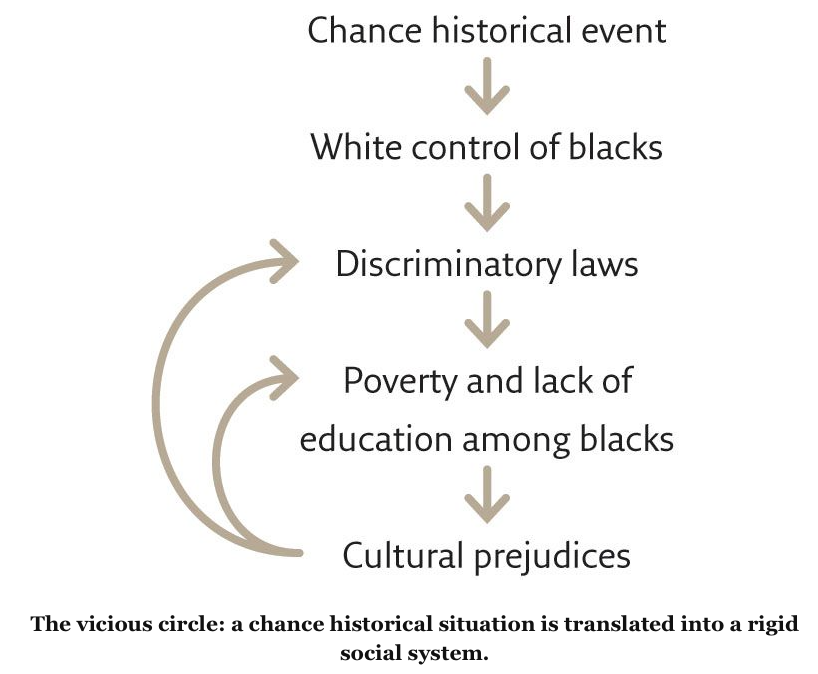
Discussion is related initially to racism and then goes to sexism, providing an interesting table of attitude changes:

Author also poses an interesting question: “How come that human society that extensively relies on cooperation the less cooperating sexual group (males) are routinely dominate ove more cooperating group (females). He has no answer at this point.
Part Three: The Unification of Humankind
- The Arrow of History
The view of history had changed from image of arrow flying in some predefined direction to quasi-static condition continuously interrupted by unpredictable events and therefore moving chaotically from one direction to another. In other words it is being in flux with no predestination whatsoever, but with some loosely defined direction nevertheless. This direction could be rather defined as consolidation of humanity that started at very low level of groups and growing into one global entity of humanity. This process is based on foundation of three abstractions: money, empires, and religions.
10 .The Scent of Money
The first abstraction – money supports effective division of labor and exchange of goods and services. This chapter is a very short discussion of money with stress on its function as trusted medium of exchange.
- Imperial Visions
The second abstraction – imperial visions provides for unification of humanity in large entities that provide security, create common trade space, and develop common cultural space for huge numbers of people over extended territories. Here is tabulated representation of empires life cycles:
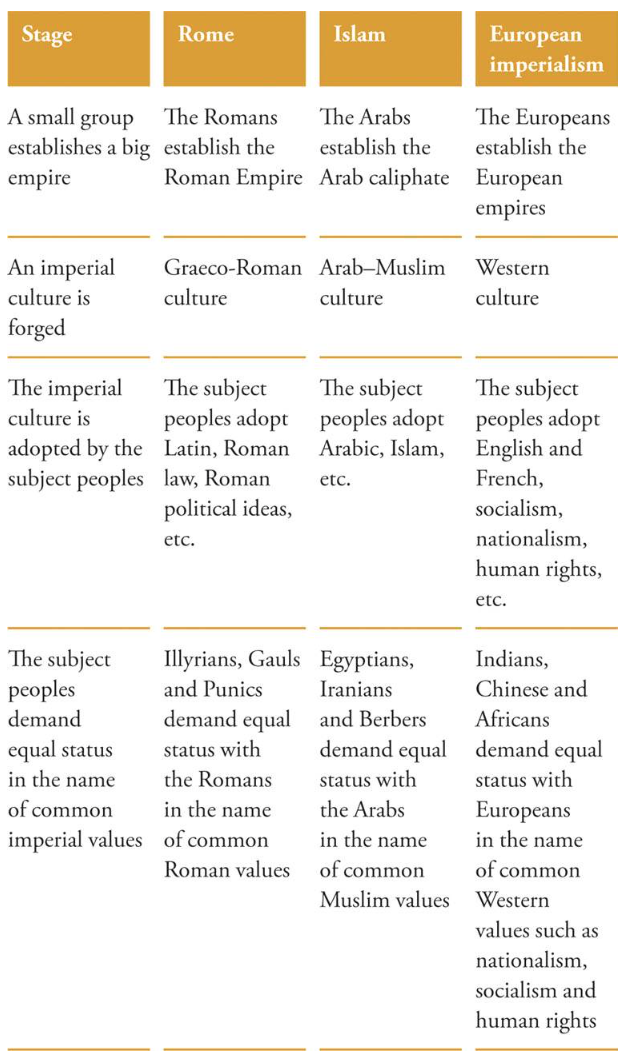

The final destination of this vision where we are moving now is a global empire that includes all of humanity held together by common culture and common interests.
- The Law of Religion
The third abstraction – religion provides for unified philosophical view of the world that support culture of the society and cohesiveness of its members. This chapter reviews a number of religions developed by humanity including secular religions such as Buddhism and Communism. It also provides a useful graph for their understanding:

It also distinguish as a separate category humanist religions:
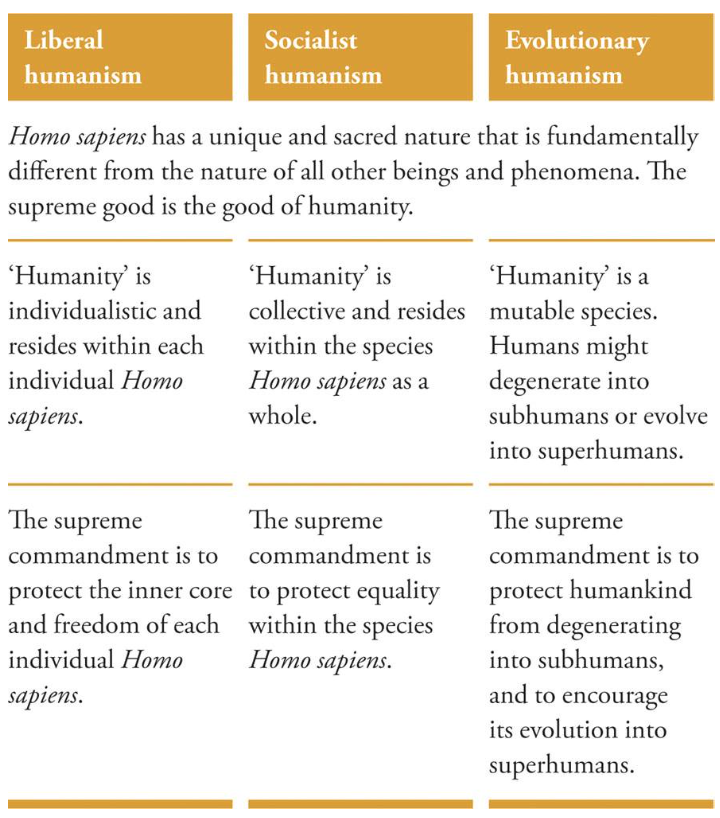
- The Secret of Success
This is discussion of how humanity get to the point it is in now – a dominant species in process of merging into one global entity. The point is made that history is second-order chaotic system meaning that any prediction changes outcome, making it unpredictable in principle. For the most part history did not lead to improvement of human lives, this is very recent phenomenon and even so it was not true for many people who perished in calamities of last century despite dramatic increase in productive abilities of humanity and improvements in all areas of technology.
Part Four: The Scientific Revolution
- The Discovery of Ignorance
The science starts with recognition of ignorance. Historically people always new everything about the world meaning that they believed they know everything there is to know and this knowledge is contained either in heads of wise old men or in sacred books. The discovery of ignorance prompted beginning of search of knowledge, creating science:

- The Marriage of Science and Empire
This chapter is about how Europe managed to combine newly found scientific approach to the world expressed in new technology and imperial conquest, while other cultures especially Chinese were not able to do it.
- The Capitalist Creed
This is about another component of European success – capitalism that provided economic foundation for application of science and technology to real life problems. Interestingly enough it looks at capitalism and monetized economy from morality point of view when everything is based on trust. Trust in money being a good conduit for value, but most important trust in the future as foundation of modern economy:

- The Wheels of Industry
This chapter is about some features of capitalism such as technology advancement, mass production including treatment of animals as machines. It also linked to consumerism with an interesting point that in the past objectives of aristocratic elites were dedicated to consumption, while regular people worked hard just to survive. The current conditions of developed capitalism led to situation when business elite works hard to invest capital in most effective way to achieve high return, while regular people work a lot less if at all and consume a lot more.
- A Permanent Revolution
This chapter is about other side of capitalist development: the great weakening of family and community and their substitute by the state and virtual community:

- And They Lived Happily Ever After
This is about human happiness and meaning of life, the issues that become important after science and capitalism provided enough food and consumables to maintain this life nearly effortlessly.
- The End of Homo Sapience
The final chapter is about next phase in history of Sapience when humans achieved ability to consciously redesign their own DNA and rebuild biological world around them to whatever specification they would like. Combined with already dramatically changed material world with its houses, cars, communications, and array of newly created goods and services this final frontier signifies end of Homo Sapience as animal created by evolution and begins new chapter of Sapience that created himself.
Afterword: The Animal that Become a God
The book ends with a charming point that while humans become gods they are still do not know where they are going and what they want to achieve. So the final question is: “Is there anything more dangerous than dissatisfied and irresponsible gods who don’t know what they want?
MY TAKE ON IT:
I find the framework of history of Homo Sapience presented in this book highly viable with decent explanatory power. Especially interesting is notion of discovery of ignorance that I do not remember encountering anywhere else. Another interesting point while not entirely new, but somehow poorly understood, is that capitalism is economic system build on trust and this is a very important reason for its success. I would not completely agree with author about current situation, which he believes characterized by increase in strength of state and market at the expense of family and community. I think that we will see decrease in the power in influence of state and restructuring of family and community that would change from family held together by external forces of laws and traditions to family held together voluntary by mutual affection. The similar process would happen with community when it will change from territorial community of kin to virtual community of individuals with similar interests and attitudes. In short – the real story of humanity is just beginning.
20150403 Social
MAIN IDEA:
Human brain is first and foremost tool for social connection between people. The need for social connection is even more important than food for survival and it show in all human activities including initial behavior of infants.
DETAILS:
Part One: Beginnings
1 Who Are We?
This starts with the story of author grandparents who were so closely connected that literally could not live one without other. Then story goes through famous Regan / Mondale debates when Regan’s joke allowed to establish direct social connection between him and public leading to victory in elections. Finally it arrives to evolutionary value of social connection with wonderful graph of its historic and developmental progression:

- The Brain’s Passion
This chapter is review of technology and research of brain activities specifically oriented to identify part of brain that is activated by default whenever brain is not tasked with specific activity. It arrives to the Social Brain Hypothesis stating that our super big brain was evolutionary developed to support our connectivity and cooperation with each other.
Part Two: Connection
- Broken Hearts and Broken Legs
This chapter is analysis of fear with interesting point that lots of people more afraid of public speaking than broken leg. From here discussion goes to social pain and suggestion to turn Maslow’s pyramid upside down putting self-actualization into foundation of needs making it more important than physiological needs. As prove two points provided: the first is the fact that painkillers work to sooth psychological pain and another one based on experiments with baby monkey and feeding machine vs. cozy machine. All this supported by fMRI research of brain activities. It was also tested by another set of experiments with Cyberball social rejection game.
- Fairness Tastes like Chocolate
This is discussion about fairness with usual reference to ultimate game. However fairness here is defined more as sign of social acception and recognition of value of the person, than anything else. From here it goes to importance of being liked to wellbeing of the person. Then it follows with discussion of using praise and recognition as reward and finally comes to conclusion that need to avoid social pain and obtain recognition is as important as physical pain/pleasure dimension and could even be causally related to altruism.
Part Three: Mindreading
- Mental Magic Tricks
This chapter is about mindreading as it is practiced in social games like Rock- Paper/Scissors when everything depends on reading adversary’s mind. It reviews a number of experiments related to taking into account other’s mind, discusses brain structures that manage this process, and its implication for social cohesiveness.
- Mirror, Mirror
This chapter is about mirror neurons, data and experiments in support of this theory and cracks found in it. It also discusses social evaluation constantly conducted in order to understand behavior of other people and to be able to answer questions How, What, and Why for this behavior. It suggests that mind reading combined with mirroring makes Social Worlds possible.
7.Peaks and Valleys
This chapter discusses ups and downs of human live. Then it goes into three types of human empathy: understanding, affect matching, and empathic motivation. It seems to be supported by the Septal Area of the brain. It also discusses autism and its probable causes.
Part Four: Harmonizing
- Trojan Horse Selves
This is a very interesting take on the problem of consciousness and self-awareness: what is its evolutionary value? The answer here is that it is the Trojan horse that makes people more social and consequently capable for self-sacrifices on the behalf of group. To support this idea author provides quite detailed overview of related parts of brain. Author actually comes up with idea that would probably become all the rage in political and business analysis of focus groups: neural focus group when result based not on what people say, but what area of their brain is gets lighten up when some product or political candidates presented. Looks like it has better predictable power than just asking.
- Panoptic Self Control
This chapter starts with an interesting anecdote demonstrating how a low value gain right now can cause person to forfeit much more gain in the future, kind of restatement of marshmallow experiment findings. Then it goes into brain’s mechanics of self-control reviewing separately a Motor self-control, Cognitive self-control, Perspective taking, and finally control over emotions via mechanisms of suppressing or reappraisal. There is also an interesting question of who benefits from self-control. Unsurprisingly, author believes that society benefits most with mechanism of switching it on and forcing individual to behave as in panoptical environment when being watched changes behavior to comply with norms. At the end of chapter author again stresses that our Self is formed by society to maximize benefits for it, rather than for individual.
Part Five: Smarter, Happier, more Productive
10 Living with a Social Brain
Here author goes into discussion about happiness and its connection with sociality of the brain. He spend some time on explaining “paradox” of money not bringing happiness only to conclude that happiness is linked to social connections and these connections in contemporary world get weaker all the time due to surrogates provided by technological tools like TVs, Internet, and such.
11The Business of Social Brains
This chapter is about implication of social brain to motivation. It represented by SCARF model: Status, Certainty, Autonomy, Relatedness, and Fairness. Author believes that this combination has significant motivational power and should be used extensively in addition to money to improve business relations and consequently productivity.
12.Educating Social Brain
The final discussion is about contemporary education and how it is often fails to take into account social characteristics of human brain. Some ideas for modification of current processes such as special attention to development of self-control, gearing process to age related changes in emotional condition of children, provide also training for emotional regulation and mindreading discussed in detail.
MY TAKE ON IT:
I think there is a lot of common sense related to human social connectivity here that is coming greatly enforced by technological understanding of a human brain and psychological experiments that demonstrate various aspects of it. The bottom line humans are social animals whose big brain developed by evolution to support group survival with the same if not higher priority than survival of individual. I find especially interesting the part on motivation, which is going to be more and more important when humanity moves from expansionary phase to sustainability phase with material wellbeing becoming insignificant and human routine labor unnecessary. SCARF and other methods of using intrinsic strive for sociality seems to open way for creating meaning of life in the new environment when plain survival, procreation, and resource acquisition are given and could not provide such meaning any more.
20150327 The Meaning of Human Existence
MAIN IDEA:
The meaning of human existence is not coming from god or any other supreme conscious entity that set up some objective for human live. It comes from evolution that produced humanity via change-selection process. Every human being is just an intermediate link in the continuing process of development of humanity and meaning of live is to prevent interruption of this process and eventually to take over future development away from evolution into consciously development under human control for human objective. This process should include transformation of continuously changing environment in such way that it would become sustainable with maintenance of biodiversity, merge of technology and humanities, and probable improvements in both human biology and society.
DETAILS:
I THE REASON WE EXIST
- The Meaning of Meaning
It is an interesting discussion about meaning of “meaning”. Two definitions are provided: Intentionality as in Intention that implies Design that implies Designer; and another one: Accidents of history and evolution creates meaning without any need for intentional design or designer. The first definition is trying to answer to “WHY” by referencing to Designer’s intention, the second: by trying to answer this question by using science and reformulates question into HOW DID IT HAPPENED and WHAT WILL HAPPEN NEXT.
- Solving the Riddle of the Human Species
This is discussion about riddle of human nature and how it came to be. It very briefly reviews prehistory of human species with conclusion that we are just a biological species adapted to live in biological world; no notions of angels or demons would be applicable.
- Evolution and Our Inner Conflict
This is the presentation of key features of our species as product of multi-level evolution when features preferable for individual survival are always in conflict with features preferable for group level survival causing extreme complexity of human behavior and attitudes.
II THE UNITY OF KNOWLEDGE
- The New Enlightenment
The new Enlightenment is the path that author believes we are already on. It is merge of science and humanities. This chapter reviews historical process of enlightenment as generation of new form of human mental representation of the world via scientific method that not only developed into separate branch of knowledge but become practically dominant approach. The new Enlightenment would be based on global interconnection and bring science and humanities back together.
5 The All-Importance of the Humanities
This is discussion of current and future technological development that would allow humans to practically reinvent themselves as species by changing DNA, environment, even creating new species as needed. Another important question is what humans would do if robots do all the work. Author believes that the only way to answer these questions is via development of humanities.
6 The Driving Force of Social Evolution
This is discussion of social evolution through the prism of two competing theories of evolution: theory of inclusive fitness and theory of multilayered evolution that includes individual level and group level. Author himself over the years moved from complete support of inclusive fitness to individual-group duality of evolutionary process.
III OTHER WORLDS
- Humanity Lost in a Pheromone World
This chapter is the step aside from human world and attempt to find explanations in the world of insects, which is the area of author’s expertise.
8. Superorganism
This is about ants and their society that could be considered as a super-organism.
9. Why Microbes Rule the Galaxy
This is view at colonies of insects as superorganisms. Interestingly enough these superorganisms are as complex as human society and are as effective in survival games as humans are even if there is nothing even remotely close in structure and functions of colony of ants and human city. The main difference is that humans are autonomous self-conscious creatures who however have inherent need to congregate in groups and coordinate their actions, while insects have not even an inkling of individuality and self-consciousness in any of their separate organisms.
- A Portrait of E.T.
This is a speculative discussion of possible ETs and what their features would be based on what we know about evolution. Unsurprisingly they have all typical characteristics of humans. They even has to achieve similar level of ecological consciousness to understand that conquest of earth makes no sense so we can rest assured that war of the worlds is not going to happen.
- The Collapse of Biodiversity.
This chapter is dedicated to discussion of dramatic decrease of biodiversity caused by expansion of human species. Author expects the bottleneck of existence that world will go through during current century with appearance at the end sustainable balance between humanity and all other species.
IV IDOLS OF THE MIND
- Instinct
The key point here is that humans as all other animals are driven by instincts, needs, and prone to develop phobias that are all but impossible to overcome. There are overall at least 67 universals found in all known human societies such as music, sports, body decorations, incest taboos and others making it highly probable that they have genetic origins common for humanity. It also includes acquired preference for natural environment that person grew up in that, however has underlying preference for natural environment of savannah where humanity came from.
- Religion
This chapter is about religion and its biological roots. From evolutionary point of view of multilevel selection, religions are highly beneficial adaptive tool that increases coherence of the group and assures necessary sacrifices by an individual for the best of the group. However all religions tend to define people as us: the true believers and others who reject the truth. Consequently all inclined to fight these others until they accept the truth or annihilated, making it quite difficult for humanity to coexist. The solution of this problem is found in America. It is tolerance for everybody’s faith and creation myths.
- Free Will
This is discussion of human free will with reference to failure of philosophy to come up with anything even remotely plausible. However being scientist and biologist at that author has no doubt in material nature of the mind and free will and assigns high expectation to the new project for Brain Activity Mapping (BAM). Author also expresses an interesting notion of self, as confabulation for multiple stories from individual’s past, present, and imagined future constantly reprocessed and changed to refit them to perceived reality. The final note here is that free will as notion is highly adaptable feature that helps human to survive in complex world regardless of actual production of human action based on neural activities of the brain.
- A HUMAN FUTURE
- Alone and Free in the Universe
Author is mainly optimistic about future of humanity, however he sees a lot of danger in contradiction between human nature created by evolution, Paleolithic environment, and what is required to accommodate to techno scientific global human community. Author compares negative features of human nature to biological notion of tolerable parasite load when presence of parasite does not hamper survival of organism. One of the most virulent and distractive features of human nature author considers religious denial of science, especially evolution. At the end author once again stresses what he believes is necessity of merge of science, humanities, and art in unified model of reality.
MY TAKE ON IT:
I pretty much agree with just about everything in this worldview. I also believe that humanity is the random outcome of spontaneous biological evolution, that human mind has 100% material base, and that we have to transform ourselves into sustainable society in harmony with environment. The only probable disagreement is that I do not see it happening via coercive power of governments and I do not believe that biodiversity is that important. I think that we are on the brink of remodeling environment rather than just accommodating to it and that would include development of new organisms, modification of our DNAs, and reconstruction of environment to fit our needs. However in my view the meaning of human live depends on time scale we apply looking at it. At the scale of a few decades of our lives it has lots of meaning in enjoying and/or suffering everything that life can provide for human being. On the scale of billions of years of universe it makes no sense whatsoever.
20150320 End of Big

MAIN IDEA:
This book is about dramatic consequences of what author calls radical connectivity – the ability of everybody to obtain any information and connect with everybody else in the world. His main idea is that consequences of such democratization of communication undermines institutions of society and endangers its effective functioning.
DETAILS:
- BURN IT ALL DOWN
This is about fear that author feel before Internet expansion and increase in freedom of people that it brings with it. Author does not trying to hide that he is active member of big left and as such in awe before big government and other big institutions of society. Even if he states at one point that some big institution deserve to die, he still believes that without some of big institutions led by supremely wise men like Obama, we all going to suffer. He clearly stated his fear that without all these big institutions and their power all “progressive” achievements of last 150+ years in limiting economic and personal freedoms of Americans will be lost. In addition to general statements about big institutions and threat to their existence this chapter also goes through brief history of development of computers that become basis for radical connectivity from PC through Internet and mobile devices. It also includes some interesting passages about what author calls “Nerd decease”, situation well familiar to everybody who ever dealt professionally with people of high technology. Quite often these people tend to look for overcomplicated technological solutions for problems that could be easily solved in much simpler way. As example he provides typical situation when complex code was developed to transfer reports to user when it could be easily done by manually delivering it across the aisle in the office.
- BIG NEWS
This chapter reviews dare situation of big news organizations that are getting killed by freedom of everybody to collect and distribute information. Behind author’s worries about decrease in professionalism of news media one can clearly see fear that without tightly controlled information flow the left political movement would be hard pressed its traditional advantage in setting up narrative and manipulating public opinion. Author is trying to find solace in some leftist success stories of online community organizing such as Huffington and Guardian experiences, but it is hard to believe that these leftist organizations that would have to compete with multiple online rightist organization could possibly provide such dominance as leftists had in time past when all three and only three TV news services were leftist. They had such amazing capability to distort information that they managed to create perception of right wing guilt in such event as communist Oswald killing president Kennedy.
- BIG POLITICAL PARTIES
Being one of technological leads in Obama campaign, author seems to be more positive in his views on impact of radical connectivity in politics mainly because Obama’s campaign was able to benefit from indoctrination of youth by public schools and colleges and therefore tap into their enthusiasm and pockets. However even in this area where author built successful carrier, he is filled with fear because radical connectivity can push upfront populist movements like Tea party that are capable to destroy leftist big government game that for more than a century was based on two big government parties: Bureaucratic party of Democrats and Crony capitalist party of Republicans.
- BIG FUN
This chapter is review of slow moving demise of another bastion of leftism – big entertainment. With virtual impossibility to control production and distribution of online entertainment Hollywood and traditional Music industry are in process of loosing control over content and distribution. Practically they are loosing monopoly power on propaganda via entertainment. Author also afraid of power moving from content oriented big entities such as Hollywood that had always been political to platform oriented big entities such as Amazon that do not really care about content, making it much more difficult from point of view of message control.
- BIG GOVERNMENT
This chapter is looking at impact of radical connectivity on big government. It recites a few cases of groundswell, meaning people finding ways to get around big government, and naturally states his fear of chaos if big government loses control over people. Another fear that is mentioned here is the fear of people sorting themselves out into separate like-minded groups and trying to handle their problem without government interference. I guess one of the main problems it represents for a liberal is dramatic increase in difficulties to conduct robbery of productive people on behalf of unproductive because it would be a big challenge to convince them that robbery is for common good when they know that they have nothing in common with beneficiaries of robbery whether these beneficiaries habituate in welfare slams or posh government offices. The final part of this chapter is dedicated to transparency of government and lobbying opportunities provided by online organizing.
- BIG ARMIES
This chapter is about impact of radical connectivity on war. The believe expressed here is that Internet, global connectivity, and similar thing completely change methods of conducting hostile actions leading to empowering of individuals to fight using terror actions and information disclosure. The big idea here is that government could not possibly shut down some digital networks. I guess meaning of big armies, their capabilities, and war with massive death is beyond author’s imagination, probably due to the lack of historical knowledge.
- BIG MINDS
This one is about elite education and government based scientific community with its process of elite selection and pier review based approval and legitimation that is increasingly coming under pressure from various forms of online education and knowledge development and dissemination. All these developments undermine authority and consequently cause fear for big government types. Author describes attempts to establish at least some authority online via authoritative sources such as Wikipedia and various fact check websites, but he does not feel that these attempts are really successful in achieving their goals.
- BIG COMPANIES
This chapter is about online goods and services providers that increasingly push out big companies substituting them with small shops and remaking America into free agent country. One of the most important points here is that economy of scale is loosing its advantages when it competes with economy of cheap information flows. Specifically reviewed are software sharing services and the cloud. This chapter is a great resource for all kind of information about weird web sites related to small online businesses.
- BIG OPPORTUNITIES?
The final chapter is kind of summary of situation. Author clearly sees that we are at the point of revolution in human history as big or even bigger then revolutions of early XX century that swept away thousands of years of monarchies and aristocracies ruling the world. It looks like big institutions of our time are moving in the same direction – they will be swept away by newly acquired power of individuals to control their lives, their productive, consuming, intellectual, and communicative activities. Author seems to be desperately looking for new institutions that could save power of elite or as he puts it “direction-setting inspirational leadership”, but could not find anything.
MY TAKE ON IT:
I agree that we are moving into new age of radical change in society institutions due to “radical connectivity” as author puts it. Contrary to the author I see only good coming from it because increase in power of individuals is not coming at the expense of decrease in power of some benevolent abstract entities of big government or big anything. It is coming at the expense of power of other individuals who are in control of these big institutions and routinely use this control to transfer to themselves wealth and resource created by other people. It short if “radical connectivity” wins, the contemporary elites will go the way of aristocracies a centuries past into oblivion. Author seems to fear this and I relish seeing it coming.
20150313 Moral, Believing Animals

MAIN IDEA:
The main idea of this book is that humans are qualitatively different from other animals mainly because of their inherent need and ability to believe in some narrative and to adhere to morals derived from this narrative. This believes and corresponding morals pretty much define human actions and attitudes to each other and environment. From here follows that other theories of human nature either rational choice or structural functionalism are incorrect with most critic directed at ideas of sociobiology.
DETAILS:
- Introduction
This book is an attempt to answer to question what kind of animals is humans? The main themes are theory of culture and human action, rejection of simplifications in other theories of culture, and, finally it elaborates a descriptive anthropology of personhood in attempt to understand human social actions.
- Human Culture as Moral Order
Author postulates a normative approach to culture stating that humans are inherently moral animals, meaning understanding of right and wrong and continuing matching of intentions, desires, and actions against these notions. The same applies not only to individuals, but also to social institution and cultural structures. This morality is controlled by human emotions, especially by empathy and only seldom fails in some individuals who are psychopaths and generally recognized as deviation from the norm. It also goes into details of social structures defining them as a complex set of rules and resources. For examples author looks at Universities and at markets stating that they are all inherently linked to morality of any given society and cannot function without it. Author also reviews some implication of his approach.
- Believing Animals
The main point here is that all humans are believers and base their actions and behavior on unverifiable assumptions they obtain during socialization. Typically any believe that an individual has is not a subject to change by presentation of empirical facts. Sometimes it is possible to change, but it does not come easy and often feels like revelation. However the person does not cease to be believer, but rather just switch to another set of believes. Author thinks that the human characteristic of believe is responsible for variety of incompatible cultures and religions existing in the world. Also reviewed here sociological research and theories with critic that they tend to ignore or at least minimize the role of believes. Finally it touches our specific set of believes – democratic capitalism that treated as just another set of believes not that different in its nature from any other set of believes like believes of a medieval peasant or aristocrat.
- Living Narratives
This chapter is about currently active narratives with stress on idea that our current narrative based on science, technology, and such is still developed as stories and they are not only made by humans, but also make humans by continuously supporting culture that forms them. The author reviews samples of narratives such as American Experiment narrative, Islamic Resurgence narrative, Christian, and some other narratives. Then he reviews how narratives impact individual and then specifically looks in details at American Sociological narrative. The interesting point at the end of chapter is that it is not possible truly be a relativist and consider all narratives as of equal value because it is not humanly possible to overcome your own narrative whatever it is at the time. The end of chapter provides a very short overview of philosophical approach to competition, mixing, and recombination of various narratives.
- On Religion
This is an attempt to answer to the question what is religion? Author comes up with a very reasonable definition: “Religions are sets of beliefs, symbols and practices about reality of superempirical orders that make claim to organize and guide human life”. This follows by speculation about origins of religion
- The Return of Culture?
This is review of development of sociology of culture in XX century when it went from structural functionalism with its stress of leading role of culture in society and as defining factor of individual behavior through second half of century when Marxist interpretation of superstructure based on economics was main force in its turn pushed away by theories of rational choice and eventually somewhat coming back to ideas of culture based sociology that incudes much richer accounts of human life than original functionalism.
- Conclusion
The conclusion briefly restates author’s dissatisfaction with existing approaches: sociobiology, rational choice theory, exchange theory, and evolutionary psychology all of which he considers being developed from antimentalist, noncultural traditions of Western social theory. Author restates his approach that humans are moral and believing animals and that there is intimate connection between morals and social institutions and that it impacts all actions of human individuals.
MY TAKE ON IT:
I pretty much agreed with proposition that morals and behavior are based on believes, but do not see how it contradicts either evolutionary biology or even sociobiology. As soon as we take out consideration of intelligent superior being(s), we necessarily wind up with evolutionary explanations, of which the most plausible for me is theory of dual level selection based on fitness of individual within the group and of group amongst other group. Believes and corresponding morals are dynamically changing sets of memes that are continuously invented, reinvented, survive or perish with individuals and groups carrying them. Sometimes the survival of individuals and groups depends on their ability discard existing believes and accept new ones that better support their survival at the moment. The great example of dramatic and massive changes in believes and consequently morals provided by history of Islamic conquests, probably the most consistent violent expansion of ideology in history.
20150306 Sleepwalkers

MAIN IDEA:
The main ideaof this book is that WWI was long in coming and that this conflict was based on dynamic change formed over some 30 years of previous diplomatic maneuvering. Individuals who were making decisions on all sides just followed usual patterns of behavior that was created during prewar years and even if many were able to see the giant catastrophe they were getting themselves into, were not able to change patterns of behavior and decision making leading to it.
DETAILS:
Part One: Roads to Sarajevo
- Serbian Ghosts: Murder in Belgrade; ‘Irresponsible Elements’; Mental Maps; Separation; Escalation; Three Turkish Wars; The Conspiracy; Nikola Parle Reacts
The first chapter is about Serbian history and culture formed in long struggle with Ottoman Empire. It starts with story of coup against Serbian king and establishment of new dynasty under control of militant Serbian nationalists. Probably the most important part of it is discussion about culturally dominant view among population of Great Serbia that would include many lands only tangibly related to Serbs. The point here is that Serbian nationalists saw possibility of development only as consequence of great European war in which bordering with Serbia and much more powerful Austro-Hungary and Ottomans would be defeated, opening way for the new country under Serbian control – Yugoslavia. Interestingly enough that was actually what happened as consequence of WWI.
2.The Empire without Qualities: Conflict and Equilibrium; The Chess Players; Lies and Forgeries; Deceptive Calm; Hawks and Doves;
The second chapter looks at another part of equation: Austro-Hungarian Empire. The main point here is that contrary to usual interpretation heavily influenced by knowledge of what happened after WWI, this country was not a sick pitiful entity on the brink of collapse. It was rather healthy and economically prosperous society that was capable more or less successfully keep in check centrifugal forces created by multi-national nature of population. While politically this semi-democratic state was often in paralysis, it boded very well for economic prosperity and well being of population. Maybe this example of political importance intertwined with economic vitality provided fodder for ideas that eventually led to creation of Austrian school of economics.
Part Two: One Continent Divided
- The Polarization of Europe 1887-1907: Dangerous Liaison: the Franco-Russian Alliance; The Judgment of Paris; The End of British Neutrality; Belated Empire: Germany; The Great Turning Point? Painting the Devil on the Wall;
This is review of dynamical changes in alliances going on in Europe for 20 years at the end of XIX century. Mainly it was a drift through various combinations to France – Russian alliance to contain Germany in the centre of Europe and prevent its expansion outside. The important role was plaid by French – Germany competition in Morocco that pushed France to look for allies. It found such initially in Russia that needed French financing to recover after loss in war with Japan, and then in British who were concerned by Germany naval buildup.
- The Many Voices of European Foreign Policy: Sovereign Decision-makers; Who Governed in St Petersburg? Who Governed in Paris? Who Governed in Berlin? The Troubled Supremacy of Sir Edward Grey The Agadir Crisis of 1911; Soldiers and Civilians; The Press and Public Opinion; The Fluidity of Power;
This chapter is an interesting review of internal powers and decision-making processes in all main countries. It shows real weakness of all monarchs who rarely if ever were able to make their decisions stick. It also demonstrates that majority of European monarchies including even Russia were semi-democratic entities in which relatively free press and public opinion played a significant role.
- Balkan Entanglements: Air Strikes on Libya; Balkan Helter-skelter; The Wobbler; The Balkan Winter Crisis of 1012-13; Bulgaria or Serbia? Austria’s Troubles; The Balkanization of the Franco-Russian Alliance; Paris Forces the Pace: Poincare under Pressure;
This chapter is about history of Balkan conflict that at the beginning was conflict of several Christian Balkan countries against Ottomans with Bulgaria playing main role and then between these countries with Serbia leading piling up of everybody else on Bulgaria. All this was going on with heavy interference from Russia, France, and Austro-Hungary.
- Last Chances: Detente and Danger 1012-1014: The Limits of Detente; ’Now or Never’; Germans on the Bosphorus; The Balkan lnception Scenario; A Crisis of Masculinity? How Open Was the Future?
This chapter is about attempt of détente between Russia and Germany that failed mainly because both sides could not risk their existing alliances. This failure created strong feelings in Germany that time is not on their side because Russia was quickly rearming its military using French money, while Austro-Hungary was very low on military expenses and Ottomans were growing comparatively weaker. When Germans increased their influence with Ottomans to the point of taking over military command, Russians become convinced that it was aimed to close the critical trade rout for their grain via Bosporus. In turn Russians did everything possible to increase their influence on Balkans trying to assure that this rout remains open.
Part Three: Crisis
- Murder in Sarajevo: The Assassination; Flashbulb Moments; The Investigation Begins; Serbian Responses; What is to be Done?
This chapter is detailed review of actual assassination in Sarajevo and its fallout. Especially interesting is Serbian initial reaction, which was not to conduct serious investigation and not suppress nationalists’ celebrations, consequently humiliating and provoking Austrians.
- The Widening Cycle: Reactions Abroad; Count Hoyos Goes to Berlin; The Road to the Austrian Ultimatum; The Strange Death of Nikolai Hartwig;
This is review of public reactions to events and maneuverings between Germany and Austro-Hungary with Germany pushing for quick and decisive action. It seems to be possible that this was based on believe that conflict is eventually inevitable, while its delay would be detrimental to Germany chances.
- The French in St Petersburg: Count de Robien Chanees Trains; M. Poincare Sails to Russia; The Poker Game;
This is about overall French-Russian relationships and specifically detailed description of Poincare visit to Russia during the crisis where both sides agreed to take side of Serbia even if it would cause military conflict.
- Ultimatum: Austria Demands; Serbia Responds; A ‘Local war’ begins;
This is brief, but detailed account of Austrian ultimatum and Serbian response. An interesting thing about it is that initially even before it was formally delivered Serbian leaders were scared enough to consider its acceptance. However with Russian and French assurances that they would not be left alone, they moved to reject Austrian demands initiating local war that quickly started to escalate.
- Warning Shots: Firmness Prevails; ‘It’s War This Time’; Russian Reasons;
The initial steps to war at this point become practically inevitable because, at least partially due to prevailing military doctrine that stated that mobilization and positioning of troops is critical for achieving success. This chapter reviews Russian thinking and acting in view of this doctrine.
- Last Days: A Strange Light Falls upon the Map of Europe; Poincare Returns to Paris; Russia Mobilizes; The Leap into the Dark; ‘There Must Be Some Misunderstanding’; The Tribulations of Paul Cambon; Britain Intervenes; Belgium; Boots
This chapter recounts the last days of piece when mobilizations and counter mobilizations went full speed underway. Interestingly enough in addition to Austrian ultimatum to Serbia there was another ultimatum by Germany to Belgium demanding to open passage for German troops. The Belgium’s rejection and the following German aggression brought into hostilities Britain. British previously stated that German passage would not cause military response if it were limited geographically: remaining south of Sambre -Meuse line. Germans just ignored this opportunity and went full speed ahead with invasion. The final small note is description of people in remote areas of Russia learning about war. They did not even know who is war against and often come up with completely incorrect guesses.
MY TAKE ON IT:
This is a very interesting prehistory of WWI with all its political and diplomatic maneuvering and intrigues. It all looks like a complicated game that rulers and their bureaucracies played jockeying to get better positions relative to one another to be eventually converted into more territories and people under their control at the time when they were not really able to control effectively people and territories they already had. It is also amazing to me how far away from everyday real lives of normal people all this occurred and how little regular people feel need to watch this and try to be involved. As result the masses paid huge price for letting their elites to play. Happens every time.
20150227 Debt

MAIN IDEA:
Debt is bad, creditors are violent creatures that spoil everything and society should clear debt for everybody because some rich and powerful do not pay their debts anyway.
DETAILS:
1 On The Experience of Moral Conclusion
Author starts by establishing his leftist credentials as participant of anti-globalization movement. As such he demanded abolishment of 3d world countries debt. In one of his encounters with civilians he bumped into a new and alien for him idea that debt should be paid. This started his research that produced this book about debt. Being leftist author considers debt as something very bad, but he is not satisfied with just moral side of it. He goes to history to trace debt origins and development.
2 The Myth of Barter
The first step of his review author is trying to disqualify typical economic idea of origination of money–based market: impracticality of barter leading to creation of money as universal exchange tool. The main point of this chapter is that barter in real primitive one-tribe economy was not used because there were no real exchange of goods and services, just mutual help and cooperation in survival process. However, when he turns to actual anthropological research he brings example of barter exchange, albeit not within a tribe, but rather between tribes as part of regular encounter. Even more interestingly he comes to conclusion that original medium of exchange was credit with money invented much later.
3 Primordial Debts
This is more detailed review of the Credit Theory of Money – theory that money was invented as unit of measure of debt. From here author links debt to the state power claiming that debt and consequently money were not created to meet exchange needs of people, but as tool of robbery forcing people to pay taxes with state issued money which could be acquired only by selling goods and services to representatives of the state. Another theory discussed is theory of primordial debt that was recently developed as part of intellectual foundation for Euro. The main idea is that all humans born already in debt to society because without it they could not possibly exists. The state and government is embodiment of the society and therefore every human is in debt to government and the only meaning of his life is to pay this debt back. To author’s credit he is capable to think it through to logically inevitable conclusion of individual being the slave of the state as in USSR. The final point is made that usual dichotomy of the market vs. the state is wrong. As author sees it states created markets and markets require states.
- Cruelty and Redemption
This is discussion of duality of the money: IOU on one side and commodity on another. Somehow it goes into discussion of economic ideas of Niezsche but then successfully goes back to evils of debt.
5 A Brief Treatise on the Moral Grounds of Economic Relations
Here author brings in anthropological research to establish qualitative and moral difference of debt comparatively to all other obligations. The first step he does is to try redefining communism as a system of mutual obligations that exists always and everywhere in compliance with slogan “from each to each”. He even states: “Communism is the foundation of all human sociability”. After that he is moving to “Exchange” treating it as an inferior method of interaction comparatively to Communism. Somehow he believes that exchange implies hierarchy so he tries to show that “exchange” produces “hierarchy”. At the end of chapter he goes into discussion of meaning of debt stating that it is just an incomplete exchange.
6 Games with Sex and Death
This starts with a strange statement that if we reduce human life to “exchange” only eliminating “communism” and “hierarchy”, we somehow move all humanity who is not adult males into background. He also introduces a new notion of “human economy” meaning “economic systems concerned not with the accumulation of debt, but with the creation, destruction, and rearranging of human beings. Then he goes into anthropological example of such economies running on blood debt, flesh debt, slavery, and such.
7 Honor and Degradation or On the Foundation of Contemporary Civilization
This chapter is about mainly non-material debts of honor and honoring one’s debts. Author brings it to an interesting point about “human economy” starting with slavery. He sees slavery not as primarily regular economic phenomenon, but rather as human relations phenomenon that he defines as “a human being ripped out of one’s contest”. From here he goes to defining slavery as “social death” and then to linking it to honor. He defines honor as “surplus dignity” often achieved by diminishing dignity of other especially by eliminating dignity of slaves. It is kind of human non-economical exploitation. Finally he links honor to money and debt by claiming that they are more measure of honor than actual economic tools. In conclusion of this chapter author comes up with a mind bugging and charming idea that we are masters and slaves at the same time and our freedom comes down to our ability to drive ourselves as slaves.
- Credit versus Bullion, and the Cycles of History
Here author returns to economy and money, looking at historic process of exchange development similar in multiple cultures from non-quantifiable Credit / Debt to Commercial loans to money exchange and quantifiable debt with term conditions. He believes that this process went in parallel in Mesopotamia, China, and Egypt and was completed about 750 BC in all these cultures with establishment of money exchange and formal debt processing.
9 The Axial Age (800 BC – 600 AD)
The next step was development of philosophies by such figures as Pythagoras, Buddha, and Confucius all living at the same time around 500 BC. German philosopher Karl Jaspers called it Axial Age and claimed that it was the age of philosophical awakening of humanity. Author is trying to link to invention and expansion of coinage to destruction of “human economies” by wide scope conquests such as Alexander’s and needs for easily transferrable and transportable media of exchange independent from human relations of credit. This need came from dramatic expansion of markets when individuals exchanging goods and services would have transactional encounters and may never meet again in their life times. Coins also where a great tool to support mercenary armies when soldier could carry acquired wealth wherever he would go. At the end of chapter author tries to combine historical development of interconnection between market, state, war, and religion into 8 steps process:
- Markets appear as side effect of government administrative systems and then provided logic and practical tools for mercenary warfare eventually subjugating government itself
- As result military-coinage-slavery complex emerges ideologically supported by materialistic philosophies
- As reaction and rejection of this materialism philosophies of humanity and soul are developed, creating foundation for ethics and morality
- Clash of these philosophies and elites supporting them led to prolong period of struggle between various ideologically based social movements
- Same social movements rejected war and aggression becoming peace movements
- The next step was development of market based philosophical ideas with non-material debt in foundation of many of them
- Rulers embraced these philosophies and managed to control empires on their ideological foundation such as Constantine’s Christianity
- Eventually the stability was achieved by dividing everything into separate spheres: one sphere of spiritual, religious, and human considerations and another one of crude materialistic, based on market, and driven by money and power actions.
10 The Middle Ages (600AD – 1450 AD)
The Medieval period saw the end of big empires and return to “human economies” in their feudal form either in smallholdings of European knights and kings or big bureaucratic Empire of China or Cast Aristocracy of India. It also produced new religion and civilization of Islam.
- Age of the Great Capitalist Empires (1450-1971)
Here author reviews West European development of contemporary capitalism and its expansion around the world. He divides it into several parts:
- “Greed, Terror, Indignation, debt” is about territorial expansion of European states based on superiority of actions of European adventurers and profit seekers often driven by debt who conquered America over potential competition like China who did not really care to compete.
- “The World of Credit and Interest” is about “break of old system of mutual aid and solidarity” and substitution it with market mechanisms of Cash, Credit and Interest.
- Development of the new system into “ Impersonal Credit-Money”
- Final formation of capitalism’s all financial features specific for this economic system occurring even before industrial revolution. Author is also claiming that capitalism was never based on free labor. His reason: slavery, Chinese laborers, and even all forms of wage labor (which author seems to believe is a form of slavery).
- Apocalypse: Author believes that capitalism, as economic system cannot stand idea of its own permanency and constantly in search of the new form of apocalypse looming ahead from world revolution to nuclear holocaust to global warming. He somehow manages to link it to accumulation of national debt that is infinite expansion of credit into the future.
12 The Beginning of Something yet to Be Determined (1971-)
The beginning of the end of capitalism and start of something new author assigns to the date in 1971 when USA stopped exchange of dollars for gold. Then he goes into discussion of national debt, fiat money, and comes with conclusion that it could not keep going on for much longer and will have to be changed by some mass movement based on new ideas. Interestingly enough he expects the new big idea that will turn world around to come from Iraq and Islamic tradition built around notion of debt, or maybe it would come from feminism, or from Islamic feminism.
Conclusion
In conclusion author declares that debt and credit drives economy and it is actually bad for two reasons: one is that only industrious individuals would prosper, while lazy would suffer, which is morally not acceptable; and the second reason is that the industrial prosperity and hard work lead to destruction of environment, global warming, and/or some other calamity yet to be defined. The author’s proposal to save the world therefore is to clear all debts and start again from the scratch as pure and moral society with no debt whatsoever.
MY TAKE ON IT:
This book is somewhat fascinated trip into leftist notions of economic history and finance. In this leftist worldview the economy is divided into good “human economy” where there is no money, no credit and consequently debt, and people just share what they produce without expecting something in exchange. Author even trying to bring back from dust been of history and beautify the old name for this – communism. It seems to me that there is lack of understanding here that finance is nothing more than automatic resource allocation to where it would produce most good, meaning under “good” goods and services. Therefore debt as integral part of finance is just a part of this process of allocation. Obviously when such allocation is done not by capitalist based on where it would produce most profit, but by politician or bureaucrat based on where it would be most beneficial for his/her career, then it would be unreasonable to expect increase in quantity and/or quality of goods and services. So I would suggest to keep in place all debt created in market economy and liquidate all debt created by politicians and bureaucrats. And since this debt is often to majority of regular people who for example paid into social security all their lives, lets cover this debt liquidation by confiscating wealth from politicians, bureaucrats, and other individuals who earned their living from government salaries, grants, and other transfers beyond minimal amount necessary for survival. We do not want anybody, even socialist professors to starve.
20150220 Language: The Cultural Tool

MAIN IDEA:
The language is the communication tool that makes humans what they are. Without language it would not be possible to achieve group cohesion specific to the humans, which gives them huge evolutionary advantages and more than fully justify huge brain and long period to maturity required for effective use of this communication tool.
DETAILS:
Introduction: The Gift of Prometheus
Author defines language as tool and compares it with fire in its importance for human survival. The difference between fire and language however is that language is purely human invention and does not exists without humans. This tool allows handling problems created by need to maintain cohesion of human groups and effective communication it requires. The book reviews specifics of these problems, solutions provided by language, actual application of these solutions, and variety of such solution due to variety of cultures.
PART ONE: Problems
Chapter One: Language as a Social Tool
Author starts with description of problems he encountered as anthropologist and missionary in the new and completely unfamiliar environment. The discussion is mainly around issue whether language is the biological tool and inherent part of human personality, or it is an invented cultural tool used to respond to survival related pressures of environment.
Chapter Two: From Fire to Communication
This is about the nature of language as communication tool. It discusses whether it has genetic origin or just genetic predisposition for development, whether its grammar inherent for all versions of human languages or it could be different from language to language. There is also discussion about invention of language and its relation to use of fire. The fire created more need in cooperation and lead to discovery of other minds and development of language as tool to connect minds.
Chapter Three: Crossing the Communication Threshold
This discussion is partially about power of the words and partially about theory of communication when language services to overcome noise and deliver message. It also includes discussion on coherence of series of words and sentences build into a story capable to transfer highly complex message from one brain to another.
Chapter Four: Does Plato Have a Problem?
This is discussion about link between language and knowledge based on Plato’s ideas of an a priori knowledge and data supporting or debasing this idea. It also goes into more details about genetic base for language and human brain’s language related areas.
PART TWO: Solutions
Chapter Five: Universals and Faculties
This is about language being a tool that provides solutions for problems encountered in each specific culture. It again returns to discussion of language not being preordained faculty based on genes because there is no language organ to be found and even more important, Chomsky’s ideas not fit with expanded knowledge of diverse languages and their radically different grammars. Here author applies his extensive experience with various tribes and languages acquired during anthropological research. It also refers to the fact that language is learned from other people and all cases when individual were deprived of help from other humans they did not develop anything like language ability.
Chapter Six: How to Build a Language
This is somewhat technical discussion of language structure, its flexibility and continuing development. It applies an interesting way of analysis by using correct grammar and words in meaningless or unrealistic combinations. It also provides T-model of language with top being mental dictionary going down to sentences / semantics on one side and syntactic / sound structure on other side.
Chapter Seven: The Platforms for Language
This is about different platforms used for language from sound based on human anatomy to various writing methods, signs, everything else conceivable.
PART THREE: Applications
Chapter Eight: Aristotle’s Answer: Interaction and the Construction of Cultural Signs
This is about process of learning language and whether it is based on inborn instinct of language acquisition or it is specific use of general ability to learn new staff. One of interesting facts is that children seem to learn sentences as they learn signs as whole. It also discusses hierarchical structure of languages and human expectation of hierarchy in complex systems. Lots of space also allocated to links between culture, language, behavior, and underlying knowledge that defines it.
Chapter Nine: Language the Tool
Here author returns to his main concept that language is just a tool for communication and community building. It also includes discussion about situation when multiple languages used by people and how they interconnect. Author supports teaching Ebonics and bilingual education on the basis that to press with English puts children with diverse background into disadvantage. Finally link between language and culture is demonstrated by examples of parallels in culture and language acquisition by children and by linguistic impact of cultural notions about hierarchy of relatives in various cultures.
PART FOUR: Variations
Chapter Ten: Language, Culture, and Thinking
This time it is impact of language on the way of thinking that is reviewed. One of the most interesting examples is language without numbers and correspondingly complete lack of quantitative thinking in culture where it is used. Another example is of languages in which speaker’s body is not used as the center of coordinates so there is no left/right or up/down.
Chapter Eleven: YOU Drink. YOU Drive. YOU Go to Jail. Cultural Effects on Grammar
This is even more technical review of link between culture and grammar. It is discussed using example of recursion.
Chapter Twelve: Welcome to the Freak Show
The final chapter is an attempt to prove value of diversity of languages and call to save this diversity as much as possible. It also looks at various creoles, pidgins, and other languages as subsets and/or combinations.
Conclusion: Grammar of Happiness
The final conclusion of this book is that language reveals the engine of our souls, our mind and it is cognitive fire of human life.
MY TAKE ON IT:
I think that the main point that language is cognitive tool absolutely necessary for building understanding of the world internally in human mind and maintain communications and cooperation with other humans is very valid and I fully agree with it. However I think that value of diversity of languages is overstated because every language is inseparably linked to the culture and when culture gets destroyed by encounter with other technologically and politically more powerful culture, the language has little chances to survive. It could be maintained artificially or even restored from practically nothing as contemporary Hebrew, but it could happen only in exceptional cases when group of people is isolated and is under hostile pressure. The normal development leads to merge of cultures and consequently merge of languages so diversity of languages serves no other purpose then artificially maintain weaker culture. It is unfortunate because the real human beings pay price for this anthropological indulgence in form of less communications, less cooperation, and consequently lower quality of life due to unnecessary cultural and linguistic isolation.
20150213 Morris,Ian-War! What is it good for?
MAIN IDEA:
The main idea of this book is that wars are not always bad, but rather often are necessary and benevolent part of human society’s development. Wars could be divided into productive wars, which increase power of state that allow rulers who are always basically bandits to suppress rival gangs, bringing dramatic decrease in violence and turning robbery into stationary prosperous business when people who are being robbed accept robbery as reasonable payment for protection. This situation is contrasted with bad wars when state power decreased or even completely destroyed resulting in substitute of one powerful stationary bandit who cares about future by multitude of roaming bandits who care only about maximizing current loot, destroying in process productive powers of society as whole.
DETAILS:
Introduction: Friend to the undertaker: This starts with recollections of Cold war and recognition that violence and violent death consistently decreased over known history. The more detailed look at history led author to conclusion that wars relate to growth of state power: War makes the State and the State makes peace. As illustration author provided Ferguson’s table:
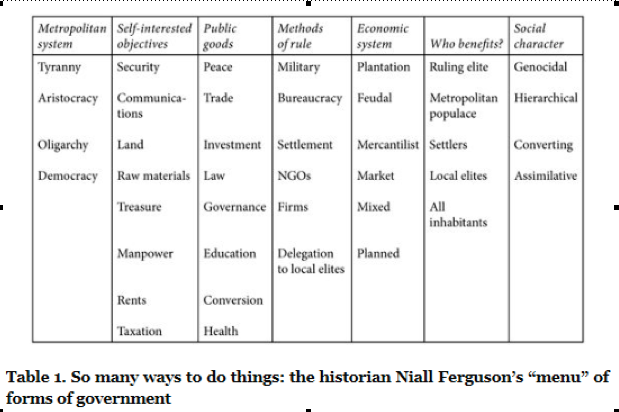
From here comes idea of separating wars into productive and unproductive with the following historical review.
- The Wasteland? War and Peace in Ancient Rome:
This chapter starts with battle between Romans and British tribes at the Craupian Mountain in 83 AD. The Romans won and dealt with losers with usual at the time cruelty. However historic record and archeological data show that level of violence in these areas went down dramatically afterword, while level of trade and prosperity was up. After reviewing a number of similar occurrences using not only historical, but also anthropological data author defines this situation as benevolent influence of stationary bandit who cares about long term rent that could be collected from conquered people. At the end the main question of this book defined as why in some cases it happens, while in many other cases it does not.
- Caging the Beast: The Productive Way of War
This chapter starts with critic of idea of special western way of war as characteristic of prosperous democratic agricultural societies. It states that 3 similar empires of ancient word: Roman, Parthian, and Han all coming into existence through conquest and merge of smaller entities were quite similar in many ways. They were similarly situated geographically in what author calls lucky latitudes: wide area from Atlantic to Pacific with good enough land and climate for extensive agriculture. In military affairs they went through similar technological phases presented in very neat graph:
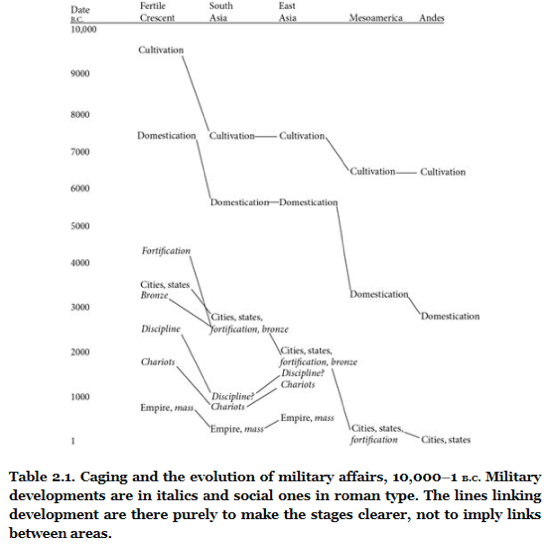
The main point made is that these agricultural empires successfully suppressed violent ways typical for all small pre-agricultural societies of frequent small-scale confrontations between neighboring tribes. The small encounters were substituted by big battles with consequent cruel suppression sometimes at the level of genocide, eventually bringing peace and prosperity for remaining population.
- The Barbarians Strike Back: The Counterproductive way of war A.D. 1-1415
The next step came with development of big horses and tools to ride those, producing cavalry that made mobile forces much more effective and gave military superiority to barbarians who overtime successfully destroyed all big empires. Author defines it as counterproductive wars. Instead of the stationary bandit – the state that cared about prosperity of rent producers came military superior mobile bandits who cared only about the loot. The final result was break down of big empires into small feudal state mainly self-sufficient, military based on fortifications for defense, heavy armored cavalry for suppression of rent producers leaving on territory under control, and semi-ritualistic knight’s alliances constantly in competition to identify and define allocation of territories. Author defines such wars as counterproductive because they increased overall levels of violence and decreased productivity levels around the world.
- The Five Hundred Years’ War: Europe (Almost) Conquers the World, 1415-1914
This chapter is about European military dominance in the world that author explains by effective use by Westerners of two non-western inventions: guns and ocean going ships and navigation. Despite rather quick acceptance of guns non-European countries never were able to catch up with European development of new military technologies, tactics, and drilling. There is also a very interesting discussion about mingling of commerce and war. Overall the European conquest of the world should be treated as at least somewhat benevolent because it resulted in dramatic decrease in wars and violent deaths. It is also mentioned that parallel to this went dramatic improvement in productivity due to industrial revolution.
- Storm of Steel: The War for Europe, 1914-1980s
This is review of long World War between European powers that lasted from 1914 until 1990 with some intermissions and long phase of Cold War. This long war had not only military, but even more so ideological character putting not only countries, but also people inside countries against each other fighting over selection of the best way to prosperity. One side was looking for prosperity via freedom both political and economic, while other side was looking for unity and top down commanding management of everything. Eventual outcome was semi-working arrangement of welfare state with limited market economies in all developed countries.
- Red in Tooth and Claw: Why the Chimps of Gombe went to War
At this point discussion is moved to biological causes and functions of violence and war starting with discussion differences between war like chimps and peace and sex loving bonobos. Turned out that even bonobos become much less peaceful when they encounter deficiency of resources. However the chapter ends with idea that human brain combined with contemporary technology decreases chances of war due to its suicidal character.
- The Last Best Hope of Earth: American Empire, 1989-?
The final chapter is review of contemporary relatively benign situation when American preeminence suppresses any significant wars around the globe providing for relatively low levels of violence. However author see future threats that could come from raise of China, India, conflict between rich and poor countries, and population groups inside countries. In short our long history of wars and violence is not over yet.
MY TAKE ON IT:
I find concept of productive and unproductive wars interesting and generally sound. However war and violence, while being the ultimate shortcut to achieving goals in resource acquisition and psychological satisfaction, is wider phenomenon than just power play between bigger and smaller or stationary and mobile groups of bandits. As long as shortcut of war works, people would use it to achieve their objectives, but I believe that technology including technology of organization of society on the basis of voluntary exchange rather than violent transfer of resources provides some hope that eventually it will be overcome.
20150206 Human Capital

MAIN IDEA:
The most important part of capital necessary for production is human capital that is humans with accumulated knowledge and skills allowing such production. This human capital has all characteristic of any other forms of capital such as ability produce profit in form of earnings to owner of this capital, investment options in form of expenses on education, and so on. Human capital is probably the most important form of capital and should be consciously developed and expanded.
DETAILS:
INTRODUCTION TO THE SECOND EDITION; INTRODUCTION TO THE FIRST EDITION: Introduction includes brief description of the structure of this book and content of its chapters.
II. HUMAN CAPITAL REVISITED: Introduction; Education and Training; Human Capital and the Family; Human Capital and Economic Development; Conclusions
This is introduction of the notion of human capital as combination of knowledge and skills obtained via education and training. It reviews formation of such capital starting with the family and its highly positive impact on economic development.
Part One: Theoretical Analysis.
III. INVESTMENT IN HUMAN CAPITAL: EFFECT ON EARNINGS: 1. On the Job Training: General Training; Specific Training; 2. Schooling; 3.Other Knowledge; 4. Productive Wage Increases;
This is analysis of educational investment based one separation of specific and general training with causal relation between accumulation of training and earnings rate. Sources of human capital defined as formal schooling and all other knowledge obtained outside of formal education. Finally wage increases that provide better access to goods and services including medical services are reviewed as methods for employers to increase human capital of their labor.
IV. INVESTMENT IN HUMAN CAPITAL: RATES OF RETURN: 1. Relation between Earnings, Costs, and Rates of Return (Addendum: The Allocation of Time and Goods over Time); 2. The Incentive to Invest; Number of Periods; Wage Differentials and Secular Changes; Risk and Liquidity; Capital Markets and Knowledge; 3. Some Effects of Human Capital; Examples; Ability and the Distribution of Earnings; Addendum: Education and the Distribution of Earnings: A Statistical Formulation; Addendum: Human Capital and the Personal Distribution of Income: An Analytical Approach; Supplement: Estimating the Effect of Family Background on Earnings
This chapter includes mathematical representation of relationship between earnings, costs and rates of return on human capital. This is followed by an analysis of dynamics of human capital in relation to age including variations of investment and returns. Overall, as expected investment decreases with age, while returns increase up to a point. It is especially typical for formal education when the length of remaining work life decreases value of investment. It also provides examples of such dynamics for various situations with detailed analysis of distribution of earnings.
Part Two: Empirical Analysis
V. RATES OF RETURN FROM COLLEGE EDUCATION: 1. Money Rates of Return to White Male College Graduates Returns; Returns 1939; Costs 1939; Rates in 1939 and 1949; 2. Some Conceptual Difficulties; Correlation between “Ability” and Education; Correlation between Education and Other Human Capital; 3. Rates of Return to Other College Persons; College Dropouts; Women; Rural Persons; 4. Variation in Rates of Return
This is an empirical analysis based on statistical data. The findings include: Return on college education for while male 11-13%. While high educational achievement strongly correlates with higher ability, author established that ability is responsible for proportionally smaller share or returns for higher levels of education. Rates of return declined from 1900 until 1940, but then grew up significantly despite increase in numbers of educated people. Rates of return are higher for white males than for black and higher for black men then for white women. Significant effort also allocated to analysis of returns causes broken down between abilities and education. It seems that ability as defined by high school rank and family background has increasing impact on earning with education, but it is not always consistent and depends of methods of analysis used.
VI. UNDERINVESTMENT IN COLLEGE EDUCATION? 1. Private Money Gains, Social Productivity Gains 3. Private Real Rates: This is analysis of comparative advantage of investment in education over other forms of investment. It also provides data about growth of investment ratio of human capital as share of total investment, indicating growing appreciation of its value.
VII. RATES OF RETURN FROM HIGH SCHOOL EDUCATION AND TRENDS OVER TIME 1. The Rate of Return from High School Education; 2. Trends in Rates of Return; After1939; Before 1939
This is analysis of returns on high school education. Unsurprisingly it was high before 1939 when it was relatively rare, but started going down with increase in numbers of graduates. However comparatively with dropouts it remains high as long as there are enough of middle level jobs for such people.
VIII. AGE, EARNINGS. WEALTH. AND HUMAN CAPITAL: 1. Age-Earnings Profiles; 2. Age-Wealth Profiles
This is an interesting analysis of relation between human capital of labor and its dependency on age. It is consistent with previous findings with income gap between people of different educational levels expanding up until middle age and then slowly decreasing. However total amount of wealth earned has obviously cumulative effect due to simple fact of disproportionally higher level of saving and investment rate for higher income individuals.
IX. SUMMARY AND CONCLUSIONS: 1. Summary; 2. Future Research; 3. Concluding Comments
This chapter is a brief restatement of previous chapters and suggestion for future research into quantitative impact of different kinds of abilities on earnings, social effects of higher levels of education, and also variation of effects of human capital development on various countries.
Part Three: Economy-Wide Changes: Introduction
X. HUMAN CAPITAL AND THE RISE AND FAIL OF FAMILIES: 1. Introduction; 2. Earnings and Human Capital; 3. Assets and Consumption; 4. Fertility and Marriage References; 5. Empirical studies; 6. Summary and Discussion
This is analysis of impact of human capital on wider condition of society as whole: it’s economic growth, foreign trade, family conditions and so on. It is also provides review of empirical studies on cross generation cumulative impact or lack thereof. Some interesting findings are: earnings regress to mean faster in rich families than in poor; Consumption is opposite; Fertility is higher for rich, but lead to dilution of wealth.
XI. THE DIVISION OF LABOR, COORDINATION AND KNOWLEDGE: 1. Introduction; 2. Division of Labor among Tasks; 3. Coordination Costs; 4. Knowledge and Specialization; 5. Extent of the Market; 6. The Growth in Specialization and Knowledge; 7. The Division of Labor Between Sectors: teachers and Workers•
This chapter is review of relation between division of labor and human capital. Overall higher level of human capital occurs when the knowledge is specialized and applied via extended division of labor. However it is limited by extent of the market: the wider market, the better return of human capital.
XII. HUMAN CAPITAL, FERTILITY, AND ECONOMIC GROWTH; 1. Introduction; 2. Basic Properties of the Model; 3. Fertility and Growth; 4. Comparative Advantage in the Production of Human Capital; 5. Discussion; 6. Concluding Remarks
This part is the detailed view of relationship between human capital, fertility, and economic growth. It analyzes returns on children vs. return on human capital with conclusion that it depends on overall level of human capital, division of labor, and economic conditions of society. In developed countries high level of all these factor leads to higher return from human capital than from children causing relative decrease in fertility, while in economies with low level of development return on children is higher causing preference for higher fertility vs. higher education.
MY TAKE ON IT:
I think that this research of human capital and its economic value is extremely interesting and provides a glimpse of future development when human capital could become by far the most important and valuable form of capital dwarfing all others. It should come as an inevitable consequence of access of each individual to reasonable levels of material well being when material staff could become much less valuable due to its triviality. Much more value would be assigned to satisfaction of intellectual and psychological needs that would come from complete merge of production and consumption of human capital.
20150130 The State

MAIN IDEA:
The main idea of this book is that a state is just a bunch of bandits who established dominance over population of some territory by conquest. It was written in 1908 so the factual and historical base of data supporting it somewhat limited, but author nevertheless makes convincing case in support of this idea.
DETAILS:
I. THEORIES OP THE STATE the Sociological Idea of the State
This chapter reviews different theories of the state and points out their inadequacies. Author comes up with his own definition: The State is a social institution imposed by a victorious group of men on a defeated group.
II.THE GENESIS OF THE STATE: (a) Political and Economic Means; (b) Peoples Without a State: Huntsmen and Grubbers; (g) Peoples preceding the State: Herdsmen and Viking; [d) The Genesis of the State
Here author provides a key statement that there are only two conceivable ways to obtain means that humans need to satisfy their desires: work and robbery. The robbery is defined as political means and work as economic means. After that primitive pre-state societies reviewed with conclusion that main reason for absence of states at this point is that low productivity and inability to save resources, which makes robbery ineffective in resource acquisition for hunter-gatherers and primitive agriculturists. However it makes sense for herdsman due to mobility of cattle and for maritime robbers such as Vikings. From here author defines genesis of a state as consequence of conquest of agriculturalists by herders and hunters going through several stages of increasing sophistication eventually resulting in fully formed political structure.
III. THE PRIMITIVE FEUDAL STATE: [a) The Form of Dominion; [b). The Integration; [c). The Differentiation: Group Theories and Group Psychology; [d). The Primitive Feudal State of Higher Grade
This chapter is review of primitive feudal state. Author defines it as form of domination: warlike minority, closely interrelated, dominates over population of some territory collecting rent. Author looks at it as an organic process of small, but energetic and active entity taking over control of big, but passive entity similar to biological interaction of sperm and egg. Author also reviews psychological underpinnings of political arrangement such as psychology of aristocrat versus peasant. The final part of this chapter reviews wars as process of formation of higher grade of feudal state through conquest and merger of smaller states.
IV. THE MARITIME STATE: (a) Traffic in Prehistoric Times; (b) Trade and the Primitive State; (c) The Genesis of the Maritime State; [d) Essence and Issue of the Maritime States;
Commercial capital and trade determine type of state based on access to the ocean or sea. Real estate capital determines another type of the state: land based state. Both types of state based on robbery and provide protection against other robbers and pirates. The difference is that maritime states based on robbery of commercial traffic that spawns cities and consequently land based property, while territorial states mainly based on rent robbery of settled population with robbery of traders being secondary. This chapter reviews details of history and sociological structure of such maritime state.
V. THE DEVELOPMENT OF THE FEUDAL STATE: (a) The Genesis of Landed Property; (b) The Central Power in the Primitive Feudal State; (c) The Political and Social Disintegration of the Primitive Feudal State; [d) The Ethnic Amalgamation; (e) The Developed Feudal State
Author defines feudal state as mainly territorial, based on landed property. He reviews genesis of feudal state as basically process of merger and acquisition via war and power. In process multiple groups and ethnicities get included into developing feudal state leading eventually to its maturity with creation of specific strata of population permanently assigned to some specific activities either agriculture for peasants or military and political pursuits for aristocracy.
VI. THE DEVELOPMENT OF THE CONSTITUTIONAL STATE: (a) The Emancipation of the Peasantry; (b) The Genesis of Industrial State; (c) The Influences of Money Economy; (d) The Modern Constitutional State
This chapter reviews genesis of contemporary constitutional state, which occurs via struggle of internal forces rather than external forces of conquest or expansion. The end of conquest results in destruction of social contract between aristocracy and peasantry when defense become function of huge conscription armies and protective function of aristocracy outdated. This in turn creates unwillingness on part of peasant to pay rent and causes growth in need of internal army of overseers and necessitates increase of rent to feed them. Another serious factor in undermining feudal state is growth and empowerment of cities, which is based on cities role in commercial exchange on countrywide market and industrial production that becomes necessary for survival of the state. All this lead to renegotiation of existing order, elimination of static strata of society with its substitution by free labor and capital, and eventual transformation to constitutional state.
VII. THE TENDENCY OF THE DEVELOPMENT OF THE STATE
Author sees eventual development of state into constitutional state with freeman citizenship in which political means (state violence) would lose it’s meaning and will be degraded to minimalistic administrative functions. Eventually the state as violent force standing outside and above society will practically disappear merging with civil society.
MY TAKE ON IT:
This is one of these books that make detailed and convincing case for something that seems to be just a plain common sense. I am fully agreed that the state is just a form of violent dominance of one group of people over another. However I think that process of state formation presented in this book is somewhat simplistic and leaves a lot outside of the scope. Most important is process of development within society methods of indoctrination and ongoing ideological control of population. It is interesting that in a case of regular gang of robbers nobody neither robbers nor people being robbed are confused about character of what is happening. The huge difference of the state compared with any other gang is that not only gang (state) members often see themselves not as robbers, but as benevolent force, but also people who are being robbed believe the same.
20150123 The beginning of infinity
MAIN IDEA:
This book is about nature of Progress and the main idea is that it is unstoppable and unbounded because it is based on human intrinsic need to find explanations and to build such model of environment that it would be good enough to facilitate survival.
DETAILS:
- The Reach of Explanations:
The first chapter lays out foundation for the book. It reviews process of building explanation as sequence of Sensory experience – Derivations (Extrapolation, Generalization or Induction). The point is made that empiricism, which makes sensory experience the main source of knowledge is not correct because building of real model of reality require much more sophisticated critical analysis to overcome false impressions such as flat earth. In short: appearances are deceptive and so is blind following to authority. The main achievement of Enlightenment – development of philosophy of science is not just experimental testing, but understanding of need for criticism of authority not based on another authority, but on different explanation of existing facts and discovery of new facts based on the prediction provided by new explanation.
- Closer to Reality
Scientific instruments are bringing us close to reality because they provide new and expanded option for theory-laded collection of facts.
- The Spark
This chapter starts with review of the fact that most non-scientific explanations are anthropocentric. These explanations so often were wrong that they cause creation of “Principle of Mediocrity”, which states: “there is nothing significant about humans in the cosmic scheme of things”. Another influential idea is “Spaceship Earth”, which states: “Earth is like spaceship designed to support human live and civilization”. Author believes that both these ideas are mistaken. Humans are not a trivial occurrence in the universe and there is no special accommodation created for humans. It is rather human existence based on ability to acquire knowledge and accommodate to reality even if it is hostile and inhospitable because people are universal constructors and the most significant part of their construction activity is construction of explanations. The most important take out from this chapter are two statements:
Problems are inevitable
Problems are soluble
- Creation
These chapter reviews different explanations of creation from creationism to evolution. The most interesting part is look at the knowledge acquisition as Lamarckian process with memes being developed with view of adaptation and optimization versus genes being developed by process of random change and selection.
- The Reality of Abstraction
This chapter reviews two misconceptions: Reductionism – the idea that science always must reduce phenomenon to components in order to explain it; and Holism the idea that all significant explanations are of components in term of wholes.
Author position is that there is no necessity for hierarchical structure of explanations; they could be at the any level and of any complexity as needed. The important point is that abstractions are real.
- The Jump to Universality
All knowledge growth is incremental, but at some point it usually lead to qualitative change when reach of knowledge become universal. One of examples provided is switch from Roman numerical to Arabic. Roman numerals being dependent on new symbols with number increase are inherently limited, while Arabic being algorithmically built with just 10 symbols provides notation for infinite numbers.
- Artificial Creativity.
This is review of attempts of creation of AI starting with Turing; all consistently failing. Author infers that the issue is unresolved philosophical problem of not understanding how creativity works.
- A Window on Infinity
This is review of mathematical and philosophical view of infinity and multiple infinities imbedded in each other. It is illustrated by Hilbert’s experiment with Infinity Hotel. The inference is that development of new knowledge is infinite and its content is unpredictable.
- Optimism
This is about unpredictability of the future, but at the same time possibility to predict direction of the future. This comes from the Principle of Optimism: All evils are caused by insufficient knowledge. So logically since amount of accumulated knowledge grows, the evils should decline.
- A Dream of Socrates
This is a phantasy flight related to the problem of complexity of communications. It is also called “Socratic problem” because Socrates did not leave anything in writing, everything from his dialogs came second hand from Plato. Overall communication problem does not really relate that much to form and/or technology, but rather to process of ideas movement from the mind of one person to mind of another. This process is very complicated because both transmission and reception of ideas based on huge amounts of preset ideas so “A” in one mind even if communicated as “a” could easily be processed into “B” in another mind. An interesting example is provided for information transfer during learning process of high physics. Teaching and learning is never ever conducted using original works of discoverers. It is conducted using specially developed training materials that considerably decrease difference between mental database of original author and contemporary student.
- The Multiverse
This is a small deviation into area of quantum physics designed to demonstrate that physical world is a multiverse, and its structure is determined by information flows in it.
- A Physicist’s History of bad Philosophy
This charter explores philosophical meaning of Quantum theory and why this meaning was actively ignored and even resisted by physicists. The reason provided: the bad philosophy that is philosophy, which actively prevents growth of knowledge. Most damage causes by bad philosophy came from idea of separating a scientific theory into explanationless predictions and arbitrary interpretations.
- Choices
This chapter starts with review of apportionment problem: how provide fair proportional representation in democracy. It turns out that it is mathematically impossible to do within a quota. Therefore idea of “will of society” is pretty much meaningless, leading to Popper’s criterion: Good political institutions are those that make it as easy as possible to detect whether a ruler or policy is a mistake, and to remove rulers or policies without violence when they are. A wider philosophical interpretation: it is mistake to conceive of choice and decision-making as a process of selecting from existing options according to fixed formula, it is missing the most important part: creating new options.
- Why are flowers Beautiful?
This chapter is about aesthetics and its meaning. Contrary to usual approach that it is subjective, author is trying to prove that there is objective truth in it that comes from its evolutionary function of attractions, but also from its function of helping communication between people.
- The Evolution of Culture
This chapter about change in culture that occurs via evolution of memes as ideas that causes behavior. They could benefit people, or they could hurt people, but what relevant is how good they are in causing people pass them on and making people to act on them. Author differentiates rational and anti-rational memes. The rational survive by helping their holders while anti-rational by suppressing critical abilities of holders. Western civilization is now unstable because it is switching from static society consisting of anti-rational memes to stable dynamic society consisting of rational.
- The Evolution of Creativity
This chapter is about human ability to replicate memes and creativity as outflow from this process. In other words human existence depends on belonging to the group, communication between members of the group and even incorporation of individual into the group requires individual to possess effective mechanism of memes’ acquisition, which is acquisition of knowledge. The same mechanism is used to create new knowledge and therefore is source of creativity. The other important point is that memes are not copied, but rather developed by each individual in his own mind under influence of environment and communications with other individuals therefore assuring uniqueness of mind of every individual.
- Unsustainable
This chapter is about static society discussed using example of Easter Island and documentaries made about it. It shows that society could become static and stop solving problems leading to complete destruction. It follows by critic of ideologues who cannot conceive complexity of future changes in knowledge and therefore try to build strategies of violent actions to conserve whatever current level of technology and wealth exists and prevent future disasters that are more often then not are just work of imagination. The real progress is in ability of society to constantly change by developing new knowledge and expanding its wealth making it possible to meet future challenges that are not possible to predict anyway.
- The Beginning
This is final discussion about many cases of people declaring that all discoveries either already made or about to be made and that the knowledge is finite. Author’s inference is that all these statements either simplistic or overcomplicated are plainly false and we are at the beginning of infinite process of knowledge acquisition and that there is only one way of making real progress, it is to seek good explanations with creativity and criticism.
MY TAKE ON IT:
This is another book that promotes ideas I am pretty much agreed with. I think that our historical experience shows that humanity makes a great progress when creativity of individuals is not restricted by narrow-mindedness of other individuals, usually those in power. The creativity and criticism always come together and help resolve new and newer problems that inevitably occur all the time. There is really no option to freeze present whether it is current natural environment, or human relations, or structure of society, or whatever. The only choice we really have is freedom when unlimited creativity and criticism would produce resolution of problems, if we want to achieve progress, meaning improvement in human lives. The alternative – lack of freedom, restriction on creativity and criticism would not maintain current status of society and environment, but rather lead to regresses meaning decrease in quality of human lives and even complete destruction.
20150116 Pentland,Alex-Social Physics
MAIN IDEA:
The main idea of this book is to approach human society as physicists approach natural phenomenon by collecting huge amount of data and applying statistical analytical tools to find out explanatory rules for this phenomenon. The most interesting thing about this is the new method to collect data about human behavior using GPS and communication tool to pick up tons of information about who communicate with who, when, where, and for how long.
DETAILS:
1.FROM IDEAS TO ACTIONS: Using Big Data to Understand How Human Societies Evolve: What Is Social Physics? A Practical Science; Big Data; A Rich Social Science; Plan for the Book; Data-Driven Societies: Promethean Fire; SPECIAL TOPIC: LANGUAGE
This is a description of idea of this book: use of quantitative methods of big data to discover mathematical connections between ideas flow and human action. The point is made that typical method of social science: laboratory experiment and polls are not adequate for purpose of developing understanding of dynamics of human society. The new method would be based on analysis of trillions of transactions between individuals that are captured by multiple automatic data collection devices from credit card readers to cameras everywhere.
PART I: Social Physics
2. EXPLORATION: How can We Find Good Ideas and Make Good Decisions? Social Learning; Idea Flow; Idea Flow and Decision Making; Tuning Networks; Exploration
This is about exploration as the best way to find good ideas and make good decisions. Example is used of transactions analysis of trading system eToro where trader can either make his own decisions or jus copy other traders. The resulting graph provided showing that the best strategy is in the middle, while isolated traders and echo chamber traders has lower returns then traders in the range of moderate idea flow. After that Bell Stars study reviewed that demonstrated star performers consistently engage links to experts in order to collect various ideas and view points. The key findings: Social Learning is critical; Diversity is important; Contrarians are important.
3.IDEA FLOW: The Building Blocks of Collective Intelligence; Habits, Preferences, and Curiosity; Habits versus Beliefs; Collectively Rational, Not Individually Rational; Common Sense
Two studies are conducted to explore process of ideas flow: Social Evolution and Friends and Family collecting 2 million hours of interactions between people. It identified key components: habits, preferences, and curiosity. The analogy provided: We all sail in the stream of ideas provided by people around and it forms our habits and preferences. This linked to ideas of fast and slow thinking with adoption of habits and preferences going via slow thinking process and then becoming foundation for fast thinking and common sense. Consequently, as rule, individual thinking is based on collective rationality, but is not rational per se. From here author brings common sense as in old English use of “kith” as group of people with common believes and thinking.
4.ENGAGEMENT: How Can We All Work Together? Social Pressure; Digital Engagement; Subjugation and Conflict; Rules of Engagement; Next Steps; SPECIAL TOPIC: THE MATHEMATICS OF SOCIAL INFLUENCE
This chapter is about working in the group and achieving cohesion. Unsurprisingly it is all about social pressure and top performers making other individuals work harder. It also states that that synchronization of idea flows in-group is critical. After discussing for a while subjugation and conflict mainly between groups, author comes up with rules of engagement that allow achieving behavior changes: Interaction, cooperation, and trust building.
PART II: Idea Machines
5.COLLECTIVE INTELLIGENCE: How Patterns of Interaction Translate into Collective Intelligence; Measuring What You Manage; Productivity. Creativity. Improving Idea Flow
While author uses trivial notion of collective intelligence, he nevertheless comes up with interesting finding that such intelligence works best when interactions within group occur on more or less equal basis. The critical factor is diversity of ideas generated and freedom in critic of ideas. Application of these ideas in modifying business processes also provided.
6.SHAPING ORGANIZATIONS: Social Intelligence Through Visualization of Interaction Patterns; Engagement; Exploration; Diversity. Social Intelligence
This short chapter is about tools that allow visualization of interaction using sociometric badges and simple software to generate graphs from communication logs.
7.ORGANIZATIONAL CHANGE: Social Network Incentives Can Be Used to Create Instant Organizations and Guide Them Through Disruptive Change; Instant Organizations; Organizations in Stress; Trust; Next Steps; SPECIAL TOPIC: SOCIAL SIGNALS
This is about instant organization created to achieve a specific goal. The example provided for balloon search when organization was instantly created by profit sharing between individuals who spontaneously self-organized into network necessary to complete the task. The key was rewarding not only people who actually completed task, but also people who expanded network because in this specific case success was dependent on size of network. Another little side story is measuring trust between based on frequencies of communications. It seems worked pretty well.
PART III: Data-Driven Cities
8.SENSING CITIES: How Mobile Sensing Is Creating a Nervous System for Cities, Enabling Them to Become More Healthy, Safe, and Efficient; Behavior Demographics; Transportation; Health and Disease; Social Network Interventions; From a Digital Nervous System to a Data-Driven Society
This is about exploring new opportunities provided by technology to analyze patterns of behavior in contemporary cities. An example provided of GPS data analysis of cell phones movement to identify concentration of people in different localities during work days and weekends. It showed that population contains different “tribes” with different patterns of behavior. All this can help to predict consumer behavior, transportation needs, disease expansion, and similar things. The key idea is that we should move into transforming cities into data driven dynamic organisms.
9.CITY SCIENCE: How Social Physics and Big Data Are Revolutionizing Our Understanding of Cities and Development; The Social Physics of Cities; Social Ties in Cities; Exploring the City. Idea Flow in Cities; Designing Better Cities; Data-Driven Cities; Next Steps; SPECIAL TOPIC: DIGITAL NETWORKS VERSUS FACE-TO-FACE
This is discussion of idea that concentration of people within face-to face distances in cities facilitates interactions and increases ideas flow. Author even claims ability to predict GDP and creativity of places based on such data. As prove author provides graph that represents growth of GDP vs. Rate of Idea flow growth.
PART IV: Data-Driven Society
10.DATA-DRIVEN SOCIETIES: What Will a Data-Driven Future Look Like? The New Deal on Data; Enforcement; The Wild, Wild Web; Data-Driven Systems: Challenges; Social Physics versus Free Will and Human Dignity
This is an attempt to assess future data-driven society. Author believes it should be based on data ownership laws such as:
You have the right to possess data about you
You have the right to full control over the use of your data
You have the right to dispose of or distribute your data
Author understands that enforcement would be a problem, but he believes that it could be solved using trust networks. Finally author discusses social physics versus Free will and Human Dignity. His approach is that since social physics based on statistical regularities and does not force anything on anybody, there is no conflict between those notions.
11.DESIGN FOR HARMONY: How Social Physics Can Help Us Design a Human-Centric Society; Natural Law: Exchanges, Not Markets; Design for a Networked Society; Data for Development: D4D; Summary: Promethean Fire
The final chapter dedicated to attempt to convince reader that social physics is the way to improve society and make it more human centric. Author believes that future is exchange networks that are different from market because it based on trust and personalized services.
MY TAKE ON IT:
I found this book quite interesting especially it experimental data. The ideas of harmonizing society based on data have a lot less value due to the simple fact that humans are not particles, but rather complex, self-directing, and, most importantly, constantly changing creatures so all and any rules developed based on big data bound to be outdated just about time when they are clearly formulated. I also find it a bit funny how deep hate and rejection of market is inculcated into psyche of contemporary intellectuals limiting their ability to understand world around them. The best example is the last chapter when exchange treated as something different from the market. Historically and linguistically market means just a place where exchange occur. In contemporary world it is practically everywhere because humans have a lot more freedom than they used to have. That’s why people are routinely talking about non-monetary markets such as marriage market.
20150109 The Power of Habit

MAIN IDEA:
The main idea is that human behavior is defined by habits to much higher degree than it is usually thought. Moreover not only habits define our behavior they do it in such way that we are often completely missing reason for doing something because we are driven by habits not by reason. On the bright side it is possible to recognize habits and either enforce them or consciously change them depending on habit’s usefulness for our wellbeing. There are quite a few methods provided to do just that leading to final statement that we are responsible for our habits and should consciously analyze and control them.
DETAILS:
PART ONE: The Habits of Individuals
- The HABIT LOOP: How Habits Work
The initial point is made that habits are quite powerful and not directly depend on memory. To illustrate this point 2 cases of amnesiacs are presented one of which is famous H.M. It follows by description of experiments with mouse and labyrinth. The analysis of mouse’s brain activity demonstrated that with development of habit moving within specific path the brain activity decreased. The habit process has 3 steps: cue – routine – reward. The key points are the cues the slightest variation of which could prevent routine from execution, leading to change in habits. All this research demonstrated that habits are very powerful and saturate our activities without us consciously tracing them. At the same time they are delicate and could be manipulated and intentionally designed.
- THE CRAVING BRAIN: How to Create New Habits
The first story in this chapter is about marketing success of promoting Pepsodent back in early 1900. The way it was done included creating a craving in this case craving for removal of film from teeth in the morning with reward of good smile and healthy teeth. However cue and reward were not enough so the next part presents another successful marketing story of smell removing spray Febreze. Ad campaign based on product ability to remove bad smell failed as well as attempt to create new habit. Success occurred when they managed to include the product as finishing step in existing routine of home cleaning to add good smell. The Pepsodent story also included an additional trick. It was not necessary abstract wish to remove film that caused people to use paste, but rather tinkling taste of freshness added to it. The point is confirmation signal that person receives during activity that it is working and prompting continuation of routine.
3. THE GOLDEN RULE OF HABIT CHANGE: Why Transformation Occurs
This is about changing habits. The chapter starts with the case of behavior change of players in football team and then jumps to the story of AA. This analysis brings idea that change is possible when sequence of habit is modified by different routine. The person starts using different routine when usual cue occurs and uses the same reward when routine completed. In example with AA the cue: need to remove restriction used to start new routing of AA meeting instead of old of getting drank to achieve reward in form of relaxation.
PART TWO The Habits of Successful Organizations
- KEYSTONE HABITS, OR THE BALLAD OF PAUL O’NEILL: Which Habits Matter Most
This chapter is about identifying specific habits on which one should concentrate in order to achieve positive change. This discussion is based on the case of Paul O’Neill- Alcoa CEO who used concentration on safety to turn company around. It is also discusses process of habit’s routine substitution using incremental method of small wins.
5. STARBUCKS AND THE HABIT OF SUCCESS: When Willpower Becomes Automatic
This is discussion of willpower as success factor. Obviously it could not possibly go without marshmallow test. More interesting is that it provides some methods of increasing it, specifically need for planning as stimulant. The experiment described people who underwent orthopedic surgery and needed regular exercise to recover. People who wrote down their detailed goals for a week recovered materially better then people who did not. As confirmation business case for Starbucks is provided to demonstrate how organization can achieve results by using extensive training program to instill good habits.
- THE POWER OF A CRISIS: How Leaders Create Habits Through Accident and Design
This chapter uses examples of hospital and London underground fire to demonstrate power of habit in relationship between groups within organization with conflicting interest. Hospital case is about switching from suppressing input from nurses into making them valid participants of medical process. London case is about ignoring emergency signal with tragic consequences because it came from unexpected source. Both cases show how people developed habits necessary to maintain truce between groups within organization at the expense of individual freedom of action for its members and how these habits led to catastrophic consequences that could have been prevented. The outcome was change of habits to provide more freedom at the expense of subordination.
- HOW TARGET KNOWS WHAT YOU WANT BEFORE YOU DO When Companies Predict (and Manipulate) Habits
This is discussion of habit manipulation successfully used by private companies and government organizations. One of cases involves big data analysis of purchases to identify individuals with specific condition for example pregnant women. Another one is successful operation of American government to convince people use organ meat during WWII.
PART THREE The Habits of Societies
- SADDLEBACK CHURCH AND THE MONTGOMERY BUS BOYCOTT: How Movements Happen
This is about link between power of habit and movements. Two examples are provided Rosa Parks and movement for bus boycott and Saddleback church. The point here is that movements can change social habits and it starts at the local level when individuals not satisfied with whatever status quo is begin resonate with each other exchanging their views until it becomes intolerable for them to refrain from actions. At this point some accidental or planned event can jump start movement of people who resonate with each other. The wider is cycle of friend and acquaintances for individual in the center of this incident, the faster and more powerful waves are moving out from the center causing change sometimes rapid in existing social habits. An interesting analysis provided for Summer of Freedom when students from North went down South to demonstrate for civil rights. The question asked was why some students went on this dangerous journey and some did not. The answer was unexpected. It was not personal qualities or even circumstances that made difference, but rather level of involvement in networks with other people who expected one to South.
- THE NEUROLOGY OF FREE WILL: Are We Responsible for Our Habits?
The final chapter discusses level of control that individual has over his/her own habits. The case reviewed of a woman who developed gambling habit. Then analysis proceeds to include cases of sleepwalking. Author contrasts these two cases as one of a gambler as a case of being under conscious control, while another one – sleepwalker killer as a case of lack of control. The main point here is that as long as conscious control present the habit could be changed per individual’s decision to make this change.
MY TAKE ON IT:
I found it quite interesting and useful especially parts of the book related to control of habits and their modification to fit person’s objectives. I believe that I used quite a few of technics discussed in this book to establish habits that I wanted and it served me quite well so far. Nevertheless it is always nice to have some more or less scientific research supporting things that one is doing in his life in addition to multiple examples of how this staff works.
20150102 Made in America
MAIN IDEA:
The main idea of this book is to trace how unique American culture and mentality developed over the time and what are main characteristics of this culture. After reviewing history and specific traits of Americans the main feature of this culture presented as self-control of individuals with continuously growing freedom, security, choices, and quality of life. It is also specific to Americans that they tend to belong to voluntary associations and persistently work on self-understanding and self-improvement in pursuit of happiness.
DETAILS:
1 THE STORIES WE TELL
This is about stories that make people American and what that means. In short it is combination of culture and character of independence and sociability. It is also about contrast between Americans of past who were fighting for mere survival and Americans of today who live in the land of plenty. This is also about myths of American social story with example of Christmas holiday, which was never a holiday of deep religious meaning. So here are some of myths and their debunking:
- Americans used to move around less than now: Actually Americans used to move around a lot more in previous centuries
- Americans moved away from religion: Actually proportionally more Americans belong to churches now
- Americans become more violent: Actually crime is down consistently despite temporary spikes in the second half of XX century
- Americans become alienated from their jobs: Actually most move to more interesting and creative jobs away from agricultural and industrial drudgery
- Americans become indifferent to the needy: Actually needy now are a lot better off than they used to be even if it is via government programs
The point of this book is to show how much American culture changed or did not change in the last hundred years in most important areas of live: security, goods, groups, public spaces, and mentality. The main thesis is that all these areas greatly improves and instead of changing American national character expanded it and provided opportunity for many people become more “American”. There is also a word about “American exceptionalism”. Author rejects its denial as well as meanings of “Exceptionally good” or “Exceptionally evil”. He defines it just as “significantly unusual” and it is hard to deny that America is very unusual country and the most unusual is its middle class mainstream, whish despite everything is still alive, well, and continue to expand including more and more people.
2 The SECURITY
This chapter reviews history and provides facts of tremendous improvement of American’s security. It goes step by step through all major security issues:
- Security from death and disease: dramatic improvement in life expectancy and quality of life
- Security from One Another: despite violent inheritance of American population this kind of security also has been dramatically improved. Despite periodic spikes of violence and crime overall trend is significant decrease in crime.
- Security from Privation: This is more complicated case to make because early Americans by the time of revolution were the wealthiest people in the world due to easy availability of land. This wealth was partially lost due to industrialization when many Americans become employees of somebody else. However American salaries always remained materially higher than anywhere in the world. The difficult problem in this new environment of dependence on job market with insecurity of unemployment was partially resolved via safety net of social security, unemployment and disability benefits, and welfare.
3 GOODS
This chapter about American love / hate affair with consumerism and materialism. There is a very interesting dynamics here: American who have little want more material goods and work hard to get them, but then their children who grew up in relative luxury reject it and strive to live non-material simple live. Well, it seems to be only while they are young and careless. The bottom line is that by now average American family moves about 3 tons of staff while relocating, which is a lot more than it would ever be before. Actually more goods means more possibilities in pursuit of happiness and that is all what America is about.
4 GROUPS
This chapter is about American tradition of forming groups and cooperating in all things conceivable. Contrary to typical in other cultures attitude to individual as a member of a group based on birth, Americans see individual as independent entity who voluntarily joins community of other individuals in order to achieve all kinds of objectives not achievable on his/her own. The chapter goes into details of history of cooperation specifically analyzing the puritan community as being tightly connected religious group with strict religious norms really unusual for America of “born free” people. Overall the foundation of American culture was in remote small households’ voluntary cooperation and dependency on similar nearby households for support in all things conceivable including defense. With growth of population density, cities, and overall interactions between individuals this tradition grew into multiple societies either religious or secular for mutual help and support with one thing being common: voluntary character of participation. Author points out to multiple research of decline of American associations in late XX century, but he seems to be not sure that it will not follow by resurrection of this tradition and possibly in a new form.
5 PUBLIC SPACES
This chapter is about role of public spaces in American culture. It starts with opening ceremony for new department store in 1895 as symbol of expansion of public spaces in American life. The in goes to review how it came about Initial period of American development was characterized by mainly secluded way of life of farmers interrupted only by attendance of churches, taverns, and markets all of which were not that close to living spaces. Only later in XIX century when Americans moved to the cities and new technology like street car become widely available cutting down effort needed to access public spaces, the role of such spaces started to grow. Many activities that used to be home based such as entertainment, political gatherings, and even dining moved to public spaces of movie theaters, restaurants, bawling alleys, and such. It lasted up until new technologies of late XX century such as TVs and computers attracted people back to their homes and, while keeping them there opened infinite opportunities to communicate with everybody everywhere over Internet. This chapter also reviews political development between all politics being local and low significance of political issues to politics being of national and even international significance and formation of virtual congregation of individuals based on their political believes and inclinations, while not related to locality at all.
6 The MENTALITY
This is probably the most interesting part of the book that relates to American mentality and its changes over time. Two things identify American attitudes to all things mental: tight link to pursuit of happiness and approaches that were changing all the time going through tremendous number of fads, scientific, semi-scientific, and just plain weird theories many of which were expressed in actions in typically American way. These attitudes were expressed as many other things American in life and writings of Ben Franklin with his inherited from puritan forefathers need and love for introspection and following actions on self-perfection. There were and there are lots of ways to express this typical American need: diaries, behavior manuals, lectures, discussion clubs, and everything else conceivable including services of shrinks to improve mental wellbeing and achieve self-improvement. Obviously to improve oneself, a person should find this self and this is another ongoing concern of many Americans. The chapter reviews many areas of mentality, but the main feature of Americans’ thinking is their nearly universal believe in individual being the driver of his/her live and external circumstances being just limitations or opportunities. It is contrasting with many other cultures when circumstances are driving individual live from beginning to the end. Also there is very interesting discussion about rationality of Americans based on everyday documentation such as farmers’ ledgers, debt letters and similar things. Another unusual trait of Americans is their religiosity that somehow very comfortably coexists with rationality. One more typically American mental trait is ability and habit to deal with multiple choices. The variety of choices in all conceivable areas of human existence is and had always been hugely outstanding characteristic of American life so ability to deal with it effectively is a huge part of American mentality very poorly understood if at all by people from other cultures. At the end of chapter author promote an interesting idea that a lot in American mentality could be explained via metaphor of bookkeeping, that is bookkeeping of happiness in live.
7 CLOSING
The final chapter is restating of main ides of this book that there is exceptionality in American culture and there is continuity to it despite all changes in population, technology, believes, and everything else. As to the question if life got better the answer is always ambivalent because people tend to beautify the past and discount the present. However the answer could be found in response to two questions: 1. Was the past better? The vast majority believe that yes, the past was better. 2. Would you agree to move to the past if you have access to time machine? The same vast majority would not agree to go back and live in the past.
MY TAKE ON IT:
I am in agreement with main ideas of this book and found it quite fascinating to go through history of different aspects of American life and culture to get better understanding of how we got to situation we are today. The only thing that is missing is about public spaces. I think that new technologically created public spaces such as Internet with variety of virtual communities that are forming now will not only substitute local organizations of old, but greatly increase coherence and political power of regular middle class Americans, by allowing mass movements from home and by doing so getting lots more people involved in political activities.
20141228 The Chosen Few
MAIN IDEA:
This is research based on economic and demographic data that tries to explain reasons for unusual behavioral and vocational traits of Jewish population of the world. The explanation seems to be found in specific features of Jewish religion that are based on literacy and numeracy as religious duty even if it is costly and economically unjustified, except for psychological satisfaction that some individuals experience from process of learning and ideological discussions. The point is made that such individuals choose to remain Jews while other individuals who did not experienced comparable psychological returns choose to convert to other, less demanding religions. Consequently on the long run over period of hundreds of years this choice made Jews into self-selected group based on propensity to learn and therefore well prepared for explosion of market for high cognitive demand professions, successful and prosperous, but highly dependent on this market.
DETAILS:
CHAPTER 1:70 CE to 1492: How Many Jews Were There, and Where and How Did They Live? From Jesus to Muhammad (1 CE-622): A World of Farmers; From Muhammad to Hulagu Khan (622-1258): Farmers to Merchants; From Hulagu Khan to Tomas de Torquemada (1258 – 1492): The End of the Golden Age Jewish History 7o CE-1492: Puzzles;
The first chapter gives overview of Jewish history and provides a list of relevant factors:
- The destruction of Jewish temple and war did not dramatically decrease Jewish population of Land of Israel. However afterward for the next 500 years it dropped by some 90%. At the same time the number of non-Jews grew with total population decreasing by much smaller percentage.
- However total Jewish population of the world decreased too, but much less with only about a half justified by massacres and general decline. At the same time the center of Jewish life moved from Land of Israel where Jews were farmers to Mesopotamia where they were artisans, traders, and members of other profession with higher level of demand for cognitive abilities. These professions where also in high demand in Muslim caliphates that were prosperous at the time
- After destruction of caliphates by Mongol invasions the need in such professions fall dramatically and so did Jewish population of these areas with center of Jewish life moving to Western Europe.
CHAPTER 2: Were the Jews a Persecuted Minority? Restrictions on Jewish Economic Activities; Taxation Discrimination; Physical versus Portable Human Capital; Self-Segregated Religious Minority; The Economics of Small Minorities
Contrary to the common understanding, Jews for the main part of their history were not restricted in their economic activities except for participation in government bureaucracies. The typical Jewish trend to go into high cognitive demand fields was an individual choice of majority of individuals. Author reviews various theories of why it happens either due to exogenous or endogenous factors and concludes that none of theories provide satisfactory explanation of known historical facts.
CHAPTER 3: The People of the Book, 200 BCE-200 CE; The Two Pillars of Judaism from Ezra to Hillel (500 to 50 BCE): The Temple and the Torah; The Lever of Judaism: Education as a Religious Norm; The Destruction of the Second Temple: From Ritual Sacrifices to Torah Reading and Study; The Legacy of Rabbinic Judaism: The Mishna and Universal Primary Education, 10 CE – 200; Judaism and Education: The Unique Link in the Worm of the Mishna
This is a story of how Jewish religion becomes tightly connected to literacy and how education becomes a religious duty. It starts with Judaism loosing one of its two pillars – the temple and putting everything on the second one – Torah. The learning of Torah become a standard requirement for all Jews of land of Israel regardless of their wealth or lack thereof. There were multiple sects, which had various other ways of survival one of them being Christianity. However only one put everything on education and this one maintained Jewish specificity afterword. This tradition did not limit itself to Torah. It produced 6 volumes of Mishna completed about 200 AD. The new religious tradition made emphasis on reading Torah in Hebrew, rather then in regular language of environment, cementing Jewish specificity and continuation.
CHAFFER 4. The Economics of Hebrew Literacy in a World of Farmers; Heterogeneity and the Choices Facing Jewish Farmers circa 200; The Economic Theory: Basic Setup; The Economic Theory: Predictions; Life in a Village in the Galilee circa 200 through the Lens of the Theory; Annex 4.A: Formal Model of Education and Conversion of Farmers;
This is review of economic circumstances in land of Israel after temple destruction with emphasis on economic costs of continuing Jewish tradition of education with no return in sight for a long time. For farming community that Jews were at the time this continuing education was nothing more then costly ritual maintained only by a relatively small minority for whom intangible psychological benefits of education, discussion, and belonging were significant enough to stay within this weird tradition. Being an economist author provides mathematical analysis of these ideas.
CHAPTER 5: Jews in the Talmud Era, 200-650: The Chosen Few; An Increasingly Literate Farming Society; Conversions of Jewish Farmers; Summary.
This is a continuation of economic analysis of consequences of Jewish tradition to period from 200 to 650 when it still remained a costly religious duty with no visible benefits outside of psychological satisfaction. It accompanied by analysis of dynamics of Jewish population provided as support to the idea that since only minority of people could find strong enough psychological benefit of education for its own sake, it should be continuing decline in numbers of Jewish population due to conversions rather then extermination. A very interesting analysis is conducted based on material traces of Jewish population distribution such as synagogues buildings. This analysis points to much higher rate of decrease of rural population of Jews comparatively with city dwellers. It also points to legal limitations on Jewish attempts to stop mass conversions to Christianity.
CHAPTER 6: From Farmers to Merchants, 750-1150; The Economics of Hebrew Literacy in a World of Merchants; The Golden Age of Literate Jews in the Muslim Caliphates; Summary. Annex 6.4: Formal Model of Education and Conversion of Merchants
This chapter reviews period from 750 to 1150 when Jewish dedication to education unexpectedly started to produce great economic returns in form of white color jobs abundance of which was produced by development of great Muslim Caliphates in Mesopotamia. The point is made that it was not only education, but also legal notions and ideas, contract enforcement, and dispute resolution mechanisms developed within Jewish tradition that provided Jews with competitive advantages in areas of intellectual activities required by economies of bureaucratic states. This chapter also provides mathematical analysis of rate of conversion for different groups in relation to different methods of taxation with inference that proportion of merchants among Jews should grow by proportions consistent with actual historical data.
CHAPTER 7: Educated Wandering Jews, 800 -1250; Wandering Jews before Marco Polo; Jewish Migration within the Muslim Caliphates; Migration of Byzantine Jewry; Jewish Migration to and within Christian Europe; Migration of the Jewish Religious Center; Summary
This chapter is about prosperous Jewish traders who used their literacy and numeracy to provide services necessary for international trade all around the known world especially in Muslim Caliphates of Middle East and Europe. Special attention allocated to European Jews. Even if Jews moved to Italy, France, and Germany back at the period of Roman Empire, the bulk of Jewish population of Europe came from different sources and much later. They were seems to be attracted by need of multiple small kingdoms in qualified services of merchants, money managers, and artisans that Jews specialized in. With continuously changing forces of pull and push they were moved throughout the Europe eventually creating multiple small, specialized communities just about elsewhere without mixing that much with local population. Genetic research of Ashkenazi Jews shows their close relationship with people living in Middle East and North Africa rather then with French or German population of Europe.
CHAPTER 8: Segregation or Choice: From Merchants to Moneylenders I000-1500; The Economics of Money and Credit in Medieval Europe; Jewish Prominence in Moneylending: Hypotheses; The Dynamics of Jewish Moneylending in Medieval Europe; Jewish Moneylending in Medieval Italy: A Detailed Analysis; Attitudes toward Moneylending; Facts and Competing Hypotheses; From Merchants to Moneylenders: Comparative Advantage in Complex intermediation; Annex 8.4: The Charter to the Jews of Vienna
This chapter analyses the most pronounced Jewish specialty – moneylending. The point is made that it was not a business activity forced on Jews by religious restrictions on other population, but rather a choice that allowed most effective use of specifically Jewish skills developed via religious practice of education. Moreover data provided that Jewish participation in credit market was relatively small amounting to not more than 10-20% of market share. Also here are provided very specific data on types of loans, borrowers, and collateral used based on historical records in Italy.
CHAPTER 9: The Mongol Shock: Can Judaism Survive When Trade and Urban Economies Collapse? The Mongol Conquest of the Muslim Middle East; Socioeconomic Conditions in the Middle East under the Mongols; Jewish Demography under Mongol and Mamluks Rule: An Experiment; Why Judaism Cannot Survive When Trade and Urban Economies Collapse; Summary
This chapter is about Mongol conquest and destruction of sophisticate urban caliphates that eliminated need in type of professional services provided by Jews and following collapse of Jewish demographics in this area.
CHAPTER 10: 1492 to Today: Open Questions; Portrait of World Jewry circa 1492; Jewish History, 7o CE-1492: Epilogue; Trajectory of the Jewish People over the Past 500 Years; Persistence of Jewish Occupational Structure
The final chapter briefly restates the Jewish history traced in this book until 1492 and adds snapshot of changing demographics and locations of Jewish population of the world. It is specifically stresses continuity of Jewish vocational profile and prominence achieved by Jews in all intellectual areas. This prominence and its source in the contemporary world when intellectual profession became the most important and competition in traditional Jewish vocational areas is high are posed as questions for the next installment of this research related to periods from 1492 until now.
MY TAKE ON IT:
I find this book and its ideas very intriguing and having high explanatory value. If typical count of generations for humans is about 25 years, then period from destruction of temple to opening of opportunities in Muslim caliphates in 650 had about 25 generations: more than enough for genetic selection. At the same time contemporary world demonstrates that practical disappearance of religious tradition of Jewish learning combined with prosperity, and security of young Jews dramatically decreased their intellectual ability to analyze and appreciate facts and ideas, while leaving intact their seemingly inherited joy of participation in all things ideological, making them into fodder of all kinds of ideological movements from eastern religions to weird cults of environmental extremism, and even to far left anti-Semitism.
20141221 Governing the Commons
MAIN IDEA:
Traditional approach to use, maintenance, and allocation common pool resources (CPR) is not sufficient to describe successfully existing arrangements known in multiple societies. It is also usually fails to fully explain failures of CPR use that very often occurs. The detailed analysis of multiple real life cases allowed author identify common features of successes as well as failures and develop a workable framework for creation institutions necessary for successful management of CPR.
DETAILS:
CHAPTER 1 REFLECTIONS ON THE COMMONS
The book is a reflection on common use of resources and has 3 objectives: critic existing foundation of political analysis of commons, provide empirical example of successful resolution of the problem, and develop tools for understanding self-governing mechanisms for use of common resources.
Three influential models: The tragedy of the commons; the prisoner’s dilemma game; the logic of collective action: The free traditional models reviewed are: tragedy of commons when lack of responsibility leads to degradation of common resource, prisoner’s dilemma when one uses commons at the expense of another, and Olson’s logic of collective action when effective use of commons is possible only by using coercion against individuals who fail to act in common interest.
The metaphorical use of models: These 3 models and their variations routinely used by politicians as metaphors to justify some policy in regard to such resources as fisheries or logging areas when direct control is difficult.
Current policy prescriptions: Leviathan as the “only way”; Privatization as the “only way”; the “only” way? An alternative solution; an empirical alternative; Policy prescriptions as metaphors; Policies based on metaphors can be harmful: the political prescriptions usually one-sided promoting either leviathan option (centralized control) or privatization (decentralized control) as the only way to solve the problem. The first one encounters problem of cost and effectiveness of control, while the second had difficulty to overcome complexity of resource division. Author believes that there is another better way than these polar options. This way is provided by empirical evidence of real societies managing commons.
A challenge: to develop theory of human organization based on reality of human abilities and limitation rather than on metaphorical ideas. The key approach to organization as self-organizing entity with limitations being: common pool resources (CPR) should be renewable, scarce, and situations when user can harm each other. Based on empirical research presented in the bulk of the book, author provides some conjectures about ways to meet this challenge.
CHAPTER 2 AN INSTITUTIONAL APPROACH TO THE STUDY OF SELF- ORGANIZATION AND SELF-GOVERNANCE IN CPR SITUATIONS
The approach is based on study of small scale CPRs with self-organization of group of principals who successfully managed beneficial use of resources and prevented such downsides as free riding and shirking.
The CPR situation: CPRs and resource units; Rational appropriators in complex and uncertain situations
Here author defines detailed meaning of CPR, resource system, resource units, and other key notions of this research.
Interdependence, independent action, and collective action: The theory of the firm; the theory of the state
This part is review of different types of actions that individuals could use in relation to CPR with special attention to interdependency of actions by all individual appropriators of CPR benefits. Author reviews and compares firms as voluntary contractual organizations with state as involuntary organization based on ability of some individuals punish others.
Three puzzles: supply, commitment, and monitoring: The problem of supply; the problem of credible commitment; the problem of mutual monitoring
This is a brief review of literature on problems of supply of institutions, making commitments, and monitoring actions of individuals in relation to CPR.
Framing inquiry: Appropriation and provision problems; multiple levels of analysis
The main feature of this inquiry is that it has multilayer character rejecting usual limitation of prisoner’s dilemma. The main interest here assigned to CPR management when PD is not applicable. Appropriation problem is related to how participants allocate fixed and time-independent quantities of resource to avoid its dissipation and conflict. It relates to assignment of spatial and/or temporal access to resource. The problem of provision relates to investment into creation and maintenance of CPR. It reviewed from both supply and demand sides of the issue. The levels of analysis include institutions, which defined as set of rules that includes subsets of rules about changing the rules (constitutional rules), collective choice rules, and operational rules. Additional division is into formal and informal rules at all levels.
Studying institutions in field settings
Here author provide rationality for selection of objects for studies presented in chapters 3, 4, and 5.
CHAPTER 3 ANALYZING LONG-ENDURING SELF-ORGANIZED AND
SELF-GOVERNED CPRs
The key parameters for selection were: 1. Appropriators devised their own rules and implemented their own control, mechanisms 2. CPR and rules survived for a long time.
Cases reviewed: Communal tenure in high mountain meadows and forests: Törbel Switzerland, Hirano, Nagaike, and Yamanoka villages in Japan; Huerta irrigation institutions: Valencia, Murcia and Orihuela, Alicante; Zaniera irrigation communities in the Philippines
Similarities among enduring, self-governing CPR institutions:
They all include the following 8 principles:
- Clearly defined boundaries;
- Congruence between appropriation and provision rules and local conditions;
- Collective-choice arrangements;
- Monitoring;
- Graduated sanctions;
- Conflict-resolution mechanisms;
- Minimal recognition of rights to organize;
- Nested enterprises
The chapter provides detailed discussion based on reviewed cases for each principle of successful CPR control by community.
CHAPTER 4 ANALYZING INSTITUTIONAL CHANGE
If chapter 3 analyzed existing long-term institution, this chapter is an analysis of the process of creation of such institutions. The case reviewed is CA water distribution between different areas. The analysis is conducted as multilayered review of different “games” played by participants in the process of setting up institution for control of appropriation of CPR of water:
The competitive pumping race: The setting, the logic of the water-rights game
The litigation game: The Raymond Basin negotiations; The West Basin negotiations; The Central Basin litigation; Conformance of parties to negotiated settlements; The entrepreneurship game: Reasons for forming a district to include both basins; Reasons against forming a district to include both basins; The polycentric public-enterprise game;
The totality of these games and their outcome led to establishment of robust institution that author believes would last for a long time.
The analysis of institutional supply: the supply of institution included creation of new private associations, extensive litigation, legislation and creation of new taxable entities. Overall these activities demanded very high allocation of resources for collection of information, development of detailed CPR knowledge, and complex negotiations.
Incremental, sequential, and self-transforming institutional change in a facilitative political regime: As result of analysis author stresses an incremental process of institution development within framework of self-rule facilitated but not fully controlled by political regime.
Reformulating the analysis of institutional change:
The result of analysis provides some rules of thumb for development of an institution such as need to ask two question at every step of development: 1. Is this action (outcome) required? 2. Is this action (outcome) forbidden? Finally author discusses difference between institution creation and institution change as two different types of activities requiring qualitatively different amounts of effort and resources.
CHAPTER 5 ANALYZING INSTITUTIONAL FAILURES AND FRAGILITIES
This chapter reviews a number of cases when CPR institutions failed.
Two Turkish inshore fisheries with continuing CPR problems; California groundwater basins with continuing CPR problems; A Sri Lankan fishery
Irrigation development projects in Sri Lanka; The fragility of Nova Scotian inshore fisheries;
Interestingly enough all reviewed cases of failure involved massive participation of government.
Lessons to be learned from comparing the cases in this study
Author divides causes of failure into 2 groups: faulty use of 8 design principles described in chapter 3 and situational and regime characteristics that effected capacity of individuals to change their institutions.
CHAPTER 6 A FRAMEWORK FOR ANALYSIS OF SELF-ORGANIZING AND
SELF-GOVERNING CPRs
Traditional models such as tragedy of commons, prisoners’ dilemma, and collective actions all are not applicable to reviewed real life cases. These models are not wrong, but they would work only in case when assumptions are fulfilled, which is not necessary case in real life. Based on reviewed cases author identifies specific rules for applied in successful use of CPR and develops framework for analysis of similar situations
The problems of supply, credible commitment, and mutual monitoring
The rules for CPR success are:
- Defined set of appropriators of CPR
- Rules are directly related to specific attributes of CPR
- Rules designed by appropriators themselves
- Individuals who are accountable to appropriators monitor compliance
- Rules include predefined and graduated punitive sanctions
A framework for analyzing institutional choice: Evaluating benefits; evaluating costs; Evaluating shared norms and other opportunities; the process of institutional change; predicting institutional change
Author also provides a detailed framework for analyzing institutions for both types: constitutional choice and collective choice. The framework includes complex configuration of variables that should be included in order to achieve successful outcome.
A challenge to scholarship in the social sciences
Author identifies deficiency of typical analysis as use of rigid models that lead to predefined conclusion about necessity to increase centralization, often at expense of eliminating previously existing institution. The recommendation is to be more cautious with models and rely more on existing ideological and analytical framework of western civilization created by individuals like Hobbs, Hume, Adam Smith, American founding fathers, and other thinkers.
MY TAKE ON IT:
It is a very interesting book in which economist goes beyond simple ideas of tragedy of commons versus private ownership and proposes well justified and based on empirical research framework of cooperative management of CPRs based on voluntary participation. For me this is the key ingredient of not only economic, but also moral success because in this case coercion used minimally and only to enforce previously agreed upon rules. I also find this research extremely useful for future designers of institutions of cooperation for CPR use and maintenance that we’ll have to develop sometime in the future when dead end of society based on government coercion become obvious for majority and multitude of new institutions for voluntary cooperation will be required to substitute old non-working bureaucratic arrangements of contemporary world.
20141214 Mindwise

MAIN IDEA:
The main idea of this book is somewhat trivial: it is very important to understand other people in order to interact and cooperate with them. Author reviews wide body of research demonstrating how exactly it happens in real life not only with other people, but also internally: ability to understand individual’s own mind and what to do to expand self-knowledge. Another aspect reviewed is people interaction with ideas about others either in form of dehumanization of other or humanization of non-existing entities like spirits and such. The final conclusion is that in order to understand other people one has to listen to them and observe their behavior rather then try to pick up some mini signals.
DETAILS:
PREFACE Your Real Sixth Sense
The real sixth sense is ability to understand others and us themselves. This sense is absolutely necessary for cooperation and sometimes it works and sometimes it does not work and that’s what this book is about. It starts with description of experiment to demonstrate difference between humans and chimps. The comparison was between chimps and kids at earlier levels of development when both groups were equally successful in solving simple physical problems. Kids, however, were dramatically better in social tests in which success required ability to understand mind of other.
PART 1 (MIS) READING MINDS
1 An Overconfident Sense
This chapter starts with an example of president Bush who misread mind of foreign leaders. After that it goes to analysis of humans ability to understand what other people think about them. The result was pretty good ability to understand what is overall impression one has on a group, but really poor ability to read mind of the specific individual. People also cannot predict what impressions would produce their photo on other people: whether they are considered attractive or not. Another research shows that ability to recognize lies is barely above random coin toss. Probably the most interesting finding is that people are not really good in reading their close friends and relatives: average accuracy of mind reading is 35% for close associates and 20% for strangers. Better results were demonstrated for married couple’s ability to evaluate levels of self-worth for the partner: 44%, but self-estimate of accuracy was 82% nearly double actual.
2 What You Can and Cannot Know About Your Own Mind
This starts with another interesting finding related to racism in USA in 1920s. When asked over the phone to accommodate Asian person 90% of clerks in hotels refused to do it. However when Asian individuals actually come in person the accommodation was refused only once out of 251 attempts. Similar experiment in our time demonstrated another version of the same result: vast majority of individuals predicted that they would be outraged by racist joke if told in their presence. In reality when it did happen overwhelming majority did nothing and expressed no discomfort. Author also recounts the famous Milgram research on obedience when people consistently cannot predict how far they would go in compliance with clearly cruel and inhumane orders. More benign form of this poor self-knowledge is our usual inability to correctly estimate how long it would take to accomplish a task. From here author provides key analogy for complex structure of our mind that contains huge amount of unconscious processing and much smaller amount of conscious: house where what we see is our conscious perception of house, but much bigger part of house: foundation, plumbing, wiring and such is invisible. The brain is constantly at work to generate finished product for consciousness from chaotic bits and pieces of information provided by senses. This subconscious process really drives our actions for which we come up with logical explanations afterword. One of manifestation of this is human ability filter out facts that are not consistent with their believes whether these are political, religious, or any other strongly help believes.
PART 2 DOES IT HAVE A MIND?
3 How We Dehumanize
As it could be expected, the chapter on dehumanizing starts with story of American Indians and then moves to civil rights protests with signs “I am a man”. Then it goes to statement that distance makes other people remote and insignificant preventing our ability to sense their minds. However two triggers: physical sense and cognitive inferences could prevent the dehumanizing. Author provides example of physical sense trigger overriding dehumanizing environment by referring to the fact that majority of US soldiers in WWII did not really fired their weapons. The cognitive inference trigger demonstrated by referring to different parts of brain being activated when person observes other person’s pain than when person is in pain. Characteristically neither of these parts of brain activated when one looks at dehumanized objects. Another finding is that there are different degrees of dehumanizing so it could be said that it applied to everybody with various intensity. Author provides example from business and military to demonstrate levels of misunderstanding of other people due to refusal to assign to them the types of motivation as one claims for self.
4 How We Anthropomorphize
This chapter describes and provides quite a few of interesting example of human ability to assign intention and planning similar to humans in situations where there are no agency, but rather random events. Human mind designed to make sense from events and situations. An interesting point is made about our relations with machines. As long as they function as expected we take them for granted and see no intentionality. However as soon as machine either car, or computer, or some other device fails we assign agency to this device and try negotiating with it however funny it looks from outside. It also relates to things like billiard balls and such that move along not easily predicted trajectories.
PART 3 WHAT STATE IS ANOTHER MIND IN?
5 The Trouble of Getting Over Yourself
This chapter is about neck problem: inability of people to look at issue from point of view different than their own. Example provided of experiment screen shelves with boxes open or closed differently from one side to another so one person has different picture then another. When asked to provide instruction to move things in boxes people often make mistake of not taking into account that other person does not see what they see. The errors level for adult is about 25% and children all the way up to 50%. This also related to overestimate of one’s importance and attention received from other people. This also related to evaluation of commonality of knowledge one possesses. For example people normally assume in conversation that vocabulary is common for all participants, while it may not be a case.
6 The Uses and Abuses of Stereotypes
We live in the world of stereotypes, which nearly always are not completely correct, but “good enough” shortcuts for everyday activities. As example a research on attitude to inequality was provided. Republicans do prefer inequality over equal distribution, but only by 3.5% more, than democrats. Another experiment is with circles: decide whether single circle included in picture with multiple circles. People usually wrong, but they are wrong consistently. Overall conclusion is that use of stereotypes is complex process with multiple feedback loops when stereotyped people for example unconsciously adjust their behavior to stereotype. A very important point however is that people easily drop stereotypes when they are dealing with individuals like in “All politicians are crooks, but my congressman is a good guy”.
7 How Actions Can Mislead
This chapter is about behavior that could be perceived completely differently than it is. Example provided of person with heart attack in crowded mall that was perceived as drunk. Contextual forces play a huge role in such situation. This is used to control people’s behavior as it discussed in book “Nudge”. Author discusses different problems such as environment, obesity, and school performance and how to create context in which people would do what he considers the right thing.
PART 4 THROUGH THE EYES OF OTHERS
8 How, and How Not, to Be a Better Mind Reader
Author describes the typical approach to understanding other people as either picking up their involuntary body signals or attempt to put oneself into other person’s shoes. He claims that both approaches are not supported by scientific evidence. As evidence of ineffectiveness of picking up bodily micro movements he provides failure of airport screenings. As to effectiveness of point of view placement the main problem is that people usually do not understand other persons’ point of view, does not know facts or falsehoods this view is based on, and have little understanding of cultural environment in which other person developed his/her personality. The final inference is that the only way to understand other people is to ask them, listen to whatever they have to say on their own, and observe their actions in real life. The main problem however is the difficulty of creating such environment that people would not be afraid to express what they really think. Another problem is that people often do not really know themselves good enough.
AFTERWORD Being Mindwise
The final note is on importance of understanding. It is discussed using Caribbean Crisis of 1962 when misunderstanding nearly led to nuclear war.
MY TAKE ON IT:
While I am quite familiar with many of experiments presented in this book, nevertheless it was an interesting point of view on human understanding of themselves and others and ability to communicate. I fully agree that the best way to understand people is to ask, listen, and observe action, only I would rely more on actions observation then on anything else because it is not unusual for people to misrepresent their situation and intentions. However I would take wider view on understanding people starting with the issue author does not include in this book: philosophical setup of individual under review. I do not think it is possible to understand anybody including oneself without looking first on background of the person, environment in which person grew up, and what is considered right and wrong in this environment. For example a person who grew up in environment where “You shell not kill” relate only to people of his tribe, while commandment in relation to people from other tribes is “You shell kill” should be perceived based on knowledge of this background rather than personal characteristics of this person if one want to select right behavior in any encounter with such individual.
20141207 Forgotten History: Progressive Empire

DETAILS CONTINUE VOLUME III:
The 17th President: Andrew Johnson: ABOLITIONIST INFIDEL DEMAGOGUE;
PRESIDENTIAL vs. CONGRESSIONAL RECONSTRUCTION; Black Codes; Joint Committee on Reconstruction; Freedmen’s Bureau and Civil Rights Act; Racial Violence; Conquered Provinces; The Reconstruction Amendments; Impeachment; Congressional Reconstruction and a Missed Opportunity; FOREIGN POLICY: Alaska; THE RISE OF THE TYCOONS; A WHOLE NEW WORLD:
The accidental president who was the only one democrat in senate remaining on the side of Union, Andrew Jonson was nevertheless convinced supporter of slavery and Southerner. The main issue of his presidency was after war settlement between South and North that initially failed leading to virtual continuation of civil war as relatively low intensity conflict. Despite Johnson’s resistance and vetoes civil act and reconstruction amendments 13th, 14th, and 15th become laws, but their real implementation was put on hold by resistance of Southern states that were able pretty much restore pre-war power structure. While the South continued its struggle, the North moved on to open the great era of economic and technological growth.
The 18th President: Ulysses Grant: THE NEW PRESIDENT; FOREIGN POLICY: Cuba; The Alabama; The Caribbean and the Pacific; THE SPOILS SYSTEM, GRANTISM, and CRONY CAPITALISM; The Rise of Political Entrepreneurs; Black Friday; Other Scandals; LAND FOR RAILROADS; The High Cost of Free; Prewar Land Grant Railroads; The Pacific Railroad Acts; Binding the Nation; Credit Mobilier; The Panic of 1873; New Philadelphia; WAR IN THE WEST; Treaties; Comancheria; The Southern Plains and the Red River War; Minnesota; The Northern Plains and Red Cloud’s War; The Desert and the Apache Wars; The Irony; RECONSTRUCTION: Racial Violence and Terrorism; CENTENNIAL ELECTION; Scott Plan, Wormley Agreement, and Compromise of 1877
The presidency of U.S. Grant had 3 main developments. The first and probably most important was development of contemporary system of crony capitalism when government provides support and lots of free staff to business owners close to government. At the time it was mainly railroads that were given huge amount of land either unpopulated or taken away from Indians. Inevitably it resulted in a number of Indian wars that eventually brought in annihilation of significant part of Indian population and push of its remnants into reservations. Formation of crony capitalism system also resulted in multiple scandals when various schemas of transferring public wealth into private coffers were implemented. Another significant development was intensification of civil war with South to the point when it was military occupied and white southerners were deprived of civil rights in order to assure civil rights for black. This war of attrition ended as many future similar low intensity wars of USA when will of more military powerful side was discounted to nothing by stronger will of materially weaker side leading to defeat of North under disguise of compromise. In this case southern whites got back their political power and successfully substituted slavery with new system of racial segregation.
19th President: Rutherford Hayes: A MORAL PRESIDENT; Carlisle Indian Industrial School; THE GRFAT RAILROAD STRIKE OF 1877; CURRENCY REFORM; FOREIGN POLICY; RECONSTRUCTION and THE FREEDMAN; Slave Narratives; W. E. B. Du Bois and Frederick Douglass; Penal Slavery; Free Labor; Micro-Banking; Legacy of War and Reconstruction; A NEW ERA; CHICAGO CONVENTION:
In order to elect Hayes Republicans struck the deal for ending military occupation of South. It virtually put civil war to end leaving white Democrats of South to establish new order on the base of segregation. Hayes also tried to bring end to Indian wars and bring Indians into western civilization by educating their children in government schools. The new area of conflict start developing due to economic expansion: labor versus management. The biggest symptom was railroad strike of 1877. At this point government was firmly on the side of owners and management using force to suppress labor during violent outbursts. Author provides quite a bit of details about condition of former slaves and new forms of suppression used as substitute of slavery. At the North economic expansion included a huge doses of crony capitalism, political patronage, and spoils system, but it still was very successful. Part of this success was acceptance of hard money (gold) that assured financial stability for decades.
The 20th President: James Garfield
Hayes accepted nomination on condition of one term only so Garfield was next republican in line, however assassination cut his presidency short.
The 21st President: Chester Arthur: ON THE JOB; Civil Service Reform; Budget Surplus; FOREIGN POLICY; IMMIGRATION and POLITICAL PARTIES; The Farmers Movement; ENTREPRENEURS: Edison; Carnegie; Rockefeller; INFORMATION REVOLUTION; Charles Darwin; Henry George; ON EARTH AS IT IS IN HEAVEN; A Part of the Flow of History; Immigrants Choose Sides; Multiple Divides; Washington Gladden and the Social Gospel; LEGACY
Author presents Chester Author as effective and successful promoter of American ideas. He curbed a bit of crony capitalism by promoting civil service reform and cutting down traditional source of government largesse: non existing postal routs. In short it was nice and mainly uneventful presidency when prosperity ruled and future sides of new ideological battles where at inception not causing too much trouble.
The 22nd President: Grover Cleveland: BOURBON DEMOCRATS and MUGWUMPS; INAUGURAL ADDRESS; DOMESTIC POLICY: Tariffs; Bimetallism; Help For Farmers; INDIAN POLICY; The Dawes Act; FOREIGN POLICY; WESTERN RAILROADS; The Inertia of Institutions; A Tale of Two States; Weather Science and the Era of the Cowboy; Cartels; CALIFORNIA and the OCTOPUS; The Rise of the Octopus; The Fall of the Octopus; THE INTERSTATE COMMERCE ACT; Guilds in the Wake; THE LABOR MOVEMENT; The Great Southwest Railroad Strike; Haymarket Riot; THE CAMPAIGN OF 1888;
Grover Cleveland was the first democrat to become president since before the civil war and as such he was pretty much in Jacksonian mold. Unusually he did not make money on political office that made his career very successful in prevailing anti graft mood. All in all he was pretty much a traditional liberal called at the time Bourbon Democrats, which means low taxes, individual freedom, non-intervention in economy. Nevertheless it was period of growth of monopolies supported by Congress through multiple legislative initiatives. It was also time of continuing growth of labor movement that was becoming more militant. In elections of 1888 Cleveland won popular vote, but lost in Electoral College to Harrison partly because of his support for free trade and low tariffs that was not popular with people.
The 23rd President: Benjamin Harrison: INAUGURAL ADDRESS; THE BILLION DOLLAR CONGRESS; The McKinley Tariff; The Sherman Silver Purchase Act; The Sherman Antitrust Act; THE GREAT SIOUX RESERVATION and SIX NEW STATES; BURY MY HEART AT WOUNDED KNEE; Opening the Indian Territory; Helping the Sioux; A Prophet in the West; FOREIGN POLICY: Hawaii and Samoa; Elsewhere; HOMESTEAD STRIKE; Frick versus Amalgamated Steelworkers; SOCIAL GOSPEL and CHRISTIAN SOCIALISM; 1885. Josiah Strong: Our Country; Edward Bellamy: Looking Backward; 1889. Jane Addams: Hull House; 1890. Jacob Riis: How the Other Half Lives; 1890. George Herron: The Message of Jesus to Men of Wealth; 1892. Francis Bellamy: The Pledge of Allegiance; Walter Rauschenbusch: Brotherhood of the Kingdom; The Social Triumphant, The Gospel Irrelevant;
This was the second case of somewhat inherited presidency: Benjamin was a grand son of William, the 9th president. The main issues again were tariffs and government spending. At this point republicans were for it and democrats against both tariffs and special interests feeding. With being initially in control of legislature republicans passed quite a few laws beneficial to their main constituency- businesses: Silver repurchase act and Antitrust Laws, which were designed pretty much to protect established companies especially railroads from competition. Harrison’s administration mainly completed 300 years long process of dispossession of Indians by opening Indian territories for settlement. It caused the last significant fight at Wounded Knee. Probably the most important ideological development of the time in America was continuing growth of labor movement with such outbreaks as Homestead strike accompanied by expansion of ideology of Christian Socialism. Harrison also continued American play with colonialism by annexing Hawaii.
The 24th President: Grover Cleveland: THE PANIC OF 1893; Tale of Two Railways; Eugene Debs and the A.R.U.; The Pullman Strike; The Rise of the Banks; FIXING THE ECONOMY: GOLD, TARIFFS, and an INCOME TAX; FOREIGN POLICY: Hawaii; Cuba and Spain; Richard Olnev and the Venezuela Crisis CARING FOR OTHERS: Fraternalism; Immigrants, Minorities, and Women; Medical Insurance; Advantages of Lodge Programs; Fraternalism to Paternalism; Other Historians; JURY NULLIFICATION; THE DEMOCRATIC CONVENTION OF 1896; Cross-of Gold:
After one term Harrison’s presidency democrats and Cleveland were back. However Cleveland’s small government attitude was going out of fashion giving way to massive government intervention in economy. Author provides a very interesting comparison between two railroads: one, Northern Pacific run by political entrepreneurs with financing using lots of government support was driven into the ground and another Great Northern run by business entrepreneurs with little to none government involvement was prosperous. Author, however, makes case against fairy tales libertarian interpretation of this case. He stresses that in both cases managers were eager to use all government help they could get and appropriate all government money they could get. The difference was that for business entrepreneurs the objective was to build railroad and make money by selling its services with government resources being a mainly a source of cost savings. For political entrepreneurs the objective was to make money by appropriating as much government resources as possible using railroad just as justification for resource transfer with very little interest if any in selling its services. Other issue was continuing growth of militant labor movement while in all confrontations government was still firmly on the side of property owners. At the same time many issues related to labor wellbeing such as medical and other forms of insurance, pensions and disabilities, education were resolved using voluntary organizations without government intervention. Finally the monetary issues of Gold versus bimetallism start getting to forefront of Democratic politics where they remained for next 20 years with passions of William Jennings Bryan keeping them out of power.
The 25th President: William McKinley: TWO McKINLEYS; THE ECONOMY FIRST, JIM CROW AT THE END OF THE CENTURY: Black Labor Suppressed; The Birth of Sundown Towns; THE SPANISH-AMERICAN WAR; The Cuban War of Independence; The Real Reasons; Retroactive Reasons: Burdens of the Victor; A Foreign Polio, Triumvirate: Roosevelt, Mahan, and Lodge; The Explosion of the Maine and Declaration of War; A Pacific Empire; Cuba; A Caribbean Empire; THE PHILIPPINE-AMERICAN WAR; Military Quagmire, Moral Quagmire; William Graham Sumner and the Anti-Imperialist League; ELECTION of 1900; Republican Party and The March of the Flag; Democratic Party; ASSASSINATION; LEGACY:
Author discusses two images of McKinley. One is maintained by majority of historians who see him as weak man under control of his top adviser Mark Hanna, and another one maintained by minority that he himself was a controller masterfully managing people and events. There was a new twist of long going saga of tariffs: some added flexibility to combine tariffs and protectionism with free trade trying to find the best accommodation for internal and external forces. Monetary policy remained firmly in support of gold standard and overall business interests. Anti-trust laws were used sparingly, while overall prosperity somewhat subdued labor problems. Internationally McKinley moved to Empire building with big investments in Navy, Spanish war, and American territorial expansion in Pacific. All these policies were good enough for relatively easy reelection, although it did required bringing Teddy Roosevelt to the ticket to assure votes in his New York bastion.
Author completes his Libertarian history of America at this point just before American move to progressivism that meant pretty much the end to the American Republic of limited government and nearly unlimited freedom and the beginning of the American republic of nearly unlimited government and limited freedom.
MY TAKE ON IT:
From my point of view the attempt made in this series of books to reassess American history from libertarian point of view is mainly successful, even if not complete. Too much of narrative is dedicated to American imperialist sins, but too little to American libertarian roots and how they withered under pressures of industrialization and phasing away of independent farmers way of life. The line of Hamiltonian republic versus Jeffersonian republic started strongly in first book, but later all but disappeared. I would also like to see a lot more of historical analysis of tensions and struggles between political and business entrepreneurs, including a very interesting and very American group of slave owners who clearly were political entrepreneurs whose business could not exists without violent structures of government to suppress freedom of slaves. Other than that it is clearly a great addition to Paul Johnson’s conservative history and Howard Zinn’s socialist histories of America.
20141130 Forgotten History: Rapture

DETAILS CONTINUE VOLUME II:
CHAPTER ONE: The 5tt President: James Monroe
JAMES MONROE: Monroe was the only president after Washington who actually fought in revolution from 1775 when he was 18. 1817 was the year when the new generation came to power. It was not only in Monroe in White House, but also Calhoun and Clay who become Speaker even earlier in 1812.
The main events and people of Monroe’s era included:
TRANSPORTATION REVOLUTION: The transportation revolution came with expansion of road building and most important with steamboats. There is an interesting story about initial Fulton’s monopoly granted by government for 30 years that slowed down development of steamboats until in 1817 it was legally broken and Vanderbilt created cheap and effective transportation network. Author stresses that technology was not enough and only free market opened way for new technology.
European Wars; John Quincy Adams; Henry Clay; John Calhoun; Andrew Jackson; Taking Florida: Here author reviews 4 other important players of the period and history of Florida acquisition mainly due to decisive actions of Andrew Jackson and despite Monroe undecidedness and Henry Clay’s attack in Congress and accusations in monarchical tendencies.
NATIONAL BANKING and THE PANIC OF 1819: Just before Monroe become president there was an explosion in number of banks from 117 in 1812 to about 250 in 1815. It was result of suspension of demand for exchange notes for species in 1814 to finance war. This suspension was lifted in 1817 causing move back to gold. It improved economy and provided for next bout of banks number explosion supported by the Second Bank of US. As usual it caused boom/busts cycle of 1819.
JOHN MARSHALL: McCulloch v. Maryland: This is review of a few cases establishing precedents under Marshall promoting Hamiltonian vision. Especially important was McCulloch in which Marshall established dominance of Federal government by rejecting Maryland’s attempt to tax local branch of the Second Bank of US. It was done by appealing to the power of people who established federal government as superior to power of states. It was initial successful attempt to deny relevancy of 10th amendment.
THE MISSOURI COMPROMISE: Unexpected Crisis and Compromise; Second Crisis, Second Compromise: The crisis started with Missouri petitioning for statehood as slave state. Since it would change balance of power, Maine was admitted as Free State to compensate. The compromise eventually included line to the Pacific dividing future territory into free north and slave owning south. At this point no civil war was conceivable because everybody accepted state’s cessation as constitutional right.
TOO DANGEROUS FOR WORDS: Tariff of 1816; Tariff of 1824: More contentions than slavery was issue of tariffs. In 1816 new tariffs were supported by Middle States, opposed by South and had mixed approach from New England where merchants wanted low tariffs and manufacturers high. By 1824 the tariffs champion Clay managed to raise them to 35% and start pushing “American system” of government support for infrastructure.
FOREIGN POLICY: Monsters to Destroy; the Monroe Doctrine: Foreign policy generally was not a big issue, but it still played role mainly in form of Monroe doctrine that demonstrated sufficient power of US to warn European powers to stay away from Latin America that at the time was in process of revolutions. Author also stresses the second part of doctrine, which is now completely forgotten: American would stay away from any conflicts in Europe.
CHAPTER TWO: The 6th President: John Quincy Adams: THE CORRUPT BARGAIN; LIKE FATHER LIKE SON; THE SPIRIT OF IMPROVEMENT; THE ERIE CANAL; Specific Gains, Theoretical Losses; PANAMA, MEXICO, TEXAS, CUBA;
PAYBACK FOR ’24
Adam’s presidency started with Henry Clay using Congress to give Adams presidency even if Jackson won the election. This “corrupt bargain” doomed Adams’ presidency. Adams big government pushed for “improvements”, which inevitably led to corruption and waist. The main program of improvements at the time was construction of canals. Internationally there was Panama congress initiated by Bolivar in attempt to create Pan American space for free trade and cooperation. The idea did not work out due to resistance to any alliances.
Martin Van Buren: The Tariff of Abominations; Election of 1828:
Author dedicated quite a bit of space to Van Buren whom he considers an outstanding Jeffersonian with preference to small and effective government. The top issue was a tariff increase that was demanded by Northern manufacturers, accepted by West, and opposed by South with its export-oriented economy. Van Buren managed to convince all sides that Jackson is with them. Campaign was dirty as usual with all kind of sexual and religious accusations and ended with Jackson’s clear victory.
CHAPTER THREE: The 7th President: Andrew Jackson
THE PEOPLE’S PRESIDENT; The Petticoat War; This is a story of small semi-political war between loyalty and society opinion, Jackson’s loyalty to his men and society’s attack against wife of one of his men. Result was an initial trouble for Jackson’s presidency.
REFORM, RETRENCHMENT, and ECONOMY: The Maysville Road; TRAIL OF TEARS: The first attack against big government was to rain in corruption that was done by cutting out quite a few bureaucrats. Jackson’s mantra was: Constitution should be obeyed, States rights assured, Union preserved, debt paid, and direct taxes avoided. At the same time as repugnant as it was for Jackson he compromised on a number of government financed infrastructure improvements such as the Maysville road. Jackson also pushed through Indian removal. As cruel as it was it is hard to imagine how else it would be possible to prevent genocide that was continuously occurring in clashes between Indians and settlers.
KNELL OF THE UNION: Nat Turner and the Slavery Debate in the South; David Walker and William Lloyd Garrison: The slavery issue was getting worse day by day with loud abolitionist movement getting more and more power and Southern tranquility disturbed by Nat Turner insurrection. There is reference to internal southern debate about abolition of slavery. It demonstrated understanding that slavery will inevitably lead to restriction of freedom for people who are not slaves and it was obviously coming.
KING ANDREW THE FIRST: Cabinet Massacre; Power of the Presidency; NULLIFICATION and THE TARIFF OF 1832: The South Carolina Exposition; Calhoun Resigns; Webster-Hayne Debates; Aversion to Manufacture; Compromise Tariff and the Force Bill: The tariffs war continue divide country and achieved such level of intensity that South Carolina moved to nullification of federal laws. Jackson used combination of threats of force and compromise to resolve this crisis successfully, but issue did not go away.
THE BANK WAR: Suffolk Bank; Mandate; Pet Banks: The final and most important struggle of Jackson presidency was fight with the Bank and victory over it. A very interesting narrative about successful Suffolk bank that fulfilled clearing functions without federal government intervention supports an idea that government control over money supply is not such a necessity.
ONWARD CHRISTIAN SOLDIERS: A New Jerusalem: The Jackson presidency was also a time of Great Awakening leading to religious resurgence in America, creation of new denominations and expansion of religious activism.
LEGACY: Author compares Jackson with Cornelius Sulla who destroyed Rome in order to save it. Jackson defended republic by using non-republican methods and therefore created precedent that was later used for destruction of original American republic.
CHAPTER FOUR: The 8th President: Martin Van Buren; ELECTION OF 1836; Jackson’s Third Term? Beyond Those Limits I Shall Never Pass: Author praises Van Buren as one of the most libertarian presidents. As the closest ally of Jackson he practically inherited popular presidency, however author does not agree with the view that it was Jackson’s third term. The point is made that it was Van Buren who to the great extent was behind Jackson policies and he maybe even prevented Jackson going to war with France over unpaid reparations. The huge merit of Van Buren was a strict adherence to constitution that author interprets as neutrality in foreign affairs.
RECESSION: The Panics of 1837 and 1839; Suffolk Bank and New England; THE INDEPENDENT TREASURY: The recession started soon after recession in 1837 when bank stopped redeeming paper with species, but after brief downturn come miniboom in 1838 followed by more serious downturn in 1839. Author credit recession to states excessive borrowing for various project especially Erie Canal. Van Buren rejected idea of federal assumption of state’s debt causing economic pain, but instilling some discipline in states. The bright spot was New England where Suffolk bank successfully controlled money supply preventing boom bust cycles in this area. The main economic efforts of Van Buren were directed to establishment of independent treasury and overall separation of economy from the state. Van Buren succeeded in creating Independent treasury that lasted until civil war and one thing dramatically different in narrative of this author from usual history is that he claims recession being relatively mild with overall losses of bank notes holders not exceeding levels equal to 2% inflation. The whole nearly 30 years period afterword author claims to be economically successful, while typical history claims to be period of chaos. Actual economic statistics seems to be supportive of this position: GDP growth was 3.9 from 1814 to 1840 and 4.9 from 1840 to 1860.
THE SLAVERY DEBATE: Petitions; Gag; Amistad: Issue of slavery keep getting more difficult with abolitionist movement expanding and the South responding by limiting free speech and expelling them, while North by physical attacks against blacks and abolitionists by the mobs. However both parties avoided raising the issue because both were active in North and in South so divide about the issue was within parties.
INDIAN REMOVAL: Second Seminole War; Trail of Tears: Van Buren continued Jackson’s policy of removing Indians out of way of American settlements expansion. There was Seminole war from 1836 to 1842 with nearly complete extermination of this tribe and at least 1500 loses by regular army.
SAM HOUSTON; TEXAS; President Houston: This period also included beginning of Texas problems with declaration of Texas independence in 1835. Both Jackson and then Van Buran rejected acceptance of Texas on constitutional grounds and to avoid war with Mexico.
MAY ALL HER PATHS BE PEACE: The Caroline Affair; Aroostook War: There were still issues with Canada related to clashes on the border from time to time and the borderline definition. Van Buren successfully avoided outgrowing of these issues into a war.
LEGACY: Author sees Van Buren as defender of Jeffersonian revolution promoter of limited state and individual freedom.
CHAPTER FIVE: The 9th President: William Henry Harrison
Harrison was big government Wig and Hamiltonian. He won election by thoroughly avoiding declaring his principles and blaming Van Buren for recession. It also helped that bank supporting and wealth-seeking democrats moved away from Van Buren. However since he died one month after inauguration, the return to Hamiltonian big government policies had to wait.
CHAPTER SIX: The 10th President: John Tyler: THE BANK AGAIN; TARIFFS and DISTRIBUTION; TEXAS and A THIRD PARTY: An English Monkey Wrench; John Calhoun; LEGACY
Tyler inherited presidency from Harrison and at the time it was unclear if he is president or just a placeholder until next election. He managed to assert himself as full pledged president setting up a precedent that was later confirmed by 25th Amendment in 1967. The main issues were the same: bank, tariffs, and Texas. Tyler believed Bank was unconstitutional, but being a Whig was inclined to compromise. Clay, on other hand was not and pushed to full restoration of bank. As result Tyler vetoed bank restoration, but agreed to raise tariffs. An interesting dynamic developed with Texas. There was a problem admitting it in Union as slave state, but there was also a problem of leaving it independent. That was because Britain started moving close to Texas as its protector causing planters’ fear of future push of British abolitionists. This situation resulted in Southern champion Calhoun moving ahead with annexation. Overall Tyler turned out to be protector of Van Buren legacy of mainly Jeffersonian Union.
CHAPTER SEVEN: The 11th President: James Polk: INAUGURAL; CABINET
MARK OF GREATNESS: Tariffs; Independent Treasury; Great Contradiction; Oregon; California;
Born after revolution in 1795 Polk was mainly political looser, but luckily for him stronger candidates Clay and Van Buren both declared against annexation of Texas going against strong popular will and by doing so removing themselves from competition. Polk was unusual president because he managed to make real everything he promised to do: lower tariffs, reestablish independent treasury, and annex territories from Mexico. Polk also was a clear supporter of slavery and author sees it as contradiction that Southern Jeffersonian freedom lovers were also supporters of slavery. Polk moved aggressively against Britain in question of Oregon getting to the brink of war, but then settling at 49 parallel.
THE MEXICAN-AMERICAN WAR: First Shot; Match-ups; Matamoros; New Mexico, California, and Northern Mexico; Quagmire; Secession; Wilmot Proviso;
All Mexico; On To Mexico City; Legacy of the War; Henry David Thoreau and Karl Marx; The Way Not Taken: Lysander Spooner; JAMES POLK’S LEGACY
It was different with Mexico where events developed in regular war. Author ‘s interpretation of this war is that despite it being wrong ideologically for republic, America with its democracy, relatively low level of corruption proved to be much more effective military than corrupted Mexican government and army despite Mexico’s numeric and moral superiority of defending their land. The new territories brought in by successful war proved to be a challenge to existing North-South compromise. The struggle exploded around Wilmont’s proviso that would forbid slavery on newly acquired territories. The proviso did not pass, but it did opened new fight between South and North. Eventually it destroyed old Whigs and opened way for creation of Republican Party.
Author also goes into philosophy bringing in Marx and Henry Thoreau: one proponent of nonviolence and another ideologically based violence mainly because both happen to publish their manifestos in 1848. Another writer he brings in is Lysander Spooner who wrote “The Unconstitutionality of Slavery” and argued that slavery could be removed without any amendment to Constitution. Obviously it was non starter with Southern elite since slaves where their main economic assets.
CHAPTER EIGHT: The 12th President: Zachary Taylor: THE LOST DECADES; THE IRONY AND THE TRAGEDY; ZACHARY TAYOR; FOREIGN POLICY: EXPANSION OR NEUTRALITY? DOMESTIC POLICY: FREE OR SLAVE? No Morbid Sympathy for the Slave; Statehood Crisis
Author views American 30 years of American history before civil war as solidification of Jeffersonian vision of America. These years saw tremendous economic and technological development, but it occurred mainly at the North. Taylor came from planter background, but spent most of his life in military fighting Indians. As a military man he new and did not like war, consequently stopping potential expansion into Cuba. He defended status quo on slavery even if he believed that slavery is wrong. Author contrast behavior of human slave-owners such as Taylor and Jefferson Davis with racial hate of many abolitionists who often proclaimed this hate and saw abolition as a way to protect white lower classes against black labor. Taylor died in the middle of his term in 1850 just when statehood crisis started with Western states applying for entry as free states breaking down Missouri compromise and Southerners responding to this with cessation movement.
CHAPTER NINE: The 13th President: Millard Fillmore: PLUMES AND SABERS;
THE CROSS; MILLARD FILLMORE; THE COMPROMISE OF 1850; Fugitive Slave Act of 1850; Slave and Freeman, North and South; Jury Nullification
ECONOMIC POLICY: NOT MUCH; FOREIGN POLICY: OPENING JAPAN; ELECTION OF 1852
Fillmore did not want and did not expect to be president, but that’s what happened. He, however, was a pretty good administrator so he managed country with minimal disturbance: no wars, no economic changes. He was not able to avoid issue of slavery and it start unraveling on his watch with the Fugitive slave act of 1850. The problem was that without North returning run away slaves Southern planters could not keep their thinking and walking property from running away. On other hand the act clearly violated rights of Northerners to speak and publish what they want, associate with whomever they want and so on. In short Southern slave owners had to invade Northern lives to save slavery in South.
CHAPTER TEN: The 14th President: Franklin Pierce: CABINET; OSTEND MANIFESTO; THE ROAD TO SECESSION; TRANS-CONTINENTAL RAILROAD:
Stephen Douglas and the Kansas-Nebraska Act; Jefferson Davis and the Gadsden Purchase; Abraham Lincoln Returns to Politics; Whigs Implode; Reborn As Republicans; DRED SCOTT and ROGER TANEY: Dred Scott; The Decision; ELECTION OF 1856
Pierce was a democrat politician with no special distinction. The main reason he won election was that he was Northerner and vague about slavery issue while his opponent was clearly anti-slavery. In foreign affairs Pierce wanted empire starting with annexation of Hawaii and Cuba. This was clearly stated in Ostend Manifesto of American diplomats on diplomatic conference in Belgium.
But of course the most important issue remained slavery. Author sees it more as a symptom than the cause of the coming clash. In his view it was clash of two cultures Cavaliers culture of the South with Puritans culture of the North. Both sides were fighting for freedom: North for free labor and the South for free trade. North wanted high tariffs to protect its business elite and internal improvements to provide business with public investment in infrastructure, while the South wanted low tariffs because it would lead to trade war in which their source of wealth – cotton trade would suffer. The fuel to this clash was added by dispute over which way to build transcontinental railroad and Kansas-Nebraska act that eliminated Missouri compromise. All these issues become red hot during Pierce presidency and he had no way to manage it.
CHAPTER ELEVEN: The 15th President: James Buchanan: PANIC OF 1857
THE FORGOTTEN SECESSION; BLEEDING KANSAS; LINCOLN RISES: THE ELECTION OF 1860; WAR OR PEACE: The Riddle of Calhoun; Secession; War of Tariffs: The next president another Democrat – James Buchanan also was not capable to put Jeannie of sectional economic and political divide back into the bottle. He actually had another cessation to deal with: Mormons, but it was successfully dealt with using compromise since Mormons did not really posed threat to any of main fractions of American public. They just wanted to have their way of life and they were let alone delaying the resolution of most contention issue of polygamy until 1890.
A lot worse was situation with bleeding Kansas and dramatic polarization of the country that ended in election of Lincoln – the candidate absolutely not acceptable to the South. Author believes that in reality slavery issue was just a bogus and Northern business elite was ready to let the South to separate as long as it would agree to maintain high tariffs. The free trade on other hand was not acceptable. That’s why election of Lincoln who by no means was an abolitionist, but was a corporate lawyer absolutely adamant about high tariffs, made war inevitable.
CHAPTER TWELVE-A: The 1st President: Jefferson Davis
CONFEDERATE STATES OF AMERICA: Constitution; Second Wave: It is highly unusual to include CSA as part of American history, but it makes a lot of sense. After all confederates were also Americans and they fought to defend their country that is the states they lived in. Author divides cessation into two separate waves. The first one was 6 Deep South states that decided to leave union because of slavery and tariffs. They model their constitution on US with only one significant difference: clear support for institution of slavery. However states of northern part of South joined only after Lincoln started war by refusing to accept separation and evacuate Fort Sumter. The following events that lead to war were considered by these states as Northern aggression.
GOVERNING THE CONFEDERACY: Cotton Communism; Conscription; Class Conflict within the Confederacy; FIGHTING THE WAR: Black Soldiers; Tears Spoiled Their Aim: What is interesting is practical rejection of American traditions in CSA when nearly all industries were nationalized, central planning implemented, military conscription implemented in much more severe form than it was on the North, individual freedoms also were suppressed much more severely. In short the civil war clearly demonstrated that seeds of future socialist shift were planted in American culture on both sides of divide.
CHAPTER TWELVE-B: The 16th President: Abraham Lincoln
INAUGURAL ADDRESS: TARIFFS OR ANGELS? THE QUESTION OF WAR: Fort Sumter; Blockade; Militia Call-up and Second Secession; Stemming the Tide
Author makes quite convincing case that Lincoln’s objectives were not that much related to slavery as to assure high tariffs protecting wealth of Northern businesses that believed that they couldn’t compete against cheap foreign goods. These interests clearly override for him constitutionality of secession, protection of individual rights, separation of powers, as well as just about everything else in Constitution. In short author’s position is that the causes of war inalienably linked to sources of income and prosperity for ruling classes: slavery and free trade for southern planters and government protection of their businesses against competition for northern manufacturers.
THREE NEEDS OF OFFENSIVE WAR: THE FIRST NEED: MONEY: Control of the Money Supply; Income tax; THE SECOND NEED: SUPPRESSION OF RIGHTS: John Merryman and Roger Taney; Clement Vallandigham; THE THIRD NEED: CONSCRIPTION: Economic Elites and America’s First Drafts; THE WAR: Death and Destruction; Mid-Term Elections; Pope Doctrine: Collective Responsibility; another Pope Doctrine; Utter Extermination; THE WAR SHIFTS TO A HIGHER PLANE: Emancipation Proclamation; Gettysburg Address: Poetry, not logic; Second Inaugural Address: The history of civil war in this libertarian presentation narrates not that much about battles, offensives, and defensives as about violation of American constitution by Lincoln’s administration in all conceivable areas: nationalization of money supply, separation of powers, and individual rights. It also narrates about people who stand up to these violations and suffered imprisonments, financial ruin, and sometimes death. The point author makes is that if any of these two sides were really defending itself against aggression it would be no need for conscription and suppression
LEGACY: Author sees the main Lincoln’s legacy not in what actually happened, but in what he prevented from happening. He believes that if Lincoln allowed 6 Southern states to leave union, it would lead to free trade of South forcing the same on North and resulting in faster and better economic development. At the same time absence of fugitive slave laws would make slavery at the South unsustainable so reunion with slavery eliminated would be the most probable outcome.
20141123 Forgotten History: Foundations
MAIN IDEA:
The main idea of this series of books is to review American history from different angle than it is usually done. Author wrote this book from libertarian point of view in contrast to leftist narrative of “A People’s History of the United States” by Howard Zinn and to conservative narrative of “A history of the American people” by Paul Johnson. The key idea of this book is the idea that American history is continuing struggle between Hamiltonian idea of mercantilist state and Jeffersonian idea of libertarian state. The first one is generally idea of big and powerful government that controls everything, interfere everywhere, and assure general wellbeing. The second one is the idea of small government limited to a few specific functions and weak enough not to interfere with Americans’ pursuit of happiness with free market providing for general wellbeing.
DETAILS FOR PART I:
Series Preface: America’s Forgotten History Preface to Part One: Foundations
Part I covers period from earliest colonies through the presidency of James Madison in 1816. It goes through discussion of people who started future United States, culture and traditions they brought in from Europe, and legal arrangements they created after wining the revolutionary war. It also covers first four presidencies until 1816.
CHAPTER ONE: Prelude To America
REVOLUTIONS
The revolutions usually fail, but American Revolution was different. It came not from people striving for power they do not have, but from American colonists – people with lots of personal power who were feeling they are loosing this power to the king’s encroachment. In essence it was a conservative revolution to defend status quo.
JAMESTOWN and PLYMOUTH: Two original colonies represented two different strains of Americans. One- started by Virginia Company was formed by profit seeking aristocratic investors and individuals attracted by opportunities in the new land regardless of initial wealth or nobility; another one started by puritans seeking religious salvation in the new land and believing in theocracy and government enforcement of right behavior. Both colonies tried communal arrangements of production and both failed in it miserably moving to private ownership of the land.
PURITANS and CAVALIERS: Newly founded colonies also had huge difference in culture of individuals populated them. The difference came from the British civil wars. In Jamestown it was cavaliers who brought in prevailing cultural attitude and they quickly started develop aristocratic utopian society with slaves at the bottom providing manpower for production. In Plymouth however, it was puritans’ culture and attitudes that prevailed causing development in direction of bourgeois utopian City on the Hill.
ENGLISH ROOTS; ENGLISH CIVIL WAR; THE GLORIOUS REVOLUTION; The Dark Side: Central Banking, Collusion, and War: This is a very short retelling of English history preceding transfer of these people to America.
FIVE MIGRATIONS SEED AMERICA
These are:
- Puritans 1630s from urban East Anglia to Massachusetts,
- Cavaliers 1640s from rural western Sussex and Wessex to Virginia,
- Quakers 1675 from Wales, Holland, Ireland, and Germany to Pennsylvania,
- Scotch-Irish and other borders in 1715 to Carolinas and later Appalachian.
- American Indians who actually got there first, long before anybody else and constituted important part of the mix.
Both Cavaliers of South and Puritans of North conducted involuntary migration of African slaves. The final or actually
THREE EMPIRES BATTLE FOR A CONTINENT: The Tiny Spark; Monongahela, The Northern War; William Pitt; The Tide Turns; Pontiac’s War: This is quite detailed narrative of 7 years war as it was conducted in America. The most important thing: Anglo-Americans had significant numeric superiority over Franco-Canadians resulted from French being mainly trade oriented while British were land oriented. Obviously agricultural settlements in moderate climate produce much more people and resources then trade posts in areas with cold climate. Side effect was that British-American agriculturists pushed American Indians out of their areas while French did not consequently causing Pontiac’s war that temporarily pushed frontier back east.
TOWARDS REVOLUTION: From libertarian point of view the causes of all revolutions are similar: government plundering going beyond of what people agree to accept. In case of Colonial America it was the key issues were:
- Fiat Money: America experienced growth and there were shortages of money, but British Tories were not about to promote inflation while Congress would happily do just that. The fiat money issue remained in the center of American political struggle ever since then with Hamiltonians supporting fiat and Jeffersonians objecting.
- Order, Mercantilism, and Taxes: In addition to money other issues start boiling over between colonists and Britain such as: political scramble between royal governors and colonial assemblies, unresolvable contradiction between colonial’s wish for unlimited land grabbing and British wish to accommodate Indians by limiting westward expansion that would require constant military expenses to defend colonials, and unwillingness of colonials to be on receiving side of British mercantilism, that restricted business development in America to promote British manufacturing.
- Taxation Without Representation: Eventually all these tensions exploded under philosophical ideas of ineligibility of taxation without representation. It was definitely a funny reason, but it worked.
CHAPTER TWO: What Kind of Government?
This chapter is about formation of American constitutional order and government that was based on key concept of natural rights. It briefly goes through revolutionary war, key points of constitution and modern views on it. Here are key points: of the narrative:
MYTHS OF MILITIA: Both sides were driven by ideals: Americans by idea of natural rights of British and Hessians by honor. Militia was generally not ineffective, but it was dependent on circumstance of fight: good defending home, not very good away from home. In both cases good military training is precondition for effectiveness anywhere.
REVOLUTION: The Baffle For New York, Turning Point, Saratoga and Alliance With France, The Southern Strategy: A very short restatement of history of revolutionary war with no points made that would be different from traditional narrative.
AMERICA’S FIRST CONSTITUTION: Perpetual Union, Life Under the Articles, Annapolis Convention and Shays Rebellion: This part is somewhat unusual in attention paid to Articles of Confederation that was the first American Constitution approved by Continental Congress in 1778. It become law in 1781 and lasted until 1789. It was based on assumption that only small states can be democratic, therefore the Union should have little central power to avoid despotism. Significant attention assigned to discussion about perpetuity of the union. The point is made that at the time perpetuity of union was a hope not imperative and Civil War to keep the Union would be inconceivable for contemporaries. There is also discussion about Annapolis convention of 1786 that cleared way for Philadelphia Constitutional Convention next year and Shays rebellion that prompted wide believe that new constitution is a necessity.
GATHERING IN PHILADELPHIA: James Madison; Alexander Hamilton; States Rights vs. the Philosophy of Large Systems; Checks and Balances; Slavery;
Religion; Defense; The Executive; The Law of Nations; Commerce; The Bill of Rights: This is review of personalities who played major role in convention and where pushing in two directions: confederation of local democracies with minimal central power vs. benevolent central power embracing local democracies in firm grip. The downgrading of local democracies to provinces was not feasible at the time. An interesting discussion on checks and balances is related to this. It pertains to checks and balances not only vertically between branches of power, but also horizontally when power of federal government was balanced by power of the states as separate and competitive centers of all-important solutions. No important solution should be initiated at the federal level. Everything was supposed to be tested at the state level and then move up to the center when enough states joined the solution. Other parts of constitutional discussion concentrate on how far away practice mode from original ideas in every area discussed.
MODERN THOUGHT (3 types):
The Cynical View: The Constitution is document created by bunch of slave-owners to protect and defend their position in society.
Freedom or Democracy: Constitution was designed to elevate friction between freedom and democracy, which is by definition suppression of freedom for minority. Contemporary development went way too far in promoting democracy while giving too much power to the central state that automatically means decrease in individual freedom.
A Living Constitution: This intellectual idea basically degrades meaning of the Constitution to text open to infinite modification by just interpreting its worlds to whatever meaning an interpreter is looking for. For example modern interpretation of “general welfare” makes enumeration of federal government powers absolutely meaningless because it gives power to do whatever president and Congress want to do without any limitations.
CHAPTER THREE: The First President: George Washington: HAMILTON GETS TO WORK; THE GREAT DEBATE COMMENCES; PARTY POLITICS; WASHINGTON’S MIDDLE WAY; ENGLAND OR FRANCE? THE LAST ACT
The first president presented here as mainly pragmatically inclined man who did not bother himself with politics and ideas too much. Generally his presidency was on the side of Hamiltonians creating Bank of USA, siding with speculators in revolutionary debt issue, and generally supporting active and powerful federal government.
CHAPTER FOUR: The Second President: John Adams: HISTORY RECAPITULATED IN THE MAN; VICE PRESIDENT ADAMS; PRESIDENT ADAMS;
This is description of Adams personality, presidency and its most noticeable events:
THE XYZ AFFAIR: The story of French demanding bribes just for opening door for negotiations about attacks of French navy on American shipping. Instead of bribes Adams start building ships and armed merchants.
THE ALIEN AND SEDITION ACTS: These were 4 laws intended to limit immigration and naturalization especially for French and Irish who were bringing in ideas of French revolution. It also imposed restrictions on freedom of speech in order to prop up government power. Several dozens of authors and publishers were imprisoned.
Jury Nullification: Here authors goes into details of Jury notification he considers very important right that was slowly suppressed. The meaning is that jury makes judgment not only on guilt or innocence, but also on legality of law itself. While it still formally exists as check on judicial power in reality it was neutralized by judge’s instructions.
The Trial of Matthew Lyon: Lyon was a congressman accused for publishing seditious letters. While being in prison he was reelected and used the privilege to continue write letters against power.
Return To Monarchy? This is story of Hamiltonians attempt to move to neo-monarchy by changing constitution to make president serve for life. The secret Rose Bill was intended to do this and also create a standing army. It also included provision for Congress to appoint 13-man commission to review validity of votes giving party in power control over election results. The attempt failed due to exposes published from underground.
State Nullification: Kentucky, and Virginia Resolutions: The first years of republic demonstrated that vertical checks and balances are not working and states start quickly loose power to federal government. In response Kentucky and Virginia asserted states’ nullification rights in resolutions.
PEACE: Adams decided to make peace with France despite opposition from about everybody.
THE ELECTION OF 1800: It was the most difficult, dangerous, and important election ever. It proved to be the test of America’s ability to survive as constitutional republic with regular and peaceful change of powers.
JOHN MARSHALL: He was creator of powerful Supreme Court. According to constitution the power of court was limited to the expression of legal opinion. Marshal managed to convert it into power to overwrite any legislative or executive action by declaring it unconstitutional. Eventually it made Supreme Court into unelected final arbiter of decisions capable to put break on any actions ideologically repugnant to majority of its members.
CHAPTER FIVE: The 3rd President: Thomas Jefferson
THE SUM OF GOOD GOVERNMENT: The main point was reconciliation: need to accept both republican principles and federal government. No need for standing army since people defend their power, no sedition acts: freedom of speech includes freedom of error, government should restrain people from injuring one another, but leave them alone otherwise,
THE BARBARY PIRATES: A Presidential War; Preble’s Boys; To the Shores of Tripoli; What America Accomplished: This narrative of story of this mini war against Barbary pirates is somewhat different then usual. It is not triumphal expedition, but rather story of half-hearted action with extensive use of adventurers and locals who were later betrayed and damped. There was also no victory that would stop attacks and/or payment to barbarians. In 1807 pirates started again attack ship and USA quietly resumed paying tribute to prevent attacks. It lasted until end of Napoleonic war in 1815.
The Louisiana Purchase; The Black Napoleon; Constitutional Concerns: Louisiana was a very nice accomplishment, even if unconstitutional. An interesting event stressed here, which usually not mentioned that much, is revolution on Haiti and its success in repulsion of Napoleon’s army there. This event convinced Napoleon that he does not have enough resources and it better to get money in exchange for formality. It is quite possible that if Napoleonic war ended differently, the Louisiana purchase would be considered a blunder of providing help to aggressor who got stronger as result and then come to take back what he “sold”.
FIRST TERM ACCOMPLISHMENTS: Practically elimination of internal taxes, decrease in size and power of government, enforcement of free speech and rejection of sedition laws.
THE GODS OF FORTUNE: All above gave boost to prosperity, plus Jefferson managed to somewhat successfully avoid entanglement in Europe’s Napoleonic wars.
DESCENT INTO TYRANNY: Threat, Confusion, and Anguish; Embargo; Improving the Nation; SECESSION and NULLIFICATION: However he was not able to stay completely out. The reason was British huge Navy expansion for which they needed sailors and Americans’ impression was a good source. On other hand, widely trading American merchant fleet also needed sailors and guys who escaped British Navy also were a good source. Eventually tensions with Britain grew to the point when British stop respecting neutrality on the sees and Jefferson responded with embargo, which pretty much caused more harm to America and led to a slight push for nullification and even secession in Northern states. It failed, causing practical disappearance of Federalist’s party.
THE ELECTION OF 1808: Jefferson selected Madison to inherit his as a president and election was quite easy
HISTORY OF HISTORIES: At the end author reviews historians’ attitude to Jefferson and concludes that Jefferson usually got negative rap from historians mainly because ideologically they typically are lovers of big centralized government, while Jefferson moved country to decentralized government structure, some would even say he moved it in libertarian direction.
CHAPTER SIX: The 4th President: James Madison
THE FIRMIST BULWARK OF REPUBLICS: Madison came up with 16 core believes for his administration that allowed him to establish goals in all main areas:
- Internationally: no intervention into others’ business and rejection of intervention into ours;
- Relationship with states strictly within constitution with use of enumerated powers, but everything else left to states;
- Strict adherence to individual rights especially first amendment;
- Fiscal responsibility: low taxes and no government debt;
- Military: limited army and preference for militia for defense;
- General wellbeing, roads, science and such: promote within limited powers;
- Indians: help them to move to civilization.
THE NEW CABINET: Except for Gallatin and Monroe, Madison allowed congress to define cabinet leading to internal squabbles.
WEST FLORIDA: In between Napoleon and Spain Florida become ungoverned and declared independence that quickly followed by request to join USA, which Madison obliged without any constitutional authority, same way as it was with Louisiana.
BUILD-UP TO WAR: Taking A Friendly Nap; Assassination; Tecumseh; The New Generation: The tensions with Britain over sailors increased. An interesting fact was that 1/3 of all American sailors actually were British so it is quite understandable that British raided American ship to capture sailors. At this point author stresses his disagreement with traditional interpretation of prewar period. He believes that Madison and Jefferson embargo worked as intended and British merchants put pressure on government to such extent that it explains assassination of prime minister. Also somewhat unusual is attention allocated to Tecumseh war. It presented not as insurrection, but rather as an attempt to create massive coalition of Indian tribes to fight European Americans invasion of their homelands. Eventually it failed due to technological and population advantages of Americans. Another interesting interpretation of events is that America moved to preparation for the war 1812 as aggressor in search of conquest of Canada. Obviously as aggressors American leadership was not that qualified since there were no significant investment into military preparation.
THE WAR OF 1812: Conquering Canada; Michigan and Tecumseh; Redemption at Sea; The War For the Lakes; Andrew Jackson and the Creek War; The Empire Strikes Back; The Battle of New Orleans; The Hartford Convention; The War’s First Lesson: The description of war of 1812 is also not exactly conventional. First of all the credit for saving Canada from American invasion goes to Tecumseh. The naval victories on the lakes presented as key to the following successful defense of American North against British and Indian counter invasion. Especially stressed is disarray and incompetence of American generals. The success came when incompetents were weeded out and substituted by middle level officers. On the South war theater Andrew Jackson successfully destroyed Creek Indians and fortified Mobil and Pensacola making British movement against New Orleans quite complicated. The British success in taking and burning Washington is presents as of little military but huge political and moral consequence. It inflamed American fears of going into prolonged fight against British Empire and even loosing independence therefore greatly increasing willingness to fight. At the same time with not enough forces to take fort Henry and move into Baltimore and farther inland it caused no serious danger. Quite a bit of attention given to the fact that American started to fight for real only when they felt they are under attack from aggressor. From this point of view the American anthem, born then and there, is reflecting American creed of military defense as fight of free militiamen (not conscripts) to protect their land and way of life. The battle of New Orleans presented as important factor making peace treatment to stick and stopping New England noises of secession produced at Hartford Convention. Author challenges traditional interpretation of the war as demonstration of ineffectiveness of American believes in defense by small professional army augmented by militia and need in big standing army. He claims that militia did good when it was well trained and used in defensive situation. Its ineffectiveness in many engagements was caused either aggressive character of war in initial actions against Canada or just poor equipment and training.
FINAL DAYS: The Bank of the United States; Internal Improvements:
The end of Madison presidency presented move away from Jeffersonian ideas with authorization of The Second Bank of United States and significant move of resources into government controlled “improvements” of roads, communications, and canals. This was the last presidency of revolutionary generation leaders: Washington. John Adams, Jefferson, and Madison. The next was generation of children of revolution Jeffersonians: Monroe, Jackson, and Calhoun; and Hamiltonians: John Quincy Adams, Webster, and Clay.
20141114 Kidding Ourselves

MAIN IDEA:
The main idea of this book is nicely expressed in introduction: It is about power of deception and/or self-deception, placebos, and similar things. The most important inference from this collection of cases and experiments is that power deception is not just inherent part of human nature, but that it is often has a positive character helping to handle complexity of life on a “good enough” basis by maintaining illusion that we are in control even if we are really not.
DETAILS:
PART I. THE POWER OF NOTHING: Placebos, Mass Hysteria, and Fatal Delusions
The Medicine of Imagination
The chapter starts with history of Mesmer who mesmerized audiences providing treatments from everything until special commission with participation of Ben Franklin. As usual this paragon of American common sense easily disproved power of mesmerism with experiment, but nevertheless the case clearly demonstrated power of believe. This reference to history follows by report on contemporary experiments with placebo that demonstrated high power of believes. Another interesting observation is impact of psychological condition of person on perception of pain. It presented using example of soldiers who were severely wounded, but were nearly painless from excitement and happiness because the wound meant a ticket home and end of war for them. In 1956 Dr. Beecher published research, which demonstrated that pain has meaning and its severity depends on psychological condition.
The Human Stampede
This chapter discusses human herd behavior when people feel and see thing not because they exists, but because other people do the same. It starts with the case of town of Mattoon Illinois where in 1944 epidemics of smelling strange smell occurred. Then it goes to discussion of monkeying behavior such as contiguous yawing and higher level of susceptibility to such things among females. At the end chapter demonstrates that herd behavior could extend even to the level of copycat suicides as it did happened after death of Marilyn Monroe.
Fatal Instincts
This chapter presents a number of cases when people dying for psychological reasons only. It includes broken heart when something happens that makes life meaningless for the person such as death of long-term partner, curse by some magician that person believes in: like “boning”, brainwashing, and learned helplessness observed in experiments with animals and in humans in real life. Martin Seligman extensively researched it.
PART II. THE EYE OFTHE BEHOLDER: Perception, Expectation, and the Lure of Superstition
Dial E for Expectation
This is about selective perception and change in performance based on expectations. In short people see what they expect / want and do not see what they do not expect and do not want. The cases provided are from literature, but more interesting cases are from test result which varied depending on priming. Students primed as “gifted” produced better test results. For selective perception cases from sport competition, experiment with gorilla on the field, and medical diagnosis is provided. The very interesting case of career made on false analysis and political correctness provided using Steven Gould and his famous career making book “The Mismeasure of man” in which he rejected skull measurement results of Samuel Morton in regard to size of skulls depending on race. Original finding was that size is different with interpretation of this as evidence of superiority / inferiority of races. Gould’s build career on falsely rejecting measurement results using statistical methods in order to prove that races are equal. The repeated measurement 30 years later proved that Morton was right and skulls are different. It is a great example of politicized pseudo science. The superiority / inferiority idea was proved wrong by 100 years of human history which produced outstanding individuals of all races, while use of skull size as proxy for intelligence is incredibly naïve, but at least in XIX century they did not falsify measurement to fit ideological doctrines.
True Believers
This is more detailed look at works of mind of true believer, how it processes information, and how it manipulate facts to fit into preset system of believes. Examples are from medical treatment by bleeding that probably killed more people than any other method of medical help, logically similar economic stimulus of Keynesian economists (take money from productive people to give in to unproductive government works very similar to letting out blood from striving organism). It also includes case of people believing that taxes are too high despite marginal rate going down (author obviously has hard time understanding that 40% income tax that one forced to pay is a lot higher then 91% nominal tax with lots of loopholes that nobody really pays). Another case of author’s political views interfering with analysis is statement that people do not see benefits they get from government and claim self-dependency while getting social security or Medicare. Author seems to have problem to understand that if these people worked long enough they were forced prepay for all government benefits and in such way they would not necessary agree with. On other hand all this is a good confirmation of blindness due to believes.
Control Freaks
This chapter is discussion of very good observation that normally people want to be in control, even if it is seldom possible. The cases he provides are non-working buttons to close doors in elevators (actually they usually work), money spent on supplements, vitamins, diets, and financial advisors (these usually do not work). Also an experiment with young students visiting old people in nursing house provided interesting results. The conditions of old people visibly improved when they were in control of these visits. This follows by other results confirming that being in control of situation makes people to be healthier and live better and longer. Obviously it could not be without mentioning the famous study of British civil workers whose wellbeing strongly correlated with their place in hierarchy: the higher one in hierarchy, the healthier he/she is.
Lucky Charms
This chapter is about different ways to obtain control over situations that are not really controllable such as religions and superstitions. As far as it is known, nobody excluded from attempts to control live with lucky charms and things like that. I guess everybody who ever had difficult exam or was involved in military fight, or had any other experience in important and difficult situation with unknown outcome can confirm that signs, lucky charms, and things like that are used extensively regardless of people religious believes or lack thereof.
PART III. DELUSIONS OF SUCCESS: Power, Money, and Risk
Drunk with Power
Being a liberal, author chose to use Gingrich as an example of a person who was dramatically changed by power to the worse. Obviously much more recent and more disgusting example is Obama who went power crazy to the point of stepping all over constitution. Needless to say that any research that was ever conducted confirms a common knowledge that power makes people over confident, neglectful to other people opinions and wellbeing, and prone to illusion of great overestimation of their power and abilities. An interesting find comes from research of use of power priming in negotiations. Individuals primed to feel powerful paid a lot less attention to reputation of other side than people who were primed to feel powerless.
It Can’t Happen to Me
This chapter is about tendency of successful people to overestimate their ability to control events and as result become prone to spectacular failure coming from excess of optimism and underestimation of risk. The chapter includes a charming statement from Amos Tversky: “People study artificial intelligence while behavior economics studies human natural stupidity”. Examples of overconfidence here include: doctors not washing hands, individuals prone to sexually transmitted diseases, funds manager making high risk decisions, and women who fail protect from unwanted pregnancy.
Enduring the Blizzard
The last chapter looks at the issue under a different angle. It states that all these illusions and self-deceptions are quite possibly a very useful tool developed by evolution. Overestimate of possible rewards makes people to work harder, take more risk, and eventually strive to obtain low probability high value results. It comes down to research confirming triviality that moderately unreasonable positive attitude make people healthier, wealthier, and more satisfied with their lives. Big help also is mental rewriting of expectations when results fall below original expectation. Good example of premed woman in 30s who due to depression failed to complete studies and become just a housewife. Asked about disappointment 50 years later she stated that she never wanted to be a doctor so there was no disappointment. The final example in this chapter relates to sexual selection when 100% is looking for above average and 100% find somebody good enough to pair at least for a while.
MY TAKE ON IT:
I think it is quite valuable presentation of various cases of disconnect between human perception of reality and actual reality. It is impossible to deny that all variations from power of placebo to statistics and math denying believes do in fact take place in real life and goad behavior of lots of people. What is interesting however that in vast majority of cases individuals have and apply these believes in areas that are not main areas of their activity or do not impact this activity per se. I guess my point is that in areas of professional involvement people have no choice, but to learn what is reality and how accommodate to it while in areas that are new for them people implement heuristics at the “good enough” principle because they do not have time and opportunity to experiment in order to find out what reality is. In short behavioral economists, economic psychologists and so on overestimate impact of such self-deceiving patterns on real life. The vast majority of people who actually do things from growing food to making steel, to programming computers actually have no such luxury because if farmer gets convinced that he can plant seeds in the winter, steelmaker that steel could be produced at low temperature, and programmer that whatever is output it is what it should be we’ll have no food, no steal, and programs would not work. The triumph of science means that areas of false believes is getting smaller and smaller all the time and necessity to put on these believes the label of science, therefore opening them to demand for falsification statement makes it more and more difficult to promote. Good example of this difficulty is denial of genetics by “Progressive Soviet Science” in 1950s and promotion of catastrophic global warming by “Progressive Western Science” in 2010s. In both cases government financed scientific establishment put lipstick of science on the pig, but could not convince that it is a beauty.
20141107 Carnage and Culture

MAIN IDEA:
This book is about interconnection between culture and military success of the people. Specifically it is trying to explain the fact that over 2000 years numerically smaller western armies won multiple battles and engagements with practically all other competing groups. The main explanation for this fact provided in the book is that culture of perceptually free and independent property owners defending their property and families produces highly organized, disciplined, and technologically superior military, generally undefeatable on the home turf. Moreover, spillover of this quality into mercenary troops produced highly successful conquerors and colonizers who were capable to basically subdue the whole world by the end of XIX century. The army produced by western culture has no serious opponent except for another western army and in this case carnage is extremely high. Correspondingly military produced by other cultures with complete suppression of individual where there is no notion of freedom and personal property produce inferior armies where lack of discipline, organization, and technology have deleterious effect on individual bravery, sacrifices, and even tactical genius of leaders.
DETAILS:
Preface
This is review of a few specific battles across 2500 year of history that demonstrates qualitative difference of Western way of war and its special lethality.
ONE – Why the West Has Won
ENLIGHTENED THUGS
It starts with Anabasis – the history of 10000 Greek mercenaries who in 401 BC were hired by Persian king and wind up far away from home without any support when king died. They managed to march back through 1500 miles of hostile territories winning all their battles with little casualties. The point is made that while these Greeks were thugs, their culture provided for democratic method of decision making, conscious understanding by each man his objectives and duties, superior camaraderie and discipline, and superior military technology. The same qualities were demonstrated throughout 2500 by different western armies that consistently won battles against numerically superior armies of non-westerners.
THE PRIMACY OF BATTLE
The war in this book is treated as expression of culture that defines what kind of people constitute army fielded by the society, quality of their arms, and most important their behavior during the battle. Author selected a number of battles for review with diversity of place, type, and outcome to analyze specifics of Western way of war.
IDEAS OF THE WEST
The first order of analysis is to establish reality of western military preeminence. It is done by looking at cases when western armies lost and confirming that nearly all of them characterized, by numerical superiority of non-westerners, their possession of military technology developed by westerners, motivation superiority when non-westerners often defended their land, while westerns were colonizers with little support from their own population. Author reviews and rejects explanations such as Jared Diamond’s superiority of western geography providing advantage despite inferiority of western people or common explanation by superior technological advantage due to west first achieving industrial revolution. The idea of inherent inferiority / superiority of populations is rejected out of hand, geographical explanation dealt with by pointing at superiority of geographic endowment of Egypt and Mesopotamia, and technological superiority reason by pointing to initial technological superiority of China in ships, guns and just about everything else.
THE WESTERN WAY OF WAR
The key to western military superiority is psychology of individual soldier who is culturally conditioned to fully believe that he is voluntary fighting for his own, his family, and his clan’s freedom and prosperity. These abstract ideas may or may not be consistent with reality, but they define soldier’s behavior in the battle.
PART ONE – Creation;
This part is reviewing 3 key components from which western way of fighting grew out. These components are Freedom, Preference for decisive battle, and a special quality of troops as citizen-soldiers.
TWO – Freedom–or “To Live as You Please”
The TWO is about naval battle at Salami in 480BC when Greek fleet destroyed Persians despite huge numerical disparity. The main point here is made that free men make much better fighters the slaves. The reason being that free man has habits of live conductive for initiative, quick change in behavior to accommodate to changing circumstances, and self-reliance in decision making. Author also specify meaning of freedom:
- Freedom of speech with two different meanings: to be able to say what one wants and to be able to speak publicly. This freedom leads to better consideration of option and diversity of ideas providing for much better considerations then lack of freedom when only opinion of superior is heard with no opportunity to challenge it if it is erroneous.
- Government with consent of citizenry. The free choice of action makes individuals much more prone to stick to it.
- Economic freedom and property rights, which provide for high battle morals because the fight is for wellbeing of individual and his family.
- Freedom of action that provides for highly diverse trial and error probes leading to finding better tactical solutions in the battle.
The legacy of battle is survival of unusually individualistic western civilization and confirmation of its military superiority over despotic collectivistic civilizations.
THREE – Decisive Battle
This part is about battle at Gaugamela 331 BC when Alexander won against Persians who had not only superior numbers, but also superior cavalry. The main point here is that Western way of war is to seek decisive battle with annihilation of losing force. The key is not a formality of the battle, but annihilation of the enemy and removal of any options for future resistance in contrast to traditional tribal wars where the objective is to identify a winner with minimal losses and destruction on both sides. The main method of achieving victory is combination of maneuver with ruthlessness. In short the western military approach was to create local superiority both numerically and technologically and annihilate subset of enemy troops, then quickly repeat it in another place with another subset. The net result is that at any given time in any given encounter western army has overwhelming superiority and chip out key pieces of enemy force until it is defeated. In such situations the ability to act independently and decisively achieved due to the quality of troops is a necessary condition. Such quality is achieved through civic militarism of relatively free and independent farmers who take arms consciously to defend their way of life and families. It is difficult if not impossible to achieve with an army of slaves.
FOUR – Citizen Soldiers
This chapter continues discussion of military qualities of army of citizen soldiers using example of western defeat at Cannae 216 BC. Interestingly the point of this chapter is somewhat contradictory, but also complementary to the idea of decisive battle. It is an idea that western way of war is not to accept defeat until it is final. Despite being massacred at Cannae due to poor generalship, Romans raised new legions, analyzed and corrected mistakes and keep coming back at Hannibal until they eventually won. There is also a discussion of the structure and method of fighting of Roman legion that made it such a formidable force. One of the most important features was discipline and well thought through and trained for process of fighting. Every soldier knew what to do in the process of battle: through spear, engage with short sword, move back to form next line, and so forth. Also important was synchronization of action that significantly increased their effectiveness. Very interesting note from Josephus about this: “their training maneuvers were battles without bloodshed and their battles were maneuvers with bloodshed”. Finally, lots of attention is paid to Roman soldier as citizen, which is a person with clearly defined rights and responsibilities, which are not subject of change by leaders.
PART TWO – Continuity.
The second part is reviewing the next layer of western way of war that makes it so lethal: Preference for infantry as the core of the military structure on land. Technological superiority initially based on specific features of western culture: curiosity, constant search for new / better solutions, and easy adaptability of such solution even if they are foreign and contradict to tradition. Finally it reviews impact of industrial revolution as product of western culture that tremendously increased technological capabilities of western armies.
FIVE- Landed Infantry
This chapter based on battle at Poitiers 732 against Islamic army discusses western infantry as one of the core reasons for military advantage. It is linked to the nature of western soldier as a member of propertied middle class wealthy enough to have good infantry equipment, but not wealthy enough for heavy cavalry. This is enmeshed with high requirements for discipline because cavalry is useless against disciplined group of heavy infantrymen, but would easily defeat in unorganized one on one encounter. Once again western way of war presented with stress on technology, group discipline and incentive with lower value put on individual brevity and/or numerical superiority.
SIX – Technology and the Wages of Reason
Battle for Mexico City 1520 was used in this chapter to demonstrate qualitative difference between Aztec and Western military. Aztecs’ military method while very effective in American environment was limited by its ritualistic character, centralization, and lack of both initiative and discipline. Conquistadors’ military method was hugely opportunistic with no qualms about rules, ready to use whatever works however unethical and/or unusual it was. Existing technological advantage provided by scientific superiority of Europe made it all, but inevitable that conquistadors would win any military encounter with reasonable ratio of participants. Obviously inadvertent use of biological weapon of smallpox assured that this ratio would not be completely overwhelming.
SEVEN – The Market–or Capitalism kills
In this chapter the naval battle at Lepanto 1571 where European coalition fleet won over Ottomans is used to discuss financial and capital investment side of war making. As usual reason for victory was superior technology and discipline of Christians despite of inferiority of their numbers. However while Christian fleet had inferior number of ships and people, the number of canons was much higher and quality of ships and weapons by far superior. The point is made that this superiority came from new economic system capitalism that dramatically increased level of innovation placing western military power into position of such technological superiority that no other culture was able get even close to until the raise of Japan in XIX century.
PART THREE – Control.
The last part is dedicated to the quality of individuals that typically constitute western fighting force. These qualities: discipline, individualism, and dissent / self-critic are critical for military success because they dramatically increase flexibility, adaptability, and ability to learn from error that are necessary in unpredictable situations of battle;
EIGHT – Discipline, or Warriors Are Not Always Soldiers
Zulu War; Rorke’s Drift 1879. This is a very interesting episode of Zulu war when within 2 days British troops experienced defeat of relatively big force that followed by victory of much smaller force against the same enemy. In both cases British inflicted disproportionally high damage on opponent, but in the first case they lost due to tactical incompetence of leadership, while in the second case the adequate leadership provided for victory. The chapter reviews Zulu war and overall features of colonial conquest. The stress is on match between individual bravery combined with lack of discipline in Zulus, with high level of discipline of British troops typical for western military tradition.
NINE – Individualism
Midway 1943. This battle is used to demonstrate superiority of western way of war even in conditions when enemy in this case Japanese Navy was technologically as good or even better then American Navy. Author makes case that victory was obtained to significant extent due to the fact that American fighters were much more inclined to act based on individual decisions with little fear for punishment if decision turned out to be wrong. Contrary to this Japanese counterparts were restricted in their action by culture of compliance with rules and norms and fear of making a mistake.
TEN – Dissent and Self-Critique
The final battle reviewed in this book is Tet offensive in Vietnam in 1968. This battle was won by all conceivable military parameters, but lost in the court of public opinion that eventually led to America loosing this war. Somewhat contrary to usual approach author not only criticize media for this loss, but also praises it for exposing the lies and errors of leadership to the American public. The point is made that such critic, even if devastating, is one of the main strengths of western way of fighting because it provides for much better error analysis and improvement opportunities then other cultures in which critic of leadership is severely punished. However author accuses media in one-sided presentation of events and it was mainly the side of communist propaganda.
MY TAKE ON IT:
It is impossible to deny lethality and effectiveness of western way of war. However in my opinion the direct impact of culture on soldiers’ behavior as cause of victory is somewhat exaggerated and technological causes somewhat understated even if author mentions unstoppable Mongols who all but conquered the world, but could not produce anything beyond superior military power and consequently had relatively low staying power. As of now, no military can compete with western forces, but technology provided for such powerful weapons that individual qualities of soldiers and even group coherence are not as important as they used to be so a small group of leaders and soldiers could use WMD to achieve whatever objective they want to achieve as long as they are not limited by humanitarian considerations. This fact creates a dangerous situation for West, which being the cultural source of humanitarian considerations could not be able to use WMD when threaten and would be inclined to surrender rather than devastate the world. However I am optimistic that huge western technological superiority and cultural conquest of potential enemy population will lead to eventual elimination of war as tool of human interactions. However until it happens this tool should be used decisively and effectively to avoid huge human suffering from low intensity conflicts that west allow simmering due to the false humanitarian considerations.
20141102 Rules for Radicals

MAIN IDEA:
Alinsky’s main idea is that American society divided into Haves, Have Little Want Mores (middle class), and Have-Nots. He was firmly on the side of Have-Nots and sought to empower Have-Nots to transfer resources from Haves to themselves. The book is philosophical, moral, and practical discussion on why the revolution should occur and how to promote it using opportunities presented by democratic character of society. Alinsky does not see this democratic character as absolute and he does not attempt to hide that. He believes that as soon as Have-Nots took power any moral and democratic niceties should not bind them.
The biggest part of book is dedicated to practical themes of preparing organizers (they used to be called revolutionaries) and how to organize masses to achieve objectives: mainly resource transfer from Haves and Middle class to Have-Nots. Alinsky, however believes that Have-Nots could not achieve power without attracting a significant part of middle class and he convinced it is possible by discrediting American dream of material prosperity in the eyes of young members of middle class and giving them better alternatives which he does not bother to specify. As practical guide to political fight it is product of long end effective career of practitioner and it provides wonderful examples of raising rubble and antagonizing groups of society against each other.
DETAILS:
Prologue
Saul Alinsky considers himself a part of revolutionary force and sees its targets as both moral and material. His hope resides in the young generation of American society (baby boomers at the time) who mainly came from the middle class background but reject similar middle class life for themselves because they saw its devastating effect on quality of life of their parents. His objective in this book is to provide this young revolutionary generation with meaning of life and tools to achieve this meaning by using democracy and organizing individuals who are not happy with existing arrangements into active force to change these arrangements.
The Purpose
This book is written for Have-Nots and designed as instruction on how to take power from Haves. Saul compares it with Machiavelli’s “The Prince”, the book that could be considered an instruction for Haves on how to keep their power. The way to achieve power for Have-nots is revolution. Alinsky sees history as sequence of revolutions and inevitable counterrevolutions, making two steps forward then step back. So his objective is to make revolutionary steps ahead longer and counterrevolutionary steps back shorter.
Alinsky keeps stressing his division of society into trinity of Haves, Have-Nots, and Have-a-little Want Mores. From the last group should come great leaders of revolution who will stir up frustrated and mentally weak Have-Nots and organize them into movement that will disposes Haves. However majority of this middle group will remain inactive due to their internal conflict of having too little to support Haves and too much to support Have-Nots. Alinsky perceives this revolution as moral imperative and as necessary in everybody’s interests including Haves because a man who has a loaf of bread and does not want to share with hungry is going to be killed by hungry to get his bread. Alinsky wants to take bread from Haves without killing.
Of Means and Ends
This chapter is somewhat long and detailed discussion on question “Does the means justify the ends?” Generally Alinsky’s answer is YES, but with a caveat: “Does this particular end justify these particular means?” Actually his view is quite interesting because he views the whole human life as a story of means and ends so he comes up with a set of rules for ethics of ends and means:
- Concern with ethics of means varies inversely with personal interest in and/or distance from conflict.
- The judgment of ethics of means directly depends on politics of person making this judgment.
- In the war ends justifies almost any means. The only reason to comply with any rules whatsoever is possibility of retaliation in kind.
- Any judgment about ethics of ends and means must be made in context of time when it occurred not in abstract.
- Concern for ethics increases with number of means available and vice versa.
- The less important the end to be desires, the more one can engage in ethical evaluation of means.
- Generally success or failure to achieve ends is determinant of ethics of means. The point with allusion to American Revolution: There is no such thing as successful traitor because if one succeeds he becomes a founding father.
- The morality of means depends on these means being deployed at the time of imminent victory or imminent defeat. Here Alinsky goes into condemnation of American use of nuclear weapons.
- Opposition automatically judges any effective means as being unethical.
- One does what he can with what he has and clothe it with moral garments.
- The Goals must be phrased in general terms like “Common Welfare” or “Bread and Peace”
Interestingly enough at the end of this chapter Alinsky find it necessary to declare his own means in the most elevated terms as “Free and Open society anchored in complex of high values that include the basic morals of all organized religions.” In his view Democracy is not the end, but political means to the ends of preciousness of human life, freedom, equality, justice, peace, and right to dissent.
A Word About Words
This chapter is about 5 key words of politics:
POWER: It is a key for Alinsky because “life without power is death” so he is looking for power to use it constructively in achieving his goals
SELF-INTEREST: Alinsky seems to go against negativity of the term and links it to question of morality. In short, whatever is in our self-interest we find ways to consider moral and visa versa. He also seems to believe that in some cases like when white students fighting for civil rights, they demonstrate “wondrous quality of man” to overcome “natural dams of survival and self-interest”
COMPROMISE: For Alinsky it is a wonderful world because he sees it as a temporary rest stop while moving in direction of his objectives. However his understanding of compromise does not include notion of retreat.
EGO: This is a key quality for organizer and is different from ego of leader or egoism of regular people. The ego of organizer is fed by ability to transfer Have-nots into united group with mass ego capable to fights for whatever it wants. In this case organizer is supreme creator of this new entity of the mass.
CONFLICT: This is an essential core of free and democratic society. Alinsky calls it “the harmony of dissonance”
The Education of an Organizer
This chapter is detailed review of methods used to educate organizers. The key methods are merging with the group, internalize their goals and attitudes, and test any concepts by real life experiences. The quality necessary for good organizer Alinsky defines as: Curiosity, Irreverence, Imagination, Sense of humor, somewhat Blurred vision of the better world, Organized personality, Well integrated political schizoid, Oversized Ego, Free and open mind, and Political relativity.
Communication
Ability to communicate effectively is indispensible. Without it organizer does not exists. It includes ability to understand life experience of other people and bring communication message within this experience. Another important rule is to arrange message in such way that people would believe that they come to it on their own. Instead of transmission of ideas they should be patiently nudged so they would come with feeling of ownership even if the feeling were false.
In the Beginning
This chapter is about methodology of organizer’s action. Specifically it is about initial process of establishing his identity and value for the group.
Tactics
Here Alinsky again uses his marvelously well organized mind and comes up with tactical rules for organizers:
- Power is not only what you have, but what your enemy thinks you have
- Never go outside experience of your people
- Wherever is possible go outside experience of your enemy
- Make enemy to live up to their own book of rules
- Ridicule is most potent weapon
- A good tactic is the one your people enjoy
- A tactic that drags on too long becomes a drag.
- Keep the pressure on
- The thread is usually more terrifying than the thing itself
- If you push negative hard and deep enough it will break through its counter side
- The price of successful attack is a constructive alternative
- Pick the target, freeze it and personalize it
The Genesis of Tactic Proxy
The point of this chapter is to stress that rules are just a compilation of effective methods not really “how to manual”. The key for success is improvisation and constant pragmatic adjustments to real life situation. As example story of development of proxy fights tactic is provided.
The Way Ahead
Alinsky sees way ahead in organizing American middle class and especially its young members – student for action to destroy existing political order of America. The way to do it is to use insecurity of middle class and increasing difficulty to achieve traditional American value of prosperity in order to generate hate and enmity to upper classes that already achieved such prosperity and eventually substitute traditional value of prosperity with the value of denying prosperity to others. He seems to consider this the way to a beautiful world without poverty, discrimination, and all other ills of American society.
MY TAKE ON IT:
Alinsky explicitly rejects both communism and capitalism, but does not provide any vision for future structure of society where Have-Nots have power. His stated objective is to teach how to organize Have-nots for power and how to use this power for more equitable distribution of means of life for all people. No word however on where these means of life would come from. He believes that the future is organizing of middle class to join poor in massive robbery of existing wealth, but significant bulk of wealth belongs to middle class so somehow he misses impossibility of long term robbery of middle class by middle class.
However his tactics are brilliant, not that much as tool for achieving something for the poor, but as political tools to achieve power in democracy by using misconceptions inherent in world views of young people on early stages of their live when indoctrination provided by schools and universities is not yet overridden by real life experiences. Alinsky’s spiritual grandchildren who organized Obama’s complain created a glowing example of successful use of his ideas. Too bad that political power in democracy has quite short shelf live if not supported by substantial improvement of quality of life. The quality of life as it changed under Obama stinks, which spells doom and gloom to the Party of Bureaucracy – Democrats as soon as their adversaries – Republican start using Alinsky’s rules with full power. If republicans find in themselves an ability to redesign themselves from the Party of Plutocracy into Party of Middle Class, the prosperity would come back and at the level unimaginable today.
20141027 Evil Income Tax

MAIN IDEA:
The income tax is nothing more than robbery where robbers are government bureaucrats and politicians and victims are productive people. The income tax is evil per logic of Judeo-Christian tradition, that American culture and society is based on. The implementation of income tax in 16th amendment was a revolution that completely changed the nature of American society from society of free individuals whose freedom was based on absolute private property into society of government subjects whose private property and consequently freedom are severely restricted by taxation and regulation.
This change in society led inevitably to corruption at all levels because all individuals, either at the top of all powerful government or at the bottom in masses being robbed, use all tolls available regardless of their morality either to hide resources from taxation or transfer to themselves resources confiscated from other people via income tax. The only hope is strength of American culture, which always managed to produce individuals passionately dedicated to freedom, and American constitutional structure of formally sovereign states. If enough people understand evil character of income tax and act to reverse results of income tax revolution of 1913, it will be possible to restore lost American freedoms. The tool to be used for such restoration could be revolt of state governments, which together can decrease power of the federal government and restore true union as it was established in original constitution.
DETAILS:
- Solomon’s Yoke
Solomon’s yoke was cost of maintaining political establishment via income tax. This and other source demonstrate that this method of resource acquisition was very old as well as method to avoid it.
- Politically Speaking What Is “Evil”?
This is a discussion of notion of evil as it related to Judeo-Christian tradition and American traditions derived from it. At the end it states that 16th Amendment that established income tax transformed American society into something alien to its roots as society of free people.
- Yours Is Not Your Own
This is discussion of relation of income tax to property rights with very logical conclusion that income tax destroyed absolute property right in USA substituting it with absolute government supremacy over resources. It also links income tax to Marxism as the first step in elimination of private property. It correctly infers that elimination of private property would lead to destruction of society as it did happened in Soviet Union.
- How it came upon us •
This is a history of fight by government-connected elite against property owners for establishment of income tax. Initially for the first 100 years of republic it was unsuccessful, but victory came to elite via propagation of “ability to pay” doctrine and enfranchising masses of people who are not able to pay and actually receive support from government. The side effect of this victory is change of capital structure of the country and decrease in productivity and wealth generation.
- The Revolution of 1913.
This is discussion of 16th amendment not as a reform, but rather as revolution, albeit it was initially slow moving and not obvious for people. This revolution had converted republic of free and independent property owners and citizens into country of democratically elected bureaucrats and politicians, reducing American citizens to subjects of political elite. The conclusion is that 16th amendment had undermined immunities of property, body, and mind; and that the freedoms won in 1776 were lost in 1913.
- Soak the Poor
This chapter makes case that expansion of government did the biggest blow to the well being of the poor. The reason is impossibility to hide wages from taxation and from placing government in control of intergenerational wealth transfers taking big chunks of wealth from transfers between productive middle to their children by using government financed education and between productive middle and their parents via social security.
- Corruption and Corruption
Corruption in American usage means use of public office for betterment of politician or bureaucrat. This chapter demonstrates how income tax make corruption wide spread and inevitable, undermining morals of the society.
- A Possible Way Out
Author sees the only way to salvation from the evil of income tax and New Deal, which he considers an American form of socialism, in the doctrine of federalism: division of authority between states and federal government.
- Competition in Government
This is more detailed discussion of how competition between state level and federal level bureaucrats can help to repeal 16th amendment and restore American freedoms.
- Union Forever
This is analysis of mechanics of federal dominance over states when federal government collects income tax and then grants some of this money back to the states with lots of strings attached. If states are able to break down this mechanism by repealing 16th amendment they will restore original union of sovereign states.
- For Freedom’s Sake
Author believes that income tax put America on the road to destruction of traditions and civilization that produced America. However he hopes that American culture is strong enough to produce individuals capable to restore original republic of free people and the first step in this restoration will be repeal of 16th amendment.
MY TAKE ON IT:
I agree with just about everything except for idealization of the past and recipe for the future. I think that American freedoms always were severely restricted even if not by the federal government than by state and local government banditry.
As for the future, I do not see division of power between states as the real hope because the state politicians and bureaucrats are not independent groups, but really just part of one countrywide hierarchical structure of political parties. When Democrats or Republicans come to power they become part of countrywide structure that has control over combination of federal, state, and judicial power. Depending on variation set of offices in the hands of each party the policy is changing either to provide slightly higher preference to bureaucrats if Democratic Party has more control, or to plutocrats if Republican Party has more control, but always at the expense of productive part of population.
However I do see lots of hope in individuals’ strife for the better life that would always make requirements to provide more resources and freedom of action: impossibility under bureaucratic control. If the idea of equal and marketable rights for natural resources takes root, than everybody have something to sell and justification of income tax as necessary for resource redistribution to help poor and maintain social peace would disappear. As soon as majority understand that income tax is redistribution from them to bureaucrats and politicians, the democratic process would lead to creation (rather then restoration) of society based on ideals of 1776. The American culture of necessity to have at least pretense of freedom, combined with generally well armed population would prevent any attempt of violent disruption of democratic process by bureaucrats and politicians, so they would rather not even think about it. It short, I think that future is bright.
20141019 Darwin’s Cathedral: Religion as tool of group survival

MAIN IDEA:
The main idea is that religion could not be possibly discarded as something that is not essential for human survival. It has high value as adaptation tool at the level of group’s evolutionary survival. Moreover, it is highly effective and often is necessary tool for survival even in contemporary world when individual has high level of dependency on the group. Finally the analysis of religion could and should provide tools and methods to analyze other unified systems of human society.
DETAILS:
Introduction: Church as Organism
This is about looking at religion and church as unit of natural selection, pretty much the same way as it is commonly done for individual organism. Actually this approach to the group applies not only to the church, but also to any grouping in human society. More specifically this book designed to treat organismic concept of religious groups as scientific hypothesis.
Chapter 1. The View from Evolutionary Biology
The first chapter is review of relevant concepts of evolutionary theory. It goes through notion of functional thinking and defines fundamental problem of social life as conflict between individual and group survival. Darwin’s solution to this fundamental problem is view of adaptation and survival of individual with two levels of characteristics: individual and group with survival assured for individuals with best mix for adaptation. In this case culture, religion, and, morality are group characteristics adaptive for survival or not. Author also reviews here the issue of group definition and its relation to organism definition and defines human group as adaptive unit. He uses this definition to develop and present table of Evolutionary Theories of religion:
- Religion as an Adaptation
- Religion as group-level adaptation
- Religion as Individual-level adaptation
- Religion as a cultural parasite that evolves at expense of individuals and groups
- Religion as Nonadaptive
- Religion as adaptive in past environments and maladaptive in modern
- Religion as byproduct (spandrel) of genetic and/or cultural evolution.
Chapter 2. The View from the Social Sciences
Here is presented Rodney Stark’s rational choice theory of religion (199x). The table of 20 propositions provided to explain this theory and another table of just 6 propositions to demonstrate its adaptive quality. Another example is somewhat older ideas of functionalism is Emile Durkheim “Elementary Forms of Religious Life” (1912). Also provided is philosophical assessment of functionalism via articles related to Holism – general idea of the Whole being more than sum of its parts. The chapter ends with idea that extremes are in the past and modern common denominator is multi-level theories of adaptation
Chapter 3. Calvinism: An Argument from Design
This chapter is a detailed review of adaptive value of religion based on history of Calvinism. It is natural before and after experiment, which quite convincingly demonstrates that “after” Geneva society was more functional and its members more adaptive to environment then “before”.
Chapter 4. The Secular Utility of Religion: Historical Examples
This chapter provides real live examples of functional value of religion:
- The Water temple system of Bali
- Survival supporting functionality of Judaism
- Early Christian Church
Finally table presented with 25 randomly selected religions and future research of their functionality discussed. However even at the first glance all these religions provided for basic functional value.
Chapter 5. The Secular Utility of Religion: The Modem Literature
This chapter is a review of contemporary research and literature about impact of religious believe and participation on prosperity of individuals or lack thereof. The results are very interesting. They demonstrate that religion does deliver benefits and it is in proportion to how strict and demanding it is, but only for individuals who need support such as new immigrants and/or individuals with personal problems. This issue reviewed using example of Korean church in Houston. Another issue is related to benefits and participation during life cycle of religious denominations. It seems to be going through dynamic process of poor helping each other to obtain mutual benefits via congregation, becoming richer in process and eventually falling out when help is not needed any more, normally in the next generation when gratitude is not carrying lots of weight any more.
Chapter 6. Forgiveness as a Complex Adaptation
This chapter presents analysis of religion from the point of view of Games theory. From this point of view religion often could be presented as set of adaptive conditional rules of type “DO X if Y is TRUE”. It looks like typical religion rules such as forgiveness comply with most effective strategies in theory of games: Tit-For-Tat with variation for Contrite TFT (one mistake forgiveness) and Generous TFT – forgiveness in proportion to frequency of mistakes. This follows with more detailed analysis of these rules as applied in Christianity. The history shows that it works as group adaptation, but fall far short from ideal of universal inclusion.
Chapter 7. Unifying systems
In this chapter author expands discussion to the level of General Theory of Unifying Systems with religion being just one of such systems. Others could be political, military, business, and any other types of human organization into groups. In this framework author discusses:
- Function and Fuzziness of the systems
- Symbols and Sacredness
- Factual and Practical Realism
- Science, as the only one system that puts high value on consciously analyzed correctness of facts
- Beauty and Utility necessary to provide motivation.
The book ends with call to learn and understand our unifying systems such as religion, so we could perfect them and fly higher rather then crash and burn because of destroying them.
MY TAKE ON IT:
I find myself in agreement with pretty much everything in this book. I also see religion as survival mechanism working at the level of group and developed via regular evolutionary process when group with better-developed religion would win over the group with less effective unifying tools. I would only note that I’d like to see more research on the role of individual susceptibility to religion or other grouping ideology. It is obvious that some individuals genetically more inclined to internalize ideology and act on it and some other much less inclined to do the same. I would also be interested to trace age related dynamics. It seems to me that religiosity of individual is changing with age depending on changing role of this individual in the group. It would make sense if there were biological mechanisms that make young adults much more religious (ideological) than older people who in turn much more inclined to put premium on maintenance of traditional practices then abstract ideology these traditions are based on.
In any case, the view at religion as evolutionary tool necessary for individual fitness via survival of the group is, in my opinion, the most reasonable way to look at it. This obviously means that religion should be embraced, rather then fought, but only on condition of tolerance to all other religions or lack thereof that satisfy need of diverse individuals in ideology. To push religion to the level of individual believes with tolerance as non-negotiable requirement, is probably the only way to maintain coherent society.
20141012 The Fourth Revolution

MAIN IDEA:
The main idea is that Western world undergone 3.5 revolutions over last 300+ years and is now on the brink of the 4th revolution. The first 3 were: establishment of nation-state; triumph of liberal capitalism of XIX century, partial rejection of liberal capitalism and establishment of welfare state. The half revolution of the second half of XX century was partial roll back of welfare state in America and UK during Regan and Thatcher administrations.
The current situation with its unsustainable debt, demographics, and level of benefits is pregnant with the next step of society development that should resolve these issues via 4th revolution. After detailed review of alternative to liberal democracy in form of Asian authoritarian capitalism of Singapore and China, authors came to conclusion that it is not the way Western world is going to follow. They expect that 4th revolution will come in benign form of technological and functional improvements to government activities that would allow resolution of current problems without sacrificing quality of life, political freedoms, and even welfare state.
DETAILS:
Introduction
This book starts with description of Chinese government school GELAP where future leaders are trained. The point is made that the student and teachers are eager to learn about western technology and management, but not only uninterested, but despise western political and cultural arrangements. It follows by discussion of Leviathan that seems to be suffering with elephant disease in all western democracies and reasons why it will inevitably be treated:
- Unsustainable government debt
- Demographics with prevailing old age and small numbers of workers per pensioner
- Impossibility to maintain current level of benefits for everybody
- External competition from Singapore model of authoritarian government combined with economic freedom for business.
Authors put out their position that too little of government is more dangerous then too much and so they reject libertarian position of government as necessary evil. However they still believe that western democracies have better chance to meet new demands because it makes authorities listen to people. They also believe that democracies have higher risk for the same reason: listening to people makes politicians to do wrong things to meat people’s demands.
PART ONE: THE THREE AND A HALF REVOLUTIONS
Chapter 1: Thomas Hobbes and the Rise of the Nation-State
This is history of the First revolution – rise of nation state that resolved problem of incessant wars of everybody against everybody through overwhelming power of this state.
Chapter 2: John Stuart Mill and the Liberal State
This chapter is short history of liberal state, as it existed in XIX century – Second revolution that provided for tremendous economic growth, but created massive groups of disenfranchised individuals at the bottom and top of society unhappy with their share of newly created wealth.
Chapter 3: Beatrice Webb and the Welfare State
This chapter is description of last period of XIX and first half of XX century when unhappy people at the top like Marks and Engels developed ideas that energized bottom and as result implemented the Third Revolution that created bureaucratic welfare state throughout Europe and its spinouts after some totalitarian deviations into Communism in Russia and Nazism and Germany.
Chapter 4: Friedman’s Paradise Lost
The final chapter of this part reviews a half Revolution of Regan and Thatcher based on ideas of Austrian school of economic effectively promoted by Hayek and monetarism of Milton Friedman. This half revolution somewhat pushed back government interference into economy creating some breathing space for western society via economic growth and prosperity for about 20 years. However this revolution failed to stop growth of government and even more important it failed turn back ideological offensive of welfare and bureaucracy forces, which practically took over education in schools and universities.
PART TWO: FROM THE WEST TO THE EAST
Chapter 5:The Seven Deadly Sins-and One Great Virtue of California Government
This is review of problems of Western government using example of California as the highly representative case. Here are the problems or sins:
- Mismatch between structure and purpose of public sector organizations
- Baumol’s disease: slow growth of productivity in public sector comparatively to private.
- Mancur Olson’s law: advantage of interest groups over public in general
- Overactive state: massive intervention into business (licensing and such)
- Fuzzy governmental math: refuse to follow general accounting rules and reporting requirements applied in private business
- Use of government to transfer public resources to well connected plutocrats
- Political paralysis caused by continuous fight between different political groups of approximately equal power
The biggest problem however is the human nature: people love to get something from government and hate to pay for it. The result is mismatch between taxes and spending covered by public debt accumulated beyond any reasonable amounts.
The virtue and hope is that current democratic power in California seems to be able to move to solution by cutting expenses and increasing taxes, but it is far from success yet.
Chapter 6: The Asian Alternative
The Asian alternative is relatively small authoritarian government thinly covered by democratic procedures that deliver order and safety net, but does not interfere that much into business. It is discussed by using example of Singapore and current development in China.
PART THREE: THE WINDS OF CHANGE
Chapter 7:The Place Where the Future Happened First
The point here is that the future and seems to be quite bright for democracy future already happens in Sweden that moved back from being the most socialistic democracy to being efficient capitalistic democracy that successfully cut on government size and services without hurting majority. Similar process is happening in other Nordic countries. They also seems to discover ways to modify existing government services in such way that introduce competition and financial discipline. Sweden for example changes its pension system from defined benefits to defined contribution.
Chapter 8: Fixing Leviathan
This chapter compares old business model of GM in 1930 with contemporary successful business model of Google and infers from this that only similar dramatic change could help fix the government. It briefly reviews previous attempts to this end that mainly failed, but states that this time it is different because there is too little space to continue on current patterns without big disaster. The remedies suggested are: more diversity, localization of government, more pluralism, and more opportunities for experimentation.
Chapter 9: What Is the State For?
It is a very short review of philosophy of government in America from Tocqueville, through old liberalism of XIX century and welfare state and crony capitalism of XX century with recourse to previously discussed remedies: trimming of entitlements and limitation on power of interest groups to transfer resources to themselves. At the end it calls to complete half revolution of 1980s and make it into the full-blown Fourth Revolution.
CONCLUSION: The Democratic Deficit
The conclusion is: the Fourth revolution is coming and it will incorporate technology to upgrade western democracy to condition that include the best of capitalism, competition, individual freedom, and even welfare state. The hope is that once again western creativity will generate new and effective solution.
MY TAKE ON IT:
I mainly agree with the thesis of 3.5 revolutions and close coming of the 4th. I also agree that technology will play tremendous role in dramatic change of society. I also agree that Asian way is not feasible for Western society, moreover I do not believe that it feasible on the long run for Asian societies either. However I do not agree that 4th revolution would produce only minor changes in existing arrangements. I think that it would lead to complete destruction of the welfare state. I hope that this destruction will come, as I suggest, in form of change to equal and marketable rights to natural resources, providing everybody with something to sell in exchange for resources and consequently creating limitless opportunities for free market capitalism with dramatic decrease in role of government and violence in economics and overall society.
20141005 Profiting from Monetary Policy

MAIN IDEA:
The idea is that existing theoretical framework of equilibriums used for monetary policy proved to be incorrect by the crisis of 2007. The main flow of this framework is not taking credit into account and maintains notion of equilibrium as something static that could be achieved by raising or lowing interest rates. Instead the Wicksellian framework of dynamic equilibrium between natural rate and money rate could generate correct signal about macro movements of market.
DETAILS:
Introduction
Key financial Issues that had to be dealt with:
- Pensions crises: In addition to aging population the return on pension funds proved to be far lower than was used in calculations for needed set aside funds. Current financial framework cannot resolve this crisis.
- A handful of dissenters not only denied contemporary theory (Hyman Minsky and Joseph Stiglitz), but proved in investment practice that other option exists (Soros, Brevan Howard)
- A new hope? Ideas of Knut Wicksell based on role of credit with denial of equilibrium refined by Hayek and Myrdal could possibly allow generating correct signals of business trend and dramatically improve returns on investments.
1 The Great Moderation and the unraveling of a Great Myth
The great moderation is period from 1980s to 2007 when economy grew at reasonable pace and central banks seems to be able to control inflation and economic cycles by changing interest rates policy increasing rates when inflation was growing and decreasing when economy was slowing down. The core ideas of general equilibrium, rational expectations, and inflation control as implemented in policy failed to prevent economic crash of 2007. This chapter is the story of development of these ideas, their triumph, and eventual failure to provide reliable market signals.
2 From model failures to streams of data
Before 2007 economists like Ben Bernanke believed that their models are pretty good and just need a little bit of tweaking. However it was not really possible to define equilibrium that these models are based on. The reason for that is powerful exogenous factors that is just not possible to predict. Besides all measurements depend on statistical estimates, which are far from exact. The analysis in 2011 by Feds demonstrated that economic forecast models failed.
One of the most important reasons is that modeling assumptions were far away from real world. For example typical assumption that firms try to maximize profit is incorrect. Detailed analysis shows that much higher priority is to build relationships with customers while earning acceptable profit. Pursuit of short-term maximization would undermine firm even on medium run.
Instead of equilibrium analysis author suggest to rely more on analysis of streams of data and chaos theory to understand general trends. Especially important is analysis of credit data, which traditional equilibrium models completely missing.
3 The problem of credit
Analysis of boom and busts shows that they are directly related to credit availability variations. Here it also seems to be clear that there is no equilibrium in credit market. This is because it depends of value of collateral, which grows dramatically in boom time and collapses during the bust. This chapter describes ideas of Minsky and Stiglitz regarding business cycle.
4 The Vienna and Stockholm schools: A dynamic disequilibrium approach
Inability to explain behavior of credit resulted in monetary policy generating false signals for investors. One of important facts is that credit bubble does not coincide with inflation. Chapter goes through Hayek’s theory of cycles, Menger’s marginal utility, and money as calculation medium rather then measure of exchange value. It follows with Bohm-Bawerk analysis of capital as sum total of intermediate products. Also reviewed are ideas of Karl Wicksell with emphasis on credit and two different interest rates one for money and another for loans. There is also natural rate of interest defined in relation to current value of future product. Economy is in equilibrium if rates are equal. If money rate is higher then returns are unprofitable.
If money rate is lower, then entrepreneur generates higher profit at the expense of creditor. Finally ideas of Gunnar Myrdal of economy in continuing disequilibrium reviewed.
5 The neo-Wicksellian framework
Theory of credit and business cycle is based on variance between natural rate and money rate. Natural rate divided into ex-post measures (investment made) and ex-ante (investor expectations). The problem is that to measure natural rate is not really possible, but this chapter provides some approximate methods to do it.
6 Testing Wicksellianism
In this chapter author uses economic history of XX century to test application of Wicksellianism. The inference is that analysis based on Wicksellian theory of credit has better explanatory power then any of GDP factor. Relationship between Wicksellian Differential and return on equity is stronger then it is for GDP.
7 The creation and destruction of capital
This chapter analyses consequences of government interference with banks and credit. It is done in relation to huge balances of pension funds in developed countries which is also require high rate of return if they to meet future payment needs. Overall ability to produce high return is linked at its core to productivity growth and it is slowing down. Author relates this slowing down to failure increase educational achievement. After that there is a discussion of government ability create of destroy capital and its necessity as preventer of market failure. There is a wise advice at the end of chapter: Junk the models and look at the data.
8 Where are the customer’s yachts?
This chapter starts with fascinating anecdote about fund managers’ yachts and lack of those for customers. The idea is that credit based analysis could allow investors to make effective investment decisions.
9 Post-script- Constructing business cycle tracking funds
The key conclusion of analysis in this book is that Efficient Market Theory works fine at the micro level, but it does not at the macro level. Thus the opportunity to invest had to be brought to macro level through asset allocation technic investing into undervalued asset classes and shorting overvalued. At the end author provides a short description of use of Wicksellian ex-ante signaling in asset allocation.
MY TAKE ON IT:
I find strange the very idea of using monetary policy without taking credit into account. As far as I’m concerned money are created every time when two individuals agreed to exchange something in two steps one now and another at some point in the future. In other words I consider credit as part of money and as such it increases or decreases money amounts and consequently can create booms and boost that is consistent with Austrian theory of business cycles. I am not sure to what extent Wicksellian framework allows generate investment signals, but I completely in agreement with author that EMT works at micro level, but not at macro level and therefore idea to react to market signals via asset class allocation makes sense.
Austrian Economics Diagrams

MAIN IDEA:
This small book presents a number of diagrams with high explanatory power for Austrian economic theory.
DETAILS:
Introduction
This is the diagrammatic representation of ideas of Austrian view of macroeconomic relationships.
The Primary characteristics:
- The capital stock made of heterogeneous capital
- The size of capital stock is treated as variable
- It is not full-employment model even if it assume that process starts with full employment
- The analysis in Austrian model is dynamic and time dependent
- The Austrian theory is theory of coordination: how production process coordinates with tastes of individuals, their time and liquidity preferences.
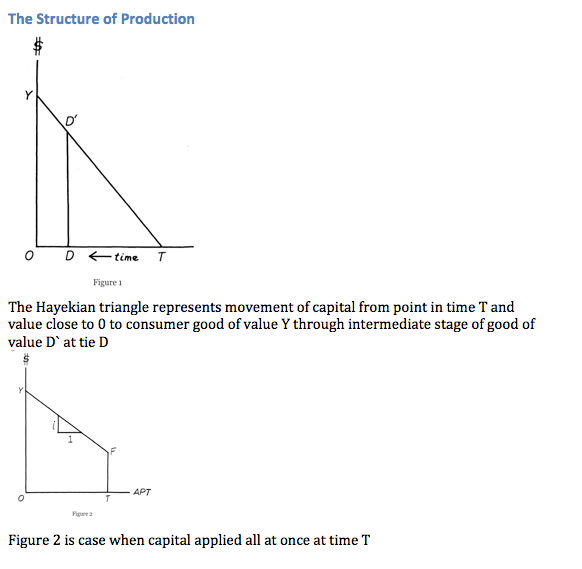

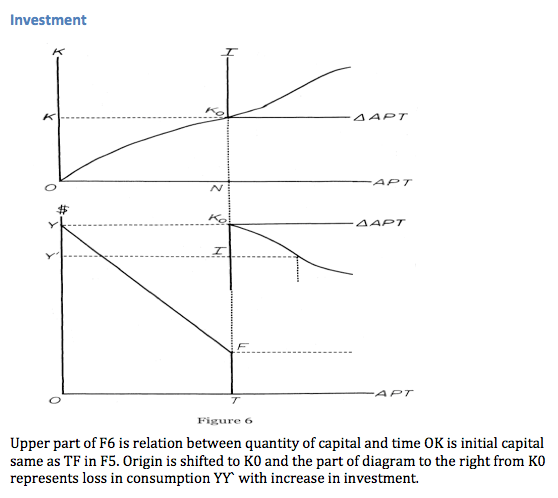

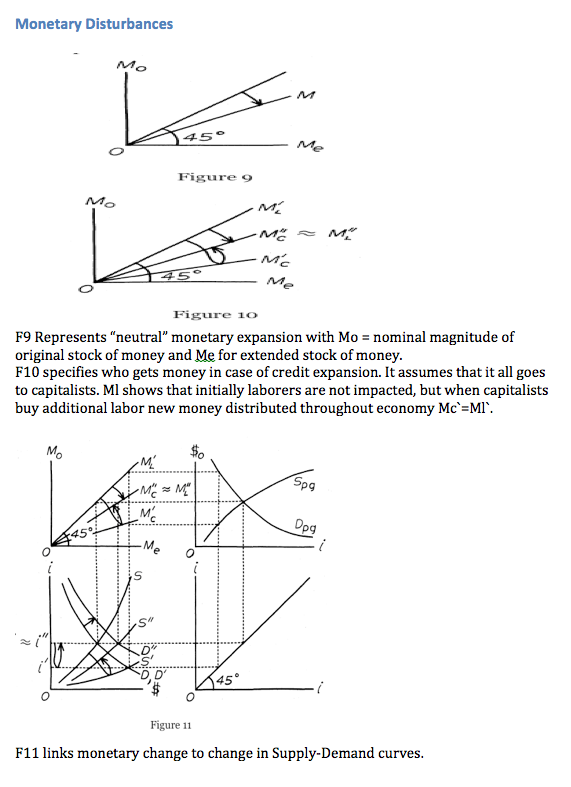

MY TAKE ON IT:
This is a great set of diagrams clearly demonstrating logic of Austrian theory of business cycle:
- The new credit expands money supply that first goes mainly into hands of capitalists creating incorrect assumption on their part that individual preferences changed to higher level of savings.
- As result capitalists increase investments in long-term projects with time horizon beyond real level of individual preferences.
- When credit increase hit the limit, the gap between consumption demand and investment starves these projects of additional monetary resources causing their suspension or liquidation and economy goes into depression.
- After clean up process completed and failed projects closed, the economy starts growing again.
I mainly agree with this understanding of business cycle with one big caveat: I do not think that money supply is susceptible to control. Neither government nor exclusive use of hard money such as gold could conceivably limit money supply as long as humans can use credit and barter. Eventually money supply is subject to human passions and herd instincts that rise and fall unpredictably so money supply could increase / decrease due to credit expansion / contraction without any change in underlying stock of money either it is gold or accounting entries.
I would also note that individual tie preferences are not constant and could change any time so even if if at the initial planning and investment stage capitalist correctly estimates time preferences at the time, there is no way to correctly estimate future preferences which are clearly unknown.
That means that business cycle will always be with us as long as humans are in control of demand and supply of goods and services.
20140921 The Origins of Political Order
MAIN IDEA:
This book is based on notion of evolution of political organization of society as direct continuation of human biological evolution. The main idea is to link together human biology, institutions of society, political organization derived from them, and then use historical evidence not only from typical point of view of Western history, but on the wider scale, including history of China, India, and Eastern Europe.
The point is made that humans are social creatures who always existed within the group and they always used political organization formal or not to maintain existence and cohesiveness of these groups. The political organization of society depends on size and method of production of society, developing from tribal organization to chiefdom, and to the state. Each level of organization provides for more effective military capabilities and therefore for success in competition with other societies for resources.
However the size and complexity of political organization creates some internal tensions. This could lead to decay and destruction of society either from within or from without. The main source of tension is human nature to help one’s kin, friends, and tribe at the expense of more distant members of society. The analysis of these internal tensions is concentrated on relative strength of central authority versus aristocracy, legitimacy of authority in the view of members of society, accountability of rulers, and rule of law as method of achieving legitimacy and accountability.
DETAILS:
PREFACE
This book is about historical origins of political institutions and process of decay of these institutions. The period covered is from origin of humanity to French Revolution.
PART ONE – Before the State
1 – THE NECESSITY OF POLITICS: The third wave of democratization and contemporary anxieties about the future of contemporary liberal democracy; how both the Left and the Right entertain fantasies about the abolition of government; how contemporary developing countries represent the fulfillment of these fantasies; how we take institutions for granted but in fact have no idea where they come from.
POLITICAL ANXIETIES: To many in recently democratized world hopes for economic prosperity and political security associated with Western world just did not happen despite elections and multiparty systems. Unable to accommodate to newly discovered insecurity and volatility of capitalism some countries fall back to traditional authoritarian rulers like Putin and Hugo Chaves.
POLITICAL DECAY: The important part of this recession is political decay of American democracy – the oldest and most powerful example of results of such form of government. Despite being relatively mild this decay led to growth of unproductive elite, bloated state, financial insolvency, and economic stagnation.
FANTASIES OF STATELESSNESS: The fantasies of left and right about disappearance of state are meaningless, because a state is required to provide security, assure property rights, infrastructure, and other public goods.
GETTING TO DENMARK: In this context Denmark is a mythical rich democratic country which is capable to provide 3 necessary ingredients for prosperous society:
- The State
- The Rule of law
- Government accountability.
This book is an attempt to use history to provide answer to a question why contemporary political entities are the way they are.
CHINA FIRST: Since China is country with the oldest and the best-documented political history, it makes sense to start there.
TURTLES ALL THE WAY DOWN: This is just a metaphor for an attempt to explain world by using circular thinking: “the world is on the turtle and turtle on another turtle all the way down”.
2 – THE STATE OF NATURE: Philosophical discussions of the state of nature; how the contemporary life sciences shed light on human nature and hence on the biological foundations of politics; politics among chimpanzees and other primates; what aspects of human nature undergird politics; when different parts of the world were first settled.
CHIMPANZEE POLITICS AND ITS RELEVANCE: This is review of evidence developed from research of chimps and their group dynamics.
TO HUMAN POLITICAL DEVELOPMENT: This is a short analysis of differences with humans being much more capable of high-level organization and complex communication due to development of language.
SPECIFICALLY HUMAN THE BEAST WITH RED CHEEKS: This is analysis of human emotions as highly important part of social interactions in the group.
THE STRUGGLE FOR RECOGNITION: This is review of need for recognition as another part necessary for construction of social system.
FOUNDATIONS OF POLITICAL DEVELOPMENT: This is a compilation of human traits conductive for building political system:
- Inclusive fitness of the group and kin selection
- Ability for mental modeling of causality
- Emotional foundation for establishing and following norms
- Need for recognition that generates legitimacy that in turn creates foundation for political authority
EVOLUTION AND MIGRATION: This is a very short recount of human expansion from origin in Africa throughout the globe.
3 – THE TYRANNY OF COUSINS: Disputes over the fact and nature of human social evolution; family- or band-level social organization, and the transition to tribalism; an introduction to lineages, agnation, and other basic anthropological concepts
STAGES OF PREHISTORY: This is a review of history of anthropological definitions for development stages of human society. Author decided on use of four-level taxonomy: bands, tribes, chiefdoms, and states
FAMILY- AND BAND-LEVEL ORGANIZATION: This is review of family as a primitive organization of hunter-gatherers with no private property and no individualism. The person is nothing more then a part of a group with need for immediate consumption leading to extensive sharing. Hierarchy is based on personal qualities such as strength and is fluid as it is with chimps.
FROM BAND TO TRIBE: Tribes are growing out of bands and are built on common ancestry and usually parental lineage. It allows much higher level of organization with expansion by just drawing lineage to the more ancient ancestor. Tribes often contain segments, which could continuously ally or fight with each other.
ANCESTORS AND RELIGION: The same logic of common ancestors is normally used in development of religion with ancestors morphing into gods over time.
RELIGION AND POWER: Being much more powerful military then bands and more cohesive due to common ideology, tribes expand at the expense of bands either incorporating or annihilating them.
4 – TRIBAL SOCIETIES: PROPERTY, JUSTICE, WAR: How kinship is related to the development of property fights; the nature of justice in a tribal society; tribal societies as military organizations; strengths and weaknesses of tribal organization
KINSHIP AND PRIVATE PROPERTY: The earliest private property rights held not by individuals, but by lineage groups or tribes. The use of property avoided tragedy of commons by clearly defined rules and tribes cohesiveness.
LAW AND JUSTICE: Tribes have very weak formal authority if any, but it has traditions and prevalent attitudes that warranties use of violence against rule breakers as long as enough people support it. In this environment Leader cannot just command, he had to be more of an arbitrator between various groups. This arrangement made tribes relatively more vulnerable to dissolution than other forms.
WARFARE AND MILITARY ORGANIZATION: With discovery of agriculture warfare became highly efficient way to obtain resources such as land, food, or slaves. Correspondingly ability to conduct effective warfare becomes main factor in evolutionary selection between different forms of societies. On the later stages of tribe development the application of violence becomes more professional with leaders forming professional teams of warriors. However nature of relationship between leader and warrior is much more built on reciprocity and communality then in societies at more advanced stages. When successful societies started moving from tribes to states, it was an organic transformation with states being build on the top of tribal societies restricting, but not eliminating tribal relationships and loyalties.
FROM TRIBALISM TO PATRONS, CLIENTS, AND POLITICAL MACHINES: The movement from tribe to state also included evolution in structure of tribe that become more inclusive by incorporation genetically non-related people as clients. From this background came contemporary democratic political machines and patronage networks.
5 – THE COMING OF THE LEVIATHAN: How state-level societies differ from tribal ones; “pristine” versus competitive state formation; different theories of state formation, including some dead ends like irrigation, leading to an explanation of why states emerged early on in some parts of the world and not in others
THEORIES OF STATE FORMATION:
- The State as a The Voluntary Social Contract
- The State as The Engineering Project
- The State as The Result of Population Density
- The State as The Product of Violence and Compulsion
- The State as The Product of Charismatic Authority
WHY WEREN’T STATES UNIVERSAL? The answer provided based on known non-state societies in Africa, Australia, and elsewhere is that geography, type of agriculture, and ease of travel and trade could prevent society from developing into the state.
PART TWO – State Building
6 – CHINESE TRIBALISM: The origins of Chinese civilization; organization of tribal society in ancient China; characteristics of Chinese family and kinship; spread of feudalism under the Zhou and the nature of political authority. The review of Chinese civilization going from 5000BC archeological settlements Yangzhou until Qin dynasty 221BC
TRIBAL CHINA: This is a short review of expansion and eventual mingling, competition, and wars of China’s tribes on their way to formation of the state.
CHINESE FAMILY AND KINSHIP: The case made here is that China never really got over its family lineages structure developed by tribes and keeps it just below superstructure of unified state.
CHINA’S “FEUDAL” PERIOD: China got to the level of bunch of chiefdoms by the time of Zhou (1200 BC) becoming a series of lords and their kin groups.
7 – WAR AND THE RISE OF THE CHINESE STATE: How the Chinese state arose out of military, competition; Shang Yang’s modernizing reforms; the doctrine of Legalism and its critique of Confucian familism; why political development was not accompanied by economic or social development
WAR AND STATE BUILDING: As in Europe, formation of state in China occurred via continuing warring between different entities for 294 years all counting 468 wars with very high levels of mobilization to up to 20% of total population.
INSTITUTIONAL INNOVATIONS BROUGHT ON BY CONSTANT WARFARE: As consequence of this warfare a number of institutions were developed to meet military mobilization needs:
- Meritocratic advancement of military commanders
- Taxation and Population Registration
- Bureaucracy
- Military and Civilian technology
- Ideological upheaval that produced Confucius and formation of Chinese culture with its superior literature and tradition so powerful that future conquerors like Mongol would be assimilated into it rather then impose their own alternatives.
SHANG YANG’S CAMPAIGN AGAINST THE FAMILY: These reforms in Qin period where directed into development of protocapitalist society with individual ownership of land, nuclear family, universal system of measurements and such, but with state being superior by far to individual and imposing whatever it deem needed by cruelest measures possible.
CONFUCIANISM VS. LEGALISM: These reforms developed into ideological concept of Legalism. Consequently it produced ideological struggle with Confucianism so pretty much all Chinese history could be viewed in the light of this ideological struggle. Legalism promoting direct relationship from individual to state with its supremacy continuously collided with Confucianism promoting extended family with strive to find harmonious relationships between families across individuals and time, with state and emperor being just a top decision making mechanism for family of families.
WHY CHINA’S DEVELOPMENT PATH DIFFERED FROM EUROPE’S: The final result of Chinese warring period was creation of one unified state contrary to Europe where nobody was able to complete unification so it still remains a conglomerate of states competing between themselves. The reasons here identified as geography – more difficult in Europe, Culture – much higher diversity in Europe, and human factor – leadership.
MANY MODERNIZATIONS: Historically Qin went through multiple modernizations with tribal relationships undermined by the state with high levels of violence resulting in reversal as soon as pressure of the state diminished, preventing development of individualistic voluntary cooperation. In Europe, on other hand, move away from tribe was from bottom up via development of Christianity making it slower, but much organic process with higher level of staying power.
8 – THE GREAT HAN SYSTEM: The first Qin emperor and why the dynasty he founded collapsed so quickly; how the Han Dynasty, restored Confucian institutions but retained Legalist principles; how China was governed under the Qin and Han
THE QIN STATE AND ITS DEMISE: The first Qin emperor (259-210 BC) rejected Confucianism and moved to legalism with extreme cruelty and prejudice. It resulted in multiple revolts eventually leading Qin to demise returning in 202 BC to Confucian bureaucracy of family with emperor being morally responsible for wellbeing of population. This period is known as Han dynasty.
THE NATURE OF HAN GOVERNMENT: The much better balance between state power and family/tribe power was achieved with basically modern bureaucratic machine, including nepotism and reasonable levels of corruption. Also educational system was developed to supply bureaucrats for all parts of the system. Interestingly enough military was pushed at the subordinate level to bureaucracy. Build on compromise Han dynasty proved to be pretty stable lasting from 202BC to 220 AD
9 – POLITICAL DECAY AND THE RETURN OF PATRIMONIAL GOVERNMENT: Why the four-hundred-year-old Han Dynasty, collapsed; significance of the growth of latifundia and inequality in a Malthusian society; how great families captured the government and weakened the state; the Chinese sense of nation
THE RICH GET RICHER: One of the main reasons of Han destruction was expansion of big land estate with the same level of technology causing Malthusian trap with deprivations for majority. With military busy at outpost there was not enough forces to maintain internal order.
CHINA DISINTEGRATES AND PATRIMONIALISM RETURNS: Han collapsed in 220 AD. This event was followed by struggle between its parts for dominance. Significant part was played fight between aristocracy based on land ownership and bureaucracy based on its traditional strong position in control of the state.
THE STRONG CHINESE STATE: The unified Chinese state was restored in new form only in 580 with short Sui dynasty that was substituted by Tang dynasty in 617. It lasted until X century. Author poses the question why China reunified while Roman Empire dissolved for good. The answers he provides are two sided: strength of Chinese state and unified culture.
10 – THE INDIAN DETOUR: How India’s early development diverged from China’s due to the rise of Brahmanic religion; varnas and jatis; tribal society in early India; peculiarities of Indian kinship; the Indian detour on the road to statehood. In short, the difference between India and China is defined by main engine of society: State and bureaucracy in China, Religion and priests in India. The review of Indian development includes: INDIAN TRIBAL SOCIETY, INDIAN FAMILY AND KINSHIP; TRANSITION TO STATEHOOD; AND THE DETOUR: The deviation of India development was due to the fact that India did not go through 500 years of was with eventual unification as China did. Author seems to believe that this was result of religious development in India, which made the law and order sourced not directly from government, but rather from superior source, establishing highly stable caste system with priests at the top. The influence of this development is lasting up to the present day, making it difficult for India to establish an effective state.
11 – VARNAS AND JATIS: Economics versus religion as a source of social change; how Indian social life becomes comprehensible in light of religious ideas; implications of Indian religion for political power
THE RATIONALITY OF INDIAN RELIGION: It is an interesting take on dispute between economics and religion as primary engine of society. Indian religion achieved a fantastic feat of stabilizing society practically forever by successfully moving opportunity for achievement out of human life span.
IDEAS AND THEIR POLITICAL CONSEQUENCES: Varna system however had not only stabilizing influence on society, but also weakening effect. By subordinating warriors to priest it clearly decreases military abilities of society overall leading to higher level of vulnerability to external threats.
12 – WEAKNESSES OF INDIAN POLITIES: How the Mauryas were the first and most successful indigenous rulers of India; the nature of the Indian state under the Mauryas; the character of Ashoka; decline, disunity, and revival under the Guptas; why India subsequently fell to foreign conquerors. The main point here is that India developed strong society that prevented development of strong state.
THE MAURYAN EMPIRE: WHAT KIND OF STATE? Ashoka Empire was different from Chinese Qin in absence of strong meritocratic administrative system. Its administration was based on caste and lineage. It did not go through such wars as in China and as result losing aristocratic groups stayed around. Buddhism had serious impact making empire weaker.
THE VICTORY OF SOCIETY OVER POLITICS: The following empire of Gupta was also relatively weak for the same reasons.
NATION BUILDING BY FOREIGNERS: Eventually development of India into one united country was mainly conducted by foreign powers. First it was Muslim conquerors and later British colonizers.
CHINA VERSUS INDIA: The key difference is strong state and weak society in China and weak state and strong society in India.
13 – SLAVERY AND THE MUSLIM EXIT FROM TRIBALISM: The Ottoman institution of military slavery; how tribalism was the main obstacle to political development among the Arabs; how military slavery first arose under the Abbasid dynasty; why tribesmen make good conquerors but poor administrators; Plato’s solution to the problem of patrimonialism
CREATION OF A MUSLIM STATE: This part is about origin of Islam and its original military expansion under 3 caliphs: Abu Bakr (632-634), Umar (634-644), and Uthman (644-656). By 711 Islam expanded throughout Middle East and conquered Spain until it was stopped in France in 732. Islam states never fully rid of tribal groups that continue to have impact to this day.
THE ORIGINS OF MILITARY SLAVERY: Islam came up with a unique way to control nepotism and promote meritocracy while preventing successful meritocrats from establishing dynasty of mediocrities. It was military slavery that was able to meet such contradictory requirements for a very long period.
14 – THE MAMLUKS SAVE ISLAM. MAMLUK DECAY. STATES AS ORGANIZED CRIMINALS: How the Mamluks came to power in Egypt; the curious fact that power in the Arab Middle East was in the hands of Turkish slaves; how the Mamluks saved Islam from the Crusaders and Mongols; defects in the Mamluks implementation of military slavery that led to the regime’s ultimate decline
MAMLUK DECAY: The decay eventually came from two sources: lack of political institutions that made selection of sultan to be at the top of hierarchy of problems due to dysfunctional process without clear rules. The second problem was lack of overarching political authority. All these problems led to a high level of internal fights at the expense of ability to mobilize against external threads.
STATES AS ORGANIZED CRIMINALS: This is an interesting part of discussion because it reviews notion of state, using Mamluk’s history, as criminal organization trying to separate immature states in which predation is unlimited from mature states in which predation is limited by elite intention to leave something for investment and development in hope to increase opportunities for bigger take from robbery in the future. Eventual substitution of Mamluks by Ottomans came after leaders successfully moved to heritability of their positions leading to increase of struggle between lineages and weakening of the system.
15 – THE FUNCTIONING AND DECLINE OF THE OTTOMAN STATE: How the Ottomans centralized power in a way that eluded European monarchs; how the Ottomans perfected the system of military slavery; instability of the Turkish state and its reliance on continued foreign expansion; caused decay of the Ottoman system; military slavery as a developmental dead end. Here is the main difference between Islamic and European states defined based on the level of top down control strong at the East and weakened by aristocracy at the West.
A ONE-GENERATION ARISTOCRACY: Ottoman system was pretty much based on military patterns so aristocrat was not linked to the land as much as lord in Europe, but rather sent to different positions within hierarchy as needed. With regular military service adding long absences from family and estate, such aristocrat would not have power base to challenge superiors or piers. These positions were not heritable so children returned to civil population.
MILITARY SLAVERY PERFECTED: This is description of military slavery structure and procedures.
THE OTTOMAN STATE AS A GOVERNING INSTITUTION: As institution Ottoman state was a mature institution based on idea that moderate robbery is conductive for resource multiplication leading to better robbery opportunities in the future.
REPATRIMONIALIZATION AND DECAY: Author sees decay of Ottomans as result of two factors: end of opportunities for territorial expansion that was necessary because the state was structured around military expansion; another factor also related to militarism was use of firearms which significantly degraded value of Ottoman’s cavalry and exposed intellectual and technological deficiencies of this society.
THE OTTOMAN LEGACY: By far the most successful Islamic state Ottomans demonstrated potential of administrative society with top of society being without blood links to each other. It also demoed potential of external to the state lawmaking organization in this case religious establishment.
16 – CHRISTIANITY UNDERMINES THE FAMILY: How the European exit from kinship was due to religion, rather than politics; common misunderstandings about the nature of the European family; how the Catholic church destroyed extended kinship groups; how English individualism was extreme even in a European context
EUROPEAN EXCEPTIONALISM: The striking difference between Europe and East was structure of the family. Kinship for regular people mattered a lot less and even more important, the decision-making was at the level of individual rather then clan.
MARX’S MISTAKE: Marks assigned reasons for these specifics to development of capitalism in Europe, when in reality these features existed well before capitalism developed in Europe.
STATUS TO CONTRACT: Marriage, control over property, and other decision-making areas in Europe were controlled by contract rather then status at in Eastern empires and timing of establishment of this pattern was consistently moving back with expansion of historical knowledge
THE SOCIAL BACKGROUND TO STATE BUILDING IN EUROPE: Another exceptional feature of Europe is that transition out of kinship structure occurred in social and cultural sphere rather then in political. Author believes that it was caused by religious influence of Christianity and Catholic Church.
PART THREE – The Rule of Law
17- THE ORIGINS OF THE RULE OF LAW: European exceptionalism evident in the role of law in early state formation; definitions and disagreements about the rule of law; Hayek’s theories about the priority of law over legislation; how English Common Law was based on royal power, and how that bolstered the legitimacy of the English state. Law here is defined as set of abstract rules that keeps community together. The rule of law could exist only if previous body of low is sovereign over legislation.
CONTEMPORARY CONFUSIONS CONCERNING THE RULE OF LAW: This is mainly discussion about relations between rule of low and economic development. Author’s position is that even if rule of law in contracts and property rights is clearly related to economic development it is not necessary to be absolute. If there is “good enough” rule of law it could be sufficient for economic success as it is now in China. He also discusses development of property rights in Western world where it occurred at first at the aristocratic top of society and only slowly moved down to commoners.
HAYEK’S THEORY THAT LAW IS PRIOR TO LEGISLATION: Hayek’s point is that common rules precede the law and consequently that ideas of constructionists that law should be created as needed is a cause of huge damage of French and Russian revolutions.
FROM CUSTOMARY TO COMMON LAW: Here author discusses transition from customary law typical for tribal society. The main difference is that customary law enforcement based on group self-help, while common law enforced by power of the state.
18 – THE CHURCH BECOMES A STATE: How the Catholic church was critical to the establishment of the rule of law in Europe; the investiture conflict and its consequences; how the church itself acquired statelike characteristics; the emergence of a domain of secular rule; how contemporary role of law is rooted in these developments
THE CATHOLIC CHURCH DECLARES INDEPENDENCE: In 11th century Catholic Church took over control over appointment of bishops and other church officials from kings. It also established celibacy as tool to keep land in hands of church preventing lineages from dividing land and power. However it was too weak military to subjugate kings, as result leading to separation of church and state with church slowly being pushed our of secular politics, while kings ceasing control over spiritual and ideological lives of their people.
THE REAPPEARANCE OF ROMAN LAW: Another result of such separation was revival of Roman law. Professional lawyers took over from church control over legal system, which become somewhat independent part of state not fully under control of either church or king.
LAW AND THE RISE OF THE MODERN STATE: Consequently the modern western state was formed not only by pure violence of strongmen of the moment, but also by need of these strongmen to obtain legitimacy from religious authority from the church and legal authority from the lawyers.
HOW THE MEDIEVAL CHURCH SET PRECEDENTS FOR CONTEMPORARY RULE OF LAW: After reforms of 11th and 12th centuries Catholic Church appeared as supranational bureaucracy working on higher scale then small bureaucracies of European kingdoms and having significant impact on laws and everyday lives of population. Eventually it opened road to separation of power between multiple entities: legal, legislative, executive, and ideological. It was a specific characteristic of Western Catholic form of Christianity. Eastern Christianity remained under control of kings with no separation of power between church and state and no independent legal power.
19 – THE STATE BECOMES A CHURCH: How the rule of law developed in India and the Middle East but not in China; how authority was effectively split between secular and religious authorities in the Middle East; how premodern Middle Eastern regimes observed property rights; why the Muslim ulama were never able to check state power in the manner of the Christian church; why no rule of law exists in the contemporary Arab world; the modem rules of law compared.
The opposite of Eastern Christianity development occurred in India where it was religion – Brahmins managed to get control over military power of state Kshatriyas, but only at ideological level without any bureaucratic organization of Brahmins.
RULE OF LAW IN THE MIDDLE EAST: Islamic countries developed one more solution when both religion and state merged into one in the person of caliph, but still was sourced from written law of sharia. The issue of complexity of control over wide territories was resolved by delegation of caliph’s power down to whoever was in actual control of local territory.
SEPARATION OF MOSQUE AND STATE: Some separation did exist in Islam in form of caliph being able to create laws outside of sharia formally subordinated to it, but mostly covering issue outside of it. The important thing about Islam is that individual property rights did not exist. In Ottoman Empire everything formally belonged to the state, but actual owners could pass it as inheritance and do whatever they wanted.
HOW THE RULE OF LAW FAILED TO SURVIVE CONTACT WITH THE WEST IN BOTH INDIA AND ISLAM: Both Eastern systems India and Islam failed to maintain their traditional structure of legitimacy and law after direct encounter with the West. Destroyed first by Western colonization they where substituted by week corrupted pro-socialistic democracy in India and by authoritarian regimes in Islamic countries. With demise of socialism its ideas lost attraction and gave push to powerful wish to go back to old time when Islam was pure and not corrupted by the West. Interestingly enough it turned into totalitarian terrorist movements that define themselves through war against the West and infidels. The most significant result to date is Iranian revolution, which so far failed to build effective self-sustained state.
WHY THE RULE OF LAW WAS STRONGER IN WESTERN EUROPE? Author’s answer: Codification, Legal Specialization, and Institutional autonomy.
20 – ORIENTAL DESPOTISM: How a modem state was reconsolidated in China after the Tang Dynasty; the usurpation of the empress Wu and what it tells us about the Chinese political system; what the Mandate of Heaven was and how political legitimacy was established in dynastic China
CHINA’S MODERNITY AFTER THE TANG-SONG TRANSITION: This is review of China’s development for next 1000 years from Tang (618) to Qing (1644). During this time China established modern bureaucratic system with meritocracy through examination system.
THE EVIL EMPRESS WU: This is story of revolt against bureaucracy by the populist despot who successfully cleansed out elite using terror with support of population.
THE MANDATE OF HEAVEN: This is discussion of Chinese legitimacy of ruler issue: Mandate of Heaven. It is just a set of understandings about duties of ruler toward masses common in Chinese culture.
21 – STATIONARY BANDITS: Whether all states are predatory, and whether the Chinese state in Ming times deserved to be called that; examples of arbitrary rule drawn from later periods in Chinese history; whether good government can be maintained in a state without checks on executive authority
GOOD GOVERNMENT, BAD GOVERNMENT: Author seems to be associating good government with efficient meritocratic bureaucracy and “bad government” with emperor at the top of hierarchy who’ve got there without climbing a ladder of bureaucratic hierarchy.
THE “BAD EMPEROR” PROBLEM: Here is where Chinese problems are coming in. Neither Emperor of old nor current Emperor of Chinese communist party is limited by rule of law and/or political accountability. As result they can and do going bad causing a lot of pain for population
INSTITUTIONS AREN’T ENOUGH: The point here is that China possesses pretty good institutions, but its people had a wrong attitude of extreme self-satisfaction that led to stagnation. With this attitude gone China is doing very well at present.
PART FOUR – An Accountable Government
22 – THE RISE OF POLITICAL ACCOUNTABILITY: What political accountability” is; how the lateness of European state building was the source of subsequent liberty; what is wrong with “Whig history” and how political development cannot be understood except by comparing countries; five different European outcomes
EUROPE’S LATE STATE BUILDING: European kings started state building rather late and consequently encountered much more resistance from aristocracy and commoners than Chinese and Muslims. As result they failed achieve complete control except for Russia. This became source of political liberties in Europe.
THE MARCH OF EQUALITY: This is a very short review of democratic political waves that formed contemporary world.
HE WHO KNOWS ONLY ONE COUNTRY KNOWS NO COUNTRIES
EUROPE’S EASTERN ZHOU PERIOD: This is about similarity of Europe in 1100 AD with Zhou dynasty in China 770 BC with multiple feudal forces fighting for dominance.
THE ROLE OF LAW IN EUROPEAN DEVELOPMENT: Contrary to China the existing laws outside of kings’ control prevented creation of mass armies and consequently unification in Europe as it happened in China.
A FRAMEWORK FOR STATE BUILDING: This is classification of political development in Europe as:
- Weak absolutism (French, Spanish)
- Successful absolutism (Russia)
- Failed oligarchy (Hungary, Poland)
- Accountable government (England, Denmark)
23 – RENTE SEEKERS: How fiscal crisis led to the rise of patrimonial government in France; the intendants and the growth of centralized government; how the French elite understood liberty as privilege, and how they were prevented from achieving collective action; the French government’s ultimate weakness and inability, to tax or control its own elites.
This chapter is mainly about French history and it covers: THE BEGINNINGS OF PATRIMONIAL ABSOLUTISM; THE INTENDANTS AND CENTRALIZATION; THE LIMITS OF CENTRALIZED POWER AND THE IMPOSSIBILITY OF REFORM; THE FAILURE OF RESISTANCE TO ABSOLUTISM IN FRANCE;
RENT-SEEKING SOCIETIES: The last part contains general inferences about rent-seeking societies based on French history. The most important is idea that rule of law and property rights extended to elite only creates growing and irremediable inequality that eventually leads to explosion.
24 – PATRIMONIALISM CROSSES THE ATLANTIC: Why government in Latin America has characteristic features not found in other parts of the world; early modern Spain and how it developed patrimonial absolutism very similar to that of France; Spanish institutions and their transmission to colonies in the New World.
This is specific example of political development resulted from conquest and interracial interactions. The chapter covers: THE BANKRUPT SPANISH STATE; TAXATION AND NO REPRESENTATION; TRANSFER OF INSTITUTIONS TO THE NEW WORLD; and THE IRON LAW OF LATIFUNDIA: In Latin America despite similar to France rent seeking, the explosion did not occur or it rather was channeled into revolutions for independence. The new elite resumed rent seeking in multiple forms often using financial methods such as nationalization, inflation, and state bankruptcy not easily understood by population and therefore allowing continuation of patrimonial society so far.
25 – EAST OF THE ELBE: Why Hungary is of interest as an alternative route to failed accountability; how serfdom was imposed in Eastern Europe just as it was being abolished in the West; the emergence of constitutionalism and noble dominance in Hungary; why it is important to have a strong central state as well as constraints on that state if liberty, is to flourish.
This is detailed review of Hungarian state and its development. It is opposite to Russia and/or France case when fight between king and nobles was won by nobles with resulting decline of state without strong unifying force.
LORDSHIP AND BONDAGE: The development of relationship between serfs and nobles reviewed mainly on the example of Eastern Europe and Russia. In contrast to West where lords were restricted by strong kings in East lords were more powerful resulting in much higher loss of freedom by serfs.
CONSTITUTIONALISM AND DECLINE IN HUNGARY: This is about Hungary developing very strong society institution at the expense of state leading to military and eventually total decline of the country.
FREEDOM AND OLIGARCHY: This is an additional discussion of necessity of balance between societies and state without which either state becomes too weak and could fall or society becomes too weak to prevent despotism.
26 – TOWARD A MORE PERFECT ABSOLUTISM: The emergence of the Muscovite state and peculiarities of Russian political development; how the gradual enslavement of Russian peasants was the result of the monarchy’s dependence on the aristocracy; why absolutism triumphed more completely in Russia than in other parts of Europe.
The issues reviewed: SOURCES OF RUSSIAN ABSOLUTISM; FREE ALTERNATIVES; THE PEASANT-OWNING CARTEL; AFTER PETER; ABSOLUTISM ACHIEVED;
27 – TAXATION AND REPRESENTATION: How the preceding cases of failed accountability set a context for understanding the development of parliamentary institutions in England; sources of political solidarity and their roots in pre-Norman England; the role of law in legitimizing English institutions; what the Glorious Revolution actually accomplished.
THE ROOTS OF ENGLISH POLITICAL SOLIDARITY: Three components:
- English solidarity was more political as represented by local governments than social from the beginning.
- Common law and legal system supported individual property rights
- Religion supported Parliament in its contest with king
FREE CITIES AND THE BOURGEOISIE: The bourgeois cities developed as independent force countering lord and attracting serfs. The specific of Europe was that cities were given charters and protection by king as counterweight against lords. It was not necessary in the East Europe were lords were dominant or in Russia were king was dominant, but in England relative equivalence of power prompted king to support cities as supplemental power. This created opportunity for development of city based relatively free market economic system.
THE STRUGGLE OVER TAXATION: This is a story of XVII century fight over taxation between king and parliament with particular outcome of lower level of corruption than elsewhere developed as specific English feature.
THE GLORIOUS REVOLUTION: The main achievement of Glorious revolution was achievement of compromise that legitimized taxation making it dependent on consent of taxpayers.
TO THE AMERICAN AND FRENCH REVOLUTIONS: This volume does not stop before American and French revolution. This part briefly reviews status of political systems at this point.
28 – WHY ACCOUNTABILITY? WHY ABSOLUTISM? The previous cases compared; why England’s path to representative government was not the only one possible; getting to Denmark; how the historical discussion is relevant to democratic struggles in the present
STRONG ABSOLUTISM: The case of strong absolutism reviewed in Russia.
WHY DIDN’T ENGLAND END UP LIKE HUNGARY? The reasons provided: the first is high mobility of society with tradition of grassroots political participation. The second reason was the state strong enough to suppress aristocracy when needed.
GETTING TO DENMARK: Another interesting case represented by Denmark where parliament was defeated by king and strong state, but monarch freed serfs to use as counterweight to landed aristocracy. Danish way to democracy was complicated and dependent on many contingencies, but it just proves that there are multiple roads to Denmark as example of prosperous democratic state.
PART FIVE – Toward a Theory of Political Development
29 – POLITICAL DEVELOPMENT AND POLITICAL DECAY: The biological foundations of politics; mechanisms by which political order evolves; what politics is and how it differs from economics; a definition of institutions; sources of political decay; the state, rule of law, accountability, and how they are related; how the conditions for political development have changed over time
THE BIOLOGICAL FOUNDATIONS OF POLITICS:
Humans always existed as part of social group and human sociability built around kin selection and reciprocal altruism.
Humans have innate propensity for creating and following norms and rules.
Humans have a natural propensity for violence.
Humans naturally desire not only material goods, but also recognition.
IDEAS AS CAUSE: Human Ideas are fundamental causes of why societies are different and follow different development paths.
Humans create mental models of reality that often take form of religions that facilitate collective actions and establish rules of moral behavior.
Religions are not purely spiritual constructs; they also define to large extent division of labor and resource distribution in society by providing legitimacy to political order.
THE GENERAL MECHANISM OF POLITICAL DEVELOPMENT: Political order develops from band – tribal level to state level by suppressing kin-lineage relationships and expanding political and material relationships not related to kin, family, and tribe. Political development is Darwinian process with inheritance, variation, and selection. The specifics are:
- Units of selection are rules and institutions that embody these rules
- Variation is not random, but rather result of deliberate ideological development of interacting humans
- Inheritance occur culturally, rather then genetically
- The competition most often occurred in the form of wars and conquest
SPANDRELS EVERYWHERE: As in biological evolution political evolution produces innumerable spandrels
INSTITUTIONS: Institutions here defined as stable, valued, and recurring patterns of behavior. The main institution discussed is state not only as monopoly on violence on specific territory, but also as subject to division of labor. Characteristics of this institution define on the axis Adaptability – Rigidity; Complexity – Simplicity; Autonomy – Subordination; and Coherence – Disunity.
POLITICAL DECAY: Political decay occurs when society’s institutions functionality declines and they could not fulfill their missions any more. The second form of political decay is repatrimonialization when patron-client relationship when subset of society hijack control over state and successfully obtains rent at the expense of members of society outside of this group.
VIOLENCE AND THE DYSFUNCTIONAL EQUILIBRIUM: Rent seeking groups can and do establish dysfunctional equilibrium when groups get disproportionally high share of continuously shrinking pool of resources. The pool is shrinking because everybody is busy in increase share of their group and efforts to expand resources in the pool meaningless for producers. The typical way out of this is violence either external – conquest by society with better functioning military, or internal violence of revolution when individual in groups who get disproportionally small share revolt against groups who get disproportionally high share.
30 – POLITICAL DEVELOPMENT, THEN AND NOW THOMAS MALTHUS: How the conditions for political development have changed dramatically since the eighteenth century; the political, economic, and social dimensions of development, and how they interacted in a Malthusian world; how these dimensions interact now; anticipations of the contemporary world
THOMAS MALTHUS: Before 1800 humans lived in Malthusian world where resources grow slowly if at all and number of people quickly outgrows available resources and is regularly trimmed by war, starvation, and diseases. However in reality humans grew in 10,000 years from a small group of a few millions to a billion or so worldwide by 1800 mainly through territorial expansion including expansion at the expense of less fitted groups.
POLITICS IN A MALTHUSIAN WORLD: In the zero-sum world the best way to survive and expand was to achieve military superiority over neighbors that would provide for ability to defend own resources and take resources from others. It was achieved via social mobilization based on legitimacy that was in turn supported rule of law and state building all of which were connected via feedback loops.
DEVELOPMENT UNDER CONTEMPORARY CONDITIONS: The same process took much more efficient form in contemporary world where social mobilization creates not only military power, but high level of economic growth and innovation taking humanity out of Malthusian trap and making territorial expansion and conquest comparatively inefficient way to obtain resources.
THE MODERN DEVELOPMENT PARADIGM: Here author reviews the contemporary development paradigm by using example of South Korea that went from poor autocracy to prospering democracy in just a few decades.
WHAT HAS CHANGED: The main change is globalization and integration of societies around the world. After the end of Cold War only two societal model are standing: Democratic liberal capitalism with welfare state as represented by America and Western Europe; and autocratic state controlled capitalism as represented by China and Russia. Author seems to believe that western concept of individual dignity and recognition would lead to victory of democratic model.
ACCOUNTABILITY TODAY: However the victory of democracy is not inevitable mainly because western democracy now is in crisis of typical political decay with multiple organized groups professional, racial or religious managed to establish rent flow to them at the expense of society as the whole leading to economic stagnation and political deadlock.
WHAT COMES NEXT: The China model while still rising economically still did not prove its economic and innovation viability because so far it was catching up using western capital, know how, and markets. Would it be able to stand on its own when increase of income and quality of life slow down? Would it be able to produce innovation without individual freedom for its people?
On other hand would Western society find its way out of doldrums of welfare state, moral decline, and political gridlock? Would it be able to restart its economic growth and move to the next level of prosperity or its current malaise is not curable? The answers to these questions will come in the future in due order.
MY TAKE ON IT:
I generally agreed with ideas presented in this book. The only point that I would like to make is that the unit of evolution mainly used here – society as whole could not provide level of resolution necessary for deep analysis of situation and prediction of future development. I think that the unit of evolution is always at the level of individual and it is clash of ideas in the heads of individuals and clash of individuals with different dominant ideas in their heads that defines condition and dynamic of change for every society. I understand that it is too much to ask for analysis based on history because of lack of sufficient data, but explanatory power at such high level as society is just not enough to achieve reasonable level of predictive power, which, I believe, is final objective of such analysis.
20140914 Clash of Economic Ideas

MAIN IDEA:
This book is detailed depiction of development of economic ideas over last 2.5 centuries, implementation of these ideas in real life, and results of such implementations. This description and analysis pretty convincingly demonstrates that ideas of state control over economy failed everywhere where it was tried. The result was always misery, but extent of it was different from relatively benign misery of American implementation to outright murderous result of Russian implementation.
DETAILS:
Introduction
This book is focused on policy related parts of economic theory and empirical work. In this introduction author gives a very nice preview of each chapter. An important part of author’s view is the statement that economic ideas do have real life consequences, even if they are not direct. Authors describe the process of influence as following: on early stage academic economists come up with idea which them picked up by journalists and popular writers who disseminate it to general population which internalizes them and pushes politicians to implement it in legislative and executive actions.
As to content of opposing economic ideas they mainly relate to two choices:
- Governments versus Markets
- Socialism versus Capitalism
The second choice is pretty much made by whole world selecting Capitalism after disintegration of Soviet Union and China’s move to mainly market economy. The first one is still pretty much in play mainly at the level of gradation of how much economy and how much government should be used.
- The Turn Away from Laissez-Faire
This chapter sets the stage, describing economic thought on the verge of the First World War. It introduces two figures that will reappear throughout the book, the English economist John Maynard Keynes and the Austrian economist Friedrich A. Hayek. Each subsequent chapter begins with a major economic problem that triggered or revived debate among economists, or a policy experiment to which economists contributed.
The main idea expressed by Keynes is need to end of absolutely free market as result of its failure to avoid depressions and necessity of government intervention to fix various “market failures”. Correspondingly the main idea expressed by Hayek was necessity of free market not only for economic prosperity, but also to maintain human freedom with any government intervention into market being harmful for economy and push of humanity to serfdom.
2. The Bolshevik Revolution and the Socialist Calculation Debate
Chapter 2 examines the issue of central economic planning versus the market price system, starkly posed by the Bolshevik Revolution of 1917 which then developed into the crucial “socialist calculation debate.”
At the beginning it reviews nearly perfect experiment of implementing pure socialism in a big country: Bolsheviks taking over Russian empire and creating Soviet Union. The results were perfectly disastrous providing tremendous amount of data and absolute prove of Mises theory of impossibility of planning and valid economic calculations in socialist economy. Here also reviewed case of Oskar Lange who came up with proposal of socialist economy that would emulate market pricing and performance. This idea just plainly did not work and he did not even try to implement it when he becomes high-level communist economic functionary in Poland.
3. The Roaring Twenties and Austrian Business Cycle Theory
Chapter 3 examines pre-Keynesian business cycle theory, in particular the theory developed by Hayek and other Austrian economists, in light of the boom of the Roaring Twenties that ended in the crash of 1929. The New Deal policy experiment of the early 1930s followed in the United States.
Mises/Hayek cycle theory is based on credit expansion caused by low interest rates and government push for cheap money. This causes misallocation of resources to projects that could not be profitable. Eventually this overinvestment creates lots of capital goods without corresponding amount of consumer goods. Excess of money paid for creation of capital goods over availability of consumer goods causes inflation, but more important, at some point investors realize that expected returns on the project will not occur. The cancellation of projects initiates run away from investment and bust. The graphic representation is diagram of value added process that is becoming longer during boom, but contracts when it exceeds public’s savings term. In short, it is cycle caused by variance between savings and investment beyond public’s tolerance.
- The New Deal and Institutionalist Economics
Chapter 4 traces origins of New Deal to the Institutionalist school of economics, especially as represented by the economist Rexford G. Tugwell.
It is notable and important to what extent New Dealers including Roosevelt where in awe before fascist regime in Italy and Mussolini because economically this regime and later German Nazis were very close to their ideas of Government control over cartelized economy. Tugwell was a student of Simon Patten who brought in America German economic ideas of controlling Government as developed and implemented in practice by Bismarck. On demand side Thorstein Veblen author of “The Theory of Leisure Class” introduced notion of “Conspicuous consumption” and believed that Economic Engineers should define reasonable level of consumption and managed economic machine to efficiently satisfy it. The economic institutionalism was lead through second half of XX century by John Galbraith.
5 The Great Depression and Keynes’s General Theory
Chapter 5 relates how Keynes’s 1936 book The General Theory of Employment, Interest, and Money fomented a revolution in economic thinking about the causes of ups and downs in the economy as a whole.
Keynes really did not cared what caused recessions or depressions. His believe was that market just failed from time to time to maintain equilibrium and fall into “vicious cycle” when low demand led to decrease in production pushing labor out of work and thus decreasing demand even more. The obvious way out was for government to create artificial demand by pumping money into economy to increase earnings and decrease unemployment. Instead of Hayek’s intertemporal triangle Keynes proposed diagram of circular flows of resources between businesses, households, and government insisting that the levels of flow could be changed by government actions within productive capacity of the system. The main difference Keynes model is summarization of current consumption and investment, while Hayek’s is trade off between today’s consumption and investment as future consumption. Another big difference is interest rates. For Hayek it is driven by market mechanism to clear preference between loanable savings (supply) and investment (demand). Keynes denied validity of such mechanism.
Keynes pretty much denied Say’s law that “ Supply creates its own demand”. It is important to note often used misunderstanding of this law when supply and demand are considered as of the same type. In reality supply of one thing create demand for another. Economy grow if shoemaker’s production grew because taxes decreased and more productive people have money to buy shoes so he can make more shoes because he expects higher marginal profit which would allow him to increase demand for whatever he wants to consume let’s say meat. The same reasoning would apply to butcher. As result it will be more shoes and more meat produced and cleared at the market. However if it is demand side and government instead of decreasing taxes just give a pooper money to buy some shoes overall supply of shoes or meat is not going to increase because neither shoemaker nor butcher will expect to get more and therefore will not increase their effort. The only outcome would be increase in pooper’s consumption at the expense of shoemaker and butcher because of inflation.
There is a very interesting point on reasons why Keynes became so popular despite intellectual deficiency of his theory. It is its optimism and insistence on human ability to control economic events that turn people in mass to support it. Too bad it did not really worked out.
- The Second World War and Hayek’s Road to Serfdom
Chapter 6 focuses on a very different book, Hayek’s Road to Serfdom of 1944, which grew out of his concern about the dangers of continuing the central planning policies pursued during the Second World War. In the immediate postwar period, very different economic policy paths were taken by different nations.
This chapter also includes an interesting review of Nazi economic policies: Strict currency exchange control; Centralized agricultural policy with import quotes; large public works to provide full employment. As always these policies caused shortages of goods and rationing.
Western intelligentsia also was completely smitten by ideas of economic planning and state control. In Hayek’s view these measures would directly lead to totalitarism. Hayek dedicated his book to socialists of all parties to warn them that their economic push could lead to political result they would hate. The reality of after WWII mass movement to economic socialism in Britain and other countries of the West do not support Hayek’s assertion, but just barely. Rather then stay on the way to totalitarism these countries’ democracies were strong enough at the moment to prevent it.
- Postwar British Socialism and the Fabian Society
Chapter 7 chronicles the nationalizations undertaken by the Labor Party in Great Britain and traces those policies to the socialist ideas that the Fabian Society had tirelessly developed and advocated in the previous six decades.
Implementation of Fabian socialism in Britain plentifully demonstrated that it does not work as economic model, but it succeeded in putting quite a few shackles on British economy so people are still suffering from it.
- The Mont Pelerin Society and the Rebirth of Smithian Economics
Chapter 8 tells the story of a society with a strongly contrasting policy outlook, the Mont Pelerin Society, which Hayek founded after the war to rally the intellectual opponents of socialism. It is mostly intellectual history of rebirth of Adam Smith’s free market ideas that created foundation for next step when economic socialism failed in the West.
- The Postwar German “Wonder Economy” and Ordoliberalism
Chapters 9 and l0 offer case studies of two countries that headed in very different directions and had very different results over the next thirty years. With important input from some Mont Pelerin Society economists, Germany moved in a market-friendly direction and prospered.
- Indian Planning and Development Economics
With important input from Fabian thinkers, India adopted nationalization and quasi-Soviet Five-Year Plans and did not prosper.
- Breton Woods and International Monetary
Chapter 11 tells the story of the 1944 Bretton Woods conference, how and why Keynes and other economists there hashed out an international monetary system that reduced the role of gold and allowed greater scope for discretionary national monetary policies. The Bretton Woods system collapsed in 1971, for reasons that economists have debated. Its collapse coincided with the onset of a period of high inflation.
- The Great Inflation and Monetarism
This chapter recounts collapse of monetary system served as the seedbed for the revival and development of “monetarist” ideas by Milton Friedman and others, who challenged the dominance of Keynesian thinking.
- The Growth of Government: Public Goods and Public Choice
Chapter 13 notes the growth of government in the postwar era and contrasts two leading economic theories that see the growth of government through very different lenses: the optimistic-about-government theory of public goods and the cynical-about-government theory of public choice.
- Free Trade
Chapter 14 is discussion of the long-running debate between free traders and protectionists.
- From Pleasant Deficits to Unpleasant Sovereign Debt Crisis
Chapter 15 examines the clash between Keynesian and “new classical “economists over the benefits and costs of government budget deficits and debt.
MY TAKE ON IT:
In my opinion, based on history of last century there is no intellectual justification for support for big government control over economy. However struggle is far from over, because lots of individuals are highly dependent on government for their wellbeing. These include rich crony capitalists who obtained their wealth through connection with politicians and bureaucrats of government; pseudo intellectuals in education, science, and culture who are highly dependent on grants from government bureaucrats, masses of poor who live in misery of welfare, but afraid of freedom of the market because they have no idea how they would survive it. Last, but far from least it is bureaucracy members themself, mainly at the higher level who know in their hearts, that they would not be able to achieve the same level of control over resources and ability to use them outside of government.
The losers in this system are always individuals who provide real goods and services because huge share of these goods and services going to individuals who do not produce anything of value at all and, more often then not, actually impede production of anything of value. The way out in my opinion is not easy but possible by:
- Pushing through equal, unalienable, and marketable rights on natural resources so everybody would have something to sell on the market regardless of inheritance, abilities, and luck; therefore providing better access to resources then welfare state does
- Educating young people and convincing them that they would be by far much better off not only materially, but even, more important, in life satisfaction in environment of free market then in environment of rigid government hierarchy
- Convincing productive individuals that it is worthwhile to allocate some of their time to support fight against crony capitalism, corruption, and other forms of government intervention because it would bring better return on investment especially initially, than their regular productive activities.
If these measures succeed the political resistance to free market would become extremely week because only well established bureaucrats, politicians, and crony capitalists are really benefit from socialism in all its forms.
20140907 Omnipotent Government
MAIN IDEA:
Old Liberalism was a great intellectual break through in history of humanity, which brought in free markets, expanded division of labor, provided economic support for political freedoms, and dramatically improved quality of life for everybody.
Unfortunately intellectual forces of Socialism and Etatism, which lulled masses into believe that they could be much better off with big government, defeated Old Liberalism. This book is a very detailed analysis of Germany’s case when Etatism in form of National Socialism took over society as whole and brought it into unwinnable war against whole world.
The Germany is only one case of many when Etatism takes society over and proceeds by destroying wealth, freedom, overall quality of live, and often lots of lives. The future is bleak because masses do not have intellectual capacity to understand economics and readily buy into cheap Etatist solutions to they problems even if these solutions do not work. There is nothing inevitable in this development and the fate of humanity still can turn out to be better, but only if masses become enlightened enough to through away all forms of Etatism and Socialism and embrace free markets and Capitalism.
DETAILS:
Introduction
It starts with characteristic of German Nazi party and its program as Labor imperialism based on Marxist ideology. The idea is that resources, especially lands are limited and nations had to fight for them. The winner (which obviously should be German nation) will control more land and use losers as slaves to work on it. This and many other similar ideas come from movement of people away from free market and capitalist economy to Etatism when government more and more takes over economy. Such intervention means expansion of violent resource transfer between individuals within country which substitutes free resource exchange. Correspondingly when extended outside of country, it means violent resource transfer between nations = war of conquest. That is exactly what Germany did during WWII.
PART I: The Collapse of German Liberalism
CHAPTER I. German Liberalism
- The Ancient Regime and Liberalism
Germany was late in transfer from Ancient regime of King to liberal regime of people, human rights and parliaments. Germany produced idealistic philosophy, represented in writings of Schiller, and German intellectuals mainly accepted ideas of enlightenment and liberalism.
- The Weakness of German Liberalism
However the German liberalism was adapted only by the part of population. The significant numbers of people came from eastern areas, were less educated, and more prone to obey orders. As result revolution of 1848 was crashed and German liberalism was defeated by nationalism and socialism.
3. The Prussian Army
Prussian Army from XVIII century to XIX underwent dramatic evolution. It started from point where both soldiers and officers had been randomly pressed into long term services and drilled to become mildness to such extent that army was not able to act at night or in small units due to the fear of desertion. Than it developed into army based on compulsory short-term service of all men with ideological conditioning similar to French revolutionary and later Napoleonic army with high levels of loyalty to the leader. It was expanded and the Royal guard was created to assure availability of loyal force. Eventually by 1860 army became a bulwark against liberalism.
4. The Constitutional Conflict in Prussia
German liberals who called themselves progressives did everything possible to prevent revolution and civil war in hope to enlighten layers population that supported king, but failed, and eventually retreated during constitutional crisis giving way to Bismarck and his program of Etatism.
- The “Little German” Program
The episodes of territorial struggle against France and Denmark opened way to strengthening Prussian army and eventual unification of Germany not under united liberal government, but under King of Prussia and his Prime Minister Bismarck.
- The Lassalle Episode
Lassalle – leader of socialists played a substantial role at this point by pushing labor against liberals (progressives) with ideas of socialism and class war. In process he build clandestine alliance with Bismarck since both of them where fighting against capitalism and free market represented by liberals.
CHAPTER II. The Triumph of Militarism
- The Prussian Army in the New German Empire
The specificity of Prussian Army was that it was build not within, but above civil administration. It was meritocratic institution and fully reliable tool of supreme warlord – Kaiser.
- German Militarism
The core of this system was the position of army, which was supreme factor of political life. This was a system of disguised absolutism with powerless parliament and Army leaders such as Moltke being courtiers. This system actually failed in the WWI, but it did it in such way that it was not absolutely clear for the people.
- The Liberals and Militarism
Prussian parliament had universal, but unequal franchise divided into 3 equal groups each elected by majority of taxpayers paying together 1/3 of taxes. This way richest group included a lot less people voting then poorest group. As result liberals had majority, but due to militarism they did not have control. Without control they failed to prove their ideas, but took blame for whatever went wrong. Consequently it opened the majority of wage earners to socialist agitation and destroyed ideology of liberalism.
- The Current Explanation of the Success of Militarism
Mises poses the question why capitalists and intellectuals did not resist militarism and why army that was build from lower classes who often supported socialism did not reject semi hidden absolutism? He rejects Marxists explanation of imperialism as stage of capitalism.
PART II: Nationalism
CHAPTER III. Etatism
- The New Mentality
The new mentality of Etatism in form of socialism and interventionism replaced Liberalism in the minds of Europeans during XIX and beginning of XX century. It came to Germany from West Europe and firmly established itself with growth of Social Democratic movement that found a pretty nice accommodation with social kingdom of Hohenzollerns with its social security and labor legislation. It fed back philosophy of Etatism to England in France through work of intellectuals from Show and Wells to Fabians.
- The State
This is a short review of notion of state as coercive organization in control of territory and its population. The only difference from a regular criminal gang is that it has no competition within its territory. Mises accepts necessity of the state because only coercion can prevent coercion, but he sees it not as benevolent godlike entity, but for what it is – a violent organization that should be limited as much as possible.
- The Political and Social Doctrines of Liberalism
The essence of Liberalism’s believes are private property on means of production and market as method of cooperation and division of labor. Coercive machinery of state is necessary, but only to defend property and prevent coercion by non-state actors. The control over state should be democratic because legitimacy of state’s coercion depends on voluntary acceptance of state’s rule. The validity of such voluntary acceptance is not possible to define without democratic process.
- Socialism
Socialism is the system of public ownership of means of production that is total state control over economy. Many people believe in compatibility of socialism and democracy, but it failed the check by reality of socialism implementation in multiple countries. This statement follows by demonstration of economic logic of why socialism could not work as advertised.
- Socialism in Russia and in Germany
This part is a review of actual and very sad experience of real socialism as it was implemented in Russia in form of Communism and in Germany in form of Nazism.
- Interventionism
This is a bit softer form of coercive intervention when state does not take over economy, but just interfere preventing it from proper working. This piece includes multiple examples of government intervention, how it normally achieves results directly opposite to advertised, and economic logic for reasons of such wonderfully consistent failures.
- Etatism and Protectionism
This is review of Etatism expressed as Protectionism. Obviously coercion is necessary to force people to buy something produced internally at higher price than could be obtained externally at lower. Eventually it comes down to some people getting more as producers while other paying more as consumers.
- Economic Nationalism and Domestic Monopoly Prices
This is description of another method of Etatism interference into economy: via monopoly pricing and inevitable negative results.
- Autarky
Finally it comes to extreme case of country isolated from international market. Obviously it dramatically increases costs of everything that is not produced most efficiently in this country and there is no such country that would have all quantities and qualities of resources that whole world has, it is the most destructive economic intervention short of socialization of means of production.
- German Protectionism
The specific German case included formation of cartels supported by government that charge high domestic prices in closed market and exported their product at much lower prices to compete on world markets. This allowed Germany conduct highly pro-labor policies supported by high prices. For some 60 years Germany was ahead of other countries, but eventually retaliation did occurred decreasing quality of life for everybody and pushing Germany to seek another method to obtain resources externally, more traditional than capitalism – war of conquest.
CHAPTER IV. Etatism and Nationalism
- The Principle of Nationality
This is review of the process of formation of nationalities in Europe as coercive process that included wide range of measures including education and suppression of traditional culture of minorities.
- The Linguistic Group
Principle of nationality generally requires formation of separate state for every linguistic group, however countries with relatively liberal systems handle perfectly well population with multiple languages without big problems. The notion of race was a latecomer and become prominent well after European states were formed.
- Liberalism and the Principle of Nationality
If Liberalism triumphs, the principle of nationality, separate states, and frontiers become redundant. If personal freedom both political and economic respected throughout the space, it does not matter if person born in country A, speaks in language B, and supports set of ideas C. Such person would be comfortable everywhere and will go to the place where his/her effort would be the post productive for consumers of his/her product as defined by the best return on investment of this person’s labor and capital.
- Aggressive Nationalism
Completely different situation is in environment of Etatism. Now returns are not defined by consumers, but by coercive power of the state. So to get the best access to resources person should join the group more powerful in control of the state. Obviously any minority will be disadvantaged causing it to fight for independence breaking states in smaller and smaller pieces with opposite process of war of conquest bringing these pieces together, but on unequal basis.
- Colonial Imperialism
This is review of colonial expansion of XIX century. It makes a very interesting point that contrary to Marxist interpretation it was not a result of next phase of capitalism. Capitalism does not need territorial expansion because whatever it needs could be bought on the international market and whatever they sell, they can sell at the same place. Colonialism is rather product of Etatism when government bureaucrats civil and military see territorial expansion as source of increase in amount of resources under their control and correspondingly increase in their power.
- Foreign Investment and Foreign Loans
This part discusses international movements of capital and is mainly about movement of Western capital to less developed countries. As usual it generated hate, resentment, and confiscations. The result is decrease of profitability of foreign investment and cessation of such investment making everybody poorer.
- Total War
The old wars of small armies and aristocracies are gone. The new total war between people is the feature of XX century and it makes war much more damaging then it ever been. Etatism removes free exchange creating economic disasters that result in decrease in quality of life for masses that depend on employment for their living. This normally blamed on lack of resources and generates hope to obtain resources from others via victorious war. The only real measure that could prevent war is liberalism that would provide everybody opportunity on the world wide free market.
8. Socialism and War
Socialists claim that wars caused by capitalism. It is BS. The reality is opposite. Capitalism creates opportunity for cooperation and prompts everybody to try to meet other people’s needs. Socialism is coercion that completely separates resources available to person from results of this person’s efforts. Consequently the logical way to obtain more resources for all members of society is to get them from other people by winning in the war.
CHAPTER V. Refutation of Some Fallacious Explanations
- The Shortcomings of Current Explanations
The fallacy of explanation of nationalism is coming from failure to understand that Etatism is source nationalism. Without state taking from one people and giving to people of preferred nationality, the nationalism has no meaning whatsoever.
- The Alleged Irrationality of Nationalism
This fallacy relates to explanation of nationalisms as irrational. Nazis and other nationalists always promise to take from other nations something of value and give it to their own people. Humanity has a huge experience of this kind of resource acquisition working, so it is quite rational to expect it continue to work.
- The Aristocratic Doctrine
This is a nice description of revolt against masses when intellectuals and bureaucrats revolt against democracy as inefficient and harmful method of society organization and strife to substitute it with rule of “wise kings” selected through formal meritocratic process of tests and best universities. In reality only capitalism with real democracy when people compete on free market of goods, services, and ideas demonstrated superior ability to create wealth for everybody.
- Misapprehended Darwinism
This is a short and nice debunking of Social Darwinism as doctrine of aristocratic intelligentsia that has nothing to do with real philosophy of Darwin and Evolution.
- The Role of Chauvinism
This is explanation of logic and nature of Chauvinism as different from Nationalism. The Chauvinism is just a disposition of character and mind not involving action, while nationalism is all about action and policies. Both despise others and believe in their own superiority, but Chauvinist does business as usual with other, while nationalist uses violence against other.
- The Role of Myths
This is an analysis of myths as fictitious narratives and doctrines that play important role in history as something people actually believe. Socialism, Etatism, and Nationalism are valid doctrines in the minds of their supporters because of acceptance of myths presented in these doctrines, despite their fallaciousness.
PART III: German Nazism
CHAPTER VI. The Peculiar Characteristics of German Nationalism
- The Awakening
The German nationalism became qualitatively different from other nationalisms in 1880s. It formed notions of Germans as superior warriors and producers who are young, energetic, and deprived of access to needed resources by existing world order established by old, degrading, and corrupt western democracies. That was result of disunity of Germany and it will be fixed by unification of Germany that should be dominant power in the world.
- The Ascendancy of Pan-Germanism
Contrary to prevailing narrative neither Junkers of old Aristocracy, nor bankers, nor capitalists and middle class pushed Pan-Germanism. These groups were perfectly happy with existing order and growing ability of compete in free market – activity that brought them wealth and influence. The real engines of Pan Germanism were intellectuals who promoted it via education, books, and other forms of culture.
- German Nationalism within an Etatist World
Germans did not invent nationalism, but rather used it as everybody else. The key notion here is that nationalism makes sense only in conjunction with Etatism because if state controls resources individuals within or without this state can obtain these resources only by the grace of this state’s bureaucracy or via violence either plain robbery or military conquest (the same only bigger and bloodier). Only free market provides opportunity to obtain whatever one wants or needs without violence, but it practically leaves bureaucracy, politicians, and intelligentsia out of business.
- A Critique of German Nationalism
The critic provided includes two main points: one is the unrealistic complex superiority that made German nationalists and later Nazis to believe that they can fight the whole world and win; and another one: complete immorality of ideology that deemed moral anything that would benefit German state and nation. Obviously the great leaders should define what exactly benefit German state and nation.
- Nazism and German Philosophy
This is critic of idea that Nazism is logical outcome of German Idealistic philosophy.
- Polylogism
This animal came from Marxists who, after failing to refute by logical methods “bourgeois” economics, came up with Polylogism that states that thought and logic is defined by the social class, therefore since any thinker belongs some class, both logic and facts could be contested based on personality of individual who present them. Marxists claim to represent proletarian logic, class, and science. Nazis pick it up and created their own Aryan logic, facts, and even science.
7.Pan-Germanism and Nazism
Pan Germanism had naturally grown into Nazism. Unfortunately other people in Europe just fail to understand that Nazi is not a small group of weirdoes, but rather true representatives of German people who, while fighting each other on details and methods were united in their understanding of goals – expansion and enrichment of Germany via military conquest.
CHAPTER VII. The Social Democrats in Imperial Germany
- The Legend
There are two legends about German social democrats. The first one is that they were fighting against militarism supported by bourgeoisie who was in search of armaments profits. The second one is that they were fighting against Hitler, agent of big capital. Both are untrue.
- Marxism and the Labor Movement
This is about intellectual history of Marxism. Marx started as interventionist, but reading of British economic authors convinced him that interventionism does not work so he moved to complete Hegelian negation of capitalism. Labor movement was not really Marxian, but rather interventionist demanding government intervention on behalf of workers. German Social Democrats managed to build organization on duality of theoretical Marxism and practicality of labor movement.
- The German Workers and the German State
The labor movement’s main weapon in any confrontation with employer was strike. The strike is meaningless if employer can freely use his property and just hire other people if demands of striker exceed market price for labor. The key for success therefore is to deny employer control over his property that could be done only using coercion. In 1870 German government moved to the side of labor and practically stop enforcing property laws in case of strikes. It is an interesting fact that union’s came from above: Bismarck and government. The seemingly anti-socialist laws were just a sham under which socialist movement grew tremendously supported from above by intellectuals and bureaucrats and from below by labor.
- The Social Democrats within the German Caste System
One important service Social Democrat provided to wage earners was creation for them social environment within German caste system that legitimized wage labor as important part of this system.
- The Social Democrats and War
Social Democrats as good Marxists supported civil war between classes and despised imperialistic war between countries in theory. In reality all of them supported their nations. Only when war causes suffering to lower classes the socialist starts agitate against it and tries to use it to take over government power.
CHAPTER VIII. Anti-Semitism and Racism
- The Role of Racism
An interesting point is made here that as meaningless as race in reality is it was used to create a notion of Germans as nation of noblemen by race regardless to actual social standing and in contrast to ignoble Jews. It was partially result of German aristocracy proving itself useless in all areas of achievement including military during WWI.
- The Struggle against the Jewish Mind
While fighting “Jewish Mind”, Nazis actually failed to define what it is and what specific characteristics it has. They also tolerate Christianity, which is a product of Jewish mind if there is one. Obviously socialism is also to significant extent product of this mind and is foundation of both Nazi and Soviet regimes. However Nazis ridiculously claim that only these parts of it that they reject such as internationalism are Jewish product.
3.Interventionism and Legal Discrimination against Jews
This is a list of Nazi government action against Jews. Obviously because the book was written before Holocaust become a known event, it is a relatively benign list of discriminations and indignities against Jews.
- The “Stab in the Back”
The failure of WWI winners to assert reality of German defeat created an opportunity for legend of “Stab in the Back” of victorious German Army committed by Jews. This legend was not forcefully destroyed and as result it created German illusion of superiority that eventually led to WWII and final defeat with unconditional surrender.
5.Anti-Semitism as a Factor in International Politics
The interesting dynamics reviewed here led to initial defeat of France and Britain in the beginning of WWII. This dynamic had two sides: in Britain it was growing of popularity of socialism and its international pacifistic logic putting the break on rearmament in the face of Nazi military build up; in France it was Anti-Semitism of Nazi that converted Anti-German French nationalists into force somewhat supportive to Germany based on commonality of their hate for the Jews.
CHAPTER IX. The Weimar Republic and Its Collapse
- The Weimar Constitution
The beginning of this period was characterized by socialist revolution in which contrary to Russian pattern the winners were not communist who wanted to eliminate hostile classes, but Social Democrats who still tried to maintain some image of democracy. In defeating communist they had to ally with vast majority of Germans who did not want to repeat Russian experience. The military power to defeat communists came from remnants of the army led by nationalists. So the democratic Weimar republic was basically created by alliance of anti-democratic forces of socialism and nationalism.
- The Abortive Socialization
This is a description of Social democratic attempt to socialization. It started with creating committee of professors, which amazingly failed to achieve anything.
- The Armed Parties
Here are details of inherent weakness of Weimar republic that led to creation of paramilitary forces by just about every political group. In this brawl Hitler came on the top because this gangs consisted of young people dedicated to fight and not burdened by jobs and families. He also managed extract financial support from business mainly because owners preferred Nazi form of socialist when they remained formally in control to Communists form of socialism when they would be liquidated.
- The Treaty of Versailles
The treaty is defined as failure, but not for usual reasons. Contrary to common wisdom Misses believed that treaty was not too tough on Germany. On contrary, he is pretty convincing in showing that neither territorial changes nor reparations were overwhelming. The failure rather was inability of Britain and France to stick to the treaty and fight for it both ideologically and military when needed. Without such fight the treaty become just an ideological feeder for German nationalism.
- The Economic Depression
The great German inflation was result of monetary policies of socialists of the chair. Mises predicted it in 1912. Depression was created by social democrats and victims went to Nazis because they believed that Nazis could help.
- Nazism and German Labor
The question of why masses of workers who were Social Democrats and Catholics allowed Nazis came to power is invalid. These people were not ideological. They cared about their lives ad believed that Nazis would do better for them.
- The Foreign Critics of Nazism
Nazis won in Germany because they never encountered any adequate intellectual resistance. This is quite understandable because the fundamental tenets of Nazi ideology do not differ from generally accepted social and economic ideologies:
- Capitalism is an unfair system of exploitation
- The foremost duty of government is to substitute management of capitalists with government control
- Price ceilings and minimum wages are adequate method to improve lives of workers and consumers
- Easy money make country more prosperous
- Everybody who does not agree with statements above is evil and had to be suppressed.
- Export is good, import is bad for economy
These common tenets of ideology prevented any serious foreign critic of Nazism.
CHAPTER X. Nazism as a World Problem
- The Scope and Limitations of History
This is a small philosophical discussion about inevitability of historical explanation of event to encounter limitation of individual makers of history.
- The Fallacy of the Concept of “National Character”
Attempts to explain Nazism by German national character are meaningless because there is no such thing as a character prevailing in all individuals of the same nationality. It is uniqueness of historical situation in combination with uniqueness of psychological and ideological status of multiple individuals that is continuously changing over time that defines historical events.
- Germany’s Rubicon
The Nazism is not unique, but rather a consequence of move to autarky. The Germany just got there first and under considerable pressure of consequences of WWI. The Germany’s Rubicon on the way to Nazism was rejection of fee trade in late 18xx.
- The Alternative
The issue in struggle between Nazis and the rest of the world whether world consists of one linguistic group of German masters and everybody else as slaves or it will be world of heterogeneous society embracing all human beings. There is no neutrality or conscientious objectors in this struggle. One either fights Nazis or supports them actively or passively.
PART IV: The Future of Western Civilization
CHAPTER XI. The Delusions of World Planning
- The Term “Planning”
Some people start using “Planning” as substitute of devalued term “Socialism”. It really does not make any difference because compulsory cartel instead of free competition is pretty much the same. In terms of “world planning” it means world socialism under unitary management.
- The Dictatorship Complex
The funny thing about people supporting dictatorship is that they always believe in dictatorship when and if dictator does what they want. As soon as dictator does something they do not like, they are firmly against this form of rule.
- A World Government
The World government is not possible unless everywhere in the world established capitalism with free enterprise, free trade, and free movement of people. In this case government would be minimalistic. Currently governments use violence to provide more resources to some people at the expense of others, with expansion of this process to more groups it would become unmanageable.
- Planned Production
The economic system is too complex and dynamic for planners to be able control it in any meaningful way.
- Foreign Trade Agreements
All agreements restricting free trade are economically harmful. The world bodies based on balance of restrictions would lead to incessant haggles between representatives of countries trying to get some advantage at the expense of each other.
- Monetary Planning
Moving away from gold to feat money at the worldwide scale would cause inflation and severe boom bust cycles hurting middle classes.
- Planning International Capital Transactions
As usual with planning the attempt to use some international body to control capital flows bound to fail due to huge diversity of constituencies and their interests that could be reconciled only via free movement of capital.
CHAPTER XII. Peace Schemes
This part is pretty much outdated, but the bottom line is still correct: only truly free market, capitalism, and individual freedom can remove wars and violence between countries and peoples. The schemes reviewed:
- Armament Control
- A Critique of Some Other Schemes Proposed
- The Union of the Western Democracies
- Peace in Eastern Europe
- The Problems of Asia
- The Role of the League of Nations
Conclusion
Original Liberals believed in perfectibility of humans. They developed economic theories of free market and free trade that provided for tremendous growth of wealth. Nobody was able disprove these theories and when socialism become popular Original Liberals proved impossibility of effective socialist planning that nobody was able to disprove. They proved in free market economic theories and real life capitalist practice that it is possible to cooperate without conflict of interest. However they failed because intellectual abilities of vast majority of people are insufficient to comprehend advantages of capitalism. The world is hopeless at least in the near future. However despite original Liberals failure, the currently winning alternative of socialism cannot bring anything but wars, dictatorships, and overall misery. The humanity will be able move on to the better life only when majority become enlightened enough to understand those important points:
- Durable peace is possible only under condition of perfect capitalism when all resource transfers and exchanges occur voluntary without coercion because that would eliminate any economic causes for wars
- Free movement of labor would lead to equalization of labor rates throughout the world removing any over/under population problems.
- Government interference with economy decreases productivity, increases costs, and, most important, generates hate between economic winners and losers because both know that outcome is not fair.
- Socialism as system of effective organized and planned production is not possible because planners could not possibly calculate proper resource allocation in dynamic system of human demand for goods and services.
- Etatism could not bring equality because decision making from the top of hierarchical system always creates conflict of interest that could not be resolved without violence.
The future Mises expect as result of poisoning of population by socialist ideas is bleak. Etatism would divide world into prosperous industrialized West and miserable others who would start wars to take over resources from western minorities making it necessary for westerners to become highly militarized, suppress traditional freedoms, and dramatically decrease quality of live.
This catastrophe is not inevitable, but highly probable, as Mises saw it at the time of writing.
MY TAKE ON IT:
As usual I mainly agree with Mises on all economic issues. I also think that only free market could support freedom and prosperity and socialism or any other form of Etatism including welfare state is inevitably lead to decrease in quality of life, war, violence, and over all misery.
In addition to detailed description and analysis of history of National Socialism in Mises’ land of birth Germany I could add my experience of similarly disgusting form of Etatism: International Socialism in country of my birth Soviet Union.
However I completely disagree with is evaluation of Socialism power as result of insufficient enlightenment of masses. I think that many supporters of Old Liberalism and overall Capitalism are missing dynamics of this system when, while being beneficial for everybody at the long run, it is often detrimental to individuals over period of their one and only one specific life.
The individual who is at the bottom of society hierarchy, has no property, and has nothing significant to offer on the labor market cannot obtain satisfactory level of resources to accept the system. Such individuals are bound to fight it and if Socialism, Welfare state, or any other form of Etatism promised them more resources, they would support it either with their votes or with their guns. It would be only rational for them to do it.
The key for bringing this majority to the side of free market is to grant these people something that would immediately assure acquisition of at least the same amount of resources available them now and free them to search for additional application of their talent on the free market with plentiful educational opportunities. I believe that the way to do it is to establish equal, unalienable, and marketable rights for natural resources so individuals who use more than average had to buy these rights from individuals who use less.
The same is not necessarily applies to intellectuals who are not always stupid despite spending lots of time in brain damaging educational establishments. Many of them understand quite clearly that socialism does not work, while free market does. However they also understand that they would never be able to achieve the same level of resource acquisition on the free market, as they are able to achieve as reliable cogs in some hierarchical system of the state. No amount of enlightenment will change minds of these people.
It would not be possible to bring older and well-established intellectuals on the side of free market, but it should be possible to move to this side young intellectuals. By the same pattern as with masses without marketable skills, if granted equal rights for natural resources they would be set free to seek whatever application they want for their talents either for additional resource acquisition on the free markets, or just a personal life satisfaction. As a way to enjoy life, it would beat the hack out of being even well paid bureaucrat.
The bottom line is that tremendous improvement and prosperity is right around the corner, if we can manage to handle property rights in society well enough.
20140829 Inner Pulse

MAIN IDEA:
Every human being has an “Inner Pulse” which deeply connected to health and well being of this individual. This “Inner Pulse” not really susceptible to technology and scientific analysis, but clearly represents itself in unexpected medical outcomes both positive and negative. The only connection to this “Inner Pulse” could be via self-analysis and/or interaction with other humans, but it is not easily controllable.
DETAILS:
Introduction
Author defines Inner Pulse as a life force that is somehow not limited to material condition of body, but exists somewhat independently and can impact body’s survival or destruction. The Inner Pulse is responsible for unusual recoveries that seems to be medical miracles, but it also could be responsible for person succumbing to disease even if pure medical condition is not that bad.
Part One: Knowing Yow Inner Pulse
Chapter 1: Surgeons of the Mind
In this chapter author recounts history of his own fight with depression and how he recovered by finding balance between spiritual and physical world.
Chapter 2: The Pulse of Recovery
This chapter is recount of several stories about individuals who went in coma and remained in it for a long time. Sometimes recovery occurred despite seemingly medical impossibility. This caused author to look at non-regular communications channel between patient and doctor and at all kinds of out of body experiences.
Charter 3: One Patient. Manu Pulses
This is probably the most interesting part of the book. It reports case of multiple-personality patient who suffered from diabetes. The interesting part is that not all personalities had diabetes so when patient switched from one personality to another, level of sugar in the blood also changed. If true, it is an amazing example of direct influence of mind on complex bodily function completely out of conscientious control.
Chapter 4: Inner Pulse Rising
This is another story demonstrating mind’s ability to override condition of body in order to achieve some passionately required objective. In this case it was revenge. The paraplegic patient hated his former business partner who stole his money. At the end he was able temporarily override his condition, walk out of his chair and shoot his enemy. Interestingly enough he was not able to raise gun to the level to hit vital organs, so he ended up wounding his enemy in the leg before collapsing. Author sees it as sample of human ability to accumulate power of inner pulse and apply it in such a way that seems to be beyond human abilities.
Chapter 5: Radar to Die
This chapter is about opposite situation. Patients who seem to be in reasonably good medical condition have feeling that they are dying and it becomes self-fulfilling prophecy. From here author goes to discussion of premonitions from Titanic passengers who missed the voyage because of it and then to experiments with electric current when brain action was recorded before current was applied. The final anecdote is about famous cat in nursing home, which came to people shortly before they died, even if nobody knew that the end is near.
Part Two: The Healing Pulse
Chapter 6: Dancing in the Dark
In this chapter another case of seemingly unexplainable illness described, but this time with pretty clear and non-spiritual explanation. The case was result of abnormal function of thyroid gland that expressed itself through hysterical behavior of patient. The correct treatment removed the problem, but the case here used to discuss an ancient obsession with demons, spirits, and exorcisms that were applied to individuals in such condition.
Chapter 7: Infection of Body, Infection of Spirit
This is another story about patient whose condition was highly influenced via mind, this time due to media hype about superbug. It turned out that superbugs are not really super and are well known in hospitals. It was not bug, but hype that was new. In short the patient condition dramatically worsened due to the hype for no real medical reason. It came back to normal after hype was over.
Chapter 8: Never Say Die
This is another story about a patient who should be dead judging by her medical condition, but nevertheless survived. This time it was author’s aunt and he believes that her survival was caused by her special psychological characteristics, especially stubbornness. He also brings in results of studies that show irrelevance of positive attitude to level of cancer survival. It seems that the only trait at least relatively relevant is will to live.
Chapter 9: Radar to Live
This time it is about a patient who felt that something wrong with him, got prove from medical science and survived with psychological help from deep reliance on religion.
Chapter 10: The Black Swan
This chapter starts with reference to Tomas Mann’s novel “Black Swan” about menopausal women who mistakenly perceived cancer related bleeding for rejuvenation. It follows with real live story about patient who was stressed and become ill as result. Eventually she was treated successfully, but not after very difficult diagnostic process. Author references book by David C. Clarke “They can’t Find Anything” dedicated to the problem of stress inflicted symptoms and expanded diagnostic tools necessary to identify such illness.
Chapter 11: The Truth about Psychic Healing
This chapter is about psychic healing and more specifically about psychic named Desmond Darrel who contacted author and informed him that he did “reading” of author from picture on web site and found low level of functionality of author’s lungs. It was true because author at the time was recovering from respiratory virus. Such occurrences of information received from psychic coinciding with actual health condition of author made him to believe in psychics’ ability to read “inner pulse” and had at least some influence on its functioning.
Part Three: Tile Pulse of Power
Chapter 12: The Strongest Inner Pulse
This chapter is about a few individuals who verifiably achieved impossible feats with their bodies. Specifically it is about Houdini and David Blain. Author believes that these achievements are result of unusual ability to control mind-body connection by these individuals.
Chapter 13: Who Dies? Who Lives?
This is about another outstanding patient Todd Barnes, a poet, and his non-traditional cancer healer Emanuel Revici. Revici started as a regular medical doctor but then in his 60-70s turned into healer creating cocktails of unknown ingredients to treat cancer. Despite failure of the healer as demonstrated by analysis of outcome for terminal cancer patients who were treated by him, in this particular case the healer was successful and Todd lived much longer than people in this condition normally do. Author attributes it to healer’s ability to establish a special relationship with patient that dramatically improved situation. This result leads to discussion of a few books and experiments related to treatments directed at mind-body connection. As usual the formal experiment and statistics of such treatments does not show their effectiveness.
Chapter 14: Considering the Alternative
This is about alternative medicine. It references a book by R. Barker Bausel “The Snake Oil Science” which demonstrates that mechanisms of convincing in effectiveness of such treatment. As usual formal scientific analysis of outcomes fails to confirm such effectiveness.
Chapter 15: Miracles and the Inner Pulse
Another story about patient and bunch of coincidences that, in author opinion, represent small miracles sometimes related to religion. However author states that he believe that these miracles do not contradict laws of nature, but just represent our deficient understanding of “inner pulse”. At the end he provide example of famous rabbi Schneerson – the producer of many medical miracles, at least according to his worshippers, who was not able to handle his own stroke any better then regular person. The final conclusion: “Strengthening his failing inner pulse was beyond even great rabbi’s ability”.
Afterword: All in Good Time
This is quite a bit more of personal family history with references to “inner pulse” as related to medical conditions.
MY TAKE ON IT:
It is an interesting collection of medical cases demonstrating connection between mind and body. My philosophical attitude to this is simple: I do not see any separation between mind and body with mind being a specific condition of brain’s neural networks at a given moment of time. Being highly complex and time dependent this condition quite possibly could not be fully known externally any more then position and moment of particle in Uncertainty Principle of Quantum Mechanics. However even granted this impossibility, the level of knowledge in mind/body connection will certainly increase and dramatically so with advance of technology. I believe it is quite possible that future medicine would include much more treatments of body via external influencing on mind that it is conceivable now.
20140823 Mises, Ludwig – Liberty and Property

MAIN IDEA:
Capitalism is the only form of society that proved to support individual liberty and material prosperity. The movement to socialism created by state dependent layer of society: intellectuals and bureaucrats who seek to retain and increase their control over resources at the expense of people who create these resources. This movement would not only fail to deliver a higher level of prosperity promised by its leaders, but would also deprive people of liberty.
DETAILS:
Part I: “At the end of the eighteenth century there were prevailed two notions of liberty, each of them very different from what we have in mind today referring to liberty and freedom.”
The first notion of liberty originating from Greek philosopher was notion of liberty for qualified individuals, necessarily a minority of population, who are full-rights citizens with others being they slaves or non-citizens not deserving it. This was liberty within a group (state) to define group wide decisions and actions.
Landed aristocracy as defense against royal absolutism developed the second notion of liberty – liberty of individual (aristocrat) from the king (state) or any other group.
Part II: “The pre-capitalistic system of production was restrictive. Its historical basis was military conquest.”
The capitalism expanded the second notion of liberty to property owners as necessary condition of managing their property in productive way and produce goods and services for everybody. It greatly increased amount of resources available, but moved them out of control of aristocracy and its clients: professional intellectuals and bureaucrats, making these two groups mortal enemies of the new method of production and society arrangements.
Part III: “What vitiates entirely the socialists’ economic critique of capitalism is their failure to grasp the sovereignty of the consumers in the market economy.”
Intellectually the idea of socialism is result of poor understanding of working of capitalism, specifically of the fact that workers are also consumers and due to competition any squeeze on workers compensation comes back to workers as decrease in consumer prices. By combining all productive resources under state control, socialism substitutes sovereignty of customer with sovereignty of dictator as it was demonstrated by real live socialism implementation in all its forms either by Russian Communists or German Nazis.
Part IV: “It was different in the esoteric discussions among the inner circles of the great conspiracy. There the initiated did not dissemble their intentions concerning liberty.”
Socialists philosophically oppose liberty even if they speak about it all the time. They use the Newspeak as defined by Orwell using usual words to express completely opposite meaning of these words as they where traditionally used. They support freedom when they are not in power to propagate their ideas, but once in power, they declare that discussion is over and suppress all intellectual freedoms.
Part V: “Romantic philosophy labored under the illusion that in the early ages of history the individual was free and that the course of historical evolution deprived him of his primordial liberty.”
The romantic notion of liberty as natural condition is plainly untrue. Liberty is not possible without resources so the only time in history when big numbers of people were free even relatively is when capitalism is main mode of society. As soon as resources shifted from individual property to government control, liberty starves and dies without resources.
Part VI: “However, one does not exhaustively describe the sweeping changes that capitalism brought about in the conditions of the common man if one merely deals with the supremacy he enjoys on the market as a consumer.”
Another huge benefit of capitalism is that it allows individuals save money and direct them to whatever investment they consider the best giving them liberty to define direction of economic development in the way that benefits them most. All socialist schemas including welfare state tend to waste and misallocate resources denying individuals liberty to enjoy results of their savings.
Part VII: “The distinctive principle of Western social philosophy is individualism. It aims at the creation of a sphere in which the individual is free to think, to choose, and to act without being restrained by the interference of the social apparatus of coercion and oppression, the State.”
Individualism of western society and capitalism form of production produced tremendous wealth and improvement in lives including the great expansion of individual liberty to do what individual wants to do. Any move away from capitalism into direction of either Nazi or Communist utopias would inevitably limit individual freedom and bring material decrease in quality of live.
MY TAKE ON IT:
I find it interesting that at least partial explanation of socialism attractiveness explained by poor understanding of capitalism with its competition and market prices that led to nearly worshipping attitude to such relatively insignificant feature as planning and popular believe among educated people that socialism would deliver superior economic performance. The history very convincingly demonstrated that even after complete failure of real socialism as economic system the socialist ideas morphed into ideas of big government and welfare state. The state dependent intellectuals and bureaucrats cannot anymore promote economic efficiency of big government, but they did not give up. Instead of socialism with its state monopoly on everything they now agree to leave private enterprise, but they want to control it to maximum extent via regulations and distribute produced goods and services the way they considered the most fair and efficient, mainly meaning distribution to their own benefit. I think it would be as distractive as their original ideas of full socialism, but the destruction would be slow moving disaster consistently decreasing quality of life for vast majority of people.
In order to avoid it we need to find a way to bring to capitalist side all these people who are not competitive in free market economy. Otherwise they will support welfare state despite the misery it brings to them because they do not see any real way to become competitive and without it they are afraid to loose even this miserable income they get from food stamps and such.
The equal, unalienable, and marketable rights on natural resources would make this people independent from bureaucrats and intellectuals of welfare state and make them instant property owners and supporters of capitalism.
20140815 Kropotkin-Mutual Aid
MAIN IDEA
This book is written as counterargument against people who embraced Darwin’s theory in the most primitive way possible: in the line with Hobbes’ wars of everybody against everybody else with survival of winner (fittest). The main idea of this book is that not war, but rather cooperation of everybody with everybody, which allows individual organisms to survive continuing struggle with environment for acquisition of necessary life resources. The book is filled with examples of cooperation real or perceived from all points of biological specter from ants to contemporary humans.
DETAILS
Introduction
This book presented as illustration and justification of idea that mutual support is much more important then struggle for survival of individual. The main point is made that author could not see examples of life and death struggle between individuals while at the same time stressing environmental causes of survival’s difficulties. Eventually author comes up with “Law of Mutual Aid” stating that it is an important factor in evolution not appreciated by followers of Hobbes.
MUTUAL AID AMONG ANIMALS
These two chapters represent a long list of animals doing something together that author considers being a mutual aid. This list includes just about all animals known to biologists of XIX century from ants to lions. The examples reviewed:
CHAPTER I:
• Invertebrates.
• Ants and Bees
• Birds, hunting and fishing associations. Sociability. Mutual protection among small birds. Cranes, parrots.
CHAPTER II:
• Migrations of birds. Breeding associations. Autumn societies.
• Mammals: small number of unsociable species. Hunting associations of wolves, lions, etc. Societies of rodents; of ruminants; of monkeys.
• Mutual Aid in the struggle for life and Elimination of competition in Nature.
CHAPTER III and IV MUTUAL AID AMONG SAVAGES
The same logic that was used for congregation of animals in groups is used for primitive human societies known at the time with the same inference: individuals are not fighting each other all the time, but rather cooperate in acquisition of means of survivals. The humans obviously add a lot of complexity if compared to animals bringing in notion of ownership both individual and group over various parts of nature: territory, water, cattle, and such. Author also reviews the phenomenon of war and private property, but seems to be treating it as aberration. Examples provided: Bushmen and Hottentots, Australians, Papuans, Eskimos, and Dayak.
CHAPTERS V and VI MUTUAL AID IN THE MEDIAEVAL CITY;
Author reviews history of society development in Europe with the same objective: to stress examples of mutual aid as rejection of struggle of individual against individual. However it seems that all examples he provides apply more to the in-group cases, rather then abstract help: Towns and Guilds, Development of trade and legal system; mutually beneficial relationships between lords, towns, and peasants.
CHAPTERS VII and VIII MUTUAL AID AMONGST OURSELVES
Final two charters describe contemporary for author (end of XIX century) situation of struggle between state and village-community organizations of society. Obviously as anarchist he opposes state and loves communities and all forms of mutual aid from cooperative businesses and self-insurance groups to unions and other mutual help associations.
MY TAKE ON IT
As usual I have a difficult time to understand why people do not see the obvious fact that humans live in complex multidimensional world and themselves are complex multidimensional entities. The evolutionary theory does not suggest that individual organism survives in battle with other individual organisms of the same type. It does not even depend on scarcity of resources. All that it says is that organisms which survive long enough to pass on their genes to next generation do pass these genes to next generation with all their features whether beneficial, detrimental, or neutral, while organisms that fail to pass their genes to the next generation would not have their features represented in nature after that. From this point of view the typical notion: ”survival of the fittest” is obviously incorrect. It should be “survival of minimally fit and sufficiently reproductive”. The method of fitness fully depends on environment, which includes not only individual organism itself but also other organisms around and not necessary of the same species. In this view both cooperation with and war against other organisms are just tools that organism uses to achieve its objectives defined by its genes and environment so the infinite number of examples could be found for all tools and their variations and combinations: cooperation, aid, war, extermination, and anything else conceivable.
20140809 Up Side Down

MAIN IDEA:
This is a simple book with simple and very American idea – the failure is not only an option, but inevitable event in everybody’s live and the only way to achieve anything is not to be afraid to act, sometimes succeeding, sometimes failing, but always learning.
DETAILS:
1. FAILURE IS FUNDAMENTAL – How a Brain Scientist and a Psychologist Hedged Me Stop Procrastinating
It starts with experiment when a number of highly educated engineers failed to build a structure from spaghetti, while kindergarteners succeeded beautifully. The key was trial and error which kids used enthusiastically, while engineers wasted time trying to apply abstract thinking. The point is made that trial and error, or in other word failure and recovery, is a natural way to succeed. An additional point is made about external evaluation. Praise for success makes people protective of success, often by avoiding challenge. Praise for effort makes people to apply more effort. This brings in critic of high stakes testing and selection culture when failure could disable person for life. The alternative is a computer game learning structure: multiple low stakes trying with movement ahead after obtaining full command at the current level of the game.
2. THE VIRTUOUS SOCIETY – What Two Economists and an Anthropologist Can Teach Us about Free markets
This starts with Vernon Smith’s research and modeling of California energy market in 1990s. The lesson is that failure is valuable only if there is feedback. If it is disconnected like in case of user disconnected from the cost of used energy, the system fails. Moreover the success or failure of market depends on rules. Market based on rules and morality in New York works, but rule-less and amoral market in Moscow fails. The research shows that market creates rational results even from irrational behavior. Another series of experiments produced generic rule of rules: participants should communicate to discover workable rules. From anthropological research and chimps comes notion that human exceptionalism originates in ability to cooperate which enhanced by ability to communicate. The rest of the chapter dedicated to fairness of hunters versus fairness of farmers, that is fairness of returns on ones labor and fairness of sharing as insurance in unpredictable environment. As illustration the difference reviewed between American and European attitude to business failure. European attitude – failure is the end of career, American – keep trying.
3. THE EXPERIMENTERS – Why There Are No Guarantees in Hollywood or Silicon Valley
This chapter is pretty much about the simple fact that nobody really knows future and success and/or failure often is just unpredictable. As example it reviews 2 similar stories about movies: Titanic and Waterworld. One was highly successful and another flop. Then it goes through Tetlock’s research and failure of experts to predict. Other forms of attempts to predict such as pilots and small scale experimentation also reviewed using history of welfare reform, LA school lunch menu massive change, and new Coke debacle. The main point is made at the end based on Hollywood’s methodology of screening movies on the small scale and fixing what is fixable before rolling it out. In other words: real live experimentation with errors and corrections.
4. ACCIDENTS, MISTAKES, FAILURES AND DISASTERS – What the Hospital System Can Teach Us about the Mistakes We Make
This chapter is about critical mistakes related to emergency health problems. It is based on author’s personal experience and demonstrates how mistakes are made in the situation of life and death for patients, but routine business for doctors and nurses. It also discusses how small mistakes cascade one on the top of another leading to catastrophic consequences. The big point here is that people often focus on results forgetting about process and by doing so create opening for cascading sequence of small errors growing into the big problem. The focus on a process could limit possibility of such event.
5. CRISIS – What a Bad Breakup Can Tell Us about the GM Bailout
This chapter starts with musing about failure sometimes being “the best thing that ever happened”. From there it goes to continuing normalcy of type of mistakes that people do when dramatic changes in situation are not responded with dramatic changes in behavior. Example is provided of people behavior in World trade center after attack. Some business examples also reviewed such as GM and Solindra.
6. ADMITTING YOU HAVE A PROBLEM – What Gamblers Anonymous Could Have Taught Dan Rather
This chapter is about inability to see reality when individual has predefined approach. The Dan Ratner’s story of using false documentation on Bush’s desertion is a good example. It goes through typical causes of such blindness: concentrated attention to one point leads to missing another (gorilla in the basketball game), Bending the Map (one does not know where he is and does not know that he does not know), and Confirmation bias (I see only what confirms my opinion)
7. GETTING UNSTUCK – Adopting the Way of the Shark
This chapter is based on author’s personal experience of being unemployed, unloved, and frustrated. The method for recovery from all these unpleasant situations: keep moving. Keep looking for job, for love, for whatever else you need, but do not stop. Keep processes going and eventually you’ll get result. An interesting note on American exceptionalism: it is easier to fire people in America, which means lower risk of loses when hiring that results in higher level of opportunities.
8. BLAME – Blame-storming and the Moral of the Financial Crisis
This chapter is about blame allocation and human propensity to find agency everywhere whether it is there or not. It also uses a nice new term: Groupidity meaning doing stupid things because group does it. Interesting turn in regard to agency seeking is its link to control: If it is the agency who does it the agreement potentially could be achieved either through bribe, submission, threat, or whatever so it is controllable. If there is no agency, then no control is possible which is difficult to tolerate. From here author goes to search for scapegoat and death penalty debate.
9. Punishment – Why Consistency Is the Secret to Breaking Bad Behavior
From finding whom to blame it is only logical to go to discussion of how to stop or even prevent bad behavior. The method to do it found in consistency of punishment and it is reviewed based on story of program for rehabilitation of criminals with nice abbreviation HOPE that is based on inevitability and consistency of punishment.
10. FORGIVENESS – How I Learned to Stop Worrying and Embrace Easy Bankruptcy (Though Not Personally)
The chapter is dedicated to role of forgiveness as it represented in American bankruptcy code in second chance opportunity. This specifically American cultural trait – availability of 2nd or even 22nd chance provides for much lower level of fear of mistake and therefore for better learning opportunity that lead better final results.
MY TAKE ON IT:
I am pretty much agreed with majority of points that were made in this book. I would also like to stress something that is not necessarily obvious: there is really no other way to learn anything except for an old good trial and error method and there is no place in the world where errors have less negative impact on future opportunities then in America. This is the greatest advantage of this country comparatively with everybody else.
20140802 The Righteous Mind

MAIN IDEA:
Humans are genetically conditioned to have moral philosophy, which defines their individual behavior and expectations they have for rules of behavior in the group because human evolution worked at two levels: individual survival and group survival. This genetic makeup defines to a large degree our thoughts and action via unconscious intuition for up to 90% with remaining 10% defined by conscious reasoning. There are 6 different dimensions of morality, which define individual’s belonging to specific ideological/political group. These are: Care / Harm, Fairness / Cheating, Loyalty / Betrayal, Authority / Subversion, Sanctity / Degradation, Liberty / Oppression. Political movements in this view are not equally effective because American Liberals are mainly one-dimensional around Care / Harm, Libertarians are one-dimensional around Liberty / Oppression, while Conservatives are multi-dimensional around all 6 dimensions. This gives conservatives advantage on the long run. The final call to everybody is to try to understand each other rather then fight because healthy society needs all these views.
DETAILS:
Introduction
This book is designed as a tour of human nature and history from point of view of moral philosophy. Its purpose is to provide a new way of thinking about religion and politics. Each part of this book reviews one key principle of moral philosophy.
PART I Intuitions Come First, Strategic Reasoning Second
1. Where Does Morality Come From?
The method used to analyze people’s moral attitudes is developing a story challenging moral judgment and collect reactions of individuals to these stories.
The results led author to a new type of answer to the question of this chapter. The typical answers are either morality is innate quality (a nativist answer) or it is coming from childhood learning and socialization (an empiricist answer). The author’s answer is more sophisticated combination of typical two:
• The moral domain is varies by culture with Western culture being more narrow then non-western sociocentric cultures
• People have gut feelings especially about disgust and disrespect with moral judgment build on the top to justify these gut feelings
• Morality could not be self-constructed by children exclusively (rationalist point of view), it requires cultural guidance from adults.
The author’s proposed combination: “we born with innate righteousness, but we need cultural training to develop knowledge of what to be righteous about”.
2. The Intuitive Dog and Its Rational Tail
Here author introduces a key metaphor of this book: rider and elephant with rider being a conscious mind and elephant being an unconscious part of brain both genetically provided and developed through interactions with environment. In order to win an argument and/or effectively communicate one should talk to elephant (intuition) first and supply reasoning for rider second.
3. Elephants Rule
This chapter designed to support the main principle of moral philosophy presented in part 1: Intuitions first, reasoning second. Six areas of experimental research to support it provided:
• Brains evaluate instantly and constantly
• Social and political judgments depend on quick intuitive flashes
• Bodily states sometime influence moral judgments
• Psychopaths reason but don’t feel
• Babies feel, but do not reason
• Affective reactions are in the right place at the right time in the brain. This one relates to biological backbone of morality and ethics (E.Q.Wilson’s consilience) when something inside absolutely forbid some actions or makes a must for some other actions.
The chapter ends with another important question: why evolution selected such a complex structure when reason used on the top of intuition providing support for something that is not always the truth. The tentative answer is that it may be because truth is less important for survival then reputation so reason main role is as inner lawyer rather then inner scientist.
4. Vote for Me (Here’s Why)
Here the human behavior reviewed as mainly driven by intuition with reasoning used as politician to obtain votes of other people. Five areas of research demonstrate:
• We are obsessively, but often unconsciously concerned with what others think about us
• Conscious mind serves more as press secretary then as decision maker
• Lies and cheating used extensively and so effectively that we themselves believe them
• Reasoning uses important technics for this. When our intuition wants to believe something we as “Can I believe it?” otherwise we ask, “Must I believe it?” It is nearly always YES to first question and NO to the second.
• In moral and political matters we are more Groupish then selfish.
PART II There’s More To Morality then Harm and Fairness
5. Beyond WEIRD Morality
This chapter describes handicap of being WEIRD and unable to see things differently from regular American liberals point of view as legitimate. Author’s trip from being close minded liberal to something more pluralistic in his attitudes somehow brings him to idea that western culture is more narrow then other cultures lacking ethics of community and divinity. However the main point is that moral matrix bind people together making them blind to moral matrixes of other groups.
6. Taste Buds of the Righteous Mind
This chapter is based on metaphor of morality as taste with narrow morality being bland and tasteless as food without salt and spices. It also discusses 5 foundations of morality and their role in evolutionary fitness of individual and groups. These are:
• Care / Harm
• Fairness / Cheating
• Loyalty / Betrayal
• Authority / Subversion
• Sanctity / Degradation
7.The Moral Foundations of Politics
This chapter is a more detailed review of 5 foundations with textual and visual examples of polar attitudes for each of them in American attitude to politics.
8. The Conservative Advantage
This chapter reviews data on comparative intensity of appreciation of value for different parameters and finds out that liberals are mainly two dimensional people putting high value on Care and Fairness and low value on other 3 parameters, while conservatives are multidimensional putting high value on all 5 parameters. Another interesting discovery is that that there is different understanding of the same values. For example Fairness is based on equal shares for liberals, but on proportionality of returns to inputs for conservatives.
This chapter also provides an evidence for deficiency of 5 parameters of Moral Foundations Theory and argues for necessity to add one more dimension: Liberty / Oppression.
PART III Morality Binds and Blinds
The Central Metaphor of this part: We are 90% Chimp and 10% Bee.
9. Why Are We So Groupish?
This chapter is about going back to Darwin and it considers human evolution as a dual process: individual and group evolution when some part of genome about 90% relates to individual survival and another 10% to group survival. The related science is presented in four exhibits:
A: Major transitions produce superorganisms such as groups or societies
B: Shared intentionality generates moral matrices. It means individuals in the group collaborate, divide labor, and develop norms to achieve common objectives
C: Genes and Culture coevolve. In other words the cultural evolution occurs in individual’s gene, which support or restrict survival of individual in whatever culture he/she happens to be.
D: Evolution can be fast so 30-40 generations produce significant difference. For humans 40 generations would be less then 1000 years.
10. The Hive Switch
It is about innate joy of being part of collective such as marching troop. A switch to hive mode could make even individualistic person enjoy being a part of collective. Oxytocin and mirror neurons could be a bio mechanism supporting this happy cog mode. The inference is that we are Human Duplexes who live mainly in self-sustainment mode, but from time to time under special circumstances we are conditioned to switch to hive mode when overriding objective is group sustainment mode all the way to self-sacrifice if needed.
11. Religion Is a Team Sport
This chapter reviews religions as method of individual adaptation that increases chances of group survival. From here comes definition of moral systems:
Moral systems are interlocking sets of values, virtues, norms, practices, identities, technologies, and evolved psychological mechanisms that work together to suppress or regulate self-interest and make cooperative societies possible.
12. Can’t We All Disagree More Constructively?
This chapter provides political analysis of America society along moral dimensions that are valued differently by main participants in political game liberals, conservatives, and libertarians. The point is made that all groups are necessary and provide healthy counterweight to each other. The final inference is that all groups should tolerate and listen to each other to avoid blind promotion of their cause.
MY TAKE ON IT:
I am fully agreed with and appreciate main points of this book. However I see problem of infighting a bit different then author. He sees it as honest disagreement between individuals with different genetic makeup, upbringing, and experience all of which want prosperity of society as whole. I do not think that it is completely true regardless of what people tell to themselves and others. I see world as divided between individuals who have deep internal need to control others via coercion and individuals who can live without such control over other or even feel repulsion to having it. The Coercives typically support big government regardless either it is big in suppressing economic freedoms or intellectual freedoms, or lifestyles or whatever. The big issue of our time is not to find way to accommodate Coercives either in form of American liberals hell bound to coerce people into their government healthcare, regulation, and ideological believes; or in form of Islamic mullahs hell bound to coerce people into their religion. In both cases accommodation is impossible except in form of submission. The only way is to win is by depriving Coercives of any ability to use coercion. In case of American liberals it is probably possible to achieve via democratic elections by making electorate more supportive of free market by creating unalienable property rights and making everybody effective participants in market exchange. In case of mullahs I think the war is inevitable and it is already going on for some 40 years ever since mullahs pushed out secular powers in Muslim world. In both cases only decisive action would stop coercion. In both cases lack of decisive action would lead to continuing pain and suffering for years to come.
 Equal Rights Libertarian