
20180617 – Who can you trust

MAIN IDEA:
The main idea of this book is to demonstrate importance of trust in all relationships between people, especially in business, which is pretty much not possible without at least some measure of trust. This is based on analysis of the processes that lead to trust with multitude of examples, mainly from real live business. It is also intended to present author’s vision of the future development of trust that in her opinion would eventually substitute many existing mechanisms of supporting trust with some kind of blockchain based infrastructure that would bring it to much higher level than ever before.
DETAILS:
Introduction
Author starts the introduction with reminiscence of her wedding that happen to be on the day of crisis of 2008 so a few of her friends – big financial bosses left the event in emergency. She uses it to discuss various events when trust of people in institutions and leasers was undermined and states that it is very troubling symptom of massive change when trust shifts “from the monolithic to individualized”. Author refer as the cause of this massive change to new technology that made it possible to record events, conversations, videos, and communicate to the world for everybody without anybody’s control and approval, something that was not possible even a few years ago. Author defines the new reality as “distributed trust” and believes that it would bring huge changes to the society.
1 Trust Leaps
From eleventh century traders to Alibaba: how trust works to cross barriers, calm fears and revolutionize what’s possible.
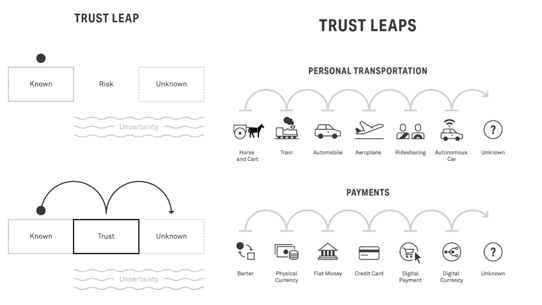
This starts with the Chinese company Alibaba going public on Wall Street. She retells a bit of her experience in China as consultant and then goes into live story of Jack Ma, but more important into how he managed to build some trust in society that builds human interactions on distrust. She provides a pictorial presentation of her understanding of the role of trust:
- Losing Faith
Behind the devastating crisis in institutional trust-and why we’re now more likely phone a friend
Here author moves to the loss of trust in society that she believes had much stronger history of relationship based on trust – American society. She starts it with the story of Tuskegee experiment when black patients where used as subjects of medical research without their knowledge or agreement. Author believes that it resulted in irreparable damage to attitudes of this population to medical profession. The next case author reviews in this chapter is the story of Panama papers that undermined trust of people in many countries in their leaders. From here she goes into discussion of general decrease in trust for all institutions from very old like government, army, or marriage to very new like Facebook or Reddit.
- Strangely Familiar
From sushi to self-driving cars-some surprising lessons in persuading people to trust new ideas.
Here author discusses how trust is build by using the story of French company BlaBlaCar, which is kind of Uber for long distance travelers. She introduces the idea of trust stack demonstrated in this picture:

It followes by a number of examples from Airbnb to Vaccination and self-driving cars of how it had happened in the real live. From here she moves to interesting interpretation of “Wisdom of Crowds” via idea of social proof. She describes an iteresting experiment of loking at the sky on busy street: individuals get no respect, small group – 5 people ignite 4 times more interest interest, and, finally, large group 15 people made 45% of passerbies to join. Author also discusses What in it for me (WIIFME) as nethod of trust building.
- Where Does the Buck Stop?
When trust crashes in the self-managed digital world, who is accountable?
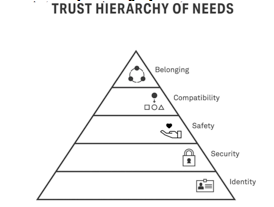
This starts with the story of Uber driver who become mass killer of his passengers. Author raises question of Uber’s responsibility for lack of checks and then moves to discussing changes of relative reliability of trust in small village, then brand name company when it became centralized, and then to Internet where it become decentralized once again and where companies search for a new form of building trust between people for which they become intermediaries. These new forms generally include reporting of people who participate in exchange on each other performance. As example author discusses Airbnb, Facebook, News, and experiment with mass manipulation of emotions. Author puts her understanding of trust hierarchy in the graph:
- But She Looked the Part
A cautionary, tale about deceptive appearances, and the technology that could unmask fakers and frauds
Here author retells story from her childhood when her nanny, who turned out to be a criminal well versed in obtaining trust from unsuspecting people. From here she moves to appearance of trustworthiness and experiments when psychologists try identifying how it works and applications of this research by companies such as baby sitter services provider. The last part of the chapter is about Internet’s ability to provide anonymity and correspondingly increase opportunity for cheating.
- Reputation is Everything, Even in the Dark
What drug dealers on the darknet can teach us about great customer service
This is about dark net and value of reputation for everybody and especially for all kinds of criminals who literally live or die by reputation. The inference here is that reputation is precursor for trust or distrust and as such is important in proportion to value and risks of transactions.
- Rated: Would Your Life Get a Good Trust Score?
When dystopian sci-fi turns into a reality and every little move you make is ranked, who wins and who loses?
This is about Chinese moving to create “Social Credit System” – something clearly dystopian from Western point of view, but in actuality nothing more than an attempt to bring old fashioned totalitarian vigilance and control to the new technological basis. Interestingly enough it is modelled on American Credit score system only instead of tracing financial behavior it would trace general and political behavior of population.
- In Bots We Trust
But should we… and how do we make them ethical?
This is basically about believes in technology and specifically in robots and AI. Here is graphic presentation of the issue:

The chapter retells a charming story of the Chatbot Tay that was supposed to represent a young girl. It crashes spectacularly when the bot quickly learned from humans to spit out all king of nasty staff.
- Blockchain Part I: The Digital Gold Rush
From fei to bitcoin, the long road to setting money free. What win it mean for the City?
This chapter starts with the story of island Yap where money represented by huge stones making them absolutely symbolic when all transactions are conducted using human witnesses and their memory, so they could be considered based purely on trust. After that author goes into brief history of contemporary monetary systems and explains blockchain and distributed ledger:
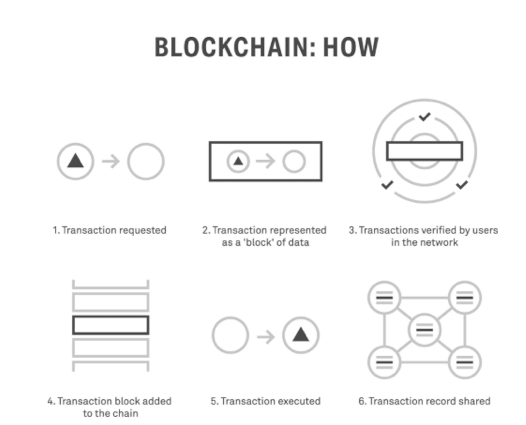
Author also discusses bitcoin and its technology as the first digital currency not controlled by any government.
- Blockchain Part II: The Truth Machine
The golden promises of the blockchain: overhyped or the trustworthy key to our digital future?
The final chapter is about hacking of digital currencies and various problems that occur at intersection of computers and human trust.
Conclusion
This author starts with reference to Stiglitz: “Trust more than money moves world around” and then talks about microloans, which are eventually based on trust. Then she moves to conclude the narrative with discussion of distributer trust based on digital technology as the wave of the future.
MY TAKE ON IT:
I find the discussion of trust really important and I think that it had to be of key interest for everybody who thinks about current and future conditions of society. I personally believe that trust is bases on mental habits developed by every person since practically beginning of their lives. Depending on how much person’s trust was justified or misused such mental habits solidify and by adulthood become basis of all interactions with people. The deviation into either side makes people suffer either from becoming victims of cheating or from losing some great opportunities because of lack of trust in others. I believe that expansion of data collection systems from e-mail history, to body cameras for police, to video recording of meetings and other interaction greatly increases human ability to verify and consequently greatly increases area of interactions when this ability could decrease risks of loss due to cheating or misrepresentation. Obviously the technology of blockchain, understood simply as simultaneous and contemporary record of an event in multiple instances too loosely connected making the later correction impossible, will help a lot to assure validity of such records. From economic and even human side it would mean decrease in cost of transactions and reliability of transaction records resulting in prosperity both materially and psychologically.
20180610 – Strategy of Victory

MAIN IDEA:
The main idea of this book is to demonstrate that contrary to general opinion George Washington, as military leader, was not a mediocrity, but genius who managed to win the war in which he had to fight the combined forces of the most powerful empire and local loyalists with poor mix of with untrained volunteers and militia that typically was not capable for serious fight. He managed to do it by using Fabius’ strategy of avoiding battles and draining enemy resources and will until settlement becomes more attractive then continuation of the struggle. Moreover it required not only military but also political genius necessary to mediate tensions between Congress that consistently undersupplied resources, officers and men that were cheated of their promised compensation and at the end of war were on the brink of military coup, and other generals who were intriguing to undermine him.
DETAILS:
INTRODUCTION
Here author states the objective of this book as attempt to demonstrate military genius of Washington. It is somewhat unusual statement because the generally accepted view is that Washington was at best a mediocre general, lost more battles than he won, and achieved victory in the war mainly via logistical sophistication that allowed him to keep his army in the field until combination of British exhaustion with the war and massive help of French assured this victory. Author’s claim, however, is that there was more to that and that Washington actually proved to be a military genius by demonstrating capability to change strategy in the middle of the war and succeeded in this turn.
Chapter 1 THE FIRST STROKE
This starts with the analysis of the first encounter of the war in April of 1775 when British troop failed to disarm Lexington militia and lost significant number of their troops in process. Author makes point that it was not result of spontaneous enthusiasm and heroism, but rather well prepared logistical and tactical operation conducted by well-trained militia that was qualitatively better than other Americans militias that for years failed to match this initial achievement.
Chapter 2 PROPAGANDA MEETS REAIJTY IN 1776
Here author analyses role of successful political propaganda campaign that followed Lexington that increased numbers of American militias, simultaneously decreasing their quality. The next American victory in June 1775 at Banker Hill in author’s opinion created false narrative that greatly hurt American cause for many years afterword. Author calls it Bunker Hillism and characterize it as conducting military operation with objective to capture well situated and fortified position and then expecting enemy to repeat British mistake at Bunker Hill of attacking such position headlong. The chapter narrates details of American defeats during second half of 1776 in New York in elsewhere as result of this tactic, that British were able easily overcome by maneuvering and going around fortified position, cutting them off and periodically forcing Americans into pitched battles, in which poorly trained, undisciplined, and often incompetently led militia could not possibly match professional British and Hessian troops.
Chapter 3 THE YEAR OF THE HANGMAN
This is about 1777, which started with remnants of Washington’s army achieving military small, but psychologically huge success at Trenton. After that it was a string of defeats that eventually forced Washington to change strategy to model it on Roman general Fabius’ strategy against Hannibal – avoid direct confrontation and just try to stay in the field long enough for enemy to give up. Author also trying to make case that British commander Howe did not really wanted to military defeat Americans, but tried rather to force them into settlement.
Chapter 4 THE PERILS OF FABIUS
Here author describes political perils that come with the strategy of avoiding fight: Congress political rambling and competitor General Gates getting more traction in his political maneuvering. Eventually Washington was able to avoid replacement and moved to Valley Forge where despite all the problems with supplies and winter he was able to conduct more or less effective training of the army.
Chapter 5 GENERAL DOUBLE TROUBLE
The general Double Trouble was General Lee who was formally more experienced than Washington and, despite being POW for a while, intrigued against Washington and promoted idea of cheap army / militia. While Lee did cause a lot of trouble and continuously demonstrated insubordination, these troubles were resolved in the battle at Monmouth where Lee absolutely failed.
Chapter 6 A SURPLUS OF DISAPPOINTMENTS
This chapter going into details of initial failed cooperation with French fleet and then into money matters when paper money became nearly worthless and material condition of troop and officers greatly deteriorated. It also reviews British attempt to move war to South in hope to get Tories of Florida and especially South Caroline more involved into fighting Americans. They failed mainly because Southern Carolina colonels refused to provide material support. It also describes French failed attempt to take Savannah. However, the most interesting part probably Clinton’s victory at Charleston where the number of militia found in hiding after surrender was 3 times the number of troops actually fighting.
Chapter 7 LEXINGTON REPEATED–WITH AN ARMY TO LOOK THE ENEMY IN THE FACE
This is about British attempt to finish Washington’s army in the June 1780 with landing operation in Elizabethtown. By this time continental army was in pretty bad shape due to shortages of everything including food to such extent that they even had mutinies such as Connecticut Continental brigade. Nevertheless, the landing operation after initial British success stalled with British and German troops constantly harassed by militia and attacked by Washington’s regulars. Author makes an important point that a lot of problems were caused by British generals’ competition and intriguing against each other.
Chapter 8 ENTER THE OUTRAGED CONQUEROR OF CARLESTON
This chapter is about continuation of this battle, which developed into battle of Springfield when British were forced to retreat, but were not completely defeated, leaving many on American side deeply disappointed.
Chapter 9 HOW MUCH LONGER CAN FABIUS LAST?
This is about the next stage of the war when British moved further into South Carolina. Initially it was another defeat of Americans under command of general Gates who once again violated Washington’s rules of using militia. This chapter also briefly discusses Benedict Arnold’s treason, but from an interesting angle: it probably caused Congress appreciate Washington quite a bit more than before. At the end if Arnold left the cause, what would have happened if Washington did the same?
Chapter 10 A PLAN SO DARING EVEN DANIEL MORGAN FEARED THE WORST
This chapter goes in details of event in Carolinas backcountry where Americans under Green and Morgan succeeded with not small help from British arrogance and stupidity that pushed locals into American camp. It narrates about maneuvering in this area between Americans and the best British tactical commander Banastre Tarleton that eventually led to one of the most tactically interesting battles when Morgan intentionally put his troops in position where it would be obvious that give up fighting and run as militia did quite regularly would not be a viable option if one wants to stay alive.
Chapter 11 DOWNRIGHT FIGHTING
This chapter is detailed narrative of battle at Cowpens when thanks to Morgan’s masterful use of combination of militia, infantry, and cavalry British were defeated with quite serious consequences for the war overall.
Chapter 12 FIGHT, GET BEAT, RISE AND FIGHT AGAIN
The next stage of war was Cornwallis movement to South through North Carolina and another battle at Guilford Court House, which Americans under command of Nathaniel Green kind of lost, but were able orderly retreat. In process inflicting serious casualties on Cornwallis. After that Green moved to South Carolina, but Cornwallis decided that he had enough of Deep South and moved up North to Virginia in hope eliminate Washington’s Northern Army.
Chapter 13 FROM MUTINY AND DESPAIR TO IMPROBABLE VICTORY
This chapter is about deteriorating condition of continental army exhausted by multiyear war, devastated by currency inflation that deprive them of practically any meaningful material compensation, and slowly losing any motivation to continue fighting. This situation caused increasing tension and even mutinies in some cases. In addition, Benedict Arnold, in command of some 2000 British troops by this time, raided Virginia forcing Jefferson to run away from his home. Simultaneously France also got tired of the war and start planning peace conference in Vienna with clear intention to abandon Americans to their fate. However, the new and probably the last opportunity presented itself when Cornwallis moved to Yorktown, French fleet moved in to join forces with Washington, and Green wreak havoc on British troops in South. The outcome of all this was defeat and surrender of Cornwallis just when American Revolution was seemingly at its last legs.
Chapter 14 VICTORY’S UNEXPECTED CHALLENGE
This is a bit about peace negotiations when Franklin and Adams had to find way to establish America as an independent state without giving in either to France or to Britain. But it is more about seldom discussed internal American affairs of the period, specifically question of compensation for veterans of revolutionary war when Congress unwillingness to meet obligation put country on the brink of military coup. All this was complicated by British troops remaining in America.
Chapter 15 GEORGE WASHINGTON’S TEARS
This chapter is continuation of the narrative of American veteran’s standoff with Congress, which could end pretty badly if not George Washington. Unlike practically all military leaders before and after him, he did not move to the head of upset military and become dictator, but rather used all his influence to prevent such development that practically makes him the greatest political actor in history. The story here is about specific and famous episode when Washington shed tears at the farewell meeting with officers.
Chapter 16 MAJOR GENERAL ANTHONY WAYNE TO THE RESCUE
The final chapter is about later period when Congress’ neglect of military led to St. Clair’s defeat at the hands of Indian alliance, which jeopardized American Western expansion. This even led to revival of American military, the job that Washington assigned to Antony Wayne who did it and in process created foundation for future American professional military.
MY TAKE ON IT:
I see value of this book in providing much more details than it is usually done on strategically complex decisions of Washington that changed Bunker Hill approach to conduct of the war to Fabius approach. From tactical point of view it is interesting how Washington, Morgan, Green, and others developed methodology of using interplay between training professional army and poorly trained militia to achieve good enough outcome in several battles that convinced British to forfeit hope for clean victory. I also found it very interesting and generally poorly understood psychological genius of Washington who managed to prevent military takeover of the country with the following lawlessness and disarray that was plentifully demonstrated later on in the history of Latin America. In short the more one learns about American history the more one can see intellectual and moral superiority of some founding fathers (all warts included) over the most of people who were in power in USA for 2.5 centuries afterword.
20180603 – In Pursuit of Memory

MAIN IDEA:
The main idea of this book is to make everybody aware about impact of Alzheimer disease, present current state of research and different branches of this research, and, most of all, convince readers to support increase in funding for this research.
DETAILS:
Preface: ‘A Peculiar Disease’
Author starts with reference to his personal encounter with Alzheimer disease observing its progress in his grandfather and how it led to author’s involvement with it as researcher. Author presents this book as history of disease, its past, present status, and future resolution that is becoming more and more important with increase of older population.
PART I: Origins
- The Psychiatrist with a Microscope
This is a narrative of the disease discovery when doctor Alzheimer started investigating brains of people who died from it. It also about live of the doctor and what led to this investigation.
- Understanding an Epidemic
This chapter is about long period of somewhat confusion between character of this as disease vs. normal process of old age dementia. At one point it even was considered that age 55 is top age limit for disease. Eventually development of microbiology left no place for controversy, clearly demonstrating that there no biological difference in process of disease that would be linked to age only.
- A Medicine for Memory
Here author goes more into details of how normal brain works and how disease impacts these processes. It follows by discussion of promising, but eventually failed hope to treat the disease with acetylcholine. Then author narrates the story of tacrine – another promising treatment that produced several approved drugs, which seems to provide some improvement, but are far from complete treatment.
PART II: Research
- Diagnosis
Here author describes a couple of real live cases of Alzheimer caused deterioration of mental abilities.
- The Alzheimer’s Gene
In this chapter author looks at some cases of genetically defined early Alzheimer onset that happens to people in their 50s and even 30s. The mutation is now well-defined and could be tested. The problem is whether people want or do not want to know what is coming.
- The Science Behind the Headlines
This is about relatively new approach to the understanding of disease with stress on formation of beta-amyloid plague in brain, which occurs continuously. The supporters of this theory are known as Baptist (from beta). They were successful in confirming this idea by using mouse, injecting them with human DNA, and artificially developing Alzheimer. The second half of chapter is about alternative suspect – APOE gene variations, positing that plague formation is not the cause, but just a symptom. These variations are actually linked to kind of local diabetes that impede energy supply to brain cells, causing their deterioration. The third part of chapter is about another group – Tautists who named for “tubulin associated unit”, which is protein that forms Alzheimer tangles in the brain. Author discusses which of these theories has higher probably to be correct, but it is still an open question.
- The Second Brain
This is about glia part of the brain that until recently was considered just filler, but now is demonstrated to be an important part of the processes necessary for brain functioning. Author describes his own research with microglia. The functioning of microglia in Alzheimer disease was similar to immune system, so the attempt was made to develop a vaccine. It demonstrated some positive results in testing, but far from being significant enough for practical use.
- Swedish Brain Power
This is about Swedish researcher who works on biomarker that would help predict Alzheimer long before it actually developed in the brain of individual. So far, they achieved 3 years before symptoms and 90% accuracy, but with very small number of objects. The final point in the chapter is that knowledge of approaching disease could prompt people to change live style to help prevent it.
PART III: Prevention
- Stress; 10. Diet; 11. Exercise; 12. Brain Training; 13. Sleep;
This part is about usual staff that considered healthy and prevents all known diseases, Alzheimer included. Interesting note about exercise – after normal amount there is no evidence of increased benefits. It also relates to cognitive training that helps to maintain mental ability in old age, but useless for younger than 50.
PART IV: Experimentation
This is about different directions of experimentation that may bring some new ways to handle the disease.
- Regeneration
This is about experiments in molecular biology with DNA and embryonic stem cells in attempt to regenerate aging cells of human bodies. Some success was achieved in turning adult cells into stem cells – called iPS cells. In short, it provides hope that eventually neurons could be regenerated and transplanted into the brain to compensate for loses due to disease.
- Young Blood
This is about attempts to use biological materials from young people to rejuvenate old. So far, no scientifically valid results were achieved in this area.
- Seeds of Dementia
This is about mad cow and other brain diseases, some of them infectious. The point here is that even if they all are different, they still could help understanding brain functions and malfunctions.
- Looking but Not Seeing
This is about some special forms of Alzheimer when disease impacts only parts of the brain, while mechanism of disease seems to be the same -such as visual Alzheimer (PCA).
- Between the Devil and the Deep Blue Sea
This is about unexpected discovery of drag approved for skin cancer somehow had positive impact on Alzheimer patients. It also about an interesting connection – cancer patients had less occurrences of Alzheimer and vice versa. The chapter is discussion experimentation with various compounds impacting RNA with very positive results in mouse. This also prompted expansion of research on impact of different unrelated drags and substances in hope that something could work.
PART V: Discovery
This part is about what could be brought to bear in this struggle from different parts of the world.
- To the Ends of the Earth; 20. Insights from India; 21. Clues from Colombia
These chapters review: the DNA project from Island where they collect it from total population in hope to utilize it in finding all kinds of correlations, massive memory studies from India, people with genetic mutation that could have relevance from Columbia.
- Alzheimer’s Legacy
The final chapter discusses current status of disease expansion due to aging of population and as usual trying to justify more government funding its research.
MY TAKE ON IT:
To me it is quite obvious that Alzheimer is an awful disease and that its elimination requires massive effort in research and medical testing. I think that the more or less valid combination of genetic predisposition and cumulative impact of lifestyle will be identified causing this disease and in the near future some combination of measures in both areas will be developed to fix the problem. The importance of solution for this problem would grow exponentially, so amount of resources directed at supporting research in this area is practically guarantied to grow.
20180527 – Life 3.0

MAIN IDEA:
The main idea here is to present the wide range of issues related to Artificial Intelligence in the very clear and digestible form and prompt everybody in the world to understand that humanity is on the brink of huge change when human monopoly on intelligence and probably consciousness is coming to the end. It also kind of invitation to get involved in discussions of these issues and link with the new organization that author and his cooperators created to handle these issues.
DETAILS:
Prelude: The Tale of the Omega Team
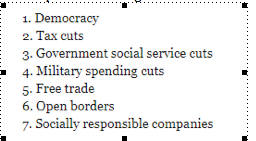
The book starts with author’s fantasy about team of super intelligent and super benevolent group of geeks that take over the world using Artificial Intelligence and its ability to outperform humans in all intellectual and artistic areas. In process author provides 7 slogans that he believes could make the world wonderful:
1 Welcome to the Most Important Conversation of Our Time
This is a sample of philosophizing about conscious as a necessary condition of the beauty of universe and approaching of new era of AI when the consciousness will move into overdrive.
A Brief History of Complexity
Here author discusses evolution of consciousness that is, meaning the biological human consciousness and where it came from.
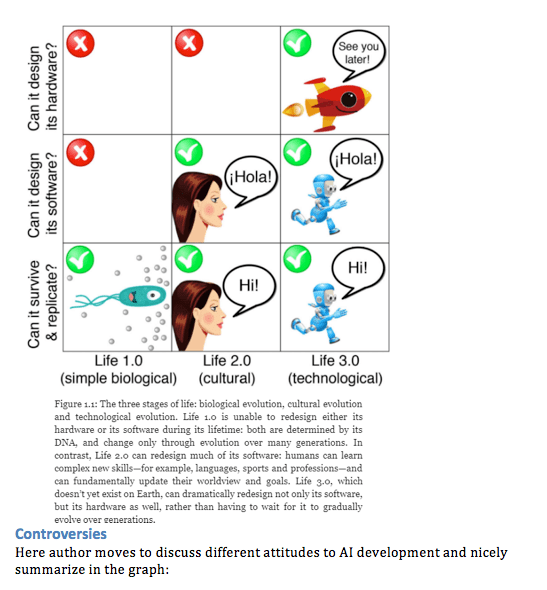
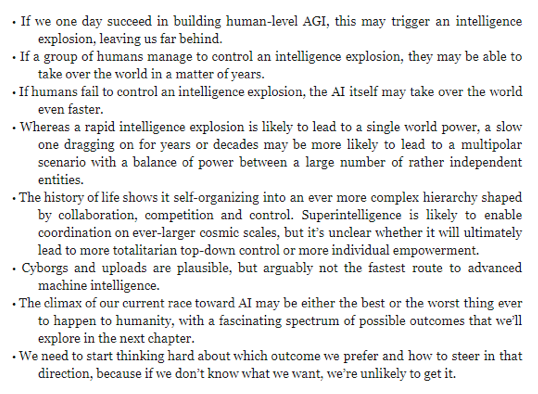
The Three Stages of life
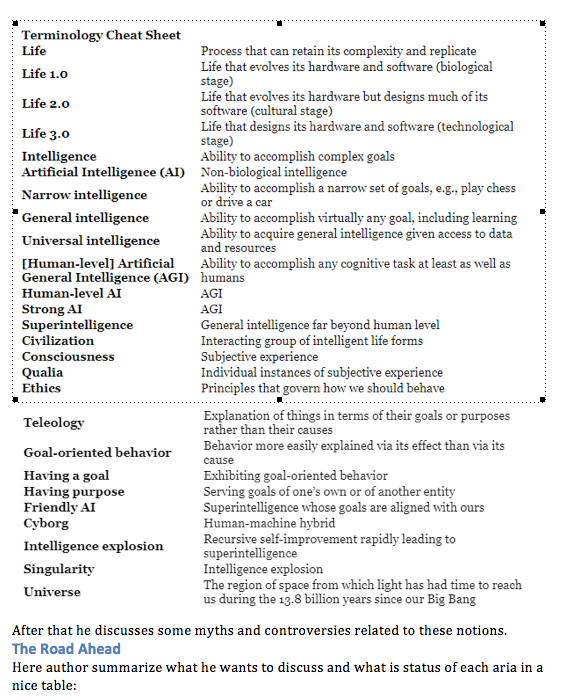
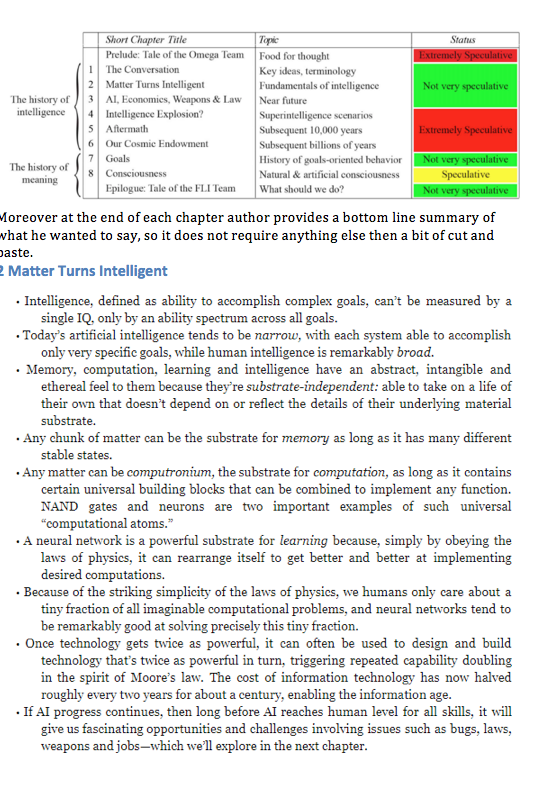
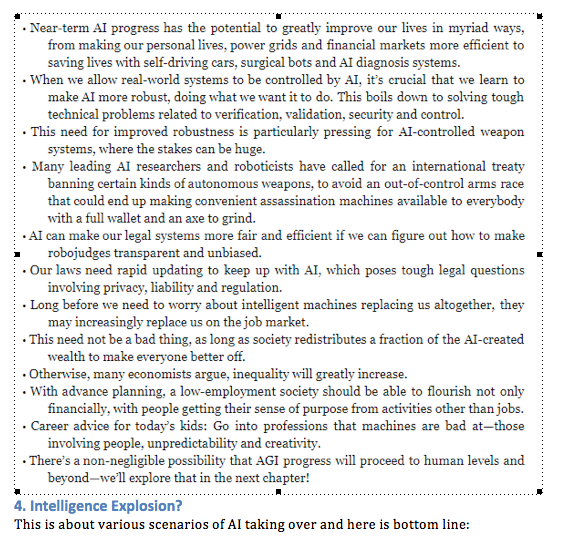
Here author provides a nice picture of what he means by this:


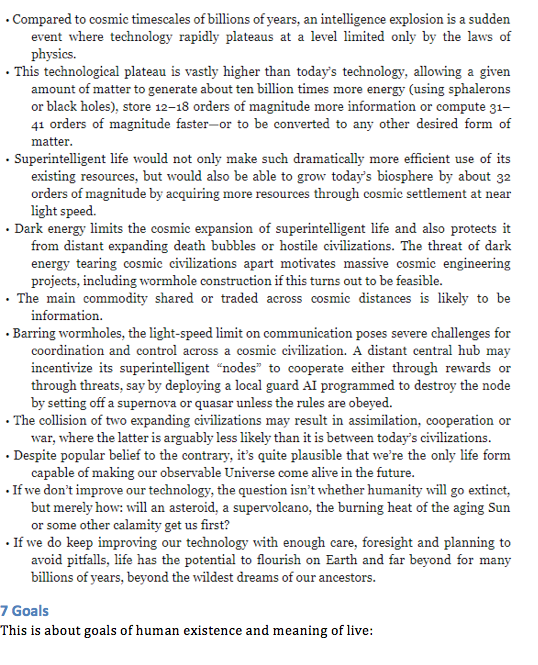
- Aftermath: The Next 10000 Years
This continuation of future scenarios review, this time with long-term perspective:




Epilogue: The Tale of the FLI Team
The epilogue is about organization that author and his friends created: Future of Live Institute (FLI), its goals and activities.
MY TAKE ON IT:
I think that this book wonderfully overstates both dangers and importance of Artificial Intelligence. The reason for this is misunderstanding of intelligence as something standing alone outside of human beings who possess it. In reality intelligence is unalienable part of human being and is painstakingly developed by this human being over dozens of years with the use of highly flexible and adjustable biological hardware, provided at birth, for processing and interacting with multitude of external entities. The ability to solve problems, to prove theorems, and build one’s own hardware is not really that important as long as the entity in question is directed from outside to do this activity. So, AI engine is not really intelligent, it is just a piece of software designed to use pattern recognition in order to develop data processing and problem resolution skills required to achieve whatever objectives humans assign to this piece of software. Correspondingly self-driving car is not intelligent because it does not decide where to drive and does not possess any internal motivation to drive anywhere. Correspondingly it is as unlikely that humans would decide to enhance their intellectual ability by modifying their biological brains as it is for human to underwent genetic reengineering of their DNA to have wings to fly even if technologically it is becoming quite possible. I think it is possible to create artificial human, let’s say on the material base of silicon chips by providing sufficient data processing power and raising this thing as human. However, it would be just another human, albeit with more computing and physical power, different material design, but still human. In short, I think AI would be just another tool added to human abilities, but not much more than that.
20180520 – Saving Justice
![Saving Justice: Watergate, the Saturday Night Massacre, and Other Adventures of a Solicitor General by [Bork, Robert, Bork, Robert H.]](https://images-na.ssl-images-amazon.com/images/I/51cFFcqGi7L.jpg)
MAIN IDEA:
The main idea of this book is to present author’s point of view on what actually happen before and during his tenure as Solicitor General in Nixon administration at the time of Watergate. Author demonstrates complexity of the legal and administrative process behind the scenes and somewhat dysfunctional operation of American legal/administrative/political bureaucracy with its struggle for power and influence over the country.
DETAILS:
PROLOGUE
This is a brief description of functionality of The Office of Solicitor General and its functions. These mainly include arguing cases before Supreme Court on behalf of Executive Branch of government. In 70’s – the period author describes, it was just a few lawyers processing some 1700 cases in 1973. Author also discusses his attempt to streamline workflow and make the office more efficient. He defines the most important part of his job as “assist Supreme Court in the development of legal doctrine”.
Chapter 1 – Getting the Job
This is a story of author’s getting job of Solicitor General in Nixon administration. It started with author’s published article supporting Nixon for president in 1968. It follows by description of several interactions with Nixon himself and then his people with stress on Nixon general dislike of Ivy League professors. As a bit of distraction, author refer to a bad omen for his role when during swimming in ocean resort just before being sworn in, he was pulled by the current into the see and when he was frantically waving for help, getting instead of help, some joyful wave back because people on the beach though he is waving just to show how much he enjoys swimming. He refers to this situation as very similar to his future experience related to Watergate.
Chapter 2 – Nixon’s Defense Attorney Offer
This chapter is about the apex of Watergate scandal when author was offered place on Nixon defense team, but was able successfully avoid taking it. It is interesting because author’s note about his conversation with Haig who suggested that Nixon would rather burn tapes than give them. He was tempted to ask why Nixon did not do it yet, but did not ask. He characterized it as the best sentence he never pronounced. It would obviously be not good for author if tapes were burned on advice of Solicitor General.
Chapter 3 – William O. Douglas War
This is an interesting chapter about the role of Supreme Court discussed around actions of judge Douglas who supported stay on military operation in Cambodia. It involved some disagreement with other judges and eventually was overwritten by judge Marshall and then by telephone conference.
Chapter 4 – L’Affaire Agnew
This is about a little discussed part of the Watergate coup when rather feeble attempt was made on double impeachment of President and VP so the Executive powers were transferred to Democratic speaker. Author seems to agree that Agnew was as crooked politician as they come, but not that much more crooked than all others. The double impeachment was avoided by getting Agnew to resign as part of the plea bargain.
Chapter 5 – The Saturday Night Massacre
Here author discusses the whole issue of special prosecutor and his power and then goes through events of Saturday night and what happened right before that. Very interesting point here is that Nixon’s first choice for new VP was not Ford, but very popular John Connally who was wounded in the car with Kennedy and in 1973 switch to GOP. Democrats in Congress would not agree because of fear that he really could win the next election. Also, there is an interesting description of complexity and logic of the resignations of this night and author’s decision to take responsibility as Acting AG and fire Cox. He also stresses his concern to avoid any hint on personal benefit from this decision, all the way to refusing use of limo assigned to AG.
Chapter 6 – After the Massacre
The aftermath of the deal was mass resignation of staffers who unsurprisingly were able to use it as career enhancing vehicle. However remaining staff did a good job and author stresses that it was not an easy thing to do. Author also discusses storm outside which he deems to be saturated with “poverty of moral rhetoric” presented by constant calls from other Yale graduates accusing author in degrading dollar value of Yale law degree by his actions. Another one was inability of press and public to assess legal side of situation and appropriateness of author’s actions. Author also expresses his disappointment in many lawyers who failed to act professionally.
Chapter 7. – Restoring Justice
Here author discusses the selection of the new special prosecutor and the changes in legal environment that occurred in this period. Specifically, he discusses FBI issues with legality of surveillance that resulted in creation of FISA court. Other issues were War Power Resolution, Campaign finance prompted by Eugen McCarthy campaign based on very large donations by rich activists, and attempts to make special prosecutor into permanent office. He also describes final stages of impeachment saga.
EPILOGUE
Here author briefly describes his live after these events, including participation in Ford and Reagan administrations. Interesting also is his reference to Supreme Court nomination that he believed was a sure thing because of his qualifications, the fact that none of his decision as judge was overturned by Supreme Court, and history of bipartisan support for qualified judges. Obviously, he was wrong because he was the first appointee who was attacked by democrats on the political basis and defeated. At the end author refer to Obama’s statement that he would appoint judges with empathy to a little guy, which completely rejects the very notion of impartial jurisprudence. Author warns against judges who used their position to exercise power, but not authority and affirms his believe that the remedy for America legal ills is Originalism that provides hope to maintain constitutional structure of the country.
MY TAKE ON IT:
I read Bork’s work before and found myself mainly in agreement with his legal ideas. This book presents narrative of his exploits as Legal bureaucrat at the very interesting point when political bureaucracy represented by Nixon was attacked and defeated by American elite combining professional formally non-political, but really deeply politicized in support of big government bureaucracy, legal, and media establishment. The whole Watergate saga demonstrated power of this alliance, which success assured their control over the country for the next 40 years. As could be expected, this control led to material deterioration of American quality of live both economically and in international affairs, leading to massive deindustrialization, terrorist attacks, massive debt, and overall unhappiness with the state of affairs. Now this fight is renewed in much more interesting form with Trump winning presidency and the elite dropping any pretense of unity and commonality with their opponents. It would be interesting to see how well Trump and his team learned lessons of Watergate and whether they will be able to repel the attack and win battle with bureaucratic/ legal / media / big corporate leadership united forces.
20180513 – Left Turn

MAIN IDEA:
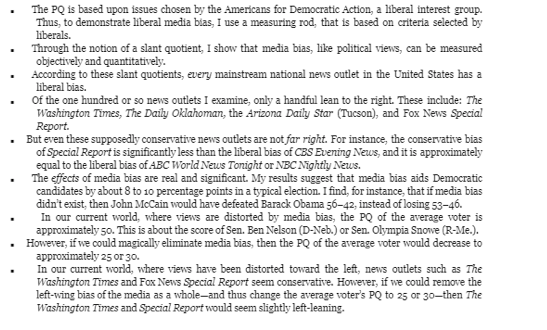
Author explicitly stated the main conclusion of this book is based on extensive research and demonstrates that the left leaning media shifted American political opinion by approximately 8 to 10 points, keeping Democrats and their ideology relatively competitive, which would not be possible without media influence. Author introduces a notion of Political Quotient as scale from 0 to 100 with top left being 100 and top right 0. Here is how author describes overall methodology and intermediate conclusions:
DETAILS:
PART 1. Political Quotients and the Science of Politics
- What Are PQs and How Do They Reveal Media Bias?
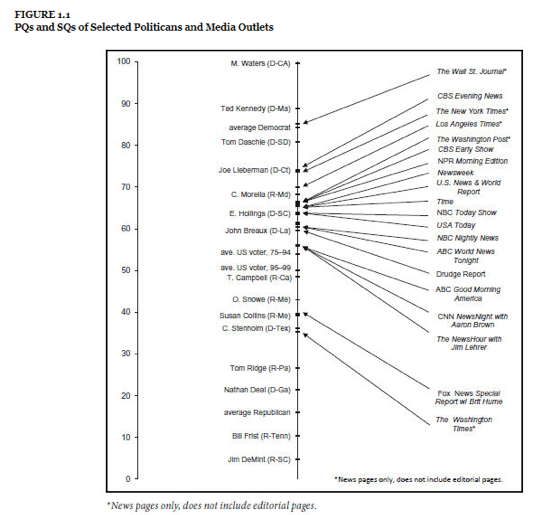
Here author describes methodology of defining PQ for individuals, and media published opinions based and case-by-case calculation. He even provides tools to calculate one’s own PQ and presents results for some specific politicians and media outlets:
- Caught in a Trap: Problems in Judging Media Bias
Author here discusses one of the most important indicator of such bias – circular sourcing of the media. Interestingly enough “intellectuals” are more prone to be disoriented in this way because they believe in their own capability to recognize it. Th real way out of this trap in to find independent source of the story.
- But I’ve been to Oklahoma
Author starts this chapter with reference to his own upbringing as conservative and notes that he stays one with PQ13. Then he moves to more interesting point: the difference between normative and positive questions with the former being about opinions that could not be factually confirmed, while latter render themselves to factual and logical confirmation. After this author discusses reality of positive questions being better answered by people who actually imbedded in related environment. For example, the people who lived among military and their relatives could give the best answer to why people join military. Similarly, people of racial group against which it is directed could give the best answer about reality of racism. Finally, author discusses why conservatives are more interested in analyzing media bias. He makes an important point that this bias is positive question and therefore could be answered with data so formal and scientific analysis would demonstrate that liberal bias exists, making such research rejected by liberals and embraced by conservatives.
- Ps and Qs of PQs
Here author discusses what and who are liberals and conservatives by using leftists Americans for Democratic Actions (ADA). Here are liberal positions:

Correspondingly, the negation of these position is conservative, so these attitudes exppressed via voting and/or support become measurable signals allowing PQ identification for a person.
- Defining the “Center~
This is about methodology of defining PQ, its centers and extremes based on voting records of legislature. The graph represents result of such calculation demonstrating successful move to the left over recent decades:
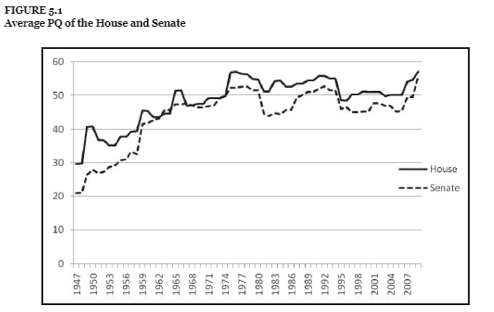
Author also answer to some challenges posed to his methodology and then presents reasons why middle is more interseted in being truthful than extreme ideologues on either side.
PART II, A Distortion Theory of Media Bias
6.Lies, Damned Lies, and Omitted Statistics: A Case Study in Distortion Theory
This case study is about media distortion of student admission in UCLA when admission of blacks to university was considered too small, when in reality the number of applications was correspondingly small. This represents use of statistics to mislead people.
7.Hidden Under a Bushel
This chapter is about another technic – hiding relevant information. The examples here are Katrina, and Obama’s pastor of “god damn America” fame. Van Jones, and finally Obama’s election by the color of his skin.
- An “Alien” Conservative Injected into a Liberal Newsroom and the Topics She Might Cover
This chapter presents story of conservative journalist joining regular newspaper and how it demonstrated different approach to the same story, in this case imams on airplane.
PART III. Evidence of Liberal Media Bias
- Political Views in the Newsroom: Viva Homogeneity
This chapter is response to criticisms of author’s work on bias:
- Surveys of journalists irrelevant
- They are inaccurate
- They tell nothing new
In actuality surveys probably underestimate bias because journalists are conscious about demands for objectivity. Author provides pretty funny examples of this approach.
- The Second-Order Problem of an Unbalanced Newsroom
If the direct political attitudes of journalists is the first order of bias, the pressure on minority opinion holders, tendency of overwhelming majority to move to extreme positions.
- The Anti-Newsroom, Washington County, Utah
In this chapter author analyses counterfactual of journalists being as conservative as some of the counties in Utah. The results would be the same pressure on individual to stay in line with majority. Author also looks at idea that corporate media management easily override liberal inclination of journalists, concluding that reality as presented by real media output is opposite – journalists express their views, rather than management’s.
- Walk a Mile in the Shoes of a Centrist
Here author looks at centrist regions of the country and provide an interesting graph for representatives / vote correlation:

There is also a number of table demonstrating PQ distribution by states.
- “Wise Men from the Center on Budget and Policy Priorities Say…”
This chapter is about author’s methodology and its critics. It also provides results of analysis for some news outlets:

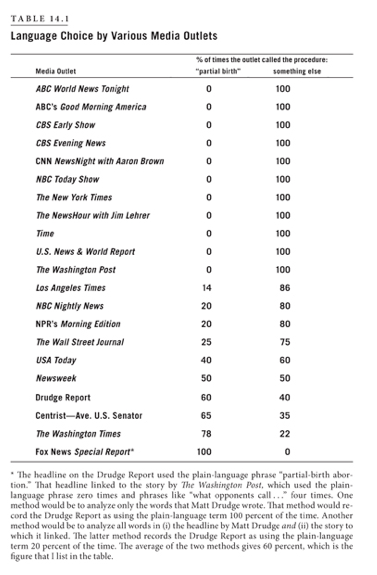
- The Language of Journalists and the Special Case of Partial-Birth Abortion
This chapter is about language manipulation in order to frame some issue in positive or negative form. It obviously works pretty well and author uses it to measure media bias using a specific case of “partial birth abortion”. He provides a very enlightening table to demonstrate it:
- The Language of Journalists and the Centzkow-Shapiro Measure of Media Bias
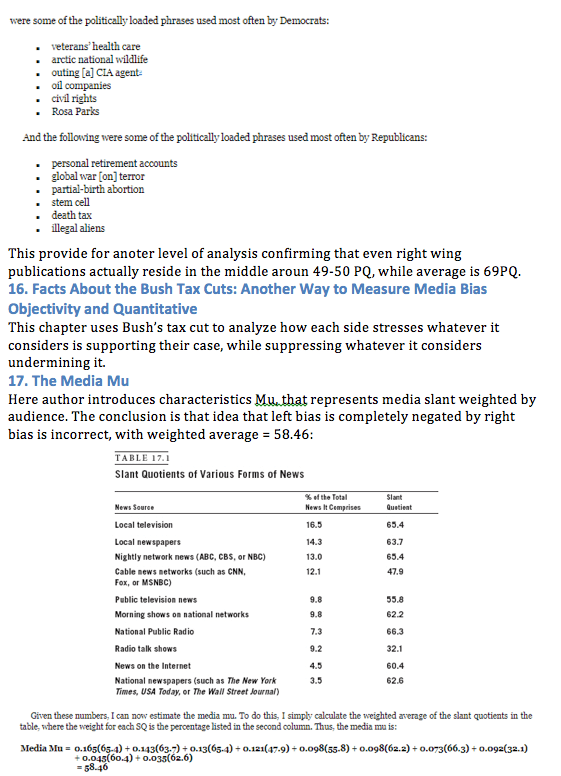
This is continuation of language discussion and reference to another research when computer analysis of 2-3 words combinations produced typical use of language by sides:
PART IV. Effects of Media Bias
- Measuring the Influence of the Media I: Many Methods False and Spent, and One That’s Not
Here author moves to evaluating effects of media bias, stating that his previous believes in the negligence of such effect were disproved by evidence. In order to discuss his conversion author presents some scientific issues such as endogeneity problem and demonstrates how it could and does influence results of economic and sociological research. The only really good solution is natural experiment. As example of such experiment author refer to Della Vigna and Kaplan study of Fox network expansion demonstrating how it influences the voting patterns around the country.
- Measuring the Influence of the Media II: Two More Groundbreaking Experiments
This is about two more research projects: Washington Post vs. Washington Times experiment when free subscription for randomly selected individuals led to 3.8% gap in voting. Another one Cai Wang laboratory experiment with messaging demonstrated 0.282 variations from the middle of 5, when rational-choice theory predicted variance of 0.
- The Media Lambda
In this chapter author introduces a quantitative measure of media influence:

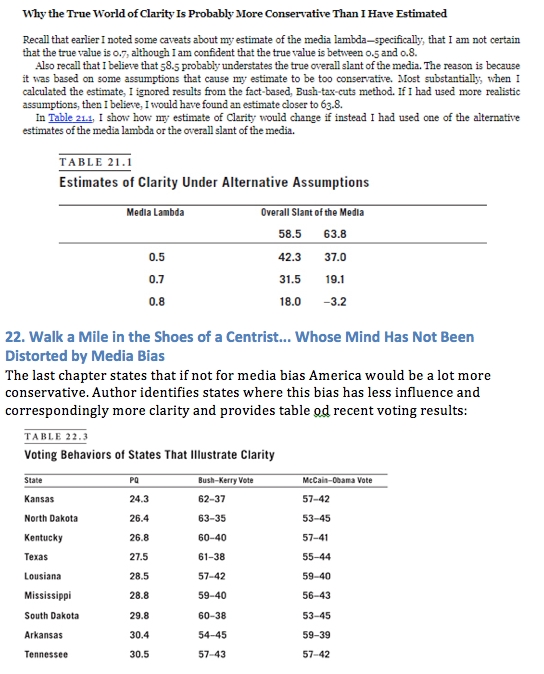
- Rendezvous with Clarity
Here author refer to Reagan’s “Rendezvous with History” to present his findings as “Rendezvous with Clarity”, providing the following table to stress the conservative nature of his assumptions:
Epilogue: Small Steps Toward a Better Media
Author suggests here that the main method of fixing the problem of media bias should be transparence – effort to force journalist to openly present their views so news consumers could understand the probability of bias and make correspondent adjustments to whatever message is transmitted.
MY TAKE ON IT:
Ii is a very nice scientific analysis of media bias to the left. Until now I mainly agreed with rational- choice approach. It seems to be too much to believe that media is capable to move public opinion and voting behavior in any significant way. Unlike others I did not think that it is because the media is ineffective, but rather because people are not really interested in what media has to say and mainly ignore it. It is seemingly supported by the fact that political media is not really watched and listen by too many people. Enough to say that in the nation of 300 million just some 10 millions are actually watching news. Add to this my experience of growing up in highly politicized totalitarian state where agitation and propaganda were compulsory parts of live and education generally ritualized into meaningless flow of words and images that vast majority of population was completely ignoring regardless of whatever was propagated at any given moment. By demonstrating that the media bias is actually moderately effective, this book forced me to change my mind and accept the need for active and effective countermeasures against the ideological success of leftist movement. These measures could not be effective if conducted at the level of logic and scientific explanation of facts. It should be based on generating emotional response to leftist ideology by bringing up its murderous character demonstrated everywhere where leftists took complete power and stressing that any liberal bias is not based on journalists’ good intentions somewhat misplaced, but on their evil strive to power to control population and in process transfer to themselves products of other people’s efforts.
20180506 – Happiness for All

MAIN IDEA:
The main idea of this book is to review results of research about happiness and wellbeing of people with objective to define how it changed over the time in America and in the world. Author attempts to demonstrate how it depends on income inequality, availability of opportunities, and that it seems to be better to be rich and healthy than poor and sick. Also, the point is made that situation in USA seems to be deteriorating at least based on pools, while in other places, especially Latin America it gets better.
DETAILS:
CHAPTER 1. INTRODUCTION; Happiness for All: Living the Dream?
Author starts by immediately switching topic from American creed of “pursuit of happiness” to generally liberal creed of equal availability of American dream and general well being. She refers to research that shows that subjective wellbeing is linked to availability of opportunity. After that she moves to inequality of opportunity and its dynamic character, if perceived as access to opportunity. Then she discusses research data from polls demonstrating that despite decreasing numbers of brainwashed population from 64% to 56%, the majority still believes that they pay fair share of income in taxes. She also discusses technical issues of dimensions and metrics of wellbeing, role of believes and what she intends to present in the following chapters of the book.
CHAPTER 2. What Happened to Horatio Alger? U.S. Trends in Inequality and Opportunity in Comparative Perspective
The reference to Horatio Alger is used mainly to profess that his story about making it from the bottom to the top of society are not really describe realities of contemporary live when children born to lowest strata of society tend to stay there. She consistently points out that Americans generally overestimate societal mobility of their society. She provide graph to demonstrate that with increase in Gini mobility decreases:

After that she moves to explanation of reasons of inequality growth:
- Aging of population that increases share of retired people, who do not make a lot of money
- Single parent families
- Increase in compensation in high cognitive demands employment: finance, professions, medicine, and decrease in compensation for low skill labor.
At the end of chapter author provides technical review of measuring mobility rates and states that American practically lost its status as the land of opportunity.
CHAPTER 3. Who Believes in the American Dream? Public Attitudes about Mobility in the United States and Beyond
This is about different attitudes to American dream and it starts with discussion about relationship between inequality and wellbeing. Somewhat contrary to general leftist understanding, author points out that there is no prove of negative impact of inequality on wellbeing everywhere, but it is highly dependent on the country. Author looks at multiple studies and concludes that America generally lost its exceptional character when people believed in opportunity as sufficient benefit to overcome negatives of inequality. However, graphs provide seems to show small difference in well-being:

Author provides quite extensive comparison between USA and Latin America and then discussesd attitudes to hard work and opportunities accross the world. She provides a very interesting result demonstrating that American rich have attitudes close to general population of Latin America where people across income levels believe that hard work is beneficial, while American poor much more close to Europe where a lot less people believe in it, also acrossall levels of income:

CHAPTER 4. The High Costs of Being Poor in the Land of the Dream: Stress, Insecurity, and Lack of Hope
This is about high psychological cost of being poor in America, even if purely material conditions such as food, housing, transportation, and such would be considered at the level of rich in other countries:

There is also a very interesting graph demonstrating impact of assistance on satisfaction: people without assistance are generally more satisfied with their live:

Author then looks at detailed picture in USA with somewhat higher concentration on stress, which she defines as being good (mainly for rich with creative and intensive work), and bad (mainly for people who sterrssed by lack of funds). She repeants the trope of two Americas, but with an interesting quirck – blacks are more optimistic than poor whites.
CHAPTER 5. Well-Being, Aspirations, and Outcomes: What Do We Know?
This is about knowing where one wants to get in order to decide direction of effort. Author explores how effort depends on believe in opportunity. The main point is that good situation prompts people to do things that will improve the future situation and vice versa. For example: good health -> joy of movement -> more exercise -> even better health or sedentary life style -> poor health -> hard to move -> no exercise -> even worse health. Important thing here is also locus of control: internal means “If I want something I need to do something because it depends on me” external: “If I want something it is somebody else’s responsibility to produce it so I just need to demand it louder and louder”. Finally, time horizon is also important: long term much more effective because leads to education and sustained effort.
CHAPTER 6. Can We Save the Dream?
The final chapter is about all these new happiness and other metrics, whether they are useful or not.
MY TAKE ON IT:
I do not think that happiness is that much linked to material conditions. It is a lot more complex notion and is extremely subjective, personal, and changeable over the time. Nevertheless it is a good review of material subset of causes of happiness including comparative approach of how one is doing compare to peers. I think a bit underexplored is a very important issue of agency, which in my opinion playing a very important role as soon as subsistence level material needs are met. It also seems to be missing another very important component of happiness – satisfaction from affirmation of one’s self-image. The person who believes that he is number one in something would be unhappy if found himself in the second place, while person who believes that he is in the top 100, will be happy if found self at number 25. In short it is interesting, but extremely limited approach to the issue.
20180429 – Inheritors of the Earth

MAIN IDEA:
The main idea of this book is that the current environmental obsession with saving species comes from really poor understanding of realities of the world and meaning of evolution. In reality the environment is constantly in process of change and it is always beneficial for some species and detrimental for others, so some go on to prosper and some go extinct. The idea that humans is some king of external factor in Earth’s ecosystem is ridiculous on its face because humans are part of environment and, as every other species that ever existed, they change environment by the simple fact of being alive. However, these changes caused by humans are on much higher scale than by other species and, most important, could be consciously controlled. So, the point is that human interaction should become more conscious and direct its impact to create much better environment with understanding that it is dynamic process and that extinction of some species and creation of new is natural and could not be possibly stopped.
DETAILS:
PART I: Opportunity
Prologue: Gains and losses
This starts with the looking around out of window and seeing somewhat chaotic mix of species of everything alive from grass and trees to animals and birds, which is completely different from what it used to be even a several decades ago. Lots of species disappeared, pushed out by competition from other species and humans. But lots of new species showed, or old species invaded from faraway places and then prospered. Also, the human impact changed dramatically from killing animals to saving them not only for use in economy, but also for their own sake. The point here is that living world is complex, constantly changes, and humans should not attempt to stave off the change. They should rather ride the wave based on understanding of ecosystem dynamically then try to maintain status quo of the system based on the idea that it is perfect as it is.
- Biogenesis
Here author traces development and movement around the world of one specific specie: sparrows, that came from Asia and then moved elsewhere in close cooperation with movement of humans, in process evolving to fit different environments. Author uses this as example of coevolution and points out that it happens all the time with all kind of living things and that idea of environmentalists that there ever was a perfect condition, which was destroyed by unnatural humans, is just plainly not correct. His main point however is that even if humans decided to save environment as it is, it would not be possible due to complexity and variety of evolutionary processes that involves everything living.
PART II New Pangea; Prelude
Here author just states his purpose in this part to look at four human-caused changes in environment and demonstrate how some species become highly successful as result of these changes.
- Fall and rise
This chapter is about impact of humans killing animals for food and other products. The author starts with elephants and discusses reasons for their survival, unlike many other big animals that were extinct most probably by the human hunting. An interesting point here is that one of the reasons for this survival was their African roots where they developed in parallel with humans and learned how to avoid and overall deal with this extremely dangerous predator. Other big animals for example in America encountered humans when they arrived with already highly developed hunting skills, so these animals had no time to adjust. Here is a nice diagram of before and after:

Eventually human transformed the world and it is obvious now that everything alive, plants or animals are one way or another impacted by humans, some of them in very beneficial ways if they were found useful.
- Never had it so good
This chapter looks at impact of agriculture. Author starts it with discussion of butterflies, which are not directly useful to humans, but prospered by evolutionary adjusting to utilize abundance of cereals grown by humans. After reviewing this regular English agricultural environment author moves to tropical forest where he easily finds traces of human impact ,for example plants from other continents that would never get there without human interference. One of the most important inferences here is that humans, as well as all other animals and plant had never lived in harmony with surrounding environment by the virtue of being part of this environment continuously, at least until recently, trying to expand its own species as much as possible. The final important point here is that human impact changes environment by making winners and losers differently than would be without humans, but so everything else either alive or not so in these terms humans are not that different from any other natural phenomenon.
- Steaming ahead
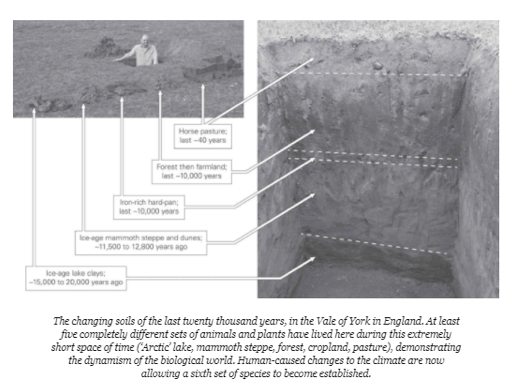
This chapter looks at evolutionary success resulting from human-caused climate change. As example author uses other primates moving up into the mountings, wolves that move to areas they never inhabited before, and finally beetle that expanded to new areas on mass scale. However, author actually refers to general climate change that happens constantly, triggering huge changes in species distribution, evolution and even existence. Here is a nice illustration from the dig in very civilized area in England:
- Pangea reunited
This chapter is dealing with evolutionary changes caused by humans transporting everything conceivable, including all living things, all around the world. Author provides a number of examples of this process, but their number is infinite. In the last few hundred years humans developed tools for practically instant travel, so no wander that everything else uses these tools, whether they buy ticket or not to move around. As the result the whole ecosystem of the planet, actually more than that because it includes minerals, metals, and everything else, become much more dynamic so some species prosper in new environments, while others cannot survive in their original environment anymore because of new competition.
PART III: Genesis Six; Prelude
This part is about perception, which many people have, of current development as the sixth mass extinction caused by humans. The previous 5 extinctions were caused by geological and astronomical events. None of extinctions, however, was complete. At the time of the great many of extinct losers there were some successful winners, for example mammals after dinosaurs, so author here discusses who are survivals of current change and what new species this change brings to live.
- Heirs to the world
This starts with discussion of New Zealand’s successful conservation attempts to save original species that were endangered by new arrivals brought in by humans. Author points out an interesting fact that these animals actually consume plants brought in from Europe, making this the idea of conservation somewhat invalid. In reality it is not possible to recreate bygone environment, even if it is possible maintain parts of it alive, usually at high cost. Author then discusses various methods of regulating environment to bring it to the state preferable to humans, even if it would never be conservation of some original state.
- Evolution never gives up
This chapter reviews some very dramatic and massive changes of environment created by humans, but demonstrates that evolution often works in the complex and unpredictable way, resulting in unplanned and unexpected changes that sometime are beneficial for human objectives and sometimes not, but always uncontrollable.
- The Pangean archipelago.
Here author stresses that current changes do not really decrease diversity of environment, but just change the mix of this diversity making sometimes winners out of invaders, but sometime turning them into losers when local species develop successful adjustment.
- Hybrid
The final chapter of this part is about hybridization that constantly producing new species out of old. He even refers to humans as one of such hybrid at least with Neanderthals for Europeans, but probably a great number of hybridization occurrences over millions years of human evolution. Author very reasonably rejects ideas of genetic purity with tree of live viewed with perfectly separated branches. Reality is very different with species forming, then merging, then splitting and always changing as long as environment changes. It is obviously possible for some species to maintaining themselves in environment when change is slow to nonexistent, but current impact of humans shaking the planet and its species inevitably causes accelerated evolution, at least for a while. It is basically healthy process and it is ridiculous trying to stop it.
PART IV Anthropocene Park; Prelude
This part is kind of summation of this book in which author calls to accept change as a natural part of live and instead of trying to restore some stable ecological environment that never really existed in the first place, humans should look ahead and think and act carefully to impact the ways change occurs so it would happen in direction beneficial for humanity.
- The new natural
Here author argues that humans are the part of nature, not something standing outside of it, so human actions are actions of nature therefore changes caused by humans are natural changes.
- Noah’s Earth
This chapter is about conservation or more precisely about futility of attempt to save something as it is by preventing any change. Normal development includes species going extinct and the new species being developed, rare plans becoming widely spread and widely spread becoming rare, and so on and on. We live now in kind of Anthropocene Part and we both inmates and custodians of this part, so the more knowledge and technology we have the more we can consciously do to make this world livable and dynamically modifiable in the direction we want, including creation and/or extinction of species.
Epilogue: One million years AD
This is highly optimistic epilogue that stresses, and quit convincingly at that, that while we do extinguish lots of species and know that, we really do not understand that we created a lot of new ones, even if mostly unconsciously. Moreover, author claims that it is quite possible that on final count the earth diversity increased due to the human impact, rather than decreased and there is plenty of reasons to think that future world of humans will be as diverse as they would want it to be.
MY TAKE ON IT:
I think it is a great approach to human / environment interaction. I think humanity is on its way to create self-contained production system when producing everything that human need would be restricted to full cycle closed systems with no impact on environment whatsoever. As example I would take production of energy when we are moving from primitive generation of heat from open fire in caves through coal fed electrical plants to small-scale thermonuclear devices that would consume miniscule amount of water and produce clean energy. It does not mean that human would ever become isolated from environment. I would expect that human impact on environment would actually increase and quite dramatically, but it would have completely different objective – instead of obtaining energy and material for survival it would be continuing dynamic modification of environment with objective to make it the most enjoyable for humans and other species that humans would like to have in this environment, probably even some species, specifically designed to make environment more enjoyable. Maybe it would even include some genetically modified lions that, when meeting a lamb instead of tearing it apart would start playing with it, distracted only by need to go and do some human designed exercise that would keep them fit and reward them with industrially produced meat of perfect nutritional value.
20180420 – The Secret of Our Success.doc

MAIN IDEA:
The main idea of this book is based on recent research and experimentation that demonstrates more and more clear that humans became the most successful species due to development of tools for communication and cooperation allowing them to act with incomparable level of coordination and therefore putting them in the Ligue of their own. This process did not occur at once, but was rather a long evolutionary process in which two close connected processes occurred: biological evolution of human body and cultural evolution of human groups. All this could be understood only if looked at together, when, for example, development of language was accompanied by changes in the body that made it capable to produce more and more complicated sounds and gestures, in turn creating evolutionary advantageous abilities for superior coordination between individuals in the human group.
Actually author provides a list of most important insights drown from this book:

DETAILS:
Preface
Here author describes his journey from engineering to anthropology that included forays into psychology, economics and evolution, initially genetic and then cultural, so he refers to names relevant to my own interests: Kahneman and Tversky, Ostrom, Boyd and Richerson, Haidt, and Romer. It is also important that author has hand on experience with ethnographic field research.
- A Puzzling Primate
At the beginning of this chapter author makes a very refreshing statement that humans are not really that smart as they believe they are and that success of human species could not be explained by individual characteristics such as brain size. It is much better explained by the fact that humans are cultural species and as such capable accumulate and use huge amounts of knowledge divided between individuals. This knowledge actually distributed into multitude of different individual skills that are used cooperatively, expanded and rectified across generations, and saved in various material forms so they could be restored as needed even if they are not in anybody’s head anymore. Author also provides a nice layout of the book.
- It’s Not Our Intelligence
This chapter is unusual in its main idea that humans are not really that much smarter than other primates, except for one specific area – social learning. Here is graph of testing results demonstrating just this:

- Lost European Explorers
This chapter presents samples of another poorly understood reality confirmed by multiple natural experiments when people of one culture found themselves in the new environment and were not able to survive without specific local knowledge and skills developed by other cultures, native for the given environment. Author reviews a number of such experiments that occurred with European explorers.
4 How to Make a Cultural Species
In this chapter author classifies domains of knowledge and skills necessary for survival:

After that he linkes this with various features of culture that facilitate cultural learning such as: Skill and Success, Prestige, Self-similarity that lead to aiming for acquiring a specific role in division of labor by sex and other parameters. Author also discusses cultural knowledge accumulation and role of older individuals in transferring successful survival mores from generation to generation. Finally author also discusses methodology of such transfer: conformity and mentalizing.
5 What Are Big Brains For? Or, How Culture Stole Our Cuts
This is about cultural/genetic evolution and author makes a point that in humans, unlike majority of other species, culture is driving genetics and he provide a table of how exactly it happens with reference to chapters of the book relevant to each feature:
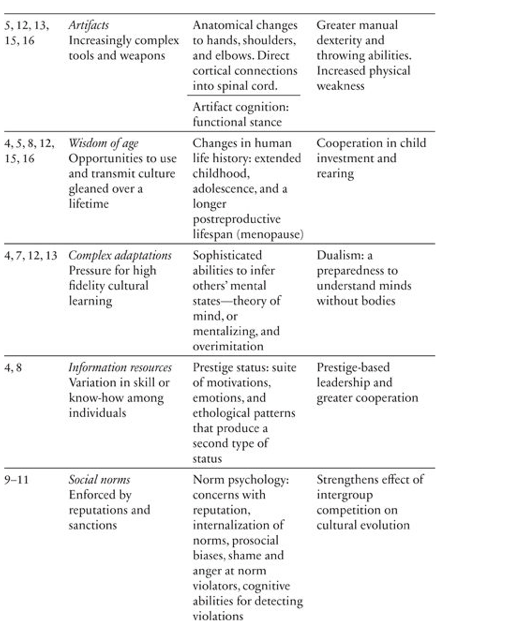
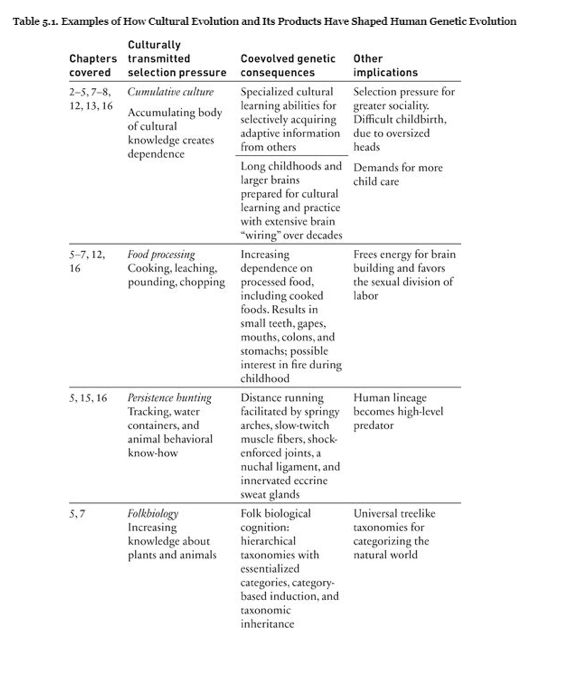

After that author concentrates on relationship between big brain and its function as kind of outsourcing tool when humans outsource expensive big digestive tract to fire and cooking, inherent body weapons and armor to tools such as spear and shields, and so on. It is also interesting that in process humans become optimized for long distance endurance running. Author demonstrates it by discussing muscle composition and other features of human body including incomparable thermoregulation that allows rather save hunting by driving animals into exhaustion. The big brain is also very useful for obtaining and using vast amounts of information about animals and environment via cultural transfer.
6 Why Some People Have Blue Eyes
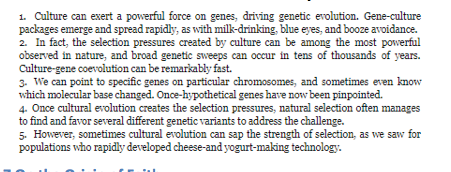
This chapter is about relatively recent human genetic mutations and how they were distributed among various people. Most important, it is about culture/genetic interactions that author summarizes in such way:
7 On the Origin of Faith
Here author moves to an interesting view of faith, including faith and taboos of “primitive” tribes, is information transfer method, which is highly effective and does not require clear understanding of causes and consequences, but assure compliance with the wisdom acquired over very long periods of experience. It is also very positively referring to traditions, which served humanity very well until now when we get into era of fast changes and effective accumulation of information outside of human heads. The chapter ends with interesting proposition that cultural adaptation is as powerful tool as genetic evolution, but works a lot more efficient and fast, resulting in contemporary world in which the humans – animals that developed technology of language and overall culture become absolutely dominant.
8 Prestige, Dominance, and Menopause
Here author moves to internal details of how culture works, discussing two methods of influence: prestige and dominance and providing comparative analysis for them:

9 In-Laws. Incest Taboos, and Rituals
This is about kinship relationship in hunter-gatherer communities that includes not only blood relatives, but also complex “in-laws” relationships and their cultural meaning. The main point here is that there is a multitude of variations with one common feature – one way or another they culturally condition individual to act cooperatively to assure group survival and obtain kind of group insurance for individual survival.
10 Intergroup Competition Shapes Cultural Evolution
Here author moves to the next obvious step – intergroup competition. The first question is how old this competition and simple answer is that it is well documented even in chimpanzees. The second – group expansion at the expense of others is mainly documented with farmers and herders at the expense of foragers, but it is because not that many foragers left and they are practically confined to small areas. However, there is plenty of archeological evidence that human groups expansion occurred on the huge scale initially at the expense of other species – a good example are Neanderthals, and then at the expense of other groups that were less competitive military, which is more than well documented.
- Self-Domestication
This is discussion of rules setting and enforcing, something that author characterizes as specifics of our species:

There are quite a few interesting experiments that author presents in this regard, with some demonstrating automatic character of rule compliance, which actually decreases if people have time to think about it:

After this discussion author looks at the reasons for such automatic cooperation and concludes that it is a necessary tool for survival when individual survival and genes transfer to the next generation depends on one’s group survival and transfer of genes condicted by kin is good enough for evolution to support these features.
12 Our Collective Brains
By “collective brains” here author means totality of knowledge and skills of a group of humans distributed between their brains and/or recorded in some material form so that humans can extract information from these records. He demonstrates importance of this by retelling story of Intuit tribe that lost large number of elders due to disease and as result lost a significant part of their survivability knowledge. Eventually they were able to restore this knowledge only years later after contact with another tribe. Author also discusses similar case in Tasmania and laboratory experiments that demonstrated necessity of access to diversity of knowledge. Here is a graph demonstrating just that:

There is also somewhat interesting reference to Neatherthals who had bigger individual brains, but went extinct probably due to failure outcompete damber, but better organized humans.
13 Communicative Tools with Rules
This chapter is about human communication tools, most important of which is language. Author looks at quite a few important parts of this communication tool and provides a brief summary:

He also discusses how language and its development were impacting genetic evolution of humans.
14 Enculturated Brains and Honorable Hormones
This part is especially interesting because author discusses intermediate point between genetic and cultural evolution of humans such as genetically predefined learning process, which allows to learn one’s native language without accent in specific period of live, but then shuts it down. Author discusses livelong available ability to change one’s body and brain – famous example of London taxi drivers. Another interesting research referred here is on Chinese Americans and influence of unhealthy habits specific to this culture. Here is graph demonstrating this:

15 When We Crossed the Rubicon
Very nicely summarized his understanding of the history of cultural evolution in the table:
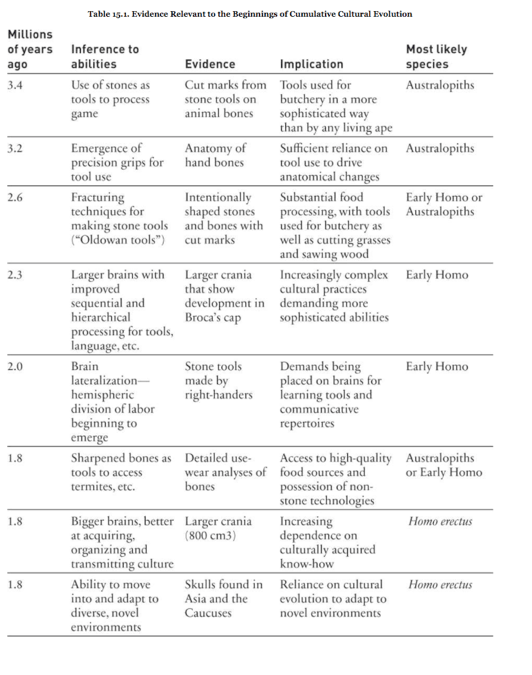
16 Why Us?
Here author discusses very important notion of bridge between animal and humans that we crossed. It is basically intertwining of cultural and biological evolution based on massive communications and cooperation between individuals that exceeds by far anything else that exist in any other group of animals. Here is the diagram demonstrating this bridge:

After that author discusses in details many of the boxes in diagram.
17 A New Kind of Animal
In the last chapter author discusses key changes in attitude to understanding humans and their development from direct linear and progressive path from genes via biology and psychology to culture and behavior to complex process with multiple feedback loops, when changes in culture lead to changes in biology and vice versa. Author also discusses uniqueness of humans and their comparison with other animals.
MY TAKE ON IT:
This is the most complete and well-supported look at the humanity and its roots that I encountered so far. The idea of interconnected genetic and cultural evolutions with multiple feedbacks is in my opinion the most realistic understanding of humans and their movement from an animal similar to any other to completely different creature that not only was able to expand and occupy all conceivable ecological niches, often pushing out or outright annihilating previously dominant species, but also achieved self-consciousness to such extent as mainly to control lots of genetic needs and features that no other known creature can do. Also interesting is that eventually we get to the point when human individual become able to control their own reproduction, produce practically infinite amount of food and other supplies on demand, use technology to significantly improve health, and, most important, turned everything upside down by turning meaning of individual live from successful reproduction, driven by blind evolutionary process into the consciously identified meaning of live being successful pursuit of happiness, whatever it means for any given individual.
20180413 – Fifty Inventions

MAIN IDEA:
The main idea of this book is to review 50 innovations that had significant impact on human live. The very important part of this idea is that author reviews not only technological innovations, but also societal and quite convincingly demonstrates that such inventions had maybe even more impact on quality of live than technological inventions.
DETAILS:
- The Plow
It starts with imaginative scenario when civilization had to restart from the scratch. Author answers to the question where to start with reference to the first invention: plow, which become main tool of agriculture and consequently foundation of civilization. Then in introduction author defines how he selected inventions for this book – not according to their importance either economical or technological, but rather as illustration of some common themes relevant to nearly all inventions.
- Winner and Losers
The common theme in this part is approach to inventions and the new technology from the point of view of winners and losers of this invention.
- The Gramophone
This invention and its spinouts could be generically defined as recording of sounds and images has a number of very clear losers: all people who produce such sounds and images that valuable enough for other people to pay for. The obvious winners are majority of population that now has access to such information produced by the top talent at low price, often even for free even in situation when the person with the talent is long dead. Also, winners are top talents who now can sell their production to millions and correspondingly earn millions. Obviously, the biggest losers are mediocre talents who used to be able successfully compete in a limited locality with access to people close to this locality in time and space, but now have to compete with everybody in the world who ever lived.
- Barbed Wire
This invention dramatically changed human ability to control agricultural property either land or cattle and as such it facilitated Western development in XIX century. Obvious winners were owners and consumers of agricultural products, while squatters become losers with their chances of apprehending free land greatly diminished.
- Seller Feedback
This is about contemporary invention of feedback on business transaction via Internet when individuals not really familiar with each other have new ways to evaluate reliability and honesty of the person on other side of transaction. This invention basically involves a protocol of human relations that decreased cost and increased reliability of transactions and made billions of users of peer-to-peer transactions better off. Obvious losers are crook and unreliable people.
- Google Search
This invention is not really Google, but all computerized search dramatically changed information inequality between parties of business transaction when on one side is professional seller or buyer who has time and resources to invest into market knowledge development because he/she conducts multitude of similar transactions, while on another side is onetime customer who could not possibly do the same. As result traditional outcome was overpayment. In the new world consumer could spend a few minutes to obtain information and level playing field. As usual, the winners are multitude, while losers are professional information traders from used car salesmen to librarians.
- Passports
Here author discusses not that much passports as tool of control over people movements, as immigration of labor and its pluses and minuses. He is firmly on the side of pluses even stating that some economists evaluated that free movement of labor would double world output. But after conceding that it would probably not going to happen any time soon, author defines winners and losers, by wealth of the country that issued passport.
- Robots
This is mainly about all technology based on AI and robotics that could do multitude of tasks that used to be done by people. Obvious losers are people who lost their jobs, but author points out that robots’ bodies are not as good as their AI brains so humans still can find jobs cleaning toilets, at least for a while.
- The Welfare State
This is societal invention of moving responsibility for individual for his/her wellbeing away from this individual, family, and community to the government that would take care about everybody. Author links it to the motherly love with government being the mother, but still points out that it could be too much love so people could be spoiled. Author end this with positive reference to idea of guarantied income.
- Reinventing How We Live
This part is moving from winners and losers of innovation to their impact on our lives and overall functioning of society that changed quite dramatically in recent times.
- Infant Formula
Author retells an interesting story of this invention prompted by volcano eruption resulted in decrease of food supply, so some artificial concoction helped babies without mothers to survive. The resulting separation of infant feeding from mother’s bodies had profound impact on their survival, but also on availability of their mothers for work and other activities that would put distance between them and babies.
- TV Dinners
Somewhat similar effect had invention of industrial food processing that by now provided infinite number of fully or semi processed food freeing humans from necessity to spend a few hours every day preparing food from scratch, which is not very productive activity anyway.
- The Pill
This is about contraceptive pill that drastically changed stakes in sexual encounters by decreasing probability of pregnancy. It not only become foundation of sexual revolution, but also revolutionized economics by opening way for women into professions and other economic activities that demand allocation of time and effort inconsistent with continuing care for multiple children.
- Video Games
It is interesting that author puts video games into category of society changing inventions. He does it based on economic impact of the new form of entertainment that demands some programming effort, but provides a hugely popular way of waste available time, without which the time could be used in less benign for societal stability way.
- Market Research
This is another societal invention that has significant impact on economy. Market research became a tool of discovering and sometimes creating consumer desires, resulting in much higher level of satisfaction for customer and increased economic activity.
- Air-Conditioning
This relatively new invention was prompted by industrial needs, but it opened way for maintaining temperature controlled environment that consequently improved health by decreasing impact of high temperature and, as side effect opened hot South to settlement elsewhere in the world.
- Department Stores
Author presents department stores as invention of not that much concentrating lots of different merchandise in one place, as the development of different attitude to customer, moving from naked strive to sell to much softer attitude of presenting goods and politely helping customer to generate and eventually satisfy desires that they may not have before they start looking.
III. Inventing New Systems
This part is about generating new standards that greatly facilitate exchange of goods and services, by adding compatibility between them and allowing to build unique system and environment serving specific individual needs from parts produced by diverse providers.
- The Dynamo
This is about one of the most important standardized good – electricity and how it slowly over some 50 years substituted steam powered energy supplies in business and the huge impact it had on the methods of production.
- The Shipping Container
This is about the invention that did pretty much the same for transportation. The use of standard containers allowed practically eliminate reloads between different forms of transportation resulting in dramatic decrease of it costs, which in turn opened opportunity for globalization.
- The Bar Code
This is another supplemental information processing technology that allowed relatively easy tracing of smallest goods all around the world, making it another tool of globalization.
- The Cold Chain
This starts with reference to banana republics of Latin America, but then returns back to looking at technological achievement, in this case Cold Chain that actually means refrigerated transport, the technology that allows people elsewhere in the world enjoy bananas and millions of other things that would spoil without cooling. Besides opening for everybody everywhere all fruits and goods that this planet can offer, it provided good insurance against poor harvests and other things that caused lots of problems in the past, but now can be easily managed by transporting staff from the places where it is in abundance at the moment.
- Tradable Debts and the Tally Stick
Author refers here to the old Irish tool of recording debts and then discusses financial mechanisms of supporting trade, manly in primitive and exotic way.
- The Billy Bookcase
This is about another invention that author refers as IKEA’s – shift of final assembly to customers site. The big deal here is that by doing it manufacturer can package product in the most efficient for transportation form, sharing with customer savings on cost transporting a few cubic feet versus a lots of cubic feet of some goods like furniture. Probably the cost of final assembly by customer is much higher that it would be at the plant, but since people usually do not count their own time and effort as money, the method is quite popular.
- The Elevator
This is another technological improvement that greatly changed circumstances of human live. It practically opened the third dimension of space for human settlement. The small one or two-story building providing shelter to one family now can be substituted by multistory skyscraper that provides shelter to hundred families using the same amount of land. While it is not really such a great thing for many people who would prefer not to live on the top of each other, it is perfect for industrial and business facilities providing extremely high-density places for work easily supplied, protected, and cheaply supported.
- Ideas About Ideas
This part is about invention of metaideas, which are the ideas about processing information.
- Cuneiform
This is about an ancient method of writing – the first known method to represent words in abstract pictorial form. Probably nothing could compare with this invention because it moved humans to situation when they could maintain totality of knowledge infinitely higher than sum of knowledge in the heads of all living people.
- Public Key Cryptography
Here author jumps from ancient and hugely important invention to the recent and much less important invention in cryptography. It is nice and dandy, but it has limited application and could and probably will be discarded in the next few dozen years when and if need to keep secrets decrease.
- Double-Entry Bookkeeping
This is obviously more important and much longer living invention, but it is also becoming somewhat obsolete with the continuing progress in technology of capturing and processing information, when much more effective processes and controls developed all the time.
- Limited Liability Companies
Here author discusses invention of limited liability companies as a necessary condition for existence of capitalism supported by opportunity to limit one’s financial exposure and consequently provide more security for investment that was ever possible before.
- Management Consulting
Here author describes managerial consulting as highly value-added activity mainly based on example of its application in Indian textile factories and then quite skeptically discusses effectiveness of this business altogether. Eventually he concludes that it is necessary mainly due to government regulations.
- Intellectual Property
This is another recent (250 years) invention, which is not clearly beneficial. Author even discusses work of economists Boldrin and Levine who suggest ridding of it altogether arguing that it is more an impediment to business than support for new inventions.
- The Compiler
This final chapter in this part is somewhat technical. Computer compiler is the great tool that made programming a lot easier, but it is just one of the steps in development of information processing technology.
- Where Do Inventions Come From
In this part author looks at how inventions occur even if it is not the focus of this book. Author believes that inventions are not a work of a single genius, but rather culmination of multiple small changes merging into one qualitatively important change.
- The iPhone
This is one example – combination of Internet, new batteries, c radio communications, flat screens and lot of other things culminating in what is not really phone, but network integrated computer.
- Diesel Engines; 32. Clocks; 33. Chemical Fertilizer; 34. Radar; 35. Batteries; 36. Plastic;
These all are similar stories of step by step development in various seemingly unrelated area with following on integration into one new technology that delivers huge value in unexpected field.
- The Visible Hand
Here author returns to inventions that facilitate functioning of human societies and he stresses that it is based on institutions that are provided and/or supported government so the idea of invisible hand is not really applicable here.
- The Bank
The first such invention author looks at is a bank and it is a very ancient one so author traces it back to Templars
- Razors and Blades
This starts with a funny story of Gillette who started as philosopher writing against market and ended as founder of business empire. However, it is just a side show, the chapter is really about new method of selling invented by Gillette – cheap or free initial devise with need for continuing supply of expensive consumables.
- Tax Havens
This is another institutional invention that allows global businesses shopping around for smaller taxes, consequently shielding their profits from government.
- Leaded Gasoline 41. Antibiotics in Farming
This couple is used by author to demonstrate how invention could go wrong: lead gasoline poisoning people and unrestricted use of antibiotics develops drag-resistant bacterial that is difficult to handle not only in animals, but also in people.
- M-Pesa
This is about electronic currency and its use in developing countries to go around of usual corruption, for example by paying policemen directly to their iPhone rather than via their chief who take cut from these salaries.
- Property Registers
This is about property rights and their enforcement as condition of effective capitalist development in line with work of de Soto.
VII. Inventing the Wheel
In this part author admits that he did not touch a lot of the most important invention because they change the world way too much and could not fit into the limited space of this book. For example, invention of the wheel was so huge that would require many volumes to analyze. Here are a few of similar in their importance in author’s view:
- Paper; 45. Index Funds; 46. The S-Bend (sanitation); 47. Paper Money;48. Concrete; 49. Insurance;
Conclusion: Looking Forward.
This is about very limited ability of people to predict the future with examples such as book by Herman Kahn and Wiener in 1950 about year 2000. They predicted something that did happened, but also a lot that did not. However, the main lesson here is that process of continuing innovation is not only started, but acquired a huge momentum, so one could expect a lot of it in the future changing the way of live and bringing improvements both technological and societal that are not even imaginable today.
Epilogue: The Light bulb
This is an interesting approach to measure impact of invention of previous century by comparing value of $70,000 income in now and its equivalent in 1900. If adjusted to inflation it would be $1,962,800, so one could buy a lot more of goods and services that existed in 1900, but the problem is that so many important goods and services did not exist, that one would be crazy to accept such bargain.
MY TAKE ON IT:
These book’s inventions are interesting and important in their impact, but I’d like to point out that we are just at the beginning of the process and the most important part is restructuring of society. We are still moving from industrial type of society where real ownership of property is limited to very small number of people and majority had to make living by selling their labor. This method of society organization is becoming increasingly unsustainable because there is less and less need in productive labor either for goods or services. The current method of handling it by providing miserable level of subsistence to less educated and much better level of bureaucratic sinecures to more educated part of population would not cut it because all three groups: productive people, welfare poor, and bureaucrats are bound to be psychologically miserable: the first group because being robbed and the other two because of the lack of agency, which is necessary for human high quality of live. That’s why I think that a huge wave of societal inventions is coming with technological inventions being just a relatively unimportant supplement.
20180406 – The All or Nothing Marriage

MAIN IDEA:
The main idea of this book is to trace high level logic of marriage from economic necessity to the being the tool of self-expression and propose the new notion of marriage: all or nothing marriage that would be flexible enough to be capable meeting needs of the contemporary world with its economic independence of women, value of individual choice, and high demand of investment into growing the next generation. All this is done by using vast amount of empiric data accumulated about contemporary marriage via statistical and sociological research of recent decades.
DETAILS:
Preface: Panic in Evanston
Author starts with the story of the beginning of his development of the new theory of marriage, which started from request for article about marriage. Author looked at all forces that impact this institution and concluded that it is under serious strain and could buckle. More detailed analysis showed that while the institution of marriage is struggling, there is a reason for optimism because good marriages now are better than ever before. In short, he puts it as “all or nothing” theory of marriage. At the end author briefly goes to review of liberal vs. conservative approaches.
Part One Marriage Today
1 Temperamental but Thrilling
This chapter starts with reference to a couple of books called “Eat, Pray, Love” and “Wild”, both about women running away from seemingly good marriages. After supplying this narratives by reference to men doing the same, author looks at the history of marriage in America and identifies 2 great transitions: The sentimentality Transition of 1880s when industrialization allowed people to go above partnering for physical survival and the authenticity transition of 1950-60s when search for fulfilment and change of mores created wave of divorces:
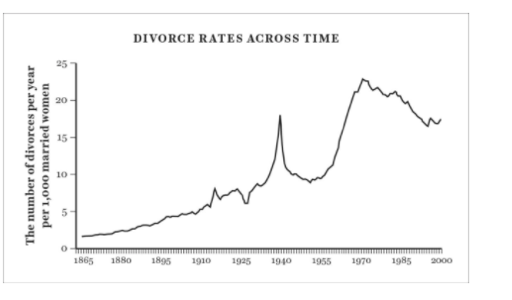
Author links it to Maslow’s pyramid and then discusses Michelangelo effect when people try to create perfect sculpture from “ugly stone” of another person. He also connects it to weakening of social networks that before put pressure from outside to support a marriage and provides a nice graph demonstrating data about this:
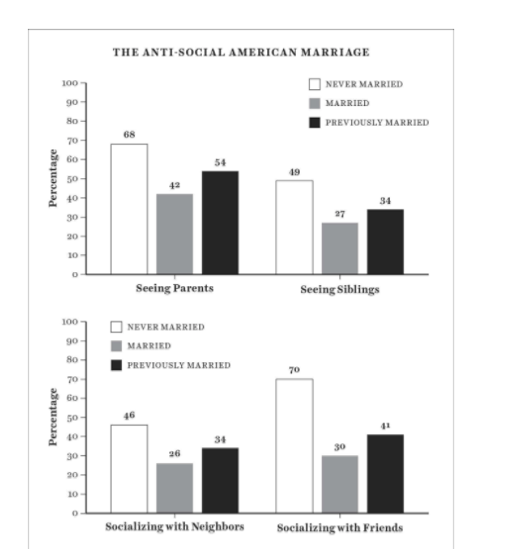
Author also discusses another important point – the growth of demand to other people that is hard to meet for any conceivable marriage partner. Here is illustration:
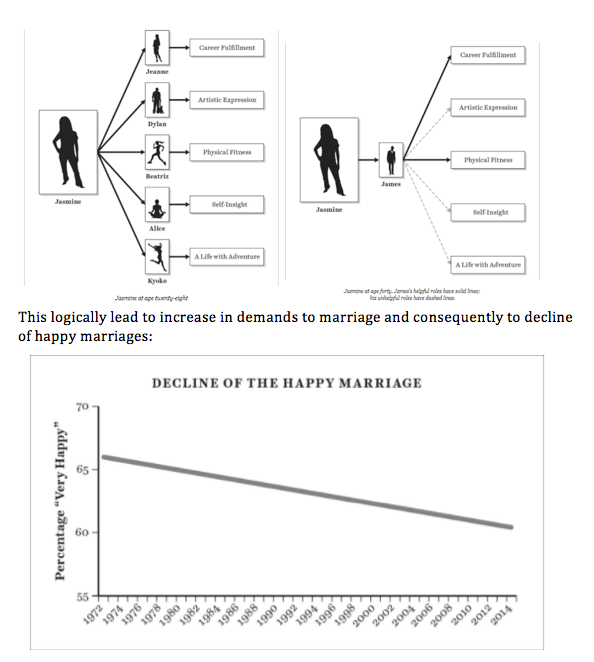
At the end of chapter author discusses his believe that we are actually at the final stages of paradigm change and that the new paradigm is still marriage, only happier one.
Part Two Historical Perspective
This part is historical so author goes through periods:
- Pragmatic Marriage
Marriage for survival, with example of Lincoln parents and through various periods in American history:
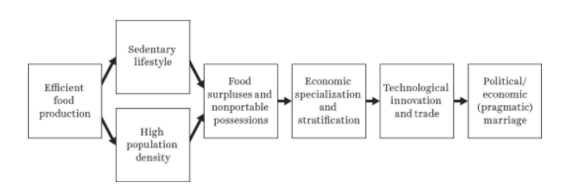
- From Pragmatism to Love
This is about the next step: transfer from pragmatic marriage to search of love. This came with industrialization and huge improvement in survival rates leading to decrease in fertility that provided much more opportunities for women to live their live instead of constantly producing and burying children. This new love based marriage of industrial age came to fruition in 1950s and was undermined after that by 5 important factors:
- Women economic dependence
- Social isolation of nuclear family
- Lack of insight in one’s spouse due to different (working/non-working) live experiences
- Stunted psychological development
- Often subordinated sex drive
- From Love to Serf-Expression
This starts with reference to Sex and the City as a typical example of search for love and meaning in live, which somewhat impedes marriage and then moves to intellectual roots of this process and needs for self-expression. Here is example of results of study of this process:

Author also points out to probably the most important fundamental transformation of society that underlying these processes- change in male/female difference in method of resource acquisition from women being internal family support producer to being equally to men external market producer:

Author presents 5 challenges of the Self-Expressive Marriage:
- The Elusive Self
- The Porcupane’s Dilemma: hard to get close to warm each other
- The Struggle for Balance
- The Inexorable Rise in Demand for Sexual Fulfilment
- Men’s stanted psychological development
At the end of chapter author discuss emerging pattern of Fuly Functioning Couple and again refer to the Sex and the City pointing out that it eventually comes down to marriage.
Part Three: All-or-Nothing Marriage
- Personal Fulfillments and Marital Commitment: The Detente
This starts with discussion of marriage becoming tool of personal fulfilment in late 1700s when couples start forming based on love. This approach was expanding until 1950 when pursuit of happiness and meaning went beyond traditional arrangement. Author provides useful breakdown for these two objectives:

- Marriage at the Summit
Here author compares what he calls “Frightened marriage” with his idea of “All or Nothing” marriage. The “Frightened marriage” is basically the pattern that existed up until now when marriage was necessity for survival and raising children. Now, when industrialization freed people from domestic work, made it easy access to food, energy, and comfort, old forces that kept marriage alive are gone. Now the objective is much more self-actualization via work, entertainment, health maintenance, elaborate satisfaction of natural needs like food and sex, and on and on. Author provides a number of research results demonstrating that time spent by spouses together is declining as well as time spent on children. Author refers this phenomenon to decline in value of traditional marriage that was kept together by external needs, which he calls suffocated marriage. However, he is optimistic that it will be substituted by Enriched marriage, the one that is kept together by common interests of spouses and mutually enriching relationships that are beneficial for both.
- For Richer or Poorer
This is about economic foundation of the new model of marriage. He points out that marriage stressed most of all when economic wellbeing is stressed and links it to the levels of education:

Another interesting chart demonstrates that actuall cultural values are practically the same for all economnic classes of Americans:

Author also discusses a hypotheses that it could be explained by mental deficiencies of lower classes like low levels of self-control and such. As it should be expected, leftists attack it and put blame on external circumstances. Interestingly enough the very high income marriage is often similar to lower class in terms of instability. Author explains it by pointing out that very hihg income peope too busy working and interacting outside of home and find self actualization opportunities there.
Part Four Toward Stronger Marriages
- For Better or Worse
This is about complexity and unreliability of self-expressive marriage – humans tend to change with time and they are not necessary changing in synch, and it shows:
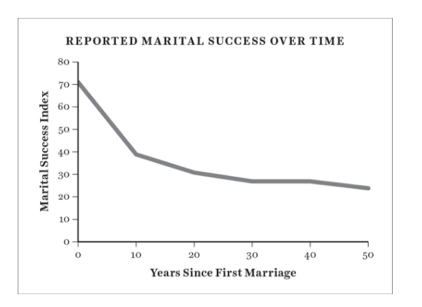
There is also an interesting phenomenon of looking at the process through rose colored glasses. The graph below demonstrates that people look at the past as the continuing improvement, when their actual reporting at the time shows otherwise: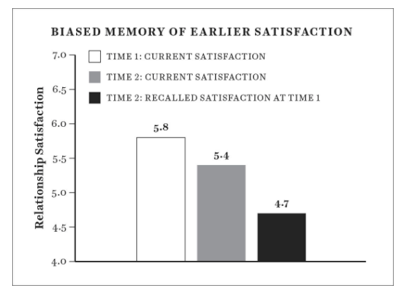
The recommendation author comes up with is: “do not idealize and you will not be disappointed”:
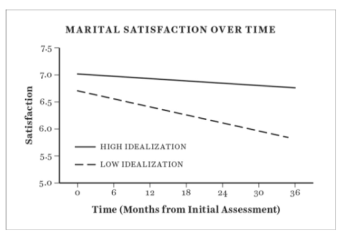
- Lovehacking
This is about psychological tools that could be useful in achieving marital satisfaction:
Another hack is to take third party perspective. The third hack is Abstract Reframing procedure: convert any specific complement into statement of general admiration by a partner. This helps people with low self-esteem:

Also is effective tool expression of gratitude:
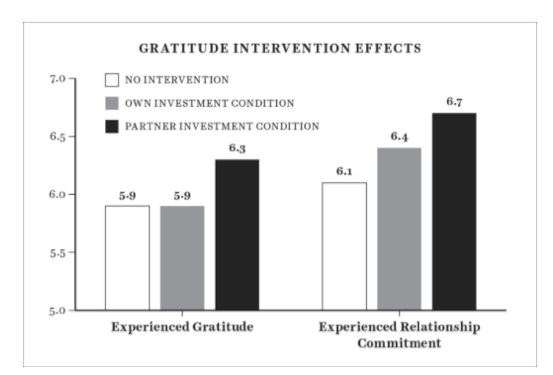
Overall author provide quite convincing data that use of these tools could be effective.
- Going All In
This is about details of handling complex self-expressive marriage. It goes through communications, responsiveness, various activities and such. It also cautions about possible negative consequences of “Going All In” such as revealing incompatibility.
- Recalibrating
This chapter is about recalibrating expectation from marriage if one is going to pursue this new high altitude and complexity marriage with its increased independence and each spouse that could require complex reconciliation procedures in all areas including sex, social interactions with outsiders, consensual non-monogamy. For the last one author provide an interesting graph:

The final graph here is on high value of low expectations for really bad cases, but higher benefits of high expectation if marriage is fulfilling.

- The Marital Buffet
The last chapter is pointing out that Americans now have a huge number of options in marriage and non-marriage, so it would help when one understands what they are before actually making the choice.
MY TAKE ON IT:
I like data richness of this book and generally agree that old institute of marriage needs significant upgrade in order to keep its validity in the age when necessity of domestic work, formerly domain of women or servants, had practically disappeared, in turn making hierarchical structure of family invalid. The effective marriage today got to be cooperative enterprise of free individuals kept together not by consideration of survival or economic necessity, but by huge physiological and psychological benefits that it could bring to these individuals. The value of having a spouse, as the second half of you, different but continuously attached to you for a very long time, could not be matched neither by short-term hookups nor my professional help nor by chemical enhancements. Certainly the process of selection of spouse as live-long partner could be enhanced by psychological and physiological testing that is rapidly developing all the time and by some additional tools that will be developed to support parallel development of individuals over their live time, but I do not think that there is anything else that could match such long term partnership in the level of benefits provided for wellbeing of individual.
20180330 – The Republic for Which It Stands

MAIN IDEA:
The main idea of this book is to review history of American development after the Civil War until end of XIX century and analyze what and how impacted this development and turned America into the country it became at the beginning of XX century. The main points of analysis are the reconstruction and its failure, Western expansion, Indian wars and removal of Indians to reservations. The key for understanding of these events was an American ideology build around the notion of Home and competency, and eventual failure of classical liberalism to respond effectively to industrialization and substitute of independent farmer and planter / landowner with laborer and businessmen as key elements of society.
DETAILS:
Introduction
In introduction author defines main themes of this book: transfer of America from the world before Civil War with its slavery, provinciality, and people’s loyalty to their state to the world after war with its eventually failed reconstruction, massive industrial development, and transfer of loyalty from one of the states to the United States. No less important was process of slow, but continuing decline of traditional liberalism with its laisses faire market and rise of progressivism with its government intervention and struggle between organized labor and owners/management.
Part I: Reconstructing the Nation
Prologue: Mourning Lincoln
Author uses assassination of Lincoln as the starting point, describing how it impacted overall leadership of the country by bringing to power Southerner Andrew Johnson. At the end author uses census data to make a point of how relatively levelled was wealth distribution in America with even somewhat rich people having practically the same live style as relatively poor, in the society with absence of both very rich and very poor.
- In the Wake of War,
Here author present American situation after the war: Victorious North, Devastated South, and mainly unconquered West. Then he defines North objectives as establishment of National Unity, freedom of Contract for everybody, including fully emancipated freedmen. After defining these objectives, author describes realities of the South where emancipation and freedom of contract for freedmen were completely rejected by white population. Consequently, it led to continuing condition of low intensity civil war between North supporters and active blacks, especially ones with military experience, and majority of whites on the local level and similar struggle between Johnson and Republican congress, senate, and administration. In DC this was expressed with Presidential Reconstruction of Johnson, who intended return country to practically pre-war situation sans formal slavery and put high priority on rehabilitation of confederates. This pretty much failed due to activities of republicans at all levels, especially in legislature, but also on sites via Freedman bureau activities. The situation was multilayered: federal legislature was resisting presidential reconstruction, Southern state legislature was trying to return back to prewar situation by implementing black codes, and at the very bottom terrorist activities and overall violence on both sides ran wild. The last part of this chapter stresses how dominant at the time ideology of old liberalism failed to expand from North to South and include freedmen.
- Radical Reconstruction
This is about the struggle between Johnson who slowly, but surely moved in direction of reestablishment of slaveowners power against congressional republicans including radicals who promoted constitutional amendments to solidify victory in Civil War and make emancipation irreversible reality. This struggle included both legislative and ideological fight in DC and all over the country, and low intensity terrorist war in the South. The result was pretty much stalemate with Republicans failing to impeach Johnson, small mainly demobilized army incapable suppressing terrorist activities, and former slave owners taking power back, while emancipation amendments successfully moving ahead.
- The Greater Reconstruction,
This chapter starts with initiation of the next step in Indian wars – Chivington’s massacre of Cheyennes in Colorado in November of 1964. Just after completion of Civil War, US Army, while rapidly decreasing in numbers, nevertheless become very active in cleansing Indians from territories further and further to the West. Here is a nice map representing this process:

The interesting thing about it is that unlike all other countries of colonization period, American exceptionalism was demonstrated itself in complexity of this process when many of American military commanders and political figures tried to bring some order and legality, however shaky, to this process, by continuiously creating treaties with Indians and sometimes even attempting to use force against white settlers to enforce this treaties. Eventually only massive government intervention in the form of sponsoring railroad and western settlement assured conquest of these territories and relegation of Indians to reservations.
- Home
This is a very important chapter for understanding of America because it is about ideological notion of Home, which basically serves as cornerstone of American culture. This notion is much more that building where one lives. It includes competency of the person and his ability to build family and provide for it based on combination of property and work. In this family everybody: husband, wife, children had their roles and were valued by selves and others based on their ability to fulfil these roles successfully. The societally approved objective was not to get rich and powerful, but rather fulfil one’s role in live by achieving competency resulting in building the home, giving good start to the next generation, and retiring with comfortable means. Author discusses in detail how this process was developing initially, how it was supported lately, and provides a nice graph for one of the most important form of such support: homestead movement:
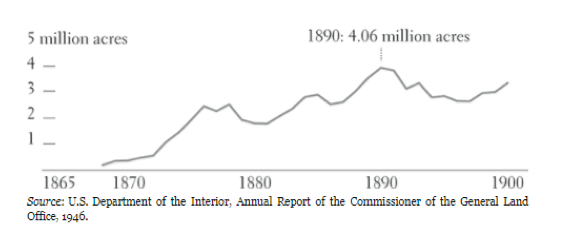
Author makes an important point that the most important objectives of reconstruction were turning former slaves and Indians into homebuilders similar to all other Americans and how both of these objectives mainly fail because of Southern resistance for blacks and cultural incompatibility for Indians. It also applied to other groups: Chinese, Irish, and other immigrants who did not share this concept of home as objective of life’s main effort and often would not be able to achieve it, even if they would want to because members of the idealistic republic of farmers that did not really exist outside of ideological construct of American society.
5.Gilded Liberals,
This chapter is about struggle of intellectuals of Gilded Age to reconcile American ideology of home and competency with realities of live. It went in multiple directions one of them being use of scientific achievement of age such as statistic to build new institutions such as insurance companies to handle randomness of luck. Another was via expansion of education, and yet another one via Social Science represented by ASSA, which author considers the most important classical liberal institution of the time. Finally, this period also included beginning of conversion of classical liberalism of free market and personal responsibility into ideology of supplemental institutions to alleviate individual problems via statistical redistribution of risk with the new liberalism of big government interfering to eliminate problems completely by using force and expert knowledge. Interestingly enough, it all coincided with the struggle against government corruption – usually local government corruption of Tammany hall type.
- Triumph of Wage Labor,
This chapter is about the coming of the new era when productivity growth in agriculture (250 hours per bushel in 1840 vs 150 per bushel in 1880), new goods and services that become available, made old ideas of farmers’ republic invalid. It was substituted by the combination of labor and capital with old middle class of farmers, while converting into the new middle class of small business owners and highly qualified employees, nevertheless losing its ideological and political influence. Author describes this process and allocates a lot of attention to the process of devaluation of labor that become increasingly wide spread due to the nature of labor at the low level of technology when it required little time and effort to get up to speed, making workers easily substitutable, and consequently decreasing their bargaining power to nearly 0.
- Panic
The chapter starts with reference to Grant election in 1972 for the second term. Author stresses the local character of politics at the time, and that the Reconstruction as national issue was not that important for majority of people. Grant was still popular and won easily, but he did not have any big ideas to implement and was traying to accommodate different fractions of republican coalition. Author looks at various scandals that start developing at the time such as Credit Mobilier and them moves to actual panic that started with the crash of stock exchange in Vienna, which undermined European grain trade, causing financial problems in America that was supplying lots of grain to these markets. Combined with switch to gold coins only (Crime of 73), it caused serious recession through the end of Grant administration and beyond. It was especially severe because of the shift to wage labor that left little space for people to fall on when unemployment struck. By the end of panic in 1880 lots of people were worse off than 20 years before. Author also looks at legal developments and failed attempt to implement Civil Rights Act of 1875. The reconstruction ended with elections of 1876 without achieving real emancipation and leaving the South free to establish formal racial segregation.
- Beginning a Second Century
The chapter starts with Centennial exposition where demonstration of progress was combined with absence of Southerners and Indians. Then it proceeds to discuss limits of free labor in the age of monopolies and initiation of unions and strikes. Author discusses practical end of 200 years of Indian wars and kind of settlement with reservations, Indian affairs departments, and Indian dependency on government for mere survival after they were deprived of opportunities to continue their way of live. Author briefly discusses Southern problems, but mainly concentrates on issues of Catholic immigration and related development of new political and economic power – permanent wage workers like miners, steelworkers, and such who did not expect to become independent farmers or business owners and consequently saw the only way for improvement via higher wages and better labor conditions.
Part II: The Quest for Prosperity.
- Years of Violence,
This is about 1876-1877 when after the end of Grant’s second term North gave up on reconstruction in exchange for Hayes presidency and southern racists fully reestablished their rule in the form of segregation. Author describes it in part I, then goes to Indian Nez Perce war of 1977. However, the most attention allocated to economic development: Rockefeller and railroads. This also includes labor struggles, strikes, lockouts, and related violence. Author also discusses political organization of this time with fee-based government and fight between different parts of this political system for wealth and power.
- The Party of Prosperity~
This chapter is about Republican Party that claimed to be a party of prosperity based on tariffs and protected markets. They supported gold standard and correspondingly democrats were for easy money with the use of silver. This period also includes beginning of welfare state with pensions for Civil war union soldiers. Author looks at multiple strains of cultural development from suppression of Mormons into monogamy to beginnings of temperance movement, and expansion of education, including for women. At the end of chapter author discusses election of 1880 with all candidates pretty much scared by raise of monopolies and labor movement with Garfield eventually winning for republicans.
- People in Motion,
This chapter is about immigration and it starts with description of process for English immigrant. It then discusses immigration overall and its impact in late XIX century when newly arrived immigrant could not expect to get land anymore and generally should go to work in urban or extraction industries. It also provides a nice graph for the process:
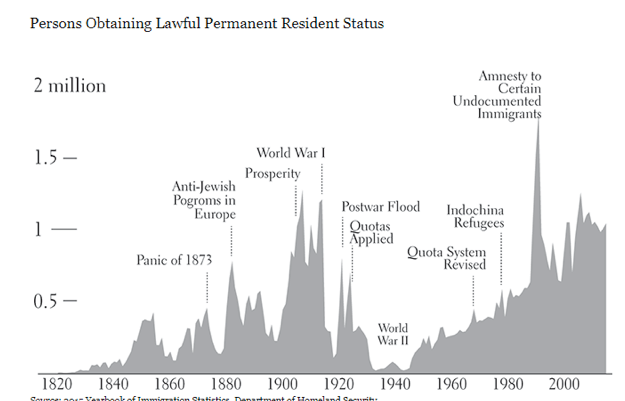
Author dicusses positive economic role of immigration and how it was necessary to populate the country.
- Liberal Orthodoxy and Radical Opinions,
Here author looks at events of 1880s through prism of decaying ideology of classical liberalism that could not handle the new situation of expansion of non-propertied labor that had nothing to fall on in case of unemployment, possess no serious skills that would support meaningful bargaining power, and therefore had to agree to practically any conditions, even if these conditions could not provide sustainable living. Author discusses assassination of Garfield and ideological movements: Spencer, William Sumner, and overall American movement to obtain high level European education, especially in Germany. A special discussion is provided for Henry George and his ideas of right for land and universal tax on rent. Another ideological personality discussed here is Howells who communicated his ideas via popular novels. Finally, the last part of this chapter discusses fight over corruption and eventual road to Pendleton Act that created permanent bureaucracy theoretically ending spoils system.
- Dying for Progress.
This chapter is about hugely negative consequences of industrial development on environment, conditions of live, and consequently on health of American population. Here is a nice graph demonstrating this development:
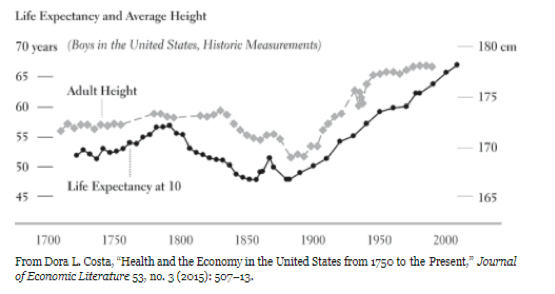
- The Great Upheaval,
This is about that rise of labor movement, and specifically story of Knights of Labor and other similar organizations that at the time seems to be confirming Marxist analysis of human history and development. Nevertheless, even after major strikes and disturbances American system demonstrated its flexibility in accommodating to the new circumstances and successfully handling the Great Upheaval of labor within it framework.
- Reform
This chapter is about various reform movements. It starts with anarchists, Greenback supporters, then moves to evangelicals, temperance movement, and most importantly, to labor movement. The big part of chapter describes anti-monopoly movement, which unlike many others had significant legislative achievements.
- Westward the Course of Reform
This chapter is about western movement and development. It was quite different from initial American development that was driven by settlers with little if any government involvement. The movement of the end of XIX century was government driven via huge land grants to railroads, but also huge expansion of public land ownership. There is a very interesting piece here about cowboys and huge difference between reality and cultural representation. In American culture cowboys represent rugged individualism, guns, freedom, and violence. In reality they were mainly corporate employees because corporations very quickly took over cattle rising. Also interesting is the story of tick resistant longhorns vs. more valuable, but less sturdy regular northern cattle. Overall the western cattle industry was highly dependable on railroads and eventually was not that profitable after all. Author also discusses here attempts to include Indians into regular American culture via Indian schools, development of mining and farming industries on the West.
- The Center Fails to Hold,
This is about political development at the end of century when socialist ideas start penetrating culture, especially intellectual circles, while previously dominant classical liberalism was in full retreat, not capable to handle labor movement based on inability of low skills individual to survive in the free market. The chapter also includes discussion on final expulsion of Indians from practically all valuable land and expansion of homesteads, however faulty it really was.
- The Poetry of a Pound of Steel
This chapter starts with Carnegie and his involvement in both material and ideological areas of American live. It is interesting how his growing involvement with ideas, which were pretty much feel good ideas of peace, brotherhood, education, philanthropy and such, practically pushed him out of area of material production that required competition, cost cutting, including wages and jobs, and similar unpleasant activities, which nevertheless were the only way to achieve efficient production. Author describes in details Homestead strike and other episodes of industrial struggle. A very interesting and not obvious note is that very nice philanthropic initiatives like creation of Carnegie libraries eventually came down to rich man deciding what poor man needs and directing resources of society to building something that was of no use for hard working laborer and later had to be maintained by taxes drawn from these laborers.
Part III: The Crisis Arrives
- The Other Half,
The other half here is the newly arrived immigrants and other laborers. Live of these people was unknown for middle class established Americans. It was later popularized via literature and journalism on the mass scale. This description typically ignored reason for this people to come, which was obviously better live than they had back in places of their origin. It was rather concentrating on perceived failure of free market in creating human conditions of live for these people and necessity of government involvement. Author describes formation of local political machines that facilitated process of immigrant integration, which while hugely corrupted, still helped them to improve their lives. The last part of the chapter is about acculturalization that rapidly occurred if not with immigrant themselves, then with their children.
- Dystopian and Utopian America
This chapter starts with Lizzie Borden and culture of American crime, then moved to Dreiser and world that he described. Then it returns back to South situation with lynching and growing segregation, and then political movements of the end of century, especially populism. However, despite all this, the chapter ends with Columbian Exposition and enthusiasm about America and its future that majority experienced at the time.
- The Great Depression,
This chapter describes the depression of 1893 and panic on Wall Street. It also narrates story of Pullman’s attempt to create perfect factory town with everything from housing to control over behavior provided by the company. Obviously, it did not work, so author next continue discussion of labor movement including new personages like Debs.
- Things Fall Apart,
This chapter starts with Mark Hanna and political maneuvering of McKinley and his tariffs policy. Then it continues describing labor relations and how people start adjusting their lives to unpredictability of labor market and need to maintain saving to handle it. Author also discusses public domain issues such as roads and public lands. At the end of chapter author looks at appearance of judicial activism and ideological background that gave birth to it – rejection of democratic governance as inadequate and ineffective and call for experts to take over.
- An Era Ends,
The final chapter is about the end of post-Civil War era that came with election of McKinley for the second term with Teddy as VP. Even when republicans triumphed in election 1896, their ideology of classical liberalism was in deep decline and mass government intervention into just about everything was just around the corner.
Conclusion,
In conclusion author retells his main points: failure of liberalism to substitute slavery with effective system of contract labor, decline of independent agrarian producer, and raise of labor, capital, struggle between them, ideological movement to socialism, and consequently raise of government in all areas of live.
MY TAKE ON IT:
This as a pretty good and detailed history and I think it shows quite well that decline of traditional American culture and raise of government was a very logical response to industrialization and decline of opportunities for individual producers not only to compete but even to survive in the world of big business closely connected with government. It is also very interesting in demonstrating the extent to which removal of slavery was based on little supported ideology of abolitionism and necessities of war, rather than on rejection of this institution by either Southern or Northern societies, including southern slaves who put relatively little resistance to reestablishment of white dominance. Probably the most important, albeit not really obvious lesson here is that overall huge change of society that occurred after Civil War went amazingly smoothly with relatively small bloodshed. I think it demonstrates significant advantages of Democracy as the system that allows resolution of core issues of society via relatively peaceful interaction of its different forces.
20180323 – Insight

MAIN IDEA:
The main idea of this book is to provide information about psychology of self-awareness, its importance for setting meaningful objectives for one’s live, and necessity of mastering self-awareness in order to achieve these objectives.
DETAILS:
- The Meta-Skill of the Twenty-First Century
It starts with the story of young George Washington and his sad adventure with Fort Necessity, where his arrogance and self-assurance caused defeat. Author describes it as a good example of the lack of self-awareness; so eventually George Washington improved his performance in live by developing self-awareness, the skill, which is absolute requirement for the success. Author refers to studies that demonstrated opposite feature – self-delusion as typical characteristics of many people. She defines two types of self-awareness – internal, which is understanding of self and external, which is the understanding of how others see you. The final and very important point here is that self-awareness is a developmental skill and there is no better example than the older George Washington.
PART ONE: ROADBLOCKS AND BUILDING BLOCKS
- The Anatomy of Self-Awareness: The Seven Pillars of Insight
The chapter starts with reference to Mayan civilization and story of its demise that author presents as the consequence of poor understanding of environment resulting in deforestation and destruction of Mayan ecology. After that she moves to religious understanding of self-awareness and concludes: “self-awareness is the will and the skill to understand yourself and how others see you”. From here author moves to discuss Franklin and Thoreau and their approach to understanding and controlling self from which she derives seven pillars of insight:
- Understand one’s own values
- Understand one’s own passions
- Understand one’s own aspirations
- Understand one’s own fit for environment
- Understand one’s own consistent patterns of behavior across situations
- Understand one’s own real-time reactions
- Understand one’s impact on others
For all 7 pillars it is imported to have 2-way views: from inside and from outside.
- Blindspots: The Invisible Inner Roadblocks to Insight
This chapter is about situation when people completely misunderstand how others perceive them. An example is an executive who believes that he is pretty good with people, but actually is hated by everyone. The author moves to research on criminals, who actually perceive themselves as regular good people. Author defines blind spots of such people as: Knowledge Blindness, Emotion Blindness, and Behavior Blindness. Author suggests some technics to fight this blindness:
- Identify your assumptions
- Conduct double loop learning: make predictions and compare later with actual results
- Constantly continue learning even in areas one is very familiar with
- Seek feedback on abilities and behaviors
- The Cult of Self: The Sinister Societal Roadblock to Insight
This is a bit of a problem that to some extent is caused by recent developments in American culture. As example, author discusses change in children naming from generic commonly used names like John to unique names. It went from 40% getting common names for boys in 1983 to only 10%. For girls it is from 25% to 8%. Author also discusses movement from Age of Effort to the Age of Esteem, when Self-esteem movement made people to look for undeserved appreciation. The recommendation is to combine self-acceptance with understanding objective reality.
PART TWO: INTERNAL SELF-AWARENESS – MYTHS AND TRUTHS
- Thinking isn’t Knowing: The Four Follies of Introspection
Author starts discussion of follies with a good point that thinking about ourselves does not correlate with knowing ourselves and that assumption that introspection begets self-awareness is a myth. Then she discusses four follies:
- Myth of padlocked basement – about access to subconscious
- Why not ask WHY – about asking WHAT rather than WHY as in instead of “Why I do not like” ask “What do I like”. She stated that Why is good to understand environment, but WHAT is good for understanding self.
- Keeping journal – would not help unless done very carefully without overthinking positive and reasonably exploring negative.
- The Evil twin of Introspection – this would-be rumination, constant rethinking of everything. One important point here is that people do not care about our mistakes or successes as much as we think they do.
- Internal Self-Awareness Tools That Really Work
After chapter on follies, this chapter is about doing things right. What works is the mindfulness – simply noticing what we are thinking, feeling, and doing. Another one is reframing – looking at circumstances from different angles. Also, useful tool is comparing and contrasting. The final part of the chapter is about attitude – focusing on solutions or as author puts it: solution mining, which includes defining specific objectives and path of achieving them.
PART THREE: EXTERNAL SELF-AWARENNESS – MYTHS AND TRUTHS
- The Truth We Rarely Hear: From Mirror to Prism
This starts with the story of personal experience when author learned how people really perceived her in the quite close circle of friends, only many years later in random conversation. She uses this to stress how much people reluctant to share their real attitude to a person. After that she points out that others are more objective than ourselves and that even unfamiliar people could provide a lot of valuable information about us. She discusses in details reasons why people are reluctant to discuss negatives, but happy to do for positives. Another issue is that in addition to people reluctant to tell truth, we are reluctant to ask. At the end of chapter author discusses various ways of obtaining true information, especially 360 reviews.
- Retrying, reflecting on, and Responding to Difficult or Surprising Feedback
This is about hearing and learning from the true feedback, which is in and of itself a very difficult task. She provides recommendation for somewhat formalized process of Receive, Reflect, and Respond. She also discusses problems and us of both self-limitation and self-affirmation
PART FOUR: THE BIGGER PICTURE
- How Leaders Build Self-Aware Teams and Organizations
This is about leadership and author builds this chapter about what she calls the three building blocks:
- Modelling the Way
- The safety and expectation to tell the truth
- Outgoing commitment and process of staying self-aware.
At the end author expands the notion of self-awareness from individuals to teams and whole organizations.
- Surviving and Thriving in a Delusional World
This is about accepting world as it is, not as we want it to be and making positive change when it is possible. Author discusses example of Maria – the person who lives in her own reality. Author provides a number of examples illustrating this point. At the end she presents a detailed guide of how to improve self-awareness by using this book.
MY TAKE ON IT:
There is little new for me in this book, but it is still interesting how much our success in live depends on understanding of ourselves and how others perceive us.
Generally tools that author provides are nice, but I doubt that it is possible formalizing such complex thing as self-awareness. It also probably not really possible to see how others perceive us, but it is still worth trying. In any case it is a nice refresher of notion that so much in our live depends on us and it is always useful to try harder to be more self-aware.
20180316 – Doomsday Machine
MAIN IDEA:
The main idea of this book is to use author’s experience as top secret analyst of American chain of command for nuclear weapons in 1950s and 60s to inform everybody in the world that this chain in unreliable, is far different and far less sophisticated than it is shown in the movies. Author also seems to intend to scare people into action against nuclear weapons by informing them that real control over such weapons is not in the hand of presidents, but rather in the hand of medium or even low rank field officers. Finally, even if author does not believes that anybody would really implement his suggestion, he provides recommendation on how to decrease American nuclear options.
DETAILS:
Prologue
Here author presents his credentials as the special assistant to Assistant of Defense secretary in order to establish that that he did had access to the top-secret information and really knows what he is writing about. After that he present a graph of expected casualties of nuclear war that runs into hundreds of millions. He claims that when he understood it he decided to prevent this from happening at any cost.
Introduction
Here is a narrative of how he, as RAND consultant, was one of the main developers of guidance for the operational plans for general nuclear war and then was involved in handling Cuban crises. Then he describes how his conscious made him to copy what become Pentagon papers and lots of other classified documents in regard to nuclear planning that he kept separately with intention to disclose them later. Then he explains that reason for failing to do so was the loss of stolen top-secret documents by his brother. At the end he discusses his learning about American nuclear posture in 50s and 603, states his believe that nothing seriously changed, and presents a number of specific points that he would make in his briefing for president:
- Basic element of American nuclear posture did not change since 60s, especially hair-trigger alert
- USA strategic capability designed for the first strike
- US nuclear weapons in reality regularly used as pointed gun, even if trigger was not pulled since Hiroshima.
- US reject idea to forfeit the first strike, which in author’s opinion promotes proliferation
- American attack could be triggered by wide range of factors not limited to retaliation
- History of Cuban crisis is incorrect because it underestimates the level of danger of all out nuclear war at the time
- Nuclear command and control systems are unreliable and false alarm or some coincidence still could lead to massive nuclear attack
- All these facts are systematically concealed from the public
Part I: The Bomb and I
1: How Could I? The Making of a Nuclear War Planner
Here author narrates his story of growing in the family of professionals, his father’s involvement with development of nuclear weapons, and his refusal to continue this work after the end of WWII. It had no impact on authors career, since father kept it a secret, so author kind of independently moved through academia, then to RAND Corporation as analyst, and, eventually, as RAND consultant got involved in the decision-making theory application to making decisions in regard to nuclear weapons.
2: Command and Control: Managing Catastrophe
This chapter is about author’s research on vulnerability of command system for nuclear weapons. It describes really unreliable early warning systems, which had multiple false alarms and author describes one of the most dangerous when system defined with 99% probability that USA are under attack. At the time only presence of Soviet leader in New York prevented mass retaliation to non-existing attack. After that author discusses in quite a details his assignment to Pacific fleet and processes and deficiencies of nuclear posture of American forces such as: pilots trained to get to the plains daily, but never trained for massive take off, planning deficiencies when such as technically impossible flight plans and schedules, absence of contingency planning for accidents like collusion of planes with nuclear weapons, which could explode, creating false impression of being under nuclear attack and correspondingly mass retaliation, unreliability of communication, that made authorization from president problematic, and such. Overall author seems to encounter culture clash when military culture encouraged people to act aggressively and independently when not sure what is going on because failure to act could lead to the lost time and eventual defeat, while author’s academic culture encourages thorough deliberation with failure to act being not really that significant.
3: Delegation: How Many Fingers on the Button?
This chapter is about authority delegation from president down to lower levels to initiate nuclear strike. Author describes here that the common believe that only president can initiate a nuclear strike is incorrect. Since communications between president and multiple far away bases and fleets is not perfect and it is not unusual that communications interrupted so this power delegation was necessary if US were to avoid the first disarming strike against its forces.
4: Iwakuni: Nuclear Weapons off the Books
This is about US violating treaty with Japan that no nuclear weapons would be situated on its territory. Iwakuni was a base in Japan where American ships with nuclear weapons were based on permanent basis, technically violating the treaty.
5: The Pacific Command
Here author discusses military culture, specifically in the area that he was most familiar with – Pacific command. He especially was concerned that brasses did not see such a big problem in delegation power down, which author believes was unacceptable. Another issue very disturbing to the author was that the planners did not differentiate between China and USSR so attack by one of them would initiate retaliation against both. Author thought that it is a local problem with Pacific command, but later understood that it came from the top where leadership had no intention of leaving someone untouched when USA would experience huge loses.
6: The War Plan: Reading the JSCP
This chapter is about detailed plans of nuclear war that civilian leadership of country including secretary of defense were not familiar with. Author uses it to discuss overall relationships between elected civilian leadership and permanent military leadership, which generally were strained all the time. In author’s opinion military tended grossly overestimate Soviet forces and ability and correspondingly created plans and forces using great overkill.
7: Briefing Bundy
Bundy was Kennedy’s national security assistant and author briefed him on American war plans and his discoveries about command and control on Pacific. He stressed what he thought was the problem with delegation, only to find out later that it was consciously done by Eisenhauer, rather than being a product of unauthorized military overreach. It turned out that author findings that he considered unacceptable were pretty much in line with policies established from the top.
8: “My” War Plan
This describes author participation in development of the new National Security policy for Kennedy administration. Kennedy did not like Eisenhauer’s “mass retaliation” policy. He wanted “flexible” response to attack, so to minimize damage on both sides. Author describes his proposal that would meet this objective, such as instead of immediate use of all missiles use only partial forces and keep “strategic reserve” in order to slow down escalation, not attack enemy cities at one, remove automatic retaliation, everywhere were it was possible use non-nuclear forces, and so on.
9: Questions for the Joint Chiefs: How Many Will Die?
This is about response to Kennedy’s request for damage assessment based on JSCP plan. Author discusses questions that he prepared with clear objective to demonstrate deficiencies of military planning and incompetence of military leaders. Actually, the main point author makes is that for American president risk of all out nuclear war was acceptable in order to save USA as it is, but for author it was unacceptable doesn’t matter what consequences are. Author believed that Joint staff would come up with lowball estimates, but they told the truth about consequences of war – hundreds of million dead. Moreover, military was prepared to deliver the first strike if situation was clearly leading to the war. For author it was unthinkable.
10: Berlin and the Missile Gap
This is the story of Berlin crisis of 1961 when Soviets decide that they would not tolerate mass defection of Germans from East Germany via open West Berlin and demanded peace treaty and transfer control over the whole of Berlin to GDR. USA refused and it brought world to the brink of war. Eventually crisis was resolved by Soviets’ building the wall, but meanwhile military preparations and pressure was on both sides. Based on Soviet success in use of intercontinental rockets US estimated Soviet capability in hundreds of ballistic missiles, constituting a serious gap in missiles. Author claims that since surveillance identified only 4 intercontinental missiles, that gap did not really exist.
11: A Tale of Two Speeches
This is about perception that existed at the time that Soviets believe in their ability to deliver the first disarming strike and could be enticed to do just that. As result author claims that he and other developed speech for Kennedy that highlighted American power overall and demonstrated that first strike would not disarm USA. It caused direct response from Soviets, who were also afraid of the first strike against them. The big part of the problem was that politics of US democracy required reassuring population that current administration maintains or even expands American superiority, but it scared Soviets into believing that the first strike could be coming. Author believes that it caused Soviets to look for countermeasures and Cuba was one of them.
12: My Cuban Missile Crisis
This is retelling of pretty much well known story, only with some details from inside. However, it contains nothing significant.
13: Cuba: The Real Story
I guess the key point of author’s revelation is that top leaders risked a lot to avoid war and it was much more dangerous for Khrushchev, who eventually lost his position partially because of this. Another important part of the narrative is how little understanding is of how much it all depended on lower levels military commanders on both sides, who could use nuclear weapons without any authorization. Especially it applies to commanders of Soviet submarines who at great career risk decided to rise to service when pressed by American Navy, rather than use nuclear torpedoes, as it was required by standing orders.
Part II: The Road to Doomsday
In this part author looks at development of mass destruction weapons and tactics from before WWII and all the way to nuclear weapons and MAD strategy.
14: Bombing Cities; 15: Burning Cities; 16: Killing a Nation
These chapters are about strategic bombing in WWII, that started as impossibility and ended as routine. While initially intended as a method to undermine resolve of enemy population, it actually only increased it, at least until bombing was somewhat tolerable. Eventually it moved from psychological and narrowly military objectives to the objective of annihilating enemy population without much differentiation between combatants and non-combatants.
17: Risking Doomsday I: Atmospheric Ignition
This is about an idea of some possibility that explosion of nuclear device could ignite atmosphere and completely annihilate everything alive. Calculations that were conducted pointed to the very small probability of such event, but it still existed. Author obviously believes that at this point all work should stop and humanity should move away from producing nuclear weapons.
18: Risking Doomsday II: The Hell Bomb
This is about hydrogen bomb, which is not only much more powerful than nuclear, but also has no limit on its power. There were some people who were either against its development or wanted it to be conditional on competition. The main supporter of H-bomb development was Edward Teller and author obviously does not like this man. At the end author claims that it was done under incorrect assumption similarly to believe in Nazi’s advances that were a big driver of Manhattan project.
19: The Strangelove Paradox
The paradox here is between secret development of powerful weapons that are actually doomsday machines and their objective to prevent attack because if adversary does not know power of such weapons, these weapons would not stop this adversary. Author also discusses various scenarios around decapitation and validity of the first strike. Eventually it came down to the “dead hand” technology. Author goes into some details about Russian “Perimeter” system that would initiate nuclear strike automatically if it defined that the attack against Russia already occurred. Author assumes that similar systems were developed by all powers.
20: First-Use Threats: Using Our Nuclear Weapons
Here author discusses the use of nuclear weapons as not retaliation against use of these weapons, but as tool to achieve some objectives. He considers it hugely immoral and demands USA denounce such use regardless of what others like Russia and China would do.
21: Dismantling the Doomsday Machine
Author starts this chapter discussing quite ridiculous idea of slowing down earth movement so that Russian missiles would miss their targets. He uses this as example of insanity and then tries to prove that the very existence of such weapons is insanity. He provides a list of what measures he would like to see implemented, but at the end states that there is no real hope for this to happen. Here are his suggestions, which for some reason apply only to USA:

MY TAKE ON IT:
It is interesting to read about this staff from somebody who actually worked inside of this machine. The levels of organization and safeguard of nuclear weapons is pretty consistent with what I would expect based on my long experience observing control and command system in many other areas of live. However it does not cost me sleepless nights because I believe that normal people are actually more responsible than top-level politicians, because unlike politicians they do have habit of being responsible. The only thing that would really disturb me is if somebody as traitorous as the author of this book would really implemented author suggestions, creating impression for Russians, Chinese, and other enemies that USA is weakened enough to make their first strike an acceptable risk. However real live experience demonstrated that even such president, as Obama, who would probably agreed with author 100%, still was not able to disarm USA and open it for attack, probably to separation of powers implemented in American system. This kind of safeguards gives hope that this dangerous, but tolerable position of nuclear standup will last for next 50-60 or whatever it takes years, before everybody in the world would join Western civilization with its Democracy and market economy. When the whole world join civilization, the worldwide strict control with no exclusions would make it possible to move nuclear weapons to the dust been of history next to Nazism, Communism, Islamism, Chinese supremacism, and whatever other ism history will come up with before that.
20180309 – How to Think

MAIN IDEA:
The main idea here is to review the process of thinking and maintaining or changing one’s believes. This process includes a number of important abilities:
- Ability to tolerate and analyze opinions outside of one’s comfort area, overcoming “true believer” behavior patterns
- Ability to avoid assigning opponents some evil qualifications that would automatically invalidate their points
- Ability to be careful with words so to prevent unconscious accepting or rejecting of ideas based on aura of words used
- Ability to avoid lamping of notions into one bunch, making it difficult differentiate between them
- And most of all ability to understand opponent’s view on its merits, rather than reject it wholesale.
Another part of main idea is to provide tool in form of checklist to organize oneself for better and more effecting thinking.
DETAILS:
Introduction
It starts with the statement that the process of thinking is very important and that we often get it wrong. Author then provides an example of “thinking in action”: buying a car and then reviews all considerations that are going into this decision. After that he moves to Kahneman’s idea of thinking quick and slow, trying to demonstrate that “speed kills”. Next, he moves to an essay by Robinson that discuss consensus and emotions using example of Puritans and their image in popular culture that has little to do with historic reality. He uses it as an example of “everybody is knowing a little bit about a lot of things”. Another point is that when we do not know, we tend to develop emotional attachment to socially approved views. For many people it is becoming quite complicated because we all belong to multiple communities with not necessary consistent socially approved view. The final part of introduction refers to author’s believe that his book provides kind of “diagnostic” approach to the problem of quality thinking, similar to medical approach to symptoms of diseases.
Chapter One: Beginning to Think
This starts with the story of a member of Westboro Church being converted to more civilized attitude via Internet connection to the person with different views who treated her nicely. One of the most important steps in this process was her initial attempt to reject all communications with this person in order to protect her believes. From here author moves to a notion that “thinking for self” is not really possible because humans exist in connection with others and even if one comes up with original deviation from common believes, he would encounter active and sometimes violent resistance from other members of a group. After that author looks at the experiment with Mills junior who was raised in environment of reason and forceful logic that he eventually rebelled against. Author uses this as a study case of relations between reason and emotions. The next point author makes is by using the story of basketball player who was applying in his game less effective, but more attractive to viewers technic, explaining that his real objective was attract girls rather than win games. Author completes this chapter with reference to “What’s the matter with Kansas” pointing out that nobody really can say what is good for other individuals, only themselves.
Chapter Two: Attractions
This chapter once again starts with a person who moved away from the set of believes he grew up with to another set. This time it was from atheism to religion. Interestingly, it occurred in framework of Yale Political Union debate society. The atheist just failed to find logical reasons to contradict theists. Here author refer to Jonathan Haidt’s idea of personality-defined views to which people attracted. The next point is coming from Lewis and Hoffer’s “True Believer” about the need of belonging and links to it membership and compliance with the group worldview. The next part of this chapter is about adjustment that one makes to get what he wants – in author’s case it was correct his views to get his article published in Harper’s. Finally, author uses Ta-Nehisi Goates’s demand for reparations to discuss notion of who derives what and when and how it all should be negotiated.
Chapter Three: Repulsions
This chapter is about tolerance in thinking. It starts with a nice piece on outgroup and how people tend to punish outsiders for being outsiders. Author looks at it from the point of view of two somewhat hostile groups to both of which he belongs: Christians and Academia. Next, he discusses what he calls Bulverism after the name of one of personage of C.S Lewis who present such attitudes: “First assume that your opponent is wrong, then explain his error, but do not try to really find out if he really is wrong or not”. As historical example author provides polemic between Martin Luther and Thomas Moor, which was by far viler, than whatever we can hear now. Finally, author looks at the idea of Rationalia and demonstrates that this could not possibly work in real live because it would require constant System 2 slow thinking that would make all actions all but impossible.
Chapter Four: The Money of Fools
These money are would-be words, which are issued easily, but could convey no meaning or just pure falsehoods. One of the interesting uses, however, is use of some key words that signify common attributes and group belongings. Author provides a number of example and a nice quote from Orwell. Then he goes into power of metaphors, especially war related that put argument into its own fight category. Author then refers to Lakoff’s and its companion Mary Migley book “The Myths we live by”. The point here is that myths are not lies, but rather self-contained representation of the world. Author also discusses contemporary, somewhat Twitter related trend to convey information and ideas produced by others in form of “shorter”, which often distorts transferred ideas, sometime to the level of completely opposite to original. The final discussion of this chapter is about notions of dual booting coming from computers using two operating systems and method acting of actors, both being used as metaphor for attitudes defined by circumstances.
Chapter Five: The Age of Lumping
This is about contemporary habit of lamping together often poorly related people, ideas, and everything else. Author discusses continually growing abbreviation monsters like LGBTQ… and such. Then he moves to poorly translated Lenin’s “Who Whom” changing meaning from who will win in a struggle, into who control whom. This lead to discussion of removing historic names and statues as result of lumping, for example the lumping of the all people of Civil war period South and its soldiers together with idea of slavery. As a countermeasure, author presents value of idea of splitting that should lead to the analysis at the level of individuality, which would be much more reasonable approach to their merits or demerits.
Chapter Six: Open and Shut
This starts with author pointing out that open mind is not only impossible because everybody has convictions, but also unadvisable. As example he brings kidnapping – the activity for which open-minded approach would be more than strange. After that author goes into details of looking at vices, virtues, and sunk costs. As the final point author brings bubbles whether market or ideological and true believers that shut their minds so profoundly that they continue believe regardless of how many times these believes were falsified by events.
Chapter Seven: A Person, Thinking
This is an interesting approach to the connection between language, thinking, and acting. Specifically, it is about English and Democracy. Author uses work of David Foster Wallace. He discusses an interesting notion of Democratic Spirit:
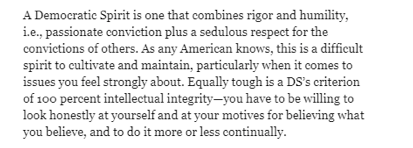
As example of forbearance necessary in democratic debates author uses long going abortion debates in America.
Conclusion: The Pleasures and Dangers of Thinking
The conclusion is about such dangers as change of mind leading to ideological conflict with one’s environment, loosing friends, and eventually being thrown out into the cold. On the pleasure side is finding the truth, getting joy from helping others do the same, and, very important, continue the intellectual journey without final destination.
Afterword: The Thinking Person’s Checklist

MY TAKE ON IT:
It’s a useful book, but it makes a very big assumption that objective of thinking is to obtain some truth and/or convince opponent that one’s opinion conveys such truth. In reality people generally have objective of confirming their own goodness, maintaining whatever benefits they have material or immaterial such as prestige, self-esteem, and confirmation of relevant members of one’s group. Examples of ideological transformation that author provides mainly occur in the process of individual changing his/her group association. I personally believe that the best way to achieve conversion from any ideological position to any other ideological position if to demonstrate very convincingly for individual that he would be better off after changing group association, again either materially or psychologically or both. Neither facts, nor logic, nor anything else would change person position if he/she convinced that continuing association with current group is the most beneficial materially or psychologically.
20180302 – Rebooting Justice

MAIN IDEA:
The main idea of this book is that American legal system, as it stands now, works to benefit lawyers more than anybody else. It is done by overcomplicating proceedings to such extend that normally average educated lay person could not possibly represent self not only in criminal, but even in civil cases. Moreover, in any serious case even professional and outstanding lawyers need another lawyers’ support. It is a huge deviation from original American legal system when per se was not only possible, but also prevalent. This created overblown demand for lawyers that is not possible to satisfy because they are too expensive even for middle class. The remedy provided by Gideon is not effective because free lawyers are overloaded and could not possible handle all cases. The real remedy to these problems should be: simplification of legal process, expansion of paralegal support to substitute lawyers in simple cases, and technology that could help process routine legal tasks. In short: “Less Lawyers, More Justice”.
DETAILS:
- Introduction
This starts with the real live case when authors believe accused murderer did not get a decent defense and then they proceed presenting statistics that justice is often denied in USA such as results of polling of judges with 94% pointing out deficiencies. After that authors move to civil cases, demonstrating that they are also underserved because contemporary American justice requires heavy involvement of professional lawyers, which is not feasible in many cases. Authors discuss Gideon that created requirement to provide free lawyer for poor and demonstrate that it did not really help enough so further and significant changes are required. At the end of the introduction they provide a brief description of each chapter’s content.
Here is brief description by authors:
Part I. The Problem
This part explains the contours of our access-to-justice crisis
- The Reality of Criminal Justice for Poor Defendants
This chapter describes the issue in criminal courts. Criminal defense is, and always has been, radically underfunded in comparison to prosecution and police resources. This underfunding drives larger caseloads, fewer investigatory resources, and much lower salaries. The upshot? Systematic ineffective assistance of counsel is prevalent all over the country. It would be an easy problem to solve if it were a few bad apples. Instead, the system itself forces appointed defense lawyers to plea out as many cases as they can as quickly as possible, often with little investigation and less legal work. Underfunding breeds overwork, and together they lead to poor defense lawyering. The reality is much darker than Gideon’s shining ideal.
- How We Got Here: Criminal Defense
Chapter 3 describes the history of the right to appointed counsel in criminal cases, from colonial times to the present. In the eighteenth and nineteenth centuries, there was no constitutional right to appointed counsel, but criminal procedure was much more straightforward and a literate citizen could represent himself in court relatively easily. In the twentieth century criminal procedure became more complicated and having a lawyer changed from a luxury to a necessity. Courts responded by creating and then expanding a right to appointed counsel. This right started with death penalty cases and then spread to felonies in federal courts, then to state court felonies in Gideon, and eventually to any misdemeanor threatening even a day in jail. This expansion, however, was not accompanied by a strong right to effective counsel. Courts have been very hesitant to second-guess even facially deficient lawyering or to order any particular level of funding or to limit caseloads. What was the predictable result? Defendants have a right to a lawyer but no particular level of service.
- Access to Justice in Civil Courts
Chapter 4 lays out the problem in civil courts. Legal aid funding has been in steady decline since the 1990s, and is down 63% from its high point in the 1980s. Because of limited funding, legal aid organizations turn away more than half of the eligible persons seeking help. Pro bono (charity, free legal help) has grown, but cannot possibly meet the overwhelming need. And legal aid and pro bono are only for the very poor; there is no help for the middle class. If a middle-class person needs a divorce or change in child custody, or must probate a will, she will need to pay a lawyer for help or proceed doing this pro se. Despite a glut of law graduates and unemployed lawyers, hourly rates remain stubbornly high (averaging $190 an hour even for solo practitioners), and even the simplest legal tasks are likely to cost thousands of dollars. Predictably, this has led a number of Americans to “lump it” (live with their legal problems) or proceed in court without a lawyer. But many American courts are not set up to handle pro se cases, and some are outright hostile. The end result is that in the country with the most lawyers per capita, a huge chunk of the population cannot afford to access the courts for the most basic of legal problems like divorce, child custody, and property
- How We Got Here: Civil Law
Chapter 5 addresses the history of the poor and middle class in civil courts. As with criminal law, civil-court procedures and the underlying laws in the eighteenth and nineteenth centuries were simple enough that literate Americans could represent themselves. For example, in the mid-nineteenth century, a number of states allowed any citizen to appear in court. From the 1880s on civil courts came to be lawyers dominated and it was harder for the poor. Charitable legal aid societies were formed to help the “deserving poor” and were eventually converted into government programs, but they have never come close to meeting the needs of the poor, let alone the middle class. Other solutions-pro bono, increased legal aid funding, court appointments, and a proposed civil Gideon right – have all failed. Despite the good intentions of everyone involved, access to civil justice continues to erode.
- The Political Economy of Gideon and Civil Gideon
Chapter 6 explains the political economy of our current mess. If everyone agrees that we have a problem, why has it kept getting worse? Part of the answer is the time and expense of legal education, and part is our adversarial system’s expectation that each side will hire a capable lawyer for itself. Part of the answer is legislative indifference to funding free civil and criminal lawyers. Part of it is natural judicial hesitation to order any particular level of funding or to expand Gideon into civil cases. Part of it is that high defense lawyer caseloads and low funding are key ingredients in America’s shift to a plea-driven system. If we spent more on criminal defense, there would be more investigation, more motions, and more trials. In a nation of rising caseloads and fixed judicial resources, that would worsen the backlog of cases.
Part II. How We Fix It
Part II turns to how America might start to fix this message. The message of Part I sounds gloomy, even fatalistic. Progressive social engineering to provide more lawyers seems doomed to fail. But we must stop confusing lawyers with justice. The prospects for improving access to justice are much better if we are willing to think outside the box, beyond giving each person a full-service lawyer for free. For years, Civil Gideon advocates have argued for transplanting the broken Gideon system from criminal courts into civil courts. In Part II, we argue that is exactly backwards-the nascent pro se court reforms of civil justice should be transplanted into our broken criminal courts.
- Against “More Lawyers More Justice”
Chapter 7 critiques the old ways of addressing these problems, what we call the “more lawyers, more justice” fallacy. It begins with the failed movement for a civil equivalent of Gideon. The Supreme Court has twice rejected civil Gideon, most recently in Turner v. Rogers, a 9-o decision (on which both authors worked on the winning side). Turner signals the death of civil Gideon for the foreseeable future. Civil Gideon is not only unrealistic but unworkable. Gideon has largely failed in criminal courts and would work even worse in civil courts. Creating such a right would make lawsuits slower and more complex, turning them against unrepresented litigants on the other side. The evidence that lawyers are necessary in all cases is surprisingly weak, particularly for simpler disputes. Time and money are limited, and lawyers are too expensive. Plus, courts are much worse at social reform than at doing justice in individual cases. Similarly, we need to break out of the political and legal arguments that have crippled Gideon’s great promise on the criminal side. America will never be able to offer every criminal defendant facing any amount of jail time a criminal defense equal to what the wealthy can afford. But we can focus our efforts on the cases that so desperately need our attention and care: serious felonies.
- Techno-Optimism and Access to Justice
Chapters 8-11 describe the new approaches that have been most successful. Pro se court reform, technology, and a loosening of restrictions on legal practice are transforming some courts from a hidebound anti-pro se attitude into simpler, fairer places where litigants can succeed with or without a lawyer’s assistance. While there are few reasons to be optimistic about the failed approaches of the past, there are many reasons for optimism today. But we must not let vested interests – judges, clerks, and lawyers get in the way.
Chapter 8 discusses technological innovations. Private, nonprofit, and government computerization of legal services have already transformed the market, and we are in the very nascent stages of this revolution. It will be a long time before computers can replicate human legal reasoning fully. But computers can already outperform humans on many routine legal tasks and, as data collection and computing power improve, computers will be able to do more and more. Legal publishers can provide interactive websites and tillable forms for routine transactions. Hotlines, chat rooms, and message boards can answer discrete questions without requiring full-service representation. And interactive websites promise faster, cheaper adjudication without having to gather everyone in the same room at the same time. Internet merchants such as eBay have already proven that online dispute resolution can work cheaply and smoothly.
- Court Reform
Chapter 9 discusses pro se court reform. There are plenty of ways to simplify procedures, forms, and rules so non-lawyers can represent themselves pro se, and many of the most promising reforms have already started. Court clerks should actively assist pro se litigants. Some courts have hired dedicated pro se clerks. America should even expand small claims courts, which often ban lawyers in order to keep proceedings simple and fast enough for non-lawyers. This chapter also argues that we should change the judicial role in some American courts. We can learn from the American system of administrative law judges and from European courts. We can adapt the inquisitorial system, in which court officials actively investigate the facts and probe the evidence instead of relying on the parties’ lawyers. That approach can cut through distracting procedural games to focus on the facts and issues at the heart of a case. Though inquisitorial judging sounds like an exotic foreign transplant, American Administrative agencies already use methods to adjudicate unemployment and Social Security disability claims, and so do small claims courts. In fact, many Americans may be more with inquisitorial systems thanks to Judge Judy, Judge John Brown, and their many imitators.
- Cheaper Lawyers and Paraprofessionals
Chapter 10 describes how we can generate cheaper lawyers and paralegals. Legal education is at an inflection point and, for the first time since the 19506, the possibility of a cheaper, shorter, and more flexible route into practice might be a reality. Right now, students must invest three years and more than $150,000 to qualify as public defenders. Yet, many argue that the current third year of law school is largely superfluous. In many other countries, paralegals, social workers, and notaries provide a range of legal services. Some states have started to experiment with licensing non-lawyers to practice law outside of court. These “limited license legal technician” programs should be expanded. And America must relax its rules against unauthorized practice of law to open the door to these paraprofessionals, much as the medical profession now allows nurse practitioners and physician assistants to provide simple care.
- Criminal Case Triage
Chapter 11 describes how some of these approaches can be imported to criminal court where they should not. America needs to do triage, and felony cases deserve the most funding and attention: They carry the heaviest punishments, the worst collateral consequences (such as deportation), and the most stigma. They also have the most complicated procedures, such as jury trials and related motions, which require lawyers to navigate them. We envision a grand bargain, in which public defenders would spend much more time up front investigating, negotiating and defending felonies. They would also have substantially more support, ranging from private investigators to forensic and medical expert. Their salaries, caseloads, and support should be comparable to those of prosecutors, and their performance standards need more teeth.
By comparison, minor criminal matters should be handled in a manner that does not require lawyers at all, by the state or the defendant~ Simpler cases need cheaper solutions. That is the other half of the grand bargain: cutting lawyers elsewhere to save more for felony defense. The government should not have to provide free lawyers for minor misdemeanors that carry no serious collateral consequences, and states should experiment with simpler, cheaper ways to try these cases. Prosecutors would have incentives to send less serious eases to these faster courts, reserving felony charges for more serious eases that deserved them.
- Conclusion: Fewer Lawyers, More Justice
Chapter 12 concludes the book on both a hopeful and cautionary note. In the face of these problems, reformers may be paralyzed by pessimism, or forget the past and be doomed to repeat it. Efforts to expand Gideon’s dream have repeatedly failed. But Chapter 12’s conclusion argues that these failures can pave a new road to success. Advances in law, medicine, and technology point reward a very different model, one that is simplex, cheaper, more flexible, and less regulated. The current crisis poses a danger, but also an opportunity to loosen lawyers’ monopoly and increase overall access to justice.
Technology also requires a note of caution, however: Technological advances have also made our legal system’s burgeoning complexity possible. Courts, regulators, and legislatures have seemingly endless resources to add layers of additional complexity to our already overweening substantive law. This chapter recognizes that procedural complexity is easier to achieve and more popular, so our book focuses on those solutions.
MY TAKE ON IT:
From all I know, authors’ description of the legal system is seemingly correct as well as diagnosis of its main flaws. The prescription, however, seems to be trivial. I think that it would not be enough. I believe that the main problem is not lack of resources, but rather inequality of their allocation. American legal system has competitive character and as such becomes greatly dysfunctional when competitive sides have hugely unequal access to resources. Whether it is government prosecutor with unlimited access to resources against individual with very limited access, or it is rich man against poor man, the result would always benefit resources rich side. My remedy would be separation of justice processing: investigation – prosecution –judgment between 3 unconnected entities, unlike currently one closely connected entity on investigative / procecutorial side. In my opinion, the investigative entity should be completely independent and have equal interaction with both prosecution and defense, each of which in turn should be completely independent from each other. Currently seemingly independent judges in reality often have background as state attorneys and correspondingly approach cases from point of view of the state. In order to avoid preset legal approaches, judges should be selected from non-legal background at the age when individuals already have a proven success in other areas of live and correspondingly accumulated some wisdom in dealing with diverse people. They should be given 2-3 years deep legal education specifically designed to train them as judges. They also should be limited to a specific time period on the bench, so that they would not have time to develop too much arrogance. As to inequality resources, it could be resolved by demanding competing sides to provide resources into one pool from which equally distribute them to prosecution and defense. The investigating branch should be concerned only with proper collection of evidence and nothing else. Prosecution and Defense should be concerned only with interpretation of evidence in such way as to benefit their corresponding side, and judges should be concerned only with proper application of existing laws in such way that all sides accepted decision as consistent with the law. Judges also should have responsibility to highlight any deficiency in the law itself, if they believe it exists, and present it to legislative branch of government for action.
MAIN IDEA:
The main idea of this book is to review history of WWII through somewhat different prism than usual concentrating on chronology and detailed narrative of events. This book concentrates on components of this struggle: Ideology, Technology, Strategy, Armies, and People. It also stresses diversity of the war when in different places and at different times fighting involved multiple countries and cultures and was very different in its nature and consequences. The narrative supports the idea that it actually was a struggle consisting of multiple wars from somewhat knightly and courteous African campaign when both sides behave more or less according to “civilized” rules of war to Eastern front where no rules except to win at all costs applied.
DETAILS:
Preface
Author starts this book with reference to his memories of growing in 1950s among veterans of WWII. This is the source of his perception of this war as multiple wars that looked very different from each other depending on where people were during these years. This perception of WWII as combination of multiple and quite different war prompted him to write this book not as sequential history of the war, but rather as combination of different views at this huge event from different points: Ideas, Types of combat, People, Technology, and finally Results.
PART ONE. IDEAS
- The War in a Classical Context
This starts with the comparison of WWII with classical wars, which were mainly contests for territories and a bit of robbery. WWII started similarly with Germany trying to obtain more territory, but in process it outgrew this narrow meaning and turned into war of regime annihilation with population annihilated in process. Except for the Germany, for which it became genocidal war with main objective to annihilate Jews, all other sides pursued objectives of conquest and regime change with mass annihilation being only a method to achieve these objectives. Author also discusses unusually huge scale of this war in all conceivable meanings: geographical, number of participants and casualties and so on. Finally, the circumstances of the war initiation in author’s opinion has a lot to do with democracies unwillingness to use force at early stages or even prepare for massive use of force, consequently creating in aggressors’ minds well justified feeling of superiority of will and illusion that their economic inferiority would be irrelevant due to the briefness of the struggle and moral weakness of democratic opponents.
- Grievances, Agendas, and Methods
This chapter is about some details of psychological, political, and historical environment that led to war: grievances from WWI and believes that it was not really lost military by majority of Germans, believes in their Darwinian superiority when natural laws define winners and losers. Author reviews here the moral and intellectual mismatch of aggressors, who saw war as natural necessity and territorial and other demands with democracies that saw war as morally and logically impossible after carnage of WWI. Democracies perceived all territorial and other demands just as a method compensation for humiliation of loss that would eventually lead to satisfaction of aggressor’s demand and peaceful settlement of grievances. Correspondingly aggressors saw their own demands as an intermediate low cost method of attack used only temporarily until enough military strength for attack acquired, after which the total war and overwhelming victory would lead to permanent dominance over the world.
- Old. New, and Strange Alliances
The last chapter of this part is review of war alliances formation and how they changed during the war, which started with coordinated attach of Germany and Soviet Union against Poland, with consequent Soviet semi-neutrality of supporting German aggression economically, but without direct military action. Then, after 2 years of German’s mainly low intensity western war, the attack against Soviet Union made it into the most actively involved military participant that eventually suffered much more damage than any other country. Other countries also changed alliances during the war mainly after defeats, for example defeated France become more or less ally of Germany in 1940, but with Allies getting the upper hand by 1944, France returned to being one of the Western allies.
PART TWO. AIR
- The Air Power Revolution
This chapter is about tremendous technological and tactical revolution that occurred between two World Wars. From lightly armed wooden planes with small bomb load it moved to metal planes capable for decisive input into the war effort from effective tactical support of troops to massive strategic bombing of cities and industries. By the end of war with the use of nuclear weapons it practically achieved proven ability to win war on its own, albeit by massive annihilation of noncombatants.
- From Poland to the Pacific
This chapter is a review of the historical development air forces during the war from successful tactical air attacks that allow German forces dramatically decrease effectiveness of Polish forces to American strategic bombing and firebombing of Japan. This bombing, including use of nuclear weapons, forced Japan surrender without attempt to fight out on Japanese territory for acceptable for imperial Japan settlement by causing high level of casualties for Americans. Author provides an interesting map of the progress of air war in Europe when the new planes allowed Allies expand attacks more and more into Germany:
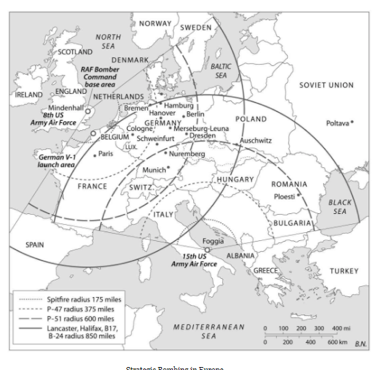
- New Terrors from Above
The last chapter on air power concentrates on strategic attacks on population and industries and their effectiveness or lack thereof. Probably the main point here is that idea of undermining population moral by terror attacks from the air is only valid when such attacks could lead to complete annihilation as it was case with Japan at the end of WWII. In case when it is just caused a few thousands of victims, it only increases population moral in support of war effort, especially when it is possible effectively retaliate, as it was case with attack against Britain using unstoppable missiles. However, strategic bombing demonstrated its effectiveness, even without complete annihilation of population, late in the war when Allied air forces obtained complete dominance over Germany and consequently were able suppress transportation and fuel production, making it impossible for Germany to continue industrial level mechanized warfare.
PART THREE. WATER
- Ships and Strategies
This chapter reviews participants’ navies, their ships and corresponding strategies. The key points here are transition of main power from battleships as main technological platform of early XX century to air careers and submarines as main technological platform of middle XX century, and submarine warfare directed at economic viability of opponent. The main mistakes of Axis power were overinvestment in battleships that were practically unusable either for Italian or German or Japan Navy. Similar mistakes of Allied navies, especially American were much less harmful because of overwhelming industrial power: USA built all of them: battleships, submarines, and air careers in huge numbers.
- From the Atlantic to the Mediterranean
This chapter reviews history of war in two theaters where the bulk if fight was against German and Italian navies. The key was battle of Atlantic between convoys and German submarines that had potential to isolate Europe from American industrial base. Initial German success was highly dependent on technology of anti-submarine warfare and Air coverage. When Allied technology allowed closing these loopholes, the battle was lost for Germany. Somewhat similar, but much smaller in scale and intensity was battle of Mediterranean. The main fight was about British access to resources of their Empire and main plyer was Italian Navy, which was poorly equipped and correspondingly failed.
- A Vast Ocean
The naval battle between Japan and USA followed typical pattern: much better prepared totalitarian militaristic society enjoyed massive success at the beginning, taking over significant part of Pacific resources. However, it failed successfully mobilize and use these resources due to its totalitarian nature. Besides Japan greatly underestimate American willingness to sacrifice and American public ability to understand that any settlement short of complete victory would be temporary with militaristic Japan coming back for more each time more and more powerful after integrating newly acquired resources. Author describes 3 periods of the war in Pacific and how initial Japanese superiority was first eroded, then matched, and eventually not only eliminated, but practically destroyed, opening mainland to complete annihilation.
PART FOUR. EARTH
- The Primacy of Infantry
It starts with the statement of primacy because no victory is possible without boots on the ground. The author looks at increased lethality of infantry weapons and overall their equipment in WWII. Author also briefly discusses specifics of expeditionary forces war and homeland protection war with the former much more “civilized” than latter. Author reviews newly developed methods of airborne infantry and demonstrates that its operations were much less effective than that it was expected. The final point in this chapter is that infantry of all armies was equipped with similar weapons, tools, and protection, but their behavior and effectiveness was different and highly dependent on culture.
- Soldiers and Armies
This chapter is going into details of each country military culture and behavior. Specifically, Soviet army relied on numerical superiority and ability to achieve nearly unlimited sacrifices of its troops reinforced by special detachments at the back of front line that would shoot retreating soldiers on the spot, British relied on professionalism of their troops, Americans on superior firepower, transportation, and overwhelming air and naval support. Correspondingly Germans relied on superiority of their soldiers based on camaraderie regardless of rank, widely acceptable freedom of initiative and decision-making at the lowest level, while Japanese relied on ideological conditioning that they expected to compensate for lack of equipment and firepower. The interesting point here is that both Germans and Russians respected each other as tough warriors and had a bit of contempt for Americans, but it was Americans with their firepower, equipment, and logistic support who were winning most of the time. Author also goes through tactical pluses and minuses of each force demonstrating that overwhelming superiority in firepower over German troop looked quite differently and resulted in different outcome depending on whether it was in Soviet or in American hands. Specifically, American casualties usually were relatively small, while Soviet typically were huge either in victory or defeat. At the end author gives credit land war victory where it belongs to Soviet army that was responsible for a vast majority of German losses, even if ration of Soviet losses to German was approximately 7 to 1.
- The Western and Eastern Wars for the Continent
Here author looks at the war in Europe as several different wars that occurred during period from 1939 to 1945. The first was brief and successful war of conquest by Germany in alliance with Soviet Union against Poland. The second war brought all continental Western Europe under German control. The final success of Germany was nearly complete destruction of Soviet military in 1941. The following initial success of 1942 eventually led to defeat in Stalingrad and then complete destruction of German Military and then political regime during 1943-1945.
- Armies Abroad
This is about specifics of fighting abroad for different armies. It starts with discussion of war in Africa where all: Germans. Italians, and British were fighting on foreign soil and in unusual for them environment. Author makes point that this theater was probably most civilized with all sides having no their own civilians under bombs so they behaved somewhat gentlemanly. After that author moves to look at the war in Italy and France where western allies were fighting on territories with population similar to their own. Author reviews conduct of military operations in these conditions. Author only briefly mentions Russian movement into Germany at this point. It follows with relatively brief description of war in Pacific with its island hopping and continuingly increasing American advantage in all things material over Japanese.
- Sieges
Here author reviews a part of WWII that usually does not attract a lot of attention: sieges. Actually, author refers to Stalingrad battle as siege, but it was not it, but rather just intensive fighting in urban environment. The real proper siege was in Leningrad where for nearly 3 years German troops surrounded city, starving to death more than a million people, but never actually trying to storm it. In addition to these two major battles author discusses other sieges of WWII: Tobruk, Malta, Sevastopol, Singapore, and Manila with Corregidor.
PART FIVE. FIRE
- Tanks and Artillery
This part is about technology of land war, especially its two main forms used: tanks and artillery. At first he looks at theory of tank use developed between WW wars and then moves to actual practice, looking a bit at technical characteristics and numerical ratios. Overall author seems to be trying to find the reason for victories or defeats not only in technology, but also at tactical use of it. Generally, experience demonstrated that superior French tanks of 1940 were nearly useless due to the failure to allocate them to right places in right numbers. Similarly, hugely superior German Tigers were over engineered that resulted in high level of mechanical failures and small numbers of these machines. One of the most interesting things here is that Germans tried, but failed to copy T-34 mainly due to unavailability of materials. Author also reviews history of Sherman tanks for which mass production was put way ahead of quality, making them uncompetitive on the battlefield against Tigers and Panthers. At the end mass production of Allies turned into such a huge advantage that it made qualitative superiority of German armor practically irrelevant.
PART SIX. PEOPLE
- Supreme Command
This is review of personalities of top leaders and an interesting discussion of their roles and ability to shape events. Author points out that it seems to be not necessarily depended on the political system that much. In democratic Britain Churchill’s personality and abilities quite possibly prevented defeatist settlement that would eventually deliver the whole Europe to Hitler, necessitating much more difficult and bloody war, than actually occurred. On the other side, the success of the plot against Hitler could quite possibly led to much earlier German surrender on much better terms. Interestingly enough the most important thing for success turned out to be correct allocation of decision-making power to various levels of the hierarchy so the decisions would be made at the level where people possess maximum information and therefore can actually implement these decisions. Overall overview of the leaders and their behavior demonstrated that they all were far from perfect, but also far from incompetent. Hitler and Stalin, who both were blamed for military failures of their countries, also were authors of their corresponding successes. There would be no quick victory over France or peaceful occupation of Austria and Sudetes without Hitler’s decisions and actions. There would be no Soviet victory without Stalin’s cruelty that cunning abilities, that assured support of allies and effective control over the country. Probably the most important role that leaders played was their ability to make final decision based on multitude of option presented by planners, generals, and managers, which right or wrong always defined the outcome.
- The Warlords
The chapter on Warlords reviews personality and actions of the second layer of military leaders: Manstein, Rommel, Yamamoto, on Axis side and Zhukov, Konev, Montgomery, and Eisenhauer on Allies side. They all were constrained by top leadership, but when allowed to act and provided with sufficient resources more often than not were successful.
- The Workers
This chapter not that much about workers, which on all sides did everything possible to produce maximum possible for their countries, but rather about economic power of these countries that to large extent defined outcome. Here is the nice top-level table of economic power during the war:
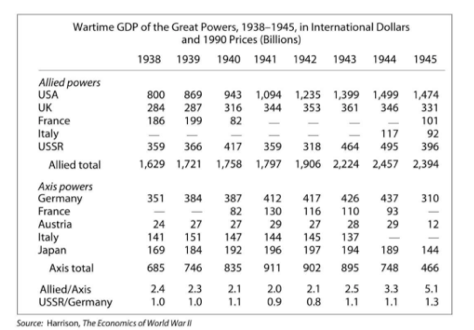
- The Dead
The final chapter about human face of the war and its participants is about those who did not survive the war. Probably the most interesting part here is that unlike all other wars, in this war winning side lost more people than losing side – Germany. The simple explanation is massive annihilation of civilians by German army that included not only Holocaust against Jews, but also indiscriminate killing of civilian population both directly and via starvation. The unusual part of it was that unlike losers of other ideological and racial wars, Germany was not subjected to mass annihilation and enslavement of its population, probably due to the immediate initiation of hostilities between two blocks of allies: Western democracy and Soviet totalitarism that made Germans useful for both sides.
PART SEVEN. ENDS
- Why and What Did the Allies Won?
After disastrous failure of the peace at the end of WWI, it was a very legitimate question. The answer author provides is that WWII provided for elimination of openly fascist ideology all over the world and opened way to transfer of former Axis powers into peaceful and democratic states. Unfortunately, it was also huge victory for another totalitarian system – Soviet communism, which obtained control over huge territory, was massively supplied with advanced technologically, including transfer to them of nuclear weapons by pro-communist elements in American establishment. The resulting power equilibrium led to Cold War.
MY TAKE ON IT:
It’s a good history and as far as I am concerned, the author’s approach seems to work very well. The history of events and their chronology is well known, but lots of details from technological to ideological are distributed all over the place in multitude of different books and are not really connected by one design. This book provides a good overview supplanted by good drill down to details, making it pretty well designed and implemented tool for understanding WWII and its role in bringing human history and development to the point we are in now.
20180216 Why We Sleep

MAIN IDEA:
The main idea here is to provide a review of scientific research on sleep function of animals and especial of humans and demonstrate that this research provides a solid scientific prove that this function of a body is critically important for survival and health. It’s importance is probably somewhere in between breathing, without which animal would die in a few minutes, and food, without which animal would die in a few weeks. This book also demonstrates that sleep is way too complex phenomenon to try interfering in it with some chemical compounds either to promote or deny it. In both cases achieved results are superficial and mainly just imitate sleeping or waking without full providing required functionality of either state.
DETAILS:
– Part1 – This Thing Called Sleep
Chapter 1 To Sleep…
This starts with reference to the importance of sleep and the general notion about it that one has to have some 8 hours, while people regularly have less than that. After discussing this general understanding, author refer scientifically proved consequences: short sleep=short live, persistent lack of sleep= death. Also, not enough sleep decreases performance in just about all areas of human activities, sometime with deadly consequences like micro sleep while driving. Then author discusses reason for animals’ need for sleep that have a lot to do with multiple tasks necessary to maintain body: it calibrates emotional brain circuits, cleans up brain in neurochemical bath, removing waste proteins, refreshes immune system, processes malignancies and sickness, and controls multitude of systems maintaining homeostasis of body including its weight. At the end of chapter author narrates how he come to sleep research and describes the structure of this book.
Chapter 2 Caffeine, Jet Lag, and Melatonin: Losing and Gaining Control of Your Sleep Rhythm
This chapter is about circadian rhythms, which are close, but not exactly the same as 24 hours, as it was established by experiments in conditions imitating absence of natural daily cycle of light and dark. Next author moves to melatonin, accumulation of which causes sleepiness and consequent dissolution of this chemical during the sleep. Similar effect has accumulation of adenosine. Author uses jet leg to discuss rhythms interruptions and then moves to mechanics of caffeine’s blocking receptors for adenosine, creating illusion of sufficient sleep. Author provides a number of graphics for various sleep related cycles.
Chapter 3 Defining and Generating Sleep: Time Dilation and What We Learned from a Baby in 1952
This starts with description of what sleep looks like and then moves to a more details of what is happening in the brain, with the most important part being kind of separation of brain activities from body movements and loss of consciousness. Contemporary sensors allow tracing what is happening in the brain. The findings are that it kind of replays activity that occurred during condition of wake. It also provided access for much more sophisticated reading of brain activity than it was at the time of original discovery of REM and NREM sleep. Here is the graph for typical activities:

Author compares functionality of different stages of sleep to rough cut of analysis of brain activities during a wake stage for NREM and then fine tuning and precise analysis for REM stage. During this process brain defines what is important and what is not, what to save in long term memory and what to discard, which new connections should be reinforced and which should be allowed to decay.
Chapter 4 Ape Beds, Dinosaurs, and Napping with Half a Brain: Who Sleeps. How Do We Sleep, and How Much?
This is about sleep patterns of animals with main conclusion that it is a necessary part of their existence not that different from humans. However, details are different and significantly: REM and NREM not the same. Some aquatic animals that need constant movement have split brain with one half sleeping, while another active. Another interesting pattern is in birds when flock members interchange their place in formation with birds inside formation sleeping, while automatically moving. However, REM sleep is not subject to splitting. The second part of the chapter is about natural patterns of sleep for humans. Author discusses natural sleep patterns as it observed in contemporary hunter-gatherers, which typically has 2 sleep periods: night and afternoon. Another specific of human sleep is that 20-25% of it is REM, which is much more than in other animals. Another interesting point is that humans sleep horizontally, while apes on the trees. Author posits that it provided for more REM sleep, which is conductive to more cognitive efficiency, social complexity, and creativity.
Chapter 5 Changes in Sleep Across the Life Span
This is about difference in the sleep patterns with age, starting even before birth when in utero child sleeps 6 hours REM, 6- NREM and 12 mixes of two. Young children have multiphase sleep with number of phase diminishing with age. The quality of sleep also changes with deep NREM sleep diminishing with age, eventually losing 80-90% of it. Also with the age increases fragmentation of sleep leading to wake-up periods in the middle of the night. Another issue is circadian timing leading aged people to go to sleep earlier. This decrease in quality of sleep has materially negative consequences for the health overall and should be taken care off to achieve maximal improvement.
– Part2 – Why Should You Sleep?
Chapter 6 Your Mother and Shakespeare Knew. The Benefits of Sleep for the Brain
Here author looks at sleep benefits for the brain working. The sleep before learning, and/or after learning improves memory functions and results. Even more interesting, it has a very positive impact on athletic functions. Here is a graph for NBA:

Probably the most important benefit of sleep is increase in creativity – well know fact that unresolvable problem that was excessively worked on before sleep somehow easily solved after a good sleep.
Chapter 7 Too Extreme for the Guinness Book of World Records: Sleep Deprivation and the Brain
This is about the other side: damage to the brain caused by sleep deprivation. The sleep deprivation could be not even consciously perceived, but damage occurs anyway. Here is a graph for driving:

Author discusses here usefulness of a nap and grades it as a positive, but limited measure. After that he reviews negative impact of sleep deprivation on emotional control and even long term consequences: insufficient cleaning of by products in the brain on regular basis could be one of the main causes of Alzheimer disease.
Chapter 8 Cancer, Heart Attacks, and a Shorter Life: Sleep Deprivation and the Body
The final chapter of this part links the sleep deprivation to a bunch of other diseases and even to obesity. At the end author discusses DNA relevance to the development of the sleep patterns and complexity of this issue.
– Part3 – How and Why We Dream
Charter 9 Routinely Psychotic: REM-Sleep Dreaming
This is about dreams, which is practically REM part of sleeping with NREM only 0-20% dreams relevant. Author discusses technological development in picking up brain activity that led to much better understanding of dreams, all the way to ability identify the content of the dreams by MRI data. From here author deviates slightly into intellectual history of dreams understanding from Aristotle to Freud with much more attention to the latter. The conclusion is basically that his theory of dreams is not falsifiable and therefore is not scientific.
Chapter 11 Dreaming as Overnight Therapy
Here author moves to contemporary understanding of dreams functionality. This chapter discusses functionality of dream and REM that support emotional and mental health. Author discusses very material changes in chemical cocktail that occurs in the brain during REM sleep. First of all stress related chemicals get shut off. Then it proceeds to rerun events of the day “divorcing bitter emotional rind from the information-rich fruit”. Author describes experiments confirming validity of this idea and links it to PTSD research and therapy. Another important function of REM is to decode experiences accumulated during the day that due to continuing flow of information could not be adequately processed during waking. It was also experimentally confirmed.
Chapter 11 Dream Creativity and Dream Control
Here author discusses how sleep provides for intelligent information processing. Author starts with the well-known story of Mendeleev who during the sleep was able to arrange chemical elements into the period table, which pointed to the new, yet unknown elements. Then he moves to explanation of this process, which comes from contemporary mathematical development of fuzzy logic and associative networks. Very interesting experiments with waking up people during various periods, demonstrated that NREM processing is logical, hierarchically connected, and associative, while REM create random combinations of fact, ideas, and notions sometimes obtaining non-obvious innovative solutions to the problems the brain is occupied with. The final result is the new model of reality in which there are unpredictable new connections between distant informational elements. This follows by discussion about dreams content and lucidity.
– Part4 – From Sleeping Pills to Society Transformed
Chapter 12 Things That Go Bump in the Night: Sleep Disorders and Death Caused by No Sleep
This is discussion of sleep disorders such as: Somnambulism, Insomnia, Narcolepsy, and Fatal Familial Insomnia. Author stresses that sleeping difficulties are not necessary mean Insomnia and provides specific boxes to check for this diagnosis:

There is also an interesting comparison between sleep and food deprivation with somewhat surprising point that lack of sleep kills faster than the lack of food.
Chapter 13 iPads, Factory Whistles, and Nightcaps: What’s Stopping You from Sleeping
This is about all characteristics of modern live that interfere with effective sleeping: all kinds of lights, multitude of electronic devices, alcohol, which creates illusion of sleep by sedating. One part of chapter is about temperature with recommendation to chill. There is also a bit of discussion of Alarm clocks and their negative impact.
Chapter 14 Hurting and Helping Your Sleep: Pills vs. Therapy
Main point here is that no known pill induces natural sleep. The sleeping pills mainly produce sedation, so the brain scans show completely different patterns of activity than natural sleep. Author recommends non-chemical methods of sleep therapy such as CBT-I (Cognitive behavioral therapy for insomnia).
Chapter 15 Sleep and Society: What Medicine and Education Are Doing Wrong; What Google and NASA Are Doing Right
This chapter provides recommendation for improvement in sleep patterns that could be provided by changing workplace, entertainment, education, medical services, and overall organizational modifications that could be done if sleep availability is a consideration. Author also stresses inhumanity of the use of sleep deprivation for punishment or interrogation.
Chapter 16 A New Vision for Sleep in the Twenty-First Century Conclusion: To Sleep or Not to Sleep
In this last chapter author discusses changes at different level that could facilitate improvement. He even provides a picture for comprehensive intervention at multiple levels and then discusses each level separately:
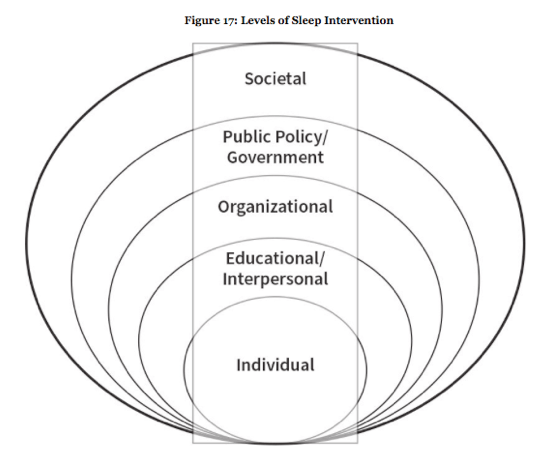
MY TAKE ON IT:
It is a valuable book and there is not much to have an opinion about here: the sleep is important for overall health and crucial for mental health and abilities. That’s all – end of story. I have this knowledge deep in my guts ever since I underwent a violent sleep deprivation for period of 5 months some 45 years ago as a soldier in Soviet army. This book just provides a scientific prove that my gut knowledge is correct.
20180209 Autumn of the Black Snake

MAIN IDEA:
The main idea of this book is to narrate history of the little known American war against Indians in Middle West that prompted creation of American Regular army soon after the end of the Revolutionary War. It was the time when Indian Confederation initially defeated American troops and seemingly created probability of setting up border between Indian nations and American intruders along Ohio River. This probability, however, was short-lived because American Army commander Antony Wayne was able to create an effective military force, which despite of multitude of difficulties, succeeded in defeating Indians and opening the West to American expansion. Author also strives to show complexity of politics on Indian side, with various leaders were both competing and cooperating with each other, Americans, British, and French. These people: Indians as well as Europeans were complex human beings and they all deserve respect and most of all understanding not for their sake, because they are all dead for centuries, but for our sake because people with cartoonish attitude to them are our contemporaries who can cause lots of problems because of their ignorance of history and complexity of history’s people.
DETAILS:
Prologue: The Ruins of an Old French Fort
It starts with reference to the French actions in America that started in Quebec and expanded all the way to Mississippi and down to New Orleans. Author points out the difference between this French expansion, which was mainly trade oriented and created a chain of forts to support it, with English expansion, which was mainly land oriented and, while trading with Indians as well as French, continuously added settlements that pushed Indians out.
Part I: Sinclair’s Retreat
- The Death of General Butler
This part starts with description of battle between Indians and Americans in1791 near upper Wabash River in Illinois. In this battle Indian coalition completely defeated American troops that moved North of Ohio River. Indian leaders Little Turtle and Blue Jacket managed to defeat American troops under general St. Clair veteran of the American war of independence so profoundly that it could stop American expansion into Indian Territory. Moreover, author points out that it could be a beginning of denial to Americans the Western expansion, which was one of the main causes of revolution because British aristocracy did not really wanted this expansion and was willing to leave lands beyond Apalachees to Indians.
- The Turnip Field
This chapter starts with Washington’s learning of defeat and his strong reaction to this news. Then author describes situation with territories North of Ohio river and American – Indian relations that were going in pretty much consistent way: American settlers moved West and North, Indians reacted often violently by killing settlers, American raised militia and killed Indians and destroyed their villages. At some point sides would come together and sign treaty, which typically was violated by American settlers moving to the new territory and Indians by attacking and killing settler families. After describing the process overall, author moves to specifics of Washington’s live and participation in this process, especially his role in seven years war between British and French. At the end of chapter authors refer to the testimony of general Thomas Gage in England Parliament when he stated that it was all about American western expansion and that Britain was duped by the colonies into support of this expansion, even if it did not need and did not want it to happen.
- Drive Them Out
This chapter is about two Indian leaders Blue Jacket and Little Turtle who managed to create coalition that defeated American troops under St. Clair. Author describes formative years of Blue Jacket and influence on him of Delaware named Neolin who retold to Indians of Western tribes the stories of fight against settlers and cruelty with which it was conducted in the East. These stories resonated very well and were amplified by the changed circumstances of Indian tribes. Consequently, it led to Pontiac insurgency and war in which Blue Jacket participated in his youth. The Pontiac war ended in 1764 with Indian defeat. However, one of the results of this war was British attempt to restrict American western expansion and in 1768 British Superintendent of Indian affairs signed the treaty with Iroquois federation restricting white settlements by Appalachians, leaving lots of Americans such as George Washington, who extensively speculated in western lands, out of luck. Here is the map demonstrating this situation with boundary line along Ohio River:

This chapter also describes events leading to revolutionary war and political developments related to western expansion, Lord Dunmore activities, and other circumstances that led to Quebec Act of 1774 allocated everything to the west of Appalachies to the new 14th colony without local representative powers. This outraged Americans and played an important role in leading to the war.
- An Inquiry into the Causes of the Late Unfortunate Defeat
In this chapter author moves to events of 1783 and describes how that led to defeat: congress of 30 Indian nations in southern Erie, British incitement and promises of support to Indians against Americans, low intensity war with high level of atrocities on both sides. Author also uses it to describe the story of another Indian leader – Little Turtle who was leader of Miami and how the coalition of Indians was formed. This was followed by narrative of events on American side during the period when Paris peace was negotiated with defined boundaries to the North between USA and Canada. Nothing like that was established to the West, which Britain left wide open to American expansion. The Western boundary was loosely defined by complete mishmash of Indian treaties, land speculation, and such. Author describes how St. Clair and Harmar started establishing the chain of forts on Ohio River, while Indians were in internal conflict between moderates and hard liners on how to respond to this new stage of American encroachment on their lands. Here is the map of this area with Forts:

At the end of chapter author returns to St. Clair defeat and describes initial concequences of this.
Part II: War Dancing
- Standing Armies
This chapter is about the value of actual standing army vs. militia troops. Traditionally Americans prefer militia, but military leaders with actual experience like Washington knew quite well that militia lacks discipline and straying power to be effective in real combat. Author discusses how Washington worked on creating professional military capable to fight and win revolutionary war only to be practically dissolved afterword. The problem with reestablishment of Army was not only Jefferson and his supporters who rejected the idea, but also Hamilton who probably wanted army to control population more than anything else. Another challenge for the army were the states, which clearly did not want federal government to have potent military power that it could use against them. Author summarizes challenge for Washington this way: without western expansion, there is no nation and without standing army there would be no western expansion. St. Clair’s defeat made it completely clear. Author also discusses European opponents of American expansion, specifically Alexander McKee former British officer and trader who worked diligently on supplying and supporting Indians in order to make them into effective force capable to stop this expansion. He also continuously assured Indians in strong British support. However, he was not able to deliver what Indians really needed – artillery, which was a necessary condition for success for Little Turtle who was quite sophisticated military leader.
- Metropotamia
St. Clair’s defeat caused near panic in all frontier states and here author discusses complex interplay between states’ governors like Pennsylvania’s Mifflin on one hand and Washington and Knox on another, that resulted in Congress deciding to create a small standing army of 5168 people. This chapter also narrates actions on the other side: both British and Indians.
- Mad Anthony
This is the story of Antony Wayne as pretty successful general and hero of revolutionary war who after the war demonstrated extremely poor judgement in business that led him to nearly complete ruin. The same qualities that made him daring and successful commander: strict discipline, risk taking, decisiveness and strictness in dealing with people turned out to be less asset and more liability in business where a lot depends on ability to find compromise and interact with people in flexible way. Similarly, the failure was his fate as politician when he managed to be expelled from his position as congressman for election manipulation, when it was quite acceptable practice for everybody else. It was at this point when Washington and Knox put him in charge of creating the regular army from nothing.
- The Peaceful Intentions of the United States
This chapter starts with the story of John Simcoe who was a governor of Upper Canada and was seeking for Britain the role of mediator between USA and Indians. The obvious objective was to prevent American expansion. The leverage for this was a chain of British forts that were supposed to be eliminated per Paris treaty, but stayed in place, providing support for Indians, albeit limited by the secondary objective to avoid war with USA. On their part Americans were looking for peace, but for such peace that would not stop expansion, which was obviously unrealistic and this chapter provides a detailed narrative of how these efforts failed. It also describes formation of the army under Wayne’s command and measures that made this army into pretty formidable force. The end of chapter discusses competition between two different strategic approaches with Wayne’s winning the approval.
- Legion Ville
This starts with the story of big Indian conference that started in fall 1792 and differences between leaders. At the same time Wayne was believed that his army is ready to move, but was contained by Washington in hope that diplomacy with Indians would deliver if not peace, then at least split between different Indian groups. The Indian conference closed with the victory of hardliners and initiation of war preparation. It also describes competing strategies: Blue Jacket’s pitched battle similar to one that brought in victory over St. Clair and Little Turtle’s idea of attacking supply chain. The several encounters with new army created by Wayne demonstrated that both strategies were insufficient against well-trained and disciplined troops of Antony Wayne. The chapter also discusses political problems in Congress that put the whole military buildup under the question. Eventually war was inevitable because the minimum acceptable compromise for Indians was a border along Ohio River and elimination of American forts on its Northern side. It was clearly not acceptable for Americans. Actually, it is hard to imagine that any border would be acceptable for Americans, whose numbers where growing with more and more new immigrants who become settlers and wanted more and more land.
Part III: The Black Snake March
- Recovery
This chapter starts with return to the place of St. Clair’s defeat, recovery of remains of fallen, and construction of Fort Recovery. Then it discusses complexities of maintaining the force and the beginning of the march in the fall of 1793. Lots of attention is paid to Wayne’s maintaining vigilance so his troops could never be caught unprepared for battle. By the New Year 1794 army was better supplied and pretty much prepared for its mission. After that author discusses Wayne’s second in command James Wilkinson who was prone to undermining Wayne and worked hard to get rich by all means necessary, especially with the use of political intrigues. He even became a Spanish spy, trying to arrange succession of Kentucky. This failed as well as his attempts to unseat Wayne, but even if he was under suspicion, his spaying was definitely proved only a hundred years later. The next part of this chapter is about divisions between Blue Jacket and Little Turtle. The former was aggressive and big believer in various unreal thins including strong British support, while the former was more realistic and, after it become clear that no artillery will be provided, he pretty much understood that Indian cause hopeless as soon as Wayne army demonstrated its professionalism and capability. Author describes the next significant encounter when Indians successfully attacked supply train near Fort Recovery and then unsuccessfully attacked fort itself, leading to their defeat. Little Turtle put condition for British, asking to provide artillery, at least as few as two big guns so he could attack the fort. He also warned British that without this help Indians would not be able to stop Wayne. British refused.
- Fallen Timbers
This chapter describes the final battle when in July 1794 Indians set up an ambush for Wayne army in the area of fallen after hurricane trees. The battle turned out to be complete disaster for Indians, for all practical purposes ending their resistance in this area.
- Black Granite
This chapter starts with overview current state of Ohio where the event described in the book occurred and describes what happened next. Everything was pretty much settled by 1795 and Indians submitted to inevitable and after being deprived of self-sufficiency, started developing dependency, leading to misery and despair that comes with it. Author describes an interesting meeting between Wayne and Indian leaders and how these leaders behavior changed. Blue Jacket become submissive and pushed Indians to accept everything, while Little Turtle who was much less aggressive before, refused participate in imitation of voluntary ceding of Indian land, albeit his objections did not matter and Indian leader eventually signed the new treaty. At least Little Turtle was the last to sign. At the end of chapter author describes what happened with main personae of the story and somewhat complains that it is all now mainly forgotten.
MY TAKE ON IT:
It is a great history book and it provides a very interesting representation of long gone reality of American expansion with all sweat, blood, and tears that were spent on all sides of this struggle. Far from being intentionally genocidal as sometimes presented by contemporary American haters, it was a tragic struggle on both sides, when two incompatible civilizations came into contact with each other and neither one could survive without pushing out and eventually eliminating another. I think that the complexity of this struggle, its inevitability, and impossibility of compromise should be understood if one wants to avoid more of the same. I believe that current situation, when American government maintains the travesty of reservations and illusion of existence of some separate Indian culture / independence, is detrimental to wellbeing of people who consider themselves Indians. I think that best solution would be to move these people to contemporary world by privatization among Indians of all land, obviously on purely voluntary character and let them merge into general American population if they want to, by eliminating government handouts and special privileges. These handouts serve like miserable, but warm prison cell with rations provided physiological live of a prisoner, but deprives this prisoner of freedom and meaningful live.
20180203 The Creative Spark
MAIN IDEA:
The main idea here is to link creativity with human development from just another animal among many to what humans are now: unquestionably the most powerful living creatures that modified environment to fit their needs and overcame unreliability and difficulty of regular animal existence. Author uses archeology to support this by demonstrating how humans start using tools in qualitatively different ways than other animals and then managed to create complex cooperative relationship that supported not just survivability for all, but comfortable existence with unlimited potential for improvements.
DETAILS:
Overture: Trumpeting Creativity and a New Synthesis
Author starts this overture with discussion on what is creativity and defines it as collaborative process of developing new ideas, artifacts, and methods rather than product of individual genius working in isolation. After that he moves to four major misconceptions about humans as the product of evolution:
- Humans being inherently violent and only somewhat subdued by civilization
- Humans being inherently good, cooperative, and altruistic and only somewhat corrupted by civilization
- Humans being a product of long evolution as hunter-gatherers well adjusted to this live style and therefore cannot handle civilization. As result they are getting fat, depressed, and sick.
- Humans by creating civilization and culture transcended boundaries of their biological and evolutionary nature and mold environment to their own design went beyond their ability to understand consequences of their actions resulting in development leading to the danger of complete destruction.
Author rejects these misconceptions and instead proposes the New Synthesis based on four systems of inheritance:
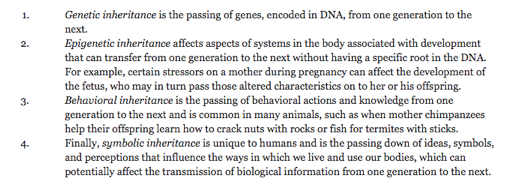
This is supplemented by distinctly human brand of cooperation and by the process of niche construction, which is the change of environment to fit one’s needs. Finally author seems to believe that competition, ever since Darwin, was overestimated as the main engine of evolutionary process and that cooperation is playing not less important part in it. The final point author makes here is that humans, as different as they are, do not represent some king of the top of evolution. All contemporary species have as long history as humans, share lots of genetic information with them, and well adjusted to whatever environment they live in. So in order to understand humans it would help a lot to understand others.
PART ONE: STICKS AND STONES: The First Creativity.
- Creative Primates
This starts with discussion of our relatives – primates, their creativity, and complex relationships. Author describes the story of dominant macaque that was very mean to other members of the group. After breaking his leg, this primate lost power and even was pushed out of the group. Eventually he joined another group at the much lower place in hierarchy, which dramatically changed his behavior to the better. He became friendly, helpful, and overall nice primate. The moral of this story is that behavior to large extent defined not by purely personal characteristics, but also by position in society and primates are flexible enough to control and modify their behavior as dictated by circumstances. After that author moves to primate’s proficiency of using physical objects like rock for various needs either related to productive activities or just for playing. Here is a nice graph demonstrating our tree of relatives:
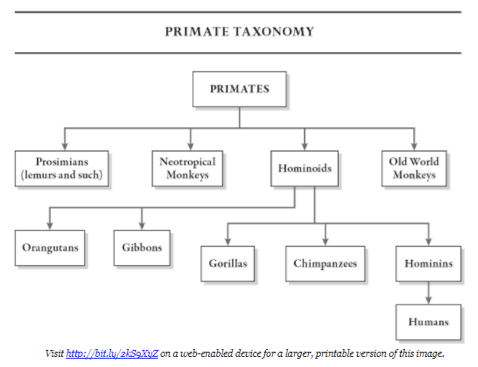
- The Last Hominin Standing
This is about usually poorly understood fact that humans are not really unique in primate development and that there were a number of various hominins much close to us that apes. Author discusses relevant archeological findings and provides a couple very useful pictures demonstrating first relationships, then innovations of various groups and finally the timeline of our group development:
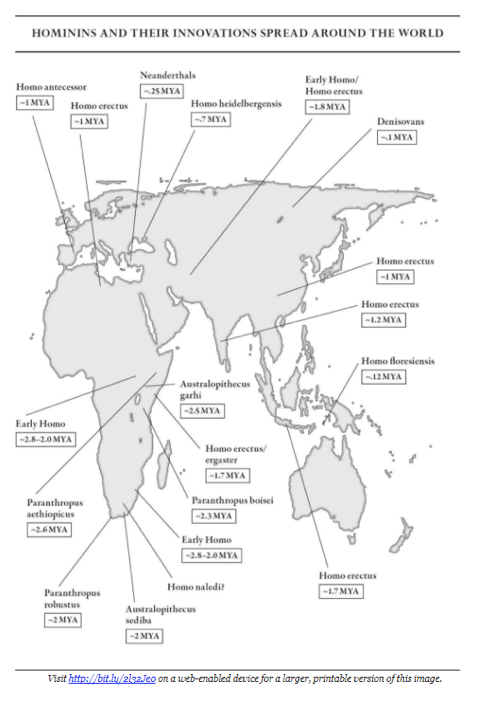


PART TWO
WHAT’S FOR DINNER? How Humans Got Creative
- Let’s Make a Knife
This is about human food acquisition and consumption and it starts with little known and relatively recent discovery that hunter-gatherers actually become hunters quite late in their development. It took a long time before hominids, who do not possess any serious natural weapons like claws, sable teeth, and similar useful for hunting parts of body, learned to use tools and methods for effective hunting. Human hunting depends on two things: tools and cooperation between multiple participants in the hunt. Both these things were developed incrementally with improvement in survivability at each step. Author discusses how initial use of tool greatly approved human ability for scavenging by allowing much better processing of not easily accessible food like nuts, bone marrow, turtles, and such. Author reviews progressive improvement in stone-age technology of producing tools. Very interesting here is description of contemporary reproduction of such effort, demonstrating how complex is this process. Author also looks at usefulness of big brain in process of avoiding being eaten, which was kind of a regular occurrence at the time.
- Killing and Eating, Etc.
This is about continuation of human development when hominids started to apply “power scavenging” when they become capable to push away actual hunters that killed a prey and get to the body first. Interestingly enough, the contemporary technology allows using ossified bones to define which traces were left first: animal claws or human stone tools. There are also traces of cutting and transportation of parts of carcass from the place of killing to the place of consumption. Finally, the knowledge of fire control that was obtained some 1.6 million years ago allowed hominids start using of cooking, which allows extracting everything up to the last calorie from available food.
- The Beauty of Standing in Line
This is about human cooperation and the ability to form a Line as example of such cooperation, which is not replicated by any other species including our close relatives – apes. Author discusses how big brain development was part of feedback loop of increase in cooperation leading to increase in survivability which in turn led to increase in cooperation and level of its sophistication including compassion levels that no other species are capable of. At the end author points to the increase in complexity of human societies sometimes dangerously so and posits question if we are wise enough to overcome these complexities.
- Food Security Accomplished
In this chapter author discusses development of agriculture, domestication of plants and animals and, finally, achievement of food security that actually occurred very recently.
PART THREE
WAR AND SEX: How Humans Shaped a World
- Creating War (and Peace)
This is about war, homicide, and overall violence that is specific for humans and is not replicated by other species. Author discusses the two opposing views: one that it is unavoidable characteristic of human nature and another that it is product of specifics of condition of the society that could and is being overcome by process of civilization. Author also discusses difficulties in identifying levels of violence by using archeological evidence. His example is remains of primate that died 500000 years ago because smashed skull. It would not be possible to say whether it is result of violence or incident. But here is what is possible to say:

All this implies increase in complexity of humn societies and competition, often violent competition between them. Author provides a nice road map of how we get from the point when our ancestors were roaming and scavenging hominids until now:
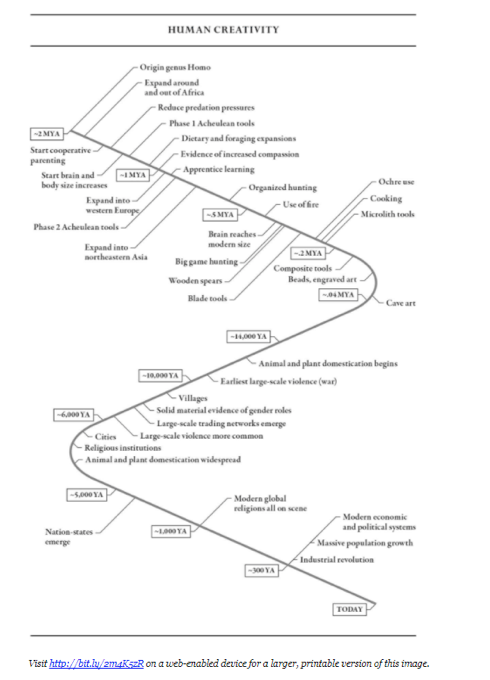
- Creative Sex
The final part of this chapter is about sex and its role in human development, which is going way beyond pure biological necessity to produce the next generation. Human sex is highly diversified tool used for communications, establishment of societal rule and hierarchies, rewards and punishments, and multitude of other purposes. Author also discusses parenting and gender as notion separate from sex and used more for allocation of roles in the group and individual’s conditioning for such role. Author also points out that archeological artifacts does not provide clear evidence about existence of gender in hunter / gatherer societies. Neither toolmaking nor hunting nor any other activity described in ancient pictorials is exclusively male/female. The difference and correspondingly gender seems to be developed with advance of agricultural societies.
PART FOUR: GREAT WORKS: How Humans Made the Universe
This is about ideological representation of the world by human that is applied by using 3 different approaches.
- Religious Foundations
Here author reviews the religious approach to representation of the world. He discusses logic of this approach, various examples and provides population breakdown by religion:

Author also discusses consequences, either positive or not, of religious believes such as sense of identity, religious experience, hope, and ability to cope with lives’ challenges. He provides a review of archeological evidence that indicates presence of religious attitudes since the very beginning of humanity. Another point is review of discussion about Big Gods ideas, how they were developed and their applications.
- Artistic Flights
This chapter is about artistic approach to live that humans also developed since the very beginning and author presents some interesting artifact supporting this idea.
- Scientific Architecture
This chapter correspondingly provides review of quite new scientific approach to the world that started as successful method of handling external material world and now in addition to this it turned internally, looking at humanity itself and trying to make some sense of it.
Coda: The Beat of Your Creative Life
This is a kind of summary of the book with stress on the main point of author, which is: “being human is a creative process” and that he hopes humanity will continue to maintain creativity and improve everything around for millions of years to come.
MY TAKE ON IT:
It is a pretty good review of human path from animal to something more than that. Especially interesting is information on stone tools, how they were produced and how their quality improved over time. I think it is mainly correct approach and it demonstrates an important notion that every step was evolutionary beneficial, so any improvement in stone tools led to improvement in food acquisition and efficiency of its use. As for other parts I think author underestimate role of war in all its form in formation of human brains and development of language and culture. The powerful and expensive brain has quite limited use for individual living in a small isolated group in environment with relatively plentiful sources of food. However as soon as number of groups become big enough so they had to compete for hunting ground and later for the arid land, the war probably became the most important activity that could provide easy access to somebody’s else resources and/or protect one’s own, especially with advent of agriculture, when resources become much less perishable and territorial control much more important. I think that role of creativeness somewhat overstated here, while communication, cooperation, and cohesiveness of the group were much more important. I also think that a bit underrepresented here is the difference between mostly informal communication and cooperation between individuals in the tribe of hunter-gatherers where these processes continuously involve activity of each individual and formal cooperation of contemporary humans when a lot of it occurs via all kind of governmental structures and laws that makes individual involvement from insignificant to non-existing such as transfer resources from producers to qualified consumers young and old.
20180127 – Russian Revolution
MAIN IDEA:
The main idea here is to provide the true history of Bolshevik coup and then revolution that was the first large scale triumph of new socialist ideology in XX century after the old mainly religious ideologies caused wars and mass extermination in previous centuries become mostly benign (at least in European societies) with advance of industrial revolution and materialistic scientific knowledge. I also this this book designed not only as historical narrative, but also as cautionary tale for the current and future civilizations about general fragility of orderly and humane societies and their vulnerability to ideological zealots that could use any significant problems to break thin layer of civilization and through everything into bloody mess.
DETAILS:
PART ONE: The Agony of the Old Regime
- 1905. The Foreshock: University disturbances of 1899 as beginning of revolution Plehve and Zubatov, outbreak of Russo-Japanese War, Plehve assassinated and replaced by Mirskii: the great Zemstvo Congress (November 1904 “Bloody Sunday tsarism tries moderate reform; the debacle of Tsushima and talk of a representative body; university turmoil resumes and leads to general strike; Witte advises concessions; emergence of St. Petersburg Soviet; the October Manifesto; Witte forms cabinet and represses radicals; nationwide pogroms; 1905 as apogee Russian liberalism
This is about prehistory of Russian revolution going back to the beginning of XX century when the first disturbances were to begin. Author looks at the first protests by students that started as non-political but then, after meeting relatively strong suppression, produced significant number of people who were neither broken or annihilated, but had their career ruined. This resulted in them becoming revolutionaries. Then author moves to just a few years later when incompetence of Russian rulers led to dramatic defeat in the war against Japan, demonstrating military weakness of regime, “Bloody Sunday” that resulted in significant decrease of support for the system, and mass movement that forced creation of Duma and October “Constitution”. Author discusses various personalities and their approach to the problem that ranged from accommodation to public demands and cautious movement to some form or semi-democracy, to outright suppression. However, the attitudes and general condition of society allowed only very limited suppression that mainly increased psychological strength of revolutionaries – enemies of regime, rather than eliminating them physically or breaking them psychologically – the processes these revolutionaries brought to perfection when they come to power some 12 years later.
- Official Russia: Patrimonialism; Nicholas and Alexandra; the bureaucracy; ministries; conservative and liberal officialdom; economic development undermines autocracy; the army; the gentry; the Orthodox Church
Here author provides a very interesting description of pre-revolutionary Russia – the society that was definitely flawed and repressive, but functional with relatively moderate levels of corruption. There was little interference of government into economy resulting in healthy growth of industries. However, the unresolved issues of the majority population – rural agriculturalists, continuously produced disturbances in the country. Overall Russian elite was divided into conservative and liberal groups, with liberals getting stronger over time and pushing country to Western way of development. As consequence, the foundation or regime – aristocracy was consistently undermined by economic development of market capitalism. The problem was that aristocracy was not able any more to provide competitive military power that required industrialized army and military production rather than forces based on feudal holdings and aristocrats’ dependents. The ideological foundation of regime – Orthodox Church was also in decline as result of being part of official government. It demonstrated all signs of decay, typical for any ideology that became too bureaucratized.
- Rural Russia: Household, village, and commune; land shortage; industrial workers; peasant mentality; peasant attitudes to law and property; changes in peasant mood after 1900
This is about the majority of population that eventually defined the fate of Russia based on its worldview. This worldview was centered on the 3 pillars: family, village, and commune. The key absent feature was private property on land. The commune allocated and periodically reallocated land, mainly based on number of people in the family. The private property was for outsiders such as aristocracy and later individuals that left commune. Since such individuals often did much better outside than inside commune led to resentment, hate, and continuing aspiration to transfer all land to the commune. Culturally this population was strongly in support of authoritarian model of society, starting with family and going all the way to czar who was the father of the country. Author provides very interesting and detailed review of this most populous part of the people and their slow transfer to rejecting existing system for failure to provide additional land and overall failure to fulfil duties of the father.
- The Intelligentsia: Its European origins; societes de pensee; socialism as ideology the intelligentsia; the Meal of a “new man”; emergence Russian intelligentsia; revolutionary movement in nineteenth century Russia; the Socialists-Revolutionaries; Russian liberals
If peasants were the brown of future revolution that provided manpower, the intelligentsia was its brain. Author provides a very good description of this layer of population and demonstrates how they got to be highly hostile to the regime, mainly because regime, while providing for them opportunity for education and transfer out of peasant’s live of their parents, did not provide real opportunities for achievement and wealth. Also important was ideological part that was mainly developed in the line of socialism as ideal society where pure reason, obviously applied in accordance with ideas and interests of intelligentsia, would rule. The western, especially American way of application of knowledge and skills to business was considered contemptible and shameful. Very interesting is the history of intelligentsia revolutionary development when small parts of this group become professional revolutionaries, sometimes terrorists, while the vast majority provided moral and financial support.
- The Constitutional Experiment: Monarchy and constitutionalism; the Fundamental Laws of 1906; elections to the Duma; the First Duma; Stolypin; Stolypin represses terror; his agrarian reforms; the Second Duma and the electoral law of June 3, 1907; Stolypin’s political difficulties begin; the Western zemstvo crisis; Stolypin’s murder; assessment of Stolypin; Russia on the eve of World War I
This is a history of Russian development after revolution of 1905 until WWII when several attempts were made to eliminate growing pressure in society At first the attempt was via establishment of kind of constitutional regime in form of Duma and then via Stolypin reforms that were targeting to change foundation of Russian society via expansion of private property, dismantling of rural commune, and industrialization of the country. Unfortunately, these attempts failed due to their rejection by country’s aristocratic leadership that could not see that settlement after revolution was temporary and unreliable, by majority of population that still prefer top down authoritarian management, and, very important, by intelligentsia that saw capitalism with contempt and was striving to move beyond it to what they believed would be much more effective and efficient organization of society: socialism.
- Russia at War: Strategic preparations and Russia’s readiness for war; early campaigns: East Prussia and Galicia; Russian debacle in Poland, 1915; changes in government; emergence of the Progressive Bloc and Nicholas’s assumption of high command bringing society into limited partnership in the war effort
This chapter is about Russian participation in WWI and calamity that it created. Russia was not ready for the war of such scale, neither culturally nor organizationally. This led to defeats on the front lines and significant difficulties with army supplies. Nevertheless, contrary to the common views, author demonstrates that these difficulties where in main successfully overcome in such areas as industrial production, providing military with enough ammunition and supplies. However, it was too late because society’s morals and cohesiveness dropped dramatically, opening gates for decline of discipline in military and mass disturbances ignited by the smallest problems. Russia was not the only country that came under pressure as result of the war, but while in UK and France democracy served as a safety valve prevented the explosion, in Germany strong middle class was able to defeat revolution, albeit temporarily, in Russia combination of mass peasant army, restless intelligentsia soaked in socialist ideas, and weak personalities in power led to conditions susceptible for complete breakdown.
- Toward the Catastrophe Inflation: the Brusilov offensive; rise of tension in the country;
Protopopov; the liberals decide to attack; Duma sessions of November 1916; assassination of Rasputin; last days at Tsarskoe Selo; plots against the Imperial family
This chapter is about pre-revolutionary situation in Russia when despite significant improvements in military production, army continued experience defeats, while leadership of the country was messing with Rasputin, court intrigues, and similar staff. The population meanwhile was growing anxious due to decrease in quality of live and especially inflation. Author present a table showing growth of inflation:

- The February Revolution: Mutiny of Petrograd garrison; the Duma hesitates to claim power emergence of Petrograd Soviet and of its Executive Committee; Duma and Soviet agree on formation of Provisional Government; Order No. 1; abdication of Nicholas II; Michael refuses the crown; early actions Provisional Government; Soviet undermines the government; land, Constituent Assembly and war aims; revolution spreads nationwide; ex-tsar returns to Tsarskoe Selo; extraordinary rapidity Russia’s breakdown
Here author clearly describes a spontaneous character of the February revolution. It was not something planned and organized, but rather result of accumulation of public loss of believes in existing system of government’s ability to provide order necessary to maintain normal living condition. Interruption of supplies that created lines for food and fuel, inflation, and continuing agitation against government created environment were support of existing regime mainly evaporated. It was accompanied by incompetence of military leadership that managed to concentrate unreliable troops in and around of the capital city making it practically impossible to enforce any decisions that government would try to implement. The result was nearly bloodless removal of old regime generally supported by all parts of population. After describing how revolution proceed, author moves to detailed description of continuing power play between two emerging power centers: Soviets and Provisional government, none capable to take complete control over the country. As result no effective order could be established, negatively impacting both war effort and ability of population to make living. Interestingly enough support for war remained strong, contrary to usual description of this period in soviet historiography so it was not a significant factor in future rejection of democracy in Russia. It was rather inability of new elite to run country and its unwillingness to move quickly to establish some form of democracy that left huge vacuum of authority.
PART TWO: The Bolsheviks Conquer Russia
This part describes how the existing vacuum of authority was filled by a small, not really well organized, but dedicated, ruthless, immoral, well financed by enemy power, and, very important, highly ideological group of revolutionaries that had no limits in their readiness to kill and die in struggle for victory of their ideology.
- Lenin and the Origins of Bolshevism Lenin: Lenin’s early years; Lenin and Social Democracy; his personality; his disenchantment with Social Democracy; emergence of Bolshevism final split with the Mensheviks; Lenin’s agrarian and nationality programs; financial affairs of the Bolshevik party; the Malinovskii episode; Zimmerwald, Kiental, and connections with enemy agents
Here author describes Lenin’s personality as it developed from mainly apolitical son of self-made high-level bureaucrat who achieved heritable nobility, to highly political and ideological individual with somewhat misanthropic characteristics. Author stresses, that the turning point of this development could be traced to university of Kazan disorders that practically put end to Lenin’s career opportunities within existing system, pushing him into revolutionary movement. Interestingly author points to Lenin’s contempt to individual human lives combined with cowardice and deep care of his our wellbeing. As Lenin’s assets author listed hard work, organizational capability, and dedication to revolution. Lenin’s intellect was keen, but severely limited by his concentration on narrow area of revolution and theoretical Marxism. Important and obvious part of Lenin’s personality was complete immorality in all things big and small. This immorality was a huge asset that allowed Lenin not only successfully take over control of the party and then country by manipulating other people, but also to survive in power by playing off leadership of other countries from Germany to Britain and Japan.
- The Bolshevik Bid for Power: The Bolshevik Party in earls 1917; Lenin returns to Russia with German help; Lenin’s revolutionary tactics; the April 1 ~ Bolshevik demonstration; socialists enter Provisional Government; Bolshevik assets in the struggle for power and German subsidies; the aborted Bolshevik street action in June; Kerensky’s summer offensive; the Bolsheviks ready another assault; preparation for putsch; the events of July.3=S; the putsch suppressed: Lenin flees, Kerensky dictator
This chapter is about the first phase of Lenin’s revolution when he and his supporters return to Russia with German help that was provided in hope to use his movement to push Russia out of war. The first attempt to take power by Bolsheviks in the summer of 1917 was unsuccessful mainly because their nature as German allies working to undermine Russian war effort was disclosed. However weak provisional government and ideologically sympathetic members of other socialist movements helped them to get away with it, recover and start preparation for the second attempt.
- The October Coup: Kornilov appointed Commander in Chief; Kerensky asks Kornilov’s help in suppressing anticipated Bolshevik coup; the break between Kerensky and Kornilov; rise in Bolshevik fortunes; Lenin in hiding; Bolsheviks plan their own Congress of Soviets; Bolsheviks take over Soviet’s Military-Revolutionary Committee; the critical decision of October lo Milrevkom initiates coup d’etat; Kerensky reacts; Bolsheviks declare Provisional Government overthrown; the Second Congress of Soviets ratifies passage of power and passes laws on peace and land Bolshevik coup in Moscow; few aware of what had transpired
This is a story of Bolsheviks’ October coup that become possible due to Kerensky’s intrigues against Kornilov, concentration of unreliable troops in and around of Petrograd, and complete absence of understanding of reality on the part of SR – the most popular party in Russia.
- Building the One-Party State: Lenin’s strategy after power seizure; Lenin and Trotsky rid themselves of accountability to the Central Executive Committee of the Soviet; strike of white collar employees; the Council of People’s Commissars; accord with Left SRs and the breakup of the Peasant Congress; elections to the Constituent Assembly; decision to be rid of it; the dissolution of the Assembly; effects and implications; movement of Worker Plenipotentiaries
This chapter is an interesting recount of Bolsheviks’ solidifying their power despite absence of any significant support to their ideas among population. The tools used were simple: hide unpopular ideas that one believes in, use slogans and promises one does not believes in and has no intention to implement, but which are popular at the moment, concentrate reliable element of power structure in critical point and use it massively, quickly, without hesitation, and without any moral and other limitations. It took time to implement all this, so initially Bolsheviks allowed election of Constitutional Assembly, even if they had only minority in it. However by the time it was opened, they were strong enough to shut it down the same day. Here is result of this election:

- Brest-Litovsk: Bolsheviks and traditional diplomacy; German and Bolshevik approaches to talks; divisions in the Bolshevik command; initial negotiations; Trotsky at Brest; bitter divisions among Bolsheviks and the German ultimatum; Germans decide to be firm; they advance into Soviet Russia; Allied efforts to win over Bolsheviks; Moscow requests Allied help; Russians capitulate to German terms; Soviet government moves to Moscow; terms of Brest-Litovsk Treaty; first Allied landings in Russia. American reaction to Bolshevik policies; principles of Bolshevik foreign policy
This is about Russian separate peace with Germany. By this time Lenin and his faction were strong enough to control central Russia, but majority of its members did not really understand the deep link that Lenin had with German intelligence and military command, so the Russian surrender was resisted within and without Bolshevik party. Obviously such person as Lenin could not possibly feel any duty to his German handlers and financiers, but he had one overriding objective to survive in power and capitulation to all German demand was helping this objective. At the end of chapter author summarizes key points of Lenin and Bolshevik actions during this process that later become keystones of Soviet international policy:

- The Revolution Internationalized: Small Western interest in Russian Revolution; foundations of Red Army laid; further talks with Allies; German embassy arrives in Moscow; Soviet embassy in Berlin and its subversive activities; the Czechoslovak rebellion; Bolsheviks adopt military conscription; Czech advances; the Kaiser decides to continue pro-Bolshevik policy; the Left SRs plot uprising; they kill Mirbach; suppression of their rebellion; Savinkovs clandestine organization; the Yaroslavl rising; Riezler fails in attempt to reorient German policy; further Allied activities on Russian soil; Bolsheviks request German intervention; Supplementary Treaty with Germany; Russians decide the Germans have lost the war; the problem of foreign “intervention”
This is about generally poorly understood international help that Bolsheviks managed to obtain from practically all WWI belligerents. Germany continued to provide financial and material help including occasional military support in order to assure that Russia would not return to WWI. Western allies provided some support in hopes that Russia will return. Meanwhile Bolsheviks continued successful maneuvering between all sides on international arena, while achieving their objective of establishing one party rule by eliminating their former allies – Left SR from any positions of power. It ended with SR half-baked revolt that succeeded only in they own elimination. This chapter also discusses formation of Red Army that moved from kind of militia formation to regular army with commanding officers mainly military professionals from Russian army and conscripted troops. This formation proved to be decisive factor in Bolsheviks victory over multiple revolts against their power.
- “War Communism”: Its origins and objectives; “Left Communists plan implementation; attempts to abolish money; creation of supreme Economic Council; decline of industrial productivity; decline of agricultural productivity; efforts to abolish the market and the growth of a shadow economy; anti-labor legislation; trade union policy; effects of War Communism
This chapter is about truly communist economic policy that Bolsheviks attempted to implement. It included elimination of money, complete top down planning and control over productive activities, and multiple other socialist measures, which resulted in complete economic disaster. Here is a table demonstrating the scale of disaster:

- War on the Village: Bolsheviks view peasants as class enemy; what peasants gained in 1917-18 and at what cost; food requisition policies and hunger in the cities; campaign against the village begins; May 1918; food supply detachments meet with resistance: massive peasant revolt; “Committees of the Poor”; assessment of the campaign
This is another chapter on economically disastrous results of socialist approach to power. It basically came down to outright robbery and even annihilation of the productive part of population, the process, which made Russia not capable to produce enough food for its population until the end of Soviet power some 74 years later. It is not that socialists managed to remove market. The market just became a black market with access only to a small share of country’s productive resources, when vast majority of resources coming under government control and used very ineffectively.
- Murder of the Imperial Family: Russian regicide unique; the ex-tsar and family in the first months of Bolshevik rule; Yekaterinburg Bolsheviks want ex-tsar in their custody; Nicholas and Alexandra transported to Yekaterinburg; the “House of Special Designation”; murder of Michael as trial balloon; Cheka fabricates rescue operation; decision to kill ex-tsar taken in Moscow: Cheka takes over guard duties; the murder; disposal of the remains; assassination of other members of the Imperial family at Alapaevsk; Moscow announces execution of Nicholas but not of family; implications of these events
This is detailed description of events related to imperial family and its sad fate. Author quite reasonably points out that comparatively to the huge tragedy of millions of people, the murder of imperial family does not seem as very significant, but it has deep symbolic meaning as the milepost separating previous development of humanity that led to relatively organized society with at least some formal law and order to totalitarian regimes of XX century. It moved from situation during English or French revolutions when such things as regicide were committed with formal legal proceedings and public execution to outright murder of the family including children followed by denials, cover ups, and later justification with no legal formalities whatsoever.
- The Red Terror: Lenin’s attitude toward terror; abolition of law; origins of the Cheka; Cheka’s conflict with the Commissariat of Justice; Lenin shot, August 3, 1918; background of this event and beginning of Lenin cult; “Red Terror~ officially launched; mass murder of hostages; some Bolsheviks revolted by bloodbath; Cheka penetrates all Soviet institutions; Bolsheviks create concentration camps; victims of Red Terror; foreign reactions
The last chapter is about mass terror conducted by Bolsheviks that started soon after their take over. It is the gruesome, but necessary reading. Author points out a very strange fact of lack of serious resistance from victims of terror and even kind of cooperation on their part when both sides perceived what was happening as part of some huge historical processes that was unstoppable and inevitable. Interestingly enough, even in such environment there was some resistance to terror and torture even from some in party leadership, especially at the middle level. Eventually terror did not stop, but become relatively less virulent and more covered up with all forms of disinformation. This was somewhat necessary for both internal purposes to prevent desperate revolts or at list prevent their synchronization, but also for international purposes so all this socialist intelligentsia of western countries could pretend not to know about it and provide support to their spiritual socialist brothers doing hard Cheka work of nudging humanity to the bright future.
MY TAKE ON IT:
This is magisterial work on Russian revolution and even if I grew up in the society created by this revolution, it still provides quite a bit of new information about events and people that were integral part of the culture of this society. One of the most important lessons of this story is recognition of hugely dangerous character of intelligentsia and especially its misfits who could not find place of power they want in exiting society. The typical attitude to people like Lenin, Trotsky, Stalin, Hitler, and Mussolini before they came to power was such as if they were mainly impotent, often not even capable to make living. However they proved themselves smart, ruthless, and, most important, effective leaders capable to achieve their objectives when circumstances allow it. People, who perceive today’s aspiring Lenins, Hitlers, and Trotskys in American universities as somehow benign and call them snowflakes, should learn this lesson. These little outgrows on the body politics should be watched with full attention and full understanding of their malignant cancerous nature and, if necessary, treated as such cancerous outgrowths should be treated to prevent metastasizing.
20180121 – Moral Tribes
MAIN IDEA:
The main idea here is to discuss contemporary moral conditions of humanity via parable of 4 tribes with different morals and attitudes, then propose “Metamorality” of “Deep Pragmatism” that would allow overcoming controversies between these tribes and eventually lead to their merge into one global benevolent tribe that would provide happiness for all.
DETAILS:
Introduction: The Tragedy of Commonsense Morality
Author starts introduction with reference to tragedy of commons allegory of four tribes that handled commons differently:
Egalitarian Tribe 1 posited equal number of animals per family to use common pasture
Egalitarian Tribe 2 posited access to common pasture based on the size of family
Libertarian Tribe rejected idea of common pasture or control of animals’ number completely, allocating all land to private property
Socialist Tribe expanded idea of commons to everything including both animals and pasture so families would get whatever share of common product “elders” decide to give them.
Then author brings in disruption in the form of the new pasture that leads to complication and violence between tribes. Author first stresses difference in morality and attitude between tribes caused by their lifestyles leading to conflict when each side considers itself moral and other immoral. He calls this Tragedy of common sense morality. Author aspire in this book to obtain deep understanding of moral development from science and then to find way to use similarity of moral rules existing within tribes to produce “practical philosophy” that would help to eliminate the Tragedy of Commonsense Morality.
Author also provides a nice plan of the book, explaining what he intends to achieve in each part.
PART I. Moral Problems
This part designed to identify two main moral: “Me vs. Us” and “Us vs. Them”
- The Tragedy of the Commons
This starts with the reference to the original author of “The Tragedy of the Commons” ecologist Garret Hardin. From this point author discusses the problem of cooperation and then moves to the function of morality as a tool to provide evolutionary advantage via cooperation. However, morality is only for “Us” does not extend to “Them”, leading to all kinds of nasty staff from unpleasantries to atrocities. Then author introduces a notion of Metamorality, which he believes could provide universal moral rules and eliminate “Us vs. Them” problem.
- Moral Machinery
Here author reviews typical moral experiments: prisoner dilemma and “tit for tat” as the best solution per game theory, golden rule and family values, attitudes to strangers, sympathy to others’ pain, behavior change under surveillance even if it is imitated, tribalism, and inclusiveness for “members only”. At the end author summarizes moral machinery into a few mechanisms: Concern for others, Direct Reciprocity, Commitments to threads and promises, Reputation maintenance, Assortment and Tribalism, Indirect reciprocity, and Empathy.
- Strife on the New Pastures
Here author moves to discuss psychology of conflict either between individuals or tribes and then reviews terms of cooperation using Ultimatum game. He looks at factors defining human behavior in this game: terms of cooperation, honor requirements vs. harmony, biases in perception and notions of fairness. Author provides quite interesting graph demonstrating how communitarian vs. individualist increase difference in their estimate of climate change with more knowledge:

At the end of chapter author states that humanity resolved lots of problems and then provide a standard liberal list of problems still outstanding.
PART II. Morality Fast and Slow
In this part author applies Kahneman’s idea of fast and slow thinking to morality, which he illustrates with analogy from old photography: auto focus which is fast but not that good and manual focus, which is slow but precise.
- Trolleyology
This is a long and detailed review of multitude of mental experiments with trolley and choice type decisions who to kill and how.
5.Efficiency, Flexibility, and the Dual-Process Brain
This is a bit of technical look at which parts of brain doing fast and slow processing in our dual-processing brain and how various tradeoffs occur, such as emotional response vs. reasonable, or reward now vs. reward later and so on.
PART III. Common Currency
This part introduces author’s idea of Common Moral Currency: the global moral philosophy capable to adjudicate among competing tribal moralities.
- A Splendid Idea
Author restates his parable of 4 tribes who go different way in setting up their rules and morals then comes up with “splendid idea”: do what works whether it is individualism or collectivism. Luckily author realizes that “works best” is conditional so he promotes consequentialism, utilitarianism, and pragmatism. After that he goes into detailed explanation of what he means and discussion on happiness: what it is, how it measured, and how to achieve it. At the end of chapter author looks for convergence to overcome differences and he finds it in attempt to move to manual mode and then attempt to ask key questions: What really matters and what is essence of morality. The answers he provides: “experience matters” and “impartiality is the essence of morality”.
- In Search of Common Currency
Here author discusses what he calls moral currency: common morality that would be acceptable for everybody. He is looking whether it could come from god or from common values or could be established by using some kind of mathematics or it could be defined via scientific research. He eventually comes to conclusion that perfect moral truth could not be found, but humans can find some ground to establish “common currency”.
- Common Currency Found
Here author declares that the common currency could be found in the modern new and improved utilitarianism and explains what it means.
PART IV. Moral Convictions
This part is about author’s believe that old arguments against utilitarianism could be challenged by new scientific understanding of moral cognition.
- Alarming Acts
It starts with the statement that Utilitarianism is just common sense, but the problem is that different people have different common sense, leading to over/under sensitive approaches to action and expressions of others. After that author returns a bit to trolleyology to discuss moral buttons of people and specifics of influence of side effects and what he calls “modular myopia”. He links it to dual processing and provides a nice picture to illustrate this:

This follows with disussion of doing vs. allowing as in case of picking one’s own pollution, but living alone pollution of others. The final discussion of the chapter is about how to use various gizmos to achieve utilitarian objective by converting environment and situation in such way as to immitate circumstances when typical preferred personal behavior would coinside with objectives of controller. Something like convincing people that to fly on vacation and consequently producing more CO2 is a moral equivalent of killing a child.
- Justice and Fairness
Here discussion is going into the problem of Utilitarianism being too demanding, so author going into reviewing various ways to nudge people into doing what author thinks they should do such as: peer pressure, duty to help, extraction of personal commitments, appeals to justice, and greater good argument.
PART V. Moral Solutions
The final part is an attempt to substitute somewhat disgraced old idea of utilitarianism by what he calls “deep pragmatism” and demonstrate that this could conceivably work by applying it to his original parable of four tribes.
- Deep Pragmatism
Author starts by stating that the Deep Pragmatism is based on Metamorality, that is tradeoffs between different moralities of different tribes. He explains that such tradeoffs should be based on impartiality meaning that happiness or suffering of one person has the same value as any other person. This should be foundation for decision-making and it should be done with heads, not hearts. After that author discusses “Me vs. Us” and “Us vs. Them” problem. His solution is based on the idea of quick and slow morality or more precisely on matching application of them to the problems. So for “Me vs. Us” problem he recommends using emotional morality, while for problems “Us vs. Them” he recommends shift to manual mode: painstakingly find resolutions for controversies, because emotional morality is different for different tribes. After that author discusses brain research that he believes is supporting his ideas and actual moral issues from general such as use of rights to specific such as abortion. At the end he presents his liberal credentials, but still try to demonstrate his open mindedness and possibility of change.
- Beyond Point-and-Shoot Morality: Six Rules for Modern Herders
This is a summary and recommendations that author believes could resolve multiple controversies that exist between moral tribes and lead to some kind of accommodation and eventually better world through “deep pragmatism”. Here are these rules:
- In the face of moral controversy, consult, but do not trust, your moral instincts.
- Rights are not for making arguments they are for ending arguments
- Focus on the facts and make others do the same
- Beware of biased fairness
- Use common currency
- Give
He ends with the call to establish “a global tribe that looks out for its members… simply because it is good”.
MY TAKE ON IT:
It is a nice review of contemporary approaches to morality in western societies with some scientific background based on psychological research. The attempt to find some common ground that would make all moral tribes happy via “Deep pragmatism” seems to me quite futile, just because it somehow assumes that other non-western tribes could somehow join a common “Metamorality” ground. He kind of missing the simple fact that the person, who believes that the highest moral duty and the only purpose of his existence is to serve god and god directs him to kill infidels, could not possibly find any accommodation with infidels without forfeiting this moral duty. I guess, it is unless infidel is suicidal. I also think that typical liberal attitude to the government, as some benevolent entity standing somehow outside or even above regular human passions is illusionary. The government consists of human individuals and has no mind and/or heart outside of minds and hearts of these individuals who are generally much less decent than overall population due to the typical process of obtaining controlling position in government, which is quite similar in all forms of government.
I also find that it is funny how leftist conditioning of the author makes him blind to elementary logical lapses in in his analysis. For example even dimensions for this analysis such as “Egalitarian Communitarian” vs. “Hierarchical Individualist “ are ridiculous because Communitarian could not possibly be Egalitarian because any communally made decision had to be made by hierarchal process if not by formal with Big Man / Chief / Leader / Fuhrer at the top, then by informal hierarchy of sex, age, influence and such. Correspondingly Individualist could not possibly be Hierarchical because any decisions should be individual therefore unrelated to any hierarchical order.
I think that all morality should come down to one basic factor: do not use violence against other people unless these people use, or clearly intend to use, or used in the past violence against you. There is also a need to assure equal rights for natural resources, but not right on the product of other people efforts. The last one is necessary in order to avoid fight for resources and could be mainly achieved by voluntary (market) exchange of these rights for resources between individuals who underuse and individuals who overuse such natural resources.
20180114 – Darwin’s Unfinished Symphony

MAIN IDEA:
The main idea of this book it to review research results of animal cultures and, by combining them into one evolution based narrative, try to present logically consistent idea of how super complex and super successful human individuals and cultures come to be. This review leads to the idea that powerful brain was developed not for the problems resolution, but rather for transfer of skill and knowledge via human specific complex communication process of individual-to-individual teaching. This process provided immediate evolutionary advantage by allowing accumulating design improvements for tools and methods that become more and more effective and efficient over time, unlike inventions of other animals that have high level of attrition due to failure of communications and intergenerational transfer.
DETAILS
PART I: FOUNDATIONS OF CULTURE!
- Darwin’s Unfinished Symphony
It starts with the question: if human brains and culture are so useful for survival, why other species did not developed the same functionality? Why human culture is so sophisticated and complex while cultures of other animals are extremely primitive? Author points out that his specialty as a scientist of animal behavior and cultures led him to knowledge of high level of complexity of animal behavior that while extremely sophisticated, nevertheless could not support anything close to human abilities for cooperation, planning, coordination, and results analysis. All these actually put humans at the qualitatively different level than any other animals. Author also discusses here role of communication and languages. Finally, he discusses a bit of methodology, specifically the use of mathematical models.
- Ubiquitous Copying
Here author looks at the process of copying in various animals and demonstrates that this is widely used method in the live of practically all animals, even those that are considered very primitive. In short copying and similar forms of social learning are routine processes used just about everywhere and by everybody.
- Why Copy?
This is a discussion of evolutionary advantages provided by social learning and copying. The point here is that the only other way to learn is trial and error and it is very expensive comparatively to “monkey see monkey do”.
- A Tale of Two Fishes
This chapter is about experimental research on fishes’ learning / copying. It incidentally discovered how cost of learning plays into selection of behavioral patterns. Two similar species of fish with different level of natural protection armor developed different behavior patterns: well-protected fish would prefer to learn, while poorly protected fish would prefer to copy – learn from others. In this case risk is equal to the cost of learning. After that author goes on to discuss strategic learning when animal behavior dependents on its estimate of costs and efficiency of learning vs. copying.
- The Roots of Creativity
This is also based on the research of animals that demonstrated creativity, being a part of learning process. Animals try different things to achieve their objectives and when they succeed, other animals copy their behavior. There is no dramatic difference here from humans either in process of trials and errors or copying process. Author reviews results of detailed research on who, when, and how innovate and provides sometime unexpected results such as innovation being done mainly by adults, rather than by young. Another, not exactly unexpected result is a strong correlation between innovation and brain size. All these results point out at causal relation between evolutional advantage produced by the ability to innovate and brain size that this ability requires.
PART II: THE EVOLUTION OF THE MIND
- The Evolution of Intelligence
This chapter starts with the reference to Alan Wilson who developed method of identifying relationship between species by content of DNA, which also allowed tracing ancestry. That’s how notion of mitochondrial Eva was established. However, author is more interested in Wilson’s idea of positive feedback between brain size and corresponding problem solving capability results in evolutionary advantage leading to increase in brain size closing the feedback loop. Interestingly enough, recent research of multitude of animals demonstrated that a big brain is not really that necessary for innovation since lot of small brain animal capable of doing wonderful things. The resulting hypothesis is that brain is tool for complex culture, communications, and cooperation rather than just for problem solving. Here is a nice graph demonstrating these ideas:
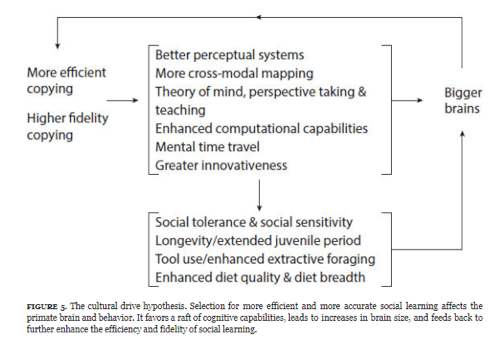
At the end author discusses details of this process, specifically levels of error in copying including both: buiological and cultural levels.
- High Fidelity
After demonstrating that resent research debunked traditional ideas of human exceptionalism such as use of tools and problem solution, author moves to real human exceptionalism: ability to developed cultural artifacts and high fidelity with which these artifacts are transferred from generation to generation and between populations. Here is a representation of this:
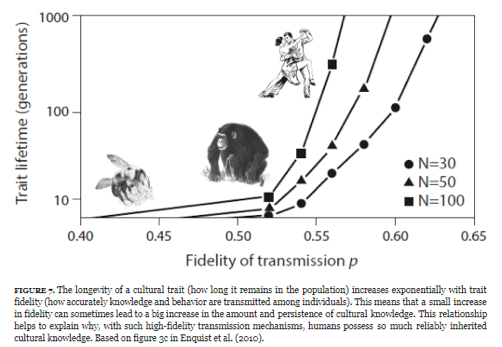
The rest of the chpater is about methods of achieving high fidelity of cultural transmission: intentional tutoring that is very specific for humans and have no comparable examples in other species.
- Why We Alone Have Language
This is a detailed discussion of one human specific artifact. Author defines requirements for the theory of explaining artifact of language in humans:
- It should account for honesty of the early language
- It should account for its cooperativeness
- It should explain how language was adaptive from the outset
- Concepts proposed by the theory should be grounded in reality
- It should explain generality of the language
- It should account for uniqueness of human language
- It should explain why communication need to be learned
After that author discusses just such proposed theory, which states that language was developed as necessary tool for teaching or in other words formal transfer of knowledge and skills from one human to another during cooperative activity conducted specifically for the purpose of this transfer. At the end of chapter author discusses experiment with teaching contemporary humans to manufacture stone tools specific to Acheulean culture – the oldest currently known (2.5 million years). This experiment demonstrated insufficiency of observational learning for skills transmission between teacher and student, therefore postulating the necessity of the language.
- Gene-Culture Coevolution
This chapter is about links between genetic and cultural evolution. Author uses such genetic feature as right or left-hand dominance to model evolution of this trait. Similarly, he discusses other studies related to lactose tolerance and such. All these and also sexual selection studies demonstrated that genetic and cultural evolutions are part of the same feedback loop expanding or constricting various features.
- The Dawn of Civilization
This starts with discussion of speed of change and then goes to defining human development as sequence of 3 stages: Biological evolution; Gene-culture coevolution that started with creation of language and teaching, and currently in process stage of the Cultural dominance in human evolution. The further discussion in the chapter is mainly about how did it happened and relates not that much to currently developed world, but even to contemporary hunter-gatherers and primitive agriculturalists. Even for them knowledge accumulated over millions of years allows, for example, consume food that would be poisonous without specific knowledge how to prepare it. Obviously living in contemporary society nearly completely isolates humans from natural environment.
- Foundations of Cooperation
Here author moves to more detailed discussion of cooperation and its evolutionary explanations starting with kin selection, coercion, and group selection. Author makes a point that large-scale society depends on teaching for their very existence. Author also discusses how rules of cooperation develop and difficulties for many to change paradigm from biological evolution only for genes/culture mutual feedback evolutionary process.
- The Arts
The last chapter is about arts, their evolutionary role, and how innovation, copying and learning involved in producing its artifacts. Author looks in details at the development and contemporary condition of dance as a specific form of art.
Epilogue: Awe Without Wonder
In conclusion author states that he started at the beginning of his research into evolutionary processes of human culture with Awe and Wonder for it. After decades of research he does not fill Awe anymore because he developed what he believes a good understanding of this process and found answers to questions about uniqueness of humanity. This uniqueness comes from uniquely human ability to transfer skills and knowledge via intentional teaching, which created positive feedback loop when needs for improved communication and innovation lead to the growth of the brain that in turn allows creating more and more complex know how that in turn lead to increasing need for teaching these complex skills. Eventually this loop took humanity out of regular world of animals and made into what we are today.
MY TAKE ON IT:
I think that person-to-person teaching, as effective process of knowledge / skill transfer, is a very good candidate for explanation of continuing increase in human brain complexity and ability when each step provides for material evolutionary advantage. Interestingly enough it could easily be linked to another area of humanitarian research – analysis of innovation and technological development, which more and more often treated as cumulative process with continuing increase in effectiveness and efficiency, albeit with only occasional significant breakthrough to qualitatively different level.
20180107 My European Family

MAIN IDEA:
The main idea of this book is to use author’s own genetic makeup and heritage to review history of human genetic development including movements of people, their mixing, the way humanity arrived to current genetic makeup overall, and specifically Scandinavian people that author belongs to. It seems that the final objective of author is to demonstrate that humans of all races are close to each other and that Scandinavians for example could find as their ancestors people from Middle East who brought in agriculture to the area where it could not possibly originate. The secondary objective seems to be to protect genetics from political correctness by limiting it to analysis of individuals, rather than races and populations.
DETAILS:
Introduction: The Funeral
It starts with author attending funerals that caused her to contemplate on genetic makeup of her ancestors.
PART 1: THE HUNTERS
Chapter 1: The Troll Child: 54,000 Years Ago
This is about author’s imaginary first human child born some 54K years ago that was different from normal children of its tribe of pre-humans. Author calls it a troll child because it was supposedly quite different even in appearance.
Chapter 2: Neanderthals in Leipzig
Here author discusses Neanderthals and their input into the human DNA. However, the bulk of chapter is about mitochondrial DNA that allows tracing female lines. Author provides a nice diagram for this:

She traces more specifically DNA by haplogroup and defines that she has group U5.
Chapter 3: The Flute Players; Chapter 4: First on the Scene in Europe
Here author describes her experience at archeological site in Europe dated at 45K. Some artifacts at this site like a flute made out of a bone indicate existence of music. She discusses the reasons for this and hypotheses that it could be explained by need to meet challenges created by Europe’s much colder climate than Africa, so genetic modification leading to need for self-expression helped in it. Author does not go into exploring how exactly it helps, but points out that there is genetic price for artists – increase in occurrence of schizophrenia, so it must be advantage because otherwise these artistic features would not survive.
Chapter 5: Mammoths in Brno
This is about archeological finding related to the human migration from Africa to Europe and encounters of contemporary humans with Neanderthals. One interesting idea is that there was massive climate change due to volcanic activities that decimated Neanderthal population and opened their ecological habitat for humans. In any case, the causes are not clear, but their disappearance about 39K ago seems to be confirmed quite well by archeological research. It is also quite possible that the cause was typical human activities – extermination of competitors for resources. For this author provides a hilarious discussion of the moral responsibility of humans for disappearance of Neanderthals.
Chapter 6: Cro-Magnon
Here author moves to Cro-Magnon – the first anatomically humans found so far. She describes Gravettian culture and museum with finding including sawing needles and other tools. The she links it with DNA data demonstrating her own connection to Ice age:

Chapter 7: The First Dog; Chapter 8: Doggerland;
These two chapters represent somewhat deviation from genetic and cultural history of humans to discuss human long-time companions – dogs and how they became such companions.
Chapter 9: The Ice Age Ends
This is about the end of Ice Age that occurred some 11600 years ago and various challenges it caused for humans. These challenges included change of hunting patterns, since reindeers moved away, massive fields of ice converted into open waters and dividing previously undivided land for example separating American continent. Author discusses recent findings of DNA intermediate between Europeans and Native Americans. Finally, she looks at human cultural changes that allowed more than accommodate to climate change by developing boats and technics for fishing.
Chapter 10: Dark Skin, Blue Eyes
This is about confirmation of out of Africa ideas when DNA shows that currently rare combination of blue eyes and dark skin was actually quite common some 8,000 years ago. She also discusses usual ideas about need for vitamin D causing lightening of skin via evolutionary selection.
Chapter 11: Climate and Forests
This is an interesting discussion about change in vegetation caused by climate change, that lead in turn to change in weapons and hunting technics. Specifically, in dense forest spear is the most optimal weapon, but in open space – bow and arrow is much more useful, and that is what was developed by humans as evidenced by archeological findings.
Chapter 12: Sami?
Sami are ancestral and indigenous northern people somewhat despised by general population, but they actually provided lots of DNA input for contemporary population of Scandinavia. Author discusses this and also their linguistic influence since contemporary populations are just a few thousand years old and therefore quite traceable in language.
Chapter 13: Pottery Makes its Appearance Chapter 14: The Farmers Arrive
This as a brief review of pottery industry development as it could be traced from archeological finding and how it is represented in various areas from Japan to China to Europe and elsewhere. It demonstrates that pottery was not only linked to agriculture, but it actually appeared somewhat before that in form of various small items that could be carried on relatively easy. Interestingly enough, it seems to have not only utilitarian use, but also artistic and probably religious application.
Chapter 14: Farmers Arrive
This is not that much about general introduction of agriculture, its causes and consequences, as about specific northern attitudes that were somewhat upset by new DNA findings that undermined traditional believes in independent development of somewhat superior humans formed by challenging cold climate. These findings basically indicate that agriculture was not developed indigenously, but rather brought in by immigrants from the South.
PART 2: THE FARMERS
Chapter 15: Syria; Chapter 16: The Boat to Cyprus;
These two chapters are about author’s travel to archeological sites in Middle East where archeologists found the earliest signs of agriculture, specifically facilities for grain stock accumulation, but also interesting side effect – domestication of cats that seems to occur with switch to agriculture and was caused by need to protect grain from mice.
Chapter 17: The First Beer
This is about another type of evidence of agriculture – facilities to produce beer. Author also discusses findings of sheep domestication on Cyprus going back to about 9,500 years BC.
Chapter 18: The Farmers’ Westward Voyagers
Here author discussed traces of farmers movement from Middle East up North to Sardinia, Italy and Spain, which somewhat coincides with genetic mutation allowing to consume lactose.
Chapter 19: The Homes Built on the Graves of the Dead
This is about findings in Anatolia that show clear change in lifestyles to be much more sedentary to the point that homes contained remnants of deceased people. Author also discusses various routes that farmers could use to move up North in Europe.
Chapter 20: Clashes in Pilsen and Mainz
This is the next stop on the movement to north – middle Europe, where author met DNA researches who confirmed genetic changes in population consistent with substitution of hunters with farmers. Similar findings came from isotopic analysis of food consumption.
Chapter 21: Sowing and Sunrise
This is about linear pottery culture in Germany, which started about 7500 years ago. Over 300 yeas people of this culture steadily moved North in Europe. Author also discusses the first traces of wheeled vehicles going back to 5600 years, which together with plow and animals like ox provided for superior productivity of agriculture.
Chapter 22: Farmers Arrive in Skane
Here author looks at the next pottery culture – Funnel Beaker culture that developed from linear. The people of this culture left traces in Scandinavia. She also discusses the question of why farmers moved north and point to a few reason such as superior flint sources up North that supported nearly industrial levels of tools production.
Chapter 23: Otzi the Iceman
This is about nearly perfectly saved frozen remnants of a man from about 5300 years ago that provided lots of information about live style, tools, and DNA of people from this period.
Chapter 24: The Falbygden Area
The next stop is in Sweden where another skeleton was found that provided valuable information about DNA of people who moved into this area. Once again author discusses type of people who brought agriculture to the North and it looks like she really wants them to be dark skinned with clear Middle Eastern origin.
Chapter 25: Hunters’ and Farmers’ Genes
The final chapter in this part is about Hunters versus Farmers, their different live styles, diets, attitude, and DNA. Eventually she presents herself as a sample of the mix with her own mitochondrion DNA pointing to reindeer hunters, while her paternal grandmother’s pointing to Syrian farmers.
PART 3: THE INDO-EUROPEANS
Chapter 26: The First Stallion
This is kind of deviation from the main narrative about European genes. Author moves to Asia to look at horses and people, which lives are linked to them. In the process she moves to linguistic area discussion Indo-European languages and how it reflects movement of people and genes.
Chapter 27: DNA Sequences Provide Links with the East
Correspondingly this chapter moves to genetic specifics of haplogroups and chromosomes and how this genetic material mixed in author’s own inheritance.
Chapter 28: Battleaxes; Chapter 29: Bell Beakers, Celts and Stonehenge; Chapter 30: The Nebra Sky Disc in Halle; Chapter 31: The Rock Engravers; Chapter 32: Iron and the Plague Chapter 33: Am I a Viking?
These several chapters are mainly about material culture that produced various artifacts and how their archeological discoveries demonstrate mixing and movements of diverse people that eventually resulted in current human setting around the Europe.
Chapter 34: The Mothers;
This is a bit of personal narrative about author’s multigenerational mothers who were lucky to survive and reproduce resulting in eventual object of genetic and cultural combination that is the author of this book.
Chapter 3S: The Legacy of Hitler and Stalin The Tree and the spring
The last chapter starts with the story of Soviet murderous rejection of genetics and then somehow moves to pronounce decisive rejection of Nicolas Wade’s book that promotes thesis of genetic dependency of just about everything: average IQ, society prosperity, and even political system on genetic make up of members of the society. It ends with the call for individuals to research their DNA and hopes to avoid Soviet style rejection of genetics this time in the name of political correctness that posit genetic equality of all and ready to affirm this equality by all means necessary.
MY TAKE ON IT:
It is an interesting review of currently existing research and theories of human genetic development, humanity expansion around the world, and continuing mixing of human and pre-human population. I think that author’s continuing deviation and eventually plunge in the final chapter into ideology and politics is somewhat unfortunate because it brings in unresolvable ideological contradictions about genetics. It comes with typical reference to Hitler who based his murderous ideology on believe in overwhelming role of “blood” in defining characteristics of society as well as less typical reference to Stalin who based his murderous ideology on believe in overwhelming role of “class” and actually killed geneticists who dared to believe that DNA is important. I think that genes are important, play huge, but not defining role in “who we are”, and what kind of society we have. However I do not believe that it makes any more sense to define what is more important Nature or Nurture for formation of humans and their societies than discussion of which leg left or right is more important for process of walking. Let’s just try to fix whatever is not working right. So if it is DNA, let find the way to correct it and if it is environment and society let’s find what is not working and fix it too.
20171231 Why the Germans, Why the Jews
MAIN IDEA:
The main idea of this book is that Holocaust was not just WWII event, but rather logical conclusion of German cultural development of XIX and early XX century. It was caused by a few main sources:
- German attitude to Jews as “others” who do not belong to German people despite living in Germany for centuries. This attitude created environment of at least indifference and at worst active hate towards Jews from vast majority of German population.
- Jewish emancipation that opened way to direct competition for cognitively more effective Jews who disproportionally obtained wealth and prosperity on the relatively free market, even if they still remained barred from governmental jobs, military leaderships, and other preferable positions in society.
- Political advantages provided by anti-Semitic positions. This came from the growing envy and resentment of left-behind part of German population. These people were not able to adjust to the world that was rapidly changing from medieval agriculture to industrial production so they blamed Jews who were disproportionally successful due to this change.
- Opportunity of ruling classes to shift blame for whatever calamities befall Germany due to their mismanagement such as loss in WWI, to the Jews by creating such ridiculous legends as “stab in the back”.
DETAILS:
Introduction: The Question of Questions
Here author describes his interest in the question of Holocaust. Why Germans, the most technologically advanced and seemingly civilized people killed millions of Jews? One of the reasons for looking at it that author provides, is his German heritage. In introduction, in addition to key points, author describes methods of information collection for this book: published artifacts of ongoing cultural live of XIX and XX century and multiple family archives, including author’s family that demonstrated development of German attitudes towards Jews, which eventually culminated in Holocaust.
- Jewish Emancipation
This is the story of Jewish emancipation in Germany, which started under French influence during Napoleonic wars, but achieved relatively equal legal status for Jews only in the second half of XIX century. The first step for many Jews was to obtain self-emancipation was via education. It was greatly supported by Jewish tradition of learning and discussion that put Jew into advantageous position comparatively to general population. As usual, author refers to statistics of educational achievement, but also stresses cultural specifics of Jews that were instrumental in producing this achievement. Author also points out an interesting phenomenon when advance of democracy was actually detrimental to Jewish emancipation due to widely accepted antisemitism of the population. It was clearly demonstrated during revolution of 1848.
- The Anxiety of German Nationalism
This chapter provides kind of counterpart to Jewish advancement in education and business in typical German attitude of inferiority produced by long history of military defeats, indignities experienced during multiple religious wars, and later during wars of earlier XIX century when French occupied many German territories. Overall author believes that it had created a culture of low self-esteem and powerlessness. Moreover, division of Germany into multitude of states created confusion of who is or is not German. Eventually it led to movement to unite Germany into one powerful state driven by very strong nationalist ideology. Since this nationalism had mainly ethnic characteristics, the Jews being “others” had hard time to be accepted as equal members of German nation.
- Anti-semitism as a Political Force
Here author looks at political development in Germany caused by dramatic changes in economy and culture and finds that traditional antisemitism of masses found huge support in upper layers of society, which considered Jews competitors and attempted to slow down or even stop their progress. In addition to reference to historical events and literature author provides a very interesting story of his own family and the role antisemitism played in their worldview and behavior.
- The Mainstream’s Dangerous Indifference
This chapter starts with review of social-democratic movement and active Jewish participation in it. One thing here author stresses, is quite strong push against Zionism from many well settled assimilated Jews who strived to be part of German collective and hated any hint on existence of separate Jewish collective. At the same time this and other collectivistic, anticapitalistic movements possessed strong anti-Semitic current typically associating Jews and their culture with capitalism, especially financial side of it. It was demonstrated in many forms including Marx’s “On Jewish Question”. The logical outcome of it was development of national-socialist ideas first introduced by Frank Naumann. While it had strong ethnic character, its antisemitism was kind of moderate, trying to restrict Jews via economic rules setup by government, while leaving open door for them to join Germans if they accept “German way of thinking”. Eventually this movement seamlessly merged with Nazis.
- The War, Defeat, and Jew Hatred
This starts with 1916 Jewish census that used statistical data to demonstrate that Jews are not patriotic enough and participate less than others in war efforts. It was achieved by somewhat manipulating data and discarding Jewish specific statistical variation such as generally older Jewish population producing fewer conscripts that was presented as avoidance of service. Author also looks at details of “stab in the back” believes and how it was linked to Jews with no foundation for this whatsoever.
- Weak Masses, Strong Race
This is about intellectual superiority of Jews and the fact that it would not disappear when they converted to Christianity, causing antisemitism to move from religious foundation to ethnic that was growing especially strong in educated circles when Jewish competition was more and more visible. Author describes this reaction that practically led to multiple attempts to limit access of Jews to education and promotion since they were disproportionally good in various intellectual fields. Author also reviews in this chapter a number of literary work of early XX century that represented utopias / dystopias about “Cities without Jews”, totalitarian collectivism, and various ways to rid society of Jews that where pretty close to the future reality of Holocaust. At the end of chapter author reviews history of his own family demonstrating how antisemitism played out in their striving to move ahead in live.
- The National Socialist People’s Party
This is about culmination of German antisemitism that was NDASP and Holocaust. It reviews multiple variations of Germans attitudes to Nazis and stresses that generally it was massive support of their program, even if aggressive antisemitism was considered as somewhat not nice, but not really that relevant. However, the material benefits obtained from looting and killing Jews clearly added to Nazi support by population, especially when killing happened out of sight while benefits were quite real. Author’s review of his strong Nazi relative’s letters shows just two anti-Semitic remarks out of 500 pages demonstrating that it was not significant for him, however maintaining purity of the race and such was really important. The review of literature and attitudes shows that Holocaust was just acceptable way to take out Jewish wealth and cleanse race from intruders and as such had support of majority of Germans who, nevertheless, did not really wanted to go into details of the process of its implementation.
Epilogue: A Story with No End
Here author reviews his points: German antisemitism came from feeling of inferiority and losing competition to Jews in rapidly changing environment. The cultural envy of Germans in process of formation of their nation to Jews who possessed outsized cultural influence on practically all world of Christianity. Probably one of the most important part of this process was moving away from individualistic values of enlightenment to collectivistic values of early XX century that defined Nazi society development practically until its end. Author also points out irony of history when Germans moved to mass murder driven by envy and hate even if by this time their achievement in education and advance in profession catches up with Jewish achievement. He ends this book with reference to Bible and its story of Cain who killed his brother because of envy and need to feel equal and states that these feeling will never go away and things like Holocaust could happen again and again.
MY TAKE ON IT:
It is a pretty good history of German antisemitism, but I do not think that the main explanation of it by using envy is sufficient. I think it is deeper than that. The hate of Jews was around for such a long time and became internalized so deeply that it became unalienable, albeit somewhat hidden, part of many cultures of the world. Actually, the role of envy is somewhat overstated because Jews are hated even if they deprived of opportunities and stay permanently poor as it was in Russia or Middle East for centuries. I would look at another reason for hate: Jews are permanent troublemakers. Whether it is new religion based on monotheism, or new theory of relativity in physics, or new secular religion of communism and socialism, or rejection of this religion in the name of economic and political liberalism, or whatever, Jews always prominent in creating and promoting the new ideological and cultural staff, which in turn always has negative impact on whatever part of society, quite often majority, benefits from status quo. Consequently, it is typical that Jews are hated even in places where there are no Jews for centuries or at least for decades as in Europe after Holocaust. One needs only look at attitude of United Nations to Israel to see a multitude of charming examples. Probably the only culture in the world that naturally embraces Jews with all their troublemaking is America, which is itself is mainly nation with culture of troublemaking: always changing, always inventing new and discarding old, always moving somewhere, typically without really knowing where, but confident that it will be a better place than here and now. I guess, as long as America maintains this culture Jews will be fine.
20171222 – More than Nature Needs

MAIN IDEA:
The main idea of this book is to demonstrate that seemingly exceeding capacity and power of human brain comparatively to what is required for survival does make sense from evolutionary point of view. The book designed to demonstrate specific, consecutive, and evolutionary meaningful steps that necessarily led to development of human intelligence as necessary tool for developing language and cultural technology of its acquisition. All this is based on analysis of languages and their development and use.
DETAILS:
- Wallace’s Problem
The Wallace’s problem is an explanatory problem of human brain, which is significantly more powerful than it should be from strait forward evolutionary point of view. For example, our close relatives – apes have quite a bit less brainpower, but nevertheless survive just fine. So why would humans have such a powerful mind is a puzzle, obviously if we disregard religious explanation. Darwin’s explanation was incomplete and it mainly refer to mind and self-consciousness as side effect of other facilities such as use of language. Author breaks down the problem into three parts: escape from animal communications, acquisition of basic structures of language, and development contemporary abstract languages capable to support self-consciousness. The book is an attempt to look for answer for these questions in details and, in process, resolve the Wallace’s problems.
- Generative Theory.
This is about generative theory of linguistics. It starts with Chomsky and his idea of innate language structure, which by now is mainly discarded. It then proceeds to review some half dozen theories from standard to minimalist.
- The “Specialness” of Humans
This chapter looks at specificity of humans comparatively with all other animals in their development and use of language. Author discusses relative weight of genetics vs. learning in language acquisition and overall treatment of humans in scientific studies. In process, he comes up with notion of Evo-Devo that is evolutionary development biology, which studies genetics of organism and how it was produced by evolutionary development. After reviewing the idea of component feature author moves to what he calls “the ladder to humans”, which means researching primates on the way to understanding humans. All this done based on detailed review of scientific literature.
- From Animal Communication to Protolanguage
It starts with characterization of language as the 8th major transition in evolutions after such heavies as origin of life, multicell organisms, and so on. After that author goes into discussion of appearance of cognition and how it linked to appearance of language. He provides evidence pro and contra of high level of cognition in animals and pre-human relics. He follows it with discussion of evolutionary pressures, especially intergroup conflict that he designates as “Confrontational Scavenging and Displacement”. In short, with intergroup conflict clearly providing advantages to the group. This advantage is capable supporting higher level of coordinated planning and actions. Consequently, the importance of means of communications became very important. Obviously, this created a very strong evolutionary pressure for development of a language.
- Universal Grammar
Here author discusses an idea of universal grammar, which was pretty much discarded by the latest scientific developments. However even if it is so, the direct link between brain’s development and language structure is strong and author discusses in detail how it is build and specific algorithms used for these processes.
- Variations and Change
This chapter moves away from biological evolution to cultural one and starts with discussion on variation and need for it from the language side. It establishes connection by defining change as temporal extension of variation. After that author looks at linguistic specifics such as word order, tense modality, grammatization of relations between words, and other objects. At the end author looks at causes of change and objections to his model.
- Language “Acquisition”
Here author looks at language acquisition starting with commonly accepted Language Acquisition Device (LED). After that he provides an alternative model and uses child language acquisition process to demonstrate how it happens, starting with One-Word stage, then Two-Words, then Telegraphic Speech and all the way to comparing English and French as examples of different ways of negation. Also, interesting here is discussion of an Error as the source of Insight.
- Creolization
This is about mixing process when people with different languages interact, in process creating some linguistic mix useful for communication. Author discusses continuum of creoles existing in Caribbean and other places and how language changes from one group to another demonstrating failure of innate language model explain this process. He also reviews children language vs. adult and various pidgin variations.
- Homo Sapiens Loquens
In this last chapter author summarizes his position providing an analog of human development as 3 rooms and elevator, where the first room is confrontational scavenging niche. After spending long enough time in this room humanity moved to the second room: symbolism, leaving behind other group surviving species such as ants and bees. When symbolism had developed enough, the move to the third room becomes inevitable. This room is self-organizing brain or in other words cultural learning ability that humans developed. This last room contains an elevator that is language, which allowed humanity quickly moving up to become dominating species. At the end author summarizes his position in such way:
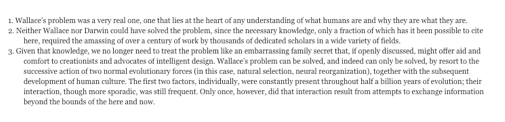
MY TAKE ON IT:
I believe this is a good model of human development and I would add that the idea of Wallace’s problem could be entertained only if one forgets that the main competitor of a human being in his/her struggle for survival is another human being and in this struggle to have more powerful brain and be able to outsmart another human is the necessity of survival. Moreover it is not limited to an individual, but also extended to a group. As anybody who ever thought about huge military experience of humanity understands, the functionality provided by the brain: planning, communication, ability for direct synchronized action of the group of individuals, and ability to correct these action per results of feedback analysis, are necessary tools of warfare. Obviously the people who are better at it get to obtain more natural resources and consequently to pass more of their genes to the next generation making brain a necessary survival tool without which humans could not survive pressure from other humans.
20171217 – Patient will see you now

MAIN IDEA:
The main idea of this book is that contemporary medicine is not capable to keep up with technological developments and is bound to be substituted by the new medicine that will be not only patient centric, but also patient controlled and directed with the technology providing all necessary support via access to information, data collection devices that patient can use, and doctors relegated from CEO of treatment to highly qualified supporting specialist who would take over only if patient is mentally incapacitated.
DETAILS:
Section 1: Readiness for a Revolution
- MEDICINE TURNED UPSIDE DOWN
It starts with the discussion of old phenomenon of the “difficult patient”, the one who does not trust doctor without questions and trying to get access to medical information and even participate in decision-making relevant for them. Author makes point that with Internet and access to all kind of medical devices from blood pressure measuring machines to portable EKG patients can and do produce their own medical information and analysis based on Internet medical websites. After that author discusses his own experience with portable devices and concludes that they do bring qualitative change in access to collection of information together with increased levels of education led to rise of smart patients.
- EMINENCE-BASED MEDICINE
This is a look back at traditional medicine when doctor was practically the only entity with access to data and final decision maker, whose decision was not to be challenged, except by other doctors. In addition to looking at this historical situation author brings a personal story about his grandparents who were not well served by the medicine of 1960s. Moreover, he applies it not only to some individual doctors, but to overall condition of medical knowledge, which as any other knowledge, when start moving to scientific method is continuously developing and changing, in process removing or at least dramatically decreasing medical authority. Author provides a nice table of medical tests that proved to be inadequate, meaningless, or even harmful in the view of newly acquired data:
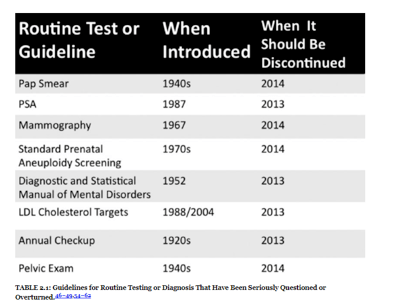
- A PRECEDENT FOR MOMENTOUS CHANGE
Here author discusses impact of the new technology such as smart phone combined with Internet and compares it with the previous revolutionary change in information technology: Printing press. Here a couple of graph he provides to demonstrate consequences of such information revolution: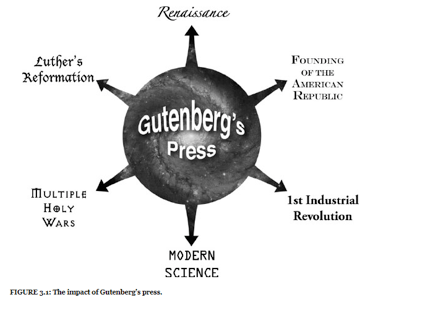

- ANGELINA JOLIE: MY CHOICE
Here author moves to our time providing quite a dramatic result of individual making very challenging decisions about her health based on her understanding of scientific information specific for her not only current, but also probable future medical condition. Since this individual is very famous, rich, and is subject of admiration by millions of people, her very public decision-making had a significant impact on the huge number of people, medical industry, and market for genetic analysis.
Section Two: The New Data and Information
- My GIS
This chapter starts with comparison of human body with Geographic Information System (GIS), which provides multiple layers of data about environment. Author believes that similarly to GIS it is possible to combine multiple layers of data about a person that would allow prevent and/or quickly react to any deviation from optimal health conditions. Here is a nice picture of all these layers, which follows by brief explanation of each layer:

Social Graph and the Phenome: It is about individual within his/her social environment.
Sensors and Physiome: Biosensors collecting all kinds of health-related information from heart activity to blood pressure, mood and everything in between.
Imaging and Anatome: This layer includes more complex and expensive scanning: MRI, CT, X-Rays, and other methods to evaluate person’s anatomy at any given moment in time.
Sequencing and Genome: Personal DNA analysis
The Transcriptome: This is about transfer of information from DNA to RNA and correspondingly expression of genes, which turned out to be a complex and important process in its own right.
The Proteome and Metabolome: This analysis of body proteins, autoantibodies, and metaboles – compounds resulting from body’s metabolism
The Microbiome: This is an analysis of all other organisms that are included into our body, but have different DNA than our own: bacteria, viruses, fungi, and what not. Interestingly enough, it represents at least equal amounts of human and non-human content.
The Epigenome: The side chains and packaging of our DNA. This staff can actually change genes expression causing all kinds of problems. It is cell specific and can be decoded similarly to DNA.
The Exposome: This is about our environment with all nice things like radiation and pollution exposure to which could be tracked and analyzed as a factor in condition of body.
All together these areas of analysis could provide information for pre-womb to coffin health maintenance that author envisions in such way:

Author discusses in some detail how it could work for a couple of examples, specifically how it would apply to cancer:
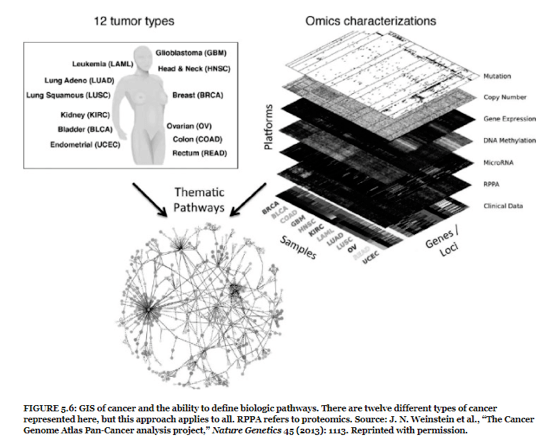
- MY LAB TESTS AND SCANS
This starts as somewhat panegyric to Theranos, which is currently not in such a great shape, but main point is still valid: patients should have unlimited access to all testing results relevant for them. Moreover, the emerging technology promises lab on the smart phone when various attachments allow measuring all kinds of electrical, mechanical, and chemical signals produced by a body. Another emerging technology: Lab in the Body: that is imbedding sensors into human body to analyze all kinds of processes occurred in there without sending any external signals in any form. Author also discusses side effects of multiple scans and necessity to use these scans wisely. The final part of the chapter is about miniaturization of scanning and possibility of pocket MRI linked to one’s smartphone.
- MY RECORDS AND MEDS
This chapter is about medical records, needs for their transparency to patient and to doctor. It actually becoming critical because of the huge amount of powerful medicines that interact in extremely complex way very much outside of human ability to trace and understand it.
- My Costs
Here author discusses costs, as usual pointing out to contrast between costs in USA and elsewhere. Here is a nice breakdown for this issue:
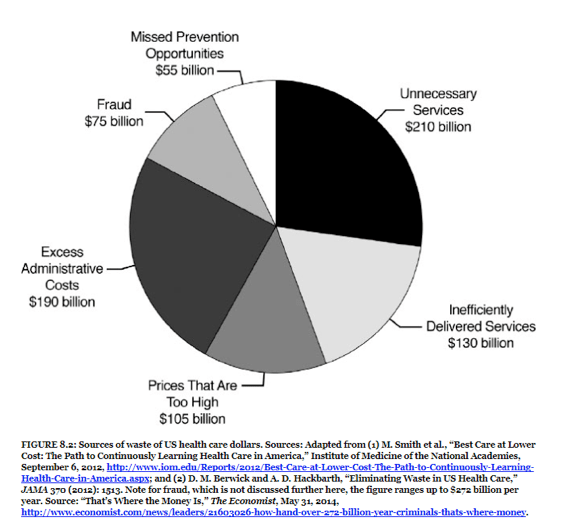
Obviously there is a lot that could be improved by making prices transparant and removing diconnect between payor and user of medical services. Obviously it is mainly separate and huge issue.
- MY (Smartphone) Doctor
This is about access to medical knowledge that is changing dramatically with advance of medical websites that help to establish diagnosis, develop treatment plan and do all kinds of things that before required doctor’s full involvement. An interesting result is the decrease in number of physician visits by 17% despite aging of population. It coincides with improvement in outcomes. Another point is that increasingly challenging environment for doctors leads to decrease in their numbers and availability. Here is a nice picture of multiple factors impacting them:
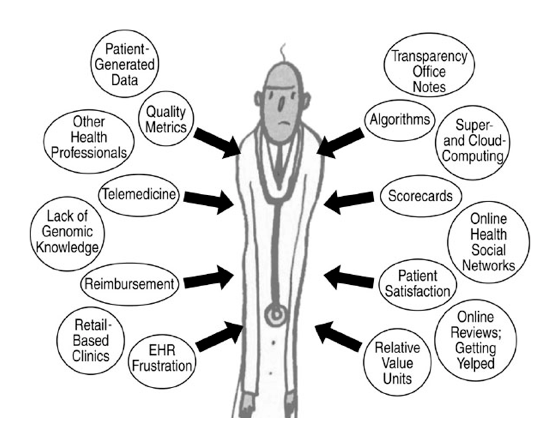
Section Three: The Impact
- THE EDIFICE COMPLEX
This is about hospital stay and need to move treatment as much as possible to outpatient care or even to patient’s home. Author recalls his experience as young cardiologist when even simple procedures required long hospital stays, contrasting it with much shorter stays now. Author discusses hospital of the future, which goes far away from simple bed to complex technologically heavy site that provides constant monitoring of patients, protection against infection and external interferences. But most promising development is advance of technology that could make hospital if not completely eliminated, then reduced to emergency use only.
- Open Sesame
What author here wants to open is access to medical data so he starts with reference to open source software and the proceeds to discuss Massive Open Online Courses (MOOC) that allow learning without attending expensive classes, and finally renames them into MOOM, where the last letter stands for “Medicine”. He looks in details at cancer specific MOOM and then discusses information flows and role of government in opening access.
- SECURE vs. CURE
This is discussion on privacy and its increasing disappearance in all areas including personal medical data including genetical information. At the end author expresses his believe that all medical data about person should be owned by this persona and hope that it would help with privacy issues.
- PREDICTING AND PREEMPTING DISEASE
This is about changing the whole approach to medicine from mainly reactive process to proactive when service delivered not in response to complain, but rather continuously on regular bases with stress on preemption of disease rather than treating it when symptoms become obvious. Here is a nice diagram demonstrating author expectation for future changes in life expectancy resulting from this:
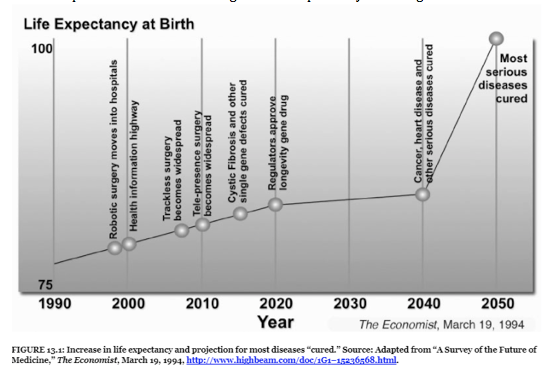
- FLATTENING THE EARTH
This is about globalization of medicine both in term of collecting data and providing services across borders. It goes through usual trope of need to help poor countries, development of cheap substitutes for technology and medicines, but most interesting are a couple of graphs that demonstrate that overall deaths due to infections and other diseases of the poor actually fall way below deaths from the same diseases that rich people die from:

- THE EMANCIPATED CONSUMER
The final chapter is kind of summery with the stress on the main point of this book: switch to patient directed medical services based on technology with doctors involved mainly in consulting roles and high complexity specialty service. Here are two pictures presenting this vision:


EPILOGUE
This is pretty much list of references to various forms of what author calls iMedicine Galaxy starting with smartphone:

This also includes various imagining technology that allow scanning of one’s own internal organs condition and other digital appliances. Author completes it with graph for overall medical data transfer and processing:

MY TAKE ON IT:
I think this is a wonderful book with lots of good ideas and, very important, lots of information about technology available now for anybody who wants to be in control of his/her own health. I am pretty sure that direction of development that author describes in this book is not only valid, but practically inevitable. I would only add that, in my opinion, author a bit underestimate value of personal relationship that could potentially develop between individual providing health service and patient. With all these new devices, information processing, and soon coming fully developed AI the role of healer will change. It would stop being mainly technical processing, when doctor really does not know patient as human being and mainly treats this patient as body, not that different from mechanic treating car in repair shop. It would become more friendship like continuing relationship with specific goal to provide psychological, technological, and informational support from a person dedicated to such support for just a few or maybe a few dozens people. It would be probably mainly something like regular monthly meeting with discussion of individual about mental and physical health based on recommendation of AI developed with use of readings from multitude of scanning devices constantly monitoring individual’s condition. I guess it would require completely different skillset much less related to butchery than it used to be in the past and is still prevalent in present.
20171208 – Big Lie

MAIN IDEA:
The main idea of this book is that contemporary leftists’ claim that they are anti-fascists is not just false, but rather completely opposite – they are fascists. Their claim that Fascism and Nazism were right wing movement is the Big Lie and in reality both initial Fascism as it appeared in Italy and Nazism in its German form were leftist movements ideologically closely connected with contemporary leftism and its American political expression –Democratic Party. It is not a new idea, but author brings some interesting historical material to support it. Author also suggests starting active denazification of American political scene to rid country of this murderous ideological bacillus.
DETAILS:
One: Return of the Nazis
The book starts with review of contemporary events when leftists started violent campaign against freedom of speech, racial equality, and recently elected president who seemingly dead set to fight back against leftist collectivistic ideas as they were implemented in America over the last few decades.
Two: Falsifying History
This chapter is interesting by its multiple examples of close ideological relations between socialism and fascism, claiming quite convincingly that back then in 1920s both movement recognized and even celebrated their similarity of ideas and methods. Author refers to a number of ideologues of early fascist movements especially to Giovanni Gentile who developed ideological foundation of this movement.
Three: Mussolini’s Journey
Here author refer to development of founder of fascism Benito Mussolini who started as regular socialist, achieving significant position within this movement. However after the WWI clearly demonstrated superior ideological power of nationalism over power of international socialism, Mussolini moved to merge these two ideas into powerful mix of National Socialism.
Four: A Democratic Party. Secret
Author starts this chapter with Hitler’s ideological development and his embrace of anti-Semitism. From there he moves to concentration camps, genocide, and winds up with Andrew Jackson – founder of Democratic Party. Author accuses Jackson of genocide against Indians, but does not explain why this genocide was expressed in continuation of traditional American pushing of Indians further and further west, rather than just plain annihilation as it was the case with classical Nazi genocide and actual meaning of this word. At the end of chapter author discusses slave labor, Nazi labor camps, and Nazi death camps, trying to demonstrate that these widely different institutions were created for different purposes, for different objectives and, most important were managed differently to achieve these objectives. Therefore, author asserts, contemporary Democrats’ attempts to equate slavery with genocide are deeply ahistorical and plainly dishonest.
Five: The Original Racists
This chapter is about long and colorful history of racism in progressive movement, its previous incarnations as communism and fascism, and its current incarnation as ideology of Democratic Party. It starts with interesting and historically very valid point that fascism, as it started in Italy was not a racist movement. Italian fascists perceived “national” part if their ideology not as ethnic, but rather as nation-state based term so Jewish Italians could be and were as integral part of the movement, as any other group of Italians. Only later in Germany fascism incorporated traditional German anti-Semitism in conjunction with American racial inequality ideas becoming genocidal Nazi movement. Author also demonstrates an interesting mix of anti-capitalist ideas with anti-Semitic ideas when “Jew” is permanently linked to ‘Capitalist – Exploiter”. This is especially funny because it kind of demonstrates ridiculousness of these Jews: from Karl Marx to Leo Trotsky to contemporary activists of Democratic Party who in their anti-capitalist zeal become deliciously anti-Semitic.
Six: Disposable People
Here author discusses typical progressive thrust to mark some people as a burden to society and either limit their functional ability, especially in reproductive area, or even completely dispose of them via mass murder.
Seven: American Fuhrers
Here author moves to the overall estimate of XX century Fascism expansion coming to conclusion, quite different from common historical narrative that it happened in Europe, but could not happen in USA. Actually author provides quite a convincing thesis that it did happened here by comparing actions of FDR administration and actions of Mussolini, and Hitler before these Europeans embarked on aggressive wars and eventually Holocaust. Here there is an interesting story of communications between all 3, which could be qualified as mutual admiration society. Also interesting is author’s analysis of leftists tricks that turned Fascism, which is inherently super big government idea, into something opposite by Roosevelt rhetoric such as: “The liberty of a democracy is not safe if the people tolerate the growth of private power to the point where it becomes stronger than their democratic state itself”.
Eight Politics of Intimidation
This chapter is kind of mosaic linking together violent methods of various leftist movements before they came to power from Fascists in Italy in 1920s, Nazis in Germany, and all the way until contemporary Antifa movement in America. Author looks at its leaders from practitioners such as Hitler and Mussolini, philosophers such as Heidegger and Marcuse, and financiers such as Soros.
Nine: Denazification
The final chapter refers to the process of denazification that American occupation forces conducted in Germany after WWII cleansing out from all political and governmental positions former active members of Nazi party and suggests that similar process is necessary to implement to stop fascistic increase in government power under Obama administration and use of this power against American conservative movement, which is real anti-fascist force today. However author calls to use democratic methods: election and political education of population, rather than respond in kind, even if author himself experienced prison term in America as result of his political activities, albeit the formal reason was inflated violation of law limiting donation to political candidates.
MY TAKE ON IT:
I think that author characterization of Fascism as left wing political movement correct and well supported by historical material he provided. I also agree that contemporary American society, especially its young generation, are contaminated by these twin bacilli of big government sickness: Fascism and Communism. However I do not think that it could be easily resolved via election and democratic process mainly because left, as of now, is in control of educational system and generally capable to impose their political correctness on all institutions of society. To overcome this control one need to attract wide masses of population, including those who are currently depend on government, to some new ideas that would be more attractive than current ideas of satisfactory lives live with support of the big government.
The young generation should be convinced that the big government is bad for them because even if they are lucky enough to obtain place in bureaucratic hierarchy their live within government will still be miserable. Even if they would have better access to goods and services they will be subject of abuse by whoever is higher in bureaucratic hierarchy than they are.
However if they are not that lucky and wind up outside government hierarchy on handouts, their live will be miserable because these handout will be necessary small and of low quality due to the lack of incentive for productive people to produce.
Convincing the young generation that they will be much better off in free market open society than in big government hierarchical closed society is the challenge of our time and continuation of American experiment fully dependent on our ability to respond to this challenge.
20171201 – Scienceblind
MAIN IDEA:
Author formulated the main idea of this book as an attempt to convince people that two ideas are correct:
- We often get things wrong because “our intuitive theories in several domains of knowledge carved up the world into entities and processes that do not actually exist”.
- To get world right we need not just change believes, but to change the very concepts that articulate these believes.
DETAILS:
- Why We Get the World Wrong
This starts with the story of milk consumption causing infection deceases before advent of pasteurization in XIX century. Traditionally milk was consumed fresh on site in villages, causing no problems, but the development of cities led to delay between milk production and consumption consequently giving time for bacteria to develop. Author uses it to demonstrate how difficult it is to get people to understand and believe scientific data. As usual it supplied by reference to the poll that demonstrate big numbers of Americans believing in all kinds of weird unscientific staff. After that author goes a bit into epistemology discussion about representation of the world via what he calls “intuitive theories” build on “causal knowledge” from observation and experiences versus representation of the world via theories produced via scientific method. The difference is conceptual and author demonstrates it by comparing explanatory theories for the same phenomenon by these two different approaches.
PART 1: Intuitive Theories of the Physical World
- Matter: What Is the World Made Of? How Do Those Components Interact?
This starts with discussion of human misperception of the world. As example author brings tall vs. wide glasses and conservation problem, then he moves to atoms and difficulty to understand general emptiness of the world. It is supported by multiple experiments with children and adults demonstrating all kind of variances between intuitive perception and scientific modeling of reality regarding material density, volume, weight, and such.
- Energy: What Makes Something Hot? What Makes Something Loud?
This is an application of the same approach to energy, heating, and cooling. Author traces development of ideas about heat and cool from ancient world to its current understanding as a function of molecular movement. There is also an interesting discussion here of extramissionist vs. intramissionist believe about flow of information in vision. Similarly, author discusses misconceptions about electricity that is often believed to be a flow, rather than transfer of energy.
- Gravity: What Makes Something Heavy? What Makes Something Fall?
This is another set of examples about misperception, this time about gravity. As the previous one it is heavily reliant on experiments with children to demonstrate how human intuitive perception of gravity works. It also includes funny mental experiment about a ball oscillating around the center of the earth.
- Motion: What Makes Objects Move? What Paths Do Moving Objects Take?
This is another discussion on disconnect between people’s intuitive understanding of motion as the process driven by some internal force, which is known to be incorrect since Newton. Also, future trajectory of movement often predicted incorrectly due to failure of considering all forces. At the end of chapter there is a bit of discussion on educational method to overcome this problem.
- Cosmos: What Is the Shape of Our World? What Is Its Place in the Cosmos?
This is about human perception of the Earth and Universe and how it developed from the flat Earth believe into contemporary Cosmology. It has some interesting staff about children and how they individually going through the same process.
- Earth: Why Do Continents Drift? Why Do Climates Change?
This is an application of the same idea to the geology and climate. It is again intuitive theory of everything not always consistent with knowledge obtained by painstaking analysis and experimentation. Obviously people who are not familiar with this knowledge tend to repeat usual staff that they come to intuitively or acquired as children from not well-educated adults. Author provide an interesting breakdown of attitudes to global warming:

Typically for his surroundings, author seems to suport alarmist position based mainly on famously non-real 97% of experts. In process he somehow manageded to miss that all empirical data of the last 20 years contradict alarmist models and show no significant warming despite increases in CO2.
At the end he provides summary of intuitive approach:
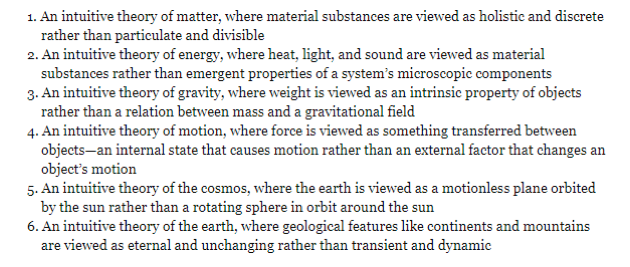
PART 2: Intuitive Theories of the Biological World
- Life: What Makes Us Alive? What Causes Us to Die?
Here author moves from non-animated world to the world of living and dying. He goes through somewhat long discussion of children’s perception of these issues as typical example of intuitive theories, summarizing it in such way:

- Growth: Why Do We Grow Bigger? Why Do We Grow Older?
This is kind of about lifecycles and human destiny to grow old and eventually die. Here is a nice illustration:
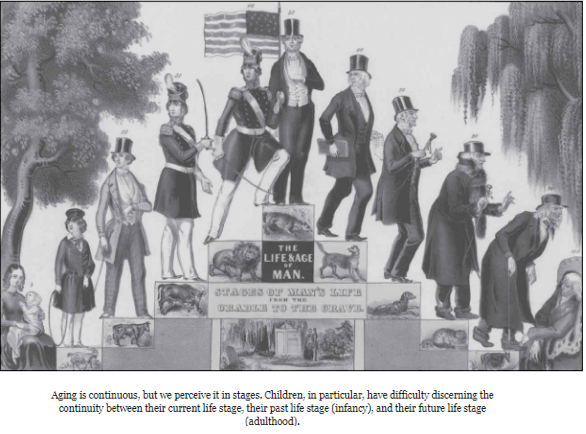
Once again author looks at intuitive theories through the prism of children’s perception, discussing vitalism, essentialism, and other theories of the past. An important point for author is that practically all intuitive theories treat live not only as qualitatively different phenomenon than unanimated material world, but also as the one that could not disassembly into material elements. Obviously contemporary science rejects this idea and maintains that live is just a specific form of material worlds and could eventually be created from material components.
- Inheritance: Why Do We Resemble Our Parents? Where Did We Get Our Traits?
Here author goes into discussion of scientific conceptions and misconceptions in genetics. Here is the nice sample when only the first two statements are scientifically correct, but all 6 are believed by majority to be true:
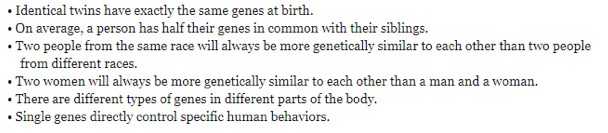
Overall the misconception usually come from poor understanding of the level of complexity related to genes expression and interaction with environment, leading sometime to believe that too much predefined by genes and concequent unjustified passivity in controlling one’s live.
- Illness: What Makes Us Ill? How Does Illness Spread?
The discussion of illness starts with phenomenon of disgust as a preventive mechanism for poisoning and other similar threats. Important difference here is that intuitive theories usually treat it as given, while science shows that a lot of it learned. Author provides quite a few examples of this in children and even in adults who change their attitude and behavior in relation to environment when new for them information about diseases become available.
- Adaptation: Why Are There So Many Life Forms? How Do They Change 0ve! Time?
This is mainly about Darwinism and evolution vs. creationism. It is also about popular misconceptions about genetics neatly illustrated by this picture were left side represent scientific view and right side popular view:
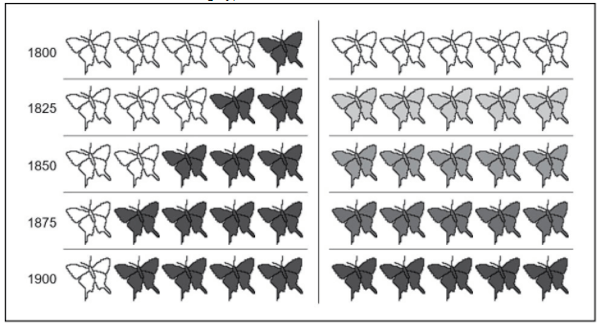
Author also stresses an interesting phenomenon that misconceptions often persists even in people who had specific education in the field with probably the most funny being an inability of many people to understand that morality has no place in the struggle for survival in animal kingdom and could be applied only to humans and a few other group dependent species. Another persistent “misconception” – Lamarckian adaptation, which lately become less of misconception when it was found by biologists that some ability to retain newly acquired adaptive feature and transfer it to the next generation does exist, albeit in somewhat week form.
- Ancestry: Where Did Species Come From? How Are They Related?
This is continuation of discussion on evolution, this time directed to the past. The misunderstanding here is popularity of teleological approach of development from lower forms of live to higher. Here is traditional representation of this view:
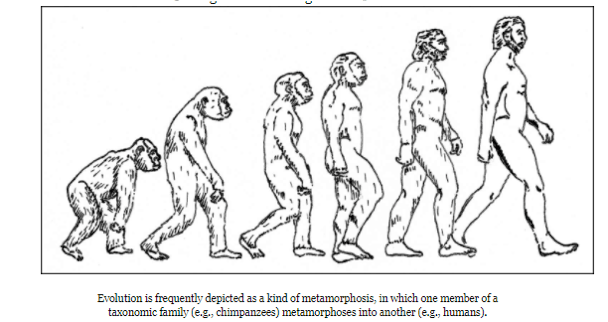
In reality there is no define direction of development and it is just random transformation of live when changing conditions demand it, continutation when there is no such demand and extinction when demands for survival are so overwhelming that available diversity within species under pressure could not provide necessary features to overcome it. Here is more realistic presentation of evolution:

- How to Get the World Right
The final chapter is about how to avoid intuitive theories and obtain more scientific understanding of the world. Author stresses that intuitive theories usually based on perceptions and experience, while scientific theories are complex, come from formal process, which is difficult to implement and which requires a serious cognitive effort to digest. Nevertheless, he makes a serious effort of convincing that it is necessary because misconceptions about reality lead to errors in judgement and actions, eventually hurting people. He supports this idea by providing such examples as vaccination when intuitive theory led its supporters to pretty bad consequences.
MY TAKE ON IT:
This is an interesting look at the problem of forming worldview consistent with the real world. In my opinion author is relaying too much on children to demonstrate intuitive theories of the world, making it way too simplified. I believe the problem, and it is a big problem, is that contemporary education does not provide people with tools to understand scientific method, its applications and limitations. Besides, author seems to be too much of an academic to understand that in real world people more often had to act based on intuitive theories that are good enough to predict consequences of actions in real world even if these theories are not really formulated, but rather just a product of experience. A good example could be takes form author’s first chapter about misconception of mechanics of the world: when two bullets one shot from the gun in perfect parallel to the floor, and another one just dropped. According to author they both hit the floor simultaneously because the only force that causes bullet drop is gravitation, which is equal for both bullets. However, in reality everybody who ever shot a gun knows that it would take much longer for flying bullet to hit the floor than for the dropped bullet. The shooter knows that from experience and, if he is not educated in physics and pressed to explain, he could come up with some idea of inherent driving power instead of correctly point out that real world is complex and bullet spin, air resistance, curvature of the earth, wind direction and so on. So, we have an interesting situation here when simplified, primitive education gives result inconsistent with reality, while intuitive non-scientific theory provides for better results. Here I think author is missing a very important problem that causes well educated people to buy into such hoaxes as global warming: difficulty to understand that real world is extremely complex, while science is generally simple and limited, so any prediction claiming to be scientific should be founded on multiple full-scale experience with phenomenon that one is trying to predict. Therefore, it is not possible to predict future climate and even weather over long term, because there are way too many unpredictable variables, some of them like son’s radiation levels, being much more influential than content of greenhouse gases in atmosphere. In other words non-theoretical common sense based on experience is just another way to comprehend reality and it is not less scientific than formal science in terms of predicting power, while lack of explanatory power does not make it less useful.
20171124 – Civil Wars- A History

MAIN IDEA:
The main idea of this book is to review the very notion of civil war from various prospectives starting from historical, then moving to philosophical and legal approaches, and finely completing it with contemporary political analysis. Probably the most important inference here is that civil wars are way too complicated and mainly depend on participants’ ideas about themselves, their group, and their opponents therefore it should be treated as the great opportunity for historical approach, rather than legal or philosophical.
DETAILS:
Introduction: Confronting Civil War
It starts with somewhat interesting complain that a lot of history research dedicated to wars, but very little of it to civil wars, while in reality civil wars, especially over the last 70 years after the end of WWII, are much more common than wars between states. Author discusses cruelty of civil wars that often goes way beyond cruelty of wars between states, especially in relation to non-combatants. However the main stress is not on this, but rather on the “generative” role of civil wars that author puts under investigation, claiming that this is a book “in ideas”. It makes sense because ideas are usual drivers of Civil Wars, unlike territorial and political conquest that drives regular wars. Author defines development of ideas about civil wars based on three points:
- Difference between civil war and revolution
- Legal meaning of civil war
- Proxy wars of Cold War period, including decolonization wars when external power played significant roles in internal conflicts.
Part I: Roads from Rome
1: Inventing Civil War: The Roman Tradition
The first place the author goes to – Rome, which he considers inventor of civil war. It came from Roman tradition to call wars by the name of opponents so then opponent belongs to the same civic community the war becomes civil. After that author goes into details of Roman and Greek notions of internal conflict: for Greeks political war was inconceivable, but for Romans it became nearly routine. Author allocates a lot of space to Roman internal conflicts because they often had clear character of class war for political power.
2: Remembering Civil War: Roman Visions
Here author refers to idea that “forgetting is the best defense against civil war”, then proceeds to discuss civil war between Caesar and Pompey. This was practical consequence of lack of civilian control over military leaders who managed to build personal loyalty of troops to themselves that was exceeding loyalty to the Rome. Author points out the story of Cicero’s promotion of military leaders and attempts to define differences between various types of internal conflict. This follows by more or less retelling of history of Roman conflicts.
Part II: Early Modern Crossroads
3: Uncivil Civil Wars: The Seventeenth Century
This chapter starts with discussion about influence of Roman writings related to civil wars on development of European culture. They popularized notions of civil strives and variety of forms of control over society somewhat different from what was usual at the time. In process it probably created intellectual environment susceptible to raising weapons against other members of the same society. By seventieth century it all moved from domain of history and literature into domain of law and actual implementation. As examples, author discusses Hobbes ideas and actual civil war of British Parliament against the king.
4: Civil War in an Age of Revolutions: The Eighteenth Century
This is about comparing civil wars and revolutions. Author believes that the difference is that civil wars are contained within a nation, while revolutions tend to expand all over the world like communist revolutions. He also notes that overall revolutions have some positive connotation, while civil wars are ugly beasts. Author reviews a works of a few historians and then looks in details at XVIII century writer Emer Vattel, the influential thinker on laws of wars and revolutions. After that author moves to American Revolution and controversy about extent of it being civil war between patriots and loyalists as much as revolution. Finally, discussion moves to Burke and his analysis of American and then French revolutions / civil wars.
Part III: Paths to the Present
5: Civilizing Civil War: The Nineteenth Century:
This starts with American Civil war and Gettysburg Address and, more interesting, with General Order 100 drafted by Francis Lieber that defined legal code for the conduct of war 6 months before Gettysburg. Author discusses the legal and philosophical meaning of civil war in XIX century when ideas of Enlightenment become dominant in the Western world. Author points out that Confederacy never accepted that it was Civil war. For them it was war of Northern aggression not different from any other wars between different polities. Eventually the range of attitudes in emerged in Western civilization goes from the notion that all wars are civil wars because of humanity being a whole, to infinite variety of non-civil wars between citizens of different entities: national, religious, territorial, and any others that do not accept each other as members of the same group.
6: Worlds of Civil War: The Twentieth Century:
Both trends fully matured in XX century when on one hand some perceived WWI and WWII as civil wars within mainly western society, while on the other hand any diverse entity came under pressure from inside when groups small and big demanded independence and initiated wars of divorce. Author reviews this development, especially its diplomatic and legal details using example of Yugoslavia and Serbia civil wars that outgrew into international conflict. The second part of the chapter is about philosophical approach to war with lots of attention paid to Rawls and his classification of wars:

Conclusion: Civil Wars of Words
In conclusion author discusses contemporary implications of wars designation as Civil or International conflicts that could and do create not only different psychological attitude, but also often lead to international involvement, including military, on one or another side of conflict.
MY TAKE ON IT:
I think that the differentiation between civil and. international wars is important because it often defines level of savagery the war is conducted with. Except for some very specific cases when war was waged with purpose of annihilation of other, the civil wars are usually more savage that international. The wars are always between groups and humans are always belong to the multitude of groups from small group of their close family to the big group of their nation, to the huge group of their religion and/or philosophy. Therefore, any war’s character depends on what people are fighting for and what is breakdown of groups that are fighting each other. I would define the civil war as the war where significant groups of individuals belonging to one political entity, but irreconcilably diverse in their attitudes and believes fight each other with objective to suppress, eliminate, or expel their opponents. The good example would be revolutionary wars including decolonization when significant number of people are quite satisfied with existing situation and resist change while others could not tolerate status quo any more, like it was during American revolution when 1/3 of population were Patriots, 1/3 Tories, and 1/3 Neutral who eventually sided with Patriots due to deprivation brought on by British army. In this case the internal conflict between colonials with different approaches to relations with British polity, they all belonged at the time, outgrew into international conflict between two nations, when colonials formed the new American polity. Quite different development occurred during American Civil war when American polity containing diverse states developed into two groups of states with irreconcilable differences in all significant areas: economically, legally, philosophically, and politically, leading to armed conflict between them. There were no 1/3 of abolitionists on South and even if majority of Northerners were indifferent to slavery, tariffs, or any other disputes with South, they had strong enough support for Union to fight for it. Interestingly enough, end of formal conflict did not really end the war, but rather continued for another 10+ years in the form of irregular guerilla warfare waged by Southern Whites against Southern Blacks supported by transplanted Northern Abolitionists until more or less acceptable for all accommodation was achieved in the form of segregation. In this case the war that started as war between states within Union outgrew into the civil war of two racially and ideologically different groups living on the same territory under umbrella of the same state.
20171117 You brain is your time machine

MAIN IDEA:
The main idea of this book is to review the notion of time in all its complexity from all possible angles: historical, psychological, physiological, mathematical, theoretical physics, and even mental time travel in literature.
DETAILS:
PART I: BRAIN TIME
1:00 Flavors of Time
It starts with presentation of variety of attitudes to the notion of time:

After this author moves to describe history of time, or more precisely of its discovery, since the time not always was something that was consciously perceived by humans. Here author traces it from initial vague notions to mathematical perception of time as the fourth dimension of the space/time continuum. Author also looks at neuroscience of time understanding, eventually completing this chapter with philosophical understanding of time divided into the two contradictory camps: Presentism when only the present exists and Eternalism when all time dependent events exist exactly like other 3 dimensions of the space that is if we are only at one specific point at any given time, nevertheless any other point on time dimension also exists. Finally, author discusses plurality of time as used in language and human perception, positing that at the core is time as measured by clocks.
2:00 The Best Time Machine You’ll Ever Own
This is about imaginary time travel and human brain as the best time machine that is. It properly starts with H.G. Wells and touches on multitude of other images including mathematically sound 4D space. The characteristics of the brains as time machine are:
- It remembers past in order to predict future
- It tells time
- It creates sense of time
- It allows mentally travel in time back and forth.
Author also looks at the time as a teacher that teach us that cause and effect must be continuous in time and space; that cause must be before effect; and that time follow clearly defined direction that could not be reversed.
The next part of the chapter looks at human the brain and synaptic causes and effect that happen there.
3:00 Day and Night
This is about human perception of time periods of a day and circadian rhythms that control them. Author discusses multiple experiments with isolation when person has no way to identify time of the day. In such cases time seems to be shortening in the mind so 170 days feels like 150 or so. Authors discuses in details how it all works and how various cycles in body starting at molecular level influence perception of time with significant variance from astronomical time.
4:00 The Sixth Sense
This is also about subjective time perception, but it is more about such cases as dangerous situations when time seems to be standing still. One interesting part of it is variance between prospective and retrospective time perception. Author discusses the link of both types to the memory. When time is filled up with events it runs fast and posts a lot of information into the memory. Correspondingly if there are no events, just waiting for something, it moves slowly and leaves very little to recall. The contemporary perception of a long and short times usually changes when it becomes memory. Long, one-day delay at airport becomes barely recallable, but one day walking around of tourist attractions contains multitude of memories good enough for a few days. Author also discusses cause of slow-motion effects:
- Overclocking – mobilization of organism causes all processes to accelerate, creating illusion that person thinks and moves faster than in reality
- Hypermemory – this is an idea that slow motion is post factum illusion created by assigning the event very high value and import.
- Metaillusion – since reality is always just a construction of brain, the slow motion is constructed on the top of normal perceptions with magnifying effects.
These illusions relate not only to time, but also to space and all other perceptions.
5:00 Patterns in Time
This starts with discussion of relationship between time and language when different timing defines meaning of speech including such low level as difference between P and B defined by time allowed for air release while speaking. Timing also plays a big part in defining emotional content of the speech example is “not” jokes. After that author goes to time relevant aspects of motherese, fully timing based Morse code, time length perception of sounds, songbirds, and music. The chapter ends with discussion of neuro mechanics of length of time perception for sounds and similar events.
6:00 Time, Neural Dynamics, and Chaos
Here author moves to time measurement methods starting with regular clock and then moving to Supra and Infra period timing, the idea based on brain time processing, which is not necessary some kind of oscillator like in time measuring devices. This leads to a discussion of timing of the sequence of events such as rain drops and ripples generated by them and similar case of synaptic plasticity. It is connected to the idea of state dependent networks, which are basically core of processes in the brain discussed in the bulk of this chapter.
PART II: THE PHYSICAL AND MENTAL NATURE OF TIME
7:00 Keeping Time
Author starts here with introduction of idea of temporal telescopes that allow us to look into the past or future. At first it leads to the discussion of atomic structure of the brain, formation of neurons, and such, then author moves to various time related devices from calendars to clocks, pendulums, and other oscillators that are at the core of time measurement.
8:00 Time: What the Hell Is It?
Here author goes back to the meaning of time and links it to the meaning of existence referring to previously discussed notions of Presentism and Eternalism, whether it is arrow or double-headed arrow or some other notion developed from fancy ideas produced by physicists.
9:00 The Spatialization of Time in Physics
This is about theoretical physics approach to the time as just one of dimensions of continuum, relativity of time and its dependence on speed. Somewhat unusual trick here is an attempt to remove inconsistency between eternalistic presentation of time/space and human perception of time moving from past to future via current by claiming that it is just neurological illusion of existence of now. Author poses a funny question if the block universe is compatible with neuroscience, but could not provide a clear answer.
10:00 The Spatialization of Time in Neuroscience
This is a look at the time beyond physics from purely human perspective. Author finds that even here time is considered as a dimension of space, albeit somewhat strange because one can move along it only in one direction or, alternatively it is moving through. Here is a nice illustration of these approaches:
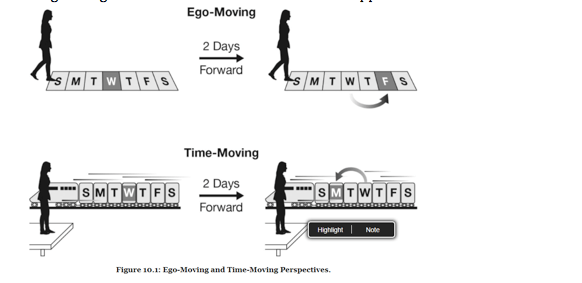
At the end author kind of connects time perception to general human susceptibility to illusions.
11:00 Mental Time Travel
This is about relation between time and brain. The brain actually could be considered a tool for mental time travel that allow analyze past and predict future from primitive prediction of future spatial position of running animal to plan on achieving some specific objective many years in the future. Author cannot help but mention human tendency to allocate much more value to the close future than to the distant one.
12:00 Consciousness: Binding the Past and the Future
The final chapter is about human mind ability to connect past and future, calibrating one’s behavior based on known actions and result in the past, and ability to predict future results, making live somewhat predictable, but a lot less than everybody would want.
MY TAKE ON IT:
The time is an interesting notion that I somewhat straggled back some 40 years ago when I did my classes in theoretical physics. Somehow I could not connect the clear and simple mathematical concepts of theory of relativity with common sense and experience of everyday live. Author discusses this kind of problem in his presentation of philosophical dispute between Eternalists and Presentists and he seems to be inclined to support the Eternalists approach. I on other hand learned over all these years that when there is any inconsistency between theory and common sense the latter should be treated preferentially just because it’s analog character guaranties inclusion of much more relevant information, albeit at the expense of being imprecise. I guess, in other worlds, I am convinced Presentist, even if this view is not supported by theoretical models of speculative science. As to the neurological and psychological side of the time, I think that compression of the past is natural feature of human memory, while ongoing present leading to unpredictable future that one will have to live second by second is inevitably seems to be slow moving unless one is in process of psychological flow. In short the Externalist’s spatial model of time as dimension is good for mathematical modeling and useless for living one’s live. The latter activity would be done much better if time were treated as a limited resource spent carefully.
20171110 – America’s Great Depression

MAIN IDEA:
The main idea of this book is that business cycle could be explained by analysis of government interventions that expand credit to unreasonable levels. It results in situation when business owners bound to make mistakes of investing out of sync with the future demand. When this overinvestment leads to decrease in profits they try to liquidate these investments causing panic, decrease in production and employment. However, if left alone, businesses quickly liquidate failed investments resulting in prices, especially of labor prices, going down and creating the new starting platform for efficient expansion. Correspondingly, the cause of the great depression were actions of Hoover administration that from Hoover down to nearly every lowly bureaucrat believed that they can and should engineer economy to avoid downfall. They did it by forcing businesses maintain high level of salaries and unproductive employment, expanding or at least maintaining the same high level of government expenses, creating public works program, inflating money supply, and cutting foreign trade. FDR actually just continued doing the same only on the ever-bigger scale.
DETAILS:
PART I: BUSINESS CYCLE THEORY
- THE POSITIVE THEORY OF THE CYCLE
The study of business cycles should be based on consistent economic theory. Only Misses’ theory meets this requirement.
Business cycles and business fluctuations
Here author discusses difference between cycles and fluctuations with fluctuations being a normal process of changes that constantly happen, while cycle is connected with general changes in money supply and therefore goes through clear phases of crises and depression.
The problem: the cluster of error
Unlike normal fluctuations, the cycle’s depression phase represents massive cluster of business errors happening in sync, so this synchronization requires explanation.
The explanation: boom and depression
Author’s explanation defines boom as cause of cycle because it normally follows by bust and depression. The reasons for boom is government actions when it uses banks to pump money into economy, creating skewed environment where business bound to make mistakes in evaluating demand and consequently misallocates resources. Incorrectly allocated resources would not provide normal return on investment and therefore had to be liquidated, which happens during the bust phase.
Secondary features of depression: deflationary credit contraction
Here author analyses credit contraction as the secondary feature of depression because liquidation of failed investment causes increase in liquidity demand consequently pushing prices down. If not interfered, the liquidation happens quickly and, after losses flushed out, economy start growing again.
Government depression policy: laissez-faire
This process of adjustment after the failed boom is often interrupted by government intervention that prolongs life of failed businesses and artificially supports high prices, preventing the start of recovery. Correspondingly author’s recommendation for government is not to interfere.
Preventing depressions
However, preventing depression in the first place could be done via government interference, mainly by preventing banks from inflating money supply. The ideal method would be to forbid fractional-reserve banking.
Problems in the Austrian theory of the trade c cycle
Here author reviews some critical ideas proposed against Mises theory of depression such as:
- Assumption of full employment,
- No clear difference between Overinvestment and Malinvestment,
- Lack of clear difference between Active and Passive banks
- Recurrence of Cycles
- Gold changes within Cycle
Assumption of full employment
- KEYNESIAN CRITICISMS OF THE THEORY
Here author points out 2 criticisms from Keynesians:
- Rejection of separation between savings and investments
- The nature of consumption
The liquidity “trap”
This is discussion of Keynes idea of depressions being caused by withdraw of liquidity from market, which Misses reject because of its dependency on elasticity of demand. The reason for rejection is that this elasticity is not infinite.
Wage rates and unemployment
This is a critic of Keynes idea of downward rigidity of wages based on the notion that in free market it is not possibly because labor sellers need earnings to survive and therefore would accept wage decrease.
- SOME ALTERNATIVE EXPLANATIONS OF DEPRESSION: A CRITIQUE
This is a critic of idea that other non-Austrian explanations for depressions are also valid
General overproduction
This is critic of overproduction – the idea, which author believes is irrelevant because it just means that business must sell below cost and incur losses. Such loses would quickly stop any additional production and shift resources to a profitable use.
Underconsumption
Similarly, underconsumption would immediately lead to fall in prices to the level when consumption would move to equilibrium
The acceleration principle
The point here is that the increase in consumer demand leads to disproportional increase in producer demand for secondary goods with consequent overcapacity and inevitable drop in the following years.
Dearth of “investment opportunities”
This is about decrease in population growth leading to stable consumption and production with no need for the new investment. As other ideas, this one fails to take into consideration the pricing system, which would lead to decrease of cost of capital resulting in increase in consumption.
Schumpeter’s business cycle theory
This is critic of the idea that one can postulate 0 interest rate in analyzing depressions. This allows unabridged increase in credit to industries with the cluster of innovation at the time with consequent bust when innovation ends.
Qualitative credit doctrines
These is a cluster of theories that agree with Austrians about boom and bust being parts of the same process leading to depression, with boom being responsible for bust. However, these theories are different on causal analysis and author reviews how exactly it happens for a couple of them:
- Banking school that claims that problem is credit allocation to long-term loans
- Some other schools that emphasize credit allocation to wrong asset types
- Still some other schools blaming financial trading on margins and derivatives
Overoptimism and overpessimism
The final peace in this chapter is about animal spirits such as unjustified optimism or pessimist that causes people to behave irrationally.
PART II: THE INFLATIONARY BOOM: 1921-1929
- THE INFLATIONARY FACTORS
It starts with the claim that use of historical data to test economic theory is a mistake because every situation is unique and way too interconnected with multitude of causal effects interacting. As example author refer to 1920s boom, which often mistakenly called inflationary, even though prices were stable. However, this stability was result of two forces acting in different direction: price decrease due to dramatic increase in productivity with price increase due to monetary inflation. Therefore, historic data could only be only partially relevant. The point author makes is that unhampered market would not have booms and busts because of diversity of industries and complexity of economy where mini boom in one place would be compensated by mini bust in another. The depression can really be caused only by government, which by interfering with money supply would synchronize these processes.
The definition of the money supply
Here author discusses money supply and what is included or not included into it.
Inflation of the money supply 1921-1929
This is a look at actual money supply in US economy in 1920s:
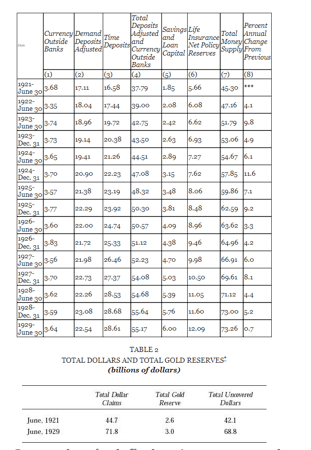
Generating the inflation, I: reserve requirements; Generating the inflation, II: total reserves; Treasury currency; Bills discounted; Bills bought-acceptances; U.S. government securities;
These sub-chapters represent detailed review of positions in American money supply.
- THE DEVELOPMENT OF THE INFLATION: Foreign lending; Helping Britain;
The main point of this chapter is that development of inflation occurred due to some very specific factors: FEDs purchases of silver, discounted treasury bills with low acceptance rates, open market purchases of government securities, lending to foreign entities, with government actively interfering. Finally, significant role was played by help to the British, which did occur despite the enduring myth of isolationism.
The crisis approaches
In the spring of 1928 FED initially tried to halt boom by reducing reserves, but banks managed to compensate for this by shifting from demand to time deposits. However, it failed due to the policy of unlimited buying of acceptances and eventually cheap money prepared economy for the bust.
- THEORIES AND INFLATION: ECONOMISTS AND THE LURE OF A STABLE PRICE LEVEL
This is about believes of economists in stable prices and ability of monetary policy to maintain such prices that led to their inability to see growing monetary expansion and unhealthy boom it caused. One interesting point author makes here is that despite appearing stability of prices, the wages in capital goods industry were growing disproportionally, while in consumer goods industry they remained the same, indicating overinvestment that counterweighted price decreases that should follow huge gains in productivity. Author supports the idea that this great experiment in price stabilization was one of the main causes of depression.
PART III: THE GREAT DEPRSSION: 1929-1933
- PRELUDE TO DEPRESSION: MR. HOOVER AND LAISSEZ-FAIRE
This is detailed and quite convincing retell of “the great engineer” Hoover’s attitude to economics that, while not “socialistic” was still pretty much in line with general thought that economy could be run as machine from the top. Probably the main difference between him and FDR was Hoovers’ compliance with constitution, laws of the country, and his oath of office, while FDR demonstrated complete contempt for all these “unnecessary niceties”. As result, while both were trying to do the same, being driven by poor understanding of economy and humanity, Hoover put pressure on business making them “voluntary” act against their interests, when FDR just issued unconstitutional directives.
The development of Hoover’s interventionism: unemployment; The development of Hoover’s interventionism: labor relations
These two subchapters describe how Hoover started “reconstruction program”, the first massive interference into economy, created management/labor conference, promoted collective bargaining, and pressed businesses into minimizing unemployment and maintaining salaries above the market, resulting in economy’s inability to rich bottom quickly, flash out inefficiency, and start growing.
- THE DEPRESSION BEGINS: PRESIDENT HOOVER TAKES COMMAND
This is a very interesting chapter because it looks at Hoovers’ role as the first president who considered it the government responsibility to manage economy. Until that economic condition of the country was pretty much perceived as independent from government intervention similarly to the weather. Sometimes it was good, sometimes not so good, but there was nothing one could do about it. Hoover believed that with his engineering background he could do a lot more. So here is a brief list of his actions:
The White House conferences
These were conducted with business leaders on the wide scale and served to force these leaders to provide more investments and maintain high level of wages to keep demand up.
Inflating credit
The monetary policy of FED was initially inflationary leading to quick expansion of credit and initially saving banks.
Public works; The New Deal Farm Program
Similarly, to the credit expansion, Hoover interfered into economy by pushing increase of public works. Corresponding effort in agriculture led to creation of farm subsidies program, which often mistakenly considered as FDR’s New Deal program. Author goes into some details of formation and political activities of farm block, which is even now, 80 years later still goes strong, consuming public resources at good pace.
- 1930
At the beginning of 1930 majority of public believed that Hoover and government got crisis under control. To assure the continuing “success” Congress authorize $915 million for additional public works in construction.
More inflation; The Smoot-Hawley Tariff; Hoover in the second half of 1930; The public works agitation; The fiscal burdens of government;
This list pretty much represents further continuation of seemingly successful policy of massive government intervention expanded into strong protectionist measures, continuing expansion of public works, and extensive use of government power in support of organized labor with Wagner act. All together it led to big expansion of government expenses and author points out that it grew quite dramatically as % of total economic activity. Author rightfully designates government economic activity as depredation since it occurred via use of force to confiscate resources from productive parts of economy.
- 1931- “THE TRAGIC YEAR”
This was supposed to be a year of recovery instead it was a year when crisis development accelerated. Author describes its development in Europe and makes point that FED’s attempts to support untenable credit positions of European countries was a serious mistake.
The American monetary picture; The fiscal burden of government; Public works and wage rates; Maintaining wages rates; Immigration restrictions; Voluntary relief;
Every small subchapter here demonstrates an increased intervention of government into economy and author stresses that this intervention was mainly counterproductive, preventing economy from self-adjustment and restoration of normal activity. Even the voluntary efforts for relief, became supplemented by Emergency committee to control it, turning it into bureaucratic enterprise
Hoover in the last quarter of 1931;
This is description of Hoover’s frantic attempt to start recovery by increasing push for “volunteer” compliance of businesses with his ideas, which pretty much come down to staunch rejection of laisses faire approach, creation of multitude of government programs that later become the “New Deal”, and attempts to pump more government money into economy.
The spread of collectivist ideas in the business world;
The final part of this chapter is especially interesting by analyzing mental state of leading individuals in business world, in economics and in public discussion. It clearly demonstrates the massive acceptance of collectivistic ideas with bend towards government planning and top down control of economy. These were not just ides, but also actions such as cartelization of oil industry, activization of union movement often with support of big business, and similar events.
- THE HOOVER NEW DEAL OF 1932
This is another list of Hoover administration activities in their attempt to stop developing depression by using government power both direct and disguised as persuasion. Author presents Hoover program and then goes into details of its implementation.
The tax increase: It was massive and included just about everything from estate taxes for rich to increase in postal rates for poor
Expenditures versus economy: Government expenditures decreased, but a lot less than decrease in GNP resulting in proportional increase of spending to economy.
Public works agitation: This is a brief description of discussion about continuing expansion of public works with one side stressing need to fight unemployment while another pointing out that it froze both capital in labor in unproductive uses, therefore preventing recovery.
The RFC: RFC was providing massive influx of government capital into economy providing loans without real evaluation of their future performance and as one could expect become a serious case of massive corruption.
Governmental relief; The inflation program; The inflation agitation; Mr. Hoover’s war on the stock market; The home loan bank system; The bankruptcy law; The fight against immigration: Each of above is an area of Government involvement that caused more harm than good. Author very briefly touches each of these areas, providing factual account of what had been done. Regardless of actual result one can easily conclude that it was far from doing nothing and not interfering into economy.
- THE CLOSE OF THE HOOVER TERM: The attack on property rights: the final currency failure; Wages, hours, and employment during the depression
An interesting thing here is that Hoover sincerely believed that he did a pretty good job, was proud of his multiple interferences, and confident that doing nothing would be a disaster. However, Hoover remained more or less within bounds of his constitutional authority and rejected plans of very popular “economic fascism” similar to what come to pass with FDR administration.
Conclusion: the lessons of Mr. Hoover’s record
The main conclusion that author states is that all this government interference, especially inflationary activities were cause of the depression. Author believes that business cycles are caused by government’s expanding credit to unreasonable level that creates misallocation of resources during the boom, making it necessary to liquidate such misallocation during the bust. Such believe leads to conclusion that Hoover’s actions, caused by his rejection of laisses faire, made the depression all but unavoidable and the next great expansionist of government FDR only added to Hoover’s action more of the same delaying recovery to the WWII. At the end author provides some statistical information demonstrating level of the disaster that was the Great Depression and here is one example:

MY TAKE ON IT:
I do not think that core idea of this book: a business cycle caused mainly if not exclusively by government intervention, is completely correct. The history demonstrated that there were business cycles as long as there were businesses. I would rather put generic cause of cycles to the human propensity to join crowd and run in the same direction as everybody, so contagious optimism could easily cause a bit of boom, while contagious pessimism would lead to a bust. Nevertheless, I fully agree with author that deepness and tragedy of the Great Depression was the product of engineering arrogance of Hoover and overall elite of western societies that had their heads spinning from technological achievements of XIX century. These achievements caused people to develop false believe that they could engineer complex systems based on human individuals as well as they can engineer some mechanical system based on nuts and bolts. Actually, it is not limited to the Great Depression. All evils of XX century: socialism, communism, fascism, genocide, and such came from this source. Unfortunately the idea of engineering and controlling society from above is still alive in minds of many an elite and it will probably take some more fighting to put it to rest.
20171103 – The Enigma of Reason

MAIN IDEA:
The main idea of this book is that human reason is misunderstood as a feature of individual survival, when in reality it is the feature of group survival. As such feature the reason had recently came under attack as sloppy and ineffective due to various biases, failures of statistical and logical thinking. The attack came from psychological research that convincingly demonstrated all these deficiencies. Authors reject the idea of dual thinking: fast and sloppy vs. slow and accurate, as insufficient and propose argumentative theory of reason where biases and other failures serve as tools to include into consideration as wide range of opinions as possible and flash out evolutionary viable solution via argumentation between people with strongly held views.
DETAILS:
Introduction: A Double Enigma
Given that humans are animals and as any other animals were shaped by evolution, why do they have such an expensive mechanism as reason and why only humans have such mechanism and no other animals? It is also interesting from another angle: recently psychologists found a lot of flows with human reason such as failures of logic, inability to think statistically, partiality of thinking and many others. So the double enigma is why we have this tool and why it is so flowed. Authors claim that the reason for this is that it is only one tool of many in arsenal of human thinking and provide graphic representation of its place as imbedded within other ways of thinking:

I. SHAKING DOGMA
The traditional Western dogma of reason as source of human superior abilities was shuttered by the last 50 years of psychological research and newly applied constructions such as “Fast and Slow” thinking or “Dual processing” could not meet explanatory requirements created by the data.
- Reason on Trial
In this chapter authors review multiple failures of human brain to correctly represent input from senses and/or solve simple logical problems from misevaluating levels of gray in 2 squares in the picture of checkers to producing inconsistent logical sequences such as A>B>C>A.
- Psychologists’ Travails
This chapter demonstrates that usual believe in inseparable combination of reason and logic is not really as strong as we want to believe. After using a couple tests that clearly demonstrate the case, authors move to describing idea of duality of thinking:

Without going deep into the details authors discuss it as division of thinking into: “Mental Models” and “Mental Logic” with psychologists divided between supporters of one idea against another.
II. UNDERSTANDING INFERENCE
This part is about understanding Inference, its base mechanism and procedures.
- From Unconscious Inferences to Intuitions
This starts with two questions: Why and how we reason? First authors look at reasoning in animals, specific example they use is about ants capable to find way by memorizing and calculating the previous path. Then they look at human perception, demonstrating how brain reprocesses and modifies raw information from senses to constructing a meaningful representation of reality. As prove they use a couple of optical illusions like small monster pursuing a big one on the picture while in reality they are of the same size. Authors discuss not only sensorial illusions, but also nature of human memory and research demonstrating that it has not that much reproductive as reconstructive character. This follows by a piece on Intuitions that authors define as interpretation of inferences. In case of monsters the inference of their size and positions lead to intuition that one is running after another. The third process used is reasoning, which is slow, conscious, and sequential process based not only on perception and intuition, but also on the knowledge base available. Here is graphic representation of these processes in the framework of two systems:

The final point here is Metacognition that is “cognition about cognition” that humans use to evaluate their own mental states.
- Modularity
Authors start this discussion with look at interaction between instinct and expertise. To clarify it they bring notion of instinct as “natural expertise” and “expertise as “acquired instincts”. After that they are going into mechanics of face, words, and norms recognition as examples of such acquired instincts. The final part of the chapter is about modularity of the mind, which authors define as biological modules with cognitive functionality. They reject notion of rigid innate modularity and support idea of cognitive functionality based on biological tissue, using reading as example.
- Cognitive Opportunism
Here authors discuss cognitive abilities through prism of evolution, rejecting in process the idea of mind as unitary and principled. They look at presentation and low-level procedures of mind’s working such as logical AND gate also know as conditional reflexes. However their overall assessment of logical and probalistical processing of the mind moves away from simplistic Aristotelian ideas to much more complex and chaotic processes that sometimes contradict formal logic, but seems to be beneficial for survival.
- Metarepresentations
This is about human attempts to understand how mind works via comparison with other animals and folk ontology that tend to assign reasoning and acting ability to just about anything including unanimated objects. Authors also discuss here mental representation versus public representations and high order presentations about presentation, which they define as metapresentations. They provide two similar sets of statements about representation of: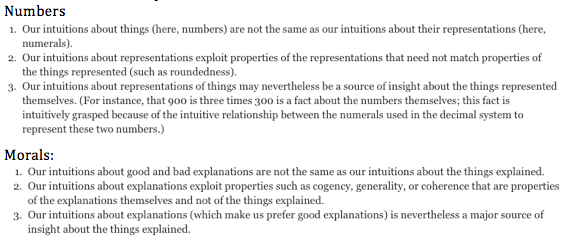
III. RETHINKING REASON
In this part authors are presenting their ideas about reason being a tool used by individuals to justify their actions, convince others in validity of these actions, and obtain their support, rather than develop a course of action.
- How We Use Reasons
Here authors are trying to provide support for their idea of reason as tool for explanation and justification of thoughts and actions after the fact. They start with the story of a man who killed stranded woman-motorist who was banging on the door of his house looking for help because he believed that he is under attack. They used this and a couple of similar stories to separate actual cause of actions not necessarily consciously understood and psychological reason that people create to justify their actions. Authors discuss experimental research supporting this idea and references to theoretical work supporting it. They also link it to previously discussed modularity of mind, presenting an idea that reason for subconscious control of action is that modules just do their own processing without necessary regard and coordination so eventually conscious mind left with need to find reasons to whatever subconscious made the body to do. The final part of the chapter discusses why there is need for reasons in the first place and concludes that it is for external social consumption.
- Could Reason Be a Module?
Here authors move to deeper discussion of the issue of reasons in both modes: retrospective and prospective. They provide a logical tree for this:
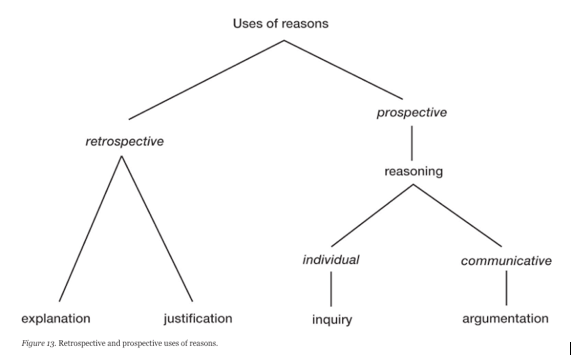
After that they discuss reasons as product of inference from the perceived factual data and regularities of environment. Authors also present some research supporting ideas that people have intuitions about reasons and eventually propose an idea that reasons are product of separate module mainly used for justification and explanation, but practically not involved in decision making.
- Reasoning: Intuition and Reflection
Here author discuss nature of arguments and conclusions as components of reasoning as representation of processes conducted in the reason module and provide a small table to illustrate it:

After that author discuss reliance of reason on language and use of logic as heuristic tool for reasoning.
- Reason: What Is It For?
This is an attempt to link authors’ understanding of reason’s use for justification to evolutionary need for cohesiveness of a group. They look at history of understanding of reason and discuss its various uses that improve fitness of individuals and their group from coordination to communication to argumentation
IV. WHAT REASON CAN AND CANNOT DO
This part is an attempt to test hypothesis that reason serves not that much for decision making as for justification of already occurred actions.
- Why Is Reasoning Biased?
This is about reason being biased, which does not make sense if its function were to analyze facts and make decision that would lead to achieving objectives. However it makes a lot of sense if it is used mainly for justification. In this case any distortion of reality could be useful as long as it helps to achieve such justification. Authors look at advantages provided by a bias such as prevention of expensive investigation to identify truth and use cheap “good enough” solutions, also important is a part on complexity of science where real pursuit of truth lead to need in complex philosophical approaches such as falsification. Then they discuss a couple of typical forms of reality distortions such as confirmation bias and myside bias both of which make sense for justification, but not for correct way of actions.
- Quality Control: How We Evaluate Arguments
This is about a quite special use of reason in argumentation when it is clear that generally decision-making is not involved and objective of convincing is pursued via interaction with various argument some of which are quite illogical such as request for prove of absence. Here authors look at support for their position in the fact of duality of reason use when different criteria used for one’s own reasoning and for other people reasoning:

- The Dark Side of Reason
This is about human capability to find reasons to confirm opinion whether these reasons viable or not. The examples provided are for literature, but also from the story of Dreyfus when famous detective who was hard believer in Dreyfus’ quilt could not be moved from his position by any valid proves that Dreyfus was innocent. After that authors discuss an interesting question: if the main use of reason is for self and others deception, how come evolution created humans with lots of such features. Their answer is quite interesting: the reason’s distortion of reality does spell disaster for individual, but it is beneficial for a group when diversity of strongly held opinions could lead to the better overall decision making via argumentation when only strong argument would survive.
- A Reason for Everything
This is about human ability to find reasons for everything, even when it is clear that there is none like in experiment with selection between several perfectly similar items when strong reasons for selection after the fact point to non-existing variances between items. However authors also discuss quite a few experiments when requirement for reasoning imposed before making decision changes the way decision is made. At the end of chapter authors review a sunk cost fallacy that makes people to take into account quite strongly some events of the past that really have no weight on the future such as decision to go into storm to use prepaid ticket, but not to go if ticket was provided for free.
- The Bright Side of Reason
The final part of this chapter is pretty much praise of argumentation and support to the idea that the best way to make decisions is via rigorous argumentation between several people with diversity of strongly held views.
V. REASON IN THE WILD
The last part of this book designed to go out of psychological laboratories and experiments with clearly defined limits into real worlds and look at the use of reason in the wild.
- Is Human Reason Universal?
Here authors discuss validity of results of psychological experiments with the WEIRD people. As the example of cultural dependency they use a simple task of getting 3 coins out of the box with many. It is a very easy task for nearly all people except for Piraha Amazonian Indians whose language includes only count to 2 with anything more than 2 practically non existent. Only 2/3 of Piraha were able to succeed, while they were pretty good in multiple other tasks that did not require counting more than 2. Authors also look at specifics of argumentation in East Asia, small-scale societies, and such. At the end of chapter they are trying to reconcile evolutionary, cognitive, and anthropological perspectives for reasoning.
- Reasoning about Moral and Political Topics
Here authors look at especially difficult for people topic of use of reason for rationalization in areas of politics and morals. They refer to research demonstrating how some mundane factors influence human behavior in areas that everybody consider hugely important. A nice example was provided by judges whose sentencing decisions turned out to be highly correlated with condition of their body with people sentenced after lunch getting lighter sentences than those who were sentenced by hungry judge just before lunch. This follows by discussion on reasoning and morality and digression into history of slavery and abolitionism.
- Solitary Geniuses?
The final chapter is about science as a method of somewhat organized reasoning and argumentation, which allows to achieve results in the form of understanding of the world significantly better than occurs in other areas, despite scientists being as biased, prejudiced, and limited by the dominant paradigm as everybody else. Authors seem to suggest that it occurs because of good combination of solitary thinking and peer group arguing that allow producing new ideas without pressure, but rigorously test them afterworld.
Conclusion: In Praise of Reason after All
In conclusion authors state that the Reason is only one module of inference among others and is highly specialized for its domain of competence as any of them. Authors define this domain as domain of social interaction and present it as “argumentative theory of reason”. They reject idea of dual, fast and slow thinking and argue that human biases, illogical conclusions, and such are not a bug, but rather a feature of effective problem resolution where problem solver is not an individual, but rather a group and solution is found via argumentation between strong, intellectually and experimentally diverse individuals, rather than via logically consistent, non-contradictory, and algorithmically defined thinking.
MY TAKE ON IT:
I think it is a great book and I inclined to agree with authors approach to reason as tool for argumentation, convincing, and justification, rather than tool for analyzing facts and planning future actions. However I would still maintain that reason as planning tool is also evolutionary useful, but require unusually hard effort to apply it effectively, that majority of people usually do only in the case of few instances when decision they are working on is complex and consequential. While agreeing with authors that regular use of reason applied mainly for argumentation and justification, I think that the current and even more future development would expand use of reason for planning and execution of human activities because it is and even much more will be supplemented by logically and statistically perfect reasoning using computers, which have none of human deficiencies in logical thinking. The human task in achieving effective solution will be shifted from intellectual processing for data selection to feed into computer for processing. As perfect as computers are in sequential formalized intellectual processing, they have no common sense of what, out of infinite amount of data, is relevant and what is not, resulting in well-known phenomenon of “ junk in – junk out”. Actually this does not diminish argumentative value of reason, it just moves it to more sophisticated level when computer models support both planning and argumentation.
20171027 – A Sovereign People

MAIN IDEA:
The main idea of this book is to review history of 4 challenges to the newly created American nation that had to be overcome in order to create truly sovereign state:
- Internal threat of Whiskey rebellion that was generated from the bottom of society
- French attempt to subvert American sovereignty and force it to act under French control
- Disruption that America brought in to existing diplomatic order by rejecting core value of European politics – bribery and corruption
- Another Internal threat, this time generated from the top of society that represented an attempt by political parties to become dominant by using legal system to suppress opposition.
The objective here is to demonstrate that all these challenges were extremely dangerous, were successfully met, and how exactly it was done.
DETAILS:
INTRODUCTION
Here author describes purpose of this book as an attempt to present history of formation of American sovereignty via prism of 4 well-known, but poorly understood crises of founding era that occurred in years after acceptance of constitution and before the first in history mainly peaceful and democratic transfer of power from Federalists to Democrat Republicans.
PART I The Whiskey Rebellion
This is the story of an interesting and deeply American rebellion of population against government. It was not something quick and dirty with big military encounters that end in victory of one side and executions leaders and others of losing side. Rather it is slow, several years long process with government victory, no executions, but rather somewhat grudging acceptance of this victory.
Chapter 1
The first part describes formation of the first American government and distribution of power between future competing forces led on one side by Hamilton with support of Washington and Adams, and on other side by Jefferson.
Chapter 2
Obviously the first order of any government is to obtain funding and it was especially challenging for the new country that just went through victorious revolution in no small extent driven by resentment of government taxation. In March 1791 Hamilton succeeded in moving through congress tax on Distilled Spirits.
Chapter 3
This part describes nature of Whiskey use as regular and important farm product of multiple uses including its use as a form of money. Probably the most important reasons for rejection Whiskey tax were not that much related to the taxation per se, as to details such as requirements to pay tax before product was leaving distillery, creation of bureaucratic apparatus to control production and trade of Whiskey and reality that this apparatus was quickly populated by well-connected individuals with lots of nepotism added to the mix. The response was also quick: combination of protests, intimidation and sometimes violence against officials, and, most important, plain and simple flaunting of the law by ignoring it.
Chapter 4
This chapter is about discussion of the law and its consequences in Congress that took place in 1792 with Hamilton strongly supporting the law against westerners and southerners. An important point here was necessity to prove that Federal government actually is capable to enforce its law, so the bill was passed to allow president to raise militia to suppress insurrection.
Chapter 5
This describes raising tensions and specific cases of violence when local population and its representatives frustrated any attempts on enforcing the law, which in Washington’s view threatened sovereignty of Federal state and on September 15 1792 he issued proclamation against rebellion calling on local authorities to provide enforcement.
Chapter 6
This is description of political maneuvering around excise law compliance when Washington did everything possible to encourage compliance and avoid any hint on use of regular army. Interesting here is interplay between federal and local power such as Pennsylvania Governor Mifflin who tried to assure one side that law is enforced and other side it would be somewhat ignored.
Chapter 7
This is description of event of 1793 and 1794 when resistance to excise law was sporadically raised in various places, noncompliance and plain ignoring of the law was widely spread, and even talk about secession started in Kentucky and Georgia.
Chapter 8
This chapter about events in Pennsylvania where violence made it clear, that peaceful resolution become impossible. The locals started formation of militia against federal government
Chapter 9
This chapter moves to the summer of 1794 when Washington and Hamilton started to form militia to suppress rebellion, while still working with Mifflin trying to resolve situation, even if everybody by this time understood futility of this effort and need for raw power.
Chapter 10
Throughout August of 1794 both negotiations and preparation for military action continued in parallel. Eventually by September it became clear for leaders of rebellion that their chances are slim and that the best course of action was to submit to the law.
Chapter 11
This is description of further events of the fall of 1794 when incompliance continued leading to the new proclamation by Washington, who tried position rebels as a small minority dictating norms of behavior to majority.
Chapter 12
This chapter describes final preparation by Washington for military action to the delight of Hamilton. Washington was informed that government officials intimidated and many believe that there is no popular support to the tax. At this point Washington start moving troops.
Chapter 13.
Federal troops start moving in November 1794 and many leaders of rebellion were arrested. There was no serious resistance and by the end of November 1794 militias returned home and majority of participants in rebellion were pardoned with other accused rebels freed by the summer of 1795.
Chapter 14
This chapter is about post-rebellion finger pointing on who is to blame and such.
Epilogue 15
The epilogue discusses historical lessons stating that Hamilton had military approach trying to act quickly to suppress rebellion, while Washington acted as experienced politician using delay tactics to form opposition to rebellion, generate feeling of futility among rebels, and use military power more for intimidation than for actual fighting. Author makes important point here that this story demonstrated critical value of George Washington personality and popularity that allowed to resolve the crisis in such way, that led to establishment of the new loyalty not to personality of Washington, but rather to the Constitution and Federal government.
PART II The Genet Affair
Edmond Genet was revolutionary French government minister to USA who tried to force Washington to move US to French side in its conflict with Britain. In process he blatantly violated usual diplomatic norms trying to build support, including military support, for the French side by going directly to government opponents and even to the people, signing up volunteers, privateers, and sheltering bounty.
Chapter 1
This is brief description of immediate result of the French revolution in America when initial enthusiasm for it disappeared as soon as its excesses become known. As usual in American politics one side – Jefferson republicans continued their support, while other – federalists withdrew it.
Chapter 2
This is about Genet personality and objective that French had sending him to America: expedite payment of American debt and get America involved in supporting French side.
Chapter 3
This chapter describes Genet’s arrival and initial enthusiasm for him as the minister representing fellow republic. It also describes rejection of American government to take French side in conflict and Washington’s proclamation of neutrality that was developed out of contest between Hamilton and Jefferson pro and contra direct support.
Chapter 4
This is about Genet initial reaction and attempts to raise American enthusiasm for the French republic. It also discusses his attempt to start naval privateering based on US soil, specifically in Charleston with support of Jefferson and despite strong opposition by Hamilton.
Chapter 5-15
These chapters describe details of Genet intrigues, their eventual failure, and at the end his rejection of France after Jacobins taking power. The most interesting here is the description of attempt to reject American sovereignty, that was shown by Genet’s manners and actions, and believe that the new country could be controlled and manipulated to somebody’s else benefit. The part ends with Genet becoming an American and with discussion of lessons for the weak state that faces pressure from more powerful states to become their agent, rather than independent principal.
PART III The XYZ Affair
Chapter 1 – 10
Here author describes diplomatic event that demonstrated a very serious impact of the new American State on the way international business is done and, most important, the formation of American attitudes to international business. The case started with American delegation of three people sent to France negotiate relationships with this country, which demonstrated tendency to interfere in American internal affairs by supporting men and parties more responsive to French than to American needs. After consistent deterioration of relations during late 1790s American attempt to start dialog by sending minister Pinckney in 1796 was rejected by French with insult. Even more important was French decision to start naval attacks on Americans ships carrying trade with Britain. All this brought America to the brink of war with France and in attempt to resolve crisis Adams sent 3 men delegation: Charles Pinckney, Eldridge Gerry, and John Marshall. Author provides very brief history of Talleyrand and how he came to be the top French diplomat and then describes in details story of his attempt to extract bribe as a necessary condition for starting diplomatic discussion. This typical European approach to state business turned out to be unacceptable for America and led to scandal with some interesting details of quarrels between American delegates and behind the scene maneuvering. All this was to no avail and delegation come back with nothing in 1798. The most interesting part came after that, when American press both Federalist and Republican started very hot polemic on the issue resulting in US abrogating the treaties of 1778 with France and started preparation in line with unofficial slogan: “Millions for defense but not one cent for tribute”, which greatly increased popularity of Adams administration. However its failure to follow through despite increase in taxes and expansion of federal army under control of Hamilton caused suspicion that federalists are just trying consolidate their power. As result Adams popularity plummeted. Eventually the new delegation was sent to France, accepted by Napoleon, and signed treaty of 1800. Author characterizes this episode as important step in formation of American national identity.
PART IV The Alien and Sedition Acts
Chapter 1 – 7
The final case that author reviews is Federalists’ attempt to suppress opposition by using their control of legal and state power via set of laws known as Alien and Sedition acts. It led to imprisonment of some editors, journalists, and even bystanders who managed to say something wrong in a bar. The interesting thing however happened in America that never ever happened before in any other place: the population did not accept violation of free speech and despite or maybe because of very light level of enforcement: only 21 arrest were made, the opposition to suppression by far outweighed any other issues eventually leading to federalists’ loosing election and bringing Jefferson into the White House. Author notes that ironic part of it was inability of Federalists to suppress opposition probably was result of their adherence to traditions of due process, but it is impossible to know because both sides acted mainly within constitutional framework, paradoxically affirming viability of the main Federalist achievement – Constitution of the United States.
MY TAKE ON IT:
It is a great historical book demonstrating how these 4 crises formed American system by turning principles implemented in the paper document into ideas imbedded into minds of people and driving action of these people. Either accommodation found between the needs of government for money and unwillingness of people to give this money shown in whiskey rebellion, or establishment of loyalty to the American state above loyalty to some general international ideas of brotherhood, revolution, and such demonstrated in case of citizen Genet, or application of business rules of honesty in diplomacy and rejection of bribes demonstrated by XYZ affair, or massive rejection of attempt to suppress opposition to party in power, all these were the new features practically unknown to other countries. These other countries’ systems mainly were based either on high transnational ideas of religion combined with monarchial powers of kings, while the new country – America was based on ideas of individual freedom and voluntary cooperation, practically non-existent in explicit form anywhere else at the time. The one thing that I think author is somewhat missing in relation to the most important of these cases – sedition Acts, I think, is the role of potential violence in preventing Federalist from massively enforcing these acts and fixing or even canceling elections. In short they just did not have power. The Hamilton’s army was in infancy, while states militias, especially Virginia militia under control of Jefferson were much more potent force, making the idea of opposition suppression for the greater good by force highly problematic. The Federalists’ adherence to due process came not from their innate goodness and respect for the law, but rather from the weakness of their military capabilities.
20171020 – Destined for War

MAIN IDEA:
The main idea of this book is to raise alarm about potential clash of the USA with China by demonstrating applicability of history of interactions between dominant and raising powers that more often than not ended in military confrontation. This historical analysis spans from ancient Greece to the latest confrontations of XX century. The second point is to review all conceivable ways that growing confrontation between USA and China could develop in conflict and, finally, to provide recommendations and alternatives for future actions.
DETAILS:
THE RISE OF CHINA
“The Biggest Player in the History of the World”
The first part of this book is about raise of China over the last 30 years and its movement to becoming number one economic power in the world. Here is a small graph illustrating this process:

A lot of the narrative here based on PPP data that obviously provides numeric advantage to China’s estimates just because its population is about 4 times bigger than USA, but author quite reasonably suggests that growth in economic power would prompt growth in all other aspects of the country power including technological and military, so eventually it will lead to change in world balance of power.
LESSONS FROM HISTORY
Athens vs. Sparta
Here author moves to review history of international power rebalancing starting with ancient Greece and raise of Athens that threatened to dominant power of the time – Sparta. Eventually the competition between Sparta as the dominant land power and Athens as dominant naval power led to Peloponnesian war that Sparta won, but at very high price of weakened all Greek city-states.
Five Hundred Years
Here author moves from the first well-documented specific case of the dominant versus the raising power clash to general overview of such clashes over the last 500 years mainly within Western civilization and their outcomes:

Author specifically reviews the most recent cases:
- Japan vs. United States in mid XX century
- Japan vs. Russia and China in early XX century
- Germany vs. France in mid XIX century
- England vs. Dutch Republic in XVII century
- Hapsburgs vs. France in XVI century
Britain vs. Germany
Here author looks at what seems to be the most applicable case when dominant power of Britain, while being much bigger Empire due to colonies, started to rapidly lose competition to Germany in areas of technology and industrial power. Here is graph representing this change:
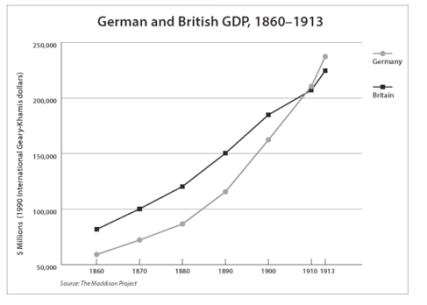
The British response to this was increase in resources allocated to maintain advantage in military power especially navy, but it was clearly inadequate despite success in maintain advantage:

Eventually the competition turned into war and it was fought mainly on land.
A GATHERING STORM
Imagine China Were Just Like Us
This is a typical litany of Americans being imperialistic: pushing Spain out of its American and Pacific colonies, creating and enforcing Monroe doctrine, creating new country Panama because Columbia would not allow build canal on American conditions, buying Alaska from Russia and quite forcefully defining borders with Canada. In short as raising power of early XX century America did not show a good example of behavior towards declining power or weak states. In order to provide some feeling of what it would look like now, author compares Teddy Roosevelt and current Chinese president Xi pointing out that it would be quite a nightmarish scenario.
What Xi’s China Wants
This chapter is an attempt to look at things from China’s point of view. This point of view is a mix of pride, humiliation, and strives for restoration. It relates not only to the country as whole, but also to the personality of its leader who went from high living of child of important party official through humiliation of Cultural revolution, and back to the top of power. The key point here is that Chinese believe that their rightful place in the world is at the top and would do everything to get there by all means necessary. Author also discusses potential difficulties such as loss of party control over society, slowdown of the economy, demographic consequences of one child policy and so on, but so far Chinese leadership feels strong enough to start challenging USA in South China Sea – possibly the first tremor of coming earthquake.
Clash of Civilizations
This chapter starts with the story of Lord Macartney mission to China in 1793 when both side where so far away culturally that no effective communication was possible. Author analyses potential clash of the West as represented by USA and China, which he believes is highly probable due to superiority complex that both sides have. Here is a nice table to compare cultural approaches:
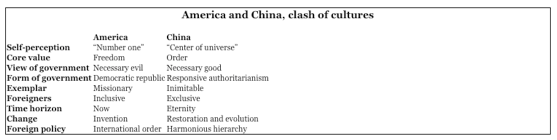
These innate cultural differences lead to demonstratively different approaches to just about everything: economy, diplomacy, education, and what not.
From Here to War
This chapter is pretty much a list of hypotheticals about all conceivable situations that could lead to US-China war. It starts with historical factoids of Korean War and China-Soviet mini war and goes through various scenarios from accidental collision at sea outgrowing into the war, so economic conflict pushed all the way to military confrontation.
WHY WAR IS NOT INEVITABLE
Twelve Clues for Peace
Here author returns back to the history trying to identify specific factors that prevented war between dominant and raising power in previous conflicts. Author presents 12 different clues that served to avoid open military conflict:
- Existence of higher authority that both sides would listen to
- Competing states are embedded in larger political, economic, and security institutions
- Politicians on both sides could find way to accommodate each other with formerly dominant power recedes gracefully
- Dominant power missing opportunity to stop raising power on its track as Britain could possibly do if they supported Confederacy, breaking America in two weak states in process
- Cultural commonalities could prevent conflict as it happened between formerly dominant Britain and raising USA.
- Nuclear weapons, which make any large scale military conflict literally deleterious for both sides
- The same as 6, but formalized as MAD strategy
- MAD could not be justified
- But for MAD be effective leader should be ready to use it all and convince others that they do.
- Thick economic Interdependence
- Alliances should be under strict control
- The final and most decisive factor: domestic performance
Where Do We Go from Here?
These are author recommendations:
- Begin with structural realities: if China continues on current path of growth and USA on current path of relative decline, China will become economically dominant and military dominance will follow
- Apply History: it has a lot of examples to learn from and lessons that are applicable to current situation
- Recognize that American strategy is a contradiction: the strategy “engage and hedge” allows everything, but prohibits nothing. This strategy founded on believe that democracy and freedom are universal aspirations and therefore applicable to China, but they are not. Idea of equal “citizenship” in “community of nations” is alien to Chinese hierarchical culture and besides would not be acceptable to it anyway because traditionally some “citizens”, namely USA are more equal than others.
- Review all strategic options even ugly one: the bottom line here is: accommodation should stop.
- Accommodate: this obviously contradict the precious one and basically means just accept China dominance in the future
- Undermine: revive the believe in universality of democratic values and try to push them on China
- Negotiating Long peace: delay any possible confrontation as much as possible by finding agreements
- Redefine relationships: achieve common understanding that win-loose is not possible due to nuclear weapons so it is better to find win-win than stumble into loose –loose.
Conclusion
The conclusion once again stresses need for clarity of vital interests, understanding of Chinas aspirations, striving to act more at strategic level, and always keep in mind paramount value of controlling domestic challenges first.
MY TAKE ON IT:
This book provides pretty interesting historical and political analysis and quite convincing lead to necessity of confronting China before it is too late. I personally believe that China threat is about 90% product of American misunderstanding of the world and misplaced believes that everybody mainly just want a good live. It seems to me that for Americans the very notions of national and ethnic greatness, conquest just for power sake, and achievement of superiority over others, are deeply alien and basically inconceivable. Americans can understand giving all to achieve or protect freedom, but could not understand giving all to deprive others of freedom so for them China or for that matter former Soviet Union are just incomprehensible. Generally I agree that something had to be done and this something already start happening: limitation on uncompensated transfer of intellectual know how to China is just around the corner, pressure on trade is coming, creation of strong cyber defenses are not that far away, so all these measures could quite possibly stop China’s march to economic and political dominance. So far China’s raise was to the huge extent parasitic one: use of foreign capital, including massive transfer of technology and building production facilities aimed to use cheap Chinese labor to produce goods for Western population. This period of rapid parasitic growth is coming to the end and quite quickly. For once automation makes Chinese cheap labor irrelevant, consequently making technological knowledge transfer paid by profits from cheap production unpalatable for Western businesses. The general absence of respect to property, especially intellectual property quite possibly will put China on “no business” list and it could happen soon. The probability of China developing its own technological prowess is very problematic if one takes into account absence of intellectual and political freedom. Humans are quite complicated creatures so if one limits freethinking in one area, let’s say political and philosophical, it is virtually guaranties the decaying of freethinking and consequently success in technological area. The final point is that Chinese population advantage is on somewhat shaky ground taking into account that West includes not only 300+ millions of Americans, but also 500 millions EU, plus additional billions of people in countries like India, which in any conceivable confrontation will reside with the West rather than bow to Chinese dominance. All this would probably prevent any war because the equation of force both economic and military will always be against China, while odds of China’s joining democratic world as full pledged equal member will grow in proportion to decrease in opportunities for parasitic growth.
20171013 – Superforecasting
MAIN IDEA:
The main idea of this book is to relate the new developments in author’s work when he found a way to obtain funding from IARPA and start Good Judgment Project, which includes systematic analysis of forecasting processes using thousands of volunteers. This project allowed author to identify a group of successful forecasters, analyze how exactly they work, and produce a pretty good description of successful patterns of behavior and processes.
DETAILS:
- An Optimistic Skeptic
Author starts with the point that we all are forecasters trying to predict future events with different results. He refers to his earlier work on quality of forecasting conducted back in the 1980s that demonstrated very poor quality of forecasts by experts and pundits that become source of pessimism about this popular activity. The new research that he discusses in this book provides some reasons for more optimistic view on possibilities of improvement in forecasting quality. This research called Good Judgment Project (CJP) is sponsored by IARPA and based on formal forecasting and result analysis processes done by mainly self-selected volunteers. These processes allowed identify a group of super forecasters who were able to beat control group by 60-70%. The final part of the chapter refers to recently developed AI capabilities that promise in conjunction with humans achieve significant improvement in the quality of forecasts.
- Illusions of Knowledge
This starts with some examples of mistaken medical diagnosis and correspondingly forecast, then expand it to discuss human blindness to facts and multitude of historical cases supporting the notion of its severity and hugely negative consequences such as common medical practice of bloodletting that led to doctors’ killing multitude of patients, probably including George Washington. The contemporary result of growing understanding of deficiencies in human thinking processes led to development of the new procedures in medicine and resource allocation to analysis of the process of thinking. The final part discusses popular notion of “blink” vs. necessity of systematic thinking and Kahneman’s work on the fast and slow thinking.
- Keeping Score
This chapter is about difficulties of keeping score of forecasts. It uses example of Steve Ballmer who famously made statement seemingly underestimating iPhone potential. The actual statement nevertheless had enough wiggle room to spin it as pretty good forecast. After that author discusses an interesting example of important forecast failure – Soviet Union dissolution. After that he goes to some technical aspects of forecasting: over / under confidence, its decisiveness and calibration:

Author also establishes here the main criteria for quality of forecast: Brier score with correlations: 0 perfect, 0.5 random, and 2 perfectly false forecasts.
Author also returns here to results of his 1980s study and it’s findings about impact of personality type on quality of forecast with foxes being much better than hedgehogs. The final part is about “wisdom of crowds” aggregation that sometime drastically improves forecast if diversity of views good, meaning wide enough to achieve healthy cancellation of extremes.
- Superforecasters
Here author reviews finding from his recent project with IARPA that allowed identify individual with significantly better forecasting results than average. The bulk of discussion here is related to differentiation between luck and skill, which author mainly does by tracing regression to the mean, the absence of which indicated prevalence of skill over luck.
- Supersmart?
This is about notion of smartness or intelligence and how it is defined via IQ testing or Fermi questioning (number of piano tuners in Chicago). After that author applies these notions to the real live forecasting question whether it will be found or not that Israelis poisoned Arafat. Here is an interesting concept of Active Open Mindedness (AOM) developed by Jonathan Baron based on agreement/ disagreement with questions:

- Superquants?
This is about application of math and statistics to forecasting and need for preciseness (use of % in forecast rather than verbiage: likely/unlikely). Here is a typical use of verbiage that allows granular, but not precise analysis:

At the end of chapter author looks at difference between probabilistic and deterministic approaches.
- Supernewsjunkies?
This chapter is about successful forecasters from the project, their methods and cases of over or under forecasting of actual events. It is also a bit of discussion about Bayesian equation and how it approves forecast when the new information is being taken into account.
- Perpetual Beta
This chapter is very valuable because author not only discusses need of practical experience rather than theoretical knowledge in forecasting, necessity of failure, and imperative of thorough analysis and adjustment, but also provides features of model superforecaster derived from his experience:

- Super teams
Here author discusses value of teamwork in forecasting initially questioning validity of team approach in such deeply intellectual activity as analysis and forecasting. The conclusion is that generally team is more cumbersome, but results in accuracy about 23% better than the same people individually.
- The Leader’s Dilemma
This chapter starts with very interesting deviation into military history discussing little known quality of German military that made it so formidable power during two World Wars: culture of independent thinking and consistent encouragement of decision making at the lowest level of hierarchy if it is consistent with the highest level of competence relevant for this decision. Author contrasts it with rigid and hierarchical decision making in American military and how difficult it is to overcome. One important lesson in this is that even if German military was clearly force for evil, it should not prevent good analyst from learning whatever strengths it had and apply this knowledge.
- Are They Really So Super?
Here author discusses tendency of people to ignore information that contradicts their preset opinions and stress the one that supports it. He uses recent political development on Middle East to demonstrate how bureaucracy often fails anticipate changes in situation and how black swan events tend to pop-up elsewhere. Another point author makes is that failure to collect real data often leads to mistakes that could be easily avoided if analysts apply real data rather than preconceived ideas. He provides a nice example with income distribution when formal application of normal distribution leads to incorrect estimate of possibility for somebody to be a billionaire as one in trillions, when in reality Fat Tail actual income distribution makes it much more probable:

- What’s Next?
This is an interesting take on future of forecasting where author correctly identifies objective of a forecast as to promote well being of forecaster with accuracy being a useful, but not ultimate parameter in achieving this objective. As example author discusses political events of Romney election and difficulties of implementing Evidence based medical policies. In both cases objective data pushed aside when they undermine well being of political analysts in the former case and medical profession in the latter. Interestingly, author also discusses vulnerability of all objective facts and numbers to manipulation, but that it is still best methodology that we have. The author also makes a point about post factum situation when experts often manage to spin results to such extent that makes failed forecast justifiable and, somewhat laughably, successful.
Epilogue:
The final world is that superforecasters such as one of participants of Good Judgment Project Bill Flack, who is often right about future events, and “strategic thinkers” like Tom Friedman, who was consistently wrong, in reality are complimentary because people like Friedman are good at raising question, even if they typically could not provide meaningful answer, leaving this job open for superforecasters like Bill.
MY TAKE ON IT:
I think it is a great book that significantly expands on initial work of author that demonstrated low levels of ability of typical experts and pundits to correctly forecast future events. The success in trying identify and somewhat formalize the method of effective forecasting is very important and may in the future lead to creation of some independent sources for analysis and forecasting of political, economic, and legislative decisions. Nevertheless, I personally believe that world is way too complicated for anybody or any combination of humans and computers to be able correctly forecast future events so the best way to prosperity and good outcome is to minimize need in complex high level decision making, by decreasing role of governments, big corporation, and legislature in everyday live pushing decision at as low level as possible and practical, consequently dramatically decreasing cost of errors and unintended consequences.
20171006 Abrams, Floyd – The Soul of the First Amendment
MAIN IDEA:
The main idea of this book is to review realities of history and contemporary application of the First Amendment that guaranties freedom of speech. It also includes extensive comparison of free speech in America with other democracies and demonstrates the exceptional character of American approach.
DETAILS:
Introduction
It starts with the anecdote about author’s son not being admitted to the movie in Europe because of age and then claiming his First Amendment right to see it. The anecdote is provided to demonstrate how deeply this amendment ingrained in American minds. After that author compares it with typical European attitude to the freedom of speech and demonstrates the deep difference between these two approaches. The introduction also describes the structure of the book.
I
This is historical part tracing debates about the First Amendment at the time of Constitutional convention and its ratification process. The main dispute was between those who believed that it is not necessary enumerate rights since constitution already put restriction on government power and those we demanded clear articulation of key rights such as free speech. After this author discusses somewhat surprising fact that the First amendment was dormant for a long time and really become very active only in the second half of XX century and remains in the focus of public discussion and Supreme Court decisions ever since.
II
This chapter compares levels of free speech protection in USA and other countries. Author refers to hate speech laws in Canada, label laws in UK, and privacy protection laws in Finland that limit free expression to the extent inconceivable for Americans. Overall it is a good piece of information for anybody who has doubt about exceptional character of USA.
III
This chapter reviews legal case of 1941 Bridges vs. California that established exceptionally American understanding of the freedom of speech. It initially discusses obscenity laws that were used widely, but then concentrate on Patterson and Supreme Court decision affirming the First Amendment right to criticize judiciary.
IV
This chapter discusses American deviation from Europe in understanding of relationship between privacy and free speech. Specifically it discusses European “right to be forgotten”, which is drastically limit speech on Internet.
V
This chapter discusses American deviation from Europe in understanding of relationship between money and free speech. In short in Europe a government limits spending and consequently ability of people and organizations to distribute their views. In America right to use resource for support of one’s speech was consistently supported by the Court.
VI
Here author goes beyond legal approach to the First Amendment and looks at controversies related to its use in responsible way, especially when it relates to classified materials and other forms of information that if made public could cause serious negative consequences. In short, in America the freedom of speech takes precedence over national security at least as it was decided in cases of Pentagon papers and many others.
MY TAKE ON IT:
I think that the First Amendment and freedom of speech that it supports is one of the most important factors that led to American prosperity. It keep in check, at least to some extent, people in power and allows powerful tools for organizing and creating political pressure for people out of power. However I think that some serious problems presented in this book are not dealt with properly and I would suggest this for each if key problem:
Libel and Privacy: I would not limit it by any means, but rather expand access to refutation of label and other untruthful information to such extant that court could upon deciding that information provided was maliciously distorted force allocating of the same amount of space and place in whatever printing or electronic form it was produced. For example if New York Time or Breitbart News published some clearly libelous piece against Trump or Obama correspondingly, they would have to publish rebuttal on the same page with the same amount of space and, in case of electronic format, keep it for the same amount of time as original piece. It would allow consumer of information to obtain rebuttal information and in some murky case make decision for self.
Hate Speech: Again I would not limit it by any means, but would punish producer in case somebody actually acted on this speech. For example, if some preacher calls to kill infidels he should be punished as accomplice when and only when somebody acts on this call, even if there is no direct connection between talker and actor. I think it would go long way to preventing incitement of violence.
National Security: I believe that it requires legislative action that would clearly define what type of information could be classified, whether it is technological specification, or political discussion, or diplomatic mail. With contemporary technology it is possible to assign clearance on person/document basis and keep track of who accesses what, when, and why. The security will never be provided if some generic classification of Top Secret allows some clerk with clearance such as Manning or technician as Snowden to access millions of classified documents that they not only have no business to access, but would not be even able to look through even if they spend every second of their lifetime doing it.
20170929 – Deep Thinking
MAIN IDEA:
The main idea of this book is to review author’s experience as the first chess champion loosing to AI and using this experience to discuss past, present, and future development of AI and consequences of this development. The main objective here for author is to find reasons to be optimistic and demonstrate that advance of computers does not mean decline or even obsolesce of humanity.
DETAILS:
ONE The Brain Game
Here author discusses the nature of chess as the brain game and commonly recognized link between ability to play chess and intelligence. Correspondingly this game was often used in all discussion of AI as a benchmark of its abilities. After that author moves to his experiences as chess prodigy in the Soviet Union where this game was treated as an important factor in competition with Western world for superiority in the area of intellectual development. Author briefly reviews history of chess related Cold war episodes and his role in them when he became world champion in 1985 just before Soviet Empire started its rapid move to demise.
TWO Rise of the Chess Machines
This chapter briefly reviews the story of development of chess related software and hardware from the earlier attempts when computers just started in late 1940s to Deep Thought specialized computer that was able successfully play at the Grandmaster level.
THREE Human versus Machine
Here author describes how computers were introduced into chess world and what kinds of strategic algorithms were used from initial stress on material weight to brute force positions crunching. He also discusses his own participation in the development of chess computers. The pinnacle of initial achievement was the program called Chess that was capable to win in a week human tournament.
FOUR What Matters to a Machine?
This is more about strategy and tactics used in development of AI algorithms and use of Chess for their development where the clear rules of game and complete information defined by rules provided a type of experimental tool similar to use of drosophila in biology. It is also about deficiencies of such approach because the main assumption about working of mind similarity to a computer proved to be incorrect.
FIVE What Makes a Mind?
Here author moves to discussion of properties of human mind and psychological aspects of chess. In process he discusses popular, but not necessarily well-founded idea about 10000 hours required for mastering any skill. Author claims, based on this own experience both as progeny and later as teacher, that initial genetic makeup of individual could not be discarded and 10K hours would produce different results in different people. In the second part of the chapter author discusses various anti-computer strategies that he developed to overcome computer’s advantage in tactical calculations and lacking of psychological component that could be debilitating for human player.
SIX Into the Arena
Here author briefly returns to his experience playing for championship against Karpov – KGB preferred winner, then moves to discussing DARPA initial development of AI. This follows by author’s discussion of complexity of rules in culture and lives, which is dramatically different and higher than simplicity of rules in chess. As example he looks at machine translation of human languages. The last part of the chapter is the story of author’s match against Deep Thought computer in October of 1989, which author won, but it was already a serious game.
SEVEN The Deep End
This chapter is the first part of the culmination of the story because it is about the match with Deep Blue. Author still won this match, but it was not that easy any more and Deep Blue demonstrated that it is getting close. Author also briefly describes chess revolution that occurred with dramatic improvement of PC that obtained enough computer power to provide vast majority of players with a partner at the level they want to have, even if it is pretty high level.
EIGHT Deeper Blue
This starts with discussion of improvement in computer power that practically eliminated need for super complex algorithms by bringing to the table tremendous computer power. It follows by the story of the second match with Deep Blue, but not before author reviews meaning and advantages and disadvantages of rematches. At the end author discusses prelude to the second game and his overestimation of time needed to Deep Blue team to fix problems and achieve significant improvement in its game. He also points out that IBM hired quite a few Grandmasters to work with Deep Blue.
NINE The Board Is in Flames! TEN The Holy Grail
These two chapters represent very detailed game-by-game and nearly move-by-move description of the second match when human chess champion (author) actually lost to the computer. It also includes discussion of several related controversies and author’s psychological ups and downs that had significant impact on the quality of the game.
ELEVEN Human Plus Machine
The final chapter is about combining AI and human intelligence in teams, which allows for better performance than either of them separately. Author discusses quite a few areas like GPS where AI added tremendously to the quality of life and our ability to achieve results. This obviously includes chess where computer programs dramatically improved training opportunities for players. One very interesting point here is that young players now learn quite differently from the old school that author went through. They are playing a lot more and consequently obtain a lot more practical skills, while learning a lot less theory. Then author discusses AI impact on innovation. Specifically in chess Grandmasters now have opportunities to run any innovation with AI before using it in high stakes game, allowing them to test much more approaches than was possible before. At the end of chapter author discusses more details of human vs. AI strengths and weaknesses and how to combine them to achieve maximum effect.
Conclusion: Onward and Upward
The final conclusion is pretty much that future is bright. The author believes that while humans good at developing machines to do their work the work itself will not disappear, but rather expand providing more and more interesting things to achieve and tasks to complete because humans have purpose and AI does not.
MY TAKE ON IT:
It is very interesting recount of the human vs. AI struggle in probably one of the simplest computer friendly applications that become proving ground for initial AI development. I am mainly in agreement with author that it is not a threat to humanity as long as humans would not decide to make it a threat either from military or some other considerations. Actually I am believer that humans are to the high extent are product of their experiences, so even if we create AI and feed into it huge amount of information and allow it to get skills via experience like self-teaching AI program, it would not be substitution for humanity, but rather just another tool, granted a very sophisticated one. The key feature that makes humans what they are, in my opinion, is their self-directed character that provide for ability to obtain idiosyncratic experience and form unique personality. I would not exclude possibility of AI computer that is designed to do just that: to learn from “parents”, obtain unpredictable experiences, direct its own development in some direction not necessarily controlled from outside, and eventually develop its own self and personality. I am pretty sure that it will occur in some kind of experimental form. However I do not think that it would go anywhere beyond experiment because eventually if it is successful all that we going to get is another human being with silicon rather than biological basis, but human being nevertheless. And since we have much easier and cheaper ways to produce those and all advantages that such AI person would have from more memory or higher speed of calculations could be easily matched by non-personified AI acting under human direction, it will probably never go beyond experimental stage.
20170922 – On Human Nature

MAIN IDEA:
The main idea here is to express author’s complete set of views on the humans and humanity, their nature, attitudes and meaning or lack thereof. In order to do that author looks at the I-YOU relations between humans, notions of self, sex, and intentionality. The second part of the book is about society’s settings such as morality, its different expressions, laws, including common law, and the range of characteristics assigned to just about everything that varies from profane to sacred. It also looks at interactions between individual and group and limits imposed on the individual by various rights, duties, and obligations and also a bit about where all these are coming from.
DETAILS:
Chapter 1. Human Kind
This is a discussion on what humans are. Obviously they are animals, but not regular animals. Unlike others they are capable to convert their biology into cultural artifacts, so sex becomes love, generating poems and other art. Likewise human’s territorial character turns into national sovereignty, patriotism and so on. Ever since Darwin we understand how evolution made us and what we are biologically. However we are much more than that. From here author goes into the review of some specifics:
Genes and Games: This is about Darwinian population or group selection or sexual selection or any other form of selection when selected features seemingly decrease survival chances of individual.
Genes and Memes: Here author discusses memes selection as model of cultural evolution, but he generally rejects this approach due to its seeming neutrality of memes to good, evil, and overall morality. The main point author makes is that if memes relate to ideas as genes to organisms then they are pretty much irrelevant because unit of selection is a cultural artifact.
Science and Subversion: Here author discusses memes as subversive concepts like Marx’s ideology or Freud’s unconscious. He contrasts it with functional explanations, which are central in biology. However author rejects idea of a human as collection of genes and talks about a person, which is requires another dimension of discussion: religion and morality.
Laughter: Here author discusses uniqueness of human laughter, the feature no other animal possesses. His approach is that it is a dual applications tool: method of coping with realities of live that humans understand, while other animals do not, and method of communication that allows to smooth interactions within community.
The Genealogy of Blame: This is about another uniquely human feature – responsibility. It is discussed with reference to Nietzsche, Kant, Aquinas, and Locke, stressing difference between a human being and a person, conscious and self-conscious.
The Embodied Person: This is another approach to the problem of human animal and person. This comes from separation of self from non-self and its use as an object of reference, so self-attribution and self-reference becomes a primary avenue of what we think and how we act.
Intentionality: Here author discusses Dennett’s notion of intentionality, when animal acts with an intention to change environment. This allows for a more or less plausible way to predict actions of others based on one’s believe about their intentions.
Emergence and Materialism: This is author’s critic of reductionists who believe that emerging properties do not extend beyond physical properties. He provides example of art when multitude of colored spots on the canvas at some point become a recognizable picture that has meaning beyond totality of these colored spots. Similarly the key point here is that a person emerges from multitude of physical / biological features.
Person and Subject: This is about interrelation between two humans when both understand the personhood and intentionality of other. Author also provides an interesting brief on various approaches to defining what is so distinct in human condition: Language (Chomsky), second-order desires (Frankfurt), second-order intentions (Grice), convention (Lewis), freedom (Kant, Sartre), self-consciousness (Kant, Fichte, Hegel), laughing or crying (Plessner), or the capacity for cultural learning (Tomasello).
Verstehen and Faith: Finally author defines human nature in such way: we are kind of thing that relates to members of its kind through interpersonal attitudes and through self- predication of its own mental states. The study of our kind is the business of not science, but humanities (Verstehen). After that author kind of links to the need for understanding humans not only in terms of reason, but also in terms of faith.
Chapter 2. Human Relations
This is about human relations and I-YOU dynamics that generate emotions and moral norms, which to the large extent define humans:
The first person case: The main point here is that self is social product and could not exist or even emerge in complete isolation. Another point is that self does not need to conduct normal process of discovery for expression of his views and positions.
Self and Other: This is about Kant’s ideas of self-identification and notions of subject vs. object and relation to others on which all most important in the human condition is built: morality, responsibility, law, institutions, and art.
The Intentionality of Pleasure: This is about intentionality of the state of mind and human relations, distinguishing free from unfree actions, reasonable and unreasonable, and such. Here author brings pleasure as evolutionary tool that makes us to act in such way that would be beneficial for our survival and procreation. However we humans are just too smart to enjoy sensual pleasure without complications and author brings in a couple of mental experiments to demonstrate this.
Sex, Art, and Subject: This is about sex from evolutionary point of view: a bit about pleasure, something about incest, and quite a bit about sexual selection.
Overreaching Intentionality: This is about interpersonal attitudes, about giving each other reasons, holding each other to account, negotiating and maintaining dialog.
Recentering and Decentering Passions: This is about self and centering other into I, something like “I got you under my skin”. Correspondingly decentering is mainly objectification of other like in porn looking only at body while disregarding the other in this body.
Personal Identity: This is about meaning of persona. It came from Romans as a legal object with rights and duties and then was developed by Christian theologians with relation to god, god’s features and eventually into human identity with human organism and persona being philosophically different entities.
Chapter 3. The Moral Life
This chapter goes into complexity of tension that exists between our nature as individuals and demands created by our nature defined by group belonging or, in other words, members of moral community:
Deep Individuality: This is a funny peace of philosophy where author discusses his nature as human individual with knowledge and image of past, present, and future that establish his deep individuality unlike his horse Desmond’s animal individuality.
Praise, Blame, and Forgiveness: This is about various consequences of human actions that could represent specific feedback from other people or from imaginative entities like god.
Pollution and Taboo: Unlike previous point where consequences caused by action or absence of action when individual does not deserve neither praise, nor blame. This is about situation when even without any intentional action just by polluting or breaking taboo and individual could cause reaction of the society.
The Sovereign Individual and the Common Law: This is about relationship between individual and the group in regard to the law when solution to dispute comes without violence, but rather according to a set of rules:
1.Considerations that justify or impugn one person will, in identical circumstances, justify or impugn another.
2.Rights are to be respected.
3.Obligations are to be fulfilled.
4,Aggreernents are to be honored.
5.Disputes are to be settled by negotiation, not by force.
6.Those who do not respect the rights of others forfeit rights of their own.
Moral Arithmetic: The calculations here are involve balance of good and bad actions and could be highly complicated as experiments with “trolley” and such demonstrates. Author discusses here ideas of Parfit that calculation should be such that one treats his own children the same way as other. Author quite reasonably points out that own children have much more claim on a parent than others.
Comparative Judgments: This is another look at attempts to treat moral calculation as economic and reject it.
Consequentialism and Moral Sense: Here author moves on to discussing consequential reasoning, which he defines as optimistic principle that leads to choice of future good over current evil, that become considered necessary and therefore irrelevant to morality, something which was abundantly demonstrated in XX century by Nazis, Commies, and various other ideological nuts.
Virtue and Vice: Here author goes back to ancient philosophers like Aristotle in search for source of behavior and trying to find it in duty to self to be virtuous and reject vice.
Honor and Autonomy: Here author uses situation of a soldier who have to overcome whatever fear and other negatives he encounter to maintain his honor in a battle. Author discusses attitudes of Aristotle vs. Kant in evaluation of soldier’s behavior and motivation.
Mrs. Jellyby and Good Samaritan: Mrs. Jellyby here is example of somebody who cares a lot about distant people, but not about others close by, while Samaritan correspondingly cares about another individual who is close. The inference from this is that moral live is rooted in personal obligations to close by.
Rights, Deserts, and Duty: This is again about moral calculation and importance of rights and deserts in this calculation. Author also seeks here a theory of the person to link notion of the human rights to the nature. His main point here is that concept of the person is at the center of political disputes, but it is treated as a mere abstraction. Author believes that it should be treated as the complex reality with its social and historical context.
The Person and the Self: Here author counter two different concept of human person, which defining feature is either autonomous choice or life in community and find both lacking. Author seems to believe that these two contradictory approaches could be resolved if I-YOU encounter becomes center of attention, discussion, and most important, behavior.
Chapter 4. Sacred Obligations
This is about political order and how it is discussed in contemporary academic world: as supplement of morality and necessary tool to safeguard individual autonomy and assure “social justice”:
Two Criticisms: The first criticism is that our nature as organisms is not taken seriously. The second is that our obligations could not be reduced to assuring mutual freedom. Here author is trying to respond to these criticisms.
Sexual Morality and Desire and Pollution: This is about obligations related to sexual behavior including ideas of defilement related to sex and various deviations: incest, rape, and such. It is all linked to ideas of pollution and taboo and author refers to his book “Sexual desire” where he goes deep into these issues.
Piety: This refers to the second criticism and looks at the character of the moral agent who is bound by unchosen moral requirements. Author brings Rawls and Hegel to discuss pious obligations and linking it all to the family and eventually to the political order connected to it.
Sacred and Profane; Evolution and the Sacred; Remarks about Evil: This is discussion about various levels of attitude to various concepts from Evil on one side to the Sacred on another with the special attention paid to the nature of evil.
Morals and Faith: The final part is about source of morality, stating that it is different from the faith. It raises an interesting question for philosophers: quilt of existence. The final world here is actually reference to Dostoyevsky’ Brothers Karamazov and Wagner’s Parsifal whose aesthetic achievements are by far more significant than perspective of philosophy.
MY TAKE ON IT:
As it is appropriate for very simpleminded man, I do not see a lot of philosophical complexity in humans, their groups, and everything related. From my point of view humans are nothing more than analog, partially self-directing computers who poses dynamically changed semi-hardware in form of genes and who are programmed by other humans to behave in such way as to constantly search for optimal mix of selfish and self-less behavior that maximizes probability of their survival and procreation in a randomly occurring and constantly changing environment. Things like morality, law, and such are just more or less codified rules of behavior developed by a group in competition with other groups when ineffective rule lead to the group dissolution or even annihilation.
20170916 The Islamic Enlightenment

MAIN IDEA:
The main idea of this book is that when Islamic world discovered its inferiority versus Western world at the end of XVIII century when Napoleon invaded Egypt, it applied considerable effort to catch up starting in XIX century ongoing till now, while not very successful so far. As the way to understand what happened author looks at the history of 3 centers of Islamic world in XIX century and then analyses how cultural change proceeded from massive attempts to implement societal mores similar to western mores starting in XIX centuries to strong rejection of this mores by significant part of Islamic societies in XX and XXI centuries.
DETAILS:
Introduction
The introduction starts with comparison of Jane Eyre – an early XIX century Christian writer in England with situation of women in Islamic world at the same time where existence of such writer would not be possible. However by the end of XIX century similar female writer Fatma Aliye was a reality in Ottoman Empire. Similarly to her western sisters she was a product of development of her society with its postal services, travel, and limited, but growing independence of women. Author uses this story to claim that there is nothing inheritably wrong with Islam that prevents Muslims from moving into contemporary world and all these ideas about need for Islamic reformation are not a valid approach to the problem of contemporary Islamic poverty, failed states, and global terrorism. His main point is that Islamic world went through a massive effort of modernization in XIX and XX century that he calls Islamic Enlightenment. This process was quite different from Western Enlightenment and started much later mainly under influence of technological and especially military failures, especially Napoleon invasion of Egypt that made it obvious for everybody. The structure of the book is first to look at history of 3 main branches of Islamic civilization: Egypt, Turkey, and Iran, then look at separate issues of development: societal change, development of nation/state, and massive counter-enlightenment movement that started after WWI.
1:Cairo
The story of Egypt enlightenment started in 1798 with Napoleon invasion and complete destruction of Mamelukes – main military power of Egypt. The French conquest led to influx of Western scholars and their direct interaction with Muslim clergy. Author goes through the most important personalities that were involved in this interaction such as Jabarti – one of the leading clerics. He was amazed by French knowledge and technology, but main inference was that Muslims did something wrong religiously against god and it led to punishment so the remedy should be increase in religious compliance. The reason was not a tool that could help in this conservative view. Counter this conservative approach was Hasan Al-Attar who intermingled with French, but went nowhere after French army evacuated. However this first encounter brought in a typical figure for Islamic and other civilizations attempting to overcome their deficiency against the West: authoritarian reformer, in this case Muhammad Ali Pasha who after coming to power in 1805 spent the next 40 years modernized Egypt using methods similar to Peter I of Russia, including sending delegation to Europe to learn and cutting beards together with heads. Author reviews this history in quite a detail; specifically live of one of the most important members of such delegation Rifaa Al-Tahtawi who was a pupil of Al-Attar. Rifaa was supported under reformer Ali-Pasha, expelled under his successor Abbas I, and returned back after successor died and enjoyed support for his ideas until his death in 1873. Author points out that the first 70 years of XIX century dramatically transferred Egypt and moved it much close to the West. Author completes this chapter with the story of Suez Canal, which eventually led to British occupation in 1882.
2: Istanbul
Similarly to Egypt the prompt for modernization came to Ottomans from military defeat to Russia when they lost monopoly over Black see and Crimea in 1768. Ottoman Empire also experienced unrest among its Arabs from Wahhabi revolt in 1798. The internal tensions also came from Orthodox Christians who become subject of Russian interest and support. All this made modernization necessary for survival. As usual in Islamic word the opinion on what to do was divided between conservative Muslims who believed that weakness came from not sufficient devotion to god and modernizers who believed that it came from economic and technological deficiencies. The first serious drive for modernization started under Selim III (1762 – 1808). On ideological side the important figure of modernization become Sayyid Mustafa. After coup and counter coup that removed Selim, another modernizer Mahmud II came to power and remained in power until 1839. The modernization started with building new military force and annihilation of Janissaries who were representing military power of conservatives. One interesting innovation that Mahmud implemented in the diverse Empire was granting separate legal authorities to various religious groups, while demanding loyalty to Empire. Despite reforms Ottomans continue to lose territories and retreat, leading to Mahmud falling into depression and dying. His sons continued modernization with 30 years of reforms known as Tanzimat. Author reviews in details the cultural and political history of this process that eventual led to creation of Ottoman constitution in 1876. It confirmed sovereignty of the sultan, but provided bill of rights and limited electoral system. However it contained an article that allowed sultan override anything and everything so its impact was very limited.
3: Tehran
Iran entered modernization after significant turmoil. In 1722 it was invaded by Afghanistan leading to destruction of old order without creating a new one. This situation continued until 1796 when Agha Muhammad Khan managed to setup some order and declared himself the shah, but he lasted only two years before being killed by servants. The next shah, Fath-Ali managed to stay in power until 1834, but he had to deal with Russia that won consistently over this period and took away Caucasus. Fath-Ali mainly transferred military power to his son Abbas Mirza who failed to push Russia out, so he brought in British advisors and started military modernization. This was not an easy thing to do due to tribal character of the country and overall traditional attitudes. Despite all these efforts Iran continued losing to Russia. As other modernizers Iran sent learning missions to Europe and one of the members of such mission Mirza Saleh became somewhat effective promoter of modernization and Western ways, so author describes his story in detail. There is here also quite interesting history of Russian policies in Iran and later British interference that made Iran into battlefield between two colonial powers. Eventually great-grandson of Fath-Ali Nasser Al-Din became shah in 1848 and remained in power for the next 40 years vacillating between modernization and retreat. He initially supported his older tutor Amir Kabir considered to be a great reformer who managed establish internal stability and implemented typical set of modernizing reforms. It not lasted for a long time since shah had Amir Kabir killed after which modernization somewhat stalled. Instead the central place in history of this period went to religious struggles that author describes in detail: traditional Islam against the new and popular religion of Babiism that was later transferred into Bahaism. All this led to Iran falling behind comparatively with other modernizing Islamic countries Egypt and Ottoman Empire.
4: Vortex
This chapter is about the turbulence that all Islamic societies arrived to by the end of XIX and beginning of XX century trying simultaneously catch up with military and technological modernity of the West and retain their cultural and religious traditions. This period combined into one chapter because author believes that the differences between countries became mainly irrelevant at this point. Economy, railroad, communications, mass press, all this made the world intertwined and forced it to move somewhat in synch, with Islamic world becoming provider of raw material and cheap labor parts for world economy driven by the West. Combined with pretty cruel colonial attitudes, this necessarily generated high level of hate and resentment. Correspondingly elite was divided into two main groups one – conservatives rejecting modernity and moving back to religious roots and modernizers embracing change and trying to move to the future where Islamic world would become rich and powerful. Both groups resented the West and its colonial attitude of superiority. Author reviews cultural change of this period, literature, attitudes to women, sex, and religion,
5: Nation
This chapter starts with referring to the fact that initial interaction between Islam and West in XIX century was mainly beneficial, but by the late part of century it become more and more violent: British vs. Afghanistan and Sudan insurgencies, Russian Caucasian wars, and such. However the Pan-Islamic movement was considered not that different from Pan-Germanism or Pan-Slavism. Author reviews in live and ideas of one of the most important founding fathers of Islamism Jamal Al-Din Afghani (1838-1897). The main ideological point that he promoted was necessity to return to one worldwide community of Muslims (umma) directed against the West. It follows by review of multiple revolutions and insurgencies that continued until the brink of WWI when Ottoman Empire was very much weakened, Egypt under British occupation, and Iran under Russian semi-occupation. However liberal modernization was quite powerful in all three centers of Islam and even some democratic ideas took roots elsewhere.
6: Counter-Enlightenment
This chapter is reviewing the story of Islamic world in XX century after WWII. The initial consequences for this war were movements to secular nationalisms as continuation of enlightenment of XIX century. Elsewhere it brought to power secular autocrats who were at best indifferent to Islam and whose objective was to bring their countries to modernity at par with the West. However since they tried to do it without any serious support from majority of population and often without any interest in developing such support, they had to rely on police and military to remain in power. These cruel methods caused disaffected intellectuals, brought up in Islamic tradition who could not see decent place for themselves in this new world, to start Islamic supremacist movements like Muslim Brotherhood. Eventually by the end of XX and early XXI century these movements took power either via revolution as in Iran or via elections during temporary democratization of the country as in Turkey and Egypt. They were pushed back in Egypt by military and still did not achieve complete theocratic power in Turkey and Pakistan, but at this point they still are on the rise overall.
Conclusion
In the conclusion of this book author states that he believes that he demonstrated that Western ideas of individualism, representative government, and law took root in Islamic societies so its enlightenment did not disappear. However author does not demonstrates a lot of optimism stating at the end that Islam will remains contradictory and will continue perplex us.
MY TAKE ON IT:
I think it is a very good and detailed review of Islamic history that provides a lot of insight in current condition and functioning of these societies. Unfortunately it confirms that current upsurge of totalitarian Islamism in various forms from terrorism to ISIS caliphate to Iranian attempts to obtain nuclear weapons is consistent with typical Islamic tradition when response to falling behind is highly aggressive and based on believe that the very reason for decline is dissatisfaction of Allah with insufficient aggressiveness in promoting Islam. Correspondingly the proper response that will be rewarded by prosperity is an attack by all conceivable methods either peaceful via use of mass immigration to promote Islam and suppress resistance of native population of infidels by ideological action in alliance with leftovers of socialist and communist movements; or via direct military action and terrorism. It is possible that West will develop mass rejection of Islamic supremacy in time to defuse this bomb peacefully, but I would give it 50-50 chance that it would not happen and the growth of Islamic supremacist movement will continue until its leaders feel powerful enough to demand mass conversion under thread of mass annihilation probably with Iranian nuclear weapons used in terrorist attacks. I do not think such massive conversion will occur, so humanity will have to deal with it in usual way via war and massive loss of live, but it proved to be resilient enough before, so it will get it done and then move on after cleaning some radioactive debris and resolving issue with Islam either via annihilation of this system of believes as it happened with National Socialism or relegation it to much less influent and benign condition as it happened with formerly aggressive and militant variations of Christianity.
20170909 – Ignorance

MAIN IDEA:
The main idea here is that the ignorance or, more precisely, understanding of one’s own ignorance is a necessary and probably one of the most important parts of scientific development because it allows posing meaningful question that would then direct research. Lacking such understanding of ignorance leads to mistake of believing in something that just isn’t so and consequently failure to ask right questions.
DETAILS:
Introduction
Here author rejects idea of science as systematic discovery of the truth and exposes it for what it really is: an attempt to understand reality by building models and then experimentally testing whether they work or not. The process is messy, chaotic, and only occasionally leads to really valuable scientific results. This process is not driven by facts because there are way too many of them, but rather by human interest of scientist who understand his ignorance and is trying to find answers to questions that reflects in formal and systematic way this ignorance, consequently substitution it with knowledge. Consequently, this in turn typically leads to the understanding of the new level of ignorance. As professor author recognized this as the important, but missing part of his students’ education and therefore developed a course on ignorance.
ONE: A Short View of Ignorance
The key point here is that Ignorance is a bigger subject than knowledge. Author reviews general thrust of our culture at acquisition of knowledge and stresses that it creates an illusion that knowledge is some established whole and there are only a small patches of ignorance that need to be fixed. Author believes that we have too many answers and often not enough questions leaving us with poor understanding of our level of ignorance.
TWO: Finding out
Author starts this chapter with the discussion on meaning and value of data for processes of scientific discovery. A very important point here is that data are not produced spontaneously. There is complex process of decision making for what kind of data collect, how measure them, and eventually how to interpret them so they would become a fact. One of consequence of that is that only false science could claim that facts are permanent and not changeable. Any scientific fact could change with the new technology or new generation of scientists who would interpret data according the new paradigm. After that author discusses the dark knowledge, which he defines as apparent knowledge that stands in the way of ignorance and provides a few example of this. The logical inference from this is that “science always wrong and it creates 10 new problems after resolving the old one. In short science development is infinite because of this process of discovery generating new ignorance.
THREE: Limits, Uncertainty, Impossibility, and Other Minor Problems
This is discussion of human cognition, which starts with review of human sensors and their limitations illustrated by mental experiment of Flatland world inhabitants of which could not possibly see 3-d dimension, but they still can see projection of objects moving in 3 dimensions and therefore their science could develop some understanding of it despite absence of direct sensory input. After that author moves to specify limits: Quantum mechanics Uncertainty Principle, Kurt Gödel’s Incompleteness Theorems, Logical paradoxes, and such. After this author discusses Leibnitz’s positivism and believe in mechanical certainty of the world and demonstrates that it even theoretically not applies to real world, consequently leaving space for inevitable and unresolvable ignorance.
FOUR: Unpredicting
This chapter discusses one specific type of unavoidable ignorance: impossibility to predict future state of complex system with any reliability. It does not mean however those complex systems are unpredictable. We predict their behavior every day in live and in science, it just these predictions’ reliability is always limited. Consequently one could claim that the meaning of science is to define method of producing prediction and establish level of their reliability or in other words framework of our ignorance. Author puts it in an interesting way: “Ignorance is an engine of science”.
FIVE: The Quality of Ignorance
This is discussion of the quality of ignorance and author refers to Enrico Fermi who said that that experiment that proves hypothesis is measurement, but one that fails is discovery. Author adds that it is a discovery of new ignorance. This follows by discussion based on author experience as scientist of how to define low vs. high quality ignorance, which is done mainly by providing multiple examples from research and some commonly used metaphors like looking for keys lost in the dark place in different place because there is more light there. In the second part of the chapter author discusses breaking down ignorance into smaller parts such as brain research conducted on simple organisms, unpredictability of research direction, and silliness of grants and political discussions about their use.
SIX: You and Ignorance
This chapter is about practical approach for lay people to use ignorance as tool for understanding science. Author believes that key here is to answer questions that are really interesting, not the one that we believe there are answers and being not embarrassed by showing ignorance. Author even provides a nice list of questions to ask scientists that really make sense:
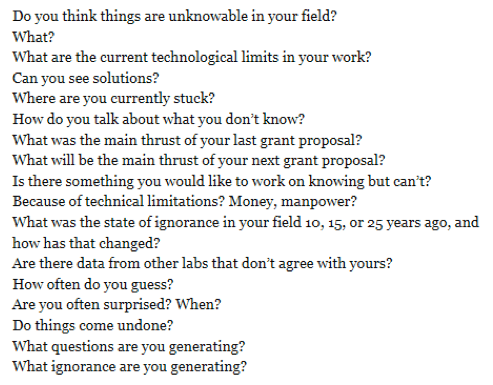
SEVEN: Case Histories
The final chapter presents history of 4 cases of intertwining of ignorance and science:
- Research on cognition and consciousness
- Search for unified theory in physics
- Attempts to understand working of the brain
- Author’s own unusual history of moving from the world of theater and entertaining into the world of science.
EIGHT: Coda
The final chapter starts with the quest for public money for science and consequently need to educate public about it. Author laments that science became too complex for laypeople to understand it to the levels similar to the Middle Ages when all intellectual work was conducted in Latin. Author calls for expansion of scientific education and development of something he calls “citizen science”. He even defines that the requirements for abilities of scientific teachers are:
MY TAKE ON IT:
It is a very interesting approach to science and understanding of the world. It is not necessary the new idea of a small, but growing circle of the light of knowledge in the middle of infinite space of ignorance. I believe it is going back to Socrates, but author’s conversion of ignorance from a negative fact of reality into useful tool of scientific research could be potentially very productive in terms of showing to lay people the value of science. Whether it will help to generate more public money for science is questionable, mainly because governmental science or more precisely scientific bureaucracy already receives huge amounts of public money with very little to show for that. Actually I believe that government generally mainly capable produce only quasi science at best and pseudoscience at worst as it is well illustrated by the history from academic Lysenko’s Socialist anti-genetics “science” to contemporary global cooling/warming/change boondoggle. Much better for science and for people would be if government, that is violent hierarchy of bureaucrats to get out of science financing. This way the freed money would be left in hands of people who produced them. Maybe as result these people in become rich enough to be curious beyond their immediate concerns and educated enough about their ignorance to voluntary provide funds for science to expand this ignorance by expanding cycle of knowledge. In this case the probability of money being used for real science rather than providing expensive welfare for scientific bureaucrats would increase dramatically and so will increase amount of interesting scientific results.
20170902 Basic Income

MAIN IDEA:
The main idea of this book is to provide intellectual foundation and support for idea of assuring some basic minimal income as entitlement for everybody regardless of means, effort, overall abilities, and/or behavior of individual. In authors’ opinion such basic income is a central pillar of free society and its implementation would allow moving away from old socialist and neoliberalism ideas that were pretty much discredited in the past.
DETAILS:
Prologue
This is a brief description of the structure of the book and intention statement for each chapter.
- The Instrument of Freedom
Here authors present the central case for unconditional basic income. This case is based on dramatic change of the economic world, which became highly polarized between high skills / high earnings people and low skill/ low earnings people unable successfully compete neither with cheap foreign labor nor with robots. Authors believe that traditional methods of welfare state would not be enough to solve the problems of providing for low skill people because these methods designed as temporary help and include humiliation and stigma of not working. The most important features that authors stress in their schema are: universal character of basic payments for everybody regardless of anything, cash payments only, individual income, rather than family, and obligation-free nature of the income. Authors believe that it makes such income instrument of freedom.
- Basic Income and Its Cousins
This is a review of alternatives to basic income and reasons why authors believe these alternatives are inferior. The first alternative authors review is Basic Endowment, meaning allocation of some wealth level at birth or some specified age. The main objection to this is that some individuals would waste endowment and require help anyway. The second alternative is Negative Tax Income, which authors consider less efficient due to administrative requirements, but more politically feasible. The third alternative: Earned Income Tax Credit seems to be unacceptable to authors because it requires work. Even more critical authors are to Wage Subsidies and Guarantied Employment alternatives. The final alternative to basic income that authors review is French inspired Working Hours Reduction. They clearly consider it inferior because the variety of work demands when some labor is over and other undersupplied. Besides it would require lots of bureaucrats watching self-employed not to overwork.
- Prehistory: Public Assistance and Social Insurance
This chapter is a review of historical development of two currently dominant forms of social protection: public assistance and social insurance. The range of review here is from Thomas More with his Utopia to contemporary welfare state.
- History: From Utopian Dream to Worldwide Movement
This is a review of history of basic income idea from the end of eighteen century on. Since authors do not aspire for originality, they provide a very detailed history of Basic Income Idea starting with Thomas Paine vs. Tomas Spence polemic. Then they look at Marx’s Communist Manifesto and ideas of John Charlier who was the first to offer national level Basic Income. It follows by review of actual political debates about it in UK and America and partial implementation of the Idea in form of Alaska’s citizen dividend. The chapter ends with review of contemporary debates in Europe and attempts to implement Basic Income via referendums and/or other forms of political process that so far were unsuccessful.
- Ethically Justifiable? Free Riding Versus Fair Shares
This chapter is rejection of moral case against basic income and an attempt to provide ethical and philosophical justification for it. Obviously the first issue here would be free riding. Authors provide a number of reasons for rejecting this ethical accusation:
- Fairness: Rich are not required to work for their income
- Sexual analogy: people who do not produce children are not considered immoral so people who do not produce wealth should not be either.
- Income without work would just redirect activities into areas that individuals enjoy and removed curse to produce what other people need.
- Finally there is lots of activities that people do like domestic work that is not paid for
Consequently authors are trying to make ethical case that unearned income justified because it would provide freedom for all. This supported by discussion of various philosophical discussions from Rawls to such funny ideas as “Capitalist road to Communism”. At the end of the chapter authors provide graphic representation of dynamics of level of taxation under Basic Income system:
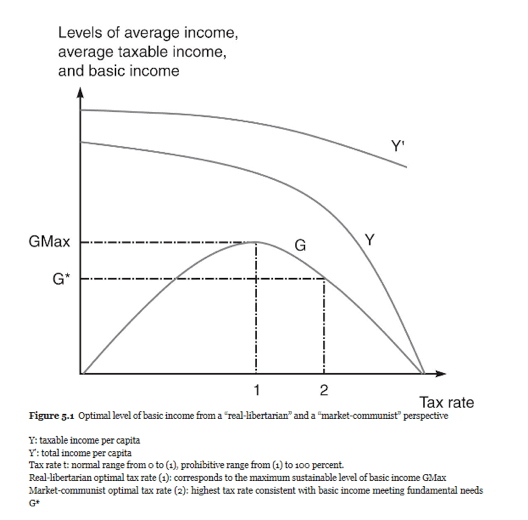
6. Economically Sustainable? Funding, Experiments, and Transitions
This chapter is an attempt to develop economic case that basic income for all is feasible and authors propose some ideas of how to fund it. The first thing authors look at is the labor income, more specifically they look at disincentive that Basic Income would provide to individuals capable to work. Initially they are going into somewhat funny statistical exercise trying to prove that it is not necessarily the case by playing with Gross income vs. Net Income:
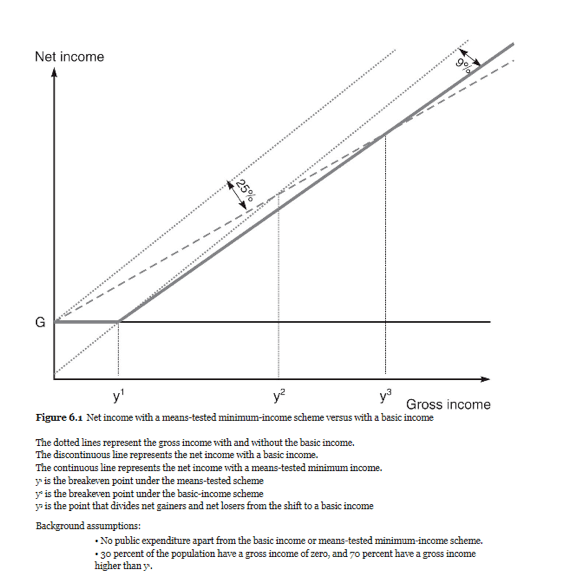
After that they are looking at results of experiments with Basic Income and Negative tax in various countries, which were not very useful due to limitation in time, value of provided income, and temporary character. The other methods of obtaining financial support include nationalization of natural resources, gambling by others (Indian casinos), money printing, and such. They also discuss seemingly all conceivable variation of the notion of basic income from temporary to partial and various form taxation / confiscation that could be conceivably used.
7. Politically Achievable? Civil Society, Parties, and the Back Door
This is a review of political forces that could be used to support the idea or had to be overcome in order to implement it. So far public opinion in USA is strongly against just providing free income. It is higher in Europe, but it is still a minority who supports this. Authors look at Unions, Employers, and all other conceivable groupings from sex to political views and estimate level of potential support for such incentive and conclude that it real support is not feasible for Basic income provided in the form they discuss in this book. They put the hope on potential crisis and expect that even in this case they will have to start with partial basic income, masked with some conditions for receiving it, and keeping existing redistribution system mainly in place.
8. Viable in the Global Era? Multi-Level Basic Income
The final chapter is an attempt to apply the idea of basic income at the global level. Author looks at globalization as a process of pushing income down to the bottom in developed countries, consequently creating demand for a change. They add to the mix mass immigration and discuss EU as a transfer tool. They provide a nice little table demonstrating huge unfairness between developed and undeveloped world using carbon emission as a proxy for resource consumption:

After that authors conclude that the only way is to create global multilevel basic income in order to adjust to existing variety in wealth.
Epilogue
Here authors briefly restate parameters of their case, admit that Unconditional Basic income is utopian idea, but claim that this idea in necessary and it has potential to free people from “dictatorship of the market”. They also put it in opposition to Hayek who wanted liberal (old meaning) utopia to oppose socialist utopia of his time. Interestingly enough the final word about achieving their utopia comes with reference to Machiavelli and need to push it via backdoor because they see no way to use honest dialog to bring humanity to their utopia via front door.
MY TAKE ON IT:
The Basic Income is becoming more and more popular idea and not only on the left. It is supported by Charles Murray and some other thinkers on the right who are concerned that with globalization, automation, and overall growth of demand to labor quality contemporary development leaves mass of unqualified and uneducated people outside in the cold, potentially creating foundation for instability of society. I agree that concern is real and important, but I think that the idea of unconditional Basic Income misses a very important point: we are dealing with human beings not just passive consumers of goods and services. Human beings if not seriously engaged in meaningful activities both physically and intellectually tend to deteriorate and could explode in riot even if they are well fed and provided. I think that much more reasonable solution would be equal rights for natural resources when individuals consuming more than average would buy this right from people who are consuming less than average via free market. In this case instead of passive reception of transfer people would be engaged in trading activities with various results, opportunity to improve skills, grow, and develop ambitions that would make them effective members of society. As to “dictatorship of market”, in my opinion only very miseducated people could seriously use this oxymoronic expression. The market by definition is voluntary exchange of goods and services and therefore could not possibly be “dictatorship”. The voluntary market exchange could be and often is unfair when the state deprive individual of any property so they had to agree to unfairness or starve, but even in this case it is the state, which is a culprit, not the market.
20170826 – Behave

MAIN IDEA:
The main idea here is to combine in one book all contemporary knowledge about everything that moves human beings and defines their behavior from DNA and other molecular factors thru biology of brain, endocrine system, and all the way to the societal hierarchies and culture. This encyclopedia of human behavior and its causes is necessarily brief, but it provides a lot of support to the idea that humans are animals developed via evolutionary process that includes not only biological, but also cultural and behavioral systems that proved themselves fit enough to exist now.
DETAILS:
INTRODUCTION
Author presents here his credentials as neurobiologist and primatologist and expresses intention to explore in the book important types of human behaviors such as violence, aggression, and competition by individuals and groups. The design of this book is a bit unusual because author is moving his analysis backward in time from the moment a behavior occurred through everything that preceded it from muscular action all the way to initial formation of embryo and then beyond individual existence to the formation of groups and evolution of humanity. After completing this review of an action and its causes in the first 9 chapters, author dedicates another 8 to human society and behavior of individuals that eventually defines various facets of these societies from their structures as hierarchies or less structured groups to key factors defining individual behavior within a group such as morality, criminality, cooperation, competition, and what not.
One THE BEHAVIOR
This brief chapter defines meaning of behavior that author intend to explore such as: aggression, violence, compassion, empathy, sympathy, competition, cooperation, altruism, envy, schadenfreude, spite, forgiveness, reconciliation, revenge, reciprocity, and love. After that he discusses the complexity of behavior and its justification using as example aggression. One very charming example of justification he provides is a Buddhist monk who stopped meditation because of compassion to his own knees. Finally author looks at the meaning of good and evil behavior from point of view its appropriateness for a given condition, stressing that brain images demonstrate activation of the same circuits when the behavior is proper regardless of its nature either it is shooting aliens or helping wounded allies.
Two ONE SECOND BEFORE
This is a pretty technical / biological chapter reviewing different parts of organism that activated to produce a given behavior. He divides it into 3 interconnected layers: basic automatic Limbic system – Amygdala, the Autonomic Nervous system, and Frontal Cortex – the newest part of the brain highly developed in humans. After reviewing the structure author moves to discussion of its work first stating that usual dichotomy between emotions and cognition is actually false and that both systems work pretty much in concert due to complex interactions between Frontal Cortex and Limbic system. He also discusses works of dopamine system that supports various feedback loops in the body. Especially interesting is the timing of rewarding process, which definitely gives preference to anticipation of reward before action to actual reward after it. Here is a nice graph to demonstrate this:

Obviously in more complicated cases it is not that simple and author provides information about research detailing complex relationship between production of dopamine and various external conditions such as probability of reward, which could materially change the this picture. There is also discussion here about serotonin, which contrary to commonly accepted ideas relevant not that much to aggression as to impulsiveness. Overall the point here is that controlling systems of a human are highly complex and could not be easily identified and cataloged. The chapter ends with somewhat unexpected and very important statement that brain is not where behavior begins.
Three SECONDS TO MINUTES BEFORE
This is about subconscious collection and processing of information from internally and externally oriented sensors that precipitate action of any animal and, as research shown in humans, it sometimes precedes consciously made decision to act.
Four HOURS TO DAYS BEFORE
This discussion is concentrated on chemical condition of the organism and its hormones, which to significant extend define what actions this organism could produce. It includes detailed review of Testosterone, Oxytocin, Vasopressin, Estrogen, and Progesterone. Author looks in details at how these Neuropeptides play out in human behavior either aggression, or cooperation, or anything else. The second part of the chapter is about the stress and its impact on behavior. Generally impact looks like this:
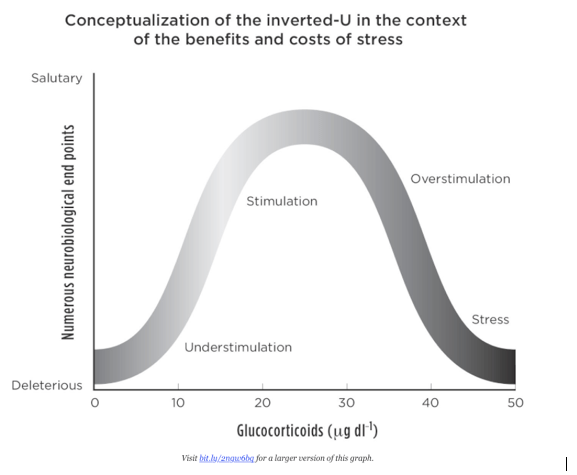
The bottom line: sustained stress is hugely detrimental and aggression reduces stress, which creates direct connection between pressure and explosion. On the other hand acute stress is a normal condition animal selected for by evolution and therefore capable to handle it quite well. The problem is that humans are too smart for their own health because they precipitate future action and stress, consequently producing condition of sustained stress. Neither Zebra nor Lion are familiar with this condition since they do not think too much about the future.
Five DAYS TO MONTHS BEFORE
By extending time frame for actions to days and months author moves to the discussion of plasticity of human brain, formation of memories, and nonlinear learning processes that create AHA moments. Author allocates significant attention to technical side of memory formation and whether it is linked to formation of new neurons or strengthening their connections, or both. The key point here is that brain continuing develop even in purely biological context during adulthood and actually as long as it is alive.
Six ADOLESCENCE; OR, DUDE, WHERE’S MY FRONTAL CORTEX?
This chapter moves from neuroplasticity that works over relatively short periods of time to formation of individuals during childhood and adolescence when both biology and personality are in process of continuing massive change. The big point of discussion here is that Frontal Cortex formation is not completed until mid 20s of age, so adolescents are literally not completely formed human beings and their reactions to environment is not fully calibrated. Here is a nice graph showing this:

Author also discusses here societal consequences of adolescent disconnect between maturity of a brain and other systems of the body.
Seven BACK TO THE CRIB, BACK TO THE WOMB
This chapter moves review of human individual formation further backward to childhood and typical stages of mental development. It necessarily includes role of environment that requires warmth and love for normal development not only for humans, but also for chimps and other complex animals. It touches usual themes of needs for family, especially mothers, moral and cultural development, and even differences between sexes. The final conclusion is that genes and environment so intertwined and influence human development so much that it is not possible to separate their roles into separate buckets.
Eight BACK TO WHEN YOU WERE JUST A FERTILIZED EGG
This chapter has two parts. The first one is obviously about the staff that we get from our predecessors at the moment of inception: genome. It mainly designed to demonstrate that unlike mechanical systems biological systems, including humans, do not have blueprints, they rather have biological set of suggestions in form of DNA that organism uses or not during its formation depending on input from environment. Author discusses here epigenetics, which actually somewhat confirms previously rejected ideas of Lamarck. The second part is about behavioral genetics or how much genetics define behavior. There is an extensive body of research on twins and adaption with very hot debates about their validity and meaning of results. Author provide his take on this research, stressing key points:

The final conclusion is that genes have a lot to do with behavior, but they are not defining factor. They rather support context dependent tendencies, propensities, potentials, and vulnerabilities.
Nine CENTURIES TO MILLENNIA BEFORE
This chapter is about cultural evolution and it starts with look at sex differences in STEM achievement when author refer to different cultural environment. From this author moves to various definitions of culture and the most important lines of polarization between cultures: Individualist vs. Collectivist, Pastoralists and Southerners, Stratified vs. Egalitarian. There is even very interesting graph of correlation between genetic makeup and collectivist/individualist cultural variance:

Obviously correlation does not mean causation, but still interesting. However right here author provides a good example that practically excludes genetic explanation: variance in culture and attitude between Orthodox and Secular Ashkenazi Jews with former heavily community oriented with corresponding holistic views and perception, while latter highly individualistic with strong orientation to capturing key features and often neglecting the whole. Needless to say that Ashkenazi Jews are extremely highly genetically homogeneous group that went through multiple bottlenecks of annihilation from Middle Ages to XX century. Another key point of attention in this chapter is violence, war and how various cultures promote and/or suppress violence. Obviously it includes internally directed violence intended to suppress individual’s attempts to deviate from dominant cultural norms. The final discussion in chapter is about nature of our hunter-gatherer ancestors whether their world was close to believes of Rousseau or Hobbes with lots of evidence supporting the latter despite strong resistance of academics who really want it to be close to the ideas of former.
Ten THE EVOLUSION OF BEHAVIOR
The chapter on evolution of behavior starts with the basics of evolution as algorithm for analysis and then proceeds to discussion of group vs. individual selection. Author generally rejects ideas of group selection with somewhat strange logic that it requires self-sacrifices from members of a group for others and discounting obvious groups or insects selected as whole by defining them as one organism. Somehow author believes that this logic is completely deleterious for ideas of sociobiology. After that he moves to reviewing various mechanism of individual and kin selection, reciprocal altruism, and optimal strategies of cooperation based on games theory. At the end of the chapter author returns to the ideas of multilevel selection, discussing the interplay between genotype and phenotype. Moreover he actually brings back group selection as an integral part of multilevel selection especially well developed in humans with their huge variety of simultaneous participation in many groups from family to huge religious groups with billions of members. This follows by discussion about nature of evolutionary change whether it is continuous and gradual or instant and drastic where author referring to famous Siberian experiment with silver foxes. The final part is about Gould and Lewontin’s ideas about adaptive quality of changes, which add notion of spandrel – random change with neutral adaptive value for organism that neither improves nor diminishes survival chances. This chapter completes the first part of the book, which author summarized in such way:

The main point here is that humans always belong to a group and the key is to define correctly what group to belong and avoid mindlessly dehumanize others.
Twelve HIERARCHY, OBEDIENCE, AND RESISTANCE
This is about another important feature generally typical for complex animal, but especially highly developed in humans. The hierarchy, obedience, and resistance are absolutely necessary for the group effective functioning. Author starts with quick look at this in animal groups and then moves to humans, pointing to well-established feature of optimal group size 100-150 and ranking methods within group. Here author brings a very interesting analysis of brain chemistry dependency on the rank in hierarchy with higher rang correlating with more dopamine. Here are some findings:

It follows by an interesting discussion on biology and psychology of political orientation. At the end this chapter has somewhat more extended and detailed summary that well worth to be paid attention to.
Thirteen MORALITY AND DOING THE RIGHT THING, ONCE YOU’VE FIGURED OUT WHAT THAT IS
This chapter starts with look at the primacy of reasoning in moral decision making, but then switch to analysis of the finding that humans often do not really know why they behave in some specific moral/immoral way. The search for reasons of this goes into childhood and changing with age behavior of babies. The result is the need to look at socialization and institutions that person is socialized into, which define levels of cooperation, competition, and punishment for deviation. Here is example of such differences:

An important point here from morality meaning that author looks at in details is “Me Versus Us” and “Us Versus Them”. The final part of chapter is about Veracity and Mendacity and link of the lying to the processes in the brain.
Fourteen FEELING SOMEONE’S PAIN, UNDERSTANDING SOMEONE’S PAIN, ALLEVIATING SOMEONE’S PAIN
This is obviously about compassion and its role for emotionally contagious animals. It also contains discussion about mirror neurons, the idea, which author pretty much rejects. After this author explores the difficulty and results of actually doing something, which brings us to negative actions caused by compassion and other complexities of the world.
Fifteen METAPHORS WE KILL BY
This is about symbols and their value, which could be so powerful that people would kill or die for them like nation’s flag or gang insignia, or any other symbol of the group. Author also discusses notion of purity and disgust that have root in evolutionary developed biological mechanism to prevent poisoning, but eventually was extended culturally to patterns of behavior that could be harmful for survival of the group. Then author moves to metaphorical sensations and their relation to the reality of live. Author extends his discussion of use of metaphors to process of dehumanization of other when metaphorical assignment of non-human features to the other was an important part of genocides of XX century. At the end of chapter author discusses value of sacred symbols and necessity of mutual recognition of such symbols by participants in conflict as condition of recognizing opponents’ humanity and finding peaceful solution. He looks at Arab-Israeli and Irish-British conflicts. The latter was practically resolved, but the former is as far from resolution as ever.
Sixteen BIOLOGY, THE CRIMINAL JUSTICE SYSTEM, AND (OH, WHY NOT?) FREE WILL
This is discussion of relation of biology and free will. Author emphasizes unsustainability of polar argument either for absolute free will or determination and moves to the discussion of where we can find reality based point between them. This brings us to the discussion of intellectual maturity of individual and cultural maturity of groups. This maturity defines level of responsibility for behavior and author links it to the age for individuals and cultural environment of society. As example he presents variance of impact on children’s behavior of two different way of praise: “you are so smart” results in fear of failure because “smart” is unchangeable feature, while “you worked so hard” results in search for challenge because level of effort is under control of individual. This follows by quick review of research and publications about human behavior that “explain a lot, but predict little”. At the end author reaffirms his believe in free will and moreover necessity of such believe for normal functioning of individual and society.
Seventeen WAR AND PEACE
This chapter starts with reference to Pinker, his book about decrease of violence and reasons for that. Actually author somewhat rejects the idea of decrease in violence by adjusting levels to population and duration of violent periods. However he accepts that contemporary western societies are much more peaceful than others, even if being a liberal he pains at this. One idea is that people are getting smarter (Flynn effect) and another is that they are less religious. The remaining ¾ of the chapter is about continuing tension between human propensity to fight, aversion to fighting and killing, and hope for the future that comes from recognition of common humanity between members of different groups.
EPILOGUE
Here author nicely provides list of key points of this book:

MY TAKE ON IT:
This is a wonderful and quite detailed review of contemporary knowledge of human behavior and its genetic and environmental mechanisms. It is slightly muddled by author’s political views, but it should be expected from deeply religious orthodox Jew converted to ideological leftism. I am pretty much accepting framing, but not defining nature of genotype and strong dependency of individual development on environment. The chapter on chemical processes in a body and their behavioral implications are interesting by their nice description of complexity of these connections. The long discussion of evolution, especially multilevel approach is fully consistent with my opinion about these: individual genotype and phenotype are selected for survival by environment based on combination of two somewhat conflicting sets of features one supporting individual procreation and another one supporting group continuation or at least propensity for successful transfer from a failing group to another more successful one. I probably somewhat more optimistic about overall future of humanity, which is, I believe, in process of unification into one worldwide group with paramount value of individual freedom based on easy availability of resources for all and stable levels of population, so Malthusian pressure would become obsolete as well as, driven by its implications, fight for resources. It is true that resources are always limited, but with human ability to create more resources consistently outperforming needs for the last 2 centuries and clearly visible stabilization of these needs at the level when not only survival, but comfortable live is available for everybody, I think that war, violence, and such would become obsolete. It does not mean that struggle for resources will disappear, but it would be very much separated from struggle for survival and therefore will make human behavior much more benign.
20170819 The Mind Club

MAIN IDEA:
The main idea of this book is to identify objects, including humans, animals, and everything else conceivable as possessing or not a mind and extent of this possession. For this purpose mind defined as something that belongs to the 2-dimensial space between Agency and Experience with objects that have minds by definition are in the upper right with maximum of both, while everything else being below it either on one or both dimensions. While the bulk of book allocated to discussing place of different objects in this space the final part is more philosophical / psychological / scientific is dedicated to trying to understand individual human mind as complex and dynamic biological and cultural entity.
DETAILS:
Chapter 1: WELCOME TO THE CLUB
This starts with the idea that it is not only impossible to know what is on the minds of other people, but it is even impossible to know for sure that such minds exist. From here it goes into the story of serial cannibalistic killer in order to demonstrate that in this killer’s perception minds of other people did not exist and they are actually just things, not minds. From this author moves to Turing and his algorithm for identifying mind vs. computer over the phone and eventually to providing his own graphical mind identifying 2-dimensional space of Agency/Experience:

At the end of the chapter author identifies scope of discussion about mind and different entities that he is reviewing for the indicators of mind or its absence with a chapter dedicated to each entity under investigation.
Chapter 2: THE ANIMAL
Animals are obviously the first on the list of candidates for mind club. Author first looks at human perceptions of animals, which is dependent on their speed of movement as presented on the graph:
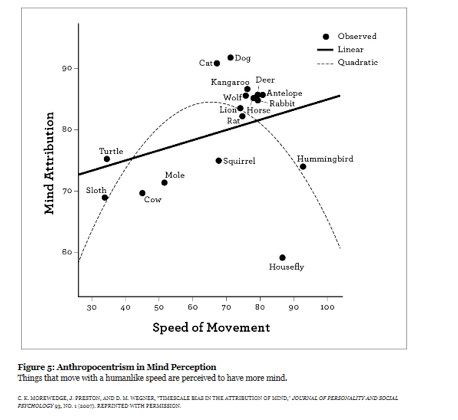
This follows by discussion about experimentally established animal capabilities in various areas of intellectual processing. The final conclusion is that while animal do have to various degrees both Agency and Experience, the human perception dependes much more on the level of interaction with animals than anything else so dogs are considered smarter than pigs when reality is opposite,
Chapter 3: THE MACHINE
This starts with machines specifically designed to satisfy a very human needs in sex and companionship – RealDolls. The interesting part here is that interaction with machines lead to assigning them qualities that they really do not process such as agency, which often happens when they fail to work properly. A typical example would be a frozen computer that stopped responding to our commands and we immediately assign to it malevolent agency before rebooting. The author’s conclusion is that machines to not belong to mind club because even if they have some agency, they are very low on experience, which could eventually change with further development of AI. Here is a nice graphic representation for this:

Chapter 4: THE PATIENT
This case is an interesting by the very fact of questioning a patient’s belonging to a mind club. After all patients are human so they belong to the club by definition. However the low level of agency that they have, due to being literally vulnerable feelers, pushes them to the left of Agency/Experience space. Author describes a number of experiments demonstrating the difficulty of understanding not only others, but also ourselves. One interesting inference is that obtaining more of the agency either via exerting control over treatment, helping others, or similar activity clearly improves results. This follows by discussion of typecasting in life and in Hollywood and difficulty of overcoming it. Interestingly enough the author builds a moral space around agency as presented on the graph:

Chapter 5: THE ENEMY
This is about dehumanization and/or objectification of enemy and it starts with inversion scenario to test how Americans would feel if American soldier would be treated in such awful way as terrorists are treated in Guantanamo. It follows usual examples of human ability to form competitive group for any small reason or no reason whatsoever, in process assigning negative characteristic to the group of others and positive characteristics to own group. However the most typical reason for enmity is competition for resources. Author looks at it by using examples from animals, experimental research, and historical examples of objectification of others. The typical outcome in terms of this book is mental conversion of other either into unthinking feelers or unfeeling doers. The first group, being savages close to nature, needs benevolent oversight and control such as master / slave relationship. The of the second one are dehumanized as cunning evil doers not susceptible to regular human emotions and concerned only with winning at any cost. At the end author makes an interesting point that common intellectual and emotional experience can decrease enmity and supports it by example of soap operas that tend to decrease hostility to other in people who watch them..
Chapter 6: THE SILENT
This starts with the story of Terri Schiavo who was in coma, in vegetable state and an object of legal battle whether she should be considered dead since her brain had no activities. From here author discusses connection between consciousness and correspondingly Agency and Experience. Here is diagram of consciousness continuity from none to full based on EEG: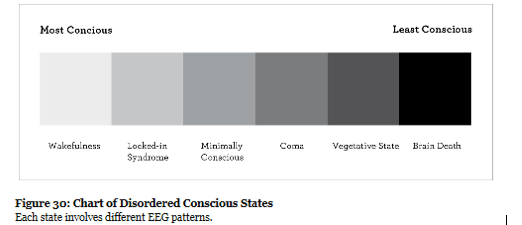
Author also discusses here a variety of human conditions from the inception to incapacity from point of view of who should or should not be included into mind club.
Chapter 7: THE GROUP
The chapter on a group’s mind starts with description of Indian festival when multitude of people comes to one place for religious reasons, acting as one. From there author goes into formal notion of grouping and Gestalt psychology, linking it to external form of the group when individual members could be practically invisible or undifferentiated from each other. To demonstrate continuity of the group belonging over time author uses Jews as highly connected group membership, which comes with birth and is not easy to denounce, if it is at all possible, due to external perception of its members as unalienable pieces of one entity. After that author discusses psychology of individual in the group and all kinds of intellectual affiliations via ideas such as conspiracy theories leading to deindividualization when one practically adjust own mind to whatever dominates the group. One of typical examples is synchronization from marching bands to monkeying actions of others and joining some collective on Internet. Author also discusses political groups such as countries that have hierarchies and structured processes to make group’s mind on something and enforce compliance of group members with whatever course of action decided. At the end of chapter author states as paradox that individuals in the group generally become less intelligent, but allow achieving huge results from cooperation unachievable by similar number of individuals not joined in a group.
Chapter 8: THE DEAD
Here author discusses mind of dead or more precisely various ideas about it developed by humanity from believes in hosts and Descartes’ duality to contemporary frozen bodies, Duplication problems in Star Track transporter, or existence within the Matrix. Nevertheless author seems to consider dead to be crypto-minds low on both Agency and Experience.
Chapter 9 GOD
The next mind is actually a super mind of God. This chapter includes requisite discussion of Pascal ledger and human proclivity to see agency everywhere whether it exists or not with usual reference to prehistoric times when lion may or may not be in the bushes, but one is by far better off by believing it is there. One interesting proposition here is link between sufferings and believes. Author provide a graph to demonstrate this link:
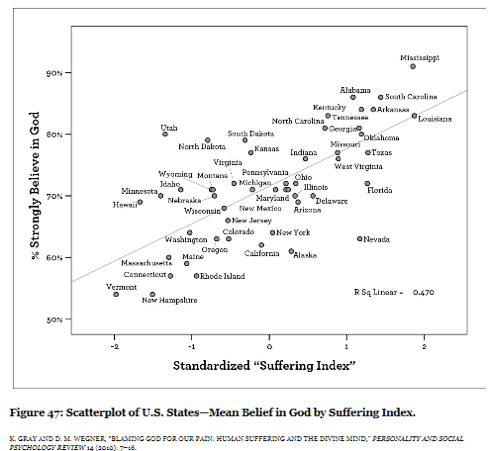
Eventually author places God on this mind map at the very bottom of Experience and at the top of Agency and since we have no really reliable communication lines with God, his mind is mainly the product of nothing more than human perception.
Chapter 10: THE SELF
The chapter on human individual’s mind starts with an example of a person who in his sleep was not able to control his actions and committed a murder. This case used to demonstrate that we are not really in control of our mind and do not really understand its working. It follows by description of a number of experiments demonstrating somewhat independent work of subconscious and raises question of free will existence based on famous experiments demonstrating activation of body for moving before actual decision to move had been made. After that author moves to discussion about using new knowledge about mind’s workings to improve human conditions. It goes at the two levels – psychological method to prevent people from desperation when they understand complexity of mind’s working and the second level practical methods to apply in their everyday lives to achieve success such as Commitment Clubs, Implementation intentions technics, and such. At the end of chapter author discusses philosophical aspects of what the self actually is, what part of it is memory, how thoughts are generated and, probably most important, fluidity of self and its susceptibility to change including false and placed memory, self-perception and such. The final point is refer to Dennett and his definition of self as the center of gravity around which orbit all our desires, memories, hopes, believes, and everything else.
MY TAKE ON IT:
Generally I find an idea of mind as topological point of Agency /Experience plane very interesting and I think it deserves consideration and probably expansion into multidimensional space by breaking Experience down into such dimensions as culturally programmable experience vs. random occurring environmental experience and Agency into Consciously directed Agency vs. Subconsciously directed Agency. I would also have problem with idea of a Group, Dead, and God being included into discussion of mind. In mine opinion the mind is a function of acting entity, while all above are not such entities: God does not communicate his existence in any clearly recognizable way, the dead do not act or communicate, neither does group since any of its actions or communication are always vector combination of actions and communications of its members. I guess eventually this approach could be used in modeling AI and potentially providing better understanding of the mind.
20170812 -The Ideas Industry
MAIN IDEA:
The main idea here is to identify and review the Ideas Industry: the area of activities that author himself belongs to. Author identifies two main types of participants: Public Intellectuals and Thought Leaders, discusses their different variations from loners to superstars, and reviews organizational forms they use such as academia, think tanks, and private entities on social media. However the most important objective of this book is to evaluate impact of their activities on real world,
DETAILS:
PART I. Introduction: The Transmogrification
It starts with the statement that marketplace of ideas changed and rather dramatically with advance of technology and change in societal mores. Then it goes to comparison of the two most recent presidents Obama and Trump. Obama is presented as supremely qualified near genius frustrated with poor understanding of his sophisticated actions by foreign affairs community, which undermined his ability to achieve his objectives. Trump in author’s opinion lacks understanding of foreign affairs, acts erratically, and produces highly heterogeneous policy. After demonstrating his deep misunderstanding of both presidents, author moves to generalization of public intellectuals as follows:

His designation for two reviewed presidents: Obama= Public Intellectual and Trump = Thought Leader. Aftrer identifing players, author moves to identifying most prominent trends of the game, which ignite powerful clushes on the market place of ides. These trends are:
- Erosion of trust in institutions
- Polarization of American Society
- The growth of economic inequality.
Author also discusses the role of ideas and their impact on population, which historically was often underappreciated by intellectuals. However the focus of his attention is development of Ideas Industry created by increase of information and duscissions availability due to Internet, social media, TED, and multitude of other channals that opened access to these forums to masses of lay people.
1.Do Ideas Even Matter?
This chapter is an attempt to make case why ideas matter in the first place. It starts with a charming example of how Jeffrey Sachs’ trivial ideas of ending poverty in the third world by pumping money into the hands of leaders of its leaders led to massive waste of money with no results to show for this. Then author moves to review counter arguments that basically state that ideas and discussions does not matter. He identifies four types of such ideas value discounting arguments:
- The Materialist: everything is moved by materialist forces so ideas are irrelevant
- The Defeatist: too much media and too many ideas, therefore good ideas just drown out by the noise
- The Populist: complex abstract ideas would not work because people are too stupid to understand and support them
- The Nostalgic Argument: intellectuals now are not what they used to be, so they just cannot produce such big ideas that would effectively influence outcomes.
Author reviews each argument in details without fully supporting or rejecting any of them, but rather while partially accepting some of their logic, nevertheless concluding that ideas do matter a lot after all.
2.How Pessimists, Partisans, and Plutocrats Are Changing the Marketplace of Ideas
This chapter looks at trends above that author consider to be systematic forces, which are shaping Ideas Industry. It starts with discussion about foreign policy experts’ outburst against simplification and popularization of ideas via books like “Black Swan” and the whole phenomenon of online discussions and presentations like TED. After that author moves to trace in details 3 trends that drive this Ideas Industry and its mass production branch: popularization. Here author provides some polling data to support reality of these trends:
Loss of trust in Institutions:
Polarization: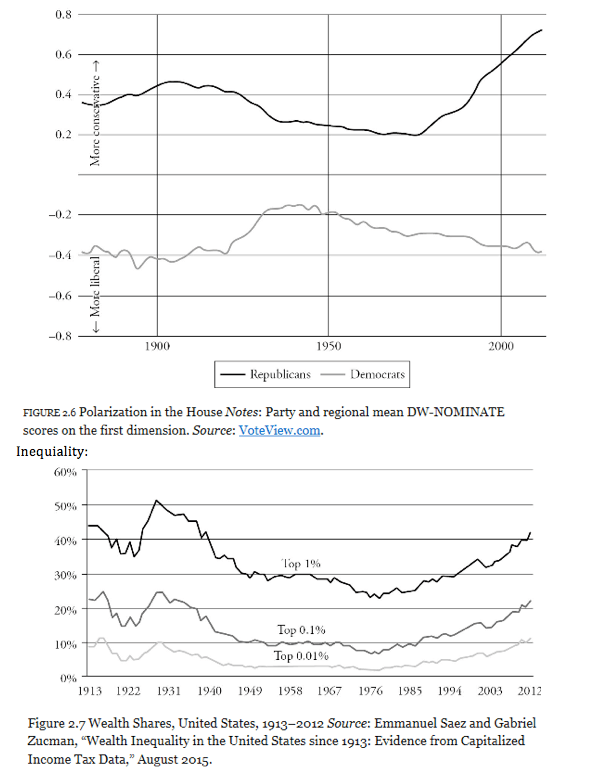
PART II
This part looks at the people who are main suppliers of ideas and industries that provide resources to these people such as academia, think tanks, and various publications / websites.
3.The Standard Indictment Against the Academy.
The oldest and most traditional sources of ideas are Universities and Academics discussed in this chapter. Author points to the notion promoted by journalists that academics do not participate enough in public market of ideas because they are too busy writing for peers due to the academic life’s imperative: “Publish or perish”. Interestingly enough a generation ago academics were the only one group who actively participated in this market, while population at large would receive second hand transfer of ideas via political process. Author specifically looks at foreign policy discussions and points out that academics activity decreased with the end of Cold, which caused dramatic decrease of money flowing to academia to analyze and produce ideas relevant to it. Terrorist attacks somewhat revived it, but incentives participate are still by far below historical levels. Another issue is closeness of academic literature due to publisher’s fear to loose lucrative source of income by diluting information into much cheaper popular distributors. Nevertheless author points to a number of such ideas distributors that become popular. However it is not only and even not the most important issue that troubles author. More important is the fact that politicians are not paying as much attention to academics’ work as they believe it deserves. After relatively long discussion on career and other reasons of decreased participation of academics, author hits on one very important reason: huge and dramatically increasing deviation of academia ideology from ideology of majority of country population and correspondingly politicians that this population elects. Here is a nice graph to demonstrate this deviation: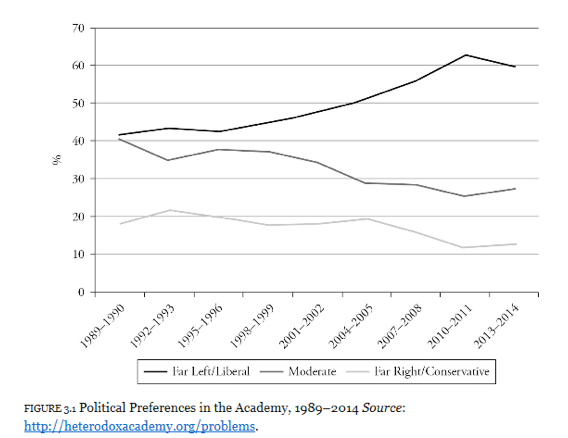
When Academic’s ideas deviate from ideas and believes of electorate, politicians start having hard time trabsfering public resources to academics, even if politicians themselves are very much in aggreement with academics. At the end author points out that some individual academics did well on marketplace for ideas, but it is become risky for them to go out there.
4.The Disciplines: Why Economics Thrives While Political Science Survives
This is a comparison of two fields most important in public discussion: politics and economics and how much different are attitudes to them with economics being by far more respected and rewarded field. The main point here is that economics gets more money, more prestige, and more support than political science. Author provides a couple of polling graphs to demonstrate that elite’s attitude to economics is significantly more positive:
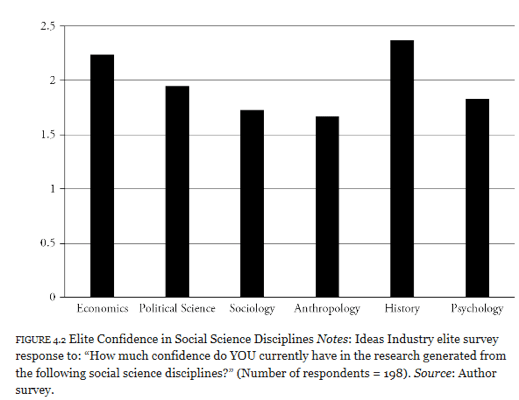
Interestingly enough it is not the result of economics being any more scienifically sound than political science as it is demonstrated by its consistent failure predict results of policies and economic developments. It is rather due to high levels of mathematization economics looks more scientific and elites routinely buy this. Right now political science is trying to follow suit, but it is not clear if it will work out or not.
5.This Is Not Your Father’s Think Tank
Here author looks at think tanks that specialize on conversion of high-level ideas into detailed policy proposals. Author looks in quite a detail at Heritage foundation and changes under DeMint leadership that led its position deterioration. After that author briefly reviews 3 generations of think tanks and their role as source of jobs for middle to low-level politicians out of power and developers of detailed ideologically defined policy plans for their constituency. Author also discusses infliction points in funding, power, and influence of think tanks. The first such point was 9/11 and the second 2008 crash. There is also relatively detailed review of multiple funding sources and dynamics of changes between them. Interesting thing here is that philanthropic support is qualitatively changing with donors getting more and more involved with ideology and direction of think tanks activities, instead of just providing money to professional ideologues.
6.The Booming Private Market for Public Ideas
Here author moves from the area of mainly government financed formal institution nearly completely subjugated by leftists to the area of privately financed think tanks where diversity of ideas is still alive and kicking. The point here is that diverse individuals and corporations in possession of resources obtained from the market place of goods and services are moving into the market place of ideas and use their resources not to support academics, but rather develop and promote their own ideas. Author uses the story of BRICS and debates around them as example of such process. He also points out at interesting result of this movement: development of for-profit think tanks that sell consulting services. Here is graphic representation of relative elite trust to traditional vs. for-profit think tanks:
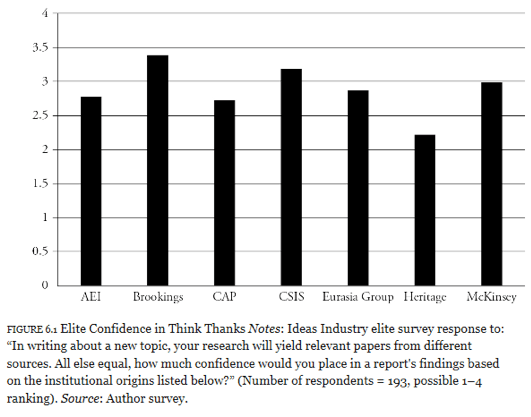
PART III
This part is the review of functioning of market place of ideas.
7.The Promise and Perils of Intellectual Brands
The first chapter of this part is concerned with role of superstar intellectuals who are driving the Ideas Industry. Specifically author looks at history of Walter Lippmann and at contemporary superstars Fareed Zakaria and Neil Ferguson. He also provides a list of 20 most influential intellectuals in foreign policy:
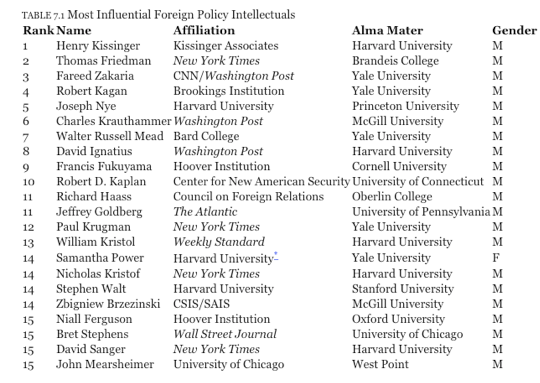
8.Is the Ideas Industry Working?
This is discussion of how effective is Ideas industry and how much it is vulnerable to bubbles similar to bubbles of financial, real estate, and other markets. By working author means improvement in American foreign policy debates. To answer this question author first goes into discussion of idea of disruption from Schumpeter all the way to our days. He looks in quite a detail at work of Clayton Christensen and in main rejects validity of this work. Consequently author uses the story of raise and fall of disruption discourse as sample of Ideas Industry working: an idea gaining popularity, becoming a fad, then falling out of fashion, and eventually remaining as one more source of background noise in continuing discussion with a small cadre of dedicated supporters.
9.Tweeting Ideas: Or, the Requisite Chapter on Social Media
The final chapter looks at interaction between Ideas Industry and online world and how it processes ideas generated by the Industry. Author seems to appreciate influence of new social media, but is clearly unhappy with its idiosyncratic character and complete lack of decorum or even simple decency.
Conclusion: The Dark Knight Theory of the Ideas Industry
In conclusion author states that Ideas Industry grew to be bigger than ever, but he wishes it would be quite a bit better. Author also brings in his our experience as a fledgling intellectual star in foreign policy discussing perks and feeling of self-importance it brings. The final point is that he aspires to achieve sustainability as public intellectual rather then become a burning star.
MY TAKE ON IT:
I did not find a lot of new information in this book, but I do like author’s approach to this area as an industry with everything typically involved in this notion. There is profit seeking motive and not necessarily in monetary form only, albeit this form is very important, but also in form of respect and appreciation from peers and general public. The last is becoming more and more problematic by the minute, mainly because the Idea Industry more often than not fails to produce ideas that find validation in reality and often betrays self-serving character of many public intellectuals. Lately after somewhat dramatic failure in understanding and correspondingly predicting results of American election of 2016 the public trust into Ideas produced by the Industry cratered. I guess, the new Ideas will have to be generated in order to get out of current ideological dead-end that both American main parties encountered. I believe that source of these ideas will be outside of the Ideas Industry, which is way too mature and settled for the real innovation. However, when it will come, the source of these new ideas will probably be able to capture a significant chunk of existing Industry and use it to move to the next step in development of the Great American Experiment.
20170805 – War and the Art of Governance
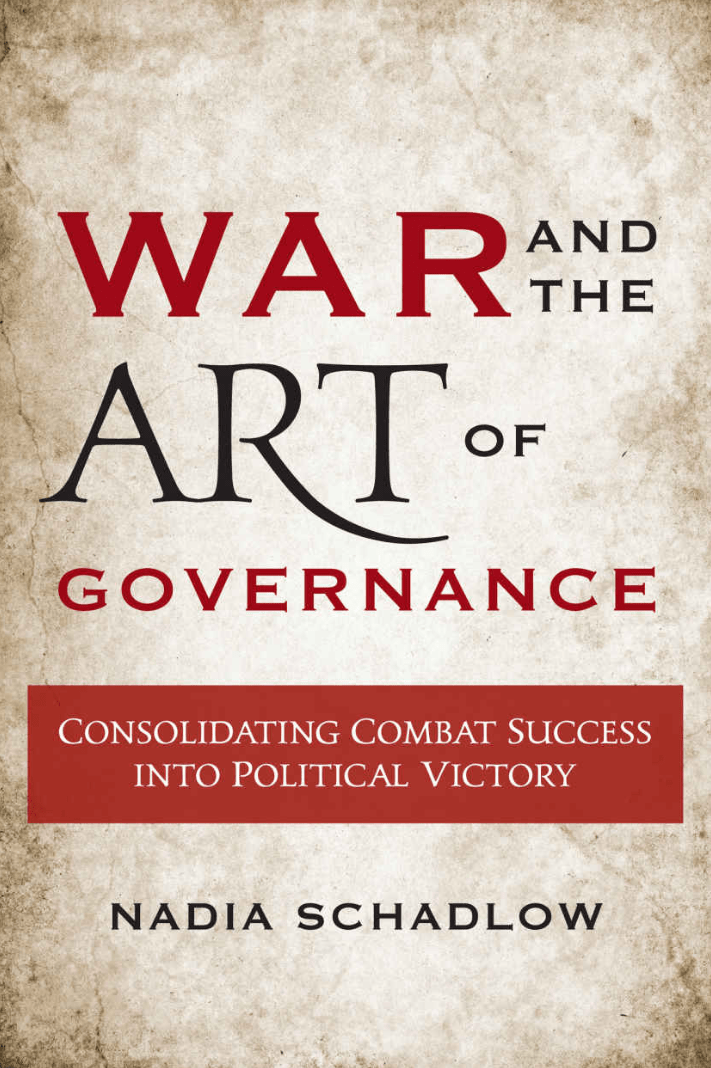
MAIN IDEA:
The main idea of this book is to review the history of American occupation of different countries and their successes and failures. The most attention here allocated to the analysis of bureaucratic planning and relationship between organizations responsible for reconstruction of society, especially between military commanders and civilian administrators. The very important objective here was to look at cases these entities were separate, creating difficulties for military commanders to overcame purely military fighting attitude and switch to attitude of builders and interlocutors with local population.
DETAILS:
- American Denial Syndrome: Failing to Learn from the Past
This is about contemporary situation when America gets involved in some optional wars like Iran and Afghanistan without clear understanding of end game and being in denial that such end game has political character and requires by far more time and resources than actually winning the war military. Traditionally, in previous wars the settlement was in hands of military commander with little if any interference for political class. However Americans were always uneasy with such arrangement because of their deep antipathy to the notion of standing army. Normally it was tolerated mainly due to the limits on federal government resources and importance of internal politics. However starting with Vietnam professional politicians started intensely interfere limiting military options and trying to impose political and economic solutions. Consequently internal political dynamic started to exceed the need for success of settlement after military engagement. The result was military success followed by slow moving disaster of inability to establish peaceful settlement and low intensity military actions lasting for decades. Correspondingly the focal point of this book is settlement or lack thereof after American war and military victory.
- The Early Years: Improvisation
This is a review of early wars when after war settlement was mainly improvisational and conducted by military commanders on site. It starts with brief review of American military development after revolutionary war when army was small and politicians and population generally had negative attitude to the very notion of standing army, allowing its existence only under pressure of circumstances. This attitude mainly lasted up until the early XX century when even small colonial expansions caused significant stress to small military and invoked robust opposition. During all this time any after war settlement activities were conducted by tactical commanders to the best of their ability, which was not that high in civilian affairs, but usually sufficient to achieve decent results good enough to transfer power to civilians.
The Mexican-American War
The outcome of this war was acquisition of significant territories from Mexico and establishment of typical American pattern of occupation: creation of local civil government and minimization of any involvement in their activities. This mainly describes how it happened and struggle between various American commanders who promoted different tempo and methods of conversion of these territories and their population into regular part of America. This process of creating territories that later were converted into the states was relatively smooth and successful. Slightly different it was in parts of Mexico that were only temporarily occupied, but it included the same pattern: establishment of local government with support of American military, but minimal interference in local politics or economics.
The Civil War and Reconstruction
Completely different situation developed in occupation of South were North’s objective was complete change of Southern way of live by eliminating slavery as economic foundation of Southern society. This part describes low intensity insurrection war that continued long after massive military engagement had ended. The Northern attempt to restructure society via Reconstruction with new local governments based on support from black population and relative significant transfer of people from the North mainly failed after Northern population got tired and continuation of massive suppression effort become politically untenable. Eventually the new form of society with segregation at its base was established, emancipation of black population mainly rolled back, and long economic and political stagnation settled in on South.
The Spanish-American War
This war demonstrated growing schizoid character of American international politics in colonial era when American politics become much more federal rather than local pushing imperial expansion, but strong anti-colonial forces inside USA preventing annexation of Cuba or Philippines. While pro-colonial forces succeeded in creating US territories in Caribbean, it failed to push America into full pledged pursuit of colonial empire. Author reviews this process in Cuba and Philippines, especially low intensity colonial war that lasted for years in Philippines.
World War I
The American occupation of some parts of Germany after WWII was brief and relatively easy since German government mainly remained unchanged, there were no attempt to radically change society, and consequently army just provided support to local government, assuring compliance with Versailles treaty. Some civilian structures were created within military to interact with locals and control military support for security and logistics in the occupied areas.
Conclusions:
In reviewing these cases author identified two different forms of general engagements: political oversight and political reconstruction. The lesson derived is complexity and inevitability of civilian – military tension due to different training, attitude, and experience between military officers and civilian officials tasked with supporting occupation. Another lesson is necessity and difficulty of maintaining the unity of command due to the fact that military forces structured and optimized for independent military operations and consequently have difficulty to adjust to political, police, logistical, and other governmental roles in close interaction with local population.
- World War II: Building an Organization
Civil-Military Tensions
This part provides history of bureaucratic processes in relation to military governance. It reviews various documents developed based on experience of WWI and preparations during WWII. These preparations were quite extensive including special training program for civil affairs in the War Department. It also reviews tensions caused by the very idea of use of military for civilian governance from legal and civilian side. Army also was not very interested in obtaining these new responsibilities because it was destruction from its main professional duties to fight and win wars.
Italy
The American military involvement in Italy governance was quite complex due to multiple factors such as Italy’s switch from being German ally to fighting Germany and occupation. Politically the main purpose was to remove remaining fascists from the position of power, at the same time preventing communists from taking over. The significant economic aid and logistical support allowed Italy to avoid catastrophic consequences in provision of food and other supplies. The transfer to republican political organization directed political activities into peaceful direction by allowing communists to maintain hope of achieving victory via democratic election. At the same time presence of American troops made any attempt to take power by force way too risky.
Germany
This is review of history of Germany occupation, which extensively prepared for over the years leading to victory. Initial plan was to allocate specific military detachments to administrative units and localities of Germany, but it was not possible due to the lack of resources, so regular tactical units of army were used for this purpose. After hostilities ended the governance was converted to territorial model with main objective to transfer it to civilian governance as soon as possible. An extensive program of denazification was implemented and formation of multiple political parties was highly encouraged. There were no significant resistance to the return to democratic order and within 4 years American military control over country governance was practically removed.
Japan
Japan surrender left all government structure from Emperor down basically intact. Military units of occupation army were organized to match Japanese prefectures Politically country was restructured to democratic norms, changing political, but living intact administrative organization of society. Overall there were no significant resistance, country readily accepted modification of constitution and by the end of 1945 there were 60 political parties.
Korea
A bit more complicated was situation in Korea mainly because it was for a long time occupied by Japan and departure of Japanese bureaucrats left void in governance. Eventually administrative positions were successfully filled by occupying military and returning Korean emigrants, leading to restoration of necessary function of the state. Probably the most difficult was political struggle to keep Korea united and prevent communist from taking power by force. This obviously failed and Korea was divided into two countries.
- The Cold War: Illusive Lessons: The Korean War; The Dominican Republic;
Panama;
These were mainly successful operations not that different to ones that followed WWII. There were no significant insurgencies and limited political objectives of stabilization and transfer of power to locals were relatively easily achieved. Author provides rather detailed description of bureaucratic structures and processes that allowed such results.
- Afghanistan and Iraq
Lessons Ignored
Author identifies lack of planning for settlement after military victory as the ignored lesson from the history of previous occupation.
Afghanistan
Author sees the problem in lack of integrated efforts between multiple occupying NATO forces and lack of central authority to define and enforce common strategic approach. She recounts history of attempts to reconstruct the state that generally failed due to poor understanding of tribal and sectarian nature of Afghan society.
Iraq
Similar problems occurred in Iraq, which is also society deeply divided by sectarian lines and history of internal violence. One of the most important mistakes was destruction of existing Iraqi institutions such as Army without ability to substitute these Sunni dominated structures with the new non-sectarian ones.
Conclusions
Finally the most important difference is strong and continuing insurgence in both Iraq and Afghanistan that author explains by ineptitude of American leadership at the time, poor planning and failure to implement timely transfer from military fight to reconstruction and suppression of insurgency.
MY TAKE ON IT:
I take from this book that generally American occupation was successful when military were given more freedom to act and objective was less to build new society, than pacify existing one and let locals decide what they want to rebuild as long as main objective – removing future threats to America is achieved. I do not think that the latest failures or semi-failures in Afghanistan and Iraq has anything to do with planning, sufficient or not, centralization, or other activities or lack thereof on the part of Americans or NATO countries. The main problem is clash of religious and cultural character inside of these countries that could not be easily overcome. Historically military conquest of Islamic countries was successful in one of two ways. One way was when it did not involve any significant interference into regular lives of locals, leaving their mores untouched, while assuring quick, immediate, but carefully calibrated military reaction to any threat, as it was in case of British in India / Pakistan. The other way was when it involved dramatic change of culture and mores with any resistance suppressed with extreme cruelty against not only activists, but also regular population, as it was the case in 1930s Central Asia when communists took over. I do not think that either one of these method is applicable now, so the best way would be to leave them alone, while assuring their inability to develop any military or terrorist threat by immediate massive, but brief intervention eliminating any entities that start developing ideological and/or technical capability for such thread. It means in/out operation with elimination of threat, but no occupation. Independently there should be a continuing effort to conduct massive ideological campaign against militant understanding of Islam and material support to whatever forces inside of these societies would want to move to contemporary world.
20170730 From bacteria to Bach and back

MAIN IDEA:
The main idea of this book is to provide summary of philosophical position based on Darwinian approach, but at the same time seriously discussing Cartesian ideas, which put consciousness outside of material world. Probably the most important here is an attempt to trace development of ideas from Theistic Intelligent Design through Darwinist development both biological and cultural and all the way to humanistic Intelligent Design. One of the most important ideas here is the idea of us humans being only an intermediate step in development of more and more comprehensive intelligence and that future contains some complex and unknown development that would lead to such superior intelligence either in form of human – AI symbiotic coexistence or some other form that we cannot even comprehend, but still based on codependency and coevolution of humans and technological environment they create. To put it in other and very brief form: coevolution of genes and memes.
DETAILS:
Part I
TURNING OUR WORLD UPSIDE DOWN
1.Introduction: Welcome to the jungle; Bird’s-eye view of the journey; The Cartesian wound; Cartesian gravity;
This is an introduction to the book and brief description of how author wants to cover the development of live and human mind. Here are milestones:
1.Darwin’s strange inversion of reasoning
2.Reasons without reasoners
3.Competence without comprehension
4.Turing’s strange inversion of reasoning
5.Information as design worth stealing
6.Darwinism about Darwinism
7.Feral neurons
8.Words striving to reproduce
9.The evolution of the evolution of culture
- Hume’s strange inversion of reasoning
11.Consciousness as a user-illusion
- The age of post-intelligent design
This follows by discussion of application of Cartesian philosophy and demonstration of dependency of perception on the internal state of perceiver.
2.Before Bacteria and Bach: Why Bach? How investigating the prebiotic world is like playing chess
It starts with reasoning why Bach is a good example of the summit of human intelligence development then somehow meander between feminism, political correctness and usefulness of memes. This follows by discussion of prebiotic world, its non-evolutionary character and a bit of teleology with stress on “Panglossian paradigm”. The most important point is that we still have no clear picture of origin of live that actually started evolution.
3.On the Origin of Reasons: The death or rebirth of teleology? Different senses of “why”; The evolution of “why”: from how come to what for; Go forth and multiply;
This starts with the reasoning of why live exists and develops, going back to Aristotle with his idea of purpose for everything, eventually overthought by Darwin’s rejection of purposes and meaningful ends. It follows by discussion of deep meaning of asking “why”. Eventually author points to two districting meanings” “how come” and “what for”, the first one pretty much reasoning for specific results of interactions between time and objects, while the second one assumes some purposeful intentionality. Actually author stresses not just difference between these meanings, but evolutionary character of their relation: “what for” is product of evolution of “how come”. From here author goes into discussion of evolution as algorithm with details of meaning of algorithms and how they work using non-live processes like development of stone circles.
4.Two Strange Inversions of Reasoning: How Darwin and Turing broke a spell; Ontology and the manifest image; Automating the elevator; The intelligent designers of Oak Ridge and GOFAI;
The inversion here is kind of change of paradigm of understanding of the world. Darwin moved it away from believe that every complex system, including humans, had to be consciously put together by some creator to the notion that complex systems are developed via evolutionary mechanism. Correspondingly Turing come up with idea that computer could solve computational problem without having any consciousness whatsoever by just following some algorithm. From here author moves into the brief discussion of ontology and then to automation of elevator as example of substitution of complex set of rules for smart humans by relatively simple algorithms for ignorant machines. The final part is discussion of actually existing intelligent design, which is done by humans designing everything by using GOFAI (Good Old Fashioned AI)
5.The Evolution of Understanding: Animals designed to deal with affordances; Higher animals as intentional systems: the emergence of comprehension; Comprehension comes in degrees
This is discussion of how different creatures deal with environment and survival. The first author looks in parallel at animals and computer’s development. It is complicated with animals because of the long process of evolutionary development when lots of intermediate steps occurred to fit to environment that we really not familiar with, which makes reverse engineering of animal all but impossible. As example of much more simple development of computer code demonstrates that even in this case when everything is recent and transparent, it still practically impossible to untangle some piece of “spaghetti code”. After that author moves to the problem of comprehension and how it comes into existence.
Part II
FROM EVOLUTION TO INTELLIGENT DESIGN
6.What is Information? Welcome to the Information Age; How can we characterize semantic information? Trade secrets, patents, copyright, and Bird’s influence on bebop
This is discussion about nature of information starting with Shannon definition that was agnostic of content and then following into semantic information that is content only, eventually ending with a bunch of examples such as patents, secrets, and such.
7.Darwinian Spaces: An Interlude: A new tool for thinking about evolution; Cultural evolution: inverting a Darwinian Space
Here author first looks at spatial representation of Darwinian evolution:

He then reviews a couple of applications such as Darwinian space for bottleneck development and Darwinian space for origin of live. How core idea is to present inverted Darwinian space that linked two generally contradictory approaches to understanding the world: Darwinian and Intelligent Design:

This link per author is used not just to demonstrate connection, but rather represents progress of human existence going from random evolutionary (Darwinian) development to Human controlled and conducted Intelligent design of human existence.
8.Brains Made of Brains: Top-down computers and bottom-up brains; Competition and coalition in the brain; Neurons, mules, and termites; How do brains pick up affordances? Feral neurons?
This is discussion of nature of human brain vs. computers with probably the most important statement that author understand analog nature of human brain and its profound difference from digital nature of computers.
9.The Role of Words in Cultural Evolution: The evolution of words
Looking more closely at words; How do words reproduce?
Here author moves to nature and use of words as key part of cultural evolution. He provides a nice tree of language evolution demonstrating that the development and evolution of languages is not that different from the similar process for species:
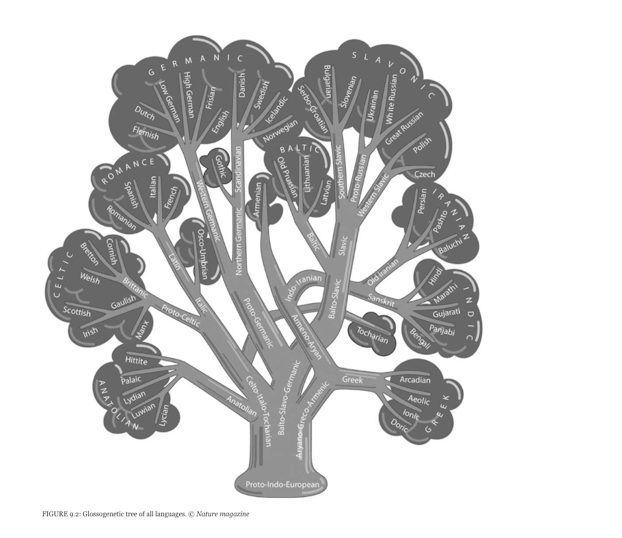
10.The Meme’s-Eye Point of View: Words and other memes; What’s good about memes?
This is quite detailed discussion of memes and ideas of memetic evolution occurring similarly to genetic evolution. Here author goes back to one of the core ideas of this book that competence and comprehension are two separated notions and it is not just conceivable, but actually typical development for development to be independent in both areas.
11.What’s Wrong with Memes? Objections and Replies: Memes don’t exist! Memes are described as “discrete” and “faithfully transmitted,” but much in cultural change is neither Memes, unlike genes, don’t have competing alleles at a locus; Memes add nothing to what we already know about culture; The would-be science of memetics is not predictive; Memes can’t explain cultural features, while traditional social sciences can; Cultural evolution is Lamarckian
This is look at critics of memetic ideas starting with non-existence of memes, then following with their easy changeability that makes them radically different from genes, and finally ending with doubt in memes usability as explanatory tool for cultural evolution and lack of explanatory power.
- The Origins of Language: The chicken-egg problem; Winding paths to human language
This is about complexity of figuring out origin of language. The first author discusses usability of language: Communicative utility, Productivity, Digitablity or in other words – ability to correct to the norm, Displaced Reference, and Ease of acquisition. Finally author discusses here path from pre-linguistic utterances to fully blown and comprehensive human language.
13.The Evolution of Cultural Evolution: Darwinian beginnings; The free-floating rationales of human communication; Using our tools to think; The age of intelligent design; Pinker, Wilde, Edison, and Frankenstein; Bach as a landmark of intelligent design; The evolution of the selective environment for human culture
The final chapter of this part is going into the nature of Cultural evolution, how it started with Darwinian approach postulating improvement in evolutionary fitness via development of more and more sophisticated communications, eventually moving humanity from left bottom point of Inverted Darwinian space where everything happens randomly to upper right side of our space where everything happens intelligently and were Bach resides.
Part III
TURNING OUR MINDS INSIDE OUT
14.Consciousness as an Evolved User-Illusion: Keeping an open mind about minds; How do human brains achieve “global” comprehension using “local” competences? How did our manifest image become manifest to us? Why do we experience things the way we do? Hume’s strange inversion of reasoning; A red stripe as an intentional object; What is Cartesian gravity and why does it persist?
This chapter is about consciousness, work of human mind, and its similarity and/or uniqueness comparatively to minds of other animals. The main point here is that we are conscious about ourselves because we talk about it all the time, which no other animal does. The second point is that conscious seems to develop necessarily from communication needs. It is not possible communicate and cooperate effectively without conscious separation of self from others and from environment. Actually other organisms also have some rudimentary notion of self, but none other develops and uses it so extensively. Finally author discusses phenomenon of free will and our limited access to reasons for our own thinking and acting.
15.The Age of Post-Intelligent Design: What are the limits of our comprehension? “Look Ma, no hands!” The structure of an intelligent agent; What will happen to us? Home at last
This is a look at language and human ability to pose questions, find answers, and consequently comprehend reality. It is a bit of polemic with Chomsky’s argument from Cognitive Closure and conclusion that so far no limits were found or even postulated believably. This follows by discussion on technological enhancement of our abilities to comprehend existing material world and/or theoretical speculative construction of the world of ideas. Obviously it is a good place to discuss AI and all these potential consequences of its development. At the end author is trying to look in the future that author thankfully understand is not really possible concluding with very wise statement: “Evolution is smarter than you”.
MY TAKE ON IT:
Being a very simple man I do not see a lot of complexity in all these ideas. It is obvious for me that Darwinian algorithm of Intergenerational transmission of information either in form of Genes or Memes with modification and consequent filtering by environment is probably the most general natural process of diminishing entropy and proving inapplicability of the second law of thermodynamics to complex systems. As far as current implementations of AI and dramatic changes in humanity both biologically and culturally, I do not think that humans would ever move to creation of superior Intelligence that would substitute them. I believe that humans will try to play with it, but will be deeply disappointed because they will find out that to get consciousness one need to provide experience and, while it is possible, all that one would get will be another human even if it will be based not on proteins, but rather on silicon. More important is that not everything that can be done, will be done and while it is quite possible that AI pretty soon would sing Annie Oakley song to humans: “Everything you can do I can do better” one thing that humans do will never be transferred to machines: deciding what to do, what goals to set, and what objectives to achieve in pursuit of human happiness – one and only one objective that makes at least some sense.
20170723 – The Confidence Game
MAIN IDEA:
The main idea of this book is to review the confidence games (cons in commonly used abbreviation), their methods, and psychological foundation discovered in recent years via extensive scientific research using contemporary experimental technics and machinery. It is illustrated by a multitude of real live examples.
DETAILS:
INTRODUCTION
The introduction starts with description of adventures of some aristocrats of crime such as Joseph Cyr who successfully pretended to be a surgeon and actually did surgeries without any education and experience whatsoever. This is a good example of confidence man with no trace of self-doubt whatsoever. This follows by other examples of elegant, self-assured, and convincing con men that succeeded in the art of swindling people. This book is a psychological analysis of how it is done.
Chapter 1 THE GRIFTER AND THE MARK
The grafter and the mark are probably two the most important parts of any con. The main characteristics are: the personality of the con man and his ability to correctly identify the mark (the person who could be conned effectively). The analysis starts with look at the very effective con man Frank Demara who serves as one of the most prominent examples in this book. The key features discussed are pretty much features of psychopath: low sympathy to people and high levels of empathy in terms of understanding other people. Two features stand out as necessary for success: Narcissism and Machiavellianism, which author discusses in detail. Obviously not all people endowed with these features become con men, but combination of predisposition and opportunity could lead to a grafter to be born. Author also discusses deception and lies everywhere including animals and then how it could be recognized via catching micro expression, specific language, and its use not only in direct, but also in written communications. As to the victim of con the most typical victims are honest people who used to and expect honesty from others, but much more important – people in urgent need of something that con artist promise to provide be it material or psychological. One example provided is a rich mother paying millions to psychic who promised transfer soul of her dead son into another boy’s body. However there is no one size fits all approach in this game. Different people are prone to different cons. Another group quite often becoming victims are conmen themselves, when they are trying to con somebody, consequently opening gates for successful counter con.
Chapter 2 THE PUT-UP
The put-up is about choice of victim. It is often based on intuitive judgment of people that everybody does instantly, but con artists are especially proficient in doing. Author discusses works of psychologist Nicolas Epley who extensively explored process of intuitive judgment. Then author moves from personal evaluation to discussion of psychology of phishing attacks and their victims. An important point here is that repetition generate familiarity, which nearly automatically converts into trust. Another point here is that successful put up includes emotional, time, or situational pressure. Finally author discusses self-selection of victims and even their persistence in believing, even if actual deceiver issues disclaimers.
Chapter 3 THE PLAY
The chapter on the play starts with the story of Australian girl who successfully pretended to be a victim of human trafficking, in process obtaining help and publicity. This brings us to review of work of Robert Zajonc who studied human emotions for decades. One of the most important findings: emotions come first, thinking – second. So the main task of con artist is to generate positive emotions in the mark even before any thinking process would occur. As usual an important part is the story. Author refers to work of Jerome Bruner who identifies two ways to frame experience: propositional and narrative. The former is based on thinking and is dry and difficult demanding logical processing that does not comes naturally, while the second produces the story, which could be easily incorporated into mark’s mind and would generate emotions helpful for con artist. Author provides a number of supporting stories and specifically discusses technic of “wishful identification” when mark tricked into believe that somebody is very successful so he identifies to the point of trusting with money and other resources. This works especially well with investors. Overall the play on emotions by using the stories, especially such emotions that are considered rewarding, but bad like lust, greed, and such helps con artist subdue any skepticism of the mark and succeed.
Chapter 4 THE ROPE
This starts with the story of political campaign when candidate was convinced by swindlers to run and invest only to see his bank account disappear. Author uses this example to define the rope: alpha and omega of confidence game where alpha is increasing appeal of something and omega is decreased resistance surrounding something. This leads to discussion of process of persuasion work of Robert Cialdini. One of the most interesting points is that somebody who agreed provides a small favor will be more likely to provide a bigger one – kind of increasing the stakes. This opens opportunity for roping technic: one person – roper asks for a small favor, and then the second player comes in with the real request. It is also called “foot in the door” approach. Author discusses various technics of roping such as “confuse and reframe” like with pennies turned into dollars, scarcity of access as in Madoff case, promising more and more starting with a small one, and others.
Chapter 5 THE TALE
This is about another tool in con artist toolbox – create a compelling tale of events that lead mark to believe that his actions would lead to achieving self-affirmation and self-actualization. As example author reviews a story of physics professor who was used for drug trafficking by a woman who successfully played his arrogance and sense of exclusivity and superiority. It is called Lake Wobegon effect when everybody considers himself or herself better then average. Author also touches here on another phenomenon when people fail to recognize their prejudices believing that they are above it.
Chapter 6 THE CONVINCER
This is about somewhat opposite technic when con artist instead of using inflated self-confidence of mark, inflates his own value overstating abilities, history, and what not, eventually becoming an idol for his marks. This works especially well with investors, art collectors, and other rich people who are looking for somebody with superior skills to entrust their wealth for enlargement. Author provides such examples with con investor overstating return and arts connoisseur who provided her patron with false art.
Chapter 7 THE BREAKDOWN
This chapter is about the con coming to the end when victim begins developing doubt that everything is fine, mainly due to accumulated evidence that it is not. Here author discusses cognitive dissonance between expectation and reality that victim begins to experience and how con artist uses it to delay discovery of the con. For illustration author uses a story with failed investment when con artists managed to continue con even when victim already understood its nature, but still was unwilling to believe. As usual author refer to psychological research and some well known historical events such as Mesmer and commission on mesmerism.
Chapter 8 THE SEND AND THE TOUCH
This starts with the story of mass sale of fake paintings and then continues to another story about engineering negligence that led to Teton Dam failure. Both cases illustrate one of the most important tools in the arsenal of con artists: human difficulty with accepting loss, also known as the problem of sunk costs. In other words the more value invested already into something, the less critical people tend to be to this something makes them to invest more and more, even when it become clear that this is a loser.
Chapter 9 THE BLOW-OFF AND THE FIX
This starts with another worldwide schema: Francis Drake inheritance, which is used to illustrate a very important for many con enterprises feature: social connectivity and conformism to the groupthink. Author discusses results of research in this area and various strategies of interaction with optimum being tit for tat. From here author moves to multistep games modeling long-term interaction and importance of reputation. For con artist the reputation could be the best tool possible because it opens people to change their game strategy from cautious and reliable to trusting and vulnerable. If the con artist painstakingly built stellar reputation for honesty, the value of possible scam grows in geometrical proportion to reputation. Another important side effect is that in many cases victim’s reputation is so important that the victim decides to keep the fact of being swindled in the secret, ironically providing support to the con artist. Author also discusses value of personification either it is for the purposes of extracting more charitable donations that would go to cute poor child, but not to invisible statistical child or supporting con artist’s claims by his trustfully appearing confederate who provides assurance of schema’s previous success.
Chapter 10 THE (REAL) OLDEST PROFESSION
The final chapter is about religious cons one of the most effective, popular, and ancient methods of separating people with their resources. At the end author states that after all con artists are actually a necessity of live because they often give ideological meaning to it, especially in situations of some cult and its followers when “one man’s con artist is another man’s spiritual leader”. Author even stated her believe that it is not only oldest profession, but it is the superior profession to all other that it still will be around when all others known professions had faded away.
MY TAKE ON IT:
From my point of view it is a nice review of technics used in con games, which provides for better understanding of human behavior in many other areas besides swindling. Especially interesting would be a review of application of these technics in politics either written large like presidential election or small bureaucratic politics of cheating other people into supporting one’s bureaucratic career. I think that it would also be interesting to apply analysis of con artist’s methodology to giant con jobs of contemporary world such as socialism, global cooling/warming, environmentalist, racialist, and feminist movements. The huge scale of these con jobs moved hundreds of million people, transferred resources from their producers to ideologues many of which where nothing more than con artists, and actually caused tremendous amounts of pain, suffering, loss of live, and waste of resources. I think that extensive education in methods of con artist should be one of the most important part of school curriculum, teaching young generation to recognized when they are a subject to con artist’s attack, either it is with objective to sell Ponzi schema investment or obtain their support for some socialist political measure.
20170716 Complacent Class

MAIN IDEA:
The main idea of this book is that America is currently in process of losing its economic dynamism, risk taking, mobility, and other features that made it an exceptional and the most prosperous country in the world. Author supports this idea with statistics about mobility, risk taking, decrease in innovation, and increase in segregation of Americans into smaller grouts of matching individuals who do not care and even are somewhat hostile to other groups. All these developments are taken together created environment of complacency and decay that bound to decrease quality of live, slow down or even stop improvement in all areas of live, and eventually could potentially lead to complete destruction of society or at least to dramatic internal conflict.
DETAILS:
- The Complacent Class and Its Dangers
This chapter is about current structure of American society that seems to be stabilized and is supported by overall complacency of majority. The breakdown looks like this:
- Privileged class in America: well educated, influential, and high earning people fully satisfied with existing arrangements
- Those who dig in Middle class and are more or less satisfied, but not really that confident their wellbeing is assured.
- Those who stuck in the low quality of life and see no way out.
However the most attention author directs at people who are mostly complacent with current situation discussing roots and results of this compliance, which are presented by attitudes of NIMBY and similar acronyms starting with Not In My… Author sees sources of this in the new culture of matching when people find match for everything and do not care about externalities, preferring to have safety and calm.
- Why Have Americans Stop Moving, or Is Your Hometown Really So Special?
Starting with this chapter author looks it signs of compliance as it shows itself in statistics. Here it is about Americans significantly decreasing their residential mobility. This had important economic consequences because highly mobile workforce supports optimization of geographical resource allocation consequently increasing overall economic output. Some very important reasons for those developments are practically closed areas where cost of living artificially made so high that they become inaccessible for individuals with regular income.
- The Reemergence of Segregation
Similar processes led to reemergence of segregation this time not that much by race enforced by laws as by education and culture enforced by cost of living with race still important, but mainly a secondary factor.
- Why Americans Stopped Creating
This is about decrease in innovation, which author believes underperformed since early 1970s. Author discusses the reason in some details, but overall feeling is that it is result of monopolization of economy and dramatic increase in regulations that put everything new at disadvantage. Another source of negative impact of increased statism of American society on innovation is concentration of resources on some grandiose projects such as democratization of Iraq or Obamacare. Even dramatic improvement of information technology related to Internet does not compensate enough for lost dynamics of American Innovation.
- The Respite of the Well-0rdered Match: Love, Music, and Even Your Dog
This is about impact of contemporary information technology that allows everybody to get whatever his heart desires, whether it is specific type of music, art, books, games, dating or anything else. The point is that such massive matching makes live both more satisfactory because it is possible to find perfect match to one’s needs and wants, but also more difficult because of constantly growing multitude of offers. This matching extends also into productive areas of live like jobs, business interactions, and so on. The second part of the chapter is about winners and losers of the multitude of matching processes. Winners are matchers – individuals who are looking to find a good match and succeed, while losers are strivers – people who are looking to win rather than to match and wind up suffering from underachieving because the playing field is not a limited locality where one can be winner among limited number of players, but the whole world where number of players is in billions.
- Why Americans Stopped Rioting and Legalized Marijuana
This chapter goes back to 1960-70s when baby boomers were rioting. Author poses question why this rioting spirit disappear and was substituted by relative calm. The reason he provides is bureaucratization of society, obsession with safety, and much more sophisticated and scientific policing that suppresses rioting in the bud.
- How a Dynamic Society Looks and Feels
Here author bring in example of China as contemporary dynamic society and lists a number of Chinese entrepreneurs who achieved huge wealth starting at such levels of poverty that Americans would have a hard time to imagine. Americans on other hand have it too good so they often forfeit struggle and just live their nice comfortable lives, which they do not want to put at risk even for potential of big gains. One final reason of American compliance is casualization of everything so it is not that much psychologically beneficial to acquire expensive staff and show off when richest people in the world have casual closes eat in casual places and despise show off the wealth.
- Political Stagnation, the Dwindling of True Democracy and Alexis de Tocqueville as Prophet of Our Time
The chapter on political stagnation points to small range between American left and right. It seems that both sides generally support big bureaucratic welfare state with limited market economy and nobody really trying to blow society apart and rebuild it on completely new principles like communists of yesterday. Author goes back to Alexis de Tocqueville and his ideas that static society and democracy not really compatible because different states would achieve stasis in different conditions and would become incompatible so the country would fall apart. It kind of happened with Civil War when instead of peaceful separation, one part of the country suppressed another one.
- The Return of Chaos, and Why the Complacent Class Cannot Hold
The main point of this chapter is that current situation cannot continue for much longer. Author lists a number of signs of growing unwillingness of American to remain complacent: Renewed racial riots in some cities, failure of establishment of both parties to stop Trump, instability on campus, and growing crime rates. Even more important is dysfunction of government and its failures in both international and domestic affairs. Author stresses idea of the Black Swan and its implication for regular Americans: the change could be sudden, tremendous, and with unpredictable results. Theoretically author moves to express preference for cyclical idea of history over progress idea, meaning that instead of continuing growth and improvement of quality of live we may be on the brink of disaster comparable to previous massive societal disasters from the fall of Roman Empire to the fall of Soviet Union.
MY TAKE ON IT:
I think this is a very good analysis of the current conditions of American society and ongoing bitter political strife of left’s resistance against American democracy. This struggle provides lots of factual support to ideas presented in this analysis. I also think we are on the brink of serious upheaval, but I do not think it is the consequence of complacency, decrease in mobility, or separation of Americans into subgroups of matching individuals. I think it is a natural process of obsolesce of current method of production caused in main by increase of productivity to the level when human labor become increasingly redundant, leaving more and more people without meaning in live and limiting their ability to achieve objectives planted in their minds by currently prevalent model of socialization. I am sure that this model will be changed over the next 30 to 50 years, but I afraid this change would be quite painful.
20170709 – How Emotions are Made

MAIN IDEA:
The main idea of this book is to dismantle traditional view of emotions as something hardwired by evolution in our brain and substitute it with the new paradigm of continuing concept acquisition, prediction of the future, and dynamic construction of emotions resulting in actions that increase probability of successful survival and procreation. For humans and other group dependent animals these concepts of constructed emotions and appropriate actions are supplemented by the notion of somewhat artificial socially created environment where emotions and actions occur.
DETAILS:
Introduction: The Two-Thousand- Year-Old Assumption
The assumption is about emotions that they are instinctive, natural, and just barely controllable by higher parts of the brain. Author claims that scientific research demonstrates that it is just not true and she proposes the new theory of constructed emotions that claims emotions being just a typical part of human repertoire of behavior that is developing culturally as a part of individual’s maturation and socialization. It is not only emotions, but overall human personality is a construct based partially on genetic endowment and partially on accumulated experiences of interaction with environment and other people.
- The Search for Emotion’s “Fingerprints”
This chapter discusses idea of emotions being genetically predefined method of human reactions to environment common for all. The research however does not support this idea, which circumstance directed author to the finding that emotions are different depending on cultural environment and in actuality are formed during development and socialization. Moreover usual idea allocating emotions to specific part of human brain-amygdala failed to obtain of experimental confirmation. On the contrary, the finding demonstrated that emotions as well as practically all other activities involve multiple parts of brain’s neural networks. The brain analysis using its division into cubic areas (voxels) and statistical analysis of higher level of activation for each voxel found “no brain region contained the fingerprint of any specific emotion”. Author believes that this finding falsifies the idea of emotions as specific inborn functionality of a part of the brain.
- Emotions Are Constructed
This chapter starts with demonstration of partial picture unrecognizable from outset, but easily recognized as a bee after individual sees complete picture at least once. This indicates that mental representation of the picture is not direct proportional replica of visual perception, but rather mental construct based on available, even if often incomplete, information combined with preexisting patterns of activation of the neural networks. Author describes “gross food” experiment when individual provided with good, tasty food presented as something disgusting. In this case even if smell, visuals, and taste tells that it is a good piece of food, people still have difficulty because of the presentation. Author uses this experiment as another demonstration of construction of emotion in this case disgust for perfectly good food due to presentation. Another example is the projection of internal well being on external objects. Author recalls her negative attitude to a date that she later understood was not caused by the date, but rather by the condition of her body inflicted by cold. Author uses kitchen metaphor where emotions are cookies prepared in the kitchen (brain) from ingredients already present in it in form of previously developed neural networks and their susceptibility to activation.
- The Myth of Universal Emotions
This chapter is about emotions being construct of human experience rather than universal hardwired characteristics of humanity. It starts with analysis of recognition of pictures representing emotions by people from different cultures, demonstrating that previously commonly believed results showing universal recognition is actually incorrect, coming from purely designed research. It discusses specific studies with African tribes demonstrating that facial representation of emotions is culturally dependent.
- The Origin of Feeling
This is the first of four chapters going into details of author’s theory of constructed emotion. It starts with discussion of brain’s functionality and structure of its 86 billion neutrons. Somewhat unusually author looks at the brain as not that much a reaction and control tool, but rather as future prediction tool, which constantly builds short, medium, and long term predictions based on previous experience and perceived data flow from human electromagnetic, acoustic, and other censors. Here is a nice presentation of this process:

Author specifically discusses brain’s predictions as powerful method in body resource allocation. It constantly regulates energy flow inside the body, data from environment, and produces decisions what body should do next. To simplify author divides brain functions into body-budgeting and primary interoceptive, meaning sensations within the body. Each time action is defined the brain develops prediction of future perception both from environment and from the body and regulates the body system to act as required. The actual perception is used to produce the next prediction and so on. The experience defines affective niche and author provides a nice graph to demonstrate what it means:

Human are constantly make decisions depending on gut feeling, which is actually just an internal representation of affective condition. Consequently we live within a bubble of affective realism created by combination of our internal condition and environment signals and our experience based reading of these signals at any given moment. A very important point here is that all this information is processed by the brain so we really do not have access to raw information and actually feel what our brain believes. This idea is defined as affective realism. One interesting inference is that what we hear and see is highly dependent on our internal condition.
The final note here is that typical presentation of human brain as layered organ with lower layers developed by evolution earlier then upper layers and kind of compete between them for control is incorrect. Here is graphic presentation of this typical, but wrong idea:
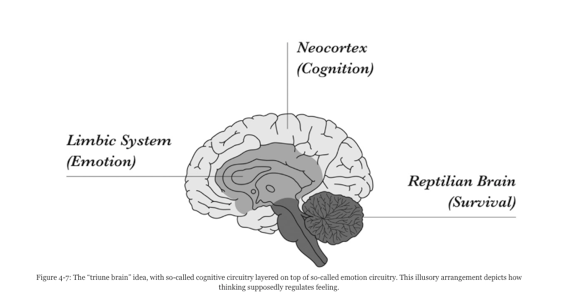
Author claims that in reality all decisions and actions based on interoception and affect, so rational thinking is just an illusion. Our environment as we perceive it does not really exists, it is what our brain build based on experience and current signals.
- Concepts, Goals, and Words
This chapter is about relation between objective reality and its presentation in human mind and communications between humans. It starts with the nice example of rainbow, which is objectively just a range of electromagnetic frequencies, which different parts got names of colors. Interestingly enough it is culturally dependent so there are 7 colors in Russian, but only 6 in English. This follows by the discussion about conceptualization, objects, and goals. Here is representation of these notions:
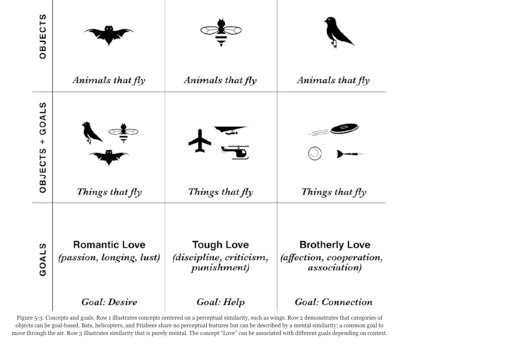
After that author applies these notions to emotions and discusses how they are developed and how they constantly impact body functions and our behavior.
- How the Brain Makes Emotions
This chapter is about how brain uses concepts to build emotions. It starts with discussion of infant’s brain developing ability to predict via trial and error process that is based on training neurons and developing neural networks that respond to combination of internal and external signals. The general idea is that formation of concepts is similar to coding and compressing visual information, while prediction is similar to unpacking and application of this information. Here is visual representation:

- Emotions as Social Reality
This starts with discussion of idea that even simple signals such as sound of falling tree or colors of a flower are really construction of the brain build on incomplete bits and pieces of information. Similarly emotional reaction is a construct that used by the brain to define what emotion needs to be activated and then produces corresponding activities in the body. Then author expands this to wider notion of social reality that only tangibly connected with objective reality. Author provides a very charming example when Andy Warhol’s painting named $200 and picturing exactly that was sold for $300,000. Finally author discusses language and words as communication tools used to exchange concepts in order to cooperate or just interact.
- A New View of Human Nature
This is about the inferences that follow from the new theory of constructed emotions: humans are much more in control of their experiences than usually thought because they are not passive recipients of external information that automatically activate emotions, but rather active interpreters of incongruent data flow, active constructors of emotion, and implementers of action that they believe would lead to achievement of more or less identified objectives. How exactly this construction occurs, depends on complex interplay of individual genetic endowment, cultural environment, and previous experiences of individual. Another point is that construction theory decisively shifts responsibility for action to acting individual because it defines brain as predictive rather than reactive tool, making it clear that action follows conscious or subconscious decision to act. This chapter also includes critic of essentialism, which obviously is not compatible with emotional construction theory, including Broca’s ideas of brain area specific emotional configuration. The final part of the chapter is about history of research and prevalence of ideas of construction in 1930 that nevertheless was pushed out by essentialism.
- Mastering Your Emotions
This is about a strong link between brain and the whole body and multitude of feedback loops between these entities. The key for success in live here is to maintain balanced body budget and develop a rich set of concepts. It follows by discussion of emotional granularity and also by a bit of practical advice how to improve ones emotional intelligence.
- Emotion and Illness
This is about connections between emotions and body conditions including illness. The main point here is that brain constantly tries to predict needs of body and direct different processes inside the body to meet these needs. This process is especially important for immune system. It works differently for each individual consequently making usual medical approach driven by symptoms outdated because the same symptoms could be produced by different causes in different people and successful treatment should concentrate of fixing causes. Even pain is not purely biomechanical process, but rather brain construct that needed to conduct actions of organism and author discusses research on how exactly it works. There is also discussion of purely psychological conditions such as depression and anxiety.
- Emotion and the Law
This is discussion on responsibility for actions when essentialist claims that action under influence of inherited emotion should not be punishable if individual acted under overwhelming emotional pressure. The emotional construction theory states that individual’s brain construct emotion and predicts results of actions in all circumstances consequently making individual responsible. Author also discusses unordinary value assigned to criminal’s remorse that is mainly unjustified. A very important point here is that emotions and their expression is not objective factors, but rather depend on culture and perception.
- Is a Growling Dog Angry?
This is discussion of emotions in animals and review of relevant experiments. The overall inference is that animals could not develop human concepts, but humans project their own notion of emotions on animal behavior. In reality animals just produce behavior to control bodily budget and necessary for survival based on 4 F: Fighting, Fleeing, Feeding, and Fucking.
- From Brain to Mind: The New Frontier
The final chapter is a bit philosophical, discussing brain – mind connection. The new brain imagining technology opened a window in its internal working and it pretty much made obsolete traditional ideas about dichotomy between animal body and spiritual mind. The experimental approach demonstrated unitary character of body-mind functionality with brain being an analog dynamically changing universe of neural networks that constantly develops concepts, construct emotions, and overall manage body’s actions necessary to survive and reproduce. There are no essences emotional or otherwise that are hardwired in the brain, rather the brain constantly construct emotions and behavior necessary to maintain body budget and produce actions necessary to survive based on predictions build on the bases of concepts and experiences many of which for humans come from social reality rather than from purely objective environment.
MY TAKE ON IT:
For me this book is a very welcome set of theoretical and experimental research generally supporting my believe that human brain is biological self-programming analog computer based on constantly forming and reforming neural networks containing billions of neurons, that constantly change their electro/chemical parameters and connections based on frequency and power of their activation/deactivation. On this terms we are dynamic creatures who constantly construct and reconstruct our memories, believes, emotions, and just about everything else, while maintaining some continuity, which is pretty far away from being absolute. The important inference from this is that we to a very large extent responsible for our condition and actions even if a lot of it happen at the unconscious level where prediction of future is constructed depending on universe of possible actions. However the choice of the specific actions from this universe is always ours.
20170702 The Great Leveler Violence

MAIN IDEA:
The main idea here is that inequality is considered unhealthy for the society and it probably is, but history demonstrates that it is typically a product of peaceful and productive development of society, while decrease in inequality is typically consequence of some kind of disaster: war, revolution, pandemic, or collapse of society. There is also attempt to look at recipe for leveling without disaster, but it is limited to somewhat trivial taxation ideas.
DETAILS:
Introduction: The Challenge of Inequality
The introduction starts with the notion that inequality is growing and it is dangerous because it creates tensions in the society and could even destroy it. However this book is interested not that much in equality, but rather in conditions when it decreased often dramatically. Author finds four typical occurrences when it happens: War; Revolution, Society Collapse, and Plague. Author looks at all of them in details, reviews alternatives, and finally discusses future of leveling.
PART I. A BRIEF HISTORY OF INEQUALITY
- The Rise of Inequality
As usual this starts with discussion of hunter-gatherers and their equality based mainly on very low productivity so there were not enough goods and services susceptible for accumulation. Even thou some burials demonstrate high level of variance in prestige in form of artificial decoration such as bids that required huge amount of labor to produce, the real inequality came with agriculture when increase in productivity and, most important, ability accumulate wealth or obtain it from others provided opportunity for its growth. With ability accumulate and transfer wealth came necessity for a state, which would protect one’s own wealth and, if military successful, would allow obtain wealth from others. Here is a nice picture of the structure of typical agrarian society:

2 Empires of Inequality
After discussing generic characteristics of agrarian states, author briefly reviews 2 most successful empires: Chinese and Roman both of which provide ample data for inequality. Here is an estimate of Wealth at the top and population growth for Romans:
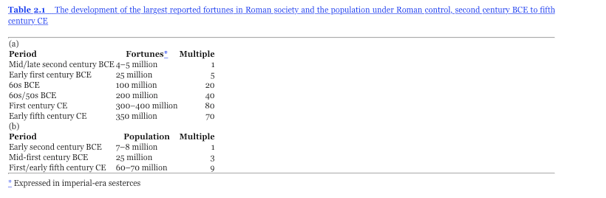
At the end of chapter author discusses patterns of empire wealth circulation that typically occurred via violent redistribution among elite.
- Up and Down
This is somewhat high-level discussion of changes in inequality supplied with a bunch of interesting graphs:
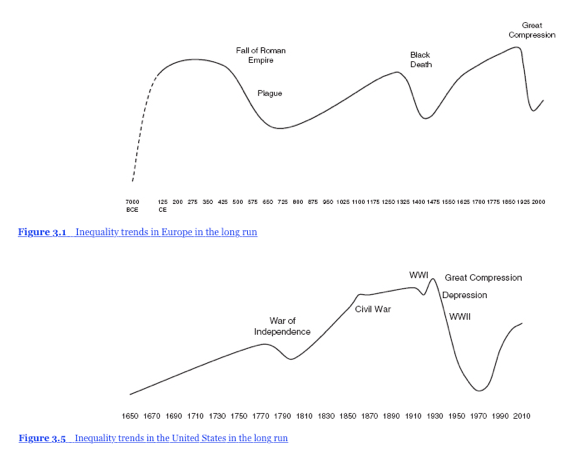
PART II. WAR
- Total War
This chapter is an analysis of equalizing impact of the total war using Japan as an example. Probably no other country reached such level of war effort by the totality of its population without being actual battlefield. The leveling results were truly dramatic:
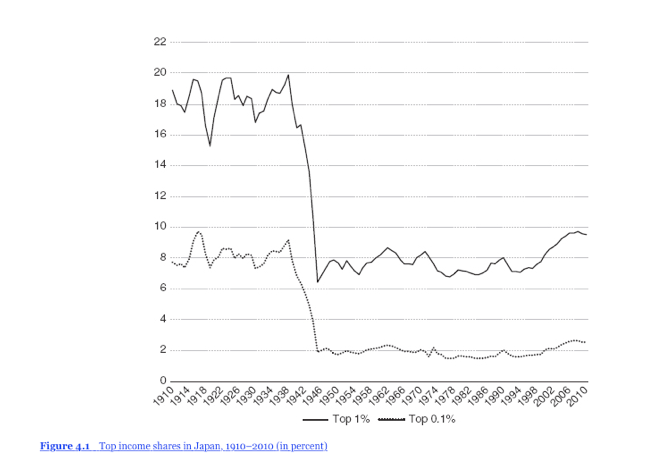
- The Great Compression
This chapter expands previous analysis to the whole world, clearly demonstrating that war destruction leads to more equality, even if it is equality in misery. This is achieved by dramatic decrease in private wealth, especially comparatively with resources controlled by the government:
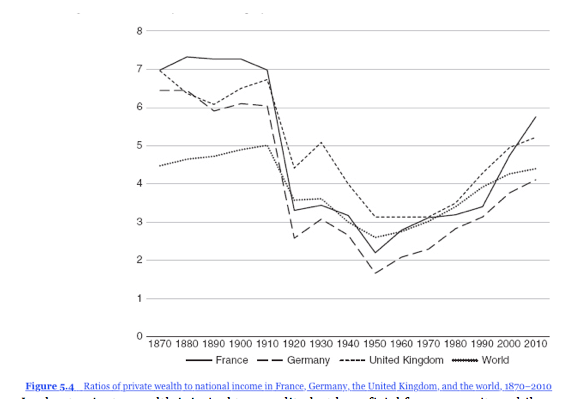
In short private wealth inimical to equality but beneficial for prosperity, while war is opposite: inimical to prosperity and beneficial for equality.
- Preindustrial Warfare and Civil War
This chapter looks at history of preindustrial mass mobilization wars. From ancient times until recent occurrences and find some evidence that they had significant equalizing impact. Mainly it was result of need to obtain participation of low wealth masses as soldiers and supporters of military effort, which was paid by upper wealth class correspondingly decreasing their wealth. Overall the dispersion of equalizing was wide and dependent of character of the war. Similarly historically civil wars not necessarily decrease inequality often just moving wealth from one group to another, but it was highly dependent on character of war with high intensity was obviously decreasing overall wealth of the society.
PART III. REVOLUTION
- Communism
This chapter is about recent Russian and Chinese communist revolutions in which equalizing became one of the most important objectives. Since these revolutions included mass killing of higher wealth population, their achievement in formal equalization were unparalleled. However if one takes into account real control over society’s resources, this equalization become more than dubious.
- Before Lenin
This is similar look at French revolution, Taiping rebellion, and many other rural revolts, city revolts, and city-state revolts. Whatever leveling occurred during such events it usually was not very long lasting reverting back to inequality as soon as revolutionary period ended and more or less normal economic development would restart.
PART IV. C0LLAPSE
- State Failure and Systems Collapse
This is discussion of pretty obvious fact that when society collapses it’s hierarchical structure going down consequently removing all forms of enforcement of existing controls over resources, which leads to dramatic leveling. The cases author uses for collapse discussion are Chinese history of the end of Tang dynasty, Western Roman Empire, late Bronze Age Mediterranean and pre-Columbian America. It is nicely supported by archeological research represented by historical house size diagram in Britain:

The final part looks at contemporary society collapse: Somalia, which is wide open for research now, providing researchers are well protected against multitude of local gangs (authorities).
PART V. PLAGUE
10 The Black Death
Another powerful leveling process is epidemics, which kills lots of rich as well as poor. Author analyses leveling caused by the Plague in Medieval Europe. Interesting here is the fact that leveling occurred not only due to death, but also due to post epidemic dramatic growth of wages because of scarcity of labor. Here is a nice graph to support it:
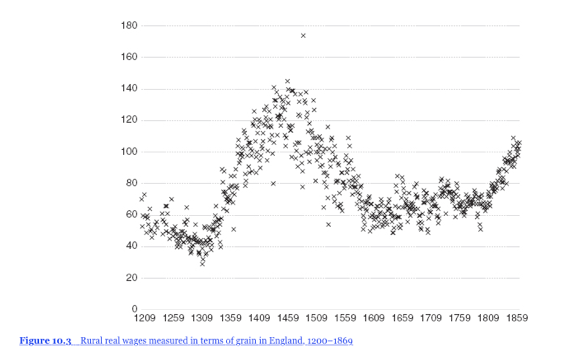
- Pandemics, Famine, and War
This is an expansion of previous discussion to cases when all 3 combined practically destroy society, bringing society to the lowest levels of inequality since the start of agriculture. It is done based on American history when European invasion brought both pandemic and destructive war. Author also looks at Justinian plague 541-750 CE and the Antonine plague in Egypt circa 165 CE. More detailed analysis based on well collected and preserved local data for the city of Augsburg during 30 years war presented by the graph below:
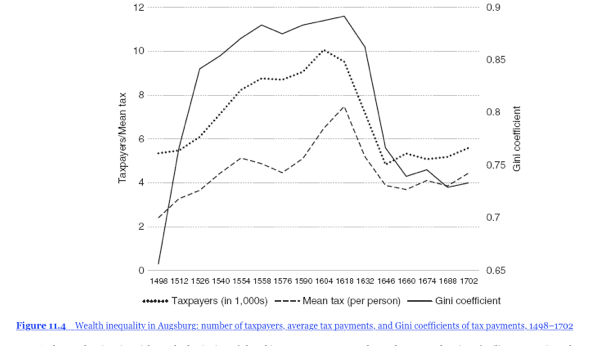
Even more interesting is result for this city by numbers demonstrating that population loss was about 50%, but it fall disproportionally on poor. In other worlds it was not that much leveling, but shift when higher levels of income shifted down to lower levels, while population in two lowest income bracket was dramatically decreed by shifting out of live:

PART VI. ALTERNATIVES
- Reforms, Recession, and Representation
This is the look at possibility of leveling without massive bloodletting typical for war, revolutions, pandemic, or collapse. One such method is Land reform, another Debt relieve and Emancipation of slaves or serves. Even more peaceful leveling occurs during economic crises when loss of wealth obviously hit people in possession of this wealth. Finally democratic political system typically allows leveling via taxation and welfare state.
- Economic Development and Education
Here author discusses more positive way to decrease inequality: education and skills enhancement. This is unusually positive way because instead of leveling via decrease of overall wealth, it promotes wealth increase via increase in productivity of educated people.
14 What If? From History to Counterfactuals
This is a speculative discussion about what would happen if history were different than it actually had been.
PART VII. INEQUALITY REDUX AND THE FUTURE OF LEVELING
- In Our Time
Here author discusses our time, relatively peaceful and prosperous, but with growing levels of inequality that gives jitters to many of intellectual. He provides a table and graph showing this growth with the most prosperous and wealthy country USA being also the most unequal:
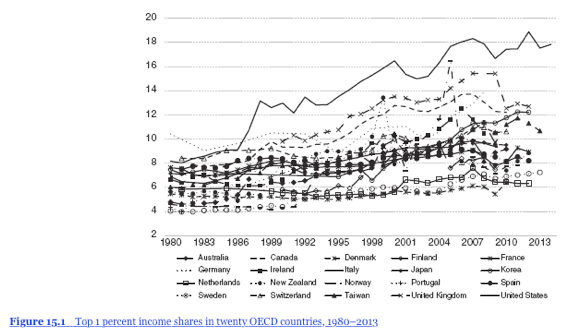
This is followed by discussion about market, power and related issues that lead to inequality growth: executive compensation, globalization, automation, and such.
- What Does the Future Hold?
Author obviously not sure about future, but he stresses growth of pressure caused by inequality and low probability of catastrophic events that would lead again to such leveling that occurred before. Author discusses a few recipes for equalization, which mainly come down to higher level of taxation and redistribution.
MY TAKE ON IT:
I do not think that inequality is the problem per se. The real problem and thread to society is perception of inequality as result of violation of rules of fair game. I doubt that any employee of a corporation would be upset by multimillion dollars payoff to CEO when corporation is doing great, employee’s job secure, salary is growing, and pension fund promises nice retirement. It is become an explosive problem when the same payoff coincides with company downsizing, employee loosing job, and pension fund going down the drain. It is obviously correct that all kinds of disasters cause leveling, but to look for disaster to heal inequality is like trying to rid of headache by putting bullet in the head – headache would go away, but so would live. In short I do not believe that taxation and welfare are good remedies either because government redistribute resources any inequality is magnified in minds of people, so inequality of getting 5 pounds of bread when everybody gets only one pound is much higher that inequality of CEO making a million when everybody else makes on average 50K. That’s how disasters of revolution start. The only known way to avoid it is implement relative equality of opportunity or at least promote believes that it exists.
20170625 – The Great Equalizer
MAIN IDEA:
The main idea of this book is not that much to describe problems with current economic order of USA, as to analyze its causes that author identifies as suppression of small business by coalition of government and big corporate business and, most important, propose a very specific program of ideas how to bring America back to its original “bottom up” approach to economic order with small businesses again becoming the engine of growth and prosperity.
DETAILS:
Introduction
Here author starts with reminiscence of his childhood in Baltimore and his outgrowing inherited loyalty to Democratic Party due to its rejection of working and lower middle class and embrace of bureaucracy, welfare dependency, and international corporatism. It follows by brief review of economic history of USA over the last 40 years with stress on failures of the first years in XXI century. At the end of introduction author states his believe that we are at the infliction point and only Main Street could save us from mediocrity and continuously degrading economic future.
1 Growth Is (Almost) Everything
Here author refer to his earlier work “The world is curved” that was stressing dangers of globalization and disputed position of “Flat world” promoted by Washington’s Elite “thinkers”. He discusses financial crisis and massive state intervention that first created it and then somewhat eased economy out of it in process practically killing economic growth. This follows by panegyric to the growth that could fix practically any problem and call to return to Main Street innovative capitalism – the only economic system that could provide such growth. The next part of chapter reviews political affiliations and lack of bipartisanship. Author refers to the last significant period of economic growth during Reagan and Clinton presidencies and how in these two cases despite bitter political struggles both party found the way to be enough bipartisan in economic policies, making growth possible.
2 The Illusion of Certainty
This is about complexity and unpredictability of economy. It provides a bunch of funny examples of complete inability of experts to predict future economic development. It follows by discussion of Wall Street well rewarded failures and overall financial part of economy. The final part is somewhat of a lament of big platform corporations like Amazon creating a new form of monopoly based on lawfare use to suppress in the bud all potential competitor startups and, in cases when it fails, to buy them out. The end result is ossification of economy and lack of growth.
3 The Economy’s Turbocharger
This starts with an interesting anecdote about author being low-level staffer at Capitol who was promised a photo opportunity with Reagan as reward for overtime work. It took a few months, but he did get his picture. The point is that opportunities come and go so one had to catch them. These fast flying opportunities especially important in high tech area as it represented by Silicon Valley. Author stresses new jobs potential for Main Street created by innovation industry. There is a duality in this development: on the one hand new technology eliminates old jobs, but on the other hand it frees people and capital from old activities and allows investing them in the new ones. He refers to “mass flourishing” ideas of Edmund Phelps. Author believes that this dynamic process is the most promising option to maintain prosperity, but he clearly sees decline in the levels of innovation in USA and discusses reasons for this decline. These are:
- System rigged in favor of big against small
- Huge levels of public and private debt
- Political system frozen by partisanship preventing required reforms
- Globalization made world a frightening place with no one in charge.
4 Top-Down Frustrations in a Bottom-Up World
This chapter is about comparison of small economic entities vs. big where author provides multiple examples of inefficiencies and ineffectiveness of the big highly centralized economy and discusses contemporary political and economic conditions when government creates massive advantages for the big corporate entities. It hurts economic development because it practically removes the only way to find out what needs to be done to achieve economic success: unabridged competition between economic entities with failure being not only an option, but frequent occurrence.
5 The World’s Greatest Wager
This is about debt and bad consequences of it. One of the most important bad consequences is “learned helplessness”, which if applied to accumulation of debt means inability of society to balance spending and revenues. As it is usual for people disturbed by high debt author brings in children who will be overburdened by inherited debt. Author discusses 3 solutions for the debt problem: Inflation, Default, and Innovation / growth of economy. He believes that the only acceptable solution is growth and only reinvigorating Main Street economy could do it. Finally author discusses demographics and need for entitlements reform to get out of debt.
6 It’s Nobody’s Century (or Maybe Everybody’s)
In this chapter instead of concentrating on American political gridlock and ways out of it, author looks at alternative political-economic system that many Western leftists admire now – China’s. This starts with the description of author’s encounter with Chinese diplomat who was dismayed when question come to China’s financial system, debt, and cooling off of investor’s enthusiasm. It looked like these issues where perceived as a serious threat to Chinese advancement. From this discussion followed the question of which country or countries are really could be global controllers in the future with author concluding that usual consensus of the future China dominance or, at best, two-polar world of USA / China competition of equals, is incorrect and China will fade away similarly to previous candidates to end American century: USSR, Germany, and Japan. He seems to believe that China’s multitude of problems would lead to such development.
7 Americans Are Fighters
This is an interesting combination of litany of American decline and expression of believe in America and hope that it will be fine based, at least partially, on author’s experience in 1970s and then in 1980s when he participated in implementing Reagan’s tax cuts and dramatic economic recovery that followed. His current proposal is guarantied investment at child’s birth from government and matching by private funds. Overall author seems to believe that mass participation in investment would go long way to eliminate problems of inequality caused by increase of return on capital and decrease of return on labor (reference to Piketty).
8 A Nation of Dreamers and Discoverers
The final chapter refers to the past cases of recovery and presents 14 points program that author believe would initiate the new recovery for our time:
- Bipartisan Congress actually capable to legislate
- Allow companies repatriate money without taxing
- Global Debt summit to avert crisis
- Reform taxes to make financial services less profitable and job producing enterprises more profitable
- Invest in Youth
- Recreate global financial Architecture
- Encourage new Enterprises
- The 3.5 Solution: manage US government non-financial assets to achieve 3.5% return
- Raise minimum wage
- Increase worker mobility
- Welcome foreign geniuses
- Temporary suspend new regulations
- Fund Adult Technical Education
- Reform the patent system and modernize Civil Service
MY TAKE ON IT:
This book contains a good dose of critic of contemporary America, but it is most interesting parts are author’s specific proposals to improve situation. Unfortunately these proposals range from very unrealistic like bipartisan congress to mainly meaningless like “fund technical education”. I think that a lot of negative staff discussed in this book comes from natural development of welfare state as it was established in USA in 1930s and then greatly expanded in 1960s. The system of welfare state was a very reasonable response to industrialization that increased productivity to such level that significant number of population could not offer on the free market goods and services including labor that would provide returns proportional to expectations, leaving multitude of individuals without proper place in economic order of society. Welfare state kind of solved this problem by providing less energetic, uneducated, and passive individuals with welfare check, so they could survive, and creating multitude of well compensating bureaucratic positions for more energetic, educated, and active individuals who could not find good returns on free market. The big issue now is that we moving into the final stage of productivity growth when human labor would not be required anymore and, in order to survive, society will need complete restructuring of resource allocation and economic relationship between its individual members. The solution should be on the scale of the problem, which is comparable to switch from hunting/gathering to agriculture / militarism to industrial production / financial resource allocation. The author’s suggestions are by orders of magnitude below this level of requirements.
20170618 Great Transformations
MAIN IDEA:
The main idea of this book is that massive transformations of institutions of society on the scale exemplified by embedding liberalism in 1930s and then disembedding it in 1980s does not occur purely on materialist basis or class realignments, but rather they are driven by ideas. These ideas usually take time to develop, then to be incorporated into thinking of significant amount of population, and only after that these ideas start moving political forces and become converted from abstraction to specific actions delegitimizing old and establishing new institutions.
DETAILS:
PART I THEORY
1 Karl Polanyi and Institutional Change
This starts with reference to Polanyi’s ideas about end of self-regulating markets in early XX century and double movement: free market losers would use state protection and in process produce institutional change in the society. This pretty much covers all statist movements from Keynesianism to Nazism and Communism. This follows by discussion of the nature of institutional change overall and role of ideas in its implementation. Author provides plan of the book: it is build on the analysis of 3 main actors: state, labor, and capital. This analysis conducted first on theoretical level and then tracing actual development by using two examples: Sweden and USA.
2 A Theory of Institutional Change
This starts with brief review of literature about ideas and their influence. Author describes two schools of thought about it: Historical Institutionalism and Rationalist Institutionalism. After that he presents his theory of relationship between ideas, interests, and uncertainty deriving from it 5 hypotheses:
- In time of economic crises ideas (not institutions) reduce uncertainty.
- Following uncertainty reduction, ideas make collective action and coalition building possible.
- In the struggle over existing institutions, ideas are weapons.
- After delegitimation of existing institutions, new ideas act as institutional blueprints
- The ideas that follow institutional construction make institutional stability possible.
PART II CASES
This part is pretty much review of 5 historical cases when ideas practically modified or substituted existing institutions with the new ones.
3 Building American Embedded Liberalism
The first case is advance of American liberalism in 1930 and its elimination or severe limitation of previously dominant free market capitalism. Author looks at Hoover vs. Roosevelt policy noticing that they where nearly identical with the main difference of Hoover’s being limited by existing institutions, while Roosevelt’s breaking away from these institution. Author demonstrates how it was done: breaking down institution of free pricing and substitution it with government controlled pricing, massive government interference into business / labor relationship, and massively increasing government spending. This followed by construction of new institutions: Social security, pro-union Wagner Act, Financial regulations, and much more. The final part of the chapter is about period after war when some of the new institutions were curtailed due to their negative impact on economy and society, but overall new institutions survived and stabilized into the new environment of Embedded Liberalism.
4 Building Swedish Embedded Liberalism
Here author conducts similar analysis of Swedish development when driving force was Social democracy significantly to the left of American New Deal administration, but somewhat paradoxically more business friendly than it. The result was Swedish form of Embedded liberalism with quite a bit more control of government over people, but with massive support of middle class due to social spending.
5 Disembedding Liberalism: Ideas to Break a Bargain
This case looks at the first at the beginning of breakdown of Embedded liberalism in USA first with the Johnson administration attempt to have both guns and butter, and then as result of increasing stagnation and inflation caused by overregulation and direct government interference into economy. Author reviews ideas that impacted and undermined embedded liberalism, preparing it’s disembedding: Monetarism, Rational Expectations, Supply-Side, and Public Choice Theories. The stagflation of 1970s clearly demonstrated deficiencies of existing institution and opened way for advancement of these new theories into popular conscious.
6 Disembedding Liberalism in the United States
Here author going into the search of causes of Liberalism’s Disembedding mainly in movement of business into political sphere in its attempt to remove or at least minimize government intervention that made it incapable effectively compete with business of countries just recently recovered after WWII. It follows by detailed description of how business intervened into politics and successful delegitimized big government and its political representation (Democratic party). The chapter ends by discussion of Clinton’s administration movement away from big government idea under pressure of changed ideological environment in the country and republican legislature.
7 Disembedding Liberalism in Sweden
This chapter describes similar events in Sweden where big government led to economic hardship and disembedding of liberalism, albeit to the much smaller degree than it happened in America.
PART III CONCLUSIONS
8 Conclusions
In conclusion author revisits his 5 hypotheses, compares his ideological explanation of transformations with materialistic and institutional explanations, and looks at the possibility of future transformation.
MY TAKE ON IT:
I am generally supporter of idea that the words and ideas comes the first and transformation of society is logical result of implementation of ideas. However I think that before any idea becomes viable as source of future transformation, the old institutions should prove to the public that they do not work any more and that whatever calamity comes, they would not be able provide tools to overcome it. Somewhat contrary to the author I do not think that it happens because some individuals just come up with some ideas undermining existing societal setup in our case Monetarism or Rational Expectation or anything else. I think that the first comes increasing frustration with old institutions that results in their inability to live up to the promise of the future beneficial results. Whether it is inability to provide enough food instead of promised abundance in communist countries, or high misery index of combined inflation and unemployment instead of uninterrupted progress closely controlled by wise bureaucrats in USA as promised by New Deal, in all cases the failure to fulfill expectations creates general mood of frustration and inapplicability to the new environment. Only when the first step mainly completed and support for the old institutions mainly based on little more then inertia, the new set of ideas could become popular and even dominant, creating opening for the second step that would complete transformation: elimination of old and creation of new institutions.
20170611 – Homo Deus A Brief History of Tomorrow

MAIN IDEA:
The main idea of this book is that technology is changing society and environment in such profound way that current philosophical notions that were built into the foundation of contemporary society become obsolete. Consequently it would have to lead to the huge restructuring not only of societal organization, but also of individual consciousness leading to some new and unimaginable arrangement of individuals, societies, environment, and connections between them all.
DETAILS:
1 The New Human Agenda
It starts with the statement that humanity achieved such level of development that it now can move from the main question of survival, to the much more interesting question: what to do with ourselves. In this chapter author looks a bit back at the biological poverty line below which humans could not survive, pathogens and other evolutionary pressures that kill humans by disease, wars and other forms of violent competition that humanity seems to be in process of finally overcoming. This follows by discussion of death and the new development when technology could possibly make it outdated. So the key issue is what is happiness and how to assure that everybody has right to happiness and actually capable to achieve it. In order to clarify his points author provides a nice analogy from the history of grass lawns, which used to demand an extraordinary amount of effort to maintain and therefore were a subject of competition between feudal lords to demonstrate their fitness. Now due to technological development a lawn become a simple part of American middle class live. At the end of this chapter author provides a general plan of the book.
PART I Homo Sapiens Conquers the World
2 The Anthropocene
This is obviously about era of humanity that started about 70000 years ago. There is a nice pie chart to demonstrate it purely by super simple measure of weight:

Author looks at ancient animalistic believes and then jumps to human use of other animals, which, while satisfying their minimalistic needs for survival, actually deprives them of natural habitat. Example provided: pigs in industrial environment. Next author discusses organisms as algorithms providing for the survival and genes transfer to the next generation. The rest of chapter is comparative analysis of agricultural and industrial ages, their ideological underpinning and similarity.
3 The Human Spark
Here author starts with human morality, which claims to be universal, but in practice is quite hierarchical on many levels with humans higher than pigs, but Americans higher than Afghanis. Author also discusses here Darwin and Evolution, which left humanity without soul. This logically leads to discussion of mind/ brain, live / non-live, and self-conscious / lack of it. Author looks at these philosophical issues using a bunch of nice examples from live of chimps, talking horse, lab rats, and communist dictatorships. Probably the most important in this part is a small piece on the Web of meaning – how people create and maintain social reality that only tangibly relates to objective reality.
PART II Homo sapiens Gives Meaning to the World
4 The Storytellers
This is a brief discussion of humans as storytellers with initial look at history of storytelling and then switch to exclusively human ability to create permanent storage of information outside of human brain, specifically on paper and other devices. Moreover the stories and information on paper become so powerful that it could decide issues of live and death as illustrated by the story of Portugal consul in France who saved thousands of Jews by issuing passports (pieces of paper). Another, even pore powerful example, is Holy Scriptures that moved to actions and defined lives of billions of humans. The final point that author makes is that he believes that in future even more powerful stories will be created and they will have even more force to move people and define arrangements in the societies.
5 The Odd Couple
This is about stories told by religion and science, which both are based on complex combination of truths and myths. One important point here is that religion is a tool for preserving social order, but so is the science, at least to the extent in supports social order. Author tries to put all this in order and provides a nice summation of religion as combination of three parts:

Overall, both religion and science are trying to provide truly correct representation of reality, but they use different method and obviously come to different conclusions. Author perceives contemporary perception of the reality as combination of science and one particular religion called humanism. These two approaches constitute mutually supporting covenant still effective, but more and more coming under pressure and seems to be moving to disintegration sometime in near future.
6 The Modern Covenant
This is detailed discussion of modern integrated science/humanist worldview. Interestingly enough the author starts this discussion with bankers and credit with interest – true engine of economic expansion specific for humans and not used by any other animals. From here he goes into discussion of economic pie that is growing if conditions are right and ecological problems that he considers the most probable reason for collapse of civilization. Dutifully regurgitating typical anti-capitalist ideas of market failure with, also typical, somewhat positive reference to market, author states that the salvation from capitalist horrors came from the new religion of humanism.
7 The Humanist Revolution
This chapter retells history of humanism from its beginning to the present time. The humanism itself defined as religious believes in humanity as substitute of god(s) with humanity giving meaning to the universe. Author provide an interesting formula for 3 different approaches to understand the world:
Religion: Knowledge = Scriptures x Logic
Science: Knowledge = Empirical Data x Mathematics
Humanism: Knowledge = Experiences x Sensitivity
This discussion includes quite interesting look at the representation of War in Art and how it changed with the development of humanism from stressing role of the leader to stressing role of individual member of masses. Author also looks at different branches of humanism: Nationalism, Evolutionary humanism, Socialism, and Democracy. All these branches in one combination or another were at war with each other for the most part of XX century, but now, at the beginning of XXI century the winner is combination of human rights, democracy, and free market. Author discusses current resurgence of Islam and religious war initiated by its adherents, but he does not consider it as a serious challenge. Much more challenging is combination of technological developments such as Automation, Artificial Intelligence, genetic Engineering, and others that taken together could lead not only to dramatic changes in the society, but to complete redesign of humans into something new and, probably not even comprehensible to us, superior entities.
PART Ill Homo sapiens Loses Control
8 The Time Bomb in the Laboratory
This starts with discussion of the philosophical problem of free will and all kinds of manipulation and conditioning of people by training and other forms of external influence. Then comes currently quite popular discussion of non-existence of individuality as something integral to the person. Finally author goes into a brief discussion of the meaning of the live ending with conclusion that current duality of popular scientific philosophers, who accept contradictory notions of self-direction and absence of self at the same time, being not sustainable.
9 The Great Decoupling
This is about human losing their value and that’s how author presents this idea:

The confirmation comes from discussion of robots substituting humans as producers, AI substituting humans in all kinds of intellectual efforts from Jeopardy to Chess and so on. Here is author’s summation of the logic of these examples:

Therefore the direction of humanity seems to be growing division into 2 classes: useless masses and small superhuman maybe even immortal elite.
10 The Ocean of Consciousness
This is about nature of consciousness and probability of emergence of new techno – humanistic religion pursuing merge of all consciousness into one entity inclusive of all possible mental states as presented in diagram:

11 The Data Religion
This is a description of one such techno-humanistic religion: Dataism. This is worshipping of Data with notion that the universe is just as collection of data flows. At the end author identifies 3 processes that overshadow all other problems and developments:
MY TAKE ON IT:
I also believe that the world is going to change quite dramatically due to completely new environment created by AI and many other technologies that will make humans redundant for all kind of economic activities. However I would make a very important point that there is only one entity that will always define objective of all these activities and it is a human being. All kinds of activities occur only because humans need product of these activities whether this product is food or poem and this directional role is going to remain human domain. It is quite conceivable that in a few years we can create computer program that will perceive itself as person and will act correspondingly. It does not matter; it will still be human even if it would not be based on DNA and organic material. It could have no other existence than a bunch of electronic impulses, but it will have memories, experiences, self-recognition, and all other quality that makes us human. However I doubt that it would go beyond experimental because there is no point of replicating humanity in other forms. As to body and mind modifications in order to become superhuman, it also does not make a lot of sense because with all external capabilities of technology who needs super muscles if one can use car or plain or heavy moving equipment? Similarly who needs super brain if Internet is always available and computer could calculate or analyze whatever needs to be calculated or analyzed. In short I think we humans will remain the way we are, may be just changing body at will and ridding off illnesses, death, and other unpleasantness of life. On other hand, who can prove that we now are not just impulses in some kind of computer, modeling human personalities for some second grade kid doing his homework?
20170604 – Forged through Fire

MAIN IDEA:
The main idea here is that contemporary democracies are a product of wars that required mass mobilization of people and resources. The democracy is necessary because such mobilization is not possible without active support of population, which in turn requires political inclusiveness. From this point of view future and viability of democracy is not clear because new technology made mass armies obsolete, while typical democratic way of doing things is inefficient and is also often ineffective in political decision-making. It reasonably could be considered an impediment to increase in prosperity, so societies can conceivably decide to rid of it. On other hand democracy could be in and of itself a valuable luxury good that the vast majority of population will prefer to retain.
DETAILS:
Introduction
The introduction is about the main theme if this book: war, society mobilization it requires, and how different forms of society could provide for this mobilization. It is built around two graphs representing types of societies under review and military effectiveness of these types:
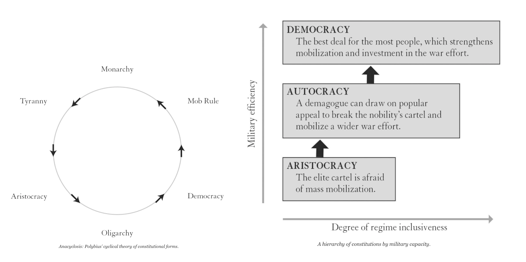
Chapter I The Twenty-First-Century Wars Without Citizen Armies
This is about contemporary military circumstances of democracies. The main characteristic is overwhelming superiority of conventional military power of democracies over any potential enemies removing need for mass mobilization and consequently leading to limitation of wars to small wars of choice like Iraq or Afghanistan with very limited and mainly political impact on society. Such wars have practically no consequences for majority of population great many people in which do not even know or care that country is actually at war.
PART I: FROM ANTIQUITY TO MEDIEVAL TIMES
Chapter 2 War and Democracy in Classical Athens
This is an interesting approach to ancient Greek democracies. It looks at military necessity of mobilizing high proportion of population to fight competing polities. Author is trying to identify circumstances when need for high level of mobilization lead to high demand for participation in decision making and consequently some form of democracy and when it leads to increase in central control and repression. Specifically author looks at Athenian democracy, its successes and accesses. Interestingly enough it looks at different level of democratization need for Army and Navy using Salamis and Marathon as test cases. The navy dependent heavily on poor who would participate by rowing triremes that did not require any investment on their part, while more affluent middle class citizens could buy equipment necessary for hoplite soldier of army. The democratic form of polity in Athens seems to be more effective military organization than competing oligarchies and monarchies.
Chapter 3 The Glory That Was Rome
The story of Rome had at first highly admirable period of republic with multiple checks and balances preventing ambitious aristocrats from taking full power. This was characterized by huge military success. However this success led to development of professional military class that eventually turned it into empire. The period of empire was based on alliance: Emperor and low-level masses often politically countered Aristocracy, while productive abilities of society heavily depended on slaves regularly produced by military class affiliated with Emperor. The success of farmer-soldier of Roman republic was substituted with top down control combined with bottom up loyalty, which eventually led to dissolution of empire into multitude of feudal polities constantly forming and dissolving new alliances and fighting each other.
Chapter 4 A Millennium of Landed Aristocracy
This is pretty much review of power plays in feudal societies, mainly in Europe, but also in China and Japan. Generally it came down to constant fight between different levels of landed aristocracies: barons and kings. One of the points here is that this political organization made peasants into permanent latent thread to existing order, depriving feudal polities of advantages of potential military mobilization against external enemies. Author also provides a very brief look at China and Japan of this period.
PART II: MONARCHY AND OTHER EXPERIMENTS
Chapter 5 The Emergence of Monarchy in France and Spain
This is about development of monarchy as more military effective form of polity organization. The competition between landed aristocrats was minimized by the use of overwhelming power of monarch who was able to raise and maintain more powerful force than any one or any group of aristocrats with strong ideological multiplier of masses believing in sacred nature of monarchy.
Chapter 6 War and Representation in England, the Netherlands, and Sweden
This chapter returns to the English history and shows how feudal fight of aristocrats led to Magna Carta: one of examples of attempt for some legal settlement to diminish cost of these fights. It shows how somewhat different historic development when nobody had upper hand brought much more participatory polity there than in France and Spain where kings were successful in acquiring overwhelming power. Even more participatory polities were developed in Netherlands and Sweden where small size of population and lack of English protection of being an island demanded much higher level of mobilization and therefore political participation.
Chapter 7 Italian Republics
This is another case of development of participatory polities where small Italian polities constantly competed between themselves economically and military. It is interesting that logistically challenging Venice with its lagoons providing some measure of protection to aristocrats from unifying despotic power, which was on display in other parts of Italy like Milan or Florence.
Chapter 8 Eastern Lands in Early Modern Europe
This is review of development in Eastern Europe were Holy Roman Empire devolved into multitude of small Duchies and Kingdoms based on culturally and linguistically diverse population. Somewhat different was development in Germany where Hanseatic League combined multiple free cities and provided military protection. However it was eventually dissolved by increasing power of autocracies forming all over the Europe.
Chapter 9 Mountain Republics
Another distinctive case is represented by Swiss confederation, which mountainous topography presented huge challenge to anybody who would aspire for conquest. The topography for all practical purposes removed military advantage in numbers and even technology, dramatically increasing military value of individuals. In such conditions any military viable polity should be significantly more participatory, which was exactly what happened with Swiss Confederation.
PART III: WAR AND DEMOCRACY
Chapter 10 The Nineteenth-Century Pivot
This is about XIX century change in the way countries conducted their wars. Starting with mass mobilization that allowed France not only to withstand massive attack of monarchical Europe, but also practically conquer the continent, clearly demonstrated that massive people’s army is by far superior to relatively small forces of armies of serves led by non-meritocratic aristocrats. Author reviews wars of France, Prussia, and Russia demonstrating that each time it led to increase in expansion of the franchise in society, even if it was in Russian case just cancellation of serfdom.
Chapter 11 Twentieth-Century Wars of Full Mobilization
This is continuation of review of the link between mass mobilization and democratization of society moving into XX century with its wars. It looks at countries participating in WWI, WWII, and Korean War demonstrating their impact on societies.
Chapter 12 War, Racism, and Civil Rights in the United States.
The final chapter looks specifically at USA and how its mass mobilization for WWII caused increase in self-respect of black population combined with increase of their respect by general population, which started include blacks into the group of us-Americans leading to initiation and eventually mass support for civil rights movement.
Conclusion
The conclusion not only summarizes ideas of this book, but also provides a number of useful graphical representations:


MY TAKE ON IT:
I pretty much agree with general idea of this book that democracy is product of evolution of military competition between societies and was developed when such competition required mass mobilization of population impossible without providing higher level of stakes in the society for practically everybody. However historically the highest known level of society mobilization was achieved not by democracies, but by totalitarian regimes of National Socialists in Germany and Communists in Soviet Union during WWII. Author does not discusses this period of history, consequently missing the point of ideological mobilization when masses in society while deprived of any meaningful political rights, perceive themselves as part of collective entity survival and prosperity of which is inseparable from their own survival and prosperity.
I think I am more optimistic about future of democracy, mainly because I believe that the stakes of individuals in society will continue to grow. The reason is that with huge development of technology the existential dangers to society could come not only from external competition from hostile society, but also internally from individuals within society who for some reason do not accept its rules and arrangements. Consequently every individual member of society will have serious concern and need not only participate in formulating and enforcing these rules and arrangements, but also assure that everybody else has opportunity to do it. I think it would lead to increase in demands for democracy going way beyond the representative democracy of XX century to the kind of society that is based much more on market with its inherent win-win type of game, than society on political win-loose type of game.
20170527 – Why They Do It

MAIN IDEA:
The main idea here is to investigate cases of high profile white color crime by using availability and even eagerness of people like Bernie Madoff to provide information and interact with author. The result of investigation is a nice presentation of causes of actions that are seemingly irrational such as selling business information for insignificant amount and loosing as result multimillion careers. The book also reviews history of creation of white color crime and how the very notion of insider trading, business report falsification, and misleading statements changed over the last century, becoming significant factor in business behavior.
DETAILS:
Prologue Managing in the Gray
The prologue is about author establishing contact with a few famous white collar criminals and surprising interest they expressed in maintaining such contact and opening up about their life and causes of their actions that would normally be incomprehensible for outsiders. Probably the most intriguing part here would be an attempt to answer question why individuals in possession of multimillion income and wealth risk everything and get caught committing illegal actions that would bring them very small amount of money comparatively with their wealth, if any money at all.
PART I: THE STRUGGLE TO CRIMINALIZE
- “Not… bucket-shop operators, dead-beats, and fly-by-night swindlers” Pillars of the Community
It starts with the story of KPMG senior manager who was convicted for insider trading: providing tips to his friend in exchange for purely symbolic amounts of money in return. Then author retells story of the first crusader against white color crime Edwin Sutherland who started this crusade in 1939 when accounting tricks, insider trading, and such just were not considered a crime. Moreover company typically preferred to cover up even accounting fraud, considering publicity more damaging than fraud itself. Eventually this crusade led to success when in 1960s white color crime began to be treated as crime.
2 “Guys… don’t drop out of windows for no reason” Creating the White-Collar Criminal
This is about change in attitude to white color criminals in USA where by late 1980s it become cause of massive investigations and publicity, especially use of RICO against financial crimes pioneered by Giuliani in New York. This change in attitude also started expanding throughout the world, significantly changing business practice.
PART II: NATURE OR NURTURE? REASONING OR INTUITION?
3 “Inherently inferior organisms” Bad People Making Bad Decisions
This chapter looks at criminality and historical development of its understanding starting with Lombroso and going all the way to contemporary research of brain actions and free will. The summary is: people are complex creatures and could not be divided into good and bad by their biological endowment.
4 “I thought it was all going to pass” A Press Release with Consequences
This chapter used to demonstrate that white color crimes are often defined by purely legalistic environment when individuals not doing anything that would even remotely could be called bad by normal morality get nevertheless into serious legal trouble. This demonstration is done by using example of pharmaceutical company executive who made very cautious announcement about results of drug testing, which lawyers successfully turned into crime.
5 “If you don’t take it then you will regret it forever” The Triumph of Reason
This refers to XIX century thinker Gabriel Tarde who promoted idea that criminality is not biological, but rather social phenomenon and that people learn it from each other. Here is a nice diagram for morality by profession and development:
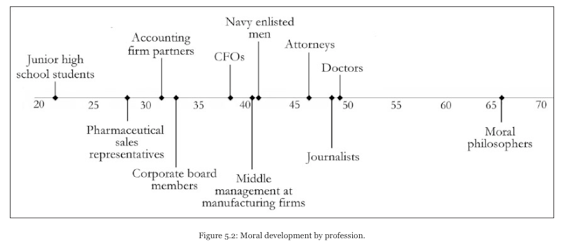
The interesting thing here is that moral philosophers are highly moral theoretically, but in real live circumstances their behavior not that different from others. Eventually human behavior seems to be defined by cost benefits analysis, but there is a catch. Either costs or benefits are not necessarily monetary or even quantifiable, reside in the head of human who is making the decision, and not observable externally, consequently making behavior unpredictable.
6 “I never once thought of the costs versus rewards” Intuitive Decisions
This is about relations between complex machinery of human brain and decision-making, which often happens at subconscious level with conscious reasoning used just to justify it.
7 “I never felt that I was doing anything wrong” Overlooking Harm
This is about famous psychological experiments with choice of who would get hurt: 5 people vs. one with train accident, fat person on the rail and such. The important point here is that harmful decision-making is a lot easier in abstract rather than in reality, with manual effort to implement it making it even more difficult.
8 “If there was something wrong with this transaction, wouldn’t people have told me?” The Difficulty of Being Good
This is about sometimes occurring conflict between norms and laws. In such cases business executive can easily get in conflict with law by acting in usual way according to accepted norms without even thinking about it. Author uses a few cases including McKinsey’s Kumar, Tico’s Kozlovski, and DVI’s Garfinkel to illustrate it.
PART III: THE BUSINESS OF MALFEASANCE
This part starts with reference to LIBOR fixing as an example of business as usual leading to criminal activity. In this case culprit feel no guilt and do not even try to hide activities they consider just normal business activities.
9 “You can’t make the argument that the public was harmed by anything I did” Misleading Disclosure
This provides examples of misleading disclosure such as MBS’ Litvak misleading investor about price of shares, Obama’s about “keep your doctor and insurance”, and Roosevelt while driving country into WWII. The last two had kind of justification for their actions being for the bigger good, obviously in their own opinion. This staff works for politicians, however it did not work in case of Bilzerian, who conducted acquisition of company without fully disclosing his ownership level. For him similar justification and being absolutely convinced that it would not hurt anyone, did not work so he went to prison.
10 “Unfortunately, the world is not black and white” Financial Reporting Fraud
This is about the gray area of financial reporting in which good accountant can easily shift data about company performance one way or another. Author provides a charming diagram showing how small losses are shifted within statements so company image with investors would not suffer:

11 “You go from just being on top of the world” Insider Trading
This is about insider trading which is only recently become a crime. Author provides example of how it practically become a minefield for business when businessmen could be blown up without really being guilty in anything.
12 “I thought we were freakin’ geniuses” Deceptive Financial Structures
This is more sophisticated case of intentional building of super complex financial structure in Enron. This structure allowed such distortion of financial statements that it became impossible to identify real financial position of the company, feeding illusion of it being profitable, when in reality it was drawing in debt.
13 “You couldn’t stop because you would wreck everything” The Ponzi scheme
This is about evergreen Ponzi schema with two examples illustrating it. One example of Marc Dreier who was clearly running a Ponzi all the way until he was caught trying to present himself as another person in order to obtain more money. Another one is of Sanford bank, where it was not clear if it really was Ponzi schema or it was legitimate business that was ruined by government interference.
14 “When I look back, it wasn’t as if I couldn’t have said no” Bernie Madoff
The final chapter is about the king of all Ponzi schemas – Bernard Madoff. This is a very interesting case when initially legitimate business had stumbled and its owner could not accept failure, even if it would have very limited if any impact on his wealth, so he moved business to Ponzi, initially hoping it will recover in a cycle or two, but then just continuing deeper into criminality because of inability to face reality.
Conclusion Toward Greater Humility
The conclusion is about seeking better ways to avoid pitfalls of white color crime. One of them is improvement of business ethics that in contemporary conditions should substitute old time control of community that would make any misconduct widely known, preventing future business. Another one is to seek disagreement and pay attention to dissonance. Finally author stresses importance of compliance and prevention of feeling of invincibility that often develops in people in high places.
MY TAKE ON IT:
It is an interesting account of while color crime development that actually occurred after WWII. There are two very different groups of criminals here: one is people involved in real crime when they intentionally lied to investors, created Ponzi schemas, and such and another one: people who become criminals due to complex rules violation. Author seems to be making no real differentiation between these two groups, but I think such differentiation is critical. The first group should be prevented from cheating, while the second one should not be subjected to complex rules in the first place.
Actually I do not believe that government should use its power of violence to establish rules. The rules should be established by business people who are participate in the market. This way the rules will be meaningful and minimalistic.
The government should use its power of violence to collect and distribute information to market participants. Otherwise the existence of some supreme rules maker that does not depend on business success or failure gives bureaucrats huge amount of power without any responsibility and encourages them to suppress business activities or at least chill them. The opportunities for bribes consequently become very high and I am sure they are exploited in direct proportion with the power of bureaucracy. Good example is the case of Madoff and any other Ponzi scheme. If instead of making this illegal, the government violence should be used to obtain complete record of transactions and present this record in the digestible form for everybody, which would make the problem immediately obvious. Actually the move away from transparency of statements to transactional transparency would make white color crimes all but impossible.
20170520 – Weapon Wizards

MAIN IDEA:
This book is about very unusual circumstances of Israel – the small country under continuing thread of annihilation with population culturally primed for educational and intellectual achievement. The main idea of this book is to review history of Israeli achievements in military technology and how it was done.
DETAILS:
Introduction
The introduction is mainly about Israel culture of survival among multiple hostile nations and populations that used any methods conceivable from massive conventional attacks to individual stabbings to annihilate Israel and its Jewish population. Simply put without superior weapons and tactical superiority Israel would cease to exist and its population would become victims of the new Holocaust.
- Beginning in a Bunker
This is history of the birth of Jewish military industry in the British controlled Palestine. It starts with the story of underground munitions factory, then moves to the creation of air force and ends with the review of Israeli – French cooperation in 1950s that allowed Israel to be reasonably well armed. The French help ended in 1967 when De Gaulle imposed arms embargo. Luckily for the Jews the new sponsor – USA come to help and up until presidency of Obama remained reliable supporter.
2: Creative Drones
This is story of creation of military drones and of Israel becoming by far the most effective producer and seller of this form of armament. It is a good example of success of enterprising individuals in fight against bureaucratic state. Obviously this advantage would not stay forever and everybody now has and uses drones including terrorists.
3: Adaptive Armor
This chapter is about another important weapon that Israel seems to be good at producing – tanks. Israeli constantly in contest with the latest anti-tank weapons that Soviets and now Russians supply to Hamas and Hezbollah. This contest produced multiple improvements in tanks design with very important new addition – active protection against projectiles.
4: Chutzpadik Satellites
This is about another technology that would normally be out of reach for small country – satellites. Driven by unreliability of support from even the friendliest country – USA, Israel managed to develop technology and by the end of 1980s become one of a few countries with military abilities in the near orbit space.
5: Rocket Science
This header is a bit misleading because it is not that much about rockets as about stopping them from coming. The rockets here are Hamas and Hezbollah rockets trying to hit Israelis. Eventually Israelis responded with anti missile system Iron Dome, which main achievement is automated tracking system capable identify incoming projectile, its direction, level of threat it posses, and shoot it down if and only if it is the real threat.
6: Intelligent Machines
This is about Israel incessant fighting with terrorist organizations and the strategy of choice that Israel uses – targeting killing of leaders, while minimizing damage to everybody else. A good chunk of the chapter describes how Israeli military evolved tactics to scare off voluntary human shields by using first low charge ammunition before actually bombing military facilities protected by civilians.
7: Cyber Viruses
This is about Israel proficiency in cyber warfare demonstrated by Stuxnet virus that slowed down Iranian nuclear program. Another example was bombing well-defended Syrian reactor that required highly coordinated and eventually effective actions of intelligence, cyber measures, commandos, and air force.
8: Diplomatic Arms
The final chapter is about Israel use of its proficiency in weaponry for economic and diplomatic purposes. It looks in details at one such case: attempted sale of Israeli military system to China and how it was stopped when USA expressed its opposition.
Conclusion: Armageddon and the Future of Weapons
The conclusion of this book is quite obvious: Israel will continue attempts to stay at the top of military technology because it is constantly under attack and any negligence leads to immediate punishment in form of successful operation by enemy. The latest example during recent Gaza war is unexpectedly massive and somewhat effective use of tunnels by Hamas. Authors end this book by stressing the high value of education embedded in Israel culture, which gives them hope that Israel will continue to be successful in the future.
MY TAKE ON IT:
I am not that optimistic about future of Israel if it will not change it approach in very significant way. Israel is good at technology and the next generation of warfare with massive use of autonomous and semi-autonomous system is already here in form of Iron Dome and some other systems that are under development in Israel, so at this point Israel probably not in such a bad shape. However strife to annihilate Israel and its people is continuing and if your enemy can lose infinite number of times and easily recover with help provided by the “world community”, but your loosing once means end of game, then someday this “one in a thousands” case will occur and you cease to exists. The only way out for Israel is to win the war once and for all so it’s Muslim neighbors fully accept reality of Israel existence and stop trying. The only way it could happen is if they really and truly believe that the stakes for them are the same – loosing means annihilation. I afraid that we’ll see the end of game coming in the next 20-30 years when Iran and maybe even some non-state terrorist organization acquire the nuclear weapons and try to use them.
20170513 White Trash

MAIN IDEA:
The main idea of this book is to reject notion that America is the land of equal opportunity where all men are created equal and if they fail to achieve prosperity it is their own fault. In order to achieve this author provides quite detailed history of American white poor and contemptuous cultural attitudes to them from elite and middle class. Another key point here that this is not going away and so called “white trash” will stay with us for a very long time in the future.
DETAILS:
Introduction: Fables We Forget by
Here author mainly discusses fables of “all men are created equal” and/or “America the best hope”. She stresses that poverty and underclass are always were part of America, from the very beginning of colonization and it never really went away even in the “golden” age of 1950s. She points out that America always was and still is not only “land of opportunity”, but also a damping ground for people not wanted in other places. This book is mainly about them.
Part I: To Begin the World Anew
Chapter ONE: Taking Out the Trash: Waste People in the New World
This is about original shipping of waste people to America. It starts with reference to Richard Hakluyt (1552-1616) who wrote about America as mainly wasteland that presents plentiful opportunity to ship there waste people who may or may not improve it under semi military regime and eventually could provide a pool of soldiers and sailors who are not connected to anything. This vision was tried at Jamestown, but not very successfully. Mayflower puritans did a bit better by establishing something like theologically controlled society. In all cases the new colonies were pretty class-conscious society with strict enforcement of who is who.
Chapter TWO: John Locke’s Lubberland: The Settlements of Carolina and Georgia
This chapter moves to ideological underpinning of the new America obtained by colonists from John Locke in XVII century. She discusses his participation in creation of illiberal Fundamental Constitution for Carolina colonies that indorsed slavery and rigid hierarchical society. Practically it was beginning of long war against poor settlers and squatters. Author allocates quite a bit of space to Dismal Swamp that came to symbolize America as a wasteland that requires spending lives of multitude of poor people to achieve at least some improvement. Somewhat different was development in Georgia, which practically started with James Oglethorpe’s colony established in 1732. Here slavery was initially rejected and classic agrarian society consisting of citizen – farmers – soldiers was attempted. However even here unequal classes were quickly established. About 10 years after the first governor left, the slavery was allowed and Georgia moved in the same direction as other parts of the South.
Chapter THREE: Benjamin Franklin’s American Breed: The Demographics of Mediocrity
This starts with Ben Franklin, more specifically with his approach to demographic of poor who produced children regardless of means to support them. However in country like America at the time with unlimited pool of land additional children were the same as additional wealth for the society providing they are productive. In Franklin’s view the new Americans would eventually substitute slaves and indentured servants. However it did not work this way and author goes into discussion of why no self-made man is really self-made and nobody could be productive without at least some human capital transferred via family and upbringing. Author also brings in views of Thomas Paine who, while being clearly class conscious, nevertheless believed that idleness could be eliminated by independence, which together with access to natural resources would dilute class differences between Americans.
Chapter FOUR: Thomas Jefferson’s Rubbish: A Curious Topography of Class
This is continuation of review of founding fathers approach; this time it is Thomas Jefferson. His ideas of agrarian society of farmers without class distinction however required proper topography good for agriculture so places like Dismal Swamp could not help but produce poor, lazy, and good for nothing people. He still left some space for classes with at least some aristocracy at the top, albeit not heritable, but rather meritocratic.
Chapter FIVE: Andrew Jackson’s Cracker Country: The Squatter as Common Man
The final chapter of this part is about Andrew Jackson and his fight against East coast Elite, which become quite well settled and powerful during the first 50 years after revolution. Big part of it was not only fight against the Bank, but also squatters against landlords and westerners against East based government. Since squatters had no titles to the land and moved from place to place under pressure they become the lowest class of the period associated with multiple evil characteristics. Jackson was not really their supporter, but he was expansionist and new land inevitably provided opportunities for these people. Eventually by 1840 despised squatter turned into freedom loving westerner supported by all sides of political divide.
Part II: Degeneration of the American Breed
Chapter SIX: Pedigree and Poor White Trash: Bad Blood, Half-Breeds, and Clay-Eaters
This chapter moves to the next period when the main issue was slavery, but secondary and also very important was issue of poor southern whites spoiled by negative attitude to labor. At this point the issue of biology as defining factor of behavior started to become important and blood, especially mixed blood begin define attitude to people. It was at this point when notion of “white trash” was created.
Chapter SEVEN: Cowards, Poltroons, and Mudsills: Civil War as Class Warfare
This is somewhat unusual look at the Civil war as class struggle. The classes in it were Southern aristocratic land and slaveholders with support of southern whites on one hand and Northern business elite with support of farmers and other middle class members who were threatened by emerging aristocracy.
Chapter EIGHT: Thoroughbreds and Scalawags: Bloodlines and Bastard Stock in the Age of Eugenics
This chapter is about Darwinian approach to poor and Eugenics movement that was based on practically agricultural approach to humans as just another group of domestic animals that could and should be bred to improve quality of stock. It discusses Du Bois who was trying to advance black development pointing out at the same time degeneracy of poor Southern whites and danger of rednecks. The author looks here on post Civil war South population including Northern whites that moved south and tried to benefit from reconstruction (skalawags). In addition to Du Bois author looks at Teddy Roosevelt, another enemy of rednecks. Teddy was eugenicist and supported political measures consistent with better breeding ideas. Author also covers multiple violation of human rights caused by supporters of these ideas.
Chapter NINE: Forgotten Men and Poor Folk: Downward Mobility and the Great Depression
This covers great depression, which dramatically increased share of poor in population at the expense of part of middle class that failed to survive economically. Probably this sudden increase in number and quality of poor population is not that bad explanation of serious movement of political power to support their needs. After all American democracy allows people smart enough to vote and numerous enough to win majority put into power somebody who would help them, even if it would happen at the expense of others, which what New Deal was all about.
Chapter TEN: The Cult of the Country Boy: Elvis Presley, Andy Griffith, and LBJ’s Great Society.
The post WWII history reviewed here brought in the new phenomenon – popularity of poor southern white culture and its representatives like Elvis and Andy. It was greatly enhanced in TV culture by representing it in relatively positive, albeit slightly intellectually challenged, view, while pushed down and suppressed in its racist expressions. It also touched on Johnson’s great society that was aiming eliminate poverty by giving out handouts, rather than eliminating poor by breeding them out of population.
Part III: The White Trash Makeover
Chapter ELEVEN: Redneck Roots: Deliverance, Billy Beer, and Tammy Faye
The next step in history of American poor whites are 70s and 80s when they were on the roll first surviving stagflation and their own Jimmy Carter, then nearly taking over the whole country with evangelical revival and extension of pop-culture.
Chapter TWELVE: Outing Rednecks: Slumming, Slick Willie, and Sarah Palin
The final chapter brings us to 90s and 2000s when first slick Willie Clinton from democrats and then Sara Palin from republicans seemingly brought the lower classes representatives to the top of political power or close to it. It was obviously false with Clintons who with their top schools lawyering were more pretending then really belonging to this class, but the fact they did it demonstrated growing political power of the bottom and correspondingly decrease in power of elite.
EFILDGUE: America’s Strange Breed: The Long Legacy of White Trash
This is pretty much restatement of the main thesis that America is not a classless society, never been and probably will never be one. In author’s opinion America’s classes, as in any other country, are defined by inheritance, wealth, and educations. These are not easily penetrated barriers and lots of people keep staying in their white trash status for many generations in the past without any indication that they will do better in the future.
MY TAKE ON IT:
I find this history of “white trash” quite interesting and educational. However I do not think that it proves that traditional idea of America is wrong. If something it actually demonstrates it is that America is the land of opportunity, albeit it is not easy to convert this opportunity into success. Moreover the history demonstrates quite convincingly that American system of imperfect democracy and generally wide freedoms allows peaceful revolutions via elections when people at the bottom find that opportunities are not as good as they should be. It happened a few time in American history from Andrew Jackson to Donald Trump and even if result is not always what is expected, it still corrects American system in such way that it provides more opportunity than it was the case before revolt.
20170506 – Dereliction of Duty

MAIN IDEA:
The main idea of this book is to use detailed chronicle of events from the beginning of Kennedy administration until July 1965, the beginning of mass escalation by Johnson administration to demonstrate how inter-service rivalry, bureaucratic maneuvering, and plain political cowardice led to failure of military leaders to provide clear advice to political leaders against untenable semi-war intentionally designed not to win. It also demonstrates how typical bureaucratic career enhancing games taken to the level of the Country’s military leadership and involving military engagements could sacrifice lives of many thousands of people for some additional star or bureaucratic advancement for individuals at the top.
DETAILS:
1 The New Frontiersmen and the Old Guard: 1961-October 1962
The story starts with the new president – Kennedy coming to power and bringing with him the big philosophical change in American politics. It coincided with establishment of Max Taylor, who was proponent of the new approach to military, as Army Chief of Staff. The political consequence was the change from Eisenhower’s doctrine of mass retaliation to Kennedy’s doctrine of flexible response. Eisenhower believed that competition between communism and capitalism will be resolved in economic and society building competition so military aspect should be limited to prevention of big war by the making it impossible to start small wars and then escalate them. This doctrine made it impossible to achieve expansion of communism by revolutionary methods of internal subversion. The mass retaliation doctrine required a small high tech and massively nuclear force with supplement of quick and effective support of counter-revolutionary forces wherever communists get real opportunity for break through. This doctrine stopped Korean War, kept in check multiple countries of the third world, preventing communist take over, even at the expense of respect for national sovereignty of these countries, and successfully prevented any serious wars for the 8 years.
Kennedy’s doctrine however was based on complex ideas of theory of games, flexible retaliation, proportional escalation, and formal adherence to international norms with massive undercover operations outside of these norms that would somehow remain secret. This doctrine required massive army since proportionality of response and prevention of use of nuclear weapons become more important than winning. This attitude put Kennedy on collision course with military leaders who came out of WWII with notion of winning, which he successfully overcame by using bureaucratic maneuvering to implant his supporters like Taylor in leading military positions and non-military wiz kids like Robert McNamara in leading civilian positions over military.
2 Havana and Hanoi: October 1962-November 1963
The first consequence of new Kennedy doctrine was American failure in Cuba at the Bay of Pigs when Kennedy’s ineptitude and his intention to hide American support to anti-Castro forces at any cost led to defeat of these forces and consequent conversion of Cuba into communist dictatorship and Soviet military base. The following missile crisis forced Kennedy to go to the brink of nuclear war and eventually delivered huge victory to the USSR that was successfully masked by American pro-Kennedy media as Soviet defeat. However indecisive Kennedy was in fight against communist Castro, he compensated by decisive intervention in Vietnam against Diem, who until then successfully contained communist forces by using not very nice methods of suppression. Kennedy administration organized the coup that killed Diem and by doing so caused disarray in anti-communist forces, opening door for massive intervention of North Vietnam, Kennedy administration leaders were ready to meet with sophisticated strategy of game theory.
3 New War, New Leader: November 1963-January 1964
After Kennedy’s assassination new president Johnson found himself between two opposite pressures. On one hand Democratic Party and left wing demanded limited military response initially unconsciously and later fully consciously supportive to “progressive” communist movement, while on other hand republicans and right wing movement stand by ready to exert massive political punishment for loosing Indo-China similar to Truman’s suffering for loosing China. The fear to win as much as fear to loose pretty much defined his policy of receding any initiative to communist forces and using retaliation by proportional escalation to contain their success.
4 Graduated Pressure: January-March 1964
This is the story of the initial attempt to gradually increase pressure not necessarily to stop communist forces, but rather to find acceptable accommodation with them. It was base on the strange reading of Caribbean missile crises result as a demonstration of success for gradual approach, rather than success of direct threat of mass retaliation that in reality it was.
5 From Distrust to Deceit: March-July 1964
This chapter is a nice demonstration of elite modus of operandi when their action based on sophisticating reasoning and mathematical approach deliver completely different result than elite expects: they just lie and distort result to fit to their narrative. In this case the main actor was McNamara who successfully interfered in communication between president and military leaders, which eventually made clear choice to give priorities to their career rather than to risk it by giving honest professional advice and resigning if their advice is not accepted.
6 Across the Threshold: August 1964
Meanwhile the Joint Chiefs personal was changed with pushing out WWII fighting generals like LeMay and substituting them with bureaucratic generals like Wheeler. All this added to election complain where Johnson ran as peacemaker, successfully trying to present his opponent as warmonger. Interestingly enough it was in conjunction with attempt to demonstrate strength by providing limited military operations in Vietnam, when Gulf of Tonkin events of Vietnamese attacks on American destroyers were used to initiate congressional resolution, demonstrating Johnson’s strength, and repudiating Goldwater’s accusations.
7 Contriving Consensus: August – September 1964.
Direct strikes against North Vietnam resulting from Tonkin resolution did demonstrate Johnson strength, but did not change overall strategy of administration directed not at winning the war, but at convincing enemy to settle. This chapter details personalities, their history, and attitudes that led to continuing clashes between military and political leadership with military consistently giving way so the strategy of limited response with automatic transfer of initiative to the enemy remained operational.
8 Prophecies Rejected and the Path of Least Resistance September-November 1964
This is about actual predictions of supporters of limited semi war such as Rostow and attempts to analyze them using traditional methodology of war game. Such game SIGMA 11-64 was formally conducted and concluded that such limited engagement will not achieve objective of changing enemy behavior, but it would erode support for war in USA. The prediction was correct, but policy makers just ignored these results. The chapter also discusses some guerilla attacks on American troops and retaliation that had to be strictly calibrated to be proportional.
9 Planning for Failure: November-December 1964
This is about bureaucratic process of long term planning that administration conducted pretty much excluding military leadership. The special commission was created for this purpose, which produced report mainly reaffirming objective to save South Vietnam, but also including planning of how to spin events in the case of defeat. Overall all activities were conducted with accommodation to political requirements so prevent public from understanding that country is actually at war.
10 A Fork in the Road: December 1964-February 1965
At this point Johnson visited Vietnam where he tried to suppress internal political infighting between various groups in Vietnam leadership threatening withdrawal of American support. After concluding that South Vietnam would not stand on its own even with American air and logistics support, Johnson started introducing ground troops despite his preferred objective to established the great society programs.
11 The Foot in the Door: February-March 1965
At this point the war was turned into American war. However even after committing ground troops and starting to bomb Northern territory civil politicians retained detailed control over military operations, practically preventing military from winning the war. Meanwhile political situation within South remained fluid with internal struggles and even coup attempt.
12 A Quicksand of Lies March-April 1965
This chapter presents a nice catalogue of spin and outright deception that Johnson administration used to hide scale and nature of American growing involvement in the war. The conclusion here is that taken this entire together one had to accept failure of the bureaucracy to prevent its top leader – president from starting real war without consideration of its costs and consequences.
13 The Coach and His Team April-June 1965
This is about the process of Johnson’s continuation of dual efforts to increase military involvement and hide its scale from the public. It was policy doomed to be a failure in such open society as USA.
14 War without Direction: April-June 1965.
This is about one of the main causes of failure: deep involvement of the top leadership into operational issues that inevitably led to neglect of strategic issues that in turn led to long periods of wondering without clear detailed and achievable objectives that made it practically impossible to win war against determined enemy with clear knowledge of his objectives and readiness to pay any price to achieve them.
15 Five Silent Men duty: July 1965
The final chapter is about failure of military Chiefs to stand up to political leadership for what they believed is a case in Vietnam War. Obviously for these people their own career was more important than anything else for all practical purposes.
MY TAKE ON IT:
It is very a detailed and in depth analysis of American involvement in Vietnam from the point of view of interactions between senior political and military leaders who failed at all meaningful levels from strategic to operational to tactical. I think this raises the very important question of war and peace. I guess the founders were wise when they wrote into constitution that power to declare war belongs to Congress as the most populous and close to the people body, guaranteeing by this that it would not be done easily or for non-critical reasons. Unfortunately starting with Truman this constitutional wisdom was disposed off, leading to 70 years of failure. We lucky that these wars were relatively small and insignificant due to nuclear weapons and American technological superiority, but still costs of these wars, not only in human lives and dollars, but also in overall moral and cohesiveness of society was way too high. If such approach will continue in the future it will eventually get to the very dangerous levels.
20170429 – Disinformation
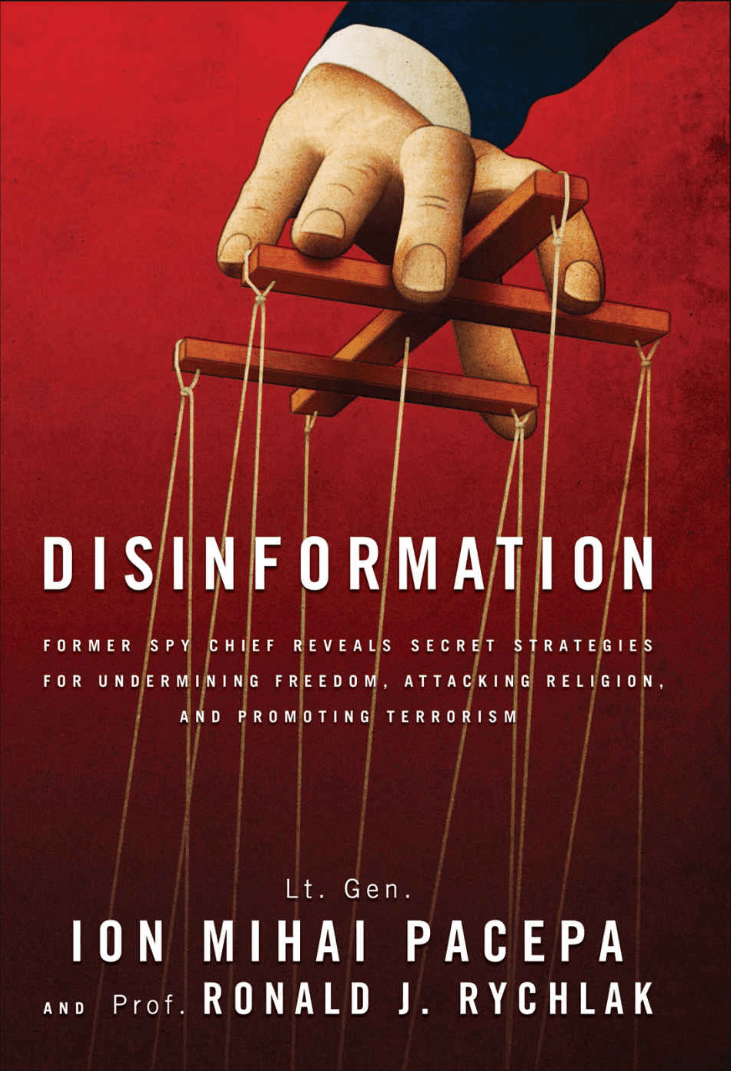
MAIN IDEA:
The main idea of this book is to use Author’s deep knowledge and decades of experience as chief of Romanian Intelligence to explain meaning and methods of highly successful ideological and psychological operations conducted by Soviet block to undermine democratic polities in Europe and USA. The key method used in this operations author defines as Disinformation – careful selection of combination of real fact, semi-truths, and outright lies to implant into minds of people ideas and attitudes instrumental in achieving whatever objectives elite of Soviet block was considered beneficial for them. Author also stresses that methods and tools of disinformation are not just a subject of history, but rather living and very active part of leftist movement that not only survived the fall of the Soviet block, but is currently thriving, making great strides in their attempts to destroy free democratic system and establish once again totalitarian system in which “socialist” elite would control all areas of human live.
DETAILS:
PART I: GLORIFYING THE GUILTY, FRAMING THE INNOCENT
Prelude: 1 Drafted into the Securitate; 2 The True Meaning of Glasnost
- Defecting to America; 4. The Black Art of Disinformation; 5 The “Beauty” of Disinformation; 6 Kremlin Framings; 7 Stalin’s Encounter with Catholicism
- The Kremlin’s New Enemy.
The first part is pretty much author’s history before and after joining Securitate. Obviously he tries to separate himself, as individual, from evils of the organization that he’d been working for, but it does not sound realistic. Somewhat more realistic is his foray into Glasnost and attempt to present it as intentionally designed ideological weapon created in Andropov’s KGB and tested using “independence” of Ceausescu regime in order to obtain economic and technological help from the West in exchange for nothing but rhetoric. He uses it as an important example of disinformation. This part also includes more or less detailed description of technics for framing.
PART II: ANATOMY OF A DISINFORMATION CAMPAIGN: THE CREATION OF “HITLER’S POPE”
- The Failed Birth of “Hitler’s Pope”; 10 Cardinal Stepinac; 11 Cardinal Mindszenty; 12 More Framings; 13 Global War on Religion; 14 The Vatican’s New Crusade; 15 Liberation Theology; 16 Khrushchev’s War on the Vatican; 17 Preparations for Framing Pius XII; 18 The Deputy; 19 The Play; 20 Disinformation under Every Rock; 21 KGB Fingerprints; 22 The Deputy’s Anti-Semitism; 23 The Deputy’s Ideological Roots; 24 Rolf Hochhuth; 25 A New Look at The Deputy; 26 Khrushchev’s Political Necrophagy; 27 Hitler’s Pope, The Book; 28 Andropov’s Cocaine.
This part is the detailed description of history of one of the biggest and quite important campaigns of framing and disinformation – Soviet ideological war against Catholicism. It included several objectives more or less successfully achieved during period after WW II: physical elimination of clergy in Easter part of Europe after Soviet occupation, discrediting of Pope and Catholic Church as supporters or at least neutral observers of Nazi activities by creating corresponding narrative supported by art from books to plays and movies, utilization of European intellectuals to penetrate educational institutions and instill these ideas into the young generation. Author stresses Andropov’s ideas of slow promotion of anti-western ideology in carefully designed small phases similar to getting person hook on cocaine by slowly increasing doses of drug. This operation also included creation of substitute of traditional Catholicism with Liberation theology that practically is socialist ideology with religious cover up. This was very successful in Latin America. Author looks in some details at individuals used in this operation.
PART Ill: FRAMING THE US GOVERNMENT AS A PACK OF ASSASSINS
29 The End of America’s Innocence; 30 Khrushchev: A Monument to Disinformation; 31 Operation ‘Dragon’ 32 New Hard Proof of the KGB’s Hand
This part is about another extremely successful ideological operations: framing of American government as enemy of American people or at least as bunch of intellectually challenged dupes. The obvious success led to American defeat in Vietnam, “anti-war” movement, and general expansion of leftist influence around the world. Author also discusses Kennedy assassination that was, as he believes based on his knowledge of internal working of Soviet block intelligence, a KGB operation.
PART IV: UNRAVELING TODAY’S WEB OF DECEIT
33 From Disinformation to Terrorism; 34 Putin Time; 35 From “Hitler’s Pope” to September 11, 2001; 36 The Kremlin’s Nuclear Terrorism; 37 A KGB Empire; 38 Keeping the Lie-Machine Going; 39. The Antiwar Movement; 40 Marx’s Ghost Lives On; 41 Disinformation in Today’s America; 42 From Disinformation to Assassination; 43 Marxist Personality Cults and Heavy; Water 45 How I Became a “Filthy Jew Traitor”.
The last part is more about contemporary world as it developed after author defected from Socialist Paradise. It starts with chapter on Soviet and overall leftists support for terrorism that is now well documented for 1970-80s. However he extrapolates it to our time noting that establishment of KGB, that become a core of regime in Russia with Putin at the top, moved not only to typical Soviet rejection of democracy and consolidation of power, but also revival of old subversive foreign activities against the West this time in cooperation with Iranian regime. Probably the most important point here is about seamless continuation of these activities that resulted in such amazing achievements as election of deeply leftist and anti-western administration of Obama in USA and establishment of virtual control by leftists over educational system in Western countries. The final chapter is kind of funny because author found that being anti-communist and anti-leftist nearly automatically turned him into “Filthy Jew Traitor” in Romania. The reason it is funny because historically any totalitarian movement, even as saturated with Jewish by birth intellectuals as leftist movement in the West, is inevitably becomes anti-Semitic. This interesting phenomenon is going back to Karl Marx who was nearly perfect example of Jewish leftist intellectual of deeply anti-Semitic persuasion.
MY TAKE ON IT:
There is not much new for me in this book, but it is interesting to look at all this from point of view of very senior Intelligence and Security official in one of Soviet satellite States. In addition to historical value this book provides a very good insight into the nature of current leftists in Academia, government, and elsewhere. The mindset they possess, tools that they use, and general modus operandi is the same as it was used by totalitarian elite of old Soviet block. It is not surprising, taking into account that often these are the same people, only a bit older. After failing in Cold War that was relatively peaceful competition of two competing ideologies and economic systems, they did not disappear and did not change their views, but rather moved inside of Western societies successfully waging new ideological and economic war from inside of these societies that I would call Cold Civil War. As usual people in Democracies when attacked either from outside or from inside take long time to comprehend that they are attacked, reasons for this attack, and objectives of attackers. History demonstrates, however, that when this comprehension finally achieved nothing could save attackers from defeat and this is what we seems to observe now with massive anti-elite movements, which are clearly directed against leftists in government, academia, and all other areas of live. I expect really enjoy watching the complete defeat of these totalitarians over the next 10 – 15 years.
20170422 – Toward Democracy
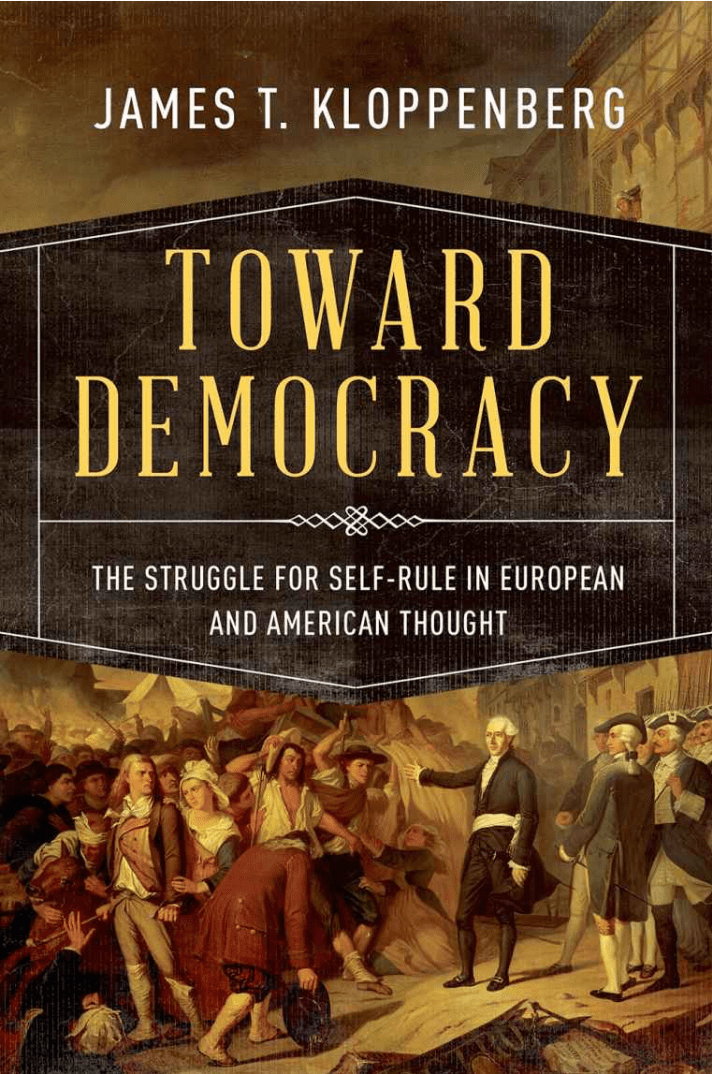
MAIN IDEA:
The main idea here is to provide historical support to the notion that democracy was developed as a method of collective decision making while minimizing violence. The narrative includes a bit of ancient history, but mainly concentrates on development over the last few centuries of democracy in the Western world, its ideological support by two distinct types of Enlightenment French and English/Scottish. It stops at the brink of American Civil War when idea of democracy was practically pushed far back and was seemingly highly dependent on this war’s outcome.
DETAILS:
Introduction: The Paradoxes of Democracy
Democracy became a leading ideal form of society, but it is often misunderstood. Author claims that it “arose from violence and has never strayed far away from it”. The focus of this book is democratic thought in America and changing meaning of democracy over time. Most of all it is about the implementation of ideas and gaps between ideals of democracy and its practice, which makes democracy somewhat unsatisfying, leading to it’s multiple paradoxes.
Part I Roots and Branches
Chapter 1 Born in Bloodshed: The Origins of Democracy
It starts with the story of mayor of Bordeaux Montaigne in 1585 that survived on several occasions using ethics of reciprocity, which he promoted in his later essays. From here comes author’s point that democracy is born by violence as a tool to avoid or at least diminish violence via conversation and search for accommodation. This follows by the discussion of ancient Greek democracy of Athens with its initial notion of individual rights, however limited by popular will. After that author briefly reviews various philosophical approaches and implementations of this system in Rome and medieval Europe with somewhat special attention to religious thought: first Hebrew and then Christian with consequences of reformation and religious wars. The common outcome of both was general revulsion to rule of demos as meaninglessly violent that had to be contained by organized leaders of society: kings and aristocracy.
Chapter 2 Voices in the Wilderness: Democracies in North America
This chapter looks at initial European settlement in North America, which was to significant extent done by the people who did not accept conclusion of evils of democracy, but rather saw it as the better solution for society organization in which every member was equal in their relation to god and to others. Author looks in details at New England puritans as founders of specifically American approach to the ruling society, but also and somewhat unusually, author also looks at diversity of American colonial societies many of which quite vigorously supported ideas of divine sovereignty and king’s power. Practically however regardless of ideology all settlements had to develop various forms of self rule for simple reason of distance, difficulty of communications, and just plain lack of interest on the part of British kings and authorities. These forms necessarily included elections of rules and laws makers and enforcers who would act on more or less consensus basis because nobody really had enough power to impose their will without majority consent.
Chapter 3 Democracy Deferred: The English Civil War
This chapter goes back to Europe to discuss English Civil war of XVII century and how it led to Glorious revolution and ideological struggle that developed at the same time:
- King’s attempt to move to pure absolutism
- Parliament’s attempt to retain Magna Carta and power of gentry
- Ideas of mixed government with divided power based on natural jurisprudence and natural laws when powers balance each other
- Levelers ideas that legitimacy of government could be obtained only from consent of governed.
At the end of this chapter author discusses Milton’s poetic work as representation of ideology and general attitudes of this period when monarchy was destroyed, then restored, then restricted and made compatible with increasing democracy.
Chapter 4 Coup d-Etat: 1688 in England and America
The final chapter of this part is about Glorious revolution and its impact not only on English settlement, but also on American development. It also looks at writings and story of Algernon Sydney and John Lock who developed ideas that went into foundation of American revolutionary thought. However it was not only thought, but also growing American reaction to king’s attempt after restoration to bring American colonies under more direct supervision. This reaction obviously was quite negative because of incompatibility between de facto self-rule of colonies and hierarchical monarchical rule of England.
Part II Trial and Error
Chapter 5 Sympathy, Will, and Democracy in the Enlightenments of Europe
This is about French Enlightenment: Voltaire, Montesquieu, d’Alembert, Diderot, and Rousseau. The key difference here is much more value assigned to emotions and equality of results. It also reviews polemics between Rousseau and Hume who represented Scottish enlightenment, which was based on common sense rather than emotions. The views of Adam Smith and Hutcheson also reviewed here.
Chapter 6 Faith, Enlightenment, and Resistance in America
Here author moves to American Enlightenment, which had much more practical character because its people were involved in practical politics of the Democracy. It starts with Ben Franklin, and then goes to other founders. It also structured about main intellectual events of this time including Great Awakening and revolutionary developments.
Chapter 7 Democracy and American Independence
This is continuation of review of American development, especially on how movement for independency becomes intertwined with ideas of democracy.
Chapter 8 Constituting American Democracy
This is about post revolutionary period when initial regime established by Articles of Confederation becomes insufficient in the eyes of many to support efficient political system in the new country. It reviews people, ideas, and debates that led to creation of American Constitution.
Chapter 9 Ratification and Reciprocity
This is a very nice description of events and debates during ratification. The obvious fact about American constitution is its attempt to balance self-interest and general good and this chapter goes into details of founders’ understanding of local self-interest and general good.
Part III Failure in Success
Chapter 10 Delusions of Unity and Collisions with Tradition in the French Revolution
This is look at European type of Democratic revolution, which is decidedly different from American Revolution – French Revolution. The reason was huge difference in structure and attitudes of these two societies. Americans generally were much more similar to each other generally separated from existing English hierarchies of the society with their own society had its emerging hierarchies in flux, while French had well established layers of society with different world views, ideas, and approaches including religious vs. non-religious worldviews resulting in violent clash of huge proportions.
Chapter 11 Virtue and Violence in the French Revolution
This is about ideological war between supporters and opponents of French approach with Paine and Burke being good representatives of these fighting ideological camps. It also describes sequence of events in France and even somehow manages to go into ideas of feminist writers.
Chapter 12 Democracy in the Wake of Terror
This is detailed description of period of terror and, more importantly different reaction to it and its relation to Democracy in America and Europe.
Chapter 13 Diagnosing Democratic Cultures in America and Europe
The main difference is American understanding stressed reciprocity between individuals and society in democracy as key element of making it work. European approach was based on finding individuals best in expressing general will and then violently force all other individuals to comply with their directions. Net result of this was general rejection of this form of democracy and its practical elimination in Europe after defeat of Napoleon. In this chapter author look in details at parallel development of America, Britain, and France to analyze how exactly it happened.
Chapter 14 The Tragic Irony of Democracy
This covers developments in America leading to Civil War and its challenges to democracy. It also looks at other side of Atlantic where British moved on with reform movement, while Germany and France experience failure of revolution of 1848 and Napoleon III rule correspondingly. No surprise that at this point Lincoln was probably right that American Civil war was decisive for Democracy and that Union victory was necessary for it to survive. It did survive, but the following developments leading to gilded age brought mass corruption taking it far away from theoretical ideals. Author ends with a remark that Democracy proved to be malleable and its success depends on ability of individuals to internalize limits on freedom that democracy given them.
MY TAKE ON IT:
It is an interesting approach to defining reasons for and meaning of democracy. I basically accept the idea that democracy is nothing more than a tool to minimize violence, but I deeply resent the idea that it is perfect and universal tool. Actually I as many others, think that it is pretty crude and ineffective instrument that is acceptable only because there are no other instrument better than that. The history of democracy provided here has two interesting points: one is that democracy in America developed in kind of natural way, not possible in other places, and another one that two enlightenment movements French and English/Scottish/American, while being quite close ideologically, nevertheless brought dramatically different results when implemented in two different cultures. Finally it is interesting how far from inevitable progressive development believed by determinists Marxian and others the real history actually was removed and how close to the rejection of very idea of democracy humanity came in the middle of XIX century. With my one and only life I feel really lucky that such rejection did not happen.
20170415 – Against Empathy

MAIN IDEA:
The main idea of this book is that too much empathy clogs vision and thinking preventing people from making good decisions and act reasonably. Empathy here means attempt to feel what others are feeling and act to alleviate their pain, which actually not a good way to achieve this objective. In short this is book in support of deliberate non-emotional decision-making and actions.
DETAILS:
Prologue
Here author presents reasons for his antipathy for empathy and why he decided to write a book about this. It also includes a brief review of the plan of the book and discussion of extremely critical reaction to its ideas when they were presented earlier in some articles published by author.
CHAPTER 1: Other People’s Shoes
This is a general attack on empathy in broad strokes: just establish author’s position on it. It starts with discussion on meaning of empathy and wide use of this notion in literature and everyday live. It follows by the reasoning that contrary to typical equivalency of use between two, morality and empathy are not really close notions. The morality is much wider notion than empathy and these two could easily go contrary to each other. The balance of chapter is about empathy not necessarily making world a better place and about providing responses to various types of rejection of author’s thesis of rejecting empathy.
CHAPTER 2: The Anatomy of Empathy
This and the next chapter are designed as zoom in on the psychology and neuroscience of empathy, exploring features that make it inadequate as a moral guide. This is also kind of review of mechanics: mirror neurons, their supporters and rejectionists, Adam Smith’s use of sympathy as analog to empathy, and even Baron-Cohen’s research on autism. The conclusion from all this is basically that empathy not really related to good behavior.
CHAPTER 3: Doing Good
This is kind of approach from other side of equation: why actually people do good, charitable things? The general conclusion is because it is in their perceived interest, which is well could be non-material. Author discusses empathy as process of trying to raise other people to own level in person consciousness that practically not possible to do. As alternative he suggests diminishing own need and wishes to the level of “other”.
INTERLUDE: The Politics of Empathy
This is about relationship between empathy and politics where author looks at approach to this by contemporary liberals (high level of empathy) and conservatives (low level). Technically this is not correct. It is rather two sides have intensive empathy, but to different people and issues so author’s point is that clear-minded non-empathic analysis and decision-making would do much better than passionate and empathic support of one side.
CHAPTER 4: Intimacy
This is about impact of empathy on intimacy. The search for most important feature for success in intimate live brought up not empathy, but kindness. He also looks at attempts to establish scale of empathy and corresponding bell curve. At the end author provides a funny formula that everybody could use to find out how much attention and effort one is inclined to invest in self and others: Self + Close People + Strangers = 100%.
INTERLUDE: Empathy as the Foundation of Morality
The foundation of morality obviously comes from the childhood so here author looks at the moral lives of babies and children. Author looks a bit at evolutionary benefits and costs of empathy and his preferred compassion when people help others without feeling their pain, but rather for their own psychological comfort. He provides a number of examples of such behavior in children, but stops short of claiming it has enough explanatory power.
CHAPTER 5: Violence and Cruelty
This chapter is about evil and idea that lack of empathy makes people worse. Author pretty much rejects this idea as way out of reality because it is not possible to have such level of empathy to other as on one has of self and/or “one of us”. Actually in this case empathy could lead to aggression against those who caused damage to “us”. The second part of chapter is about individual characteristic of psychopaths, basically rejecting explanatory value of lack of empathy for such cases. He provides a nice table to support this:

CHAPTER 6: Age of Reason
The final chapter is an attempt to convince people that reason is a much better tool to achieve positive results than blind empathy and actions driven by emotions generated from empathy.
MY TAKE ON IT:
Generally empathy, as any other non-critical emotional response to reality, probably causes more harm than good. It prevents people from analyzing causes of distress and leads to actions that have deleterious effect on chances to achieve positive results. So I basically agree that the empathy is not only overrated, but also rather incorrectly rated as a positive feature, when it is at best is neutral and at worst is a negative feature causing unreasonable actions. I think that author provides a good example when discussing distress of Palestinian children vs. Israeli children when empathy of outsider bound to go much more to Palestinians who get killed rather than to Israelis who just have inconvenience of going to shelter when Palestinians start shooting their low quality low precision missiles. I think it is a great example of how empathy works and why it is useless as tool for improving world if we look at this situation a bit wider: The empathetic outsider in this case would insist on providing help to Palestinians, maybe even assuring that it was purely humanitarian help so outsider’s self-appreciation, conveniently forgetting that resources are fungible. However the realities of live when Palestinians’ objective is conquest and annihilation of Jewish population, while Israelis’ objective is just self-defense limited by humanitarian considerations for Palestinian lives and fear to become politically and economically isolated. The result is the continuing war without end hurting people on both sides. If one would remove empathetic outsider, the war would end long time ago. In this case, because Israel is militarily more powerful, it would most probably end in prosperous demilitarized Palestinian state alongside with Israel with Jews and Palestinians living in both states, maybe in different proportions. In another similar case a while ago, when Jews were powerless, it ended in Holocaust, but it ended nevertheless, even if empathic feelings of German soldiers to their victims were instrumental in costly change from cheap, if somewhat demoralizing, mass killing on the spot to industrialized processing with gas chambers and extensive transportation of victims to killing factories in order to minimize negative psychological impact on Germans.
20170408 Common Sense Nation

MAIN IDEA:
The main idea of this book is to review intellectual underpinnings of American culture that logically led to revolution and consequent formation of completely new and unusual country based on constitution and common sense. This common sense came not from the magic, but from the Scottish Enlightenment, which is quite different than the French Enlightenment. This difference eventually led to quite different types of states that developed from two revolutions of 1776 and 1789: one being an American type state with constitution and democracy used as methods to find some generally accepted compromise between multitude of individual wills and another one of a French type with society driven by “general will” identified at best by democratic elections, but more often by will of elite or even individual in power with multitude of individual wills of regular people either subordinate or actively suppressed.
DETAILS:
Introduction
This is a discussion of American Enlightenment as product of British or more precisely Scottish Enlightenment, which has its own very distinct features quite different from usual understanding of Enlightenment based on its French patterns.
OVERTURE Locke’s Revolution
This about Locke, his treatises on government and, most important, his core idea that “The supreme power in every commonwealth (is) but the joint power of every member of society”
ONE: The Founders
This obviously is about formation of American founders as individuals with ideology that occurred under influence of Scottish immigrants who were their tutors. It is reviewed in some details based on example of Benjamin Rush. It also provides somewhat unusual look at constitutional convention as the drama founding and as the unique case of deliberative establishment of the state.
TWO: The American Enlightenment
This is a look at specifics of American Enlightenment and discussion of similarities and differences between it, French Enlightenment, and huge differences in societies that American and French revolutions produced.
THREE: The Declaration of Independence
This is a very interesting discussion on declaration of independence and ideological root of its key notion that by now became quite obscure and misunderstood such as “…Self-Evident”, “…Unalienable rights”, “… Pursuit of Happiness”, and “… All men created Equal”. This chapter also contains brief, but very important piece on the American idea of Property Rights.
FOUR: The Constitution
This is about constitution as an attempt to create such framework of the state that would take into account immutable characteristics of human nature, rather than try to change human nature to fit into framework of ideal state. Author uses juxtaposition between Madison and King George both treated as legitimate thinkers about nature of the state, but with critically different approach with Madison seeking establish new framework of society, while King George trying to protect god ordained order from “Presbyterian rebellion”.
FIVE: The Federalist Papers
This starts with Adam Smith’s “The Theory of Moral Sentiments” that author seems to consider to be underappreciated founding document of America and then goes to Madison’s argumentation in Federalist Papers on the Extended Republic, Representation, and legal framework of the society.
SIX: Religion and the American Enlightenment
This is about a religion being a necessary component of American creation that sprung from the very special creed of Christianity: not dogmatic, but tolerant, which paradoxically made America much more religious country than any other in developed Western world.
SEVEN: Turning Away from the Founders
This chapter moves us close to the contemporary world, retelling history of mainly successful so far attempt to destroy America conducted from within its society by supporters of French enlightenment of the big government and suppression of individual. The ranks of these supporters run from Woodrow Wilson to contemporary post-modern “Progressives” .
EIGHT: Common Sense Nation
This is about American Common Sense that still standing, but is severely wounded by 100 years “progressive” challenge. It directs a special attention to the currently victorious progressives in academia.
NINE: A Brief History of “Liberalism”
This is about American Liberalism that came to signify something directly opposite of Liberalism of XIX century. The latter was freedom movement, while the former statist and oppressive movement striving to move control of human lives to the big government bureaucrats. The chapter briefly looks at original progressivism of early XX century, FDR’s big government revolution of 1930s, and countervailing movement of conservatism as it developed by the end of this century.
POSTSCRIPT How to Misunderstand the Founders
This very short chapter stresses the typical mistake that people make trying to explain America by reference to English parliamentary system and the French Enlightenment. It is neither. America is the product of unique American Enlightenment and must be analyzed on its own terms.
MY TAKE ON IT:
I find the idea of America’s roots in Scottish Enlightenment very intriguing. The whole idea of two different approaches to the running of society: one from the top down via Reason of educated elite that is imposed by all means necessary on non-elite members of society and another one from the bottom up via Common Sense of regular members of society pushed up to elite for limited managerial functions, seems to me highly explanatory and consistent with real live experience.
The last couple hundred years after both methods where applied: the Common Sense in America after 1776 and the Reason in France after 1789 history produced some very good examples of implementation results for each approach:
- It is hard to imagine more Reason driven ideologies than Communism and National Socialism, both being products of pseudo-scientific reasoning of intellectual elite most often born to middle layers of society and raised to the top via self-education and revolutionary activities similarly to mother of them all elite of the French revolution.
- Correspondingly it is hard to imagine more Common sense driven society than early America were whatever Reason of elite dictated was practically impossible to implement due to huge distances, absence of well organized government power structures, and economic independence not only localities, but also individual farmers and mechanics.
It is obvious that with increased maturity of technology and society’s power structures America practically ceased to be the fully Common Sense nation. The dramatic growth of educated elite that has no place in market economy, but strongly demands level of resources provision consistent with their expectations, created strong base for movement to expand top down European Reason model in which such educated elite guarantied high level of resource transfer from actual producers. However the Common Sense part of America did not disappear and still maintains probably slight advantage among American population. All this indicates high probability of clash between these two models of society with one of them definitely ending on the top, taking over American society as the whole.
20170401 – A Culture of Growth
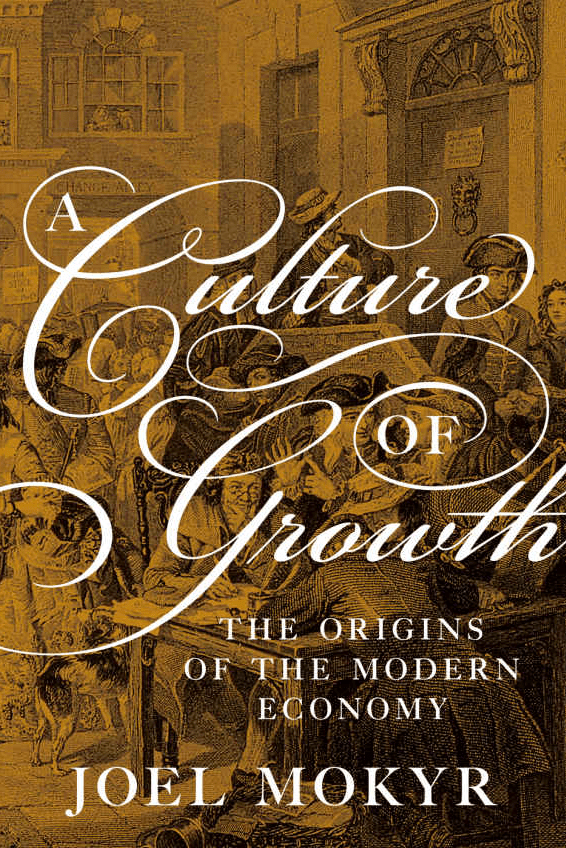
MAIN IDEA:
The main idea is to demonstrate that culture, economic, and technological development of society is deeply intertwined with change in culture (understood as prevailing attitude in human interactions with material world and other humans) and is absolutely necessary prerequisite for such development. Specifically it relates to dramatic changes in economic and technological conditions of Western societies that followed not less dramatic change in ideology of this society brought in by Enlightenment.
DETAILS:
Part I: Evolution, Culture, and Economic History
Chapter1: Culture and Economics
The point here is that author believes we know what happened during industrial revolution and such, but do not know how and where exactly it happened so he intends to provide answers. This chapter gives a brief review of different approaches to such explanation related to link between culture and economics.
Chapter 2: Nature and Technology
This is about the culture impact on technology and its development with the main point being that high tech culture generally egalitarian and individualistic because without high value of invention and technological improvement for individuals they would not put a serious effort in innovation. Collectivist society could use existing technology, but it would not invent. Author defines 3 key cultural elements required:
- Believe that better technology is virtuous
- Believe that progress in increase in wealth is desirable
- Believe that practical agenda for progress is required and should be implemented
Chapter 3: Cultural Evolution and Economics
This is discussion of evolutionary approach to development of the Culture based on application of key evolutionary principles: variation, inheritability, and superfecundity.
Chapter 4: Choice-based Cultural Evolution
This is an additional detailed look at choice based evolutionary approach with a nice picture to summarize it:

One of the most important points here is the dramatic increase in share of non-parental transmission of culture that makes variability much higher in high tech societies.
Chapter 5: Biases in Cultural Evolution
This is about the process of choice in cultural evolution based on biases – identifiable patterns that make people choose from available options. Here is classification of such biases:
- Content based bias
- Direct Bias (Authority)
- Consistency and Confirmation Bias
- Model-based Bias
- Rhetorical Bias
- Frequency Dependency Bias
- Rationalization Bias
- Coercion Bias
- Salient Events Bias
Part II Cultural Entrepreneurs and Economic Change, 1500-1700
Chapter 6: Cultural Entrepreneurs and Choice-based Cultural Evolution
Here author looks at role of individuals who moved Western culture into direction different from other cultures, eventually producing enlightenment and industrial revolution. He cites B. Show Maxim #124: Reasonable man adjusts to the world, the unreasonable adjust world to themselves. This follows by detailed review of 2 examples: Chapter 7: Francis Bacon, Cultural Entrepreneur and Chapter 8: Isaac Newton, Cultural Entrepreneur.
Part Ill: Innovation, Competition, and Pluralism in Europe, 1500-1700
Chapter 9: Cultural Choice in Action: Human Capital and Religion
This is a dig into personalities and cultural believes of people who followed culture entrepreneurs by internalizing their ideas and applying these ideas through their objectives and activities: businessmen, military leaders, engineers, inventors, and practically all self-directing individuals. These people intensely developed their own human capital and applied it to environment in order to improve lives. Significant part of this was the development of formal education, but it is far from clear that it was a critical component. Rather more important was general ideological attitudes in society, which to significant extent were based on religious believes and author look at this in quite a detail.
Chapter 10: Cultural Change and the Growth of Useful Knowledge, 1500-1700
This is about culture openness to external influence and its influence on knowledge acquisition and economic growth. In this part Western culture was unique in its dogged pursuit of new discoveries and shameless appropriation of everything useful: technologies, all kind of know how, and, very important, intermixture of people via immigration/emigration between countries. From evolutionary point of view all this greatly increased variation.
Chapter 11: Fragmentation, Competition, and Cultural Change
This is about another feature of Western world – its fragmentation into multiple entities constantly competing between themselves, but never annihilating or consuming each other. As result new and useful methodologies and technologies were quickly dispersed preventing everybody from achieving any long-term dominance.
Chapter 12: Competition and the Republic of Letters
This is about another important feature of Western culture that author calls Republic of Letters: Christianity providing common language of European intellectual elite (Latin) consequently supporting their ability to move between entities and communicate via letters on regular basis. Overall it created ideological superstructure common for all countries of Western civilization and situated somewhat above direct control of any particular country.
Part IV: Prelude to the Enlightenment
Chapter 13: Puritanism and British Exceptionalism
Here author looks at religious development in Britain that produced Puritanism with its religious imperative to be productive as the necessary way to achieve bliss. This eventually caused change to useful technological knowledge and necessity to improve productivity and consequently led to somewhat paradoxical development of separation of empirical knowledge into generally independent from religious dogma sphere of intellectual activities – science.
Chapter 14: A Culture of Progress
This is about, what now seems to be inevitable consequences of creation of such empirical area, formation of the Culture of progress when dramatic improvement in technological and economic conditions of society initiated expansion of this way of thinking into ideological sphere first pushing out intellectual reliance on ancient Classics and then building new ideology of knowledge that eventually started pushing out traditional religion.
Chapter 15: The Enlightenment and Economic Change
This is about history of interaction between Enlightenment and Economic change and its history that amply demonstrated its non-linear character.
Part V: Cultural Change in the East and West
Chapter 16: China and Europe
This part is somewhat deviate from narrative about Western world by moving to the huge puzzle of the most developed country of medieval world – China failing to produce industrial revolution. It is mainly comparative review of China versus Europe.
Chapter 17: China and the Enlightenment
This is mostly review of Chinese ideological development and reasons why it did not create its own Enlightenment and why it was immune to European ideas to the point of practically disaster when it led to complete military and technological inferiority.
Epilogue: Useful Knowledge and Economic Growth
Here author briefly summarize his points: collective knowledge about nature and environment expressed in culture defines economic position of society. It is demonstrated in this book by analysis of Enlightenment and its impact on development of Western society that led to dramatic changes in multiple SOPs of various countries of this society.
MY TAKE ON IT:
I really like evolutionary approach to understanding of history overall and explosion of prosperity in Western societies over the last few hundred years. I find the idea of culture as set of biases very interesting and deserving wide application for understanding of history and even contemporary world, especially when it relates of comparative analysis. Very important thing here would be ability to always keep in mind that the only real curriers of culture are individual human beings and, even if culture is huge and could not possibly fit into one human brain, the core biases of every culture are common for any individual who fully belongs to it. Practically in our time of global communication, migration, and interaction it could be critically important to understand such biases, isolate points of incompatibility, and disarm them to avoid conflicts even, if necessary, by cutting off connection. Also beyond the main point of this book, it is an interesting source of information about Enlightenment and its consequences.
20170325 – The Nobel Factor

MAIN IDEA:
The sub-main idea of this book is that economics is not a real science and that majority of economists including those who received Nobel price understand this. However the main idea is that Prize in Economics is not really the Nobel price, but somewhat external creation of Swedish right wing economists who used it to provide more legitimacy to free market ideologues whom authors, being clearly of socialist persuasion, deeply resent. Correspondingly overriding objective of this book is to undermine this legitimacy and convince reader that Scandinavian socialist model of 1950s really worked just fine until reactionaries succeeded in undermining it and moving Sweden back to horrors of capitalism.
DETAILS:
Introduction
The introduction spells out authors believe about economy being something like not completely legitimate way to undermine what they call Social Democracy – the combination of market economy with government controlled massive redistribution of income and Keynesian interventions on the large scale. They provide a gist of the book as retelling of history of economic views with paradise (Social Democracy) achieved and then lost due to intrigue of evil free marketers.
- Imaginary Machines
This is about economic models that build similarly to technological models like airplanes with one important difference – they never work in real live. Authors look at Robert Lucas as contemporary model builder and then jump back to David Ricardo as most effective builder of oversimplified models. They also discuss idea of rational expectations and complete this chapter by countering what they call New Classical Macroeconomics (NCM) with Social Democracy. Interestingly enough, they link NCM with ideas of post-modernism and anti-realism, which are quintessentially anti-capitalist ideas.
- A Prize in ‘Economic Sciences’
This is mainly discussion of meaning of science as it relates to economics and value of prizes as symbols and ritual.
- Bitter Roots: Finance and Social Democracy between the Wars
This is brief review of interwar economics in Europe with stress on monetary issues, specifically consequences of loosing gold standard. The special attention paid to development of Stockholm School of economics and its support of sound money and resulted clash with Social Democracy that obviously wants fiat money controlled by government. They also provide not very well known, but interesting story of interwar Bank of International Settlements.
- The Riksbank Endows a Nobel Prize
This is mainly story of after war struggle between Banks and Swedish Social Democracy when socialists wanted to spend on social programs to buy votes and power and banks wanted maintain sound money and retain economic power. The Nobel price for economics in this story is a by-product of this struggle or as authors call it “A Cuckoo in Nobel Prize Nest”.
- Does Economics Have a Political Bias?
This is pretty much story of liberal (in American understanding) vs. conservative evenhandedness of awards that author seems to consider unfair despite much higher level of references for liberals. They provide a nice graph where “Arrows” means characteristics of citations”

- Individual Reputations (with Samuel Bjork)
This is data heavy review of impact of the Nobel Price on popularity and citations of individual economists. Authors conclude that prize does have credibility, but it rather follow citation curve than leads it, albeit it does raises popularity of specific economists. Here is a graph to support this idea:
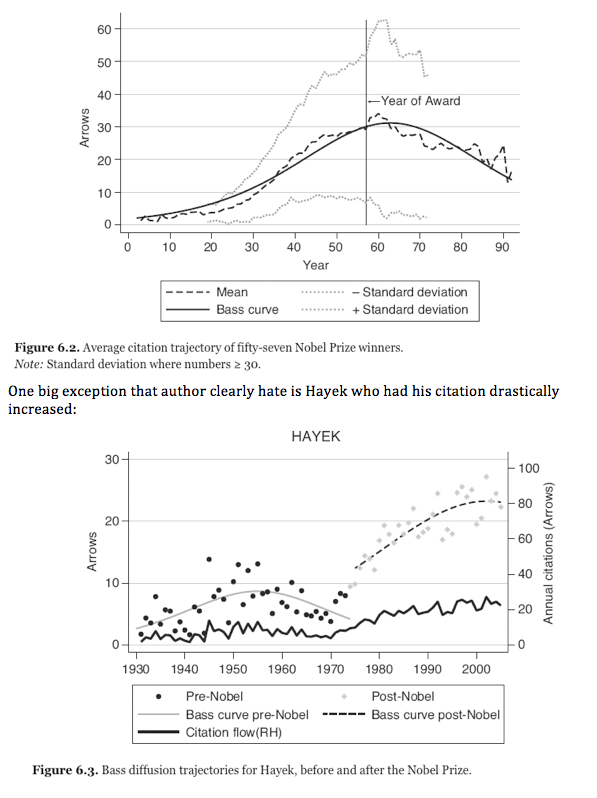
- Nobel Economics and Social Democracy
Here authors look at Nobelists based on their approach to economics either as Empiricists or Formalists and here is how they define them:

They also discussed contrasts in approach between what they call Social Democracy (good because it provides managed solution for resource allocation over live cycles via redistribution) and Market Alternatives (bad because it hold that world is too complex for simple management and just rely on market to allocate resources in the best way). They even provide ideal sequence of development right out of book for systems analysis:
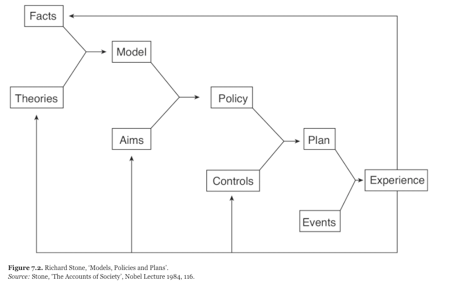
- Models into Policy: Assar Lindbeck and Swedish Social Democracy
Here authors trying to describe Swedish Social democracy as nearly perfect solution for economic issues of society that was successfully implemented in Sweden from 1930s to 1970s, but then somehow was undermined by international competition and evil Swedish economists like Assar Lindbeck.
- Swedosclerosis or Pseudosclerosis? Sweden in the 1980s
This chapter seems designed to convince people that Swedish economic sclerosis of 1980s that eventually led to significant market oriented reforms, actually did not occur, but was rather invented by market oriented economists. Their main point is that economic calculations designed in such way that they underestimate value of production for countries with high level of public services. In short this is an attempt to explain away economic failures of Swedish Socialism as imaginary.
- The Real Crisis: Not Work Incentives but Runaway Credit
Correspondingly this chapter is an attempt to explain away success of market by assigning it to unhealthy levels of easy credit that eventually caused financial crash.
- Beyond Scandinavia: Washington Consensus to Market Corruption
The final chapter is comparison of Washington consensus (Regulated Market) that authors consider corrupted vs. Social Democracy that authors consider to poses high levels of integrity.
Conclusion: Like Physics or Like Literature?
The final chapter is restatement one of authors’ main points that Economics is not really science and should not be included in Nobel prizes. Finally they add another issue that economics is a-moral because it just trying to link inputs and outputs, while humans are moral and consequently economic priorities and methods should not be really applicable for society management.
MY TAKE ON IT:
This is an interesting review of Nobel prizes in economics with multiple diatribes against market and glorification of social democracy of Swedish type. It is typical product of people who somehow fail to understand complexity and diversity of humanity and consequently believe that the best way of society organization is kind of elitist oligarchy masked as democracy when the best and brightest, mostly defined by academic achievements, control resources and decide what when and how to produce and consume them, while mentally deficient masses blissfully participate in elections mistakenly believing that they actually decide direction of the society. Unfortunately authors heavily concentrate on small homogeneous Sweden society as example of successfully working Social democracy and completely ignore other much larger scaled socialist experiments of Russia, Chine, and Nazi Germany – all of them being economic and humanitarian disasters. Somehow they also missed a simple historical fact that very well explains Swedish prosperity of 1950-70s – destruction of WWII that for Sweden was a huge bonanza of German military orders paid by wealth transferred from all over occupied Europe. From this point of view the temporary success of Swedish Social Democracy was purely parasitic and disappeared when both Europe and Asia recovered after the war. It short authors’ ideas of superiority of Social democracy just do not hold water.
20170318 The Perfect Dictatorship

MAIN IDEA:
The main idea of this book is that Chinese mix of socialism and market economy in reality is a lot less effective and efficient than it is usually perceived. Comparatively to other Asian nations like Japan and especially Korea Chinese development lags behind, leaving population at the level well below it wants and needs to be. The result is a shaky stability of society highly dependent on economic growth that now beginning to slide. The alternatives of Chinese Dream and other nationalistic ideas may or may not work on the long or even medium run.
DETAILS:
Introduction
The introduction is about complexity of China and somewhat illusory character of top down control in this country. It also states author’s objective to analyze the multifaceted character this society.
- Leaders
The first chapter is about leadership structure of Chinese party-state dictatorship: who are the people in leadership and what are their priorities. It looks at relations between state and economy, reasons and prospects of growth, corruption, and overall view at the China project.
- What They Say
This is about ideological presentation of Chinese version of one party totalitarian system not only to the world, but also for internal consumption. Here author defines 3 types of states and asks his most important question: whether it is trivial state most concerned with sustainment and territorial integrity, welfare state most concerned with well being of population, or power state most concerned with increase in power by all means including territorial expansion. After presenting these 3 options as testable hypothesis, author is trying to provide answer in the next 3 chapters.
- What They Do
Based on actions of Chinese leadership author looks at activities directed at self-preservation by obtaining legitimacy of the state by producing economic growth and continuing improvement in quality of live. At the same time raw power is used widely and decisively via 6 pillars of Chinese society: party, military, executive, legislature, police, and judiciary. Author looks in details at each oh these pillars.
- What They Produce
This chapter analyses what and how Chinese state produces its services in order to test welfare hypothesis. He looks at Taxes, Welfare services, Public Sector provisions, and various social services. Overall conclusion is that it is not welfare state and it could not easily develop into one.
- Who They Are
The final chapter concludes that it is totalitarian state, but complex and sometimes even benevolent so author goes through is sort of compilation of what Chinese party-state gives to people and what it takes from people. After analyzing his 3 hypotheses author concludes that it is trivial state, but with clear tendency to develop into power state and it is not clear yet whether such development will occur or not.
Postscript
Here author discusses several possible developments that he considers more or less probable:
- Steady on – continuation without significant changes
- Demise – economic failure leading to loss of legitimacy and destruction of the state
- Utopia – development of successful utopian socialist state
- Democracy – resurrection of latent peasant democracy still existing in rural areas and its expansion through the country.
- The perfect fascist state – development into classical power state.
Author assigns kind of probabilities to each option, but it is really everybody’s guess of what future will look like.
MY TAKE ON IT:
For me China does not seem that interesting from societal structure and ideology system. It is clearly still socialism and totalitarian dictatorship, but with leadership that was smart enough a while ago to practically discard Marxist dogmas and rather than trying to move to world proletarian revolution and build the drastically new and much more productive society of communist utopias, choose to use totalitarian power to convert the country into economic supplement of highly developed rich Western world by providing very cheap labor, cost of which defined by state power rather than by market, in exchange for investment and technology flow. These factors: investment and technology would allow for a while maintaining increase in material quality of live, but at the expense of denial of many characteristics of quality of live such as freedom and environment quality. The problem here is that at some point it would become impossible to continue because without freedom truly effective development is not possible, while margins for expansion of economy as cheap labor supplement is already challenged. Internally because after getting a bit better materially people start wanting more and more undermining main China’s asset on world market – cheap and diligent workforce. Externally because shift of labor from Western world caused some serious societal problems in this world that could and will be addressed via multiple measures shifting labor demand back to Western developed countries, consequently cutting off external labor markets that currently sustain Chinese system. I think one of two developments is possible: either the slow degradation of Chinese totalitarianism with consequent transfer, hopefully peaceful transfer to democracy similarly to development in South Korea, or strong move to increase in totalitarianism of more nationalistic form with following Cold war with the West. I believe and hope that the former development in more probable mainly because Chinese society and its leadership much more familiar with civilized world of market based democracy and seems to be much less ideological than previous totalitarians, but one could never be sure about the future.
20170311 – The Attention Merchants

MAIN IDEA:
The main idea of this book is to provide a detailed look at business model of communication and information services including news, entertainment, and Internet services as a method to capture customer attention and then sell it to advertisers.
DETAILS:
Introduction: Here’s the Deal
The introduction starts with the story of poor school in California that obtained funding by allowing companies advertise to students. It follows by definition of what are the attention merchants.
Part I: Masters of Blazing Modernity
This part is about the beginning of this business in early XIX century with mass paper based news and later broadcasting corporations.
Chapter 1: The First Attention Merchants
The first serious business based on reselling captured attention was Benjamin Day’s New York Sun first published in 1833. It changed business model to rely not on subscription and retail sales, but on advertisements. Author also traces even earlier form of advertisement – Posters, which were around since 1796. Author also discusses mechanism of human attention that makes this business model viable.
Chapter 2: The Alchemist
This is about the story of patent medicine that was mainly based on advertisement to sell snake oil with no need to prove that it actually works as advertised.
Chapter 3: For King and Count
This is about patriotic advertisement that allowed countries with relative tradition of freedom and voluntary military to successfully mobilize population for large-scale war.
Chapter 4: Demand Engineering, Scientific Advertising, and What Women Want
The next step in progress of attention capturing and selling was scientific advertisement developed in 1920s. The key feature was demand manufacturing, which is development via advertisement consumer needs that did not exist before. It was especially successful with women.
Chapter 5: A Long Run
This is a story of tobacco advertisement which promoted product increasingly understood to be harmful. It also summarizes achievement of advertisement industry that by late 50s defined informational environment of American live.
Chapter 6: Not with a Bang but with a Whimper
The last chapter of this part is about the fall of advertisement industry from grace caused by disconnecting advertisement with reality and eventual government interference, which limited methods and tools of advertisement. All these, plus global economic crash brought advertisement industry to its knees by 1930.
Part II: The Conquest of Time and Space
This part is about formation of the new mass broadcasting media such as radio and TV that brought not just a nice recovery, but huge growth in advertisement.
Chapter 7: The Invention of Prime Time
This is about different methods tried by radio advertisement, with special attention to black radio show Amos ‘n’ Andy that unexpectedly attracted huge numbers of listeners who were ready to adjust their schedule to sit by their radio set at specific time, which eventually become Prime time.
Chapter 8: The Prince
This is story of CBS – the smallest of the big broadcasters, its chef William Paley and his struggle with RCA and NBC that were under control of David Sarnoff. It also provides brief story of Edward Murrow – the first successful political commentator on mass radio show at CBS.
Chapter 9: Total Attention Control, or The Madness of Crowds
This is about political use of mass broadcasting in Germany during Nazi rules and their perceived success in manipulating population. Is also discusses similar use of broadcasting in USSR.
Chapter 10: Peak Attention, American Style
This is about American TV in 1950s that commanded unprecedented control over attention of population via just a few TV shows. It also discusses appearance of Nielsen popularity evaluation tool that facilitated competition.
Chapter 11: Prelude to an Attentional Revolt
This is about new invention by Zenith Corporation that provided technical ability for viewer to exercise power via remote control. It also looks at a number of scandals with TV shows such as quiz show 64000 that demonstrated sometime fraudulent character of these shows, undermining trust and consequently interest for them.
Chapter 12: The Great Refusal
This is about the great rebellion of baby boomers in 1960s that refused TV world and preferred to look for entertainment and information in the reality of their lives, filled with rock music, drugs, and political protest. It also discusses changed character of TV shows in this period that moved away from quiz to Mary Tailor Moor, Archie Banker, and M*A*S*H, bringing them much closer to issues of interest for population.
Chapter 13: Coda to an Attentional Revolution
This is about Jon Robbin and PRIZM – computer based analysis of American population by ZIP codes into 40 different groups so diverse in their attitudes that they could be called different nations. What followed, as one could expect, multitude of specialized stations like ESPN. Eventually it led to new competition even in the political news area by Fox news that practically ended monopoly of leftist intelligentsia on mass broadcast of political information. It also discusses channel serving and consequent decrease in attention span afforded by public to broadcasters.
Part III: The Third Screen
This part is about initial invasion of computers into information exchange business and how it started diminish the role of traditional broadcasters.
Chapter 14: Email and the Power of the Check-in
This is about the first encroaching of the new peer-to-peer tools such as E-mail. At this point these were mainly small number of computer enthusiasts, but writings were on the wall.
Chapter 15: Invaders
The next step in computers growing competition for attention was proliferation of computer games.
Chapter 16: AOL pulls them in
This is about final part of initial computer invasion: massive expansion of e-mails with AOL, Prodigy, and CompuServe. The interesting part of this story is the failure of big business that supported Prodigy to effectively compete with more entrepreneurial AOL. Nevertheless AOL also went down in early 2000 with advance of free e-mail provided via Internet.
Part IV: The Importance of Being Famous
This part is about attention attracted by celebrities that created qualitatively new phenomenon when technology made information access available at will.
Chapter 17: Establishment of the Celebrity-Industrial Complex
This chapter starts with process of creating celebrities, initially by Time with its Man of the Year cover. It continues with analysis of mechanics of “illusion of intimacy” that makes lots of people allocate extraordinary amount of time and attention to lives of and gossips about some celebrity, consequently opening channel for precisely aimed advertisement and sales of related goods.
Chapter 18: The Oprah Model
This chapter is analysis of a subset of celebrity culture when celebrity is becoming daily visitor to your house discussing issues that she makes look like relevant to you, even if they, quite obviously, are not.
Chapter 19: The Panopticon
This is about simultaneously developed attention grubbers based on TV from MTV boom to reality shows: all designed to allow people to jump out of their real live into much more interesting virtual world, the process that was always basis of art, but now dramatically more powerful due to technical ability to make the story as real, if not more real, than actual reality.
Part V: Won’t Be Fooled Again
The final part is about much more matured Internet of 2000s and that opened attention market place to practically everybody, shifting not only consumption, but also production of information to wide-open world.
Chapter 20: The Kingdom of Content: This Is How You Do It
This chapter is about process of division of proceeds from selling attention between actual producers of content and Internet platforms that support delivery. That’s how Google and Facebook become such a huge recipients of ad dollars with limited success in producing content.
Chapter 21: Here Comes Everyone
This is about population producing their own content bloggers, YouTube producers and such.
Chapter 22: The Rise of Clickbait
This is about specific technic to attract attention, clicks, and consequently revenues via planting some outrages that makes people to get involved in mass.
Chapter 23: The Place to Be
This is the story of Facebook, which provided widely used platform for communication between people and presentation to the world of trivialities of everybody’s live.
Chapter 24: The Importance of Being Microfamous
This is a funny piece about getting micro fame by accumulating “friends” and fans on social media.
Chapter 25: The Fourth Screen and the Mirror of Narcissus
Another new invention that attracts lots of attention came with smart telephones, in other word handheld communication computers that allowed people maintain constant communication with each other via texting, voice, and lately video. It also allow immediate catching of events to electronic media and distributing these images to the whole world.
Chapter 26: The Web Hits Bottom
The next step is from mass broadcasting to personalized tracking and advertising based on computerized analysis of individual behavior on the web.
Chapter 27: A Retreat and a Revolt
This is about development during period after 2010 when paid content providers like Netflix moved decisively to develop their own content, taking attention away from free advertisement based media.
Chapter 28: Who’s Boss Here?
The final chapter is about the latest development that potentially could remove even possibility of traditional advertisement as it existed so far – implementation of ad blocking. It would make for switch from indirect payment for entertainment when people were getting it for free and paid later when buying advertised goods and services to direct payment when people would just pay for entertainment they want.
The Temenos
The epilogue is about the future, which is obviously unclear. Whether the new (oldest) form of direct purchasing of entertainment or old (last 3 centuries at most) form if indirect purchasing of entertainment will be dominant is unknown. Most probably both forms will coexist for a while into the future. The final word is that live experience amounts to whatever we pay attention to, and the fight for getting this attention will never subdue.
MY TAKE ON IT:
It is an interesting angle to the story of mass communication and entertainment. It could easily be extended back to Roman times with their “bread and circuses” motto. I think that the most interesting part here is ability of mass communicators to attract attention to their product and methods they used to get it done. It is not only advertisement for goods and services, but also political action in democracy or any system for that matter that are critical for condition of society. Depending on who and how can get attention of the active majority and direct it into carefully selected points of reality or false reality, the society could implement effective methods of achieving well being for population as it happened in market based democracies of early America and period of British industrial revolution or it could implement ineffective methods that lead to hugely tragic economic mismanagement and loss of live as it happened in communal, market denying societies of Russia, China, or Nazi Germany in XX century.
20170304 The Shock of the Old

MAIN IDEA:
The main idea of this book is to provide unusual view of technology development and its use. Unlike typical approach, that is heavily stressing innovations, this book is much more about use of existing technologies and reasons why it was implemented when it was, not when it was invented, which sometimes constitute gap of thousands of years. Even more important is analysis of cultural impact of technology on everything that is society.
DETAILS:
Introduction
This is bout use-centered account of the history of technology with stress what author calls “creole” technological mixes. It also provides critic of innovation- centered history demonstrating its deficiencies and mistakes. It is also about interplay between technology and culture.
- Significance
This is a review of relative importance of different technologies, which is based on an interesting observation that quite often small and simple technologies have much higher impact than expensive, complex, and spectacular. Very good example is condom technology that definitely had much higher impact on fate of humanity than moon landing, but had never been considered something newsworthy or spectacular. Author also looks at technology spin offs and overall methods of assessing technologies.
- Time
This is a look at timeline of development and implementation of different technologies, which is quite different from traditional. For example steam power technology was actually developed long before its massive use in XVIII and XIX centuries, probably thousands years before. Author looks here at several technologies that were highly time dependent in their implementation.
3.Production
This is about impact of technology on overall production, especially on productivity. For example typical discussion is about decline of agriculture and expansion of manufacturing with industrializations. Author however stresses that it is mistaking analysis because agriculture did not decline, but rather grew dramatically. The point is it grew via productivity improvement with fast decline in number of people involved and decrease in overall share of GDP. Consequently the image of decline is misleading because the total ability to produce more food increased dramatically so humanity now can easily produce more food than could possibly be consumed.
- Maintenance
This is about another underappreciated part of the technological process, the part often forgotten and/or taken for granted. In reality maintenance takes as much if not more efforts than creation of construction or technology. Author looks at multiple examples of high importance of maintenance in various industries with stress on upgrade when some parts of technology drastically changed despite retaining it outlook and frame. Good example is B-52, which is flying for 60 years, while multiple upgrades of its avionics, communication gear, and weaponry made it probably hundred times more effective bomber than it was originally. At the end of chapter this logic extended from technology all the way to maintenance of society.
- Nations
This is about relationship between technology and nations, which depends in their development on creation or imitation of the new technology in order to maintain themselves as independent entities and provide goods and services for population. Author discusses positives of globalization and negatives of autarky, the last one by using example of Soviet Union – ultimate autarky of “socialism in one country”, which in reality was highly dependent on American technological transfers. Similar stories provided for other countries where nationalism and racism led to quite idiotic technological decision making.
- War
Here is quite typical look at war as engine of technological progress. The main point is that despite all these technologies, the most part of fighting and killing was done with old tools – many more people killed in XX century with artillery and small arms than with nuclear and all other air delivered bombs. However victory is nevertheless going to possessor of better technology, in short – war rewards successful innovation in technology more than anything else. Author also discusses “unusable” weapons such as nuclear weapons and the latest military events.
- Killing
This chapter is about killing of living creatures that humans do for various reasons: pesticides, slaughterhouses, fishing, and even other humans in various genocides. Obviously technology improved dramatically, making it highly efficient process.
- Invention
The final chapter addresses process of invention itself and is looking at academic science and business R&D, demonstrating that this formal processes of invention become a significant part of human activities, not necessarily producing constantly increasing returns.
Conclusion
This is a restatement of key point of this book: old technologies are as important as the new ones if not more so and that typical overblow of everything new. Consequently we would be better off by selecting technologies based on their functionality, rather than their novelty.
MY TAKE ON IT:
I think this book is a good collection of technological examples, but it is somewhat redundant if looked at recommendation for action in market economy. A business owner seldom would change technology for change sake because it is his own money and increased cost. Not so for all kind of government driven technological change when cost is practically not part of consideration. In short, my opinion is that similarly to any other area only free market with responsibility fully allocated to decision makers technological progress could be sensible and effective. The top down government driven development it guaranteed to be producer of various boondoggles like Concord and many others. Consequently no book and no logic would convince government bureaucrats to look at old simple and cheap technology for any purpose whatsoever when expensive, poorly designed, and immature technology that provides well for bureaucrats would do at leas half decent job at it.
20170225 The Demon in Democracy

MAIN IDEA:
The main idea of this book is to demonstrate not just close resemblance, but actually common features of East European Communism / Socialism of XX century and West European Liberal Democracy. Most importantly this includes similar objective – to improve world for people by building completely new society and destroying traditional society in the process. The key to common approach of both Communists and Liberal Democrats is attitude to people as abstractions that should be led if necessary by force, to better live whether they want to go there or not. Obviously it is done without real understanding and even interest in lives of real human beings. Consequently this inevitably led to totalitarian inclinations of both systems clearly expressed by their intolerance and hostility to individual freedoms and non-conformist opinions. One of the most consequential results of this similarity in countries of former Eastern block like Poland was easiness with which former communist bosses accommodated to transfer of their countries into Liberal democracies, often taking powerful positions in the new system with huge support of Western Liberal Democrats, while former freedom fighters and dissidents found themselves in somewhat hostile environment due to their adherence to individual freedoms and religious views.
DETAILS:
INTRODUCTION
Here author refers to his experience as dissident in communist Poland and member of Solidarity movement who lived through the struggle and societal change to demonstrate his deep familiarity with both Communist / Socialist system and Liberal Democracy in order to validate veracity of his comparative evaluation of the two systems.
CHAPTER I History
In this chapter author looks at historical commonality of two movements: they both are based on idea of inevitable linear progress of society from lower to higher forms of organization. They both linked to Marxist ideology, one openly and assertively relying on totalitarian violence, while another somewhat more softly and mainly relying on democratic process. Both systems aspire to take over all societal functions and both perceive themselves as the final stop in historical development. Author discusses in details notion of discontinuity of the new system from previous history of a given society, when the new system not just ignores, but also actively rejects it. Author also discusses anthropological minimalism as the key to understanding of liberal democracy and entertainment and education as main tools used to form a new either communist or liberal democrat man who overcomes human nature as it was developed through history in order to fit into the new society.
CHAPTER II Utopia
Here author makes point that both Communism and Liberal Democracy are utopian ideologies and looks at their similarities. After that he looks at democracy that is promoted by adherents of both ideologies, but with different levels of hypocrisy. Communists support democracy only until the moment they take power, after which they extinguish it completely, leaving only formal shell such as one party-one candidate elections, while liberal democrats typically not able to achieve complete control of society and tend to loose elections to their opponents after liberal policies cause some economic and/or political disaster. After that author analyses workings of democracy, providing an interesting take on reasoning supporting this form of political organization:
At the end of chapter he provides somewhat funny, but way too real method of Liberal Democracy actions of “coercion to freedom”, which is typical currently in Europe and elsewhere in any area of societal activities that fall under its control: education, entertainment, and mass media.
CHAPTER III Politics
The discussion of politics points another common feature of Communism and Liberal Democracy: both promise to reduce role of politics, but in reality dramatically increase this role. Author discusses it as a paradox present in each of ideologies albeit somewhat differently. Communism is much more coercive and mainly satisfied with external and formal expression of loyalty with winning minds and hearts of people being secondary objective. Liberal Democracy works much harder and much more successfully on winning hearts and minds using coercion on much smaller scale, however this scale is growing consistently with increase of popular support. This discussion is going into great details of situation in Europe and political developments in EU.
CHAPTER IV. Ideology
This is discussion of ideological similarities between these two. The both see development as teleological process with progress being inevitable. They both see themselves as one and only true ideology and therefore anybody who does not agree with them is under influence of false consciousness. The difference however is that Communism openly accepts this approach, while Liberal Democracy pretends of being non-ideological, just following common sense. Historically Liberal democracy is much more successful than Communism in coercing people to comply with its ideology leading to some very funny examples like white individuals developing black racist attitudes or male developing radical feminist views. Another important point in this discussion is that both ideologies distract people from reality and trying to substitute it with some ideological constructs. Based on his experience author stresses that Communism was eventually destroyed not by challenge from Liberal Democracy, but by more traditional set of views like patriotism, religion, traditions, and strive for freedom. In these terms Liberal Democracy much more powerful mainly because it acts much more slowly, resorting to coercion only after it obtained majority support among influencers if not among general population.
CHAPTER V Religion
This chapter is pretty much application of general approach to struggle of these two ideologies against religion, especially Christianity and how representative of these religions respond. Once again direct coercive nature of Communism led sometimes to strong resistance, especially when supported coreligionists from countries outside of Communist control. However within Communist countries and later within Liberal Democratic world official religious structure typically vacillate between conciliatory and capitulatory approaches, both eventually leading to elimination of religion from human live.
CONCLUSION
Here author discusses not just affinities between Communism and Liberal Democracy, but their impact on culture and general condition of society. He referrers to his experience in Poland where Communism came in one of the most cruel forms of Soviet occupation that followed after another extremely cruel form of socialism – Nazi occupation. The resulting destruction of culture and tradition turned out to be persistent and individuals formed by the Communism ideology turned out to be perfectly fit into Liberal Democracy as it substituted Communism after it fall. The contemporary result of both and any of these two ideologies is a vulgar and primitive individual who rejected history, traditions, and religion of his ancestors and busy accommodating to whatever current fissionable turn of ideology would provide most reliable access to goods, services, and power. Author can see one of two future outcomes: either the new human being produced by ideology is in reality true human nature and will permanently exist in world of vulgarity and mediocrity, or true human nature is different and would eventually lead to rejection of ideology and return to freedom and aspiration to live a wonderful live.
MY TAKE ON IT:
Since I have similar background it seems to be easy for me to understand where author is coming from. His comparison of these two ideologies is right on target and his characterization of Liberal Democracy as softer, more human, but consequently more dangerous relative of Communism is exactly right. The significant point I think is missing here is that both these ideologies have strong deleterious character for economical as well as cultural development of society. This comes from the key feature of both these ideologies: the strong believe in top down management and control of society by experts, whether these experts are members of Politburo of Communist party or Harvard PhDs. History demonstrated that human society overall and economics specifically are way too complicated for such approach to work. In short both ideologies severely impede human pursuit of happiness to the extent they are implemented, inevitably cause deterioration in production of goods and services, and consequently could not possibly be stable on the long run. The seemingly more powerful ability of Liberal Democracy to convince people in its validity is illusory because a relatively peaceful development and ascent to power of Liberal Democracy, unlike Communism, initially keeps in place market economy that provides satisfactory amounts and quality of goods and services. However with increase in power Liberal Democracy obtains more control over all areas of live leading to top down control that fails produce effective results inevitably leading to its rejection. The question is obviously what comes next, but it is outside of the scope of this discussion.
20170218 What Washington gets Wrong
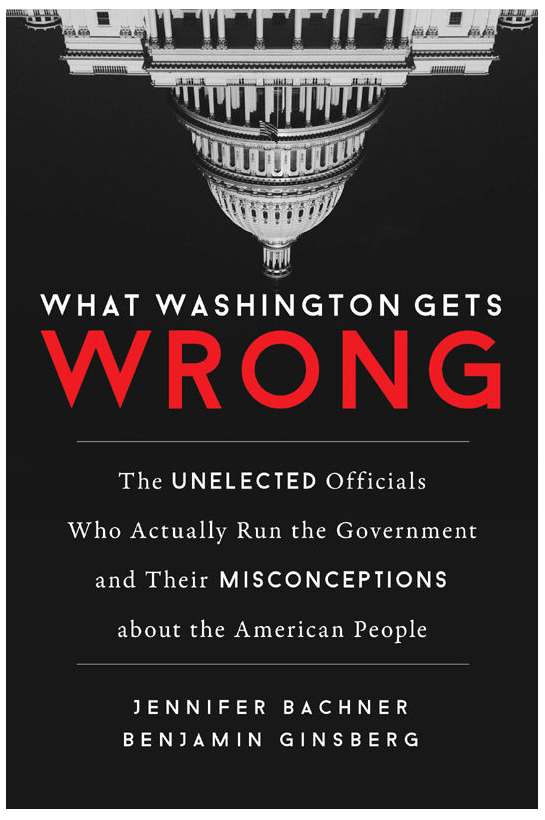
MAIN IDEA:
The main idea of this book is that American system as it was evolved over XX and early XXI centuries is, for all practical purposes, an overwrite of constitution, which substituted the original system of power divided into legislative, executive and judicial with nearly all powerful administrative state run by professional bureaucrats with materially different believes and attitudes than general population. Authors suggest that remedy could be improvement in education of both population and bureaucrats by teaching both of them realpolitik attitude to governance and trying to instill in bureaucrats a notion that their role is to serve population not to lead population to whatever ends they consider beneficial.
DETAILS:
Here is the gist of this book as described by author:
Chapter 1. Unelected Government: The Folks Who Really Run Things
Administrative agencies have become “relatively autonomous,” to borrow an idea from Marxist social theory. Though federal bureaucracies are, to some extent, overseen by Congress, the president, and the courts, America’s administrative agencies exercise a good deal of discretionary authority as they promulgate rules and regulations that have the force of law. For most Americans, in realms ranging from healthcare through air travel, encounters with federal authority involve interactions with administrative agencies. Do these relatively autonomous agencies have appropriate regard or sympathy for the citizens for whom they work?
Chapter 2. The Chasm between Us and Them
Using a statistical measure called propensity scoring, we compare citizens and officials along a number of dimensions. To summarize these comparisons, we introduce a measure we call “civic distance”. This measure is derived from another useful Aristotelian notion, that of Kowov (koinon, or political commonality), and is designed to statistically capture the extent to which citizens and officials inhabit similar political worlds on the basis of education, income, experience, and beliefs. We discover that when it comes to politics, the two groups actually live in rather distinct cognitive universes, viewing issues, policies, and events through disparate lenses.
Chapter 3. What Those Who Govern Really Think about You and Me
Many Washington officials have little regard for the citizens they nominally serve.
Inside the Beltway, ordinary Americans are seen as knowing very little about government and politics and as expressing outlandish and uninformed opinions.
In truth, the attitudinal difference between officials and citizens, though significant, is less than the officials think. Officials tend to exhibit a sense of false uniqueness, thinking themselves so superior that they cannot imagine that ordinary folks share their lofty thoughts. Viewing the public as benighted, officialdom seems more concerned with how best to induce citizens to obey, than with how best to serve the public. Hence, “enforcement” is a hot topic in official Washington.
Chapter 4. What the Government Does versus What the People Want
Officials’ lack of concern or even knowledge of the views of the general public does not leave us with much confidence that the interests of ordinary citizens will carry much weight in the process of administrative rulemaking. Using a data set drawn from the federal government’s Unified Regulatory Agenda, we present an analysis of the determinants of rulemaking by federal agencies. Some scholars assert that the impetus for the thousands of rules and regulations written every year by government agencies is extrinsic – that is, determined by political and other events outside the agencies. Other scholars, though, have argued that the agencies, perhaps working with their supporting constellations of interests and stakeholders, march to and govern according to their own drummers and rhythms! Our study would appear to indicate that the second group is closer to the truth. Congressional intervention into rulemaking seems to bring rules closer to public priorities. Left to themselves, though, administrators’ priorities and those of the more general public seem to diverge. It is no wonders that many Americans believe the government is out of step with their views and are willing to give their support to political outsiders in the 2 of 16 presidential elections.
Chapter 5. What Should Be Done to Make the Government Listen?
Given the findings presented in chapters 1-4, can anything be done to enhance the government’s “sympathy” for the people and the likelihood that policymakers will be guided by popular interests and preferences? Many institutional and procedural reforms are, of course, discussed in the policy and administrative literatures. Our focus is a bit different. We recommend changes in American civic education. Today, under the rubric of civics, American citizens are taught to be good and dutiful subjects. Fortunately, they are not taught very effectively and many quickly forget their classroom history and civics lessons. Officials, on the other hand, with one significant set of exceptions, are taught leadership skills but very little about the people whom they lead or their responsibility to those people. The one exception consists of military officers who do receive training in their duties to the people of the United States. Civilian officials, on the other hand, are taught little or nothing about their duties and obligations to the people. We propose that citizens be taught realpolitik, the German term for political realism, rather than civic mythology to prepare them to be actual citizens rather than subjects. The Athenians distinguished between citizens-individuals who had the capacity to debate in the agora, or marketplace and idiots who lacked that capacity. America could do with more citizens and fewer idiots. We also propose measures that might remind officials of their own civic responsibilities to the citizens whom they nominally serve.
Chapter 6. What If What Should Be Done Isn’t Done?
We conclude by pointing to the significance of our findings for more general issues of representative government. We also consider the relevance of our findings for understanding the major problems associated with the rise of bureaucratic governance in the United States. Bureaucrats are certain that they are more competent than ordinary citizens when it comes to matters of governance. This sense of superior competence, however, can become a dangerous delusion–damaging to both democracy and governance.
Here are a couple of tables demonstrating difference between population and bureaucrats:
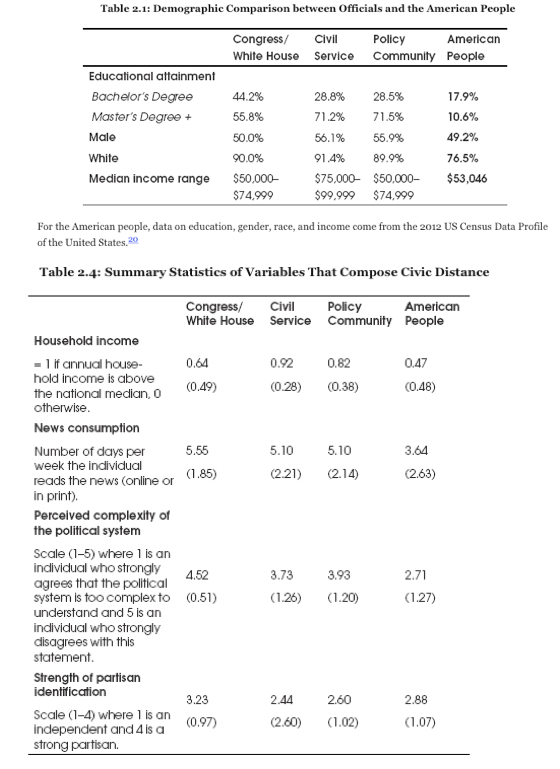

MY TAKE ON IT:
This is a great collection of research and derived knowledge about America’s real ruling class of bureaucrats and politicians. It demonstrates all features typical for such classes: distance from population, arrogance, hubris, and, most important, dogged pursuit of their own interest at the expense of general public. There is no doubt in my mind that this ruling class, as many similar groups in history, would lead country to social disaster unless American exceptional quality of highly distributed wealth, power, and well armed and independently thinking population decisively come into play. Despite all negative developments of the last century and a half, these exceptional qualities of America made it impossible for ruling class of bureaucrats and politicians fully control information flow, discussion about issues, and even selection of issues to discuss. Even their stringent effort to instill Political Correctness as rigid framework limiting speech mainly failed at least so far due to the very strong believe of population in free speech. It also makes it all but impossible to fully control raw power, which is in America traditionally distributed between federal armed forces strongly indoctrinated to face outside of the country, state level forces, multiple police forces, and last but not least multitude of well armed individuals who could easily band together into significant force in case of perceived danger to their freedoms (however illusory these freedoms are). In short, every time in American history, when distance between rulers and population became too obvious and much resented, Americans used formal democratic procedures of election to find some outsiders to elect and at least temporary defeat and diminished the class of ruling bureaucrats and politicians. This was the case with Andrew Jackson 190 years ago and it seems to be the case with Donald Trump now. The key for understanding here is that the rulers’ defeat is only temporary and after all settled, the administrative state would start its growth again – that is, until complete system will change so that all resources would be in full ownership of population in such way that nobody is left behind without resources and therefore no redistribution is possible.
20170211 – Not by Genes Alone

MAIN IDEA:
Culture is the necessary feature of human existence and has deep biological roots providing for coevolution of individual and group with successful group supporting genetic selection of the most fitting individuals, while at the same time providing much more flexible and adaptable set of features supporting group’s cultural survival.
DETAILS:
Chapter 1 Culture Is Essential
The nature of culture as essential feature of human condition is demonstrated here by looking at well-established and well-known pattern of US Southern vs. Northern Culture. The key points here are:
- Culture is critical for understanding human behavior
- Culture is part of biology
The way it works is this: humans genetically predisposed to acquire cultural patterns of behavior from other humans during their childhood and maturation. After such patterns acquired and fully established, they define biological reaction of human organism consistent with this patterns. For example a casual insult to Southerner causes immediate activation of biological response to fighting situation, while similar insult goes practically unnoticed by Northerner’s organism.
Authors provide a nice definition of culture as “information capable of effecting individual’s behavior that they acquire from other members of their species through teaching, imitation, and other forms of social transmission.”
The core theory of culture that authors are supporting is population thinking, that is thinking about a group and its characteristics as much as about individual. They also discuss link between cultural characteristics and individual characteristics formed by genetic and cultural evolutions correspondingly. The connection is strong and clearly has two way character when survival of individual and survival of the group interdependent, albeit not always simultaneous. Generally effective group outcompete less effective, but then normally provides opportunity for inclusion for individuals from defeated group. At the same time individual belonging to winning group quite often had to forfeit individual survival for the sake of the group. This creates an interesting interplay between features promoting individual and group survival.
This logic goes back all the way to Darwin who clearly understood connection between individual and group with culture being practically all covering media between them. However his thought was pretty much ignored by social sciences.
Chapter 2 Culture Exists
The main point here is rejection of popular view that culture is not important and analysis should start and pretty much end at the level of individual. The reasons provided in order to reject this view are:
- Cultural differences account for much of human variation
- The “common garden experiment’ – mental experiment of transfer individual between drastically different environments demonstrates impossibility of survival without possession of appropriate culture.
- Example of natural experiment provided: variance in behavioral patterns between farmers of different cultural background in the same natural environment in Illinois
- Natural experiment of group competition between Noer and Dinka in Africa
- Multiple other examples.
Most important inferences: environment does not explain difference between group in full despite little to none differences in genetic makeup.
Authors also look at dynamic development of culture and find multiple samples of group evolution either internally driven or via process of adaptation from other more successful groups. Also important point is that culture normally evolves via small changes that happen all the time, leading eventually to huge variances in cultures that allow explaining magnitude of human variations.
Chapter 3 Culture Evolves
This is about process of culture evolvement or in other words evolvement of information content of brains that consequently expressed in behavior of these brains owners. Authors look at the acquisition process for believes, skills, and attitudes that actually are culture and define behavior. Here is a nice graphic presentation of the process:


Chapter 4 Culture Is an Adaptation
This chapter is designed to prove that the meaning of culture is adaptation for the group. This is different from usual perception that culture just simplifies individual learning by postulated higher level of knowledge than individual brain is capable of obtaining, leading to qualitative difference between individual and group adaptations. Here are main points that authors make:
- Culture is derived trait in humans
- Social transmission of behavior is common, but much more complex in humans than in other animals
- Cumulative cultural evolution is practically unique for humans
- Cultural transmission based on imitation with selective learning that allows for cumulative improvement
- Culture is adaptable when learning is difficult and environment is unpredictable.
Authors discuss how culture had evolved and present and interesting idea that it could be because of dramatic increase in climate fluctuations making quick adjustment to a change via cultural modification on the same genetically unchanged basis effective tool for survival of human species. Here is graph demonstrating that such increase in fluctuations coincides with human development:
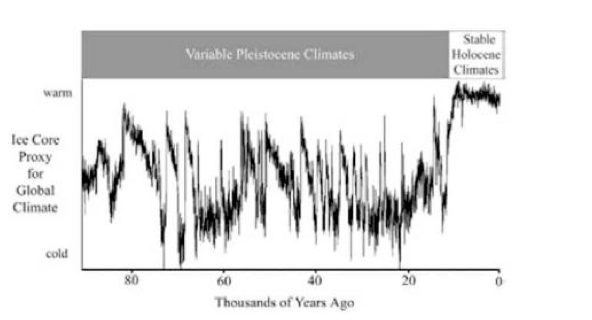
Chapter 5 Culture Is Maladaptive
This chapter is about another side of the story: culture can easily be maladaptive and there are multiple examples of this. Authors point out that it is quite similar to individual evolution when change is tested by environment that define validity of the change whether it increases chances for survival, decreases them or just neutral. They review multiple samples of adaptation and maladaptation driven by culture. The main conclusion here is that culture is built for speed not comfort.
Chapter 6 Culture and Genes Coevolve
This is about coevolution meaning that some cultural features cause genetic selection starting with typical example of lactose tolerance mutation clearly connected to cultural development of animal husbandry. Authors provide quite detailed analysis of egoism vs. selfless behavior within group and then discuss survival rates of groups as continuing process of selection most fitting cultural features. One interesting thing is that failure of a group not necessarily means extinction of its members. Much more typical is incorporation of members of failed group into the winning group with superior cultural features. The final point is that our modern institutions are based on tribal social instincts and that cultural and genetic evolution is practically indivisible and represents one process, albeit clearly two-sided.
Chapter 7 Nothing About Culture Makes Sense Except in the Light of Evolution
The final chapter is designed mainly as response to the question: is dual inheritance theory the proper theory of cultural evolution? The obvious response is yes. It also calls for synthetic theory of human behavior that would include both micro and macro influences that define behavior according to genes, environment and individual psychology, but also includes macro impact from the culture of the group.
The final word is that key for understanding is evolution both genetic and cultural.
MY TAKE ON IT:
This book contains the great amount of supporting scientific material for my believe that human individuals being the product of combination of genes and environment, which to very high degree is defined by the culture of the group individual belongs to. However I would be very careful in applying mathematical methods just because the level of complexity is incredibly high. For beginning in contemporary world individual belongs to a multitude of groups by nationality, ethnicity, locations, and such. It is quite common for individual to go through multiple locations in different periods of live and so on. We’ve got far away from formative experiences of our first 90,000 years as humans, when we lived in the simple world of one person – one group at the time. I think it would take a lot more complex analysis and research to understand dynamics of constantly changing hierarchy of groups and loyalty to them that impact both formation of individual psychological self and everyday behavior in continuously changing circumstances. However the main dynamic: individual survival in interplay with group cultural survival remains key feature of human behavior.
20170204 To Sell is Human

MAIN IDEA:
The most important point of this book is that sales are not kind of activity that is going to disappear. On the contrary, author looks at the sales as an activity of communicating with other people and convincing them to do something (to buy) one is selling, whether these are goods, services, or ideas. In this view selling is the activity that takes significant part of time and efforts for everybody even for people who do not believe that they are in selling business. So the main idea is to look at the process of selling and provide recommendations on how to do it effectively in today’s world.
DETAILS:
Part One Rebirth of a sale man
- We’re All in Sales Now
This chapter starts with the story about the last of disappearing breed of door-to-door salesmen – Fuller Brush man. The story demonstrates that job of selling is far from disappearing, moreover, in reality:

After that discussion goes into characteristics of non-sale selling, which takes about 40% of everybody’s work time and consist of persuading, influencing, and convincing others – critical part of every non-manual job.
- Entrepreneurship, Elasticity, and Ed-Med
This chapter demonstrates that selling is an integral part of any entrepreneurial activity and entrepreneurs are presenting millions of businesses, many without any employees whatsoever. This requires elasticity of skills combining technical organizational and sales specific skills. This follows by example of Ed-Med couple that needs selling skills to work effectively in education and medical services.
- From Caveat Emptor to Caveat Venditor
This chapter starts with description of cultural perception of selling as low activity done by sleazy people. Here is a nice presentation of this attitude by frequency of words use in relation to selling:

Author suggests that this approach while valid in the past due to widely used informational disparity between buyer and seller, leading to seller’s ability to sell lemons, is losing its validity due to Internet and wide availability of information that eliminates disparity. Author demonstrates it by discussing old style auto dealership serving poor and contemporary haggle free big dealership with preset prices and conditions for used cars where honesty really become the best policy.
Part Two HOW to Be
Here author introduces new ABC of successful sales: Attunement / Buoyancy / Clarity
- Attunement
This is about attunement of seller’s action to buyer’s needs that become necessary in order to be successful. The idea of hard sell seems to run out its course and in reality the idea of empathic sale works a lot better. Author also discusses personality features most beneficial for sales: contrary to typical believes it is not Extraverts but rather Ambiverts who generally doing much better than Introverts. Here is nice graph for this:
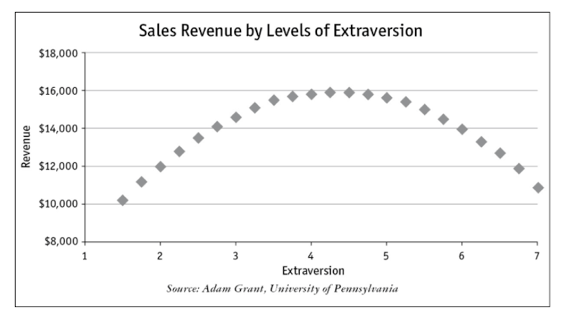
- Buoyancy.
To demonstrate this feature author returns to the Fuller Brash Man and looks at details of his selling process when he returns again and again to the same potential buyer continuously probing and continuously going through the sequence:
- Before: Interrogative Self-Talk – the process of setting up own mood and attitude to be effective in selling, which surprisingly is not command: “I Will”, but rather question: “Will I?”
- During: Positivity Ratios – the positivity here means transmitting such attitude that one’s counterpart was felling that seller does everything possible the process of sale lead to win-win situation. The very interesting thing here is that research seem to identify effective ratio for positive to negative emotions as 3 to 1, with lesser ratio such as 2 to 1 being as bad as negative, while too positive around 11 to 1 becoming counterproductive.
- After: Explanatory Style – here author relies on research of Martin Seligman discoverer of “learned helplessness”. This is related to Attributional Style Questionnaire (ASQ) that measure pessimism-optimism and can-do approaches. The results are: the best approach is optimism with clear eyes to reality. Either pessimism or rose glasses optimism fail.
- Clarity
The chapter on clarity starts with research of Hal Hershfield about retirement saving that discovered an interesting fact about human attitude: people see themselves now and in the future as different entities, so the problem is subconscious resistance: why am I, 35 years old, would make sacrifices for this absolutely unknown stranger – 65 years old me. Author uses this as example of necessity to carefully identify problem and formulating it with complete clarity before trying to solve it. To expand on this idea, author also discusses research by Mihaly Csikszentmihalyi that demonstrated materially higher level of success for people for trying to find problem before acting and people who are trying to solve problem before clearly understanding what it is. The second part of the chapter is about finding correct frame for the problem of sale and here are examples:
- The less Frame – limit choices by eliminating some of them and allocating more effort to analyzing others
- The Experience Frame – people prefer experience to staff, so frame staff as experience
- The Label Frame – this is based of managed perception for example Prisoner’s dilemma framed as “Wall Street game” is played completely different when framed as “ Community Game”
- The Blemished Frame – small negative added to the mix of mainly positive features actually improves chances of success
- The Potential Frame – unknown potential benefits beats know benefits hands down. Nice example: “ He Is the Next big thing” loses to “ He Could Be the Next big thing”.
The final and very important point in this chapter is need for the clarity of future action that author characterizes as off-ramp.
Part Three What to DO
This part is about the process of selling. It defines it as 3 stages continuing process with the first one making people interested through Pitch, the second convincing them to close the deal, and the final after sales service that would create basis for the next sale.
- Pitch
The pitch chapter starts with story of Otis – elevator pitch, which was actually demonstration of save working elevator. It follows with description of 6 types of pitches:
- The one word pitch (Saatchi for MasterCard: Priceless)
- The question pitch (Reagan: Are you better off today?)
- The rhyming pitch (OJ trial: If it does not fit you must acquit)
- Subject line pitch based on Utility, Curiosity, and Specificity
- The Twitter pitch (winner of MBA application contest: Globally minded / Innovative and Driven / Tippie can sharpen)
- The Pixar pitch (The story framework: Once upon a time / Every Day / One Day / Because of that / Because of that / Until finally
- Improvise
This is about improvisation required in process of selling. Here are some tips:
- Hear Offers
- Say “Yes and…”
- Make your partner look good
- Serve
The final chapter is about service – ability to learn how goods or services used and improve this process in such way as to add value to acquired product. Example provided: nudge announcement passengers to control reckless driver in Kenya dramatically decreasing amount of accidents, personification X-ray prints with picture of patient improving recognition of diseases, improving compliance by nurses to procedure by adding purpose to protect patients to hands washing.
MY TAKE ON IT:
In my opinion this book is not really about sales, but rather about communication skills. The diversity of objectives of communication is practically infinite and sale when money exchange takes place is just a small subset of it. This book is a very nice collection of methods of preparation for communication and tools that could be used to make it effective. It is worth to remember and use as needed.
20170128 Who Needs the Fed?
MAIN IDEA:
The main idea here is to explain and demonstrate that Fed existence is not helpful, but rather detrimental to efficient functioning of economy because it cannot effectively fulfill its function to control money supply.
DETAILS:
PART ONE: CREDIT
ONE The Rate Setters at the Fed Should Attend More Taylor Swift Concerts
The first chapter uses example of Uber dynamically changing rate for taxi after popular concert, consequently providing ability to meet demand that was properly decreased by higher price. The point here is to demonstrate that it is not possible establish best price from outside and that this general rule of economics applies to the price of credit that Fed supposedly controls.
TWO Jim Harbaugh, Urban Meyer, and Pete Carroll Would Never Need an Easy Fed
This chapter uses sport to provide example of inefficient use of capital. The lesson here is that entrepreneurs are human and as such make mistakes leading to failure and economy has a tool to clear up consequences of such failure – recessions. The point here is that recessions are not market failure, but rather an act of maintenance of the system, necessary to keep it in good shape.
THREE In Hollywood, the Traffic Lights Are Almost Always Red
This chapter uses Hollywood to demonstrate actual independence of credit and credit rates from Fed, mainly by pointing out that popular actors believed to have potential to produce blockbuster in their next movie have no problem to get vast amount of credit at low rate regardless of economic cycle, while actors who failed could not get credit at any price.
FOUR In Silicon Valley Your Failures Are Your Credit
This is extension of credit cost irrelevance discussion based on example of Silicon Valley where credit is relatively plentiful because huge potential return. The failure here is celebrated as necessary step in acquiring experience that will lead to future win, even if it has a significant feel of lottery in it.
FIVE Did You Hear the One about Donald Trump Walking into a Rank?
This chapter uses examples of Donald Trump and Michael Milken to present idea that the real private credit has overwhelming dependency of character and history of creditor.
SIX Ben Bernanke’s Crony Credit
In this chapter author is moving away from private credit to state interference in credit and uses example of Bernanke and Paulson to demonstrate how government’s violent interference creates huge redistribution opportunity for individuals in possession of intimate connections with and knowledge of bureaucratic hierarchy.
SEVEN What the Supply-Siders and Hillary Clinton Sadly Have in Common
This chapter presents somewhat unusual proposition that supply side economics actually empowers government distortion of economy and misallocation of resources as it is embodied mightily in Hillary’s personality and ideas. The logic here is simple: supply side decrease taxes resulting in increase in government tax revenues as consequence allowing government spent more to bribe more constituencies and increase its power.
EIGHT Why “Senator Warren Buffet” Would Be a Credit-Destroying Investor
This chapter makes another important point to demonstrate necessity of failure. It uses Warrant Buffet and his relatively low rate of capital misallocations to demonstrate that private market feedback allowed for quick reaction in reallocation resources away from unproductive use. If Buffet were a senator there would be no reason for him to react quickly, moreover political resource allocation always includes supporters who receive these resources, therefore reallocating resources to more productive use would cost senator Buffet support of people and would have negative impact for him, while similar reallocation for private investor Buffet would be positive for him by preventive loss or providing bigger gain.
NINE The Credit Implications of the Fracking Boom
This chapter initially discusses complexity and necessity of division of labor (“I, pencil” and similar) and then applies it to credit in fracking industry. The point here is that for global economy credit for fracking is net loss because there are plentiful other reserves of oils that are profitable with traditional and much cheaper technology. Author points out stability of oil price in gold and relate its variation in dollars to political manipulation of dollar. His point is that USA president always get dollar he wants, but gold it constant.
TEN Conclusion: Sorry Keynesians and Supply-Siders, Government Is Always a Credit-Shrinking Tax
The final chapter about the Credit summarizes author’s ideas that credit is nothing more than tool of resource allocation and any government interference in this allocation is really just a tax that moves resources away from productive use. In these terms supply siders who decrease tax rate consequently increasing economy and with it tax returns are guilty in transferring more resources to government bureaucracies to waste.
PART TWO: BANKING
ELEVEN NetJets Doesn’t Multiply Airplanes, and Banks Don’t Multiply Money and Credit
Here author uses example of air rental company NetJets to demonstrate that credit represents real resources and exists outside of banks and feds activities that change money supply. The point is that if one just creates money by fiat and gives it out as credit, this credit would not bring in resources if they do not exists. Since money nothing more than facilitator of credit such fiat would only lead to impediment of real economy.
TWELVE Good Businesses Never Run Out of Money, and Neither DO Well-Run Banks
The point of this chapter is that good business can always get necessary credit as long as creditors believe that it is good. The same applies for banks therefore government demand to keep a share of deposits as cash are meaningless for good banks and would not prevent bad banks from failure.
THIRTEEN Do We Even Need Banks?
This is reference to advance technology that allowed for credit cards and then for crowd financing such as Kickstarter. These developments make banks somewhat outdated. The inference here is that we do not need banks in their current form and they could survive and maintain relevance only if government gets out and allow them compete with all other forms of credit.
FOURTEEN The Housing Boom Was Not a Consequence of “Easy Credit”
This is discussion directed against idea that Housing boom was caused by easy credit. Author repeats his point that monetary credit just represents resources and as such could not increase or decrease their amount, so the crisis occurred mainly to weak dollar policy.
FIFTEEN Conclusion: Why Washington and Wall Street Are Better Off Living Apart
The final conclusion of this part is that close link between banks and government distorted working of economic system in such way that banks got to care about only one customer – government, neglecting all others and it led to gross misallocation of resources.
PART THREE: THE FED
SIXTEEN Baltimore and the Money Supply Myth
This chapter is directed against monetarists. The main point here as elsewhere in this book is that money is just a measure of resources and does not really have any serious impact on resources exchange. As example author uses Baltimore where non-productive welfare recipients would not get better if additional money supply increase their demand because they do not produce anything so this demand would not stimulate Baltimore. In addition to Keynesian solution author rejects gold standard as being far from ideal and suggest that the best way would be to leave money creation to private market where multiple currencies could compete and the most stable and liquid would win.
SEVENTEEN Quantitative Easing Didn’t Stimulate the Economy, Nor Did It Create a Stock-Market Boom
This chapter is discussion directed against Quantitate Easing arguing that government should not use political methods to stimulate spending. The main point here is that QE based on the strange idea that could be buyers without sellers and borrowers without savers.
EIGHTEEN The Fed Has a Theory, and It Is 100 Percent Bogus
This is discussion about Philips curve and another strange believe that economic growth causes inflation and it is somehow connected with decrease in unemployment, so by inflating money Fed can decrease it. Author believes that this idea is 100% wrong because it does not account for global character of the market and, most important, for continuing increase in productivity.
NINETEEN DO We Really Need the Fed?
The obvious answer is clearly “No” for reasons exemplified by Taylor Swift and Barney Madoff – credit is something that borrower already has either as marketable collateral for loan or human capital that represents high probability of future cash flows. By definition Fed function is monetary intervention into market to control inflation and unemployment, which according to author and the last hundred years of history, could not possibly work.
TWENTY End the Fed? For Sure, But Don’t Expect Nirvana
Here author again briefly going through history and discussing Fed’s failures, but he warns it is not really Fed, but government spending that causes the problem and Fed just facilitate this spending.
TWENTY-ONE, Conclusion: The Robot Will Be the Biggest Job Creator in World History
Interestingly enough the concluding chapter is about robots and their impact. Author rejects the idea that robots would push humans out of productive activities and crash economy. He looks at them as dramatic enhancement of productivity making resources and correspondingly credit abundant and therefore giving humans tremendous entrepreneurial opportunities.
MY TAKE ON IT:
I find the author’s idea that credit is not money, but rather representation of resources pretty compelling and his critic of Fed as mainly harmful blunt instrument generally used to hurt economy mainly correct. I think that idea of private money theoretically interesting, but misses a very important issue of transaction costs: any individual on the market would have to spend unordinary amount of time and effort researching validity and efficacy of currency for transaction. I would suggest another solution: to keep Fed as currency insurance tool that could be financed by currency issuer and would provide currency stability insurance on transactional basis. The government involvement here is necessary because its coercion and violence is necessary tools to get access to full information and limit cheating. As for robots as credit enhancers that would just add to human productivity rather than put humans out of work, I think author makes mistake by overestimating human propensity for productive activity. A significant number of individuals, if not the majority would prefer do nothing or pursue completely non-productive objectives if left alone and deprived of external force that makes them to sell labor for living. I really do not think it is a huge problem, but if not taken care of by establishing mechanism of resource allocation for such people, it could become very dangerous source of tension in society.
20170121 The Sharing Economy
MAIN IDEA:
The main idea here is that the radical shift in economics and property rights as its foundation currently is under way. It is shift from ownership economy to sharing economy when people use staff that they do not own, but rather share with other people or exchange it on peer-to-peer basis rather then produce, sell, and distribute this staff via hierarchically structured corporations.
DETAILS:
Introduction
In introduction author explicitly states the main idea of this book and provides main examples of the new economy: Airbnb, Uber, and Facebook. Important point here is author’s understanding that peer-to-peer exchange is not new, but it was key feature of pre-industrial economy. The main and very radical difference is that it used to be local exchange between neighbors and now it is becoming global exchange between strangers. The relatively detailed review of specific business model provides examples of how exactly it is done.
- Cause
- The Sharing Economy Market Economies, and Gift Economies
This is about definition of sharing economy and its nature as notion covering all Market-To-Gift Spectrum of exchange. The key features:
- Largely market based
- High impact capital both material and human
- Crowd-based networks
- Blurring lines between personal and professional
- Blurring lines between fully employed and casual labor
- Extensive use of crowd funding
- Importance of platforms
- Laying the Tracks: Digital and Socioeconomic Foundations
This chapter discusses history of Internet development and digitalization of exchanges from e-bay buying and selling to digital currencies, 3d printing, and even digitization of trust.
- Platforms: Under the Hood
This is about necessity and nature of platforms for sharing economy. It provides an interesting graph for relationship between markets vs. hierarchy and complexity vs. specificity of products or services:


- Blockchain Economies: The Crowd as the Market Maker
The final chapter in this part is about blockchain logic with its distributed transaction posting and its implementation for digital currency (bitcoin) and decentralized services platforms.
II Effect
- The Economic Impacts of Crowd-Based Capitalism
For economic impact author initially discusses deficiencies of usual methods of measuring economy such as GDP and overall difficulties of measuring digital economy. After that he points out four key economic effects:
- Altering capital impact, for example increase ration of use of existing car with Uber
- Economies of scale would be overcome by economies of networks
- Increased Variety = Increased Consumption
- Democratization of Opportunity due to use of platforms and crowd financing, which dramatically decreases cost of entry into practically any economic activity.
- The Shifting Landscape of Regulation and Consumer Protection
This chapter is about dramatic changes that will necessarily come in the area of regulation that would become less government centric and more peers controlled. Here is a nice graph for this:

- The Future of Work: Challenges and Controversies
Here author looks at the change in nature of work with local hands on work providing advantage to semi-skilled workers, while pushing higher skills level workers into more generalist activities with special tasks assigned to machines.
- The Future of Work: What Needs to Be Done
This is discussion of need to do something to counter trends that are pushing humans out of labor market. Author seems to believe that the best way to do it is promote self-employment and contract work with some guarantied safety net. It also seems to be consistent with what people really want:

Concluding Thoughts
Here author briefly restated main points he made in each chapter and reaffirms his believe that we are in process of moving away from managerial capitalism of XX century to crowd-based capitalism of XXI century that will provide for much more informed decisions by consumers, new regulatory framework to rebalance private-public relationships, and establish new, yet unknown form of society.
MY TAKE ON IT:
I fully agree that we are in process of revolutionary change in the method of economic organization of society comparable with industrial revolution. However I do not share most of ideas about shared economy, mainly because I believe that value of material assets is going down dramatically, therefore idea of savings coming for example from sharing car looks a lot less attractive if cost of car represents not 6 month of earnings, but rather 6 days of earnings. In this case instead of Uber self-driving car picking one up on demand a person would have one’s own car finely tuned to personal needs and idiosyncrasies. Similar approach could be applied to just about everything. To put in simple, I believe in dramatic increase in ownership of everything made possible by dramatic decrease of costs of everything, rather than savings due to increase in asset utilization via sharing. Similarly instead of massive service economy where everybody makes living by serving everybody, I believe we are moving to automated economy when machines are serving everybody, while humans are busy conducting self-serving activities some of which would include non-quantifiable services to each other.
20170114 Bourgeois Equality

MAIN IDEA:
The main idea of this book is deeply counter Marxist and even counter materialistic. It posits that tremendous growth in productivity and wellbeing of humanity over last 300 years was caused by dramatic change in ideological attitudes to the business and bourgeois middle class that represents it. The attitude changed from complete contempt traditionally expressed by aristocracy, clerisy, and peasantry to respect and even somewhat adulation. Author calls the new ideology “Trade Tested Betterment”, meaning that economic players have incentives to improve productivity, types of goods and services they produce, and then put it out for test by free market competition where some of these would survive and some would not. As the result it opened the way for population to produce and exchange goods and services relatively freely with diminishing of usual intervention of state in their business, and, moreover, allowed retaining profits in the hands of producers. The secondary idea however is that starting in 1848 the clerisy conducted successful complain against dignity of business resulting in catastrophic revolutions of XX century and dramatic slowdown of economic development in early XXI century. The fight is still on and it is not clear yet whether clerisy will succeed in stopping capitalist development of humanity.
DETAILS:
First Question: What Is to Be Explained?
Part I A Great Enrichment Happened, and Will Happen
1 The World Is Pretty Rich, but Once Was Poor; 2 For Malthusian and Other Reasons, Very Poor; 3 Then Many of Us Shot Up the Blade of a Hockey Stick; 4 As Your Own Life Shows; 5 The Poor Were Made Much Better Off; 6 Inequality Is Not the Problem; 7 Despite Doubts from the Left; 8 Or from the Right and Middle; 9 The Great International Divergence Can Be Overcome
This part reviews dramatic results of economic development of capitalist countries over the last 300 years comparatively with not only previous development, but also with contemporary development of countries that did not move to Trade Tested Betterment. The results are amazingly obvious: not only western countries that embarked on this methods of society organization prospered, but also big eastern countries such as China and India moved to prosperity as soon as they started to use the same approach. Side story here is that it impacted not only rich, it improved lives of poor even more so these poor now have more access to goods and services than rich of the past.
Second Question: Why Not the Conventional Explanations?
Part II Explanations from Left and Right Have Proven False
10 The Divergence Was Not Caused by Imperialism; 11 Poverty Cannot Be Overcome from the Left by Overthrowing “Capitalism”; 12 “Accumulate, Accumulate’ Is Not What Happened in History; 13 But Neither Can Poverty Be Overcome from the Right by Implanting “Institutions”; 14 Because Ethics Matters, and Changes, More; 15 And the Oomph of Institutional Change Is Far Too Small; 16 Most Governmental Institutions Make Us Poorer
This part looks at traditional explanations for explosive growth in productivity such as Imperialistic robbery of resources from other countries, accumulation of capital, development of new institutions, and wise governmental policies. Author rejects all these explanations because: divergence in Europe that caused continuing improvement in militaristic performance provides good reasons for European dominance over the world, but could not explain internal improvements in productivity. Accumulation of capital could not explain it either, because countries that had longer history of development like China did not get there first despite such huge capital investment as irrigation systems or great wall. The idea of institutional explanation also does not hold water because laws, effective property rights, and such existed for a long time, but did not lead to any significant improvement in economic growth. Actually author accepts role of institutions as necessary condition of improvement, but denies their sufficiency and even provides small chapter on deleterious effect of some government institutions on economic growth.
Third Question: What, Then, Explains the Enrichment?
The next 6 parts trying to explain how exactly the great enrichment occurred by looking at different sides of ideological processes in western societies.
Part III Bourgeois Life Had Been Rhetorically Revalued in Britain at the Onset of the Industrial Revolution
17 It Is a Truth Universally Acknowledged That Even Dr. Johnson and Jane Austen Exhibit the Revaluation; 18 No Woman but a Blockhead Wrote for Anything but Money; 19 Adam Smith Exhibits Bourgeois Theory at Its Ethical Best; 20 Smith Was Not a Mr. Max U, but Rather the Last of the Former Virtue Ethicists; 21 That Is, He Was No Reductionist, Economistic or Otherwise; 22 And He Formulated the Bourgeois Deal; 23 Ben Franklin Was Bourgeois, and He Embodied Betterment; 24 By 1848 a Bourgeois Ideology Had Wholly Triumphed
This part looks at representation of bourgeoisie in literature using examples of novels by Jane Austin and plays by Samuel Johnson. However the most attention author allocates to Adam Smith, but not to his usually discussed economic masterpiece “Wealth of Nations”, but to his less known “The Theory of Moral Sentiments” in which Smith discusses complexity of bourgeois ideology, stressing that it goes way beyond purely material (prudential) considerations. There is a very interesting moral and ideological interplay between bourgeois need in honesty and trustworthiness that dramatically decreases cost of transactions and enticement of monopoly and use of informational disparity between seller and buyer. One important point is that bourgeois control over political power could remain bourgeois only in condition of democracy when individuals currently in power could not use it to stop competition and consequently betterment. When they are able to do it bourgeois order naturally degrades into aristocracy as it did happened in Venice and many other places. There is also interesting discussion here about virtues nicely presented by diagram below:

Author also discusses “the Bourgeois Deal” as it was formulated by Adam Smith, which actually contains not one but two “invisible hands”. In addition to “invisible hand” of market forces it has “invisible hand” of “natural liberty” that removes very visible hand of the state from controlling and directing individual actions leaving choice of winners and losers to market place only. As example author analyses Ben Franklin’s live as quintessential bourgeois type. Finally in this part author looks at classes and their values: Aristocrat vs. Peasant vs. Bourgeois and trying to prove that by 1848 the Bourgeois triumphed over Aristocrat and Peasant. Here is a nice table for this comparison:

Part IV Pro-Bourgeois Rhetoric Was Forming in England around 1700
25 The Word “Honest” Shows the Changing Attitude toward the Aristocracy and the Bourgeoisie; 26 And So Does the Word “Eerlijk”; 27 Defoe, Addison, and Steele Show It, Too; 28 The Bourgeois Revaluation Becomes a Commonplace, as in The London Merchant; 29 Bourgeois Europe, for Example, Loved Measurement; 30 The Change Was in Social Habits of the Lip, Not in Psychology; 31 And the Change Was Specifically British
This is about formation of the new ideological attitude to bourgeois activities and people. It starts with tracing development of the world “honest” in literature and general use from aristocratic meaning of belonging to upper class of society to purely bourgeois meaning of acting honestly – truthfully, without cheating and deceit. Similar change occurred in attitudes to trade, the typical bourgeois activity – it went from being despised activity of low-born to, if not necessary noble, then quite decent, productive, and highly approvable. It went in parallel with advancement of typical bourgeois attitude to the world: learning objective facts and acting in accordance to them to achieve success. Author provides evidence from literature and historical evidence to support these ideas. Author however stresses that change was mainly rhetorical, rather than psychological and importantly occurred in the British world.
Part V Yet England Had Recently Lagged in Bourgeois Ideology Compared with the Netherlands
32 Bourgeois Shakespeare Disdained Trade and the Bourgeoisie; 33 As Did Elizabethan England Generally; 34 Aristocratic England, for Example, Scorned Measurement; 35 The Dutch Preached Bourgeois Virtue; 36. And the Dutch Bourgeoisie Was Virtuous; 37 For Instance, Bourgeois Holland Was Tolerant, and Not for Prudence Only
However even in Britain the rhetorical change was somewhat superficial. In this part author provides multiple examples of persistent contempt to bourgeoisie from Aristocracy and Intelligentsia from Shakespeare to any typical politician or lord by using multiple examples from literature of the period to confirm this point. However author also looks at the country where bourgeois virtues actually become the core of national culture – Netherlands. Especially important was such typically bourgeois virtue as tolerance extended far beyond tolerance to diverse trading partners to religious and political attitudes on individual level.
Part VI Reformation, Revolt, Revolution, and Reading Increased the Liberty and Dignity of Ordinary Europeans
38 The Causes Were Local, Temporary, and Unpredictable; 39 “Democratic” Church Governance Emboldened People; 40 The Theology of Happiness Changed circa 1700; 41 Printing and Reading and Fragmentation Sustained the Dignity of Commoners; 42. Political Ideas Mattered for Equal Liberty and Dignity; 43 Ideas Made for a Bourgeois Revaluation; 44 The Rhetorical Change Was Necessary and Maybe Sufficient
This part is an attempt to identify reasons for this change. Author rejects the idea that such change was preordained part of inevitable progress and believes that it was just serendipitous combination of factors often local and temporary that led to change in attitude. One of the most important was religious change in theology of happiness from passive attitude of “’god willing” to active attitude “work hard to get there”. The significant part of the process was availability of printing and explosion of reading and discussing political matters. At the end of this part author promotes idea that rhetorical change in attitude to bourgeoisie was not only necessary, but also maybe even sufficient to start up process of great enrichment via trade-tested betterment.
Part VII Nowhere Before on a Large Scale Had Bourgeois or Other Commoners Been Honored
45 Talk Had Been Hostile to Betterment; 46 The Hostility Was Ancient; 47 Yet Some Christians Anticipated a Respected Bourgeoisie; 48 And Betterment, Thou Long Disdained, Developed Its Own Vested Interests; 49 And Then Turned; 50 On the Whole, However, the Bourgeoisies and Their Bettering Projects Have Been Precarious
Here author discusses traditional disdain to trade typical for practically all cultures and people. One of the reasons for this is that bourgeois methods require the development of relatively high levels of human contacts. Here is nice table for this:
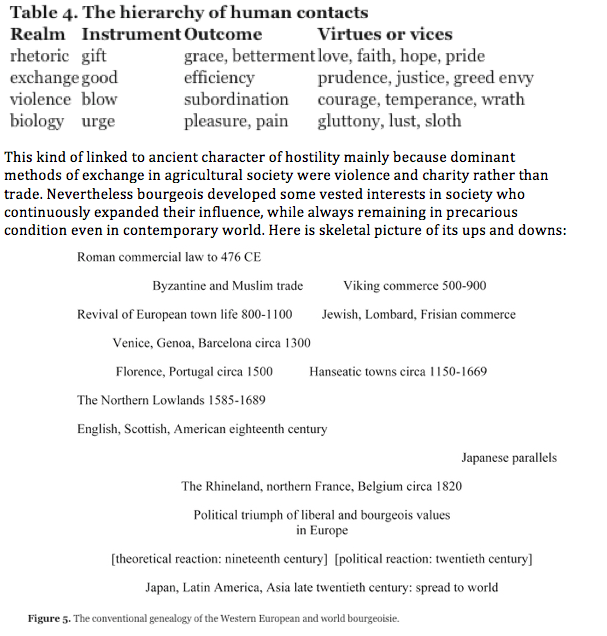
Part VIII Words and Ideas Caused the Modern World
51 Sweet Talk Rules the Economy; 52 And Its Rhetoric Can Change Quickly; 53 It Was Not a Deep Cultural Change; 54 Yes, It Was Ideas, Not Interests or Institutions, That Changed, Suddenly, in Northwestern Europe; 55 Elsewhere Ideas about the Bourgeoisie Did Not Change
This part is about words being the core of economic activities and how they changed dramatically and quickly. Author analyses share of economic activities, that is mainly dependent of verbal activities, and finds that it by far exceeds any other activities involved in generating goods and services. Author also provides example of quick change in rhetoric leading to dramatic consequences such as brief and murderous rule of Khmer Rouge. Author also reviews and rejects other potential causes of the change such as institutions and interests, claiming that these did not change that much. Finally author compares other parts of the world where attitude to bourgeoisie did not change and finds that they also did not have anything like economic revolution of the western countries.
Fourth Question: What Are the Dangers?
Part IX The History and Economics Have Been Misunderstood
56 The Change in Ideas Contradicts Many Ideas from the Political Middle, 1890-1980; 57 And Many Polanyish Ideas from the Left; 58 Yet Polanyi Was Right about Embeddedness; 59Trade-Tested Betterment Is Democratic in Consumption; 60 And Liberating in Production; 61 And Therefore Bourgeois Rhetoric Was Better for the Poor;
To answer the question about future author first summarizes history of economic ideas about reasons and causes of drastic economic growth of the last few centuries. Author looks again at North and Thomas ideas of institutional development, XIX century Marxist ideas of capital accumulation, contemporary redistributionist ideas based on zero sum economy. Author allocates lots of space to polemics against Polanyish ideas of capitalism as recent development despite plentiful evidence of existence of market economy and property right for thousands years throughout human history. Here is a nice table demonstrating various ideological constructions:

The last two chapters of this part are restating author’s logic that change in rhetoric and attitudes led to trade-tested betterment as key method of economic activities in western societies leading to dramatically improved productivity and innovation and consequently improvement in lives of everybody including poor.
Part X That Is, Rhetoric Made Us, but Can Readily Unmake Us
62 After 1848 the Clerisy Converted to Antibetterment; 63The Clerisy Betrayed the Bourgeois Deal, and Approved the Bolshevik and Bismarckian Deals; 64 Anticonsumerism and Pro-Bohemianism Were Fruits of the Antibetterment Reaction; 65 Despite the Clerisy’s Doubts; 66 What Matters Ethically Is Not Equality of Outcome, but the Condition of the Working Class; 67A Change in Rhetoric Made Modernity, and Can Spread It
The last part reviews ideological development after 1848 when bourgeois value again came under sustained attack, this time not from Aristocracy, but from the increasingly numerous and consequently empowered part of population – Clerisy. Either in its Bismarckian relatively benign welfare state or in its radical bloodthirsty Bolshevik / Nazi incarnation XX century societies were mainly driven by Clerisy with its rejection and contempt for all things bourgeois. As result the economic development and prosperity growth in parts of the world where Clerisy’s ideas become dominant where slowing down or even reversed. Author demonstrates how it happens and keeps pressing the idea that we need to reject clerisy’s anti-betterment efforts and unmask their reasons: income inequality and similar fuses used by Clerisy are false narratives because in reality bourgeois rhetoric and practice led to tremendous improvement in lives of regular people and this is what really matters.
MY TAKE ON IT:
It is somewhat difficult for me, with my Marxist education and background, to accept author’s main position that it was the ideas that matter the most, not material and technological development. Nevertheless I find it very stimulating to look at reasons for industrial revolution in human minds rather than in steam engine and I think it is the right place to look at. However I do not think that explanation of the ideological change, as mainly serendipitous event, is good enough. I personally believe that it is much more realistic to look at it as the consequence of interplay of Darwinian struggle for survival at two levels: individual and group. The individual struggle occurs within society and has mainly peaceful character because alternative is chaos that inevitably leads to dysfunction of society. The struggle between groups however more often than not leads to intermediate change from war to peace and back, but could never be completely settled in peace until groups merge or one group annihilates another. Two developments are possible and actually occurred in history. One is unification of society as one group big enough so wars or trade with external societies have only marginal effect as it happened in China or Russia. In this case Clerisy, which controls organized power in all societies, becomes dominant and just does not allow development of bourgeois ideas and dignity to occur. In this case individual struggle comes down to meritocratic advancement via some kind of examination and/or bureaucratic maneuvering. Another model of development: small states always in war and/or extensive trade with each other eventually bound to generate 2 different power centers in society: Aristocracy that handle the war and Bourgeoisie that handle the trade. On early stages of development before effective firearms developed Aristocracy has huge advantage in use of power because it is mainly manual and requires constant training so one well trained man with a sword can easily overcome a dozen untrained individuals with exactly the same type of swords. In this case Aristocracy could not only require significant share of production as payments for protection from external groups and maintaining internal order, but also just take whatever it wants from actual producers internally within a group (society). As soon as firearms become effective, bourgeoisie can protect itself with minimal training, refuse Aristocracy’s unlimited ability to take and start imposing its own virtues on society. Eventually with development of mass mobilization and conscript armies it becomes capable to send Aristocracy to dustbin of history. However the following peaceful consolidation of society and consequently its wealth and complexity causes expansion of growth and with it expansion of Clerisy required to maintain order and internal interactions in complex society in its role as bureaucracy, but in process producing multitude of individuals with expensive qualifications, but no ability to find good place in bureaucracy or aptitude to achieve level of success in business that they feel entitled to. Logically either bureaucratic or redundant parts of Clerisy necessarily reject bourgeois values as incompatible with their values. The key differences in values are caused by methods of achieving success: Trade Tested productive work for bourgeoisie and Formal Testing and Bureaucratic maneuvering for Clerisy.
We are living at the moment of continuing struggle between these two groups with periodic change from Clerisy winning, and then leading to economic downfall, decrease in prosperity for everybody except for corrupted top-level members of Clerisy. Eventually it gets rejected by majority, causing Bourgeoisie winning, and then leading to economic improvement overall, but dramatic increase in inequality between winners and losers, with significant number of losers being educated members of Clerisy capable organizing losers into movement to reject Bourgeois order in reestablish Clerisy dominance. I believe this periodic process is coming to the end, but it would take another 50-100 years to find new structure of society where Clerisy would become unnecessary and Bourgeois ideas of Trade-tested Betterment will completely win.
20170107 Where They Stand (Presidents)

MAIN IDEA:
The main idea of this book is to review success or failure of presidents from two different angles. One is the evaluation of contemporaries based on voting history: winning 2 terms and leaving next president of own party constitute success. One term or change of party in power after the second term constitutes failure. The second angle is history evaluation, which actually means evaluation by historians based on a number of polls. This angle is highly subjective and susceptible to influence of historians’ own political views, which are typically leftist, big government supporting views. From this point of view whoever president increased size and power of government is a good president. The other set of ideas reviewed is about what makes or breaks individual’s reputation as good or great president. This is highly dependent on circumstances: war vs. peace, massive change in direction of the country make presidents great like Lincoln or FDR, while continuation of prosperity and prevention of big political earthquakes like Coolidge or Eisenhower does not.
DETAILS:
PART I: THE HISTORIANS
Chapter 1. The Judgment of History
This is about history of surveys of historians about presidents that started in 1948 by Arthur Schlesinger and continues ever since with some presidents going up and others down in ratings, but with relatively small variations.
Chapter 2. The Vagaries of History
This chapter nicely demonstrates how historians’ evaluations are dependent on the latest greatest book published by the same historians about one president or another.
PART II: THE PEOPLE
Charter 3. The Making of the Presidents
This is about history of presidency as institution and how it changed over time moving from the office of equal or even somewhat inferior power to legislature early in XIX century to the office consistently getting more power during civil war, even if it was somewhat diminished after the war. Eventually starting with Teddy Roosevelt early in XX century it was gaining more and more power, eventually achieving levels of contemporary imperial presidency.
Chapter 4. The Presidential Referendum
This chapter is about presidential election as referendum on results of the president in power. It includes description of 13 Keys (6 false keys means party change) for reelection, which predictable power was ones again confirmed by elections of 2016:
Chapter 5. The Judgment of the Electorate
This is about judgment of electorate based on examples of presidents Cleveland who had 2 non-consecutive terms failing to be reelected both times, Madison and Grant who were both reelected and left their party in power after the second term.
Chapter 6. The Stain of Failure
The meaning and making of presidential failure discussed here using examples of presidents Harding, Taylor, Fillmore, and Pierce. However the most detailed discussion of failure provided is about pre-civil war Buchanan who basically created conditions for the war and after civil war Andrew Jonson who made recovery extremely difficult. This chapter based on historians’ evaluation and being leftist creatures they are, they include in failure both Coolidge who avoided depression after market crash in early 1920-21 by using laissez faire policy and Hoover who was instrumental in creating great depression after market crash in 1929-33 by strong governmental intervention.
PART III: THE TEST OF GREATNESS
Chapter 7. War and Peace
This is review of war presidents and analysis of which of them achieved greatness and which did not. It reviews Madison – War of 1812(Success), Polk – Mexican War (Success), Lincoln – Civil War (Success), and McKinley – Spanish War (Success), Wilson – WWI (Failure), Roosevelt – WWII (Success), Truman – Korean War (Failure), Johnson – Vietnam War (Failure), Bush I – Iraq War (Success). Author stops here and does not include the latest wars.
Chapter 8. Split-Decision Presidents
These are presidents who succeed in getting the second term, but failed to leave their party in power. Usually it is result of second term being a lot less successful than the first. Examples provided are Eisenhower and Nixon, the former relatively successful, but not enough to keep power by smallest margin possible, but the latter completely failed with Watergate making it impossible to maintain power for the party.
Charter 9. Leaders of Destiny
These are presidents who drastically changed nature of the system leaving America after their rule practically different country. There are only three such revolutionary presidents so far: Washington, Lincoln, and Franklin Roosevelt.
PART IV: REPUTATIONS IN FLUX
Chapter 10. Republican Resurgence
Author included into this category two republican presidents Reagan and Bush I. It seems to be because these two are republicans and therefore generate strong rejection by historians who have difficulty to accept success of ideologically hostile presidents. Nevertheless both of them seem to get more appreciation over time so their rating will probably improve.
Chapter 11. The Post-Cold War Presidents
This is about Clinton and Bush II both of which managed to get the second term, but failed their party. Obviously it is too early to look at history judgment because not enough time expired since their presidencies.
Conclusion: Clear and Present Danger
Here author discusses success of the office of president historically and difficulties of present time for America. He concludes that it looks like we are due for the next Leader of Destiny to put America in the position to succeed in the XXI century.
MY TAKE ON IT:
It is a nice review of American presidency, but it seems to be leaving out of discussion historical development of the office and change in its relative power comparatively to Congress and Judiciary. It is missing the whole appearance in XX century of the new practically independent power that is, while under formal control of president, in reality become more than semi-independent and probably even the most powerful in in lives of regular people – Administrative state. However I find methodology of defining success or failure somewhat unequally divided into objective – decided by voters in election and subjective – decided by historians. The weakness of second part is in ideological makeup of historians who are bound to be big government supportive type just because it the subject of their profession, which is mainly studying actions of individuals in the office of president. I would like to see additional point of view of constitutional scholars discussing which president strengthened and which weakened constitutional foundation of republic.
20161231 Pre-Suasion
MAIN IDEA:
The main idea of this book is to extend scientific information provided in previous book “Influence”, by adding the new dimension to the process of persuasion: timing. This new dimension changes process of influence from static to dynamic, looking at it from point of view of time dependent conditions both surrounding individuals and established internally in his/her mind. These include creation of “privileged moments” when individuals is highly susceptible to persuasion, taking control over individual’s narrow beam of attention, invoking associations supportive for ideas of persuasion, using human tendency to seek confirmation from others, and acting in sync with representative group to smooth down path to persuasion.
DETAILS:
Part 1: PRE-SUASION: THE FRONTLOADING OF ATTENTION
- PRE-SUASION: An Introduction
The chapter starts with author’s reminiscence of attending multiple sales seminars to learn technics used by successful salespeople to convince people to buy their staff. The main take out from this experience was author’s understanding that these skills are quite effective and learnable. As example author provided the narrative about successful use of persuasion upon himself when he was convinced to teach MBA class even if it impeded with his previous plans. As it is typical for a good teacher, author provided a nice synopsis of this book.
- Privileged Moments
This chapter explicates the concept of privileged moments, identifiable points in time when an individual is particularly receptive to a communicator’s message. The chapter also presents and supports a fundamental thesis: the factor most likely to determine a person’s choice in a situation is often not the one that offers the most accurate or useful counsel; instead, it is the one that has been elevated in attention (and thereby in privilege) at the moment of decision.
- The Importance of Attention… Is Importance
This chapter explores and documents one central reason that channeled attention leads to pre-suasion: the human tendency to assign undue levels of importance to an idea as soon as one’s attention is turned to it. The chapter looks at the effects of channeled attention in three different arenas: effective online marketing efforts, positive consumer product reviews, and successful wartime propaganda campaigns.
- What’s Focal Is Causal
This chapter adds a second reason for why channeled attention leads to pre-suasion. In the same way that attentional focus leads to perceptions of importance, it also leads to perceptions of causality. If people see themselves giving special attention to some factor, they become more likely to think of it as a cause. The influence-related upshots of the “what’s focal is presumed causal” effect are examined in domains such as lottery number choices and false confessions in police interrogations.
- Commanders of Attention 1: The Attractors
If elevated attention provides pre-suasive leverage, are there any features of information that automatically invite such attention and therefore don’t even require a communicator’s special efforts? This chapter examines several of these naturally occurring commanders of attention: the sexual, the threatening, and the different.
- Commanders of Attention 2: The Magnetizers
Besides the advantages of drawing attention to a particular stimulus, there is considerable benefit to holding it there. The communicator who can fasten an audience’s focus onto the favorable elements of an argument raises the chance that the argument will go unchallenged by opposing points of view, which get locked out of the attentional environment as a consequence. This chapter covers certain kinds of information that combine initial pulling power with staying power: the self-relevant, the unfinished, and the mysterious.
Part 2: PROCESSES: THE ROLE OF ASSOCIATION
- The Primacy of Associations: I Link, Therefore I Think
Once attention has been channeled to a selected concept, what is it about the concept that leads to a shift in responding? All mental activity is composed of patterns of associations; and influence attempts, including pre-suasive ones, will be successful only to the extent that the associations they trigger are favorable to change. This chapter shows how both language and imagery can be used to produce desirable outcomes such as greater job performance, more positive personnel evaluations, and, in one especially noteworthy instance, the release of prisoners kidnapped by the Afghan Taliban.
- Persuasive Geographies: All the Right Places, All the Right Traces
There is geography of influence. Just as words and images can prompt certain associations favorable to change, so can places. Thus, it becomes possible to send us in desired directions by locating to physical and psychological environments prefit with cues associated with our relevant goals. It’s also possible for influencers to achieve their goals by shifting others to environments with supportive cues. For instance, young women do better on science, math, and leadership tasks if assigned to rooms with cues (photos, for example) of women known to have mastered the tasks.
- The Mechanics of Pre-Suasion: Causes, Constraints, and Corrective
A communicator pre-suades by focusing recipients initially on concepts that are aligned associatively with the information yet to be delivered, but by what mechanism? The answer involves an underappreciated characteristic of mental activity: its elements don’t just fire when ready they fire when readied. This chapter examines this mechanism’s operation in such varied phenomena as how advertising imagery works, how infants can be pre-suaded toward helpfulness, and how opiate drug addicts can be pre-suaded into performing an important therapeutic activity that none would consent to otherwise.
Part 3
BEST PRACTICES: THE OPTIMIZATION OF PRE-SUASION
- Six Main Roads to Change: Broad Boulevards as Smart Shortcuts
On which specific concepts should an audience’s attention be focused for the greatest pre-suasive effect? Attention should be channeled to one or another of the universal principles of influence treated in my earlier book, Influence: reciprocity, liking, authority, social proof, scarcity, and consistency. There is good reason for their prevalence and success, for these are the principles that typically steer people in the fight direction when they are deciding what to do.
- Unity 1: Being Together
This chapter reveals an additional (seventh) universal principle of influence: unity. There is a certain type of unity-of identity-that best characterizes a “We” relationship and that, if pre-suasively raised to consciousness, leads to more acceptance, cooperation, liking, help, trust, and, consequently, assent. The chapter describes the first of two main ways to build “We” relationships: by presenting cues of genetic commonality associated with family and place.
- Unity 2: Acting Together
Besides the unitizing effect of being together in the same genealogy or geography, “We” relationships can result from acting together synchronously or collaboratively. When people act in unitary ways, they become unitized; and when such activity is arranged pre-suasively, it produces mutual liking and support. This chapter provides illustrations in the forms of greater helping among strangers, cooperation among teammates, self-sacrifice among four-year-olds, friendship among schoolchildren, love among college students, and loyalty between consumers and brands.
- Ethical Use: A Pre-Pre-Suasive Consideration
Those using a pre-suasive approach must decide what to present immediately before their message. But they also have to make an even earlier decision: whether, on ethical grounds, to employ such an approach. Often, communicators from commercial organizations place profit above ethics in their appeals. Thus, there is reason to worry that the pre-suasive practices described in this book will be used unethically. However, this chapter argues against unethical use, offering data from studies indicating that such tactics undermine organizational profits in three potent ways.
- Post-Suasion: Aftereffects
Pre-suaders want to do more than create temporary changes via momentary shifts in attention; they want to make those changes durable. Accordingly, this chapter provides the behavioral science evidence for two kinds of procedures that increase the likelihood that changes generated initially will take root and last well beyond pre-suasive moments.
MY TAKE ON IT:
It’s a very good, very professional, and well supported by data analysis of the art of persuasion. The one general problem with it is that human beings are learning creatures and the very fact of discovering and formalizing tools of persuasion makes them less and less effective when more and more people learn about them and develop countermeasures. So for the practitioner of art of persuasion it is a good methodological toolset until its specific tools become common knowledge. On the defensive side of persuasion game it is not less valuable providing access to this knowledge while its methods are still very potent. It is somewhat similar to eternal straggle between viruses and antibodies with scientific psychological research being kind of vaccination against being manipulated by other people. On these terms this book is a great set of multifarious vaccine protecting against a number of widely circulating viruses.
20161224 – The Inner Life of Markets
MAIN IDEA:
The main idea of this book is to review history of development of economic thought after WWII and attempt to provide guidance for future development. The period covered by this book was period when Marxist ideas of superiority of central planning, so popular earlier and actually implemented in many countries at the cost of hundreds of millions of deaths, proved to be spectacular failure, while ideas of relatively free markets proved to be not less spectacular success. However authors’ ideas are far from unequivocal support for the free market. They rather believe that free market is susceptible to failure and requires a wise guidance of somebody outside and above its trivialities.
DETAILS:
Introduction: Terms of Service
Here authors discuss their intentions in writing this book and it comes down to providing a guide to “Terms of Services” for the world we live in, the word saturated with multitude of markets.
1 Why People Love Markets: R. A. Radford’s Stiff Upper Lip and the Economic Organization of POW Camps
This is tory of spontaneous development of primitive market in POW camps in Germany and Japan where inmates exchanged their rations and everything else they could use. The point here is that even in such conditions market function actually saved lives by automatically allocating resources to the individuals who needed these resources most, consequently improving effective use of these resources. This analysis is very powerful because various camps had various rules allowing markets function or forbidding it. The result was higher level of survival in camps with functioning market.
- The Scientific Aspirations of Economists, and Why They Matter: How Economics Came to Rule the World
This is about mathematization of economics in the years after WWII. Authors see it as continuation of Pareto work and intermixes it with general mathematization of strategy via theory of games at RAND. Authors consider Paul Samuelson with his General Equilibrium to be the most important economist of this period. They also mention Ken Arrow and his mathematical prove of Equilibrium existence theorem. However Arrow’s theorem required postulation of a number of highly unrealistic assumptions that actually made it all into abstract play with no practical meaning whatsoever. Authors briefly discuss input of Robert Solow with his various grades of capital, Gary Becker with his human capital, and Josef Stiglitz with his prove of ability of inconvenient reality to destroy Equilibrium, rending them model useless.
- How One Bad Lemon Ruins the Market: That’s for Me to Know and for You to Find Out (But Only When It’s Too Late)
This chapter is about the role of information disparity between buyer and seller also know as Market for Lemons thanks to George Akerlof’s article. It discusses application of these ideas in E-commerce, specifically E-bay operations. At the end of chapter authors conclude that information disparity is unavoidable as well as existence of individuals happily applying it to unethical uses.
- The Power of Signals in a World of Cheap Talk: Face Tattoos and Other Signs of Hidden Qualities
This chapter is about power of signals uses an interesting story about gang tattoos serving as powerful signal of belonging that capable completely define individual’s live and death. After that authors review typical market signaling methods with special attention to mixed signals and cost of signal as method to support its validity.
- Building an Auction for Everything: The Tale of the Roller-Skating Economist
This is about auction theories that become very popular late in XX century. It reviews a number of various types of auctions, their advantages and disadvantages.
- The Economics of Platforms: Is That a Market in Your Pocket or Are You Just Happy to See Me?
This is about the old economic notion of platform that recently become highly popular due to Internet with its preponderance of platform as the most effective form of monopoly in contemporary world. It discusses pre-internet platform of credit cards and theory of two-sided markets and role of platform as necessary intermediary between sides developed by Jean Tirole.
- Markets Without Prices: How to Find a Prom Date in Seventeen Easy Steps
This chapter is about the huge market, which has a lot bigger role in human live than anything else: market where voluntary exchange of goods and services occurs without intermediate use of money. It includes dating, all kinds of interactions between kin and kith, and charity. Authors review applications of newly developed algorithms for matching of everything and everybody from school dance couple to doctorate students assignments, to school choices. This is based on work of market designer Al Roth.
- Letting Markets Work: How a Hardcore Socialist Learned to Stop Worrying and Love the Market
This is kind of extension of the previous chapter with a small quirk about how reality forced even hard core socialists, dedicated to non-monetary work in capitalist society, accept necessity of market driven solution if they want to achieve positive results. Examples reviewed here are from simple school problem of lack of enough hooks for overcoats that could be resolved by assigning price, to distribution of free food, which becomes much more effective with quasi monetary system. It also includes retelling of Al Roth’s story about kidney exchange market. Finally it looks at the new Internet based markets for sharing such as Uber and Airbnb.
- How Markets Shape Us: The Making of King Rat
The final chapter is about negatives of market that makes human selfish and unethical in search of winning in competition.
MY TAKE ON IT:
It is a nice review of history of economic thought, but I think it is highly deficient because it completely ignores a very serious branch of economics represented by Ludwig von Mises who completely rejected the very idea of use of mathematics in economics because he saw it as the science of human actions, which are unpredictable and unquantifiable. In this view equilibrium is not possible because human wishes are tend to change every second, making any idea of aggregate demand ridiculous on its face. In this view money is just one of many intermediate goods necessary to achieve final result of satisfying human wants. Another very important and missing part of economic thought is Friedrich Hayek’s idea of markets as process of use of distributed information to satisfy human wants versus central planning as use of concentrated and necessary heavily curtailed information to fit information processing ability of a few individuals at the top and consequently incapable to satisfy human wants or even reasonably well evaluate them. The final part of the book about negative consequences of markets that makes people selfish and unethical authors somehow forget or just not capable to understand that alternative to markets (voluntary exchange) is involuntary exchange that is robbery either by unorganized gangs or by organized government. In either case the idea that robbers either as couple armed guys on dark street or highly refined and well educated members of central planning committee, would be unselfish or ethical sounds to me as highly implausible.
20161217 A Field Guide to Lies

MAIN IDEA:
The main idea of this book is to demonstrate a number of tricks used to misrepresent data in order to lead reader to preordained conclusions beneficial to data presenter. In short it is a nice guide to methods of creating “facts” and “proves” where there are none or spin real facts to such extend that they become irrelevant.
DETAILS:
Introduction: Thinking, Critically
The brief introduction promotes the idea that users should not blindly trust any pseudo scientific ideas supported by graphs and numbers, but rather critically analyze what these data really show.
PART ONE: EVALUATING NUMBERS
Plausibility
The first step in this review is the test on plausibility. The sample of impossibility: something is down by 200%. Obviously nothing could be down by more than 100% at which point it becomes 0.
Fun with Averages
This is about typical misuse of Average vs. mean (same as average) vs. median (50% above/below) vs. mode (most frequent – pick of distribution). There is very nice example of company salary / bonus for owners income presentation manipulation to convey different points to different audiences.
Axis Shenanigans
This is about the use of graph with typical manipulation reviewed such as: Unlabeled Axes, Truncated vertical axis, Discontinuity of Axes, Improper scale of Axes, Double Y-axis with inadequate scales.
Hijinks with How Numbers Are Reported
This is about technics for misleading numerical data presentation such as: use of cumulative data to hide changes with nice example of cumulative sales data to hide drop in sales, plotting on the same graph unrelated data to imply correlation where there is none, use of deceptive illustrations and extrapolations with hilarious example of extrapolation decrease in coffee temperature to absolute 0, variation in data precision with nice example of manipulating birth data to prove point, and final trick – special subdividing with nice example of manipulation of statistics of heart disease death by subdividing them into categories in order to move another type of disease to the first place as cause of death.
How Numbers Are Collected
This is about manipulation of data collection in order to achieve preordained results such as: sampling biases, Participation Bias, Reporting Bias, Lack of standardization, Measurement error, and inclusion of unverifiable data.
Probabilities
This is a nice analysis of use of probabilities. It divides this use into classic probability based on symmetry, frequency probability based on known outcome, and subjective probability based on opinion (Bayesian probability). After that author briefly goes into the basics of statistics with probably most important point being that conditional probabilities are not invertible meaning that if probability of B is higher after A occurred, it does not mean that occurrence of B does not increase probability of A. Very good example number of car incidents at 7am vs. 7pm.
PART TINO: EVALUATING WORDS
How Do We Know?
This is a small chapter on veracity of quotations and expert opinions. The key phrase here is “It ain’t what you don’t know that gets you in trouble. It’s what you know for sure that just ain’t so”.
Identifying Expertise
This is about identifying truthfulness of witnesses and real knowledge of experts. Author somewhat support trust into licensed experts, degreed experts, governmental experts, experts certified by prizes, authoritative publications and similar establishment supported validations. However he also provides some meaningful advice such as: True expertise is always narrow, Check website domains and links to find out who is really behind catchy name, Check for time relevance of websites, Take into account institutional bias.
Overlooked, Undervalued Alternative Explanations
When evaluation claims, take into account alternative from suggested reasons for factual events. Exclude non-provable and therefor meaningless explanations: like “Aliens did it”. For research result check existence and validity of control group, sample sizes, selection criteria, and overall statistical validity of claims.
Counterknowledge
This is about misinformation packaged to look like a fact. Author provides examples of step-by-step building a misinformation case based on accumulation small plausible, but not necessarily correct statements. One of very popular misleading technics providing facts without link to big picture something like “double number of hurricanes in area A during last year means huge increase in X” without mentioning that previous year there were 1/10 of average number of last 100 years, meaning that X is not changing or maybe even decreasing. Another very nice technic of persuasion is to provide a number of weakly related correct facts in congestion with false statement one wants to promote. Here is a nice example for selling bottled water:

PART THREE: EVALUATING THE WORLD
How Science Works
This is a nice small presentation of formal methods of deduction and induction.
Logical Fallacies
Here author discusses sample limitation leading to illusory correlation, framing probabilities and risks, and believe perseverance when contradictory evidence is heavily discounted. As example author provide story about link between autism and vaccines.
Knowing What You Don’t Know
This is a brief discussion of 2X2 Known / unknown matrix popularized by Rumsfeld with stress on need to minimize unknown/unknown, which is the most dangerous form of ignorance.
Bayesian Thinking in Science and in Court Four Case Studies
This is another brief discussion this time on Bayesian thinking: conditional probabilities.
Four Case Studies
Here author provides 4 case studies to demonstrate difficulties of decision-making and supporting information selection in contemporary world overwhelmed with various data often presented in such way that it is very difficult to obtain valid representation of reality. The cases are:
- Author dog’s fatal illness and related decision making process
- Reality of moon landing
- David Blaine’s presentations of non-breathing or ice cube frizzing
- Pattern recognition in in periodic table and use of statistics in Standard Model of Particle Physics
Conclusion: Discovering Your Own
The conclusion is the call to use one’s own intellectual facilities to recognize misleading information and data presentation because the world is filled with agenda currying presentations and lack of vigilance would lead to costly mistakes in decision making.
MY TAKE ON IT:
In my opinion it is a very valuable book, even if for me personally there is very little new in this presentation. Having spent first 37 years of my live in Soviet Union, that really had Orwellian ministries of truth and propaganda was considered a necessary tool of mass education, I learned to read between lines, decode graphs and tables to identify truthful information that these graphs and tables where designed to hide. However such training was not available for everybody so lots of people in western world get lost without such skills and often buy into all kinds of misrepresentations causing them significant harm in many areas from dietary behavior negatively impacting their health to political behavior negatively impacting their material well-being. Paradoxically author of this book on more than one occasion demonstrate his leftist leaning, clearly demonstrating how it impacts his judgment in presenting examples of misleading.
20161210 – Upside of Inequality

MAIN IDEA:
The main idea here is that growing inequality is not really such a big problem and it is overstated anyway. Moreover inequality is the engine behind the risk taking, innovation, and economic growth would not happen without it. The usual ideas of leftists that incentives do not matter and success is unearned, but rather is matter of luck are just plainly incorrect. Some other myths, which are not true, are:
- Economy has slowed down because there are little opportunities for investment;
- Middle class is hurt by progress;
- Class mobility has declined
The real solutions are change in immigration laws to promote high skill immigration, decrease marginal corporate tax, and apply full accounting for redistribution and government services that would show quite different picture of inequality than the one promoted by leftists.
DETAILS:
INTRODUCTION
Here author refers to his previous book “Unintended Consequences” where he expressed concern that massive blame of the free enterprise system for crisis of 2008 would lead to slower than necessary growth. The point was that high risk / high reward economy is more productive and more efficient than low-risk / low reward one. His point is that Keynesian interference into economy could not create growth because it stifles innovation and discourage savings by inflating money supply. This book is designed to demonstrate power of incentives in moving economy ahead via innovation and risk taking that would not occur in environment of heavy redistribution.
Part I: THE WORLD AS WE FIND IT
Chapter 1. The Causes of Growing Inequality
This chapter confirms growth of inequality with a nice graph:

Here are reasons:
- Globalization: Larger economy rewards stars more even if it decreases cost to consumers: CEO of company with 500000 employees receiving 0.001% of sales as compensations would get millions per year, while CEO of company with 5 employees would starve at this rate of compensation.
- IT disproportionally benefits most productive people and decrease needs for capital. Here is the graph for this:
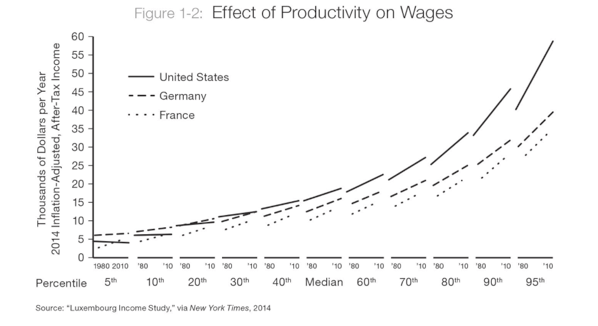
- Compounding success benefits most productive individuals, by attracting more investment in their intangibles such as knowledge and experience:
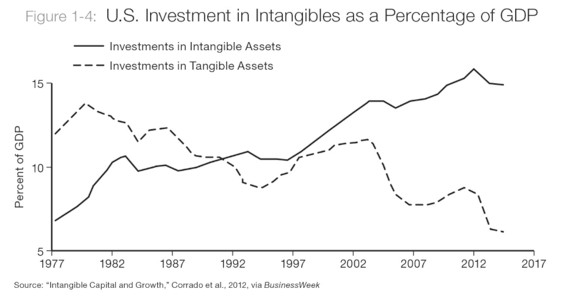
- Increased risk taking increases inequality because even if increasing majority of new enterprises fails, the few who succeed would succeed with bigger returns, sometime in billions.
Chapter 2.The Reasons for Slowing Wage Growth
The same dynamics have negative effects on average wage growth:
- Globalization brings competition from poor countries where similar talent costs much cheaper.
- IT and low skill immigration directly restrict wage growth at the bottom and in the middle.
- Trade deficit strains economic capacity and consequently reduces wages even further.
Overall trend for commodity labor is to equalize over open global markets and that is what happening: highly paid American labor wages stagnate or even going down via inflation, while developing countries labor wages such as China are growing dramatically.
Part II: DEBUNKING MYTHS: Mitigating Inequality Is Not the Solution
Chapter 3.The Myth That Incentives Don’t Matter
Here author makes a point that growing literature about psychological drivers of risk taking and achieving success are stronger than pecuniary rewards do not really consistent with real live experience that demonstrates that without material rewards innovation and risk taking disappear, even if it does not happen immediately. Movement in both directions has compounding effect so results become obvious only over time. Correspondingly redistribution does not stop innovation right away when most established innovators would continue do what they like, but it would decrease numbers of individuals moving into these activities. Author also points out that high payoff of success does not impede reality that the most benefits are eventually going to consumers.
Chapter 4. The Myth That Success Is Largely Unearned
This is the challenge to idea that top earners not really earn their compensation, but rather get it by using their positioning in the business structure: something like CEOs get their compensation defined not by investors but by other CEOs sitting on the board of their company. In exchange they return the favor by voting for high compensation as directors on the board of some other company. To contradict this author presents study that income of CEO did not really grew as proportion of their companies’ income, it is that companies become much bigger. Similarly money managers’ compensation directly related to volume of funds they manage and these volumes increased dramatically. Another point author makes is that CEO job is highly risky, difficult to get, and is usually one time shot after long carrier of acquiring necessary knowledge and experience, so compensation should cover this risk. Overall high-risk high reward pays off for companies and here are some graphs to prove it:
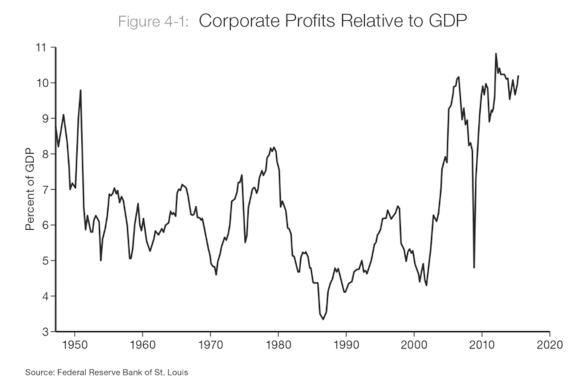
 Chapter 5. The Myth That Investment Opportunities Are in Short Supply
This is about high corporate profits and unwillingness of corporations to invest them back into economy. The inference Keynesians make from this is that government should confiscate unused capital and redistribute either to poor who would increase consumption or just use for more government spending. Author makes important point that in reality investments do not wait for demand, they create demand by providing more and new goods and services that customers did not know they want. The amount of examples is infinite from cars to smart phones. The real constrain is government interference with regulations, confiscations, and limitation of rewards that make such investments not worth trying. Author also looks at government interference into banking business where imposed demands on landing to unqualified borrowers led to crisis. Finally author criticizes an idea of starting economy up via infrastructure investment by referring to Japan huge spending over decades with no productivity growth to show for it.
Chapter 6. The Myth That Progress Hollows Out the Middle Class
Here author reviews and rejects idea that progress hollows out middle class. Here is the graph showing relatively small shift in income distribution over decades:

Finally author discusses cultural changes dependency on economic changes such as increase in women participation in labor had decreased value of marriage for them or dramatic increase in college education leading to inflation in value of college degrees.
Chapter 7. Myth That Mobility Has Declined
The final myth author challenges is decline in mobility. He does it by comparing US mobility with Denmark and finding no significant difference except at the very bottom, where Americans tend to stick relatively more, except for whites who have the same rates as in Denmark:
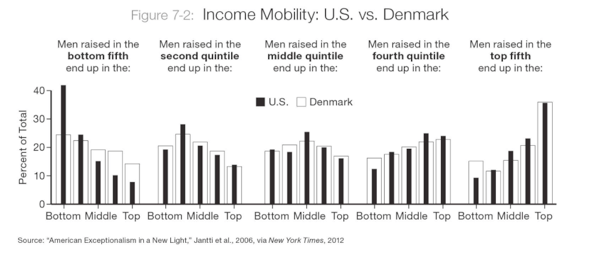
Part III: THE WAY FORWARD
Chapter 8. Our Moral Obligation to Help Those Less Fortunate
This is about poverty with usual inference that poor should be helped, but the problem is that help decreases incentives to work, acquire skills, and get out of poverty. The interesting point is that with all this help in terms of access to goods and services American poor actually are rich by international standards. However psychologically it does not help because people live by local standards and to be poor is devastating, even if American poor are fat, have cars, air conditioners, and unlimited access to entertainment and communications.
Chapter 9. The Limitations of Education
This is somewhat non-traditional take on education that starts with denial of inferiority of American schools to higher-scoring international schools. It is actually not that difficult to prove. One just has to be a little bit politically incorrect and look at test scores European-Americans separately and see that they are not worse than for children in European schools. The same applies to Asian Americans. After author looks at charter schools, other attempts to improve education, and comes to somewhat trivial conclusion that the best way to improve education is to filter out bad teachers and promote the good ones. He also makes a point of denying direct positive impact of increased levels of education on economic performance of the country.
Chapter 10. Real Solutions
Here author provides solutions for the problem of slowing economic growth based on American traditional openness as society and support for risk taking to achieve highly rewarding results:
- High-skill immigration should substitute low skill illegal and family based immigration
- Lower marginal corporate tax rates
- Allocation of all government expenses to households instead of middle-class tax cuts. Here author provide a table to demonstrate redistribution by counting in government services and taxes:
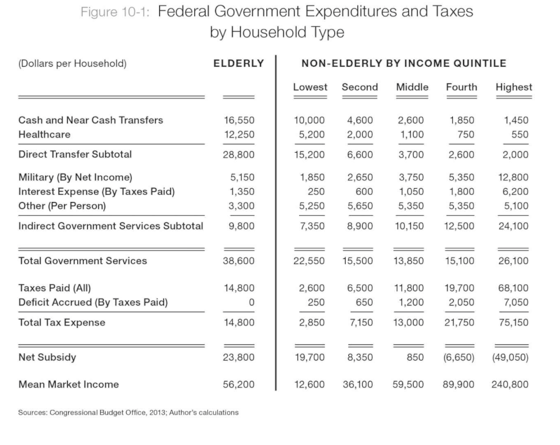
MY TAKE ON IT:
There are a lot of reasonable points here especially about incomplete accounting of transfers and government services, importance of incentives, dependency of investment opportunities on preponderance of societal attitudes, and needs to change nature of immigration. However some of this in my opinion is not justified such as ignoring prevalence of self-dealing by upper classes in control of other people’s money. Whether it is CEO that receives ridiculously huge income in exchange for providing ridiculously huge income to another CEO when voting as a Board Director on compensation, or it is politician in control of public resources using these resources and government power to create foundation for future multimillion income as lobbyist, it is the human nature and expect these people to link their income to their productivity would be unreasonable. I think that inequality is a very important issue not because it hurts economy, but because it creates foundation for all kind of leftist demagogues to undermine or even explode structure of society and therefore it should be minimized as much as possible. However this limitation should be achieved not by decreasing incentives, but rather by making them clearly linked to results of individual actions so negative results should lead to negative returns. When in addition to CEO making millions as 0.001% of company profits we learn about CEO loosing millions as 0.001% of company loses them issue of inequality would go away. I guess the best way is when owners run companies. In the case of huge public corporation when it is not an option I would like to see CEO based compensation limited to some multiplier of average salary of company employees with 100% profits/losses transferred to owners who then may or may not decide provide additional compensation to CEO as they wish. I doubt that this way anybody would complain about inequality, even if total compensation goes in billions.
- Compounding success benefits most productive individuals, by attracting more investment in their intangibles such as knowledge and experience:
20161203 Big Gods

MAIN IDEA:
Luckily author summarized the main idea of this book in succinct list of eight interrelated principles:
- Watched people are nice people.
- Religion is more in the situation than in the person.
- Hell is stronger than heaven.
- Trust people who trust in God.
- Religious actions speak louder than words.
- Unworshipped Gods are impotent Cods.
- Big Gods for Big Groups.
- Religious groups cooperate in order to compete.
DETAILS:
Chapter 1 Religious Evolution
It starts with brief review of Mormon’s history as real live well-documented example of creation of the new and highly viable religion. Then author discusses necessity of religion as glue that allow to keep together big groups of unrelated people when initial sources of cooperation evolutionary developed such as kin selection are not sufficient anymore to protect group from free riding and selfish, group detrimental behavior. For some reason author considers development of Big Gods in agricultural societies as puzzle to which he outlines solution: prosocial character of religions supported evolutionary fitness of big groups as whole and allowed for practically unlimited scalability of such groups.
Chapter 2 Supernatural Watchers
This chapter starts with specific human ability to use mind theory to predict actions of other people and human tendency to assign agency to just about any conceivable entity or object. This creates very solid foundation for accepting god(s) as reality, even if individual has no direct contact with them. A very interesting point here is that god(s) are normally treated as personalized entities with all limitations typical for humans, despite theological notions of omniscience and unlimited power. This idea confirmed by MRI analysis and other research that demonstrated activation of parts of brain related to mind theory when individuals think or discuss god. However even if circuits in brain used for gods and for other humans are the same, people perceive gods as continuously watching entities hiding from which is just impossible. Author describes quite interesting research demonstrating that gods perceived to pay much more attention to moral and other violations of norms than to neutral actions and behavior.
Chapter 3 Pressure from Above
This chapter presents an interesting approach by characterizing religion as presented more in situation than in person. Basically it means that human actions occur under influence of multitude of forces and true believes are only one of them. Consequently the behavior consistent with believes is highly dependent on circumstances of the moment. Author provides description of a number of experiments confirming this idea. Author also reviews mechanics of Supernatural monitoring with Carrots and Sticks used to achieve conformity. Typically sticks are by far more powerful factor.
Chapter 4 In Big Gods We Trust
This chapter explores connection between prosocial religions and trust with true believe being very significant factor in generating trust in individual honesty and integrity without which long distance trade and many other business transactions becoming if not impossible outright, then very complex and cumbersome. This explains to significant part distrust of atheists comparatively to believers in other gods, even if these gods are hostile.
Chapter 5 Freethinkers as Freeriders
This chapter is looking at contemporary situation when powerful governments, which take consistently increasing role in monitoring behavior and enforcing norms, challenge gods. There is also dependency here on levels of development of a country when more developed countries have relatively uncorrupted governments assuring that game is playing by the rules, while in underdeveloped countries governments are thoroughly corrupted leaving people only hope on gods for interventions to correct the wrongs.
Chapter 6 True Believers
This chapter looks at critical requirement to separate true believers from pretenders. Since true believers enjoy trust from other people who convinced that gods enforce good behavior, they have non-trivial opportunities for benefiting from deception. Author reviews solution for this problem: high cost of proving one’s true believes. This is achieved by high level of burdens from tithe to self-mutilation that true believers voluntary subject themselves to. This cost also facilitates feeling of belonging to chosen group that is strongly reinforced by music, dance, and overall pageantry of religious ceremonies.
Chapter 7 Gods for Big Groups
This is a bit of historical review starting with the first known large-scale religious artifact at Gobekli Tepe created by hunter-gatherers even before mass transition to agriculture. Author believes that it is evidence that big gods are not a product of agriculture, but rather a contributing factor to such transition. The discussion here also moves to specifics and differences between Gods of small groups and Big Gods of big groups. This difference is mostly in the nature of religious concerns, with Big Gods much more concerned about group cohesiveness and conditioning of individual to promote group interest first, rather than help individual. Correspondingly rituals become more group oriented and standardized and punishment more strict. Author also reviews history of supernatural policing of moral behavior that becomes a serious concern in big groups.
Chapter 8 The Gods of Cooperation and Competition
This chapter looks at religion as a tool to increase group evolutionary fitness by creating a moral community, supporting military effort in intergroup competition, maintain internal stability, and assure group growth by promoting high levels of fertility and attracting converts.
Chapter 9 From Religious Cooperation to Religious Conflict
This is about another side of religion – religious conflicts. Author sees it as a very complex process in which on one-side religions engender conflict because of their very nature to divide true believers from wrong believers, which is practically inseparable from conflict. On other hand they often promote tolerance and call to avoiding violent conflict. The final point in this chapter is that religion has inherently sacred views that could not possibly be negotiable and therefore contain seeds of conflict that due to the very fact of unacceptability of “false” believes could last practically forever.
Chapter 10 Cooperation without God
The final chapter is about possibility for societies do well without religion when monitoring and punishing transgressions roles are taken over by government that had become much more powerful with development of contemporary technology and bureaucracy. It now can be successful in controlling people in areas that governments of the past could not. At the end author analyzes various characteristics of atheism and concludes that, with prosperity typically intertwined with secularization of society, such society has better claim on future dominance. However they have demographic disadvantage since people in such secular societies care most about their own happiness even at the expense of creating and raising next generation, so they are typically in serious demographic decline, which opens vacuum for more religious group in societies to fill and take society as whole over.
MY TAKE ON IT:
I think that religions are a very valid and necessary tool for making society into one unified group capable to succeed in fight with another groups for resources in intergroup competition. It is also absolutely necessary and very effective tool for achieving internal cohesion in societies that depend on sacrificing some people’s live to provide for others being it military aristocracy, intellectual elite, or industrial management. However when society and technology move into situation when such sacrifices are not needed any more due to technology and knowledge that allow automate all processes not enjoyable for humans, proper behavior outside of established sphere of privacy can be automatically monitored, and military conquest becomes impossible due to weapons of mass annihilation, the religions themselves become redundant and are going to expire. As to demographic weakness of secular societies, the process of creating and rising the next generation in sufficient numbers could and probably will be based on joy and satisfaction that many people can obtain from this process, especially if many negative problems related to it: medical, financial, opportunities costs, and such would become things of the past.
20161126 – Specialization and Trade

MAIN IDEA:
The main idea of this book is to look at economy from the angle of specialization and division of labor that become the key feature of contemporary economy. In process author demonstrates impossibility of central planning and government controlled economy to produce effective and efficient results. Author also provides suggestions for solutions mainly in form of promoting better balancing between market and government controls in mixed economy.
DETAILS:
Introduction
Author defines it as re-introduction to economics with specialization being the main character in the story. He refers to Adam Smith and his famous example of specialization leading to dramatic increase in productivity, but does not stop there. He also stresses dynamic character of specialization bringing in Schumpeter’s “Creative destruction” to demonstrate that lots of events in economics could be explained by detailed analysis of specific changes in specialization patterns over time.
1.Filling in Frameworks
This is about meaning of economics as whether it is a science or not. Author’s infer that it is not a science strictly speaking, but rather interpretive framework for understanding economic events because any economic statement always starts with “all other things being equal”, which is in and by itself moves it out of possibility for falsification because all other things are always unequal. Obviously any theoretical construction, which is not subject to falsification, is not strictly scientific.
2.Machine as Metaphor
This is the critic of the idea of economics as machine, subject to engineering. The point here is that economics actually deals with human action, which makes mechanical approach invalid.
3.Instructions and Incentives
This is the critic of the idea of planning as controlling tool for economics even at the enterprise level. The reality is that the prices derived from supply and demand processes define economics and coordinate human actions within its framework. The planning, even if conducted with supercomputers, could not possibly handle complexities of the real live because of distributed character of relevant information, leading to grave mistakes and producing staff that nobody needs, while neglecting staff that people want.
4.Choices and Commands
This is a comparative analysis of market system and central planning, which historically failed in resolving information problem, incentives problem, and innovation problem. Here author provides a nice small 2×2 table of what one could get by using/not using price system and/or commands:

Obviously we are mainly in “Mixed system” with huge variances in proportion of mix, but quite stable pattern of results: minimizing commands and maximizing pricing consistently leads to better economic outcomes.
5.Specialization and Sustainability
This is a very interesting discussion about market price being the only tool that could support sustainability of economics and any attempts to override it leads to failure.
6.Trade and Trust
This chapter is directed against strict libertarians who believe that market by itself is solution for everything. Author’s opinion is that government together with NGOs is absolutely necessary to force people to play by the rules.
- Finance and Fluctuations
This is about financial intermediation, the value it brings to economy, and its necessity for maintaining stable patterns of specialization and trade.
- Policy in Practice
This is critic of typical approach to “market failure” using housing crash as an example.
- Macroeconomics and Misgivings
This is restatement of idea that that economy is way too complicated to try Keynesian approach for controlling it. It also provides author’s suggestions on using analysis of specialization in trade to provide subtle corrective impulses, as needed, rather than use crude Keynesian and/or monetarist tools.
- Concluding Contemplation
The main conclusion is that we live at the time of extreme specialization that created correspondingly complex economy, which could not be effectively managed by using Keynesian equations because these equation way too simplified to match complexity levels of reality. Author’s proposed alternative is to use small intervention needed to promote trust in trade, overcome inherent instability of financial system, and establish better balance between constructive and destructive forces in economy needed to avoid or at least alleviate boom and bust cycles.
MY TAKE ON IT:
This book’s ideas are pretty much consistent with my thinking on economics in terms of its high level of complexity that makes it impossible to manage effectively by using simplified mathematical modeling, socialist central planning or even Keynesian government interventions. However I do not agree with ideas of even minimal government controlling interventions because it would always and inevitably going to be done by human bureaucrats in their own interests distorting economic reality and decreasing effectiveness of the system as whole. I believe that violence and coercion (government) should be used only to protect property, enforce legally admissible contracts, and collect information that some participants in the system would try to hide so everybody would make decision based on reality rather than illusions.
20161119 Life on the Edge (Quantum Biology)

MAIN IDEA:
The main idea of this book is that live is not based exclusively at chemistry level, but that it rather based at lower level of elementary particles so laws of quantum mechanics had to be used if we to understand its nature and key difference between living and non living objects.
DETAILS:
- Introduction
This starts with an example of a robin. The bird is flying for thousands miles using highly developed orientation mechanism based on magnetic fields. The mystery is how exactly this mechanism works and it brings in an idea of insufficiency of chemical processes for explanation. The real explanation comes from quantum mechanics via process of fast triplet reaction that kind of connects electron level to chemical reactions level. This example is only one of many that demonstrate continuity of nature from one level as described by specific human modeling to another. Basically the point is that it is humans who have different models for different levels of understanding of nature so mechanics for big objects is analyzed separately from chemistry at molecular level, which in tern is analyzed separately from quantum mechanics at particles level, but live is a complex phenomenon that crosses multiple levels and therefore could be understood only via new modeling combining chemistry, biology and quantum mechanics.
- What is life?
While nobody really knows beyond typical answer that “we know it when we see it”, this chapter reviews some previous ideas like life force, which it rejects and tries to define it as a process qualitatively different from normal chaotic processes described by chemistry and molecular statistics. While at high level we have quite solid model of genetic replication and selection, we have a big whole below that because so far we cannot replicate process of creation of new cell from non-live materials, even if we can easily differentiate between living cell and dead cell. In short we can build new forms of live by manipulating genes in existing living materials, but we cannot recreate living material itself and this is the area where quantum biology is aiming.
- The engines of life
This is somewhat technical chapter about enzymes as engines of live, which are catalysts for all processes more or less explained by transition state theory (TST) and insufficiency of chemical explanation of live. The inference from this is the necessity to go to lower, quantum levels for explanation of a living cell processes by using quantum tunneling.
- The Quantum beat
This is highly simplified explanation of what actually is quantum mechanics in relation to particles / waves movement within living cells. Basically this is used to explain how captured photon’s energy is transferred into living biomass at microscopic level.
- Finding Nemo’s home
This is a bit different approach: using process of smelling, when minuscule amount of chemicals serves to transfer and decode information about environment, to demonstrate that understanding is not possible without involvement of quantum mechanics.
- The butterfly, the fruit fly and the quantum robin
This is return to author’s initial question of robin’s magnetic orientation with explanation based on quantum entanglement and spin.
- Quantum genes
This chapter reviews genetic transfer of information using just 4 keys: Adenine, Thymine, Cytosine, and Guanine, but then moves to reviewing quantum explanations for bond between them.
- Mind
It starts with the story of the Chauvet cave where some very ancient art was found representing one of the oldest samples of human consciousness. Author discusses kind of physiology of conversion of idea into human action and then moves on to neural networks and quantum computers where bit represented by qubit, which have more states and could therefore contain more information than a bit.
- How life began
This is an interesting approach to the process of the beginning of live. The point here is that there was probably a long, now completely disappeared, molecular scaffolds of primitive replicators that are a lot simpler than the most primitive living thing currently existing. Author believes that understanding of random creation of such super primitive replicators could come from quantum mechanics analysis.
- Quantum biology: life on the edge of a storm
The final chapter is about the place of quantum mechanics in general human modeling of environment and its explanatory and predictable power as it is related to live. Author provides somewhat unusual points on live vs. death as live being grounded at the quantum level and death meaning disconnection of living object from this level. It is nicely illustrated in these couple of pictures the first representing live and the second death:


Another point here is that with future understanding of live at quantum level it will be possible to create live from the scratch, directly from non-live materials.
Epilogue: quantum life
The final point is that even if quantum mechanics level may not be as deeply linked with biology as presented in this book and many biological processes are fully explainable at higher, molecular level; the application of quantum mechanics to biology will still produce new and unexpected knowledge.
MY TAKE ON IT:
It seems to me that ideas presented in this book are mainly valid, just because division of nature into different levels analysis: mechanics, thermodynamics, and quantum mechanics is nothing more than need to handle complexity of nature at the level accessible for human understanding, which is quite limited by evolutionary achieved level of complexity comprehension. The next step would probably be development much more powerful Artificial intelligence that would be to able analyze complexity of nature as whole, synthesize complex models of high predictability power and then dumb it down to the level of human understanding.
20161112 Intelligence and how to get it

MAIN IDEA:
The main idea of this book is that IQ of not genetically inherited, but rather is the product of combined influence of genes and environment, with environment including education having much bigger impact than genetic endowment. This idea discussed in polemics with Bell Curve, Twin Studies, and other supporters of preponderance of genetic IQ. Correspondingly author infers that increasing one’s IQ is quite possible and education is the way to do it.
DETAILS:
1.Varieties of Intelligence
This is discussion of IQ tests, what exactly they measure, and various types of intelligence. It provides a very nice graph describing dependency of two main types of intelligence on age with Fluid intelligence being raw, generally knowledge independent ability to solve intellectual problems and Crystallized intelligence being more knowledge/experience based ability:
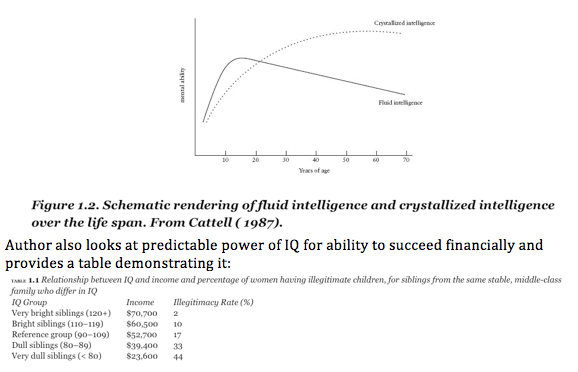
2.Heritability and Mutability
Here author defines two camps as one consisting of environmentalists who believe that IQ heritability provides 50% or lower impact on achievement level, and another view, which he believes is outdated, it is 75% or more. He provides a table of metadata demonstrating correlation between IQs of variously related individuals:

Author makes a very important point that genes are not singularly defining factor in intelligence or any other human characteristics because they are expressed only via interactions with environment so complex that it is not even conceivable to break down result into specific components. The final point author makes is irrelevance of heritability to mutability.
- Getting Smarter
This chapter discusses improvement in general IQ over period of time (Flynn effect) and data demonstrating high dependency of IQ on schooling or lack thereof. Here is graph demonstrating this:
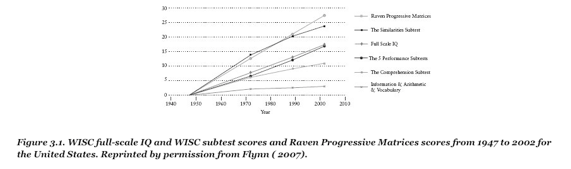
- Improving the Schools
Since author believes in direct impact of schooling on IQ, he looks at factors that define quality of schooling: Money, class sizes, teachers’ quality, instructional technics, and such. He also provides recommendation how to use schools to produce smarter people.
- Social class and Cognitive Culture
This is detailed review of impact of class on cognitive abilities and IQ. It include a number of factors mainly unrelated to genetic endowment such as:
- Nutrition and other biological factors
- Cognitive culture of environment
- Socialization for factory for lower classes and socialization of professions in middle and upper class
- IQ in Black and White
Similarly to class author believes that IQ variance by race between black and white mainly caused by environmental factors. It includes economic barriers, cultural positioning as low IQ group, and parenting practices that stint intellectual development by providing for example several times less words during childhood development by parents of working class than by parents in middle class. Probably the most important here are examples of black success at the North before civil war and mass migration from South that undercut it. Also very interesting is the story of Caribbean immigration that produce as good economic outcomes as any group of whites.
- Mind the Gap
This is a review of multiple external interventions aiming to improve cognitive abilities of lower class black population, its many failures like Head starts and few successes as KIPP academies.
- Advantage Asia?
This is overview of Asian success in all things educational with interesting point that actual IQ is not higher than for other groups, but it is well compensated by higher level of effort. There is also interesting part about difference between Asian and European cognitive processing.
- People of the Book
This is practically unavoidable chapter for any book about IQ related to Jews and their outstanding intellectual achievements. Author reviews a number of theories, but basically gives up on explanation stating at the end that whatever is Jewish advantage in IQ, the actual achievement is higher that could be explained by this advantage and had to relate to very specific culture and values,
- Raising Your Child’s Intelligence…and Your Own
The final chapter provides some pedagogical advice on how to raise children so they grew up smart by promoting training for Fluid-Intelligence, Self-control, effective tutoring, and providing incentives for hard work, but avoid rewarding activities that have intrinsic value for a child.
Epilogue: What We Now Know about Intelligence and Academic Achievement
Author summarizes book by once again rejecting strong hereditarian view and stressing value of culture and education in enhancing whatever endowment one has.
In Appendix author provides some experimental data starting with a nice statistical graph:
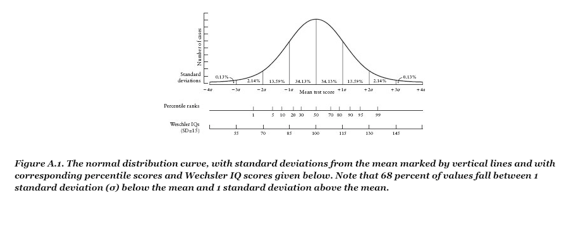
MY TAKE ON IT:
It is an interesting book, but I think that the whole IQ issue is practically irrelevant for contemporary world and even less so for emerging world. The point of IQ at the beginning was to find way easily and cheaply identify cognitive abilities of individuals in order to achieve the most efficient match for tasks assignment in military or industrial environment. We are now moving beyond industrial environment, mass conscript armies, and such, all of which quickly becoming things of the past, so the original objectives are now practically defunct. With Internet and availability of all information including multiple education classes, testing tools, and, most important, advance of self-selection of activities, the test of IQ intelligence becomes not just outdated, but plainly meaningless, unless we intent maintain some kind of artificial “meritocratic” system when merits are defined by IQ tests. I believe that we are moving to the world without elite, maybe even without elite colleges, in which we will stop treating people as attachments to tasks. My guess is that over time IQ test will become harmless curiosity exercise like crossword puzzles, rather than live defining test.
20161105 Kelly, Kevin – The Inevitable

MAIN IDEA:
The main idea is to use author’s extensive experience as technological writer and editor to analyze the direction and nature of development for our increasingly computerized and digitalized civilization and present it in disassembled form of 12 specific processes with some more or less specific prognosis of future condition for each of them.
DETAILS:
INTRODUCTION
Here author defines his intent as to uncover roots of digital change and try to foresee societal impact of this change. Philosophically he defines this change as switch from products to processes and this book pretty much describes 12 high level processes or forces that he believes will form the future of humanity.
- BECOMING
Here author uses his experience as editor of Wired to discuss continuing change in technological landscape, which is constantly upgrading unlike very stable landscape of the past. He calls this state “protopia” kind of rejection of notion of utopia and dystopia, that is condition of constant becoming but never to become some final permanent condition.
- COGNIFYING
This process means adding some cognitive function implemented by using computer to practically all aspects of live from daily routine activities to entertainment and big choices of live. Practically it also includes substitution of humans by robots in all conceivable areas of activity.
- FLOWING
This is about constant flowing of information via computer networks with clouds containing everything that could be digitalized and 3-D printing producing material goods as needed on demand.
- SCREENING
This is kind of addition to the flowing when humans and computers constantly screen the flow of information to select what they need at any given moment. It also would include constant screening of personal health parameters and/or anything related to selected activities either productive or recreational.
- ACCESING
Here author promotes idea that future contains dramatic switch from ownership mode of resource allocation, production, and consumption with accessing mode when goods and services provided as needed without taking ownership in order to use. Simple example: use of driverless Uber car instead of car ownership.
- SHARING
This is a vision of the new world overcoming self-interest via open source software, cooperation, sharing of information on Facebook, Instagram, and such. Strangely enough author believes that he was indoctrinated in free-market individualism, when, as practically all educated people in America, he was indoctrinated with collectivism, based on ideal of all powerful and all benevolent government run by unselfish expert public servants in the best interest of population, which consists of similarly unselfish, enlightened but somewhat dim people who need continuing guidance. Consequently it is not surprising that anything that smells like sharing and voluntary job without pay he celebrates as wave of the future and everything that is driven by self-interest is suspicious as retrograde and probably evil.
- FILTERING
Here author reviews filtering processes and provides very nice and concise presentation of existing filters:

his is very interesting and important piece because filtering could be a huge tool for supporting peer to peer services by allowing use of AI to select very specific services for a person both to produce for small and precisely targeted audience and to consume from reliable source who knows one’s preferences. However it could be and actually is powerful tools for conditioning people to do whatever elite wants them do, even if it is extremely harmful.
- REMIXING
This is another process that always existed, but at current level of computer and communication power is becoming qualitatively more effective, allowing just about everybody produce just about everything by remixing existing bits and pieces of information.
- INTERACTING
This is about interacting with computerized virtual reality. Here are trends that author expects to expand this area:

- TRACKING
This process is expanding all the time and eventually, in author’s opinion would lead to a number of beneficial abilities:

- QUESTIONING
This process already achieved significant success with Wikipedia and Google search allowing finding answers with ease not even conceivable a half century earlier. With development AI of IBM’s Watson type the level of complexity of QA becoming dramatically higher, providing support for increasingly high level of functionality. Actually the crux of human intellectual activity will move from finding answers to posing good questions and author provides a nice list to define what kind of questions are the good ones:

- BEGINNING
The final chapter kind of summarizes author’s vision of the future as one highly integrated human-computers network, albeit still saturated with barriers and monopolies either corporate or governmental. However these barriers will be breached and on the long run we’ll achieve soft singularity with AI.
MY TAKE ON IT:
I find technological ideas presented in this book quite convincing and generally consistent with my take on future technological development. However I think author significantly overestimate possibilities for cooperation and labor without compensation and all these open source kind of things, but it is relatively insignificant problem. The main point is that with all these processes humans cease to be standing alone entities and becoming self-controlling and self-directing parts of one network based on AI running everything that is required for meeting objectives defined by humans.
20161029 The rise and fall of American Growth

MAIN IDEA:
The main idea of this book is that century and a half from 1870 until 2014 USA went through periods of huge growth and dramatic changes in Total Factors of Production (TFP) and consequently quality of life. However level of growth and improvement was unequal concentrating in period 1870-1970 with dramatic slow down in period 1970-2014 despite temporary spike in 1990s. This slowdown is inevitable due to multiple headwinds that American society encountered and so far failed to overcome. Author proposes a number of ways to fight these headwinds, but he seems to be not very optimistic that they will be implemented and would really help.
DETAILS:
- Introduction: The Ascent and Descent of Growth
This is the book about change in the temp of American growth from high levels of change in productivity, output, and living standard in century from 1870 to 1970 and dramatic slowdown afterword. The main point is that this special century brought in changes in productivity and quality of live that could be implemented only once and would not be possible to match in the future such as implementation of electricity, automated water supply, sewer, and substitution of animal power of humans and horses with mechanical power. All following up progress that occurred after 1970 is a lot less dramatic, occurring at much lower speed, and mainly incremental. Author believes that it is the way things will continue to be in the future.
PART I. 1870-1940–THE GREAT INVENTIONS CREATE A REVOLUTION INSIDE AND OUTSIDE THE HOME
- The Starting Point: Life and Work in 1870
This chapter describes demographic, production and consumption situation in 1870. All of this changed dramatically over the next 140 years from work being mainly manual in agriculture to work being mainly cognitive and in services, while consumption from food and clothing as main items to services and entertainment and communication goods that did not existed in 1870. Here are a couple of tables:

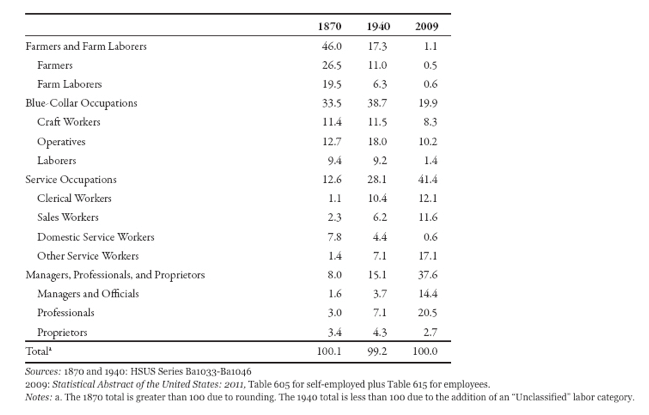
The next 7 chapters provide detailed review of all aspects of human live in America and how they dramatically changed over this period:
- What They Ate and Wore and Where They Bought it
- The American Home: From Dark and Isolated to Bright and Networked
- Motors Overtake Horses and Rail: Inventions and Incremental Improvements
- From Telegraph to Talkies: Information, Communication, and Entertainment
- Nasty, Brutish, and Short: Illness and Early Death
- Working Conditions on the Job and at Home
- Taking and Mitigating Risks: Consumer Credit, Insurance, and the Government
Entr’acte. The Midcentury Shift from Revolution to Evolution
This is about unevenness of progress that occurred, from high level of growth in productivity and output to stalling and then decline of speed of growth:

PART II. 1940-2015–THE GOLDEN AGE AND THE EARLY WARNINGS OF SLOWER GROWTH
This part provides detailed review of the qualitatively new goods and services that were invented and implemented during these 140 years and how they dramatically changed quality of live:
- Fast Food, Synthetic Fibers, and Split-Level Subdivisions: The Slowing Transformation of Food, Clothing, and Housing
- See the USA in Your Chevrolet or from a Plane Flying Above
- Entertainment and Communications from Milton Berle to the iPhone
- Computers and the Internet from the Mainframe to Facebook
- Antibiotics, CT Scans, and the Evolution of Health and Medicine
- Work. Youth, and Retirement at Home and on the Job
Entr’acte. Toward an Understanding of Slower Growth
Here author restated the important point of growth stalling starting in 1970s mainly because of dramatic changes such as electricity, water, sewer, cars, and instant communication that can happen only once and further improvement such as computers, smart phones and such being intrinsically of significantly lower value.
PART III. THE SOURCES OF FASTER AND SLOWER GROWTH
This designed to demonstrate that slower growth and improvement is inevitable and we should learn to leave with it and maybe even love it.
- The Great Leap forward from the 1920s to the 1950s: What Set of Miracles Created It?
This is look back at 1920-70s as the period of fast growth of TFP and implementation of the second industrial revolution based o electricity and mass manufacturing.
- Innovation: Can the Future Match the Great Inventions of the Past?
The brief answer is “No” because Internet, computers, smartphones, and such are inferior to previous achievement in their impact on human lives. Author also discounted fast growth of 1990 as somewhat temporary deviation from overpowering trend for growth slowing.
- Inequality and the Other Headwinds: Long-Run American Economic Growth Slows to a Crawl
The final chapter analyses in details what author calls headwinds: inequality, education, demographics, and fiscal problems and concludes that they will cause slowdown of increase in productivity and consequently improvement in income.
Here are a couple of nice graphs demonstrating changes in growth of productivity, compensation, and Total Factor Productivity (TFP):

Postscript: America’s Growth Achievement and the Path Ahead
Here author provides what he believes would be effective remedy against headwind factors, which are typical for moderately leftist approach: decrease inequality by taxing more, increase minimum wage and earned income tax credits, legalize drags, and decrease incarceration; provide better equality of opportunity via increase in educational spending and further nationalization of education. Author also proposes non-leftist measures of decreasing regulations and licensing requirements to provide for more opportunities. Here is a nice summation for his recommendations.

MY TAKE ON IT:
This is a wonderful and very well documented account of changes in productive abilities and quality of live in American society, albeit somewhat pessimistic in regards to its future. From my point of view this pessimism is not justified. One reason is the mistake of measurement: there is huge improvement between having no electricity and its availability, which is the unique event that should be put outside of measurement of progressive improvement. From this point on increase in availability of electricity at decreasing price is measurable as amount of money spent per unit of energy including minimization of environmental impact. This way it could be demonstrated that we have still lots of space for improvement. It is quite conceivable that traditional material needs could be fully satisfied at negligible price so no more improvement will be feasible and Artificial Intelligence would completely substitute humans in all routine tasks, even complex cognitive task in legal and medical professions. However the human need for intellectual and emotional consumption from self-actualization in interaction with other people could not have any conceivable limit, leaving plenty space for progress. The only real barrier that had to be overcome is the structure of society currently built on selling and buying labor, the process that rapidly becoming meaningless. In my view as soon as it would be supplemented by equal and marketable property rights for natural resources, the shackles will be taken away and improvement in quality of live will grow at increasing rate.
20161022 A History of Warfare
MAIN IDEA:
The main idea of this book is to answer question “what is war?” and demonstrate that it is not continuation of politics by other means, but rather it is separate phenomenon related to politics only in very special circumstances applicable only in Western society and only in very limited period of time. This phenomenon is mainly cultural and changes from people to people and from time to time. The society’s culture defines all aspects of war making and is always based on available technology whether it is horse and chariot or horse and saddle or stone axe or tank and nuclear weapon. Eventually war becomes outdated and for humanity to survive the global politics and diplomacy should remove war as method of achieving any conceivable objectives.
DETAILS:
Introduction
This is the story of author’s personal involvement with military and war mainly as historian and professor at Sandhurst Military Academy. The main point here is that from extensive interaction with military professionals, studying or teaching in the Academy, author learned that war is a tribal affair, when in contemporary world tribe is substituted by military unit.
- War in Human History
The first question author explores here is Clausewitz’s definition of war as a continuation of politics. He rejects this idea, initially analyzing behavior and attitudes of irregular forces as Cossacks and then moving to idea of war as culture that he discusses using examples of Easter Island, Zulus, Mamluks, and Samurai. After that author looks at Western culture that somehow developed new and unusual methods of conflict resolution without war: via politics, democracy, and diplomacy. While for extended time Western culture developed as two parallel and somewhat segregated parts of war and non-war with war being rules based method of continuation of politics, now with invention of nuclear weapons it moved to complete elimination of war. This idea worked fine, albeit not right away, and so far there were no wars between countries with dominant western culture since WWII However it had a very limited success when non-western countries and cultures are involved.
Interlude: Limitations on Warmaking
In this interlude author discusses limitation on war that always existed, albeit highly diverse at different times and in different places. He looks at geographical, climatological, economical, and religious factors that caused these limitations.
- Stone
Here author explores human nature to answer question “why do men fight?” He even looks at biology, neurology, and anthropology trying to answer to this question. He discusses ideas of primitive warfare versus civilized, and then reviews results of anthropological research on existing hunter-gatherer tribes like Yanomamo and historical research on Aztecs and Maoris. The conclusion is that war between tribes for territory historically had a constant presence, but was very limited and often quite ritualistic, mainly because of absence of economic resources that tribe could allocate to war and very limited benefits that such war could produce. Only with development of agriculture war become a very productive way to acquire resources such as land and slaves for victorious tribe, leading to creation of states with significant stress on war making abilities, eventually leading to creation of civilization.
Interlude: Fortification
This interlude looks at fortifications and siege warfare and their development over time.
- Flesh
This chapter is about use of animals – mainly horses and related technology. It looks at historical use of horses initially in chariots and then later developments of cavalry. The main point here that use of horses supported military superiority for people who managed to do it earlier than others starting with Egyptians and their chariots and all the way to Mongols and armed Knights. Eventually horse people’s military declined quite dramatically due to improvements in various projectile technologies from crossbows to firearms.
Interlude: Armies
This is discussion of various types of human organizations for military purposes. It looks at European armies of XIX centuries with their ability of population mobilization, militarized societies as Cossacks, feudal military gangs based on relationships, mercenary armies, and others from point of view of MPR (Military Participation Ratio). Author also discusses issue that often missed in historical writings – special personality types geared to soldiering.
- Iron
This is discussion of technology and tactics on battlefield. It looks at historic development of materials used in close manual combat encounters from bronze to iron with tactical use of phalanx and psychological / sociological conditions required to support this tactics. It also reviews Greeks amphibious strategy that allowed numerically inferior Greek forces to succeed against Persians. Lots of attention also paid to Roman imperial military, its successes and its role as prototype of future mass military forces. At the end author analyses medieval Europe, which militarily speaking, was continent without armies that were substituted by poorly organized feudal gangs involved in limited scale warfare with fluidly changing sides.
Interlude: Logistics and Supply
This is review of development of logistics from earlier natural form when armies lived off the land by plain robbery that could support only minimal concentrations of troops to XX century warfare involving complex planning, production, and transportation operations when millions of people work under top down command structure. The results were highly effective in terms of ability of one society practically annihilate another, but highly inefficient due to impossibility to control systems of such level of complexity.
- Fire
The fire here means pretty much chemistry used in warfare either in form of direct use of fire as Greek fire, napalm, and such or use of chemistry to send projectile or produce explosion. Author looks at interplay between gunpowder and fortification, development of firearms and their application, and, most important, change in use of violence caused by simplification of its use. This simplification, when use of firearm becomes as deadly in hands of poorly trained conscript as in hands of professional soldier, led to creation of mass armies of XIX and XX centuries. Eventually with development of nuclear weapons the war lost meaning as a tool to acquire resources because losses would exceed any conceivable gains for all sides. Consequently it kind of suppressed in Western societies and put under restrain by international law that would probably be valid only as long as countries with secular and pragmatic values have overwhelming control over nuclear weapons.
Conclusion
There is no simple way to define war since it is different for different cultures and peoples. However the war as we know it is mainly Western way of war and it become outdated and inapplicable because currently achieved level of weapons power makes it meaningless. However another types of war: guerilla wars, religious wars, and other will force international community to continue use of peacemakers and peacekeepers who should learn to use all form of warfare starting with the most primitive.
MY TAKE ON IT:
I think that war should and could be eliminated from human live, but it is possible only if developed western countries reassert dominance of their civilization, if necessary by use of force, to establish world wide its cultural achievements dearly paid for in blood and treasure over the centuries: peaceful conflict resolution through negotiations, tolerance to ways of other peoples, and forfeiture of any attempt to dictate to others how to live, what gods to believe in not only at the level of societies, but at the level of individuals. In my view currently the main impediment to the peace is paradox of extreme tolerance to intolerance demonstrated by Western countries. Whether it is Islamic supremacists or Communists or some other *ists who use violence to force other people to comply with their ideas, the outcome will always be war as soon as they feel ready to initiate it. The only way to stop war is extreme intolerance to intolerance so it would be eliminated before it acquired enough power to start a war.
20161015 Does Education Matter?

MAIN IDEA:
The simple idea of this book is that there is no clear evidence that growth in formal education has direct positive impact on the economic prosperity and that current massive growth in government expenses on general formal education and workforce training by all countries is not really justified. A very interesting point is also made that when business get involved in government’s educational decision making it does not add value, only when businesses spent their own money on workforce training the results are somewhat positive.
DETAILS:
- A truly world-beating industry: the growth of formal education
This is mainly statistical chapter showing that education scale grew exponentially all over the world. Here are a couple tables to demonstrate this:

- Elixir or snake oil? Can education really deliver growth?
The answer to this question is not unequivocal: it is clearly linked to greater income, lower unemployment, and other good things for individuals, but there is no such clear link for society as whole and this chapter demonstrates why: mainly because there is no demonstrable link between productivity and formal education. It seems to be function of changed occupational structure that actually responsible for income increase:
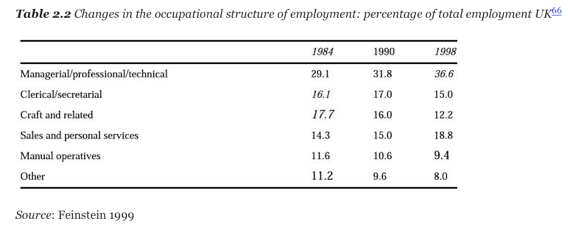
- A great idea for other people’s children: the decline and fall of vocational education
This chapter is about vocational education that politicians and overall elite promote for lower classes, but not for themselves. Author shows that it is normally not working and rational teenager with lower level of cognitive skills is better off getting general education, rather than vocational training.
- Does business know best?
This is UK specific discussion about government getting business involved in training in order to make it more relevant to needs of employers. The conclusion is that when big bureaucratic organization of government colludes with big bureaucratic organization of big business the result is use of public money to satisfy needs of bureaucrats in both of these organizations.
- Why worry about training
This is about British specific workforce training effort and support for this from government. The point here is that it is too much specific for workplace and too flexible depending on companies and technology so government should stay away from it. Besides there is no evidence except for special case of Germany that apprenticeship really makes big difference in employment and growth.
- The tyranny of numbers and the growth of the modem university
This is about massive growth of higher education based mainly on general idea that education is good, which is strongly supported by voters consequently allowing politicians to pump money into it without any serious consideration for cost / benefit evaluation. Here is a nice graph demonstrating growth of participation:

Author makes an interesting point that the main outcome of this is that higher education lost its meaning as indicator of higher cognitive abilities for employers:

Author also demonstrates that higher education still remains highly dependent on economic class of family.
- Pyramids and payments: the higher-education market
The last chapter demonstrates that in current winner takes all environment education is retained its selective function, only it is shifted from educational level to specific educational institutions with huge increase in educational expenses supporting this shift: Advantage level of just getting MBA decreed to low significance and now is provided only by MBA from Top institutions only. This is leaving majority of lower income young people at the same relative level, only at much higher cost. Here is table demonstrating it:

- Conclusion
Overall conclusion is that education does matter, but it is possible to overdo it and that is what developed countries achieved, so their people are getting less for more during last decades of exponential growth of higher education.
MY TAKE ON IT:
I generally agree with conclusions of this book, but for somewhat different reasons:
- What is called education in non-technical fields is more often than not is just indoctrination when students do not know elementary facts, but carry very strong opinions based on misrepresentation of reality. Obviously this education has very little value on free market, even if it provides access to relatively small number of government-sponsored positions.
- The whole notion of education is unreasonably tilted to obtaining some set of knowledge usually meaningless for future activities, rather than concentrating on developing self-education abilities that would allow individual successfully reeducate oneself to whatever requirements are presented by the market and real live demands.
My second point is logically leading to an idea that if main function of education is to teach student to self-educate, then 2 levels education should be supported with first level learning generic minimal skills such as literacy, numeracy, philosophy, sociality, communication skills, and personal psychological, physiological, and financial management. The second level should be self-education under supervision for whatever subset of knowledge individual is interested in at the time, with stress on ability to prepare oneself for market success. After that education should be mainly self-directed and continuing throughout the live, allowing individual to change whatever he or she needs to change, like in my case: country, language, culture, multiple locations, and business activities (professions).
20161008 – The Fractured Republic

MAIN IDEA:
This book is designed to analyze current fracture of American republic and propose solution. The fracture is coming from strive to return to the ideal past that never really existed: progressive paradise of FDR or conservative paradise of Reagan. The solution author see is to lower the stakes for both sides and move to more decentralized solutions without dismounting institutions of big government, but rather bringing them in line with more decentralized society that we live in due to internet, easy communication, and other features of contemporary world.
DETAILS:
PART I: OUT OF ONE, Many
1: Blinded by Nostalgia
This chapter is about nostalgia of both parties: Democrats for 1960s with its “wise” government, powerful unions, and liberal Supreme Court overriding constitution at will, while Republicans long for 1980s with Reagan’s “Morning in America” and victory over communism in Cold War. Both sides have selective memories picking up what they like and forgetting what they do not. Author rejects this nostalgia on both sides.
2: The Age of Conformity.
The age of conformity that both liberals and conservatives are nostalgic about is time for about 25-30 years after WWII when the whole industrial world but USA was in ruins leading to nearly complete lack of competition and huge needs in American products elsewhere in the world. This created conditions when it was enough for everybody: high paid union jobs, high profit for government supported monopolies, moral cohesion of society based on trust in government ideologically supported by XX century collectivistic craziness. Obviously it was unsustainable because other countries eventually restored their industry so competition put end to this paradise.
3: The Age of Frenzy
Then come age of what author describes as frenzy from late 1960s until early 2000: failures of Vietnam war, civil rights movement, oil embargo, seemingly successful progress of communism in USSR and around the world, and, the most important, increasing competition of low wage countries. Consequently cohesiveness of society failed. A century of communist / socialist propaganda and continuing advance of individuals carrying these ideas into ideological institutions of society: education, entertainment, legal system, and journalism brought its fruits. On one side it was liberalization of thought and behavior resulted in retreat and weakening of traditional values, while the new collectivistic values were not strong enough to assert their power on everybody via government coercion. While the move of the country to the left was temporarily interrupted by Reagan counterattack and following hiatus when even democratic president of leftist persuasion declared that era of big government is over, this movement restarted with the new century when undeclared alliance of left and right elite was reestablished.
4: The Age of Anxiety
However after relatively short period it began unraveling when leftists recognized what they believe is opportunity to establish complete control over the country: mass immigration from the poor countries of individuals brought up with strong collectivistic ideology and mass movement of population from active mainly independent market based productive activities to mainly parasitic existence either on welfare or within some governmental or quasi governmental bureaucratic structure. The partial dissolution of elite alliance moved country to the higher level of polarization. Here is a couple of graphs demonstrating this:
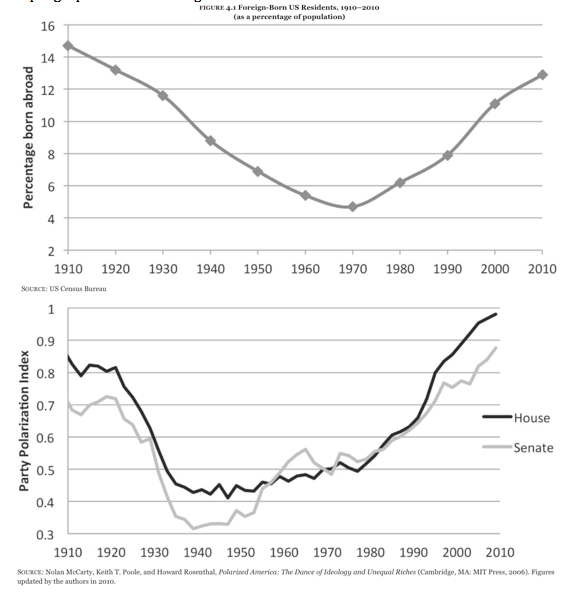
PART II THE NEXT AMERICA
5: The Unbundled Market
This chapter is about contemporary status of America economy. The main point here is that what used to be V shaped demand for labor when low and high skill level jobs were plentiful, while middle level was substituted by automatization is not a case any more. Now much more functional computerization and automation moves to substitute human labor at all levels of complexity. Obviously it makes everything cheaper and better for consumers, but practically eliminates labor. In view of this continuing struggle between public and private sectors for share of economy becomes bitterer every day. Author seems to propose non-trivial for rightist solution: to diminish fight over public versus private and move to promoting decentralization even if it is in public form. He also proposes to empower mediating institution as means to balance market, which produced lots of losers, without undermining prosperity and freedom, which are always deteriorate when public option under government control expanding in some area of society.
6: Subculture Wars
This chapter is about cultural division constantly increasing in America due not only to ideological struggles, but also to technological changes when instead of 60% of population watching the same show on TV in 1950s because there were no alternative, we now have hundreds of shows going on so even the most popular attract a small fraction of population. Author looks at multiple areas of culture to analyze trend and support his thesis that culturally America become hugely diverse, while political life lags behind and remains way too centralized.
7: One Nation, After All
The final chapter is designed to provide concise diagnosis of current American problems, some recommendations for solutions, and prognosis of future outcome. The problem as author sees it is weakening of intermediate political structures and unreasonably strong empowering of two opposites: government and individuals to do things that they are not competent to do. The result is society that is not working for its members and political polarization that prevents implementation of corrections. Author sees remedy in doing away from extreme centralization and extreme individualism and moving to localization and diversification of power that would allow to move to more competent governance and functional society much better adapted to contemporary technological, ideological, and political realities. Oh, and by the way he believes that conservative political movement will find way to move country in this direction.
MY TAKE ON IT:
I find this description of recent American political history and contemporary situation quite interesting, even if I agree neither with this logic nor with this recommendation. I think that obvious nostalgia often expressed by both left and right if mostly rhetorical tool to demonstrate where they want society to go. The real issue is that methods of creation and allocation of resources that both left and right promote are not adequate for contemporary technological levels achieved by humanity, while political structures cannot satisfy psychological and ideological needs of individual members of society in which traditional objectives of any human group such as physical survival are taken for granted and practically pushed into background by much more complex requirements for self satisfaction and psychological happiness.
The reason leftist ideas of big centralized, benevolent, and all powerful government cannot satisfy people is due to two problems: one is that government consist of humans who are always act in their own interest and the second one – complexity and dynamics of needs of millions of people and activities that required to satisfy them are so complex that no conceivable centralized hierarchical system could handle them. Only market system proved positive ability to do it at least much better than any other system.
The reason why conservative ideas of unlimited free market with somehow benign regulations would work just fine to meet human needs fails in reality is that they ignore recent technological development that increasingly makes humans uncompetitive as providers of productive labor. Since all market exchange is based on interactions between property owners and labor sellers, only one side remain valid –property owners, while labor sellers are made redundant by machines, the free market could not provide any resources for this people. There is no reasonable solution for this problem presented by conservatives so far, just unfounded believes that human labor will always be in demand.
Paradoxically leftists have solution, even if they do not recognize it: bureaucratization of labor sellers capable to obtain educational level necessary to take place in hierarchy and welfarization of those who cannot. However I believe it is pseudo solution, which is not going to work because humans could not be happy either being a small cog in bureaucratic machine or idle recipient of minimal resource allocation.
My suggestion of equal, unalienable, and marketable (rent only) rights for natural resources would make everybody property owner, therefore providing them with ability to obtain resources on free market at least at average level of natural resources consumption and, very important, leave them with ability self-direct their actions and succeed or fail using their human ability for pursuit of happiness.
20161001 The Pentagon Brain
MAIN IDEA:
The main idea here is simple: to present the story of DARPA and how it developed from its Cold War roots into technological driver of American power.
DETAILS:
PART I
THE COLD WAR
Chapter One: The Evil Thing
The story starts with 1954 test of thermonuclear bomb. The power of the bomb was significantly underestimated leading to nearly catastrophic consequences for participating scientists in nearby area. It also describes some complexity in decision-making caused by ethical and moral considerations, but also by technological uncertainty of consequences.
Chapter Two: War Games and Computing Machines
This is about von Neumann, first computer, and research in Game theory used to define strategy for Cold War
Chapter Three: Vast Weapons Systems of the Future
This chapter is about sputnik scare that significantly increased amount of resources allocated to military research, especially to ballistic missiles
Chapter Four: Emergency Plans
This is about generally unknown research on survivability of society after massive nuclear strike: “The Emergency Plans Book”. After reviewing multiple scenarios conclusion was: it is not possible to survive. It eventually led to MAD strategy and attempts to find some kind of accommodation to prevent nuclear war by all means necessary short of surrender.
Chapter Five: Sixteen Hundred Seconds Until Doomsday
This chapter is about one of the first close calls of nuclear age when technology could cause nuclear exchange if not human intervention. One of the consequences was creation of Jason Group of top scientists to tackle wide variety of technological issues related to national security.
Chapter Six: Psychological Operations
This is about another, softer side of science use in Cold War struggle. It is related to William Godel and his role in psychological operations in Korean War and beyond. It includes side story of Dulles’ son Allen who, as young lieutenant, was wounded in Korean War and had his brain permanently damaged.
PART II
THE VIETNAM WAR
Chapter Seven: Techniques and Gadgets
This chapter describes Kennedy’s flexible response doctrine and how it led to Vietnam War. It also describes several related military research programs specifically supporting this war: various gadgets including new firearms specifically designed for Vietnam conditions. The most important effort however was chemical defoliation program.
Chapter Eight: RAND and COIN
This chapter describes ARPA non-government affiliate: RAND corporation and how it provided sociological research in support of counterinsurgency. It used experienced anthropologists well familiar with Vietnamese people, culture, and language. They come up with very good recommendations especially against the program of strategic villages. Unfortunately military and political bureaucracy rejected these recommendations.
Chapter Nine: Command and Control
This is about paralleled development of computerized control system. It was a SAGE system developed for control over strategic nuclear forces, but it also traces J.C.R. Licklider who became one of the most important computer scientist involved. One of the programs he led was related to computer analysis of behavioral patterns applied to counterinsurgency operations.
Chapter Ten: Motivation and Morale
This chapter brings in another personality Leon Goure, who seems to be a spoiler in psychological operations overriding scientific anthropological research and implementing ad hoc non-working solutions.
Chapter Eleven: The Jasons Enter Vietnam
This is review of Jasons’ participation in Vietnam and projects that they worked on from analysis of use of nuclear weapons to defoliation of jungles.
Chapter Twelve: The Electronic Fence
This chapter is about electronic fence along Ho Chi Minh Trail – one of the most consequential Jason projects. This was a set of electronic equipment that could collect and transfer information remotely practically without human intervention.
Chapter Thirteen: The End of Vietnam
When Vietnam developed into large-scale fight within American society one of the consequences was leftist attack against Jason scientists on campuses that eventually led to distancing Jasons from ARPA. Moreover the very existence of ARPA was threatened by investigations and overall attempt by communist sympathizers to permanently cripple American military power.
PART III
OPERATIONS OTHER THAN WAR
Chapter Fourteen: Rise of the Machines
This is about technological transformation of military that occurred during and after Vietnam War. It involved not only hardware, but also human training that begin to be conducted using computerized simulators, therefore allowing people to obtain experience without actual risks and expenses related to field training.
Chapter Fifteen: Star Wars and Tank Wars
This chapter is about star wars ideas and their impact on simulation technology, specifically for armored warfare.
Chapter Sixteen: The Gulf War and Operations Other Than War
This is about successful confirmation of American military development in 1970-80s that led to easy victory with insignificant loses in Gulf war, but also a non-military defeat in Somali, which demonstrated moral and public relations unpreparedness of US military to conduct operations against guerilla opponents acting among civilians.
Chapter Seventeen: Biological Weapons
This is a review of seldom-discussed issue of biological welfare. It presents story of Soviet scientists who worked on bio warfare and changed sides when USSR start falling apart.
Chapter Eighteen: Transforming Humans for War
This is about biological research to develop a new soldier who would be smarter, stronger, and more efficient on battlefield. It also reviews result of war game Dark Winter testing scenario of terrorist biological attack by Saddam against USA. Results indicated 3 mil American casualties from smallpox.
PART IV
THE WAR ON TERROR
Chapter Nineteen: Terror Strikes
This is about 9-11, but with an interesting twist: attention and even panic caused by false positives for biological weapons. An interesting point is that DARPA did not fail because surprise came not from technology.
Chapter Twenty: Total Information Awareness
This is about tentative program for government to know about all information flows and PR disaster it caused.
Chapter Twenty-0ne: IED War
This chapter is about expensive high tech attempts to fight cheap low tech IED warfare with little real success. It also discusses social science side of counterinsurgency effort.
Chapter Twenty-Two: Combat Zones That See
This is about more technical details of Iraqi war
Chapter Twenty-Three: Human Terrain
This is about human side of war. It again brings in social science and attempts to build awareness about humans in war zone and their behavior.
PART V
FUTURE WAR
Chapter Twenty-Four: Drone Wars
It is story of drones, but it is not limited to it. The autonomous and remotely controlled devices from extremely small to very large are the future of American war making.
Chapter Twenty-Five: Brain Wars
This is about human brains damaged in the war, but also about artificial brain that can control machines without human being on site. Obviously it creates huge problems not least of them being how not to loose control over AI killing machines.
Chapter Twenty-Six: The Pentagon’s Brain
The final chapter is about DARPA interconnection with corporate world and mutual need they have. It also points out to future development that comes down to the idea that “battlefield is not the place for human beings”.
MY TAKE ON IT:
It is quite interesting story of relationship between science, corporations, and American military that resulted in significant superiority of American military over any other country. Unfortunately leftists dominant in American elite often vilify the scientific military research, resulting in limitations on its progress. Not less important is historic inability of American society to deny its enemies either Communists or Islamists access to results produced by American technological research. Consequences are severe, for example transfer of American nuclear technology to Soviets led to trillions in expenses, tens of thousands of Americans killed in Korea, Vietnam, and other places, and millions of people perished in struggle against Communists or under their rule. So far, despite regular transfer of technology to enemies, Americans were lucky to avoid catastrophic damage, but this luck may not hold forever. I wish this issue would be treated seriously and technology and knowledge would be transferred only to civilized democratic people, but I do not expect it to happen at least until really catastrophic events occur.
20160924 The Rational Animal

MAIN IDEA:
This book is kind of counterargument to currently very popular idea of behavioral economics that human thinking is often not rational and therefore not effective in dealing with challenges of contemporary live. This counterargument based on two insights: The first is that whatever human approach to economic behavior is, it developed as result of evolutionary success and therefore has deeper rationality than formal logic could provide. The second one is that such seeming irrationality comes from the fact that at any given moment any human is trying to achieve multiple evolutionary goals, which realistically could be in conflict, so decisions are made as compromise between these goals selecting the best mix of actions for this particular time and space.
DETAILS:
Introduction: Cadillacs, Communists, and Pink Bubble Gum
Why did Elvis gold plate the hubcaps on his Cadillac?
This chapter provides examples of human irrationality of famous people, posits question: why did they do it, and establishes direction of inquiry that authors believe would allow answer this question.
1: Rationality, Irrationality, and the Dead Kennedys
What do testosterane-crazez skateboarders have in common with Wall Street bankers?
This chapter introduces idea of deep rationality as synthesis that allows overcoming two usual approaches: humans as rational econs vs. humans as morons too stupid to behave rationally. Authors propose notion of deep rationality: humans as animals conditioned by evolution to act in such way as maximize their evolutionary fitness in fast changing, unpredictable environment when criteria of action is not optimization, but rather “good enough to survive.” In short – humans are rational animals with rationality defined as such actions that increase chances of survival.
2: The Seven Subselves
Martin Luther King Jr. had a multiple personality disorder? Do you?
Here authors discuss seven subselves, each of which works to achieve a specific evolutionary goal:
- Self-Protection Subself from other animals including hostile humans
- Disease-Avoidance Subself
- Affiliation Subself – humans survive in a groups so the survival of the group as important as individual survival
- Status Subself – If group survives then individual survival depends on status inside the group
- Mate-Acquisition Subself
- Mate-Retention Subself
- Kin-Care Subself, obviously the most important kin being one’s children
Here is a nice graph for priorities somewhat based on Maslow ideas:
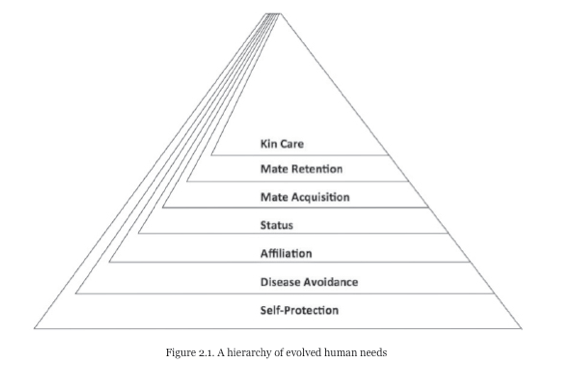
3: Home Economics Versus Wall Street Economics
Why did Walt Disney play by different rules than his successors?
This chapter explores interaction between different subselves and other people and entities. It analyses human economic behavior based on 7 subselves, each of which requiring somewhat different approach, resulting in very dynamic patterns of integration depending on circumstances.
4: Smoke Detectors in the Mind
Why is it dangerous to seek the truth?
This chapter concentrates on mistakes and biases that each of our evolutionary subselves is prone to make. This is very interesting and somewhat counterintuitive approach. The question is how humans treat truth and accuracy of reality representation and answer is: as mainly irrelevant to action. In other word the lie that helps to survive preferred to the truth that would lead to demise and it is not only for external consumption, but also for internal individual believes. Author look at all 7 subselves as to what kind of biases and self-deceptions they promote.
5: Modem Cavemen
How can illiterate jungle dwellers pass a test that tricks Harvard philosophers?
This is a discussion of how our understanding of subselves could help to make better decisions. This chapter includes multiple examples of human logical mistakes and inconsistencies and then provides suggestions on how to avoid them: by using understanding of evolutionary meaning of our approaches and consciously modifying them to fit new contemporary environment when we are not hunter- gatherers any more, but rather members of complex groups interacting with environment via sophisticated technological systems.
6: Living Fast and Dying Young
Why do people who go from rags to riches often end up in bankruptcy court?
This is look at how subselves change human behavior at different stages of live from childhood to old age. The main point here is that all humans are different not only from individual to individual, but also for the same individuals during different periods of live, when different subselves become dominant in defining behavior. Authors identify 3 main stages during lifespan when different types of effort become dominant: somatic effort, mating effort, and parenting effort. They also discuss here fast and slow strategies and thinking that varies greatly between different individuals depending on their genetic makeup and environmental circumstances.
7: Gold Porsches and Green Peacocks
Do people buy a gold Porsche and a green Toyota Prius for the same reason?
This is exploration of mechanism of human decision making, quite correctly pointing out that whatever decisions are made they are always in interest of decision maker. As example for analysis authors use buying Porsche vs. buying Prius: the first one signaling wealth and prosperity, while the second signaling communitarianism and environmentalism. In actuality both behavior serve the same purpose: to demonstrate one’s fitness to the group one wants to belong and be accepted.
8: Sexual Economics: His and Hers
When is a gain for the goose a loss for the gander?
This chapter looks at variation of approaches to decision making between men and women and links it to different evolutionary goals that inherent to each sex. As usual this comes down to men distributing their sperm as wide as possible and women capturing a partner good enough to raise children. The interesting and not trivial point here is about jealousy: men jealous at women’s sexual infidelity, while women jealous at men’s emotional infidelity. Finally mating behavior is as much defined by supply and demand as any other human activity involving interaction between people and exchange of goods and services. When there are too few women as in American West in 1880s, men are chivalrous, respectful, and trying to please women as much as possible, while women are selective and powerful. When it is low supply of men as usual happens after big war, men are selective and often neglectful, while women often had to limit their search for reliable men and accept sex without commitment even if it means to have children to rise on their own.
9:Deep Rationality Parasites
How do snake oil salesmen exploit deep rationality?
This is an interesting look at our vulnerability: how knowledge of human subselves allows some human successfully exploit others. The examples provided mainly from sales strategies: selling diamond by creating the need where none existed before or drug advertisement campaigns or books like: “xxx, they do not want you to know”. The recommendation for counteraction: know thy enemy, know thy situation, and know thyself.
Conclusion: Mementos from Our Tour
In conclusion authors provide some mnemonics to remember their ideas and 3 lessons:
- Don’t assume other people are morons
- Rational self-interest is not in your self-interest
- Don’t leave home without consulting your other selves.
MY TAKE ON IT:
This is a great approach to understanding of humans, their behavior, and results of this behavior. I think it clearly supports my believe that humans are way to complex and dynamically changing to try any attempts to control and manage them externally whether these are relatively soft attempts of American elite to “nudge” people into the “right” economic behavior for their own good or murderous concentration and “reeducation” camps of communist countries where alternative is either “right” behavior or death. The logical conclusion is to assure that people have resources to do what they want and forget any ideas about some elite thinkers knowing and having justification to force their ideas on people. I do not think that there is any non-destructive alternative to freedom with resources.
20160917 Government Failure

MAIN IDEA:
The main idea of this small book is to concisely present key points of the Theory of Public Choice through 3 essays of its intellectual founders. The main point of this theory is that humans remain humans and care most about their own interests regardless of whether they work in private or public sector. Consequently it makes rules of market competition applicable to public sector, providing, however, that in this case the competition is not for market share and profit from selling goods and services to consumers, but for position in political / bureaucratic hierarchy with most power to obtain and direct public resources in one’s own interest regardless of whether it is beneficial to anybody else or not.
DETAILS:
PART I: THE THEORY OF PUBLIC CHOICE Gordon Tullock
1. People Are People: The Elements of Public Choice
Public choice is scientific analysis of behavior of individual with respect to government, which comes down to transplanting the general analytical framework of economics into political science. This theory rejects the dominant view of bifurcated human behavior that posits that when moved to political arena individuals magically forfeit their own self-interest and act exclusively in the interest of public. Instead it views politicians as individuals good at being elected into the office and stay in office generated both monetary and psychological benefits not different from any businessman on the market. Author looks at specifics of democratic versus nondemocratic government, their costs and benefits, and how politicians pursue their interest depending on the nature of political market. In the summary the Theory of Public Choice lead to conclusion that government inefficiency if not a bug, but the feature and the best way is to minimize government sector to the areas of absolute necessity where market solutions are not feasible such as military and legal systems.
2. Voting Paradoxes
This is review of electoral systems and their paradoxes. One example of paradox is selection A over B over C over A due to sequence of binary choices. Another example is British system when parties have constantly build coalitions in order to obtain majority. Author looks in a bit more details at Proportional representation and Single-Member Constituencies systems. Finally author discusses multi-dimensional character of politics when different constituencies put different weights on issues.
3. Logrolling
This is a very important concept for group decision-making when members of the group exchange votes conditioned on support for each other issues. Generally it results in benefits exchange at the expense of people not represented or weakly represented in decision-making group, leading to expansion of lobbying. Author refer to Reagan’s tax cut as example of victory of common interest over special interests, which happens extremely seldom, unlike multiple victories of special interest that occur practically on daily basis.
4. The Cost of Rent Seeking
This is discussion of rent seeking (government granting of special privileges) and its cost. Author admits that we do not have adequate methods to measure cost of rent seeking, but there is plenty of evidence that it is tremendous and naturally growing with each expansion of government regulation and interference into resource distribution.
5. Bureaucracy
This is review of Bureaucracy and its power that in such developed countries as USA and UK actually accedes power of politicians. Obviously Public Choice deny the notion that bureaucrats’ objective is public good or institutional interest as deeply contradictory to empirical evidence. Author stresses his attitude to bureaucrats as not bad, but rather just normal people whose activity is necessary for functioning of big organization public or private. He just rejects notion of bureaucracy as a group of idealists working for common good and promotes empirically valid notion of bureaucrats as self-interested individuals whose actions may or may not be in public interest, but are always in their own interest.
6. Tax “Avoision”
“Avoision” is combination of all legal and illegal methods used to decrease one’s taxes. Author goes through examples such as mortgage deduction, adjustment of corporate structure to minimize tax, cost of multiple loopholes designed to encourage individuals and entities to act in interests of bureaucracy, and even cost of underground economy that exist exclusively to avoid taxes and regulations imposed by government. The conclusion is that Avoision is quite often beneficial for society because it add goods and services that otherwise would not be created and even puts some restrains on government, which could be good or bad depending on what government does.
7. Federalism
The final chapter of this part is about interaction between local and centralized government entities and advantages of federalism: more responsive to people local governments combined with high concentration of resources in central government. Also voting with the Feet is very important feature of federalism that allows voters reward or punish local government by moving in or out of its jurisdiction. Author strongly support federalism and express some dismay that movements in recent years is mainly to centralization.
PART II: AMERICAN APPLICATIONS Gordon L. Brady
8. Protection in International Trade
This is review of application of Public Choice theory to international trade. It mainly discusses how personal interests of bureaucrats and politicians sometime support, but sometime impede free trade depending on their constituencies despite generally accepted idea of its benefits.
9. Internet Governance
This chapter reviews Internet as unusual area of minimal regulation and how bureaucratic interest keep pushing to increase in it. It is written a while before Obama’s attack against Internet freedom, but it is quite obvious it was long in coming.
10. Public Choice to Telecommunications
This is an interesting case when Telecommunications that were developed at the pick of bureaucratic power in 1930s got to be regulated to monopolistic level. The most interesting part of this natural experiment was review of benefits created by deregulation of this area. The process of deregulation, as consequence of new technology not covered by regulation and complex political logrolling, is especially interesting as an example of potential decrease in bureaucratic power by setting up various groups of bureaucrats against each other competing for higher rent.
11. Public Choice to Environmental Policy
The final chapter of this part is about environmental regulation and EPA. Created as tool to rule in externalities of industrial production, which harmful effects become obvious to population, it quite successfully put break on most obvious harm caused by emission and pollution, clearly providing for public good. However as any bureaucratic organization it immediately expanded in search of rent and power, eventually becoming a huge impediment on economic development via multiple costly regulation without and meaningful impact on improvement in environment.
PART III: PUBLIC CHOICE IN BRITAIN Arthur Seldon:
12. Public Choices or Political Sovereignty?
This is an interesting discussion about Political Sovereignty in view of the Theory of Public Choice. It stresses that ratio of individual decision making versus collective decision making has great impact on quality of live in any society. It shows in some details in regard to public goods, redistribution, and welfare how increase in collective decision-making actually means increase in decisions made in the interest of bureaucracy at the cost to population, leading to increasing reluctance of population to curry this cost.
13. Government Intentions and Consequences
This is discussion about distinction between public and private interest that author believes to be fictional. In reality the only interest that exist is always private interest and “collective” practically means interest of bureaucrats and politicians. Author also debunks myth of Collective Superiority using example from British history of welfare and public housing.
14. Overdependence on the Welfare State
This is British specific history of welfare state development and harm to population in caused.
15. The Weakening of the Family
This brief chapter is about negative impact on family from expansion of welfare state to the level when bureaucrats substitute parents. The only reasonable solution created by this expansion of government is remove bureaucrats’ power over family live.
16. Voters versus Consumers
This is about perception and actions of politicians depending on their values. It practically means that politicians consistently value voters much higher than consumers, creating condition for intentional promotion of unjustified fear and resentments so politician could use them to win election, even if in reality it causes real harm to their voters as consumers causing them for example to avoid Genetically modified food, which has much higher quality and lower price than conventional.
17 The Political Fate of Economic Federalism
This is about current centralization of government at the expense of federalism. Author reviews this process and its consequences and concludes that it leads to rejection of democratic government and attempts to escape to open markets.
18. The Escapes from Overgovemment: Political Power Yields to Economic Law
The final chapter is about future and unsustainability of infinite government growth that increasingly hurts population. Author strongly rejects an idea that the choice is between Government and Anarchy and stresses new opportunities to escape excesses of Public Choice and expand sovereignty of the public.
MY TAKE ON IT:
The Theory of Public Choice is the great achievement of political thinking that while still mainly in infancy will eventually become dominant due to the simple fact that growth of government and bureaucratic abuses of individual will, supports rent seeking on the large scale, and creates opulent political / bureaucratic enclaves such as Washington DC becoming richer, while population becoming poorer. It will inevitably force people to reject socialist / statist ideas of XX century as unworkable. The only problem here is that while correctly and wonderfully clearly describing Public Choice of bureaucrats and politicians it does not provide solution for this conundrum. I, on other hand, think that I have one: equal marketable (time limited rent only) rights for natural resources that would provide all individuals with resources and allow for automatic selection via market mechanism of individuals most capable for effective and efficient application of these resources to generate goods and services. I also think that limitation of government to its legitimate area: use of violence to prevent and/or retaliate for violence, enforcement of legitimate contracts, and acquisition of factually correct information to support individual decision making, would dramatically decrease abilities of bureaucrats and politicians to seek rent and to use other people’s resources for themselves.
20160910 The End of Doom
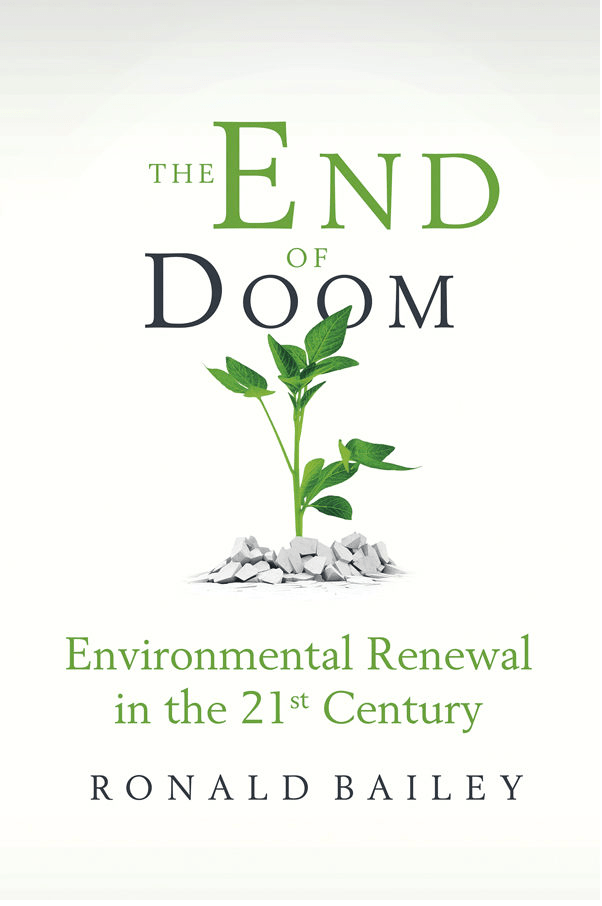
MAIN IDEA:
The main idea here is that doomsayers who consistently over the years declare that humanity is moving to catastrophe either due to overpopulation or mineral resource depletion, or cancer epidemics, or genetic engineering were wrong every time for as long as this alarmist industry exists. Being wrong however did not prevent them from reaping huge benefits in form of academic positions, grants, prestige awards, and publishing success. Actually it is pretty much a reliable way to become rich. Consequently author states his believe that human resourcefulness will again prove all them wrong in current cycle of doom predictions.
DETAILS:
- Peak Population?
This starts with review of “population bomb” prediction so popular and so profitable for its promoters in 1970s. Author reviews these predictions and actual development to demonstrate how they failed: green revolution of modified crops, decrease in birth rates with increase in survivability of children and education levels of women. Author also makes a very interesting point that with development of welfare society children became kind of luxury that people spend their resources on without any expectation of significant material returns, instead of children being the only source of resources and protection in the old age as it was the case in the past.
- Is the World Running on Empty?
This chapter is about pick oil scare and multiple other picks in natural non-renewable commodities that never ever happened in reality. The important point here is that richer society is normally cleaner society and it also uses a lot less natural resources due to more efficient technology. Eventually humanity will move to sustainable processes, but there is no rush because we have plenty of resources with demand for them per unit of output going down quite dramatically in practically all areas.
- Never Do Anything for the First Time
This is about the latest craziness called precaution. By and of itself it kind of makes sense, stating that one should not harm. However if taken to extreme it is used to prevent any actions and/or improvements in technology or processes. Author makes a good point about seen and unseen when, for example, not allowing new treatment bureaucracy assures that nobody will be hurt (seen), but prevents a lot more people from being saved (unseen). Obviously it could not be possibly trial of something new without errors so the only way prevent errors is to stop all trials and froze humanity in place.
- What Cancer Epidemic?
This is about a number of health scares and their methodologies, which typically are highly misleading and self-serving. In this regard “cancer epidemic” is a very good example. Typically stated number of increase in deaths from cancer often miss any age adjustment and do not mention simple fact that significant part of population that used to die in young age from all kind of diseases typical for their age now live long enough to get old and to die from old age diseases, pushing up statistics for cancer or Alzheimer higher and higher.
5.The Attack of the Killer Tomatoes?
This is about another craziness – fight against genetically modified food. Needless to say that humans do not really use natural food since beginning of agriculture. It is the new method of gene selection done in laboratory by genes splicing rather than in the field by selective breading what scares the heck out of functionally illiterate activists. Needless to say that highly profitable organic industry supports these protests not because of illiteracy of its leaders and scientists, but rather for profitability reasons.
- Can We Cope with the Heat?
This chapter is somewhat different from previous chapters because here author agrees with doomsayers about global warming. He repeats their regular trope: more greenhouse gases in atmosphere (true) inevitably lead to warming (questionable) that will cause dramatic negative impact in the future as shown by computer models (unknown, since models being highly unreliable). However author seems to be capable maintain reasonable approach despite his conversion, so he goes through counter argument: warming not happening over last 15 years, lack of observable damage from climate change, low probability of catastrophic warming even according to models specifically designed to prove it, and finally unreasonably high cost of extreme measures to stop CO2 production. Most important, author seems to understand ideological rather than practical approach to the warming that dominates leftist environmental movement and correspondingly ideological approach of their free market opponents. His recommendation is to encourage economic growth so future generations have resources to handle climate change if it does occur and has negative consequences.
- Is the Ark Sinking?
Here author briefly looks again at multiple doomsday scenarios from the past and their current status in corresponding area and finds that lots of staff actually getting better: farmland use is decreasing, forests are growing, cities are incorporated into natural environment rather than substituting it, and so on. Actually he even trying to debunk idea of “pristine and benevolent nature spoiled by evil humanity”. Such nature never really existed. It is and always been tough and unforgiving randomly changing environment in which complex interaction of material components, energy, and time regularly eliminate species, create new ones, runs some of them through bottleneck of survival, and sometime allows some to expand dramatically.
His conclusion is optimistic: humans managed to survive and prosper for a long time in environment they poorly understood by fixing problems one at the time as they presented themselves. There is no reason to believe that with contemporary technology and science humanity would not be able to continue its success. The multiple panics created by ideological environmentalists and supported by bureaucracies usually used to transfer more resources to these groups, increase their power, and most often are detrimental to everybody else. Eventually humanity will overcome its nature consumption phase and switch to sustainment mode when nature will be not a source of raw materials, but “arena of human pleasure”, but this future state should come through economic growth and prosperity, not from restriction and raw political power of ideologues.
MY TAKE ON IT:
It is a very nice review of environmental scares and their consistent failure to materialize. This book is pretty much in tradition of Julian Simon, whom I consider the most profound ecological thinker and who believed that the only really limited resource is human individuals and their capability to invent and implement good ideas. Despite multiple self-enriching schemas of leftist ideologues and their supporters, humanity seems to be able to limit damage they cause, especially in democratic societies. For example it is highly teachable and is something ironic that damage caused by population bomb promoters was very limited to non-existent in democratic societies in which all they could do was to scare a lot of people into buying their books and tolerate bureaucratic transfer resources to themselves, while totalitarian China actually implemented one child policy leading not only to suffering of huge amount of people on the short run, but also to looming demographic catastrophe on the long run. Overall this book is a nice reprieve from stupidity of political environmentalism.
20160903 The Spirit Level
MAIN IDEA:
The main idea of this book is to present a nice collection of data linking inequality with everything bad one can think about from obesity to murder rate and consequently convince reader that inequality had to be eliminated or at least dramatically decreased in order to improve quality of live for everybody. The method of inequality correction is usual: big government with political will for equalizing.
DETAILS:
PART ONE Material Success, Social Failure
- The end of an era
This is about the end of era of materialism, which is consistent improvement in material wellbeing. Authors believe that contemporary western society achieved limit when material improvement does not provide for improvement in quality of live. Here is typical “evidence” they provide to support this view: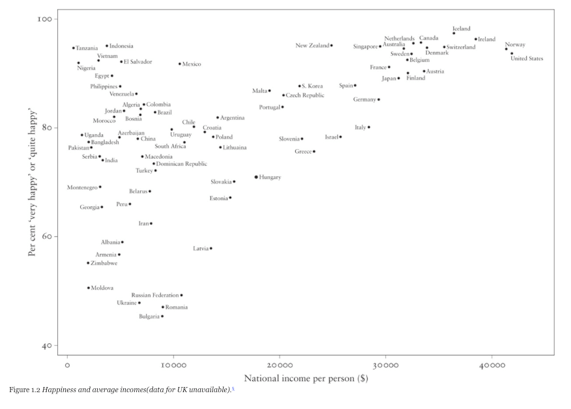
Obviously people in Tanzania or Vietnam are as happy as people in USA despite huge difference in resource availability. Besides authors really believe that there environmental limits to growth.
- Poverty or inequality?
Here authors make the point that inequality is more important characteristics than income in defining quality of live:

- How inequality gets under the skin
In this chapter authors analyze how exactly inequality causes deterioration of quality of live. Here are reasons:
- High Anxiety
- Impact on self-esteem and social insecurity
- Impact on pride, shame, and status
- Threats to social self
- Destruction of community with defined place for individual
PART TWO The Costs of Inequality
All chapters in this part pretty much about negative impact of inequality on all aspects of people well being from trust between people to obesity. This thesis illustrated by a bunch of interesting graphs showing relation between levels of inequality and other aspects of human live.
- Community life and social relations


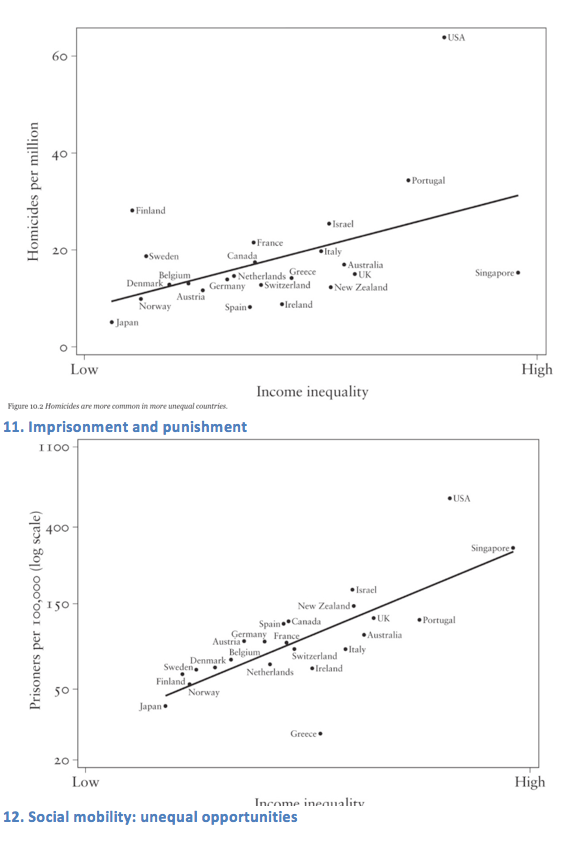
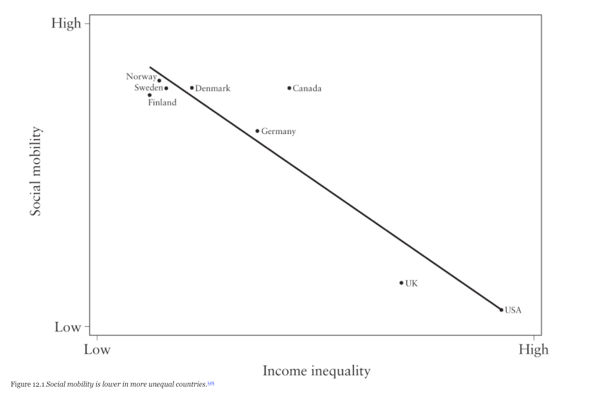
PART THREE A Better Society
- Dysfunctional societies
After presenting correlation between inequality and everything that is conceivably bad authors trying to analyze alternative explanation of correlation via external factors. They look at ethnicity, society history, and social class. They generally reject all other explanations and provide a separate discussion on causality of inequality – everything bad correlations. This explanation is pretty much comes down to: inequality correlates with everything bad so it must be causal. Even such seems to be obvious causal link as poor health – inability to work – low income is rejected. They also reject direct influence of ideology, but consider its indirect impact via: neoliberal free market lead to increase in inequality causing everything bad to occur. However authors admit that they really cannot prove causality and claim that it could require impossible experiment by dramatically changing level of inequality in some country and observe results.
- Our social inheritance
This is look at social impact of inequality such as difficulty of real friendship between individuals with high difference in status and negative impact on human relations by perceived unfairness and strict hierarchy. Authors bring in research on chimps versus bonobos, ultimatum games, and anthropological research of Paleolithic societies and their social structures. They also discuss human duality of individual and group survival both of which are necessity for humans.
- Equality and sustainability.
Here authors link everything to ecology sharing their dream for “steady-state economy”. As usual this dream includes hope to decrease consumption of the “rich people” who work too much and consume by far more than other people. Here is their graphic representation of this idea:
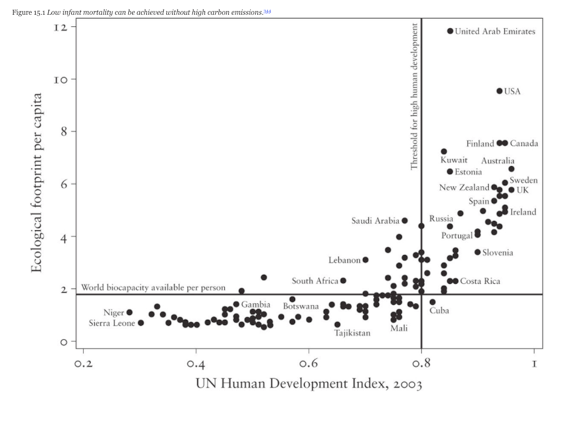

- Building the future
This chapter is about what should be done to decrease inequality, after authors put blame for it on political development. Interestingly enough they point out that level of taxation seems to be irrelevant providing example of low tax New Hampshire with very high quality of live and health. However they see solution in politics of society that would force equality on people and suppress corporate power that authors believe promotes inequality. They also see solution in non-profit corporations, trade unions, and employees ownership. However ultimate do-gooder should be big benevolent government that would have political will to make people more equal.
MY TAKE ON IT:
The data set provided in this book is nice, but ideology is somewhat stale. In their passion for equalizing authors somehow manage completely ignore that huge equalizing experiments ware conducted and on the huge scale: Russia, China, and many other countries that were taken over by communists with immediate and drastic decrease in inequality to such level of equalization that even amount of available food was made equal. Probably authors ignore it because it makes their thesis of inequality causing everything bad kind of ridiculous if compared to millions of deaths caused by extreme equality. Another interesting phenomenon, typical for all socialists, is authors’ completely blind spot to inequality created by government and myriad “non-profit” organizations. It seems to be that huge amount of resources spend on building palaces and providing good live for government bureaucrats, politicians, non-profit CEOs, and Union bosses somehow is not counted into inequality. For them a multimillion private 12 seats plane compared with economy middle seat in jumbo jet is huge example of inequality, while government jumbo jet used to carry one important politician to play golf over weekend is not. Especially egregious example is calculation of Gini coefficient without taking into account control over resources by bureaucrats and politicians, so for example country like Sweden, where a few hundred people at the top of government control about 60% of country’s resources, has lower levels of inequality than USA where similar number of top politicians and bureaucrats control just over 30% of all resources. With this approach one gets a ridiculous result when something like North Korea where current Kim controls 100% of country resources somehow has Gini coefficient less than USA, rather than 1, as it should.
While agreeing with findings that inequality hurts people and causes health and other societal problems, I think that most important part is missing: causes of inequality. People are not equal, but this inequality could not cause income/wealth ratio in millions. The real cause of inequality is government that forces on people such rules of game that allow some individuals acquire control over huge amounts of resources, while leaving others with nothing. I think it does not matter whether this control is implemented via mechanism of private or government property. What does matter is real control over resources.
My approach to fixing this problem would be to equalize natural resources availability and making people who use more than average to buy this right from people who use less. With no restrictions and no redistribution of produced wealth the inequality between people would be limited to difference in productive abilities and luck, that could not possibly be that huge, therefore removing all these negative problems that authors wrote about.
20160827 Finance and the Good Society

MAIN IDEA:
The main idea of this book is to provide kind of guide to contemporary finance, its professions, operations, and objectives. It divided into part I describing who does what and part two pretty much describing positive and negative consequences of these actions and motivation behind them. The bottom line: finance is necessary and effective tool of economy without which contemporary world would be impossible despite all problems it causes and generally negative attitude of the public caused by recent financial crisis and bailouts.
DETAILS:
Part One Roles and Responsibilities
- Chief Executive Officers; 2. Investment Managers; 3. Bankers; 4. Investment Bankers; 5. Mortgage Lenders and Securitizers; 6. Traders and Market Makers; 7. Insurers; 8. Market Designers and Financial Engineers; 9. Derivatives Providers; 10. Lawyers and Financial Advisers; 11. Lobbyists; 12. Regulators; 13. Accountants and Auditors; 14. Educators; 15. Public Goods Financiers; 16. Policy Makers in Charge of Stabilizing the Economy; 17. Trustees and Nonprofit Managers; 18. Philanthropists;
The first part is somewhat trivial going through 18 different types of participants in financial operations and creating necessary framework for such operations: from education, lobbying, and regulations all the way to actual operators such as traders, bankers, and investment managers. Probably the most interesting part of these small narratives is description of incentives that people have in each of these professions that more often than not deviate quite considerably from formally advertised objectives of organizations that operate in each area.
Part Two Finance and It Discontents
In part two author goes into somewhat philosophical review of financial operations, their meaning, and positive / negative outcomes.
- Finance, Mathematics, and Beauty
This is about the beauty of mathematical representation of finance. It is mainly based on ideas of the beauty of symmetry. Too bad it remains purely theoretical because real world includes all kind of imperfections that pretty much make this beauty not really applicable.
- Categorizing People: Financiers versus Artists and Other Idealists
This is about type of people who are doing finance. Contrary to usual few of it being area of either boring and honest types or cunning crooks author provide examples of financially effective artists, revolutionaries, and philosophers.
- An Impulse for Risk Taking
This is about risk taking opportunities provided by finance and type of people who take it.
- An Impulse for Conventionality and Familiarity
Correspondingly this chapter is about financial types that counter risk taking by conventionality and familiarity. In a word it is about security provided by finance so it contains a piece about entitlements such as social security.
- Debt and Leverage
This is about the logic of debt and leverage and how it used in finance. Quite appropriately it discusses financial crisis of 2007 and dangers of overleverage. Interestingly author tries to establish new notions of odious and salubrious debt one if detrimental to social welfare and another promoting it. By adding moral dimension to a debt, author calls for more regulations required to use it to assure prevalence of salubrious debt.
- Some Unfortunate Incentives to Sleaziness Inherent in Finance
Obviously author had to address typical approach to finance as something sleazy. He does it here by comparing it to gambling, but at the same time trying to explain that some financial operations look sleazy only because people do not understand their meaning and purpose. He practically begs not to overreact to sleaziness, by restricting financial operations to the level of understanding of regular people.
- The Significance of Financial Speculation
This is an attempt to explain merits of speculation as financial tool that is necessary to improve functioning of markets. He discusses various corporate forms that limit liability and makes suggestions how to improve existing process by regulation.
- Speculative Bubbles and Their Costs to Society
Obviously it is not possible to discuss finance and not discuss financial bubbles, which author does in this chapter. As it seems to be usual for him, he sees remedy in regulations by wise bureaucrats who somehow superior in judgment to market participants.
- Inequalities and Injustice
This is discussion about how finance lead to inequalities through compensation bubbles, supporting family dynasties, and just plainly benefiting rich for being rich. He gives a nice example of book by rich that are immediate bestsellers because they are written by rich (Trump, Oprah). He suggests usual remedy against inequality: progressive and estate taxes.
- Problems with Philanthropy
This is about financial implications of philanthropy and its limitations. It is mostly about tax exemption and other initiatives to do it.
- The Dispersal of Ownership of Capital
Here author discusses government policies to disperse capital starting with land allocation policies and then going through support for home ownership, retirement accounts, and employee ownership of business. He believes that it support dispersal of capital that prevent concentration of economic power.
- The Great Illusion, Then and Now
Here author discusses what he calls the great illusion: idea that military power provides for national advantage. He looks at history and practically expands this idea to cover all forms of aggression including in business and life. At the same time he stresses that interconnectedness implied in finance if the way to counter aggression by presenting much better return on effort than aggression and wars.
Epilogue: Finance, Power, and Human Values
At the end author discusses relationship between financial wealth and power and how over XIX and XX Centuries power moved from hands of aristocracy into hands of the rich. Actually it seems to be not that bad in terms that it is much better when power struggle occurs not at the battlefield, but on financial markets leaving to mainly bloodless financial battles transfer of power between players, especially when this process often increases overall wealth creation for everybody. Author believes that the future prosperity depends on maintenance of existing and creation of the new forms of financial institutions that would help to resolve existing contradictions and provide supporting system of democratic finance for individuals to achieve their goals.
MY TAKE ON IT:
It is 30 thousands feet description of finance, its role in society, and players who fulfill this role. Overall I think it is a very good idea to move as much as possible human interaction related to creation, distribution, and exchange of resources to financial area where it could be done peacefully, effectively, and even relatively fair. The only serious disagreement that I have with author is his highly positive attitude to bureaucracy and regulations. I think that any regulation is limiting ability for business to function effectively and efficiently. Instead of reliance on wise bureaucrats to make decision and setting framework for decisions that people are allowed to make, I would rather limit bureaucratic interference to enforcing contract with specific designation of some contracts that would not be enforced. I would also leave to government power to obtain financial and other business related information and provide estimate of honesty and trustworthiness of economic players. In other words I would leave all decision making with people and use bureaucracy only for contract enforcement and effective informational support of decision-making both of which require ability to use violence or at least threat of it.
20160820 Here Comes Everybody

MAIN IDEA:
The main idea is that contemporary computer technology dramatically decreased cost of distributing ideas, accessing information, communicating, and organizing collective actions. All this together leads to dramatic changes in society including methods of organizing groups, setting their objectives, and achieving results. This change is occurring right before our eyes.
DETAILS:
CHAPTER 1 – IT TAKES A VILLAGE TO FIND A PHONE
It starts with the story of lost cell phone that finder refused to return. The well educated and reasonably well to do owners started campaign on Internet shaming the finder and even initiated legal action. This resulted in eventual arrest of the finder and return of the phone by police. The story is used to demonstrate the ease of access to distribution of information and ability to communicate to practically infinite amount of people without high cost as long as communicator has ability to attract attention and stand out in huge flow of information. The main point here is that technology practically not only removed limitation on one to many type of communications, but also converted it to many to many type of communications with the power residing with communicator most capable to bring people to his/her side by own personality and content of communication.
CHAPTER 2 – SHARING ANCHORS COMMUNITY
This chapter look at another huge change in human ability collect and use information, make decision, and organize synchronized actions of multitude of people. It starts with analysis of two way communication network between individuals and then proceeds to describe spontaneous generation of visual report about Mermaid parade in New York with pictures provided by multitude of independent individuals using organizational website. The resulting report was by far more detailed than anything provided by professional reporters without any significant loss in quality of pictures. The second part of chapter looks at managerial history from initial organizational charts and strict hierarchical structures that supported practically all activities of industrial age and concludes that it is rapidly becoming outdated, opening way to the new organizational structures based on peer networks. The hierarchical structures of industrial age were effective in organizing collective actions of multitude of people, but they also carried huge cost of professional bureaucracy and deterioration of information during transfer from one level of bureaucracy to another. New peer networks have practically no costs and transfer information without any distortions.
CHAPTER 3 – EVERYONE IS A MEDIA OUTLET
This starts with the reference to cost of publishing in newspaper age, stressing positive side of it: high levels of professionalism that resulted from very limited access to ability publish one’s opinion. Internet removed this cost, allowing everybody to publish own opinion regardless of the quality. The interesting deviation here is reference to medieval scribes and their currently lost skill of calligraphy, killed by printing press. The eventual result of printing press was wide availability of high quality reading material and disappearance of profession.
CHAPTER 4 – PUBLISH, THEN FILTER
This chapter is about another side of the process. During industrial age with its high cost of publication the filtering of information and quality control was done upfront before publishing. Now it is turned upside down because compression of time: it is so easy to publish that any delay puts one behind the curve, consequently it makes sense to publish first and only then filter. All this causes revolutionary changes in culture that are currently in process with very unclear future outcome.
CHAPTER 5 – PERSONAL MOTIVATION MEETS COLLABORATIVE PRODUCTION
This chapter is about interplay between personal effort/motivation and resulting collaborative production. Author uses example of Wikipedia to analyze individual contribution and quality of interaction in what he calls unmanaged division of labor. Two graphs nicely illustrate his points:

CHAPTER 6 – COLLECTIVE ACTION AND INSTITUTIONAL CHALLENGES
This is about challenges that spontaneously organized groups could pose to legacy institutions and organizations. It starts with the story of Boston Globe uncovering evidence of catholic priests molesting children and being covered up by the church. It caused lots of publicity, but real change occurred only when self-organizing activist groups put pressure on the church. The main point here is that molestation and cover up went on for centuries, but there were no organized power to counter it. Only when technology allowed easy organizing the power of multitudes become overwhelming and forced action.
CHAPTER 7 – FASTER AND FASTER
This chapter is about speed with which people can organize into a group cooperatively acting to achieve some specific objective using Internet and communication tools. The examples reviewed are: flash mobs in Belorussia demanding political change, protests in Philippines, on the flight organizing of stranded air passengers who managed to reach CEO and force actions, and blitz information distribution about the arrest of Egyptian activist. The tools and speed which they could be used are continuously improving, which changes nature of cooperative actions regardless of their type.
CHAPTER 8 – SOLVING SOCIAL DILEMMAS
Here author looks at possibility that new technology could optimize solving of various social dilemmas by increasing speed and scale of iterative solutions. Another point here is that new capabilities allow much better opportunities for socializing. One does not need to leave house to meet multitude of people, discuss something with them, and agree on some actions. It all could be done online now. Author also looks at downside: losses from substituting professional work with unpaid amateurish work, damage to existing social bargains, and finally the most harmful – empowering terrorist and criminal networks to collect and distribute information and disinformation on the mass scale in order to achieve their objectives.
CHAPTER 9 – FITTING OUR TOOLS TO A SMALL WORLD
This is elaboration on interconnection of the world with stress on the quality and diversity of connections. Instead of complete interconnection, in reality it is more like connection of clusters. It has a nice graphic representation of this:

CHAPTER 10 – FAILURE FOR FREE
This is another very important point: due to the decrease in cost of publishing and overall information processing, the cost of failure is also decreasing, opening huge opportunities for trial and error methodology of discovery that was not available before. In the past high cost of attempt inevitably led to significant part of any effort being planning and modeling. With current environment it could be substituted with actually trying.
CHAPTER 11 – PROMISE, TOOL, BARGAIN
This chapter is about use of social tools and issues that arise in process of their use. Author discusses some of these issues, especially issue of governance using example of “White bicycle”, LA times website, and a few fan groups of TV shows.
EPILOGUE
The final word here is to stress value of social networks and technology that made them possible. At the same time it stresses needs for managing, however loosely, such networks and danger of government interference. It also discusses future of collective actions: spontaneous organizing of people around some issue that become possible due to technology, stressing that it is much easier to do for protesting, than for productive cooperation.
MY TAKE ON IT:
This is a very nice review of issues related to newly created abilities to generate and distribute ideas in process creating groups of self-selected individuals based on interests with no relation to location of its members, their wealth or lack thereof, their background and anything else. This is something new in the history of humanity and I believe it will lead to dramatic changes in how society works, opening way for a lot more free society than it would be possible to imagine before. Obviously this would require new methods of resource generation and distribution because current methods are becoming increasingly obsolete, not capable to provide level of resources people consider appropriate, and consequently could loose legitimacy much faster than ever before due to tremendous increase in flow of information between people that makes any notion of accepting one’s place in the society as given outdated.
20160813 Wired for culture
MAIN IDEA:
The main idea here is to review balance of power between genetic makeup of humans and cultural constructions that they create and internalize via socialization. Based on the review of history of human biological and cultural development author proposes general solution to the problem of creating stable and effective society through self-organization of free individuals with common objectives and shared results.
DETAILS:
INTRODUCTION: The Gamble
At the beginning author provides an interesting summary of culture: everything that humans do and monkeys don’t. After that, however author moves to clarify that he sees humans as carriers of two somewhat supplemental, but somewhat contradictory informational sets: one defined by genes and another defined by memes or in other words by culture. The human history could be seen as process of change of balance of power between these two sets with culture slowly taking upper hand not only by defining human actions, but also by creating completely new artificial environment that did no exist in nature. This fact should be considered the main differentiation of humans: other animals mainly adapt to existing environment, while humans consciously build their environment within framework of nature. Author introduces notion of small tribe as cultural survival vehicle built on the top of human bodies that are physical survival vehicles.
PART I • Mind Control, Protection, and Prosperity
This part is to answer question of how our cultures have been able to organize us into small tribal groups: cultural survival vehicles.
CHAPTER 1: The Occupation of the World
This chapter starts with review of human biological history including multiple relatives such as Neanderthals then switching to history of humans expansion throughout the world and elimination of all competitors for the same ecological niches – the process accompanied by constant generation of new cultures and languages within confines of small tribes. Here author’s attention is directed at development of multiple cultures as survival vehicles based on genetic functionality of humans that allows acquiring language, ideas, and norms of behavior from whatever culture they are born into, essentially becoming an integral part of the tribe. Author also looks at culture’s impact on flow of genes and flow of information and ideas both inside and outside tribe. The final point is that humans not only were able to support demographic rule of two (meaning stable numbers of people in next generation), but dramatically exceeded it, multiplying all over the planet in nearly infinite number of local ecological niches.
CHAPTER 2: Ultra-sociality and the Cultural Survival Vehicle
This starts with discussion of visual theft when observers copy some invention or process without any benefits for inventor. Author calls this social learning and defines humanity as ultra-social species versus eusocial insects. From here author traces development of cooperation and its biological roots – all the way from DNA-RNA “cooperation” to complex patterns of cooperation and altruism between humans.
CHAPTER 3: The Domestication of Our Talents
This is somewhat unusual and interesting approach to role of individual within society. Author characterizes humans as domesticated to fulfill a specific role in the society mainly via division of labor, which opens opportunities for individuals to use their specific abilities to maximize both total resource generation in society and their own share of these resources. This follows by usual discussion about born vs. made with reasonable conclusion that it is both. The final part is about cultural impact on our genetic evolution and discussion of future technological feasibility to actually define our own genetic makeup.
CHAPTER 4: Religion and Other Cultural “Enhancers”
This chapter looks at what author calls cultural enhancers: religion, art, music, and such. All these enhancers create environment that provides necessary intellectual and psychological benefits (brain candy) from belonging to some specific cultural tradition. Author pays special attention to ideological, mainly religious part of culture to discuss potential pluses and minuses for individuals and, most important, cultural survival of the group as unique entity clearly distinct from any other similar entity of humans.
PART II • Cooperation and our Cultural Nature
This part is an analysis of cooperation between individuals often completely unrelated as key to effectiveness of culture for survival.
CHAPTER 5: Reciprocity and the Shadow of the Future
This chapter looks at reciprocity as a source of cooperation. Initially it is somewhat going into linguistics analyzing the phrase “God Save The Queen” as set of replicators where each word can survive only as a part of the phrase. After that it goes into 4 modes of being social: altruism, selfishness, spitefulness, and beneficial cooperation as in prisoners dilemma. Author highlights a strategy that he believes moved humanity for a long time: win-stay and lose-shift. Also the issue of fairness and trust is analyzed as a beneficial set of rules that support intragroup cohesion.
CHAPTER 6: Green Beards and the Reputation Marketplace
This is analysis of individual evaluation method of reputation as the tool necessary for cooperation. The analysis here is based on hypothetical scenarios such as green beard being genetically assigned symbol for specific behavior. The analysis goes through multiple behavioral patterns: nationalism, reputation development and marketplace, morality, shame, self-sacrifice, parochialism, and xenophobia. All these are tools used to achieve effective cooperation, which is the key to our success as species.
CHAPTER 7: Hostile Forces
This chapter is about conflict and it starts with an interesting idea that the main function of our big brain is to handle interactions and conflict of interests within and without groups of our species, rather than manage interactions with nature and environmental forces. Our huge advantage obtained from this highly expensive part of our bodies is ability for social learning and accumulation of knowledge and know how that allow us not only adjust to existing environment, but also change environment to adjust to our preferences. Author stresses two important characteristics of humans: the first is that social knowledge became so complex that nobody really has complete knowledge of any technology and the second that we are still in process of continuing evolution that could be accelerating with our newly acquired ability to consciously direct it.
PART III • The Theatre of the Mind
This part analyses how culture formed individual ability to use it in order to obtain advantage in resource acquisition.
CHAPTER 8: Human Language – The Voice of Our Genes
This is an analysis of human language and its use. An interesting point here is that humans are the only beings that have something to talk about: stories about past that allow reordering of experiences real or imagined, which in turn allow planning and design of future actions. Author goes a bit into biological details of DNA and their relation to language. There is also discussion about power of the language with reference to Cyrano de Bergerac and language role in forming and maintaining our identity. The final and quite interesting point is about extinguishing of languages and increasing use of English as lingua franca of the world, but not in its pure form, but as a skeleton language around which continuously growing flesh of adapted words and rules develops a natural universal language of humanity.
CHAPTER 9: Deception, Consciousness, and Truth
This chapter uses quite interesting approach to use of language. It looks at it not as communication tools that supposed to transfer truthful information, but as cooperation tool that used to build believes and actions instrumental for our survival. Whether communications transferred between individuals are truthful, deceitful, or anything in between is actually irrelevant as long as objective of survival is achieved. Here author looks at stories of use of deception by criminals, spouses, and even by newly born babies. Babies’ deception is genetically based: all babies are born looking the same and only after few months of development they begin demonstrating individual similarities to their parents. It seems to serve purpose to prevent rejection by adult males who could have doubts about their parenthood. The baby who was able to hide similarities to other man from father of the family long enough to create reliable bond, has better chances to survive. Another interesting discussion here is about self-awareness and self-deception both of which could be powerful tools for survival.
PART IV • The Many and the Few
The final chapter is trying to understand how humans who are optimized for live in small tribal groups manage to create large scale stable societies that includes billions of individuals who generally accept rule of small elite and more often than not comply with rules established and directives issued by this elite.
CHAPTER 10: Termite Mounds and the Exploitation of Our Social Instincts
Author compares large-scale societies with termite mounds and tries to identify difference in mechanisms that make multitude of humans and termites work together. He looks at idea of trust to others, but rejects it as unrealistic. He seems to prefer explanation of cultural experience of interaction with others when people learned how interact by looking at interactions between others. Actually this is mechanism well developed in small tribal societies that practically scale-free. Typically we behave as is we live in small tribal society with dynamically changed personalities who behave according to specific roles. However author points out that our ability to create large-scale societies does not explains why they were created. After that author discusses role of local rules in self-organization of large-scale societies and economy of scale that seems to be promoting increase in size. Author also looks at mechanics of dictatorial regimes and their live cycles, especially revolutionary processes just before regime dissolution. Finally author discusses individual behavior in the group, specifically subordination to authority, rejection of authority and social ties between people that pretty much define societies. The final world about effective scale-free society construction is: “creation of strong clues of trust and common values and then encourage the conditions that give people a sense of shared purpose and outcome”.
MY TAKE ON IT:
It’s very nice review of cultural development of humanity with, also very nice, recommendations of what needs to be achieved. However it is not going into issue how to achieve it. The idea of continuing recombination of genetic and cultural characteristic in various forms of human society is quite interesting and could be a source of large-scale research on actual historical societies and how they were using specific genes and cultural memes during their live cycles. If it were done, we would probably find quite a few similarities in process of society formation, development, maturity, and eventual destruction, leading to better understanding of processes in our own society and, hopefully, better management of its live cycle.
20160806 Listen Liberal

MAIN IDEA:
The main idea here is that liberals and their democratic party lost their meaning as protector and supporter of lower classes and turned into elitist movement, which, while still using the same rhetoric, acts in the interest of educated elite and quite often doing it to the detriment of lower classes.
DETAILS:
Introduction: Listen, Liberal
The liberals and their political organization – Democratic Party was losing its original position as defender of large masses of laborers, unions, and poor for a while, with Obama’s leadership being a big disappointment. Instead of reversing this process this administration had been increasing its speed. Author calls on liberals to listen to his warning because alternative will leave them in minority and away from political power when majority eventually understand that they become an elite party.
- Theory of the Liberal Class
Here author presents his understanding of Democratic Party, as Party that should be “Party of the people”, but turned into “Party of High born and Well Educated” that claims right to rule mainly based on their superior knowledge and expertise. Unfortunately it is more pretense than reality, which author quite convincingly demonstrates by analyzing track record of failures of the Best and Brightest.
- How Capitalism Got Its Groove Back
This chapter represents a brief history of change in Democratic Party that resulted from its failures in 1960s and 1970s that left country with ailing economy, defeat in Vietnam, racial riots, and overall doom and gloom. These failures gave opening for Reagan Republicans to restore some sanity and improve situation practically in all areas.
- The Economy, Stupid; 4. Agents of Change; 5. It Takes a Democrat
This part retells story of Clinton’s New Democrats who moved to supporting international capitalism, free market, and even declared the end of Big Government. Author clearly considers New Democrats as traitors of the liberal ideology and to working population that was traditionally democratic base. The treason in author’s opinion, also includes Clinton’s support of Law and Order that together with Welfare reform practically amounts to racism because it forced many blacks to work even if wage is so low that would not significantly exceed amount of handouts, plus many blacks were incarcerated for previously ignored or lightly punished crimes. Overall author characterizes Clinton presidency as “The Disastrous Success”.
- The Hipster and the Banker Should Be Friends
Here author looks at the current Democratic Party that lost its working class roots and become party of Blue Billionaires, Hipsters, and Artists. He discusses work of Richard Florida and his ideas of deindustrialized, “creative” economy based on financial services. Needless to say, that this vision went down the drain with crisis of 2008.
- How the Crisis Went to Waste
This is another aggrieving narrative of lost opportunities that author believes leftist had with crisis of 2008 when democrats had all legislative and executive power, but failed implement massive change on the scale of New Deal. The key problem here in author opinion was Obama and democrats become too cozy with Wall Street and practically betrayed working class in the interests of elite.
- The Defects of a Superior Mind
The “superior mind” is obviously Obama. Here author reviews main achievements of Obama’s brief (2 years) period of nearly complete control: Obamacare, Dodd-Frank and Stimulus. Quite surprisingly for the leftist, author seems to understand that government regulations normally created mainly in interest of big business and are pretty much negotiated deals from which democratic politicians get cover to present themselves as defenders of their voter’s interest, while established and well-connected business interests get opportunity to suppress competition. Author also complains that Obama and his administration were too “smart” to bring decisive changes and limited themselves to marginal tinkering.
- The Blue State Model
Here author responds on democrats’ claim that they do all that is possible at federal level where they are limited by republican opposition by looking at some states where democrats have unlimited control such as Rhode Island, Chicago, New York, and such. He does not really look at disaster of inner cities that are controlled by democrats for at least half of century, but rather concentrates on small upscale, elitist and very prosperous “innovative” part of population: people linked to elite universities, high tech enterprises and such. However he also points out to formerly prosperous, but now devastated manufacturing and services communities of low-tech middle class. Under democratic rule that these people voted for, they practically get destroyed.
- The Innovation Class
Here author looks in a bit more detail at “the innovative class” that become so prosperous under democrats and concludes that this prosperity came at the expense of old middle class because huge raise in productivity kills jobs. The interesting example is Wal-Mart that killed small retailed shops substituting middle class shop owners with low working class employees, which now in turn seems to be getting killed by Amazon that moves retail on line and substitutes low class retail employees with even lower class cheaper warehouse employees and robots.
- Liberal Gilt
Here author looks on seems to be standard pattern of democrats: enthusiastic idealism turning into disappointing results. He also goes a bit into psychology, pointing out liberal’s need to feel good about self and in this line he analyses Hillary as typical representative of this need. The interesting thing about it is that do-gooders are pretty good in convincing poor masses to vote for them, then do well by enriching themselves, feeling even more good, but in reality leaving poor masses even more poor after all said and done.
Conclusion: Trampling Out the Vineyard
Author restates the main objective of this book by picturing Venn diagram of interests’ intersection between Democrats, Plutocrats, and Meritocrats. He refers to Martha’s Vineyard as real live representation of this intersection of people and their interests. There is no place in Marta’s Vineyard for regular Americans either of middle or lower classes and this could doom the party and liberal movement. Author wants to change it, but could not come up with anything other then: “ Let’s strip away the Democrats’ precious sense of their moral probity” to force them understand how “starkly and how deliberately Democratic party political leaders contradict their values”.
MY TAKE ON IT:
It is a painful book for any liberal because it nicely shows that Democratic Party is just a corrupt machine, mainly serving needs of political bosses and connected to them plutocrats and meritocrats. I personally do not like term meritocrats applied to people main merits of which are credentials from top-level colleges, but it is not an important point. I also think that author misses on the very core constituency of Democratic Part that in reality provides most important support and controls it more than anybody else – bureaucrats. However putting this aside, it is a nice demonstration of the first part of revolutionary formula: the people at the top cannot rule as usual. The other part, mainly left outside of the scope of this book, is that people at the bottom do not want to tolerate it as usual any more. However there are quite a bit of evidence that it could be a situation that we are moving to. Historically speaking, thanks to democratic system of rule, America did not know violent revolutions (original revolution was against foreign power and civil war was actually a war between two societies with different cultures and economic systems). So I would take this book as another evidence that we are coming closer to typical American peaceful revolution in ballot box when election of significant majority of representatives of the new power nearly completely changes rule and function of the state, while maintaining formal structure of the system. Last time it was successful revolution of the new powerful class of bureaucracy against declining class of plutocracy known as New Deal. This time it could be a revolution of new increasingly powerful class of independent market participants against declining bureaucracy supported by desperation of lower classes whose quality of live dramatically deteriorated, similarly to the period just before the revolution of New Deal.
20160730 American Betrayal

MAIN IDEA:
The main idea of this book is to assert and provide supporting evidence for the historical fact that American left were closely linked to Soviet directed international communist movement and provided Soviets with all conceivable forms of support including espionage, transfer of military know how and equipment at the scale unprecedented in history. Moreover, Roosevelt administration was saturated with communist agents and sympathizers to such extent that even strategic plans and their execution overall was geared up to support Soviet strategic goals to establish communist political control over Europe and Asia.
DETAILS:
INTRODUCTION: “THE BEGINNING”
This is a brief tribute to individuals such as Chambers and Dr. Wirt, who initiated fight against communist infiltration and uncovered at least some communist agents and sympathizers. It also briefly touches mechanics of successful attempts to discredit such people by leftist intellectuals in media and government under control by Democratic Party.
CHAPTER ONE
This chapter starts with contemporary condition of extreme political correctness that successfully neutered American attempt of ideological resistance to Islamic supremacist movement. Author links it to the raise in American politics such leftist personalities as Obama with implicit help from Republicans such as Bush. Author also narrates her personal experience with PC limiting her ability to discuss issues as public personality on CNN. Author states that this PC environment of ideological control over discussion by leftists moved her to investigate historical background of leftists’ influence in America. It led to some unexpected discoveries and raised question that seems to be inconceivable such as “Who really won WWII?”
CHAPTER TWO
This chapter starts with period of late 1980s when Cold War ended. Author described supersensitive attitude of Bush administration designed to alleviate ideological consequences of economic and political self-destruction of Soviet System. She describes process of negotiation between Bush and Gorbachev when both sides seems to be the most concerned to present Soviet Union as equal power rather then looser asking for help. One of the most impressive things for author was very limited knowledge of Gorbachev about American land-lease program when USA practically saved Soviets by their massive supplies and reluctance of American leadership stress failure of Soviet system. This “ideological collaboration” combined with tremendous increase in real knowledge of Soviet system, made possible by temporary opening of Soviet Archives after demise of Soviet Union, prompted author to start a serious research of leftist movement in USA and to discover the scale of its influence in American politics and treasonous character.
CHAPTER THREE
Here author traces her own development from somewhat leftist background to reevaluation and consequent interest in question of why while USA won Cold War internationally it was loosing it internally when counterculture seems to be overtook traditional culture just about everywhere. Interestingly enough it came to her from strange cultural development that made crimes of National-Socialism well known, while crimes of International socialism, that were by level of magnitude bigger, where practically unknown leading to acceptance of such communist killers as Mao, Che, and Castro as positive symbols in American culture. She start looking at vilified McCarthy era and found that lots of claims of this anti-communist fighter were later supported by Soviet secret documents that come to the light in 1990s. Not less startling was her discovery that communist infiltration was really covered up by top politicians and bureaucrats of American government.
CHAPTER FOUR
This chapter is review of KGB and its predecessor activities in America based on a number of books that used open archives, including Mitrokhin diaries. These activities were by far more complex and successful than anybody could imagine. Author also looks at activities of soviet apologists such as Davies who provided propagandist support to Soviets from inside America’s top mass media organizations either due to their ideological inclinations, just plain treason, or both. Finally author looks at Reagan’s “evil empire” speech, finds it incredibly mild, and concludes that noise around it created by western leftists shows that soviet propaganda took deep root in American culture.
CHAPTER FIVE
This chapter is review of Roosevelt’s land-lease program as applied to the soviets. It demonstrates that not only this program was huge, but also that soviets often were given priority over needs of other allies, and even over needs of American military. Moreover it was transfer not only all kinds of material, but also technical knowledge of all things military and, most damaging, including nuclear research and supplies. Author also claims that the closest and most important aid of Roosevelt – Hopkins was quite possibly a Soviet spy with direct connection to Stalin.
CHAPTER SIX
This chapter looks not only at patterns of soviet deception in media supported by western intellectuals, but also at patters of suppressing and distorting history to build a narrative in which communism of if not a great idea, then at least not a virulent one. Author looks at Office of War Information that was saturated with communists and played a big role in distribution of communist propaganda by American government.
CHAPTER SEVEN
This is detailed review of Harry Hopkins role as the closest adviser of FDR and even at times practically substitute president. It provides quite a bit of information on Hopkins interference on the behalf of Soviets, his probable connections with soviet residents and even direct link to Stalin. However it is not completely clear to whether Hopkins was a spy or just ideological friend of soviets, but it does not makes lots of difference. The final results: most of Europe and Asia under Soviet control, and nuclear technology transferred to USSR, providing it with power not only counter much more economically developed West, but also keep expanding communist empire under nuclear umbrella. This chapter provides multiple examples of western politicians systematic refusal to counter soviets from the story of Katyn in 1940 to ignoring soviet violation of nuclear treaties in 1970s.
CHAPTER EIGHT
This chapter is about huge contrast between treatment of dissidents by soviets and by the west. In one case it was deadly concentration camps, outright killing, and even political assassinations abroad, while on western side there were “heroes of Hollywood” who bravely refused “to name names” and paid a severe price of doing their work under pseudonyms after being “blacklisted”. Needless to say, that this severe punishment was supplanted by adulation of all “decent” meaning leftists in top levels of American elite.
CHAPTER NINE
This is review of strategic direction of WWII as conducted by FDR administration. Author makes case that in reality it was subordinated to Stalin’s strategy to achieve significant expansion of communism in Europe. The two polar approaches were Churchill’s intention to expand strategic offensive from Italy up North through Balkans, cutting off Red Army from massive invasion of Central Europe that was passionately contradicted by Stalin’s intention to direct Western offensive to the Western part of France so it would be as far as possible from Central Europe, creating opportunity for Soviets to conquer its Eastern part.
CHAPTER TEN
This is another aspect of the war – potential of German resistance against Hitler. Author’s thesis here is that FDR ignored and even sabotaged opportunities presented by resistance from German military and intelligence. She seems to believe that demand for unconditional surrender was to stifle such resistance and removed possibility of elimination of Nazis by German military and early end of the war.
CHAPTER ELEVEN
This chapter if about Americans and others left behind in hands of Soviets. These were American POWs liberated from German camps by soviets that were transferred to Stalin camps with American government willfully ignoring their plight. Similar fate expected later POWs of Korean and Vietnam wars that where transferred to Soviet hands by these countries.
CHAPTER TWELVE
The final chapter comes back to parallels between historical weaknesses of West in the face of communist ideology and current weaknesses in the face of Islamic supremacist movement. Author also laments decline of American Republic, growth of big government, and limitations on economic freedom. She believes that it is time to stop this decline and return to Americanism with its individual freedom
as foundation of society.
MY TAKE ON IT:
This book definitely expanded my understanding of the scale of socialist / communist impact on American development in XX century. It is interesting that one could reasonably claim that this ideology practically won elsewhere including USA, but then self-destruct not because it encountered a serious ideological opponent, but because it is so severely detrimental to economic, scientific, and psychological wellbeing of people that it just could not possibly work. It is funny to see how each victory of this ideology either Nationalization of economy in Britain in 1940 or Obamacare in 2014 in USA wind up harming wide majority of people and eventually gets rolled back in subsequent elections, even if it take a dozen of years. It is not that funny to see victory of this ideology in countries like Russia there is no tradition of democracy and therefore feedback between actions of politicians and reaction of population is slow, painful, and takes 70 years and tens of millions of lives before it gets undone. However in every case it does gets undone and will always get undone because it contradicts human nature and therefore could not possibly work.
20160723 Significance of Frontier in American History
MAIN IDEA:
This is a collection of essays written from 1893 to 1910 and covering dramatic changes in American society. The end of frontier meant the end of unlimited supply of agricultural land that fed not only immigration from Europe, but also formation of immigrants into Americans – peoples with strong individualistic core and deeply suspicious of government who had very little use for it. So the main idea was to recognize and then describe what is coming next, which was big government democracy.
DETAILS:
I The Significance of the Frontier in American History
This is a key article in this collection. It describes history of American frontier and how it defined American culture. There is a very interesting point on difference between French and British approach: French was a trading frontier that did not encroach on Indians territorially, while British was a farming frontier that practically took land away from Indians and created settlements of Americans continuously pushing further and further West. The key factor was a very cheap land that provided ownership opportunity for everybody because all attempts to limit squatting and maintain elite ownership of land failed. Another point was that frontier promoted formation of American identity out of diverse European identities of new immigrants. Yet another point was increase of internal market and corresponding decrease of dependency on Britain with western expansion. However further west individual land ownership was decreasing and state nationalized control increasing because over time government power increased. However as long as western frontier existed it was main source of democratic nature of America, maintaining continuous tension against Eastern elitists and Southern slave-owners.
II The Problem of the West
This is about problems of the West circa 1896 as problems of American development. Author looks at the West not as geographical notion, but rather as a special type of social organization and culture. He again reviews history and West vs. East vs. South and concludes that its continuous expansion created a very special circumstance and with completion of Western movement the problem is to work out social ideal and adjustments for the whole America.
III The Significance of the Mississippi Valley in American History
This is detailed review of development of Mississippi Valley from sociological point of view with its movement from practically unrestricted competitive individualism to powerful democratic government build on culture developed in conditions of freedom.
IV Social Forces in American History
There are nearly 20 years between the first and the last part of this book. The end of frontier was far in the past by 1910 so author could discuss dramatic changes that occurred after frontier was closed. The most important was industrialization of America that led to switch of the main American type from a farmer into employee, sometime immigrant from rural farming family, but sometime new immigrant from Europe. The Country became interconnected by railroads and communication lines supporting huge amounts of goods, services, and information moving between people all over the country. This merge of country into one huge network of markets led to dramatic increase in federal government and its limitation on individual freedoms, especially in commerce. Author points out that cultural change that occurred also was in core American values: if for the pioneer the source of resources was unlimited nature around frontier and government was an evil that limited his use of resources, then for employee government become necessary protector of democracy and his access to “fair share” of resources produced by industrialized economy: “government of the people, by the people, and for the people”.
MY TAKE ON IT:
For me these old essays are interesting not only as historical artifact, but as eyewitness description of period in American history not unlike ours when old method: back then expansive farming being substituted by industrial economy regulated by big government; while in our time this big industrial / service economy is falling apart due to automatization and globalization and it is not clear what will be next. I hope that eventually idea of unalienable and marketable (rentable) equal rights for natural resources will take root and everybody will have enough such property to provide for acceptable living and ability for free people to pursue whatever activities they deem most effective in obtaining whatever ends they want to obtain.
 Equal Rights Libertarian