
20200607 – Storm before the Calm
MAIN IDEA:
The main idea of this book is that America regularly going through two parallel, but mainly independent cycles: institutional and socioeconomic. At the end of each cycle it goes through severe crisis after which it comes out with renewed institutions and updated economic system. 2020s represent a unique occurrence when both cycles enter crisis stage simultaneously, making crisis more complex and difficult than usually. However, upon completion of the crisis the renewed, more productive and more powerful America will continue to move to higher levels of prosperity, as it had always done before.
DETAILS:
Introduction
Here author presents his doctrine of two parallel cycles of American History: “institutional cycle” approximately 80 years starting with Revolutionary war and “socioeconomic cycle” approximately 50 years. Then he notes that 2020s will be a very difficult time for America because both cycles include period of crisis, which happens simultaneously during this period. Then author defines American exceptionalism in such way: “The most important fact to bear in mind is that the United States was an invented nation; it didn’t evolve naturally from a finite group of people over thousands of years in one indigenous region, as did, for example, China or Russia. More than that, the United States was an intentionally and rapidly invented nation. The American regime was first conceived in the Declaration of Independence and institutionalized in the Constitution. The American people were constructed from many countries and many languages, with varied reasons for coming to America—most freely, and some by force. The people of the United States invented themselves from a blank slate. And in important ways the American land invented itself. It provided Americans with possibilities that were unimaginable to most and could be used in ways no one anticipated.”
The author presents plan of the book: “Part 1 seeks to explain the American character, American values, and the history that led to the formation of the “American people.” It also shows why the United States is so resilient and why it can survive extreme periods. Part 2 describes the two major cycles in detail and the realities that govern American history, especially what has led to the crisis the United States is currently experiencing. Part 3 is a forecast for the future, describing the crisis that will happen when the massive forces of these two cycles converge in the decade 2020 to 2030—something that has not happened before—and then looks at what will follow and the future of America when the storm has passed.”
PART ONE: THE INVENTION OF AMERICA
1. The American Regime and a Restless Nation
Here author further defines specificity of American culture, which based on both: distrust of government and distrust of people. It resulted in creation of complex dynamically changing system based on balance of power and intentionally complicated rules where everybody has some areas of protected freedom and some area where restrictions apply. The main difference from others and common core is that each American ought to be free to succeed or fail in the pursuit of happiness. Then author discusses history of how it all came to be this way.
2. The Land—a Place Called America
Here author discusses geography and climate of America, original settlers – American Indians, and reasons for British being successful in settlement of this land and suppression of both Indian resistance and French competition. Here are a few pictures supporting author’s points:

3. The American People
In this chapter author discusses people that populated America: first British settlers, who then brought in African Slaves. The second wave, well before revolution, were Scotch-Irish and Scottish Presbyterians from Ireland. Author notes that they were considered unassimilable, the first in many waves to come, but does not discuss them and just moves to culture. He discusses the dominance of Anglo-Saxon culture that lasted all the way until the end of WWII and then looks at stereotypes of Americans: The Cowboy, The Inventor, and The Warrior. In the final part of chapter author fulfils compulsory requirement to lament crimes of America against black Slaves and Indians, albeit within reasonable framing: Slavery was normal elsewhere in the world, Indians were successfully killing, fighting , raiding, and conquering each other forever, and their destruction was not caused by genocide of settlers, but rather by diseases that settlers brought in.
PART TWO: AMERICAN CYCLES
4. How America Changes
Here author starts with the statement that America changed a lot during 250 years and it came in somewhat predictable cycles despite of chaos of everyday lives, politics, and economics. The change was not only in America internally, but also in its global position in the world, going from peripheral small country to the globally dominant power.
5. How Geopolitics Frames the 2020s
Here author discusses his expectation of big crises of 2020s resulting with coincidental completion of two major cycles one of which is institutional cycle typically driven by a war. Author then discusses this starting from the beginning of America with special details related to America’s global empire created after WWII and currently mainly outdated after the end of Cold war, even if its institutions are still keep going. Author makes the point that it leads to coming crises.
6. The Institutional Cycles and War
In this chapter author reviewing history of such institutional cycles: The first starting with Revolutionary war, the second – Civil War, and currently the third one starting with WWII and closing to its completion now. Here is how author defines crisis at the end of such cycle:” The institutional crisis is rooted in two things. First, the governing class, and the technocrats, accumulate power and wealth, and they begin to shape the institutions to protect their interests. The second problem is that the expertise that won World War II and built the postwar world is now encountering its own problem of inefficiency—diffusion.”
7. The Socioeconomic Cycles
In this chapter author discusses the second type of cycles: socioeconomic cycle. He reviews history of 5 such cycles:
The First Socioeconomic Cycle: The Washington Cycle, 1783–1828
The Second Socioeconomic Cycle: The Jackson Cycle, 1828–1876
The Third Socioeconomic Cycle: The Hayes Cycle, 1876–1929
The Fourth Socioeconomic Cycle: The Roosevelt Cycle, 1932–1980
The Fifth Socioeconomic Cycle: The Reagan Cycle, 1980–2030
At the final analysis he links it to income distribution problem when wealth is concentrated at the top, while middle stagnates. Here is graphic he provides to support this idea:

PART THREE: THE CRISIS AND THE CALM
8. First Tremors of the Coming Storm
The storm for author is coming with Trump and in this chapter, author elaborates why it is so. The reason is practically that old cycle ran out of steam and Trump is the last hurray of descending blue color class, which is expected to lose whatever is left of its power in 2020s.
9. The Crisis of the 2020s—a Clashing of Cycles
Here author discusses coming crisis as form of class straggle when ideology of effective government and rule of technocracy would clash with traditional ideology of democratic government by elected officials. Author looks at the history of democracy and its corrupt party bosses, who nevertheless where mainly local and close enough to regular people to help with their problems. Their substitution with technocratic bureaucrats made rulers much more distant, but also less effective, often working against interests of people they are supposed to serve, as it was the case with outsourcing and globalization. The end result is massive loss of legitimacy by nearly all institutions, save military.
10. The 2020s Crisis in Technology and Education
Here author discusses another side of crisis, which he characterizes as diminishing productivity growth resulting from failure of educational system to meet requirements of technology. The result is another division of population into hostile classes: educated and prosperous and poorly educated and miserable. Author expect that for the next 8 years quality of live would be declining due to crisis of final years of Reagan era that will end in 2028 with election of the president and team that will produce new innovative and currently unknown ideas that will define the next cycle.
11. Beyond the Storm
This chapter is somewhat optimistic when author tries to look beyond current problem to the new raise of America. He believes that it would be based on the new understanding of governance when government will become more strategic by defining main direction and allowing local much smaller bureaucracies to make tactical decisions and actually implement them much more effectively and efficiently than super big and complex federal bureaucracy. Author discusses in some detail how it would be happening in areas he is familiar with such as education. He is quite optimistic about future and states that America always came out of crises stronger than before and he believes that it will happen again this time. He also provides graph of America’s GDP growth per person and states that he does not expect it to be any worse in the future:

Conclusion: The American Age
In conclusion author discuss America as unwilling empire, which is slowly moving to maturity that would take another century to achieve. He completes this analysis on very nice note:” America is a country in which the storm is essential to clear the way for the calm. Because Americans, obsessed with the present and future, have difficulty remembering the past, they will all believe that there has never been a time as uncivil and tense as this one. They will wait for the collapse of all things and loathe all those who produced it—which will be those with whom they disagree. It will be a time of self-righteous self-certainty, hatred, sometimes murderous, for those they despise. And then the patterns of history work their way through, using the raw material available. American power in the world will sustain itself, because the power of a country like the United States, a vast economy and military and seductive culture, does not decline because it is hated. All empires are hated and envied. Power is not diminished by either. The permanent things in America’s founding—our rights and the Constitution—serve to drive both the prudence and the recklessness of the country. And it is the combination of these two things that has allowed the United States to evolve over nearly 250 years of stability and chaos. There is no evidence of it ending. The current storm is nothing more than what is normal for this time in America’s history and our lives.”
MY TAKE ON IT:
It seems to be a popular idea to find cycles in American development and there are quite a few authors doing just that. I find it somewhat interesting, entertaining, but hardly relevant for understanding the current situation or future development. I agree that America and even the world is falling periodically into crises that it then overcomes. However, I think that each crisis is unique and should be explained not by cyclicity, but rather by development of technology, modes of its use, and ideas of how multitude of individuals had to interact with each other. The crisis occurs when levels of technology, modes of its use, and modes of human interaction get out of synch, cause some kind of calamity, and force change. Example could be WWI when technology of high frequency precise shooting and heavy weight projectiles led to the crises of traditional mode of technology use for killing people and taking their staff, because cost became by far higher than benefits. It took a while to switch to other modes of human interaction that substituted war by international trade and division of labor, but killing technology is still standing by just in case. The current crisis comes from technology that first made long distance goods transfer cheap and information transfer practically free, creating opportunity to substitute expensive labor with cheap. Now in addition to this new challenge arrived in form of AI that could substitute humans in practically all productive activities. Unlike author I do not think that it is specifically American crisis, it is just America always arrives first into the future. However, like the author I think that this crisis will be overcome and the next wonderful stage of human development will arrive relatively soon.
20200531 The Evolution of Cooperation

MAIN IDEA:
The main idea of this book is to present results of author’s research on cooperation that was conducted using tournament of computer game based on prisoner’s dilemma. The result consistently demonstrated that the best strategy is always TIT-FOR-TAT starting with default cooperation. Author also presents brief overview of history of cooperation, its evolutionary significance, and provides recommendation on how to expand cooperation.
DETAILS:
I: IntroductionChapter 1: The Problem of Cooperation
Here author discusses the problem of cooperation: why would egoists cooperate without central authority that would force them to do this? Author bases his search for solution on analysis of prisoner’s dilemma as game:

Author also provides here the review of book’s content.
II: The Emergence of Cooperation
Chapter 2: The Success of Tit FOR Tat in Computer Tournament
This chapter explores the emergence of cooperation through the study of what is a good strategy to employ if confronted with an iterated Prisoner’s Dilemma. This exploration has been done in a novel way, with a computer tournament. Professional game theorists were invited to submit their favorite strategy, and each of these decision rules was paired off with each of the others to see which would do best overall. Amazingly enough, the winner was the simplest of all strategies submitted. This was TIT FOR TAT, the strategy which cooperates on the first move and then does whatever the other player did on the previous move. A second round of the tournament was conducted in which many more entries were submitted by amateurs and professionals alike, all of whom were aware of the results of the first round. The result was another victory for TIT FOR TAT! The analysis of the data from these tournaments reveals four properties which tend to make a decision rule successful: avoidance of unnecessary conflict by cooperating as long as the other player does, provocability in the face of an uncalled for defection by the other, forgiveness after responding to a provocation, and clarity of behavior so that the other player can adapt to your pattern of action. These results from the tournaments demonstrate that under suitable conditions, cooperation can indeed emerge in a world of egoists without central authority.
Chapter 3: The Chronology of Cooperation
To see just how widely these results apply, a theoretical approach is taken in chapter 3. A series of propositions are proved that not only demonstrate the requirements for the emergence of cooperation but also provide the chronological story of the evolution of cooperation. Here is the argument in a nutshell. The evolution of cooperation requires that individuals have a sufficiently large chance to meet again so that they have a stake in their future interaction. If this is true, cooperation can evolve in three stages. 1. The beginning of the story is that cooperation can get started even in a world of unconditional defection. The development cannot take place if it is tried only by scattered individuals who have virtually no chance to interact with each other. However, cooperation can evolve from small clusters of individuals who base their cooperation on reciprocity and have even a small proportion of their interactions with each other.
2. The middle of the story is that a strategy based on reciprocity can thrive in a world where many different kinds of strategies are being tried.
3. The end of the story is that cooperation, once established on the basis of reciprocity, can protect itself from invasion by less cooperative strategies. Thus, the gear wheels of social evolution have a ratchet.
III: Cooperation Without Friendship or Foresight
Chapter 4: The Live-and-Let-Live System in Trench Warfare ion WWI
Chapter 4 is devoted to the fascinating case of the “live and let live” system which emerged during the trench warfare of World War I. In the midst of this bitter conflict, the front-line soldiers often refrained from shooting to kill— provided their restraint was reciprocated by the soldiers on the other side. What made this mutual restraint possible was the static nature of trench warfare, where the same small units faced each other for extended periods of time. The soldiers of these opposing small units actually violated orders from their own high commands in order to achieve tacit cooperation with each other. A detailed look at this case shows that when the conditions are present for the emergence of cooperation, cooperation can get started and prove stable in situations which otherwise appear extraordinarily unpromising. In particular, the “live and let live” system demonstrates that friendship is hardly necessary for the development of cooperation. Under suitable conditions, cooperation based upon reciprocity can develop even between antagonists.
Chapter 5: The Evolution of Cooperation in Biological Systems
Chapter 5, written with evolutionary biologist William D. Hamilton, demonstrates that cooperation can emerge even without foresight. This is done by showing that Cooperation Theory can account for the patterns of behavior found in a wide range of biological systems, from bacteria to birds. Cooperation in biological systems can occur even when the participants are not related, and even when they are unable to appreciate the consequences of their own behavior. What makes this possible are the evolutionary mechanisms of genetics and survival of the fittest. An individual able to achieve a beneficial response from another is more likely to have offspring that survive and that continue the pattern of behavior which elicited beneficial responses from others. Thus, under suitable conditions, cooperation based upon reciprocity proves stable in the biological world. Potential applications are spelled out for specific aspects of territoriality, mating, and disease. The conclusion is that Darwin’s emphasis on individual advantage can, in fact, account for the presence of cooperation between individuals of the same or even different species. As long as the proper conditions are present, cooperation can get started, thrive, and prove stable. While foresight is not necessary for the evolution of cooperation, it can certainly be helpful.
IV: Advice for Participants and Reformers
Chapter 6: How to Choose Effectively
Chapter 6 spells out the implications of Cooperation Theory for anyone who is in a Prisoner’s Dilemma. From the participant’s point of view, the object is to do as well as possible, regardless of how well the other player does. Based upon the tournament results and the formal propositions, four simple suggestions are offered for individual choice:
- Do not be envious of the other player’s success;
- Do not be the first to defect;
- Reciprocate both cooperation and defection;
- Do not be too clever.
Understanding the perspective of a participant can also serve as the foundation for seeing what can be done to make it easier for cooperation to develop among egoists.
Chapter 7: How to Promote Cooperation
Chapter 7 takes the Olympian perspective of a reformer who wants to alter the very terms of the interactions so as to promote the emergence of cooperation. A wide variety of methods are considered, such as making the interactions between the players more durable and frequent, teaching the participants to care about each other, and teaching them to understand the value of reciprocity. This reformer’s perspective provides insights into a wide variety of topics, from the strength of bureaucracy to the difficulties of Gypsies, and from the morality of TIT FOR TAT to the art of writing treaties.
Here are author’s recommendations:
- Enlarge the shadow of the future
- Change the payoffs
- Teach people to care for each other
- Teach reciprocity
- Improve recognition abilities
V: Conclusions
Chapter 8: The Social Structure of Cooperation
Chapter 8 extends the implications of Cooperation Theory into new domains. It shows how different kinds of social structure affect the way cooperation can develop. For example, people often relate to each other in ways that are influenced by observable features, such as sex, age, skin color, and style of dress. These cues can lead to social structures based on stereotyping and status hierarchies. As another example of social structure, the role of reputation is considered. The struggle to establish and maintain one’s reputation can be a major feature of intense conflicts. For example, the American government’s escalation of the war in Vietnam in 1965 was mainly due to its desire to deter other challenges to its interests by maintaining its reputation on the world stage. This chapter also considers a government’s concern for maintaining its reputation with its own citizens. To be effective, a government cannot enforce any standards it chooses but must elicit compliance from a majority of the governed. To do this requires setting the rules so that most of the governed find it profitable to obey most of the time. The implications of this approach are fundamental to the operation of authority, and are illustrated by the regulation of industrial pollution and the supervision of divorce settlements.
Chapter 9: The Robustness of Reciprocity
By the final chapter, the discussion has developed from the study of the emergence of cooperation among egoists without central authority to an analysis of what happens when people actually do care about each other and what happens when there is central authority. But the basic approach is always the same: seeing how individuals operate in their own interest reveals what happens to the whole group. This approach allows more than the understanding of the perspective of a single player. It also provides an appreciation of what it takes to promote the stability of mutual cooperation in a given setting. The most promising finding is that if the facts of Cooperation Theory are known by participants with foresight, the evolution of cooperation can be speeded up.
MY TAKE ON IT:
This classical book confirms once again my believe that the only reasonable behavior in interacting with other people is TIT-FOR-TAT despite its negative connotation as “eye for an eye”. However, the default to initial cooperation removes this negativity as long as other player uses the same strategy. Generally, author’s examples from real life confirm this finding, but a couple of important issues remain unresolved. The most important is probably the case when reciprocity is not possible, for instance because of lack of resources to use for this. Another one is complexity of the world, when players interact via multiple intermediaries who apply variety of strategies and the traceability of TIT-FOR-TAT is all but impossible. However, it is still very usable to have robust results for optimal strategy, however limited is its application in real life.
20200524 – Duped – Truth Default

MAIN IDEA:
The main idea of this book is to summarize and present author’s decades long research in psychology of lying and methods and tools to recognize lies and obtain truth. In order to do this author presents his Truth Default Theory (TDT) and provides wealth of experimental data supporting this theory. Author also reviews competing theories and ideas and supplies reasons why they do not work.
DETAILS:
PART I: THE SOCIAL SCIENCE OF DECEPTION
Chapter 1. The Science of Deception
This chapter starts with author recollection of listening book review of CIA agents on how they recognized lying. From this point he moves to discusses his qualifications as scientific researcher in just this area of psychology and how he came to this. He then present questions that such research supposed to answer:
1. What do people look for in order to distinguish between whether someone else is honest or lying?
2. What, if any, specific behaviors actually distinguish truthful communication from lies?
3. How accurate are people at distinguishing truths from lies?
4. Under what conditions are people more accurate or less accurate at lie detection, and what types of people, if any, are more skilled or less skilled lie detectors?
He also present results of previous research over decades that consistently shown human ability to recognize lies just slightly above random. Here is graph demonstrating these results:

Chapter 2. Cues
This chapter focuses on “cues.” Here is how author describes it:” We will take a close look at the research on:
(a) the behaviors that people think distinguish truths and lies,
(b) the behaviors that people actually rely on in distinguishing truths from lies,
(c) the behaviors that do and do not actually distinguish truths from lies.”
Here is the Summary:
What do people look for in order to distinguish whether someone else is honest or lying? People pay much attention to nonverbal behavior when assessing honesty and deceit. In terms of specific cues, there is a worldwide, cross-cultural consensus in the folk belief that liars avoid eye contact. But when behaviors that actually influence honesty assessments are analyzed, perceptions of plausibility, logical consistency, confidence, friendliness, and conversational involvement are quite important. What’s more, cues are not used in isolation, nor are they uncorrelated. Constellations of cues combine to create an honest or dishonest demeanor that guides people’s decisions about whether or not someone is honest. (There is more on this in chapter 13 when sender demeanor and the BQ [believability quotient] are discussed.)
What, if any, specific behaviors actually distinguish truthful communication from lies? The short answer is, not many. The only two cues that hold up consistently across various meta-analyses are that liars have larger pupils and higher pitch, on average, than honest senders. The differences are not large enough to have much practical use in lie detection. In general, there are few behavioral differences that distinguish truths from lies, and the differences that are there are not large, are inconsistent, and tend to diminish as scientific evidence accumulates.
Chapter 3. Deception Detection Accuracy
In this chapter author “examines people’s ability to distinguish truths from lies in traditional deception detection experiments. In both, priority is given to meta-analysis, looking at trends across larger numbers of studies rather than at the findings of individual studies. I strive to provide a coherent picture of what we know by focusing on findings that reliably replicate and by describing the big-picture implications of those results.”
This chapter answered two important questions:
How accurate are people at distinguishing truths from lies? People are slightly better than chance at distinguishing truths from lies in deception detection experiments. Accuracy is better than chance, but not by much. The across-study average is about 54% correct truth–lie discrimination.
Under what conditions (if any) are people more accurate or less accurate at lie detection, and what types of people (if any) are more skilled or less skilled lie detectors? The slightly-better-than-chance accuracy is remarkably robust and invariant. Some things make a difference of a few percentage points this way or that, but the slightly-better-than-chance holds across a wide range of conditions and methods. Besides answering these two critical questions, this chapter also highlights some important but underappreciated findings. One of these is the small standard errors in deception detection experiments involving multiple judgments per judge. The implication is that even small differences in raw accuracy can be statistically significant with ample effect sizes. Findings need to be understood in context. Second, the number of judgments strongly impacts the results, making unusual results based on small data untrustworthy. Third, raw accuracy (i.e., correct truth–lie discrimination) and accuracy for lies are not the same thing. The implication is that if people are better than chance at truth–lie discrimination, this does not mean that they are better than chance at recognizing lies per se. Finally, there is much more variability in senders than in judges. This suggests that viable explanations for findings need to account for both sender variability and judge constancy.
Chapter 4. Rivals
Here author describes competing theories that preceded his Truth Default Theory.
Author’s Summary: “This chapter provides a chronicle of prior theories of deception and deception detection. Ekman’s original leakage theory, Ekman’s updated perspective, four-factor theory, Bella DePaulo’s self-presentation perspective, Interpersonal Deception Theory, and Aldert Vrij’s cognitive load approach were each reviewed. I see much communality among Ekman, four-factor theory, IDT, and Vrij. In the next chapter, I offer the catchall idea of cue theories as a way to show the commonalities in the logic behind prominent deception theories and to show how theory has shaped research priorities and design. I offer a critical evaluation of these prior theories in specific, and cue theories in general. I hope it is obvious after this chapter why a new theory is so desperately needed.”
Chapter 5. Critiquing the Rivals
This is continuation of the previous chapter where author critiques rivals, their theories and then “provides a detailed rationale for the book and TDT. If prior theory were adequate and sufficient, there would be little to be gained from yet another theory. The case is made that prior theories have serious deficiencies and that the need for TDT is real and pressing.”
At the end of chapter author characterizes his rival as cults and summarizes them in such way:” Various camps of deception researchers have leaders who are revered by followers (e.g., Ekman, Burgoon, Vrij). The members of the various groups are very devoted to the system of beliefs that form the tenets of the various theories, and they see disagreement by outsiders over core issues as heresy. Each of the groups is relatively small in number, and each group sees the doctrines of rival theories as strange, sinister, and threatening. And, at least from my point of view, I think the admiration that the followers of the various theories have for their theories is both excessive and misplaced. Each of the rivals falls short in verisimilitude.”
PART II: TRUTH-DEFAULT THEORY
In this part author moves from critic of rivals to presentation of his Theory
Chapter 6. Truth-Default Theory Summarized
This chapter “provides a succinct and rough summary of TDT. Key definitions are provided. TDT is modular, by which author means that it is an organized collection of stand-alone mini-theories, hypotheses, and effects. Each of the modules is briefly described, and the propositional structure weaving them together laid out. But the chapter just provides an outline, with little explanation.”
TDT MODULES
TDT is a modular theory. The modules are various minitheories, models, effects, and hypotheses that can stand alone. They can be understood without reference to larger theory. Empirical support or disconfirmation for one module does not imply support or disconfirmation of another module. The modules discussed in the following chapters are:
• A Few Prolific Liars (or “outliars”; chapter 9)—The prevalence of lying is not normally or evenly distributed across the population. Instead, most people lie infrequently. Most people are honest most of time. There are a few people, however, who lie often. Most lies are told by a few prolific liars.
• Deception Motives (chapter 10)—People lie for a reason, but the motives behind truthful and deceptive communication are the same. When the truth is consistent with a person’s goals, he or she will almost always communicate honestly. Deception becomes probable when the truth makes honest communication difficult or inefficient. • The Projected Motive Model (chapter 10)—People know that others lie for a reason and are more likely to suspect deception when they think a person has a reason to lie.
• The Veracity Effect (chapter 12)—The honesty (i.e., veracity) of communication predicts whether the message will be judged correctly. Specifically, honest messages produce higher accuracy than lies. The veracity effect results from truth-bias.
• The Park–Levine Probability Model (chapter 12)—Because honest messages yield higher accuracy than lies (i.e., the veracity effect), the proportion of truths and lies (base-rates) affects accuracy. When people are truth-biased, as the proportion of honest messages increases, so does average detection accuracy. This relationship is linear and is predicted as the accuracy for truths times the proportion of messages that are true plus the accuracy for lies times the proportion of messages that are lies.
• A Few Transparent Liars (chapter 13)—The reason that accuracy in deception detection is above chance in most deception detection experiments is that some small proportion of the population are really bad liars who usually give themselves away. The reason accuracy is not higher is that most people are pretty good liars.
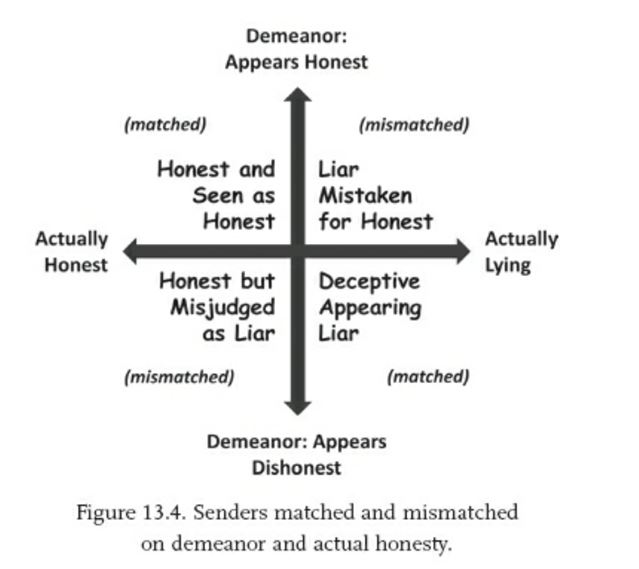
• Sender Honest Demeanor (chapter 13)—There are large individual differences in believability. Some people come off as honest. Other people are doubted more often. These differences in how honest different people seem to be are a function of a combination of eleven different behaviors and impressions that function together to create the BQ (believability quotient). Honest demeanor has little to do with actual honesty, and this explains poor accuracy in deception detection experiments.
• How People Really Detect Lies (chapter 14)—Outside the deception lab, in everyday life, most lies are detected after the fact, based on either confessions or the discovery of some evidence showing that what was said was false. Few lies are detected in real time based only on the passive observation of sender nonverbal behavior.
• Content in Context (chapter 14)—Understanding communication requires listening to what is said and taking that in context. Knowing about the context in which the communication occurs can help detect lies.
• Diagnostic Utility (chapter 14)—Some aspects of communication are more useful than others in detecting deception, and some aspects of communication can be misleading. Diagnostic utility involves prompting and using useful information while avoiding useless and misleading behaviors.
• Correspondence and Coherence (chapter 14)—Correspondence and coherence are two types of consistency information that may be used in deception detection. Correspondence has to do with comparing what is said to known facts and evidence. It is fact-checking. Coherence involves the logical consistency of communication. Generally speaking, correspondence is more useful than coherence in deception detection.
• Question Effects (chapter 14)—Question effects involve asking the right questions to yield diagnostically useful information that improves deception detection accuracy.
• Expert Questioning (chapter 14)—Expertise in deception detection is highly context dependent and involves knowing how to prompt diagnostically useful information rather than passively observing deception cues.
TDT Propositions
The TDT propositions provide a string of assertions, predictions, and conjectures that weave the constructs and modules together to describe and explain human deception and deception detection and to provide coherence. That is, the propositional structure shows how the various modules fit together. The propositions also provide specific, testable, and falsifiable predictions. The propositions are numbered one to fourteen and reflect the logical flow of TDT.
• Proposition one. Most communication by most people is honest most of the time. While deception can and does occur, in comparison to honest messages, deception is relatively infrequent, and outright lies are more infrequent still. In fact, deception must be infrequent to be effective.
• Proposition two. The prevalence of deception is not normally distributed across the population. Most lies are told by a few prolific liars.
• Proposition three. Most people believe most of what is said by most other people most of the time. That is, most people can be said to be truth-biased most of the time. Truth-bias results from, in part, a default cognitive state. The truth-default state is pervasive, but it is not an inescapable cognitive state. Truth-bias and the truth-default are adaptive both for the individual and for the species. They enable efficient communication.
• Proposition four. Because of proposition one, the presumption of honesty specified in proposition three is usually correct. Truth-bias, however, makes people vulnerable to occasional deception.
• Proposition five. Deception is purposive. Absent psychopathology, people lie for a reason. Deception, however, is usually not the ultimate goal, but instead a means to some other ends. That is, deception is typically tactical. Specifically, most people are honest unless the truth thwarts some desired goal or goals. The motives or desired goals achieved through communication are the same for honest and deceptive communications, and deception is reserved for situations where honesty would be ineffectual, inefficient, and/or counterproductive in goal attainment.
• Proposition six. People understand that others’ deception is usually purposive and are more likely to consider a message as potentially or actually deceptive under conditions where the truth may be inconsistent with a communicator’s desired outcomes. That is, people project motive states on others, and this affects suspicion and judgments of honesty and deceit.
• Proposition seven. The truth-default state requires a trigger event to abandon it. Trigger events include but are not limited to: (a) a projected motive for deception, (b) behavioral displays associated with dishonest demeanor, (c) a lack of coherence in message content, (d) a lack of correspondence between communication content and some knowledge of reality, or (e) information from a third party warning of potential deception.
• Proposition eight. If a trigger or set of triggers is sufficiently potent, a threshold is crossed, suspicion is generated, the truth-default is at least temporarily abandoned, the communication is scrutinized, and evidence is cognitively retrieved and/or sought to assess honesty–deceit.
• Proposition nine. Based on information of a variety of types, an evidentiary threshold may be crossed, and a message may be actively judged to be deceptive. The information used to assess honesty and deceit includes but is not limited to: (a) contextualized communication content and motive, (b) sender demeanor, (c) information from third parties, (d) communication coherence, and (e) correspondence information. If the evidentiary threshold for a lie judgment is not crossed, an individual may continue to harbor suspicion or revert to the truth-default. If exculpatory evidence emerges, active judgments of honesty are made.
• Proposition ten. Triggers and deception judgments need not occur at the time of the deception. Many deceptions are suspected and detected well after the fact.
• Proposition eleven. With the exception of a few transparent liars, deception is not accurately detected, at the time in which it occurs, through the passive observation of cues or sender demeanor. Honest-looking and deceptive-looking communication performances are largely independent of actual honesty and deceit for most people and hence usually do not provide diagnostically useful information. Consequently, demeanor-based deception detection is, on average, only slightly better than chance due to a few transparent liars, but typically not much above chance due to the fallible nature of demeanor-based judgments.
• Proposition twelve. In contrast, deception is most accurately detected through either (a) subsequent confession by the deceiver or (b) comparison of the contextualized communication content to some external evidence or preexisting knowledge.
• Proposition thirteen. Both confessions and diagnostically informative communication content can be produced by effective context-sensitive questioning of a potentially deceptive sender. Ill- conceived questioning, however, can backfire and produce below-chance accuracy.
• Proposition fourteen. Expertise in deception detection rests on knowing how to prompt diagnostically useful information, rather than on skill in the passive observation of sender behavior.
Chapter 7. Defining Deception (Beyond BFLs and Conscious Intent)
Chapter 7 takes a close look at issues in defining deception from the TDT perspective. Here is author’s definition of deception, lying, and honest communication:
• Deception is intentionally, knowingly, or purposefully misleading another person.
• A lie (or bald-faced lie, BFL for short) is a subtype of deception that involves outright falsehood, which is consciously known to be false by the teller, and is not signaled as false to the message recipient.
• Honest communication lacks deceptive purpose, intent, or awareness. Honest communication need not be fully accurate or true, or involve full disclosure.
Here author also looks at different types of deception such as self-deception, false statements, and failed deception attempts. He concludes: “An important implication is that message features like the truth and falsity of specific content, message intent, and message function or impact need to be distinguished because these things do not map perfectly onto one another. So, someone can say something that is objectively false, omit information, change the subject, and so forth, in a manner that is either intended to deceive or not. The objective truth or falsity of messages may or may not actually function as deception, and such messages may or may not be perceived as deception. In short, speaker intent, purpose, and message consequence in combination define deception, not the objective qualities of messages or information dimensions (discussed in the next chapter). Further, mere speaker intent is neither sufficient nor necessary in and of itself to define deception.”
Chapter 8. Information Manipulation (Beyond BFLs and Conscious Intent, P.2)
Beginning in chapter 8, a series of numbered original empirical studies are summarized testing relevant theoretical predictions. Author discusses in details Information Manipulation theory (IMT) and IMT2, providing review of several relevant studies.
Chapter 9. Prevalence
Chapter 9 explicates TDT’s first two propositions and the Few Prolific Liars module. The empirical support is detailed by reviewing multiple studies. Then author presents his interpretation: “TDT departs from most other theories of deception regarding the prevalence of deception. According to TDT, lying is infrequent relative to the truth. Lying is not normally distributed across the population but is instead highly skewed, with most lies coming from a few prolific liars. And, according to TDT, the frequency of lying matters in deception detection.”
Chapter 10. Deception Motives
In this chapter author examines motivation of people’s lying and delves into proposition five and the People Lie for a Reason module. It provides the first part of the answer to the mystery of accuracy in research that uses deception but is not about deception. Here are key TDT claims regarding motivation:
1. People lie for a reason. That is, deception is purposive. It is therefore not random.
2. Deception is usually not the ultimate goal but instead is a means to some other end or ends. That is, deception is typically tactical.
3. The motives behind truthful and deceptive communication are the same.
4. When the truth is consistent with a person’s goals, the person will almost always communicate honesty.
5. Deception becomes probable when the truth makes honest communication difficult or inefficient.
Then author provides experimental support of these claims.
Chapter 11. Truth-Bias and Truth-Default
Chapter 11 gets to the core of TDT, focusing on truth-bias and the truth-default and summarizing author’s research on them. The existence of the truth-default and the idea of triggers provide additional insight into the mystery of accuracy in research that uses deception but is not about deception. As before author discusses in details experimental results supporting his ideas.
Chapter 12. The Veracity Effect and Truth—Lie Base-Rates
Chapter 12 focuses on two important implications of truth-bias, namely, the veracity effect and the Park–Levine Probability Model. The focus is on the empirical evidence supporting these modules and proposition three. Chapter 12 explains why base-rates are so important. A very important here is that author provides clear falsification criteria and results of its experimental validation:

Chapter 13. Explaining Slightly -Better-than-Chance Accuracy
The focus in chapter 13 shifts to offering a coherent explanation for the prior detection-accuracy findings described in chapters 1 and 3. The companion modules A Few Transparent Liars and Sender Honest Demeanor are explicated, and the evidence consistent with proposition eleven is described. The mystery of normally distributed slightly-better-than-chance accuracy is solved. Here is a very important graphic representation of matched or unmatched demeanor and behavior, which somewhat confuse even professional interrogation experts:
Chapter 14. Improving Accuracy
Here author discusses the ways of improving accuracy. How People Really Detect Lies is described, along with the Content-in-Context, Question Effects, and Expertise modules. In the process, evidence for the twelfth, thirteenth, and fourteenth propositions is provided. Author reviews research documenting five paths to improved lie detection:
• Using evidence to establish ground truth and assessing the correspondence between communication content and ground truth.
• Using situational familiarity and contextualized communication content to assess plausibility.
• Using situational familiarity and contextualized communication content to assess motives for deception.
• Strategically questioning senders to elicit diagnostically useful communication content.
• Persuading liars to be honest and tell the truth.
Chapter 15. The TDT Perspective
This chapter wraps things up, restating key points of TDT and providing 5 keys to improvement in lie detection:
1. Correspondence of communication content with evidence
2. Content in context (situational familiarity)
3. Assessment of deception motives
4. Diagnostic questioning
5. Persuading honesty
MY TAKE ON IT:
This is the great book and I highly appreciate author’s scientific approach to his ideas and TDT’s experimental support. I guess it would allow to skip the whole lot of literature about truth finding via cues analysis. It also nicely demonstrates that I am not alone finding lie to be difficult even when necessary. The findings of this book are also very helpful in design of processes involving human action, making it clear that by removing advantages that could be provided by lying would remove motivation for doing this and consequently its occurrences.
20200517 – Willful

MAIN IDEA:
The main idea of this book it to present a different view on human action. Author expands usual assumption that people act rationally, trying to maximize material benefits or emotionally, based on instinctive heuristics, by introducing the new form of motivation for action, that he calls “for self”. Consequently, he supports this idea by reviewing various areas of human behavior that, he believes, are not covered by conventional views of motivation.
DETAILS:
PART I Life Is a Mixed Drink
1 Venturing beyond Purposeful Choice
Author starts here by rejecting the idea of exclusively purposeful choice: “Both rational choice and behavioral economics assume that action is purposeful, that people seek the outcomes that best gratify their preexisting desires. People either know their preferences and can describe them out loud, or sense them and act as if they understood what they wanted. The purposeful choice model can explain many things, but not everything. Certain actions are undertaken not for any tangible benefit but for their own sake. They cannot be ranked against, or traded for, other actions. These actions belong to a second realm of behavior that is neither rational nor irrational, but for-itself.”
Then he tells the story of his intellectual development from PhD candidate in Chicago school of economics with strong believe in economic rationality, to financial trading executive discovering joy of doings difficult projects for its own sake, and all the way through wealthy early retirement and post retirement projects when life’s enjoyment is not linked to specific material purposes.
2 Two Realms of Human Behavior
Here author moves to detail his main thesis discussing meaning of “For-Self” motivation and significance of Authenticity. He also reviews relationship between realms of “Purposeful” and “For-Self”, including their interactions and inequality when default is usually set to “Purposeful”. Author also provides graphic representation of his idea:

After that author proceeds to review in details all three parts of “For-Self” domain, dedicating a Part of the book to each: believes, people, and time.
PART II Belief
3 Acting in Character
Here author discusses how people have infinite variety of believes and how they depend on individual character. He refers to philosopher Charles Sanders Peirce to discuss adoption of believes:
- A new belief X is consistent with the things one already knows.
- An authority to which one has committed says that X is so.
- X is the style of thing that one is inclined to believe. In Peirce’s words, X is “agreeable to reason.”
- A new belief X, when subjected to the scientific method, corresponds to data in the world.
After that author move to discuss consequences of acting based on believes, providing 2 interpretations for each one as Purposeful and another For-Self:
- Disregarding Expert Opinion
- Clinging to False Beliefs
- Favoring Experiential Knowledge
- Reacting to Extreme Unexpected Events
At the end of chapter author looks for practical implications in such area as stock picking.
4 Making Money in Financial Markets: Anatomy of a Leap
In this chapter author moves to area of his expertise – Financial Markets and first reviews Efficient Market Hypothesis, then two forms o investing: Institutional and Individual, and finally tells his individual business story with financing big and risky project Thanet.
5 For-itself Decision-Making within a Group
In this brief chapter author once again retells business story, this time with stress on reconciliation of his For-Self decision-making with other people, usually investors. Interestingly enough he even manages to link it to the Bible story of Joseph and Pharaoh.
PART III People
6 Altruism
Here author defines main categories of altruistic behavior and then looks in details at each one of them:
(1) selfish altruism, when an individual appears to subordinate his interests while actually promoting them;
(2) manners and ethics, when an individual observes social norms or adheres to established moral principles;
(3) care altruism, when one person cares directly about the well-being of another;
(4) mercy, when a person performs a sporadic altruistic act that defies rational explanation; and
(5) love altruism, which describes acts that transcend all preferences and do not stand in relation to them.
He also states that: “The purposeful choice model makes room for the first three types of altruism but not the last two.”
7 Public Policy
Author starts this chapter by applying Pareto efficiency to public policy. Then he moves to discuss moral dilemmas, including compulsory trolley problem and monetary value of human life.
PART IV Time
8 Changing Our Minds
This chapter is about choices across time, which includes planning and contradiction between current self that does planning and future self that suppose to implement it. Then author pontificate on planning horizon and discount of the futures.
9 Homo Economicus and Homo Ludens
The final chapter is about two different approaches: Homo Economicus and Homo Ludens, both of which drive human life. He also discusses freedom of choice, choice overload, need for meaningful challenges and consequently work. Finally, author suggest that economy should be changed to move away from Homo Economicus needs that becoming too easy to achieve in direction of Homo Ludens needs.
SUMMING UP Purposeful versus For-itself: A Peace Treaty
For summary author discusses behavior biases for rational choice or For-Itself, positive psychology, and provides updated graph of action drivers:

MY TAKE ON IT:
Generally, I am in agreement with author’s point that economics fail to explain human conditions and actions and there is need to go far beyond it to what author calls “for-itself”. However, I believe that it is not possible for human to do anything that could be strictly divided into “purposeful and for-itself”. It is because human is rather complex entity, which is continuously in process of changing condition of need to satisfy multiple, often contradictory needs and wants created by the brain’s evaluation of physical, psychological, and environmental conditions both: existing and preferable. The variance causes action to move from existing to preferable, which is one and only purpose of any action whether it purposeful, selfish, altruistic, or whatever. I wholeheartedly support all attempt to understand humans, but I am against all attempts to control them as long as they are not violent. My believe is that humans are best off if they are not controllable by others and have resources to achieve whatever they want to achieve.
20200510 – Narrative Economics
MAIN IDEA:
Here is how author defines the main idea of this book:” A key proposition of this book is that economic fluctuations are substantially driven by contagion of oversimplified and easily transmitted variants of economic narratives. These ideas color people’s loose thinking and actions. As with disease epidemics, not everyone becomes infected. In the case of narrative epidemics, the people who miss the epidemic may tell you that there was no such important popular narrative.”
DETAILS:
Part I The Beginnings of Narrative Economics
Chapter 1 The Bitcoin Narratives
Author starts it with the statement that he presents a new theory of economic change that introduces new element: contagious popular stories as important factor defining economic behavior. In this chapter he presents example of such narrative: Bitcoin and then discusses its relation to bubbles, its philosophical link to Anarchism, elimination of inequality, and globalization via removing nation-state control over money supply.
Chapter 2 An Adventure in Consilience
In this chapter author looks at consilience as unity of knowledge and presents his idea that it could be build on the basis of narratives. To support this idea, he presents search results in publications from different areas of knowledge:

Chapter 3 Contagion, Constellations, and Confluence
Here author states that economic narratives are pretty much similar to viruses and then looks at processes of contagion. Once again, he uses Bitcoin as example, comparing it with previous popular economic narrative of Bimetallism:

He also discusses how multiple economic narratives interact and intertwine between themselves, creating environment that drives econonic events in one direction or another.
Chapter 4 Why Do Some Narratives Go Viral?
Here author looks at why narratives are so important and why anthropologists find them in all human societies, regardless of their levels of development. He also looks at the nature of narratives, discussing difference between story and narrative and then providing example with invention that had significant impact on economy – rolling suitcase and how it could not become viable for about 100 years after it was patented in 1887. It took glamourous aircrews of big airlines start using rolling suitcases for them going viral and becoming ubiquitous.
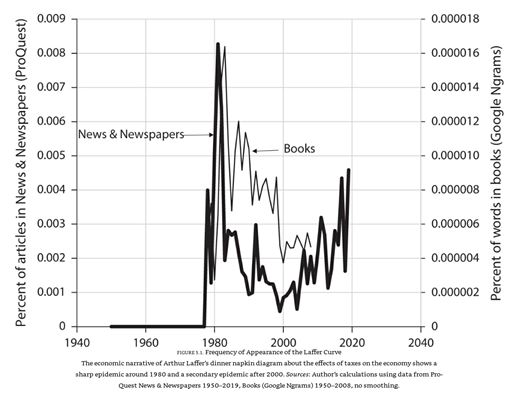
Chapter 5 The Laffer Curve and Rubik’s Cube Go Viral
In this chapter author looks at another two viral phenomenon, one economic -Laffer Curve, and another just toy – Rubik’s cube. Here is diagram of popularity search for Laffer:
Chapter 6 Diverse Evidence on the Virality of Economic Narratives
Author starts this chapter by looking at underlying physiology of human brain related to stories and narratives. He then refers to philosophical writings to provide additional evidence that “going viral” is not a new thing, but rather natural condition of human existence that was around forever. Finally, he links it to various examples of impact of narratives on human behavior, including economic behavior. He also discusses heuristics that often define human behavior without any regard to formal logic and even, quite often, completely denying it.
Part II. The Foundations of Narrative Economics
Chapter 7 Causality and Constellations
Author starts this with note that just a few persons create new economic narrative and consequently cause big economic movement only if and when this narrative becomes accepted by many. Then author discusses direction of causality taking for example Friedman’s “Monetary history” and then reviewing the idea of “self-fulfilling prophecy”. Next stop is discussion of impact of random events on narrative including such events as anniversaries. Author also describes a number of experiments when intentional prompting caused change in behavior. The final part of the chapter is discussion of memory and impact of fake news that could cause real change of events.
Chapter 8 Seven Propositions of Narrative Economics
In this chapter author summarizes 7 propositions of narrative economics:
- Epidemics can be fast or slow, big or small. The timetable and magnitude of epidemics can vary widely.
- Important economic narratives may comprise a very small percentage of popular talk.
- Narratives may be rarely heard and still economically important. Narrative constellations have more impact than any one narrative. Constellations matter.
- The economic impact of narratives may change through time. Changing details matter as narratives evolve over time. Truth is not enough to stop false narratives.
- Truth matters, but only if it is in-your-face obvious.
- Contagion of economic narratives builds on opportunities for repetition. Reinforcement matters.
- Economic narratives thrive on human interest, identity, and patriotism. Human interest, identity, and patriotism matter.
Part III Perennial Economic Narratives
Chapter 9 Recurrence and Mutation
This chapter is about complex live of economic narratives, how they are created at some point and then move with time, sometimes moving into economic live and them disappearing in shadows, only later mutate and move back to live again. He provides a list of the biggest economic events in American history:
- A depression from 1857 to 1859, followed by the secession of southern states in 1860–61 and the US Civil War (1861–65). The Civil War was the most lethal war in US history, responsible for more US fatalities than all other US wars combined.
- A depression from 1873 to 1879 that led to the publication of the best-selling economics book of all time in the United States, Henry George’s Progress and Poverty (1879), which accused the unrestrained free-market system of producing worsening inequality.
- A depression in the 1890s comprising two NBER contractions, 1893–94 and 1895–97. The extended depression, during which unemployment always exceeded 8%, ran from 1893 to 1899. This depression coincided with an aggressive phase in US history, with the United States launching the Spanish-American War and the Philippine War.
- A series of three short contractions from 1907 to 1914, starting with the Panic of 1907, which ended only with the heroic advances made by J. P. Morgan and other bankers. These events led to the creation of the Federal Reserve System to prevent such banking crises in the future. These contractions were followed by World War I, which began in 1914.
- A brief but extreme depression from 1920 to 1921 that included the sharpest deflation ever experienced in the United States.
- The Great Depression after the 1929 stock market crash, which morphed into a worldwide depression. In the United States the extended depression ran from 1930 to 1941, with unemployment uniformly exceeding 8%. The Great Depression took its name from the 1934 Lionel Robbins book with that title. It comprised two NBER contractions, 1929–33 and 1937–38. The worldwide depression immediately preceded World War II.
- A severe recession in 1973–75, associated with a war in the Middle East and an oil embargo. Economist Otto Eckstein called this period the “Great Recession” in his 1978 book with that title, inviting comparison with the Great Depression. z
- A severe recession from 1980 to 1982, comprising two NBER contractions, a short contraction within the year 1980 and, soon after, another contraction 1981–82, associated with a war in the Middle East. At the time, this recession was called the “Great Recession,” again inviting comparisons with the Great Depression.
- A severe recession from 2007 to 2009, also named the “Great Recession,” once again inviting comparisons with the Great Depression, and this time the name really went viral and has stuck to this day.
At the end of chapter author identifies 9 specific narratives that he specifically reviews in the next 9 chapters.
Chapter 10 Panic versus Confidence
Here author analyzes raise and fall of panic or levels of confidence using search for frequency of use words in contemporary publications:

He then discusses crowd psychology which causes these movements and how they impact economy.
Chapter 11 Frugality versus Conspicuous Consumption
Here author discusses another somewhat polar narratives: frugality and need for saving that was prevalent before WWII and how it was substituted by the new narrative of “’American Dream” after WWII:

Chapter 12 The Gold Standard versus Bimetallism
This chapter is about another pair of narratives, this time related to intrinsic value of money, which had 2 picks: one at the end of XIX century with “Cross of Gold” images and later narratives of XX century with Gold Standard as tool to limit government monetary excesses:
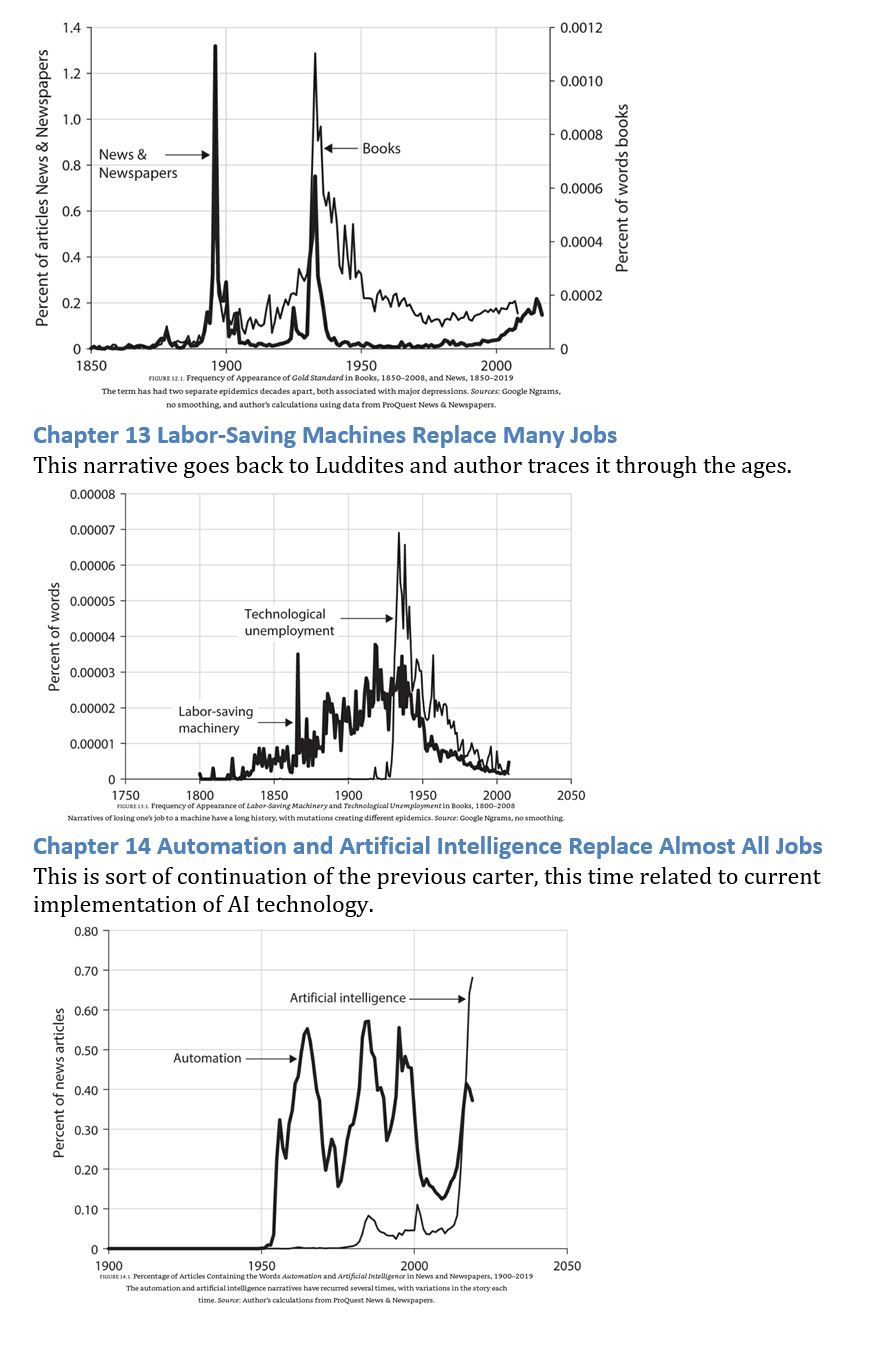
Chapter 15 Real Estate Booms and Busts; Chapter 16 Stock Market Bubbles; Chapter 17 Boycotts, Profiteers, and Evil Business; Chapter 18 The Wage-Price Spiral and Evil Labor Unions;
These all are other long-living narratives, which author traces in similar ways through use of relative frequency of words in news and magazines. They all have intermediate ups and down when a narrative used to explain current events and then fades out when events change and some other narrative takes its place.
Part IV Advancing Narrative Economics
Chapter 19 Future Narratives Future Research
Here author discusses future and makes a number of important points about changes in future forms and circumstances of various narratives and anticipation of new technology changing contagion rates and recovery rates of future narratives. At the end he suggests how his approach should be used in future research and how incorporate narrative economics into general economic theory. He also suggests the great expansion of data collection efforts necessary for application of his ideas and specifies how it could be done:
- Regular focused interviews of respondents inviting them to talk expansively and tell stories in response to stimulus questions related to their economic decisions.
- Regular focus groups with members of different socioeconomic groups to elicit actual conversations about economic narratives.
- A historical database of focus groups conducted for other purposes in years past.
- Databases of sermons.
- Historical databases of personal letters and diaries, digitized and searchable.
Finally author suggests to conduct tracking and quantifying narratives in order “to better understanding the patterns of human thinking about the forces that cause economies to boom at times and to stagnate at others, to go through creative times and backward times, to go through phases of compassion and phases of conspicuous consumption and self-promotion, to experience periods of rapid progress and periods of regression.”
MY TAKE ON IT:
I find this book very interesting and I think that author’s approach would be much more effective than quantitative approach to economics that dominated the last 60 years of this field development, consistently providing proves of its inability to predict future developments even for the next couple of quarters. Interestingly enough, this approach somewhat reminds me of Mises’ believe that economics is about human actions and as such is not really good place for mathematical approach based on analysis of global equilibrium and computer modeling. However, it would take tremendous change in thinking of economists on tenure that I do not think could possibly happen, unless tenure is substituted by rewards for correct predictions of future economic developments.
20200503 – Hive mind

MAIN IDEA:
The main idea of this book is that individual IQ scores have only marginal impact on individual prosperity, but IQ of a nation or hive, defined as average of its people, is much more important because it defines overall prosperity of the nation.
DETAILS:
Introduction: Paradox of IQ
The paradox author presents here is that countries which do better on various international scholastic tests have higher GDP, however inside countries high IQ does not correlate with high income at the same level. Here is how author summarizes reasons for this:
Author identifies 5 channels for IQ to pay more for nations than for individuals:
“1. High-scoring people tend to save more, and some of that savings stays in their home country. More savings mean more machines, more computers, more technology to work with, which helps make everyone in the nation more productive.
- High-scoring groups tend to be more cooperative. And cooperation is a key ingredient for building higher-quality governments and more productive businesses.
- High-scoring groups are more likely to support market-oriented policies, a key to national prosperity. People who do well on standardized tests also tend to be better at remembering information, and informed voters are an important ingredient for good government.
- High-scoring groups will tend to be more successful at using highly productive team-based technology. With these “weakest link” technologies, one misstep can destroy the product’s value, so getting high-quality workers together is crucial. Think about computer chips, summer blockbuster films, corporate mega-mergers.
- The human tendency to conform, at least a little, creates a fifth channel that multiplies the effect of the other four: the imitation channel, the peer effect channel. Even a small tendency to conform, to act just a little bit like those around us, to try to fit in, tends to quietly shape our behavior. If you have cooperative, patient, well-informed neighbors, that probably makes you a bit more cooperative, patient, and well-informed.”
- Just a Test Score?
Here author looks at IQ tests as tool for intelligence measurement and points out that high scores in one area predicts skills in other. Then he discusses diverse methods of measuring cognitive skills and provides some research result for impact:” The payoff to a high IQ appears moderate. Those with IQs in the top 10 percent earned about 60 percent more than those in the bottom 10 percent.” Another research demonstrates that this impact did not change that much for 100 years. Finally, author discusses Emotional IQ noting that:” Better average social skills are typically just another benefit of having a higher IQ score, and since the economy is a social system, those social skills may prove important in explaining why higher-scoring nations tend to be more productive.”
- A da Vinci Effect for Nations
Here author extends the idea if consistent levels of IQ across different areas to Nations. First, he discusses ecological validity of tests. Then author moves to discuss main source of nations IQ – work of psychologist Richard Lynn and political scientist Tatu Vanhanen. Here is relevant graph:
- James Flynn and the Quest to Raise Global IQ
This chapter is about Flynn effect of IQ raising over time. Author discusses racial implications, politically correct suppression of research, impact of nutrition, health, education, and surrounding people on IQ not only of individuals, but also groups and nations. - Will the Intelligent Inherit the Earth?
Here author moves to various experiments with delayed gratification and idea that smarter people are more patient. Author reviews various research results and financial results for savings rates and debts. - Smarter Groups Are More Cooperative
This chapter looks at another very important area of human activity: cooperation. Once again research demonstrates correlation: smarter people are not only more patient, but are also better at mind reading to predict results of cooperation or lack thereof. To analyze this at the group level author looks at data from schools with high average SAT scores adn low, finding that students in former are more cooperative than in latter. - Patience and Cooperation as Ingredients for Good Politics
Author starts this chapter with discussion of cooperation, providing example of informal truce during WWI. Then he moves to politics defining it as kind of recurring prisoners dilemma and linking it to institutions: “I contend that economic institutions—property rights, legal systems, political regimes—are often a collection of just the kinds of games for which higher average IQ pays off, games that are played day in and day out by judges, bureaucrats, politicians, and citizens.” . Author then brings in Coase Theorem: “If it’s easy for two or more parties to bargain with each other, they can bargain to an efficient, win-win outcome regardless of which party has the most power going in to the negotiation.” The final part of the chapter is about government and corruption as measured by the corruption perception index. Author makes an interesting point about IQ and corruption: “Average IQ predicts lower corruption across countries. Additional research that Potrafke and I collaborated on showed that both national average IQ and national math and science test scores do a robust job of predicting a nation’s degree of overall property rights enforcement.14 And University of Johannesburg economist Isaac Kalonda Kanyama found a moderate to strong relationship between national average IQ and yet another set of institutional quality indices created by the World Bank.15 In nations with higher average test scores, politicians tend to respect people’s property, government bureaucracies allow people and businesses to buy and sell with less interference, and bribery is less a part of daily life. In nations with higher average test scores, the government is more likely to let people and businesses find their Coasian bargains peacefully.” - Informed Voters and the Question of Epistocracy
This chapter starts with example of gap between experts and population using issue of dosage. Then he moves to discuss uninformed voters as result of low numeracy and literacy of population. It is linked to IQ with high IQ voters being better informed, more active, and generally having different attitudes, usually more pro-market. Author also discusses here formation of political opinion via social pressure and information manipulation. On Epistocracy author brings in a paradox of democracy: expansion of franchise brings in low IQ masses that vote incorrectly from the point of view of high IQ elite. He ends with this: “As an economist I will make this forecast: if a nation can find an effective way to raise the information level of its voters, it will probably become more market-oriented, more socially tolerant, and more prosperous in the long run.” - The O-Ring Theory of Teams
O-ring is reference to the piece of Shuttle equipment that failed causing catastrophe. Author uses this example to discuss that any system is as reliable as its least reliable subsystem. Author then expands this analogy to teams with good and bad workers and posits the question: If high IQ team is more productive, why individual IQ does not provide higher returns. - The Endless Quest for Substitutes and the Economic Benefits of Immigration
Here author provides his solution to paradox: in high average IQ team even low IQ individuals much more productive than they would be on low average IQ team. This become foundation of author’s discussion on immigration. His claim is that low IQ and culturally different immigrants are becoming much more productive in high IQ team, consequently benefiting everybody. He then discusses impact of such immigration including on the political system of the new country. - Poem and Conclusion
In the last chapter author become a bit poetic. Then he refers to research about top 5-10% of population with higher level of cognitive skills and whether they have disproportional impact on prosperity of the nation overall. The final inference is that individual IQ does not matter as much as overall levels of cognitive abilities and skills and politics should be directed to support their development. Author also expresses hope that Flynn effect would have global impact raising prosperity of currently lower-scoring countries.
MY TAKE ON IT:
I think that author’s attention and concentration on average IQ of the nation is somewhat strange because it does not exist. As many other thing that social “science” attempts to analyze, it is just an abstraction. IQ and other characteristics are characteristic of individual humans and sould not be applied to abstraction because it prevents clear analysis. What does matter is culture, expressed as a set of views and opinions in minds of majority of people regardless of their IQ. Average American regardless of IQ is culturally conditioned to believe that he/she is entitled to freedom of action in hope to obtain good returns if this action successful in satisfying needs of others who would pay. Whoever is the leader of the nation at the moment can help or hamper to this action, but not really define outcome. The flow of wealth is going from the bottom up with most of it supposed to stay at the bottom. Average Russian, also regardless of IQ, culturally conditioned to believe that decisive impact on his/her well being comes from whoever is the great leader, who now makes decisions and directs collective effort in creation of wealth, which them distributed down according to individuals’ position in society. Consequently, individual effort should be directed to improvement of position within society rather than to creation of wealth. IQ, either individual or national, hardly has much impact on wealth creation by overall society in either case.
Actually, table of cognitive abilities and IQ results by country nicely demonstrates my point. Both CA and IQ of Ukraine and Israel are exactly the same 93 and 95. Moreover the population of Israel to high extent came from Ukraine between 1880 and 2000, the last wave (10% of Israel population) coming after 1990. Israel’s GDP per capita is $42,452, while Ukraine $2,536, that is nearly 20 times difference. It is all despite Ukraine having large territory with the best agricultural land in the Europe, close to the rich EU countries, and vast industrial base built during Russian Empire and expanded by USSR. It is also mainly at peace, except for low scale conflict with Russia, which does not threaten its existence. Israel has miniature territory, is surrounded by enemies who seek its complete destruction and annihilation of its population, constantly suffers from terrorist attacks, constantly under political attack from United Nations, constantly under attack from anti-Semitic intelligentsia of nearly all countries. And, since national CA or IQ cannot explain this different in performance, something else should. Whether such explanation would be based on high individual IQ of Ashkenazi Jews that represent some 25% of population, or overall mix of Jewish cultures from all around the world that formed Israeli culture, or quality of air and water, it would be an interesting thing to explore.
20200426 – Great Society

MAIN IDEA:
The main idea of this book is to review and retell history of American “Great Society” that was supposed to end poverty and instead turned into nothing else than huge expense on bureaucracy and handouts, often resulting in increased misery of poor. Here is how author defines her objectives: “For today, the contest between capitalism and socialism is on again. Markets do promise strong growth; we do live in a creative society, the most creative in the world, creative enough to lift the nation to new heights. Yet new, progressive proposals bearing a strong resemblance to those of Michael Harrington’s and his peers’, from redistribution via taxation to student debt relief to a universal guaranteed income, are sought yet again. Once again, many Americans rate socialism as the generous philosophy. But the results of our socialism were not generous. May this book serve as a cautionary tale of lovable people who, despite themselves, hurt those they loved. Nothing is new. It is just forgotten.”
DETAILS:
Introduction: The Clash
Author starts with the story of Michel Harrington – socialist and author of the book about poverty “The Other America”, which prompted this discussion among American upper classes of politicians, bureaucrats, and intelligentsia. Author briefly describes how this discussion turned into political action resulting in massive expense on variety of government programs that often ended in complete failure.
New Frontier
- The Bonanza (1960-1962)
This chapters starts with discussion of very popular TV series “Bonanza”, which author characterizes as one of attempts to answer to the key question of early 1960s: What to do with the newly found huge American wealth? Author briefly describes some key points of the New Deal, which seemingly established harmony between big government, big corporations, and big labor. Then she looks behind the façade at fight between corporations vs. unions vs. government and individuals who were involved at the highest levels. Author specifically looks at GE, which leaders Lemuel Boulware, Ralph Cordiner, and Charlie Wilson strongly rejected socialist ideas, supported capitalism, and later got Ronald Reagan involved in their effort, creating popular GE theater. Government responded by Justice department investigations and via its TVA administration attack against Reagan. Unions initiated strikes. It all ended with defeat for GE after massive intervention of Kennedy administration. It also killed Reagan GE theater and pretty much ended active ideological support of capitalism by big corporations
- Port Huron (1962)
This chapter is about famous student statement. It turned out that it was not some spontaneous expression of students’ feelings and ideas, but union organized and financed political action. The organizer was UAW boss Walter Reuther. Author retells history of his life, including his work in USSR after which he came out as convinced anti-communist, while retaining his believes a socialist. Then she moves to Tom Hayden, other personalities, discussions, and final result – Port Huron Statement was directed against military, supported unions, and three of Roosevelt’s four freedoms, missing freedom of worship. It also spawned SDS organization. After that author moves to relationship between Reuther and unions with Kennedy and then Johnson administrations.
Great Society
- Great Society (May 1964)
This chapters starts with campaign of 1964 when Johnson and media succeeded in turning Goldwater into warmonger, while preparing huge expansion of government that was supposed to raise society to the new heights. This would be massive expansion of New Deal that democrats failed to achieve before. Author describes Johnson’s legislative success and a few failures, such as inability to eliminate “right to work” at federal level.
- Revolt of the Mayors (January 1965)
Here author describes struggle between local, state and federal powers using example of LA democratic mayor Sam Yorty. The struggle was about many issues, not last of them civil rights. The problem was that federal government dealt with abstractions when forcing all to be equal is always good, while mayors dealt with realities when middle class neighborhoods like Watts were turning unlivable, so middle class evacuated in mass. Author looks at multiple programs imposed on cities by federal government and analyses their consequences, including Watts riots.
- Creative Society (August 1965 – January 1966)
This starts with NASA and its achievements, then moves to the story of Intel and birth of Silicone Valley prompted by equity compensation in startup high tech businesses. Then author returns to politics of the period: attempts to declare welfare as property, civil rights, and right to work fights.
- Interlude: Looking for Socialism (September 1965 – January 1966)
Here author describes Tom Hayden’s unsuccessful attempt to initiate viable political movement for socialism. At the time American attention turned to Vietnam war, which prompted powerful political movement against it that leftists pretty much took over. They revived communist propaganda similar to “I saw the future and it works”, promoting beauty of totalitarianism in Soviet Union, China, Cuba, Vietnam, and elsewhere. Author describes travels of Hayden and others to North Vietnam that was celebrated by American intelligentsia, rather than punished as support for the enemy.
- Housing Society (January 1966 to July 1967)
This chapter looks at HUD and massive housing programs that were supposed substitute old poorly regulated housing created by independent efforts over long period of time with government planned state of the art, well regulated and controlled projects that would force on poor much better quality of life than they could produce themselves. Author describes political and legal actions that extended eminent domain beyond any conceivable limit and for all practical purposed deprived poor of what little residential property they had, substituting it with a place in government owned hosing with lots of strings attached. Author describes these strings and impact they had on destruction of family and overall way of live. Author also describes war against landlords, which led to elimination of any incentive for private investment into housing for poor and implementation of complete bureaucratic control.
- Guns Butter and Gold (Thanksgiving 1967 to March 1968)
This chapter starts with discussion of gold and its link to dollar that was still valid at the time per Bretton Woods agreements. Johnson administration profligate spending led to gold outflow from USA. Author describes attempts to increase gold mining. It follows by the look at relationship with UK. Author also reviews multiple additional crises: political between Johnson and Kennedy clan, scary pronouncement of environmentalists that were gaining popular support, Tet offensive in Vietnam, legislative failures, and finally primaries challenge. All this together led to Johnson dropping out from running for the second full term.
- Reuther and the Intruder (August 1968 to December 1968)
This starts with description of arrival of small foreign cars like Toyota and Volkswagen that were destined to undermine both American big automakers and their symbiotic partner – UAW. Author retells story of 1968 elections, internal struggle within democratic party, and actions of UAW boss Reuter.
Abundant Society
- Moynihan Agonistes (1969 to 1970)
This chapter starts with discussion of unusual for liberal academic action: Moynihan joining Nixon administration. Then author reviews events of this period somewhat via Moynihan eyes. Nixon’s cooperation with reasonable left reached the point when he supported and even tried to promote guaranteed income. However, since it would eliminate welfare system, depriving its constituents of cash flow, the proposal failed. Author also deviates a bit into history of welfare ideas all the way to Engels, Webb, and Roosevelt to demonstrate how these ideas developed in the Anglo-American world. Author describes how practically all political powers left and right rejected the idea of family assistance and how other events related to Vietnam led to complete disruption between intelligentsia and Nixon administration. The chapter ends with description of two symbolic events marking the end of era: Moynihan resignation and death of UAW boss Reuther.
- The Governor of California (1970)
This chapter pretty much describes initiation of the new movement, which was pretty much against direction to increase welfare and government power. It starts with description of fight against integration of all LA schools ordered by judge and discussion of popular legal doctrine of welfare being property of its recipients. Author then demonstrates how it prompted growth of Reagan’s political career. Reagan strongly rejected both ideas because LA school integration would require busing, which was huge burden on middle class kids and parents. Author then describes a number of political fights in California that made Reagan a national political figure of serious statute.
- Scarcity: Burns Agonistes (1971)
This chapter starts with the story of residual payments for actors that Reagan achieved when he was the union leader, which become less and less valuable with inflation. The author then moves to discussion of inflation and overall economic decline that become evident in early 1970s practically destroying the very idea of affordability of massive welfare state. Author discusses details of interplay between FED chairman Burns and Treasury’s Connally who tried stopping inflation and save economy with price and wage control, closing gold window, and using other measures, but were not that successful.
Coda: Demolition in St. Louis (March 1972)
This ends book on symbolic note of demolition of Pruitt-Igoe – one of the most visible and expensive projects of welfare state. More than anything else it demonstrated that human beings, even very poor, are not subject to easy control by bureaucratic machinery, at least in democratic country were, one way or another, they manage to avoid such control.
MY TAKE ON IT:
This is an interesting take on history written with typical American attitude of believe that politicians and bureaucrats had initiated welfare state, promoted, and continue promoting it because they want the best for poor. The problem is that they choose erroneous method to do it and that is why it continuously fails and quite miserably at that.
I think it is very naive view that impedes resolution of the problem. I like the expression that I read once about Roosevelt’s brain trust and other enthusiastic promoters of big government solution in 1930s: “They come to do good and did well”. I think that regardless what such people think when they start as politicians or bureaucrats, “do well” is the real engine of their effort, and key here is “do well” at the expense of productive people misleading them into believe that it is done to achieve fairness for all. The programs, projects, justifications, and promotions change but lust for power and wealth via control over government machinery of coercion is constant. Therefore, no effort to have reasonable and limited welfare programs could possibly be successful until this obvious fact of lust for power is internalized by majority and countermeasures decidedly applied.
These countermeasures should make it an impossibility to gain wealth and power over others via political or bureaucratic career, which could be achieved only by making all senior political and bureaucratic position temporary with prohibition to any conceivable cashing in upon the end of such career. In short people should obtain their wealth in public sector before embarking on political bureaucratic career or forever forfeit hope to be much wealthier than average.
20200419 – The Tyranny of Experts

MAIN IDEA:
Here is how author defines his main idea: “The technocratic illusion is that poverty results from a shortage of expertise, whereas poverty is really about a shortage of rights. The emphasis on the problem of expertise makes the problem of rights worse. The technical problems of the poor (and the absence of technical solutions for those problems) are a symptom of poverty, not a cause of poverty. This book argues that the cause of poverty is the absence of political and economic rights, the absence of a free political and economic system that would find the technical solutions to the poor’s problems. The dictator whom the experts expect will accomplish the technical fixes to technical problems is not the solution; he is the problem.”
DETAILS:
PART ONE: THE DEBATE THAT NEVER HAPPENED
Chapter One: Introduction
Author starts this with imagining routine, for developing countries, application of government power to move farmers from their village to another place happening in Ohio. Then he stresses that such raw and cruel power application in developing world would occur under direction of Western technocratic elite, which finds it inconceivable in their own countries. Then author presents his claim that technocratic approach of forcing people to do “right things”, whatever it is, is not working regardless of how much money provided as “help” to support it. Author also discusses in this introduction what he wants to achieve with this book, anticipating accusations that he expects to be pointed at him, and provides a detailed list of what this book is not about.
Chapter Two: Two Nobel Laureates and the Debate They Never Had
The laureates here are Gunnar Myrdal – promoter of soft authoritarianism with socialist central planning and Friedrich von Hayek – promoter of freedom, not only as value of and in itself, but also as source of economic prosperity.
Author then discusses debates that representatives of these two polar views should have, but never did:
- Debate on the Blank slate versus Learning from History
- Debate on the Well-Being of Nations versus that of Individuals
- Debate on Conscious versus Spontaneous Solutions
Finally, author states that Authoritarian point of view obtained practically unanimous support of intelligentsia, while its supporters, especially Myrdal understood that large scale planning does not work neither logically nor practically. So the only way to promote it is to avoid debates at any cost.
PART Two: WHY THE DEBATE NEVER HAPPENED-THE REAL HISTORY OF THE DEVELOPMENT IDEA
Author starts here from referring to Truman’s initiative to start foreign aid in 1949, which is considered the starting point of the process and then reject this idea and demonstrates that it had its roots in colonialism and locates its formative years between 1919 and 1949. This part reviews the development and implementation of Authoritarian, expert led development idea in three areas: China, Africa, and Colombia.
Chapter Three: Once Upon a Time in China
Author start this chapter with introduction of two economists: Condliffe, who supported free development and H.D. Fong who supported authoritarian model. Then he analyses role of racism, which was widely accepted among western intellectuals, who believed that people of “inferior” races could not develop their countries without external direction and control. Author also discusses consequences of Versailles treaty and its system of mandates. Author then moves to discuss development in China where revolution brought to power socialist Sun Yat-sen who fully supported idea of authoritarian development. Author then reviews role of American experts who brought in money from Rockefeller foundation and network from YMCA. He also looks at creation of the Institute of Pacific Relations (IPR) under leadership of H.D. Fong that start looking for development projects in China to implement authoritarian model. Author also discusses attempts to promote democratic development by Condliffe and Yuan-li Wu, which were not successful. All this ended, however, with communist takeover of China in 1948.
Chapter Four: Race, War, and the Fate of Africa
This is the story of another not very successful attempt of expert led development, this time in Africa under leadership of Lord Hailey. This one was driven by idea to save British colonies in Africa by preventing race war that was brewing from the mid of the century. There is interesting narrative here about contradictions between British and Americans when British blamed Americans for racism, while American could not stand even idea of Empire. Author then briefly discusses how out of all this was born African nationalism with strong authoritarian tendencies. As representative type author uses Kwame Nkrumah.
Chapter Five: One Day in Bogotá
This chapter moves to Latin America to trace development of Authoritarian, expert driven development in Colombia. Author starts with two events of April 9 1948: selection of Colombia as test case of development by World Bank and assassination of popular leader Jorge Caitain, which triggered long period of massive violence. Author also trace development US attitudes to Latin America during this period.
PART THREE: THE BLANK SLATE VERSUS LEARNING FROM HISTORY
This part starts with the story of Bill Gates claiming achievement of dramatic improvements in fighting child mortality in Ethiopia. Author looks at this in details and finds that it is pretty much result of poor statistics, which does not allow any serious analysis of results. Author evaluates this as example of “Blank Slate” attitude when experts believe they can apply technical solution to the country without any accommodation of its specifics such as history and cultural values.
Chapter Six Values: The Long Struggle for Individual Rights
Here author looks at history of emergence of individual values and consequently democracy. He tells the story of fight between Emperor Barbarossa (1154) against cities in Italy some of which were able to retain their rights and some were conquered. This difference in history is still shows now in prosperity levels of these places. Author then discusses collectivist values, which always are values of rulers and aristocracy versus individualist values, which lead to the freedom. He traces how individualistic values moved after expansion of trade. First from Mediterranean to Atlantic: from Italian cities to Dutch and British, and then to America. Author also analyses different effects of autocracy vs. democracy on values and how it impacts behavior. He specifically looks at case of Asian type of collectivist values, using the story of British man of Chinese origin Henry Lee who became Lee Kuan Yew – the Singapore autocrat who established seemingly very successful form of political autocracy combined with business freedom. Here author provides an interesting analysis of trust between people in different societies:
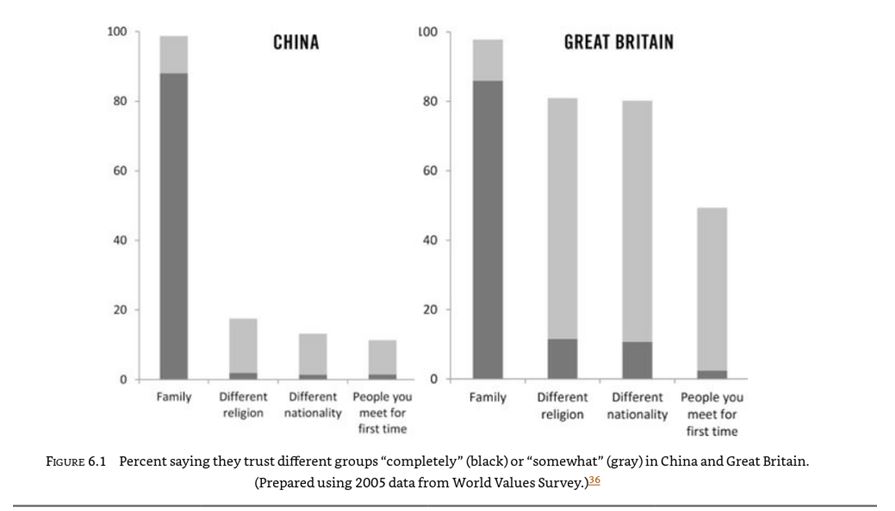
At the end of chapter author contemplates on individual rights and values being an end in itself and then discusses findings of research on what poor really want, which turned out pretty much the same that rich and definitely includes freedom. He then points out that tradeoff between freedom and autocrat led prosperity is often illusionary and burden of prove is on experts who promote such tradeoffs.
Chapter Seven Institutions: We Oppress Them If We Can
Here author discusses oppressive institutions, which experts usually support, claiming that forcing people into some kind of behavior or organizational structure they do not want, leads to quick material improvement. Author looks at few case studies that demonstrate that cost of oppression is high, while benefits are dubious or non-existent. Author provides a very interesting data based on history of African tribes that either were victims of slave trade or avoided this, demonstrating that history of oppression carries long lasting damage to culture and attitudes, making it much more difficult to prosper. Interestingly enough, it relates not only to oppressed, but also to oppressors.
Chapter Eight: The Majority Dream
Here author looks at two places: New York and Colombia. Both places started as colonies with slavery. Author traces one street block in New York – Greene Street, who owned this place, how they lived, and what they did. He traces how this place initially was owned by aristocratic family of Bayard whose economic power was based on slavery and sugar plantations back when New York was New Amsterdam. However, by 1780s they lost this property due to changes in economy and mass influx of immigrants, opening it to succession of businessmen whose well being was based on prosperous free economy. Author briefly retells history of Erie canal that made New York into huge hub for trade between American plains with their agricultural production and Europe with its advance manufacturing. Author also traces economic development of refugees Sephardic Jewish family Seixas, who prospered for centuries in this place and still do. Finally, author looks at change in infant mortality and how democracy positively impact this parameter.
PART FOUR: NATIONS VERSUS INDIVIDUALS
This starts with interesting example of how differently could be perceived the same fact by people with authoritarian and collectivistic mindset from individualistic. The fact is migration of professionals, in this case doctors from poor countries to USA. From authoritarian point of view: “America is Stealing the World’s Doctors”, indicating attitude that doctors are less than human, rather kind of commodity produced by the “World” so their migration is equivalent to “America is Stealing” this commodity. From individualistic point of view doctors are human and if they decide that America is better place for them to live and work, then it is just indication that America has better society, at least for doctors. Author also makes important point that authoritarian attitude treats individuals from different countries differently – nobody would even think to say that prominent American doctor was stolen by Africa if he would move there from USA.
Chapter Nine: Homes or Prisons? Nations and Migrations
This chapter is about migration between countries and nationalism. Author’s position is that migrants from poor authoritarian countries to rich and democratic West reduce overall poverty in the world, expand protection of individual rights, send money back home in excess of any official help to their countries and do other nice things. Author also discuss limits and negatives of nationalism.
Chapter Ten: How Much Do Nations Matter?
Here author discusses impact of national policies on economic development- research project that he worked on at the beginning of his career. The point is that it does have significant impact in extreme cases, but generally within limits of normalcy such impact is only marginal. Generally, it is more function of luck and circumstances, so except for periodic good or bad exceptions, the condition of nation is pretty stable. This brings author to discussion of measurement of these conditions and their changes, noise vs. signal, measurement errors, and such. Here is author’s overall conclusion: “In the debate on the prerogatives of nations versus the rights of individuals, the case for the former depended on development that happened mainly at the national level. Yet nations do not matter for development as much as the development community says they do. When they do matter, it is sometimes in a bad way, as we have just seen with Aleppo disease and trade-destroying borders. The worship of national growth success has often led to giving the national state more powers to pursue this success. The extreme emphasis on national growth performance is misguided, for it shows little evidence of paying off—or even of any way to know whether the national strategy really is paying off or not, according to questionably measured growth rates. The casualties as usual are the individual rights suppressed in the name of the nation’s collective pursuit of success.”
PART FIVE: CONSCIOUS DESIGN VERSUS SPONTANEOUS SOLUTIONS
Chapter Eleven Markets: The Association of Problem-Solvers
Here author presents an opposite way of thinking of contemporary high-level bureaucrats such as president of world bank versus thinking of Adam Smith and other supporters of freedom. Author discusses Smith’s approach as “Problem-Solving System” that includes such parts as division of labor, gains from trade, gains from specialization, and other features of free market. However, author stresses that it would be mistake to look at it as market vs. government problem. It is rather about individual rights vs. state power. Here is author’s formulation:” We have now reached another crucial moment in the argument of this book. The technocratic approach—solutions by experts—arguably gives us the worst of all worlds. Having experts in charge of solving society’s problems turns things over to agents who face neither a market test nor a democratic test. If they get the knowledge (including localized feedback) wrong, they suffer neither economic nor political penalties. If their solutions should happen to work, they get neither economic nor political rewards. So, there is nothing to spur them on to scaling up successes any more than there is anything to motivate them to kill off failures. The Invisible Hand spurs development through the virtuous circle of specialization, learning by doing, and gains from trade. The Invisible Hand guides nonexperts to something they are good at doing. They start selling it, and they get even better at it thanks to learning by doing. Trade allows them to keep increasing the scale of the virtuous circle, selling more and more, learning to do it better and better, till they take the world market by storm.”
Chapter Twelve Technology: How to Succeed Without Knowing How
Here author presents his point of view on what causes economic development and concludes that it is technology. Technology is another spontaneous order and author looks in details at multiple examples of its development, stressing that it is not really subject to planning or even knowledge of where its development will move, so there is no place here for government direction.
Chapter Thirteen Leaders: How We Are Seduced by Benevolent Autocrats
In this chapter author reviews so called autocratic miracles like Singapore and provides evidence that it is not as good as advertised. Author presents two potential reasons for autocratic success:” The first and stronger variant is simply that autocrats are better than democrats for development (by development in this context we usually mean “rapid economic growth”). The second, weaker variant is that the best autocratic leaders are better for growth than the best democratic leaders, while conceding that the worst autocrats are worse for growth than the worst democrats.” The he proceeds to reject both of them using factual data and parables.
Chapter Fourteen: Conclusion
In conclusion author summaries the ideas of this book based on various stories told in previous chapters, making the point that use of government power to achieve progress generally fails like it did in Ethiopia and Uganda, while uncontrolled natural development generally succeeds as it did on Green Street.
MY TAKE ON IT:
I seldom agree with anybody to such extent as with this author. For me it is obvious that relationship between people, whether as equals with voluntary exchange and cooperation, or as superior and inferior with top down control, define economic success or failure, and generate prosperity or misery. The one important thing I think author did not pay enough attention to is parasitic character of all authoritarian regimes. The typical policy of authoritarian regime in a country with successful economy is to control whatever limited freedom it allows to its productive population, while continuously transferring wealth to themselves. In most important case such as China, which is now trying present itself as viable and even superior alternative to democratic fee market system, this parasitic character expressed by using cheap labor and unlimited power of regime to ignore environment, health, and freedoms of its own population in order to obtain investment and technological transfers from Western hosts. This was successful for a few decades with great help of western elite, which become rich from such transfer. However, at some point, and such point seems to be achieved, population in host democratic countries would recognize that such parasitic transfer has very strong negative impact on their well-being, leading to disconnect between them and autocratic parasite. It is quite possible that we already observing such disconnect expressed by raise op populist powers and resentment against both parasitic allies: foreign autocracies and domestic elite.
20200412 – Transaction Man

MAIN IDEA:
The main idea of this book is to review the last 100 years of economic thought and actions and demonstrate how they all, after quite a bit of hype, proved to be deficient and failed to produce what is badly needed: reliable, workable, and implementable economic and political organization of society that would meet requirement of the people for good system. Probably the most important point author makes is idea of revival of Arthur Bentley’s ideas about group interest in pluralistic societies.
DETAILS:
Prologue
This starts with the note that our world is very fragile and something that seemingly rock solid could be dissolved by the event in the blink of an eye. As illustration author retells the story of typical auto dealership that was created and ran by quite typical American middle-class family for decades and then was destroyed by financial crises of 2008-9. Author presents it as a example of process that he investigates in this book: “the history of our move from an institution-oriented to a transaction-oriented society.” Author also looks at raise and fall of transactional society and discuss future that he believes will be based on networking
- Institution Man
Here author starts at the beginning of XX century when Institutional Man came into existence and then dominance. Author uses story of Adolf Berle to present ideas of institutions and institutional man that Berle developed. These ideas were pretty much in synch with New Deal and Berle presented them in a book:” The Modern Corporation and Private Property, which had two central arguments: first, that a relatively small number of corporations had rapidly come to dominate the American economy, and second, that because these corporations had so many shareholders (the biggest one, American Telephone and Telegraph, had more than half a million), they represented a historically new kind of economic institution that was not under the control of its owners. “. Consequently, these institutions in conjunction with institutions of government that would maintain leading role, should substitute private property and free market as economic foundation of society. Berle become one of the closest advisors of FDR and author describes this relationship and how it impacted American development in details. Berle died in 1971 just before all powerful corporations led by all-knowing government brought in near destruction of American economy via stagflation.
- The Time of Institutions
This chapter moves to the next two important thinkers on economy and society: Drucker and Polanyi. Author describes Drucker’s work with GM and its struggle with Unions, Dealers, and Customers. Here author links this with initial story of auto dealership in Chicago Lawn and how it started moving from prosperous suburb of Middle America of 1950 down the hill. Author also includes into discussion financial institution – Morgan Stanley, which become key player in investment market of public offerings with shares ownership distributed to such extent that Drucker in 1976 published book” called The Unseen Revolution, in which he announced, with typical flair, that the United States was the first truly socialist country in world history. That was because the workers now owned the means of production through their union and company pension funds’ new role in the stock and bond markets.” - Transaction Man
Here author presents the next thinker – transaction man Mike Jensen, economist who in 1976 in his book ”The Theory of the Firm” started promoting idea of efficient markets, heavy computerization and mathematization of trading, combined with multitude of new financial tools: “ the derivatives markets—options, futures, index funds, swaps, mortgage-backed securities; anything that could be assembled out of existing financial instruments and then priced, packaged, and traded—had gone from being insignificantly small to producing billions of dollars in activity every year, far more than the traditional stock and bond markets.” One of the most important key ideas was recognition of agent – principal problem and corresponding attempt to remove it by getting management wellbeing directly linked to the Firm’s performance. One of effects of these ideas was boom in leveraged buyouts in 1980s. Author also describes debates between this approach and newly developed behavioral economics of 1990s. The chapter also closely traces personal and professional live of Jensen. - The Time of Transactions: Rising
Here author moves away from theory and personalities of theorist to practical history of Morgan Stanley and raise of financial industry. - The Time of Transactions: Falling
Here author moves to the fall of Morgan Stanley, starting with the story of dramatic expansion of mortgages, especially substandard, and linking it back to Chicago lawns, auto dealership, and Obama’s bailout. - Network Man
In this final chapter author moves beyond financial crises to the new network and Social media environment. He briefly retells the story of Silicon Valley and present his final hero – founder and CEO of LinkedIn Reid Hoffman. Author uses this ultimate networking company as example of emerging new economy and Hoffman’s attitudes and actions as representative for the new economic relations. Author also discusses Hoffman political views and hate of Trump and everything Trump represents.
Afterword: An Attempt to Use a Tool
Here author concisely repeat his review of century of economic thought and action development and bring another personage: Arthur Bentley and his work on “role of business in politics and of politics in the economy.” The main point in his work was to switch analysis from broad classes to much more local and limited interest groups and seek reorganization on the basis of some process of reconciliation of interests, while maintaining pluralistic character of society.
At the end author summarizes the book this way: “What all the major thinkers in this book had in common was an intolerance for organizing the country, in particular the economy, around a never-ending political struggle among non-gigantic interest groups. This meant that in each case, they upheld a pure and alluring idea that was supposed to transcend the inherent contention and untidiness of life in a democracy. Adolf Berle wanted to put the corporation under government’s dominion. He had in mind a two-player game that would begin in conflict but mature into tranquility. Michael Jensen dreamed of a society built around the discipline imposed by markets. The corporation-based American welfare state that Berle helped create was a casualty of the rise of transactions as our governing economic principle. A transaction-based society is anti-pluralist by definition because it lets decisions rest entirely with markets that move instantaneously, and it disempowers groups that aim to attain their goals through political means. Reid Hoffman’s idea of a technologically enabled, network-based society has brought with it a pluralist-sounding rhetoric about distributing power, giving voice to the voiceless, and enabling political organizing. This stands in contrast to the new economic and political world that the Internet-based networks have created thus far, which looks awfully similar to the world made by the railroads and oil companies and electric utilities in their early days of bigness. Pluralism requires institutions that will enact and maintain democratic ideals. A network society promotes a form of pluralism that is virtual and institution-free. That is impossible. Our notional turn away from institutions doesn’t mean that institutions no longer exist. People are social; they naturally form themselves into groups. The more established groups become institutions, and the less established try to influence institutions; and institutions constantly struggle for advantage against one another. To remove institutions from the tableau of how society is supposed to work is, inevitably, merely to allow the powerful institutions to become more powerful and the more vulnerable ones to weaken. This has happened in almost every area of American life. Deregulation produced the greatest concentration of financial power in American history, in six big companies. The advent of the supposedly power-distributing Internet produced the five big companies that now dominate technology. Understanding institutions as necessary is the only real protection against a few institutions becoming too powerful. The great project of organizing economic life so as to give most people a sense of security, belonging, and hope is still an urgent one. The economy we have now is not doing a good job of generating social trust, political calm, or widely shared prosperity. Instead, it has produced a series of terrifying economic shocks that have given rise to equally terrifying political upheavals fueled by voters who feel so ignored and angry that they are willing to blow up the system just to see what happens. The solution to this problem surely will not entail returning to some fondly remembered arrangement from the past. History moves in only one direction, forward. But the tool that Arthur Bentley attempted to fashion, with its insistence on understanding the world in terms of a ceaseless but often productive contention between groups, where the best outcomes are complicated and inclusive bargains, provides useful guidance. Using it properly entails understanding that most people, even people who think of themselves as cosmopolitan, even in the age of globalization and the Internet, live parochial lives. They are neither atomized individuals nor part of a great undifferentiated mass of the public. What’s in front of them are the groups they belong to and the institutions they can see and touch: the schools that educate their children, their local governments, the places where they pray, their trade associations, their ethnic organizations, their political movements. Those are their means of protecting themselves, of improving their condition, of addressing their needs as they define them. Reaching people, doing right by people, building the next good society means using these institutions. Not transactions. Not big ideas.”
MY TAKE ON IT:
I think that it is generally good interpretation of history and economic thought. I would agree that so far none of attempts was successful in providing theoretical guidance for building better system. I also support ideas of pluralism, but I would not limit it to the group level, even small groups. I think all analysis should eventually go to the level of individuals. The group level would probably be sufficient a while ago when groups to high extent were defined by locality and commonality of personal features and therefore remained relatively stable. It is not the case now when social media and Internet made everybody connectable to everybody else in the world providing for complete instability of the groups and possibly of instant group formation on the huge scale. In my opinion the pluralism should be accepted at individual level, the one and only way to avoid tensions and conflict.
20200405 – The Knowledge Illusion

MAIN IDEA:
The main idea of this book is to reject traditional understanding of intellect, innovation, and achievement as product of individuals, their intellect and effort and provide the new paradigm: individuals are only a small part of bigger entity and it is this entity that does thinking, inventions, and all other staff. Authors also aim to supply some advice to individuals on how to realistically estimate one’s own deficiencies and mitigate them.
DETAILS:
Introduction: Ignorance and the Community of Knowledge
This starts with description of one very important technical miscalculation: underestimate of power of thermonuclear explosion by factor 3 in 1954 that led to severe adverse consequences. From here authors define their purpose as such:” How is it that people can simultaneously bowl us over with their ingenuity and disappoint us with their ignorance? How have we mastered so much despite how limited our understanding often is? These are the questions we will try to answer in this book.”.
After that they provide a number of examples of how little people know about specific details of working even simple devices and present their view of “thinking as collective action” and knowledge as being distributed among community rather than being in individual domain. At the end of introduction, they express believe that understanding of knowledge and thinking as communal activity would help overcome American political divide, help people understand view of others, and make traditional believe in individual achievement much less influential.
ONE: What We Know
Once again authors start with miscalculation of nuclear test, this time with chain reaction, which costed life to the person who worked on experiment and made mistake. Then they move to discussion of generally poor understanding of how everything around us work, starting with simple example of zipper about which many people mistakenly think they understand how it works. Then authors describe a number of psychological research experiments demonstrating typical illusion of knowledge. Authors discuss complexity of contemporary world and technology, concluding that individuals lack detailed knowledge of anything even moderately complex and only combined knowledge of multiple people allows humans to manage the complex world they live in, while maintaining illusion that they individually understand it.
TWO: Why We Think
This is about human memory and how important for it is human ability to forget in order to be able to act meaningfully without brain completely overloaded by unnecessary junk. Authors then discuss functionality of brain in animals such as jellyfish and conclude that even at the most primitive level it provides for serious evolutionary advantages. Then they move discussion to crabs and image recognition system in humans, which provide for very sophisticated capabilities, including ability to develop abstractions that contain enough information for effective action, while cutting off unnecessary details.
THREE: How We Think
This chapter starts with discussion of causality that seems to be required to establish link between events for animals, which is somewhat different from Pavlov’s idea of reflexes. Authors then move to well established causality of human reasoning and human use of logic. They also discuss reasoning forward and backward: from causes to effects and from effects to causes. They suggest that forward reasoning is much more natural and easier than backward. At the end they discuss storytelling as the way to pass causal information. However, it is also a way to mentally manipulate reality represented by the story trying counterfactual variation and looking at what would be changing.
FOUR: Why We Think What Isn’t So
Here authors discuss how humans common sensical expectation sometime contradict laws of physics, making it impossible to have correct expectations for something one has no experience with. Authors explain it by the fact that good enough understanding of many things in reality is better than detailed understanding of a few things. Then they discuss ideas of fast, intuitive and slow, in depth thinking. They present a bunch of psychological tricks and experiment results from Cognitive Reflection Tests (CRT) demonstrating this idea.
FIVE: Thinking with Our Bodies and the World
In this chapter authors retell the story of attempts to develop AI as symbol processing program on stand alone computer. Despite partial successes the overall attempts were not successful due to the both: insufficient technological level and poor understanding of human mind. Authors describe an interesting experiment when computer traced human eye, making meaningful test limited to the point of attention and mesh for surrounding text, which turned overall text into nonsense. Nevertheless, people thought that the text is meaningful. The inference is that people are modelling surrounding environment based on narrow glimpses on its parts and combining incoming information with preexisting expectations and assumptions. Authors also discuss wholeness of human perception when emotional condition of individual plays significant role in the way information received.
SIX: Thinking with Other People
Here authors ones again return to idea of community as one thinking and feeling entity bringing in beehive as example. They compare it to human communal hunting of big animals with complex division of activities. Then they move to evolution of human brain and hypothesis of social brain, which posits that big brain developed in order to maintain high levels of communication necessary to synchronize complex activity of many individuals. They discuss unique to human feature of shared intentionality based on the work of Michael Tomasello about human interactions versus apes. Then they move to contemporary teamwork and advantages and disadvantages of “Collective mind”.
SEVEN: Thinking with Technology
This chapter is about technological enhancement of human thinking and actions, current limitations of technology such as lack of shared intentionality and situational awareness in AI. Authors review in some detail status of most popular application and speculate a bit on future of human-computer integrated systems.
EIGHT: Thinking About Science
This chapter is about popular understanding of science and its deficiencies, which they demonstrate by presenting result of questionnaires. Somewhat unusual they do not blame people, but rather present hypothesis of why it is so: “Scientific attitudes are not based on rational evaluation of evidence, and therefore providing information does not change them. Attitudes are determined instead by a host of contextual and cultural factors that make them largely immune to change.” Authors then discuss integrated character of human believes and how human causal models impact their science understanding and provide a few typical examples such as vaccination and GMO.
NINE: Thinking About Politics
In this chapter authors apply their ideas to politics starting with example for Obamacare when people had strong opinions about Supreme Court decision and poor knowledge of details of this decision. From here they move to discuss the usual problem:” not that much what one does not know, as what one knows is not so”. They use example of political research when people estimated their position and knowledge of some ideas and then explain additional details causal implications. Authors claim that it resulted in move away from extreme positions to more moderate. Then they change it to discuss in details reasoning for position, rather than causality. This approach did not move people in any direction. Authors then move to ethics, using examples of morally repulsive suggestions with no negative consequences mainly borrowed from Haidt’s work. Theirs inference is pretty much that positions based on values are non-negotiable, while based on consequences are much more subject to compromise and resolution. At the end of chapter author discuss elite / democracy problem and, while not taking clear position, provide a number of examples of negative consequences of democratically defined decisions and reference to low levels of knowledge of average person.
TEN: The New Definition of Smart
This chapter is pretty much against “lionization of individuals”, even such iconic figures as Martin Luther King and Copernicus. Authors posit that any achievements of humanity are really collective achievements, rather than individual. They discuss human intelligence, its testing, and experiments that demonstrate superiority of group intelligence over individual.
ELEVEN: Making People Smart
This starts with experiment with a group of street kids in Brazil, comparing them with schooled kids and knowledge of math. Both groups were low on basic skills like reading big number, but street kids, who live by selling and buying staff, had much better operational math skills like adding and subtracting. The bottom line: humans develop knowledge by acting, not by listening to lectures, so formal schooling mainly creates illusion of knowledge. Authors suggest to allocate a lot more attention to teaching people identify limits of their knowledge, to know what they do not know. Authors end this chapter with discussion of improvement of group learning methods to make them more fit to individual role allocation in synch with individual abilities.
TWELVE: Making Smarter Decisions
This chapter starts with discussion of low levels of financial literacy and then moves to example of explanation of the value of modification of traditional Band-Aid. After discussing a few more ideas about information vs explanation, and nudging, authors provide check list for effective communications:
Lesson 1: Reduce Complexity
Lesson 2: Simple Decision Rules
Lesson 3: Just-in-Time Education
Lesson 4: Check Your Understanding
Conclusion: Appraising Ignorance and Illusion
Here authors summarize ideas of this book:
- Ignorance is inevitable and should be mitigated by sober evaluation of one’s knowledge and skills
- Intelligence resides not in individual, but in community
- Illusion is as inevitable as ignorance and should be dealt with the same way: sober evaluation and understanding of one’s limitations.
MY TAKE ON IT:
For me it is a funny book because its ideas pretty much directly contradict my own believes that beehive or other usually used abstractions like state or society or whatever, do not have ability to think, feel, invent, and act. The funny part is that I generally agree that no human knows more than a very small part of existing information, could not survive without help from multitude of other people, and could not invent anything new without infinite number of previous inventions. I guess the difference is that where authors see one entity – collective, I see network of human individuals. Where authors see one will, intention, and actions, I see complex interplay of multiple wills, intentions, and actions some close to each other, pointing in the same direction, some diverse, pointing in different directions, and some completely opposite. Consequently, final result is combination when some actions amplify each other some counteract, and some even cancelling each other. In short, for me the object of analysis, understanding, and actions are individuals and their relations between themselves with action of the group being derivative of these complex processes. It seems that for authors the object is a group and both analysis and actions should be directed toward this abstraction.
20200329 – Republic if you can keep it

MAIN IDEA:
The main idea of this book is to express author’s legal philosophy as originalist and textualist, provide general overview and somewhat critic of current American judicial system, present author views on ethics of legal profession in America and support all this with texts of previous speeches and brief discussion of representative cases.
DETAILS:
Introduction
Here author presents how his confirmation as Supreme Court Justice prompted him to write this book to explain his legal philosophy, understanding of Constitution, and role of a judge. He also discusses his life, key points of development, and transitional character of his new position.
- “A Republic, If You Can Keep It™
This starts with discussion of the long line of Supreme Court Justices who supported American tradition of Self-rule by adhering to Constitution and laments current increasingly growing attitude to Justices as politicians in disguise who manipulate legal system in any way that supports their agendas. Author expresses his believe that it is completely wrong and that judge should act in accordance with written law the way it was understood when written and provides example of proper way of change via Constitutional Amendment.
- Our Constitution and Its Separated Powers
Author starts this chapter with citation from wonderful constitution of North Korea, which guaranties all conceivable freedoms and lots of free staff. Then he notes that, as all other communist / socialist constitutions it is really nothing more than words on paper with no relevance to reality. Then he contrasts it with American Constitution, which is short on promises and guaranties, but long on structural design of the system and procedural details of its functioning. Then he specifically looks at the role of Judiciary as interpreter o laws versus law giver and provides case examples when judges overstep their role. Then he discusses what happens when various branches of American government usurp powers they are not entitled to by Constitution. Author provides texts of earlier speeches and some cases demonstrating his points: Of Lions and Bears, Judges and Legislators; Power without Law; Gutierrez-Brizuela v. Lynch; Caring Hearts v. Burwell; United States v. Nichols Sessions v. Dimaya
- The Judge’s Tools
Author starts here with recollection of his days in Law School when he was taught about “living” Constitution, which practically means judge disregarding actual text in order to achieve preordained conclusion, which this judge consider preferable in interests of “progress”. He then describes his discovery of people who believe differently and his conversion into this believe. Then he moves to discuss in more detail ideas of Originalism and Textualism.
Originalism and the Constitution
Here author discusses notion of originalism, which he defines simply as: “Originalists believe that the Constitution should be read in our time the same way it was read when adopted.” He also provides examples of such understanding in case of huge changes of meaning of words over centuries:” Originalism teaches only that the Constitution’s original meaning is fixed; meanwhile, of course, new applications of that meaning will arise with new developments and new technologies. Consider a few examples. As originally understood, the term “cruel” in the Eighth Amendment’s Cruel and Unusual Punishments Clause referred (at least) to methods of execution deliberately designed to inflict pain. That never changes. But that meaning doesn’t just encompass those particular forms of torture known at the founding. It also applies to deliberate efforts to inflict a slow and painful death by laser. Take another example. As originally understood, the First Amendment protected speech. That guarantee doesn’t just apply to speech on street corners or in newspapers; it applies equally to speech on the Internet. Or consider the Fourth Amendment. As originally understood, it usually required the government to get a warrant to search a home. And that meaning applies equally whether the government seeks to conduct a search the old-fashioned way by rummaging through the place or in a more modern way by using a thermal imaging device to see inside. Whether it’s the Constitution’s prohibition on torture, its protection of speech, or its restrictions on searches, the meaning remains constant even as new applications arise.”
Author also debates various objection to this approach voiced by supporters of “living constitution”.
A Case for Textualism
This is another item of contention related how to interpret texts. Author position is:” any theory of interpretation seeking to comply with the Constitution and the values it seeks to serve must respect the divide between making legislation and interpreting it; honor the grueling legislative process, not seek to invent new shortcuts; and protect the people from political pressures when it comes to the application of the laws in their cases and controversies.
Textualism does all this. When interpreting statutes, it tasks judges with discerning (only) what an ordinary English speaker familiar with the law’s usages would have understood the statutory text to mean at the time of its enactment. Rather than beginning with legislative history or making economic hypotheses about social consequences, a textualist starts with dictionary definitions, rules of grammar, and the historical context in which a law was adopted to see what its language meant to those who adopted the law. In this way, textualism offers a known and knowable methodology for judges to determine impartially and fix what the law is, not simply declare what it ought to be—a method to discern the written law’s content without extraneous value judgments about persons or policies.
Maybe the most prominent interpretive tools used by textualists are the so-called “canons of construction.” But don’t let the arcane name fool you. The canons are little more than commonplace rules of English usage and grammar—like the rule that the verb “includes” followed by a list introduces examples and not an exhaustive list.”
As with originalism, this follows by debate with opponents of textualism and careful review of their rejection.
In the second part of this chapter author provides review of four cases that demonstrate real life application of these ideas: United States v. Carloss; Carventer v. United States; United States v. Games-Perez; United States v. Rentz
- The Art of Judging
Here author discusses quality of judges and process of judging. That’s how he defines key points:” When it comes to the art of judging, I’ve learned over the years from watching my mentors and heroes that a good judge knows a few things. A good judge knows that often the lawyers in the case have lived with it for months or years and thought deeply about it long before the judge enters the picture; they deserve the judge’s respect as valuable colleagues whose thinking can be mined and tested to better the judge’s own. A good judge recognizes that existing judicial precedents reflect the considered judgment of judges who have come before and sometimes embody the settled expectations of those in our own generation. A good judge listens carefully to colleagues, appreciating the different perspectives each brings to bear. A good judge always questions not only the positions espoused by the litigants but his own tentative conclusions as they evolve. Pride of position and fear of embarrassment associated with changing one’s mind play no useful role; regular and healthy doses of self-skepticism always do.”
He also discusses a very important issues of social pressure and courage that a good judge needs to stand his ground when public opinion is going against the law. Author includes here a few relevant speeches and discusses some cases:
On Courage; (How) Do Judges Think? Of Intentions and Consequences; On Precedent; Henson v. Santander; A.M. v. Holmes; American Atheists v. Davenport
- Toward Justice for All
This chapter is about distance between legal ideals and realities of life, which often makes access to law difficult if not impossible for regular people. Author starts with the story of old fight between homesteaders and cattle barons in Wyoming at the end of XIX century when legal maneuvering succeeded with helping barons literally get away with murder. Then author links it to contemporary situation when access to legal protection is all but impossible for average person due to its expense, unlimited protection for prosecutorial misconduct and even crimes, overcomplication of laws and procedures to such extent that regular, even well-educated individuals could not effectively represent themselves even in simple and obvious cases. Author also critics overproduction of criminal laws, currently over 4,500 that nobody could reasonably expected to know, leave alone follow. Author also points out dangerous trend of substitution of jury trial with plea bargains, when prosecutors achieve nearly 100% success by blackmailing defendants either by overcharging or threat of financial ruing or both in cases, they insist on jury trial. As in other chapters, author provides text of a few relevant speeches and discusses some cases to illustrate his points:
Law’s Irony; Access to Affordable Justice; A Note on Jury Trials; Mathis v. Shulkin; Hester v. United States
- On Ethics and the Good Life
Here author discusses ethics of legal profession, the subject he taught for many years. Specifically, he discusses whether the prima loyalty of lawyer should go to the law or to the client. The illustration:
A Tribute; White and Murrah; But My Client Made Me Do It; Ten things to do in your first ten years after graduation;
- From Judge to Justice
The final chapter returns to the story of author confirmation to Supreme Court:
The East Room; The Senate Judiciary Committee; The Front Porch
The book ends with Author reference to the tombstone of early American lawyer Increase Summer, which symbolizes what the good lawyer should be:

MY TAKE ON IT:
To say that I strongly believe in legal originalism and textualism would probably be understatement because I just could not understand how “living constitution” and lawmaking by judge on the fly could be considered as anything else but complete arbitrariness: rule of men not the law. Moreover, the men in question were not a subject to any control and pretty much limited only by other men of different legal and political ideology. Currently the real law practically defined by balance of power in Supreme Court for all important issues, making it nothing but a tool of a party. Similarly, outcome of any legal proceedings is defined by balance of political power, including popular support of one or another approach, which, sometime (not that often) even overrides money and power of connections.
20200322 – Rebooting AI

MAIN IDEA:
The main idea of this book is to describe in very entertaining form various deficiencies of AI, as it is developed up until now and critic currently popular hype created by media around such systems. It is also designed to demonstrate complexity of such systems and difficult road ahead that needs to be travelled to overcome it.
DETAILS:
1: Mind the Gap
It starts with brief history of AI beginning in 1950s with its consistent over promising and underdeliver. The author provides a few examples of simple linguistic problems that easy for humans but very difficult for AI. He also provides a list of questions to ask in order to recognize overhype:
- Stripping away the rhetoric, what did the AI system actually do here?
- How general is the result? (E.g., does an alleged reading task measure all aspects of reading, or just a tiny slice of it?)
- Is there a demo where I can try out my own examples? (Be very skeptical if there isn’t.)
- If the researchers (or their press people) allege that an AI system is better than humans, then which humans, and how much better?
- How far does succeeding at the particular task reported in the new research actually take us toward building genuine AI?
- How robust is the system? Could it work just as well with other data sets, without massive amounts of retraining? (E.g., could a game-playing machine that mastered chess also play an action-adventure game like Zelda? Could a system for recognizing animals correctly identify a creature it had never seen before as an animal? Would a driverless car system that was trained during the day be able to drive at night, or in the snow, or if there was a detour sign not listed on its map?)
Finally, he discusses a number of areas where success is very close, but not achievable for a while, despite huge progress, such as driverless cars and makes the point that current AI with its trained neural networks becomes more functional and less understandable.
2: What’s at Stake
This chapter starts with the story of MSFT’s Tay – AI teenager who quickly learned lots of very bad staff from net and was shut down. It follows by discussion of AI’s lack of malice, personality and self-awareness. This makes them more controllable, but uncompetitive with humans in complex cognitive tasks. Author lists 9 specific risks linked to AI use. Author provides a couple of nice examples when non-human logic leading to logically consistent solutions unacceptable to people. Big part of it is AI substituting actual objectives of the task by some intermediate goal that is much easier to achieve. Nice example is soccer playing robot with set objective to touch ball as many times as possible, which start vibrating while touching ball. These problems are easily solvable, but practically non-predictable.
3: Deep Learning, and Beyond
Here author discusses massive move from classical – algorithmically programmed AI to deep learning self-programmed AI. The dramatic improvement in hardware power over the last 10 years greatly increased viability of this approach and shifted complexity to data selection. Author provided a nice graphic presentation of AI field:
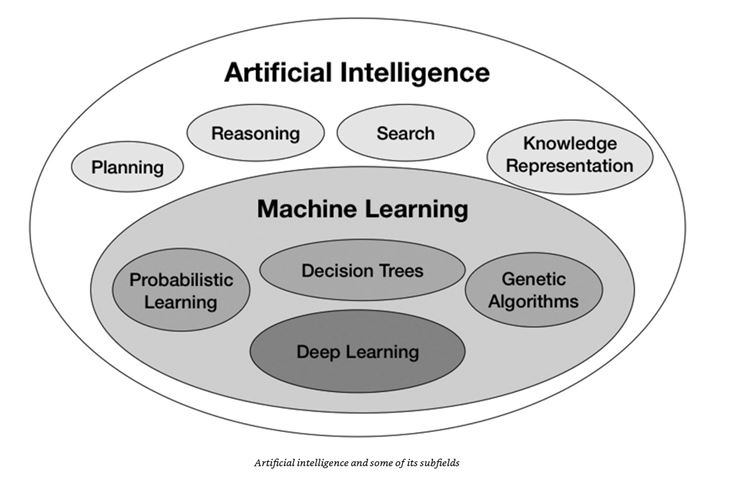
Then he concentrates on Neural Networks, discussing their greed for data, opaqueness of results and fragility when it is not possible to understand how it achieved some weird conclusion. Here is representation of how it works:

4: If Computers Are So Smart, How Come They Can’t Read?
This is about another feature of AI – its inability of making sense out of reading texts or other forms of processing information. Author analyses a few examples of this happening. After this author discusses Google search algorithms and how they sometimes make mistakes inconceivable for humans, providing a few funny samples.
5: Where’s Rosie’?
This chapter is about progress in robot’s development or rather the slow tempo of such progress. So far we have Rumba, which is not that smart and hope for driverless cars that hit new hurdles all the time. Author discuses challenges of localization and situation awareness that robotics finds difficult to overcome and presents some “real life” scenarios to demonstrate impact.
6: Insights from the Human Mind
Here author reviewing some specific point, which make human intelligence so difficult to imitate:
- There are no silver bullets- complexity
- Excessive use of internal presentations
- Abstraction and Generalization
- Cognitive systems are highly structured
- Even simple aspects of cognitive systems require multiple tools
- Human thoughts and language are compositional
- Humans keep track of individual things and people
- Complex cognitive systems aren’t blank slates
7: Common Sense, and the Path to Deep Understanding
This chapters is about complexity of common sense and how difficult it is to recreate it via computers. Author reviews different attempts to recreate it algorithmically which generally fail because inapplicability of formal logic to common sense.
8: Trust
The final chapter discusses high requirements for AI system to be trustworthy and potential very high cost of errors even if probability of such errors is extremely low. Author discusses program verification methods, but admit that they are good only for simple systems like device drivers, but could not be used for complex AI, making the issue of the trust in such systems paramount to resolve before mass implementation.
Epilogue
At the end author expresses believe that eventually AI will become part of regular human environment and issues discussed in this book will be resolved, while presenting a bunch of new issues such as human employment that will need to be tackled.
MY TAKE ON IT:
I like multiple examples of clumsy AI provided in this book and generally agree that this technology is far from being close to full implementation as foreseen by Sci-fi authors and philosophers. However, I pretty sure that non-thinking, environment analyzing, and action directing systems such as required for driverless cars and based on Deep Learning are very close to implementation and will become trivial reality of everyday life. As to super sophisticated self-conscious system, I do not think they would go beyond some experimentation because in order to create such system, one would need to recreate complex experience similar to human life, which result in creation of just another human only on silicon instead of carbon base. I do not think that such artificial human would be superior in any shape and form to combination of regular human and computers with complex databases and AI analytical tools. Besides, similarly to what happened with nuclear weapons and conduct of war, not everything that could technically be done will be actually done due to multitude of ethical and common sensical limitation.
20200315 – We Stand Divided
MAIN IDEA:
The main idea of this book is that the rift and even confrontation between American Jewish establishment and majority of American Jews on one hand and Israeli Jews on another is not an anomaly, but rather is the norm of this relationship, as it was existed since the beginning of Zionist movement. The reason is simple: American Jews live in America- universal country encompassing ideas of Western Enlightenment that applicable to the whole of humanity, while Israeli Jews live in National country of Jews encompassing Jewish strive to survive in hostile world by separating themselves into entity capable for military protection and economic support. This explains hostility of many American Jews to Israel caused by the fear that even slightest affiliation could threaten their good life among generally friendly non-Jewish majority. It also explains unhappiness of Israelis who feel that they do not receive enough support and understanding in their struggle to survive.
DETAILS:
The Rift:
Introduction: “Why Can’t We All Just Get Along?”
Author starts here with reference to a number of writings and speeches demonstrating the deep division and tension between two communities. Author then discusses history of this divide and presents this book as an attempt to explain its character, inevitability, and permanence.
1: A Mistaken Conventional Wisdom – A Rift Older Than the State Itself
This starts with author recollection of reaction of American Jews to Entebbe raid saving hostages and war of 1973 when the very existence of Israel was questioned. He recollects the feeling of unity and unquestioned support American Jews had for Israel and then recounts how this feeling all but disappeared and was substituted with complex mix of love – hate – contempt that is expressed in multitude of ways. He retells the recent history and change from admiration of Israel fight to survive when it was weak to rejection of the same fight when it became stronger. Author makes a point that it is not something new, but rather old situation with very deep roots:
- The real issue that divides the world’s two largest Jewish communities, as we have noted, is not what Israel does, but what Israel is. The essential issue, we will suggest, is that, at their core, America and Israel are exceedingly different: created for different purposes, they believe in and foster very different sorts of societies with very different values and different visions of Judaism.
- American Jews misunderstand Israel when they assume that Israel’s founders wanted or expected it to mirror America’s core values. And Israeli Jews often wrongly read American Jews’ differences as disloyalty, or laziness, without appreciating that American Judaism has a profound, but very different, set of core values. Israel’s founders never hoped that Israel would be an imitation of America, and American Jewish leaders recognized from the outset that a Jewish state would threaten some of their deepest commitments.
2: A Rift Older Than the State Itself
Here author looks at the rift between two Jewish communities, then rejects notion that it is a recent phenomenon and demonstrates that it is not correct by retelling the story of unhappiness of prominent American Jews with Israelis kidnapping of Eichmann. Then author refers to the refusal of American Jewish leaders support creation of Israel and rejection of Zionism. Here is a very nice confirmation: “ In 1885, American Reform rabbis adopted what is now known as the Pittsburgh Platform, the movement’s statement of core beliefs and commitments. In it, these rabbis declared, in part, that the Jews were no longer a people but now constituted a religion. “We recognize, in the modern era of universal culture of heart and intellect, the approaching of the realization of Israel’s great Messianic hope for the establishment of the kingdom of truth, justice, and peace among all men,” they said as they jettisoned Judaism’s long-standing particularism and embraced the universalism then much in vogue in philosophic and cultural circles. “We consider ourselves no longer a nation, but a religious community,” they said, and since Jews were no longer a national community, they expected “neither a return to Palestine, nor a sacrificial worship under the sons of Aaron, nor the restoration of any of the laws concerning the Jewish state.”
Author also discusses here external attitudes in America that at the time demanded 100% Americanism from new immigrants, which was completely consistent with wishes of Jewish immigrants, who feared rejection at the slightest hint of dual loyalty. Another fine point author makes is that eventual support of creation of Israel by American Jewish establishment in 1947 was prompted not by their support of Zionism, but rather they unwillingness to support admission of Holocaust survivors to America, which could strain relations with American Christian majority. Finally he traces how American Jewish attitudes to Israel mutated from supporting underdog fighting for National liberation, to protesting “Colonial power” that somehow suppresses National liberation of Palestinians.
The Causes
3: A Particularist Project in a Universalist World
Here author compares American Declaration of Independence with its Universalist character, which claims commonality for the whole of humanity with Israeli declaration of Independence, which claims Jewish Particularity. Here is how author defines the core cause of difference: “America’s applicability to “all men at all times” and Israel’s commitment to the flourishing of the Jewish people are starkly opposite foundations for two different countries. That is why for many American Jews, to whom America’s universalism seems both natural and the indisputable ideal for the basis of a country, there is something deeply problematic and discomfiting about the very purpose of the State of Israel.“
Then author reviews history of discussions regarding this issue over the last century.
4: Idealized Zion Meets the Messiness of History
This chapter is not that much about conflict between two groups of Jews as about conflict between Zionist ideals and reality. Author starts it with his own history as a member of well to do Jewish family in America when his rabbi grandfather officiated Bar Mitzvahs and weddings in mid 1940s, while millions of Jews in Europe were being killed. He then discusses difficulties of understanding between people discussing ideals in comfortable settings and people fighting to death for survival – the process when people had simple choice: to die or to kill. American Jews are always ready to mourn those who die and condemn those who kill, while Israelis who are still alive do not inclined to be remorseful for such transgression. Author also discusses how the growing military strength of Israel opened opportunity for similar to American approach to the issue among Israeli “revisionists historians”.
5: People or Religion: Who and What Are the Jews?
This chapter is about another part of conflict – the notion of Jewishness. The American Jewish tradition is about religion, being American with somewhat different religious view, just a bit more different than between Protestants and Catholics. For Israeli religion is not the most important part of Jewishness – the nationality is. From here comes another difference: for Americans variances of religious attitudes are normal. One could be Orthodox, Reform, Conservative, or whatever other denomination outside of the state control. For Israeli Judaism is state religion, so everybody should comply, at least formally, and pay taxes to support it.
6: How Naked a Public Square: A Liberal or Ethnic Democracy?
This chapter is about continuing struggle to reconcile democratic ideals generally accepted by both group with reality when American Jews are very comfortable being one ethnic group among others in multiethnic American Nation, while Israelis struggling to maintain ethnic character of their state in fear that loosing it would leave Jews ones again to be people without a country at the mercy of some hostile majority.
The Future
7: Charting a Shared Future—and Why That Matters
Here author discusses the future of not only relation between these two groups, but also of their existence. American Jews numbers and their influence in America are on decline and with mass assimilation and intermarriage quite possibly on the way to extinction. Israel on other hand acquired millions of Jews from former Soviet Union and other socialist countries, increased birthrates of Jewish population and strengthened its ethnic/religious character as Jewish state. Author points out that both Jewish communities are vulnerable. Israel enemies could once again become more potent military and inflict crashing defeat and annihilation. The self-confidence and comfortable existence of American Jews could also proved to be as ephemeral as existence of German Jews of early XX century who considered themselves more German than Jews, fought bravely for Germany in WWI and a couple decades later found themselves on the way to gas chambers.
Conclusion: “Forget Your Perfect Offering”
In conclusion author makes a few suggestions on what to do and expect:
- The first order of business has to be a fundamental decision not to let the relationship founder, a commitment to the premise that the break must somehow be healed.
- Second, no progress will be possible without each side trying to see the other in the best possible light. Institutions cannot bridge the divide if the world’s two largest Jewish communities do not begin to appreciate the various differences and tensions that this book has discussed. The beginning of the solution lies in Jews learning about themselves, about the tradition they share, and about each other.
- Third, because the two communities are so fundamentally different, both sides need to accept that there will always be dimensions of their respective behaviors and policies that strike the other as shortsighted, morally questionable, or even disloyal.
- Fourth, both sides, if committed to maintaining some sort of a relationship, need to mute the dismissive rhetoric that they too commonly employ. Israeli denigration of Diaspora life—which, as we have seen, is deeply rooted in Zionism—is not helpful. Israeli denigrations of Jews who do not intend to move to Israel (a habit of Ben-Gurion’s) or of Reform Jews (much in vogue among today’s ultra-Orthodox Israeli leaders) serve no one. By the same token, however, saying that the creation of a Jewish state was a bad idea (recall the comment of J Street founder Daniel Levy), calling Israel a “terrorist state” (as did several delegates to the J Street conference in April 2018), or claiming that in defending its border Israel has “chosen to shoot Palestinians” (the Forward headline discussed earlier) serves no purpose. Such reckless and irresponsible statements deplete goodwill and sow bitterness.
- Fifth, there is little value in either side expecting the other to do the impossible. There is something not only intellectually sloppy but fundamentally immoral about American Jewish progressives’ insistence that Israel end the occupation but, when asked how, explicitly refusing to offer suggestions. If they have no idea how to end it, why would they assume that Israelis could end it but refuse to? Do they imagine that Israeli parents want to send their daughters and sons into combat? Just as one can understand why young American Jews want to end the occupation, one should understand just how offensive it is to Israelis when outsiders who have no idea how to end the conflict imply that Israelis are not interested in ending it or insist that Israel’s ending the occupation is a prerequisite to their engaging with Israel.
- And finally (for now), there are many other steps that would help, including (though certainly not limited to) much more intensive Jewish education among American Jews and a deeper understanding of the values of the West among Israelis.
MY TAKE ON IT:
I think that the problem here is not necessarily limited to Jews. It is the common problem in contemporary globalized world when Nation-states, as they formed in XVI-XX centuries, are under pressure to find some viable accommodation between their ethnic/cultural/religious foundation and supranational rules of game that increasingly combines world into one entity. The specific of American Jews vs. Israeli is just a part of these global processes. Its uniqueness comes from American exceptional quality as the country of individuals of multiple ethnicities, races, religions, and backgrounds united into one by common ideals of individual independence and limitation on government that provides enough space for everybody to maintain their uniqueness as individuals and/or groups with various levels of commonality. I believe that the best way for future development would be creation of something like United Democracies with USA standing as nation of individuals, whose needs for commonality with others is below levels of government intervention and force so these individuals would accept and tolerate religious and cultural differences of others, while other nation-states such as Israel could stand next to USA as nations of individuals, whose needs for commonality are much higher and require government intervention to enforce common religion, ethnicity, and culture. Such United Democracy could provide unified military defense, common market with standard rules of exchange, including leveling of cost of labor and such, protection of individual rights with most important being ability to leave country, which religion, culture, and rules an individual does not want to accept.
20200308 – The Long Waves of Economic Life
MAIN IDEA:
The main idea of this brief, but important book is that the typical business cycles of 9-10 years do not cover the complete cyclical character of development and that there are much longer economic cycles – some 50 years long that represent powerful waves of increase or decrease in the levels of prosperity.
DETAILS:
- Introduction
This introduction points to the role of long cycles discovered by Kondratieff’s work, which normally masked by regular 9 years cycles.
I-III. Method
This is just a statement that statistical methods used to analyze business cycles demonstrated required per capita analysis and taking into account that 9 years moving averages typically used smoothed secular trends.
VI. The Wholesale Price Level
This chapter represents analysis of French wholesale prices that demonstrates 3 long cycles: 1789 to 1814 (60 years), 1849 to 1896 (47 years) and one starting in 1896. Here is the graph:
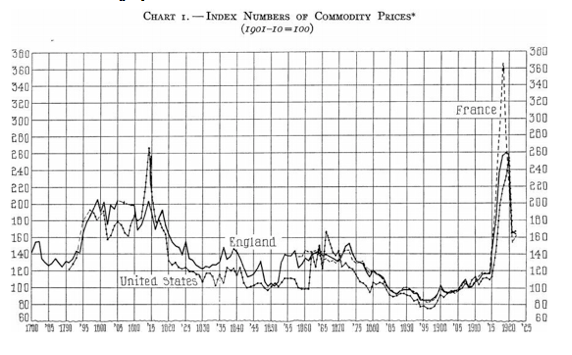
Then author conducts similar analysis of cycles based on variety of statistical data:
V. The Rate of Interest

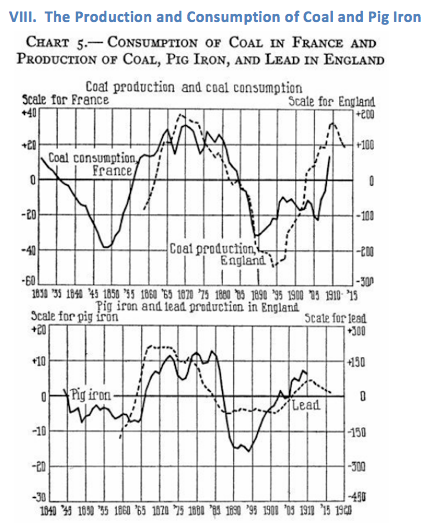
- Other Series
This one is just reference to multitude of other series demonstrating the same trends.
- Statistical Findings
Here are key findings of author’s statistical analysis:
(1) The movements of the series which we have examined running from the end of the eighteenth century to the present time show long cycles. Although the statistical-mathematical treatment of the series selected is rather complicated, the cycles discovered cannot be regarded as the accidental result of the methods employed.
(2) In those series, which do not exhibit any marked secular trend — e.g., prices — the long cycles appear as a wave-like movement about the average level. In the series, on the other hand, the movement of which shows such a trend, the cycles accelerate or retard the rate of growth.
(3) In the several series examined, the turning points of the long waves correspond more or less accurately.
(4) Although for the time being we consider it to be impossible to fix exactly upon the years that marked the turning points of the long cycles, and although the method according to which the statistical data have been analyzed permits an error of 5-7 years in the determination of the years of such turnings, the following limits of these cycles can nevertheless be presented as being those most probable:

(5) Naturally, the fact that the movement of the series examined runs in long cycles does not yet prove that such cycles also dominate the movement of all other series.
(6) The long waves that we have established above relative to the series most important in economic life are international; and the timing of these cycles corresponds fairly well for European capitalistic countries. On the basis of the data that we have adduced, we can venture the statement that the same timing holds also for the United States.
XI. Empirical Characteristics
Here are some conclusions:

XII. The Nature of Long Waves
Here author discusses the nature of long waves. He rejects the idea that these waves are caused by external events like wars, revolutions, and technological changes. Then author discusses in details why it is so for each of potential causes he reviews.
XIII. Conclusions
Author makes the following conclusion:
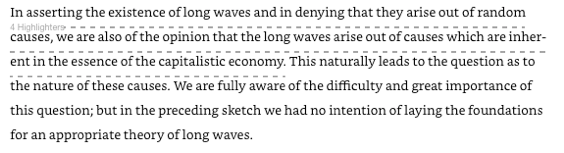
MY TAKE ON IT:
I believe that in other works beyond the scope of this book Kondratieff identified causes of long cycle with long term capital investment deterioration that lead to decrease in productivity of capital over time and consequent decrease in investment followed by decrease in consumption and depression. After long cycle hits bottom, the economy starts recovery with capital investment growth at the new and higher technological and infrastructural levels. I think it is only partially correct because levels of investment and overall economic development defined not by statistical numbers of economy performance, but by human actions, which depends less on economic statistics than on human psychological condition, moods, and believes. This links Kondratieff’s ideas of 60 years waves with idea of Saeculum cycles of societal development of approximately 80 years of psychological/political cycles when society goes through sequence: High – Awakening – Unraveling – Crisis. Historically Kondratieff’s third wave in which decline starts in 1914-20, somewhat coinciding with Unraveling-Crisis 40 years span ending in 1945. By this account we are now in 2020 approaching the end of Crisis period that sometime around 2025 would switch to High. Here is graph of Kondratieff’s long waves from another source linking them to technological development:

20200301 – The Fourth Turning

MAIN IDEA:
The main idea of this book is that the human society is developing somewhat cyclically going through 4 seasons or turns, like a year with about 20-25 years each turn, all together matching one long human life and defined by generation formed in condition of previous season. The seasons are: High – Awakening – Unraveling – Crisis and they neatly apply to American history. Correspondingly each season forms specific archetype of dominant personality: Artist – Prophet – Nomad – Hero, which in term moves through different stages of life, playing a different roles in different seasons. The idea of somewhat uniform cycles allows predicting the next development and author attempt to prove is by reviewing and predicting (somewhat correctly) the future.
DETAILS:
Chapter 1 – Winter Comes Again
The book is written in late 1990s and authors predict that the winter is coming in around 2005 and it will last for about 20 years when America would go through Crisis season completing 80-85 year cycle that started after previous cycle’s Crisis of WWII. Here is how authors define the Four Turns:

Authors also describe dominant type of personality for generation born in each turn:
- A Prophet generation is born during a High.
- A Nomad generation is born during an Awakening.
- A Hero generation is born during an Unraveling.
- An Artist generation is born during a Crisis.
Then they describe in details the meaning of turns and how it applies to history overall and to American history specifically.
Chapter 2 – Seasons of Time
This chapter starts with discussion of notion of seasons starting in pre-Roman Italy and then moving through a few historical societies: Rome, Babylon, Maya, Hebrew, Hindu, and Chinese. Authors discuss specific Roman idea of Saeculum – period of time close to the length of human life during which full cycle occurs. Here is authors’ presentation for our society:
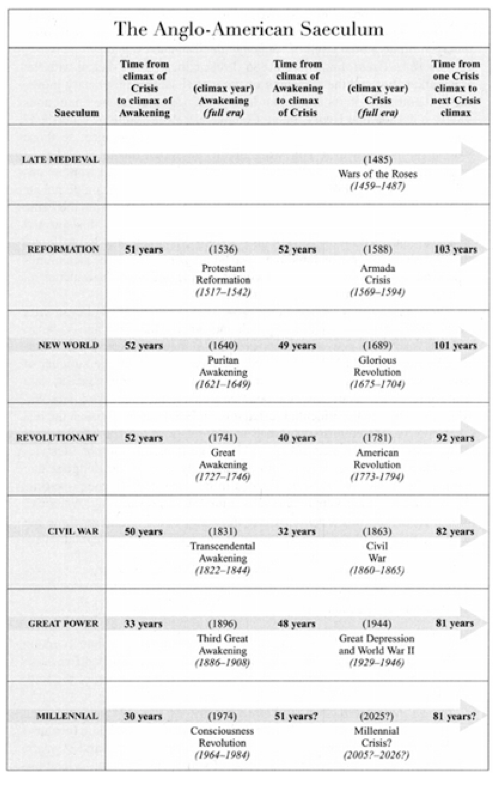


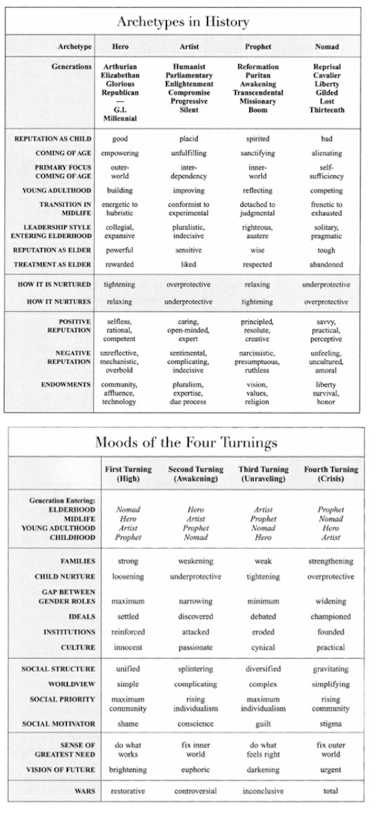
After that authors go into details of development in each of four turns of various cycles, including population, politics, economy, foreign affairs and other areas. At the end of chapter authors provide combined timetable of all Anglo-American Saeculum:
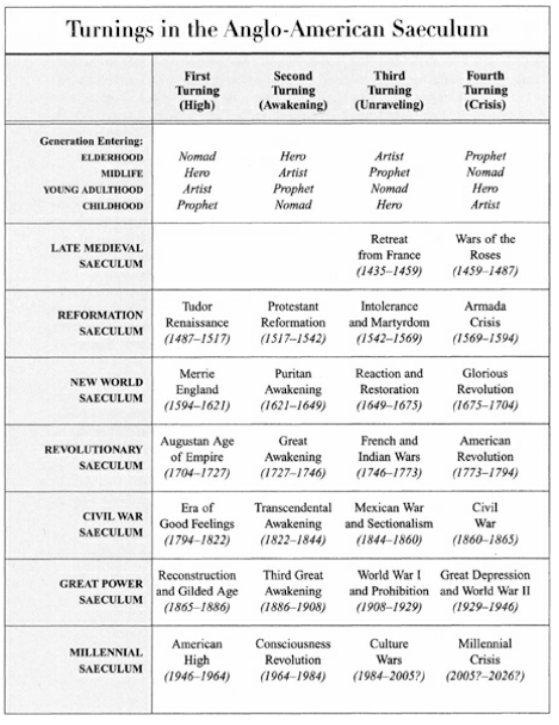
Chapter 5 – Gray Champions
This is reference to literary work of Nathaniel Hawthorne and Gray Champions are sign of new beginnings of every 80 some years: Puritans coming to America, American Revolution, Civil War, Great Depression/WWII, and the next one, which authors writing in mid 1990s foresee coming in 2005.
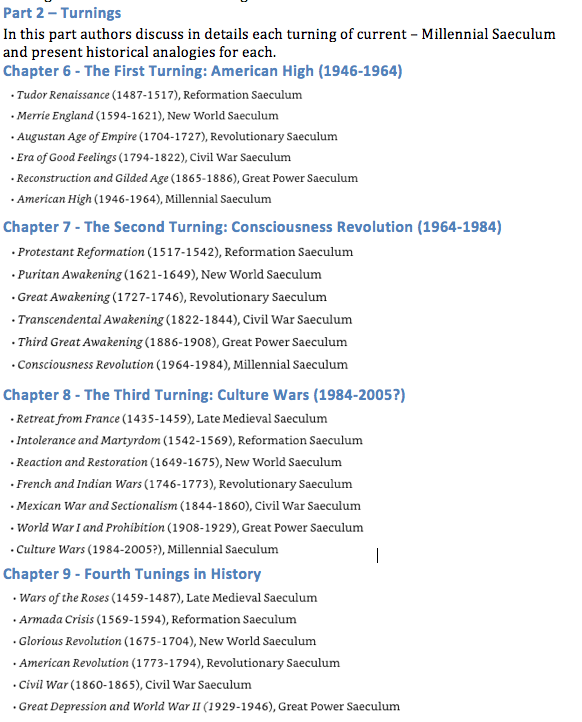
Chapter 10 – A Fourth Turning Prophecy
This is the very interesting chapter in which authors from their vantage view of 1990s discuss the future Crisis that they expected to arrive around 2005. Obviously they could not know what is going to happen, but here is their list that now in 2020 looks much more severe than what actually happened:
- Economic distress, with public debt in default, entitlement trust funds in bankruptcy, mounting poverty and unemployment, trade wars, collapsing financial markets, and hyperinflation (or deflation)
- Social distress, with violence fueled by class, race, nativism, or religion and abetted by armed gangs, underground militias, and mercenaries hired by walled communities
- Cultural distress, with the media plunging into a dizzying decay, and a decency backlash in favor of state censorship
- Technological distress, with cryptoanarchy, high-tech oligarchy, and biogenetic chaos
- Ecological distress, with atmospheric damage, energy or water shortages, and new diseases
- Political distress, with institutional collapse, open tax revolts, one-party hegemony, major constitutional change, secessionism, authoritarianism, and altered national borders
- Military distress, with war against terrorists or foreign regimes equipped with weapons of mass destruction
Part 3 – Preparations
Chapter 11 – Preparing for the Fourth Turning
Chapter 12 – The Eternal Return
The last part of the book and its 2 chapters are about preparation for the Fourth Turn and its crisis. It provides recommendation for each generation on what to expect and what to do in order to survive. By now it is mostly irrelevant, since the Fourth Turn is coming to the end and crisis thing that authors expected to happen did happen, albeit in somewhat different form:
- Terrorist attack on 9/11/2001 and following long war on Middle East
- Great Recession of 2008
- Cultural Distress of late 2010s
- Current Cold Civil war between American tradition, culture and political system and Anti-American denial of tradition with falling monuments and renaming places, rejection of American political system with its constitution, laws, and tradition, promotion of socialism.
In short, authors’ prophecies turned out to be correct in main.
MY TAKE ON IT:
It is quite unusual book on human society because it makes predictions, which proved to be true not only in their functionality, but also in their timing. Overall the idea that human history is defined by generations of people formed by circumstances of their birth and socializing and therefore acting differently sounds pretty good to me. It makes sense that children of the First turn – Prosperity initiate the Second turn – Awakening, creating idealized and therefore impossible demands on society, which makes their children initiate the Third turn – Unraveling undermining this society, its culture and traditions, and, eventually, weakening to the point when it movers to the Fourth turn – Crisis and then either falls apart internally, succumbs to external enemies, or rejuvenate itself by restoring its tradition, refreshing its culture, and mobilizing its internal strengths to defeat external enemies and/or suppress internal subversion. The final result of the Fourth turn is either disappearance of society under conquest, dissolution into multiple parts, or recreation as even stronger society it was before. In case of survival, it starts the First turn of the new saeculum, to repeat process over the next 80 some years.
I guess we are now at the final stages of the Fourth turn – Crisis, which I believe to be completed about the final part of the second term of Trump’s presidency in 2024. By this time American culture that was under sever attack starting at the end of WWII and conducted by communist/socialist sympathizers will come back roaring, after rejecting attempts to suppress its key features: individual freedoms of speech, freedom of association, freedom of self-defense, and democratic control over bureaucracies. The new economic accommodations will be created to incorporate Artificial intelligence into the system without undermining individual ability to prosper via productive activities. Finally the new system of international alliances will be created to remove possibility of military confrontations either on small scale of terrorism or large scale of competitive societies seeking dominance.
20200223 – Lifespan Why we age
MAIN IDEA:
The main idea of this book is that aging and deterioration of human abilities with age is not an inevitable natural process caused by irreversible accumulation of errors in DNA, but rather disease caused by accumulation of epigenetic changes that regulate genes expression. As such, this disease could be treated by restoring epigenetic environment of youth that would allow normal DNA expression and elimination not only of old age disabilities, but even death itself. In support of this idea author discusses results of his team research and findings.
DETAILS:
Introduction: A Grandmother’s Prayer
Author starts this with description of his grandmother’s quite adventurous life and her vitality that disappear with age, substituted by physical and then mental disabilities. This was one of important stimuli for author to go into the specific field of biology and medicine.
Part 1: What We Know (The Past)
Chapter 1. ‘Viva Primordium’
This starts with description of initial evolutionary development and how living things developed ability to fix breakdowns of DNA. Here is pictorial presentation:

From here author moves to discuss overall approach to healing, noting that it is often fight against symptoms, rather than real causes. He discusses cancer as generic disease of immune system, rather then specific illness of lung or liver or some other part of the body. Author also discusses aging in evolutionary terms as seen via group selection, which prevents selection for immortality or even especially long lifespan. Author summarizes current prevailing attitude that aging is result of combination of factors and provides the list of these factors:
- Genomic instability caused by DNA damage
- Attrition of the protective chromosomal endcaps, the telomeres
- Alterations to the epigenome that controls which genes are turned on and off
- Loss of healthy protein maintenance, known as proteostasis
- Deregulated nutrient sensing caused by metabolic changes
- Mitochondrial dysfunction
- Accumulation of senescent zombielike cells that inflame healthy cells
- Exhaustion of stem cells
- Altered intercellular communication and the production of inflammatory molecules
Author does not really reject any of this, but rather goes around, first stating that he understands low feasibility of one cause for complex processes, but then presenting just such cause at the high level. He views bodily functions based on two types of information processing: digital presented by DNA and analog presented by epigenetics, with former reliable and unchangeable and latter vulnerable and is often broken due to variety of contingencies. Author correspondingly believes that this analog process is more or less regularly cleaned up and presents genes named SIRT1 to SIRT7, and a few other genes and enzymes that do just that. The final point author makes that accumulation of too many problems over time at epigenetic level makes this cleansing and fixing process less and less effective leading to aging. Consequently medical intervention that would restore effectiveness of such process would lead to elimination of aging.
Chapter 2. The Demented Pianist
Here author discusses incompleteness of DNA mapping and what he calls the Information Theory of Aging that he formulated. It started with research on one of the simplest living creatures – yeast. Author used it to analyze protein SIR2. Here is how author describes core of his discovery: “Broken DNA causes genome instability, which distracts the Sir2 protein, which changes the epigenome, causing the cells to lose their identity and become sterile while they fixed the damage. Epigenetic changes cause aging. There was, I imagined, a singular process that controlled them all. Not a countless number of separate cellular changes or diseases. Not even a set of hallmarks that could be addressed one at a time. There was something bigger—and more singular—than any of that. This was the foundation for understanding the survival circuit and its role in aging.“
The main analogy of this chapter is piano as DNA and epigenome as Pianist. The failing of SIR proteins allows accumulation of errors in epigenome, so pianist becomes demented, even if piano is good. Author discusses it in details and provides graphic presentations:

The main point that author makes here is that, as disease, aging is susceptible for treatment and that is what author is working on and he believes that such treatment is possible.
Part II: What We’re Learning (The Present)
Chapter 4. Longevity Now
Here author presents what is known about longevity and various examples of it occurring. He provides some recommendations: fasting, food mix, exercise, a bit of cold exposure, and so on. However he admits that the most important factor is good DNA.
Chapter 5. A Better Pill to Swallow
Here author moves a bit to philosophy and history, discussing Gilgamesh, Schrodinger, and nature of life. Then he moves to biology presenting:” The three main longevity pathways: mTOR, AMPK, AND SIRTUINS, evolved to protect the body during times of adversity by activating survival mechanisms. When they are activated, either by low-calorie or low-amino-acid diets, or by exercise, organisms become healthier, disease resistant, and longer lived. Molecules that tweak these pathways, such as rapamycin, metformin, resveratrol, and NAD boosters, can mimic the benefits of low-calorie diets and exercise and extend the lifespan of diverse organisms.
“. He also discusses resveratrol and some other compounds.
Chapter 6. Big Steps Ahead
Here is graphic representation what author believes in achieving:
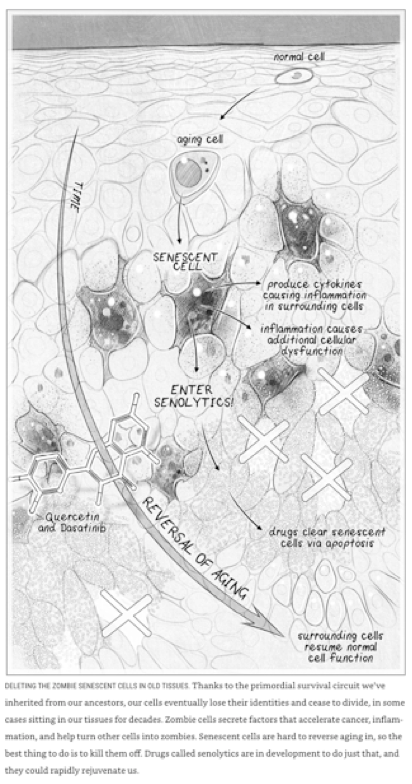
And here is the way author plans to achieve this:

Chapter 7. The Age of Innovation
This chapter is about the last centuries of innovation in medicine. It starts with discussion of DNA and diagnostic and treatment feasts it made possible. Then author moves to more technical discussion about tools summarizing this in this picture:
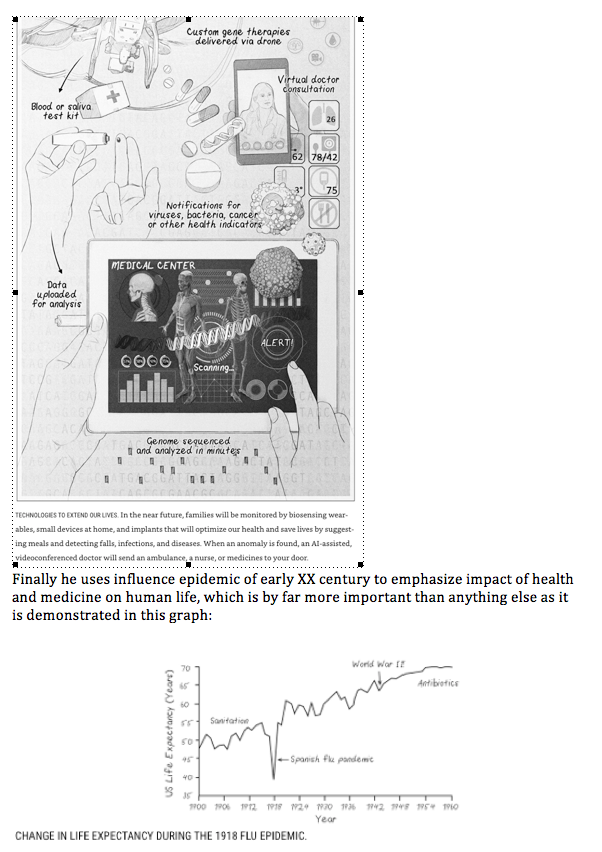
Part III: Where We’re Going (The Future)
Chapter 8. The Shape of Things to Come
Here author looks at what will happen if his anticipation of elimination of aging in near future would come true: lifespan and health span extended beyond 100, leading to families of 4-5 generations, stress on resources, slowing down of scientific and political progress because individuals in power live a lot longer, social insecurity, renewed Malthusian challenge, and so on. However author ends the chapter on semi-optimistic note that humanity managed to overcome challenges before, so there is a chance that it would overcome this one too, especially if it means population of healthy, active, and productive 100 year olds.
Chapter 9. A Path Forward
The last chapter ends book with standard pitch of contemporary science: “we are about do and make great things, just give us more public money. No, make it a lot more public money”. In this particular case it sounds like complain that other get more for various diseases with really not that big impact, while aging impacts everybody and treatment of this disease would fix all others such as:

The final point here is that people should be able to die when they want to die and be healthy and productive until this moment.
Conclusion
In conclusion author describes his and his team current activity and stresses that so far there is no approved treatment for aging. However he can share what he himself does to prevent this disease:
- I take 1 gram (1,000 mg) of NMN every morning, along with 1 gram of resveratrol (shaken into my homemade yogurt) and 1 gram of metformin.
- I take a daily dose of vitamin D, vitamin K2, and 83 mg of aspirin.
- I strive to keep my sugar, bread, and pasta intake as low as possible. I gave up desserts at age 40, though I do steal tastes.
- I try to skip one meal a day or at least make it really small. My busy schedule almost always means that I miss lunch most days of the week.
- Every few months, a phlebotomist comes to my home to draw my blood, which I have analyzed for dozens of biomarkers. When my levels of various markers are not optimal, I moderate them with food or exercise.
- I try to take a lot of steps each day and walk upstairs, and I go to the gym most weekends with my son, Ben; we lift weights, jog a bit, and hang out in the sauna before dunking in an ice-cold pool.
- I eat a lot of plants and try to avoid eating other mammals, even though they do taste good. If I work out, I will eat meat.
- I don’t smoke. I try to avoid microwaved plastic, excessive UV exposure, X-rays, and CT scans.
- I try to stay on the cool side during the day and when I sleep at night.
- I aim to keep my body weight or BMI in the optimal range for healthspan, which for me is 23 to 25.
MY TAKE ON IT:
I think it would be wonderful if author is correct and his research would lead to elimination of the most profound and most dangerous epidemic that kills 100% of people impacted – aging. I would not hold my breath in anticipation of this, but I believe that a number of point here are valid:
- Epigenetic nature of aging rather than DNA error accumulation
- Potential for regular maintenance of this epigenetic environment that would eliminate or greatly diminish symptoms of aging.
However I do not believe that lifespan extension would be a problem economically or environmentally. Economically advance of Artificial intelligence will eventually make humans redundant for production of goods and services, freeing them to pursue happiness as the main business of live. Environmentally it would also not going to be a problem because we are getting closer and closer to finalizing stable level of population and establishing complete control over environment by setting up closed loop of production/consumption and controlling additional inputs/outputs into the system, including most important: solar radiation. In short the future is bright and we’ll probably see a glimpse of it.
20200216 – More from Less
MAIN IDEA:
The main idea of this book is to present a bit of reality to people brainwashed by constant flow of negativism about economy, human industrial activities and their consequences. This reality is that over the last hundred years with technology development humans produce a lot more goods and services with a lot less of raw materials and external pollution of environment. It is also demonstration of futility of CRIB ideas that come down to using less of goods and services to save the world. In addition to some reasonable ideas author moves supports panic of global warming and demands resource allocation by very big government and behavior changes from people to prevent it.
DETAILS:
Introduction: Readme
Here author previews the book, explicitly stating his argument: Unlike what people believe, in reality the world and especially USA constantly produce “more with less” raw materials. It was achieved via computerization, by “substituting bits for atoms”. Author believes that this caused by combination of 4 factors: tech progress, capitalism, public awareness, and responsive government. Author also proudly declares that everybody will find something not to like in this book: environmentalist – his claim that industries are not evil, socialists – his support for capitalism, capitalists – his support for big government and taxes. So author calls for open mind and claims position of neutral observer.
Chapter 1: All the Malthusian Millennia
Here author reviews Malthus and Hobbes ideas and even provides quite convincing prove that it did worked like that until recent time: graph with relation of population to salaries:

Here author moves to the bad staff of early modern age: slavery, children labor, colonialism, pollution, and destruction of wild animals such as buffaloes and whales.
Chapter 4: Earth Day and Its Debates
Here author discusses the Earth Day: April 22, 1970 when America celebrated the first Earth Day. Author considers it turning point of Environmental movement. He refers to previous disasters such as explosion on Union Oil rig in California, Cuyahoga rover fire and so on. He also writes about Paul Ehrlich and other doomsayers who predicted unrealistic scaring scenarios, which nevertheless captured imagination of population, especially miseducated youth. Then author moves to proposed remedies that he does not believe in:
- Consume Less
- Recycle
- Impose Limits
- Return to land
Somewhat interestingly author also present ideas of Julian Simon that there is no scaring emergency and the Ultimate Resource are humans, who will eventually find solution to any development problems. Author also discusses bet between Ehrlich and Simon on future availability of raw materials that Simon won hands down. Obviously it did not stop promoters of gloom from continuing promoting gloom and make money in process.
Chapter 5: The Dematerialization Surprise
Here author reviews books and essays that documented dematerialization of American economy, meaning decrease of use of raw materials to produce consumable goods and services. Here are a couple of graphs demonstrating this trend:
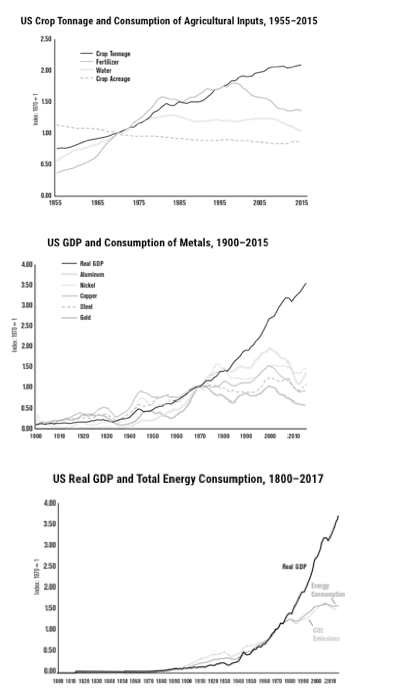
Chapter 6: CRIB Notes
In this chapter author revisits of CRIB implementation: Consume less – Recycle – Impose limits – Back to land ideas, reviews how they worked over the last decades, and concludes that they had at best marginal influence on the process of dematerialization. Then he suggests that the causes are presented in the next 3 chapters.
Chapter 7: What Causes Dematerialization? Markets and Marvels
Here author states his believe that four main forces are responsible for dematerialization, and that it’s helpful to think of them as two pairs, with the first reviewed in this chapter being Capitalism and technological progress. Then he proceeds to review a few examples:
- Increase in agriculture that dramatically decreased use of land, fertilizers, and pesticides
- IPhone that substituted a half dozen of different devices from telephone to photo camera, to TV.
- Decrease of use of coal, pushed out by gas
- Computerization of transportation that dramatically decreased need for rolling stock
The key feature here is that people need benefits of final products and services, while raw materials are costs; therefore technology that reduces such costs is implemented enthusiastically.
Chapter 8: Adam Smith Said That: A Few Words about Capitalism
Here author provides kind of critic of critic of capitalism, albeit it is half hearted. He starts it with what he considers valid criticism:
- Capitalism is selfish
- Capitalism is immoral
- Capitalism is unequal
The he presents his critic of what he believes invalid criticism of Capitalism:
- Capitalism is cronyism
- Capitalism is anarchy
- Capitalism is oppression
Author then moves to discussing socialism. He mentions Hayek’s theoretical prove that socialism could not possibly work and then proceeds to discuss real live catastrophic consequences of implementation of socialism, concentrating on relatively benign case of Venezuela. Author even completes this chapter stating that the problem with Capitalism is that there isn’t enough of it.
Chapter 9: What Else Is Needed? People and Policies
Here author goes to critic of capitalism: externalities, such as pollution and stresses his opinion that capitalism needs supervision in form of “responsive government”. He combines it all in image of “Four horsemen of the Optimist: call technological progress, capitalism, responsive government, and public awareness.”
Chapter 10: The Global Gallop of the Four Horsemen
This chapter is quite optimistic presentation of recent developments: outreach of technology to even poorest people, demise of global Socialist system and switch of its key countries USSR and China to market, Global movement for good government, and so on.
Chapter 11: Getting So Much Better
This is discussion of the world’s getting better thanks to some extent to feeling worse. He complains about humans leading other species to extinction, compulsory global warming, and so on, but then presents a bunch of graphs demonstrating that everything is actually getting better like this one: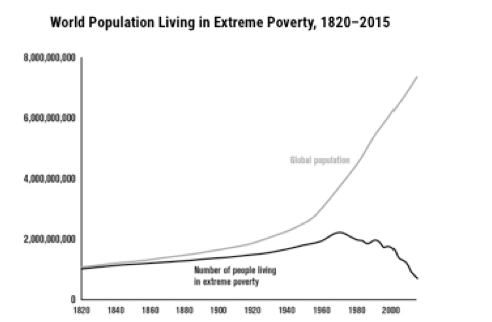
Chapter 12: Powers of Concentration
Here author moves to discuss urbanization and globalization that connects world into one with mix of positive and negative consequences. He provide 3 scenarios of change:
- There’s strong economic growth. The rich get much richer, but middle class and poor households also do better. Because wealth and income gains are fastest at the top—because the rich get richer faster than the rest do—inequality increases, but all segments of society see growing incomes and wealth. Tech progress exists but is not highly disruptive; people continue to do the same kinds of jobs for the same kinds of companies in the same communities year after year. Important institutions such as the educational system and the courts remain stable and inclusive.
- The elites capture the economy and the political system and turn inclusive institutions into extractive ones. They change the laws, pack the courts, demand bribes, assume control of the largest companies (publicly or behind the scenes), hire security services for themselves and let law and order decay for everyone else, and so on. The economy slows down because it’s so badly managed, and all tech progress has to be imported. The elite get fantastically rich while everyone else suffers and becomes poorer. Wealth and income inequality skyrocket.
- Economic growth is healthy and institutions remain inclusive, but tech progress is extraordinarily powerful—so much so that it disrupts industry after industry. This progress fuels many types of concentration; it allows more crops to be grown on less land, more consumption from fewer natural resources, more output from fewer factories, and more sales and profits from a smaller number of companies. The people at the top of these superstar companies see huge wealth and income gains. Gains for those in the middle, however, slow down considerably. And some segments of the labor force face particularly tough challenges; the factories and farms that used to employ them close, and new ones don’t open. Job opportunities concentrate in cities and in service industries. Wealth and income inequality rise a great deal.
Chapter 13 Stressed Be the Tie That Binds: Disconnection
Here author moves to discuss disconnect that developed between Americans of different persuasions. He starts with James Mattis stating that it is his biggest worry, by far bigger than Iran or North Korea. It follows by discussion of decrease in social capital due to multiple challenges such as deindustrialization and loss of good jobs, opioids, inequality, and widely existing knowledge of staff that is not so. All this creates disconnect between members of society and consequently undermines its stability.
Chapter 14: Looking Ahead: The World Cleanses Itself This Way
After giving way to challenges in previous chapters, author states here his overall optimist based on believe that:

Chapter 15: Interventions: How to Be Good
This is author recommendation to what should be done to reconnect country back. So he goes through main points starting with “statecraft” required to save the world from global warming with taxes. Then he takes on corporations that should drop whatever they are doing and direct resources to saving planet. Finally he does the same for non-profits and citizenry, at the end issuing the list of strong recommendations:
- Reducing pollution. Pollution is not a necessary cost of doing business; it’s a negative externality that causes great harm to people and the environment. However, efforts are now underway in America and other countries to roll back restrictions on pollution to reduce businesses’ costs. The better health is much more important than higher profits.
- Reducing greenhouse gases. Greenhouse gases deserve to be called out separately from other forms of pollution because of the long-term harm they can cause across the planet, and because they’re not yet being controlled with regulations, taxes, and the many other tools used for dealing with externalities.
- Promoting nuclear energy. We currently have only one power source that doesn’t emit greenhouse gases and is scalable, safe, reliable, and widely available. We should be working to drive down the cost of nuclear power, and to overcome barriers to adopting it.
- Preserving species and habitats. Even though capitalism is now shrinking its geographic footprint in many countries, it still has a great thirst for attractive pieces of real estate, and for many animals. Conserving land, limiting hunting, and banning trade in products made from threatened species are highly effective interventions.
- Promoting genetically modified organisms. GMOs have been extensively studied and found to be safe. They also have the potential to greatly improve crop yields, reduce pesticide use, and improve nutrition. Yet they are strenuously resisted in many parts of the world. This needs to change.
- Funding basic research. Private businesses spend money on research and development, but they tend not to invest much in areas and ideas that won’t become products anytime soon. This means that governments have an important role to play in supporting more fundamental scientific and technical research as well as research into social phenomena such as disconnection.
- Promoting markets, competition, and work. Capitalism is widely unpopular at present, and socialist ideas are making a comeback. Yet markets, competition, and innovation have brought us previously unimaginable prosperity. As we’ve seen, they’ve also finally enabled us to take less from the earth. So we should not turn away from them now. Instead, we need to focus on finding meaningful opportunities for people at risk of disconnecting from society.
Conclusion: Our Next Planet
In conclusion author laments what humans did to the planet by living and multiplying and expresses hope that his “4 horsemen of optimism” will save whatever has left of it.
MY TAKE ON IT:
From my point of view this book is filled with duality. On one hand author looks at the past with optimism and recognizes that doomsayers where absolutely wrong and technological growth and increase of knowledge led to vast expansion of production combined with decrease in use of raw materials and pollution. This part is convincing, filled with data, and very reasonable. On the other hand author jumps to the same panic mode about global warming that he just criticized about previous fear of resource exhaustion and environment annihilation. This part is not supported by any serious data, filled with the same unjustified fear, and the same demands for government to interfere and save the world. I think that there is no real difference between people who made good living by scaring everybody about population bomb, resource exhaustion, and pollution in process falsifying data and attacking everybody who did not agree, and people who currently doing the same under the flag of global warming. Actually they are either the same people that did it in 1960s and 70s, if they are older, or just the next generation of crooks who look to make good living and obtain power over others by scaring them out of their wits.
20200209 – The Meritocracy Trap

MAIN IDEA:
Author presents main points of this book in introduction as such:
- Meritocracy promises to open way up for lower and middle classes and this promise become false
- Meritocracy oppresses middle class and exploits elite
- Meritocracy divides society into haves and have notes
- It is paradoxical because on one hand it divides society into elite and non-elite, but on other hand it makes both of them miserable creating resentment in non-elite and anxiety in elite.
- There is the way to escape this trap and author see it in political actions:” To escape the meritocracy trap, politics must overcome all the vulnerabilities and bad incentives that meritocracy enshrines in public life. Both the rich and the rest must learn to see through the anxieties—from populist and nativist resentment through small-minded competitiveness and arrogant condescension—that currently divide them. Both classes must recognize that their distresses, and even their antagonisms, share in meritocracy a single source. And both classes must join in a coalition in which each eases its own afflictions by empathizing with, and even shouldering, the meritocratic burdens that now afflict the other.
“
DETAILS:
Part One: Meritocracy and Its Discontents
ONE. THE MERITOCRATIC REVOLUTION
This chapter describes history of meritocracy raise beginning in early XX century when leisured rich started to be pushed out by up and coming meritocrats trained in elite schools. These meritocrats without great wealth worked hard to obtain it via complex intellectual work in law, management, science, and arts. Author discusses in some details the nature of such works.
TWO. THE HARMS OF MERITOCRACY
Here author uses a town of St. Clair Shores, which used to be prosperous manufacturing town with middle class and elite living side by side. Now it is not that awful yet, but it is not any more prosperous town, which elite left behind and where the next generation of middle class cannot repeat success of previous decades. The author looks at what happened to elite and finds it not less awful: practically unlimited long hours, constant work stress, and even difficulty to enjoy significant wealth produced via these efforts. In short, elite highly exploited.
THREE. THE COMING CLASS WAR
Here author looks at one of the most elite places in USA – Palo Alto where rich people are miserable due to stress and poor find it hard to satisfy elementary needs like housing. Then author moves to discuss formation of new class of meritocrats via marriages and raising children in highly competitive environment, which requires lots of money to keep up with others. The next part of discussion is growing political division between meritocrats who use money, connections and skills to control government and use it for their benefits at the expense of middle and lower classes. In response these classes move to nativism and populism and use their numbers and democratic process to bring to political power their own champions. This political struggle scares author and makes him believe that country is moving to revolution.
Part Two: How Meritocracy Works
FOUR. THE WORKING RICH
This is somewhat repetitive description of how working rich pushed out from center stage old leisured rich, how much money top meritocrats make, how stressed they are and how they are different from majority of middle class that could not catch up with development of technology and knowledge based economy, seeing their own earning power stagnating or even going down. The result is the growth of inequality and corresponding stress on society.
FIVE. THE MERITOCRATIC INHERITANCE
This is about how difficult and expensive it is now to raise a meritocratic child, how much investment it involves from paying for upscale kindergarten to hiring multiple tutors, trainers, and consultants to get into top college without which it is not possible to achieve high level position anywhere. Author applies here monetary calculations for all fees and other payments required, eventually concluding that successful raising of contemporary meritocratic individual costs around $10 million. Author considers it as non-taxable inheritance.
SIX. GLOOMY AND GLOSSY JOBS
Here author compares meritocratic and regular jobs in various areas from restaurant to hedge funds management demonstrating the huge gap between them in both: efforts and returns.
Part Three: A New Aristocracy
SEVEN. A COMPREHENSIVE DIVIDE
The chapter starts with Clinton and Bush who had similar childhood even if one was son of salesman and another son and grandson of high-level bureaucrat and politician. It is not the case any more – the lives of their children is very different than the same generation middle class kids. Then author goes to review various aspects of these differences: Work, Family, Culture, Consumption, and Place of living,
EIGHT. SNOWBALL INEQUALITY
Here author reviews history of how this divide happened starting with increased role of education, changes in business management, and overall change in economics that values knowledge and skills much more than just plain hard work.
NINE. THE MYTH OF MERIT
In this final chapter author discusses where the notion of meritocracy came from and what is the nature of merit now in real live. He finds that it relates mostly to obtaining credentials, successfully playing some kind of bureaucratic games, and/or conducting complex activities in areas of information processing such as law, high level management, and such.
CONCLUSION: What Should We Do?
In conclusion author provides currently obligatory logically inconsistent invective of Trump and complains that “progressives” fail to answer effectively because they are under “meritocracy’s thumb”. Author points out that their move to identity politics and demands for equalization would inflict damage on meritocrats and middle class so it is not viable solution. He believes that solution is comprehensive restructuring of society:” To escape the meritocracy trap, politics must overcome all the vulnerabilities and bad incentives that meritocracy enshrines in public life. Both the rich and the rest must learn to see through the anxieties—from populist and nativist resentment through small-minded competitiveness and arrogant condescension—that currently divide them. Both classes must recognize that their distresses, and even their antagonisms, share in meritocracy a single source. And both classes must join in a coalition in which each eases its own afflictions by empathizing with, and even shouldering, the meritocratic burdens that now afflict the other.
“
In order to achieve this author suggests two paths to reform: ” First, education—now concentrated in the extravagantly trained children of rich parents—must become open and inclusive. Admissions must become less competitive, and training less all consuming, even at the best schools and universities. Second, work—now divided into gloomy and glossy jobs—must return mid-skilled labor to the center of economic production. Industry that is now concentrated in a superordinate working class must be dispersed widely across a broad middle class.”
Author also suggest to close meritocrats’ ability to transfer wealth to children via expensive elite education. Author considers it unfair tax shelter so he wants tax such expenses. On the other path: gloomy vs. glossy work author is looking for massive government intervention to define how what kind of jobs exists and how they paid.
MY TAKE ON IT:
Author is university professor and it shows. While his analysis is generally correct, it suffers from relatively poor connection to reality. For example the idea that law firm that charges 500 billable hours a week for work done by 5 lawyers has 5 people working non-stop 100 hours per week is very touching, but not at all realistic. Much more important however is author’s missing the most important part of the idea of meritocracy: who defines what merit is. Traditionally merit in American republic was defined by market place. Person who did something that other people voluntary pay for would earn more merit, expressed in more wealth. Because human beings generally are not that different in their capabilities, it led to society of nearly equals. Certainly a few people, who get in the very right place at the very right time and are capable to come up with some great idea that they are capable to implement, benefit hugely. These people like Rockefeller or Ford or Gates becomes million times richer than average not because they are million times smarter and hard working, but because being somewhat smarter they won lottery of time and place. This lottery winner as all other lottery winners are lucky exception to general rules of live and therefore have little impact on society’s structure. The current meritocracy comes not from ability to do something that people need. It comes from government power to take from people resources by force and redistribute these resources between hierarchical structures of government supported multitude of educational, legal, environmental, non-profit, and other bureaucracies, which do something that nobody would voluntary paid for. Correspondingly good places in these bureaucracies come from connections, elite education, based not on real knowledge and skills acquisition, but rather credentialism, racist preferences, donations, and other forms of corruption. Idea that it could be remediated by more government intervention strikes me as something slightly funny and completely unrealistic.
In my opinion, the real remedy would be dramatic decrease in government intervention in economy and all other areas of human live, removal of massive redistribution apparatus that mainly redistribute wealth not from rich to poor, but rather from middle class to bureaucrats, making these bureaucrats rich. Actually it looks like American people already start applying this remedy by electing and supporting Trump’s administration that author and majority of his peers so sincerely despise.
20200202 Morland, Paul – The Human Tide
MAIN IDEA:
The main idea of this book is that the demographic is very important part of any society’s survivability and prosperity. This feature to significant extent defines society’s economic and military power and place in the world among other societies. The secondary idea is that there is quite consistent path of development that occurred over the last few centuries:
Step 1: scientific, economic, and cultural progress lead to decrease in childhood deaths, while level of births remains the same causing population explosion
Step 2: increase in survivability, new opportunities for improvement of quality of life, decrease in dependency on children in old age, and reproductive control technologies lead to decrease in births, which lead to stabilization or even decrease in population
Because different countries go through this process at different time and at different tempo, the end result is that countries that got there first, specifically Anglo-sphere and then Europe end up with materially smaller populations than countries that got there later eventually changing balance of power between different populations of the world.
DETAILS:
Part One: Population and History
- Introduction
It starts with the story from 1754 in London when life was nasty, brutish, and short, killing lots of children who died very young, living population numbers very stable despite high number of births per woman. Then author briefly retells the story of the last 250 years when improved hygiene and medical services dramatically decreased number of deaths, while social welfare, emancipation, education, and growing opportunities greatly decreased number of births. Finally author defines the objective of the book: discuss role of population in history. Author cautious to stress out that demographic is not the destiny, but it is material part of it.
- The Weight of Numbers
Here author defines time scope of this book as starting from 1800 and Malthus and ending in the future. He then presents demographic history of British royals, which he shows to be quite representative to overall trends. Author then expands this discussion to overall population of the world and its dramatic increase. He also introduces idea that because process started with developed nations the cycle: improvement of living conditions – decrease of infant deaths with corresponding dramatic population growth – further improvement in living conditions leading to decrease of births and pursuit of happiness leading to decrease of births below replacement level – probable stabilization of population. This process seems to be common for all nations, religious, and other groups with the once that delayed process had stabilized at higher levels of population, sometimes much higher. Finally he discusses the difference that demographic makes in military balance of power and economic clout and applies this logic not only to balances between countries, but also to balance between various groups within countries, specifically referring to USA. Finally he provides a nice graph demonstrating current status:
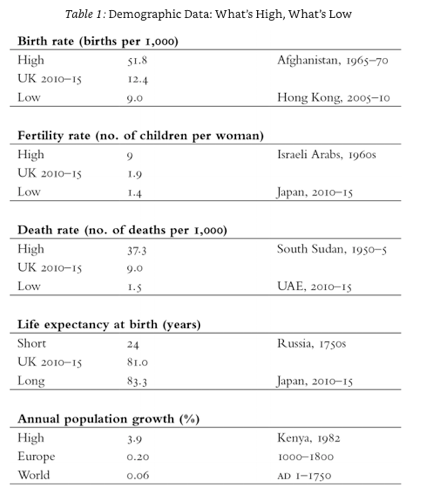
At the end of chapter author identifies his own point of view on demographic issues:
“First, human life is an inherently good thing, and the saving and extension of it is a worthy pursuit. If it is good to save the life of a single child then all the more is it good to save the lives of millions of children, which is what happens when infant mortality is brought down. Healthy, civilized and long lives are better than nasty, brutish and short ones. Violent and catastrophic mass deaths are an inherently bad thing; if we regret the loss of a single life then the regret at the loss of multiple lives should be proportionately greater. What we do not wish for our families and friends we should not wish for other human beings, whether this is in the name of equality or environmentalism or any other potentially worthy but abstract goal.
Second, when women have control over their own fertility, they collectively make wise decisions, with or without input from their male partners. When women are educated and have access to contraception, they will not choose to have more children than they can support and, just as the hidden hand of the market works in economics, so the hidden hand of demography will work if allowed to do so. Enforced limitations on childbearing are not only wrong; they are unnecessary. In matters of demography as in so many others, the decisions of ordinary people, given the educational and technical tools to take them, will turn out to be best for their societies and for the planet as a whole.”
Part Two: The Gathering Tide: Among the Europeans
- The Triumph of the Anglo-Saxons
This chapter is about Britain being the first country that successfully broke through Malthusian trap by using scientific approach and industrial revolution. Author discusses here also other countries of Anglo-Saxon sphere, especially USA, claiming that its dominance of the world was derived from the rapid growth of population that resulted from being the first in this change.
- The German and Russian Challenges
This chapter is about similar processes in European countries that picked up steam in late XIX / early XX century. Author specifically discusses how it changed balance of European power making France fearing Germans who ran ahead in population growth, then Germans fearing Russian who did the same.
- The Passing of the ‘Great Race; 6. The West since 1945 From Baby-Boom to Mass Immigration; 7. Russia and the Eastern Bloc from 1945
Here author moves to the overall picture when Europe started falling behind in population growth because its advancement in technology, including medical, public services, economy, and overall prosperity that makes families smaller, promoting quality over quantity. Author also discusses here Europe self-inflicted tragedy of World Wars, massive epidemics that still occurred, and immigration with racial issues related to it. Finally author discusses European dictatorships of the first half of XX century and their demographic impact. At the end author poses the question “Is the Europeans in Retreat?” and pretty much replies that they are based on decrease in European population as percentage of the world.
Part Three: The Tide Goes Global: Beyond the Europeans
- Japan, China and East Asia The Ageing of Giants; 9. The Middle East and North Africa 10. Nothing New Under the Sun? Final Frontiers and Future Vistas
In chapters of this part author applies the same logic to all other countries of the world where he finds the same processes under way: Improvement in quality of life, leading to decrease in early death, which initially results in dramatic growth of population, but later on it leads to decrease in family sizes and stabilization or even decrease in population. Author ends very reasonably refusing to make any predictions on future demographics either of the worlds or specific countries. He only stresses his believe that whatever will happens demographics will be intertwined with destiny as it had always been before.
MY TAKE ON IT:
I completely agree with author’s presentation of demographic trends and history as it developed over the last couple centuries. However I do not think that division of people of the world in different populations makes a lot of sense presently and would make any sense in near future. Whatever is racial and cultural breakdown of the world population we find up at the moment in next 50 years, when population growth stops, it will become less and less relevant due to continuing mix of all populations both genetically via interracial births and culturally via expansion of popular culture in which input of population of western developed countries is completely dominant. I believe that in relatively short period of time, a hundred years at most, an average person would have as hard time answering question about his/her genetic roots, as average American with all 8 great-grandparents being non-immigrant with various roots: English, Scottish, German, Italian, or whatever else went into the mix. The only question in my mind is not about genetic demographics, but rather cultural dominance: which of European traditions become dominant in future genetically intermixed world: hierarchical, even totalitarian big state with suppression of individual freedoms and control from the top down, or flexible free association society based on individual freedom with minimalistic state restricted to prevention of wars and maintenance of law and order. The future answer to this question will define whether people of the world will live in misery or relative happiness.
20200126 William – Money Changes Everything

MAIN IDEA:
The man idea of this book is to review development of financial technology from the earliest known records and artifacts all the way to contemporary complex and highly mathematized financial tools and demonstrate how it impacted functioning of various complex societies. It is also aims to demonstrate importance of careful and sophisticated approach to financial technology necessary not just for society’s effective functioning, but for its very existence.
DETAILS:
Introduction
Here author presents the view that finance is the main method of resource allocation that lays in foundation of great many important human activities.
Finance has four key elements:
- It reallocates economic value through time;
- It reallocates risk;
- It reallocates capital; and
- It expands the access to, and the complexity of, these reallocations.
Author briefly discusses each of these functions and then looks at finance’s impact on culture, development of civilization, knowledge acquisition, and finally hardware and software that it is based on. Author also presents various perspectives that he uses to look at finance in this book:
- Investor perspective
- Researcher perspective
- Empirical perspective
- Cultural perspective
PART I FROM CUNEIFORM TO CLASSICAL CIVILIZATION
- Finance and Writing
Author starts with earliest historical artifacts of writing found in Mesopotamia and demonstrates that they closely related to financial transaction records, contracts, and accounts maintenance.
- Finance and Urbanism
Here author uses one of such artifacts: the Warka Vase to discuss link between religious and economic sides of worshipping and culture. He then looks at Babylonian samples of writing, demonstrating the use of compound interests, financial planning, borrowing and lending, and other financial activities.
- Financial Architecture
Here author looks at archeological evidence demonstrating spatial impact on cities where financial activities led to development of special districts where such activities were concentrated. Author uses specific documents to review activities of individuals in areas of debt and risk, trade financing, and joint ventures. Author also discusses government interference into financial activities, specifically periodic forced debt forgiveness and other methods of robbery that made finance high-risk enterprise.
- Mesopotamian Twilight
Here is author summarizes the first part of this book: The primary goal of Chapters 1–4 is to document the early development of the hardware and software of finance. This includes the first appearance of financial contracts, as well as the development of financial mathematics and financial thought. A secondary goal was to show the integral role these played in Mesopotamian society. Finance developed out of the need for intertemporal contracting, which was the economic foundation of the first cities. It also made possible the organization and intensification of long-distance trade. While such trade existed in societies with less financial architecture, the toolkit in the ancient Near East included a silver-based monetary system, equity-like partnerships, and a legal system of enforcement that was evidently robust and flexible enough to allow even small, combative city-states to access prestige goods and metals from afar.
- Athenian Finance
Here author looks at Western financial tradition starting at the beginning: “The classical civilizations of Greece and Rome developed sophisticated financial economies based on money and markets. The Greeks invented banking, coinage, and commercial courts. The Romans built on these innovations and added business corporations, limited liability investments, and a form of central banking. Unlike the ancient cities of Mesopotamia, which were primarily organized around the redistribution of local produce and secondarily around long-distance”. Author mainly discusses finance as it was used in support of trade, especially high-risk long distance overseas trade, but also land privatization and mining rights. He assigns high importance to the fact that trade disputes were resolved by jury trials with hundreds of jurors, which required very high levels of financial literacy.
- Monetary Revolution
This chapter is about invention of money coinage and specifics of Athens that differentiated it from other ancient societies: unique form of governance unlike temple based forms of Sumerian city-states and high dependence on trade even for food supplies that made it necessary to establish distributed financial system resulting in independent decision making and democratic form of government.
- Roman Finance
This is somewhat continuation of Greek traditions, only much more dependent on local slavery based agriculture and heavy use of debt. Author discusses here archeological discoveries that allowed much better understanding of Rome business model that by then included shareholders and limited liability. The Roman form for this was publican societies based on private property that was dominant form of resources control. Finally author discuses link between wealth and political power, which in Rome was quite direct: senator who lost wealth would lose his place in senate.
PART II THE FINANCIAL LEGACY OF CHINA
- China’s First Financial World
This chapter is very brief description of financial history of China, demonstrating that China developed pretty much the same financial technology as the West, but its use was concentrated not in the hands of private citizens, but in the hands of sophisticated bureaucracy, with the state controlling just about everything. Author also stresses importance of paper money invention that occurred in China long before recreated elsewhere. Author also discusses in some detail philosophical foundation of Chinese attitude: potentially attributable to the Jixia Academy collection of essays called the Guanzi.
- Unity and Bureaucracy
Here author moves to Confucius and his teachings, especially in regard to finance and “principal-agent” problems, which could be resolved by indoctrination of agent in such way that would assure internal drive to do right thing by principal. It includes also sophisticated method of bureaucrats’ selection and severe punishment for failure or corruption. Author looks in details at use of money in their various forms in Chinese society and also at western point of view on Chinese financial innovations.
- Financial Divergence
This is a look at the diversions between Chinese and Western development not only in finance, but also in key industries of early industrial age that made industrial revolution reality in the West, but absent in China. The main point: big organization bureaucratic system makes individuals dependent on superiors, consequently limiting innovation to their judgment, while private business that relies on market would be open to any innovation that owner wants to try.
PART III THE EVROPEAN CRUCIBLE
Here is how author defines key points of this part: ”I argue that the fragmentation of European states was the stimulus for a variety of creative, somewhat independent financial experiments. The fragmented political economy of Europe fostered the development of investment markets; the reinvention of the corporation; extra-governmental banking institutions; complex insurance contracts on lives, property, and trading ventures; and a sophisticated tradition of financial mathematics, reasoning, and analysis. These innovations, in turn, changed human behavior. I argue that they altered attitudes toward risk and chance, leading on the one hand to probabilistic thought and calculation and on the other hand to unbridled speculation that fueled the world’s first stock market bubbles. Europeans ultimately turned themselves and the rest of the world into investors. The key stages in Europe’s development are first, the emergence of financial institutions; second, the development of securities markets; third, the emergence of companies; fourth, the sudden explosion of stock markets; fifth, the quantification of risk; and finally, the spillover of this system to the rest of the world.
“
- The Temple and Finance
In this chapter author traces development of European banking system, starting with Templars who provided financial support for pilgrimage and crusades to Jerusalem.
- Venice
Here author reviews commercial empire of Venice: “The creation of a market for financial securities in Venice in the twelfth century represents a watershed in European history. It began the practice of deficit spending by the state, financed by the issuance of liquid debt. Finance became one of Venice’s key instruments of power in its rise as a mercantile empire. Its financial architecture was every bit as important as its bricks and mortar.
“
- Fibonacci and Finance
This is about the next development of finance – its quantification with development of double entry bookkeeping, notion of net resent value, and business education that allow massive expansion of trade.
- Immortal Bonds
This chapter is about finance development that led to expansion of business transactions timeframe beyond limits of individual human life.
- The Discovery of Chance
This chapter discusses emerging understanding of probabilities that led to development of such financial tools as insurance, annuities, and other forms of risk management. Author also discusses probabilities in China where no mathematics of chance was developed.
- Efficient Markets
This is about development of efficient market ideas in late XIX century that led to such developments as options market and in late XX century application of complex mathematical models like Black-Scholes formula. Author discusses in some detail mathematization of finance.
- Europe, Inc.
Here author moves a bit from discussing specifically financial area to forms of business organization – specifically European forms of limited liability corporations. He specifically looks at the oldest existing corporation: Honor del Bazacle formed in 1372 in Toulouse.
- Corporations and Exploration
This chapter is about a chain of event that transformed the world: use of corporate form to explore world in order to discover new lands, gold and other goods, and markets. Private business corporations of Europe, only slightly supported by governments, conducted the world exploration. These corporations, while privately financed, nevertheless had their own armies and navies, which colonized nearly all the planet.
- A Projecting Age
This is detailed description of one of such enterprises linked to famous English writer Defoe. It included raising money via subscription to deferred payment plans, investment in some type of usually monopolistic operation that would become ongoing concern with liquid participation via external trade of shares. Here is author’s note about this:” Broken down by industry, these new British firms included companies for mining, salvage, fishing, forestry, agriculture, textile and mechanical manufacturing, overseas trade, infrastructure, real estate, leasing, and finance. Ever since 1623, when England enacted the Statute of Monopolies, an inventor had the exclusive right to profit from a novel invention. The new financial market after 1688 married capital with creativity and intellectual property rights. Perhaps because they were engines of innovation, joint-stock companies grew dramatically in importance relative to the rest of the economy. The historian William Robinson Scott estimated that in 1695, they represented 1.3% of the national wealth of Great Britain, but by the end of 1720, this had grown to 13%.
“
Author also reviews here the bubble phenomenon and attempts to rule it in by regulations such as British “Bubble Act” of 1720.
- A Bubble in France
This chapter looks at one specific and very large instance of bubble that developed in France by John Law in early XVIII century and then burst. However author states that not all bubbles were created equal and compares two of them:” What was missing from the Mississippi Bubble, in contrast to the South Sea Bubble, was the wellspring of innovation. France had its projectors, with plans for public works and trading companies, but there seems to be no evidence that any other shares were seriously traded in the Rue Quincampoix. Law apparently had no successful competitors for the public appetite for share investing. The creation of a share market appears to have been a means to an end—a method for building the Mississippi Company out of investor cash, rather than an institution used to channel resources to innovation.”
- According to Hoyle
This is about Insurance Corporation in Rotterdam created in response to British “Bubble law” that prevented limited liability for British companies. It started boom of public companies in Netherlands, some of which become prominent in financing Atlantic trade. Author discusses this trade and its impact on bubble formation in some details including regulation that it prompted. At the end of chapter author points out that financial technology developed during this period was widely used later in XIX and XX centuries to finance massive infrastructure projects.
- Securitization and Debt
This is about the next step in development of finance – securitization. It starts with discussion of Dutch mutual funds, then moves to American land banks and notes how much American founding fathers and their families were linked to land speculation, which somewhat explains readiness of Dutch and French investors finance American revolution, at least partially. Author also discusses financial implications of French revolution and ends the chapter by reflecting on European financial innovations that made countries of his continent very distinct from others like China.
PART IV THE EMERGENCE OF GLOBAL MARKETS
Here is how author defines his objectives in this part: “In Part IV we will see the reassertion of earlier amoral characterizations of finance and a seductive argument against the fundamental principles that support financial technology, including private property and entrepreneurial freedom. This reinvigorated dialectic over the role of finance in society comes to a crescendo in the early twentieth century and literally breaks the world in two.”
Author also discusses here globalization, worldwide access to equity financing and global debt.
- Marx and Markets
Here author briefly discusses Marx, his failed theory of labor-based value and huge influence Marx’s ideas have despite their complete failure to explain reality and predict future developments. Author then discusses Hobson’s “Imperialism”, and Suez Canal as example of early stages of globalization and violent reaction of Egypt’s population to it.
- China’s Financiers
Here author moves to similar event of imperialistic intervention in China with Opium wars, revolution, railroad construction, and China’s initial moves to be part of global capitalist system, using example of Shanghai stock exchange in 1920s as an example.
- The Russian Bear
The “Russian” chapter discusses capitalism development in Russia and its disruption by first WWI and then by revolution. Author kind of links to it Ayn Rand and her objectivism, even if she left Russia as young woman and her ideological development mainly occurred in America despite very strong hate for communism typical for any thinking person with real live experience with consequences of this ideology.
- Keynes to the Rescue
This chapter is another very brief description of ideology, this time dominant on the West.
- The New Financial World
This chapter looks at financial world of XX and early XXI centuries, discussing financial instruments like bonds and stocks, funds, and financing of construction and infrastructure in America. The chapter ends with discussion of great depression and its legacy.
- Re-Engineering the Future
Here author moves to massive government intervention in resource allocation and distribution in form of Social security and multitude of other programs.
- Post-War Theory
The final chapter is about mathematization of finance with computers and various technical approaches to investment and financial management including optimal investment portfolio, indexation, sovereign funds, institutional investment, and public/government business ownership.
Conclusion
Here author restates his objective to review historical development of financial technology and its interaction with development of complex societies. Here is how author completes this book:” History is interesting in its own right, but it is also important as a measure of the present and a guide for the future. As the world moves toward a collective global civilization with a greater proportion of its population participating in complex society, financial tools need to keep up. The lessons from our collective financial past take on more relevance. History has shown us financial mechanisms for risk sharing and intertemporal transfers and how variations in these tools can be adapted to different kinds of societies. We are free to repurpose past successes and learn from past failures about what to avoid. The experience of five millennia of financial innovation, however, suggests that finance and civilization will forever be intertwined.“
MY TAKE ON IT:
I generally agree that finance or, more precisely, resource allocation across time and space with corresponding risk management, is foundation of human civilization. The history of financial technology is interesting, but much more significant is that its role in the near future will probably be even more important than it was in the past. It is because the future most probably will contain automated production of goods and services, making it impossible for anybody to be self-sufficient and survive outside of financial networks. This means that much more complex financial systems will be developed based on much more complex models aiming at continuing evolutionary optimization of resources allocation via process of individual competitive decision making at various levels and localities. Then, as it is now, the top down all-knowing modeling of socialist type would not be possible due to infinite level of complexity, albeit in primitive suboptimal form that could exist only if supported by massive state intervention. It remains to be seen whether ideological and moral development of humanity will move in the direction of integrated market resource allocation with minimal restriction or in direction of socialistic type of top down resource allocation with its inherent inefficiencies.
20200119 – Against the Grain

MAIN IDEA:
The main idea of this book is that the latest discoveries in archeology and anthropology demonstrate link between type of agriculture and development of the state. Specifically, only grain based agriculture led to development of sedentary way of life with consequent development of hierarchies and state because the grain output is easy to control and tax. Correspondingly literacy and numeracy were developed to support information processing linked to taxes and population control. Other forms of agriculture, not grain related, used by barbarians, provided for higher quality lifestyle and, until very recently were more than competitive military.
DETAILS:
Preface
Here author explains how he came to this book by preparing for a lecture. It made author to look at early states, conventionally divided into:
- Ubaid (6,500–3,800 BCE)
- Uruk (4,000–3,100)
- Jemdet Nasr (3,100–2,900)
- Early Dynastic (2,900–2,335)
- Akkadian (2,334–2,193)
- Ur III (2,112–2,004)
- Old Babylonian (2,004–1,595 BCE)
The core of author’s finding relates to links between not only agriculture but its specific part – grain production to formation of early states.
INTRODUCTION. A Narrative in Tatters: What I Didn’t Know
Author continues here with presentation of time line of human development that does not comply with traditional sequence, which directly links agriculture and state creation. He points out that there is huge gap between archeological and ecological evidence of agriculture and formation of states. Here is how this time line looks based on the latest research
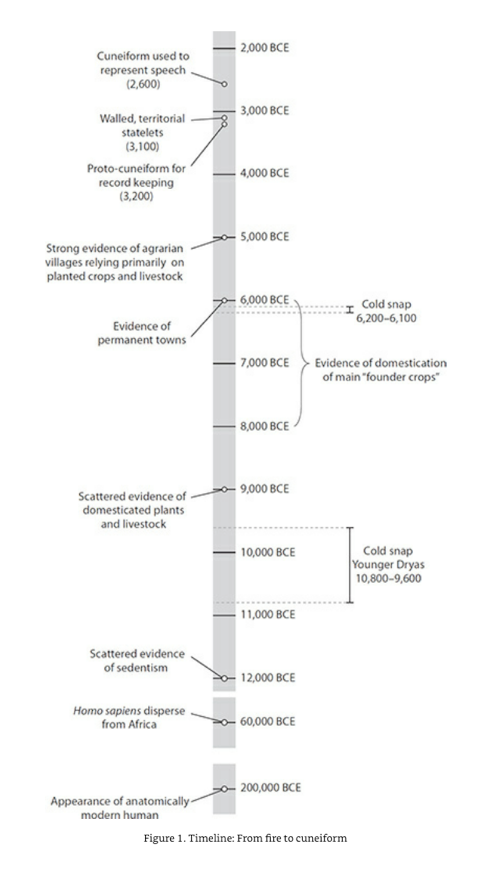
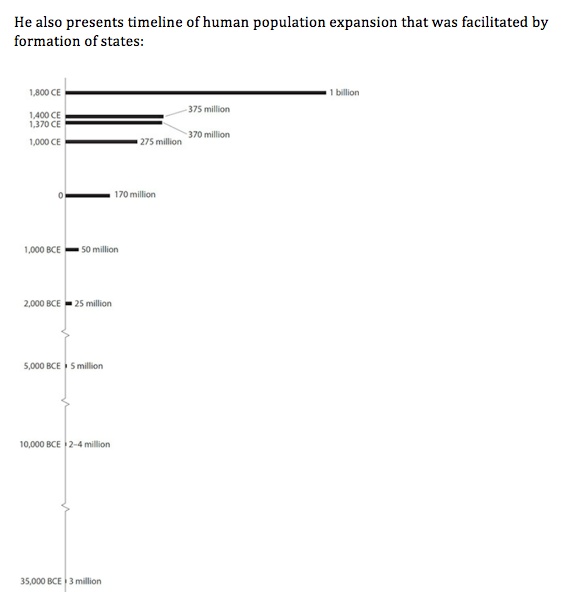
The key paradox author formulates is this:” Homo sapiens appeared as a subspecies about 200,000 years ago and is found outside of Africa and the Levant no more than 60,000 years ago. The first evidence of cultivated plants and of sedentary communities appears roughly 12,000 years ago. Until then—that is to say for ninety-five percent of the human experience on earth—we lived in small, mobile, dispersed, relatively egalitarian, hunting-and-gathering bands. Still more remarkable, for those interested in the state form, is the fact that the very first small, stratified, tax-collecting, walled states pop up in the Tigris and Euphrates Valley only around 3,100 BCE, more than four millennia after the first crop domestications and sedentism. This massive lag is a problem for those theorists who would naturalize the state form and assume that once crops and sedentism, the technological and demographic requirements, respectively, for state formation were established, states/empires would immediately arise as the logical and most efficient units of political order.
“
It is also directly connected to relatively recently discovered fact that:” Contrary to earlier assumptions, hunters and gatherers—even today in the marginal refugia they inhabit—are nothing like the famished, one-day-away-from-starvation desperados of folklore. Hunters and gathers have, in fact, never looked so good—in terms of their diet, their health, and their leisure. Agriculturalists, on the contrary, have never looked so bad—in terms of their diet, their health, and their leisure.”
In short it seems that state based agriculture allowed dramatic increase of quantity of people, while similarly dramatically decreasing quality of individual lives.
One. The Domestication of Fire, Plants, Animals, and…US
The theme of the first chapter turns on the domestication of fire, plants, and animals and the concentration of food and population such domestication makes possible. Before we could be made the object of state making, it was necessary that we gather—or be gathered—in substantial numbers with a reasonable expectation.
Author discusses here environmental conditions required for switch to sedentism: wetlands and such – areas that provided sufficient food to stay around. Author also poses the question why people started plant grains. He rejects usual explanation that it is because the product could be saved for long period, providing insurance against bad year. He also rejects idea that it provided better returns from cooperation. Author’s explanation is that the reason is much higher productivity from flooding area that then made raising crops much easier.
Two. Landscaping the World: The Domus Complex
Here author explore meaning of domestication as it relates to plants, animals, and also humans. He discusses notion of Domus as a module of evolution that allowed coevolution of semi closed local ecosystem. The impact was not only on plants and animals, but also on humans. Author discusses how use of agriculture could be easily identified by human remnants that have indelible traces of agricultural work. Author also analyses changes in tempo of life, which for hunter-gatherer defined by external cycles of availability of various food types that required huge knowledge base about environment. For agriculturalists it was pretty standard year around cycle requiring a lot less knowledge and a lot more routine manual work.
Three. Zoonoses: A Perfect Epidemiological Storm
In this chapter author discusses specific features of agro-pastoralism, which come to dominate first Mesopotamia and then the world. The first part of discussion is drudgery that was direct consequence of the switch. It caused material deterioration of quality of life and there is plenty of archeological evidence confirming this. Then he moves to epidemiology discussing how increased concentration of people combined with closeness to animals produced periodic epidemics killing significant shares of population, but creating immunities for survivors. At the end author discusses fertility and population growth brought in by switch to sedentism.
Four. Agro-ecology of the Early State
Here author discusses material or more precisely agricultural foundation of early states, concluding that it necessarily had to be based on a grain for a number of reasons: “The key to the nexus between grains and states lies, I believe, in the fact that only the cereal grains can serve as a basis for taxation: visible, divisible, assessable, storable, transportable, and “rationable.” Other crops—legumes, tubers, and starch plants—have some of these desirable state-adapted qualities, but none has all of these advantages. To appreciate the unique advantages of the cereal grains, it helps to place yourself in the sandals of an ancient tax-collection official interested, above all, in the ease and efficiency of appropriation.
“
Author also discusses evidence that agriculture was often based on state violence and taxation. Another important point he makes is that one of consequences was development of literacy and numeracy – absolutely necessary tools for top down control and systematic robbery, which of no real use for hunter-gatherers.
Five. Population Control: Bondage and War
This chapter is about the role of coercion in formation and maintenance of the states. Its main form initially and all the way until now were slavery and bondage. Initially slavery was product of war, when captives were enslaved. Overtime it was expanded so parts of population were slaves from the beginning of life, with people breaded and controlled the same way as domesticated animals. Actually it would not be possible to maintain effective society at low levels of productivity with lots of manual works required without such institution as slavery or something close to it.
Six. Fragility of the Early State: Collapse as Disassembly
The historical and archeological data show that early states were extremely fragile popping up and going down within historically short periods of time, sometime materially less than length of a human life. In this chapter author discusses reasons for this fragility such as:
- Hypersedentism and lack of movement
- Ecocide: Deforestation and Salinization
- Politicide: Wars and Exploitation of the Core
At the end author actually praises state “collapse” as a necessary part of evolutionary process.
Seven. The Golden Age of the Barbarians
In the last chapter author looks outside of the sate borders at people who habituated there – barbarians and how they interacted with “civilized” peoples of the states, in actuality living in dichotomy of these two method, often moving between them at will. Author provides somewhat unusual, but quite convincing explanation why barbarians underappreciated:
- The history of the peasants is written by the townsmen
- The history of the nomads is written by the settled
- The history of the hunter-gatherers is written by the farmers
- The history of the nonstate peoples is written by the court scribes
- All may be found in the archives catalogued under “Barbarian Histories”
Author discusses relationships between “civilized” and barbarians in details and quite convincingly demonstrates that mainly it was balance of either equal power or even with military advantages going to barbarians. He also discusses trade, military alliances, mercenaries, and other interactions between these two parallel flows of human development and existence. The point is that it lasted forever and arrived to complete dominance by the states only very recently.
MY TAKE ON IT:
It is a very interesting approach to understanding human development, which makes a lot of sense to me. From my point of view the idea of parallel development of highly organized grain based hierarchical society and non-grain based barbarian societies, either pastoralist or hunter-gatherers, explains quite a bit of known history. This history was narrated by literate society that is grain-based states, so barbarians were diminished and poorly understood. The puzzle was how come, that barbarians overrun such highly developed societies as Rome? The answer provided here is that barbarians were as highly developed, only in different way. They did not need literacy and numeracy because the cultural tradition could be well maintained via oral tradition, while without taxation need in numeracy was quite limited. As to military, much looser structure of barbarian military, often based on cavalry and therefore much more mobile, with more space for individual initiative was generally superior to massive, but slow moving and rigid infantry of grain-based states. The aristocracy, as more mobile and more military effective specialized part of society developed by these states, sometimes compensated for difference, but overall for some 10,000 years neither grain-based agriculture and slave-based hierarchical “civilized” states nor non-grain agriculture and loose organization of barbarian entities had decisive advantage. Only with advance of scientific method of thinking and consequent technological and industrial development, literacy and numeracy became convertible into military power, leading to triumph of “civilization”.
20200112 – Sword and Scimitar

MAIN IDEA:
The main idea of this book is not that much to present military history of the most important battles between Islamic and Christian armies, as to demonstrate that despite illusion of peace caused by contemporary overwhelming power of the West, Islamic ideology of conquest and proselytizing by force did not go away. It is also warning that if West continues its historical amnesia and ideological appeasement, the bloody fight could start again and cost dearly.
DETAILS:
Preface
Here author characterizes this book as work of military history reviewing 8 key battles between Islamic and Christian forces. These battles, while different by time, place and participants, represent key points in 14 centuries long struggle between followers of two religions one of which generally being on offensive from 636 to 1683, while another generally losing territory and adherents during the same time. Here is the map demonstrating this point:
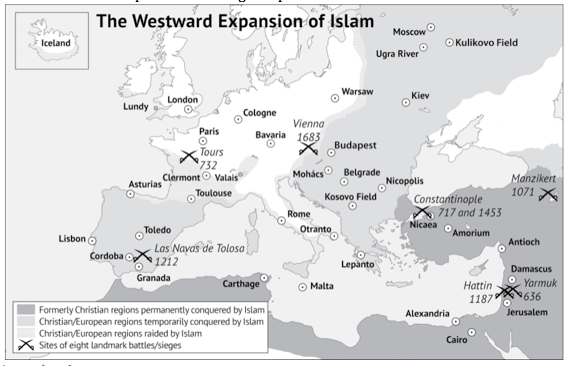
Introduction
The initial part of the book is discussion of the nature of Islam, its creation by Muhammad as a tool to overcome tribalism and create religion-based unity open for everybody to join. It was also an effective tool of using force to expand. Author discusses notion of jihad defined as religious duty of conquest with huge rewards either in this or the other world for participants. Author also discusses West, Christendom, and their nations, which were converging into more or less loose alliances coming to life under threat of annihilation and dissipating when this threat diminished. Author also discusses very limited tolerance in Islam of Jews and Christians as “people of the book”, stressing temporary character of this tolerance.
Chapter 1 Islam Takes Christendom by Storm: The Battle of Yarmuk, 636
Here author discusses the first major victory of Islam when relatively small force of Muslims destroyed numerically superior forces of Byzantine Empire. Author stresses religious fervor of Muslims and their ability to fight in the dark, which eventually brought their victory. After the battle author reviews consequent conquests that followed: successful siege of Jerusalem, conquest of Egypt and North Africa. Author especially stresses that unlike other conquests of the period this one had very strong religious component of proselytizing by the sword and atrocities. The end result was complete change of population’s religion and permanent conversion of these territories into Islamic lands. Here is how author characterizes consequences of this battle: “two-thirds (or 66 percent) of Christendom’s original territory†—including three of the five most important centers of Christianity—Jerusalem, Antioch, and Alexandria‡—were permanently swallowed up by Islam and thoroughly Arabized. For unlike the Germanic barbarians who invaded and conquered Europe in the preceding centuries—only to assimilate into Christian culture, civilization, and language (Latin and Greek)—the Arabs imposed their creed and language onto the conquered peoples so that, whereas the “Arabs” once only thrived in the Arabian Peninsula, today the “Arab world” consists of some twenty-two nations spread over the Middle East and North Africa.”
Author then briefly discusses events after Yarmuk when Muslim powers consolidated their gains and continuing warfare against Byzantine.
Chapter 2 The Jihad Reaches an Eastern Wall of Stone: The Siege of Constantinople, 717
This chapter describes temporary slowdown of Muslim conquest when they failed in the first siege of Constantinople in 674-678. Then author reviews follow up struggles and stresses the role of slaves’ acquisition, especially women, as significant driving force of Muslim raids, strongly supported by religions duty of jihad. Practically it meant psychologically win-win situation when strive to obtain earthly pleasures was combined with definite promise to supply high quality of such pleasures in afterlife for fallen jihadists. Author also describes growing understanding among Christians of ideological, religious character of the struggle and impossibility of permanent accommodation. At the end of chapter Author describes the second 717-718 siege of Constantinople, which also ended in Muslim defeat.
Chapter 3 The Jihad Reaches a Western Wall of Ice: The Battle of Tours, 732
This chapter moves just a dozen years later, but to different part of Europe. First author discusses Muslim conquest of Spain and initially Mediterranean coastline that was completed by 730. As usual author stresses multiple atrocities committed during this process and massive forcible conversions of previously mainly Christian population. Then he reviews history of Charles Charlemagne who defeated Islamic force in battle of Tour in 732, stopping cold their movement farther into Europe. At the end of chapter author however mentions that it did not prevent follow up attempts such as Muslim landing in Italy in 846 that ended with occupation of Sicily, many Mediterranean islands, and new long-term feature of life in these areas – Muslim piracy. Author somewhat asserts that Charlemagne victory at Tours was overstated because it did not really prevented Mediterranean from becoming “Muslim Lake”. Author even completes the chapter by stating that Muslims often not even were looking for complete conquest, but rather for raiding, looting, and acquiring slaves so actual Muslim chronicles not even mention Tours as something significant.
Chapter 4 Islam’s New Champions: The Battle of Manzikert, 1071
Here author moves to another part of Islam, the one related to Abbasid Caliphate, based on Shia branch situated in Persia with center in Baghdad. In 838 Caliph Mutasim destroyed important Byzantium city Amorium, which led to Christian counterattack when for the next two hundred years fight was continued until Turks formed Seljuk Empire and first devastated Armenia in 1019, then destroyed Byzantium forces at Manzikert and captured Roman emperor. Author characterizes this as Turkish Yarmuk, meaning that it was similarly to Arabs opened road for conquest for Turks.
Chapter 5 Christendom Strikes Back: The Battle of Hattin, 1187
The next point of this long struggle was the first Crusade when continuing deprivation against Christian by Muslims in what used to be Christian territories containing multiple religious sites. Author describes it as the holy war initiated in response and retaliation against Muslims’ jihad. Author starts this part of history in 1095 with Christian mobilization, initial victories resulted not in small part because of general indifference of Muslim population. Muslims were much more busy fighting each other in Shia vs. Sunni struggle to pay attention to such insignificant things as Jerusalem and area around. However they noticed that something is not exactly right and produced Saladin, who manage mobilize Muslims, win battle of Hattin and expel Crusaders.
Chapter 6 The Crusade Victorious: The Battle of Las Navas de Tolosa, 1212
This chapter starts with discussion of incomplete conquest of Spain in 8th century by Muslins when small Christian enclaves in mountainous Astoria managed to survive and repulse many consequent attacks for centuries. Author also discusses what he believes erroneous narrative for Muslim tolerance and scientific prosperity of Islamic Spain. Author discusses an interesting dynamics created by massive use of slavery, especially enslaved women of European background that, combined with acceptance of children produced by these women as legitimate issue of their Muslim fathers. Author describes details of this long continuing war, which eventually ended by complete expulsion of Muslims from Spain in 1492.
Chapter 7 Muhammad’s Dream: The Siege of Constantinople, 1453
Here author reviews the late part of Byzantine decline and raise of Ottomans with their peculiar institution of kidnapped in childhood slaves-soldiers that eventually become key component of Ottoman state. At the end author discusses final destruction of Eastern Roman Empire (Byzantine) and fall of Constantinople due to numeric and technological superiority of Ottomans.
Chapter 8 The Rise and Fall of Islam: The Siege of Vienna, 1683
This chapter is about pick Islam when Ottomans sieged Vienna, but where defeated by alliance of European Christian armies. Author looks at previous events in Eastern Europe when Mongols conquered Russia in 1240 and then become Islamized by 1300. It was not an easy process and author describes it in some detail. By 1380 Russians achieved some success in repulsing Tatars, but the fight was periodically continuing until in 1478 Russia stopped paying tribute. The Islamic raids with plunder and abduction continued for another century, but complete dominance over Russia ended. Author reviewing similar evens all over the Europe and Middle East when Islam was stopped and after a few centuries of relative equilibrium with raids and mutual retaliations until very religious Ottoman Grand Vizier Kara Mustafa decided renew Islamic conquest and moved against center of European Holy Roman Empire – Vienna. Despite usual betrayals of some Christian nations and leaders, enough forces arrived to protect Vienna with key role played by Jan Sobieski’s Polish army to achieve victory, forcing Ottomans to retreat. After another 15 major battles from 1683 to 1697 the treaty of Karlowitz was signed practically ending 1000 years Islamic military offensive against Christianity.
Author briefly describes the following centuries when Islamic forces were limited to raids with no ability to launch massive military attack any more. The response was various from Russian conquest of Crimea to American punitive naval expedition against barbarian pirates. Author ends in 1924 when the last great Islamic power – Ottoman Empire was dissolved and West European countries divided Islamic lands between themselves as mandates or colonies.
Postscript Muslim Continuity vs. Western Confusion
Author’s postscript kind of laments current situation that he believes characterized by Western loss of memory about 1500 years war and came up with politically correct interpretation of Islam as religion of peace, that no truly religious Muslim really accept. Consequently the Islamic jihad renewed in form of terrorism. It is clearly supported by restoration of Islamic states such as Iran or ISIS. These Islamic states are way too weak to be serious threat for now, but are quite inspirational for Muslims in their ability to stand up against non-Islamic powers and dogged pursuit of nuclear weapons. Author makes the point that current overwhelming military power of West is combined with ideological weakness and loss of history and understanding of enemy, making situation quite dangerous with potential to be be costly in the future: “In short, if Islam is terrorizing the West today, that is not because it can, but because the West allows it to. For no matter how diminished, a still swinging Scimitar will always overcome a strong but sheathed Sword.“
MY TAKE ON IT:
I think that author is quite correct in his estimate of dangers of Islamic ideology. However I do not think that Islam is as strong as it was 1000 years ago mainly because humans are moving away from strong religious believes. It is fully applied to Muslims all over the world and a pretty good example of this had been provided during 1950s and 60s when people in these countries moved to quasi-scientific secular ideology of socialism. It ended in disaster and misery and partial return to militant Islam is reaction to this disaster. However the terrorism against West and application of Sharia laws is even more disastrous for Muslims. The problem is they see no alternative since West at this point does not inspire following despite overwhelming technological and economic superiority. The resolution of these problems will actually come from the West’s accommodating to tremendous technological and political changes it is undergoing right now. Such western renewal would once again provide example for emulation and people in Islamic world eventually leave this militant religious ideology of 7th century in dustbin of history where it belong.
20200105 – Polarization

MAIN IDEA:
The main idea of this book is to review recent sociological research on American political conditions and present massive prove that it is now in the state of deep polarization between traditional parties of Democrats and Republicans. Author provides statistics on polarization between various part of society: elite, including media, partisans of both parties, and general population. Author aims to convince that at least part of the cause for this is regional realignment between North, South, and West, but also wealthy ideological donors, a bit of gerrymandering, and a lot of Divergence and Sorting of population.
DETAILS:
- Introduction
Here author briefly characterizes what is current polarization of American politics and discusses what he intends to presents in each chapter of this book.
- What Is Political Polarization?
What is the difference between partisanship and polarization? What Is the difference between mass and elite polarization? What is partisan sorting and is it different from polarization? What is belief constraint and ideological consistency; Who is polarized—the public or the politicians? Why is polarization bad? What have we learned?
In this chapter author defines polarization “as the increasing support for extreme political views relative to the support for centrist or moderate views. He contrasts it with partisanship which “is reflected as a strong bias in favor of one’s party and strong dislike or prejudice against other parties” and argues that this distinction in “how we understand and evaluate the performance of our political system.”
Author provides very clear graphic representation of polarized vs. centrist situation:

- Are Partisan Elites Polarized?
How do we measure elite polarization! Why do you assume legislative voting occurs only on the liberal-conservative Are there other sources of data for measuring congressional polarization? Do roll-call ideal points really reflect congressional ideology! What issues divide Congress the most? Are both parties responsible for polarizations; Are state legislatures polarized? Are the courts polarized? And the media? What have we learned?
Here author discusses polarization of elites and how it could be measured. Mainly the measurement is based on votes and how many of them went in synch or out of synch with one’s party. Here is the graph demonstrating that we moved into highest polarized period since the New Deal:

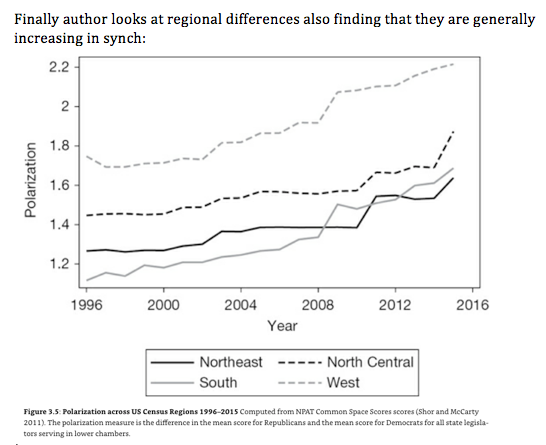
- Is the Public Polarized?
How is it even plausible that the public is not polarized? Is the public moderate? What is the evidence in favor of increased voter sorting? Why does it matter whether voters are sorted but not polarized? Is sorting a good thing or a bad thing? What issues are the public is sorted on? Is it the economy, stupid? Does polarization reflect a “culture war? What is affective polarization? What have we learned?
In this chapter author moves from elite to regular people:” Here we will see that the evidence is more mixed. It is true that there is much more disagreement on policy issues between voters who identify with the Democratic Party and those who identify with the Republican Party. But how to interpret that fact is open to considerable disagreement. Many scholars argue that it is indeed evidence that voters have polarized in the sense of adopting more extreme views. But other scholars are equally insistent that it reflects the fact that voters are simply better sorted into parties so that most conservative voters are now Republican and most liberal voters are now Democratic—something that was far from true in earlier eras.”
Here author offers some conclusions:
- The first is that the partisan polarization or sorting of voters occurred considerably later than the polarization of the political elites and activists. This suggests that the polarization we observe from the elites is probably not a simple reaction to changes among the electorate. Indeed it is more plausible that the positions and partisanship of the voters are a reaction to the polarization of elected officials and other elite actors.
- Second, despite the widely held belief that voters are polarized along a set of hot button social issues, such as abortion and gay rights, political scientists have routinely found that positions on economic and social welfare issues better predict the partisanship of voters. There are sharp disagreements, however, to the extent to which preferences on social welfare issues are in turn derived from differences in racial attitudes.
At the end of chapter author discusses how political views become part of people’s identity and what he calls “affective polarization”
- Finally, I discuss the related concept of affective polarization that focuses on the increased salience of partisanship as a social identity. As a consequence of heightened party identification, citizens now show considerably more animus to supporters of the other party. I discuss the roles of ideological and policy polarization as well as the partisan sorting on other social identities in the rise of affective polarization.
- What Are the Causes of Polarization?
Why was polarization so low from the 1930s to the 1960s? Senate? Can the polarization of the late nineteenth century be compared to what we see today? What is the Southern Realignment and why did it happen! Why did southern whites move to the GOP? Why is congressional voting on racial issues no longer distinctive? Does economic inequality cause polarization? Do party leaders engineer polarization? Is the rising competition for congressional majorities to blame? Why don’t more moderates run for Congress? Is the media responsible for polarization! What about the emergence of the Internet and social media? Is the United States unique? What have we learned?
Here author moves to causes of polarization. He point out regional realignment when Democrats lost their Southern base. Author also “consider large-scale economic and social change as explanations as well as important developments in the media environment, including cable television, the Internet, and social media.” Author also links it to the growth of inequality:

The final point he makes here is that leadership of both parties push for polarization to enhance their position inside the party, while media actively promotes it because without polarization there is no story to tell.
- How Does Electoral Law Affect Legislative Polarization?
How much does polarization reflect geographic sorting? Does gerrymandering cause polarization? Isn’t it possible that the effects of gerrymandering on the House carried over to the Senate? But isn’t gerrymandering responsible for a decline in electoral competitiveness? Are there other ways in which redistricting can impact polarization? Do partisan primaries cause polarization? Hasn’t California’s “Top-Two” system reduced polarization there? What role does campaign finance play in polarization? Would stronger parties reduce polarization? Would a different electoral system reduce polarization? What have we learned?
Here author analyses and then rejects the idea of institutional prompting of polarization despite changes in some features such as partisan primaries and gerrymandering. He suggests that it is rather wealthy ideological donors who push polarization up. He rather blames polarization on sorting and divergence – the situation presented in the graph below:

- What Are the Consequences of Polarization for Public Policy and Governance?
Why does polarization impact congressional policymaking capacity? How do legislative parties turn polarization into gridlock? What about the filibuster and the presidential veto? Does polarization make Congress less productive? How has polarization affected the executive branch and the bureaucracy? Has the American judiciary and legal system changed as a result of polarization? How has polarization affected the balance of power between the national and state governments? Has polarization affected policymaking in the states? Has polarization increased the political power of the wealthy relative to others? Does polarization have a conservative bias? What have we learned?
Here author discusses “the impact of polarization on policy outcomes and governance. The focus is on how polarization has affected the level and quality of policymaking in the legislative, executive, and judicial branches. “ Author believes that the problem is in Congress’ failure to legislate due to polarization which prevents its members from creating effective majorities. Author expresses hope that courts and presidents could pick up the slack, but he is afraid that it could benefit conservatives.
- Is the Trump Presidency a New Normal or More of the Same?
As any other person of seemingly liberal persuasion, author cannot avoid the Donald. Author notes that while Trump ran as populist, probably closer to traditional democratic politics than to GOP, he rules as pretty orthodox conservative. Author discusses Trump’s achievements in populating Supreme Court with 2 constitutionalists in mold of Federalist Society, which author seems to be unhappy about. While giving Trump some credit for legislative and judicial achievements, author expresses fear that Trumps popularity could lead to authoritarian change of type implemented by Hugo Chavez and Erdogan. He also concerned that Trump strong support of working class would be somehow detrimental to non-white people. As it is usual for currently popular among western elites racist / leftist stereotype of dividing people by race and inability to see that Trump success in creating jobs and improving economy is beneficial to all working class with non-whites probably benefiting even more than whites. At the end author expresses hope that “ The press, the civil service, the states, and the judiciary continue to place formidable checks on the president’s power. While the president’s co-partisans in Congress should have challenged him more publicly and investigated his administration more thoroughly, they declined to move on some of his legislative priorities, opened independent investigations into his campaign, and refused to provide him cover should he have decided to fire Special Counsel Robert Mueller. Yet cloth can tatter only so long before it rips. The preservation of liberal democracy in the United States will eventually require overcoming our deep divisions in order to rekindle our faith in the virtues of compromise.“
MY TAKE ON IT:
This book is fine as a source of political statistics packed in a bunch of nice diagrams. However it does not look deeply into ideological causes of polarization, which in my opinion strongly linked to change not that much in ethnic mix of population as change in types and availability of jobs and correspondingly decent quality of life. This quality, while improving technologically and materially, greatly deteriorated psychologically due to elite moving manufacturing jobs out of country to China and other places where labor is cheap and environmental and other American regulations are non-existent. Combined with massive immigration of low skill illegal immigrants and, as well educated and much cheaper than Americans, legal immigrants from developing world, it squeezed middle and working class. The elite prospered, while many others suffered. It’s no wonder that these others start looking for a champion who would be fully on their side. After failing to find it either with Bushes or Clintons / Obamas, they practically dropped both parties and found the champion in Donald Trump, who with their help defeated elite of both parties, eventually remaking GOP to fit his vision. I think that idea that this Jeannie once out of bottle could be put back in is completely insensible and could lead to Jeannie being very upset and even violent against elite. It would be much better to negotiate way to restoration of psychological well-being of Americans of lower classes by all means necessary even if it includes limitation of immigration, regulatory enthusiasm, racist politics, and other things dear to American elite.
20191229 – The Evolution of The Sensitive Soul

MAIN IDEA:
Authors define the main idea of this book as attempt to answer the question: “How did minimal animal consciousness originate during animal evolution?”
. This attempt is based on identification of a marker that indicate transfer from preconscious to conscious animal. Overall authors define three levels from self-maintaining activities to complete consciousness: “nutritive soul” – plants, “sensitive souls” – animals, and “rational soul” – humans. Authors define this marker the following way: ”the evolutionary-transition marker for consciousness is unlimited (open-ended) associative learning (UAL). This, we argue, was the phylogenetically earliest manifestation and driver of the evolution of sustainable minimal consciousness. UAL refers to an organism’s ability to attach motivational value to a compound, multifeatured stimulus and a new action pattern and to use it as the basis for future learning. We argue that UAL is a good transition marker because the features that neurobiologists and philosophers regard as essential for consciousness are also required for UAL. If UAL is accepted as a transition marker, one can identify this capacity in different taxa and provide an account of the distribution of consciousness in the animal world—a major issue with important biological and ethical implications.“
DETAILS:
Introduction to Part I: Rationale and Foundations
Here authors discuss main ideas of the book and present brief descriptions and objectives for each part and chapter of the book.
- Goal-Directed Systems: An Evolutionary Approach to Life and Consciousness
Here authors describe their evolutionary approach and provide nice picture of Aristotelian approach to differentiation of all things living:
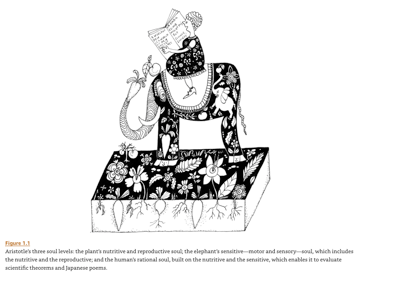
After that authors discuss some epistemological issues of defining life and present table of history for this in XX century:
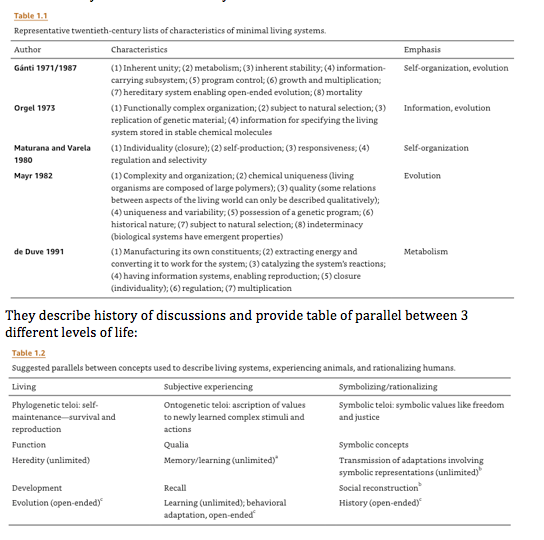
2. The Organization and Evolution of the Mind: From Lamarck to the Neuroscience of Consciousness
In this chapter authors go through work and thinking of outstanding researches: Lamarck, Spencer, Darwin, William James, Pavlov, and Skinner reviewing developments up to the recent time.
3. The Emergentist Consensus: Neurobiological Perspectives
Here authors review contemporary status of the field and identify areas of consensus. Here is the graphic representation:
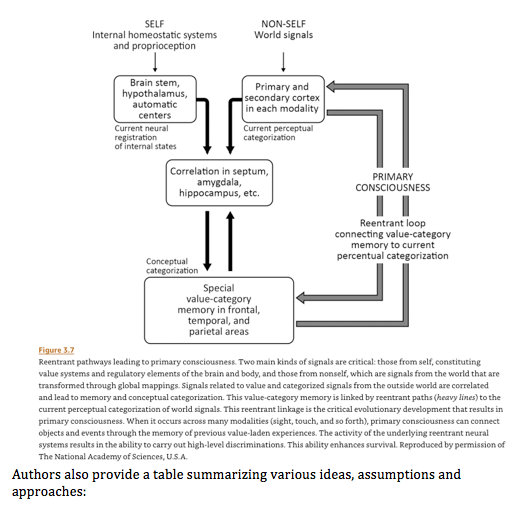
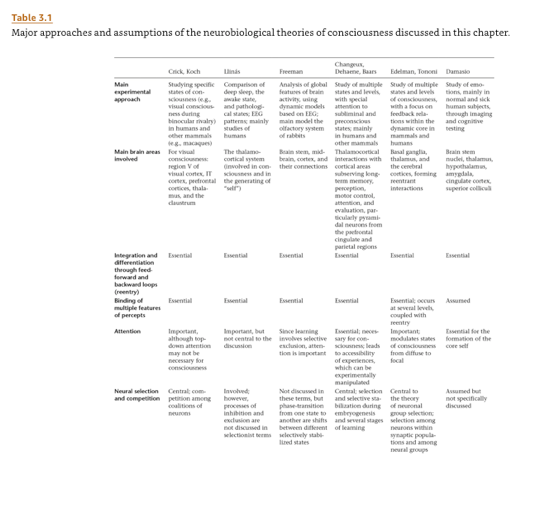
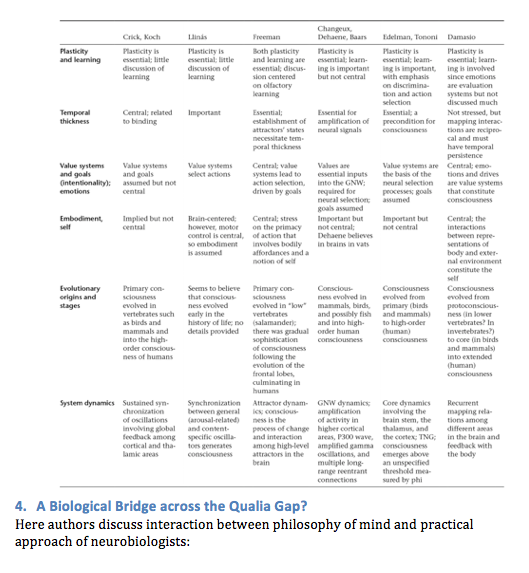
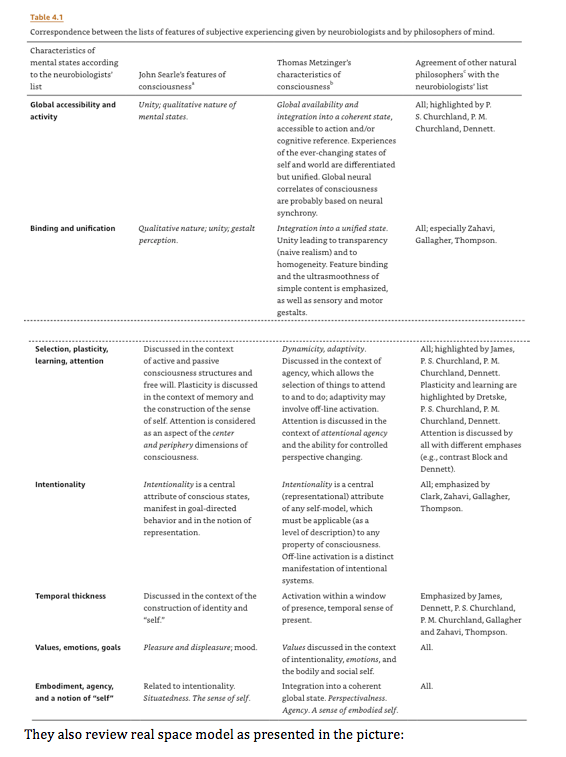
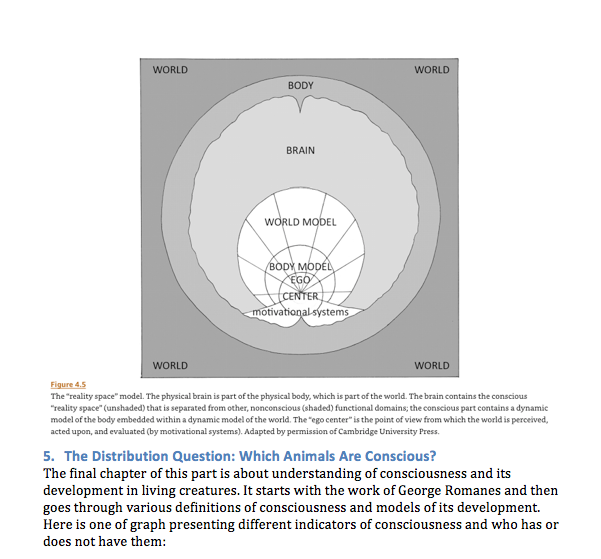
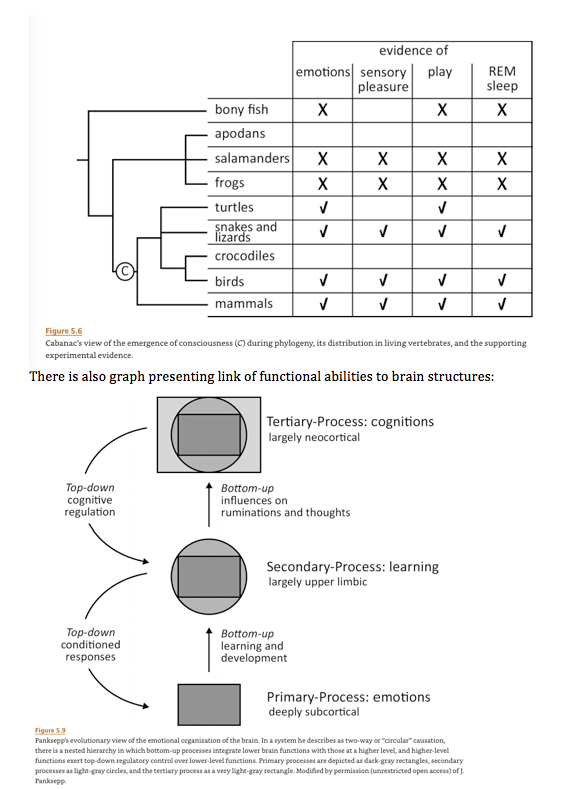
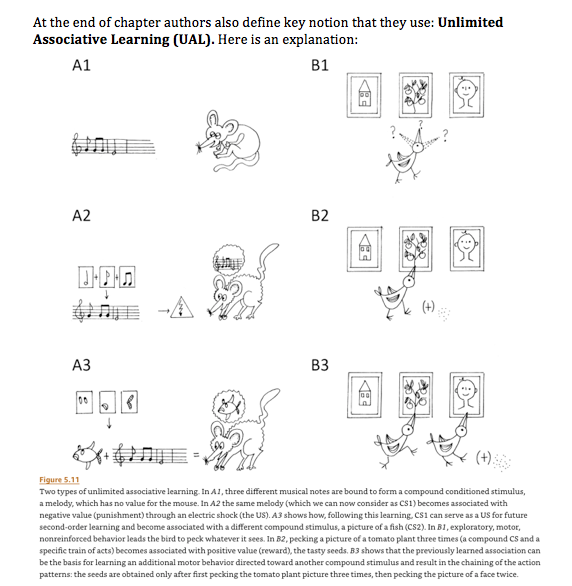
Authors link UAL to consensus of seven properties characterizing consciousness:
- Global activity and accessibility of information
- Binding and unification
- Selection, plasticity, learning, and attention
- Intentionality
- Temporal thickness
- Emotions, goals
- Embodiment, agency, and a notion of “self”
At the end authors suggest:” that UAL is the transition marker for consciousness has obvious implications for the distribution question. Discovering whether or not UAL occurs in different groups could provide an answer to the question about which animals can positively be said to possess minimal consciousness.”
Introduction to Part II: Major Transitions in the Evolution of the Mind
Authors start by presenting 8 levels of genetically supported information processing in living objects identified by John Maynard Smith and Eörs Szathmáry:
(1) From replicating molecules to populations of molecules in compartments (protocells);
(2) From independent genes to chromosomes;
(3) From RNA as both an information carrier and catalyst to DNA as the carrier of information and proteins as enzymes;
(4) From prokaryotes to eukaryotes;
(5) From asexual clones to sexual populations;
(6) From single-cell eukaryotes to multicellular organisms with differentiated cells;
(7) From solitary individuals to colonies with nonreproductive castes
(8) From primate societies to human societies with language
Then they discuss their approach to research as development-oriented (evo-devo), in which they identify 5 research themes:
- First, using the comparative method, it is developmental processes from the fertilized egg onward that are being compared, rather than the biological features of adult animals.
- Second, there is a strong focus on the effects of genetic variations on embryonic development and recognition that some variants can have large, saltational outcomes.
- Third, the role of developmental plasticity—the ability of the same genotype to generate different phenotypes in different environmental conditions—and the primacy of developmental responses in evolution are highlighted.
- Fourth, the generation of developmental variations and their maintenance and inheritance within and between individuals—play a role in evolutionary explanations.
- Fifth, physical, chemical, and cybernetic constraints on the direction, mode, and tempo of development, and their role in evolution, are emphasized.
Then they discuss role of phenotype in selection and model of exploration – stabilization perspective on selection.
Authors also provide here brief description of remaining chapters of the book.
6. The Neural Transition and the Building Blocks of Minimal Consciousness
Authors start this chapter “with the building blocks of learning, provide an overview of the transition to neural animals, and discuss the molecular and behavioral components found in cnidarians, from which simple forms of associative learning, and later UAL, probably evolved. Authors link the evolution of the nervous system with the evolution of mobility and muscles. They also stress the problem mobility opened up: once moving macroscopic animals had evolved, they had to distinguish between the sensory effects of their own movements and those that were independent of their own actions, a difficulty that led to the evolution of new modulatory interactions between sensory and motor neural centers.”
7. The Transition to Associative Learning: The First Stage
In this chapter authors ” describe the evolution of limited associative learning and the problem that this great adaptive innovation brought about—the problem of overlearning. This stumbling block was partially overcome by restricting learning to surprising, newsworthy discrepancies between expectations based on what has been learned and the actual, current effects of a new stimulus.”
Here is graphic comparison of authors’ model with previous:
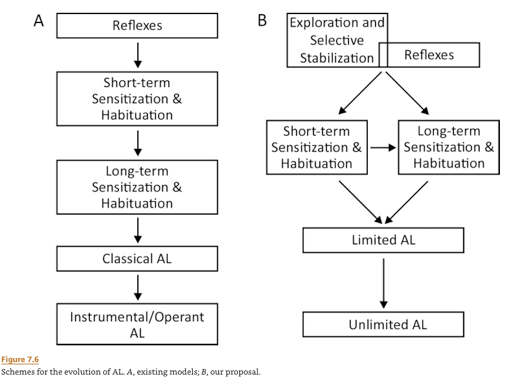
8. The Transition to Unlimited Associative Learning: How the Dice Became Loaded
“Building on the discussion in the preceding seven chapters, this chapter considers the transition to UAL and to minimal consciousness. Authors describe the functional neural architecture that constructed UAL, which, they argue, is the architecture underlying the simplest mental representations, and describe the different realizations of this architecture in vertebrates, arthropods, and mollusks. UAL led to a great increase in adaptability, but like limited associative learning, it also led to a severe problem of overlearning, which was evolutionarily solved by modulating the animals’ memory and their responses to stress.”
Authors also discuss UAL in Bayesian terms, somewhat linked to AI developments and provide nice graphic presentation of functional evolution:
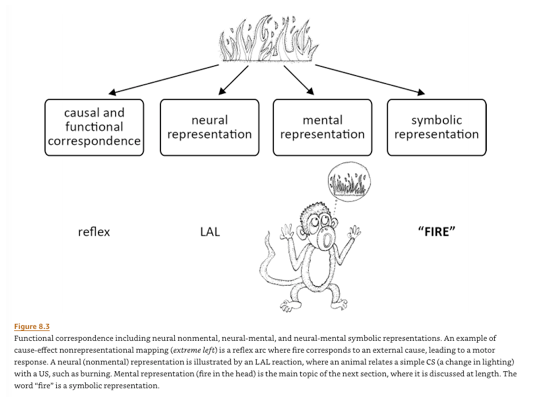
9. The Cambrian Explosion and Its Soulful Ramifications
Here authors position their “evolutionary proposal within an ecological context. They suggest that the evolutionary emergence of limited and unlimited associative learning had dramatic effects, acting as an adaptability driver of the Cambrian explosion. Once in place, the evolution of UAL led in some lineages (notably, birds and mammals, but also in the very different cephalopods) to the emergence of “Popperian” animals, creatures endowed with imagination.”
Here is general presentation of author views on Cambrian:
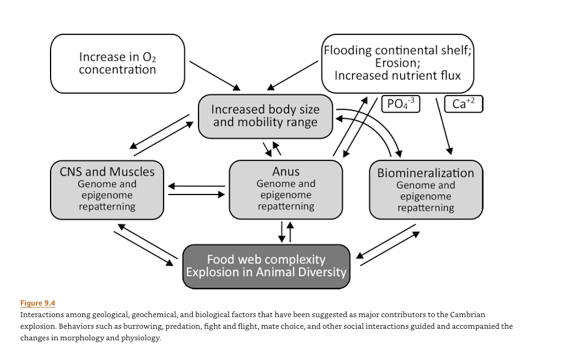
10. The Golem’s Predicament
In this final chapter authors “discuss the continuity between life and consciousness, examine the possibility (and implications) of constructing artificial conscious beings, and outline a further stage in the evolution of consciousness: the transition to the human “rational soul,” to human symbolic-based cognition, and to human abstract values. This last chapter takes the form of a dialogue, with a critical reader who questions authors’ interpretations and who wants to understand the implications of our proposal for neural and cognitive consciousness studies, for the philosophy of mind, and for ethics.“
Here is the table authors compiled to present totality of development from non-living materials to rational (human) consciousness:
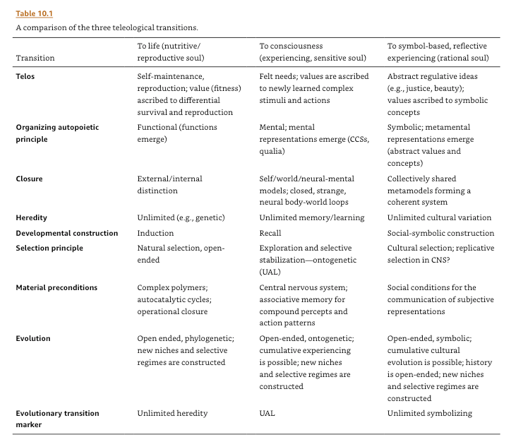
MY TAKE ON IT:
This is very well researched, logically constructed, and very convincingly presented view on evolutionary development of rational beings. I pretty much agree with authors approach and I think that presented understanding of interaction between genotype and phenotype is very plausible and probably quite close to reality. The limitation of this book to sensitive soul and especially final discussion shows authors understanding, that I fully agree with, of necessity of expanding research into group functionality in order to fully understand evolutionary meaning of rational soul. I really hope that authors will move into this direction and produce as well researched and analyzed book on this next step, as this one.
20191222 – Upheaval
MAIN IDEA:
The main idea of this book is that a crisis that occurs in lives of individuals and history of countries is an important and difficult process with unpredictable outcome. The response to such crisis requires mobilization of all individual and societal strength and abilities to overcome successfully. From detailed analysis of history of countries in crises author is trying to derive some rules how to handle crises successfully and then suggests ways to deal with what he considered current and/or potential crises in USA and the World.
DETAILS:
Prologue: Legacies of Cocoanut Grove
Two stories—What’s a crisis? – Individual and national crises—What this book is and isn’t— Plan of the book
Here author refer to tragic fire in dancing hall in 1942 Boston that killed some 492 people. This tragedy caused multiple people, either survivors or relatives of victims to undergo difficult psychological crisis, which not all of them were capable to overcome. Here is how author defines crisis: ”one can think of a crisis as a moment of truth: a turning point, when conditions before and after that “moment” are “much more” different from one another than before and after “most” other moments.” After that author expands this notion of crisis from individuals to societies, providing as example history of Rome: ”a historian of ancient Rome might apply the word “crisis” to only three events after the foundation of the Roman Republic around 509 BC: the first two wars against Carthage (264–241 and 218–201 BC), the replacement of republican government by the empire (around 23 BC), and the barbarian invasions leading to the Western Roman Empire’s fall (around AD 476).” At the end of prologue author presents plan of the book, which is mainly discussion of historical crisis in several countries and look at the future for USA and the World.
PART 1 INDIVIDUALS
Chapter 1. Personal Crises
A personal crisis—Trajectories—Dealing with crises—Factors related to outcomes—National crises
Author begins this chapter with personal crisis story that he successfully overcame with the help of his father. Then he provides kind of algorithm of how to deal with crisis and discusses each item in his list:
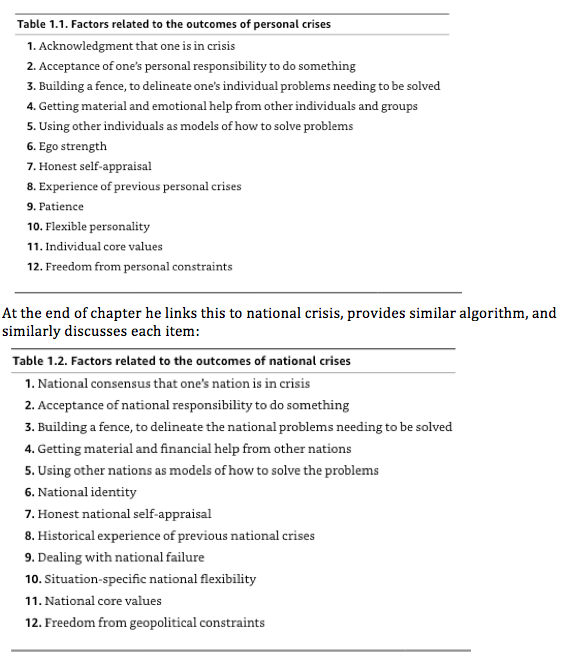
PART 2.NATIONS: CRISES THAT UNFOLDED
In this part author reviews history of several countries where severe crises occurred and then connects these histories to factors that he provided in the table.
Chapter 2. Finland’s War with the Soviet Union
Visiting Finland—Language—Finland until 1939—The Winter War—The Winter War’s end – The Continuation War—After 1945—Walking a tightrope – Finlandization—Crisis framework Chapter
Here author retells the story of Russo-Finland winter war of 1940 and its continuation until 1945. Finland lost this war but not until it inflicted severe casualties on the USSR and caused serious ideological and psychological damage, eventually resulting in Stalin’s decision to tolerate its limited independence. Author makes point here that overcoming crisis took difficult steps of accepting Soviet humiliating demands and learning not to irritate this powerful neighbor.
- The Origins of Modern Japan
My Japanese connections—Japan before 1853—Perry—1853 to 1868—The Meiji Era—Meiji – Reforms—“Westernization”—Overseas expansion—Crisis framework—Questions
Here author reviews another crisis, this time from XIX century when Japan discovered that its traditional isolation stop working because Western military become so superior that it allowed force imposition of trade rules. Japan leadership successfully resolved this crisis by dramatically changing their behavior not only opening country, but also actively searching acquisition of knowledge and skills that consequently led to liquidation of military and industrial deficiencies, so within some 50 years Japan was able to win war against Russia in 1904.
Chapter 4. A Chile for All Chileans
Visiting Chile—Chile until 1970—Allende—The coup and Pinochet—Economics until “No! ‘— After Pinochet—Pinochet’s shadow—Crisis framework—Returning to Chile
This is review of another crisis, this time internal crises in Chile when socialist Allende, after being democratically elected, start moving to communist totalitarian regime. Chile’s society resisted, leading eventually to military coup. Author manages to maintain reasonably fair narrative retelling not only negatives, but also positive economic development that brought in relative prosperity to Chile after market reforms.
Chapter S. Indonesia, the Rise of a New Country
In a hotel—Indonesia’s background—The colonial era—Independence—Sukarno—Coup—Mass legacies—Crisis framework—Returning to Indonesia
This chapter is about another crisis, somewhat similar to Chile when leftist coup was stopped by military and consequential massacre of everybody even remotely on the left. This time the dictatorship was not able to move effectively to market economy and suppress corruption, so no happy ending occurred at the time. However author describes how he visited this country recently and found a lot less corruption and working economy.
Chapter 6. Rebuilding Germany
Germany in 1945—1945 to 1961—Germans holding judgment—1968—1 968’’s aftermath— Brandt and re-unification—Geographic constraints—Self-pity?-Leaders and realism—Crisis framework
This chapter about Germany concentrates on several crisis in this country and its post WWII history from division of the country to rise of Berlin wall to the fall of this wall. For some reason author pays lots of attention to students riot in 1968, but his main stress is on the change of this country from aggressive and highly militaristic to quite pacifistic.
Chapter 7. Australia: Who Are We?
Visiting Australia—First Fleet and Aborigines—Early immigrants
—Federation—Keeping them out—World War One—World War Two—Loosening the ties—The end of White Australia—Crisis framework
The final chapter of this part is about Australia, which did not have such tragic and bloody crises with wars or coups, just slow moving identity crises. This was pretty much recognition that Australia is not part of Britain any more and old mother country does not have neither resources nor will to provide protection and support. It was a slow process on both sides, but eventually Australia moved to practically complete independence, even if it still recognizes queen as formal head of the state.
PART 3 | NATIONS AND THE WORLD: CRISES UNDERWAY
In this part author moves to more consequential countries: Japan and USA and changes focus from looking back at historical crises to looking at ongoing crisis in these two countries, and what he believes could lie in the future not only for these two countries, but for the whole world.
Chapter 8. What Lies Ahead for Japan?
Japan today—Economy—Advantages—Government debt—Women—Babies—Old and declining—Immigration—China and Korea—Natural resource management—Crisis framework
This chapter is about what author believes is Japan crisis. The reasons are aging and decrease of population, debt, and not complete reconciliation with Korea and China after the war. He then moves through his list of crisis factors and checks pluses and minuses of Japan situation and crises handling.
Chapter 9. What Lies Ahead for the United States? Strengths, and the Biggest Problem The U.S. today—Wealth—Geography—Advantages of democracy—Other advantages—Political polarization—Why? —Other polarization
Chapter 10. What Lies Ahead for the United States? Three “Other” Problems
Other problems—Elections—Inequality and immobility—So what? —Investing in the future—Crisis framework
Similarly to analysis of Japan, only more detailed, is author’s analysis of USA that author provides in these two chapters. At the end he provides typical American summary:” What is going to happen to the U.S.? That will depend upon the choices that we make. The enormous fundamental advantages that we enjoy mean that our future can remain as bright as has been our past, if we deal with the obstacles that we are putting in our own way. But we are presently squandering our advantages.
“
Chapter 11. What Lies Ahead for the World?
The world today—Nuclear weapons—Climate change—Fossil fuels—Alternative energy sources—Other natural resources—Inequality—Crisis framework
Here author dutifully and obviously sincerely checks all the fears that academic class uses to scare people into agreeing for more taxes and more grants. He even provides very funny diagram describing how global warming works and a few numbers about resource depletion and population growth.
Epilogue: Lessons, Questions, and Outlook
Predictive factors—Are crises necessary? —Roles of leaders in history—Roles of specific leaders —what next? – Lessons for the future
Here author combines his two tables into one list and goes in details through each part at global level:
- Acknowledgment that one is in crisis
- Accept responsibility, avoid victimization, self-pity and blaming others
- Build a fence / selective change
- Help from other nations
- Use other nations as models
- National Identity
- Honest self-appraisal
- Historical experience of previous national crises
- Patience with national failure
- Situation-specific national flexibility
- National core values
- Freedom from geopolitical constrains.
At the end author discusses need for crisis for people to take situation seriously and do something to overcome it. He also stresses role of leaders, which importance could never be clearly identified.
MY TAKE ON IT:
It is a nice review of crisis situations, which nevertheless overestimates importance of crisis in many cases, underestimates human ability to handle them, and somewhat missing luck or lack thereof in crisis situations. I think that crisis situation itself is only indicator of how well entity, either person or nation, is adjusted to environment and how much resources, both tangible and intangible, this entity has for modification if needed. Author’s to do list is nice, but it would only work if both levels of adjustment and resource availability sufficient to overcome the crisis. Otherwise to do list is not going to help in the least. To take one of his many example at national level, the Japan Meiji success was possible only because it dealt with Western trading nations, which had no intention of conquest and subjugation while happily allowing Japan to acquire technology and know-how, the generosity for which these Western nations later paid a lot in lives and treasure during WWII. In case of Finland, its successful resistance in the winter of 1940 did not stop Stalin from winning this small war, but demonstrated that it would require resources for occupation and complete subjugation that Stalin, busy with Poland, Baltic States, and preparation for war, just was not willing to allocate. At the end of war Stalin decided that remotely controlled satellite placed within Western camp – kind of small trap door in Iron curtain, used as conduit for technology transfer and source of convertible currency would better serve his purposes than another soviet republic. In both cases success was not that much what was done by leaders of these countries, as what opportunities were open for them. Such opportunities were completely closed for others, like Poland or Baltic countries.
20191215 – The Coddling of American Mind
MAIN IDEA:
The main idea of this book is to demonstrate how contemporary American Academia violate or even trying completely eliminate the great Western tradition of free thinking and research, propagating untruths and hurting the young generation of students. It is also to demonstrate how this generation is already severally handicapped by development of super safe parenting, fear of exposure to reality, and social media that leaves young people with no experience of real social interaction by substituting it with remote electronic forms. The main idea also includes recommendations for how to move to wiser kids, universities, and eventually society by acting according to the rules and ideas of Western traditions that served well to create prosperous society that leftists are trying to destroy.
DETAILS:
INTRODUCTION: The Search for Wisdom
Here authors explore untruth that currently taught to the young generations:
This is a book about three Great Untruths that seem to have spread widely in recent years:
- The Untruth of Fragility: What doesn’t kill you makes you weaker.
- The Untruth of Emotional Reasoning: Always trust your feelings.
- The Untruth of Us Versus Them: Life is a battle between good people and evil people.
While many propositions are untrue, in order to be classified as a Great Untruth, an idea must meet three criteria:
- It contradicts ancient wisdom (ideas found widely in the wisdom literatures of many cultures).
- It contradicts modern psychological research on wellbeing.
- It harms the individuals and communities who embrace it.
Authors also discusses in introduction their experiences as leftist academics who observed changes in universities from 1970 till now and got scared by massive debilitating impact on the young generation of massive indoctrination, suppression of free speech and free thinking and isolation of student from exposure to Western culture and its values.
PART I: Three Bad Ideas
CHAPTER 1 The Untruth of Fragility: What Doesn’t Kill You Makes You Weaker
Here author discusses correctness of usual wisdom:” What does not kill you makes you stronger”, even if it is not absolute and critic its opposite that is in vogue in colleges right now. They refer to Antifragility, which is normal product of evolutionary process human development and retell how it is undermined by Safetyism, implementation of Safe spaces, and such. Their conclusions are:
- Children, like many other complex adaptive systems, are Antifragile. Their brains require a wide range of inputs from their environments in order to configure themselves for those environments. Like the immune system, children must be exposed to challenges and stressors (within limits, and in age-appropriate ways), or they will fail to mature into strong and capable adults, able to engage productively with people and ideas that challenge their beliefs and moral convictions. Concepts sometimes creep.
- Concepts like trauma and safety have expanded so far since the 1980s that they are often employed in ways that are no longer grounded in legitimate psychological research. Grossly expanded conceptions of trauma and safety are now used to justify the overprotection of children of all ages—even college students, who are sometimes said to need safe spaces and trigger warnings lest words and ideas put them in danger.
- Safetyism is the cult of safety—an obsession with eliminating threats (both real and imagined) to the point at which people become unwilling to make reasonable trade-offs demanded by other practical and moral concerns. Safetyism deprives young people of the experiences that their Antifragile minds need, thereby making them more fragile, anxious, and prone to seeing themselves as victims.
CHAPTER 2 The Untruth of Emotional Reasoning: Always Trust Your Feelings
This is about handling emotions and most important not to become slave of one’s emotions. One of expressions of emotional debility of contemporary students, especially leftist is disinvitation of speakers on campus. They provide nice graph for frequency of such idiocy:
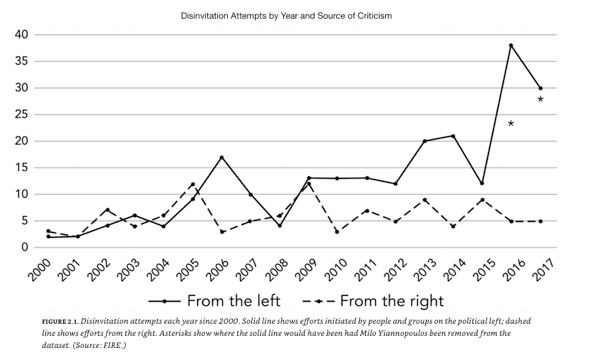
Here is summarization of this chapter:
- Among the most universal psychological insights in the world’s wisdom traditions is that what really frightens and dismays us is not external events themselves but the way in which we think about them, as Epictetus put it.
- CBT is a method anyone can learn for identifying common cognitive distortions and then changing their habitual patterns of thinking. CBT helps the rider (controlled processing) to train the elephant (automatic processing), resulting in better critical thinking and mental health.
- Emotional reasoning is among the most common of all cognitive distortions; most people would be happier and more effective if they did less of it.
- The term “microaggressions” refers to a way of thinking about brief and commonplace indignities and slights communicated to people of color (and others). Small acts of aggression are real, so the term could be useful, but because the definition includes accidental and unintentional offenses, the word “aggression” is misleading. Using the lens of microaggressions may amplify the pain experienced and the conflict that ensues. (On the other hand, there is nothing “micro” about intentional acts of aggression and bigotry.)
- By encouraging students to interpret the actions of others in the least generous way possible, schools that teach students about microaggressions may be encouraging students to engage in emotional reasoning and other distortions while setting themselves up for higher levels of distrust and conflict.
- Karith Foster offers an example of using empathy to reappraise actions that could be interpreted as microaggressions. When she interpreted those actions as innocent (albeit insensitive) misunderstandings, it led to a better outcome for everyone.
- The number of efforts to “disinvite” speakers from giving talks on campus has increased in the last few years; such efforts are often justified by the claim that the speaker in question will cause harm to students. But discomfort is not danger. Students, professors, and administrators should understand the concept of Antifragility and keep in mind Hanna Holborn Gray’s principle: “Education should not be intended to make people comfortable; it is meant to make them think.”
CHAPTER 3 The Untruth of Us Versus Them: Life Is a Battle Between Good People and Evil People
This is about identity politics, which authors contrast with MLK’s common-humanity approach. Authors also discuss intersectionality and provide nice graph explaining this concept:
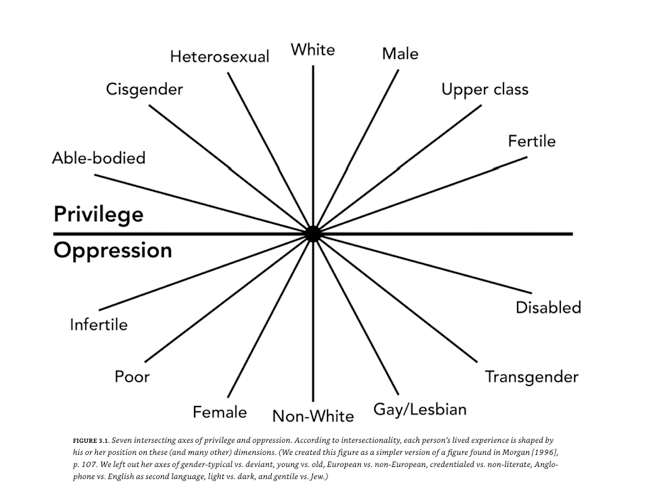
Here is the summary of the chapter:
- The human mind evolved for living in tribes that engaged in frequent (and often violent) conflict; our modern-day minds readily divide the world into “us” and “them,” even on trivial or arbitrary criteria, as Henri Tajfel’s psychological experiments demonstrated.
- Identity politics takes many forms. Some forms, such as that practiced by Martin Luther King, Jr., and Pauli Murray, can be called common-humanity identity politics, because its practitioners humanize their opponents and appeal to their humanity while also applying political pressure in other ways.
- Common-enemy identity politics, on the other hand, tries to unite a coalition using the psychology embedded in the Bedouin proverb “I against my brothers. I and my brothers against my cousins. I and my brothers and my cousins against the world.” It is used on the far right as well as the far left.
- Intersectionality is a popular intellectual framework on campuses today; certain versions of it teach students to see multiple axes of privilege and oppression that intersect. While there are merits to the theory, the way it is interpreted and practiced on campus can sometimes amplify tribal thinking and encourage students to endorse the Untruth of Us Versus Them: Life is a battle between good people and evil people.
- Common-enemy identity politics, when combined with microaggression theory, produces a call-out culture in which almost anything one says or does could result in a public shaming. This can engender a sense of “walking on eggshells,” and it teaches students habits of self-censorship. Call-out cultures are detrimental to students’ education and bad for their mental health. Call-out cultures and us-versus-them thinking are incompatible with the educational and research missions of universities, which require free inquiry, dissent, evidence-based argument, and intellectual honesty.“
Part II: Bad ideas in Action
In this part authors “show the Great Untruths in action. We examine the “shout-downs,” intimidation, and occasional violence that are making it more difficult for universities to fulfill their core missions of education and research. We explore the newly popular idea that speech is violence, and we show why thinking this way is bad for students’ mental health. We explore the sociology of witch-hunts and moral panics, including the conditions that can cause a college to descend into chaos.”
CHAPTER 4 Intimidation and Violence
Here authors move to contemporary left’s Orwellian ideas like “Words are Violence; Violence is Safety”. Here is authors’ summary:
- The “Milo Riot” at UC Berkeley on February 1, 2017, marked a major shift in campus protests. Violence was used successfully to stop a speaker; people were injured, and there were (as far as we can tell) no costs to those who were violent. Some students later justified the violence, as a legitimate form of “self-defense” to prevent speech that they said was violent.
- Hardly any students say that they themselves would use violence to shut down a speech, but two surveys conducted in late 2017 found that substantial minorities of students (20% in one survey and 30% in the other) said it was sometimes “acceptable” for other students to use violence to prevent a speaker from speaking on campus.
- The “Unite the Right” rally in Charlottesville, Virginia, in which a white nationalist killed a peaceful counterprotester and injured others, further raised tensions on campus, especially as provocations from far-right groups increased in the months afterward.
- In the fall of 2017, the number of efforts to shut down speakers reached a record level.
- In 2017, the idea that speech can be violence (even when it does not involve threats, harassment, or calls for violence) seemed to spread, assisted by the tendency in some circles to focus only on perceived impact, not on intent. Words that give rise to stress or fear for members of some groups are now often regarded as a form of violence.
- Speech is not violence. Treating it as such is an interpretive choice, and it is a choice that increases pain and suffering while preventing other, more effective responses, including the Stoic response (cultivating nonreactivity) and the antifragile response suggested by Van Jones: “Put on some boots, and learn how to deal with adversity.”
CHAPTER 5 Witch Hunts
Here authors discuss history of witch-hunt and note that it happens when some ideologies came to dominate and then trying to retain this dominance forever. They provide graph demonstrating left dominance in universities:
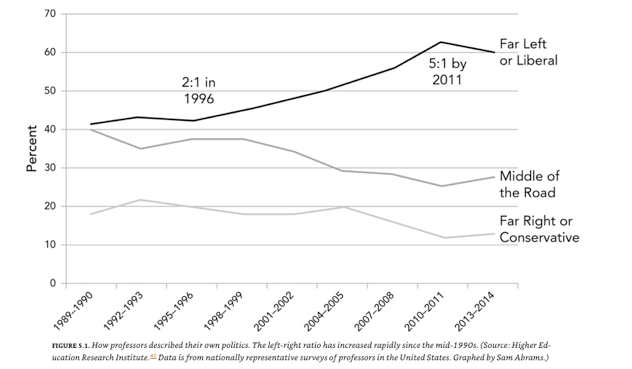
They also discuss some recent events and provide summary of the chapter:
- Humans are tribal creatures who readily form groups to compete with other groups (as we saw in chapter 3). Sociologist Emile Durkheim’s work illuminates the way those groups engage in rituals—including the collective punishment of deviance—to enhance their cohesion and solidarity.
- Cohesive and morally homogeneous groups are prone to witch hunts, particularly when they experience a threat, whether from outside or from within.
- Witch hunts generally have four properties: they seem to come out of nowhere; they involve charges of crimes against the collective; the offenses that lead to those charges are often trivial or fabricated; and people who know that the accused is innocent keep quiet, or in extreme cases, they join the mob.
- Some of the most puzzling campus events and trends since 2015 match the profile of a witch hunt. The campus protests at Yale, Claremont McKenna, and Evergreen all began as reactions to politely worded emails, and all led to demands that the authors of the emails be fired. (We repeat that the concerns that provide the context for a witch-hunt may be valid, but in a witch-hunt, the attendant fears are channeled in unjust and destructive ways.)
- The new trend in 2017 for professors to join open letters denouncing their colleagues and demanding the retraction or condemnation of their work (as happened to Rebecca Tuvel, Amy Wax, and others) also fits this pattern. In all of these cases, colleagues of the accused were afraid to publicly stand up and defend them.
- Viewpoint diversity reduces a community’s susceptibility to witch-hunts. One of the most important kinds of viewpoint diversity, diversity of political thought, has declined substantially among both professors and students at American universities since the 1990s. These declines, combined with the rapidly escalating political polarization of the United States (which is our focus in the next chapter), may be part of the reason why the new culture of safetyism has spread so rapidly since its emergence around 2013.
PART Ill: How Did We Get Here’?
In Part III authors “try to solve the mystery. Why did things change so rapidly on many campuses between 2013 and 2017? We identify six explanatory threads: the rising political polarization and cross-party animosity of U.S. politics, which has led to rising hate crimes and harassment on campus; rising levels of teen anxiety and depression, which have made many students more desirous of protection and more receptive to the Great Untruths; changes in parenting practices, which have amplified children’s fears even as childhood becomes increasingly safe; the loss of free play and unsupervised risk-taking, both of which kids need to become self-governing adults; the growth of campus bureaucracy and expansion of its protective mission; and an increasing passion for justice, combined with changing ideas about what justice requires. These six trends did not influence everyone equally, but they have all begun to intersect and interact on college campuses in the United States in the last few years.”
CHAPTER 6 The Polarization Cycle
Here authors discuss polarization between political parties:
- The United States has experienced a steady increase in at least one form of polarization since the 1980s: affective (or emotional) polarization, which means that people who identify with either of the two main political parties increasingly hate and fear the other party and the people in it. This is our first of six explanatory threads that will help us understand what has been changing on campus.
- Affective polarization in the United States is roughly symmetrical, but as university students and faculty have shifted leftward during a time of rising cross-party hatred, universities have begun to receive less trust and more hostility from some conservatives and right-leaning organizations.
- Beginning in 2016, the number of high-profile cases of professors being hounded or harassed from the right for something they said in an interview or on social media began to increase.
- Rising political polarization, accompanied by increases in racial and political provocation from the right, usually directed from off-campus to on-campus targets, is an essential part of the story of why behavior is changing on campus, particularly since 2016.
CHAPTER 7 Anxiety and Depression
Being teachers, authors constantly interact with the young generation and they notice dramatic increase in metal problems:
- The national rise in adolescent anxiety and depression that began around 2011 is our second explanatory thread.
- The generation born between 1995 and 2012, called iGen (or sometimes Gen Z), is very different from the Millennials, the generation that preceded it. According to Jean Twenge, an expert in the study of generational differences, one difference is that iGen is growing up more slowly. On average, eighteen-year-olds today have spent less time unsupervised and have hit fewer developmental milestones on the path to autonomy (such as getting a job or a driver’s license), compared with eighteen-year-olds in previous generations.
- A second difference is that iGen has far higher rates of anxiety and depression. The increases for girls and young women are generally much larger than for boys and young men. The increases do not just reflect changing definitions or standards; they show up in rising hospital admission rates of self-harm and in rising suicide rates. The suicide rate of adolescent boys is still higher than that of girls, but the suicide rate of adolescent girls has doubled since 2007.
- According to Twenge, the primary cause of the increase in mental illness is frequent use of smartphones and other electronic devices. Less than two hours a day seems to have no deleterious effects, but adolescents who spend several hours a day interacting with screens, particularly if they start in their early teen years or younger, have worse mental health outcomes than do adolescents who use these devices less and who spend more time in face-to-face social interaction.
- Girls may be suffering more than boys because they are more adversely affected by social comparisons (especially based on digitally enhanced beauty), by signals that they are being left out, and by relational aggression, all of which became easier to enact and harder to escape when adolescents acquired smartphones and social media.
- iGen’s arrival at college coincides exactly with the arrival and intensification of the culture of safetyism from 2013 to 2017. Members of iGen may be especially attracted to the overprotection offered by the culture of safetyism on many campuses because of students’ higher levels of anxiety and depression. Both depression and anxiety cause changes in cognition, including a tendency to see the world as more dangerous and hostile than it really is.
CHAPTER 8 Paranoid Parenting
This chapter is about paranoid parenting that become typical in America:
- Paranoid parenting is our third explanatory thread.
- When we overprotect children, we harm them. Children are naturally antifragile, so overprotection makes them weaker and less resilient later on.
- Children today have far more restricted childhoods, on average, than those enjoyed by their parents, who grew up in far more dangerous times and yet had many more opportunities to develop their intrinsic antifragility. Compared with previous generations, younger Millennials and especially members of iGen (born in and after 1995) have been deprived of unsupervised time for play and exploration. They have missed out on many of the challenges, negative experiences, and minor risks that help children develop into strong, competent, and independent adults (as we’ll show in the next chapter).
- Children in the United States and other prosperous countries are safer today than at any other point in history. Yet for a variety of historical reasons, fear of abduction is still very high among American parents, many of whom have come to believe that children should never be without adult supervision. When children are repeatedly led to believe that the world is dangerous and that they cannot face it alone, we should not be surprised if many of them believe it.
- Helicopter parenting combined with laws and social norms that make it hard to give kids unsupervised time may be having a negative impact on the mental health and resilience of young people today.
- There are large social class differences in parenting styles. Families in the middle class (and above) tend to use a style that sociologist Annette Lareau calls “concerted cultivation,” in contrast to the “natural growth parenting” used by families in the working class (and below). Some college students from wealthier families may have been rendered more fragile from overparenting and oversupervision. College students from poorer backgrounds are exposed to a very different set of risks, including potential exposure to chronic, severe adversity, which is especially detrimental to resilience when children lack caring relationships with adults who can buffer stress and help them turn adversity into growth.
- Paranoid parenting prepares today’s children to embrace the three Great Untruths, which means that when they go to college, they are psychologically primed to join a culture of safetyism.
CHAPTER 9 The Decline of Play
This chapter is about necessity of play for development not only humans, but also animals and how American children now deprived of this necessity:
- The decline of unsupervised free play is our fourth explanatory thread. Children, like other mammals, need free play in order to finish the intricate wiring process of neural development. Children deprived of free play are likely to be less competent—physically and socially—as adults. They are likely to be less tolerant of risk, and more prone to anxiety disorders.
- Free play, according to Peter Gray, is “activity that is freely chosen and directed by the participants and undertaken for its own sake, not consciously pursued to achieve ends that are distinct from the activity itself.” This is the kind of play that play experts say is most valuable for children, yet it is also the kind of play that has declined most sharply in the lives of American children.
- The decline in free play was likely driven by several factors, including an unrealistic fear of strangers and kidnapping (since the 1980s); the rising competitiveness for admission to top universities (over many decades); a rising emphasis on testing, test preparation, and homework; and a corresponding deemphasis on physical and social skills (since the early 2000s).
- The rising availability of smartphones and social media interacted with these other trends, and the combination has greatly changed the way American children spend their time and the kinds of physical and social experiences that guide the intricate wiring process of neural development.
- Free play helps children develop the skills of cooperation and dispute resolution that are closely related to the “art of association” upon which democracies depend. When citizens are not skilled in this art, they are less able to work out the ordinary conflicts of daily life. They will more frequently call for authorities to apply coercive force to their opponents. They will be more likely to welcome the bureaucracy of safetyism.
CHAPTER 10 The Bureaucracy of Safetyism
This is basically about people who benefit from all this – bureaucrats:
- The growth of campus bureaucracy and the expansion of its protective mission is our fifth explanatory thread.
- Administrators generally have good intentions; they are trying to protect the university and its students. But good intentions can sometimes lead to policies that are bad for students. At Northern Michigan University, a policy that we assume was designed to protect the university from liability led to inhumane treatment of students seeking therapy.
- In response to a variety of factors, including federal mandates and the risk of lawsuits, the number of campus administrators has grown more rapidly than the number of professors, and professors have gradually come to play a smaller role in the administration of universities. The result has been a trend toward “corporatization.”
- At the same time, market pressures, along with an increasingly consumerist mentality about higher education, have encouraged universities to compete on the basis of the amenities they offer, leading them to think of students as customers whom they must please.
- Campus administrators must juggle many responsibilities and protect the university from many kinds of liabilities, so they tend to adopt a “better safe than sorry” (or “CYA”) approach to issuing new regulations. The proliferation of regulations over time conveys a sense of imminent danger even when there is little or no real threat. In this way, administrators model multiple cognitive distortions, promote the Untruth of Fragility, and contribute to the culture of safetyism.
- Some of the regulations promulgated by administrators restrict freedom of speech, often with highly subjective definitions of key concepts. These rules contribute to an attitude on campus that chills speech, in part by suggesting that freedom of speech can or should be restricted because of some students’ emotional discomfort. This teaches catastrophizing and mind reading (among other cognitive distortions) and promotes the Untruth of Emotional Reasoning.
- One recent administrative innovation is the creation of “Bias Response Lines” and “Bias Response Teams,” which make it easy for members of a campus community to report one another anonymously for “bias.” This “feel something, say something” approach is likely to erode trust within a community. It may also make professors less willing to try innovative or provocative teaching methods; they, too, may develop a CYA approach.
- More generally, efforts to protect students by creating bureaucratic means of resolving problems and conflicts can have the unintended consequence of fostering moral dependence, which may reduce students’ ability to resolve conflicts independently both during and after college.
CHAPTER 11 The Quest for Justice
Here authors expand on leftist understanding of justice and provide timetable of events that impacted their perception of current situation. Here is their summary:
- Political events in the years from 2012 to 2018 have been as emotionally powerful as any since the late 1960s. Today’s college students and student protesters are responding to these events with a powerful commitment to social justice activism. This is our sixth and final explanatory thread.
- People’s ordinary, everyday, intuitive notions of justice include two major types: distributive justice (the perception that people are getting what is deserved) and procedural justice (the perception that the process by which things are distributed and rules are enforced is fair and trustworthy).
- The most common way that people think about distributive justice is captured by equity theory, which states that things are perceived to be fair when the ratio of outcomes to inputs is equal for all participants.
- Procedural justice is about how decisions are being made, and is also about how people are treated along the way, as procedures unfold.
- Social justice is a central concept in campus life today, and it takes a variety of forms. When social justice efforts are fully consistent with both distributive and procedural justice, we call it proportional-procedural social justice. Such efforts generally aim to remove barriers to equality of opportunity and also to ensure that everyone is treated with dignity. But when social justice efforts aim to achieve equality of outcomes by group, and when social justice activists are willing to violate distributive or procedural fairness for some individuals along the way, these efforts violate many people’s sense of intuitive justice. We call these equal-outcomes social justice.
- Correlation does not imply causation. Yet in many discussions in universities these days, the correlation of a demographic trait or identity group membership with an outcome gap is taken as evidence that discrimination (structural or individual) caused the outcome gap. Sometimes it did, sometimes it didn’t, but if people can’t raise alternative possible causal explanations without eliciting negative consequences, then the community is unlikely to arrive at an accurate understanding of the problem. And without understanding the true nature of a problem, there is little chance of solving it.
Part IV: Wising Up
In the final part authors “offer advice. We suggest specific actions that will help parents and teachers to raise wiser, stronger, more independent children, and we suggest ways in which professors, administrators, and college students can improve their universities and adapt them for life in our age of technology-enhanced outrage.“
CHAPTER 12 Wiser Kids
Here authors discuss how to raise kids to be ready for real world. It is mainly to provide knowledge of this real world, train to rely on sober analysis, rather than emptions and feelings, develop resilience to opinions and even hostility of others, avoid confrontation because good and evil are inside people not between groups of people. They also propose a practical measure: do service or work before college.
CHAPTER 13 Wiser Universities
For universities authors’ recommendations are: defend freedom of inquiry; pick more mature students; look for viewpoint diversity, and educate for “productive disagreement”.
CONCLUSION Wiser Societies
In conclusion authors summarize the whole book in one small table:
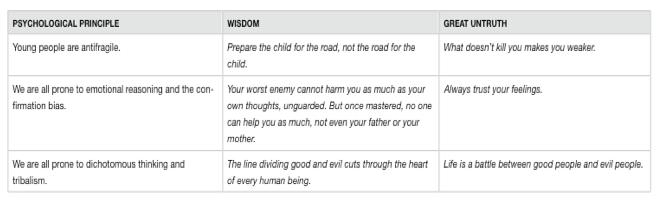
MY TAKE ON IT:
I find in somewhat charming and encouraging that authors, despite being leftists, nevertheless are capable to think, analyze, and understand the harm the current takeover of higher education by the left is causing not only to students and universities, but also to internal peace of the country. The eye opening for them came from situation when more extreme leftists attack less extreme the same way as they attack conservatives. It looks like something called self-preservation kicks in, making them more reasonable. This self-preservation expands also to their children and way of live because being smart people they seems to understand that combination of debilitating education based on primacy of emotion, denial of intellectual freedoms, and aggressive attempts to suppress others could lead to such powerful pushback from these others that would force them to lose their comfortable way of life. Certainly, being leftists, they comply with compulsory requirement to say some lies about Trump and express their hate, but to me it seems like they do not have real passion behind this. Anyway, I think in general it is great development and whatever these people can do, and they are really trying, to return American education back to traditions of Western civilization would be a valuable help in this struggle.
20191208 – How to lie with Statistics
MAIN IDEA:
The main idea of this small book is to demonstrate how by using various presentation methods and statistical tools, which are technically correct, one can nevertheless create false believes in the mind of user.
DETAILS:
Introduction
Author provides a brief narrative of his encounters with people being misled by either misuse of statistical tools or by intentional use of such tools for this purpose and then moves to specific examples.
- The Sample with the Built-in Bias
Here author looks at income statistics for “Average Yale man, class 24” and demonstrates how misleading is this statement because it contains a bunch of imbedded biases. He makes an important point: “To be worth much, a report based on sampling must use a representative sample, which is one from which every source of bias has been removed.”
After that author discusses another issue with selection of representative sample: “The test of the random sample is this: Does every name or thing in the whole group have an equal chance to be in the sample? The purely random sample is the only kind that can be examined with entire confidence by means of statistical theory, but there is one thing wrong with it. It is so difficult and expensive to obtain for many uses that sheer cost eliminates it. A more economical substitute, which is almost universally used in such fields as opinion polling and market research, is called stratified random sampling.
“ Finally author demonstrates how difficult it is to meet these requirements.
- The Well-Chosen Average
The next point author makes is use of averages without clarifying what they mean. He provides a very nice graphic presentation for this issue:
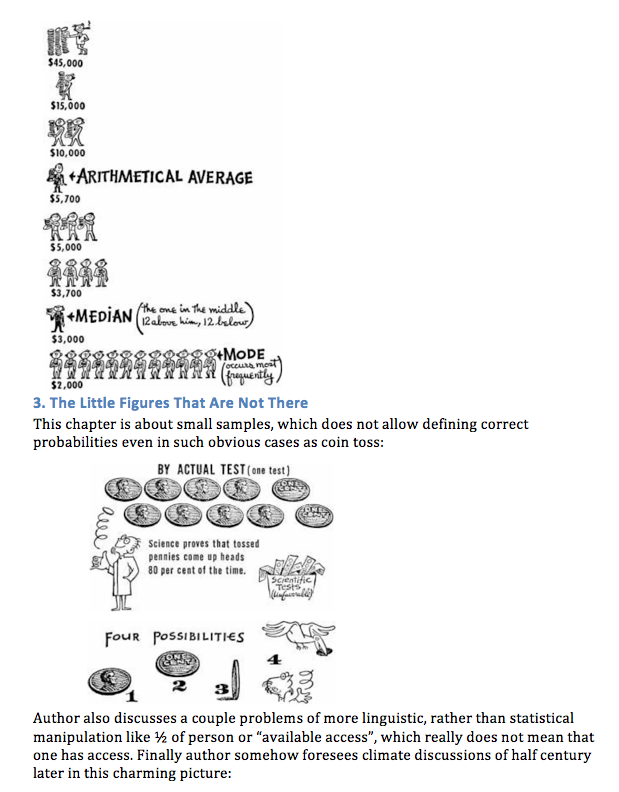
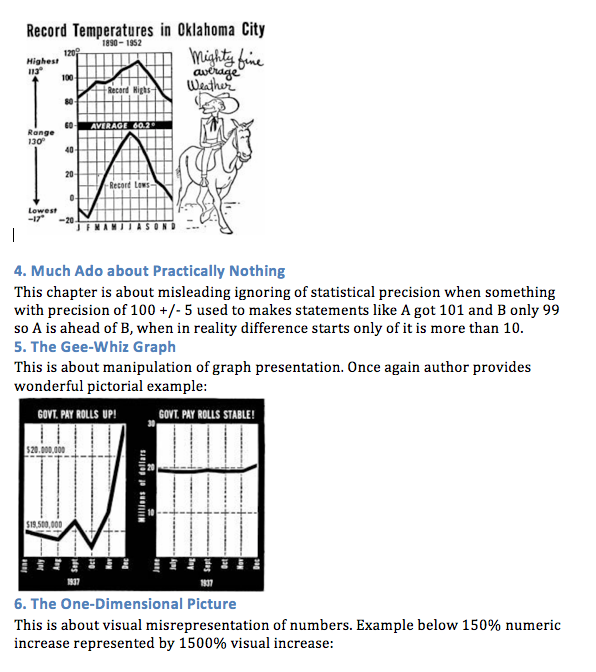
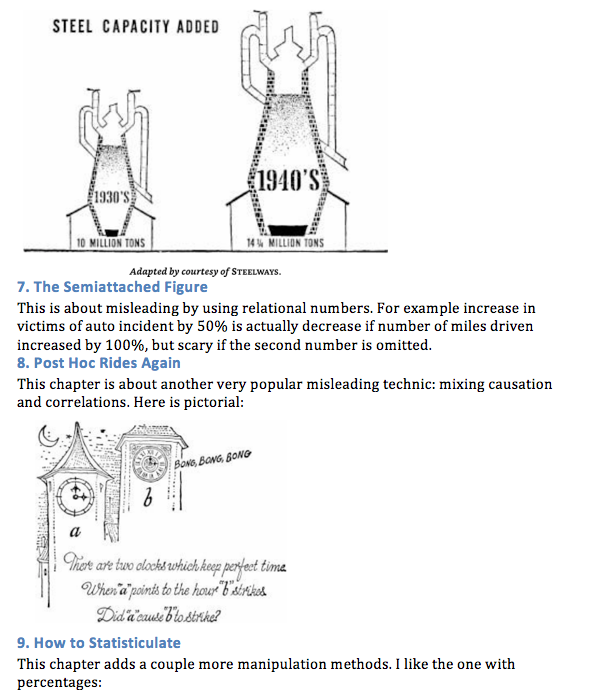
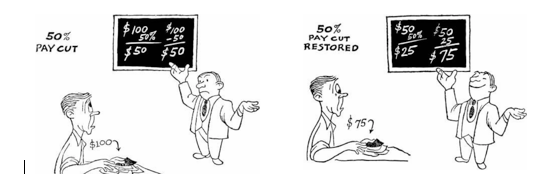
- How to Talk Back to a Statistic
The final chapter is about overcoming manipulation with statistics and presentations by asking a few very reasonable questions:
- Who says so?
- How does he know?
- Did somebody change the subject?
- Does it make sense?
MY TAKE ON IT:
This is a great collection of manipulation tools from some 50 years ago. It is funny that despite huge progress in information processing these methods did not change that much. Practically all these technics could be found now in books, news, and on Internet. Sometimes it requires some effort to recognize such manipulation, but usually it is very primitive and obvious to any even slightly educated person. Unfortunately after 12 years of high school and often even after additional 4 years of college the general level of mass education could be estimated as much less than slightly, which created the basis for mass manipulation of people. Consequently lots of politicians and bureaucrats make a great living out of this manipulation. I think that American society is pretty close to saturation with this lies because the net result is deterioration of quality of live, which at some point could create some serious push for a change, including massive improvement in education that would prevent manipulation or at least make it much more difficult.
20191201 – Global Crisis

MAIN IDEA:
The main idea of this book is demonstrate that “Little Ice Age” of XVII century had huge impact on human history. The global cooling caused significant decrease in agricultural productivity all over the world and consequently mass starvation in many places. The consequence was an increased fight for survival that included wars, revolutions, and political changes. Author clearly intent to caution everybody about direct link between climate and human affairs, which requires constant preparedness to handle similar crises in the future.
DETAILS:
Introduction: The ‘Little Ice Age’ and the ‘General Crisis‘
Here author briefly recount tragedies of XVII century: English Civil War, German 30 years religious war, French Civil war, Russian-Polish-Ukrainian struggle, Ming-Qing dynasty change in China, Mughal empire suffering from the draught, and so on. The only country that got away from this calamity relatively easy was Japan. Author links all this to climate change that had global character and provides nice table summarizing political consequences:
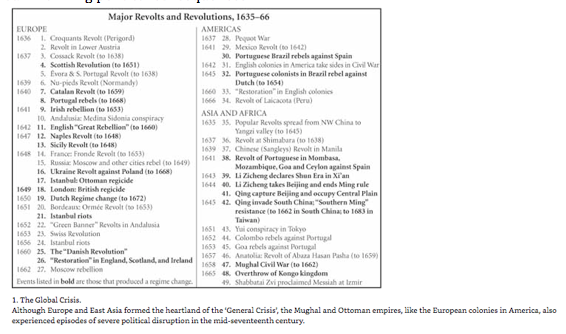
PART I. THE PLACENTA OF THE CRISIS
1 The Little Ice Age
Here author retells adverse climatic events of the period and then discusses typical response of people highly consistent with the level of civilizational development: the Search for Scapegoats. Author also discusses agricultural productivity, its reliance on climate, and human need in food for survival. With humanity at the time being at the early stages of technological development it was not feasible effectively prevent decrease in food supply, which led to Malthusian solution: massive deaths and decrease in population. The problem was not only death, but also impact on physiological condition of population. As example author provides graph of average height of French males born between 1650 and 1770:
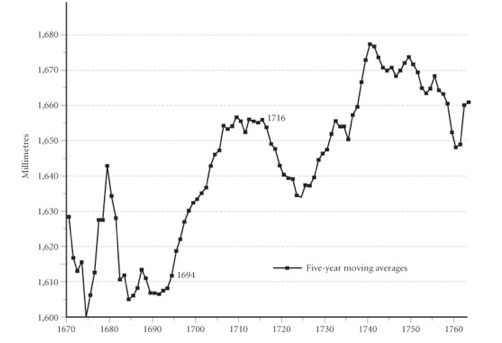
2 The ‘General Crisis’
In this chapter author discusses how humanity responded to adversity: mainly by starting massive wars, which despite multiple disguises religious and otherwise, were pretty much straggle for resources. Here is well-documented example from Europe:
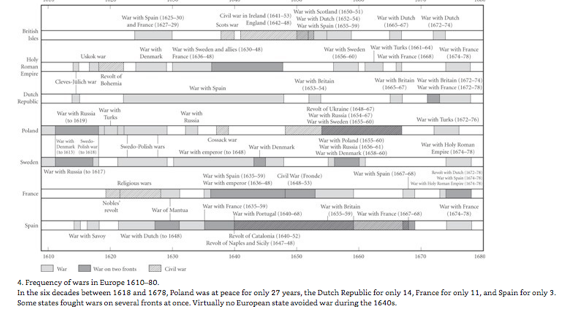
At the second part of chapter author discusses how various absolutist monarchies of the time handled the crisis.
3 ‘Hunger is the greatest enemy’: The Heart of the Crisis
Here author reviews details of agricultural production in several countries and its marginal character. Combined with societal conditions of the time any variance in food production quickly led to variance in population. Author also discusses role of cities as “urban graveyard effect”, which occurred when people failed to live off the land and move to cities in hope to obtain sustenance there. Here is example:
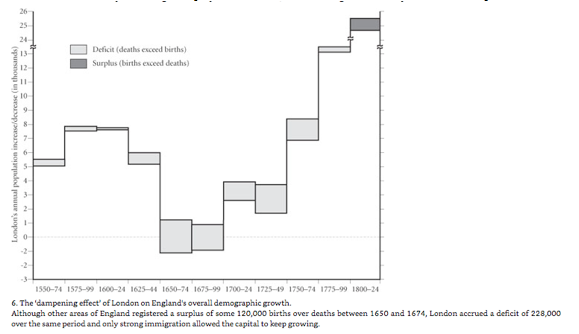
Author reviews this situation in multiple countries and their big cities, concluding that similar circumstances led to similar outcomes.
4 ‘A third of the world has died’: Surviving in the Seventeenth Century
Here author discusses various modes of destruction directly or indirectly caused by climate: massive suicides, increase in deadly diseases, infanticide and abortions, mass migration both voluntary and involuntary. Finally author stresses demographic effects that led to decrease in various cohorts of population.
PART II. ENDURING THE CRISIS
5 The ‘Great Enterprise’ in China, 1618-84; 6 The great shaking’: Russia and the Polish-Lithuanian Commonwealth, 1618-86; 7 The ‘Ottoman tragedy’, 1618-83;
8 The lamentations of Germany and its Neighbors 1618-88; 9 The Agony of the Iberian Peninsula, 1618-89; 10 France in Crisis, 1618-88; 11 The Stuart Monarchy: The Path to Civil War 1603-42; 12 Britain and Ireland from Civil War to Revolution, 1642-89
This part is country-by-country detailed history of crisis with all its famines, massacres, revolutions, wars, and tremendous suffering of people all over the world.
PART III. SURVIVING THE CRISIS
13 The Mughals and their Neighbors; 14 Red Flag over Italy; 15 The ‘dark continents’: The Americas, Africa and Australia; 16 Getting it Right: Early Tokugawa Japan
This part continues the history of the crisis, but moves to countries where it was somewhat less severe. It was still pretty bad, just a bit better than extreme cases. However one country: Japan was much more successful in handling it. Author provides a small table demonstrating this success by increase in population and harvests:
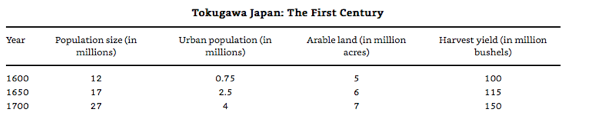
Author explains this success by referring to a number of measures that allowed start up Tokugawa dynasty to achieve this result. The most important was what author calls “Industrious Revolution” – massive intensification of agricultural process that allowed increase in productivity and overall output, consequently preventing or at least alleviating severity of famines that caused so many problems in other countries. Another important achievement was Tokugawa’s success in ruling in feudal lords (daimyo) by forcing them to stay close to the center and provide hostages, which made for effective control over their actions. Not a small part in this success was result of control over information flows, publishing, and religious activities. Author also stresses comparatively beneficial circumstances: Japan at the time was somewhat under populated so climate cooling had a lot less impact than in countries where previous period of population growth and expansion of agriculture to marginal productivity areas created potential for disaster, when harvest failed in these areas.
PART IV. CONFRONTING THE CRISIS
This part traces response to the crisis from different groups of population. Author cites LU Kun – Chinese bureaucrat of Ming dynasty who identified four types of rebellious people:

Then he follows on to discuss rebels breakdown along similar lines in different countries.
17 ‘Those who have no means of support’: The Parameters of Popular Resistance
At the beginning of chapter author provides table for France and graph for China that demonstrate massive increase in revolts during climate crisis:
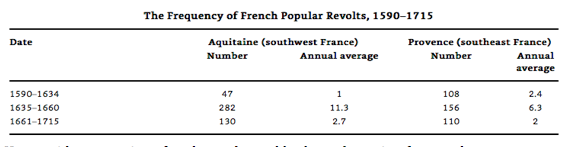
He provides narrative of such revolts and looks at deterring factors that demonstrated some preventative power:
- First, the need to earn a daily wage formed a powerful restraint on rebellion: a family that did not work – whether because on strike, in rebellion, or unemployed – might not eat.
- Second, the vertical links of kinship, friendship, faction, patronage and ritual in each community created ties between the dominant and the dominated that discouraged violent action.
- Third, and paradoxically, any economic development within the community that increased social divisions also militated against collective action. Thus a shift towards producing crops (especially industrial crops) for export normally created groups of prosperous cultivators who, as long as strong demand for their goods lasted, remained largely insulated from the frustrations and sufferings of those still tied to subsistence farming; and this significantly reduced the likelihood of unified resistance.
- Fourth and finally, in most farming communities of the early modern world, the poor often depended for their survival on deference and subordination. Better-off neighbors were more likely to provide relief in time of need to those who showed constant respect and obedience, whereas neglect or surliness might lead to denial of charity and even expulsion from the community. However much the poor may have resented their subordination and humiliation, their circumstances compelled them to conform: they might try to negotiate the terms of subordination, but they rarely dared to challenge it.
Author also looks at such details as role of clerics, etiquette of collective violence, place and time of rebellions, weapons and emblems, and, finally, at outcomes: whether it ended in Concession or Repression.
18 ‘People who hope only for a change’: Aristocrats, Intellectuals, Clerics and ‘dirty people of no name’
Here author moves from the bottom to the near top of societies looking at such causes as crisis of Aristocracy, Education, that typically makes it difficult to accept low level station and lack of resources, and finally at people of “no name” who are practically situated outside of main society, but at some condition could invade it – good examples are Russian Cossacks (Stenka Razin) and Chinese pirates (Li Zicheng). Author also discusses in details legal and philosophical justification of Disobedience and violent revolts.
19 ‘People of heterodox beliefs … who will join up with anyone who calls them’: Disseminating Revolution
Here author looks at similarity between development of revolts and contagious diseases: both starting with some spark in local place, but then quickly expands when encountering large numbers of people without immunity and psychologically at the limits of tolerance. Author also discusses situation when fire moves across national borders, exporting revolution. Finally author looks in details on ‘public sphere’ in different countries meaning foundation of literacy, which is always instrumental in promotion of ideas, including revolutionary ideas. A very interesting note at the end of the chapter relates to the number of initial revolutionaries who in nearly all cases is exceedingly small, which is quite consistent with idea of spark causing huge fire.
PART V. BEYOND THE CRISIS
In this part author moves to aftermath of the crisis in late 1680s when despite continuing adverse climate effects well into XVIII century with continuing wars and revolts, wars and revolts decreased in frequency and intensity. Author rejects the idea that it was result of depopulation. He rather stresses human ability to adjust citing evidence of increased crises preparedness, new technological and organizational measures like quarantine that were applied and, most important, shift away from religious thinking to new way – scientific thinking that provided much better ability to handle adversity. The chapters of this part look at all these consequences.
20 Escaping the Crisis
Here author discusses personal reactions of contemporaries and kind of links it to what it would look like now: “ Many of those who lived in the seventeen century reacted to adversity and anxiety which they could neither explain nor avoid in much the same way as their descendants today: some killed themselves; others went to consult a therapist or a cleric; while others found solace in an absorbing pastime. All three categories are difficult to document, because they left few traces in the surviving sources. “
. Author looks at each of these groups
reviewing escapist measures used from emigration to suicide, prevailing psychological mode of melancholy, how it was documented in multiple diaries and other documents and so on. Finally author discusses how it happened that Europe shifted from mass wars to peace as result of general exhaustion.
21 From Warfare State to Welfare State
Here author moves to resilience and recovery starting with notes about Germany that was probably the most devastated part of the continent. Then he reviews similar situation in China and other countries. Finally he reviews multiple technological and economic changes that he characterizes as “Agricultural revolution, Consumer revolution, containment of diseases, advancement and periodic renewal of cities, often after massive fires, and other economic changes that led to increased prosperity.
22 The Great Divergence
Here author analyses reason for divergence between Europe and other parts of the world, citing mainly intellectual changes: development of universities, decrease in power of religious thought controls, overall increasing use of scientific method in all areas of life.
Conclusion: The Crisis Anatomized
In conclusion author discusses who were winners and losers of the crisis, which were somewhat different in different countries generally with peasants and others in lower classes being losers and soldiers and governments being winners.
Epilogue: ‘It’s the climate, stupid’
This stresses human dependency upon climate and discusses in details various occurrences of extreme climate variations. Author laments calm attitude of population to global warming alarmism and presents in details how analysis of London potential floods led to preventive intervention in form of building barrier, which despite being very expensive did prevent massive damages afterword.
MY TAKE ON IT:
It is an interesting history clearly demonstrating human dependency on climate in XVII century when technology was primitive, understanding of environment even more primitive and hate, that was periodically exploding in violence between various nations, religious groups, and classes was just a normal condition of humanity. We now live in different world and current knowledge, scientific method, and technology allows not only much better understanding of climate, but also multitude of measures that could allow handling many a crises in effective way. For example such thing as famine due to cooling, could be easily prevented by shifting agriculture to wormer places, or even moving it to controlled environment, not even accounting for human current ability to modify plants or even produce artificial food. I think that alarmist approach is not supported by demonstrated levels of climate understanding and often driven more by power plays and greed of pseudo scientists who derive lots of money and publicity, than by actually demonstrated problems. In any case, it is typical for people who spend time outside of real business environment attempting to find universal solution for multitude of problems, when in reality problems should be resolved one by one as they clearly present themselves.
20191124 – Impossible to Ignore
MAIN IDEA:
The main idea is to present and discuss in details 15 variables that author believes could be used to influence other people’s memory: “context, cues, distinctiveness, emotion, facts, familiarity, motivation, novelty, quantity of information, relevance, repetition, self-generated content, sensory intensity, social aspects, and surprise.
“
The end result should be ability of the reader to prepare and deliver memorable presentations that would have material impact on people.
DETAILS:
Author provided a nice summary at the end of each chapter, so I would just go with it. Here is a couple of key diagram around which author builds the narrative:
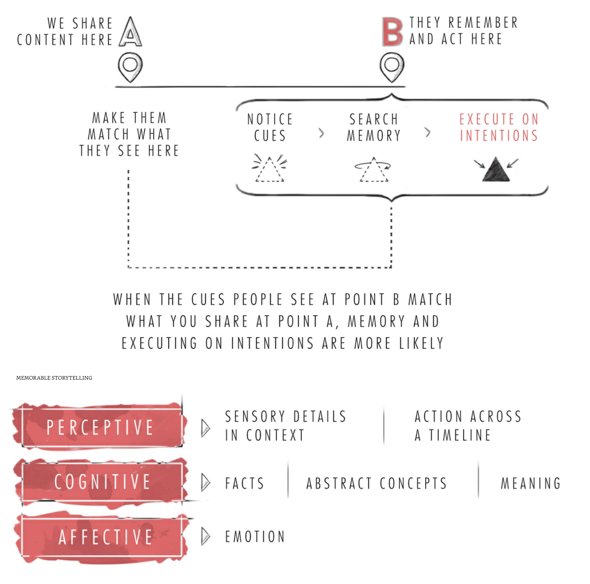
CHAPTER 1: MEMORY IS A MEANS TO AN END Why Memory Matters in Decision-Making
- People act on what they remember, not on what they forget
- What matters most is what happens next. People need memory to predict their next move
- Memory guides action toward maximum rewards.
- To be on people’s minds, plug into their: Reflexes Habits Goals
- Establish a framework, and then decide which items must stand out. Weaken their neighbors.
- Consider the memory from the standpoint of proportions, not precision.
CHAPTER 2: A BUSINESS APPROACH TO MEMORY Three Steps to Influence Memory and Decisions
- Prospective memory, which means remembering a future intention, has remarkable advantages for any business because it keeps us viable: we stay in business when people remember what we say and act on it in the future.
- When people act on future intentions successfully, they complete these three steps, sometimes within fractions of seconds: they notice cues that are linked to their intentions; search their memory for something related to those cues and intentions; and if it is rewarding enough, they execute.
- The effectiveness of cues depends on how strongly they are related to a desired intention and how salient they are to draw attention at the time of remembering. • Memory, emotions, and motivation are influenced by the presence, absence, or termination of rewarding or punishing stimuli.
- People execute on intentions according to the following variables tied to rewards: effort, time delay, risk, and social aspects.
CHAPTER 3: CONTROL WHAT YOUR AUDIENCE REMEMBERS Practical Ways to Avoid the Hazards of Random Memory
- The forgetting curve hypothesizes that we lose information over time when we make no effort to retain it. We can lose as much as 90% after a few days.
- Unless we take control of the metaphorical 10% message, an audience will remember things at random.
- According to fuzzy-trace theory, people form two types of memories: verbatim and gist. Verbatim memories are word-for-word, accurate representations of what we’ve learned in the past. Gist memories include the general meaning of what has happened in the past, and they are less accurate and specific.
- Determine what type of memories (verbatim or gist) you would like to place in people’s minds and in what proportions.
CHAPTER 4: MADE YOU LOOK How Cues Pave the Way to Action
- When the cues you use to attract attention at Point A are similar to what people encounter later at Point B, the cues are more likely to signal action.
- Physical properties of stimuli such as unusual colors, textures, size, motion, loud sounds, harmony, or orientation of objects can force people to look “despite themselves.” These types of cues work because they do not require much cognitive effort.
- Create cues that are linked to existing habits (e.g., associating new information with a software application people already use) Attention driven by habits is potent because people can sustain it on their own, and once habits are formed, they do not require much cognitive effort.
- Use cues to direct attention inward and prompt audiences to focus on habitual thoughts. When you engage your audiences in reflective attention, you promote long-term memory because of a process called elaborate encoding.
- Link your message to people’s most important goals. Unlike reflexes or habits, goals require cognitive effort, but attention is still possible because goals are fueled by needs. Consider acknowledging that an audience may have conflicting needs, such as uncertainty versus structure, people versus privacy, and survival versus transcendence. • Tie your message to a current but unfulfilled goal. People tend to pay greater attention to and remember more of what is not finished because the brain seeks closure.
- Link cues to social desirability because impression management is a strong motivation driver. People tend to pay attention to what makes them look good in front of others.
- Ensure that people have enough willpower to pay attention to you (e.g., present important messages early in the day).
- Strengthen the association between cues, memory, and intentions.
CHAPTER 5: THE PARADOX OF SURPRISE The Price We Pay for Extra Attention, Time, and Engagement
- Our audiences form expectations so that they can predict the next moment. When you give them something they expect, you satisfy a human need for accurate predictions, which generates pleasure.
- Audiences form expectations automatically and mostly unconsciously based on what they pay attention to, memories of past experiences, motivations, emotions, and beliefs they form along the way. To get attention, tie your content to existing beliefs for a better future and provide effective tools they can use after consuming your content, such as checklists, how-to videos, or free software trials.
- Too much predictability can lead to boredom. Offer your audiences something they expect (and can predict), as well as something that takes them by surprise. Use linguistic, perceptual, cultural, or social norms to break conventions.
- Juxtapose seemingly unrelated but existing schemas to create surprise.
- Continue elevating your content to ensure you are meeting your audiences’ ever-evolving palate for satisfying experiences.
CHAPTER 6: SWEET ANTICIPATION How to Build Excitement for What Happens Next
- Use the word “imagine” to create anticipation and invite action. People don’t just think about the future; they feel the future, and emotion influences decision-making. • People feel more motivated to take action with a boost of dopamine. The presence of dopamine increases the likelihood that people have enough motivation to not only notice cues but come and get the rewards we’re promising and return to us again. • Dopamine is released when we help people anticipate a reward accurately, but also when we reserve room for some uncertainty. The area of the brain that predicts rewards is the same area that handles novelty.
- Dopamine spikes in the face of unexpected events. In general, uncertainty makes us uneasy, which is why it is often referred to as “tension.” We can tolerate some tension as long as (1) we know its degree, (2) we are reminded about the importance of the final outcome, and (3) we can tolerate the amount of delay until that outcome is realized.
- Unusual activities or performers with skills different from your teams’ are anticipation hooks and serve as strong cues that announce worthy outcomes.
- If the delay before realizing a promised reward is brief, find the right words for the reveal and practice them.
- Use foreshadowing, which means frequently giving signs of what will come next.
CHAPTER 7: WHAT MAKES A MESSAGE REPEATABLE? Techniques to Convince Others to Repeat Your Words
Criteria for repeatable messages:
- Portable
- Timeless
- Simple syntax
- Tied to long-term goals
- Aspirational
- Generic (no articulate prepositions or definite articles)
- Appeal to self-interest (make us look good to ourselves)
- Social currency (make us look good to others)
- Universal
CHAPTER 8: BECOME MEMORABLE WITH DISTINCTION How to Stay on People’s Minds Long Enough to Spark Action
- Distinctiveness is important for long-term memory because isolated items draw more attention and rehearsal time. In addition, isolated items come to the foreground, reducing interference with other items, and also appear in smaller numbers, which makes them easier to recall long term.
- The more similar things are, the harder it will be to retrieve them later. However, similarity is important for the brain to detect distinctiveness.
- The brain is constantly looking for rewards. In business, when many messages are the same, we can create distinctiveness, and therefore improve recall, by being specific about these rewards, which we can frame as tangible results.
- If you’re not first to market, observe pockets of similarity in your domain and then strike with distinctiveness. Allow your audiences’ brains to habituate to similarity; it will be easier for your message to stand out.
- The more an item differs from other items, the bigger its effect. Select a property you want to isolate and increase its distinctiveness by at least 30% compared with neighboring items.
- Find opportunities to deviate from a reality your viewers have learned to expect. • Create distinctiveness by thinking in opposites. This is helpful not only because it helps the brain distinguish some stimuli more strongly than others, but also because contrast is a shortcut to thinking and decision-making.
- Enable self-generated distinctiveness.
- Achieve distinctiveness with a human touch and deep meaning.
CHAPTER 9: “I WRITE THIS SITTING IN THE KITCHEN SINK” The Science of Retrieving Memories Through Stories
- Memorable stories contain the following components: perceptive (sensory impressions in context and action across a timeline), cognitive (facts, abstract concepts, and meaning), and affective (emotion).
- Something is concrete if we can perceive it with our senses. If we can’t perceive it with our senses, we are talking about an idea or a concept, which is abstract. Balance both in your communication and, to avoid habituation, break the pattern an audience learns to expect.
- While abstract and concrete are opposites, generic and specific are subsets of each other, with generic being a large group and specific representing an individual item within that group. Zoom in on specific details based on your audience’s level of expertise (advanced audiences can handle abstracts better).
- Text and graphics have the potential to be equals in memory. Make pictures easy to label and text easy to picture.
- Pair abstract words with concrete pictures to ensure that your audience extracts a uniform meaning from your message.
- Use visual metaphors to explain abstract concepts. Steer away from clichéd metaphors by either giving an old metaphor a fresh meaning or using unexpected metaphors.
- Wrap abstract words in concrete contexts. Repeat information in the same context for verbatim memory. Vary the context for gist memory.
- Appeal to the senses to activate multiple parts of the brain and create more memory traces. The more personal experiences you share, the more opportunities to include sensory details.
- Avoid clichéd images. Instead, use vivid images to evoke tension, mystery, wabi-sabi, or nostalgia.
- Use strong emotions by showing an audience how to: Move toward rewards: pleasure, happiness, elation, ecstasy, love, sexual arousal, trust, empathy, beauty. Move away from rewards: frustration, indignation, disbelief, sadness, anger, and rage. Move toward punishments: apprehension, disgust, aversion, fear, terror, unfairness, inequity, uncertainty, and social exclusion. Move away from punishments: relief, liberation.
CHAPTER 10: HOW MUCH CONTENT IS TOO MUCH? How to Handle Content Sacrifice
- Clarifying what an audience must remember and do helps to filter unnecessary content.
- Keep it brief when an audience must identify with the content. Offer more when your listeners don’t have much information or context, and they must make an important decision.
- Earn the right to provide more information by offering value.
- If your content is long, alter your audience’s perception of time by offering visible signs of progress, shifting the audience’s focus frequently, and making the content aesthetically pleasing.
CHAPTER 11 HOW DOES THE BRAIN DECIDE? The Neurobiology and Neuroeconomics of Choice
- If your audience has been performing a task for a long time, link your content to an existing habit. If there are no habits related to your products or ideas, present goal-oriented information. When you do it repeatedly, you help an audience form new habits.
- Habits are formed by doing, not by not doing. Frame your messages in a positive way.
- Decisions typically include four steps:
- Identify sensory stimuli: What are they?
- Select an action that will maximize a reward: What is it worth?
- Act on the intention.
- Evaluate the results: Did you predict the outcome well?
- The values our audiences assign to different objects, people, and experiences can range from functional and concrete to something more abstract. People buy things because of emotional, epistemological, aesthetic, hedonistic, or situational value. Clarify these values for your audiences.
- Even unattended stimuli influence choice. There is no break from greatness for the communicator who aspires to be influential, because everything you share has the potential to influence decisions.
- Variables that have an impact on our choices include effort to get the reward (physical, financial, or mental), time delay until we get the reward, perception of risk in getting the reward, and social impact in relation to that reward.
- If your audiences perceive a high amount of uncertainty in their interactions with you, consider heuristics, such as availability, familiarity, or authority, to help them make quick decisions.
- Fast decision-making is also based on the perception of a stable environment and social factors.
- A balance between desirability and feasibility leads to more persuasive content. This is because feasibility will help people with their own decisions, and desirability will help them in their transactions with others.
- Develop content that hooks into rewards from the past but also provides sources for new rewards.
CHAPTER 12
THE RIGHT TO BE FORGOTTEN AND THE INTENT TO BE REMEMBERED How to Balance Accidental and Purposeful Forgetting
The final chapter is about memory management: need to correctly define what is one need to keep in and what dispose off memory. It is also about Black Swans and need to be prepared by continuously modifying understandings and assumptions. Here is graph that author provides to demonstrate this idea:
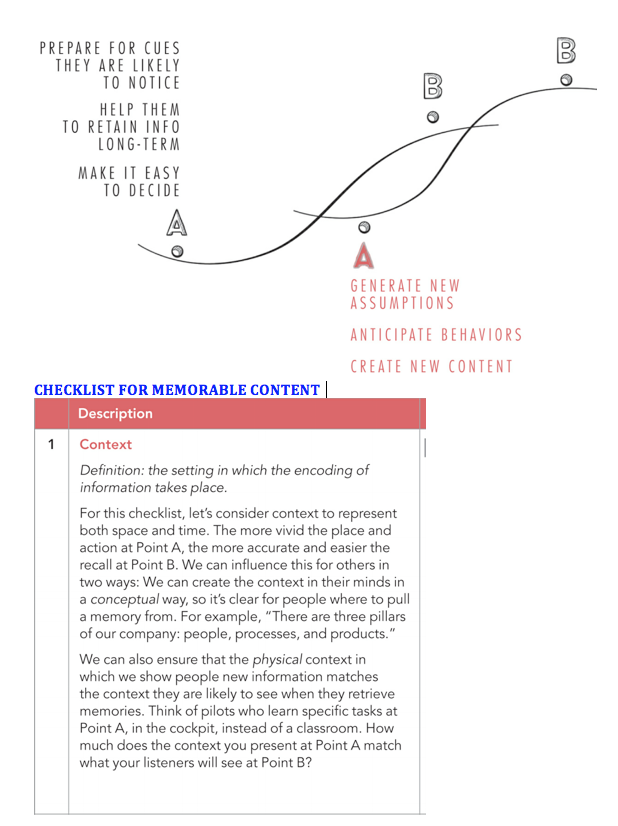
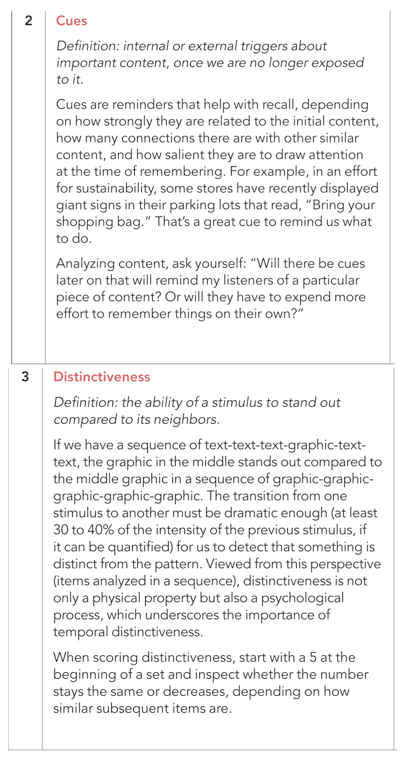
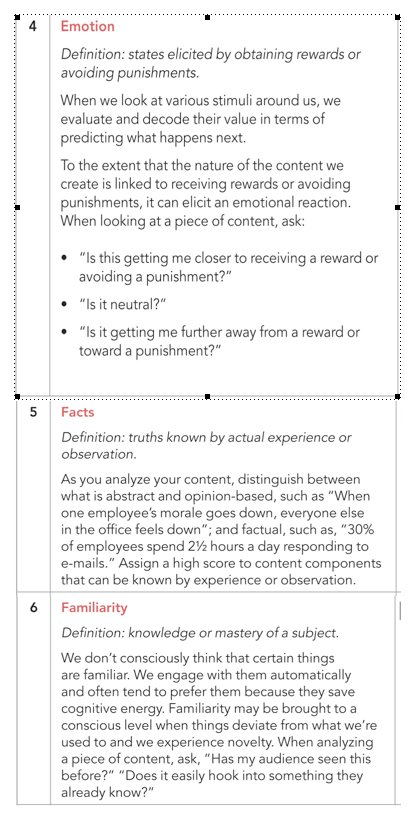
MY TAKE ON IT:
I think it is a great tool to understand works of human perception, understanding, and memorizing of presentations. It well worth it to look through before any important presentation and ask question about how each part of it support or maybe not support the checklist provided and ideas presented in this book.
20191117 – Blueprint

MAIN IDEA:
The main idea of this book is that humans carry in them DNA based and evolutionary developed blueprint of their social behavior and that this blueprint had to be taken into account in all issues related to social engineering and societal changes. The neglect to do so could and did lead to dysfunction, sometime on the huge scale like WWI and WWII. So we would be much better off if we learn to understand it and comply with its requirements.
DETAILS:
Preface Our Common Humanity
Author starts his book about common humanity with personal experience being an outlier in the mob, as an American kid and later as teenager in the middle of Greek nationalist demonstrations with anti-American feelings. He then moves to his experience as doctor and scientist that clearly demonstrated human commonality among all the groups regardless of how they were defined: ethnic, religious, national, or whatever. After that he expresses believe in possibility to overcome divisions because: “The fundamental reason is that we each carry within us an evolutionary blueprint for making a good society. Genes do amazing things inside our bodies, but even more amazing to me is what they do outside of them. Genes affect not only the structure and function of our bodies; not only the structure and function of our minds and, hence, our behaviors; but also the structure and function of our societies. This is what we recognize when we look at people around the world. This is the source of our common humanity. Natural selection has shaped our lives as social animals, guiding the evolution of what I call a “social suite” of features priming our capacity for love, friendship, cooperation, learning, and even our ability to recognize the uniqueness of other individuals. Despite all the trappings and artifacts of modern invention—our tools, agriculture, cities, nations—we carry within us innate proclivities that reflect our natural social state, a state that is, as it turns out, primarily good, practically and even morally. Humans can no more make a society that is inconsistent with these positive urges than ants can suddenly make beehives.“
Chapter 1: The Society Within Us
Once again author starts this chapter with recollection of his childhood playing with kids from different ethnic groups. It followed by discussion of commonalities and formulation of what author calls the Social Suit:
(1) The capacity to have and recognize individual identity
(2) Love for partners and offspring
(3) Friendship
(4) Social networks
(5) Cooperation
(6) Preference for one’s own group (that is, “in-group bias”)
(7) Mild hierarchy (that is, relative egalitarianism)
(8) Social learning and teaching
The final point author makes here is that tremendous amount of variation between human groups generally is not coming from human genetic makeup, but universal commonalities, as they are expressed in Social Suit, do come from human DNA common for individuals in all groups.
Chapter 2: Unintentional Communities
This chapter is about unintentional communities that where created by unusual circumstances such as shipwreck leaving a number of individuals in isolation. Author analyses how ability or inability to self-organization had decisive impact on chances to survive in this circumstances. In order to support this point author reviews in details several such cases.
Chapter 3: Intentional Communities
This is analysis of different type of communities: intentionally created utopian and/or religious communities with well-documented histories such as Brook Farm, The Shakers, Kibbutzim, Walden, and finally Urban communities of 1960s. Author provides detailed scientific analysis of human networks formed in isolated community of scientists working in Antarctic station. The concise result comes to this: “In short, though the specific circumstances vary, two broad sorts of forces serve to promote the success of, or hasten the collapse of, communalist dreams to make society anew: intrinsic biological pressures and extrinsic environmental pressures. Pushed by the blueprint within us, and even if pulled by the forces around us, it is not easy, or feasible, to abandon the social suite.“
Chapter 4: Artificial Communities
The artificial communities in this case are product of social experimentation with use of Amazon Mechanical Turk. Author describes methodology of these experiments first in building Small societies, and then in use of Massive online games. Here are some graphic results:
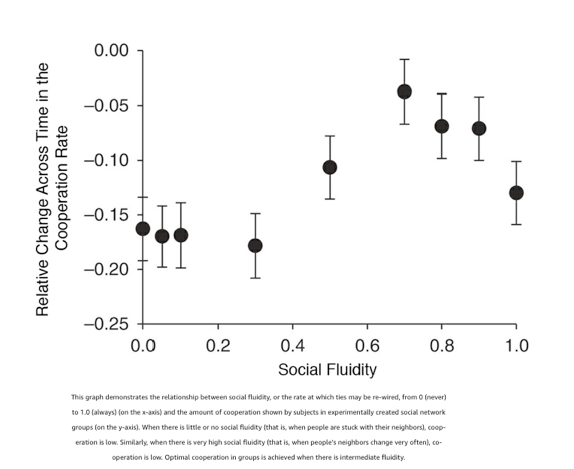
Then author discusses use of topology to systemize variety of shell forms using multidimensional space that opens possibility to define all conceivable forms, even if they do not exists. Author then applies this methodology to discuss societies:” To do this, we would have to define the key axes, just like Raup’s three parameters. One important axis might be the hypothetical size of the society, perhaps defined as the size at which people actually know the others in the group well, even if they are not close friends; this could range from, say, zero (meaning that no one knows anyone in our imagined society) to two thousand (each person knows two thousand other people intimately). In reality, most people have about four or five close social contacts and know roughly one hundred and fifty people well—well being defined as familiar enough that they can pick up a conversation where they left off after an absence. This latter number is known as Dunbar’s number. Another axis we might focus on is the cooperativeness of the society or some measure of its proclivity for intragroup violence, perhaps quantified as the chance that two people would cooperate with each other when playing a public-goods game (using a percentage ranging from 0 to 100, 100 percent being the most cooperative). In real human societies, the chance is typically about 65 percent, meaning that roughly two-thirds of people are inclined to cooperate with a stranger when it comes to sharing a possible reward. But the extent of cooperative behaviors can vary somewhat across societies. A third axis might be related to the structure of the social ties—for example, the number of connections people have or the likelihood that their friends are themselves friends with one another (this is known as transitivity in the network, and it ranges from 0 percent to 100 percent). An alternative parameter for the third axis could be a measure of hierarchy or equality in the distribution of some key resource. Once we chose and defined our various axes, we could put all our examples—and, indeed, all
known societies—into such a grid with three (or more) dimensions.
At the end of chapter author makes the point: “genes may have come to work outside our bodies, having their impact at some distance from their source—like fireworks exploding far from their origin—helping to shape the societies far above the genes themselves. They may do this by affecting the human tendency to cooperate with and befriend others, to care for others’ children, to value other people’s individuality, and to love one’s partners. Because of this, in all the seemingly strikingly different human cultures around the world, in all the repeated opportunities to make new societies, we see the same core patterns again and again. Even the social organization and function of political units, like tribal chiefdoms and modern nation-states, are grafted onto this ancient heritage, and they must respect the principles guiding the organization of smaller groups. Rapidly invented, deliberately designed, or wholly novel social systems that seek to abrogate the social suite cannot be as functional as organically evolved ones.”
Chapter 5: First Comes Love
Here author moves to area of love demonstrating how exceptions in societal behavior kind of reaffirm existence of rules. For this author uses kissing as expression of love. It is pretty much common for all humans except for Tsonga people and some others in southern Africa that just do not do this. It follows by discussion of variety of sexual behavior: monogamy, polygamy, polygyny, and their impact on corresponding societies.
Chapter 6: Animal Attraction
Here author compares all this with animal attraction, reviewing pair bonding in animals. Author reviews male and female strategies and behavior genetics research. As example author uses Prairie Vole and genetically close Meadow Voles. Due to the small genetic variation the former are strictly monogamous, while latter are not. The extension of such research to humans demonstrated that genetic component is present in mating behavior.
Chapter 7: Animal Friends
Here author looks at deeper roots of connectivity, first at animal to humans and then between primates. For this he uses massive amount of data collected by Jane Goodall. In addition he provides contemporary analysis of social networks for various animas from chimpanzees to dolphins.
Chapter 8: Friends and Networks
In this chapter author discusses human networks and their strength, starting with example of men who protected others with their bodies during mass shooting. He characterizes this as inherent tendency to include other into self. Here is graphic representation of this idea:
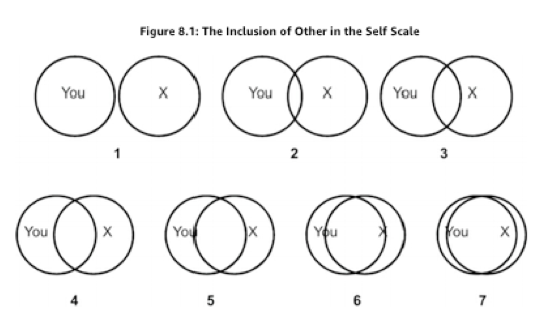
After that author discusses patterns of friendship in 60 different societies. Based on research of genetic and fraternal twins author demonstrates inherited character of individual networking with others. Author also provides some statistical research data:” In 2009, we asked a national sample of households two key name generators (“Who do you trust to talk to about something personal or private?” “With whom do you spend free time?”), and we found that Americans identify an average of 4.4 close social contacts, with most having between 2.6 and 6.2. The average respondent lists 2.2 friends, 0.76 spouses, 0.28 siblings, 0.44 co-workers, and 0.30 neighbors in response to these questions. These numbers have not changed appreciably in decades, and we see similar results around the world.44 People have roughly four to five close social ties on average, typically including a spouse, perhaps a sibling or two, and usually one or two close friends. These numbers can change somewhat over the course of a person’s life (for instance, as people become widowed).“
The last part of chapter is about friends, enemies and universal bias to one’s own group, however defined.
Chapter 9: One Way to Be Social
This starts with example of failed human heart valves that contemporary medicine can substitute with valves from animals. Author uses it to demonstrate continuity of human and animal worlds. However after discussing similarities author moves to discussing individual variances in humans providing this nice illustration:
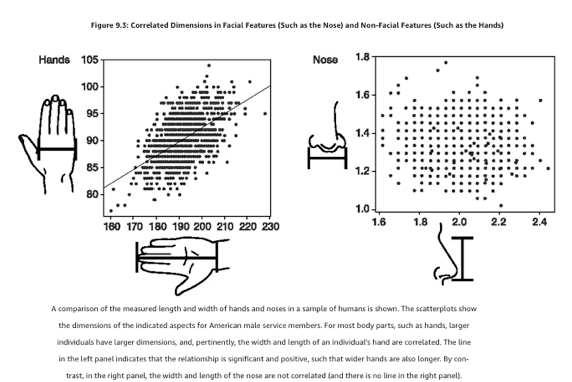
Author characterizes individuality and recognition of Self as mainly human feature seldom existing in other species, at least based on Mirror test. Then author discusses link between identity and grief, which is also characteristics of human and very few other species. The final part of the chapter is about cooperation in humans and animals, teaching and learning and so on, with conclusion that humans societies are not that radically different from other species as usually thought.
Chapter 10: Remote Control
This is about Genes’ use of bodies to change the worlds, as author puts it. Author stresses role of evolution in formation of human network and societies and then reviews various animal artifacts as example of evolutionary development of complex systems. The point he makes is that practically everything was developed by this process, therefore networks and societies are also based on evolutionary developed DNA.
Chapter 11: Genes and Culture
Author starts this chapter with description of impact of technology on productivity and cumulative nature of culture. This is followed by discussion of complexity and unpredictability of cultural development and how it depends on size of population and length of history. The final and most interesting part is discussion of culture and genes coevolution, the process that created us and the environment we live in.
Chapter 12: Natural and Social Laws
Author starts this chapter with reference to old image of body-politics when different parts of society correspond to body parts, kind of Leviathan. This follows by discussion of human societies link to nature and their separation in theological doctrines. Correspondingly industrial age views brought this link back to be dominant idea. Here is how author describes key change processes human ideologies: “It is not just the social sciences that are vulnerable to revision. New thinking and discoveries have upended many scientific claims, such as the number of chromosomes in human cells, the composition of the core of the Earth, the existence of extrasolar planets, the health risks of various nutrients, the efficacy of anti-cancer treatments, and so on. But the provisional nature of scientific discovery does not mean—cannot mean—that it is simply impossible to observe any objective reality. Over time, items of belief become formalized into hypotheses and then, after sustained testing and much experimental evidence, get widely accepted as facts: Cold, hard facts. The social sciences, like the natural sciences, advance. Their previous errors are not sufficient grounds for their present rejection. Especially in the social sciences, we need to determine whether it is the world that is transforming or just our understanding of it. For instance, just because the manner in which we understand certain core aspects of society is updated, (for example, if we invent new statistical methods or develop new theories and discard old ones) does not mean that those same aspects of society are somehow new. Some of these changes are even to be expected; the contingency we see in the social life of our species is in fact a contingency we evolved to be universally capable of manifesting. One of the ways humans differ from other primates, for instance, is in the variety of mating practices we adopt, albeit grafted onto the core practice of pair-bonding, as we saw.“
The author moves to discuss philosophical Isms: Positivism, Reductionism, Essentialism, and Determinism. Then author returns to his idea of social suit, which is to significant extent genetically human behavior, but it is far from being deterministic. It rather defines general framework of humans’ existence, but not its details and it is what author calls “blueprint”. At the end of chapter author looks at new technology such as AI and concludes that humanity is moving to hybridization of humans with machines, retaining however the blueprint as foundational feature. He ends this book with a word of caution: “Humans have always had both competitive and cooperative impulses, both violent and beneficent tendencies. Like the two strands of the double helix of our DNA, these conflicting impulses are intertwined. We are primed for conflict and hatred but also for love, friendship, and cooperation. If anything, modern societies are just a patina of civilization on top of this evolutionary blueprint. There is another reason to step off the plateau and look at mountains rather than hills. A key danger of viewing historical forces as more salient than evolutionary ones in explaining human society is that our species’ story then becomes more fragile. Giving historical forces primacy may even tempt us to give up and feel that a good social order is unnatural. But the good things we see around us are part of what makes us human in the first place. We should be humble in the face of temptations to engineer society in opposition to our instincts. Fortunately, we do not need to exercise any such authority in order to have a good life. The arc of our evolutionary history is long. But it bends toward goodness.”
MY TAKE ON IT:
I think it is generally not completely correct approach to look at DNA as blueprint of anything. I would rather compare it to the typographical letters in drawers with moving type. One can build whatever text is fit to circumstances, but only if there is enough letters of required types. I would also add that it is time dependent. It other words DNA contains potential, but not a blueprint, however sketchy, of result. In any case it is an interesting book, only slightly skewed by author’s expectation for encountering resistance when he states something obvious, commonsensical, and not fitting into some racist and intersectional doctrine dominant in leftist academia. Normal people who are making living not from academic positions and government grants do not require too much supporting material when they see something clearly consistent with their common sense developed via real life experiences.
20191110 – On Freedom

MAIN IDEA:
The main idea of this book is that freedom is good in theory and not really good in practice because regular people do not really know what they want or if they do think they know it, they could be wrong, or even if it would be good for them, it could be not so good for society. Therefore people should be nudged by some, not really specified, assumingly expert, external forces into doing right things, and if it is not enough, then coerced.
DETAILS:
Introduction: Bitten Apples
It starts with discussion of Navigability, stating that difficulty of navigation in some areas is a major source of “unfreedom in human life”. Author considers it a blind spot in Western philosophy and seems to be ready to remove it. Here is his statement of intent: “While my main focus is on navigability, I shall also be asking these questions about freedom and well-being: What if people’s free choices are decisively influenced by some aspect of the social environment, and they are happy either way? In such cases, how should designers of the social environment—employers, teachers, doctors, investment advisers, companies, and governments—proceed? As we shall see, these questions are both difficult and fundamental.”
He also expresses believe that one of the most important is self-control which could be help via external intervention, which could be done to people so they would comply, “while retaining their freedom (and from a certain point of view, even increasing it)”
Chapter 1: What the Hell Is Water?
Here author discusses choice architecture ”—the environment in which choices are made. Choice architecture is inevitable, whether or not we see it, and it affects our choices. It is the equivalent of water.” After that he moves to “Nudges”, which he defines as “Nudges are interventions that fully preserve freedom of choice, but that also steer people’s decisions in certain directions. In daily life, a GPS device is an example of a nudge. It respects your freedom; you can ignore its advice if you like.
“
Author discusses real nudges implemented by government to direct people and identifies causes of, what he believes, is unreasonable resistance:
- Fear of government, which he rejects mainly because the private actors could be as bad;
- Need to decide for themselves what is good or not, which he also reject based on 3 issues:
- External manipulation
- People could deem as “good for themselves” some ugly things like racism;
- People could learn to “love Big Brother”.
After that author moves to the problems of the Nudger that he divides in 3 categories:
- Those in which choosers have clear antecedent preferences, and nudges help them to satisfy those preferences.
- Those in which choosers face a self-control problem, and nudges help them to overcome that problem.
- Those in which choosers would be content with the outcomes produced by two or more nudges, or in which after-the-fact preferences are a product of or constructed by nudges so that the “as judged by themselves” criterion leaves choice architects with several options, without specifying which one to choose.
Chapter 2: Navigability
This starts with Food Pyramid that later turned into Food Plate as example of improvement in “choice architecture”. Then author moves to the problem of navigation overall and life navigation specifically, discussing advices to poor to take responsibility by rich people who have little responsibility because their wealth protects them. Then he discusses a problem of destination: people often do not know where they want to go. At the end of chapter author discusses the problem of sludge by which he means decrease in Navigability.
Chapter 3: Self-Control
This is about failure of self-control and/or awareness of it such as all forms of addiction, present bias, unrealistic optimism, and others. Here again author maintains his main point that it is warrants external intervention, at least in the form of nudge. He reports survey of 200 people he conducted with 70% complaining on lack of self-control from which he infer that people would generally welcome intervention. He also discusses time line: “Preference at Time 1; make certain choices at Time 2; and regret those choices at Time 3. Perhaps an intervention will eliminate the conflict. Perhaps an intervention, or a nudge, will increase freedom”.
From here author infers: “In my view, there is no alternative to resorting to some kind of external standard, involving a judgment about what makes the chooser’s life better, all things considered. That judgment might require moral evaluations of options and outcomes. It might require some kind of aggregate judgment about people’s personal wellbeing. In many cases in which people think differently at Time 1, Time 2, and Time 3, we have to ask: “What is the effect of honoring one or another thought on the person’s well-being over time? … Valuing freedom of choice does not tell us what we need to know.
Chapter 4: Happy Either Way
Here author analyzes cases when “It is not clear if we have antecedent preferences at all. Perhaps we do not. We might have no idea what we want. We might lack important information, and if we have it, we still might not know what we want. In other cases, our after-the-fact preferences are an artifact of, or constructed by, the nudge. Sometimes these two factors are combined (as savvy marketers are well-aware). We are speaking here of “endogenous preferences,” and in particular of preferences that are endogenous to, or a product of, the relevant choice architecture. In such cases, how should we think about freedom of choice? And how ought the “as judged by themselves” criterion to be understood and applied?”
Once again author apply the same solution: external intervention in form of nudge. The final part is about what to do if nudge does not work. The obvious solution for author is coercion. Here is his logic: “hard paternalism, and no mere nudge—might end up producing an outcome akin to what we would see if consumers were at once informed and attentive. Suppose that the benefits of the mandate greatly exceed the costs and that there is no significant loss in terms of consumer welfare (in the form, for example, of reductions in safety, performance, or aesthetics). If so, there is good reason to believe that the mandate does make consumers better off. Freedom of choice fails. “
Epilogue: “Through Eden Took Their Solitary Way”
Here is author summarization: “Freedom of choice should be cherished, but cherishing it is hardly enough. Countless interventions and reforms increase navigability, writ large. They enable people to get where they want to go, and therefore enable them to satisfy their preferences and to realize their values. They operate like maps. Many other interventions and reforms, helping people to overcome self-control problems, are also welcomed by choosers. Such interventions increase navigability and promote freedom. They can be consistent with the “as judged by themselves” standard. Numerous people acknowledge that they suffer from self-control problems. They welcome the help. They exercise their freedom of choice in its favor. Sometimes people lack clear preferences. Sometimes their preferences are not firm. When a nudge or other intervention constructs or alters their preferences, and when they would be happy either way, the “as judged by themselves” standard is more difficult to operationalize. It may not lead to a unique solution. But it restricts the universe of candidate solutions, and in that sense helps to orient choice architects. To resolve the most difficult questions, it might make sense to see what informed, consistent choosers do, or instead to make direct inquiries into wellbeing. The first approach is best unless choosers suffer from a behavioral bias—and if choice architects cannot be trusted. The second is best if choosers suffer from a behavioral bias—and if choice architects can be trusted. For the future, we need far more careful consideration of the ingredients of wellbeing, informed by evidence as well as by theory. We need the arts and the humanities, social science, law, and theology.”
MY TAKE ON IT:
The big problem that I have with this approach is with author’s practically complete omission of what are these external, all knowing forces that always know what is good for us individually, or for us as society. Author does recognize the problem with “choice architects” imperfectability, but dispatches with this problem by saying that it requires careful consideration. I think no amount of consideration would be enough for one person “feel your pain” in reality. It is just human nature that, as once eloquently described: ”paper cut of a person’s finger is tragedy, but million people dead after earthquake in distant land is unhappy incident”. So whatever government “experts” want people believe, their own well being will always be tremendously more important for them than wellbeing of people they nudge or coerce in direction of their choice. Consequently I think that individuals who will enjoy or suffer consequences should do all decision-making, otherwise decision maker would never pay enough attention and effort for making good decision as defined by preference of outcome.
Actually author’s idea could be expressed in much more concise way just by following Orwellian traditions: ” Slavery is the Real Freedom”.
20191103 – Permanent Revolution
MAIN IDEA:
The main idea of this book is to demonstrate that traditional historical understanding of Western transition from medieval Dark Ages to Enlightenment is not exactly correct because early Reformation was much darker than Dark Ages and brought with it religious violence, suppression of human individuality, and lots of other nasty things on the scale unknown before. Author’s point, however, is that eventually it produced its opposite: Enlightenment as one and only way out from initial tragedy of societal self-distraction of the Western Europe that occurred in the beginning of the process. Here is how author defines this:
Permanent Revolution, then, addresses the competing claimants to Anglo-American (and global) modernity (i.e. evangelical religion and the Enlightenment), and poses the following questions with regard to the British Reformations: (i) how did we get from the first, illiberal Reformation to the Protestant proto-Enlightenment?; and (ii) why did we need to?
Three perceptions animate the argument: (i) that dissident, repressive, non-conservative sixteenth-century evangelical religious culture was revolutionary; (ii) that revolutionary evangelical culture was simultaneously a culture of permanent revolution, repeatedly and compulsively repudiating its own prior forms; and (iii) that permanent revolution was, as it always is, punishingly violent, fissiparous, and unsustainable, so much so that it needed to invent self-stabilizing mechanisms. In the seventeenth century, I argue, English Calvinist Protestantism necessarily produced its opposite cultural formation (what I call the proto-Enlightenment), against the punishing, crushing, violent, schismatic logic of the evangelical Reformation. The Protestant proto-Enlightenment made the permanent revolution of evangelical religion at least socially manageable and personally livable, even if the liberal order remained scarred by the effort.
DETAILS:
Each part of the book looks at specific aspect of the period going chronologically through 3 steps:
- Appropriation of powers and carnivalesque, revolutionary energy (c. 1520–1547);
- Revolutionary grief (c. 1547–1625);
- Escaping revolutionary disciplines (c. 1603–1688).
PART 1: Religion as Revolution:
1 Revolutionary Religion;
In this part author first trying to demonstrate revolutionary character of reformation due to it’s nearly complete break with pre-Reformation past. Author looks at theological differences and finds that it kind of mirrors historical process of switch from multiple feuds coexisting via mutual obligation to centralized monarchies being installed all over the Europe. Here is author presentation of this contrast: “ The late medieval European Christian God was a constitutionalist of sorts: despite the fact that he could do whatever he liked, he freely made reliable agreements with humans according to which they could negotiate their way out of sin. Most (not all) late medieval theologies had imagined God working out from various combinations of his agreed, reliable, ordained power (potentia ordinata) and his wholly unrestrained absolute power (potentia absoluta). Of course the late medieval God had absolute powers at his disposal, but he freely decided to hold by his ordained, which is to say his established and rationally perceptible, power. Sixteenth-century Protestant theology was starkly different. The Protestant God acted, not coincidentally, like sixteenth-century monarchs, insisting on his absolute prerogatives. He actively repudiated any reliable agreements that would abrogate his “independent and unlimited Prerogative.”
Author also provides a comprehensive list of features that identify a process as revolutionary:
- Posited unmediated power relations between highly centralized, single sources of power on the one hand, and now equalized, atomized, interiorized, and terrorized subjects on the other;
- Looked aggressively upon, and sought to abolish, horizontal, lateral associational forms;
- Produced a small cadre of internationally connected, highly literate elect who belonged to the True Church, and who felt obliged by revolutionary necessity both to target the intellectuals of the ancien régime, and to impose punishing disciplines on the laity, who were expected, in this case, to become a “priesthood of all believers”;
- Generated revolutionary accounts of both ecclesiology and the individual life: both could achieve a rebirth, wholly inoculated from the virus of the past;
- Demanded total and sudden, not developmental, change via spiritual conversion;
- Targeted the hypocrisy of those who only pretended to buy into the new order;
- Abolished old and produced new calendars and martyrologies;
- Proclaimed the positivist literalism of a single authoritative text, to be universally and evenly applicable across a jurisdiction, if necessary with violence;
- Demanded and enacted cultural revolution, through iconoclasm of the repudiated past’s accreted, erroneous, idolatrous visual culture and by closing down its theatrical culture;
- Distributed the charisma of special place across entire jurisdictions, thereby legitimating the destruction of sites considered in the old regime to have compacted charisma most intensely, or to provide sanctuary;
- Actively developed surveillance systems;
- Legitimated violent repudiation of the past on the authority of absolute knowledge derived from the end of time. The saints were in a position confidently to judge and reshape the saeculum, or the world of everyday experience, precisely because, as elect members of the eternal True Church, they were saints; they beheld the everyday world from the determinist vantage point of the eschaton, or the end of time. They knew how to see historical error (it was in fact easy), and they knew the denouement of History’s narrative;
- Promoted the idea of youth’s superiority over age;
- Appropriated the private property of religious orders and centralized previously monastic libraries;
- Redefined and impersonalized the relation of the living and the dead, notably by the abolition of Purgatory and the prohibition on masses for the dead;
- And, by no means least, legitimated revolutionary violence by positing a much more intimate connection between violence and virtue than the Maoist dictum “no omelet without breaking eggs” would imply. In this culture, persecution and violence were a sure sign that the Gospel was being preached, that Christ was indeed bringing not peace but the (necessary) sword. The absence of tumult was symptomatic of somnolent hypocrisy.
- Violence was a necessary obligation within the logic of History.
- Permanently Revolutionary Religion;
Author identifies Protestant revolution with other revolutions, especially communist revolutions and Marxist ideology in which permanent revolution is permanent class war with revolution periodically destroying generations of revolutionaries. Author looks at several examples of destroyed destroyers during period of 1540s and 1550s, especially at live of John Bale in some detail. Then he proceeds to discuss struggle between Catholic Church and Protestant reformation in England that produced Anglican Church. Finally he looks at its reflection in works of John Milton and Thomas Edwards.
PART 2: Working Modernity’s Despair: 3 Modernizing Despair; 4 Modernizing Despair: Narrative and Lyric Entrapment; 5 Modernizing Despair’s Epic Non-Escape
Author first discusses nature of human despair and then identify general causes of such despair as disconnect between human effort and reward, which happens when society establish strictly enforced rules transferring wealth from its creators to elite. In chapter 3 author sketches the theology of this human depravity; the peculiar psychic cruelty of its necessary consequence (i.e. the doctrine of predestination, whether double or not); and the energy that exclusivism produces. He pursues that theological story up to the end of the reign of Elizabeth (1603). In Chapter 4, author turns to literary expressions of near-total subjection to predestinarian punishments, between 1530 and 1620 or so, in the form of brilliant, claustrophobic lyric poetry and endlessly recursive romance narrative, both forever unable to move out of or beyond the Cave of Despair. From 1625 or so, the promise of a recovered freedom of will and then Miltonic epic seem to produce an escape route from the punishing disciplines of predestination and its attendant despair. In the final chapter of this part author looks to the ways in which that apparent escape route to the proto-liberal future does not, in fact, offer its promised, full escape from early modernity’s despair. Rebellion against the early modern absolutist God and his revolutionary theology themselves took revolutionary form, and thereby remain profoundly scarred by the struggle.
PART 3: Sincerity and Hypocrisy: 6 Pre-Modern and Henrician Hypocrisy; 7 The Revolutionary Hypocrite: Elizabethan Hypocrisy; 8 Managing Hypocrisy?: Shakespeare, Milton, Bunyan, 1689
In this part author moves from despair to Hypocrisy stating that sectarian division brought continuing squabbling between clerics with claims of sincerity and accusations in hypocrisy created high potential for violence. Hypocrisy accusation and sincerity claims have a history within revolutionary moments, since the kinesis of revolution produces an intelligible sequence of phases, each of which seeks to exploit and / or to manage the impossible demands of revolutionary sincerity, and the impossible burden of avoiding hypocrisy. In this and the following two chapters, author aims to delineate the story of early modern English hypocrisy. As he does so, his essential argument is that sincerity and hypocrisy are of ecclesiological origin; that they are inevitable, unmanageable products of the centralizations and disciplines of revolutionary early modernity; and that the only way to deal effectively with the threat of hypocrisy (the Shakespearean solution) is to become a hypocrite. In chapter 6, author tells the story from its late medieval sources up to and including the first, energetic outburst of Reformation hypocrisy accusation in the first half of the sixteenth century. In Chapter 7, he turns to the subsequent, more somber trajectory of hypocrisy accusation, as it rebounds back onto Elizabethan evangelicals. Chapter 8 looks to hypocrisy management (or lack thereof), from Shakespeare to Bunyan.
PART 4: Breaking Idols: 9 Liberating Iconoclasm; 10 Saving Images and the Calvinist Hammer; 11 One Last Iconoclastic Push?
In this part author looks at iconoclasm that is typical characteristic of all revolutionary movements. In this particular case of reformation Protestants saw themselves as ancient Israeli who destroyed idols per God’s commandment. Author divides this process in 3 phases: “The kinesis of iconoclasm begins with energetic and irreverent evangelical destruction of physical religious images. That first phase of material destruction (c. 1538–1553) was, however, just the easy start, before a much more painful, unjoyful second sequence (c. 1558–1625) began. Iconoclastic hygiene around the absolutist, modernizing God targeted all forms of idolatry, not only visual images. It therefore worked its way into the liturgy, to be sure, but also into the most intimate recesses of the soul, breaking visual imaginations, and breaking the idols of false doctrine. In that second phase, lovers of the image needed to invent ways of managing the punishing dynamism of iconoclasm. One key form of management was to stabilize and rename our love of, and need for, salvific representations of others, and ourselves otherwise known as images… A third phase (c. 1625–1670s) is mixed: on the one hand, the counterrevolutionary is determined to replace the images; on the other, the revolutionary is determined to return to iconoclastic business, precisely in response to counterrevolutionary attempts to reinstate images.”
In chapter 9 author delineates phase 1, the carnivalesque, fun phase of iconoclasm (1538–1553 or so), before turning in Chapter 10 to phases 2 and 3: the less amusing matter of breaking the psyche’s images (c. 1558–1625); and the further, overlapping struggle between lovers and destroyers of the image in England (c. 1625–1670s).
PART 5: Theater, Magic, Sacrament: 12 Religion, Dramicide, and the Rise of Magic; 13 Enemies of the Revolution: Magic and Theater; 14 Last Judgment: Stage Managing the Magic
This part is about use of magic and art during reformation revolution. Author argues that evangelicals invented black magic primarily because they needed to attack Catholic sacramental practice, in which performative language (e.g. “Hoc est enim corpus meum”) makes something happen between earth and heaven. The Catholic Mass in particular needed to be described as juggling magic or as “hocus pocus” … This attack also applied to other sacraments, and from there extended to denigrate the entire Catholic Church. Author connects it to “linguistic performativity in all its forms” making “fundamental argument that, as early modern fears of sacramental and black magic rose, so too did drama fall, or at least shrank its own magic circle.”
Author looks at key areas of art to support this point: Chapter 12 is about theater, Chapter 13 narrates the evangelical persecution of witches and the correlative evangelical prosecution of theater in early modern England. Chapter 14 turns to the production and shrinkage of drama itself, from Marlowe and Shakespeare to Milton.
PART 6: Managing Scripture: 15 Scripture: Institutions, Interpretation, and Violence; 16 Private Scriptural Anguish; 17 Escaping Literalism’s Trap
Here author turns to ideological foundation of Reformation revolution: “Like most revolutions, the Reformation had its book and its reading practice. The book was the Bible, and the reading practice was literalism. Revolutions all usher in a new textual canon in their train, and they all, of necessity, locate interpretative truth in the literal sense. They must do that, since the revolution, by definition, constitutes a radical break with the past; the new society is determined by a document, either freshly written or rediscovered. The reading protocols for that document must be open and incontrovertible in the present; and the truth claim of any such document must not make appeal to a past reading community, with historically shaped interpretive practices. To recognize any historical determination of meaning would compromise the revolution’s claim to have started afresh, without reliance on any practice of the ancien régime. The society brought into being by the revolution, whether in 1517, 1688, 1776, or 1789, is brought into being by the document, not the other way around. The document must therefore be self-generating; must posit literalism as the hermeneutic default position; and must itself lay claim to literalist status. Its understanding of textuality is nearly the opposite of, say, English common law, and of English constitutionalism, both of which depend wholly on precedent, so much so in the case of English constitutionalism as to abjure any single codified, written document whatsoever.” After that author discusses information revolution of the time caused by implementation of printing press and movable type that made bible and other literature widely accessible, giving impetus to various interpretations and conflicts based on them. The chapters of this part “pursue less the material history of the book than the history of reading and community formation (and fracture). They pursue, to put it another way, the relation of textual interpretation and violence. The evidential materials author uses are less material books than, on the one hand, Reformation discourse about how scriptural writing legitimates or delegitimates institutional practice and spiritual status; and, on the other hand, Reformation literary texts that express, and sometimes seek to neutralize, the violence of early modern revolutionary Biblical reading.”
PART 7: Liberty and Liberties: 18 Liberty Taking Liberties
The final part is about author’s contemplation of Liberty. He writes: “I distinguish the main traditions of liberty in the sixteenth and seventeenth centuries. Two are of especial importance: evangelical liberty and the so-called Neo-Roman theory of liberty, traditions that are, evidently, wholly heterogeneous in content. I will not parse which of these traditions was the principal force in the English Revolution (a task outside my competence in any case). Instead, I look first to the ways in which these wholly heterogeneous traditions in fact share formal properties in their understanding of Liberty as singular and animated… In sum, this final chapter aims to work out when liberties (plural) became Liberty (singular). I’ll also attempt to elucidate what the stakes of that change were. The essence of my argument is that singular Liberty is a product of early modernity: it comes into re-existence as a response to the theological and political centralizations—singularizations, if you will—of early modernizing Europe. Above all, it comes into existence as the response to two distinctively early-modern neoclassical resurgences: those of political absolutism on the one hand, and of theological absolutism on the other.”
Author also discusses role of Liberty, difference in its understanding (economic liberty and social choice liberty) in contemporary USA by different political forces, then links it back to early modernity and specifically to Protestant Reformation: “The key articulations of this longer narrative occur in the Reformations of the sixteenth and seventeenth centuries. The key driver of this change in early modernity is as follows: as power centralizes and singularizes, so too does resistance to power centralize and singularize. As power claims absolutist prerogative, so too does resistance to power. The subjects of absolute power describe their condition as one of slavery. The past is described as the period of enslavement, enslavement either to the tyranny of the Roman Church, or to absolutist, or to potentially absolutist monarchical power. In response to those enslavements, singular, revolutionary, absolutist Liberty commands attention. The pattern also works in reverse: in response to a notion of singular Liberty defined negatively, as a savage state of nature, theorists such as Hobbes turn to the attractions of singularized, absolute Power. Promoters either of Liberty, or of absolutist monarchy, work within distinctively early modern singularizations of both liberty and power. Singularization of one produces a mirroring response in the other.”
Author also provides an interesting table for this thesis:
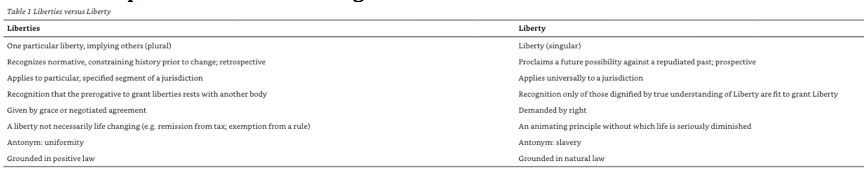
Conclusion
In conclusion author describes his work as analysis of history and foundations of Liberalism and that’s how he characterizes result:
“First, contemporary Liberalism looks unpersuasive in its account of its own history. When many liberal early modernist scholars go back to the sixteenth century, they focus on the following (for example) with approval: liberty, equality, free will, consent, the individual conscience, interiority and individuality, division of powers, rationality, toleration, reading, work, revolution. They focus on the following (for example) with disapproval: absolutism, predestination, hypocrisy, iconoclasm, anti-theatricality. “Protestantism” tends to be a code for the terms of approval, whereas “Catholic” encodes many of the terms of disapproval.
Second, Liberalism has not escaped the influence of its older sibling, evangelical religion. The reader will have noticed that in my chapters I consistently say that anti-evangelical movements “almost,” “nearly,” or “partially” succeeded in neutralizing the forces of permanent evangelical revolution. These qualifications are crucial, even if they cannot be fully substantiated within the bounds of the present book. If a revolution is truly permanent, then it leaves its scars on even the most resourceful alternative cultural forms that seek to neutralize and survive its punishing regime. For good or ill, liberals continue automatically to distrust institutions; overwork; calibrate agency with minute attention; fear inauthenticity; enjoy visual art in aesthetic conditions that remain partially iconoclastic; remain appalled at various forms of idolatry, even if the idolaters are now consumers; read to save themselves. Above all, many of us remain historical secessionists, vigilantly insisting on the legitimacy of the modern age, even as we find ourselves forever rowing against the current. We liberals remain children of our permanent revolutions; both energized and scarred by them.
Third, and finally, progressivist liberals stand in danger of damaging the good of Liberalism by claiming impossibly excellent standards for Liberalism. Liberals regard Liberalism as a worldview, or what Germans would call a Weltanschauung. A worldview proper implies claims about the process of history and the makeup of human being. A worldview claims to understand the historical process and to deliver humans from history, so as to liberate full human being. Christianity and Marxism are, for example, worldviews, with their separate salvation histories and anthropologies…
Liberalism is not a worldview. It claims no scheme of salvation history, or Heilsgeschichte, and has no developed anthropology. It does not offer itself as a category to sit beside a religious or political Weltanschauung. When those with a proper Weltanschauung (what might be called a first-order belief system), either religious or secularist, dismiss Liberalism as “hollow” (as they frequently do), they are missing the point. Liberalism is meant to be hollow. Liberalism is a second-order belief system, a tool for managing first-order belief systems. It is derivative (as its historical appearance would suggest), and secondary to first-order belief systems. It promises only to manage and mediate those first-order systems. The clash of first-order belief systems leads to violence; Liberalism promises to manage the violence. Liberalism is a tool, an instrument designed to govern first-order belief systems that tend not to negotiate. For this reason, Liberalism stands always in an asymmetrical rhetorical position with regard to first-order belief systems, looking cool and detached against its hot and committed first-order competitors. When progressivist liberals treat Liberalism itself as a first-order belief system, they produce what look like hollowed-out versions of first-order belief systems. Liberalism’s minimalist anthropology; the abstract, universalist legal principles that flow from that anthropology; its lack of a salvation history; its default positions of institutional distrust; its often impoverished conception of singular Liberty: each make Liberalism look weak as long as liberals claim that Liberalism is a worldview rather than a tool for governing worldviews.”
MY TAKE ON IT:
It is very interesting approach and I think it would be great if one could divide systems of believe in the first and second orders. However I think such attempts are possible only if and when mode of behavior linked to Liberalism: such as tolerance, non-violent discussions, and peaceful change of control over government, are the first-order believes and worldviews are secondary. The contemporary Progressivism is the product of Socialist ideology only slightly disguised as something different, kind of related to Liberalism, and not related to oceans of blood spilled on behalf of this ideology in XX century. Historically this Socialist ideology was very successful in using Liberalism to get power and then pushed it out of window. The only way Liberalism can survive is to recognize that it is the first-order believe system and start responding violently to any hint of violence, and intolerantly to any hint of intolerance. For example heckler’s veto should be responded to by heckler removal and punishment to compensate others for time lost. In the past the victory over illiberal forces came from competitive illiberal forces. I think the time is nigh to remove such forces from existence.
20191027 – The Age of Living Machines
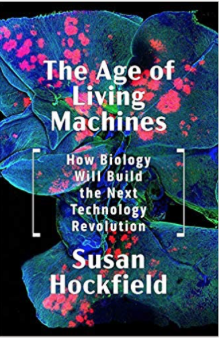
MAIN IDEA:
The main idea of this book is to present the latest technological achievements of MIT and other American high tech institutions and then convince reader that bright future depends on giving them lots and lots of government money above and beyond of lots and lots of government money they are receiving now.
DETAILS:
Prologue
This refers to growth of population and need to overcome Malthus ideas about population growth outpacing resources, resulting in wars and starvations. Author points out that it was prevented by technological development of XIX and XX centuries and her believe that we need another technological breakthrough to prevent it in the future. Author also presents here the plan of the book with annotation for each chapter.
1 WHERE THE FUTURE COMES FROM
This starts with a bit of biography of how author became MIT president and then moves to ideas of integrating different scientific fields, with such integration providing for new discoveries and inventions. Author discusses the first such integration of physics and engineering and then promotes the new integration of biology and engineering.
2 CAN BIOLOGY BUILD A BETTER BATTERY?
This chapter introduces the nucleic acids, DNA and RNA, which serve as biology’s information system. Nucleic acids direct the assembly of biological structures and ensure the accurate transmission of traits from one generation to the next. Nucleic acids can be manipulated, and this chapter describes how nucleic acids of viruses have been manipulated for next-generation battery fabrication. DNA and RNA carry the instruction set for the assembly of proteins, the mini-machines responsible for many biological functions.
3 WATER, WATER EVERYWHERE A CANCER-FIGHTING NANOPARTICLES
This chapter tells the story of the discovery of protein, called aquaporin. Aquaporin serves as a highly specific channel for water flowing into and out of cells (in bacteria, animals, and plants) and is now being deployed in commercial water filters.
4 CANCER FIGHTING NANOPARTICLES
The technologies discussed in this chapter introduce one of the fastest growing areas of medicine—namely, molecular medicine—with its central premise that disease processes reflect perturbations in the normal molecular processes of our cells. Highly sensitive new technologies that recognize those perturbations make early disease detection more reliable and less expensive. Our complex biological functions, such as breathing, digestion, and hearing, are carried out by complex tissues composed of an array of different kinds of cells gathered and organized together, with the brain the most complex tissue of all.
5 AMPLIFYING THE BRAIN
This describes how the brain sends messages along nerves to move limbs and how new technologies can restore to amputees and victims of brain injury the ability to move their limbs.
6 FEEDING THE WORLD
This is the last technological chapter that returns us to the sum of the parts. For every living organism, the sum of gene and protein expression is revealed in its physical traits -its phenotype. Over at least the last ten thousand years humankind has selected and propagated plants and animals by evaluating their phenotypes. Here author describes new engineering tools that accelerate phenotype-based selection, promising to identify more productive and more resilient food crops in time to nourish the planet’s growing population.
7 CHEATING MALTHUS, ONCE AGAIN: Making Convergence Happen Faster
The final chapter discusses what author calls Convergence 2.0: combination of technical and biological sciences, which follows historical conversion of physics and engineering – Conversion 1.0. Author notes that all fundamental discoveries necessary for Conversion 1.0 were made before 1930, but somehow fails to mention that it was done with private support with no government money whatsoever. After that she greatly praises government role in its implementation, which was driven by military needs of WWII and then Cold War. Author then links scientific progress directly to government funding and call for its dramatic increase.
MY TAKE ON IT:
This book is interesting for me in two ways. One is description of current and coming technological achievements based on scientific research. The other one is author’s mode of thinking, which is probably highly typical for contemporary bureaucratic scientist who probably spent good chunk of her time in all kinds of competitive bureaucratic fights for funding. Understandably, the future of science in her mind depends on outcome of these bureaucratic games. I do not believe that it is correct approach. Government / Bureaucratic funding produces well fed, wealthy bureaucrats rather than well developed technology. I would like to see real breakdown of funding, which I have no doubt would demonstrate huge waste on meaningless projects like “Future impacts of increase in temperature from global warming on something in XXV century”. I think that America had very good scientific arrangement when Universities funded by private charities and reasonable tuition fees produced high quality fundamental science and well educated citizens who were capable developing new technologies and run successful businesses, while adjusting these technologies to human needs and making huge amounts of money in the process. Later on these successful people donated significant resources back to Universities partly to satisfy their scientific curiosity, something that well educated people usually develop, and partly to establish their legacy. The current system of government funding from money confiscated from productive people and allocated vie political and bureaucratic games is detrimental to development of real science and supports huge waste on pseudo science, which is always much more politically correct than real science.
20191020 – The Human Swarm
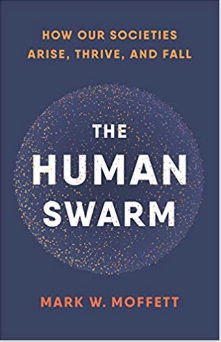
MAIN IDEA:
The main idea of this book is to look at formation, maintenance, and dissolution of all types of societies from ants to humans, their functioning and/or malfunctioning. The main points are:
- Society membership based on various parameters, which define individuals that belong as separate and different from those who do not belong, creating support for the former and rejection and often hostility to latter.
- Societies are tremendously different and it is questionable that there are ways to avoid clashes, even if interests are irreconcilable.
- There is some logical commonality in origin, maintenance, and dissolution of societies that could be understood by methods of science including “biology, anthropology, and psychology, with some philosophy thrown in for good measure.”
- The future depends on human ability to overcome limitations of struggle of one’s society against others and find accommodation and resolution of difference within societies and between them.
DETAILS:
Author describes his objectives for each chapter in some detail, providing pretty good overview of the book.
SECTION I: AFFILIATION AND RECOGNITION
This part “takes in the wide range of vertebrate societies”,
that author is familiar with as biologist
.
Chapter 1: What a Society Isn’t (and What It Is)
This is about the role of cooperation in societies, which author believes is less essential than the matter of identity; societies consist of a distinct set of members in a rich tapestry of relationships, not all of which are harmonious.
Chapter 2: What Vertebrates Get out of Being In
This chapter covers other vertebrate species, especially the mammals, to illuminate how societies, despite whatever imperfections in the system of partnership that exists within them, benefit the members by providing for their needs and protecting them.
Chapter 3: On the Move
“The third chapter probes into how the movements of animals within and between societies are important to the success of the various groups. One versatile pattern of activity, fission-fusion, creates a dynamic that helps explain the evolution of intelligence in certain species, humans most obviously among them, and the subject will come up repeatedly in this book. “
Chapter 4: Individual Recognition
“Chapter 4 investigates how much the members of most mammal societies must know about each other for their societies to stay together. Here, author reveals a limiting factor in the societies of many species: all their members are obliged to know each other as individuals, whether they like each other or not, restricting the societies to, at most, a few dozen individuals. This sets up a puzzle about how the human species broke free of such a constraint.
“
SECTION Il: ANONYMOUS SOCIETIES
This section addresses a group of organisms that readily crash through the population limit of individual-to-individual familiarity: social insects. He states as one of his objectives to break down any aversions that the reader may have about likening insects to “higher species,” especially humans, by making clear the value of these comparisons.
Chapter 5: Ants and Humans, Apples and Oranges
Chapter 5 reports on how social complexity generally climbs with an increase in the size of insect societies with features like infrastructure and division of labor becoming more complex, a trend paralleled in humans.
Chapter 6: The Ultimate Nationalists
Chapter 6 looks at how most social insects, and a few vertebrates such as the sperm whale, demonstrate affiliation with a society by using something that marks their identity: chemistry (a scent) in ants, and a sound in whales. These simple techniques are not constrained by the limitations of memory, and thus permit the societies of certain species to reach immense sizes, in a few cases without an upper bound.
Chapter 7: Anonymous Humans
The chapter after that, “Anonymous Humans,” spells out how humans employ the same approach: our species is attuned to markers that reflect what each society finds acceptable, including behaviors so subtle they may only be noticed subliminally. By this means people can connect with strangers in what author calls an anonymous society, thereby breaking the glass ceiling in the size societies can achieve.
SECTION III: HUNTER-GATHERERS UNTIL RECENT TIMES
Chapter 8: Band Societies; Chapter 9: The Nomadic Lite; Chapter 10: Settling Down
This section asks what the societies of our species were like before the advent of agriculture. Authors covers people who existed as hunter-gatherers up to recent times, ranging from those who lived nomadically in small, spread-out groups, called bands, and others who settled down for much or all of the year. Although the nomads have gotten most of the attention and are treated as the gold standard for our ancestral condition, a readily defensible conclusion is that both options have been within the reach of human beings likely going back to the origins of our species. We can also conclude that hunter-gatherers were not archaic people living an archaic mode of existence. Their people must be recognized as essentially no different from us: humans, as it were, “in the present tense.” Despite traces of ongoing, even rapid human evolution in the past 10,000 years, the human brain clearly hasn’t been restructured in any fundamental way since the appearance of the first Homo sapiens. This implies that notwithstanding any human adjustments to modern life, we can look to the lifestyles of hunter-gatherers in recorded history and consider the nature of early human societies as the bedrock that underlies our own. What concerns author most are the extraordinary differences between the nomadic hunter-gatherers—equality-minded jacks-of-all-trades, who solved issues by discussion—and settled hunter-gatherers, whose societies often became open to leaders, division of labor, and disparities in wealth. The former social structure points to a psychological versatility we still possess, even if most people today behave more like settled hunter-gatherers. Two conclusions of Section III are that hunter-gatherers had distinct societies and that those societies were distinguished, just as societies are now, by markers of identity. What that means is that at some point in the distant past, our ancestors must have taken the crucial but heretofore overlooked evolutionary step of making use of badges of membership that would, in time, permit our societies to grow large.
SECTION IV: THE DEEP HISTORY OF HUMAN ANT
Chapter 11: Pant-Hoots and Passwords
For clues about how this happened, Section IV transports us into the past and also scrutinizes the behavior of modern chimps and bonobos. Author puts forward the hypothesis that a simple shift in how the apes use one of their vocalizations, the pant-hoot, could make that sound essential for identifying each other as society members. Such a transformation, or something like it, could have easily occurred in our distant ancestors. Ever more markers would have been added to this initial “password,” many of them connected to our bodies, transforming them into flesh-and-blood bulletin boards for displaying human identity. Having looked at how markers of identity originated, we are in a position to explore the psychology underlying those markers and society membership.
SECTION V: FUNCTIONING (OR NOT) IN SOCIETIES
Chapter 12: Sensing Others; Chapter 13: Stereotypes and Stories; Chapter 14: The Great Chain; Chapter 15: Grand Unions; Chapter 16: Putting Kin in Their Place
The five chapters of Section V, “Functioning (or Not) in Societies,” review a fascinating range of recent findings about the human mind. Most of the research has focused on ethnicity and race, but should apply to societies as well. Among the topics are the following: how people see others as possessing an underlying essence that make societies (and ethnicities and races) so fundamental that they think of these groups as if they were separate biological species; how infants learn to recognize such groups; the role stereotypes play in streamlining our interactions with others, and how those stereotypes can become tied to prejudices; and how the prejudices are expressed automatically, and unavoidably, often leading us to perceive an outsider more as a member of his or her ethnicity or society than as a unique individual. Our psychological assessments of others are many and varied, including our penchant for ranking outsiders as “below” our own people or in some cases as subhuman altogether. The fourth chapter of Section V elucidates how we apply these assessments of others to societies as a whole. People believe that the members of foreign groups (and their own people as well) can act as a united entity, with emotional responses and goals of its own. The final chapter steps back to draw from what we have discovered about the psychology of societies and the underlying biology to pose more sweeping questions about how family life fits in the picture—whether, for example, societies can be understood as a kind of extended family.
SECTION VI: PEACE AND CONFLICT
Section VI, entitled “Peace and Conflict,” takes on the issue of the relationships among societies.
Chapter 17: Is Conflict Necessary?
In this chapter author documents the evidence from nature, which shows that while animal societies need not be in conflict, peace between them is relatively rare, present in just a few species and supported by situations of minimal competition.
Chapter 18: Playing Well with Others
The second chapter then highlights hunter-gatherers to examine how not merely peace but active collaborations between societies provided additional options for our species.
SECTION VII: THE LIFE AND DEATH OF SOCIETIES
Chapter 19: The Lifecycle of Societies; Chapter 20: The Dynamic “Us”; Chapter 21: Inventing Foreigners and the Death of Societies
Section VII, “The Life and Death of Societies,” examines how societies come together and fall apart. Before writing about people, author surveys the animal kingdom, concluding that all societies go through some sort of lifecycle. Although, other mechanisms for starting new societies exist, the pivotal event in most species is the division of an existing society. The evidence from chimpanzees and bonobos, bolstered by data on other primates, is that a division is preceded by the emergence, over months or years, of factions in the society, which increases discord and ultimately causes a split. The same formation of factions, usually over the passage of centuries, takes place with humans also, except for a key difference: the primary pressure that severed human factions was when the original uniting markers keeping a society together were no longer shared, leading people to see themselves as incompatible. This section lays plain how people’s perceptions of their own identities change over time in a way that could not be stopped in prehistory, mainly the result of poor communication across hunter-gatherer bands. For this reason, hunter-gatherer societies split apart when they were tiny by today’s standards.
SECTION VIII: TRIBES TO NATIONS
Chapter 22: Turning a Village into a Conquering Society; Chapter 23: Building and Breaking a Nation
The expansion of societies into states (nations) was made possible by the social changes author lays out in section VIII, “Tribes to Nations.” Some hunter-gatherer settlements and tribal villages with simple agriculture took the first tentative steps in this direction as leaders extended their power to take control of neighboring societies. Author begins by describing how tribes were organized into multiple villages, each of which acted independently much of the time. The leaders of these loosely connected villages were not very proficient at sustaining social unity and curtailing social breakdowns, in part because they lacked the means of keeping their people on the same page with regards to identifying with the society—things such as roadways and ships that connected people with what their compatriots were doing elsewhere. Growth also required societies to expand their dominion over the territories of their neighbors. This didn’t occur peacefully: across the animal kingdom author finds little evidence of societies freely merging. Human societies came to conquer each other, thereby bringing outsiders into their fold. Occasional transfers of membership take place in other species too, but in humans such exchange was taken to a new level with the advent of slavery, and finally, the subjugation of entire groups. Now that we understand the forces that can cause small societies to scale up to large ones, including the nations of today, the final chapter of Section VIII evaluates how these societies tend to meet their end. What’s typical of societies put together by conquest isn’t division between factions, as we saw earlier for hunter-gatherers, nor utter collapse, though it can happen, but rather a fracturing that almost always occurs roughly along the ancient territorial lines of the peoples that have come to make up the society. Large societies may be no more durable than small ones, fragmenting on average once every few centuries.
SECTION IX: FROM CAPTIVE TO NEIGHBOR… TO GLOBAL CITIZEN
The final section carries us along the circuitous route that led to the rise of ethnicities and races and the at times muddy waters of current national identities.
Chapter 24: The Rise of Ethnicities
To become an interlocking whole, a conquering society had to make the shift from controlling what had been independent groups to accepting them as members. This requires an adjustment in people’s identities, in which ethnic minority groups adjust to the majority people—the dominant group that most often, founded the society and controls not only its identity, but also most of the resources and power. This assimilation would be accomplished only to a degree, for this reason: ethnicities and races—as demonstrated earlier in the book for individual persons and for societies as well—will be most comfortable together if they share some commonalities and yet differ enough to feel distinct. Status differences emerge among the various minorities too, and may change over the course of generations—though the majority almost always stays firmly in control. Bringing the minorities into the fold as society members entails allowing them to intermix with the majority people, a geographical integration of populations that not all past societies have permitted.
Chapter 25: Divided We Stand
This chapter tackles how modern societies have made the friendlier incorporation of large numbers of outsiders possible through immigration. Such movements have seldom occurred easily, and, as in the past, have assigned lower power and status to the immigrants, who may face the least resistance when they take on social roles that minimize competition with other members while giving them a sense of value and esteem. The identity immigrants had once treasured in their ethnic homeland is often recast into broader racial groups. The shift in perception may initially be pushed on the newcomers, but they can accept the changes because of the advantages of having a more extensive base of social support in the adopted society. The chapter closes by describing how criteria for citizenship have come to deviate from the psychology of how people register who has a rightful place in a society. The latter is heavily influenced by people’s attitudes about how important a society should be in providing for different individuals or groups versus protecting themselves—attitudes relating to patriotism and nationalism, respectively. Variation among the members in these points of view may well be required for a healthy society, even though it also compounds the social conflicts that make headlines today.
Chapter 26: The Inevitability of Societies
This raises the issue of whether societies are necessary. In making what inferences author can in this book, he admits up front that a unified field of study of societies is a distant dream. All too often, academic disciplines foster a habitual concentration on certain modes of thought and a disdain for the unfamiliar by dividing the intellectual world into mutually alien fields known as biology, philosophy, sociology, anthropology, and history, thus leaving much room in the nooks and crannies between for debate. For instance, “modernist” scholars of history view nations as a purely recent phenomenon. Author’s contention will be that the national pedigree has ancient roots. Some anthropologists and sociologists go a step further and see societies as entirely optional, with people forming such unions when it serves their interests. Author’s goal is to show that membership in a society is as essential for our well being as finding a mate or loving a child. Author frustrates somewhat in his own discipline of biology. He has listened to biologists adamantly oppose the idea that societies ought to be examined as groups of distinct identity and membership when their study species don’t quite match with this criterion—a passionate reaction that more than anything makes plain the cachet of the word “society.” Disputes among the specialists aside, readers of every political persuasion will find both good and bad news in the current science. Whatever readers’ social views, author urges them to consider insights from fields beyond their usual interests to become aware of how one’s own, often subliminal, biases and those of people around – writ large, across multitudes – might affect both the actions of a country and individual’s daily conduct with others.
Conclusion: Identities Shift and Societies Shatter
Here author summarizes his views on human relations within society and between societies. This includes absolute necessity of society for human existence, expansion of societies beyond limitations of individual recognition, with necessity of market to support such expansion. He then discusses treatment of aliens, and consequently relations between societies as based on levels of maturity of individuals and their society with more mature societies being more tolerant. Author also discusses issues of individual freedom and group freedom and how they relate to others using American experiment to make major points of his views. Finally he expresses caution for future developments that he believes currently moves away from pursuit of diversity to pursuit of national prosperity and fear that any discontent will be directed at outsiders. His hope is that human trend to cooperate to mutual benefit would be more powerful than trend to blame and attack others for any arising problems.
MY TAKE ON IT:
I think author provides pretty good narrative of history, formation, functioning, and/or dis-functioning of societies in animal world including humans. I think that we are in process of formation of one global society covering all individuals on this planet. Only I do not believe that it would be easy and fast process and I also do not believe that it would be done with kind of salad plate when different cultures remain mixed and separate at the same time. I think that it would be rather melting pot of formation of the one united society with one language and one culture formed on the bases of previously existing cultures providing very different input: some cultures huge and some very small. The process of such formation is unpredictable and may or may not include massive violence and forced accommodation to some norms. It also may or may not be very benign with individuals’ voluntary accepting features of preferred culture they think to be more beneficent for them. One thing I am pretty sure about is that it all depends on triumph of failure of ongoing American experiment, which is now endangered by uncontrollable cancerous growth of bureaucracy and administrative state that are suppressing individual freedoms, making peaceful accommodation all but impossible. Actually I hope that existing American society is strong enough to overcome this disease and consequently open the way to universal truly democratic society, but it is just a hope.
20191013 – Discrimination and Disparities
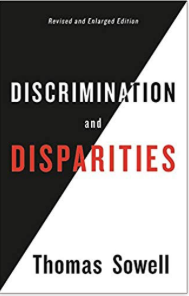
MAIN IDEA:
The main idea here is to restate once again author’s believes in complexity of the world and futility of applying simple and primitive solutions to many complex problems of contemporary society. Author goes one by one through hot points of contemporary discussions, demonstrating that in complex world only multitude of specific decisions made by individuals for themselves could lead to improvement, while violent intervention by power crazy leftists via government directives could only hurt everybody, eventually leading to dramatic decline of society.
DETAILS:
Chapter 1: Disparities and Prerequisites
Here author presents an idea that the result of any actions depends on combination of prerequisites and demands of the moment. For example someone with 5 prerequisites to achieve something that requires all 5 will achieve it, while everybody else with either any 1 or 4 prerequisites will fail. Since these prerequisites not always and not all depend on person’s effort, the achievement is combination of luck and effort. Author provides very interesting result of Harvard longitude study of men with very high IQ, which demonstrated low correlation between lifetime achievements and IQ. Another peace of empirical data is the variance in achievement between twins raised in the same family. There is also high level of correlation between birth sequence of individuals and their achievements, with earlier born having higher achievements. Author also analyses history of Jews as high achieving group and points out that it was case at the very specific time period when their prerequisites fit to circumstances. Author also applies this point for institutions and organizations, demonstrating the same evolutionary fitness or lack thereof. Finally author discusses implications of these ideas, stating that various factors help or hamper developments, but not define them deterministically neither for individuals nor for groups.
Chapter 2: Discrimination: Meanings and Costs
Author defines two types of Discrimination:
Type I:” The broader meaning is an ability to discern differences in the qualities of people and things, and choosing accordingly”. This pretty much means evaluate people as individuals – effective, but very costly and not always easily available process.
Type II: This means evaluate people based on their belonging to some group, automatically assigning real or perceived characteristics of this group to individual – ineffective and often harmful, but low cost, intuitive, and very speedy method.
Author also discusses what he calls Discrimination IB – discrimination based on small number of group characteristics. As example author provides assumption of low creditworthiness and high insurance rate in localities with high crime rate.
After that author discusses examples of discrimination with interesting patterns when clearly ideological racists fought against discrimination that was detrimental to their own well being, like demand for segregated railroad cars when there were not enough passengers to keep it profitable: for example enough whites to fill 0.5 of car and blacks to fill 1.5. With discrimination one needs 3 cars, 2 being half-empty, while without only 2 cars.
Chapter 3: Sorting and Unsorting People
This is about human tendency to settle among people who could help one to manage life challenges. Typically it is similar people and author discusses such sorting not only on ethnic or racial basis, but also within communities: sometimes by place of origin and sometimes by business similarities. Author also discusses assumption that people immediately make about others by appearance. He provides a couple stories about rich blacks professors causing fear because they are big and black before people recognize them as rich and educated. Author also discusses government imposed sorting that unlike self-sorting is not possible remediate by better knowledge about individual.
Author also discusses methods of unsorting: Education, Residential, and equal employment. In all cases author points out to distortion brought in by government intervention, which actually causes problem for people who are really trying to rise. For example government programs of subsidized housing often leads to placement of disturbing people into locations with lower middle class population who are paying full price for housing in these areas at great sacrifices to provide safe environment for their children, only to see government nullifying their efforts.
Chapter 4: The World of Numbers
This chapter is about manipulation of statistics to promote some bureaucratic and/or political agenda. This is very typical when used to find racism where there is none: either in income distribution, crime data, capital gains calculations, and so on. The implication of such manipulation is often false believes, political support for ineffective and even harmful measures, and waste of resources.
Chapter 5: The World of Words
This chapter is about manipulation of words similar to manipulation of data and used for the same purpose: promote some political agenda and direct public resources into whatever schema manipulators desire to promote. Author presents a number of examples of such manipulation such as “Diversity” use to promote racism, Ex Ante substituted based on Ex Post events like explaining someone’s achievement by some unspecified privileges that nobody could see before the achiever obtained results. Another contemporary innovation of the left is use of word “Violence” on context where no violence could be occurring like in response to words or images. There is the whole are of manipulation when manipulator targets some ridiculous idea or notion linking it to opponent’s position, even if opponent never subscribed to this idea. Examples are “Trickle down economics”, “Racism”, “White supremacism”, and many others. One interesting example of such use is “Freedom” used with meaning of absence of fear, poverty, and poor health, even if none of these has anything to do with freedom of person to obtain information, to express self, to get job to escape poverty, or use treatment to improve health.
Chapter 6: Social Visions and Human Consequences
This chapter is the critic of prevailing social vision that diminishes individuals responsibility for their prosperity, health, and wellbeing or lack thereof. It includes absolutely unfounded assumption that results for everybody should be the same and if they are not, then some politico-bureaucratic intervention is justified to enforce equality of results. Author then discusses typical human consequences of such interventions and notes how what he calls “toxic vision” completely blinds people who religiously cling to this vision despite reality of multitude of factual data demonstrating failures of their programs.
Chapter 7: Facts, Assumptions and Goals
Author starts this chapter by stating that his goal is not really propose solutions, but rather “provide enough clarification to enable others to make up their own minds about the inevitable claims and counter-claims sure to arise from those who are promoting their own notions or their own interests.”
Correspondingly he discusses:
- Meanings and prospects of equality, which is inexorably linked to question of merit vs. productivity: do people deserve to get something that other people produce or they should be productive to get something. Another point is inequality of languages some of which are more developed then others.
- Disparities: people represent not only their inherent qualities, but also background, which are in some circumstances beneficial, but in others detrimental.
- Culture: author compares Scandinavia with Middle East and then discusses issues of culture clash when people from Middle East immigrate to Scandinavia
- Process goals versus Outcome Goals: the former highly beneficial, creating conditions for people to obtain what they want, while latter highly detrimental, prompting people demand something they did not earn.
- Social Justice understood as“(1) the seemingly invincible fallacy that various groups would be equally successful in the absence of biased treatment by others, (2) the cause of disparate outcomes can be determined by where statistics showing the unequal outcomes were collected, and (3) if the more fortunate people were not completely responsible for their own good fortune, then the government—politicians, bureaucrats and judges—will produce either efficiently better or morally superior outcomes by intervening.
“ - The Past and the Future: the look at history is both frustrating and aspiring because it filled with examples of decline of highly developed societies and blossoming of previously dormant societies and peoples.
MY TAKE ON IT:
As nearly always with his other books, I agree with main points that Tomas Sowell makes in this book. However I think that his position of not looking for solution is not sufficient. Presenting intellectual and moral deficiencies of contemporary left and their “toxic vision” should be combined with presentation of another vision, which would go beyond just asking for less government intervention, but also demonstrating how to decrease it and how to make people left behind to fight people of the government in order to protect themselves and retain the freedoms they still have.
20191006 – Big Business
MAIN IDEA:
The main idea of this book is to present kind of pro-business manifesto that would reject typical attacks against business and present reasons to believe that overall role of business and specifically big corporations is a lot more positive, than many people believe.
DETAILS:
- A New Pro-Business Manifesto
It starts with the simple statement that without business nothing in economy would be created or moved. Then author proceeds to extoll particular virtues of American Business such as superior management practices: “It has been estimated that Chinese firms could increase their productivity by 30 to 50 percent and Indian firms could do so by 40 to 60 percent merely by bringing the quality of their management practices up to American levels.” After that author compares American Business and Government and concludes that former clearly works better than latter. Finally he states that he was prompted to write this book by massive attack against business from the left and from the right that led to low level of trust that it has with American public, which is even worse than trust in nearly all other institutions:
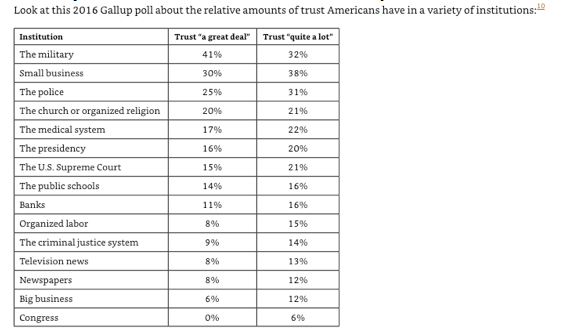
At the end of chapter author expresses his believe that business deserves better trust and his intention to provide prove of it in this book.
- Are Businesses More Fraudulent Than the Rest of us?
The obvious response presented in this chapter is “NO”, the business is no more fraudulent than regular people and probably quite a bit less than public employees. Author discusses a number of studies confirming this and then moves into psychological research demonstrating that CEOs are more trusting than regular people. He also provides some interesting data obtained from cross-cultural research demonstrating that people more exposed to developed market economy are more honest.
- Are CEOs Paid Too Much?
Author position here is that CEO properly paid that much because their decisions have huge impact on success or failure of very big businesses and these decisions are highly non-trivial. He discusses skill set of the modern CEO and here is some really funny citation:”The CEO is the modern world’s equivalent of a successful philosopher, as a good CEO must have a reasonably well-rounded sense of nearly the entirety of the contemporary human experience, whether as worker, consumer, funder, media communicator, or political activist. In reality, there is no other job that is as—yes I will stick with that word—philosophical. Good CEOs are some of the world’s most potent creators and have some of the very deepest skills of understanding.
“
Author also refer to interesting research on what happens when CEOs dies. The usual consequence: companies lose at least some value. The final point in this chapter is author’s attempt invalidate usual view that CEO’s time span of planning is too short and they are sacrificing long term prospective for short term gains.
- Is Work Fun?
Author looks at polls demonstrating that work is not fun, but then at work time data demonstrating that people work now more hours than they used to. There was also an interesting research checking hormones of people during work hours and at home for stress. It turned out that being at home often is more stressful than work.
Author concedes that not everything is perfect in work places and there is not very nice staff about harassment, companies taking advantage of their workers using market power, and so on. However all this often comes not from company policy, but from other employees. At the end of chapter author compares different organizational forms and finds that coop is not that good either.
- How Monopolistic Is American Big Business?
The analysis here provides that business is by far less monopolistic than people think and that really big and bad monopoly are government monopolies such as K-12 education.
- Are the Big Tech Companies Evil?
Here author goes through usual litany of accusations and responds:
- Competition in high tech did not disappear
- Tech Companies continue innovating
- Internet and computers does not make humans stupid
However there is one area in which author does have a very serious concern: loss of privacy, and he discusses it in details.
- What Is Wall Street Good for, Anyway?
This chapter is response to wave of accusations against financial business, usually by people who have now clue about finance role in contemporary world. So author explains:
- VC drive innovation – no startups without money
- Companies shares allow people participate in financing business and benefit from stock appreciation
- Comparatively to other countries Americans are taxed less and have reliable banking system.
- American financial system did not grow unreasonably big, but rather grows in proportion to increased wealth of society when ratio of assets to income is growing all the time.
- Americans have huge benefit from the scale of their financial system because it supports global peace and prosperity by assuring money, goods, and services flow relatively unimpeded.
- Crony Capitalism: How Much Does Big Business Control the American Government
This chapter is about business influence on government, and author makes very valid point that government constantly interfere into business imposing demands and regulations, so all this lobbying is pretty much business self-defense against predatory politicians.
- If Business Is So Good, Why Is It So Disliked?
In the first part of this chapter author discusses anthropomorphizing corporations. The corporations encourage this attitude by using symbols that aim to personalize them as trusting friends and supporters. It is especially obvious no when corporations are active on social media and use AI to interact with customer via humanlike conversations and images. However there is downside from personalizing and it is ease with which corporation as personal friend could be turned into enemy. There is the whole industry, which is built on vilifying corporations – Hollywood. The movies usually based on fight between good and evil and humans who pay for entertainment associate with good in movies. Obviously the good had to be represented by humans, while evil could not. It had to be represented by some abstract entity like Nazis or Aliens or most often by soulless corporations. Similarly even if majority of people are corporate employees, they tend to perceive whatever good comes from their employment, as their fair deserve and whatever bad as expression of inhumane corporate nature. Author final word is about social responsibility of business and this is how he puts it: “And what, in turn, is the social responsibility of business? I don’t think there is a single concrete answer to that question except the following: the social responsibility of business is to come up with new and better conceptions of the social responsibility of business, ones that will both boost corporate profits and further other social ends, including prosperity and liberty. You might say the social responsibility of business is to come up with the magic of a vision that will help us trust it more, whether as consumers or as workers. Corporations won’t succeed all of the time at this, but American business, by enabling so much wealth creation and by creating so many new opportunities, arguably has outperformed any other set of private institutions in all of world history.”
MY TAKE ON IT:
I think that the whole idea of anthropomorphized corporation is very harmful for the society because it allows really bad people to hide beyond corporation and often denies good people appreciation that they truly deserve. There are very complex and historically deep reasons for corporations obtaining personality including some legal and human rights like sue and being sued and recently even free speech. I personally think that this structure is outdated and just remains from time when it was impossibly to process information to the human individual level so one had to trust brand name of corporation or sue corporation for negligence of individual working for it. I think over the next few dozen years this approach will be gone and reward or punishment for good or bad actions would be directed not at the abstract corporation, but at the specific human actors.
I generally agree with author in his description and rejection of typical accusations against corporations, except for CEOs income. With all justifications that author provides, the reality is that CEO compensation decided by boards appointed by CEOs, consistent of current and formers CEO, who, quite normally, view the world through CEOs lenses. If we remove possibility of CEOs as a group having infinitely higher moral standards than general population, which in my view is negligible, we should expect them to pay themselves out of investors’ pocket as much as legal system would allow. However taxes are not a reasonable way to go because taxes just mean that resources transferred from corporate bureaucrats to government bureaucrats, which generally are usually lot less competent. Similarly any limitations on CEO compensation only serve to direct efforts at avoiding such limitations instead running corporation to benefit of owners. The only reasonable way, in my view, would be create direct and simple link between company performance and CEO actions in such way that poor performance would guarantee low levels of compensation, unlike stock options, which quite often provide enormous compensation for average performance and huge compensation for poor performance.
20190929 – End of Work
MAIN IDEA:
The main point of this book is that the work one does because he/she loves it is not really work, but rather enjoyable application of one’s energy. The consequence of increased prosperity is ability of people to do what they love, so the work would not feel like work, constituting therefore the end of work. The most important extension of this idea into the future is that non-routine works like sports, games, cooking, and such could provide joyful employment allowing doing what they love for people who will lose their jobs to automation.
DETAILS:
INTRODUCTION
Author starts this with description of the band in which players reached retirement age, but continue perform because they love what they do. It leads to the statement: “The central message of this book is that you’re not lazy, you’re simply in the wrong job. And there’s nothing wrong with that. Successful people will tell you that success springs from the pursuit of all kinds of work—with lots of failure in the process”. So author promises: “Whatever you’ve been told and whatever you believe about yourself, you have within you the work ethic, intelligence, and charisma that you marvel at in others. What’s missing is the kind of work that inspires the heroic effort of which you’re capable. I’m going to show you that that work is within your grasp and how to recognize it. Truly, the end of work is near.
“
CHAPTER ONE: Why College Football Players Should Major in College Football
This chapter is about Football players that make millions, but have to go through college, pretending that they learn something else. Author’s recommendation is to teach football as a profession.
CHAPTER TWO: Intelligence and Passion Don’t Stop at Football
This chapter is about basketball and baseball, both being also a pretty good source of income for top players. In addition author refers to book “Moneyball” and discusses high levels of special intellect required to be successful in all these games.
CHAPTER THREE: Education Isn’t Meaningless, But It’s Grossly Overrated
This chapter starts with very wise quote from Ludwig von Mises: “The successful conduct of business demands qualities quite other than those necessary for passing examinations—even if the examinations deal with subjects bearing on the work of the position in question.”
Then author proceeds to demonstrate using a few examples how musicians with no formal musical education like Beatles not just achieved huge success, but also changed how music is played. In addition to Beatles he discusses Rolling Stones and their impact on popular music. Author also brings in a few more examples like Brothers Wright, a few movie starts, Internet personalities and so on. The main point here is that education follows technological and cultural breakthrough rather that creates them.
CHAPTER FOUR: What Was Once Silly Is Now Serious
This chapter presents more examples of people following their dreams and doing what they love and achieving huge success. This time it is about cooking, restaurant business, and, once again, more actors that achieved success. One point added at the end of chapters is that new technology allows everybody make movie and post it on YouTube, or some equivalent for other professions, so barriers to entry become lower every day.
CHAPTER FIVE: Abundant Profits Make Possible the Work That Isn’t
The chapter starts with reference to high performing businessmen: Goizueta, Warren Buffet, Bill Gates and others who used their money for all kinds of charity, in process creating lots of jobs in non-profit organizations. Similarly author points out that without high profit there would be no high culture such as symphonies, universities, and such.
CHAPTER SIX: The Millennial Generation Will Be the Richest Yet—Until the Next One
Here author moves to discuss complains of current generation that they could not find jobs adequate to their education levels. He looks at this and other generations after WWII and concludes that they all were richer than previous ones, albeit not right away, but after some struggle.
CHAPTER SEVEN My story
Here author retells his story as college graduate of 1992, the time before Internet. Unlike ancient times when people were happy to find good enough jobs to earn living, author and his generation spend years or even decades looking for jobs that they would enjoy and make lots of money. In author’s case the search was successful.
CHAPTER EIGHT The “Venture Buyer”
Author starts this chapter with discussion of well known fact that nobody knows the future and government bureaucrats is not any better at predictions than capitalists. However people in free market environment evolutionary selected for their ability to move quickly to catch up in time with any new technology, trend or fashion making money from successful innovation. It is not only in production, but also in consumption. People with money, author calls them Venture buyers, buy new and exiting staff and if it is any good, promote it to everybody, consequently increasing demand, which in turn initiate economy of scale and improvements making this staff more and more effective and less and less expensive over time.
CHAPTER NINE: Why We Need People with Money to Burn
This is another bunch of examples that rich and semi rich spenders move progress either by using their wealth to invent things like brothers Wright, manage creation of new consumer products like Steve jobs, or do something else productive.
CHAPTER TEN: Love Your Robot, Love Your Job
Here author refers to the work of Henry Hazlitt and links his book to it:” I make three arguments in this book. First, everyone is intelligent in his own way. Second, everyone has a huge capacity to work if his work is matched with passion. Third, economic growth will allow work and passion to become one and the same for the greatest number of people. That’s why Hazlitt’s insight is so important. An “economy” is nothing more than a collection of individuals. When we take our economic thinking down to the level of the individual, we discover the secret to roaring economic growth: No individual is made more prosperous if local, state, and federal taxes shrink his income. What governments spend represents lost spending and savings for every individual.”
After that author moves to discuss technology and productivity growth that made contemporary world wealthy and his believe that it should cause game change from what it is now when people often do work they hate to the new game when people do what they like. In his opinion it would be world without laziness.
CHAPTER ELEVEN: Come Inside and Turn on the Xbox, You Have Work to Do
Here author recounts how in contemporary world people make good money playing golf, poker, or some X-box games. He presents the idea that such games require support like caddies who are high-level professionals in their own right and discusses real life examples at length. The inference from this is: ” The United States is already becoming a nation of happy workers, but we’ve only scratched the surface. The end of work has in a sense already arrived, but it could be so much better if our government taxed and spent more sensibly. You’re not lazy, you’re not stupid, and you’re not bereft of talent. You, like so many others, simply suffer a capital deficit. That can change if we demand that it change. If that happens, a life of enriching work will be our reward, and a certain reward for our children.”
MY TAKE ON IT:
Nice try, but somewhat light on thinking. At no point author try to compare numbers of jobs that will be lost to automation with number of jobs real or potential that could be created by sports, entertainment, and other areas that author believes susceptible to joyful working. The way reality looks now is that productive work removed by automation will be substituted not by some joyful jobs allowing people to play while working, but rather some miserly handouts like guarantied income and/or by soul killing miserable jobs of filing slots in some bureaucratic structure that pays better than this guarantied income in exchange for mindless conformity. I believe that there are better ways. These ways are not about doing something that one likes, even if nobody wants to pay for it, but rather about everybody having equal rights to natural resources including our biological DNA, cultural, and technological heritage so that people capable create wealth in amounts higher than average would have to buy rights for use of it from people who produced less than average.
20190922 – Genesis-The Deep Origin of Societies
MAIN IDEA:
The main idea here is to present idea of Eusociality that applies not only to humans, but also to other extremely successful forms of live –insects, especially ants. This idea helps to answer main philosophical questions humanity posed by referring to the process of evolution and not at the level of DNA only or even organism only, but at the level of society as whole with this process being broken into multiple levels, including competition between groups.
DETAILS:
Prologue
Author starts with defining the scope: “ALL QUESTIONS OF PHILOSOPHY THAT ADDRESS the human condition come down to three: what are we, what created us, and what do we wish ultimately to become.
“ Author believes that answers are in evolution and it is good not only for humans, but also for other forms of societies: ants and bees.
Chapter 1. The Search for Genesis
Here author presents his believes on key points for human self-understanding:
- Every part of the human body and mind has a physical base obedient to the laws of physics and chemistry. And all of it, so far as we can tell by continuing scientific examination, originated through evolution by natural selection.
- The unit of genetic evolution is the gene or ensemble of interacting genes. The target of natural selection is the environment, within which selection favors one form of a given gene (called an allele) over other forms (other alleles).
- During the biological organization of societies, natural selection has always been multilevel. Except in the case of “superorganisms,” as found in a few kinds of ants and termites, where subordinates form a sterile working class, each member competes with other members for rank, mates, and common resources. Natural selection simultaneously operates at the level of the group, affecting how well each group performs in competition against other groups.
Finally after that author discusses the key points of evolution: inheritance with variance and statistical selection of better breeders.
Chapter 2. The Great Transitions of Evolution
Here is how author defines the great transitions of evolution:
1.The origin of life
2.The invention of complex (“eukaryotic”) cells
3.The invention of sexual reproduction, leading to a controlled system of DNA exchange and the multiplication of species
4.The origin of organisms composed of multiple cells
5.The origin of societies
6.The origin of language
Author expresses his conviction that all teleological approaches to human evolution are false – the great transitions demonstrate that it is just natural process with no purpose whatsoever. He explains how each of these transition naturally occurred. Actually humans are not alone, huge number of other species moved along pretty far, with some all the way to level 5 and a few to level 6, albeit their language being very primitive, unlike human.
Chapter 3. The Great Transitions Dilemma and How It Was Solved
The dilemma here is about altruism and low probability of development of complex systems through multiple transitions. Author believes that it could be explained by evolution: “The solution begins with an appreciation of the enormity of the problem and the improbability, in fact near impossibility, of its solution. The great transitions together, composing the dragon challenge of evolution, lead through a field of extreme difficulty. Similarly, each of the transitions required almost unimaginably vast numbers of components (chemical compounds to simple living cells to eukaryotic cells and so on up), consuming long geologic periods of time, to create the next higher level. Each transition required, or at least was enhanced by, multilevel selection—occurrence of natural selection at the group levels added to selection at the individual level. “
Chapter 4. Tracking Social Evolution Through the Ages
Here author discusses formation of groups among various animals and their evolution. This process occurred many times so there is enough evidence to understand how it works. It seems to be done via: “…universal principle of modularity, the tendency of all biological systems to divide one way or another into semi-independent but cooperative groups. Members of the different groups specialize in function, even if just temporarily, in a way that serves the overall assembly as a whole and thereby on average benefits each individual singly”. Author believes that this process could lead to increase in groups’ complexity to the level, which is seldom achieved that he calls EUSOCIALITY. In Eusociality “the colony is divided into a “royal” caste specialized for reproduction, and a nonreproductive “worker” caste that performs the labor of the colony. Eusociality may be a relatively rare condition in evolution, but it has resulted in the most advanced levels of individual altruism and social complexity. It has conferred ecological dominance on the land by some of the species that possess it, particularly the ants, termites, and humans. “
Chapter 5. The Final Steps to Eusociality
Here author discusses evidence of Eusociality obtained from research of insects. He discusses difference between Eusociality and superorganisms such as Atta fungus and states that:” Eusociality, the organization of a group into reproductive and nonreproductive castes, occurred in only a tiny percentage of evolving lines, then relatively late in geological time, and almost entirely on the land. Yet
these few, leading to the ants, termites, and humans, have come to dominate the
terrestrial animal world. “
Chapter 6. Group Selection
Here is how author defines group selection:” Group selection is natural
selection of alleles (alternative forms of the same gene) that prescribe social traits. The traits favored by natural selection are those that entail the interaction of individuals within groups, including the initial formation of the groups. As groups of the
same species then compete, the genes of their members are tested, driving social evolution by natural selection up or down. A rich documentation of this process has been provided by both natural history and experimental studies. “
Then he provides support for this position both theoretically and referencing experimental studies in nature. Especially interesting are DNA studies on other Eusocial creatures – ants where prosocial behavior uses chemical communications based on DNA. Finally author provides some serious reasons for rejecting popular ideas of kin selection and inclusive fitness (Hamilton rule – General or HRG):
Chapter 7. The Human Story
The final chapter applies all this to human history: ”Humanity arose on the
African savanna from a line of australopiths by essentially the same route as the other known eusocial animals. A major driving force in social evolution was competition between groups, frequently violent. The final surge to the Homo level was enabled by the combination of an initially large brain, fire from the frequent lightning- struck savanna that could be captured and controlled, and the advantages of tightly gathered groups of cooperating members. “
To support idea of continuous process of violent competition between human groups author provides a very interesting table:
But it is not group violence that makes us human. Even more than that it was social interaction: ” From the earliest Homo formed, as brain size increased, the time devoted to social interactions likely increased. The trend upward has been inferred by Robin I. M. Dunbar of the University of Oxford. He used two correlations from existing species of monkeys and apes: first, time spent grooming as a function of group size, and second, the relation among apes between group size and cranial capacity. Extended to the australopithecines and the Homo line of species born from them, this method—admittedly tenuous—suggests that the “required social time” evolved from about one hour a day to two hours in the earliest species of Homo, thence four to five hours in modern humanity. In short, longer social interaction is a key component in the evolution of a larger brain and higher intelligence.”
MY TAKE ON IT:
I think that ideas expressed in this book are not just plausible, but actually completely correct. I do not see any other reasons for developing such huge and multifunctional tool for abstract thinking as human brain but for necessity to process complex tasks of strategizing, planning, communicating, and analyzing results. From current achievement in mathematics and computer science in modeling neural networks, it is clear that it requires huge amount of computing power. This is what evolution provided us with in the form of human brain. So far we used it relatively well, but now accumulated level of knowledge and skills become so big and sophisticated that it is a challenge for humanity to use it well enough to survive.
20190915 – First Freedom

MAIN IDEA:
The narrative here is to review history of guns in America, the role they played in its settlement by Europeans, and analyze features of American culture that to large degree were formed by constant need in self-protection, either individual or in loosely formed militias against hostile Indians and/or other Europeans. However the main idea is to reject attempts by the left to rewrite history of American adherence to guns and demonstrate that American freedom depends on people’s ability to have arms, without which it would be indefensible.
DETAILS:
PROLOGUE: From Prey to Predator
It starts with David and his use of projectile against Goliath. From this point author discusses history of projectile weapons from sling and stone to bow and arrow and all the way to firearms of XIV and XV centuries.
PART I NEW WORLDS
1: First Contact
After prolog about firearms coming to Europe author moves to America and initial European invaders – conquistadors. These guys’ guns were useful not that much through their firepower as for psychological effects of their noise and lights, which scared the hell out of people not familiar with technology.
2: Pilgrims Progress
The next stop is for Pilgrims and their guns. Author discusses technology of “Mayflower gun”, which was wheel lock – when rotating wheel had generated spark needed to ignite charge. Here is how author describes main use of guns in colonial America: “Hunting, not war, was the main use of the gun in early America. By the turn of the century, Indian reliance on European firearms for stalking prey was also growing. As Native Americans gradually adopted the apparatuses, they became increasingly adept at fixing and maintaining the weapons—even, occasionally, making their own ammunition. However, Indians were never able to manufacture and craft iron, and this doomed their hold on the land.
“
. Then author discusses technological development that found very good acceptation in America – Kentucky rifle that provided longer distance and better accuracy at the expense of difficulty of reloading. Comparatively speaking it was hunting weapon, not really appropriate for military engagement, which at the time was based on marching columns and disciplined volley firing that followed by bayonet attack. This tactic was based on smoothbore musket technology that provided much faster reloading.
3: Powder Alarm
This is about powder in America. Author discusses its chemistry and production technology. The production of powder in America was very limited and was subject of British attempt on confiscation whatever inventory colonials have on one side and attempts to setup production by colonials on other side. Both attempts failed so America kept powder it possessed and could not produce much more but consequently succeeded by relying on French supplies.
4: “Fire!”
Here author discusses beginnings of American revolutionary war and provides an interesting observation on why revolution would not be an easy thing to defeat: ” In 1774, Richard Price, the Welsh philosopher and intellectual who championed the American cause in Britain during the Revolution, pointed out that in the colonies “every inhabitant has in his house (as part of his furniture) a book on law and government, to enable him to understand his civil rights; a musket to enable him to defend these rights; and a Bible to enable him to understand and practice his religion. In that same year, an Englishman visiting New England wrote home that there “is not a Man born in America that does not Understand the Use of Firearms and that well . . . It is almost the First thing they Purchase and take to all the New Settlements and in the cities you scarcely find a Lad of 12 years that does not go a Gunning.””
5: The Finest Marksmen in the World
Here author discusses a special feature of American way of war at the time – massive use of snipers with rifles who were targeting officers. Initially it was quite successful and widely popular. However, as everything else, it caused changes in British tactics that explore deficiencies of rifles: their slow and difficult reloading that made coordinated action in battle very difficult. The fact that it was practically one-shot weapon that made American fighters vulnerable to bayonet attack caused its decline in popularity and eventual return to the regular method of fighting: in columns with musket volleys.
6: Liberty’s Teeth
In this chapter author refer to famous diary of Joseph Plumb Martin who went through all revolutionary war. He describes a war of muskets when both sides were armed by “Brown Bess” musket or equivalent weapon.
7: Freedoms Guarantee
In this chapter author completes his discussion of American revolution, its causes and history by noting that not a small reason for this was British attempt to disarm population. He links these events to our time by noting:“The First Amendment of the Bill of Rights lists the most vital freedoms of man. The second lists the only way to attain them and preserve them. Without the second, there is no first. It was in this context that the newly minted nation enshrined this natural right. The words written by James Madison in 1791, “A well regulated militia, being necessary to the security of a free state, the right of the people to keep and bear arms, shall not be infringed,” would not be controversial until the twentieth century when a seemingly ungrammatical comma plunked in the middle of this sentence offered a generation of gun-control advocates a justification to question whether individuals were afforded the right to self-defense.
“
PART Il DISCOVERY
8: Go West
This chapter about American movement West starts with Lewis and Clark and their weapons. One of the most important was a small-bore cannon and couple blunderbusses. It follows by the story of Daniel Boone. Author describes how much attention and effort Lewis applied to have the best available weapons, which were custom made at Harpers Ferry Armory. Especially interesting was air gun that could be fired without reloading a number of times using magazine with some 22 rounds and enough compressed air to shoot 40 times. It greatly amazed Indians who already were familiar with firearms and new their deficiencies, which quite possibly discourage potential attack. Author then discusses establishment of mass production of weapons with changeable parts. One of the most important inventions of the period was bridge-loaded gun. It was the first known patented gun.
9: Peacemaker; 10: Bullet; 11: Those Newfangled Gimcrackers;
These chapters retell story of technological developments of XIX century: Colt revolver, Smith and Wesson gun with cartages, and Spencer repeating rifle,
12: Fastest Gun in the West
Here author moves to people who used these technologies: Bill Hickok, Billy the Kid, and a few others.
13: The Showman
The final chapter of this part is about gun culture expressed in entertainment with Buffalo Bill’s show as exhibit number one. It also refers to extermination of Buffalos, how it was done, and special weapon: Sharps Rifle used to do it. The final part of the chapter is about Annie Oakley and her unmatched shooting skills.
PART III MODERNITY
14: Hellfire; 15: An American in London; 16: American Genius; 17: The Chicago Typewriter; 18: Great Arsenal of Democracy;
These chapters retells story of several types of guns of the late XIX and XX centuries and their inventors. Author discusses here Gatling gun, Maxim machinegun, Browning rifles, Thompson sub-machinegun, and Garand rifle.
19: Fall and Rise of the Sharpshooter
In this chapter author moves from hardware of guns to software – tactics of guns use – mainly about sniper fire. American military revived sniper training and extensive use during Vietnam War and since then only extended it.
20: Peace Dividends
This chapter is about contemporary automatic rifles and it discusses ongoing competition between Soviet AK-47 and American AR-15 / M16. Generally these two are designed with different ideas of fighting in mind. AK-47 was designed with preference of low cost and reliability over accuracy, while M16 for accuracy and ergonomics. Author also trying explain reasons for initially poor reputation of M16 by bureaucratic incompetence during its roll out to the troops.
21: The Great Argument
The final chapter is about continuously advancing efforts of gun control by bureaucrats and politicians. However so far these effort mainly failed because guns so much imbedded into American culture that it hard to imagine that any confiscation attempt would succeed.
CONCLUSION: Molon Labe
In conclusion author discusses revisionist attempt by leftist historians to separate guns from American history and by politicians to promote idea of the Second Amendment as “collective right”. So far it failed in Supreme Court and in popular support.
MY TAKE ON IT:
I agree with author’s position, but I think it is not sufficient. The current trend to justify individual ownership of guns by reasons of self-defense and hunting opens it to continuing attempts for regulation and confiscation. I think founders understood that armed individuals are not sufficient for protection of freedom. Only independent organizations of armed individuals could protect it against enemies foreign and domestic, which means military for protection against former and militia for protection against latter. As for military it should be small and professional to be used exclusively against other countries and their forces. As for militia, it should be based on mass participation of all adult so no politician or gang of politicians could believe that there is any chance to deprive people of their freedoms. This mass participation in militia long gone and so was significant parts of freedom that Americans used to have. Whether it is gone forever, however, still remains to be seen.
20190908 – An Elegant Defense

MAIN IDEA:
The main idea here is to present contemporary understanding of immune system workings and humanize this discussion with real live example of 3 people who suffer from immunity system problems and one person who possess unusually powerful immune system, which allowed him to survive AIDs at the time before treatment was developed and the vast majority of infected people died.
DETAILS:
Part I: Lives in the Balance
- The Ties That Bind 2. Jason 3. Bob. 4. Linda and Merredith
In this part author discusses a little bit on the nature of immune system and then presents stories of four people: his friend Jason who suffered from cancer at middle age, Bob – gay man who survived AIDS, Linda – high power workaholic who encountered rheumatoid arthritis, which is autoimmune disease, and Merredith, who has genetic version of autoimmune disease.
Part II: The Immune System and the Festival of Life
- The Bird, Dog, Starfish, and Magic Bullet
Here author starts with the origins of immunology, which started in Italy first with discovery of chicken bursa by Fabricius ab Aquapendente
and then in 1622 with discovery of lymph circulation. The next step was in XIX century when Metchnikoff discovered phagocytes and developed theory of immunities, which was supplemented by work of Paul Ehrlich who discovered antigens.
- The Festival;
Here author describes what he calls festival of life: permanent movement of cells in the body and some processes used to fix the problems that periodically occur.
- Festival Crashers;
This is about all kind of challenges to this festival: Bacteria, Viruses, Parasites, and Cancers. Then author discusses how body’s immune system handles these challenges. The common problem of this handling is the difficulty of correct recognition between hostile and own healthy cells so that body would not attack the latter (autoimmune illnesses) and would not protect malignant cells (cancer). Here is how author describes his task: “ It is the story of scientific discovery. It goes like this, in brief: scientists got an idea about these things called T cells and B cells, started applying big conceptual knowledge through life-saving vaccines and transplants, and then these imaginative and innovative immunologists delved into the tiny fragments of the immune system, the cogs, and built a blueprint of the machine. They understood, as I’ll describe, what inflammation is about, and the molecules that make up our communications network. With each advance of science came another practical step, like building medicines by replicating our defense cells, and then would come another extraordinary scientific leap, like the discovery only a few years ago of a second immune system.
“
- The Mystery Organ
This starts with the story of tuberculosis patient who died shortly before discovery of antibiotics and whose sister became medical researcher who discovered thymus – the mystery organ strongly influencing work of immune system.
9 The B-Word
This is about discovery of two different immune cells that body produced- B-cells originating in bone marrow and generated antibodies, while T-cell went through thymus and could direct actions against disease.
- T Cells and B Cells
This is about functionality of B and T cells with nice picture of both:
- Vaccines
This is brief, but important part describing how vaccines work. They present immune system with relatively weak cell form of enemy that allow it to develop response to this particular problem, so when real virus hit, the immune system already prepared to defeat it.
- The Infinity Machine
This is about big mystery of immune system – how it recognizes good cells vs. bad that needs to be attacked. Turned out that immune system has preset pieces of DNA ready to create antibodies for multitude of different invaders.
- Transplant
This chapter is about transplantation of organs that was very challenging process before medicine achieved good enough understanding of immune system to be able suppress it enough for body accept transplant, but not enough to leave it defenseless against infection.
14 The Immune System’s Fingerprint
This is an interesting chapter about uniqueness of immune system and its ability to sent chemical signals externally, based on MHC gene. Among other things it was discovered that close enough MHC repels people from each other, while different attracts, providing chance for increased diversity.
- Inflammation
This is another interesting and not trivial look at inflammation. Author links it to immune system and complex process of organism reaction to invasion with use of various more or less specialized killer cells: neutrophils, macrophages, and natural killer cells.
- Fever
This chapter is about discovery of a molecule that controls fever in the body – leukocytic pyrogen, even if it is present in miniscule quantities.
- Flash Gordon
This is about interferon (IFN) – a medicine that is based on dead virus. It prepares immune system to recognize DNA of virus in case of infection and attack it.
- The Harmonious Way
This very brief chapter is about change in approach to immune system from perceiving it as defensive system that attacks intruders to understanding that it is kind of homeostatic mechanism that maintains overall cellular balance of the body reacting to violation of this balance in such way as to restore it.
19 Three Wise Men and the Monoclonal Antibody
This is about the research that developed process for isolating specific antibodies and produce them in volume. Such antibodies called monoclonal antibodies that could be potentially produced for any disease.
- A Second Immune system
This is the story of discovery of second signal system – innate immunity based on gene called Toll receptor that defines which cell attack and which should be not attacked. The understanding of immune reaction is now includes coordinated working of both: innate and adaptive immune systems. Here is brief description:
Part III: Bob: 21. Sex Machine; 22. GRID; 23. The Phone Call; 24 CD4 and CD8; 5. Magic; 26. The Prime; Part IV: Linda and Merredith: 27. Linda; 28 The Wolf: 29. Invisible Evidence 30. Best of Both Worlds (Sort Of); 31. Merredith;
This part of the book follows stories of 3 people that author selected for the “human interest” part of the book.
- Should You Pick Your Nose? 33. Microbiome; 34. Stress; 35. Sleep;
The 3 chapters about factors impacting immune system. They discuss correspondingly: need to train immune system in real life, so too much sterility in life and too cautious approach to raising children puts people at risk of having poorly trained immune system, resulting in allergies and openness to infection; value of microbiome that surround human body and provides vital support for its functioning, so overuse of antibiotic and other suppressors of micro organism could be not just harmful, but deadly; Finally minimization of stress and optimization of amount and quality of sleep are important factors in maintaining immune system in good shape.
Part V: Jason 36. A Word About Cancer 37.Laughter and Tears
In these two chapters author once again returns to the story of his friend Jason and Jason’s struggle with cancer.
38 The Lazarus Mouse
Here author moves to discuss interaction of immune system with cancer, which is practically comes down to its failure to attack cancerous cells. The research found that it seems to be possible to remove the restriction that disrupt this process and prompt immune system to attack, consequently leading to possibility of developing qualitatively new method of cancer treatment.
- Wound Healing
Here author discusses process of wound healing and suggests that cancer related to this process when immune system react to cancer cells as a wound and start protecting it.
- Programmed Death
In this chapter author retells the story of antibody development that would prompt immune system attack cancer cells. Here is author’s description of how it was done:(For those interested in the details, Lonberg and his peers, in the late 1990s, were figuring out how to cause the T cell to receive its signal at CD28, which is the spot where the “go” signal is received, and not at CTLA-4, where the “stop” signal arrives. Both receive their signal from the molecule B7-1; if B7-1 binds to CTLA-4, the immune system stops, and if it binds to CD28, the attack goes forward. In some cancers, “CTLA-4 is hogging B7,” Lonberg said. So the goal was to “displace” B7-1 from the CTLA-4 so that CD28 could bind. They did this by creating an ultra-specific antibody to bind to CTLA-4. When the antibody bound to CTLA-4, it pried loose the B7-1. Now the brakes would have been turned off. The immune system could attack the tumor as if it were foreign and dangerous, not innocuous and self.)
“
- The Breakthrough 42. Jason Races Time 43. Shepherd of Death 44. Trials, Personal and Clinical 45. The Other Shoe Part VI: Homecoming 46. Bob 47. Linda 4S. Jan and Ron 49. Jason Down the White Tunnel; 50. Jason Rises; 51. Apollo 11; 52. Home; 53. Jasons Way; 54. The Meanings of Life; 55. The Meaning of Jason
These final chapters retells current state of four people used to illustrate the book: author’s friend Jason died, but others keep going, indicating increased level of knowledge and abilities of current medicine.
MY TAKE ON IT:
This book clearly improved my understanding of immune system, how it works, what is current level of understanding of this system, and what could be expected in reasonably near future. The human-interest story was in my view a bit out of place, but it is not that bad. Anyway, the information from this book indicates that humanity is getting closer and closer to real understanding of immune system workings and therefore closer to eliminating practically all diseases known to humanity, including not only auto-immune diseases and allergies, but also immune deficiency diseases such as all kinds of cancers. It would be very interesting to see the results.
20190901 – China Vision of Victory
MAIN IDEA:
The main idea of this book is to use author’ experience on site in China to demonstrate that Chinese totalitarian regime is real danger to the world not only economically, but also politically and military. The point is that China’s objective to be dominant power in the world, if obtained, would inevitably lead to loss of freedom and democracy. This experience included talking with regular people that followed and greatly enhanced by subsequent education in political science with stress on China and research in details of Chinese leadership’s communications to the people formal and informal
DETAILS:
Introduction: Chinas Vision of Victory
Author starts by referring to failed idea of China’s transfer to democracy in due time when it would become rich enough. This idea was the main driver of Western support of China’s growth, inclusion into international trade system, and, most important, tolerance to China’s violation of all Western norms. Instead of democratization the economic growth created believe in China’s leadership of their inherent superiority and expectation in short period of time to take leading position in the world both economically and militarily. Author stresses that unlike democratic USA it would not be benign leadership, that usually meant American protection for freedom in all its forms. It would rather mean world dominance of Chinese communist party leadership and suppression of freedom in all its forms all over the world.
After stating this main thesis of the book author describes his live in China, which he started at age 22 as backpacker travelling from place to place and learning people, culture, and language. It followed by some other travels, learning and communicating with experts, strategic studies at Oxford, and author’s maturation into expert and consultant. Author combines his presentation into two parts: the first Chinese understanding of self and their society historical destiny, which could be briefly summarized as “rule the world” The second part is about comprehensive planning and implementation strategy to achieve with objective. The total layout of book is implemented across 5 dimensions:
- A Vision of National Destiny
- Strategic Geography and Military Plans
- Economic and Technological Ambitions
- Growing Global Reach
- A Vision of a New World Order
Part I: “The Great Rejuvenation of the Chinese Nation”: China’s Vision of National Destiny
1.1 National Resurrection; 1.2 “The New China”: Mao Zedong; 1.3 “Hide Your Brightness, Bide Your Time”: Deng Xiaoping and Jiang Zemin; 1.4 “The Period of Strategic Opportunity”: Hu Jintao; 1.5“The China Dream”: Xi Jinping;
1.6 “The New China” Meets “The China Dream”; 1.7 From “the Peaceful Rise of China” to “Fighting the Bloody Battle Against Our Enemies’; 1.8 From “Able To Fight And Win Wars” to “Preparing to Fight and Win Wars”
This part is about Chinese perception of their own history and China’s place in the world the way it is promoted by communist party and readily accepted by Chinese people. This pretty much comes down the morality story quite similar to the story told to their people by German and Russian rulers. The story is that the great nation, superior in all areas to all other nations was denigrated by foreigners due to incompetence and corruption of previous leaders, but now is regaining its place under wise leadership of current leaders. Author goes through historical sequence of Chinese Communist leadership starting with Mao, demonstrating how initial strong believes in superiority of socialist ideology led to disasters of Mao years and how it was substituted by retreat from these ideals. This retreat included allowing somewhat market economy with communist party retaining power while permitting Western capital and knowledge inflow in exchange for cheap labor and shelter against environmental and other regulations. Author describes how this policy succeeded beyond all expectation in moving China to the level of industrial development tat was closing gaps with the West and causing current Chinese leadership decision that time arrived to through away mask of peaceful participant in international economic and political order and take what they believe is proper place of China – world wide dictatorship of Chinese Communist Party (CCP). Author provides plentiful evidence of Chinese leaders’ expressing these believes and, moreover, readiness to achieve this goal by all means necessary including military.
Part II: “Blue National Soil”: China’s Strategic Geography and Military Plans
2.1 The Military Rise of China; 2.2 New Technologies, New Frontiers; 2.3 Internal Security and Homeland Defense: China’s Traditional Military Geography; 2.4 The New World Map: Regional Expansion and Global Military Presence; 2.5 Toward 2049: China’s Vision of Military Power “Catch up to America, Surpass America”: China’s Economic and Technological Ambitions
This chapter is about Chinese military ambitions and it starts with something that so far was only rarely mentioned in literature: Chinese territorial claims. Something that pretty much disappeared in international relations since WWII. Here is the map of these claims:
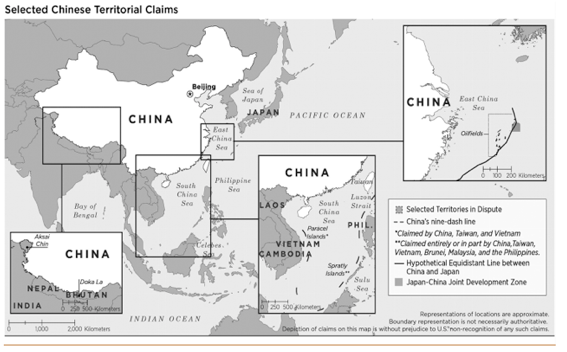
Author reviews different areas of recent Chinese military development and concludes that building of military capable successfully conduct world wide conflict and win in it became clear objective of Chinese leadership. There is also pretty clear formulation of who is considered the enemy, and it is USA and by extension all countries that would refuse to accept China not just as superior power, but also as rule maker and dictator.
Part III:
3.1 “Comprehensive National Power; 3.2 Made in China 2025: Mastering Future Industries and Going Global; 3.3 The Importance of Economic Power: Technology and National Strength; 3.4China’s Economy: Rejuvenation’s Engine;
3.5 China’s Ambitions in Technology and Innovation; 3.6 China Goes Global: State and Private Enterprise Take on the World; 3.7 Toward 2049: China’s Vision of Economic Power
This part is about economic power. Author provides graph representing past, present, and future economic balance of GDP between countries and regions: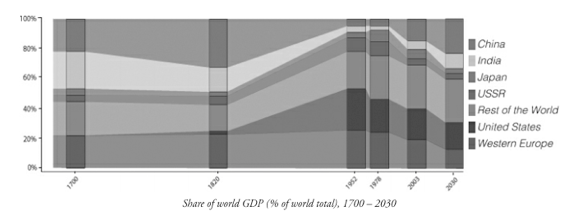
It demonstrates vision of achieving economic superiority by 2030. It is not only GDP, but also technological superiority that Chinese leadership is expecting to achieve. The method used is to transfer technological achievement from other countries to Chine either via purchase or stealing IP, or forcing transfers as price to access Chinese market. So far this worked wonderfully for China allowing it to jump to forefront of technological advancement without spending really that much on R&D.
Part IV: FF Reo “The Ceaseless Expansion of National Interests”: China’s Growing Global Reach
4.1 Overview: China’s Need for the World’s Resources; 4.2 China in The Middle East; 4.3 China in Africa; 4.4 China in Latin America; 4.5 China in the Arctic and Antarctic; 4.6 The Indo-Pacific: The Indian Ocean Region and South Pacific States; 4.7 China And The “Major Powers”: The United States, Russia, India, Japan, and Europe;
This part is about China expansion of its influence around the worlds in search of resources, bases, and vassals. Author moves through all major geographical points demonstrating how it is currently in process.
Part V: “A Community of Common Destiny for Mankind”: China’s Vision for the New World Order
5.1 China’s Vision for World Order; 5.2 A Global “Middle Kingdom; 5.3 “Interior Vassals” and “Exterior Vassals” in the “Community of Common Destiny for Mankind”; 5.4 A World Transformed: A Day in the Life of Chinese Power; 5.5 2049: China’s Vision of a New World Order;
Here is how author presents main question of this part and the answer he provides:
“WHAT WOULD IT MEAN FOR CHINA TO RULE THE WORLD? The answer has been in front of us all along. It has been in front of us as we read the Chinese Communist Party’s statements, observe their strategies and actions, and come to understand the intentions behind China’s ascendency in this century. It is simple: China’s rise, in the minds of its leaders and many of its people, is not a rise, but a restoration. It is a restoration, simply put, of the power and prosperity enjoyed by the Chinese Empire. It is the restoration, as the Communist Party sees it, of an entire world defined by China’s supremacy. Most importantly, both as a political culture and as a civilization, China has plenty of experience ruling a world system. It is from the earlier time of supremacy that much of the character of current-day Chinese political thought and action derives.
“
Author also provides an interesting list of values of Western world that are completely unacceptable to Chinese communist party and are intensively suppressed by all means necessary:
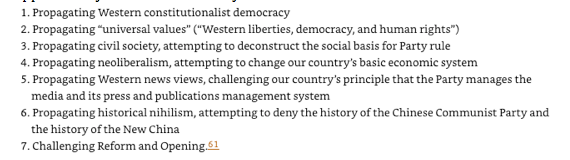
Author also presents a vision of what world would look like if Chinese communist party will be successful in achieving economic, military, and ideological supremacy, and it is not a pretty picture.
MY TAKE ON IT:
To me the author’s warning about China’s ideology and objectives sound quite convincingly. Actually it is not that China specific, as author believes. Russia, Germany, and some others believed in their special destiny as world superpower coming from century or two of humiliations. I appreciate author’s understanding of complete support of Chinese people that party enjoys, which is kind of a feast for an American whose culture built on idea of people thinking for themselves. I also think that China is real and present danger to the free world, but I believe that we are already over the pick of this danger. Reason for my opinion is that China’s superfast growth was not generated by its system or even by its people. It was more consequence of China’s low labor cost and protection from regulations, especially environmental regulations ubiquitous in the Western world. There are a number of factors that made this calculation outdated, not last of which is Chinese leadership’s arrogance in announcement of China’s intentions. All together it lead to wide recognition of danger by the Western politicians and business, which in turn will most probably cut China off Western investment, technology transfer, and access to know how in many areas, most important military. The consequence will be beneficial for China because it will eventually send its Communist part to the same place where Soviet Communist and German National-Socialist parties ended – dustbin of history. The only question is whether it will happen within near term with CCP leadership starting process of peaceful self-dissolution with intermediate transfer to oligarchy or over long Cold War with the whole world consolidated around USA.
20190825 The Global Age 1950-2017

MAIN IDEA:
This is a history book, so the main idea is to narrate events in Europe from the end of WWII until 2017 and do it with reasonably factual approach.
DETAILS:
- The Tense Divide
This chapter is mainly about events of the Cold War, especially when it was getting close to the Hot War. Author describes origins and conduct of Korean War and how it happened that it was UN, mainly USA, against North Korea and China. It also describes creation of NATO, with complex interplay around West Germany and its sovereignty. It followed by creation of Warsaw Pact combining militaries of Soviet Block countries. Finally author describes creation of neutrals like Yugoslavia, Austria, and a few more countries. The narrative then goes through nuclear competition, and process of settling of blocks’ areas of influence, including struggle over West Berlin that was completed with building of the Wall.
The second part of the chapter describes population attitudes to the nuclear weapons, including anti-nuclear movements and Anti-Americanism – both actively supported by Soviets. Author also describes anti-nuclear campaigns in the Soviet block. It is funny how both Western and Eastern Campaigns were directed against American nuclear weapons and neither one against Soviet nuclear weapons.
- The Making of Western Europe
This is about growing cooperation between countries of Western block and European Neutrals. It describes creation of European Economic Community (EEC) in 1957, decolonization, driven partially by liberation movement, partially by democratization of colonial powers, their military / economic weakness, and post-war change in population attitudes to colonialism. Author also describes various ways of accommodation between popular socialist ideology, capitalist economy, and democratic policies in Western countries. Author goes through details of this by regions and some big countries: Southern Europe, Scandinavia, Italy, Britain, West Germany, and France.
The second part of the chapter provides more details on “Imperial retreat” of UK during Egypt crisis and Suez mini-invasion. Similarly French fight in Alger and Vietnam also discussed. The chapter ends with funeral of Churchill in 1965, which could be considered the end of colonial era and after the war consolidation of western democracies.
- The Clamp
This chapter is about another consolidation – consolidation of Soviet Empire and non-democracies in Eastern Europe. Author starts with rejection of usual characterization of events after death of Stalin in 1953 as “thaw”. He provides different analogy – the Clamp. This clamp was somewhat loosened in late 1950s leading to emergence of some non-compliance with soviet ideology ranging from unionist movement in Poland to revolution in Hungary, all of which were suppressed.
Loosening the Clamp: The Soviet Union
This part is about internal Soviet loosening under Khrushchev when Stalin was denigrated, his terror methods and Cult were condemned as anti-party activities, and some very limited freedoms were allowed. Contrary to Khrushchev’s and his mainly young supporters believes the loosening of the clamp did not lead to increase of popular support and prosperity, but rather led to the situation when demand for improvement by far outstrip actual improvement in quality of live. Under Khrushchev soviet people leaved better than at any time since 1917 when communists took power, but they used newly acquired relative freedom of speech to express unhappiness as never before. Eventually this led to removal of Khrushchev from power and reestablishment of dictatorship, albeit in much less murderous form.
Yugoslavia’s ‘Heresy
Here author describes clash between Yugoslavia dictator Tito and Stalin, which caused this country to move out of the Soviet Block and find some place between blocks, accommodating communist dictatorship internally with semi-market economy and economic and political interaction with the west. Probably most interesting here was ability of Tito to suppress ethnic enmity between different groups of population and non-conformist movements, providing for relatively prosperous society, at least during Tito’s lifetime.
Tightening the Clamp: The Soviet Bloc
This part describes how Khrushchev’s “loosening of clamp” was perceived in different countries of the Soviet block and how it was eventually tightened up, in some cases by using military power.
- Good Times
This is about prosperity of Western Europe in 1960s. One of the signs was that by 1963 West Europe exported twice USA share of the world manufacturing exports. Author describes how it happened, emergence of consumer society in the West Europe and massive move of integrating economies into one European market. This move included Marshal Plan under European Recovery Plan of 1947, creation of Organization for European Economic Cooperation (OEEC) by sixteen European countries, establishment of the Council of Europe in 1948, creation of the European Coal and Steel Community (ECSC),
and many other steps. The relations not always were smooth, and author discusses multiple problems and their resolution.
- Culture after the Catastrophe
This is about cultural development in Western Europe after the war. Author discusses pop music, rock n roll, and other art forms. The common feature for all was the breaking with the past and movement not only to the new form, but also to the new values. Instead of prevailing before the war nationalism new antimilitarism become the trend. There was also massive movement away from organized religion in the West. Overall the society had become more tolerant and liberal, but far less cohesive.
- Challenges
This chapter is about youth revolt against capitalism and traditional society in 1960s. Author discusses in details protest movements that got to the point of quasi-revolution, with some elements of society resorting to terrorism. Mostly it is about protests in Germany and France conducted by students with little support outside universities, which did not create real existential threat to Western society. It was different in the East were every easement of repression caused generation of movement to democracy, which had to be suppressed with open use of violence, as in was with Prague Spring in 1968.
- The Turn
This chapter is about the end of prosperity of 1950-60s that started with Arab embargo and oil crisis of 1973. It caused breakdown of economy in practically all-Western countries including USA. It went through monetary crisis, which removed gold standard then moved to deep recession caused by labor and other economic relationships build in the years of after was prosperity driven by cheap resources and need to rebuild after destruction of WWII. It was also very much undermined by generally accepted ideas of socialism or at least social democracy with its welfare state and multitude of benefits for not working. Eventually democracy triumphed in the West, causing communist powers to lose hope for the world revolution and recognize that their own economies can barely survive on their own. It was also political recovery of the West with Reagan and Thatcher turning decline around and making their respective countries more powerful than ever.
- Easterly Wind of Change
This chapter describes the beginning of end of Soviet empire. Prompted by new assertiveness of the West, natural process of old soviet leaders dying out, and general stagnation of economy, soviet elite decided to promote new leader – Gorbachev whose career raised mainly after Stalin’s death and by all accounts was true believer in socialism. The problem was that this true believe was so far from reality that each and every effort of Gorbachev to revive economy and political live of Soviet Union ended in disaster. Author nicely demonstrates that West went out of its way to help, rather than to use situation to win. They provided loans, political support, and very positive media coverage, but to no avail. The corrupt socialist system underwent improvement attempt by a bunch of true believers was doomed and consequently fallen apart. Author also discusses political and cultural developments of this period in western countries noting that new trend brought in by computerization started to have impact on everyday lives of people.
- Power of the People
This chapter is retelling the story of soviet satellite states crumbling without support of soviet military, because they had no support from their own population, which considered themselves under soviet occupation. Among this suddenly found freedom the great reshuffling of Europe occurred: Germany was reunited, while Czechoslovakia split into two. Soviet union itself was split into 15 countries, some of which like Ukraine came to existence first time in history, while others like Baltic States just restored independence they had before WWII. Author also describes reaction of western intelligentsia, not a few of which members mourning Soviet demise.
- New Beginnings
This chapter is about early consequences of Soviet empire demise and it starts with discussion of Balkan’s bloody civil war between parts of Yugoslavia. The second part of chapter is mainly description of process of coping with the ideological blow that western social democrats went through. For some countries like Germany it was difficulties of assimilating former socialist population of East Germany into contemporary world. This period ended on September 11 2001 with massive terrorist attack against USA.
- Global Exposure
This chapter describes events of the first part of XXI century that included global war against Islamic terrorist movements, globalization problems when opening of Western for Chinese products produced with Western capital and technology very cheaply due to cheap labor and absolute neglect of all and any environmental and legal restrictions imposed on western businesses by politicians. The obvious result was huge deprivation of working and middle classes in the West that by the second decade of XXI century started creating populist movements against globalization. Other issues author discusses a lot are EU problems. These were caused by typical for all socialists drive to move all decisions up, in this case to the EU leadership at the expense of localities. Finally author brings in “Putin factor” discussing partial economic and military revival of Russia with some aggressive actions against neighboring countries.
- Crisis Years
The final chapter describes financial crisis of 2008 and its consequences: massive bailout of bank, deep economic recession, austerity politics of debt overloaded countries, and such. The final point is about even more profound consequences of globalization including migrant issue, terrorism continuity, and finally political change in form of Brexit.
MY TAKE ON IT:
It is an interesting narrative of events that I lived through, so it all is very much familiar staff for me, especially starting in 1960 when, as any other 7 years old in Soviet Union, I solemnly promised to Soviet people and personally to Nikita Sergeievich Khrushchev to work and fight for the cause of Communist Party. This book looks at events mainly from social democratic point of view, but generally it is even handed, so this book is not screwed too much in any direction. It provides lots of information that would be very surprising for this 7 years old and I am sure that if he knew even a small part of the evil that was Communism, he would never promised to support it. As to the Western democracy, if looked at it as a stand alone system, it is far from perfect and even slightly below decent, but in comparison to the Evil of Communism / Socialism it looks like shining summer day vs. dark and cold winter night.
20190818 – The Human Network
MAIN IDEA:
The main idea of this book is to present contemporary understanding of human networks, how they are formed, behave, and facilitate relationships between people, including information dissipation, contagion, and power distribution between nodes. Lots of attention assigned to homophily – human tendency to attract to similar people as self and repulse dissimilar, and how it lead to polarization between groups of people. There is also discussion of “wisdom of crowds”, which depends on quality and diversity of the crowd as network, and intergenerational income mobility as result of maintenance of family networks across generations. Finally author presents his attitude to globalization as dramatic change in networks with some very significant consequences that may or may not be beneficial or dangerous.
DETAILS:
- Introduction: Networks and Human Behavior
It starts with reference to the beginning of Arab Spring and the role of human networks in it. Author aims to discuss: “two different perspectives: one is how networks form and why they exhibit certain key patterns, and the other is how those patterns determine our power, opinions, opportunities, behaviors, and accomplishments.”
After that author provides examples of human networks in school, graphically demonstrating how networks split:
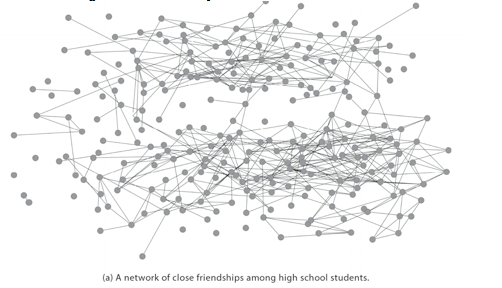
2. Power and Influence: Central Positions in Networks
In this chapter author discusses various position in networks, stressing importance of central position. Here is another graph demonstrating this point:
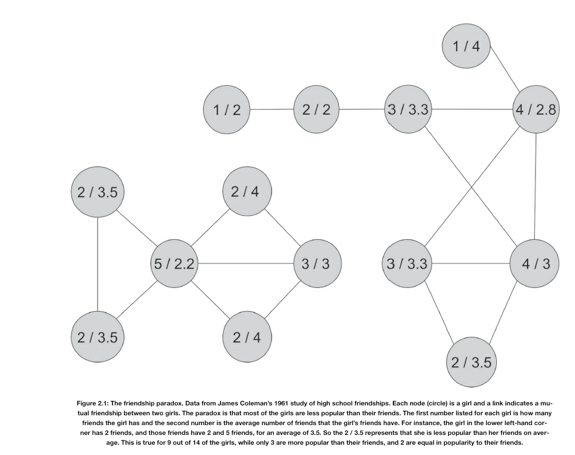
Author then discusses issue of centrality of individual in network and how it creates or undermines power. He provides a nice historical example when superior network led to the victory in power struggle:
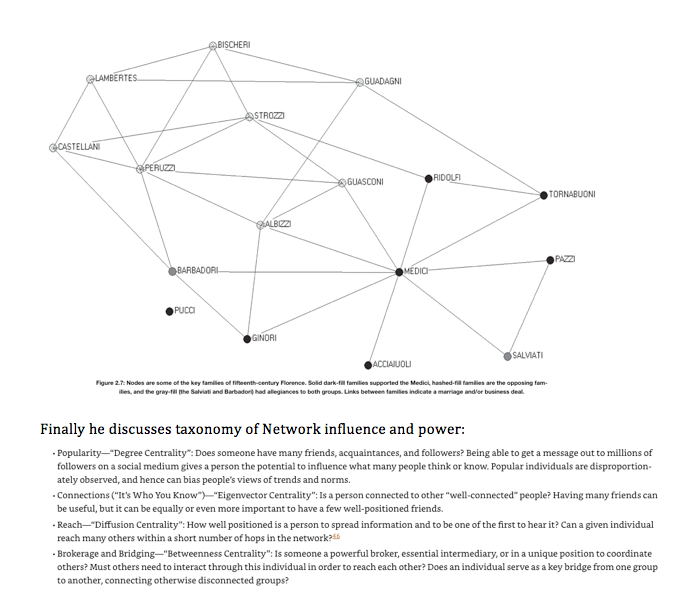
3. Diffusion and Contagion
This chapter is about diffusion and contagion between different nodes in network. It starts with discussion of diffusion of plague and sexual diseases in networks of medieval Europe and contemporary school. Then author moves to vaccination and similar externalities that could impact the contagion process. He also discusses such measures as quarantine and their deficiencies.
4. Too Connected to Fail: Financial Networks
Here author expands these ideas to financial network discussing how failure of some financial institutions prompted failure of others during financial crisis of 2008. Here is graphic representation of the idea that distributed network is more stable than one that relies on a few core institutions:
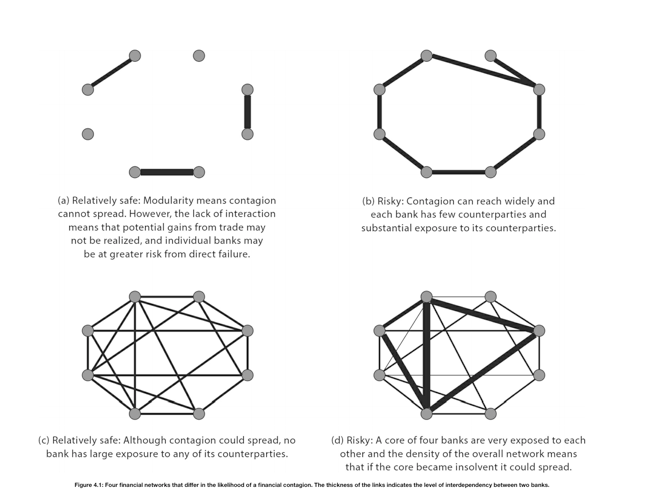
Author then discusses regulation and externalities and poses the question whether crisis was like domino with pieces causing the fall of each other or like popcorn when conditions of market caused the individual pieces to pop up at approximately the same time, even if they were independent from each other.
5.Homophily: Houses Divided
Homophily here means love for people like self with rejection of people unlike self. Author uses Indian caste system to discuss separation of one village network sub-networks by caste. After that he discusses process of self-segregation and Shelling’s model of this process. At the end of chapter author discusses negative impact of segregation levels on overall productivity of society as expressed by GDP per capita,
6. Immobility and Inequality: Network Feedback and Poverty Traps
Here author discusses intergenerational income mobility in inequality using Gini and demonstrating how it changed over time:
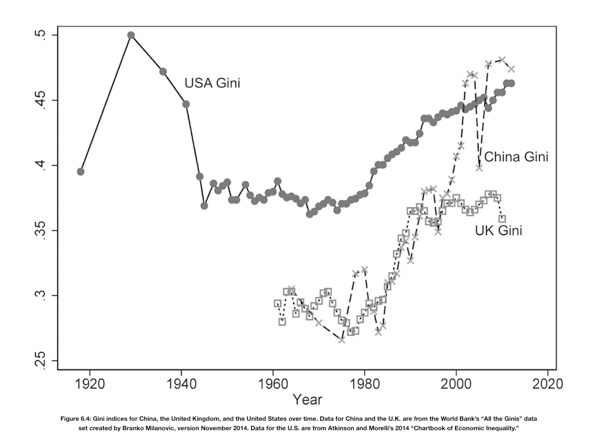
He also looks at reasons for these changes that he finds in educational levels, changes in structure of economics when old manufacturing jobs disappeared, and role of job networks, which facilitate acquisition of a preferable place in network for next generation of its members. The chapter ends with call to fight homophily and inequality by increasing transparency of opportunities, providing education so people were qualified to move up and by removing barriers to such mobility.
7. The Wisdom and Folly of the Crowd
This is usual discussion of the wisdom of the crowd and need for diversity that is necessary for such wisdom to occur. Then author discusses polarization of news and political discourse in America, nicely supporting it by comparative diagram of voting patterns in US Senate in 1990 and 2015. The former shows relatively high number of votes cross party line, while the latter much lower number, making contrast very vivid:
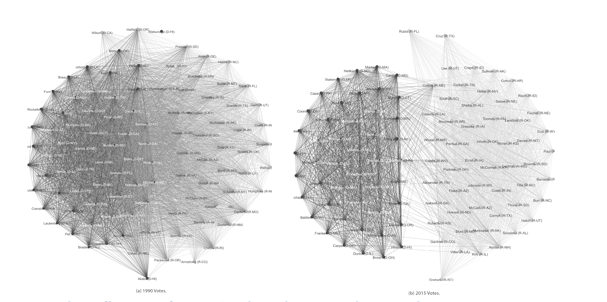
8. The Influence of Our Friends and Our Local Network Structures
This chapter is about human behavior in crowds and the tendency of people to conform to majority. Author discusses different behavior of ants and lemmings, then providing examples of human behavior under carefully designed nudging, and that quite often achieves significant results comparatively with control groups. Author also discusses here clustering when connected nodes of network are linked to each other via multiple connection such as friends of a person are also friends between themselves. Here is a nice graphic presentation of this with and without clustering: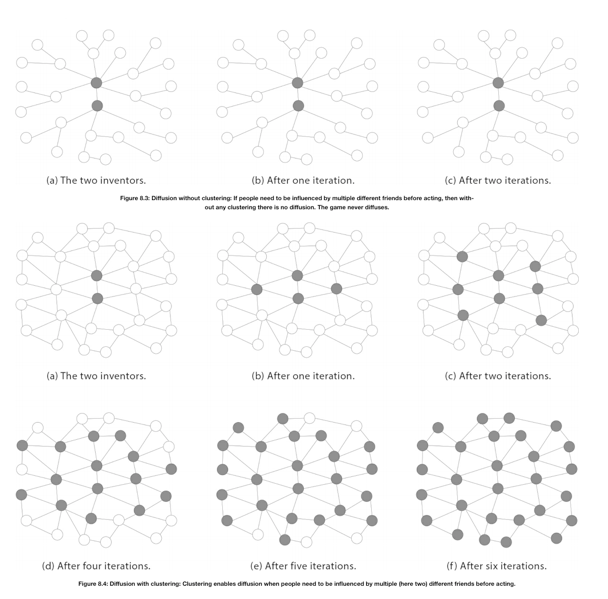
9. Globalization: Our Changing Networks
The final chapter is a look at contemporary world with extensive globalization when massive trade networks growth coincided with decreases in wars and increases in global GDP. To demonstrate increase of networking between countries author provides graph of military alliances from 1875 till now:
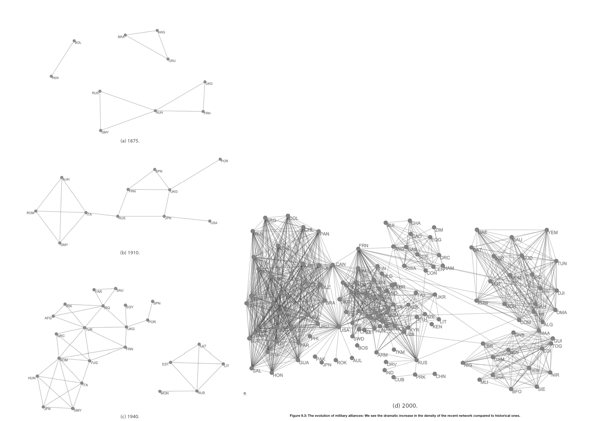
However the final thoughts are about disruptions, especially massive urbanization that dramatically increased density of networks, but also created conditions for growing impact of homophily and resulting polarization, which potentially could lead to explosion. Author ends by calling to develop better understanding of human networks and externalities so humanity could avoid such explosion and continue increase in productivity that linked to increase in networking.
MY TAKE ON IT:
It’s a nice book with decent set of facts and experiments description that provides more or less good picture of current understanding of human networks, their functionality, and impact on human relations and power distribution. Generally I think that presentation is correct, but it is somewhat minimalistic on the role of human individuals and their self-understanding and formation that has huge impact on functioning of networks. This leads to overuse of homophily as explanatory method for behavior of both networks overall and their human nodes. I believe that this is not exactly correct, and such thing as political polarization comes not from individual attraction / repulsion, but more for commonality of interest as they are perceived by individuals.
20190811 – Invisible Influence
MAIN IDEA:
The main idea of this book is to present multiple experiments demonstrating how human decisions are influenced by society surrounding individuals and how these individuals often do not understand or recognize this influence. It is also reviews human strive to differentiate self from others, but not too much, so one would find goldilocks’ place in live. Finally it is also to demonstrate how understanding of social influence could improve attempt to change behavior of some individuals, specifically poor so they would become more productive and successful in handling life’s challenges.
DETAILS:
Introduction
It starts with discussion about choices and huge influence of other people on one’s choices. As example author refer to lawyers buying BMW to show off that they belong to the group of people that buy these cars. Author did research and found that people believe that others buy BMW under influence, but not themselves. Another case author discusses is mating, which often occur with somebody close by – coworker high school mate, and so on. Author describes a few experiments that support that: “The idea that mere exposure increases liking may seem strange at first, but it has actually been shown in hundreds of experiments. Whether considering faces in a college yearbook, advertising messages, made-up words, fruit juices, and even buildings, the more people see something, the more they like it. Familiarity leads to liking.” Moreover he demonstrates that people could be reliably influenced without recognizing so. For example a set of words presented before reading personal description could define whether described person perceived positively or negatively, even if the description remains the same. After that author provides a brief description of each chapter.
- Monkey See, Monkey Do
Chapter 1 explores our human tendency to imitate. Why people follow others, even when they know the answer is wrong. Why one man’s soda is another man’s pop. How mimicking others can make us better negotiators. And why social influence makes Harry Potter and other blockbusters hard to predict, even for industry experts.
Author discusses here Ash’s experiments and similar experiments by Sharif demonstrating power of conformity. After that he digs into reasons for conformity, which he defines as need for information from others, need for social cohesiveness, and need to synchronize emotions to increase effectiveness of collective action. From here the discussion moves to negotiations when mimicry improves chances of success. At the end of chapter author makes a very interesting take on popularity noting that it is actually random event when some initial variance makes an item a bit more popular than other similar items, resulting and higher chances of additional attention, which increase popularity, turning it into snowball. He provides an interesting example with cars on empty parking lot. Whatever side of lot the first car use becomes more attractive to the next driver, so cars tend to concentrate around the first one parked. The final important point is that even the lonely dissident could free people from internal need for compliance, which is very well demonstrated in the same Ash experiments.
2 A Horse of a Different Color
Chapter 2 examines the drive for differentiation. Sometimes people jump on the bandwagon and follow others, but just as frequently they jump off once it gets too crowded. We’ll discuss why most sports stars have older siblings, why babies all look the same (unless they’re ours), and why some people want to stand out, while others are happier blending in.
So per author first born get more parents attention so they do better academically, but younger children are better in athletics because they are looking up to older siblings. Author describes a number experiments demonstrating that decision making highly dependent on what other people do. However he also points out to nonconformist behavior and individualism specific to American culture. Finally he discusses how all this used in sales providing people with goods that are unique and similar to everybody’s goods at the same time.
- Not If They’re Doing It
Chapter 3 starts to explain how these competing tendencies combine. Whether we imitate others or do something different depends in part on who those others are. We’ll discuss why expensive products have fewer logos, why companies pay celebrities not to wear their clothes, and why people pay $300,000 for a watch that doesn’t tell time. Why skin tone affects school performance and why small green frogs are the counterfeiters of the animal kingdom.
Here author discusses dog that was not barking, signaling with example of changing business use and people signaling belonging to something like ideology. As example of pure signaling he discusses extremely expensive watch that does not show time.
- Similar but Different
Chapter 4 examines the tension between familiarity and novelty, and the value of being optimally distinct. We’ll learn why prototypical-looking cars sell better, what chickens have in common with the thirtieth president of the United States, and why hurricanes influence the popularity of baby names. Why modern art might seem grating the first time we see it, but why, after looking at a couple Picassos, Kandinsky are more pleasing on the eye.
Here author also discusses goldilocks effect and how to get it exactly right for promoting something new – hide nature of radically new under disguise of something old and familiar so people would feel comfortably to try. If trial is successful, the advantages of the new could attract people to implement this new in their lives.
- Come On Baby, Light My Fire
Chapter 5 illuminates how social influence shapes motivation. Why having other people around makes us faster runners but worse parallel parkers. How our best chance at saving the environment may come from watching our neighbors. What cockroaches can teach us about competition and why losing at halftime makes professional basketball teams more likely to win
.
It starts with experiment on cockroaches demonstrating that even for them social influence has impact: on simple task performance improves, on complex task performance deteriorates. People are the same. So author describes how he and his team apply it to nudge people to decrease electricity use. After that there is interesting discussion of specificity situation when loosing in the middle of game sometimes increases chances to win the game overall, but in some other cases makes people to give up and then loose catastrophically. Author also discusses a bit visual versus audio perception and how to use this and other discoveries to control people and prompt them to act enthusiastically to achieve objectives of controller.
Conclusion: Putting Social Influence to Work
In conclusion author retells sad story of public housing in USA, which was created to eliminate slums and become slums themselves because they were build in poor areas for poor people, so the nature of social influence led to behavior that makes people poor. However when new approach was tried to move poor people into middle class area with vouchers in small numbers, it worked much better because new social influence was prompted behavior that moves people into middle class.
MY TAKE ON IT:
It is one of this books usually written by psychologists and sociologists that seek to understand impact of environment on human behavior, consequently using it to control and direct other people to behave the way controller wants them to. I do not believe that it is possible. The experiments and anecdotes provided in his book are mainly true and they do represent reality. However what is missing is the understanding that reality is very dynamic and so is human perception of reality, making it impossible to control people’s behavior with reliable levels of predictability. As author correctly notes there is mix of needs to conform and to be different making the very fact of interference highly impactful on results. In my opinion it all is pretty good for understanding, but of no use for controlling.
20190804 – Good Reasons for Bad Feelings
MAIN IDEA:
The main idea of this book is that current development of scientific thought is more and more conducted based on evolutionary understanding of biological and specifically human development, which is fully applicable to understanding of mental diseases and disorders. Author reviews results of multiple studies of mental and emotional disorders in view of his experience as clinical psychologist and concludes that evolutionary approach does promise to achieve much better understanding of these problems and possibly define good direction for finding fixes.
DETAILS:
Preface
Here author describes his interest in application of evolutionary biology to explanation of mental diseases. Author is practicing psychiatrist and he is disturbed by slow progress in this area. So he is trying to use the new approach and believes that its fundamentally new perspective could be instrumental in finding solutions.
Part One: Why Are Mental Disorders So Contusing?
- A New Question
Author starts with description of one of cases he had treated when patient claimed that she cannot get consistent explanation of reasons for her problems and 4 different medical professionals provided different recommendations. This led author to understanding that psychiatry is quite confused. After that he discusses difficulties of mental diseases diagnosis and story of DSM from 1 to 5. He discusses relation between process of evolution functioning of human brain and refers to Tinbergen’s 4 questions:
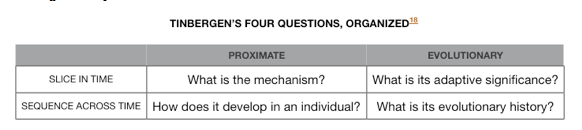
Author also adds another question: “Why did natural selection leave our bodies with traits that make us vulnerable to disease?”
- Are Mental Disorders Diseases?
Here author continues discussion of diagnosis and posits question about nature of mental disorders. He looks at development of sequential DSMs in search of truly scientific definition but could not be satisfied with this. Here is how he defines the problem: “The core problem for psychiatric diagnosis is the lack of a perspective on normal useful functions that physiology provides for the rest of medicine. Internal medicine doctors know the functions of the kidneys. They don’t confuse protective defenses such as cough and pain with diseases such as pneumonia and cancer. Psychiatrists lack a similar framework for the utility of stress, sleep, anxiety, and mood, so psychiatric diagnostic categories remain confusing and crude.
“
- Why Are Minds So Vulnerable?
Here author provides 6 reasons and discusses them in detail:
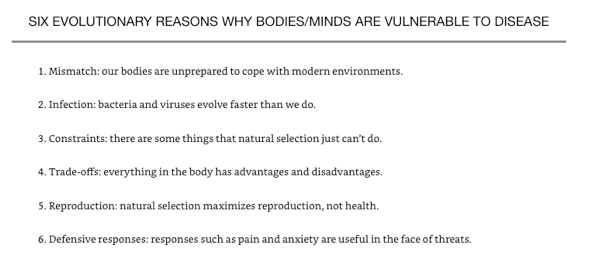
Part Two: Reasons for Feelings
4 Good Reasons for Bad Feelings
Here author discusses evolutionary meaning of bad feelings and here they are: “four good reasons for thinking that symptoms have evolutionary origins and utility. First, symptoms such as anxiety and sadness are, like sweating and coughing, not rare changes that occur in a few people at unpredictable times; they are consistent responses that occur in nearly everyone in certain situations. Second, the expression of emotions is regulated by mechanisms that turn them on in specific situations; such control systems can evolve only for traits that influence fitness. Third, absence of a response can be harmful; inadequate coughing can make pneumonia fatal, inadequate fear of heights makes falls more likely. Finally, some symptoms benefit an individual’s genes, despite substantial costs to the individual.
“
Author also provides definition of emotions:” Emotions are specialized states that adjust physiology, cognition, subjective experience, facial expressions, and behavior in ways that increase the ability to meet the adaptive challenges of situations that have recurred over the evolutionary history of a species.” Finally he provides graphic representation and table:
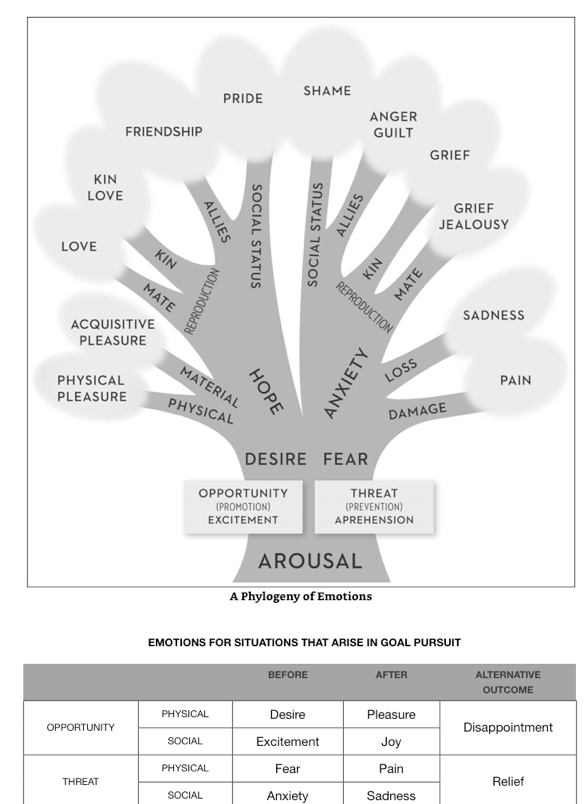
- Anxiety and Smoke Detectors
Here author concentrate on specific type of emotions that cause lots of psychiatric problems – anxiety and discusses different varieties of it from phobias to PTSD:
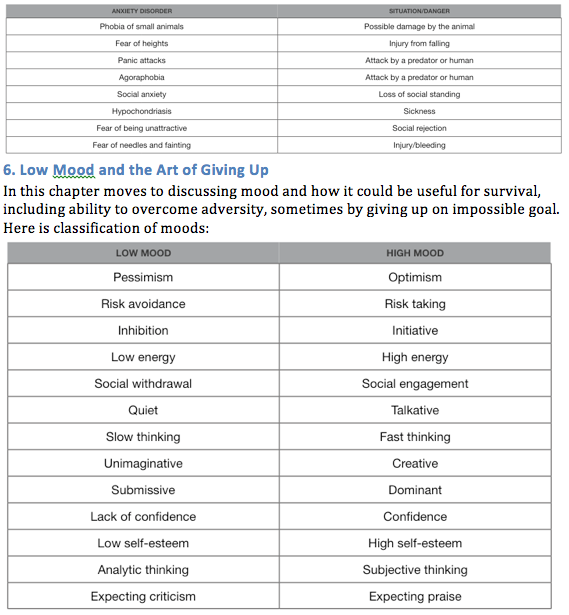
He even applies apparatus from economics – The Marginal Value Theorem, to demonstrate how mood helps to obtain optimal time / effort allocation when picking up berries:
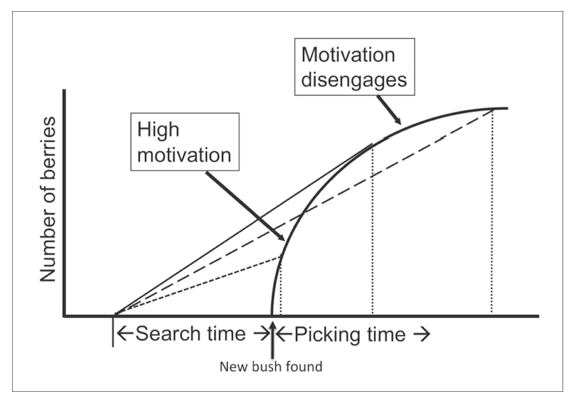
The final inference: “the capacity for mood can be said to have a general function: mood reallocates investments of time, effort, resources, and risk taking to maximize Darwinian fitness in situations of varying propitiousness. High and low moods adjust cognition and behavior to cope with propitious and unpropitious situations.”
- Bad Feelings for No Good Reason: When the Moodostat Fails
Here author moves to the area of pathology when mood variations incapacitate person either by depression or bipolar disorder or by some other malfunction. Author provides general description of such malfunctions:
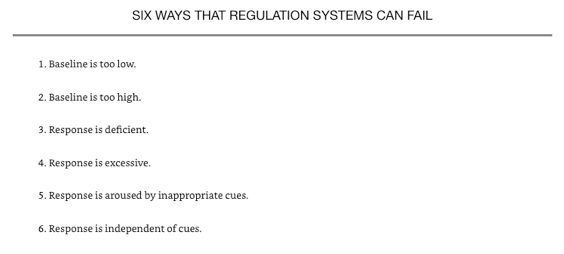
Part Three: The Pleasures and Perils of Social Life
8 How to Understand an Individual Human Being
Author begins this chapter with the story of his experience when in the morning he did analytical jobs with numbers and parameters of multiple patients and in the second half of the day he worked with individual patients. He found it very hard to reconcile these two experiences. Eventually he understood that it requires two different approaches: “Explanations based on general laws that are always true he called nomothetic (nomos refers to laws, thetic to a thesis). Explanations based on historical sequences that occur only once he called idiographic (idio refers to individual unique events, graphic to description). “ It helped him to embrace the idea of psychiatric analysis based on live events, even if reaction to similar events is idiosyncratic depending on values, personality, and experience. Author also provides the breakdown of environment impacting individual into various social systems, emotional states, general and specific sets of influences:
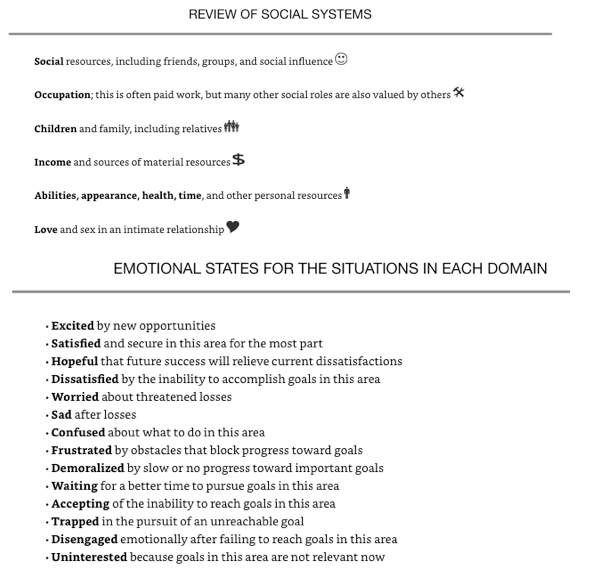
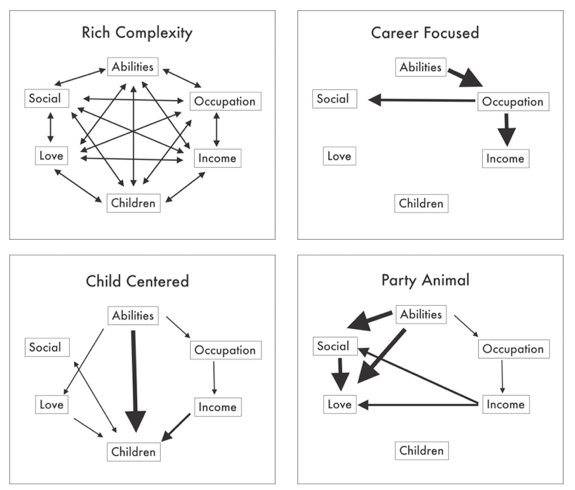
- Guilt and Grief: The Price of Goodness and Love
This is about cooperation between people and emotions it creates. Here is how author summarizes its origins:” (1) Benefits to groups of unrelated individuals cannot explain the evolution of extreme human social abilities. (2) Benefits to kin who share the same genes explain most altruistic behavior. (3) Much apparent cooperation among nonrelatives is just individuals doing things that help themselves and that also happen to help others. (4) Extensive cooperation among nonrelatives is explained mostly by reciprocal favor trading. (5) Reciprocity systems shape costly traits for establishing a good reputation. (6) The previous five explanations explain most social behavior in most organisms, but not quite all. They represent a spectacular fundamental advance in human knowledge even though they cannot fully explain human capacities for commitment and moral behavior. Important additional explanations are offered by cultural group selection, commitment, and social selection“. Then he provides table for links between cooperation and emotions based on prisoner’s dilemma with points for win/loose:
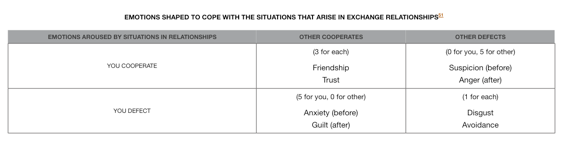
Author then looks at Social Anxiety and Self-Esteem with a bit of discussion about psychopaths and their specifics. The final discussion of this chapter is about Grief and research on older couples that demonstrated surprising ease with which many people were able overcame it after a few months since the loss. Interesting point author makes about anniversaries. Often people experience unexplained sadness until they realize that it is anniversary of loss.
- Know Thyself—Not!
Here author refer to psychoanalysis, which he considers debunked and admits that there is something to its idea of repression. Then he proceeds to discuss psychological studies of the adaptive unconscious and how to access one’s own motives and emotions.
Part Four: Out-of Control Actions and Dire Disorders.
- Bad Sex Can Be Good—for Our Genes
Author starts with the sexual fantasy of the world in which everybody finds ideal partner and has perfect sex with them. Then he moves to discuss partner selection and its evolutionary meaning. On the side he provides evolutionary explanation of homosexuality as option exercised by family oriented species in conditions adverse for new family creation. In birds it means adults cold not build viable new nest and stays with parents providing support to siblings, consequently supporting 50% of their DNA. Author also discusses here sex frequency in marriage and problems when it is out of synch between partners.
- Primal Appetites
This chapter is about eating problems that author characterizes as failures of homeostatic control systems. From this point of view obesity is similar to the great many other diseases. He then discusses contemporary environment, which is very challenging to humans because of technological enticement of various kinds from candies and junk food to pornography and sex robots.
- Good Feelings for Bad Reasons
This is about people who consciously choose self-harmful behavior, which nevertheless satisfies their needs to feel good and enjoy whatever this behavior produces from alcoholic stupor to venereal diseases. He then discusses evolutionary meaning of drugs production by plants and use of drugs by humans.
- Minds Unbalanced on Fitness Cliffs
In this final chapter author discusses reasons for mental diseases and hopes for DNA decoding to fix everything that were dashed in the last 20 years. He then provides a graph for the Standard model of evolutionary fitness followed by Cliff-Edged model:
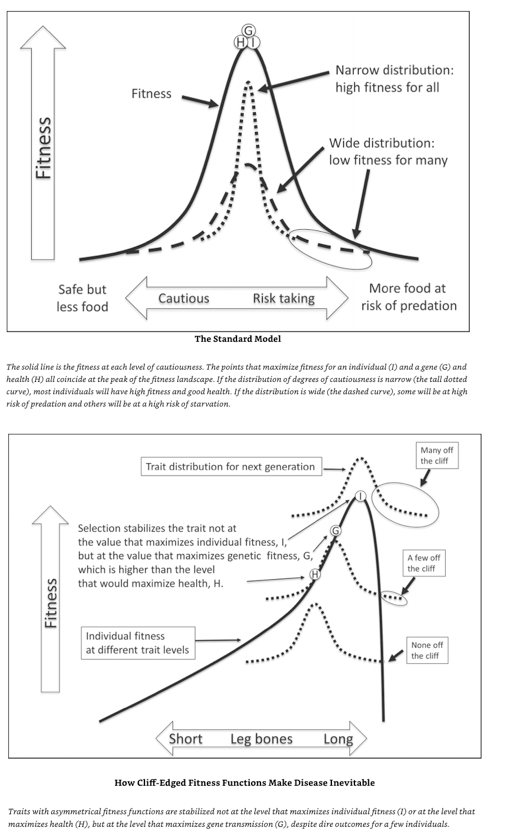
Epilogue: Evolutionary Psychiatry: A Bridge, Not an Island
The epilogue discusses Evolutionary Psychiatry as bridge between evolutionary biology and psychiatry, which is valuable for two reasons: “In the long term, an evolutionary perspective will transform our understanding of mental disorders in ways that lead to better treatments. In the short term, evolutionary perspectives can be somewhat helpful even now.” This helpfulness comes in the form of Cognitive Behavioral Therapies and better understanding of various disorders by psychiatrists.
MY TAKE ON IT:
I think that evolutionary approach is much wider than pure biology. It also applies to information systems, technology, sociology, and all other areas in which there are systems, continuously changing whether randomly or not with following up test for fitness. So it could and should be applied as major methodological tool to research and understand human beings and their mental conditions. I think that most productive way would be longitudinal studies on individuals throughout their lifetime to identify periods of perfect functioning, some positive or negative deviations, and dynamics of changes from one state to another. The treatment of mental problems without knowledge of what is normal for the specific individual is like trying to repair car without knowing its make, year, mileage, and details of how it normally works. Humans quite a bit more complicated, so need much more data collection to understand how individual psyche works when it is OK and what variation from this OK state developed that makes it fail.
20190728 – It’s Only a Joke, Comrade
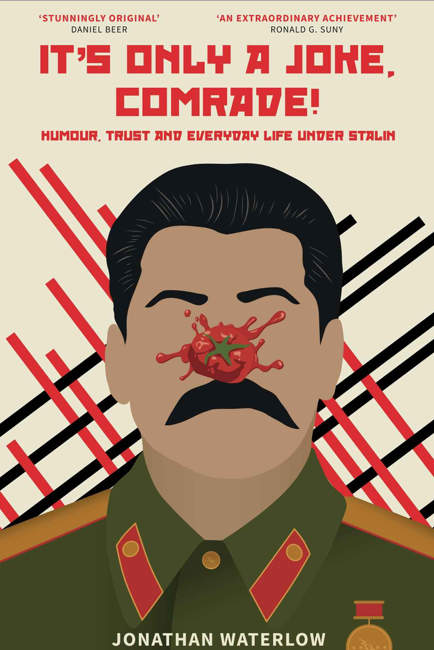
MAIN IDEA:
The main idea of this book is to use history of humor in Stalin’s Soviet Union to analyze human need for agency in live, which is so important that people still were telling all kind of jokes unacceptable for soviet authorities even when there was real and present danger of being imprisoned or even shot as a consequence. Author also analyses what kinds of jokes were told and psychological reasons for each of them. Finally an important part is rejection of dualism when historians look for support / resistance for regime. Author believes that people mainly supported regime, but had to resolve to humor when contrast between official propaganda and personal experience was too big and people needed some reconciliation between these two.
DETAILS:
Introduction
Here author briefly describes the story and reasons he become so interested in jokes telling in totalitarian society. He describes political and economic situation of Soviet Union in 1930s and response of extremely suppressed people expressed via all kind of humor. Author also introduces notion of Crosshatching, which he applies to situation, trying to demonstrate how intersection of the dominant official and suppressed, but not eliminated unofficial discourses, values, and assumption created complex mix of soviet live.
PART 1: TAKING LIBERTIES
Chapter 1: Kirov’s Carnival, Stalin’s Cult
This chapter “explores the myriad ways Soviet people dethroned their leaders and brought them down to earthy reality, from the quietly subversive to the raucously sexualised and scatological, focusing on the irrepressibly carnivalesque responses to the murder of Leningrad Party boss Sergei Kirov in December 1934. “
Author characterizes is as kind of counterculture that provided people with some space to at least partially get away from official craziness.
Chapter 2: Plans and Punchlines: ‘The anecdotes always saved us’
Here is how author characterizes function of humor of the time: “At first glance, humour might seem anathema in such dark days, but, as Chapter 2 shows, in fact this was precisely when it was needed the most. From the Five-Year Plans to the bloody collectivization campaign, an endless slew of mandatory state loan subscriptions, and the growing suspicion that their blood, sweat and tears might all be for nothing (exacerbated by a truce with Nazi Germany), people’s everyday realities clashed painfully with regime promises. Just as contemporaries used anekdoty to read the regime’s often bloody policies through the incongruous lens of their everyday experiences, they used the blackest humour to cope with the fear of denunciation and the dreaded 3 am knock of the NKVD at their apartment door. People were not struck mute by terror during these years; in humour they found ways to deal with the hardships and uncertainties, rather than standing frozen and isolated in the headlights of the NKVD’s paddy wagons. If humour could not save them from the secret police, it could always save them from despair. “
Chapter 3:Speaking More than Bolshevik: Crosshatching and Codebreaking
This chapter is about specifics of soviet speak – the new language that was strongly promoted by soviet officials in order to wipe out history and even language that existed before communists came to power. However it was not only imposed from above, but also actively supported from below by majority of population who were seeking way to survive in attempt to become truly new soviet person. It proved to be impossible and old (real) way of thinking and talking proved to be quite resilient, creating mix of old and new.
PART 2: JOKING DANBEROUSLY
Chapter 4: Who’s Laughing Now? Persecution and Prosecution
This is about price of humor that people sometimes paid: “Chapter 4 shifts our focus from how joke-tellers perceived the regime to how the regime perceived the joke-tellers. It reconstructs for the first time how the Bolsheviks struggled to control and contain all unofficial humour, and reveals how its perception of humour changed from considering it a blunt instrument to a mind virus, which could infect all but the most ardent ideologues. This was a twisted evolution that was largely opaque to the general population, but even if some people managed to keep up with policy, it might already have been too late. If historians have long known that the Soviet legal system was capricious and unpredictable, the criminal case-files of those convicted for humour reveal that it also practiced retroactive ‘justice’. A joke that seemed acceptable at the time it was told could be reinterpreted months or years later as evidence of counterrevolutionary intent and could land even devoted Party members in jail. In such a climate of uncertainty and unpredictability, even though joke-tellers might know they were taking a risk, they had little chance of judging the true danger of their actions. Even so, the content of what they actually said frequently turns out to have been less important than who they were.”
PART 3: ALONE TOGETHER
Chapter 5: Beyond Resistance: The Psychology of Joke-Telling
This is probably the most interesting and important chapter: what were psychological reasons to say jokes and laugh in the face of death or at least prison term. Here is how author describes it:” Studying an extreme case can highlight elements of the ordinary. Everything exceptional, if it endures for long enough, becomes ordinary – that is, at some level accepted and understood as ‘how things are’. People seek to normalize and adapt to their circumstances – so they can find a degree of stability and predictability as they go about their daily lives – but this is not the same as blindly accepting them. Joke telling could even become a statement of your own existence in this climate of smothering conformity: ‘I joke, therefore I am’. This could be quite practical as well as psychological. Wit and anekdoty did not just pick holes in the fabric of the official world and its claims, but actually began to create new ways of looking at it – unofficial rules, which could help people, get by just a little more comfortably and successfully. These were ways to solve problems and get by within the system, rather than attempts to destabilize or to confront it. In-jokes became a secret language between those in the know, and, while pointing out what didn’t work in the Soviet system, many jokes simultaneously conveyed a kind of clandestine ‘ know-how ’ – hints and tips people shared which explained how to get by to their minimum disadvantage. Barbed as they might be, they were often simultaneously affectionate, expressing a desire that things should work as they were supposed to, rather than writing the system off at large. In this way, they were actively trying to find patterns within the confluence – the crosshatching – of both their own perspectives and official ideology.”
Chapter 6:In On the Joke: Humor, Trust and Sociability
The final chapter is about trust. Author rejects idea of Hanna Arendt that totalitarian system destroys private life. On contrary, author’s research demonstrates that private life become even more important because it was the one area where individual could be save – there were no data found showing family members denouncing each other to authorities. Moreover strong friendships also provided shelter where individuals could express opinions with little fear and doing so satisfy his/her need for at least some semblance of agency.
Conclusion
In conclusion author points out that his research demonstrated that society was not really “atomized” into bunch if individuals trembling with fear. It rather turned into some king of mix of intersecting multiple realities in one of which Soviet Union made huge progress and build superior socialist society, in another reality it was all for show and Soviet Union was the place of massive incompetence, corruption, and suppression in which individuals were telling jokes not that much to undermine regime as to save self-respect and some semblance of control over their lives.
MY TAKE ON IT:
This is a great research on human psychology under totalitarian regime in which ideology, while being generally supported by vast majority, nevertheless was so far away from reality that it was necessary to find some way to diminish cognitive dissonance that was done by using humor and jokes. Far from being method of resistance the humor was method to maintain sanity and reaffirm one’s agency by demonstrating to self and few trusted others ability to see ridiculousness of socialist environment and official propaganda. There is also another point that I’d like to make, which is the use of notion “real”. For soviet people telling jokes there was no contradiction between believing in ideas of communism and laughing over real live implementation of these ideas. The duality is kind of simple: “real communist” was incorruptible, but local party boss was highly corrupt. “Real” socialist plant was super-efficient, but the plant one worked at was super-wasteful. This tolerance of inconsistency was the great achievement of totalitarism, which by suppressing real information and supplying huge amounts of propaganda successfully pushed handling of cognitive dissonance into area of underground humor, consequently preventing population from facing real problem of failing system and extending existence of the socialist system for decades after its economic and ideological bankruptcy become obvious to anybody in possession of real and truthful information.
20190721 – Frontier Rebels
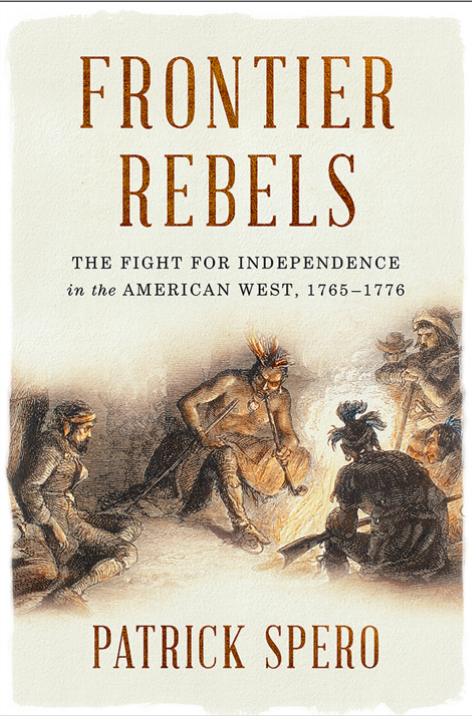
MAIN IDEA:
The main idea of this book is revive memory of mainly forgotten part of American Revolution that was not less or probably even more important than most celebrated revolutionary movement of coastal elites in Boston and New York. This coastal elite revolted against taxes, regulations, and increased government control. The other part of revolution was rebellious movement of frontier settlers who decided that British attempts to accommodate Indian tribes, while refusing provide military protection to settlements makes it detrimental for them, so they started revolutionary fight for independence.
DETAILS:
PREFACE: THE CRISIS OF EMPIRE
This starts with the story of important mission sent in 1765 to Indians by British government under leadership of Robert Callender. The objective was to bring massive amount of gifts including weapons and ammunition to Indians in order to establish firm foundation for permanent peace with American settlements expansion stopping at Appalachia and Indian tribes maintaining complete sovereignty further West. The mission was practically destroyed by resistance of settlers who had no intention to limit their advance and who considered British attempts to stop such advance and settle the border with Indians completely treasonous. They believed that Indians would continue attack frontier settlements in any case. The people who stopped this mission were called Black Boys. Their resistance eventually grew into kind of frontier rebellion that continued on and off until it merged with coastal movement into one American Revolution.
- SETTING THE STAGE
This chapter is about prehistory of main events – the British / French 7 years war in which British were victorious and took North America away from French. However this victory left Britain economically deprived and in need for money. This quite reasonably prompted the Crown to make its colonial subjects to help with payments for their defense and start looking for settlement with Indian tribes that would sharply decrease needs in such defense. The latter was the main reason to arrange delegation with gifts to Indian tribes in order to convince them in British peaceful intentions.
- THE MISSION
Here author describes preparations for the mission, its main players like George Croghan, and complex machinations between government and private interests used to raise significant money required for the mission. Author also describes attitudes of Indian side somewhat tangibly led by Pontiac who tried establishing peaceful relations with British after French were mainly gone.
- THE CONVOY DEPARTS
Here author describes final preparations, content, and departure of the mission led by Robert Callender – one of Croghan’s business partners. Croghan himself was waiting them at Fort Pitt. The mission on its way moved to Conococheaque – an area close to frontier, were population was well familiar with Indians and was undergoing regular attacks.
- THE ATTACK
This chapter describes actual attack of Black boys against Callender’s mission with destruction of gifts prepared for Indians. It also includes one of the first direct clashes of Americans with British troops. When train came to Sideling Hill Black boys attacked it, but the British soldiers of 42ndRegiment successfully protected the train and disarmed Black boys. British, however, could not prevent destruction of much of convoy’s property. On the Indian side another leader Charlot Kaske did not believe in possibility of accommodation with whites and did all he could to stop new settlements.
- TRANSFORMATION
This is detailed narrative of attack’s consequences when attempt to prosecute Black boys failed because of jury support for them. This story includes lots of legal and executive maneuvering and also some semi military confrontations around Ford Pitt and Fort Charles. It also includes details of Penn’s thinking and his politics of trying to find some way to accommodate both sides: British and settlers, which had directly opposite objectives.
- CRISIS
This chapter starts with the story of capture of Fort Loudon commander lieutenant Grant by Black boys. The main point here was the struggle for settler’s guns captured by British troops in previous confrontation. Author describes general mood of settlers and provides support to this description in form of popular ditty describing these events as clash between patriotic settlers and treasonous authorities that preferred to support Indians against Americans. Author stresses that it was the same period of time in the summer of 1765 when coat cities were boiling excited by Stamp act.
- INDEPENDENCE
This starts with description of Indian, more specifically Pontiac attempts together with Croghan to establish peace and stop settlements. It has a very interesting point about difference in notion of “father” between Indians and British. The former did not perceive it as someone superior in hierarchical order, but rather equal friend. This created confusion when British believed that Indians accept their rule, while Indians believed that it is just agreement coexist in exchange for gifts. Even when British authorities and people like Croghan were dealing directly with Indians, they would be satisfied with formalities because it supported their of objective peace and no more settlements. For them gift to Indians including weapons and ammunition were just a normal condition of peace. For settlers peace would mean complete cessation of Indian attacks against settlements, which settlers did not believe to be possible, so any transfer of weapons and ammunition to Indians meant treason of authorities against them. Therefore logically dependence on British would be detrimental for settlers.
- THE ELUSIVE PEACE
This is narrative of the following events when Penn broke with settlers as result of massacre against peaceful Indian tribe by Frederick Stump. Initially disgusted, by Stump’s actions settlers put him in prison, but their opinion changed when they found that authorities supported his punishment. Consequently mob broke prison and set Stump free. In turn authorities with William Johnson at the head turned against settlers even more. In October 1768 Johnson signed treaty with Iroquois at Fort Stanwix to establish Ohio River as natural border between Indian lands and settlements. As byproduct it included generous land grants to Johnson himself and his deputy George Croghan, making them the richest landowners in the area. It turned out to be not a stable solution.
- DISINTEGRATION
This chapter describes the next confrontation when Black boys start patrolling highways near Fort Pitt to prevent transfer of weapons and ammunition to Indians. Some of them were arrested, leading to Black Boys taking Fort Pitt in September of 1769 and freeing their people. In following encounter the man was killed and Black boys leader Smith was accused of murder. Instead of escaping, he decided to comply with laws, stand trial and was acquitted. Then author discusses legal situation on the frontier, when settlers often ignored directions and legal requirements of British authorities and used their own courts and juries to resolve issues. Especially explosive was their rejection of authorities demand to give Indians the same legal protection as any British subjects. This was so much unacceptable for these British subjects that they start moving in direction of ceasing to be British subjects. The final part of the chapter discusses Indian internal struggle that eventually led to the murder of peace promoting Pontiac and raise of militant Charlot Kaske who believed that no real peace with settlers is possible and just wanted to win military against all odds.
- IMPERIAL FAILURE
This chapter moves to events in 1772 – close to revolution. The British authorities decided to stop protection of settlers and removed a few forts including Fort Pitt. The idea probably was that without military protection settlers exhausted by Indian attack would stop resisting and become much more compliant subjects. Another plan was set into movement was Croghan plan to create new colony: Vandalia. Ironically this plan failed in court when multiple claims on the same land forced administration to drop this idea. Croghan did not give up and continued fight, eventually getting approval for Vandalia in 1775 just when revolutionary war started in Lexington. After that author describes London political events of 1770s and events on the East Coast including Tea Party that made war for independence inevitable.
- REVOLUTION
In this last chapter author discusses events and meaning of American Revolution for the West and events during period of 1777 to 1783 substituted British authorities with new American Authorities, which were a lot less concerned about Indians than about settlers, supporting Western movement all the way to Pacific with Indians being just a bumps on this road that were continuously removed.
EPILOGUE: LEGACIES
This is an interesting part where author somewhat links these events of long time ago with contemporary issues when current American coastal elite, which for all purposes is not that different from historical British elite once again bumped into resistance of lower classes, which are also for all purposes not that different from historical settlers. He specifically looks at issue of guns ownership and control and provides an example of older man explaining to young students that it is not possible to keep freedom if one cannot keep guns to protect this freedom. In his final thought of this book author states that this direct confrontational approach to elite is legacy of American history and revolution and one should not treat it easily because such easy treatment by president Buchanan in 1850s was one of the causes of devastating Civil War.
MY TAKE ON IT:
The author’s recovery of important, but often-missed part of American Revolution provides an interesting material for thought. The cruel and unstoppable movement of European settlers West was inevitably destroying Indian civilization, which was by far inferior numerically, technologically, and organizationally to fight successfully against this movement. I do not see how it could be different, all good feeling and compassion of British elite notwithstanding. For me it is interesting clash between two groups of people belonging to one civilization, specifically British Europeans that developed different believes who should be included into group of “us” and who should be treated as “others”. The settler had not doubt that Indians could not be included into ‘us’, while for elite the contempt and disgust of settlers was strong enough so to include Indians into the group of ‘us’ and suppress settlers who were not agree with this. It is understandable because this disgust of settlers came from somewhat familiarity, while good feelings and admiration of Indians came from the lack of familiarity. One should not discount purely financial consideration. For elite formal land grant meant little because of difficulties to use it, while protection of settlers meant loss of resources for causes elite had difficult time benefiting from. The Indian area free of settlers with clear border and peace meant profits from trade and little need for protection expense. For settlers peace with Indians meant loss of opportunities to acquire new lands and life under constant threat and real attacks every time when their interest clash with Indians. The free trade obviously would mean for settlers to deal with Indians who are well armed and equipped. In short interests of elite and settlers could not be reconciled.
20190714 – The Pursuit of Oblivion
MAIN IDEA:
The main idea of this book is to trace history of drugs use mainly in the Western world, present some technological history of variety of drugs and methods of their use, and use multitude of historical examples to demonstrate that consequences are quite different for different individuals. It is also history of government intervention with drug use, prohibition, and, generally futile, attempts to prevent such use.
DETAILS:
Prologue
Author starts providing definition of various types of chemicals impacting humans psyche:
Narcoticsrelieve pain, induce euphoria and create physical dependency. The most prominent are opium, morphine, heroin and codeine.
Hypnoticscause sleep and stupor; examples include chloral, sulphonal, barbiturates and benzodiazepines. They are habit-forming and can have adverse effects. These side effects are shared with tranquillisers, which are intended to reduce anxiety without causing sleep.
Stimulantscause excitement, and increase mental and physical energy, but create dependency and may cause psychotic disturbance. Cocaine and amphetamines are the pre-eminent stimulants, but others include caffeine, tobacco, betel, tea, coffee, cocoa, qat and pituri.
Inebriantsare produced by chemical synthesis: alcohol, chloroform, ether, benzine, solvents and other volatile chemicals.
Hallucinogenscause complex changes in visual, auditory and other perceptions and possibly acute psychotic disturbance. The most commonly used hallucinogenic is cannabis (marijuana). Others include LSD, mescaline, certain mushrooms, henbane and belladonna.
Then he briefly discusses prohibition and its counter-effectiveness, providing a number of statistical factoids.
ONE Early History
The contemporary story starts in 1670 when English sailors first encountered drug use in Bengal. Then author narrates discovery of opium, cannabis, coca, and other drugs. He also refers to drug use in history starting with Sumerian records, including Egypt, Greeks, Romans, and everybody else.
TWO: Opium during the Enlightenment
This chapter describes use of drugs during Enlightenment when they became a potent part of medical toolset. At the time drugs action was poorly understood so it was used without limitation and author describes numerous real stories of opium users of this period. Some of these users were destroyed by constantly increasing need to have drugs, but many others found some stable level of drug use that practically had little impact on their live, just slightly enhanced their perceptions and alleviated discomforts. The important point here is unpredictability of individual consequences, however with high probability of developing strong dependency.
THREE: The Patent Age of New Inventions
Here author describes significant changes in drug use that occurred beginning in 1820s. Drugs, as everything else, were industrialized being included into multitude of patented medicines and then produced and marketed on the big scale. Author also discusses here Chinese opium wars that were mainly result of economic disequilibrium between China that had plenty of products for international sale like silk and British Empire including India that had little useful for China and therefore paid silver in exchange of goods. It was clearly unsustainable and sale of opium from India was very useful tool to resolve this problem. As elsewhere in this book author narrate a number of personal stories of drug users mainly from the upper crust of British and French societies, once again demonstrating that consequences of drug use are highly individual and range from financial and health ruin to mainly benign enhancement of everyday perceptions, physical conditions, and mood.
FOUR: Nerves, Needles and Victorian Doctors
This chapter is about development of various methods of drug delivery into human body: digesting, smoking, injection and so on. It is also about differences in drug impact depending on the method.
FIVE: Chemistry
This starts with description of coca leaves in recipes of various drinks. Then author describes a wave of Chloral addiction, use of amyl nitrite, and other stimulants.
SIX: Degeneration
This chapter starts with the story of dr. Pemberton – founder of Coca Cola Company. Then it moves to Freud and his unethical behavior promoting use of Coca. It is also about medical use of cocaine to treat depression and neuralgia. Author compares level of addictiveness of various drags, concluding that cocaine is more harmful than opium. It resulted in continuously growing stigmatization of cocaine and its users. Author describes the growing concern about drug use and results of various government commissions reviewing the issue.
SEVEN: The Dawn of Prohibition
This chapter is about beginning of prohibition. Author looks first at Moscow and London where at the beginning of XX century many thousands of patients were treated from addition. One of the interesting points author makes hare is that every new drug developed first was considered non-addictive and was used to wean people out from another drug. He reviews this process in details using development and initial use of heroin as example. About the same time in early XX century first contemporary restriction on drug use begin to apply.
FIGHT: Law-breaking
This chapter is about the history of legal limitations on drugs as it developed from 1919 on in UK and then in parallel in USA: The Jones-Miller Narcotic Drugs Import and Export Act of 1922 further institutionalized and restricted drug supplies. The Porter Act of 1924 prohibited the manufacture and medical use of heroin.
As usual these developments included multiple controversies, but by the end of 1930 elsewhere in Europe and America governments prohibited drugs.
NINE: Trafficking
The production and transportation drugs was probably the first international trade when product cultivation was moving regularly from country to country finding new and new places where government control was very weak as in former colonies or very strong as in communist countries where government itself was the main producer and distributor of drugs to international market.
TEN: The Age of Anxiety; ELEVEN: The First Drugs Czar; TWELVE: British Drug Scenes; THIRTEEN: Presidential Drugs Wars
This was the age after WWII when drugs came into use massively and produced lots of feed to mass media and Cultural Revolution in Western world, which start destroying traditional values substituting sobriety and hard work as models of behavior with search for satisfaction via all means available including drugs. The political and moral reaction was traditional – attempt to forbid and suppress use of drug by police force. Author describes history of this process and multiple personal stories involved. There are a lot of details here, but they are generally retelling the same story of the failure of this suppression.
FOURTEEN: So Passé
The final chapter is about multiple new drug that are getting created all the time, their various impacts on human body and histories of typical loop: creation of the new drug, its penetration through the market, alarms caused by some negative effects like overdose deaths or some other negative consequences, prohibition, and indefinitely ongoing and generally futile fight to enforce this prohibition.
MY TAKE ON IT:
This very detailed and thorough account of history of drug discovery, production, distribution, use, abuse, and prohibition is quite interesting. It provides very good description of how many of drugs work, their impact on human body, and long fight of multitude of authorities in multitude of countries to prevent or stop their use. I generally agree with author that prohibition does not work, but I would go as far as it is possible to allow people to use whatever they want in pursuit of happiness, and if it is just chemical reaction inside of body that make them happy, so be it. I think it is meaningless and cruel to deprive some people of resources they produce in order prevent other people from hurting themselves. I think that example of one of the most potent drug – alcohol is quite obvious: some people never use it, some use it very moderately without any negative consequences, but some destroy their lives with alcoholism. I guess it would be no different with all other drugs, so it would be better allowing people decide what they want and obtain drugs if they want to and medical help to get off drugs if they want to. However I think it is very important that drug use started only when person is adult and can take responsibility of his/her action. Children should be educated at early age about potential consequences with visits to hospitals for addicts so that children had very vivid picture of consequences. Correspondingly pushing drugs to children should be treated as murder, since it does has potential to ruin human life.
20190707 – Government- Industrial Complex
MAIN IDEA:
The main idea of this book is to identify true size of government counting total FTE employees not only of government, but also of contractors and grants recipients. Author intends to demonstrate that American strive to limit government had resulted not that much in small government, but rather in big government-industrial complex in which many government tasks conducted by employees of private companies via government contracts and grants, making it actually less effective and more cumbersome, even more expensive. The solution author proposes is to increase number of government employees so they would do tasks that need to be done and in process actually save money on contracting overhead, complexities, and inefficiencies.
DETAILS:
- A Warning Renewed
“Chapter 1 starts discussion by focusing on Eisenhower’s warnings about the conjunction of what he described as an “immense military establishment” with “a permanent armaments industry of vast proportions” and proceeds to a description of the methods used to calculate the true size of the federal, contract, and grant workforce. As chapter 1 argues, Eisenhower presented a framework for tracking the “unwarranted influence, whether sought or unsought,” of any government-industrial conjunction, large or small, and even outlined a method for measuring the true size of government through head counts of federal employees and funding for contract firms and grant agencies.”
Here author provides description of methodology and results of analysis of head count and functional allocation of government employees in 2017:
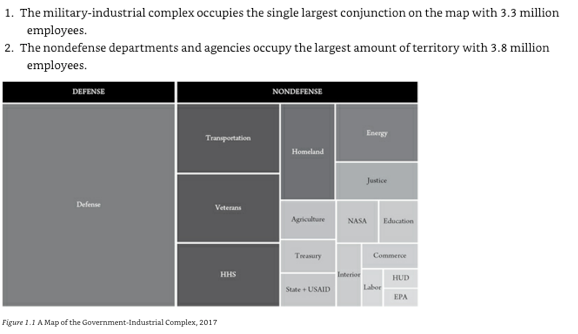
Author also discusses how much there is hidden government-funded employment and provides a comprehensive list of reasons why nobody can even estimate these numbers:
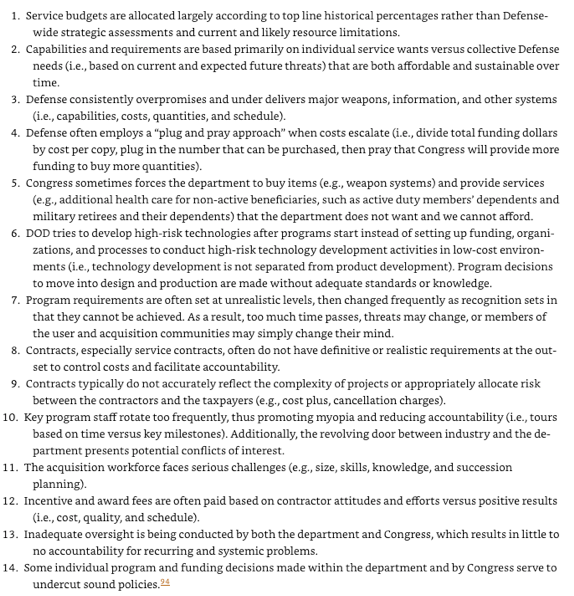
2. The True Size of Government
Chapter 2 explores patterns in the number of federal, contract, and grant employees under Presidents Ronald Reagan, George H. W. Bush, Bill Clinton, George W. Bush, and Barack Obama. The chapter starts with an overview of the measurement challenges in estimating the true size of government, a discussion of threats to accuracy, and a description of an estimating approach based on contract transactions and grant awards. The chapter also offers caveats on using the information and examines the data deficits that currently frustrate efforts to monitor the blended workforces that faithfully execute the laws from both sides of the complex. The chapter then turns to a history of the changing size of government under Reagan, George H. W. Bush, Clinton, George W. Bush, and Obama. Reagan and George W. Bush pushed the total size of government upward during war, while George H. W. Bush, Clinton, and Obama all harvested the peace dividends that followed. The chapter examines each president’s view of the federal workforce and explores patterns of growth and decline as the true size of government surged during war and economic crisis and compressed during peace and recovery. Readers are urged to pay particular attention to Reagan’s role in creating a Cold War peace dividend that reduced the number of employees on both sides of the government-industrial complex. Reagan also helped launch two decades of military base closing that gave his successors enough savings to hope for no new taxes and declare an end to the era of big government. The chapter ends with a quick review of President Donald Trump’s early relationship with the government-industrial complex and ends with a discussion of the federal personnel caps, cuts, and freezes that have done so much to alter the government-industrial balance. Although most of these post–World War II employment constraints had negligible effects on federal employment, they fueled public demand for a government that looks smaller but delivers more and the use of contract and grant employees as a work-around.
Despite difficulties of accounting presented in the first chapter author provides some official data on history of government-funded head counts:
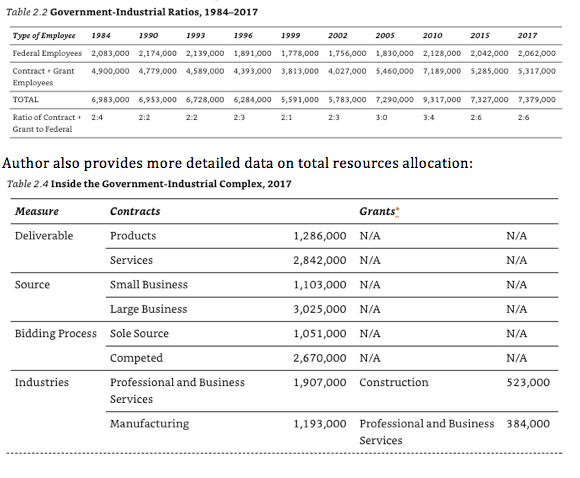
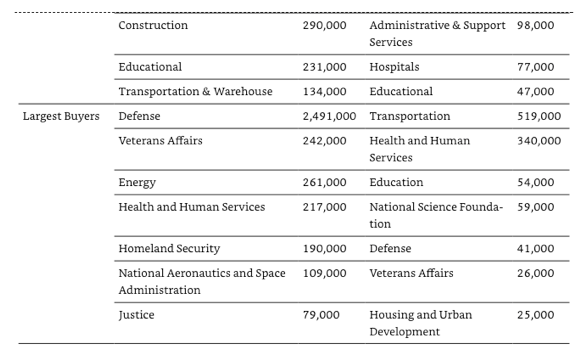
3. Pressures on the Dividing Line
Chapter 3 examines the time limits, bureaucratic constraints, and political realities that drive federal functions and jobs across the dividing line between government and industry. Whether by accident or intent, the fifteen pressures catalogued in the chapter give Congress, the president, and federal officers ample incentive to use contract and grant employees in lieu of federal employees. The pressures also frustrate effective deployment of federal, contract, and grant employees. The chapter ends with a short discussion of the prospects for reducing the pressure through comprehensive reform.
This chapter is also interesting by author’s analysis of differences between direct and indirect government-funded employees. Here is result of one research:
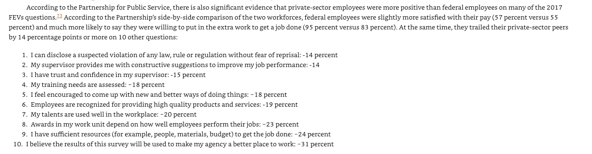
Another interesting part here is the example of bureaucratic structure that includes some number of layers in bureaucracy and people that occupy them:
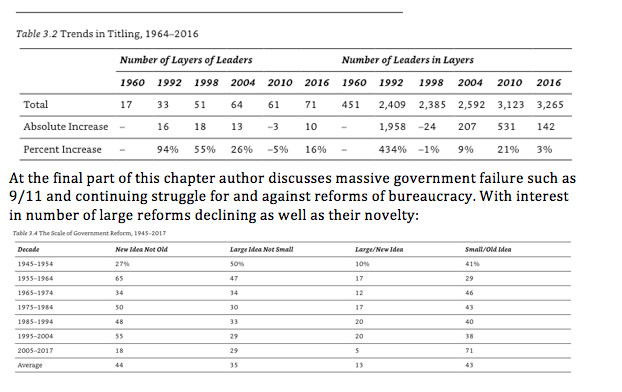
4. A Proper Blending
Chapter 4 starts with a short history of recent efforts to realize Eisenhower’s proper meshing of government and industry. As author argues, six of the past seven presidents focused on one-sided reforms designed to cut big government or discipline the contracting process. Obama is the only recent president who focused on both sides through a broad agenda for government improvement and aggressive reforms in the blend of federal and contract employees. Obama eventually retreated from both efforts, but provided an inventory of options for future two-sided action. The Chapter draws on this history for developing a “reset and reinforce” process that might be used for a regular reblending of the federal government’s federal, contract, and grant workforces. Based on rigorous annual head counts and workforce planning, this proper blending involves six steps:
(1) Clarify terms,
(2) Force both sides of the government-industrial complex to take social responsibility for their work,
(3) Track movement across the divide between government and industry,
(4) Sort functions based on careful definitions of which workforce should do what,
(5) Monitor and reset caps on the true size of the total workforce, and
(6) Reinforce the dividing lines between government and industry. Anchored by more precise inventories of who delivers what for government, this reblending process could ease long-standing limits on federal employment, while acknowledging the important role that contract and grant employees play in launching bold endeavors and achieving success.
Author looks in details t every one of these steps and concludes the chapter with question: who can deliver on these recommendations?
5. Conclusion: The “Next Gen” Public Service
“Chapter 5 ends the book with a discussion of the “next gen” public service. Even following a careful reblending using the sorting system presented in chapter 4, Congress and the president must assure that the government-industrial complex embraces a continued commitment to public service, a mission that matters to the nation’s future, and a workforce that bring new vitality to aging institutions. Federal employees are going to retire in record numbers over the next decade, but their departures will create a destructive “retirement tsunami” unless Congress and the president act now to recruit and train the next generation of public servants wherever they work in the government-industrial complex. Congress and the president must make sure that every federal, contract, and grant employee is committed to faithfully executing the laws, including laws they might oppose. Too many decisions about the choice and deployment of the federal government’s blended workforce are made without concern for cost, benefit, performance, accountability, and the underlying public-service motivation that should call all government employees to their work. Just as Eisenhower argued that the military-industrial complex was imperative to the nation’s safety, this book argues that the government-industrial complex is critical for supporting bold endeavors and creating lasting achievements. And just as Eisenhower also argued that a proper meshing of the military and armaments industry was the only way to protect liberty, this book asks how to align a much larger government-industrial complex than Eisenhower could ever have imagined. It is impossible to know whether Eisenhower would describe today’s government-industrial complex a conjunction of an immense federal workforce and a large contract and grant industry, but it is easy to imagine that he would say its size creates the same “grave threats” may be perfectly appropriate, if not much too weak.”
MY TAKE ON IT:
This book is an interesting artifact of American society demonstrating how deep is foundation of American culture that forces bureaucrats and politicians go to very long ends to hide size of the government. One should make no mistake that it is all about this hiding. Practically in any other country no bureaucrat or politician would think twice about increasing size of government workforce, but in USA such increase is done underground, even if per author’s tables this underground of formally private employees represents 5 out of 7 millions people paid by government. I well understand frustration of author who obviously would like all these people to be moved to government jobs in which he believes they would be more effective and productive. I do not believe that it would be the case, but I would also like to see the same happen. Unlike author I believe that most of these jobs have nothing to do with legitimate government functions and mainly represent malignant growth on American society, which simultaneously deprives its economy millions of potentially productive people and deprives millions of actually productive people from keeping significant share of result of their work. I would hope that open and clear presentation of government workforce and results of their activities would make it politically necessary really decrease size of government and move great many of its activity to private sector.
20190630 – The Goodness Paradox
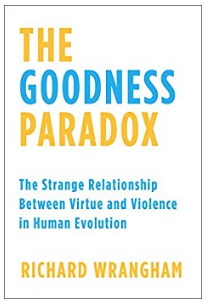
MAIN IDEA:
The main idea of this book is that humans evolutionary developed via self-domestication, which occurred by process of elimination of troublemakers, either tyrannical or just non-conforming. The group’s elimination of such people created evolutionary pressure against tendency to resort to reactive aggression. Such aggression usually unplanned and happens within group, which undermines its survivability. At the same time competition between groups supported genes for planned aggression that would be directed either externally against outsiders or internally against individuals who become too powerful and therefore subject to elimination via conspiracy of a group of weaker individuals. These theses supported by multiple data obtained from genetic analysis and observation of two species of human close relatives: chimpanzees and bonobos.
DETAILS:
Introduction: Virtue and Violence in Human Evolution
It starts with discussion of human paradox when individuals that clearly demonstrate nice and humane features and behavior at the same time can commit huge crimes against humanity. Author looks at ideas of inherently good human nature, spoiled by civilization and inherently evil human nature, constrained by civilization and finds both inadequate, albeit having some merit to them. Then author expresses his believe that one should look at evolutionary explanation of human behavior, which is defined by the fact that: “Human societies consist of families within groups that are part of larger communities, an arrangement that is characteristic of our species and distinctive from other species.”
At the end of introduction author describes plan of the book and objectives of each chapter.
Chapter 1: The Paradox
This chapter launches the investigation by documenting behavioral differences among humans, chimpanzees, and bonobos. Decades of research suggest how species differences in aggression can evolve. Aggressiveness was once thought of as a tendency running from low to high along one dimension. But we now recognize that aggression comes in not one but two major forms, each with its own biological underpinnings and its own evolutionary story.
Chapter 2: Two Types of Aggression
Here author is trying to demonstrate that “humans are positively dualistic with respect to aggression. We are low on the scale of one type (reactive aggression), and high on the other (proactive aggression). Reactive aggression is the “hot” type, such as losing one’s temper and lashing out. Proactive aggression is “cold,” planned and deliberate. So our core question becomes two: why are we so lacking in reactive aggressiveness, and yet so highly proficient at proactive aggressiveness? The answer to the first explains our virtue; the answer to the second accounts for our violence. Our low tendency for reactive aggression gives us our relative docility and tolerance. Tolerance is a rare phenomenon in wild animals, at least in the extreme form that humans show.
“
Chapter 3: Human Domestication
Here author discusses “the similarities between domesticated animals and humans, and show why an increasing number of scientists believe that humans should be regarded as a domesticated version of an earlier human ancestor. One of the exciting aspects of the biology of domesticated animals is that researchers are beginning to understand puzzling similarities that occur among many unrelated species. Why, for example, do cats, dogs, and horses frequently sport white patches of hair, unlike their wild ancestors?
“
Chapter 4: Breeding Peace
This chapter “explains new theories linking the evolution of physical features such as these to changes in behavior. Humans exhibit enough such features to justify calling us a domesticated species. That conclusion, which was first intimated more than two hundred years ago, creates a problem. If humans are like a domesticated species, how did we get that way? Who could have domesticated us?”
Chapter 5: Wild Domesticates
Author believes that some clues to human evolutionary development could be found in the behavior of bonobos. Author reviews “the evidence that bonobos, like humans, show many of the features of a domesticated species. Obviously, bonobos were not domesticated by humans. The process happened in nature, unaffected by human beings. Bonobos must have self-domesticated. That evolutionary transformation seems likely to be widespread among wild species. If so, there would be nothing exceptional in the self-domestication of human ancestors.”
Chapter 6: Belyaev’s Rule in Human Evolution
Here author traces “the evidence that Homo sapiens have had a domestication syndrome since their origin, about 300,000 years ago. Surprisingly few attempts have been made to explain why Homo sapiens arose, and as I describe, even the most recent paleoanthropological scenarios have not addressed the important problem of why selection should have favored a relatively tolerant, docile species with a low tendency for reactive aggression. How self-domestication happened is in general an open question, with different answers expected for different species. Clues come from the way that aggressive individuals are prevented from dominating others. Among bonobos, aggressive males are suppressed mainly by the joint action of cooperating females. Probably, therefore, bonobo self-domestication was initiated by females’ being able to punish bullying males. In small-scale societies of humans, females do not control males to the same extent as they do among bonobos. Instead, among humans, the ultimate solution to stopping male aggressors is execution by adult males.”
Chapter 7: The Tyrant Problem; Chapter 8: Capital Punishment
These two chapters are about the process of self-domestication, which author believes is based on “the use of execution in human society to force domineering men to conform to egalitarian norms, … through the selective force of execution was responsible for reducing humans’ reactive aggression from the beginnings of Homo sapiens. If genetic selection against reactive aggression indeed occurred through self-domestication, we should expect human behavior to share aspects of the behavior of domesticated animals beyond reduced aggression.”
Chapter 9: What Domestication Did
Here author “emphasize that the proper comparison is not between humans and apes, because too many evolutionary changes have occurred in the seven million years or so since we had a common ancestor. Instead, the proper comparison is between Homo sapiens and Neanderthals”
Chapter 10: The Evolution of Right and Wrong
Here author looks at reasons “why our evolved moral sensibilities often make people afraid of being criticized.” He concludes that sensitivity to criticism “would have promoted evolutionary success thanks to the emergence of the same new social feature that was responsible for self-domestication: a coalition able to carry out executions at will. Our ancestors’ moral senses helped protect them from being killed for the crime of nonconformity. The ability of adults (and particularly men) to conspire in the act of capital punishment is part of a larger system of social control using proactive aggression that characterizes all human societies.”
Chapter 11: Overwhelming Power
Here author discusses impact of types of aggressions on evolutionary selection of humans. “Since proactive aggression is complementary to reactive aggression (rather than its opposite), proactive, planful aggression can be positively selected even while reactive, emotional aggression has been evolutionarily suppressed. Humans can therefore use overwhelming power to kill a selected opponent. This unique ability is transformative. It has led our societies to include hierarchical social relationships that are far more despotic than those found in other species.”
Chapter 12: War
Obviously war is the highest form of proactive aggression and author discusses its specificity in this chapter: “Although contemporary war is much more institutionalized than most prehistoric intergroup violence, our tendencies for proactive and reactive aggression both play important roles, sometimes promoting and sometimes interfering with military goals.
“
Chapter 13: Paradox Lost
The final chapter “assesses the paradox that virtue and violence are both so prominent in human life. The solution is not so simple or morally desirable as we might wish: humans are neither all good nor all bad. We have evolved in both directions simultaneously. Both our tolerance and our violence are adaptive tendencies that have played vital roles in bringing us to our present state. The idea that human nature is at the same time both virtuous and wicked is challenging, since presumably we would all wish for simplicity.
“
Afterword
Here author expresses his pain that his theory of self-domestication via elimination of troublemakers is kind of linked to capital punishment and therefore could not be feely expressed by western academic with fear of massive attack from the left. So he feels that the strong denial of support of this measure is absolutely necessary, even if his research demonstrate that consequences of capital punishment are highly beneficial for human development.
MY TAKE ON IT:
This is another very interesting approach to evolutionary roots of human species. Its concentration on aggression makes a lot of sense because it is what needed for survival in the natural world with its wonderful choices between the necessities to eat and real possibility to be eaten. I think ideas and research results presented in this book support approach to human being as the entity of dual types of evolutionary pressure: individual survival and group survival. It is very interesting that group survival required not only ability successfully fight outsiders, but also maintain cohesiveness within group. Author’s idea that this was achieved via elimination of too powerful and non-conformists looks very plausible, especially in the view of provided data. I think that this newly achieved realistic understanding of human nature would help in the current process if reformatting it to the new methods of production when old need for human labor is going extinct and new construction of society needs to be developed.
20190623 – Confessions of a Greenpeace Dropout

MAIN IDEA:
This book has two objectives. One is autobiographical to tell author’s story of growing up in logging community in the family of business owners, his education in environmental science that led him to activism and participation in creation of Greenpeace organization, which later become powerful anti-human advocacy group seeking limits on human use of environment and most of all power over other people, which in turn led author to drop out from this organization. The other one is to express author’s environmental views, which mainly come down to very reasonable approach trying to find way to build sustainable future by designing such forms of human interaction with environment that would create dynamically stable system supporting comfortable existence for humanity.
DETAILS:
Introduction
Here author briefly retells his story with Greenpeace, including critic of extreme movement to the left of this organization. More important, he formulates his environmental believes.
- First Principles
Here author defines his principles and provides his definition for relevant notions such as: Renewable, Sustainable, Clean, and Green. Then he critics all kind of environmental noise makers who are often driven by strive for power combined with some idealism, but not without greed for donations money and academic or political career. He also expresses here his attitude to Philosophy, Religion, Politics, Dogma, Propaganda, and Science. Then he discusses the “Precautionary Principle” and how often it is taken beyond any reasonable limit.
- Our Present Predicament
This chapter is a brief review of current situation, specifically global warming, species extinction, and such. He critic unreasonable and unscientific alarmism and contrasts it with his vision presented in this book.
- Beginnings; 4. No Nukes Now! 5. Saving the Whales; 6. Baby Seals and Movie Stars;
These chapters narrate author’s upbringing in the woods of Canada, his education and development as environmental scientist and creation of Greenpeace – organization that started by fighting nuclear testing by USA and France, but quite reasonably restraining it to Western testing because of unwillingness to spend rest of their life in Gulag if they would try doing the same for USSR or China. The Wales and Seals were the following up causes Greenpeace was fighting for with nice cameo of Brigitte Bardot who somewhat helped.
- Taking the Reins; 8. Growing Pains; 9. Greenpeace Goes Global
This is mostly about period when author was president of Greenpeace and how it developed into typical organization with power politics between different personalities, local offices, and ideological divisions. Author continues here narrative of their activities harassing waling fleets, oil companies, and such, but internal politics seems to be taking most of his attention.
- Consensuses and Sustainable Development Discovered
This brief chapter is about Greenpeace big win on seals hunting, but more about author’s discovery that the goal should be not stopping human activity, but rather integrate this activities into such interaction with environment that dynamic equilibrium between using resources and restoring them could be achieved.
- Jailed Whales, Curtains of Death, Raising Fish, and Sinking Rainbows
This is continuation of narrative about Greenpeace fight to protect baby seals and terrorist act against them by French authorities that exploded “Rainbow Warrior” ship, but it is also about author discovery of Aquaculture – fish harvesting in closed waters.
- Greenpeace Sails Off the Deep End
Here author describes the end of his affiliation with Greenpeace, which move into direction of the use of pseudoscience to raise alarms, money, and prestige while author moved into direction of building sustainable future by growing salmon – the process he describes in some detail.
- Round Tables and Square Pegs
This is about author’s participation in a number of environmental round tables in UN and elsewhere and his experiences in art of negotiation. He also mentions his first encounter with ideas of global warming and then describes in detail the second, after the salmon, fission between him and environmental movement – his support of sustainable forestry based on specific rules negotiated with business that was countered by the hate and accusation in treason. He describes attacks by environmental zealots who wanted logging completely stopped. He also describes hypocrisy of Greenpeace, which fought sinking of outdated oil platform to create marine habitat, while doing the same with its own outdated ship.
- Trees Are The Answer
This is about author’s position on wood, which he considers the most important renewable resource already produced in controlled environment similar to other agricultural product, albeit with much longer maturity period: decades instead of months.
- Energy to Power Our World
Here author reviews all known sources energy and concludes that any effective mix should include nuclear power, which is the only serious source of energy that does not rely on fossil fuel. He provides detailed analysis of all aspects of nuclear demonstrating that fears are overblown and by far.
- Food, Nutrition, and Genetic Science
This is similarly detailed overview of food production where author once again finds contemporary activism unscientific and harmful, especially in regard to genetic engineering.
- Biodiversity, Endangered Species, and Extinction
Here author addresses another panic promoted by environmentalists and quite reasonably notes that not only humans, but also all other species led each other to extinction, so there is nothing new about. The difference is that humans are the only species, which can and do consciously recognize the problem and act to remedy it. He also discusses how activist environmentalists capture more and more formerly scientifically sound publications such as National Geographic and turn them into sources of propaganda.
- Chemicals are us; 19. Population Is Us; 20. Sustainable Mining; 21. Climate of Fear
In these chapters authors reviews multiple areas where environmentalists fight completely save materials and processes that constitute contemporary industry and provide goods and services necessary for human live. He allocates especially significant amount of space to Climate discussion, providing multiple data graphs and concluding that, while human do have impact on climate it is not that significant, that the system is way too complicated and dynamic for scientists to be able reliably understand and predict its future changes at this point. So the hysterical alarms sounding all over the world combined with often successful attempts to generate financing, government grants, and regulatory power grabs that makes alarmist rich and powerful have no scientific foundations.
- Charting a Sensible Course to a Sustainable Future
In this final chapter author summarizes his believes about environment in such way:
- We should be growing more trees and using more wood, not cutting fewer trees and using less wood as Greenpeace and its allies contend. Wood is the most important renewable material and energy resource.
- Those countries that have reserves of potential hydroelectric energy should build the dams required to deliver that energy. There is nothing wrong with creating more lakes in this world.
- Nuclear energy is essential for our future energy supply, especially if we wish to reduce our reliance on fossil fuels. It has proven to be clean safe, reliable, and cost-effective
- Geothermal heat pumps, which too few people know about, are far more important and cost-effective than either solar panels or windmills as a source of renewable energy. They should be required in all new buildings unless there is a good reason to use some other technology for heating, cooling, and making hot water.
- The most effective way to reduce our dependence on fossil fuels is to encourage the development of technologies that require less or no fossil fuels to operate. Electric cars, heat pumps, nuclear and hydroelectric energy, and biofuels are the answer, not cumbersome regulatory systems that stifle economic activity.
- Genetic science, including genetic engineering, will improve nutrition and end malnutrition, improve crop yields, reduce the environmental impact of farming, and make people and the environment healthier.
- Many activist campaigns designed to make us fear useful chemicals are based on misinformation and unwarranted fear.
- Aquaculture, including salmon and shrimp farming, will be one of our most important future sources of healthy food. It will also take pressure off depleted wild fish stocks and will employ millions of people productively.
- There is no cause for alarm about climate change. The climate is always changing. Some of the proposed “solutions” would be far worse than any imaginable consequence of global warming, which will likely be mostly positive. Cooling is what we should fear.
- Poverty is the worst environmental problem. Wealth and urbanization will stabilize the human population. Agriculture should be mechanized throughout the developing world. Disease and malnutrition can be largely eliminated by the application of modern technology. Health care, sanitation, literacy, and electrification should be provided to everyone.
- No whale or dolphin should be killed or captured anywhere, ever. This is one of my few religious beliefs. They are the only species on earth whose brains are larger than ours and it is impossible to kill or capture them humanely.
MY TAKE ON IT:
It is an interesting story of man growing from somewhat mindless activism to maturity and understanding that human interaction with environment not one way movement when benevolent or evil humans to something to environment destroying or conquering it. It is not even two ways interaction, but rather humans being part of environment, as any other species changing it, making it more or less fit for them. The key here is that this part of environment has conscience and recently acquired powerful intellectuals tools: science and technology, which allow them more or less control their own actions, predict future results of these actions, and correct these actions in such way that would be the most beneficial for humans. It is also nice to see person, who spent decades in activism, recognizing that lots of this activism represents the worse that is in humanity – strive for power over other people and ability to take advantage of them.
20190616 – Science and the Good
MAIN IDEA:
The main idea of this book is to examine quest by scientists and philosophers for understanding biological, evolutionary, and historical origin of the notion of good and how to build “good society” based on of scientific foundation of morality. The conclusion is that science is far from meeting challenges posed by these questions and as of now science failed as well as religion failed before provide foundation for morality strong enough to be generally accepted.
DETAILS:
Preface: The Argument, in Brief
Here author explicitly formulates his objectives in this book, which is to demonstrate failures of religion to bring order and peace, followed by similar failure of Enlightenment and science, then redirects this question to finding just “useful solutions“ that science can discover, which per author could lead to “moral nihilism”.
PART I: Introduction
1 Our Promethean Longing
Here author is looking at the question “ if science can be foundation of morality.
He discusses “the Dilemma of Difference”, which is resulting from the need to find common moral ground for multitude of different cultures that now encounter each other in common place of interconnected world of economics and politics. The difficulties are greatly increased by the problem of complexity that resulted from overload of information. Author then moved to the promise of science that was supposed to provide common language and objective methodology to define good and bad, but could not do so. After that author discusses his method and approach to the problem of finding objective and universal criteria of good and bad.
PART II. The Historical Quest
- Early Formulations
Author starts with 3 challenges to traditional philosophy that where posed by Europe social transformation: These challenges included:
(1) The inability of old ways of knowing—philosophy, religious authority—to resolve exploding moral and political conflict;
(2) A need for a convincing basis for shared international trade laws as global commerce swelled and broadened;
(3) A sense that the world was bigger and more complex—in terms of natural, cultural, and moral phenomena—than older medieval conceptions could account for.
Author looks at Aristotelian Scholasticism, then at the conflict and complexities of medieval Europe, which moved morality foundation away from the god mainly due to consequences of religious wars. The Enlightenment, Reason and Science seem to promise scientific solution to the problem of absolute good. Author looks at ideas of lawyers Hugo Grotius (1583-1645 and Samuel von Pufendorf (1632-1694) and philosophers Thomas Hobbs (1588-1679) and John Locke (1632-1704)
- Three Schools of Enlightenment Thinking And One Lingering and Disturbing Worry
The first school author discusses is Sentimentalism as represented by Anthony Ashley Cooper, better known as the Third Earl of Shaftesbury (1671-1713); Francis Hutcheson (1694–1746); and, of course, Adam Smith (1723–1790) among them. The central figure was David Hume (1711–1776).
The main point here is empirical impossibility in Hume’s opinion to derive “ought” from “is”. The second was Utilitarism with its Jeremy Bentham (1748-1832) and ideas of nearly mathematical balance of pain and pleasure. Author also discusses consequent developments of Utilitarism with John Stuart Mills (1806-1873). The third and school came with Charles Darwin (1809-1882) –Evolutionary Ethics. Author looks at each school and especially at the logical and ideological problems that could not be overcome. A bit outside of schools framework author discusses attempts for empirical finding of solutions via behaviorism with its raise and fall during XX century.
4 The New Synthesis
In this chapter author moves to our time and discusses Sociobiology of Edward O. Wilson and its transformation into Evolutionary Psychology. It led to the new synthesis, which author defines in such way:
“This new-synthesis view of morality has four basic elements:
(1) Humean mind-focused sentimentalism,
(2) Darwinian evolutionary account of why the mind has the traits it does,
(3) Human interest–based utilitarianism about morality, all embedded within
(4) Strident naturalism committed to empirical study of the world.”
PART III. The Quest thus Far
5 What Has Science Found?
This starts with discussion of meaning of science and author properly stresses that science could not be settled on anything, ever. In relation to morality author suggested existence of 3 levels of scientific results:
- Foundation of morality that would settle existing moral issues
- Scientific facts that, while not settling issues would give same material to support or reject a moral claim
- Finding that would demonstrate origins and meaning of morality, even if they would not support or reject any specific moral doctrine.
He then discusses how different fields of science approach to moral issues like altruism, other-regarding behavior and such. After reviewing some finding from Evolutionary Biology, Psychology, Primatology, Neuroscience, and Social Psychology, he concluded that results are very modest indeed.
6 The Proclivity to Overreach
Here author refer to tendency to overstate scientific achievements in relation to morality when there are claims of achieving levels 1 and 2 when in reality they are not even close. After that author refers to a number of works that demonstrate philosophical and methodological limitations in this area. Then he discusses some cases of oversimplification such as oxytocin. Finally he points out to blurred boundary between “Is” and “ought”, in other words between empirical and moral statements, that so far nobody was able to breach.
7 Intractable Challenges
He details the following challenges for scientific approach to morality:
- The Challenge of Definition
- A Lexical Range
- Neuroscientific representation of “Ought” vs. “Is”
- Altruism
- Virtue
- Specificity
- The Challenge of Demonstration
- Happiness and Well-being
- An Internal Barrier
PART IV. Enduring Quandaries
8 The Quest, Redirected
Here author claims that scientific approach to morality should not be forfeited despite lack of significant results so far. He rather suggest that it makes some turns in more productive directions, the first toward a Disenchanted Naturalism and he provides duality of approaches between enchanted and disenchanted:
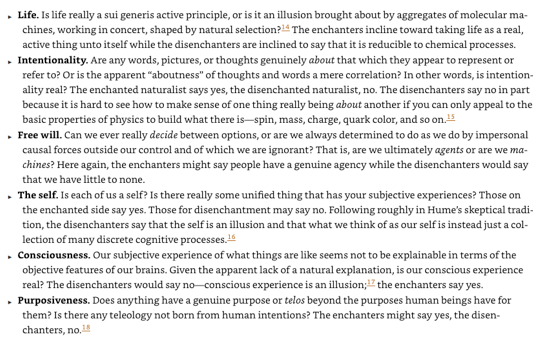
Then the second turn: The Original Quest Abandoned that author treat as failure of science to provide foundation for morality similarly to the previous failure of religion.
9 The Promethean Temptation And the Problem of Unintended Consequences
This is the summation of the narrative of this book, which provided plenty of evidence of science failing in the area of morality. At the end author recommends not to give up and try to find some foundation of morality that would overcome moral differences between people and cultures. It just requires more understanding, interaction, and discourse that would hopefully lead to some accommodation between varieties of moral views.
MY TAKE ON IT:
I think that the core of problem is that people do not really understand meaning of morality, which in my view comes from duality of human as a product of evolution of individual organism fully integrated into the group without which it cannot survive. Consequently it causes development of dynamic interplay between actions of individual directed to survival of organism and actions of individual directed to survival of the group. The morality is just a set of rules developed by individuals within group over long period of time that would provide for group survival even at the expense of individual survival. These rules are culturally transferred to every individual via process of socialization that individuals of each generation sometimes adhered to and sometimes change, depending on personality and place of individual within group and in lifetime point. If morality rules are sound in support of survival in the given environment and flexible enough to change with the change of environment, the existence of group will continue indefinitely and existence of individual would be successfully maintained at last until the next generation of individuals of this group matured enough to carry it on. The rules of the group morality that are not allow flexibility enough could lead to group disappearance with individual members of the group, if they survived group destruction, joining some other group and internalized the morality of this more successful group.
20190609 – A History of Fascism 1914-1945
MAIN IDEA:
The main idea of this book is to provide detailed analysis of nature and history of fascist movements in Europe and all over the world. These movements were somewhat popular in Europe between WWI and WWII, but a lot less than people usually believe. There is trend to call fascistic all kind of authoritarian regimes that are not really belonging to this category. Moreover author quite convincingly demonstrates that in between wars majority of fascist movements were successfully suppressed by rightist authoritarian regimes, so the most famous German Nazi and Italian fascists who obtained state power were unlucky exception rather than rule. Finally the overriding idea is to provide understanding of these exceptions and make sure that it would not happen again.
DETAILS:
Introduction. Fascism: A Working Definition
Here author discusses use of the term and its meaning. He provides a very detailed definition and historical reference to various movements that could be defined as fascist:
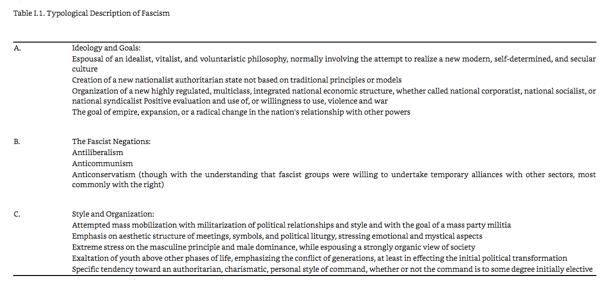
Despite closeness between totalitarian ideologies – all beings collectivistic ideologies, author places fascism on the right and provides table comparing it with other right wing movements:
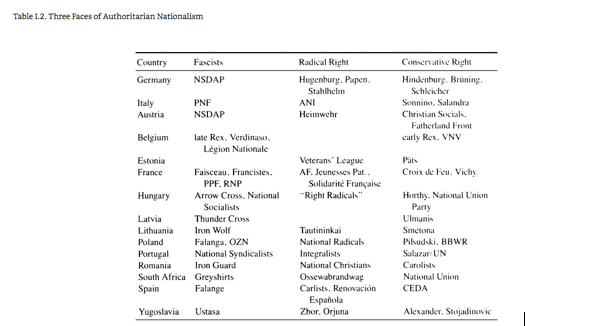
PART I: HISTORY
- The Cultural Transformation of the Fin de siecle
Here author discusses development of fascist ideologies and links it to the end of era of monarchies and empires that was prepared by European development before WWI and caused huge convulsion in period between1914 and 1945. Author looks at expansion of Marxist philosophy with its ideas of radical revolution and advocacy of mass violence, which coincided with development and popularization of racist ideas, somewhat derived from application of Darwinian ideas of evolution and survival of the fittest to societies and populations. Author makes an interesting point that it all become possible due to dramatic improvement in productivity that freed multitude of young people from the need to work hard just to survive and allowed them to spent time on ideology.
- Radical and Authoritarian Nationalism in Late Nineteenth-Century Europe
Here author discusses growth of authoritarian nationalism in Europe at the end of XIX century, which was directed against old monarchical imperial orders and promoted ethnicity based nationalism. First it obtained popularity in France and author reviews history of this movement. Then it was expanded to Germany where it obtained somewhat more sophisticated form with German school of political economy and volk traditions. It basically included massive state control over economy in interest of indigenous people with strong limitations on ethnic outsiders, especially Jews. Then author looks at Italy with its “Risorgimento” movement that was aimed not only to remove foreign control, but also create new superior society. It was expressed in Futurist movements that become ideological precursor of fascist movement. Here is example of manifesto from 1909:

However author stresses that it all was not the main foundational part of fascist movement. It actually came from the left from Revolutionary Syndicalism that was directed to more violent action with objective to implement socialism in contrast with existing popular socialist movements that were looking for peaceful transition from capitalism. Finally author allocates some space to Eastern Europe and Russia, but so little that he misses similar events in Russian division of socialist movement into Bolsheviks and Mensheviks.
3. The Impact of World War |
The WWI was the key event that created foundation for all fascist and communist movements of XX century and author provides quite comprehensive list of its consequences:
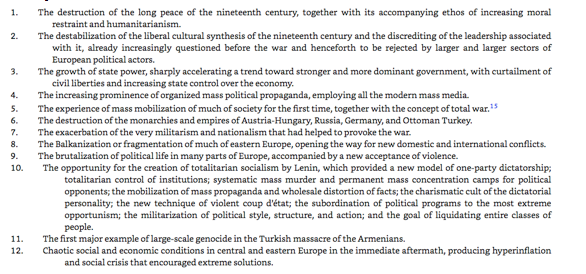
4. The Rise of Italian Fascism, 1919-1929
Here author provides details of fascist movement’s history in Italy including personal history of Mussolini, impact of WWI, and postwar crisis that pushed a lot of people into search of new solutions outside of constitutional monarchy of the time. There are plenty of historical details of party organization, development, and internal politics. There is also a very interesting analysis of class and professional participation:
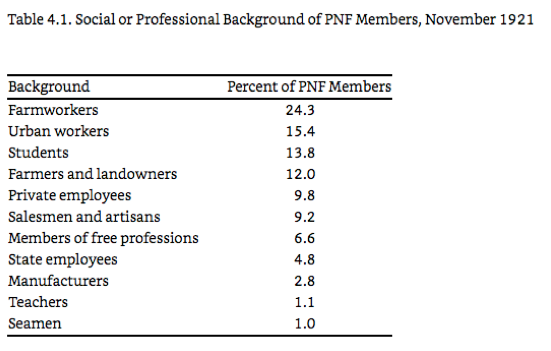
The author reviews phases of taking power: March on Rome; Mussolini taking role of Semi-constitutional Prime Minister (1922-25); Construction of dictatorship (1925-29); and finally completion of Totalitarian state. In the final part of the chapter author reviews attitudes to the newly established Italian fascist regime from different quarters including communist and anti-communist ideologues. Communists were ambivalent, recognizing fascists’ similarity to their own movement with ambition to establish new society on ruins of old using the same violent methods, but also recognizing their anti-Marxist philosophy that would put nation above class. Kind of side effect of this ambivalence was tendency to use the word fascist as insult intended to denigrate opponents of all kinds, while at the same time building alliances with fascists when it was useful for communists.
5. The Growth of Nonfascist Authoritarianism in Southern and Eastern Europe, 1919-1929
This is country-by-country review of fascist movements in small countries of Europe. Important point here is that nowhere they succeeded in taking power on their own, being mainly suppressed by traditional authoritarians and conservatives.
6. German National Socialism
German version was famously much more successful. Author rejects idea that it was because of some specifics of German culture or history. It was rather time specific combination of defeat, economic suffering, and believes that army was not defeated, but betrayed. Author goes through postwar crisis of 1919-1923 when communist forces nearly took power, but were suppressed in bloody, but brief civil war. Author also discusses creation and development of Nazi party, which was invigorated by Hitler who turned it into genially cross-class mass movement. It however failed when it tried to take power in Bavaria, leading to decisive change to formal compliance with laws and attempts to take power legally via elections. Then author moves to reviewing period of stability 1923-1930 when Weimar was quite successful until it was economically crashed by the worldwide depression. However author mainly reject that Germany was uniquely hard hit. He provides table of unemployment in different countries showing that there was nothing unusual in its situation, except that after taking power Nazis did decreased unemployment and quite dramatically:
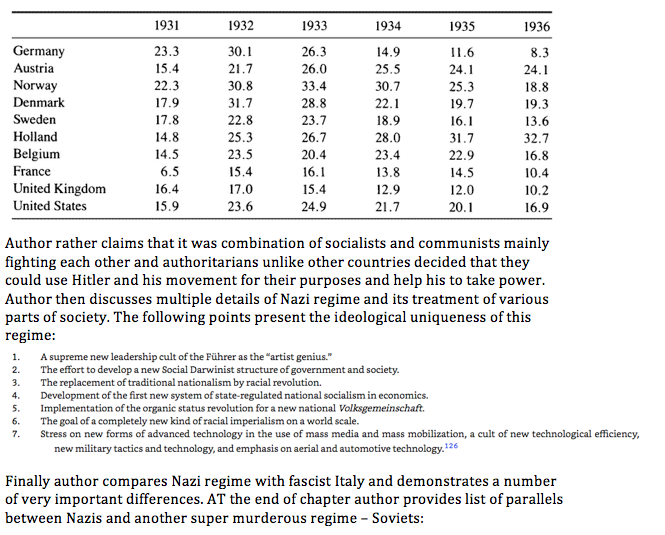
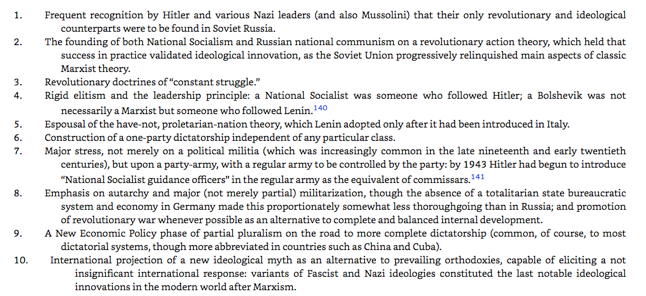
7. The Transformation of Italian Fascism, 1929-1939
Here author discusses history of Italian fascist rule and its transformation from popular movement to bureaucratic elite. Basically author presents opinion that the state kind of consumed fascist party and it become the prime object of support of all statists of the world including FDR and many members of intelligentsia in democratic countries that saw in this party-state combination much more effective method of society organization than messy democratic governance. Economic policy was relatively successful: “Compared with the pre-World War I norm of 1913, total production in Italy had risen by 1938 to 153.8, compared with 149.9 in Germany and 109.4 in France. The aggregate index for output per worker in 1939, compared with the same 1913 base, stood at 145.2 for Italy, 136.5 for France, 122.4 for Germany, 143.6 for Britain, and 136.0 for the United States. “ The fascist state even started implementing welfare programs, but it was never fully completed. Author also discusses expansionist policies, which were not especially successful due to overall military weakness.
8. Four Major Variants of Fascism
Here author discusses countries where fascist movements were powerful and popular: Austria, Spain, Hungary, and Romania. In all these countries authoritarians subdued fascist movement, even if they were initially very important part of coalition, like it was in Spain.
9. The Minor Movements
Here author looks at fascist movements in democratic countries like France, Britain, Low countries, Ireland, Scandinavia, Czechoslovakia, and others. Nowhere fascist movements were able to get close to power before the war. Only under German occupation fascist movements where somewhat in control, but only to the extent Germans allowed.
10. Fascism Outside Europe?
In this chapter author reviews countries outside Europe and mainly demonstrate that despite usual tendency to call any authoritarian regime fascistic, they generally were far from it.
11. World War II: Climax and Destruction of Fascism
Here author reviews WWII and how character of Nazi regime defined its conduct by Germany. Here is representation of different approaches:
Table 11.1. The Nazi New Order
- Direct Annexations: Austria; Czech Sudetenland; Danzig: Polish West Prussia. Poznan, and Silesia; Luxembourg; Belgian Eupen and Malmcdy: French Alsace and Moselle: northern Slovenia; Yugoslav Banat
- Direct German Administration:
- a) Civil: Polish Government General. “Ostland” (Baltic area). Ukraine. Norway. Holland
- b) Military: Belgium and part of northern France, forward military districts in the Soviet Union
- Tutelary Satellite or Puppet Regimes: Protectorate of Bohemia-Moravia: Croatia. Serbia. Montenegro. Greece. Italian Social Republic (1943-45)
- Satellites: Denmark. Finland. Hungary. Romania. Slovakia. Bulgaria. Vichy France. Italy (1941-43)
- Neutrals:
- a) Friendly neutrals: Spain. Switzerland. Sweden
- b) Distant neutrals: Portugal. Ireland. Turkey
At the end of chapter author discusses how military defeat led Nazis to attempt to expand the fascist movement into all European form so it would allow combining total resources of occupied Europe, but this was mainly unsuccessful.
PART I: INTERPRETATION
12. Interpretations of Fascism
Author discusses a variety of explanations mainly provided by ideologues of the left with the clear intention to link it to the right. Probably the funniest part is that a bunch of interpretations are quite opposite to each other. Here is the list:
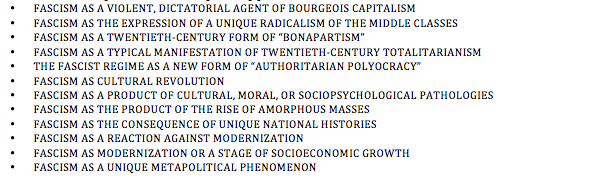
Probably on conclusion, which is practically inevitable, is that, as any other complex societal phenomenon, it is just not possible generalize.
13. Generic Fascism?
Here author discusses difficulties of defining genus of fascism and presents 5 specific varieties that did existed:
- Paradigmatic Italian Fascism, pluralist, diverse, and not easily definable in simple terms. Forms to some extent derivative appeared in France, England, Belgium, Austria, Hungary, Romania, and possibly even Brazil.
- German National Socialism sometimes defined as the most extreme or radical form of fascism, the only fascistic movement to achieve a total dictatorship and so to develop its own system. Somewhat parallel or derivative movements emerged in Scandinavia, the Low Countries, the Baltic States, and Hungary, and, more artificially, in several of the satellite states during the war. The Italian and German types were the two dominant forms of fascism.
- Spanish Falangism. Though to some extent derivative from the Italian form, it became a kind of Catholic and culturally more traditionalist fascism that was more marginal.
- The Romanian Legionary or Iron Guard movement, a mystical, kenotic forms of semireligious fascism that represented the only notable movement of this kind in an Orthodox country. It was also marginal.
- Szalasi’s “Hungarist” or Arrow Cross movement, somewhat distinct from either the Hungarian national socialists or Hungarian proponents of a more moderate and pragmatic Italian-style movement. For a short time, perhaps, it was the second most popular fascist movement in Europe.
14. Fascism and Modernization
Here author discusses relationship between fascism and modernization or more precisely idea that fascism is reaction to modernization by people who are not able to adjust. Author provides data demonstrating that it was not the case, showing that fascism accelerated modernization as part of process of military preparation.
15. Elements of a Retrodictive Theory of Fascism
Here author confirms that all attempts to create adequate theory of fascism failed, but it was possible identify a specific set of circumstances consistent with its success. Here there are compiled in the table:
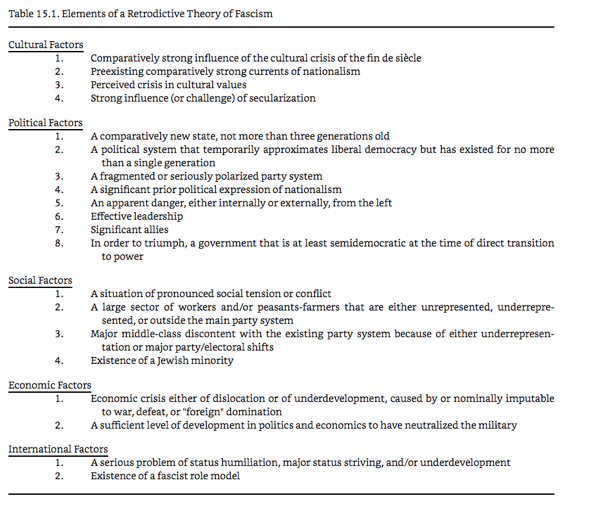
Epilogue. Neofascism: Fascism in Our Future?
Here author states that despite destruction of fascism in WWII fascists did not disappear and still exist, albeit on the margins of politics. He reviews their activities in several countries, but concludes that at this point it is not very serious threat. However author provides list of features that are typical for fascist movements and could appear in some other arrangement. Here is this list:
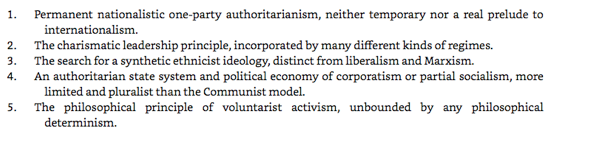
MY TAKE ON IT:
It’s a very nice historical research and it provides lots of facts and background that allows better understanding of this phenomenon. I think that, while overall reviewed and discussed, the issues of psychological environment that make people to seek revolutionary changes to existing order using extreme violence were not looked in sufficient depth. I also think that the key feature of Fascism as philosophy of group supremacy and suppression of individual should be discussed more. I would be interested in much more extensive look at the link between Fascism and Communism, but at the commonality of all group dominance / statist / welfare ideologies of XX century that seek top down control of society by bureaucrats and politicians. I think those have a lot more in common, even if some of such ideologies in Western world by far less murderous than Nazis. There is also clear connection between real danger of fascism and level of adherence to democracy in population. The greatest examples are probably consequences of taking power by collectivistic powers in Russia, Germany, USA, and Britain. In all cases communist / fascist / socialist parties took power either via democratic (USA, Britain), semi-democratic (Germany) or quasi-democratic (Russia) methods. Populations with deep democratic traditions (USA and Britain) were capable more or less recover by electing less collectivistic parties in relatively short period of time (1932-1952 in USA and 1945-1951 in Britain) when collectivistic policies proved to be detrimental to population wellbeing, despite multitude of antidemocratic methods like massive propaganda in support of regime and legal measures against its opponents. Populations with strong authoritarian traditions were successfully suppressed for decades so they could move away from totalitarian collectivism only after complete military (Germany) or economic (Russia) collapse.
20190602 Tomasello, Michel – Becoming Human

MAIN IDEA:
The main idea here is to review experimental data comparing human and great ape development and use it to support author’s believe that human specificity comes from qualitatively different process of development collective intentionality, which provides for human ability to create cultures and societies based on hyper cooperative processes.
DETAILS:
I BACKGROUND
Chapter 1. In Search of Human Uniqueness Chapter
It starts with Darwin and author discusses seemingly puzzling circumstance that unlike any other animals, humans created their own environment that includes technology, culture and religion. Author suggests that solution for this puzzle is unusually high level of cooperation achieved by humans. Author discusses ideas of Vygotsky about species-unique forms of sociocultural activity and links it to evolutionary developed biological specificity of human species. Then he defines his team’s specific proposal that this specificity was defined by common intentionality, which emerges during human development at about age of 3 years. At the end he defines his aim as to provide a “complete and coherent account of the process of becoming human”.
- Evolutionary Foundations
Human Evolution
It starts with human evolutionary history and then proceeds to compare it to the great apes. Author defines difference in such way:” What they do not possess is humanlike skills of shared intentionality, such as the ability to participate in the thinking of others through joint attention, conventional communication, and pedagogy. Chimpanzees and bonobos—and thus the LCA (common ancestor)—are and were very clever, but mainly or only as individuals.
“
Then author moves to define shared intentionality and look at its development all the way until present when it becomes Culture and Collective Intentionality. Here is graphic representation if these ides:
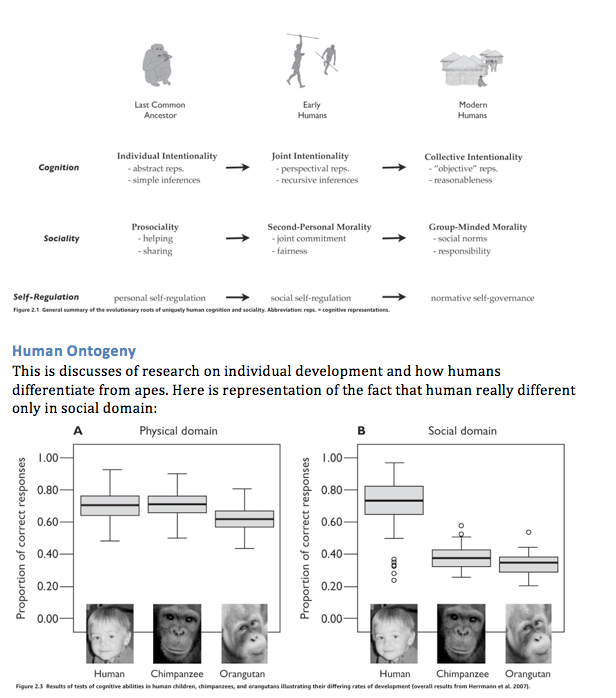
Explanation in Developmental Psychology
Here author discusses 4 different types of learning and how humans are different:
“Typology of four types of learning and experience that play key roles—at different ages in diverse domains—in human cognitive and social ontogeny: (1) individual learning, (2) observational learning (imitation and so forth), (3) pedagogical or instructed learning, and (4) social co-construction (prototypically in peer collaboration).
Here author provides development diagram for complex movements:
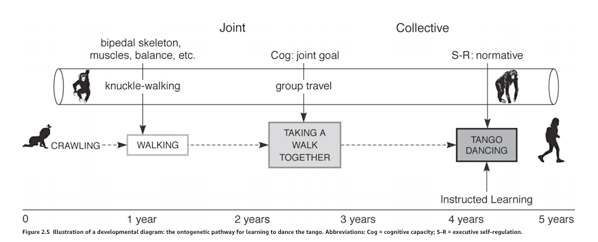
II The ONTOGENY OF UNIQUELY HUMAN COGNITION
Here is how author describes this process overall:First, from around nine months of age, infants engage with others in acts of joint attention, which creates the possibility of conceptualizing entities and situations simultaneously from differing perspectives; then, later, they can even view things from an “objective” perspective. From early on as well, infants communicate with others referentially, inviting them to jointly attend to something, and this requires recursive inferences about mental states embedded in mental states; later they communicate with shared linguistic conventions. Again, from early on infants imitatively learn things through others’ perspectives, and later they come to understand pedagogy as an attempt by a representative of the cultural group to convey objective cultural knowledge. Finally, by the time they reach school age, children are capable of using all these skills of social cognition, referential communication, and cultural learning to engage intersubjectively with a peer in the kind of cooperative thinking and reasoning that are the source of all kinds of novel cultural achievements.
Chapter 3. Social Cognition
Author describes the mature human thinking as based on several dualities such as objective vs. subjective, true vs. false, and so on. Then author describes in details research that analyses how it happens step by step:
From Apes: Imagining What Others Perceive; Joint Attention; The Coordination of Perspectives; Becoming “Objective”.
At the end of chapter he also provides the graphic representation of this processes:
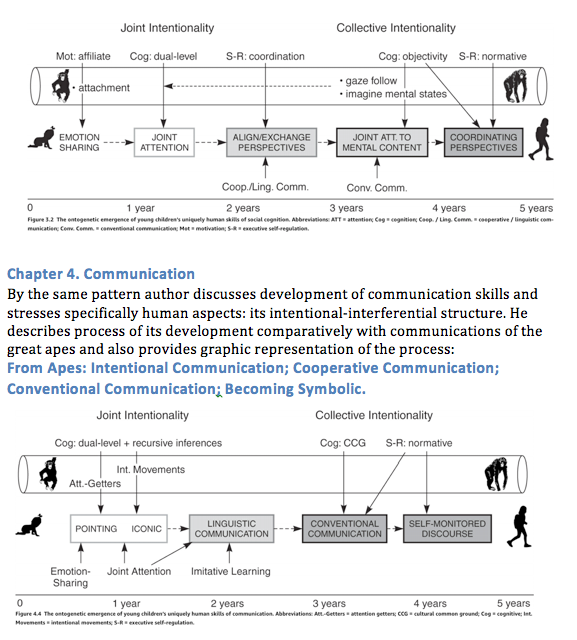
Chapter 5. Cultural Learning From Apes: Social Learning
Imitation and Conformity
Here author moves into the area that even further away from animals – cultural transmission of knowledge and skills. The humans so far are only one known species that formally teach young generation not just by example, but using language and other methods such as books, pictures, graphs, and so on. The topics are: Instructed Learning; Becoming Knowledgeable.
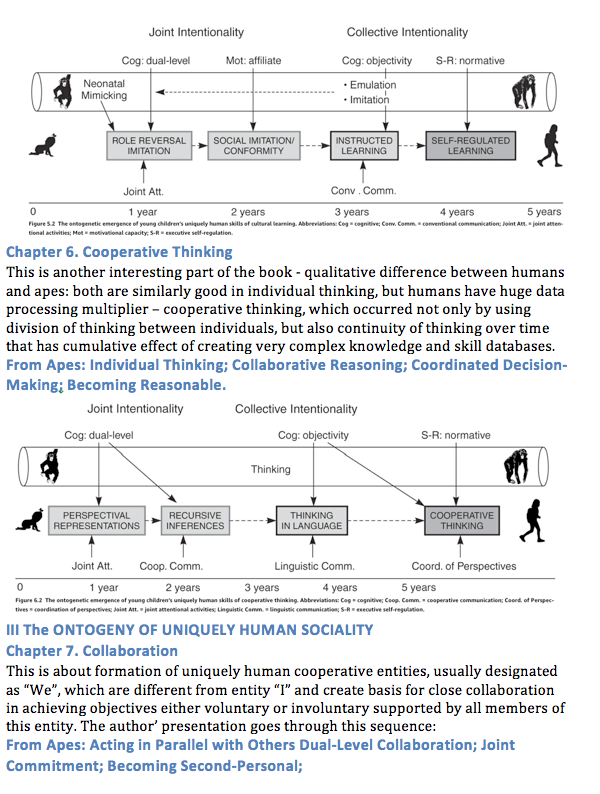
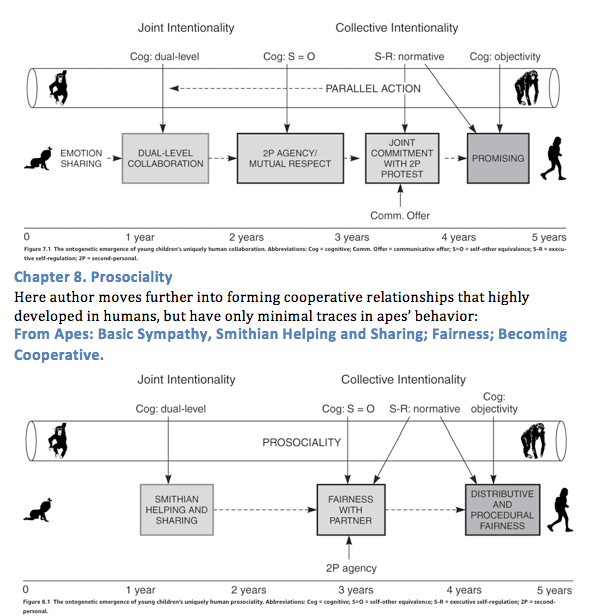
Chapter 9. Social Norms
This is an interesting discussion about normalization of human behavior when groups developed norms of behavior that they formalize and then pass from generation to generation. It is again feature highly developed in humans and mainly absent in apes:
From Apes: Group Life; Social Norms; Justice; Becoming Group-Minded.
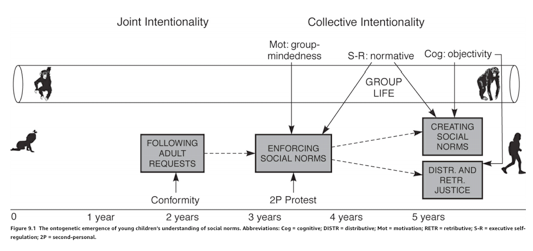
Chapter 10. Moral Identity
This is another purely human feature that pretty much define humans as extremely group-oriented creatures. Author discusses the meaning of moral identity and how it is developed in humans via process of socialization. It is greatly different from apes that form partnerships, but in very primitive forms and usually directed on achieving not more than some local dominance. Obviously in humans it means a lot more because it places individuals “I” within group “WE” supporting both compliance with norms and their enforcement against non-compliant individuals.
From Apes: Social Evaluation; Self-Presentation and Self-Conscious Emotions; Moral Justification and Identity; Becoming Responsible.
Here author provides not only graphic representation of development, but also Venn diagram for moral decision making unique to the humans:
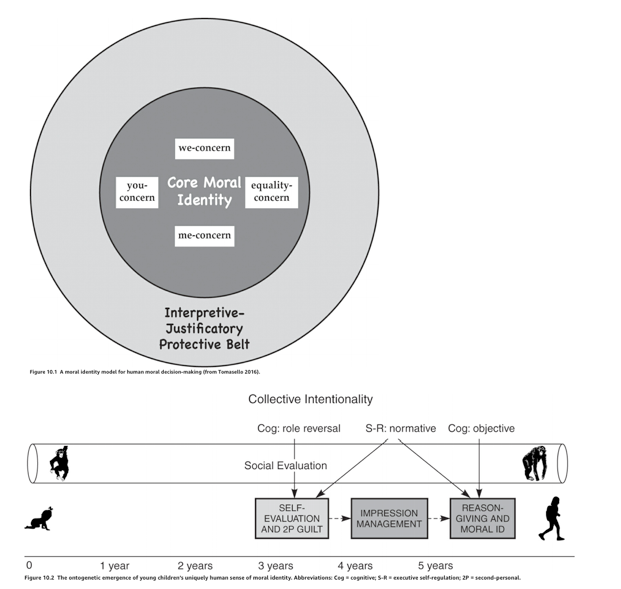
IV CONCLUSION
Chapter 11. A Neo-Vygotskian Theory
Here author reaffirms his conclusion that specifics of human ontogenetic process come down to hyper cooperative way of life, which is main difference between humans and great apes.
Global Theories of Human Ontogeny Shared Intentionality Theory
Here author reviews the following theories:
- Individualistic – human child as individual scientist developing theory of the world
- Sociocultural – human child as newly developed part of socio-cultural network being socialized via language and interactions with older members of the culture.
- Shared Intentionality – human child develops based on two sets of specifically human capacities:
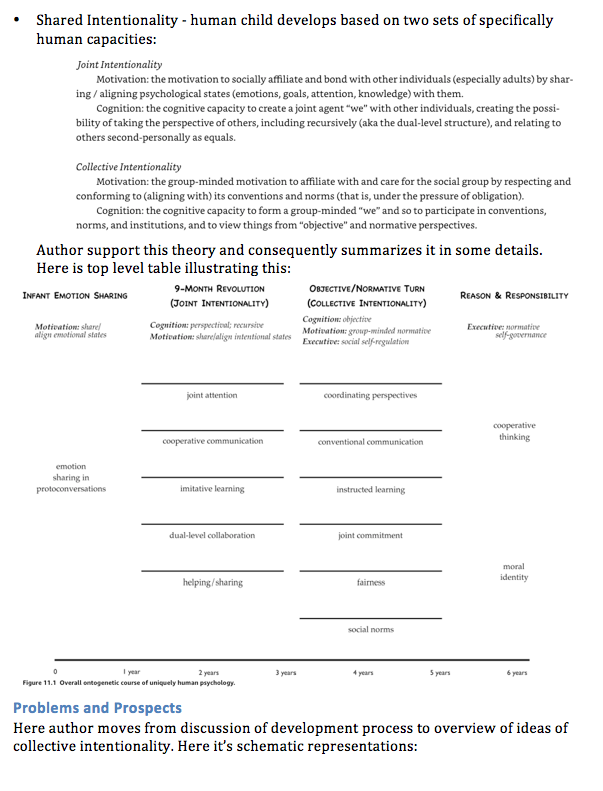
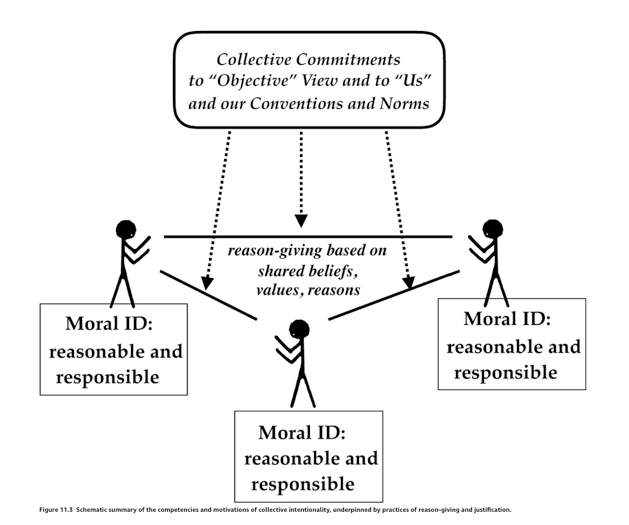
Chapter 12 The Power of Shared Agency
Here author looks at evolutionary meaning of human species development as unique form based on hyper cooperation and collective intentionality. He refers to work of Maynard Smith and Szathmary that identified common characteristics of eight major transitions in complexity of living things with each transition characterized by two fundamental processes. Here is author’s characterization of these processes and their relevance to humans:
“(1) a new form of cooperation with almost total interdependence among individuals (be they cells or organisms) that creates a new functional entity, and
(2) a concomitant new form of communication to support this cooperation.
In this very broad scheme, we may say that shared intentionality represents the ability of human individuals to come together interdependently to act as single agent—either jointly between individuals or collectively among the members of a group—maintaining their individuality throughout, and coordinating the process with new forms of cooperative communication, thereby creating a fundamentally new form of sociality.
“
MY TAKE ON IT:
It all looks very convincing to me, which somewhat impacted my attitude to duality of humans with their separation / interaction of individual and group evolutionary fitness. I guess I was too much concentrated on individuality as reaction to surrounding pressures throughout to put group first in everything and everywhere. I think that development process based on collective intentionality adequately represents reality and should be taken into account. I guess it moves me to move focus a bit away from individual / group to individual / hierarchy-of-groups, meaning that key better functioning humanity is in forming such hierarchy in minds of all individuals that would give higher priority to more inclusive group over less inclusive competing groups. For example putting humanity overall over religious groups, consequently denying religious supremacy claims and compelling tolerance of other religious groups, if necessary by force. Similarly it could be applied to nation as higher level of hierarchy group over various ideological groups, similarly compelling tolerance between various ideologies. In short whatever internal hierarchy of group exists in the mind of individual, the overriding priority should be tolerance of other hierarchies of groups.
20190526 – China’s Crisis of Success
MAIN IDEA:
The main idea of this book is that China went through very specific Asian path of rapid economic development that was previously travelled by other countries such as Japan, South Korea, Taiwan, and Singapore. This path is unique because it was based on fear of complete destruction that united population of these countries and allowed to go through suffering and deprivations that would not be accepted in normal times. Similarly to what previously happened to these other countries China now came to the tipping point when continuation of the same model of development become not sustainable due to both internal and external developments. At this point other countries changed mainly in direction of democracy or at least benign authoritarianism and found the new position of stability and prosperity. China however is different due to its size, culture, and ideology, so it is not at all clear what will follow.
DETAILS:
Introduction
Here author states his believe that China is approaching the crisis of success by which he means that the growth of last decade came to an end because it could not count any more on economic model that brought it this success. It is on the brink of transition similar to one experienced by other Asian tigers like South Korea and Singapore, but because of it’s much bigger and more complicated nature it is far from obvious that China will be successful.
1 China Model/Asia Model
Here author compares China and overall Asian models and expresses opinion that conditions, which create opportunity for dramatic growth of economy, are quite unique and could not be easily reproduced elsewhere. Such growth is normally based on dramatic and very painful dislocation of significant part of population and therefore could be conducted only in non-democratic countries and based on massive fear that alternative could be much worse than reform. It also required shared identity of the vast majority of population that recognizes its common fate and consequently accepts pain of restructuring. Author also compares success of Asian countries and failure of the Soviet Union, showing different priorities during change:
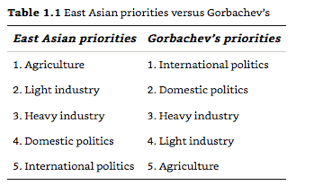
Then he looks at the core reasons for rigidity and centralization of economy that led all this countries into the crisis and concludes that it was somewhat result of believe in effectiveness of war mobilization model that allows concentrate resources on limited tasks of military economy when production concentrated on war material and population accepts whatever sacrifices are required. It does not work in complex consumer economy. The inference here is that concentration of efforts on economy is beneficial for the country, while concentration on military and politics causes stagnation. Here is interesting table of Asian development:
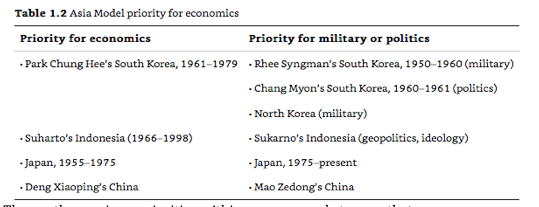
Then author reviews priorities within economy and stresses that success came when the human needs such as jobs and consumption have higher priority than everything else. He rejects the idea of priority of big scale changes from the top either in form of promotion of heavy industry or shock therapy of massive switch to market. However he supports idea of “rapid incrementalism”, which basically means just increase in economic freedom and opening of the market to foreign investment. The politics have vital, but secondary role. He also discount cultural prejudices noting that he saw a lot of idle workers in Japan, Korea, and China when people have no incentive to work, so the attempt to explain Asian miracles by cultural propensity to work hard in just nonsensical. Then author moves to China and stresses that the main differentiator was idea of “one country two systems” that allowed communist leadership utilize Hong Kong and some special zones to open link to world capitalist markets assuring flow of capital and know how to vitalize economics. Author also stresses that all economic miracles occurred within authoritarian systems, in which dominant party maintained strict political control. The final point in this chapter is that all this is possible only when people are poor and well remember fear of recent disasters. However when the country gets richer people much less inclined to accept deprivations and corruption, creating crisis situation. So far it happened everywhere and solution was usually move to more democratic and much less corrupt system. Author believes that China is now approaching similar point and outcome of this crisis is far from clear.
2 The Economic Crisis of Success
Here author retells story of Chinese economic success with the stress on recent history when Zhu Rongji and Jiang Zemin introduced critical market reforms in 2003. It reduced SOE employment by 45 million people. It moved economy forward, but then Hu Jintao and Wen Jinbao who expanded it to some rural areas, but allowed it to unravel, growing bureaucracy from 40 to 70 millions. It brought China to current Xi and what author calls “Crisis of Success” – when old drivers such as foreign investment, know how transfer, and export are becoming more and more limited. Crisis of 2008 convinced Chinese leaders that Western economic model is not that good and they start moving back to state controlled economy. Then author expresses his delight of the amazing new development plan and his contempt to silly “market fundamentalists” who do not understand that key to prosperity is government planning. Nevertheless author also states that only market could provide solution to the problem of complexity. In short, author supports “socialist market economy”. Then author discusses specific areas of transition: switch from export to domestic consumption, manufacturing upgrade, expansion of services, and development of credit-based finance. Author notes that Chinese leaders are usually have engineering background and it shows. Then author discusses Financial squeeze in the country where there is huge shadow bank market. Other issues that author discusses here are: demography, currency, Entrepreneurship, and Innovation. Author ends the chapter with overview where he simultaneously glamorizes China and states that the center of everything is going to shift there, but then stresses that it will take time and it is not yet tomorrow. At the end he expresses caution that China should avoid the fate of Japan that turned inward and started stagnate.
3 Critical Social Issues of the Transition: Inequality, Corruption, Environment, and Globalization
Here author moves to social issues and discusses Chinas inequality in many dimensions including geographical between rural-urban divisions, provinces, sex, and wealth inequality. Here is picture of regional divisions in wealth:

Author also discusses specificity of Chinese corruption, which he finds of better quality than corruption in democracies such as India. He also discusses Environmental issues that started having some impact on attitude of Chinese people. He also discusses globalization and admits that this process is at the core of China’s success story. At the end of chapter author restates that China’s economic and social problems are enormous and it is far from clear that its social structures would allow positive resolution of these problems.
4 China’s Governance Crisis of Success
Here author starts with Mao era failed attempt to jump ahead by using communist ideology and practice. This followed by changes after Mao when leadership start building institutions of functioning state, starting with limits on officials, establishing professional standards, and, most important, fine tuning the economic system that would be acceptable for foreign businesses so they could invest and actually move production to China being relatively comfortable with legal environment. Author especially stresses what he believes is China’s great achievement: stability via incrementalism when leadership moved very carefully, but allowed small changes in multitude of areas looking at what worked and what not. Author also discusses what he calls GE model – obsession with one key parameter, which was the Profitability for GE and Economic growth for China. He reviews specifics of Chinese model and democratic alternatives and finds Chinese by far superior for poor democratic countries, mainly India. Author believes that democratic elections in poor countries are captured by elite resulting in use of the state in elite interests combined with neglect of general interest. In Chinese model no capture is necessary and party bureaucrats are moved in hierarchy based on meritocracy that somehow make them working for common good, rather than their own narrow interest. He looks at example of other Asian countries like Korea, Singapore, and Taiwan, concluding that they’re all went through massive economic development using combination of authoritarian government and relatively free market. However upon achieving some specific level of wealth many of them switched to democratic rule under pressure of emerging middle class. Author counter this Asia model to disastrous post Soviet shock therapy driven by free market theoreticians and very reasonably concludes that it is much better.
5 China’s Political Economy under Xi Jinping
This chapter is the review of current situation as it developed under current leader Xi Jinping. Author points out that he was selected mainly as technocrat without strong political base. Author claims that Xi was given power to manage challenges of current situation when China become strong and decided that it can through away pretense of weakness and openly claim the leading role as raising power of the world. Author analyzes emerging powerful interest groups in China and new social forces. He discusses search for filling moral vacuum left by elimination of religion and bankruptcy of communist ideology, guest of private business and intelligentsia for proper legal system, and so on. Author expresses believe that China is at turning point. Old fears disappear, powerful interest group trying to increase their role in decision-making, and financial system become quite fragile due to massive debts. Author points out that Xi’s strategy of doing everything at the same time: reforms, anti-corruption, campaign, military challenge to USA in China sea, and so on is very risky. He discusses what happened in other Asian countries at this point in their development: Japan becoming rich, satisfied and apathetic, Taiwan moving to democracy peacefully, while South Korea via demonstrations and some killings, and finally Singapore finding interesting combination of state ownership of businesses, which are managed by independent boards. Author characterizes current point as “Complexity revolution” in China – dissipating fear, emerging hubris, economic and political complexity. He also provides list of 10 great paradoxes that China faces now:
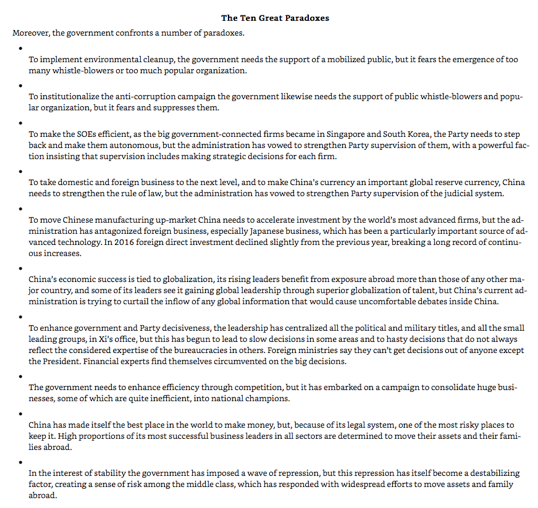
6 What Will Happen?
Here author reviews different scenarios of future development: Reforms or their failure / Japan Scenario / Democratization / Communist power consolidation / Leadership split. None of these scenarios have clear and easy path and future is murky. Author concludes this book with this statement: “China is on the cusp of greatness, stagnation or tragedy, and the risks are so high that small, unexpected events could make the difference. That is the defining quality of China ’ s crisis of success.
MY TAKE ON IT:
I think author is absolutely correct in both his main points: China’s success brought it to tipping point when it had to change and nobody really knows how it will do this. I think, however, that despite very good analysis overall author is missing one key point: the rapid development of China occurred as result of massive transfer of manufacturing economy from West, especially USA driven by communist party’s making available cheap labor and environmental negligence to western businesses. Obviously taking machinery from Ohio, moving it to China and start producing with cheap labor with complete absence of environmental, safety and other regulations makes for rapid increase of “made in China” and decrease of “made in Ohio”. However this model is coming to the end because many factors: China labor is not that cheap any more, growing refusal to accept environmental deprivations force increase in production costs, population of Ohio shows signs of political awakening and is not agree any more to suffer for somebody’s high profit and cheap goods. There is also growing understanding in the West that China under communist party is not going to be peaceful and accommodating member of existing world order, but would rather demand not just leading, but dominating role in the world. I do not think that this would be acceptable for western population and the part of western elite that finds it acceptable will be eliminated from its position. I have no doubt that the world is moving to confrontation, actually it is probably already in it, but I think that short of nuclear war Western values would overcome Chinese outdated strive for dominance and within the next 20-30 years China would become just another part of free world. Alternatively, if Chinese leaders could choose Cold War in hope that current level of economic and technological achievement would be enough to with in such war, they could be sorely mistaken. I think it would lead to China’s defeat with highly negative consequences for its population, not least for its elite. The reason for this would be the same as in Soviet Union: unfree people normally are not those productive and definitely not happy. The Cold War between China, if it occur, would be about the same issues that with Soviet Union: which system if more productive and provides for better life. Communist dictatorship proved many times over its dismal performance in these areas, special Chinese case with massive Western investment and technology transfer of the last 30 years notwithstanding. Deprived of such investment and transfer China would not stand a chance.
20190519 – Through a Glass Brightly

MAIN IDEA:
The main here idea is to demonstrate how contemporary science destroyed multiple old paradigms that put humans into the center of everything. The secondary idea is that after proving human non-uniqueness, humans should know their place and use science to create somewhat minimalistic place for themselves within existing environment.
DETAILS:
Part I: The Allure of Human Centrality, or, How We Persistently Try to Deny Our Place in the Natural World—and Fail
Prelude to Part I
Here author presents the main thesis of this book and what each of its two parts is discussing:
- Major paradigm shifts that involve diminishment of humanity’s self-image, and which have therefore been resisted with particular vigor, for example, heliocentric astronomy, the notion that human beings have been especially “well designed,” and so forth.
- Reassessments of certain previously held notions that deal with specific aspects of “human nature,” many of them still alive in the public mind; for example, altruism cannot be explained by evolution and must therefore be a gift from god, and people are naturally monogamous. Here, my intent is less to argue against human centrality per se than to take issue with an array of preexisting beliefs that have themselves been privileged at least partly because they place human beings in a flattering but misleading light.
In each chapter author is trying to present exiting paradigm, demonstrate why it is wrong and present the new one.
- The journey to Brobdingnag
Here author refer to Gulliver to characterize humanity’s descend from being the center of universe into being as everything else.
Old paradigm: Human beings are fundamentally important to the cosmos.
New paradigm: We aren’t.
- From centrality to periphery
Here author discusses anthropocentrism and modocentrism (central position of modern time), and all pain and suffering that caused people new understanding that none and nobody is especially unique. The paradigm change is:
Old paradigm: We are literally central to the universe, not only astronomically but in other ways, too.
New paradigm: We occupy a very small and peripheral place in a not terribly consequential galaxy, tucked away in just one insignificant corner of an unimaginably large universe.
- The meaning of life
This is about humanity as an exceptional species that can neglect procreation in pursuit of something else that they consider more important – meaning of life. At the first glance it does not make since since death ends life so nothing really matter, but humans come up with religion which virtually extend life into infinity. Author presents attitude of multiple famous thinkers to this issue, only to end with:
Old paradigm: Each human life has its own inherent meaning; it is up to every person to discover it.
New paradigm: No one’s life is automatically endowed with any meaning, simply by virtue of his or her existence; it is up to individuals who seek meaning to define and establish it by how they live.
- Well designed?
Here author provides critic of popular misconception that humans and overall our universe is well designed. Any more or less serious look at human body would demonstrate beyond any doubt that is not designed at all, but rather represent natural movement from one feature to another sometimes improving, but sometimes having deleterious effect. Author concludes:
Old paradigm: The human body is a wonderfully well-constructed thing, testimony to the wisdom of an intelligent designer.
New paradigm: Although there is much in our anatomy and physiology to admire, we are in fact jerry-rigged and imperfect, testimony to the limitations of a process that is nothing but natural and that in no way reflects supernatural wisdom or benevolence.
- The anthropic principle
This principle suggest that all physical constants of our universe so precise that any deviation, however small, would make human life impossible. Author discusses weak and strong forms of this circular argument and once again presents attitudes to this of a few famous scientists and philosophers. The result:
Old paradigm: The universe has been “fine-tuned” for life, especially human life.
New paradigm: There are many alternative explanations for this apparent fact, all of them based on a mechanistic rather than theistic conception of reality.
- Tardigrades, trisolarans, and the toughness of life
It starts with reference to Albert Schweitzer and his ideas of reference for life. Then author defines subject of this chapter that life itself is much more robust than individual life and could survive in practically inconceivable environments (extremophiles). This idea, as usual, brings us another paradigm change:
Old paradigm: Life is delicate; hence the fact that we are alive is testimony to our profound specialness.
New paradigm: Although individual lives are delicate, life in one form or another is remarkably robust; hence, aliveness isn’t in itself a statement of any living thing’s extraordinary importance.
7 Of humanzees and chimphumans
This is about cross-species experiments. Author refers to the first, unsuccessful ones done back in 1910. Now, with current understanding of DNA and life overall, it become much more possible, so author infers:
Old paradigm: Human beings, presumably because they have divine souls, should never be genetically combined with other animals, which don’t.
New paradigm (not really a paradigm so much as an impertinent suggestion): Creating a new and viable organism by combining human and nonhuman DNA might usefully open otherwise closed minds to the connectedness of human beings and other living things.
- Separateness of self?
This starts with debunking idea of homunculus, which author uses trying to claim that individuals are not really separate from worlds around them, but rather just a part of it. To support this thesis author uses not only science, but also lots of poetry. The paradigm change:
Old paradigm: Everyone is separate and distinct, an army of one.
New paradigm: Not so! The boundaries between individuals are arbitrary, artificial, and for the most part illusory. Our states are united.
Part ll: New Ways of Understanding Human Nature
Prelude to Part II
Here author moves to more detailed review of human nature as it developed under evolutionary pressures. Author concentrates on panhuman features that are common across variety of human cultures. He also discusses science as methodology opposite to religion and professes his intention to go wherever fact and experiments, would lead, even if this would hurt someone’s believe in human exceptionalism.
- Uniquely thoughtful
It starts with kind of catalogue of everything conceivable that humans are and do, but animals do not. Then he proceeds to demonstrate that actually just about everything of this could be found in animals and their behavior, albeit not to the same extent as in humans. Finally author discusses a few well known examples that demonstrate human irrationality and concludes that paradigm is changing:
Old paradigm: Nonhuman animals are unreasoning automatons; people, by contrast, are notable for even defined by their use of reason. Moreover, our species is unique in possessing an internal mental life.
New paradigm: Human beings have not cornered the market on complex cognition and an array of complex mental capacities; moreover, we are often downright irrational, and not merely when in the temporary “throes of passion” but also as part of our complicated human nature.
- Conflict between parents and offspring
Here author reviews conflict for resources between parents and children and between siblings. He starts with birds and other animals and then moves to humans. In all cases it is conflict between need to stay alive for individual and need to pass one’s genes to the next generation. The conclusion is:
Old paradigm: Parents and offspring are united in their interests, albeit sometimes at odds for other reasons.
New paradigm: Parents and offspring have genuine, predictable, biologically mediated areas of conflict.
- True or false?
This is about animal communication and the latest research that demonstrated its complexity, including ability to cheat. Author discusses communication vs. manipulation; males of many species tendency to present themselves as quality partners, and specifically human propensity to tell lies 6 to 8 times a day. The conclusion:
Old paradigm: Communication is assumed to be honest, providing mostly truthful information.
New paradigm: It is at least as likely to be dishonest, or in any event, an effort by the sender to manipulate the receiver for the sender’s benefit.
- The myth of monogamy
This is about evolutionary reasons for monogamy, but there is also multiple evidence of human inclination to polygamy. The logic in both cases is the same – attempts to make male to support family and select the most effective male to pass his genes to the next generation, with the former being a bit more supportive for getting male support and second for getting high quality male who is able to protect his harem, depriving competitors of opportunity to pass their genes.
Old paradigm: People are naturally monogamous, if only they find their ideal life partner.
New paradigm: Men are naturally polygynous, interested in multiple female partners, and women are naturally polyandrous. But both sexes are essentially free to be whatever they choose, particularly if they free themselves from the straitjacket that is the myth of monogamy.
- War and peace
Here author rejects the idea that humans predisposed for war. He recites multiple sources from literature to anthropology that kind of indicate existence of such predisposition, but then critics methodology of research. He also stresses that archeological research demonstrate that only with agriculture human groups become violent against each other, hunter-gatherers were much more peaceful. Author also makes sure that he separates group conflict (war) from individual violence, which is much more common in all periods of history. The conclusion:
Old paradigms: (1) Human beings are irrevocably stamped with a biological predisposition to wage war, so we had best get used to it and plan accordingly, or (2) We are inherently benign, benevolent, and peaceful.
New paradigm: We are not biologically doomed to war, although we are inclined to be interpersonally violent on occasion; the war/peace future is in our hands, and isn’t written in our genes.
- About those better angels
This chapter is about people helping each other. It discusses evolutionary reasons: reciprocity, kin selection, and cooperative breeding. The change author defines:
Old paradigm: The human penchant for altruism, beneficence, caring for others, and moral sensibility could not have evolved via a brute mechanical process of natural selection; hence, it is evidence for god.
New paradigm: There are many plausible biological explanations for these traits, which are not uniquely human, and which do not require—or even suggest—divine intervention.
- Who’s in charge?
This is discussion of free will. Author refer to multitude of living non-human DNA mixed with human DNA in every human body, which selfish genes are trying replicate by impacting functions of this body, sometime benignly, but sometimes lethally. This is not unique to humans and author provides some interesting examples of this. However the general conclusion is:
Old paradigm: Aside from obvious constraints, each of us is in control of his or her life, if not an “army of one,” at least the chief operating officer of our own central intelligence agency.
New paradigm: Everyone is shot through with a diverse array of other organisms as well as other entities, each exercising influence on the levers of “control,” such that either no one is in control or everyone is . . . whatever that means!
- The paradox of power
Here author restates the key message of this book: anthrodiminution, recognition of human non-uniqueness and then moves to lament non-trivial and unique impact of humans of everything around. He then discusses biological vs. cultural evolution and sometime dangerous tensions between them, such as biologically beneficial craving of hunter-gatherers for fat combined with abundance of fat for humans in our age leads to very fat humans with very negative effects for their health. Nevertheless author clearly supports contemporary culture of industrial society and understands that its benefits overweight negatives by far:
Old paradigm: By virtue of our uniquely human cultural and technological achievements, we have raised ourselves above mere animals and even above natural limitations.
New paradigm: We are the products of biological and cultural evolution, a combination that has endowed us with extraordinary power; at the same time, however, these two processes are often out of synch, a disparity that confronts us with extraordinary difficulties as well as challenges.
Conclusion: Optdare aude
The conclusion is a bit of pontificating on awfulness of Donald Trump, loss of paradigms that put humans in the center of everything, sad fate of Don Quixote who was brought back to reality by a cruel Carrasco, and finally hope that all this would eventually lead to the better place.
MY TAKE ON IT:
I find it quite funny how many a product of contemporary academia manage simultaneously write tracts diminishing humanity overall, while kind of aggrandizing themselves. It is also funny how they consider their duty to say something bad about the Donald. Other then these funny things, it is a nice catalogue of old ideas that nobody seriously consider operational any more. Obviously humanity is not in the center of everything, so what? It still has lots of knowledge and power to do what it had been doing for the last few hundred thousands years – change environment to fit its own needs. Actually humanity is not unique in this either: every ant and every bird do it by building anthill or a nest. It is just that human capability are much higher, especially cognitive abilities, resulting in the new environment where humans’ concerns include ants, birds, and a lot more that makes it better for humans, even if it is quite different from original environment.
20190512 – The Future of Capitalism
MAIN IDEA:
The main idea is to demonstrate that current increase in political division all over the western world between left and right is destructive to society and should be overcome. In order to achieve this author suggests establishing new system that he calls Social Materialism, which he defines as mostly capitalist system with big government that plays active role. This system would be based on everything “ethical”: State, Firm, Family, and overall world, meaning recognition of the network of reciprocal obligations between everybody and everything.
DETAILS:
Part One: Crisis
- The New Anxieties
It starts with discussion of contemporary crises of Western societies when globalization and technology led to deterioration of quality of life of less educated people mainly in working and lower middle classes. It caused these people to give up on existing long-term arrangements and practically rebel against elite in power. This rebellion so far is within democratic framework, leading to election of Trump and other similar figures, but with increasing elite resistance, nobody knows how far it will go. Author presents his own story to demonstrate familiarity with both camps: successful and unsuccessful in the new economy. He then discusses success of social democracy in XX century with its welfare state, unions, big government, and intellectuals’ activity in politics that grew during this period. Author ends the chapters with Manifesto of what he calls Social Materialism – the mainly capitalist system in which government plays very active role in economics and social life, with tax policy “restraining powerful”. As usual for such cases, author claims pragmatic solution and presents his ideology as non-ideology crossing left-right continuum.
Part Two: Restoring Ethics
- The Foundations of Morality: From the Selfish Gene to the Ethical Group
This starts with typical complain that capitalism provide for material wellbeing, but is immoral and does not provides for meaning of life. Then it goes to discuss “Wants vs. Oughts” where author talks about seemingly contrarian demands between economic and moral objectives, concluding that both are needed and key is in the balance. Then he moves to emergence and wide use of reciprocity in human relations, which is developed evolutionary, somehow coming to conclusion that conservative philosophy could not be right because it support existing institutions, which are necessary dysfunctional because the world is changing all the time. The final part is about obligations to each other and to “society” and development of norms and organizations to make all this work.
- The Ethical State
Author’s philosophy is pretty much demonstrated when he states that “New Deal” was ethical and people recognized this. This follows by brief panegyric to Keynes, glorification of social democracies (ethical states) circa mid XX century and lament on their decline and fall. Author seems to see the cause of this fall in division of population into well educated and prosperous in market economy and less educated who fail to find place in it. Ideologically population divided into libertarians on one side and identity and rights obsessed leftists on another. Both groups undermined common identity one in the name of unified global market, another in the name of ever multiplying groups of victims, and both successfully suppressing conservatives who were protecting this identity, albeit in outdated format of nation and religion. Then author proceed to look at ways to restore common identity and patriotism in order to return to “ethical state”.
- The Ethical Firm
Here author moves to the idea of ethical firm by which he seems to mean the firm that exist not in interests of people who owns it, but in interests of somebody else who cares about some other, more important things than returns on investment. He also discusses problems with hired management who care about their own benefit, even if it would kill the business. Author proposes rethinking role of big firms in society and changing legal constrains on its management. He discusses in details how and why regulation and nationalization do not provide effective solution for ethical firms and suggests to look at 3 other approaches: Taxation, Public interest representation on corporate boards, and Policing public interest.
- The Ethical Family
The chapter about family starts with discussion of how it used to be highly normalized foundation of society until 1950s. Then came shock at the top when birth control changed sexual relations. Then came shock from expansion of education that somewhat led to loss of respect to older people. Then came shock at the bottom from technology and globalization that deprived lower classes not only of income, but also of self-respect from a job. This led to social divergence and dissolution of traditional family at the bottom. Author suggests that it is possible to restore “ethical family” through commitment technology and extended family that include 4 generations due not increased life span.
- The Ethical World
Here author kind of combines ideas of “ethical everything” in 3 precepts:
Precept 1. Recognition of obligations to other societies that are not dependent upon reciprocity: the duties of rescue. These cover obligations to groups such as refugees, those societies facing mass despair, and those lacking the rudiments of justice. Precept 2. The Construction of more far-reaching reciprocal obligations among chose countries willing to go further.
Precept 3. Such reciprocity is supported by recognition of common membership of a group, based on common purposive actions that further the enlightened self-interest of each participant.
Then he discusses erosion and potential rebuilding of such ethical world.
Part Three: Restoring the Inclusive society
This is pretty typical discussion of different aspects of contemporary division of population into winners and losers who benefit or fail to benefit from huge changes in methods of production and distribution of goods and services.
- The Geographic Divide: Booming Metropolis, Broken Cities;
After discussing diversion between prosperous metropolises and declining towns author proposes a number of possible solutions for specific problems, but ends up stating that none of them ready for implementation and need careful experimentation to define their viability.
- The Class Divide: Having it All, Falling Apart;
For this author suggest implementing “Social Materialism” when state cushions family with practical support could fix these problems by substituting what author calls “Social Paternalism” when state policies family.
- The Global Divide: Winners, and the Left Behind;
This is a bunch of Mea Culpa that author offers as professional economist: in regard to: Trade, Regulations, and Migration. The final professional Mea Culpa is in regard to economic profession glorifying globalization and closing its eyes on its negative effects.
Part Four: Restoring Inclusive Politics
10: Breaking the Extremes
This is the author’s lament that capitalism divides people and that right now everybody seems to be moving to extremes. He calls to establish process that would move main parties to the center. In order to do this he suggest to leave selection of leaders to party insiders and generally move into direction of decreasing divide in wealth and everything else at the global level, but most important is to build shared identity. He believes that the period of left’s dominance by Utilitarism and Rawlsian ideas of redistribution and victimhood and right’s dominance by ideas of individualism is coming to the end and the future would bring movement of left to their communitarian roots and right to restoring their “ethical bearings” and all happily moving in non-existing past when there was little division and no ideological struggle.
MY TAKE ON IT:
I think that idea of “social materialism” is plainly not realistic because it demands from people some abstract commitment to reciprocation to others even if these people to not include themselves and this other in one entity. I believe in evolutionary developed duality of humans with one side based on individual survival and another on survival of the group one belongs two. The complexity comes from existence of multitude of different groups that individual belongs to and frequent contradictions between objectives of these group. The idea that some bureaucratic entity such as state or firm could be made “ethical” meaning it would start caring for outsiders is not supported by the history. I think that the solution is not change in people or even their attitudes, but rather in change of group structures and hierarchies that would minimize contradictions and perhaps even reconcile objectives of different groups to extent possible so the resource production and allocation would be conducted on non-zero sum basis.
20190505 – A Brief History of Everyone
MAIN IDEA:
The main idea of this book is that humans are not necessary that different from other apes and have a lot in common with everything living in their DNA. It also provides history of human expansion all over the world and elimination of all our close relatives like Neanderthals who left us a bit of DNA and a few bones to discover. Author contemplates on commonality of our DNA so we all have common ancestors from not that long a go, and meaningless of primitive division of humans into races and such. Finally the big point here is that evolution is continuing and future changes are not really predictable.
DETAILS:
Introduction
This book is about humans and their DNA. It discusses multiple humanoid species that existed in the past and then for one reason or another disappeared leaving ecological space for the one and only survivor specie – contemporary humans. It is also about our DNA history, its present and what future can bring to us via results of DNA research.
Part One: How We Came to Be
- Horny and mobile
This starts with evolution and continuously changing life forms, of which humans is just one example. Author then discusses rejection of usual tree like interpretation and proposes somewhat different graph:
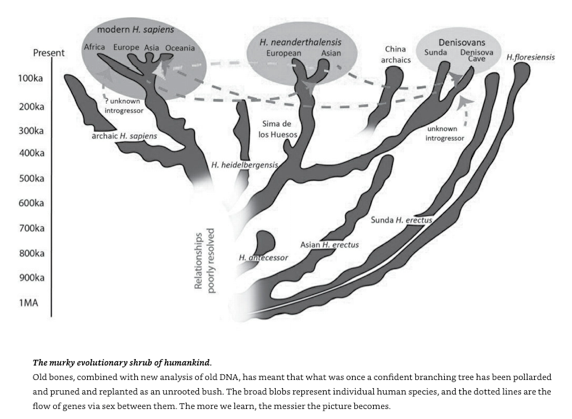
Then he follows with discussion of DNA structure and how to read it into separate genes. After DNA author moves to human movement from their place of origin in Africa all over the world:
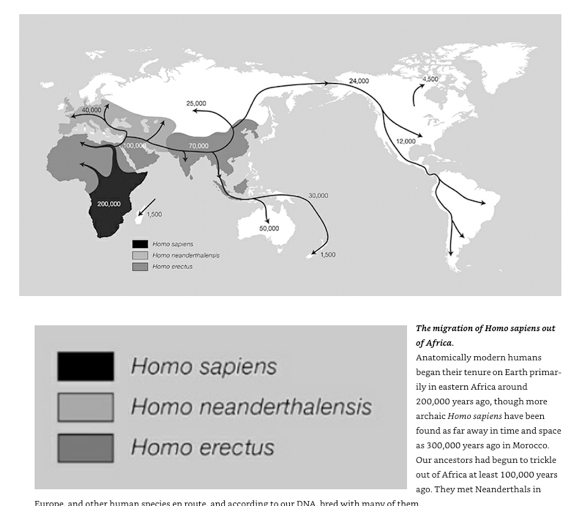
Author goes into a bit of details about archeological, paleontological, and DNA analysis methods for obtaining this information.
- The First European Union
Here author discusses European population and how it come to be from the time of Neanderthals, that where successfully disappeared by humans. There is interesting discussion of type of food our ancestor subsisted on based on our DNA’s enzymes production such as Amylase. Then author discusses impact of cooking that started some 300,000 years ago and invention of agriculture that practically led to wiping out hunter-gatherers. He provides supporting evidence including typical discussion of lactose tolerance and not so typical discussion of blond and red hair. Author looks in some details on DNA make up of British Islands’ population and impact of plague. He ends chapter with the note about slow tempo of human advancement out of Africa, which was slow enough to provide time for evolutionary development of DNA differences. The evidence discussed consists of DNA variances and different cultures, such as Clovis, identified by tools used. The inference is that all Native Americans Indians are genetically close enough to confirm the idea of movement via Bering when continents were connected.
3 These American Lands
This chapter starts with Viking and Columbus, and then quickly moves to American Indians and how they get here. For some reason author discusses contemporary method of joining Indian tribes in USA retelling Navasupai story. At the end of chapter author points out that Americans, as nation of immigrants, have all kind of DNA mixes and discusses a bit his own family DNA.
- When We Were Kings
This is about impossibility of pure DNA because of geometrical progression of ancestors: 2 parents, 4 grandparent and 2100 for 100 generation, which is something like 2500 years – clear impossibility. The inference is that we all relatives and math confirm that it is correct. Author then go into a bit of genealogical discussion and ends up with explanation of problems with inbreeding.
Part Two: Who We Are Now
- The End of Race
Author starts this chapter with his recollection of encountering some racist teasing as a child and then moves to DNA and the story of unsuccessful search for biological foundation for racism retelling story of Darwin’s cousin Francis Galton – founder of eugenics movement. Obviously there are lots of differences of characteristics between individuals of different races, but most important point is that they do not exceed differences between individuals of the same race, making the very notion of race meaningless. To illustrate this author discusses results of research of genetic grouping of people. This grouping starts with division of everybody into two groups and then expanding it to more and more groups. The result is unexpected when algorithm groups people by DNA in such ways that is completely different from their races. After that author discusses various genetic diseases and inclination such as alcoholism, concluding that genetic influence is greatly overstated.
6 The Most Wondrous Map Ever Produced by Humankind
This starts with discussion and betting by the group of scientists on DNA length in 2000 when it was in process of decoding. Everybody overestimated its length because the common notion was that genes have direct link to specific function of organism, when in reality it is much more complicated and it is rather: complex, environmentally dependent genes combination link to function. Now, decades after DNA decoding the huge progress was made, but we are still far away from complete understanding how this staff works. Author discusses “genome-wide association studies” (GWAS) that seek to establish understanding of diseases by analyzing genome association of multiple people with the disease. He also discusses twins’ studies that demonstrate that link of DNA and some disease is not really simple and direct.
- Fate
This is about link between genome and crime and other behavioral problems. As example author uses MAOA – the chemical disproportionally found in individual with behavioral deviations. Nevertheless the link is complex and could hardly be defined as having causal character. The final part of the chapter discusses intergenerational transmission of environmental impact. It is done on very interesting case of consequences of mass starvation in Netherlands in 1944. The key here is that it is highly developed country with great levels of documentation of all events, including health histories over generations. The result is interesting because it does support suggestion that this artificial famine did have impact across generations. Finally author spends a bit of time discussing epigenetics that kind of brings back Lamarckian approach.
8 A Short Introduction to the Future of Humankind
The main point here is that future is already here including modifications to DNA. It happens via mutations all the time. Research demonstrated that the same gene checked in 6500 people has 1.5 million single letter mutations. Since there are billions of people in the world the much more complex mutations are bound to happen all the time. There is also phenomenon of the same functional changes due to mutations in different genes, which makes sense because few functions and features linked to one gene only. So we are good with variety, but the second part – selection is becoming mute because survival pressures are not what they used to be if one takes into account abundance of food, shelter and advanced medicine. Nevertheless author final conclusion is that humanity is still in process of evolution because evolution is change + time and neither of this could be eliminated.
Epilogue
Author completes it with brief discussion of uniqueness of both species and individuals, which is created by constant recombination of bits and pieces of DNA present in millions of lives in the past so genome could be considered a history book without end and it would be read, reread, and updated for future as long as humanity exists.
MY TAKE ON IT:
So I guess it is not a big news that we are all relatives and have 99% common DNA. It is interesting how exactly humans moved around the globe and how much it could be traced in our DNA. Similarly it is obvious that there is no real scientific foundation for the notion of race because DNA variety within any race is higher that between races. I guess the problem is that DNA has little to do with cultural differences and human propensity to divide everybody into US and Non-US is more related to culture than to DNA. It is also interesting how author narrates impact of DNA decoding with unexpected number of genes: too few to explain features of human organism that eventually led to creation of new, supplemental to genetics field – epigenetics. I think that eventually it would open the new area of conscientious efforts to use epigenetics to improve development of young humans by creating individually designed environment with ability to control real impact by analyzing epigenetic changes. It would probably take a lot of time to move there, but result could be much happier people that we are now.
20190428 – Democracy When People are Thinking
MAIN IDEA:
The main idea of this book is to present the new method of collective decision making that author calls Deliberative democracy and convince people that it is the direction in which society should move to overcome multiple deficiencies of existing competitive democracies. This deliberative democracy consist of decision making by randomly selected representative group of citizens who have time for deliberation on issues and contemplate the most appropriate decision to resolve these issues. Such deliberation would be conducted with support of experts and author presents a number of experiments when such method achieved the best solutions, obviously author believes that he knows what is the best.
DETAILS:
Part I: Introduction
Author starts with brief discussion of democracy and expresses his believe that it should be closely connected to people, but in real life it is generally not that connected. He defines the problem as difficulty to define “will of people” in environment of massive and well-funded advocacy by special interests, which are also quite adept in capturing support of people’s representatives and/or bureaucracy of the state. Author believes that the solution is deliberate democracy, which he defines as the system in which detailed deliberation of issue is conducted by a group of people selected for this purpose and is based on real arguments and facts. Author makes point that this book is not that much about theorizing as about real life experiments in deliberate democracy that he and his team conducted over the years in multiple places.
- Party Competition and Its Limits
Here author reviews existing patterns of democracy when two or more political parties compete in election and then winner makes political decisions controlling society. He points out that typically such democracy considered a guarantor of civil liberties by virtue of elections, but deliberative democracy kind of turns it upside down putting liberties and ability to think and discuss issues freely ahead political freedom of election. Another point author makes is that government can achieve legitimacy either via process such as democratic elections or outcome – economic prosperity even in illiberal system of government. Believe in former is in decline and author believes that deliberate democracy could stop and even reverse this decline.
- Deliberation and Reform
Here author expresses believe that democracy has fundamental contradiction between two main objectives: political equality and deliberation. The first one tends to empower people who have neither inclination nor ability for deliberation, resulting in deterioration of the second and low quality of decisions. He then adds the third issue – participation, which is an issue because impact of a voter on final decision is so small that it does not make sense for him to waste time on deliberation. Then author claims that Deliberate Democracy is the way to achieve all three principles: political equality, participation, and deliberation.
Part II: Can the People Rule?
1 Four Criteria for Popular Control
Here how author defines it:
Inclusion: all adult citizens should be provided with an equal opportunity to participate.
Choice: the alternatives for public decision need to be significantly different and realistically available.
Deliberation: the people need to be effectively motivated to think about the reasons for and against competing alternatives in a context where they can get good information about them.
Impact:the people’s choices need to have an effect on decisions (such as who governs or what policies get enacted).
2 Four Forms of Democracy
Here author defines four forms of democracy with Competitive, being a typical elections with political parties, Elite deliberations, being a selection of representatives with filtration such as US senate in original constitution, Participatory, being all kinds of referendums, and finally the one author promotes – Deliberative, when decision makers randomly selected and deliberate on solution under experts tutelage. Author provides table that breaks down their relation to principles:
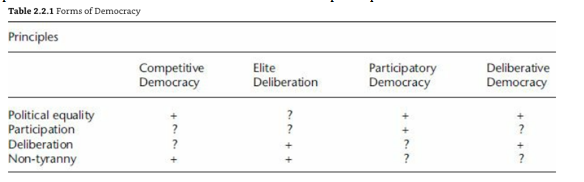
- Popular Control in Competitive Democracies
Here author discusses how this form is deficient because it limits public influence only to really big issues, leaving lots of space for special interests capturing of political power.
4 Is There Democracy for “Realists’’?
This is discussion of research that demonstrate requirements for real democracy that could not be met in areas such as:
- The citizen must express an opinion on an issue (“cognize” the issue).
- The citizen must have knowledge of current government policy on the issue.
- The citizen must have knowledge of the policy alternatives offered by the competing parties.
- The citizen must feel sufficiently strongly about the issue to make use of the aforementioned knowledge in casting his vote.
It short “will of people” could not be obtained when individual people recognize that they have little impact of political decisions, which does not worth effort of deliberation or sometimes even effort of vote.
- Manipulation
These are just a few examples of what author believes is manipulation of voters via advertisement and media.
6 Elite Deliberations and Popular Control: Madison’s Filter
This is discussion of Madisonian ideas of elite deliberative bodies where elected representatives filter out elite individuals for deliberation. Author seems to be sympathetic to these ideas, but at the end has to admit that it really did not work as designed.
7 Participatory Democracies and Democratic Control: From Town Meetings to Referenda
This is about direct participation whether in town meetings or referendums, which carries the same limitation that democracy always has: quantity of people and quality of decisions. It just does not work in complex societies because it is not scalable.
8 Reflections on the Athenian Case
Here author discusses failure of Athenian democracy that lead to disasters of Peloponnesian war and corrections implemented to improve opportunities for deliberation by creating additional filter of randomly selected citizens to deliberate on decisions in some depth.
Part III: Making Deliberation Practical
- Designing Deliberative Democracy
This is about defining specifications for selection of individuals for deliberation. Here they are:
1) Demographic representativeness;
2) Attitudinal representativeness;
3) Sample size.
4) The opportunity to engage policy arguments for and against proposals for action in an evidence-based manner.
5) Knowledge gain.
6) Opinion change.
7) Whether or not distortions in the dialogue are avoided.
8) Whether or not there are identifiable reasons for considered judgments after deliberation.
2 Deliberative Agenda-Setting: California 1n One Room; 3. Mongolia: Deliberative Participatory Budgeting; 4. Applying Deliberative Democracy in Africa: Uganda’s First Deliberative Polls; 5. Deliberating European-Wide?
These are descriptions of test cases in different places when Deliberative Democracy technic was applied.
Part IV: Reimagining Democratic Possibilities
- Designs for Deliberation: Where and How?
Here author returns to 4 types of democracies to restate his opinion that the first 3 are not effective and only deliberative democracy meat the requirements he defined. However he understands that replacement of existing system is not that feasible, so he suggests moving ahead by supplementing it with increasingly frequent use of deliberate democracy processes to solve specific problems.
- It Works in Practice, But Does It Work in Theory?
Here author replies to critic of deliberate democracy in these four domains:
- Domination by the more advantaged
- Polarization
- Lack of citizen competence
- Gap between mini-publics and the broader society
3 From Thought Experiments to Real Experiments: Reflections on Rawls and Habermas
Here author discusses reason for concentrating discussion on Deliberative Polls and his preference for analysis based on real experiments rather than thought experiments typical for philosophers. He discusses in some details ideas of Rawls and Habermas and their implications fro Deliberative Democracy.
4 Deliberative Democracy and Candidate Selection; 5 Texas: Connecting Public Deliberation to Policy Elites; 6 Connecting Deliberative Designs to Participatory Democracy; 7 Deliberating Before Ballot Propositions: Reflecting on the “Australian Republic”; 8. Japan: Deliberation for Hard Choices;
This is another bunch of examples of using Deliberative Design for discussing a specific issue. In this case author specifically link this design to existing laws in regard to referendums, presenting it as effective way to improve participatory democracy.
9 Deliberation Day
Here author moves to practical implementation of Deliberative Democracy, suggesting creating “Deliberation Day”. The idea is to scale up process so the final Deliberation will be completed after serious preparation including such conditions as:
- a) Diversity in the small groups;
- b) A mechanism to ensure equal and mutually respectful discussion;
- c) Briefing materials that can serve as the basis for the discussion;
- d) Plenary sessions with competing experts to answer questions from the small groups;
- e) Accepted ground rules for the discussions that protect individual opinions from the social pressures of consensus;
- f) A context that effectively motivates deliberators to participate on the merits.
- Connecting Deliberative Democracy to Constitutional Change
This is contemplation on how to implement Deliberate Democracy and change the Constitution without going through constitutionally defined method of amendments.
- Speculating on New Institutions
Here author spells need for the new institutions and Constitutional amendment to create them. One such institution would be 4thbranch of government something like “civic jurors” selected for deliberation. Another one would change the process of amendment itself so it would be easier to implement based on deliberation day resolutions. Author looks at few such suggestions in some details.
- Mongolia Deliberates on Constitutional Change
Here author describes actual process of deliberate democracy as constitutional amendment in Mongolia. He seems to be optimistic, but it was not a done deal at the moment of writing.
13 “Deliberative Authoritarianism”
This is an interesting combination that was discussed in China. The point here is that authoritarian one party government allows deliberation, but instead of decision making as in democracy it would be just polling and recommendation. It was somewhat tested in China and Singapore and author claims that it mainly complied with requirements of Deliberation, albeit without decision making it is very limited.
- “Deliberative Systems” and Popular Control
Here author discusses expansion to Deliberative system. Here are a few of suggested systems:

- Toward Collective Self-Rule
In this final chapter points out that with all well known deficiencies of existing democratic systems his Deliberate Democracy would be a great improvement over current situation and that its implementation would go a long way to assure more valid collective self-rule than exists now.
MY TAKE ON IT:
I generally find idea of Deliberative Democracy very nice, but highly unrealistic and
I see the problem not in complexity of decision-making, but in reality of human interests. In reality the elite part of population controls continuously increasing share of resources and generally uses it to their own benefits both material and psychological. This means that they would not give up this power for such funny reason as better method of finding solutions for the problems. My approach is that the process of decision-making is a lot less important than the scope of decisions that is brought into domain of “collective”. I think that the only way to achieve real democracy is to decrease collective decisions to absolute minimum by moving as much as possibly to domain of individual decision-making. Take for example drugs use. As soon as decision about this is moved to collective it create need for the huge number of decisions that had to be made by somebody for everybody. Whether this somebody is king or bureaucrat or parliament is not relevant, it still millions of decisions: which drags allow and which not, how punish for drug use, how prevent production or delivery of drags and so on infinitum. However as soon as this decision is taken away from public domain into individual domain, it become distributed between millions of people each deciding for self. Some may decide wrongly, with very negative or even lethal consequences, but as long as this decision is personal, only decision maker would suffer or enjoy these consequences. It is very much unlike collective decisions in public domain when negative consequences of poor decision fall on multitude of innocent people, usually leaving decision maker well protected from these results. In short freedom and collectivism are not compatible and no amount of improvement in process of collective decision-making could improve on this defect. The only real solution is limitation of collectivism to absolute minimum such as: collective defense, personal freedom and property loss, prevention of and punishment for deception, coercion, and violence against individuals.
20190421 – We the Corporations
MAIN IDEA:
The main idea of this book is to review history of corporate litigation in USA pertained to legal status of corporation as artificial person. The author’s main point is that over the last 200 years the legal person of corporation obtained more and more rights that actually were relevant only for humans such as the first amendment rights to which author allocates lots of space in his discussion in view of Citizens United.Even more interesting is author’s point that it was not development in one direction, but rather along a complex road with a lot of loops when in some cases it was beneficial for corporation to be considered in possession of human rights, but in other to be a separate entity to which legal framework created for humans just does not apply.
DETAILS:
INTRODUCTION: ARE CORPORATIONS PEOPLE?
Author starts with the story of Roscoe Conkling the outstanding lawyer of the reconstruction period, one of the drafters of the fourteenth amendment that granted rights to former slaves. Later, after two decades in Congress, as the lawyer for Railroad Company he managed to apply equal rights to corporations. It is interesting that it become a norm, so up until 1912 there were 312 cases in Supreme Court when it was used to protect corporations and only 28 cases dealing with blacks. After describing misuse of fourteenth amendment early in XX century, author jumps to describing hated Citizen Uniteddecision that extended free speech rights to corporation in early XXI century. After that author points out that the story of corporation acquiring more and more rights is long, illustrious, and that the objective of this book is present this history.
PART ONE CORPORATE ORIGINS
CHAPTER 1. In the Beginning, America Was a Corporation
Here author discusses origin of American colonies, which were created by corporations and were treated as business enterprises. Whether Virginia colony or later Pilgrims, or later on others, they all were extension of British tradition of privateering when king or queen would give authorization to private actors to play role of Navy and obtain colonies. An interesting fact is that in 1590 these activities were responsible for 10% of economy. As result these colonies were set up as corporations and author discusses in details how it happened. One of important consequences was perception by colonials that their rights legally defined by corporate charters rather than by the will of monarch.
PART TWO THE BIRTH OF CORPORATE RIGHTS
CHAPTER 2. The First Corporate Rights Case
This was the case of Bank of the United States v. Deveaux. The case was about corporation paying local taxes. Interestingly enough, corporation won, but the logic was different. Corporation rejected its treatment as a person and asked to be treated only as conduit for rights of its members. The key here was state citizenship of corporation, which had members in several states. Here author goes to history of corporations all way to the Roman Empire, discusses in details works of Sir William Blackstone who identified corporations as “artificial persons”, and strategy of Bank’s lawyer Horace Binney who wanted to pierce corporate veil and instead of claiming corporate identity rights, claimed members rights to sue collectively. The author also discusses another case – Hope Insuranceof the same period, in which the lawyer was John Quincy Adams, who argued for corporate citizenship and right to sue. These two cases established the framework of discussion with personhood and piercing being two different approaches to corporate rights.
CHAPTER 3. The Corporation’s Lawyer
Here author moves along of timeline, bringing discussion to Daniel Webster as a corporate lawyer, reviewing important case of Dartmouth College. This case defined private character of corporations leading to recognition of their rights, which had limited government power over them. After this author discusses later career of Webster when he became much less successful trying to protect the Second Bank of USA against Andrew Jackson and his Supreme Court pick – Taney, who was approved as such only after the second nomination. They denied special rights to elite bank, but greatly expended access to corporate form in more democratic version. The case that was decisive in this regard was Charles River Bridge Company when Webster tried to protect its monopoly. It failed and Taney wrote decision, which stressed narrow reading of corporate chapter to prevent monopolies. Author also discusses issues of corporate personhood in view of comity clause of constitution, which defined equal rights for citizens of other states of the Union that prevented discrimination by local courts. Overall Taney Court accepted corporate artificial personality, but would allow it more limited rights than ordinary citizen, including state option to exclude corporation from their borders.
PART THREE PROPERTY RIGHTS, NOT LIBERTY RIGHTS
CHAPTER 4 The Conspiracy for Corporate Rights
Here author returns to Roscoe Conkling and use of 14thamendment to establish corporate rights. The main point here is Conkling’s assertion of drafter’s intention to read this amendment in the way beneficial for corporations. Author considers this assertion and consequent confirmation of this idea as conspiracy and names four conspirators: Conkling, Justice Stephen Field, Bancroft Davis, and Southern Pacific. Specifically author discusses San Mateo v. Southern Pacific Railroad, the case designed to establish civil rights for corporations. Author describes process of adding 14thamendment in detail clearly, albeit unintentionally demonstrating its dubious legality since it was ratified in some states under military occupation in period of reconstruction. There is also here an interesting story of southern lawyer John Campbell who instead of fighting this amendment managed to turn it to use in southern interest by protecting economic rights of southern small businesses against government intervention (butchers case). Then author discusses ideas of Conkling conspiracy that appeared quite a bit later in early XX century, promoted by historian Charles Beard. Finally author reviews fight between justices Field and White on issues related to business and ethics, with White generally siding with state regulators and Fields with corporations.
CHAPTER 5 The Corporate Criminal
This is discussion of corporation rights in criminal investigation. It starts with case of Tobacco trust and application of 5thamendment rights to corporation. Author concentrates on personalities: Edwin Hale – company executive and prosecutor Henry Taft who argued against such rights for corporations. As it was related to the case, author discusses Sherman Act and its use or lack thereof. The chapter ends with discussion of how attitude to 4thand 5thAmendments changed in courts and how it is actively used now. At the time courts decided not allow disclose of corporate communications, the decision that would not be acceptable in court now.
CHAPTER 6 Property, Not Politics
This is about another case that occurred at about the same: New York Life Insurance Company represented by its executive George Perkins. The case was about financial mismanagement, specifically payments to Morgan’s firm for unspecified services. Prompted by excessive luxurious expenses of individuals related to company it was about the level of freedom the management can or cannot use with corporate financials. In addition to personal excesses, money was used extensively to bribe politicians. Author uses this case to discuss the struggle over ethics and politics of the time and stories of several famous people: Teddy Roosevelt, Mark Hanna, and Louis Brandeis.
PART FOUR THE RISE OF LIBERTY RIGHTS FOR CORPORATIONS
CHAPTER 7. Discrete and Insular Corporations
It starts with reference to the note to Supreme Court decision written in 1938, which marks end of real protection of property rights (Lochner era) and beginning of Brown era– protection of civil rights. Harlan Stone wrote it and author discusses this lawyer and his role in this and his earlier activity as protector of socialists against “red scare”. The same relates to Newspapers and other media that need protection from politicians such as Hue Long. Then author moves to Oliver Holmes and his protection of free speech, especially in its corporate form of media in Grosjean case. The fight was about taxing advertisement that Long was attempted to use against adversary media. The final result was extension of free speech to corporations as a right. This was a precursor to the future Citizen United.
CHAPTER 8. Corporations, Race, and Civil Rights
This chapter is about racial struggle. One case was about NAACP, which was corporation and refused to turn in to authorities membership list. It discusses also issue of corporation’s race, which normally does not have any, but could be contrived as in Johnson amusement park case. The court defined that corporate is separate entity from its members and therefore could not have human characteristics such as race. Then author discusses career of Thurgood Marshall and Hugo Black and their roles in civil rights movement.
CHAPTER 9. The Corporation’s Justice
In this chapter author moves to discuss Nixon judges and their role in moving Supreme Court away from liberalism of Warren Court. Author provides detail look at career of Lewis Powell who fought “excessive tolerance” that created crime wave, attacks against business for environmental and other reasons. A lot of attention author pays to Powell’s role as promoter of corporate political speech and active participation in politics overall as necessary to protect shareholders interests. He discusses details of Powell’s memorandum for business leaders named “Attack on American Free Enterprise System” and its consequences.
CHAPTER 10. The Triumph of Corporate Rights
The final chapter is mainly dedicated to discussion of Citizen United and overall polarization of American. It also includes discussion of corporate money in political campaigns and personality of lawyers such as Jim Bopp who fought and successfully rebuffed campaign finance laws. Author also discusses the process of how Supreme Court became more conservative with appointments of judge Thomas, Alito, and Roberts.
CONCLUSION Corporate Rights and Wrongs
Author conclusion mainly comes down to the idea that corporations are people, at least in many aspects as Supreme Court defined it over years. Author points out to the latest move in this direction – Hobby Lobby case that defined that corporations cold have religious rights. At the end author brings in reference to Leo Strine – Delaware Chief Justice and his lecture on corporate governance in which Leo discussed corporate governance and impossibility of shareholders to control corporate political speech or any other actions for that matter. This makes the idea of corporate personhood that was continuously expanded somewhat damaging, since it resulting in actual infringement of rights of real people.
Author ends his conclusion with the story of a small Mora County court, which decided to ban fracking on its territory. The case was whether Shell Company could challenge the ban in court as violation of its constitutional rights. The Court sided with Shell, once more confirming constitutional rights for corporations.
MY TAKE ON IT:
As the great many other things American jurisprudence went way beyond original Constitution by establishing precedents and confirming laws that have no relation to original text. It is a pity because the idea of constitution was to restrict power of politician and bureaucrats to creation of explicit laws directly, instead forcing them to base laws on written Constitution so these laws could not be expanded beyond its limits. The corporate personhood, establishment of which author describes in great detail, is one uniquely demonstrative example of such legal expansion way beyond constitutional limits.
I personally would like to see complete elimination of all this unconstitutional legal structure and establishments of explicit constitutional article that would define meaning and rights of corporations, similarly to the way it defines rights of human citizens. In my opinion the existence of corporations has dual purpose: limitation of individual responsibility and combination of resources of different entities under one control. The limitation of liabilities could have two sides: material loses and negative consequences of some action or inactions by individuals. Correspondingly it should be two different types of corporations – Business Corporation with no political rights whatsoever and Political Corporation with no business activities whatsoever. The first would have neither first amendment nor any other human rights, while second would not be able to sell anything, only use collected money for political activities. As to legal standing, instead of current arrangement when corporation can sue or be sued, providing money flow away from shareholders to both corporate and adversarial lawyers, I would like to see corporate resource allocation to human beings who would curry legal responsibility for use of these resources on behalf of corporation and in the amount of allocated resources.
20190414 – Behold America

MAIN IDEA:
The main idea of this book is to use two popular phrases / notions: America First and American Dream and then trace their appearance and use from the very beginning to our time. It is also seems to be stressing the use of these phrases in contest of isolationism, racism, and consumerism when “America First” was mixed with ideas of 100% American as WASP, with all other being less than 100% and isolationism, while “American Dream” developing from strive to get new land to strive to get more goods. Another part of the main idea is to link the worst ideas related to these phrase to Trump and his supporters.
DETAILS:
Prologue: First, America First
It starts with description of two simultaneous demonstrations: one by Italian fascists and another by KKK in New York in 1927. There was violence and police had some people arrested. Author stresses that among detained was one Fred Trump and, while some others were identified as Klan members, Fred Trump was not. Author notes that it meant nothing at the time, kind of indicating that it does mean something now.
PART ONE 1900—1920
- The American Dream 1900-1916: The Spirit of American Dreams 4
Author starts this part with the first mentioning of American Dream in 1900 in context of “resentful multimillionaires that would kill American dream”. Author points out that here American Dream meant equality and rich would undermine equality and therefore kill the dream, which is opposite of current American dream that came to mean be successful and become multimillionaire. In support of this author brings multiple examples from newspapers and other literature of the progressive period. She discusses quite intensely work of Walter Lippmann and his critics of American individualism and Americans’ “naïve” believe in democracy unburdened by expert control and regulation. Author mentions abundance of Americans dreaming about their own advancement, but together with authors of progressive era, she seems to see it as ugly impediment to implementation of beautiful collective dream.
- America First 1900-1916: Pure Americanism Against the Universe
The other notion: America First author mainly links with WWI and American initial neutrality. In addition to kind of external direction of America first author bring internal direction when it meant “melting pot” assimilation and tensions over hyphenate Americans of various kinds. It was linked first and foremost by fear of immigrants taking jobs, pushing out native business by better goods and services and cheaper prices, and, very important, fear of being pulled into European war that was practically irrelevant for majority of Americans. After reviewing more or less relevant literature and speeches of the period about immigration and assimilation, author moves to additional topic of the idea of 100% American, that obtained popularity at the time, often having Darwinist character of superior and inferior races, culminating in rebirth of KKK, and mass culture glorification of the Lost Cause of Confederacy, accompanied by occasional lynching. Author provides number of 3,436 people lynched between 1889 and1922, majority black. It is interesting because 1888 was the first year when majority of victims were black. Statistics exists for earlier times, but then majority of victims were white so author avoids it.
- The American Dream 1917-1920: What Do You Call That But Socialism?
This chapter starts with review of changes in American dream presentation in press from equality to liberty and democracy that were prompted by war propaganda. After the war the same propaganda machine switched to promoting socialism with American specifics, which somehow would be very different from murderous socialism of Russian Revolution. Once again author stresses that “ the American Dream was about how to stop bad multimillionaires, not how to become one”.
- America First 1917-1920: We Have Emerged from Dreamland
This chapter starts with statement that idea of America First moved from isolationism to jingoism, when main point became how different and better is America than other countries. Author provide an interesting example of America creed definition that won contest and remained popular for decades and even become official in 1945:

After that author discusses struggles for/against League of Nations and Americanization of immigrants. The former ended with America staying out of League, while latter with potential immigrants kept out of America. Author also links it to KKK and growth of racism.
PART TWO 1920—1930
- The American Dream 1921-1923: Salesmen of Prosperity
Author decided here to allocate separate charters to 2 years of Harding administration, which practically deconstructed Wilsons’s super big government and returned to normal, when middle class prosperity was the American Dream. Author discusses in details emerging anti-middle class literature like Sinclair Lewis’s “Babbitt”. After that she moves to immigrants, their communities, and their fitness or not for America. Author also found that in literature and ideology of the time American dream of liberty was coming in conflict with dream about equality and justice.
- America First 1920-1923: The Simplicity of Government
For America first part of discussion for this period author looks and Harding’s attempt to simplify government and make it more business like and therefore more efficient. Big part of this effort was to remove government from activities that where not proper for its interference. It also included America First approach to international trade with tariffs and increasing isolationism. She also constantly refers to literature produced by leftist authors and discusses KKK and American fascist movement that were growing at the time.
- The American Dream 1924-1929: A Willingness of the Heart
This is about period of Calvin Coolidge administration and author starts it with Scott Fitzgerald’s “Great Gatsby”. Only after discussing the book that was supposed to demonstrate moral bankruptcy of American capitalism, she moves to Coolidge and his declaration that “The chief business of American people is business.” Author also links it to Calvinist religion, which hold that productivity is religious duty and points out how out of this mix start emerging individualism, which discounted equality, rejecting the idea that there is something wrong when different ability, effort, and luck lead to different a results, sometimes dramatically so.
- America First 1923-1929: A Super Patriot, Patriot
For “America First” of this period author once again concentrates on KKK, racism, but also adds a new theme: corruption of Harding administration. She also discusses election of 1924 when democrats ran on anti-corruption platform, while supporting racism and KKK, albeit not without tension between Northern and Southern wings of the party. The republican response was to legislate anti-immigration laws that stopped mass immigration by linking ability to immigrate with country of origin in order to keep American population at the existing ethnic proportions. Author does recite Coolidge speech against bigotry, in which he stated that bigotry and racism contradict idea of “America First”, but she finds it strange, moving on to KKK claim on this slogan and 100% American notion being racist.
PART THREE 1930—1940
- The American Dream 1930-1934: Das Dollarland
This is about period of great depression when in author’s opinion selfishness failed. Author traces changes in American Dream as it was represented in literature and periodicals. The main change was loss of believe in wisdom of business leaders and growing distrust in reality of equal opportunity. Moreover it became kind of identity crisis for the country when individualism and materialism of America was questioned and significant part of Americans bought ideas of collectivism, all knowing benevolent political leaders who implement scientific social planning. This change in ideology opened gates for FDR mass changes in American system that for the first time after civil war moved America to big government system.
10 America First 1930-1934: The Official Recognition of Reality
Author describes America First of this period and increasing reaction to immigration with KKK achieving nearly mainstream status. As to external world, America once again moved to its default status of wishing external world just go away. At the same time multiple various-scale movements continued promoting American involvement in international causes. Author describes in some details one such movement – fascistic “Friends of the New Germany” that tried to promote Hitlerism and his ideas of German (Nordic) racial superiority.
11 The American Dream 1934-1939: The Pageant of History
Author describes this period as the time when American Dream become ubiquitous, saturating public discussion. It got to mean Democratic equality and high levels of activity in inventions and production. However it also started diverging into two separate streams, not necessarily compatible: Equality of Opportunity and Equality of Results. Author discusses work of quite interesting thinker named Herbert Agar who held that the failure of Americanism, as represented by Great Depression, was caused but failure to assign private property to many versus a few. Author goes through multiple examples of American dream as it was presented on meetings, in newspapers, books, and lectures. She also presents the new American dream of getting better off via government handouts, such as in public housing. The Dream also start moving away from dream of individual advance to dream of country prosperity as whole. One interesting statistical representation of this approach is rejection of variance between mean and median, when a few very rich raise mean to the level unachievable to many poor. One point that author makes here is that American Dream would have many variable meanings, but one constant feature: it always applied to all Americans. The final part of the chapter was about defending the Dream, which necessitated defense of democracy, without which its achievement would be impossible.
12 America First 1935-1939: It Can Happen Here
This is about various fascist and semi-fascist movements that happened in America at the time, igniting discussion among intelligentsia whether it could or could not happen here. Author discusses career of Huey Long and his semi-dictatorship in Louisiana, American Nazis rallies, pro-German Bund, and rejection of Jewish refugees. Author also describes in details career of Dorothy Thompson – popular anti-fascist author and journalist.
13 America First and the American Dream 1939-1941: Americans! Wake Up!
This part is mainly about raise of anti-war isolationist movement, Lindberg’s America First committee, which, under circumstances, was basically Nazi Germany propaganda operation conducted in hope to keep America out of war long enough for Germany to conquer Europe and use its total resources to prepare for final victory and conquest of the world. This German Dream of making the World save for “superior race” domination by keeping America neutral ended 4 days after Pearl Harbor, when America First Committee disbanded.
Epilogue 1945-2017: Still America Firsting
Here author narrates a bit about what happened later to these ideas after WWII and to couple of main personalities of her narrative: Hugo Black and Dorothy Thompson. At the end she breaks out of self-imposed restrictions and lets out the full scale of her Trump Derangement Syndrome, which is kind of pity because it somewhat spoils a reasonably decent book.
MY TAKE ON IT:
I think that ideas of American Dream are alive, well, and are about to blossom as soon as we get out of current restructuring of the mode of resource production and allocation from old industrial mode to the new informational one. The old Dream one way or another was mainly about material wellbeing, while now it could be taken for granted. The productivity achieved now and looming in the near future when AI could make any routine human activity unnecessary, makes this old Dream not just easily achievable, but trivial. We are in the process of switching to the New American Dream when material part could be taken for granted and psychological needs are becoming paramount. There is danger here because there are two types of psychological needs: one is achieving personal satisfactory condition via learning, relationship, thinking, and achieving recognition. And another one: which is achieving power to force other people to do what one wants, regardless of their own wishes. The first one is pretty much aligned with traditional American Dream and it could be easily traced to original dream of having enough food and shelter from one own piece of land and labor. The second one is not American at all. It was brought in from Europe with its tradition of court thinkers telling monarchs how to achieve glory, power, and prosperity. After some 5 generations of government educational bureaucrats promoting this European dream, it seems getting some traction, but there is growing resistance to this and, as usual, waking up after long sleep, American people will overcome this challenge.
As to America First, the current iteration seems to be changing from America First to pay for other people wellbeing to America First to take care about its own people.
The former comes in two forms: one is protecting allies like Europe practically for free over generations, and the second one in form of providing opportunities for developing countries like China to transfer technology and accepting unfair trade. Surely, both methods were based on believe that it was better for American ruling classes: the protection gave them power and security, while developing world was providing cheap labor and place for industrial production without environmental restrictions, which made production cheaper still. Both where at the expense of American middle class, which seems had enough. So Trump or no Trump, this change from “the first to pay” to “the first to care” is going to happen.
20190407 -Brief Answers to the Big Questions

MAIN IDEA:
The main idea of this book is to translate author’s thinking based mainly on theoretical physics and mathematics into simplified presentation of his views on nature of our world and derive from these views answers to 10 questions that author believes to be the most important for humanity.
DETAILS:
Why We Must Ask Big Questions
Here author describes his family and upbringing and how he get involved with science so much. Then he moves to big cosmological question of 1970s: did universe have a beginning. Author found the answer in black holes theory via combination of general relativity (very large) with quantum theory (very small). After that he describes history of his illness and accommodations that were made possible by contemporary technology, allowing him to lead active intellectual live as scientist and author of popular book on cosmology.
Since author designed this book as QA, with chapters being the questions, the best way to summarize is just to include his own answers as they are.
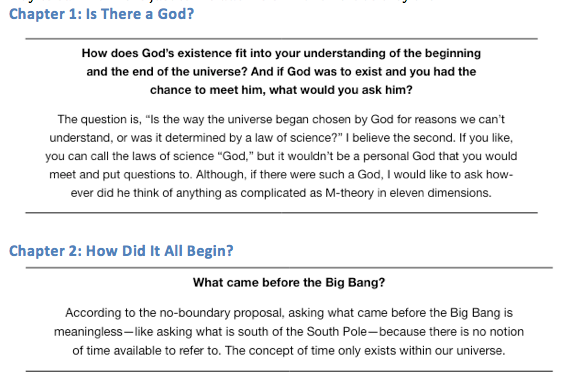
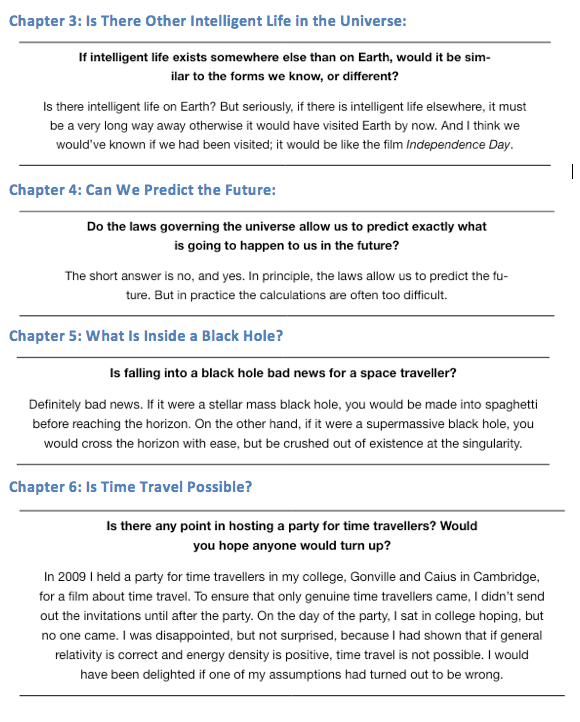
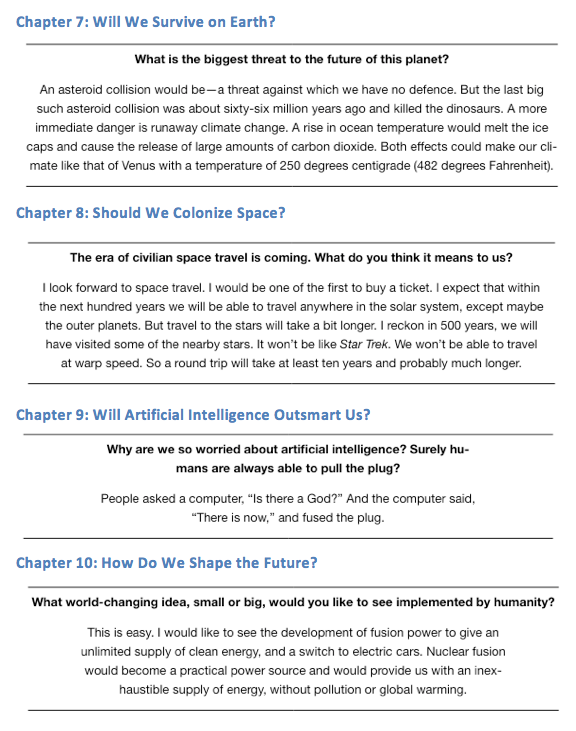
MY TAKE ON IT:
- GOD EXISTANCE:
I believe that this could not possibly be known, unless and until God decides to make it known. Consequently the best way to treat it is American way: leave everybody to believe whatever they want and prevent anybody from imposing his/her believes on others
- BEGINNING:
I actually do not think that it is meaningless question, but I also do not think that it is an answerable one. Our understanding of Bing bang, time, and space came from combination of observable facts in form of various physical phenomenon with mathematical modeling that kind of makes sense of this. This modeling could not possibly be final not only now, but ever because we do not know what other phenomenon would be discovered in the future and what mathematical modeling would be available if our data processing and modeling abilities will increase by factor of billions. In mine humble opinion there were no beginning as well as there will be no end, as it was said before: ”just one damn thing after another”.
- OTHER INTELLIGENT LIFE:
I think it absolutely exists and probably in huge number of variation, but not necessarily that often and close to each other. Therefore limits on travel and communications are way too high, making idea of interaction improbable.
- PREDICT THE FUTURE:
No way. There are too much complexity and variations to have it reliably predictable in details. Probabilistically, however, we predict the future everyday with pretty high level of precision like: it will be one Monday within the next 7 days.
- INSIDE OF BLACK HOLE:
The black hole is the product of our modeling, so description provided by author must be consistent with it. It does not mean that if one tried to inter black hole it is exactly what would happen.
- TIME TRAVEL:
We do it all the time, but only in one direction physically with speed being marginally changeable, but not by much. Psychologically there are no limits.
- SURVIVAL ON EARTH:
We’ll survive for a while, at least until some big thing happen that is beyond our control, like sun becoming supernova. Things like climate change are not a problem at all. The climate had always been changing and that’s why evolution gave apes with bigger brain advantage in survival, so they could adjust faster that it could be supported by DNA change. Besides the way it is presented now is mainly BS, serving to assure wealth transfer to bureaucratic scientists.
- COLONIZE SPACE:
I do not thinks it make sense. Humans are not going multiply indefinitely. Moreover we already can observe shrinking rather than expansion of population, so there are enough places on this planet for everybody.
- ARTIFICIAL INTELLIGENCE OUTSMART HUMANS:
If question is if non-biological system can do everything that humans do, better, then the answer is yes. However if we consider human being a system that through internal presetting (DNA for example) can accumulate experiences, form self-perception as the entity separate and different from environment outside of border of this entity, set up objectives to achieve, and act to achieve this, then answer is no. It is “no” because such system would be a human, even if it is based not on biological material, but on, let’s say, silicone. However I do not see any reason for creating this new type of humans, except for limited experiment, because we humans love ourselves and do not need any competition. The use of AI as tool, functional, but not conscious would be good enough.
- HOW SHAPE FUTURE:
Technological future is trivial, it will happen. Much more important is social future. Humanity needs to move away from resource creation, allocation, and redistribution via Deception, Coercion, and Violence. Similarly humanity should discard the idea of one individual having power over other to force this other to do or not to do something. If we manage to do these 2 things within the next 50-100 years, we’ll be fine. If not, then some pissed of individual will use technology to create deadly virus or super powerful explosion or something else to end this all.
20190331 – Living with the Gods
MAIN IDEA:
The main idea of this book is to trace religious and other ideological believes from the very beginning, by analyzing the first known relevant artifact and then information from many diverse sources that demonstrate and explain different patterns of ideologies. It is also to demonstrate how these ideologies unite groups of people, how the process of ideological interaction occurs, how theatrics and images are used in promoting these religions and ideologies, advantages and disadvantages of different religious structures: one or many gods. The key point however is the look at power distribution between religion and secular authorities formal and informal.
DETAILS:
Introduction: Believing and Belonging
Here author defines this book not as a history of religion, but as research on the role of shared believes either religious or ideological in society and how it shapes individual’s attitude to society, state, and morals. Author briefly looks at different systems of believes starting with American motto on the money: “In God we trust” and then at organized religions of the world that experiences kind of religious revival in multiple places, especially Hindu and Muslim combined with reaction of dominant secular believers in response. Author also stated that he believes that religion addresses many of the same questions as politics, providing guidance to any specific group of people to “Who are we?” question.
Part One: Our Place in the Pattern
Chapter 1: The Beginnings of Belief
This chapter starts with discussion of the oldest known statute – Lion man, dated to around 40,000 years ago. It was evaluated that this small statute required some 400 hours of work and therefore had to be highly valuable. It must have some very important ritual value for people who crated it. In addition, microscopic analysis identified that mouth and only mouth of the statute was contacted by organic material, probably blood. This is quite striking evidence of development of some kind of material representation of powerful forces that influence human environment, but are beyond human control. Another peace of evidence is that no everyday objects were found in the same place, but a lot in places nearby, seemingly demonstrating that Lion man was part of some important ritual not really mixable with everyday life. Author’s conclusion is that even at this early point Homo sapience is also Homo religious, using his imagination to try appease unknown.
Chapter 2: Fire and State
Here author moves to more recent times discussing link of fire to gods from Shiva to Jewish Yahweh, to Roman goddess of fire Vesta and her virgin servants. Somehow this leads to female power of English and French queens and their cultural connection to Vestal Virgins demonstrated in portraits. Then author brings in Zoroastrians and their attitudes to fire, which was quite different from Roman attitude. Romans saw it as coming from one source, since Vestals and maintaining this permanent source. Zoroastrians saw it as coming from everywhere and mixing in one place, creating unifying symbol of community. Amazingly, centuries after Islamic conquest when small group of remaining Zoroastrians called Parsis moved to India, bringing with them ashes of their sacred fire, they managed for centuries keep this ritual fire running. It believed that this flame was continued unextinguished since year 721. Then author traces this attitude to fire to contemporary permanent fires at Tombs of Unknown soldiers and similar places.
Chapter 3: Water of Life and Death
This is about religious meaning of water. It starts with baptismal font in Salisbury Cathedral today and then moves to high significance of water in Hindu religion, especially Ganges water. Author also discusses baptism, where he also uses Indian example.
Chapter 4: The Return of the Light
This is about not just light, sunbeam and different ancient structures where it plays important role, defining specific moment of time. As example author discusses Newgrange that was built some 5000 years ago. After that he moves to discussing Japanese use of sunlight and cultural fusion of “light and life, of the nation, the winter solstice sun and the emperor.
Chapter 5: Harvest and Homage
Here author moves to religious meaning of animals. He starts with bible, Noah’s story and notion that god gave humans dominion over animals. Then he moves to Alaska and discusses meaning of anorak, made from animals and rituals that designed to establish peace with spirits of these animals that humans used for their needs. It goes through all human cultures and author discusses such process in ancient Egypt.
Part Two: Believing Together
Chapter 6: Living with the Dead
The next stop is rituals of burial, mourning, and various forms of body disposal in such way that newly empowered spirit of deceased would stay happy and cooperative, rather than pissed off and hostile. Author discusses attitudes in medieval England, and then moves to WWI dead and commemorations. He also looks at Peruvian mummies and Chinese tradition of giving gifts to the dead and their contemporary practices.
Chapter 7: Birth and the Body
For discusses of birth author uses St. Margaret who bursts from the back of dragon that swallowed her, which somehow made her protector of women giving birth. Author also brings in an evil counterpart from Hindu – Lamashtu who brings in miscarriage and infant death. The sale of amulets protecting from her is a thriving business. Similar traditions exist in Europe and Japan. Author also discusses hierarchy of bodies that he finds in monotheistic religions who put male body above female.
Chapter 8: A Place in Tradition
Here author discusses how people are born into tradition and, as an example, provides artifact from Jewish community in Germany in 1750: circumcision cloth with record of newborn’s and his father names and some blessing. Author traces life from birth to bar mitzvah when a Jewish boy becomes adult after satisfying traditional requirements. After that author looks at quite similar and colorful traditions of primitive tribe in Melanesia, in this instance instead of reading and discussing bible they go for haircut.
Chapter 9: Let Us Pray
This chapter moves to one-sided communication with god – prayer. It starts with discussion of Millet’s painting from 1881 that became extremely popular in France. Then author switches to Islam and technical difficulties Muslims experience in trying to find direction to Mecca they need to face during prayers. He also discusses Buddhist rituals. At the end he points out to interesting paradox of public call to private prayers, which is expressed by Church bells or Islamic call to prayer.
Chapter 10: The Power of Song
The last chapter of this part is about songs and music that synchronize people’s mood and put them and semi hypnotic condition. Author discusses use of music in Christian denominations, at the end referring to Obama’s singing of “Amazing grace” at funeral, which was immediately joined by all present, creating very powerful scene.
Part Three: Theatres of Faith
Chapter 11: The House of God
It starts with Gobekli Tepe and continues discussion of religious architecture through the contemporary structures. Author discusses how architecture of sacred spaces instills communality of people and reinforces common believes.
Chapter 12: Gifts to the Gods
This chapter is about typical attitudes to anthropomorphic god: attempts to acquire good will by bringing gifts. It starts with actual Eldorado: lake Guatavita in Andes where Muiska Indians for centuries deposited gold as gift to gods. Then author moves to ancient Greeks, Parthenon, and their gifts to gods. There is interesting discussion here about separation of regular state finance and sacred finance when gifts to gods became kind of banking fund from which it was allowed to take loans, which them had to be returned.
Chapter 13: Holy Killing
This is about flesh sacrifices to gods. It starts with always charming Aztecs and their murderous rituals with cutting hearts from living humans, and then moves to European traditions of using animals for the similar purposes.
Chapter 14: To Be Pilgrim
This is discussion of another complex set of rituals: pilgrimage to holy places. For a change author starts with relatively recent Canterbury tales describing travel around Europe medieval Christian holy places, then moves to similar Sikh places in India, then 4 great sites for Buddha followers, and the most spectacular and crowded of all – Muslim Hajj.
Chapter 15: Festival Time
Obviously there is no religion without festivals and author uses Sakha in Yakutia to discuss working of this type of ritual. I guess author decided to use this unknown group because it provides a good example of heavy suppression for decades of Soviet Russian rule and eventual resilience of native believes that survived even nearly complete obliteration of culture, religion, and language. The second part of the chapter is an interesting review of very recently created festival, which has some religious flavor, but not very strong and provides very attractive secular way to rejoice – contemporary American Christmas. There is very well documented process of development of this holiday, which was created by lots of individuals pursuing various needs from promoting books and worldviews by Dickens to selling soda drink by Coca-Cola.
Part Four: The Power of Images
In this part author discusses what he calls “community of the image”.
Chapter 16: The Protectoresses
He starts in Mexico with the image of Lady of Guadalupe, which practically became the symbol of Mexico. Then he moves to the ancient world of Europe and discusses image of multi-breasted Artemis / Diana, and completes this chapter with emerging cult of images of Princess Diana.
Chapter 17: The Work of Art in Times of Spiritual Reproduction
The next set of images that author discusses comes from Russia with its Lady of Kazan that was supposed to protect this country, and completes with Indian images of Durga that have very temporary use during Durga Puja festival and discarded when festival ends.
Chapter 18: The Accretion of Meaning
It starts with discussion of nativity paintings where unnatural images of light emanated from body creates combination of real and imaginary amplifying religious story. Then author moves to cave images in different places depicting hunting and other scenes from live somewhat realistic, but somewhat idealistic. Author also looks at Japanese Shinto shrines and their images and completes chapter by discussing contemporary images in South Africa trying to unite diverse people.
Chapter 19: Change Your Life
This starts with poetry of Rilke in which Greek images prompt contemplation about need to change one’s life. Then it goes into the meaning of Christ suffering and gory images of it, discussing different interpretation of where it directs Christians. This follows by discussion of Buddha and his smile. Ironic ending of the chapter is the image of starving child used to elicit donations.
Chapter 20: Rejecting the Image, Revering the Word
This chapter is about another time-venerated tradition – hating and destroying images. Author starts with Taliban, contemporary representatives of this tradition then he moves to medieval Christians destroying Greek and Roman art. After describing hate to images author inserts discussion of destruction of Jewish Temple that initiated Jewish tradition of building religious community around much more flexible artifact – sacred and not so sacred books that allowed Jews survive as specific group despite moving all the time, mostly involuntary. Author ends it with Muslim worship of Koran, which interestingly enough in treated more as image than book, albeit very complex one.
Part Five: One God or Many
This part is about monotheistic vs. polytheistic societies and political implication of difference in believes.
Chapter 21: The Blessings of Many Gods
This starts with discussion of Romans who had a god for just about everything and keep adding additional gods from conquered tribes. Author compares the story of Noah with Epic of Gilgamesh – in both cases man gets direction from above to build ship to escape disaster, but in case of Noah it is one powerful god who decides both to start flood and to save Noah and one couple of every species. For Gilgamesh it is more complex with multiple gods intriguing for and against annihilation of humans with chief god Enlil ordering it, while his younger brother sabotaging his decision. It ends with charming story of a really existing bureaucrat Dr. Ambedcar, author of Indian constitution, being added to Indian pantheon of multiple gods. Author makes point that polytheism is much more tolerant than monotheism, but it is not always so.
Chapter 22: The Power of One
Here author goes to ancient Mesopotamia to look at origin of monotheism. There is interesting tablet from around 580 BC, in which one god Marduk kind of takes over responsibilities from all others, declaring that he is real power behind all of them. Author here presents thesis that unlike secular contemporary world, the world before knew no difference between political power and theology, so concentration of political power in one hands necessitated transfer to monotheism. In addition of Babylonian artifacts author adds history of Egypt pharaohs to support this thesis.
Chapter 23: Spirits of Place
This is kind of deviation from big gods to small local spirits, which are, while supernatural, nevertheless very limited in their power. Author looks at English folklore, Thai spirit houses, and spirits of Yolngu people in Australia to demonstrate how it works.
Chapter 24: If God be with us
This chapter is about use of Gods in military campaigns where their support is absolutely necessary for victory. It starts with English movies of WWII referring to battle of Agincourt during religious wars of XVI century. Then he shows how it was used in Christian Ethiopia during wars again Italian invasion. One interesting fact from this is that Haile Selassie had become known as Ras Tafari or Rastafari, generating a specific branch of Christianity that become popular in Africa and in Jamaica.
Chapter 25: Tolerating and Not Tolerating
The chapter on tolerance starts with discussion of Indian tolerance either under Hindu or under Muslim rulers. Then author moves to religion of Sikhs and to contemporary world when the tolerance became a lot weaker and both Hindu and Muslims are often militant against each other.
Part Six: Powers Earthly and Divine
This part is about relation of ideology and politics from divine rules of kings to direct rule by god, as transferred by politicians, to atheistic societies were religious believe is not allowed, substituted by kind of secular religion usually centered around the great and infallible leader.
Chapter 26: The Mandate of Heaven
This starts with coronation of English queen in 1953 and then moves on to XIX century Oba from kingdom of Benin and symbols of royal power. The second part of the chapter about complex religious – political constructs of China and idea of Mandate of Heaven.
Chapter 27: Thy Kingdom Come
This chapter starts with the Jews, their story and ideas of Kingdom to come – the future resolution of all problems by God’s direct intervention. After briefly retelling Jewish struggles with Roma Empire through bar Kokhba revolt, author moves to XIX century Islamic state in Sudan and their struggle with British Empire kind of intermixing these two stories.
Chapter 28: Turning the Screw
Here author discusses intolerance to religious expression. His examples are French authorities forbidding burkinies – Muslim bathing suits in 2016 and Japanese forbidding Christianity in XVI – XVII centuries. Then author discusses French annihilation of Huguenot Temples and overall religious wars between Catholics and Protestants in Europe, ending by noting that burkinies were allowed after all, indicating kind of progress in our time.
Chapter 29: ‘There Is No God!’
This chapter is about another form of intolerance – intolerance of religion. Author starts with French revolution and its massive attempt to substitute Christianity with the Cult of reason. He looks at details of this attempt such as new calendar, festivals, and so on. Similarly he discusses Soviet Atheism that proved to be deficient as ideological foundation of society during WWII, forcing Stalin to pull a bit back by restoring legality of Orthodox Christianity, albeit closely controlled by secret police. Author then describes how after fall of communism Orthodox Christianity returned to its place as ideological foundation of Russian society.
Chapter 30: Living with Each Other
The last chapter comes down to the quite trivial idea that we all should tolerate each other’s ideologies religious or otherwise and move along through the wheel of life that author presents as Buddhist illustration:
MY TAKE ON IT:
It is always interesting to trace various religious believes of people through time and space and author does a pretty good job going through multitude of artifacts representing these ideologies from Lion man of 40,000 years ago to Soviet Cosmonaut of 50 years ago. For me these all are various attempts to build some societal consensus of believes that allows big numbers of people cooperate more or less effectively and at least somewhat defines individual behavior the way consistent with wishes of controlling individuals of society. However any believes tend to take various forms inside brain of each individual, it is always supplemented by use of force just to make sure that deviations are not too big. One common feature of all of these is an attempt to substitute art either as narrative, graphical, musical, or architectural for scientific understanding of the world. I think that this type of ideological construction is coming to its natural end because the new approach – scientific pragmatic and theoretical / experimental ideological construction after proving its efficacy over the last few centuries will become more and more dominant, making all other into just curious historical artifacts. Currently the latest religious attempts to build ideological foundation of society supporting strict forms of control such as global warming or socialism turns to quasi-scientific forms. This demonstrates that old forms of ideological construction: revelations and art do not have the same convincing power they used to have, probably because of increase in literacy and technological savvy of population. I hope that current attempts to build the new controlling narrative will fail due to the same factors, but one never knows the future. It is possible that with advance of AI, robotics and decrease of needs in human labor, humanity will be divided into two parts: small elite living interesting and challenging live of achievement; and masses drowned in entertainment, drugs, and cheap substitutes for real live. However I could also imagine future without any overwhelming controlling narrative, in which every individual has freedom to believe whatever ideological framework he/she is comfortable with and had something to do either in art or science or both. In either case, I think purely material needs of subsistence both material and psychological will remain in the past and issues of the future would be different from whatever we could imagine now anyway.
20190324 – Heirs of the Founders
MAIN IDEA:
The main idea of this book is to review lives and achievements of 3 most famous and effective legislators of the first half of XIX century. Author considers them direct inheritors of founding fathers and credits them with several important achievements such as building legislative foundation of America, supporting building of infrastructure that allowed rapid development and most of all delaying Civil War for decades, even if the next generation failed to prevent it.
DETAILS:
Prologue: January 1850
This starts at the end of story when Henry Clay – Kentucky Westerner, supporting Union, John Calhoun – Southerner rejecting it in hope to save the South as it was – with slavery and everything, and Daniel Webster – Northerner lukewarm abolitionist who was pushed to the brink by his constituency, all where close to their deaths. This was completing the chapter of American history that all three of them created by fighting, intriguing, and compromising for 40 years since the war of 1812.
Part One: The Spirit of ’76
Here author describes background of 3 main personalities that defined legislative battles of the first half of XIX century. Henry Clay – scion of Virginian family that moved west to Kentucky, John Calhoun – Scotch-Irish member of southern aristocracy, and Webster – Massachusetts lawyer who moved to politics. Author also describes 4thperson John Randolph – member of Virginia aristocracy. Author discusses the period at the start of their career when the most controversial issue was the war of 1812. East Coast was pretty much against it, while South and West were for, the former looking for stability, the latter for expansion to Canada and further West that British were trying to prevent by promising these territories to Indians.
Part Two: To Build a Nation
This part describes legislative fight to define the new nation when all sides believed that they were building foundation for much bigger country that it was at the time. Author starts this with discussion of end game of the war when Andrew Jackson’s victory at New Orleans brought victory when settlement was already signed without definite knowledge of who won the war. Then author moves to period after the war when the 2ndBank of USA was established in 1816 and Henry Clay start promoting his American system of government that was based on infrastructure development for common benefit. Webster supported Clay. Author discusses in some details legal issues: Marbury that allowed Supreme Court’s power grab, Dartmouth college that limited states power to interfere into contracts, and McCullough that again limited state power, this time prohibiting states from taxing federal government. Finally author discusses fight over Missouri admission as a slave state to the union and eponymous compromise that was established mainly by Henry Clay’s efforts.
Part Three: The People’s Government
This part is mainly about politics and maneuvering of Andrew Jackson’s era, which really started with Jackson failure in election of 1824 when despite getting most of the vote he was deprived of presidency by politics of different factions in congress. The main political issues of the day were:
- Federalism and extent of government expenses for country infrastructure
- Free trade vs. protectionism
- Power fight between established aristocracy of “expert” politicians mainly represented by John Quincy Adams with partially hidden support of majority of professional politicians vs. uncouth masses mainly represented by Andrew Jackson.
After Jackson eventually took presidency in 1828 two very important issues came upfront. One was the issue of tariffs that benefited the North and hurt the South, turning eventually into South Carolina’s failed attempt to assert state rights via nullification. Another one was Bank of the United States that Jackson considered key power player against interests of mass population that he represented. After several years of struggle Jackson successfully killed the bank.
There was also an important sideshow related to behavior of wife of John Eaton that was considered improper and was boycotted under leadership of Calhoun’s wife. It was kind of expression of hate to Jackson and class of people he represented, so his response was to get on the side of Peggy Eaton, with quite negative consequences for Calhoun standing.
Another issue of the growing import was the change in attitudes to slavery. Moving away from common perception of slavery as evil, albeit necessary and temporary, southern elite start promoting the idea that slavery is a positive good that benefited both masters and slaves by combining brain and sophistication of masters with manual labor of slaves who were too inferior in abilities to survive on their own. This was subject of debates between South Carolina Senator Robert Haynes and Daniel Webster. This issue was conflated with issue of state rights and nature of Union. This debate demonstrated how irreconcilable become this issue, raising clear possibility of civil war.
Part Four: A Deep Game
This part starts with Jackson realizing Calhoun’s enmity to him and everything that he represented that resulted in removing him from Jackson team. After that Calhoun found his place as passionate defender of South, which made him the secondary player in presidential games. Henry Clay tried to arrange opposition to Jackson on the basis of tariffs, bank, and American system of government building of infrastructure, all of which Jackson opposed. Despite mass propaganda and bribery campaign conducted by Bank’s Nicolas Biddle, Jackson popularity only grew as result of this battle and he easily won the second term. The battle of the second term was about states rights, nullification, and nature of American Union whether it was permanent contract uniting all states in one whole with superiority of Federal authority or it was just a compact between sovereign states that could leave it at will. Philosophically the issue was whether the Union is creation of states or creation of the people. Daniel Webster quite eloquently supported the latter approach, while Calhoun the former. Henry Clay managed to forge compromise and Jackson supported it, but it was clear that country moves to disunion and at some point it will run out of compromises.
Part Five: Temptations of Empire
Author starts this part by presenting view on events of foreign observer Harriet Martineau. She created popular salon in Washington and was able to observe main players in quite relaxed environment that presented better view of their personality than formal environment of Congress and their speechifying.
After that author retells completion of battle with the Bank and its destruction. Author stresses that despite battles in Congress about nullification and slavery, Americans were too busy with establishment of democracy with Andrew Jackson presidency and chaos that it created to get involved in anything more of internal politics, so the Union was save for the moment. Then author moves to another big issue of late 1830 through the end of 1840 – territorial expansion to the West and South at the expense of Mexico. This includes issue of Texas that was populated by illegal immigrants from US, started rebellion, become an independent slaveholding republic, and wanted to join USA. Abolitionists were strongly against such addition, so the issue was outstanding for a while. Meanwhile ideological struggle over slavery continued and increased over time, now with the clear cut positions: Southern – that slaves are less than human and had to be controlled and taken care of, and Northern – that slaves are human and should possess all rights of American citizens. In this fight Calhoun become a leading proponent of slavery and supported everything, war included to protect it. Webster was somewhat lukewarm opponent prompted all the time by his abolitionist constituency to fight it, and Clay, while clearly against slavery, was also against abolitionists, believing that their radical approach is way too dangerous. Author retells some important parts of this ideological struggle including the story of black man from New York who was kidnapped and sold into slavery, then escaped after 12 years. After escaping the man produced account of his story, that condemned this institution in very vivid way, becoming kind of ideological victory on par with Uncle Tom’s story. In parallel to these various stories author mentions Van Buren presidency that was killed by economic downturn and then unexpected presidency of John Tyler, elected as vice-president from Whig party who acted completely on his own when become president.
Part Six: The Fatal Compromise
This starts with description of Daniel Webster’s opposition to Texas annexation that moved closer to reality with election of James Polk to presidency. When it came to the war with Mexico Calhoun kind of supported it, but tried to move it slowly in Congress, eventually failing. Webster tried at least reject territorial acquisition as objective of war, but fail in this too. Whigs even tried to censure Polk for initiation of war and then rejected Mexican treaty that gave USA new territories, but they failed to stop him.
Then author returns to the event he started this book with: discovery of gold in California. He even states his believe that if it would become known during negotiation with Mexico, the outcome would be different. Then he moves to discussion of Clay’s opposition to the war and, most interesting, his proposal of 8 resolutions that he believed would settle slavery issue once and for all. It was comprehensive solution in which Clay tried to meet needs of all sides, but it proved to be impossible. After discussing Clay’s failed attempt for compromise, author moves to Calhoun, who had no intention of compromising. He believed that balance of power permanently shifted to the North, so any compromise would only delay inevitable: the South cessation from the union. He envisioned the calamity that would come from any serious attempt to change southern society. The only way to save the union, Calhoun believed, would be for stronger North to accept South’s peculiar institution and forcefully support it, which in reality could not possibly happen. Interestingly enough, at this junction Daniel Webster tried to go pretty far to meet southern demands, even in contradiction of wishes of his constituents and endorsed Clay’s compromise. During the period of discussion of this compromise Calhoun, the most formidable opponent of compromise died. Compromise passed with big effort by young Stephen Douglas and was signed by president Fillmore. This Compromise of 1850 did not last for long, but it still probably delayed the Civil War. Once again author returns to discussion of ideological war, referring to the book by kidnapped black citizen of New York that became important factor in making abolitionist case against slavery.
In the last chapter author describes deaths of Clay and Webster that occurred pretty close in time and kind of indicated the closing of the era of the first post-revolutionary generation of Americans and their attempts to build country and keep its different section together. The next generation – generation of Lincoln born early in XIX century and matured in its middle were a lot less inclined to compromise, so the issues of slavery, state rights, and nature of the Union was decided the Civil War.
MY TAKE ON IT:
Unlike majority of history books this one is not about war and generals, but about politicians who for some 40 years often fought each other, but also sometimes worked together to build legislative framework of United States and resolve the great many issues of the period. They somewhat succeeded, but the most important and difficult issue of slavery, that in reality was based on irreconcilable contradiction between North and South. The Northern capitalism was based on free labor, which produced great economic growth and rapid development, despite all negatives of wage labor it was based on. The Southern semi-capitalism was static, extractive, and foreign trade dependent, which could not be really called capitalistic because of its complete dependence on slave labor.
These politicians were smart and interesting people and too bad that all their efforts to achieve compromise failed. I wish they all had better understanding of military technology and imagination to fully appreciate the cost of war not only in lives and suffering, but also in money. Had they have any inkling of these costs, the full price of buyout of all slaves, letting them go free with full citizenship, supplied with massive ongoing support to make them self sufficient would be a very small price to pay indeed.
20190317 – The Once and Future Worker
MAIN IDEA:
The main idea of this book is that all problems of American Society come from devaluation of work and the solution for most of the problems is restoration of strong labor market: “labor market in which workers can support strong families and communities is the central determinant of long-term prosperity and should be the central focus of public policy”.
DETAILS:
Introduction: The Working Hypothesis
Here author defines his main idea, which he calls “the Working Hypothesis” and claims that neither of two main American parties really working on behalf of workers and labor market. Republicans trust market too much so they do not interfere enough in economy leading to division into winners and losers that leave working classes behind, resulting in grossly unequal distribution of wealth. Democrats do not trust market so they interfere too much, limiting market forces and degrading economic productivity in the name of identity politics, green and other special interest. The consequences of these policies are less and less wealth created and available for distribution. Author expresses believe that public policy “not that much failed as succeeded at the wrong things”, so it could be fixed via negotiation and tradeoffs between political forces leading to restoration of healthy labor market.
PART I WHAT WORK IS WORTH
- As American as Economic Pie
Here author traces history of consensus development between Center Left and Center Right that growing economic pie is enough to maintain health of society and whatever problems raise they could be resolved vie redistribution. He points out how the flaws of this view have led to the abandonment of too many American workers. One such flaw author defines as agreement that interests of consumers are more important than interests of producers. There is also brief review of elite opinion about closed vs. open, which by open means easy access to world cheap labor market that benefits consumers at the expense of destruction of their society.
- Productive Pluralism
Here author presents what he calls productive pluralism: the idea that the objective of policies should be not just material production, but non-material benefits of working such as self-respect and meaningful lives. Author presents his idea of constructive definition of prosperity, which includes not only economic but also social well being of society. Author also discusses his productive pluralism from the point of overall investment into the next generation via support for family, social cohesiveness and other indicators of prosperity that go way beyond just GDP and other economic metrics. Author states that productive pluralism is also includes things like sustainability and high quality environment. One interesting point author makes is that specialization is not always positive factor and that overall diversity of knowledge and skills could be more beneficial for the health of society, especially in conditions of fast technological change when overspecialized individual with obsolete skills have hard time to switch to something else.
- The Labor Market
This is an analysis of labor market: how economy aligns what needs to be done and what people can actually do and stresses that it is not good enough to achieve high level of production if lots of people fail to succeed and author reviews tools that could be used to correct market. One of these tools is entrepreneurship. Author believes that entrepreneurs could always find way to apply additional labor if they are not restricted by government rules and requirements. In this view unemployment is mainly artificial creation of the government. Author reviews multiple factors that impact labor market: Demand, Supply, Boundaries, Transactions / Relationships, and Taxes.
- A Future for Work
Here author discusses how technology changes nature of work so the workers also had to change to maintain relevant skills and abilities that market rewards. Author discusses automation that kills jobs and creates new ones, usually not at the same time and not for people with the same skill set or flexible enough to learn the new ones. Author characterizes the problem of the future that productivity raises, while output does not. He contrasts current situation with 1950-60s when productivity grew even faster than not, but so was output. Author then analyses literature and statistic on manufacturing and consumption by different layers of society with top making much more income than bottom, but consuming on average only 2 times more of everything. In addition to material and non-material consumption author discusses geographical distribution of population noting that attractiveness of big cities is seemingly decreasing and people again start moving away.
PART Il TURNING AROUND
Here author discusses political interferences in economy that most influence labor market.
- The Environment and the Economy
This is about environmental regulations. Author defines his position as believe in necessity of environmental regulation combined with requirement for regulator to be wise and make necessary trade offs between clean environment and production of goods and services. After that author proceeds to use multiple examples to demonstrate that environmental regulation is not product of wise trade off, but rather often product of power crazy bureaucrats who are trying to stifle productive abilities of society in order to satisfy their psychological needs to control everything.
- How the Other Half Learns
This is about education and how it helps people develop marketable skills or more often fails to do this. Author starts here with obvious fact that huge spending on education does not produce a lot of educated people. As it is popular now, author calls for more occupational training and less expense on formal college education of individuals who do not want it or are not capable to obtain it. Author calls for removing federal standards and mandates, directing funds instead of formal college education to support of multiple paths to acquire marketable skills, knowledge, and experience.
- Of Borders and Balance
This is about international aspects of labor market: trade and borders, or more precisely who produces goods and services, where it happens, and who consumes all this. Author discusses low skill immigration as causing wage suppression and discusses confusion about economy growth via immigration vs. growth via higher productivity. There is discussion here of Arizona experiment of limiting illegal immigration that did decrease overall GDP, but increased GDP per capita and wages. Author also provides suggestions on how to fix problems with immigration and foreign trade:
- Build on American advantages created by free market
- Deter unfair practices like IP theft
- Address financial imbalances by scrutinizing more capital acquisitions from foreign countries especially China that transfer IP and technology
- Support American workers by forcing businesses take into account impact of production transfer to cheap labor countries
- More Perfect Unions
This is about labor unions and how they impact labor market. Basically author supports unions, but on condition of less adversarial and more cooperative relationship with business similarly to one in Europe, especially in Scandinavia
- The Wage Subsidy
This is about direct political impact on market via taxes and subsidies. Author look at Foxconn plans in Wisconsin as example of huge subsidies in form of tax cuts from government to business to create jobs. Author discusses history of wage subsidies and critic of both approaches: Democratic for directing public resources to welfare programs and republicans for directing resources to businesses via tax cuts. He suggests different way provide support that would not have usual problems.
PART Ill BEYOND THE MARKET
- For Those Who Cannot Work
This chapter is about safety net to protect those who cannot work without discouraging those who can. Author finds it paradoxical that every dollar taken from productive people and given to unproductive decreases incentive to be productive. Author reviews a number of welfare programs concluding that the formal objective – to help poor would be much better achieved by just giving them money. He also quite reasonable criticizes a static character of help that does not take into account dynamic character of working, when growing experience even at the lowest levels of work make individuals more marketable. With too much help people do not have incentive to start working and consequently have no opportunity become more marketable. Author also looks at similar problems with low-income housing and other areas. Overall he believes in need to substitute no demand safety net by resource-transfer model that would promote self-sufficiency. He refers to wage subsidy as tool that could do just that.
- The Social Wages of Work
This is about social norms and culture that pretty much defines what work worth. This in turn can increase both material and psychological returns on participation in labor market, which author considers being critical for healthy society.
Conclusion: The Lost Generation
The generation that author refers here, the one that could become lost, are people born in 1980s when combination of cultural decline of value of work, normalization of welfare as way of live, and availability of cheap goods produced in poor countries made it difficult to find satisfaction in work, pushing people to all kind of pathologies from opioids to crime. Author suggests building the new broad socioeconomic coalition that would concentrate on supporting effective job market. This would provide meaningful jobs that would support not only material, but also psychological needs of people.
MY TAKE ON IT:
I would pretty much agree with author diagnosis that high productivity, automation, global shift in production to low wage countries, and massive cultural devaluation of traditional values of family and hard work caused not just difficult problem, but actually moved society to disintegration. However I do not think that it could be easily fixed. Current achievements in AI make it more and more probable that not only it would be impossible to find meaningful jobs for people with low levels of skills, but also the same will apply to people with high levels of skill that become obsolete. It would increase destruction of family and other cultural values because one needs resources to support these values, which welfare, however generous, could not possibly provide. My solution: equal rights for resources with continuing rights trade between resource over and underusers, which would make everybody active market participants with unequal outcomes and therefore opportunity to improve this outcome. When everybody has something to trade, he/she would acquire skills necessary for market participation, while wide access to practically any information and ability of training in virtual reality could provide everybody with meaningful and gainful opportunities.
20190310 – The New Mind Readers
MAIN IDEA:
The main idea of this book is to review history of neural imaging development, its current technology, and prospects for the new ones, and discuss methodology of its application and experimental finding. The other important idea here is to present the current technological capability of brain imaging that allows for some form of mind reading. Author also analyzes societal and ethical consequences and presents medical and biological aspects of these new capabilities.
DETAILS:
- Thinking on 20 Watts
This chapter starts with description of the brain and electro-chemical processes that occur when it works. There is usual analogy between brain and computer, but it follows by better than usual explanation of why and how it is different. Then author describes history of neuroimaging and how fMRI allows tracing of what is happening inside of working brain. Author also provides examples of experiments without use of neuroimaging, typical for period before fMRI such as experiment with best ways of memorizing something. At the end of chapter author provides road map for the book.
2 The Visible Mind
This chapter goes a lot more into history, starting with use of positron emission tomography (PET) in 1980 that allowed accumulate data and knowledge about relation between brain activity and blood flow, electrochemical activities in the brain and how it could be picked up by magnetic resonance. All this eventually led to development of fMRI that become the most popular tool for analyzing human mind.
3 fMRI Grows Up
This chapter traces development of fMRI technology and its increasing usability. The first important issue was linearity of fMRI reaction with neuron activity. This was confirmed by Logothetis’s study. The second was an attempt to find consistent functional modules in the brain. It produced an interesting result for identifying fusiform area (FFA) as module used for expert recognition of objects with general recognition mainly distributed to different parts of brain. The follow on research-developed ability to recognized specific patterns of brain activity linked to specific inputs. New technic was developed to trace movement of water molecules in the brain: “diffusion weighted MRI” (DWI). It was used for Human Connectivity Project mapping human brain connectivity. Author links it to general theoretical development of complex networks analysis. Author also discusses some false analytics by using example of fMRI analysis of dead salmon’s brain. The point here is that fMRI analysis based on lots of statistical correlations which is quite dangerous tool due to correlation / causation problem and dependent/independent variables.
4 Can fMRI Read Minds?
This chapter is about attempts to link fMRI imaging to actual activity of the brain in order to decode this activity into meaningful chain of thoughts and words. There are some real achievements in this area for example author presents comparison of actual object presented to the person and reconstruction of these object based on fMRI data:
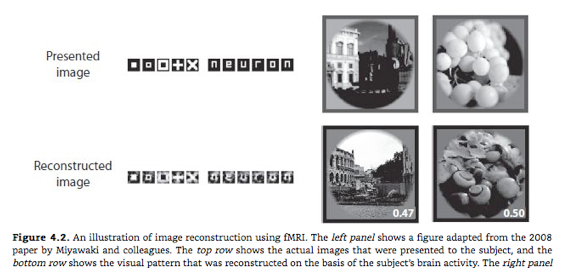
One practical implementation is to use fMRI to identify consciousness in brain damaged individuals in coma. Another problem author discusses here is chronic pain, which is related to different parts of the brain than acute pain. It is a very serious problem not only for treatment, but also for need to establish that it exists. The fMRI technology was recently allowed for use in legal cases related to chronic pain diagnostics.
5 How Do Brains Change over Time:
This chapter is a bit less about technology and a bit more about brains or, more precisely, about how brain changes over time and how it incorporates experiences into its material structure. In addition to well-known facts of brain changing with time from pruning of connections in the brain of infant to London taxi drivers overdevelopment of spatial areas. What is new and interesting here is research, which demonstrated that any overdevelopment of one area occurs at the expense of another areas. Author describes study that he conducted on himself by regularly going through fMRI analysis. It demonstrated changes in individual brain over time, dependency on external factors like caffeine and food, and necessity of detailed research on individuals versus mixing results from different people because every brain differs from others. The last finding is probably most important because it demonstrates that in order to be effective neuroscience application should be personalized.
6 Crime and Lies
This is about attempts to use fMRI in courts as sort of lie detector and why these attempts so far remain quite problematic. Author also discusses brain development and responsibility, supporting idea that underdeveloped brain of teenagers makes it improper to keep them responsible for their actions. Author discusses not only lie detection with fMRI, but also crime prediction feasibility. It follows by detailed discussion of research literature and statistical method used to evaluate how useful fMRI would be for real world decision making. Author mainly calls to be on the side of caution, avoiding jump to conclusions about the validity of fMRI methods.
- Decision Neuroscience
This is about attempts to understand how people make choices and decision and moreover how to influence these choices either for marketing or other reasons. It starts with discussion of difference between human decision making and statistical and formal logic decision-making that are quite different. Humans are much more risk averse than formal logic or game theory recommends, they have different attitude to time value, risk evaluation, and different “quick and slow” approaches to decision making either based on habit and heuristics or formal analysis of situation.
Finally author discusses impact of advertisement, both consumer and political, when fMRI reading demonstrates different impact then self-reporting. Here is a nice graph showing this:
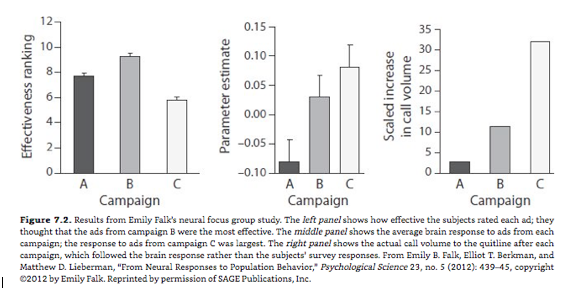
In short, the neural focus group is considerably more effective than regular with conscious responses.
8 Is Mental Illness Just a Brain Disease?
This is about improvement in understanding of mental illnesses that was achieved by using fMRI technology. It starts with discussion of genetic component, which is not only strong, but also is similar to cross of different mental disorders. Author specifically identifies areas of brain where its physiology differentiate in people with mental disease for usual. Author also discusses here difficulties in diagnosis, imagining challenges for fMRI and emerging field of computational psychology.
9 The Future of Neuroimaging
The final chapter is about future of use of neuroimaging, fMRI enhancements, its limitations and how these limitations may be addressed by using new technologies. Specifically author discusses technology – constantly increasing magnetic power of fMRI devises, use of near-infrared spectroscopy (NIRS), and others. At the end of chapter author discusses methodological issues – difficulties with results reproduction and need for more transparency.
MY TAKE ON IT:
It is kind of exiting to read about all this new knowledge about human brain and it’s working obtained via fMRI imaging. It gives us a lot more power of understanding of how it works, but also a lot of power of manipulating it with objective to achieve some result – for example voting for a specific political party. It even seemingly promise to provide technology that would allow differentiating between lie and truthful statements, bringing dramatic changes to legal system. However I do not think that it would dramatically change society. I would expect medium level changes that would be to the better. Inability to avoid control will direct people to do much more active political participation in defining what controls are allowed, probably making a lot of currently illegal activities into legal. I am also doubtful that it is feasible manipulating people effectively on the long run. I would expect that any new method of manipulation would cause creation of some new method, maybe technological to reject this manipulation. I also think that it is quite possible that consciousness can override internal impulses generated by external interference. In short, I am quite optimistic about future of freedom.
20190303 – American Individualism
MAIN IDEA:
The main idea of this book is to present America as a country and culture that not only rejects popular ideas of socialism, which by this time already proved to be a source of bloody mess, but also present much better alternative by maintaining something like enlightened individualism. Author seems to intend to demonstrate that the core feature of America – individualism is main reason of American prosperity. Even more than that, it is the foundation of society, especially if combined with voluntary cooperation in various associations, corporations with enlightened management, and benevolent government that serves as fair arbiter of all contradictions.
DETAILS:
INTRODUCTION
This book that was first published in 1922 expressed Hoover’s understanding of America and its key distinction from countries of Europe despite common religion and cultural heritage. As a consequence, America rejected socialism, while Europe embraced this ideology. This was a huge contrast in cultural attitudes when for America individual is first and society is basically contract between free individuals. For Europe, the society comes first and individuals are just material that is used as needed to benefit society. From his experience before and during WWI Hoover understood that socialism could not possibly work as productive economic system and that its success in Europe was based on illusions and hatred that developed in deeply divided by class Europe. It had relatively little foundation in America of the time. Introduction also describes later ideological development of Hoover and discusses validity of this work for our time.
AMERICAN INDIVIDUALISM
Here Hoover first states an obvious fact that revolutions where exploding all over the Europe, but found little fuel in America and explains it by specific qualities of American creed:

The key here is real opportunity for individual, not legalistic framework of society. Hoover, however, claims that it is not kind of laissez faire when “every man for himself”, but rather consistent structure where weak helped and strong contained so that everybody would have chance.
PHILOSOPHIC GROUNDS
Hoover starts here by stating that individual qualities such as intelligence and character are property of individual and could not be used effectively without this individuals’ support for whatever productive purposes they need to be used. So, since individuals are not equal in these qualities any attempt to limit individual from using fruits of his effort would lead to diminishing of this effort by individual and necessarily decrease of society’s productivity as whole. Hoover also discusses here leadership as one of such individual qualities, and very important for production at that, which he contrasts with the crowd that he considers mainly destructive.
SPIRITUAL PHASES
Here Hoover discusses spiritual qualities of American society, which unlike old European society, believe that “divine inspiration” resides not in a few god-selected aristocrats, but in every individual. Consequently everything in America is growing from bottom up via individual efforts, voluntary societies, and individual effort for common good, even if at some cost to individual.
ECONOMIC PHASES
Here Hoover discusses contrast between American economic development based on individual effort, that brought huge growth in productivity and well being for everybody, and socialistic economic method that suppresses individual, resulting in misery and economic destruction. However Hoover very positive to ideas of top down control of economic activities if it is conducted in form of corporations managed by enlightened leaders and regulated by government. Consequently he sees progress as increase in cooperative forms of organization, which somehow will retain space for equality of individual opportunities.
POLITICAL PHASES
Hoover here states that the only appropriate political organization is Democracy, which “arises out of individualism and prospers through it alone”. He believes that government should play role of arbiter in all interaction between individuals and organizations and suppress whatever business activities it considers harmful via legislative intervention such as antitrust laws. He mainly dismisses government incompetence, and typical behavior of bureaucrats on the ground that nothing is perfect and claims that American bureaucracy somewhat better than bureaucracy in the old world. It just needs to be managed solving its insufficiencies as needed.
THE FULTURE
Here Hoover once again stated that individualism is the primary force of American civilization for three centuries that made America the most prosperous country in the world. He believes that this would lead to America successfully avoiding dangers of both reaction and radicalism and will produce better, brighter, and broader individualism that would service not inly to individual but also to “our fellows”. He ends with hope that the future will lead not only to retaining individualism of the most critical feature of America, but to its expansion into the new quality of “glorified service” that would become “part of national character”.
MY TAKE ON IT:
I believe that Hoover was completely correct when he stresses American individualism as the source of American prosperity. However I do not believe either in enlightened corporate managers or in benevolent government bureaucrats. I believe that every individual always act in his/her own interest whether material or psychological and could not possibly act in any other way. Therefore the best way is to structure society so that each individual would make the vast majority of decisions influencing his/her condition, rather than these decisions made by somebody else on individual’s behalf. This is possible only if each individual has property and can decide how apply this property in such way as to maximize material and psychological returns to self. As soon as one individual gets to decide how to use resources produced by other individuals, these others bound to be sacrificed to controlling individual’s needs whether it is corporate manager satisfying his material need to get rich by increasing value of his/her stock options at the expense of long term prospects of the company and jobs of its employees; or some great leader like Hitler or Stalin sacrificing millions of lives to the psychological need of building the great Germany or promoting world wide communist revolution correspondingly.
20190224 – Capitalism in America
MAIN IDEA:
The main idea of this book is to review history of capitalism in America and extract from it some lessons for current situation when after the great recession lots of people once again loosing believe in this system. Author also trying to suggest some solutions, but they are not going beyond typical suggestions of better managing entitlements and decreasing regulations, albeit without any clear explanation how to achieve either one of these objectives.
DETAILS:
INTRODUCTION
Author starts with imaginary meeting in Davos in 1620 when in his opinion nobody would predict America becoming the richest and most powerful country in the world with 5% population and 20% of world GDP. He credits capitalism and democracy for this development and revers to property rights as foundation of American DNA. Author discusses key engines of American development: intellectual property protection, individual freedoms to think and act, mass immigration, free market that forces increase in productivity as the best way to obtain wealth, and the most of all creative destruction that constantly moves the country ahead. At the end of introduction author points out the downside of all these: constant presence of losers who were left behind who respond by banding together in unions, gangs, and most important political class: groups that make living by violence. After hundred years of struggle these people succeeded in robbing America of its dynamism and binding its economy with myriad entitlements and limitations. Author indicates that he believes that there is need for radical change in line with Swedish model that was implemented after social-democratic way brought Sweden to stagnation.
One: A COMMERCIAL REPUBLIC: 1776-1860
The history in this book starts with creation of America, which practically inherited its democratic rule and market economy from colonial times. Moreover, the revolution was mainly prompted by attempt to remove these conditions. Author describes mainly subsistent economy that existed at the time and was based on agriculture, horsepower, and wide availability of land. However despite being subsistence economy it was managed by people who actually were productive, culturally conditioned to use market for exchange, and armed so they could keep product of their labor for themselves. Author pays a specific attention to the fact that original Americans were busy people always trying to do something to improve their lives rather than demand from somebody else to do it for them. Initially it meant extensive growth: bring immigrants and start cultivating more land, but sometime after war of 1812 it start turning into intensive development when economy was growing faster than population.
Two: THE TWO AMERICAS
Two individuals represented the original America’s divisions: Jefferson with his ideal of farmer’s republic and Hamilton with his ideal of industrial capitalistic republic. It then morphed into North with its free labor and South with its slave labor. Here is interesting table of South wealth structure in which between 1/3 and 50% of wealth was market value of slaves:

Author does not provides equivalent table for North were taxable labor was belonging to individuals providing this labor. However the difference between development with free labor and slave labor nicely demonstrated by GDP per capita table showing that break in performance actually occurred in 1830-40 and it remained wide until in 1960s southern labor also become free:
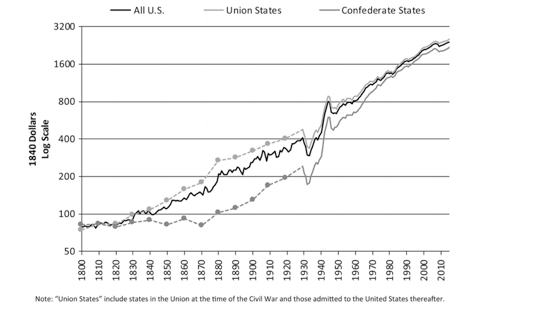
The two Americas went to war with each other and capitalist North based on free labor won, more or less uniting country under capitalism.
Three: THE TRIUMPH OF CAPITALISM: 1865-1914
This chapter is about the period in American history when capitalism was pretty much not restrained neither by slave owing aristocracy of South nor political aristocracy of the North, mainly because the former perished in the Civil war, while the latter was only in process of forming. This process was continuously disrupted by impact of western movement when new land, gold, and other resources dramatically increased wealth of country. This wealth was concentrating in hands of Midwestern tycoons rather than adding to the wealth of Eastern aristocrats, which made it available for massive development of the middle of the country. Important factor here was that it was not only natural resources but also growth of productivity as represented in this graph:
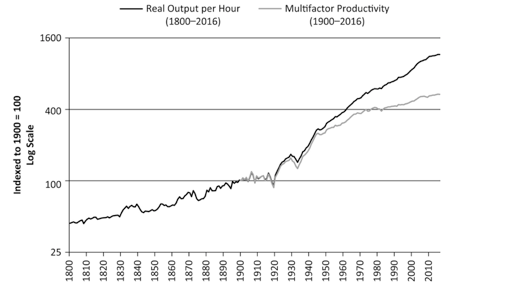
Four: THE AGE OF GIANTS
This chapter is about industrial giants who rose to huge economic power during this period mainly by achieving significant advantage in productivity that allowed them dramatically cut prices and push competitors out of business. The interesting thing here is that while author talks about dramatic growth of corporations and role of innovation, the final result of this was overwhelming control over economic development in hands of professional management or in other words corporate bureaucrats who become less and less interested in innovation and directed their efforts more to maintaining standardized mass production and avoid disruption by small, but effective competition.
Five THE REVOLT AGAINST LAISSEZ-FAIRE
The revolt came from the part of population who found themselves not competitive in the new industrial economy and started looking for the way out. Big part of it were farmers that believed that their problems came from tight money supply based on gold so they demanded silver and found their champion in Bryan. The other, more important movement was coalition of new immigrants who found that their labor was not valuable enough to provide for their needs and educated classes who found pretty much the same: free market needs for their labor could not provide levels of compensation they believed they entitled to. They all saw solution to their problems in increased government intervention: force employers to agree to better condition of work than could be achieved by individual bargaining, limit market power of corporation that could not be achieved by competition, government supported jobs that would put their holders outside of market pressure. This created progressive movement that succeeded in increasing government expenditures and intervention in economy. Author discusses details of how it happened and provides a few graphs demonstrating results:
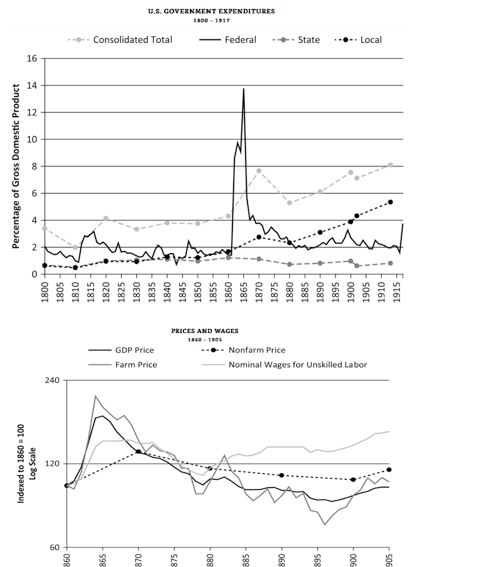
There were also two big cultural forces that promoted increase of government. The most important was American believe in education as the way to rise to higher level in society both materially and psychologically. This created the chronic oversupply of highly educated individuals that could not find place in market economy on par with their perceived self-value and therefore directed their effort to obtain it via government interference. The other factor was the end of frontier that removed safety valve letting out individuals who were not ready accept live of employee in somebody’s else business and did not have resources and/or abilities to start their own.
Six THE BUSINESS OF AMERICA IS BUSINESS
Here author moves to period after initial triumph of progressives in 1900 – 1920 when progressive success combined with war economy and big government excesses of Woodrow Wilson lost support of population. It was period of “do nothing” Harding and Coolidge administrations that freed economy at least to some extent and produced economic miracle of 1920s including self-fixing brief depression of 1920-21. Author reviews multiple technological achievements of this era when car, radio, electricity, and many other new technologies were rapidly implemented. Author also reviews changes in business culture when utilitarian approach as represented by Henry Ford was pushed out by more hedonistic approach as represented by Alfred Sloan. Author discusses radical change in resource allocation brought in by formation of financial industry, providing massive consumer loans, formation of unified countrywide market with chain stores like Piggly-Wiggly. This development was supported by dramatic improvement in transportation and communications, allowing countrywide optimization of allocation of labor and capital. At the end of chapter author stresses that it all created tensions that later led to the great depression: growing debt, unrestricted financial speculation, culturally diverse population with significant number of recent immigrant in main centers of the country, and, also very important, unwarranted growth of believes in engineering approach to the management of society as represented by Herbert Hoover – probably the most experienced and qualified societal engineer ever.
Seven THE GREAT DEPRESSION
This chapter describes the great depression and author defines its causes in such way:

Author also discusses in details monetary aspects of the depression, expressing view that the problem was not with unsustainable gold standard, but with fixing exchange rates to dollar at prewar levels. In short author characterizes the problem as necessity of transformation of economic center from Britain to America that failed to be conducted smoothly due to “European pride and American irresponsibility”. Author also defines as one of the main causes of depression low effectiveness of American political system that was not designed for massive internal intervention and therefore failed to respond in time to markets breakdown. The author discusses Hoover’s failure to contain depression and FDR’s New deal, which was pretty much the same policy that Hoover had, only on much wider scale, without restrictions of constitution, and with massive support of intellectual class. Author points out that FDR’s failure to revive economy was combined with his success in providing substitutes for healthy economy in form of safety net: unemployment benefits, social security, mass unionization, and government expense. The war and economic mobilization that provided more than full employment created illusion that FDR overcame depression, while the victory in the war made not only hero out of him, but also sealed up, at least for a while, his New Deal achievements as permanent characteristic of American system.
Eight THE GOLDEN AGE OF GROWTH: 1945-1970
This chapter is about the most prosperous time when America was one and only big industrial country that came out of WWII without any destruction on its territory and consequently become producer of just about everything needed for the significant part of the world. This golden age created quite unreasonable believe that such condition will last forever, resulting in what author calls corporate imperialism – dominance of big American corporations at home and abroad supplemented by increasing psychological unhappiness of population in both places. Obviously it could last only until economies in Europe and Japan would be restored and once again become competitive.
Nine: STAGFLATION
Some 20 years after the end of war world capitalist economies mainly recovered and American golden age in production ended. First Germany, then Japan, and later on other countries start producing goods as good or better than American and sell it at cheaper price. That’s when unsustainable entitlements, corporate benefits, and government regulations demonstrated how much they are burden on economy, which responded by stagflation: combination of huge inflation and economic stagnation happening at the same time – something that Keynesian economist confidently stated could not possibly happen. Author provides a few graphs that demonstrate decline of core American industries: steel and automotive.
Ten THE AGE OF OPTIMISM
This chapter is about 1980s, Reagan, and changes in American attitudes away from big government, that brought stagnation, to more economic freedom for American business and less accommodation for American enemies. It is also about one less noticeable, but most important development – revolution in finance that allowed much more efficient resource allocation via junk bonds, mutual funds, IPO, and other mechanisms. It was beginning of the globalization process of combining multiple economies in one supply chain. Author discusses change in America during this period from manufacturing to service economy and massive implementation of information technology.
Eleven THE GREAT RECESSION
This is about great recession of 2008, its causes and consequences. Author defines causes as exuberance of 1990s that followed fall of communism and countries of eastern block joining one world economy. Author especially stresses his believe that one of reasons was under-consumption, when consumption could not keep pace with growth of savings, causing inflation of such assets as housing in USA. This was combined with securitization of assets leading to overly complex structure of securities that masked quality of underlying loans, resulting in bubble that eventually burst. Author avoids mentioning his own role as FED chairman in allowing this to happen under political pressure, but praises work of his followers who, in his opinion, prevented this recession turning into depression by pumping practically unlimited amount of liquidity into the system. He explains the following up stagnation by decrease in the growth of productivity that started even before recession and provides graph to demonstrate this:
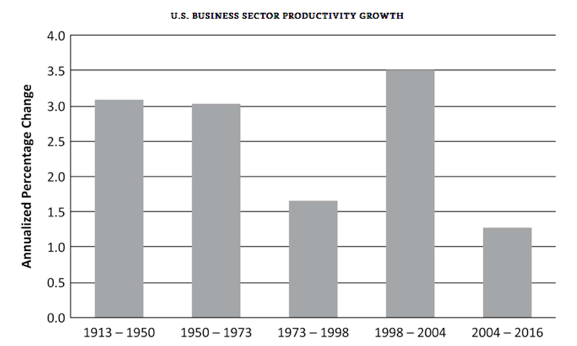
Twelve AMERICA’S FADING DYNAMISE
Here author discusses declining economic dynamism of America and explains it by country’s move away from creative distraction to less risky behavior. He discusses multiple reasons: decrease in quality of education, aging of population, decrease in quality and scale of immigration and disappointing result of IT revolution. Generally author rejects these causes and points out to growth of entitlements and regulation that stifle economic development.
CONCLUSION
In conclusion author discusses what he believes is downside of creative distraction – its losers who create political pressure against capitalism. He points out that even if its costs are visible, while benefits are not so much in reality it was capitalism benefits that created mass prosperity from cheap and abundant food to better work conditions and much more. Author reviews changing social structure of America from 1800 to 2000 and expresses believe that technological improvement will allow overcoming current problems as it pretty much did before.
MY TAKE ON IT:
It is a nice historical overview, but it is not going deep enough into causes of the problems. In mine opinion there is not enough attention to people who rise again and again against capitalism despite dramatic increase in wealth and quality of life in America, especially if compared with any socialistic and communistic experiments conducted in XX century with catastrophic results. I’d like to see much more clear analysis of anti-capitalist forces, layers of society that constitute these forces, and reasons for theirs increasing power. I would like to see clear understanding of the situation and some ideas how to fight it, because this really is an ideological war in which one side has difficulty to understand that they are at war. I actually believe that XXI century will produce final victory of capitalism and destruction of all forms of socialism that will lose supporters similarly to what happened to National Socialism after military defeat. The question is how big price humanity will pay to achieve this result.
20190217 – Lamarck’s Revenge
MAIN IDEA:
The main idea of this book is that in addition to commonly accepted Darwinian idea of genetic evolution via random change in DNA followed by selection of organisms fit for environment, there is another mechanism – epigenetically changing genes expression that has tremendous impact on the functionality of organism. Author believes that these two mechanisms are complimentary with epigenetics responsible for quick response to dramatic changes in environment, while DNA changes are much slower and kind of harden new functionality of organism.
DETAILS:
INTRODUCTION: Looking Back
It starts with discussion of sci-fi, entertainment, and quick changes that occur in life, technology, and environment requiring similarly quick changes in humans and other animals and their behavior. The usual scientific explanation divides it into two separate domains: Darwinian evolutionary random DNA change with selection of the fit, which is very slow process and cultural change that supplement this selection with quick accommodations. Author believes that it is not enough and does not adequately explain accumulated observation. The missing component is epigenetic change, which practically brings back Lamarckian ideas of biological inheritable changes. Biologically it is done by natural addition of molecules that regulates DNA expression, highly dependent on environment, and is inheritable.
CHAPTER I From God to Science
Here author retells the story of raise and mainly fall of Lamarck’s ideas of acquisition of inheritable characteristics. Somehow instead of just supplemental process in understanding of evolution it became perceived as unscientific. Here author definition of what it is: “The favored theory of Charles Darwin, and the “Darwinians” who followed him, is that the major process of evolution is driven by natural selection combined with genetic change by mutation. Epigenetics posits that a quite different set of circumstances can drive also evolutionary change, and that both Darwinian- as well as epigenetic-driven change (or, to do him honor, Lamarckian-driven change) can proceed simultaneously.
“
Author also reviews general history of scientific understanding from observation of Hadrian wall leading to rejection of biblical account of geological age, through work on Linnaeus cataloguing living organisms that demonstrated their changeability, and work of Buffon, who anticipated Darwin’s Ideas by about a hundred years, but did not risk to go public with this. Author also briefly discusses Darwin’s grandfather Erasmus who was thinking in similar ways.
CHAPTER II Lamarck to Darwin
This chapter retells story of Lamarck’s live and survival during French revolution. From professional side it is also story of struggle against Georges Cuvier, who in addition to being “father” of comparative anatomy and scientist who developed understanding of mass extinctions was also dedicated enemy of Lamarck who succeeded in discrediting Lamarck’s work.
CHAPTER III From Darwin to the New (Modern) Synthesis
Here author presents Darwin’s view in such algorithmic way:
- There is a pattern of characters encoded in each organism in structures called genes.
- This pattern is copied and passed on to offspring.
- The copying is never perfect: Variations arise through errors in copying or through random (not directed) mutations. This produces variation. Even greater variation is introduced through sexual reproduction.
- The variant members compete with each other for more offspring produced that can survive.
- There is a multifaceted environment that makes some of the variants more successful than others.
- The individuals that survive and go on to reproduce, or who reproduce the most, are those with the most favorable variations. They are thus naturally selected.
This all is correct, but not complete. Author points to the speed with which evolutionary change occurs, making it impossible to explain by random process exclusively. Another problem is the absence of small change sequences for many cases when new species appear seemingly from nowhere.
CHAPTER IV Epigenetics and the Newer Synthesis
This starts with explanation of the modern understanding of epigenetics as a supplemental phenomenon to DNA that changes genes expression without changing DNA itself while allowing these changes to be transferred to the next generation. Author provides example of this with 2 types of nautiluses that were considered different species, but have the same DNA. Then author provides definition: “Epigenetics is the study of heritable gene functions that are passed on from one reproducing cell to another, be that to a somatic (body) cell or to a germ cell (sperm or ovum), which does not involve a change to the original DNA sequence.” The bulk of this chapter discusses how exactly this happens:
- Methylation: DNA activated by methyl groups
- Modification of genes expression, often via interaction of 2 X chromosomes.
- Reprogramming: combination of genome and epigenome.
Then author discusses impact of this new understanding that includes epigenetics impact on history of life and hormonal processes.
CHAPTER V The Best of Times, the Worst of Times—in Deep Time
This is about history of life, how environment had been changing, and how Darwinian random change could not explain speed of change without addition of epigenetics. Author discusses mass extinction events: asteroid 65 million years ago, Siberian Traps 251 million, extinction events between 600 and 700 millions. and the worst for life –snowball Earth 2.5 billion years. In all cases the first response of organisms was epigenetic reorganizations that only later followed by DNA changes. Overall author supports idea of multilayer adaptation to environmental change:“First was the change in environment experienced by an individual organism. Second was a change of that organism’s behavior. Third was a change in its phenotype, the expression of not only how its genes were used prior to the environmental change, but also how they are expressed post change. The greater the environmental change, the more consequential each of these steps might have been.“
CHAPTER VI Epigenetics and the Origin and Diversification of Life
This chapter is about a very important problem with origin of live – how come that quite complex DNA molecules were created in the first place. Author discusses what life is: complex organization, metabolisms, replicates, and evolves. In 2016 was discovered LUCA – the last universal common ancestor, which is bacteria like creature with DNA. Theoretical research claims that minimum for life is 355 genes. Author discusses how such complex combination could be created via lateral gene transfer that happens all the time on microbial level. At the end of chapter author discusses the Margulis endosymbiosis theory that proposes increase of complexity via direct merges of different microorganisms under environmental pressure, which would clearly be Lamarckian process.
CHAPTER VII Epigenetics and the Cambrian Explosion
This is discussion of period of rapid expansion of life that author believes could be explained only by epigenetic model:”It is posited here that four different epigenetic mechanisms presumably contributed to the great increase in both the kinds of species and the kinds of morphologies that distinguished them that together produced the Cambrian explosion as we currently know it: the first, the now familiar methylation; second, small RNA silencing; third, changes in the histones, the scaffolding that dictates the overall shape of a DNA molecule; and, finally, lateral gene transfer, which has recently been shown to work in animals, not just microbes.“
CHAPTER VIII Epigenetic Processes Before and After Mass Extinctions
The main point of this chapter is that Darwinian and Lamarckian evolution are different in both their mechanism and in their application, the latter more active during conditions of rapid adjustments to environment often after mass extinction events, while the former is more complex fine tuning process that kind of hardens results in form of DNA:
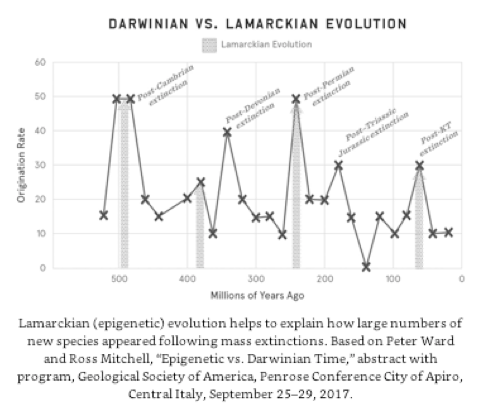
Author also discusses contemporary mass extinction and links it to domestication.
CHAPTER IX The Best and Worst of Times in Human History
This is about impact of human cultural evolution on human biology. Author discusses cognitive revolution that occurred 70,000 years ago after Toba eruption, then another one some 45,000 years ago with ice age climate change, then the one that came with agriculture, and finally the one that is currently in process. The main point author makes here is that all this happens way too fast for random DNA change to handle, so epigenetics provides more robust framework for this.
CHAPTER X Epigenetics and Violence
This is about more than just link of genes to violence, but rather explanatory insufficiency that exists if one does not brings in epigenetics. Here is example, formulated as three laws of behavior:
- First Law: All human behavioral traits are heritable.
- Second Law: The effect of being raised in the same family is smaller than the effect of genes.
- Third Law: A substantial portion of the variations in the complex human behavioral traits is not accounted for by the effects of genes or families.
CHAPTER XI Can Famine and Food Change Our DNA?
This is continuation of discussion on environmental impact and author uses well-documented historical event of famine in Holland during WWII, that left clear traces in next generation. However author does not limit mechanism of impact here to epigenetics only. He also discusses impact of famine in microbiome that currently more and more considered a necessity for human existence.
CHAPTER XII The Heritable Legacy of Pandemic Diseases
Here author starts with obvious point that pandemics have great impact on gene pool not only by eliminating significant part of it, but also by its influence on survivors. This influence occurs via methylation process, making it transferable to the next generation without changing genetic code. Author also points to intensive religious experience prompted by pandemics and even specifies gene VMAT2, which controls mood and seems to be susceptible to epigenetic changes.
CHAPTER XIII The Chemical Present
This is about simple chemical impact of multitude of different toxins and metals that also could have influence that appears to have epigenetic effect.
CHAPTER XIV Future Biotic Evolution in the CRISPR-Cas9 World
This is about amazing finding that humans evolved in the last 5000 years as much as in precious 6 million years. This was done based on DNA analysis in 270 people from different genetic groups. The conclusion author derives is that dramatic change in environment accelerates evolution and epigenetics provide explanation for this process so far. However now humans are getting close to intentionally modifying genetic material to achieve specific results and this would practically switch process of human development from evolution to production.
EPILOGUE Looking Forward
Here author looks in the future and is quite scared by what he sees, which is increase in stress, all kinds of catastrophic events, referring to the paleontological research that found marks of increased stress in animals in areas where humans moved. Similarly stress in Native Americans dramatically increased with arrival of Europeans. Now the stress is increasing for the whole humanity, causing epigenetic change. Author ends with the point that epigenetic is moving into mainstream and probably will become quite common approach with the passing of older generation of scientists who cannot overcome old paradigm.
MY TAKE ON IT:
I think that idea of epigenetics and non-DNA inheritable change makes lots of sense and, if experimentally confirmed, does lead to the new synthesis in understanding of evolution. I personally would like to see the general theory of evolution that would include not only Darwinian and Epigenetic changes, but also cultural changes. After all the example of discovery of use of fire, while being obviously cultural event seems to lead overtime to purely biological changes in human digestive system that in term provided a lot more time for developing brain, language, and development of sophisticated culture, making humans not only super predators, but also unchallenged force in shaping the world to their convenience.
20190210 – Stubborn Attachments

MAIN IDEA:
The main idea of this book is to summarize what is wrong with American society and provide some recommendations for Americans about the way to get back to fundamentals that made America great: free market economy and respect for individual rights.
DETAILS:
- Introduction
This is about the point of this book – American deviation from the principles that made it great: society based on prosperity and individual rights. Here are author’s main points:
- “Right” and “wrong” are very real concepts, which should possess great force.
- We should be skeptical about the powers of the individual human mind.
- Human life is complex and offers many different goods, not just one value that trumps all others.
Author discusses 6 issues he considers critical for getting back on track:
- Time – present interests versus future
- Aggregation – how resolve disagreements
- Rules – how create and maintain rules and when to allow exceptions. Utilitarism and consequentialism of rules.
- Radical Uncertainly – consequences of action could not possibly be known completely
- How can we believe in rights – this is about rights (nearly absolute) and rules that could contradict each other
- Common sense morality – “Common sense morality holds that we should work hard, take care of our families, and live virtuous but self-centered lives, while giving to charity as we are able and helping out others on a periodic basis.“
Author also defines fundamentals of his philosophy: Productive powers should not be taken for granted and future should have say about our actions in present
- Wealth makes the world go round
This is about wealth creation and that’s how author defines it, going beyond usual GDP measures: “Wealth Plus: The total amount of value produced over a certain time period. This includes the traditional measures of economic value found in GDP statistics, but also includes measures of leisure time, household production, and environmental amenities, as summed up in a relevant measure of wealth.“
Author posits 3 key questions for growth, civilization stability, and environment, reviewing in the process of productivity growth versus increase in growth via increase in inputs, migration of people and capital, and West vs. Rest with special attention to Asian tigers and their fast development. Finally he discusses wealth / happiness relationship.
- Overcoming disagreement
It starts with the point that economic growth could not satisfy everybody and there always be differences in preferences. Author defines 2 principles:
- The Principle of Growth: We should maximize the rate of sustainable economic growth, defined in terms of a concept such as Wealth Plus.
- The Principle of Growth Plus Rights: Inviolable human rights, where applicable, should constrain the quest for higher economic growth.
He also discusses Nozick’s idea about rights being “side constrains” on individual choice and Derek Parfit’s “Mistakes in Moral Mathematics.”
- Is time a moral illusion?
Here author discusses time value of comfort or discomfort; meaning delays or speeding up events known to be not neutral for wellbeing. Being an economist, he brings in discount rates, applying it not to the value of money, but to the perceived value of event. He also refers to opportunity costs in the same way, as a moral choice.
- What about redistribution?
This starts with usual staff of feeling guilty that somebody somewhere suffers when one eats ice cream. Then it goes to economic speak: “we should redistribute wealth only up to the point that it maximizes the rate of sustainable economic growth. “
It goes from there to all typical staff: how “we” should redistribute, who should and should not benefit and so on. He also discusses Solow model of growth via technological improvements. An interesting point here is the link of the scale of economy to innovations” it does not worth invent iPhone for population of New Zealand because not much return due to very small size of population.
- Must uncertainty paralyze us?
This is about forks on the road: how many different ways life could develop depending on different choices made at key points. Consequently author discusses impossibility of knowing completeness of future result of any action. This could lead to paralysis by analysis and similar forms of fear to act. Then author discusses a couple of mental experiments like terrorist with biological weapon and John Lenman’s ideas of irrelevance of consequences as measure of right or wrong and his discussion of D-day beach and poor dog. Finally he comes up with “The Principle of Roughness:Outcomes can differ in complex ways. We might make a reasoned judgment that they are roughly equal in value and we should be roughly indifferent to them. After making a small improvement to one of these outcomes, we still might not be sure which is better.“ At the end of chapter author states that practical implication of this discussion are: need for agnostic and tolerant attitude to others and protection of individual rights.
Conclusion—where have we landed?
Here author once again repeats his main points about importance of economic growth in conjunction with morality and provides specific recommendations:
- Policy should be more forward-looking and more concerned about the more distant future.
- Governments should place a much higher priority on investment than is currently the case, in both the private sector and the public sector. Relative to what we should be doing, we are currently living in an investment drought.
- Policy should be more concerned with economic growth, properly specified, and policy discussion should pay less heed to other values. And yes, that means your favorite value gets downgraded too. No exceptions, except of course for the semi-absolute human rights.
- We should be more concerned with the fragility of our civilization. The possibility of historical pessimism stands as a challenge to this entire approach, because in that view the future is dim no matter what, and there may not be a more distant future we can look toward in order to resolve the aggregation dilemmas involved in making decisions that affect so many human beings. We should be more charitable on the whole, but we are not obliged to give away all of our wealth.
- We do have an obligation to work hard, save, invest, and fulfill our human potential, and we should take these obligations very seriously.
- We can embrace much of common sense morality with the knowledge that it is not inconsistent with a deeper ethical theory. Common sense morality can also be reconciled with many of the normative recommendations which emerge from a more impersonal and consequentialist framework.
- When it comes to most “small” policies affecting the present and the near-present only, we should be agnostic, because we cannot overcome aggregation problems to render a defensible judgment. The main exceptions here are the small number of policies, which benefit virtually everybody.
MY TAKE ON IT:
It is somewhat typical academic work expressing feeling that something not right and providing recommendations in form of “We should” without going into details of “How”. It is also interesting because of author’s believe in necessity of convincing people that one should do something at all. It seems to be an issue in his environment due to complexity and unpredictability of any action. It is interesting to me because in environment I live in such question just plainly not exist. If you are not doing something you are not making money and cannot have even relatively good live so unexpected consequences of actions be damned. In my previous environment in USSR such question would be resolved simple: if you do not act, you die. It is also very funny to read his call to be more concerned about distant future, because we really do not know anything about it. Any guesses and speculations are inevitably meaningless because not only future science, technology, and even morality are unknowable, but we also cannot do anything about it. The scope of our action is necessarily limited to10-20 years at most – the time length of implementing some relatively big and complex project. I think our concerns should be limited to 4 basic issues:
- Prevent blowing ourselves up via use of weapons of mass destruction
- Maintaining effective market economy, the one and only known way effectively produce goods and services necessary for living beyond subsistence level
- Maximizing individual perception of living a good live for maximum number of people so they would not become susceptible to some violent ideologies like Marxism, Socialism, National- Socialism, Communism, Islamism, and such
- Preventing individuals who are already poisoned by these violent ideologies from causing significant damage.
20190203 – New Authoritarianism
MAIN IDEA:
The main idea of this book is to demonstrate that there is real and clear danger of America moving to authoritarianism, but it does not come from Tramp and his supporters as media and other leftist groups claim. It comes from already deeply established and continuously growing tyranny of experts. At the same time Tramp, as of now, is the important protection force against this authoritarianism.
DETAILS:
- Freedoms, Rights, and the Liberal Ideal
Here author briefly reviews contemporary state of western countries and paints picture of increasing dominance of non-elected government and quasi government entities controlling everything and pushing aside old methods of society management – politics. This development has created a political backlash in form of multiple movements, with Tramp being somewhat a leader of one of them. Author discusses how liberal movement moved from promoting individual freedoms to suppressing them in the name of other individuals’ “rights”. Then author defines his understanding of authoritarianism: “Authoritarianism simply means governance legitimated by demands for deference to authority. “ and supports his point by discussing difference in how America entered wars in early and late XX century – the first after long political discussion and in accordance with constitution via formal declaration by Congress, while latter mainly via discussions between experts, unclear and poorly defined “use of force authorization”. So in reality these developments amount to substitution of sovereignty of people by sovereignty of experts.
- The Rise of the New Authoritarians
This starts with the list of what good liberals did: women and minority rights, voting rights, and so on. Author also notes that liberals could and did act under authoritarian rule and actually were quite successful in liberalizing such rule. After that author reviews history when liberalism was an ideology of individual rights, protecting the individual from government power. However they have somewhat difficult relations with democracy often referring to courts or to authoritarian power to achieve their objectives, unachievable via ballot box. Until recent times liberals in America had place in both political parties protecting rich against masses and expropriation as the republicans and middle class and poor against rich as democrats. However now liberal coalition pretty much rid of middle class and as of now combines rich, professionals, and poor, all of which highly depend on government for transfer resources to them from middle class. Author discusses here mainly USA and UK politics, including liberal support for immigration.
- Liberal Authoritarianism in a Global World
This chapter looks at the global liberal coalition mainly protecting interest of professionals who have education, skills, and established positions valuable on the global market so they promote power of international organizations, free trade and so on even if it is detrimental to masses in their own countries who cannot compete on the global market with much cheaper labor from developing countries.
- The Passion of Donald J. Trump
This chapter about the Donald as representative of national movement that is currently developing in many developed countries that aims to protect such people who are on receiving side of liberal world order. Author also reviews old populist movements like Bryan’s anti-gold movement and compare it to Trump, noting however that they are quite different in their philosophy. He also reviews some typical liberal paranoid attitudes: Trump=Hitler, racist, mercantilist, and so on. Author also reviews a very specific case of women not supporting Hillary, which seems to be unexplainable for liberals.
- The Populist Purgative
In the last chapter author looks at the big picture of Angle-American traditions that include all three: conservatism, progressivism, and liberalism, noting that the two main powers are really conservatism and progressivism, with real liberal being somewhat swing vote that from time to time give advantage of either of these powers. At the end author refer to Churchill and his famous quip about democracy that was actually quite powerfully reflected in Churchill political career as initially member of Liberal party, who become conservative leader only after this party folded. Author ends with Churchill’s point that liberalism will not be killed, but it would not be dominant either, always remaining kind of intermediary.
MY TAKE ON IT:
I think that there is way too much confusion about all these political terms. In reality “conservatives” or “right” are not trying to conserve current political arrangement, but rather trying overturn advances made by “progressive” or “left”. Liberals lost any connection to ideas of individual liberty and they are busy trying to restrict this liberty with their political correctness, censorship, and suppression of freethinking in any place where they acquired power: media, education, and corporate boardroom. All these labels become somewhat meaningless, hiding real passion and objectives of all these movements, which come down to the following few arrangements:
- Who will decide how to allocate available resources and produce new ones
- Who will decide which behavior is acceptable and which is not
- Who will decide how to use violence and coercion by governments
All these issues have hugely important consequences mainly because they impact how much and what kind of resources will be produced and how they will be used. Progressives and supporting liberals (American meaning) were successful in taking key positions in the society, but it resulted in severe limitation on productivity and freedom, without which possibility of innovation and prosperity is questionable. The resulting backlash was inevitable with or without Trump. Whether it will be the same yo-yo movement that America experienced for the last century or we’ll move in some new direction remains to be seen.
20190127 – The Most Dangerous Branch
MAIN IDEA:
The main idea here is to review history, especially the most recent, of Supreme Court and demonstrate that it had acquired the huge power of final legislative decision maker that was not granted to it by constitution and impact of this circumstance on the American republic. The main point author is making is that cases decided to support leftist ideology should be considered legitimate court interference, even if they are deeply flowed as Roe, but cases decided in support of conservative ideology could not be considered legitimate exercise of court power, so now, when court seems to be moving to reliable conservative majority, its powers should be restricted.
DETAILS:
Introduction: The End of the World as They Knew It
The introduction starts with the story of Justice Kennedy resignation and brief discussion about its meaning as change from 4-1-4 balance of power to 5-4 conservative advantage.
Prologue: Death at the Ranch
Correspondingly prologue uses the story of Scalia’s death to discuss how Supreme Court become supreme branch of power and how it led to highly politicized selection process for justices.
Part I: Characters
Chapter 1: The Marble Temple
This chapter discusses decorum of Supreme Court including the building; justices’ patterns of behavior, their travel, public norms, and refusal allow TV to transmit proceedings. Then author discusses contrast in outlook between some justices.
Chapter 2: No.9
This chapter is about the new justice Gorsuch, who, as conservative, is clearly disapproved by the author. Helpfully author narrates his fear for the fate of Chevron, which required deference of the courts to unconstitutional administrative state. Another issue author discusses is Gorsuch’s careful avoidance of abortion issue. At the end author reviews in details Gorsuch selection process and role of Federalist society.
Chapter 3: Confirmation World
This chapter probably qualifies as howl of democratic soul hurt by Republican senate rejection of Obama’s appointee Garland. In author’s opinion it was painful for Obama compromise that, nevertheless, was rejected by evil republicans. After that author goes a bit into history of confirmation and how it became so polarized by borking Bork. Author admits that it was not fair and that Teddy Kennedy was disgusting, but somehow justifies it by Bork’s behavior and overall need to have democrats in power.
Chapter 4: Deploying the Warhead
In this chapter author moves to the nature and story of filibuster and how democrats killed it for lower level court, creating opening for republicans to kill it for Supreme Court. All this supplemented by details of Gorsuch confirmation.
Chapter 5: The Institutionalist and the Notorious Chapter
Here author moves to personalities, discussing Roberts as an Institutionalist and Ginsburg as Supreme Court’s rock star. He also mentions left’s attempt to push her out due to the age and health that were unsuccessful. As usual for liberals RBG prefer to do what she believes is best for her despite paying lip service to common goals.
6: The Left Flank
In this chapter author discusses left flank, which includes Breyer, “wise Latina” Sotomyor, and Elena Kagan whom author somewhat accuse of being too smart and not sufficient tolerant to others who are to so much.
Chapter 7: The Right Flank
The right flank is Thomas, who author consider not very influent on the court. As usual author stresses Thomas’ usual reluctance to ask question during hearing and allocates lots of time to confirmation disaster and Anita Hill.
The second man on the right flank is Sam Alito. Author discusses his selection and confirmation then somewhat laments the fact that Alito came as substitute to semi-liberal O’Connor.
Chapter 8: Deus Ex Machina
The Deus here is justice Kennedy who had decisive vote that he used in some cases siding with conservatives and in some cases with liberals, but in all cases becoming key decision maker.
Part II: Cases
Here author moves from personalities of justices to most important cases that practically change laws the way court want it either to the left or to the right.
Chapter 9: Sleeping Giant
This is the story of Supreme Court usurping power not granted to it by the Constitution. It started with Marbury vs. Madison in 1803 then was somewhat subdued with court mainly seeking to mediate power distribution between federal and states powers, mainly siding with federal all the way to the allowing overriding state laws, creating foundation for the future Civil War between North and South. After the war it somewhat retreated, but then came back in force first siding with conservatives at the beginning of XX century with Lochner vs. New York and even stopping Roosevelt excesses of the New Deal in Schechter, only later being forced to move to liberal side where it resided through 1970s.
Chapter 10: The Runaway Court
This chapter is clearly painful for author who as liberal hates it, but as reasonably thoughtful person had to admit legal, intellectual, and even logical deficiencies of super liberal court of early 1970s that brought usRoe vs. Wade and following abortion laws. Author believes that it was a mistake that turned country to support republicans and eventually led to the Court that was mainly appointed by republican presidents, who actually did extremely lousy job selecting justices who whether were or became later of liberal persuasion.
Chapter 11: Revenge of the Right
Here author discusses one of the most painful for the left case – Gore vs. Bush. He does it in relatively honest way, noting that Gore demanded recount only in democratic precincts. However his sympathy is shown very clearly.
Chapter 12: James Madison Made Us Do It
Here author discusses 2ndAmendment starting with Roosevelt National Firearms Act – the first massive intervention of government against right to be armed. Author refers to Miller, which in 1938 confirmed government ability to limit firearms, claiming that the main point of amendment was militia, not individual right. The author jumps to 60s Gun Control Act, and finally brings in Reagan as the initiator of fight for individual right to be armed. The balance of chapter dedicated to discussion of Hellerand political fight around it.
Chapter 13: For the Love of Money
This is about another case of semi conservative majority of the court deciding important issue related to the 1stamendment – Citizens United which rejected attempt to regulate political speech under disguise of limiting role of money in politics. The decisive vote again was Kennedy who believed that this is an attempt to establish censorship.
Chapter 14: A Disdain for Democracy
Here author moves to voting rights, affirmative actions, and other issues related to left efforts to “stop discrimination” by implementing more discrimination and creating special and superior rights for democratic constituencies. The latest case in this prolonged saga is Shelby County decision of 2013 that rejected entitlements based on race.
Chapter 15: Roe by Any Other Name:
The final chapter is about fight for or against homosexuality and elevation of gay sexual relationships institutionally to the same status as heterosexual marriage. Author reviews decades of this struggle, first for legalization of homosexuality and then for its equalization. It was decided in Obergefellwith Kennedy voting with liberals with non-existing constitutional reasoning similarly to Roe.
Epilogue: A Less Dangerous Branch
Here author reviews the current state of Supreme Court and concludes that with advance of conservative majority, it should be limited and become less dangerous branch of government. He specifically states that after Kennedy leaving the best hope of left is John Roberts who in his decisions about Obamacare indicated that he maybe in process of maintaining tradition of justices appointed by the weak republican presidents converting to liberal persuasion.
MY TAKE ON IT:
I think that idea of court being supreme decision maker in the country is so deeply flowed that it becoming more and more untenable. Even if it is becoming conservative, meaning more inclined to comply with constitution, it is still not good enough, especially when it has such judges as “wise Latina” who are capable discuss limitation of presidential constitutional power based on whether justices consider motivation of presidential actions good or bad. Somehow such people fail to understand that government, which is always based on violence and coercion, can do it peacefully only if overwhelming majority of population believes that these coercive actions are based on established rules (laws). Moving coercive action away from rules common for everybody would inevitably lead losing party to respond with violence as soon a its aggravation coincides with support of at least significant part of individuals who control means of violence: army and police. The idea that democratic president Obama has legal rights to issue executive order that republican president Trump has no legal right to cancel moves country to the state of lawlessness that cannot be resolved by any way other than one side violently suppressing the other. Unlike 1860 it is not conflict between states that led to incorrectly named Civil War, but rather the true conflict within society between ideologies of individuals. One should hope that country remains in the state of relative lawfulness, so ideological conflict could be resolved peacefully, but current leftist movement acts daily in such way that this hope is diminishing.
As to Supreme Court I think that USA needs constitutional Amendment, which would remove legislative power of the court, limiting it to expressing technical legal opinion. With top legal experts of both main ideological persuasions on the court, the decision on constitutionality of the issue should be decided with overwhelming majority of the court. However, if justices split on decision, either because they are driven by ideologies or due to any other reason, each side should provide suggestion for constitutional amendment clarifying and confirming their opinion, which then should go to amendment process on condition of necessity to accept either one or another interpretation of constitution. This way any ridiculous and unreasonable change to constitution will be applied with transparency and discussion and, if proved untenable, as for example was prohibition, quickly change using the same process, without long struggle for change of personalities on the court.
20190120 – Oceans Ventured

MAIN IDEA:
The main idea of this book is to describe how American Navy managed to arise from decline and neglect of post WWII when it lost ships, funding and general support from political class. It came to the point when Soviet Navy was becoming capable to challenge American, so naval superiority of USA was not assured any more, at least on the long run. The turn around came with Reagan’s administration aggressive approach that allowed Navy to challenge Soviets in areas where they believed they have complete control and provided significant factor in winning Cold War.
DETAILS:
INTRODUCTION
Author, former Navy secretary, presents here this book as the story of America overcoming serious decline of its Naval force due to president Carter and his party anti-military approach combined with massive successful espionage operation that gave USSR real advantages. It was not only American Navy decline, but also raise of the Soviet fleet that was fed by massive allocation of resources and legal and often illegal technology transfer from the West.
- American Naval Strategy and Operations in the Cold War
Author starts this chapter not from the beginning of Cold war, but rather from the end of XIX century and works of Mahan and others who promoted idea of Navy as the critical component of state military power. Only after revisiting Spanish war, WWI, and WWII author moves to the Cold war. Author retell the story of American Navy that was mainly demobilized after WWII, partially resurrected during Korean war, and then bogged down during Vietnam war. Author also provides quite detailed account of inter services fight for resources and how Air force and Army tried to push Navy nearly out of existence die to believe that in Nuclear age it become mainly outdated.
- Ocean Venture’ 81: A Bold New Strategic Operation
The next chapter is about Reagan’s initiative to start Ocean Venture 81, massive Navy exercise that was very unusual because Navy moved up North close to Soviet bases and very aggressively used all its assets in order to quickly obtain experience of acting in cold weather and close to Soviets. Author describes assets and their movements that made Soviets very nervous and clearly demonstrated that Carter’s meekness is gone.
- Taking a New National Strategy to Sea: Sending a Message
This chapter is about two important developments. The first was public relation offence that used Hollywood and other cultural venues to promote Navy and its value and valor. Another equally important was development of new military technology such as Tomahawks and Los Angeles and Ohio types submarines to achieve technological superiority. Author also briefly discusses events of the time like Hezbollah’s attack and Falklands war.
- Soviet Panic: Misreading the Message: The Mobilization of 1983
This chapter is about Soviet reaction to appearance of the new and quit aggressive American Navy and overall policy. Soviets did not take Reagan seriously and believed that his rhetoric was just that, so real actions were a big surprise. On the practical level they started more actively use aviation during American Navy exercises, trying intimidating and/or demonstrating their capabilities. However it was not an easy task, partially because of technological inferiority of Soviet forces. Author discusses problems with the first Soviet aircraft carrier Kiev. Despite this and other problems, Soviet Navy continued to grow exponentially and author reviews various new assets that it acquired during 1970s and 80s.
- Gaining Global Velocity, 1983-1985
This chapter describes developments that become possible due to increase of funding and expansion of the Navy. These included expansion of training, new technological developments that among other things allowed finding the rack of Titanic, and also, very important, American support for Chinese Navy, that was considered somewhat of an ally against Soviets. Author also refers to important political developments of the period: reelection of Reagan and Gorbachev’s taking power in USSR.
- The Beginning of the End: Northern Wedding, 1886
Here author describes multiple high scale exercises of Navy across the globe from Arctic to Pacific designed to demonstrate and test new equipment and develop corresponding tactic that put Soviet Navy under constant pressure, especially in environment when Gorbachev was looking to save economy at least partially by decreasing military expenses. Author also details a small-scale conflict with Libya where aggressive use of American power finally cut down Kaddafi ambitions and, in process, demonstrated superiority of American equipment over Soviet equipment provided to Libya.
- The Soviets (and Others) Get the Message, 1986-1988: The Cold War Hurtles Toward Its End
In this chapter author continue narrative about successful large-scale exercises and ability of American Navy to outplay Soviets. However much more attention is allocated to internal Soviet political developments that greatly decreased power of their military and diplomatic events that not only start decreasing pressure of Cold War, but also indicated that it could end.
- The Cold War Ends, 1989: The East European Bloc Disintegrates
The final chapter describes mainly diplomatic and political events that led to dissolution of Soviet block and USSR itself.
Epilogue
The epilogue is mainly about contemporary situation when lessons of Cold war were generally forgotten and once again American politicians let military decline by refusing funding and necessary support. All this happens at the time when Russia and China dramatically increase their efforts to build military and naval power not only capable to challenge American power, but overcome it and win conflict. Author nicely summarizes his attitude by bringing quote from Winston Churchill from 1935: “Want of foresight, unwillingness to act when action would be simple and effective, lack of clear thinking, confusion of counsel until the emergency comes, until self-preservation strikes its jarring gong— these are the features which constitute the endless repetition of history.”
MY TAKE ON IT:
It is an interesting history, but I think author overestimate role of American Navy and overall American politics in decline and fall of the Soviet Union. He seems to be missing a point that Soviet Union fall apart not because of pressure of military expense, but actually for opposite reason: the attempt of true believers in socialism and communist ideology such as Gorbachev to deliver high quality of live promised by this ideology. It was impossible task because collectivistic planned economy could not possibly deliver goods and services that people want. However, despite not being a decisive factor, the change in American military posture played its role in convincing enough of Soviet leaders that time when American politicians paid little attention to Soviet military growth and aggression in the third world was ending.
The newly aggressive USA put Soviets before dilemma: either go all the way in confrontation risking war, suppressing all dissent, and forcing further deterioration of wellbeing of population or try to turn to economy and modernized outdated and barely working planned economy into something else.
It is hard to overestimate believes of soviet leaders at the time into superiority of planned economy that led to rejection of militaristic approach. These leaders were educated in Soviet Union on the ideas of superiority of Marxism, were completely ignorant in realities of market economy, had no idea that both theoretically and practically Marxism was completely debunked, and, finally, they were deceived by easily found infinite amount of support in western academia. The result was the absence of any doubt that turn to economic development would quickly put them into superior position to chaotic market economy of the West. They paid for this illusion with complete failure and dissolution of their society.
20190113 – Simplexity
MAIN IDEA:
The main idea of this book is to look at notions of complex and simple not in static, but in dynamic way and demonstrate that these notions are pretty much dependent on the point of view of observer. To support this thesis author reviews stories from epidemiology, stock market, human interaction, sport, and what not.
DETAILS:
Prologue
This starts with the story of discovery of source of disease in water well in London in 1854, which was the first known case of successful use of epidemiological methods. Then it switches to the story of bookstore owners who successfully compete with Amazon by using their superior knowledge and understanding of their customers and books. Using these 2 examples author raises question of complexity and simplicity of the world stating that seemingly simple could be very complex and visa versa so the key is to define, which is which. Author defines it as a research on complexity – the new field of science and his work as an attempt to present its finding to reader.
Chapter One: why is the stock market so hard to predict? Confused by Everyone Else
Here author retells story of market crash of 1987 and then moves to studies of complexity in Santa Fe Institute (SFI) under Murray Gell-Mann Nobel laureate in physics. These studies cover range from complete robustness to complete chaos, trying understand how complexity is created somewhere in between these extremes. Here a useful graph explaining this:
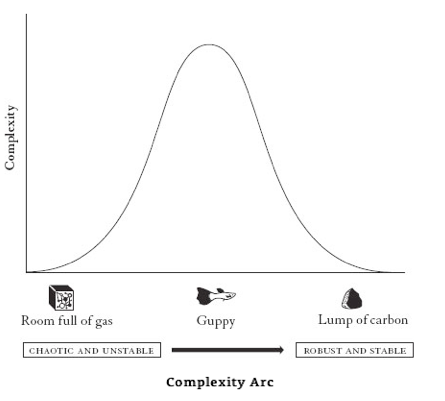
Then author returns to stock market and attempts to modeling it by using statistical equations from physics. In process author discusses “wisdom of crowds”, market vs. planning, and need to ideas diversity increase in order to obtain solution for complex problems. One of interesting pieces here is description of research that demonstrated that historically traders pay a lot less attention to news than usually believed. Another important part of traders’ behavior turned out to be sense of fair play. Author refers to ultimate game to discuss how it works. The final part is discussion on interplay between people’s behavior when mimicking one another would have deleterious impact on reasons for behavior in the first place. Author example is movement to suburbs to avoid congestion that in turn leads to congestion in suburbs.
Chapter two: Why is it so hard to leave a burning building or an endangered city? Confused by Instincts
This chapter uses the story of escaping world trade center on 9/11 to demonstrate how seemingly trivial decision could lead to life or death consequences. Little known part of this story is that analysis of evacuation during the bomb scare a few years before, led to improvements in evacuation design, training and procedures that eventually did save lives. Another interesting fact is that in dealing with humans in crowds one needs to leave some space and maybe add some turbulence to allow crowd self-regulate. Author discusses evacuation software developed using these ideas and human specifics that need to be taken into consideration for it to work. The next part is discussion of gridlock that is often resulting from human behavior more than real bottlenecks of the roads. Once again to add some bumps slowing movement of each car could increase overall speed by avoiding development of congestion points. Here is how author characterizes these situations: “THE CHALLENGE IN all these situations is to start with the already complex repertoire of human behavior, introduce it into an even more complex environment, and figure out how in the world to manage this exponentially more complicated dynamic. The rules change according to the situation, but the stakes always stay high. “
Chapter Three: How does a single bullet start a world war? Confused by Social Structure
Contrary to expectations it starts not with WWI, but with leadership fight in the troop of macaques, which is as complex and challenging affair as it is in any other group of primates. After point that author makes in process of quite logical transition to discussing complexity of human nation-states governance, overall dynamics of coordinated actions, and how they are initiated. As part of explanation, author brings Markov’s chain of probabilities and then Arrow impossibility theorem. He also discusses complexity of American election system and military resource allocation problem (Colonel Blotto).
Chapter Four: Why do the jobs that require the greatest skills often pay the least? Why do companies with the least to sell often earn the most? Confused by Payoffs
This is actually very interesting statement because it is clearly contradicts not only common sense, but also usual experience. Author discusses call centers and such returns/complexity disparities as job of supervisor (complex) and board member (not complex). Actually author provides definition: “One of the best measures for judging the true complexity of a job is how easily a machine can replace it.
“
He also provides graph of complexity:
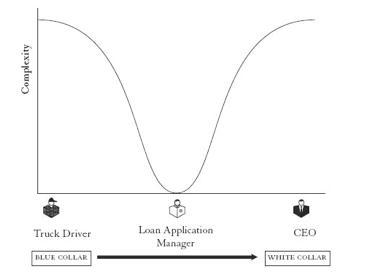
Chapter Five: Why do people, mice, and worlds die when they do? Confused by Scale
This starts with musing on death and then moves to physiological data such as stable number of heartbeats during lifetime with smaller creatures living faster and shorter lives (Kleiber law). Then he moves to Krebs cycle – characteristic of carbon dioxide transformation in living organism. Then author tries to apply similar numerical “laws” to cities development.
Chapter Six: Why do bad teams win so many games and good teams lose so many? Confused by Objective
Here author moves to sporting competition and its rules that create high levels of complexity. Author specifically analyses how these rules can give advantage and wins to bad teams.
Chapter seven: Why do we always worry about the wrong things? Confused by Fear
Here author discusses risks, their real levels and human perception of such levels, as usual talking about 9/11 overestimated, while fall from staircase at home underestimated. He, also as usual, links it to amygdala and brings in work of Kahneman and other researchers working on risk estimates real and psychological.
Chapter Eight: Why is a baby the best linguist in any room: Confused by Silence
Here author takes on another complex phenomenon – human language and its acquisition by babies. He describes a very interesting experiment with babies learning their own and foreign language phonemes that they are highly capable of doing for some period of time after which they become completely deaf to unfamiliar. Author discusses research that shows that perfect language and accent acquisition window start closing around 9 months. It is also very interesting that it requires living person to be present because acquisition via speaker just does not work. The process had to be highly socialized for it to work. All this discussion is used to demonstrate how complex things could be, because language is nearly the most complex thing known to humanity.
Chapter Nine: Why are your cell phone and camera SO absurdly complicated? Confused by Flexibility
This is about typical contemporary phenomenon of functionality creep – the situation when designers pack huge number of features in hardware and/or software, making it difficult to use.
Chapter Ten: Why are only 10 percent of the world’s medical resources used to treat 90 percent of its Ills? Confused by False Targets
Author starts this chapter not with medical issues, but with Muhammad Yunus and his micro lending. From here he moves to Pareto and his rule that applies to just about everything. Both are good examples of simple approach to complex issues that nevertheless work. This follows by somewhat lengthy diatribe about Western society that allocates resource to diseases specific to their population, rather than diseases of poor around the world before returning to the issue and discussion some simple solution to complicated medical issues such as rehydration fluid. Overall the point here is that often cheap and easy solutions are available for very complex problems.
Chapter Eleven: Why does complexity science fall flat in the arts? Confused by Loveliness
Here author moves discussion of complexity vs. simplicity to the area of art, starting with an anecdote about composer Ravel who had composition with requirements not really understood until one takes into account acoustic parameters of the apartment in which he worked on his music. Author discusses some other examples of hidden meaning in artistic artifacts.
Epilogue
Here author returns to Santa Fe institute, discussing word plexus that means multiple and complex folding of meaning into the words. Then he brings in discovery radio astronomy by Jansky during attempts to find source of interference with radio broadcasting in 1931. The final and quite important point is that everything is complex and everything is simple depending on the level of analysis, so, for example, a simple newspaper article becomes hugely complex if looked at the level of black and white dots on paper, and even more complex if looked at the level of molecules and atoms.
MY TAKE ON IT:
This book is interesting mainly because it prompts one to think about importance of point of view of observer being taken into account if one want to develop picture of some artifact or phenomenon close enough to reality so to be meaningful. I think it is a great idea and it should be formally applied in all areas of intellectual activities, especially in economics and politics when neglecting to take it into account could easily create huge negative consequences.
20190106 – The How of Happiness
MAIN IDEA:
The main idea of this book is to use results of author’s some 20 years of experience in psychological studies on happiness to develop and present patterns of behavior that are specific to people with high scores in happiness tests and present “to do” type of recommendations for achieving the same results. Generally these patterns are not new and even somewhat corny, but it turned out that they do work and could be used to achieve better state of well-being.
DETAILS:
Part One: How to Attain Real and Lasting Happiness
- Is It Possible to Become Happier?
Here author analyses what people mean by happiness and how to obtain it. Then she provides results of research that indicate that it mostly comes from two sources: DNA and Personal effort, with circumstances of life giving some marginal addition:
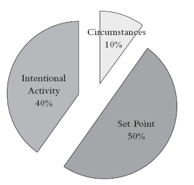
So author suggests concentrate not on wishful thinking about change in circumstances, but actively work on doing things that make people happy. Helpfully she provide results of research that itemizes what happy people do:
- They devote a great amount of time to their family and friends, nurturing and enjoying those relationships.
- They are comfortable expressing gratitude for all they have.
- They are often the first to offer helping hands to coworkers and passersby.
- They practice optimism when imagining their futures.
- They savor life’s pleasures and try to live in the present moment.
- They make physical exercise a weekly and even daily habit.
- They are deeply committed to lifelong goals and ambitions (e.g., fighting fraud, building cabinets, or teaching their children their deeply held values). Last but not least, the happiest people do have their share of stresses, crises, and even tragedies.
- They may become just as distressed and emotional in such circumstances as you or I; but their secret weapon is the poise and strength they show in coping in the face of challenge.
At the end of chapter author asks somewhat strange question:”Why Be Happy” and replies about happy people: “they actually show more flexibility and ingenuity in their thinking and are more productive in their jobs. They are better leaders and negotiators and earn more money. They are more resilient in the face of hardship, have stronger immune systems, and are physically healthier. Happy people even live longer.
“
- How Happy Are You and Why?
Here author states that happiness, as everything else, is continuum, rather than discreet states Author also reviews methods of evaluation and provides questionnaires used to identify levels of happiness and/or depression. Next she defines and trying to debunk myths about happiness:
- Myth: Happiness must be “found”. Reply: “happiness, more than anything, is a state of mind, a way of perceiving and approaching ourselves and the world in which we reside.
“ - Myth: Lies in Changing our Circumstances. Reply:” Beyond minimally satisfactory level it is not important”.
- Myth: You Either Have it or you don’t. Reply:“ Happiness is teachable and learnable and this book will help”.
After that author goes through detailed explanation of why it is so for the following items:
- Material Wealth and cost of materialism
- Beauty
- Phenomenon of Hedonic Adaptation
- The Altar, the Lottery, and a House in the Burbs
Then author discusses research and anecdotal evidence of genetic component, inferring that it would constitute 50% of final level, providing set point for happiness, but after that human action could move it up or down depending on whether these action promote or depress happiness.
- How to Find Happiness Activities That Fit Your Interests, Your Values, and Your Needs
To find happiness author recommends using strategies that fit with source of unhappiness, one’s strengths, and lifestyle. In order to define what are these fits, author provides test questions for 12 activities that could bring happiness.
Part Two: Happiness Activities
Before going into details of activities’ application author provides The Oxford Happiness Questionnaire to identify current level of happiness.
- Practicing gratitude and Positive Thinking
This is about expressing gratitude and the ways in which it boosts happiness:
“First, grateful thinking promotes the savoring of positive life experiences.
Second, expressing gratitude bolsters self-worth and self-esteem. When you realize how much people have done for you or how much you have accomplished, you feel more confident and efficacious.
Third, gratitude helps people cope with stress and trauma.
Fourth, the expression of gratitude encourages moral behavior.
Fifth, gratitude can help build social bonds, strengthening existing relationships and nurturing new ones.
Sixth, expressing gratitude tends to inhibit invidious comparisons with others.
Seventh, the practice of gratitude is incompatible with negative emotions and may actually diminish or deter such feelings as anger, bitterness, and greed.
Last but not least, gratitude helps us thwart hedonic adaptation.
“
This is followed by “How to” recommendations.
The second Happiness Activity discussed in this chapter is “Cultivating Optimism”;
Number 3 Activity is “Avoid Overthinking and Social Comparison”. Author provides data from laboratory experiments, some real life anecdotes, and recommendation s how to do it mainly by “Letting it go” and looking at the big picture.
- Investing in Social Connections
Here comes activity number 4: Practicing Acts of kindness. Author’s important point here is to do it in bulk rather than small staff daily, so that it could not become boring routine. Similarly number 5 is Nurturing Social Relationship. Here author makes a list of benefits from relationships from social support to minimizing hedonic adaptation and provides recommendation on how to obtain and maintain such relationships.
- Managing Stress, Hardship, and Trauma
The activity number 6 is strategy of coping with adversities. The main point here is that problem-focused coping works much better than emotion-focused coping. Author discusses 3 outcomes from making stronger to barely survival:
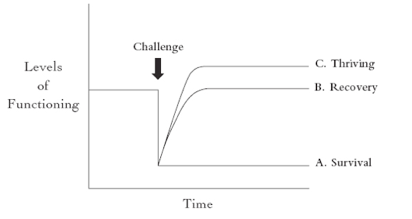
One interesting point is discussion on the use of writing as method to overcome adversity.
The activity number 7 is forgiveness. The main point here is that forgiveness is important for victim as method to overcome concentration on damage, which prevents overcoming it and moving on.
7 Living in the Present
The activity number 8 – Increase flow experiences, which comes with concentration on present, especially during work or other meaningful and challenging activities that match individuals’ abilities at the level that allows increase of these abilities. Author provides recommendations on how to increase flow experiences.
The activity number 9 is about savoring life’s joys including ordinary experiences that come and go but will be missed when they passed. It is also useful to recollect good things in the past.
8 Happiness Activities No. 10: Committing to Your Goals
This chapter starts with very true statement that happy people have objectives that they are in process of working on to achieve. Author lists psychological benefits of commitments and defines what kind of goals could lead to more happiness. It should be intrinsic and authentic goals. Actually author expands this and comes up with simple table what kind of goals lead to happiness and what kind does not:
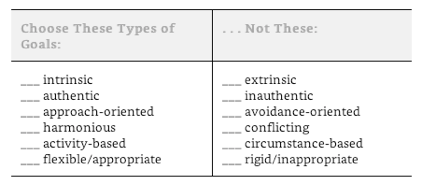
- Taking Care of Your Body and Your Soul
Author here discusses psychological benefits of religiosity and spirituality, which she designates as activity number 11. She analyses when and why it is so beneficial, but also some specific cases when it is not. The final activity number 12 is taking good care about body by exercising, mediating, and, also important, behaving like a happy person. There is plenty of evidence that such behavior as smiling for no reason makes people happier. There is a link between facial expression and behavior which makes reinforcement loop in both directions so it is not only that happy person smiles, it is also true that smiling person becomes happy.
Part Three: Secrets to Abiding Happiness
Here author summarizes her recommendations on haw to achieve happiness or at least improve one’s psychological conditions.
- The Five Hows Behind Sustainable Happiness
The First How: Positive Emotion
The Second How: Optimal timing and variety
The Third How: Social Support
The Fourth How: Motivation, Effort, and Commitment
The Fifth How: Habit
The Promise of Abiding Happiness: An Afterword
Here author discusses how the writing of this book impacted her own condition quite positively and that she noticed that this impact was much more obvious in areas where she had some deficiencies specific to her personality, while a lot less obvious in areas where she already was acting as recommended. In short the main point here is that happiness is learnable and trainable condition that could be achieved if one is willing to learn and to work on it.
MY TAKE ON IT:
I find this presentation of positive psychology quite interesting and potential useful for anybody who would like to improve quality of his or her perceived condition of being. Interestingly enough I find some 90% of recommendations consistent with what I am doing in my own live with results that one would expect according to presentations in this book. Another interesting thing is that being of somewhat similar background with author, coming from USSR, albeit at different ages, I have similar attitude in some areas that I find as difficult implement as author. Author reports that when she tried to apply it despite her internal resistance, it did work and she did felt happier than before, but I think that my soviet background is so much entrenched in my psyche, that it probably does not even worth trying. Anyway it is nice to know that the way one lives his live is highly consistent with the way contemporary psychological science recommends to live in order to be happy.
20181230 – Risk Savvy
MAIN IDEA:
The main idea of this book is that we live in the risk illiterate society and as result people often make decisions, which are not reasonable, sometime becoming victims of swindlers or just plain mass hysteria for practically no reason whatsoever, except for this illiteracy. Author also strives to educate people about real risks and how to deal with them and makes suggestions on how to deal with it on the scale of society.
DETAILS:
Part I The Psychology of Risk
- Are People Stupid?
It starts with an interesting observation that people generally do not understand risks and do not understand probabilities, even if they are use it all the time. Author presents a simple example of meteorologist predicting x% probability of rains. It turned out there are multiple ways to understand it and people do understand it differently including such hilarious statement that probability 50% of rain two days in the row means 100% probability of rain over the next 2 days. Author also looks at British contraceptive pill scare causing lots of damage because women stop using the pill, risks of terrorism that caused people to expose selves to much higher risk of driving, and so on. At the end author states that:
- Everyone can learn dealing with Risk
- Experts are usually do not understand risks either, so they are no help in risk evaluation
- Less is more in terms of usefulness of simple solutions for complex problems.
- Certainty Is an Illusion
The point here is that complete certainty really does not exist, only illusion of it. Author discusses contemporary prediction industry in economics and elsewhere and he specifically looks at test results, which are also sort of predictions. One of the reasons for this is human propensity to seek certainty of the future, which is obviously not possible. Author provides a nice take on Risk versus Uncertainty:
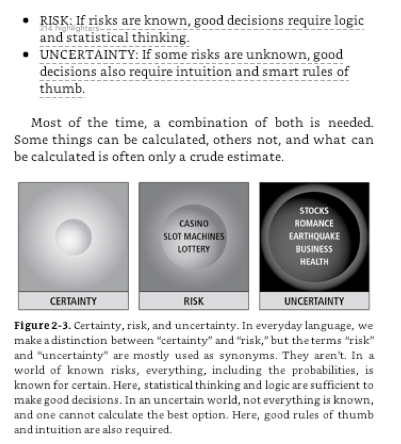
After that author discusses probability and does it in very specific terms: “Probability is not one of a kind; it was born with three faces: frequency, physical design, and degrees of belief.”
He also makes two important suggestions in communicating and evaluation risk:
- Use frequencies instead of single-event probabilities.
- Use absolute instead of relative risks.
Then author discusses intuition as a way to apply unconscious rules of thumb based on experience, that generally work pretty well.
Finally author points out to negative effect that could occur due to unreasonable search for certainty such as in case of medical test results with false positives causing more problems than resolving to true positives. Another classic example: Turkey illusion.
- Defensive Decision Making
This starts with examples of mistakes made even by Einstein and demonstration of visual illusions, then continue to discussion of human errors, their quality: good and bad errors, and proceed to look at different cultures some more tolerant to errors, especially good, and some not, making the latter cultures stagnant due to fear of errors and defensive decision making. Author discusses in details the expression of defensiveness in medicine that leads to huge overkill in testing and expenses with priority given to procedures over performance.
- Why Do We Fear What’s Unlikely to Kill Us?
To answer this question author brings in amygdala and need to be very cautious with unknown. This brings in social imitation and cultural settings that make people to be afraid of some things but not others. Author provides example for X-mas candles that Americans afraid of, while Germans not. Then he goes through a number of similar cases like lucky numbers, GMO food, Radiation, medical symptoms and other. There is also an interesting piece on validity of questionnaires, especially the closed ones. Here is example for children answering to closed and open QA:
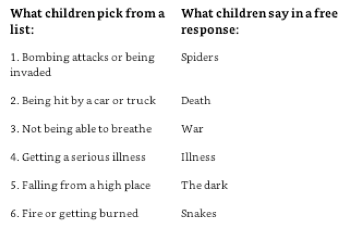
At the end of chapter author looks at anxiety in young people, and concludes that it is mostly linked to difference between internal and external goals, when former are more typical for older people who less dependent on others approval, while latter for young people for whom fear of failure is a big cause of anxiety.
Part II Getting Risk Sa
- Mind Your Money
This starts with discussion of American optimism in financial area and statements that it is not supported by data. The author moves to useless experts that do slightly worse in prediction than chimps. Good example is that nobody was able to predict market crash in 2008. Author provides an interesting piece of information about Harry Markowitz who got Noble for his portfolio management math, but for himself used just plain diversification 1/N. So here is general interpretation:
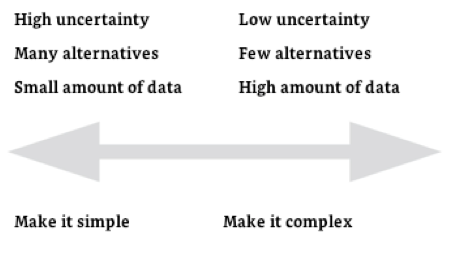
This follows by an Austrian retirement plan story when bank representatives recommended investment in fund despite bad conditions. In some cases it was because they did not understand these conditions, but in others because it was their job. From here author provides recommendation when to trust you banker:
- Banker understands the featured financial products, and
- Banker has no conflicts of interest.
- Leadership and Intuition
This is about decision making at the executive level. It turned out that lots of decisions are made not on the basis of formal analysis, but rather at the gut level with formal analysis used to justify decisions. After that author discusses defensive decision making typical for any bureaucratic entity and offers suggestions on what to do and what not to do. Finally author suggest that simple strategies work better:
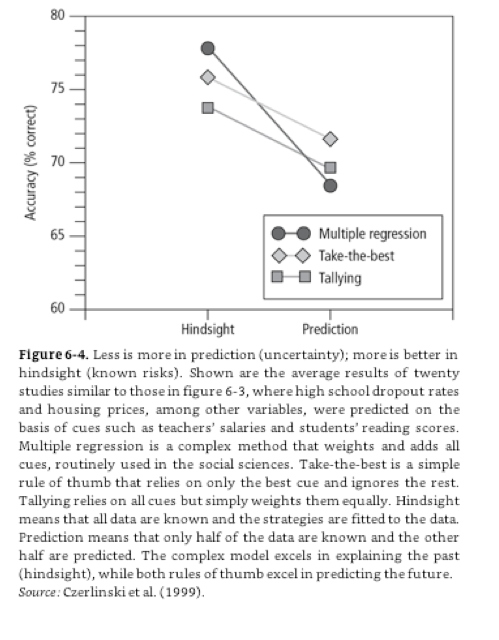
- Fun and Games
This is about various games involving risk, which starts with example of “Let’s make a Deal” when choice in condition of uncertainty often is dun without understanding of statistics and therefore is not optimal. Author also makes recommendation on dining and shopping choices like asking waiter “What would you eat here this evening?”
- Getting to the Heart of Romance
This is pretty much about finding mate. It starts with Darwin’s diary and his reasons to marry or not, then continuing with Ben Franklin’s recommendations to his nephew. After this author moves to some simple mathematics and brings in notion of “Satisficing”. Then author moves to parenting and show an interesting diagram about parent effort allocation between children:
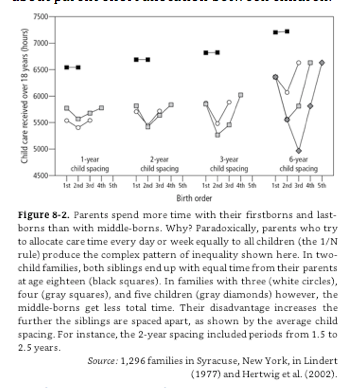
- What Doctors Need to Know
This is about doctors and quite low levels of their numeracy causing unsound recommendations. The good news is that doctors are trainable so they are capable provide statistically valid estimates. The bad news is that it is against doctors’ own interest and exposes them to lawsuits when similarly innumerate lawyers could inflict lots of damage. Author continue going through a number of medical / statistical issues and algorithmic methods to obtain better care, while decreasing exposure to negative impact from testing. Probably the most important here is that author provides reference to sources like (www.the cochranelibrary.com).
- Health Care: No Decision About Me Without Me
This is pretty much about misleading health statistics that causes people go into unnecessary procedures that have negative impact. Here is a sample:
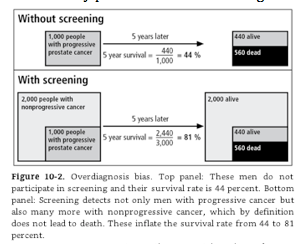
Author reviews in details screening for prostate and breast cancers, their promotion and results. He provides a nice summary of Facts and Fiction for cancer screening resulting in conclusion that one would be better off doing preventive measures rather than screening, which includes diet and exercise. The interesting example is Japanese who moved to Hawaii. They change diet and behavior resulting in dramatic decrease in cases of stomach cancer and increase in breast and prostate cancers:
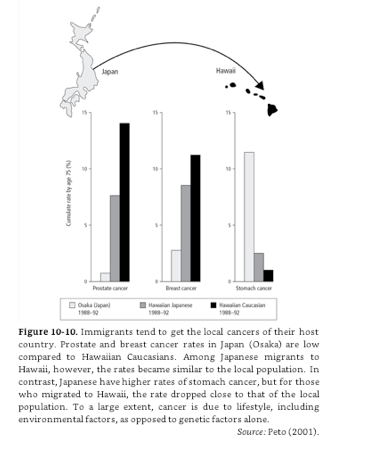
The final and most important recommendation is that doctors allocate only small share of their time and attention to each patient and do not suffer consequence of mistakes or unsound recommendation. The patients do, so only the ability of individual to control as much as possible of treatment activity could somewhat improve quality healthcare decisions.
- Banks. Cows, and Other Dangerous Things
Here author provides a few very reasonable rules for living in our world:
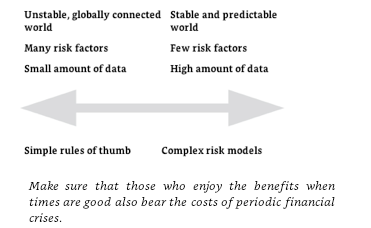
Probably the most important rule is this: ”Think for yourself”.
Part Ill Start Early
12 Revolutionize School
The final part is about schooling and what author believes had to be done to produce Risk Literate new generation. For this author suggests instead of teaching for some nearly randomly selected testable skills, teach to “Problem Solving in Real world” so that students acquire specific levels of Health literacy, Financial Literacy, Digital Risk Literacy, Self-Control, digital and otherwise.
MY TAKE ON IT:
It’s a very good review of deficiencies of Risk understanding in contemporary Western world. It worth to add that despite all this problems the western world is much better able to handle risks and other problems than any other Cultural world either current or historical, mainly because of relative freedom of decision making and information distribution that allows wide range of opinions and potential solutions to be presented tried and, if proved successful, to be implemented. For me this book is very interesting by providing statistical confirmation to many of my gut feelings that I kind of acted upon by doing or not doing something, while feeling some very light concern that it is wrong. The statistical data and reminder to apply analytical skills to everyday life on more consistent basis kind of eliminated this light concern.
20181223 – The Optimism Bias- A Tour of the Irrationally Positive Brain
MAIN IDEA:
The main idea of this book is going somewhat against the main idea of fashion psychology, which recently discovered a huge amount of situations when human brain misrepresents reality, while constructing its picture. The main point author makes is that it is incorrect approach. Whatever misrepresentation brain makes is beneficial for survival due to the simple fact that it is found in the brain of survivors who are currently alive and author uses results of extensive research and multiple real live examples to demonstrate how it works.
DETAILS:
PROLOGUE: A Glass Forever Half Full?
This starts with author being puzzled by recent research data that demonstrated how human optimism distorts reality. It relates not only to the future, but also to the past. It is now well understood that humans do not recollect something the way computer memory does. Human recollection is rather reconstruction of some consistent memory from bits and pieces contained in the brain, which is implementing in process both filtering and invention of specific facts. Similarly human brain projects future only partially consistent with known reality, adding corrections needed to achieve optimistic bias. Author presents a research that she conducted on students to support these ideas. Here is her reasoning for why it happens: “The optimism bias protects us from accurately perceiving the pain and difficulties the future undoubtedly holds, and it may defend us from viewing our options in life as somewhat limited. As a result, stress and anxiety are reduced, physical and mental health is improved, and the motivation to act and be productive is enhanced. In order to progress, we need to be able to imagine alternative realities—not just any old realities, but better ones, and we need to believe them to be possible.
“
- Which Way Is Up? Illusions of the Human Brain
This chapter starts with illusions that brain creates while processing reality. One such illusion was an airline pilot’s spatial confusion that led to the crash of passenger plane. After that author discusses sever visual illusions that demonstrate brain’s functionality not as a tool of presenting reality, but rather tool for constructing reality representation based on clues. After presenting some visual illusions, author discusses well-known cognitive illusions like everybody being better than average and reviews photograph selection experiment– choice blindness. One more interesting point is that research shows that thinking too much can lead to suboptimal judgment. Author provides example with posters selection.
- Are Animals Stuck in Time? The Evolution of Prospection
In this chapter author moves to animals and discusses their abilities for mental representation of time researched by observing their patterns of food hiding and recovery. This leads to discussion of physiological changes to the brain when knowledge is accumulated. As usual there is reference to London taxi drivers and their increased spatial processing parts of the brain. However she brings some really new information. It turned out that these taxi drivers pay for this increase in spatial effectiveness by losing some abilities in different functions. Even more interesting is discovery resulting from continuation of observation beyond retirement, which demonstrated that when demand stops, brain returns to normal levels of development for both spatial areas and other areas that where limited by spatial overdevelopment. The final part of the chapter is about mental time travelling.
- Is Optimism a Self-Fulfilling Prophecy? How the Mind Transforms Predictions into Reality
Here author uses the story from sport to demonstrate that in some cases, actually great many of cases, unjustifiable optimism could motivate people to work harder, eventually not only making this optimism more and more justifiable, but leading to dreams becoming true. Next part of the chapter is about stereotypes and how they mold relationship between people and could direct development in one direction or another. The typical example two persons one of whom stereotyped, as being better athlete because of race, indeed becomes a better athlete because of much more effort applied in athletic area. Author provides a few interesting experiments, demonstrating powerful application of stereotypes resulting in clearly observable changes in behavior and consequently result. The chapter ends with discussion of optimism saving and pessimism killing people in some cases of disease.
- What Do Barack Obama and Shirley Temple Have in Common? When Private Optimism Meets Public Despair
This chapter is about mass optimism or lack thereof that could be restored by popular public persona. Author refers to two such individuals Shirley Temple in 1930s and Obama. She obviously missing one small detail that Shirley Temple provided natural non-political optimism supported by everybody who was not hater of little cute girls. Barak Obama represented very political optimism of leftist kind not acceptable to significant part of population, so unlike Shirley he was very dividing and controversial person. Curiously after that she moves to samples of false hope provided by individuals like Madoff, which is actually very appropriate when discussing Obama. After that author discusses interplay between pessimism and optimism. Which in developed countries like US often has form of: “everything is awful, but I am doing fine and expect it to continue.”
- Can You Predict What Will Make You Happy? The Unexpected Ingredient for Well-being
This is about what makes people happy and survey identify 5 factors from most to least important:
- More time with family
- Earning double what I do now
- Better health
- More time with friends
- More traveling
Then discussion goes into some of these things: marriage, finances, perspectives for bright future, and focus on some specific temporal need. She also discusses memory and anticipation of future as area where application of optimism is quite important. One of reasons author provides is this:” Our belief that happiness is just around the corner is, ironically enough, what keeps our spirits high in the present. Imagining a better future—which is attainable if we follow certain rules (or so we think) —maintains our wellbeing. “. She also refers to biological link between optimism and mental health: “…depression is the inability to construct a future. As a matter of fact, clinically depressed individuals find it difficult to create detailed images of future events, and when they do, they tend to be pessimistic about them.”
- Crocuses Popping Up Through the Snow? When Things Go Wrong: Depression, Interpretation, and Genes
Here author concentrate on the complexities of life that could lead to psychological problems and even depression if there is lack of optimism. She starts with hypothetical story of two individuals in similarly difficult situation of relationship breakdown, which for one individual is just a problem to overcome, but for another complete prove that he not only failed in overcoming the problem, but also could not possibly have another successful relationship because of inherent deficiencies. From here she moves to learning helplessness in animals and people. This is not necessarily universal – some percentages of individuals refuse to do this learning and keep looking for solution even in the most impossible situation. After that author discusses biological causes of depression and pharmaceutical treatments and other interventions. She even refers to some genetic indicator of inclination to be optimistic.
- Why Is Friday Better Than Sunday? The Value of Anticipation and the Cost of Dread
This is quite interesting approach to well known fact that anticipation of good or bad event often generate more happiness or unhappiness than event itself. Author supports it with experiments that demonstrate different value of the same event depending on its terminal position in the near or more distant future. From here author moves to temporal discounting – the tendency to value present more than future and experiments exploring different facets of this phenomenon. She ends this chapter with the story of Michael Jackson who demonstrated outstanding ability to lose money and commonality of such behavior for many Americans of much smaller means who fail to save because they discount future a bit too much.
- Why Do Things Seem Better After We Choose Them? The Mind’s Journey from Expectation to Choice and Back
This is about well-researched psychological phenomenon that when people make choice they become attached to this choice, so the value of selected item increases, sometimes dramatically. Author describes a number of experiments supporting this finding with especially interesting ones when people were deceived into believe that they made choice when in reality they did not do this. The interesting inference from this is that continuous reminding people that they selected company they work for, subject they study or whatever else, increases their commitment. Author also discusses reason for this: strive to avoid cognitive dissonance. Another reason, not necessary alternative is that selection between choices involves investment of time and effort, so by psychologically increasing value of selection one protects this investment. The final series of experiments demonstrated the process of choice is mainly subconscious by reviewing patterns of brain activity when the choices are presented: selected item initiate higher levels of activity well before selection had been made.
- Are Memories of 9/11 as Accurate as They Seem? How Emotion Changes Our Past
This chapter is about validity of human memories. It demonstrates quite convincingly that it is generally low. Author recorded personal recollections about such dramatic even as 9/11 a few days after it happened and then returned to the same people a few years later. Even if everybody believed that they remember every detail of this day, comparison with recorded data demonstrated that 25% had it completely wrong, about 50% were 67% wrong and only 7% were correct in their recollection. The final and very important point that author makes is that people who were close enough to towers on 9/11 have a lot stronger memories, meaning that being there matters a lot. Research confirmed that different parts of the brain activated depending on how much person involved in recollected event, creating important emotional aspect of recollection that helps to fulfill the main objective of memory: to use previous experience to survive in current circumstances.
- Why Is Being a Cancer Survivor Better Than Winning the Tour de France? How the Brain Turns Lead into Gold
This comes from Lance Armstrong who was both and said that he values cancer survival because it made him a better man. Author uses it as example of important human ability to turn a lemon that life gives one into lemonade. What is interesting that people are pretty bad in predicting their condition after something like this happen. Author discusses a number of experiments with fMRI when objects selected one of two bad future events like broken leg vs. broken arm. Within minutes after selection people change their estimate of selected condition as less severe than before. Another interesting experiment was to make students to walk some distance on campus in embarrassing outfit. One group was “high choice group” that prefer select outfit from a few options and another “low choice group” preferred to use whatever outfit was assigned. Contrary to expectation that the distance would feel longer than it was, both groups perceived it to be shorter with high choice perceived it nearly twice shorter than low choice group. The conclusion is that anticipation is very different from actual event. The final part of the chapter is about cognitive dissonance that makes people either reevaluate their views that caused it or reject reality as false and increase commitment to their views.
- A Dark Side to Optimism? From World War II to the Credit Crunch—Underestimating Risk Is Like Drinking Red Wine
After 10 chapters discussing mainly positive side of optimistic self-deception author moves to the negative side – human propensity to close eyes on probability of negative events. As example author uses Stalin’s inability to see very clear signs of coming German attack. Similarly people underestimate probability of serious illness, incidents, divorce, and what not. The amazing thing here is that even after being provided with statistical data for probability of negative events, people still believe that their own chances are much better than statistics. However when people encounter reality they make adjustment and go to somewhat different levels of optimism. In brief, as everything else optimism is good in moderate doses when it creates incentive to work harder and live smarter, turning into self-fulfilling prophecy. However in excessive doses it could cause serious damage and author provides story of Sydney opera house, which was completed 10 year late and 14 times over budget.
EPILOGUE: A Beautiful Mademoiselle or a Sad Old Lady? From Prediction to Perception to Action
The brief epilogue presents one of these dual meaning pictures: young woman changes to old lady and back depending on viewer’s perception. Author’s point is that optimism is like these pictures; depending on user it could be highly beneficial or completely destructive.
MY TAKE ON IT:
I think it is very interesting approach and wealth of research and examples make this book quite useful for understanding humans. I also think that author, willingly or most probably unwillingly, demonstrates inhuman character of all socialistic movements and their acolytes including the one she is enamored with – Barak Obama. The inhumanity of these people comes from their contempt to other people and their abilities, even while they do not understand these people and have no clue about deep evolutionary benefits of distorting reality in ways beneficial for survival. So these Sozis, Nazis, and Commies feel entitled to dictate other people how they had to live, behave, and what they allowed or not to do, using for this purposes all means necessary and available from soft “nudging” to save more money for retirement to concentration camps and mass shootings to rid of “deplorable and irredeemable”. I understand that this book would not change anybody’s mind on wisdom of leading and forcing other people to act differently to what they want, but I think it gives some good scientific information for people who resist nudging, even when they are told that their believes and actions are against laws of statistics or probability or against common sense of their betters, who in reality are severely deprived of common sense due to the lack of practice.
MAIN IDEA:
The main idea of this book is that the main ingredient of success is Grit, in other words the ability of individual passionately and persistently pursue his/her objectives. All other components that go into achievement such as DNA, hard work, and luck are secondary.
DETAILS:
Part I
Chapter 1: Showing Up
This starts with discussion of author’s experience analyzing what makes person a success in West Point where a significant number of people drops out despite very strong admission competition. This was the problem West Point was trying to resolve with the Whole Candidate Score calculated based on just about anything that could be digitized in previous history of the person. Despite this effort this Score could not reliably predict who would succeed. Author then states that she developed Grit questioner, measuring individual’s ability to persevere and it turn out materially better predictor who would stay to completion. At the end of chapter author provides another example related to preparation for spelling competition.
Chapter 2: Distracted by Talent
Here author refer to her experience as a school teacher when she discovered that to her surprise overachievers who easily learned material often were left behind by less talented students who had much harder time understanding, but persevered until they learned. Author also adds reference to authority citing Darwin who believed that people generally are close in talents, but differentiate in ability to persevere. After that author discusses work of psychologist William James who 40 years after Darwin concluded that humans generally greatly underuse their capabilities. The next stop is research on musicians, which again confirmed that the best just work harder than the second best. At the end of chapter author retells her experience as McKinsey consultant, the company that dedicates lots of effort for the search of “talent”.
Chapter 3: Effort Counts Twice
Here author moves to closer look at what constitutes human ability to achieve success in some area and finds that any activity consists of a multitude of sub activities that should be painstakingly learned and repeated until they become automatic, which is not possible without hard work and persistence. Author also present a nice graphic of how something is achieved:
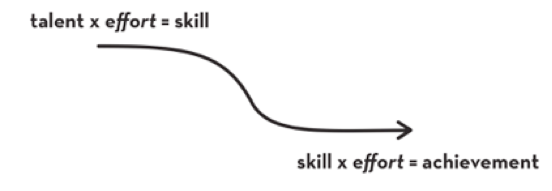
Chapter 4: How Gritty Are You?
Here author provides questions, which allow reader to check his/her own level of Grit manly based on ability to be consistent in objectives and persistence, meaning not changing what one wants to achieve and not stopping working on it. Another important point author makes that objectives could be achieved only if there is clear understanding of how to do it and what are sub-objectives that had to be achieved in order to succeed:
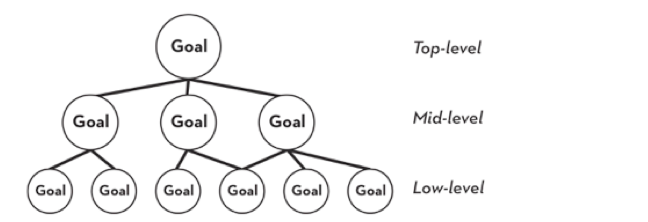
At the end of chapter author discusses research on historical high achievers that clarify the scale:
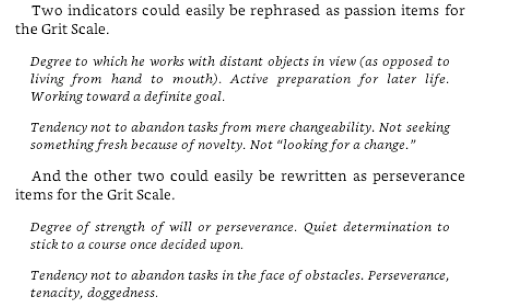
Chapter 5: Grit Grows
Here author discusses again nature vs. nurture and claims that Grit is not necessarily DNA defined feature and it could grow and here is brief recipe:
First comes Interest
Next comes the capacity to practice
Third is Purpose
Finally it is Hope, which is not separate part, but rather component of all 3 above.
Part II: Growing Grit from the Inside Out
Chapter 6: Interest
This is review of the first component of Grit that author deems necessary: Interest. First author states that when she grew up she was told to do what is needed, not what she had interest in, leading for her to do staff she later gave up like consulting. Then she reviews a number of stories of high achievers to identify how exactly people develop a passionate interest in something. She concludes that process starts with Discovery, followed by lots of Development, that eventually switch to Deepening.
Chapter 7: Practice
The next step is component is Practice and author discusses work of Ericsson on Deliberate practice. She also provides a nice graph for various ways it happens:
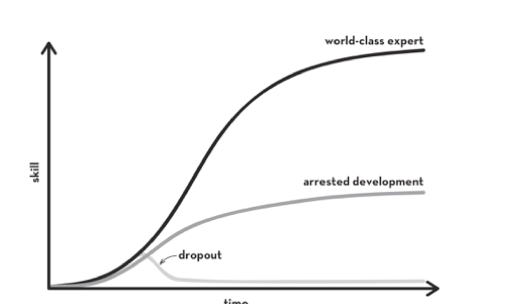
At the end of chapter she presents her own experience of preparing for TED talk as example.
Chapter 8: Purpose
Here author starts with defining purpose as “the intention to contribute to the well-being of others”. In this interpretation the purpose is intrinsically linked to “others”. She goes back to Aristotle to discuss ““eudaimonic”— in harmony with one’s good (eu) inner spirit (daemon)— and the other “hedonic”— aimed at positive, in-the-moment, inherently self-centered experiences.“
The she links it to Grit in such way:
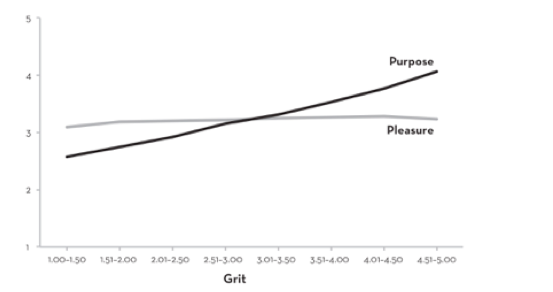
Chapter 9: Hope
The final chapter of this Part is about hope. She defines it in relation to Grit this way: “Grit depends on a different kind of hope. It rests on the expectation that our own efforts can improve our future. I have a feeling tomorrow will be better is different from I resolve to make tomorrow better. The hope that gritty people have has nothing to do with luck and everything to do with getting up again.” Consequently she links it to the work of Seligman on happiness and development of Positive Psychology, especially its part related to being in control as necessary condition of happiness as well as extreme case of learned helplessness to be an important cause of depression. She also discusses how to help people in development of right attitude:
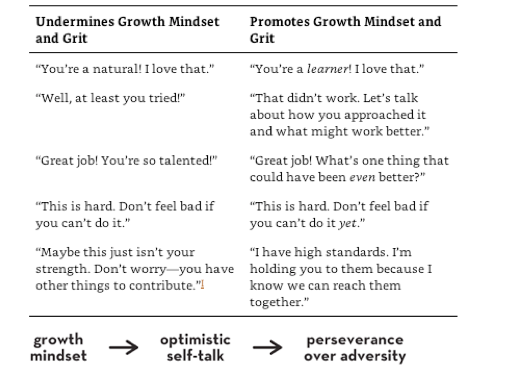
Part Ill: Growing Grit from the Outside In
Chapter 10: Parenting For Grit
This is about raising kids with Grit so they would be successful in life. It mainly comes down to creating environment in which kids are challenged, but not broken. Here is nice representation of this view:
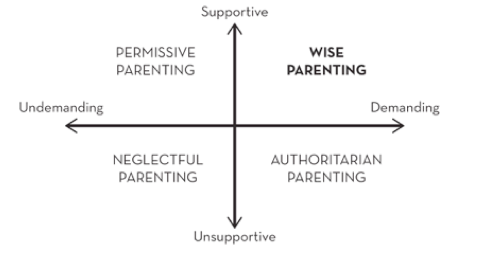
Chapter 11: The Playing Fields of Grit
The recommendation here is mainly to get kids involved in extracurricular activities and make sure that once activity is selected there would be no “give up” option at least for a specified period. Author also discusses in some details Personal Qualities Project and testing to help trace progress.
Chapter 12: A Culture of Grit
Here author discusses culture in somewhat narrow terms as culture within group or organization. Leaders of organization usually create such culture, but author also presents example of very gritty national culture, specifically Finns. Their culture is practically built on grit, they proud of this, and they treat it as the defining feature of national character.
Chapter 13: Conclusion
The conclusion per author is very simple: want to be happy – be gritty:
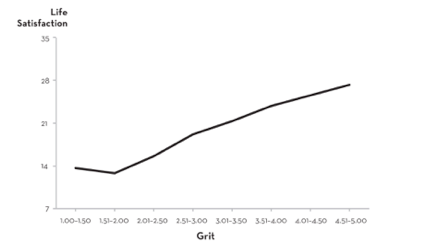
The last word is a caution that it is possible to have too much of the good things, the grit included. This could happen when some direction of activity proved to be incorrect and one has to change it.
MY TAKE ON IT:
This is a kind of collection of examples and research results that clearly demonstrate somewhat trivial idea that if one wants to achieve something he should work on it and not give up until either this objective achieved or it cease to be meaningful. I think that grit, as it is described here is a necessary component of success, but I do not think it is decisive component. The world is complex and one need good timing, luck, some inherent abilities from their DNA, and generally to be in right place at the right time. If one believes that grit could overcome everything, try a simple thought experiment: imagine that he exactly as he was born 20 or 200 years ago. How different would be his life and how long would it be whether he posses grit in spades or nothing at all. That said, it is clear that without this component one could not get anywhere at all.
20181209 – The Virtue of Nationalism

MAIN IDEA:
The main idea of this book is that people are better off if they allowed to live according to their traditions and religion in nation states that are independent and are not subordinate in any way, shape and form to any transnational or global organization and not included as a part into any other nation with different culture, traditions, and religion. These other forms author defines as imperialist regardless of whether these are organizations such as UN or EU or plain old empires like Rome or USSR.
DETAILS:
Introduction: A Return to Nationalism
Here author discusses how the notion of nationalism turned from something noble and progressive early in XX century into something awful and unacceptable. Author provides this theoretical notion that nationalism is: “a principled standpoint that regards the world as governed best when nations are able to chart their own independent course, cultivating their own traditions and pursuing their own interests without interference. This is opposed to imperialism, which seeks to bring peace and prosperity to the world by uniting mankind, as much as possible, under a single political regime.
“. Author makes the point that reason for this change is that new form of imperialism – transnational globalism in form of UN and EU or New world order of Pax Americana became an objective that global elite is trying to achieve. Further author proceeds outlining the argument of this book in some detail.
PART ONE – Nationalism and Western Freedom
I Two Visions of World Order
The two visions author discusses here are: the vision of multiple independent nation-states based on common history, language, religion, and culture with their idiosyncratic legal and political system, peacefully coexisting without any territorial or other irreconcilable demands to each other vs. the vision of one global community with common set of values, one superior legal and political system that could impose these values to member nations by force if necessary.
II The Roman Church and It’s Vision of Empire
This brief chapter is about Western history and Universal Catholic Empire that outgrow from Roman Empire and despite nearly thousand years of attempts failed to unite western Europe into one transnational whole, ending up with multiple nation-states system established after the peace of Westphalia in 1648 and end of Christian religious wars.
III The Protestant Construction of the West
Here author links development of the world of nation states in Europe to Protestantism, which based it construction on two principles:
- The Moral Minimum Required for Legitimate Government and mainly based on 10 commandments from Jewish bible
- The Right of National Self-Determination.
Author believes that this Protestant approach led to formation of political order beneficial to national freedom and eventually led to the creation of United States, and dismantling of colonial Empires.
IV John Locke and the Liberal Construction
This chapter starts with reference to Atlantic Charter of 1941, which established notion of only liberal construction being a legitimate form of government based in individual freedom and best expressed by Locke’s “Second Treatise of Government”. Author puts against this idea what he calls protestant construction, which is based on national freedom. Author assigns all that he considered good and proper like God, family, property, and limited government to national freedom and treats individual freedom like something that denies all these. In his view some given at birth circumstances of life including cultural, religious, and family belonging are not subject to individual consent and therefore make such consent at best irrelevant and at worst detrimental. Author also rejects ideas of von Mises and Hayek about need for individual freedom for prosperity and overall classical liberalism. In his view too much individual freedom is not consistent with freedom of nation, which is community of individuals with common ethnic, religious, and cultural background.
V Nationalism Discredited
Here author discusses reasons for why nationalism was discredited, starting with denial of Hitler being nationalist, similar to socialists’ usually denying that he was a socialist. The main reason for this denial is that Hitler would not accept Westphalian approach of coexisting nation-state and was aiming to subdue the whole world to the will of German nation defined as ethnic, rather than territorial and cultural entity. Author sees continuation of this objective in after war unification of Europe, albeit without Master race ideas somewhat substituted by ideas of Management by the best and brightest recruited from all different ethnic groups. The chapter ends with discussion of American protection, which also diminished traditions of independent nation state, but provided security and prosperity after 1945 so any suggestion to return to more Westphalian order is treated as call to return to barbarism.
VI Liberalism as Imperialism
This is an interesting chapter where author defines liberalism as form of imperialism because it strives to substitute the multitude of diverse nation-states with divers cultures, attitudes, and laws by the universal super entity, which laws and rules are the same, defined by some super national elite and forced on everybody in the world regardless whether they want it or not.
VII Nationalist Alternatives to Liberalism
Here author discusses alternatives to imperial liberalism:
- Neo-Catholic opposition, which does not mind coercive international order as long as it is consistent with biblical teaching, which imperial liberalism actively denies in relation to sexuality, family, and human life.
- Neo-nationalist or statist view originated from French revolution, which raises state above nation
- This is author’s preferred position and he expresses it in such way: “The third alternative to the liberal order is what may be termed a conservative (or traditionalist) standpoint, which seeks to establish and defend an international order of national states based on the two principles of the Protestant construction: national independence and the biblical moral minimum for legitimate government.
“
PART TWO The Case for the National State
VIII Two Types of Political Philosophy
Here author goes back to Greek political philosophy that was concerned with form of government: monarchy, democracy and so on. Another issue is what author calls philosophy of political order that is what causes a specific political order: what allows a group of people to constitute one political entity.
IX The Foundations of Political Order
Here author elaborates what he means by political order that creates government and it is mainly combination of force and mutual attractions between individuals and groups, starting with family, then clans, tribes, and eventually nations. Author calls these attractions the bonds of mutual loyalty created by common language, culture, and history. These bonds are much more powerful than various forms of universal ideology either religious or secular.
X How Are States Really Born?
Author starts with very reasonable rejection of ideas of mutual consent between individuals creating the state. He also rejects ideas of natural state when individuals were free and independent either in condition of beautiful and peaceful world of Rousseau or cruel world of war all against all of Hobbes. Author believes that it was one of two or combination of both processes: voluntary merge of tribes into the free state and/or violent conquest by more powerful tribe subjugating others. He also very reasonably notes that in either case nobody ever asks a regular individual for consent or approval.
XI Business and Family
Here author puts in opposite positions business and family, rejecting idea of state formation as kind of business enterprise with voluntary participation of consenting individuals and promoting idea that it is based on mutual loyalty between individuals, families, clans, and tribes with force routinely used against individuals who fail to demonstrate sufficient loyalty. So author’s main point is that state as business – voluntary contract of individuals, need continuing consent based on calculation of costs and benefits and therefore is unstable because cost and benefits are subject to change. The nation-state, which is based on belonging to a family or tribe is given, is not subject to individual consent, and therefore could not be dissolved easily. Consequently his inference is that nation state is stable and therefore could be free, while multinational state, which has little if any mutual loyalty of its individuals and groups, needs force to keep it together.
XII Empire and Anarchy
Here author looks at history and suggest that most of it people lived in anarchy meaning small entities of tribes, clans, and families fighting each other, creating and dissolving loose alliances with loyalty owned to individual – tribal chief or some equivalent, which is familiar to members of the group. This necessarily limits the size and power of the group. Empire is completely different because it is based on abstraction of universal order so loyalty owned to the abstraction and individuals from emperor down are not familiar and only in control due to bureaucratic and military organization formed around this abstraction and capable enforcing such loyalty. But it is not all. Author claims that any look underneath of empire would show that core of its bureaucratic and military machinery is actually consist of members of ruling nation bound by the same bonds of mutual loyalty as nation of nation state. Around ruling nation there is a circle of allied nations that maybe not in the core, but are loyal to empire and maintain superior position to nations downstream more recently conquered or allied with empire.
XIII National Freedom as an Ordering Principle
Here author establishes his understanding of political order in such way: Anarchy when loyalty goes from individual to individual, Empire when it supposed to go to humanity overall, and Nation when loyalty is to the Tribe and Nation – group of people with shared culture and history. Author is making case that, as an intermediate point between anarchy and empire, nation represents best off all. After that he is trying to make the case that such thing as freedom of nation can exists in form of individual submitting to the will of collective because if collective is suppressed by the will of more powerful collective, individual, who belongs to this collective could not be free.
XIV The Virtues of the National State
Here author lists virtues of National State:
- Violence is Banished to the Periphery
- Disdain for Imperial Conquest
- Collective freedom
- Competitive Political Order
- Individual Liberties
For each of this virtues author is trying to provide some explanation for why for example real national state would maintain these virtues
XV The Myth of the Federal Solution
Here author is trying to prove that federalism, as superstructure of nations, could not work. His reasoning is that dispute between parts of federal state could not be resolved:
- Voluntary adjudication. Nations in conflict choose whether to submit a dispute for adjudication, and the choice of whether to comply with the decision of the judge or adjudicating body remains in the hands of these independent nations.
- Compulsory adjudication. Nations are compelled to submit a dispute for adjudication by the officials of the international federal state, and compliance with the decision is likewise enforced by the agents of the international federal state.
“
However when author moves a step down to dispute resolution between tribes within Nation, he somehow finds resolution at the Nation level compulsory for tribes quite feasible. Author then discusses American federalism and convincingly demonstrates that it works only partially and even this was continuously diminished by more and more power shift to the federal government. At the end of chapter he similarly demonstrates that EU is moving in the same direction, albeit much faster.
XVI The Myth of the Neutral State
Here author moves to the notion of Neutral state in which individual representative of multiple nations dispersed geographically throughout State’s territory could maintain their national specificity as something separate from the state similarly to separation of religion and state. Author discusses that such Neutral state has to have something common and sacred for everybody such as Constitution for Americans or Koran for Muslims. However he rejects the idea that such document could possibly exist without relation to some nation’s cultural heritage and traditions, making it alien to individuals not belonging to this nation. Once more he uses America as example, stating that contrary to idea of Neutrality of American constitution it is really a product of a nation, specifically English speaking religiously protestant, culturally based on European Enlightenment. Incorporation into American state of large number of Catholics, Jews, and others is nothing more that adoption into this state of other nations, which do not constitute majority in any of American states or territories. Finally author looks at example of new states created when European countries liquidated their colonies and created territorial states without any regard for national character of people living there, such as Iraq or Syria. In many cases it led either to cruel dictatorship of one nation over other or civil war, or both. As successful alternative author refer to true National State of Israel and a number of other states with overwhelming majority of one Nation allowing for stability and minimal if any oppression of minorities mainly because minorities do not have power to threaten the state.
XVII Right to National Independence?
Here author addresses an issue of self-determination to increasingly smaller entity. His criteria are quite simple: Nation’s ability to protect itself from aggression and its economic viability. His example for this is American Civil War when Confederacy after asserting its self-determination failed to repel Northern Aggression, consequently preventing survival of Southern Nation that merged eventually with the Northern Nation, even if the process took more than 100 years. In short, author deems universal self-determination right non-feasible, while specific cases being highly dependent on military, economic, and political circumstances such as support of some serious power, even if it is temporary.
XVIII Some Principles of the Order of National State
Here is how author formulates it:
In the first place, the order of national states is one that grants political independence to nations that are cohesive and strong enough to secure it.
The second principle is that of non-interference in the internal affairs of other national states.
The third principle is that of a government monopoly of organized coercive force within the state.
The fourth principle is the maintenance of multiple centers of power.
The fifth principle of the order of national states is parsimony in the establishment of independent states.
Protection of minority nations and tribes by the national government is a necessary sixth principle in an order of national states.
The seventh principle is the non-transference of the powers of government to universal institutions.
PART Three – Anti-Nationalism and Hate
XIX Is Hatred an Argument Against Nationalism?
The point author makes here is not that nationalists do not hate, but that there is no special feature that makes nationalists more hateful than other people. Actually people who are empire builders are much more hateful because they demand and force other people to comply with their ideas, while nationalist just want space for his nation to be left alone to live in accordance with its culture and traditions.
XX The Shaming Campaigns Against Israel
Here author repeats well-known fact that international community or more precisely elites of developed countries hate Israel. However he does not link it to inherent anti-Semitism, but rather to nature of Israel as Nation state specifically created by minority of world Jews who rejected all kinds of global holistic movements, seeking one world wide perfect empire either in form of communism, United Nations, European Union or whatever else, where people of all nations would have similar lives and circumstances. For such globalists/imperialists the existence of successful Israel is unacceptable violation of laws of history, which was a historical mistake of the Western world and should be eliminated. Author defines it as paradigm similarly to scientific paradigm as it was defined in Kuhn’s work and expresses his believe that it has similar staying power and could not be overcome easily.
XXI Immanuel Kant and the Anti-Nationalist Paradigm
Here author looks at sources of Anti-nationalist paradigm to philosopher Kant and his ideas of universal power of reason that should win over nations with their “savages who cling to their lawless freedom” and bring everybody under an universal rule of international state.
XXII Two Lessons of Auschwitz
Here author applies Universalist and Nationalist points of view to Auschwitz. From nationalist point of view it is historical event when one nation – Germans forfeit any notion of humanity and tried annihilate another nation – Jews, who did not have their own state and army and therefore where defenseless. To avoid repetition Jews created their own state – Israel, with Army that proved to be effective in defending this state. From point of view Universalist Jews created Israel in denial of common humanity and universal laws to selfishly protect themselves by all means necessary even if it means to use violence against everybody who attacks them, currently Palestinians. For Universalist there is no difference between German soldiers killing Jewish children and Jewish soldiers killing Palestinians in order to prevent them from killing Jewish children because in both cases it is nation against nation and therefore violation of universal rules of reason.
XXIII Why the Enormities of the Third World and Islam Go Unprotested
This is an interesting part where author discusses difference in attitude of western elites to offensive violence of Islam and Third world, which they generally justify, and defensive violence of Israel, which they consistently condemn. Author’s point is that it is because these elites consider Jews their equal in moral and technological development, kind of adults who should know better and avoid violence at any costs, but Third world people are kind of children who still did not achieve moral and technological age of maturity and there could not be blamed for any violent actions.
XXIV Britain, America, and Other Deplorable Nations
The similar attitudes global elite expresses towards USA and Britain, the latter mainly for its Brexit vote. In both cases people of this countries prefer their own nation and its idiosyncratic laws and mores to global order based of Reason, the attitude elites find deplorable.
XXV Why Imperialists Hate
Here author makes point that Liberal Imperialists hate probably much more than nationalists and this hate directed at everybody who is not willing meekly accept their rule. Author puts it in historical context, stating that it had always been so when some Universal Truth whether it is Christianity or Islam or Nazism or Communism or Liberalism encounter resistance from so local non-universal and practical truth adherents of which resist this Universalism. Jews with their god and covenant are usual objects of such hatred because they do not intend to comply with universal truth. Interestingly enough Jews are joined by Evangelicals, Catholics, and others former Universalists, who accept diversity of the world, forfeited ideas of dominance, and seems to be happy just to maintain their own national idiosyncrasies.
Conclusion: The Virtue of Nationalism
In conclusion author restates his believe that only national state with sufficient viability is capable to provide conditions for the flourishing of freedom and prosperity, while all and any Universalist movement will always end up where they ended up before. Moreover he expresses strong believe that humans are intolerant by nature and therefore the only way out is to maintain national state in which individual bound by common culture, history, and believes would be capable maintaining cohesiveness of society without resorting to massive use of force.
MY TAKE ON IT:
It is interesting and unusual approach to the question of nationalism vs. universalism. Author makes a lot of very valid points, especially when explaining his views on reasons for hate of Israel. However I would not agree with main thesis of this book about superiority of national state and impossibility of federalism. I believe that nations as well as empires do not have brains or hearts or ability to act, all these are characteristic of individuals and nothing else. So the idea that nation is somehow less depends on force than empire does not seem to be supported by reality. It could definitely be that in a nation any given individual at the top would have more in common with any other individuals at the bottom than in empire, but they would still have enough differences to hate each other guts and resort to violence when they believe in probability of success. I think that the effective and efficient society with minimal violence is only possible when as vast majority of decisions are done at the lowest level as possible, while costs and benefits of implementation of these decisions would be matched at the level of people who make these decision. So let’s say 60% of decision impacting individual live that have no impact on lives of others, should be done by these individual with cost and benefits accrued to this individual. Correspondingly another 30% of decisions impacting not only the individual, but also his or her family should be done at the family level with option for non-compliant individual to be excluded from the family. Finally remaining 10% of decisions mainly relevant for society defense again external and internal attacks (military and law enforcement) should be done at the level of society, again with option of exclusion for non-compliant individuals.
As for some special loyalty between individuals of one nation it could not be any higher than loyalty between individuals of multinational state, members of which have one common language, common set of rules, and constantly voluntary work together in all kinds of businesses where success or failure is accrued in the same manner for all participants. I believe that process of universalization occurred many times at lower level when clans formed from families, tribes formed from clans, and nations from tribes. Genes, or culture, or history does not define this process, albeit all above have some influence, but it is defined by proximity, ease of communications, and marginal increase in value via cooperation and interaction. We live in the world where communications became instant, any person could get into personal face to face contact with anybody else within 15-20 hours that it takes to fly from one end of earth to another and any business includes intermediate products created all over the world, assembled in multiple places, and distributed once again all over the world. In this environment Universalism become inevitable, but it could not be achieved from top down by force. It will be achieved from bottom up, by rejecting all socialistic ideologies and leaving individuals decide as much as possible what and how to do things.
As to the current struggle between Nationalism and populism on one side and elitist internationalism on other, I think it is not just the pain of the growth, but rather the beginning of massive revolutionary (hopefully bloodless) process of societies restructuring to accommodate for integrated world economy in which individuals participate in one labor / capital market where everybody has both and can have decent living on equal rights capital only and great living if capable provide labor.
20181202 – World War II at Sea

MAIN IDEA:
The main idea of this book is to use detailed narrative of events and battles at sea to show impact of naval struggle on overall conduct and outcome of WWII. Author looks at this struggle not as a collection of lightly connected events, but rather as one integrated battle with strategic resources moved from one theater to another many thousands miles away to implement some specific strategic vision. The main point however is that these events at sea often played decisive role in outcome of battles between armies on land by assuring or preventing supplies, troops transfers, and communications.
DETAILS:
Prologue
This starts with discussion of prewar attempts to restrict naval arm races that at the time were mostly about size and number of battleships. Eventually these negotiations turned out to be futile not only because sides were cheating, but also because technological development made battleship outdated, even if it was not clear before the war.
Part I: The European War
Chapter 1: Unterseebooten
This chapter is about development of German U-boat fleet in 1930 after Hitler discarded all restrictions of Versailles treaty. Luckily this was not the most important impediment to Donitz’s attempt to build ocean going submarine fleet. The bureaucratic struggle with Raeder who directed resources to building fleet of battleships was more powerful in doing this. However Germany still developed viable U-boats, which delivered initial successful attack at Scapa Flow.
Chapter 2: Panzerschitfen
This chapter reviews activities of German battleships that consumed resources denied to U-boats. It is a story of pocket battleship Graf Spee, which attempted to implement Raeder’s strategy of avoiding naval battle and prioritize effort of raiding against merchant marine in order to starve Britain into submission. Initially successful it was caught up with several British ships resulting in serious damage and retreat to neutral port and then demolished by the captain with crew interned in Argentina.
Chapter 3: Norway
This starts with discussion of strategic value of Norway for German supply of iron from Sweden, which resulted in combined sea-land-air battle that Germany won, but at rather steep price. One of the most important strategic considerations of battle for Norway was German intent to obtain bases for submarine warfare with direct entry to Atlantic. It became mute, however, because Germans occupied France.
Chapter 4: France Falls
This is about Allies defeat in France that from naval point of view presented two important events: Dunkirk evacuation and disabling of French navy. Dunkirk, contrary to usual description, was not just makeshift operation of multitude of small boats but rather relatively successful operation mainly by navy destroyers. The small craft played critical role of moving people from the show to destroyers that could not come close due to the shallow waters. Overall British moved 50,000 to 60,000 people a day during evacuation. French navy become a problem due to capitulation, so British had to remove it from consideration. It was done partially by agreement for it moving to colonial ports and remaining inactive, but partially by directly attacking and destroying French ships at Mers-el-Kebir when it looked as Germans could take control over them.
Chapter 5: The Regia Marina
This chapter is about Italian Navy, which was build with idea to have first class surface ships and save them for the end of the war when everybody else would be exhausted. Eventually it was mainly idle because of lack of fuel and remained locked in Mediterranean. Author describes a few battles it took part in without significant success. One of interesting reasons for this was bureaucratic disconnect between Navy and Air force that made air support practically impossible.
Chapter 6: The War on Trade,
This is about the first phase of battle of Atlantic, when Germans had significant advantages and were able to get relatively close to stopping convoys movement to Britain, so American Navy provided some support, violating neutrality. While U-boat were main force doing the war on trade, at this point German surface Navy was also active and to some extent successful in intercepting convoys.
Chapter 7 The Bismarck
Author retells here the story of Bismarck, its success in battle with British battleships and sinking of Hood. However it was not capable defeating air power, got crippled, and eventually sunk by British ships.
Part II: The War Widens
Chapter 8: The Rising Sun
This chapter is about Japan and its preparation for war. Author paid lots of attention to prewar negotiations and the role they played in Japan political movement to military dictatorship. It also discusses technical developments of Japanese Navy: its battleship, cruisers, and air careers.
Chapter 9: A Two-Ocean Navy
This chapter discusses developments in American Navy and it’s initial starving for resources due to isolationist approach dominant in politics at the time. This ended in 1938 when it become clear that Japanese aggression would not be limited in any way. Author briefly describes the following build up that was far from completely expanded before war started, leaving American Navy underpowered in both Atlantic and Pacific. Despite that and formal neutrality it was increasingly active, supporting convoys and author documented how it was happening. Author also discusses bureaucratic movements in Navy command and its impact on build up and operations. The chapter ends with reference to Roosevelt’s diplomatic offence against Japan that put Japan before dilemma of either stopping aggression due to deficiency of resources, or dramatically expanding its scope in order to take resources from old colonial powers.
Chapter 10 Operation Al The Attack on Pearl Harbor
This is retelling of Perl Harbor attack with specific attention to what this attack failed to do: disable port facilities and destroy oil and other resources based there and, very important, it did not removed American Air careers, living serious force in Pacific that proved to be crucial to close gap until new ships that were in process of construction could go on line providing for huge superiority to American Navy later in the war.
Chapter 11: Rampage
This chapter is about Japanese successes during initial period of war when they practically annihilated colonial power in Pacific and advanced all the way to Australia so they bombed Darwin with its warehouses. Author retells the story of defeat of combined striking force of colonial powers ABDA that was completely annihilated by Japanese Navy.
Chapter 12: The War on Trade, II
This chapter starts with discussion of war on trade conducted by Allies: British attacks in Mediterranean against Italian merchants and American submarine campaign against Japanese. However the most active during this period was German U-boat fleet. Initially it was somewhat contained during the second half of 1941 by fear to get American involvement, but eventually Hitler removed restrictions, probably accepting inevitability of America entering the war that he obviously speeded up by declaring war after Perl Harbor. Author describes in some detail strategic situation around Malta and critical convoy of just 4 merchant ships supported by dozens of Navy destroyers and capital ships that was barely able to get through. The first half of 1941 was nearly complete success for U-boats that sank 263 ships, but then, at least partially due to Enigma decoding it fell to 169 ships in second half. Author describes this story in some detail. Another success for Germany was initial campaign in American waters where U-boats sank 133 ships. By the summer 1942 Americans established convoy system, making it much more difficult for U-boat operation. One of the big successes of German surface Navy was practically stopping operations of northern PQ convoys that were delivering goods to Russia.
Part Ill: Watershed
Chapter 13: Stemming the Tide
This is about growing resistance to Axis actions during 1942. It starts with the story of Tokyo symbolic bombing from Hornet based B-25s. It caused little if any material damage, but huge psychological damage, demonstrating that Japan did not achieve complete air superiority and that American Navy is still functional. Soon after that Coral Sea battle started with big engagement between Air Carriers when both sides suffered damage, but Americans managed to repair Yorktown near by, while Japanese sent theirs home for repair, weakening their force in the area. This created somewhat of an opening for Midway where luck was clearly on the side of Americans. Author describes this battle in details because it completely changed force equation in Pacific, by removing most of Japanese Air Carriers.
Chapter 14: Two Beleaguered Islands
This chapter is about two battles for superior strategic position: Malta that controlled sea supply lines to Africa, so British continuing control prevented supplies from reaching Afrika Corps and probably prevented Germans from cutting off British access to oil. Another island – Guadalcanal on the other side of the planet featured Japanese built airfield captured and retained by Marines, providing huge unsinkable air carrier for Americans that become critical for achieving air superiority in the area. Despite allies defeat in the naval battle of Savo Island nearby, Japanese failure to destroy undefended transports left Allies with capability to continue operation at Guadalcanal.
Chapter 15: A Two-Ocean War
This chapter is about resource allocation, especially by Americans. The main point here is that despite official policy “Germany first”, they allocated lots of resources to Pacific, paying little attention to British continuing nagging to do more in Europe and USSR demanding the 2ndfront ASAP. Author describes in details operations of the Cactus Air Force from Guadalcanal airstrip, which provided air superiority, but was not able to stop Tokyo express – overnight supplies delivery by sea. It was especially important because by this time Americans had only one air carrier left in Pacific. Author also describes in this chapter parallel operation Torch in North Africa. At the end of chapter author describes another air carrier battle in South Pacific – Battle of Santa Cruz Islands in October 1942, which left America with no operational air carriers in Pacific.
Chapter 16: The Tipping Point
This starts with description of American landing in Africa that included delivering million tons of supplies and 18480 vehicles via 20,000 miles sailing around South Africa and Suez. This includes description of fighting with French colonial troops that at this point were allies of Germany. However it was not consistent and in some places French happily surrendered to Americans. Eventually they all stopped resistance. American Navy quickly sank a few destroyers of French Navy that attempted to fight. The net result was dramatic increase in allied power in North Africa and decrease of supplies for German troops.
Meanwhile in Pacific once again Japanese won naval battle only failing to follow through and destroy Henderson field, allowing Cactus air force successfully attack. Finally American summarily won naval battle in November due to superior radar technology, preventing Japanese from delivering reinforcements to Guadalcanal resulting in Japan evacuating its forces by the end of 1942.
Chapter 17: The War on Trade, III
It was also tipping point in the global war on trade. Author starts this chapter with the story of Laconia – British liner full with Italian and German POWs that was sunk by U-boat. After that author describes many technological improvements that occurred in anti-submarine warfare. Together with increase in quantity of escort ships and their quality it lead to increase in loses of U-boats. If one adds to this dramatic increase in shipbuilding when Liberty ships were built faster than U-boats could sink them, the battle of Atlantic was quickly moving to Allies victory. Here is an interesting graph demonstrating this process:
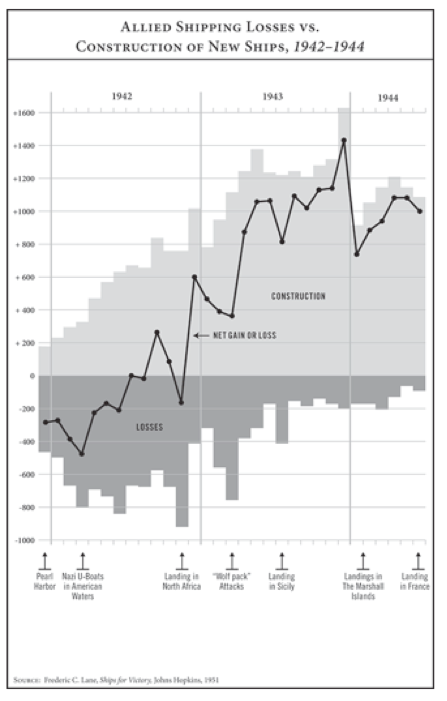
While in Atlantic German submarine forces were loosing the battle, completely opposite occurred in Pacific where American submarines caused increased levels of damage to Japanese merchant fleet.
Part IV: Allied Counterattack
1943 was a year when Allies recovered from early loses and increasingly went on offence, which required massive increase in production of landing craft since the geography of battlefields required multiple amphibious operations.
Chapter 18: Airplanes and Convoys
This starts with description of the battle of Bismarck Sea when American air power destroyed Japanese convoy. Author describes a series of air battles in which japan was increasingly losing due to previous loses of experienced pilot and technological inferiority. Then he describes successful operation of eliminating Yamamoto, which was considered an important event because it caused deterioration in quality of Japanese naval leadership. Then author moves to Africa, where deprived of supplies German forces start loosing and eventually surrendered in May 1943. The end of the chapter is about diplomatic wrangling about what to do next.
Chapter 19: Husky
This chapter describes landing in Sicily where Allied superiority in air and everywhere become obvious. Author looks in detail at technology of landing craft and their quantities that become a bottleneck in conducting amphibious operations. However success was not complete because significant German and Italian forces managed to escape across the strait to Italy, providing force for future difficult battles there.
Chapter 20: Twilight of Two Navies
The first Navy that was on its way out was Italian Navy. Deprived of fuel it was pretty much disabled throughout the war, staying in ports. Author discusses the role it played in negotiation for Italy’s surrender. Eventually it become target of German air force and was pretty much destroyed because it had no air cover. The author moves to amphibious battles in Italy when Navy played role of mobile artillery suppressing German resistance in areas close to the beaches.
The second Navy to go was German surface fleet and author describes how the last battleships Tirpitz and Scharnhorst were eliminated.
Chapter 21: Breaking the Shield
This is about American advance in South Pacific. Author provides a nice illustration of the big picture:
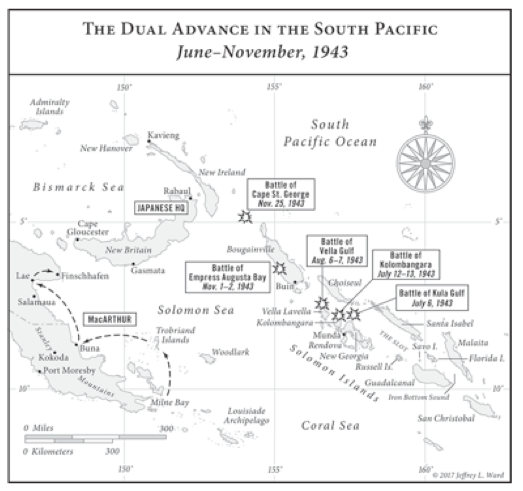
Author also provides an interesting discussion of technical duel between American radar controlled naval artillery and Japanese long distance torpedo. This followed by narrative about island hopping and American strategic discussion where to direct attacks first.
Chapter 22: Large Slow Target
Here author returns to discussion of landing crafts, their features and role in amphibian operations overall, and specifically in battle for the Italy, where their use was critical:
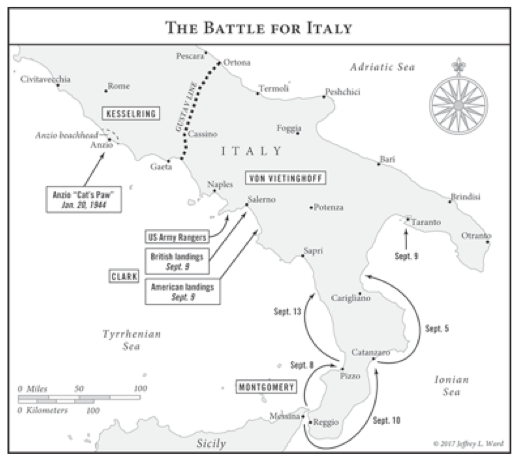
Part V: Reckoning
The final part is about last period of war when allied Navies and Air forces completely controlled everything, while German and Japanese Navy lost any influence on the development of events.
Chapter 23: D-Day
There is very little to discuss here except for huge amphibian operations that was conducted practically with no serious resistance from German Navy, so author relates details of the landing. The only peculiar, even if quite damaging, event was not during landing, but during exercise when German boats attacked LSTs that were poorly protected and killed hundreds of soldiers. Despite mobilizing whatever they still had German Navy could not cause any serious damage, leave alone prevent D-day.
Chapter 24: Seeking the Decisive Battle
At the same time as D-Day in Pacific Japanese Navy tried to stop American amphibian operation in battle of Philippine Sea. This attempt failed and Japan suffered another defeat at sea. The final attack using super battleships Yamato and Musashi similarly failed due to American air superiority.
Chapter 25: Leyte Gulf
Here author describes details of Leyte Gulf battle that annihilated whatever left of Japanese Navy. It has very interesting in part because it described low level of competence of American leaders who managed to leave transports practically unprotected. Only because of heroic sacrifice of destroyers, which attacked battleships and delayed them at very high cost, the disaster was averted. Overall it was the largest naval engagement in history, which Americans won.
Chapter 26: The Noose Tightens
This chapter is mainly about success of American submarines that practically stopped Japanese transportation by sea. It meant that troop on multiple islands had to fight with whatever they’ve got with no hope for resupply or reinforcement. It ends with discussion of Iwo Jima, capture of which opened way for massive air offence against Japan mainland.
Chapter 27: Denouement
This is about the last period of war when Germany capitulated, while Japan leadership tried to use kamikaze in vain hope that they could cause such damage to Americans that they would agree to peace in some form acceptable for Japan. However not only American navy quickly learned how to deal with kamikaze and had relatively small losses, but air offensive moved way beyond anything imaginable before from firebombing cities to eventually using nuclear weapons.
Epilogue: Tokyo Bay, 1945
The final chapter is about formal end of war with Japan, which by far was mainly naval and air war with land operation being much less prominent than in Europe.
MY TAKE ON IT:
This book about somewhat neglected part of WWII – naval battles. It played significant, but not decisive role in Europe, but it was main form of warfare between Western powers and Japan. Probably the most interesting part is the lesson demonstrating poor preparedness on the part of both British and American Navies, which was somewhat result of idea to achieve peace via negotiations and arms control. This idea prevented them from maintaining necessary levels of shipbuilding and Navy expansion that would convince Japan that conquest in impossible. Instead facing weakness, Japan leadership decided that it is unchangeable feature of democracy and they could start war, achieve their objectives to dominate Pacific, and then negotiate peace with opponent that has no moral power for meaningful defense. Unfortunately for Japan, if given enough time, democracy can summon will and way to expand their militaries to the levels required to win and in WWII America and Britain had this time. I do not think that similar victory by rearming during the fight would be possible now, but with nuclear weapons the massive attack becomes suicidal, so it does not make sense even if one believes that enemy morally inferior and technological behind. However I could not say that I am convinced that current decay of patriotism and unity in America would not create condition when it disarm itself under some kooky agreement with its enemies like China and Russia, which would never ever disarm in return.
20181125 – A Long Bright Future

MAIN IDEA:
The main idea of this book is that contemporary development in societal arrangements in developed countries and technological development provided for increase longevity, which made existing lifecycle modes with predefined periods of childhood, maturity, and retirement outdated and unsustainable on the long run. Author proposed to substitute this model with the new one with much less segregated periods of activities when learning, working, and leisure/travel distributed much more evenly throughout lifespan and conducted continuously, so the person would relearn and probably change profession a few times, travel around the world not in retirement, but in young and middle age, and even avoid retirement all together by continuing doing productive activities that he/she enjoys nearly to the end.
DETAILS:
Introduction
It starts with presenting the new problem – significantly extended life span of western population. For example number of 100+ years old people quadrupled in 4 years. It extends complex social and financial problems of how to provide for people who are inactive, waiting for the end of life and assure sufficient levels of Social security and Medicare financing for these people. Author suggest that there is need to rethink meaning of old age and refers to her own experience when in her twenties she was immobilized for months after incident, staying in one room with 3 old women and learning about problems of people who cannot take care about themselves. This started her career in psychology, which eventually became centered on problems of aging. Author differentiates two different processes of aging: one for educated and affluent people who mainly remain active both physically and intellectually and another one for poor uneducated people without access to anything beyond various welfare handouts.
2 – What Is Aging?
Here author is discussing and trying to debunk 5 myths about aging:
- The “Misery Myth” that older people are sad and lonely
- The “DNA Is Destiny Myth” that your whole fate is foretold in your genes
- The “Work Hard, Retire Harder Myth” that we should rush to exit the workforce
- The “Scarcity Myth” that older people are a drain on the world’s resources
- The “We Age Alone Myth” that how we fare in old age is entirely an individual matter, and not a function of society
The debunking is going this way:
- People in old age are not miserable, they just change mode of living: value more simple everyday things, small circle of friends, stronger marriages, more specific and shorter term goals, and so on. All this makes people quite happy in old age.
- For this author provides multiple evidences that DNA, while important, is not definitive. One of this is:“A Harvard University study that’s been running since the 1930s, tracking the lifelong health of both Harvard graduates and people born in inner-city Boston, shows that longevity hinges largely on seven lifestyle choices, which, if made by age fifty, serve as excellent predictors of well-being after age seventy. They are not smoking, not abusing alcohol, getting regular exercise, maintaining one’s weight, and having a stable marriage, an education, and good coping mechanisms for dealing with life’s troubles.
“
- Here author supports idea that productive activity is very beneficial during aging process, but also that it is necessary because lack of financial security. So author promotes all kinds of part time and voluntary work.
- Here author states that it is not a problem and then for some reason discusses overpopulation, which is not happening in developed country and is in process of ceasing in undeveloped ones. Author rejects idea of intergenerational war for resources, as well as idea of older people keeping good jobs and preventing advancement for younger people.
- The final myth rejection based on numerical strength of baby boomers and increased easy of communication and transportation. However author stresses need for resource and its direct link to longevity: “The difference in life expectancy between the most and least affluent Americans nearly doubled in the last twenty years, from 2.8 years in the early 1980s to 4.5 years at the turn of the century. To pit extreme demographic variances against each other, affluent white women now live, on average, fourteen years longer than poor black men in America.”
3 – Reenvisioning Long Lives
Here author discusses need to review the notion of live as 3 Acts play: Growing and Learning with minimal if any participation in productive activities, Act II – full time productive activities, and Act III – leisure and decay with no productive activities.
Author suggests changing it into 5 Acts play:
- Beginning with government provided retirement saving account with the main objective being to prepare individual to lifelong learning and easy change of profession.
- The increased productive activities starting sometime in 30s, but not too heavy so they would leave plenty of space for art, travel, leisure and so on. Author think it would be a good idea to underwrite this pace by keeping parents working at least part time.
- Middle age when people actually take full responsibilities for their society and production of goods and services it needs. However author insists that it should also be moderate, leaving place for family and everything else.
- The turning point at social security age from mainly productive activities to some kind of minimized version of such activities with maybe “encore career” and/or voluntary activities.
- Resolution sometime in 80s, meaning slowly fading away while joining with young people in acts 1 and 2 to transfer knowledge and wisdom and do something good.
4 – The Social Side of Aging
This is about need for aging to continue maintaining social connection with other people, as absolutely necessary because humans developed to live and act in groups with no possibility of surviving alone. Author refers to multiple studies that demonstrate deleterious effects of social isolation. Author also discusses age related changes in social interaction modes from expansion of connections in young age with quantity preferred to quality to contraction of connections with age, with intense concentration on quality of these connections. Author also looks here at institutionalized connections like marriage and grand parenting.
S – Collective Supports: Social Security and Medicare
This chapter is more about social policies providing safety net for old and unproductive people with no savings. Author discusses typical calculation of these systems running out of money if nothing change and current trends continue. Author looks at different group of SSA recipients: wealthy for whom social security provides 30% of income, middle class for whom it is 50-60%, and poor for whom it is 80% and more. After that author weights in social security funding and reform discussion, making it clear that she believes it is not insurance program, but rather social support program. She also rejects ideas of its privatization. However, she does not go to anywhere beyond Simpson-Bowles Debt Commission with its suggestion to increase retirement age and similar “lets steal more from middle class” ideas. She demonstrates similar approach to Medicare.
6 – Investing in Our Future: The Case for Science and Technology
This starts with discussion about causes of increased longevity such as improvement in hygiene that increased averages without real impact on longevity of people who did not succumb to early age diseases. Then author moves to interesting part of epigenetics and new science of human life cycle that stresses need to start working on longevity of organism right after inception. This follows by discussion about continuing body conditions monitoring throughout lifetime that would allow early corrective interventions to prevent development of unhealthy conditions. At the end of chapter author complains that 90% of science developments directed to serve 5% of richest people in the world, meaning citizens of countries that conduct such research.
7 – What Might Go Wrong?
Here author expresses concern that current trend of increase in longevity should not be taken for granted and lists some scenarios how it could go wrong:
- We fail to imagine new models of live
- We spend like there is no tomorrow
- We fail to address current health threats
- We let the poor stay poor
- We forget to plan for the children
8 – Ensuring a Long Bright Future
The final chapter summarizes author’s opinion about successful aging, which is based on her experience in life and results of scientific research such as need to be active and effective in four key areas: Relationship: Social and Family activity; Finance: Work longer, save more; Intellectual Activity: Learn throughout your life; Health maintenance: Take care of your body;
MY TAKE ON IT:
Like author I also think that existing mode of aging and retirement is not sustainable, but not only in relation to life span, but also for overall society organization because the automation is already pushing people out of work place, while health maintenance developments are making traditional pattern of intergenerational resource transfer ineffective. I think that author is too much of a socialist, even if she does not really understands it, to offer any viable solutions in economic and financial areas, but her psychological and gerontological experience makes her advice for health, both physical and mental, in old age quite valuable. I personally practice what she preaches and can confirm that it works as advertised, at least so far.
20181118 – The Consciousness Instinct
MAIN IDEA:
The main idea of this book is to demonstrate validity of author’s understanding of consciousness that he developed during decades of working with mental patients, specifically with individuals who had brain hemispheres disconnected. This understanding denies not only some immaterial mind, but also some centralized organ or functionality of the brain that creates consciousness. Instead author sees human brain as complex combination of multilayered modules, which are activated in response to external and/or internal signals and temporary take control, supplying symbolic representations of its activity that we perceive as consciousness.
DETAILS:
Introduction
Author starts with clear statement what he means by consciousness: ”Plainly stated, I believe consciousness is an instinct. Many organisms, not just humans, come with it, ready-made. That is what instincts are, something organisms come with. Living things have an organization that allows life and ultimately consciousness to exist, even though they are made from the same materials as the non-living natural world that surrounds them. And instincts envelop organisms from bacteria to humans. Survival, sex, resilience, and walking are commonly thought to be instincts, but so, too, are more complex capacities such as language and sociality— all are instincts.“He also states that consciousness is not property of some central mechanism in the brain, but rather property of local brain circuits. After historical review of the notion of consciousness and thinking about it in part I, author presents his understanding of technical architecture of the brain and it’s functionality. The part III moves in two directions – one, being somewhat philosophical, discussing animate vs. inanimate matter, and somewhat practical, discussing processes in the brain that typically linked to notion of consciousness. At the end of introduction author provides a wonderful analogy that very clearly presents his believe about work of consciousness: “Conscious linear thinking is hard work. I’m sweating it right now. It is as if our mind is a bubbling pot of water. Which bubble will make it up to the top at any given moment is hard to predict. The top bubble ultimately bursts into an idea, only to be replaced by more bubbles. The surface is forever energized with activity, endless activity, until the bubbles go to sleep.“
Part I: Getting Ready for Modern Thought
- History’s Rigid, Rocky, and Goofy Way of Thinking about consciousness
This starts as detour to history, discussing ancient Egyptians and Mesopotamians who assigned consciousness pretty much to all natural forces. Greeks where the first who separated “It” and “Thou”, creating philosophical foundation for scientific approach when “It” (Nature) has no intentionality, only naturally existing sets of rules – natural laws that work always the same and therefore could be understood and used in human action without fear that these rules could change. Author illustrates this point by looking at thinkers from Aristotle to Descartes. Especially interesting is approach dividing human consciousness into “It” of brain and “Thou” of mind.
- The Dawn of Empirical Thinking in Philosophy
This is retelling of appearance of contemporary scientific approach to everything, including consciousness, in mid-seventeen century England. Author looks at thinking of several individuals who developed philosophical approach based on more or less scientific method, all the way until XX century: Hobbes, Petty, Willis, John Locke, David Hume, Arthur Schopenhauer, Franciscus Donders, Francis Galton, and Wilhelm Wundt. The chapter ends with discussion of Darwin’s evolution and Freud’ unconscious mind.
- Twentieth-Century Strides and Openings to Modern Thought
The chapter for XX century starts with recognition of two camps: the rationalists and the empiricists and author presents position of each camp. Author also specifies positions of pragmatists who believed that action could be caused by mental state and behaviorists who assumed that mental state could not be known and therefore only action-reaction analysis is meaningful. The behaviorist’s ideas were quite dominant in America until late 1950s when attacks from psychology, language, communication, and improving technology that provided validity for neuroscience, pretty much moved these ideas to irrelevance. Author then reviews modern philosophical approach to mind/body from Vatican supported research to works of atheist philosophers like Dennett. Finally author discusses research pioneered by Francis Crick of DNA fame, looking to establish direct correspondence between any given mental state and correlate condition of neural network in the brain. This is pretty much author’s position and he formulates it in such way: “I will argue that consciousness is not a thing. “Consciousness” is the word we use to describe the subjective feeling of a number of instincts and/ or memories playing out in time in an organism. That is why “consciousness” is a proxy word for how a complex living organism operates. And, to understand how complex organisms work, we need to know how brains’ parts are organized to deliver conscious experience, as we know it.”
Part II: The Physical System
- Making Brains One Module at a Time
The main thrust of this chapter is that the brain is not one integrated whole, but really a multitude of loosely related modules that were evolutionary developed to fulfill different functions beneficial for survival and what we call consciousness is really sequential activation of various modules, which in any given point more important for organisms’ survival with other modules working in somewhat subdued mode as long as their functionality does not acquire higher priority. Author supports this point by demonstrating examples when loss of some functionality of brain follows by complete removal of knowledge of this functionality’s previous existence. Similarly brain is quite susceptible to creating fictional reality if it is necessary. Based on his research with divided brain, author proposes a model of unconscious brain and autobiographical brain with main function of former being to keep organism going, while main function of latter being to give some order and make sense of perceived signals in order to construct picture of future, design survival plan, and consequently activate subconscious modules to start implementation of this plan. Author discusses in some details this modularity and its advantages. Author also compares humans and animals and concludes that based on multitude of research data there is no clearly defined qualitative difference between them. The difference is rather quantitative – amount of neurons and especially connections defined as Neuropil volume is much higher in humans. The final point here is: “We are on the road to realizing that consciousness is not a “thing.” It is the result of a process embedded in architecture, just as a democracy is not a thing but the result of a process.”
- The Beginnings of Understanding Brain Architecture
Here author uses human created complex machinery like Boeing 777 to demonstrate how complex is this machine with some 150,000 modules that actually designed to do a very simple thing – move people from one place to another. This follows by discussion about “The robust, the complex, and fragile” and tradeoffs necessary to make it all work and notion and exemplars of the Layered Architecture that allows such complex system to work effectively. This feat achieved by providing some autonomy to multitude of modules at multitude of layers, consequently providing for a multiple realizability of organism’s functions.
- Gramps Is Demented but Conscious
In this chapter author demonstrates that conscious is deeply ingrained and practically indestructible quality of organism, which would not be possible if it was some centralized functional organ or combination of organs. Author’s extensive experience in neurological wards demonstrated that regardless, of which part of brain is destroyed by disease, and author saw just about every part destroyed in one patient or another, the consciousness still survives albeit in all kinds of perverse form often depending on which modules still work and which are not. This relates on only modules in frontal lobe that differentiate humans from others, but throughout all modules of the brain. The conclusion here is: “The incessant interplay between cognition and feelings, which is to say between cortical and subcortical modules, produces what we call consciousness.”
Part Ill: Consciousness Comes
- The Concept of Complementarity: The Gift from Physics
Here author moves away from his specialty into more philosophical direction discussing development of Physics from Newtonian determinism to Quantum mechanics and Statistical view of causation. Author discusses complementarity between wave and particle representations of reality, consequently declaring his believe that this principle similarly applies to mental representation of human via duality of mind and brain.
- Non-Living to Living and Neurons to Mind
This is about differentiation between living and non-living matter. Author again brings in Quantum Mechanics with reference to Howard Pattee and notion of die Schnitt, meaning separation of subject (the measurer) and object (the measured). Then author discusses work of von Newman on symbolic representation of replication and evolution, which is basically anti-entropy process of increase in complexity – the key characteristics of living matter. Pattee extended it to DNA as true code. Author also discusses Semiotic closure, the link that spans the gap between living and non-living matter.
- Bubbling Brooks and Personal
Here author moves to the notion of personal consciousness and starts it with reference to his experience with separated brain hemispheres, the surgery that creates two personalities from one. Author describes in details how it was discovered via observation of disconnect in division of work between left and right parts. From this he makes interesting conclusion that there is no specific mechanism of consciousness neither for the whole brain nor for 2 separate for each hemisphere. It is rather consciousness works as cognitive bubbles with different system popping up to the front with each being capable to evoke consciousness. The author describes experiments that demonstrate this process in more details.
- Consciousness is an Instinct
The final chapter summarizes presented information and formulates the main conclusion that consciousness is an instinct. Author discusses various understandings of the very notion of instinct and concludes that it is just faculty of producing certain ends without foresight, which could be inborn or developed via experience or, most probably, resulting from combination of both. Author refers to article by William James some 125 years ago defining meaning of instinct and links this to his understanding of consciousness. At the end he presents his understanding of future development in such way: ”What will the neuroscience of tomorrow look like? In my opinion, the hunt for enduring answers will have to include neuroengineers, with their ability to eke out the deep principles of the design of things. Such a revolution is in its early days, but the perspective it offers is clear. A layered architecture, which allows the option of adding supplemental layers, offers a framework to explain how brains became increasingly complex through the process of natural selection while conserving successful basic features. One challenge is to identify what the various processing layers do, and the bigger challenge is to crack the protocols that allow one layer to interpret the processing results of its neighbor layers. That will involve crossing the Schnitt, that epistemic gap that links subjective experience with objective processing, which has been around since the first living cell. Capturing how the physical side of the gap, the neurons, works with the symbolic side, the mental dimensions, will be achieved through the language of complementarity.”
MY TAKE ON IT:
Interestingly enough, this book somewhat connects two arias of my interest: complex systems working in groups of individuals and psychology of individual based on complex system working inside the brain into one philosophically consistent model: successfully functioning complex systems that could not possibly be build as top down centralized system, but rather had to be build as multilayered networks of modules that are taking control of the system on time limited basis in response to external and or internal signals. These signals either by instincts or experiences makes it necessary for organism or group to transfer from the less preferred condition to the more preferred. In the case of individual it makes sense if, as author suggests, the consciousness of individual in possession of the brain is part of this module functionality, only loosely connected with all others. Similarly for the group role of functional module is played by subgroup of individuals capable effectively coordinate their actions to convince or force enough individuals to move in direction of new condition. In both cases the new condition may or may not be truly preferable, creating condition for evolutionary selection or removal of individual or group.
20181111 – AIQ
MAIN IDEA:
The main idea of this book is to demonstrate in greatly simplified form how AI works, how statistical methods used, illustrate it with multiple entertaining examples, and assure people that AI is coming, but it is not scary and will work together with humans even if it sometimes will control many functions controlled currently by humans such as driving, robotic surgeries, and so on.
DETAILS:
Introduction
Here author discusses AI and its popularity. Author defines it as trainable algorithm when programmer does not define how process goes, but rather how program trains itself by processing multitude of data and the rules of probability. Then he goes through a brief history of AI and discusses anxieties it created due to resent dramatic improvement in its performance.
- The Refugee
The chapters starts with discussion of Netflix, the company that excel in using probabilities derived from huge customer base to propose movie selection. It is using conditional probability to do it. The author retells the story of Abraham Wald – refugee from Hungary who developed statistical analysis methods to generate recommendation on survivability and consequently protection of different parts of a bomber plane, and improve quality inspection protocols to decrease production defects. His work with planes included adjustments for survival bias, by using same assumption for all types of damage and calculating survival probability. After that author demonstrates application of Wald algorithm to Netflix processing.
- The Candlestick Maker
This is about pattern recognition. It starts with the funny story of thieves stealing toilet paper rolls in Beijing, which led to implementation of face recognition in public toilets and draconian requirements it caused for people to present their face in readable by computer form. The author goes a bit into details of pattern recognition based on statistical evaluation of inputs and outputs. After that author moves to astronomy and the story of Henrietta Leavitt who developed method for calculating distance to starts by using pulsation and brightness. One of results was reevaluation of distance to various starts and Hubble’s discovery of Andromeda being far outside of Milky Way. From here author formulates key ideas of pattern recognition in AI:
- In AI, a “pattern” is a prediction rule that maps an input to an output.
- “Learning a pattern” means fitting a good prediction rule to data set.
Here is a graphic example:
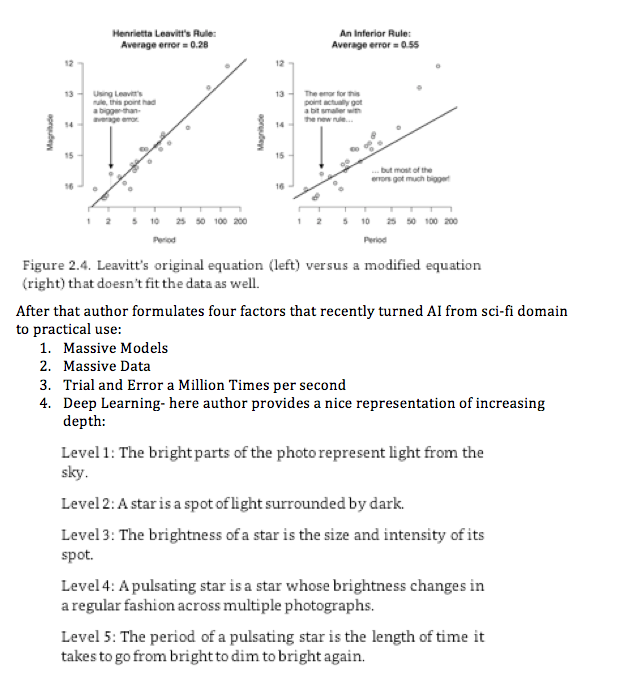
Author makes a very important point that in image recognition AI now can outperform humans. For example image “Alaskan Malamute” produced 5% error rate for humans, but only 3% for AI in 2016, down from 25% in 2011. This result was produced by 22-layer neural network.
- The Reverend and the Submarine
It starts with components of intellectual designs that go into self-driving car and how its software processes external objects. Then it goes to robotics revolution and SLAM (simultaneous localization and mapping) problem. To illustrate the problem author retells the story of missing submarine Scorpion and search for it, linking it to multistep Bayesian processing. Then author also links it to various applications from investing to medical diagnosis.
- Amazing Grace
This is about languages both natural and programming. Author suggested that we had 2 revolutions – one for each language: programming in 50s and natural language now, going from purely algorithmic construction to more probabilistic one. With this development computers had been achieving parity with humans in speech recognition. Author looks back at history to find tipping point of this development and for some reason uses story of Grace Hopper. Then he moves to history of computer software development from compilers to speech recognition.
- The Genius at the Royal Mint
It starts with the use of coin toss in sports and then moves to discussion of probabilities and anomalies, that allow identifying cheating. As illustration author uses Newton and his tenure at royal mint when he tried to fight money debasement and clipping by using Trial of Pyx – when accumulated over year samples where tested by the jury of experts. This method was not completely effective due to variability and Newton failed to fix the problem. After that author trying to demonstrate that contemporary statistical method would easily handle this challenge.
- The Lady with the Lamp
Here author moves to Florence Nightingale and her role in improvement of healthcare system, and use of statistical methods to achieve this. Author even calls her “The Mother of Evidence-Based Medicine”. It follows by illustration of contemporary problems and discussion of how AI could fix a lot of them.
- The Yankee Clipper
Somewhat unexpectedly author starts this chapter by cautioning against excessive enthusiasm for AI and pointing out at its dependence on assumptions that could easily lead to greatly diverse solutions produced with the same mathematical tools due to slight variance in assumptions. As illustration author uses data for Joe DiMaggio and some other examples, concluding at the end: Bias IN – Bias Out. As the final word author suggest that AI, even if it is unbiased and does better job than humans in many areas, should not be allowed to make decisions on its own, but should rather be used as quality of decision multiplier for humans.
MY TAKE ON IT:
It is generally correct description of ideas and math in foundation of AI, but I think that idea of AI working always under human control generally not realistic. AI is too fast and takes into account too many factors for humans to understand what, leave alone how it is doing something, so any detailed control is just not feasible. At the same time AI is just a tool, which is not conscious and therefore has no objectives or ability for self-direction. In short Self-Driving car would drive one anywhere, processing more information in seconds than this person could process in lifetime. However this car would never decide to go on car trip across the country for fun. In short I believe that AI will take over all routine and semi-routing jobs that human do for living both blue and white color. However since humans are the only self-directing entity in humans created environment, they will always decide “Where” and “When” to drive, even if reasons “Why” will always be sketchy, leaving to AI complete control over details of “How”.
20181104 – On Grand Strategy
MAIN IDEA:
The main idea of this book is to formulate meaning of grand strategy that author defines as “the alignment of potentially unlimited aspirations with necessarily limited capabilities”and provide a wide ranged confirmation from history and art to support this idea. It mainly demonstrates superiority of flexible approach to ways and means to achieve adjustable objectives over rigid subordination of everything to overreaching objectives.
DETAILS:
ONE – CROSSING THE HELLESPONT
This narrative starts with discussion of Xerxes decision to cross Hellespont despite advise of his advisor and uncle Artabanus, who pointed to unpredictable character of the future struggle. Xerxes’ position is: “if you were to take account of everything . . . you would never do anything. It is better to have a brave heart and endure one half of the terrors we dread than to [calculate] all of the terrors and suffer nothing at all . . . Big things are won by big dangers.”
From this initiation author moves to Isaiah Berlin and his discussion on hedgehogs and foxes, applying it to Xerxes vs. Artabanus and defining Xerxes as a big idea man and Artabanus as “how to do” man, who can see complexities of undertaking. This follows by discussion of Tetlock’s finding about predictability power of experts, which is very close to none. The author moves to the main point of the chapter – need to establish a proper relationship between ends and means and discusses how exactly hedgehog Xerxes and fox Artabanus both failed: “The tragedy of Xerxes and Artabanus is that each lacked the other’s proficiency. The king, like Tetlock’s hedgehogs, commanded the attention of audiences but tended to dig himself into holes. The adviser, like Tetlock’s foxes, avoided the holes, but couldn’t retain audiences. Xerxes was right. If you try to anticipate everything, you’ll risk not accomplishing anything. But so was Artabanus. If you fail to prepare for all that might happen, you’ll ensure that some of it will.
“
Next author brings Scott Fitzgerald and his definition of the first class intellect:“the ability to hold two opposed ideas in the mind at the same time, and still retain the ability to function.”
, the quality both Xerxes and Artabanus were lacking. Author then goes into literary discussion of several famous artworks that he believes are relevant, consequently formulating the main point of this book. The final part of the chapter discusses training and planning as forms of preparation to action, stressing that it is not possible to plan for all contingencies and to be trained for all variants of the future, but both are necessary if not sufficient for concentration of resources and development of skills, which in combination with bold improvisation and effective behavior during action dramatically increase possibility of success.
TWO – LONG WALLS
Discussion in this chapter is built around Peloponnesian war and Athenian reliance on the long wall and Navy versus Spartans reliance on impromptu actions and improvisations. Author discusses strategic value of expensive defense infrastructure, which often froze resources in places that may turn out to be not very useful because the opponent would take walls into consideration and would go around them. There is also very important psychological component: Athenians build walls on the back of farmers around the city, who were not really protected by these walls, so this strategy led to resentment of Athenians’ most important allies. Another downside was that by moving resources to infrastructure they starved warriors of weapons, training, and professionalism. It democratized war by removing class of professional warriors, but deprived Athens of effective human military component. Author then reviews details of the war and demonstrates how exactly the failure of strategy produced actual defeat. At the end of the chapter author links the hedgehog strategy and its inherent failure to American war in Vietnam, which was a classical case of such strategy.
THREE – TEACHERS AND TETHERS
Here author moves from Greeks to Chinese – San Tzu and their round about way of discussing strategy and everything else. The author finds here a way to tether a few principles to the practices, of which is many. The next teacher is Roman Imperator Octavius – great nephew of Caesar and very successful practitioner, since he did a lot and died in his bed of old age. Author reviews history of his actions in fight for power, especially fluidity of his alliances with Antony in fight with Sextus Pompeius. At the end of chapter author praises Octavius for his strategic success of turning dysfunctional republic into somewhat functional empire.
FOUR – SOULS AND STATES
This chapter starts with work of George Kennan who researched Siberian native tribes in 1870s. It is about divine representation of reality in the minds of people. The eye-opening event here is the ease with which Kennan nearly moved from his native Christianity into polytheistic believes of natives. This moves discussion from military and power struggle strategy to ideological strategy or strategy for salvation as Augustine and others practiced it. Author discusses “Confessions” and “City of God” in which Augustine concerned himself with tensions such as: order vs. justice, war vs. peace, and Caesar vs. God. Resulting standards that Augustine framed were presented in form of checklists that become foundation of his teaching. After that author moves to Machiavelli and his strategic advice to a prince, eventually offering analogy for Augustine as hedgehog and Machiavelli as fox who promoted the “lightness of being”. Consequently author discusses strategy of Borgia and his use of Machiavellian technics in power struggle. Author stresses importance of power balancing and provides corresponding quote from Machiavelli’s “Discourses”: “[I] t is only in republics that the common good is looked to properly in that all that promotes it is carried out; and, however much this or that private person may be the loser on this account, there are so many who benefit thereby that the common good can be realized in spite of those few who suffer in consequence.”
At the end author again invokes Berlin and his interesting interpretation of fraise of tolerance: “[T] here are many different ends that men may seek and still be fully rational,” Berlin insists, “capable of understanding . . . and deriving light from each other.” Otherwise, civilizations would exist in “impenetrable bubble[s],” incomprehensible to anyone on the outside. “Intercommunication between cultures in time and space is possible only because what makes men human is common to them, and acts as a bridge”
FIVE – PRINCES AS PIVOTS
The chapter starts with the statement that princes are always pivots around which society turns and thinkers such as Augustine or Machiavelli, while themselves being pivots of Western thought during their lives, were dependent on princes they served. Then author looks at two of them who competed in XVI century: Philip II of Spain and Elizabeth of England and strategy they applied. Here again author refers to rigidity of Philip and flexibility of Elizabeth to some extent explained by huge size and therefore inertia of his holdings and small size, compact, but with strong flexible arm of navy of Elizabeth’s realm. Her background gave her additional advantage of superb political training since her very survival was dependent on political skills and luck. Author refers to eventual triumph of Elizabeth as the strategy of small, but flexible force of England wearing out big and rigid force of Armada. One of the key elements of Elizabeth strategy was refusal to commit to anything as much as possible, always trying to leave place for maneuvering. At the end of chapter author discusses counterfactual novel about possible historical changes if assassin eliminated Elizabeth with all her foxy skills.
SIX – NEW WORLDS
Here author moves close to our time and discusses Monroe doctrine, which at the point of its establishment by John Quincy Adams in 1823 could not be realistically supported by USA due to its weakness. It is also interesting that at the time Spanish America, which USA were going to protect from Europe, was much bigger than its northern neighbor. Author stresses diversity of USA at the time when its states differentiated from each other far more than countries of Spanish America. Author discusses specificity of American population as it emerged from English development and freely developed in environment of benevolent neglect from mother country, allowing establishment of democratic institutions, armed and independent population, and unusual culture of self-reliance. Author briefly reviewing American developments starting from 1760s, which he separates into 2 revolutions – one of 1776 for independence and another – constitutional revolution of 1786-88, which created highly functional Union of the states with innovative method of rule via representative democracy. Interestingly enough, author stresses difficulty of this method confirmed by the fact that many countries find it extremely difficult to support, typically falling into some kind of authoritarian rule.
SEVEN – THE GRANDEST STRATEGISTS
Here author discusses theoretical strategists: Tolstoy and Clausewitz. He provides samples from both – writing about chaotic character of real battle and difficulty, or even impossibility, of making sense of any developments on the spot. Author looks at contradiction in their approaches when both promote determinism at the same time as being amazed by consequences of individual actions of actors such as Napoleon. After that author applies this thinking to Napoleon’s invasion of Russia and its consequences. Author provides concise summary for this: “(a) that because everything connects with everything else, there’s an inescapable interdependency across time, space, and scale— forget about distinguishing independent from dependent variables; (b) that, as a consequence, there’ll always be things that can’t be known— breaking them into components won’t help because there’ll always be smaller components; (c) that owing to what we can’t know, we’ll always retain an illusion of agency, however infinitesimal; (d) that while laws may govern these infinitesimals, they make no difference to us because we can’t feel their effects; therefore (e) our perception of freedom is, in practice, freedom itself.”
EIGHT – THE GREATEST PRESIDENT
This starts with comparison of John Quincy Adams to Napoleon in the scale and complexity of his initial intention when he became president with minority vote. It was also showed similarly clear lack of understanding of challenges of practical implementation of this vision. Then author praises Adams for his persistence after he lost reelection and became congressmen in petitioning against slavery and placing the Constitution within the frame of Declaration – all men were created equal. After that author moves to Lincoln and reviews his development into unusual non-patronage politician who put up containment of slavery as his key position, linking pragmatism with passion of realigning practice with Declaration. Author looks at ideological competition between Lincoln and Douglas in famous debates that made Lincoln into viable presidential material. Author also reviews developments of Civil War, discussing Lincoln’s underestimate of Southern resolve and his development as strategist. Unlike previous examples, in this case the big rigid and slow moving side of North won over flexible, mobile and tactically superior South, but only after slick generals like McClellan were substituted by dogged and commonsensical commoners Grant and Sherman who were fighting to win at any cost.
NINE – LAST BEST HOPE
This starts with description of fear of Americans that British Victorian Prime Minister Salisbury experienced together with contempt for democracy. He was afraid of Americans starting Napoleon like ideological war and would dream about helping Confederacy in order to keep America divided. Such interference did not occurred and ideological war also did not happen because of democracy, the system when regular people have say in politics, albeit in roundabout way. Eventually British increasingly democratic monarchy and Americans become more and more allied. After that author moves to Mackinder strategic paper “The Geographical pivot of History” and Mahan’s work on strategic significance of naval power. Author also discusses geopolitical and colonial strategies leading to WWI and then WWII and people who developed and applied them.
TEN – ISAIAH
Here author returns to the live and wisdom of Isaiah Berlin. He discusses Berlin’s role as analyst of American politics for British and his attitudes to Soviet Allies whom he correctly identified as the evil challenger to democracy. Then, after brief discussion of Roosevelt presidency, author moves to define liberty as positive: “hedgehogs trying to herd foxes” or negative:“foxes with compasses who “had the humility to be unsure of what lay ahead, the flexibility to adjust to it, and the ingenuity to accept, perhaps even to leverage, inconsistencies. They respected topographies, crafted choices within them, and evaluated these carefully once made.”
At the end author refers to political correctness and uses example of Robert Kennedy’s statement about unfairness of USA’s war against Mexico and its territorial gains, to which he was replied with question: “do you want to give it all back? Author uses this example once again to define grand strategy as art of proportionality: “the alignment of potentially infinite aspirations with necessary limited capability”.
MY TAKE ON IT:
I find the main thesis of this book about realignment of objectives and capabilities very reasonable and, despite its triviality, very difficult to implement. The many reasons for this include usually very sketchy understanding of objectives. The simple example is “the world peace”. At first thought it is great, but who would really want to live in the peaceful world based on Hitler or Stalin ideology, so any freedom loving person would wage war to the death on such “peaceful world”.
Another point of author – generally more successful approach of foxes vs. hedgehogs is also much more complex than it appears. The perfect fox has practically unlimited flexibility, but it is not possible in real live because of complexity of human action and its multistep character. This necessarily creates commitment that with each step forces continuation of initial direction. The simple example: any topographical allocation of resources based on plan A, makes it increasingly difficult to change suddenly to plan B that would require different topographical allocation. Overall it is a meaningful analysis of strategy albeit slightly overloaded with repetitive illustrations of the same point.
20181028 – Peak Secrets of Expertise
MAIN IDEA:
The main idea of this book is to present results of author’s extensive, decades long research of human learning process and resulting method of learning that author called Deliberate Practice. This method pretty much substitutes studying with doing, with continuing increase in complexity of tasks so they would be challenging, but not frustrating, controlled by experienced trainer who understands both tasks and student, consequently assuring maintenance of the golden point in process. Author also refutes idea of innate talent that allows some prodigy to achieve perfection without really trying. His research quite convincingly demonstrated that beyond generic intellectual ability and some specific hard work of Deliberate Practice there is no need for superb genetic abilities to achieve real success in just about any field.
DETAILS:
Introduction: The Gift
This starts with the perfect pitch – probably one of the most widely known ability commonly linked to genetic endowment. After retelling story of Mozart as typical genius author present an amazing experiment of Sakakibara who managed train a group of regular children to have a perfect pitch. Then author discusses overall objectives of the book and its main lesson:“The right sort of practice carried out over a sufficient period of time leads to improvement. Nothing else.”The sort of practice author refers to – the “Deliberate Practice”, which is qualitatively different from practice as a repetitive exercise of some function. It is different in use of planning, modelling, and feedback processes that are consciously developed and then consistently applied in order to achieve expertise in some area.
The Power of Purposeful Practice
This is retelling of author’s work on using deliberate practice with a subject called Steve to develop meaningless, but difficult skill of remembering large numbers of random numbers. The regular person, Steve included has ability to remember about 7 numbers at most. After about a year of deliberate practice Steve achieved 82 digits capacity. After that author moves from individual achievement to cumulative achievement in sports when year after year generations of competitors develop new technics and methods leading to continuing increase in performance, so contemporary middle level sportsmen easily do staff that 20 years ago would be Olympic level achievement. After that author discusses usual method of obtaining a new skill when progress, initially slows down and then stops when some acceptable level of performance had been achieved. Here author introduces notion of purposeful practice when objective to achieve is constantly moving, but at the pace consistent with achieved level. This would necessarily include barriers when improvement stops. This does not mean that more progress is not possible. It most often just means that new method to proceed should be discovered and applied. At the end of chapter author reviews limitation inherent to purposeful practice and states that deliberate practice allows overcome these limitations.
Harnessing Adaptability
This starts with discussion of human adaptability, including brain adaptability as demonstrated by famous London taxi drivers, which author discusses in detail. After that author moves to pushups and other physical examples. In short there is no qualitative difference between adaptability of brain and other parts of body. A very interesting point author makes here is that adaptability is directly caused by the need for homeostasis because it would not be possible without constant adjustment to changing environment. The important point is to move just beyond existing level – a bit more would lead to the crash and a bit less would be not enough to move.
Mental Representations
This chapter starts with reference to blind chess playing when master can keep in mind a number of active games simultaneously as example of human capability to have mental representation of many complex systems. The key point here is that information if highly organized and easily compressed so it could be effectively managed. Author points out that it is not chess only, but practically all known human abilities, both mental and physical, depend on mental representation. For example, in addition to chess it also includes words, like dog or ability to walk or anything else conceivable. And since the main point of deliberate practice is to obtain expertise, here is how author defines what it is: “The main thing that sets experts apart from the rest of us is that their years of practice have changed the neural circuitry in their brains to produce highly specialized mental representations, which in turn make possible the incredible memory, pattern recognition, problem solving, and other sorts of advanced abilities needed to excel in their particular specialties.”. After that author proceeds to review use of mental representation in planning, learning, and so on.
The Gold Standard
The gold standard for deliberate practice could be found in musical training, which is highly developed from technical side and generally conducted by professional trainers with high levels of expertise. Author conducted research of what makes a great musician and found that what differentiate good from better and from best. The research included time study and concluded: That nobody likes practice per se, but the crucial finding was that: there was only one major difference among the three groups. This was the total number of hours that the students had devoted to solitary practice. Specifically, the music-education students had practiced an average of 3,420 hours on the violin by the time they were eighteen, the better violin students had practiced an average of 5,301 hours, and the best violin students had practiced an average of 7,410 hours.
Principles of Deliberate Practice on the Job
This chapter starts with well-known example from Vietnam War when Navy started training program for its pilots imitating as close as possible real life combat. The trainers remained constant while pilots changed with every new group, allowing trainers accumulate expansive experience and provide specific instruction. Author describes it as an example of Deliberate Practice. The next step is going beyond practice as an activity separate from work to practice while doing the work. After discussing examples and methods, author moves to definition of difference between knowledge and skills, stressing superiority of the latter providing as example a medical practice of surgeons when after some 500 surgeries they usually stop killing patients.
Principles of Deliberate Practice in Everyday Life
Here author moves to practical application of process of deliberate practice, which starts with finding a good teacher. Author provides some advice on how to do this. The next important thing is to be engaged as much as possible. The formal approach would not cut it. Author also discusses the problem of teacher unavailability. Here is his advice: “To effectively practice a skill without a teacher, it helps to keep in mind three Fs: Focus. Feedback. Fix it. Break the skill down into components that you can do repeatedly and analyze effectively, determine your weaknesses, and figure out ways to address them.”
. The next important issue is inevitable achievement of plateau in development when it seems to be no progress occurs. The key here is to keep trying, analyzing, and diversifying approaches until breakthrough to the next level of performance occur. Final point here is the need to maintain motivation without which success is not achievable.
The Road to Extraordinary
Here author provides a number of success stories for deliberate practice such as female chess players raised by father psychologist specifically to be grandmasters. In such situation when somebody start training a child to achieve top levels of some activity, the important part is achieve child’s commitment to the process without which nothing is achievable.
But What About Natural Talent?
In this chapter author reviewing a number of well known example of prodigies and concludes: “The bottom line is that every time you look closely into such a case you find that the extraordinary abilities are the product of much practice and training. Prodigies and savants don’t give us any reason to believe that some people are born with natural abilities in one field or another.
“ However, author does not stop here and does give some credit to innate characteristics, but more as a necessary initial condition for achievement, rather than as sufficient condition. Here is the point he makes about IQ:“A number of researchers have suggested that there are, in general, minimum requirements for performing capably in various areas. For instance, it has been suggested that scientists in at least some fields need an IQ score of around 110 to 120 to be successful, but that a higher score doesn’t confer any additional benefit. However, it is not clear whether that IQ score of 110 is necessary to actually perform the duties of a scientist or simply to get to the point where you can be hired as a scientist. In many scientific fields you need to hold a Ph.D. to be able to get research grants and conduct research, and getting a Ph.D. requires four to six years of successful postgraduate academic performance with a high level of writing skills and a large vocabulary— which are essentially attributes measured by verbal intelligence tests. Furthermore, most science Ph.D. programs demand mathematical and logical thinking, which are measured by other components of intelligence tests”
Where Do We Go from Here?
This chapter starts with description of experiment with students when group trained using deliberate practice method learned more than twice as much as regular class. Basically in came down to switching from feeding information to students to make them practice under direction of instructor and rather then receiving and reproducing information they where compelled to acquire skills. At the end author suggests that it is the way humans were developed evolutionary and that correct name for our species should be not Homo Sapience, but rather Homo Exercens.
MY TAKE ON IT:
It is a great book for anybody who needs or wants to achieve something in any area of human activities. I experienced this in my own live some 45 years ago when I was a student in University. Our professor of mathematical analysis for some reason liked to call me up not regurgitate some previously presented theme, but to start a new part of our curriculum. I guess she knew that I am a lazy person and, while I am pretty good problem solver, I was not smart or diligent enough to read the next chapter of curriculum. In short she would present a new problem and call me upfront to try solving this problem without real clue of how to do it. So I would come up with various suggestions, some of which she would immediately shut down, some she would allow to move on for a while until dead end arrived, and some would lead to solution, often clumsy, but correct. After that she would present real solution demonstrating the beauty of mathematical analysis that was developed by much more intelligent people than we lowly students, hinting at the same time that not all lost and if we work hard enough and smart enough we eventually be able achieve something in the range of this perfection. I enjoyed this process tremendously and I think anybody who is lucky enough to become part of such process of Deliberate Practice would enjoy both the process and final result.
20181021 – In Defense of Troublemakers
MAIN IDEA:
Author explicitly expresses the main idea of this book as such: “Consensus narrows, while dissent opens the mind. Both affect the quality of our decisions. The take-home message of the research presented in this book is that there are perils in consensus and there is value in dissent.” The dissent is often detrimental to the well being of dissenters and requires courage of conviction, but without dissent, the price paid by the group that suppresses it is often very high indeed.
DETAILS:
INTRODUCTION: FEAR CONSENSUS, LOVE DISSENT
Here author defines objective of the book as improvement in decision-making process. Interestingly enough, author defines dissent as necessary condition for good decision-making: “When we are exposed to dissent, our thinking does not narrow as it does when we are exposed to consensus. In fact, dissent broadens our thinking. Relative to what we would do on our own if we had not been exposed to dissent, we think in more open ways and in multiple directions. We consider more information and more options, and we use multiple strategies in problem solving. We think more divergently, more creatively. The implications of dissent are important for the quality of our decision-making. On balance, consensus impairs the quality of our decisions while dissent benefits it.” Author provides quite striking real live examples of necessity for dissent and stresses that correctness of it is pretty much irrelevant. Its value not in it, but in its ability to make people think beyond the consensus, resulting in evaluation of wider range of option an increase in possibility of better solution.
At the end of introduction author points out a number of books and ideas that are widely accepted, like “The Wisdom of Crowds”, but in reality, are of very little application due to the very constrained character of their effectiveness.
PART I MAJORITIES VERSUS TROUBLEMAKERS: THE ART OF PERSUASION
This part is about persuasion and how majority and minority use different tools to achieve it.
1 NUMBERS RULE
This is about human nature that in majority of cases makes people to comply with majority; whatever strange and/or weird is majority’s behavior or decisions. Author starts with example of “Face to the Rear in elevator” and proceeds to discuss ease with which majority persuades people to join. As real live example she refers to her jury consulting practice that demonstrated 90% certainly that initial majority will prevail. After that author describes conditions when majority has advantage – for example when individuals in crowd has diverse opinions that give better produce better average result than any individual’s opinion. Author also refers to Solomon Ash study demonstrating power of the group and then discusses mount of conformity and its dependence on multiple variables. The level of conformity with obvious error is usually around 75% with only 25% consistently non-conformist individuals. It is very interesting that even these individuals admitted that they majority probably correct but could and would not overcome their own perception of the truth. Autor also provides multiple examples when business and/or ideologues use this propensity to conform. At the end of chapter author discusses anonymity provided by computer networks as a tool to reduce conformity comparatively to face to face communications.
2 EVEN ONE DISSENTER MAKES A DIFFERENCE
This is an interesting chapter on break of unanimity when even one dissenter can unshackle people from conformity at any cost and dramatically change dynamic of the group. She describes a few experiments that demonstrated this point. One interesting experiment was with writing opinion on the paper vs. on the erasable board before learning majority opinion, which clearly increases commitment to one’s point. After that author discusses courage that is required to express dissent and experiment that demonstrates change of attitude of majority to dissenter, which could become quite harsh. Interesting thing here is that after rejecting dissenter, majority internalizes this behavior, resulting in quite dramatic decrease in conformity in the next setting of experiment – all the way down from 70% to 14% of conformity with clearly wrong opinion of majority.
3 DISSENTS AS AN ART IN CHANGING HEARTS AND MINDS
This is about technics that dissenter can use to change hearts and minds. It starts with Galileo and Sigmund Freud, then looks at Snowden, and eventually ends with recommendations if dissenter really wants to achieve results (could be posthumously). These are: be consistent; compromise sparingly – negotiate deal, but do not change attitude, compromise late: “It was the “late compromise” condition that had it both ways—both public and private attitude change. When a dissenter compromised at the last minute, he did two things. He appeared consistent and, at the same time, flexible enough to achieve an agreement. He did not change his position. He simply offered a concession. As a result, he achieved both outcomes. This was the “sweet spot.” He got the other participants to make public concessions and he changed their private attitudes.”. Finally, keep in mind that dissenter, even if losing, typically creates doubt in the minds of majority, and, if it is developed consciously and consistently, could turn things around. As example author discusses in detail “12 angry men”.
PART II CONSENSUS VERSUS DISSENT: CLOSED MINDS VERSUS OPEN MINDS
This part is about how different approach to persuasion by majority and minority stimulate different modes of thinking and deciding. The key difference between majority opinion and dissenter opinion is that majority opinion changes thinking in ways that are narrow and closed with main objective to comply with existing opinion, while dissent opinion opens range of thinking because objective if not to squeeze into existing mold, but rathe find the new one that would attract support.
4 CONSENSUS NARROWS THINKING—AND KILLS RATIONALITY
The starting point here is that consensus makes the majority formidable forcing people to seek ways to join it even if there is very little they agree with. Then author proceeds to review real life events and research supporting this point. She starts with the story of suicidal cult of the Peoples Temple, analyzing how it happened that people voluntary committed mass suicide and concluding that it was result of strict maintenance of consensus. After that she reviews results of Berkley study that illustrated how majority opinion prompts people unconsciously seek confirmation information and reject contrarian. This has negative impact on problem solving because it limits the range of possible solutions under consideration. Author discusses multiple lab experiments like anagram solution demonstrating this dynamic. Similarly, majority opinion narrows focus, which become a liability when looking for solution of non-trivial problems. Author discusses experiment that vividly demonstrate this feature and then returning to the story of flight 173 that crushed due to the super narrow focus of the crew.
5 DISSENT DIVERSIFIES—AND STRENGTHENS THINKING
Here author moves to the necessity of dissent for effective problem solution and decision-making. It comes from the nature of dissent, which by definition means to go against majority opinion and therefore forces dissenter to look widely and deeply at the problem at hand in order to find convincing reasons to support dissenting opinion. The author refers to a number experiments when sole dissenting opinion suddenly dramatically changed levels of conformity, even if this opinion was obviously incorrect. One point that an author stress often and strongly is that correctness of dissent opinion is generally irrelevant. Its value is in its propensity to liberate people from conformity and prompt them to look outside the box of their biases. Also, very important insights author obtained watching jury deliberations. It was not that much opinion change that dissenters caused – they usually failed to cause any, but rather quality of deliberations that improved significantly by the presence of dissenter and need to respond to dissent opinion. Then author discusses a few of real life cases: about Snowden, drones, surveillance, and such. Finally, author looks in details at technic of brainstorming and critics its core rule of not criticizing new ideas.
PART III GROUPTHINK VERSUS GROUPS OF THINKERS
The final part is about groups, their complexity, how they obtain consensus, and how unsuppressed dissent increases the quality of decision-making process.
6 GROUP DECISIONS: OFTEN IN ERROR, NEVER IN DOUBT
Author starts with the statement that groups operate in “a way that “strains” for consensus”, which pretty much means groupthink. In reality it often means just compliance with opinions of group leader, so the lower positioned members of the group strive to accommodate to them, suppressing in process whatever doubts they have. As example author refer to Bay of Pigs story. Then she moves to result of research that demonstrates poor outcomes for direct leadership when leader offers his/her opinion upfront, limiting opportunities for discussion and making dissent costly. Another problem with groupthink is that it promotes search for consensus within at any cost and polarization against groups of others. When groups are generated within wider populations they tend to move in different directions. More risky individuals joined in a group become riskier than any of them while more cautions individual in a group also move to extreme caution. Author also goes through examples of manipulating people into doing something they would not necessary do themselves. Author discusses two theories of polarization: one is persuasive argument theory, and another is “social comparison” theory. She concludes that both have merit. Another interesting finding is that people in groups tend to share information that they have in common and hide information that could undermine consensus, resulting in decrease of quality of opinions and decisions. Author refers to meta-analysis of 65 studies that demonstrated that groups with openly shared information both positive and negative have eight times higher probability to find solution than groups were information is hidden.
7 BETTER DECISIONS: DISSENT, DIVERSITY, AND DEVILS ADVOCATES
This is about decision-making and how dissent or lack thereof impact quality of decisions. It starts with rejection of false diversity when instead of diversity of opinion people promote diversity of skin color or sexual orientation. As example author uses two trials of O.J Simpson – one, criminal, intentionally moved to locality where neither victims nor accused lives and far away from the place of crime occurred. The intention of move was to find sympathetic jury and it succeeded in acquitting OJ and another civil trial at actual location found him guilty. The point author makes that both decisions were poorly made, and both were based on tribal affiliation. This point is confirmed by the multitude of experiments demonstrating how easy it is to create competing groups even by randomly allocating similar people to teams and then observe in-group favoritism that starts immediately. Author discusses in details different types of diversity and different value of it for organizations and decision making, which is sometimes positive, but sometimes not. However regardless of whatever levels of type of diversity exists nothing could substitute value of dissent in decision making that would amplify positives of diversity and suppress negatives.
Another very interesting point author makes is that often used formal technic of “devil advocate” does not produce expected results mainly because in order to have impact the dissent should be real and passionate, formal moves just wouldn’t do that. Author discusses history of this technic and reviews a number of experiments analyzing its impact on quality of decisions.
8 CONCLUSIONS
In this chapter author summarizes massage of this book as twofold: danger of consensus for quality of decisions and necessity of real dissent for increase this quality. She also points out that it is not about anger, suppression of dissent, arguing, or contrivances. It is about authenticity and conviction, speaking up, protecting different views, and encouraging debates. Finally, it is all not for the sake of harmony or moral imperatives that people and organization should protect and even nourish dissent, but as indispensable tool for achieving high quality of decisions and better solutions for all kinds of problems.
MY TAKE ON IT:
It is nice to encounter book that provides lots of scientific and experimental support to the way one lives his live. Somehow, I often find myself in the state of non-agreement with whatever is discussed or whatever conventional wisdom is. This contrarian view at just about everything served me well because it forced me to compare different attitudes and approaches before making decision and prevented me from automatically accepting somebody else’s opinion. It has downside of complicating matters, slowing down process of about anything, and delaying action. Therefore, I can wholeheartedly agree with author of this book about value of dissent and danger of suppressing it. Such suppressing is especially dangerous at the level of society as whole because it leads to disappearance of dissent and consequently to dramatic degradation of quality of decisions and eventually quality of live. One can look not only at psychological experiments, but at huge real life experiment with Russian Empire in XX century when decades of suppressing dissent and killing or pushing out of country dissenters turned quite prosperous country of early XX century with world class writers, musicians, scientists, and intellectuals into miserable shadow of itself by the end of XX century.
20181014 – Growth Delusion
MAIN IDEA:
The main idea of this book is to review history of economic measurements – specifically GDP, discuss its multiple problems, and review new developments such as Internet that makes it more and more meaningless to use old methods of calculating economic activities designed mainly for material production. Author also has an idea to propose a few different methods for measuring economic activities that would be more meaningful than GDP.
DETAILS:
The Cult of Growth
The book starts with overall discussion of GDP, how it was created in 1930s and how it became the most important indicator of economic conditions of society. It is also critic of very notion of necessity of growth for prosperity, stressing that infinite growth just plain impossible. At the end author states a contrarian point of view that growth and prosperity are two different things referring to Japan, which is not really growing for decades, but is a very prosperous country anyway.
Part One: The Problems with Growth
Chapter 1: Kuznets’s Monster
This chapter, after brief discussion of economic history, moves to Simon Kuznets and his invention of GDP, which come around during the WWII as necessary tool to estimate American capacity for production of war material and consequently to build effective military strategy. Author discusses Kuznets’ attempt to leave government out of economic calculation and how it failed under the pressure of Keynesians who believed that government activity should be important part of economy. Author also discusses another failed attempt to include only “productive activities”, while excluding things like advertisement, gambling, and such.
Chapter 2: The Wages of Sin
Here author jumps directly to our time discussing well-publicized economic case of counting input into British economy by prostitutes. It caused all kind of funny staff related to various calculations of duties, debts, and so on, defined as a share of GDP. Foe example increase of GDP by counting prostitutes’ income would increase Britain duties to NATO defined as 2% of GDP. Similarly changes to GDP formula caused other countries to report quite ridiculous numbers. From here author goes to discuss meaning of GDP vs. GNP and how complex it really is because of multitude of intermediate products and services. Another big issue is that even this numbers are not hard numbers, but rather result of questionnaires, samples, and statistical manipulation.
Chapter 3: The Good, The Bad. And the Invisible
Here author moves to the topic of impact on GDP from various idiosyncrasies of different countries, looking at American Medicare, which inflated payments clearly overstate the numbers. Another important topic is calculation of input from government expenditures. It is quite easy to calculate, for example, inputs into free education such as teacher wages and school building. But is this a real input into economy if government schools produce illiterate graduates? Yet another, somewhat opposite problem, is very valuable input that is not included. As an example, author discusses production of mothers’ milk for baby, which is not counted, but could add billions to economy. These counted/ uncounted / wasted economic artifacts could be discovered in many areas, opening huge opportunities for manipulation.
Chapter 4: Too Much of a Good Thing
This starts with the story of Iceland financial industry prosperity that was followed by crisis. Author makes the point that financial industry could not bring prosperity and at some point, its input into economy becomes illusory because it is just play of numbers. The new financial instruments that used to generate paper profits do not really serve its main economic purpose of efficient allocation of capital because they based on correct assumption of government intervention that would socialize any losses from failure, while keeping private benefits of success.
Chapter 5: The Internet Stole My GDP
This is an interesting discussion of Internet impact on real economy and on GDP. Basically, for real economy it is great. People get information from home they used to be spending lots of time and effort to obtain. Business thrives on low transaction costs, and improved analytics. However, all this decreases GDP. From this point of view driving in a car to Movie Theater and sitting there watching movie adds a lot to GDP from cost of gas to cost of building to salary of people running Movie Theater. Watching the same movie in comfort of one’s home subtracts all these from GDP, which shows decreased economic activity even if entertainment consumption improved dramatically. Then author compares Internet with multiple inventions of XIX and XX centuries that brought electricity, multitude of machines from home, telecommunications, utilities, and transportation that change lives a lot more then Internet ever could. At the end of chapter author reviews difficulties of calculating and taxing services comparatively with manufacturing.
Chapter 6: What’s Wrong with the Average Joe
This starts with discussion of deterioration of health and life expectancy of average western lower middle class, which has difficulty to handle loss of semi-qualified manufacturing and service jobs and resorts to suicides and opioids despite safety net that provides relatively high level of consumption with plentiful food, merchandising, and practically unlimited entertainment. The most impressive statistics for this is a gap in live expectancy between educated / high income and uneducated / low income Americans, which grew from 5 years in 1970s to 15 years now. From here author moves to the growing inequality, which he blames for many of presented ills.
Part Two: Growth and the Developing World
Chapter 7: Elephants and Rhubarb
This chapter is about alternative evaluation of economic activity. It starts with estimates of artificial lights intensity at night. Then author discusses difficulties of estimating it in poor and corrupt countries where lots of economic activity is hidden. Detailed studies estimating economic output of one product, for example milk demonstrate huge variance from official data up to 20 times. Author discusses details of this in several African countries.
Chapter 8: Growthmanship
Here author moves to discuss countries that made significant progress such as South Korea and India. Author makes the point that even if this book is about GDP and growth being often misleading and poor indicator of wellbeing, the poor countries are really benefiting from growth and should be evaluated differently from the rich ones. Author also discusses ideological struggle about economy in India and work of Hans Rosling.
Chapter 9: Black Power, Green Power
This starts with discussion of environmental impact of growth on China. He states that China embraced GDP growth as main objective and directed main efforts to it, all other considerations pushed aside. Here there is an interesting discussion of how Chinese economists calculate its GDP, making it into whatever if should be according to party decisions. However, a lot of this growth is real and environmental and human costs are real as well, causing increasing resistance to single minded industrial development.
Part Three: Beyond Growth
Chapter 10: Wealth
This starts with discussion about wealth, its misleading averages, and difference between income statement and balance sheet each of which give only approximate idea of the wealth of any entity because a lot of wealth comes from knowledge and skills, which not easily converted into monetary units. Similar difficulties occur in calculation of environmental costs.
Chapter 11: A Modern Domesday
This starts with reference to Doomsday book – an attempt to count all wealth in Britain in 1086. The author discusses contemporary, even more ridiculous attempt to monetary estimates like 33 trillion for value of the Earth. Author analyses these attempts, but more importantly he presents idea of qualitative rule that “The aggregate level of natural capital should not decline”.
Chapter 12: The Lord of Happiness
This chapter starts with anecdote about stolen head of Jeremy Bentham that was returned for ten pounds in 1975. Author uses it just to move to evaluation of economic value of human happiness and he starts it with Easterlin’s research, linking it with Bentham’s utilitarism. Moving to contemporary time author briefly discusses happiness by country with usual Scandinavians at the top and Burundi at the bottom then moving to more interesting estimate of events on happiness. The table below demonstrates this approach:
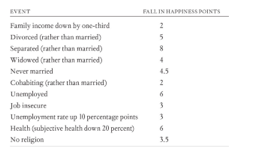
Finally, he refers to Bhutan with its Gross National Happiness, which somehow does not attract people for moving to Bhutan.
Chapter 13: GDP 2.0
This starts with that GDP was turned into a proxy of wellbeing, which it is obviously not. Author discusses the story of Maryland where local authorities come up with “enhanced” Genuine Progress Indicator (GPI) that included all king of subjective measurements:
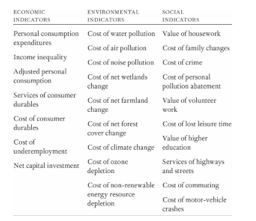
Eventually it completely did not work.
Chapter 14: The Growth Conclusion
The last part starts with the praise to GDP, which somehow manage to squeeze all human activity in one number. However, author highlights its negative side – it become measure of everything and driver of policy. It has significant problem of garbage in – garbage out, and so on and on. Author’s suggestions for better measurement of economy are:
- GDP per capita
- Median Income
- Inequality
- Net Domestic Product
- Well Being
- CO2 Emissions
MY TAKE ON IT:
I think the GDP is an interesting case of invention that begins to live on its own, doing something that its inventors could not possibly anticipate. So GDP instead of tool for resource planning and allocation during wartime became measurement of prosperity or lack thereof, tool for comparison between different countries, benchmark of dues allocation to countries for international organizations, and a lot of other things.
I for one think that it really does not make a lot of sense beyond its original use of allocating material resources to produce war materials. It works for this only because the war is simple – just a few thousands of different types of machines, no need to worry that nobody would buy them no need to think about human tastes and wishes. Even more important, as tool of measurement its necessity implicitly assumes that it would be used by some top managerial authority that can control economy and society overall, which is not a case in free market economy to the extent that it is free and it is market, rather than semi-free and semi-market. As to all other uses, the best comparison between countries would be direction of people’s flow or at least its intentionality. Bhutan well may have 10 times higher levels of “National Happiness” than USA, but somehow people from Bhutan as well as from many other countries trying move to USA, while Americans in their pursuit of happiness do not move in mass to Bhutan. Similarly, payment to international organizations should not be defined by countries GDP, but rather by willingness of citizens of these countries to transfer their earnings to these international organizations. In short, free and market economy does not need the crutches designed for the planned economy of the country at war.
20181007 Factfulness
MAIN IDEA:
Author uses this book to demonstrate that humans were evolutionary developed to make quick and easy decisions and turn them into actions without careful analysis of underlaying facts, which results in many an error, so such actions should not be taken. However, the main idea is that we are not doomed to keep doing it and that our intellectual and communicative abilities could be used to develop a set of tools to handle a variety of typical “instincts” that become impediment to good decision making. Author presents just such set of tools that he combines into what he calls Factfulness.
DETAILS:
Introduction
This starts with author’s recollection of his fascination with magic, specifically with the sword swallowing and how he learned to do this trick, which is based on human anatomy. He makes a point that even being a doctor did not help him to understand how to do the trick until he learned the specifics. After that he moves to a small quiz, which quite convincingly demonstrates that people, even those interested in politics and economics greatly underestimate progress made in last few decades in many areas so that currently developing (poor) countries have quality of live as good or batter that developed (rich) countries had just a few decades ago. Then author links it to optical and other illusions and fast / slow thinking that was evolutionary beneficent for hunter-gatherers but become somewhat of impediment for understanding the world in our time. The remedy is to develop process of factual confirmation in order to avoid ideas and action based on false understanding of reality.
Chapter One: The Gap Instinct
This chapter starts with misconception of child mortality. It turns out to be a lot smaller than people in western world think. This is result of progress in knowledge and its application that moves a lot faster than people perceive. In reality developing countries catch up with developed in this parameter. Here is picture demonstrating this thesis:
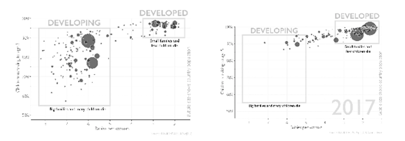
After discussing a few more parameters author presents the real picture of people distribution by 4 levels of income and he defines it in very clear form for all 7 billion people living now:
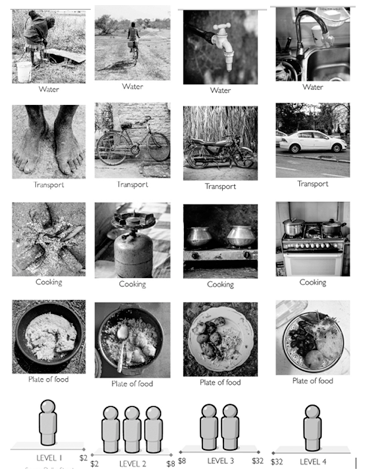
Author then discusses Gap instinct – human propensity to break any phenomenon, object or group into two qualitatively different objects like rich and poor. It is also often supported by propensity of bringing everything to averages, when in reality there is much more different statistical distribution often overlapping. Here are two examples:

Author also discusses relativity of comparisons and propensity of comparing extreems. For example poverty level in USA is somebody at level 3 of income, so typical reader of this book would have difficulty to understand what real poverty is.
Author presents the the key point of this chapter in such way:
Factfulness is … recognizing when a story talks about a gap, and remembering that this paints a picture of two separate groups, with a gap in between. The reality is often not polarized at all. Usually the majority is right there in the middle, where the gap is supposed to be. To control the gap instinct, look for the majority.
Chapter Two: The Negativity Instinct
Here author starts with recalling his background as child of Dutch family in Egypt and how he nearly drawn in the ditch as toddler because sewage ditches where not walled out. Then he proceeds to discuss that humans generally prefer negative picture of reality because evolution selected out over optimistic individuals. He supports this thesis with multiple examples for live expectancy, mortality, criminality, and others. The final inference:
Factfulness is … recognizing when we get negative news,and remembering that information about bad events is much more likely to reach us. When things are getting better we often don’t hear about them. This gives us a systematically too-negative impression of the world around us, which is very stressful. To control the negativity instinct, expect bad news.
Chapter Three: The Straight-Line Instinct
This is about human tendency extrapolate any sequence as straight line into the future, creating typically false expectations. Author starts with panic about Ebola epidemic, and proceeds to other extreme applications like population bomb. He provides a very interesting graphic presentation of the process:
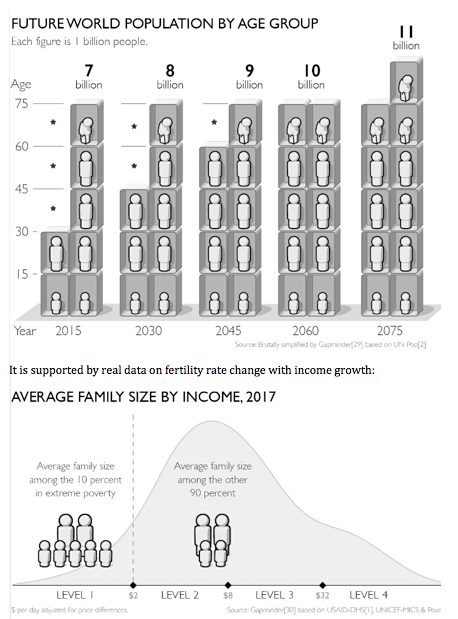
The chapter conclusion:
Factfulness is … recognizing the assumption that a line will just continue straightand remembering that such lines are rare in reality. To control the straight-line instinct, remember that curves come in different shapes.
- Don’t assume straightlines. Many trends do not follow straight lines but are S-bends, slides, humps, or doubling lines. No child ever kept up the rate of growth it achieved in its first six months, and no parents would expect it to.
Chapter Four: The Fear Instinct
The next stop is fear and author recalls his own fit of fear when he mistakenly thought that WWIII started. Then he proceeds to discuss various causes of fear both rational and not so much and role of attention directed at them in huge exaggeration of real dangers. Here is summary:
Factfulness is … recognizing when frightening things get our attentionand remembering that these are not necessarily most risky. Our natural fears of violence, captivity, and contamination make us systematically overestimate these risks. To control the fear instinct, calculate the risks.
- The scary world: fear vs. reality.The world seems scarier than it is because what you hear about it has been selected—by your own attention filter or by the media—precisely because it is scary.
- Risk = danger × exposure.The risk something poses to you depends not on how scared it makes you feel, but on a combination of two things. How dangerous is it? And how much are you exposed to it?
- Get calm before you carry on.When you are afraid, you see the world differently. Make as few decisions as possible until the panic has subsided.
Chapter Five: The Size Instinct
This is basically about triangulation and resource allocation. Once again it is based on author’s experience in 1970s as a doctor in Mozambique, one of the poorest countries in the world where he had to make difficult decisions to stop helping dying child before him in order to provide help to many more that were not directly in his presence. This decision caused protest from outsiders and author points out that decisions could be valid or not only if the proper scale of factors selection is applied. The size instinct that author refer to is the human tendency to overstate importance of everything visible on hand and understate importance of everything note visible, getting things out of proportion. Author also discusses Pareto rule 80/20 and human propensity to forget about ratios. As example he provides graph from the field of energy where popular discussion of sources is way out of proportion with real production:

The final word for the chapter:
Factfulness is … recognizing when a lonely number seems impressive(small or large) and remembering that you could get the opposite impression if it were compared with or divided by some other relevant number. To control the size instinct, get things in proportion.
- Compare.Big numbers always look big. Single numbers on their own are misleading and should make you suspicious. Always look for comparisons. Ideally, divide by something.
- 80/20.Have you been given a long list? Look for the few largest items and deal with those first. They are quite likely more important than all the others put together.
- Divide.Amounts and rates can tell very different stories. Rates are more meaningful, especially when comparing between different-sized groups. In particular, look for rates per person
Chapter Six: The Generalization Instinct
This starts with author experience of eating unusual for him and culturally disgusting food. From here he jumps to why it is so and concludes that it is generalization instinct when people assign new things to familiar group. He uses as example incorrect believe of rich westerners that children in poor countries are not vaccinated. Another non-statistical example is the story of generalization of elevator technology in western world to India, where it could cause bodily damage because elevators in India do not have usual safety features. This effect often leads to situation when people “know” something that just is not so. Then he proposes to correct it by using his 4 levels of income scale and discusses how it is applicable pretty much independently of culture and geography everywhere in the world. Here is author summary:
Factfulness is … recognizing when a category is being used in an explanationand remembering that categories can be misleading. We can’t stop generalization and we shouldn’t even try. What we should try to do is to avoid generalizing incorrectly. To control the generalization instinct, question your categories.
- Look for differences within groups. Especially when the groups are large, look for ways to split them into smaller, more precise categories. And …
- Look for similarities across groups.If you find striking similarities between different groups, consider whether your categories are relevant. But also …
- Look for differences across groups.Do not assume that what applies for one group (e.g., you and other people living on Level 4 or unconscious soldiers) applies for another (e.g., people not living on Level 4 or sleeping babies).
- Beware of “the majority.” Themajority just means more than half. Ask whether it means 51 percent, 99 percent, or something in between.
- Beware of vivid examples. Vivid images are easier to recall but they might be the exception rather than the rule.
- Assume people are not idiots.When something looks strange, be curious and humble, and think, in what way is this a smart solution?
Chapter Seven: The Destiny Instinct
Author defines it this way: “The destiny instinct is the idea that innate characteristics determine the destinies of people, countries, religions, or cultures.” The he proceeds to demonstrate that it is not so and neither people nor cultures unchangeable referring to development in Africa, which is, while still being behind the West, nevertheless achieved levels of West in 1970s at least in terms of income levels. The author review fertility rates as one of the clearest examples of how attitudes change with change of income and conditions. So here is his summary:
Factfulness is … recognizing that many things (including people, countries, religions, and cultures) appear to be constant just because the change is happening slowly, and remembering that even small, slow changes gradually add up to big changes. To control the destiny instinct, remember slow change is still change.
- Keep track of gradual improvements. A small change every year can translate to a huge change over decades.
- Update your knowledge.Some knowledge goes out of date quickly. Technology, countries, societies, cultures, and religions are constantly changing.
- Talk to Grandpa.If you want to be reminded of how values have changed, think about your grandparents’ values and how they differ from yours.
- Collect examples of cultural change.Challenge the idea that today’s culture must also have been yesterday’s and will also be tomorrow’s.
Chapter Eight: The Single Perspective Instinct
This is about failure to diversify sources of information that one uses to form opinions. The point here is that ideas are simple and beautiful, and people tend to use them as abstractions always applicable when in reality everything is messy and complex and blind application of abstract ideas is often harmful. Summary:
Factfulness is … recognizing that a single perspective can limit your imaginationand remembering that it is better to look at problems from many angles to get a more accurate understanding and find practical solutions. To control the single perspective instinct, get a toolbox, not a hammer.
- Test your ideas. Don’t only collect examples that show how excellent your favorite ideas are. Have people who disagree with you test your ideas and find their weaknesses.
- Limited expertise.Don’t claim expertise beyond your field: be humble about what you don’t know. Be aware too of the limits of the expertise of others.
- Hammers and nails.If you are good with a tool, you may want to use it too often. If you have analyzed a problem in depth, you can end up exaggerating the importance of that problem or of your solution. Remember that no one tool is good for everything. If your favorite idea is a hammer, look for colleagues with screwdrivers, wrenches, and tape measures. Be open to ideas from other fields.
- Numbers, but not only numbers.The world cannot be understood without numbers, and it cannot be understood with numbers alone. Love numbers for what they tell you about real lives.
- Beware of simple ideas and simple solutions. History is full of visionaries who used simple utopian visions to justify terrible actions. Welcome complexity. Combine ideas. Compromise. Solve problems on a case-by-case basis.
Chapter Nine: The Blame Instinct
This is about human tendency to blame people and groups for whatever bad happens, without even trying to understand real causality of events. Author looks at multitude of examples, but summary is simple:
Factfulness is … recognizing when a scapegoat is being usedand remembering that blaming an individual often steals the focus from other possible explanations and blocks our ability to prevent similar problems in the future. To control the blame instinct, resist finding a scapegoat.
- Look for causes, not villains.When something goes wrong don’t look for an individual or a group to blame. Accept that bad things can happen without anyone intending them to. Instead spend your energy on understanding the multiple interacting causes, or system, that created the situation.
- Look for systems, not heroes.When someone claims to have caused something good, ask whether the outcome might have happened anyway, even if that individual had done nothing. Give the system some credit.
Chapter Ten: The Urgency Instinct
Here author looks at “Now or Never” attitude that impose urgency and prevents careful analysis of options and actions. As usual author brings a few examples from his experiences in third world countries, summarizing it all in such way:
Factfulness is … recognizing when a decision feels urgent andremembering that it rarely is. To control the urgency instinct, take small steps.
- Take a breath. When your urgency instinct is triggered, your other instincts kick in and your analysis shuts down. Ask for more time and more information. It’s rarely now or never and it’s rarely either/or.
- Insist on the data.If something is urgent and important, it should be measured. Beware of data that is relevant but inaccurate, or accurate but irrelevant. Only relevant and accurate data is useful.
- Beware of fortune-tellers. Any prediction about the future is uncertain. Be wary of predictions that fail to acknowledge that. Insist on a full range of scenarios, never just the best or worst case. Ask how often such predictions have been right before.
- Be wary of drastic action. Ask what the side effects will be. Ask how the idea has been tested. Step-by-step practical improvements, and evaluation of their impact, are less dramatic but usually more effective.
Chapter Eleven: Factfulness in Practice Factfulness Rules of Thumb
This starts with the true story when author found himself before enraged mob ready to kill doctors on suspicion in evil magic that was causing harm – not unusual for illiterate people everywhere in the world. He claims that ability to think things through based on facts on the part of one authoritative woman in the mob prevented lynching and saved his life. At the end author provides graphic summary of his ideas:
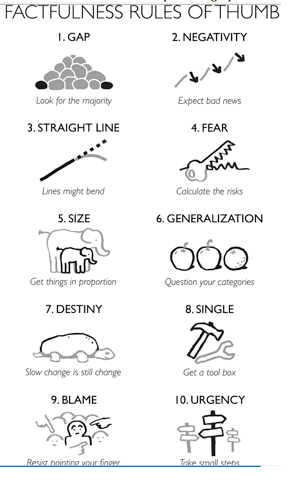
Author’s daughter in law and son wrote the final part describing his death from cancer that he had been fighting when writing this book.
MY TAKE ON IT:
This book is a wonderful example of relatively clear thinking and very clear presentation of ideas. Ideas themselves are not very new and were researched extensively in the last 50 some years by behavioral economists, psychologists, philosophers and what not. It would be obviously useful if people start taking Factfulness into account, but it is not at all clear how to achieve it. It seems to me that author was missing intentionality in facts misrepresentation, which is actually a very serious factor in great many bureaucrats and politicians’ wellbeing. Either the counterfactual believes in God granted status of a king or similarly counterfactual believes in dangerous global warming, there are always people who are depended on these for their livelihood. Correspondingly these people, and they are usually in control of education and mass media, do all they can to prevent every generation from learning skills necessary for using Factfulness either in their ideological position or in their everyday activities. As result people necessarily develop Factfulness approach in their profession and job, often at the steep price of many failures, but they often fail to develop the same in their philosophical and ideological attitudes, resulting in unnecessary long continuation of awful ideas such as socialism.
20180930 – Why Liberalism Failed
MAIN IDEA:
Here is author’s main point: “Liberalism has failed—not because it fell short, but because it was true to itself. It has failed because it has succeeded. As liberalism has “become more fully itself,” as its inner logic has become more evident and its self-contradictions manifest, it has generated pathologies that are at once deformations of its claims yet realizations of liberal ideology.”
The main inference that author provides is:” A rejection of the world’s first and last remaining ideology does not entail its replacement with a new and doubtless not very different ideology. Political revolution to overturn a revolutionary order would produce only disorder and misery. A better course will consist in smaller, local forms of resistance: practices more than theories, the building of resilient new cultures against the anticulture of liberalism.”
DETAILS:
Introduction: The End of Liberalism
At the beginning author defines liberalism as philosophy, which conceived human individuals as rights bearing entities who could pursue happiness according to their own understanding. It supported limited government, rule of law, and independent judiciary. Then author complains that in current American society it all deteriorated, so Americans do not believe in existing institutions anymore and do not trust them. It resulted from raising division of population into elite and regular people with different resource availability, different believes and overall different life experiences. In short – liberalism achieved equal opportunity meritocracy that led to huge division of society into successful few and unsuccessful many eventually resulting in their separation into different layers of society with the next generation deprived of equal opportunity. Author reviews the most important areas of live and tries to demonstrate how liberalism failed in each of these areas:
- Politics: limited government was substituted by practically unlimited administrative state with unelected bureaucrats and incumbent politicians controlling nearly everything.
- Economics: division of population into very rich and well to do living in completely different economic world than poor and lower middle class. The former benefiting from globalization, when cheap low skills labor from all over the world combined with expensive high skill labor in developed countries dramatically increased wellbeing of these participants at the expense of latter’s dramatically deteriorated wellbeing, leading not only to their material deprivation, but to the existential crisis of these people who are not productive and dignified members of society anymore.
- Education: division of population when children of upper classes provided education and access to technology that make them increasingly more productive, while lower classes provided indoctrination in leu of education resulting in their hate to productive individuals and inability to become productive themselves.
- Science and Technology: Its triumphs led to creation of contemporary world, but now liberalism turned against it in form of environmentalism, the ideology of rich who are seeking psychological satisfaction at the expense of others’ suffering.
- Culture: Liberalism’s struggle against cultural and religious limitation imposed on individual freedom turned into political and ideological limitations, which rapidly becoming as onerous as the old ones. For example, the demand for freedom from religious turns into denial of freedom of religion.
ONE. Unsustainable Liberalism
This starts with the statement that liberalism is committed to liberty and self-government and author goes into history of these ideas starting with Romans and Christianity, which produced Liberal ideology and idea of individual rights. Author however characterizes original Christian approach as an attempt to prevent tyranny by promoting virtue and education in virtue. He points to Machiavelli as the thinker who moved away from this unrealistic approach to the new realistic approach that accepted not very nice human features such as greed, pride, and selfishness, but seek to temper these features via division of power, so different interests conflict with each other, consequently limiting each other and forcing some compromise and accommodation for common good. Author provides more detailed discussion of the nature of liberalism and claims that it became the last standing ideology in 1989 when competing communist ideology practically fall apart. However, after that liberalism itself started falling apart in a number of areas because per author it is running out of cultural foundation that it inherited from religion and previously established society mores. Specifically, unabridged self-interest undermined and made irrelevant virtue that used to be it the core of behavior, mastery of nature produced unacceptable ecological costs, loosening of nearly all social connections undermined voluntarism, leaving individuals mainly on their own and directing all support to needy via formal tools of government. Author characterized this as 2 revolutions: The first: switch from communal objectives and actions to individual, and the Second: war against nature.
Two. Uniting Individualism and Statism
Author begins this chapter with history of left and right all the way back to French Assembly’s division between revolutionaries and royalists and going on until current American political division between conservatives (classical liberals) promoting individual liberty from governmental control and progressives (liberals) promoting collective liberty from limitation on the leaders of collective by either laws or individual rights. Somehow author combines them into one, claiming that both are liberal positions in their philosophical sources and practical implications: classical liberals via idea of social contract, while progressives via idea of social whole (we as people). Both were united in their struggle against aristocracy, but became enemies when aristocracy was gone, leading to interesting result of dual expansion of the state and individual autonomy.
THREE. Liberalism as Anticulture
This chapter is about transformation of culture that occurred under influence of liberalism. The old religion and cultural norms were mainly destroyed by leftist liberal who were seeking to undermine cultural cohesion of the society that impeded their social experiments in forming new humans that belongs to liberal super state rather than to family, religious, and local community. Author defines 3 pillars of liberal anti-culture: conquest of nature, denial of past as it was and its continuing redesign according to contemporary views, and change of notion of place, making it fungible and disconnected from individual’s background. Author reviews in details each of these pillars and concludes that it led to rise of leviathan, but even more important fact is that parasitic liberalism sustainable only until there are still remnants of culture it is trying to annihilate, which provide some cohesion to society. When these remnants eventually liquidated, society would not held together, leading to its demise, which would take liberalism with it.
FOUR. Technology and the Loss of Liberty
It starts with the note that infatuation with technology is a product of modern times and did not occur before. Author discusses a number of cultural artifacts prophesizing awful future catastrophes, and then points out that it could be result of foreboding about powerlessness before technological and societal developments. Then he goes to technology of liberalism that he defines as technology of self-government with interesting quirk that self-rule of collective actually suppress individual’s ability to do as he wishes, which comes only after liberalism become dominant, while before that objective was increasing liberty of individual. Author also discusses political technology such as Constitution and related ideological and legal artifacts that constitute technological society. All this also linked to actual technological infrastructure such as Internet and social media.
FIVE. Liberalism against Liberal Arts
The main point here is that liberalism generally attempts substitute culture with anticulture resulting in substitute of liberal education with servile education. Author discusses here attacks against liberal arts, which were currying on traditions of the culture. He documents multiple examples of these successful attacks in universities that become bastions of liberalism. Author also opposes conversion of universities into what he calls multiversity, which substitutes humanities with purely technical and scientific instruction.
SIX. The New Aristocracy
Here author discusses how anticulture brought in by liberalism and promotion of statist ideology led to creation of new aristocracy that crosses national borders and consists of people all over the world who went to the same universities, obtained the same believes and enjoy upscale lifestyles supported by income from positions in bureaucracies and government supported industries. These people often quite contemptuous to majority of their countries who do not have elite education and similar opportunities and make living in difficult global market place where they are not competitive with low paid works with similar low-level skillset from developing countries. Author also discusses his believe that this new aristocracy came from classical liberalism, which promoted free market place and support for meritocracy at the expanse of commonality. Author reviews a number of recent books dedicated to discussion of these issues.
SEVEN. The Degradation of Citizenship
In this chapter author looks at liberalism’s attack against citizenship and use of democracy as paramount value that justifies suppression of real and previously protected rights such as freedoms numerated in bill of rights and their substitution by materialistic and unrealistic rights like good job, decent income, free healthcare, right not to be insulted, and so on. Interestingly enough liberalism managed simultaneously to idolize democracy in theory and suppress it in practice everywhere where it is possible.
Conclusion: Liberty after Liberalism
Author conclusion is somewhat paradoxical: “Liberalism has failed because liberalism has succeeded”. It succeeded in its destructive function removing old aristocratic system, but it filed in its constructive function to provide something better for individual happiness. Author posits that there is no return and proposes initial steps that he believes would help to move beyond liberalism:
- Acknowledge achievements of liberalism and accept their finality
- Outgrow age of ideology and instead “focus on developing practices that foster new forms of culture, household economics, and polis life.”
- Out of this new practice generate a better theory of politics and society.
MY TAKE ON IT:
I think that there is quite a bit of confusion that author demonstrates all the time. If by his definition liberalism is about individual freedom and limited government, how one can state that it failed by creating big administrative state that increasingly stifle economy by regulation and keeps subverting constitutional guaranties of Bill of Rights? This confusion probably comes from poor understanding of real or classical liberalism vs. leftist, name-stealing liberalism. As ideology of liberty liberalism in XIX and early XX century was directed against businesses united with state and local, authorities via massive corruption in their struggle to suppress independent business and labor. These independents either presented too much of competition or limited business options by creating unions that tried monopolizing access to labor. At this point of history, the main ally of these groups was federal bureaucracy, who had limited opportunities for enrichment via corruption by virtue of being too far away and above from real cash flows of mainly small and middle size business. This bureaucracy was handily supported by top level journalists and intellectuals deeply infected by socialist ideas that pretty much boiled down to believe in supreme effectiveness and efficiency of big bureaucracy, preferably at the level of total control over society’s nationalized means of production. Early in XX century when old aristocratic forces practically self-destroyed during WWI, liberalism was highjacked by its socialist branch, living only small group clinging to ideas of individual freedom and limited state. The vast majority moved to socialist ideas, with half moving fully into collectivistic direction rejecting both individual liberty and limited state, consequently producing Nazi and Communist totalitarian regimes. Another half also forfeit limited government and moved to create ever-growing welfare state, while still retains individual liberty, including limited property rights and some remnants of legal structure. Both failed: the first half quite dramatically as result of losing in WWII for Nazis and in Cold War for Commies, while the second one – Sozis failing much less dramatically now.
In my opinion the solution could not possibly be “outgrow ideology” because there is no possibility of human society without ideology. Neither it is possible to return to liberalism of limited government mainly providing security and legal framework without some serious changes in societal foundations that would support individuals ability fully practice both their individual and economic freedom with such arrangement that would guaranty everybody real access to resources needed for this even if human labor does not have lots of value for production of goods and services.
One such arrangement could be equal rights for natural resources that would allow individuals less capable to efficiently and effectively use these resources for generation of consumable resource would be able obtain such resources by periodically selling their rights to individuals capable to use these resources better.
20180923 – The Expanding Blaze

MAIN IDEA:
The main idea of this book is to use historical events starting from American Revolution until 1850 to convince reader that there were two different enlightenments. One was good – radical enlightenment promoting human rights, all things nice, and mainly represented by French revolution and Thomas Paine’s side of American Revolution. Another one bad – moderate enlightenment, promoting populism, nationalism, property rights detrimental to non-propertied people, and mainly represented by other side of American revolution: Washington, Adams, and later majority of politicians of both parties. The Paine’s side is responsible for huge impact of American Revolution on the political development in Europe and America in direction of more democracy and freedom, while Adam’s side is responsible for decline of this influence and transformation of America into ugly caricature by 1850s.
DETAILS:
Introduction: The American Revolution and the Origins of Democratic Modernity
From the very beginning author sets up his position of dividing American revolution into two: somewhat conservative national revolution of Franklin and Washington seeking freedom from British aristocracy and mainly retaining institutions of American society, and Atlantic revolution of Jefferson and Paine that was seeking equal rights for all and fundamental change of society’s institutions in manner closely associated with French revolution. Author stresses that both sides were not entirely consistent, nevertheless he defines them as mainly unreconcilable aristocratic republicanism vs. democratic republicanism. He then discusses similar division in Britain, France, and other western European countries. Author stresses that this book traces impact of American revolution on the developments in the world, where it prompted such latent division to develop in some cases into violent French-like revolution, in some cases into British-like peaceful reform, some cases mix of all above, but in all cases moving humanity away from previous hierarchical order of kings and aristocracy of birth to the new world of formal equality and aristocracy of success.
- First Rumblings
The chapter starts with Adams’ letter to Jefferson where he pointed out that revolution actually occurred before 1775 and it happened in the minds of people. From here author discusses developments of 1760 – 1775, which created huge gap between Britain and its citizens that happened to live in America. As usual this gap was mainly between regular people that were trying to use opportunities created by the new country and elite that had different considerations. Probably the most important was imperial decree of 1763 that established limits on western settlement. This followed by increase in duties, monopolization of trade and multitude of other decisions that against interests of regular people like Stamp act of 1765. Author traces these measures and increasingly negative reaction to them that was obtaining more and more violent character. The chapter ends with events of February 1775 when Parliament reaffirmed its supremacy over colonies
- A Republican Revolution
This chapter is retelling of events of 1774-1776 that lead from growing rejection of British rule and recognition by colonials their need in creating the new entity of United States, if they to keep the democratic self-rule as it developed in 13 American States. In addition to narrating events author looks at philosophical underpinning of these events that he defines as Philadelphia Radicalism connected to Thomas Paine and represented by Philadelphia Constitution in competition with conservatism of John Adams and Hamilton. Author also briefly reviews events of Revolutionary war.
- Revolutionary Constitutionalism and the Federal Union (1776-90)
This starts with discussion on dichotomy of two opposing principles that author calls “aristocratic” and “democratic” and how it was played out in States constitutions. The general approach author takes here is that Pennsylvania constitution, with its one level legislature, was democratic, while other constitutions with 2 levels of congress and senate were aristocratic since it provided superior representation in form of senate to the top layers of society. After is reviewing a few states and literature on the issue. After that author moves to Federal government and provides similar analysis. At the end of chapter author discusses issues of church / state separations.
- Schooling Republicans
This is about intellectual struggle preceding the constitution. Author puts Paine, Franklin, and Jefferson on the side of democracy and Locke, John Adams, and Washington with their somewhat conservative views on opposite side. Author expressly stands against “moderates”, their fear of powerful government, and attempts to prevent it by dividing power. One important issue was education with “democrats” pushing for government controlled universal mass secular education, while “moderates” saw it as local issue to be handled without unified control. Similar attitude was extended to everything else from roads to poor relieve. The remaining part of the chapter was about establishment of colleges and general failure of “radicals” in the face of the second Great Awakening that returned many Americans back to their religious and moral roots.
- Benjamin Franklin: “American Icon?
Here author retells story of Ben Franklin and his evolution from prosperous British citizen into American revolutionary who risked everything by getting to the side of revolution. Then author reviews events of French revolution and Franklin’s situation in Paris during preceding period. Author’s conclusion is that “though not classed as radical, Franklin became a leading light of “Radical Enlightenment”.
- Black Emancipation: Confronting Slavery in the New Republic
This starts with trivial accusation of Americans in hypocrisy: “all men are created equal” in country with slavery. Author correctly stresses that the accusers, whether British or loyalists, really did not believe in equality of black and were as racist as anybody but found it useful tool against American patriots. It follows by look at the revolutionary war in which British tried to use attacks against slavery and liberation of slaves in their war efforts with some success. After that author discusses early abolitionist movement in America of 1780-90 mainly based on religious ideals, despite general believe in inferiority of blacks. All this eventually led to slowly moving, but sustainable process of slavery abolition in the North over period of 1780 to 1848.
- Expropriating the Native Americans
This chapter is about another eternal sin of Americans – expropriation of Native Americans. This was also a very long process mainly dependent on arrival of new settlers and their demand for land. Author description of this process follows typical narrative of broken treaties, violence, cruelty, and sometimes genocide. Also, as usual, author forgets to mention that overall numbers of Indians were very small, their societies tribal and poorly organized, even if quite competitive militarily, and constantly fighting between themselves. So the struggle was not between Whites and Indians, but rather between different tribes of whites (French and British) with allied with them Indian tribes.
8 Whites Dispossessed
This chapter is about poor whites and frictions between them and other population. Author discusses economic situation in Pennsylvania in late 1770s when inflation and deficiencies led to armed mob gangs fighting each other and government. Author describes in more details fight over price regulation and other issues. Author laments that radical revolutionary leaders failed fully support the mob against merchants. The net result was the change in Pennsylvania that eventually led to elimination of author’s beloved constitution and switch to more typical American type with main beneficiaries being property owning middle classes. Naturally, author also goes through Shays’ rebellion (1786-87) and related problems caused by machinations with revolutionary debt that ended up with enrichment of well-connected and practical robbery of poorly connected who were first given promissory note in exchange for goods and services during the war, which they sold at small fraction of the nominal to speculators and then had to pay taxes so the speculators could obtain full value of the notes. All this did not go that well for relations between top and bottom of American society.
9 Canada: An Ideological Conflict
This is about failure of American invasion of Canada that left this part of America in the hand of British that then was greatly reinforced by American Tories, resulting not only in it’s staying within British Empire, but also in forming completely different culture to significant extent countering American culture. Author describes an interesting interplay between French Canadian Catholics, British, and Americans resulting in defeat of American efforts. All this did not end with the end of revolutionary war, but continued afterword, all the way until the end of war of 1812, which mainly settled the issue.
- John Adams’s “American Revolution”
This chapters starts with Adam’s diplomatic effort during revolutionary war when he was quite successful in getting loans and other help from Dutch but proved to be no match to Franklin in dealing with French. From here author moves to discuss Dutch colonial problems in South Africa and elsewhere, caused by American example, and eventually to Anglo-Dutch war. Author discusses complex fight between moderates and radical that eventually led to Orange coup of 1787.
- Jefferson’s French Revolution
The author’s take on Jefferson is as an ideologue who somewhat opposed British enlightenment and supported French philosophers. Author retells Jefferson’s diplomatic efforts in France and his strong support for French revolution all the way to the brink of treason against America when he was close to violating Washington neutrality policy. After that author is going into details of French revolution and following years, making the point about American influence on these developments. Author describes Jacobin terror with, not if approval, then with somewhat of understanding, at least when it was directed at “moderates”. However, he points out that it was way too much for Jefferson who believed Robespierre to be betrayer of revolution.
- A Tragic Case: The Irish Revolution (1775-98)
The chapter on Irish revolution does not present some American sponsor like Jefferson for France. However, author still traces it to the American Revolution as the 4thcountry after Canada, Holland, and France prompted to revolution by American example. In addition to national movement against Britain it also had catholic vs. protestant angle that did not make it any easier. Author describes the process of maturing of Irish revolution, which eventually explode in 1798. It failed mainly due to low levels of understanding and support from masses.
- America’s “Conservative Turn”: The Emerging “Party System” in the 1790s
Here author discusses birth of American two-party system that he relates to two opposite revolutionary traditions. One was the party of Federalists and another of Democrat – Republican. Author links Federalists not only to Americans, but also philosophically to Adam Smith and Burke. Correspondingly the other one is linked to French philosophers from Rousseau to Brissot and Condorcet. This follows by the story of citizen Genet and his attempt to establish French control over American republic and push it to the war with Britain. As part of this discussion author brings the Whiskey Rebellion, as and example of struggle between these two directions of democracy. Eventually, this struggle somewhat decreased after Sedition act and its rejection that brought Jefferson to power.
14 America and the Haitian Revolution
This is unusually detailed and very interesting story of Haitian Revolution that first time in history created republic of lacks, mainly former slaves who successfully, albeit with big help from tropical diseases, conducted war against France and managed to obtain and maintain independence not only through war, but also through diplomacy maneuvering between France, America, and Britain. Despite seemingly similar republican ideals, USA rejected to provide serious help and left Haitians alone as well as did all other European powers after massacres of whites. Author seems to be not considers these massacres as a good enough reason for rejection of Haitian state that USA maintained until 1862.
- Louisiana and the Principles of “76
For some reason author starts this chapter with detailed narrative of the story of Thomas Paine and eventually failure of his vision of American revolutionary movement. Author links this to changes in Pennsylvania constitution that until that represented this ideology. Then author moves to the narrative of Louisiana purchase story, which is much more realistic and makes a lot more sense than usual narrative of Napoleon needing money and not knowing what to do with this huge territory. Actually, Napoleon had pretty good plan of strengthening New Orleans and then moving up on Mississippi, cutting off American western movement and creating powerful extension of French Empire in North America. This plan, however, became quite unfeasible, forcing Napoleon to make choice either to take money in exchange for land or just loose it to Americans without compensation. He obviously made a wise choice.
- A Revolutionary Era: Napoleon, Spain, and the Americas (1808-15)
The next stop in review of American influence is Spanish revolution of 1808-14. Author reviews penetration and development of enlightenment ideas in Spain and especially work of Francisco Cabarrus. Author looks at interplay between developments in Spain and in Spanish America, which kind of fed on each other, while moving development to revolution. It was also linked to French occupation of the Spain. The result of this movement was Cadiz Constitution of 1812 that limited role of monarch and to large extent echoed French approach and rejecting American. It lasted only until end of Napoleonic rule and was completely removed by Fernando VII after return to power. After that he sent expeditionary force that successfully suppressed budding republics of Spanish America, returning them under monarchic rule. However this success for only temporary and from 1819 till 1830 Bolivar succeeded in creating multiple Latin American republics with highly corrupted and unstable regimes that continue in this mode pretty much for the next 200 years.
- Reaction, Radicalism, and Americanisme under “the Restoration” (1814 – 30)
Here author moves back to Europe to look at restoration period after defeat of Napoleon. While it looked like monarchy and aristocracy coming back to power everywhere and revolutionary turmoil of the last 25 years left behind, the reality was that population attitude changed and despite restoration of preexisting old order by Vienna Congress, there were no real way back. Author describes initially latent resistance to restoration elsewhere in the world. One of the clear signs of these restorations was laxity with which officials treated former revolutionaries and promoters of radical ideas. During this period democratic America remained the beacon of enlightenment, albeit of conservative, moderate type. Author describes in some detail cultural movements of period, especially romanticism that clearly undermined loyalty to the monarchy. Author also looks at Spanish revolution of 1820-23 and how it led to the end of Spain’s American empire. In short – restoration, while on the surface successful, was anything but, demonstrating internal cracks just about everywhere.
- The Greek Revolution (1770-1830)
Here author describes the Greek’s struggle for independence against Ottoman Empire that was massively supported by European countries, based not only on religious motivation, but also on expansion of ideas of Enlightenment and culture of Romanticism. In this light author reviews the career of Adamantios Korais who promoted Enlightenment ideas especially in their French radical form throughout this period. The Greek revolution failed to create coherent power system and eventually was pushed away by the monarchy imposed by the members of Vienna Congress. In this case as well as in cases of other failed revolutions of the period author looks at American influence on these development, even if it was purely ideological with little if any material resources transferred.
- The Freedom Fighters of the 1830s
Here author initially looks at culture that was developed after 50 years of war and revolution, which was mainly culture of Radical Enlightenment that was targeting removal of monarchy, aristocracy, and religious powers and substitution of these powers with some form of new power structure that would be not as rigid and provided more space for free thinking, communicating, and political acting. Eventually it led to French revolution of 1930 and author again links it to cultural and ideological influence of America. Similarly author discusses the Belgian and Polish revolutions of this period.
- The Revolutions of 1848: Democratic Republicanism Versus Socialism
The next stop in this journey are revolutions of 1848 when the new ideological engine start working –socialism. These revolutions started in Scandinavia and only then moved to other European countries: France, Germany, Italy and many others. The two forces moving these revolutions: Democratic republicanism and socialism proved to be not exactly reconcilable, eventually weakening these revolutions and leading to their morphing in something intermediate between old regime and democratic republic, nicely represented by French regime of Napoleon III.
- American Reaction (1848-52)
In this chapter author returns back to America and discusses American attitude to revolutionary events in Europe and its own development into political crisis. Author looks at various movements in America from collectivistic commune in Ohio to Dorr’s war – militant movement against property qualification for voting that included small scale armed confrontation in Rhode Island. Overall European revolutions of 1848 were met with huge enthusiasm in America. From here author somehow moves to discussion of slavery in America, Wilmot Proviso, fugitive slaves controversies, and overall increasing tensions about these issues. Finally author discusses ideological stand off between Conservative Populism and Socialism with emerging divide between America where socialism mainly lost and Europe where it mainly won. The final part of the chapter discusses American “Forty -Eighters” – European radicals who escaped to America after defeat of revolutions and immediately started building foundation of future American leftism including treasonous communist movement of XX century and educational subversion that came to fruition in early XXI century – nearly 200 years after its seeds were planted.
Conclusion: ‘‘Exceptionalism,” Populism, and the Radical Enlightenment’s
The conclusion of this lengthy book is that American Revolution had huge impact on political and cultural development of the whole world. It especially obvious in European countries culturally and religiously close to emerging American state, which become ideological and cultural superpower prompting and sometimes supporting such developments morally and sometimes materially, long before it become military and industrial superpower in XX century. However author strives mightily to demonstrate that American Revolution is not logical development of British Culture and history and especially the Glorious revolution of 1688, somewhat opposite to French revolution, but rather product of Enlightenment common for both American and French revolution with Paine and to smaller extent Jefferson pretty much in synch with Robespierre and his ilk. Author discusses this controversy and then somehow concludes that victory in America of “moderate enlightenment”, populism, and property rights led to situation when America “ceased to represent a universal model”, become country of “bigotry and prejudice”, and by 1850s was not an internationally inspiring spectacle”.
MY TAKE ON IT:
I think that this book represent the great collection of historical data, nicely summarized and thoughtfully presented. However its ideological underpinning sounds ridiculous for me. I agree that there were two different enlightenments, but I would not call any of them moderate. Both were radical and both were directed to taking power away from aristocracy and substitute monarchy by the new form of government. The difference was in believe who should have this power. The answer of British / American enlightenment is: nobody. The power of state should be limited; people in power interchangeable, and it should be divided in smaller chunks, so that nobody could usurp it. The answer of French enlightenment is: highly educated intellectual elite, that always know “who WE are”, “what WE want to achieve”, “were is ARK OF HISTORY going”, and be ready and willing to use all violence and deception necessary to force and/or cheat all members of society to move in “correct” direction.
The first one – American Enlightenment brought in single-family house with 2 cars, unlimited amounts of food, soap operas, and all other lowbrow staff that regular people want and elite despise. The second one – French entitlement brought in Jacobins, socialism, and communism with their mass killing, concentration camps, and other niceties.
20180916 – The Nature and Origins of Mass Opinion

MAIN IDEA:
Here is how author defined the main objectives of this book:“The aim is to integrate as much as possible of the dynamics of public opinion within a cohesive theoretical system. The ideas necessary to accomplish this integration are few and surprisingly simple. The first is that citizens vary in their habitual attention to politics and hence in their exposure to political information and argumentation in the media. The second is that people are able to react critically to the arguments they encounter only to the extent that they are knowledgeable about political affairs. The third is that citizens do not typically carry around in their heads fixed attitudes on every issue on which a pollster may happen to inquire; rather, they construct “opinion statements” on the fly as they confront each new issue. The fourth is that, in constructing their opinion statements, people make greatest use of ideas that are, for one reason or another, most immediately salient to them.”
From all above the very interesting inference follows: polling can easily be used to obtain whatever answers pollsters want to obtain and therefore results should be approached cautiously with full understanding of pollsters’ objectives and integrity or lack thereof in achieving these objectives.
DETAILS:
- Introduction: The fragmented state of opinion research
Here author states the aims of this book and discusses methodology of building theoretical framework for opinion polling. His approach is not just statistical data collection and processing, but also attempt to understand how people convert political information and argumentation into opinions. In other words, author considers it as a study in political psychology. Author also provides plan of the book and discusses data sources.
Chapters 4 and 5 deals with the nature of political attitudes – or more precisely, how individuals convert the ideas in their heads to answers to closed-ended survey questions.
Chapter 6 turns to the substantive content of people’s attitudes, showing how elite opinion leadership, individuals’ level of attentiveness to elite cues, and differences in individual political values interact to affect opinion statements. This chapter, however, deals only with static distributions of opinion, such that can be observed in typical, one-shot opinion surveys.
Chapters 7 through 10 shift the focus to attitude change by developing a dynamic formulation of the argument used in Chapter 6. A source of possible difficulty in these chapters is that they conduct tests in many different issue domains, skipping from one topic to another (from race to presidential popularity to judgments of the performance of the national economy to support for the Korean War) in order to take full advantage of the limited amount of pertinent data. In consequence, this part of the book seems to be somewhat disjointed. However, author hopes that chapters have a compensating theoretical unity, as they test increasingly complex ideas on how the public responds to competing communications of unequal intensities or “loudness.” The fullest tests of the model appear in Chapters 9 and 10.
Chapter 9 analyzes the evolution of mass attitudes on the Vietnam War over the period 1964 to 1970, and Chapter 10 examines the formation of candidate preferences in contested elections (presidential, Senate, House, and presidential primary). Although the two types of cases seem quite different, the dynamics of attitude formation and change in each seem to be exactly the same. Following the presentation of the core arguments of the book in Chapters 2 through 10, author presents what are, in effect, two concluding chapters. The first evaluates the strengths and weaknesses of the model developed in the body of the book, suggests some corrections and extensions, and illustrates the form that future theorizing might take. The second of the concluding chapters is an epilogue that stands somewhat apart from the rest of the book. It shows how elements of the system of political information in the United States are linked to the model of attitude formation sketched in the earlier part of the book.
- Information, predispositions, and opinion
This chapter introduces the principal theoretical concepts and model based on them. Author defines opinion as combination of information and predisposition. Author believes that the information mainly comes from elite discourse and he defines elite as unknown “others”: politicians, officials, journalists, and experts. Author refers to Lippmann’s “Public Opinion” to discuss how regular people fed with information and inferences preprocessed by elite for easy digestion so they would develop elite’s preferable opinions. After that author discussed some specific stereotypes created either over long period of cultural development such as representation of historical events or recently created such as “the homeless”. Competitive stereotypes of some phenomenon supplied by different parts of elite could define attitudes and consequently political actions for example for the level of support for poor. Correspondingly in cases of united elite, the public usually follows elite’s lead mainly without deviations as in case of war.
Author then discusses specific issue of race and how it was processed via elite discourse. He provides a series of graph demonstrating how it moved attitude for elite and population:
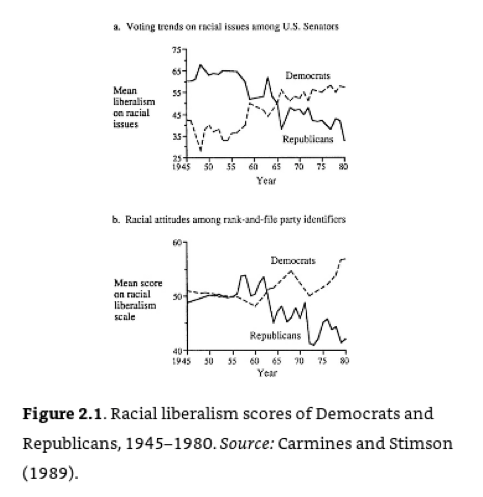
Then author moves to analysis and measuring elite discourse followed by analysis of mass attention to this discourse. After reviewing elite discourse and its pushdown to the general public, author discusses predisposition that may or may not allow this pushdown. Consequently, author defines political opinion and discusses process of obtaining reports on mass opinion and problems with such reports:
- Over time instability
- Response effects
- Question-wording effects
- On spot opinion formation with no or little preceding interest in the issue.
AT the end of chapter author discusses overall background of the question-answering model.
- How citizens acquire information and convert it into public opinion
This is about the process of acquiring political information that people do not deal with in their everyday live and how it is converted into political opinion. Author defines a few terms for this discussion: considerations –reason that induce individual to decide on political issue, which is combination of cognition and affect; he defines two types of political messages: persuasive message– arguments or images prompting individual to take a position, and cueing messages-information about ideological implications of persuasive messages. After that author defines his model as build on Axioms:
A1. RECEPTION AXIOM. The greater a person’s level of cognitive engagement with an issue, the more likely he or she is to be exposed to and comprehend – in a word, to receive – political messages concerning that issue.
A2. RESISTANCE AXIOM. People tend to resist arguments that are inconsistent with their political predispositions, but they do so only to the extent that they possess the contextual information necessary to perceive a relationship between the message and their predispositions.
A3. ACCESSIBILITY AXIOM. The more recently a consideration has been called to mind or thought about, the less time it takes to retrieve that consideration or related considerations from memory and bring them to the top of the head for use.
A4. RESPONSE AXIOM. Individuals answer survey questions by averaging across the considerations that are immediately salient or accessible to them.
Author discusses each of his axioms in details and then explains use of the model in this book.
- Coming to terms with response instability
Here author discusses one of the most interesting points: different answers to the same question by the same person at different times. Author describes how it was discovered and how pollsters attempt to go around this devastating problem. He brings in his model based on 4 axioms – RECEIVE-ACCESS-SAMPLE (RAS) and makes some deductions based on it. The first is tendency towards ambivalence and author discusses supporting data and measurements. The second is the relationship between responses to open ended questions and direction of opinion statements. Then author provides somewhat mathematical analysis of response instability overall depending on waves of questioning.
- Making it up as you go along
This is about polling in circumstances when people really do not know what they are talking about. As example author uses result of polling about congressman that nobody really knows. Actually, it is an important point because only 12% follow local politics, 45% look at it now and then, and 22% has low interest and know pretty much nothing. After that author discusses another deleterious effect for value of polling: situation when response if at least somewhat defined by random factors such as sequence of questions. Author makes point that it is well described by RAS model, but it is still disturbing that results of polling are not only inconsistent, but easily susceptible to manipulation, turning it from tool of opinion measurement into tool of opinion formation. Author provides detailed analysis of different methods of framing and priming, concluding at the end that majority of people are ideologically inconsistent and polling results could be manipulated to extent of 30-40% as it was demonstrated with the example of poll 3 weeks before such high-profile event as Gulf War in 1990 after about a half year of extensive coverage in the press and political statements. The final part of chapter discusses relationship between public opinion and democracy and unstable, even contradictory character of political actions in democracy.
- The mainstream and polarization effects
This starts with the story of Nixon’s wage and price controls and how it was supported by republicans who before where strongly pro-market. Author uses it as an example of elite communications that directs mass opinion according to party affiliation, overriding ideology. Author then analyses mainstream effect when elite developed consensus on the issue. In this case it usually able to transfer this consensus to mass opinion even if before it supported an opposite attitude as it happened with race relations. Quite different dynamic occurs when elite is divided, and consequently mass opinion breaks down and moves in polar directions. Author traces how such process is flowing from elite to more politically aware individuals to less aware until groups move far away from each other. Here are some examples of the process:
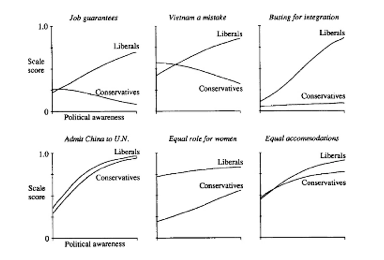
Author also discusses attitude constrains that lead people to support a number of ideologically consistent position across issues.
- Basic processes of attitude change
Here author presents mathematical model of attitude change as two-step process: reception of persuasive communication and then acceptance or rejection of its content. The first step is highly dependent on awareness, with more aware processing communication easier, but acceptance for them is much more complicated and more difficult because for highly aware individuals it may or may not be consistent with their ideological values.
- Tests of the one-message model
The chapter has three parts. The first analyzes two message-level determinants of attitude change: the intensity of the change – inducing messages, and whether the messages deal with a familiar or unfamiliar issue. These factors create predictably different patterns of opinion change. The second part examines the dynamics of movement from resistance to persuasion at the level of the RAS model’s primitive term, considerations. Finally, the chapter uses the model to shed light on the classic problem of opinion research: generational differences in receptivity to new ideas.
- Two-sided information flows
This chapter expands the model from one source of information – dominant flow from elite, to two sources by adding secondary flow of contradictory information. Author uses history of Vietnam war to analyze how initially unified support was divided when part of elite moved to withdraw its support and then moved to resist the war, turning it from mainstream to polarizing issue. Here is graphic representation of this process:
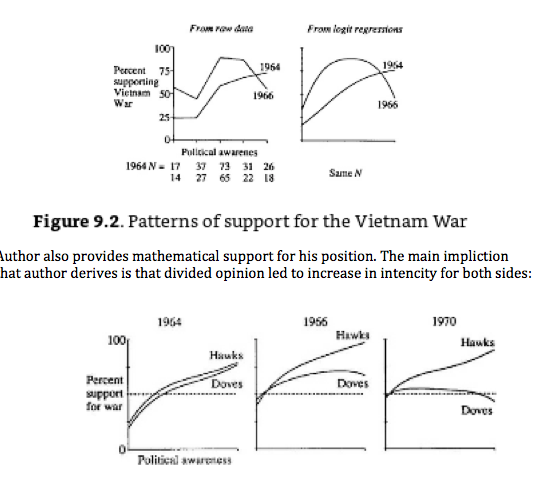
10. Information flow and electoral choice
This is application of author’s ideas to the situation of election when public divided into two camps by definition. Author looks at inertial resistance and incumbent advantage, which plays big role in House elections. The information flow in this case is pretty much limited to politically aware and therefore mainly serves as confirmation of already existing positions. Defections occur, but not that often. Here is graphic analysis of the process:
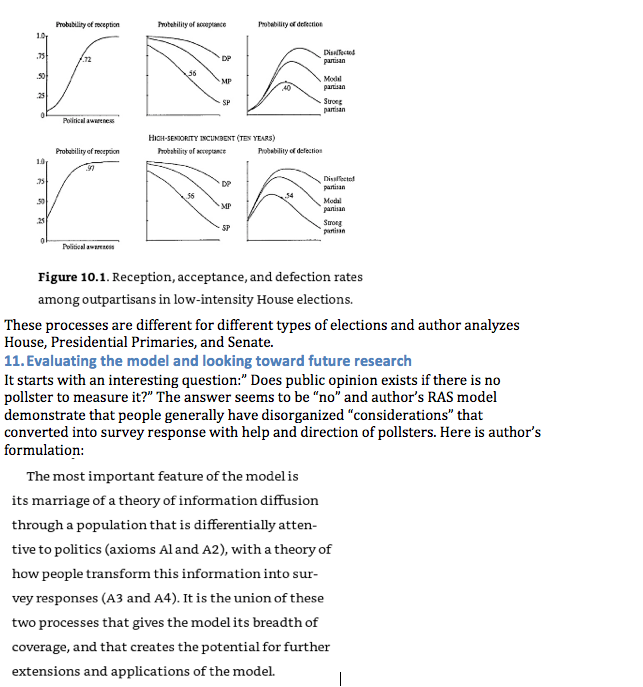
After that author asks anotehr question: “Who leads whom?” (leaders or masses). His response is that it depends, but mainly elite shapes mass opinion via communications. Author provides examples from American history demonstrating how elite moved masses without initial popular support: Brown vs. Board of Education, Nuclear freeze movement, Economic boom of 1982 when change in mood preceeded real economic data, Persian Gulf war of Bush I.
At the end of chapter author reviews critic of basic axioms of RAS model.
- Epilogue: The question of elite domination of public opinion
The main point here is that “the voice of people is but an echo” of elite opinion and it sounds in unison when elite opinion is unified and is divided when elite is divided. Author reviews here methods of elite dominance implemented via the political communications system of the United States: Press, Experts, and Mass Media. In conclusion author expresses his believe that people do not have lots of wisdom, but neither do experts and elite, so it is probably works more or less fine since elite is usually divided and the key for maintaining effective democratic system is guaranteeing the existence of vigorous competition among opposing ideas.
MY TAKE ON IT:
It is a wonderful book from the point of view of technical analysis of polling processes and their deficiencies of which are many. The most important and detailed here is the dominance of elite opinion over people’s believes and political actions. However, in years since this book was written we had communication revolution with dramatic increase of peer to peer and one to multitude Internet communications that are cheap to the nearly 0 level and have only one practical limitation – to get noticed. I think that in the view of this new development, polling is pretty much become an outdated process of collecting information and, I believe, it will be pushed out pretty soon by AI applications supporting in depth many-to-many interactions with individual opinions in search of latent massive support fro some ideas, moving them up from the sea of opinions to forefront and, after some period of continuing polishing, graduating them into viable and actionable tools for legislative and cultural change.
20180909 – The Happiness Curve
MAIN IDEA:
The main idea of this book is to present a human life as U curve of happiness / unhappiness with bottom achieved in the middle age. The book is based on psychological research and author’s own experience, which he extensively uses to support various topics related to this idea, as well as multiple examples from other people’s lives.
DETAILS:
- The Voyage of Life
It starts with discussion of series of pictures from XIX century by Thomas Cole representing journey through live as sailing along the river and then it intertwines with the stories of a few middle age individuals who express phycological difficulties of middle age that seems to have no reason and author’s own experience of the same. Then he discusses the situation that occurs later with age, when this changed and to his somewhat dismay it changed to the better despite usual bodily deterioration.
- What Makes Us Happy (and Doesn’t)
Here author moves to discussion of what actually makes people happy and uses work and life story of his colleague Carol Graham. She did research in Peru and discovered that even very poor people are quite happy, even if people whose income changed to the better were less happy. The same phenomenon of disconnect between objective economic situation and perception she found in Russia and China. Then he moves to Easterlin and his research that found impact of material condition on happiness is quite limited. Author presents long going discussion of these paradoxes and then discusses nature of happiness and its variations such as evaluative happiness= subjective wellbeing and affective happiness= momentary emotional condition. Author summarizes it as 6 factors:
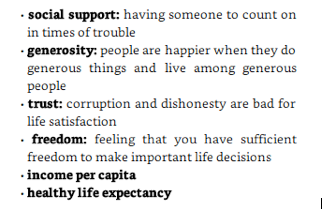
- A Timely Discovery
Here author moves to the story of discovery of happiness curve, the phenomenon common not only for humans, but also for apes. First it was kind of discovery of middle age crisis in 1965 by Elliott Jaques for which there is still no hard-scientific evidence. However self-reporting provides data that about a half of people are going through some distress during this period of their lives. Then author moves to British economist Andrew Oswald and his research on subjective economics – evaluation of one’s situation based on others’ situation. This research was based on big data, covering some 37 countries and thousands of people. This led to discovery of age dependent U-curve of happiness. Author also discusses some challenges to this theory, referring to dependency of happiness on personality and combination of big 5: neuroticism, extroversion, openness to experience, agreeableness, and conscientiousness. All of these are heavily dependent on genetic make up of a person, which links it to another research, this time on Chimps, conducted by Alex Weiss, Mark Enns, and James King, which provided support that age dependent psychological condition could be clearly demonstrated in animals.
- The Shape of the River
This starts with discussion of author’s polling of hundreds of middle age people. Generally, they reported unease and hope for change. Here is a nice illustration:

After that author discusses less obvious results that indicate that age dependency is not that clear, but claims that after controlling for health income and such, the satisfaction curve still stands. The next topic is the scale of age impact. Authr refer to research by Oswald and Cheng demonstrating that moving from 20 to 45 compares to negative impact of unemployment or divorce. Author even presents a simple formula:
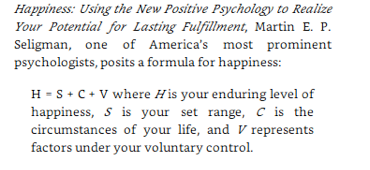
The final part of chapter is about international research demonstrating qualitative simolarity for all with various levels of happiness depending on the country.Here is part of this comparison:
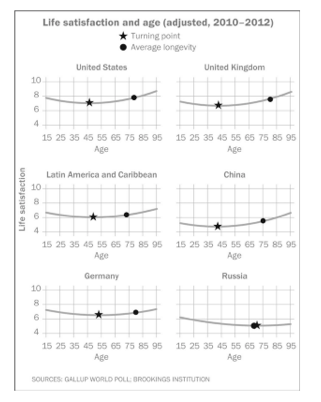
- The Expectations Trap
Here author moves to search for reasons for the curve. It basically comes to the variance between expectations and reality. It is nicely illustrated by this graph:
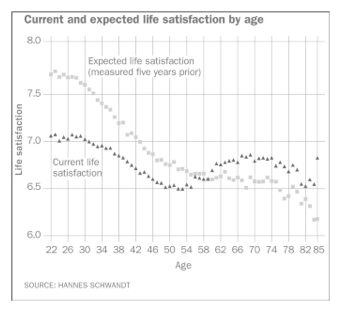
It is not only change in ratio between expectation and reality, but also impact of regrets: youth has little regrets – everything is in the future. With age time is more and more limited, so by the middle level of regrets is high and variance between expectations and results is high. With expectations are getting lower; disappointments also are getting lower, while regrets are not that acute any more. Author also discusses how expectations change and refer to works of Tali Sharot on optimism. Finally, author discusses the work of Jonathan Haidt on meaning of happiness and his analogy of the elephant and rider.
- The Paradox of Aging
Here author moves from middle age to older age, and tries to answer to question why older people are happier:
- Stress declines after about 50
- Emotional regulation improves
- Old people feel less regret
However older people are not depression-prone, especially at the very old age.
On the bright side per Tarot: “Optimistic bias increases in older age”. Overall conclusion is that pick of emotional life comes around seventh decade. Even when health starts giving up, older people manage to stay happy despite deterioration. At the end of chapter author relates research of Laura Garstensen on emotional and social live of old people. The inference here is that old people careful with their emotional investments and highly value remaining time of live, resulting in higher satisfaction of its use.
- Crossing Toward Wisdom
The chapter starts with the story of Andrew Sullivan who walked away from his successful blog and author uses it as an example of middle live transition. After that he discusses much more difficult transition with depression and mental problems. It leads to presentation of Dilip Jeste and Positive Psychiatry as extension of Positive Psychology. After that he moves to the notion of “wisdom”, which somehow is considered a taboo. He brings in work of Monika Ardelt who demonstrated quantifiability of wisdom. It was done along 3 domains: Quantitative, Affective, and Reflectiveand author goes into details of what it is and what it is good for.
- Helping Ourselves
This chapter present discussion with Joshua Coleman, who is practicing psychologist, about ways to handle most difficult points on happiness curve and here are key points:
- Normalize
- Interrupt the Internal Critics
- Stay Present (Mindful Presence)
- Share
- Step, Don’t Leap
- Wait (It gets better)
- Helping Each Other
This as mainly about Self-Help being not sufficient in some cases so one may need help from others. Author stresses need for psychological support from close people but warns against medicalization and substitution such as buying sports car in early 50s. After that author moves to overall life cycle starting with childhood and adolescence (recent invention of wealth society, which actually was created in 1904). Then he jumps to older ages and discusses ENCORE.ORG – organization supporting the second and following chances in life. Author also discusses various forms it could take.
- Epilogue: Gratitude
The final word here is about Gratitude for life and for opportunities for happiness it brings. He ends with the point that U curve of life, when one achieves the top on the right side in happy old age, makes Gratitude easier to come and therefore worth to struggle through life to get there.
MY TAKE ON IT:
This is a nice book to read for somebody like me who is rapidly moving up on the right side of the U curve. Actually, I do no remember being at the bottom, but it was probably because my middle age happened to be at the time when I was too busy getting out of the old USSR and building a new life in USA. Somehow this kind of staff consumes too much time and effort, leaving very little for self-digging and psychological complexities. On other hand, being very simple-minded person is, probably, also quite helpful in avoiding psychological complexities of contemporary upper middle class life. Anyway, it is a nice review of life cycle that could be helpful for somebody going through difficult time or somebody just interested in human psychology. It has quite a few interesting references and also provides some information that in my opinion support the idea that humans have evolutionary selected features influencing individual’s psychology and correspondingly action that are instrumental in fine-tuning individual behavior to promote group survival. It seems to be no accident that periods of happiness corresponds to periods when individuals have the highest value for the group: young age with its energy and readiness to make sacrifices for the group, act quickly, decisively, and with little thought applied – eventually making the future of the group; and old age, when accumulated over decades wisdom makes individual into valuable asset for decision making and directing all this youthful energy to some meaningful cause. From this point of view, the middle age with lower energy and not enough accumulated wisdom had to be a lower point when individual’s value to the group is at the bottom.
20180902 – A Short History of Truth
MAIN IDEA:
The main idea of this book is to analyze and summarize the meaning of truth, its different presentations in various areas and its interaction with non-truths, half-truths, and such. Also the important point is that truth is complicated and could not be easily presented without understanding of background and believes of both sender and receiver of message, because depending on this the same message could be identified at completely different levels, sometimes contradictory.
DETAILS:
Introduction
This starts with author’s recollection of free magazine from 1980 called “Plain Truth” and contemplation on intertwining of “plain”, “truth”, and linguistical meaning of this. Then he moves to philosophical meaning of truth. This kind of distorted everything, so author finds that problem is not “with what truth means, but by how and by whom truth is established”. Overall author concludes that despite all “post-truth” ideas and discussions, truth does exist, only one should be careful to consider complexity of issue, because this complexity provides for all different kinds of truth and author in this book is trying to define how evaluate truth-claims for different type of truth.
- ETERNAL TRUTHS
This starts with the “Truth” of Mormons and proceed to discuss situation when majority of minority believes in some revealed text, but majority of majority believes that most revealed texts are not revealed. From here author discusses various “eternal truths” of religions and deviations from literal understanding as a method of reconciling them with reality and science. From here follows method of peaceful coexistence – various truths either religious or scientific exist in parallel moral and intellectual universes and therefore do not intersect and could not conflict.
- AUTHORITATIVE TRUTHS
This starts with Indian sect of Sai Baba and goes to discuss how validations of epistemological authority are expertise or divine. Obviously, the underlying foundation is the notion that truth exists. After that it is only question of who can confirm authority, but it could not rely on one’s experience only because it is necessary very limited. It had to rely on communications about this from others.
- ESOTERIC TRUTHS
This starts with discussion of 9/11 truthers and claim that it is not possible to know if their idea completely false or have some truth to them and it was intentionally hidden. It leads to an interesting point: “One of the perennial challenges of being a critical thinker is to be appropriately skeptical without being indiscriminately cynical”.
4 REASONED TRUTHS
This starts with experimental truths as in Jefferson’s “American Experiment” of governing by reason and truth. However, that experiment is complicated and contains lots of contradictory facts. Author brings in Western tradition of constructing “truth” via reason. He discusses in some details Spinoza and his search for truth via formalized reasoning, which now pretty much out of fashion. Nevertheless, it is still a powerful tool if combined with experience.
5 EMPIRICAL TRUTHS
This starts with reference to Francis Bacon – original promoter of empirical method in formal philosophy. Eventually it became what is normally called science. Author provides an interesting example of controversy whether regular Cold is caused by cold or by virus. Eventually it was proved that virus is suppressed by immune system when it is warm, but much less so when it is cold. It demonstrates complexity of reality and a simple fact that real science never provides the final answer, only some approximation to reality, often good enough for practical improvements. It is interesting that this understanding logically forces author to admit that “climate deniers” could be right, which is not an easy thing for Western academic.
- CREATIVE TRUTHS
This chapter starts with Bush’s “Mission accomplished” truth or non-truth. Author uses this to discuss complexity of declaration when truth of simple facts is mixed with hopes and believes. From here author moves to a notion of “illocutionary truth” when “by saying something we do something”. However, it is a complex and not always consistent process so sometimes truth can be created by words, but sometimes it is not, however creative are these words.
- RELATIVE TRUTHS
It starts with difficulty of proving or rejecting popular meme that Intuits have 50 words for snow. It actually depends on interpretation of words and there is even approach of Relativism, which states that the meaning comes only from interpretation, not facts, so truth is always relative. Author somewhat defends this approach based on idea of conventional meaning of language and words. He also discusses contextual meaning that complicates things even more. Eventually it comes to existence of “real truths about relative truths”. The final point here is important in and of itself: “there are no alternative facts, just additional facts” that may or may not change perception of truth.
8 POWERFUL TRUTHS
Autor starts with diets: widely propagated for many years untruth that saturated Fat is cause of diseases. Author claims that it was intentional by powerful interests that wanted to protect sugar. The point here is that truth of health impact of different foods is not defined by scientific facts, but rather by relative power of industries producing different foods. This is an important demonstration of how power to define truth could be converted into financial and other benefits.
9 MORAL TRUTHS
It starts with obvious statement that such truths are culture dependent and author condemns “arrogant oppressors”, but right after that says something about rape and other niceties of non-western cultures are not necessary acceptable and position “Who are we to judge?” is often not really tenable. This follows by funny discussion of passions being a master and reason the slave, so it is not really possible to be tolerant to something that is completely unacceptable for a person morally. The author discusses choice vs. nature moral problems such as “homosexuality could not be morally wrong because it is genetic makeup of the person, not a choice”. Author also discusses in some details Hume’s idea that morality is rooted in “moral sympathy” and how it is impacted by facts.
- HOLISTIC TRUTHS
It starts with discussion of true believers in such things as Bible’s defined creation of universe and note that these believes are logically consistent and so are many other believes. Consequently, one cannot change mind by providing any factual or logical truth if there is not agreement on what to consider as such truths. Author discusses how believes form webs and often filter incoming information to fit these webs. The only way to get to the truth is to keep own believes in check and use diverse sources of information, while keeping filters in check.
Conclusion Future truths
In conclusion author summarizes his typology of truths as such:
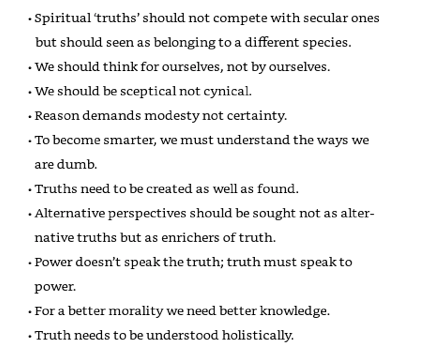
MY TAKE ON IT:
I think that idea of truth is quite complex and analysis of different types of truth, while useful, could not provide what people need most – tool to differentiate truth from non-truth. There is also very important part of it that is usually missing, which is absence of “I do not know” position. Another thing often missing is gradation and relevance of truth. I believe that the only relatively reliable method to define truthful understanding of the subject is analysis of confirmation or rejection of prediction about future. Without this any truth is tentative, especially if it is based on believes that are not subject to empirical falsification. Eventually all really important believes are logically consistent and therefore could not be changed by direct contest. They only could be changed by demonstrating real live consequences of acting or not acting in accordance with such believes, then allowing people to decide which type of consequences they prefer and then decide for themselves whether believes adjustment is required or not. This practically means that acquisition of truth should be done carefully with lots of small-scale experimentation before rolling it out, and preferably without u-e of violence. As example I would offer to review socialism of Robert Owen vs. socialism of Lenin / Stalin / Mao. The former was voluntary and on small scale, but clearly demonstrated socialism’s flows and failures at the cost of a few disappointments and slightly shattered lives. The latter demonstrated the same flows and failures times billion, but at the cost of hundred of millions lives lost and billions destroyed. If humans in XIX – XXI century had a bit better philosophical understanding of truth, the Owen’s experiment would be enough and all this billions of lives would be saved.
20180826 – Skin in the Game
MAIN IDEA:
The main idea of this book is that the skin in the game is necessary for effective functioning of any system containing humans and functioning via actions of these humans. The main cause of many societal problems is that people, whose action cause these problems, have no skin in the game so they act in their narrow interest causing system overall to fail.
DETAILS:
Book 1: Introduction
Prologue, Part 1: Antaeus Whacked
The main point of this part is that the knowledge and skills obtained in the real live by doing something is far superior to abstract formal knowledge obtained in class room, and author compares it to the Antaeus’ link to earth. After that author moves to discussing USA interventions in Middle East and defines deficiencies of people who designed it:
1) They think in statics not dynamics,
2) They think in low, not high, dimensions,
3) They think in terms of actions, never interactions.
Author especially points out that these people unlike warmongers of the past do risk their own lives and livelihood in these interventions and therefore have no skin in the game, which makes them reckless and dangerous. Similarly, in financial area author points out to Bob Rubin type of trades when government supported people’s financial operations, helping them to win every time because any lose was covered by taxpayers. The final point here is that skin in the game is the necessary condition for successful learning and without it error could be much costlier and even catastrophic.
Prologue, Part 2: A Brief Tour of Symmetry
Here author looks at his “skin in the game” from the point of view of symmetry. He starts with Hammurabi code that established symmetry between actions and counteractions even for extremely rare “tail” events. Author provides a nice table this:
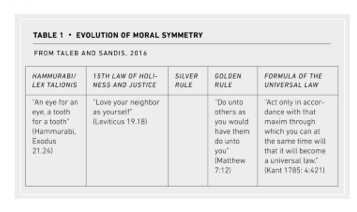
He also compares golden and silver rules, prefer latter over former:
The Golden Rule wants you to treat others the way you would like them to treat you. The more robust Silver Rule says do not treat others the way you would not like them to treat you.
After that author refer to Kant and his Universalism as unworkable in practice even if it looks great on the paper. As usual he brings Fat Tony (supreme common-sense personality) to expresses his philosophical approach in the series of aphorisms.
This follows by discussion on modernism that created a huge educational apparatus with its extension to consulting of all kinds about things that consultants never actually did, but rather learned in school. What makes it dangerous is absence of skin in the game. Author also discusses regulation vs. legal system noting that former has risk of regulator’s malfeasance because cost is always goes to somebody else. The next part is about soul in the game, which is honor that used to be important, sometimes even more than life. Author then discusses people who are by nature have skin in the game and it is more important for them and material returns: Artisans and Entrepreneurs. Finally, author talks about his American Citizenship that he consciously chosen, even if it means that he has to pay more taxes on his international income.
Prologue, Part 3: The Ribs of the Incerto
This part of prologue discusses author’s work over many years and a number of books all that he calls Incerto (kind of uncertainty).
Appendix: Asymmetries in Life and Things:
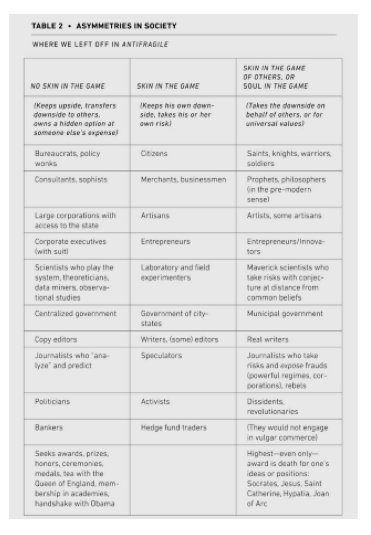
Book 2: A First Look at Agency
This is a deeper exposition of symmetry and agency in risk sharing, bridging commercial conflict of interest with general ethics. It also introduces us briefly to the notion of scaling and the difference between individual and collective, hence the limitations of globalism and universalism.
Chapter 1: Equality in Uncertainty
It is reference to ancient adage and basically about advises given by people who themselves do not risk anything, but also about inequality of information access between sellers and buyers. Yet another point here is scaling when moving up or down the scale qualitative changes the game. Author makes important point here that “general kills particular”. Here is a nice example from political scaling:
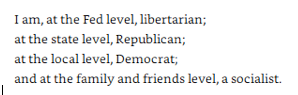
Book 3: That Greatest Asymmetry
This is about the minority rule by which a small segment of the population inflicts its preferences on the general population. The (short) appendix for Book 3 shows:
1) How a collection of units doesn’t behave like a sum of units, but something with a mind of its own, and
2) The consequences of much of something called social “science.”
Chapter 2: The Most Intolerant Wins: The Dominance of the Stubborn Minority
It starts with reference to kosher food that majority does not care about, but minority pushed through special designation on packaging. Author provides multiple other examples when minority gets accommodation because majority does not care. Author calls such minority intransient group and majority – flexible group. Author discusses renormalization and provides graphic representation of the process:
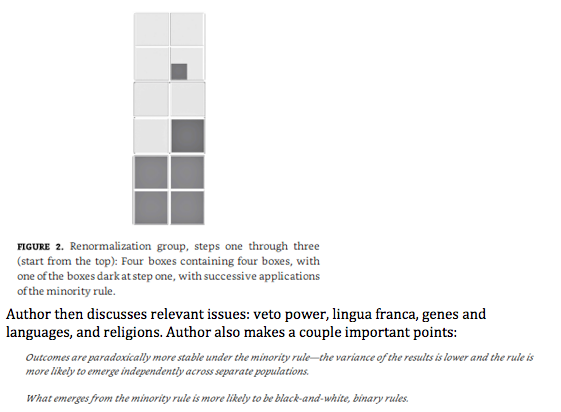
Thenauthor discusses Popper-Goedel paradox of tolerance for intolerance. At the end author provides summary:
Society doesn’t evolve by consensus, voting, majority, committees, verbose meetings, academic conferences, tea and cucumber sandwiches, or polling; only a few people suffice to disproportionately move the needle. All one needs is an asymmetric rule somewhere— and someone with soul in the game. And asymmetry is present in about everything.
Appendix to Book 3: A Few More Counterintuitive Things About the Collective:
- The average behavior of the market participant will not allow us to understand the general behavior of the market.
- The psychological experiments on individuals showing “biases” do not allow us to automatically understand aggregates or collective behavior, nor do they enlighten us about the behavior of groups.
- Understanding how the subparts of the brain (say, neurons) work will never allow us to understand how the brain works.
- Understanding the genetic makeup of a unit will never allow us to understand the behavior of the unit itself.
- Under the right market structure, a collection of idiots produces a well-functioning market.
- It may be that some idiosyncratic behavior on the part of the individual (deemed at first glance “irrational”) may be necessary for efficient functioning at the collective level.
- Individuals don’t need to know where they are going; markets do
Book 4: Wolves Among Dogs
This deals with dependence and, let’s call a spade a spade, slavery in modern life: for example employees exist because they have much more to lose than contractors. It also shows how, even if you are independent and have f*** you money, you are vulnerable if evil corporations and groups can target people you care about.
Chapter 3: How to Legally Own Another Person
It starts with reference to church and monks and their relationship with monks being financially free for the lack of financial assets were controlled by the rules. Then author goes to contemporary world when employees are kind of owned by employers and discusses trade-offs between employment and contracting and other peculiarities of contemporary work places.
Chapter 4: The Skin of Others in Your Game
This is about personal responsibility or lack thereof for organization men. This mainly comes in the form of conflict between action of organization and individual’s acceptance/rejection of these action and cost of either option. Then author moves from individual to individual’s important persons and discusses their costs that could be caused by individual’s action. As example he uses suicide bombers who seemingly have nothing to lose, but still have family and/or something that is dear for them.
Book 5: Being Alive Means Taking Certain Risks
Chapter 5: Life in the Simulation Machine
This is about how risk taking makes you look superficially less attractive, but vastly more convincing. It clarifies the difference between life as real life and life as imagined in an experience machine, how Jesus had to be man, not quite god, and how Donaldo won the election thanks to his imperfections.
Chapter 6: The Intellectual Yet Idiot
This chapter “The Intellectual Yet Idiot,” presents the IYI who doesn’t know that having skin in the game makes you understand the world (which includes bicycle riding) better than lectures.
Chapter 7: Inequality and Skin In the Game
This chapter explains the difference between inequality in risk and inequality in salary: you can be richer, but then you should be a real person and take some risk. It also presents a dynamic view of inequality, as opposed to the IYI static one. The most egregious contributor to inequality is the condition of a high-ranking civil servant or tenured academic, not that of an entrepreneur.
Chapter 8: An Expert Called Lindy
This explains the Lindy effect, that expert of experts who can tell us why plumbers are experts, but not clinical psychologists, why The New Yorker commentators on experts are not themselves experts. The Lindy effect separates things that gain from time from those that are destroyed by it.
Book 6: Deeper into Agency
This book looks for consequential hidden asymmetries.
Chapter 9: Surgeons Should Not Look Like surgeons
This shows that, viewed from the standpoint of practice, the world is simpler and solid experts don’t look like actors playing the part. The chapter presents BS detection heuristics.
Chapter 10: Only the Rich Are Poisoned: The Preferences of Others
This shows how rich people are suckers who fall prey to people complicating their lifestyle to sell them something.
Chapter 11: Facta Non Verba (Deeds Before Words)
This explains the difference between threats and real threats and shows how you can own an enemy by not killing him.
Chapter 12: The Facts Are True. The News Is Fake
This presents the agency problem of journalists: they will sacrifice truth and build a wrong narrative because of the necessity to please other journalists
Chapter 13: The Merchandising of Virtue
This explains why virtue requires risk taking, not the reputational risk reduction of playing white knight on the Internet or writing a check to some nongovernmental organization (NGO) that might help destroy the world.
Chapter 14: Peace. Neither Ink nor Blood
This explains the agency problem of people in geopolitics, and historians who tend to report on wars rather than peace, leaving us with a deformed view of the past. History is also plagued with probabilistic confusions. If we got rid of “peace” experts, the world would be safer, and many problems would be solved organically.
Book 7: Religion, Belief, and Skin in the (same
This book explains creeds in terms of skin in the game and revealed preferences: how atheists are functionally indistinguishable from Christians, though not Salafi Muslims. Avoid the verbalistics like “religions” are not quite religions: some are philosophies, while others are just legal systems.
Chapter 15: They Don’t Know What They Are Talking About When They Talk About Religion
This starts with author’s motto: “mathematicians think in (well, precisely defined and mapped) objects and relations, jurists and legal thinkers in constructs, logicians in maximally abstract operators, and… fools in words.”
It is an interesting observation that could help understand different approaches to reality and role that worlds play in politics and culture. Author proceeds to discuss the difference in meaning of “religion” for people with different cultural background.
Chapter 16: No Worship Without Skin in the Game
This is about another interesting approach to religion as the method of creating skin in the game, by using high-level demands on resources and dedication that person needs to demonstrate that he is true believer.
Chapter 17: Is the Pope Atheist?
This is very reasonable approach to the posed question: if the Pope really believer, why would he need medical services, security protection and other similarly secular things if everything is under control of the god anyway. In short, the real attitude is demonstrated by deeds, not words.
Book 8: Risk and Rationality
Book 8, “Risk and Rationality,” has the two central chapters, which author elected to leave for the end. There is no rigorous definition of rationality that is not related to skin in the game; it is all about actions, not verbs, thoughts, and tawk.
Chapter 18: How to Be Rational About Rationality
This chapter deals with human perception and its distortions. Author makes an interesting point that these distortions are necessary for survival. It seems to be obvious by definition, but his point is that distortions that exaggerate risks and consequently help to avoid loss much more useful than correct perception that would lead to loss, especially in cases of tail risks. He links it to the idea of bounded rationality that helps to heuristically process overwhelming amount of information at the levels good enough for survival. Here are 3 maxims that kind of formulate this idea:
- Judging people by their beliefs is not scientific.
- There is no such thing as the “rationality” of a belief, there is rationality of action.
- The rationality of an action can be judged only in terms of evolutionary considerations.
Chapter 19: The Logic of Risk Taking
This chapter summarizes all author tenets about risk and exposes the errors concerning small-probability events. It also classifies risks in layers (from the individual to the collective) and manages to prove that courage and prudence are not in contradiction provided one is acting for the benefit of the collective. It explains ergodicity, which was left hanging. Finally, the chapter outlines what is called the precautionary principle. Here is author’s view of this:
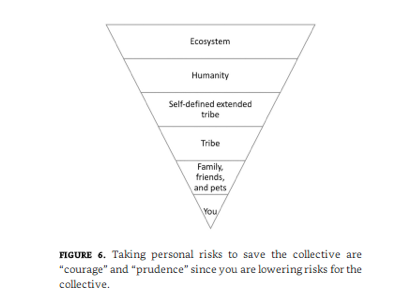
At the end author provides his summary:
- One may be risk loving yet completely averse to ruin.
- The central asymmetry of life is: In a strategy that entails ruin, benefits never offset risks of ruin.
- Further: Ruin and other changes in condition are different animals. Every single risk you take, adds up to reduce your life expectancy.
- Finally: Rationality is avoidance of systemic ruin.
Epilogue
The final wisdom:
When the beard (or hair) is black, heed the reasoning, but ignore the conclusion. When the beard is gray, consider both reasoning and conclusion.
When the beard is white, skip the reasoning, but mind the conclusion.
So author finishes this book with a (long) maxim, via negativa style: No muscles without strength, friendship without trust, opinion without consequence, change without aesthetics, age without values, life without effort, water without thirst, food without nourishment, love without sacrifice, power without fairness, facts without rigor, statistics without logic, mathematics without proof, teaching without experience, politeness without warmth, values without embodiment, degrees without erudition, militarism without fortitude, progress without civilization, friendship without investment, virtue without risk, probability without ergodicity, wealth without exposure, complication without depth, fluency without content, decision without asymmetry, science without skepticism, religion without tolerance, and, most of all: nothing without skin in the game.
MY TAKE ON IT:
It is interesting to read something so close to my own thinking, expressed about 37 years ago, that caused some problems for me with KGB and eventually resulted in learning English, getting out from USSR, and drastically improving my live. It is obviously written by much more educated and erudite man, but the core is the same – without “skin in the game” or what I called real responsibility and proper feedback loop, no human system such as society could function efficiently. It does not mean that it would not be able function somewhat effectively, but with huge waste in resources and, most importantly, human lives. Even so this inefficiency would necessarily cause such society to lose competition with any other, even slightly more efficient society, at least over sufficient period of time. Correspondingly “skin in the game” or “proper feedback loop” could be represented as well functioning democracy with complete freedom of speech, association, movement, actions, and availability of enough resources to make all these freedoms real for practically all members of society. Contemporary Western world, especially USA is pretty good on declarative part and opportunities to obtain resources for individuals with average and higher abilities. However, since about half of population has abilities lower than average, it still has a lot to achieve so all declared freedoms become available for everybody.
20180819 – Happier
MAIN IDEA:
The main idea of this book is to review the field of positive psychology as it developed after WWII, somewhat as reaction to its horrors. Started by to significant extent by Holocaust survivors who were trying to make some sense out of senseless tragedy, it developed into massive industry supporting typical American creed of Pursuit of Happiness with psychological, medical, and statistical research and expressed in nearly infinite number of self-help books. As everything American it expands all over the globe and impacts human behavior and decision making from individual level to all the way up to ruling governmental entities.
DETAILS:
Introduction
It starts with the anecdote about business owner who reduced his salary to $70,000 based on the psychological research claiming that more money does not make people happier. Author uses this to discuss role of psychology, especially positive psychology and happiness studies. He provides a brief overview of happiness discussion in history going all the way back to Aristotle and then moving all the way to contemporary time with its “positive thinking”, “Gross National Happiness”, and such. However, he points out that in our time massive research of happiness coincides with mass unhappiness caused by the great recession, stagnant wages, and political deadlock in USA and other developed countries. Then he brings in Positive psychology that provides highly contested and complex view on human happiness and its relation to material consumption and social environment. Author stresses that Positive Psychology became a powerful movement, which aims not only to help people with problems, but provide tools to regular people without any psychological problems to improve quality of their live through better understanding of what could make them happier.
- From Helplessness to Optimism: Martin Seligman and the Development of Positive Psychology
This chapter starts with reference to Seligman’s address in 1998 to American Psychological Association (155,000 members) when he called to use positive approach to strive for achieving human flourishing and preventing conflicts. One of the most important goals was to handle new situation when increased material affluence led to higher levels of depression and unhappiness. The emphasis should move away from mental illness to wellbeing of all individuals.
After discussing speech and overall new direction of psychology, author moves to review bio of Seligman and some other personalities who created foundational work for positive psychology and happiness studies. Paradoxically quite a few of them were Jewish and, one way or another, related to Holocaust either as survivors such as Victor Frankl or their children and other relatives. Interesting here also is somewhat negative attitude to self-esteem and other “humanistic” psychology movements, which often promoted “unwarranted self-esteem” undermining readiness to apply hard work necessary for achievement. Author, however, stresses connections between earlier humanistic psychology and positive psychology and continuation of its effort to understand people in order to improve their wellbeing.
- Misery and Pleasure in the Origins of Happiness Studies, 1945-1970
This is going to the beginning of positive psychology that occurred in years right after WWII and Holocaust. The interesting point here is that people think about happiness more when they are not happy, especially when their relatives and friends get killed and they find themselves in concentration camps as Victor Frankl. However initial background of positive psychology was in psychological treatment of WWII veterans and victims. Author also discusses here Norman Peale and his Power of Positive Thinking. This movement started in 1952 and was based on the idea that whatever real problems exist in the world; the individual thinking could manage perception and direct action in more productive way than just lamenting uncontrollable events. The next step in this direction was Victor Frankl’s “Search for Meaning”. Here idea was that positive thinking and ability to preserve some internal intellectual freedom and dignity increased chances of survival in concentration camps and eventually allowed person to grow. Frankl also practiced as a therapist, moving away from Freud and concentration on the past to concentration on life’s meaning and future. The next figure author discusses – John Bowlby was member of British elite who suffered corresponding adversities: being sent to boarding school, separation from wife, and other unhappy events, which influenced his work on separation and social isolation. He developed attachment theory especially for small children, which pointed out need for social interaction. The next is Aaron Beck and his work on depression and recovery through cognitive behavioral therapy. This method was based on attempts to help patient to overcome “misconstruction of reality” and develop realistic goals for improvement and handling of life events. Next part of this review is Abraham Maslow and his pyramid of motivation, especially his idea of self-actualization. One of more important points is Maslow’s insistence on analysis of psychology of healthy people in search of understanding what makes them healthy. He also expanded it to societal impact suggesting that self-actualized people are not interested in hate and violence making society better for everybody. The next figure – James Olds had more technical approach – he was searching for pleasure centers in the brain. He found it in rats and proved that direct electric stimulation of the brain could cause all-consuming pleasure. Another researcher Frank Berger moved to chemical stimulation developing drug Miltown to prevent depression and increase happiness.
The next part of review for this period includes discussion of happiness studies that were conducted in USA and other countries. The final part refers to Alan Watts and related move to Asian religions in search of ancient wisdom that would provide road to happiness.
Author concludes that for the period before 1970 the main thrust was to overcome misery of tragedies of war and find way to achieve mental stability and comfort either via positive thinking, meaning of life, and/or anything else available: electrical / chemical stimulation, Asian religions, or whatever else would work. The most important here is that it signified shift from overcoming misery to obtaining happiness.
- Crisis of Confidence? 1970-1983: Providing the Groundwork for the Study of Positive Happiness
This period included growth in happiness research with contemporary decrease in happiness and optimism in the Western world due to economy, Vietnam, and other negative events. It also included new approaches based on rejection of purely materialistic approach, such as “Hedonic Treadmill”. It featured Brickman and Campbell with their Adaptation theory, which denigrating value of achievement because it would never deliver on expected levels of happiness and therefore had no real benefit. Moreover, it was linked to idea of diminishing resources that pointed to counterproductive nature of material improvements. Author then discusses Paul Ekman’s research on evolution of emotions and facial expressions. This demonstrated power of positive emotion transmitted via expressions. The next point is Robert Trivers and his “Reciprocal Altruism” as source of happiness. Moving on it is Edward O. Wilson and his “Sociobiology”, demonstrating Evolutionary processes behind human behavior and conditions. Alisa Iven and Paula Levin then continued it in study “Effect of Feeling good on Helping”. Philip Kunz researched issue of communications for helping in his experiment with Christmas cards. Another classical research was by Richard Easterlin who demonstrated that difference in levels of happiness between rich and poor are small and concluded that money has little impact on happiness. Yet another approach to happiness was demonstrated by Mihaly Csikszentmihalyi who researched condition of deep emersion into productive task and found what he defined as flow – condition of happiness from the process of achievement. Another study by Philip Brickman, Dan Coates, and Ronnie Janoff demonstrated stability of individual levels of happiness by looking at condition of lucky winner of lottery and unlucky individuals who suddenly become paraplegics. In both cases in a few months after big change people return to pre-existing levels of happiness, albeit it was not completely so for incident victims.
The next area of research in these years was about decision making under risk. It was done my Kahneman and Tversky who demonstrated that these decisions were far from purely rational as it was assumed by economic profession. Together with Thaler’s research on consumer choice it practically started behavior economics.
Author also discusses growing number of surveys conducted in these years and their methodology. These surveys generally found decreasing link between material and psychological wellbeing.
Yet another direction was search for better leaving via relaxation and use of Asian religious thought to handle life’s events. Author describes work of promoter of this approach – Herbert Benson.
Somewhat different, but in the same line was an attempt by Timothy Leary to use chemicals such as LSD in search of happiness, which was kind of continuation of popularity of Miltown in 1950s and Valium in 1960s. All this led to extensive research on operation of these drugs and their influence on brain and author provides a sketch of results of this research.
Finally, author discusses popularization of psychological research and increasing search for happiness and dissatisfaction with existing situation that grew in American society. In conclusion of the chapter author refer to other works in psychology not directed at happiness and wellbeing such as Gardner’s work on multiple intelligences, Goleman on Consciousness and Awareness, and some other. Interesting also is reference to Nozick’s “Experience Machine” in which he suggested that humans need more than experiences, they also need real, tangible results for their activities.
- Morning in America, 1984-1998: Assembling Key Elements in the Study of Happiness and Positivity
This part describes period of change from Reagan through Clinton and renewed optimism in America. Author considers this period as turning point in history of happiness studies because of its acceptation by Library of Congress as a separate subfield of psychology. It was also period when thousands of studies were published in this area and field expanded a lot. One of important new areas of research was about the problem of endogeneity – difficulties of separating causation and correlation. Author stresses importance of article by Ed Diener: “Subjective well-being” and discusses it in detail. Especially important was search for link between happiness, age, work environment, family, and social relations.
The second part of the chapter is about brain research that received a big push in late 1980s. It involved experiments with Alzheimer patients, but also famous research with Buddhist monks and meditation. He also discusses careers of Ryff and Peter Kramer who promoted a better life through chemistry of Prozac that he used extensively in his clinical practice.
The next researcher author discusses is Kabat-Zinn who founded the Stress reduction and relaxation program based on meditation, which spawned Mindfulness-Based Stress Reduction (MBSR) programs that promoted idea of close link and unity of mind-body with stress on inner life and somewhat neglect of external circumstances. Author also discusses a few longitudinal studies tracing the same people over long periods of time and Cutler’s work on it with help of Dalai Lama, resulting in bestseller “The Art of Happiness”.
The following part of the chapter returns to behavior economics and discusses it in conjunction with Hedonistic Psychology. One interesting part of this discussion came from Kahneman’s research demonstrating difference between current and later perception of well-being and that duration of condition did not matter that much – discomfort for period of time with improvement at the end was perceived as better event than period of comfort followed at the end by deterioration.
After that author moves to Festinger and comparative evaluation of one’s status in all relevant areas to define own happiness. Yet another approach came from David Lykken and Auke Tellegen was about genetics. Their research on twins claimed to demonstrate that about 50% of happiness level came from genetics.
There is also interesting discussion on international comparison, which demonstrated variance in understanding of happiness between collectivistic and individualistic societies. Overall research demonstrated dependency of happiness levels in different countries on their culture.
- Drawing (and Crossing) the Line: Academic and Popular Renditions of Subjective Well Being, 1984-1998
This period of “morning in America” preceded final formation of positive psychology and included move to popularization of this research by Seligman and Csikszentmihalyi and author reviews their books in details. There were also multiple books on happiness with strong push into self-help format.
- Building a Positively Happy World View
This is about events and discussions after Seligman’s presidential address in 1998 that established Positive Psychology as clearly defined field of research. It starts with description of reaction in mass media – articles in Time and such. It also refers to Jeffrey Kluger’s essay about American pursuit of Happiness and Happiness of Pursuit mainly about relation between consumption and happiness. Then author moves to discuss development of professional infrastructure for positive psychology: university programs, training classes, textbooks, and such. Author allocates lots of attention to Martin Seligman’s work during this period. He also discusses “How to” literature, such as work of Sonja Lyubomirsky who provided kind of formula for happiness (50/40/10 – genetics / intentional activity / circumstances), and quite a few of other books on the happiness topic published in early XXI century. Author also identified the key 3 issues around which all discussion is mainly conducted: Money, Measurement, and Meaning of Happiness.
- The Future Is Here: Positive Psychology Comes of Age
Here author reviews the key findings and directions of research related to different parameters of happiness: Character, Gratitude and Altruism, Resilience, and Spirituality and Religion, Author also discusses the latest scientific tools used in happiness research. Part of this is international research and he provide an interesting statistical graph:
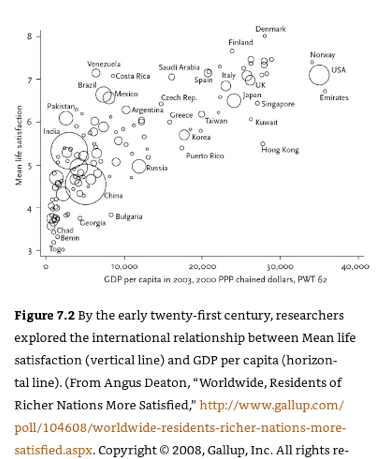
There is also interesting discussion here on political ideology and positive psychology noting that it is somewhat related to neoliberalism that he defines as self-government by individual rather than by group or government. At the end author discusses in details critic of positive psychology which grew exponencially with the growth of its popularity.
- The Business of Happiness
This is about business of promoting positive psychology and overall happiness. Whether it is TED talks or “Happy Corporate Life” or Oprah. Author also discusses penetration of these ideas in schools, mass media, and all kinds of Happiness coaching. As any other mass movement, positive psychology has philanthropic support in form of foundations, government organizations, and Academic entrepreneurship.
Coda: The Happiest Place on Earth
This starts with description of author’s attendance of the Fourth World Congress of Positive Psychology in 2015. It included 1,200 participants from 48 countries. After that author discusses how big become this movement and how much happiness it created at least for people who making living from positive psychology. Author ends on very interesting note that out of some 800 people present at presentations on positive psychology influence on culture only some 20 were conservatives. Others were mainly center left and they did standing ovation to the speech of Csikszentmihalyi about need to increase push for equality, social justice, and environment.
MY TAKE ON IT:
The pursuit of happiness in last 70 years moved away from simple strive to be well fed, have decent shelter, and maintain positive social connections with other people; to much more sophisticated strive to achieve psychological satisfaction with one’s life in which these simple things are taken for granted. This naturally caused serious research in what it means to be happy and the whole industry of advisory services to help people in this. I think eventually the biggest discovery still ahead of us and it will be discovery of simple fact that happiness is deeply, individual condition that occurs even for the same individual differently in different moments of time and space in this individual’s life. As such no statistical and/or psychological help could work consistently because of this dynamic character of the state of happiness. The most that could be done is to assure that all individuals have resources to do whatever makes them happy, agency to be able to use this resources the way they want to do it, and protect them from external violent interference in their live by other individuals who are in control of whatever the powers are in society.
20180812 – The Case Against Education
MAIN IDEA:
The main ideas of this book are very clearly presented in introduction:
- Contemporary education educates in areas that have little relation to realities of life when it goes beyond literacy and numeracy.
- It is not disputable that education provides high returns on investment, but it comes not from acquired knowledge, but from signaling that the person with educational credentials is more valuable employee, than person without.
- Consequently, massive investment in education does not produce any returns for society overall because it just inflates cost of signal – where bachelor degree was a pretty good signal in the past, now, when everybody has bachelor degree, one needs master degree to send the same signal.
DETAILS:
CHAPTER 1 – The Magic of Education
This chapter starts with confirmation of education value for individual career and statement that statistics proves that. It follows by review of what is actually taught, including author’s own experience as economics professor and conclusion that it really has nothing to do with the skills required to do a job. These real skills are acquired on the job, not in the classroom. The author asks the question – what is the magic that turn diploma into higher income? The answer is – signaling. Employees look for individuals with specific personal qualities: intelligence, consciousness, conformity, and so on. Possession of these qualities is not obvious and it requires some investment of time and money to recognize them in individual. Education provides short cut to this information. Author specify what qualities education signals and why it so in some details, such as individual’s ability to apply raw intelligence to achieve the specific objectives. For example, two individuals with high IQ, easily tested in a couple hours, would signal completely different level of job fitness if one of them has PhD in some esoteric area and another one did not move beyond high school diploma. This job fitness includes the whole package of traits, which author again boils down to trifecta: intelligence, consciousness, and conformism. Author also discusses objections to the signaling. One objection he actually accepts is that signaling is not the only one thing and education sometime does provide valuable skills and knowledge. However, he believes the signaling is the thing because it allows recognizing absence of easily fakeable traits: consciousness and conformity. Individuals who spend years getting diplomas are not faking these traits. Author also provide an interesting point in support of signaling: education is practically free if one wants to listen to lectures, read books, and do exercises. Nevertheless, people are paying huge money for credentials, which are nothing more than confirmation that one did all this. This refers to author’s main contrarian idea – human capital model, which states that it is knowledge and skills obtained via education that creates value for employee. His interesting reply: what would be better for getting the job: Princeton diploma without knowledge or knowledge without diploma – the answer is obvious: diploma wins.
CHAPTER 2 – The Puzzle Is Real: The Ubiquity of Useless Education
This chapter looks in details at curriculums to demonstrate how little it relates to real life. Here is breakdown for high school: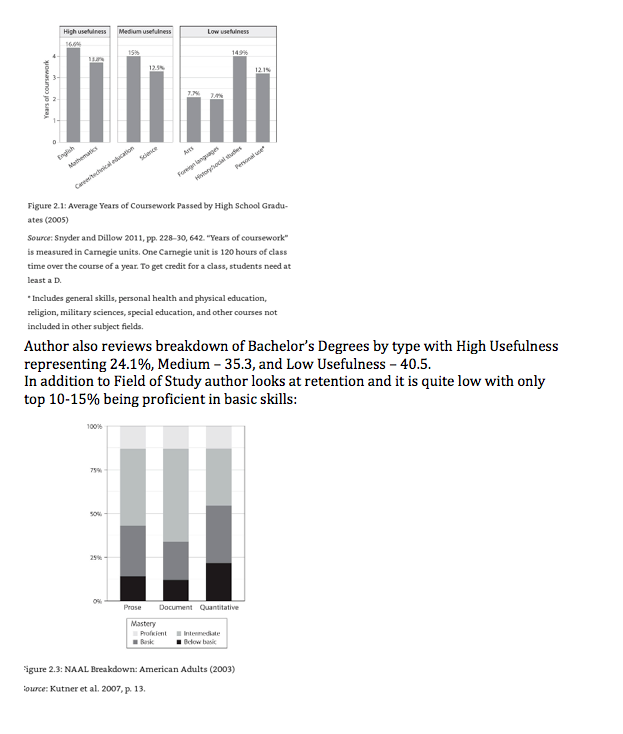
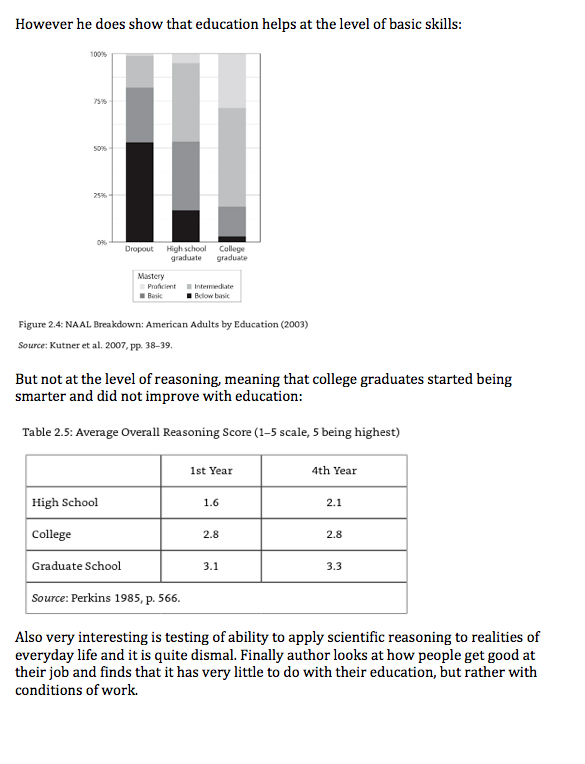

Discussing signaling author points out at legal limitations on use of cheap methods like IQ and other tests. However he rejects this, pointing out that huge difference between cost of formal credentials as signaling and cost of test so much different that people would find way to avoid laws if the test’s signal would be comparable.
Author also discusses positive impact of eduction on unemployment numbers.
At the end of chapter he presents what he believes are real rewards of education: signaling.
CHAPTER 4 – The Signs of Signaling: In Case You’re Still Not Convinced
Here author provides additional support for this signaling theory. He discusses the Sheepskin effect when value added not by years of education, but by credentials only. The estimate of this effect is highest for High school diploma and Bachelor degree – about 30%. Interesting also is analysis of misemployment when people work jobs where their education is irrelevant. Author demonstrates that even in this case High school graduates command premium of about 100% over dropouts, but even more amazing is that college graduates command 30-40% premium over High school graduates. Author summarize Human capital vs. Signaling in such way:
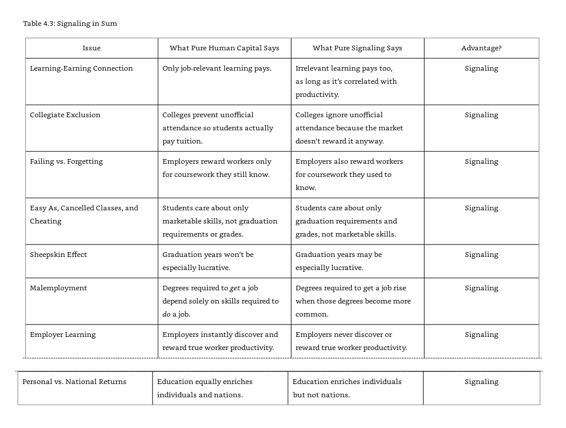
CHAPTER 5 – Who Cares If It’s Signaling? The Selfish Return to Education
Here author stresses benefits of educational credentials for individuals, regardless of reason it happens. He does somewhat funny math calculating total cost of education not only in payments, but also in cost of sitting in boring classes, enduring stupidity of professors, and lost opportunities of doing something productive. He concludes that it is definitely worth it and provides a bunch of nice graphs to support this conclusion. Here is one of them:
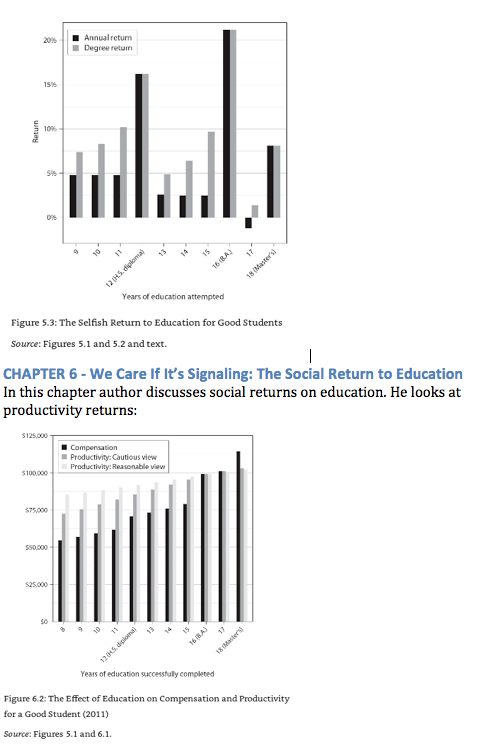
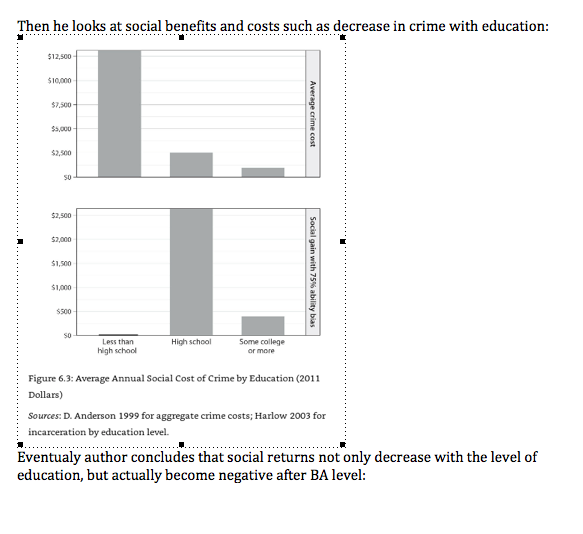
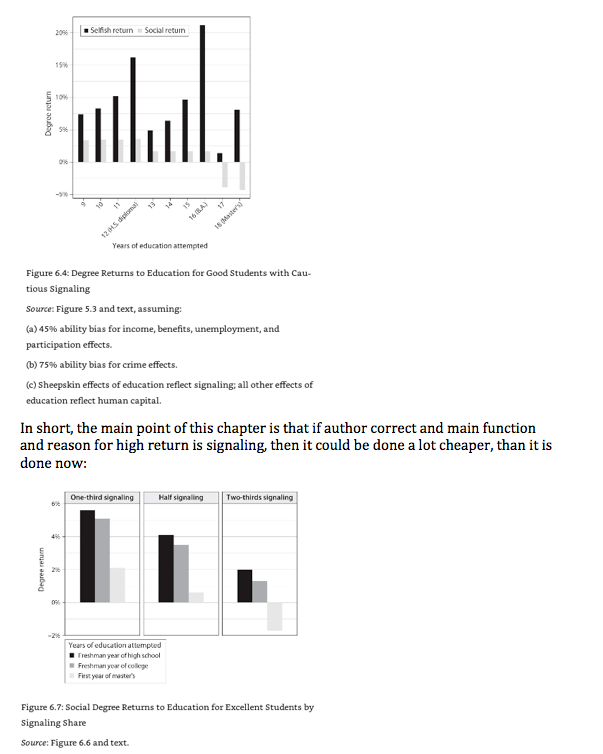
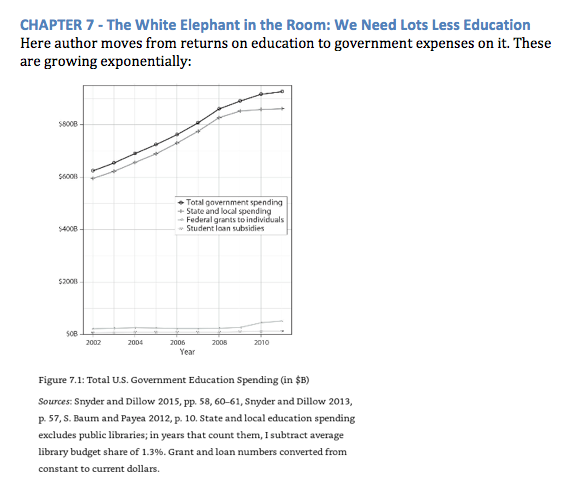
A very interesting point author makes when he shares his experience of discussing this issue. Typically people relatively easily agree that educatinal spending is wastful, but strongly resist to any cuts. After that author reviews a number of related issues, mainly demonstrating that governemnt interference makes things worse by removing incentive to select meaningful forms and subjects of education that would provide good returns, and substituting them with easy subjects that would not provide good returns, if any. At the end he states his recommendation – austerity in eductional expenses.
CHAPTER 8 – 1>0 We Need More Vocational Education
This chapter on vocational training makes a very interesting point: students are underachievers before they start vocational training, but then get much better. Overall this small table summarizes the comparison:
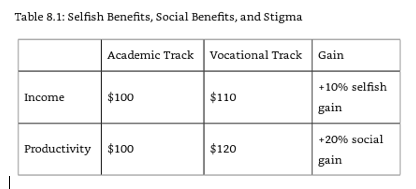
Author also discusses child labor that was substituted by eduction and reasonable claims that on job training superior to formal education for learning this job and should not be limited by age. Finally he quite reasonbly points out that learing Latin or Medival history is really not generic education, but is rather technical education of very narrow specialty with little application in real live.
CHAPTER 9 – Nourishing Mother: Is Education Good for the Soul?
This is discussion of the very notion of Alma Mater that every college trying to develop in their students and alumnus. Author clearly and strongly support humanitarian side of education, but separates it from practical education. The first one requires students consciously and enthusiastically participate, otherwise being just waste of time – which does regularly occur in contemporary educational system. After that author reviews what is popular: books, other cultural artifacts, and demonstrates that it is far from high culture taught in schools. There is also very funny part of this chapter referencing political correctness as paper tiger. Mainly the point here is that Marxist professors are not capable to instill their ideology into students and therefore are somewhat benign. The final part basically demonstrates that force-feeding culture and ideas does not produce cultural and idealistic people. It produces cynics and manipulators, trained to demonstrate characteristics and believes that are required for achieving their objectives regardless of possession of these characteristics or real support for this believes.
CHAPTER 10 – Five Chats on Education and Enlightenment Conclusion
The final chapter is about interaction between education and enlightenment. Author presents it in the form of 5 chats with invented character:
- Education what is good for
- College and Catch-22s
- How Educational Investments Measure Up
- Why Do You Hate Education?
- Education Against Enlightenment
CONCLUSION:
Here author repeats the main points: Education is overrated from social and humanistic point of view, but beneficial from individual materialistic point of view by providing necessary and important signal to employees about this individual’s abilities and characteristics. Author expresses pessimism that anything will ever happen to change this, but he does hope that some austerity in educational expenses will eventually arrive.
MY TAKE ON IT:
Signaling is a pretty good explanation of economic function of higher education in USA and I believe that author absolutely correct that education provides individual benefit, while causing societal loss of resources. What in my opinion is missing here is more clear presentation of welfare aspect of education. Out of nearly trillion dollars spent every year, only a small fraction supports transfer of real knowledge and skills to next generation of producers, but huge proportion goes to providing income to non-educators, administrators, and others not related to any instruction: from new school building to professors’ pensions. It is by far the biggest welfare program that exists and the question is what would happen to all these people if USA moves to education austerity. The answer is – millions of semi educated people often trained in some kind of socialistic thought, deprived of expected levels of income and therefore extremely angry at the society and political system that caused their grief. It is hard to imagine better receipt for revolutions and civil war. On other hand the current trends are unsustainable not because education costs too much – a small number of effective producers with support of technology so far were able produce enough goods and services for all including welfare recipients from bottom dwellers of slums with their $4 dollars / day food stamps to women/ethnic/diversity/lgbtqqcc studies professor with 400k income. It is not sustainable because society in which huge number of people doing something meaningless, while being included in some hierarchy, meaning suffering all indignities of being dependent on superior bureaucrat and consequently losing their agency as human beings, could eventually produce an explosion as powerful as they could produce if deprived of income.
I believe that austerity would not help. It is rather creation of opportunities outside of rigid educational system, including teaching and learning opportunities and slow and deliberate movement of resources from governmental redistribution to voluntary market exchange could resolved this growing danger of explosion. As to signaling, employers would not need credentials if they can easily admit people on voluntary basis to work for them in exchange for skill acquisition and productivity linked on profit share basis. With current level technology it would be not a problem to keep databases with reliable auditing, maybe even by government bureaucrats providing records of projects participation and detailed activities of all people willing to have such proved record. This would eliminate need for employer to look at credentials from college and allow them to select the best people for a job at any time and at marketable price. In any case I think this book will generate lots of discussion and will be an important input into coming huge societal change.
20180805 – End of Era ( China)
MAIN IDEA:
The main idea of this book is that the Era of reform in China ended. The result is advanced economy with authoritarian government, which is, while very impressive from outside, it nevertheless contains huge internal pressures probably not easily controllable by communist party in power. It is not clear what will be next, but it is clear that this “next” will be very different from “now” and probably not very happy.
DETAILS:
Introduction
The introduction starts with reference to Three Gorges dams as symbol of contemporary Chinese society – huge but fragile construct that changed natural flow of things, providing benefits at first but threatening catastrophic consequences in the future if dam breaks. The author’s point is that economic success of Chine hides internal tensions that are moving the country closer to explosion as evidenced by growing unhappiness on social media that from time to time leads to protests and even violence. Author also briefly summarizes content of the chapters that follow.
- Overview: The End of China’s Reform Era
This chapter starts with discussion of the raise of authoritarianism elsewhere in the world, which is fed by seemingly miraculous success of China model. After that author looks in details of China’s development from late 70s on when Den’s reform opened China to foreign investment and kind of capitalism controlled by communist party. Author makes point that during reforms communist party moved to building institutions for collective control for its rule, including changeable leaders with term limits. It also included expansion of education and bureaucratization of society at the same time opening some space for private business and civil society as long as it was not threatening party’s control. It worked fine for a while, but at the early XXI century system run out of steam due to increase in dissatisfaction of population with corruption, environmental degradation, pressure from the bottom to increase quality of live, especially in provinces, increased unhappiness of western companies with illegal technology transfers, and slowdown of economy. The response, so far was concentration of power at the top, removal of restrictions on personal rule, massive stimulus of economy, and complains against corruption of intraparty competitors. Also revived was ideological push, this time in the form of Chinese Dream and great leader Xi’s writings. Author characterizes all this as the beginning of counter reform era.
2.Society and Economy: The Closing of the Chinese Dream
Here author looks on Chinese Dream development. First it was Imperial Dream – meritocratic raise through education and exams going back to the 900-1000 AD. The raise mainly meant high place in Imperial bureaucracy. It lasted until 1911 when resulting relative military and economic degradation led to revolution and fall of Qing dynasty. The following up power play practically lasted until reforms end of 1970 and included wars, interventions, and such ideology-made disasters as cultural revolution. The reform somewhat restored road to success via education, albeit restricted for provincials by hukou (individual’s assignment to locality), causing mass illegal migration to cities. Also, huge increase in number of college graduates put a lot of pressure on society because it produced entitled intellectuals with not enough place in bureaucracy and lack of marketable skills. Another point author makes is growing differentiation between educated elite and educated non-elite that undermines meritocracy when inequality is growing:
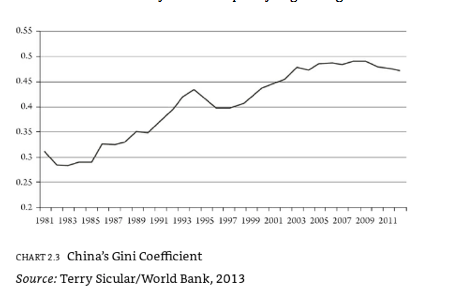
The inequality during reform period was aliviated by opportunities in private business, but party response to slowdown of economy decresed these opportunities leading to frustration and sometimes to violent outbursts. At the end of chapter author discusses XI’s Chinese Dream of innovation society and hope to supplunt USA as preeminent source of new technology rather than cheap labor, but author is sceptical that it would be possible.
3.Politics: Internal Decay and Social Unrest
Here author suggests that China’s resent success was linked to “Partial political institutionalization”, meaning somewhat stable norms of party’s bureaucratic machine. However, it did not go anywhere close to establishment of at least somewhat democratic institutions and all attempt to their establishment like local election or independent courts eventually failed when bumping into supremacy of one party rule. Consequently, attempts of technocratic organization turned into mass corruption problem as it is supposed to according to theoretical agent-principal problem. Author looks at recent history and, interestingly enough, points to Mao’s Cultural Revolution as attempt to solve this problem by mass removal of corrupt bureaucrats. After Mao initial development of institutions stopped in 1989 when it clashed with communist party controls. After tracing the failure of institutional development author moves to increased tensions in Chinese society linked to conditions of migrant workers and labor over all. It is represented by the growth for legal and labor disputes:

The situation become quite dangerous, stressing and undermining bureaucratic and technocratic cohesion that mainly maintained over the period of reform. Eventually, now it looks as the solution the party leaders came up with is mainly return to upgraded to contemporary conditions Mao’s practices with the new leader XI esteblishing himself as the leader for live and significant number of top level party oficials purged via anti-corraption compain.
4.Religion and Ideology: What Do We Believe?
This is about religion in China, which is, as in all formerly communist countries, a mess. China is still communist country, but official communist religion of atheism mainly become meaningless so both top and bottom of society are looking for something else. There is an attempt to go back to Confucian teachings, but it is not that forceful yet. Author provides estimate for religious affiliation: 300 mil folk religions, 250 mil Buddhists, 68 mil Christians, and 25 mil Muslims. Author reviews religious history, stressing that government usually selected one and suppressed others. Communist party did the same, but its official religion – communism become quite hollow, opening space for others. Party’s attitude represents wide variety mainly of neglect, but sometimes strong, even violent response when popularity of some believes system becomes too big, creating potential competition. Author discusses in details Falun Gong as one example of this. Overall party is looking for some effective substitute for dead Marxism, which would support its current nationalistic direction.
5.China in Comparative Perspective
It starts with reference to Americans inability to understand that people in other countries often do not have real experience of democracy and often used democracy-like institutions such as election, formal division of power, and independent judiciary only for show without investing them with meaning and real power. Author in depth discusses some Asian countries like Taiwan transfer to democracy, only to demonstrate huge difference between circumstances of these countries and China, which are so much different that their example is not applicable.
6.Possible Futures
The last chapter is about different versions of future that author foresees:
- Demise of liberal dream, complete elimination of possibility of democratization, and continuation of authoritarian rule
- Rejection of established by reforms semi-capitalism with private property and return to totalitarian system
- Populist Nationalism with anti-foreigner tint.
- New Dynastic cycle as it usually happened in China before
- Regime collapse leading to civil war and war lords taking different parts of the country.
At the end author analyses what would be meaning of this for the world and how USA could respond.
Conclusion
In conclusion author makes a valid point that society’s governmental system is highly dependent on overall culture. So, in America democracy does not start at the top, it starts at the level of individual experience – high school elections, PTA meetings, and infinite number of events of collective decision-making and elections of individuals into position of power, however small or big power it is. These institutions are foundation of democracy and China’s reforms failed to develop such institution. Author compares result of this failure with Three Gorges Dam and expresses fear that the big earthquake is coming. On the bright side he offers, as an alternative, example of another project – Dujiangyan irrigation system built around 256 BC, which successfully merged with environment regulating water flow without dams, regulating water flow by the using topography enhanced my multiple channels. Author ends stating that it is up to Chinese to decide which way to go.
MY TAKE ON IT:
I think that it is correct that the era of reform ended, but it is not actually Chinese decision or even purely Chinese development. This Era is ending because it was based on integration of China into Western capitalist world as provider of low cost labor and environmentally indifferent manufacturing network. As such it was built on the number of historically abnormal circumstances:
- Ability of communist party elite to obtain both wealth and security by receiving share of proceeds from western investment into China, while buying popular support with material improvements
- Acceptance by Chinese people, who were providing this labor, dramatically lower wages comparatively to people doing the same work in western world, corruption and limitation of their human rights, and decrease in quality of live due to environmental disaster caused by industrial production not burdened by limitations on pollution.
- Willingness of Western businesses to investing in China even if it meant sacrificing some intellectual property and creating new competitors
- Willingness of Western population to tolerate deindustrialization and massive loss of jobs in exchange for cheap goods made in China, at least until enough money provided to buy them via government transfers and make-believe jobs.
- Support of Western elites that were happy to have well-paid governmental and semi-governmental (education, healthcare, non-profits, and such) jobs and really did not care about their less well-heeled compatriots.
All above is not valid anymore Instead new factors are playing increasing role:
- The labor cost in China rose to levels that become comparable to the West: 7/1 instead of 15/1, but much more important – recent developments in AI that are making labor cost much less potent issue.
- Chinese people are in process of withdrawing acceptance of much lower quality of live than it is in Western countries, while elite is in search of substitute to non-ideological support based on material improvements it was able obtain from population until now with something else- probably nationalist ideology and aggressive posture that would cause pushback by the West that elite could use to justify call for sacrifices.
- Western businesses increasingly recognize downside of technology transfer, which already put quite a few out of business, population is becoming restless in search of economic improvements in form of more income rather than cheap goods, and politicians recognize military downside of technology transfer
In short China will probably have a few tough years and only decisive behavior of Western powers – mainly USA, could prevent catastrophic unwinding of current global system, which is quickly becoming become unsustainable.
20180729 – From Cold War to Hot Peace

MAIN IDEA:
The main idea of this somewhat biographical book is to present resent history of Russia and Russian-American relations via the prism of initially young and idealistic American supporter of democracy in love with Russian culture and people who actively participated in Russian democratization after the fall of Soviet Union, who later become diplomat and eventually American Ambassador to Russia at the time when this country was in process of transfer from temporary democratic aberration to normal for Russia authoritarian rule. One of the most important objectives of the book is to justify actions of Obama administration in relation to Russia and demonstrate that these actions had no bearing on negative developments in this country.
DETAILS:
Revolution
- The First Reset
Here author narrates his story as an American who was born right after Caribbean crises of 1962. He grew up during Cold War, being indoctrinated into leftist politics and scared of Reagan. All this caused him to develop deep interest in Soviet Union, learn Russian, study International relations, and enroll in language program in Leningrad in 1983. In Leningrad author found Soviet Union neither scary nor oppressive, obviously it was true for American student in love with Russia. He came back in 1985, this time to Moscow to spend a semester there, somewhat losing his excitement about Soviet System and learning to recognize, at least somewhat, depravity of real socialism. This followed by description of the next few years of Gorbachev when Soviet system was falling apart while author worked on his PhD dissertation. The diminished political power of Communist party signaled coming of revolution and opened space for various democratic NGOs. Author could not stay away, so he moved to Russia and become an active participant of one such organization – NDI organizing meeting, supporting other logistics, and interacting with wide variety of people all this time being on Fulbright fellowship. In process he got into sights of KGB as probable American intelligence officer.
- Democrats of the World, Unite!
Just 2 months after completion of author’s fellowship in 1991 Communists tried coup and failed, opening gates for wholesale change not only in the political system in Russia, but also for complete dissolution of the Soviet Union.
- Yeltsin’s Partial Revolution
At this point in 1994 author moved to Russia with his wife and joined Carnegie Moscow Center, actively participating in political discussions with various political players, promoting democracy in mass media, and supporting Yeltsin and his administration through elections of 1996. After this the gap appeared and start growing between USA and Russia initially in international relations: former Soviet East European allies joining NATO, conflict in Serbia, and war in Chechenia. The final blow was Russian economic collapse of 1998 leaving Yeltsin’s regime in shambles and forcing peaceful and barely noticeable transfer of power to KGB forces represented by Putin.
- Putin’s Thermidor
Here author discusses Putin’s strategy of semi-restoration of whatever left of the former Soviet Union that included creative recombination of old Soviet power structures slightly repainted such as KGB renamed into FSB, formal retention of the new democratic institutions like political parties and non-governmental media, while making impossible for media to remain independent or for other parties really compete for political power. Even symbolic things were reshuffled into combination of new and old such as return to the old Stalinist era Soviet anthem from 1940s with the 4threwriting of its words. Also, very important was Putin’s deepening of market reforms in economy, albeit with retention and increase of top-level government control and forceful suppression of oligarchs who potentially could become base of competing political power. Author also describes USA-Russian relations of the period that moved from Putin’s sincere help on 9/11 at the beginning of decade to his anti-American speech in Munich in 2007. Author also refers to his writings about Russian affairs that caused protest from Russian Embassy and, as author believes, make him an enemy to Putin. However, the chapter ends with Putin formally complying with constitution and ceding kind of supervised presidency to Medvedev, while moving into less visible position of prime minister and retaining real power.
Reset
- Change We Can Believe In
This is about author’s participation in Obama’s campaign and formulation of reset policy towards Russia. Here is author’s formulation of its objectives:
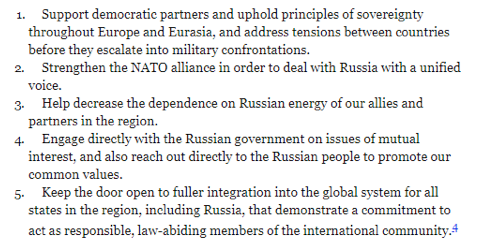
- Launching the Reset; 7. Universal Values; 8. The First (and Last) Moscow Summit
The continuation narrates an attempt to actually implement this policy and achieve these objectives. Mainly it is about interplay between Obama’s diplomacy, Medvedev and Putin. Medvedev was Putin’s placeholder when Putin in compliance with constitution stepped down from his position as president. It pretty much comes down to good cop/bad cop game, which was somewhat successful for Putin since he got pretty much what he wanted.
- New START
This is about arms control treaty that was left over from Soviet/American improvement of relation in Reagan / Gorbachev era. Obama’s objective was officially: the world without nuclear weapons, but per author’s description there were significant problems from Russian side who sincerely supported Obama’s intention as long it was limited to American weapons and were very reluctant to decrease any Russian weapons and even pore reluctant to allow onsite inspections. Per author narrative it looks like main barrier to extreme decrease in American weapons was outside Obama’s administration – Pentagon and Senate. It is also interesting how they achieved ratification by the Senate.
- Denying Iran the Bomb
This chapter about Obama’s outreach to Iran has a bit misleading header. In reality it is more about strenuous effort to help theocratic regime to survive and assure international support for its legitimation. It includes lots of interaction with Russia in effort to increase sanction in order to convince mullahs that it would be better for them to follow Obama’s path of low-key acquisition of bomb with international help, but without much of blustering.
- Hard Accounts: Russia’s Neighborhood and Missile Defense
This is about difficulties of working with countries – former Soviet satellites convincing them that accommodation to Russia and Iran are in their interests.
- Burgers and Spies
This is about Obama’s meeting with Medvedev in 2010, which was seemingly successful, but then was negated by discovery of Russian illegal spies network in USA.
- The Arab Spring, Libya, and the Beginning of the End of the Reset
This chapter is interesting by author description of Obama’s administration approach to Arab Spring. They were pretty happy to see secular dictators like Mubarak and Kaddafi overthrown and substituted by representatives of Islamic movement. Interestingly enough it led to public disagreement between Putin and Medvedev with former expressing strong unhappiness about pushing out these dictators, while Medvedev demonstrating willingness to follow Obama to support “democratic” empowerment of Islamists.
- Becoming “His Excellency”
The final chapter of this part describes process of author’s becoming American Ambassador to Russia just when Reset policy start moving to dust been of history. It happened after Medvedev, despite making some weak noises about running for the second term, opened road for Putin’s return to formal power.
Reaction
- Putin Needs an Enemy—America.
This part is about author’s tenure as USA ambassador to Russia at the time when Putin came back as president and decided that it would be beneficial for him to use America as symbolic enemy. Author describes how demonstrations against voting irregularity impacted Putin and his regime. This follows by description of harassment and use of link to American Embassy to accuse people in treason against Russia and in being American agents. There is somewhat interesting part of people that author knew during his activities in 90s as democrats that slowly, but reliably become Putin’s apparatchiks, executing very undemocratic policies against others.
- Obama and Me Photos
This is just a set of pictures relevant to author’s story.
- Getting Physical
This is more detailed narrative of multiple cases of harassment against author, his family and other Americans in Russia by Putin forces.
- Pushback
Here author is trying to present Obama’s administration response to Russian hostilities in many areas, but it really sounds funny, especially when author characterized as most important pushback attempts to remind Russians about good old times of reset and win-win relationships. Overall it was somewhat meaningless propagandist mini war.
- Twitter and the Two-Step
This is description of author’s seemingly successful attempt to use twitter to communicate directly with Russian public.
- It Takes Two to Tango; 21. Chasing Russians, Failing Syrians;
- Dueling on Human Rights
This is description of various failed attempts to maintain meaningful relations with Russia and several areas: arms control, business, human rights, and internationally, especially on Middle East. Author pays special attention to the story with Syria, trying present in the best light Obama’s actions or inactions.
- Going Home
By summer of 2013 author and his family run out of power and decided that enough is enough. This chapter describes process of resignation and disengagement from Russia and people there.
- Annexation and War in Ukraine; 25. The End of Resets (for Now)
This is about events occurring after author’s return home when US-Russian relations completely nosedived with Ukraine revolution against Russia propped forces, Putin’s annexation of Crimea, and little war against that country. All this caused implementation of sanctions against Russia and put it in the most hostile position against USA since the end of Soviet Union.
Epilogue: Trump and Putin
This is a typical dribble of Obama’s official against Trump, mainly repeating standard democratic narrative and demonstrating only that author has no clue about what Trump and his movement is, what they are trying to do, and why they actually quite successful in doing it.
MY TAKE ON IT:
It is a nice narrative of leftist’s travel from enchantment with Soviet union from afar, deep disappointment of close encounter, euphoria of semi-revolution or, more precisely, falling apart under the weight of corruption and dysfunctionality of the real socialist system, period of hope for something new and beautiful, not really fully conscious participation in the Obama’s leftist movement aiming to bring America in the same place where Soviet Union was before, and the first row observation position in the process of Russia going back to its traditional authoritarian roots. It is also a nice example of encounter of typical American academician with practically non-existent real live experience with tough KGB bureaucrat used to dealing with such naïve guys in interrogation room. It does not relate only to the author, who at least did deep diving into Russia for a while, but to the whole Obama team. It would be funny and a nice plot for comedy if not very sad consequences: much more strong and assertive authoritarian Russia, slow moving war in Ukraine, somewhat more energetically moving war in Syria, and reappearance of Russia as military power, albeit without any serious underlying economic power. In short – without Obama Putin would be history and non-authoritarian Russia would probably be much friendlier to USA.
20180722 – The Republic of Virtue
MAIN IDEA:
The main idea here is to review history of corruption in Democratic society, especially in USA, and demonstrate how it worked in the past, how it works now and propose some technical measures to diminish corruption and some legislative measures that could curb it at least somewhat.
DETAILS:
- THE UNITED STATES OF CORRUPTION
- Our Machiavellian Moment:Pay-for-Play Networks Republican Virtue
Author starts here with a movie plot when FBI set up sting operation when agent pretending to be foreign businessmen bribed American politicians. Then author somehow links it to “Citizen’s united”. From here author goes to real “Pay to Play” operations like Clinton foundation. Author uses this to present Republican Virtue as counter force that was acting in America since it’s beginning and actually was a part of the reason of its creation as reaction to corruption of British officials.
- Excusing Corruption:The Mutual Protection Association; The Polemarchist;
The Apologist.
This chapter refers to Tocqueville who clearly saw political corruption in America and compared it with family centered aristocratic institutions of France that he preferred. The interesting thing here is an idea that politics is kind of remedy against American individualism, creating sort of mutual help society, which just one of many mutual help organizations that were so popular in America at the time, but now declined with expansion of government. Author also discusses here Polemarchism that he defines as different attitude of network member to fellow member vs. out-of-network others. He illustrates it by referring to rich experience of Clinton and Obama networks. Finally, author presents a point of view of Apologist who basically states that for example Clintons should be allowed to be corrupted, because they do a lot of good and/or because they comply with various formal procedures.
- The Silent Killer: Rent-Seeking; Measuring Corruption; The Cost of Corruption; The Rule of Law
To estimate cost of corruption, author refer to TARP and sugar subsidies, but does not come up with any quantitative estimate. It follows by discussion of rent seeking behavior, regulatory capture, and a couple examples of how it is done. Then author presents estimates of corruption via polling:
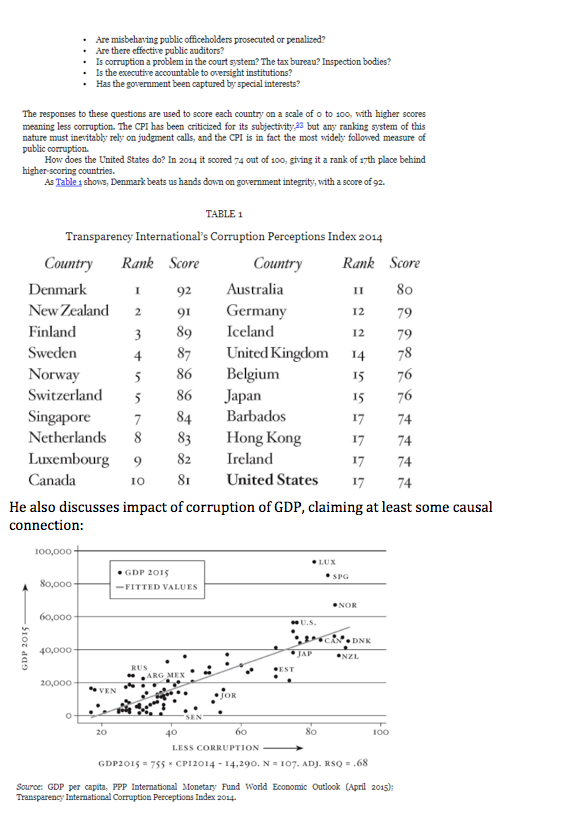
- The Dream of a Virtuous Republic: The Separation of Powers Federalism;
Money; Three Proposals
This starts with deviation to history and reference to earliest dreams of virtuous republic without corruption. After that author reviews ideas that were supposed to prevent this problem at American foundation, but mainly failed to do so:
- The separation of Powers
- Federalism
- Limitations on money in politics.
Instead author proposes his own 3 rules to curb corruption:
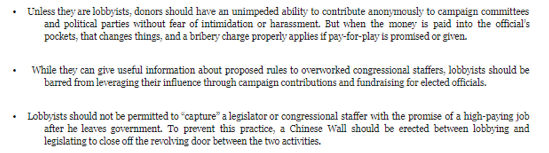
Il. THE SEPARATION OF POWERS:
- An Anticorruption Covenant:The Constitutional Convention Filtering Virtue; Choosing a Virtuous President
This is about Constitutional convention and how founding fathers tried to set up rules that would prevent corruption. Franklin suggested unpaid public officers so it would make it unattractive for individuals without sufficient wealth. Madison and majority preferred division of power with checks and balances and with general election of a virtuous president. It was expected that limited franchise would produce electorate of self-sufficient men who would not be easy to bribe, consequently assuring elected official acting in interests of common good for all people.
- What Corruption Meant to the Framers:Republican Virtue; Extensive Virtue; Governing Above Faction Private Virtue; Religious Virtue—and Vice
This is an interesting peace because 250 years is a long time and culture changed a lot. So, the notion of corruption was somewhat different. It was based, for example, on experience of king James who just used treasury at will and other processes of wealth transfer typical for monarchy – gifts, patronage, and such. Founders were looking to instill republican virtue, which meant work on behalf of public with no pecuniary interest whatsoever. Author defines supporters of this vision as Country party. Other vision was that individuals always greedy and it is inevitable that voters will be bribed. Therefore it is necessary to have powerful and wealthy leaders and independent voters so these leaders could not be corrupted. Author also discusses different types of virtue, as it was perceived at the moment, including, private and religious.
- The Promise of Virtuous Government:Reining in the Presidency; Electing a President; Impeachment;
This is about the debate that followed decision to establish powerful presidency that involved search for methods of limiting this power just in case when president happen to be not that virtuous. The first step was clear separation of power, preventing members of legislature to be included into executive power at the same time. It was done mainly to prevent corruption observed in British parliament. Another issue was presidential election, that was decided by Electoral College, which originally gave power to choose electors to the states and only over time moved to much more democratic form of nearly direct elections when majority within states and their weighted representation are deciding, leaving open possibility of minority of voter effectively distributed providing for majority in Electoral College. Author also discusses solution for vice-presidential position and election that proved to be ineffective and was changed early in the history of Republic. Finely, some serious attention was paid to Impeachment process to prevent Executive power from taking over.
- How Did That Work Out?Minoritanian Misbehavior; The Democratic Presidency Power and Corruption; A Grim Logic
The final part is about how did it eventually worked over the next 250 years and it is not the pretty picture. Congressmen bring home bacon, bribing voters and, as result, stay congressmen for live. Interest group capture legislation all the time, getting nice staff like indestructible sugar subsidies, and so on and on. Democratically elected president courting specific groups of population in strategically selected areas to obtain college majority and often does something in interest of small group of supporters at the expense of majority. In short American Constitution proved to be no match to human ingenuity in pursuit of corruption. However, it is still the best working system comparatively with all others ever tried.
Ill. FEDERALISM
- Federalism and Corruption:Bigness and Badness; Smalliness and Badness
It starts with discussion of origins of American Federalism. It was not an original intention of founding fathers, but rather necessity to accommodate small states without which any agreement would be impossible. Madison’s original idea of federal veto over state led to nowhere and eventually the principle of federal power as controller of interstate interactions rather intrastate live was established. Over time state power diminished and federal power grew dramatically and consequently corruption distributed among the state moved up to federal level. One exception is power of courts and author discusses in some details corruption of local courts in one specific case of money extorsion from Canadian company Loewen.
- The Mississippi Story: Mississippi Burning; Mississippi Cashes In
This is discussion of another clash between local Mississippi courts and Federal power, this one the older case of civil rights era. The second part of the chapter is about more contemporary story of tort lawyers’ extortion racket backed up by unwavering support of local judges.
- Designing a Virtuous Justice System:The Genius of the Framers’ Constitution; Genius Frustrated
This starts with discussion of design of American Justice system. It was based on 3 main decisions: selections of judges, their removal if corrupted, and allocation of judicial power between state vs. federal courts. All three decisions were based on multiple compromises and author briefly describes the final system established by the Constitution. After that author discusses complete diversity precedent established by Supreme Court in 1806 and how it allows everybody to sue everybody in any court, creating a mess and huge opportunities for corruption.
- The Silver Bullet: The Way Back; State Judicial Elections; A Judicial Aristocracy
After condemning American plaintiff friendly justice system in the previous chapter author points out here that there is no simple solution. He starts with discussion of McDonald coffee case that he presents not as aggreges as it is usually thought. The solution author proposes: state court should be permitted to compete in their judge made rules for out of state parties; Class action Act should be modified and author proposes how; State judicial elections processes should be modified. Finally, author praises American quasi-aristocracy of federal judges.
- MONEY
- Bribes: The Ordeal of Francis Bacon Corruption of the Heart; The Limits of Bribery Law
It starts with warning about problem of corruption of judges and then moves to the story of Francis Bacon, his bribery and eventual confession. After that author discusses contemporary bribery case when judge took bribes to sentence juveniles to prison terms in order to supply prisoners for private jail. The final part of the chapter is about political bribery when everything done without direct money transfer and often is not even possible to clearly identify as a bribe.
- The Republic of Defection: The Dismal Dialectic; Crimes of Democracy; The U-Curve
Here author compare what he believes are low and high trust countries: USA and Canada. He uses immigration issue in which Canada provided more assistance and on better terms than USA with wide support of all political forces. As crimes of Democracy author reviews cases of Dinesh D’Souza and his unusually harsh treatment and operation of political democrats in Wisconsin against Scott Walker. Finally, discussion moves to overall dynamics of Anti-corruption laws that usually are not very effective and often just become a tool for corrupted officials. Here is graphic representation of this dynamic:
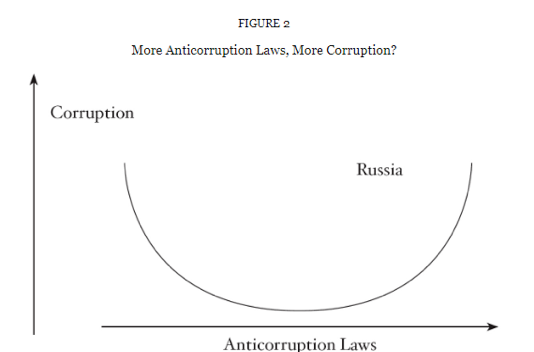
- Policing Crony Capitalism: What Doesn’t Work; Disclosure Requirements;
Contribution Limits; Spending Caps
The next stop is Crony capitalism when government helps some private businesses at the expense of others. Author demonstrates how typical legislative measures: Disclosure, Contribution Limits, or Spending Caps work to this end.
- Three Reforms: Mandated Anonymity; Suspect Donors; Chinese Walls
Here author suggests a few reforms that he believes could help to limit political corruption:
- Mandated Anonymity – politicians should not know who gave them money
- Completely forbid donations from donors suspected in expectation of potential payback, such as government contractors
- Similarly to suspected donors, Chinese wall between donors, bundlers, or lobbyists and appointments to various government positions
17.The Heavenly City of the Enlightened Reformer
Here author reviews various schemas for keeping politics clean such as public financing or voter vouchers for political donations and demonstrates that they basically not really workable. Author ends quite pessimistically pointing out that in election of 2016 highly corrupted Hillary Clinton received majority of votes indicting that people in democracy do not really object to corruption that much.
MY TAKE ON IT:
This is an interesting review, but it does not touch at the core of corruption common for all societies democratic or not. This core is ability of individuals with place in political/bureaucratic violent hierarchy of society to use this place for control over application of violence resulting in transfer of resources produced by other people to themselves. The idealistic form of corruption, when these people use control over violence to satisfy not their material, but rather psychological needs by forcing other people do something they do not want or not do something that they want, somehow is not considered as corruption, even if it causes people often much more pain and suffering than any amount of taxes and bribes could ever do. It is also often demonstrates that power is fungible, meaning that forbidding something, for example homosexuality creates opportunity for individuals in power exchange laxity of enforcement for bribes.
This corruption is inevitable and will always be with us as long as we have violent hierarchy of society involved in any activity that is not prevention, retaliation, or retribution for violence. As long as such hierarchies of individuals in power are involved in the redistribution of resources and/or control over individuals, they will always use this power to satisfy their needs and wants, which is practically definition of corruption.
20180715 – Neither Ghost not Machine

MAIN IDEA:
The main idea here is to discuss origin of live based on the new idea that it resulted not from random mix of different organic chemicals, but from similarly random dynamic interaction of constrains that result in origination of regularity and local rejection of the 2ndlaw of thermodynamics. Author presents notion of autogen – self-generator created by dynamic constrains of Autocatalysis and Capsid formation and defines it as the bridge between material world of cost and effect and living world of selves and aims they try to achieve. It is also an attempt to derive implications of this approach for multiple philosophical questions from determinism vs. free will to science and values interaction.
DETAILS:
- OVERVIEW
1 THE MYSTERY OF PURPOSE
Author starts with the statement that this book is about purpose and how it emerges from purposeless phenomena. The ambition here is to use science to provide explanation for this. Author defines here the main notion used in this book: self, which is practically everything living from grass to humans and then defines four questions:
- The Nature of Selves
- The Origin of Selves
- The Nature of Aims
- The Origin of Aims
He also defines reasons for this:
- Link between Selves and their aims.
- Link between Origins and Natures
After defining his objectives, author discusses attitude to these “mysteries”, commonality of everything living, the very notion of purpose, which he links to self-direction. He also discusses the mystery of live and the facts, that so far nobody was able demonstrate, of how non-living matter becomes living. Author claims that the question of origin of live is solvable and presents approach of his lead Terrence Deacon who concentrates on transition from Cause and Effects to Means and Ends behavior. The qualitatively different approach here is that Deacon removes assumption that one need addition to achieve new quantity, positing that it could be achieved by additional constrains, or in other words by subtraction. Author points out that molecules in a body are the same that elsewhere and therefore could move freely. Constrains are what limits these molecules to move only within body, creating conditions for self-regeneration, which is the key feature of living.
- THE BIGGEST MYSTERY WE EVER IGNORE
The mystery here is appearance of selves and their difference from non-selves. Author posits here the difference between non-selves and selves as difference between Cause-Effect pair and Means-Ends. Where former is just happening naturally, while latter defined by selves’ actions. After that, author looks at the notion of information as something specific for selves or machines working for selves. Author discusses bridge in human notions between selves and non-selves that is difficult to close and looks at various attempts typical for human culture to insert invented selves elsewhere where there are gaps in understanding of reality. It is especially interesting when humans hit transformation point from selves to non-selves as at the point of dying.
- DEACON’S SOLUTION IN BRIEF
Here author presents the brief version of his teacher’s solution to the problem of appearance of highly organized selves in the world of the 2ndlaw of thermodynamics. This solution is based on the idea of random constrains that occur naturally, limiting range of movement for molecules of non-selves, which in some cases could lead to increase of local orderliness. Author defines emergent vs. imposed constrains and posits that these constrains could lead to emergent self-regulation, which in turn could lead to regeneration and consequent establishment of circular self with somewhat dynamically stable conditions of birth – live with continuing intertwining of deterioration and self-repair – reproduction by creating another self that combines similarity with variation – death. Author concentrates on the notion of self-regeneration, which includes: self-protection, self-repair, and self-reproduction. Author introduces here idea of autogen that includes higher and lower levels of emergent constrains that causes self-generating selves.
Il. FRAMING, THER MYSTKRY
- TWO SOURCES OF CHANGE
Here author going into details of changes process. He discusses two toolkits: cause and effect, which is purely material and happens consistently all the time; and means and ends, which depends on selves and happens with great variety depending on selves and their internal and perception of external conditions at the moment.
- SELVES
This is look at what is self and author pretty much defines it as everything alive and then goes into discussing differences between human vs. non-human selves. Then he goes a bit into Descartes Body/soul (self) dichotomy. Somehow author comes to conclusion that selves are non-material based on the strange idea that living and dead bodies are materially the same (which they are obviously not).
- TWO GHOSTS, TWO MACHINES
This starts with discussion of supernatural ghosts that author obviously rejects and equivocal ghost or homunculi that kind of manage us from inside. This is also rejected as unscientific. The right approach is emergentism, which seeks to explain transition from one state to another via cause and effect dynamics to selves with time. After dealing with ghosts author moves to machines and defines them as either functional or non-functional depending on whether they serve selves or not. The final part is discussion of teleonomy, meaning impression of purpose, resulting from Couse/effect laws of nature.
- INTERPRETATION
It is about typical notions that make sense only in relation to selves such as: FOR-NESS, ABOUT-NESS, and interpretations of behavior.
8.AIMS
Similarly, author discusses aiming as constraining meaning that when selves aim at something to de-liberate them from something else. Author looks at differences between human approaches to aiming, which is pinpoint aiming in both time and space, but it is much less precise for other selves. Author also discusses here determinism, which is rejected and then pairs: determinism vs. probability, and probability vs. possibility.
- EVOLUTION’S LIMITED LIMITING ROLE
The final chapter of this part is about evolution and author stresses its aimless character. However, he points out that only selves have aims that could evolve because of variance: generation, not replication. The final point here is that Darwin’s “Origin of species” is somewhat a misnomer because we do not know about origin, we only know about transformation. The origin itself – that is production of living self from non-living materials, is still a mystery.
III. DEAD ENDS, LIVE CLUES
- THE HISTORY
Author starts this with example of various functional causes going back to Aristotle:
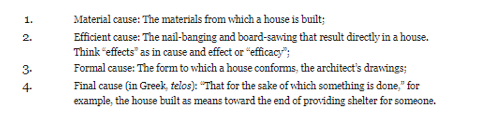
From here author goes to discussion of Christian and Islamic attitude to causes and tendency to insert god into causal relationship whenever gaps in understanding occur. This tendency was greatly undermined by development of scientific approach, which makes god a lot less necessary for understanding the world and practically useless for predicting future outcome of actions.
- EVOLUTIONARY THEORY’S ELUSIVE SELF
The next stop is discussion of evolution. First it discussed from the Darwin point of view and then going to Dawkins with his “selfish gene” and “blind watchmaker”.
- INFORMATION ABOUT NOTHING FOR ANYONE
Here author moves to Shannon and theory of information, which is basically theory of imperfect communications.
- THE ENGINEERED GHOSTS IN OUR MACHINES
Here it is computer that is object of discussion or more precisely its ability to imitate humans and Turing test. Author seems to believe that computers could eventually become selves, but we are far away from that. Finally, author discusses “reverse engineering fallacy” that means science first. In reality engineering often comes first when something is done and works without doer understanding how it works. There is a nice statement here “The map is not territory”.
- SMALL IS DUBIOUS
The final peace is about small particles approach to the search of understanding of live in quantum mechanics and physics. Author provides a brief review of a number of approaches, none of which he considers valid:
- GROUNDING A SOLUTION
- PROCESSES OF EMERGENT ELIMINATION
This starts with discussion of materialism vs. naturalism. Author states that naturalism is wider notion because it includes absences, which materialism does not. Author also includes dynamic changes into natural, but not material phenomenon. Then he moves to interesting part of discussing processes of elimination vs. processes of production, with former being natural processes leading to creation of selves, while latter are typical for selves. Another unusual approach here is discussion of negative scientific breakthroughs. Author refers here to evolution, which works by eliminating unfit, information theory where message received is whatever left of message sent, and cybernetic self-organization, which eliminates states of the system inconsistent with its functioning. Finally, author moves to discuss selves’ emergence of new dynamic paths. The application here is to look from elimination point of view, for example instead of what makes something alive to look at what prevents something from dying.
- SECOND LAW
This starts with an interesting question: what is more complex frog or blended mix of its parts? Author position is that blend is more complex because in one case parts are organized and easily identified, while in the mix everything is elsewhere preventing categorization. Author present is as 2ndlaw of thermodynamics – entropy. Normal movement from simple – organized staff to complex, mixed staff is according to this low, but the puzzle is how regularity such as selves were created in the first place. Author’s response is that it happens via irregularities that constrain path of movement, generating regularity. One of examples – paths development when more walked on path becomes more and more attractive for walkers, consequently becoming a road. Author’s here is that nothing added, but rather potential paths are eliminated.
- EMERGENT REGULARIZATION
It starts with discussion of material constrains like walls, which are defined as imposed constrains. Author present another form of constrains – self-organization as emerging constrains created throughout dynamics – something like turbulence created by mix of currents of the river or crown movement out of stadium. This follows by discussion of top-down causality and critic of notion of self-organization, which author wants to substitute with new term: emergent regularization. This emergent regularization means increase in constrains eventually leading to self-regeneration.
- EMERGENT REGULARIZATION VS. EMERGENT SELF-REGENERATION
Important point here is that emergent regulation is temporary and local effect, but it produces self-generation that from this moment on start producing highly regulated material. Author provides example of fossil fuel that is at its core such regulated material with high concentration of energy created by selves. After that author refer to Schrodinger’s idea of unknown laws of nature that possesses negative entropy – negentropy that would differentiate living from non-living material. Author’s point is that emergent regularization is practically doing just that. After that author defines self-regeneration as combination of 3 fundamental capacities presented in such way:
At the end of the chapter he discusses interaction between these 3, which is quite complex because they impose opposite demands.
- OTHER EMERGENT REGULARIZATION DYNAMICS
Here author surveys 3 types of emergent regulation dynamics:
- Benard Cells – regular pattern created by heated oil due to variance of temperature between layers of this oil.
- Autocatalysis, when there is closed loop of catalyst supporting chain of reaction leading to production of more of this catalyst.
- Crystals, which author calls frozen regularity. Author uses it as sample of aperiodicity somewhat similar to DNA.
At the end author discusses 3 what he calls “proposed missing links, falling short”, each of which has a camp of supporters:
- COUPLED REGULARIZATION PROCESSES
The chapter starts with reference to Kant and his machine’s motive power vs. life’s formative power, the last one being systemic with everything interconnected creating vector from means to ends. Deacon and author’s approach is different and based on idea opposite to usual: the whole is less than sum of its parts. In other words, it is the system of reciprocal constrains that author calls synergistic coupling. One candidate for such coupling is Eigen’s hypercycle – coupling of multiple autocatalytic processes. After that author discusses “Error Catastrophe” when various processes in the system go out of sync, which in author believe would prevent hypercycles from creation of live. Another candidates discussed are “autopoietic units” formed by autocatalytic processes that create membranes. Author believes that this is unlikely scenario due to low probability of such occurrence. Author provides more details on this, but concludes that all this is not enough to generate life.
- DEACON’S SOLUTION
- AUTOGENS: SELF-GENERATORS
This is discussion of autogen and its use as a model for origin of live. Here is pictorial presentation:
Author discusses autogen cycles and its dynamic constrain tendencies resulting in self-generation for which it meets all 3 requirements: Self-protection, self-repair, and self-reproduction.He also looks at information collection from environment and self-cleaning, concluding at the end that autogen provides for evolvable reproduction at the edge of chaos.
- EVOLVED AUTOGENS
This is the next step in the theory of autogen – adding selectivity to autogen interaction with environment. This obviously allows for evolutionary development because selectivity and choice is what allow for preferable survival of selves that do it more effectively. After that author moves to discuss replication and currently dominant origin of life theory based on RNA replicators. At the end author discusses hypothetical scenario for templates being incorporated into autogen providing for autogen lineages ability to inherit random monomer sequences.
- WHERE IS THE SELF?
The first question here is if autogen is self. So far it is all theory since an autogen is still to be generated in a lab or observed spontaneously arise in nature. After that author goes into discussion of reciprocity of parts in living body and so is autocatalysis vs. capsid formation could be considered reciprocal, creating entity that has an aim of not ending. Here is the illustration of such super primitive self:
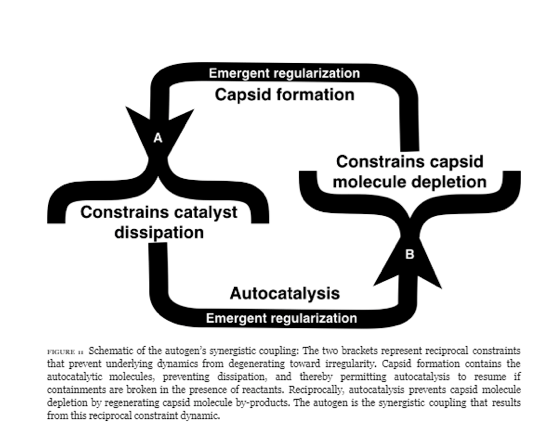
At the end author points out that self is not really material object similarly to whirlpool, which is not material condition of material water molecules. Therefore, what author calls synergetic coupling of Autocatalysis and Capsid formation could start evolutionary process expanding all kind of entities that combine all three basic capacities: self-reproduction, self-repair, and self-protection.
- THE CONSEQUENCES OF SELF-REGENERATION
Author starts this with discussion of trying, which he defines as specific characteristic of selves’ attempt to avoid ending. He then moves to consequences of trying: emergence of good and bad, self-other relationship, foresight, and memory.
- THE INTERPRETING SELF
- CODES, SIGNS, INTERPRETERS
Here author is using autogen in attempt to analyze selves at their most primitive level so to avoid complexities added by evolution. He starts with functional constrains, the first one being a coincidence of autocatalysis and capsid formation being together (dynamic constrain) and the second: catalysts clustered together in autogen seed (static constrain). Consequently, author discusses information first theories of live, DNA and link of information transfer functionality to selves.
- KINDS OF SIGNS
Here author looks at nature and functionality of signs, symbols, and symbolic systems. The most important probably here is discussion of interpretations and the notion of only selves being able to interpret anything at all.
VII. IMPLICATIONS
- A CONSTRAINT-BASED APPROACH TO EVOLUTIONARY THEORY
Author looks at implications of autogen theory and notes that template – DNA is redundant and this gives the freedom to explore. He also points out that evolution is basically theory of constrains because they are causing selective pressures and remove unfit. Author critics a simplified idea of evolution and promotes idea that selves at least somewhat drive evolution of choosing what aims they are trying to achieve. He is trying to provide an adjustment that is based on 3 R: Redundancy, Relaxation, and Repurposing.
- IMPLICATIONS FOR THE WILL DEBATE?
Another issue is implication of this theory to the free will. Author claims that will is neither free nor determined, but rather it is complex source of action predefined by selves’ aims. He rejects an idea that motor neural activities occurring before conscious decision demonstrate absence of free will, it only demonstrates that organism is more complicated than simple top down hierarchy. After that author discusses categories, symbolic interpretations and unexpected consequences. While rejecting determinism, author also rejects simplified application of Heisenberg uncertainty principle to selves, stating that we have incomplete determinism in the probabilistic world. He also discusses theory of chaos pointing out that normally butterflies do not really create hurricanes. Finally he discusses a notion of strange loop, which is ambiguity of causes and effects relationship, concluding that “We evolved selves are strange loop also, tangled hierarchies of levels of representation. Our DNA is not full representation of all constrains, but rather loose set of molecular representation of temporal and developmental constrains not reducible to chemical dynamics.
- MAKING SCIENCE SAFE FOR VALUE
It starts with the discussion of Hume’s guillotine: oughtis not deducible from is. In other words science cannot speak to questions of value. Author suggest that if oughtmeans value for selves; they could be expressed via selves’ aims. Author then moves to science / religion contradiction and suggest that it should not prevent scientific approach to values, which is not deterministic and does not involve anything supernatural, but rather based on selves who have aims resulting in forming values and negotiating between each other over these values. He ends with the point that the higher value for humans should be self-preservation as the one and only symbolic life.
MY TAKE ON IT:
I find the approach via subtraction (constrains) rather then addition to the problem of origin of life very interesting, but very difficult to test in any conceivable settings. It does make a lot of sense and is quite possibly explanation close to reality. However I think that implication of it to all philosophical questions being a bit of the stretch, except for the idea of difference between living and non-living objects as between selves that have aims and material objects that have no aims whatsoever and just being moved by natural phenomenon of cost and effect. I think it would make sense to add that selves’ aims depend on their material condition in time and space, which defined by complex material cause – effect events that consequently prompt selves initiate action that seek to achieve aims via probabilistically predictable cause-effect events.
 Equal Rights Libertarian