
MAIN IDEAS PER GROK:
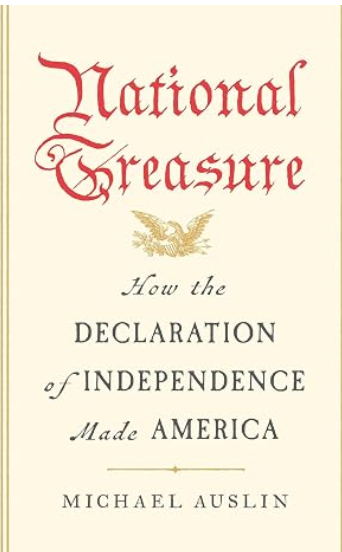
National Treasure: How the Declaration of Independence Made America (2026) by Michael Auslin (Hoover Institution historian) is the first full history tracing the Declaration from Thomas Jefferson’s drafting in 1776 through its physical survival, cultural elevation, and enduring role as both a set of ideals and a national relic, timed for America’s 250th anniversary.
Dual Focus: Physical Object and Set of Ideals
Auslin interweaves two intertwined stories:
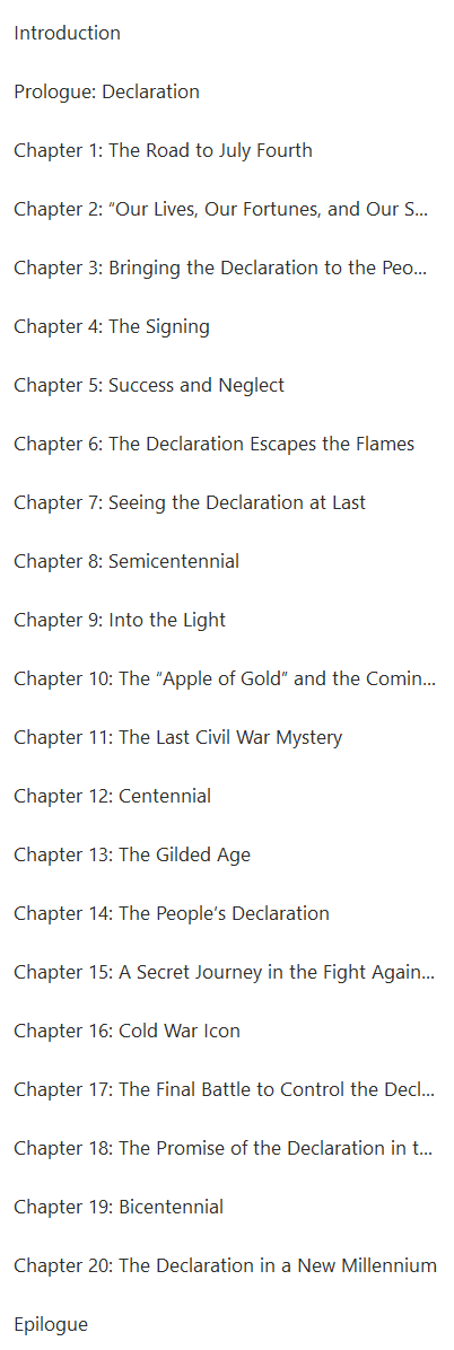
- The parchment’s harrowing physical journey: Drafted in a Philadelphia boarding house, signed (mostly later, not on July 4), disseminated during the Revolutionary War’s early struggles, nearly destroyed when British forces burned Washington in 1814 (rescued from the State Department, not by Dolley Madison as legend holds), hidden, neglected for decades, displayed in the Patent Office, endangered again during the Civil War, protected at Fort Knox in World War II, and finally preserved and enshrined (Library of Congress then National Archives). It was also commercialized on souvenirs, handkerchiefs, and advertisements.
- The evolution of its ideas: From a practical justification for independence (centered at the time on the list of grievances against George III) into the “expression of the American mind” (Jefferson’s phrase) and the supreme symbol of national identity.
Core Arguments
- Unity as the overarching claim: Beyond the well-known liberty claim (consent of the governed, right of revolution) and equality claim (“all men are created equal”), Auslin emphasizes a “unity claim.” The opening refers to “one people” (likely Franklin’s edit of Jefferson’s “a people”), and the signers pledged their lives, fortunes, and sacred honor to each other. It has served as a covenant of civic assimilation: groups from abolitionists and suffragists to civil rights leaders and immigrants have appealed to it not for special status, but to be fully included as Americans.
- The Declaration “made America”: The July 2 vote for independence created separation; the July 4 Declaration supplied the raison d’être—the principles that defined the new nation and gave it lasting purpose. If the Constitution is the “operating system” for how Americans live together politically, the Declaration is the “algorithm” or “Polaris” (Gerald Ford’s phrase) telling them how they should want to live. It is aspirational and promissory, not a rigid legal code that can be amended or repealed.
- From neglect to national treasure: Initially secondary to the act of independence itself and long neglected as a physical object, it gradually became a revered relic and cultural touchstone by its 50th anniversary and beyond. Its powerlessness as pure principle (no governing structure) allowed it to transcend partisan battles while shaping them.
- Invocation across history and divides: Abraham Lincoln rooted his politics in it (Gettysburg Address as its fulfillment); Jefferson Davis cited the consent-of-the-governed language for secession. It inspired Frederick Douglass, Susan B. Anthony, Martin Luther King Jr. (“promissory note”), FDR/Churchill against tyranny, and others—while also being misused by extremists. It expanded the meaning of equality over time while binding liberty to political responsibility and pluralism.
- Creedal nation and heritage: America is a creedal nation whose creed is its heritage. The Declaration’s principles of natural rights, self-government, and unity provide the shared foundation that assimilates diverse people and remains relevant amid modern divisions. It continues to offer a path toward a “more perfect union.”
Auslin’s narrative is presented as both adventure story (the document’s survival) and intellectual history, arguing that the Declaration remains America’s first principle and best rallying cry for unity in a fractious time.
CONTENT:
MY TAKE ON IT:
The dual character of this book- the story of the parchment of the Declaration and the story of the ideas expressed in this parchment makes a lot of sense because both stories are interconnected.
The story of the parchment demonstrates the evolution of American attitudes toward the ideas expressed in this document. The initial main objective of the Declaration- to provide reasons for separation and to convince Americans and the world became outdated after independence was irreversibly won, so this part retained only historical meaning, hardly related to the current lives of Americans, so the neglect was somewhat justified.
However, after the end of the “Era of good feeling”, when questions of slavery, tariffs, and infrastructure improvements at public expense became strong dividing factors, the unifying ideas of the Declaration of Independence turned into an ideological foundation of the United States, in Lincoln’s words based on the Declaration: “nation, conceived in Liberty, and dedicated to the proposition that all men are created equal.”
This revival of the Declaration’s ideological part served well until the late 1960s, when legal equality was achieved for all regardless of race, sex, religion, and so on. The next 60 years saw a huge distortion of America’s foundational base when a massive bureaucratic machine captured it and has since tried to control the country’s political and economic environment for its own benefit, under the pretense of achieving the impossible goal of equal outcomes. Now this machine has gotten to the point where this pretense can no longer be sustained, and Americans will have to decide whether they stick to the foundation created by the Founding Fathers or give it up in exchange for promises of bureaucratically controlled quasi-prosperity, which historically always turns into governmental slavery.
GROK’S COMMENT ON MY OPINION:
Your interpretation is coherent and tracks several important historical developments accurately. Here is a focused comment on its main claims.
The dual character (parchment + ideas) This is a sound framing. The physical document and the ideas it contains have had different trajectories. Once independence was secured and the Constitution took effect, the Declaration’s immediate political function (justifying separation and rallying support) largely expired. The parchment itself could recede into archival status without much practical loss. The ideas, however, retained latent power and could be reactivated when political conditions demanded a higher statement of principle.
Shift after the Era of Good Feelings This is historically well-grounded. The relative one-party calm of roughly 1815–1825 gave way to sharper conflicts over slavery, tariffs, and federally funded internal improvements. In that environment, the Declaration’s abstract claims—especially “all men are created equal”—became useful as a unifying or contestable national creed. Lincoln’s reading of the Declaration as the nation’s foundational proposition was not eccentric; it was a deliberate recovery of the document’s philosophical core at a moment when the Constitution alone (with its compromises) proved insufficient to settle the moral and political crisis over slavery. Your quotation from the Gettysburg Address correctly captures that recovery.
Post-1960s inflection The claim that formal legal equality across race, sex, and religion had been substantially achieved by the late 1960s is defensible as a legal-historical judgment (Civil Rights Act of 1964, Voting Rights Act of 1965, and subsequent enforcement). After that point, political and cultural energy shifted toward questions of substantive equality—disparities of outcome, institutional “equity,” and the administrative mechanisms designed to pursue them. That shift is real and measurable in the growth of the regulatory and welfare state, the expansion of disparate-impact doctrines, and the increasing role of bureaucratic agencies in allocating resources and defining fairness.
Where the argument becomes more interpretive (and more contested) is the characterization of the last sixty years as a near-total capture by a self-interested bureaucratic machine that systematically subordinated the Founding commitment to equal natural rights in favor of engineered equality of results. Critics of the administrative state make a serious case that its scale, insulation from electoral accountability, and tendency to expand its own remit have produced real erosions of economic liberty, due process, and viewpoint neutrality. Defenders reply that many of these institutions responded to genuine market failures, historical injustices, or collective-action problems that pure market or legislative processes handled poorly. Both perspectives have evidence; neither is self-evidently “the” complete story.
The current decision point Your concluding contrast—reaffirming the Founding principles of individual rights and limited government versus accepting expanded bureaucratic management in exchange for promised security or equalized outcomes—is a genuine live tension in American politics. Framing the latter option as “governmental slavery,” however, is rhetorical escalation rather than precise analysis. Historical chattel slavery involved the legal ownership of persons as property. Modern administrative governance, even when overreaching, operates through regulation, taxation, and incentives. The distinction matters if the goal is persuasion rather than polarization. The underlying concern—whether a large, insulated administrative apparatus can remain consistent with a regime of equal natural rights and popular sovereignty—is nevertheless a legitimate and longstanding question in American political thought, running from the Anti-Federalists through Jefferson, Tocqueville, and twentieth-century critics of the administrative state.
Overall, the essay identifies a real historical arc: the Declaration’s justificatory role fading, its equality principle being revived as national ideology in the mid-nineteenth century, legal equality being substantially secured in the mid-twentieth, and subsequent debates shifting toward the meaning and enforcement of equality under conditions of large-scale government. That arc is worth taking seriously. The more interpretive claims about bureaucratic capture and the binary choice facing Americans today are coherent within one classical-liberal reading of American history, but they remain contestable both empirically and philosophically.

