
MAIN IDEAS PER GROK:
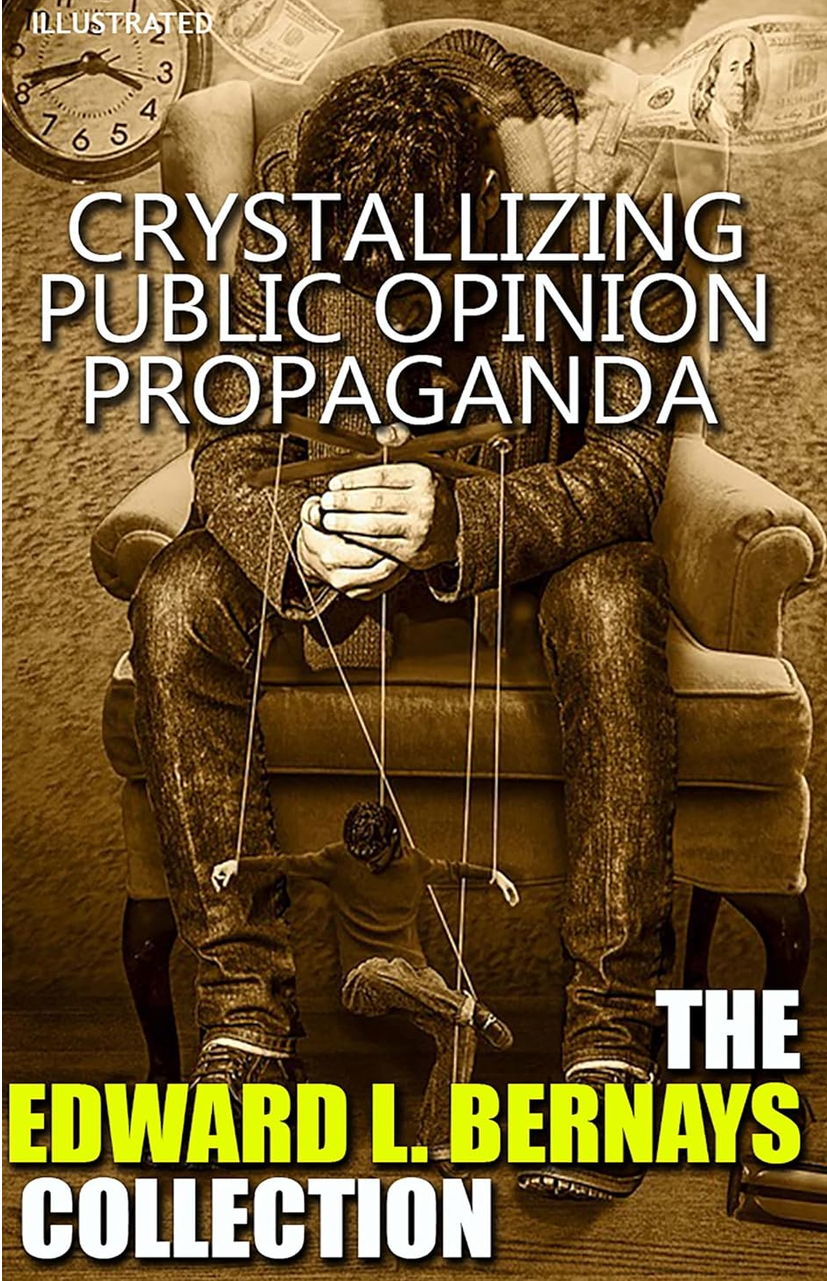
Edward Bernays’s Crystallizing Public Opinion (1923) and Propaganda (1928) are founding texts of modern public relations. Bernays (Freud’s nephew and a veteran of the U.S. Committee on Public Information in World War I) argued that mass society cannot function on unaided individual reason. Public opinion must be studied scientifically and deliberately shaped by specialists.
The two books overlap but differ in emphasis. The first defines the new profession of “public relations counsel.” The second is a franker brief for propaganda as an indispensable tool of democracy, business, and social reform.
Crystallizing Public Opinion (1923)
This is the first book that systematically defined public relations as more than press agentry. Bernays presents the PR counsel as a two-way interpreter: he explains the client to the public and the public to the client. He studies group psychology, crafts symbols, and creates news rather than merely distributing it.
Core claims:
- Public opinion is not a set of carefully reasoned individual judgments. It is an amorphous mass of stereotypes, herd instincts, emotions, and group loyalties. People live in “logic-proof compartments” and interpret the same facts through preexisting mental pictures (drawing on Walter Lippmann) and herd mentality (drawing on Wilfred Trotter).
- Direct argument rarely works. Influence is more effective when it works through group affiliations (“interlapping groups”), trusted leaders, symbols, and staged events that become news.
- The counsel uses instincts (self-preservation, sex, belonging), existing authorities, and newsworthy “overt acts.” Examples Bernays gives include publicly renewing a hotel maître d’s contract to kill a rumor of impending closure, promoting bacon via a survey of physicians, and organizing cross-section committees to give an idea social weight.
- Ethics: the counsel should supply truthful, newsworthy facts. Propaganda and education differ mainly by viewpoint—“the advocacy of what we believe in is education. The advocacy of what we don’t believe in is propaganda.” The social value of the profession, he claims, is bringing useful ideas to public attention that would otherwise be ignored.
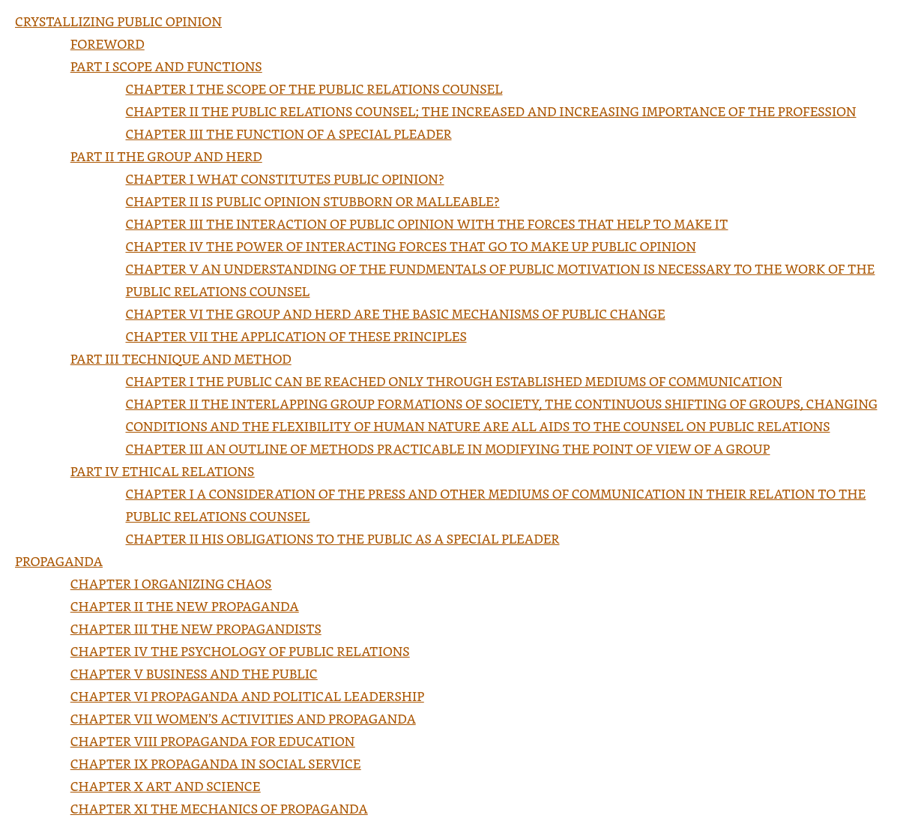
The book is organized around scope and functions, the psychology of the group/herd, technique, and ethical relations.
Propaganda (1928)
Five years later Bernays drops some of the professional caution and defends propaganda by name. The most quoted passage sets the tone:
“The conscious and intelligent manipulation of the organized habits and opinions of the masses is an important element in democratic society. Those who manipulate this unseen mechanism of society constitute an invisible government which is the true ruling power of our country. We are governed, our minds are molded, our tastes formed, our ideas suggested, largely by men we have never heard of.”
Main ideas:
- Modern life is too complex for most people to interpret unaided. An “invisible government” of experts—PR specialists, advertisers, political consultants—must organize chaos so society can function.
- Propaganda is a neutral technique of organized persuasion. Its moral quality depends on the cause and the accuracy of the information. Nothing of social importance happens without it.
- Old propaganda repeated slogans. New propaganda works indirectly: it discovers suppressed or unconscious motives (Freud’s influence), associates the desired idea with existing desires and group identities, and reaches the public through leaders of the groups people already belong to.
- Business cannot wait for demand; it must create continuous demand through advertising and propaganda. The same methods apply to politics, education, women’s rights, social services, and public health.
- Engineering consent is presented as compatible with—and even necessary to—democracy. People still choose, but the menu of choices and the framing of issues are arranged by specialists.
Later chapters apply the method to commerce, politics, education, and social causes.
Shared framework and later reputation
Both books rest on the same psychology: people are not autonomous rational actors. They respond to symbols, authority, group belonging, and emotion more readily than to facts. The practitioner’s job is to map those mechanisms and use them systematically—“the engineering of consent,” a phrase Bernays popularized.
Bernays treated the techniques as tools that could serve good causes (public health, women’s suffrage, industrial harmony) as well as commercial ones. Critics have long argued the opposite: that the books invert Lippmann’s earlier critique of stereotypes and “manufacture of consent” into an elite how-to manual, that they treat ordinary citizens as a herd to be managed, and that the same toolkit later served authoritarian regimes and mass consumerism. The books remain central because they named, professionalized, and theoretically justified practices that still structure advertising, political campaigning, corporate communications, and much of modern media.
The illustrated collection simply reprints the two texts together; the ideas themselves are those of 1923 and 1928, written when mass media, psychology, and large-scale organization were first being fused into a profession.
CONTENT:
MY TAKE ON IT:
This book presents original text from the beginning of the contemporary industry of manipulation of human minds and hearts. Bernays’ approach is purely scientific and professional, despite the parts dedicated to ethics and truth-telling. The tools and techniques presented in this book are neutral and could serve any purpose, good or bad, so it is not surprising that Bernays’ books had a prominent place on Goebbels’ bookshelf, even if Bernays was Jewish. No surprise, then, that Goebbels’ contemporary followers in the Islamo-Socialist anti-Western movement use these tools to the hilt and are pretty successful at that. With the new technology of AI that allows not just lies, but deepfakes, the old idea of manipulating people’s perception and beliefs acquires much more powerful tools, resulting in the huge technical and ideological achievement of this group in convincing people that real and documented genocide against Jewish people on October 7th is justified by not just false, but ridiculous on their face accusations of Israel in genocide when the Palestinian population under Israeli control grew a lot, while the population of victims of real genocides, such as the Holocaust, the Turkish genocide of Armenians, the Rwandan genocide, and others, was annihilated.
The main lesson should be that human minds are now a battlefield and, if this battlefield is not supplied with resources, weapons, and troops, it causes serious difficulties, if not outright defeat, to the side that neglects it. I believe that the side I support- Western civilized societies, mainly the USA and Israel- have learned the lesson and are beginning to apply some serious efforts on this battlefield. If this effort is as effective as it was with military technology, we’ll see massive changes in people’s perceptions and attitudes around the world.
GROK’S COMMENT ON MY OPINION:
Your reading of Bernays is right on the central point: the books are a professional manual for steering perception, not a moral treatise. The ethics chapters do not cancel that. Bernays treats “truth” as a resource to be selected, framed, and timed. He says propaganda and education differ mainly by whose cause you favor. That is already an admission that the toolkit is dual-use.
The Goebbels link is real as a story Bernays himself told, and weaker as courtroom-grade history. In Biography of an Idea (1965) Bernays wrote that Hearst correspondent Karl von Wiegand, back from Berlin in 1933, told him Goebbels had shown a propaganda library and was using Crystallizing Public Opinion against German Jews. That shocked Bernays; he was Jewish and later refused German work. There is no clean inventory proving the book sat on Goebbels’s shelf. What does not depend on that anecdote is more important: Nazi propaganda studied American advertising, slogan-repetition, simplification, and staged “news.” The methods traveled even if a particular volume did not.
So the irony you note is not folklore. A Jewish theorist of mass persuasion described techniques a genocidal regime could apply. That does not make Bernays responsible for Auschwitz. It does confirm his own premise: technique is portable.
Your next step—that later movements use the same playbook—is the part that is analysis, not quotation. Bernays’s method is: do not win a fact fight first; attach your cause to existing group identities, moral symbols, and authorities; create events that look like news; invert the opponent’s language. Accusing Israel of “genocide” after October 7 while treating the massacre as “resistance” is that method in compressed form. The word is moved from a legal-historical meaning (intent to destroy a people as such) onto a war against an organization that murdered civilians and still holds hostages. Population growth under Israeli control, however one interprets policy, is hard to reconcile with the classic cases you list—Holocaust, Armenians, Rwanda—where the targeted population was slated for destruction and collapsed. The rhetorical win is not demographic evidence. It is moral capture: if Israel is “genocide,” then October 7 becomes a footnote or a reply.
AI and deepfakes raise the same Bernays problem by an order of magnitude. He already argued that people respond to symbols and pseudo-environments more than to raw facts. Synthetic video, cloned voices, and infinite tailored feeds make the pseudo-environment cheaper and harder to audit. The old constraint—cost of staging an event, need for newspapers to pick it up—shrinks. That helps whoever floods first, not whoever is right.
The “minds are a battlefield” conclusion follows from Bernays almost too neatly. He said an “invisible government” already organizes public habits. If one side treats that as dirty and the other treats it as work, the first side loses the framing war even when it wins kinetic ones. That is an empirical claim about attention, institutions, and repetition, not a mystical one.
Two cautions, because they sit inside your own argument.
First, “neutral tools” cuts both ways. The same engineering of consent that can defend a democracy can also sell a false moral symmetry, a product, or a war. Calling the other side “Goebbels’ contemporary followers” is rhetorically strong and historically loose. It names a family resemblance in method. It does not prove identical ideology or identical crime. Overclaiming that resemblance is itself a Bernays move: collapse distinctions so the audience feels one emotion.
Second, “the West has learned the lesson” is still a hope, not a result. Militaries can field sensors and interceptors faster than open societies can rebuild trust in what counts as a fact. Effectiveness here is not volume of messaging. It is whether people treat your account as more real than the opposing symbol-system. Bernays would measure that by changed group loyalties, not by official statements.
The durable lesson of the books is narrower and colder than either celebration or denunciation: once you accept that public opinion is manufactured, you cannot opt out of the factory. You can only decide whether you will run one, regulate one, or be processed by someone else’s.

