
20261025 – Bernays Collection
MAIN IDEAS PER GROK:
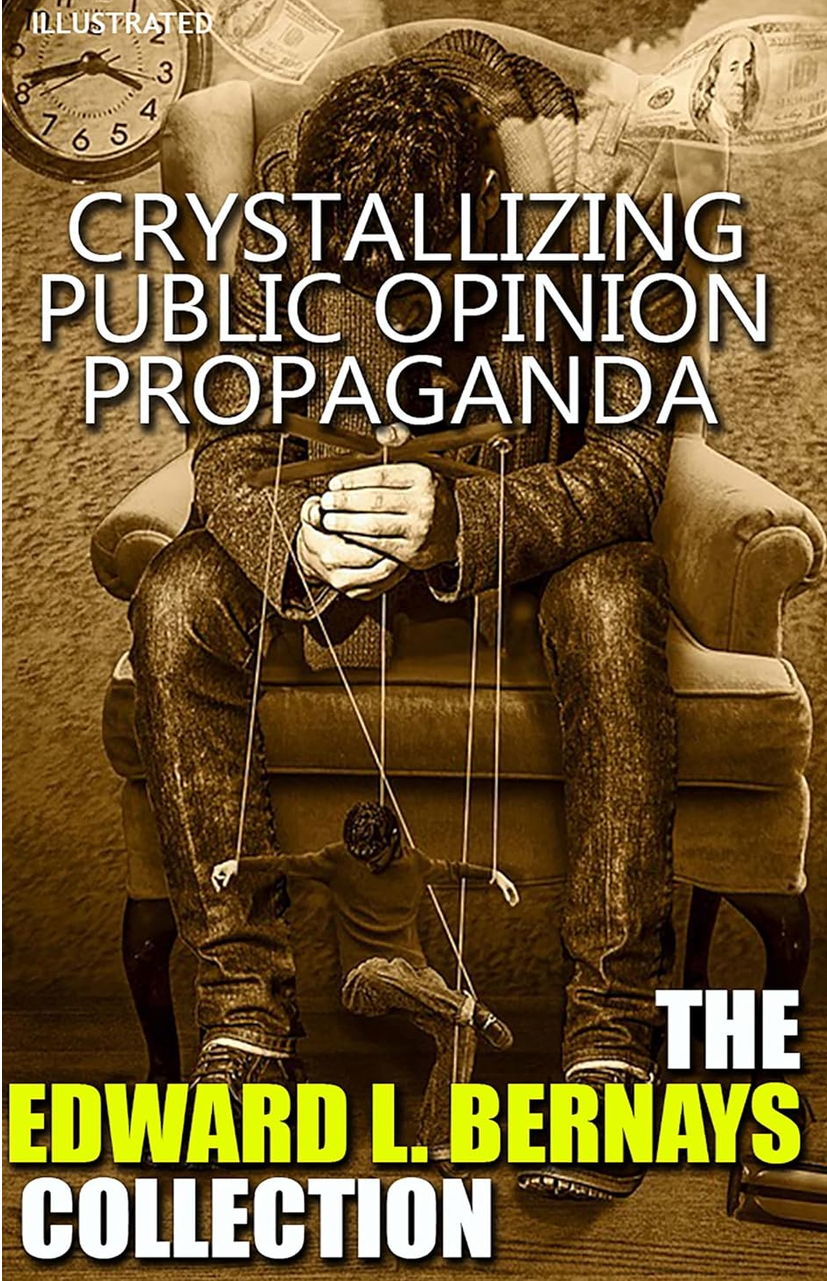
Edward Bernays’s Crystallizing Public Opinion (1923) and Propaganda (1928) are founding texts of modern public relations. Bernays (Freud’s nephew and a veteran of the U.S. Committee on Public Information in World War I) argued that mass society cannot function on unaided individual reason. Public opinion must be studied scientifically and deliberately shaped by specialists.
The two books overlap but differ in emphasis. The first defines the new profession of “public relations counsel.” The second is a franker brief for propaganda as an indispensable tool of democracy, business, and social reform.
Crystallizing Public Opinion (1923)
This is the first book that systematically defined public relations as more than press agentry. Bernays presents the PR counsel as a two-way interpreter: he explains the client to the public and the public to the client. He studies group psychology, crafts symbols, and creates news rather than merely distributing it.
Core claims:
- Public opinion is not a set of carefully reasoned individual judgments. It is an amorphous mass of stereotypes, herd instincts, emotions, and group loyalties. People live in “logic-proof compartments” and interpret the same facts through preexisting mental pictures (drawing on Walter Lippmann) and herd mentality (drawing on Wilfred Trotter).
- Direct argument rarely works. Influence is more effective when it works through group affiliations (“interlapping groups”), trusted leaders, symbols, and staged events that become news.
- The counsel uses instincts (self-preservation, sex, belonging), existing authorities, and newsworthy “overt acts.” Examples Bernays gives include publicly renewing a hotel maître d’s contract to kill a rumor of impending closure, promoting bacon via a survey of physicians, and organizing cross-section committees to give an idea social weight.
- Ethics: the counsel should supply truthful, newsworthy facts. Propaganda and education differ mainly by viewpoint—“the advocacy of what we believe in is education. The advocacy of what we don’t believe in is propaganda.” The social value of the profession, he claims, is bringing useful ideas to public attention that would otherwise be ignored.
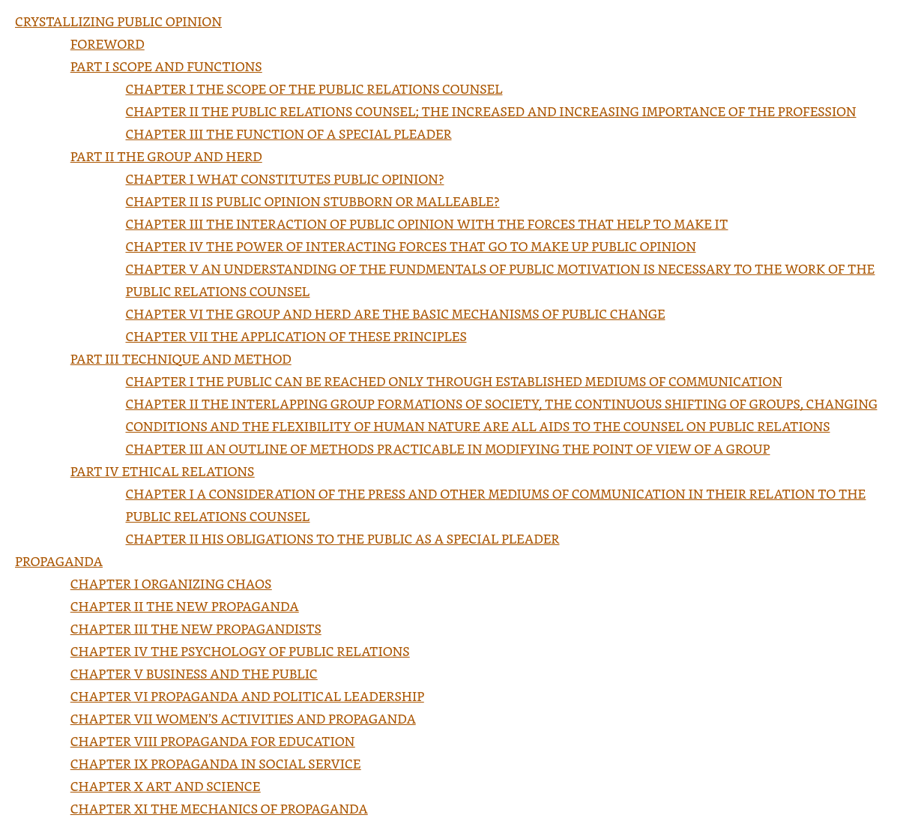
The book is organized around scope and functions, the psychology of the group/herd, technique, and ethical relations.
Propaganda (1928)
Five years later Bernays drops some of the professional caution and defends propaganda by name. The most quoted passage sets the tone:
“The conscious and intelligent manipulation of the organized habits and opinions of the masses is an important element in democratic society. Those who manipulate this unseen mechanism of society constitute an invisible government which is the true ruling power of our country. We are governed, our minds are molded, our tastes formed, our ideas suggested, largely by men we have never heard of.”
Main ideas:
- Modern life is too complex for most people to interpret unaided. An “invisible government” of experts—PR specialists, advertisers, political consultants—must organize chaos so society can function.
- Propaganda is a neutral technique of organized persuasion. Its moral quality depends on the cause and the accuracy of the information. Nothing of social importance happens without it.
- Old propaganda repeated slogans. New propaganda works indirectly: it discovers suppressed or unconscious motives (Freud’s influence), associates the desired idea with existing desires and group identities, and reaches the public through leaders of the groups people already belong to.
- Business cannot wait for demand; it must create continuous demand through advertising and propaganda. The same methods apply to politics, education, women’s rights, social services, and public health.
- Engineering consent is presented as compatible with—and even necessary to—democracy. People still choose, but the menu of choices and the framing of issues are arranged by specialists.
Later chapters apply the method to commerce, politics, education, and social causes.
Shared framework and later reputation
Both books rest on the same psychology: people are not autonomous rational actors. They respond to symbols, authority, group belonging, and emotion more readily than to facts. The practitioner’s job is to map those mechanisms and use them systematically—“the engineering of consent,” a phrase Bernays popularized.
Bernays treated the techniques as tools that could serve good causes (public health, women’s suffrage, industrial harmony) as well as commercial ones. Critics have long argued the opposite: that the books invert Lippmann’s earlier critique of stereotypes and “manufacture of consent” into an elite how-to manual, that they treat ordinary citizens as a herd to be managed, and that the same toolkit later served authoritarian regimes and mass consumerism. The books remain central because they named, professionalized, and theoretically justified practices that still structure advertising, political campaigning, corporate communications, and much of modern media.
The illustrated collection simply reprints the two texts together; the ideas themselves are those of 1923 and 1928, written when mass media, psychology, and large-scale organization were first being fused into a profession.
CONTENT:
MY TAKE ON IT:
This book presents original text from the beginning of the contemporary industry of manipulation of human minds and hearts. Bernays’ approach is purely scientific and professional, despite the parts dedicated to ethics and truth-telling. The tools and techniques presented in this book are neutral and could serve any purpose, good or bad, so it is not surprising that Bernays’ books had a prominent place on Goebbels’ bookshelf, even if Bernays was Jewish. No surprise, then, that Goebbels’ contemporary followers in the Islamo-Socialist anti-Western movement use these tools to the hilt and are pretty successful at that. With the new technology of AI that allows not just lies, but deepfakes, the old idea of manipulating people’s perception and beliefs acquires much more powerful tools, resulting in the huge technical and ideological achievement of this group in convincing people that real and documented genocide against Jewish people on October 7th is justified by not just false, but ridiculous on their face accusations of Israel in genocide when the Palestinian population under Israeli control grew a lot, while the population of victims of real genocides, such as the Holocaust, the Turkish genocide of Armenians, the Rwandan genocide, and others, was annihilated.
The main lesson should be that human minds are now a battlefield and, if this battlefield is not supplied with resources, weapons, and troops, it causes serious difficulties, if not outright defeat, to the side that neglects it. I believe that the side I support- Western civilized societies, mainly the USA and Israel- have learned the lesson and are beginning to apply some serious efforts on this battlefield. If this effort is as effective as it was with military technology, we’ll see massive changes in people’s perceptions and attitudes around the world.
GROK’S COMMENT ON MY OPINION:
Your reading of Bernays is right on the central point: the books are a professional manual for steering perception, not a moral treatise. The ethics chapters do not cancel that. Bernays treats “truth” as a resource to be selected, framed, and timed. He says propaganda and education differ mainly by whose cause you favor. That is already an admission that the toolkit is dual-use.
The Goebbels link is real as a story Bernays himself told, and weaker as courtroom-grade history. In Biography of an Idea (1965) Bernays wrote that Hearst correspondent Karl von Wiegand, back from Berlin in 1933, told him Goebbels had shown a propaganda library and was using Crystallizing Public Opinion against German Jews. That shocked Bernays; he was Jewish and later refused German work. There is no clean inventory proving the book sat on Goebbels’s shelf. What does not depend on that anecdote is more important: Nazi propaganda studied American advertising, slogan-repetition, simplification, and staged “news.” The methods traveled even if a particular volume did not.
So the irony you note is not folklore. A Jewish theorist of mass persuasion described techniques a genocidal regime could apply. That does not make Bernays responsible for Auschwitz. It does confirm his own premise: technique is portable.
Your next step—that later movements use the same playbook—is the part that is analysis, not quotation. Bernays’s method is: do not win a fact fight first; attach your cause to existing group identities, moral symbols, and authorities; create events that look like news; invert the opponent’s language. Accusing Israel of “genocide” after October 7 while treating the massacre as “resistance” is that method in compressed form. The word is moved from a legal-historical meaning (intent to destroy a people as such) onto a war against an organization that murdered civilians and still holds hostages. Population growth under Israeli control, however one interprets policy, is hard to reconcile with the classic cases you list—Holocaust, Armenians, Rwanda—where the targeted population was slated for destruction and collapsed. The rhetorical win is not demographic evidence. It is moral capture: if Israel is “genocide,” then October 7 becomes a footnote or a reply.
AI and deepfakes raise the same Bernays problem by an order of magnitude. He already argued that people respond to symbols and pseudo-environments more than to raw facts. Synthetic video, cloned voices, and infinite tailored feeds make the pseudo-environment cheaper and harder to audit. The old constraint—cost of staging an event, need for newspapers to pick it up—shrinks. That helps whoever floods first, not whoever is right.
The “minds are a battlefield” conclusion follows from Bernays almost too neatly. He said an “invisible government” already organizes public habits. If one side treats that as dirty and the other treats it as work, the first side loses the framing war even when it wins kinetic ones. That is an empirical claim about attention, institutions, and repetition, not a mystical one.
Two cautions, because they sit inside your own argument.
First, “neutral tools” cuts both ways. The same engineering of consent that can defend a democracy can also sell a false moral symmetry, a product, or a war. Calling the other side “Goebbels’ contemporary followers” is rhetorically strong and historically loose. It names a family resemblance in method. It does not prove identical ideology or identical crime. Overclaiming that resemblance is itself a Bernays move: collapse distinctions so the audience feels one emotion.
Second, “the West has learned the lesson” is still a hope, not a result. Militaries can field sensors and interceptors faster than open societies can rebuild trust in what counts as a fact. Effectiveness here is not volume of messaging. It is whether people treat your account as more real than the opposing symbol-system. Bernays would measure that by changed group loyalties, not by official statements.
The durable lesson of the books is narrower and colder than either celebration or denunciation: once you accept that public opinion is manufactured, you cannot opt out of the factory. You can only decide whether you will run one, regulate one, or be processed by someone else’s.
20261018 – Fluke
MAIN IDEAS PER GROK:
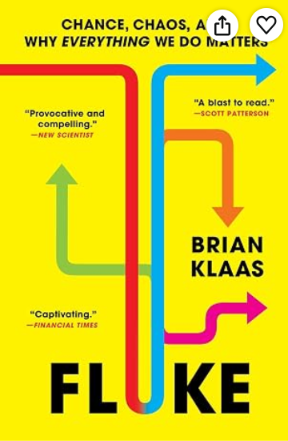
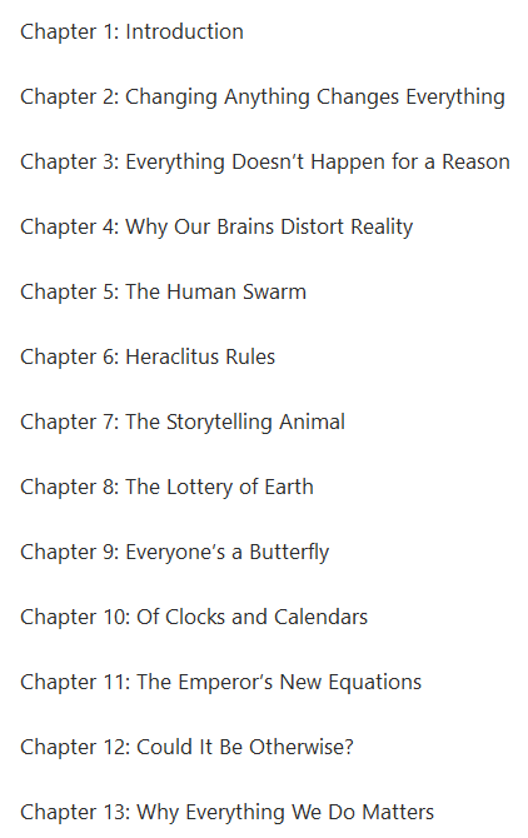
Fluke: Chance, Chaos, and Why Everything We Do Matters (2024) by political scientist Brian Klaas argues that chance, small contingent events, and chaotic interconnectedness shape lives and history far more than we admit. We prefer tidy “storybook” narratives of major causes producing major effects, but reality is a dense web of flukes.
The core claim
Klaas’s refrain is: we control nothing, but influence everything. Tiny, often invisible details—weather, a vacation, a missed bus, a single cell engulfing another—can reroute personal lives and civilizations. Rewind the tape of history or your own life and press play; the outcome would likely be different. The world is not a clockwork machine of linear cause and effect. It is a complex system operating at the edge of chaos.
He contrasts two ways of seeing change:
- Convergence: large forces push outcomes toward similar results (the familiar “everything happens for a reason” or “survival of the fittest” view).
- Contingency: outcomes hinge on innumerable small, accidental events.
Klaas’s synthesis is contingent convergence: systems often look stable and patterned until a fluke triggers a cascade. Self-organized criticality (like a sandpile that looks solid until one extra grain starts an avalanche) is a recurring metaphor.
Signature examples
- U.S. Secretary of War Henry Stimson visited Kyoto with his wife in 1926 and later spared the city from the atomic bomb list. Hiroshima was hit instead; Nagasaki became the second target only after cloud cover hid Kokura. One couple’s sightseeing trip redirected tens of thousands of deaths.
- Klaas himself exists because of a 1905 family tragedy: his great-grandmother killed her children and herself; her husband later remarried. Without that horror, a different person would occupy his place in the world.
- Roughly two billion years ago a bacterium was engulfed by another cell and became the mitochondrion. That microscopic accident enabled complex life. Evolution is not only “survival of the fittest” but “survival of the luckiest.”
- Other cases include a Union soldier stumbling on Lee’s lost orders in the Civil War, weather and geography diverting wars and settlements, and modern shocks such as a single ship blocking the Suez Canal or volcanic ash grounding air travel.
Why we miss this
Human brains evolved for survival, not truth (“fitness beats truth”). We impose narrative, purpose, and simple causality even when they are not there (teleological bias, narrative bias). We overestimate our agency and underestimate hidden connections. Prediction is far harder than we think; Laplace’s demon—an imagined being that knows every particle and can forecast the future perfectly—does not exist in a chaotic, information-limited world.
Geography, environment, and ecology also constrain and redirect societies, but even these large factors interact with chance rather than deterministically dictate outcomes.
Practical and philosophical takeaway
Because everything is interconnected, no action is truly inconsequential. The same sensitivity that makes the world unpredictable also means small choices and random encounters can matter enormously—often in ways no one will ever see. Klaas urges humility about grand plans and over-optimized systems that remove slack, plus a stance of exploration rather than rigid control. Accepting uncertainty, he argues, can produce gratitude and a richer sense of meaning rather than nihilism: we are the living result of 13.8 billion years of flukes, and our own flukes continue to ripple outward.
The book draws on chaos theory, evolutionary biology, history, complexity science, and philosophy. It is less a how-to manual than a change of lens: stop pretending the world is a clean story with a few big causes, and start noticing the hidden contingencies that actually write it.
CONTENT:
MY TAKE ON IT:
The book is interesting and entertaining because of its examples, but it has a philosophical flaw: it misses important parts of reality – scale and probability. Yes, by deconstructing any significant event, one can find quite a few points where it could turn out differently. However, these points are typically small in scale and have a low probability of impact. Yes, the proverbial butterfly could cause a hurricane but based on the number of butterflies flying around at any given time, the probability of such an event is infinitesimally small. Even if one accepts determinists’ idea that everything is defined by initial conditions, all butterflies included, there is no practical way to use it.
The contrast between Convergence and Contingency, with a preference for Contingency, makes as little practical sense as the deterministic view because it is not possible to account for an infinite number of small events that produce small effects, which, if aligned cumulatively, could produce a big and important event.
Nevertheless, the author’s call for humility in planning big projects is well justified, but in my view, the acceptance of uncertainty should not mean that much “produce gratitude and a richer sense of meaning”, as scaling projects to a minimally appropriate size and implementing as many feedback loops as possible. The future is not predictable in detail, but you can minimize reaction time and buffer resources for contingencies.
GROK’S COMMENT ON MY OPINION:
Your critique is sharper than most popular-science reactions to Fluke. The examples are the book’s strength; the leap from “small causes can matter” to “therefore contingency is the right practical worldview” is the weak joint. Scale and probability are exactly where that leap usually fails.
Where you are right
Chaos theory says systems can be sensitive to initial conditions. It does not say every small perturbation is likely to produce a large, named outcome. A butterfly can sit in the causal ancestry of a storm in some models; almost none of the butterflies flying at any moment do. The set of initial conditions that cascade into a hurricane-scale event is a vanishingly thin subset of phase space. Klaas’s stories pick the rare, retrospectively visible cases (Stimson’s vacation, the lost orders, the engulfed bacterium) and then invite the reader to treat that rarity as the hidden texture of ordinary life. That is narrative selection, not a probability statement.
The same problem appears in the Convergence vs. Contingency framing. Once you allow an unbounded number of tiny causes, “contingency” becomes unfalsifiable and unusable: any outcome can be redescribed as the alignment of countless small events. Convergence is also incomplete, but at least it points at regularities you can measure and act on (selection pressures, geography, institutions, resource constraints). Preferring contingency as the practical stance does not give you a better planning method; it mainly gives you better after-the-fact stories.
Determinism does not rescue the book either. If the future is fixed by initial conditions including every butterfly, you still cannot use that fact. You lack the measurement precision, the model, and the computational reach. Sensitivity without observability is not a decision rule.
Where Klaas still has a narrower, usable point
The useful residue is not “everything is a fluke” but “our models systematically drop the tails and the coupling.” Over-optimized, tightly coupled systems (just-in-time supply chains, single-point targets, plans with no slack) convert some of those low-probability perturbations into high-impact failures. That is why the Suez blockage and similar shocks land so hard. Humility about large, brittle projects follows from that, even if most butterflies remain irrelevant.
You do not need Klaas’s metaphysics to get there. You need the distinction between risk (known distributions) and uncertainty (unknown or shifting structure), plus the observation that modern systems often trade away buffers for efficiency.
On the prescribed response
Your operational alternative is the stronger conclusion:
- Scale the project to the smallest size that still does the job.
- Add feedback loops so error is detected early.
- Shorten reaction time.
- Hold buffers for contingencies.
That is how you live with unpredictability without pretending every action is destinationally significant or that gratitude is the main payoff. Meaning can follow from competence under uncertainty; it does not have to be the primary lesson of chaos.
Klaas’s “we control nothing but influence everything” is rhetorically neat and practically almost empty. Influence without a way to rank influences by scale and probability does not tell you what to do on Monday. Your framing does: treat large, tightly coupled bets as the real hazard, keep optionality and slack, and update fast. That keeps the book’s best warning and discards the part that confuses possibility with practical weight.
20261011 – Blood & Progress
MAIN IDEAS PER GROK:
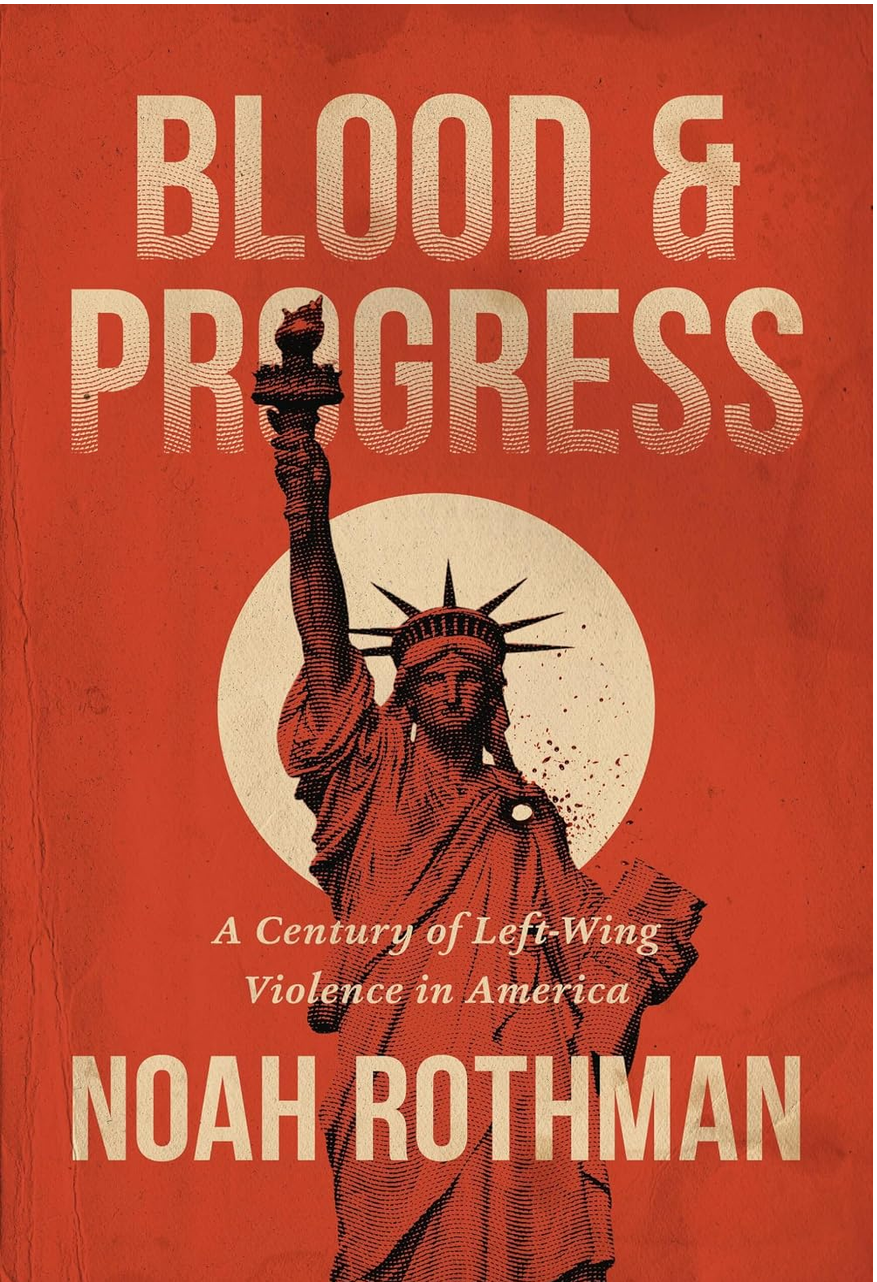
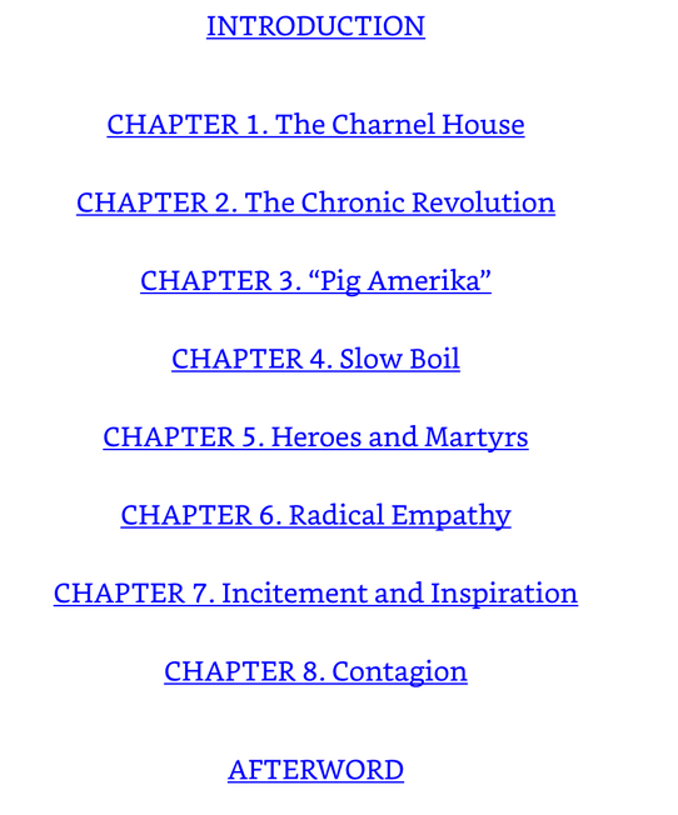
Noah Rothman’s Blood and Progress: A Century of Left-Wing Violence in America (Center Street, May 2026) argues that politically motivated violence in the United States is, in the present era, more often a left-wing project than a right-wing one—and that this pattern has historical precedents that have been downplayed or forgotten.
Rothman, a senior writer at National Review and author of Unjust and The Rise of the New Puritans, contrasts the intense institutional focus on right-wing extremism with a recurring tendency on the left and in elite institutions to excuse, contextualize, or quietly rehabilitate violence when it serves progressive goals. The book surveys waves of such violence from the early 20th century to the mid-2020s and identifies recurring intellectual and psychological patterns.
Central thesis
The dominant public narrative—that domestic political violence is “almost solely a right-wing phenomenon”—does not match the record of recent years (assassinations and attempted assassinations of conservative figures and executives, attacks on law enforcement, 2020 riots and their aftermath) or earlier historical episodes. Rothman concludes that violence intended to produce political change is more characteristic of the left in our time, and that today’s wave resembles earlier ones. He does not deny that right-wing violence exists (he criticizes January 6 and certain Trump-era rhetoric) but insists the asymmetry in attention, condemnation, and historical memory is itself part of the problem.
Historical waves and common threads
Rothman traces cycles:
- Early 20th-century anarchists and socialists, including bombings and the 1920 Wall Street attack.
- 1960s–1970s radicals (Weather Underground and related groups, militant Black activists, anti-war violence).
- Later episodes through Occupy, 2020 unrest, attacks on ICE facilities, and 2020s political murders and plots.
He finds repeating features: a revolutionary or “progress-through-struggle” mindset in which violence is seen as producing positive social change; small-cell or mob tactics; and post-hoc intellectual work that reframes the acts as expressions of justified frustration rather than terrorism or crime.
The “permission structure” and “omnicause”
A core idea is an intellectual and institutional ecosystem that supplies a permission structure. Democratic politicians and commentators have at times framed violent movements as the “voice of frustration.” Violent actors or groups are sometimes absorbed into a kind of folklore or later recast as martyrs or misunderstood radicals. Rothman also describes an “omnicause”—a bundling of disparate grievances (race, climate, Palestine, gender, anti-capitalism, etc.) into one revolutionary identity that makes violence against “oppressors” feel morally coherent to participants. Elite cultural and academic institutions amplify this by treating contextualization of left violence as sophistication.
Psychological and cultural dimensions
Rothman examines why some agitators conclude that bloodshed advances justice. He criticizes the left’s roster of historical heroes who themselves used or encouraged violence. He also notes a troubling parallel: parts of the American right have begun adopting similar rationalizations that once belonged more exclusively to the left. The book’s purpose is diagnostic and prescriptive: train observers to recognize left-wing political violence with the same scrutiny applied to the right, and insist on consistent revulsion toward political violence from any source. Without that consistency, the cycle continues.
The argument is polemical and written from a conservative vantage point. Rothman presents it as a corrective to what he sees as a one-sided public conversation rather than a claim that only one side ever uses violence.
CONTENT:
MY TAKE ON IT:
This book presents a pretty good and detailed history of left-wing violence and properly concentrates on the societal environment that makes such violence not only justifiable but forgivable. In my view, the problem with political violence is that it works, and if it isn’t suppressed quickly and decisively, it could lead to a revolutionary restructuring of society that generates violence far beyond anything known in that society.
America has avoided this fate so far, but it would help to look at other societies in history that went through this process all the way. A good example would be Russia in the late 19th and early 20th centuries, when an educated part of society wholeheartedly supported not only various leftist causes and socialism, but also terrorism on behalf of these causes. A nice example would be a terrorist act by a socialist woman who shot the governor of St. Petersburg in 1878. The jury of her educated peers acquitted her, based on the reasoning that the terrorist act was justified. It took some time and the stress of WWI to bring revolutionaries to power, but by 1918 the members of Russia’s educated classes could read in newspapers just about every morning how many hostages taken from among their peers were executed in response to some counterrevolutionary action real or imaginary.
The author nicely describes a similar recent and contemporary process in American society and suggests corrective measures such as “train observers to recognize left-wing violence. I do not think that it would be helpful. To solve the problem, one should understand the long cycle of violence: terrorist act –> approval by the intellectual and educated part of society –> transfer of this approval to the next generation by school teachers and University professors –> the magnified terrorist actions by members of this next generation when society comes under stress for whatever reason. The real solution would include complete disruption of this long cycle: any person who expressed support for any terrorist action should be deprived of the ability to teach the next generation for life.
I don’t think America will repeat the experiences of the Russian or French revolutions, mainly because many people are well familiar with this history and wouldn’t wait for Jacobins or Chekists to come after them. These people understand that the only proper response to terrorism is overwhelming violence, which will probably be used if this societal disease develops to a dangerous point. Let’s hope we treat it before it reaches that point.
GROK’S COMMENT ON MY OPINION:
Your take is sharper than Rothman’s on the mechanism that actually matters: not isolated acts, but the social ratification of those acts. Rothman documents the history and the excuses. You are describing a reproduction system—approval → pedagogy → the next cohort under stress. That is a stronger frame than “train observers to notice left-wing violence.”
Where your reading is strongest
The Vera Zasulich case (1878) is the right illustration. She shot Trepov after he had a political prisoner flogged. A jury of respectable Petersburg society acquitted her. The legal question was not really “did she shoot him?” It was whether the act counted as crime or as justice. That verdict taught a generation that certain murders were already morally completed before the trial began. Narodnik terrorism did not invent itself in a vacuum; it received a cultural license.
Your sequence is historically recognizable:
terrorist act → elite/intellectual ratification → transmission through schools and universities → larger, less scrupulous violence when the state is strained.
Russia did not go from Zasulich to the Cheka in a year. It took decades of normalized exception-making, then war, then dual power. By 1918 the same social layer that had applauded “propaganda of the deed” was reading execution lists of hostages drawn from its own class. That is not poetic justice. It is what happens when a society trains itself to treat political killing as a debate about whose violence is legitimate.
The claim that “political violence works” is also more honest than most public commentary. It works as a strategy for radicals when:
- institutions hesitate,
- media and universities supply context instead of condemnation,
- and the target side is constrained by norms the attackers do not share.
It “works” until it produces a regime that no longer needs the old intellectuals. That is the part the 1878 jury did not price in.
Where the analogy is real but incomplete
Late-imperial Russia had features the United States still does not: a brittle autocracy, a thin legal culture of individual rights, a wartime collapse, a professional revolutionary underground, and no durable federal structure. 1917 was not “the left got away with street violence.” It was state failure plus a party that already intended to rule by terror.
France 1789–94 and Russia 1917–22 are useful as end-states of the cycle you describe, not as near-term forecasts. The value of those cases is diagnostic: once a critical mass of the educated class treats revolutionary violence as historically necessary, the later body count is not an accident. It is the program.
America has so far interrupted the cycle at earlier stages—prosecutions, elections, federalism, an armed and historically literate minority, and a still-functioning (if battered) distinction between protest and armed politics. That is why your closing hope is not empty. It is also why it should not be treated as a guarantee.
The weak point in your remedy
Rothman’s “train people to recognize it” is too soft if the problem is reproduction through the teaching profession. Your alternative—lifetime exclusion from teaching for anyone who expressed support for any terrorist act—aims at the transmission belt. The intention is clear. The design is not.
Problems that matter:
- Definition. “Support of any terrorist action” is easy to apply to someone praising Mangione or Kirk’s killer. It is much harder once you include historical guerrilla romance, “by any means necessary” rhetoric, or academic work that treats certain insurgencies as liberation. Revolutionaries and their opponents will both try to own the definition.
- Who decides, and under what procedure. A permanent occupational ban is a severe civil disability. In a constitutional system it will be litigated as viewpoint discrimination and prior restraint on professions. If the standard is informal—lists, HR, boards, social pressure—you get the same machinery that already purges people from universities, only pointed the other way. That is a tactic, not a settlement.
- Overbreadth vs. underbreadth. A bright-line rule catches performative campus statements and misses the subtler work: syllabi that treat political violence as a “response to structural harm,” hiring networks, and prestige for scholars who aestheticize militants. The cycle you care about lives more in framing than in explicit cheers.
- Historical warning from your own example. Revolutionary regimes also purged teachers. The difference you want is moral content, not the method of occupational destruction. Methods travel.
A narrower, more defensible version of your idea would be: institutions that certify teachers and professors should treat celebration of contemporary political murder the way they already treat other bright-line professional disqualifiers—not as a unique political crime, but as evidence of unfitness to form minors and undergraduates. That is still illiberal by postwar academic norms. It is less of a revolutionary mirror than a lifetime ban triggered by “any expression of support.”
“The only proper response is overwhelming violence”
As a description of how states actually stop terrorism, this is often true: swift, legal, overwhelming force against the cells and the logistics. As a political ethic—“treat the disease with Chekist methods before the Chekists arrive”—it collapses the distinction you are trying to preserve.
The people who know the Russian and French stories well enough not to wait for the knock on the door are also the people who should be most wary of normalizing extra-legal class punishment. Once “overwhelming violence” becomes the political answer rather than the criminal-justice answer, you have already accepted the premise that law is too slow for history. That premise is how both sides talk themselves into emergency.
Your last paragraph is the most American part of the take: a bet that memory of 1918 and 1793, plus a population that will not queue politely, raises the cost of letting the cycle run. That bet can be right and still fail if the professional-managerial layer keeps ratifying the early stages while everyone else assumes the late stages will never come.
Rothman wants recognition and consistent disgust. You want to break the teaching pipeline. The second is the more serious theory of how the thing reproduces. It also needs a legal and definitional discipline that your current formulation does not yet have—otherwise you are describing the same long cycle with different personnel.
MY Additional Correction:
My few paragraphs of opinion are not a complete program for how to do it. The bottom line is to recognize the long multigenerational cycle of the societal disease that terrorism is a symptom of and interrupt this cycle before the disease becomes too advanced. If we don’t do this within a framework of civil society and the legal system, violent extralegal resolution will become inevitable, whether we like it or not, and, based on widely held historical knowledge, it is not obvious which side will win. At least the current aspiring Jacobins will have a much more difficult time taking power than the original ones.
GROK’S COMMENT ON MY CORRECTION:
Your correction improves the earlier note in the right place: you are no longer offering a personnel policy. You are stating a diagnosis and a timing problem.
Terrorism as symptom, not the disease. That is the useful shift. The acts are intermittent. The disease is the multigenerational permission structure—moral exemption for “our” violence, transmission through prestige institutions, and the habit of treating political murder as a commentary on injustice rather than as a crime. If that is the object, then interrupting ratification and transmission matters more than writing better op-eds after each shooting. Rothman’s “train observers to recognize left-wing violence” still sits one level too late. Recognition without interrupting reproduction leaves the next cohort intact.
Civil society and law first. This is the necessary constraint, and it is more serious than it sounds. A constitutional order that waits until “overwhelming violence” is the only remaining instrument has already accepted dual power in slow motion. Using courts, professional standards, hiring, accreditation, donor pressure, criminal statutes that already exist, and equal application of those statutes is the only way to break the cycle without becoming a party to it. The moment the remedy is “we will do to them what the Cheka would have done to us, only earlier,” the cycle has won the argument even if your side wins the street.
“If we don’t, extralegal resolution becomes inevitable.” Historically that is often how late stages look: the legal system loses legitimacy with one camp, the other camp concludes legality is a suicide pact, and both start preparing for a contest the law no longer referees. Inevitable is too strong for the United States in 2026. Possible, and more possible if the early stages keep being excused, is fair. Inevitability talk is itself a radicalizing device. It tells people to stop investing in lawful interruption because history has already chosen the ending.
“Not obvious which side will win.” That is the most important sentence in the correction. It rejects the comforting story that “the adults who know 1917 will simply prevail.” Revolutionary minorities have taken states they had no business taking; conservative or liberal majorities have also crushed insurgencies they underestimated. Outcome depends on organization, the army and police, elite defection, economic shock, and whether the public still believes there is a center worth defending. Widespread historical literacy is an advantage. It is not a war plan.
Modern Jacobins would have a harder time than the originals. On the institutional facts, yes. The original Jacobins and Bolsheviks faced a collapsing monarchy or a collapsing empire, a wartime army in disintegration, and weak mediating institutions. The United States still has federalism, elections that change control of government, an independent (if battered) judiciary, a professional military with no tradition of party seizure, and a population that is armed and not culturally trained to obey a Committee of Public Safety. That raises the cost of a minority coup. It does not make the cultural half of your cycle harmless. A movement can fail to take the state and still normalize assassination, campus exemption, and selective prosecution for a generation.
The coherent program implied by this correction is therefore narrower than a teaching ban and harder than Rothman’s awareness campaign:
- Name the cycle as intergenerational, not as a news cycle.
- Treat celebration of political murder as a professional and civic disqualification inside existing law and institutional rules, applied without a one-way partisan exception.
- Do that early, while the legal system still has authority.
- Drop the assumption that historical memory automatically produces victory if the legal path is abandoned.
That last point is the one your correction quietly admits and should keep in view. If the contest leaves civil society, knowledge of the Terror does not tell you who inherits the ruins. It only tells you what the ruins look like.
20261004 – The Art of Impossible
MAIN IDEAS PER GROK:
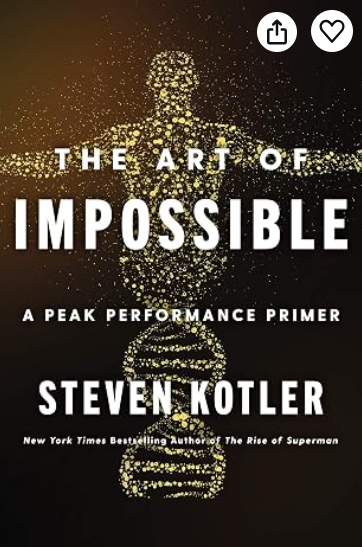
The Art of Impossible (2021) by Steven Kotler is a neuroscience-based primer on peak performance. Its central claim is that “impossible” results—whether personal breakthroughs or historic firsts—are not reserved for geniuses. They come from a trainable system of four interlocking skills: motivation, learning, creativity, and flow.
Kotler argues that human biology is already wired for this. Personality differences matter less than harnessing the same neurochemical and attentional mechanisms that elite athletes, scientists, and innovators use. Flow is the amplifier; the other three skills are the foundation that makes flow sustainable rather than destructive.
The four pillars
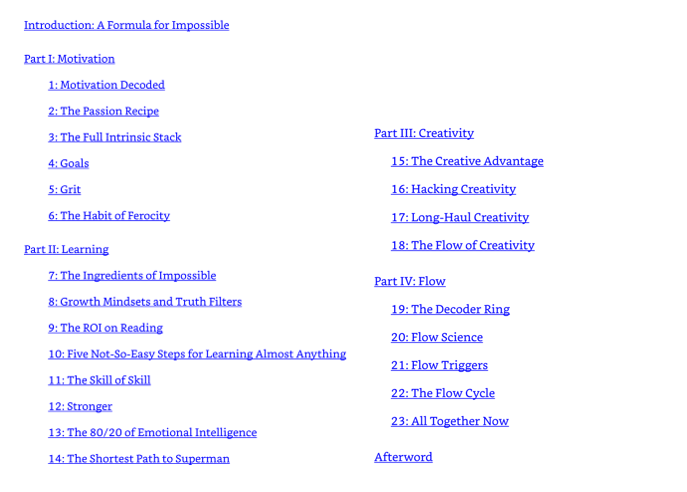
Motivation gets you into the game and keeps you there. Kotler distinguishes extrinsic rewards (money, status) from intrinsic drivers and says the latter last. He stacks five intrinsic motivators in sequence:
- Curiosity (interest and exploration)
- Passion (overlapping curiosities that become absorbing)
- Purpose (tying the work to something larger than yourself)
- Autonomy (control over how you work)
- Mastery (the drive to get better)
These feed one another and release the reward chemicals that make hard work feel worthwhile. He pairs them with three timescales of goals: a lifelong Massively Transformative Purpose (MTP), medium-term High Hard Goals, and daily Clear Goals. Grit and a “habit of ferocity” (persistent, almost aggressive engagement) keep the stack running when motivation dips.
Learning lets you stay in the game as the challenge grows. Kotler emphasizes a growth mindset, “truth filters” (ways of testing what you think you know), heavy reading, and a five-step process for acquiring almost any skill. Deliberate practice, feedback, and understanding how you learn matter as much as the content itself.
Creativity is how you navigate and invent new paths. It depends on switching among three brain networks (executive, default-mode, and salience), maintaining a positive mood, and practicing long-haul creativity—the ability to keep generating useful ideas over years rather than waiting for lightning strikes. Frustration and “itchy dissatisfaction” are treated as normal parts of the process, not signs you should quit.
Flow is the state of complete absorption in which time distorts, self-consciousness drops, and performance jumps. Kotler describes a four-stage cycle—struggle, release, flow, recovery—and lists internal and external triggers (clear goals, immediate feedback, challenge-skill balance, novelty, risk, etc.). Flow multiplies the other three skills; without a solid base in motivation, learning, and creativity, the amplification can produce burnout or poor decisions.
Overarching ideas
- Potential is emergent. You discover what you can actually do only by repeatedly pushing to the edge of current ability.
- The work is an “infinite game” (James Carse): the point is to keep playing and expanding the possible, not to reach a final win.
- Daily structure matters: tackle the hardest tasks first, keep the day’s to-do list short and achievable, and protect recovery (sleep, exercise, nutrition).
- Biology is universal; the methods scale even if individual psychology differs.
The book is practical rather than purely inspirational. Kotler repeatedly notes that application is personal—“that’s just me”—while the underlying mechanisms are not. The goal is a repeatable system that turns ambitious goals into a sequence of difficult-but-doable steps.
CONTENT:
MY TAKE ON IT:
This is an important book because it outlines a general direction for humanity to overcome the coming competition with AI for a place in the world and the meaning of existence.
Generally, all four pillars make sense if one wants to achieve the goals he has, and it fits very well with human biology as it developed through evolution, except for the simple fact that the goals the author refers to are way beyond what humans are designed to achieve: survive, produce the next generation, and support its development until it can stand on its own.
It is obviously beyond the scope of this book, but I think that the most important thing will become the art of setting objectives to achieve and the ability to negotiate these objectives with objectives of others with minimal conflict. The current typical objectives of human life: to obtain credentials, apply them to achieving a well-remunerated position in society, and maybe produce something that would impress others, will quite possibly become obsolete due to the abundance of everything for everybody. I also think that eventually we’ll reach a point where the purpose of “tying the work to something larger than yourself” shifts to enjoying yourself in close coordination with others enjoying themselves, as you explore life and the universe.
GROK’S COMMENT ON MY OPINION:
Your take is sharper than most readings of the book, because you treat Kotler’s system as a tool rather than a destination. The four pillars are a good operating system for high effort. They are not, by themselves, a theory of what that effort is for once survival, status, and scarcity stop being the default constraints.
The evolutionary point is the strongest part. Human motivation, learning, creativity, and flow evolved under conditions where “winning” meant staying alive, reproducing, and getting offspring to independence. Stretching those same circuits toward moonshots, mastery for its own sake, or “impossible” firsts works—because the machinery is flexible—but it is a hack. Kotler treats the hack as the point. You treat it as evidence that the machinery can be pointed at new targets. That is the more interesting claim.
Where your comment goes beyond the book, and where it matters most, is the claim that the scarce skill is no longer execution. It is objective-setting plus low-conflict negotiation of objectives. Kotler assumes the goal is already there (MTP, HHGs, daily clear goals) and then optimizes the engine. He has little to say about how people choose goals when the old scoreboard—credentials, scarce jobs, signaling competence to a hierarchy—loses force. If abundance really does cheapen those prizes, then “get better at flow” without “get better at choosing and coordinating ends” just produces more efficient people chasing emptier trophies.
Two cautions, not as rebuttals but as boundary conditions.
First, abundance of goods does not automatically produce abundance of meaning or of agreed-upon ends. Status, recognition, and narrative uniqueness do not vanish when calories and tools get cheap; they often intensify. “Enjoy yourself while others enjoy themselves and explore the universe” is a beautiful attractor. It is also easy to turn into a new status game (who explores more beautifully, who coordinates more virtuously, who is more at peace). The negotiation problem you flag does not disappear. It moves from markets and credentials into values, attention, and identity.
Second, Kotler’s “purpose larger than yourself” is not only a moral add-on. In his stack it is a neurochemical move: tying curiosity and passion to something outside the self is how you keep the reward system from collapsing into short-term stimulation. Coordinated enjoyment can do the same work if it is genuinely shared and slightly larger than private pleasure. If it collapses into isolated consumption plus polite non-interference, the stack loses its last durable driver. Your formulation—“enjoying yourself in close coordination with others enjoying themselves”—is actually closer to a workable successor purpose than a lot of grand mission-talk, provided the coordination is real and not just adjacent solitude.
So the useful synthesis is this: Kotler gives a biology-compatible method for pursuing hard goals. You are pointing at the coming bottleneck: which goals, whose goals, and how they are reconciled when the old scarcity-based reasons for effort weaken. That is a bigger book than The Art of Impossible. It is also the book that will decide whether peak-performance culture becomes a way for humans to stay relevant next to AI, or just a more refined way to optimize ourselves into a contest that no longer needs us.

