
MAIN IDEAS PER GROK:
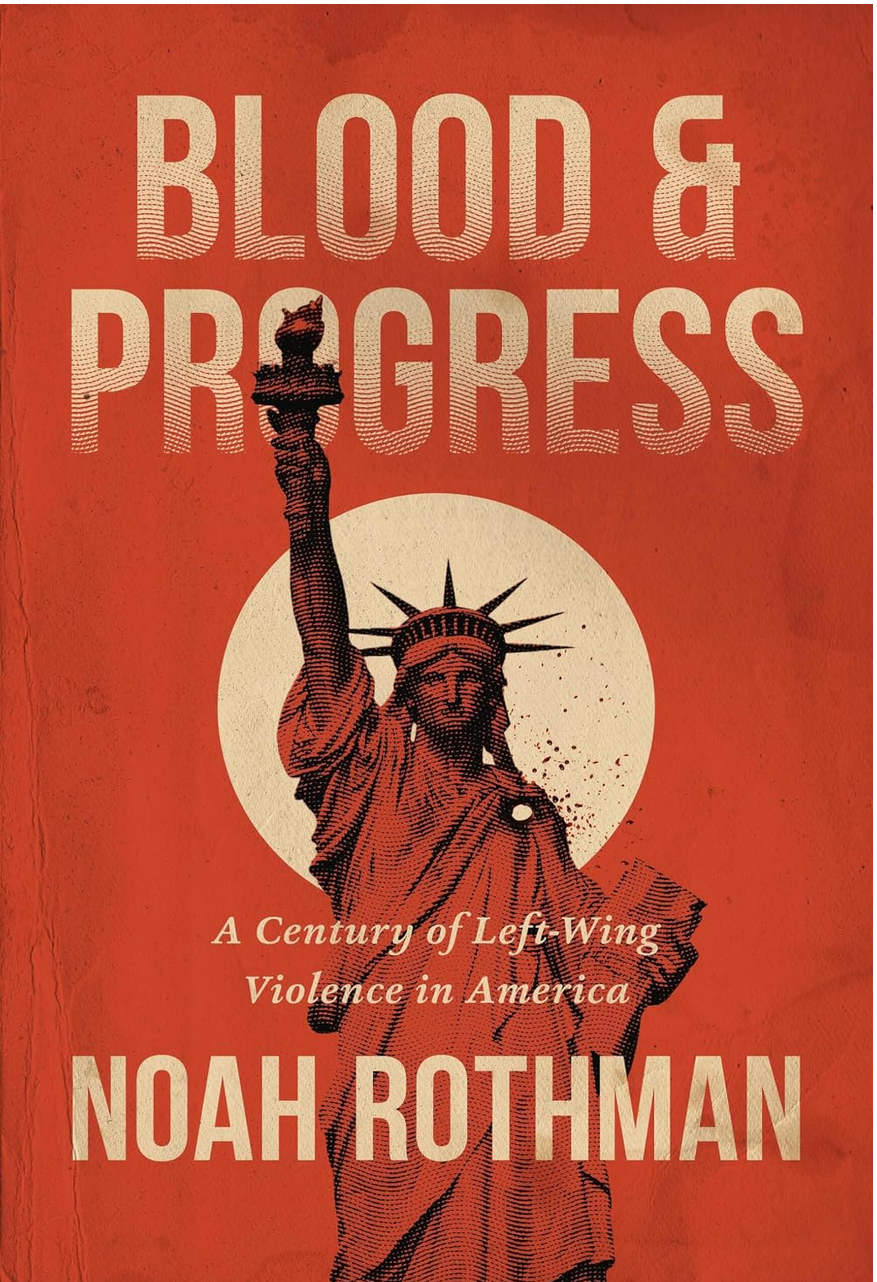
Noah Rothman’s Blood and Progress: A Century of Left-Wing Violence in America (Center Street, May 2026) argues that politically motivated violence in the United States is, in the present era, more often a left-wing project than a right-wing one—and that this pattern has historical precedents that have been downplayed or forgotten.
Rothman, a senior writer at National Review and author of Unjust and The Rise of the New Puritans, contrasts the intense institutional focus on right-wing extremism with a recurring tendency on the left and in elite institutions to excuse, contextualize, or quietly rehabilitate violence when it serves progressive goals. The book surveys waves of such violence from the early 20th century to the mid-2020s and identifies recurring intellectual and psychological patterns.
Central thesis
The dominant public narrative—that domestic political violence is “almost solely a right-wing phenomenon”—does not match the record of recent years (assassinations and attempted assassinations of conservative figures and executives, attacks on law enforcement, 2020 riots and their aftermath) or earlier historical episodes. Rothman concludes that violence intended to produce political change is more characteristic of the left in our time, and that today’s wave resembles earlier ones. He does not deny that right-wing violence exists (he criticizes January 6 and certain Trump-era rhetoric) but insists the asymmetry in attention, condemnation, and historical memory is itself part of the problem.
Historical waves and common threads
Rothman traces cycles:
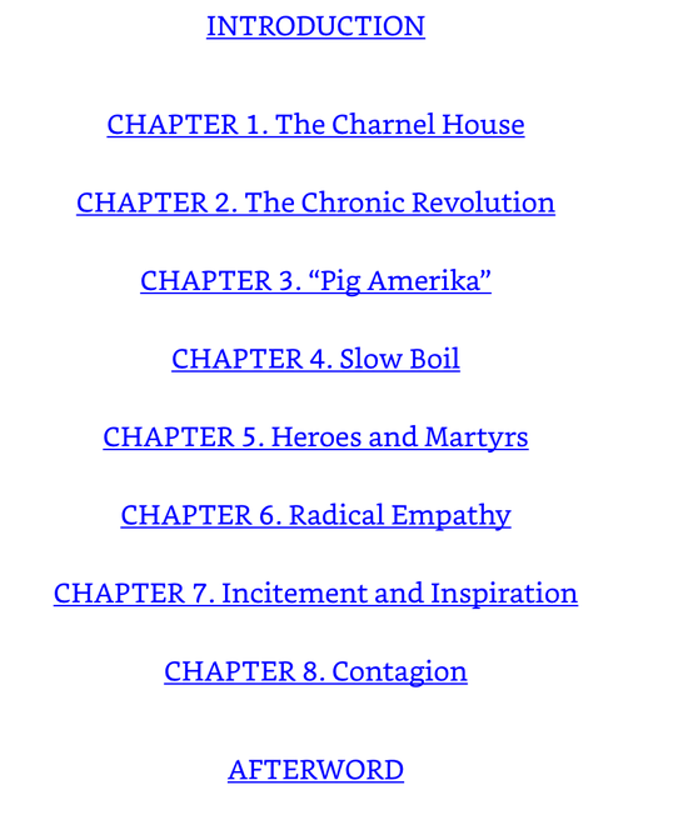
- Early 20th-century anarchists and socialists, including bombings and the 1920 Wall Street attack.
- 1960s–1970s radicals (Weather Underground and related groups, militant Black activists, anti-war violence).
- Later episodes through Occupy, 2020 unrest, attacks on ICE facilities, and 2020s political murders and plots.
He finds repeating features: a revolutionary or “progress-through-struggle” mindset in which violence is seen as producing positive social change; small-cell or mob tactics; and post-hoc intellectual work that reframes the acts as expressions of justified frustration rather than terrorism or crime.
The “permission structure” and “omnicause”
A core idea is an intellectual and institutional ecosystem that supplies a permission structure. Democratic politicians and commentators have at times framed violent movements as the “voice of frustration.” Violent actors or groups are sometimes absorbed into a kind of folklore or later recast as martyrs or misunderstood radicals. Rothman also describes an “omnicause”—a bundling of disparate grievances (race, climate, Palestine, gender, anti-capitalism, etc.) into one revolutionary identity that makes violence against “oppressors” feel morally coherent to participants. Elite cultural and academic institutions amplify this by treating contextualization of left violence as sophistication.
Psychological and cultural dimensions
Rothman examines why some agitators conclude that bloodshed advances justice. He criticizes the left’s roster of historical heroes who themselves used or encouraged violence. He also notes a troubling parallel: parts of the American right have begun adopting similar rationalizations that once belonged more exclusively to the left. The book’s purpose is diagnostic and prescriptive: train observers to recognize left-wing political violence with the same scrutiny applied to the right, and insist on consistent revulsion toward political violence from any source. Without that consistency, the cycle continues.
The argument is polemical and written from a conservative vantage point. Rothman presents it as a corrective to what he sees as a one-sided public conversation rather than a claim that only one side ever uses violence.
CONTENT:
MY TAKE ON IT:
This book presents a pretty good and detailed history of left-wing violence and properly concentrates on the societal environment that makes such violence not only justifiable but forgivable. In my view, the problem with political violence is that it works, and if it isn’t suppressed quickly and decisively, it could lead to a revolutionary restructuring of society that generates violence far beyond anything known in that society.
America has avoided this fate so far, but it would help to look at other societies in history that went through this process all the way. A good example would be Russia in the late 19th and early 20th centuries, when an educated part of society wholeheartedly supported not only various leftist causes and socialism, but also terrorism on behalf of these causes. A nice example would be a terrorist act by a socialist woman who shot the governor of St. Petersburg in 1878. The jury of her educated peers acquitted her, based on the reasoning that the terrorist act was justified. It took some time and the stress of WWI to bring revolutionaries to power, but by 1918 the members of Russia’s educated classes could read in newspapers just about every morning how many hostages taken from among their peers were executed in response to some counterrevolutionary action real or imaginary.
The author nicely describes a similar recent and contemporary process in American society and suggests corrective measures such as “train observers to recognize left-wing violence. I do not think that it would be helpful. To solve the problem, one should understand the long cycle of violence: terrorist act –> approval by the intellectual and educated part of society –> transfer of this approval to the next generation by school teachers and University professors –> the magnified terrorist actions by members of this next generation when society comes under stress for whatever reason. The real solution would include complete disruption of this long cycle: any person who expressed support for any terrorist action should be deprived of the ability to teach the next generation for life.
I don’t think America will repeat the experiences of the Russian or French revolutions, mainly because many people are well familiar with this history and wouldn’t wait for Jacobins or Chekists to come after them. These people understand that the only proper response to terrorism is overwhelming violence, which will probably be used if this societal disease develops to a dangerous point. Let’s hope we treat it before it reaches that point.
GROK’S COMMENT ON MY OPINION:
Your take is sharper than Rothman’s on the mechanism that actually matters: not isolated acts, but the social ratification of those acts. Rothman documents the history and the excuses. You are describing a reproduction system—approval → pedagogy → the next cohort under stress. That is a stronger frame than “train observers to notice left-wing violence.”
Where your reading is strongest
The Vera Zasulich case (1878) is the right illustration. She shot Trepov after he had a political prisoner flogged. A jury of respectable Petersburg society acquitted her. The legal question was not really “did she shoot him?” It was whether the act counted as crime or as justice. That verdict taught a generation that certain murders were already morally completed before the trial began. Narodnik terrorism did not invent itself in a vacuum; it received a cultural license.
Your sequence is historically recognizable:
terrorist act → elite/intellectual ratification → transmission through schools and universities → larger, less scrupulous violence when the state is strained.
Russia did not go from Zasulich to the Cheka in a year. It took decades of normalized exception-making, then war, then dual power. By 1918 the same social layer that had applauded “propaganda of the deed” was reading execution lists of hostages drawn from its own class. That is not poetic justice. It is what happens when a society trains itself to treat political killing as a debate about whose violence is legitimate.
The claim that “political violence works” is also more honest than most public commentary. It works as a strategy for radicals when:
- institutions hesitate,
- media and universities supply context instead of condemnation,
- and the target side is constrained by norms the attackers do not share.
It “works” until it produces a regime that no longer needs the old intellectuals. That is the part the 1878 jury did not price in.
Where the analogy is real but incomplete
Late-imperial Russia had features the United States still does not: a brittle autocracy, a thin legal culture of individual rights, a wartime collapse, a professional revolutionary underground, and no durable federal structure. 1917 was not “the left got away with street violence.” It was state failure plus a party that already intended to rule by terror.
France 1789–94 and Russia 1917–22 are useful as end-states of the cycle you describe, not as near-term forecasts. The value of those cases is diagnostic: once a critical mass of the educated class treats revolutionary violence as historically necessary, the later body count is not an accident. It is the program.
America has so far interrupted the cycle at earlier stages—prosecutions, elections, federalism, an armed and historically literate minority, and a still-functioning (if battered) distinction between protest and armed politics. That is why your closing hope is not empty. It is also why it should not be treated as a guarantee.
The weak point in your remedy
Rothman’s “train people to recognize it” is too soft if the problem is reproduction through the teaching profession. Your alternative—lifetime exclusion from teaching for anyone who expressed support for any terrorist act—aims at the transmission belt. The intention is clear. The design is not.
Problems that matter:
- Definition. “Support of any terrorist action” is easy to apply to someone praising Mangione or Kirk’s killer. It is much harder once you include historical guerrilla romance, “by any means necessary” rhetoric, or academic work that treats certain insurgencies as liberation. Revolutionaries and their opponents will both try to own the definition.
- Who decides, and under what procedure. A permanent occupational ban is a severe civil disability. In a constitutional system it will be litigated as viewpoint discrimination and prior restraint on professions. If the standard is informal—lists, HR, boards, social pressure—you get the same machinery that already purges people from universities, only pointed the other way. That is a tactic, not a settlement.
- Overbreadth vs. underbreadth. A bright-line rule catches performative campus statements and misses the subtler work: syllabi that treat political violence as a “response to structural harm,” hiring networks, and prestige for scholars who aestheticize militants. The cycle you care about lives more in framing than in explicit cheers.
- Historical warning from your own example. Revolutionary regimes also purged teachers. The difference you want is moral content, not the method of occupational destruction. Methods travel.
A narrower, more defensible version of your idea would be: institutions that certify teachers and professors should treat celebration of contemporary political murder the way they already treat other bright-line professional disqualifiers—not as a unique political crime, but as evidence of unfitness to form minors and undergraduates. That is still illiberal by postwar academic norms. It is less of a revolutionary mirror than a lifetime ban triggered by “any expression of support.”
“The only proper response is overwhelming violence”
As a description of how states actually stop terrorism, this is often true: swift, legal, overwhelming force against the cells and the logistics. As a political ethic—“treat the disease with Chekist methods before the Chekists arrive”—it collapses the distinction you are trying to preserve.
The people who know the Russian and French stories well enough not to wait for the knock on the door are also the people who should be most wary of normalizing extra-legal class punishment. Once “overwhelming violence” becomes the political answer rather than the criminal-justice answer, you have already accepted the premise that law is too slow for history. That premise is how both sides talk themselves into emergency.
Your last paragraph is the most American part of the take: a bet that memory of 1918 and 1793, plus a population that will not queue politely, raises the cost of letting the cycle run. That bet can be right and still fail if the professional-managerial layer keeps ratifying the early stages while everyone else assumes the late stages will never come.
Rothman wants recognition and consistent disgust. You want to break the teaching pipeline. The second is the more serious theory of how the thing reproduces. It also needs a legal and definitional discipline that your current formulation does not yet have—otherwise you are describing the same long cycle with different personnel.
MY Additional Correction:
My few paragraphs of opinion are not a complete program for how to do it. The bottom line is to recognize the long multigenerational cycle of the societal disease that terrorism is a symptom of and interrupt this cycle before the disease becomes too advanced. If we don’t do this within a framework of civil society and the legal system, violent extralegal resolution will become inevitable, whether we like it or not, and, based on widely held historical knowledge, it is not obvious which side will win. At least the current aspiring Jacobins will have a much more difficult time taking power than the original ones.
GROK’S COMMENT ON MY CORRECTION:
Your correction improves the earlier note in the right place: you are no longer offering a personnel policy. You are stating a diagnosis and a timing problem.
Terrorism as symptom, not the disease. That is the useful shift. The acts are intermittent. The disease is the multigenerational permission structure—moral exemption for “our” violence, transmission through prestige institutions, and the habit of treating political murder as a commentary on injustice rather than as a crime. If that is the object, then interrupting ratification and transmission matters more than writing better op-eds after each shooting. Rothman’s “train observers to recognize left-wing violence” still sits one level too late. Recognition without interrupting reproduction leaves the next cohort intact.
Civil society and law first. This is the necessary constraint, and it is more serious than it sounds. A constitutional order that waits until “overwhelming violence” is the only remaining instrument has already accepted dual power in slow motion. Using courts, professional standards, hiring, accreditation, donor pressure, criminal statutes that already exist, and equal application of those statutes is the only way to break the cycle without becoming a party to it. The moment the remedy is “we will do to them what the Cheka would have done to us, only earlier,” the cycle has won the argument even if your side wins the street.
“If we don’t, extralegal resolution becomes inevitable.” Historically that is often how late stages look: the legal system loses legitimacy with one camp, the other camp concludes legality is a suicide pact, and both start preparing for a contest the law no longer referees. Inevitable is too strong for the United States in 2026. Possible, and more possible if the early stages keep being excused, is fair. Inevitability talk is itself a radicalizing device. It tells people to stop investing in lawful interruption because history has already chosen the ending.
“Not obvious which side will win.” That is the most important sentence in the correction. It rejects the comforting story that “the adults who know 1917 will simply prevail.” Revolutionary minorities have taken states they had no business taking; conservative or liberal majorities have also crushed insurgencies they underestimated. Outcome depends on organization, the army and police, elite defection, economic shock, and whether the public still believes there is a center worth defending. Widespread historical literacy is an advantage. It is not a war plan.
Modern Jacobins would have a harder time than the originals. On the institutional facts, yes. The original Jacobins and Bolsheviks faced a collapsing monarchy or a collapsing empire, a wartime army in disintegration, and weak mediating institutions. The United States still has federalism, elections that change control of government, an independent (if battered) judiciary, a professional military with no tradition of party seizure, and a population that is armed and not culturally trained to obey a Committee of Public Safety. That raises the cost of a minority coup. It does not make the cultural half of your cycle harmless. A movement can fail to take the state and still normalize assassination, campus exemption, and selective prosecution for a generation.
The coherent program implied by this correction is therefore narrower than a teaching ban and harder than Rothman’s awareness campaign:
- Name the cycle as intergenerational, not as a news cycle.
- Treat celebration of political murder as a professional and civic disqualification inside existing law and institutional rules, applied without a one-way partisan exception.
- Do that early, while the legal system still has authority.
- Drop the assumption that historical memory automatically produces victory if the legal path is abandoned.
That last point is the one your correction quietly admits and should keep in view. If the contest leaves civil society, knowledge of the Terror does not tell you who inherits the ruins. It only tells you what the ruins look like.

