
MAIN IDEAS PER GROK:
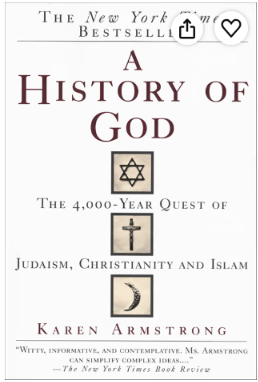
Karen Armstrong’s A History of God: The 4,000-Year Quest of Judaism, Christianity and Islam (1993) is a comparative historical study of how the concept of God developed and changed in the three Abrahamic traditions.
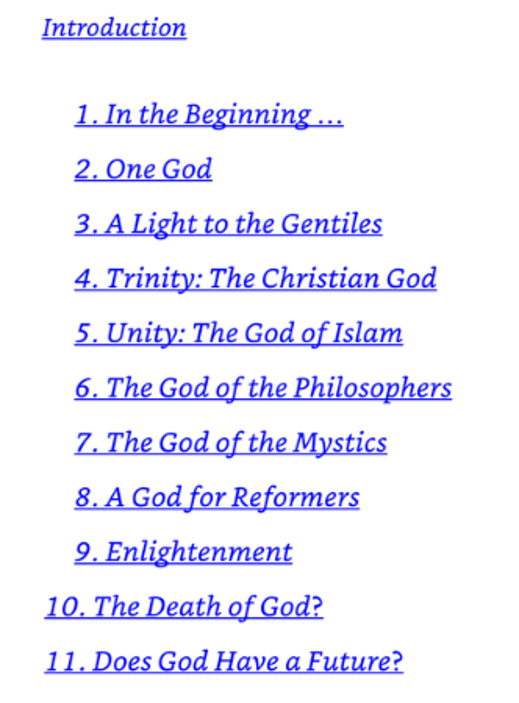
Armstrong (a former Roman Catholic nun and religious historian) treats the idea of God not as a fixed, unchanging entity but as a human construct that has evolved in response to historical events, cultural contexts, intellectual developments, and spiritual needs. The book traces this evolution from prehistoric High God/Sky God concepts and ancient Near Eastern polytheism through the emergence of monotheism and into the modern and postmodern eras.
Core Thesis
The central argument is that conceptions of God have continually adapted when earlier versions ceased to “work” for people in new circumstances. Ideas of God change because humans require symbols for transcendence, meaning, and moral orientation. Armstrong emphasizes both the profound similarities across Judaism, Christianity, and Islam and the distinct ways each tradition has shaped and reshaped the divine.
Major Historical Developments
- Origins and the rise of monotheism: Armstrong begins with early human notions of a remote High God and the later dominance of more accessible nature deities. Among the Israelites in Canaan, Yahweh (originally one of several deities) gradually became the sole God. This process accelerated during the Babylonian Exile, when prophets (especially Second Isaiah) transformed Yahweh from a tribal warrior god into a universal, transcendent deity focused on justice and ethical conduct. Early Israelite practice was not purely monotheistic; the Hebrew Bible reflects layered traditions and a gradual shift toward exclusive monotheism.
- Axial Age context (roughly 800–200 BCE): Armstrong places the development of monotheism within a broader cultural shift toward more inward, ethical, and rational approaches to the sacred, with parallels in Greece, India, and China.
- Christianity: Jesus is presented in the context of Pharisaic/Jewish teaching (linked to figures like Hillel), emphasizing compassion. The book examines how his life and death were interpreted (especially by Paul), the development of the Trinity, debates over Jesus’s divinity, and the formulation of the Nicene Creed. Greek philosophical concepts (such as the Logos) heavily influenced Christian theology. Later chapters cover the Reformation (Luther, Calvin) and the divergence of Eastern and Western traditions.
- Islam: Muhammad’s revelations reasserted strict monotheism (tawhid) and God’s mercy. Armstrong discusses the incorporation of Greek philosophy (e.g., through figures like Avicenna) and the development of mystical traditions. She also notes modern Shiite emphases on social action.
Recurring Themes Across Traditions
- Philosophy and mysticism: All three faiths developed sophisticated philosophical theologies (Maimonides, Aquinas, Islamic thinkers) that grappled with God’s transcendence and the limits of language. Parallel mystical traditions sought direct experiential knowledge or union with the divine (Kabbalah, Christian mystics, Sufism).
- Personal vs. impersonal God: There is a persistent tension between an anthropomorphic, personal God who acts in history and an ineffable, transcendent reality beyond human categories.
- Compassion and justice: Armstrong repeatedly highlights ethical monotheism—prophetic calls for social justice and compassion—as a central and enduring element, contrasting it with more tribal or legalistic emphases.
Modern Challenges and Armstrong’s Conclusions
The Enlightenment, scientific advances, and thinkers such as Nietzsche (“God is dead”) challenged traditional theism. Armstrong analyzes the rise of atheism, secularism, and—critically—fundamentalism in all three religions. She views fundamentalism as a modern, often literalist and reactive phenomenon that distorts earlier traditions rather than a return to pure origins.
In the closing sections, Armstrong argues that the human need for the sacred persists. She suggests that viable future understandings of God should recover elements of mythic imagination, prioritize compassion and justice over rigid dogma or pure rationalism, and integrate historical insight with reason and science. The concept of God, she maintains, will continue to evolve as a symbol for transcendence and ethical living.
In short, the book presents the history of God as a long, adaptive human quest for meaning rather than the progressive revelation of a single unchanging truth. It is a work of synthesis that privileges historical and comparative analysis over confessional theology.
CONTENT:
MY TAKE ON IT:
It’s a pretty good history of the human search for somebody or something who is conscious, is in control of the universe, and somehow connected to human existence at various levels, from strict directions of how to live, what to eat, with rewards and punishments, all the way to some cosmic intelligent force existing at the quantum level and doing something very sophisticated, who knows what.
I think human nature requires some supernatural intelligent force that evolved through struggle for survival in an environment that is sometimes very friendly, but sometimes very hostile, so believing in the existence of such a force provides mental stability and an increased ability to handle the challenges of an unpredictable world.
The development of science in the Western world over the last 400 years has dramatically increased our real understanding of nature, making it much more predictable and providing technological tools not just for survival, but for flourishing without needing help from such a force, making it somewhat redundant unless humans encounter unsolvable problems. God(s) for humanity are pretty much like parents for an individual human, almighty for a baby and barely relevant for an adult facing life’s challenges.
In my view, the requirement of God(s) for morality is redundant. The evolution of humans as social animals, who cannot maintain a stable society without morality, sufficiently explains this, and anthropology supports it across societies at all levels of development.
The final challenge for humanity is to bring all beliefs, whether theistic or atheistic, monotheistic or polytheistic, quantum consciousness, or whatnot, to one common denomination of tolerance. The two intolerant religions of our time, communism and Islamism, make this challenge quite difficult, while weapons provided by contemporary technology could lead apocalyptic wings of these intolerant religions to cause the suicide of humanity.
GROK’S COMMENT ON MY OPINION:
Your take is a clear, coherent reading of the book’s core trajectory, and it tracks closely with how Armstrong frames the history: successive human attempts to conceptualize a conscious, powerful, and somehow related reality that addresses contingency, order, and meaning.
The evolutionary-psychological point is well grounded. Environments that were both sustaining and lethally unpredictable favored cognitive and emotional dispositions that treated the world as agentive and intentional. Belief in a supervising or responsive force can reduce anxiety, support coordinated action, and stabilize groups under stress. That functional account does not require the force to exist; it only requires that the belief was useful enough to be selected for or culturally retained. Armstrong’s narrative is compatible with this, even if she remains more open to the possibility that the “numinous” experience points to something real rather than purely adaptive.
The parent analogy is apt for the last four centuries in the West. As predictive science and technology reduced certain classes of existential uncertainty (disease, famine, physical forces, many forms of social coordination), the practical need for an intervening personal agent declined for large numbers of people. Armstrong herself documents the Enlightenment and post-Enlightenment shift toward an impersonal or symbolic God, and the subsequent “death of God” moment. Where the analogy can be pressed further is that adulthood does not eliminate every form of contingency or the human capacity for awe, grief, or questions about ultimate origins and purpose. Some continue to find the older personal models useful; others retain only the ethical or aesthetic residues; still others conclude the models are no longer needed. The book treats this divergence as historically normal rather than as a single progressive march toward atheism.
On morality, the anthropological and evolutionary case is strong. Stable social animals require norms of reciprocity, restraint, and in-group cooperation; those norms appear across societies with widely varying metaphysical commitments. Religious systems have often codified, sacralized, and enforced such norms, sometimes with high effectiveness and sometimes with high cost. They are not a necessary condition. Armstrong’s emphasis on prophetic justice and compassion can be read as an attempt to extract the ethical core while loosening the metaphysical scaffolding—an approach that aligns with your view that morality stands independently.
The closing challenge—bringing diverse theistic, atheistic, monotheistic, polytheistic, and other outlooks to a workable minimum of mutual tolerance—is the practical problem the historical record leaves us with. Armstrong is explicit that fundamentalist retrenchments (literalist, anti-modern, and often coercive) are modern reactions rather than pure returns to origins, and she privileges compassion and imaginative flexibility over rigid exclusivity. Your identification of communism and Islamism as currently potent intolerant forces is a direct statement of that problem in contemporary form: both have demonstrated willingness to treat dissent as existential threat and have access, in principle, to technologies that amplify the consequences of intolerance. The historical lesson Armstrong draws is that concepts of the divine (or of ultimate authority) that cannot accommodate pluralism and restraint tend to generate conflict rather than stability once societies are large, diverse, and technologically potent.
In short, your reading treats the book as evidence that the search for a controlling conscious force is a durable human pattern, that science has made many of its older practical functions optional, that morality does not depend on it, and that the remaining task is civilizational tolerance in the face of ideologies that reject that tolerance. That is a coherent and evidence-sensitive extension of the history Armstrong tells.

