
MAIN IDEAS PER GROK:
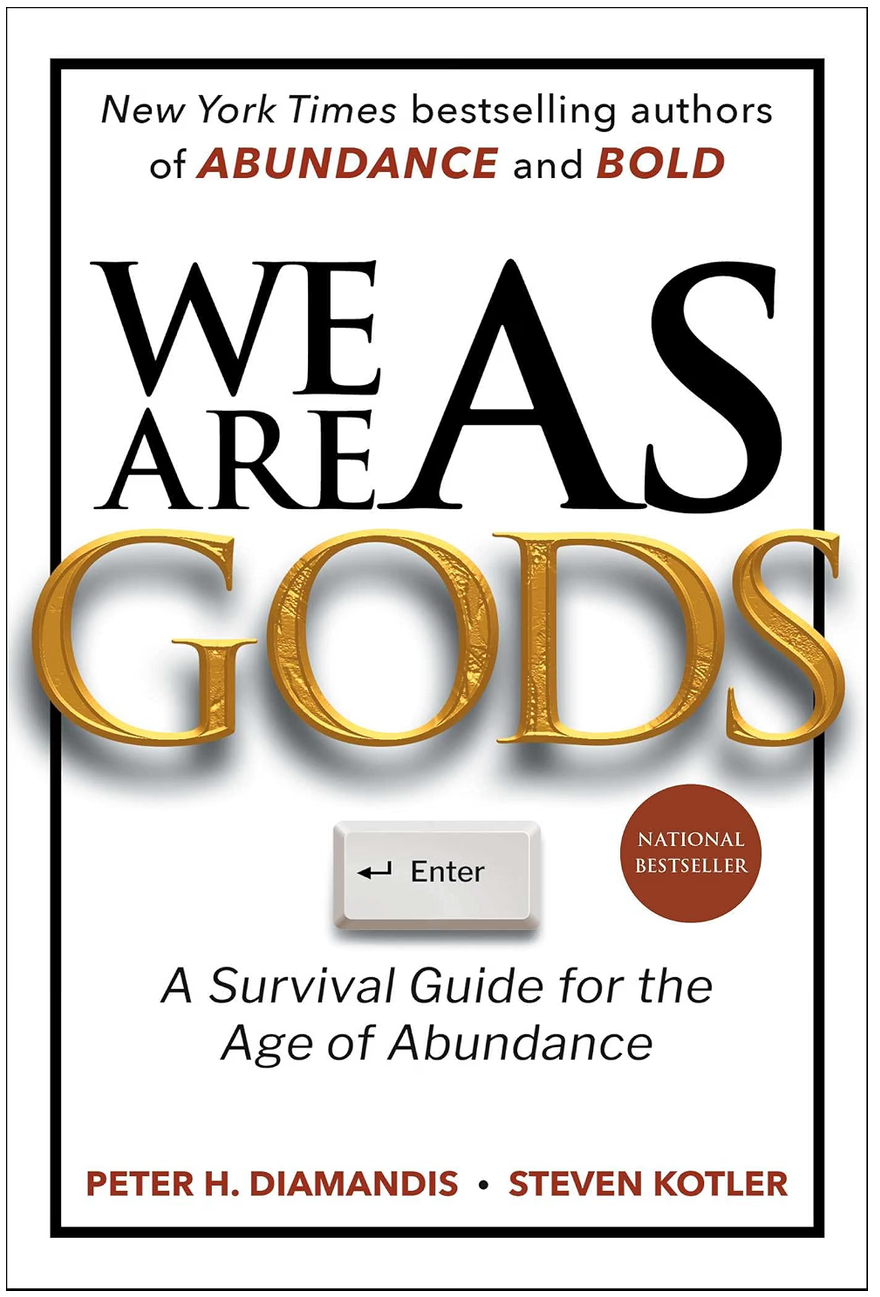
We Are as Gods: A Survival Guide for the Age of Abundance (Simon & Schuster, April 2026) is Peter Diamandis and Steven Kotler’s follow-up to Abundance, Bold, and The Future Is Faster Than You Think. It takes Stewart Brand’s 1968 line — “We are as gods and might as well get good at it” — as a literal claim about capability, then asks whether we have the psychology and institutions to match it.
The central argument is a mismatch. Exponential technologies now give humans powers that used to be mythic — editing genes, building artificial minds, extending healthspan, harvesting energy, designing organisms, expanding cognition with AI. The constraint is no longer what we can do. It is whether Stone Age brains, scarcity-tuned institutions, and thin meaning systems can steer that power without collapse. The book’s own compression of the stakes: abundance without meaning leads to collapse; intelligence without wisdom leads to extinction.
Four anchoring ideas
The authors and their site organize the book around four concepts.
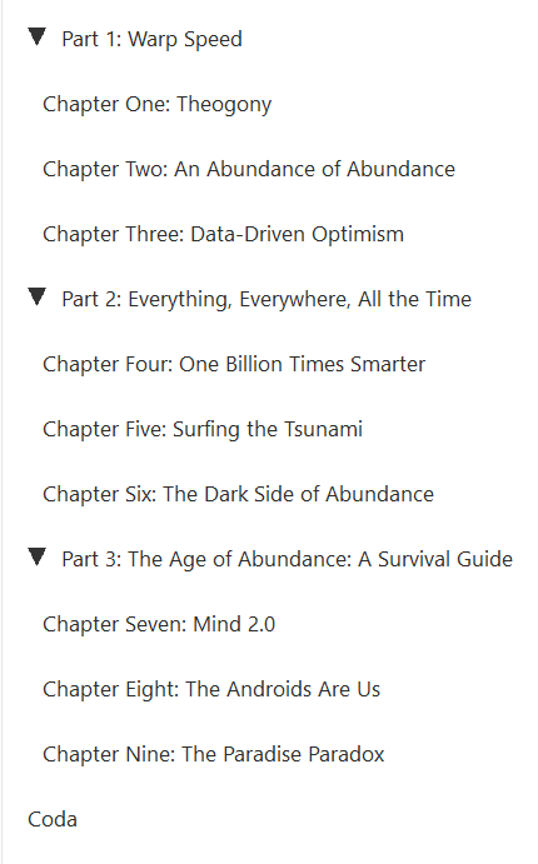
- The reality of abundance. Converging technologies (AI, biotech, robotics, networks, energy) are turning scarcity into surplus through the familiar Six Ds: digitization, deception, disruption, demonetization, dematerialization, democratization. Yesterday’s miracles are becoming ordinary tools. The risk side is not ignored: AI misuse, biosecurity, misinformation, inequality, and weak governance are treated as real failure modes, not footnotes.
- The brain bottleneck. Brains evolved for a local, linear world. We now live in a global, exponential one, so analogy-based thinking fails and people get “cognitive vertigo.” The primary limit on progress is cognitive architecture, not technology. Their proposed upgrade is an exponential mindset, reliable access to flow (which they argue amplifies lateral thinking that AI still does poorly), and using AI as a partner rather than a crutch — the “centaur” model of human–machine collaboration. Offloading judgment to AI is framed as a way to lose the very capacity you need.
- The Paradise Paradox (also called the abundance or paradox of plenty). Solving old scarcities creates new problems, and often faster. Famine yields obesity; hyperconnectivity yields overload and a mental-health crisis. Material plenty can erode purpose, motivation, and emotional coherence — a Universe 25–style warning that a mouse paradise can become a tomb when the “why” disappears. This is also their explanation for why many people experience the world as getting worse while material indicators improve. In a post-scarcity setting, purpose is the anchor, and “the new work” is earning a life through creation and meaning, not merely earning a living.
- Cooperation at scale, and the last mile. Exponential tools amplify intention, for better or worse. Turning technical capability into widespread benefit still depends on distribution, adoption, culture, policy, and governance — the “last mile” of abundance. The book splits people, roughly, into passive consumers of these tools and active creators who shape them, and argues that coordinated collective intelligence is what decides which future arrives.
What they want the reader to do
The practical layer is a survival guide rather than a pure forecast: stop mapping the future onto the past; train cognition alongside the machines; protect attention and judgment; treat play as a biological requirement for adaptability once survival work is automated; and treat optimism as a responsibility — data-driven, not naive. The tone is cautiously optimistic: the tools for large gains in health, energy, and intelligence are here, but wisdom, restraint, and cooperation have to scale with them.
Compared with their earlier books, this one is less a catalog of exponential tech and more a claim that the bottleneck has moved from capability to character, cognition, and coordination.
CONTENT:
MY TAKE ON IT:
This book accurately captures both humanities massively expanded technological abilities and the bottleneck of our consciousness and cultures, shaped by a world of scarcity and competition for survival. It also correctly identifies the dual dangers of finding humanity in “the mouse paradise” that destroys the will to live, and the potential self-destruction of humanity through the application of super-powerful technology in pursuit of the ancient drive to dominate others.
The authors’ advice on what to do is pretty good on an individual level, but not sufficient for survival. To address both dangers of the coming future, we need to completely revamp resource acquisition and distribution, so it fits the new environment, where labor as an activity under the control of others in exchange for resources is no longer viable. I believe the alternative should modify the notion of private property to provide everyone with property and the ability to use it to obtain resources via a competitive mechanism that would allow, but not require, applying human effort to gain access to more resources. It should also remove any fear of being left without resources sufficient to pursue individual happiness through family relationships and self-improvement.
The second danger of self-destruction is becoming more present as long as we express tolerance to people who carry intolerant ideas that demand everybody’s submission to whatever ideology they promote by all means available to them, be it democratic elections or terrorist action. Currently, two such ideologies are on the rise: Islamism and Communism/Socialism. If we do not want to wait until we must submit, die, fight them with every technology we have, however destructive, we should stop tolerating these people and force them to be tolerant now, while they are still relatively weak.
GROK’S COMMENT ON MY OPINION:
Your reading of the diagnosis is fair. The extension into institutions is where the argument gets harder, and where it starts to recreate the problem it wants to solve.
The book’s core claim is the mismatch you describe: tools that used to be mythic (gene editing, artificial minds, healthspan extension, energy and information at planetary scale), steered by psychology and cultures built for scarcity, status, and dominance. The Paradise Paradox is explicitly their version of the mouse-utopia problem — Calhoun’s Universe 25 is the image Diamandis uses — in which material security arrives and purpose, pair-bonding, and the will to strive collapse. The second danger, domination drives armed with super-powerful technology, is also in the book, under AI misuse, biosecurity, and governance failure. “Abundance without meaning leads to collapse; intelligence without wisdom leads to extinction” is their own compression. So the diagnosis is not a stretch.
Where you depart from them is the remedy. Diamandis and Kotler stay at the level of mindset, flow, centaur-style human–AI collaboration, purpose, and cooperation at scale. They treat the “last mile” — distribution, adoption, policy — as the barrier between capability and widespread benefit, but they do not propose a redesign of property. Your claim is stronger: once labor under someone else’s control stops being a viable way to acquire resources, individual cognitive advice is not a survival strategy. That is a real gap in the book. A playbook for founders and high-agency readers does not answer what happens to people whose bargaining power was their labor.
The property proposal is in a recognizable family: property-owning democracy, universal basic capital, stakeholder grants, Alaska-style resource dividends, Georgist charges on uncreated assets. The attractive part is that it tries to avoid both traps you name. A pure cash floor with no upside can reproduce the mouse paradise — resources without a reason to act. A winner-take-all labor market under falling labor demand reproduces domination. An endowment everyone holds, plus a competitive mechanism for more, keeps skin in the game and separates survival from employment. The hard parts are not rhetorical.
- Who defines “sufficient for family and self-improvement,” and who stops that floor from becoming the new instrument of control? In an age of godlike enforcement tools, the administrator of the endowment is a dominance structure unless its power is tightly bounded.
- Existing property rights have to be modified to fund the endowment. That is a taking. If the rule can be rewritten whenever “the new environment” is said to require it, private property stops being a constraint on the state and becomes a policy variable. That is the opposite of security.
- Capital decays, and competitive mechanisms get captured. Sovereign wealth funds and social-wealth proposals fail less from theory than from public choice: the people who set the rules consume the surplus. Any design that does not specify exit, inheritance, alienability, and a credible limit on the allocator is incomplete.
- The premise that labor-under-others is no longer viable is timing-sensitive. Automation is biting into routine cognitive and physical work; it has not yet abolished the return to scarce human judgment, responsibility, and local knowledge. A system built for the end state can impoverish the transition.
On the second danger, you are restating Popper’s paradox of tolerance: unlimited tolerance of movements that reject tolerance ends tolerance. The historical record supports the narrow version. Leninist regimes did demand submission and used mass coercion; major Islamist projects (Muslim Brotherhood lineages, Khomeinism, jihadist groups) reject liberal pluralism in their own founding texts and, where they have held power, have enforced it. Waiting until those movements hold the coercive apparatus is a bad strategy. Liberal orders have always excluded violence, incitement, and parallel legal systems — that is not a new discovery.
The formulation goes past that. “Islamism and Communism/Socialism” are not one object. A democratic socialist party operating inside constitutional limits is not the Cheka or the Houthis. Treating carriers of the ideas as the target — “stop tolerating these people and force them to be tolerant” — slides from restraining illiberal movements to coercing persons for beliefs. That distinction matters more, not less, when the tools of coercion are exponential. Preemptive force against broad ideological categories is itself a domination technology. Once surveillance, AI, and biosecurity sit in the hands of whoever defines the intolerant, the second danger you fear is no longer only an external threat. It is the enforcement mechanism. The book’s point about restraint applies to the remedy.
A tighter version would separate three things the comment currently merges: speech and association, which a liberal order tolerates even when the ideas are hostile; organized projects that reject reciprocity and use elections, lawfare, or terror to end the liberal order, which it may legally constrain while they are weak; and persons, who are not identical with the ideology they currently hold. Forcing people to be tolerant is not available without a submission demand of the same shape as the one you want to stop. Constraining anti-pluralist power-seeking is available, and does not require a new doctrine of preemptive coercion against categories of believers.
So the comment is right that the book’s individual advice does not secure either survival or liberty, and right that both the meaning-collapse and the domination-with-super-tools are live risks. The economic half needs an institutional design that cannot be turned into the new scarcity allocator. The political half is sound as a case for not granting power to movements that will abolish the rules once they have it, and unsound where it treats millions of people who hold a label as a force to be broken before they are strong. In both cases the failure mode is the same one the book is about: ancient drives, new leverage.
MY ADDITIONAL COMMENT:
Regarding intolerance, it is not really that complicated; it comes down to trusting people to do what they say they will do and act before they have the ability to do it. The current response: “your intentions are not nice, but there is nothing we can do until you actually start killing us because we are so tolerant”, leaves them with means and opportunity to get more supporters, come to power, and eventually implement their intentions. The proper response would be something like that: “You just expressed your intention to force infidels to submit by all means necessary, so we’ll not wait and act now to prevent any opportunity for you to implement this intention.”
GROK’S COMMENT ON MY ADDITION:
The shortened version is clearer, and the core heuristic still holds: an explicit plan to coerce submission is evidence, not a mood. Waiting for the first bodies is a bad trigger against a movement that says the pluralist order is temporary.
The sentence that remains too wide is “act now to prevent any opportunity.” Opportunity is ordinary life — speech, association, a job, a vote, a bank account. Closing all of it before an attempt is banishment or incapacitation for a stated aim. That can be justified for non-citizens, for conspiracies, for material support to a violent organization, and for incitement to imminent violence. Applied to anyone who has announced the intention and not yet acted, it is a preventive detention rule with no stable edge. Whoever defines “any opportunity” holds the dominance tool you are trying to keep out of their hands.
Believe the text. Shrink their power to organize coercion. Do not treat the announcement itself as the completed act.

