
MAIN IDEAS PER GROK:
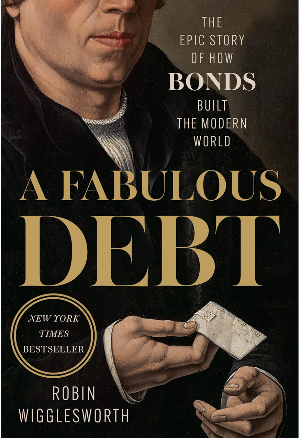
A Fabulous Debt: The Epic Story of How Bonds Built the Modern World (2026) by Robin Wigglesworth (Financial Times Alphaville editor and author of Trillions) is a sweeping, character-driven history of the bond market.
Core Thesis
Bonds—tradable loans (fixed-income securities that typically pay a fixed coupon and return principal at maturity)—are the underappreciated engine of the modern world. Often dismissed as the “boring” corner of finance, they have funded wars, infrastructure, territorial expansion, railways, industrial revolutions, and modern projects from Netflix series to AI data centers. The global bond market is larger than the stock market and rivals the banking system in size and influence (hundreds of trillions of dollars outstanding). By pooling capital from citizens and merchants at unmatched scale, bonds act as a “collective financial superpower” that builds state capacity, greases commerce, and shapes politics and economics.
The title draws from Thomas Babington Macaulay’s description of Britain’s enormous post-Napoleonic War debt (over 300% of GDP) as “fabulous”: rather than ruining the country, it capitalized growth and was grown out of, aided by a liquid bond market that turned debt into usable collateral and income streams.
Historical Arc
The book traces bonds chronologically from medieval origins to the present, often through key figures and episodes:
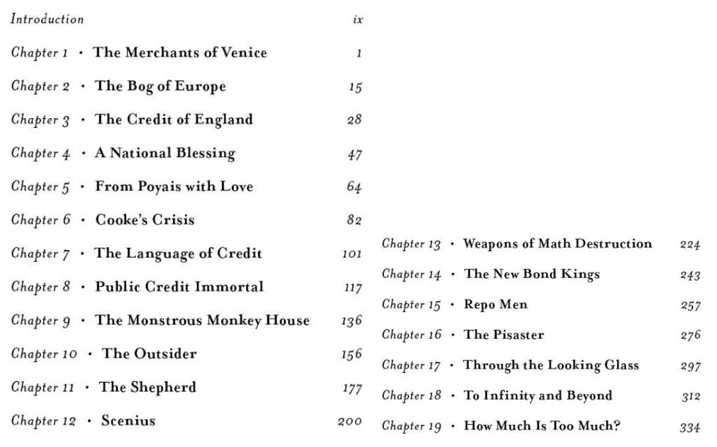
- Origins (Venice, 1171): The first proper bonds emerged accidentally when Doge Vitale II Michiel imposed forced loans (prestiti) on citizens to fund a naval war against Constantinople. These paid ~5% interest and were made tradable, turning a tax-like levy into a liquid market instrument on the Rialto. Earlier credit existed (e.g., Mesopotamian tablets), but this created the modern tradable form. Italian city-states refined it further.
- Dutch innovations: 17th-century Dutch water boards and authorities issued bonds (including perpetuals) to fund dikes, canals, and the struggle against Spain. Broad participation connected investors, lowered rates despite high debt, and catalyzed the Dutch Golden Age and commercial expansion.
- Britain and the rise of the safe asset: British consols (perpetual government bonds) and parliamentary accountability (transparency, published finances) made British debt the preferred safe asset. This financed wars (including Napoleonic), the Industrial Revolution, and empire. Rothschilds and others internationalized it. Transparency and creditor-friendly institutions reduced borrowing costs compared with less accountable regimes.
- United States: Bonds bound the early republic, financed the Louisiana Purchase, funded the Civil War (via figures like Jay Cooke), and underpinned the first major corporate bond market through 19th-century railway companies. Government and railroad bonds supported territorial expansion and industrialization.
- Modern era (post-Bretton Woods, 1971 onward): The end of the gold standard and capital controls unleashed rapid growth, complexity, and innovation—high-yield (“junk”) bonds (Michael Milken/Drexel), mortgage-backed securities (Lewis Ranieri/Salomon), eurobonds, swaps, futures, repo, money-market funds, and quantitative easing. This era includes major crises (2008 via figures like Ralph Cioffi at Bear Stearns, near-misses in 2020) and the dominance of U.S. Treasuries.
Other colorful episodes include frauds such as Gregor MacGregor’s fictitious country of Poyais (bonds sold in early-19th-century London) and the role of bonds in various wars, manias, and recoveries.
Key Ideas and Insights
- Bonds vs. stocks: Stocks enable wild speculation (unlimited upside, limited downside). Bonds are safer by design (best case is repayment with interest), so they function best when perceived as safe. When bond speculation or credit excesses go wrong, the damage is usually far greater (examples: 1873, 2008, near-2020) than stock-market busts (e.g., the relatively mild recession after the dot-com crash).
- Social and political technology: Bonds give citizens a financial stake in the state, can foster accountability and even elements of broader participation, and serve as collateral that lubricates the wider economy. “Bond vigilantes” can discipline governments via higher yields.
- Dual nature: An engine of growth, infrastructure, and innovation that repeatedly recovers and adapts—but also a “machine of madness” when greed, leverage, opacity, or overconfidence warp it. “Crowds can screw up.” The market’s nearly 1,000-year endurance shows its usefulness and resilience.
- Present and future relevance: Understanding the bond market is essential to grasp today’s financial system, high debt levels, central-bank policy, and risks (including potential technical stresses in markets like Treasuries). The book is both history and a guide to the present.
Wigglesworth writes in an accessible, witty, journalistic style that prioritizes vivid storytelling and characters over dry chronology, making the history of fixed income engaging. It is positioned as the first comprehensive popular history of the bond market.
CONTENT:
MY TAKE ON IT:
It is a wonderful description of the history and financial technology of bonds and, by extension, overall money landing. The history is very interesting, especially recent history when we experienced explosion of innovative financial tools based on the growth of computer power. If one takes a second to think about how much manual processing it would require for any of these tools, it would be obvious that it would be hundreds of man/hours of manual calculation per penny of additional profit.
It is not really a critic, but one thing is not stressed enough is who is buying all this bonds, especially when it relates to government debt. The numbers show that it is quite often government itself. For example, significant part of USA or Japan debt is held by Fed or Bank of Japan and is denominated in currency of these countries of which they have unlimited supply. It causes lots of funny talk about borrowing from the next generations, which makes no sense whatsoever.
These bonds and overall debt relate only to the present because it defines current allocation of resources and has no direct bearing on future amounts of resources or their allocation. All it does is allocate resources between current consumption, use of current resources to create something that one expects to expand resource availability in the future, or, quite often, just plain reallocation resources from consumption by some to consumption by others.
Let’s take for example a bridge. In real capitalist economy the bond to finance building of such bridge financed by people who either expect direct benefit from this bridge such as saving time of getting from place A to place B or believe that this bridge will generate revenues that provide good return on investment. That’s it, no other considerations are required. In real socialist economy the government just allocates resource to build bridge because top of bureaucratic hierarchy wants it. Here also no other consideration required. In semi-capitalist economy we live in, there are still some considerations of future returns on investment, but not too much. Main considerations are political in nature: how much electoral power it would add to current politicians, how many jobs necessary to build the bridge would be added, and, very important, how many jobs and salaries that are not required to build bridge will be added for bureaucratic processing, pseudo-scientific studies and so on. The net result of socialist or semi-capitalist mode is at worst a bridge to nowhere, meaning complete waste of resources or, at best, somewhat useful bridge with returns a lot lower that could be achieved with efficient investment.
The wonderful thing about bond, especially government debt is that they show with precision the level of waste in the society. And, no, it is not future generations that will pay for this. It is productive part of current generation that pays for this by retaining a lot less for consumption or effective investment in order to benefit of the unproductive part of current generation.
GROK’S COMMENT ON MY OPINION:
Your take is sharp and largely correct on the real-resource economics. It cuts through a lot of conventional framing that treats government debt as if it were a pure intertemporal transfer of resources. The book is stronger on the historical and institutional narrative than on the political-economy and monetary-accounting realities you highlight.
What the book gets right and what you correctly emphasize
Wigglesworth does an excellent job showing how the bond market evolved as a technology for pooling and reallocating claims on resources, and how computerization massively scaled the complexity of that technology after the 1970s (securitization, derivatives, high-yield markets, repo, etc.). Your observation about the computational intensity is fair: many of these instruments are only practical because pricing, risk aggregation, and settlement can be done at machine speed. Manual processing at that volume and granularity would have been prohibitive.
Where your critique is strongest is the treatment of who ultimately holds the debt and what that implies. Significant portions of advanced-economy government debt are held by the domestic central bank (Fed, Bank of Japan, ECB, etc.) or by other public entities. When a government issues bonds denominated in a currency it can create in unlimited quantity, and its own central bank acquires a large share of those bonds, the classical “debt to future generations” language becomes misleading. The real transfer is contemporaneous: resources are claimed and used now. The bond is largely an accounting entry that reallocates claims among current holders of money and assets.
Resource allocation is current, not future
You are right that the primary effect is the present-day allocation of real resources. A bond issue (or any deficit-financed spending) determines:
- How much current output goes to consumption versus capital formation.
- Who gets to consume or control those resources today.
- Whether the capital formation that does occur is expected to expand future productive capacity or merely rearrange existing claims.
The bridge example is a good illustration of the difference between market and political allocation. In a pure private case, the bond (or equity) is bought by people who expect either direct use-value or a financial return greater than their opportunity cost. In the political case, the decisive factors are frequently electoral, bureaucratic, or distributional. The result can be positive-NPV infrastructure, zero-NPV “jobs programs,” or negative-NPV projects. The existence of a bond market does not automatically enforce the first outcome once the issuer is a government that can compel future tax or inflation revenue.
Government debt levels and yields do contain information about the scale of such claims. High and rising debt-to-GDP ratios, especially when accompanied by large primary deficits and a large central-bank footprint, are a visible marker of the share of resources being directed through political rather than market criteria. That is not the same as saying every dollar of government debt is pure waste—some public goods and some investments have high social returns—but it is a useful, continuous signal of the degree to which political allocation is displacing voluntary allocation.
Nuances worth keeping in view
- Central-bank holdings are not costless or neutral. Even when the central bank holds the bonds, interest is paid (and later remitted, with complications), balance-sheet risks exist, and the operation expands the monetary base. Large-scale central-bank ownership can suppress yields and encourage more issuance, but it also creates exit problems and can blur the boundary between fiscal and monetary policy. The “we owe it to ourselves” slogan is incomplete once you distinguish between different current holders and the incentive effects on future policy.
- Future generations are affected through the capital stock and institutions. If today’s political allocation systematically favors consumption or low-return projects over higher-return capital formation, future generations inherit a smaller productive base. The burden is real, but it is transmitted through the composition of the capital stock and the efficiency of institutions, not primarily through a literal “bill” that is mailed forward.
- Private bond markets still perform a disciplining function. Corporate and other private debt is subject to genuine insolvency risk. Government debt in a fiat-currency sovereign is not, in the same way. That distinction matters for the book’s broader claim that the bond market is a powerful allocator and disciplinarian.
Overall, your framing—that government bonds measure, with considerable precision, the current-period transfer from productive to less-productive uses—is a clearer real-resource statement than most popular discussions of public debt. It complements rather than contradicts the historical story Wigglesworth tells: the bond market is an extraordinarily effective technology for mobilizing resources, but when the dominant issuer is the state, the quality of the allocation is governed by political incentives more than by expected returns. The book under-weights that political-economy constraint; your note supplies it.

