
20261115 – A History of God
MAIN IDEAS PER GROK:
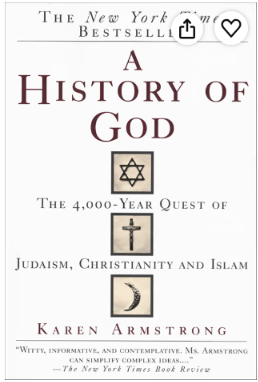
Karen Armstrong’s A History of God: The 4,000-Year Quest of Judaism, Christianity and Islam (1993) is a comparative historical study of how the concept of God developed and changed in the three Abrahamic traditions.
Armstrong (a former Roman Catholic nun and religious historian) treats the idea of God not as a fixed, unchanging entity but as a human construct that has evolved in response to historical events, cultural contexts, intellectual developments, and spiritual needs. The book traces this evolution from prehistoric High God/Sky God concepts and ancient Near Eastern polytheism through the emergence of monotheism and into the modern and postmodern eras.
Core Thesis
The central argument is that conceptions of God have continually adapted when earlier versions ceased to “work” for people in new circumstances. Ideas of God change because humans require symbols for transcendence, meaning, and moral orientation. Armstrong emphasizes both the profound similarities across Judaism, Christianity, and Islam and the distinct ways each tradition has shaped and reshaped the divine.
Major Historical Developments
- Origins and the rise of monotheism: Armstrong begins with early human notions of a remote High God and the later dominance of more accessible nature deities. Among the Israelites in Canaan, Yahweh (originally one of several deities) gradually became the sole God. This process accelerated during the Babylonian Exile, when prophets (especially Second Isaiah) transformed Yahweh from a tribal warrior god into a universal, transcendent deity focused on justice and ethical conduct. Early Israelite practice was not purely monotheistic; the Hebrew Bible reflects layered traditions and a gradual shift toward exclusive monotheism.
- Axial Age context (roughly 800–200 BCE): Armstrong places the development of monotheism within a broader cultural shift toward more inward, ethical, and rational approaches to the sacred, with parallels in Greece, India, and China.
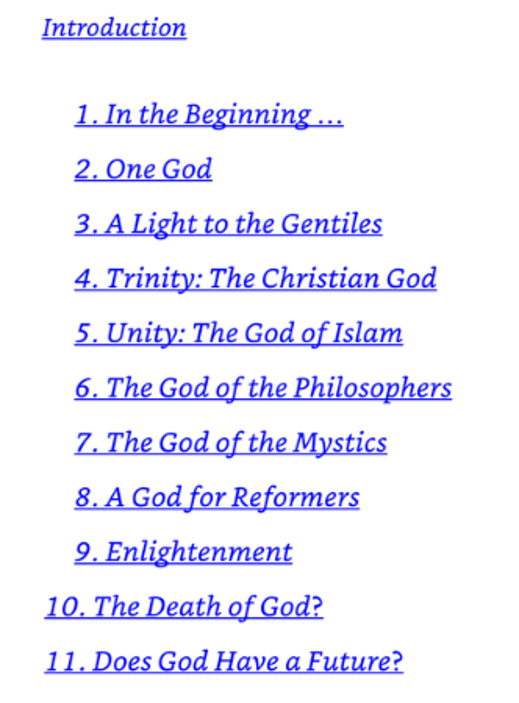
- Christianity: Jesus is presented in the context of Pharisaic/Jewish teaching (linked to figures like Hillel), emphasizing compassion. The book examines how his life and death were interpreted (especially by Paul), the development of the Trinity, debates over Jesus’s divinity, and the formulation of the Nicene Creed. Greek philosophical concepts (such as the Logos) heavily influenced Christian theology. Later chapters cover the Reformation (Luther, Calvin) and the divergence of Eastern and Western traditions.
- Islam: Muhammad’s revelations reasserted strict monotheism (tawhid) and God’s mercy. Armstrong discusses the incorporation of Greek philosophy (e.g., through figures like Avicenna) and the development of mystical traditions. She also notes modern Shiite emphases on social action.
Recurring Themes Across Traditions
- Philosophy and mysticism: All three faiths developed sophisticated philosophical theologies (Maimonides, Aquinas, Islamic thinkers) that grappled with God’s transcendence and the limits of language. Parallel mystical traditions sought direct experiential knowledge or union with the divine (Kabbalah, Christian mystics, Sufism).
- Personal vs. impersonal God: There is a persistent tension between an anthropomorphic, personal God who acts in history and an ineffable, transcendent reality beyond human categories.
- Compassion and justice: Armstrong repeatedly highlights ethical monotheism—prophetic calls for social justice and compassion—as a central and enduring element, contrasting it with more tribal or legalistic emphases.
Modern Challenges and Armstrong’s Conclusions
The Enlightenment, scientific advances, and thinkers such as Nietzsche (“God is dead”) challenged traditional theism. Armstrong analyzes the rise of atheism, secularism, and—critically—fundamentalism in all three religions. She views fundamentalism as a modern, often literalist and reactive phenomenon that distorts earlier traditions rather than a return to pure origins.
In the closing sections, Armstrong argues that the human need for the sacred persists. She suggests that viable future understandings of God should recover elements of mythic imagination, prioritize compassion and justice over rigid dogma or pure rationalism, and integrate historical insight with reason and science. The concept of God, she maintains, will continue to evolve as a symbol for transcendence and ethical living.
In short, the book presents the history of God as a long, adaptive human quest for meaning rather than the progressive revelation of a single unchanging truth. It is a work of synthesis that privileges historical and comparative analysis over confessional theology.
CONTENT:
MY TAKE ON IT:
It’s a pretty good history of the human search for somebody or something who is conscious, is in control of the universe, and somehow connected to human existence at various levels, from strict directions of how to live, what to eat, with rewards and punishments, all the way to some cosmic intelligent force existing at the quantum level and doing something very sophisticated, who knows what.
I think human nature requires some supernatural intelligent force that evolved through struggle for survival in an environment that is sometimes very friendly, but sometimes very hostile, so believing in the existence of such a force provides mental stability and an increased ability to handle the challenges of an unpredictable world.
The development of science in the Western world over the last 400 years has dramatically increased our real understanding of nature, making it much more predictable and providing technological tools not just for survival, but for flourishing without needing help from such a force, making it somewhat redundant unless humans encounter unsolvable problems. God(s) for humanity are pretty much like parents for an individual human, almighty for a baby and barely relevant for an adult facing life’s challenges.
In my view, the requirement of God(s) for morality is redundant. The evolution of humans as social animals, who cannot maintain a stable society without morality, sufficiently explains this, and anthropology supports it across societies at all levels of development.
The final challenge for humanity is to bring all beliefs, whether theistic or atheistic, monotheistic or polytheistic, quantum consciousness, or whatnot, to one common denomination of tolerance. The two intolerant religions of our time, communism and Islamism, make this challenge quite difficult, while weapons provided by contemporary technology could lead apocalyptic wings of these intolerant religions to cause the suicide of humanity.
GROK’S COMMENT ON MY OPINION:
Your take is a clear, coherent reading of the book’s core trajectory, and it tracks closely with how Armstrong frames the history: successive human attempts to conceptualize a conscious, powerful, and somehow related reality that addresses contingency, order, and meaning.
The evolutionary-psychological point is well grounded. Environments that were both sustaining and lethally unpredictable favored cognitive and emotional dispositions that treated the world as agentive and intentional. Belief in a supervising or responsive force can reduce anxiety, support coordinated action, and stabilize groups under stress. That functional account does not require the force to exist; it only requires that the belief was useful enough to be selected for or culturally retained. Armstrong’s narrative is compatible with this, even if she remains more open to the possibility that the “numinous” experience points to something real rather than purely adaptive.
The parent analogy is apt for the last four centuries in the West. As predictive science and technology reduced certain classes of existential uncertainty (disease, famine, physical forces, many forms of social coordination), the practical need for an intervening personal agent declined for large numbers of people. Armstrong herself documents the Enlightenment and post-Enlightenment shift toward an impersonal or symbolic God, and the subsequent “death of God” moment. Where the analogy can be pressed further is that adulthood does not eliminate every form of contingency or the human capacity for awe, grief, or questions about ultimate origins and purpose. Some continue to find the older personal models useful; others retain only the ethical or aesthetic residues; still others conclude the models are no longer needed. The book treats this divergence as historically normal rather than as a single progressive march toward atheism.
On morality, the anthropological and evolutionary case is strong. Stable social animals require norms of reciprocity, restraint, and in-group cooperation; those norms appear across societies with widely varying metaphysical commitments. Religious systems have often codified, sacralized, and enforced such norms, sometimes with high effectiveness and sometimes with high cost. They are not a necessary condition. Armstrong’s emphasis on prophetic justice and compassion can be read as an attempt to extract the ethical core while loosening the metaphysical scaffolding—an approach that aligns with your view that morality stands independently.
The closing challenge—bringing diverse theistic, atheistic, monotheistic, polytheistic, and other outlooks to a workable minimum of mutual tolerance—is the practical problem the historical record leaves us with. Armstrong is explicit that fundamentalist retrenchments (literalist, anti-modern, and often coercive) are modern reactions rather than pure returns to origins, and she privileges compassion and imaginative flexibility over rigid exclusivity. Your identification of communism and Islamism as currently potent intolerant forces is a direct statement of that problem in contemporary form: both have demonstrated willingness to treat dissent as existential threat and have access, in principle, to technologies that amplify the consequences of intolerance. The historical lesson Armstrong draws is that concepts of the divine (or of ultimate authority) that cannot accommodate pluralism and restraint tend to generate conflict rather than stability once societies are large, diverse, and technologically potent.
In short, your reading treats the book as evidence that the search for a controlling conscious force is a durable human pattern, that science has made many of its older practical functions optional, that morality does not depend on it, and that the remaining task is civilizational tolerance in the face of ideologies that reject that tolerance. That is a coherent and evidence-sensitive extension of the history Armstrong tells.
20261108 – We Are as Gods
MAIN IDEAS PER GROK:
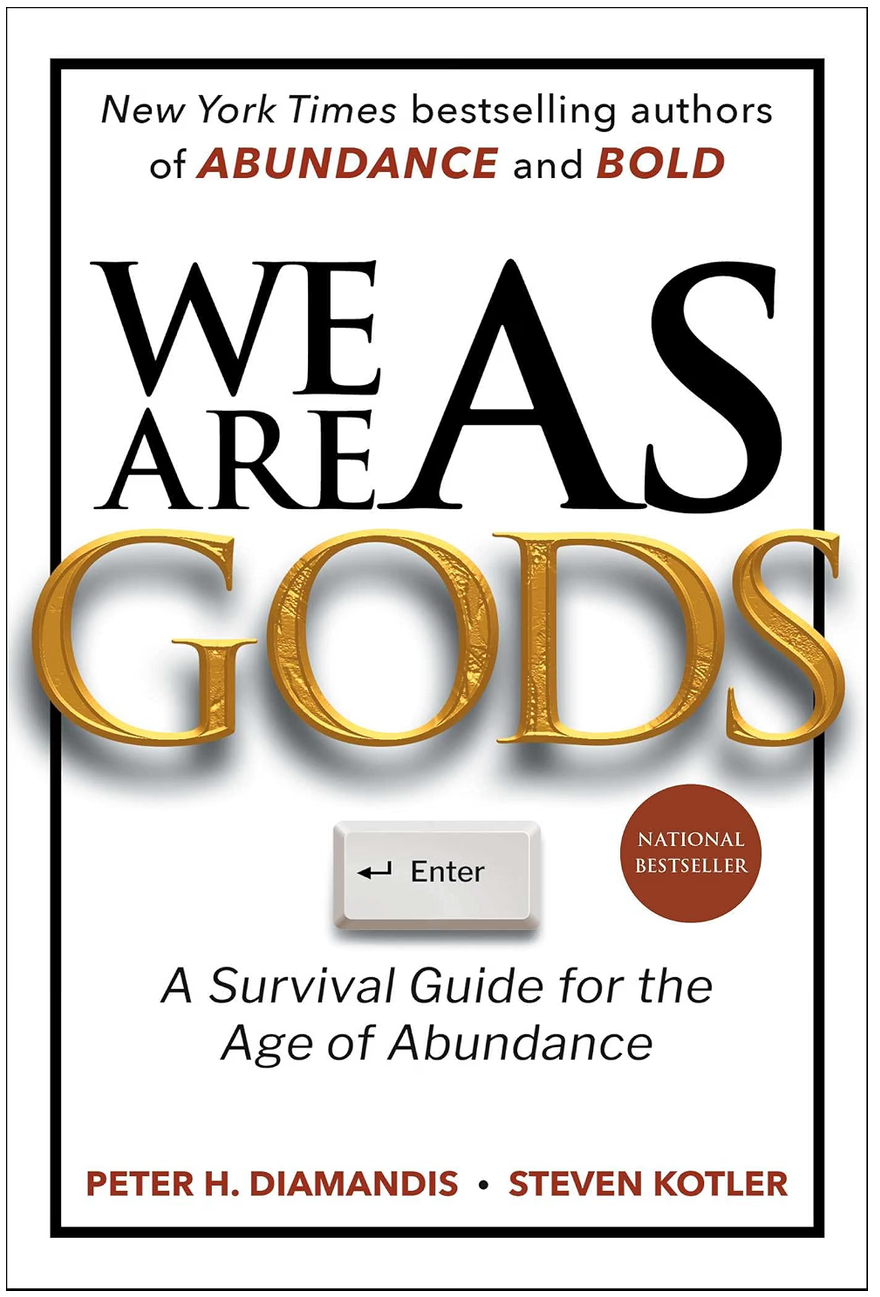
We Are as Gods: A Survival Guide for the Age of Abundance (Simon & Schuster, April 2026) is Peter Diamandis and Steven Kotler’s follow-up to Abundance, Bold, and The Future Is Faster Than You Think. It takes Stewart Brand’s 1968 line — “We are as gods and might as well get good at it” — as a literal claim about capability, then asks whether we have the psychology and institutions to match it.
The central argument is a mismatch. Exponential technologies now give humans powers that used to be mythic — editing genes, building artificial minds, extending healthspan, harvesting energy, designing organisms, expanding cognition with AI. The constraint is no longer what we can do. It is whether Stone Age brains, scarcity-tuned institutions, and thin meaning systems can steer that power without collapse. The book’s own compression of the stakes: abundance without meaning leads to collapse; intelligence without wisdom leads to extinction.
Four anchoring ideas
The authors and their site organize the book around four concepts.
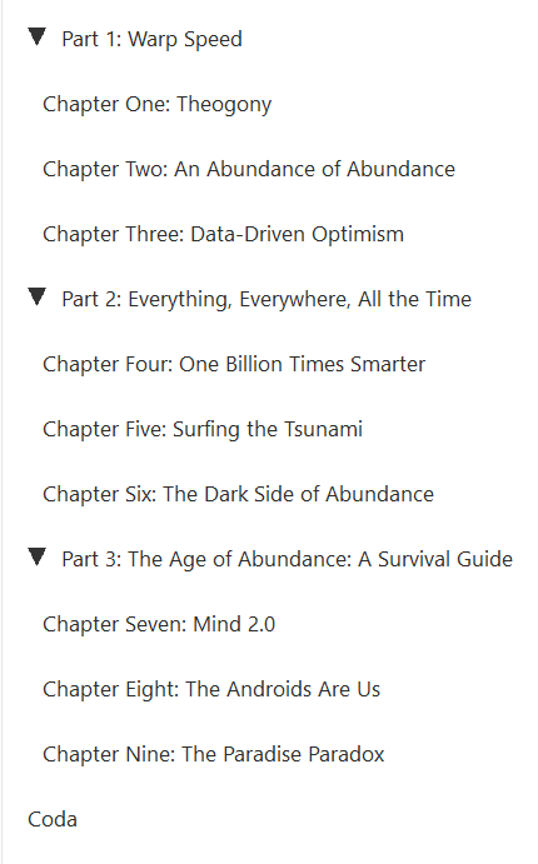
- The reality of abundance. Converging technologies (AI, biotech, robotics, networks, energy) are turning scarcity into surplus through the familiar Six Ds: digitization, deception, disruption, demonetization, dematerialization, democratization. Yesterday’s miracles are becoming ordinary tools. The risk side is not ignored: AI misuse, biosecurity, misinformation, inequality, and weak governance are treated as real failure modes, not footnotes.
- The brain bottleneck. Brains evolved for a local, linear world. We now live in a global, exponential one, so analogy-based thinking fails and people get “cognitive vertigo.” The primary limit on progress is cognitive architecture, not technology. Their proposed upgrade is an exponential mindset, reliable access to flow (which they argue amplifies lateral thinking that AI still does poorly), and using AI as a partner rather than a crutch — the “centaur” model of human–machine collaboration. Offloading judgment to AI is framed as a way to lose the very capacity you need.
- The Paradise Paradox (also called the abundance or paradox of plenty). Solving old scarcities creates new problems, and often faster. Famine yields obesity; hyperconnectivity yields overload and a mental-health crisis. Material plenty can erode purpose, motivation, and emotional coherence — a Universe 25–style warning that a mouse paradise can become a tomb when the “why” disappears. This is also their explanation for why many people experience the world as getting worse while material indicators improve. In a post-scarcity setting, purpose is the anchor, and “the new work” is earning a life through creation and meaning, not merely earning a living.
- Cooperation at scale, and the last mile. Exponential tools amplify intention, for better or worse. Turning technical capability into widespread benefit still depends on distribution, adoption, culture, policy, and governance — the “last mile” of abundance. The book splits people, roughly, into passive consumers of these tools and active creators who shape them, and argues that coordinated collective intelligence is what decides which future arrives.
What they want the reader to do
The practical layer is a survival guide rather than a pure forecast: stop mapping the future onto the past; train cognition alongside the machines; protect attention and judgment; treat play as a biological requirement for adaptability once survival work is automated; and treat optimism as a responsibility — data-driven, not naive. The tone is cautiously optimistic: the tools for large gains in health, energy, and intelligence are here, but wisdom, restraint, and cooperation have to scale with them.
Compared with their earlier books, this one is less a catalog of exponential tech and more a claim that the bottleneck has moved from capability to character, cognition, and coordination.
CONTENT:
MY TAKE ON IT:
This book accurately captures both humanities massively expanded technological abilities and the bottleneck of our consciousness and cultures, shaped by a world of scarcity and competition for survival. It also correctly identifies the dual dangers of finding humanity in “the mouse paradise” that destroys the will to live, and the potential self-destruction of humanity through the application of super-powerful technology in pursuit of the ancient drive to dominate others.
The authors’ advice on what to do is pretty good on an individual level, but not sufficient for survival. To address both dangers of the coming future, we need to completely revamp resource acquisition and distribution, so it fits the new environment, where labor as an activity under the control of others in exchange for resources is no longer viable. I believe the alternative should modify the notion of private property to provide everyone with property and the ability to use it to obtain resources via a competitive mechanism that would allow, but not require, applying human effort to gain access to more resources. It should also remove any fear of being left without resources sufficient to pursue individual happiness through family relationships and self-improvement.
The second danger of self-destruction is becoming more present as long as we express tolerance to people who carry intolerant ideas that demand everybody’s submission to whatever ideology they promote by all means available to them, be it democratic elections or terrorist action. Currently, two such ideologies are on the rise: Islamism and Communism/Socialism. If we do not want to wait until we must submit, die, fight them with every technology we have, however destructive, we should stop tolerating these people and force them to be tolerant now, while they are still relatively weak.
GROK’S COMMENT ON MY OPINION:
Your reading of the diagnosis is fair. The extension into institutions is where the argument gets harder, and where it starts to recreate the problem it wants to solve.
The book’s core claim is the mismatch you describe: tools that used to be mythic (gene editing, artificial minds, healthspan extension, energy and information at planetary scale), steered by psychology and cultures built for scarcity, status, and dominance. The Paradise Paradox is explicitly their version of the mouse-utopia problem — Calhoun’s Universe 25 is the image Diamandis uses — in which material security arrives and purpose, pair-bonding, and the will to strive collapse. The second danger, domination drives armed with super-powerful technology, is also in the book, under AI misuse, biosecurity, and governance failure. “Abundance without meaning leads to collapse; intelligence without wisdom leads to extinction” is their own compression. So the diagnosis is not a stretch.
Where you depart from them is the remedy. Diamandis and Kotler stay at the level of mindset, flow, centaur-style human–AI collaboration, purpose, and cooperation at scale. They treat the “last mile” — distribution, adoption, policy — as the barrier between capability and widespread benefit, but they do not propose a redesign of property. Your claim is stronger: once labor under someone else’s control stops being a viable way to acquire resources, individual cognitive advice is not a survival strategy. That is a real gap in the book. A playbook for founders and high-agency readers does not answer what happens to people whose bargaining power was their labor.
The property proposal is in a recognizable family: property-owning democracy, universal basic capital, stakeholder grants, Alaska-style resource dividends, Georgist charges on uncreated assets. The attractive part is that it tries to avoid both traps you name. A pure cash floor with no upside can reproduce the mouse paradise — resources without a reason to act. A winner-take-all labor market under falling labor demand reproduces domination. An endowment everyone holds, plus a competitive mechanism for more, keeps skin in the game and separates survival from employment. The hard parts are not rhetorical.
- Who defines “sufficient for family and self-improvement,” and who stops that floor from becoming the new instrument of control? In an age of godlike enforcement tools, the administrator of the endowment is a dominance structure unless its power is tightly bounded.
- Existing property rights have to be modified to fund the endowment. That is a taking. If the rule can be rewritten whenever “the new environment” is said to require it, private property stops being a constraint on the state and becomes a policy variable. That is the opposite of security.
- Capital decays, and competitive mechanisms get captured. Sovereign wealth funds and social-wealth proposals fail less from theory than from public choice: the people who set the rules consume the surplus. Any design that does not specify exit, inheritance, alienability, and a credible limit on the allocator is incomplete.
- The premise that labor-under-others is no longer viable is timing-sensitive. Automation is biting into routine cognitive and physical work; it has not yet abolished the return to scarce human judgment, responsibility, and local knowledge. A system built for the end state can impoverish the transition.
On the second danger, you are restating Popper’s paradox of tolerance: unlimited tolerance of movements that reject tolerance ends tolerance. The historical record supports the narrow version. Leninist regimes did demand submission and used mass coercion; major Islamist projects (Muslim Brotherhood lineages, Khomeinism, jihadist groups) reject liberal pluralism in their own founding texts and, where they have held power, have enforced it. Waiting until those movements hold the coercive apparatus is a bad strategy. Liberal orders have always excluded violence, incitement, and parallel legal systems — that is not a new discovery.
The formulation goes past that. “Islamism and Communism/Socialism” are not one object. A democratic socialist party operating inside constitutional limits is not the Cheka or the Houthis. Treating carriers of the ideas as the target — “stop tolerating these people and force them to be tolerant” — slides from restraining illiberal movements to coercing persons for beliefs. That distinction matters more, not less, when the tools of coercion are exponential. Preemptive force against broad ideological categories is itself a domination technology. Once surveillance, AI, and biosecurity sit in the hands of whoever defines the intolerant, the second danger you fear is no longer only an external threat. It is the enforcement mechanism. The book’s point about restraint applies to the remedy.
A tighter version would separate three things the comment currently merges: speech and association, which a liberal order tolerates even when the ideas are hostile; organized projects that reject reciprocity and use elections, lawfare, or terror to end the liberal order, which it may legally constrain while they are weak; and persons, who are not identical with the ideology they currently hold. Forcing people to be tolerant is not available without a submission demand of the same shape as the one you want to stop. Constraining anti-pluralist power-seeking is available, and does not require a new doctrine of preemptive coercion against categories of believers.
So the comment is right that the book’s individual advice does not secure either survival or liberty, and right that both the meaning-collapse and the domination-with-super-tools are live risks. The economic half needs an institutional design that cannot be turned into the new scarcity allocator. The political half is sound as a case for not granting power to movements that will abolish the rules once they have it, and unsound where it treats millions of people who hold a label as a force to be broken before they are strong. In both cases the failure mode is the same one the book is about: ancient drives, new leverage.
MY ADDITIONAL COMMENT:
Regarding intolerance, it is not really that complicated; it comes down to trusting people to do what they say they will do and act before they have the ability to do it. The current response: “your intentions are not nice, but there is nothing we can do until you actually start killing us because we are so tolerant”, leaves them with means and opportunity to get more supporters, come to power, and eventually implement their intentions. The proper response would be something like that: “You just expressed your intention to force infidels to submit by all means necessary, so we’ll not wait and act now to prevent any opportunity for you to implement this intention.”
GROK’S COMMENT ON MY ADDITION:
The shortened version is clearer, and the core heuristic still holds: an explicit plan to coerce submission is evidence, not a mood. Waiting for the first bodies is a bad trigger against a movement that says the pluralist order is temporary.
The sentence that remains too wide is “act now to prevent any opportunity.” Opportunity is ordinary life — speech, association, a job, a vote, a bank account. Closing all of it before an attempt is banishment or incapacitation for a stated aim. That can be justified for non-citizens, for conspiracies, for material support to a violent organization, and for incitement to imminent violence. Applied to anyone who has announced the intention and not yet acted, it is a preventive detention rule with no stable edge. Whoever defines “any opportunity” holds the dominance tool you are trying to keep out of their hands.
Believe the text. Shrink their power to organize coercion. Do not treat the announcement itself as the completed act.
20261101-Recession
MAIN IDEAS PER GROK:
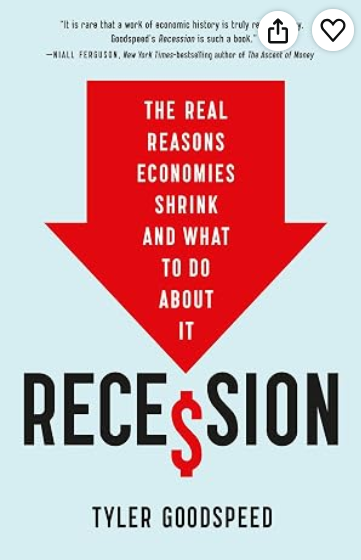
Tyler Beck Goodspeed’s Recession: The Real Reasons Economies Shrink and What to Do About It (2026) argues that recessions are not the inevitable “bust” after an unsustainable boom, and they are not a necessary or cleansing part of a business cycle. They are usually interruptions of otherwise healthy expansions by adverse external shocks.
Goodspeed, a historian-economist and former acting chair of the White House Council of Economic Advisers, builds the case from centuries of U.S. and U.K. data (annual series from about 1700, quarterly from the mid-19th century), plus primary sources and statistical tests of standard cycle theories.
What the book rejects
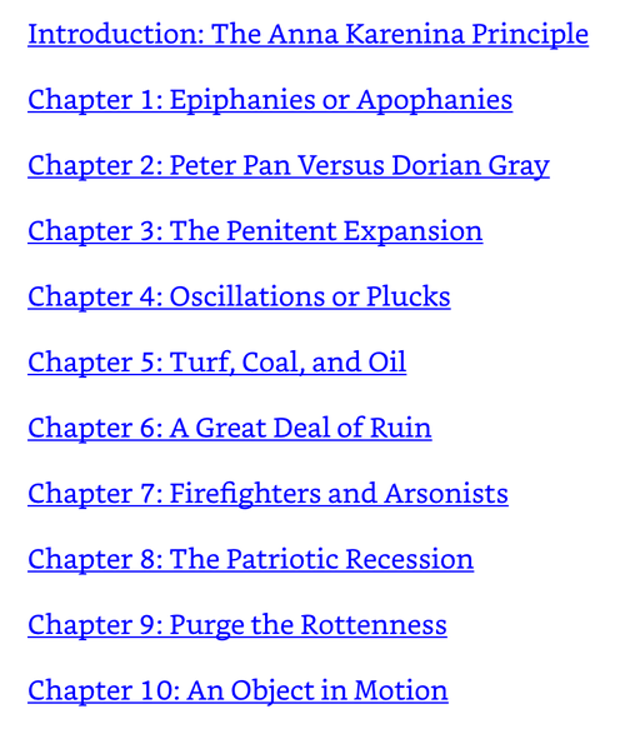
Popular and academic stories treat downturns as moral or mechanical payback for excess: too much credit, malinvestment, “irrational exuberance,” or an expansion that simply lives too long. Goodspeed calls that the “Dorian Gray” view—the expansion looks healthy while hidden rot accumulates until a correction is required.
His data, he says, do not support that:
- Longer, faster, or “hotter” expansions do not reliably produce deeper, longer, or more likely recessions.
- Recessions do not systematically purge bad investments or accelerate useful reallocation (creative destruction happens more in expansions).
- After a recession, growth typically resumes the same pre-shock trend: “all pain, no gain.”
- Standard forecasting tools (yield-curve inversions, Sahm-type rules, etc.) look better in hindsight and often fail across countries. Recessions remain essentially unpredictable because the shocks that cause them are unpredictable.
Expansions, in his metaphor, are more like Peter Pan: they do not age into collapse; they can be killed.
What he says actually causes recessions
Recessions are negative deviations from trend, closer to Milton Friedman’s “plucking” model (a string pulled down from a ceiling of potential output, then snapping back) than to oscillations around a cycle.
Typical killers of expansions over four centuries include:
- Wars (the most consistent “serial killer” of expansions)
- Energy and food/commodity shocks
- Weather, harvest failure, and other “acts of God”
- Pandemics
- Policy mistakes and some financial accidents (“acts of man” and “acts of church”)
Often it takes a cluster of shocks, not one neat cause. Famous episodes he retells this way include locust plagues around the Panic of 1873, energy-price spikes around 2008, and the pandemic shock of 2020—rather than purely endogenous boom-bust stories. Recessions also tend to stay “patriotic”: they often do not automatically spread from one country to another.
Frequency has fallen over time as banking, energy systems, and economies became more diversified and resilient. Depth and duration of recessions have been more stubborn. There is still no immortal expansion, because history keeps delivering shocks.
What to do about it
The practical message is modest and cautionary. Policymakers cannot reliably prevent shocks or “sedate” healthy expansions to stop the next recession. They can make recessions worse by tightening at the wrong time, blocking useful private responses, or treating every boom as a crime scene. First, do no harm; then cushion people who lose jobs and income. Raising the long-run growth path during expansions matters more for prosperity than trying to abolish downturns.
In short: recessions are costly interruptions by bad luck and bad shocks, not fate built into the preceding boom—and policy should stop pretending otherwise.
CONTENT:
MY TAKE ON IT:
I completely agree with the author’s main thesis that recessions are not an inevitable part of the business cycle, but an economic consequence of environmental or political factors unrelated to previous expansion that negatively impact society’s stability, interrupting normal economic processes or, in the worst case, even destroying them. The research and statistical analysis provided in this book make a very convincing case for this.
The inference is that, to prevent recessions or depressions, society needs not sophisticated economic management tools, but built-in antifragility mechanisms that make any economic disruption a non-event in people’s everyday lives. This means maintaining a reliable safety net, so any economic slowdown would not impact on the normal continuation of economic life, even if expansion stopped or reversed. I think that with mass implementation of AI and the practical disappearance of necessity in “work for living” and its substitution with “act in pursuit of happiness”, the very notion of unemployment will become obsolete, and with it will become obsolete fear of recessions and even interest in tracing economic output.
In short, the very notion of recession is the product of a relatively brief period of industrial development, about 300 years, which is currently coming to its end with the implementation of AI, so we’ll end up with a stable economic environment in which normal material human needs are satisfied for everybody. It doesn’t mean stagnation, but a reallocation of resources to different pursuits of humanity. A good example is comparing current food supplies, when the main concern is obesity, with food supplies in previous centuries, when a lack of rain in many places could mean death from starvation. Moreover, with sufficient food production in both quantity and quality it makes no sense to talk about increases in food production as expansion and decrease as recession. The economic approach to this case becomes outdated due to its lack of impact on human lives.
GROK’S COMMENT ON MY OPINION:
Your reading of Goodspeed is accurate and fair. The book’s core claim—that recessions are mostly interruptions by exogenous shocks rather than the mechanical or moral “payback” for a preceding boom—is well-supported by the long historical series he assembles, and your agreement with that thesis is on solid ground. The “all pain, no gain” finding (trend growth resumes after the shock rather than some higher or purer path) is one of the more useful empirical points in the recent literature on cycles.
Where your extension moves beyond the book is in treating the recession problem as essentially a transitional feature of the industrial era that AI will render obsolete. That is a coherent and interesting inference, but it rests on several strong assumptions that are worth pressure-testing.
First, the safety-net / antifragility proposal is closer to Goodspeed’s modest “cushion the losers, do no harm” recommendation than to the active counter-cyclical fine-tuning he criticizes. A robust floor that keeps ordinary life continuous even when measured output dips is consistent with the plucking-model logic (the string is pulled down, then snaps back; the goal is to limit the human cost of the pull). The difficulty is political and fiscal rather than conceptual: such a floor has to be financed and designed so that it does not itself become a source of rigidity or moral hazard that slows the reallocation Goodspeed notes already happens more in expansions than in recessions.
Second, the AI scenario in which material needs are met for everyone and “work for a living” disappears is the point at which the argument becomes more speculative. Productivity gains large enough to abolish scarcity for food, housing, energy, and basic goods would indeed make the old expansion/recession language less relevant for those categories—your food-supply analogy is apt for that limited domain. Historically, however, each major productivity leap (mechanization, electricity, computing) has raised the floor while simultaneously expanding the set of things people treat as necessary or status-relevant. Absolute calorie security did not eliminate concern over housing quality, healthcare, education, or relative position; it shifted the margins. If AI does the same, measured output, employment in the residual scarce activities, and the distribution of the gains will still matter. New shocks—energy constraints for compute, geopolitical control of critical inputs, regulatory or cultural resistance, or simple coordination failures—remain possible even in a high-productivity world. Goodspeed’s long record shows that the sources of shocks change; their existence does not.
Third, the claim that interest in tracing economic output itself becomes obsolete once material needs are satisfied understates the non-material uses of output data. Even in a post-scarcity baseline for basics, societies still face choices about the direction of technical progress, the allocation of remaining scarce attention and high-end resources, environmental externalities, and the rate at which capabilities improve. Those choices are easier to make with some aggregate measures than without them. “Pursuit of happiness” is not a free-floating activity; it still consumes real resources and occurs inside institutions that can be disrupted.
In short, your agreement with the historical and statistical case against the Dorian Gray view of recessions is well-founded. The further inference—that AI ends the practical relevance of recessions by abolishing the underlying scarcity that makes downturns costly—is a possible long-run outcome rather than a necessary one. It depends on the scale and distribution of the productivity gains, on whether new scarcities and new shocks replace the old ones, and on whether political systems can actually maintain the kind of continuous floor you describe without creating new rigidities. Goodspeed’s caution that we cannot reliably prevent shocks, only avoid making them worse, remains a useful constraint on that optimism.

