
20260927 – Last Branch Standing
MAIN IDEAS PER GROK:
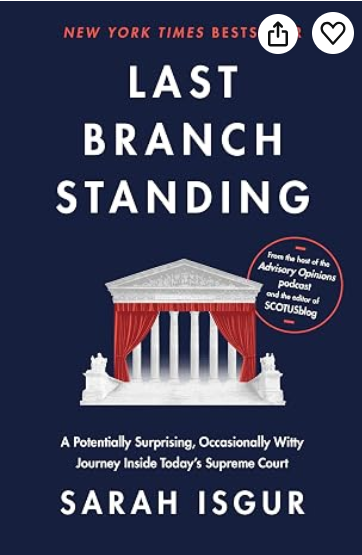
Last Branch Standing: A Potentially Surprising, Occasionally Witty Journey Inside Today’s Supreme Court (2026) by Sarah Isgur is a myth-busting, insider look at the modern Supreme Court. It argues that popular understandings of the Court are overly simplistic and partisan.
Core Thesis: Beyond the 6-3 Myth
Most people (and much media coverage) treat the Court as a purely political body split along a left-right “X-axis,” with a reliable 6-3 conservative majority (Republican appointees vs. Democratic ones). Isgur shows this is incomplete and often misleading. Many decisions do not break cleanly along partisan lines—recent terms have featured high rates of unanimous or near-unanimous outcomes, and individual justices frequently cross expected ideological lines (for example, Brett Kavanaugh aligning more often with Elena Kagan than with Neil Gorsuch in certain periods).
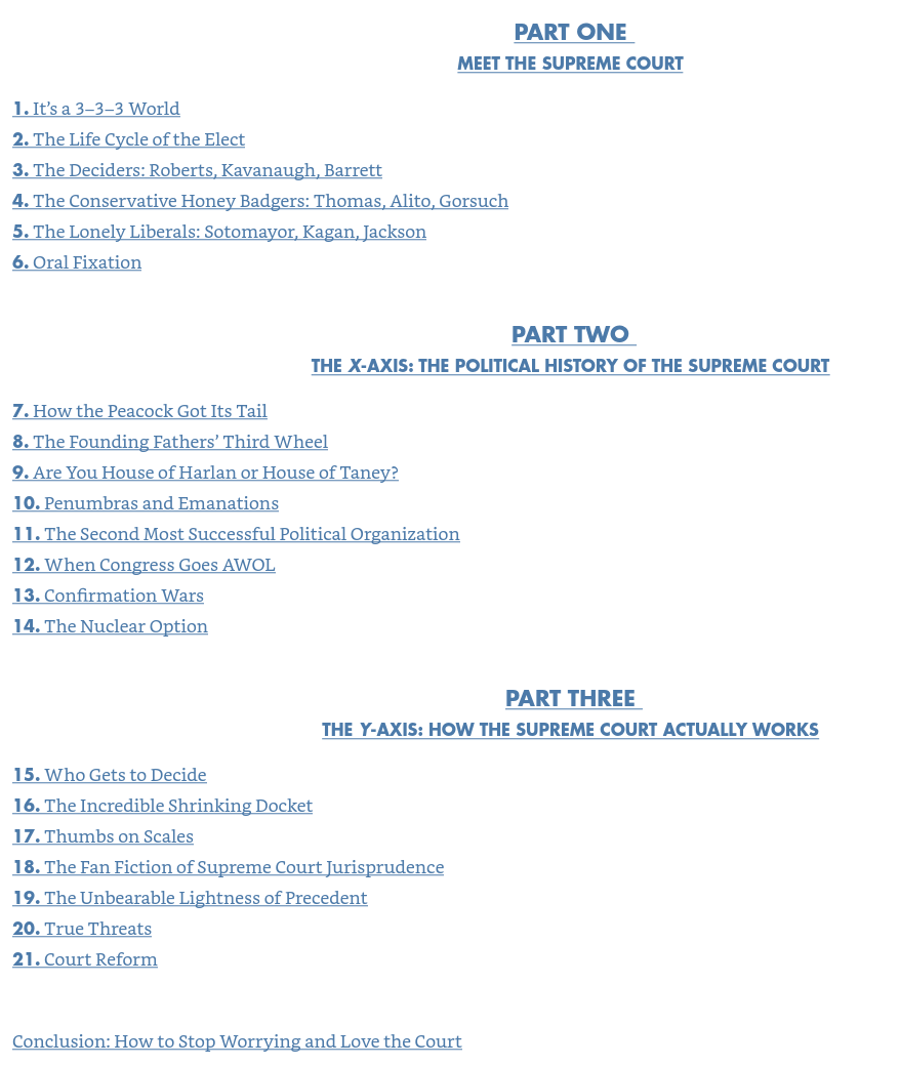
She introduces a second dimension, the “Y-axis”: justices’ institutional instincts, ranging from order-loving institutionalists (who prioritize the Court’s legitimacy, consensus, precedent/stare decisis, workability, and long-term credibility) to “chaos agents” or more disruptive justices less constrained by those concerns. Overlaying the two axes produces a more accurate 3-3-3 picture of the current Court rather than a rigid 6-3:
- Lonely Liberals: Sonia Sotomayor, Elena Kagan, and Ketanji Brown Jackson (with Kagan often more institutionalist than the others).
- Conservative Honey Badgers (more originalist/textualist and less institutionalist): Clarence Thomas, Samuel Alito, and Neil Gorsuch.
- The Deciders/Institutionalists (swing or moderating influence): Chief Justice John Roberts, Brett Kavanaugh, and Amy Coney Barrett.
This framework explains surprising alliances, narrow opinions, and why high-profile cases do not always produce the expected partisan outcomes.
The Court as the “Last Branch Standing”
Isgur argues the Supreme Court is the only branch still operating roughly as the Founders intended. Congress has largely abdicated its legislative role (due to polarization, leadership dynamics, campaign incentives, and historical shifts), while the executive has accrued excessive power. This forces the Court into an uncomfortable position of resolving major policy disputes that properly belong to the political branches, making it a target for partisan attacks. The Court is thus both uniquely powerful and uniquely vulnerable in the current system.
How the Court Actually Works
The book provides an accessible, often humorous tour of internal operations and culture:
- Case selection (the “rule of four,” criteria for granting certiorari, shrinking merits docket from historical highs of ~150 cases to ~60).
- Oral arguments, opinion assignment, and the rise of the “shadow docket” (emergency stays and orders with limited briefing and reasoning).
- Day-to-day life: clerks, which justices appear in the building or at social events, interpersonal dynamics.
- Biographies and judicial philosophies of the current justices, treating them as complex individuals rather than partisan heroes or villains.
- Broader context: historical development of the Court (Marshall era, landmark cases), the role of precedent, textualism/originalism debates, and the professionalization of the Supreme Court bar.
Isgur emphasizes that cases with superficially similar headlines often turn on distinct factual records and legal postures, which media coverage frequently flattens.
Critiques, Reforms, and Tone
She critiques over-politicization of the judiciary by both sides, certain aggressive theories (including aspects of “common good” constitutionalism), and public/media misunderstandings. Proposed improvements include restoring aspects of the Senate confirmation process (e.g., a soft filibuster), enforcing an ethics code, expanding the merits docket, better public education about the Court, and limited structural ideas (such as temporary replacements for recusals or adjusted appointment norms).
The overall tone is irreverent, witty, and accessible—aimed at general readers while remaining substantive. It blends history, institutional analysis, insider anecdotes, and cultural references to demystify the Court and argue for preserving the rule of law amid institutional dysfunction elsewhere in government.
In short, the book’s central message is that understanding the Supreme Court requires looking past red-vs-blue scorekeeping to the interplay of ideology and institutional temperament, and recognizing the Court’s strained but still-recognizable constitutional role as the last functioning branch of the original design.
CONTENT:
MY TAKE ON IT:
This book offers an interesting insider look at Supreme Court personalities and how it functions. However, the author’s main positions, in my view, don’t quite match reality.
Starting with the idea that it is the branch that functions consistently with the original intentions of the framers of the Constitution. The author herself provides a detailed narrative of how Justice Marshall managed to transform it from one of 3 equal branches of government into the superior branch that has the final say on the most important decisions. Despite multiple deviations from this position over the next 250 years, we still live in the republic in which 9 unelected Justices can override any decision of elected branches, both legislative and executive.
Similarly, the author seems confused about ideological differences between justices and tries to resolve seemingly inconsistent attitudes by reducing their positions to a two-dimensional space of conservatives-liberals and high-low institutionalists. In reality, all justices are ideological; only their ideology is not consistent across all areas. So, when Roberts bent over backward to support Obamacare, it was not because of an attempt to protect the institution of the Court, but rather because government controlling healthcare and therefore removing this headache for business is consistent with his ideology as a big-government conservative, while completely contradicting the ideology of Justice Thomas – an individual-freedom conservative. If you break down votes by positions on specific issues, it becomes obvious that institutionalism has nothing to do with it.
The author’s suggested reforms amount to something between cosmetic and irrelevant because the author refuses to accept the reality that Justices are mainly ideological creatures, with politics much less important after they get into the permanent seat. None of this would prevent the deterioration of the Supreme Court’s standing.
As far as I am concerned, the solution should be to recognize that the framers actually agreed with the idea of a “living” constitution – that’s what the process of amendments is for. So, all that needs to be done is to recognize that ideas of non-ideological Justices above the fray giving politically neutral solutions to controversial issues are absolutely unrealistic and have never worked.
The best way would be to turn Justices into explicit representatives of different ideologies by making, for example, 10 Justices appointed, reconfirmed, or removed by 10 senators each, with senators having only one vote. This would create an ideologically representative body of legal professionals capable of providing sophisticated review of any issue from 10 different ideological positions. After that, if a decision has a qualified majority (at least 8 to 2), it becomes standing interpretation of the Constitution. If such a majority is not achievable, both the majority and the minority produce constitutional amendment drafts that would remove interpretive uncertainty. After that, it would go through the regular process of constitutional amendments, with a caveat that one of these drafts becomes the new amendment by simple majority. Such a process could lead to errors similar to prohibition, but an erroneous amendment could be removed by a newer one, based on the lessons learned.
GROK’S COMMENT ON MY OPINION:
Your critique is substantive and raises several real tensions that the book either soft-pedals or frames differently. I’ll engage the main points directly.
1. “Last Branch Standing” and original design
You are right that Marshall’s establishment of judicial review in Marbury (and the subsequent expansion of the Court’s role) was a major institutional power grab relative to the text of Article III and the expectations of many Framers. The Constitution does not explicitly grant the Supreme Court the final word over the other branches, and several Framers (Jefferson most notably) were hostile to the idea of judicial supremacy. The Court has been the least democratic branch from the start; Marshall made it far more consequential than the text alone required.
Where Isgur’s framing still has force is comparative and functional rather than pure originalism. She is not claiming the Court operates exactly as 1787 imagined. She is claiming that, of the three branches as they exist in 2026, the Court is the only one that still roughly resembles a constitutional institution with internal norms, reasoned explanation, and some degree of independence from immediate electoral pressure. Congress has largely ceased to legislate on hard questions and the executive has absorbed vast discretionary power. In that degraded landscape, the Court remains the branch that most closely tracks the formal structure the Constitution created, even if Marshall already stretched that structure. Your point about nine unelected people overriding elected branches is correct and is the core democratic deficit of judicial review. Isgur does not deny the deficit; she treats the Court’s relative institutional health as a second-best reality given the collapse of the other branches.
2. Ideology vs. the X/Y-axis model
This is your strongest critique. The 3-3-3 / institutionalist-vs-chaos-agent model is a useful descriptive heuristic for predicting certain patterns of coalition and opinion-writing behavior, especially on procedural, statutory, and institutional-legitimacy questions. It is weaker as a causal explanation of high-stakes constitutional outcomes.
Your Obamacare example is fair. Roberts’s vote in NFIB v. Sebelius is better explained by a combination of:
- a preference for incrementalism and avoiding sharp political ruptures,
- a view of the Commerce Clause and taxing power that is more capacious than Thomas’s, and
- a long-standing big-government conservative orientation that accepts substantial federal regulatory power over the economy when it is framed as traditional rather than radical.
Calling that pure “institutionalism” underweights the substantive ideological content. The same applies to other cross-ideological alignments: they often reflect overlapping but incomplete ideological commitments (federalism, administrative state skepticism, speech maximalism, etc.) rather than a clean institutionalist variable. Ideology is multi-dimensional and issue-contingent; forcing it onto a two-axis plane inevitably flattens real differences. Isgur is more candid about this complexity in the podcast version of her thinking than the book sometimes is. The model is still better than pure red/blue scorekeeping, but it is not the deep causal account you want.
3. On reforms and the nature of justices
You are correct that once confirmed, the political party that appointed a justice becomes less predictive than the justice’s own jurisprudential priors. That is why “politics” in the narrow partisan sense declines in importance after the lifetime appointment is secured. The deeper problem is that those priors are themselves ideological and are not neutrally derived from the constitutional text. Isgur’s proposed reforms (ethics code, more cases, better public education, soft filibuster restoration) are mostly process improvements. They do not confront the harder reality that the Court is a small, ideologically sorted, life-tenured body exercising final interpretive power over contested moral and policy questions. Cosmetic fixes will not restore public legitimacy if the underlying structure continues to produce high-stakes, 5-4 or 6-3 outcomes on culture-war and regulatory issues.
4. Your proposed redesign
This is the most interesting part of your take. You start from a realistic premise: the myth of the non-ideological, above-the-fray justice has never been true and is increasingly untenable. You then try to make ideology explicit and accountable rather than hidden.
Strengths of the idea:
- It abandons the fiction of neutral umpires.
- It forces the production of concrete amendment text when interpretive consensus fails, which is closer to the formal amendment process the Constitution actually provides.
- The dual-draft + simple-majority fallback creates a mechanism for resolving permanent interpretive deadlock without requiring the supermajorities that have made Article V almost inert.
- Explicit ideological representation could reduce the current selection process’s focus on hiding ideology during confirmation.
Serious difficulties:
- Democratic legitimacy of the amendment shortcut. Allowing a simple majority to enact one of two Court-produced drafts effectively lets a transient political majority amend the Constitution with far lower thresholds than Article V requires. That is a major departure from the supermajority protections the Framers built in. Prohibition is a useful cautionary example, but the correction mechanism you describe still concentrates enormous agenda-setting power in a body of ten ideologically selected lawyers.
- Appointment mechanics. “10 justices appointed/reconfirmed/removed by 10 senators each” needs much more specification. Senators already have staggered terms and unequal state populations. Giving each of ten senators exclusive control over one seat would create odd principal-agent problems and potential capture by individual senators rather than broader coalitions.
- Qualified majority (8-2) threshold. This is high enough to force compromise on many issues, which is a feature, but it also risks paralysis or strategic defection. The current Court already struggles to produce stable majorities on some questions; raising the bar further could shift more decision-making into the amendment track you propose.
- “Living constitution” via amendments. The Framers did create an amendment process precisely because they knew the document would need updating. They did not create a system in which the judiciary routinely supplies the updates under the guise of interpretation. Your proposal tries to restore the formal channel while acknowledging that interpretation has already become a functional substitute. That is coherent, but it requires a cultural and political willingness to treat constitutional meaning as subject to majoritarian revision that does not currently exist.
Overall assessment of your take: You correctly identify the book’s weakest points—the romanticization of the Court as the last properly functioning branch and the incomplete explanatory power of the institutionalism axis. Your alternative design is more radical and more honest about ideology than Isgur’s incrementalism. Whether it is workable is a different question; it would require a level of elite and public acceptance of explicit ideological constitutionalism that American political culture has long resisted. The diagnosis is sharper than the book’s; the prescription is higher-risk and higher-reward.
MY CLARIFICATION FOR GROK:
I did not mean one senator – one specific seat on the Court. I meant a coalition of 10 senators to appoint one Justice. This way, senators will have 10 groups representing 10 ideological shades.
GROK’S COMMENT ON MY CLARIFICATION :
Got it — thanks for the clarification. That changes the mechanics in an important way.
Revised understanding
- 10 justices total.
- The 100 senators self-organize into 10 coalitions of exactly 10 senators each.
- Each coalition of 10 controls the appointment, reconfirmation, and removal of one justice.
- Each senator can belong to only one coalition (the “only one vote” constraint).
- The resulting 10 justices are therefore intended to represent 10 distinct ideological shades rather than the current binary or 3-3-3 sorting.
This is cleaner than a pure one-senator-one-seat model. It creates a structured form of proportional ideological representation inside the Court and forces senators to form durable ideological blocs rather than pure party caucuses.
What this version improves
It makes ideology explicit and multi-dimensional instead of forcing everything through the two-party confirmation process. A coalition system could, in theory, surface libertarian, national-conservative, progressive, technocratic, religious-traditionalist, classical-liberal, and other strains that currently get flattened into “conservative” or “liberal.” That is a genuine improvement over the present system, which incentivizes nominees to conceal rather than articulate their full range of views.
It also creates ongoing accountability: a justice whose voting pattern drifts too far from the coalition that selected them could face removal or non-reconfirmation. Lifetime tenure is softened without eliminating expertise.
Remaining structural problems
1. Coalition formation and stability Senators are not free-floating ideological agents. They are elected from states with specific interests, party brands, donor pressures, and primary electorates. In practice, the 10 coalitions would almost certainly collapse into two or three dominant blocs that mirror existing partisan and factional lines (Trump-aligned, traditional Republican, progressive Democrat, moderate Democrat, etc.), with a few smaller, less coherent groups on the margins. Creating and maintaining 10 genuinely distinct ideological coalitions of equal size is much harder than it sounds once real electoral incentives are applied.
2. Power of small groups Each coalition of 10 senators would hold absolute control over one seat. That is a large grant of power to a relatively small number of legislators. A determined faction of 10 could install and protect a justice whose views are well outside the median of the Senate or the country. The current system at least requires majority (or formerly filibuster-proof) support in the full Senate; this proposal concentrates the decision.
3. Interaction with the 8-2 rule and the amendment track The high bar for a “standing interpretation” (8-2) is designed to force broad agreement. With 10 ideologically distinct justices, reaching 8 votes becomes quite difficult on the hardest questions — which is partly the point. But that means a large share of major constitutional controversies would be pushed into the dual-draft + simple-majority amendment process. Over time this could turn the Court into a standing constitutional convention that regularly produces amendment text for the political branches to ratify by simple majority. That is a profound shift in the amendment threshold and in the balance between interpretation and formal change.
4. Democratic legitimacy and entrenchment Once the 10 coalitions are locked in, the system risks freezing a particular distribution of ideological power. New political movements or demographic shifts would have to break into an existing coalition of 10 rather than simply winning more Senate seats under ordinary majoritarian rules. Entrenchment of the initial 10 shades is a real risk.
Bottom line on the refined proposal
The coalition-of-10 version is more coherent than a pure one-to-one mapping. It honestly accepts that justices are ideological actors and tries to make the ideological composition of the Court more representative and multi-dimensional. That is a serious alternative to both the current life-tenured model and to pure majoritarian court-packing.
Its practical success would depend heavily on whether senators can and will form stable, ideologically distinct coalitions of equal size rather than collapsing back into the familiar two- or three-bloc pattern. The high 8-2 threshold plus the simple-majority amendment fallback would also accelerate formal constitutional change far beyond anything the current Article V process allows. Whether that is a feature or a bug depends on how much one prioritizes resolving interpretive deadlock versus preserving the supermajority character of constitutional amendment.
It is a more radical and more explicit solution than anything Isgur proposes. It confronts the ideological reality you correctly identify as the book’s blind spot, but it does so by redesigning the Court into something closer to a specialized ideological legislature with a fast-track amendment function.
20260920 – Inside the Box
MAIN IDEAS PER GROK:
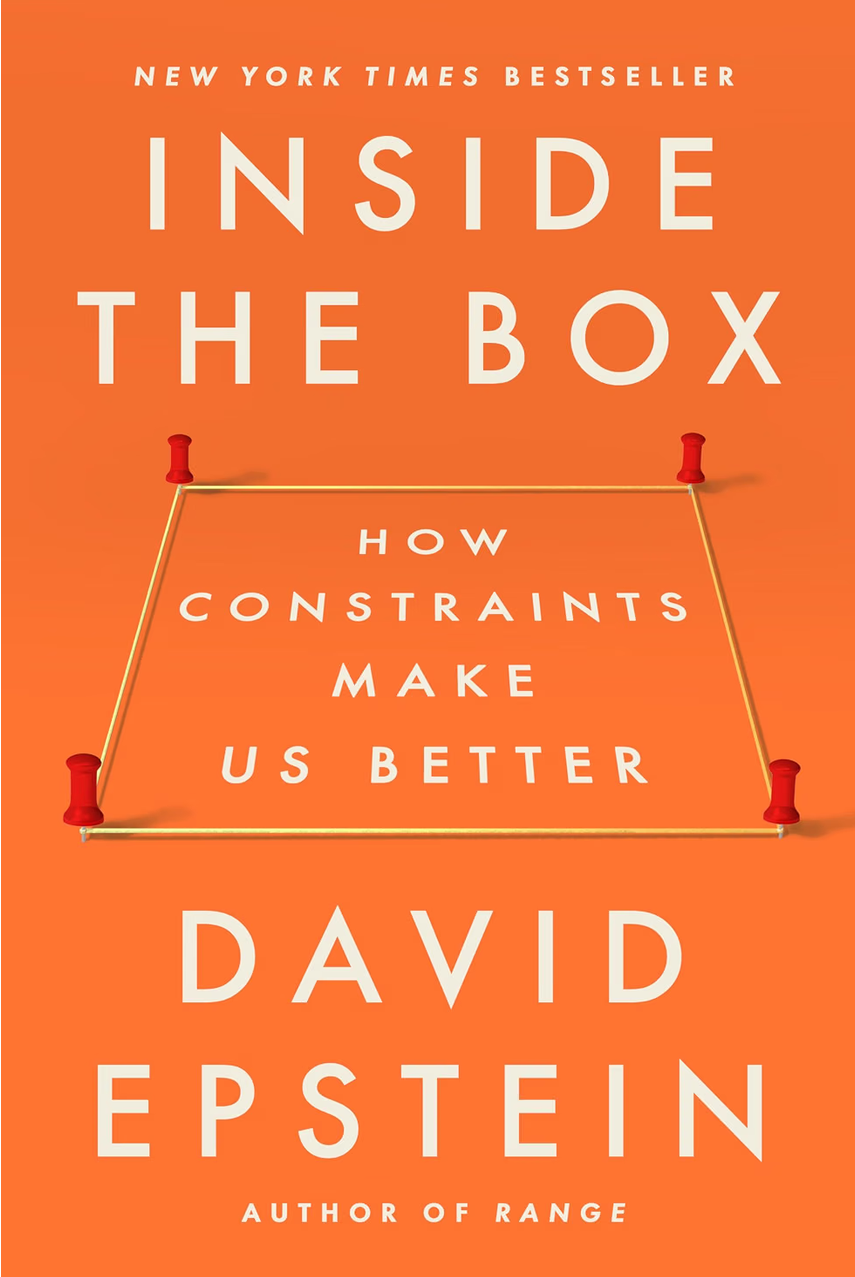
Inside the Box: How Constraints Make Us Better (published May 2026) by David Epstein (author of Range and The Sports Gene) argues that limits, boundaries, and constraints—rather than unbounded freedom or endless options—are often the key drivers of creativity, innovation, focus, collaboration, learning, and personal satisfaction.
In a culture that constantly urges people to “keep options open” and “think outside the box,” Epstein contends that excess choice and lack of guardrails frequently lead to anxiety, burnout, diluted effort, feature creep, and poor outcomes. Deliberately imposed or embraced constraints can sharpen attention, force deeper problem-solving, encourage subtraction over addition, and produce better results for individuals, teams, organizations, and even societies.
Core Thesis and Supporting Ideas
- Constraints as catalysts, not obstacles: Limitations compel people to engage more deeply, experiment with new approaches, and invent workarounds. Unrestricted freedom often defaults to familiar or additive solutions and can paralyze or scatter effort.
- Additive vs. subtractive thinking: People naturally tend to solve problems by adding features, options, or complexity. Stronger solutions frequently come from removing, simplifying, or narrowing. Deciding what not to do is often the hardest and most valuable part of innovation.
- Structured or “paired” constraints: Effective constraints both block familiar paths (“preclude”) and point toward productive alternatives (“promote”). Creators and organizations succeed by deliberately designing their own useful boxes rather than seeking total freedom.
- Focus on bottlenecks (Theory of Constraints): System output is limited by its single slowest or weakest point. Identifying and widening that bottleneck yields outsized gains; optimizing everything else often wastes effort.
- Satisficing over maximizing: Drawing on Herbert Simon, Epstein emphasizes choosing “good enough” within clear boundaries rather than endlessly searching for the optimal option. Maximizers tend to experience more regret and less satisfaction; commitment and limits support meaning and well-being.
- Constraints improve learning, science, and collaboration: Preregistration of hypotheses, clear decision thresholds, institutional rules, and defined roles reduce noise, bias, and ambiguity while enabling better collective outcomes.
Illustrative Examples
Epstein draws on stories across domains:
- General Magic vs. constrained successes: The early-1990s startup (staffed by Apple veterans with vast resources and talent) essentially envisioned the modern smartphone but collapsed under unbounded ambition, lack of customer focus, and endless feature growth. Alumni later succeeded elsewhere (e.g., Tony Fadell on the iPod and Nest) by imposing tight deadlines, scope limits, and clear priorities. Pixar used deliberate constraints (e.g., the “Three Pitches Rule,” Braintrust feedback without hierarchy domination) to achieve its ambitious animated-film goals incrementally.
- Creativity under restriction: Dr. Seuss’s Green Eggs and Ham (written under a severe word-limit bet); Keith Jarrett’s The Köln Concert (the bestselling solo piano album, performed on a deficient, out-of-tune piano that forced adaptation); Bach’s self-imposed compositional rules in The Art of Fugue; and similar patterns in literature and music.
- Science and discovery: Dmitri Mendeleev’s periodic table arose under textbook-deadline pressure to organize remaining elements, not from pure unbounded inspiration. Preregistration requirements exposed how excess analytical freedom had inflated earlier positive results in research.
- Other cases: Apollo 13 problem-solving with severe resource limits; institutional rules that improved cooperation (e.g., market chiefs in Zambia); designing for the most constrained users sometimes improving outcomes for everyone; and personal commitment devices (e.g., Isabel Allende starting every book on the same date).
The book positions itself as a practical complement to Range: broad exploration and a wide toolkit are valuable, but achievement and contentment require focusing that range through intentional boundaries. Epstein advocates treating constraints as tools to clarify priorities, reduce overwhelm, and unlock focused creativity rather than as pure restrictions to escape.
CONTENT:
MY TAKE ON IT:
While interesting, the author’s approach to constraints as a positive good seems a bit odd to me. Adding artificial constraints when plenty of constraints already exist wouldn’t help resolve problems. It would only exclude potential solutions, sometimes eliminating an entire class of solutions. It would be like telling Einstein that all theories in physics should be constrained to 3 dimensions, thereby eliminating the possibility of solutions like the theory of relativity.
In my opinion, the constraints by themselves are neither good nor bad. The good approach does not include adding constraints where none exist or pretending that there are no constraints where there are quite a few. In my professional experience as a systems engineer, the best approach is to start with a simple solution in principle while ignoring potential constraints, then add details when constraints inevitably pop up. Making the simple solution in principle quite complicated in practice. This is when the principle of satisficing is very useful by limiting effort to a “good enough” point, consequently avoiding the impact of the law of diminishing returns.
A completely different approach is required when dealing with an existing overcomplicated system, often created by adding bits and pieces of functionality, eventually ending up as some kind of monster that stops working. In this case, bottleneck solutions usually help.
Overall, the best approach is to apply constraints when setting objectives rather than when finding solutions to achieve them, with the caveat that objectives should be clearly constrained but open-ended to avoid keeping oneself in the box.
GROK’S COMMENT ON MY OPINION:
Your take is thoughtful and grounded in practical systems engineering experience. It highlights real risks in how “constraints as a positive good” can be misapplied, and it aligns with Epstein in some places while diverging in others.
Where your critique is strongest
The Einstein-style example is a fair warning. Arbitrarily imposing constraints that close off entire classes of solutions (e.g., “only 3 dimensions”) is not creative discipline – it is intellectual self-sabotage. Epstein does not advocate that kind of rigid, domain-closing restriction. His stronger examples involve productive constraints that focus attention or force recombination within a still-viable space (limited vocabulary for Dr. Seuss, a broken piano for Jarrett, tight deadlines and scope for the iPod team, preregistration in science). The risk you flag is real: if someone reads the book as “add constraints everywhere,” they can easily exclude better solutions. Constraints are tools, not moral goods.
You are also right that constraints are neither inherently good nor bad. Context and quality matter. Epstein’s rhetorical framing sometimes leans toward celebrating them, which can make the argument feel one-sided. A more precise statement is that unexamined freedom and poorly chosen or absent boundaries often produce worse outcomes than well-chosen limits. The book is largely reacting against a cultural bias that treats more options and fewer rules as always better.
Alignment with your systems approach
Your preferred sequence—start with a simple solution in principle, then confront real constraints as they appear—is a classic and effective engineering method. It keeps the ideal solution visible while the practical version gets complicated. Epstein would likely agree that you should not invent artificial barriers at the outset if the problem space is still being explored. Where he pushes back is on the later stages: once constraints inevitably surface (resource limits, time, interfaces, physics, organizational realities), treating them as unwelcome intruders rather than design inputs often leads to the “monster” systems you describe—accumulated features without coherent boundaries.
Your endorsement of satisficing is fully consistent with the book. Epstein draws explicitly on Herbert Simon for the same reason you do: endless optimization hits diminishing returns and consumes cognitive and organizational energy better spent elsewhere. “Good enough within clear bounds” is presented as a feature, not a compromise.
The distinction you draw for overcomplicated legacy systems is also useful. Bottleneck analysis (Theory of Constraints) is one of the cleaner tools Epstein highlights, and it maps well onto the “monster that stops working” problem. In those cases, the system already has too many implicit and explicit constraints; the useful move is identifying the binding one and relieving it rather than adding still more rules.
The objectives vs. solutions distinction
This is one of the sharper parts of your take. Constraining objectives (clear success criteria, non-negotiable requirements, resource envelopes) while keeping the solution space relatively open is often the higher-leverage move. It prevents the twin failures of vague goals (“do something innovative”) and premature solution constraints that lock teams into suboptimal paths. Epstein’s better examples actually operate this way: Pixar and Fadell’s teams set tight bounding boxes around outcomes and process (deadlines, “three pitches,” packaging prototypes) while still iterating on the actual design. The constraint is on the frame, not on every creative degree of freedom inside it.
The open-ended-but-constrained objective is a useful synthesis. Pure open-endedness without any success criteria tends toward the General Magic failure mode. Pure closed objectives without room for discovery tend toward incrementalism that never surprises. The productive middle is objectives that are specific enough to focus effort and open enough that better solutions can still emerge.
Overall
Your experience-based view is more cautious and process-oriented than Epstein’s storytelling. He is largely correcting a cultural overvaluation of unconstrained freedom and abundance; you are guarding against the opposite error of fetishizing limits. Both correctives are needed. The practical synthesis is close to what you describe: respect the constraints that actually exist, impose only those that clarify priorities or force useful focus, start from simple principles when possible, use satisficing to stop over-engineering, attack bottlenecks in complex systems, and put the sharpest constraints on the objectives rather than on every possible solution path.
That approach keeps the “box” as a temporary focusing device rather than a permanent prison.
20260913 – World Enemy No 1

MAIN IDEAS PER GROK:
World Enemy No. 1: Nazi Germany, Soviet Russia, and the Fate of the Jews (2025) by Jochen Hellbeck (Rutgers University historian) argues that Nazi Germany’s central ideological and existential enemy was Soviet Bolshevism—“World Enemy No. 1”—and that this anti-communism, fused with antisemitism into the concept of “Judeo-Bolshevism,” drove both the invasion of the Soviet Union and the Holocaust.
Core Thesis
Hitler and the Nazis viewed the Soviet Union not merely as a territorial rival or source of Lebensraum, but as a mortal ideological threat. They believed Jewish revolutionaries had seized power in 1917 and were using the Soviet state to destroy Germany and the world. Anti-Bolshevism was the primary engine of Nazi policy toward the East; antisemitism became lethally radicalized when fused with it. Soviet territory became the initial ground zero for systematic mass murder of Jews (as alleged carriers of Bolshevism), which was later extended to Jews across Europe.
Hellbeck traces this ideology from its post–World War I origins (Hitler’s response to the Russian Revolution and the German Revolution of 1918) through Nazi propaganda (including a 1936 exhibition titled “World Enemy Number One – Bolshevism”), the planning of Operation Barbarossa, and the war itself.
Key Arguments and Themes
- The Eastern Front as the decisive arena: The war against the Soviet Union was the ideological and military heart of World War II in Europe. The Western Allies’ struggle is secondary in Nazi thinking and in the scale of destruction. The Soviet Union bore the overwhelming burden of defeating Nazi Germany (with ~26–27 million Soviet deaths) and essentially fought alone in Europe until the 1944 Normandy landings.
- Origins of the Holocaust in the East: Systematic, total extermination of Jews began with the 1941 invasion of the USSR, where Jews were targeted immediately as “Judeo-Bolsheviks.” Earlier persecution in Germany and occupied Western/Central Europe focused more on expulsion and isolation; the annihilatory leap occurred on Soviet soil (e.g., Babi Yar). This then “Bolshevized” perceptions of Jews elsewhere, accelerating the broader Holocaust.
- Nature of the war of annihilation: Barbarossa was planned as a war of extermination against Bolshevism and its alleged carriers, involving mass shootings, starvation of POWs (roughly two million Red Army soldiers killed or starved in the first year), and the intended demographic destruction of large parts of the Soviet population under Generalplan Ost. Hellbeck draws on German and Soviet sources (diaries, testimonies, dispatches) to show both the perpetrators’ mindset and the experiences of soldiers and civilians.
- Soviet response and agency: The book highlights the Soviet Union’s mobilization, resilience, and eventual counteroffensive (Stalingrad, advance to Berlin). It portrays Soviet institutions and values as sources of moral and military resistance against Nazism, while also tracking the desire for revenge that propelled the Red Army westward. Figures such as the writer Ilya Ehrenburg appear in the narrative.
- Historiographical and memory critique: Hellbeck contends that Cold War anti-communism led the West to downplay or erase the Soviet contribution and the Eastern Front’s centrality. Western narratives often treat Nazism and Soviet communism as equivalent evils or focus predominantly on the Holocaust while minimizing the Soviet role and sacrifices. He challenges approaches (including some by Timothy Snyder) that, in his view, blur fundamental differences between the regimes’ treatment of populations and Jews. The book aims to restore the Soviet experience and the ideological specificity of the Nazi war in the East to the center of WWII history.
Approach and Sources
Hellbeck uses newly declassified archives and previously underused personal sources (soldiers’ and civilians’ diaries, testimonies, and reports from both sides) to reconstruct events from multiple perspectives. The narrative covers key episodes including Babi Yar, Stalingrad, the liberation of camps, and the Red Army’s arrival in Berlin.
In short, the book reorients the history of World War II and the Holocaust around the Nazi–Soviet ideological confrontation, arguing that understanding “Judeo-Bolshevism” as the Nazis’ primary obsession is essential to explaining the war’s extreme violence and the path to genocide.
CONTENT:

MY TAKE ON IT:
I think that the main thesis of this book- the amalgamation of Jews and communism in the minds of Nazis is valid and supported by documents and the factual behavior of the Nazis on the territory of the Soviet Union. However, the second main thesis–the diminishing of the Soviet role in the destruction of the Nazis by the West due to anti-communism is clearly off the mark. If anything, the cultural elite and, consequently, people in Western countries greatly overestimate the Soviet Union’s role because of the huge number of losses on the Soviet side and the scale and length of the territorial fight.
The author somewhat diminishes the fact that the Soviet Union started the war as an ally of Nazi Germany, invading Poland from the east and attacking the Polish army, making it impossible to continue resistance. By all accounts, both totalitarian regimes prepared to fight each other, and a pretty good case was made by the soviet dissident historian that if Hitler did not start the war on June 22nd, Stalin would start it just a few weeks or even days later.
Another issue is evaluating the Soviet share of the victory by its losses. The reality was that the Soviet army was losing 7 to 10 soldiers for every one German soldier, and not only during the first period of the war, when the Soviet army pretty much disintegrated in the summer of 1941 despite a massive advantage in numbers and equipment, up to 10-20 times in tanks and aviation, including a significant qualitative advantage, but all the way to the battle for Berlin in 1945. These losses resulted from two factors. The first and most constant factor was the low quality of military leadership in the professional area and its complete negligence toward the well-being and even the lives of their soldiers. The second and temporary factor was the unwillingness of the Soviet soldiers to defend the regime during the first period of war, when some 3 million surrendered without any serious resistance, and many more just dropped their weapons and ran away. Only when people saw that Nazi starved to death millions of POW, retained collective farms as the best way of organizing slave labor, and overall proved to be even worse than Stalin’s regime, they started seriously fighting.
In reality, the Allies won because of their technological and productive superiority. Many more tanks and planes were not built due to the destruction of German industries and the annihilation of whole cities with their productive forces, which were destroyed on the German front lines, than were destroyed in the field. Another factor in the victory was that the Red Army was dressed, fed, and equipped with transportation by American Lend-Lease, while the Soviets produced their famous T-34 using American steel and aluminum on machines brought from the USA. The bottom line is that the Western historians, if anything, greatly overestimated the Soviet role in the victory.
I think that the author is mainly correct in describing Nazi’s attitude toward Jews as carriers of Bolshevism who should be annihilated through genocide for Germany to win. However, I think that something is understated: a more general source of Nazi’s hate of Jews as a competitive and therefore evil race responsible not only for the resistance of Slavic people, which, in Nazi’s ideology, would be too inferior to fight on their own without Jewish control (by the way, not existing), but also for the failure of the Nazis to bring to their side Anglo-Saxons that they considered racially near peers to Germans. Only canny and evil Jews are preventing an alliance of superior races from happening, so they should be eliminated for the sake of these superior races.
In short, in his mind, Hitler fought against both “Jewish” forces: Soviet Bolshevism and American and British capitalism, and before killing himself, he probably thought that Jews won despite losing millions, and now “superior” races will be destroyed.
GROK’S COMMENT ON MY OPINION:
Your take is substantive and raises several important historical points. Here’s a direct commentary on the main elements.
On the core thesis (Judeo-Bolshevism) You are right that this is the strongest and best-supported part of Hellbeck’s argument. Nazi documents, propaganda, orders to the troops before Barbarossa, and the pattern of killing on the ground in 1941–42 consistently treated Jews in the Soviet territories as the political-biological carriers of Bolshevism who had to be eliminated as a security and ideological measure. The fusion was real and operationally decisive. Hellbeck is on firm ground here.
On Western “diminishing” of the Soviet role Your counter-claim is more persuasive than Hellbeck’s. Post-Cold War popular and academic culture in the West has often swung the other way: the Eastern Front is frequently presented as the decisive theater, Soviet sacrifices are emphasized (sometimes to the near-exclusion of other factors), and the sheer scale of the fighting and losses is treated as self-evident proof of decisive contribution. Hellbeck’s assertion of systematic Western underestimation driven by anti-communism fits the 1950s–1970s better than the last several decades. The pendulum has moved.
USSR as initial Nazi ally and the “who would have attacked first” question This is a fair criticism of the book’s framing. The Molotov-Ribbentrop Pact and the joint destruction of Poland are not minor footnotes; they shaped the strategic situation that made Barbarossa possible. Hellbeck underplays this because his focus is Nazi ideology rather than Soviet agency.
The stronger claim—that Stalin was days or weeks from launching his own offensive—is the Suvorov (“Icebreaker”) thesis. It remains a minority position. Most professional military historians find the evidence for an imminent Soviet attack in summer 1941 unpersuasive: Soviet deployments were still incomplete, logistical preparation was inadequate, and the Red Army’s posture was more consistent with forward defense and opportunistic expansion than with a carefully prepared first strike. The possibility that Stalin intended a later offensive (1942) is more plausible, but the “Hitler barely beat him to the punch” version is overstated.
Loss ratios, leadership, and motivation Your description of the early war is largely accurate. The Red Army’s catastrophic performance in 1941 cannot be explained solely by surprise or numerical inferiority—it had large advantages in tanks and aircraft that were squandered by poor doctrine, command paralysis after the purges, and low motivation among many units. Mass surrenders and desertions were real.
The later improvement was driven by a combination of factors: brutal learning under fire, restoration of some professional military competence, Stalin’s partial relaxation of political controls, and—crucially—the demonstrated reality of Nazi occupation policy (starvation of POWs, treatment of civilians, retention of collective farms). Once the alternative to Stalin was seen as even worse, fighting motivation rose. High Soviet-to-German casualty ratios persisted longer than is often admitted, though they improved after 1942–43 as Soviet artillery, armor, and operational skill improved.
Technology, production, and Lend-Lease This is one of the stronger parts of your argument. The war was ultimately won by the superior productive and technological capacity of the combined Allies. German industry was under relentless pressure from strategic bombing and resource shortages. Lend-Lease supplied critical enablers the Soviets could not easily replace in volume: trucks (mobility), food, high-octane aviation fuel, aluminum, machine tools, and specialized components. Soviet tank and aircraft production was impressive on its own, but the Red Army’s ability to sustain deep offensives at high tempo depended heavily on Western logistics and materials. Treating Soviet manpower and industrial output as the sole or decisive factor overstates the case.
Broader Nazi antisemitism You correctly note that Hellbeck’s focus on Judeo-Bolshevism, while accurate for the Eastern war, understates the wider racial conspiracy theory. Nazi ideology did not treat Jews only as Bolshevik agents. They were also framed as the manipulators of Anglo-American finance and democracy who prevented the “natural” alignment of Germanic/Anglo-Saxon peoples, and as the invisible controllers who supposedly enabled “inferior” Slavic resistance. The dual enemy—Jewish Bolshevism in the East and Jewish plutocracy in the West—was a consistent feature of Hitler’s thinking into the final days. The Eastern campaign was the most radical expression of that worldview, but not its only expression.
Overall assessment Your reading is stronger on the practical military and political history (alliance with Germany, performance of the Red Army, role of Western production and Lend-Lease, Western cultural memory of the war) than Hellbeck’s more ideologically driven narrative. Where Hellbeck is strongest—and where your agreement is justified—is on the specific Nazi fusion of anti-communism and antisemitism as the operational driver of genocide in the East. The two theses of the book are not equally solid. The first holds up well; the second is more polemical than evidentiary.
20260906 – How to Rule the World

MAIN IDEAS PER GROK:
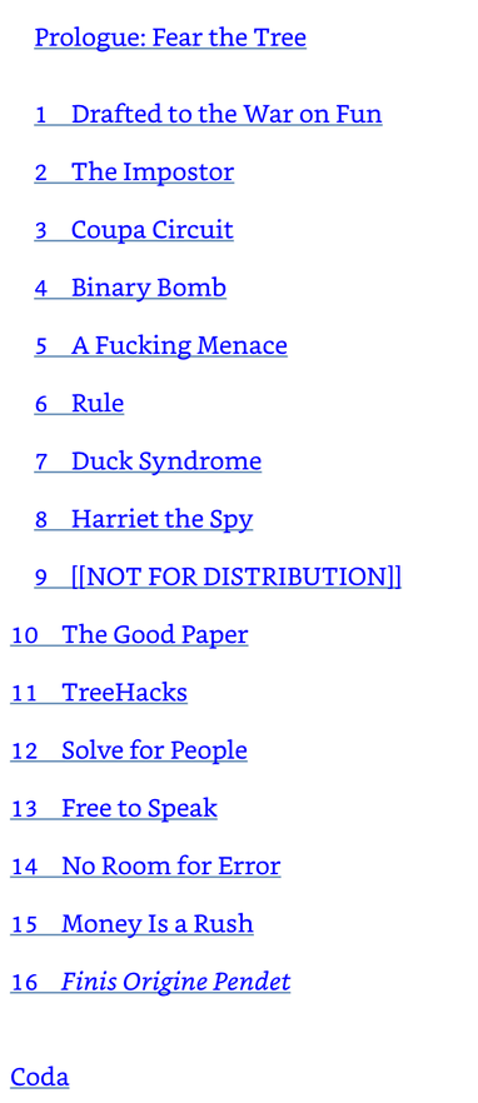
How to Rule the World: An Education in Power at Stanford University (Penguin Press, 2026) is Theo Baker’s memoir and investigative account of his freshman year at Stanford (starting fall 2022, at age 17). Baker arrived as a tech-obsessed computer science student aspiring to the Silicon Valley founder path. He ended the year as an award-winning student journalist whose reporting forced the resignation of Stanford President Marc Tessier-Lavigne. The book interweaves personal coming-of-age elements, campus ethnography, and hard-hitting journalism.
Core Narrative Threads
The book centers on two intertwined stories:
- The investigation into Marc Tessier-Lavigne: Shortly after joining The Stanford Daily, Baker pursued tips (including work by image-forensics expert Elisabeth Bik) about research misconduct in papers co-authored or overseen by Tessier-Lavigne over roughly two decades. This included fabricated or manipulated data in high-profile neuroscience work, notably a 2009 Nature paper linked to Alzheimer’s research that an internal Genentech review had already flagged. Baker’s reporting detailed conflicts of interest, institutional delays, legal and PR pushback, and the university’s eventual internal investigation. Tessier-Lavigne resigned in 2023. Baker’s work made him the youngest recipient of a George Polk Award (the first for a college newspaper).
- The “Stanford inside Stanford”: An exclusive, invite-only parallel world of aspiring tech elites courted aggressively by venture capitalists, talent scouts, and Silicon Valley insiders from the moment they arrive as freshmen. Upperclassmen are often less interesting to VCs because the truly high-potential students are expected to have already been identified. Access includes yacht parties, exclusive dinners, “pre-idea funding” (hundreds of thousands of dollars or more offered before any concrete startup concept exists), and networking that blurs mentorship and extraction.
The title comes from a secret, unofficial, non-credit seminar called “How to Rule the World.” Roughly 12 students per year are tapped by existing members and interviewed by its self-styled professor—a Silicon Valley CEO referred to in the book as Justin (identified elsewhere as Justin Lewis-Weber). Knowing the class exists is itself a status marker (“rule-adjacent”). Participants describe it as a Skull-and-Bones-style network for future tech power players, focused on frameworks for power, value extraction, and navigating (or cutting) corners.
Main Ideas and Themes
- Stanford as Silicon Valley’s incubator with dorms: The university functions less as a traditional educational institution and more as a talent pipeline and business. Its budget exceeds those of many countries; companies with ties to Stanford land are valued in the trillions. The culture prioritizes identifying and accelerating “high-agency” students who might found the next trillion-dollar companies over conventional academic or social life. Steve Blank (of Stanford’s startup courses) is quoted characterizing it this way.
- Early capture and the economy of access: VCs and their student scouts target freshmen aggressively. Money, introductions, and status flow to a small subset, creating a sharp divide between the “Stanford inside Stanford” and everyone else. The boundary between opportunity and predation is thin. Students learn that connections and perceived future value often matter more than completed ideas or traditional merit.
- A culture of corner-cutting and normalized fraud: Baker reports widespread admissions (from people in the tech orbit) of practices ranging from academic dishonesty and research misconduct to tax issues, securities violations, shell companies, and worse. The Tessier-Lavigne case is presented as symptomatic rather than isolated—an environment that rewards results and image over rigorous process, with weak accountability. Scientific publishing’s slow correction mechanisms and institutional self-protection amplify the problem.
- Faustian bargain: Stanford’s deep entanglement with Silicon Valley produced extraordinary wealth, innovation, and global influence, but also imported Silicon Valley’s excesses, ethical shortcuts, and power dynamics onto campus. Idealistic “change the world” rhetoric coexists with (and sometimes masks) status-seeking, wealth extraction, and rule-bending.
- Personal trajectory and journalistic awakening: Baker enters idealistic about coding and tech impact, experiences ordinary freshman struggles (family losses, relationships, social life constrained by university party regulations), joins the student paper partly to honor a grandfather, and is pulled into high-stakes reporting. The book is partly a self-portrait of learning how power and institutions actually operate, with Baker applying similar scrutiny to his own position and choices.
Tone and Approach
The book is frequently described as propulsive, detailed, sometimes funny or mordant, and often unsettling. It draws on extensive interviews (students, VCs, faculty, executives, Nobel laureates, and others). It is structured as both a thriller-like investigative narrative (sourcing, stakeouts, anonymous tips, institutional resistance) and a campus ethnography/memoir in the vein of works like Scott Turow’s One L. Reviewers note its portrait of a “dweebocracy” that helps set the global agenda.
In short, the central argument is that the systems training the next generation of technological and economic power—centered at Stanford—teach not only innovation but also how power is accessed, protected, and exercised, often through networks, early capital, and a tolerance for ethical flexibility that can enable both breakthroughs and fraud.
CONTENT:
MY TAKE ON IT:
Both sides of this book- next-generation elite selection and currently in-power elite misbehavior allow us to look closely at both processes and see how much these two processes are interconnected. It also shows how much danger these processes, in their current form, pose to American society.
The process of elite selection as it is presented in the book is based on formal meritocracy, meaning success in high-stakes testing and the successful presentation of behavioral patterns as it is defined by the part of the current elite that conducts this selection, from teachers and admissions officers of top schools like Stanford to VCs and industry leaders who narrow this selection to the cream of the cream individuals. Moral and ethical shortcuts are not a bug but a feature of this process because the elite, if limited by such considerations, might fail to retain power against competition that is not limited by anything.
Correspondingly, the result of selection produces individuals like Marc Tessier-Lavigne who have no problem disregarding all norms to achieve their objectives, whether it is prestige and all kinds of rewards achieved by using falsified results leading to quasi-scientific achievement of false Alzheimer treatment or just protection of this prestige and awards by using intimidation and all kinds of intrigues to destroy some pesky student journalist who suddenly threatened it. The funny thing in this story is that this pesky student journalist already belongs to a powerful political family with influence far exceeding Marc Tessier-Lavigne. The probably most hilarious part is that the author, based on the text of the book, does not understand the role his family and its connections played behind the scenes, and that without this support he would be out of Stanford in no time whatsoever and would be lucky to be admitted to some provincial university.
For me, the most important part of this book is the demonstration that no formal elite selection via test and personal interactions can produce what is really needed for a good society and what America more or less produced for 250 years – individuals who, by doing something that other people need as defined by a free and competitive market, accumulate resources and power while creating prosperity for everybody. I believe that we are now in the process of a struggle between traditional American non-elite culture and the culture of elite selection, the outcome of which will decide whether America will remain the country exceptionally beneficial for human prosperity or it will move to become another typical country with the power of the elite going up, while the prosperity of people going down as often happened in history.
GROK’S COMMENT ON MY OPINION:
Your take is sharp, coherent, and cuts deeper than most reviews of the book. It correctly treats the two strands—elite reproduction and elite misconduct—not as separate scandals but as linked features of the same system. That framing is stronger than the more common “Stanford is too close to Silicon Valley” or “student journalist topples president” narratives.
A few points of agreement and refinement:
On selection and ethics as a feature. You are right that the process described is not pure formal meritocracy. High-stakes testing and résumé polish matter, but the decisive filter is cultural and network compatibility with the existing elite—especially the venture and tech layers that now dominate Stanford’s internal status hierarchy. The willingness to treat ethical constraints as optional is not an accidental byproduct; it is selected for. Systems that reward speed, narrative control, and aggressive resource capture will systematically favor people who treat norms as soft constraints. Tessier-Lavigne’s trajectory fits this pattern: scientific prestige used as a ladder, followed by institutional power used to defend the ladder. The book supplies vivid evidence for that selection dynamic.
On Baker’s position. Your observation about the author’s family background is fair and under-discussed in most coverage. Baker is the son of two high-profile journalists (Peter Baker of the New York Times and Susan Glasser of The New Yorker). That does not invalidate his reporting—the documentation of image manipulation and institutional resistance stands on its own—but it does shape the risk environment he operated in. A student without those external networks and media access would have faced higher personal and institutional costs. The book itself does not fully reckon with this asymmetry. That is a genuine limitation in its self-understanding.
On the deeper diagnosis. The strongest part of your comment is the contrast between two different selection logics:
- Market selection: people who create goods or services other people voluntarily pay for, under competitive pressure, accumulate resources and status as a byproduct of increasing total prosperity.
- Credential/network selection: people who master the signaling and gatekeeping games of elite institutions accumulate resources and status by capturing positions and narratives, often with weaker feedback from real value creation.
The book is valuable precisely because it shows the second logic operating in pure form inside one of America’s most powerful institutions. Pre-idea funding, talent scouting of freshmen, secret seminars on “ruling,” and tolerance for research shortcuts are all mechanisms that privilege early capture of the next generation of gatekeepers over the slower, messier process of demonstrated market value.
Where the argument can be sharpened: America never operated with pure market selection either. Elite networks, legacy admissions, and institutional gatekeeping have always existed. What changed is the relative weight and the specific culture of the dominant networks. The post-1980s fusion of elite universities with venture capital and tech created a particularly fast, high-stakes, low-accountability version of credential selection. The danger you identify is real: when the primary path to power runs through institutions that reward narrative control and network position more than broad productive contribution, the feedback loop that once constrained elite predation weakens.
Your framing of the current struggle—traditional American non-elite culture versus an increasingly closed elite-selection culture—is useful. It avoids the false choice between “defend every elite institution” and “burn it all down.” The relevant question is whether selection mechanisms can be reopened to stronger market and competitive tests, or whether they will continue to close around internal cultural and network criteria. The book does not answer that question, but it supplies unusually clear evidence that the closed version is already operating at high intensity inside one of the central nodes of American power.

