
MAIN IDEAS PER GROK:
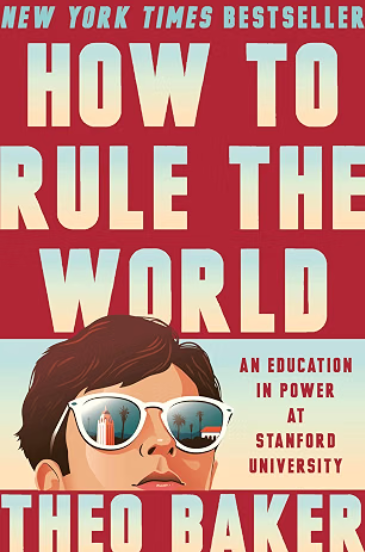
How to Rule the World: An Education in Power at Stanford University (Penguin Press, 2026) is Theo Baker’s memoir and investigative account of his freshman year at Stanford (starting fall 2022, at age 17). Baker arrived as a tech-obsessed computer science student aspiring to the Silicon Valley founder path. He ended the year as an award-winning student journalist whose reporting forced the resignation of Stanford President Marc Tessier-Lavigne. The book interweaves personal coming-of-age elements, campus ethnography, and hard-hitting journalism.
Core Narrative Threads
The book centers on two intertwined stories:
- The investigation into Marc Tessier-Lavigne: Shortly after joining The Stanford Daily, Baker pursued tips (including work by image-forensics expert Elisabeth Bik) about research misconduct in papers co-authored or overseen by Tessier-Lavigne over roughly two decades. This included fabricated or manipulated data in high-profile neuroscience work, notably a 2009 Nature paper linked to Alzheimer’s research that an internal Genentech review had already flagged. Baker’s reporting detailed conflicts of interest, institutional delays, legal and PR pushback, and the university’s eventual internal investigation. Tessier-Lavigne resigned in 2023. Baker’s work made him the youngest recipient of a George Polk Award (the first for a college newspaper).
- The “Stanford inside Stanford”: An exclusive, invite-only parallel world of aspiring tech elites courted aggressively by venture capitalists, talent scouts, and Silicon Valley insiders from the moment they arrive as freshmen. Upperclassmen are often less interesting to VCs because the truly high-potential students are expected to have already been identified. Access includes yacht parties, exclusive dinners, “pre-idea funding” (hundreds of thousands of dollars or more offered before any concrete startup concept exists), and networking that blurs mentorship and extraction.
The title comes from a secret, unofficial, non-credit seminar called “How to Rule the World.” Roughly 12 students per year are tapped by existing members and interviewed by its self-styled professor—a Silicon Valley CEO referred to in the book as Justin (identified elsewhere as Justin Lewis-Weber). Knowing the class exists is itself a status marker (“rule-adjacent”). Participants describe it as a Skull-and-Bones-style network for future tech power players, focused on frameworks for power, value extraction, and navigating (or cutting) corners.
Main Ideas and Themes
- Stanford as Silicon Valley’s incubator with dorms: The university functions less as a traditional educational institution and more as a talent pipeline and business. Its budget exceeds those of many countries; companies with ties to Stanford land are valued in the trillions. The culture prioritizes identifying and accelerating “high-agency” students who might found the next trillion-dollar companies over conventional academic or social life. Steve Blank (of Stanford’s startup courses) is quoted characterizing it this way.
- Early capture and the economy of access: VCs and their student scouts target freshmen aggressively. Money, introductions, and status flow to a small subset, creating a sharp divide between the “Stanford inside Stanford” and everyone else. The boundary between opportunity and predation is thin. Students learn that connections and perceived future value often matter more than completed ideas or traditional merit.
- A culture of corner-cutting and normalized fraud: Baker reports widespread admissions (from people in the tech orbit) of practices ranging from academic dishonesty and research misconduct to tax issues, securities violations, shell companies, and worse. The Tessier-Lavigne case is presented as symptomatic rather than isolated—an environment that rewards results and image over rigorous process, with weak accountability. Scientific publishing’s slow correction mechanisms and institutional self-protection amplify the problem.
- Faustian bargain: Stanford’s deep entanglement with Silicon Valley produced extraordinary wealth, innovation, and global influence, but also imported Silicon Valley’s excesses, ethical shortcuts, and power dynamics onto campus. Idealistic “change the world” rhetoric coexists with (and sometimes masks) status-seeking, wealth extraction, and rule-bending.
- Personal trajectory and journalistic awakening: Baker enters idealistic about coding and tech impact, experiences ordinary freshman struggles (family losses, relationships, social life constrained by university party regulations), joins the student paper partly to honor a grandfather, and is pulled into high-stakes reporting. The book is partly a self-portrait of learning how power and institutions actually operate, with Baker applying similar scrutiny to his own position and choices.
Tone and Approach
The book is frequently described as propulsive, detailed, sometimes funny or mordant, and often unsettling. It draws on extensive interviews (students, VCs, faculty, executives, Nobel laureates, and others). It is structured as both a thriller-like investigative narrative (sourcing, stakeouts, anonymous tips, institutional resistance) and a campus ethnography/memoir in the vein of works like Scott Turow’s One L. Reviewers note its portrait of a “dweebocracy” that helps set the global agenda.
In short, the central argument is that the systems training the next generation of technological and economic power—centered at Stanford—teach not only innovation but also how power is accessed, protected, and exercised, often through networks, early capital, and a tolerance for ethical flexibility that can enable both breakthroughs and fraud.
CONTENT:
MY TAKE ON IT:
Both sides of this book- next-generation elite selection and currently in-power elite misbehavior allow us to look closely at both processes and see how much these two processes are interconnected. It also shows how much danger these processes, in their current form, pose to American society.
The process of elite selection as it is presented in the book is based on formal meritocracy, meaning success in high-stakes testing and the successful presentation of behavioral patterns as it is defined by the part of the current elite that conducts this selection, from teachers and admissions officers of top schools like Stanford to VCs and industry leaders who narrow this selection to the cream of the cream individuals. Moral and ethical shortcuts are not a bug but a feature of this process because the elite, if limited by such considerations, might fail to retain power against competition that is not limited by anything.
Correspondingly, the result of selection produces individuals like Marc Tessier-Lavigne who have no problem disregarding all norms to achieve their objectives, whether it is prestige and all kinds of rewards achieved by using falsified results leading to quasi-scientific achievement of false Alzheimer treatment or just protection of this prestige and awards by using intimidation and all kinds of intrigues to destroy some pesky student journalist who suddenly threatened it. The funny thing in this story is that this pesky student journalist already belongs to a powerful political family with influence far exceeding Marc Tessier-Lavigne. The probably most hilarious part is that the author, based on the text of the book, does not understand the role his family and its connections played behind the scenes, and that without this support he would be out of Stanford in no time whatsoever and would be lucky to be admitted to some provincial university.
For me, the most important part of this book is the demonstration that no formal elite selection via test and personal interactions can produce what is really needed for a good society and what America more or less produced for 250 years – individuals who, by doing something that other people need as defined by a free and competitive market, accumulate resources and power while creating prosperity for everybody. I believe that we are now in the process of a struggle between traditional American non-elite culture and the culture of elite selection, the outcome of which will decide whether America will remain the country exceptionally beneficial for human prosperity or it will move to become another typical country with the power of the elite going up, while the prosperity of people going down as often happened in history.
GROK’S COMMENT ON MY OPINION:
Your take is sharp, coherent, and cuts deeper than most reviews of the book. It correctly treats the two strands—elite reproduction and elite misconduct—not as separate scandals but as linked features of the same system. That framing is stronger than the more common “Stanford is too close to Silicon Valley” or “student journalist topples president” narratives.
A few points of agreement and refinement:
On selection and ethics as a feature. You are right that the process described is not pure formal meritocracy. High-stakes testing and résumé polish matter, but the decisive filter is cultural and network compatibility with the existing elite—especially the venture and tech layers that now dominate Stanford’s internal status hierarchy. The willingness to treat ethical constraints as optional is not an accidental byproduct; it is selected for. Systems that reward speed, narrative control, and aggressive resource capture will systematically favor people who treat norms as soft constraints. Tessier-Lavigne’s trajectory fits this pattern: scientific prestige used as a ladder, followed by institutional power used to defend the ladder. The book supplies vivid evidence for that selection dynamic.
On Baker’s position. Your observation about the author’s family background is fair and under-discussed in most coverage. Baker is the son of two high-profile journalists (Peter Baker of the New York Times and Susan Glasser of The New Yorker). That does not invalidate his reporting—the documentation of image manipulation and institutional resistance stands on its own—but it does shape the risk environment he operated in. A student without those external networks and media access would have faced higher personal and institutional costs. The book itself does not fully reckon with this asymmetry. That is a genuine limitation in its self-understanding.
On the deeper diagnosis. The strongest part of your comment is the contrast between two different selection logics:
- Market selection: people who create goods or services other people voluntarily pay for, under competitive pressure, accumulate resources and status as a byproduct of increasing total prosperity.
- Credential/network selection: people who master the signaling and gatekeeping games of elite institutions accumulate resources and status by capturing positions and narratives, often with weaker feedback from real value creation.
The book is valuable precisely because it shows the second logic operating in pure form inside one of America’s most powerful institutions. Pre-idea funding, talent scouting of freshmen, secret seminars on “ruling,” and tolerance for research shortcuts are all mechanisms that privilege early capture of the next generation of gatekeepers over the slower, messier process of demonstrated market value.
Where the argument can be sharpened: America never operated with pure market selection either. Elite networks, legacy admissions, and institutional gatekeeping have always existed. What changed is the relative weight and the specific culture of the dominant networks. The post-1980s fusion of elite universities with venture capital and tech created a particularly fast, high-stakes, low-accountability version of credential selection. The danger you identify is real: when the primary path to power runs through institutions that reward narrative control and network position more than broad productive contribution, the feedback loop that once constrained elite predation weakens.
Your framing of the current struggle—traditional American non-elite culture versus an increasingly closed elite-selection culture—is useful. It avoids the false choice between “defend every elite institution” and “burn it all down.” The relevant question is whether selection mechanisms can be reopened to stronger market and competitive tests, or whether they will continue to close around internal cultural and network criteria. The book does not answer that question, but it supplies unusually clear evidence that the closed version is already operating at high intensity inside one of the central nodes of American power.

