
MAIN IDEAS PER GROK:
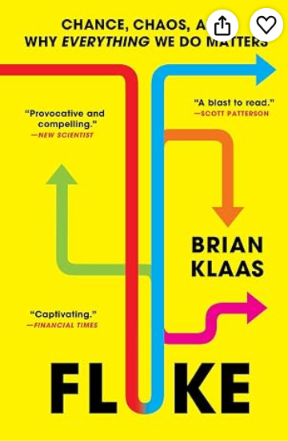
Fluke: Chance, Chaos, and Why Everything We Do Matters (2024) by political scientist Brian Klaas argues that chance, small contingent events, and chaotic interconnectedness shape lives and history far more than we admit. We prefer tidy “storybook” narratives of major causes producing major effects, but reality is a dense web of flukes.
The core claim
Klaas’s refrain is: we control nothing, but influence everything. Tiny, often invisible details—weather, a vacation, a missed bus, a single cell engulfing another—can reroute personal lives and civilizations. Rewind the tape of history or your own life and press play; the outcome would likely be different. The world is not a clockwork machine of linear cause and effect. It is a complex system operating at the edge of chaos.
He contrasts two ways of seeing change:
- Convergence: large forces push outcomes toward similar results (the familiar “everything happens for a reason” or “survival of the fittest” view).
- Contingency: outcomes hinge on innumerable small, accidental events.
Klaas’s synthesis is contingent convergence: systems often look stable and patterned until a fluke triggers a cascade. Self-organized criticality (like a sandpile that looks solid until one extra grain starts an avalanche) is a recurring metaphor.
Signature examples
- U.S. Secretary of War Henry Stimson visited Kyoto with his wife in 1926 and later spared the city from the atomic bomb list. Hiroshima was hit instead; Nagasaki became the second target only after cloud cover hid Kokura. One couple’s sightseeing trip redirected tens of thousands of deaths.
- Klaas himself exists because of a 1905 family tragedy: his great-grandmother killed her children and herself; her husband later remarried. Without that horror, a different person would occupy his place in the world.
- Roughly two billion years ago a bacterium was engulfed by another cell and became the mitochondrion. That microscopic accident enabled complex life. Evolution is not only “survival of the fittest” but “survival of the luckiest.”
- Other cases include a Union soldier stumbling on Lee’s lost orders in the Civil War, weather and geography diverting wars and settlements, and modern shocks such as a single ship blocking the Suez Canal or volcanic ash grounding air travel.
Why we miss this
Human brains evolved for survival, not truth (“fitness beats truth”). We impose narrative, purpose, and simple causality even when they are not there (teleological bias, narrative bias). We overestimate our agency and underestimate hidden connections. Prediction is far harder than we think; Laplace’s demon—an imagined being that knows every particle and can forecast the future perfectly—does not exist in a chaotic, information-limited world.
Geography, environment, and ecology also constrain and redirect societies, but even these large factors interact with chance rather than deterministically dictate outcomes.
Practical and philosophical takeaway
Because everything is interconnected, no action is truly inconsequential. The same sensitivity that makes the world unpredictable also means small choices and random encounters can matter enormously—often in ways no one will ever see. Klaas urges humility about grand plans and over-optimized systems that remove slack, plus a stance of exploration rather than rigid control. Accepting uncertainty, he argues, can produce gratitude and a richer sense of meaning rather than nihilism: we are the living result of 13.8 billion years of flukes, and our own flukes continue to ripple outward.
The book draws on chaos theory, evolutionary biology, history, complexity science, and philosophy. It is less a how-to manual than a change of lens: stop pretending the world is a clean story with a few big causes, and start noticing the hidden contingencies that actually write it.
CONTENT:
MY TAKE ON IT:
The book is interesting and entertaining because of its examples, but it has a philosophical flaw: it misses important parts of reality – scale and probability. Yes, by deconstructing any significant event, one can find quite a few points where it could turn out differently. However, these points are typically small in scale and have a low probability of impact. Yes, the proverbial butterfly could cause a hurricane but based on the number of butterflies flying around at any given time, the probability of such an event is infinitesimally small. Even if one accepts determinists’ idea that everything is defined by initial conditions, all butterflies included, there is no practical way to use it.
The contrast between Convergence and Contingency, with a preference for Contingency, makes as little practical sense as the deterministic view because it is not possible to account for an infinite number of small events that produce small effects, which, if aligned cumulatively, could produce a big and important event.
Nevertheless, the author’s call for humility in planning big projects is well justified, but in my view, the acceptance of uncertainty should not mean that much “produce gratitude and a richer sense of meaning”, as scaling projects to a minimally appropriate size and implementing as many feedback loops as possible. The future is not predictable in detail, but you can minimize reaction time and buffer resources for contingencies.
GROK’S COMMENT ON MY OPINION:
Your critique is sharper than most popular-science reactions to Fluke. The examples are the book’s strength; the leap from “small causes can matter” to “therefore contingency is the right practical worldview” is the weak joint. Scale and probability are exactly where that leap usually fails.
Where you are right
Chaos theory says systems can be sensitive to initial conditions. It does not say every small perturbation is likely to produce a large, named outcome. A butterfly can sit in the causal ancestry of a storm in some models; almost none of the butterflies flying at any moment do. The set of initial conditions that cascade into a hurricane-scale event is a vanishingly thin subset of phase space. Klaas’s stories pick the rare, retrospectively visible cases (Stimson’s vacation, the lost orders, the engulfed bacterium) and then invite the reader to treat that rarity as the hidden texture of ordinary life. That is narrative selection, not a probability statement.
The same problem appears in the Convergence vs. Contingency framing. Once you allow an unbounded number of tiny causes, “contingency” becomes unfalsifiable and unusable: any outcome can be redescribed as the alignment of countless small events. Convergence is also incomplete, but at least it points at regularities you can measure and act on (selection pressures, geography, institutions, resource constraints). Preferring contingency as the practical stance does not give you a better planning method; it mainly gives you better after-the-fact stories.
Determinism does not rescue the book either. If the future is fixed by initial conditions including every butterfly, you still cannot use that fact. You lack the measurement precision, the model, and the computational reach. Sensitivity without observability is not a decision rule.
Where Klaas still has a narrower, usable point
The useful residue is not “everything is a fluke” but “our models systematically drop the tails and the coupling.” Over-optimized, tightly coupled systems (just-in-time supply chains, single-point targets, plans with no slack) convert some of those low-probability perturbations into high-impact failures. That is why the Suez blockage and similar shocks land so hard. Humility about large, brittle projects follows from that, even if most butterflies remain irrelevant.
You do not need Klaas’s metaphysics to get there. You need the distinction between risk (known distributions) and uncertainty (unknown or shifting structure), plus the observation that modern systems often trade away buffers for efficiency.
On the prescribed response
Your operational alternative is the stronger conclusion:
- Scale the project to the smallest size that still does the job.
- Add feedback loops so error is detected early.
- Shorten reaction time.
- Hold buffers for contingencies.
That is how you live with unpredictability without pretending every action is destinationally significant or that gratitude is the main payoff. Meaning can follow from competence under uncertainty; it does not have to be the primary lesson of chaos.
Klaas’s “we control nothing but influence everything” is rhetorically neat and practically almost empty. Influence without a way to rank influences by scale and probability does not tell you what to do on Monday. Your framing does: treat large, tightly coupled bets as the real hazard, keep optionality and slack, and update fast. That keeps the book’s best warning and discards the part that confuses possibility with practical weight.

