
MAIN IDEAS PER GROK:
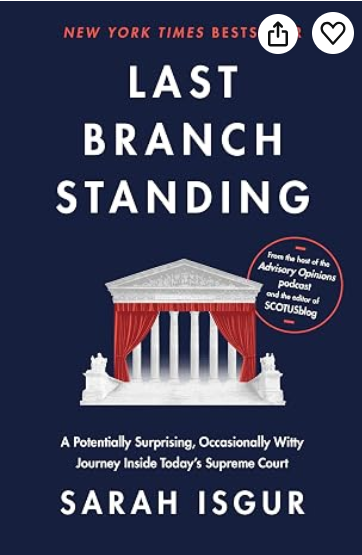
Last Branch Standing: A Potentially Surprising, Occasionally Witty Journey Inside Today’s Supreme Court (2026) by Sarah Isgur is a myth-busting, insider look at the modern Supreme Court. It argues that popular understandings of the Court are overly simplistic and partisan.
Core Thesis: Beyond the 6-3 Myth
Most people (and much media coverage) treat the Court as a purely political body split along a left-right “X-axis,” with a reliable 6-3 conservative majority (Republican appointees vs. Democratic ones). Isgur shows this is incomplete and often misleading. Many decisions do not break cleanly along partisan lines—recent terms have featured high rates of unanimous or near-unanimous outcomes, and individual justices frequently cross expected ideological lines (for example, Brett Kavanaugh aligning more often with Elena Kagan than with Neil Gorsuch in certain periods).
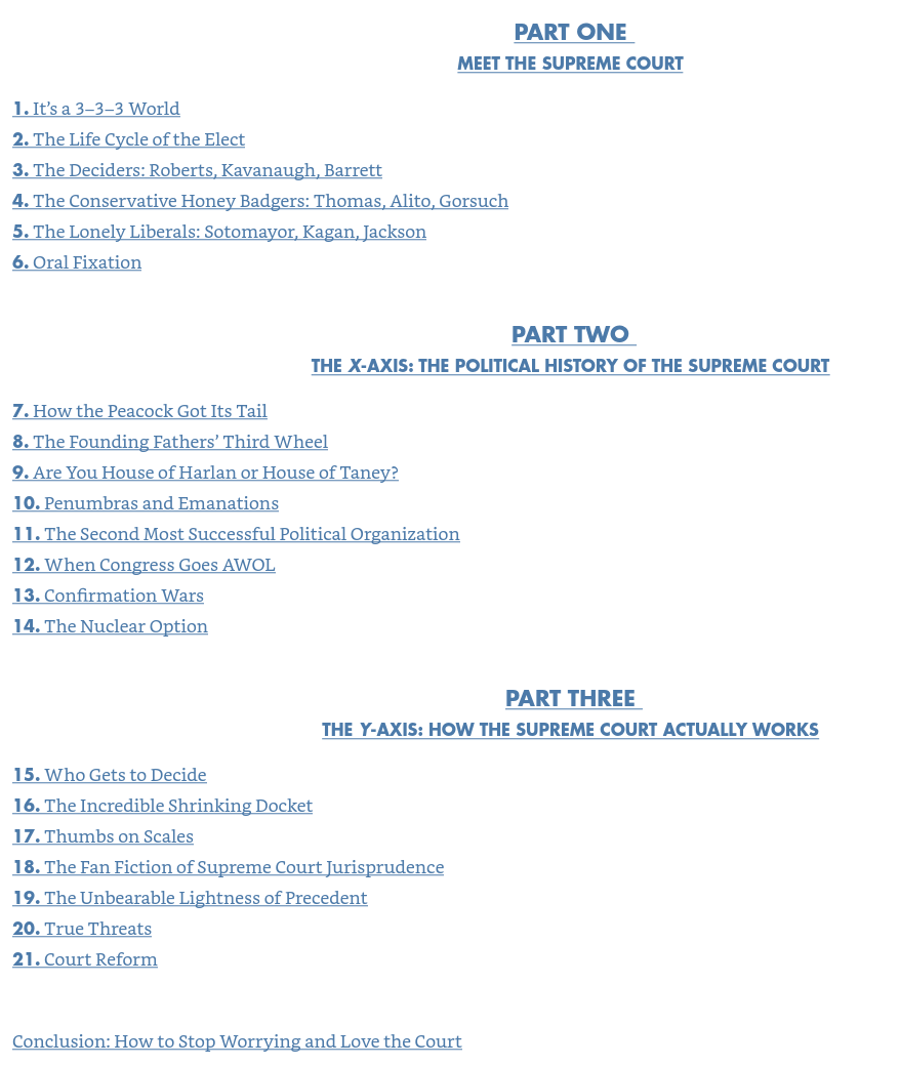
She introduces a second dimension, the “Y-axis”: justices’ institutional instincts, ranging from order-loving institutionalists (who prioritize the Court’s legitimacy, consensus, precedent/stare decisis, workability, and long-term credibility) to “chaos agents” or more disruptive justices less constrained by those concerns. Overlaying the two axes produces a more accurate 3-3-3 picture of the current Court rather than a rigid 6-3:
- Lonely Liberals: Sonia Sotomayor, Elena Kagan, and Ketanji Brown Jackson (with Kagan often more institutionalist than the others).
- Conservative Honey Badgers (more originalist/textualist and less institutionalist): Clarence Thomas, Samuel Alito, and Neil Gorsuch.
- The Deciders/Institutionalists (swing or moderating influence): Chief Justice John Roberts, Brett Kavanaugh, and Amy Coney Barrett.
This framework explains surprising alliances, narrow opinions, and why high-profile cases do not always produce the expected partisan outcomes.
The Court as the “Last Branch Standing”
Isgur argues the Supreme Court is the only branch still operating roughly as the Founders intended. Congress has largely abdicated its legislative role (due to polarization, leadership dynamics, campaign incentives, and historical shifts), while the executive has accrued excessive power. This forces the Court into an uncomfortable position of resolving major policy disputes that properly belong to the political branches, making it a target for partisan attacks. The Court is thus both uniquely powerful and uniquely vulnerable in the current system.
How the Court Actually Works
The book provides an accessible, often humorous tour of internal operations and culture:
- Case selection (the “rule of four,” criteria for granting certiorari, shrinking merits docket from historical highs of ~150 cases to ~60).
- Oral arguments, opinion assignment, and the rise of the “shadow docket” (emergency stays and orders with limited briefing and reasoning).
- Day-to-day life: clerks, which justices appear in the building or at social events, interpersonal dynamics.
- Biographies and judicial philosophies of the current justices, treating them as complex individuals rather than partisan heroes or villains.
- Broader context: historical development of the Court (Marshall era, landmark cases), the role of precedent, textualism/originalism debates, and the professionalization of the Supreme Court bar.
Isgur emphasizes that cases with superficially similar headlines often turn on distinct factual records and legal postures, which media coverage frequently flattens.
Critiques, Reforms, and Tone
She critiques over-politicization of the judiciary by both sides, certain aggressive theories (including aspects of “common good” constitutionalism), and public/media misunderstandings. Proposed improvements include restoring aspects of the Senate confirmation process (e.g., a soft filibuster), enforcing an ethics code, expanding the merits docket, better public education about the Court, and limited structural ideas (such as temporary replacements for recusals or adjusted appointment norms).
The overall tone is irreverent, witty, and accessible—aimed at general readers while remaining substantive. It blends history, institutional analysis, insider anecdotes, and cultural references to demystify the Court and argue for preserving the rule of law amid institutional dysfunction elsewhere in government.
In short, the book’s central message is that understanding the Supreme Court requires looking past red-vs-blue scorekeeping to the interplay of ideology and institutional temperament, and recognizing the Court’s strained but still-recognizable constitutional role as the last functioning branch of the original design.
CONTENT:
MY TAKE ON IT:
This book offers an interesting insider look at Supreme Court personalities and how it functions. However, the author’s main positions, in my view, don’t quite match reality.
Starting with the idea that it is the branch that functions consistently with the original intentions of the framers of the Constitution. The author herself provides a detailed narrative of how Justice Marshall managed to transform it from one of 3 equal branches of government into the superior branch that has the final say on the most important decisions. Despite multiple deviations from this position over the next 250 years, we still live in the republic in which 9 unelected Justices can override any decision of elected branches, both legislative and executive.
Similarly, the author seems confused about ideological differences between justices and tries to resolve seemingly inconsistent attitudes by reducing their positions to a two-dimensional space of conservatives-liberals and high-low institutionalists. In reality, all justices are ideological; only their ideology is not consistent across all areas. So, when Roberts bent over backward to support Obamacare, it was not because of an attempt to protect the institution of the Court, but rather because government controlling healthcare and therefore removing this headache for business is consistent with his ideology as a big-government conservative, while completely contradicting the ideology of Justice Thomas – an individual-freedom conservative. If you break down votes by positions on specific issues, it becomes obvious that institutionalism has nothing to do with it.
The author’s suggested reforms amount to something between cosmetic and irrelevant because the author refuses to accept the reality that Justices are mainly ideological creatures, with politics much less important after they get into the permanent seat. None of this would prevent the deterioration of the Supreme Court’s standing.
As far as I am concerned, the solution should be to recognize that the framers actually agreed with the idea of a “living” constitution – that’s what the process of amendments is for. So, all that needs to be done is to recognize that ideas of non-ideological Justices above the fray giving politically neutral solutions to controversial issues are absolutely unrealistic and have never worked.
The best way would be to turn Justices into explicit representatives of different ideologies by making, for example, 10 Justices appointed, reconfirmed, or removed by 10 senators each, with senators having only one vote. This would create an ideologically representative body of legal professionals capable of providing sophisticated review of any issue from 10 different ideological positions. After that, if a decision has a qualified majority (at least 8 to 2), it becomes standing interpretation of the Constitution. If such a majority is not achievable, both the majority and the minority produce constitutional amendment drafts that would remove interpretive uncertainty. After that, it would go through the regular process of constitutional amendments, with a caveat that one of these drafts becomes the new amendment by simple majority. Such a process could lead to errors similar to prohibition, but an erroneous amendment could be removed by a newer one, based on the lessons learned.
GROK’S COMMENT ON MY OPINION:
Your critique is substantive and raises several real tensions that the book either soft-pedals or frames differently. I’ll engage the main points directly.
1. “Last Branch Standing” and original design
You are right that Marshall’s establishment of judicial review in Marbury (and the subsequent expansion of the Court’s role) was a major institutional power grab relative to the text of Article III and the expectations of many Framers. The Constitution does not explicitly grant the Supreme Court the final word over the other branches, and several Framers (Jefferson most notably) were hostile to the idea of judicial supremacy. The Court has been the least democratic branch from the start; Marshall made it far more consequential than the text alone required.
Where Isgur’s framing still has force is comparative and functional rather than pure originalism. She is not claiming the Court operates exactly as 1787 imagined. She is claiming that, of the three branches as they exist in 2026, the Court is the only one that still roughly resembles a constitutional institution with internal norms, reasoned explanation, and some degree of independence from immediate electoral pressure. Congress has largely ceased to legislate on hard questions and the executive has absorbed vast discretionary power. In that degraded landscape, the Court remains the branch that most closely tracks the formal structure the Constitution created, even if Marshall already stretched that structure. Your point about nine unelected people overriding elected branches is correct and is the core democratic deficit of judicial review. Isgur does not deny the deficit; she treats the Court’s relative institutional health as a second-best reality given the collapse of the other branches.
2. Ideology vs. the X/Y-axis model
This is your strongest critique. The 3-3-3 / institutionalist-vs-chaos-agent model is a useful descriptive heuristic for predicting certain patterns of coalition and opinion-writing behavior, especially on procedural, statutory, and institutional-legitimacy questions. It is weaker as a causal explanation of high-stakes constitutional outcomes.
Your Obamacare example is fair. Roberts’s vote in NFIB v. Sebelius is better explained by a combination of:
- a preference for incrementalism and avoiding sharp political ruptures,
- a view of the Commerce Clause and taxing power that is more capacious than Thomas’s, and
- a long-standing big-government conservative orientation that accepts substantial federal regulatory power over the economy when it is framed as traditional rather than radical.
Calling that pure “institutionalism” underweights the substantive ideological content. The same applies to other cross-ideological alignments: they often reflect overlapping but incomplete ideological commitments (federalism, administrative state skepticism, speech maximalism, etc.) rather than a clean institutionalist variable. Ideology is multi-dimensional and issue-contingent; forcing it onto a two-axis plane inevitably flattens real differences. Isgur is more candid about this complexity in the podcast version of her thinking than the book sometimes is. The model is still better than pure red/blue scorekeeping, but it is not the deep causal account you want.
3. On reforms and the nature of justices
You are correct that once confirmed, the political party that appointed a justice becomes less predictive than the justice’s own jurisprudential priors. That is why “politics” in the narrow partisan sense declines in importance after the lifetime appointment is secured. The deeper problem is that those priors are themselves ideological and are not neutrally derived from the constitutional text. Isgur’s proposed reforms (ethics code, more cases, better public education, soft filibuster restoration) are mostly process improvements. They do not confront the harder reality that the Court is a small, ideologically sorted, life-tenured body exercising final interpretive power over contested moral and policy questions. Cosmetic fixes will not restore public legitimacy if the underlying structure continues to produce high-stakes, 5-4 or 6-3 outcomes on culture-war and regulatory issues.
4. Your proposed redesign
This is the most interesting part of your take. You start from a realistic premise: the myth of the non-ideological, above-the-fray justice has never been true and is increasingly untenable. You then try to make ideology explicit and accountable rather than hidden.
Strengths of the idea:
- It abandons the fiction of neutral umpires.
- It forces the production of concrete amendment text when interpretive consensus fails, which is closer to the formal amendment process the Constitution actually provides.
- The dual-draft + simple-majority fallback creates a mechanism for resolving permanent interpretive deadlock without requiring the supermajorities that have made Article V almost inert.
- Explicit ideological representation could reduce the current selection process’s focus on hiding ideology during confirmation.
Serious difficulties:
- Democratic legitimacy of the amendment shortcut. Allowing a simple majority to enact one of two Court-produced drafts effectively lets a transient political majority amend the Constitution with far lower thresholds than Article V requires. That is a major departure from the supermajority protections the Framers built in. Prohibition is a useful cautionary example, but the correction mechanism you describe still concentrates enormous agenda-setting power in a body of ten ideologically selected lawyers.
- Appointment mechanics. “10 justices appointed/reconfirmed/removed by 10 senators each” needs much more specification. Senators already have staggered terms and unequal state populations. Giving each of ten senators exclusive control over one seat would create odd principal-agent problems and potential capture by individual senators rather than broader coalitions.
- Qualified majority (8-2) threshold. This is high enough to force compromise on many issues, which is a feature, but it also risks paralysis or strategic defection. The current Court already struggles to produce stable majorities on some questions; raising the bar further could shift more decision-making into the amendment track you propose.
- “Living constitution” via amendments. The Framers did create an amendment process precisely because they knew the document would need updating. They did not create a system in which the judiciary routinely supplies the updates under the guise of interpretation. Your proposal tries to restore the formal channel while acknowledging that interpretation has already become a functional substitute. That is coherent, but it requires a cultural and political willingness to treat constitutional meaning as subject to majoritarian revision that does not currently exist.
Overall assessment of your take: You correctly identify the book’s weakest points—the romanticization of the Court as the last properly functioning branch and the incomplete explanatory power of the institutionalism axis. Your alternative design is more radical and more honest about ideology than Isgur’s incrementalism. Whether it is workable is a different question; it would require a level of elite and public acceptance of explicit ideological constitutionalism that American political culture has long resisted. The diagnosis is sharper than the book’s; the prescription is higher-risk and higher-reward.
MY CLARIFICATION FOR GROK:
I did not mean one senator – one specific seat on the Court. I meant a coalition of 10 senators to appoint one Justice. This way, senators will have 10 groups representing 10 ideological shades.
GROK’S COMMENT ON MY CLARIFICATION :
Got it — thanks for the clarification. That changes the mechanics in an important way.
Revised understanding
- 10 justices total.
- The 100 senators self-organize into 10 coalitions of exactly 10 senators each.
- Each coalition of 10 controls the appointment, reconfirmation, and removal of one justice.
- Each senator can belong to only one coalition (the “only one vote” constraint).
- The resulting 10 justices are therefore intended to represent 10 distinct ideological shades rather than the current binary or 3-3-3 sorting.
This is cleaner than a pure one-senator-one-seat model. It creates a structured form of proportional ideological representation inside the Court and forces senators to form durable ideological blocs rather than pure party caucuses.
What this version improves
It makes ideology explicit and multi-dimensional instead of forcing everything through the two-party confirmation process. A coalition system could, in theory, surface libertarian, national-conservative, progressive, technocratic, religious-traditionalist, classical-liberal, and other strains that currently get flattened into “conservative” or “liberal.” That is a genuine improvement over the present system, which incentivizes nominees to conceal rather than articulate their full range of views.
It also creates ongoing accountability: a justice whose voting pattern drifts too far from the coalition that selected them could face removal or non-reconfirmation. Lifetime tenure is softened without eliminating expertise.
Remaining structural problems
1. Coalition formation and stability Senators are not free-floating ideological agents. They are elected from states with specific interests, party brands, donor pressures, and primary electorates. In practice, the 10 coalitions would almost certainly collapse into two or three dominant blocs that mirror existing partisan and factional lines (Trump-aligned, traditional Republican, progressive Democrat, moderate Democrat, etc.), with a few smaller, less coherent groups on the margins. Creating and maintaining 10 genuinely distinct ideological coalitions of equal size is much harder than it sounds once real electoral incentives are applied.
2. Power of small groups Each coalition of 10 senators would hold absolute control over one seat. That is a large grant of power to a relatively small number of legislators. A determined faction of 10 could install and protect a justice whose views are well outside the median of the Senate or the country. The current system at least requires majority (or formerly filibuster-proof) support in the full Senate; this proposal concentrates the decision.
3. Interaction with the 8-2 rule and the amendment track The high bar for a “standing interpretation” (8-2) is designed to force broad agreement. With 10 ideologically distinct justices, reaching 8 votes becomes quite difficult on the hardest questions — which is partly the point. But that means a large share of major constitutional controversies would be pushed into the dual-draft + simple-majority amendment process. Over time this could turn the Court into a standing constitutional convention that regularly produces amendment text for the political branches to ratify by simple majority. That is a profound shift in the amendment threshold and in the balance between interpretation and formal change.
4. Democratic legitimacy and entrenchment Once the 10 coalitions are locked in, the system risks freezing a particular distribution of ideological power. New political movements or demographic shifts would have to break into an existing coalition of 10 rather than simply winning more Senate seats under ordinary majoritarian rules. Entrenchment of the initial 10 shades is a real risk.
Bottom line on the refined proposal
The coalition-of-10 version is more coherent than a pure one-to-one mapping. It honestly accepts that justices are ideological actors and tries to make the ideological composition of the Court more representative and multi-dimensional. That is a serious alternative to both the current life-tenured model and to pure majoritarian court-packing.
Its practical success would depend heavily on whether senators can and will form stable, ideologically distinct coalitions of equal size rather than collapsing back into the familiar two- or three-bloc pattern. The high 8-2 threshold plus the simple-majority amendment fallback would also accelerate formal constitutional change far beyond anything the current Article V process allows. Whether that is a feature or a bug depends on how much one prioritizes resolving interpretive deadlock versus preserving the supermajority character of constitutional amendment.
It is a more radical and more explicit solution than anything Isgur proposes. It confronts the ideological reality you correctly identify as the book’s blind spot, but it does so by redesigning the Court into something closer to a specialized ideological legislature with a fast-track amendment function.

