
MAIN IDEAS PER GROK:
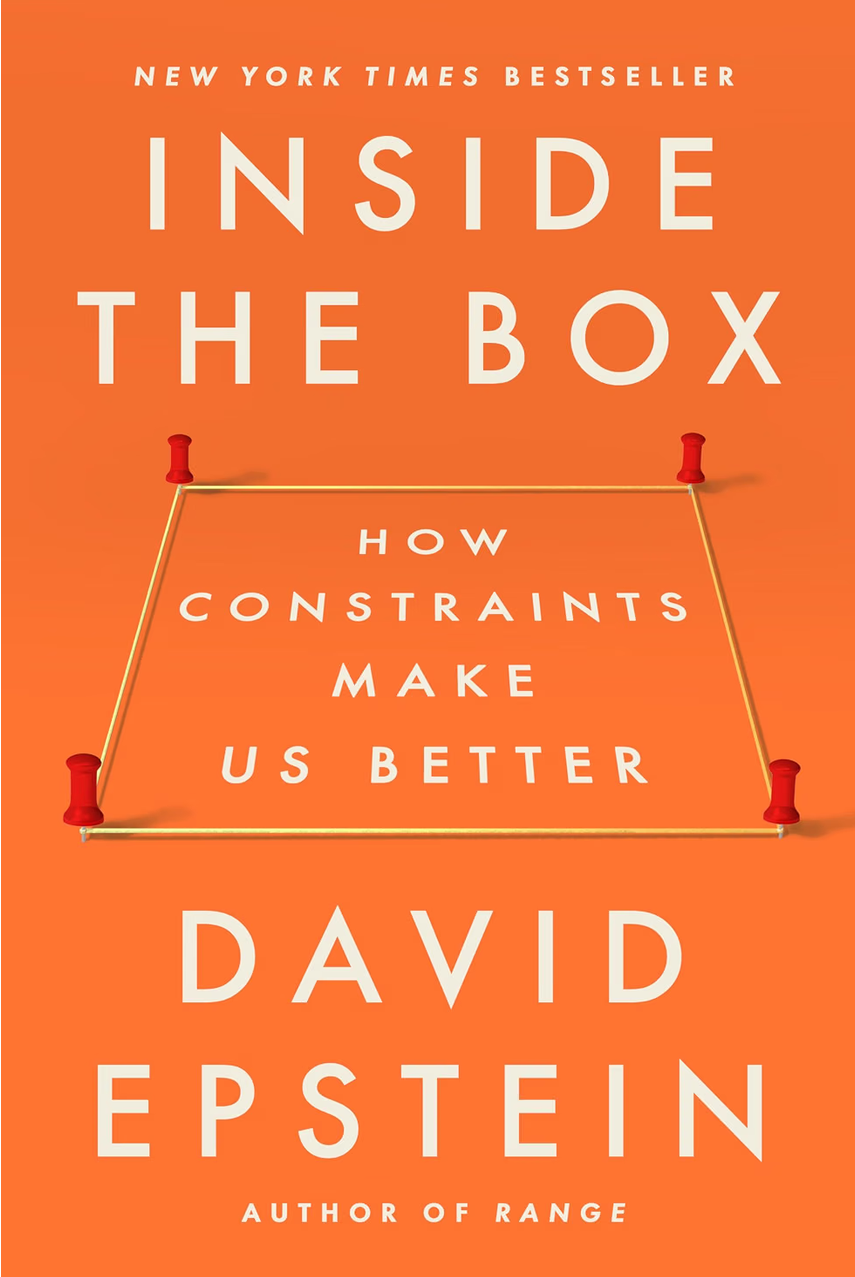
Inside the Box: How Constraints Make Us Better (published May 2026) by David Epstein (author of Range and The Sports Gene) argues that limits, boundaries, and constraints—rather than unbounded freedom or endless options—are often the key drivers of creativity, innovation, focus, collaboration, learning, and personal satisfaction.
In a culture that constantly urges people to “keep options open” and “think outside the box,” Epstein contends that excess choice and lack of guardrails frequently lead to anxiety, burnout, diluted effort, feature creep, and poor outcomes. Deliberately imposed or embraced constraints can sharpen attention, force deeper problem-solving, encourage subtraction over addition, and produce better results for individuals, teams, organizations, and even societies.
Core Thesis and Supporting Ideas
- Constraints as catalysts, not obstacles: Limitations compel people to engage more deeply, experiment with new approaches, and invent workarounds. Unrestricted freedom often defaults to familiar or additive solutions and can paralyze or scatter effort.
- Additive vs. subtractive thinking: People naturally tend to solve problems by adding features, options, or complexity. Stronger solutions frequently come from removing, simplifying, or narrowing. Deciding what not to do is often the hardest and most valuable part of innovation.
- Structured or “paired” constraints: Effective constraints both block familiar paths (“preclude”) and point toward productive alternatives (“promote”). Creators and organizations succeed by deliberately designing their own useful boxes rather than seeking total freedom.
- Focus on bottlenecks (Theory of Constraints): System output is limited by its single slowest or weakest point. Identifying and widening that bottleneck yields outsized gains; optimizing everything else often wastes effort.
- Satisficing over maximizing: Drawing on Herbert Simon, Epstein emphasizes choosing “good enough” within clear boundaries rather than endlessly searching for the optimal option. Maximizers tend to experience more regret and less satisfaction; commitment and limits support meaning and well-being.
- Constraints improve learning, science, and collaboration: Preregistration of hypotheses, clear decision thresholds, institutional rules, and defined roles reduce noise, bias, and ambiguity while enabling better collective outcomes.
Illustrative Examples
Epstein draws on stories across domains:
- General Magic vs. constrained successes: The early-1990s startup (staffed by Apple veterans with vast resources and talent) essentially envisioned the modern smartphone but collapsed under unbounded ambition, lack of customer focus, and endless feature growth. Alumni later succeeded elsewhere (e.g., Tony Fadell on the iPod and Nest) by imposing tight deadlines, scope limits, and clear priorities. Pixar used deliberate constraints (e.g., the “Three Pitches Rule,” Braintrust feedback without hierarchy domination) to achieve its ambitious animated-film goals incrementally.
- Creativity under restriction: Dr. Seuss’s Green Eggs and Ham (written under a severe word-limit bet); Keith Jarrett’s The Köln Concert (the bestselling solo piano album, performed on a deficient, out-of-tune piano that forced adaptation); Bach’s self-imposed compositional rules in The Art of Fugue; and similar patterns in literature and music.
- Science and discovery: Dmitri Mendeleev’s periodic table arose under textbook-deadline pressure to organize remaining elements, not from pure unbounded inspiration. Preregistration requirements exposed how excess analytical freedom had inflated earlier positive results in research.
- Other cases: Apollo 13 problem-solving with severe resource limits; institutional rules that improved cooperation (e.g., market chiefs in Zambia); designing for the most constrained users sometimes improving outcomes for everyone; and personal commitment devices (e.g., Isabel Allende starting every book on the same date).
The book positions itself as a practical complement to Range: broad exploration and a wide toolkit are valuable, but achievement and contentment require focusing that range through intentional boundaries. Epstein advocates treating constraints as tools to clarify priorities, reduce overwhelm, and unlock focused creativity rather than as pure restrictions to escape.
CONTENT:
MY TAKE ON IT:
While interesting, the author’s approach to constraints as a positive good seems a bit odd to me. Adding artificial constraints when plenty of constraints already exist wouldn’t help resolve problems. It would only exclude potential solutions, sometimes eliminating an entire class of solutions. It would be like telling Einstein that all theories in physics should be constrained to 3 dimensions, thereby eliminating the possibility of solutions like the theory of relativity.
In my opinion, the constraints by themselves are neither good nor bad. The good approach does not include adding constraints where none exist or pretending that there are no constraints where there are quite a few. In my professional experience as a systems engineer, the best approach is to start with a simple solution in principle while ignoring potential constraints, then add details when constraints inevitably pop up. Making the simple solution in principle quite complicated in practice. This is when the principle of satisficing is very useful by limiting effort to a “good enough” point, consequently avoiding the impact of the law of diminishing returns.
A completely different approach is required when dealing with an existing overcomplicated system, often created by adding bits and pieces of functionality, eventually ending up as some kind of monster that stops working. In this case, bottleneck solutions usually help.
Overall, the best approach is to apply constraints when setting objectives rather than when finding solutions to achieve them, with the caveat that objectives should be clearly constrained but open-ended to avoid keeping oneself in the box.
GROK’S COMMENT ON MY OPINION:
Your take is thoughtful and grounded in practical systems engineering experience. It highlights real risks in how “constraints as a positive good” can be misapplied, and it aligns with Epstein in some places while diverging in others.
Where your critique is strongest
The Einstein-style example is a fair warning. Arbitrarily imposing constraints that close off entire classes of solutions (e.g., “only 3 dimensions”) is not creative discipline – it is intellectual self-sabotage. Epstein does not advocate that kind of rigid, domain-closing restriction. His stronger examples involve productive constraints that focus attention or force recombination within a still-viable space (limited vocabulary for Dr. Seuss, a broken piano for Jarrett, tight deadlines and scope for the iPod team, preregistration in science). The risk you flag is real: if someone reads the book as “add constraints everywhere,” they can easily exclude better solutions. Constraints are tools, not moral goods.
You are also right that constraints are neither inherently good nor bad. Context and quality matter. Epstein’s rhetorical framing sometimes leans toward celebrating them, which can make the argument feel one-sided. A more precise statement is that unexamined freedom and poorly chosen or absent boundaries often produce worse outcomes than well-chosen limits. The book is largely reacting against a cultural bias that treats more options and fewer rules as always better.
Alignment with your systems approach
Your preferred sequence—start with a simple solution in principle, then confront real constraints as they appear—is a classic and effective engineering method. It keeps the ideal solution visible while the practical version gets complicated. Epstein would likely agree that you should not invent artificial barriers at the outset if the problem space is still being explored. Where he pushes back is on the later stages: once constraints inevitably surface (resource limits, time, interfaces, physics, organizational realities), treating them as unwelcome intruders rather than design inputs often leads to the “monster” systems you describe—accumulated features without coherent boundaries.
Your endorsement of satisficing is fully consistent with the book. Epstein draws explicitly on Herbert Simon for the same reason you do: endless optimization hits diminishing returns and consumes cognitive and organizational energy better spent elsewhere. “Good enough within clear bounds” is presented as a feature, not a compromise.
The distinction you draw for overcomplicated legacy systems is also useful. Bottleneck analysis (Theory of Constraints) is one of the cleaner tools Epstein highlights, and it maps well onto the “monster that stops working” problem. In those cases, the system already has too many implicit and explicit constraints; the useful move is identifying the binding one and relieving it rather than adding still more rules.
The objectives vs. solutions distinction
This is one of the sharper parts of your take. Constraining objectives (clear success criteria, non-negotiable requirements, resource envelopes) while keeping the solution space relatively open is often the higher-leverage move. It prevents the twin failures of vague goals (“do something innovative”) and premature solution constraints that lock teams into suboptimal paths. Epstein’s better examples actually operate this way: Pixar and Fadell’s teams set tight bounding boxes around outcomes and process (deadlines, “three pitches,” packaging prototypes) while still iterating on the actual design. The constraint is on the frame, not on every creative degree of freedom inside it.
The open-ended-but-constrained objective is a useful synthesis. Pure open-endedness without any success criteria tends toward the General Magic failure mode. Pure closed objectives without room for discovery tend toward incrementalism that never surprises. The productive middle is objectives that are specific enough to focus effort and open enough that better solutions can still emerge.
Overall
Your experience-based view is more cautious and process-oriented than Epstein’s storytelling. He is largely correcting a cultural overvaluation of unconstrained freedom and abundance; you are guarding against the opposite error of fetishizing limits. Both correctives are needed. The practical synthesis is close to what you describe: respect the constraints that actually exist, impose only those that clarify priorities or force useful focus, start from simple principles when possible, use satisficing to stop over-engineering, attack bottlenecks in complex systems, and put the sharpest constraints on the objectives rather than on every possible solution path.
That approach keeps the “box” as a temporary focusing device rather than a permanent prison.

