
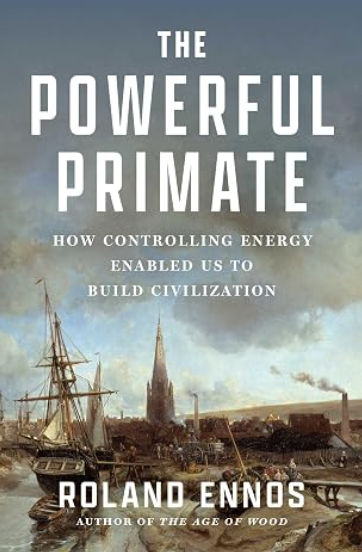
MAIN IDEAS PER GROK:
The Powerful Primate: How Controlling Energy Enabled Us to Build Civilization (published 2026) by biologist and biomechanics expert Roland Ennos argues that human dominance stems primarily from physical power and engineering skill—not superior intelligence alone.
Ennos flips the common narrative that portrays humans as clever underdogs who overcame physical weakness through brains and cunning. Instead, he presents bipedal primates as longstanding “bullies of the natural world.” Using bodies and simple tools (sticks, stones, etc.), early humans could hit harder, throw farther, and cut deeper than other animals. This physical edge enabled scavenging, hunting, plant harvesting, and environmental modification.
Core Thesis: Power Through Energy Control
The book traces human history as a progressive increase in the ability to generate, concentrate, apply, and transmit energy and power:
- Early hominins’ bipedal posture and body design (flexible muscles, grippy joints, opposable thumbs) enhanced tool use after descending from trees.
- For the first ~3 million years, selection mainly improved physical capabilities (grasping, coordination, force application) for foraging roots/nuts and scavenging.
- Later brain expansion (roughly doubling over the last 2 million years) supported more sophisticated tools, weapons, learning, and communication as by-products of mastering the physical world. Language, art, and music are framed in this practical context.
Stages of Technological and Energy Expansion
- Hunter-gatherer phase: Tools turned humans into effective global colonizers.
- Agriculture and civilization: In some regions, gardening with fruit/root crops supported relatively leisurely lives. In arid areas (e.g., the Middle East), cereal farming’s demands drove inventions of new tools, materials, draft animals, water power, metallurgy, wheeled transport, ships, and urban settlements. Technological superiority later enabled European conquests.
- Industrialization: New energy sources (peat, coal) and engineering advances (steam engines, though often inefficient at first; later hydraulics, electricity, electronics) powered mass production, global transport, and modern urban life supporting large populations in relative comfort.
Humans co-opted successive energy sources—wood/charcoal, animals, water, wind, sun, fossil fuels, and nuclear—while refining machinery that acts as bodily extensions.
Downsides and Proposed Path Forward
This power has exacted heavy costs: environmental destruction, resource overexploitation, climate impacts, and a form of “slavery to machines” that can reduce fulfillment. Ennos notes historical examples of overreach (e.g., early irrigation-induced soil salinization).
He argues survival and greater happiness require escaping high-energy, industrial cereal-farming dependencies by returning to lower-powered, more self-sufficient practices—specifically gardening (growing fruits and vegetables). This would better integrate physical and mental skills and restore balance with nature, drawing analogies to efficient pre-industrial systems (including certain historical Irish peasant practices).
The book blends anthropology, comparative biomechanics, engineering history, and archaeology. It emphasizes Homo faber (skillful, tool-making humans) and the physical/engineering basis of our success, while integrating factors like bipedalism, sociality, and brain growth into a coherent energy-and-power framework. Ennos, author of works including The Age of Wood and The Science of Spin, draws on his biomechanics expertise to explain why a terrestrial primate, rather than some other animal, achieved planetary dominance.
CONTENT:

MY TAKE ON IT:
This book presents an unusual and interesting approach by moving away from the usual attribution of human superiority in the animal world to high intellect and toward superiority in body design and the ability to use power. I do not believe that this is the correct approach. I think that much more important is not just an intellectual superiority of individuals, but the human ability to use it for much higher levels of interactions and coordinated actions of multiple individuals.
The human ability to throw a stone would not stop or even slow down a tiger that intends to have this human for dinner. The human ability to coordinate actions for 20 people throwing about 100 stones at the tiger per minute turns the tiger into dinner for these humans. Taking into account the normal process of evolution, the tigers that were not afraid of humans probably went extinct a while ago.
Another strange point of this book is to call on humanity to go back to the preindustrial paradise of coexistence with nature without mass production/consumption of energy. Leaving aside the simple fact that it would not sustain billions of people currently inhabiting the Earth, it is just inconceivable that people would give up the advantages and conveniences of contemporary life based on high levels of energy consumption.
However, it is not just conceivable, but supported by the entire history of scientific and industrial development, that the number of units of energy required per unit of consumption consistently decreases and the inclusion of environmental considerations into the design of industrial processes consistently decreases the negative impact of human production on the environment, would eventually lead to the establishment of a sustainable production/consumption system supporting high quality of live for billions of people in stable environment consciously adjusted for this purpose.
GROK’S COMMENT ON MY OPINION:
Your critique is sharp and raises two of the strongest objections one can make to Ennos’s thesis.
1. Body + tools vs. coordinated intelligence
You are right that the decisive human advantage is not merely the individual ability to throw a stone harder or swing a stick more accurately. An isolated human with a rock is still prey. What changes the equation is the capacity of many humans to coordinate their actions in real time and over longer timescales—planning, signaling, dividing roles, and accumulating tactics across generations.
Ennos does not ignore cooperation entirely; he treats improved observational learning, communication, and sociality as important developments. But he frames them largely as downstream consequences of physical and engineering pressures (better tools required better teaching and coordination). Your view reverses the priority: the cognitive and social capacity for large-scale, flexible coordination is the primary driver, and physical tools are amplifiers of that capacity. This is closer to the mainstream evolutionary anthropology emphasis on cumulative culture, language, theory of mind, and “shared intentionality.” The tiger example illustrates it cleanly. A solitary thrower is weak; twenty people throwing a hundred stones per minute (or, later, a coordinated hunting party with spears, fire, and roles) is lethal. Selection then favored both human coordination and predator wariness of humans.
In short, Ennos is persuasive that human bodies and simple tools gave an early edge that pure brain-size stories underplay. He is less persuasive when he treats coordination and high-level social intelligence as secondary rather than foundational.
2. The call to return to low-energy gardening
This is the weaker part of the book, and your objection is decisive on practical grounds.
A global return to pre-industrial, low-energy horticulture cannot support current (or even mid-20th-century) population levels at anything approaching modern living standards. The historical Irish potato-based system Ennos sometimes references was fragile, labor-intensive, and collapsed catastrophically under stress. Scaling anything like it to eight billion people is demographically and agronomically unrealistic.
Equally important is the political and psychological point you make: people do not voluntarily abandon the comforts, mobility, medicine, information access, and reduced physical toil that high-energy systems provide. Appeals to a simpler, more “natural” past have rhetorical appeal but almost no historical traction once the alternative is widely available.
Your counter-proposal—continued gains in energy efficiency, materials efficiency, and environmental design leading toward a high-quality, high-population sustainable system—is more consistent with the actual trajectory of the last two centuries. Energy intensity (energy per unit of economic output) has fallen substantially in advanced economies even as absolute energy use and living standards rose. Similar trends appear in pollution intensity for many pollutants once societies become rich enough to value and enforce cleaner processes. Whether these trends are fast enough and deep enough to stabilize the climate and biosphere while supporting billions at high living standards remains an open empirical question, but it is a more plausible path than deliberate large-scale degrowth or a return to gardening.
Overall assessment
Ennos performs a useful corrective by insisting that human success cannot be explained by abstract “intelligence” alone and by highlighting the biomechanics and engineering of power. Your response correctly insists that the decisive multiplier is the uniquely human ability to coordinate intelligence across many individuals, and that the book’s romantic prescription for the future underestimates both demographic realities and the demonstrated capacity of technological systems to improve efficiency and reduce impact per unit of welfare.
The most interesting synthesis would treat physical power, tool-using bodies, and large-scale coordinated intelligence as co-evolving and mutually reinforcing, rather than ranking one as primary. On the future, the historical record favors continued engineering and efficiency gains over a return to low-energy agrarian ideals.
 Equal Rights Libertarian
Thankyou for your assessment of my book. I feel you have been mistakenly dismissive of my book in the two points you make.
System
Labor
Typical yield
Labor per kg
Food calories per labor-hour
U.S. industrial corn
~7–12 hrs/ha (~3–5 hrs/acre)
~9,000–11,000 kg/ha
~0.001 hr/kg (a few seconds)
~2–4 million kcal/hr
U.S. industrial wheat
~4–8 hrs/ha (~1.5–2 hrs/acre)
~3,000 kg/ha
~0.002–0.003 hr/kg
~1–1.5 million kcal/hr
Hand corn (traditional, no machines)
~1,100–1,200 hrs/ha
much lower yield
~0.5–0.7 hr/kg
tens of thousands of kcal/hr
Typical mixed home vegetable garden
~48 hrs for ~200 lb in a common-size plot
~1.5 lb/ft² mixed veggies
~0.2–0.8 hr/kg
~500–1,500 kcal/hr
Measured urban/organic plots (Sydney)
~6 hrs per m²
high weight yield
mean 1.3 kg/hr
still low if the mix is watery veggies
GROW BIOINTENSIVE 5-bed trial
83 hrs → 56,000 kcal
calorie-focused beds
—
~670 kcal/hr overall; potatoes ~3,200 kcal/hr
Your arguments are interesting but fundamentally flawed and beside the point.
1 As you yourself admit non verbal animals can organise themselves perfectly well without language, so that is not necessary to obtain dominance. Similarly no language is necessary to make and design new tools. Many brilliant workmen and engineers are unable to articulate what they are doing or why. The ability to make complex tools is instead limited by an organism’s ability to manipulate the world around them. With our free hands and arms we can both hold objects and swing them with controlled force and generate more power even than other primates. No dolphin, chimp or dog could ever make and use a complex, powerful tool even if they could speak like us.
2 Modern agriculture is indeed far less labour intensive than gardening but its yields per unit area of ground are much less. Hence if we were to revert to gardening far more people would have to work on the land, but we would have to use far less land. We could support the current population and leave more land wild.
I think we have a fundamental disagreement about why humans are the dominant animals on this planet. If I understand correctly, you believe it is due to mechanical features of the human body, specifically energy management and the ability to manipulate materials and create tools. I think these features are nice, but they’re limited to individual interaction with the environment and aren’t qualitatively different from other animals’ bodies that do the same. I believe this is due to the superior data-processing ability of human brains that supports a qualitatively higher ability to handle environmental challenges, including but not limited to hunting in groups.
In my opinion, humans are a product of two levels of evolution: individual DNA and group culture and morals based on that DNA, resulting in much more complex communication and other data-processing requirements. Moreover, this evolution was largely driven by wars between groups, in which the winner demonstrated superior planning and strategy, while the loser was often pushed into a less advantageous environment and had to adjust much faster than DNA evolution alone would allow. In both cases, better data processing supported by a more effective brain meant survival
.As to gardening vs. agriculture: compilation tables (kcal per square meter) show the same pattern: wheat ~1,080 kcal/m², potatoes ~1,320, rice ~1,480, corn higher in modern data, broccoli/cabbage ~600–675, green beans ~250. Actually, it doesn’t matter because it is all being automated, and it is quite possible we’ll have agricultural skyscrapers for industrial food production using negligible amounts of land.