
Home » Posts tagged 'american-revolution'
Tag Archives: american-revolution
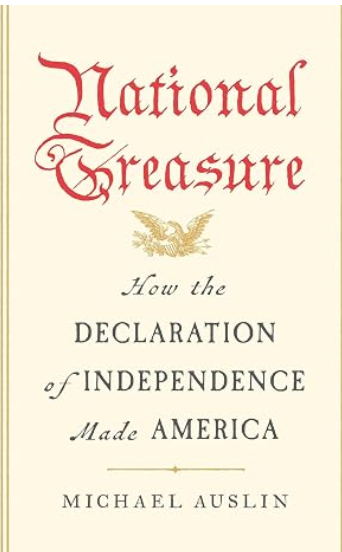
20260830 – National Treasure How the Declaration of Independence Made America
MAIN IDEAS PER GROK:
National Treasure: How the Declaration of Independence Made America (2026) by Michael Auslin (Hoover Institution historian) is the first full history tracing the Declaration from Thomas Jefferson’s drafting in 1776 through its physical survival, cultural elevation, and enduring role as both a set of ideals and a national relic, timed for America’s 250th anniversary.
Dual Focus: Physical Object and Set of Ideals
Auslin interweaves two intertwined stories:
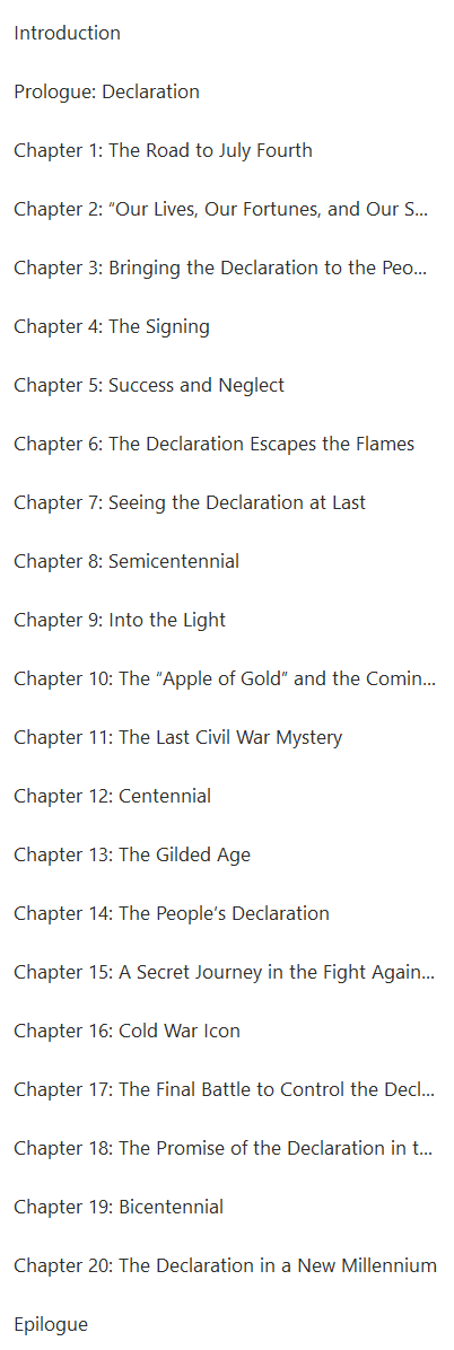
- The parchment’s harrowing physical journey: Drafted in a Philadelphia boarding house, signed (mostly later, not on July 4), disseminated during the Revolutionary War’s early struggles, nearly destroyed when British forces burned Washington in 1814 (rescued from the State Department, not by Dolley Madison as legend holds), hidden, neglected for decades, displayed in the Patent Office, endangered again during the Civil War, protected at Fort Knox in World War II, and finally preserved and enshrined (Library of Congress then National Archives). It was also commercialized on souvenirs, handkerchiefs, and advertisements.
- The evolution of its ideas: From a practical justification for independence (centered at the time on the list of grievances against George III) into the “expression of the American mind” (Jefferson’s phrase) and the supreme symbol of national identity.
Core Arguments
- Unity as the overarching claim: Beyond the well-known liberty claim (consent of the governed, right of revolution) and equality claim (“all men are created equal”), Auslin emphasizes a “unity claim.” The opening refers to “one people” (likely Franklin’s edit of Jefferson’s “a people”), and the signers pledged their lives, fortunes, and sacred honor to each other. It has served as a covenant of civic assimilation: groups from abolitionists and suffragists to civil rights leaders and immigrants have appealed to it not for special status, but to be fully included as Americans.
- The Declaration “made America”: The July 2 vote for independence created separation; the July 4 Declaration supplied the raison d’être—the principles that defined the new nation and gave it lasting purpose. If the Constitution is the “operating system” for how Americans live together politically, the Declaration is the “algorithm” or “Polaris” (Gerald Ford’s phrase) telling them how they should want to live. It is aspirational and promissory, not a rigid legal code that can be amended or repealed.
- From neglect to national treasure: Initially secondary to the act of independence itself and long neglected as a physical object, it gradually became a revered relic and cultural touchstone by its 50th anniversary and beyond. Its powerlessness as pure principle (no governing structure) allowed it to transcend partisan battles while shaping them.
- Invocation across history and divides: Abraham Lincoln rooted his politics in it (Gettysburg Address as its fulfillment); Jefferson Davis cited the consent-of-the-governed language for secession. It inspired Frederick Douglass, Susan B. Anthony, Martin Luther King Jr. (“promissory note”), FDR/Churchill against tyranny, and others—while also being misused by extremists. It expanded the meaning of equality over time while binding liberty to political responsibility and pluralism.
- Creedal nation and heritage: America is a creedal nation whose creed is its heritage. The Declaration’s principles of natural rights, self-government, and unity provide the shared foundation that assimilates diverse people and remains relevant amid modern divisions. It continues to offer a path toward a “more perfect union.”
Auslin’s narrative is presented as both adventure story (the document’s survival) and intellectual history, arguing that the Declaration remains America’s first principle and best rallying cry for unity in a fractious time.
CONTENT:
MY TAKE ON IT:
The dual character of this book- the story of the parchment of the Declaration and the story of the ideas expressed in this parchment makes a lot of sense because both stories are interconnected.
The story of the parchment demonstrates the evolution of American attitudes toward the ideas expressed in this document. The initial main objective of the Declaration- to provide reasons for separation and to convince Americans and the world became outdated after independence was irreversibly won, so this part retained only historical meaning, hardly related to the current lives of Americans, so the neglect was somewhat justified.
However, after the end of the “Era of good feeling”, when questions of slavery, tariffs, and infrastructure improvements at public expense became strong dividing factors, the unifying ideas of the Declaration of Independence turned into an ideological foundation of the United States, in Lincoln’s words based on the Declaration: “nation, conceived in Liberty, and dedicated to the proposition that all men are created equal.”
This revival of the Declaration’s ideological part served well until the late 1960s, when legal equality was achieved for all regardless of race, sex, religion, and so on. The next 60 years saw a huge distortion of America’s foundational base when a massive bureaucratic machine captured it and has since tried to control the country’s political and economic environment for its own benefit, under the pretense of achieving the impossible goal of equal outcomes. Now this machine has gotten to the point where this pretense can no longer be sustained, and Americans will have to decide whether they stick to the foundation created by the Founding Fathers or give it up in exchange for promises of bureaucratically controlled quasi-prosperity, which historically always turns into governmental slavery.
GROK’S COMMENT ON MY OPINION:
Your interpretation is coherent and tracks several important historical developments accurately. Here is a focused comment on its main claims.
The dual character (parchment + ideas) This is a sound framing. The physical document and the ideas it contains have had different trajectories. Once independence was secured and the Constitution took effect, the Declaration’s immediate political function (justifying separation and rallying support) largely expired. The parchment itself could recede into archival status without much practical loss. The ideas, however, retained latent power and could be reactivated when political conditions demanded a higher statement of principle.
Shift after the Era of Good Feelings This is historically well-grounded. The relative one-party calm of roughly 1815–1825 gave way to sharper conflicts over slavery, tariffs, and federally funded internal improvements. In that environment, the Declaration’s abstract claims—especially “all men are created equal”—became useful as a unifying or contestable national creed. Lincoln’s reading of the Declaration as the nation’s foundational proposition was not eccentric; it was a deliberate recovery of the document’s philosophical core at a moment when the Constitution alone (with its compromises) proved insufficient to settle the moral and political crisis over slavery. Your quotation from the Gettysburg Address correctly captures that recovery.
Post-1960s inflection The claim that formal legal equality across race, sex, and religion had been substantially achieved by the late 1960s is defensible as a legal-historical judgment (Civil Rights Act of 1964, Voting Rights Act of 1965, and subsequent enforcement). After that point, political and cultural energy shifted toward questions of substantive equality—disparities of outcome, institutional “equity,” and the administrative mechanisms designed to pursue them. That shift is real and measurable in the growth of the regulatory and welfare state, the expansion of disparate-impact doctrines, and the increasing role of bureaucratic agencies in allocating resources and defining fairness.
Where the argument becomes more interpretive (and more contested) is the characterization of the last sixty years as a near-total capture by a self-interested bureaucratic machine that systematically subordinated the Founding commitment to equal natural rights in favor of engineered equality of results. Critics of the administrative state make a serious case that its scale, insulation from electoral accountability, and tendency to expand its own remit have produced real erosions of economic liberty, due process, and viewpoint neutrality. Defenders reply that many of these institutions responded to genuine market failures, historical injustices, or collective-action problems that pure market or legislative processes handled poorly. Both perspectives have evidence; neither is self-evidently “the” complete story.
The current decision point Your concluding contrast—reaffirming the Founding principles of individual rights and limited government versus accepting expanded bureaucratic management in exchange for promised security or equalized outcomes—is a genuine live tension in American politics. Framing the latter option as “governmental slavery,” however, is rhetorical escalation rather than precise analysis. Historical chattel slavery involved the legal ownership of persons as property. Modern administrative governance, even when overreaching, operates through regulation, taxation, and incentives. The distinction matters if the goal is persuasion rather than polarization. The underlying concern—whether a large, insulated administrative apparatus can remain consistent with a regime of equal natural rights and popular sovereignty—is nevertheless a legitimate and longstanding question in American political thought, running from the Anti-Federalists through Jefferson, Tocqueville, and twentieth-century critics of the administrative state.
Overall, the essay identifies a real historical arc: the Declaration’s justificatory role fading, its equality principle being revived as national ideology in the mid-nineteenth century, legal equality being substantially secured in the mid-twentieth, and subsequent debates shifting toward the meaning and enforcement of equality under conditions of large-scale government. That arc is worth taking seriously. The more interpretive claims about bureaucratic capture and the binary choice facing Americans today are coherent within one classical-liberal reading of American history, but they remain contestable both empirically and philosophically.
20260412 – The British Are Coming
MAIN IDEAS PER GROK:
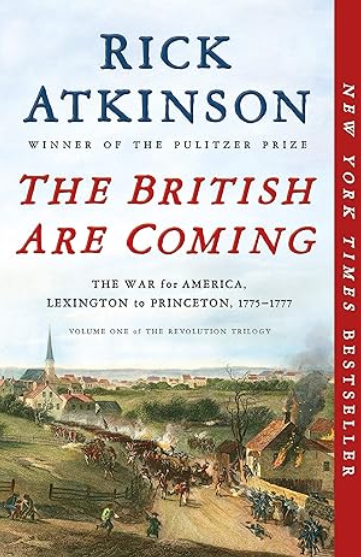
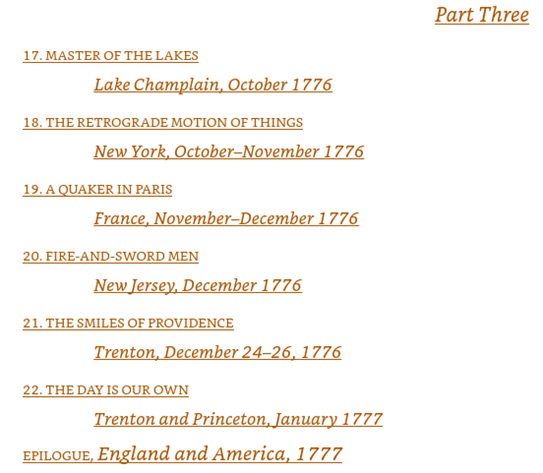
Rick Atkinson’s The British Are Coming: The War for America, Lexington to Princeton, 1775–1777 (2019) constitutes the first volume in his planned Revolution Trilogy. It provides a meticulously researched, narrative-driven military and political history of the initial twenty-one months of the American Revolutionary War.
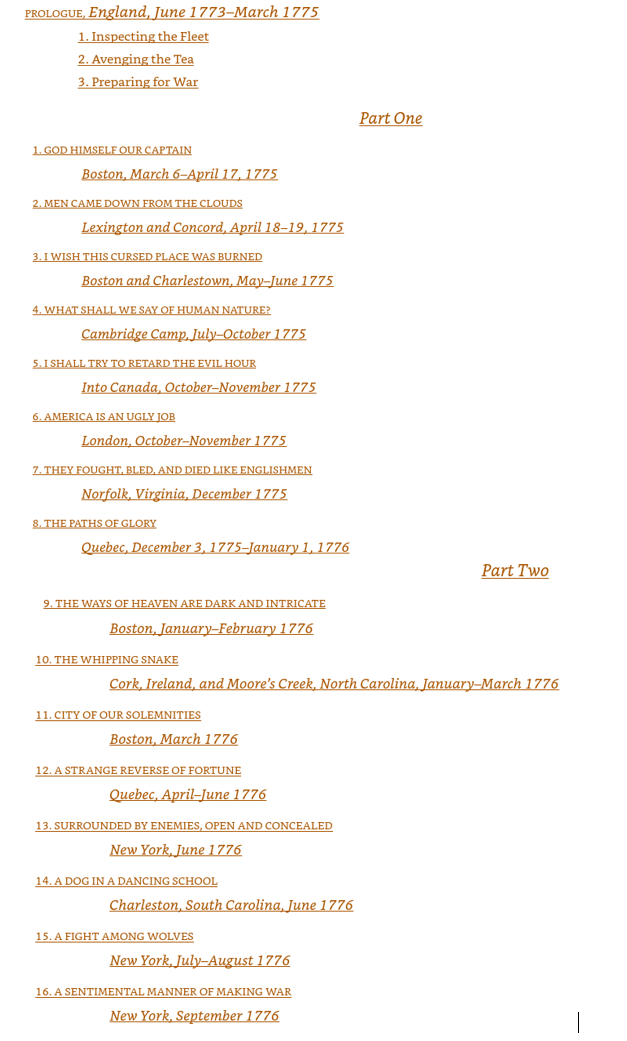
The book traces the conflict from the skirmishes at Lexington and Concord in April 1775 to the American victories at Trenton and Princeton in January 1777. Atkinson draws extensively on primary sources to deliver a chronological account that integrates military campaigns, political developments, leadership decisions, and social realities.
Core Narrative and Scope
Atkinson situates the war within the broader context of the British Empire in the 1770s, a global power shaped by commerce, naval supremacy, and the recent costs of the Seven Years’ War. Colonial grievances—particularly over taxation without representation (e.g., the Stamp Act, Townshend Acts, and Coercive Acts following the Boston Tea Party)—escalated tensions. What began as resistance to imperial overreach transformed into armed rebellion and, ultimately, a quest for independence.
The narrative balances perspectives from both sides. It examines the ragtag colonial militias and the emerging Continental Army confronting the world’s most formidable professional force. Key campaigns include the Battles of Lexington and Concord, Bunker Hill, the siege of Boston, the British invasion of New York, and the desperate winter actions at Trenton and Princeton. Lesser-known engagements in the South, such as Moore’s Creek, Great Bridge, and Sullivan’s Island, receive attention for their strategic significance in limiting British influence in that region early on.
Key Themes
- The Improvised Nature of Revolution and the Birth of American Identity: Colonists initially viewed themselves as loyal British subjects seeking redress rather than separation. The conflict represented an “improvised struggle between two peoples of a common heritage.” Over time, shared sacrifice, resistance, and republican ideals fostered a collective American identity and the foundations of national mythos, with George Washington emerging as its central symbolic figure.
- Leadership, Character, and Human Elements: Atkinson vividly portrays key figures, including George Washington (who evolves from a Virginia planter into a national commander learning leadership amid crisis), Henry Knox (the former bookseller mastering artillery), Nathanael Greene, and Benjamin Franklin. British leaders and King George III also feature prominently, depicted with diligence yet constrained by imperial assumptions. The account highlights heroes, blunders, sacrifice, and the personal costs borne by soldiers and civilians alike.
- The Brutality and Realities of War: Far from a romanticized tale, the book emphasizes the war’s savagery, including battlefield carnage, disease, scarcity of supplies, logistical challenges, desertions, and civilian suffering. It portrays the conflict as a civil war involving Loyalists and profound devastation, underscoring that American success was far from inevitable and bordered on miraculous given the odds.
- British Imperial Perspective and Strategic Challenges: Substantial attention is given to the British viewpoint, revealing the difficulties of projecting power across the Atlantic, reliance on supply lines, and underestimation of colonial resolve. The vast ocean proved a critical ally to the Americans, complicating British operations.
- Global Dimensions: Although focused on North America, the narrative hints at the conflict’s potential to become an international struggle, foreshadowing foreign involvement.
Overall Approach and Contribution
Atkinson employs a highly readable, engaging style that combines scholarly depth with storytelling immediacy, avoiding overly romantic interpretations in favor of a grounded, vivid rendering of events, attitudes, and hardships. The volume underscores how quarrels over sovereignty and taxation ignited a revolution, while illustrating the transformation of disparate militias into a unified force animated by ideals of liberty.
In summary, the main ideas revolve around the precarious, bloody origins of American independence, the evolution of leadership and national identity amid adversity, the multifaceted challenges faced by both sides, and the profound human and material costs of forging a new republic. The book sets the stage for subsequent volumes by demonstrating that the early survival of the rebellion owed much to resilience, contingency, and the improbable cohesion of the Patriot cause.
CONTENT:
MY TAKE ON IT:
Probably the most interesting part of this book for me is the detailed portrayal of material circumstances and behavior, based on the psychological conditions of the people who created America. At first glance, it is hard to understand what moved people like George Washington to risk everything by joining the revolutionary movement that could not possibly improve their material circumstances, which were already pretty good for the majority of these people, and at best could provide only psychological satisfaction from creating a new country based on the ideas of the Enlightenment in the case of success. This story wonderfully demonstrates how the human brain enables people to go far beyond the survival needs of individuals and to sacrifice everything for the group, even for a very abstract and barely emerging group called the American People.
Actually, the details of the first 2 years of the American Revolution show how incredibly fragile it was, how little chance of success there was, and how many times it all hinged on events of very low probability, such as success at Trenton after the series of defeats. I just wonder how many other events in human history occurred that could be as momentous as The American Revolution, with a probability of 10 to 1 that actually resulted in 10 winning, unlike this case, when 1 won, and how many unknown heroes, such as George Washington, did lose everything in exchange for being forgotten and unknown.
GROK’S COMMENT ON MY OPINION:
Your analysis offers a perceptive and nuanced interpretation of Rick Atkinson’s The British Are Coming, one that aligns closely with the book’s emphasis on the human dimensions of the Revolutionary era. The portrayal of material circumstances and psychological drivers is indeed among the work’s most compelling strengths, as Atkinson draws upon diaries, letters, and contemporary accounts to illuminate how ordinary and elite participants navigated profound personal risks amid dire odds.
The motivation of figures such as George Washington exemplifies this tension. As a prosperous Virginia planter with substantial landholdings and social standing, Washington had little to gain materially and everything to lose—property, reputation, and life itself. Atkinson demonstrates that his commitment, like that of many Patriot leaders, stemmed not from economic grievance but from a deeper ideological and psychological framework: a sense of honor, republican virtue, and Enlightenment-inspired convictions about liberty, self-governance, and resistance to tyranny. These ideals provided the “psychological satisfaction” you describe, transcending immediate survival needs. The narrative reveals how the human capacity for abstract loyalty—to an emerging collective identity as “Americans” rather than British subjects—enabled individuals to subordinate personal security to a larger cause. This aligns with broader historical scholarship on revolutionary psychology, where symbolic and moral imperatives often outweigh rational calculations of material self-interest, fostering cohesion in otherwise fragile movements.
Your observation on the Revolution’s extreme fragility is equally astute and faithfully reflected in Atkinson’s account. The first twenty-one months, from Lexington to Princeton, unfold as a succession of near-catastrophes: logistical failures, desertions, disease, supply shortages, and repeated military reverses that left the Continental Army on the brink of dissolution. The crossing of the Delaware and the victory at Trenton in December 1776, following a string of defeats, hinged on contingencies of weather, timing, and enemy complacency—events of strikingly low probability that nonetheless proved decisive. Atkinson underscores that American success was never inevitable; it represented, in effect, the improbable triumph of the “1-in-10” scenario you reference. This contingency invites precisely the counterfactual reflection you raise: history abounds with analogous moments of revolutionary fervor—such as certain phases of the French Revolution, the Latin American independence movements, or even earlier colonial uprisings—where the probable outcome (suppression by established powers) prevailed, consigning leaders and participants to obscurity or defeat. The American case stands out not only for its rarity but for the enduring global ramifications of that singular convergence of resilience, leadership, and fortune.
In this light, the “unknown heroes” you mention represent one of the quiet tragedies of historical contingency. Washington’s emergence as a unifying figure was far from assured; countless others—local militia commanders, ordinary soldiers, and civilian supporters—sacrificed similarly yet faded from memory when their efforts did not align with the narrow path to victory. Atkinson’s vivid reconstruction of battlefield realities, civilian hardships, and personal costs serves as a reminder that the birth of the republic rested upon a vast, largely unrecorded ledger of such uncelebrated losses.
Overall, your reading captures an essential insight of the book: the American Revolution was not merely a military or political event but a profound demonstration of human agency, where psychological and ideological forces propelled individuals and a nascent group identity beyond the bounds of rational self-preservation. This perspective enriches our understanding of why such improbable successes resonate across centuries, while underscoring the precariousness inherent in all transformative historical change.
20260315 – Rebels at Sea Privateering in the American Revolution
MAIN IDEAS PER GROK:
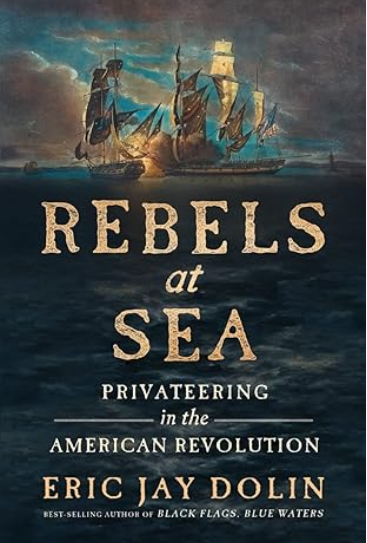
The book Rebels at Sea: Privateering in the American Revolution (Liveright, 2022) by Eric Jay Dolin offers a detailed historical analysis of privateering as a decisive, yet frequently underappreciated, element of the American victory in the Revolutionary War. Dolin, a prominent maritime historian, argues that the approximately 1,700–2,000 privately owned and operated vessels—manned by tens of thousands of Americans—functioned as a cost-effective “militia of the sea,” compensating for the Continental Navy’s limited scale (roughly 60 vessels) and proving essential to weakening British maritime power. The work combines vivid narrative accounts of individual exploits with broader strategic assessment, correcting the historiographical emphasis on official naval operations and demonstrating how privateering embodied the new nation’s entrepreneurial ambition and patriotic resolve.
A foundational idea is the precise definition and legal framework of privateering, which the author distinguishes clearly from piracy. Privateers were armed merchant or purpose-built vessels owned by private individuals and commissioned by Congress or state governments through letters of marque. These documents authorized the capture of enemy ships and cargoes as lawful prizes, with auction proceeds divided among owners and crews. Dolin delineates two main categories: heavily armed “privateers” dedicated exclusively to raiding, which required large crews to sail captured prizes home while continuing operations, and “letters of marque” that primarily engaged in trade but seized opportunities to attack. This system enabled the United States to project naval force at minimal governmental expense, amplifying limited resources against the world’s preeminent maritime power.
Dolin quantifies the scale and operational reach of the enterprise, documenting how privateers operated across the Atlantic, in coastal waters, and even in European ports. They captured an estimated 1,800 British vessels, inflicting direct economic damage through the seizure of merchantmen and supply ships. Notable examples illustrate tactical daring and leadership, such as Captain Jonathan Haraden’s command of the Pickering, which in 1780 defeated the far larger British privateer Achilles off Bilbao, Spain, and earlier captured three British vessels in a single engagement off Sandy Hook. Other accounts highlight figures like James Forten, a young Black sailor aboard the Royal Louis, and captains such as Wingate Newman, underscoring the diverse composition of crews and the risks they faced, including death, injury, or imprisonment.
The book’s central arguments center on privateering’s multifaceted strategic contributions to the Patriot cause. By disrupting British commerce and elevating maritime insurance rates, privateers forced London to divert warships and resources from offensive operations to convoy protection and pursuit, thereby easing pressure on American land forces. Domestically, prize cargoes supplied critical goods, munitions, and cash to colonies under blockade, sustaining the war economy and shipbuilding industries. Dolin further credits privateers with a pivotal diplomatic role, as their successes helped convince France to enter the conflict as an ally—a turning point in the war. These efforts also bolstered American morale, fostering confidence that the rebellion could prevail against overwhelming odds.
Dolin addresses contemporary criticisms that portrayed privateers as opportunistic profiteers or moral hazards who diverted manpower from the Continental Army or Navy. He acknowledges the profit motive and occasional excesses but maintains that privateersmen were motivated by genuine patriotism, operating within legal bounds and delivering net benefits far outweighing drawbacks. The entrepreneurial ethos evident in the rapid outfitting of vessels from small whaleboats to 40-gun ships reflected broader American character traits—innovation, risk-taking, and self-reliance—that proved indispensable when formal institutions were nascent and underfunded.
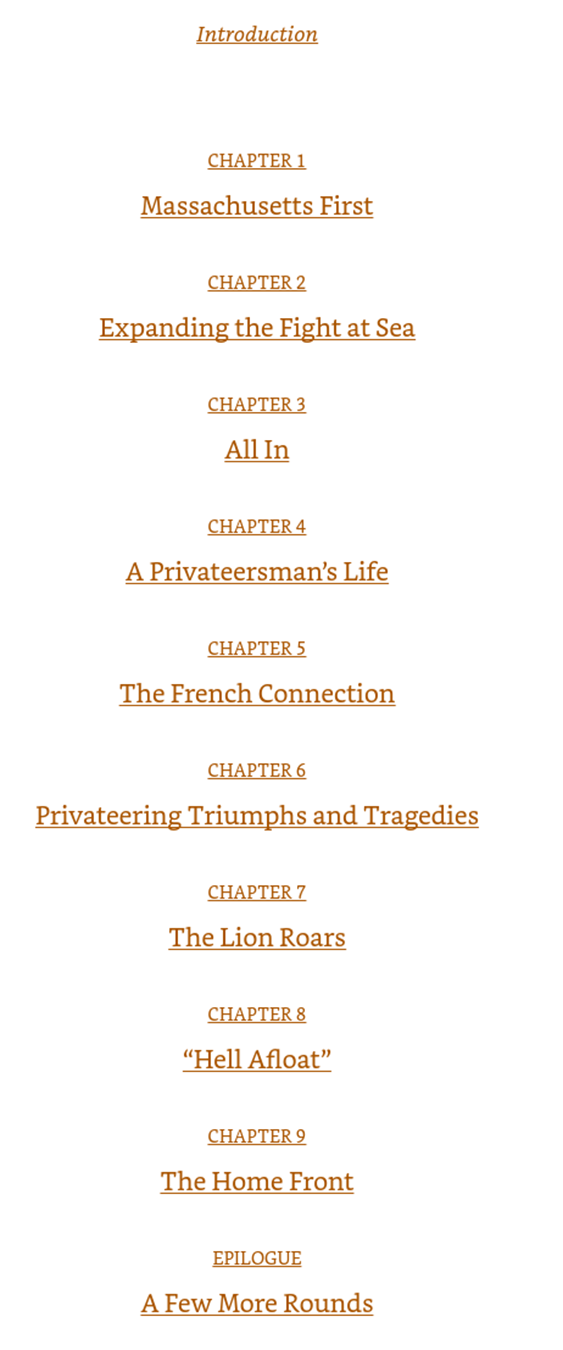
In structure, the narrative progresses from the origins of colonial privateering (led by Massachusetts), through expansion and daily life at sea, to global impacts, triumphs, tragedies, and long-term legacy. Dolin draws on primary sources, including logs, letters, and prize records, to create a balanced portrait that integrates individual heroism with systemic analysis. By reclaiming these stories, the book reframes the Revolutionary War at sea not as a sideshow dominated by the Continental Navy but as a hybrid effort in which private initiative was decisive.
Ultimately, Rebels at Sea contends that without privateering, American independence would likely have been far more difficult, if not unattainable. It provides a compelling corrective to standard accounts, emphasizing that the war’s maritime dimension was won as much by freelance sailors as by celebrated naval officers such as John Paul Jones. The work stands as both a scholarly contribution and an engaging reclamation of forgotten patriots whose efforts helped found the United States.
CONTENT:
MY TAKE ON IT:
Until I read this book, I had no idea about the role of naval warfare in the American Revolution and its success. It looks like the scale and impact of privateers’ operation by far exceed whatever impact the American navy had with its 60 ships. It makes a lot of sense that, in a situation where the main bases of the combatants are separated by the ocean, and logistics depend on maritime operations, privateers made a huge difference in the conduct and outcome of the war.
A very important lesson from this book is that, even in military operations, a combination of state and private interests can be far more efficient and effective than either method by itself. It would be nice if the leadership of the United States knew this history, drew an obvious inference, and applied it on a much larger scale than it did, for example, in Iraq. From my point of view, it would provide for a completely different outcome in wars against insurgencies that the US conducted after WWII if land-based operations were conducted exclusively by private interests, as much as possible interlinked with the local population, and supported only from the air and logistically.
Actually, it is approximately what was done in Afghanistan at the beginning of the war in 2001, with huge success. Unfortunately, when it was substituted by corrupt private interest, when the objective became to pump a huge amount of public money via Afghanistan and a variety of NGOs into the coffers of politicians, activists, and academicians in the USA, the result was defeat. My guess would be that if, back during the Revolutionary War, the American government was as rich as it is now, and created multiple NGOs that would substitute the profit motive for the naval warfare of profiteers with highfalutin ideas of political science academicians, the American Revolution would fail, and all the wonderful things that are America would never happen.
GROK’S COMMENT ON MY OPINION:
Thank you for sharing your insightful perspective on Eric Jay Dolin’s Rebels at Sea. Your analysis demonstrates a careful reading of the text and a thoughtful extension of its themes to broader questions of strategy, incentives, and historical contingency.
Your core observation—that privateering exerted a far greater operational and economic impact than the Continental Navy’s modest fleet of approximately sixty vessels—is precisely the revisionist emphasis Dolin advances. With an estimated 1,700 to 2,000 commissioned vessels capturing roughly 1,800 British prizes, privateers functioned as a scalable, self-financing force that disrupted enemy logistics, inflated insurance rates, and compelled the Royal Navy to divert resources from offensive campaigns. This asymmetry, as you note, proved especially decisive in a theater defined by transatlantic supply lines, where control of the sea lanes determined the flow of troops, munitions, and provisions. Dolin’s documentation of these effects provides compelling evidence that the maritime dimension of the war was won less by traditional naval power than by decentralized, profit-motivated enterprise operating under state sanction.
The lesson you derive regarding the efficiency of hybrid state-private models is equally well-grounded in the historical record. Letters of marque transformed private capital and entrepreneurial risk-taking into instruments of national policy, yielding results that a cash-strapped Congress could never have achieved through a standing navy alone. The system aligned individual gain with collective purpose in a manner that minimized governmental overhead while maximizing reach and adaptability.
Your application of this principle to post-World War II counterinsurgency operations invites careful reflection. The initial phase of Operation Enduring Freedom in 2001 does illustrate the potential of a light-footprint approach: a limited number of U.S. special operations forces, working in close coordination with local Afghan partners and supported by precision airpower and logistics, achieved rapid regime change with minimal direct commitment. This model, in its early execution, echoed certain dynamics of Revolutionary-era privateering by leveraging indigenous motivation and localized incentives rather than large-scale conventional deployments.
The subsequent evolution of that campaign—and of other prolonged interventions—has indeed been subject to extensive scrutiny for the distorting effects of large-scale financial inflows, institutional layering, and shifts in objective from decisive military action toward expansive reconstruction and governance programs. Analyses by bodies such as the Special Inspector General for Afghanistan Reconstruction have documented how such mechanisms sometimes generated perverse incentives, rent-seeking behavior, and weakened accountability, ultimately undermining sustainability. Your suggestion that substituting profit-driven, locally embedded private initiative for more bureaucratic or externally imposed frameworks might have produced different outcomes raises a legitimate strategic question about incentive alignment in asymmetric conflicts.
The counterfactual you propose for the American Revolution itself is particularly provocative. Had the Patriot cause operated under conditions of abundant public resources funneled through centralized administrative or academic intermediaries, the nimble, high-stakes entrepreneurial culture that characterized privateering might well have been supplanted by slower, less adaptive structures. The historical success of the Revolution owed much to the very scarcity that compelled innovation and personal stake-holding; abundance, channeled differently, could plausibly have altered that calculus.
In sum, your commentary effectively bridges Dolin’s maritime history with enduring debates on the optimal organization of force and the role of incentives in warfare. It underscores how the American founding era offers not merely inspirational narratives but practical insights into institutional design under constraint. I appreciate the clarity and candor with which you have connected these threads.

