
20140907 Omnipotent Government
MAIN IDEA:
Old Liberalism was a great intellectual break through in history of humanity, which brought in free markets, expanded division of labor, provided economic support for political freedoms, and dramatically improved quality of life for everybody.
Unfortunately intellectual forces of Socialism and Etatism, which lulled masses into believe that they could be much better off with big government, defeated Old Liberalism. This book is a very detailed analysis of Germany’s case when Etatism in form of National Socialism took over society as whole and brought it into unwinnable war against whole world.
The Germany is only one case of many when Etatism takes society over and proceeds by destroying wealth, freedom, overall quality of live, and often lots of lives. The future is bleak because masses do not have intellectual capacity to understand economics and readily buy into cheap Etatist solutions to they problems even if these solutions do not work. There is nothing inevitable in this development and the fate of humanity still can turn out to be better, but only if masses become enlightened enough to through away all forms of Etatism and Socialism and embrace free markets and Capitalism.
DETAILS:
Introduction
It starts with characteristic of German Nazi party and its program as Labor imperialism based on Marxist ideology. The idea is that resources, especially lands are limited and nations had to fight for them. The winner (which obviously should be German nation) will control more land and use losers as slaves to work on it. This and many other similar ideas come from movement of people away from free market and capitalist economy to Etatism when government more and more takes over economy. Such intervention means expansion of violent resource transfer between individuals within country which substitutes free resource exchange. Correspondingly when extended outside of country, it means violent resource transfer between nations = war of conquest. That is exactly what Germany did during WWII.
PART I: The Collapse of German Liberalism
CHAPTER I. German Liberalism
- The Ancient Regime and Liberalism
Germany was late in transfer from Ancient regime of King to liberal regime of people, human rights and parliaments. Germany produced idealistic philosophy, represented in writings of Schiller, and German intellectuals mainly accepted ideas of enlightenment and liberalism.
- The Weakness of German Liberalism
However the German liberalism was adapted only by the part of population. The significant numbers of people came from eastern areas, were less educated, and more prone to obey orders. As result revolution of 1848 was crashed and German liberalism was defeated by nationalism and socialism.
3. The Prussian Army
Prussian Army from XVIII century to XIX underwent dramatic evolution. It started from point where both soldiers and officers had been randomly pressed into long term services and drilled to become mildness to such extent that army was not able to act at night or in small units due to the fear of desertion. Than it developed into army based on compulsory short-term service of all men with ideological conditioning similar to French revolutionary and later Napoleonic army with high levels of loyalty to the leader. It was expanded and the Royal guard was created to assure availability of loyal force. Eventually by 1860 army became a bulwark against liberalism.
4. The Constitutional Conflict in Prussia
German liberals who called themselves progressives did everything possible to prevent revolution and civil war in hope to enlighten layers population that supported king, but failed, and eventually retreated during constitutional crisis giving way to Bismarck and his program of Etatism.
- The “Little German” Program
The episodes of territorial struggle against France and Denmark opened way to strengthening Prussian army and eventual unification of Germany not under united liberal government, but under King of Prussia and his Prime Minister Bismarck.
- The Lassalle Episode
Lassalle – leader of socialists played a substantial role at this point by pushing labor against liberals (progressives) with ideas of socialism and class war. In process he build clandestine alliance with Bismarck since both of them where fighting against capitalism and free market represented by liberals.
CHAPTER II. The Triumph of Militarism
- The Prussian Army in the New German Empire
The specificity of Prussian Army was that it was build not within, but above civil administration. It was meritocratic institution and fully reliable tool of supreme warlord – Kaiser.
- German Militarism
The core of this system was the position of army, which was supreme factor of political life. This was a system of disguised absolutism with powerless parliament and Army leaders such as Moltke being courtiers. This system actually failed in the WWI, but it did it in such way that it was not absolutely clear for the people.
- The Liberals and Militarism
Prussian parliament had universal, but unequal franchise divided into 3 equal groups each elected by majority of taxpayers paying together 1/3 of taxes. This way richest group included a lot less people voting then poorest group. As result liberals had majority, but due to militarism they did not have control. Without control they failed to prove their ideas, but took blame for whatever went wrong. Consequently it opened the majority of wage earners to socialist agitation and destroyed ideology of liberalism.
- The Current Explanation of the Success of Militarism
Mises poses the question why capitalists and intellectuals did not resist militarism and why army that was build from lower classes who often supported socialism did not reject semi hidden absolutism? He rejects Marxists explanation of imperialism as stage of capitalism.
PART II: Nationalism
CHAPTER III. Etatism
- The New Mentality
The new mentality of Etatism in form of socialism and interventionism replaced Liberalism in the minds of Europeans during XIX and beginning of XX century. It came to Germany from West Europe and firmly established itself with growth of Social Democratic movement that found a pretty nice accommodation with social kingdom of Hohenzollerns with its social security and labor legislation. It fed back philosophy of Etatism to England in France through work of intellectuals from Show and Wells to Fabians.
- The State
This is a short review of notion of state as coercive organization in control of territory and its population. The only difference from a regular criminal gang is that it has no competition within its territory. Mises accepts necessity of the state because only coercion can prevent coercion, but he sees it not as benevolent godlike entity, but for what it is – a violent organization that should be limited as much as possible.
- The Political and Social Doctrines of Liberalism
The essence of Liberalism’s believes are private property on means of production and market as method of cooperation and division of labor. Coercive machinery of state is necessary, but only to defend property and prevent coercion by non-state actors. The control over state should be democratic because legitimacy of state’s coercion depends on voluntary acceptance of state’s rule. The validity of such voluntary acceptance is not possible to define without democratic process.
- Socialism
Socialism is the system of public ownership of means of production that is total state control over economy. Many people believe in compatibility of socialism and democracy, but it failed the check by reality of socialism implementation in multiple countries. This statement follows by demonstration of economic logic of why socialism could not work as advertised.
- Socialism in Russia and in Germany
This part is a review of actual and very sad experience of real socialism as it was implemented in Russia in form of Communism and in Germany in form of Nazism.
- Interventionism
This is a bit softer form of coercive intervention when state does not take over economy, but just interfere preventing it from proper working. This piece includes multiple examples of government intervention, how it normally achieves results directly opposite to advertised, and economic logic for reasons of such wonderfully consistent failures.
- Etatism and Protectionism
This is review of Etatism expressed as Protectionism. Obviously coercion is necessary to force people to buy something produced internally at higher price than could be obtained externally at lower. Eventually it comes down to some people getting more as producers while other paying more as consumers.
- Economic Nationalism and Domestic Monopoly Prices
This is description of another method of Etatism interference into economy: via monopoly pricing and inevitable negative results.
- Autarky
Finally it comes to extreme case of country isolated from international market. Obviously it dramatically increases costs of everything that is not produced most efficiently in this country and there is no such country that would have all quantities and qualities of resources that whole world has, it is the most destructive economic intervention short of socialization of means of production.
- German Protectionism
The specific German case included formation of cartels supported by government that charge high domestic prices in closed market and exported their product at much lower prices to compete on world markets. This allowed Germany conduct highly pro-labor policies supported by high prices. For some 60 years Germany was ahead of other countries, but eventually retaliation did occurred decreasing quality of life for everybody and pushing Germany to seek another method to obtain resources externally, more traditional than capitalism – war of conquest.
CHAPTER IV. Etatism and Nationalism
- The Principle of Nationality
This is review of the process of formation of nationalities in Europe as coercive process that included wide range of measures including education and suppression of traditional culture of minorities.
- The Linguistic Group
Principle of nationality generally requires formation of separate state for every linguistic group, however countries with relatively liberal systems handle perfectly well population with multiple languages without big problems. The notion of race was a latecomer and become prominent well after European states were formed.
- Liberalism and the Principle of Nationality
If Liberalism triumphs, the principle of nationality, separate states, and frontiers become redundant. If personal freedom both political and economic respected throughout the space, it does not matter if person born in country A, speaks in language B, and supports set of ideas C. Such person would be comfortable everywhere and will go to the place where his/her effort would be the post productive for consumers of his/her product as defined by the best return on investment of this person’s labor and capital.
- Aggressive Nationalism
Completely different situation is in environment of Etatism. Now returns are not defined by consumers, but by coercive power of the state. So to get the best access to resources person should join the group more powerful in control of the state. Obviously any minority will be disadvantaged causing it to fight for independence breaking states in smaller and smaller pieces with opposite process of war of conquest bringing these pieces together, but on unequal basis.
- Colonial Imperialism
This is review of colonial expansion of XIX century. It makes a very interesting point that contrary to Marxist interpretation it was not a result of next phase of capitalism. Capitalism does not need territorial expansion because whatever it needs could be bought on the international market and whatever they sell, they can sell at the same place. Colonialism is rather product of Etatism when government bureaucrats civil and military see territorial expansion as source of increase in amount of resources under their control and correspondingly increase in their power.
- Foreign Investment and Foreign Loans
This part discusses international movements of capital and is mainly about movement of Western capital to less developed countries. As usual it generated hate, resentment, and confiscations. The result is decrease of profitability of foreign investment and cessation of such investment making everybody poorer.
- Total War
The old wars of small armies and aristocracies are gone. The new total war between people is the feature of XX century and it makes war much more damaging then it ever been. Etatism removes free exchange creating economic disasters that result in decrease in quality of life for masses that depend on employment for their living. This normally blamed on lack of resources and generates hope to obtain resources from others via victorious war. The only real measure that could prevent war is liberalism that would provide everybody opportunity on the world wide free market.
8. Socialism and War
Socialists claim that wars caused by capitalism. It is BS. The reality is opposite. Capitalism creates opportunity for cooperation and prompts everybody to try to meet other people’s needs. Socialism is coercion that completely separates resources available to person from results of this person’s efforts. Consequently the logical way to obtain more resources for all members of society is to get them from other people by winning in the war.
CHAPTER V. Refutation of Some Fallacious Explanations
- The Shortcomings of Current Explanations
The fallacy of explanation of nationalism is coming from failure to understand that Etatism is source nationalism. Without state taking from one people and giving to people of preferred nationality, the nationalism has no meaning whatsoever.
- The Alleged Irrationality of Nationalism
This fallacy relates to explanation of nationalisms as irrational. Nazis and other nationalists always promise to take from other nations something of value and give it to their own people. Humanity has a huge experience of this kind of resource acquisition working, so it is quite rational to expect it continue to work.
- The Aristocratic Doctrine
This is a nice description of revolt against masses when intellectuals and bureaucrats revolt against democracy as inefficient and harmful method of society organization and strife to substitute it with rule of “wise kings” selected through formal meritocratic process of tests and best universities. In reality only capitalism with real democracy when people compete on free market of goods, services, and ideas demonstrated superior ability to create wealth for everybody.
- Misapprehended Darwinism
This is a short and nice debunking of Social Darwinism as doctrine of aristocratic intelligentsia that has nothing to do with real philosophy of Darwin and Evolution.
- The Role of Chauvinism
This is explanation of logic and nature of Chauvinism as different from Nationalism. The Chauvinism is just a disposition of character and mind not involving action, while nationalism is all about action and policies. Both despise others and believe in their own superiority, but Chauvinist does business as usual with other, while nationalist uses violence against other.
- The Role of Myths
This is an analysis of myths as fictitious narratives and doctrines that play important role in history as something people actually believe. Socialism, Etatism, and Nationalism are valid doctrines in the minds of their supporters because of acceptance of myths presented in these doctrines, despite their fallaciousness.
PART III: German Nazism
CHAPTER VI. The Peculiar Characteristics of German Nationalism
- The Awakening
The German nationalism became qualitatively different from other nationalisms in 1880s. It formed notions of Germans as superior warriors and producers who are young, energetic, and deprived of access to needed resources by existing world order established by old, degrading, and corrupt western democracies. That was result of disunity of Germany and it will be fixed by unification of Germany that should be dominant power in the world.
- The Ascendancy of Pan-Germanism
Contrary to prevailing narrative neither Junkers of old Aristocracy, nor bankers, nor capitalists and middle class pushed Pan-Germanism. These groups were perfectly happy with existing order and growing ability of compete in free market – activity that brought them wealth and influence. The real engines of Pan Germanism were intellectuals who promoted it via education, books, and other forms of culture.
- German Nationalism within an Etatist World
Germans did not invent nationalism, but rather used it as everybody else. The key notion here is that nationalism makes sense only in conjunction with Etatism because if state controls resources individuals within or without this state can obtain these resources only by the grace of this state’s bureaucracy or via violence either plain robbery or military conquest (the same only bigger and bloodier). Only free market provides opportunity to obtain whatever one wants or needs without violence, but it practically leaves bureaucracy, politicians, and intelligentsia out of business.
- A Critique of German Nationalism
The critic provided includes two main points: one is the unrealistic complex superiority that made German nationalists and later Nazis to believe that they can fight the whole world and win; and another one: complete immorality of ideology that deemed moral anything that would benefit German state and nation. Obviously the great leaders should define what exactly benefit German state and nation.
- Nazism and German Philosophy
This is critic of idea that Nazism is logical outcome of German Idealistic philosophy.
- Polylogism
This animal came from Marxists who, after failing to refute by logical methods “bourgeois” economics, came up with Polylogism that states that thought and logic is defined by the social class, therefore since any thinker belongs some class, both logic and facts could be contested based on personality of individual who present them. Marxists claim to represent proletarian logic, class, and science. Nazis pick it up and created their own Aryan logic, facts, and even science.
7.Pan-Germanism and Nazism
Pan Germanism had naturally grown into Nazism. Unfortunately other people in Europe just fail to understand that Nazi is not a small group of weirdoes, but rather true representatives of German people who, while fighting each other on details and methods were united in their understanding of goals – expansion and enrichment of Germany via military conquest.
CHAPTER VII. The Social Democrats in Imperial Germany
- The Legend
There are two legends about German social democrats. The first one is that they were fighting against militarism supported by bourgeoisie who was in search of armaments profits. The second one is that they were fighting against Hitler, agent of big capital. Both are untrue.
- Marxism and the Labor Movement
This is about intellectual history of Marxism. Marx started as interventionist, but reading of British economic authors convinced him that interventionism does not work so he moved to complete Hegelian negation of capitalism. Labor movement was not really Marxian, but rather interventionist demanding government intervention on behalf of workers. German Social Democrats managed to build organization on duality of theoretical Marxism and practicality of labor movement.
- The German Workers and the German State
The labor movement’s main weapon in any confrontation with employer was strike. The strike is meaningless if employer can freely use his property and just hire other people if demands of striker exceed market price for labor. The key for success therefore is to deny employer control over his property that could be done only using coercion. In 1870 German government moved to the side of labor and practically stop enforcing property laws in case of strikes. It is an interesting fact that union’s came from above: Bismarck and government. The seemingly anti-socialist laws were just a sham under which socialist movement grew tremendously supported from above by intellectuals and bureaucrats and from below by labor.
- The Social Democrats within the German Caste System
One important service Social Democrat provided to wage earners was creation for them social environment within German caste system that legitimized wage labor as important part of this system.
- The Social Democrats and War
Social Democrats as good Marxists supported civil war between classes and despised imperialistic war between countries in theory. In reality all of them supported their nations. Only when war causes suffering to lower classes the socialist starts agitate against it and tries to use it to take over government power.
CHAPTER VIII. Anti-Semitism and Racism
- The Role of Racism
An interesting point is made here that as meaningless as race in reality is it was used to create a notion of Germans as nation of noblemen by race regardless to actual social standing and in contrast to ignoble Jews. It was partially result of German aristocracy proving itself useless in all areas of achievement including military during WWI.
- The Struggle against the Jewish Mind
While fighting “Jewish Mind”, Nazis actually failed to define what it is and what specific characteristics it has. They also tolerate Christianity, which is a product of Jewish mind if there is one. Obviously socialism is also to significant extent product of this mind and is foundation of both Nazi and Soviet regimes. However Nazis ridiculously claim that only these parts of it that they reject such as internationalism are Jewish product.
3.Interventionism and Legal Discrimination against Jews
This is a list of Nazi government action against Jews. Obviously because the book was written before Holocaust become a known event, it is a relatively benign list of discriminations and indignities against Jews.
- The “Stab in the Back”
The failure of WWI winners to assert reality of German defeat created an opportunity for legend of “Stab in the Back” of victorious German Army committed by Jews. This legend was not forcefully destroyed and as result it created German illusion of superiority that eventually led to WWII and final defeat with unconditional surrender.
5.Anti-Semitism as a Factor in International Politics
The interesting dynamics reviewed here led to initial defeat of France and Britain in the beginning of WWII. This dynamic had two sides: in Britain it was growing of popularity of socialism and its international pacifistic logic putting the break on rearmament in the face of Nazi military build up; in France it was Anti-Semitism of Nazi that converted Anti-German French nationalists into force somewhat supportive to Germany based on commonality of their hate for the Jews.
CHAPTER IX. The Weimar Republic and Its Collapse
- The Weimar Constitution
The beginning of this period was characterized by socialist revolution in which contrary to Russian pattern the winners were not communist who wanted to eliminate hostile classes, but Social Democrats who still tried to maintain some image of democracy. In defeating communist they had to ally with vast majority of Germans who did not want to repeat Russian experience. The military power to defeat communists came from remnants of the army led by nationalists. So the democratic Weimar republic was basically created by alliance of anti-democratic forces of socialism and nationalism.
- The Abortive Socialization
This is a description of Social democratic attempt to socialization. It started with creating committee of professors, which amazingly failed to achieve anything.
- The Armed Parties
Here are details of inherent weakness of Weimar republic that led to creation of paramilitary forces by just about every political group. In this brawl Hitler came on the top because this gangs consisted of young people dedicated to fight and not burdened by jobs and families. He also managed extract financial support from business mainly because owners preferred Nazi form of socialist when they remained formally in control to Communists form of socialism when they would be liquidated.
- The Treaty of Versailles
The treaty is defined as failure, but not for usual reasons. Contrary to common wisdom Misses believed that treaty was not too tough on Germany. On contrary, he is pretty convincing in showing that neither territorial changes nor reparations were overwhelming. The failure rather was inability of Britain and France to stick to the treaty and fight for it both ideologically and military when needed. Without such fight the treaty become just an ideological feeder for German nationalism.
- The Economic Depression
The great German inflation was result of monetary policies of socialists of the chair. Mises predicted it in 1912. Depression was created by social democrats and victims went to Nazis because they believed that Nazis could help.
- Nazism and German Labor
The question of why masses of workers who were Social Democrats and Catholics allowed Nazis came to power is invalid. These people were not ideological. They cared about their lives ad believed that Nazis would do better for them.
- The Foreign Critics of Nazism
Nazis won in Germany because they never encountered any adequate intellectual resistance. This is quite understandable because the fundamental tenets of Nazi ideology do not differ from generally accepted social and economic ideologies:
- Capitalism is an unfair system of exploitation
- The foremost duty of government is to substitute management of capitalists with government control
- Price ceilings and minimum wages are adequate method to improve lives of workers and consumers
- Easy money make country more prosperous
- Everybody who does not agree with statements above is evil and had to be suppressed.
- Export is good, import is bad for economy
These common tenets of ideology prevented any serious foreign critic of Nazism.
CHAPTER X. Nazism as a World Problem
- The Scope and Limitations of History
This is a small philosophical discussion about inevitability of historical explanation of event to encounter limitation of individual makers of history.
- The Fallacy of the Concept of “National Character”
Attempts to explain Nazism by German national character are meaningless because there is no such thing as a character prevailing in all individuals of the same nationality. It is uniqueness of historical situation in combination with uniqueness of psychological and ideological status of multiple individuals that is continuously changing over time that defines historical events.
- Germany’s Rubicon
The Nazism is not unique, but rather a consequence of move to autarky. The Germany just got there first and under considerable pressure of consequences of WWI. The Germany’s Rubicon on the way to Nazism was rejection of fee trade in late 18xx.
- The Alternative
The issue in struggle between Nazis and the rest of the world whether world consists of one linguistic group of German masters and everybody else as slaves or it will be world of heterogeneous society embracing all human beings. There is no neutrality or conscientious objectors in this struggle. One either fights Nazis or supports them actively or passively.
PART IV: The Future of Western Civilization
CHAPTER XI. The Delusions of World Planning
- The Term “Planning”
Some people start using “Planning” as substitute of devalued term “Socialism”. It really does not make any difference because compulsory cartel instead of free competition is pretty much the same. In terms of “world planning” it means world socialism under unitary management.
- The Dictatorship Complex
The funny thing about people supporting dictatorship is that they always believe in dictatorship when and if dictator does what they want. As soon as dictator does something they do not like, they are firmly against this form of rule.
- A World Government
The World government is not possible unless everywhere in the world established capitalism with free enterprise, free trade, and free movement of people. In this case government would be minimalistic. Currently governments use violence to provide more resources to some people at the expense of others, with expansion of this process to more groups it would become unmanageable.
- Planned Production
The economic system is too complex and dynamic for planners to be able control it in any meaningful way.
- Foreign Trade Agreements
All agreements restricting free trade are economically harmful. The world bodies based on balance of restrictions would lead to incessant haggles between representatives of countries trying to get some advantage at the expense of each other.
- Monetary Planning
Moving away from gold to feat money at the worldwide scale would cause inflation and severe boom bust cycles hurting middle classes.
- Planning International Capital Transactions
As usual with planning the attempt to use some international body to control capital flows bound to fail due to huge diversity of constituencies and their interests that could be reconciled only via free movement of capital.
CHAPTER XII. Peace Schemes
This part is pretty much outdated, but the bottom line is still correct: only truly free market, capitalism, and individual freedom can remove wars and violence between countries and peoples. The schemes reviewed:
- Armament Control
- A Critique of Some Other Schemes Proposed
- The Union of the Western Democracies
- Peace in Eastern Europe
- The Problems of Asia
- The Role of the League of Nations
Conclusion
Original Liberals believed in perfectibility of humans. They developed economic theories of free market and free trade that provided for tremendous growth of wealth. Nobody was able disprove these theories and when socialism become popular Original Liberals proved impossibility of effective socialist planning that nobody was able to disprove. They proved in free market economic theories and real life capitalist practice that it is possible to cooperate without conflict of interest. However they failed because intellectual abilities of vast majority of people are insufficient to comprehend advantages of capitalism. The world is hopeless at least in the near future. However despite original Liberals failure, the currently winning alternative of socialism cannot bring anything but wars, dictatorships, and overall misery. The humanity will be able move on to the better life only when majority become enlightened enough to understand those important points:
- Durable peace is possible only under condition of perfect capitalism when all resource transfers and exchanges occur voluntary without coercion because that would eliminate any economic causes for wars
- Free movement of labor would lead to equalization of labor rates throughout the world removing any over/under population problems.
- Government interference with economy decreases productivity, increases costs, and, most important, generates hate between economic winners and losers because both know that outcome is not fair.
- Socialism as system of effective organized and planned production is not possible because planners could not possibly calculate proper resource allocation in dynamic system of human demand for goods and services.
- Etatism could not bring equality because decision making from the top of hierarchical system always creates conflict of interest that could not be resolved without violence.
The future Mises expect as result of poisoning of population by socialist ideas is bleak. Etatism would divide world into prosperous industrialized West and miserable others who would start wars to take over resources from western minorities making it necessary for westerners to become highly militarized, suppress traditional freedoms, and dramatically decrease quality of live.
This catastrophe is not inevitable, but highly probable, as Mises saw it at the time of writing.
MY TAKE ON IT:
As usual I mainly agree with Mises on all economic issues. I also think that only free market could support freedom and prosperity and socialism or any other form of Etatism including welfare state is inevitably lead to decrease in quality of life, war, violence, and over all misery.
In addition to detailed description and analysis of history of National Socialism in Mises’ land of birth Germany I could add my experience of similarly disgusting form of Etatism: International Socialism in country of my birth Soviet Union.
However I completely disagree with is evaluation of Socialism power as result of insufficient enlightenment of masses. I think that many supporters of Old Liberalism and overall Capitalism are missing dynamics of this system when, while being beneficial for everybody at the long run, it is often detrimental to individuals over period of their one and only one specific life.
The individual who is at the bottom of society hierarchy, has no property, and has nothing significant to offer on the labor market cannot obtain satisfactory level of resources to accept the system. Such individuals are bound to fight it and if Socialism, Welfare state, or any other form of Etatism promised them more resources, they would support it either with their votes or with their guns. It would be only rational for them to do it.
The key for bringing this majority to the side of free market is to grant these people something that would immediately assure acquisition of at least the same amount of resources available them now and free them to search for additional application of their talent on the free market with plentiful educational opportunities. I believe that the way to do it is to establish equal, unalienable, and marketable rights for natural resources so individuals who use more than average had to buy these rights from individuals who use less.
The same is not necessarily applies to intellectuals who are not always stupid despite spending lots of time in brain damaging educational establishments. Many of them understand quite clearly that socialism does not work, while free market does. However they also understand that they would never be able to achieve the same level of resource acquisition on the free market, as they are able to achieve as reliable cogs in some hierarchical system of the state. No amount of enlightenment will change minds of these people.
It would not be possible to bring older and well-established intellectuals on the side of free market, but it should be possible to move to this side young intellectuals. By the same pattern as with masses without marketable skills, if granted equal rights for natural resources they would be set free to seek whatever application they want for their talents either for additional resource acquisition on the free markets, or just a personal life satisfaction. As a way to enjoy life, it would beat the hack out of being even well paid bureaucrat.
The bottom line is that tremendous improvement and prosperity is right around the corner, if we can manage to handle property rights in society well enough.
20140829 Inner Pulse

MAIN IDEA:
Every human being has an “Inner Pulse” which deeply connected to health and well being of this individual. This “Inner Pulse” not really susceptible to technology and scientific analysis, but clearly represents itself in unexpected medical outcomes both positive and negative. The only connection to this “Inner Pulse” could be via self-analysis and/or interaction with other humans, but it is not easily controllable.
DETAILS:
Introduction
Author defines Inner Pulse as a life force that is somehow not limited to material condition of body, but exists somewhat independently and can impact body’s survival or destruction. The Inner Pulse is responsible for unusual recoveries that seems to be medical miracles, but it also could be responsible for person succumbing to disease even if pure medical condition is not that bad.
Part One: Knowing Yow Inner Pulse
Chapter 1: Surgeons of the Mind
In this chapter author recounts history of his own fight with depression and how he recovered by finding balance between spiritual and physical world.
Chapter 2: The Pulse of Recovery
This chapter is recount of several stories about individuals who went in coma and remained in it for a long time. Sometimes recovery occurred despite seemingly medical impossibility. This caused author to look at non-regular communications channel between patient and doctor and at all kinds of out of body experiences.
Charter 3: One Patient. Manu Pulses
This is probably the most interesting part of the book. It reports case of multiple-personality patient who suffered from diabetes. The interesting part is that not all personalities had diabetes so when patient switched from one personality to another, level of sugar in the blood also changed. If true, it is an amazing example of direct influence of mind on complex bodily function completely out of conscientious control.
Chapter 4: Inner Pulse Rising
This is another story demonstrating mind’s ability to override condition of body in order to achieve some passionately required objective. In this case it was revenge. The paraplegic patient hated his former business partner who stole his money. At the end he was able temporarily override his condition, walk out of his chair and shoot his enemy. Interestingly enough he was not able to raise gun to the level to hit vital organs, so he ended up wounding his enemy in the leg before collapsing. Author sees it as sample of human ability to accumulate power of inner pulse and apply it in such a way that seems to be beyond human abilities.
Chapter 5: Radar to Die
This chapter is about opposite situation. Patients who seem to be in reasonably good medical condition have feeling that they are dying and it becomes self-fulfilling prophecy. From here author goes to discussion of premonitions from Titanic passengers who missed the voyage because of it and then to experiments with electric current when brain action was recorded before current was applied. The final anecdote is about famous cat in nursing home, which came to people shortly before they died, even if nobody knew that the end is near.
Part Two: The Healing Pulse
Chapter 6: Dancing in the Dark
In this chapter another case of seemingly unexplainable illness described, but this time with pretty clear and non-spiritual explanation. The case was result of abnormal function of thyroid gland that expressed itself through hysterical behavior of patient. The correct treatment removed the problem, but the case here used to discuss an ancient obsession with demons, spirits, and exorcisms that were applied to individuals in such condition.
Chapter 7: Infection of Body, Infection of Spirit
This is another story about patient whose condition was highly influenced via mind, this time due to media hype about superbug. It turned out that superbugs are not really super and are well known in hospitals. It was not bug, but hype that was new. In short the patient condition dramatically worsened due to the hype for no real medical reason. It came back to normal after hype was over.
Chapter 8: Never Say Die
This is another story about a patient who should be dead judging by her medical condition, but nevertheless survived. This time it was author’s aunt and he believes that her survival was caused by her special psychological characteristics, especially stubbornness. He also brings in results of studies that show irrelevance of positive attitude to level of cancer survival. It seems that the only trait at least relatively relevant is will to live.
Chapter 9: Radar to Live
This time it is about a patient who felt that something wrong with him, got prove from medical science and survived with psychological help from deep reliance on religion.
Chapter 10: The Black Swan
This chapter starts with reference to Tomas Mann’s novel “Black Swan” about menopausal women who mistakenly perceived cancer related bleeding for rejuvenation. It follows with real live story about patient who was stressed and become ill as result. Eventually she was treated successfully, but not after very difficult diagnostic process. Author references book by David C. Clarke “They can’t Find Anything” dedicated to the problem of stress inflicted symptoms and expanded diagnostic tools necessary to identify such illness.
Chapter 11: The Truth about Psychic Healing
This chapter is about psychic healing and more specifically about psychic named Desmond Darrel who contacted author and informed him that he did “reading” of author from picture on web site and found low level of functionality of author’s lungs. It was true because author at the time was recovering from respiratory virus. Such occurrences of information received from psychic coinciding with actual health condition of author made him to believe in psychics’ ability to read “inner pulse” and had at least some influence on its functioning.
Part Three: Tile Pulse of Power
Chapter 12: The Strongest Inner Pulse
This chapter is about a few individuals who verifiably achieved impossible feats with their bodies. Specifically it is about Houdini and David Blain. Author believes that these achievements are result of unusual ability to control mind-body connection by these individuals.
Chapter 13: Who Dies? Who Lives?
This is about another outstanding patient Todd Barnes, a poet, and his non-traditional cancer healer Emanuel Revici. Revici started as a regular medical doctor but then in his 60-70s turned into healer creating cocktails of unknown ingredients to treat cancer. Despite failure of the healer as demonstrated by analysis of outcome for terminal cancer patients who were treated by him, in this particular case the healer was successful and Todd lived much longer than people in this condition normally do. Author attributes it to healer’s ability to establish a special relationship with patient that dramatically improved situation. This result leads to discussion of a few books and experiments related to treatments directed at mind-body connection. As usual the formal experiment and statistics of such treatments does not show their effectiveness.
Chapter 14: Considering the Alternative
This is about alternative medicine. It references a book by R. Barker Bausel “The Snake Oil Science” which demonstrates that mechanisms of convincing in effectiveness of such treatment. As usual formal scientific analysis of outcomes fails to confirm such effectiveness.
Chapter 15: Miracles and the Inner Pulse
Another story about patient and bunch of coincidences that, in author opinion, represent small miracles sometimes related to religion. However author states that he believe that these miracles do not contradict laws of nature, but just represent our deficient understanding of “inner pulse”. At the end he provide example of famous rabbi Schneerson – the producer of many medical miracles, at least according to his worshippers, who was not able to handle his own stroke any better then regular person. The final conclusion: “Strengthening his failing inner pulse was beyond even great rabbi’s ability”.
Afterword: All in Good Time
This is quite a bit more of personal family history with references to “inner pulse” as related to medical conditions.
MY TAKE ON IT:
It is an interesting collection of medical cases demonstrating connection between mind and body. My philosophical attitude to this is simple: I do not see any separation between mind and body with mind being a specific condition of brain’s neural networks at a given moment of time. Being highly complex and time dependent this condition quite possibly could not be fully known externally any more then position and moment of particle in Uncertainty Principle of Quantum Mechanics. However even granted this impossibility, the level of knowledge in mind/body connection will certainly increase and dramatically so with advance of technology. I believe it is quite possible that future medicine would include much more treatments of body via external influencing on mind that it is conceivable now.
20140823 Mises, Ludwig – Liberty and Property

MAIN IDEA:
Capitalism is the only form of society that proved to support individual liberty and material prosperity. The movement to socialism created by state dependent layer of society: intellectuals and bureaucrats who seek to retain and increase their control over resources at the expense of people who create these resources. This movement would not only fail to deliver a higher level of prosperity promised by its leaders, but would also deprive people of liberty.
DETAILS:
Part I: “At the end of the eighteenth century there were prevailed two notions of liberty, each of them very different from what we have in mind today referring to liberty and freedom.”
The first notion of liberty originating from Greek philosopher was notion of liberty for qualified individuals, necessarily a minority of population, who are full-rights citizens with others being they slaves or non-citizens not deserving it. This was liberty within a group (state) to define group wide decisions and actions.
Landed aristocracy as defense against royal absolutism developed the second notion of liberty – liberty of individual (aristocrat) from the king (state) or any other group.
Part II: “The pre-capitalistic system of production was restrictive. Its historical basis was military conquest.”
The capitalism expanded the second notion of liberty to property owners as necessary condition of managing their property in productive way and produce goods and services for everybody. It greatly increased amount of resources available, but moved them out of control of aristocracy and its clients: professional intellectuals and bureaucrats, making these two groups mortal enemies of the new method of production and society arrangements.
Part III: “What vitiates entirely the socialists’ economic critique of capitalism is their failure to grasp the sovereignty of the consumers in the market economy.”
Intellectually the idea of socialism is result of poor understanding of working of capitalism, specifically of the fact that workers are also consumers and due to competition any squeeze on workers compensation comes back to workers as decrease in consumer prices. By combining all productive resources under state control, socialism substitutes sovereignty of customer with sovereignty of dictator as it was demonstrated by real live socialism implementation in all its forms either by Russian Communists or German Nazis.
Part IV: “It was different in the esoteric discussions among the inner circles of the great conspiracy. There the initiated did not dissemble their intentions concerning liberty.”
Socialists philosophically oppose liberty even if they speak about it all the time. They use the Newspeak as defined by Orwell using usual words to express completely opposite meaning of these words as they where traditionally used. They support freedom when they are not in power to propagate their ideas, but once in power, they declare that discussion is over and suppress all intellectual freedoms.
Part V: “Romantic philosophy labored under the illusion that in the early ages of history the individual was free and that the course of historical evolution deprived him of his primordial liberty.”
The romantic notion of liberty as natural condition is plainly untrue. Liberty is not possible without resources so the only time in history when big numbers of people were free even relatively is when capitalism is main mode of society. As soon as resources shifted from individual property to government control, liberty starves and dies without resources.
Part VI: “However, one does not exhaustively describe the sweeping changes that capitalism brought about in the conditions of the common man if one merely deals with the supremacy he enjoys on the market as a consumer.”
Another huge benefit of capitalism is that it allows individuals save money and direct them to whatever investment they consider the best giving them liberty to define direction of economic development in the way that benefits them most. All socialist schemas including welfare state tend to waste and misallocate resources denying individuals liberty to enjoy results of their savings.
Part VII: “The distinctive principle of Western social philosophy is individualism. It aims at the creation of a sphere in which the individual is free to think, to choose, and to act without being restrained by the interference of the social apparatus of coercion and oppression, the State.”
Individualism of western society and capitalism form of production produced tremendous wealth and improvement in lives including the great expansion of individual liberty to do what individual wants to do. Any move away from capitalism into direction of either Nazi or Communist utopias would inevitably limit individual freedom and bring material decrease in quality of live.
MY TAKE ON IT:
I find it interesting that at least partial explanation of socialism attractiveness explained by poor understanding of capitalism with its competition and market prices that led to nearly worshipping attitude to such relatively insignificant feature as planning and popular believe among educated people that socialism would deliver superior economic performance. The history very convincingly demonstrated that even after complete failure of real socialism as economic system the socialist ideas morphed into ideas of big government and welfare state. The state dependent intellectuals and bureaucrats cannot anymore promote economic efficiency of big government, but they did not give up. Instead of socialism with its state monopoly on everything they now agree to leave private enterprise, but they want to control it to maximum extent via regulations and distribute produced goods and services the way they considered the most fair and efficient, mainly meaning distribution to their own benefit. I think it would be as distractive as their original ideas of full socialism, but the destruction would be slow moving disaster consistently decreasing quality of life for vast majority of people.
In order to avoid it we need to find a way to bring to capitalist side all these people who are not competitive in free market economy. Otherwise they will support welfare state despite the misery it brings to them because they do not see any real way to become competitive and without it they are afraid to loose even this miserable income they get from food stamps and such.
The equal, unalienable, and marketable rights on natural resources would make this people independent from bureaucrats and intellectuals of welfare state and make them instant property owners and supporters of capitalism.
20140815 Kropotkin-Mutual Aid
MAIN IDEA
This book is written as counterargument against people who embraced Darwin’s theory in the most primitive way possible: in the line with Hobbes’ wars of everybody against everybody else with survival of winner (fittest). The main idea of this book is that not war, but rather cooperation of everybody with everybody, which allows individual organisms to survive continuing struggle with environment for acquisition of necessary life resources. The book is filled with examples of cooperation real or perceived from all points of biological specter from ants to contemporary humans.
DETAILS
Introduction
This book presented as illustration and justification of idea that mutual support is much more important then struggle for survival of individual. The main point is made that author could not see examples of life and death struggle between individuals while at the same time stressing environmental causes of survival’s difficulties. Eventually author comes up with “Law of Mutual Aid” stating that it is an important factor in evolution not appreciated by followers of Hobbes.
MUTUAL AID AMONG ANIMALS
These two chapters represent a long list of animals doing something together that author considers being a mutual aid. This list includes just about all animals known to biologists of XIX century from ants to lions. The examples reviewed:
CHAPTER I:
• Invertebrates.
• Ants and Bees
• Birds, hunting and fishing associations. Sociability. Mutual protection among small birds. Cranes, parrots.
CHAPTER II:
• Migrations of birds. Breeding associations. Autumn societies.
• Mammals: small number of unsociable species. Hunting associations of wolves, lions, etc. Societies of rodents; of ruminants; of monkeys.
• Mutual Aid in the struggle for life and Elimination of competition in Nature.
CHAPTER III and IV MUTUAL AID AMONG SAVAGES
The same logic that was used for congregation of animals in groups is used for primitive human societies known at the time with the same inference: individuals are not fighting each other all the time, but rather cooperate in acquisition of means of survivals. The humans obviously add a lot of complexity if compared to animals bringing in notion of ownership both individual and group over various parts of nature: territory, water, cattle, and such. Author also reviews the phenomenon of war and private property, but seems to be treating it as aberration. Examples provided: Bushmen and Hottentots, Australians, Papuans, Eskimos, and Dayak.
CHAPTERS V and VI MUTUAL AID IN THE MEDIAEVAL CITY;
Author reviews history of society development in Europe with the same objective: to stress examples of mutual aid as rejection of struggle of individual against individual. However it seems that all examples he provides apply more to the in-group cases, rather then abstract help: Towns and Guilds, Development of trade and legal system; mutually beneficial relationships between lords, towns, and peasants.
CHAPTERS VII and VIII MUTUAL AID AMONGST OURSELVES
Final two charters describe contemporary for author (end of XIX century) situation of struggle between state and village-community organizations of society. Obviously as anarchist he opposes state and loves communities and all forms of mutual aid from cooperative businesses and self-insurance groups to unions and other mutual help associations.
MY TAKE ON IT
As usual I have a difficult time to understand why people do not see the obvious fact that humans live in complex multidimensional world and themselves are complex multidimensional entities. The evolutionary theory does not suggest that individual organism survives in battle with other individual organisms of the same type. It does not even depend on scarcity of resources. All that it says is that organisms which survive long enough to pass on their genes to next generation do pass these genes to next generation with all their features whether beneficial, detrimental, or neutral, while organisms that fail to pass their genes to the next generation would not have their features represented in nature after that. From this point of view the typical notion: ”survival of the fittest” is obviously incorrect. It should be “survival of minimally fit and sufficiently reproductive”. The method of fitness fully depends on environment, which includes not only individual organism itself but also other organisms around and not necessary of the same species. In this view both cooperation with and war against other organisms are just tools that organism uses to achieve its objectives defined by its genes and environment so the infinite number of examples could be found for all tools and their variations and combinations: cooperation, aid, war, extermination, and anything else conceivable.
20140809 Up Side Down

MAIN IDEA:
This is a simple book with simple and very American idea – the failure is not only an option, but inevitable event in everybody’s live and the only way to achieve anything is not to be afraid to act, sometimes succeeding, sometimes failing, but always learning.
DETAILS:
1. FAILURE IS FUNDAMENTAL – How a Brain Scientist and a Psychologist Hedged Me Stop Procrastinating
It starts with experiment when a number of highly educated engineers failed to build a structure from spaghetti, while kindergarteners succeeded beautifully. The key was trial and error which kids used enthusiastically, while engineers wasted time trying to apply abstract thinking. The point is made that trial and error, or in other word failure and recovery, is a natural way to succeed. An additional point is made about external evaluation. Praise for success makes people protective of success, often by avoiding challenge. Praise for effort makes people to apply more effort. This brings in critic of high stakes testing and selection culture when failure could disable person for life. The alternative is a computer game learning structure: multiple low stakes trying with movement ahead after obtaining full command at the current level of the game.
2. THE VIRTUOUS SOCIETY – What Two Economists and an Anthropologist Can Teach Us about Free markets
This starts with Vernon Smith’s research and modeling of California energy market in 1990s. The lesson is that failure is valuable only if there is feedback. If it is disconnected like in case of user disconnected from the cost of used energy, the system fails. Moreover the success or failure of market depends on rules. Market based on rules and morality in New York works, but rule-less and amoral market in Moscow fails. The research shows that market creates rational results even from irrational behavior. Another series of experiments produced generic rule of rules: participants should communicate to discover workable rules. From anthropological research and chimps comes notion that human exceptionalism originates in ability to cooperate which enhanced by ability to communicate. The rest of the chapter dedicated to fairness of hunters versus fairness of farmers, that is fairness of returns on ones labor and fairness of sharing as insurance in unpredictable environment. As illustration the difference reviewed between American and European attitude to business failure. European attitude – failure is the end of career, American – keep trying.
3. THE EXPERIMENTERS – Why There Are No Guarantees in Hollywood or Silicon Valley
This chapter is pretty much about the simple fact that nobody really knows future and success and/or failure often is just unpredictable. As example it reviews 2 similar stories about movies: Titanic and Waterworld. One was highly successful and another flop. Then it goes through Tetlock’s research and failure of experts to predict. Other forms of attempts to predict such as pilots and small scale experimentation also reviewed using history of welfare reform, LA school lunch menu massive change, and new Coke debacle. The main point is made at the end based on Hollywood’s methodology of screening movies on the small scale and fixing what is fixable before rolling it out. In other words: real live experimentation with errors and corrections.
4. ACCIDENTS, MISTAKES, FAILURES AND DISASTERS – What the Hospital System Can Teach Us about the Mistakes We Make
This chapter is about critical mistakes related to emergency health problems. It is based on author’s personal experience and demonstrates how mistakes are made in the situation of life and death for patients, but routine business for doctors and nurses. It also discusses how small mistakes cascade one on the top of another leading to catastrophic consequences. The big point here is that people often focus on results forgetting about process and by doing so create opening for cascading sequence of small errors growing into the big problem. The focus on a process could limit possibility of such event.
5. CRISIS – What a Bad Breakup Can Tell Us about the GM Bailout
This chapter starts with musing about failure sometimes being “the best thing that ever happened”. From there it goes to continuing normalcy of type of mistakes that people do when dramatic changes in situation are not responded with dramatic changes in behavior. Example is provided of people behavior in World trade center after attack. Some business examples also reviewed such as GM and Solindra.
6. ADMITTING YOU HAVE A PROBLEM – What Gamblers Anonymous Could Have Taught Dan Rather
This chapter is about inability to see reality when individual has predefined approach. The Dan Ratner’s story of using false documentation on Bush’s desertion is a good example. It goes through typical causes of such blindness: concentrated attention to one point leads to missing another (gorilla in the basketball game), Bending the Map (one does not know where he is and does not know that he does not know), and Confirmation bias (I see only what confirms my opinion)
7. GETTING UNSTUCK – Adopting the Way of the Shark
This chapter is based on author’s personal experience of being unemployed, unloved, and frustrated. The method for recovery from all these unpleasant situations: keep moving. Keep looking for job, for love, for whatever else you need, but do not stop. Keep processes going and eventually you’ll get result. An interesting note on American exceptionalism: it is easier to fire people in America, which means lower risk of loses when hiring that results in higher level of opportunities.
8. BLAME – Blame-storming and the Moral of the Financial Crisis
This chapter is about blame allocation and human propensity to find agency everywhere whether it is there or not. It also uses a nice new term: Groupidity meaning doing stupid things because group does it. Interesting turn in regard to agency seeking is its link to control: If it is the agency who does it the agreement potentially could be achieved either through bribe, submission, threat, or whatever so it is controllable. If there is no agency, then no control is possible which is difficult to tolerate. From here author goes to search for scapegoat and death penalty debate.
9. Punishment – Why Consistency Is the Secret to Breaking Bad Behavior
From finding whom to blame it is only logical to go to discussion of how to stop or even prevent bad behavior. The method to do it found in consistency of punishment and it is reviewed based on story of program for rehabilitation of criminals with nice abbreviation HOPE that is based on inevitability and consistency of punishment.
10. FORGIVENESS – How I Learned to Stop Worrying and Embrace Easy Bankruptcy (Though Not Personally)
The chapter is dedicated to role of forgiveness as it represented in American bankruptcy code in second chance opportunity. This specifically American cultural trait – availability of 2nd or even 22nd chance provides for much lower level of fear of mistake and therefore for better learning opportunity that lead better final results.
MY TAKE ON IT:
I am pretty much agreed with majority of points that were made in this book. I would also like to stress something that is not necessarily obvious: there is really no other way to learn anything except for an old good trial and error method and there is no place in the world where errors have less negative impact on future opportunities then in America. This is the greatest advantage of this country comparatively with everybody else.
20140802 The Righteous Mind

MAIN IDEA:
Humans are genetically conditioned to have moral philosophy, which defines their individual behavior and expectations they have for rules of behavior in the group because human evolution worked at two levels: individual survival and group survival. This genetic makeup defines to a large degree our thoughts and action via unconscious intuition for up to 90% with remaining 10% defined by conscious reasoning. There are 6 different dimensions of morality, which define individual’s belonging to specific ideological/political group. These are: Care / Harm, Fairness / Cheating, Loyalty / Betrayal, Authority / Subversion, Sanctity / Degradation, Liberty / Oppression. Political movements in this view are not equally effective because American Liberals are mainly one-dimensional around Care / Harm, Libertarians are one-dimensional around Liberty / Oppression, while Conservatives are multi-dimensional around all 6 dimensions. This gives conservatives advantage on the long run. The final call to everybody is to try to understand each other rather then fight because healthy society needs all these views.
DETAILS:
Introduction
This book is designed as a tour of human nature and history from point of view of moral philosophy. Its purpose is to provide a new way of thinking about religion and politics. Each part of this book reviews one key principle of moral philosophy.
PART I Intuitions Come First, Strategic Reasoning Second
1. Where Does Morality Come From?
The method used to analyze people’s moral attitudes is developing a story challenging moral judgment and collect reactions of individuals to these stories.
The results led author to a new type of answer to the question of this chapter. The typical answers are either morality is innate quality (a nativist answer) or it is coming from childhood learning and socialization (an empiricist answer). The author’s answer is more sophisticated combination of typical two:
• The moral domain is varies by culture with Western culture being more narrow then non-western sociocentric cultures
• People have gut feelings especially about disgust and disrespect with moral judgment build on the top to justify these gut feelings
• Morality could not be self-constructed by children exclusively (rationalist point of view), it requires cultural guidance from adults.
The author’s proposed combination: “we born with innate righteousness, but we need cultural training to develop knowledge of what to be righteous about”.
2. The Intuitive Dog and Its Rational Tail
Here author introduces a key metaphor of this book: rider and elephant with rider being a conscious mind and elephant being an unconscious part of brain both genetically provided and developed through interactions with environment. In order to win an argument and/or effectively communicate one should talk to elephant (intuition) first and supply reasoning for rider second.
3. Elephants Rule
This chapter designed to support the main principle of moral philosophy presented in part 1: Intuitions first, reasoning second. Six areas of experimental research to support it provided:
• Brains evaluate instantly and constantly
• Social and political judgments depend on quick intuitive flashes
• Bodily states sometime influence moral judgments
• Psychopaths reason but don’t feel
• Babies feel, but do not reason
• Affective reactions are in the right place at the right time in the brain. This one relates to biological backbone of morality and ethics (E.Q.Wilson’s consilience) when something inside absolutely forbid some actions or makes a must for some other actions.
The chapter ends with another important question: why evolution selected such a complex structure when reason used on the top of intuition providing support for something that is not always the truth. The tentative answer is that it may be because truth is less important for survival then reputation so reason main role is as inner lawyer rather then inner scientist.
4. Vote for Me (Here’s Why)
Here the human behavior reviewed as mainly driven by intuition with reasoning used as politician to obtain votes of other people. Five areas of research demonstrate:
• We are obsessively, but often unconsciously concerned with what others think about us
• Conscious mind serves more as press secretary then as decision maker
• Lies and cheating used extensively and so effectively that we themselves believe them
• Reasoning uses important technics for this. When our intuition wants to believe something we as “Can I believe it?” otherwise we ask, “Must I believe it?” It is nearly always YES to first question and NO to the second.
• In moral and political matters we are more Groupish then selfish.
PART II There’s More To Morality then Harm and Fairness
5. Beyond WEIRD Morality
This chapter describes handicap of being WEIRD and unable to see things differently from regular American liberals point of view as legitimate. Author’s trip from being close minded liberal to something more pluralistic in his attitudes somehow brings him to idea that western culture is more narrow then other cultures lacking ethics of community and divinity. However the main point is that moral matrix bind people together making them blind to moral matrixes of other groups.
6. Taste Buds of the Righteous Mind
This chapter is based on metaphor of morality as taste with narrow morality being bland and tasteless as food without salt and spices. It also discusses 5 foundations of morality and their role in evolutionary fitness of individual and groups. These are:
• Care / Harm
• Fairness / Cheating
• Loyalty / Betrayal
• Authority / Subversion
• Sanctity / Degradation
7.The Moral Foundations of Politics
This chapter is a more detailed review of 5 foundations with textual and visual examples of polar attitudes for each of them in American attitude to politics.
8. The Conservative Advantage
This chapter reviews data on comparative intensity of appreciation of value for different parameters and finds out that liberals are mainly two dimensional people putting high value on Care and Fairness and low value on other 3 parameters, while conservatives are multidimensional putting high value on all 5 parameters. Another interesting discovery is that that there is different understanding of the same values. For example Fairness is based on equal shares for liberals, but on proportionality of returns to inputs for conservatives.
This chapter also provides an evidence for deficiency of 5 parameters of Moral Foundations Theory and argues for necessity to add one more dimension: Liberty / Oppression.
PART III Morality Binds and Blinds
The Central Metaphor of this part: We are 90% Chimp and 10% Bee.
9. Why Are We So Groupish?
This chapter is about going back to Darwin and it considers human evolution as a dual process: individual and group evolution when some part of genome about 90% relates to individual survival and another 10% to group survival. The related science is presented in four exhibits:
A: Major transitions produce superorganisms such as groups or societies
B: Shared intentionality generates moral matrices. It means individuals in the group collaborate, divide labor, and develop norms to achieve common objectives
C: Genes and Culture coevolve. In other words the cultural evolution occurs in individual’s gene, which support or restrict survival of individual in whatever culture he/she happens to be.
D: Evolution can be fast so 30-40 generations produce significant difference. For humans 40 generations would be less then 1000 years.
10. The Hive Switch
It is about innate joy of being part of collective such as marching troop. A switch to hive mode could make even individualistic person enjoy being a part of collective. Oxytocin and mirror neurons could be a bio mechanism supporting this happy cog mode. The inference is that we are Human Duplexes who live mainly in self-sustainment mode, but from time to time under special circumstances we are conditioned to switch to hive mode when overriding objective is group sustainment mode all the way to self-sacrifice if needed.
11. Religion Is a Team Sport
This chapter reviews religions as method of individual adaptation that increases chances of group survival. From here comes definition of moral systems:
Moral systems are interlocking sets of values, virtues, norms, practices, identities, technologies, and evolved psychological mechanisms that work together to suppress or regulate self-interest and make cooperative societies possible.
12. Can’t We All Disagree More Constructively?
This chapter provides political analysis of America society along moral dimensions that are valued differently by main participants in political game liberals, conservatives, and libertarians. The point is made that all groups are necessary and provide healthy counterweight to each other. The final inference is that all groups should tolerate and listen to each other to avoid blind promotion of their cause.
MY TAKE ON IT:
I am fully agreed with and appreciate main points of this book. However I see problem of infighting a bit different then author. He sees it as honest disagreement between individuals with different genetic makeup, upbringing, and experience all of which want prosperity of society as whole. I do not think that it is completely true regardless of what people tell to themselves and others. I see world as divided between individuals who have deep internal need to control others via coercion and individuals who can live without such control over other or even feel repulsion to having it. The Coercives typically support big government regardless either it is big in suppressing economic freedoms or intellectual freedoms, or lifestyles or whatever. The big issue of our time is not to find way to accommodate Coercives either in form of American liberals hell bound to coerce people into their government healthcare, regulation, and ideological believes; or in form of Islamic mullahs hell bound to coerce people into their religion. In both cases accommodation is impossible except in form of submission. The only way is to win is by depriving Coercives of any ability to use coercion. In case of American liberals it is probably possible to achieve via democratic elections by making electorate more supportive of free market by creating unalienable property rights and making everybody effective participants in market exchange. In case of mullahs I think the war is inevitable and it is already going on for some 40 years ever since mullahs pushed out secular powers in Muslim world. In both cases only decisive action would stop coercion. In both cases lack of decisive action would lead to continuing pain and suffering for years to come.
20140725 RACE-Troublesome Inheritance

MAIN IDEA:
The differentiation of human into races is not skin deep and mainly defined not exclusively by culture, but rather by genetics that has significant impact on social behavior, society and its culture. These genetic differences occurred due to different evolutionary paths that led to formation of different races over period of 50K years after humans moved out of Africa. This is a scientifically provable fact and it should be taken into account, however it in no way, shape, or form should impact equality of races and equality of opportunity for all individuals.
DETAILS:
1. EVOLUTION, RACE AND HISTORY
Decoding of human genome at the end of XX century opened new options for research not only about human individuals, but also about human society. The new knowledge developed from genetics demonstrates that human biological evolution did not stop with advance of more or less efficient society about 200k ago, but rather has been recent, copious, and regional. The new knowledge also encountered strong cultural and psychological barriers created after racist horrors of XX century.
These barriers designed to established once and for all that all human beings are similar enough so no racial differences exists. Whatever difference could not be denied is just insignificant. However the simple facts discovered by genetics demonstrate that all humans, while coming from the same source in Africa, moved elsewhere around the globe and in processes developed via continuing evolution, somewhat different genetic ability to adjust to different environments. Examples provided are:
• Lactose tolerance in people of North European origin
• Tolerance to low oxygen in air in Tibetans
• Multiple genetic-medical parameters with statistically significant variation between races.
Overall evaluation provided that about 14% of genetic variance in humans is due to evolution occurring after human exit from Africa.
The other area where contradictions developed is the area of social sciences where denial of any significant genetic impact on human behavior and believe that it is completely defined by culture in which individual is raised is culturally required.
The author reviews differences between individuals coming from different races and cultures in various areas of societal activities and testing such as IQ tests, proficiency variation in sports, music, social behavior, economic disparities, and such.
2. PERVERSIONS OF SCIENCE
This chapter is a review of racial theories of the XIX and first half of XX centuries. It is pretty clear from this review that these theories where based on external characteristics of human beings and that empirical confirmation of their validity failed.
Moreover since all this was highly politicized despite failing to produce scientific prove of such differences, it winded up creating pseudo-science with practical actions leading to catastrophic consequences for humanity. Even in cases when empirical science could be more or less validated such as inheritance of features like individual height or blond hair, the approach to humans as cattle that could and should be subject of selective breading did not do any good to societies that tried to implement it.
3. ORIGINS OF HUMAN SOCIAL NATURE
This chapter compares chimpanzees’ and human society and reviews genetic differences between individuals who comprise societies and their evolution. One of the most interesting findings is that key difference between chimps and humans is genetically deep-seated ability of humans to cooperate and complete genetic inability of chimps for cooperation. This genetic ability to cooperate led to creation of family with male human cooperating with female greatly increasing chances for survival of the next generation.
The case is even made that invention of weapons greatly downgraded value of individual physical strength leading to increase in procreative chances of smaller and weaker males, who were smart enough to compensate it with superior weapon handling and tactical skills.
After that chapter goes into review of biological foundation of behavior such as oxytocin and MAO-A gene that was linked to individual ability to control aggression. The point is made based on research that genetics make significant impact on individuals’ inclination to cooperation and aggression, while these genetics are significantly and consistently different between races and even different groups within races.
The final point is made that society and its environment drive genetic evolution of individual belonging to this society so the trait such as lactose tolerance and aggressive behavior helped individual to survive in pastoral society where herd could be easily stolen and should be constantly defended, while impeding or being irrelevant for survival in agricultural society where harvest could not be easily stolen and compliance to the leader of big group defending territory is rewarded much better then undisciplined aggression.
4. THE HUMAN EXPERIMENT
This chapter is am attempt to answer question if races exists. One group of intellectuals is firmly rejecting the idea of different races claiming that differences are insignificant. Another group is accepting that races exist, but claims insignificance of this fact. There is an interesting difference between anthropologists. Among physical anthropologists (dealing with bones and bodies) 50% believe that races exist while among social anthropologists (dealing with people and cultures) only 29% believe that races exists. However the neutral evidence: ability of police departments correctly identify race of skull with 80% correctness indicate that it does exists.
The review of genetic evidence of human development over the last 50K years with different evolutionary pressures in different regions lead to conclusion that there are five races that developed in process of several divisions of population:
• First division separated Africans from the group who moved out of Africa to Europe
• The Second division separated Europeans from East Asians
• The next two separations were linked with population of two remote continents America and Australia which were reached relatively soon after exit from Africa about 46K years ago, but then where separated giving space to development of this group into separate races Australian Aborigines and American Indians.
Finally the races when they connected via landmass usually have a connection areas populated by individuals produced by continuing mixes of close by racial groups.
5. THE GENETICS OF RACE
This chapter is a bit more detailed technical review of genetic variance by race. It provides a nice Venn diagram showing distribution of about 400 genetic clusters with high level of variation developed by evolutionary pressures in 3 major different races: African, Asian, and Europeans. Interestingly, these 400 clusters are different for different races with only relatively small overlaps. Every group has about 120-140 clusters that were under selection exclusively for this group.
This follows by review of genetic mixes and how such mixes depend on separate portions of genome inherited from father or mother with different racial components. The second part of chapter dedicated to review of arguments against existence of human races and reasons to reject these arguments. The most important argument is that variation between individuals is higher the average variation between races. The response if that while it is correct, nevertheless the variation between races is significant enough to treat races as different entities.
6. SOCIETIES AND INSTITUTIONS
This chapter explores possibility of interconnection between genetic differences and cultural outcomes between different societies. As example development of religion reviewed with inference that it must be genetic predisposal for religion views in all human genomes since various religions were developed in all known human societies. Then human history reviewed with special consideration for impact on human genome of different evolutionary pressures created by transitions from hunter-gatherer to agriculture in both forms: settled and pastoral with different parameters for aggression, cooperation, and submission being most advantageous in different societies leading to diversity of races.
7. THE RECASTING OF HUMAN NATURE
This chapter reviews changes that occurred in human natures due to changing environment. The most important changes were decrease in propensity for violence and increase in literacy. As result individuals with beneficial traits obtain higher level of income leaving more children and pushing out from genetic pool early dying violent and ineffective people. In short in more recent societies being eaten by tiger was substituted by being poor and not able to feed ones children. The “long arc of domestication” is reviewed in details for various societies. At the end hypothesis of correlation between hereditary intelligence, as measured by IQ, and achieved level of wealth. There are plenty of correlations, but no causation was ever proved. The final section dedicated to review of institutions of different nation and their impact on prosperity or lack thereof.
8. JEWISH ADAPTATIONS
It seems to be impossible to talk about genetic intelligence, IQ, and wealth without bringing in Jews, their achievements, and history. This chapter is doing just that in process stressing evolutionary pressure on Jews’ intelligence due to requirements to accommodate to hostile environment in which Jewish history occurred and nature of professions open to Jews in Europe.
9. THE RISE OF THE WEST
This chapter brings an interesting and unusual angle to the question why Europe prospered, while other parts of the world did not. Example used of telescope, which in Europe caused dramatic changes in understanding Astronomy, world, and seagoing navigation, but, while demoed to Chinese and Muslims, generated no real interest. The point is made that European openness and acceptance of change and innovation has genetic component because all other conceivable explanations of differences seems to be failing. A special attention allocated to Jared Diamond’s ideas of Geographical determination and thesis that “societies are different due to different geo conditions not due to the different genetics of people.
10. EVOLUTIONARY PERSPECTIVES ON RACE
The conventional denial of genetic differences between races is implausible because of:
• Precise mix of genetics is not possible to identify and surmise that genetic component of 0 is not realistic
• All-culture position formulated as ideological position directed against racism. Ideology, even a decent one, does not provide for a scientific explanation of anything
• All-culture also fails to explain difficulties encountered in attempts to change cultures of third world in order to bring them into age of prosperity
• Supporters of all-culture failed to maintain this position by including newest research in genetics and culture.
This book attempts to include genetic component into analysis of differences between people with history viewed not as purely cultural development, but rather as combination of evolutionary genetic development with cultural evolution.
The important part of understanding is that while individuals of all races are very similar, the societies they created are very different and part of this difference could be explained by genetic evolution of part of genome that controls social behavior and eventually lead to specifics of society created.
MY TAKE ON IT:
I am fully agreeing with position that genetics of different races justify existence of this notion of race. However I do not agree that this difference is important and that social behavior of people defined by genes is strong enough to provide significant impact on characteristics of society.
The most important part of my disagreement is not with this book, but with whole tendency to assign to groups characteristics that are specific to individuals. For example the statistical distribution of IQ while moved to the right for Jews up to 110 points average IQ does not make any particular Jew any smarter then he/she is, but culture of learning and great encouragement of intellectual achievement, which is undeniably cultural phenomenon, makes every Jew try his/her best to be smart and educated or at least look as such. The resulted overachievement is more of the product of this culture then genetics.
Another consideration that make me think that genetic component while exist and pretty strong, is not that important, are ease with which people with the same genetic background accept superior culture if given chance either at individual level as immigrants from third world to the first world or even as societies as exemplified by Korea (South and North) and Germany (West and East).
My final reason for why genetics is not that relevant, is that in contemporary world people are intermixing at huge rate and with increasing speed so the fact that one’s grandparents include representatives of 4 different races is much more important then the fact that they all carry evolutionary differences developed over previous 50K years.
20140719 The DIM Hypothesis.
MAIN IDEA:
The main idea of this book is that Western civilization produced 5 and only 5 philosophical frameworks or modes which define condition of society at any given moment and dynamics of its development.
These modes are:
D – Philosophy of Disintegration based on Kant’s ideas, which comes in two forms:
D1 (Knowing Skeptics): Unity through natural world grasped in unrelated chunks
D2 (Kant): Unity is impossible, both percepts and concepts are detached from reality
I – Philosophy of Integration based on Aristotle ideas: Unity through natural world grasped through concepts derived from percepts
M – Philosophy of Misintegration based on Plato’s ideas, which also comes in two forms:
M1 (Worldly Supernaturalists): Unity through transcended world, but natural world is real and concepts must be applicable to percepts.
M2 (Plato): Unity through transcended world grasped by concepts independent of percepts.
These definitions allow analyzing Western history as process of modal progression with change in mode defining all areas of culture including art, science, and politics. Contemporary United States is currently representing mix of multiple modes with author expecting one mode M2 in form of religious totalitarianism to become dominant with the exclusion of all other modes.
There is a small chance to avoid it due to combination of current expansion of Objectivism as pure philosophical representation of I (Integration) mode and predisposition of American culture to I mode as it was expressed in Enlightenment and ideas of country’s founding fathers; but this chance is as small as probability of 300 Spartans stopping Persian army (which did really happened).
DETAILS:
PART ONE: EPISTEMOLOGY
1. Integration
The Western civilization became different from all others when Greek philosopher Thales came up with idea of new method of thinking – integration. Now we seems to be observe process of switching from this method to method of disintegration that threatens destruction of Western civilization. The DIM theory is an attempt to analyze current processes and provide prognosis of future development.
The process of integration per philosophy of Objectivism contains integration from perception to concepts as integration of percepts; then from concepts to generalizations, then from generalizations to principles and finally to integrated unity of knowledge.
Integration could be valid that is based on perceptions of real world as in science and invalid, that is unrelated to perceptions of the real world. The only alternative to these two methods is non-integration when part of the whole product brought in randomly like in abstract art. Examples of all three are: Galileo vs. Nostradamus vs. Pollock
2.The Three Archetypes
The three archetypes of integration represented by three philosophers and their ides:
• Plato: Everything is integrated and combined in the one Supreme Being not related to natural world and not accessible to sensual perception. His metaphysics is supernaturalism meaning that reality is non-natural phenomenon. His epistemology is rationalism meaning that concepts are primary and independent from percepts. This is invalid integration.
• Aristotle: Reality is Nature and there is nothing else. There is no matter without form and no form without matter. His epistemology is derived from perceptual reality: human percepts create concepts in the mind and concepts are aggregated into reason. This is valid integration
• Kant: Logic and causality are baseless; they cannot be derived neither from percepts nor validated by reason. Everything comes from 12 innately existing mind concepts. Reality does not exist, but rather just a product of human mind and is generated from preset concepts. Since reality does not exist there is no absolute truth and everything is whatever humans want it to be. This is not integration, but disintegration.
All three philosophies are internally consistent and logical, even if writings of all three authors include quite a few contradictions.
3.The Two Mixtures
Philosophies of Plato and Kant spawn two additional mixtures:
• Worldly Supernaturalism. This is concept of duality of real (supernatural) and unknowable god and worldly nature knowable via empiric research and scientific method. This was direction of ideas developed by Descartes, Spinoza, and Stoics. This mixture represents mutation of rationalism.
• Knowing Skepticism is the mixture that represents mutation of empiricism under influence of Kant. It accepts that the reality is unknowable, but allows knowledge of specific limited facts making universe into stream of human experiences. Comte and John Stuart Mill father developed these ideas. Interesting outgrowth of this came in area of ethics where it produced Comte’s religion of humanity and Bentham’s Utilitarianism.
4.DIM and the Hypothesis
DIM:
D – Disintegration
Kant: Unity is impossible, both percepts and concepts are detached from reality.
D2 – Many without One
Knowing Skeptics: Unity through natural world grasped in unrelated chunks
D1 – Ones in the Many
I – Integration
Aristotle: Unity through natural world grasped through concepts derived from percepts
One in the Many
M – Misintegration
Plato: Unity through transcended world grasped by concepts independent of percepts.
M2- One without the Many
Worldly Supernaturalists: Unity through transcended world, but natural world is real and concepts must be applicable to percepts.
M1: Many from the One
DIM Hypothesis contains to related theses:
1. Western philosophy produced 5 products defined by their mode of integration, which describe totality of all alternatives.
2. Western Culture historically went through several changes of these modes with these changes occurring not by chance, but in accordance with logic of mode progression. Understanding of this logic provides for ability of rational prediction of future development of the West
PART TWO: DIM IN MODERN CULTURE
Part two is review and analysis of modern history of changing mode expressions in 4 areas of culture:
5. Literature
Classicism: Various versions of M1 mode – Worldly Supernaturalism.
Romanticism: I mode – One in the Many, Aristotle’s mode
Naturalism: D1 mode Ones in The Many
Modernism: D2 mode Many without a One
Socialist Realism: M2 mode One without the Many
6. Physics
Newton: This is variation of integration mode. One is real, but only as One in the Many (I).
Positivism: Representative Erich Mach. This is Comte’s epistemological approach-reality exists and is knowable, but only as a bunch of percepts somewhat interconnected, but not integrated: Ones in the Many (D1)
Einstein: This one accepts reality of the world, but puts first mathematical ideas and esthetics of equations to explain it and use percepts only to confirm correctness of concepts. The mode is the Many from the One (M1)
Quantum Mechanics: This is juxtaposition of percepts, equations, and probabilities. The mode is the Many without a One (D2)
String Theory: In this approach the physical world is not exactly real, but derived from conceptual realm of mathematics. From unified Theory of Everything or One flows unreal and non-perceptual Many (M2)
7. Education
Classical Education: based on studying ancient texts and logic of ancient languages. It was however based on religious doctrine with Many (school goals, curriculum, and methods derived from supernatural One = M1 mode)
Progressivism: it was rejection of raw accumulation of texts and facts with downgrading the very notion of knowledge and move to perceptual level exercises and processes. It was mode of Many without One D2.
Pluralism (In Schools): This is D1 mode – Ones in the Many with multiple instances of percepts and concepts presented chaotically with consistent rejection of integration as impossibility.
Totalitarian Education: This form of education is fully designed to indoctrinate individuals into whatever ideology rules a given totalitarian society. It has always a few unalienable characteristics: It is always collectivist, it has always clearly defined enemy either bourgeois class, or Jews, or whatever. Observed facts had to be subverted to comply with a priory concept of ruling ideology. It is M2 mode– One without many.
I Approach: There are no clear examples of I approach in contemporary educational systems. Author only provides a speculation based on his experience as processor. The crux of the matter should be integration of high level philosophical concepts with lower level concepts derived from clearly identified percepts. It should also include extensive horizontal integration between various areas of knowledge. It should be One in Many mode – I.
8. Politics.
Absolute Monarchy: In this form it is Many from One mode when king is the One. M1 mode.
Capitalism: This form of society is integration of Many individuals interacting through market into One prosperous society where everybody is trying to make living by doing something that other people need: I mode.
Pluralism (In Government): This is form of contemporary western societies when basic principles disconnected from reality of everyday concerns and actions. It is D1 mode where Many interspersed by unconnected Ones.
Totalitarianism: This form popular in the middle of XX century is deifying collective and diminish individuals all the way to annihilation. It is One without Many – M2 mode.
Egalitarianism: This form was never really implemented and will never be implemented because its promoters always exclude themselves insisting on being more equal then others. It is more of a method of obtaining electoral support in democratic society for bureaucratic machinery of state. Ideologically it is Many without One – D2 mode.
PART THREE: DIM IN PRE-MODERN CULTURE
This part is a pretty detailed review of pre-modern cultures from point of view of DIM hypothesis assigning specific mode sequences to different areas of these cultures. So here are the assignments:
9. Greece: Literature – mode I; Science – I; Education – I; and Politics – I.
It is quite interesting that author assigns the best and fully objectivist mode to all areas of Greek culture, but does not concentrate on reasons why this breakthrough eventually did not held. There is mention of incomplete development of ideas and institutions and small scale and populations of Greek societies that prevented them from making their I-mode dominant in following Western societies.
10. Rome: Literature-M1 mode; Physics-M2; Education-M1; and Politics-M1
11. The Middle Ages: Literature – M2 mode; Science – M2; Education – M2; and Politics – M2.
Overall it seems that Western civilization got it right starting with Greeks who were mainly I mode culture then went to M1 mode in Rome, and then to M2 in Middle Ages. However contemporary cultures are jumping all over the place between all 5 modes everywhere with probable exception of education, which somehow never got a proper I-mode established. Could it be that it is source of our many troubles?
PART FOUR: THE FUTURE
12.Identifying a Culture’s Essence
Philosophy and Cultural Products: Philosophy that dominates society is not obvious on foreground for all to see. It is rather in background nearly invisible, defining thoughts and actions of individuals representing intellectual forces of society. Even if these individuals not clearly formulate or even understand philosophy they adhere to, they insert it in all cultural products that they generate. Author believes that he proves important generalization: Cultural Works are transmitters to a society of philosophical fundamentals.
Some Problems of Non-DIM Analysis: Non-DIM analysis does not provide a standard for analysis of cultural product. DIM does it by selecting product’s structural features, essential characteristics, and relationships between them without which it could not be considered whole.
The Two Philosophical Issues Underlying Mode: Metaphysical issue is the status of this world. Epistemological Issue is the status of concepts. The first one defines what to integrate and the second defines how to integrate.
13.The West’s Modal Progression
The mode is a way of thinking and it lasts for a long period of time until some triggering event makes people to conclude that this mode is not working any more and they change to another mode of thinking considered more effective in achieving their goals. Author believes that DIM allows evaluate the status of current mode based on relevant events that may or may not undermine or strengthen current mode and available alternative modes that are represented in minds of population and, as result, produce not only valid explanation of previous mode changes, but also prediction of future change.
West modal progression went through 2 phases for each mode: one ancient and another contemporary. So here they are:
I (Integrations)- Ancient Greece and Enlightenment of XVIII century;
M1 (Misintegration of Worldly Supernaturalists) – Ancient Rome and Renaissance and Age of Reason of XVII century;
M2 (Platonic Misintegration of the One)- Middle Ages and Contemporary Totalitarians Marxism and Nazism with the One being Führer;
Author sees the M modes as dominant with I and D modes just as temporary interruptions. However even during these interruptions M is always in background waiting to show up as response to whatever crisis to occur.
Here is Mode change algorithm:
1. Instability of mixed mode
2. Inability of establishment to defend its mode due to philosophical deficiency
3. Modal rebellion by intellectuals
4. Modal rebellion by the public
5. Knowledge of acceptable alternative mode
6. Triggers
14.Secular Modes in the United States Today
Secular modes are those that at minimum deny exclusive reality of supernatural: D1, D2, M1, and I. Currently there are multiple modes in play in the USA with D1 mainly being philosophy of educated (soft BA) elite. Based on number of college graduates about 15 mil or 5% of population. D2 is much smaller not more the 1-2 mil, but it includes elite of art, science, education, and politics, making it disproportionally influential. I mode supporters are unusually strong in America as evidenced by consistent split between American common-sense public (I) and intellectuals (D). However at the same time population continuously moving away from I mode accepting more and more growth in government. At this point author finds it impossible to define strength and potential of American subconscious adherence to I mode and predict either it will wither away over time or suddenly explode to the surface moving country as whole to tradition of founding fathers. M1 mode of significant part of population combines reality of supernatural with reality of natural world as represented by adherence of many Americans to both science and religion. It is philosophy of established traditional churches and it seems to be on its way out.
15. The Anti-Secular Rebellion
Author expects rebellion against contemporary D mode of elite and even M1 mode of philosophically peaceful coexistence between supernatural and natural. He believes that Christianity as M2 mode is on the raise being supported by significant forces in middle bureaucracy, military, and business. He also considers it a possibility of merge between Christianity and Environmentalism resulting in very robust M2 movement.
16. What’s Next?
In the best traditions of American doom and gloom future author believes that M2 is unstoppable and will result in totalitarian religious regime based on Christianity with property rights retained more as cultural tradition, than actual individual control over resources, pretty much as it was in Nazi Germany. It would also include high level of nationalism and external aggression. The time frame for all this is defined as next 50 years.
This prognosis is not presented as inevitable, but rather as high probability outcome. However there are some trends that could prevent such theocracy – small, but growing objectivist movement among intellectuals. Interestingly enough he finds a solace in the story of 300 Spartans who stopped huge Persian army in the battle of Thermopylae preventing annihilation of Western civilization in its cradle.
MY TAKE ON IT:
It is a very interesting philosophical interpretation of the history of Western civilization and prognosis of its future development, but in my opinion it is way too limited to be correct. The problem is that humans are not really philosophical creatures who think and act consistently with philosophical concepts they consciously or unconsciously developed in their minds. Humans are self-directing creatures who act mainly with the purpose to survive in a given environment and pass on to the next generation genes that were instrumental in their survival. As such creatures, humans develop conceptions about environment, their place in it, and actions they need and want to conduct on multiple levels with two main objectives: individual survival and group survival. Even at this level of simplification the two objectives they have are often contradictory when group’s survival may require individual sacrifices and vice versa. The point is I do not believe that humans could conceivably have non-contradictory, logically consistent philosophy and act on it. Moreover in addition to philosophical contradictions within one human head at one point of time there are many more contradictions between different incarnations of owner of this head over time. Just try a simple mental experiment: pick up an issue and try to imagine discussion between yourself as you are now and yourself-10 years, yourself-20 years, and so on. Now multiply it by about 300,000,000 times and you’ll get nearly infinite variation of philosophical views and concepts about reality or lack thereof at the same time in one society. In short humanity is way too complicated to predict its future development based on philosophical concepts simplified to 5 modes.
This brings me to the reason why I think that prediction of future theocratic totalitarism in America is way off the mark. The culture of this country combines tremendous practicality of people who were formed both genetically and culturally by their immigrant ancestors who carried in their minds ability to be comfortable with purely I mode approach to environment at the level of direct interaction with this environment and multiple variations and combinations of all modes in their minds at the level not related to such interactions. The second (ideological) level is mainly used to support group cohesiveness and pretty much nothing else, so it is not really important. What is important is American tolerance to this ideological level diversity formed by necessity to cooperate with neighbor who has different genetic, cultural, religious, and you name it background. This combination make it highly probable that Americans turn away from current trend of big government due to its inefficiency and impracticality and will do it within relatively short period of time because tolerance prevents big government from shutting down dissent. In my opinion all this makes theocratic totalitarian future unrealistic, but libertarian future with “I” mode dominant at the practical level and usual mess of all 5 modes at philosophical level will continue as usual with currently prominent collectivistic intelligentsia being destroyed by failure to produce promised governmental paradise.
20140712 Anatomy of the State
MAIN IDEA
The State power is power of banditry and robbery, which is supported by ideology and bribery and depends on these methods for its maintenance. It is in constant struggle with Social power of productive people who generate all resources available to humans. This struggle usually ends with victory of the state, at least until robbery suppresses Social power to such extent that States fall either to external conquest or to revolution. So far no method was identified to permanently remove or at least limit evils of the state.
DETAILS
1. What the State Is Not
The State is often regarded as social services organization, which it is not. It is also often characterized as “WE” that is completely incorrect because quite often especially in totalitarian regimes of XX century government killed quite a few citizens either Jews in Nazi Germany or Kulaks in Soviet Russia. If government is “WE”, then these people who where a part of “WE” committed suicide, which they did not.
2. What the State Is
The State is organization of political means that is means of violent transfer of resources from one group of individuals to another. In other words it is systematization of predatory process on given territory.
3. How the State Preserves Itself
The State maintains itself by combination of violence, bribery, and ideology. Correspondingly there is army and police to inflict violence, there are intellectuals who develop and promote ideology to support state in some combination of religion, philosophy, and culture, and there is also a part of population that benefits from wealth transfer to them from other people.
4. How the State Transcends Its Limits
The people continuously try to impose limits on the state, but even if they succeed from time to time like in America with its constitution and Bill of Rights, eventually State always breach through these limits and expand. This chapter documents how it happened in America in XX century.
5. What the State Fears
The State is always under the threat of two potential killers: external conquest and/or internal revolution. The reason often cited for state existence is defense of population. However any analysis of any state shows that much higher priority is defense of the state itself.
6. How States Relate to One Another
This chapter analyzes different ways of competition between states, mainly as military competition in Europe demonstrating historic process of substitution of states competition as fight between gangs with fight between populations. During the phase of States being just gangs the winners just get ability to rob population that mainly indifferent to which specific gang robs them. The more advanced State is characterized by success of ideology that makes population self-identify with the state allowing the state completely take over control of all aspects of population’s live. This advancement greatly increases efficiency of robbery at the same time making out of victims of robbery its supporters at least for a time being.
7. History as a Race Between State Power and Social Power
This essay started with statement that there are only two ways to humans to obtain resources: by work exercising power over nature and converting its product to their own use; and by robbery exercising power over other people and taking their resources for robber’s use. The former method is Social power and the later method is State power. The history of humanity is a continuing struggle between powers with State power mainly succeeding in removing any limitations that representatives of Social power able to put in place from time to time.
MY TAKE ON IT
This is one of very few texts that I am completely and fully agree with. The only addition that I want to make is that it seems to be missing full understanding that the state is not thinking and acting entity, but just a hierarchical group of individuals capable to suppress other individuals in a given society to such extent that they do not resist to being robbed. I believe that the way out of this conundrum is to establish real and clear benefit for each individual from participating in voluntary exchange and cooperation system (free market), and demonstrate to them as clear as possible how individuals directly and/or indirectly included into hierarchy of state benefit at his/her expense. The establishment of unalienable, equal, and marketable right on natural resources could achieve this objective relegating coercive organization of state to minimal supporting role in society.
20140705 Capital in XXI Century

MAIN IDEA
This book contains a few simple ideas illustrated by significant amount of graphs and contemplations that all ends with on big and fearless recommendation.
The simple ideas are:
• Inequality of private wealth is very bad for society and could lead to cataclysm.
• This inequality is huge and constantly growing because there is the “first law of capitalism: return on capital if growing faster then rate of economic growth.”
• The mechanism of inequality growth includes inheritance, that is playing bigger and bigger role in the level of capital available to individuals, and unequal returns on labor when top earners make disproportionally higher compensation then regular people.
• However despite all these elements of ugly capitalism there is no real alternative to maintain viable economy without necessary evil of private property and unequal returns.
The suggestions therefore are limited and do not included such decisive measures, actually implemented by Marxists of the past, as complete confiscation of private property and physical elimination of capitalists and high earners. It is just mild global tax of 80% with objective not to raise revenues, but rather limit inequalities and assure stability of society.
DETAILS
Part One: Income and Capital
1. Income and Output
It starts with the story of bloodily suppressed strike of South African miners with statement that cause was not that much low pay of miners, as extremely high pay to top managers. From this point author rejects idea of market provided division of income between labor, capital, and management as being optimal without any attempt to provide some logic why it is not, and presents a question of how it should be divided in ideal society.
Then it goes to contemplate a pretty obvious fact that split between labor and capital is not stable and tend to change over long period of time with capital getting higher share in peaceful time while labor getting higher share as result of wars, revolutions, and massive government intervention into economy.
A number of economic definitions follow with very important for this book caveat that capital is defined as the same as wealth and excludes human capital, which brings us back to XIX century Marxist understanding of economy. Also everything “national” is defined as “national”=”public”+ “private” whether it is income or wealth or whatever.
The final statement defined as fundamental law of capitalism is that national income = capital * rate of return on capital or a=b*r.
After that there is a historic review of development of national accounts and changes in distribution of population and production by continents over last 3 centuries starting with Asia decline and raise of Europe in 17xx and Europe decline and raise of Asia in 20xx. There is an interesting statement at the end about inequality of global income distribution in relation to output.
Then comes review of idea of convergence with inference that an optimistic idea of growing convergence of rich and poor areas is not fully realistic because it assumes free movement of capital and labor which could not be a case with poor countries alternating between periods of confiscation of foreign capital and protecting private property.
Finally the chapter ends with very interesting statement for guy who excluded human capital from his analysis: the conversion occurs and continues to be possible most of all via knowledge transfer from rich countries to poor.
2. Growth: Illusions and Realities
The main point here is expectation of low growth for foreseeable future. This includes both population growth and economic growth. The review of demographic growth and its trends comes up with conclusion that it will stop or even turn negative everywhere except Africa. From point of view of equality, the demographic growth is considered as positive because it divides wealth of rich between many children. After this author moves to economic growth demonstrating that it was huge in western world with industrialization. Author provides trivial, if somewhat unusual insight that purchasing power grew in such highly diverse way for different goods and services, with many new goods and services created, that any attempt to compare current and past are deeply flowed.
After analyzing demographic growth, author moves to the main point: slowed growth would lead to major social change by increasing value of inheritance and diminishing opportunities for self-starters. There are a few graphs with various projections all of them showing a slow growth. At the end of chapter author goes into discussion of monetary issues tracing money from stability of gold standard of XIX century to fiat money and correspondent inflation of XX century. The note about disappearance of specific money sums cited in fiction literature used as prove of inflation is somewhat touching.
Part Two: The Dynamics of the Capital/Income Ratio
3. The Metamorphoses of Capital
This chapter is about change in capital structure overtime from mainly land + residential to mainly residential + other. Interestingly enough, author does not go into details of what is this “other”. Quite a bit of space dedicated to foreign capital investment with inference that it did not play such a significant role in development of western countries. It follows by review of relationship between public and private debt and capital in Britain and France. The interesting side effect of government taking over money supply in XX century was annihilation of rentier – the guy who financed public debt with his savings. At the end author makes a point that despite change in capital structure its total amount in relation to income did not change.
4. From Old Europe to the New World
At first author provides similar analysis of capital change for Germany and then goes to changes of capital/income ratio history for Western Europe, which decreased from about 7/1 to 3/1 during WWI to WWII and came back only after return to peace in 1950 achieving ratio 5/1 to 6/1 by now. Nothing like this happened in America, however he is going back to XIX century to find big drop in capital/income ratio for America after civil war when slaves stop being counted as capital stock.
5. The Capital/Income Ratio over the Long Run
This chapter continues capital/income ratio analysis over long run of 150 years. Interesting point is that ratio of public capital remains approximately the same while ratio of private capital going up and down. After that the second law of capitalism stated as: ” Capital/Income = Savings rate / Growth rate. There is a bunch of qualifiers for this law that make it not really applicable in many cases. Author reviews relationship between private and public capital with overall inference that public capital is staying at the same level, while private capital is growing as ratio of capital/income in all developed countries. At the end of chapter author predicts that with rate of growth going down from 3% to 1.5%, savings rate assumed to be constant at 10%, the ratio capital/income will grow to 7/1 by the end of XXI century.
6. The Capital-Labor Split in the Twenty-First Century
This is analysis of relations between labor and capital in production. The main points are:
• Split of returns is changing to benefit capital because return is the same, but ratio of capital/income is growing
• Returns on capital increases for big corporations due to economy of scale
• Counter trend is decrease of marginal return on capital if there is more capital then could be used productively.
• The split also changes for capital because elasticity is more then one – additional capital could substitute labor to the extent defined by technology.
• The value of human capital should be discounted because material capital still remains there.
The most important lesson author believes he provided is that there is no natural force decreasing capital’s importance and flow of income it provides.
Part Three: The Structure of inequality
7. Inequality and Concentration: Preliminary Bearings
This chapter is about distribution at individual level and its inequality. Author divides it into inequality in income from labor, inequality from returns on capital, and interaction between those two.
It starts with reference to classic French literature of XIX century to pose the question: What is the best way to obtain wealth in a given society: Labor or Inheritance. The obvious answer in France XIX century is inheritance (Vautrin’s lesson). After brief reference to decrease in value of inheritance during period of wars and revolutions in the first half of XX century the author goes back to statement that inheritance again becoming superior to labor.
Author is trying to make case that capital is more unequally distributed than labor. To support this idea distribution tables are provided that show top 10% of labor providers get 25%-45% of all returns while top 10% of capital owners get 50%-90% of all returns on capital. The interesting note in relation to progress is what author calls “Patrimonial Middle Class” – people who own capital, but also get income from labor. For some reason he calls it “A Major Innovation” even if it is no innovation for America where farmers mainly owned their own land since the beginning of the country.
8. Two Worlds
This chapter is a comparison of dynamics of inequality in France and USA over XX century. The France went from society of rentiers to society of managers and capitalists. The top income obtained moved from rentiers who derived income from rent on capital invested in government securities to individuals selling high-end labor (managers) or investing in business enterprises. It also went down dramatically from top 10% receiving 45% of income to something around 30% and staying at the same level as result of wars and strength of socialist movement in this country. Similar path was taken by USA when New Deal cut share of top income, but in 1980s USA moved back to a little bit more of capitalism resulting in inequality going back to levels of early XX century. Author also reviews significant change in source of top income that become much more salary related and also obtained not only by men, but also by their spouses practically doubling return on highly marketable abilities. Interestingly enough according to graphs in this chapter income from returns on capital is breaking even with income from labor only at the 99.9 percentile level in USA.
9. Inequality of Labor Income
In this chapter author concentrates specifically on income from labor and its inequality. The point he makes is that income from labor, even very high quality labor, did not grow that much but for the very top individuals in control of big companies who basically write their own checks. He identifies it as mainly Anglo-Saxon phenomenon where share of top 1% grew up dramatically more then in Europe or Japan. Author specifically rejects theory of unlimited growth of marginal productivity due to technology as explanation of this growth. He quite reasonably suggests that there is no way to define marginal contribution of top manager to corporation’s profit, so the only reasonable explanation of this growth is political power of top manger within corporation.
10. Inequality of Capital Ownership
Here it is turn of Capital ownership to be analyzed as source of income. Author goes through history of capital ownership in France and USA with specific attention to appearance of middle class with significant capital ownership. Overall the top 10% in France went down from 90% of all capital to 60% during wars and revolutions and then slightly rose at the end of century to about 65%. USA the dynamic was much milder from 80% down to 65% and then up to 75%. The reason for this author sees in the fact that rate of return on capital exceeds rate of economic growth constantly increasing share of capital in overall income distribution. The attempt to explain this discrepancy seems to come down to analysis of dynamic change of rates. Author adds to this a reference to time preference in savings that gives advantage to owners of capital because they can reinvest higher share of returns. This follows by quasi-historical analysis based on literature and legal arrangements for inheritances. At the end of chapter author analyses reason why inequality did not return so far to the levels of XIX century and expresses fear that it will achieve or even exceed this level in XXI century
11. Merit and Inheritance in the Long Run
This chapter is about dynamics of wealth acquisition: inheritance vs. labor. Author believes that increase of rate of return on capital over growth rate inevitably leads to increase in role of inheritance. However provided graphs show that even if share of inherited wealth grew over late XX century as percentage of national income it is still way lower then it was at the beginning of this century. Moreover living standards of top 1% rich by birth are undistinguished from the living standards of top 1% of self-made people.
12. Global Inequality of Wealth in the Twenty-First Century
This starts with analysis of inequality of returns on capital stating that there is significant economy of scale based on investment size. This results in continuing growth in wealth size of top 400 richest people and correspondingly in their share of global wealth. From there author switches to global distribution of wealth. He finds an interesting statistical anomaly that if calculate total wealth by country and summarize it, the result will be the negative financial position of the world where both rich and poor countries have a negative position. Another interesting point made in this chapter is about moral hierarchy of wealth with entrepreneurial wealth being at the top and generally considered a positive phenomenon. Author believes that it does not justify inequality and consider it as a sample of Euro-centric approach. Somehow he is trying to support this attitude by referring to dirty wealth obtained by oligarchs of third world countries and references to fiction describing criminal creation of wealth. Finally significant attention is paid to rise of China, India, and sovereign funds of oil producing countries. In addition to billionaires these owners of capital may try to own the world meaning to extract rent income from everybody else, especially western people. Amazingly he shows some common sense in this respect by coming to conclusion that it would probably not going to happen without political push back.
Part Four: Regulating Capital in the Twenty-First Century
13. A Social State for the Twenty-First Century
This chapter starts with author expressing believe that global tax on wealth is needed to avoid “inequality spiral” and regain control over wealth accumulation. This is based on believe in supremacy of “general interest” over “private interest”. After that he reviews recession of 2008, expressing hope that it facilitates “return to the state” followed quite convincing remonstration that the state never really go away and grew nearly exponentially until 1980s. There is interesting discussion about contradictory understanding of rights between USA and France. USA rights are about “pursuit of happiness” and freedom from oppression, while France it extends to social equality meaning that “ social distinction can be based only on common utility”. This follows by call to modernize contemporary social state (welfare state) with specific review of education and retirement financing functions with inference that they are pretty much too complicated to reform. There is also a short review of social safety net in poor countries.
14. Rethinking the Progressive Income Tax
This is review of various taxes with detailed analysis of history progressive taxes in France and USA. The case is made for oversized executive salaries being result of tax arrangements, specifically dramatic decrease in marginal tax rates in 1980s. Author considers this development dangerous for society moving it from democracy to oligarchy and proposes 80% tax on high income. He seems to be understands that it would not generate that much revenues, but believes that it is necessary for the sake of society.
15. A Global Tax on Capital
This chapter discusses a global tax on capital. Author seems to understand that it is impossible, but he likes to dream. He does not see global tax as source of revenue, but rather as method of regulation of capitalism. He expands his tax all the way down to middle class just to make sure that everybody get robbed, even if just a little bit. I guess it is just a reminder to people not to get rich. There is quite a bit of technicalities of how to tax, how insure transparency, and so on, but it is beyond the point. The point is that author sees the world as global polity and believes that some equalizing power should control this polity and redistribute wealth the way author sees fit not only from rich to poor, but also from rich countries to poor countries. He also sees immigration as another form of wealth redistribution only instead of wealth it is people who are moving.
16. The Question of the Public Debt
The last chapter is dedicated mainly to discussion of public debt and ways to eliminate it through increase in taxes and inflation. Also in this charter author provided an interesting discussion on Euro and European unification. The Euro being not under control of any specific government seems to provide a relatively stable money supply by limiting governments ability for counterfeiting. However it does not help when one government wants to increase money supply to liquidate debt, while another government in the same monetary union has significant number of this debt holders who do not really want to see their money disappear.
Conclusion
Here author formulates what he sees as central contradiction of capitalism: return on capital is growing faster than rate of economic growth, which leads to the growth inequality between owner of capital and provider of labor. It becomes more and more dangerous for stability of society, especially because owners of capital even if it created by entrepreneurial labor tend to turn into parasitic rentiers completely separated from people who live by labor and see diminishing returns on their effort. Contrary to previous Marxist thinkers he is not calling for revolution or looking forward for day when immoral and unequal capitalist society will be destroyed, but is rather scared that it could happen. The global tax for him is something needed to avoid upheaval with all its cruelties, blood, and totalitarianism that could come from such upheaval.
MY TAKE ON IT
Majority of reviewers of this bestselling book point out problems in author’s economic analysis and I think in many instances they are correct. However I see it as an honest attempt to prevent over-boiling of envy that proved to be able to destroy wellbeing of millions for long periods of time.
The problem is that author completely missing another source of envy that is caused by much more dramatic inequality between individual in control of “public wealth” and individuals who are in control of only their own wealth. For example if some capitalist is rich enough to fly a small plane to Hawaii at cost of $20,000 while regular person had to fly economy class at cost $200, it is awful, but if high level “public servant” uses 2 huge wide body planes and hundreds of people for weekend golf outing on Hawaii at cost $20,000,000 it is just fine according to author because it is in “public interest” to pamper “public servant”. Somehow consumption ratio of 100/1 seems to author awfully unequal if based on private property, while consumption ratio of 100,000/1 seems to be just fine as long as high-end consumer uses “public wealth” for his consumption. The history shows that this “public” wealth control inequality arrangement is as dangerous as private wealth inequality and could lead to similar cataclysm.
Another problem is not with analysis, but with suggestion of high global property tax remedy. It remains unclear what makes author think that high earners who really deserve extremely high returns will continue to apply effort to produce at the top of their ability. I think it is save to assume that these people are not idiots, so if there is some ceiling of what they can make, they would apply some ceiling on what they produce. Again, history shows that red banner of top producer (big reward in Soviet Union) does not really provide incentive for best effort.
My own suggestion to resolve issue of inequality is to establish equal, unalienable, and marketable property rights on natural resources so individual who use more then average would buy rights to use these resources from individuals who use less then average.
As for the inequality of returns division between employees of profitable private corporations, I agree that it is often result of ability of individuals in control of corporation to write their own checks. However the solution should not be robbery of their property via tax, but rather legislative limitation their ability to write checks to themselves and assignment of this ability to individual shareholders, obviously in proportion to share of corporation owned. If combined with legal requirement to distribute 100% of profit to individual owners even if it is required to go through multiple layers of mutual funds this measure could have significant positive impact on economic growth because it would reward really good producers of wealth rather then really good business office politicians who managed to get control over other people wealth.
20140628 The Storytelling Animal

MAIN IDEA:
The main idea is that humans evolutionally developed into story creating and story telling creatures. Everything is the story: our past, present, future, dreams, and plans. These stories are necessary for humans in order to comprehend reality in their minds, even if only partially, and help to develop strategy and implement actions necessary to survive. The story capability therefore has a great evolutionary meaning and is necessary for humans. This capability served well for last few hundred thousands of years, but leads now to somewhat new direction of escaping away from reality into virtual world.
DETAILS:
1. The Witchery of Story
This is about phenomenon of a written story that has power to bring reader into non-existing imaginary environment created by the author. The story exists not only in written book; it is also TV, DVD, Computer game, and any other environment. Moreover, the most popular stories are in our brain – daydreaming, the condition we spend a significant time of our lives in. It also includes an interesting observation of TV sports which is more and more packaged as a story, rather then just a competition. The point is that the story telling has an evolutionary significance because all known people tell stories.
2. The Riddle of Fiction
This chapter starts with children being a natural story telling and story listening entities. After that the narrative goes through the story telling and use of non-verbal expressions with hands, faces, and everything else. Finally the question posted what is a story for? Is it enhancing sexual selection, or just training tool, or an effective method of information packaging? Another opinion is that it is for nothing. The story telling is just a side effect of our brain with no discernable evolutionary benefit. Author contention is that it has important evolutionary benefits, but they are too wide and heterogeneous for simple explanation.
This chapter also includes analysis of stories created by children on simple prompt from the teacher. Most stories include something terrifying indicating that story telling could be a tool to prepare to deal with dangers of the real world.
Finally this chapter includes narrative about Vivian Paley’s book based on her teaching experience. It is about sexual difference with unwilling acceptance of fact that boys are boys and girls are girls and, most important, it is genetic and there is nothing feminism can do with it. Correspondingly the stories they create and live in are different: boys’ stories and girls’ stories.
3. Hell Is Story-Friendly
This is the story of kidnapping vs. non-story of everyday trip to grocery store. In the storytelling the idea of hyperrealism is non-starter, because nobody wants it. The master formula: Story= Character + Predicament + Attempted Extrication. Overall this is about universality of the story and use of story as training tool. It also includes discussion about mirror neurons as a biological tool to support use of a story. The experiments such as with flight simulator proved that simulated training works. So the idea of story telling as simulation of reality does make sense.
4. Night Story
This is about dreams as a story, Freud and his psychoanalysis. RAT – Random Activation Theory – sleep is basically batch jobs of the brain and dreams are just a side effect. Research related to atonia – sleep paralysis shows that if atonia switched off in cats they seems to be playing a problem resolution versions closer to hell than to reality. The same applies to humans. Dreams are more often nightmares than not.
5. The Mind Is a Storyteller
This is about brain being a storyteller. Normally the story helps to manage reality, but in mental cases like schizophrenia it distorts reality so much that person become dysfunctional. Interesting info – 87% of great poets had mental disorders.
The chapter also includes description of Gazzaniga’s experiments with individuals with split brain. Then it provides example of story building from nothing from Sherlock Holmes to Kuleshov effect. It also included discussion of confabulators – individuals living inside invented story without realizing it. Example of conspiracy theorists is provided.
6. The Moral of the Story
This chapter starts with discussion of a religion as a story. It is quite possible that human brain needs explanatory story to function in the real world. Another function discussed is function of sacred stories and moral stories to condition individuals for specific behavior. This is deeply connected to children’s play – training for the real life.
7. Ink People Change the World
This chapter is about the writers and their ideas making deep impact on the world through the stories they tell. It starts with intellectual story of Hitler who was greatly impacted by Wagner’s opera Rienzi.
8. Life Stories
This is about our life stories being partially real and partially fiction. There is plenty of scientific research confirming that what we remember is not exactly what happen, moreover the memory is malleable and could be intentionally changed or planted. One very interesting inference comes out of this discussion: “ The Past like Future does not really exists”. All is just a bunch of stories. From here the discussion is going through self-image that is always complimentary and well-known effect when everybody is above average.
9. The Future of Story
The result of all these stories of the book is a statement that “Humans are creatures of Neverland”. That is the place where all our stories happen and where we spent most of our life. The new technology, TV, computers, and games make our story more and more sophisticated every year. It even become possible to exit real world and spend live inside some computer game.
MY TAKE ON IT:
I am pretty much in agreement with ideas of this book. Humans are storytelling animals living in Neverland. They are at the risk of moving completely out of this world into virtual world. Economically it becomes feasible and maybe even probable because of high level of automation and productivity providing enough food, shelter, and entertainment for mass exodus of individuals not capable to handle real world into virtual world.
However I think that quite a few of capable individuals will prefer boring and difficult real world to virtual world of computer-based fantasy. Moreover I even think that after a while the vast majority of people would learn to enjoy reality more then fantasy because of reality, well, actually being real and therefore capable to give enjoyment unobtainable in Neverland.
20140621 OBJECTIVISM

MAIN IDEA:
The main idea of this book is to provide relatively concise, but complete presentation of philosophy of Objectivism as it was expressed by founder Ayn Rand not only in her writings, but also in her conversations within the small group of followers.
The key points of this philosophy are:
• The Philosophy is not just important, but it is indispensible part of human existence, so every human being has it. The difference between Objectivist and everybody else is that Objectivist is not only conscious about his philosophy, but has it built on as strong basis as mathematical theory with clearly defined axioms and logically non-contradictory inferences from these axioms
• Objective Reality exists independently from any form of consciousness and is the primary to anything else.
• Objectivism accept consciousness as non-material faculty inseparable from human beings
• Existence is linked to Identity and could not be without it.
• Human beings exist for their own sake and their lives have no other meaning. From here follows morality of individualism combined with individual freedom both economic and personal and rejection of use of force except for self-defense.
• Correspondingly the only acceptable form of society for Objectivist is capitalism with government limited to protection of individual rights especially property rights because these rights are under sustained attack from forces of collectivism.
Finally the point is made that history of civilization is history of philosophical duel between Plato and Aristotle representing ideas of consciousness being primary vs. material and objective reality being primary.
DETAILS:
Chapter 1- REALITY
Philosophy is not an abstract knowledge that is possible to go without. Philosophy is the human need that is always satisfied by whatever set of believes a specific human being has. The only real choice is whether this philosophy is true or false in relation to reality, whether it is consistent or contradictory. Objectivism as any other philosophy based on axioms and this chapter reviews these axioms.
Existence, Consciousness, and Identify as the Basic Axioms
The first one: Existence exists.
The second: Humans have faculty of consciousness that equal to perceiving existence.
The third and final axiom: to be means to be something, to possess identity.
After establishing axioms, the text proceeds to demonstrate that denial of axioms is necessarily logically inconsistent.
Causality as a Corollary of Identity
Here text reviews process of human acquisition of understanding of axioms during process of maturity of a child with development of understanding of cause and effect law. Corollary is self-evident implication of established knowledge so according to this postulate, causality comes as corollary of identity.
Existence as Possessing Primacy over Consciousness
Objectivism infers from axioms primacy of Existence over Consciousness, while majority of other philosophies define primacy of Consciousness over Existence.
The Metaphysically Given as Absolute
The meaning of this is that there is no possible or imaginable alternative to the fact of reality. Metaphysically given = exists without human action or influence, such as universe. This notion is opposed to human created facts and realities that also exist, but are not absolute.
Idealism and Materialism as Rejection of Basic Axioms
That Idealism contradicts presented Axioms is self-evident, however it is discussed in details due to popularity of notion of omnipotent God. Objectivism is nicely defined here as a-theism, a-devilism, a-demonism, a-gremlinism, and a-anything-conscious-ism.
More interesting is discussion against materialism. Here Objectivism accuses materialism in denial of reality of Consciousness because it is byproduct of material brain. At the same time it is stated that Consciousness could not be separated from matter. It does not make a lot of sense to me, but I guess it is just an attempt to separate Objectivism from primitive materialism at the most basic level possible.
Chapter 2 – SENSE PERCEPTION AND VOLITION
This chapter is about objectivism’s Epistemology – science of what rules to follow to obtain real knowledge of reality that exists independently of consciousness.
The Senses as Necessarily Valid
The validity of senses comes from the fact that they necessarily caused by existing objects.
Sensory Qualities as Real
Objectivism rejects postulation of sensory quality as choice between “in the object” and “in the mind” approach. Its position: complex combination of both.
Consciousness as Possessing Identity
Objectivism’s approach: Identity is precondition of Consciousness.
A Perceptual Level as Given
Perceptual level is Epistemological primary, but not a Metaphysical primary. It is given and is a foundation of conceptual level.
The Primary Choice as the Choice to Focus or Not
Man is a volitional being who functions freely. However he can use available intellectual ability fully, only if he puts focus on the issue. So the real choice is what to focus on.
Human Actions, Mental and Physical as Both Caused and Free
Free will versus determinism does not make sense because every action defined by complex combination of previous physical condition of all parts and human selection of one particular course of action out of multiple available courses.
Volition as Axiomatic
Volition is the starting point of conceptual cognition and therefore could only be self-evident = axiomatic.
Chapter 3 – CONCEPT-FORMATION
The concept is human ability to build generic representation of the world from specific perceptual input of the senses. For objectivism it is what differentiate humans from animals.
Differentiation and Integration as the Means to a Unit-Perspective
This is discussion of human ability to regard entities as units and then use analysis and synthesis or differentiation and integration as tools to build useful models of reality.
Concept-Formation as a Mathematical Process
This is discussion of use of measurement and mathematics as human developed tools to dramatically improve validity of concepts and their relation to reality.
Concepts of Consciousness as Involving Measurement- Omission
Here the text is going into review of complexity of concepts and correspondingly notion of hierarchy of concepts. The building of higher-level concepts requires consciousness and act of abstraction: measurement-omission that involves two aspects: content and intensity.
Definition as the Final Step In Concept Formation
As such definition is contextual and evolving concept of entity with includes or excludes some parameters as needed for use of this concept. The analog provided is concept as file with related data and definition is as label on this file.
Concepts as Devices to Achieve Unit-Economy
This is discussion of concept as a tool that allow humans to operate in infinitely diverse world by picking up concept identifying features and use previously developed template of how to deal with this concept.
Chapter 4 – OBJECTIVITY
Objectivism defines Epistemology as practical tool necessary to conceptualize reality
Concepts as Objective
This is about integrating concretes into concept, which is possible for 4 categories: perceptual concretes, scientific discoveries, man-made objects, and complex human relationships. The difficult part is to define level of conceptualization so to avoid duplicates or too much of unnecessary specifics.
Objectivity as Volitional Adherence to Reality by the Method of Logic
Objectivism defines knowledge as the grasp of the object through an active reality-based process chosen by the subject. The chosen process should be logical, defined as non-contradictory identification. There is a nice example of logical and non-contradictory statement that is useless because it is not based on reality: “ Apples are razors and oranges are blades, therefore we can shave with fruit salad”
Knowledge as Contextual
Concepts are relational form of knowledge; therefore knowledge is meaningful only in specific context. Action based on statements of knowledge without context does not correlate with reality and often bound to fail.
Knowledge as Hierarchical
This is discussion about hierarchical structure of knowledge and necessity of moving up through integration and down through reduction in hierarchy as required to discover proves of this knowledge. Interesting concept of Ayn Rand’s razor is provided: “State your primaries”. In other words, what is taken as axiom at the beginning of logical construction, may define final result.
Intrinsicism and Subjectivism as the Two Forms of Rejecting Objectivity
Historically 3 theories of concepts: Platonic realism (non-material forms like goodness), Aristotelian realism (form + matter), and nominalism (every existent is unique). All of these reject objectivity. Per Rand: “Objectivity is achieved using logic, including context and hierarchy of knowledge” applied to perceptual data.
Chapter 5 – REASON
Objectivism based on Reason: facility that identifies and integrates material provided by senses.
Emotions as a Product of Ideas
This is Objectivist’s definition of emotions being states of consciousness, with bodily accompaniments and spiritual / intellectual causes. Per Ayn Rand emotions are redundant because they are just consequences generated by reason’s conclusions.
Reason as Man’s Only Means of Knowledge
Reason is faculty of awareness and volition directing human actions. There is no alternative to reason as means of knowledge.
The Arbitrary as Neither True Nor False
Arbitrary claim is claim that has no evidence either perceptual or conceptual to support it. As such it cannot be proved or disproved.
Certainty as Contextual
This discussion is about reason’s ability to lead to certainty. It is somewhat directed against skeptics who believe that doubt is a permanent state because no knowledge can be absolute. Objectivist response is that knowledge is valid in context and doubt is just a temporary state when switching from known to unknown context.
Mysticism and Skepticism as Denials of Reason
In objectivism knowledge is just a grasp of reality achieved using reason. Both mysticism and skepticism deny possibility to achieve knowledge of reality and therefore deny validity and ability of reason.
Chapter 6 – MAN
According to Objectivism a philosophical view of man rests on metaphysics and epistemology, but is not exhausted by them.
Living Organisms as Goal-Directed and Conditional
The main characteristics of living organisms, including man is that its actions are self-directed and goal-oriented.
Reason as Man’s Basic Means of Survival
Objectivism view is that mind and body is an integrated system with reason being the main tool of survival. There are plenty of real live confirmation of this from primitive tribes surviving by their knowledge and skills applied to environment they live in to highest achievement of technology when vast majority of people obtain everything necessary for live without ever doing any direct manual job.
Reason as an Attribute of the Individual
For Objectivism there is such thing as collective reason as there is no such thing as collective mind or collective brain. There are agreements achieved between individuals about coordinated actions, but they are never primary. Nothing is ever created by collective; it is always individuals who create new ideas, concepts, and act upon them. What is called a collective achievement is always just a combination of individual inputs that are always greatly different from microscopic simple action to the great innovation.
On the subject of nature of man Objectivism denies alternative of “nature versus nurture” as false choice, presenting man as an integrated entity with facility of reason.
Chapter 7 – THE GOOD
Objectivist position in regard to values: The ultimate value is life. The primary virtue is rationality. The proper beneficiary is oneself.
“Life” as the Essential Root of “Value”
The only alternative to life is death and that creates context for value-oriented action. The life as ultimate value is the end in itself that set a standard by which all other goals are evaluated.
Man’s Life as the Standard of Moral Value
The human life is continuous whole containing all time lived to the point and all projections for the future. The meaning is everything that required for survival of man as rational being. It does not mean survival at any price, but rather specifically as “rational being” with morality being: “everything supporting such survival is good, everything preventing it is bad”.
Rationality as Primary Virtue
Rationality leads to primary values of life: Reason – Purpose – Self-Esteem.
The Individual as the Proper Beneficiary of His Own Moral Action
This is discussion of value of egoism with reasons for objectivism’s promotion of rational-self interest. The rational self-interest could include practically infinite types of action including risking life for others in some very limited circumstances.
Values as Objective
For Objectivism values, like concepts, are not intrinsic or subjective, but objective. That means it exists independently, but in relation to a man and should not be invented, but discovered.
Chapter 8 – VIRTUE
Objectivism derives additional values from the key virtue of rationality: independence, integrity, honesty, justice, productiveness, and pride.
Independence as a Primary Orientation to Reality, Not to Other Men
Existential independence means supporting oneself in rational field of endeavor by using first-hand approach. Here objectivism divides people into rational creators and dependent non-creators. The first ones create everything valuable and the second type of people at the best supply creators with labor necessary to implement their ideas, or use force to pry results from creators for their own use. The real life interdependency is resolved via market. When buying bread from baker one pays money and therefore is not dependent on baker.
Integrity as Loyalty to Rational Principles
Integrity defined as “loyalty in action to one’s convictions”. Objectivism does not allow lots of wiggle space in question of integrity. One either has it or not. Metaphor is provided of mafia killer who kills on order, but in principle value human life and is true to his principle in 99% of encounters with other people.
Honesty as the Rejection of Unreality
“Honesty” is defined as refusal to fake reality. Especially important is Intellectual honesty because without it to act properly and consistent with reality is not possible.
Justice as Rationality In the Evaluation of Men
Justice is the virtue of judging men’s character and conduct objectively and of acting accordingly. From here discussion goes to problem of non-judgment (it is immoral), to mercy, forgiveness, personal change over time, and such. Interesting point is made on Egalitarianism, which is considered to be a complete repudiation of justice.
Productiveness as the Adjustment of Nature to Man
“Productiveness” is process of creation of goods and services necessary for human life. The productive man is moral man. Correspondingly all other activities like leisure and recreation are subordinate to productive activities.
Pride as Moral Ambitiousness
“Pride” is commitment to achieve one’s own moral perfection. It is discussed in relation to productiveness as in providing the best goods and services for internal satisfaction “self-esteem”.
The Initiation of Physical Force as Evil
The final discussion in this chapter is not about virtue, but rather about vice. This vice is Initiation of Physical force. Important is that vice is not just use of force itself, but initiation of force.
Chapter 9 – HAPPINESS
Objectivist defines happiness, as the good man’s experience of life, achievement of which is the only moral purpose.
Virtue as Practical
“Practical here means achieving desired result. This is a discussion of objectivist principle of harmony between moral and practical. It is also rejection of dichotomy between practical and moral.
Happiness as the Normal Condition of Man
Objectivist view is that Happiness is a state of non-contradictory joy from achieving what is real without guilt or penalty. Moreover it is normal condition of man because universe is “benevolent” meaning has no intentionality toward man therefore if man successful in dealing with reality the happiness is achieved.
Sex as Metaphysical
This is discussion of sex as celebration of existence that should carry no guilt and should be considered a physical capacity in the service of spiritual need.
Chapter 10 – GOVERNMENT
This chapter reviews politics as a normative branch of philosophy defining the principles of a proper social system and government actions.
Individual Rights as Absolutes
Objectivism holds that the basic principle of politics is Individual rights. The fundamental is right to life with major derivatives being right to liberty and right to property. There is also interdependence of the rights: Individual freedom could not exist without political freedom, and political freedom cannot exist without economic freedom: free minds and free markets are corollaries. The Objectivist notion of rights has meaning of rights of Individual to act and be free from adverse action of other directed at individual. It absolutely excludes notion of rights as demand on other people to provide something to individuals. There are only individual rights, the notion of collective rights absolutely repulsive to Objectivism.
Government as an Agency to Protect Rights
Objectivism defines government as an agency that has exclusive power to use force on a given territory. Since without government the self-defense is the only way of protection everybody would be consumed by it with no time left for productive work. However as most powerful violent organization government should be under strict control and the only way to achieve it is to have democratically elected government of laws, not people.
Statism as the Politics of Unreason
Objectivism differentiates statism from proper government. The proper government exists to protect individual rights, while statism suppresses them. This difference is discussed in the view of dispute between old left and the new left. Old left saw statism as apex of human development when wise government scientifically manages economy, individual lives, and everything else. This vision failed after being implemented in Soviet Union in the form of International Socialism and in Germany in the form of National Socialism. New Left came up after this failure with idea of mixed economy when they agreed to allow some economic freedom, but as little as possible.
An interesting discussion about Liberal and Conservatives as subjectivists relying on mind-body dichotomy in their philosophy with liberals limiting economic freedom, but expanding personal freedom, while conservatives limiting personal freedom, but expanding economic freedom. Ayn Rand noted that each camp wants to control what they consider most important: for conservatives it is human mind and liberals human body (economics).
Interestingly enough both camps true to their philosophy only as long as they are out of power. As soon as they get power liberals happily suppress personal freedoms, while conservatives not less happily suppress economic freedom.
Chapter 11 – CAPITALISM
This chapter provides philosophical analysis of capitalism.
Capitalism as the Only Moral Social System
Capitalism is the only known system that recognizes all human rights: life, freedom, and property and therefore it is the only moral system for Objectivists. It does not need justification as more effective and efficient system then any other. This is given by just about everybody left, right, and in-between. Objectivist justification for capitalism is different because it is done on the philosophical and moral basis.
Capitalism as the System of Objectivity
Capitalism does not accept notion of public good achieved at the expense of individual because “public” always consists of individuals and therefore it always means sacrificing one individual for the benefit of other. Very important discussion is provided to repudiate notion of economic power as something of the same type as political power in the tradition of FDR’s “economic royalists”.
Opposition to Capitalism as Dependent on Bad Epistemology
The main idea of this part is that the decline of the capitalist society when it occur happens because people fail to develop proper philosophical approach to problems of their life and as result fall victim to all kind of political manipulation which typically results in dramatic decrease of quality of life for majority with correspondingly dramatic increase in power and wealth of politicians who exploit this philosophical defenselessness.
Chapter 12 – ART
This chapter relates to Objectivist esthetics view of the art as the last branch of philosophy making it a complete philosophical system in addition to view of the universe (metaphysics), view of the knowledge (epistemology), view of value (ethics), and view of society organization (politics and economics).
The chapter discusses the following issues:
• Art as a Concretization of Metaphysics
• Romantic Literature as Illustrating the Role of Philosophy In Art
• Esthetic Value as Objective
Epilogue
The Duel Between Plato and Aristotle
The epilogue is about philosophy as the main engine of human history when ideas developed by a few individuals find place in the minds of intellectuals who propagate them through art and education throughout the whole of population until they become a force defining actions of majority of people.
In view of this approach the history is looked at as duel between two set of ideas: one generated by Plato that defined consciousness and primary force, and another one by Aristotle that defined objective existence independent of consciousness as primary. Ayn Rand’s Objectivism is contemporary restatement and expansion of Aristotle and Kant is correspondingly contemporary restatement of Plato.
The final thought is that Objectivism is an American philosophy and being country without precedent America may eventually embrace it creating prosperity much greater the ever before.
MY TAKE ON IT:
Philosophically my views are close to Objectivism more then to any other philosophy that I know about and I agree with about 80% of ideas presented in this book. However there are some areas that I am not agree:
• Non-material character of consciousness – as far as I know consciousness is nothing more then result of electric activities in human brain based on network of neurons that are constantly changing their electric parameters as a consequence of these activities. There is a huge history of medical research and natural experiments confirming this view.
• Another problem I have is with constant paeans to rationality and reason. Objectivism seems to assume that it is always obvious what is rational and reasonable and what is not. I do not believe that it is correct. I do not believe that it is that simple. Reasonability is not obvious, but is rather subject to test. Here it goes to philosophy of science and I am big time adherent to Karl Popper’s falsification idea. Anything reasonable is so only if theory based on it has clearly stated a falsification criterion that was not falsified.
• Despite being individualist myself, I cannot fully accept Objectivist ideas of unabridged individualism. We humans are social animals and therefore our evolution works at the two separate levels: level of individual organism and level of the group individual organism belongs to. In order to survive human had to have two things: good enough body to survive whatever challenges presented by environment from bacteria to tigers; and belong to strong enough group that is capable to overcome whatever challenges presented by other group competing for resources. This thing – human survival stands on two pillars and would fall if any of them undercut.
• I agree that capitalism is the best of what we had come up with so far, even if it never ever been used in its ideal form without severe government intervention. However it carries within itself a destructive feature of perceived unfairness of property allocation that from time to time leads to explosion that is usually followed by move to some form of socialism with significant deterioration of quality of live at the best and significant loss of lives at worst. I believe that it could be corrected by implementing equal and marketable rights for natural resources, which would give everybody really unalienable property by removing persistent quest of propertyless to confiscate property from those who have “too much” of it.
In short if I would have to put label on myself, it would be label of “objectivism” rather then anything else. However since I do not have to be labeled, I would not call myself so.
20140614 Penguin and Leviathan
Main Idea:
The main idea is that current economic and political system built as combination of market economy based on self-interest (which is BAD) and government coercion (which is not very good, but at least not based on self-interest). This structure should be substituted by selfless cooperation because it is natural for humans – idea promoted originally by Rousseau and Kropotkin. The way to raise Penguin (selfless cooperative society) is to apply contemporary psychological research to modification of human behavior through number of “levers”:
• Communications;
• Framing, Fit, and Authenticity;
• Looking beyond ourselves:
• Empathy and Solidarity;
• Constructing Moral Systems: Fairness, Morality, and Social Norms;
• Reward and Punishment;
• Reputation, Transparency, and Reciprocity;
• Building for Diversity.
Details:
CHAPTER 1: The Penguin vs. the Leviathan
This is all about contest between Penguin that represent human empathy and cooperation and Leviathan, which contrary to it usual designator for government (per Hobbs), here represents selfish interest. Actually Leviathan here is paired with Invisible Hand of Adam Smith: both are promoters of selfishness, while Penguin is all about empathy and cooperation with roots in writing of Rousseau, Kropotkin, and Hume’s moral sentiments.
Cycles of Leviathan and Invisible hand
Here history is viewed as cyclical process when big government takes turns with Invincible Hand of market in domination of society with less then satisfactory results. Author sees an alternative in cooperation without compensation as it occurred in multiple Internet based development such as open software code, Wikipedia, and such. The motivation comes from common sense of purpose.
Why has myth of self-interest persisted?
Author’s answer:
1. It is Partially truth, but mostly idea of self-interest is wrong.
2. History – selfishness is just a very old idea.
3. Simplicity – simple people love simple explanations to complex world.
4. Habit – people are socialized into believe in selfishness and competition.
However author knows the way out – we just need to overcome incorrect assumption of self-interest and move to the better world of selfless cooperation that we all striving to achieve.
Why now?
Because we are in the middle of great disruption in all areas of live: business, ideology, technology, and everything else. Especially important is Internet that produces successful examples of “social production” when people do great things without being paid.
CHAPTER 2: Nature vs. Culture: The Evolution of Human Cooperation
Author presents “Nature” side of polemic as Social Darwinism with strong surviving at expense of the weak. This follows by presentation of E.Q. Wilson’s Sociobiology as neo social Darwinism in contest with “Culture” side presented by ideas of Franz Boas, Steven Gould, and Richard Lewontin.
What is the “Selfish Gene”?
This is reasonably correct presentation of ideas of Richard Dawkins with “Selfish gene” being not equated with selfish person. In short- cooperation makes evolutionary sense.
Drowning siblings: Reciprocity
This piece is about cooperation via reciprocity on many levels including even cooperation between different species. Example provided badger and coyote cooperation in hut on squirrels.
A Letter from Ben Franklin: Paying It Forward.
This is about Cooperation via reciprocity extended in time. It is also a bit about decline and contemporary revival of group selection ideas.
Soldiers and Voters: Cooperation and Coevolution.
Group selection related work of Rob Boyd and Pete Richerson describes two modes of group selection: cooperation as in group of soldiers with cultural adaptation to the group and coevolution as in a group of voters acting to elect group leaders even at high expense if compared to the level of influence on outcome of election. In both cases it is genes that have significant influence on behavior, but culture is as powerful, so it seems to be wash overall.
CHAPTER 3: Stubborn Children, New York City Doormen, and Why Obesity Is Contagious: Psychological and Social Influences on Cooperation
Here straw man of selfish economy raises his head. This time to be rejected by nuanced psychological and social models. The models reviewed here are related to motivational structure starting with Maslow’s ideas.
We see the World through the Frame
This piece is about situational framing. Nice example of framing with use of Wall Street vs. Community designation of group in the game.
Social Capital, Reputation, and Social Contagion
This one is about accumulation of information about person that allows getting better returns in encounters with other people. Nice example of doorman in New York –job obtainable only via social network of doormen. However social network could also be somewhat dangerous for individual if adaptation requires some risky and/or unhealthy moves. Example – obesity that seems to be having much higher probability if it is common in individual’s social network.
CHAPTER 4: I/You, Us/Them: Empathy and Group Identity in Human Cooperation
This discussion is about empathy and recent discovery of mirror neurons that provide necessary hardware in the brain. One interesting thing that not often mentioned is that it is quite different from “group solidarity”.
Stand by me: Solidarity and Social Identity in Cooperation.
This is description of experiments demonstrating that solidarity alone is enough to sustain cooperation in public goods game. On the dark side of solidarity is separation of people into in-group and out-group with out-group being outside of empathy. Some interesting dynamic of change between others and ours during American political election process when others during primary become ours after party candidate is defined.
Praying on Street Corners
This is discussion about community policing movement as example of solidarity.
CHAPTER 5: Why Don’t We Sit Down and Talk About It?
Typically people believe that talk is cheap, but this is discussion about value of talk as a way to set up rules for cooperation and resolve issues that prevent it. As example discussion about elections article in Wikipedia is provided. An interesting link provided for MEETUP.com where people cooperate in all conceivable areas.
Motorcycles and Mediators
Here is example of creative net based on Chine motorcycle industry. It includes a bit more details on mediation as a tool to support cooperation.
Cooperation and Framing
Parameters of successful cooperation: Empathy, Solidarity, Moral Norms, Fairness, and Trust and Leadership; all depend on communication. Examples of shared interest and reciprocated services based on Internet are provided.
CHAPTER 6: Equal Halves: Fairness in Cooperation
These issues are reviewed based on experiments with Ultimatum game. Conclusion: the equal share works best.
Fairness of Outcome and Intentions
This is discussion about fairness meaning different things to different people at different times. Examples are provided from California mining codes to anthropological research with different results for ultimatum game in different cultures. The interesting thing – Western democratic culture people prefer equal division and reject unequal breakdown even if they benefit more.
Lotteries, draft, and lines
Research seems to demonstrate that people care more about fairness of process then of outcome.
Defining Fair Play
Research reviewed of wages comparison as defined by market based versus flat structure. Surprising result was that performance dependent more on company consistency in applying announced method rather then method itself. Most important result of research: fairness is an independent motivational factor.
CHAPTER 7: What’s Right Is Right–or at Least Normal: Morals and Norms in Cooperation
This chapter is about cultural norm and standards. It starts with cultural rejection of a tip in Europe and then follow through discussion of “order without law” when individuals act according to group standards rather then according to formal law.
Music downloads: The power of combining fairness with conformity
This is example of music download site with voluntary payments.
Spanish Farmers and Lobster gangs: (un) Tragedy of Commons
This is a description of research of real commons that contrary to economic thought did not fail, but seems to be working just fine. Author seems to expect commons to prosper in XXI century and property rights kind of withering away.
Wikipedia’s Neutral Point of view
This is discussion about how to establish workable norm for community, based on author’s experience with Wikipedia. Here is an important result: the cooperation is highest when rules self-developed by community. Interestingly enough right after that author goes into discussion of successful internalization of norm imposed from above based on New York ban on smoking.
Moral Commitments and Principled Action
This is a discussion of role of Morality in human actions as usual for this author in contrast to action in self-interest.
CHAPTER 8: For Love or Money: Rewards, Punishments, and Motivation
The chapter starts with description of Carr-Benkler wager, which web site would attract more people: one where contributors pay or the voluntary contribution site. Author believes that he won, but so is Carr. This follows by discussion about intrinsic versus monetary compensation.
Putting a Price on Blood
Author compares British healthcare with American trying to prove that British system is better based on quality of blood supply. The point is made that voluntary donations provide better quality and quantity of blood. Eventually USA also stopped paying for blood with results being more blood donations. The main point here is that material compensation could crowd out voluntary donations.
Software developers, University professors, and Overpaid executives
The point here is made that we cannot go around without market so we need both intrinsic and extrinsic type of motivation working in tandem.
“Free as in “Speech”, not as in “Beer”
This is discussion of phenomenon of open source software development and its complex patterns of motivation and compensation. The second theme is executive compensation that despite exponential growth seems to be failed to deliver proportional growth in returns for shareholders.
The Punishment Puzzle
The other side of reward – punishment is discussed in the same vein of superiority of intrinsic punishment. Example with Israel kindergarten reviewed when fine resulted in increased violations.
At the end of chapter a very reasonable inference provided: both intrinsic and extrinsic motivation should be included for system to work in the best way. Another reasonable point is made that motivational system could and should be included within framework of market.
CHAPTER 9: The Business of Cooperation
The chapter starts with review of two business cases: failed due to incompatibility of cultures GM-Toyota plant in California, and success of unusual business practice with high level of employee autonomy of Southwest airlines.
What Toyota Got Right
The idea expressed that Toyota on its plants provided high levels of autonomy, while GM was highly controlling. Success comes from treating people as at least somewhat independent entities who are trustworthy and trusting at the same time.
Why Open Source Works
The short answer is because it combines free software with payable services built around it, providing necessary cash flow for both development and support.
The Sounds of Music
Similar story for music downloads and records industry attempts to cope with it.
Changing the Face of Politics
This is about political impact of social networks and advantage of left over right during Obama election in 2008. Review of 155 political blogs at the time demonstrated that left wing sites provided more freedom for authors while right wing were significantly more controlling.
CHAPTER 10: How to Raise a Penguin
This means society of individuals who cooperate selflessly and generously to common good. Somehow author sees cooperation as contradiction to both the Invisible hand of market and Government coercion of Leviathan.
Designing for Cooperation
Here author stated the “Design Levers” of cooperation that he suggests to implement in order to “raise a penguin” (build a better society). These suggestions would lead to better human systems that should somehow substitute existing systems build on self-interest, suppression of bad actors, and low levels of trust.
My Take on It:
Nice recount of some contemporary social and psychological research, but way too much of wishful thinking and unrealistic ideas about human nature. Especially touching is designation of self-interest as “myth”. I would love to see rejection of this myth by author if his professor’s salary would be decreased by order of magnitude to janitor’s salary in the name of empathy and self-less cooperation. Somehow I think that myth of self-interest would quickly turn into undeniable reality.
Jokes aside, I think that all voluntary cooperation is based on self-interest of participants, as well as all coercive activities of Leviathan are based on self-interest of individuals in control of this creature. Actually as soon as self-interest viewed broadly as whatever individual believe is his/her self-interest at the moment, it becomes just impossible to imagine any other way of action for human being other then in self-interest. Even a monk starving himself to death for his religious believes acts in self-interest, as he understands it at the moment: raise his spirit closer to god by suppressing his lowly body.
From my point of view all this countering of self-interest against cooperation is just meaningless, and so are attempts to build cooperative society in denial of self-interest. What is meaningful is attempt to modify society in such way that individual were able to pursue their self-interest not at the expense of other people, but by helping other people pursue their self-interest. Actually we know such system – voluntary market exchange. The only thing that we need to make it work for everybody is to make sure that everybody has something valuable for exchange. Then nobody will be left in the cold, even if human nature stays the same and everybody’s self-interest remains intact.
20140607 What Government done to our Money

Main Idea:
The main idea is that only commodity money such as gold could support robust economy. All other forms of money from bimetallism to paper fiat money undermine economy bringing inflation and other problems.
Details:
I. Introduction
This introduction is about the nature of money as government-controlled tool versus natural equivalent of goods and services used in free market without government intervention.
II. Money in a Free Society
1. The Value of Exchange: Money is unit of measure for exchange of incomparable goods and services differently valued by participants of exchange
2. Barter: This is direct exchange good or service A for B
3. Indirect Exchange: This is two-step exchange Good A for money M for good B
4. Benefits of Money: This is about money being medium of exchange – the most liquid commodity around.
5. The Monetary Unit: Since money is commodity, usually gold or silver is the natural type of money with unit of money being weight of commodity.
6. The Shape of Money: The shape is irrelevant, but coins are more uniformed and easier to count, but need some work so they are more valuable.
7. Private Coinage: This chapter is in support of private coinage. Actually intervention of government into coinage was the first step of taking control over money.
8. The “Proper” Supply of Money: This is discussion about what should be proper supply of money. The inference is that it should be defined by free market as everything else.
9. The Problem of “Hoarding”: Contrary to usual perception hoarding does no harm to economy. It is just maintenance of cash balances by individuals regulating available money supply.
10. Stabilize the Price Level? The stabilization of price level is making no sense in free market economy. Since money is just a medium of exchange their value in relation to other goods is bound to vacillate and there is no problem with it.
11. Coexisting Moneys: This part is about multiple types of money serving as medium of exchange. Again since money is just another commodity, this would cause no problems on the free market.
12. Money Warehouses This is discussion about simplification of commodity money when banks and their notes just represent gold in bank warehouse and provides for more convenient use of money.
13. Summary: The free market could run money supply as well as it runs supply of any other commodity.
III. Government Meddling With Money
1. The Revenue of Government: The government is basically a violent organization designed to transfer resources from producers to bureaucrats. The two main methods are taxation that being always quite obvious is unpopular and money counterfeiting: the case when government establishes control over money supply and tend to oversupply money creating inflation.
2. The Economic Effects of Inflation: This chapter is review of consequences of inflation, the most important being a distortion of business calculations that in case of hyperinflation could bring economy down.
3. Compulsory Monopoly of the Mint: This is a short review of historically initial step in government counterfeiting of money – control over the mint.
4. Debasement: The second step is debasing – progressive decrease of gold content of the coins
5. Gresham’s Law and Coinage: Simple formulation: the bad money pushes out good money from the market.
a. Bimetallism: The changing market ratio between 2 metals causes less valuable to push out more valuable.
b. Legal Tender: The definition of some forms of money either commodity money or just paper money that government enforcement of contracts will use
6. Summary: Government and Coinage: The government’s counterfeiting of money is limited as long as commodity money are used. The switch to fiat money frees government to inflate money infinitely.
7. Permitting Banks to Refuse Payment: The options of refuse payment in specie given to banks by government caused crises of 1819, 1837, and 1857 and provided for banks initiative to `encourage inflation.
8. Central Banking: Removing the Checks on Inflation: The monopoly on notes issue granted to central banks removes any limitation on inflation of these notes.
9. Central Banking: Directing the Inflation: The Central Bank controls inflation via demand to regular banks to maintain a specific reserves. This moves money supply away from economic area to political area since decisions of central bank are in hands of politicians.
10. Going Off the Gold Standard: This is description of steps that moved world economic system away from gold standard.
11. Fiat Money and the Gold Problem: Coexistence of gold and fiat money at the same time expose value loss and inflation very clearly making government to strive to remove gold out of circulation.
19. Fiat Money and Gresham’s Law: The Gresham law when gold is forbidden works through currency exchange so the more reliable currency is going into savings with less reliable circulating on the market.
13. Government and Money: Free, commodity based money make people nervous because nobody in control, so they demand government control of the money. The history demonstrates that it is wrong and in reality it is government that causes chaos in money supply leading to crises and inflation.
IV. The Monetary Breakdown of the West: This was written in mid 1970s when USA went into stagflation with drastic reduction in the value of paper money and dissolution of Bretton Woods’s system. It goes through history of government takeover of money supply
1. Phase I: The Classical Gold Standard, 1815-1914: Slightly idealized period of international gold standard as related to prosperity.
2. Phase II: World War I and After: The reason of moving away from gold is need to finance war that was beyond economic ability of governments causing them to use inflation.
3. Phase III: The Gold Exchange Standard (Britain and the United States) 1926-1931: The temporary system was establish when USA remained on real gold standard while Britain moved to pseudo gold standard with exchange allowed only with large scale gold transactions.
4. Phase IV: Fluctuating Fiat Currencies, 1931-1945: everybody inkling USA for going away from gold standard to fluctuating exchange of currencies. However it was limited so gold still was used and moved to US.
5. Phase V: Bretton Woods and the New Gold Exchange Standard (the United States) 1945-1968: The after WWII system was established when currencies were linked to dollar and dollar to gold.
6. Phase VI: The Unraveling of Bretton Woods, 1968-1971: Accumulation of dollars abroad eventually overcome amount of gold in USA leading to stress on Bretton Woods system
7. Phase VII: The End of Bretton Woods: Fluctuating Fiat Currencies, August-December 1971: The final period of Bretton Woods.
8. Phase VIII: The Smithsonian Agreement, December 1971-February 1973: The clearly doomed attempt to base currency exchange on rigid system of government pledges. Obviously, it could not possibly work.
9. Phase IX: Fluctuating Fiat Currencies, March 1973-?: This is current system of free exchange of fiat money.
Preface: The short review of the first part.
Case for the 100 Percent Gold Dollar: Rothbard states his disagreement with majority of supporters of gold standard who would like to go back to 1932. He would like to have completely 100% gold standard.
Money and Freedom: The money is basis of economy, therefore free economy could not exist if money controlled by government. The stricter such control, the less freedom economic system has.
The Dollar: Independent Name or Unit of Weight? : All money names originated from units of weight used in gold-based transactions.
The Decline from Weight to Name: Monopolizing the Mint: The decline from weight to name occurred as result of government intervention and debasement of money. The government coins weighting a lot less then pound of gold in weight had to be considered as pound because government said so and is capable to bring force to the table to assure acceptance of this statement.
The Decline from Weight to Name: Encouraging Bank Inflation 100 Percent Gold Banking: This is discussion of fractional reserves banking. The fractional banking means that money issued by bank is only fractionally convertible which is pretty close to cheating and, therefore should be prevented by government.
Objections to 100 Percent Gold:
1. Banks would not be able to make profit – Response: they just should charge for services
2. Inadequate money supply for growing economy – Response: money supply does not matter because monetary units automatically are adjusted to needs of the market. The stability of prices is not relevant.
3. Money value could not be fixed and should not be fixed. Use of commodity money would allow fixing money’s real unit of measure – weight.
Professor Yeager and 100 Percent Gold: The problems of deflation, national reserves, and exchange rates are caused by fractional-reserve banking. They would not exist if whole world were on 100% gold standard.
The 100 Percent Gold Traditions: The 100% gold standard is original American position ably supported by both Jeffersonians and Jacksonians.
The Road Ahead: This is just in case somebody listens: 6 steps program of establishing gold standard.
My Take on It
All things being equal I would agree that gold standard would be the best form of money. However things are not equal and not static. They are changing all the time so my first concern would be that unchanging money supply would be falling behind demand for money because of growth in economy and need in money to support this growth. In theory it does not matter that one’s labor today is worth $10/hour while yesterday it was $100/hours if one can buy with $10 today the same as with $100 yesterday. In practice it does matter because this number also represents evaluation that individual receives on the market and therefore has impact on psychological wellbeing. People hate to loose anything and this immaterial loss in number has real impact. This is only one of many reasons why maintain gold standard would be tough due to inevitable deflation if economy and population is growing while amount of money remains the same.
Even more important is fact that money is not exists outside of system of coercion necessary to maintain contracts, avoid cheating, stealing, and other economic malfunctions. It is not conceivable that people on controlling side of this coercion would easily give up control over money that allows them to access a lot more resources that they would be able to without such control.
Finally there is an inherent flow in any kind of commodity money including gold – new technological discoveries could dramatically change availability of any commodity sending economy in tailspin and chaos.
I think that the best way would be free fluctuation of all types of money people could come up with including gold, but with one significant caveat – an independently elected economic agency not part of other government organizations providing easily available money, probably in form of transaction records with limited amount of money units maintained at such level that inflation of this unit against wide range of constant goods would be minimal. It would be important that this set of goods was constant, unchangeable, and minimally improvable. Something like gallon of gas, KW/Hour of electrical energy, pound of food of specific type, pound of gold, and similar unchangeable things. With wide range of money / goods equivalents it would be possible not only control money supply overall, but also control it at the lower resolution level preventing inflation bubbles for specific goods whether tulips or housing.
20140531 The Great Stagnation

Main Idea:
American society developed using low hanging fruits of industrial development and human capital which is not there any more, so it went into pretty deep crisis now being not able to meet usual requirements of population. The crisis was also aggravated by mistaken believe that society had more resources that it actually had, leading to overstress of financial system with consequent deep plunge into Great Recession. The salvation could potentially come from outside due to development of consumerist society in populous countries like Chine and India, creating higher demand for goods and services and support for continuing economic expansion. Another potential help could come from more effective marketization of technological achievements and increase of prestige of science leading to development of more human capital. The downside of new technologies may be its destructive capability in hands of future dictators.
Details:
Chapter 1 – The Low-Hanging Fruit We Ate
American society is in the crisis economically, financially, and psychologically. The reason for this crisis is that system as it is, was not designed to handle complex processes because it was formed and functioned during especially good condition of Low-Hanging Fruit available to it. The Low-Hanging Fruit consist of:
1. Free Land
2. Technological Breakthroughs
3. Smart, Uneducated Kids
Chapter 2 – Our New (Not So) Productive Economy
New and not very productive American economy is built on 3 major areas outside of normal market economy: Government, Healthcare, and Education. This chapter reviews all 3 areas demonstrating quite convincingly that dramatic growth in expenditures in all 3 areas produced very little, if any, improvement.
Chapter 3 – Does the Internet Change Everything?
The point of this chapter is that new technological breakthroughs like Internet did not have dramatic positive economic impact even if it created lots of valuable services that were unimaginable before.
Chapter 4 – The Government of Low-Hanging Fruit
The government provided goods and services that have the same dynamics of Low-Hanging Fruit as overall economy. These Low-Hanging Fruits where government intervention was both effective and efficient: Transportation, Industrial Production, Electronic Communications, and Scientific management had changed so much lately that they do not lend themselves to such use by government that it would be beneficial for population. The technological changes made government intervention harmful even when it is done in these areas.
Chapter 5 – Why Did We Have Such a Big Financial Crisis?
This chapter provides a charming answer to a very hot question and it is: WE THOUGHT WE WERE RICHER THEN WE ARE. This simple explanation goes like this: everybody expected 3% growth and made plans and build assets based on this assumptions, but when real growth was much smaller there were no money to pay for this, so economy crushed. The impact of these incorrect assumptions in financial area was growth of leverage ratio from 1:12 to 1:30 and higher. Obviously the mortgage industry collapse is another example.
Chapter 6 – Can We Fix Things?
This chapter is a review of favorable trends that could help overcome this crisis and unfavorable trends that should be handled. The favorable:
1. Interest to science and engineering in China and India combined with hope that they will become as consumerist society as US is.
2. Internet will generate more revenues eventually
3. Pressure from American electorate to move education to school choice and would cause dramatic improvement in human capital
4. Obvious for author idea: Raise social status of scientists. The example of Norman Borlaug provided as father of green revolution that nobody knows.
The potentially unfavorable listed is future technological development that could cause trouble in hands like Hitler’s in XX century.
My Take on It:
I do not agree with the whole concept of low-hanging fruits due to the simple fact that this fruit was hanging as low as it was in XIX and XX century for all previous history of humanity without any significant progress for a very long time. Much more important is organization of society and psychology of its members. These were the factors that moved Europe and America into industrial revolution creating consumerist society in the place of sustenance and robbery societies. The one most significant fact that led to it was temporary weakness of government that is forces of robbery due to process of switching from aristocratic robbery blessed by god(s) to bureaucratic robbery blessed by “forces of history” and “common good”. I believe that neither growth of consumerism around the globe nor raise in prestige of science would help to overcome this crisis. The only realistic way to do it is to find a way to dramatically decrease the scale of bureaucratic robbery and promote expansion of free markets based on Equal and Marketable rights to natural resources that would provide everybody with something to sell and therefore eliminate support for bureaucratic welfare state.
20140524 American history is not what they say.doc

Main Idea:
The history as we know it, is not a real, more or less complete collection of facts with simple one-dimensional interpretation that bound to be close to reality, but rather complex ideological construct build on careful selection and/or omission of facts by ideologically conscious individuals in order to support and promote their ideology. The analysis of historical semi-fictional literature of American authors of XX century: Ken Roberts, John Dos Passos, and Gore Vidal confirm this idea. The similar confirmation could be found in works of professional historians: Charles Beard, Harry Barnes, and James Martin.
The overall direction of American history representation went over the last century pretty much from “America the noble and beautiful” selection of facts and interpretations to “America the ugly and imperialistic” selection and interpretation. This is plentifully demonstrated by review of literature about American wars.
This reinterpretation of history was aggressively applied in both entertainment and education and pretty much become a new paradigm of American history in education of young generation. However counter force of new understanding of history with notion of “America the beautiful despite all its warts especially if compared with everything else known to humanity” is growing leading to historical textbooks wars between interpretations by Howard Zinn, Eric Foner, Thomas Woods, and Michael Allen.
The main inference – objectivity is not really possible, so the quality of historical writing should be evaluated based on completeness of facts included and even-handedness of interpretations.
Details:
ONE: The Art of History
I. Objectivity in History
This chapter is pretty much about impossibility to achieve ideal of “objective history”. Since the main sources of history are written documents created by contemporaries they all and especially newspapers are not really reports of facts as they occur, but rather selectors and compilers of facts used to create a narrative to support preexisting ideological views of authors and their readers.
II. History and Fiction
This chapter is a review of historical narrative as growing out of fiction. It used to be that everybody including authors considered history as literature. An example is provided of Bancroft’s 10 volumes “History of United States”. The expression of this point of view is Roy Child’s definition: “ History is a selective recreation of past events according to historian’s premises regarding what is important…”
III. The Historical Fiction of Kenneth Roberts (1885-1957)
This chapter is a review of historical fiction by Roberts. His writings were about American Revolution, but from a very specific side – detailed and sympathetic narration of Benedict Arnold story. While not very popular as books, these writings made their way into public conscious via movies and seems played a role in swinging American attitudes towards Britain before WWII into Anglophile direction. This story used as illustration of intellectuals or “secondhand dealers in ideas” (Hayek’s definition) managing to change attitude of previously isolationist majority.
IV. The Historical Fiction of John Dos Passos (1896-1970)
This chapter is about another author of historic novels while not very popular, but influential among intellectuals. The road traveled: pacifism as reaction to WWI, isolationism before WWII, patriotism in WWII, and disappointment after WWII with fear of nuclear war eliminating civilization.
TWO: The Historical Fiction of Gore Vidal: The “American Chronicle” Novels
The part two dedicated to Gore Vidal and his representation of American history, which was nontrivial, but well documented.
I. Burr and Lincoln
Books discussed “Washington DC” (1967), “Burr” (1973),”Lincoln” (1984), Empire (1987), Hollywood (1990), and “Golden Age” (2000). Taken together it is kind of alternative history with Washington supporting strong government in order to defend Mount Vernon and Jefferson supporting state rights in order to get votes. In this alternative history founding fathers are petty, cowardly, violate laws as needed and so on. The same treatment applies to Lincoln.
II. 1876. Empire and Hollywood
This is description in Gore’s novel of period of Grant administration and elections of 1876 pretty much in the same spirit of disparaging traditional narrative. Then it going on through the end of XIX century and American attempts to build empire in Pacific
III Hollywood and The Golden Age
The same representation of American history continues throughout remaining books chronologically all the way until end of WWII at the end of which American imperialism started cold war against Soviet Union.
THREE: The Story of American Revisionism
The story of revisionism of American history includes not that much discovery of new historical facts as reinterpretation of well-known facts from the new and changing ideological positions. Part three of this book goes through a century of consequent reinterpretations of American history.
I. The Birth of American Revisionism and the Rise of Harry Elmer Barnes
This chapter describes the first reinterpretation of history as process driven by economy and technology. The main works are Beard’s “An Economic Interpretation of Constitution” and Barnes’ “History of Western Civilization”. Special attention assigned to revision of WWI history that was a key event for people of this generation.
II. Charles A. Beard and William Appleman Williams: From Progressivism to the New Left
This is about history of progressive anti-war revisionism with initially successful attempt to support isolationist movement in US that eventually failed after Pearl Harbor. The key works were Barnes’ “Perpetual war for Perpetual Peace” directed against Roosevelt’s international policies and Williams’ “The Tragedy of American Diplomacy”. It was a critic of American policy of “open doors” when USA actively tried to open doors of other countries for American goods and ideas. Despite this critic serious historians did not move too much to the left and maintained their distance from anti Vietnam movement.
III. Harry, Elmer Barnes and James J. Martin: From Progressivism to Libertarianism
This chapter adds another historian to the list: James Martin who considered himself not revisionist, but rather “additionist”, adding new knowledge to existing narrative. Martin’s work popularizes libertarianism and another promoter of such ideas – Tucker.
IV. James J. Martin: Historian and Pamphleteer
This is continuation of the story of libertarian historian James Martin in relation to Rampart College and Freedom school. The core formula of this kind of libertarian attitude goes back to Washington’s foreign policy: “Stay home and don’t interfere in other people’s business”.
V. The Libertarian Historians and Their Colleagues on the New Left
This chapter is about interaction between new left and libertarian historians. Lots of references with the most interesting being work of Gabriel Kolko demonstrating that anti-monopoly government intervention into economy was initiated by monopolies in order to restrict competition.
FOUR: Some American Wars–Both Hot And Cold–Through Revisionist Eyes
I. The U.S. Civil War-the Revisionist View
The revisionist view is that Civil War was not about slavery, but about whether US is one perpetual state or relatively loose confederation of states. It was initiated and conducted by Lincoln in response to constitutionally legal intention of South to ceded. It was conducted with complete disregard to constitution and Bill of rights. The chapter includes a short review of work by DiLorenzo.
II. America in the World Wars–A Revisionist Perspective
This is based mainly on works of Barnes and comes down pretty much to putting guilt for war on American anglophiles: first Wilson in WWI and then Roosevelt in WWII. They both worked to provoke Germany and later Japan, creating eventually conditions when wars become inevitable. Obviously they did it in violation of constitution.
III. A Revisionist Look at America in the Cold Wax
This is another example of attitude of “blame America first”. According to revisionists the cause of Cold war was insistence of American leadership on leading role of USA in the world.
FIVE: The Polities of the American Revisionists
I. “Left” and “Right,” “Conservative” and “Liberal,” Differentiated Historically
This is description of 3 main ideological movements behind historical revisionism. An interesting discussion about Left and Right with Libertarians assigned to the Left.
II. The Decline of American liberalism–the Early Years
“Decline” is a book by Arthur Ekirch arguing that from relatively liberal beginnings America moved consistently in direction of more centralization and concentration of control at the expense of freedom. This chapter also includes the story of Whiskey rebellion and its interpretation by Murray Rothbard.
III. Conservative Republicans and Liberal Democrats in 19th Century America
This chapter is review of revisionist’s interpretation of XIX century political developments with 40 years of Jeffersonian party following 12 years of Federalists and then followed by Wigs until Civil War.
IV. Teddy Roosevelt, Woodrow Wilson, and the Triumph of Conservatism
This chapter is continuation of historical review through progressives of early XX century from Teddy Roosevelt to Wilson. An interesting look provided at Wilson as individual who tried implement liberal ideas by conservative methods.
V. Herbert Hoover’s New Deal
Revision of Hoover administration to state that it was actually Hoover who started New Deal era of rapidly increasing government.
VI. The Myth of the “Old Right”
This revision is about actual New Deal implemented by FDR. FDR presidential run in 1932 included promises to decrease government expenditures, balance budget and provide sound currency. The actual actions were exactly opposite. The loose group of intellectuals resisting Roosevelt’s New Deal was designated “Old Right” when in reality they were mainly a bunch of classical liberals defending market and small government rather then “Law and Order” conservatives. Another revision is about role of New Deal as promotion of big business at the expanse of free market.
VII. The Goldwater Anomaly
This chapter is about new look at historical development from point of view of struggle between classical liberalism of free market vs. conservatism of big government. Before New Deal these were two forces competing for political power. From Roosevelt until Goldwater it was basically 2 anti free market party since both Republicans and Democrats supported corporate state with big business and big government working in tandem.
VIII. The Reagan Fraud–and After
The Goldwater’s run is considered anomaly because Republican Party of Reagan only used rhetoric of free market remaining the supporting force of corporatism in its actual actions.
SIX: The New American History Wars
The final part of this book is about importance of history teaching that forms views of young people and through their action impacts reality in the way consisted with these views. It goes through a number of authors and textbooks that had a serious impact in last half century.
I. Why Textbooks Matter
This chapter is review of history of textbooks use in American schools as main source of historical information. It traces use in textbooks stories of early XX century stress on common ancestry and culture with British. This may explain at least to some extent American support for entry in WWI on the side of British. Starting in 1960s the left applied a very serious effort to promote their views in historical textbooks. They were mainly successful in these efforts.
II. The Breakdown of the Consensus-the Case of Howard Zinn
This chapter contains story of Howard Zinn writings based pretty much on his communist ideology that become widely accepted in American colleges.
III. American History According to Eric Foner
Eric Foner is another history author who while being “red diaper baby” wrote with somewhat more traditional understanding of history then revisionists. In his books Lincoln is quite a positive hero and WWI and WWII were not entirely adventures of American Imperialism.
IV. Thomas E. Woods. Jr. vs. Larry Schweikart and Michael Allen
These authors are a bit more right wing and it is interesting that their books are widely read by students outside of official curriculum.
V. History, Fiction, and Objectivity—Some Concluding Observations
The final word is praise to Gore Vidal and his novels that should be considered a legitimate historical writings and overall conclusion that objectivity in history is not possible if construed as an absence of any ideological influence, but it is possible if construed as even-handedness and fairness.
My Take on It:
I am petty much agree that complete objective historical narrative is not possible. However I think that Cliometric that is narrative based on documented historical facts especially numerical facts such as demographic and economic statistics is the best way to achieve something close to objective analysis. Such objective numbers based analysis is badly needed after nearly a century of left-wing big socialist government supporters’ controlled historical narrative in American educational systems causing formation of new generation brainwashed into believing in all this junk.
Interestingly enough that people of my generation brought up in conditions of totalitarian Soviet Union, when interpretation of history had to be supportive of ideals and objectives of Communist Party with facts changing or being created as needed, were inoculated from this socialist intellectual disease by reality of everyday life under socialism with its deficits of everything, special supply system for communist elite, and attempts of communist to control any intellectual activity. Here is my great hope that the seemingly overwhelming dominance of left wing statists in education is not really final. As it always happens, the reality tends to penetrate whatever ideological walls are built by propaganda in the minds of people, opening these minds to other explanations of the events when reality of decrease in economic quality of life hit home.
I think that the ideological conquest of American minds that led to triumph of left in form of Obama administration is about to fall apart due to consequences of actions of this administration in both economic and political areas. With no real ability to suppress dissent on par with abilities of KGB or Gestapo, the American left will not be able to continue their inhumane experiment for 70 years, as was the case of USSR.
20140517 Difference
Main Idea:
The main idea of this book is not only that diversity or difference in skill sets, knowledge, attitudes, and other human qualities is important and beneficial in achieving objectives, but that it is more important then individual ability. In addition to this interesting idea author also brings in commonly used political meaning of diversity as diversity of skin color, religious believes, and ethnic background, arguing that all these differences provide for different approaches and therefore improve performance.
Details:
Prologue: How Diversity Trumps Ability
This statement based on computer based experiments when two groups of people were selected to solve some problems. One group was selected randomly and therefore diverse while another included best individuals performers. The counterintuitive result was that diverse groups were consistently superior in problem solving than groups of superior individuals. Additional reference demonstrating the same idea is provided from “Wisdom of crowds” and other literature.
Introduction: Unpacking Our Differences
The two examples of successful use of diversity are provided: Eli Lilly web site seeking solutions for posted problems; and WWII decoding success of Bletchley Park by collection of diverse individuals. From these examples comes the Diversity Conjuncture: DIVERSITY LEADS TO BETTER OUTCOMES.
The logic of book implemented in 5 parts:
1. Review of five different types of diversity
2. The Benefits of Diverse tools
3. Diverse values
4. Formulation of diversity benefits claims:
a. Diverse perspectives and tools enable collections of people to find more and better solutions
b. Diverse predictive models enable crowds to make better predictions
c. Diverse fundamental preferences frustrate the process of making choices
5. Application in real world.
This introduction also puts a very unusual twist on hot issue of affirmative actions: they make sense as long as different identities correlate with cognitive diversity. This correlation is taken as given, but it is not necessarily so.
PART ONE UNPACKING THE TOOLBOX
1. Diverse Perspectives How We See Things
The perspective framework is provided: A perspective is a map from reality to an internal language such that each distinct object, situation, problem, or event gets mapped to a unique word.
Examples: perspective of mathematician vs. chemist; various perspectives on quality of ice cream. Very interesting presentation of the same simple game Tic Tac Toe from different perspectives making it unrecognizable.
2. Heuristics: Do the Opposite
Definition: A heuristic is a rule applied to an existing solution represented in a perspective that generates a new solution or a set of possible solutions.
Example “Do the Opposite of what you initially wanted” provided from Seinfeld episode as “successful” heuristic for George Costanza.
Heuristics reviewed:
• Traveling salesman heuristic
• Topological heuristics
• Gradient heuristics
• Error allowing heuristics
• Population heuristics
3. Interpretations: Our Own Private Flatland
An Interpretation is a map from objects, situations, problems, and events to words.
Projection interpretation ignores some dimensions of a perspective.
A clumping interpretation creates categories of similar objects that are not simply projections of attributes.
4. Predictive Models: Judging Books by Their Covers
A predictive model is an interpretation together with prediction for each set or category created by the interpretation. Simple example of predictive matrix is provided.
5. Measuring Sticks and Toolboxes: Calibers for the Brain
This chapter adds measurement to previous discussion of tools: Perspectives, Heuristics, Interpretations, and Predictive models. The measurements discussed based of multiple IQ measurements and their use.
PART TWO: DIVERSITY’S BENEFITS: BUILDING FROM TOOLS
6. Diversity and Problem Solving: Darwin’s Brass Tacks
The rule of diversity trumping individual superiority for problem solving restated and explained as following: the best individual perfumers tend to be similar and therefore are looking for solution in the same place achieving local optimization. Diverse problem solvers are looking for solution all over the place including areas of absolute optimum, which often is outside scope of best performers. The rule is not absolute. It requires fulfillment of four conditions:
a. The problem is difficult. No individual problem solver always locates the global optimum
b. All problem solvers are smart enough to recognize solution
c. Any solution other then the global optimum is not a local optimum for some nonzero number of problem solvers
d. The initial population of problem solvers must be large
A very interesting idea comes from Darwin: selection reduces diversity. In other words by selecting the best and brightest to solve problems we actually cutting off all possible solution that could come from not the best and brightest.
7. Models of Information Aggregation: Mindless Signals
This chapter about wisdom of crowds and conditions when it happens: different individuals have knowledge of different parts of solution while various errors distributed randomly and therefore cancel each other.
8. Diversity and Prediction: The Crowd of Models
For predictions the diversity matters as much as ability. Not less and not more. From here comes the Diversity Prediction Theorem:
Collective Error=Average Individual Error – Prediction Diversity
The potential downside: madness of the crowds. People in the crowd conform to prevailing views and suppress non-conformist opinions. The result is dramatic decrease in diversity or even its change to negative value in formula.
PART THREE DIVERSE VALUES: A CONFLICT OF INTERESTS (OR IS IT)?
9. Diverse Preferences: Why Tapas
Notions defined of Fundamental Preferences (about outcomes) and Instrumental Preferences (how to get there). Preferences are different from choices. They are ordering of alternatives rather then selection of alternatives. Example fundamental preference: reduce crime first and care about better housing second. Example of instrumental preferences: try to reduce crime by increased policing first and by education second.
10. Preference Aggregations: Four (Not So) Depressing Results
Here is an important mathematical results going back to Kenneth Arrow:
• Collective preferences may fail to exists
• Unconstrained voting process may result in arbitrary choices
• People may have incentives to manipulate the choice process
• Common resources (public goods) may be underprovided
I personally love Arrow’s theorem so much that I have to include it: “No complete, transitive collective preference ordering based on individual preference ordering exists that satisfies unanimity, independence of irrelevant alternatives, and nondictatorship if all possible preferences are allowed.
Also provided other mathematical analytics confirming the main result: no collective objective could be defined without manipulation and/or dictatorship or at least suppression of minority objectives.
11. Interacting Toolboxes and Preferences: Go Ask Alice
There is complex interaction: Diverse fundamental preferences produce diverse values and different sets of possible solutions. The effects of interaction: diversity begets diversity; diverse predictive models create diverse instrumental preferences.
PART FOUR THE PUDDING: DOES DIVERSITY GENERATE BENEFITS?
12. The Causes of Cognitive Diversity: Family Vacations, College, or identity?
Summary so far:
• Cognitive diversity produces benefits
• Fundamental preference diversity creates problems;
• Collections of people with diverse cognitive toolboxes and diverse preferences have higher-variance performance.
Causes of diversity: DNA, Training and Experience, Identity, finally and very important – Serendipity.
13. The Empirical Evidence: The Pudding
This chapter is about proper collection and analysis of data. Example provided of hypothetical experiment to define if bike is faster transportation then walking. The result really depends on user having skill to use bicycle.
Here are the areas were diversity hypothesis is supported by facts: Predictions and Problem Solving. The confirmed Formula: Net Benefits = Gross Benefits of Diversity – Cost of Diversity.
The overall empiric results:
Cognitive diversity always improve collective performance
Identity diversity performance impact is not clear. Sometimes cost of identity diversity is too high when groups fight each other.
PART FIVE GOING ON THE OFFENSIVE
14. A Fertile Logic: Putting Ideas to Work
This chapter contains more or less detailed recommendations for effective use of diversity:
• Move beyond stock portfolio analogy in building diverse groups by taking into account superadditivity of diverse tools
• Contain multitudes (Whitman) by not being afraid of contradictions
• Bring in and listen to dissenters
• In politics encourage diverse citizens
• Encourage interdisciplinary efforts
• When building groups distinguish the Fundamental from the Instrumental
There is also a sub-chapter about use of diversity in hiring and admissions.
Epilogue: The Ketchup Questions
This epilog is pretty much call to invest necessary effort not only into tolerance of diversity, but go farther and embrace diversity because it would help to solve problems and improve lives.
My Take on It:
The term “diversity” is pretty much spoiled for me by its use to justify racial preferences, or support for illegal immigration, or refusal to reject intolerance, or even expression of sympathy to historical grievance or religion motivated terrorism.
However I agree with thesis of this book and I think that application of recommendations provided in it would be very beneficial for everybody’s wellbeing and prosperity. The only thing that I believe did not get proper treatment is tolerance. I think that if society to survive diversity, it should be extremely tolerant to everything except of intolerance of actions. Somehow people get excited when somebody said some stupid thing about race, but find it wonderful to have official race discrimination in college admissions. I would much prefer opposite attitude: everybody ignoring with contempt stupid talks by individuals and get excited and seriously fight all forms of race, religious, and any other form of discrimination.
As to the problem of people not getting proper treatment in childhood and schools, I am all in support for additional training to close gaps that prevent such people from competing on equal basis. I am completely against of having different criteria for anybody. Somehow in sport nobody suggests that athletically not very proficient people participate in Olympics running shorter distances or getting some seconds shaved off their time. The real consequence of this is not advance of disadvantaged, but cultivation of resentment resulting in inevitable increase in cost of diversity to the point of negative consequences.
20140510 The Average is Over
Main Idea:
This is nicely analyzed and documented description of change in market labor requirements due to automation. This process allows automate medium complexity tasks and correspondingly eliminate middle earners with average skills who do these tasks. What left is top and bottom: the top skill and top earnings individuals whose labor cannot be automated: entrepreneurs, senior level professionals, managers, and scientist on one hand and low level low skills and low earnings jobs that are not easily automated: personal services, retail sales, and similar jobs. It would lead to significant changes in American politics, wealth distribution, and class relationships. The expected outcome is increased taxes, decrease in rents, decrease in consumption, and decrease in upward mobility due to difficulty of getting to the top.
Details:
PART I Welcome to the Hyper-Meritocracy
1. Work and Wages in iWorld
This chapter is pretty much description of the new brave iWorld where computers and related technology takes more and more tasks that used to be done by humans, leaving the young generation, even with the college level education, unemployed.
2. The Big Earners and the Big Losers
This is analysis of market scarcities and abundances that leads to high returns for individuals in possession of scarcities and correspondingly low returns to individuals in possession of abundant resources.
Scarcities are: natural resources, Intellectual property especially new ideas, and Quality labor with unique skills. Abundant are: unskilled labor and monetized wealth. Correspondingly winners are: Individuals in control of natural resources from American superrich to Russian oligarchs; innovators and individuals with unique marketable skills.
Identified areas of growth and prosperity: Marketing and Finance due to increase in value of effective resource allocation, Managers due to increase in teamwork, top level individual workers due to high dependency of results on individual actions and uniqueness of high level skills.
3. Why Are So Many People Out of Work?
The explanation provided is simple – majority of people have average skill set and demand in it is going down dramatically. An interesting analysis based on chess game that underwent invasion of chess computers. The chapter includes review of unemployment impact of great recession and phenomenon of freelancing.
PART II What Games Are Teaching Us
4. New Work Old Game
This is a small chapter about use of computer in games, specifically in chess.
5. Our Freestyle Future
This is continuation of discussion about chess, computers, and human interaction as Freestyle operation – probably future of work.
6. Why Intuition Isn’t Helping You Get a Job
This part is about human intuitive decision-making versus computer-based decision-making. It comes with an interesting set of rules:
• Human strengths and weaknesses are predictable
• Be skeptical about elegant intuitive theory
• It is harder to get outside of your head then you think
• Revel in messiness
• We can learn
7. The New Office: Regular, Stupid, and Frustrating
At first it is about new work environment saturated with computers and technology. Then author is describing movement to use this technology to grade humans with example of FICO score expanded to multiple other areas, providing foundation of multiple fears of computers going wild or at leas making errors that humans would not make.
8. Why the Turing Game Doesn’t Matter
This is discussion of human versus machine and the fact that at current level of technology when computer consistently wins over human, the Turing’s criterion is not applicable any more. However the main thrust is to demonstrate that we are moving to human/computer combination in all areas of our lives.
Part III The New World of Work
9. The New Geography
The new geography of work is based on technology that allows instant communication and selection of who to communicate with. It also provide for easy movements leading to people sorting themselves out into groups. As example a statistics is given of dramatic increase in variance between the most and least educated cities. Similar geographic segregation is going on around the world.
10. Relearning educations
This is about dramatic changes in education when things like Khan academy, TED lectures, and such dramatically expand availability of best teaching methods and programs to everybody in the world. There is also a new understanding of learning processes developed based on computer games. It is self-directed and self-controlled processes when instead of grades student just plays until enough skills are mastered to move to the next level. The point is also made that there is plenty of space for human face-to-face teaching, but it comes as support for computer based self-learning.
11. The End of Average Science
The disappearance of average also fully applies to science. 3 reasons are given:
• Scientific problems become more complex
• Individual knowledge and contribution become more specialized
• AI computer could do research on their own
This process in its current status reviewed based on example of author’s area of expertise – economics.
12. A New Social Contract?
The typical reasons for coming dramatic social change are listed here: fiscal problems caused by generational entitlements of developed world, growing income inequality, huge populations of India and China are joining civilized world.
An interesting note about academic life as related to entitlements: the same professor who would defend unlimited safety net, would be pretty strict in his application of meritocratic attitude and demand for work ethic to his students and assistants.
Generally author’s forecast is stated like this:
a. Taxes will raise for top earners
b. Medicaid will be cut, but not Medicare
c. Fiscal shortfall will be taken out wage earners income through hidden cuts in benefits and additional burdens and mandates
d. Real estate rent will go down because people move to cheaper housing
e. Generally consumption expenses will decrease especially for junk.
The political changes per author are not expected to bring anything really dramatic such as revolution. America is still very rich country with one of the highest qualities of life even for relatively poor people. The political division expected to go three ways: high earners leaning democratic and low earners divided into two groups. One group that is living off government transfers would support big government democrats, and another one that is living off the relatively free market would support republicans.
There is also an interesting observation about division between high earners and high prestige groups. There is tension and a little bit of fight between them about what is more important: status currency of money or status currency of intellect.
The final word: do not expect dramatic changes in American polity, but dramatic changes in technology and environment are coming fast and it is both scary and exciting.
My Take on It:
Generally I agree with trend described in this book. However I do not think that average is over, it would rather change and quite dramatically. One things that got missing here is role of government not only as redistributor of wealth to the poor, but also as creator of meaningless and even harmful, but well compensated jobs for significant number or maybe even future majority of population.
The government jobs by definition have no value outside of legitimate government function of dealing with violence. These jobs produce something that nobody would buy on the free market. Actually author sees the future with government playing the decisive role in accommodation to changes described. I, on other hand, due to my half-life experience of living in USSR see another danger – it is danger that government redistribution of wealth could not prevent. This danger is boredom and loss of interest in producing something that people need and would buy and increase in interest in obtaining higher position in bureaucracy and better access to constantly diminishing pool of quality goods and services.
The only way out of this is to make sure that everybody had something to sell on the marked independently of demand for labor. I suggest equal rights for use of natural resources with individuals using less then average being able to sell these rights to individuals using more. This would eliminate dependency on labor sales or government loot for existence as long as one accepts life with somewhat below average use of natural resources.
20140502 Revolt Against Masses

Main Idea:
This is a review of history of liberalism in USA as a product and political movement of self-conscious intellectuals directed against widely based democracy of uneducated and unrefined masses. This history starts a bit earlier then usual dating of progressive / liberal movement – not at the beginning of XX century, but a couple decades earlier when ideas of natural intellectual aristocracy start taking hold over minds of educated and semi-educated individuals.
The movement‘s objective was and is to overthrow “dictatorship of middle class” in America and establish rule of “the best and brightest” defined as individuals who successfully achieved accreditation from institutions accepted by other “intellectuals” as qualified to grand such accreditation: universities, especially ivy league universities, high brow publications, bureaucratic organizations of government, and all kinds of evaluation institutions created specifically for this purpose such as Oscars for cinema art, Pulitzers for journalism, Nobel for just about everything, and such. Since this accreditation in normal market economy does not necessarily could be easily converted into wealth, the paramount objective of the movement is to obtain control of violent machinery of the state and force transfer of resources from unwashed masses that created resources in the first place to control of “intellectuals”.
So far the movement was very successful, tremendously increasing size and role of government in American life. However this success was paid for by dramatic decrease in vitality of American economy and, consequently, levels of prosperity of American population. It seems that lately it got pretty close to achieving a tipping point when American Middle classes either rise to fight this enemy of their prosperity or will be destroyed by increasingly powerful bureaucracy that will inevitably will lead to additional and probably dramatic decrease in wealth and quality of life for vast majority of people including low level accredited “intellectuals”.
Details:
1. Progenitors
The beginning of contemporary liberalism came after Civil war massive industrialization that created the new rich. These new rich moved to the national scene in mass, but they were deeply resented by old gentry who was running country before. It took a few dozen years to produce forefathers of the movement: E.L. Godkin – founder of “Nation”, Henry Adams son of John Quincy and author of “Education of Henry Adams”, H.G.Wells author of Science fiction books, Herbert Croly founder of “The New Republic” and author of “The promise of American life”, Randolph Bourne author of “Youth and Life”, and Henry Mencken who made his name with books about plays of Bernard Shaw, and, obviously, Bernard Shaw himself.
All these individuals had similar world view saturated with contempt for regular people and hate to America as country where these contemptible regular people had power to live their lives the way they wanted and use resources they produced for their own purposes – the arrangement that severely limited intellectuals’ ability to direct development of society. Interestingly enough, this hate and contempt to democratic America was combined with admiration for Bismarck’s Germany, the country of all conquering bureaucracy that controlled society and provided social services appropriate for masses.
2. 1919: Betrayal and the Birth of Modern Liberalism
The idea here is that modern liberalism was born after WWI as rejection and even betrayal of progressivism. The progressives were aiming to improve democracy by reforms, while liberals rejected democracy as inappropriate form of government for contemporary world. The second term of Woodrow Wilson and red scare that actually was well justified, provided background necessary for this change. The milestone in change from improvement of America to contempt for America was collection of essays “Civilization in United States” written by elite Harvard graduates.
3. “Randolph Bourne Writing Novels” About Main Street
Bourne was a poet who hated America. This chapter is about a very popular novelist Sinclair Lewis and his novels saturated with the deep hate to American Bourgeois Middle Class, specifically the most famous of them “Main Street” and “Babbitt”.
4. Three Trials
These were: trial of Loeb and Leopold – two kids from rich Jewish families who killed a boy just from boredom and to prove their superiority after reading Nietzsche; Monkey trial about legality of teaching evolution; and Sacco and Vanzetti trial of two anarchists killing and robbing payroll guard. The point is made that intellectuals promote their agenda by using all three trials to prove that ideological complain can override the simple fact of each case: in Loeb case it was reasoning that killers were actually victims of society so their lives should be spared; in Scopes Monkey trial the whole case was intentionally initiated to reject ability of traditional society to maintain control over educational system; and in Sacco case the real fact were successfully overwritten by strife to make these two man into martyrs of labor movement.
5. Giants in Decline
This chapter traces fate of founding fathers of movement. Croly was disappointed with prospects of western civilization and eventually moved to support Mussolini and fascism before dying in 1930. Herbert Wells rejected both fascism and soviet communism, but for amazing reason of both these system being too democratic, that is having support of majority. Wells’ own ideas presented in “Open Conspiracy” were quite traditional – naturally born class of elite intellectuals ruling masses without any limitations whatsoever.
6. The Red Decade
It was decade of 1930s when western world was struggling through depression while intellectuals found example of bright future build in the Soviet Union with plan and control economy being superior to chaos of markets. The chapter brings in a number of Soviet supporters, propagandists, and enablers in USA who worked hard on behalf of Soviet Union as paradise for workers dutifully covering up truthful information about real Soviet Union as murderous totalitarian regime. Interestingly enough the common name for them at the time was “Penthouse Bolsheviks” that sounds a pretty close to contemporary “Limousine Liberals”.
7. The Passing Glory of the Vital Center
This is review of the next historical period of liberalism – post WWII development. It is mainly about Arthur Schlesinger and his ideas expressed in the book “Vital Center”. This strain of liberal / progressivism thinking was directed to distance itself from previous products of intellectuals – totalitarian Communist and Fascist regimes.
8. How Highbrows Killed Culture and Paved the Path to the 1960s
This is a story of 50s and liberal’s successful attack against American mass culture and consumerism. Two books from 1930s played a significant role in this attack: Aldous Huxley’s “The Brave New World” and Jose Ortega y Gusset’s “Revolt of masses”. Especially interesting is account of how mass culture moved to merge with classical culture through series of Great Books, TV performances of classic plays, and other attempts to bring high culture to masses. These attempts ended when intellectuals start mocking the combination of middle class with high culture and made a significant and successful effort to devalue such high culture in order to avoid any intellectual equalization with middle class.
9.Not a New Left but a New Class
This chapter is about 1960s when intellectuals moved to the next step of their battle against middle class using their prevalence in education to indoctrinate young generation move away from traditional values into tender hug of New Left. Galbraith provided the ideological foundation in his book “The Affluent Society”. In it intellectuals found their place as class of managers and technocrats superior to entrepreneurs and small business owners. It was also the time when pseudo scientific bureaucrats massively moved into politics first in Kennedy and then in Johnson administration. There is also an interesting reference to Eric Hoffer who identified this movement as the New Class aspiring to substitute old aristocracy and put themselves firmly on the top of masses.
10. From Jim Crow to Crow Jim
The point in this chapter is made that liberalism of 1960s was simultaneously statist and libertarian. It was striving to expand big government run by technocrats / bureaucrats and remove racial and cultural barriers. This went through a brief period of general agreement on colorless society, and then moved on to the new racism this time with superiority of black skin and inferiority of white. Paradoxically well-established white liberals for whom it seems gave license to expand government and correspondingly their power over middle class enthusiastically supported this switch.
11. McGovernized
This is review of tumultuous period of 1970s from initial far left liberal push of McGovern complain through republican big government of Richard Nixon who created a bunch of new federal administrations and such a pearl of liberalism as affirmative action, crash of Nixon administration in Watergate and return of one party rule of democrats with Jimmy Carter and completely democratic congress. 1970s was a time when failed rebels of 1960s got older and moved in mass into government, technocracy, and education. The big government supported businesses especially finance and other areas where many of intellectuals could find secure returns on their education relatively isolated from market. During these years leftists consolidated their views around ideology of big government and big business isolated from market and prepared foundation of their future massive offensive with objective to transform America into some kind of semi-socialist paradise where the best and brightest would make decisions in common interest and on behalf of everybody and where this contemptible middle class would be finally put in the low place where it belongs.
12. Progressives Against Progress: The Rise of Gentry Liberalism
This small chapter describes development of alliance between traditional liberalism and environmentalism that kind of provided “scientific” foundation for restrictions on growth of prosperity of middle class.
13. “The Philosophical Crisis of American Liberalism’?
This is description of philosophical transformation of Democratic Party from party of saloonkeepers, segregationists, private sector unions, and middle class workers with objective to provide protection and support to these groups within framework of market capitalism into party of government employees, public sector unions, and big government-protected businesses with objective to maximize control over all generated resources in hands of government leaving remnants of free market only in areas which government has problem to handle. At this point in late 1980s middle class was still too strong so technocratic liberal Dukakis went down to defeat due to damage inflicted on the middle class by liberal law non-enforcement politics, but philosophical framework for contemporary liberal / progressive ideology was pretty much settled down.
14. The Clinton Interregnum
Small chapter on Clinton years when liberal white house managed to accommodate republican legislature providing for relatively calm and prosperous period of economic prosperity. It also helped a lot that USSR fall apart so there were no serious external challenges.
15. Gentry Liberals and Public-Sector Unions to the Fore
This is a little bit more detailed description of formation of alliance between Democratic Party and Public employees Unions.
16. What Are Our Convictions?
This is an interesting question. In 2000s the left liberals of Democratic Party consolidated on mainly negative platform of opposing Bush II administration. With economy doing relatively well and Bush promoting republican version of expansion of big government, the main point become failure to limit wars in Iraq and Afghanistan. Financial crisis caused by big government intervention into financial markets ironically opened way to power for truly Leftist technocratic liberal wing of Democratic Party.
17. Conclusion: Obama Versus Main Street
The final chapter is about Obama, his administration and personality. Quite a bit of space dedicated to Obama’s successful reelection complain of 2012 when he won despite poor economy and lack of success in anything that he tried to do except for growth of government power. The conclusion seems to be that bureaucratic version of social democracy remains the only one of all isms of XX century that is still standing and there is no visible alternative to this arrangement.
My Take on It:
After a century of struggle BUPs (bureaucrats and politicians) finally arrived. With successful reelection of Obama administration, its nearly complete control over Democratic Party, and, despite Republican Party’s control of Congress, American liberal totalitarians seems finally have an opportunity to transform America in what they want it to be – docile government employees, protected against risks and prosperity of the free market, diligently working to implement great visions of the Best and Brightest. Fortunately it is not going to happen.
The one thing that inevitably comes with BUPs (bureaucrats and politicians) taking control over economy and/or any part of it is dramatic decrease in quality and quantity of goods and services generated. We can see it in every one of parts of American economy taken over by BUPs over the last hundred years: railroads, communications during AT&T monopoly, air travel during Aeronautics board control, education, home mortgage industry, and now healthcare services.
It is not obvious, but I think that we are on the brink of dramatic changes and real transformation of America because of a simple fact that this country populated by people who do not like and do not accept long term decreases in their quality of life. They already feel that exactly such decrease is happening now and they are becoming restless. Eventually, and probably pretty soon the young activist part of middle class will overcome remnants of educational indoctrination they were subjected to in schools and colleges and turn against people who brought this plaque of big government on them – liberal intellectuals and their Democratic party.
It’s going to be fun to watch.
20140426 Intuition Pumps

Main Idea:
Intuition pump is a thinking tool used as a short cut to understand some issue or situation. This book is kind of collection of intuition pumps provided by professional philosopher. The samples of such pumps like Descartes coordinates, probability theory, or Bayes’s theorem are abound and Dennett demonstrates application of quite a few of them.
The list includes not only general thinking tools, but also specifics tools for thinking about Meaning, Evolution, Consciousness, Free will, and big discussion about computers, their software, and intelligent use of these machines.
Details:
I Introduction
II A Dozen of General Thinking Tools
1. Mistakes
Making mistakes is one and only way of making progress. One of the main processes when mistakes are indispensible is evolution. Basically every step starts with mistake or more precisely variation in copying DNA that provides for sometimes improved chances of survival in constantly changing environment. Making mistakes seems to come naturally to everybody, but I guess it does qualify as philosophical tool.
2. Reductio
This is a standard method in any discussion – reduction to absurdum. Good example of counterattack with Chomsky: if idea you are criticizing is so absurd, why waste time to go through critic of obvious? Another method – grasping the nettle and indorse conclusion. Example: J.J.C. Smart – “Yes, my theory of ethics leads to conclusion that is is sometimes ethical to frame innocent man”
3. Rapoport Rules
Anatol Rapoport author of winning Tit-for-Tat strategy for prisoner’s dilemma come up with the rules for successful critical commentary:
a) Re- express target’s position as clearly as possible to obtain confirmation of correctness
b) List all points of agreement
c) List all lessons learned from opponent’s position
d) Only after that provide critic of points of disagreement
4. Sturgeon’s Rules
Si-Fi author Ted Sturgeon’s law: 90% of everything is crap so concentrate on main points
5. Occam’s Razor
Do not multiply entities beyond necessity
6. Occam’s Broom
Sidney Brenner’s definition: “Removing facts not consistent with theory”
7. Lay audiences as Decoys
Disputes between experts should be conducted with lay audience that would require clarification for everything they do not understand. This prevents expert from talking pass each other.
8. Jootsing
Doug Hofstadter’s definition: Jumping out of the System
9. Goulding: Rathering, Piling on, and Gould Two-step
Steven Jay Gould: Rathering – slide out of false dichotomy; Piling on – use of “nothing could be farther from bla-bla-bla; Two-steps: Step one create a straw man. Step two – refute it, but state that opponent moved away from your straw man only under your attack
10. “Surely” Operator
Use “surely” as the way to dismiss opponent’s position without argument
11. Rhetorical questions
When encountered try to come up with non-trivial response
12. Deepity
Deepity is proposition that seems to be true, important, and profound mainly due to its ambiguity
III Tools for thinking about meaning
13. Murder on Trafalgar Square
The something obvious idea that the same event (Murder) would get represented similarly in the brain of different individuals regardless of how it got there – via different languages, communication tools and such. At the same time all these individuals could have a separate property – intentionality of this event.
14. An Older Brother in Cleveland
Meaning of statement is interconnected with multiple other representations in brains. The simple statement about brother in Cleveland could represent reality or not and be just a consequence of brain dysfunction.
15. Daddy is a Doctor
This is another example of statement by child without full understanding of meaning of doctor’s profession. The notion of sorta is added here.
16. Manifest image and scientific image
The manifest image – trivial and perceptual image of the world, while scientific image is image built according to rules. However the attention here is on ontology – the things that exists. Their images are built by evolution – perception and manipulation of such images help us to survive.
17. Folk Psychology
Folk psychology presented as a set of ideas that all humans have about themselves and other people’s knowledge and behavior. Especially important in this is the human propensity to find an agent in everything that is happening. This is the logic of “No stone moves without somebody moving it”
18. The Intentional Stance
This is extension of Folk Psychology – assignment of intention to all occurrences. It could be broken into 3 stances: physical stance – an entity complies with laws of physics, design stance – the entity is consciously designed and will work in accordance with design; intentional stance – entity has volition.
19. The Personal/Sub personal
This is the idea of division of person into personality and subsystems. The sample: “your brain does not understand English, you do”
20. Homunculi
This is an idea that human personality is at least theoretically subdivided into sequentially less complex subsystems – progressively more stupid homunculi.
21. The Sorta Operator
This is a notion of not complete understanding or action, but good enough for limited purposes. The sample: “ I Sorta understand theory of relativity”.
22. Wonder tissue
In short that there is no Wonder tissue means that out neuron despite whatever miraculous thinking produced by them seems to be are not “real miracle”, but just a specific types of materials working in full compliance with the known laws of nature.
23. Robot control room
This is a description of person in control room of giant robot that he should control without understanding of how exactly available controls work. After some trials and errors more or less competent management is quite possible. In short it is a case of competence without comprehension.
IV Interlude about computers.
24 – 27 Skipped because of triviality for me, as professional working with computers for 40 years.
V More tools about meaning
28. Redheads
This is about stereotyping. A sample stereotypical believe: For all X if X is a redhead Y is TRUE.
29. Wandering Two-Bitser
This relates to original intentionality – something about us that is not derived from our action, but intrinsic to us. To provide distinction the best way is to put examples of original versus derived intentionality such as:
Two-Bitser: Vending machine, which recognize US quarter as original intentionality and Panama coin as derived.
Twin Earth: Everything exactly the same only instead of horses there are schmorses with only difference hidden in DNA. Individual transferred to twin earth would call them horses mixing original and derived intentionality.
Robot designed to maintain comatose body in good shape for a long time would require self-programming to meet all environmental changes. In this case original intentionality of maintaining body initiate a huge tail of derived intentionality. Same situation happens with chess playing computer.
It is kind of similar to “selfish gene” logic. The original intentionality is for gene to maintain its code in perpetuity; the animals are just derived intentionality machines to do it.
30. Radical Translation
This is about Quine’s principle of indeterminacy of radical translation: given task of designing translation between completely different languages with no commonality and individuals familiar with both, result would be completely different translation manuals, but no factual confirmation which one is correct.
31. Semantic Engines and Syntactic Engines
This is about human brain. It designed to produce model of future and correspondingly direct actions of body. It is defined as semantic engine. In fact being material and working in accordance with physical and chemical laws, all parts of human brain are just syntactic engines.
32. Swampman and Cow Shark
This is a pump about instant replica of a person that somehow maintains some characteristics, but looses others, for example could not recognize friends. More precisely internal conditions remain intact, but knowledge of external world disappears. Cow shark is entity with all atoms and appearances of shark, but with cow DNA.
33. Two Black Boxes
This is a model with two connected black boxes: one with controllers (buttons) and another with presentations (lights). It provides for discussion about complexity of communication and difficulties of learning code from external presentations. The system could contain all the possible truths, but it would not be thinking system.
VI Tools for Thinking about Evolution
34. Universal Acid
This is an acid that would dissolve everything. The challenge is how to save it. Darwin’s idea of evolution is similar – works on just about everything.
35. The Library of Mendel
This is comparison of imaginary library of Babel that contains all conceivable books in all languages with all conceivable combinations of DNA.
36. Genes as Words and Subroutins
This is DNA comparison with computer program.
37. The Tree of Life
This is imaginary tree of all DNA sequences ever existed built as tree with branches and everything
38. Cranes and Skyhooks
This is discussion of complexity of life and evolutionary explanation of it. The representative image provided is construction by using cranes that was build from the bottom up versus skyhook coming down from the sky. The logic of evolution shows that skyhook is redundant. Everything could be built with cranes
39. Competence without comprehension
The infinite sequential loop of transfer with change – trial – approval / rejection, and transfer of approved design to the next generation does not require any comprehension whatsoever, but is very competent in achieving results.
40. Free-Floating Rationales
This is about human tendency to find intention where none exists. Comparison of termites and architecture coming up with similar design, but termites with no intention to do it
41. Locust and Prime numbers
This is an application of human logic of evolution to the reproductive cycle of cicadas that occurs in the years equal to prime numbers. It seems to be linked to cyclic appearance of predators.
42. Stotting
Stotting is prey’s demonstration of high level of fitness to the predator like gazelles jumping higher then necessary while running from lion. The message: “I am fit and you are not going to catch me, so let’s not waste resources on this pursuit”
43. Prime Mammal
This is chicken and egg dilemma. If every mammal had mammal parents where the first mammals came from?
44. When does Speciation occur?
This is about speciation – generation of the new species from old one. It is very rare event. Intuition pumps: geo separation of specie members one from another that leads to independent development over time.
45. Widowmakers
This is not that much about widow makers as about mitochondria DNA that allow to trace female line of inheritance and human individuals being a collection of various organisms to such extent that cell with non-human DNA outweigh cell with human DNA Another interesting thing – 99% of all organisms that ever lived left no offspring.
46. Cycles
This is a discussion about cycles and evolution as cyclical process with small changes accumulated during repetitions. The idea is that non-biological cycle create condition for initial start-up of bio evolution
47. Frog’s eye
This is the use of characteristics of frog’s eye to identify flying small object as food to present notion of exaptation – use of existing property for new environment. Example is provided of frog catching pellets from people in zoo instead of real flies.
48. Leaping through space in the Library of Babel
This a bit of discussion about science versus art: Newton if replaceable, while Shakespeare is not.
49. Who is the author of Spamlet?
This is about author issue: if Frankenstein created robot that wrote a play. Who is the author of the play? Other examples are from the real life – computer chess and music.
50. Noise in the Virtual Hotel
This is ac comparison between real and virtual worlds. The virtual hotel is cheap, but does not have any intrusions that are typical for real world. Then it goes through computer modeling of evolution and creativity. The key here is that virtual world is a lot simpler then real world.
51. Herbs, Alice, and Hal
This is a pump about humans. Herb and Alice make a child Hal, but not in usual way. They sequence and splice their DNA in tube. Then speculation what if humans have different sequences for different communities, they would not be compatible.
52. Memes
This is about MEMES as another conduit of evolution, only this time it is a cultural evolution.
VII Tools for Thinking about Conscience
The question here is if it is possible to comprehend conscience
53. Two Counter-images
So the images are kind of negative. Conscience is not the top and it is not media as TV. The interesting suggestion is that conscience is like a fame or “cerebral celebrity”.
54. Zombic Hunch
This is inability to accept that robots can have conscience even if it is typical to assign it to just about anything in cultural artifacts. Zombies do the same as humans and there I no behavioral differences, but they are not human.
55. Zombies and Zimbos
This is a funny discussion about ability to conceive staff. It goes to bring in Zimbo that is Zombie with ability of self-monitoring.
56. The Curse of Cauliflower
This is about notion of Qualia – term for way it seems to us, or specifics of individual’s perception unknowable for other people.
57. Vim = Money
This is discussion of Qualia with use of notion of real money to measure all other types of money. The vim is used as non-material characteristic of real money.
58. The sad case of Mr. Clapgras
This starts with idea that “Qualia are what makes life worth living” and goes through philosophical discussion of two pathologies: prosopagnosia (inability to recognize faces) and Capgras delusion (believe that close person is impostor). The derivative is produced –Mr.Clapgras whose perception is normal, but emotional attachments are screwed. For example usual emotions for blue color are attached to the yellow.
59. The Tuned Deck
This is about complex problems of conscience. Complexity illustrated by card trick – the tuned deck when magician claims to be able to hear where the each specific card is in the deck. The trick was presented as very complex, but was really very simple. The key was to make people to look for complexity.
60. The Chinese Room
This is about experiment to show that strong AI is impossible. The strong AI is computer program capable to explain human cognition. AI computer in the room uses Chinese language. Researcher outside the room does not understand and could not translate. Infer – there is no understanding of Chinese in the room.
61. The Teleclone fall from Mars to Earth
This is about question of material identity: is teleported person is the same as original?
62. The Self as Center of narrative gravity
This is thinking about difficulty of defining self. Self is not part of brain. The notion presented of self as immaterial mathematical point of gravity of a person.
63. Heterophenomenology
This is a combination of third-person and first-person view of self. More precisely it is the third-party scientific analysis of conscious representations by first-party of events and experiences that he believes to be true, regardless of third-party knowledge about correctness of this evaluation. As example the sighting of UFO could be used.
64. Color Scientist
This is mental experiment about color scientist who is able to see only in black and white. The scientist uses wavelength to recreate representations of color. Does switch to color TV for data collection change anything? Believe is that it does moves us beyond physicality.
VIII Tools for Thinking about Free Will
65. A truly nefarious Neurosurgeon
Neurosurgeon tell patient that he implanted control box in patient’s brain. The claim is that it removes responsibility.
66. A Deterministic Toy
This is pump about toy (grid of cells) to think about determinism – the idea that current status conclusively defines all future statuses of the system.
67. Rock, Paper, and Scissors
This pump is contrary to determinism- unpredictability of winner when pairs selected randomly. For this one there is a good advice: be unpredictable.
68. Two Lotteries
This pump is about two lotteries: one with winner defined before and another after ticket distribution. In the first one winner predetermined in the second winner is random.
69. Inert Historical Facts
This is pump about facts that may or may not be true like piece of gold one has used previously beloning to Caesar. From here it goes back to discussion about determinism
70. Computer Chess
Another pump about determinist thinking – is chess computer moves predetermined or not? Then it goes into funny discussion about changing the future.
71. Ultimate Responsibility
This is about responsibility: one does something because the way he is, but he did not make himself, so he has no responsibility for what he does.
72. Sphexishness
This is a term for rigid robotic mindlessness. Applied to animal with defined pattern of behavior, but could be also used as intuition pump for determinism versus free choice.
73. The boys from Brazil
This is about law being impossible without assumption of free will. The pump goes to scientist from Brazil who clones little Hitler.
IX Philosopher
74. Faustian bargain
This is a bunch of choices for philosophers between achieving intellectual objective to solve the problem, or get fame forever by incorrect but popular theory.
75. Philosophy as Naïve Auto-anthropology
This is a view at philosophy as discipline that negotiates traffic between manifest and scientific images.
76. Truths of Chmess
This is about the higher truth versus simple or practical truth. The example from chess – it is common knowledge that it is not possible to checkmate with a lone knight and king. However there is a position that is shown when it is possible. The Chmess is an invented game just like chess where king can do two steps, disabling the shown position.
Burton Dreben: “Philosophy is garbage, but history of garbage is scholarship”
77. 10 percent that’s Good
The idea that 10% of philosophy contains the truth and worth effort to develop, even if 90% is garbage.
X USE TOOLS, TRY HARDER
So it comes down to use of tools trying to answer unanswerable questions: meaning in material world, how life evolved, how consciousness work, and if there is a free will.
XI WHAT GOT LEFT OUT
Some intuition pumps that where left out: “Where am I”, Darwinian spaces, and many others.
My Take on It:
General Thinking Tools: A very nice set of intellectual tools. In addition to ones that I know, use all the time, and love such as Occam razor I highly appreciate addition of Occam Broom and Rapoport rules. I think it is a great systematization that allows recognizing quite a bit of malicious ways to avoid meaningful discussion. I guess if one encounters an opponent spewing lots of “Deepity” type of arguments or “Surely” operator, it is a good sign that discussion is not based on search of truth and therefore in most cases just meaningless. On other hand if conducted in a fight for hearts and minds of relatively open-minded audience the knowledge of these tools could help.
Tools for thinking about meaning: the most important for me here is a contrast between manifest and scientific way of thinking. It happens all the time especially in politically acute discussion. The clear understanding of manifest thinking is absolutely necessary in order to remove mask of scientific truth from ideas that have not a smidgen of science in them from scientific communism to global warming.
More tools about meaning: the additional piece on meaning is somewhat overcomplicated, bringing many hypotheticals like swamp man and cow shark. It goes way to deep into contrast between materiality of brain and idealism of its activity. I have difficulty in accepting it as some kind of controversy with semantic engine of brain’s predicting future and syntactic engine of brain – its material structure. As far as I am concerned it is simple and relationship of chemical molecules of the human brain and chess moves generated by this brains is no different then relationship between computer chips’ chemical molecules and chess moves generated by computer. The philosophical difference between those two is not in the process itself, but how each of these two systems came to the point of playing chess. One system – human came there as self organizing and self-directing system that was developed over long years of growing up and in process changing structure of its brain through continuing encounter with environment, while another one – computer was externally designed and programmed to use logical and mathematical processes to define the next move. The actual chemical foundation of the system is just irrelevant.
Tools for Thinking about Evolution: I really struggle to understand why evolution seems to be difficult for many people to understand and causes such a controversy. As far as I am concern it is just universal process that occurs every time when self-directing systems are involved. It is not only biological systems with genes transferring information, but also cultural evolution with memes transferring information. Moreover just about every human nontrivial activity involving learning something new could be viewed as process of evolution when every attempt that failed to achieve objective leads to change of approach (mutation of meme) until objective is achieved and new meme settled down in the head of the human who worked on it.
Why it is so difficult to see the commonality of evolutionary process in everything that biological systems do with results somewhat hardened in what they are is beyond me.
Tools for Thinking about Conscience: I find notion of Qualia introduced here very useful in presenting uniqueness of experience and reaction of every bio system. Again, as with many other things in philosophy my simple mind makes it difficult for me to understand why a conscience is such a difficult thing to understand. In my humble opinion it is just an ability of self-directing biological system to behave at higher level of complexity by identifying itself as a separate entity from environment, and by doing so to dramatically increase effectiveness of its actions.
Tools for Thinking about Free Will: The whole discussion about determinism, free will, and responsibility seems to me being totally over-connected. In my opinion these 3 things have nothing in common if looked at not from academic point of view of how it is, but rather from practical point of view what to do. From this point of view it does not matter if somebody done something because it was predetermined or because he had free will to do it. What does matter is what to do about it. The experience shows that if properly incentivized (meaning this widely, including beyond limited material incentives), people would do things or not in accordance with incentives.
Besides, complete determinism is not possible and we know this for a while from quantum mechanics. We are now learning that even DNA code as deterministic as it seems, in reality does not work the same way in all circumstances. So with full determinism out of picture the choice between different courses of action becomes domain of free will, however it may be limited.
The final thought is about philosophy. I pretty much agree that it is 90% garbage, but I still think it is important because this garbage always accumulates in the mind of human beings and make them act in very specific and often unpleasant way like theories of race superiority which are the garbage if there is one. It would be nice to limit this accumulation to at least benign forms.
20140420 Bringing Power Back Home

Main Idea:
The big central government is way too far away from real people to be efficient supporter of collective needs of community. At the same time low-level local governments are too low on resources to do the same. The most effective way is to create more or less standard government units optimized to be small enough to be close to human level and big enough to have necessary resources. In short the thrust here is not against government per se, but for optimization of size of the government.
Details:
Bringing Power Back Home
Interestingly enough it starts from reference to history, specifically to Machiavelli as expositor of Florentine republican ethics of “civic humanism”. It stated that to maintain immortal republic the following should apply:
1. Widespread distribution of power and thus property
2. Citizen must be participant in civic life
3. Every able-bodied male should serve in militia to protect against invasion
The discussion goes to size and level of localization of government necessary to meet these requirements. The obvious conclusion is that contemporary American society moved far away from these requirements.
The solution offered is to create shires – government bodies with sizes between 2,500 and 60,000 people in which participatory democracy is possible. These shires would be the main governing body that will transfer very limited power to superior government bodies at the state and federal level only to the extent necessary to conduct functions that are impossible at the local level such as defense, diplomacy, regulation of trade, and such.
The short expression of idea is: “Bring Government home”.
My Take on It:
Since I do not see government or any collective for that matter as thinking, feeling, and acting entity, but rather as more or less organized hierarchy of individuals, I do not believe that change in size would matter that much. There are plenty of examples that even such minimally conceivable unit of government, as homeowners association becomes a petty tyranny hell bound on stepping on individual rights and transferring other people wealth to functionaries of government.
I believe that the only real solution is not to tinker with the size of government, but drastically decrease role of government to areas of its competence which is limited to areas where use of violence is necessary and justified. All other areas where government involved in now such as wealth transfer from rich and poor, regulation, and such would be taken care of by individuals and joint or separate market exchange between them as long as all individuals have something significant enough for sale. The core of this something in my opinion should be equal, unalienable, and marketable rights for natural resources supplemented by individuals’ ability to produce marketable goods and services.
20140411 Vienneese Waltz
Main Idea:
This book, at least partially, written to contradict the idea of Random Walk and Efficient Market. It based on the ideas of Austrian school of economics, which views market as representation of human actions and even if these are actions of multiple humans with different, often contradictory ideas, it still subject to human behavior including mob behavior and therefore is far from being completely unpredictable. Austrians and especially von Mises saw economy as the field of human actions susceptible to analysis, but way too complex for mathematical analysis. In short Skousen sees market as a dance – definitely not random movement along dance floor in accordance with some rules and esthetics. However it is quite fast dance: Viennese Waltz which is not easy to trace and difficult to predict.
Details:
Part I
1. What is the Austrian School?
This is a short 2 pages opening describing Austrian school as foremost defenders of free market economy and place of its birth – Habsburg’s Austro-Hungarian Empire. From this point follows the review of personalities and their input.
2. Carl Menger (1840-1921): Subjectivism and the Marginalist Revolution
Principle of Subjectivism – Prices defined by consumer’s subjective demand not by costs or labor value. There is no intrinsic value.
Marginal Revolution – Price defined by the utility of last (marginal) unit of profitable sale.
Time value – depending on amount of time from inception to final product and utility to consumer goods and services divided into lower (consumer) and higher (producer) order goods and services. Implies greater price volatility in lower order goods.
3. Eugene Bohm-Bawerk (1851-1914): Saving, Interest Rates, and the Theory of Capital
Importance of Savings – increase in level of roundabound method of production increases productivity and output. In other words savings directed into expansion of base of higher order (producer) goods and their quality.
4. Friedrich von Wieser (1851-1926): The “Great Man” theory
The Creative Entrepreneur – high importance of human individual who creates new sometimes break through products and services. In definitive text of “The Theory of Social Economy” he defined terms of “Marginal Utility”, Economic Planning”, and “Opportunity Cost”.
5. Ludwig von Mises (1881-1973): Human Action
Cause and Effect – Human actions are always purposeful and rational therefore if actors are known and understood, their actions and results could be predicted including future prices and market movement trends, but not details such as timing.
People are Different – Humans are too complex and understanding of their action requires completely different science – praxeology. That is science of purposeful actions different from science of purposeless processes of unanimated objects (Dualism). Overall humans are unpredictable and therefore quantitate methods could not possibly work. The economics as science is valid only at qualitative level.
Socialist Calculation Debate – Socialist planning is meaningless because without prices defined by competition efficient economy could not work. The market is process of discovery of what humans really want and what value they put on different goods and services. Without such rediscovery of constantly changing needs and values socialist economy is bound to overproduce some things and under produce others.
6. Friedrich von Hayek (1899-1992) The Austrian Theory, of the Business Cycle
Austrian Business Cycle Theory – Business cycle of boom and bust caused by government intervention into money supply via change in interest rates for credit. When government decreases cost of money below natural level it causes unhealthy expansion because cheap money encourage inefficient investment that will results in production of overpriced goods and services causing inflation. Eventually either government had to drastically decrease interest rates causing bust, or inflation will run out of control that would also lead to even more painful bust. The bust liquidates inefficient investment and businesses until money supply contracts to the level when only most efficient investment is justified causing start of next round of expansion.
7. Schumpeter (1883-1950): The Creative Destruction
The Creative Destruction – The great entrepreneur comes up with new revolutionary product or service that satisfies human needs much better then previously existing methods. The new product destroys existing businesses that use outdated methods or products.
8. Kirzner (1930- ): The Discovery Process
The Discovery Process – Entrepreneur as scientist discovering new products, services, processes, and even human needs those never existed or were latent before.
9. Murray Rothbard (1925-1995) and the Hard-Money Movement
The Cause of Stagflation: Price of consumer goods tend to rise faster then price of producer goods with prices realigned during recession caused deflation. With government pumping money into economy deflation is not occurring so prices could not be realigned causing stagnation and inflation at the same time.
The Origin of Banking and Money: Manifesto of hard money movement. Main idea is that government is inherently corrupt and therefore the only way to stable money is gold standard.
10. The 2008 Financial Crisis: Austrian Response to the Chicago School of Milton Friedman (1912-2006)
This is review of differences between Austrian school and Chicago school of economics. While both are supporting free market economy the Chicago school emphasize government monetary policy that it deems inevitable, while Austrian school insists that only gold could provide for good monetary policy.
The big work of Friedman was proving that government’s monetary policy caused the great depression.
Differences between Chicago and Austrian school in regard to crisis of 2008:
Chicago: 4 factors: 1.FDIC; 2. No gold standard; 3. Automatic stabilizers; 4.FED determination; combined prevent depression. In short – drastic monetary expansion prevents depression. This view puts Chicago monetarists on the same side as Keynesians.
Austrians: monetary expansion is inevitably leads to structural imbalances and eventually to inflation. Government manipulations with statistics such as not counting discouraged workers as unemployed or playing with inflation calculation method does not make depression disappear.
Austrian Alternative: Posit restricted money supply to M1 as only one true money supply measure – AMS (Austrian Money Supply). Also puts high importance on interest rates, but does not provides method of dealing with imbalances.
Part II – Various essays
11. Murray Rothbard As Investment Advisor
This is the review of overall ability of economists to forecast market movements with a reasonable conclusion that this ability is quite low.
12. What every Investor Should Know About Austrian Economics and the Hard-Money Movement
Philosophy of Hard-Money movement – circumvent effects of government monetary interventions by adhering to hard money (gold and silver) in their investment analysis and decisions. This essay is detailed description of hard money approach to investment.
13. The Economist as Investment Advisor
Another shot at economist as investor. The idea is that economics does not provide for valid investment advice in details, but it allows predict high level trends caused by government interference. This provide for imperfect knowledge of future that conceivably could be converted to decent returns.
14. Keynes As a Speculator
Review of Keynes performance as investor – overall very successful, but far from perfect with significant losses in some years. It is also unclear how much of his success could be attributed to insider knowledge.
15. Who Predicted the 1929 Crash?
The answer is very few and mainly sound money supporters based on their estimate of 20s as inflationary spiral. Austrian school Mises and Hayek anticipated the crash, but could not be precise on timing.
16. Financial Economics
Another essay on market predictability with the same conclusion: it is not predictable at the detailed mathematical level, but quite predictable on the high qualitative level where Austrian economics operates. Unfortunately this level highly dependable on political events those in turn are not very predictable at all.
17. A Tale of Two Dollars
The tale of inflation told via fate of two dollars in 1960: one silver and another paper. After 50 years the difference for silver was 18/1 while for paper 0.1/1. However the interesting thing is not inflation per se, but rather silver price variation. The silver dollar of 1960 went up to $5 and down back to $1 that kind of indicates that history commodity based money is far from perfect. The new technology of gold / silver extraction or production could cause crash in value any time.
Part Ill. – Information sources
18. Austrian Economics: Newsletters, Books, and Services
The final couple pages are reference to websites and newsletters that specialize in investment advice base on Austrian school of economics.
My Take on It:
I am an admirer of Austrian school and its thinkers. I believe that it is the most realistic approach to economics especially comparative to other schools such as Marxists or Keynesian. The only quarrel I have with this school is it’s over appreciation of commodity based money such as gold and silver. I think that money is construction of human action consistent of two equally important parts: government violence and human trust between individuals represented by credit. I also think that a missing part in analysis of Austrian school is analysis of property rights not just as necessary and mainly benevolent foundation of sound economy, but rather as another human construction based on government violence. Without proper attention to violent components of human society economic analysis of Austrian school while valid and useful, does not provide tools necessary to improve economic performance of society.
As to contest between Efficient Market theory with its Random walk and Market predictability to extent of predictability of human action, I am with Austrians. I believe that market could be predicted, but only to very limited extent when some human actions clearly go beyond economic rationality.
As far as Marxism and Keynesianism, I think that Marx’s theory of total government control as effective economic organization proved to be false by history and explained very well why it is false within framework of Austrian economy. The same pretty much applies to Keynesianism that was explained as mainly false by Austrians and currently is in process of final historical confirmation of its falsehood.
The only thing I would add is that typical Keynesian analysis of aggregate supply and demand misses one important thing – it is that artificial government-created demand in reality means that individuals who produce something valuable that other people are willing to pay for are bound to receive less and less in real terms for their effort and on the long run (however not that long – well before we are all dead) would respond to this by decreasing level of their effort and consequently level of production of valuable good and services. The abundance of bureaucratic goods and services of 0 value could not be a good substitute for this loss.
20140405 Triple Package

Main Idea:
The main idea is very simple: the prosperity for groups and individuals comes from combination of three factors: superiority complex, insecurity complex, and impulse control. All these three factors are combined in the “triple package” provide for very good explanation for high level of prosperity for some of minority groups in USA. At the same time lack or weakness of any of this factors makes individuals and group fail. It is also important that the high level of achievement is identified as somewhat limited to simple things like power, money, and other forms of worldly success. Another important point is that triple package made America what it is – the most prosperous and powerful nation in history, but it tend to decay overtime making next generations to lose important components: insecurity and impulse control creating lazy and stupid people with high self-esteem living on welfare.
Details:
CHAPTER 1 THE TRIPLE PACKAGE
Description of triple package with examples of successful minority groups that possess these qualities ispades: Mormons, Cuban Americans, Indian Americans, Nigerian Americans, and, most obviously, Jews. The dynamics of achievement is presented as follows: Superiority complex and Insecurity generate drive to achieve, and Impulse Control provides for ability to maintain continuous effort necessary for high level of achievement.
CHAPTER 2 WHO’S SUCCESSFUL IN AMERICA?
More detailed review of high achievement groups: Mormons, Cubans, West Indian and African immigrant groups, Asians, especially Chinese, Jews, and Iranian / Lebanese immigrants.
CHAPTER 3 THE SUPERIORITY COMPLEX
Review of sources of superiority complex for each of these groups: Jews and Mormons as chosen people, Cubans as former elite of Cuban society, Chinese and Iranians (Persians) as members of greatest ancient civilization. Conversely the group consistently pressured into accepting their inferiority – American blacks developed complex of inferiority that in many cases prevents them from achieving. African black immigrants who have none of this inferiority complex like Nigerians doing just great. Also provided are some results of psychological research and experimentation that demonstrate significant dependency of level of achievement on level of expectation and self-evaluation.
CHAPTER 4 INSECURITY
The second component – insecurity reviewed not only as applied to immigrants, but also as inherent trait of American culture that was created after all by very insecure immigrants from second sons of English nobility to religious decedents. It is more then obvious that such insecurity applied too and at the much higher level to immigrant groups with minority racial and religious background.
CHAPTER 5 IMPULSE CONTROL
The impulse control review starts from classical “marshmallow experiment” to demonstrate scientific prove of value of self-control for success and then goes through detailed review of superior impulse control development methods of Chinese and Jewish families.
CHAPTER 6 THE UNDERSIDE OF THE TRIPLE
This chapter is something unusual for a book about sources of success. It reviews cost of the success. The live within triple package culture is not easy. In exchange for constant drive, hard work, and high achievement it brings not only power and money, but also high levels of stress, psychological and emotional problems, and, sometimes substance abuse in attempts to decrease pressure. There is also an interesting discussion about Chinese Confucian culture’s based pathologies with extreme forms of compliance to authority versus Jewish individualistic god-fighting culture’s based pathologies with extreme forms of challenge of authority.
CHAPTER 7 IQ, INSTITUTIONS, AND UPWARD MOBILITY
This is a review of achievement or lack thereof of various groups with detailed look at underachievement of Appalachian white Protestants. It seems to be demonstrates that lack of one component of triple package causes failure to achieve. The missing component for Appalachians is the superiority complex. The American culture controlled mainly by coastal elites treat Appalachians as retarded hillbillies and by doing so instilled in them feeling of intellectual inferiority which prevents them from achieving success.
There is also interesting take on the most successful group – Jews. They are seems to be in process of loosing their insecurity in America. One of consequences of loosing this component is drastic decrease in academic performance of American Jews. This brings us to IQ question. Ashkenazy Jews have notoriously high IQ by all accounts. So dramatic decrease in insecurity accompanied by dramatic decrease in academic performance seems to be indicate that Triple Package is more important for success then pure IQ level. The fact is that individuals with lower IQ, but higher level of drive clearly outperform individuals with higher IQ and less drive.
CHAPTER 8 AMERICA
The final chapter is dedicated to America that, as culture, was build on the Triple Package, but after a century of incredible success is loosing these qualities. One of the most important parts – insecurity is becoming less relevant. Moreover contemporary American culture of “everybody is a winner”, and artificial self-esteem movement, combined with welfare state nearly completely eliminates insecurity from American life.
Another important part – impulse control had never been the strongest suit of typical American. A very interesting idea is expressed that Declaration of Independence was typical expression of American rebellion and inadequate impulse control, while Constitution established a framework for impulse control through checks and balances of different branches of government.
The final recommendation of this book is to work on restoring and expanding Triple Package in American culture in order to assure continuing success and prosperity of this country.
My Take on It:
I find the theory of Triple Package being a good explanation for raise of different groups within society. However one thing more or less left outside of discussion is that only in capitalist society the raise and success experienced by different groups described here is possible. More important only in capitalist society like America this success is based on doing something that other people need, buy. This way it increases quality of life for everybody, including unsuccessful individuals and groups. In all other societies known to history success of any group typically achieved at the expense of other groups leading to stagnation of society overall.
As to regard to America’s loosing its Triple Package, I would not worry about it. Americans are always in the state of insecurity whether because of the rise of some other country (China now and USSR, Germany, Japan in the past) or threat from some ideological phenomenon (Islam now and Communism, Catholicism in the past).
I think this insecurity will not go away at least until the whole world will become something like idealized America – free, democratic, and capitalistic society, where individuals have opportunity to pursue happiness any way they want.
20140328 Time on the Cross

Main Idea:
The main idea of this book is pretty simple: to use actual raw historical documentation to understand real condition of slavery in American South. Instead of emotional fiction written by people who really did not know what they are writing about, as was the case with majority northern abolitionists, the sources of the book are emotionless church records of births and deaths, accounting books of profits and losses from cotton or selling and buying slaves or doing any other activities. Important sources of information also were diaries of multiple individuals of what was a pretty literate society of South. These records where not created to convince anybody in anything or to create positive narrative for future historians. These were everyday records used to run business and trace events of live and therefore they are the best source to recreate what this society was really like.
While authors go out of their way to stress again and again that they are completely detest slavery and racism, the documents create much more complicated picture than one taught in American colleges and schools.
Details:
Prologue. Slavery and the Cliometric Revolution
The prolog is a short description of Cliometric method and its application to the history of South.
One. The International Context of U.S. Slavery
The review of slave trade brings some not exactly expected facts. One of the most interesting is that slave trade in America was very unevenly distributed along the continent. The number of slaves imported to US was just 6% of total, while Brazil had 36% and Caribbean 17%. However survival rate was so different that black population of United States continued to grow even after all slave trade stopped while population in Latin America was barely supported by continuing import. The share of foreign-born slaves in US went below 50% sometime in 1710s and by 1860s it was close to 0. The process of emancipation of slaves started in England when in 1772 Lord Chief Justice ruled slavery not supported by English law. It started nearly immediately in USA with Society of Friends in Philadelphia banning it for its members in 1772 and completely abolishing in 1865. The last country to abolish slavery in America was Brazil in 1888.
Two. Occupations and Markets
Unexpected data came from comparative analysis of professional activities of slaves versus total adult population. While majority of all adults were manual laborers as expected, % of artisans and semiskilled workers was pretty much the same between all adults and slaves. Even more unexpectedly was to find out that about 7 to 8% of slaves worked in managerial and professional positions. Obviously it was within constrains of plantation, but nevertheless it puts and interesting twist on racial attitude variation between white individuals who were familiar with individual slaves and whose who were not. The southerner exploiters of slave labor often knew and appreciated real capabilities of individuals and used their ability in the most effective way they could come up with, while northern abolitionists fought slavery on moral grounds while firmly believing in inhering inferiority of black people.
Another interesting fact is that slave trade did not play significant role in business amounting to less then 2% of slave population in any given time. According to documents it also contained disproportional number of young individuals and seldom included families either whole or broken. Studies of Maryland slave trade show that about a half of all sales was due to bankruptcy or from estate of deceased planters. I guess humans are not a very profitable if used as merchandise.
Also an analysis of migration patterns shows that slave migration usually occurred as part of planter’s movement to new land, rather then slaves movement via trade.
Three. Profits and Prospects
The analysis shows that slavery was profitable, but only in very complicated way related to human life cycles. Based on age/price variation the pick returns from slave labor was in the age 25-40 years, but in order to achieve it the investment in childbearing and upbringing was necessary before labor extracted from a slave would allow breakeven between cost of slave maintenance and returns on slave labor. Interestingly enough prices for old slaves did not fall to 0 until age of 70+ signifying that even at this age return from slave labor was profitable. The data also reject notion of slave breeding for sale. Analysis of prices for cotton and other products of plantation show that slavery was economically viable system. Moreover analysis of slave employed in cities as artisans often on their own making money and paying taxes to owner demonstrates that cities did not kill slavery, but rather provided additional venue for its use.
Four. The Anatomy of Exploitation
This is detailed review of documented information about live of slaves and level of satisfaction of their needs. It reviews food, shelter, medical services, family live, and also exploitation with punishment and rewards used to extract maximum returns. Not surprisingly it confirms notion of tangible advantages over hired unskilled hands in all these areas. More strikingly is to find out that life expectancy of slaves in USA was only slightly lower then free whites and at the same level as for population of France.
Five. The Origins of the Economic Indictment of Slavery
This chapter is not about slavery, but rather about slavery related writings and how attitude to the slavery created familiar narrative about slavery being economically inefficient system regardless of real facts on the ground.
Six. Paradoxes of Forced Labor
After review of myth creation, the detailed review of actual economic performance paints quite a different picture. This picture includes a set of data supporting a number of notions that authors considers as paradoxes:
1. Slavery based agriculture was more efficient then fee labor based agriculture
2. Quality of slave labor was much higher then it is commonly perceived
3. The black low level managers (drivers) and middle managers (overseers) were quite competent in their job, often more competent then white overseers hired from outside.
This chapter also provides an interesting discussion about economic significance of property rights in man. The proposed notion of difference between slave owning and free society as difference in who has title to human capital rather then who controls it. In free society the title on human being is not separated from this human being, while title on slave belongs to slave owner. Paradoxically it could mean that free man would rent out himself at a market price, which depends on supply and demand for labor that could lead to extremely low price at the level of minimal subsistence. Slave owner on other hand owns this particular individual slave as capital good with significant investment and therefore amount of resources allocated to slave’s subsistence could be significantly less depended on market fluctuations. Net result is higher level of subsistence available to a slave comparatively to free laborer.
Epilogue. Implications for Our Time
The epilog provides a short review of what happened next after emancipation. The picture was not a pretty one. The South economy significantly deteriorated for all population, but it was especially bad for former slaves. While getting title on themselves they did not get main source of subsistence – land. Without land they had to sell their labor and price for this labor went as low as it gets. Overall statistical information shows a drastic decrease in all measures of well being such as life expectancy for former slaves.
My Take on It:
Free man curries his own cost so his market price could be marginally lower then slave’s because slave owner carries cost of raising slave and has to include this investment costs in his calculation. Based on statistics collected and analyzed in this book the slave’s life was not significantly worse then life of free laborer in terms of food, shelter, housing, and, consequently, qualitative parameters such as life expectancy. However humans are not machines and they tend to put a very high value on self-control and self-direction. This value could not possibly be matched by improvement in material wellbeing because these are incomparable apples and oranges.
Too bad that vast majority of Americans especially young does not know details of slavery history provided in this book and mistakenly believes that slavery means materials deprivation. It makes them blind to real nature of promoters of big democratically elected government and welfare state. They fail to notice that such welfare state is slavery under other name because it would deny them options of self-control and self-direction the same options that slave owner denied to well fed and sheltered slave.
However I am very optimistic about future because we have overwhelming prove of inability of centralized welfare state to produce goods and services that people want and therefore being inferior to laissez-faire capitalist society.
Southern slaveholding capitalism was economically effective and therefore stable. Welfare state is not economically ineffective and therefore is unstable. In its most murderous communistic form it could last for a few generations by killing all opposing individuals. In its relatively benign social-democratic form it would not last beyond running of other people’s money.
20140321 Citizen’s share

Main Idea:
The main idea of this book is simple: widely distributed property is necessary for existence of democratic state. The authors make case that moving from more or less equalized distribution of land as main productive asset at the time to highly unequal distribution of wealth and financial assets now jeopardizes continuing existence of democratic form of government and so the property should be democratized and redistributed much more equally then it is done now. The tool for such democratization of property is property sharing when employees own a significant share of company and get corresponding returns.
Details:
1. An American Vision
This chapter reviews founding father’s vision of America as land of property owning farmers self-sufficient in application of mainly their own labor to the land they own. In addition to founding father’s writing authors review Homestead Act as attempt to maintain this ideal of independent farmer. In the last part of this chapter they argue that substitution of land by corporation as main source of production make corporations a new land, subject to more equal distribution of property rights in this new land.
2. Examples
This is a set of examples of corporations that more or less widely distribute shares or profits to their employees. Examples include: Google, Procter & Gamble, Southwest Airlines and a bunch of smaller enterprises.
3. Citizen Shares in the United States
This is a review of current status of employees’ stock ownership with results of survey showing that 47% of American workers have some capital stake in their companies and/or profit sharing plan. The conclusion is that broad-based capitalism is pretty common in USA.
4. How it Evolved
This is a historical review of how such wide participation in corporate ownership developed. It starts with artisan small businesses as propertied class versus wage earners as propertyless class; goes through history of railroad ownership and than through the list of individual entrepreneurs and then corporate organizations that promoted broad-based capitalism as counter measure against class war between labor and capital.
5. Evidence
In this chapter authors report results of several studies of companies that use various forms of profit and property sharing. Overall results are positive in term of higher loyalty, higher level of involvement and effort, and better working conditions. Significant attention in studies was allocated to the problem of free riders – workers who, while receiving equal share, tend to minimize their input. As it could be expected, in such situations profit sharing increased social pressure on free riders making them to increase level of efforts.
6. The Road to Increasing Citizen’s Share
Authors see road to expansion of broad based capitalism in very typical for academician’s way – top down political pressure with National Goals and Objectives, government incentives and progressive taxation on capital gains. It also includes wide government supported program to educate population and businessmen in advantages of broad-based capitalism.
Epilogue
Here author restate their vision of Citizen’s Share and Broad-based capitalism as the way to assure political and economic success of United States.
My Take on It:
I agree with necessity of Broad-Based capitalism, as the only reliable way to achieve economic and political prosperity and even survival of American Society. However I have a problem with profit sharing and distributed ownership as main tools to achieve results. The problem of both these method is an absence of control over property for participating individuals except for top-level managers. These methods allow workers to get some share of return, but do not make them real owners of anything. By real owners I mean individuals who have both parts of ownership – title and control. Besides these methods leave outside everybody not employed in some business that would be more and more common even with advance of automated production of goods and services
My solution – to separate title (rights) to natural resources and actual control (decision-making) with rights being equal and marketable when users of more then average buying rights from users of less then average would make everybody equal owner of nature with owners of companies and capital being sole owners of their property. This way natural resources and related property rights are equally distributed, while human created resources belong to individuals who created them and / or to the most capable to combine human created and natural resources to produce goods and services in the most effective and efficient way as defined by market where such individual would be able pay more for use of natural resources then less efficient users.
20140313 Random Walk
MAIN IDEA
This is basically affirmation of week form of efficient market theory. In strong form theory states that all existing information is immediately incorporated into pricing of securities and therefore it is not possible to beat market. Based on empirical evidence collected over last couple centuries it does not sound as correct statement. The week form of the theory does not claim market perfection; it rather limits itself to claiming market unpredictability. Again based on empirical evidence and unaccountable numbers of individuals who lost money trying to predict market movements, it sounds like a pretty correct statement.
In addition to review of different approaches to securities market: castles in the air and bubbles; technicians and fundamentalists; risk / reward ratios; this books provide quite commonsensical advice on investment in securities market correlative with individual’s life cycle and objectives.
DETAILS:
Part One: STOCKS AND THEIR VALUE
1. FIRM FOUNDATIONS AND CASTLES IN THE AIR
Investing is a necessary part of life for everybody who does not want to lose wealth to inflation at minimum or is capable to increase wealth at maximum. A very nice table is provided to illustrate this thesis by comparing prices in 1962 to prices in 2010 (average increase 10-15 times). Two types of investment theory reviewed – firm foundation which states that securities have intrinsic value based on fundamentals of underplaying businesses; and The Castle in the Air theory which states that all depends on perception of investors and securities prices moved by passions and human psychology.
2. THE MADNESS OF CROWDS
This chapter dedicated to review of long history of investment bubbles confirming validity of the castle in the air approach. It starts with famous Tulip bubble 1633 – 1637 and ends with stock market bubble preceding great depression of 1922-1929
3. SPECULATIVE BUBBLES FROM THE SIXTIES INTO THE NINETIES
The bubbles review continues with review of New Issue / Growth stock craze of 1960s when in 3 years 1959-1962 more new issues were created then ever before. The next was Conglomerate boom of mid 60s when conglomeration of various companies allowed increase shares price / earnings evaluation by bringing up lower priced parts of conglomeration to the level of higher priced. After crash of conglomerates the next magic was created by “performance” this time representing mutual-fund investment into “concept” companies, which really did not produce anything real, but represented a great idea of something. The pick of this phase was achieved in 1968. The next was psychologically well-motivated return to “sound” investment in Nifty-Fifty big specialized companies such as IBM or McDonalds. As usual even with if these companies did produced real goods and services it was quite possible to pump enough money into them to go through High up / Low down bubble cycle. For example McDonalds P/E was 83 in 1972 and 9 in 1980.
From 1983 it were High-tech stocks going through IPOs especially in Biotechnology in the mod 80s and Internet in mid 90s. In between in was boom/bust cycle in Japanese Yen and Land.
4. THE EXPLOSIVE BUBBLES OF THE EARLY 2000s
This chapter starts with Internet crash that wiped out $8 trillions in market value quickly substituted by housing bubble that duly crashed in late 2000s. All this history of bubbles makes a great illustration of irrationality of market in the short run, while its efficiency on the long run. But the core lesson is that it is unpredictable at any given moment so if an investor reasonably shorts a crazy growing stock of company that is bound to crash, he still stands a good chance to loose money because it did not crash fast enough.
PART Two: HOW THE PROS PLAY THE BIGGEST GAME IN TOWN
This part reviews more in details how professionals divided into two main groups –technicians and fundamentalists play the game.
5. TECHNICAL AND FUNDAMENTAL ANALYSIS
Definitions and examples provided for technical analysts who do not care about companies’ business, but mainly about their securities movements trying to find pattern to predict future movements; and fundamentalists who are not that much concerned with charts of previous movements and patters, but trying to predict future movements based on parameters of company business and markets it is in. The experience shows that both methods do not work reliably so author comes up with quite reasonable rules:
1. Buy only companies that expected to have 5+ years of more then average growth.
2. Never pay more for the stock then its firm foundation of value
3. Looks for the stock with good stories so investors would build castle in the air for them.
6. TECHNICAL ANALYSIS AND THE RANDOM-WALK THEORY
It is the review of technical analysis that leads to conclusion that it basically useless.
7. HOW GOOD IS FUNDAMENTAL ANALYSIS?
The functional analysis fares a bit better but not that much. There are 5 different reasons why fundamental analysis mostly fails.
Overall conclusion for Part Two is that the best way is the middle of the road – analyze market trying to find the bigger fool, the guy who buy your stock when market going to crash and you getting out and sell you stock when market is at the bottom and about to go up. One does not need to know when exactly top a bottom going to happen. It is good enough to figure it out before the other guy.
Part Three: THE NEW ~ TECHNOLOGY
8. A NEW WALKING SHOE: MODERN PORTFOLIO THEORY
This theory mathematically links risk level / direction and price of securities in such manner as to achieve optimum combination of risk and returns with stress on diversification.
9. REAPING REWARD BY INCREASING RISK
This is a similar exercise with stress on risk control. Represented by Capital Assets Pricing Model (CAPM). This thing produce some Nobel prizes, but pretty much failed in reality.
10. BEHAVIORAL FINANCE
This one is not really theory, but rather result of research of human behavior of identifying and formalizing all irrationalities that human action prone to. This chapter provides quite good list of specific behaviors to avoid.
11. POTSHOTS AT THE EFFICIENT-MARKET THEORY AND WHY MISS
This is a list of critics of efficient market theory. Funny, but can be easily refuted by stress of weakness of efficient market and real life data of professional investors dismal results.
Part Four: A PRACTICAL GUIDE FOR RANDOM WALKERS AND OTHER INVESTORS
12. A FITNESS MANUAL FOR RANDOM WALKERS
13. HANDICAPPING THE FINANCIAL RACE: A PRIMER IN UNDERSTANDING AND PROJECTING RETURNS FROM STOCKS AND BONDS
14. A LIFE-CYCLE GUIDE TO INVESTING
15. THREE GIANT STEPS DOWN WALL STREET
The whole Part Four is detailed investment advice that could be very useful for novices.
MY TAKE ON IT:
I am pretty much in agreement with very weak form of efficient market. I would only add a lot more of behavior analysis and I definitely do not trust all mathematical models because of my education and lifetime experience in computer science. This experience tells me that level of simplification unavoidable in models could not possibly represent reality with enough precision necessary for effective investment.
20140307 Inventing Freedom
Main Idea:
The freedom and democracy both, as ideas and as contemporary structure of government was developed by English speaking people of British Islands. From there it was brought out to the world through military and trade expansion. The freedom had deep roots in Anglo sphere, but has difficult time in other places including even continental Europe. This freedom, rule of law, and notion of private property created contemporary capitalism and consequently tremendous growth of prosperity. However this freedom had destroyed the existing equality of misery at the bottom of society. It also destroyed believes in god given and protected superiority of the top of society. Consequently equality before the law and property rights created huge inequality of results due to obvious inequality of abilities and luck. The resulting wave of envy and resentment against prosperous led to successful attacks against original culture of Anglosphere elsewhere in the world which currently is succeeding in undermining this culture even in the place of its origin.
Details:
Introduction: The Anglosphere Miracle
This is initial description of idea of Anglo sphere as cradle of freedom starting with comparison with culture in Peru where author come from originally.
1 The Same Language, the Same Hymns, the Same Idols 2 Anglo-Saxon Liberties
Review of common features of Anglo sphere: language, religion, and ideals with stress on origination from England.
2 Anglo-Saxon Liberties
History tour of where England came from starting with Romans, Anglo-Saxons, and up until Norman Conquest.
3 Rediscovering England
Story of Norman Conquest and interplay between Norman (French) aristocracy and original population resulting in development of parliament.
4 Liberty and Property
Unusual and highly interesting discovery that exceptional among people English did not have period of common ownership of land by community and extended families, but at least since earliest known sources had individual ownership of land. This exceptional way of live was enforced by primogeniture which maintained numbers of aristocracy limited and pushed second sons down into lower classes where they brought higher levels of literacy and culture, leaving first sons at the top to run undivided and therefore more powerful estates.
5 The First Anglosphere Civil War
This is the story of long war between kings and parliament with special attention to movement of levelers who are presented as first libertarians. Lots of details about the struggle which ended with creation of “Crowned Republic” contrary to outcome of similar war in Europe from France to Russia which mainly ended with defeat of parliaments and establishment of absolutism.
6 The Second Anglosphere Civil War
The American Revolution and war for independence are treated as the second Anglosphere civil war. The history of the war, as it is described, presents it not only as civil war between American Tories and Patriots, but actually as 100% British civil war with division between supporters and opponents of American cause going all the way across Atlantic with significant number if not majority of people in Britain supporting Americans up until France’s entry into the war turned it from British civil war into World war giving birth to the new political entity – United States of America.
7 Anglobalization
This is review if British colonial history with stress on mostly privately driven colonial expansion of Englishmen in search of wealth with a lot more trade deals and political alliances with local elites, than purely military conquests. The case is made that expansion was only supported, but not directed by government’s power. Another thesis is that this expansion was much more cultural and technological than human movement. Except for America there were no mass movement of people from England to India or other colonies around the world. The typical process was a minuscular colonial administration setting up governing structure with majority of officials coming from local population transplanting cultural and technological mores and making country part of Empire.
8 From Empire to Anglosphere
This describes the next step – conversion of from Empire to Anglosphere with colonies one after acquiring independence mainly without any significant military struggles.
9 Consider What Nation It Is Whereof Ye Are
This is an interesting take on contest between English tradition of territorial localization when, while possessing the same cultural background, people move power to as low local level as possible; and European, Asian, and all other imperial tradition of concentration of power at the top. It is very interesting and contemporary discussion concentrating on the staff the author knows best – EU versus independent European countries.
Conclusion: Anglo sphere Twilight?
There is clear concern here that tremendous improvement in human lives brought in by democratic culture and capitalism developed in Anglosphere is being destroyed by people like Barak Obama who rejected the cultural values and democracy of self-reliant, property owning, and independent people. Such people as Obama use freedom and democracy to undermine both. Their vision is the same mix of great leaders moving compliant masses to prosperous future using coercion and violence to any individual who fall out of step. They seem to be succeeding bringing down Anglosphere and its cultural values.
My Take on It:
I pretty much agree with historical review of development of contemporary democracy from English culture. I also share concern about its retreat before forces of demagoguery and big government. However I am much more optimistic due to the simple fact that these forces have one unavoidable feature which shows again and again in its full force as soon as they start winning. This feature is complete inability of big government and demagoguery to provide good life for anybody except thin layer of functionaries at the top. Unfortunately for them the ideas of god given ruler ran out of steam about 2 centuries ago while ideas of great all knowing supreme leader able to bring prosperity via coercion and violence that where tried extensively in XX century proved to be a spectacular failure. Therefore I believe that a current bunch of seemingly winning demagogues and clowns from Russia to America are nothing more than a small hiccup on the way to complete switch of humanity to the way of live developed in Anglosphere and based on property freedom, and limited democratic government.
20140228 Focus
Author of Emotional Intelligence decided to look at Focus as in paying attention and Distractions. He does it in 7 steps:
1. The Anatomy of Attention. The baseline here is that attention is a limited resource and should be used sparely. This follows by analysis of bottom up and top down mind closely following Kahneman’s ideas about thinking fast and slow. Quite a bit of attention assigned to a centipede’s problem: if one starts thinking how he does something, he could not do it efficiently anymore. Very interesting and something unusual is deviation to appreciate value of the mind adrift. It seems to suggest that daydreaming has significant value producing unexpected solutions. Overall as everything else the balance is required to achieve success.
2. Self-Awareness. This step about awareness of one’s body, mind, and attempts to learn how to see self through the eyes of others. An interesting discussion about self-deception and groupthink. The recipe for self-control provided: control over attention will allow control over mind.
3. Reading others. This one goes back to part of EQ that emphasized empathy.
4. Attention in context of systems. This is pretty much about looking at the world as a system, including as much as possible of small pieces of information to create an adequate picture. An interesting example is Mau sailor capable to find way in the ocean using small patterns of environment. Here is a wonderful idea, which as trivial as impossible to implement – focus on the big system and future consequences. I guess it is an inherent failure of liberal intellectual’s mind – a weird believe that it is possible to understand big system in primitive terms. It comes with lack of real world experience of getting things done. Such experience teaches humility and understanding that we are lucky to get correctly a small part of the big system and achieve a baby step positive results. Academic experience of dealing with other human beings either teachers or students teaches arrogance of believing that one can easily understand big system either healthcare in USA or climate of earth and improve this big system with some crude and primitive tool like ObamaCare or forced decrease in using fossils.
5. 10000 hours and games as training for the brain. Here is an attempt to deny veracity of achieving perfection after 10k hours of deliberate exercise. I think that idea is true, but the problem is with deliberate part. It is not always possible to implement while just repetitive exercise would not do much good.
6. Use of control over attention as tool for control over people (leadership). Same as above – liberal minds need leaders, self-reliant individuals don’t.
7. Big picture of the last chapter turns out to be a primitive environmentalist’s rap about stupid people not understanding that good life today inevitably leaves future generations without resources. It seems to be does not matter that year after year and, actually century after century human ingenuity overcomes predictions of doomsayers and provides more and more resources to consume. The most disgusting however is this search for great leaders who would force stupid people to cut down on their consumption.
20140221 Life at the speed of Light

Craig Venter is the first person to sequence human DNA and now he seems to be the first person to create artificial life from human designed DNA.
It is not a small achievement and it seems to be opening an infinite opportunities to use human designed organisms to meet whatever needs humans have.
The discussion starts with chemical synthesis as prove of understanding of biological issue. As soon as it is achieved, the next step is to develop digital model of life, which comes down to pretty much sequencing of DNA because all life is build with DNA. As soon as DNA sequence for new organism defined on computer as blueprint, the necessary sequence could be generated from base pairs.
Obviously as everything else in the world it is a lot simpler as idea on paper then actual implementation in reality with all real life complications, but it actually was done and we now on the brink of incredibly powerful technology that will give us power to add self-replicating and self-developing organism / machines to our existing non-organic technologies.
At the end Venter looks at possibility of biological teleportation which seems to becoming real possibility, but I would not bet on it just because I do not think it would be possible to get snapshot of living organism which is changing constantly and then send and reassembly it flawlessly. However all other possibilities are more then exciting.
20140214 Knowledge and Power

True to the name this book is about knowledge and power. More precisely it is about what kind of knowledge leads to power and how it is done. The first came a theory. The knowledge comes from information as it is defined by original Shannon’s theory of information communication, which stated that information is not just flow of data, but rather new and unpredictable piece of data. The human mind combines new information in often-unexpected way and creates knowledge to allow humans to deal with real external world much more effectively then any other animal can.
It is kind of interesting how ideas of deeply religious Gilder mirror ideas of deeply atheistic Ayn Rand. Both are at awe of real world and both are accept that it exists outside of human mind and is not limited to simple material forces. However Gilder sees in it absolute necessity of superior being, while Ayn Rand just uses notion of human consciousness as additional factor missed by both materialists and spiritualists. I guess I am philosophically with Ayn Rand, but I am afraid there is no logical justification for this except that I brought up an atheist and therefore have default assumptions formed at early age. If I were brought up in religious home, I would probably prefer Gilder’s assumptions. However I do not agree with these guys that it is important. I think that as long as science is accepted as 3 steps process a-falsifiable theory, b-practice / experience / experiment, c- theory rejection / revaluation / expansion; everything is fine and philosophical ideas are not really relevant. The problem happens when actions are based on philosophy rather then science, especially when these are violent actions. Then we have lives destroyed and price to be paid for deviation from science.
The second part of the book is going through financial crisis with correct in my opinion evaluation that it was caused by government intervention. With usual conservative idea that there are superheroes – entrepreneurs who made life better and create wealth for all other bums who would not be able to survive without these superheroes. Obviously it is also relates quite closely to Ayn Rand’s ideas. I for one only partially agreed with these ideas because with all due respect these superheroes normally did not do it alone. Society and yes, government just have to assure such arrangements that “superheroes become recipients of wealth created by efforts of multiple individuals many of which are not less hard working, often a lot smarter, and generated produce more ideas. So I think we should find better arrangement so everybody could apply maximum of his or her abilities and obtain benefits of results. Meanwhile until we found such arrangement, existing capitalism with wealth sticking in hands of entrepreneurs beats the heck out well-known alternative of transferring wealth into hands of bureaucrats and politicians.
The final chapter unsurprisingly dedicated to the future which is going to be bright because entrepreneurs eventually win due to simple fact that only entrepreneurial capitalism proved to be able creating constant improvements in human lives and any repression of capitalism would lead to decrease in wealth and consequently quality of life. I could not agree more.
20140214 American Guns and history

It is a nice little book about 10 guns that had impact on American history. They are:
1. American long rifle. This rifle was more of a hunting gun then fighting weapon. It was shooting farther and more accurately then military musket, but it was more difficult and time consuming to reload. As result in traditional pitched battle between two military forces it would produce inferior volume of fire. However if tactics change from mass movement of formations typical for battles since ancient Greeks to “pick up high value target, shoot, and run” – new tactic of American voluntary military of war for independence, it become a powerful tool with significant advantages. Not the least of which was ability to take our commanding officers, bringing British and German military formation into confusion and disarray. This weapon did not win the war, alliance with France did it, but it was instrumental in victory and formation of American culture of independent actions.
2. The Spencer repeater. This was one of the first weapons with magazine that significantly increased firepower. Author believes that it had a significant impact on Civil war victory.
3. Colt single action revolver. Another example of fast reloading weapon. Starting from 1844 it gave American decisive advantage in Indian wars against people armed with bows and arrows.
4. Winchester 1873 rifle. Well known as “gun that won west”. It was not a military, but rather civilian self-defense weapon. It was rifle of choice in after civil war fight between settlers and Indians that obliterated remnants of independent Indian tribes.
5. M1903 Springfield rifle. As many bolt rifles of early XX century it was made from pattern provided by the Mauser design. As a main American weapon of WWI it was not that different from rifles of other countries, but its place in American history is warranted by being the weapon of mass of conscripted American soldiers in WWI.
6. Colt .45 M1911 Pistol. This weapon is special for two reasons. First it was typical American tool of American soldier. The pistol in other armies of the world was weapon of an officer. In American army regular soldier carried it also. The second reason is its design. This gun was designed so well that it lasted for nearly a century.
7. Thompson submachine gun. This weapon was designed to be a trench warfare tool, but wind up as mainly civilian criminal gun for bank robbers. I guess its value is not so much military or historical, but rather as cultural amulet of American gangster. It looks great and makes a lot of noise – perfect for movies.
8. M1 Garand – the main American rifle of WWII. Being semiautomatic weapon it provided American soldiers with superior power against German troops armed with bolt-action rifles and submachine guns. As it is always with American weapons accuracy was pretty high.
9. .38 Special police revolver. This gun was for a long time weapon of American police and detectives. As with Thompson gun it had more of cultural then historical value.
10. Finally M16 – American high tech response to Soviet AK47. As it is typical in match between Western and Soviet weapons nearly at all levels from handguns to tanks and jets it has superior technology at high price put against cheap mass production of lower technological quality, but high reliability. The experience of Vietnam war was – a cheap AK47 that nearly any Vietnam soldier would have that would always work, but would not hit a target against expensive, light weight and accurate M16 which would not always work, especially if not taken enough care of. After some modification M16 won military contest, but AK47 won cultural contest in third war becoming a symbol of fight against civilization and found its place even on flags of a few terrorist organizations.
Overall it is an interesting professional angle on American history.
20140207 John Galt – The world of Ayn Rand and contemporary America

The main idea of this book is to compare heroes of Ayn Rand books and real people in America of early XXI century. It turns out that there is a lot in common so the pairing goes like this:
Howard Roark – undefeatable architect of “Fountainhead” is paired with Steve Jobs founder of Apple.
Mad collectivist Ellsworth Toohey – evil enemy of Roark from the same book is paired with Paul Krugman – NYT columnist and consistent promoter of collectivism and left wing of Democratic Party in our reality.
John Galt – initiator of creative and productive individuals strike from “Atlas Shrugged” is paired with John Allison former CEO of BB&T bank who seems to become an effective promoter of libertarian ideas among young people.
Parasitic businessman James Taggart incapable to run his business effectively and living off the government support if paired with Angelo Mozilo former CEO of Countrywide – Mortgage Company that was using government to give out mortgages to individuals who could not possibly pay them back.
Henry Rearden – superman quality inventor and businessmen courted by John Gult paired with Bill Gates in his struggle against big government.
Wesley Mouch – the evil central planner and regulator who is destroying economy in “Atlas Shrugged” with Barney Frank who did the same in real life, thou somewhat less successful.
Farncisco d’Anoconia the rich man who inherited both wealth and many talents and used them to create prosperity is paired with T.J. Rodgers CEO of Cypress Semiconductor.
Robert Stadler a brilliant scientist in “Atlas Shrugged” who gives government powerful weapons is paired with Alan Greenspan – the libertarian who became top government financial regulator and was instrumental in creating real estate bubble.
Finally Hugh Akston a superior philosopher from “Atlas Shrugged” is paired with Milton Friedman – real life economist who did more then anybody else to promote libertarian ideas in economics.
Obviously comparing fiction with reality is not an easy task. Fictional heroes have no negatives and fictional villains have very few positives, while real people are a bit more complicated. The same applies to actions and their results. Actions are bold and results are obvious in fiction, while actions a subdued and cautious in real live and results are not obvious and subject to the spin. Nevertheless these comparisons are pretty good and quite consistent with real life results.
20140209 Israel Test

The main idea of this book is that Israel being the one and only real democracy in the middle of Muslim word’s dictatorships and kingdoms needs and deserves full support of Western world. The effectiveness of this support is the real test of viability of Western democracies and their ability to meet challenge of savagery and theocracy and win.
The book goes through Bell Curve narrative of statistically superior intellectual abilities of Ashkenazy Jews notable only because of one interesting remark. It is that among enemies of Israel who are most effective in ideological attacks there is a disproportional number of individuals who are actually born Jewish. It is a cute note that Jews so good in all intellectual endeavors that they even succeed in Anti-Semitism.
I am not sure that western world will pass Israel test. The history gives plentiful examples of how western intellectuals not just supported, but initiated bouts of Anti-Semitism always harmful and sometimes murderous. I would not count on support and defense from anybody including United States, in which Jewish influence is on decline, leaving alone countries like France or Russia where Anti-Semitism always was a part of national identity. My hope is that contrary to all previous situations Jews have their own state and therefore access to resources to develop all technology they could come up with. This technology could make such a huge qualitative difference that numerical inferiority of Jew could become insignificant in any military contest even if it contest against whole world united in hate against Jews. Obviously it is limited to situation when such hate would not become suicidal. In case if it does become suicidal it could be a Samson option for humanity.
20140202 – Conversational Intelligence

Ever since Daniel Goleman came up with “Emotional Intelligence” new and new forms of intelligence get discovered all the time. This time it is “Conversational Intelligence” – an ability to effectively communicate that separate unsuccessful people from successful in all areas of human activities from business to marriage.
This intelligence has 3 levels: Level 1 is just a communications necessary to transact business and share information; Level II – positional conversation when individuals state their position and try to influence positions of counterparts; Level III – the highest level when conversation turns into joint effort to shape reality according to mutually agreed form.
As help in achieving level III of conversations a mnemonic of STAR SKILLS is provided:
1. Build Rapport
2. Listen Actively
3. Ask smart questions
4. Dramatize message
5. Reinforce success
Also significant attention is allocated to emotional side of conversation. All this is supported by references to experiments using fMRI technology to analyze process of conversations.
The book is divided into tree chapters dedicated to 3 topics:
1. Why we need conversational intelligence?
2. How to raise you own conversational intelligence
3. Getting to the greatness in conversations
All this is supported by real life experiences and examples of improvement in conversational intelligence leading to success in achieving some business or personal goal.
I am not sure it could help anybody, but it is an interesting reading for communicationally challenged individuals like me.
20140126 Against Fairness

The main idea of this book is valid, but it runs against great many things that we all get indoctrinated with from early childhood. It is not just restates such platitudes as that life is not fair, but it also states that it makes a lot of sense and that we wood be worse off if somehow it would be otherwise.
One of the most interesting points is that big and famous “humanists” like Gandhi are really inhumane because they often put some ideal of abstract humanism higher then real and concrete human beings they are dealing with. So somehow it becomes not only acceptable to hurt real humans in the name of great idea, but even necessary and justifiable to do so.
Luckily unfairness is so deep seated in us that it is more often then not overcomes abstract indoctrination and makes us to be unfair often without even recognizing it.
Here are some points made in this book:
Biological favoritism – the idea that some human being could be equally impartial to their own children and to children of strangers contradicts our real life experience, even if it is supported by many philosophers and ethicists. The book provides a nice tour on biological mechanics of why it is so. Obviously process of evolution would probably filter out individuals who have problem prioritizing limited resources they have by allocating these resources randomly instead based on genetic closeness.
Uniqueness of Western culture, which somehow overcame, at least to some extent, this biological favoritism and puts high value on equality before the low and kindness to strangers. Interesting point is made on artistic representation of reality. In Western culture at some point the correct perspective started to be used making various figures proportional so king would not be bigger in size then regular person. It seems to be correlated with development of capitalism and appearance of wealthy commoners.
After spending a bulk of book on interplay between western egalitarian culture, author goes through review of Chinese, Indian, and other non-western cultures.
The remaining part is most interesting by attempt to accommodate two contradictory forces: fairness with more good for most people and favoritism with helping keen first. The final result presented by thought experiment of utilitarian philosopher William Godwin when one have a choice of saving chambermaid who happens to be his mother and archbishop. Godwin insists that to save archbishop is more important because of his value for humanity. Stephen Asma insists on saving his mother. I completely agree with him and I even think that it is much more humane and even more reasonable from utilitarian point of few because utility of once mother is known to this person, while utility of archbishops for anybody is always questionable.
20140119 Seeing like a State

The book is about case of State against people and nature. It starts with observation that state is somehow always against “people, who are moving around”. This analysis led to understanding that main functions of state: taxation, conscription, and prevention of rebellion are successful only if people are easily found, their wealth is easily assessed, and, most important they could be easily robbed.
From here comes the most common functions of the state – creation of identification system in the form of last names, standardization of measures, creation of cadastral surveys, and population registers. In short the state and its bureaucracy creates conditions necessary for population control by bureaucracy with consequent confiscation and concentration of resources to achieve whatever objectives bureaucracy wants to achieve.
The book reviews real life examples of state projects, philosophy behind them, and catastrophic results of violent implementation of different visions of bureaucracies in different countries and places.
The projects reviewed are:
• Forest management in Germany
• Artificial cities build from the scratch like in Brazil and/or existing cities modernized by bureaucracy like Paris by Napoleon III.
• Creation of surnames
• Implementation of standard national language
• Centralization and restructuring of traffic
The book is reviewing history and logic of authoritarian high modernist visions, which are nothing more then different forms of socialism developed in Europe and implemented to various degrees around the world. Two visions are analyzed in details one architectural – Le Corbusier and his “Radiant City”, and another one – political – Lenin and his new type of Revolutionary party.
Bulk of the book is dedicated to history of 3 sad examples of application of high modernist visions using bureaucratic power of state: Soviet Collectivization, Viligization in Tanzania, and modernization of agriculture in the third world. The disastrous character of the first two is well known. However agricultural change is not that easily defined and author admits that it led to dramatic increase in agricultural production, even if it was done not in the best possible way.
The somewhat unusual approach to all this consists in analysis of bureaucratic intervention as conflict between simplified view of the world developed and used by educated bureaucrat with little to none practical knowledge who lives and dies by getting resources from other people using coercion versus complicated and nuanced view of uneducated farmer who survives by constant experimentation and interaction with nature where resources are obtained from by accommodation and use of natural processes.
The main lesson here is that the more power bureaucracy has, the more damage it could cause by implementing its high modernist visions. In countries with powerful bureaucratic traditions this damage is in millions of human lives. In courtiers with relatively limited bureaucratic tradition and strong democratic traditions the damage come just as significant decrease in quality of lives for millions of people.
If only enough people were able to learn these lessons, the power of bureaucracy would be suppressed and the lives of these people would be significantly better.
20140112 The Fourth Great Awakening
The main idea is that America throughout its history periodically undergoing a significant change via religious-political movements – Great Awakenings. These movements are based on interplay of two egalitarian principles that are foundation of American Culture – Equality of Condition and Equality of Opportunity. Robert Fogel identifies 4 such Great awakenings when one of these two principals was moving upfront pushing away another one only after achieving significant improvement in lives of Americans and then to be pushed aside by the next Great Awakening, which moves upfront another egalitarian principle.
Here are these four Great Awakenings:
The First Great Awakening religious phase started in late 1730s with theological movement to undermine position of church leaders by accusing them in corruption and calling on people to trust their own judgment and experience. The political ascendancy phase run from 1760s through 1790 and included revolutionary movement against British monarchy resulting in formation of new United States of America. The political coalition of evangelicals, deists, farmers, artisans, and slaveholders that brought in this development lasted until 1820 when it broke apart due to difference in economic and ideological interest of these diverse groups.
The Second Great Awakening began in 1800 overlapping the late part of the First Awakening and bringing new religious fever to mainly secular country. It featured new religious leaders who were seeking to achieve God’s kingdom on earth, defining it as the America’s mission. By 1840 it morphed into anti-slavery and anti-alcohol movements. The political phase that started in this period lasted until 1870 and included struggle for union and Civil war that lead to abolition of slavery. It ran out of steam by 1880s so Southern states partially reconstruct prewar political structure in form of segregation. However it established formal equality of all people of all races and at the far end it even won political war against alcohol by establishing prohibition, even if it was a pyrrhic victory.
The Third Awakening began in 1890 and featured labor conflict and struggle between traditional American culture of equal opportunity and religiosity against modernist, mainly secular, somewhat socialistic movement for equal outcomes. This movement pretty much won in 1930s when big government policies they advocated brought economy to great depression on the watch of progressive republicans which progressive democrats successfully used to decidedly win ideological war, at least for the next 50 years successfully establishing welfare state. This victory, as it always happens in America due to the culture of democracy, could not possibly be final and planted seeds of its own demise by consistently decreasing quality of life for majority of Americans.
The Fourth Great Awakening started in 1980s and initially included significant religious movement of evangelicals. However main thrust of the movement moved to reestablishment of American creed of self-reliance and opportunity at the expense of diminishing size of government and welfare state.
The book was written in 1990s so RF did not deal with counterattack of big government progressives which again successfully used failure of big government republicans to deal with crises caused by big government policies, but at least for now it look like this counterattack, by allowing massive expansion of big government among population that does not like big government, will end up in dramatic defeat for progressives. This defeat will open a huge opportunity for expansion of American free civil society at the expense of contraction of big bureaucratic government.
Overall despite of aging process inevitable for any politico-philosophical work Robert Fogel’s book is still very interesting and provides significant insights into American history and culture.
20130825 Evolving Self

Csikszentmihalyi has a difficult name to remember and the great ideas to follow. He is a man who is famous for developing notion of FLOW – the condition of human being at the moment of submergence in meaningful activity, which is perfectly realigned with ability of this person to handle the activity, and provides immediate feedback on progress allowing on the spot correction. This realignment provides for feeling of achievement, happiness, and fulfillment that would be impossible if the activity’s demands were above person’s aptitude (failure leading to frustration) or below person’s aptitude (low level of challenge leading to boredom). The notion of flow was developed from experiments based on random checks of correlation between psychological condition and activity at the moment.
This book is going way beyond psychology into quite interesting review of human condition, history, and potential for future. I think it worth to check all 10 specific themes discussed in this book’s chapters. MC defines objective of this book as analysis of forces that shaped humanity, review of ways to free humanity from “the dead hand of the past”, and suggestion of how to improve quality of life and achieve “joyful involvement”. So here it goes:
1. MIND AND HISTORY
The idea I am fully agreed upon with MC is that we are formed by evolution, future is unknown, incomprehensible, and subject to chaotic changes represented by butterfly effect. MC presents a very interesting idea that evolution is a buffer between deterministic forces and human actions. I think it is a great idea except that I would not limit it to humans only. We are animals and not only humans, but all complex animals define their future by their actions which in turn defined not only by biology, but also by patterns of behavior acquired from surrounding animals through process of socialization and skill acquisition whether this process happens to be in Harvard or in the herd of antelopes.
There is an interesting discussion about good and bad in human nature, but it is kind of beyond the point. Humans act trying to achieve whatever objective they have either it is successful hunt or building house. The result of actions in specific environment leads either to passing of some genes on to the next generation or not. The complex machinery of brain includes multiple semi-independent systems, which create representation of environment based on current sensory input, rules learned during socialization, and previous experience. This machinery is based on genes, but actually a lot less then car is based on blueprint, because genes get expressed or not depending on environment and timing of external signals. In short, human’s developed self that is always unique even if compared with self of another human with the same set of genes (twin).
In this regard a very interesting idea of MC is that animal without self needs reproduce only the information in its genes, while person with self will want to keep and spread information in his or her consciousness as well. MC believes that the fate of humanity depends on kind of self we are creating. Evolution is not guarantied human continuation and whether life exists or not depends on humans’ understanding of their place in the nature. I think in a little bit different venue. I see humans as part of nature and evolution as force not that much different from gravitation so we hardly have option to stop it. Actually whatever we’ll do is a part of nature and if we changing wild forest into the city this city is a part of nature not any less then ants colony. What I do agree with MC is that kind of self that we are developing has a huge implication for the kind of lives we are going to have.
2. WHO CONTROLS THE MIND
The discussion presented here in regard to brain-mind mechanism is kind of difficult for me to comprehend because I do not see any difference between brain and mind. The congestion that we need conscious control over our mind because it is limited by evolution and has lots of imbedded biases is completely valid. However the idea that our educated in university and highly conscious reason is in any way deprived of biases seems to me completely ridiculous. Both gut feelings of unconscious and well-reasoned inferences of conscious include biases, misrepresentations and errors. There is one and only one method that works was discovered so far – science based on experiment and falsification of theories. This and only this invention gave us all technology that we have and gave us incredible opportunity to go through live without starving and fighting other people for survival. Actually we and other animals in possession of brain used this method from the very beginning as long as we’ve got brain via evolutionary process. As far as I am concern brain is just another organ, which give its processor valuable advantage in strive for survival – instant accommodation to constantly changed environment based on accumulated patterns of past events either obtained via experience or via communications with other animals. Since this organ is highly self-programmable it is obvious that this advantage is big enough to justify long period of growth and programming and high consumption of energy required by the brain. So, I guess my answer would be – nobody controls the brain, it just runs its program changing it on the fly as needed to accommodate to environment.
3. VEILS OF MAYA – GENES, CULTURE, AND SELF
Veils of Maya expression come not from America, but from Hindu and means illusion. MC goes through discussion of multiple levels of illusions that populate our mind/brain. It created by our genes, our culture, our environment, and by self and he comes to conclusion that reality is eminently elusive. I could not agree more, but I do not think it matters. We had to understand and accept that our theories are always either completely wrong or ruefully incomplete. So what? The only thing that really count is that they are at least partially work and allow us predict future from weather tomorrow to behavior of new airplane before it took off. The problem is that we way too often refuse to accept our limitations trying to act based on reasonable theories that are simply speculation like changing behavior based on weather prediction for 100 years from now.
4. PREDATORS AND PARASITES
This part is about external obstacles humans encounter that come from interaction with other people. This is another level of evolutionary process when we deal with predators and parasites: two types who try to prosper at our expense – predators by taking all our resources and annihilating us in the process, while parasites just milking out some resources leaving us alive so we could continue to provide for them. MC provides quite interesting discussion along these lines about exploitation and power plays between humans. I would just look at the two examples: cannibals as predators who would kill and eat us and bureaucrats and politicians as parasites who live by sucking out our resources.
5. MEMES VS. GENES
Next comes memes versus genes discussion. Meme being cultural equivalent of gene that carries unit of cultural information while gene carries a unit of biological information. The main idea here is that memes go through the same process of evolution as genes only much faster. I am completely agreed with it.
6. DIRECTING EVOLUTION
The main idea is that process of evolution is unstoppable and humanity needs to direct this process, rather then passively allow it to go its own way without control. MC states 7 rules of evolution build around energy consumption that do not make a lot of sense to me. The key difference is rule 3 where MC stated that each organism would try to take as much energy from environment as possible. I do not think this statement is supported by reality. I would rather state that each organism try to obtain as much energy as required by its internal structure in order to obtain state of satisfaction.
MC infers from this rule inevitability of self-destruction due to over consumption of energy, unless some more complex type of live externally limit this consumption for a less complex organism. So his solutions for preventing self-destruction by over consumption are: control of population and Eumemics – limiting reproduction of memes. I should say that MC deserves respect for not suggesting something like Chinese one child policy to control population and censorship to implement Eumemics, but he gets pretty close to it. What is obvious however is that he is looking for “collective” actions for resolution of these problems. Since I do not believe in existing of “collective” as thinking and acting entity, I think all this would be naturally resolved by voluntary individual actions.
7. EVOLUTION AND FLOW
The main idea is that FLOW is an evolutionary tool that make human much more evolutionary fit by increasing complexity of their behavior and providing innate rewards for correct behavior. I could not agree more.
8. THE TRANSCENDENT SELF
Here MC is bringing notion of Trascender or T-person – the person whose psychic energy is joyfully invested in complex goals. It is a funny part of the book because MC provides examples of T-person and goes into some weird staff about “something in our mind that is more than the sum of the individual neurons that make up the brain”. Since I think that we all are just a bunch of connected neurons, this “something” makes no sense to me whatsoever. However it is fun to read anyway.
MC also allocates lots of space to creation and maintenance of images including self-images and collective images and this part actually does make a lot of sense.
9. THE FLOW OF HISTORY
In this part the discussion of history turns into discussion of “good society” MC goes through short analysis of French revolutionary ideals vs. American ideals and eventually comes to definition that “a good society is one that helps each individual develop his/her genetic potential to its fullest”. This is the statement I fully agree with. However MC’s extension to “ It must take into account differentiation and integration beyond the needs of individual human beings, and of humanity as whole. It has to be a system that recognizes the law of nature as well as laws of men”. Here is difference – I believe that as long as individual is taken care off, everything else will be fine even if “laws of men” are corrected. As to the law of nature, I have no idea how one could not comply with them. It is just not possible. What we need is just a better understanding of such laws and consequences that these laws cause in response to our action. We actually have a good tool for this – science, that is system of methods of processing information that allows limited correct predictions of the future conditions arrived to as consequence of action.
10. A FELLOWSHIP OF THE FUTURE
When I got to the final part of the book about creating “Fellowship of the Future” – that is informal community of individuals moving world to better future as MC understands it, I somewhat unexpectedly found that I pretty much agree with his tenets on which to base the work of such fellowship. Here they are:
a. You are part of everything around you: the air, the earth, and the sea; the past and the future
b. You shall not deny your uniqueness
c. You are responsible for your actions
d. You shall be more than what you are – the self is a creative construction.
20131228 Three Languages of Politics

The Main Idea: American Political division between 3 main groups Conservatives, Liberals, and Libertarians comes from 3 different word views and dominant heuristics, which causes people to use 3 different languages talking about the same event. No wonder people have difficult time understanding each other.
Here they are:
1. Liberal (Progressives) – world is viewed in terms of straggle of oppressors against oppressed: Capital vs. Labor, Rich West against Poor East, and such.
2. Conservatives – world is viewed in terms of civilization against barbarism: Innovative and productive Entrepreneurs vs. Lazy unionized workers, Civilizing West with god given human and property rights against Barbaric East with no human rights and shaky property rights superseded by corruption
3. Libertarians – world is viewed in terms of Freedom vs. Coercion.
To graphically enhance this understanding Three-axis is proposed where every individual can find his point in 3-dimentional space along these lines, while consciously recognizing and placing people only on one dimensional line. For example Liberal could see conservatives and libertarians as being on the side of oppressors, while Conservative could disregard oppression factor and concentrate on civilization and liberty. For example when looking at history of colonization Liberal vehemently hates colonizing power and supports peoples of colonies disregarding technological, moral, and cultural progress brought in by colonization, while conservative would glorify railroads, contemporary medicine, and improved administration, while ignoring oppression and humiliation of indigenous people.
The book reviews state of closure when people incapable to look at the problem outside of their dominant heuristic and, consequently, approach people with alternative heuristics as enemies. This create problems in finding solution for any serious society-wide problem and guaranties incessant and somewhat futile political struggle when nobody can push through their solution while preventing implementation of alternative solutions.
Author’s conclusion is that we need to use multiple heuristics to learn understand each other and it will help us to find solution for the problem.
I do not think it is possible and the only solution I can see is to get away from statewide problems by dividing any problem into smaller pieces, ideally bringing it to the individual level and allowing individuals to solve these problems for themselves in cooperation with likewise thinking individuals. For example currently hot problem of healthcare in my opinion could be solved by creating several different healthcare systems with voluntary participation as decided by individuals. In this case progressives could sign up for government managed healthcare system, while libertarians could sigh up with insurance companies on individual basis. I would even accept some resource equalization between systems as whole based on average health status so if one system spends more then average per the same health status, individuals in this system would pay more. Correspondingly individuals in more effective and efficient system would pay less then average.
20131221 Secular Cycles

This is a theory applicable to agrarian societies and it seems to be pretty well fit into real historical data. The core idea is somewhat Malthusian, connecting growth population to development cycles of society. In short most of conditions depend on ratio of available natural resources to population. The cycle goes through several stages:
1. Expansion – population is small and there is enough arable land to feed it well. It results in population and society growth until it hit some natural o human barrier – borders of powerful neighbor, or geographical limits like oceans.
2. Stagnation starts when the limit achieved and there is no place to expand. Long period of stability with slowly declined quality of life follows for a while.
3. This stagnation period ends by decline usually not expected and quite dramatic often connected to epidemics of contagious disease, or invasion, or some other cataclysm that dramatically decrease population and changes structure of society to some new form in which the cycle starts from the beginning.
The book reviews in details 8 such cycles:
2 for England – Plantagenet cycle (1150-1485) and Tudor-Stuart (1485- 1730)
2 for France – Capetian Cycle (1150-1450) and Valois (1450-1660)
2 for Rome – Republican Cycle (350-30 BCE) and Principate (30 BCE – 285 CE)
2 for Russian – Muscovy Cycle (1460-1620) and Romanovs (1620-1922)
All cycles last between 200 and 350 years and include stages of Expansion, Stagflation, Crisis and Disintegration.
Very interesting is discussion for each cycle of elite’s structure and behavior. It looks like one of necessary condition of disintegration in addition to unsustainable level of population is break down of elite into warring parties of approximately equal strength so nobody can achieve decisive victory until society disintegration is completed and it is ready for the new cycle.
I guess it looks like we are now at similar point, though our society is not agrarian and our elite seems to be not that keen on killing each other, it is rather fight on paper and in the voting booth. However I think outcome of the fight will be a new cycle of reformed society, only this time without population decrease.
20131203 Alan Dershowitz’s Life and Law

This is a nice description of life long travel of Jewish orthodox boy from his Brooklyn background with Yeshiva education to the top of the world as famous lawyer, professor, and writer, powered by combination of intelligence, cultural training for legalistic discussions, and, to significant extent, by opportunities created by previous generation of Jewish lawyers well established at the top of profession by the mid of XX century in America.
The book is divided into 4 parts with first part mainly biographical story, the second part dedicated to AD’s fight for the freedom of speech and reviewed based on 7 legal cases; the third part dedicated to criminal justice and reviewed based on another 7 criminal cases; and the fourth part dedicated to AD’s understanding of equality and justice and his fight for these values based on 3 global issues: Race, Religion and State, and Human Rights vs. Human Wrongs.
I could not say that I was surprised, but I was definitely glad to see that AD despite his left wing background is intelligent enough to stray away from left wing orthodoxy. The fact that he is deeply Jewish while left wing zealots are increasingly becoming Anti-Semitic, obviously has some impact on his progress, but I inclined to think that it is driven more by power of his intellect. After all with XX century’s temporary triumphs of International, then National Socialisms and, eventually, Welfare state followed up by defeat of National Socialism of developed world (Germany and Japan) in WWII, slow disintegration of National Socialism of third world, spectacular falling apart of International Socialism of Soviet Union and Welfare State failure happening before our eyes now, it is more then difficult to remain both intellectually honest and politically Left wing at the same time.
On legal ideas that AD presents in his book I probably agree with some 60-70% with his opinions and I think remaining 30-40% seems to be not completely ossified in his mind so it would be interesting to hear more extensive discussion of them with somebody of equal intellectual capabilities.
20131124 Democracy and Ignorance
It’s a very interesting analysis of American democracy from the point of view of voters’ competency and its consequences in the management of the country. First of all it establishes the level of political ignorance as very high based on questionnaires conducted over significant period of time. Obviously there is now surprise here.
However it goes not just beyond usual laments about stupidity of the voters, but into much more interesting discussion of rationality of voters’ low level of political knowledge. It reviews various theories of democracy such as retrospective voting, Burkean Trusteeship, Majority views representation, Deliberative Democracy, and Pure Proceduralist Theories of Democracy.
Another interesting and unusual approach is to look at the problem when voters know too much. The interesting conclusion here is that yes, voters could know too much when knowledge is combined with “bad” values. There is seems to be not completely conscious assumption that there is somebody outside who knows what the “good” outcome should be. Here I think we are going into very core issue with democracy – whether democracy is acceptable, as simple rule of majority or it should be tempered by “elite” so non-elite would not do evil due to its bad values. The example is racist population deceived by elite politician who pretends to be more racist that he is in order to get power. For me there are two big problems here. One is that elite usually has a lot worse values then regular people. The second one is that deception in itself is not a good value whatever justification politicians could come with. For both of these reasons I believe that pure majoritarian democracy is not much different then tyranny. Only democracy restricted by external set of non-violable values either religious such as 10 commandments or humanitarian such as American bill of rights could provide for a system leading to freedom and consequently to prosperity.
The next discussion is pretty convincing essay on rationality of political ignorance due to the simple fact that it is not rational to spend much time on knowledge acquisition of resulting improvement in decision-making has negligible impact on reality, because one vote is not deciding anything.
Another highly insightful analysis is provided for Foot Voting vs. Ballot Box voting. In other words people are moving to another place where conditions are better for them. Being immigrant, this discussion is very close to my heart. I more then fully agree that such voting is immeasurably more effective and knowledgeable because of high stakes involved. I think we all would be a lot better off if this kind of voting occurred with higher frequency and more information about results provided to everybody.
The weakest part of this book, in my opinion, comes at the end when different solutions provided to improve voting process. I think that it is completely wrong approach. What we really need, if we are serious about improving lives, is movement away from big decisions made based on majority rule and towards maximization of individual freedom, the only way when individuals could possible pursue their happiness successfully. There is no need really to justify it in any way other then simple pointing to the fact that all individuals are different and therefore it could not possibly be one size of happiness that fits all.
20131123 The Next 100 Million Americans

This is the book about future. More exactly – what we can expect in 2050 when demographic projections point to 100 million more people living America then 300 million living now. In short, the expectation is that America is radically transformed, but the American creed, which includes rejection of fatalism and hierarchy, while supporting individual freedom, will be prospering as never before. The discussion goes along demographic lines and here are the main points:
Additional 100 million will come from immigrant and minorities with proportion of original WASP population going down. The important feature is American openness for all humanity regardless of small staff like race, nation, and religion. Everybody can become an American and be perceived as such by everybody else. An interesting point is that overall world population will stabilized or even go down, while American will keep growing.
Cities will remain entry points and suburbs will remain core America where mature native-born Americans, well Americanized successful immigrants, and minorities will wield increasing political and economic power. Los Angeles model with small downtown and huge suburbia will expand around the country, but with significantly better communication and transportation amenities supporting economic main activities which will also move to suburbia. America would become an archipelago of villages where people not only sleep, but also work, get entertained, and spent most time of their lives enjoying plenty of space, nature, and security.
In short the future is bright and we can expect the great improvement in American life pretty much as it always was before.
I mainly agreed with this evaluation because I think that the great growth of power of bureaucracy and politicians that occurred over last 100 years is about bump head on into Americans’ well being and deep cultural believes with, in my opinion, inevitable outcome of significant decrease of this power and conversion of great many bureaucrats and politicians into productive members of society.
20131117 Unlucky Goliath
Malcolm Gladwell found a great recipe for writing bestsellers: take a simple even banal idea, wrap it in a bunch of curious anecdotes that illustrate this idea, and indicate that this idea universally applies to everything in the world. The result is an enjoyable and easy reading without deep dive into complexities of real life.
So the simple idea is that inequality of sides often really works to the advantage of seemingly weaker side with top example of David versus Goliath. The traditional reading is that Goliath, as professional warrior – big, strong, and well armed had huge superiority over simple boy David, so David won by using his specific skills in non-traditional way. The point Gladwell makes is that in reality Davis had advantage because he used projectile against slow moving target that could not effectively defend itself. Leaving alone ridiculousness of this example (after all it was not peasant boys who were living at the expense of big strong warriors, but rather other way around), the idea is not bad. It just had to be taken with a grain of salt and used very sparingly because in real life Goliaths usually win.
The expansion of main idea comes in two directions. One is that disadvantage makes people do thing that they did not know they can do before and achieve things that they would never achieve if the disadvantage would not make them to work double hard. The second expansion is into limits of power. It comes with complexity of life and existence of way too many powers. This part as usual when invoked in humanistic discussion could not held in real life because they take for granted self-imposed humanistic limitation, which often prevent civilized powers to achieve secondary objectives. In reality these limitations are not permanent limitations on everybody by any means. A good example is non-violent movements. Gandy and Martin Luther King were possible only in opposition to relatively civilized and therefore humane power whether of British colonial or American democratically elected administrations. Against non-civilized and non-humane power like Hitler’s Nazis or Stalin’s communists they would be wiped out long before anybody knew they existed. This is really not an assumption, but reality of many people who were crashed by power without limits.
In short a nice book with very limited relation to reality.
20131107 Social choice and Individual

This is a classic work of social science written in 1950s and carrying indelible mark of this time – time of triumph of hard science, math and engineering. It investigates the nature of choice in a group or society, how it is done and what is normally comes out of it. The unusual part of this is an attempt and quite successful to apply rules of mathematical logic with its language of theorems and equations to society and individuals.
Here a sample of how it looks like in my translation from Math to English:
Axiom I: Any two conditions could be either indifferent or one more preferable then another.
Axiom II: IF condition X preferable to Y and Y preferable to Z, THEN X preferable to Z
After dealing in details with preference and choice it goes into definition and discussion of Social Welfare Function. It is to a significant extent reverberates with Jeremy Bentham’s philosophy – something that I believe is completely meaningless because humanity and society does not exists except as abstraction. The reality is that it all consists of individuals and calculation of total satisfaction or happiness could not possibly be done. In short if there are 10 people and they all are hungry, to kill and make dinner for 9 people out of one could not possibly be good even if as result we have 9 people who are not hungry any more at the expense of one who is not alive any more. My point is that social welfare is meaningless and only individual welfare makes sense. However it was interesting to look at this work.
20131104 The Cognitive Surplus
The main idea of this book is coming from the simple fact that we have a lot of free time on our hands and with much higher level of education of the people we have a huge surplus resource of cognitive ability. If we apply this cognitive surplus to problems that we are facing we could progress in unexpected and probably very productive ways.
Shirky touches all points that are required to make something of this surplus:
Means – Contemporary communication networks and social media that allows disseminate ideas with lightening speed
Motive – People need to belong to a group and now it is possible to do across countries and regions, providing people with similar interests opportunity to join a fitting group regarding of how small percentage of population this group represents.
Opportunity- This combination of networks, need to belong, and interests creates opportunity to combine all of this in something significant and productive such as open source software (example of Apache)
Culture – Finally culture, if seen as coordinating tool, will provide environment in which all these could factors could join together creating new method of use of cognitive surplus for production of ideas and services much more fitting for post-industrial age. The new generation would probably have difficult time even to imagine the time when people did not have so much freedom to use their time and efforts to do whatever they want to do together with other people across the globe who think likewise.
20131103 Value of Violence

It is somewhat strange to read a book that includes a lot of things that I’ve been thinking about for a while. One of these things that always come to my mind when I hear or read an incredibly counterfactual statement “Violence is not an answer” has become a chapter in this book named “Violence often is an answer”. This answer is what defines any political system – the form of organized violence. Political system or the state is more effective in its violence because it is bureaucracy and therefore is capable to overcome natural limits on violence normally present in humans. Ginsberg is also bringing in welfare state as another side of state violence, this time as a carrot. Finally he absolutely correctly defines violence as necessary, if unfortunate condition for a change. Even democracy could and should be evaluated as mechanism to prevent violent change, by providing for peaceful, if slow moving, mechanism of change. It is not that often that I encounter book so much in sync with my own thinking.
The chapters of this book provide nice and detailed analysis of use of violence as driving force of political life allowing groups of individuals to establish dominance within society or over other society. Very interesting and quite non-trivial analysis provided for non-violent movement. I pretty much had to agree that such movements do not really exist. It all comes down to ability of leaders of “non-violent” movement to provoke intervention of some external power in possession of tools of violence exceeding such tools of their adversary. A very good example is “non-violent” civil rights movement in USA with its leaders working tirelessly trying to generate support of northern white population and federal government, which was representing it. At the final analysis “non-violent” movement succeeded when troops of 101 airborne interfered on its behalf.
Another issue wonderfully analyzed in this book is connection between bureaucracy and violence. Historical examples provided illustrate this connection in very interesting way. One of such interesting facts that were new to me came from analysis of Rwandan genocide. Contrary to common view it was not completely spontaneous process, but rather an operation that was prepared well in advance and implemented using all necessary trappings of bureaucratic hierarchy. Obviously violence is much more effective if it is conducted using all logistical and organizational achievement of contemporary bureaucracy.
By extension violence based on bureaucratic support find its most effective form in state apparatus. It relates not only to logistics and other material processes, but also to software of government – rule of law, legitimation of the ruling elite, propaganda, and all kind of brainwashing applied to members of society, starting before kindergarten and never really ending, except that with age and experience it always become less and less effective. The counter force to this decrease in susceptibility to propaganda that bureaucracy always uses is violence as tool of keeping individuals in line.
The book also provides a very good review of America and its system of combination of hard and soft power which allows American elites to succeed where elites of old empires failed miserably. Being democracy with mainly market economy, which necessarily provides a non-trivial amount of freedom for regular Americans, resulting in much more resilient society capable to a great change without big violent interruptions.
The final chapter dedicated to analysis of relationship between violence and change. This analysis includes review of law-preserving violence versus change promoting violence. There is continuing tension and counteraction between these two forces with forces of law-preserving violence normally overwhelmingly more powerful and continuously winning tremendous number of small skirmishes, until at one point existing system is not capable to meat requirements of significant enough number of active members of society who want to change it and revolutionary change occurs sometimes in really wild paroxysm of violence as it happened during French revolution of 1789 and Russian revolution of 1917. Thankfully lately the great change happens with minimal amount of applied violence as it happened with dissolution of Soviet Union in 1991.
20131027 The Exceptional America
This small book is written in 2011 and it seems to be a response to the famous statement by president Obama when answering to question about American exceptionalism. He pretty much stated that America is as exceptional to Americans as Belgium is exceptional to citizens of Belgium. I guess this piece of ignorance should be engraved somewhere next to Obama’s statement that he visited all 57 states of USA.
Actually American status as an exceptional country is pretty much generally accepted worldwide view whether it is accepted with positive connotation as country of freedom and prosperity, or with negative connotation as country of greedy capitalists and self-destructive, unreasonably hard working, money crazy, and madly religious primitives.
This nice book provides a response by presenting pretty clear picture of what American exceptionalism is, and how it come to be. First of all America is exceptional in its geographical settings – it represents a big chunk of the continent separated by oceans from big and powerful at the time countries of Europe which provided for America’s peaceful existence for significant part of its history, meaning no big military, no big war, no mass conscription, and no regular destruction. The size of country provided for abundant land open for settlement for the first century and a half, giving opportunity for any European with guts and drive to settle on his own farm without being robbed by lords, kings, and such.
These settlers created their own ideology, which while being articulated pretty well in founding documents, nevertheless was deeply engraved in minds and hearts of majority of Americans well before these documents were written. The key to this ideology is the simple notion that “all men are created equal” and while acting in their own self-interest through market and without violence, except for self-defense, they more often then not create the best outcome for everybody involved.
Charles Murray identifies 4 key American traits that make this country: Industriousness, Egalitarianism, Religiosity, and Community life based on Voluntarism and Philanthropy.
He provides a very nice picture representing how typical American behavior patterns grow out of these traits, for example Industriousness linked to self-reliance, hard work, and getting ahead. Religiosity linked to social activism, utopian aspirations, and inner self-government. Egalitarianism made aristocracy non-starter, supported mutual respects and equality of dignity, and produced special American phenomenon when the vast majority of individuals identify themselves as middle class even if some of them are rich and others are poor. The last trait is one of the main reasons why socialism and communism ideas did not created mass political movement in America as it happened in Europe.
Murray also analyses current state of American exceptionalism and finds significant deterioration of all these specific American traits. His diagnosis is this:” America still has exceptional aspects, but we are no longer the unique outlier that amused, amazed, and bemused the rest of the world from its founding through the first half of the twentieth century”.
I think that something is missing in this diagnosis. This something is the fact that the whole world moved quite dramatically in the direction of American ideology, even if in America itself this ideology is under attack. This movement removed formal aristocracy just about everywhere in the world. It created democracies elsewhere even if lots of them are far from perfect. It moved the vast majority of the world to market system living state planning in dust. In short as world moved close to America, it became less exceptional.
I also think that America is far from done. I believe that resurgence of American culture is coming and it is coming on the scale that nobody can even imagine right now so the current temporary degradation will be considered for what it is – the small bump on the way to world wide triumph of freedom, self-reliance, and egalitarianism.
20131027 Facts are Sacred

This book is somewhat curious take on facts, journalism, and big data. Actually author talks about it as data journalism that is journalism based on databases, statistical information, and such. Simon Rogers, author of this book works for Guardian and is one of creators of Datablog – website for data journalism and this book based on his experience in this area. There are quite a few mainly statistical interesting facts about information from government databases, Wikiliks. It also contains some technical information on file formats and spreadsheets. There is also some information about sources in UK. Overall this book is mainly a collection of curious data and review of methods of their acquisition and analysis.
20131020 The Meaning of Science

During the first half of my life I lived in environment where everything was science or at least scientific. I studied Scientific Communism, Scientific Atheism, and other Soviet Scientific BS. I also studied subjects which had nothing scientific in their titles, things like mathematical physics, electronics, Boolean algebra, design of computer processors, and quite a few others included in university studies for system engineers. Even at the time I noticed an interesting phenomenon that the more words “science” and “scientific” used in description, the less reliance on experiment this subject contained and more difficult it was to pinpoint reason why, despite lots of very logical and complex statements representing this subject, they clearly made no sense whatsoever if compared with realities of the world around me.
Obviously I never heard about Karl Popper and his epistemological work. Somehow it did not even get into books with names like “Critic of bourgeois philosophy of science” which I kind of liked to read to amuse myself by the strange inability of bourgeois philosophers to accept compelling logic of Soviet Official Scientific Whatever. Now I finally got to read “Logic of Scientific Discovery” and really enjoyed a clear thinking of Karl Popper even if I left Soviet notion of “Scientific” behind long, long time ago.
This book is somewhat complicated so I would not try to go into details and particularities of its logic. The most important in it is a notion of scientific logic, which includes two steps process – building of theory and its falsification or more precise attempts for its falsification.
This notion of falsification is, probably the most important contribution to understanding of science as method of knowledge acquisition. In short falsification of theory is the clearly defined conditions for experiment and its outcome, which, if proved to be true, falsifies the theory, or in other words proves that it is incorrect. The simplest example of this method is a theory that sun always rising every morning. The falsification of this theory would be fact that one morning sun did not raise. Even if sun will rise the morning after, the original theory still is falsified and we’ll need another theory to explain the phenomenon of raising sun.
By the same pattern an extension of this theory would be the theory that sunrise is directly connected to the chief priest’s making sacrifices to gods. The falsification of this theory would be the statement that if chief did not make sacrifices, sun still would rise. It is scary, but if proved to be true, it would make the theory about sacrifices and chief false and could even lead to chief’s unemployment since his work on making sunrise to occur is just not necessary.
One very interesting consequence of this logic is impossibility of any settled science whatsoever because as long as theory is scientific it has a statement of falsification. It doesn’t matter how many such statements where tested and confirmed because for theory to remain scientific it should still have a statement, which could be tested only sometime in the future. As soon as such statement could not be provided the theory cease to be scientific and become an article of faith. And that is exactly what happened with all this “scientific” theories that I studied in the late Soviet union – they where falsified and before disappearing turned into articles of faith, and pretty evil faith at that.
20131012 America’s Unwritten Constitution

The main point of this book is that American Constitution should not and cannot be used and understood outside of unwritten rules and mores of culture at the any given moment, so with changes in this culture overtime the written text is read and perceived differently even if not a word had changed.
Akhil Amar starts with detailed legal review of constitutional issues of impeachment trial of Andrew Johnson. He makes pretty convincing case that the text of written constitution if taken literarily could conceivably lead to situation in which Andrew Johnson would preside as judge in his own case. This logical outcome of written text contradicts not only to all cultural traditions, but also to simple common sense. So the first lesson of this case is necessity of dialogue between written Constitution and unwritten Constitution, which includes various principles implicit in the text.
The second case used for analysis: McCulloch vs. Maryland related to state’s claim to tax Bank of United States – federal organization. Here chief judge Marshall established option of deriving rules not from the written text, but from “broad purpose of document”. Here is the logic: Step 1 – purpose of constitution security of the people; Step 2 – Creating central bank fit into this purpose; Step 3 – Therefore central bank is constitutional. I think it is one of the earliest examples of pulling constitutional rabbit out of the top hat. Needless to say that not everybody agreed with this logic and it took more then a hundred year before supporters of central bank achieved final victory in form of establishment of Federal Reserve System, and, after another 100 years, it is still not clear whether FED increased or decreased economic security of the country.
Other cases reviewed in this chapter involve freedom of speech and executive power. They all lead to one conclusion by author – the clause-bound literal interpretation of constitution fails.
The second chapter provides an interesting take on how the Constitution became the law. The one of the most important characteristic of this process was unabridged free speech of everybody involved and interested in process. This was a great break off from all known traditions including well-established British tradition of Parliament making laws and people just accepting it. The tradition of free speech with which American constitution started was not formed easily. Long after the Constitution become law the attempts by people in power to limit free speech continued, and so far all of them from Sedition Act of John Adam’s administration to “Fox News is not a news organization” of Obama’s administration failed and failed quite miserably. Another interesting things that was not well understood before, is that 9/13 rule of states ratifying constitution was not binding on states that voted NO. Actually 2 states Rhode Island and North Carolina declined to ratify the Constitution in 1787-88 and joined the Union later. In other words majority decision was binding only on states that vote for it. It would be great if such rule were expanded to individuals. In this case we would reed of the worst problem of democracy – people voting to give themselves money of other people.
The chapter three is about constitutional status of textually unnamed or underspecified rights. Such rights from property law to criminal law are based mainly on common law traditional for British culture. In this case it is not unusual for judges just attach part of constitution to whatever rules or rights they feel like creating. A good example of such situation reviewed here in details is the rule of exclusion of reliable physical evidence if it was obtained in violation of law. Neither Constitution nor common law provided for such option, but nevertheless this rule was successfully established and is maintained because it is what legal establishment wants.
The chapter four is all about the greatest discoverer of constitutional rights and privileges that nobody knew about before him – Earl Warren and his court. The legal revolution that occurred in 1950-60s was based on pretty much complete disregard of actual text of document and implementation of new rules that temporarily winning liberal establishment deemed proper. To say truth the previous conservative judges were not absolutely dedicated to the text either, but Warren’s court revolution was breathtaking. We can see it even now when the newest addition to the court Elena Kagan could not articulate anything hypothetical that government cannot do, logically stating that government has tyrannical power and constitution is just meaningless piece of paper which should be referred just for show.
The chapter 5 explores relationship between text and judicially crafted unwritten doctrine. More specifically – it looks at how precedent is treated in new decisions and when it is considered binding or not. There are lots of interesting intricacies in this discussion, but the bottom line is simple – whenever majority of court wants disregard previously established precedent and has support of other powers, it does it. The example used to demonstrate it is cases of segregation and Supreme Court’s change of position to completely opposite over period of a few dozen years.
The chapter 6 discusses a symbolic meaning of American Constitution as document, which helps to forge unity of nation that includes millions of people of completely different races, cultures, religions, and attitudes. This symbolic constitution includes not only Constitution per se, but also Declaration of Independence, Gettysburg address, and many other things that are America. The chapter provides detailed analysis of 6 such texts.
The chapter 7 dedicated to Ladies – the detailed review of process of expansion of individuals included into notion of American people which started with adult propertied white males and grew wider and wider to include the biggest part of population – ladies.
The chapter 8 reviews process of establishment of precedents of American republic starting with multiple precedents established by George Washington.
The chapter 9 is about American Institutional Constitution – the way of interpretation of government practices. This is pretty much about real distribution of power between individuals and groups who hold positions in institutions of power – Congress, Senate, Presidency, Supreme Court, and others.
The chapter 10 gives a very nice review of history and working of American two-party system. It was quite a process, but the one most important thing that could be inferred from this is that any political movement that want to become relevant has to take over one of two parties. We now at the very interesting point of American history when coalition of upper class socialist-democrats and underclass national-socialists took over Democratic party and are trying to implement their objectives – expansion of government with many positions of power to implement their utopias for upper class liberals and redistribution of wealth from middle class to them for national-socialist underclass. In its turn the Republican party is now in transition from party of conservative plutocrats who until recently happily enjoyed their wealth paying a little bit down to lower classes in form of compassionate conservatism, to the party of enraged middle class who are mad as hell and will not take any more of redistribution of wealth from them to upper class for their luxuries and utopias and to underclass for their non-working, even if miserable, living.
Chapter 11 – Conscientious Constitution is all about good feeling like rejection of death penalty in principle even in rejection of compliance with existing law as demonstrated by justices Brennan and Thurgood Marshall. It is also about juries and their power of law nullification demonstrated on many occasions over history of America. It is also about pro defendant asymmetry, which mainly exists in theory, while helping a lot in practice to well-connected and wealthy defendants and being practically nonexistent for vast majority of defendants. It also spends quite a bit of space on amendments process and on conscience of judges.
The final chapter 12 is about America’s Unfinished Constitution or, in other words about future changes that Akhil Amar envisions in American Constitution. He believes that it will be expanding into direction of more rights and inclusion. For example he believes into expansion of constitution to allow immigrant to become eligible for presidency, that we will soon rid of electoral college if not by changing constitution, then by going around it at the level of states when all state electors go to winner of popular vote. He also dedicates quit a bit of text to interaction between states and federal power and seems to believe that progress means decreasing role of states and increase of power of federal government as it did happen over last 100 years. I see it differently. I think that this century will be different and we’ll see decreasing power of federal government after huge government enterprises of XX century like big military, social security, and similar things will go down crashing. We’ll go away from the way of utopian thinking of upper classes isolated from real life by their wealth and/or academic environment into direction of thinking of middle class people who are not isolated from consequences of their mistakes and know very well that future is unknown and all experimentation should be not big and bold, but small and cautions, done at the level of state or even more local level. And when dust settle, we’ll see new refreshed constitutional order dictated by middle class for which good life now is much more important then future progress which will take care of itself, providing we took care about current situation now.
20131006 Law, Legislation and Liberty Volume 3
In volume three Hayek is going into discussion of Democracy as the lousy, but the best and the only effective method of peaceful change of society. At the time of writing in late 1970s he was concerned with growing disillusionment about democracy as a desirable method of government and anticipated movement to an impasse. Therefore 3d volume is basically a proposal of basic alteration of the structure of democratic government.
12 Majority Opinion and Contemporary Democracy
The biggest threat to contemporary democracy comes from government intervention into economy and wealth redistribution. When government starts to decide who gets what, when and how, it inevitably drives society apart. Hayek identifies unlimited power of democratic state as the fatal defect of democracy. He believes that the only remedy is limitation on government coercion. It should be limited to “purpose of ensuring obedience to rules of just conduct approved by most”. Involvement of democratic government into wealth redistribution and business regulation is inevitably leads to multiple special interests corrupting politicians by selling support and participation in coalition in exchange for share of loot either in form of subsidies, or tax relieve, or regulation of competition. The bottom line – only limited government can be a decent government.
13 The Division of Democratic Powers
Significant problem for democracy is created when over the time legislature losses its function as law giving body and becomes a dictatorial body which uses its power pretty much as kings used to do to direct use of resources and redistribution of wealth. The same relate to executive power, which over time tends to loose its limitations and become more of the legislature. I guess in USA this process moved quit a bit ahead with executive branch usurping more and more legislative power via regulation, which have power of laws. This intermixing of power leads to deterioration of democratic system creating lots of small tyrants at agency level of executive power and big party lines tyrant of legislative majority.
14 The Public Sector and Private Sector
This probably one of the biggest disagreement I have with Hayek. In his opinion government has legitimate functions in multiple areas not related to defense and security where it can provide services and collective goods using violence to collect taxes. I believe that role of government should be limited to the area of violence with all areas covered by private sector with government only providing decision supporting information which could not be obtained without violent power of government.
15 Government Policy and Market
Here Hayek contradicts doctrine of perfect market, which was so popular in the 1990s and I am completely agree with him. Markets are not perfect. Market consists of real human individuals and nobody is perfect. People, make mistakes, deceive, and are being deceived, fail to deliver on promise and do a zillion ineffective and inefficient things. Nevertheless market is the only mechanism discovered so far that creates opportunities and stimulus for innovation and constant improvement in quality of life. It is interesting that Hayek looks at competition as a procedure of discovery. Discovery of real human needs and prices that individuals are willing to pay to satisfy these needs. Hayek also discusses here a problem of monopolies in quite a details and seems comes to conclusion that anti-monopoly legislation is a bigger problem them monopolies.
16 The Miscarriage of the Democratic Ideal: A Recapitulation
Democracy as it developed now in western world denies ideal of equality before the law and rule in interests of majority. It developed into bargaining democracy were power of the state used to benefit special interests that bargain between themselves to achieve majority however fleeting coalition this majority represent. This necessary creates situation of lawlessness because law is stable rule, which does not change with every election, while rule by direction of current coalition in power needs flexibility to meet interest of its members and therefore had to override law. The only reprieve we have comes from separation of power and even this only when different branches of power are taken over by different coalitions of special interests which compete with each other and in process prevent complete lawlessness.
17 A Model Constitution
At this point Hayek presents some ideas to remedy the problem of democracy deterioration:
• Slightly different model of separation of power when upper house of representative body provides more law making activity, while lower house takes over some executive functions. The idea here is to reinforce rule of law by separating it more strictly from rule by directions.
• The basic clause of model constitution is that in normal times men could be restrained from doing what they wished, or coerced to do something they do not wish only in accordance with the recognized rule of just conduct. I think it is far from enough because whoever defines what are such rules has practically unlimited power. I think that the rule for coercion of not allowing doing something should be acceptable only for prevention of coercion or violence against other people. Coercion to make individual to do something he does not want should not be used at all except for removing individual off the way if he/she prevents other people of doing something.
• Hayek suggests two representative bodies with distinctive functions one more of law giving body and another more of executive day by day conduct of government business. He goes into somewhat interesting discussion how to use age of representatives, process of election, terms, and other details of how to get right people in right places of power. I, on other hand do not think that it is possible at all to have good and benevolent people elected into position of power. The power hungry crooks are just inevitable in these places. The only way to avoid it is just not have such high power positions in the first place.
18 The Containment of Power and the Dethronement of Politics
The final chapter is about limited and unlimited power and how to contain it. Hayek believes that the only way to prevent democratic representatives from serving special interests is to deprive them from giving discriminatory benefits to groups and individuals. He understands that it is not really possible, but still believes that it could be achieved by giving supreme authority to tradition or as he puts it to long-term running rules. I do not believe that it is possible because all rules and all traditions are subject to interpretation by current generation of people. It is also impossible because in last few centuries due to tremendous development of science, tradition lost its aura of the best known way because science proves every day that what thought to be correct yesterday turn out to be an error today. It constantly comes out with examples of logic and experiment beating up old notions and ideas. I think the only way to prevent democratic government from using power of coercion to serve special interests is to minimize power of coercion, period.
Actually at practical level Hayek comes to the same conclusion because after spending lots of time on designing democratic system, which would not serve special interests he talks at the end about Peace, Freedom, and Justice as “the three great negatives” meaning that they could be achieved only by negating ability of government to interfere.
EPILOGUE: The Three Sources of Human Values
It is extremely interesting discussion about evolution, sociobiology, formation and maintenance of tradition, and unstoppable march of progress. Hayek seems to believe that civilization and tradition are going against human primordial instincts. He talks about deterioration of Western world and its democracy as consequence of re-emergence of suppressed primordial instincts. He even states: “And since we owe the order of our society to a tradition of rules which we only imperfectly understand, all progress must be based on tradition. We must build on tradition and only tinker with its product. “. I actually believe quite opposite. As bad as democracy looks now, it is a lot better then it was at any point of time in the past. It is just question of what is it compared to. If it is compared to ideal, it is pretty bad. But if we compare it to the reality of the past, it is getting better every time we learn something new about the past.
I mainly agree with Hayek’s final conclusion: “Man is not and never will be the master of his fate: his very reason always progresses by leading him into unknown and unforeseen where he learns new things”. However I would add a significant adjustment to it: “The more man learns, the better he is capable to adjust environment to himself and himself to environment even if it is constantly changes, and, as result, he is able to make his fate a lot better then it would be otherwise.”
20131004 Road to the Past

This is an old book from 1980s in which two views on history presented by two people who actually know what they are talking about. One – Robert Fogel presenting cliometric or scientific approach to history and another one G.R.Elton presenting traditional approach.
Here is the core of their ideas compared by Fogel, Cliometrics vs. Traditional:
• Subject Matter: focus on collectives of people vs. individuals and their stories
• Preferred types of evidence: statistical data and quantitative evidence vs. testimonials
• Standards of proof: documents designed to meet current needs: bill, bureaucratic paperwork, and such vs. legalistic prove by evidence and analogy
• Role of Controversy: cliometricians tend to accept controversy and access part of history based on estimating procedure, while traditional historians evaluate a large work as whole trying to resolve all controversies
• Attitudes toward collaboration: cliometricians work collaboratively and could not work otherwise due to amount of material they analyze, while traditionalists work more as writers creating narrative rather then scientific report.
• Communications with public: Cliometricians’ direct communications at other historians as it is usual for professions which require special knowledge, while traditionalists direct communication at wider public trying to have cultural impact rather then just stay within profession.
Elton response is very interesting. It comes down to the statement that Fogel’s description is somewhat oversimplified and it assigns to traditional historians attitudes and behavior that is just plainly caused by low level of professionalism of some individuals, rather then different attitude to the subject.
Overall I find a very little of substantial difference. Cliometrics is just an expansion of method of development of historical knowledge that allows including a significant number of material evidence which was not possible before advances in information technology allowed dramatically expand our ability to process it.
The 30 years that passed since this discussion took place seems to show, that eventually both method merged into one process of developing historical knowledge that materially improved quality of such knowledge.
20131004 How the Jews defeated Hitler
That is one very unusual idea. So in the war which was conducted by all major powers in the word with hundreds of millions in population and multimillion armies it was a relatively small group of people with no nation of their own, speaking different languages, and, as diverse as 18 million people could be, with only one thing in common – religion and culture actually defeated Hitler.
This idea seems to be a preposterous until one think about perception of the war by Hitler and all other ideological Nazis. In their minds it was the war of races between superior and noble Arian race and filthy, disgusting, and evil race of Jews. It is weird, but it was not only in their speeches and writings where ideological Nazis expressed opinion about enemies they are fighting, but even more important this opinion directed their actions. Even during the most important moments of battle when everything was on the line, the Nazi leadership gave priority to trains carrying Jewish children to gas chambers over trains carrying ammunition for German troops on the front line. If this is truth, then in minds of Nazis these children were more dangerous enemy then Russian or American soldiers. And at the final count by this logic with Hitler and Nazis going down in April 1945 while 12 million of world Jews out of 18 million before WWII of world and 3.5m out of 9.5m European Jews still alive, Nazis were defeated in this race war.
In reality it was not really war of races. It was ideological war of the world including Western democracies of America and Great Britain, International socialism of Soviet Union, and everything in between against German National-Socialism. The inequality of resources was so significant, that Hitler could not possibly win even if ammunitions were put ahead of killing children.
Nevertheless this book provides a good overview of totality of efforts of individual Jews and their influence on outcome of this struggle:
1. Millions of American Jews used their abilities and position to overcome isolationist and pro-Nazi movements in USA such as German immigrant’s Bund. It was a high stakes ideological struggle outcome of which was not known at the time. If Jews lost this fight it is quite possible that Germany would achieve victory in Europe with USA standing by or even helping Nazis. This would inevitably lead to much more difficult for USA war against united national-socialist Europe that would have to be conducted for decades to come.
2. European immigrants many of them Jewish contributed technological knowledge that culminated in creation of nuclear weapons. It was used against Japan, but there is no doubt that if Nazi lasted a few more months it would be used against them.
3. Millions of Soviet Jews used their communication skills, technological and managerial abilities to contribute to Soviet victory. It was not a small deal because Jews while small minority provided non trivial numbers of top engineers, scientists, and managers way out of their proportion in population.
4. Being traditionally more or less community interconnected across border in Europe and well familiar with multiple cultures and languages Jews provided significant services in intelligence.
5. Finally at least hundreds of thousands Jews directly participated in fight as soldiers and officers in all armies of anti-Nazi coalition, partisans, and saboteurs of German war effort.
In short even without state or any other organization the sum total of individual efforts was qualitatively higher then just their numbers. This qualitative difference could be demonstrated by counterfactual thought that if Germany remained culturally and politically the same way it was during WWI and all these Jewish scientists who participated in creation of American nuclear bomb would remain Germans, Italians, and citizens of other European states, the outcome of war could be quite different then the one which actually occurred.
20130929 America 3.0
This is a kind of book I am quite interested in – ideas about where we are now, how we got here, and what we could expect in the future based on whom we are.
So the first thing first – the future is bright. At least we have reasons to think that it is bright. These reasons are based on our history, especially on our traditional family way of life. Here is an interesting point that I did not think about before. The American nuclear family that authors trace back in history to typical family type of Germanic tribes is exceptional if compared with other family types usual among other peoples and that is where American exceptionalism is coming from.
The core difference is position and freedom of individual within the family structure, which in America’s case is nuclear with very week connections to extended family, tribe, and location. Americans setup up their family as man + women + children and that’s it. Parents, cousins, matriarchs, and patriarchs are out of picture. Parents interact with the world the best they can, obtaining resources and providing children with opportunity to grow, but as soon as children become adults they are supposed to get out and start their own nuclear family more often then not in some distant location. Children are not supposed to count on inheritance because the parent’s wealth belongs to parents and could be used as they wish with no consideration for children. By the same pattern children do not have to provide for parents at their old age – parent’s savings should take care about that. Certainly in reality parents leave inheritance to children and children take care about old parents, but point is that American culture unlike other cultures does not demand and/or force it. So the family life is basic training for Americans in individualism and self-reliance, which they are famous for. This is also an all-important conditioning for rejection of big government as substitute for family where father/government knows best just because such family is not an American family. Therefore, based on the deeply entrenched cultural feature of Americans the current period of big government sickness is expected to pass with relatively small changes, while opening new venue for flourishing of American culture.
Bennet and Lotus review in details how American family culture was formed and changed based on Germanic roots, through English inheritance, and consequently multiple influences of immigrants from all over the world who brought in some of their specifics. Nevertheless over time all immigrants accept American culture and become as exceptional as all other regular Americans.
In addition to family authors propose tree steps model of American development naming based, as it is usual now, on designation of software generations:
America 1.0 – original America of small farmers, manufacturers, and traders at the North in constant conflict with slave owning budding aristocratic society of the South. The conflict was resolved in Civil war with the North winning and then moving for full development of relatively free farmers agricultural republic and South losing war, but winning afterward low intensity war of rebellion and attrition, establishing segregation as substitute for slavery, and, as result, economically stagnating for the next century.
America 2.0 came to the life after version 1.0 ran out its course with end of frontier, disappearance of freely available land, and expansion of cities and industries populated by mass influx of new immigrants. The 2.0 versions did not come to life easy. It was born in long industrial wars with real shootings from 1870s through the New Deal in 1930s. This version was a combination of highly regulated welfare state with big government and massive limitations on individual freedom. For a while it brought in prosperity, which was based to the significant extent on the fact that all other industrial world was busy destroying itself in two world wars working out outdated notion of prosperity based on acquiring territory and slaves through conquest.
America 3.0 is being born now and it is America of free and independent individuals whose prosperity based not on land and agriculture, but on creating sophisticated services for each other and exchanging them on highly computerized and interconnected virtual market. The old material staff like manufacturing and agriculture would be brought to insignificance by such technological development as robots, 3d manufacturing, and such. Here I somewhat disagree, even if my opinion used to be very similar. I just do not see enough demand for services of other people especially when information by nature has unlimited simultaneous use by infinite number of individuals and consequently impossible to control. My current opinion is that universal property would have much better chance to do the trick, but this is a different story.
Authors claim and I tend to agree that we are now going through dying pains of America 2.0 and birth labor of America 3.0 which will be much more true to individualistic nature of America with social settlement between beneficiaries and supporters of America 2.0 somewhat dividing country with beneficiaries of America 3.0. They see such settlement in form of decreasing power of federal government and increasing power of the states, which will attract people with different preferences. Some states will be strong welfare states with big state government while others will be small government individualistic states. I am not sure that it could happen because welfare state is by its nature is an arrangement in which parasitic part of population such as bureaucrats, politicians, poor, and others who do not produce anything that other people need, live at the expense of people who are working hard and create marketable goods and services. It would be kind of difficult to maintain welfare state if productive individuals can easily move to another state and could not be robbed. We seems to have a good historical example of this in Berlin Wall.
Nobody really knows what will happen, but I agree with authors that it will be long and difficult, but peaceful process.
20130921 Law, Legislation and Liberty Volume 2

In volume two Hayek analyses somewhat contradictory relationship between human notions of justice and overall culture developed over millions of years when people lived in small bands of basically tribal society versus demands and notions of justice that makes market possible and efficient.
7. General Welfare and Particular purposes
This part is dedicated to analysis of abstract rules compliance which creates opportunity for functioning market. Probably the most important conclusion that somehow escapes many philosophers of “progress” is that future is unknown and therefore even notion of progress when somebody knows that some end is inevitable in the future is invalid. The best we can do is just complying with time tested abstract rules. I am not necessarily agreed with this idea of compliance. I absolutely agreed that future is unknown and that “progress” as in “progressives” is purely junk thinking. But I believe that present is known and if the present provides clear and obvious evidence that time tested abstract rules are not effective any more, then compliance maybe unreasonable and rules should be changed
8. The Quest for Justice
Here presented the idea that Justice is pretty much negative that is absence of injustice. The following very interesting discussion about Justice vs. Law vs. morals vs. nature vs. sovereignty is very interesting. I am fully in agreement with this notion of justice.
9. “Social” or Distributive Justice
This is detailed discussion of “Social justice” as equality of result assured by government intervention into all areas of human life. Hayek dedicated lots of space to this discussion and it is probably good decision because it became so popular in his time and still remains popular. I think that this notion of social/distributive justice is so logically absurd that the only reasonable explanation of its popularity is that it is a great tool for people not happy with current resources allocation to unite around common objective of violent resource redistribution to them. Leaving alone moral side of it, it is just simply counterproductive when resource transfer comes down to the robbery by government of individuals who produced these resources. The outcome proved beyond any reasonable doubt by all history of XX century is always the same – productive individuals stop producing and amount of resources greatly diminished in direct proportion to severity of robbery. For example in Russia and China robbery by communist governments was absolute and immediate consequence was starvation in places that did not know problems with food for centuries before communists implemented social justice. The robbery in Western Social democratic countries was relatively benign leaving productive individuals with some incentive to remain productive even if it was significantly diminished. As result they wind up with significantly diminished amounts of resources available as result of decrease in economic growth.
10. Market Order
Probably nobody is as good as Hayek in describing market order and logic of its superiority over any other system of organization of human activities. I think that the most important take out from this chapter would be this:
• “A Free society is a pluralistic society without a common hierarchy of ends
• “Specific commands / interference in market order create disorder and can never be just”
• “The good Society is one in which the chances of anyone selected at random are likely to be as great as possible”
11. Discipline of Abstract Rules and the Emotions of the Tribal Society
Here Hayek provides a detailed analysis of reasons for people moving back away from superior market order to organizational thinking of Tribal society and consequently to the royal screw-up of their lives. I am not completely agreed with his analysis, but I do not think that it is that relevant. The humanity always acts in the trial and errors mode and errors of “Social justice” / Progressivism, and Communism/Socialism present themselves in form of decreasing quality of life for vast majority of people. Eventually these junk ideas will go away with the wind. Too bad for many people it spoils the only life they have.
20130915 Law, Legislation and Liberty Volume 1
As usual Hayek tackled one of the most important areas of human life / action and came up with very interesting insights:
1. Reason and Evolution
The main point is the collision of two views of the world – evolutionary view, which holds that law is and organic part of human society and developed through method of trial and error with the level of complexity just not comprehensible for human being; and Cartesian view coming from tradition of René Descartes which holds that law comes from human reasoning by some legendary law giver and not only easily comprehensible by human beings, but is subject to legislative change as it deem fitted by current generation of philosophers/Legislator/kings .
When I was a young member of Soviet Society, O would wholeheartedly supported Cartesian view that was fitting so much to communist ideal of changing world. Now quite a few years older and a lot wiser based on my experiences I have little doubt in validity of evolutionary view. The way I see it now – any change should be treated as necessary fix when something is not working anymore. It is not that any change should be small, but rather it should be proportional to changed environment and should not be taken easily. In short the imperative should be to minimize possible damage. The results of Cartesian view with logic of doing change fast and on mass scale was widely used in country of my birth and it has millions and millions of graves and destroyed society to show for it.
2. Cosmos and Taxis
These two notions are linked to concept of order which is defined by Hayek as “A state of affairs in which a multiplicity of elements of various kinds are so related to each other that we may learn from our acquaintance with some spatial or temporal part of the whole to form correct expectations concerning the rest, or at least expectations which have a good chance of proving correct”.
From here comes notion of TAXIS as made order and KOSMOS as grown self-organized order taken from Classical Greek. The very important inference from this is that spontaneous / self-organized order (KOSMOS) comes from compliance with certain rules of conduct developed over the long time in evolutionary process even if these rules are vague and does not make a lot of sense to individual. The TAXIS on other hand is man made rules of organization created by organizational leaders any way they wish.
3. Principles and Expediency
This is another point of Hayek’s multidimensional view – Principled approach to decision-making based on inviolable principles whether individual understands them or not versus Expediency approach when decision-making based on what individual believes is the most effective way to achieve objective.
I think it could be illustrated by contrast of use of one of Ten Commandments “You shell not kill” with communist / national-socialist approach – “Let’s kill these people Kulaks/Jews because they seems to be an obstacle to achieving our objectives.” I completely agree with Hayek on this point:” Freedom can be preserved only by following principles and is destroyed by following expediency”
4. The Changing Concept of Law
Hayek contrasts concept of Law as old self-organizing system developed by society with Legislation as part articulation, part codification of existing Law and part current rules of game defined by Legislature. He brings a very interesting definition of Common Law given by eighteenth century judge Lord Mansfield –who stressed, “ Common law does not consist of particular cases, but of general principles, which are illustrated by particular cases”.
5. Nomos: The Law of Liberty
Here Hayek uses is another Greek notion for customs and habits to discuss role of judge as interpreter of existing Law for a special cases before him. In this case the aim of jurisdiction is the maintenance of and ongoing order of actions. In this case judge should act under constrain of two notions: values and facts to decide which expectations of outcome should be met and which should not. In this view the law is process of discovery of what are relevant norms and how they apply in particular case.
6. Thesis: The Law of Legislation
In this case the law is not a discovery process, but rather manufacturing process. The Legislature manufactures rules of conduct with little if any regard to previously existing norms. Hayek reviews various areas of legislative activities demonstrating that in this case law become just a tool for rulers to control individuals first in foremost in the interest of people who are in control of government, whatever they interests are.
20130907 Financial crisis and Free Market Cure

John Allison is the former CEO of BB&T – the 10th largest financial services holding company so unlike vast majority of analysts writing books about financial crisis he really knows what he is talking about and has success of his company as unimpeachable prove of it. BB&T went through financial crises without one single quarterly loss despite its core business being real estate related. So here is what he had to say:
1. Government policy is the primary cause of the financial crisis because American system is not free market system, but rather mixed economy with government dominance in financial industry.
I am fully agreed with this statement, but I would also add that American economy had never been fully free market system. However up to the beginning of XX century it was relatively close to the free market mainly because of availability of new land and weakness of government that lacked standing army and was divided into multiple entities (states) making it difficult to properly organize mass robbery of population by bureaucrats and politicians (BUPs). During XX century American BUPs managed to obtain permanent Army, consolidate power at the federal level and bring economic development to near standstill.
2. Government policy created a bubble in residential real estate
I do not believe I met anybody disagreeing with this statement, so it could be considered trivial, unless vast majority of people were ignoring logical conclusions from this fact – need to remove government from economy in order to prevent similar bubbles
3. Top Wall street financial institutions contributed to crises by using Government provided incentives to generate profit without regards to negative consequences and were proved to be correct in their reckless disregard to economic consequences by government bailouts
This fact as the previous is generally accepted, but then fully ignored by mainstream
4. Government Actions since the start of crisis while helping in the short term will result in reduced standard of living on the long run
My attitude to this is more expansive – any government actions are always conducted in interests of BUPs and since BUPs are a mainly parasitic element of society, they always decrease standard of living on the long run
5. The deeper causes of America’s economic problems are philosophical, not economic
I would only added that philosophy is not a stand-alone product of human intellect. It is developed by individuals based on their perception of reality and directed at providing survival and promotion of values of these individuals. Current philosophical crisis is result of failure of socialist ideas, which in the absence of viable alternative for significant part of population just mutated from erroneously thought as productive form of government property over means of production into ideas of government controlled distribution and rules of game imposed on production. I think that this mutated socialist idea is as flowed as idea of government control over means of production and will be as destructive as original one.
6. If direction is not changed soon, the United States will be in serious financial trouble in 20 to 25 year
I think that it will come quite a bit earlier. My guess is 10 – 15 years.
Allison’s solution is:
Let markets correct errors by allowing big financial companies fail and recessions run their course and bring supply and demand in sync by eliminating ineffective businesses. Avoid Keynesian solution since demand does not create supply, but rather supply creates demand
I think that all discussion about supply side versus demand side (Keynesian) economy is misguided and most resembles discussion of what comes first – chicken or egg. It is all about incentives that people have or do not have to be productive. I fully support free market because it provides such incentives giving capable people only one option for prosperity – do something that other people need, while demand economy of Keynes does not. Keynesian demand side economy creates incentive for capable people to get as close to control of wealth allocation as possible and allocate it to themselves. This leaves productive work to people who failed to get close to government redistribution levers. The result is completely logical – the more capable people move away from producing goods and services where they get robbed of fruits of their labor into the ranks of BUPs to do redistribution where they get rewarded with the fruits of other people’s labor, the less goods and services are available overall. Large-scale experiment to test this notion was conducted in former Soviet Union, which successfully proved this logical inference leaving Soviet Union in dustbin of history.
In the last few chapters John Allison provides quite a few well thought through solutions in area of government economic and financial policies. Unfortunately they all are unrealistic because they do not provide direction how to change attitude of bureaucrats and politicians (BUPs), low marketability people and all other people who are grew to be dependent on government so they would support market oriented reforms. Without such change of attitude reforms are impossible.
20130830 Doing Nothing?
The name of this book is an interesting case of misstatement. It is not really about people doing nothing. It rather about people doing something that is not a business or in other words something that nobody wants to pay for and the struggle of two forces in American culture. One force originally represented by Ben Franklin was all about doing something that other people need and would by, that is business. Another force originally represented by Samuel Johnson was all about doing something that nobody needs and/or would buy. Interestingly enough both cases actually involved doing not just something, but a lot. The difference was that in case of “doing nothing” it was anything that one can imagine from writing poetry to growing trees and working very hard in hippy community just for food.
The book contains reports about fates of a long line of individuals who did nothing while managing to leave a significant literature and legends. The list includes quite a few famous American writers throughout history and to this extent it is not that interesting. It is kind of trivial that until big government started robbing regular people on behalf of these geniuses transferring loot to them in form of grants and tenured professorships, they had pretty rough time making living. Much more interesting, at least for me, is detour into life of regular people and their work ethics which was in constant competition with their doing nothing ethics. The review of slow implementation of notions of work day and work week and fight between labor sellers and buyers for extraction of time/value is really interesting and provide quite a bit of non-trivial information.
In short this review of alternative to business strife for self-fulfillment is interesting because it provides some insights into diversity of American culture and uncovers quite exciting potential of this culture to support coming gigantic and dramatic change in paradigm of use of human efforts which quite obviously comes with approaching full automation of all routing jobs. It would be interesting to see how “Doing Nothing” will be converted into extended “Pursuit of Happiness”
20130824 Two men of Political Economy – Bastiat and Marks

Two men were born early in XIX century – one in France and another in Germany with difference of 17 years. Both were lucky because they had opportunity to avoid working for living and had time to develop and express their views on political economy, society and how it should be organized. The older one – Frederic Bastiat had extensive experience in business early in his life while the younger one – Karl Marx had never been in business and was fully immerged in theoretical world of intelligentsia.
It is hard to imagine two more polar ways of thinking and expressing ideas then these two men did. One – Bastiat had clear views of economic world, expressed it in crystal clear and logical way in a number of short essays with great examples, which could be easily multiplied by anybody with any ability for logical thinking whatsoever. Another one – Marx wrote huge volumes of extremely muddled text that was progressively deteriorating with age of author.
It would be puzzling why the smart one – Bastiat was mainly unknown while semi crazy blabber – Marx become a great founder of mass movement that caused and still causes innumerable suffering for millions of people if not the simple fact that Marx’s ideal promised a paradise in the near future, while Bastiat just explained how economy works and correctly predicted the sad consequences of meddling with the free market.
This volume was compiled from Bastiat’s works in 1995 contains key components of his ideas. These are:
• Capital deserves to be paid for with interests because it is a necessary component of production. Without interest individuals in possession of capital would not agree to provide it and therefore no production could possibly occur. The private owner of capital is also a necessary player because only private owner who gets not only gains, but also losses would be interested enough to allocate all his abilities to finding the best application of capital as defined by highest amount people who would agree to pay for it in interest. The very sad history of real socialism abundantly demonstrated that huge price is paid for removing capitalists and substituting them with bureaucrats who do not take losses and whose gains are not related to performance of capital they manage.
• Another set of ideas relates to the notion of seen and unseen consequences of decisions. Bastiat provides a number of examples:
o Broken window – job for repair is seen, while alternative use of resources is not
o Military expenses – well paid troops and supporting businesses are seen while much better use of manpower and resources for producing goods and services is not seen
o Taxes used to provide something useful for everybody are seen, but use of money by original owners that would be much more efficient is not seen
o This list goes on and on and each example well thought through, clear and convincing
• Finally the discussion of government as violent way for elite to enjoy the fruits of other people’s labor is just wonderful. I love his definition of government as “the great fiction, through which everybody endeavors to live at the expense of everybody else”. Probably this is the key to popularity of Marx after all. His muddled works seems to provide foundation for people to believe that they all will be able happily live at the expense of others. Too bad that chances to achieve it are somewhere out there next to the ability to build perpetuum mobile, while price is very real – miserable lives for just about everybody.
20130817 Culprits and Blitzkrieg
I grew up in the shadow of WWII and I probably will never be able to completely rid off it until the end of my life. Every time when I read another book I hope that it is the last one and I will finally loose interest in this war since I do not expect to learn anything new that I did not learn from previous hundreds if not thousands of books, documentaries and interviews. However again and again some new book or documentary attracts me and I wind up spending time only to find out that I did not find out anything new.
This book is somewhat unusual because it is not so much about new information as about new view at existing information about this war which, in my opinion, is much more consistent with data then traditional view. The traditional view is that Hitler’s Germany after failing in air war against Britain just switched its aggression from West to East and invaded Soviet Union which, while preparing for the war, nevertheless was not ready and therefore was badly bitten during the first two years of war. The reasons for this beating in traditional view was decimation of Soviet officer corps by Stalin’s purges, Stalin’s incompetence, and technological obsolesce of Soviet weapons.
This book makes a pretty convincing argument that Soviet officer corps despite purges was not completely destroyed and by the time of invasion was pretty much back in their previous positions and ready to fight. There are quite a few big names of Soviet military leaders who made a great career by mid 30s, found themselves in prison in the late 30s, and then were back in command by the time of German invasions on June 22d 1941. For anyone familiar with the logic of Soviet system it sounds quite plausible. One fascinated example of this was a chief of gulag who was intermediately prisoner and then back in his position as chief more then once. An individual was nothing so at one point Stalin decided that engineers would work more diligently if not distracted by families and freedom and whole design bureaus were denounced as enemies and imprisoned while keep working on the newest military equipment.
Also book’s argument that Soviet military equipment was superior then Germany’s is also very convincing. Due to results of WWI German military industry was paralyzed until 1933 and American superior technology designs had no military use in demilitarized, pacifistic, and isolationist democracies, but were easily available for Soviets to buy and use. Few people know for instance that the best tank design of WWII – soviet T-34 was based on American’s designed transmission. The impressive comparative data for military equipment provided in the book supports this argument pretty well.
So what then cause a dramatic defeat of Soviet armies in the summer of 1941? According to the book it was dedication to the doctrine of blitzkrieg, only contrary to usual history it was not only German, but also Soviet dedication to this doctrine. According to this doctrine the winner of military conflict is the side, which concentrates its resources as close to front line as possible in secret, and then attacks suddenly, decisively, and without hesitation, applies mechanized forces for deep penetration and encircling of enemy forces. The negative side of this strategy is that concentration of resources for attack makes them very vulnerable if enemy attacks first. According to the book this is exactly what happened to the soviets. Both Dictators Stalin and Hitler concentrated their forces on the border for sudden attack. Both completely rejected idea of defensive actions at the beginning of conflict. It just happened that Hitler completed preparation and struck first leading to tremendous losses for the Soviet Union, but eventual defeat for the Hitler.
In addition to pretty detailed analysis of troops and resources concentration and multiple reports from contemporaries, the book provides a very interesting analysis of other 3 blitzkrieg conflicts from 1939 to 1945 with participation of Soviet Union. These were attacks against Japan in 1939 and later in 1945 when in both cases Soviets achieved victory using blitzkrieg methods against another aggressive military which subscribed to the same doctrine. The third was against Finland in 1940 where Soviet blitzkrieg encountered well thought through and well prepared defense by much smaller forces. The soviets won, but only after difficult winter fight and with tremendous losses.
Finally one small detail is that while both Stalin and Hitler obviously were aggressors, the book implies that Hitler’s attack against Soviet Union was prompted by Stalin actions during Molotov’s visit to Berlin in 1940. During this visit the supposedly final division of the world between two totalitarians failed because of extreme demands of Stalin which if met would leave Germany under constant thread to loose access to strategic resources such as oil in Romania and metals in Scandinavia. This failure to agree left Hitler with no better option then preempt soviet first strike with his own despite less then full preparedness of Germany for significant expansion of war and inevitable war on two fronts.
One can only wander how much less losses people in the Soviet Union would suffer if Stalin choose Finish like strategy of absorbing first strike using well prepared deep defensive positions with following up counteroffensive against weakened opponent. Eventually Stalin come to accept this strategy in 1943 in Kursk battle, but only after loosing two summer campaigns in 1941 and 1942. On other hand who knows what losses the world would suffer if the WWII not ended in annihilation of one totalitarian regime and significant weakening of another despite of its victory. If victorious with small losses, Soviet Union would not only dominate all Europe, but quite possible would go on to the world wide conquest especially if America would remained disarmed and isolationist as it was before Pearl Harbor. I do not think that communism would win, but the struggle and losses could be much worse that it had been.
20130817 Markets Not Capitalism
It is a pretty good collection of 48 essays by historic and currently active anarchists or how they sometimes call themselves left libertarians. The main thrust of these essays is pretty much expressed by the header – these people are fully in support of free markets and fully against capitalism as a system of society’s organization where individuals with capital (capitalists) are in dominant positions.
The ideal society for these people is a society where all transactions are voluntary and therefore the state does not exists. As Libertarians they are in support of property rights and market exchange, but as the Left they are against property rights when these property rights are obtained in unfair way. They believe that property rights should come from mixing one’s labor with nature. However not one of essays provide any reasonable or even unreasonable way to fix the currently existing property rights which by all known accounts obtained mainly unfairly.
Being the Rights (not right) Libertarian, that is person who believes that everybody should have equal, unalienable, and marketable rights to natural resources, I do not see any sense whatsoever in trying to define fairness or unfairness of current wealth and property distribution. I believe that it is just not possible to identify who owns something fairly and who unfairly because just about every piece of, for example, land changed hands many times in history and many times before history and a vast majority of these changes where violent. Therefore in my opinion it is useless to try redistributing property in any “fair” way because it is just impossible. We’d better come up with ideas of how to change property use in such a way that it would be acceptable for everybody so people would be satisfied with pursuing their happiness without demanding violent property redistribution.
Outside of key philosophical differences, it is a very interesting collection from point of few of obtaining a new knowledge. Some of essays are very educational at least for me. For instance I did not know that all progressive movement of the end of XIX century and beginning of XX century was powered not that much by intellectuals, but rather by big business. The history of railroads with multiple failures to organize a stabile cartel, cut throat competition in prices when small start up companies continually undermining big companies with eventual government intervention on behalf of “stability” changed my mind on some details of the process of government growth in the United States.
Similarly I found myself missing on a valid point in civil rights fight of 50s and 60s. As many libertarians I do not like government telling business owner who he can or cannot serve so I see demand for restaurant owner to serve people he does not want to serve as violation of property rights. Personally, being Jewish, I have no problem with restaurant owner who would not serve Jews. I would be happy to take my money to another restaurant. By the way being born in Soviet Union were being Jewish meant to be a second class citizen, I was perfectly satisfied with taking myself out and moving to America where I am much happier and I think everybody in America should be much happier at least based on amounts of money I pay in taxes. However the important point that I was missing is that a racist business owner on South in 50s and 60s was artificially isolated from competition by non-racist business owner. This government intervention annuls his right as business owner to deny service. Thinking about it, in actuality this entire civil rights struggle was not for civil rights of individuals, but rather for dominance between state and federal organizations violent and non-violent controlled correspondingly southern and northern establishments (governments state vs. federal, State National Guard vs. Federal Army, KKK vs. Black Panthers, White citizen councils vs. Civil Rights organizations).
The federals won and racial discrimination continues this time in form of affirmative actions and multiple other forms. Much better way would be instead of directing efforts to suppression of racist business owners and forcing them to behave like they are not racists would be promoting and defending non-racist business owners who would happily accept money and provided services to everybody. This would require a much less level of confrontation and violence – just override zoning codes and licensing requirements. Somehow I am pretty sure that as soon as black and decent white population would start taking their money and labor away from racists business owners to non-racists business owners one of two things would happen – either racist business owners stop being racists or they would stop being business owners.
Overall this is a very interesting collection of thoughts and ideas and it clearly demonstrates that anarchism is still alive and kicking.
20130731 The Irony of American History

Written at the height of cold war this book by Reinhold Niebuhr is an interesting look at irony of two competing systems: Communism and Americanism. Being theologian RN brings to this discussion an awful lot of religious background, but his points are much more secular. The biggest irony of all for him is what seems to be a conflict of two competing messianic views: Communist mainly represented by real life implementation in Russia, Eastern Europe, and China versus American incarnation of liberal democracy.
There are many fine points in this book that are absolutely correct, but the bottom line in my opinion is somewhat off the target. I think RN fully and correctly identified Communism as messianic religious movement, but he is not completely correct about Americanism. He seems to consider it as another much more benign form of messianic movement which nevertheless has something in common with communism – the intention to expand itself to other countries all over the world as alternative to existing unsustainable condition of post feudal world.
He dedicated the whole chapter or about 30% of the book to “The innocent nation in innocent world” notion, that is to analysis of American innocence and how it was lost after reality of two world wars. Actually this view makes sense if one considers country as “collective man”. In reality there is no collective man, but rather millions of real men and women each of which had to deal with real life upon achieving adulthood and there is no place for innocence. The difference between America and whole other world is that individuals in America historically had a lot more freedom including economic freedom which means that their well being depends to much higher extent on their own actions and luck then on anything else. In this situation people tend to care about their local life and consider outside world more as nuisance then anything else as long as outside world does not invade their lives. The democratic form of government made this attitude to influence politicians in government and it made America to consistently attempt to avoid participation in world political game of conquests, balance of power and such.
Unfortunately two parallel developments moved America to the forefront of world politics. The first was internal – end of frontier and with it free land and relative economic independence of individual. This inevitably led to increase of power of government as hierarchical structure of bureaucrats and politicians who for the last 100 years successfully fought and won majority of battles against traditional American individualistic culture taking bigger and bigger share of resources from individual use under its own control and making individuals more and more dependent on handouts from the government. The switch of America from isolationism to highly active political and military role in the world was just one of many side effects of this change.
The second development was the growth of world wide communist movement which represented real and clear danger to American way of life. Paradoxically it was communism that provided justification for growth of American government way beyond limits imposed by constitution. Interestingly the messianic movement of communism attracted wide majority of non-technical and non-business intellectuals who happily embraced the notion of wise philosopher-scientist kings leading clueless population to happiness. Actually they are happy to play role of such kings especially when it comes with very significant wealth redistribution to their benefits.
RN did not live long enough to see it, but here comes the biggest irony of all – after Communism self destruct at the end of XX century due to nearly complete elimination of incentives for individuals to work, the Americanism, as philosophy of self-reliant individuals working independently and hard to achieve happiness, found itself on the death bed in early XXI century cut down by cancer of growth of unlimited government and welfare state.
The prognosis does not look good now, but I am optimistic that old religious tale of resurrection will work out again in the future and Americanism will revive itself in the new much more sophisticate, effective, and efficient form bringing into its embrace whole humanity by demonstrating its usefulness in achieving happiness.
20130728 America Aflame

This is somewhat unusual book about history of America’s war in the middle of XIX century. Typically any book about this period is pretty much about American Civil War. This is about much more. It is a well documented and analyzed account of period from early 1850s through American centennial in1876 and 3 wars that occurred on American soil during this period.
Based on participants and conduct of these wars it is very difficult to treat any of them as civil war. By definition the civil war is a war between opposing groups of citizens of the same country. The three wars of this period hardly fit this definition despite the fact that the first, the biggest, and only one well known is named American Civil War.
I think it is misnaming of the conflict because the war was not between citizens of one country, but rather between citizens of two different countries that while being joined by common ancestry, religion, and relatively loose Federal Union nevertheless where divided by economic structure of society, culture, philosophy, and type of citizenship. The Union was created at the beginning of American Republic and was more of an alliance against external enemy – Great Britain. After winning independence American republic continued exist as a federal union of two completely different countries – republic of independent farmers with significant, growing, but not overwhelmingly powerful plutocracy at the North and republic of slaveholders with some limited representation of farmers at the South. People in the United States of America at the time considered themselves first and foremost citizens of the states where they reside. The typical example would be Robert Lee who resigned his commission in United States Army to accept commission in Confederate States Army because he was a Virginian and Virginia joined confederacy. That was attitude of majority of population so majorities of northerners and southerners fought on the side of their states regardless of their attitude to slavery or any other issues related to the war.
This war or more precisely conflict over dominance between these two countries started in 1854 after Kansas-Nebraska act that ended Missouri compromise and opened new territories for competition between Slaveholding and Plutocratic republics. This war ended in 1865 with Northern victory and destruction of Slaveholding republic, its economy, and main features of its culture.
The second war much less researched and understood was the racial war between blacks, mainly liberated slaves, and southern whites started immediately after the end of the first war and ended in 1876 after election. This war was a lot less regular and a lot less bloody with number of victims counted in hundreds, maybe even thousands, but nowhere close to the hundreds of thousands loses in war between states. This war was won by southern whites after 10 years struggle against black liberation movement for equality which was initially supported by northern whites even if half-heartedly, but eventually lost this support and with it any chance for the victory. Even so while restoring white supremacy southern whites failed to restore their slaveholding republic and ended with regime of segregation that stifled southern economy for next 100 years until it was blown away by civil rights movement this time with unqualified support of majority of whites in the second half of XX century.
The third and final war – war against Indians also could not be considered a civil war. It was rather a typical war of territorial conquest when Americans pushed out Indians from their ancient territory. Typically such wars in history ended with original population being enslaved, exterminated, or completely pushed out, but American culture, being even in these cruel times more humane then it was typical, limited consequences of defeat to transfer of Indians into reservations, depriving them off dignity and self-sufficiency making them dependent on handouts from government.
We still have remnants of these wars impacting American culture, but this impact will go away as soon as economic market opportunities for everybody would become more significant then opportunities from getting handouts from the government by inflating racial and ethnic grievances. Successful people do not need this staff and will probably keep different parts of they highly mixed ethnic identities only as subject for curiosity and entertainment, but not much more then that.
20130721 Known and unknown

Rumsfeld’s memoir is an interesting if a bit too voluminous account of outstanding bureaucrat, better then average politician, and underachieving family man.
The account of events he provides does not uncover anything new and dramatic, but is interesting mainly by demonstrating the mechanisms of political / bureaucratic corruption that was established at the very beginning of republic and grew extensively over next 200+ years currently consuming more then a half of country economy and bringing it to a grinding slowdown.
Actually American corruption is a lot more benign then corruption in other countries mainly because it is relatively open for everybody to see thanks to the first amendment, free press, and most of all to the democratic process when two approximately equal groups of politicians and bureaucrats fight via nonviolent election process for the place at the controls when they can satisfy their needs and wishes both material and immaterial.
The nice description of this process is provided in details when Rumsfeld gets out of politics due to the republican defeat in mid 70s and goes to work and make his fortune in private business. It is kind of touching to see that he does not recognize that there is something wrong with the system when the entry level job for politician out of office and without any business experience whatsoever is CEO of big pharmaceutical company. Actually he dedicates quite a bit of time proving that he was a big asset for the company and his appointment paid to shareholders a big time. This is absolutely correct. The story is simple – company developed a new product (sugar substitute) which it could not sell without government approval. After years of delay, the hiring of experienced politician out of office allows company to obtain the approval it seeks and make billions from the selling its product. In my opinion Rumsfeld absolutely deserves money that he made from this transaction and I am sure he learned business quick and well. However the fact that company had to hire politician to get a good product to the market says a volumes about whose interests government (politicians and bureaucrats) serves. Actually I think that Rumsfeld “politics to private business” story is a wonderful argument against decision making by politicians/bureaucrats and for limiting government to only advisory role in business.
Another interesting feature of the book is detailed discussion of events after 9/11/2001. Here again Rumsfeld demonstrate his quality of outstanding bureaucrat with clear thinking and abilities to get things done. His account of events includes insistence on defining response not as vacuous “war on terror”, but as war against militant Islam. By the same pattern this clear thinking bureaucrat would limit war in Iraq to quick removal of Saddam, transfer power to Iraqis of whatever political inclinations they are with only one caveat to remain friendly to USA and quick decrease in forces to minimum necessary to assure that Iraqis remain friendly and troops situated out of cities and out of view of Iraqi population. Too bad he was overruled by old bosses’ son Bush. This is another old feature of American system – nepotism common for both private business and government and often harmful for both.
Rumsfeld is competent and effective bureaucrat and he would make a great president at this point in history. Too bad those republicans choose family connections and political competence of Bush over abilities and experience in governing of Rumsfeld.
20130713 Amazing similarities: France 1788 and USA 2013

As far as I am concerned it is really difficult to find a deeper thinker and analyst of society then Alexis de Tocqueville. I knew about his analysis of American Democracy since my life back in the Soviet Union (obviously it was not available for reading at the time, but I read it soon after coming to America).
What is interesting and unexpected for me was to encounter his book about French revolution of 1789 or more precisely about economic, political, and psychological conditions preceding this revolution. Everything seems to be not the way as it is typically presented in history books and I actually trust De Tocqueville a lot more then authors of these books because his analysis was based not on metadata, but on actual reading of documents of the period from personal diaries to bureaucratic reports.
So instead of traditional picture, which could be summarized as revolt of the Third estate against First estate (aristocracy) and the Second estate (clergy) caused by increasing burden on peasantry and business from wasteful aristocratic accesses supported by religious ideology enforced by church and accompanied by the contempt and indifference to the fate of people who actually carried this burden, we have quite a different picture of pre-revolution society.
First of all it includes real power groups (classes) that was missing – huge bureaucracy which quietly took over control of economic and political life of the society from aristocracy and secular ideologues from Voltaire to Diderot to Rousseau and a zillion other men of letters fed and supported by both aristocracy for their entertainment and feel good value and by bureaucracy for providing ideological support.
It seems that by the time of revolution the real power slipped from the hands of aristocracy. The lord of the locality did not control life of people in this locality; it was the function of Intendant appointed by bureaucratic power from the Paris. It was this unelected and not really visible Intendant who made all decisions on use of state violent powers – who will get taxed and how much and who will not, what revenues will be used for and how. Bureaucracy even wrangled out judicial power from the courts and judiciary that was formally serving to the king, informally and traditionally quite independent. By the time of revolution a bureaucrat rather then the king’s court resolved any serious dispute. By the same pattern ideological underpinning of society slipped from the church to the secular ideologists of Pure (more often then not bureaucratic) Reason.
All this left Aristocracy and Clergy redundant and parasitic in the eyes of majority of population. These people were excluded from taxes, waved around their superiority and external attributes of power while actually loosing real power to centralized bureaucracy. By the 1789 they become a perfect scapegoats to be punished for whatever wrong was happening in society without real power to do anything about it.
And it did went wrong as it always does when bureaucracy acquire power to transfer resources to themselves using apparatus of violent state. There were sinecures to create for brothers in law and government contracts to assign to old friends. There were wars to fight and grand projects to implement, but most of all there was an urgent needs to expand government and spend on it all resources that could possibly be obtained either via taxation or government debt.
This “noble” strive of bureaucracy to expand itself well beyond ability of French society to support it did aristocracy and clergy in during the storm of revolution of 1789.
Here is where the similarities between French society of 1788 and American society today are striking – uncontrolled growth of tumor of bureaucracy. New agencies and new regulations functioning using force of law; without obtaining any authorization by legislative power. Crowding out by bureaucracy of all other components of society in providing functionality necessary for society’s existence – government organizations providing everything from income to healthcare instead of private enterprise. Consequently it led to dramatic decrease in efficiency and effectiveness of these functions, because bureaucracy could not possibly match private enterprise. Tremendous growth of government debt and continuing attempts to increase taxes in the name of “fairness”.
The good news is that America is still democratic country and still has significant residue of American culture as created by independent people, pursuing their happiness in the wide wilderness of new continent. Hopefully there is still enough of health in American society to shrink this tumor. Lately we are doing pretty well using science in improving human chances with many other forms of cancer. Why not the cancer of bureaucracy?
20130706 The True Believers

This book is about individuals who are both engine of human progress and scourge of humanity – true believers. Actually they also supply fuel for all big changes in the human society. It was written in the middle of XX century that was crowded with mass movements probably more then any other century in human history. Communism, Nazism, Italian Fascism, innumerable small and big Nationalistic movements, and even to some extent western Democratic Statism are all samples of mass movements of the last 150 years.
There are quite a few very interesting points in Hoffer’s analysis of causes of such movements and personalities who become true believers and fighters for idea of such movements. The most important of them is the notion that such movements are caused by refusal of significant number of individuals in society to continue their lives within a framework of this society and they readiness to fight and even die in order to change this framework. Such movement is not aiming at practical improvement of society it rather attempts to completely change its organization and function from routine and maybe not great, but functioning state into some ideal superior state when all problems are resolved and some perfect stasis is achieved.
Very interesting and well-illustrated point is that individual becomes true believer in very specific circumstances:
1. Potential true believer is not destitute; he/she does not spent all time just trying to survive. It is rather combination of availability of material resources with deep psychological dissatisfaction with current status of individual in existing society.
2. The dissatisfaction of individual with his/her status is perceived as impossible to resolve bringing individual into condition of frustration and self-hate. It is especially true in free societies that provide wide range of opportunities and, consequently individual has nobody to blame for failure then himself.
3. There is an ideological framework which seems to be able provide future state when this individual is guaranteed to achieve the status he is craving for even if this guaranties are illusory.
4. Existing society framework weakened and is not capable to apply force on the scale necessary to suppress mass movement.
Actually a very interesting dynamics for mass movement is implied in this book:
There is tension between freedom and equality in society. If society forces equality as in Socialism/Communism/Nazism (which is always false, but it does not matter as long as people believe in it) it is supported by great majority, but prevent talented individual to apply their talents leading to stagnation and switch of activities of talented minority to building ideological alternative to existing society. On the other hand if society provides wide freedom and opportunity so the talented minority could dramatically improve productivity and quality of life for everybody, but in the greatly unequal levels. This creates resentment in everybody, but especially in talented people whose special talents do not provide for the status they believe they deserve. It could be one of most important reasons why so many artists who did not achieve fame and recognition became leaders of mass movements and why business people very seldom become involved in mass movement on their early stages. Maybe it is because there is not limit on number of successful businessmen in prosperous society and failed businessmen can start all over again eventually achieving some level of comfortable life, while artist who is not rich and famous by his/her 30s will probably never be able to achieve material and psychological comfort.
Finally I found very interesting Hoffer’s analysis of personality types which are most effective during different stages of mass movement:
1. Intellectuals/ideologues who channel their frustration into theory of society and humanity that becomes foundation of new mass movement. These individuals work within existing society and could do it only if it is free or already undermined and weakened if it is not free. The example very close to my heart is former Soviet Union where somebody writing something with the slightest critic of communist party would be dead within days as soon as secret police found it during 1930s to 1950s, but would get away with just a warning in 1980s. These people usually much better off if they die before mass movement takes power. In this case they become well esteemed founders and prophets like Marks, but if they live long enough they inevitably transfer their intellectual urges into critic of new regime that could never do everything right and consequently they get persecuted as enemy and killed like Trotsky.
2. Fanatics – these are frustrated artists and intellectuals who could not get status under old regime. These people would rather die for idea then live bring and tedious life saturated by feeling of individual failure to achieve. These people are essential for movement and if in possession of effective communication skills they become leaders of mass movement and either die fighting for it or bring it to power.
3. Practical people – these are the people who do pretty well in existing society, but either can see opportunity in new mass movement or forced to join when mass movement has enough coercive power. They are managers, engineers, communicators, and other specialists who bring their practicality to bear and turn mass movement into new framework of society that more or less allows it to keep going. Certainly when mass movement brings ideology deleterious to economic success like socialism or war generating qualities like Nazism no amount of talented Russian engineers and managers or German best in the world soldiers could prevent society from disaster.
I think that this book provide a great insight into catastrophic mass movements of XX century and indicate some way of preventing such catastrophes – just give people opportunities to apply their talents and strive to achieve whatever they want to achieve, but be vigilant when somebody moves in direction of violent achievement at other people’s expense.
Any movement, which targets human rights, either it is religious intolerant movement of Islamists who want to force everybody to accept their rules or it is anti-property rights movement of statists (they are not socialists anymore because socialism failed), such movement should be suppressed preferably with democratic means, but without slightest signs of weakness because any weakness invites father expansion of intolerance and inevitably lead to more loss of blood and treasure then necessary.
20130623 Signals and Noises

Nat Silver author of this book got his notoriety or even fame in very unusual way. He specializes in political predictions and his prediction proved to be highly correct in last few election cycles. Since my own political prediction were more often then not incorrect it make lots of sense for me to pay attention to what he has to say and he has a lot to say about art of forecasting and prediction overall.
First of all he gives a nice common sense definition of difference between forecast and prediction: Prediction is a definite and specific statement about what will happen whereas Forecast is a probabilistic statement about future.
Also there is a very nice discussion about risk versus uncertainty with Risk being a quantifiable representation of possible outcome whereas Uncertainty is unquantifiable. “Risk greases the wheels of free-market economy; uncertainty grinds them to a halt.”
Then Silver goes to review multiple areas of prediction and forecasting dedicating a separate chapter to many of them:
• Political forecasting with heavy accent of its failures as practiced by pundits and experts and documented by Tetlock in his book.
• Sports forecasting
• Weather Forecasting
• Earthquakes Forecasting
• Even Poker game review as exercise in forecasting and prediction
Out of all these reviews comes out a number of rules that makes predictions and forecasting more or less viable:
1. Think probabilistically
2. Keep changing forecast as soon as new data come in – it is a dynamic process
3. Look for consensus – aggregate of forecasts is usually 15 to 20% more accurate then the individual ones.
4. Beware Magic Bullet forecast – too much certainty based on historical record could hurt
5. Weighting Qualitative information
6. Do everything possible to control for bias – objectivity is material for good forecast and is very difficult to maintain
7. Avoid overfitting – mistake of perception of noise for a signal. Often happens when correlation is taken for causation.
There is also quite nicely intersection with Taleb’s Antifragility and Randomness notions – a nice discussion of nonlinearity of the future and role Chaos theory (this nice little butterfly which can cause a huge hurricane due to nonlinearity of cause) effect sequences.
There is also an important discussion on Self-fulfilling and Self-cancelling predictions that provides a good reason to try taking into account the impact of prediction itself. Everything that we do has impact on the future events.
Silver also goes into nice set of details about Bayesian statistical methods and successes and failures of computer models and overall computer versus human issues in prediction and / or forecast development.
Overall a very useful book for me.
20130616 The disappeared world we all came from

There is the great difference between descriptions of hunter / gatherers life in this book and a zillion descriptions of such life in literature from Jean Jacques Rousseau to present time – the author actually knows what he is writing about. Jared Diamond spent years living in hunter / gatherers societies and collecting information so he is probably the last trustworthy witness of how these societies worked. The simple and obvious reason for this is that during his research’s duration starting from 1960 to the present day these societies disappeared for good so we are not going to have any witnesses of them in the future. It is too bad because our genetic makeup is pretty much defined by the process of evolution as individual members of such societies successful enough to pass their genes on to the next generation. Obviously the genes that were not consistent with mode of living in such society were filtered out by this process.
So let’s look at what his knowledge of such societies tells us about what we can or cannot do; what we can and cannot be in different areas of human life:
Territory – all hunter / gatherers are territorial creatures. They divide space between tribes and guard borders as much or actually much more vigilantly then nation states because their survival depends on it. This territoriality runs deep in our genes and it is just not possible to remove it whatever socialists / communists / utopists think about it. We’ll always divide world into bits and pieces of property that belong to somebody: individual, family, tribe, or government or, more precisely to individuals who are in control of these entities and therefore care about this property decreasing in proportion to decrease of level of control over this property.
Consequently the division of the world into property pieces leads to conflicts because of dynamic nature of the world, which is constantly breaks down whatever mutual agreements about division exist at any given moment. Since there is always a change in power and legitimacy balance, there is always change in property allocation: who owns / controls what and to what extent. This leads us to another important feature of our nature – we are very prone to use violence to get what we want. Fortunately we are also very prone to build images of future outcomes which make us very peaceful creatures if we expect to fail in achieving whatever we want to achieve either because of inevitable and forceful violent resistance, retaliation, or whatever else can cause this failure.
Actually it opened a proven way to achieve peace – inevitable and extremely severe retaliation in form of nuclear strike stopped total wars between big states in the middle of XX century. With expansion of electronic surveillance of everything and everybody which seems to be impossible to stop, it looks like we are well on the way to eliminate individual crimes except in the case of complete desperation when consequences are irrelevant for individual.
Another important feature of hunter / gatherer is what author defined as “Constructive paranoia” – cautious and careful approach to environment with main objective to avoid catastrophic outcome rather then achieve a significant gain. There is a wonderful discussion in this book about agricultural strategy of tribes when everybody works on a number of different plots (sometimes 7-10) in different areas to assure that at least some of them provide enough food to survive despite a high cost of moving from one plot to another. It is a wonderful sample of antifragility in stark contrast to fragility of recently expanded nation state societies which provide such examples as potato famine in Ireland, or Cultural Revolution in China, or socialism in Russia.
For me as convinced libertarian, one additional source of hope that comes from this book is discussion about treatment of children and old people in this society. With all multiple variations of such treatment one thing seems to be consistent across the board – self-sufficiency of individual within framework of the tribe. It means that individuals either children or old entitled to receive resource transfer from other people only on two conditions – they could not do without it and their survival has more upside then downside for the tribe survival. Since we did not get that far away in our background from hunters / gatherers, I would expect that genes of majority of individuals would switch to the mode of survival when decrease in quality of life due to parasitic bureaucracy will achieve the level unacceptable for them.
The final part of book dedicated to religion, language, health, and nutrition of hunter/gatherers. Curiously as much as all these areas distant from each other they have something in common – in natural environment they are provided in very small doses and as result our genes developed to grab all these things as much as possible and consume them without a limit.
As result the religious world view of hunter / gather which serves a valuable purpose to explain world and help to deal with it, but could be only supplemental activity not capable to provide for survival, becomes a full time business of expansion, often violent, of religious world view on other people. The necessity for hunter-gatherer, member of a small tribe to speak several languages in order to communicate with members of other tribes become intellectual indulgence in symbolic arts of literature and entertainment. The health – death and life issue for hunter-gatherer, becomes an unhealthy obsession with unnecessary treatment for non-existing deceases for influent member of our society. By the same pattern the sweet and fancy food rarely available in small quantity in natural environment becomes easily available in unlimited quantities leading to obesity and early death.
I personally have no doubt that humanity will survive either via traditional way through elimination of individuals, whose genes are too much prone either to religious fanaticism or food overindulgence, or via less traditional and more human way of education and prevention of excesses.
20130609 Antifragile

An interesting take on the world as it exists with non-trivial philosophical approach are presented in this book. I found it very consistent with my own believes and experiences.
The most important part of this approach is acceptance of the world as a given set of material substances and all events in this world as pretty much random and unpredictable sequences with no real meaning and / or objective behind it. It is not really important if there is something supernatural behind all of this or not because we cannot comprehend it anyway. My personal believes is simple – there is nothing to comprehend.
So in this unpredictable world filled with random events when in vast majority of cases the previous experience does not allow to predict future events, all systems from simple to complex created by humans or by nature have 3 levels of survivability status – Fragility, Robustness, and Antifragility. Fragility level is a condition of the system when unexpected changes are easily capable to destroy the system, Robustness level is a condition when system is capable to continue as it is despite significant changes occurred outside, and Antifragility is a condition of the system when it can change itself and self improve in response to changes.
Not surprisingly it comes down to difference between man made mechanical, chemical, or organizational systems and evolution made organic systems. A simple example of these notions would be a vessel to collect and keep water. It could be a glass bottle, a plastic container, or a leave of a plant. Obviously the glass bottle is fragile. It would break and spill all water if dropped on the hard floor. The plastic container is robust and will not break, but it would not change either. The plant’s leaves would change if not right away, then over time via process of evolution. So if we put up these three different containers with objective to collect water for a very long period of time the glass bottle will probably not survive strong wind or earthquake. The plastic bottle being robust would survive, but it would always collect water from the same area and always to the amount of its volume. The plant however would change from generation to generation and if climate become to be drier, it would expand its leaves to collect water from wider area. If climate changed to be wet, it could change form of leaves develop them into something quite different like pine needles to take advantage of abundance of water.
There is a very interesting discussion of this idea in application to human society with convincing argument that society build on libertarian market oriented principles with local democratic form of government is inherently superior to large scale bureaucratic state even if bureaucracy is limited by relatively democratic form. In turn even big bureaucratic, but at least somewhat democratic state with some level of rule of law is greatly superior to authoritarian state with level of fragility going up dramatically from local democracy to bureaucratic democracy to autocracy.
There is also an interesting discussion about system / subsystem relationship when subsystem, for example an individual is necessarily fragile in order to provide for high level of Antifragility for the system as whole – society this individual belongs to.
The book is also provides an interesting insight into human organizations from firms to society as whole depending on its setup for positive and negative feedbacks. In terms of this book it is treated as transfer of fragility from one subsystem to another for example from CEO to shareholders which could lead to destruction of the system as whole (firm) with prosperity of some subsystem (CEO) at expense of others (shareholders).
Overall I think this book is an excellent argument for libertarianism and for small local democracies against bureaucratic crony capitalism that currently is the organizational principle of majority of Western societies. Logically it leads to conclusion that we’d better start working now on developing general understanding and acceptance of these ideas if we want to be ready for inevitable self-destruction of super fragile contemporary societies. If we are successful, we’ll be able to smooth the transition to more Antifragile forms minimizing pain and suffering of this transition. If we’ll fail, the transition could be extremely painful. Just look at billions of lives lost and / or screwed in XX century’s painful transfer from autocratic states of kings and queens to democratic welfare states of politicians and bureaucrats.
20130601 USA Government Debts
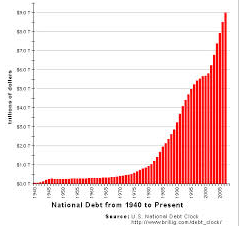
It became trivial to hear that US government debts become so huge and that we put our children and grandchildren in economic jeopardy by accumulating this debt. I think it is high time to clarify this thing a little bit.
First of all we cannot put economic future of people not yet born into jeopardy any more then we can eat today lunch prepared two month from now on Monday. Future generations will always be free to cancel this debt or just inflate money so debt will go away. We actually have a good example of it. After WWII the government debt of USA was $251.43 billion in 1945. It was pretty much paid off by 1970 when debt ratio to GDP went down to the prewar level. If one takes into account that average house price was $10.000 in 1945 and $24,000 in 1970 we can say that US borrowed at value of 25,143,000 houses and returned at value of 10,476,250 houses. So our grandchildren can return pennies on dollars and be just fine.
Much more important is that people seems to fail understand that internal debt is just an accounting method to represent wealth transfer from productive people to unproductive. If one think about it the mechanics is pretty simple. US FED creates dollars with which it buys T-bonds from US Treasure. The US treasury transfers these newly created dollars to bureaucrats and politicians who use these dollars to pay themselves and to buy goods and services that nobody would voluntary buy otherwise. A good traditional example would be a bridge to nowhere that nobody would build but government. A good contemporary example would be R&D for technology that nobody would invest into because there is no reason to believe that these R&D will produce anything useful beyond salaries for researches and revenues for contractors.
The net result of this debt is always and inevitably inflation because people who produce useful goods and services get the same dollars for them, that bureaucrats and politicians who do not produce anything useful and waste resources for unnecessary staff. Obviously the dollars paid by productive people represent value of goods and services they produced, while dollars paid by bureaucrats and politicians represent nothing valuable. The net result productive people get for their dollars less of useful goods and services then they produce, while bureaucrats and politicians lots and lots more.
As of now US bureaucrats and politicians (Federal + State + Local) consume 40% of GDP without producing anything valuable, that is something that people would by voluntary. That means that productive people get back 60 cents on dollar in valuable goods and services produced by other productive people in exchange for valuable goods and services that they produce themselves.
It is not obvious for a number of reasons. One reason is the complexity of exchange when people do not have ready option to compare value of what they produce with value of what they consume. This comparison is partially represented by taxes + government debt which is most obvious and therefore causes some pushback. However much more of this inflation is hidden For example increase in productivity that would led to decrease in prices and therefore better return on productive work is completely annulled by increase in government regulation that decreases productively. Another example is when bureaucratic machine takes over some valuable part of economy such as education and makes potentially productive teachers to deliver subpar educational services which by the way politicians on the top of bureaucracy from Clintons to Obamas refuse to use for their own children but insist on use by regular Americans.
So to summarize it in short – the government debt represent current transfer of valuable goods and services from productive people to unproductive bureaucrats and politicians and have no impact whatsoever on future generation except for decrease in current productive investment that could make their life better via new technology like flacking instead of bureaucratic boondoggles like wind energy; or infrastructure in form of bridge to somewhere instead of bridge to nowhere.
The good news is that next generation could be smarter, thru away society structure created by socialist / progressive ideological movements of XX century and create new libertarian and productive structure that would make their life much happier due to abundance of resources.
The bad news is that next generation is being educated by socialist/progressive bureaucrats and politicians with objective to maintain existing structure permanently and even expanding it. If the next generation will continue to buy their junk philosophy, they will continue to pay price in lack of resources ad decrease in quality of life.
The real remedy to government debt in democracy is the economic education of people, which as successful for majority will eliminate this unproductive structure.
20130526 The Psychopath test

This book’s main idea is about psychopaths – them being always among us with proportion going up from 1% of general population to significant share or even majority among high achievers in such areas as politics, management, and, obviously, criminals. This sounds quite plausibly to me, even if author’s selection of individuals for detailed review provides only anecdotal confirmation. Most interesting to me was a simple test that supposed to identify person as psychopath. If looked at as personal characteristics, quite a few of them seems to be very beneficial for some careerist who is moving up in hierarchy at any cost. It is definitely consistent with all that we know about great leaders in history and how they usually come to power.
From my point of view it is just another reason to limit power of hierarchical structures such as big businesses and government as much as possible because it is the one and only real way to avoid impact on one’s life of some psychopath in power.
Here is the test:
1 Glib and Superficial Charm The tendency to be smooth, engaging, charming, slick, and verbally facile. Psychopathic charm is not in the least shy, self-conscious, or afraid to say anything. A psychopath never gets tongue-tied. They have freed themselves from the social conventions about taking turns in talking, for example.
2 Grandiose Self-Worth A grossly inflated view of one’s abilities and self-worth, self-assured, opinionated, cocky, a braggart. Psychopaths are arrogant people who believe they are superior human beings.
3 Need for Stimulation or
Proneness to Boredom An excessive need for novel, thrilling, and exciting stimulation; taking chances and doing things that are risky. Psychopaths often have a low self-discipline in carrying tasks through to completion because they get bored easily. They fail to work at the same job for any length of time, for example, or to finish tasks that they consider dull or routine.
4 Pathological Lying Can be moderate or high; in moderate form, they will be shrewd, crafty, cunning, sly, and clever; in extreme form, they will be deceptive, deceitful, underhanded, unscrupulous, manipulative, and dishonest.
5 Conning and Manipulativeness The use of deceit and deception to cheat, con, or defraud others for personal gain; distinguished from Item #4 in the degree to which exploitation and callous ruthlessness is present, as reflected in a lack of concern for the feelings and suffering of one’s victims.
6 Lack of Remorse or Guilt A lack of feelings or concern for the losses, pain, and suffering of victims; a tendency to be unconcerned, dispassionate, coldhearted, and unempathic. This item is usually demonstrated by a disdain for one’s victims.
7 Shallow Affect Emotional poverty or a limited range or depth of feelings; interpersonal coldness in spite of signs of open gregariousness.
8 Callousness and
Lack of Empathy A lack of feelings toward people in general; cold, contemptuous, inconsiderate, and tactless.
9 Parasitic Lifestyle An intentional, manipulative, selfish, and exploitative financial dependence on others as reflected in a lack of motivation, low self-discipline, and inability to begin or complete responsibilities.
10 Poor Behavioral Controls Expressions of irritability, annoyance, impatience, threats, aggression, and verbal abuse; inadequate control of anger and temper; acting hastily.
11 Promiscuous Sexual Behavior A variety of brief, superficial relations, numerous affairs, and an indiscriminate selection of sexual partners; the maintenance of several relationships at the same time; a history of attempts to sexually coerce others into sexual activity or taking great pride at discussing sexual exploits or conquests.
12 Early Behavior Problems A variety of behaviors prior to age 13, including lying, theft, cheating, vandalism, bullying, sexual activity, fire-setting, glue-sniffing, alcohol use, and running away from home.
13 Lack of Realistic,
Long-Term Goals an inability or persistent failure to develop and execute long-term plans and goals; a nomadic existence, aimless, lacking direction in life.
14 Impulsivity The occurrence of behaviors that are unpremeditated and lack reflection or planning; inability to resist temptation, frustrations, and urges; a lack of deliberation without considering the consequences; foolhardy, rash, unpredictable, erratic, and reckless.
15 Irresponsibility Repeated failure to fulfill or honor obligations and commitments; such as not paying bills, defaulting on loans, performing sloppy work, being absent or late to work, failing to honor contractual agreements.
16 Failure to Accept Responsibility
for Own Actions A failure to accept responsibility for one’s actions reflected in low conscientiousness, an absence of dutifulness, antagonistic manipulation, denial of responsibility, and an effort to manipulate others through this denial.
17 Many Short-Term Marital Relationships A lack of commitment to a long-term relationship reflected in inconsistent, undependable, and unreliable commitments in life, including marital.
18 Juvenile Delinquency Behavior problems between the ages of 13-18; mostly behaviors that are crimes or clearly involve aspects of antagonism, exploitation, aggression, manipulation, or a callous, ruthless tough-mindedness.
19 Revocation of Condition Release A revocation of probation or other conditional release due to technical violations, such as carelessness, low deliberation, or failing to appear.
20 Criminal Versatility A diversity of types of criminal offenses, regardless if the person has been arrested or convicted for them; taking great pride at getting away with crimes.
20130518 The Language matters

Sometimes, actually quite often the simple substitution of words in a text with different and more exact meaning of these words makes very clear underlying understanding or misunderstanding of the text by both author and audience.
I would like to offer such an example. We hear all the time from Democratic Party about greatness and benevolence of the government and from Republican Party about inefficiency and sometime even malevolence of the government. It seems to me that both sides would be much clearer if they would use instead of the word “government” two words that designate human beings who really are the government – bureaucrats and politicians. Here is the small piece of Obama’s commencement speech where such substitution is done with resulting wonderful clarification:
“And that’s precisely what the founders left us: the power to adapt to changing times. They left us the keys to a system of self-SERVING BUREAUCRATS AND POLITICIANS—the tool to do big and important things together that we could not possibly do alone. To stretch railroads and electricity and a highway system across a sprawling continent. To educate our people with a system of public schools and land grant colleges, including Ohio State. To care for the sick and the vulnerable, and provide a basic level of protection from falling into abject poverty in the wealthiest nation on Earth. To conquer fascism and disease; to visit the Moon and Mars; to gradually secure our God-given rights for all our citizens, regardless of who they are, what they look like, or who they love.
We, the BUREAUCRATS AND POLITICIANS, chose to do these things together. Because we know this country cannot accomplish great things if we pursue nothing greater than our own individual ambition.
Still, you’ll hear voices that incessantly warn of BUREAUCRATS AND POLITICIANS as nothing more than some separate, sinister entity that’s the root of all our problems, even as they do their best to gum up the works; or that tyranny always lurks just around the corner. You should reject these voices. Because what they suggest is that our brave, creative, unique experiment in self-rule is just a sham with which we can’t be trusted.
We have never been a people who place all our faith in BUREAUCRATS AND POLITICIANS to solve our problems, nor do we want it to. But we don’t think the BUREAUCRATS AND POLITICIANS is the source of all our problems, either. Because we understand that this democracy is ours. As citizens, we understand that America is not about what can be done for us. It’s about what can be done by us, together, through the hard and frustrating but absolutely necessary work of self-SERVING BUREAUCRATS AND POLITICIANS.”
Now the unshakable believe of Barak Obama in ability of bureaucrats and politicians “To stretch railroads and electricity and a highway system across a sprawling continent. …To care for the sick and the vulnerable, and provide a basic level of protection from falling into abject poverty in the wealthiest nation on Earth” sounds absolutely ridiculously and clearly contradictory to any known fact about American history. Add to this a self-evident fact that Barak Obama loves bureaucrats and politician most when he is the top dog in this pack and true nature this man and his party could not be missed.
20130511 Contrarians
It is a nice little book by professional debater and opinionator designed to expire his future colleagues. There is a lot I would agree on with Hitchens except for one small thing – it kind of easy to be a contrarian if one gets paid for it, has significant support of surrounding people and no real risk to suffer consequences from “establishment”. In other words in well developed democratic state when attacking existing order verbally or in writing is a very secure and even beneficial career choice. But it there was nothing courageous about it.
Attacking Christian church, Western Imperialism, Capitalism, and such is not only was save, but actually career enhancing activity in the second half of XX century for western intellectual. Even for many intellectuals in Eastern block acting against existing socialist regimes it was not as dangerous as one would think. The common attitude of educated part of population to these regimes could be characterized as “finger in the pocket” with safety pretty much insured as long as finger remained in the pocket.
More important question that Hitchens failed to address was selection of causes between evils. Granted Hitchens does put socialist murderous dictators like Stalin in the same bucket as Hitler (who, by the way, ideologically was not that far away with his National-Socialism from Stalin’s international socialism). However he fails to distinguish between regimes for which murderous activity was necessitated by core logic of regime from regimes for with such activity was just a feature.
For example he is still proud of his support of North Vietnam completely missing the fact that North Vietnamese communist regime was based on statist ideas which by the time of war proved to be murderous to great number of regular people through artificial famines, overwork, and other miseries that followed inevitably with government control over economy. Comparatively the corrupted, undemocratic, and incompetent regime of South Vietnam with all its evil left regular people more or less economically alone content with robbery rather then ideologically motivated slavery and annihilation.
The western idealists – socialists will never accept their own guilt in innumerable killings of Soviet, Chinese, and many other regimes that they enabled by their support, but it would nice if they would at least understood the connection. Hitchens probably more then other getting close to such understanding, but he seems to be not able to step over this threshold.
20130505 Dow 15,000
Last Friday the milestone event happened – Dow Jones have got over 15,000. At the first glance this happy event is kind of strange. The American economy is not moving anywhere for many years. Official unemployment at 7.5%, but according to Shadow Government Statistics which calculations include all unemployed is really about 23%. GDP growth is something between weak and non-existent and big new tsunami of Obamacare is coming closer and closer carrying significant potential for a huge economic destruction. So why is Dow so happy?
Long ago professor of economics Ben Bernanke had got some notoriety proclaiming that in case of economic downturn government should increase money supply by all means necessary even dropping bags with money from helicopters on American cities. As result Bernanke got nickname “Helicopter Ben” and now as Chairman of FED he remains true to his credo and continue pumping money supply up even if there is no positive result to be excited at.
On the bright side the inflation is relatively tame at least according to official statistics. However official statistics mixes a lot of staff together hiding areas where real inflation is growing due to increase in money supply. It has impact on goods and services consumed by regular people, but not as big as it used to be because high level of productivity allows one productive person easily provide goods and services for a dozens, including useless and even harmful for production bureaucrats and politicians. The demand for such goods and services did not decrease dramatically because, contrary to old great depression, low income consumers had their labor income substituted with benefits from extended unemployment and social security disability. So current money oversupply has relatively low impact on their prices.
So the extra money created by Bernanke’s FED is going into assets especially relatively inflation proved assets like gold and stock market. Hence Dow’s wonderful growth is nothing more as reasonable way to defend wealth against inflation. As optimism goes this definitely demonstrates optimism about stability of American political system so companies shares will not be confiscated and government will support really big companies even if they fail in business as GM or big banks.
The simple result is that companies are sitting on trillions of dollars and not investing in business expansion, but rather continuously increasing dollars numeration of their assets. The same continuous increase of dollar numeration applies to government debt. The downside is economic stagnation when productive people have decreasing incentives to expand because of continuous threat of government wealth confiscation via taxes, while unproductive people are deprived of opportunities to become productive and increase quality of their lifes.
For me it looks like this low moving disaster will continue at least until after election of 2014 when political dynamics could change to benefit productive part of population and business expansion would start moving the way it used to be.
20130425 Meaning of war as applied to the Ideological Movement (to win – disable guy with the finger and microphone)


It is getting quite boring to hear about war on terror from people who have no idea what war means and familiar with terror mainly in contexts of their relationships with spouses, bosses, and doctors. I think that it is a high time to clarify meaning of what we are dealing with so I would like to offer my own understanding of situation, actions that would resolve it, and expected consequences of not resolving it.
First of all I’ve got to repeat something that many people keep saying ever since 9/11/01 – terror is just one tool of war among many and making war on terror makes no more sense than it would make for United States to declare war against air carriers after Perl Harbor, simultaneously trying to maintain peace with Empire of Japan because Japanese are very nice people and have very ancient history. Technically it could be done and any attack against Japanese battleships, leave alone industry and cities would be considered illegitimate. The only small catch is, I think, that in this case we would still be continuing war with Japan waiting in fear while they completing building their next air carrier and discussing if it would be legal to attack it before it wiped out another American city. On other hand if American leaders of 1941 were as soft minded as American leaders now, we would probably don’t even know by now that once was such a country as America before the great Japan took over the world around Pacific ocean and started the great racial fight with the great Germany which took over world around Atlantic ocean.
So who attacked us, and whom we should be making war on? It is simple – Islamic Dominance Ideological Movement (IDIM) attacked us, and we have to make war on people who belong to this movement until they surrender, will be taken prisoners, or killed. The complete victory will be achieved when the number of individual belonging to Islamic Dominance Ideological Movement is close to 0.
As form of human cooperation and congregation Ideological Movements are somewhat different from nation-states, mainly spatially and by type of inclusion. Spatially nation-states are based on geography and control of territory, while Ideological movements are thinly distributed around the multiple geographical regions and do not have control over territory until they took over some nation-state as it happened with Communist Ideological movement which took control of Russia in 1917 or National Socialist Ideological movement which took control of Germany in 1933.The type of inclusion of individual into Ideological movement is mainly voluntary, while inclusion of individual into Nation state usually based on residence of individual on territory under control of nation-state. Consequently key to power of Nation-state is control over territory while key to power of Ideological movement is control over minds.
Therefore the war against nation-state includes taking over territory from nation-state until individuals in control of nation-state has no place to go, and either surrender and become POW or just killed. Correspondingly the war against Ideological movement includes convincing individuals who capable to change their mind to leave this Ideological movement, while making people who are not capable to change their mind either POW or dead. Nation-state as collective is controlled by political and bureaucratic hierarchy therefore to win the individuals in control of hierarchy should be targeted. Ideologues and propagandists control ideological movements, therefore individuals who are the most influential ideologues and propagandists should be targeted.
Practically right now a serious war against Islamic Dominance Ideological Movement would include attempts to discourage, capture, or kill all people who attach themselves to this movement. It is not really that difficult to identify such people because they advertise their attachment every way they can. They do it because they have support of many individuals in control of nation states with significant Muslim population and sympathy of many people in control of democratic nation states. The reason for this is that both groups of individuals in control belong to intelligentsia, that is people brought up and educated on abstract notions of multiculturalism and collectivism. However my intention in this post is not to discuss reason of what is, but rather suggest what could have been done if (counterfactual assumption) leaders of democratic states, especially USA were serious about defending security of their citizens against attacks by members of IDIM.
Let’s ignore all previous attacks including 9/11 and assume that it started with Boston bombing. The facts are simple – 2 young foreign-born residents of USA voluntary become members of IDIM and in accordance with main ideas of this movement exploded bomb that killed Americans. These two young men did not invent IDIM, but rather learned about its ideas from multiple propagandists with prominent role in this case belonging to Australian Islamic cleric Sheik Feiz Mohammed. Let’s see what action could be taken by individuals currently in control of American nation-state, which would lead to speedy destruction of IDMI.
First and foremost according to the constitution President could ask for declaration of war against this movement. That would lead to clearly identified mission for the state to convince all individuals identified as belonging to this movement to change their mind, if not possible to capture them as POW, and if this also not possible to kill them. In process all nation states that provide cover for such individuals could be identified as allies of IDIM and therefore put under the thread if war.
With war declared, USA could publish names of all individual it consider members of IDIM and demand them publicly reject this ideology with clear understanding that this rejection will not be revocable. If refused, they should be invited to surrender as POW and moved to POW camp in some remote place were they would be kept in humane conditions, but without access to communication tools until the end of movement. All nation states that refuse apprehend such individuals who refuse to surrender could be subject of traditional military action. If this war conducted decisively it would cut off all propagandist facilities of IDIM. Without propagandist facilities any movement dies out in short order.
Back to the real world – none of this will be done and consequently IDIM will continue its existence and quite probably expansion. It is already taking over some significant nation states and most probably will be able to achieve the level of success of communism and national-socialism ideological movements of XX century. I do not foresee a serious chance of victory for IDMI mainly because nation states that they are capable to take over do not have such advance military capability as Germany, Japan, and Soviet Union had in XX century, but terrorists will kill thousands in Western world in future years. And there is no doubt that millions of people in the Muslim word will have their life completely screwed the same way as lives of people in Russia and Germany were screwed. Eventually it will be defeated, but at much higher cost then it could have been.
20130415 Is it really nobody in charge?

This book is a very interesting view at the world from seemingly special point of view of neuroscientist. Generally speaking it describes works of human brain as it is understood now based on significant amount of research and experimentation with people whose brains were impacted either by lesions or necessary surgeries that either took out some parts of brain or cut out some connections between parts of brain.
The picture that emerges from this research shows human being not as one defined and whole entity as we usually perceive ourselves, but rather as totality of multiple neurosystems that pretty much independently control not only unconscious functions, but also a lot of what we consider conscious thinking. Especially interesting are multiple experiments with people whose right and left hemispheres of brain are separated and cannot communicate. Since our receptors are independently connected to left and right hemispheres such people react completely differently to the same stimuli depending on whether they presented to left analytical part of the brain or to the right sensitive part.
The experiments with “interpreter”, that is the part of left brain which makes sense out of inputs, shows that our “making sense” has really shaky relation to reality while having a huge costs for the organism which spends 20% of energy on supporting such a huge brain. It has to be good evolutionary explanation and in my view such explanation comes from survival advantages provided by long term planning. I think that such planning even if based on incorrect assumption allows for much better outcomes of intentional acting comparing to just plain reaction to environment. Obviously if planning occasionally gets to be based on right assumptions, the result would be spectacular improvement in survivability; the great example would be agriculture which is completely based on long term planning.
Another interesting philosophical take out would be understanding that even our own personality is not really one strictly hierarchical command and control system that we believe it to be. If even one brain of one person is really a complex combination of multiple autonomous and semiautonomous systems which act pretty much on its own and interact with each other via communications based on the strengths and volume of signals which often make us act even before we consciously decided to act, then we deprived of one and only example of effective work of command and control system.
That puts all philosophical structure of superiority of top down command and control systems build in XIX century in precarious position of being based on plainly incorrect understanding of reality. If even a brain of one person is really not a top down system, but rather neurological market where different parts of brain exchange signals and producing actions as outcome of self-organizing activities, then what reason do we have to believe that other complex systems like human society could be efficiently organized in such way? The answer is – none, and without such reason the whole philosophical foundation of communism, socialism, and such just goes down the drain.
20130413 Social Conquests of Earth and Human Nature

Every time when I read a new book, even if it is by author I know, I cannot say upfront if it worth of my time or not. Not so with E.Q. Wilson who’s every book that I read so far brings something new to think about. This time these are 2 very big ideas that do not come naturally.
The first one is that human species is not alone conquerors of Earth. Other species that we do not think about that much are actually as successful as we are. It turns out that ants and bees are as good as we are in adjusting to environment and changing environment to meet their own needs. As humans they build accommodation for millions of individuals, practice agriculture and to some extent manufacturing. Contrary to humans who are still in process of completing their expansion, these insects slowly co-evolve with environment and therefore achieved sustainable levels of existence millions of years ago.
According to estimates their biomass is approximately equal to biomass of 7 billion currently living humans, so as of now we have two types of species with eusociality sharing earth between them. One (insects) with complete subordination of individual to collective or, based on the fact of genetic sameness of all individuals in ants or bees colony, rather expansion of one individual into multiple clones adjusted by environment to fulfill different functions. (Oh boy it really sounds like socialist / communist dream). Another one (humans) with more complex relationship between individual and group based on relative independence of individual from the group and genetic diversity between individuals.
Here is where the second main idea kicks in – human evolution occurred in two dimensions. It is combination of individual selection and group selection. This duality explains a lot in human genetics and human behavior. The individual cannot survive on his/her own, but any sacrifice of own genetic fitness to the group leads to evolutionary disadvantage. So this is where duality of humans is coming from – constant tension and interplay between individual and collective interest.
The only thing is I do not think there is such a thing as collective interest, so it should be formulated as tension between individuals who are not in control of the group and individuals who are in control of the group. The individuals in control obtain it by building group identity whether as tribe or state or nation or religion or whatever. If successful, it kicks in genetically imbedded need to belong to the group and support group competition against other groups especially when this competition comes in the form of war. If needed, this support could get to the level of self-sacrifice especially in young and well-indoctrinated individuals. Somehow older age and family often switch individual’s effort from achieving group ideals to obtaining benefits for his/her family.
What is really differentiate humans from insects is that any group successfully winning competition against other groups tends to have individuals in control overreaching in identification of their own individual interests with the group so they direct resources to satisfy these interests at the expense of individuals not in control. The typical outcome is internal revolution in the group sometime partial when only individuals in control are changed, but sometimes complete when the whole group identity is changed – for instance individuals accept a different religion or much more often drastic modification of old.
The great invention of democracy is that it provides procedure for orderly and peaceful change of individuals in control. Depending on severity of unhappiness the change could be small something like between similar political parties or it could be big something like coming to power of new political force with ideas drastically different from the ones that dominated before.
Such big changes happened several times in American history – the last time it was triumph of Progressivism in both dominant political parties over period from late XIX century to the mid XX century. The continuing degradation of progressive / socialist / communist / collectivist ideas to the level of rusty junk car that we can observe now created the general unhappiness of individuals not in control that will probably lead to another radical, while peaceful change in USA and consequently in the world within next 30 to 50 years.
20130407 Ben Carson’s talented hands and a wonderful intellect

Ben Carson’s story narrated in his memoir would be trivial if written by the son of Jewish or Asian immigrants. Start at the bottom of society in poor family without father and growing up to be a top notch professional in his field represents nothing unusual for people belonging to these groups.
Written by the black man it is inspiring story that implies a great future for America because it clearly shows the way out of racial dead end it was pushed in by leftist intellectuals and rent seekers of all skin colors who built their careers and well being on suffering of minorities.
Carson clearly demonstrated that color of skin is irrelevant to success, but culture is definitive cause and reason for positive or negative outcome. And it seems to be just a set of simple cultural rules that in his case were transferred to him and enforced until they become self-sustainable by his semi-literate single mother.
This set of rules is very simple and includes:
Find what is one’s talent that could be developed to the high level and define goal consistent with this talent.
Set up realistic goals – for example to be a doctor when there is a great need in thousands of doctors even if it is not easy to become one. The opposite would be a goal to become a basketball star even if one does not possess superior athletic genes
Have discipline to do what needs to be done to achieve this goal – to study, do tests, and avoid distractions like TV shows
Learn to enjoy something that is not exciting initially, but had to be done in order to achieve the goal like reading and listening to classic music in the case of Carson.
Right now Ben Carson seems to be trying to find out if it is feasible for him to win American presidency. I think it is not such a bad idea even if it is far from being a trivial. Americans are fed up with both parties which quite possibly can open a huge opportunity for outsider with skills, financial support, and big and attractive for majority ideas. During next 2-3 years we’ll see if this ultimate achievement will be within Ben Carson’s grasp.
20130407 Coolidge – the last president of limited government
It is quite interesting that the author of eyes opening book about malignant mutation of American society into big government society during the Great depression (The Forgotten Man) decided to write book about Calvin Coolidge – the last American President who presided over a mostly limited federal government. I think it is a very important book because it brings to light results of amazingly successful experiment in limited government, especially in tax policies of low rates of taxation and economical policies of doing nothing and allowing market to resolve problems created by economic cycle without throwing in monkey wrench of government intervention.
It is especially interesting because the successful experiment was conducted just before tsunami of XX century big government was about to engulf United States denying its people for generations many opportunities of private enterprise despite the fact of even the big American government being relative benign especially if compared with big governments of Fascist Italy, Nazi Germany, Communist Soviet Union, or China.
I have no doubt that Coolidge would be quite amazed if somebody told him that he is conducting experiment. He would be vehemently denying it and insist that he is just conducting regular conservative policies of not interfering in complex things that one does not understand. He would probably concede that his tax rate decrease policy is somewhat experimental, but would insist that it based on scientific taxation ideas of Andrew Melon which are not really that experimental, but rather follow accumulated business knowledge of human economic behavior. The resulting increase in tax revenues confirmed that this knowledge was correct.
Few people know that American economy had a pretty big dive in the beginning of 1920s with Harding and Coolidge doing nothing. Consequently economy moved into roaring 20s fixing itself without government intervention resulting in tremendous increases in productivity and volume. The after Coolidge activist government of Hoover and then triple activist government of FDR coincided with pain and suffering of great depression.
Certainly coincidence does not mean cause, but activist government in economy always reminds me my childhood experiences with poorly manufactured Soviet TV – when it stopped working a few fist hits on the side would make it come back to life. It would work for a while, but then stop again and after a number of iterations would completely die.
The lesson is that if one deals with more or less complex things that one does not completely understand, the proposition of using fist or hummer or stimulus maybe not be a very good idea especially when this thing is complex self-adjusting market economy rather then simple TV of 1960s design. Calvin Coolidge understood this, but his intellectually inferior, but supremely arrogant successors did not and still do not.
20130331A History Written in Genes
It is strange sometimes how something that seems to be impossible to know suddenly becomes obvious and relatively easily available for learning. The new technology that opened human genome for sequencing and analysis over last 50 years is one of such examples and this book quite well describes this knew knowledge.
There is a precious little technical information in this book; just enough to inform us that mail and female part of humanity could be traced separately via exclusively female mitochondrial DNA and exclusively mail Y-chromosome.
Steve Olson makes somewhat convincing case that we all genetically came from one source – mutated humanoids in Africa and much less convincing case that we are all the same; meaning that DNA variation between human races is insignificant. He spends lots of effort trying to be as much politically correct as possibly and convince a reader that whatever is the difference – color of skin or anything else is either insignificant or result of different cultural development.
Sometimes it sounds absolutely ridiculous when he is stating that even if easily measurable parameters such as average size or the same color of skin are clearly different, more complex features such is intellect are the same on average across all human races and populations.
What I do not understand is why does it matter? Why do we need to substitute old Nazi type racism that held that some groups are inferior and therefore should be violently suppressed by the state, with the new liberal/progressive racism that holds that all groups are the same and therefore some groups should be violently promoted by the state? Either form of racism does not make any sense whatsoever. If a group is inferior it will always loose in fair competition; if all groups are the same everybody eventually will get equal share of everything. In both cases no violent interference of state is necessary.
I also cannot understand the logic of averages as applied to individuals. Even if we have a group of people who are on average have low IQ, it does not mean that one individual in this group could not be the greatest genius who ever lived. So if we deprive these low IQ group individuals of equal opportunity, we deprive ourselves of potential huge benefit that the genius’ effort could bring to all of us. By the same pattern promoting somebody only because this person belongs to high IQ group would hurt us if it results in incompetent person in highly position.
In short I believe that we just need to take care to provide opportunity in as much blind way as possible. For example I would make all decisions about admission to high value educational institutions in such way that decision makers would have no clue what race, background, beauty, or anything else unrelated to ability to succeed in obtaining education this individual has. It is the only way to get the best outcome for everybody. I also see absolutely no problem if one group of people commonly defined as race X is highly overrepresented in sport and entertainment, while another commonly defined as race Y if highly overrepresented in writing and sciences. I do not get why would anybody care as soon as we get the best possible musicians, writes, and everybody else.
One nice thing however is clear that with current intermixing and communication of people from all background it just a few dozen years we would be hard pressed to find anybody who would be find it conceivable to claim purity of race and all weird staff will just fade away.
20130331 God and Gold + Bourgeois Dignity = Power and Prosperity


I think this is a very profound book about contemporary history and, quite possibly, with implication for future development. It talks about sources and meaning of maritime powers that were represented first by Dutch, then by British, and currently by American power. It aims to answer 6 questions:
1. Why Anglo-Saxon powers are always winning in clash of civilization against other powers either continental European powers of France / Germany / Russia or ancient states that fallen behind in XVII – XVIII centuries like India and China?
2. What moves people who passionately hate Anglo-Saxon civilization and all that it represents?
3. How relatively small Anglo-Saxon powers were able to put together economic and military resources that enabled them to defeat all enemies for hundreds of years
4. How the great philosophical idea of invisible hand become deep seated foundational notion of Anglo-Saxon culture leading to tolerance in all areas of life – economics, religion, entertainment, and all other areas of human activity that resulted in diversity of ideas and, consequently, continuous growth in economic and military power.
5. Why Anglo-Saxon optimism about future is nearly always was wrong.
6. What three centuries of Anglo-Saxon success means for world history.
Walter Russell Mead uses some 400 pages to answer to all these questions in details. I think he gives pretty good answers, but I’d like to add one thing that seems to be missing. In my opinion a lot of this is explained by different relationship between individuals at the top layers of society and individuals at the bottom.
To put it mildly the individuals at the bottom of Dutch-Anglo-Saxon culture always had a lot more appreciation of their own value then individuals in other cultures. Whether it is coming from religious specifics of Protestantism or from simple fact that sailor is always more skilled and therefore more valuable then soldier, or from tradition of clearly identified private property of individuals versus everything belonging to the king, but result is the same – individual in maritime culture has much more space for incentive, wealth creation, and wealth acquisition then in other cultures.
This is transferred into technological and overall material advantage, which in every long lasting military encounter overcomes ability of other cultures easily sacrifice regular individuals to whatever objective leaders deem worth of persecuting.
Actually the issue of dignity of self sufficient and productive individual as driver of Western prosperity is thoroughly explored by Deirdre McCloskey in her book “Bourgeois dignity”. She adds a human dimension sorely missing in typical analysis not only history, but also current politics either internal or external. Her meticulous review of all other conceivable causes of Western prosperity seems to leave very little space for these alternatives.
I actually believe that all of these causes interplayed in the creation of Western civilization that provided for unprecedented level of prosperity and hope that currently ongoing destruction of this civilization form inside is just a temporary setback which will be stopped and reversed as soon as negative impact of this destruction on their lives and well being will become obvious for significant enough numbers of individuals in Western world.
20130323 Herders vs. Growers / Bureaucrats vs. Productive


By some strange coincidence I was watching an epic documentary about American West just a few weeks after reading an epic book about Genghis Khan and Mongolian conquests. It caused me to compare two historical events that occurred with some 600 years difference in time and brought me to conclusion that these two events had pretty much the same meaning while quite opposite outcome.
These two events were Mongol conquest of Asia and Europe and European conquest of American West. In both cases two civilizations founded on two different ways of resource acquisition encountered each other, clashed in multiple wars over the long period of time, which ended in absolute victory for one civilization, and defeat for another. However long term consequences where absolutely different.
In both cases Herders (Mongols and American Indians) fought agricultural civilizations with different level of manufacturing abilities (Chinese, Central Asians, Russians, and Americans). In one case herders (Mongols) won the clash hands down, but either accepted cultures of conquered agrarians (China and India) or just limited themselves to taking tribute for a few centuries until losers where able develop enough military power to repulse attacks after stopping paying tribute (Russia and other European nations). In another case herders (American Indians) lost every battle they fought save one against agrarians/manufacturers (Americans) and where pretty much obliterated as independent entities from the face of the Earth.
The reason for such different outcomes came from what they were fighting for. The herders where fighting either to obtain goods and services from agrarian/manufacturers that they could not produce themselves or just to maintain control over natural resources that they where not able to use intensively. The agrarians/manufacturers on other hand were fighting for control over natural resources either in the form of land or in the form of gold which they could use much more intensively then herders maintaining more people, building cities and industries
For herders the winning meant to make agrarian/manufactures to provide their goods and services for free which could be done only if they remained alive and productive. For the agrarian/manufacturers the winning meant to get access to natural resources and eliminate herders as completely as possible because herders represented nothing more then obstacle to their prosperity. Looking at these clashes from such point of view makes it obvious that any victory of herders was temporary, while any victory for agrarian/manufacturers was not just final, but often genocidal for herders.
Somehow this history resonates with the biggest clash of our time between politicians and bureaucracy on the one side and productive individuals of society on the other side. Doesn’t matter how many victories politicians and bureaucrats are able to obtain, their every victory diminishes productive ability of society and consequently decreases quality of life for everybody creating foundation for backlash. On other hand the victory for productive part of society could be final with restructuring of society in such way that bureaucrats and politicians have no more ability to rob productive members of society then American Indians maintain tribal lifestyle based on hunting buffalo on American plains.
Let’s just hope that bloody and eventually futile victories of politicians and bureaucrats that they achieved in XX century in such places like Nazi Germany and Soviet Union will be avoided in XXI century, while eventual defeat of politicians and bureaucracy will be bloodless with peaceful weaning of these people off their habitual behavior of robbing and looting productive people via dual mechanism of taxation / regulation.
Hopefully equal rights for natural resources with ability to sell them to highest (presumably more productive) bidder would provide them enough incentive to accept loss of ability to loot and, who knows, maybe achieve higher level of consumption and satisfaction then they were able to achieve via looting
20130317 Entitlements and Education as Investment


I somewhat sick and tired to hear about Social Security and Medicare that they are direct transfer programs of moving resources from young people to the old. Obviously it is truth, but it nearly always mentioned without any reference to the huge expense that old incurred over time of their productive lives to provide resources for young people to survive until adulthood and obtain education. It seems to be clear that without these resources young people would not become productive and would not be able generate new resources necessary for old people to enjoy their Social Security and Medicare.
Given that, unfortunately while resources provided to meet physiological need of young generation where more then adequate – they are bigger, stronger, and often fatter then their parents, resources provided for their education where wasted on the scale unimaginable by previous generations – just look at inability of significant percentage of youth to find productive employment or start their own businesses.
I submit that the reason of this failure comes from one and one source only – the big part of investment was transferred from older generation to young generation via hierarchical organization of politicians and bureaucrats also known as government. As always with no exception to the rule, bureaucrats and politicians used these resources for their own gratification with education of youth or lack thereof being insignificant byproduct of bureaucratic activities.
The solution from the point of few of Rights Libertarian (RL) would be to substitute hierarchy of politicians and bureaucrats with direct investment of older people into younger people the same way as people invest in any company, organization, or entity which has at least some chance to generate more resources then were consumed.
Contemporary technology allows creating a market for trade between young people or their parents (custodians) and completely unrelated people with current resources supplied in exchange for obligation to pay back a share of specific individual’s income in the future. It would obviously create competition for resources between young people who would try to demonstrate that they are a better investment then other guy. This would add to educational process the part, which is most missing – deep interest of youth to obtain marketable skills whatever they are. It would also create competition among resource providers for opportunity to invest in the most promising young people and therefore greatly improve resource allocation process. By the way profitability would mean that some people would try to invest in great geniuses, but other would invest in bad cases where marginal improvement at decent scale could bring significant profits.
If such market created, all supplemental market activities like insurance, educational programs, materials, and services will be generated in necessary amount and of much higher quality then bureaucrats and politicians can do. It would open a great opportunity for all bureaucrats and politicians who actually capable to teach effectively to earn much higher return on their talents then what they get from being part (usually lower) of bureaucratic educational structure.
20130616 Fountainhead and Regular Heads

Last weekend I watched a very old movie from 1949 – The Fountainhead after Ayn Rand’s novel with the same name. It was made in the best traditions of propaganda movies of the first half of XX century – a simple idea expressed very directly with no recognition of realities of life.
For those who did not read the book and/or did not see the movie, the plot is going like this – highly talented architect Howard Roark refuses to compromise his talent by doing what other people want him to do and agrees to apply his incredible talents only on condition that his projects will be accepted and paid for as is, with no modifications to his vision.
Initially he is deprived of opportunities to apply his vision so he is working as manual laborer, but his superior and heroic personality overcomes all resistance and he builds all he wants to build the way he wants to do it until his friend convinces him to design a project for public housing. He does it without compensation, but on condition that integrity of design will not be violated. As it is to be expected, evil forces intentionally distort design and build new buildings in the way unacceptable for genius. In retaliation the genius blows buildings up (literally) and makes the great speech during the trial about individual’s right and even duty to live selfishly in his/her own interest and not give a damn about other people expectations, providing he is not interfering with their selfish interests.
Somehow jury behaves strangely different from surrounding masses of people who demand his blood, and acquits him. The happy end comes in the form of opportunity to build the biggest and most visionary building in the world with lesser people providing financing and conveniently removing themselves from the scene. Or, and for a cherry on the top of the cake he gets a beautiful and rich women who is in love with him from the moment she saw him as laborer on construction site.
Actually I am pretty much agree with Libertarian ideology and with Ayn Rand on main parts of her philosophy. I just see no more reason in trying to convince people to be selfish then in trying to convince them to be selfless. They will do whatever they believe is in their interest anyway with this “whatever” being unpredictable. Whether it would be “washing beggar’s feet” as Mather Teresa did or running “Ponzi schema” as Barry Medoff did depends purely on what the individual perceives as his/her paramount interest at the time – saving the soul or maintaining the image of great investor at any cost.
However Ayn Rand’s paeans to illusionary superior human beings, geniuses, “job creators”, and visionaries cause huge damage because they tend to send message to regular people that they are not important in the Libertarian world, that they are just a tool or raw materials in achieving goals and visions of some heroic capitalist. Real people observe real capitalists, see no superior talents or heroic deeds and know that these capitalists do the same as all people do to obtain resources and achieve their goals and this “the same” is not always pretty. Sometimes they work harder, but sometimes they do not. Sometimes they are more knowledgeable, but sometimes they are not. In short there is no way that regular people would accept their own inferiority and supported a hero in real life.
The secondary message – that everybody will be better off if capitalists, heroic or not, do whatever market makes them to do, while true could not possibly resonate if it means to loose one’s job here and now without any way to know whether one will be able to get similar or better job in the future.
In short I believe that Libertarian ideas could and eventually will get traction, but only after Libertarians will be able to come up with a solution that provides reliable backup plan for everybody in any situation while leaving wide open the way up for everybody who is willing to try. So let’s stop blabbering about heroic “job creators” and start looking for solution that would prompt regular people to switch their support from politicians and bureaucrats who promise them share of loot to Libertarians who provide a feasible way to prosperity through self-reliance without risk of absolute failure and poverty.
20130310 It is “In Our Hands” to avoid “Coming Apart”


In my mind these two books are going together. One of them is documenting in details the dramatic changes in American society at the beginning of XXI century while another one, interestingly enough written a few years earlier, provides an alternative solution to failing welfare state in America.
“Coming Apart” provides details of growing differentiation between well educated and effective in their dealings with live Americans who are quickly becoming an upper class and poorly educated, overwhelmed by complexity, and failing in their managing of contemporary life Americans who are becoming lower class.
Charles Murray is doing a great job in looking at details of this coming apart process in all areas of life – industriousness, honesty, religiosity, and marriage while demonstrating the growing difference between emerging upper and lower classes and how it threatens wellbeing of American society.
Being written before “Coming Apart”, “In Our Hands” does not directly addresses issues of failing society, but rather proposes a detailed suggestion of how to provide for failed individuals in very rich American society in more effective and efficient way then welfare state could possibly do. I believe Charles Murray has no illusions in regard to feasibility of his plan to become reality; he just needs to put it up for review and discussion.
In my opinion it is a great plan – to give everybody $10,000 per year per adult person as grant, link it to income so people with higher income would cover the grant for people with lower income, and rid of welfare state which is destroying American society. Too bad it was pretty much ignored by all parties of the great American discussion of our time.
I think that the reason for this quiet rejection is that in reality the main beneficiaries of welfare state are not poor and powerless 20% of population at the bottom. The real beneficiaries are all – middle class, plutocrats, and everybody else who has one of the giant number of meaningless jobs created by big government to produce goods and services that nobody needs and nobody would ever buy on the free market.
The contemporary society is so hugely productive that we have 2% of active people producing enough food for 100% to suffer from overeating. We have 8% of population manufacturing everything that we need. We have 0.01% of population producing all entertainment we can possibly consume. At this point we use a big government in all its forms – services, regulations, etc. to provide “jobs” and living to people either in form of salary for high-income regulation compliance specialist or meager social security disability payments for young man not capable to find meaningful application for his energy.
We need completely different way of creating and distributing goods and services and, even more important, providing everybody with a meaningful way to apply their energies and talents. If American society fails to find such way, we’ll be in trouble sooner then anybody expects.
20130308 .45 ACP

.45 ACP is a type of handgun bullet. It was designed in 1904 by John Browning for the new Colt pistol adapted by US Army in 1911. It proved itself possessing a very high stopping power during World War I and is a very popular high caliber handgun ammunition in America ever since. The reason for this is a very simple one. The stopping power is an ability of bullet to stop a big man with bayonet running towards you from driving this bayonet through your guts. A different bullet may kill the man, but would not stop him and his bayonet. .45 ACP would reliably do this stopping trick so your guts will be just fine.
Last week I encountered a situation that I did not encounter for the last 23 years ever since I immigrated to America from the Soviet Union – the widely used popular commodity product manufactured for more then a century disappeared from the shelves of the stores. This product is .45 ACP bullets. The shop assistant happily informed me that it is just a temporary inconvenience caused by dramatically increased sales of guns and ammunition so supplier cannot keep up with the demand He had no doubt that eventfully they will catch up and everything will be back to normal.
So while media of all kinds is discussing fine points of American gun culture, the regular members of this culture are buying ammunition in huge quantities despite the fact that it is not cheap even for dwellers of American suburbs with jobs and/or small businesses.
The media discussion is very often concentrating around self-defense issues with only sporadic reference to American tradition of being armed against tyrannical government. In reality the violent crime is down and in Suburbia it is practically non-existent. The government is obviously growing like cancer tumor, but we still seem to be quite a bit away from setting up concentration camps for dissidents, the situation that would call for use of guns and ammunition.
I think that the piece that is missing in this discussion is a symbolic value of a gun as tool of power. In any encounter of a person with the gun with person without gun, the person with gun is powerful, while person without gun is powerless. When I was growing up in USSR after WWII it was a usual thing in movies of, unknown to Americans genre of industrial drama, to see a powerful person like plan manager or even scientist with a gun, usually in his desk. Contrary to the rules of Russian school of dramatic art it would be never used, but it always had the same deep meaning – this guy allowed to have a gun so he must be important and powerful.
Meanwhile in real life to have unauthorized gun would be a crime punishable by long prison term. Even veterans of war who had guns given to them as award for some heroic action with their name and description of action inscribed on the gun (popular way to reward an officer without going through bureaucratic nightmare of getting him a decoration) were strongly recommended to give their guns to government for “safekeeping”. As usual it was an offer that nobody could refuse.
It short, I believe we should look at gun control battles for what they really are – a struggle of politicians and bureaucrats to deprive Americans of these symbols of power in hope that it would help them to break resistance to their political agenda.
I think politicians and bureaucrats should be very careful and remember old flags of American Revolution depicturing snake and “Don’t step on me” slogan. Recently these flags start flying again. Just keep in mind that when you are stepping on the people, nobody knows when and if they start using the stopping power of .45ACP. One thing is for sure – you cannot have a big government without stepping on the people.
20130302 Dean Ornish – “Love and Survival”

“Love and Survival” is interesting because it provides a pretty good scientific support to what I consider a plain common sense – a human being needs another human being(s) to have close relationship in order to have good and healthy live.
It makes a perfect evolutionary sense because everybody has periods of temporary weakness physical or psychological or both and need support of somebody else. Besides it is quite obvious that no human being could survive the first 10-15 years of life without external help.
Actually it provides for a very good case for every individual to adhere to boring traditional family values – that is to have, love, and cherish a spouse and take care about young and old not as matter of goodness and morality, but as a matter of self-preservation. As far as I am concern it just makes for a higher quality of life.
Here are a couple samples from the book:
The Harvard Mastery of stress study – In 1952-54 126 healthy Harvard student questioned about relationships with their parents. 35 years later 91% with cold relationships had serious diseases typical for midlife while on 45% with warm relationships had such diseases.
The John Hopkins Study – 1100 medical students followed starting in 1940-s. It was defined that closeness to parents had valid predictive value for good or poor psychological and physiological condition 50 years later.
Overall it contains reference to some 15+ studies that leave no doubt about value of close relationship for human wellbeing.
I do not share Ornish’s interest in eastern philosophy, dieting, and overall science/mystery staff. For me it is just shows the simple way to good live – find somebody to love you and love them back as they are without being judgmental and trying to change them to become more to your liking. If you cannot do that with humans, just get a dog, still would be better for your health then any dieting and even many medicines.
20130301 Jack Weatherford: “Genghis Khan”

A while ago when I was some 10 years old I learned in school about the great scourge of humanity – Tatar-Mongols. According to the history that I was taught, they where savages who came from distant and nearly inhabitable steppes in XIII century, devastated all civilized world from Pacific shores of China to Eastern part of Europe and where stopped only by heroic fight of noble Russians who despite loosing all the battles and being subjugated by Mongols for 200 years nevertheless weakened Mongols to such extent that they could not expand much farther to the West. As result as usual ungrateful Western Europe was saved to develop its civilization which eventually produced wonderful contemporary industrial world. Russia meanwhile paid for its heroism by falling behind and was still catching up at the middle of XX century some 700 years after invasion.
This book provides much more interesting and logically much more probable account of the greatest kind of empire in human history. The reason I used words “Kind of empire” is that what Mongols mainly created was not a big bureaucratic state, but rather a common space of trade and communications that established foundation of contemporary word. Obviously being not less bandits then Russian noblemen or Chinese bureaucrats or American politicians they robbed everybody in their power, but it was somewhat more orderly robbery with enough space for people being robbed to produce sufficient wealth for themselves. In short while other robbers treated people in agricultural way that is like peasants treat their crop – planting, growing, and cutting with continuing attention and control over process of growing, Mongols treated conquered people like horses, allowing free pasture with little attention and getting what they needed when enough wealth was produced.
For me the most interesting is history of conversion of pastoral culture of Mongols who were not cowboys, but rather horse-boys and lived off pastures and horses in necessarily small family size groups into the most powerful military force known to history until advance of contemporary technology. Especially interesting is Genghis Khan’s ability to accommodate independent, self-sufficient, and quite individualistic Mongolian horseman into well coordinated military unit.
The military strength of Mongols came from combination of every warrior being self sufficient with 5-6 horses and hunting ability that provided for food, shelter, and mobility with team discipline and loyalty to the unit that allowed tens of thousands of such warriors coordinate their actions. Resulting ability of Mongols to fight equally well in retreat as in advance with decisions readily made at every level without excessive fear of superiors provided for the huge advantage in any encounter with big armies of agricultural people with their well armed knights, huge masses of poorly armed conscripts, top down decision making, and inability to move fast either spatially or intellectually because of bureaucratic hierarchy.
I do not know how much details of this book regarding Mongols religious tolerance, support of science, technology, and trade are correct, but the undeniable fact of Mongol’s movement over the huge Euro-Asian space and mingling and mixing multiple people living in this space could not possibly occur without giant exchange of information and knowledge causing upgrade of everybody’s level to the top level achieved elsewhere. In short it looked like the beginning of one world in which we are living today.
20130210 – Reasons
I am starting this blog because I need a place to express my ideas and hopefully to find people who would be interested in them. These ideas are about philosophy, economics, politics, work of society, and similar things that I was interested in since I was a small child a very long time ago. As far as I know these ideas not trivial so I would appreciate any meaningful feedback.
My views are not right and not left, but in main libertarian. The main disagreement that I have with libertarian point of view is in relation to private property. The great libertarian thinkers properly see it as the foundation of free society, but accept its existing allocation as given, unchangeable, and sacred. I am, on other hand, see it as just a temporary arrangement easily changeable by force applied legally or illegally. Their aim was to prove that it would be the best for society if property remains sacred and all transaction are conducted voluntary without government interference. In their views it would provide the best outcome for everybody because people with resources will always need labor of people without resources and therefore lively exchange beneficial for everybody will take place. I believe that with expanding level of automation people with resources will need less and less labor from people without resources, all the way to the point when there is no demand for labor whatsoever. My solution is to provide unalienable and marketable private property rights for natural resources to everybody and only after that allow Laissez–faire free market economy to sort things out.
Other two mainstream-political movements tend to support and promote Welfare State either in form of private charity (conservatives) or state controlled wealth redistribution (liberals), which in my view is deeply destructive for human individuals depriving them of ability to search, strive for better life, fail and/or succeed-the only staff of life that actually provide for happiness.
 Equal Rights Libertarian