
MAIN IDEAS PER GROK:
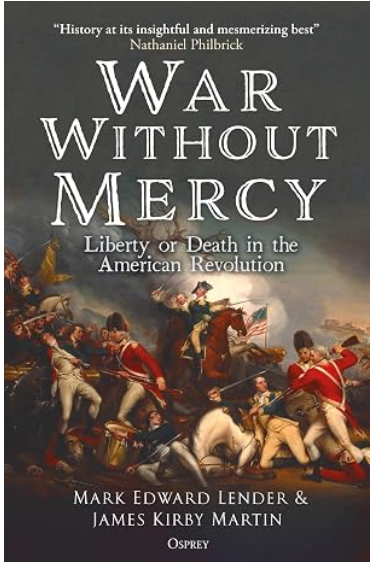
“War Without Mercy: Liberty or Death in the American Revolution” by Mark Edward Lender and James Kirby Martin (published 2025 by Osprey Publishing) examines the American Revolutionary War as a far more brutal and unrestrained conflict than traditional narratives often suggest.
Core Thesis
The authors argue that the war was fundamentally an existential struggle for both Patriots and Loyalists. Combatants on all sides believed that defeat would mean not merely political loss, but potential cultural, political, and even physical extinction. This perception transformed the conflict into one where “Liberty or Death” was a literal imperative rather than mere rhetoric, leading to widespread abandonment of conventional rules of “civilized” warfare.
Key Ideas
- Prevalence of Irregular and Local Violence: While conventional armies under leaders like Washington and Cornwallis followed more traditional military norms, the vast majority of the fighting (estimated at around nine-tenths) involved irregular forces—militias, civilians, partisans, and allied Native American groups. These local conflicts operated with few or no rules, resulting in cycles of revenge, intimidation, property destruction, and personal atrocities.
- Cycles of Retaliation and Brutality: The book highlights how initial acts of intimidation and violence (often initiated by Patriots to enforce loyalty and suppress dissent) escalated into unstoppable spirals of retribution. Both sides committed acts of extraordinary violence against persons and property, viewing restraint as a luxury they could not afford when survival was at stake.
- Psychological and Ideological Drivers: Lender and Martin explore the emotional and ideological forces at play. Participants saw the struggle in zero-sum terms: victory meant preservation of their way of life; defeat equated to subjugation or annihilation. This mindset justified ferocity, including targeting civilians and engaging in total war tactics at the local level.
- Corrective to Romanticized Narratives: The work challenges the traditional view of the Revolution as a relatively restrained or “immaculate” contest of ideals. Instead, it portrays a grim reality of widespread brutality, drawing on contemporary accounts to illustrate how the war devastated communities and reduced areas to wastelands through unchecked irregular warfare.
Overall, the book functions as a psychological and philosophical inquiry into why revolutionary wars can descend into existential brutality, emphasizing the human and societal costs when conventional restraints collapse. It serves as a sobering analysis grounded in primary sources, relevant for understanding not only the American founding but the dynamics of civil and revolutionary conflicts more broadly.
The volume is concise (around 288 pages) and accessible, blending narrative history with analytical depth. It has received positive reviews for its fresh perspective on a well-studied period.
CONTENT:

MY TAKE ON IT:
I do not think this conflict had an existential character on both sides. Even though many loyalists believed the victory was absolutely necessary for them, they had and eventually used the exit strategy of going to Britain or Canada. For patriots, the alternative to victory was death by hanging for treason, so for them it was existential.
The real war is always bloody and dirty, and could not be otherwise if it is existential. The side with a viable exit strategy, however committed to fight, would not be as cruel and uncompromising as the side without such a strategy. Correspondingly, of the three sides that participated in these events, only for patriots the war was existential, for loyalists, it was not, even if perceived so from time to time, and for the majority of the population that was neutral, it changed over time when fighting caused them to lose their possessions and normal lives, forcing them to join one camp or another.
Consequently, those who lean towards loyalists probably more often than not just used the exit strategy rather than fight, while those who lean towards patriots had no other choice but to fight and fight dirty because they wanted revenge against those who pushed them away from their neutrality.
The American Revolutionary War was, in reality, a bloody mess of hate and cruelty for the majority of participants who were not that much ideological as revengeful against those who interrupted their lives, and these obviously were those who came from outside: British, Germans, and other mercenaries. The outcome of such a situation always depends on the probabilities of victory or defeat, and the popular support for the American Revolution elsewhere in the world, including Britain, combined with French material support, moved the possibility of victory well within the realm of probability. This, in turn, created a situation in which the more intense side, the patriots, began accumulating points and attracting people who found the idea of giving up their customary lives repulsive, thereby joining the winning side.
GROK’S COMMENT ON MY OPINION:
Your analysis offers a nuanced and pragmatic perspective on the American Revolutionary War, one that effectively distinguishes between perceived existential threats and the practical realities faced by different groups. It introduces important qualifiers to the book’s central thesis without dismissing the documented brutality.
Lender and Martin portray the conflict as an existential struggle for both Patriots and Loyalists, driven by local dynamics where defeat appeared to threaten not only political status but personal survival, property, and community existence. They support this with contemporary accounts of irregular warfare, cycles of retaliation, and the breakdown of conventional restraints, particularly in regions like New Jersey and the southern colonies.
Your emphasis on asymmetric exit strategies represents a compelling counterpoint. Historical records confirm that tens of thousands of Loyalists—estimates range from approximately 60,000 to 80,000—emigrated to Britain, Canada, or other British territories following the Patriot victory. This exodus provided a viable “off-ramp” that many utilized, mitigating the absolute stakes for committed Loyalists in a way that was unavailable to Patriots, who faced treason charges and potential execution upon defeat. This asymmetry aligns with your observation that the side without a realistic exit had stronger incentives for uncompromising ferocity.
Strengths of Your Interpretation
- Motivational Realism: Your highlighting of revenge, disrupted lives, and opportunistic shifts among the neutral majority (often estimated at one-third to one-half of the population) rings true to the messy, localized nature of the war. Many participants were not deeply ideological but were drawn in by personal grievances, property losses, or the momentum of events. The book itself acknowledges cycles of intimidation and retribution that escalated beyond pure principle.
- External Factors: You correctly note the role of foreign support (particularly French aid) and broader probabilities of success in tipping the balance. These elements transformed a risky rebellion into a more winnable contest, encouraging greater commitment from the Patriot side.
- Parallel to Broader Revolutionary Dynamics: Your framework resonates with patterns seen in other conflicts, where one side’s lack of viable alternatives intensifies commitment. Given your personal reflections on the Soviet collapse and elite dynamics, this lens adds a layer of lived-informed skepticism toward romanticized revolutionary narratives.
Areas for Further Consideration
The book argues that, at the local level, many Loyalists and their supporters perceived the threat as existential during the fighting itself—facing property seizures, social ostracism, and violence from Patriot militias—even if post-war emigration proved feasible for some. This perception, rather than ultimate outcomes, drove much of the documented cruelty.
Additionally, while British regulars and Hessian mercenaries represented external forces, Loyalist irregulars were often American colonists themselves, entangled in neighbor-against-neighbor violence. The distinction between ideological commitment and vengeful pragmatism likely existed on a spectrum rather than as a strict binary.
Overall, your take serves as a valuable corrective that grounds the authors’ psychological and ideological analysis in material realities and human incentives. It underscores that revolutionary wars are rarely pure contests of ideals but frequently devolve into contests of survival, power, and score-settling—dynamics that continue to inform our understanding of civil strife. This perspective enriches rather than contradicts the book’s sobering portrayal of the war’s human cost.
I would be interested in any specific aspects of your interpretation you would like to explore further.

