

MAIN IDEAS PER GROK:
The main thesis of Gad Saad’s book Suicidal Empathy: Dying to Be Kind (published May 2026) is that excessive, misdirected, or pathological forms of empathy—particularly when decoupled from reason, evolutionary cost-benefit analysis, and self-preservation—can lead to civilizational self-harm.
Saad, an evolutionary behavioral scientist and author of The Parasitic Mind, argues that empathy is a noble, evolutionarily adaptive trait essential for social cohesion, cooperation, parenting, and relationships. However, when it becomes hyperactive, miscalibrated, or strategically deployed toward the wrong targets (e.g., prioritizing out-groups, criminals, or perceived victims over in-group members, truth, or societal stability), it turns “suicidal.” This creates self-destructive policies and cultural norms that undermine the West’s survival instincts.
Key Ideas and Arguments
- Misfiring of Empathy as a Dysregulated Emotion: Empathy, like other emotions, evolved for strategic deployment (e.g., stronger toward kin or in-group members for adaptive reasons). Suicidal empathy represents a failure of this system: an “orgiastic” or unbounded form that overrides rational decision-making, similar to compassion fatigue, pathological altruism, or other emotional dysregulations. Saad draws on evolutionary psychology, referencing concepts like kin selection and coalitional psychology, to explain why indiscriminate empathy erodes boundaries and leads to maladaptive outcomes.
- Inverse Morality and Victimhood Culture: Societies influenced by this mindset elevate victimhood as a virtue, prioritize the feelings of marginalized or outsider groups over objective truth and justice, and invert moral priorities. Examples include favoring criminals over victims (e.g., lenient policies, reluctance to prosecute), illegal migrants over citizens and veterans, squatters over homeowners, or transgender athletes over biological women in sports and safe spaces. This creates a “horrifying system of inverse morality” where the strong/successful are demonized and the destructive are coddled.
- Suppression of Truth and Forbidden Knowledge: Suicidal empathy leads to self-censorship, cancellation, and the prioritization of emotional safety over facts. This manifests in academia, media, and policy (e.g., suppressing data on crime, intelligence differences, or integration challenges; rebranding terms like “illegal immigrant” to “undocumented” or softening language around offenders). Saad critiques progressive ideologies that attribute all negative outcomes to external/systemic factors, denying personal responsibility and nature.
- Policy and Cultural Examples: The book highlights real-world manifestations such as open-border policies, tolerance of intolerance (e.g., certain immigration or cultural relativism issues), failures in addressing homelessness, crime, and drugs in progressive cities, and identity politics movements. Saad warns of broader civilizational decline, likening it to historical self-inflicted failures.
- Vulnerability Factors: Women may be more susceptible due to generally higher empathy levels. Progressive liberalism is seen as particularly prone, fostering narcissistic moral grandstanding, guilt over Western success, and a rejection of evolutionary realities in favor of blank-slate social constructivism.
- Call to Action: Saad urges restoring balance through reason, truth, moderated empathy guided by cost-benefit analysis, and survival instincts. He advocates rejecting unbounded compassion in favor of pragmatic policies that protect society, drawing on Aristotle’s “everything in moderation” and evolutionary insights. The book positions this as essential to prevent Western decline.
The book builds on Saad’s prior work, framing suicidal empathy as a “mind parasite” hijacking progressive elites’ empathy modules, leading to civilizational collapse if unchecked. The core message is a defense of rational compassion bounded by reality, rather than an outright rejection of empathy. For a full understanding, reading the book (or detailed summaries) is recommended, as it expands on these themes across relevant chapters.
CONTENT:
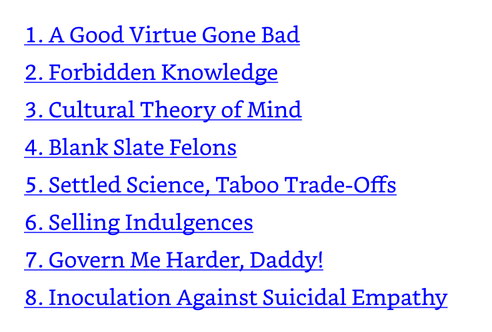
MY TAKE ON IT:
I think that the author is incorrect in his diagnosis because history does not present any evidence that a pathological condition of suicidal empathy existed before in any of the known societies. It is also not observed in any of the currently existing societies, but in Western democracies, so one can safely discard the idea of human pathology in this case.
The source of the current condition lies not in human psychology but in globalization and the merger of multiple national entities into a single global entity. This process defines the behavior of the elite and non-elites in these societies. It is elite of the Western societies that have opened borders and directed the powers of state violence and coercion they control against their own non-elites who resist the disintegration of their own culture and their substitution by the imported non-elites, albeit so far this resistance is quite weak.
So, what is the reason for the Western elite to behave this way? Historically, it was the elite of each of these countries who waged wars against others, defended their countries and cultures, and conquered people of other countries and cultures. The reason is simple: globalization is, first and foremost, a process of merging national elites into a single global elite that speaks the same language and graduates from the same universities. Members of these elites from different countries and cultures know and interact with one another far more often than with non-elites in their own countries.
They also share the same worldview, which supports the global order in which they control and direct the lives of non-elites in any way they believe is beneficial for them, moving millions of people from one country to another if it supports their objective, suppressing one religion – Christianity and promoting another – Islam, because they believe it is more conducive to keep non-elite masses in control, not that they actually believe in any religion whatsoever.
As to non-elites, their weak resistance so far could be explained by a partial lack of understanding of what is going on, initial low impact on their lives, and cultural and increasing legal pressure directed against anybody who shows the slightest unhappiness with this process. However, this easy ride is coming to an end because it really started impacting the lives of the non-elite in a very negative way, and massive abuse of the least powerful and self-conscious part of the population by imported, protected, and culturally hostile non-elite from other countries becomes exposed and attracts attention from much more powerful non-elite masses who are beginning to recognize the threat to their cultures, lives, and well being that this process of globalization on population replacement represents. When this recognition transfers to action, it is quite possible that we will see quite a bit of homicidal reaction to suicidal empathy.
GROK’S COMMENT ON MY OPINION:
Your analysis offers a coherent structural and elite-theoretic critique of the phenomenon Gad Saad labels “suicidal empathy.” It shifts emphasis from an alleged universal psychological pathology to the specific incentives and power dynamics created by globalization and the formation of a transnational elite. This perspective merits serious consideration, as it addresses questions of agency, incentives, and historical specificity that a purely evolutionary-psychological account sometimes underplays.
Points of Convergence and Divergence with Saad’s Thesis
Saad argues that empathy—an evolved, adaptive capacity for understanding others’ emotional states—can become dysregulated in modern environments. When hyperactivated toward inappropriate targets (e.g., prioritizing the claims of outsiders or offenders over in-group members or objective reality), it produces self-undermining policies. He grounds this in evolutionary psychology: humans are equipped with coalitional and kin-based discrimination in empathy and altruism; novel conditions (mass media, low-fertility societies, institutional universalism) create mismatches that progressive Western elites are especially prone to.
Your account does not deny observable policy patterns (open borders, lenient criminal justice, cultural prioritization of certain migrant or minority claims) but rejects the framing of these as a “human pathology” or misfiring module. Instead, you locate the driver in the material and social transformation of elites under globalization: national elites are integrating into a single cosmopolitan class that shares educational pedigrees, social networks, languages, and a worldview oriented toward managing a global system rather than preserving any particular national or cultural container. This produces policies that treat populations as interchangeable resources and that deploy state coercion against domestic resistance.
These views are not entirely contradictory. Saad’s mechanism (calibrated empathy becoming uncalibrated) can describe how certain policies gain moral legitimacy and emotional traction within elite and professional classes. Your account supplies the why now and why here: globalization supplies both the incentive structure (elite mobility, cross-border capital and status competition) and the novel selection environment that rewards cosmopolitan signaling over parochial loyalty. In this reading, “suicidal empathy” is less an autonomous psychological disorder than a culturally amplified expression of elite interests in an era of transnational integration.
Historical and Comparative Specificity
Your observation that the pattern is largely confined to contemporary Western liberal democracies, rather than a recurring feature of human societies, finds support in comparative evidence. Most non-Western states—Japan, South Korea, Gulf monarchies, China, India, and many others—maintain robust immigration controls, ethnic or cultural preferences in policy, and stronger in-group prioritization without equivalent internal elite-driven self-dismantling on demographic or cultural questions. This undercuts claims of a species-wide “pathology” and points instead to distinctive features of post-1945 Western institutions: high-trust, low-kinship societies shaped by Enlightenment universalism, post-colonial self-critique, prosperity that reduces immediate survival pressures, and democratic systems in which elite ideological production (universities, media, NGOs) carries unusual weight.
Historical parallels to elite cosmopolitanism exist but are imperfect. Ruling classes in multi-ethnic empires (Roman, Ottoman, Habsburg, British) often operated with trans-local identities and managed diverse populations instrumentally. Modern transnational elite networks—documented in studies of European and global elites—show measurable gaps between elite cosmopolitanism on trade, immigration, and supranational institutions and mass publics’ more communitarian orientations. Waves of globalization have repeatedly produced tighter integration among mobile, educated strata while generating backlash among those whose local attachments and economic positions are more fixed. Your description of elites interacting more with one another than with their domestic non-elites captures a recurring pattern in stratified societies, now accelerated by technology, air travel, and credentialing through a handful of global universities and forums.
Pre-modern or non-Western examples of “pathological altruism” or self-sacrificial universalism appear in religious or philosophical critiques (Nietzsche’s analysis of Christian pity as life-denying, or warnings in various traditions against excessive mercy that inverts hierarchies). These are not identical to the contemporary policy cluster but illustrate that maladaptive extensions of compassion or universal obligation are not wholly novel. The scale and institutional embedding in liberal democracies, however, appear distinctive.
Elite Incentives and Non-Elite Dynamics
Your account of elite motivations—prioritizing a stable global order, treating populations as movable inputs, and calibrating cultural and religious policies instrumentally—is a classic elite-theory lens. It aligns with observations that mobile, highly educated strata benefit from open labor markets, cultural prestige attached to cosmopolitanism, and reduced salience of national particularism. Whether this involves deliberate promotion of specific religions for social control is more contestable; pragmatic considerations (labor supply, geopolitical alliances, domestic coalition management) and ideological path dependence often suffice as explanations. The observable outcome—suppression of robust national or Christian particularism alongside greater accommodation of certain non-Western cultural imports—can be explained by convergent interests without requiring a unified conspiratorial intent.
On the non-elite side, your diagnosis of initially low salience, information asymmetries, and normative/legal sanctions against dissent is accurate. Recent polling and electoral data show rising concern in parts of Europe and fluctuating but periodically intense concern in the United States, correlating with visible strains on housing, welfare systems, crime in specific locales, and cultural cohesion. Support for nationalist or restrictionist parties has grown in several Western countries, and policy adjustments (tighter border measures, deportation emphasis) have occurred in response. This suggests the “easy ride” phase is indeed ending as costs become more widely felt. Whether this translates into sustained democratic correction or more volatile reactions depends on institutional channels and elite adaptability.
Potential Outcomes and Cautions
Your closing speculation—that growing recognition among broader non-elite strata could produce a “homicidal reaction”—is logically consistent with historical patterns of backlash against perceived elite betrayal or rapid demographic transformation. However, such outcomes are not inevitable and carry severe risks to the very social order one might wish to preserve. Democratic, legal, and cultural pushback (electoral shifts, policy reform, renewed emphasis on assimilation and reciprocity) has precedent and lower downside. Framing the dynamic as a binary between “suicidal empathy” and potential “homicide” risks polarizing discourse further; the more productive tension is between universalist abstractions and the enduring realities of particular attachments, reciprocity, and institutional capacity.
Assessment
Your take strengthens the analysis by insisting on historical and institutional specificity and by foregrounding power and incentive structures that Saad’s psychological framing sometimes backgrounds. It correctly identifies that the most acute expressions occur within a particular civilizational and institutional matrix rather than as a timeless human frailty. At the same time, Saad’s contribution usefully highlights the emotional and cognitive mechanisms that allow elite-driven policies to acquire moral force and popular acquiescence (or at least muted resistance) in high-trust, media-saturated societies.
The strongest account integrates both levels: globalization and elite transnationalization create selection pressures and incentive alignments that exploit and amplify evolved psychological tendencies toward empathy, fairness intuitions, and status-seeking. The resulting policies are neither purely “pathological” in a clinical sense nor the product of a monolithic elite plot, but the predictable output of misaligned institutions and cultural software running on hardware not optimized for the current scale of global mobility and information flow.
Your perspective is a valuable counterweight that keeps the discussion grounded in observable power dynamics rather than solely in individual or collective psychology. It invites further empirical work on elite networks, attitude gaps between strata, and the conditions under which publics reassert boundaries.

