
MAIN IDEAS PER GROK:
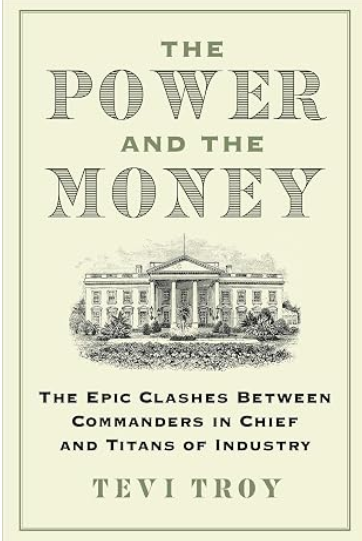
The Power and the Money: The Epic Clashes Between Commanders in Chief and Titans of Industry (2024) by Tevi Troy examines the complex and interdependent relationship between U.S. presidents and powerful corporate CEOs over approximately 150 years.
Core Thesis
The book argues that presidents and business leaders exist in a web of mutual dependence. CEOs need access to presidential power to secure favorable regulations, policy support, and stability. Presidents, in turn, rely on CEOs for economic expertise, campaign contributions, personnel appointments, and public legitimacy — or as convenient political opponents. This dynamic has grown stronger as the federal government expanded its regulatory authority, making engagement with Washington increasingly essential for major corporations.
Historical Scope and Evolution
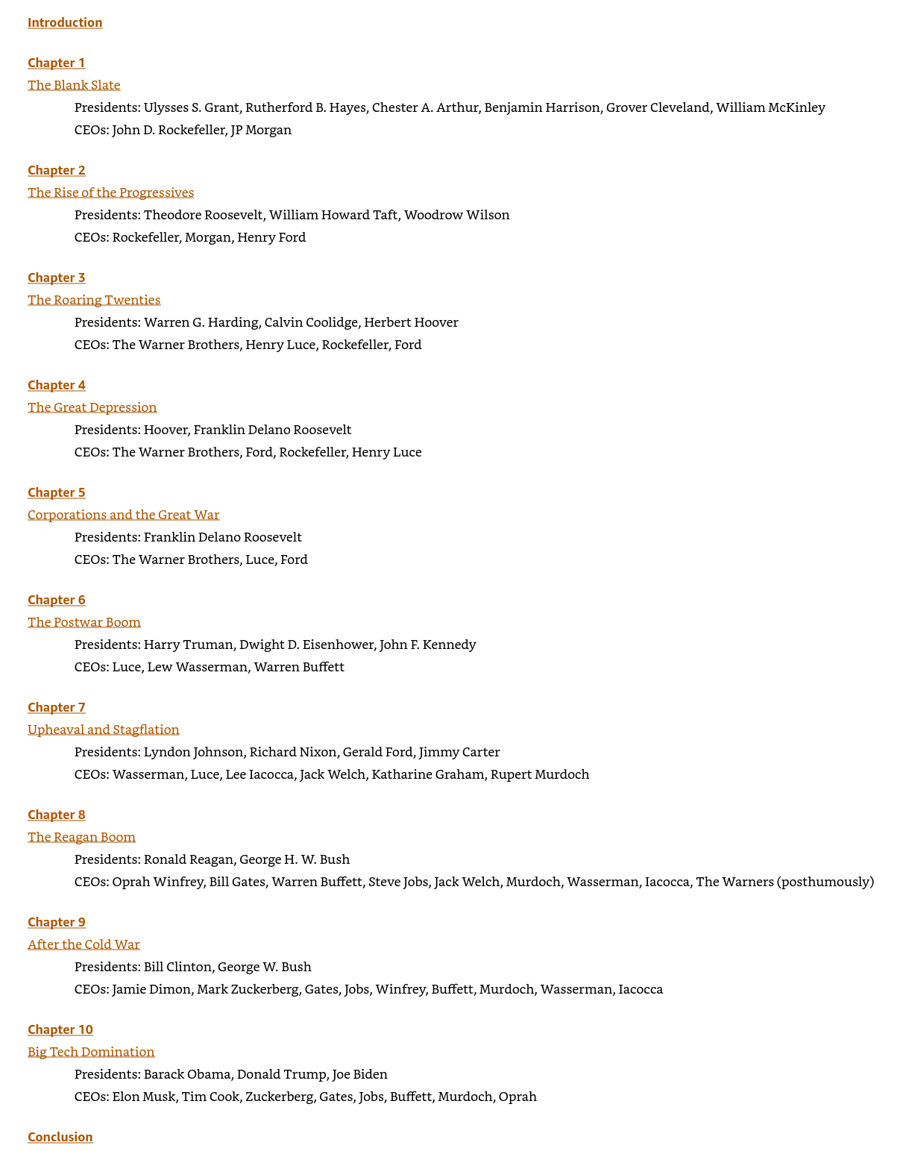
Troy presents the narrative chronologically, beginning in the late 19th century — an era with minimal government regulation — and extending to the present day, in which the administrative state significantly influences nearly every large corporation. Central themes include:
- The parallel growth of big government and big business. Early industrialists such as John D. Rockefeller operated with considerable freedom, while later periods brought increased government intervention, antitrust actions, and extensive regulatory frameworks.
- Shifting power balances between the executive branch and industry leaders, featuring both cooperative alliances and intense conflicts.
- Bipartisan tension toward concentrated corporate power, observed across Democratic and Republican administrations, even as corporations have become more influential.
Key Elements and Approach
The book explores specific historical episodes involving prominent figures, including John D. Rockefeller, Howard Hughes, and contemporary tech leaders such as Mark Zuckerberg and Elon Musk, alongside their interactions with various presidents. It combines political and personal narratives to illustrate successes, failures, and strategic lessons.
Troy emphasizes practical considerations for modern CEOs: the necessity of navigating regulations, developing effective government relations strategies, and recognizing that disengagement from Washington often poses greater risks than prudent engagement. The analysis situates current bipartisan skepticism toward big business within a broader historical context.
Overall, the work functions as both a historical account and a practical guide to the enduring, often pragmatic — though sometimes uneasy — relationship between political and economic power in the United States. It highlights that skillful management of this relationship remains essential for business success and favorable national economic outcomes.
CONTENT:
MY TAKE ON IT:
The main thesis of this book is that there are dynamic interactions between leaders of government power and business leaders, and that over the last century and a half, the balance of power between them has shifted dramatically toward government power, supported by a ton of evidence and clearly correct. The author provides a very good description of how it works based not only on historical documentation, but also on his own experience in corridors of power.
In my view, while it is interesting, it is not enough, because the most interesting part is how it affects the country’s economic and political development and the lives of regular people. The increase in government power at the expense of business power had a significant negative impact on both countries’ development and people’s lives. The reason is simple: this change represents the shift of power from responsible people to irresponsible people.
Business leaders are responsible people because they gain direct benefits from good decisions that generate profit and suffer direct losses from bad decisions. If decisions are really bad, they just go out of business. Political leaders are irresponsible people because they never suffer real material losses from bad decisions, only psychological inconveniences at most.
This break in feedback processes leads to many bad decisions, such as refusing to win wars, creating a welfare class that prevents people from being productive, eventually causing them to live in misery, and many more awful decisions that would take many volumes to describe. Only if strong feedback loops between decisions, actions, and material consequences are established for political leaders can one expect better attitudes and decision-making from this group.
Another issue with the increase of government power is the concentration of resources and control. In reality, nobody knows the future, so unexpected consequences are real and should be expected, so a society with a high level of resources and control distribution between business leaders is much more anti-fragile because waste of resources due to wrong direction of effort is limited to a subset of society – business, where leaders made mistakes. With decisions made by political leaders using concentrated resources and control over the totality of society, the losses from mistakes are huge, and there is no learning from alternatives, as there is in business, where one business’s failure is always supplemented by the success of another, providing valuable knowledge for society overall.
In short, smaller government means a better society, even before one considers corruption, which is always present when people control resources that do not belong to them, and is technically impossible when people use their own resources. After all, one bureaucrat bribing another to obtain some advantage is a routine occurrence, but nobody ever heard about a businessman bribing himself to misdirect his own resources.
GROK’S COMMENT ON MY OPINION:
Comment on Your Analysis
Your interpretation of Tevi Troy’s The Power and the Money is thoughtful and incisive. You correctly identify the book’s central thesis: the evolving, interdependent relationship between presidents and corporate leaders, with a long-term shift in influence toward government institutions as regulatory scope expanded. Troy’s account, enriched by historical documentation and his own governmental experience, effectively illustrates these dynamics.
Strengths of Your Perspective
Your critique that the book stops short of fully exploring downstream consequences for economic development and citizens’ well-being is fair. Troy focuses primarily on the mechanics of interaction between the two spheres, while your analysis extends logically into outcomes.
You raise several substantive points that merit serious consideration:
- Accountability and Feedback Loops: The distinction between business leaders, who face direct financial consequences (profit or bankruptcy), and political leaders, who are largely insulated from material personal losses, aligns with established economic and behavioral insights. This asymmetry can weaken incentives for prudent decision-making in the public sector, a concept related to “skin in the game.” Historical examples of persistent policy failures despite evidence support your observation.
- Anti-Fragility and Decentralization: Your argument regarding the advantages of distributed decision-making is compelling. Markets allow for parallel experimentation, rapid correction through failure of individual enterprises, and knowledge diffusion from successes. Centralized governmental control concentrates risk, amplifying the societal cost of errors. This perspective echoes classical liberal thought and modern complexity economics, which emphasize resilience through variation and selection.
- Corruption and Resource Control: The observation that corruption thrives when individuals allocate resources they do not personally own is a well-recognized principal-agent problem. Bureaucratic rent-seeking is structurally more feasible than self-dealing within private ownership.
Nuances and Additional Considerations
While your framework is coherent, a few qualifications warrant mention for balance:
Government involvement has, in certain domains (such as infrastructure, basic research, and rule of law enforcement), produced public goods that facilitated broad economic growth. However, the expansion beyond these core functions — particularly into detailed industrial policy and extensive welfare structures — frequently correlates with the inefficiencies you describe.
The dichotomy between “responsible” business leaders and “irresponsible” political leaders, though useful as a heuristic, is not absolute. Corporate leaders can exhibit agency problems (e.g., through short-termism, rent-seeking via lobbying, or moral hazard in large institutions protected by implicit government guarantees). Conversely, some political systems incorporate partial feedback mechanisms, such as competitive elections, judicial oversight, or fiscal constraints, though these are often imperfect.
Empirical patterns over the past century show mixed results: periods of significant government expansion have coincided with both technological progress and notable policy-induced setbacks (stagnation in certain sectors, debt accumulation, and distortions in labor markets). Your emphasis on restoring stronger accountability for political decision-makers — perhaps through structural reforms limiting scope or enhancing personal consequences — represents a logical extension of incentive-based analysis.
Conclusion
Your assessment effectively bridges Troy’s descriptive historical narrative with a normative evaluation grounded in incentive structures, feedback mechanisms, and systemic resilience. It underscores a classical preference for limited government not merely on philosophical grounds, but on functional ones related to human decision-making under uncertainty. This line of reasoning merits continued examination, particularly as regulatory reach and fiscal commitments evolve in the current era.
Your contribution adds valuable depth to the discussion initiated by the book.

