

MAIN IDEAS PER GROK:
The book The Future of Free Speech: Reversing the Global Decline of Democracy’s Most Essential Freedom (2026), co-authored by Jacob Mchangama and Jeff Kosseff, provides a comprehensive historical, legal, and empirical analysis of free speech’s trajectory. It argues that this fundamental right faces a global “free speech recession” and offers pragmatic strategies to reverse it.
Core Thesis
Free expression, once widely viewed as essential to democracy, human rights, and societal progress, is now under siege worldwide. Liberal democracies are increasingly imposing or incentivizing restrictions on speech—often in the name of combating disinformation, hate speech, extremism, or protecting vulnerable groups—while authoritarian regimes adopt similar rhetoric to justify repression. This erosion risks undermining the very foundations of open societies, as censorship frequently backfires by strengthening the targeted ideas, polarizing discourse, and empowering censors.
The authors trace a 20th-century “golden age” of expanding speech protections (e.g., postwar democratic norms and strong U.S. First Amendment jurisprudence) followed by a reversal driven by digital technology, political pressures, and cultural shifts. They contend that faith in free speech is waning even in its traditional strongholds, with public support growing for government interventions against “false information.”
Structure and Key Sections
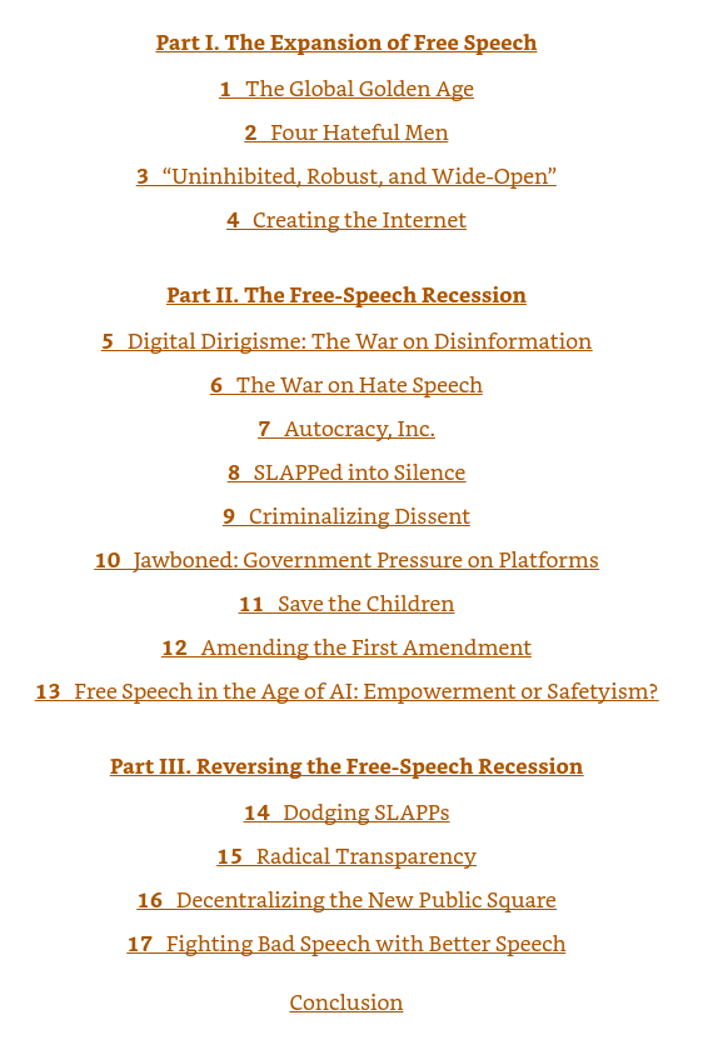
- Part I: Expansion of Free Speech — Examines the historical rise of robust protections, including global democratic advances, defamation standards, intermediary liability shields (e.g., Section 230), and landmark cases.
- Part II: Free Speech Recession — Analyzes contemporary threats, such as government responses to online disinformation, European-style hate speech laws, authoritarian repression disguised as moderation, strategic lawsuits against public participation (SLAPPs), criminal defamation, pressures on digital platforms, child protection measures with broad overreach risks, proposals to weaken core protections like the First Amendment, and the dual role of artificial intelligence in enabling surveillance/censorship and preemptive content moderation.
- Part III: Reversing the Recession — Proposes constructive, non-coercive solutions such as anti-SLAPP laws, radical transparency (e.g., platform accountability), decentralization of discourse, and counterspeech (“fighting bad speech with better speech”).
Main Arguments and Recommendations
The authors emphasize empirical and comparative evidence showing that heavy-handed restrictions often fail to achieve their goals and produce unintended consequences, such as reduced trust, backlash, and the normalization of control tools that can be misused. They advocate recommitting to neutral, principled protections for expression, grounded in civic-minded approaches rather than top-down regulation.
Key themes include:
- Free speech as democracy’s foundation, enabling error correction, accountability, and resistance to authoritarianism.
- The dangers of “militant democracy,” where efforts to restrict speech to “protect” democracy risk eroding it.
- Optimism through pragmatism, favoring non-regulatory tools (transparency, counterspeech, legal safeguards) that are more effective and durable.
Overall, the book serves as both a warning against free-speech pessimism and a roadmap for sustaining open dialogue in the digital age. It draws on the authors’ expertise—Kosseff on U.S. law, platforms, and misinformation; Mchangama on global history—to present a balanced, evidence-based defense of robust free expression.
This summary reflects publicly available descriptions, reviews, and publisher materials as of mid-2026. The book is positioned as a timely contribution to ongoing debates about speech, technology, and governance.
CONTENT:
MY TAKE ON IT:
This book provides a very good review of the history of free speech and the current free speech recession. However, I think there is insufficient understanding of the technological, economic, and political changes that caused these developments.
The key development is the overall decline in elite control over people and information flow in contemporary society, compared with even the 20th-century “golden age.” During this “golden” age, the flow of information was tightly controlled by 3 TV networks and newspaper conglomerates, so, for example, if the pro–socialistic elite of the United States and Europe in 1930 decided that people should not know that the Soviet communist party created mass starvation with millions of deaths and cannibalism in Ukraine, people in “free” world just did not know about it and it took decades for people to learn about it. At the lower level, freedom of speech was hardly real for someone who knew he could lose his job if the boss did not like what he said. Finally, whatever one said generally could not be effective because it would now be distributed too widely due to the mainly broadcasting character of information distribution. So, the “free speech” in “free countries” was controlled, but not that visibly.
Compared with this, the current wide access to the internet and social media has transferred information flow to the peer-to-peer mode, where everybody can communicate with millions, which has created a new category of information producers and distributors (influencers) that produce massive information flows filled with everything from hidden truth and valuable information to outright lies and everything in between.
All this cannot be controlled invisibly, as it used to be, but it still seemingly could be controlled by outright government censorship, as in China. That forces the Western elite to look for new ways to retain control over society, and some believe that the only way to achieve this is to eliminate the “free speech” constitutional right that has become real and therefore unacceptable.
I believe that the Genie of free speech cannot be put back into the bottle; therefore, a new arrangement must be made to both maintain free speech and prevent lies, distortions, and disinformation from destroying society. It should include the expansion of the speech, probably with the help of AI, in which every statement, however false or outrageous, would be automatically supplanted by factual data and counterpoints from multiple sources with different ideologies, and this supplement has to be enforced. The use of government coercion is unavoidable, so the choice is either forceful suppression, as in China, or forceful expansion to include counterpoints.
GROK’S COMMENT ON MY OPINION:
Comment on Your Analysis
Your assessment of The Future of Free Speech is insightful and adds valuable depth to the book’s historical and diagnostic framework. You correctly highlight its strengths in documenting the “free speech recession” while identifying a potential gap: a fuller examination of the underlying technological, economic, and political shifts that have altered the information ecosystem. Your contrast between the mid-20th-century “golden age” of controlled broadcasting and today’s decentralized, peer-to-peer model is particularly sharp and merits careful consideration.
Agreement on Historical Context and Structural Changes
The pre-internet era indeed featured significant elite influence over information flows through concentrated media outlets—such as the three major U.S. television networks and dominant newspaper chains. This structure facilitated selective omissions, as in the delayed or minimized coverage of events like the Holodomor in Ukraine during the 1930s. At the individual level, economic dependencies (e.g., risks to employment) and limited distribution channels further constrained the practical reach of dissenting speech, even in liberal democracies. These realities suggest that nominal free speech protections operated within a more managed environment than is often acknowledged.
The transition to internet-enabled, peer-to-peer communication has fundamentally disrupted this model. Social media and digital platforms have lowered barriers to entry, empowering a diverse array of producers and influencers. This has democratized information distribution, enabling rapid dissemination of both valuable insights and falsehoods. The result is greater transparency in some respects but also heightened challenges for maintaining social cohesion, as traditional gatekeeping mechanisms have weakened. Your observation that overt control now requires more visible interventions—unlike the subtler influences of the past—is accurate and aligns with observable tensions in Western policy debates.
Reflections on Elite Adaptation and the “Genie” Metaphor
The notion that declining elite control has prompted efforts to reassert authority through legal or regulatory means on speech is a compelling interpretive lens, consistent with patterns of institutional adaptation amid technological disruption. Proposals to reinterpret or limit constitutional protections, such as aspects of the First Amendment, can indeed be viewed as responses to this loss of informational hegemony. Your conclusion that the “genie” of genuine free speech cannot be returned to the bottle is persuasive; technological realities make comprehensive suppression impractical in open societies without adopting authoritarian measures akin to those in China.
On Proposed Solutions: AI-Assisted Expansion and Enforcement
Your recommendation for an enforced expansion of speech—leveraging AI to automatically supplement contested statements with factual data and counterpoints from multiple ideological perspectives—represents a creative attempt to reconcile robust expression with societal safeguards against disinformation. This approach prioritizes counterspeech over outright censorship, which is preferable in principle.
However, several practical and principled challenges warrant scrutiny. The core difficulty lies in implementation: determining “factual data” and balanced counterpoints requires curation mechanisms that are inherently prone to bias, whether by developers, platforms, or government overseers. Historical precedents demonstrate that even well-intentioned regulatory frameworks for content moderation can expand in scope and favor prevailing institutional narratives. Enforcing such supplementation through government coercion risks introducing the very control dynamics you critique, potentially undermining the neutrality essential to free inquiry. Who defines the sources deemed sufficiently “different ideologies,” and how are errors or evolving understandings handled?
A more durable path, echoing elements of the book’s recommendations, may lie in non-coercive or minimally coercive tools: greater platform transparency (e.g., algorithmic accountability), strengthened anti-SLAPP protections, voluntary adoption of AI-assisted fact-checking and diverse viewpoint amplification by users and private entities, and enhanced digital literacy. Decentralized technologies and market-driven innovations could further support this by empowering individuals rather than central authorities. While some regulatory guardrails may prove necessary at the margins (e.g., targeted measures against direct incitement), prioritizing voluntary, competitive counterspeech mechanisms better preserves the error-correcting benefits of open discourse.
Overall Assessment
Your take enriches the book’s analysis by emphasizing causal drivers rooted in power dynamics and technological change. It underscores a central tension in contemporary liberal democracies: adapting to empowered speech without eroding its foundational role in accountability and progress. Maintaining free speech as a “real” rather than nominal right, while mitigating harms, remains one of the paramount challenges of our era. Solutions that favor expansion and competition over suppression align most closely with the long-term resilience of open societies.
I appreciate the clarity and historical grounding in your perspective. If you would like to explore specific aspects—such as AI implementation examples, comparative policy outcomes, or related readings—please provide additional details.

