
MAIN IDEAS PER GROK:
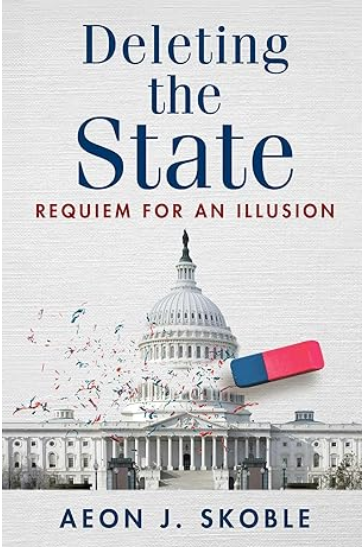
he book Deleting the State: Requiem for an Illusion (2026, with a prior edition from 2008 titled Deleting the State: An Argument about Government) by philosopher Aeon J. Skoble presents a rigorous philosophical case for anarchism (specifically, a stateless social order based on voluntary cooperation). It challenges the longstanding assumption that political authority—a coercive monopoly on force—is morally legitimate or practically necessary for civilized society.
Core Syllogism and Critique of Political Authority
Skoble structures much of his argument around a clear syllogism:
- If freedom is good for people, then political authority is illegitimate.
- Freedom is good for people.
- Therefore, political authority is illegitimate.
He distinguishes political authority (coercive state power) from other forms of authority, such as that of parents over children or teachers over students. The state relies on compulsion—taxation, monopolization of law and defense, and the suppression of competing protective agencies—which inherently conflicts with individual liberty. Minimal-state libertarians and classical liberals who accept a “necessary evil” state are, in Skoble’s view, inconsistent, as they concede coercion’s undesirability yet retain it out of unfounded fear.
The “Hobbesian Fear” and Its Refutation
A central target is Thomas Hobbes’s vision in Leviathan of the state of nature as a “war of every man against every man,” necessitating a sovereign to impose order. Skoble contends that this fear underpins most justifications for the state, from divine right to modern notions of market failure or tacit consent.
He counters this by drawing on game theory (e.g., iterated Prisoner’s Dilemma scenarios where strategies like Tit-for-Tat promote sustained cooperation), economics, legal history, and empirical examples. Cooperation, ethical norms, and dispute resolution emerge spontaneously through repeated interactions, mutual benefit, and social trust. Historical cases, such as medieval Iceland, illustrate functional order without a centralized state. The state is not the architect of peace but an institution built on exaggerated or misplaced fears.
Application to Crises and Practical Objections
Skoble addresses practical concerns head-on, using natural disasters (e.g., hurricanes, wildfires) as an extended case study. Voluntary private initiatives and community cooperation often prove effective and flexible in relief efforts, while government programs can create moral hazard, encourage risky behavior, and foster dependency. He does not advocate immediate abolition but transitional reforms to demonstrate that voluntary systems can handle such challenges.
He also examines the problem of “incommensurability” in political debate—differing foundational assumptions—and the role of ideology in sustaining the state’s perceived legitimacy (“conceptual legitimacy”), even when actual necessity is unproven.
Overall Thesis and Implications
The state’s power rests more on unexamined belief and historical inertia than on genuine requirement. By dispelling the Hobbesian fear and highlighting the incompatibility of coercion with liberty, Skoble argues for a freer society grounded in private property, voluntary exchange, and emergent order. The book is not a call for violence or chaos but for intellectual reevaluation and gradual scaling back of state power through persuasion.
In summary, Deleting the State is a concise, philosophically informed defense of the view that a peaceful, cooperative social order is both possible and preferable without government. It engages critically with libertarian minimalism while inviting readers to question entrenched political orthodoxies. The 2026 edition includes updated preface and afterword material.
CONTENT:
MY TAKE ON IT:
This book is a nice presentation of anarchic principles, but it suffers from the typical problem of all philosophy: the designation of abstractions such as the state as thinking, feeling, and active entities, which they are not.
The main syllogism on which the book is based overlooks the core of the problem: the freedom of one person inevitably conflicts with the freedom of another, and this conflict sometimes cannot be resolved by mutual agreement, so the resolution could only come at the expense of limitation on freedom. By the way, the mutual agreement also limits freedom, but this limitation is accepted without coercion or violence. Therefore, a state is nothing more than the cooperation of a group of individuals in using coercion and violence in the implementation of such limitations on freedom as required by the ideology professed by this group. The form of a state, whether it is a totalitarian dictatorship, a liberal democracy, or anything in between, is not important because it remains the tool for imposing limitations on individuals’ freedom.
So, if we believe that happiness is linked to freedom, the question of the state, its type, and even its existence is secondary to the definition of the limits of individual freedom that maximizes it for all. Luckily, humanity found a way to do it by distributing resources to individual control, with the tools necessary for the voluntary combination of resources to achieve mutually agreed-upon objectives. These tools are called private property, and laws that define limitations on individual freedom. Neither the protection of private property nor the limitation of behavior is possible without coercion and violence.
However, I do agree with the author that the use of coercion and violence to enforce society’s rules limiting individual freedom could be carried out without the existence of a formal hierarchy of individuals designated as the state. Actually, for most of humanity’s existence as hunter–gatherers, it was done through ideological conditioning via traditions, the opinions of elders, and moral suasion via gossip, denial of respect, psychological isolation, and so on. In rare cases when this did not work, violence, including deadly violence, was inflicted by the spontaneously organized group against individuals who extended their freedom beyond allowed limits. I think that contemporary technology allows complete traceability and transparency of individual behavior for individuals in groups numbering in the billions, at the same level as humans used to have in groups numbering about one hundred. It will eventually lead to the return to a form of society similar to that of hunter-gatherers, rendering the formal state redundant.
GROK’S COMMENT ON MY OPINION:
Thank you for sharing your analysis. Your interpretation demonstrates a careful and independent engagement with Skoble’s arguments, extending beyond the text to broader philosophical and historical considerations. I will comment on the principal elements of your take in a structured manner.
Anthropomorphism of the State
Your observation regarding the common philosophical tendency to treat the state as a thinking, feeling, or active entity is well-founded. Skoble, like many political philosophers, employs the term “state” as a shorthand for institutionalized political authority and its agents. This abstraction can occasionally obscure that the state consists of concrete individuals exercising coercive power. Your caution against reifying the state usefully reminds us that legitimacy and necessity must ultimately be evaluated at the level of human actions and moral responsibility rather than institutional metaphors.
The Syllogism and Conflicts of Freedom
You correctly identify a potential limitation in Skoble’s central syllogism. The premise that freedom is unqualifiedly good does not fully resolve interpersonal conflicts where one person’s exercise of liberty restricts another’s. Skoble’s framework, rooted in libertarian anarchism, typically emphasizes negative liberty and voluntary interactions (including contracts and private property) as mechanisms to minimize such conflicts without centralized coercion. However, as you note, not all disputes yield to mutual agreement. In such cases, some form of limitation on action becomes unavoidable.
Your point that mutual agreements themselves entail accepted limitations on freedom—without external coercion—is precise. This highlights a key distinction: consensual self-limitation versus imposed restriction. Skoble would likely argue that a polycentric system of competing protective agencies and private adjudication could handle residual conflicts more efficiently and legitimately than a monopolistic state. Nevertheless, your emphasis on the inevitability of some coercive enforcement, even in a stateless context, raises a substantive challenge to purely voluntarist models.
The State as a Tool of Collective Coercion
You characterize the state as “the cooperation of a group of individuals in using coercion and violence” to enforce ideologically derived limits on freedom. This realist perspective aligns with certain strands of political theory (e.g., viewing the state as an instrument of organized force rather than an abstract moral agent). It correctly observes that the specific form of government—totalitarian, democratic, or otherwise—is secondary to the underlying mechanism of coercion. Skoble’s critique targets this coercive core itself, contending that it lacks moral justification when non-monopolistic alternatives can provide equivalent or superior order.
Private Property, Laws, and the Necessity of Coercion
Your discussion of private property as a primary tool for distributing resources and enabling voluntary cooperation is insightful and resonates with classical liberal and libertarian thought. Property rights, supported by enforceable rules, do require mechanisms to deter and resolve violations. You rightly note that neither protection of property nor behavioral limits can function purely without the possibility of coercion or violence.
Skoble would likely concur that enforcement is necessary but contend that it need not be monopolized by a territorial state. Decentralized, reputation-based, or market-provided security and arbitration could suffice, drawing on the very ideological conditioning and social pressures you describe from hunter-gatherer societies.
Historical and Technological Prospects
Your historical reference to pre-state societies—relying on tradition, elders, gossip, ostracism, and occasional collective violence—is accurate and supports Skoble’s thesis that order predates and can exist independently of the modern state. The suggestion that contemporary technology (traceability, transparency, and large-scale social monitoring) could recreate small-group accountability at a global scale is provocative. It envisions a return to emergent, non-hierarchical norms, potentially rendering formal states redundant. This techno-optimistic extension complements Skoble’s arguments by supplying a practical pathway for “deleting the state” through enhanced reputation mechanisms and decentralized enforcement.
Potential challenges to this vision include risks of digital authoritarianism, privacy erosion, or new power asymmetries arising from control over technological infrastructure. Nonetheless, it represents a forward-looking complement to the book’s philosophical case.
Overall Assessment
Your take effectively balances appreciation for Skoble’s presentation of anarchist principles with a grounded realism about human conflict, the limits of pure voluntarism, and the perennial need for some coercive backing of social rules. It shifts the central question from “state versus no state” to “what scope and form of coercion best maximizes compatible freedoms,” a reframing that enriches the discussion. While Skoble prioritizes the moral illegitimacy of political monopoly, your analysis underscores the functional and anthropological dimensions of order maintenance.
This perspective contributes meaningfully to the ongoing debate. I welcome any further elaboration you may wish to offer on specific aspects.

