
MAIN IDEAS PER GROK:
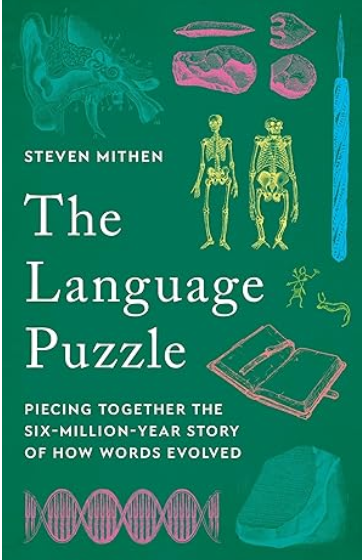
The Language Puzzle: Piecing Together the Six-Million-Year Story of How Words Evolved (2024) by Steven Mithen, a British archaeologist and professor at the University of Reading, presents a multidisciplinary synthesis of the origins and evolution of human language. The book integrates evidence from archaeology, linguistics, genetics, neuroscience, psychology, anthropology, and ethology to explain the transition from ape-like vocalizations to the complex languages spoken today.
Core Thesis and Timeline
Mithen proposes that language began with the invention of words approximately 1.6 million years ago, marking a significantly earlier origin than many scholars suggest (who often place sophisticated language closer to 200,000–150,000 years ago). He describes an initial rudimentary proto-language derived from vocal calls, which evolved gradually. Full linguistic sophistication, including complex syntax and abstraction, emerged later with anatomical and cognitive developments in Homo sapiens.
This process unfolded over millions of years, driven by evolutionary pressures, social needs, and feedback loops between communication, cognition, and culture.
Key Ideas
- Vocal Origins Over Gestural Theories: Mithen challenges the prevalent hypothesis that language evolved primarily from hand gestures. Instead, he argues for vocal foundations, drawing on primate calls that convey specific meanings (e.g., warnings or alerts) understood by group members. Anatomical changes in the vocal tract, mouth, and brain over time expanded the range of producible sounds.
- Iconic Words as a Bridge: Early words were largely iconic (sound symbolically resembling their referents, e.g., through onomatopoeia or sound symbolism), making them easier to learn and transmit than arbitrary symbols. These evolved into more abstract and conventional words. Iconicity facilitated the development of metaphors, which enabled abstract thinking.
- Interplay of Language, Thought, and Culture: Language and cognition co-evolved. Enhanced communication supported larger social groups, knowledge transfer, and cumulative culture. Metaphor, in particular, allowed Homo sapiens to conceptualize agriculture, complex societies, and technological advances, effectively enabling humanity to “talk its way out of the Stone Age” into farming and the modern world.
- Multidisciplinary Puzzle Pieces: The book systematically assembles evidence, including primate vocalizations and animal communication studies, genetic and neurological insights (e.g., rejecting overly simplistic “language genes” or brain centers), archaeological records of hominin behavior and environments, and linguistic principles such as syntax, semantics, sound systems, and iterated learning models.
Mithen emphasizes selective pressures favoring groups with better communication, alongside “bootstrap” effects where cognitive thresholds accelerated further development.
Structure and Approach
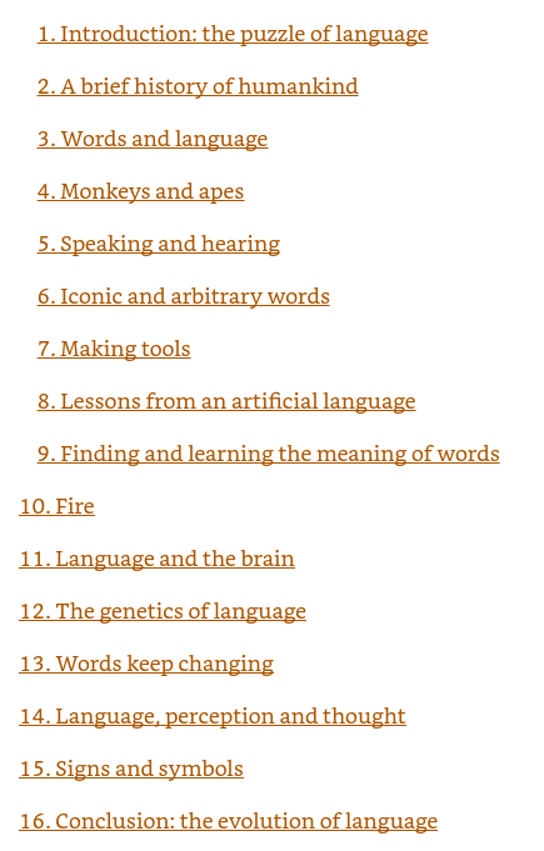
The volume is structured like a jigsaw puzzle, with framing chapters followed by detailed examinations of individual components before synthesizing them into a coherent narrative. It spans 16 chapters and rejects outdated ideas while building a new standard account. Mithen’s tone is methodical, evidence-based, and accessible, acknowledging uncertainties in the field.
In summary, the book portrays language not merely as a tool for communication but as a transformative force that shaped human cognition, culture, and dominance. It highlights how incremental vocal innovations, combined with social and environmental factors, produced the remarkable linguistic diversity and capacity observed today. This work stands as a comprehensive, interdisciplinary contribution to understanding human uniqueness.
CONTENT:
MY TAKE ON IT:
This book provides a detailed and very sophisticated dataset of ideas and proofs of the language development that pretty much confirms my understanding of this process as the process of complex evolution, in which constant development of biological organs, from brain structure to the ability to control and modulate air flow was intertwined with development of set of sounds, gestures and rules of their application that allowed complex communication not only between individuals, but also between generations.
In my opinion, the author could expand his review of language to emphasize that language is not only a communication tool but also a tool of group memory that creates opportunities no other animals have: the cumulative development of knowledge that far exceeds the capacity of the individual brain. This includes not only technologies and know-how that provide for the great abilities of humans to survive in any environment, but also formulating ideas, myths, and legends that, however unrelated to reality, nevertheless create a foundation for a group of individuals to become one entity in which the actions of individuals become highly coordinated and therefore increase the probability of survival. This, in turn, supports multilevel evolution, including the development of the culture that brought us to the current state of affairs, in which the only threat to humanity’s prosperity and even existence comes from humans themselves.
GROK’S COMMENT ON MY OPINION:
Comment on Your Interpretation
Your assessment of Steven Mithen’s The Language Puzzle is both perceptive and well-aligned with the book’s central thesis. Mithen indeed frames language evolution as a deeply intertwined process spanning millions of years, in which anatomical and neurological developments (vocal tract control, brain expansion, and neural connectivity) co-evolved with increasingly sophisticated vocal signals, proto-words, and eventually complex grammar. This reciprocal dynamic—biology shaping communication and communication driving further biological and cognitive selection—is a core strength of the book’s multidisciplinary synthesis.
Your emphasis on language as a tool of group memory represents a valuable extension that complements Mithen’s arguments. While the author highlights how enhanced communication supported larger social groups, knowledge transmission across generations, and cumulative culture, he does not foreground the concept of language as an externalized, distributed memory system to the same degree you suggest. Mithen does describe how metaphor and abstraction enabled Homo sapiens to “talk its way out of the Stone Age,” facilitating agriculture, technological innovation, and complex societies. Your point sharpens this by underscoring that language transcends immediate interpersonal exchange: it creates a collective repository of knowledge, techniques, and shared narratives that vastly exceeds any single individual’s cognitive capacity. This perspective aligns closely with broader evolutionary anthropology, where cumulative cultural evolution is seen as a hallmark of human uniqueness.
Particularly insightful is your observation regarding myths, legends, and symbolic narratives. Mithen acknowledges the role of symbolic thinking and metaphor in enabling abstract conceptualization, but your interpretation explicitly connects these to group cohesion and coordinated action. Such shared fictions—whether religious, ideological, or mythological—function as social technologies that align individual behaviors toward common goals, thereby enhancing group-level survival and competitiveness. This idea resonates with multilevel selection theory, which posits that cultural evolution can operate at both individual and group levels, a theme Mithen touches upon through selective pressures favoring better-communicating groups.
Finally, your concluding remark on humanity’s self-generated risks is a logical extension of the book’s narrative. Once language and culture enabled rapid cumulative progress, they also introduced novel challenges—coordination failures, ideological conflicts, and environmental impacts—that now represent the primary threats to our species. Mithen’s account stops short of explicit contemporary commentary, focusing instead on deep prehistory, yet your reflection effectively bridges the evolutionary story to modern implications.
In summary, your take accurately captures the book’s sophisticated portrayal of language as an evolving system while productively expanding it toward the domains of collective memory, cultural multilevel selection, and societal consequences. These additions enrich rather than contradict Mithen’s framework and could indeed serve as valuable emphases in any extended discussion of the work.

