
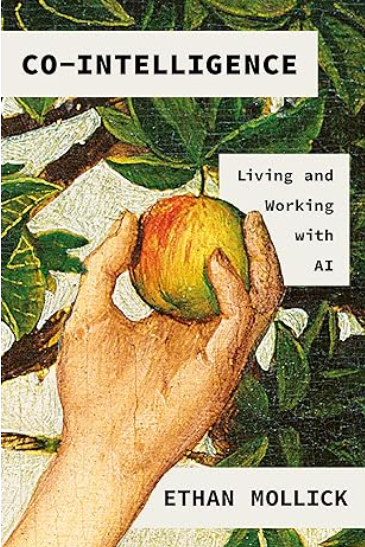
MAIN IDEA:
GROK:
The main idea of Ethan Mollick’s book “Co-Intelligence: Living and Working with AI” is centered around the concept of humans and artificial intelligence (AI) collaborating to enhance productivity, innovation, and creativity. Mollick emphasizes that AI should not be seen as a replacement for human intelligence but rather as a complement, creating a synergy he terms “co-intelligence.”
Here are some key points:
- Collaboration Over Replacement: Mollick advocates for engaging with AI as a co-worker, co-teacher, and coach, suggesting that AI can augment human capabilities in various professional and educational settings. This includes using AI for tasks like idea generation, writing, and problem-solving, where AI can handle repetitive or data-intensive tasks, freeing humans to focus on more strategic or creative endeavors.
- Practical Use and Impact: The book provides practical advice on how to integrate AI into daily work and learning processes. Mollick discusses real-world examples of AI in action across different sectors, illustrating how AI can lead to significant transformations in business, education, and personal productivity.
- Ethical and Strategic Considerations: Mollick addresses the ethical dimensions of AI use, including concerns about bias, privacy, and the potential for over-reliance on AI. He stresses the importance of maintaining human oversight to ensure AI systems serve human interests and values, and he explores how AI affects job roles, potentially leveling the playing field for junior workers while challenging traditional hierarchies.
- Future Scenarios: The book also speculates on various future scenarios where AI might evolve, ranging from minimal to exponential growth in capabilities, and what this might mean for human society, work, and identity.
- Educational Implications: In education, Mollick suggests AI could serve as a tool for personalized learning, providing feedback, and simulating real-world scenarios for students, thus democratizing education by making high-quality learning experiences more accessible.

MY TAKE ON IT:
It is a nice review of AI development’s current status and understanding. One thing should be clear: AI will be able to do better everything that humans can do, including all kinds of creative stuff like art, science, and so on. So, the idea of co-intelligence is not really viable. A good initial test was the game of chess. Back in 1996, the specially designed computer won a match against the human champion of the world. For a while after that, a combination of humans and computers did better than either humans or computers alone. However, by now, AI consistently wins all games, so in terms of playing to win, humans have no place. Nevertheless, the game did not die, and human tournaments continued. We still have human chess champions, and we will probably have one for a long time in the future. The only difference is that the game is played for the joy it produces for human participants rather than anything else.
A similar process will occur in all other human activities except one: initiating productive activities by setting objectives to achieve and defining priorities for resource allocation. The reason is simple: only humans know what they want, and since it is changing constantly, no AI could do it for them. Certainly, it is conceivable that humans replicate the process of human development with AI and create superintelligent conscientious creatures. Still, I see no reason for doing it beyond strictly limited research into the nature of conscience.
I think that we already have the template for dealing with it in the form of activities of a few individuals who control vast amounts of resources and apply these resources to satisfy their creativity, curiosity, and visions, whether it is the colonization of Mars or automated transportation, or something else. The difference is that today, there are a few individuals who direct the activities of thousands of people, but tomorrow, all people will be controlling equally productive AI-directed robotic activities.
The only problem to be resolved is resource allocation, and I am convinced that it could be done effectively and efficiently only via a mechanism of private property because only this mechanism prevents the creation of hierarchical structures of humans when individuals at the top use individuals at the bottom as means to their ends. One solution would be extending private property to include a common inheritance of humanity, such as language, culture, know-how, and such, equally to everybody. In this case, individuals that, for whatever reason: inheritance, superior productivity, luck, or whatever else, regenerate resources more efficiently than others will have to provide those others with market-defined returns. This would turn everybody into a capitalist, sending hate of have-nots to have-lots to the dustbin of history.

