
20220604 – How Dictatorships Work
MAIN IDEA:
Here is how the author defines it:” The order of the book follows the common sequence of challenges faced by dictatorial elites: (1) initiation, the seizure of power; (2) elite consolidation; (3) the extension of rule to society – policy implementation and information gathering; and (4) breakdown.” The book is based on the review and statistical analysis of dozens of dictatorships that existed over the last century. It analyses some of them in great detail to demonstrate the most typical features of each dictatorship’s life cycle phase. A very curious is the breakdown phase for which the author provides a nice graph:


MY TAKE ON IT:
A dictatorship is a pretty popular form of social organization well suited for situations when society is in military competition with neighbors or has a diverse population with unreconcilable aspirations of either territorial or religious or ethnic dominance. However, as well as it is fit for the situation of actual or potential violent fights, it is very poorly suited for effective economic development and even worse suited to support technological and scientific advancement. While forcing people into compliance and coerced coexistence, it also provides concentrated resource allocation to achieve the dictator’s and supportive elite’s simple objectives at the expense of lower quality of life for the non-elite, making regular people unhappy and frustrated. This situation makes societies under dictatorships fall behind of the societies with such systems of governance that support individual freedom, including resource allocation via institutions of private property. Individual freedom with resources allows experimentation with an infinite multitude of resource allocations in search of profit and/or psychological satisfaction. Since future discoveries and most effective resource allocations are unknown, it results in much more effective and efficient production of goods, services, and knowledge, making free societies rich and prosperous way beyond dictatorships’ abilities.
20220528 – The Down of Everything
MAIN IDEA:
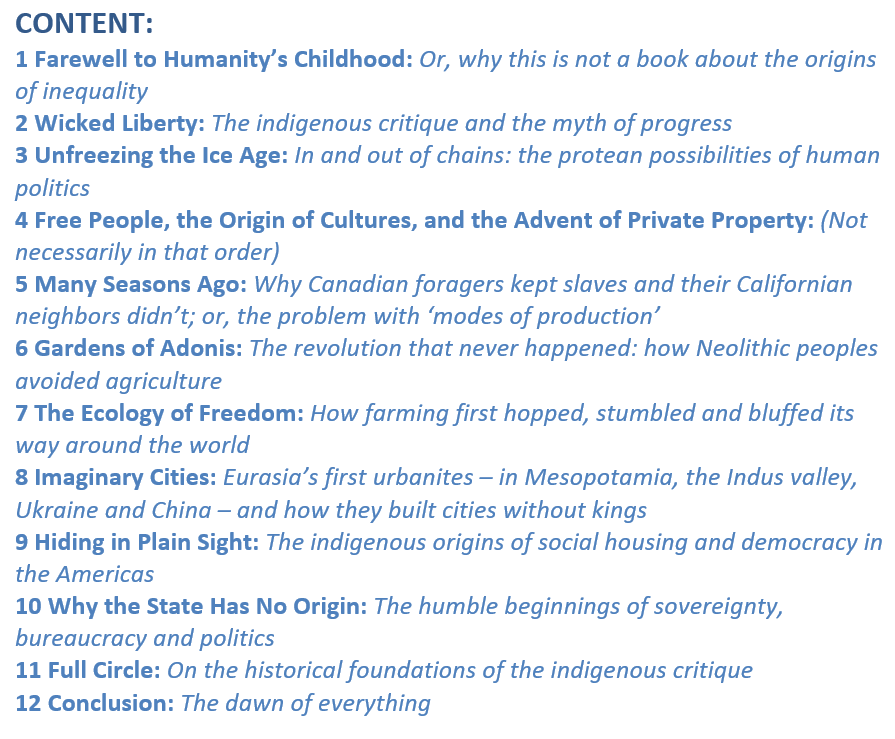
This book represents an entirely new approach to human history when viewed not as a progressive movement from one form of society less complex and productive to another – more so. It instead compares different forms of human societies, all complex and all supporting human existence at various levels of material and psychological well-being: often making a simple comparison of societies impossible. A good example is the encounter of Native American and European Civilizations when the former provides better conditions for human flourishing as defined by individual preferences of people intimately familiar with both. In contrast, the latter offers better military action and technological development organization. The book also presents an interesting thesis about the causes of West European Enlightenment It finds these causes in encountering Native American philosophy of life.
MY TAKE ON IT:
I find this book very interesting, and historical data well support its ideas. I also think that all humans and their societies are highly complex, and the designation of some of them as primitive is pretty much meaningless. Unlike the authors of this book, I do not care about inequality but do care about resource allocation. In my view, as long as everybody has enough resources to maintain a decent condition of life and the freedom to interact with others to combine resources and efforts, everything is just fine. Only when some people obtain resources by taking them from others or even making them into their own resources, do I think society has a big problem. Overall, I believe that we are now at the end of history, which is the story of fights of the grouping and cooperating animals for territories and resources. The end of history comes when these animals complete turning themselves into humans capable of satisfying all material needs via automatic productive facilities and mainly busy meeting their psychological and intellectual needs via self-directed actions while voluntary cooperating with others.
20220521 – The Tyranny of Merit

MAIN IDEA:
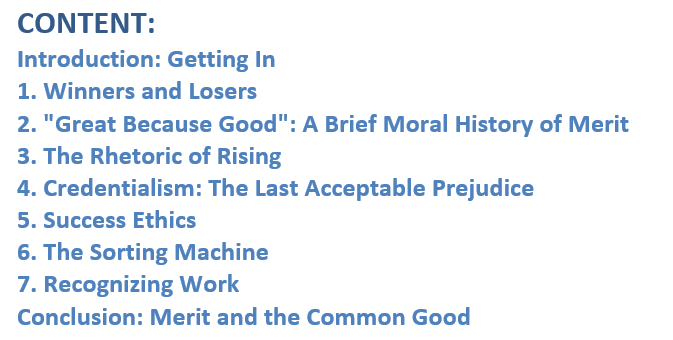
The book defines its crucial point: “In an unequal society, those who land on top want to believe their success is morally justified. In a meritocratic society, this means the winners must believe they have earned their success through their own talent and hard work.” Then it proceeds to review how people become winners or losers in the competition for a better life in a meritocratic society, which becomes less and less meritocratic over time. A significant part plays credentialism when formal testing and educational credentials rather than actual work results define winners. Finally, after reviewing all issues related to meritocracy from all conceivable angles, the book concludes:” Equality of opportunity is a morally necessary corrective to injustice. But it is a remedial principle, not an adequate ideal for a good society.” And even more:” But if the common good can be arrived at only by deliberating with our fellow citizens about the purposes and ends worthy of our political community, then democracy cannot be indifferent to the character of the common life. It does not require perfect equality. But it does require that citizens from different walks of life encounter one another in common spaces and public places. For this is how we learn to negotiate and abide our differences. And this is how we come to care for the common good. The meritocratic conviction that people deserve whatever riches the market bestows on their talents makes solidarity an almost impossible project. For why do the successful owe anything to the less-advantaged members of society? The answer to this question depends on recognizing that, for all our striving, we are not self-made and self-sufficient; finding ourselves in a society that prizes our talents is our good fortune, not our due.”
MY TAKE ON IT:
From my point of view, the whole discussion of meritocracy, equality of opportunity vs. equality of outcome, and so on is specific to the Hierarchy. It refers to how individuals would obtain places in this Hierarchy. Whether it occurs by the grace of God and good inheritance, either social – aristocracy or biological – DNA and hard work, does not matter. I believe that the Hierarchy as the method of societal organization has a very limited range of effective use: when there is a need to sacrifice some people to benefit others, such as in war. In normal life, when everybody has sufficient, albeit unequal amounts of resources, the Ownership method would do much better. However, contemporary technology created opportunities for establishing the Ownership method as dominant. When this happened, the meritocracy would become as outdated for human flourishing as inheriting an aristocratic title from parents.
20220514 – Mine!
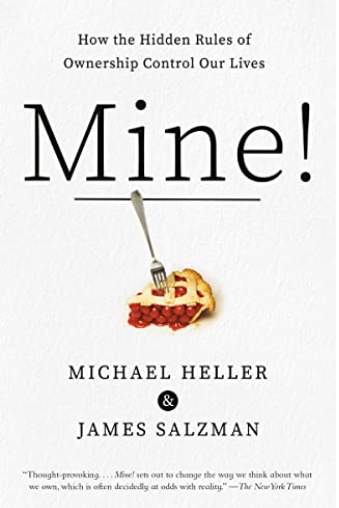
MAIN IDEA:
This book is about ownership, or more specifically, about popular misconceptions about this notion. It reviews six such misconceptions and allocates a chapter to each, demonstrating why usual beliefs are wrong. The book also defines how it works and what it is all about:” Once you understand how the rules actually work, you will see the drama taking place beneath our workaday concept of ownership. Governments, businesses, and ordinary people are constantly changing the rules on who gets what and why. Each of these choices creates winners and losers. And this has always been so. At its core, human society exists to help us deal with competing claims to scarce resources—whether food, water, gold, or sexual partners—so that we don’t kill each other too often.” It also discusses the potential future development of human society and the notion of ownership.
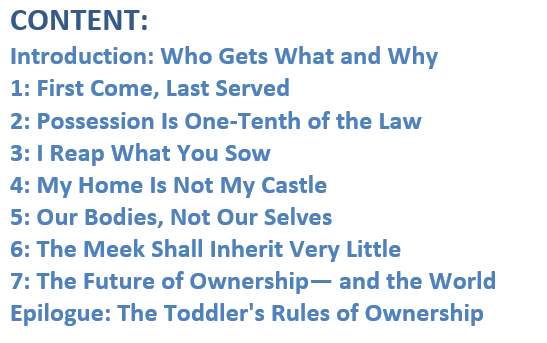
MY TAKE ON IT:
It all looks like there are only two conceivable methods of controlling resources: ownership and hierarchy. In ownership, individuals have control over resources and interact, either voluntarily exchanging them as needed or cooperating in combining them. In a hierarchy, individuals control resources via some structural relationship when the superior directs the action of the inferior. Reality always presents some combination of these methods. This book nicely demonstrates the complexity of realistic controls over resources and the inadequate character of simplified beliefs about ownership. The book correctly points out that the critical issue is “who decides?”. My answer would be that individuals should decide as much as possible with all and any coordination between them occurring voluntarily. I understand that it is not always possible, but it is the objective humanity should strive to achieve if its members have a good life.
20220507 – The Aristocracy of Talent

MAIN IDEA:
This book defines meritocracy this way:” A meritocratic society combines four qualities which are each in themselves admirable. First, it prides itself on the extent to which people can get ahead in life on the basis of their natural talents. Second, it tries to secure equality of opportunity by providing education for all. Third, it forbids discrimination on the basis of race and sex and other irrelevant characteristics. Fourth, it awards jobs through open competition rather than patronage and nepotism.”
The book then reviews the history of ideas that promote the meritocratic society and the success of these ideas in creating contemporary Western societies and their democratic forms. However, it also reviews the current growing crisis of meritocracy and its slow conversion into the new aristocracy that depends more on the inheritance of genes and wealth than on the results of individual actions. Finally, it discusses the ongoing revolt against meritocracy from the left and the right, stressing the need to find ways to retain this resource allocation method.

MY TAKE ON IT:
My attitude to meritocracy is simple: as long as it is real, it is the best way to allocate power and control over resources. However, my philosophy is that the power of some people over others has to be minimized to the lowest level possible, at least to the extent that everybody has enough to pursue whatever objectives they desire. Whether these objectives are limited to enjoying one’s life or include some grandiose goals is not essential. What is critical is that pursuing these goals involved only voluntary interactions with others, which means the market, and excluded coercive interactions, which means robbery, violence, and government interventions. Consequently, the meritocracy would work via practical consequences of individual actions rather than via formal evaluation of an individual’s abilities. Minimizing violence and government use would automatically lead to selecting the best people for obtaining good results rather than the best people for getting high grades.
20220430 – From Zero to One

MAIN IDEA:
This book discusses the issue of qualitative change when the state of the system changes from 0 to 1, which is entirely different than quantitively evolving from 1 to 2. This discussion proceeds mainly in the business area about building businesses that create new things that did not exist before. It touches on many relevant areas and concludes by presenting four future development scenarios, only one of which will be realized.

MY TAKE ON IT:
I agree with most of the ideas expressed in this book, especially in the business area. However, the most significant problem of them all, is the gigantic social change we are going through today, which is the growing redundancy of humans for the production of goods and services. The book does not explicitly recognize this problem, leave alone propose a solution. Instead, the authors allocate lots of attention to founders, stressing their role in going from zero to one, which is understandable because they belong to this personality type. But it is insufficient because the founders could exist only when everybody’s survival and even minimal satisfaction were guaranteed. Otherwise, all energy would be spent on survival, meaning just moving from condition 1 – the level below survivability, to 1.01 – the level of minimal survivability. It is also an excellent guide to the logic and circumstance of business innovation.
20220423 – Spies, Lies, and Algorithms

MAIN IDEA:
This book reviews a few known successes and many failures of the American Intelligence community, its continuously growing structure, its history, its present dysfunctionality, and its increasingly complicated future. The main point this book makes is the dramatic increase of the information available to civilians, who are often capable of providing better analysis than multibillion-dollar agencies of the intelligence community. The second point is that cyber intelligence has become both: a growing business industry and a growing hobby for many people. The result is such an increase in the scale of intelligence community failures that one could not possibly even imagine a couple of dozen years ago. An excellent example would be an acquisition by Chinese intelligence of OPM security clearance data on millions of Americans.
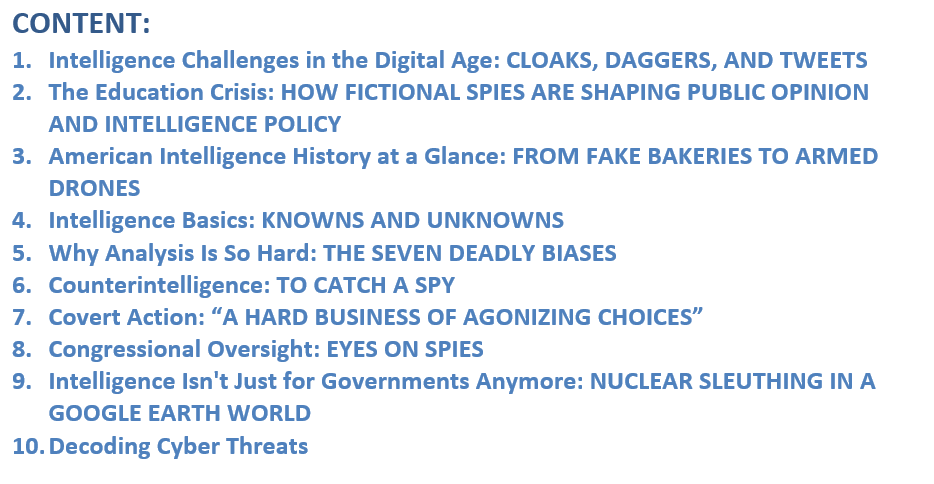
MY TAKE ON IT:
After reading about the apparent dysfunctionality of the American intelligence community, I should be distraught and scared, but I am not. Being somewhat familiar with both sides of Cold War intelligence and security competition, I believe that the stupidity and dysfunctionality of former Soviet and now Russian intelligence significantly exceeds the same of their American counterpart. I am pretty sure the same applies to Chinese. So, all things being otherwise equal, Americans would win. However, I would like to suggest a few upgrade measures that could make such an outcome guaranteed:
- Remove all generic security clearances and substitute them with clearances for a specific document. With current technology, it is not that difficult to keep in the database for each document names of individuals authorized to use this document. Similarly, it should not be a problem to save in the database entry for each individual code of documents this individual is authorized for. The ability of private Manning or technician Snowden not only to read but also download millions of classified documents was beyond any conceivable level of incompetency of officials responsible for the design of the security protocol.
- Combine all agencies into two, each of them covering the full scope of intelligence services and competing between themselves.
- Keep public track record for senior intelligence officials, so consistently failed individuals could be excluded from positions of responsibility.
- Change attitude to defectors from the enemy side by treating them as our own under suspicion in treason, meaning constant surveillance combined with conditional trust. Retaliate for any harm to them as if they were our own and provide them with the same level of support. For example, if Kennedy provided the same level of support to Cubans on Playa Giron as they were marines, Cuban people would not need to endure 70 years of communist tyranny.
20220416 – Work

MAIN IDEA:
This book reviews various types and nature of work, from hunter-gatherers to agricultural labor to work in the contemporary economy, whether as salaried people or self-controlled high-tech workers. The book is based not only on theoretical knowledge but also on detailed anthropological observations of hunter-gatherers and the destruction of their world after an encounter with more powerful societies. The book also looks at functional developments of the work process in energy, production, and use of tools. It also analyses the development of various forms of interaction with the environment, whether concerning types of living: cities vs. villages vs. nomads or division and organization of labor and trade. Finally, the book discusses our automated future, which inevitably includes the creative destruction of the currently existing form of society. It is unclear how it will look, but it has to be sustainable or else…

MY TAKE ON IT:
It is an excellent description of the historical development of human interaction with the environment in the process of resource acquisition from the earlier stages typical to the most animals to uniquely human and very complex contemporary world. This description is nearly utterly consistent with my understanding of these processes, so there is little to add. However, I would like to expand something that the book only hints at: “Other interesting approaches propose extending the fundamental rights we give to people and companies to ecosystems, rivers, and crucial habitats.”. I believe it will be a crucial change in the organization of society if all people get equal and unalienable property rights on all forms of shared and undividable resources. If implemented, such an organization would provide necessary resource flow to everybody without the need for work as the long automated process could generate such resource flow. However the idea of giving rights to non-humans such as “environmental systems” means just giving power to some people to control activities of others under pretense of defending these “rights”. This approach would lead to no good because it would mean fighting between humans for representing rights of these “environmental systems”, which would be no different than traditional fight for resources.
20220409 – Collective Illusions

MAIN IDEA:
This book is about conformity and the human tendency to comply with authority in fear of short-term punishment even at the cost of losing long-term benefits. The idea is to look at the process of such compliance that usually includes lying, accommodation to dominant ideas and powerful leaders even if one does not believe these ideas and despises these leaders. The author also suggests using some specific tools to overcome this problem. These include asking questions such as “why we do it this way?” and rejecting living by the lie. Finally, the essential tool in overcoming illusions is maintaining congruence of one’s personality, actions, and behavior.
CONTENT:

MY TAKE ON IT:
Everything here is pretty much nice, meaningful, and even somewhat helpful, especially concerning empirical research results. It would be wonderful if “the living in truth” would not be so detrimental to one’s health in typical situations of totalitarian societies like the USSR and even semi-totalitarian groups as American Academy today. People read Solzhenitsyn and have no clue how unusual is his case, not because he was a great writer, but because he survived. The noncompliance with dominant opinions and behaviors always has a cost, which could be very steep. If one to survive, it is essential to keep the balance between maintaining congruence of one’s personality and continuing existence of one’s body. It is not for nothing that the same people that were heroic revolutionaries before the Russian revolution when they were fighting czar’s political police – Okhranka became scared and highly compliant non-heroes with Stalin’s NKVD. It was not easy, but it was heroic to go on hunger strike when newspapers promoted, and many people admired one’s heroism. And the hunger strike is entirely different thing when nobody cares about it, while one is already starving to death anyway. In short, always consider the price and your readiness to pay it.
20220402 – How Civil Wars Start

MAIN IDEA:
This book discusses the results of sociological research based on an analysis of the hundreds of civil wars in the XIX and XX centuries. It identifies the key parameters that create conditions for societies’ breakdown into Civil War. First, the condition of the Anocracy– the state of society being strictly between autocracy and democracy, is necessary but insufficient. On a scale of -10 to 10, it is -1 to +1 when war occurs and -6 to 6 when serious troubles arise. The addition to Anocracy, the fractioning of the society into multiple factions, some of which are rising up at the expense of others that are going down, is an additional factor. Finally, the loss of hope for peaceful resolution of problems either via fair elections or via negotiations makes violent competition all but unavoidable.
CONTENT:
Introduction
Chapter 1: The Danger of Anocracy
Chapter 2: The Rise of Factions
Chapter 3: The Dark Consequences of Losing Status
Chapter 4: When Hope Dies
Chapter 5: The Accelerant
Chapter 6: How Close Are We?
Chapter 7: What a War Would Look Like
Chapter 8: Preventing a Civil War
MY TAKE ON IT:
I find this book very interesting and quite curiously separated into two. On one side, it is the work of the social scientist based on the wealth of experimental data thoroughly processed and analyzed that resulted in a very well-formulated and well-communicated model of societal degradation into the factions fighting each other to death. It is an excellent analysis, and I generally agree with its inferences. On the other side, it is a primal scream of the white women of North European background heavily indoctrinated into leftist, racist antiwhite ideology who consistently expresses hope to see “black and brown” people becoming the majority and expunging whiteness of America while substituting it with some kind of benevolent form of National-Socialism. All this combined with the extreme form of Trump derangement syndrome. I think that the first side is well worth reading, and the second side deserves skipping without any loss of value whatsoever.
20220326 – Woke Racism
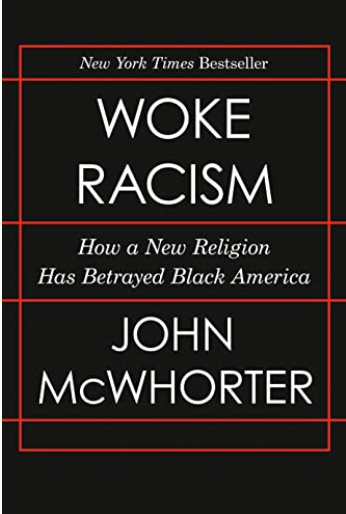
Key Insights per Thinkr:
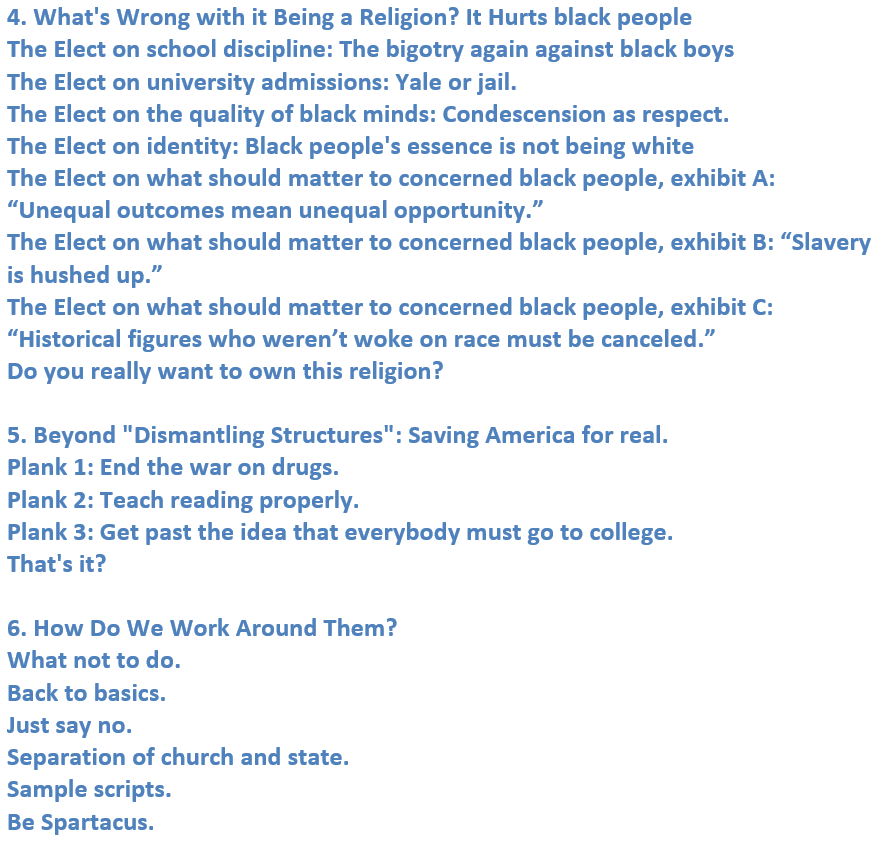
- Third Wave antiracists have formed a religious, enlightened “Elect,” and their vision and agenda are not to be questioned.
- Third Wave antiracism has all the hallmarks of a religion, from clergy and apocalyptic vision, to a doctrine of original sin.
- The religion of antiracism is not helping black people.
- There are three practical, achievable adjustments that antiracists should back if they really want to see black communities thrive: Legalize drugs, Teach to Read fluently, and provide non-college opportunities.
CONTENT:

MY TAKE ON IT:
The idea that Wokeism is a religion sounds pretty convincing. It does have lots of indicators of religious fanaticism. However, I think it is valid only in a somewhat insignificant number of cases. Similar to National-Socialism and Communism, it is just ideologically formulated to strive for power over other people. Even so, only a small minority of the wokes would sacrifice anything significant in this struggle. The majority of wokes are white, and all this is just a good career move that often helps to move ahead by undermining somebody else more qualified or more deserving. It is pretty typical for totalitarian regimes when someone is trying to move to a better position at work by informing Gestapo that somebody who occupies the coveted position has Jewish grandma or informing NKVD that the neighbor who has a bit bigger room is not sufficiently in awe of Stalin. The totalitarianism currently established in American Academia and quickly moving to other areas of life is not that different. The only real remedy for this malaise is the change of environment so that anybody that demands the punishment of others for thought crime would be immediately punished. For example, a group of professors signing a demand to fire somebody for politically incorrect twit should find themselves unemployed. Somehow, I doubt that it would be that many religious Wokes / Elect to make such demands after one occurrence of just retaliation.
20220319 – Taxing the Rich

MAIN IDEA:
This book discusses taxation of the rich mainly in democratic countries when such measure requires the support of the people. It reviews such reasons as the ability to pay the compensation for privileges provided to the rich by the government. It presents results of sociological research that provided a few main categories of support for taxation:
- Equal Treatment [fairness]—Preference for the government treating citizens the same through a proportional or flat tax.
- Ability to pay [fairness]—Specifies that the rich are better able to afford or will be less harmed by a tax increase than the poor.
- Compensatory [fairness]—Suggests a higher tax on the rich is justified because of other inequalities or advantages.
- General Fairness [fairness]—Refers to fairness but not specifically to “Equal Treatment,” “Ability to Pay,” or “Compensatory” conceptions of fairness. These responses are often of the form “because it’s fair” and were employed to justify choices for both Plan A (proportional) and Plan B (progressive).
- Progressive Treatment—Argues for a plan that taxes the rich more or poor less but does not give any reason why.
- Economic Efficiency—Argues that the preferred plan is good for the economy in some way.
- Self-interest—Chooses the plan that makes the respondent better off economically.
Then the book reviews taxation history, trying to answer such questions as to when, why, and how taxing of the rich was implemented. Finally, it provides detailed reviews of taxation use as the tool of social mobilization during wars and as a tool of society stabilization necessary to prevent explosion due to inequality and perceived unfairness of society’s organization.
CONTENT:
Part One — Debating Taxation
1. Why Might Governments Tax the Rich?
2. Treating Citizens as Equals
Part Two — When have Governments Taxed the Rich?
3. The Income Tax over Two Centuries
4. Taxing Inheritance
5. Taxes on the Rich in Context
Part Three — Why have Governments Taxed the Rich?
6. The Conscription of Wealth
7. The Role of War Technology
8. Why Taxes on the Rich Declined
9. What Future for Taxing the Rich?
MY TAKE ON IT:
The main reason for taxation in all its forms is the necessity to leave production processes mainly to the private sector. When the private sector creates resources, taxation as a form of robbery is necessary to obtain resources for the unproductive part of the population. The history of the socialist countries in the XX century, in which taxation was not really needed because most of the resources were created within the framework of the top-down government hierarchy, clearly demonstrated that it was not effective in producing goods and services that people need even for survival, let alone prosperity. It is not a new phenomenon. From ancient times to our day and from Egyptian pharaohs to contemporary presidents and prime ministers, the common knowledge is that private business produces wealth.
In contrast, the government hierarchy needs to take this wealth from others to spend. Traditionally, the elite did it with brute force ideologically supported by religious or quasi-religious teachings. However, when such teachings somewhat wear out due to scientific progress and individual use weapons such as firearms and IEDs become available, these traditional methods lose most of their power.
It is evident that contemporary somewhat oligarchical democracy is just a new tool for wealth transfer away from its producers to the governmental elite. It is then distributed throughout the government hierarchy from the elite members at the top to the welfare recipients at the bottom. What is very interesting, and what this book very capably presents, is the process of modern ideological conditioning in the environment of democracy. It shows how this conditioning allows such transfer, how justifications work on the population’s minds, and how emergencies such as wars allow moving tax rates up. Another point that I’d like to make is that increased productivity makes lots of people redundant for production and dependent on welfare handouts, often in the form of meaningless, even if well-paid jobs. The increase in numbers of such people provides expanding base for support of tax increases. However, too much taxes and ideological denigration of producers inevitably decrease the willingness of these people to produce. Why would a mentally fit person start a business, work hard, and use their talents to make something if the fruits of this effort are taken away? It would be much more beneficial and prestigious to use these talents and hard work to get a good place in the hierarchy and then just enjoy a good life at somebody else’s expense.
20220312 – Wiser

MAIN IDEA:
This book describes what authors believe is the scientific approach to wisdom. The authors also intend to help people become wiser by explaining wisdom, its components, and how one could enhance it. Here are the key points:
Prosocial Attitudes and Behaviors. These include empathy, compassion, and altruism. What exactly do these terms mean? Empathy is the ability to understand and share the feelings and thoughts of another. Compassion involves translating empathy into helpful behavior. Altruism is opposite of egoism and refers to actions to help another person without expecting any external rewards. Can you put yourself in others’ shoes and do you want to help those in need? In psychology, there is a concept called “theory of mind,” which describes the ability to attribute mental states—beliefs, desires, emotions, knowledge—to both yourself and others. Theory of mind is essential to behaviors like compassion, where we often act out of a recognized connectedness with others.
Emotional Stability with Happiness. This is the ability to maintain self-control, while preferring positive feelings to negative ones. “Anger is a brief madness,” observed the ancient Roman poet, Horace. Few acts are done well when driven by unthinking passions.
Balancing Decisiveness with Acceptance of Uncertainty. The latter involves acknowledging that different but equally valid perspectives exist and that things can change, including one’s deeply held thoughts and beliefs, over time and with new knowledge, experience, and insights. It means recognizing that other people may have different beliefs, desires, intentions, and perspectives and that people with different belief systems need not be considered evil or unintelligent. But while we accept uncertainties in life and diversity of perspectives, one cannot sit on the fence too long or too often. One must act when action is called for, based on the information at hand, knowing that the decision could later prove to be the wrong choice. Deciding not to act is also a decision.
Reflection and Self-Understanding. These include insight, intuition, and self-awareness. Are you able to analyze yourself and your motivations, your strengths and weaknesses? Understanding oneself is much more difficult than people think.
Social Decision-Making and Pragmatic Knowledge of Life. These relate to social reasoning and the ability to give good advice, as well as share life knowledge and life skills. Wisdom not shared is wisdom not gained but lost.
Spirituality. It should be noted that spirituality is not the same as religiosity. The latter typically refers to organized or cultural systems of belief. Religion can be and often is spiritual in nature, but its practices vary considerably in societies and around the world. Spirituality is a more universal constant, a core human belief in something larger than the individual and the society. It leads to a feeling of humility as well as comfort in going beyond the stresses of everyday life. Spirituality can include religion, but it can mean and embrace much, much more.
The authors provide a somewhat interesting discussion about the structure of the human brain, its features learned from observation of individuals with impaired brain functionality, and the relation of age and behavior they consider wise. They also provide IQ-type tests supposedly measuring an individual’s level of wisdom.
CONTENT:
Introduction
Part l: What Is Wisdom?
Chapter 1: Defining Wisdom
Chapter 2: The Neuroscience of Wisdom
Chapter 3: Wisdom and Aging
Chapter 4: Measuring Wisdom
Part Il: Components of Wisdom
Chapter 5: Cultivating Compassion
Chapter 6: Emotional Regulation with Happiness
Chapter 7: Balancing Decisiveness with Acceptance
Chapter 8: Self-Reflection, Curiosity, and Humor
Chapter 9: Spirituality
Part III: Enhancing Practical and Societal Wisdom
Chapter 10: Becoming Wiser Faster
Chapter 1 1: Wisdom Boosters
Chapter 12: The Future of Wisdom
MY TAKE ON IT:
I think that an attempt at a purely scientific approach to wisdom and its acquisition is kind of unwise. Science is the method of developing intellectual tools for predicting the future, at least probabilistically. Wisdom is the human ability to optimize behavior to achieve the most effective balance between two contradictory needs of assuring survival: obtaining individuals benefits, even if at the group’s expense, vs. providing benefits for the group, even at the expense of individual well-being. I agree that such ability is changing with age and is malleable. However, I doubt that it could be the subject of adequate training, just because it is highly dependent on circumstances of life and such circumstances are always unique and unpredictable. Nevertheless, the catalog of behavior that correlates with high quality of life could be helpful for people who either do not have enough living experience or experienced a low quality of life.
20220305 – The Spaces Between Us

MAIN IDEA:
This book is about the space surrounding any animal, humans included, serving as a multilayered protection bubble. The brain constantly monitors this space and applies various measures to indicate danger or opportunity.
CONTENT:
CHAPTER 1 The Second Skin
CHAPTER 2 A Startling Discovery
CHAPTER 3 The Flight Zone of the Zebra
CHAPTER 4 The French Stare Too Much, and My Lover Has a Bulgy Nose
CHAPTER 5 Monkey Versus Ping-Pong Ball
CHAPTER 6 Kissing in the Dark
CHAPTER 7 Hand-to-Mouth and Other Shocking Surprises of the Motor Cortex
CHAPTER 8 Super-Flinchers and Nerves of Steel
CHAPTER 9 The Peripersonal Radar in Humans
CHAPTER 10 Wrapping Personal Space Around My Black & Decker
CHAPTER 11 Why It’s Sexy to Let a Vampire Bite Your Neck, and Other Social Consequences of Peripersonal Space
CHAPTER 12 The First Smile
CHAPTER 13 The First Laugh
CHAPTER 14 The First Cry
CHAPTER 15 The Personal Dimension of Personal Space
MY TAKE ON IT:
This book is an interesting take on the interactions between animals and the environment. There is a direct link between the complexity of animal brains, the effectiveness of monitoring the space around the animal, and complex rituals developed to handle these processes between individuals. It is also fascinating with humans because it is highly dependent on the culture of the specific individual. The information about relevant scientific research and the author’s personal experience with the disorder of space controlling provides some insights into the human and space-around relationship and processing. I think that the ongoing process of humanity‘s transfer from the multitude of groups with different space-related rituals into one combined group based on a more complex but generally unified set of rituals will support much better communications and interactions between individuals.
20220226 – Rationality
Key Insights per Thinkr:
- We humans are capable of brilliant, incisive thought and also are vulnerable to the oldest tricks in the book.
- Reason is so fundamental to life that you can’t make a case against reason without relying on it.
- When we cannot negotiate and resolve problems with the tools reason provides, society becomes divided and bellicose.
- It is much easier to ground morality in reason than to ground it in God.
- The stock answers to the question, “What is wrong with people?” only scratch the surface.
- Suffering and confusion flourish when mythology oversteps its bounds and masquerades as realism.
CONTENT:
1. How Rational an Animal?
2. Rationality and Irrationality
3. Logic and Critical Thinking
4. Probability and Randomness
5. Beliefs and Evidence (Bayesian Reasoning)
6. Risk and Reward (Rational Choice and Expected Utility)
7. Hits and False Alarms (Signal Detection and Statistical Decision Theory)
8. Self and Others (Game Theory)
9. Correlation and Causation
10. What’s Wrong with People?
11. Why Rationality Matters
MY TAKE ON IT:
I think that the very question posed by the division of human behavior into rational and irrational is mainly meaningless. Like all other animals, humans are evolutionary conditioned to act so that it is beneficial either to the survival of an individual or a group this individual belongs to. Therefore, the approach should be not a critic of human irrationality but a search for understanding of action assuming that these actions benefit survival. The seeming irrationality comes from the complexity of human existence, which by far exceeds the complexity of formal analytical tools. Consequently, attempts to analyze human behavior with these formal tools are like measuring a 3-dimensional multifaced figure based on its projection on the plain. The typical example of irrationality discovered by psychologists and behavioral economists is the human tendency to choose A over B, B over C, and C over A. From the point of view of Boolean logic, it is wrong. However, if A, B, and C are multifeatured objects, such choice could be perfectly logical if each object has a combination of at least two features so one can prefer 1 & 2 over 2 & 3. 2 & 3 over 3 & 1. And, finally, 3 & 1 over 1 & 2.
Overall, it is a pretty good compilation, except for a somewhat hilarious part when the author’s light form of Trump derangement syndrome (TDS) causes him to provide some vivid examples of absolutely irrational thinking. However, it is a slight handicap in this generally solid work.
20220219 – The Myth of the Entrepreneurial State
MAIN IDEA:
This book mainly responds to the popular ideas promoted by supporters of “Entrepreneurial State” that claim that all achievements of individual entrepreneurs result from government activities that created infrastructure and support the rule of law. Specifically, it is directed against Mazzucato – an Italian economist, who is getting more and more power as an adviser to the government. She and other promoters of such ideas, such as Piketty and Obama, with his “you did not build your business. The government did it”. The authors methodically go step by step through pseudo-economic ideas promoted by these people and demonstrate that these ideas are not workable and often based on false data and an entirely discredited ideology of socialism.
CONTENT:
Part I – Popular, But Mistaken, Economic Ideas
1. Introducing Mazzucato
2. Statism and Its Allies
3. Statist Intervention Is Not Innocent
Part II – Innovism Has, In Fact, Worked Bottom-up
4. The Great Enrichment Came Not from the State but from Liberty
5. “Driving” from the Top Is Not Its Explanation
6. Bottom-Up Does Work
7. Economic History Rejects Mazzucato’s Hypothesis
8. There Is No “Linear Model”
9. The Internet, for Example, Was Not Invented by the State
10. Bottom-Up, Then, Is Pretty Good
11. One Must Measure the State with a Sample of the Economy
Part III – Statism Has Never Worked
12. The State Should Have a Role, but Should Not be the Director
13. For Understandable Reasons the State Is Bad at Innovation
14. Most Governments, After All, Are Demonstrably Incompetent
15. State Foresightedness Is Implausible
16. The Hypothesis of Significantly Imperfect Market Has Never Been Tested
17. Stakeholder Theory is Defective
Part IV – The Political Economy of Mazzucato is thoroughly Illiberal
18. Mazzucato Distrusts Ordinary People
19. Keynesian Mastery Takes Away Dignity
20. The Market Accords Dignity
Part V – Illiberalism Leads to Deep Technical Errors
21. The Economic Errors of Lawyers and Pre- 1870s Economists
22. The Top-Down and Legacy-Payment of Statism are Illiberal
23. The Supply-Chain Fallacy Underlies Mazzucato’s Method
24. The Enchaining of Human Action Reverts to a Labor Theory of Value
25. What Sort of Economy Do People Want?
MY TAKE ON IT:
It is a very nice book, and it could be very educational for anybody who still doubts that socialism is not working in any of its multiple forms. It failed either as fully totalitarian state ownership of the means of production as in the USSR, or as corporatist socialism of Mussolini, or in its currently popular reincarnation as “the big benevolent government” of welfare states. I think that the idea of socialism was quite scientific at the time of Marx in the XIX century as a hypothesis. Still, many countries’ experiences have thoroughly discarded it by now. What is clear is that any supporters of communism and socialism are either illiterate bums, both economically and historically, or just plain power-hungry immoral crooks. Considering the dismal state of education elsewhere in the world, I would say that the people until their mid-twenties usually belong to the former type because of miseducation. As to professional economists, I do not see how any of them who still support socialism could be anything but one of the latter types – crooks.
20220212 – Burdens of Freedom

MAIN IDEA
The author briefly describes the central theme of this book as: “The contrast between Western and non-Western ways of life is the great division in the world today, both within and between countries. On one side of that great divide, America—due chiefly to the world’s most individualist culture—has leapt to wealth and power. In such a society, particularly, power grows from the bottom up. It begins with ordinary people who take action toward their own goals and, in so doing, enrich and empower the nation.” On the other side is contemporary China, the country with deep collectivistic culture and history that seemingly presents an alternative when the power goes from the top down, forcing everybody to subordinate their lives to the vision and wishes of leaders at the top.
DETAILS:
Chapter One Introduction
The chapter presents the key points and overall structure of the book. It also discusses overall cultural differences between the western and non-western people, resources availability, which primarily derived from these differences, and the balance of economic and other forms of national power between two prominent representatives: America as quintessential individualistic and China as collectivistic societies.
Part One: History and Culture
This part discusses how history led to the development of the specific culture and points out that Western and especially American individualism largely explains the primacy of this part of the world.
Chapter Two: History
This chapter looks at the history of both Europe and the non-western world, dividing it into static vs. dynamic civilizations. The author presents it as competition between control and Freedom and reviews how this competition developed over time in different cultures. Until recently, this competition has increasingly demonstrated the superiority of the Western ways in all areas of human activities. Still, the new challenge from collectivistic cultures of Asia shows that high levels of development could be achieved when suppression of individual Freedom continues unabated in some areas, mainly political and cultural, but alleviated in the economy.
Chapter Three: The End of History
This chapter initially discusses ideas of “the end of history” popular at the end of the Cold War and makes the case that it did not end but became much more complicated. Then, it provides side by side graphic representation of politics before and after:
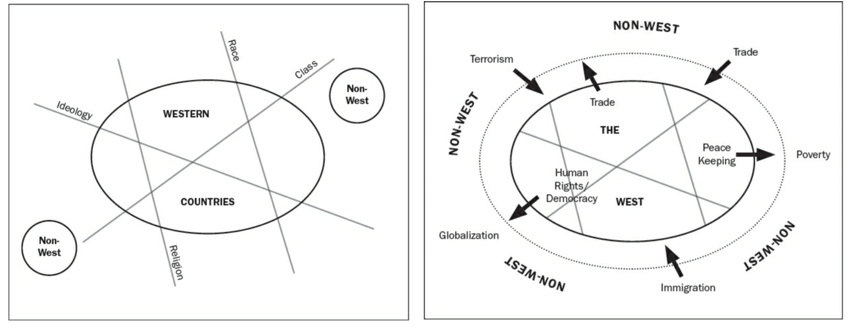
It also makes the point that the old assumption of sameness of all people regardless of their cultural background proved wrong and should be tossed away. Here is the author’s suggestion:” The Western political tradition, in fact, is antiquated. It explicates the issues that have been resolved in history, but not the deepest struggles that confront us after history. To address them, we need a new intellectual tradition. It must focus on cultural difference, not sameness; on human nature, not Freedom or equality. It will inevitably give greater place to values of order and authority, and a lesser place to Freedom or autonomy, than intellectuals favor. To reinterpret individualism as a culture of obligation rather than Freedom, as I do in this book, is already a step down that road.”
Chapter Four: Cultural Difference
The chapter first points out that the main differences between cultures are not binary but graduate: the West is somewhat more individualistic than the non-west. The chapter then discusses the variances of three critical attributes:
- Individualism vs. Collectivism
- Moralism vs. Situational Ethics
- Theory vs. Experience
The chapter then provides two graphic models of variations:
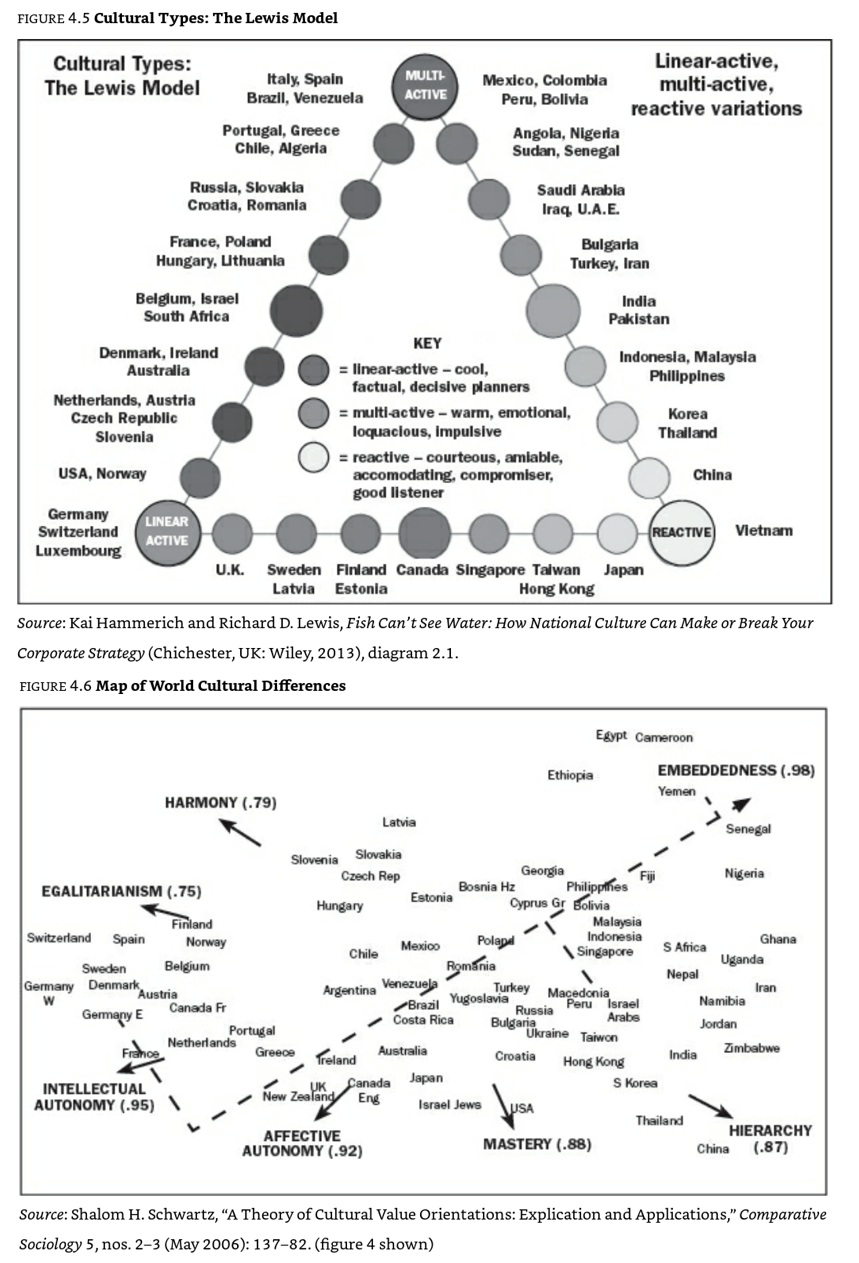
The conclusion points out differences in approach and assertiveness between cultures, making it very difficult to understand each other.
Chapter Five: The Origins of Difference
This chapter discusses the origin of differences, which it assigns to various factors from economic and social conditions to demography, history, religion, and philosophy. Finally, it looks at Europe and its most prominent countries with its culture: America and Britain. The conclusion is that typical western attitude that people in other countries want to be like them. In reality, this attitude is entirely out of the base.
Part Two: Other Roots of Power
In this part, the author looks outside the culture at other features of existence and systematically goes through the most important of them, such as:
Chapter Six: Geography;
Chapter Seven: The Market;
Chapter Eight: Good Government
However, all these factors are strongly linked to the culture, creating a kind of feedback loop. For example, with its relative independence of individuals and availability of multiple choices, the market makes a very different morality than living within some collective that imposes strict compliance on others with little if any alternatives. Correspondingly, the western understanding of good government features the interaction of more or less independent agents when people outside of government perceive themselves as customers or even bosses who theoretically could fire all government leaders and bureaucrats. On the other hand, non-western understanding features a nearly opposite approach when people outside of government are dependent on the government for their wellbeing and therefore do whatever they can to be in good graces of whatever bureaucrat they are dealing with. The author also discusses an important topic of reconciliation between Freedom and order, the challenge relevant mainly to western societies. The overall conclusion is that all these features that make the West into what it is are not easily transferrable to other cultures.
Part Three: Challenges at Home
This part looks at the Western burdens of Freedom, which come from the internal drive to pursue one’s own goals in contrast to the burdens of non-freedom imposed on individuals from outside. Sometimes these burdens are too much for some individuals, who would rather be cared for by others.
Chapter Nine: Freedom as Obligation
This chapter goes more deeply into why Freedom requires obligations, first in theory and then more concretely. Finally, it defines that the current threat to American Freedom comes mainly not from any foreign country but from the decline of individualism within America.
Chapter Ten: Social Problems; Chapter Eleven: Immigration
Chapters 10 and 11 analyze the decline, which is apparent in the recent demoralization of the working class and also in the long-standing problem of entrenched poverty. Recent immigration is also weakening the individualist character of American society. Non-Western newcomers bring valuable assets to America, just as past immigrants did, but they must also join a mainstream culture that still shoulders the burdens of Freedom. An ideal America is a multicultural society that remains individualistic.
Part Four: Future Challenges
Chapter Twelve: The Future of Primacy; Chapter Thirteen: Policy Directions
In the two final chapters, the author considers the implications of this cultural perspective for American policy both at home and abroad. He contrasts the United States with other centers of power, especially Asia:” American primacy seems likely to continue; Asian culture is too cautious and too centered on immediate interests for these countries to lead the world as the West and America have done. Against all its rivals, only the United States possesses both the will and the capacity to lead. That potential, however, depends on the maintenance of an individualist way of life at home.”
MY TAKE ON IT:
I think that the idea of Freedom requiring hard work, sometimes fighting, and always imposing obligation is not new and even maybe somewhat trivial. However, the author’s stress on the individualism of American culture and its consequences in the form of better economic outcome, less corruption, and higher quality of life, while basically correct, is not sufficiently explanatory. What is missing, in my opinion, is a more comprehensive look at the circumstances of American life, which are different from other countries by the availability of resources under individual control. The American typically owns individually both material property and their own human capital. At the same time, in other places, it is often the family or some hierarchical structure that has the power to direct individuals and suppress any external competition. For example, an American not happy with a job or living location or any other life parameters can change these parameters much easier than people in different cultures.
Moreover, an American typically has more access to other people’s resources, mainly because these resources are widely distributed among the population rather than concentrated in the hands of some government hierarchy. Finally, the cost of a failure is much smaller in America than in other places because the culture is formed in circumstances of the open frontier, so one could overcome the failure by “going West”. As to competition from Asian culture, I guess meaning China, I also optimistic because whatever errors America will make, whatever failures she endures due to incompetence and corruption of its elite, the incompetence and corruption of China’s communist elite would easily double or triple American levels of corruption and incompetence. One also had to add that rigid hierarchical structure would stick to an error much longer and cause much more damage than a flexible network of individuals controlling distributed resources that compete against each other. Only conversion of America into a quasi-socialist society by the elite could cause it to fail. Still, this process seems to encounter fast-growing resistance, so it will probably stop well before the damage becomes existential.
20220205 – Creation of Inequality
MAIN IDEA:
This book reviews massive amounts of historical and anthropological data to demonstrate how inequality develops in different societies and the causes of such development. It also suggests that the value of inequality as an effective tool for development is probably exhausted. It is time to start switching back to a more natural mode of human relations that has worked very well for a very long time – an egalitarian society.
DETAILS:
Part l: Starting Out Equal
ONE: Genesis and Exodus
This chapter discusses the origins of humanity in Africa, its distribution worldwide, and the initial development of the surplus either in the form of labor investment into improving gathering opportunities for the next season or fish smocking to save it for later use. Archeologists found these and similar cases dated long before the switch to agriculture. The chapter also describes human colonization of the Earth, its forms in various environments, and its impact on human behavior and DNA that created the varieties of adjustments such as skin color adjusted to the amount of sunlight available in different locations. It then asks why all this started occurring only about 20 000 years ago, while contemporary humans have at least 100,000 years of existence. The answer the author provides: is that it all was linked to the formation of families and then clans, which began competing, including the military, for prestige and possessions. At the end of the chapter, the author notes that society with clans has a greater inequality level than societies without.
TWO: Rousseau’s “State of Nature”
This chapter begins by referencing Rousseau’s speculative ideas about the state of nature. It proceeds to review how archeological research and real-live hunter/gatherers, observed by anthropologists in recent times, fit into these ideas’ framework. Next, the author discusses several Eskimo tribes, archeological work on prehistoric Folsom culture in Colorado, and several African tribes. The results demonstrated the egalitarian nature of these societies. The author contrasts this to the behavior of our close relatives – chimpanzees who constantly fight for dominance and maintain strict hierarchy even in small groups.
THREE: Ancestors and Enemies
This chapter discusses the origin of violence and links it mainly to the formation of clans. It notes that individual violence in hunter/gatherer societies is usually regulated quite effectively by revenge, either directly against the perpetrator or via substitution by another member of the perpetrator’s group. The chapter reviews the oldest archeological evidence for group violence from the Nile Valley: Jebel Sahaba, the anthropological research in the Andaman Islands in 1906-1908, and Australian and Tasmanian tribes. The author concludes that despite increased violence due to the emergence of clans, inequality did not significantly increase. The author also points out the emergence of the trade mainly in ritual related goods, accumulation of which could increase the prestige of one induvial comparatively to another. Still, it was far from creating the foundation of severe levels of inequality.
FOUR: Why Our Ancestors Had Religion and the Arts
The author begins this chapter by summarizing a set of typical features of hunter/gathering societies and how they relate to inequality:
1. Generosity is admirable; selfishness is reprehensible.
2. The social relationship created by a gift is more valuable than the gift itself.
3. All gifts should be reciprocated; however, a reasonable delay before reciprocating is acceptable.
4. Names are magic and should not be casually assigned.
5. Since all humans are reincarnated, ancestors’ names should be treated with particular respect.
6. Homicide is unacceptable. A killer’s relatives should either execute him or pay reparations to the victim’s family.
7. Do not commit incest; get your spouse from outside your immediate kin.
8. In return for a bride, the groom should provide her family with services or gifts.
9. Marriage is a flexible economic partnership; it allows for multiple spouses and variations.
In addition to these principles, which imply no inequality among members of society, we also encountered some premises that allowed for a degree of inequality. They were as follows:
10. Men have the capacity to be more virtuous or ritually pure than women.
11. Youths should defer to seniors.
12. Late arrivals should defer to those who were here first.
In those societies that featured lineages, clans, or ancestor-based descent groups, the following new premises appeared:
13. When lineages grow and divide, the junior lineage should defer to the senior lineage, since the latter was here first.
14. You are born into your family, but you must be initiated into your clan.
15. The bad news is that initiation will be an ordeal. The good news is that you will learn ritual secrets, become more fully a member of your ethnic group, and perhaps gain virtue.
16. Any offense against a member of your lineage or clan, such as murder or serious insult, is an offense against that entire social unit. It requires a group response against some member (or members) of the offending group.
17. Any armed conflict should be followed by rituals of peacemaking.
The author then discusses the cosmology and religion of these societies and concludes that the typical ideological setup is the source of difference between human and chimpanzee groups concerning dominance and inequality. Here is how the author formulated this point: “When we look at hunters and gatherers, we see a dominance hierarchy as clear as that of chimpanzees. It is, however, a hierarchy in which the alphas are invisible supernatural beings, too powerful to be overthrown by conspiracy or alliance, and capable of causing great misfortune when disobeyed. The betas are invisible ancestors who do the bidding of the alphas and protect their living descendants from harm. The reason human foragers seem, superficially, to have no dominance hierarchy is because no living human can be considered more than a gamma within this system.”
FIVE: Inequality without Agriculture
This chapter once again refers to Rousseau’s ideas about reasons for the human switch to agriculture and the consequent development of inequality. However, the author points out that inequality is not necessarily linked to agriculture in all cases and reviews many societies from this angle. These are the Chumash of the California coast, the foragers of Vancouver Island, the Historic Nootka, and the History Tlingit of Alaska. The author concludes that because the availability of natural resources is unequal in different places and periods, the hunter/gatherers initially create multiple sharing methods to compensate for this variance. However,
the formation of clans transforms it into a group competition with some groups and lineages rising in prestige and power and some falling. Eventually, it forms hereditary inequality.
Part II: Balancing Prestige and Equality
SIX: Agriculture and Achieved Renown
This chapter describes several societies in which anthropologists observed the process of the transfer to agriculture. These were Gana of the Kalahari region in the 1960s, Chimbu, and some other tribes in New Guinea. Here is a typical list of changes:
1. The creation myth was revised to claim that spirit ancestors (among their other teachings) showed humans how to garden.
2. Even those tribes with a history of immediate-return economy converted to a delayed-return economy, justifying the investment of labor in clearing and planting gardens.
3. Prohibitions against hoarding were relaxed so that gardeners could begin storing plants such as yams and sweet potatoes.
4. Previous behaviors in which men shared meat with everyone and women collected plants only for their family were modified. Now men pressured their wives to produce surplus plants for lavish feasts to which guests were invited.
5. Bride-price escalated.
The author also describes tribesmen’s recollections of warfare as it existed before colonialist-imposed pacification and the related process of raising “Big Men,” which slowly moved to become a hereditary position. This process was mainly based on achievement at war and accumulating surplice resources to sponsor communal building and rituals.
SEVEN: The Ritual Buildings of Achievement-Based Societies; EIGHT: The Prehistory of the Ritual House
These two chapters describe the structure and use of ritual buildings and how they came into existence. In addition, it provides a pictorial description of a few of them discusses the meanings and implementation of related rituals.
NINE: Prestige and Equality in Four Native American Societies
In this chapter author how some individuals have risen over the others in the traditional communities of the Tewa, Hopi, Mandan, and Hidatsa and the result of this process: “All four groups struck a balance between personal ambition and community spirit. These ethnic groups created a socially accepted way for talented individuals to rise to positions of respect while working to prevent the development of a hereditary nobility.”
Part III: Societies That Made Inequality Hereditary
TEN: The Rise and Fall of Hereditary Inequality in Farming Societies
After stating that archeology provides very little information about the formation of hereditary inequality, this chapter looks at several living societies at different stages of this process. Finally, the author presents the comparison of two cultures: gumlao and gumsa:
The premises of gumlao society were as follows:
1. All lineages are considered equal.
2. All villages in a territory are politically autonomous.
3. Each village has a headman, to whom no tribute is owed.
4. Debts require modest repayment, with what we would call interest. (We discuss this in detail later.)
5. The price for all brides is the same.
6. Men of lineage A marry women of lineage B. Men of lineage B marry women of lineage C. Men of lineage C marry women of lineage A.
7. All siblings are equal. It makes no difference whether one is born first or last.
8. When a lineage grows and divides, there is no senior or junior division; both are equal.
9. One’s loyalty is to the place where one lives.
10. Each headman is to be advised by a council of elders.
11. Land is controlled by all the lineages that originally entered the region. Late arrivals must negotiate for land.
12. Everyone makes sacrifices to his or her household ancestors, to one of the lesser sky spirits, and to one of the lesser earth spirits.
13. The head of each lineage does the above and also makes sacrifices to a regional spirit, to a sky spirit other than the supreme spirit Madai, and to an earth spirit other than the supreme spirit Shadip.
In contrast, the premises of gumsa society were as follows:
1. All lineages are ranked relative to one another.
2. Villages are no longer autonomous; all settlements within a territory are controlled by a single chief.
3. Everyone who does not belong to the chief’s lineage must pay him tribute, usually in the form of a thigh from every animal sacrificed.
4. Individuals of high hereditary rank must pay more compensation (interest) for their debts.
5. Families of elite brides can request a higher bride-price.
6. The giver of the bride is considered superior to the recipient.
7. To encourage older sons to leave home and found a new lineage elsewhere, all property is left to the youngest son.
8. Any lineage that grows and splits results in senior and junior lineages, with the former dominant.
9. One’s loyalty is to one’s lineage rather than to a place.
10. The hereditary chief is to be advised by a council of lineage heads.
11. All land is controlled by the chief’s lineage.
12. Lower-ranking people continue to make sacrifices to their household ancestors, and to lesser sky and earth spirits. Chiefs alone make sacrifices to the regional spirit of their lineage, as well as to the supreme sky spirit Madai, his daughter Hpraw Nga, and the supreme earth spirit Shadip. Chiefs are allowed to sacrifice to the highest spirits of Earth and sky, because those spirits are now considered remote ancestors of the chief’s lineage.
ELEVEN: Three Sources of Power in Chiefly Societies
This chapter uses some Polynesian tribes and rank societies of America and Bemba in Africa to describe the changes in the social logic:
1. Achievement-based groups pursued their own versions of life force. The Naga obtained it from the heads of their enemies. The Mandan obtained it from self-induced suffering. Chiefly Polynesians, however, possessed it from birth and could increase it or lose it depending on their own behavior.
2. Leaders in achievement-based societies had expertise of various kinds. They could memorize thousands of sacred names, like the villagers of Avatip, or develop skills at moka, like the people of Mt. Hagen. They could master ivory carving or eagle trapping. In the chiefly societies of Polynesia, however, certain craftsmen were more respected than others, for example, the makers of war canoes, purveyors of sumptuary goods, or carvers of giant statues such as those on Easter Island.
3. In achievement-based societies, bravery in war was already a path to renown. Chiefly societies converted war to a strategy of territorial expansion. Tired of negotiating for the products of a neighboring region, chiefs might just subjugate the region and demand its products as tribute. This enhanced the value of military prowess.
TWELVE: From Ritual House to Temple in the Americas; THIRTEEN: Aristocracy without Chiefs; FOURTEEN: Temples and Inequality in Early Mesopotamia; FIFTEEN: The Chiefly Societies in Our Backyard; SIXTEEN: How to Turn Rank into Stratification: Tales of the South Pacific
These chapters provide detailed anthropological data about this process in the various societies observed over the last century of research.
Part IV: Inequality in Kingdoms and Empires
SEVENTEEN: How to Create a Kingdom;
In this chapter, the author looks at the logic of creating kingdoms and illustrates it by describing how it happened in Hawaii with Kamehameha, Africa with Shaka Zulu, Hunza in India, and Madagascar tribes in recent times. Generally, this process depends on the ability of a rising chief to do one or more of these things:
1. Step up demand for resources from their own subjects, which may lead to revolt.
2. Intensify production through technological improvement, which will likely increase wealth but not necessarily sociopolitical complexity.
3. Expand the territory from which they get their resources, which will probably require the subjugation of neighbors.
EIGHTEEN: Three of the New World’s First-Generation Kingdoms; NINETEEN: The Land of the Scorpion King; TWENTY: Black Ox Hides and Golden Stools; TWENTY-ONE: The Nursery of Civilization; TWENTY-TWO: Graft and Imperialism; TWENTY-THREE: How New Empires Learn from Old
These chapters retell the stories of well-known ancient kingdoms from Egypt pharaohs to America’s Aztec and Incas, all subjects of massive archeological and historical research.
Part V: Resisting Inequality
TWENTY-FOUR: Inequality and Natural Law
This chapter summarizes the development of inequality by first stating that biological evolution defines success as population growth of the species, and humans succeeded in it by developing agriculture, states, and eventually empires. All this occurred via social development rather than biological change. The author defines the starting point like this:
The logic of small-scale foragers has its own first principles. The following would be typical:
- There is an invisible life force within us.
- Certain spirits, places, and objects are sacred.
- Individuals differ in virtue.
- Generosity is one of those virtues.
- Older, initiated people tend to be more virtuous than younger, uninitiated people.
- Later arrivals in a territory are obliged to defer to earlier arrivals.
- Our way of life is inherently superior to that of our neighbors.
After that, the humans moved first to achievement-based inequality, which turned into hereditary inequality, and the author recounts evidence of how it happened. Finally, the author laments the current condition of the American society, which moved far away from its origins as an egalitarian society that abolished hereditary privilege. His advice to get to the better place is to put hunter/gatherers in charge or at least emulate their principles.
MY TAKE ON IT:
It is an excellent review of archeological and anthropological research of the appearance and development of inequality. I personally have the simplistic view that natural inequality between individuals is pretty small, not exceeding 30%-60%, something like the difference between 5’10” average person with IQ-100 and 7’ basketball player or MENSA member with IQ=160. The inequality comes from society’s organization, and it is a temporary phenomenon. This phenomenon is operational only while the human society moves from its origins as hunter-gatherers living off the natural environment to its destination. This destination would feature individuals living off the sustainable environment modified to meet human needs and based on the multitude of automated processes and artificially created materials, both organic and non-organic. The main activity of these individuals would be the pursuit of happiness, mainly in the form of psychological satisfaction. This kind of arrangement could not possibly come from a socialist reorganization of the society into one huge bureaucratic hierarchy. The socialist/super bureaucratic state tried and failed each time. The return to equality will come from an ownership-based restructuring of society in such a way that every individual would have clearly defined, unalienable, and sufficient access to resources. It is possible to achieve if everybody pays for everything they use, which belongs equally to everyone. For example, a star basketball player’s compensation would be much higher than a non-star player but not hugely higher if both have to pay the royalty for the invention of basketball, tools, communications, and everything else these players use, which belongs equally to all. By the way, history shows that such star players would still do their best because the fame and prestige proved to be good enough reward by and in itself.
20220129 Ramaswamy, Vivek – Woke Inc.
MAIN IDEA:
The main idea is to use the author’s own experience to demonstrate the nature of Wokeism the danger it presents to American democracy and way of life. Another idea presented in the book relates to the novel use of legal doctrines limiting actions of top corporate management and enforcement of their fiduciary responsibilities
DETAILS:
INTRODUCTION The Woke-industrial Complex
This chapter presents the key point of Wokeism: “Basically, being woke means obsessing about race, gender, and sexual orientation. Maybe climate change too.”
However, it is even more important to explain this phenomenon’s real objectives – power and wealth. Therefore, the author demonstrates how it works based on his own experience as CEO.
CHAPTER 1 The Goldman Rule
In this chapter, the author discusses the main rule of the American business he learned working at Goldman: “He who has the gold makes the rules.”. The author then tells the story of how it works at the top corporate levels using the Woke ideology: anti-white racism, BLM, stakeholder movement to transfer wealth from shareholders to management, and whoever woke ideologists designate as recipients. The author defines it as crony capitalism 2.0. Finally, he retells some stories of his interactions with top-level business leaders promoting Wokeism, stressing that some are pretty sincere.
CHAPTER 2 How I Became a Capitalist
This chapter retells the author’s story: the child of immigrants growing in the USA with regular visits to the old country who eventually achieved the top of American corporate leadership via education and entrepreneurship rather than by climbing the corporate ladder.
CHAPTER 3 What’s the Purpose of a Corporation?
This chapter initially retells the author’s being pushed out from the company he had founded because of his refusal to submit to Wokeism. Then it discusses the nature of corporate ownership and the purpose of the corporation how it was developed throughout history. The author also discusses how limited liability corporations are used to protect social activism. Finally, he also proposes a solution:” For those like me who believe the rise of Wokenomics represents a problem for democracy, the simple answer is to limit the scope of limited liability of the corporation to cover only the set of activities it was intended to cover. A corporation ought to be free to pursue activities that go beyond the pursuit of profit—America is a free country, after all—but to the extent that it does, its social-activist shareholders shouldn’t receive any special protection from direct liability. There is no government regulatory action needed here. Just a simple legal fix—arguably a form of deregulation—that clarifies that the construct of limited liability is… well, limited”.
CHAPTER 4 The Rise of the Managerial Class
This chapter discusses how big business management captured nearly complete control and often enriched themselves at the expense of shareholders. The author demonstrates how technocrats use stakeholder capitalism to expand their power into areas they could not invade before and how it hurt shareholders and consumers. Once again, the author makes a suggestion:” HOW DO WE end the tyranny of the corporate managerial class? Here’s a thought: limit the scope of the business judgment rule (or the BJR, as it’s often called). In practice, most examples of stakeholder capitalism in the real world start with a CEO who decides to use the company’s corporate platform to solve a social problem. This often results in the CEO making bad business decisions that have negative externalities for democracy. Yet they are aided by the BJR, a corporate privilege that is designed to protect CEOs and corporate directors from being sued for bad business decisions that they make. There are good reasons for this legal doctrine, but today it applies far too broadly in a way that is toxic both for companies and for democracy.”
CHAPTER 5 The ESG Bubble
ESG stands for “environmental, social, and governance,” and the author testified as an expert in Congress during hearings about this. The author makes a case that ESG would lead to asset bubbles as it already happened in 2008. It is also less profitable because it puts other objectives at par or even above profits. He also tells an interesting story of how government regulations of the pharmaceutical industry created business opportunities for him to start up a multi-billion business, which as a non-public entity could work outside of these regulations. The author also looks at reports that ESG businesses outperform others. As one could expect, these non-commonsensical claims do not stand to scrutiny, even if politically motivated institutional investors prop up ESG companies.
CHAPTER 6 An Arranged Marriage
This chapter begins with the story of the successful matchmaking of the author’s parents. It then proceeds to use the analogy of marriage for an alliance of top corporate management with the “Occupy Wall Street” woke mob against the middle class. Finally, the author points out that this marriage will probably not be very successful due to incompatibility of interest.
CHAPTER 7 Henchmen of the Woke-Industrial Complex
This chapter looks at another exciting part of the woke/capitalist alliance: money flow. It works pretty much this way: big business pays money to woke non-profits either directly or via settlements with the government, so wokes do not attack this business, but do attack their competitors. This deal would not be possible without the massive support of government bureaucracy, especially the DOJ that became a subsidiary of DNC for all practical purposes. The author provides a few examples of how it works in real life.
CHAPTER 8 When Dictators Become Stakeholders
In this chapter, the author documents the alliance of big business and woke non-profits expanded to the international scene to include the Chinese communist party, which became the big player in this game. They have a lot of gold, so they can extensively use Goldman’s rule. The author strays a bit into his company’s story to provide an example of how a billion dollars investment made all the difference needed for huge success after the failure of the original plan.
CHAPTER 9 The Silicon Leviathan
This chapter discusses the monopolistic nature of Silicon value big businesses such as Google and Facebook and their attempt to suppress the free flow of information and provide massive financial support to the Democratic party. The author reviews the constitutional and legal sides of this massive intervention and expresses great concern that his children may not live in the free country that America used to be.
CHAPTER 10 Wokeness Is Like a Religion; CHAPTER 11 Actually, Wokeness Is Literally a Religion
In these two chapters, the author looks at the psychological and behavioral aspects of the wokeness and concludes that it has all indicators of religion.CHAPTER 12 Critical Diversity Theory
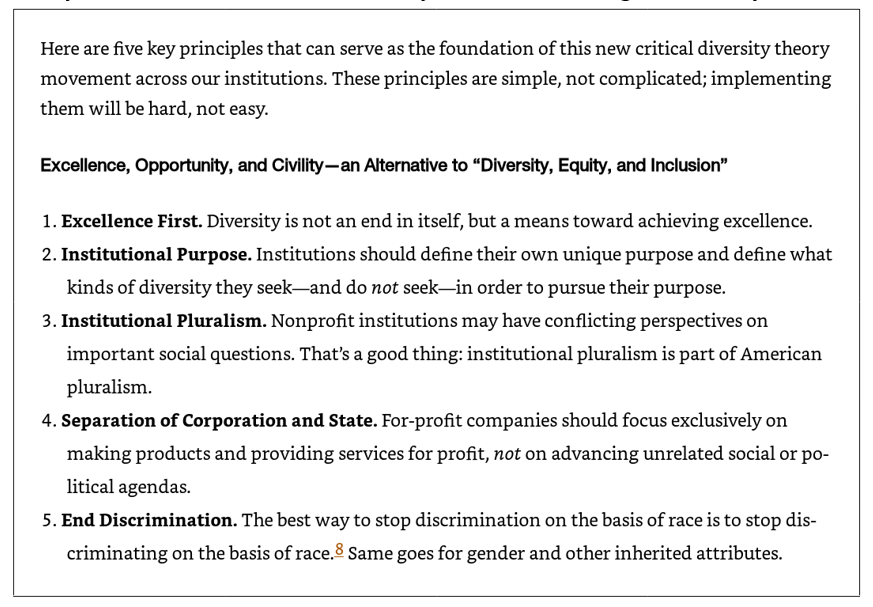
In this chapter, the author discusses the case of wokes attacking their own Larry Summers and similar occurrences and present his own suggestion: Critical diversity Theory, which seeks intellectual diversity, rather than biological diversity:
CHAPTER 13 Woke Consumerism and the Big Sort
This chapter discusses the Big Sort of Americans by political affiliation and attitudes that are happening over recent years. The author refers here all the way back to the struggle between federalists and anti-federalists and their different attitudes to diversity. Finally, the author concludes that Americans should promote their identity as first and foremost Americans, and race and political identities should be demoted, or the country would see a big fight between races and other identities.
CHAPTER 14 The Bastardization of Service
Here the author uses his own experience as upward mobile youth acquiring all kinds of formal qualifications necessary to get into the top college: volunteer work, social justice activism, and all other BS forms that substituted something that used to be internally driven service to others into self-serving activity. The author promotes the idea of mandatory civil service as a tool to establish and maintain the universal American identity.
CHAPTER 15 Who Are We?
This chapter discusses the meaning of America and the need to bring back the idea of E Pluribus Unum and live up to this idea.
MY TAKE ON IT:
This book presents a realistic picture of the current American malaise of wokeness from the point of view of the person who was extremely successful in using opportunities of education and entrepreneurship open for intelligent people capable of being effective in the environment of big government, big education, and other forms of massive corruption that constitute contemporary American society. It is also fascinating in the description of the author’s intellectual and psychological development that eventually put him at odds with other establishment members and changed the direction of his life. The most interesting thing here is the author’s ideas about legal options that could be used against woke members of the establishment that abuse their positions at the top of public entities, either corporations or government or non-profits, to use government or shareholders resources to promote their ideology of wokeness and even suppress other people’s constitutional rights. In my opinion, the last few years removed the veil of hypocrisy that covered the existing and constantly growing gap between interests of government-dependent, prospering, and often parasitic elite and lower classes and interests of the middle class who usually pays for this prosperity with the decrease in quality of their life.
Typically these interests would be reconciled via election process when members of elite supporting competing sides find some accommodation more or less acceptable for everybody while interchanging place in power. However, the last few years saw the united front of the elite against the middle class represented by rich non-elite Trump who unexpectedly jumped at the top of the governmental machinery. The panicked elite responded by completely destroying any semblance of normalcy via massive bureaucracy resistance, media hostility, opportunistic pandemic use, and eventually rigged elections. I am afraid that the successful removal of Trump could be a pyrrhic victory for the elite with a high price to be paid and maybe even soon.
20220122 – In The Know
CONTENT:
Introduction
The introduction defines this book as an attempt to close the gap between popular notions about Intelligence, which is often not supported by scientific research, and expert opinion based on such research. To make things clear, the author provides the definition of Intelligence generally supported by a consensus of scientists:
Intelligence is a very general mental capability that, among other things, involves the ability to reason, plan, solve problems, think abstractly, comprehend complex ideas, learn quickly and learn from experience. It is not merely book learning, a narrow academic skill, or test-taking smarts. Rather, it reflects a broader and deeper capability for comprehending our surroundings – “catching on,” “making sense” of things, or “figuring out” what to do. (Gottfredson, 1997a, p. 13)
The author also provides here samples of IQ test questions, some minimally required statistical concepts, and a bit of history. Below is a general overview of the presented ideas and data.
Section 1 The Nature of Intelligence
Intelligence Is Whatever Collection of Tasks a Psychologist Puts on a Test
FALSE – all cognitive tasks measure Intelligence in one way or another, which allows using factor analysis to arrive at a consistent g factor.
Intelligence Is Too Complex to Summarize with One Number
FALSE – Since all cognitive tasks are highly correlated, it is possible to derive a common factor that predicts performance on the wide variety of such tasks
IQ Does Not Correspond to Brain Anatomy or Functioning
FALSE – The correlation is well established, but only at a high level. The details would require massive research effort.
Intelligence Is a Western Concept that Does Not Apply to Non-Western Cultures
FALSE – g factor equally strong in Western and non-Western people, the cultural differences notwithstanding.
There Are Multiple Intelligences in the Human Mind
There is no empirical confirmation that there are independent levels of Intelligence in different functional areas of human activities.
Practical Intelligence Is a Real Ability, Separate from General Intelligence
Attempts to identify some practical intelligence areas independent from g were not successful. However, some non-cognitive human traits impact practical abilities that define the success or failure of an effort.
Section 2 Measuring Intelligence
Measuring Intelligence Is Difficult
FALSE – Intelligence is relatively easy to measure, and practically any cognitive task does it to some extent. Different knowledge bases and experiences do not relate to IQ tests designed to neutralize differences in backgrounds.
The Content of Intelligence Tests Is Trivial and Cannot Measure Intelligence
FALSE – the simple measurement can easily produce a reasonable estimate of a complex phenomenon. The author provides an analogy with a simple thermometer measuring the complex heat process.
Intelligence Tests Are Imperfect and Cannot Be Used or Trusted
The “imperfect” part is TRUE, but the results are good enough to be used and trusted, as confirmed by empirical data.
Intelligence Tests Are Biased against Diverse Populations
FALSE – professionally developed tests show consistent results unbiased by race and other irrelevant factors. The author provides an interesting description of the process in Ellis Island that pretty much demonstrated the validity of tests.
Section 3 Influences on Intelligence
IQ Only Reflects a Person’s Socioeconomic Status
The “ONLY” part is FALSE because genetics play an essential role: generally, about 50%. However, research demonstrated that adopted children do have higher IQ and that children in educated households get to hear more words, spend more time with adults, have better food, and so on, which has at least some impact on IQ
High Heritability for Intelligence Means that Raising IQ Is Impossible
FALSE –the incidents with lead poisoning and other environmental factors demonstrate that they have a material impact on IQ.
Genes Are Not Important for Determining Intelligence
FALSE – genes are essential for everything from height to digestion to IQ. It is always a combination of nature and nurture.
Environmentally Driven Changes in IQ Mean that Intelligence Is Malleable
TRUE – as demonstrated by adoption studies, the Flynn effect, and individual fluctuation. Most of the improvements over time are at the population level, while IQ measure the variation within a population
Social Interventions Can Drastically Raise IQ
Extreme neglect drives IQ down, but all known interventions, especially highly tested preschool programs, demonstrated only temporary improvements that disappeared over time.
Brain-Training Programs Can Raise IQ
So far, no program has demonstrated a significant improvement. However, there is no proof that no program never will.
Improvability of IQ Means Intelligence Can Be Equalized
FALSE – it is a statistical impossibility since IQ measures variation, not an absolute value. Neither genetic nor environmental components could be feasibly equalized for everybody.
Section 4 Intelligence and Education
Every Child Is Gifted
FALSE – also a statistical impossibility because all children are different.
Effective Schools Can Make Every Child Academically Proficient
It depends on what is considered proficiency. The difference will remain, but some specific level could be achieved by everybody, providing it is low enough.
Non-cognitive Variables Have Powerful Effects on Academic Achievement
TRUE – no school grades based on IQ only, so lower IQ could be compensated by hard work and discipline, at least to some extent. Similarly, a high IQ would not help if one is lazy and undisciplined.
Admissions Tests Are a Barrier to College for Underrepresented Students
TRUE – they are, but eliminating them would not change the factual differences in IQ. All attempts to equalize failed and will always fail, but selection based on proportionality deprives the brightest of opportunities they could use to produce benefits for all. In contrast, force-feeding opportunities to less bright would only mean squandering these opportunities.
Section 5 Life Consequences of Intelligence
IQ Scores Only Measure How Good Someone Is at Taking Tests
Here is a lovely picture of correlations:


Intelligence Tests Are Designed to Create or Perpetuate a False Meritocracy
FALSE – Tests were designed to simplify the selection of people to do more or less complex tasks. Ideas of meritocracy and ideology around it came later.
Very High Intelligence Is Not More Beneficial than Moderately High Intelligence
Research does not support the idea of a threshold about which higher IQ does not matter. However, IQ always works in the mix with many other factors. Therefore, simplified correlation does not work either.
Emotional Intelligence Is a Real Ability that Is Helpful in Life
There is no evidence that EQ works or even exists, and multiple attempts to raise EQ failed to produce results.
Section 6 Demographic Group Differences
The author begins by presenting fundamental principles:

Males and Females Have the Same Distribution of IQ Scores
Here is the conclusion:” While males and females are equal in average Intelligence, the distribution of their abilities differs in other ways. However, in broad non-g cognitive abilities – like spatial ability, verbal reasoning, and mathematical reasoning – mean differences do exist. Females tend to score higher (on average) on verbal abilities, while males have higher average performance on spatial ability and mathematical reasoning. Across these abilities, though, the differences average out to produce equal means on overall IQ. An important difference exists in variability in cognitive abilities. Males have a standard deviation that is 5–15% larger than the standard deviation for females. As a result, there is a greater percentage of males than females at the high and low extremes of most abilities.”
Racial/Ethnic Group IQ Differences Are Completely Environmental in Origin
The author provides a very detailed discussion well supported by statistical data but concludes that there are genetic differences even if everybody wants it not to be so. The author also discusses the inevitability of such differences due to the diverse evolutionary path of races.
Unique Influences Operate on One Group’s Intelligence Test Scores
Here the author discusses X-factor that supposedly generates differences between groups. Here is the definition:

The author reviews four different candidates to be X-factor and concludes that none of them meets the definition’s requirements.
Stereotype Threat Explains Score Gaps among Demographic Groups
The recently popular explanation of differences by the Stereotype Effect failed, mainly due to the replication crisis in psychology. The failure of confirmation does not mean proof of existence. It requires new research with a better methodology, including rigorous replication of results.
Section 7 Societal and Ethical Issues
Controversial or Unpopular Ideas Should Be Held to a Higher Standard of Evidence
The only criteria for science should be true or false, with ethical constraints necessary to prevent damage. Other than that, more knowledge is always better than less.
Past Controversies Taint Modern Research on Intelligence
This part is mainly about Eugenics, its popularity, and later disgrace due to its use by Nazis. Eugenics as an idea is mainly irrelevant by now, and it should not impact contemporary genetic research in any way.
Intelligence Research Leads to Negative Social Policies
Here the author provides some guidelines:
- First, do not promise more than a policy or program can deliver.
- Second, stick to facts – not wishful thinking. Many of the misconceptions that I deal with in this book are ideas that people want to believe.
- Third, do not ignore genetics. Nearly every trait or life outcome is partially influenced by genes
Intelligence Research Undermines the Fight against Inequality
The critical point here is that people are different but must be treated equally legally and ethically. The author also presents very interesting results that demonstrate how little IQ and other scores are relevant to actual live decision making:
- Randomly guessing which individual is more intelligent will be correct 50.0% of the time.
- Discriminating on the basis of race and assuming that the European American is always more intelligent results in a correct decision 76.0% of the time.
- Ignoring race and using IQ scores to identify which person is smarter increases decision accuracy to 94.2%.
- Using race and IQ scores to identify which person is smarter lowers the accuracy slightly to 94.0%.
In other words, ignoring race produces better decisions.
Everyone Is About as Smart as I Am
FALSE – people are different, and individuals with higher IQs are better at solving cognitive problems than people. The author calls for compassion and helps people with lower abilities rather than keeping them in contempt.
Conclusion
In conclusion, the author provides the summary of the book:
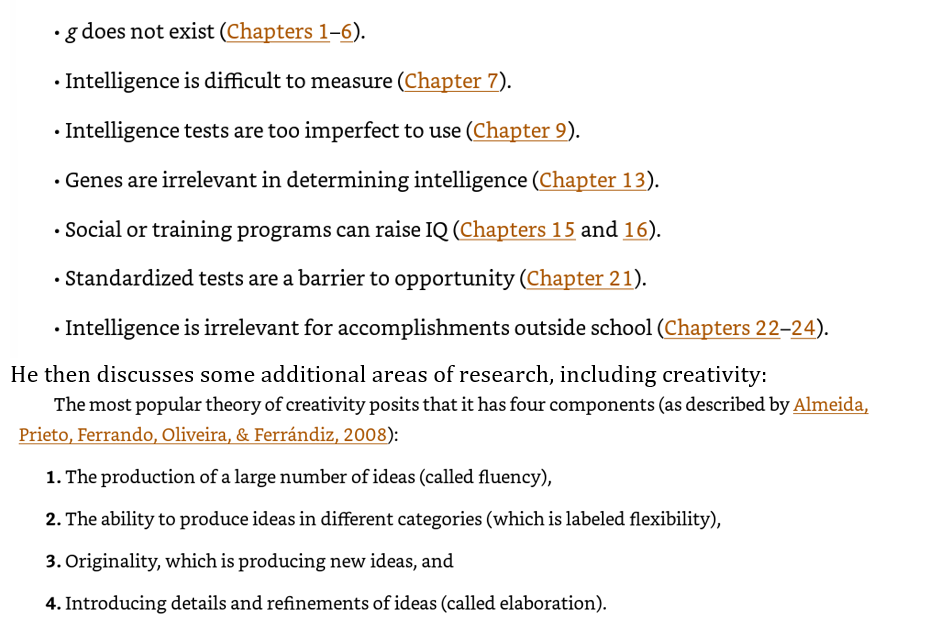
The author concludes by stressing the value of intelligence research and expresses hope that helps to promote a better comprehension of the world.
MY TAKE ON IT:
This book is an excellent collection of research results and presentations of the current level of knowledge about human Intelligence, its measurement, and relevant popular conceptions, some true and some false. I want to stress a few points related to these themes.
The first one is that everybody without exception should have not only compassion for others with lower IQ but also humility that is absolutely necessary if one thinks about the reality of the Bell Curve: if you are in the top 1%, it means that on this planet with about 8 billion people there are 80 million individuals more intelligent than you are. Or, if one goes local: 3.2 million people in the USA are also more intelligent than you are.
The second point is that it would be best to stop looking at IQ and another psychological testing as a tool to define a place in a hierarchy. The objective should not be selecting people for the slots higher or lower in the hierarchy. Instead, it should be the better understanding of self and adjusting your actions so that planned results are achievable and effective in producing the best quality of life one can have in the place and time of his/her/its existence.
20220115 – Affluence without Abundance

CONTENT:
Part One. Old Times
1. The Rewards of Hard Work
This chapter looks at the usual misconception about the life of hunter-gatherers as the struggle for survival and hard work. It rejects this view based on the author’s experiences as an anthropologist living with authentic hunter-gatherers. In reality, it is much more like a beautiful future imagined by Keynes when productivity is so high that people need to work just 15 hours per week to get all they need. In reality, 15 hours a week is all those hunter-gatherers need to hunt and gather enough resources from the environment to satisfy all their needs,
2. The Mother Hill
This chapter touches on the Khoisan hunter-gatherer’s philosophy, their genetic relations to other populations, and their evolution and way of life, based not on growth and expansion but on sustainability or what one can call stagnant interactions with the environment. The chapter also noted that this way of life, while effective for human flourishing, fails to provide tools for defense when an encounter occurs with agriculturalists. The typical result is that agriculturalists’ higher productivity, numbers, and technology allow them to push hunter-gatherers away from their territory, enslave, or annihilate them.
3. A Beachside Brawl
This chapter retells the story of European arrival to this area, the first encounters, and the specific story of da Gama and Dias.
4. The Settlers
This chapter expands this history to the present times. It includes discussion on the relations between farmers of European descent with locals, including lots of ugly interactions, exploitation, and forced labor. The situation somewhat improved after the independence of Namibia, but the old way of life was destroyed anyway.
5. Living in the Moment
This chapter looks at the psychology of hunter-gatherers. It notes their different understanding of time when only present exists, albeit it changes cyclically. Consequently, they have no notion of delayed returns, investment, and multi-step production processes. Instead, their economics based on immediate returns and knowledge base contains details about the usefulness of the environment at any given period of natural cycles.
6. Tsumkwe Road
This chapter narrates the first encounters of hunter-gatherers with anthropologists and the consequent constantly increasing intensity of the research. It also narrates the parallel development of interactions with the contemporary world, with the Tsumkwe road being a symbolic representation of these interactions
Part Two. The Provident Environment
7. The Hollow Tree
This chapter discusses the author’s experience of visiting the site starting in 1994. The author observed environmental changes caused by external forces: farmers that made this environment lose its ability to support hunter-gatherers. The chapter also discusses the difference between attitudes of hunter-gatherers and farmers, the former accepting natural settings and adjusting to them, while the latter changing the natural environment to fit their needs.
8. Strong Food
This chapter discusses attitudes to food, which hunter-gatherers divide into strong and weak food. For example, the strong food in the area with insufficient water contains more liquid. Also, the food obtained via hunting is considered strong and worth the higher time expenditure required by its acquisition. It also discusses the reasons for the absence of obesity among hunter-gatherers, and it is not from lack of food. It is rather a form of a combination of food consumption on an “as needed” basis and constant physical movement – per research, about 7-8 miles per day.
9. An Elephant Hunt
This chapter looks at another essential part of the local environment – elephants, poacher hunting, and countermeasures. The especially effective was allowing regulated hunt with the sale of licenses and organized tours that created lots of incentives for locals to protect elephants and maintain their population.
10. Pinnacle Point
This chapter looks at the archeological findings that demonstrated the uninterrupted habitation of people in the place where contemporary hunter-gatherers live. These findings also showed the stability of technology, which is, while sufficiently complex to meet human needs, nevertheless did not develop that much over time. The chapter explicitly discusses hunting technics and equipment, demonstrating that it was reasonably sufficient to assure that nearly half of calories came from meat. The chapter also points out that the stability of technology over the centuries has nothing to do with the cognitive abilities of these people. On the contrary, they quickly familiarized themselves with multiple artifacts of contemporary life and used them as needed.
11. A Gift from God
This chapter discusses hunting and general attitude to animals and changing environment of the animal world. It also describes how the fire was used to preprocess food, making people much more efficient food consumers and freeing them from consuming low-quality food. It also concludes that hunter-gatherers’ meat consumption in everyday conditions was at the first world level.
12. Hunting and Empathy
This chapter discusses various hunting technics. But more interesting is that te critical cultural relationships are established between hunters and animals that allow maintenance of a sustainable way of life for all. It specifically stresses that these relationships are based on empathy and understanding of animals as companions and adversaries.
13. Insulting the Meat
This chapter discusses hunting-related relationships within groups directed at strict maintenance of egalitarian mores. Specifically, it looks at the typical behavior of the group’s diminishing level of hunter’s success. The value of acquired meat is insulted with the objective to prevent the hunter from being arrogant. Then the chapter proceeds to discuss the use of hierarchy and its role or, more precisely, lack thereof in relations between people. It also looks at so-called “demand sharing” that somewhat regulates whatever property could be identified and gift-giving procedures.
Part Three. New Times
14. When Lions Become Dangerous; 15. Fear and Farming; 16. Cattle Country; 17. Crazy Gods; 18. The Promised Land
The last part of the book tells the sad story of the destruction of hunter-gatherers’ way of life by an encounter with the contemporary world that turned these “affluent without abundance” from well adjusted and generally happy egalitarians sustainably living off the environment into poor and often unhealthy people living off miserly welfare handouts and low paid unskilled jobs.
MY TAKE ON IT:
In my view, this is not just a description of the disappearing lifestyle that humanity maintained for hundreds of thousand years, but also the foundation for the projection into the future when humans may return to somewhat similar arrangements, only based not on harmonious interaction with the naturally existing environment, but based on the newly developed environment with fully automated processes of production of goods and services. If something like that happens, humanity could once again move to a highly egalitarian arrangement of society that must be the most effective way to pursue happiness since it is very much in synch with the human evolutionary background. Obviously, the agriculture-based invention of property and hierarchy is not going away. Still, the new forms of the egalitarian society could be based on an extensive distribution of ownership of everything with violent hierarchical structures limited to maintaining effective and efficient resource allocation and individual rights.
20220108 – Incognito (Brain)

MAIN IDEA:
Here is how the author identifies the main idea of this book:” Your consciousness is like a tiny stowaway on a transatlantic steamship, taking credit for the journey without acknowledging the massive engineering underfoot. This book is about that amazing fact: how we know it, what it means, and what it explains about people, markets, secrets, strippers, retirement accounts, criminals, artists, Ulysses, drunkards, stroke victims, gamblers, athletes, bloodhounds, racists, lovers, and every decision you’ve ever taken to be yours.”
DETAILS:
1. There’s Someone in My Head, But It’s Not Me
This chapter first identifies the theme of this book, and then it discusses various cases of small detail changing human perception either about beauty or many other things. It then makes the statement about the author’s position:” Consciousness developed because it was advantageous, but advantageous only in limited amounts.” It also makes the positioning statement:” The conscious mind is not at the center of the action in the brain; instead, it is far out on a distant edge, hearing but whispers of the activity.” Further, the author discusses the history of thoughts about consciousness from Thomas Aquinas to Freud and poses many questions about human behavior,
2. The Testimony of the Senses: What is Experience Really Like?
This chapter discusses the complexity of human perception, providing multiple examples that it is not a simple process of reading sensory input but a rather complex process of interpreting the multitude of inconsistent signals from the environment. This process sometimes produces quite different results from the same input, and the author provides several examples of visual illusions when the same picture is perceived differently. The typical example is “vase vs. two profiles.” The discussion includes the eye scanning process, blind spot, text reading, etc. The author also makes a significant point that blind people who recovered vision later in life still could not see because their brains did not develop the neural networks necessary for the interpretation of visual signals. Finally, the author also discusses the perception of time, which he also defines as a construction.
The conclusion the author makes is this:” So the first lesson about trusting your senses is: don’t. Just because you believe something to be true, just because you know it’s true, that doesn’t mean it is true. The most important maxim for fighter pilots is “Trust your instruments.” This is because your senses will tell you the most inglorious lies, and if you trust them—instead of your cockpit dials—you’ll crash. So the next time someone says, “Who are you going to believe, me or your lying eyes?” consider the question carefully.”
3. Mind: The Gap
This chapter defines the unconscious as the gap between:” what your brain knows and what your mind is capable of accessing.” The author presents an example of chicken sexers – people who select chickens by sex without fully understanding how they do it, just based on acquired experience. He then expands on other similar workings of the unconscious. After this discussion, the author moves to discuss the process for the development of subconscious hunches and similar processes:” When the brain finds a task it needs to solve, it rewires its own circuitry until it can accomplish the task with maximum efficiency. The task becomes burned into the machinery. This clever tactic accomplishes two things of chief importance for survival.” The author defines these two things a speed and energy efficiency. Finally. The author arrives to the conclusion:” Evolutionary selection has presumably tuned the exact amount of access the conscious mind has: too little, and the company has no direction; too much, and the system gets bogged down solving problems in a slow, clunky, energy-inefficient manner.”
4. The Kinds of Thoughts That are Thinkable
Here the author discusses human limitations:” What you are able to experience is completely limited by your biology. This differs from the commonsense view that our eyes, ears, and fingers passively receive an objective physical world outside of ourselves. As science marches forward with machines that can see what we can’t, it has become clear that our brains sample just a small bit of the surrounding physical world.” The author discusses the notion of umwelt for an organism, meaning the totality of inputs that create this organism’s world. For example, radio waves were outside human umwelt until technology changed it. The author also discusses a condition of synesthesia, when the inputs are perceived idiosyncratically, as when a person can see music. After reviewing the development of humans as a combination of inherited features and results of social interactions that define human behavior, the author concludes:” We’ve seen in this chapter that our deepest instincts, as well as the kinds of thoughts we have and even can have, are burned into the machinery at a very low level. “This is great news,” you might think. “My brain is doing all the right things to survive, and I don’t even have to think about them!” True, that is great news. The unexpected part of the news is that the conscious you is the smallest bit-player in the brain. It is something like a young monarch who inherits the throne and takes credit for the glory of the country—without ever being aware of the millions of workers who keep the place running.”
5. The Brain is a Team of Rivals
This chapter discusses human complexity using real-life examples of inconsistent human behavior, poetic expression of “I am large, I contain multitudes,” an analogy with various forms of government: “Democracy of mind.” The author even refers to a two-party system: Reason and Emotion. Here is the author’s summary of the chapter:” The main lesson of this chapter is that you are made up of an entire parliament of pieces and parts and subsystems. Beyond a collection of local expert systems, we are collections of overlapping, ceaselessly reinvented mechanisms, a group of competing factions. The conscious mind fabricates stories to explain the sometimes inexplicable dynamics of the subsystems inside the brain. It can be disquieting to consider the extent to which all of our actions are driven by hardwired systems, doing what they do best, while we overlay stories about our choices. Note that the population of the mental society does not always vote exactly the same way each time. This recognition is often missing from discussions of consciousness, which typically assume that what it is like to be you is the same from day to day, moment to moment. Sometimes you’re able to read well; other times you drift. Sometimes you can find all the right words; other times your tongue is tangled. Some days you’re a stick in the mud; other days you throw caution to the wind. So, who’s the real you? As the French essayist Michel de Montaigne put it, “There is as much difference between us and ourselves as there is between us and others.” A nation is at any moment most readily defined by its political parties in power. But it is also defined by the political opinions it harbors in its streets and living rooms. A comprehensive understanding of a nation must include those parties that are not in power but that could rise in the right circumstances. In this same way, you are composed of your multitudes, even though at any given time your conscious headline may involve only a subset of all the political parties.”
6. Why Blameworthiness is the Wrong Question
This chapter references the Texas sniper with the damaged brain. It discusses whether it is possible to blame people for their actions if these actions are caused by biological factors such as DNA or brain damage outside of their control. As usual, this discussion moves to free will and presents events and experiments that demonstrate that actions often occur outside of conscientious control. However, the author provides a unique point of view: “I propose that the answer to the question of free will doesn’t matter—at least not for the purposes of social policy—and here’s why. In the legal system, there is a defense known as an automatism. This is pled when the person performs an automated act—say, if an epileptic seizure causes a driver to steer into a crowd. The automatism defense is used when a lawyer claims that an act was due to a biological process over which the defendant had little or no control. In other words, there was a guilty act, but there was not a choice behind it… So, I’m going to propose what I call the principle of sufficient automatism. The principle arises naturally from the understanding that free will, if it exists, is only a small factor riding on top of enormous automated machinery. So small that we may be able to think about bad decision making in the same way we think about any other physical process, such as diabetes or lung disease. The principle states that the answer to the free-will question simply does not matter. Even if free will is conclusively proven to exist one hundred years from now, it will not change the fact that human behavior largely operates almost without regard to volition’s invisible hand.”
The author nevertheless states that “Explanation does not equal exculpation” and
Offer a graphic representation of dynamic approach based on the level of technological development:

After that, the author discusses what he calls:” A FORWARD-LOOKING, BRAIN-COMPATIBLE LEGAL SYSTEM.” He also looks at the maturation of the human brain and human inequality and concludes that legal measures should be based on modifiability to align punishment with neuroscience. The author especially stresses that his position does not mean letting criminals go free, but instead defining appropriate action, precisely:” The concept and word to replace blameworthiness is modifiability, a forward-looking term that asks, what can we do from here? Is rehabilitation available? If so, great. If not, will the punishment of a prison sentence modify future behavior? If so, send him to prison. If punishment won’t help, then take the person under state control for the purposes of incapacitation, not retribution.”
7. Life After the Monarchy
This chapter discusses scientific progress overall and its philosophical reflection, including the understanding of humans. The author discusses how difficult it is for people to accept the materiality of who they are despite the enormous amount of evidence demonstrating the impact of mechanical and chemical interferences on the human condition, from thought processes to physical actions. The author also discusses the complexity of nature/nurture interaction and provides a simple and interesting example based on a short/long combination of alleles of two genes controlling serotonin in everybody’s genome:

In short, humans are defined by both nature and nurture in complex and unpredictable combinations. The reduction to materialism does not simplify the analysis of human thoughts and behaviors. Here is the author’s final word:” In the same way that the cosmos is larger than we ever imagined, we ourselves are something greater than we had intuited by introspection. We’re now getting the first glimpses of the vastness of inner space. This internal, hidden, intimate cosmos commands its own goals, imperatives, and logic. The brain is an organ that feels alien and outlandish to us, and yet its detailed wiring patterns sculpt the landscape of our inner lives. What a perplexing masterpiece the brain is, and how lucky we are to be in a generation that has the technology and the will to turn our attention to it. It is the most wondrous thing we have discovered in the universe, and it is us.”
MY TAKE ON IT:
I think it is time to finally recognize that there is no clear division between the human mind and brain or between the role of nature vs. nurture in human development. This book provides a pretty good set of real-life examples and experimentation supporting these two statements. It also provides an excellent discussion on the individual’s control over his/her actions and blame that could or could not be assigned as a result. I also like the idea that this is not relevant to the reality of crime and punishment because the goal should be preventing crime from happening rather than inflicting retribution on the perpetrator. However, I think that in real life, retribution and prevention functions could not be separated. For example, I am always puzzled by the statement that capital punishment does not prevent crime. As far as I know, no dead criminal murdered or caused harm to anybody else, while it is not unheard of for murderers convicted to life in prison to kill again. Somehow, it is challenging for quite a few highly educated people to move from abstract thinking about “general deterrence” to simply understanding that dead people do not do anything, crimes included.
The only thing that I probably do not entirely agree with the author is about the complexity of a mind/brain being comparable to the cosmos. I think that despite a huge number of neurons in the human brain, unlike the universe, it is finite and therefore comprehensible and could be modeled or even artificially recreated if not on a silicon basis, then biologically or even mathematically. However, I do not think that it will be done on a regular basis beyond scientific research. What is the point in creating artificial humans when plenty of them are produced naturally. Indeed, technologically developed specialized brain-like systems will be and already are made, but they are just tools. They will remain tools forever because, after a tragedy or two with artificially developed conscious beings, the cruelty and meaningless of such exercise would become evident, and it would stop. I think that eventually, people would understand that a complex dynamic system is not possible to fully control externally, as well as reliably predict its behavior, so it would be better not to play with fire.
20220101 – The Hunter-Gatherer Guide

MAIN IDEA:
The main idea of this book is to apply the authors’ knowledge of evolutionary biology to the contemporary situation and derive clear recommendations for behavior both individual and a group not only in general but also in specific functional areas of human life. It is also to point out the dangers of the current situation when even humans’ formidable ability to handle changes could be overwhelmed by the temp and scale of changes currently occurring in technology and society.
DETAILS:
Introduction
In the beginning, the authors retell how they nearly got into a dangerous situation because of the lack of local environmental knowledge. Then, they discuss how much people lost what used to be necessary for survival: local knowledge, tradition, norms of behavior, and such. They make a point of how much unusual it is for the traditional human world and how difficult it would be to adjust:” The best, most all-encompassing way to describe our world is hyper-novel. As we will show throughout the book, humans are extraordinarily well adapted to, and equipped for, change. But the rate of change itself is so rapid now that our brains, bodies, and social systems are perpetually out of sync.”
The authors suggest that the only way to handle this novel situation is via science and discuss their experience as scientists. They also define science:” science is a method that oscillates between induction and deduction—we observe patterns, propose explanations, and test them to see how well they predict things we do not yet know. We thus generate models of the world that, when we do the scientific work correctly, achieve three things: they predict more than what came before, assume less, and come to fit with one another, merging into a seamless whole.”
Finally, they conclude:” Our species’ pace of change now outstrips our ability to adapt. We are generating new problems at a new and accelerating rate, and it is making us sick—physically, psychologically, socially, and environmentally. If we don’t figure out how to grapple with the problem of accelerating novelty, humanity will perish, a victim of its success.”
Chapter 1: The Human Niche
The discussion of the human niche begins with the story of the slow movement of humans to America via Beringia and how humans adjust to changes. Here how the authors see critical components of human nature that facilitate such adjustment:” Most of the best ideas that our species has generated, the most important and powerful ideas, have been the result of a group of people who had different but consilient talents and vision, non-overlapping blind spots, and a political structure that allowed for novelty.” The authors stress the paradox of human ability to become specialists as individuals while maintaining a wide range of functionality as a group. Next, the authors discuss consciousness and culture, their interplay, and the uniqueness of human use of “collective consciousness.” They provide a fascinating approach to all this:” Homo sapiens therefore oscillate between two dominant modes. When we face problems for which our prior understanding is inadequate, we become conscious. How do we feed ourselves in this new land? We plug our minds into a shared problem-solving space and share what we know. Then we parallel process—proposing hypotheses, providing observations, offering challenges—until we arrive at a new answer, one that an individual would rarely reach alone. If the result works well when tested in the world, it gets refined and then driven into a more automatic, less deliberative layer. This is culture. The application of culture to the circumstances for which it is adapted is the population-level equivalent of an individual being in the zone.”
Another interesting point that the authors make, as evolutionary biologists, is related to fitness, which they define this way:” fitness is indeed often about reproduction, but it is always about persistence. A successful population can ebb and flow through time. What a successful population can’t do is go extinct. Extinction is failure. Persistence is success—and the reproduction of individuals is only one factor in the persistence equation.”
The authors also provide a couple of notions that are critical for understanding human evolutionary processes:

Chapter 2: A Brief History of the Human Lineage
This chapter discusses the biological classification of human evolution from the very beginning starting with Plant and all the way to humans. Here are the first and last pictures:

The authors also provide functional characteristics and a high-level timeline of human development:
- Oscillating between these two challenges—ecological dominance and social competition—we became expert at exploring new niches. We are the ultimate niche switchers.
- By forty thousand years ago, many populations of people were engaged in hunting and gathering that was even more cooperative and forward-looking.
- Seventeen thousand years ago, when the most famous cave art in Europe, at Lascaux, was being created, Beringians had likely become Americans and were spreading across two vast continents.
- Ten to twelve thousand years ago, people were beginning to farm.
- By nine thousand years ago, permanent settlements were forming; in the Middle East, Jericho may have been Earth’s first city.
- Eight thousand years ago, at Chobshi, in the Andes of modern Ecuador, people took cover in a shallow cave, and hunted by funneling guinea pigs, rabbits, and porcupines off a short cliff, retrieving the corpses at the bottom, with which they made food and clothing.
- By three thousand years ago, much of Earth’s landscape had been modified by human activity—by hunter-gatherers, by agriculturalists, and by pastoralists.
- Seven hundred years ago, some humans were in Europe
Here is also a graphic representation:

Chapter 3: Ancient Bodies, Modern World
This chapter discusses multiple differences between WEIRD people and people untouched by wealth and education. These differences are both physiological and psychological. From this, the authors define a test for a feature being adaptation or not:

After that, the authors discuss different types of trade-offs: allocation and design constraints. Finally, to summarize the discussion, the authors provide the kind of user manual for dealing with the new and unknown so the following chapters discuss multiple areas of human existence and, for each, provide similar recommendations for the evolutionary approach:
Chapter 4: Medicine;
Chapter 5: Food
Chapter 6: Sleep
Chapter 7: Sex and Gender
Chapter 8: Parenthood and Relationship
Chapter 9: Childhood
Chapter 10: School
Chapter 11: Becoming Adults
Chapter 12: Culture and Consciousness
Chapter 13: The Fourth Frontier
In this last chapter, the authors move to the broader picture looking at the development of a whole society. They review challenges and define the next frontier:” The fourth frontier is the idea that we can engineer an indefinite steady state that will feel to people like they live in a period of perpetual growth, but will abide by the laws of physics and game theory that govern our universe. Think of it like the climate control that allows the inside of your house to hover at a pleasant spring temperature as the world outside moves between unpleasant extremes. Engineering an indefinite steady state for humanity will not be easy, but it is imperative.” They also talk about the senescence of civilization and suggest building a system based on such principles:
- Not optimize for a single value. Mathematically speaking, if you try to optimize for any single value, no matter how honorable—be it liberty or justice, decreasing homelessness or improving educational opportunities—all other values, every single other parameter, will collapse. Maximize justice, and people will starve. Everyone may starve equally, but that’s small recompense.
- Create a prototype for your system. After that, continue to build prototypes. Do not imagine that you know from the beginning what the final system will look like.
- Recognize that the fourth frontier is inherently a steady state, whose characteristics are ours to define. We ought to strive to create a system that:
- Liberates (that is, that frees people to do rewarding, interesting, awesome stuff),
- Is antifragile,
- Is resistant to capture, and
- Is incapable of evolving into something that betrays its own core values. In the technical language of evolution, we need a system that is an Evolutionarily Stable Strategy, a strategy incapable of invasion by competitors.
The authors also discuss challenges and the need to jump curves when usual processes stop working. Here is a graphic representation:
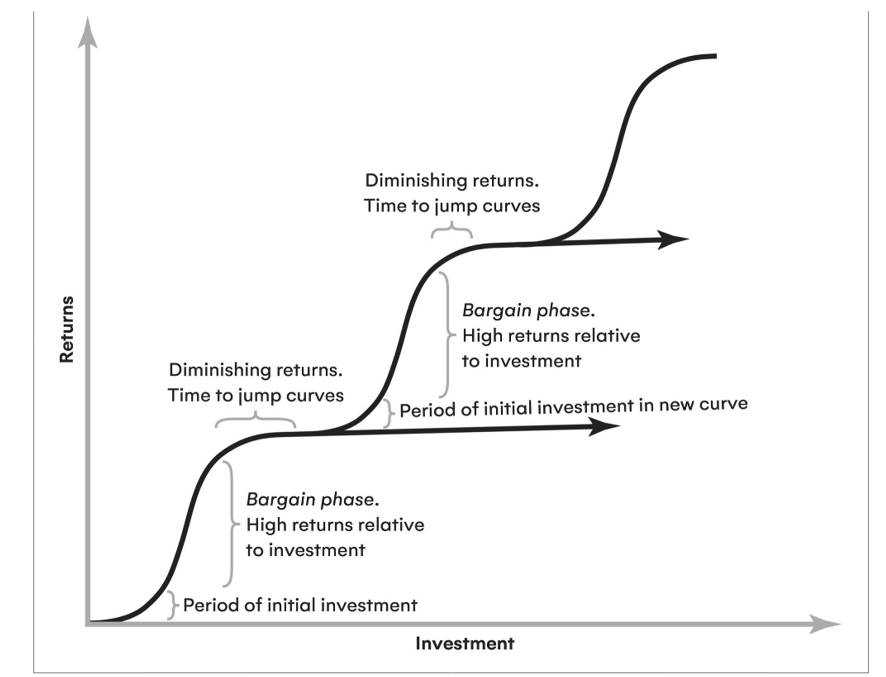
The final set of suggestions:
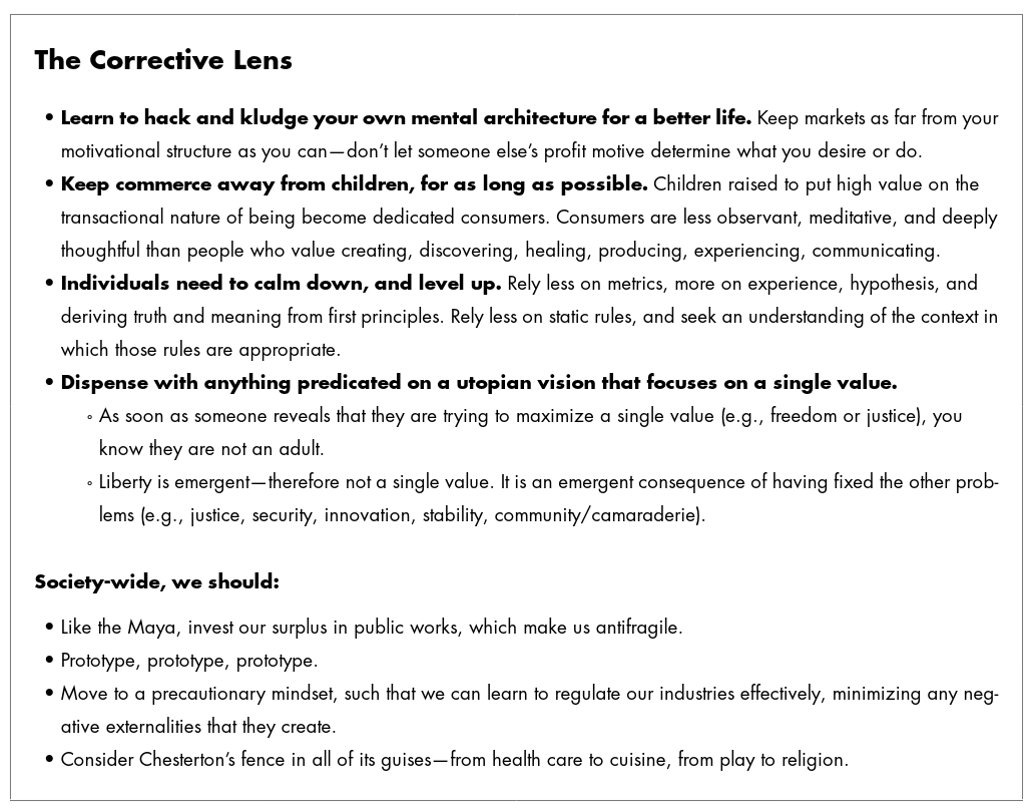
Epilogue
The epilogue presents the rules for life that the authors linked to 8 days of Hanukkah:
Day 1: All human enterprises should be both sustainable and reversible.
Day 2: The Golden Rule: Do unto others as you would have them do unto you.
Day 3: Only support systems that tend to enrich people who have contributed positively to the world.
Day 4: Don’t game honorable systems.
Day 5: One should have a healthy skepticism of ancient wisdom, and engage novel problems consciously, explicitly, and with robust reasoning.
Day 6: Opportunity must not be allowed to concentrate within lineages.
Day 7: Precautionary principle: When the costs of an action are unknown, proceed with caution before making change.
Day 8: Society has the right to require things of all people, but it has natural obligations to them in return.
MY TAKE ON IT:
The approach to the current situation through the lens of evolutionary biology is generally sound but not sufficient. The authors’ recommendations are excellent, and I agree with most of them. However, I do not think individual behavior adjustments based on these recommendations would do the trick. People need some vision of the future condition of the system to act consistently and persistently, even if this vision is not completely clear. This vision should also be simple and linked to modifying the system of relations between people rather than to individual behavior only. Religions used to be able to do it pretty well, including the religion of socialism and communism, but they also tend to lead to obsession, fanaticism, and destruction. We can see it now in the current religion of wakeism. I hope that America’s relative freedoms would help resolve existing problems by updating the system of society’s organization to match currently achieved technological levels. Still, we are probably at the beginning of a protracted period of disturbances before we’ll complete this upgrade.
20211225 – Most Things Fail

MAIN IDEA:
The author formulated the main idea of this book as consisting of three themes:” The main theme of this book is to develop a general explanation of the pervasive nature of failure in the world of human societies and economies. Though there are striking parallels between the social and economic world and the world of biology there is, however, a fundamental difference between the two: the process of evolution in biological species cannot be planned. Species cannot act with the intent of increasing their fitness to survive. In contrast, in human society, individuals, firms and governments all strive consciously to devise successful strategies for survival. They adapt these strategies over time and alter their plans as circumstances change. Yet, despite this apparent contrast, eventually, in both biological evolution and human social and economic activity, failure strikes.
A second theme of this book is to understand this seeming paradox. How can it be that not just failure, but the patterns of failure, are so similar in biology and human organization when there is such a sharp contrast between the abilities to act with the conscious intent of improving one’s prospects for survival?
The third theme, developed in particular towards the end of the book, is that failure can be highly beneficial. In the real world in which strategies evolve and which is itself the outcome of a dynamic process of change, failure at the level of the individual component part can, paradoxically, enhance the fitness of the system as a whole.”
DETAILS:
Introduction
After stating his opinion about the general inevitability of failure, the author refers to two examples of consistent long-term failure: racism and poverty. He then refers to Evolution that clearly demonstrates the necessity of failure for development. Finally, the author presents key themes of this book and stresses that his primary method is comparing the theory with evidence, unlike many other works in social sciences and economics that avoid such comparison, often substituting it with complex mathematical models.
1 The Edwardian Explosion
Here the author uses the analogy of the Cambrian explosion from evolutionary biology to characterize the economic explosion in England in the late XIXth century. It featured outside investors financing the new venture based on limited liability protecting them. The author then discusses the improvement in living standards that resulted from the rapid economic growth. However, this development’s outcome also included an increase in scale of business enterprises and the creation of monopolies. From this, the author moves to discuss multiple business failures and provides a nice table:

2 A Formula for Failure
Here the author expands the discussion to the search for reasons for failures after noting that the economic profession generally tends to ignore failures even though it is the fate of 10% of all businesses every year. The economic methodology is mainly directed to the search of market equilibrium, and the author discusses how little this approach helps explain real-world economic processes. The special attention the author allocates to the failure to properly analyze risk vs. uncertainty:” Risk refers to situations in which the outcome cannot be known with certainty, but the probability of any given outcome is understood perfectly. A simple example would be a toss of a fair coin. There is a fifty– fifty chance of it being either heads or tails. If we are gambling on the next toss being heads, there is a risk that we will lose our money if it turns out to be tails. But we know precisely what the chances are. Uncertainty, in its strict sense, refers to situations in which the probability of the various outcomes is itself unknown.” The author also uses multiple examples of real-life events and studies demonstrating a considerable difference between economic decision-making as presented in theory and as real live decision makers actually do it. From this, the author makes a pretty reasonable inference:” The capacity of firms to deal with market situations in a cognitive sense, their capacity to process information and turn it into knowledge, is small compared to the sheer scale of the problems which confront them. Companies can never deal completely with the complexity of the real world. The uncertainty that shrouds the future is not so much a veil as an iron curtain. In the current state of scientific knowledge, it cannot be penetrated. There is ample opportunity at any point in time for any firm, no matter how large, to fail.”
3 Up a Bit, Then Down a Bit
The author begins this chapter by briefly recounting the story of the increase of governments expenses and overall influence on the economy. Then, he specifically looks at the impact of this increase on the unemployment data and finds that it was not that significant:” If we compare the period from 1946 to the present day with the period 1870–1938, we see that, on average, as a proportion of the economy as a whole, the public sector was well over twice as large. Yet the average unemployment rate from 1946 has been no less than 4.5 per cent. In other words, only very marginally lower than in the period 1870–1938, despite the massive rise in the importance of the public sector in the economy. And although the highest rate in any single year, at 11 per cent, was less than the 14 per cent of the 1930s, unemployment never fell below 1 per cent in the entire period since the Second World War.” After that, the author looks at social mobility and Gini coefficients within countries and between countries:
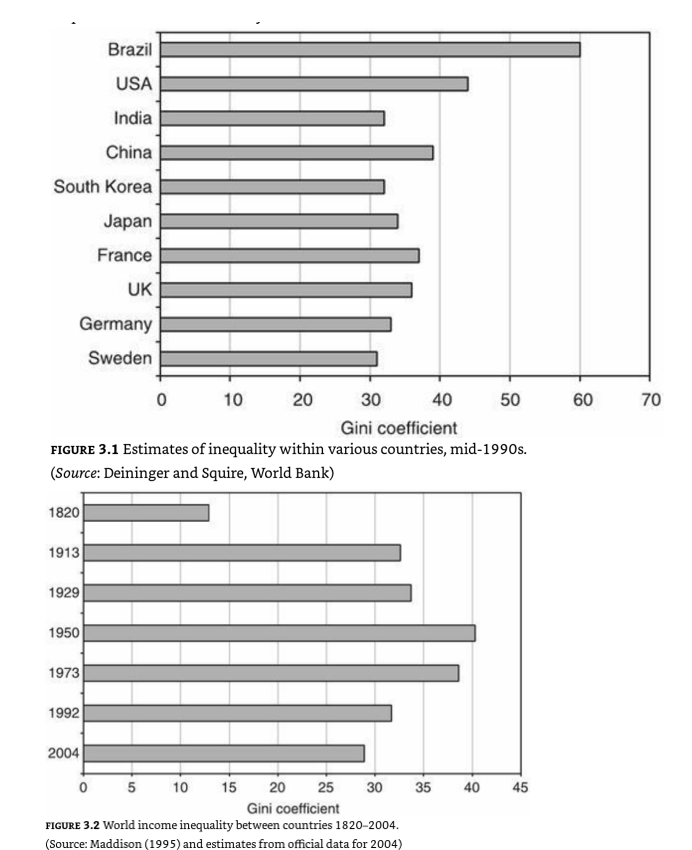
At the end of this chapter author once again refer to a critical intellectual construct of economics: general-equilibrium theory and stresses how inconsistent it is with real-life developments. He makes this statement:” In order to control a system – any system, whether an economy, a biological system or a machine – we need to be able to do two things: first, make forecasts which are reasonably accurate in a systematic way over time; and second, understand with reasonable accuracy the effect of changes in policy on the system one is trying to control.” And, since the only thing really proved about economic forecasts is their persistent failure, he concludes:” It may seem implausible that economic systems behave as if they were almost random. However, this near-random quality does not mean in any way that the individual components of an economy – people, firms, governments – take decisions at random. On the contrary, they act with purpose and intent. But the consequences of these millions upon millions of individual decisions, interacting with each other all the time, lead to an overall outcome, for total output (GDP), say, that appears as if it were close to being random. The sheer dimensions of the problem are simply too great for the system to be understood properly. There are simply too many factors that determine the outcome, and whose relative importance alters over time, for the complete picture ever to be grasped.”4 Making Sense of Segregation
This chapter starts with reference to Marx and Engels and their indirect responsibility for innumerable crimes committed in the name of communism. Then, he discusses the complete failure of Marxism as a politico-economic theory. From this point, the author discusses various forms of segregation, both geographical and housing, between groups of people along class or religious or racial lines. Next, he discusses the persistence of such segregation despite the multitude of efforts by the government to promote integration. Finally, the author discusses the reasons and process of segregation, including the fascinating example of algorithmically generated segregation based on a very simple rule of preferences:

5 Playing by the Rules
This chapter begins with reference to Alfred Marshall, Francis Edgeworth and their debate whether the market could be analyzed and understood based on supply/demand equilibrium or it is just too complex and unpredictable to obtain any meaningful understanding and correspondingly correct forecast. The author then discusses the general development of economic theory and the addition of the game theory and later psychology to the mix. At the end of the chapter, the author presents his conclusion:” A key paradox begins to emerge from all this. Humans, whether acting as individuals or making collective decisions in companies or governments, behave with purpose. They take decisions with the aim of achieving specific, desired outcomes. Yet our view of the world which is emerging is one in which it is either very difficult or even impossible to predict the consequences of decisions in any meaningful sense. We may intend to achieve a particular outcome, but the complexity of the world, even in apparently simple situations, appears to be so great that it is not within our power to ordain the future.”
6 A Game of Chess
This chapter discusses the incompleteness of information available to acting agents, contrasting it with complete information available to chess players. He begins with another paradox:” Humans can take decisions with intent, acting with the purpose of achieving specific targets. As we noted in the Introduction, this ability to act with intent is sharply different from the process of biological evolution, which takes place at random. Yet both cases, whether human strategy or the evolution of species, are characterized by widespread failure. The human ability to act with purpose and intent seems not to imply in any way that the actual outcome will be the desired one.”
The author then proceeds to discuss the contemporary economic theory that moved beyond the notion of full informed agents making perfect choices based on supply and demand to the concepts of partially or even wholly misinformed agents acting not only based on external data but also based on their internal psychological processes. However, even for chess, in which the quality of the game improved over time, the author suggests limitations of improvements due to the game’s complexity. As to the game of life, which is infinitely more complex than chess:” Individuals, firms, governments, households may lack access to complete information. Even more importantly, they do not have the cognitive ability to process it in a way which finds the single, optimal choice. Particularly when confronted with decisions that have consequences in the future, the problem of finding the ‘best’ move, the best strategy, is simply too hard. Instead, agents look for reasonably good strategies which avoid obvious loss, and they find it very difficult to learn better strategies. Armed with this view of the world, we return to the problem of failure and extinction.”
7 ‘The Best-Laid Schemes …’
Here the author expands the chess analogy further, noting that it is not only incomplete information but also the character of the rules of the game that make a difference. In real life, rules and goals are dynamic and constantly change, unlike static and well-known rules of chess. The author provides some examples and discusses in detail Harold Hotelling’s beach and ice cream model that demonstrates an exponential increase in complexity with any change in assumptions that make the model more realistic. He makes the point that this complexity makes a complete solution impossible. However, at the same time, he demonstrates that a simple strategy could produce “good enough” results.
8 Doves and Hawks
The author discusses another model in this chapter: Armen Alchian’s “Dove and Hawks”. He demonstrates how volatility is embedded in complex biological systems, sometimes leading to cyclical changes when some parameter, such as the ratio of lynx to hares, moves periodically from one extreme to another. The author also discusses Vito Volterra’s work:” A Mathematical Theory of the Struggle for Life, ” describing dynamic equilibrium between species. Finally, the author also describes some relevant samples of English literature.
9 Patterns in the Dark
Here, the author continues juxtaposing biology, Darwin’s evolution and economy, and Adam Smith’s capitalism. He describes the process of evolution and stresses that the pace of evolution is variable, referring to the “Cambrian explosion”. Moreover, the research shows that there is some multi-million years cycle of extinction with the interdependency of size and frequency:

The author then sets up the framework for moving to economics in the next chapter:” Excitingly, power law, or very near power law, relationships have been identified very recently in many areas of economic activity. Perhaps most exciting of all, the relationship that describes the pattern of extinctions amongst firms appears to be virtually identical to that which describes biological extinctions. For certain types of system, as diverse as those in which biological species and modern firms flourish and die, we may have the first inklings of a general theory not of evolution but of extinction.”
10 The Powers that Be
The author begins this chapter with the statement that describes biological processes fully apply to economics with:” the size distribution of the largest American companies was well described by a power law, a finding subsequently generalized across all US firms”. The author then discusses the relation between the size of cause and scale of the event:” Most of the time, small events, small shocks to the system, will only have small impacts, and large shocks will usually have big consequences. But the fact that we observe power-law behavior in a system tells us that the system operates in ways that mean that these relationships do not always hold. Sometimes, a very small event can have profound consequences, and occasionally a big shock can be contained and be of little import.” He also presents some analysis of types of networks and resulting variance in their behavior, illustrating all this by the story of financial debacle such as LTCM. Finally, the author also provides an extinction graph for both economic and biological species:

11 Take Your Pick?
In this chapter, the author reviews two theoretical approaches to the problem of extinction. One approach assigns cause to external shocks, while the other to the internal development of the system. The author uses business cycles as an example when one approach points to an external event such as a war that violates the equilibrium of the economic system. At the same time, another looks for internal causes such as money supply than misallocation of resources, eventually leading to a crash.
The author discusses Mark Newman’s exogenous model of extinctions and Richard Sole and S. Manrubia’s endogenous model. Interestingly enough, both models: “capable of generating results that are compatible with the key empirical evidence on extinction in the biological fossil record.”
12 Resolving the Dilemma
The author begins here by noting that there are clear cases of purely exogenous or endogenous causes and then discusses various parameters of a system that sometimes provide for the survival of the strong shocks but sometimes lead to extinction from the much smaller ones. The conclusion the author presents is this:” In the biological world, both the exogenous and endogenous extinction models in their pure form can account for the key patterns observed in the extinction of species, but the strictly endogenous model, in which firms are connected to each other and have impacts on each other’s fitness, translates far better into socio-economic systems than does the strictly exogenous one.
However, as we have noted several times, in the human world of social and economic organization, in practice failure and extinction almost certainly arise from a combination of endogenous and exogenous factors, of external shocks and the purely internal interactions of the component parts of the system. The internal network of connections and how it evolves over time are the most important causes of extinctions, but external shocks will often play a role as well. We now explore the implications of making the model even more realistic by introducing external shocks into the self-generating explanation of extinction.”
13 Why Things Fail
Here the author discusses the results of testing models in real-life that demonstrate their very limited usability. An example he looks at in detail is the Philips Curve. However, the author also stresses that: “A great advantage of a theoretical model is that we can create artificial worlds. In other words, we can change the rules of behavior and see what happens.”
The author concludes this chapter with clear inference:” To repeat a key phrase which needs to be hard-wired into the brain of every decision-maker, whether in the public or private sector, intent is not the same as outcome. Humans, whether acting as individuals or in a collective fashion in a firm or government, face massive inherent uncertainty about the effect of their actions. Whether it is the great characters of tragedy or giant corporations such as Microsoft, the future remains covered in a deep veil to all. Species, people, firms, governments are all complex entities that must survive in dynamic environments which evolve over time. Their ability to understand such environments is inherently limited.
These limits are a fundamental feature of the systems we have discussed, whether biological or whether in the realm of human social and economic organization, in which the individual agents are connected through networks which evolve over time. These limits can no more be overcome by smarter analysis than we are able to break binding physical constraints, such as our inability to travel faster than the speed of light. This is why things fail.
14 What Is to Be Done?
The author begins this chapter by stating that:” Yet humanity is not completely powerless in the face of the Iron Law of Failure. There are positive attitudes, positive steps that policy-makers, in both the public and private domains, can take. Moreover, failure at the individual level can paradoxically be beneficial for the health of the system as a whole.” He then proceeds by discussing works of Schumpeter and Hayek, the former advocating some degree of monopoly as preferable to pure competition, while the latter theoretically demonstrated that market-based economies are superior to planned ones due to superiority of distributed specific knowledge processing over-concentrated and therefore necessarily simplified knowledge processing. The author then uses examples with civil aviation industries and practically unregulated money supply in the USA until the early XX century that successfully supported a colossal expansion of the American economy for more than a century. The author then looks at the relation between extinction fitness of agents and the system as a whole, demonstrating its inverse relationship in the model:

After that, the author reviews and laments the current policies of big governments that support various agents for political reasons, consequently negatively impacting the system’s overall fitness. However, the author also stresses that:” But it is not the size of the state as such which has brought this about. Different western countries have experienced different sizes of state intervention in the economy, and there is no obvious relationship between this and economic performance. And, as we have seen, the period in which the state has seen a massive increase in its importance in western society has also been the period in which most countries moved away from rather than towards the outcomes that the social democratic model promised. Unemployment is up. Crime has increased. Income inequality has widened. And social mobility has fallen.”
In the end, the author provides his solution to the problem of the unpredictability of results and inevitable failures, which is: “‘Innovate, innovate!’ – that is the guiding principle which companies have used to try to overcome the inherent and pervasive uncertainty which surrounds all their decisions. It is the best strategy for individual survival, and it is a strategy from which we all, as consumers and citizens, have benefited immensely.”
MY TAKE ON IT:
My views are in complete agreement with the main positions of the author of this book: the future is unpredictable, and all that one can do is to try developing maximum fitness and flexibility to avoid extinction due to the wider range of shocks, endogenous or exogenous. I think it is applicable for all levels, from individuals to businesses of all sizes to the states and nations. I believe insufficiently highlighted is the tradeoff between redundancy and efficiency, necessitated by all this. The improvement in extinction fitness requires investment in a broader range of functionality that would necessarily decrease efficiency. The only way such increase is possible is if decision makers’ well-being strongly depended on the consequences of these decisions because otherwise, they would always prefer current efficiency. The lack of solid feedback for government or big business bureaucracy is probably the most crucial reason for societal failures at all levels.
A good example would be the decision of American airlines to avoid implementing security measures similar to Israeli airlines before 9/11 because of their cost, which was just a few thousand dollars. The following disaster had little impact on the lives of either airline’s management or government bureaucrats “responsible” for security while costing a lot in lives and treasure for people. If it were a small private business, its owners would be out of business and probably wholly wiped out by lawsuits forcing all others to include effective security measures as a necessary cost of doing business. As it is, the government implemented costly and ineffective bureaucracy of TSA, which demonstrated by such reports:” Federal agents posed as passengers and attempted to sneak fake guns and explosives onto flights. The results showed they were successful in getting past security 95 percent of the time. https://edition.cnn.com/2019/12/20/politics/tsa-whistleblower-airport-safety-invs/index.html”
20211218 – Minds Make Societies

MAIN IDEA:
Here is the author’s statement on the main idea of this book:” The following chapters chart some elements of this naturalistic science of human societies, from the way we form groups to the way we interact in families, from human attraction to religious notions to their motivation to create ethnic identity and rivalry, from the intuitive understanding of economics to their disposition for cooperation and friendship. This should not imply that we now know all there is to know about those topics—far from it. But we can already perceive how they make more sense in the context of human evolution. There is great promise in that vision, some would have said even grandeur, if we can make progress in explaining human behavior as a natural process.”
DETAILS:
Introduction: Human Societies through the Lens of NatureIn the introduction, the author points out that studying human societies the new approach, closely resembling the general scientific approach to studying nature, produced critical advancement by using evolutionary biology and psychology. The author presents several questions that he hopes to answer with the new approach, such as:
WHY DO PEOPLE BELIEVE SO MANY THINGS THAT AIN’T SO?
WHY POLITICAL DOMINATION?
WHY ARE PEOPLE SO INTERESTED IN ETHNIC IDENTITY?
WHAT MAKES MEN AND WOMEN DIFFERENT?
ARE THERE DIFFERENT POSSIBLE MODELS OF THE FAMILY?
WHY ARE HUMANS SO UNCOOPERATIVE?
WHY ARE HUMANS SO COOPERATIVE?
COULD SOCIETY BE JUST?
WHAT EXPLAINS MORALITY?
WHY ARE THERE RELIGIONS?
WHY DO PEOPLE MONITOR AND REGIMENT OTHER PEOPLE’S BEHAVIORS?
After asking questions, the author presents some rules for answering them:
Rule I: See the Strangeness of the Familiar
Rule II: Information Requires Evolved Detection
Rule III: Do Not Anthropomorphize Humans!
Rule IV: Ignore the Ghosts of Theories Past
The author completes the introduction by describing the positive program of the research of human social behavior.
Six Problems in Search of a New Science
One: What Is the Root of Group Conflict?
In this chapter, the author promotes a few ideas related to the human grouping that he believes the science supports:
- The contemporary nations are mainly recent inventions
- People develop and then cling to ethnicity as the tool to recruit others into their group.
- Humans are “groupish” – they join a group naturally and form their attitude and behavior about issues depending on in or out of group situations.
- People develop particular coalition psychology that synchronizes mental representations of the world, strengthening the link between the group members and preventing defection.
- People create the coalitional institutions assigning people to diverse stereotypes
- They also build the large group by signaling their belonging via appearances
- The separation into groups quickly leads to violence whether the groups are ethnic, religious, or just sports fans.
The author also discusses Hobbes vs. Rousseau’s visions of human nature, noting that reality is much more complicated than either one. He then reviews features of primitive warfare. At the end of the chapter, the author looks at the diversity of contemporary societies and stresses that it causes to many people.
Two: What Is Information For? Sound Minds, Odd Beliefs, and the Madness of Crowds
Here the author discusses various strange panics, mysteries of junk culture, and other similar things. He also looks at human biology’s “good design” when even infants possess lots of intuitive knowledge that support quick learning and effective accommodation to the environment. The author then reviews information processing in societies, concluding that people are not gullible, so all kinds of rumors, mysteries, and conspiracy theories are pretty helpful. His conclusion is:” We generally assume that information is transmitted because of its epistemic value, its connection to the way things are and to potential consequences for fitness. That explains the transmission of vast domains of cultural knowledge, but also of deceptive communication, which favors the deceiver’s interests precisely because it is false. But epistemic value is not the only factor that motivates humans to spread information. The need to be seen as a reliable source, the requirement to detect threat information, the urge to recruit others in collective action, or at least to gauge their potential commitment, are powerful factors. As they are not directly affected by the value of the information transmitted, junk culture is in some conditions both epistemically disastrous and evolutionarily advantageous.”
Three: Why Are There Religions? … And Why Are They Such a Recent Thing?
In this chapter about religion, the author reviews the meaning of various supernatural combinations and their spirituality. The main point that the author stresses is that it all has some adaptive value, or at least used to have. The current world is seemingly moving away from this, but it is not necessarily the case. The author sees contemporary development as the threefold path:
- The first is the path of indifference. This is a situation in which most people evince no great interest in the doctrines or teachings of the different religions. Naturally, like other human beings, people in this context are still attracted to the products of supernatural imagination. Generally treated as fiction, these supernatural notions can sometimes lead to the “extraordinary popular delusions”
- The second path is that of spirituality. The term is of course vague, which is rather apposite, as the beliefs people usually call spiritual are notoriously nebulous. Spiritual movements are focused not on particular statements about the world but on the exploration of various techniques and disciplines of the self.
- The third path is the coalitional path. Affiliation to a particular doctrinal religion turns into ethnic or cultural identity and triggers the thoughts and motivations of coalitional psychology, including the clear separation between those who belong and the outsiders, the valuation of the group’s collective goals, the assumption that the welfare of outsiders is a loss for the group, the close monitoring of other people’s commitment, the attempts to deter defection by making it very costly, and so forth.
Here is the author’s conclusion:” One should not take these three paths as an exhaustive description of the way religious representations could be handled by human minds. Nor should we think of the three paths as alternative and exclusive futures. They might coexist in the same place, and even in the same community. The difference between them lies in individual cognitive processes, whereby religious representations are mostly seen as possibly interesting fictions (indifference), as a way to cultivate the self (spirituality), or as the foundation of group solidarity and intergroup hostility (coalitions). We cannot, on cognitive grounds alone, predict the relative prevalence of these three paths. We can only be sure of very general probabilistic claims—for instance, that increased security favors indifference to religions, that some prosperity is required for spiritual interests, that coalitional recruitment is among the strongest forces in social interaction.”
Four: What Is the Natural Family? From Sex to Kinship to DominanceIn this chapter, the author poses some questions about various forms of families and looks at it mainly from the point of view of evolutionary fitness under variety of circumstances. He stresses that the way sex works for evolution is not direct but rather via promises. He then discusses gender and dominance why and how it defines political orders and domestic oppression. The last part of the chapter is about collective oppression when all men collectively oppress all women.
Five: How Can Societies Be Just? How Cooperative Minds Create Fairness and Trade, and the Apparent Conflict between Them
This chapter discusses human cooperation, altruism, and commons. The author initially treats it as a mystery but then demonstrates that such interactions are usually mutually beneficial and therefore fully justified from the evolutionary point of view. The author also discusses the ideas of justice, where they came from. At the end of the chapter, the author summarizes it this way:” If all this is valid, our conceptions of justice seem to lead to a paradox. The reason humans could develop trade, and expand it far beyond the confines of small-scale production and local consumption, is that we have a set of evolved dispositions for mutually advantageous transactions, based on strong intuitions and motivations concerning ownership and participation in collective action. Because of these mental dispositions, we created an extraordinarily complex economic world, and the prosperity that comes from this complexity. The world created consists in countless products and services, whose existence cannot be explained by our intuitive systems. They seem to appear, but no intuitive system represents the conditions under which they appear. So they are treated by some mental systems as a windfall. This in turn activates our communal sharing preferences and intuitions, which make certain conceptions of justice, notably the distribution of available wealth, both intuitive and compelling, that is, easy to process and convincing. But the notion of redistributing wealth violates some intuitive expectations, to do with effort and reward—those who contribute more should receive more—and of course ownership—those who produce are entitled to what they produced. Redistribution implies some limits to these expectations. Some people may contribute a lot more than others but receive only a little more than others. Some may have to relinquish part of what they produced, in the form of progressive taxation. So, the policies intuitively preferred because of one intuitive system (sharing) clash with preferences from another intuitive system.
There are of course many sophisticated ways of going past this conflict between different sets of intuitive preferences. But that is the point—they are sophisticated, they require the work of scholars, and it takes some effort to learn them, because our mental equipment does not provide us with an intuitive resolution of this inconsistency. Humans seem to generate trade because of fairness, and trade creates results in so much impersonal production that the imperatives of fairness seem to clash with the requirements for trade.”
Six: Can Human Minds Understand Societies? Coordination, Folk Sociology, and Natural Politics
In this last chapter, the author discusses politics and human perception of it. At the beginning of the chapter, he points out that:” HUMANS WERE DESIGNED BY EVOLUTION to live in societies, but they may not understand how societies work. This may seem paradoxical. Man was classically described as the political animal; many people in many places seem to be attentive to political processes and be emotionally engaged in political action; and many people, it seems, even enjoy talking about politics. Political programs, political disputes, and political arguments, not to mention revolutions and reform, all convey general ideas about the way a society works and ought to work, how institutions are created and maintained, how different groups and classes interact, and so forth. Such ideas are not the preserve of specialists; they fill everyday debates and justify opinion among all or most citizens of mass societies.”
The author discusses social complexity, the origin of politics, and typical toolkits of “Collective Actions” and “Hierarchy”. He then looks at what he calls “Folk Sociology” and systematically reviews its principles, consequently mainly rejecting most of them. The list of Folk sociology’s principles looks something like that:
Principle I: Groups Are Like Agents
Principle II: Power Is a Force
Principle III: Social Facts Are Things
The author also discusses Folk sociology as a coordination tool and seeks to derive some lessons for modern politics.
Conclusion: Cognition and Communication Create Traditions
The Author begins this part by pontificating about the nature of culture and then suggests:” So, dispensing for the moment with confusing notions of culture, we have two questions for a natural science of societies, namely, How do people converge on similar representations through communication? and Why are some themes so common in such diverse, unrelated societies? At the risk of ruining the surprise, I should reveal that these are in fact one and the same question, which we can address in a rigorous manner by considering the way human minds infer new representations from communication.”
To answer this question, the author first looks at traditions and then analyses the transmission as selection. Next, he discusses the in-depth development of social essentialism, intuitions and reflections about other groups, and other cognitive processes that define a culture. He concludes by presenting his vision of the future development of the scientific approach to social sciences:” So, rather than a new philosophy, the scientific approach to human societies is grounded in a set of simple attitudes and healthy habits that are in fact rather natural to empirical scientists in other fields of inquiry. One of these is deliberate eclecticism, a decision to ignore disciplinary boundaries and traditions, so that evolutionary findings can inform history, economic models can be based on neurocognitive foundations, and cross-cultural comparisons on ecology and economics. The other habit is a healthy embrace of reductionism. For a long time, social scientists were horrified at the very notion of reduction, and they would clutch their pearls at the very thought of explaining social phenomena in terms of physiology, evolution, cognition, or ecology. The mere mention of psychological or evolutionary facts in descriptions of culture would, according to that academic version of the one-drop rule, irretrievably pollute the social scientific brew. But, in rejecting that form of reduction, social scientists were rejecting what is the common practice of most empirical scientists. Geologists do not ignore the findings and models of physics, they make constant use of them. The same goes for ecologists with biological findings, and for evolutionary biologists with molecular genetics. It was only recently that social scientists realized that these empirical disciplines were all actually making progress, and that may have to do with the systematic use of reduction in this sense, promising a vertical integration of different fields and disciplines.55 That integration is now happening. There is a great hope in these rudiments of a science that would follow the path originally traced by philosophers, historians, and moralists toward explaining the emergence of societies, a truly unique outcome of evolution by natural selection.”
MY TAKE ON IT:
Here are my brief answers to the questions the author discusses in this book:
WHY DO PEOPLE BELIEVE SO MANY THINGS THAT AIN’T SO?
Because people had to rely on other people for information and these other people have other objectives more vital to them than truth and correspondingly adjust information to support these objectives.
WHY POLITICAL DOMINATION?
Because political domination allows people to obtain goods and services from others without giving anything in exchange, it even enables the use of others as disposable tools.
WHY ARE PEOPLE SO INTERESTED IN ETHNIC IDENTITY?
Because the ethnic identity provides at least some security in the permanent competition of us against them, whether this competition is peaceful or violent.
WHAT MAKES MEN AND WOMEN DIFFERENT?
Biology and its role in survival. For the group survival in competition with other groups, women are precious as the foundation of reproduction and individual survival, while men are disposable, being auxiliary for reproduction, but key ingredient in competition with other groups for resources and therefor the foundation of the group survival.
ARE THERE DIFFERENT POSSIBLE MODELS OF THE FAMILY?
Yes, and there are many models. We’ll probably see the new and completely different models when technology allows reproduction without a naturally high workload on women.
WHY ARE HUMANS SO UNCOOPERATIVE?
Because to survive in an environment with limited resources, sometimes one needs to fight for resources with others.
WHY ARE HUMANS SO COOPERATIVE?
Because in some cases, cooperation provides for an increase in available resources while fighting leads to a decrease.
COULD SOCIETY BE JUST?
It depends on the meaning of “just.” Since different people understand it differently, it is an impossibility.
WHAT EXPLAINS MORALITY?
Groups of people in which individuals comply with a set of rules favorable for survival outcompete the groups with no rules
WHY ARE THERE RELIGIONS?
Because true belief increases the probability of compliance with morality rules by making rule enforcement by supernatural force inevitable, whether in the near future or the future life.
WHY DO PEOPLE MONITOR AND REGIMENT OTHER PEOPLE’S BEHAVIORS?
Because supernatural forces seldom, if ever, provide sufficient evidence of rules enforcement. So, people constantly monitoring each other’s compliance with the rules compensate for this deficiency, also providing a mechanism for rules’ adjustment to what people believe is essential and what is not.
20211211 – Virtuous Violence

MAIN IDEA:
This book’s main idea is that violence in all its forms is often moral and even obligatory in the eyes of perpetrators and services to regulate their social relationships. Another purpose is to provide modeling of such relationships regulation and apply these models to the historical occurrence of violence and relevant empirical research in psychology to demonstrate how it all works. Finally, it presents some ideas on inhibiting the use of violence.
DETAILS:
1 Why are people violent?
“Chapter 1 lays the foundations for the book, stating the theory in the simplest terms, then explaining what we mean by “violence” and what we mean by “moral,” and then briefly comparing virtuous violence theory with previous approaches that address the morality of violence.”
So here is the author’s definition:” “violence “consists of action in which the perpetrator regards inflicting pain, suffering, fear, distress, injury, maiming, disfigurement, or death as the intrinsic, necessary, or desirable means to the intended ends.” The author notes that people normally are not inclined to use violence but do it if they are driven by morality and strive to be virtuous. The author explains this unusual stand by providing this definition of morality:” So we define morality in two ways, which we believe coincide and are indeed two sides of the same psychology. Morality consists of a certain set of evaluative emotions, as well as a certain set of intentions. The motives and emotions concern the feelings that something should or should not be done, while the intentions concern making relationships what they should be. When we posit that most violence is morally motivated, we mean that the person doing the violence subjectively feels that what she is doing is right: she believes that she should do the violence, and she is actually moved by moral emotions such as loyalty or outrage. At the same time, moral refers to the evaluation of action, attitudes, motives, or intentions with reference to an ideal model of how to relate.” The author also discusses in this chapter the cultural relativity of morality and the cultural attitudes to pain and suffering, which are not evil but rather positively good in some cultures. Finally, the author discusses the origins and forerunners of his virtuous violence theory and identifies the book’s scope. The book’s key point, which defines its scope, is an approach to violence as a tool people use to regulate relationships according to cultural rules. In this case, the violence, however bad, is moral in the eyes of its perpetrator. Except for some sadistic and psychopathic personalities, people who inflict violence typically do not enjoy the process but perceive it to be the moral duty they have to fulfill.
2 Violence is morally motivated to regulate social Relationships
“Chapter 2 presents the analytic structure we will be employing throughout the book to understand the social-relational nature of violence: the four fundamental relational models, their essentially cultural implementation, their constitutive phases, and how they are linked into larger metarelational configurations. This completes the foundation and erects the framework of virtuous violence theory.”
The author here defines four elementary relational models (RM) underlying the infliction of violence:
- Communal Sharing: Unity (CS)
- Authority ranking: hierarchy (AR)
- Equality matching: equality (EM)
- Market pricing: proportionality (MP)
The author also defines six ways of how each model generate, shape, and preserve social relationships:
1. Creation: violence that is intended to form new relationships, either between strangers or in a way that fundamentally changes a pre-existing relationship.
2. Conduct, enhancement, modulation, and transformation: violence that comprises the relationship itself – enacting, testing, enforcing, reinforcing, enhancing, honoring, attenuating, or transforming it.
3. Protection: people’s belief that they have a moral entitlement to protect themselves and their relationship partners.
4. Redress and rectification: punishment, making someone “pay a penalty,” retaliation, revenge, purification, restoration of honor, violent sacrificial offerings, or self-punishments in response to transgressions that threaten relationships.
5. Termination: unlike the previous relationship functions, violence not meant to create, protect or restore the relationship but to have it permanently cease. In some cases, this violence is meant to free someone from relational obligations that they can no longer fulfill, such as in cases of euthanasia or Japanese seppuku.
6. Mourning: action in response to the loss of an important relationship due to the other’s departure, defection, or death.
The author also provides a graphic representation for various scenarios.
3 Defense, punishment, and vengeance
Chapter 3 makes the crucial point that people often feel that it is right and necessary to use violence for defense, punishment, or retribution.
Here the author discusses the types of violence that in most cultures considered not only legitimate but also required. In addition to defense, it includes vengeance and retribution.
4 The right and obligation of parents, police, kings, and gods to violently enforce their authority
Chapter 4 explores the moral motives for violent enforcement of legitimate authority.
After a brief reference to history and philosophy, the author discusses corporal punishment of children, military and policing violence, perceived violence by God(s), and other cases of violence by authority. Here is the author’s take on motivation:” The moral motivations for violence grow out of the dyadic relationship between the perpetrator and the victim; but also, and sometimes even more strongly, out of metarelational models linking the relationship between perpetrator and victim to their relationships with third-party nobles, ecclesiastics, and deities; and, in turn, they grow out of those first, second, and third parties’ relationships with fourth parties such as the king, and to an important degree with other subjects of the nobles, congregants of the church, and worshippers of God.”
5 Contests of violence: fighting for respect and solidarity
Chapter 5 illuminates the moral motives for regulating relationships consisting of contests of violence such as jousts, martial and contact sports, or confrontations between gangs.
In this case, the morality of violence comes from its metarelational character. Its use against individuals out of the group allows one to establish and enhance their position, whether as a knight, warrior, gang member, or whatnot.
6 Honor and shame
Chapter 6 characterizes honor and shame as motives for violence in many cultures and subcultures, and we unpack the metarelational moral motives for violence that comprise the framework for the Trojan War and Homer’s account of the violent regulation of relationships among the ancient Greeks.
The author provides many references to works describing specific cultures in which honor and shame play an oversized role in human behavior. He also discusses particular functions such as guest-host relationship, honor killing, and honor among thieves. He then provides a detailed analysis of the metarelational honor model, which organized the violence of the Trojan War.
7 War
Chapter 7 describes national leaders’ moral motives for going to war, and soldiers’ moral motives for killing and dying.
Here the author discusses the motivation of leaders and nations that initiate a war and applies his model to actual historical events such as the Vietnam war. The author then looks at the real people who kill: soldiers, fighters, and terrorists. Finally, he analyses moral motivations such as compliance with orders from leaders of the group, protection of comrades in a battle, defense of one’s people or ideology, and so on.
8 Violence to obey, honor, and connect with the gods
In Chapter 8 we consider how humans violently constitute social relationships with gods and spirits, including human sacrifice and excruciating self-torture. After showing that these six types of violent practices are morally motivated to constitute critical social relationships, we pause to explicate virtuous violence theory more precisely.
Here is the author’s characterization of the overall discussion so far:” We have reached the midway point of the book, having characterized the moral motives and relationship-constitutive phases of defense, punishment, vengeance, fighting for respect and solidarity, violence ordered by and committed by authorities, honor violence, violence in war, and violent sacrifice.”
9 On relational morality: what are its boundaries, what guides it, and how is it computed?
Chapter 9 considers more deeply the links between moral and immoral motives for violence, showing that morality is not defined by forms of actions or their material consequences. Rather, morality is culturally defined by local precedents, prototypes, and precepts for implementing the four universal relational models (RMs). We also show that both impulsive and reflectively considered violence are mostly morally motivated.
Here is the key statement describing the author’s position on the perceived morality of violence:” violence is morally motivated when the perpetrator intends the violence to regulate a relationship in a manner that is congruent with the cultural preos as the perpetrator perceives them.” The author illustrates this by presenting a wide variety of cultural norms that define the morality of violence, from traditions of Nuer hunter-gatherers to the 53-page NATO Rules of Engagement Manual MC 362–1. The final question that the author discusses in this chapter:” Is morally motivated violence rational and deliberative or emotional and impulsive?”. The answer is: it is both.
10 The prevailing wisdom
This allows us in Chapter 10 to show how virtuous violence theory either encompasses or complements previous theories that violence results from sadism, psychopathy, rational cost-benefit calculation, or, conversely, failures of rationality. The author discusses the psychology and nature of killers and provides the summary table:

11 Intimate partner violence
Then we tackle forms of violence that people may be loath to acknowledge could be morally motivated, but, in fact, often are: intimate partner violence;
The author notes that Intimate partner violence is widespread and often morally motivated to regulate relationships
12 Rape
Chapter 12 explicitly discusses a frequent form of violence – rape, including gang rape and rape in warfare.
13 Making them one with us: initiation, clitoridectomy, infibulation, circumcision, and castration
Chapter 13 demonstrates that moral motives to constitute critical relationships with or among their children drive people to perform violent initiation rites on boys, to excise or infibulate girls, and to castrate boys.
The discussion here relates to various initiation rates that often include some form of physical mutilation.
14 Torture
We discover in Chapter 14 that moral motives drive the leaders who order torture and their minions who enact torture on victims, as well as the wider public who condone torture.
Here the author concentrates on motivation for torture as it is experienced by those who order torture and those who inflict it. The author also describes some experiments designed to define public attitudes to torture. Here is his conclusion:” In short, authorities order torture to sustain or restore their AR relationship with the victims. The torturers themselves are typically motivated by hierarchy: the desire to sustain and enhance AR relationships with the torturer’s superiors, or competitive AR relationships with peers. Torturers see torture victims as enemies existing outside the CS group, and they are motivated by MP proportionality to acquire information for the common good, using the most efficient means possible, particularly when time and resources are scarce. Public approval of torture is often driven by EM sentiments of vengeance, making the victim suffer as punishment for the evil he is thought to have done.”
15 Homicide: he had it coming
Chapter 15 investigates the motives of killers; we see that most homicides are morally motivated and the killers’ peers and neighbors feel that they did exactly what they should have done. Even mass murderers and mentally ill killers typically kill because they genuinely feel that their victims deserve to die.
The brief conclusion:” In short, when people kill, they usually do so because they feel that a crucial relationship is being threatened or has been violated, that their position in a crucial relationship is as stake, or that the relationship has reached an intolerable state and cannot be rectified, yet they cannot simply withdraw from it by ceasing to interact.”
16 Ethnic violence and genocide
Chapter 16 analyzes lynching and genocide, which sustain what the perpetrators and their reference groups perceive as legitimate, natural, and morally necessary relationships with their victims’ ethnic group or race.
Here the author, for some reason, mixes two different types of ethnic or racial violence: lynching and genocide. However, the author stresses that in both cases, the important feature is a dehumanization of victims.
17 Self-harm and suicide
When we look at suicide and non-suicidal self-injury, we discover that violence against the self is also intended to rectify critical relationships: the person who hurts herself feels that violence makes the relationship right.
The author’s conclusion:” All of these studied cases converge on the conclusion that non-suicidal self-injury and suicide are intended to constitute relationships, especially to rectify or terminate relationships, but sometimes to sustain a crucial relationship by staying with a partner who has died. The subjective phenomenology of injuring or killing oneself is moral as well: it is motivated by shame, guilt, moral outrage, loyalty, love, or the need to evoke love, guilt, or shame. Violence against the self has a lot in common with violence against others, both emotionally and with respect to its regulative functions.”
18 Violent bereavements
Chapter 18 illuminates the final constitutive phase of violence. In quite a few cultures in diverse parts of the world, people mourn the deaths of loved ones by seriously injuring themselves or others, or by going out to kill some random innocent person – and then, eventually, by also killing the witch or sorcerer or manifest assailant whom they hold responsible for the death.
The author describes a variety of cases when people killed or otherwise hurt in process of mourning for an elite person in order to provide this person with support in the existence after the death. He also discusses rage as result of death, that sometimes could be directed at others.
19 Non-bodily violence: robbery
Here authors conclude their empirical ethnological and historical investigations by considering robbery. Though robbers have obviously instrumental motives, it turns out that often they are highly morally motivated to regulate relationships with victims who don’t deserve what they have, or shouldn’t have flaunted what they had. The authors conclude the book with five chapters of further theoretical explorations building on virtuous violence theory:
20 The specific form of violence for constituting each relational model
21 Why do people use violence to constitute their social relationships, rather than using some other medium?
The authors’ answer is:
- it is necessary to attract participants’ and others’ attention to a constitutive transformation of the relationship;
- it is necessary to raise the stakes in the relationship because the relationship is crucial;
- they are constituting the relationship, rather than merely conducting (performing) it;
- there is a great deal at stake;
- people are responding to transgression through redress or protection rather than regulating relationships in other ways;
- people are acting according to CS and AR relational models rather than more dispassionate EM and MP relational models;
- people have no good alternative ways to regulate the relationship, nor do they have alternative relationships, so they cannot simply leave this relationship and start a new one;
- the violence will enhance the metarelational models within which the perpetrator–victim relationship is embedded or enhance the constituent relationships that comprise those metarelational models.
22 Metarelational models that inhibit or provide alternatives to violence
Here the authors discuss how their metarelational model may inhibit violence. They present graphics of their model and qualitatively summarize the variable effects of metarelational models in three tenets:
1. The more important and the more numerous the other relationships that are linked through metarelational models to the focal relationship, the greater their potential effects (facilitating or inhibiting) on the frequency, intensity, and lethality of the violence in the focal relationship.
2. The greater the imbalance between the number and importance of linked relationships that are enhanced by violence in the focal relationship, compared to the lower number and importance of linked relationships that are jeopardized by violence in the focal relationship, the greater the frequency, intensity, and lethality of the violence in the focal relationship. And vice versa.
3. In general, the more metarelational models in which a relationship is embedded, the less violence will occur in it (less frequent, less injurious, less lethal). This is because, more often than not, violence in one relationship undermines or jeopardizes most other relationships linked to the focal relationship, and most relationships are mostly peaceful. That is, most people don’t want most of their associates to be harmed. People typically sanction or avoid people who are violent in other relationships – for their own safety, and because the harm to the victim is objectionable to most of the people who relate to the victim. That is, most of the time most relationships inhibit violence in most of the other relationships in the metarelational models that they are enmeshed in. So, on the whole, the more metarelational models a relationship belongs to, the less violence will tend to occur in it. But, as we have seen, there are many exceptions, the most dramatic of which are cultures of honor and shame.
23 How do we end violence?
Here authors discuss alternatives to violence such as Civil disobedience, hunger strikes, and so on. They also present a list of steps that in their opinion, could reduce any kind of violence:
1. Generate precedents, prototypes, and precepts for non-violent relationship regulation.
2. Generate precedents, prototypes, and precepts that prohibit violent relationship regulation.
3. Generate metarelational models that make important and desirable social relationships follow from and contingent on non-violent relationship regulation. Thus, make peaceful relationship regulation reliably foster other good relationships.
4. Conversely, make violent regulation of any relationship irreconcilable with positive relationships with the perpetrator of violence. Publicly demonstrate to perpetrators that their violence hurts good people whom they should care about, and whom the people they care about. Shame, shun, and ostracize those who are violent to anyone.
5. Make these preos and metarelational models definite and clear, so there is no latitude or ambiguity about the unacceptability of violent relationship regulation.
6. Develop near-unanimous consensus among the primary groups, reference groups, and respected leaders of potential perpetrators, ensuring that nearly everyone adopts the peaceful preos and the metarelational models that ensure them.
7. Ensure that these preos and metarelational models are universal common knowledge: everyone knows them, everyone knows that everyone else knows them, and everyone knows that everyone else knows that everyone else knows them.
24 Evolutionary, philosophical, legal, psychological, and research implications
In this final chapter the authors discuss variety of implications and summarize it in 5 points:
1. At the most basic level, any controlled studies of first-person accounts of violence among either criminal or civilian populations should reveal the presence of moral motives, and these motives will be more prevalent than evidence of self-regulatory failure, instrumental gain, moral disengagement, dehumanization, or sadistic pleasure and psychopathy.
2. Meanwhile, if some violence is seen as obligatory, then doing violence requires increased self-regulatory control. A parent who hates to see his child in pain but knows that a good spanking is what the child needs will be less likely to be able to carry out the punishment when he is tired or his self-control is otherwise diminished. We predict that support for some forms of costly punishment, the kind of punishment that the actor believes is right and obligatory but that requires self-control, will be reduced under conditions of depletion, challenging the view that self-regulatory failure always increases the likelihood of violence.
3. Regarding rationalist approaches to violence, the addition of material incentives for peace can actually increase support for violence. We propose that in the same way that the addition of material incentives often weakens intrinsic motivation, providing material incentives to engage in violent action may lead participants to consider the violence in instrumental rather than moral terms. Hence, adding material incentives when none are currently present may reduce the propensity to engage in violence if the material benefits are small and the potential costs are great.
4. To the extent that dehumanization does facilitate violence, we should expect selective dehumanization of victims to occur, depending on the moral motives of the perpetrators, such that different kinds of violence may be tied to different kinds of dehumanization when it actually occurs. Thus, there is no reason to expect victims of retributive punishment or revenge to be deprived of mental capacities related to feeling pain, as this is necessary for the violence to have its intended effect, nor should the victim be deprived of capacities for reason or intention, as they are what make the victim deserving of punishment. Victims may, however, be deprived of certain moral emotions, such as compassion or empathy. But, of course, victims of initiation rites such as genital excision or violent hazing are often beloved members of the community, so they should be seen as capable of having moral emotions, and to the extent that their stoic endurance of pain is a crucial aspect of the initiation, they should be seen as capable of feeling pain as well. Only under conditions where perpetrators harm someone they are not morally motivated to harm (i.e., the motivation is non-moral) or where they are a passive third-party to harm, do we expect perpetrators to fail to perceive their victims as experiencing pain.
5. If violence is morally motivated to satisfy relational aims, then support for specific forms of violence will depend on the RM and corresponding moral motive people are using. For example, collateral damage, wherein some innocents are sacrificed in order to bring about a greater benefit, should be seen as more morally right when people are relating according to MP, but should be seen as more morally reprehensible when people are relating according to CS, wherein we are all in this together and anyone’s pain is my own pain. Similarly, when relating according to EM, people will feel that a person is required by equality to respond to violence with the same violence in return, but when relating according to AR, people will feel that violence may be committed only by superiors toward subordinates, not vice versa.
The dénouement
The book ends with a very brief coda reflecting on the nature of theory and the merits of inductively generating theory and broad explanations by observing and comparing the widest possible range of naturally occurring phenomena.
The authors recommend a question for any encounter with violence:
- Is it morally motivated?
- Which RM is the person constituting?
- Which constitutive phases is the violence intended to realize?
- What are the metarelationships that facilitate or inhibit the violence?
- What led the perpetrator to use violence to regulate the relationship, rather than alternative means?
MY TAKE ON IT:
I always was doubtful about the typical characterization of violence as something abnormal and done by especially bad people. There are plenty of examples of highly violent people becoming absolutely normal and well-behaving or absolutely normal people becoming extremely violent. One of such examples would be Germany after WWII. Millions of former German soldiers who survived the war came home and mainly behaved as peaceful and nice people. From 1939 to 1945, these soldiers killed many millions of civilians, including children. Sometimes they did it reluctantly, sometimes enthusiastically, but always diligently.
Nevertheless, after the war, there was no wave of violence or explosion of crime in Germany. This example nicely supports the main points of this book that violence is seldom related to psychological problems of individuals but rather prompted by the cultural norms and prevailing at the moment ideology of society. I also find the author’s modeling of violence pretty convincing and supporting evidence comprehensive enough to agree with most of his points. The only thing that I think is overcomplicated is the author’s recommendations on the elimination of violence. I like the way hunter-gatherers handled in-group violence: starting with mocking and contempt, slowly increasing pressure, and, if necessary, quick elimination of irreparably violent individuals by all group members. The same could not be fully applied to violence between states due to extreme costs of contemporary wars, but complete economic isolation, denial of access to technology, and other forms of pressure could do the trick. Overall, I think that the only way to prevent violence is making retaliation or suppression of it inevitable and so costly for the perpetrator that the very idea to use it would become unthinkable.
20211204 – Doom

MAIN IDEA:
The main idea is to apply historical analysis and comparison to a contemporary situation characterized by the COVID pandemic and the Cold War with China, then clarify all the challenges resulting from this. The author also reviews several ideas about the cyclical character of society’s development and the variety of non-cyclical catastrophic events, both natural and artificial.
DETAILS:
Introduction
The author begins with his attendance of Davos just when COVIS pandemics had been starting and then describes the allure of doom and uncertainty of catastrophic events. He defines five categories of unpreparedness, which he characterizes as political malpractice:
- Failure to learn from history
- Failure of imagination
- Tendency to fight the last war or crisis
- Threat underestimation
- Procrastination, or waiting for a certainty that never comes
The author points out the lack of incentives for preparedness:” Leaders are rarely rewarded for what they did to avoid disasters—for the non-occurrence of a disaster is rarely a cause for celebration and gratitude—and more often are blamed for the pain of the prophylactic remedies they recommended.” At the end of the introduction, the author discusses some statements of Elon Mask about the future possibilities of singularity or destruction of the civilization and concludes that it is all unknowable.
- The Meaning of Death
This chapter discusses a death, its representation in literature and pop culture, its philosophical meaning, its statistics, and its retreat in recent times due to advances in medicine and improved quality of life:

The author completes this chapter by pointing out the difficulties in quantifying the impact of various disasters, including economic and military disasters. He also referred to locational specifics, noting that COVID was 150 times less deadly than the Spanish flu of 1918, but in New York City, many more people died in 2020 than in 1918-19.
2. Cycles and Tragedies
In this chapter, the author discusses the search for cycles of human development, including various disasters. The author refers to the variety of authors from ancients- Polybius to contemporaries such as William Strauss and Neil Howe, who proposed cycle of “High” – “Awakening” – “Unraveling” and finally a “Crisis.”, Peter Turchin’s “Secular Cycles” with four phases:
1. Expansion: Population is growing rapidly, prices are stable, and wages keep pace with prices.
2. Stagflation: Population density approaches the limits of carrying capacity; wages decrease and/or prices rise. Elites enjoy a period of prosperity, as they can command high rents from their tenants.
3. General crisis: Population declines; rents and prices fall, and wages rise. Life might improve for the peasantry, but the consequences of an enlarged elite sector begin to be felt in the form of intra-elite conflict.
4. Depression: This phase of endemic civil war ends only when the elite has shrunk to the point that a new secular cycle can begin.
He also reviewed in detail the work of Jared Diamond and his twelve-step strategy for coping with a national crisis:

The chapter’s final part discusses how language reacts to times with neologisms like SNAFU or FUBAR.
- Gray Rhinos, Black Swans, and Dragon Kings
In this chapter, the author complains that many people, including world leaders, are unfamiliar with the history of disasters and often claim that it is unprecedented, whatever the current catastrophe is. Next, the author provides a brief review of multiple catastrophic events and a brief discussion of the Chaos theory and its butterfly effect. Finally, as an excellent graphic example of huge populations constantly living at the edge of disaster, the author provides an Earthquake locations map:

4. Networld
This chapter is about human networking. The author starts with discussions about disasters between philosophers from Voltaire to Kant and even provides an excerpt from Adam Smith’s “Theory of Moral Sentiments” about human psychology when one’s own minor problems are much more important than catastrophic disasters elsewhere. After that, the author refers to his previous work on networks that he summarizes in six headings:
1. No man is an island
2. Birds of a feather flock together.
3. Weak ties are strong.
4. Structure determines virality.
5. Networks never sleep.
6. Networks network. He then discusses how human networks transmit various diseases and plagues and provides a map of pilgrimages and trade routes that were used since ancient times:
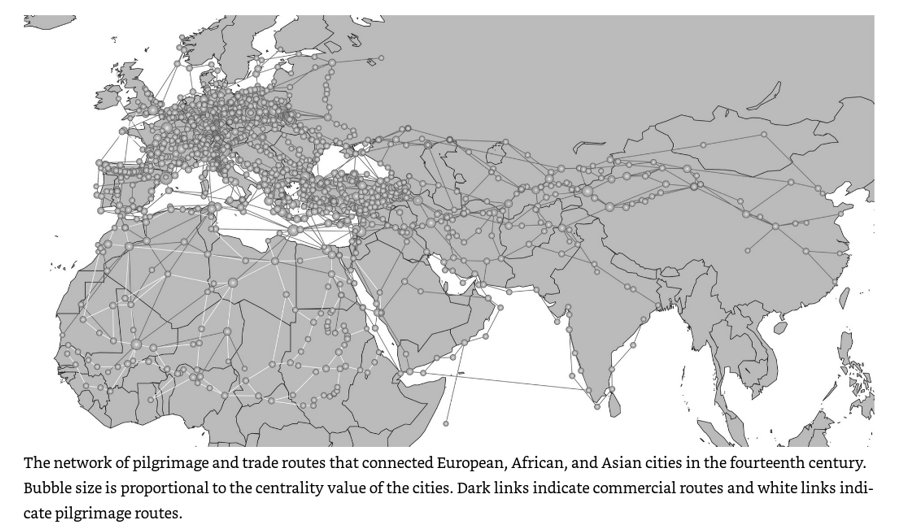
5. The Science Delusion
This chapter briefly describes the impact of various infections on human societies and their history. It includes discussions about malaria that limited access to tropical areas, the plague that changed the course of Europe, smallpox that cleared up America from its native population, and so on. The chapter also reviews attempts to fight diseases, often without any understanding of them whatsoever. Finally, it looks at the successes of the late XIX and XX centuries that actually worked.
6. The Psychology of Political Incompetence
This chapter is somewhat philosophical, discussing Tolstoy’s approach to history as an uncontrolled and unpredictable movement of millions vs. a process when leaders actually control masses, at least partially. The second part of the chapter looks at political systems, especially democracy, and how they managed natural and manufactured catastrophes, especially famines and wars. Finally, the author provides a summary table for famines:

The author also discusses British-specific events and the tendency to repeat the same political mistakes over and over again. Finally, the author ends this chapter by discussing how empires fall and the impossible dreams of the next generation of leaders about restoration, which usually do not end well.
7. From the Boogie Woogie Flu to Ebola in Town
This chapter looks at the history of the 1957-58 pandemic in the USA and compares its handled then with the COVID pandemic now. He finds material deterioration in the quality of American leadership and bureaucracy despite a huge increase in their quantity and costs. He also looks at the same events, processes, and comparisons worldwide. Finally, the author compares the views of Steven Pinker and Martin Rees and concludes that Rees was correct when:” In 2002, the Cambridge astrophysicist Martin Rees publicly bet that “by 2020, bioterror or bioerror will lead to one million casualties* in a single event.”
8. The Fractal Geometry of Disaster
This chapter is about accidental catastrophes such as Titanic or Bhopal or Challenger, or Chernobyl, caused by human imperfections or plain errors.
9. The Plagues
This chapter looks at the current COVID pandemic, its origins, development, and handling by the media, politicians, and the people. Unfortunately, all of them demonstrated high levels of incompetence and irrationality.
10. The Economic Consequences of the Plague
Here, the author discusses the pandemic’s long- and short-term economic consequences and provides some numbers based on various analyses, all huge and imprecise. Lots depend on future developments, way beyond the scope of this book. The author also allocates quite a bit of space to political polarization in America that seems to be increased with the pandemic, clearly hampering effective handling of the situation.
11. The Three-Body Problem
The final chapter is about China, its rise, and its constantly increasing aggressiveness. The author links it to COVID and other catastrophes. He notes that the China issue is the only issue in American politics in which there is a bipartisan agreement. The author also discusses other geopolitical events of recent years, concluding that we are at “the foothills of a Cold War.” He concludes that the Cold War is already underway, and all that could be done is to avoid it from turning into the Hot War.
Conclusion: Future Shocks
The conclusion pretty much summarizes the book in such a way:
- COVID-19 will be to social life what AIDS was to sexual life: it will change people’s behavior.
- Most big cities are not “over.” COVID demonstrated the difficulty of remote work
- The consequences of the pandemic are not clear, but history indicates that a comeback would make America stronger.
- There are other threads on the horizon, some of them resulting from the coming mass changes due to AI.
- The new Cold War with China is underway, and it is not clear who will win.
MY TAKE ON IT:
This book is a pretty straightforward presentation of current and previous catastrophic events and their consequences. I am well familiar with ideas of cyclical development, and even if recent events arrived right on schedule, I still think that the future is unpredictable. I believe it depends not on some cosmic powers but on actions that people apply here and now and, if these actions are effective, we are at the brink of the new world, maybe even a lot better than our current world. The author’s attention to China and the new Cold War is fully justified. This problem had to be handled much more seriously than it was done by Trump’s administration, leave alone Biden’s appeasement. However, I think that China’s internal weakness, which is not that obvious right now, as well as America’s inner strength, will produce a very positive outcome for everybody. It will be precious for Chinese people if the final result is communists’ removal from power and real prosperity.
20211127 – The WEIRDEST People in the World

MAIN IDEA:
The author provided an outstanding graphical presentation of the main ideas of this book:

DETAILS:
Prelude: Your Brain Has Been Modified
The author begins with the beautiful presentation of what reading does to people:
- Specialized an area of your brain’s left ventral occipito-temporal region, which lies between your language, object, and face processing centers.
- Thickened your corpus callosum, which is the information highway that connects the left and right hemispheres of your brain.
- Altered the part of your prefrontal cortex that is involved in language production (Broca’s area) as well as other brain areas engaged in a variety of neurological tasks, including both speech processing and thinking about others’ minds.
- Improved your verbal memory and broadened your brain’s activation when processing speech.
- Shifted your facial recognition processing to the right hemisphere. Normal humans (not you) process faces almost equally on the left and right sides of their brains, but those with your peculiar skill are biased toward the right hemisphere.
- Diminished your ability to identify faces, probably because while jury-rigging your left ventral occipito-temporal region, you impinged on an area that usually specializes in facial recognition.
- Reduced your default tendency toward holistic visual processing in favor of more analytical processing. You now rely more on breaking scenes and objects down into their component parts and less on broad configurations and gestalt patterns.
The author proceeds to discuss other forms of the impact of culture on the human body and psychology and then links all this to the Protestant branch of Christianity.
The author also presents essential ideas of this book:
- Religious convictions can powerfully shape decision-making, psychology, and society. Reading the sacred scripture was primarily about connecting with the divine, but the unintended side effects were big, and resulted in the survival and spread of some religious groups over others.
- Beliefs, practices, technologies, and social norms—culture—can shape our brains, biology, and psychology, including our motivations, mental abilities, and decision-making biases. You can’t separate “culture” from “psychology” or “psychology” from “biology,” because culture physically rewires our brains and thereby shapes how we think.
- Psychological changes induced by culture can shape all manner of subsequent events by influencing what people pay attention to, how they make decisions, which institutions they prefer, and how much they innovate. In this case, by driving up literacy, culture induced more analytic thinking and longer memories while spurring formal schooling, book production, and knowledge dissemination. Thus, sola scriptura likely energized innovation and laid the groundwork for standardizing laws, broadening the voting franchise, and establishing constitutional governments.
- Literacy provides our first example of how Westerners became psychologically unusual. Of course, with the diffusion of Christianity and European institutions (like primary schools) around the world, many populations have recently become highly literate. However, if you’d surveyed the world in 1900, people from western Europe would have looked rather peculiar, with their thicker corpus callosa and poorer facial recognition.
Part l: The Evolution of Societies and Psychologies
I. WEIRD Psychology
In this chapter, the author defines who are the WEIRD people: “raised in a society that is Western, Educated, Industrialized, Rich, and Democratic.” After that author provides results of multiple research results comparing these people with others, which identifies their specific characteristics:
- Individualism,
- Self-understanding via roles, rather than relations,
- Propensity to feel the guilt as failure to meet one’s own standards rather than a shame – the failure to meet standards of others.
- Non-conformism
- High tolerance for relayed rewards (marshmallow test)
- Trust to others
- Obsession with the intentionality
The author provides several graphs comparing WEIRD people with others per these parameters and map for levels of individualism around the world, which is synonymous with the WEIRDness:

The author also provides a summary table for psychological features:
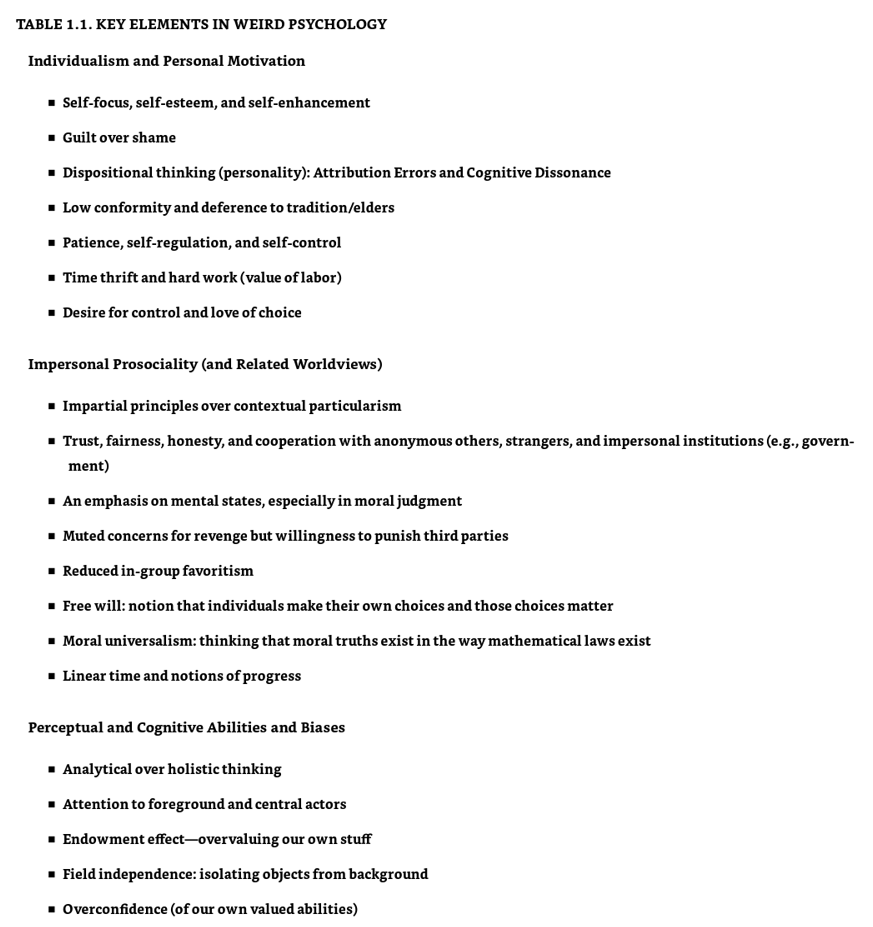
2. Making a Cultural Species
In this chapter, the author retells the story of Bill Buckley and his observations of the lives of Australian aborigines. The author refers to his previous book about cultural learning and the evolution of societies. The author defines the essential point of this chapter in such way:
- Humans are a cultural species. Our brains and psychology are specialized for acquiring, storing, and organizing information gleaned from the minds and behaviors of others. Our cultural learning abilities directly reprogram our minds, recalibrate our preferences, and adapt our perceptions. As we’ll see, culture has devised many tricks for burrowing into our biology to alter our brains, hormones, and behavior.
- Social norms are assembled into institutions by cultural evolution. As powerful norm-learners, we can acquire a wide range of arbitrary social norms; however, the easiest norms to acquire and internalize tap deeply into aspects of our evolved psychology. I’ve highlighted a few aspects of our evolved psychology, including those related to kin-based altruism, incest aversion, pair-bonding, interdependence, and tribal affiliation.
- Institutions usually remain inscrutable to those operating within them—like water to fish. Because cultural evolution generally operates slowly, subtly, and outside conscious awareness, people rarely understand how or why their institutions work or even that they “do” anything. People’s explicit theories about their own institutions are generally post hoc and often wrong.
3. Clans, States, and Why You Can’t Get Here
Here the author discusses the initial development of societies and their scaling up via intergroup competition development of the “fit” between social norm and institutions. Finally, the author presents five processes that operate intergroup competition:
- War and raiding: Any social norms, beliefs, or practices that generate greater cooperation, stronger in-group solidarity, or other technological, military, or economic advantages can spread via intergroup conflict, as groups with more competitive institutions drive out, eliminate, or assimilate those with less competitive institutions. Abelam institutions were spreading via this process in the Sepik.
- Differential migration: Whenever possible, people will migrate from less prosperous or secure communities to more prosperous and secure ones. Since immigrants, and especially their children, adopt the local customs, this differential migration drives the spread of institutions that generate prosperity and security, as more successful communities grow at the expense of less successful ones. This is what happened as the refugees created by the Abelam onslaught fled into Ilahita’s secure embrace.
- Prestige-biased group transmission: Individuals and communities preferentially attend to and learn from more successful or prestigious groups. This causes social norms and beliefs to diffuse from more successful groups to less successful ones and can drive the spread of more competitive institutions. However, since people often cannot distinguish what makes a group successful, this also results in the transmission of many norms and practices that have nothing to do with success, including things like hairstyles and music preferences. In Ilahita, the elders decided to explicitly copy the Tambaran from the successful Abelam. Along the way, Ilahita and other communities also copied the Abelam’s elaborate yam-growing magic, which probably didn’t contribute to anyone’s success.
- Differential group survival without conflict: In hostile environments, only groups with institutions that promote extensive cooperation and sharing can survive at all. Groups without these norms either retreat into more amicable environments or go extinct during droughts, hurricanes, floods, or other shocks. The right institutions allow groups to thrive in ecological niches where other groups cannot. This process can operate even if groups never meet each other.
- Differential reproduction: Norms can influence the rate at which individuals have children. Since children tend to share the norms of their community, any norms that increase birth rates or slow death rates will tend to spread. Some world religions, for example, have spread rapidly due to their fertility-friendly beliefs, such as those involving gods that eschew birth control or nonreproductive sex.
The author traces the development of tribes and clans all the way to premodern states as the process typical for all and shows its graphic representation:

Then he asks the question: why WEIRD societies move away from this path.
4. The Gods Are Watching. Behave!
The search for an answer to the question in chapter 3 leads the author to the Gods. First, he looks at behavioral differences between believers and atheists in “dictator” and other games. He then reviews the development of the religions as the necessary launchpad for contemporary societies because:” The psychological impacts of beliefs about godly desires, divine punishment, free will, and the afterlife combine with repetitive ritual practices to suppress people’s tendencies toward impulsivity and cheating while increasing their prosociality toward unfamiliar coreligionists. At a group level, these psychological differences result in lower crime rates and faster economic growth.” However, the author stresses that this does not explain the specificity of WEIRD societies.
Part II: The Origins of WEIRD People
5. WEIRD Families
Here the author begins a close investigation of WEIRD societies starting with the families. But, first, the author provides a list of typical traits:
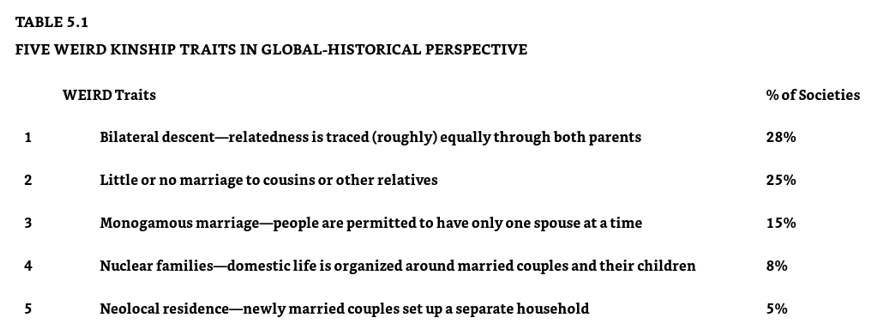
He reviews the historical development of the family institution of WEIRD societies and recognizes a specific pattern that includes:
- Monogamous nuclear families with neolocal residence,
- Late marriage, with the average ages of both men and women often rising into the mid-20s.
- Many women never marry: By age 30, some 15–25 percent of northwestern European women remained unmarried.
- Smaller families and lower fertility:
- Premarital labor period:
All this created a very different result than the one observable in other societies.
6. Psychological Differences, Families, and the Church
In this chapter, the author concentrates on critical differences for each of which he provides supporting data and research results. These differences are:
- Kinship Intensity and Psychology
- Individualism, Conformity, and Guilt
- Impersonal Prosociality
- Prevalence of Universalism over In-Group Loyalty.
- Impersonal Punishment and Revenge
- Intentionality in moral judgment
- Analytic Thinking
In conclusion, the author presents a causal pathway for this global psychological variation:

7. Europe and Asia
In this chapter, the author demonstrates how uneven historical development of the church in Europe impacted the development of different patterns, summarizing it this way:
- The patterns we’ve seen in Europe parallel those we saw globally in the last chapter. The longer a population was exposed to the Western Church, the weaker its families and WEIRDer its psychological patterns are today. Except now, our comparisons within European countries leave much less room for alternative explanations. These patterns can’t be explained by colonialism, “European genes,” democratic institutions, economic prosperity, or individual-level differences in income, wealth, education, religious denomination, or religiosity.
- The effect of kin-based institutions on people’s psychology is culturally persistent. The adult children of immigrants, who grow up entirely in Europe, still manifest the psychological calibrations associated with the kin-based institutions linked to their parents’ native countries or ethnolinguistic groups.
- Some similar patterns of psychological variation can also be detected in other large regions, including in China and India. Crucially, while this psychological variation probably traces to regional differences in kinship intensity, its underlying causes relate not to the Church but to ecological and climatic factors that made irrigation and paddy rice cultivation particularly productive over the population’s history.
8. WEIRD Monogamy
In this chapter, the author analyses impact of monogamy on various aspects of life and even biology via changes in testosterone levels in men. This impact changed many attitudes from increasing equality because a king and commoner could have only one wife to applying intuitions and insights gained from living in monogamous nuclear families when forming towns, guilds, and religious institutions in the 10th – 11th centuries.
Part III: New Institutions, New Psychologies
9. Of Commerce and Cooperation
The author begins with a discussion of the result of anthropological studies with the use of games. Here is the representation of the results:

The overall inference is that typical Western behavior and attitudes are highly connected to market development and urbanization. Here is the author’s diagram explaining this connection:
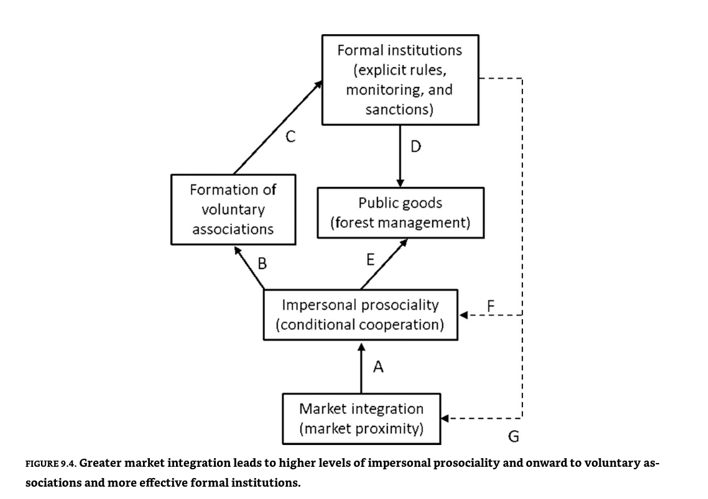
10. Domesticating the Competition
In this chapter, the author discusses the power of competition and its impact on people’s psychology. As usual, it relates to military competition – the wars, but then it developed into the peaceful market competition. The author formulates it this way:” Europeans Made War, and War Made Them WEIRDer.” The author also stresses the role of religion, specifically monasteries, which, together with other voluntary organizations such as universities and guilds, promoted interaction between strangers and the development of trust between unrelated people. Here is the crucial point that author makes:” …our modern institutional frameworks incorporate various forms of intergroup competition that drive up people’s inclinations to trust and cooperate with strangers and may influence other aspects of our psychology. People learn to work in ad hoc teams, even if those teams are composed of a bunch of strangers. The engine of intergroup competition pushes against the within-group forces of cultural evolution, which often favor self-interest, zero-sum thinking, collusion, and nepotism. Our WEIRD institutional frameworks began developing during the High Middle Ages, as people who were increasingly individualistic, independent, nonconformist, and analytic started asserting themselves into voluntary associations, which in turn began to compete. In the long run, competition among territorial states favored those that developed ways to harness and embed the psychological and economic effects of nonviolent intergroup competition. Of course, no one designed this system, and few even realize how it shapes our psychology or why it often works.”
11. Market Mentalities
This chapter reviews how to market mentality expresses itself in some curious way:

The author also discusses time management, how work becomes virtuous, and high levels of patience and self-regulation typical for WEIRD people. He links it to the Big-5 of psychology, defines them as WEIRD-5, and stresses that non-WEIRD people demonstrate only some of these dimensions. At the end of the chapter, the author notes:” …we have explored the origins and evolution of some of the major aspects of WEIRD psychology. However, there is every reason to believe that the psychological variation we’ve seen represents only a thin slice of the total diversity that exists around the world. Moreover, in explaining some of this psychological variation, I’ve considered the influence and interaction of kin-based institutions, impersonal markets, war, benign intergroup competition, and occupational specialization. These likely capture only a small fraction of the myriad ways that cultural evolution has shaped people’s brains and psychology in response to diverse institutions, religions, technologies, ecologies, and languages. All we’ve done is poke our heads below the surface and look around. This psychological iceberg is clearly big, but we can’t tell exactly how big, or how deep into the murky depths it goes.”
Part IV: Birthing the Modern World
12. Law, Science, and Religion
Before switching to the emergence of the modern world, the author summarizes four key aspects of WEIRD psychology:
- Analytic thinking: To better navigate a world of individuals without dense social interconnections, people increasingly thought about the world more analytically and less holistically/relationally. More analytically oriented thinkers prefer to explain things by assigning individuals, cases, situations, or objects to discrete categories, often associated with specific properties, rather than by focusing on the relationships between individuals, cases, etc. The behavior of individuals or objects can then be analytically explained by their properties or category memberships (e.g., “it’s an electron”; “he’s an extrovert”). Troubled by contradictions, the more analytically minded seek out higher- or lower-level categories or distinctions to “resolve” them. By contrast, holistically oriented thinkers either don’t see contradictions or embrace them. In Europe, analytical approaches gradually came to be thought of as superior to more holistic approaches. That is, they became normatively correct and highly valued. Internal attributions:
- Internal Attributes: As the key substrates of social life shifted from relationships to individuals, thinkers increasingly highlighted the relevance of individuals’ internal attributes. This included stable traits like dispositions, preferences, and personalities as well as mental states like beliefs and intentions. Soon lawyers and theologians even began to imagine that individuals had “rights.”
- Independence and nonconformity: Spurred by incentives to cultivate their own uniqueness, people’s reverence for venerable traditions, ancient wisdom, and wise elders ebbed away. For good evolutionary reasons, humans everywhere tend to conform to peers, defer to their seniors, and follow enduring traditions; but, the incentives of a society with weak kin ties and impersonal markets pushed hard against this, favoring individualism, independence, and nonconformity, not to mention overconfidence and self-promotion.
- Impersonal prosociality: As life was increasingly governed by impersonal norms for dealing with nonrelations or strangers, people came to prefer impartial rules and impersonal laws that applied to those in their groups or communities (their cities, guilds, monasteries, etc.) independent of social relationships, tribal identity, or social class. Of course, we shouldn’t confuse these inchoate inklings with the full-blown liberal principles of rights, equality, or impartiality in the modern world.
Then the author proceeds to discuss Universal Laws, Conflicting Principles, and Individual Rights, Representative Governments and Democracy, and Protestantism as the WEIRDest religion. He then combines all of this into “Dark Matter or Enlightenment”
13. Escape Velocity
In this chapter, the author presents his view on how these psychological changes eventually led to technological changes and the industrial revolution. He specifically identifies the key technologies:
- Printing press (1440–1450 CE)
- Steam engine (1769)
- Spinning mule (1779)
- Vulcanized rubber (1844–1845)
- Incandescent light bulb (1879)
Another fascinating approach is the author’s positing “collective brain” that produced the contemporary technological world. Here is the graph of the growth of such brain:

At the end of the chapter, the author provides an excellent concise summary:” To close, let’s summarize this chapter on a Post-it. To explain the innovation-driven economic expansion of the last few centuries, I’ve argued that the social changes and psychological shifts sparked by the Church’s dismantling of intensive kinship opened the flow of information through an ever-broadening social network that wired together diverse minds across Christendom. In laying this out, I highlighted seven contributors to Europe’s collective brain: (1) apprenticeship institutions, (2) urbanization and impersonal markets, (3) transregional monastic orders, (4) universities, (5) the Republic of Letters, (6) knowledge societies (along with their publications like the Encyclopédie), and (7) new religious faiths that not only promoted literacy and schooling but also made industriousness, scientific insight, and pragmatic achievement sacred. These institutions and organizations, along with a set of psychological shifts that made individuals more inventive but less fecund, drove innovation while holding population growth in check, eventually generating unparalleled economic prosperity.”
14. The Dark Matter of History
In this chapter, the author provides answers to the questions he posed at the beginning of this book:

The author also discusses other factors that could have an impact on development previously presented by Jared Diamond. He partially agrees with this approach but limits its validity to about 1000 AD, after which it is losing explanatory power, especially regarding the industrial revolution. The final part of this chapter discusses the interplay between affluence and psychology, the role or lack thereof of the genetics of different populations, and a globalized future of humanity.
MY TAKE ON IT:
I find the author’s approach fascinating, very logical, and pretty convincing. However, I think that he overestimates the role of Christianity and later Protestantism in the development of individualistic Western societies and psychology. I believe that it comes from the original division of Western societies into the multitude of small polities competing and fighting with each other in all areas of life. This fighting occurs at such a level that it created a sweet spot between too much division that minimizes interaction between multiple polities and people and too much concentration into one polity that would suppress intellectual diversity. This sweet spot allowed individuals to move from one polity to another, interact intellectually, and develop human capital movable from place to place. In short, even since Greek city-states, long before Christianity, Europe provided some space for individual accumulation of Human capital. It demonstrated its value beyond the narrow stretch of one’s tribe.
Moreover, constant migration between polities created the flow of such capital between the polities. Moving to places with a higher return also supported the development of individualistic attitudes when people were getting much better off without their tribe rather than within. Another critical point is that Western society developed expansive legal systems of individual property rights well before Christianity. In contrast, such systems are still not fully implemented even in the contemporary world in non-western societies. The ownership is essential because no individualism is possible without individual property of at least some resources supporting nonconformist behavior.
20211120 – Exercised

MAIN IDEA:
The author’s main idea is to demonstrate that physical inactivity is the preferable state not only of contemporary western people but also all known hunter-gatherers. By itself, inactivity is nearly as energy-consuming as a physical activity because the primary energy expense is the process of metabolism. Nevertheless, inactivity is still detrimental to health because the human body is a machine optimized for activity. Even if hunter-gatherers prefer to be idle, they have to walk and overall be active a lot because otherwise, they would have nothing to eat. So the second part of the book demonstrates that contemporary western people should find a way to be active or pay the price in the form of deterioration of their bodies and suffering from illnesses unknown to people forced to be physically active by the circumstances of their lives.
DETAILS:
Prologue
The author discusses his discovery that subsistence farmers in Kenia, people living close to old ways, never exercise. Moreover, if left alone, they would prefer to stay in rest, as does any regular person in the developed world. He points out that humans did not evolve to exercise, but he still agrees that it is very healthy. The author defines this as a paradox and makes the following statement:” The mantra of this book is that nothing about the biology of exercise makes sense except in the light of evolution, and nothing about exercise as a behavior makes sense except in the light of anthropology.” The author also defines here the structure of the book:” After an introductory chapter, the first three parts roughly follow the evolutionary story of human physical activity and inactivity, with each chapter spotlighting a different myth. Because we cannot understand physical activity without understanding its absence, part 1 begins with physical inactivity. What are our bodies doing when we take it easy, including when we sit and sleep? Part 2 explores physical activities that require speed, strength, and power such as sprinting, lifting, and fighting. Part 3 surveys physical activities that involve endurance such as walking, running, and dancing, as well as their effect on aging. Last but not least, in part 4 we will consider how anthropological and evolutionary approaches can help us exercise better in the modern world. How can we more effectively manage to exercise, and in what ways? To what extent, how, and why do different types and doses of exercise help prevent or treat the major diseases likely to make us sick and kill us?”
One: Are We Born to Rest or Run?
The author begins with a chapter describing the Ironman endurance competition in Hawaii and the traditional footrace in Sierra Tarahumara, Mexico. He finds both grueling, arduous, and unnatural for human beings. The next step is the critic of “the myth of the athletic savage.” The author’s point is that people from the undeveloped world do not enjoy running or exercising. It is just that their everyday life forces them to apply lots of physical efforts, inadvertently preparing them for marathons and other such things. The author also reviews the UN measurement of the physical activity level (PAL) and defines it this way:” If you are a sedentary office worker who gets no exercise apart from generally shuffling about, your PAL is probably between 1.4 and 1.6. If you are moderately active and exercise an hour a day or have a physically demanding job like being a construction worker, your PAL is likely between 1.7 and 2.0. If your PAL is above 2.0, you are vigorously active for several hours a day. Although there is much variation, PALs of hunter-gatherers’ average 1.9 for men and 1.8 for women, slightly below PAL scores for subsistence farmers, which average 2.1 for men and 1.9 for women. …Here’s another, startling way of thinking about these numbers: if you are a typical person who barely exercises, it would take you just an hour or two of walking per day to be as physically active as a hunter-gatherer”.
The last part of the chapter discusses the history of exercise as nationalistic preparation for war on one hand and as the medicalized process on the other.
Part l: Inactivity
Two: Inactivity: The Importance of Being Lazy
This chapter discusses inactivity as the natural condition of humans and other primates, which are even less active than human hunter-gatherers. The author reviews research on the calories expenditure that demonstrated little difference from exercise: about 2/3 or 63% is energy spent in the condition of the rest – just to maintain metabolism. The author narrates in detail about the study conducted at the University of Minnesota during WWII that starved several healthy men, limiting them to 1500 calories until they got to extreme condition. Here is the conclusion:” The key lesson to digest from the starving men’s dramatically lower resting metabolic rates is that human resting metabolisms are flexible. Most critically, resting metabolism is what the body has opted to spend on maintenance, not what it needs to spend.”
As clarification of this lesson, the author presents energy-use options and comparison charts:
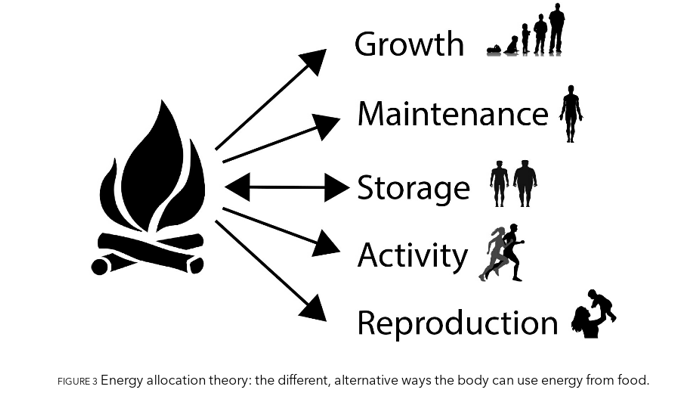

The final word here is that inactivity, if natural and the normal condition of humans is to economize energy expense. The problem is that one had to spend energy to get food and fuel, so the tradeoff was necessary, but now we can get lots of food with practically no energy expenditure, which got us out of natural balance.
Three: Sitting: Is It the New Smoking?
The main point of this chapter is that sitting, like any other inactivity, is not healthy and leads to inflammation and accumulation of fat. The author discusses the results of multiple research confirming this link and recommends an active sitting. The author also provides a picture supporting these points:

Four: Sleep: Why Stress Thwarts Rest
This chapter discusses another important activity – sleep. The main point here is that it is pretty personal, so recommendations of 8 hours and other such “one size fits all” advice are usually not correct. However, the author also presents a typical structure of sleep:
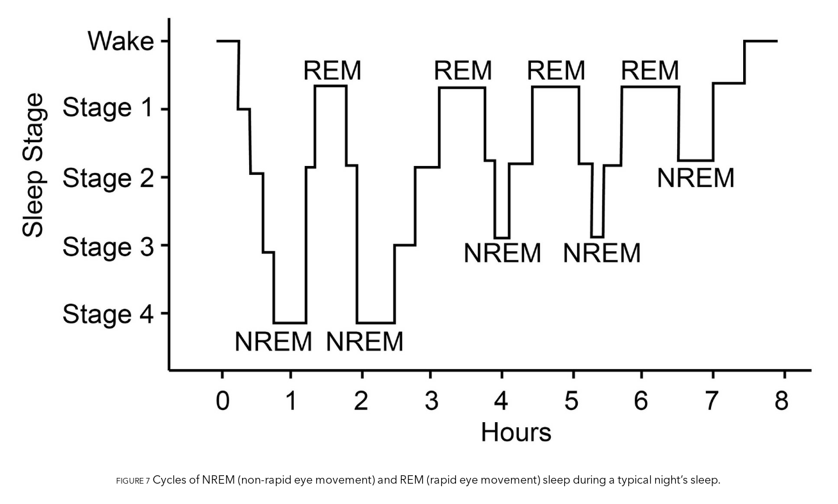
Part II: Speed, Strength, and Power
Five: Speed: Neither Tortoise nor Hare
In this chapter, the author discusses the intensity of exercise and the speed of human running, comparing it with other animals. He then discusses the pluses and minuses of long runs vs. fast runs and how they impact muscles. His conclusion supports the High-intensity interval training *HIIT” and stresses that human bodies developed for various activities so that any activity would be valuable.
Six: Strength: From Brawny to Scrawny
In this chapter, the author discusses the external presentation of physics and fashion to imitate the paleo way of life. The author reviews research on hunter-gatherers’ lifestyles and physical activities regimens. The final part of the chapter discusses muscle aging, and here is a graph demonstrating this process:

Seven: Fighting and Sports: From Fangs to Football
In this chapter, the author looks at various team sports that somewhat emulate fighting and discusses the impact of the human propensity to fight on the human body. Here is the author’s conclusion:” In the final analysis, humans are physically weaker than our ancestors not because we evolved to fight less but because we evolved to fight differently: more proactively, with weapons, and often in the context of sports. Along the same lines, we didn’t evolve to do sports to get exercise. As a form of organized, regulated play, sports were developed by each culture to teach skills useful to kill and avoid being killed as well as to teach each other to be cooperative and nonreactive. Sports took on the role of providing exercise only when aristocrats and then white-collar workers stopped being physically active on the job. Now in the modern, industrial world we market sports as a means of exercising to stay healthy (I’m still not convinced about darts). Yet true to their evolutionary roots, many sports still emphasize skills useful for fighting and hunting that involve strength, speed, power, and throwing projectiles.”
Part III: Endurance
Eight: Walking: All in a Day’s Walk; Nine: Running and Dancing: Jumping from One Leg to the Other;
In this part, the author looks in somewhat mechanical details at various activities such as walking and running. He provides a graph comparing chimps, hunter-gatherers, and westerners:

Ten: Endurance and Aging: The Active Grandparent and Costly repair Hypothesis.
The final chapter of this part looks at aging and how it developed over the ages. Here is the description of one of the experiments. It started in the mid-1960s with a group of 25 years old. The first part of the experiment looked like this:” first to spend three weeks in bed and then to undergo an intensive eight-week exercise program. The bed rest was ruinous. When they were finally allowed to arise from their beds, the volunteers’ bodies resembled forty-year-olds’ by many metrics: they were fatter, had higher blood pressure, higher cholesterol levels, less muscle mass, and lower fitness. The eight ensuing weeks of exercise, however, not only reversed the deterioration but in some cases led to net improvements.”
The second part was conducted 30 years later:” Three decades of typical American lifestyles had not been kind to the original volunteers: they had each gained about fifty pounds, had higher blood pressure and weaker hearts, and were less fit and healthy in numerous ways. But they agreed to be studied once more as they tried to undo the consequences of thirty sedentary years with a six-month program of walking, cycling, and jogging. Fortunately, this second late-in-life exercise intervention helped the volunteers lose about ten pounds and, most astoundingly, largely reversed their decline in cardiovascular fitness. After six months of moderate exercise, the average volunteer’s blood pressure, resting heart rate, and cardiac output returned to his twenty-year-old level. Many other studies confirm the anti-aging benefits of exercise.”
So, here are alternatives presented in the graphic form:

Part IV: Exercise in the Modern World
Eleven: To Move or Not to Move: How to Make Exercise Happen; Twelve: How Much and What Type? Thirteen: Exercise and Disease
This part contains multiple recommendations and “how-to” for exercise. It also provides data about the impact of exercise on various age-related diseases. Finally, the benefits are nicely summarized in these graphs:
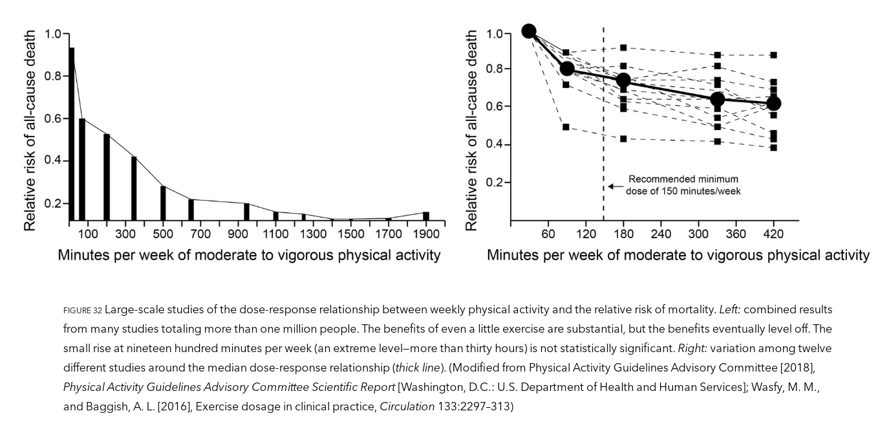
Epilogue
Here the author summarizes the final point of this book:” Researching and writing this book has convinced me that a philosophy for how to use one’s body is just as useful as a philosophy for how to live one’s life. All of us get only one chance to enjoy a good life, and we don’t want to die full of regret for having mislived it, and that includes having misused one’s body. By following deep and ancient instincts to avoid the discomfort that comes with physical exertion, we increase the chances we will senesce faster and die younger, and we become more vulnerable to many diseases and chronic, disabling illnesses. We also miss out on the vigor, both physical and mental, that comes from being fit. To be sure, exercise is no magic pill that guarantees good health and a long life, and it is possible to live a reasonably long and healthy life without exercising. But thanks to our evolutionary history, lifelong physical activity dramatically increases the chances we will die healthy after seven or more decades.”
MY TAKE ON IT:
The philosophy and supporting research presented in this book is entirely consistent with my attitude to health and exercise issues. I believe that the human body is a biological machine evolutionary optimized for 3-4 hours of daily medium-level physical activity such as walking, picking up fruits and vegetables, setting up traps, throwing projectiles, and consequently consuming a moderate amount of food obtained via these activities. As with any other machine optimized for some conditions, it would work well and last long in these conditions and could break down if it is underloaded or overloaded. Even mechanical contraptions made of steel break down if they regularly run in overdrive or get rusty if they are not used. So it seems to be a common feature of any machine, whether made out of steel or muscles. The only thing that I do not entirely agree with the author is about types of exercise. I think it should be proportionally more helpful if it imitates the physical activities of hunter-gatherers as close as possible. Such things as bicycles, tennis, and other sports could be less efficient in maintaining the human body in good shape.
20211113 – We Want Workers

MAIN IDEA:
Here is how the author defines it:” One underlying theme of this book is that viewing immigrants as purely a collection of labor inputs leads to a very misleading appraisal of what immigration is about, and gives an incomplete picture of the economic impact of immigration. Because immigrants are not just workers, but people as well, calculating the actual impact of immigration requires that we take into account that immigrants act in particular ways because some actions are more beneficial than others. Those choices, in turn, have repercussions and unintended consequences that can magnify or shrink the beneficial impact of immigration that comes from the contribution to widget production.”
DETAILS:
Chapter 1 • Introduction
In the introduction, the author describes the main points of this book, which could be summarized this way:
- Immigration is not just an economic process but rather a societal change of the receiving country’s culture and mores because immigrants, legal or illegal, bring their culture and beliefs with them.
- There are always winners and losers among the native population, both economically and politically
- The official social science is not science anymore because its prominent leaders openly proclaim that it has ideological objectives to support immigration and fight xenophobes and right-wing opponents of unlimited immigration.
The author also briefly retells his own story as a child immigrant from Cuba growing in the immigrant community and succeeding in American society.
Chapter 2 • Lennon’s Utopia
This chapter is quite interesting because the author used Lennon’s “Imagine” – a beautiful song of the economically illiterate poet about global socialism and open borders to apply the logic of economic science. Here is the table demonstrating results:
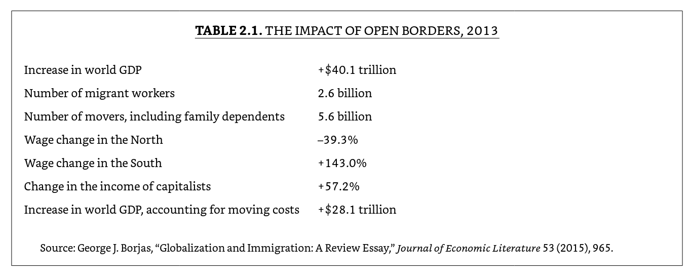
After reviewing the economic consequences of open borders with the mass migration of low-skill South workers to the North, the author looks at the other flow – high-skill immigrants to the North advertised as highly beneficial due to productivity spillovers. This analysis produces another table:

The final point that the author makes in this chapter:” The fact that immigrants affect the receiving country in many other ways—changing social customs, the norms that guide everyday interactions, the cultural milieu, and the political environment—will remain hidden in the background, even though these consequences themselves have an economic impact.” The author stresses that it is not possible to know full impact of mass immigration, but one thing is clear from the work of Putnam: “Immigration and ethnic diversity tend to reduce social solidarity and social capital. New evidence from the US suggests that in ethnically diverse neighborhoods residents of all races tend to “hunker down.” Trust (even of one’s own race) is lower, altruism and community cooperation rarer, friends fewer.”
Chapter 3 • How We Got Here
In this chapter, the author looks at the history of immigration to the USA. Here is the graphic:

The author also discusses illegal immigration and provides an interesting note on their counting methodology:” …the Census Bureau periodically conducts surveys of the population and asks the respondents where they were born. The answers give us an estimate of how many foreign-born people are actually living in the country. In rough terms, the difference between the number of foreign-born persons actually living in the country and the number of legal immigrants who should be living in the country is the DHS estimate of the number of undocumented persons”
It is evident that nobody really knows. There is also a table demonstrating where immigrants came from, and it is no surprise that the vast majority is from Latin America. Finally, the last interesting table in this chapter show immigrants’ characteristics:

Chapter 4 • The Self-Selection of Immigrants
In this chapter, the author presents two opposite opinions. One is that they are the “best and brightest” who do well in America, and another is that they are misfits who bring crime and all kinds of calamities. The author stresses that, in reality, immigrants are different. There are many of both types, but one thing is unquestionable: they are all self-selected. Finally, he discusses various economic parameters of immigrants from different places and provides a graph demonstrating the differences:
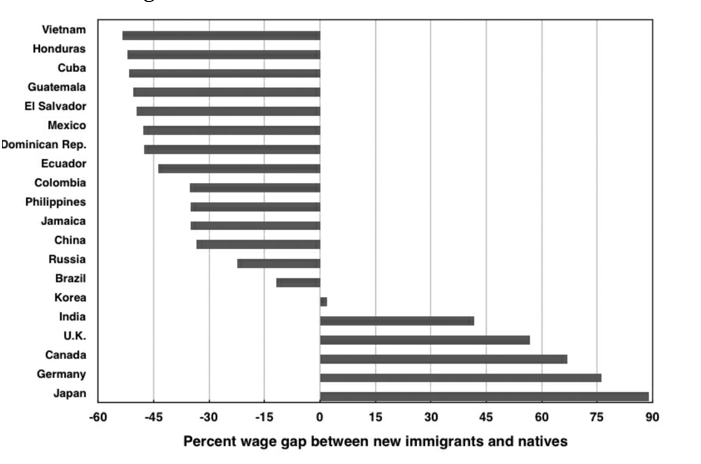
Chapter 5 • Economic Assimilation
This chapter looks at the immigrants’ economic status over time and its link to assimilation or lack thereof. The author provides several graphs demonstrating that level of assimilation decreasing with mass immigration when the new immigrants create isolated conclaves where they can maintain their culture, language and make a living without joining an American culture. Finally, the author makes these points:
“First, rapid economic improvement during an immigrant’s lifetime is not a universal aspect of the immigrant experience, even in a country like the United States, which is typically thought of as being very socially and economically mobile.
Second, immigrants assimilate when the incentives to do so are particularly strong, and they do not when there is less need for assimilation (as when there are large ethnic enclaves).
Third, it is tempting to conjecture that the presence of mass migration before 1920 and after 1980 hindered the economic progress of those immigrant waves. Notably, the interval between those two migrations happens to be the period when restrictive immigration policies, combined with the economic debacle of the Great Depression and the political upheaval of World War II, greatly limited the number of immigrants.”
Here is one of such graphs:

Chapter 6 • The Melting Pot
In this chapter, the author discusses the workings of the Melting Pot and whether it is still working or not. Then, he looks at the conditions of immigrants’ children and finds that the usual perception of their rapid progress is somewhat overoptimistic. Here are the actual data:

At the end of the chapter, the author discusses cultural changes in America that prevent the melting pot from working correctly:
- Assimilation is a choice. It used to be very beneficial economically, and the disappearance of manufacturing jobs that used to demand and reward assimilation significantly decreased these benefits.
- The political class of America used to encourage assimilation, but now it is actively resisting it
- The welfare state automatically improves the economic conditions of immigrants from developing countries, consequently changing the composition and motivations of the immigrant population.
In the end, the author concludes:”…the historical experience probably has little to teach us about the next few decades, and it should not be relied on to predict either a rosy future or a looming debacle. Instead, the lesson to keep in mind is that the melting pot will operate most efficiently when that outcome is in the immigrants’ self-interest.”
Chapter 7 • The Labor Market Impact
The author begins this chapter with the story of a meatpacking factory that, after the immigration enforcement raid, which removed the illegal immigrant workforce, hired black Americans at higher wages. The author concludes:” So what is the lesson that eludes the Cato Institute and the Center for American Progress but that Crider quickly grasped when it had to? It is not that immigrants do jobs that natives don’t want to do. It is instead that immigrants do jobs that natives don’t want to do at the going wage.”
The author provides a numerical estimate of the impact across the board:” The most credible evidence—based solely on the data—suggests that a 10 percent increase in the size of a skill group probably reduces the wage of that group by at least 3 percent.”
After that, the author reviews a natural experiment of moving a large group of immigrants from Cuba to Miami. Here is a comparison graph:


The author also retells the story of the Bush administration’s attempts to rely on the politically motivated study promoting immigration as a boon for all Americans while refusing to explain how they produced such a fantastic result. In short, here is the author’s position:” In my view, the most credible evidence on the labor market impact of immigration comes from studies that do not rely on models of hypothetical economies. Despite the many data problems that real-world studies often encounter, at least that evidence is not tainted by assumptions that offer tempting opportunities to manipulate the data and weave a narrative. The historical relation between the wages of specific skill groups and immigration into those groups summarizes what we know for sure: the earnings of the groups most affected by immigration grow at a slower rate.”
Chapter 8 • The Economic Benefits
The author first presents his modeling of economic benefits from immigration. Here is how he describes the result:” This estimate depends on the many assumptions built into the hypothetical economy. Nevertheless, the exercise says something both useful and surprising: it is mathematically impossible for this widely used framework to spit out a huge number for the immigration surplus. A $50 billion surplus in the context of an $18 trillion economy is not that big a deal; it is less than three-tenths of 1 percent of GDP. The calculation also reveals that this small surplus conceals a large redistribution of wealth. Native workers lose $516 billion, while native-owned firms gain $566 billion. If one wishes to believe that natives, on the whole, benefit from immigration and that the surplus is about $50 billion, it follows from the same calculation that native workers are sending a half-trillion-dollar check to their employers.”
The author then presents a fascinating discussion on the impact of very high skill immigration using two examples: Jewish mathematicians expelled from Nazi Germany in the 1930s and mass migration of Soviet mathematicians after the fall of the USSR. In the first case, the overall productivity of American universities improved due to the immigration of Einstein, von Neumann, and others. Still, it did not impact the productivity of the Arian professors remaining in Germany. Here is the overall picture of the productivity of their students:
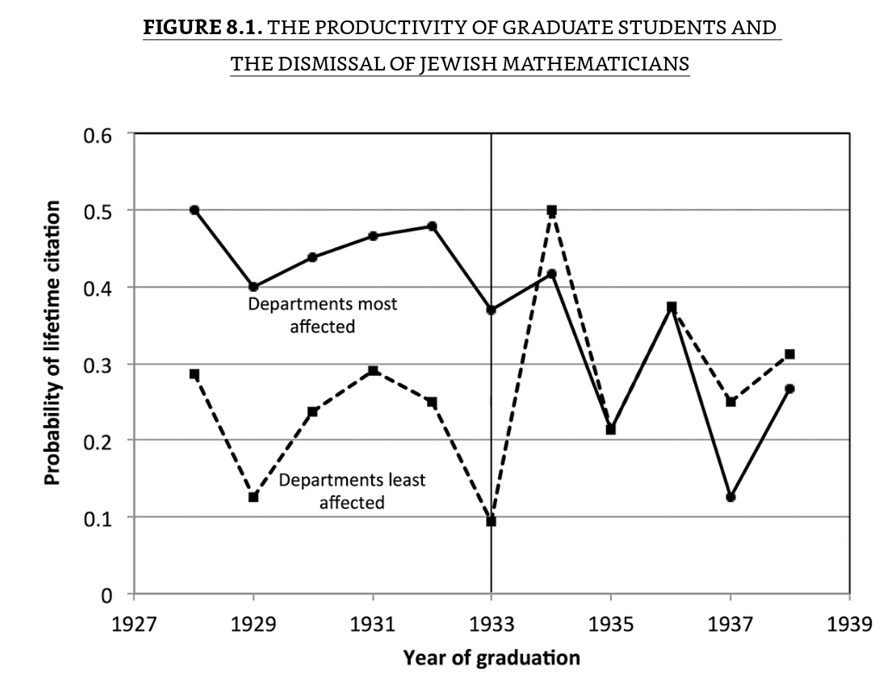
A somewhat different picture appeared in the 1990s mainly because Soviet and American mathematicians worked in different fields during the Cold War. The arrival of the Soviet mathematicians crowded out Americans from the Soviet areas because the overall size of the market for mathematicians did not change:

The final part of the chapter discusses H-1B visas. Again, it provides pretty convincing evidence that the driver is not too few educated American professionals, but rather lower price of Indian professionals.
Chapter 9 • The Fiscal Impact
The author begins this chapter with a reminder that the immigrants are also human beings, in addition to being workers, which obviously has a severe fiscal impact. The author then demonstrates how statistics could be manipulating the same data to obtain different results. He does it by presenting data for the immigrant on welfare either by household (curtain #1) or by an individual (curtain #2). The trick is that children born to immigrants in the USA are not immigrants, so their welfare recipients are counted as natives. Here is the result:
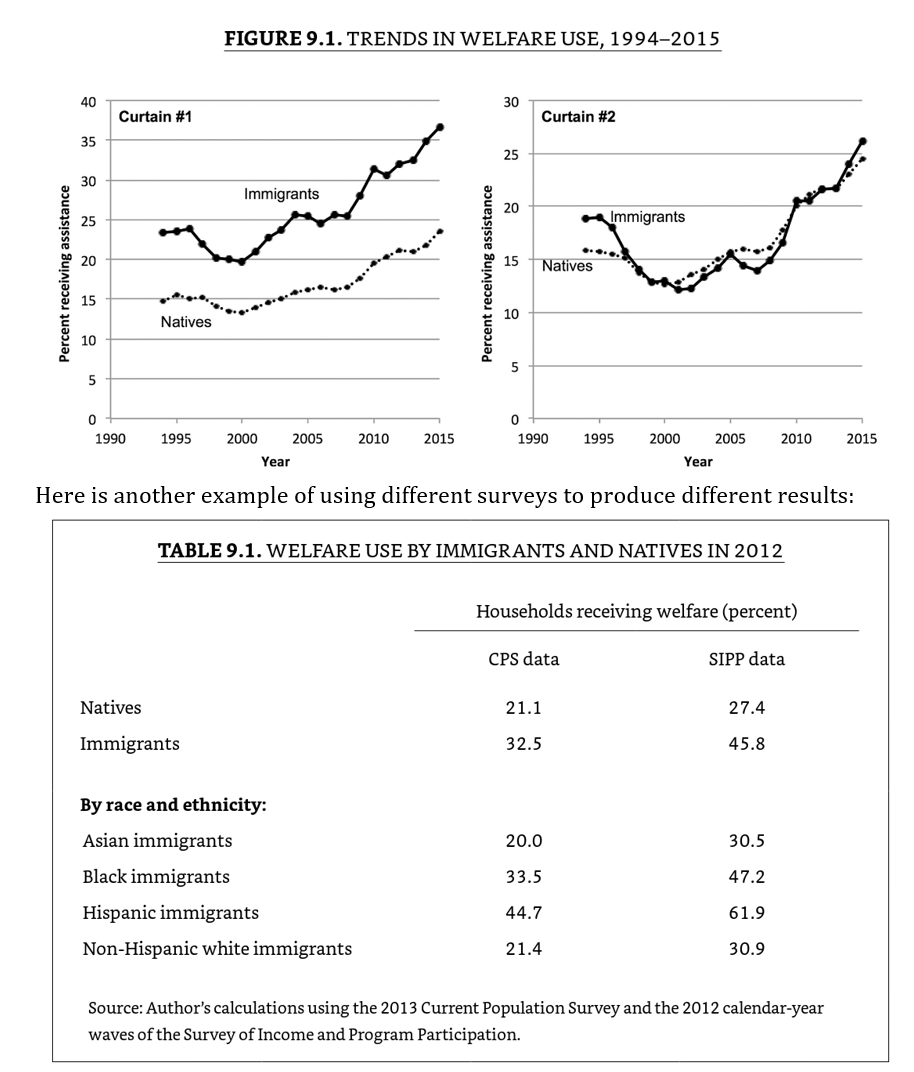
The author then looks at different long-term fiscal impact calculations and finds that they are definitely negative in the short run and probably negative in the long run. Here is the author’s overall conclusion:” This conclusion contradicts the narrative that immigration is good for everyone. It also contradicts the claim that immigration is harming the average American. Instead, the reality is much more nuanced. Although the mythical average person may be unaffected, immigration creates many winners and losers. This redistribution of wealth—in an economy where the size of the native economic pie remains relatively fixed—is the key insight I have gleaned from decades of research on the economics of immigration. After all is said and done, immigration turns out to be just another government redistribution program. And this lesson sheds a lot of light on which groups are on which side of the immigration wars.”
Chapter 10 • Who Are You Rooting For?
In this chapter, the author provides a concise and very clear summary of the results of his research and insights obtained from it:
•Not everyone wants to move to the United States, and those who choose to move are fundamentally different from those who choose to stay behind. The nature of the selection, however, can vary dramatically from place to place. The United States will attract high-skill workers when we offer a higher payoff for their abilities, but the high-skill workers will stay behind if they can get a better deal at home. The fact that different kinds of people will want to move out of different countries (and that the skills they bring are not always transferable to the American setting) creates considerable inequality in economic outcomes across immigrant groups at the time of their arrival.
•Assimilation is not inevitable. The speed of economic assimilation—the narrowing of the gap in economic outcomes between immigrants and natives—depends crucially on conditions on the ground. Sometimes those conditions speed up the process, and sometimes they slow it down. In fact, economic assimilation today is far slower than it was two or three decades ago. This trend, however, masks crucial differences in the assimilation of different immigrant groups. Some groups assimilate very rapidly and some do not. Typically, groups that are more skilled and that do not have access to large and vibrant ethnic enclaves assimilate faster.
•The experience of the descendants of the Ellis Island–era immigrants shows that the melting pot did indeed melt away the differences in economic outcomes across those ethnic groups, but it took nearly a century for the melting pot to do its job. The same process may be starting to take place with the current mass migration, as the children of today’s immigrants earn higher wages and exhibit less ethnic inequality than their parents did. But we truly do not know how things will pan out in the next few decades, because the economic and social conditions that kept the melting pot busy throughout the 1900s may not be reproducible in the next century.
•Immigrants affect the job opportunities of natives. The laws of supply and demand apply to the price of labor just as much as to the price of gas. The data suggest that a 10 percent increase in the number of workers in a particular skill group probably lowers the wage of that group by at least 3 percent. The temptation to play with assumptions and manipulate the data, however, is particularly strong when examining this very contentious issue, so the reported effects often depend on such assumptions and manipulations. Our look inside the black box of how research is done suggests one lesson: the more one aggregates skill groups, the more likely one hides away the specific group of affected workers—making it harder to document whether immigration made anyone worse off. The more laser-focused the group of native workers examined, the easier it is to detect that immigration affected the targeted group.
•Immigrant participation in the workforce redistributes wealth from those who compete with immigrants to those who use immigrants. But because the gains accruing to the winners exceed the losses suffered by the losers, immigrants create an “immigration surplus,” a net increase in the aggregate wealth of the native population. However, the surplus is small, about $50 billion annually. That calculation also suggests a half-trillion-dollar redistribution of wealth from workers to firms. The surplus could be much larger, if there are many exceptional immigrants and if some of the unique abilities brought by those immigrants rub off on the native workforce.
•The welfare state introduces the possibility that the gains measured by the immigration surplus might disappear if immigrants are net users of social assistance programs rather than net contributors. There is little doubt that immigrants receive assistance at higher rates than natives, creating a fiscal burden in the short run. In the long run, immigration may be fiscally beneficial because the unfunded liabilities in Social Security and Medicare are unsustainable and will require either a substantial increase in taxes or a substantial cut in benefits. Immigrants expand the taxpayer base, perhaps helping to spread out the burden. It is extremely difficult to accurately measure the fiscal benefit in the long run, however, because much depends on the assumptions made about the future path of taxes and government spending.
•It is probably not too far-fetched to conclude that, at least in the short run, the economic gains captured by the immigration surplus are offset by the fiscal burden of providing public services to immigrants. Given the scale and the skill mix of the immigrants who entered our country in the past few decades, the economic impact of immigration, on average, is at best a wash. This near-zero effect conceals a substantial redistribution of wealth from workers to firms.
•The argument that open borders would exponentially increase the economic gains from immigration depends crucially on the perspective of immigrants as workers rather than immigrants as people. The multi-trillion-dollar gains promised by the proponents of open borders could quickly disappear (and even become an economic debacle) if immigrants adversely influence the social, political, and economic fabric of receiving countries. In the end, the impact of open borders will depend not only on whether the movers bring along their raw labor and productive skills, but also on whether they bring the institutional, cultural, and political baggage that may have hampered development in the poor countries.
MY TAKE ON IT:
This book pretty much confirms my understanding of the immigration problem with the wealth of data and excellent analysis of this data. I think that immigration, as just about everything else, is not “good” or “bad”, but rather “it depends” proposition. It depends on the types and quality of immigrants and the types and quality of their supporters. There are three different types of immigrants:
- the ones who come to obtain a better life at somebody else’s expense, correctly believing that the American welfare state would provide this opportunity
- the ones who come to earn better life by using opportunities that America offers, but generally reject assimilation because they consider their own culture superior to the American culture
- the ones who want to become Americans and ready and able to put in the effort necessary to do it, not only because they want to get better returns on their effort, but also because they value the opportunity to be free as only Americans could be.
I think that the best solution would be to establish such processes that would filter out the individuals of the 1st type, provide temporary status for the individuals of the 2nd type, and provide all necessary help to individuals of the 3rd type.
However, I think that this is only partially relevant to the problem. The immigrants do not have control over borders – politicians do. And politicians do all they can to open these borders, and they do it for one and only reason – transfer wealth away from the American middle class to themselves. The immigrants, especially illegal, are just a conduit for such transfer. Any other reasons the politicians come up with: humanitarian consideration, empathy, and other staff is just a cloud of smoke to conceal real motives. The motive of enrichment is common for both republicans and democrats, but the latter have another, maybe even more powerful, motive – political power.
The Democratic party is inherently racist and conducts its calculations based on race with the hope of achieving a permanent majority by using a coalition of non-whites against whites. Their dream is to actually recreate the old slave-owning South, which used to have a small caste of planters (by the way, a few of them black), black slaves working the fields, and a stupid white racist majority accepting economically inferior status in exchange for the pride of belonging to “superior” race. The civil rights movement of the 1960s demonstrated that most whites are not stupid racists anymore and prefer good economic opportunities to racial pride with poverty. The new arrangement the Democratic party hopes to establish would be automated and globalized production, with wealth concentrated in the hands of the government-controlled by a small caste of credentialed people (some of them black or brown) and distributed from the top-down, with black and brown minority/majority supporting this caste and accepting economically inferior status in exchange for the pride of belonging to “superior” race. The open borders are just a tool to achieve this minority/majority demographics.
20211106 -The Logic of Violence in Civil War

MAIN IDEA:
The main idea is to present the author’s theory of violence in civil wars. This theory includes such core notions as selective vs. indiscriminate violence, five levels of control distribution between political actors: 2 areas of complete control of one side, two areas of incomplete control, and one contested area where neither side dominates, and a considerable role of information collected via denunciations and support of the population. The author not only formulated his theory but also provided massive empirical support based on data from multiple civil wars, especially on the Greek Civil war, which is the author’s specialty.
DETAILS:
Introduction
The introduction includes discussing historical puzzles when some villages are massacred during various civil wars, but others nearby remain untouched. It also discusses the meaning of civil wars, the book’s goals, the road map of the book, and a bit of the history of the project.
Here is the author’s definition:” Civil war is defined as armed combat within the boundaries of a recognized sovereign entity between parties subject to a common authority at the outset of the hostilities.”
And here is the author’s high-level description of the book:” I begin with a simplified and abstract characterization of violence in civil war, yet one that stands on well-specified conceptual foundations. I analytically decouple civil war violence from civil war. I show that despite its many different forms and the various goals to which it is harnessed across time and place, violence in civil war often displays some critical recurring elements. Rather than just posit this point, I coherently reconceptualize observations that surface in tens of descriptive accounts and demonstrate that seemingly random anecdotes tend to be facets of the same phenomenon. The positive component of the book consists of two parts: a theory of irregular war and a microfoundational theory of violence (with two strands: indiscriminate and selective). Unlike existing work, the theory stresses the joint character of civil war violence, entailing an interaction between actors at the central and local levels, and between combatants and noncombatants. This interaction is informed by the demands of irregular war, the logic of asymmetric information, and the local dynamics of rivalries. Hence the theory differs from existing accounts of violence that stress exclusively macrolevel motivations and dynamics, pinpoint overarching and preexisting cleavage structures, and characterize violence as “wanton,” “indiscriminate,” or “optimal” from the users’ point of view.
From the theory, I specify a model of selective violence that is consistent with the theoretical characterization, in which the interaction between actors operating at different levels results in the production of violence in a systematic and predictable way. This exercise yields counterintuitive empirical predictions about the spatial variation of violence at the microlevel, which I subject to an empirical test using data I collected in Greece. The empirical test confirms the explanatory power of the theory in a limited setting, whereas evidence from a wide array of civil wars suggests broader plausibility. Of course, the general validity of the theory awaits further empirical testing.
Finally, I explore two implications of the theory, looking first at mechanisms of “intimate” violence and then at how the modalities of violence identified can help inform our understanding of cleavage formation – that is, how and to what degree national-level or “master” cleavages map onto local-level divisions.”
1 Concepts
This chapter repeats the author’s definition of civil war and discusses its various examples, starting with the ancient Greeks. This discussion is mainly about different forms of the violence, its process, outcomes, and specifics of occurring in Peace and War. The author also discusses here the scope of violence, its aims, and production:

2 Pathologies
In this chapter, the author discusses what he calls “pathologies” of the literature about wars and violence. These pathologies include five biases:” the partisan bias (taking sides), the political bias (equating war with peace), the urban bias (overlooking bottom-top processes), the selection bias (disregarding nonviolence), and the overaggregation bias (working at too high a level of abstraction).” After this definition, the author reviews each bias in detail with extensive reference to examples in the professional literature.
3 Barbarism
Here is how the author describes the content of this chapter:” I reconstruct, specify, and contrast four general arguments inspired by different theoretical traditions. The first thesis, present in many historical and descriptive accounts, flows from Thomas Hobbes’s insight linking the breakdown of political order to violence. The second, transgression, points to domestic armed challenge as being transgressive of established norms, thus triggering violence. The third account, polarization, can be found in historical and sociological research and stresses deep ideological or social divisions, highlighting the predictably violent effects of what Carl Schmitt described as total enmity. The last thesis stresses violent responses triggered by security concerns related to the technology of warfare practiced in civil wars. I review several theoretical and empirical facets of these arguments and select the last thesis as the most appropriate theoretical foundation for a theory of violence in civil war.”
Before going into detail about the theoretical traditions, the author describes the exceptional barbarity of civil wars. In such conflicts, the victims are often noncombatants well familiar with each other. Then, the author analyzes the Hobbesian breakdown of society during the civil war using specific parameters, such as:” brutalization, revenge, security dilemma, and medievalization.”
The analysis of the transgression comes down to a discussion of lawful vs. unlawful warfare. The author refers to the historical distinction between” Bellum hostile and Bellum Romanum or Guerre mortelle.”
For the polarization, the author looks at causes of conflict, whether they are ideological, ethnic, or something else: ” The causes of polarization may be found at the intersection of structural conditions, political institutions, and the action of political entrepreneurs who succeed in turning real or perceived differences into polarized politics. At the individual level, polarization manifests itself as “fanaticism”: an uncompromising and passionate commitment for a particular cause that overcomes other connections between people and leads to a willingness to shed one’s own blood as well as the blood of others. Exemplary statements are encountered in most conflicts.”
After that, the author discusses the technology of warfare:
- Irregular war as a revolutionary war
- Irregular war as “medieval” war
- Irregular war as a struggle for security
At the end of the chapter, the author concludes: “Four different theoretical accounts for violence in civil wars – breakdown, transgression, polarization, and warfare – have been identified, reconstructed, and discussed in this chapter, in order to clarify the choice of foundation on which to build the current theory of violence in civil wars. Each account has great merit and continues to stand as a strong basis from which to answer a variety of questions surrounding civil war and violence. Violence is a complex phenomenon, and it clearly encompasses multiple processes and mechanisms. Ultimately, they must be operationalized and tested empirically. Nevertheless, a deductive theory of violence in civil war must arise from a simple and clear foundation.”
4 A Theory of Irregular War I: Collaboration
This chapter lays out the first part of a theory of irregular war as the foundation on which the author builds a theory of civil war violence. The author discusses the relation between irregular war and geographical space and derives key implications for the nature of sovereignty in civil war. The author then turns to the issue of popular support, where he distinguishes between attitudinal support (preferences) and behavioral support (actions). The author argues in favor of a framework that makes no assumptions about the underlying preferences of the vast majority of the population and only minimal assumptions about behavioral support, in which complex, ambiguous, and shifting behavior by the majority is assumed, along with a strong commitment by a small minority. Finally, the author concludes with a discussion of the institutional context within which interactions between political actors and civilians take place.
5 A Theory of Irregular War II: Control
This chapter analyzes the relation between collaboration and control and argues that military resources generally trump the population’s prewar political and social preferences in spawning control. In turn, control has a decisive impact on the population’s collaboration with a political actor. However, the amount of military resources required for the imposition of complete and permanent control in a country torn by civil war is enormous and, therefore, typically lacking. This places a premium on the effective use of violence as a key instrument for establishing and maintaining control – and thus for generating collaboration and deterring defection; in turn, effective violence requires discrimination.
The author presents two main propositions:
Proposition 1 The higher the level of control exercised by an actor, the higher the rate of collaboration with this actor – and, inversely, the lower the rate of defection.
Proposition 2 Indiscriminate violence is counterproductive in civil war.
In brief: “…to be effective, violence must be selective.”
6 A Logic of Indiscriminate Violence
This chapter specifies the logic driving indiscriminate violence. Proposition 2 posits that indiscriminate violence is counterproductive in civil war contexts. If this is so, then why is it observed so often? Addressing this puzzle calls for a theory of indiscriminate violence. The author begins by examining how and when indiscriminate violence is observed. Next, he discusses its logic and specifies the conditions under which it is counterproductive. The author then reviews four arguments that account for why indiscriminate violence is observed, despite its apparent counterproductivity, including the specious observation of indiscriminate violence because of truncated or misinterpreted data and its commission as a result of ignorance, cost, and institutional constraints. The author also argues that indiscriminate violence emerges when it does because it is much cheaper than its selective counterpart. Yet, any “gain” must be counterbalanced by its consequences. Thus, indiscriminate violence is more likely either under a steep imbalance of power between the two actors or where and when resources and information are low. In the absence of a resolution of the conflict, even indiscriminate actors are likely to switch to more selective violence.
Here are reasons that, the author believes, lead to indiscriminate violence:
- The Artifact: “The low visibility of selective violence may lead to a gross overestimation of indiscriminate violence.”
- The Ignorance: “Ultimately, ignorance must be qualified as a cause of indiscriminate violence because political actors often seem aware of its deleterious effects from the outset.”
- The Cost: “Identifying, locating, and “neutralizing” enemies and their civilian collaborators one by one requires a complex and costly infrastructure.” It is a lot cheaper to apply violence indiscriminately.
- Institutional Distortions: the author uses the American war in Vietnam as an example when leadership overinvested in firepower and neglected information collection and analysis.
The author also provided a graph for consequences:
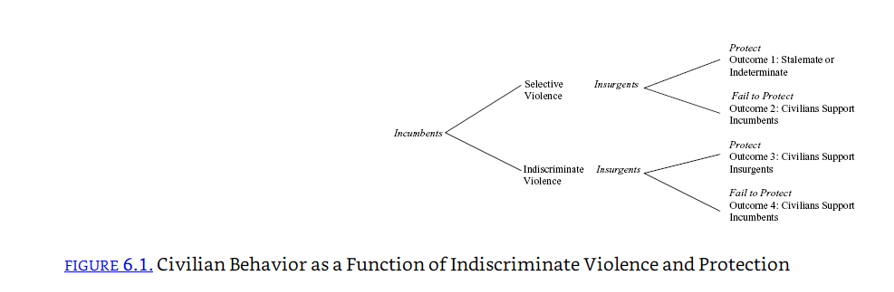
7 A Theory of Selective Violence
The author presents the following argument:” Selective violence presupposes the ability to collect fine-grained information. The most effective way to collect it is to solicit it from individuals, which explains the ubiquity of the practice of denunciation in civil war. Denunciation is central to all civil wars, with the probable exception of a subset of civil wars where no actor attempts to obtain the collaboration of members of groups that allegedly support its rival and where all relevant information is in the public domain, conveyed by visible individual identities.” Selective violence is possible only if political actors have access to information that allows identifying targets. Consequently, the author looks in detail at sources of such information – denunciation and what motivates people to do it. The author also uses the economic approach to this process as presented in the following graphs:
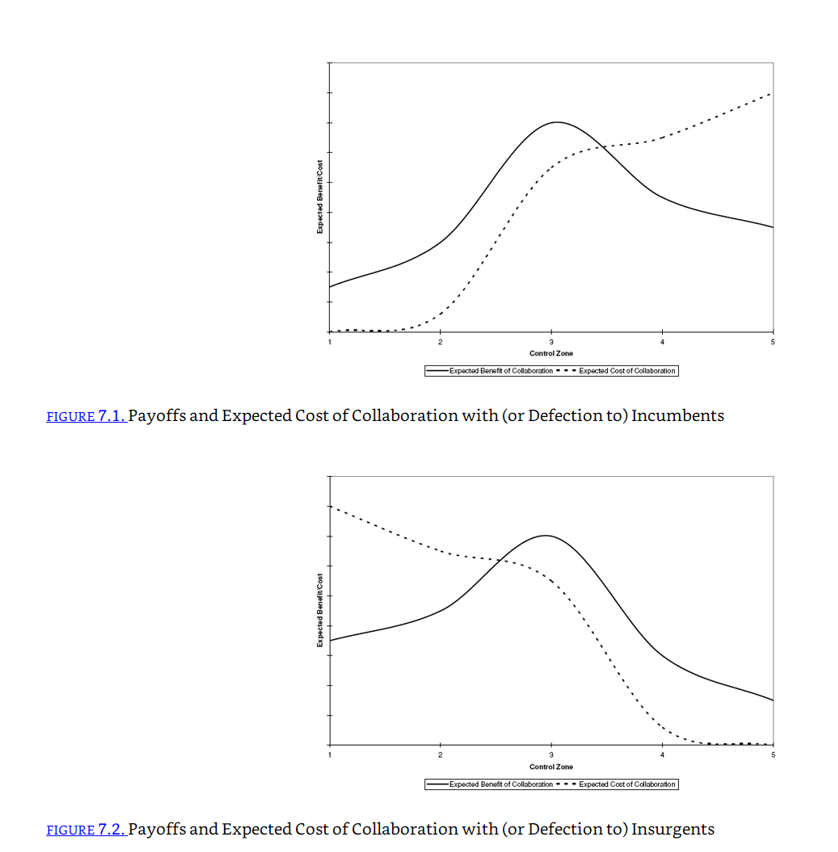
The author also presents some math describing this process. At the end of the chapter, he concludes:” This chapter has specified a theory of selective violence in civil war as a joint process, created by the actions of both political actors and civilians. The key resources around which the process is arrayed are information and violence. Political actors need information in order to be able to target selectively, to distinguish from among the sea of civilians those who are abetting the enemy. Civilians have information, which they provide through denunciation, which can be either political, or, more likely, malicious, in hopes that the violence of the political actors will be directed against those denounced. There is, significantly, a great potential for abuse in such a system, but violence need only be perceived as selective in order to avoid the pitfalls of indiscriminate violence. Denunciation will only occur in such situations in which its benefits, be they psychological or material, outweigh the predicted costs; the most significant cost would be retaliation, quite possibly in the form of a counterdenunciation by the victim or the victim’s family to the other political actor. Hence, denunciation will only occur when potential denouncers perceive the political actor as able to protect them from retaliation.”
8 Empirics l: Comparative Evidence; 9 Empirics II: Microcomparative Evidence
In these two chapters, the author provides empirical evidence related to his theory of violence. The author collects this evidence from multiple sources with the most detailed information from the author’s area of expertise: the Greek civil war in the 1940s.
10 Intimacy
The intimacy here relates to the specific character of civil wars when fighters are neighbors, often know each other, and have the know-how to maximize damage and suffering. The author explicitly analyses all kinds of denunciations, their circumstances related to the type of war: occupation, ethnic, ideological, anti-colonial, and so on. The summary:” This chapter has provided a theoretical account of the nature and causes of intimate violence in civil war, one derived from the theory of selective violence and its focus on the joint production of violence. This account helps solve a key puzzle: political violence is supposed to stand at the exact opposite pole of criminal violence, yet both share a critical common feature: intimacy. In doing so, this chapter reconciles two separate research programs long perceived to be incompatible with each other: one focusing on small-scale interpersonal violence (exemplified by Gould 2003) and one focusing on large-scale political violence. By alluding to a process through which the grand issues of the conflict and the actual dynamics on the ground connect to each other (or fail to), this chapter also lays the foundation for the next and final chapter, which elaborates the theoretical implications of this disjunction.”
11 Cleavage and Agency
The author makes a key point in this chapter that civil wars are complex events, not easily fit into simple ideological or ethnic cleavage. Here is the author’s characterization:” …actions in civil wars, including “political violence,” are not necessarily political and do not always reflect deep ideological polarization. Identities and actions cannot be reduced to decisions taken by the belligerent organizations, to the discourses that are produced at the center, and to the ideologies derived from the war’s master cleavage. Hence, an approach positing unitary actors, inferring the dynamics of identity and action exclusively from the master cleavage and framing civil wars in binary terms is misleading; instead, local cleavages and intracommunity dynamics must be incorporated into theories of civil war, as illustrated by the theory of selective violence. Second, and counter to Hobbes, civil war cannot be reduced to a mere mechanism that opens up the floodgates to random and anarchical private violence. Private violence is generally constrained by the logics of alliance and control – that is, by national elites and supralocal actors. Civil war fosters a process of interaction between actors with distinct identities and interests. It is the convergence between local motives and supralocal imperatives that endows civil war with its intimate character and leads to joint violence that straddles the divide between the political and the private, the collective and the individual.”
Conclusion
Here the author restates the goal of this book as:” to specify exactly if, how, when, where, and for whom violence “pays.” Simply put, indiscriminate violence is an informational shortcut that may backfire on those who use it; selective violence is jointly produced by political actors seeking information and individual civilians trying to avoid the worst – but also grabbing what opportunities their predicament affords them. In both instances, violence is never a simple reflection of the optimal strategy of its users; its profoundly interactive character defeats simple maximization logics while producing surprising outcomes, such as the relative nonviolence of the “front lines” of civil war.” The author also makes an interesting statement that “civil wars privatizes politics.” In the end, the author briefly describes the current state of the field of history and psychology of wars and tries to define the place of his book within this field.
MY TAKE ON IT:
For me, this book was very educational, opening a point of view I had not really considered before. Somewhat surprising was the extent to which control of the location and power of political actors to inflict violence defines people’s behavior. I was also slightly intrigued by the dynamics of selective vs. indiscriminate violence that the author describes so well and with so much empirical support. I also think that the author is absolutely correct about the complexity of civil wars and intermixing of private and political, especially as it is expressed via denunciations. One big lesson, quite applicable to the current ongoing cold civil war in the USA, is that, like any war, the side capable of inflicting more damage on the opponent in the right places at the right time will win. So the approach of seeking common ground and compromise could be a losing strategy, at least until complete control is established over the political landscape.
20211030 – Facing Reality

MAIN IDEA:
The author’s main idea is to call attention to the dismal condition of the American polity that is under severe stress due to racial tensions and identity politics. The author is afraid that the American creed, which he defines as a multiracial and mainly classless society, is falling apart. Therefore, he calls to action, rejuvenating and restoring this creed. Consequently, the author allocates the bulk of the book to demonstrate the real differences between races in IQ and crime rates with factual data and statistics. However, he points out that racial discrimination directed against Whites and Asians and designed to suppress their statistical advantages is not just unfair but dangerous. If Whites, who are the majority of the population, become another special interest group, the society in its current form could not survive.
DETAILS:
Introduction
The author defines current reality as the struggle for America’s soul, and he wrote this book to clarify two facts that people are afraid to look at:” The first is that American Whites, Blacks, Latinos, and Asians, as groups, have different means and distributions of cognitive ability. The second is that American Whites, Blacks, Latinos, and Asians, as groups, have different rates of violent crime. Allegations of systemic racism in policing, education, and the workplace cannot be assessed without dealing with the reality of group differences.”
Chapter One: The American Creed Imperiled
The author presents his understanding of the American creed as expressed in the Declaration of Independence that “All men are created equal” and then describes the recent American history of the successful civil rights movement. Then the author moves to describe developments of the XXI century that challenged this American creed. The key component of this development is identity politics, defined this way:” The core premise of identity politics is that individuals are inescapably defined by the groups into which they were born – principally (but not exclusively) by race and sex – and that this understanding must shape our politics.” The author also defines another component that he intends to defy: “…the premise that all groups are equal in the ways that shape economic, social, and political outcomes for groups and that therefore all differences in group outcomes are artificial and indefensible. That premise is factually wrong. Hence this book about race differences in cognitive ability and criminal behavior.”
Chapter Two: Multiracial America
This chapter begins with the description of multiracial America:

After describing the general racial breakdown of the population, the author discusses the racial geography of multiracial America. It includes the big cities which went from the white majority to the minority. The total population of big cities (500,000+) is 127 million people, or 39% of the population. Outside the big cities, the European percentage raises to 71%. The author also presents the color-coded map of racial distribution:

Chapter Three: Race Differences in Cognitive Ability
In this chapter, the author presents his position on the race’s average cognitive ability in the groupings. His contentions are:
- When Africans, Asians, Europeans, and Latins take tests that are related to cognitive ability, their group results have different means.
- Race differences between Africans and Europeans in cognitive test scores narrowed significantly during the 1970s and 1980s, but the narrowing stopped three decades ago.
- Scores on today’s most widely used standardized tests, whether they are tests of cognitive ability or academic achievement, pass the central test of fairness: They do not underpredict the performance of lower-scoring groups in the classroom or on the job.
The author also refers to several specific studies and explains how to interpret the results. For example, here is the table demonstrating group variance:
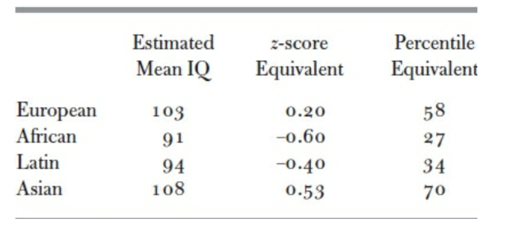
At the end of the chapter, the author discusses the meaningfulness of these findings.
Chapter Four: Race Differences in Violent Crime In this chapter, the author uses a similar statistical approach to analyzing the racial group differences in criminal activities. The data mainly relate to 13 states of the USA and summarize in several tables that all demonstrate similar trends. Here is the summary of the findings.
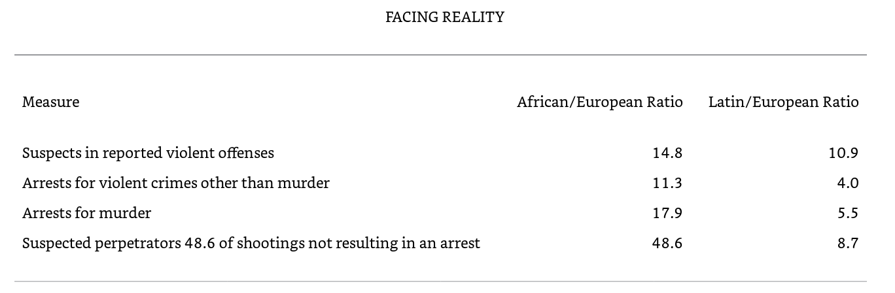
Chapter Five: First-Order Effects of Race Differences in Cognitive Ability
In this chapter, the author enumerates the effects of cognitive deficiencies. For example, in the job market, these are the impacts:
- Measures of cognitive ability and job performance are always positively correlated.
- The size of the correlation goes up as the job becomes more cognitively complex.
- Even for low-skill occupations, job experience does not lead to convergence in performance among persons with different cognitive abilities.
- For intellectually demanding jobs, there is no point at which more cognitive ability doesn’t make a difference. Increases in IQ scores are statistically associated with increases in productivity at every level of cognitive ability.
For impacts on educational achievement, the author provides the statistical result of the admission tests to professional training.:

At the end of the chapter, the author presents the consequences of affirmative actions:
“The 2014–2018 American Community Survey found that Africans, at 13 percent of the population, accounted for only 3.6 percent of CEOs, 3.7 percent of physical scientists, 4.4 percent of civil engineers, 5.1 percent of physicians, and 5.2 percent of lawyers. Latin percentages in those prestigious occupations ranged from 5.3 to 7.6 percent, but Latins are almost 18 percent of the population, so their underrepresentation was nearly the same.
The picture flips when race differences in cognitive ability and job performance are taken into account. Africans and Latins get through the educational pipeline with preferential treatment in admissions to colleges and to professional programs. Their mean IQs in occupations across the range from unskilled to those requiring advanced degrees are substantially lower than the mean IQs for Europeans in the same occupations. Race differences in measures of on-the-job performance are commensurate with the differences in cognitive ability.
I think it is fair to conclude that the American job market is indeed racially biased. A detached observer might even call it systemic racism. The American job market systemically discriminates in favor of racial minorities other than Asians.”
Chapter Six: First-Order Effects of Race Differences in Crime
In this chapter, the author reviews the consequences of high crime levels of minority groups. The author looks at big cities and finds that many crimes and arrests occur in specific zip codes. He links it to the stunted economic activity: the result of high cost and even danger of doing business in the high crime areas. The author also reviews the multiple political interventions and government expenses, none of which produce sustainable improvement. Similarly, the high crime protected by massive grievances industry makes policing defensive when police officers are concerned more with protecting themselves than anything else. The author also discusses small-city and rural America, where crime is much lower and, interestingly enough, much less varies by race.
Chapter Seven: If We Don’t Face reality
The final chapter represents the author’s sum of all fears. He laments his previous neglect regarding identity politics as just a college student game and states his belief that it now presents an existential threat to America. His big fear is that the white majority respond to growing defamation and discrimination against it with its own identity politics. The author provides parallel to BLM movement and warns:” “The question asks itself: If a minority consisting of 13 percent of the population can generate as much political energy and solidarity as America’s Blacks have, what happens when a large proportion of the 60 percent of the population that is White begins to use the same playbook? I could spin out a variety of scenarios, but I don’t have confidence in any of them. I am certain of only two things.
First, the White backlash is occurring in the context of long-term erosion in the federal government’s legitimacy. Since 1958, the Gallup polling organization has periodically asked Americans how much they trust the federal government to do what is right. In 1958, 73 percent said “always” or “most of the time.” Trust hit its high point in 1964, when that figure stood at 77 percent. Then it began to fall. By 1980, only 27 percent trusted the government to do what is right. That percentage rebounded to the low 40s during the Reagan years, then fell to a new low, 19 percent, in 1994. It rebounded again, hitting a short-lived high of 54 percent just after 9/11. Then it plunged again, hitting another new low, 15 percent, in 2011. It has been in the 15–20 percent range ever since. A government that is distrusted by more than 80 percent of the citizens has a bipartisan legitimacy problem.”
In the end, the author calls:” The return to an embrace of the American creed must be a celebration of America’s original ideal of equality under the law.” He believes that it is possible if the supporters of the American creed on both sides of the political divide start expressing their support loudly and actively. They should also stop demonizing each other, express the belief that the people on the other side also love this country, and start looking for compromises.
MY TAKE ON IT:
I generally agree with the author that the balkanization of America currently underway could lead to tremendous pain and suffering. To me, the idea that non-elite whites would sheepishly agree to be second-class citizens and passively suffer all kinds of restrictions and humiliations to pay for sins of the past seems to be just plain unrealistic. However, I do not think that accurate restatement of racial groups deficiencies would help with this problem. Actually, I believe that elite whites who actively promote identity politics are not just well familiar with statistically lower IQ and high crime rates of blacks and Hispanics but count on it to help them stay in power. Nothing could be more threatening to some mid to upper-level bureaucrat or politician than some lower-middle-class high IQ kid striving to move up and push this bureaucrat out of the comfy place. Therefore, for such bureaucrats and politicians, the identity politics that would substitute this dangerous kid with a lower IQ but a racially correct alternative is just too great of an instrument to fend off this threat. The best way to correct this issue is to disregard statistical differences and demand an individual approach with double-blind selection for candidates to any preferred and competitive position. Anything else should be treated as open racism, regardless of whether it is anti-black, anti-white, or anti-Hispanic. The individuals at the higher levels of government, educational, or corporate hierarchies should be immediately fired and treated the same way afterward as sexual predators, so people would be alerted if they move in nearby areas.
20211023 – Escaping Paternalism

MAIN IDEA:
The main idea is to review behavioral economics at a very detailed level and demonstrate that its promoters’ claims are often excessive, often based on research isolated from reality, and greatly simplify rationality or lack thereof in human behavior. However, the overriding objective of this book is to provide viable intellectual tools for rejection of the attempts to limit individual freedom via the coercive intervention of bureaucrats and politicians into individual decision-making under the pretense of better knowledge of what people need than these people themselves.
DETAILS:
1 Introduction:
The Rise of the New Paternalism
The Old versus the New Paternalism
A Sampling from the Behavioral Paternalist Agenda: Sin Taxes, Default Enrollment in Savings Plans, Cooling-Off Periods, Risk Narratives, Graphic Images, Employee-Friendly Terms in Labor Contracts, Outright Bans;
A Gauntlet of Challenges
Caveats and Clarifications: Arguments versus Policies, Behavioral Arguments for Nonpaternalist Policies, Freedom and Autonomy;
People, Not Puppets
This introduction describes the new paternalism recently developed from behavioral economics. Authors suggest that it is different from old paternalism, which stated that elite experts better know what is best for people than people themselves. The new paternalism forfeits this claim and claims not to dictate but discover peoples’ wants. The new paternalists also claim to know how to make better decisions, and they want the power to nudge people to act correctly. The authors define the key objective of the book as:” presenting the conceptual and consequentialist case against behavioral paternalism. Inasmuch as the case for behavioral paternalism rests on its supposedly beneficial consequences, our response in most respects constitutes an immanent critique.”
2 What Is Rationality?
Explicit and Implicit Components of Purposeful Behavior
Rules as a Tool of Rationality
Bounded Rationality and the Limits of Models
The Functional Value of Biases and Errors
Positive, Normative, and Prescriptive
This chapter defines the new notion of inclusive rationality:” Inclusive rationality means purposeful behavior based on subjective preferences and beliefs, in the presence of both environmental and cognitive constraints. This notion of rationality preserves the core notion of purposefulness, and in that sense, it should seem familiar. But unlike other notions of rationality – many of which were invented for modeling purposes but have since taken on a life of their own – inclusive rationality does not dictate the normative structure of preferences and beliefs a priori. Instead, it allows a wide range of possibilities in terms of how real people select their goals, form and revise their beliefs, structure their decisions, and conceptualize the world. Their preferences and beliefs may be inchoate, incomplete, inconsistent, mutable, and dependent on context. Inclusive rationality can thus encompass choices and strategies that would not make sense under more restrictive notions of rationality.” The authors present specific features of inclusive rationality and discuss how it differs from formal rationality and irrationality. They also discuss conscious and unconscious components of purposeful human behavior, bounded rationality that limits human reasoning abilities, and resulting deficiencies in human actions in achieving the best available results. Finally, the authors provide the list of issues that pretty much invalidates behavior economists’ claim to be able to improve people lives by manipulating their behavior in the “correct” direction:
- They may assume, in accordance with ordinary conversational norms, that experimenters provide only information that is relevant to solving the problem – i.e., no irrelevant or “tricky” information. They do not immediately assume the experimenters are trying to fool them.
- They may resist the distinction between the validity of a syllogistic inference (e.g., “People with red hair are Martians, John has red hair, therefore John is a Martian”) and the truth of a conclusion itself (John is not a Martian). Normally, in everyday life, it is the truth that is more important.
- They may not assume that prior probabilities about something – such as the likelihood that someone has a disease – must be equal to the “base rates” from the population provided to them. Instead, their priors may be affected by their evaluation of the significance of the base rates to a particular problem in front of them – say, whether a specific person who chose to visit the doctor and chose to take a test has the disease. Treating priors in this way is fully consistent with the subjectivist Bayesian view that prior probabilities are subjective – a fact frequently ignored in the rush to deem subjects “irrational.”
- They may not agree with model-builders on the informational equivalence of different descriptions of a situation. Instead, they may infer implicit information or advice from how a problem is presented. For example, they may perceive an important difference between a stated probability of success equal to 0.7 and a stated probability of failure equal to 0.3. Perhaps the former conveys greater optimism, despite the formal mathematical equivalence of the two statements. Conversational norms and expectations do not always align with logic and probability theory. The former can be adaptive in the real world while the latter is adaptive on experimental tests. Which is more important?
- They may attach satisfaction or utility to things other than what the analysts expect. For instance, they may value an object more because it is theirs already. Or they may care about feelings of gain and loss experienced during the experiment, not just how much money they have when they leave the laboratory. Or they may gain satisfaction purely from having a particular belief, irrespective of its truth (“My wife is beautiful and my children are gifted”).
Finally, at the end of the chapter, the authors clearly state their position:” The simple fact that individuals do not behave in accordance with standard theories is not evidence of failure in this broader normative sense. It is certainly not evidence in favor of fixing their behavior. The norms of standard neoclassical rationality are not prescriptions for better behavior. Behavioral economists have unfortunately accepted the prescriptive relevance of the received theory even as they have rejected its predictive accuracy in a wide range of behavior. In this book, the authors are mainly concerned with the normative and prescriptive aspects of rationality. Therefore, their disagreement is with both standard and behavioral economics, given that both are wedded to the same prescriptive view of rationality.
3 Rationality for Puppets:
The Axioms of Preference Rationality
Neoclassical Rationality as the Behavioral Welfare Standard
The Origin of Neoclassical Rationality in Economic Theory
Rational Violations of “Rational Preference”: Preference Discovery, Preference Formation, Economizing on Cognitive and Noncognitive Effort, Preference Rotation, Illustrative Examples;
What About the Money Pump?
Description and Redescription
The Non-Sequitur of Resolving Preference Inconsistencies
Interpreting Behavioral Inconsistency
Authors’ Conclusions: “Behavioral paternalists rest their case on the evidence that normal people violate basic tenets of rationality. But what do they mean by rationality? It turns out behavioral economists use the same definition of rationality as their neoclassical counterparts. Neoclassical or “puppet” rationality rests on two axioms – completeness and transitivity – that together impose a form of consistency on the structure of people’s preferences. Other characteristics of neoclassical rationality, such as framing invariance and independence of irrelevant alternatives, derive from these more basic axioms. Although behavioral paternalists have rejected neoclassical rationality as a positive description of human behavior, they have nevertheless maintained it as a normative standard. In this chapter, we have argued that this was a mistake. The axiomatic definition of rationality was developed primarily, if not entirely, for positive (i.e., descriptive or explanatory) analysis. The axioms justified the use of utility functions, an important step along the path to proving propositions such as the existence of a competitive market equilibrium. They made economic models mathematically tractable, and they facilitated the generation of testable hypotheses. In short, they enabled the creation of simple, functional, and often quite useful puppets to populate economic models, thereby satisfying the needs of the model-builders. But however useful the neoclassical axioms may have been for positive purposes; they never had a strong normative justification. They may be violated in many reasonable ways. Normal people may be found in the process of discovering their preferences, or even the process of creating them. They may decide, consciously or otherwise, that the costs of completely rationalizing their preferences exceed the benefits of doing so, and so they allow their preferences to remain inconsistent. A variety of examples show that people’s preferences may be incomplete or intransitive for understandable reasons that do not obviously demand correction. Our inclusive notion of rationality allows for all of these deviations from the neoclassical structure. The simplistic axioms of puppet rationality cannot capture the breadth and variety of how real human beings evaluate options and make choices. Many of the problems discussed in this chapter are not new, but presenting them together here demonstrates that the normative case for puppet rationality is extraordinarily weak, at least outside of special cases. The neoclassical axioms of preference may have descriptive or explanatory value – or, given the work of behavioral economists, they may not. But to call them “rationality requirements” is normatively arbitrary. If we gave them another name – say, “structural assumptions” – they would still perform the function for which they were created without deceiving economists or the public into thinking that nonconforming behavior or preferences need to be “fixed.”
4 Preference Biases:
Intertemporal Trade-Offs and Time-Discounting Inconsistencies: Time: Objective and Subjective, Preference Reversal, Intransitive Intertemporal Choices, Do Nonstandard Intertemporal Decision-Makers Suffer?
Endowment Effects: Loss Aversion as a Cause of Endowment Effects, Status Quo Bias as a Cause of Endowment Effects; Mere Ownership as a Cause of Endowment Effects, Contrary Evidence;
Affective Forecasting: Impact Bias as Procedural Artifact? Cognitive Feedback: Attention and Learning;
Authors’ Conclusions: “In this chapter we have shown that the phenomena known as “preference biases” are far more complex than they are often portrayed to be. Sometimes more penetrating analysis shows that the evidence for their existence is weak. Other times they are (at least partially) artifacts of imprecise or misdirected questioning of subjects. And yet other times, evidence suggests they may function as adaptations to a broader set of behavioral and environmental factors than are normally considered. Even more importantly, the normative analysis of biases is often arbitrary. Biases are typically demonstrated by showing inconsistencies in preferences and then choosing one set as normative. But alleging inconsistencies does not in itself enable us to say which preferences are normative – particularly when other behavioral factors play a role in generating the behavior in question. For example, there is good evidence to suggest that both short- and long-run discount rates are “contaminated” and therefore neither has a clearly better claim to superiority. Or, as we’d rather say, neither is contaminated; they just are what they are. Agents do not typically exhibit pure neoclassical preferences. And this is not obviously a bad thing. In the real world, agents need not be worse off by their own lights when their behavior exhibits what outside observers would regard as bias.”
5 The Rationality of Beliefs:
The Functions of Beliefs and Learning: Optimistic Beliefs;
Rational Irrationality;
Rational Violations of Classical Logic: Logical Equivalence versus Informational Equivalence, Wason Selection Test: Confirmation Bias? Nonmonotonicity, Wason Selection Test as Maximizing Expected Information Gain;
The Conjunctive Effect:
Conversational Norms and the Maxim of Relevance, Interpretation of Intersecting Events as Mutually Exclusive, Inductive Confirmation of Hypotheses;
Bayes’ Rule, Base-Rate Neglect, and Belief Revision: Base Rates Are Not Necessarily Prior Probabilities, Changing Causal Structure and Base-Rate Instability, False-Alarm Rates and Hit Rates May Not Be Independent of Base Rates, Magnification of Errors in a Noisy World, Not All Base Rates Are Created Equal;
Availability Bias and Frequency Judgments: Pinning Down the Meaning of Availability, Diagnosticity and Availability,
Salience;
Overconfidence and Probability Judgments: How to Make Guesses on Trivia Questions, Degrees of Confidence versus Subjective Probabilities, Subjective Probabilities and Objective Frequencies, When Is the Implied Expectation Consistent with the Actual Frequency, When Is the Implied Expectation “Overconfident” but the Frequency Judgement Accurate? Coherence or Adapted Frameworks? The Data: Extreme Format Dependence, The Economics of Prediction: Trade-Offs
Authors’ Conclusions: “We have covered a wide range of cognitive operations and phenomena in this chapter – from the logical to the probabilistic. We have found that the literature on cognitive biases, vast though it is, tends to fail in one fundamental respect: recognizing the pragmatic and contextual nature of rational decision-making. The mistake that is constantly and consistently made is to equate rationality with an abstract system of thought unrelated to the purposes and plans of individuals in the environments in which they find themselves. In a related manner, the literature also fails to take into account the socially legitimate expectations of the participants in experiments that the researchers should not provide extraneous or misleading information. These are problems that go to the very heart of the “heuristics and biases” research program. Our perspective, by contrast, recognizes that beliefs serve a purpose – and that purpose is not always truth-tracking. Beliefs can direct attention and provide motivation. Beliefs can be a source of direct satisfaction. Even when beliefs perform a primarily truth-tracking function, there is no uniquely correct way to form and revise beliefs in real-world environments characterized by uncertainty and change. Most importantly, people in realistic contexts do not think like strict logicians and probability theorists – nor should they. While economists and psychologists are greatly concerned with the deductive consistency of beliefs, regular people need not share that concern. People acquire tools for different types of challenge in the wild, and they should not be expected to abandon all such tools when they enter the laboratory. In the study of beliefs, just as in the study of preferences, behavioral researchers have made the mistake of conflating their models with reality – and, when reality fails to conform to the model, judging it deficient.”
6 Deficient Foundations for Behavioral Policymaking:
Context-Specificity of Psychological Findings: Contextuality of the Effect of Moods and Emotions, Contextuality of Loss Aversion and Reference Points, Context-Specificity in Context
Generalizing Quantitative Results from the Lab to the Real World: Stated Choice and Revealed Choice, Quantitative Generalizability, Reproducibility, The Population of Relevance;
Failure to Account Adequately for Incentives: Incentives: Clearing Away the Confounds, Incentive Effects, Learning and Experience, Learning and Errors, Policy Implications of Learning and Incentives
Small-Group Debiasing: Small Groups and Task Performance (Conjunctive Effect. Wason Selection Test. First-Order Stochastic Dominance. Probability Assessment. Probability Matching.) Small Groups and Preference Biases (Myopic Loss Aversion. Present Bias.)
Self-Regulation: Context-Dependence of Self-Regulation, Automaticity of Much Self-Regulation, Biases as Self-Regulation, Self-Regulatory Processes Mistaken for Agent Naivete, Significance of Underestimating the Extent of Self-Regulation, Self-Regulation and the Opportunity Costs of Executive Function
Authors’ Conclusions: “In a survey of the literature on the use of technical research by policy actors, Bogenschneider and Corbett (2010) identify twelve criteria by which the usefulness of research is evaluated for policy purposes. Among those, three stand out as having critical significance for the behavioral and cognitive research we have discussed in this chapter. They are:
- Definitiveness: Results are clear.
- Generalizability: Results are applicable to the jurisdictions or populations of interest to the policymaker.
- Policy Implications: The links between results and policy are clear.
Unfortunately for behavioral paternalism, the research displays serious deficiencies with regard to these criteria. First, it is hard to claim that the results are clear-cut. When incentives, learning, group debiasing, and self-regulation have not been adequately assessed, it is not clear which results we can confidently export to the world of public policy. Second, generalizability is uncertain because the results are highly contextual, the rate of reproducibility is unknown and possibly quite low, and the populations studied do not necessarily resemble those targeted by policy. Finally, the link between results and policy recommendations is far from clear. What appear as biases may in specific contexts actually be debiasing techniques. And the failure of quantitative results to generalize opens the real possibility of overcompensating for perceived biases. Recall our introductory remarks that the claims in this chapter constitute immanent criticism. Even if we agreed that the standard rationality norms of neoclassical and behavioral economics provided an appropriate basis for prescribing public policy, the tools that real people use to achieve their goals and to shape their own behavior are multifarious and resistant to description by simple models. To craft policies that help agents reduce their biases, we still need reliable scientific knowledge about how, when, and where those biases operate, their strength in real-life settings, the extent to which agents learn about and correct biases on their own, and so on. These questions are still largely unanswered, although we can hope that future research will begin to fill in the blank spaces.”
7 Knowledge Problems in Paternalist Policymaking:
A Typology of Knowledge Requirements: Knowledge of True Preferences, Knowledge of the Extent of Bias, Knowledge of Self-Debiasing and Small-Group Debiasing, Knowledge of Dynamic Impacts on Self-Regulation, Knowledge of Counteracting Behaviors, Knowledge of Bias Interactions, Knowledge of Population Heterogeneity;
The Empirical Search for True Preferences: Augmented Revelatory Frame Approach, Unified Behavioral Revealed Preference
The Practically Insurmountable Knowledge Problem;
Authors’ Conclusions: “Behavioral economists overreach when they confidently attribute the increase in 401(k) participation after automatic enrollment to countering biases by creating sticky defaults that people passively accept. Much of the increase in participation is likely attributable to improved information and the recommendation effect of the new default. Biases such as anchoring, limited salient options, and loss aversion do not seem as plausible in this context. While present bias may be operative with regard to decision-making costs, its importance is diminished as decision complexity is reduced. Since automatic enrollment improves the information position of agents, it reduces the complexity of decision-making. Thus, even if employees overweight initial decision costs due to present bias, the impact of this bias is substantially reduced due to the fall in decision costs. Policy-oriented behavioralists are also mistaken in suggesting that the welfare effects of automatic enrollment are unambiguously positive to all groups. There are heterogeneous effects, especially in the class of former optimizers and, in general, when the knowledge of the planners is poor. There are distributional effects within the category of retirement benefits. In addition, there are also a number of substantial unintended consequences, including increased consumer debt and early withdrawal of retirement savings. These have been ignored in previous research because of the narrow focus on 401(k) activity. Behavioralists are also likely mistaken in claiming that the greater use of automatic enrollment observed in recent years is a consequence of private paternalism. The appearance of such may be the result of an excessively loose or vague concept of paternalism – a topic we will address directly in Chapter 10. Employers in the United States are not currently required to provide an automatic-enrollment default. They are still maximizing profits and engaging in mutually advantageous bargains with their employees. How likely is it that they have suddenly become benevolent paternalists under the influence of behavioral economics? Finally, we have to wonder why so much attention has been focused on automatic enrollment versus other options. Given the evidence that information and recommendation effects play a significant role in explaining default stickiness, why not advocate explicitly providing the information and recommendations in question?68 Such messages could be provided in the presence of either the traditional default or active choice. Changing the default rule seems a very indirect way of conveying messages that could be provided directly, especially since implicit messages can easily be misunderstood. We surmise that the focus on automatic enrollment derives from the presence of other (or additional) motives – specifically, the desire to increase retirement savings irrespective of whether that is what any particular individual truly wants”.
8 The Political Economy of Paternalist Policymaking
Rational and Irrational Mechanisms of Government Failure
Rational Ignorance
Concentrated Benefits, Diffuse Costs
Self-Interested Regulators
Bootleggers and Baptists
Public choice Paternalism in Practice: The Definition of Overweightness and Obesity, Regulation of Cigarettes and Vaping, USDA Nutritional Guidelines
Public Sector Irrationality
Types of Bias that Affect Policymaking: Action Bias, Overconfidence and the Illusion of Explanatory Depth, Confirmation Bias, Availability and Salience Effects, Affect and Prototype Heuristics, Present Bias and Hyperbolic Discounting
Authors’ Conclusions: Even if policymakers (including voters) were perfectly rational, there would be good reason to doubt that democratic government would generate well-designed paternalist policies. The diffusion of responsibility and accountability inherent in our form of government creates poor incentives for people to become well informed and to demand policies that genuinely track the public interest. Instead, legislators and bureaucrats will tend to promote laws and regulations that garner the support of highly motivated parties, including moralists and activists who want to promote values that others may not share, experts and academics who wish to see their research make an impact, and special-interest groups that stand to benefit financially from paternalistic laws. If policymakers are subject to the same cognitive biases that behavioral economists attribute to regular people, we should expect the policymaking process to be even worse. Such biases are more worrisome in the public sector than the private sector, because the public sector offers far worse incentives for people to curb their irrational tendencies and numerous opportunities to indulge pleasing beliefs and prejudices at low cost. Furthermore, poor decisions in the public sector almost by definition affect large numbers of people who have little or no input into them; in other words, government policy is rife with externalities. As a result, we should expect paternalist (and other) policymaking to suffer from the effects of action bias, overconfidence, the illusion of explanatory depth, confirmation bias, availability bias, and other cognitive limitations. Although we have considered both rational and irrational contributors to government failure separately, it’s worth taking a moment to consider how they interact. Behavioral economics indicates that certain types of argument will be more likely to succeed in the political sphere: those that emphasize the urgent need for taking action; those that downplay complexity and emphasize simple solutions; those that flatter people’s current beliefs and attitudes; those that rely on easily recalled and vivid illustrations of alleged problems; and those that emphasize the benevolent goals of the policies in question. Given these tendencies, we should expect the highly motivated parties mentioned earlier to exploit them to advance their agendas. Activists, academics, experts, and industry lobbyists have strong rational incentives to craft their policy proposals so as to maximize their appeal to irrational voters and legislators.
9 Slippery Slopes in Paternalist Policymaking
The Logic of Slippery Slopes
Gradients and Vagueness in Behavioral Paternalism: How Behavioral Paternalism Creates New Gradients, How Behavioral Paternalism Exploits Existing Gradients;
Slippery Slopes with Rational Policymakers: Altered Incentives Slopes, Authority and Simplification Slopes, Expanding Justification Slopes, Application to Smoking Bans, On Experts versus Ordinary People;
Slippery Slopes with Cognitively Biased Policymakers: Action Bias, Overconfidence, and Confirmation, Present Bias and Hyperbolic Discounting,
Availability and Salience, Framing and Extremeness Aversion, Affect and Prototype Heuristics
The Paternalism-Generating Framework
Rejoinders to Behavioral Paternalist Responses
Authors’ Conclusions: “Slippery-slope arguments are often treated dismissively, sometimes even consigned to lists of logical fallacies as a form of spurious reasoning. Without doubt, some writers do deploy slippery-slope arguments in a casual and imprecise way by simply asserting that seemingly attractive policy A will lead to clearly awful policy B. But this error does not mean all slippery-slope arguments are invalid. Rather, it means that we should pay attention to the specific processes – often probabilistic rather than deterministic – that connect one policy to another, as we have sought to do in this chapter. The slippery slope is a broad category, and many different mechanisms and processes fall under its umbrella. As such, it can be difficult to describe all slippery slopes in summary form. Nevertheless, certain features characterize many, though not all, types of slope. In particular, slopes tend to occur in the presence of vague and ill-defined concepts – what we have called gradients. Consequently, the same features of behavioral paternalism that are problematic on a conceptual level also raise concerns on a pragmatic level. In the earlier chapters of this book, we argued that the theoretical and empirical foundation of behavioral paternalism is fundamentally vague. It relies on distinctions that often fail to hold up under scrutiny, and that in any case cannot be reliably identified in practice. Policies based on such unstable moorings are almost bound to drift from their original justifications, because the justifications were weak and imprecise to begin with. Another common feature of slippery slopes is the presence of multiple and diffuse decision-makers, many lacking in accountability for outcomes. When accountability is lacking due to diffuse responsibility, delayed consequences, and unclear objectives, decision-makers will typically display both rational ignorance and rational irrationality. Whatever cognitive biases are present in the private sector will tend to be magnified in the public sector, thereby creating the room necessary for the gradual drift of policies away from their initial purposes as well as the purposeful movement of policy under the influence of moralists and rent-seekers. If behavioral paternalists genuinely care about personal autonomy, as some claim, then they ought to take slippery-slope concerns more seriously than they have thus far. And if behavioral paternalists care about the implementation of thoughtful and well-designed policies, as virtually all of them claim, then they should worry about how slope processes could warp their nuanced justifications and well-intentioned plans. To ignore the risk of slippery slopes is to commit an error that behavioral paternalists often caution against: focusing on present gains at the expense of future (and uncertain) losses. To repeat: the slope risk must be counted among the costs of the initial policy intervention. What, then, can be done to avoid, or more realistically to minimize, the danger of paternalist slopes? We have suggested some of the answers in this chapter. They involve, among other things, rejecting the paternalism-generating framework suggested by behaviorally minded thinkers, and adopting instead a paternalism-resisting framework. Such a framework would emphasize the distinction between voluntary and coercive action, as well as the distinction between private and state action.”
10 Common Threads, Escape Routes, and Paths Forward
Common Threads: The Complexity of Inclusive Rationality, The Indeterminacy of Welfare Criteria, The Role of Incentives and Learning, The Rush to Policy
Escape Routes: Revert to Objective-Welfare Paternalism, Appeal to Obviousness, Shift the Burden of Proof, Loosen the Definition of Paternalism, Rely on the “Libertarian Condition”, Invoke the Inevitability of Choice Architecture, Focus on the Irrational Subset of the Population, Rely on Extreme Cases, Treat Behavioral Paternalism as a Toolbox, Invoke Fiscal Externalities
Recommendations: Replace Puppet Rationality with Inclusive Rationality, Reject the Paternalism-Generating Framework, Have Reasonable Expectations of Policymakers, Maintain Important Distinctions
A Better Path Forward: The authors begin discussion here with the Harm Principle: “the idea that we are justified in coercing people only for the purpose of preventing harm to others “. The authors stated their believe that the behavioral paternalists reject this principle, sometimes explicitly demanding coercion use for “the better good” but sometimes implicitly by trying create conditions when people forced to do what is “good for them”. The author also stated their position:” we believe others may be making mistakes that harm their well-being, we are free to tell them so. We may even beg and plead if the situation warrants. The advantage of this approach is that it offers potentially useful information and perspective while still respecting people’s right to choose for themselves. After all, they probably have information and perspective on their own lives that outsiders lack. “
The authors also discuss the promotion of behavioral economics as a form of self-help, which they do not mind: “Behavioral economists and psychologists have produced a great body of insights on how human beings make decisions. While many of these insights are not as solid as we’ve been led to believe, they have nevertheless advanced our knowledge of the human mind. Our exploration of behavioral paternalism has forced us to question ideas and concepts that we once thought unassailable. We have, among other things, become more acutely aware of the failings of the neoclassical model of preferences and beliefs – which in turn drove us toward the notion of inclusive rationality that we have presented in this book. Therefore, we should not be understood as rejecting the whole of behavioral economics.” What they do mind are attempts to use it as tools of coercive policymaking: “It is jarring, to say the least, to see social scientists pointing out the errors of private individuals – and then failing to consider that social scientists and policymakers are also subject to error. It is frustrating to see behavioral researchers demonstrating the complexity of real decision-making processes – and then ignoring that complexity when recommending regulatory corrections of those very processes. It is simply baffling to see behavioral economists showing how real behavior deviates from neoclassical norms – and then insisting that behavior must conform to those norms or else be judged deficient.”
In the end, the authors reject entirely the behavior economists’ attitude: “…approach humanity from a position of presumed superiority, like puppet masters correcting the behavior of errant puppets.” Instead, the authors insist on:” approach them as fellow human beings doing the best they can, trying to improve their own choices, and offering friendly advice on how others might do the same.”
In short, the experts’ advice should remain advice, not a coercive policy.
MY TAKE ON IT:
I greatly appreciate the authors’ effort in producing such a detailed and effective review of behavioral economics and the attempts of its application to policymaking. It is clearly a critical part of the contemporary clash of ideologies. On one side is the ideology of freedom when people do what they want if it does not harm anybody. On the other side is the ideology of the “better” people making decisions for everybody. It is interesting how people transformed the latter ideology throughout time: from God-appointed kings and aristocracy to all-knowing “scientific” socialist and communists, to “scientific” experts wielding not theoretical works of Marks, but experimental research of behavioral economics. As far as I am concerned, I do not want anybody making decisions for me for the simple reason that whatever is the decision, I’ll pay the cost. This book also reasonably demonstrated that the scientific foundation of behavioral economics is quite shaky, so the quality of decisions would be poor. I hope that the currently growing wave of rejection to the rule of “betters” would get solid scientific backing from this book and other works like that.
20211016 – Unsettled

MAIN IDEA:
The main idea is to present the vast amount of actual data about climate change to help people understand the problems and their scales. The author makes the point that climate change is real, but its consequences are greatly exaggerated. Unfortunately, elites’ global political and financial interests drive this exaggeration to the extreme with the use of unreliable models, massive propaganda in the media, and corruption of science. The author also presents potential solutions and a set of requirements for them.
DETAILS:
Introduction
The introduction begins with the facts from US assessment that remain mainly unknown because they contradict the prevailing propaganda narrative:
- Humans have had no detectable impact on hurricanes over the past century.
- Greenland’s ice sheet isn’t shrinking any more rapidly today than it was eighty years ago.
- The net economic impact of human-induced climate change will be minimal through at least the end of this century.
The author then presents his credentials as a scientist and administrator with enough clout to convene a scientific workshop to assess the condition of climate science. Here is what the author discovered:
- Humans exert a growing, but physically small, warming influence on the climate. The deficiencies of climate data challenge our ability to untangle the response to human influences from poorly understood natural changes.
- The results from the multitude of climate models disagree with, or even contradict, each other and many kinds of observations. A vague “expert judgment” was sometimes applied to adjust model results and obfuscate shortcomings.
- Government and UN press releases and summaries do not accurately reflect the reports themselves. There was a consensus at the meeting on some important issues, but not at all the strong consensus the media promulgates. Distinguished climate experts (including report authors themselves) are embarrassed by some media portrayals of the science. This was somewhat shocking.
- In short, the science is insufficient to make useful projections about how the climate will change over the coming decades, much less what effect our actions will have on it.
Because the author is a natural and honest scientist and despite being a lifelong Democrat, he felt compelled to write this book and provide accurate information about the current condition of climate science, which is very different from the media’s portrayal.
Part l: The Science
Part I clarifies how the climate has changed, how it will change in the future, and the impact of those changes. It also offers some basics about the official assessment reports that we look to for answers to those questions.
Chapter 1. What We Know About Warming
The chapter explains both the importance and challenges of obtaining quality observations of the earth’s climate (which is not the same as its weather) over many decades; it also reviews some of the indications of a warming globe and puts them in a geological context. This chapter provides information about trends in climate via multiple graphs and pictures. Generally, it demonstrates some warming, but it is not catastrophic and even practically insignificant at the long-term scale. Here are the essential graphs:
Chapter 2. Humble Human Influences
Chapter 2 then turns to how the earth’s temperature arises in the first place—from a delicate balance between warming sunlight and cooling heat radiation. We’ll see that this balance is disturbed by both human and natural influences, with greenhouse gases playing an important role. Because the climate is very sensitive, we need an accurate and precise understanding of those influences and how they’ve changed over time.
This chapter demonstrates the complexity of factors impacting climate, some of them causing the warming and some cooling:

Chapter 3. Emissions Explained and Extrapolated
The most important human influence on the climate is the growing concentration of carbon dioxide (CO2) in the atmosphere, largely due to the burning of fossil fuels. This is the focus of Chapter 3—particularly, how the connection between CO2 emissions and concentration diminishes the prospect of even stabilizing growing human influences. Here is the graph of greenhouse emissions growth:
Chapter 4. Many Muddled Models
Computer models of how the climate responds to human and natural influences are the subject of Chapter 4. Drawing upon the author’s half-century involvement with scientific computing and the authorship of a pioneering text on that subject, he shows how they work, what they tell us, and some of their deficiencies. These dozens of sophisticated models are what scientists use to make their projections. What the media cites in their coverage—alas, they give results that differ significantly not only from each other but from observations (that is, they’re right in a few ways, but wrong in many others). In fact, the results have become more divergent with each generation of models. In other words, as our models have become more elaborate, their descriptions of the future have become less certain. In other words, contemporary models are far from being scientifically sound tools because they too much rely on assumptions and, most important, have little predictable power:
At the end of the chapter, the author concludes: “The uncertainties in modeling of both climate change and the consequences of future greenhouse gas emissions make it impossible today to provide reliable, quantitative statements about relative risks and consequences and benefits of rising greenhouse gases to the Earth system as a whole, let alone to specific regions of the planet.”
Chapter 5. Hyping the Heat
Chapter 5 is the first of five chapters dealing with contradictions between the science and the prevailing notion that “humans have already broken the climate,” exploring areas where the facts and popular perception are at odds (and probing the source of those discrepancies). This chapter focuses on record high temperatures in the US—they’re no more common today than they were in 1900, yet you wouldn’t know that from the misrepresentations of an allegedly authoritative assessment report. The chapter discusses the regularly occurring hype about temperature records and provides data demonstrating that it is not justified:

He concludes:” There have been some changes in temperature extremes across the contiguous United States. The annual number of high temperature records set shows no significant trend over the past century nor over the past forty years, but the annual number of record cold nights has declined since 1895, somewhat more rapidly in the past thirty years.”
Chapter 6. Tempest Terrors
Chapter 6 likewise explains why experts conclude that human influences haven’t caused any observable changes in hurricanes, and how assessment reports obscure or distort that finding. Once again, the author demonstrates that there is some increase, but not that significant:

Chapter 7. Precipitation Perils—From Floods to Fires
In Chapter 7, the author describes the modest changes seen in precipitation and related phenomena over the past century, discuss their significance, and highlight some points likely to surprise anyone who follows the news—for instance, that the global area burned by fires each year has declined by 25 percent since observations began in 1998. Here are the data:


Chapter 8. Sea Level Scares
Chapter 8 offers a levelheaded look at sea levels, which have been rising over the past many millennia. We’ll untangle what we really know about human influences on the current rate of rise (about one foot per century) and explain why it’s very hard to believe that surging seas will drown the coasts anytime soon. Similarly, to other discussed parameters, sea level is rising but not that significantly and not out of historical patterns:
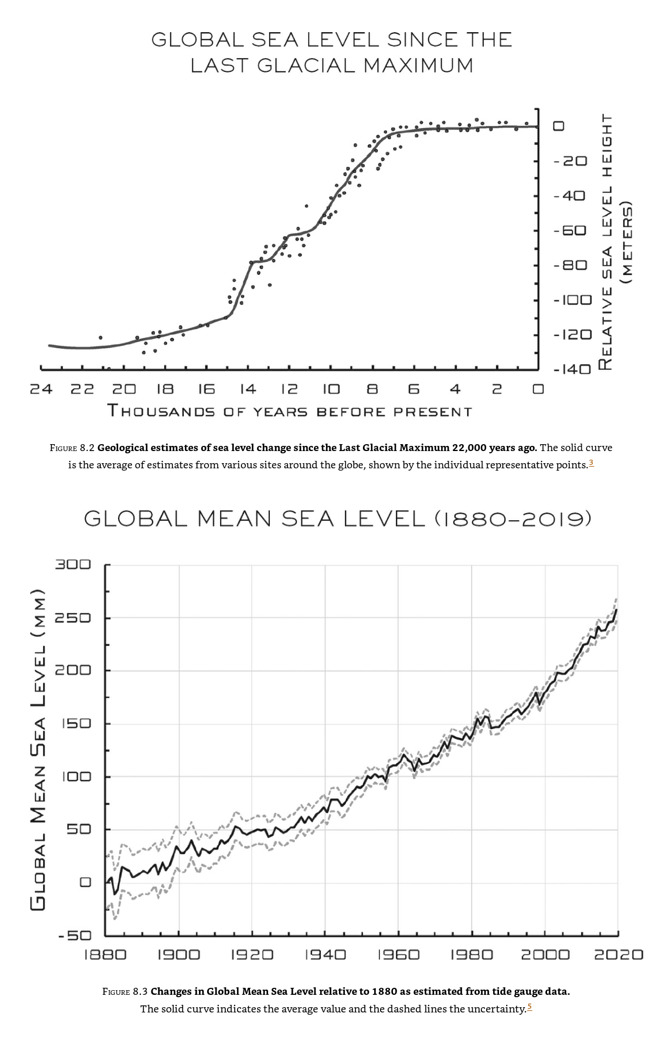
Chapter 9. Apocalypses That Ain’t
Chapter 9 covers a trio of oft-cited climate-change impacts (fatalities, famine, and economic ruin), predictions of which are belied by the historical record and assessment report projections, even if it’s hard to discern this when reading the reports themselves. Nevertheless, for each of these, the author demonstrates the triviality of the impact, even for worst-case scenarios. Moreover, the actual trend in death rates is going down:

Chapter 10. Who Broke “The Science” and Why
Chapter 10 takes up the question of “Who broke it?”—why the science has been communicated so poorly to decision makers and the public. The author describes how overwrought portrayals of a “climate crisis” serve the interests of diverse players, including environmental activists, the media, politicians, scientists, and scientific institutions.
Chapter 11. Fixing the Broken Science
Chapter 11 closes out Part I by describing how we might improve communication and understanding of climate science, including adversarial (“Red Team”) reviews of the assessment reports, best practices for media coverage, and what non-experts can do to be better informed and more critical consumers of all science media—but especially about the climate. Here the author provides a list of the symptoms of science manipulation:
- Anyone referring to a scientist with the pejoratives “denier” or “alarmist” is engaging in politics or propaganda.
- Any appeal to the alleged “97 percent consensus” among scientists is another red flag.
- Confusing weather and climate is another danger sign.
- Omitting numbers is also a red flag.
- Yet another common tactic is quoting alarming quantities without context.
- Non-expert discussions of climate science also often confuse the climate that has been (observations) with the climate that could be (model projections under various scenarios).
Part II: The Response
Part II begins its discussion of the response story by drawing a distinction between what society could do, what it should do, and what it will do in response to a changing climate—three very different issues often conflated, even by experts. The author also provides context for society’s response:
- Keeping human influences on the climate below levels deemed prudent by the UN and many governments would require that global carbon dioxide emissions, which have been rising for decades, vanish sometime in the latter half of this century.
- Emissions reductions would have to take place in the face of strongly growing energy demand driven by demographics and development, the dominance of fossil fuels, and the current drawbacks of low-emissions technologies.
- These barriers, combined with the uncertainty and vague nature of future climate impacts, mean that the most likely societal response will be to adapt to a changing climate, and that adaptation will very likely be effective.
Chapter 12. The Chimera of Carbon-Free
Chapter 12 illuminates the issue by discussing the formidable challenges in meaningfully reducing human influences on the climate, including the lack of progress toward the goals of the Paris Agreement. Here author reviews impact of different countries on the global emissions and how it changes over time. Two graphs represent this process:
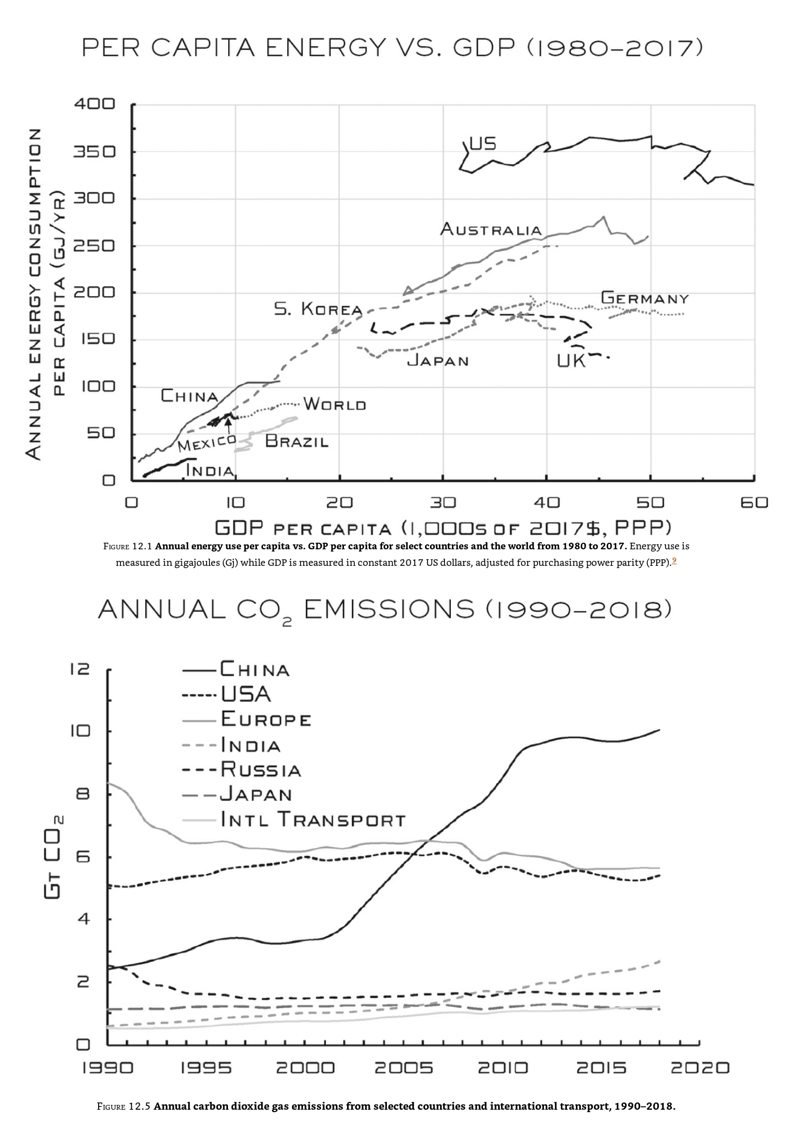
Chapter 13. Could the US Catch the Chimera?
Chapter 13 sheds some light on the could issue by discussing the tremendous changes it would take to create a “zero-carbon” energy system in the US. Here is the illustration of the challenge:
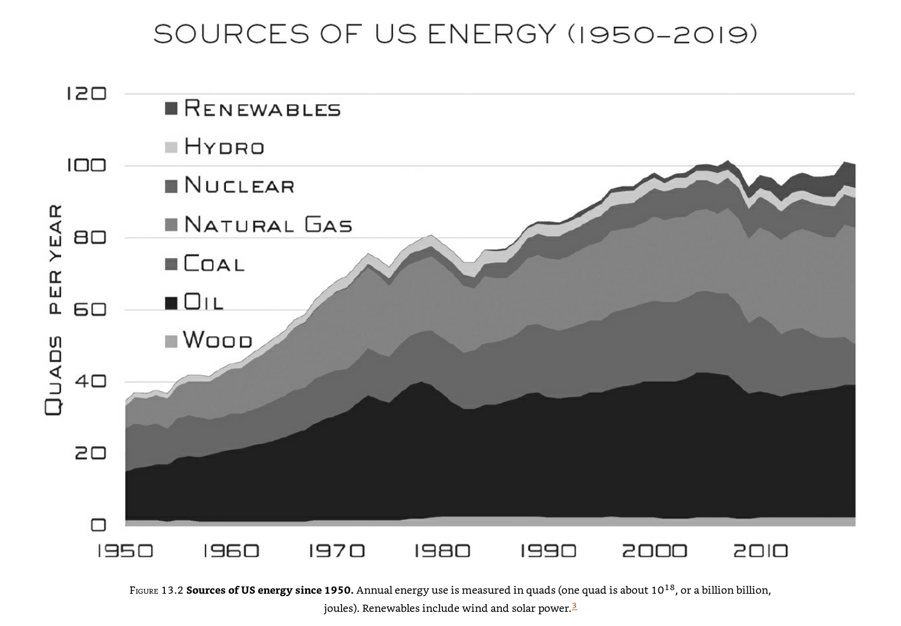
The author discusses in details policy features required to decrease emissions in the USA.
Chapter 14. Plans B
Chapter 14 completes the response story with a discussion of “Plan B” strategies that allow the world to respond to a climate changing from either human or natural causes—adaptation, which will happen, and geoengineering, which could be deployed in extremis. Here are the key points that the author makes about adaptation:
- Adaptation is agnostic. Humans have been successfully adapting to changes in climate for millennia, and for most of that time, they did so without the foggiest notion of what (besides the vengeful gods) might be causing them. Thus, while the information we have now will help guide adaptation strategies, society can adapt to climate changes caused by natural phenomena or by human influences.
- Adaptation is proportional. Modest initial measures can be bolstered as and if the climate changes more.
- Adaptation is local. Adaptation is naturally tailored to the different needs and priorities of different populations and locations. This also makes it more politically feasible. Spending for the “here and now” (e.g., flood control for a local river) is far more palatable than spending to counter a vague and uncertain threat thousands of miles and two generations away. Further, local adaptation does not require the global consensus, commitment, and coordination that have proved so far elusive in mitigation efforts.
- Adaptation is autonomous. It is what societies do, and have been doing, since humanity first formed them—the Dutch, for example, have been building and improving dikes for centuries to claim land from the North Sea. Adaptation will happen on its own, whether we plan for it or not.
- Adaptation is effective. Societies have thrived in environments ranging from the Arctic to the Tropics. Adapting to a changing climate always acts to reduce net impacts from what they would be otherwise—after all, we wouldn’t change society to make things worse!
The author provides a very nice and information-intensive graph for future handling of emissions:
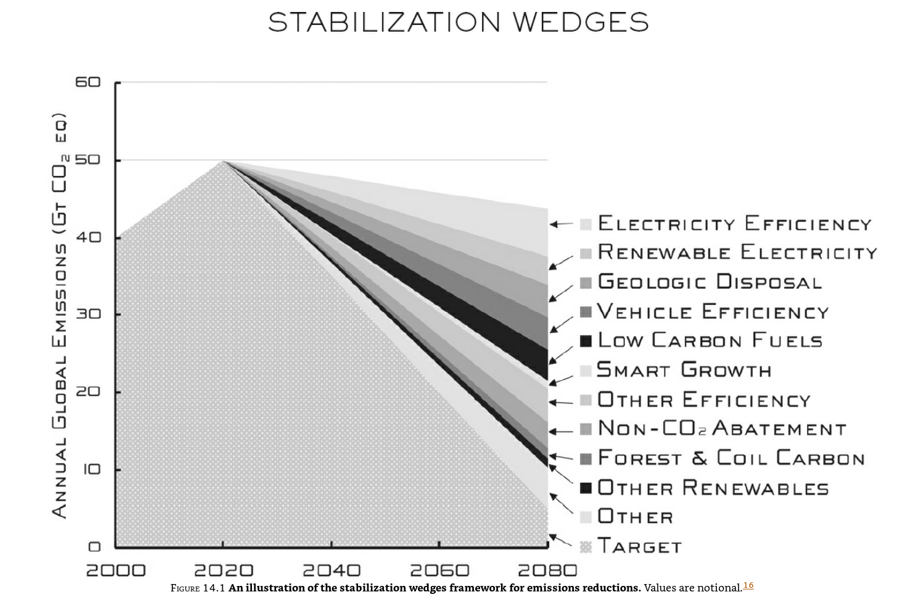
Closing Thoughts
In the end, the author discusses the reasons for writing this book, its descriptive rather than prescriptive character, and his belief that climate science needs improvement. He also suggests increase research into possible measures in case of unexpected climate emergencies such as geoengineering.
MY TAKE ON IT:
I like this book a lot because of its no-nonsense approach and the wealth of data presented in an easily digestible format. I also believe that humans impact the climate, and so do ants, chickens, volcanos, asteroids, and many more factors, either living or not. However, about the issue of the scale of such impact, I believe it is moderate. It creates no real danger to existence and prosperity of humanity unless the excretable part of this humanity – the global elite succeed in imposing unreasonable restriction on energy consumption and life for everybody else. Nevertheless, I am optimistic and believe that when people start feeling this impact on their wellbeing, they will respond; hopefully, they do it peacefully and use the democratic process to bring power crazies to the heel.
20211009 – Noise

MAIN IDEA:
The main idea is to demonstrate that errors in judgment happen all the time, and it is not a random occurrence. It is also to present the complex character of these mistakes as a combination of bias and noise, eventually recommending tools for managing this issue and maintain strict decision hygiene.
DETAILS:
Introduction: Two Kinds of Error
The introduction presents the book’s central theme: handling human errors, and describes two types of such errors: noise and bias. It also shows graphic representation with A on target, B – noisy, C – biased, and D – a mix of noise and bias.
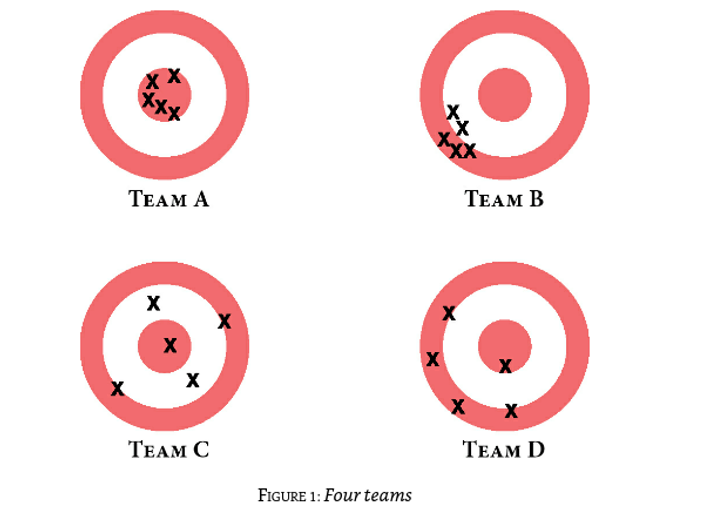
Part l: Finding Noise
This part explores the difference between noise and bias, showing that public and private organizations can be noisy. It reviews two areas: sentencing (public sector) and insurance (private sector).
1. Crime and Noisy Punishment
This chapter presents the result of various research projects that convincingly demonstrate judge decisions depend on many irrelevant factors such as lunchtime, weather, and whatnot. It discusses Marvin Frankel’s organization “The Lawyers’ Committee for Human Rights” and its legislative achievement in establishing sentencing guidelines. Here are data from the study of results:” expected difference in sentence length between judges was 17%, or 4.9 months, in 1986 and 1987. That number fell to 11%, or 3.9 months, between 1988 and 1993.” In 2005 congress changed guidelines from mandatory to advisory, and variance between sentences by different judges nearly doubled.
2. A Noisy System
This chapter discusses noise in the insurance business. First, it describes the result of the noise audit in the insurance company that discovered 55% variance in underwriters’ premium estimates, even if executives’ expectations were around 10%. It then analyses how this could happen and concludes that it resulted from the illusion of agreement. The further discussion includes psychological processes that lead to this, costs of high noise levels, and the need for regular noise estimates and measures to decrease it.
3. Singular Decisions
This chapter discusses singular decisions vs. recurrent decisions and concludes that these are also quite noisy. The main point here is singular decisions are the same as recurring decisions made only once, so people should apply the same noise-reducing technics in both cases.
Part II: Your Mind Is a Measuring Instrument
Part II investigates the nature of human judgment and explores how to measure accuracy and error. It discusses how human decisions are susceptible to both bias and noise. This part makes an interesting point:” judgment can therefore be described as measurement in which the instrument is a human mind. Implicit in the notion of measurement is the goal of accuracy—to approach truth and minimize error.”
4. Matters of Judgment
This chapter presents a case study about CEO selection as an example of the judgment process overloaded with relevant and irrelevant information. First, it offers the idea of internal signal:” The essential feature of this internal signal is that the sense of coherence is part of the experience of judgment. It is not contingent on a real outcome. As a result, the internal signal is just as available for nonverifiable judgments as it is for real, verifiable ones.” Further, it reviews ways to evaluate judgment even if results are often inconclusive. It also discusses the value of consistency and defines noise as an inconsistency that damages the system’s credibility.
5. Measuring Error
This chapter discusses how much bias and noise contribute to error. The main point here is that decision-makers should handle noise as rigorously as bias because it could cause similar levels of damage. This chapter also provides a bit of simple statistical tools relevant for measuring bias and noise.
6. The Analysis of Noise
This chapter demonstrates the use of tools to analyze noise in sentencing. It uses the breakdown of the system noise into the Level and the Pattern noises:
- Level noise is variability in the average level of judgments by different judges.
- Pattern noise is variability in judges’ responses to particular cases.
It also gives formula: System Noise2 = Level Noise2 + Pattern Noise2
The conclusion: “Level noise is when judges show different levels of severity. Pattern noise is when they disagree with one another on which defendants deserve more severe or more lenient treatment. And part of pattern noise is occasion noise—when judges disagree with themselves.”
7. Occasion Noise
This chapter discusses the noise from multiple small, difficult-to-measure factors. The repetitive estimates of unknown data demonstrated that the best assessment comes as an average of numerous estimates, with the first being usually closer to the truth. It parallels multiple individual estimates with one estimate by the crowd and finds it correct, naming it “the crowd within.” This chapter also discusses sources of occasional noise: psychological such as mood, gullibility, weather, and so on. The main point is that individuals are not constantly the same, and their behavior and decisions depend on multiple factors. It refers to interesting research demonstrating a 19% drop in granting asylum if the previous two positive asylum hearings. The conclusions are: “Judgment is like a free throw: however hard we try to repeat it precisely, it is never exactly identical.” and “Although you may not be the same person you were last week, you are less different from the ‘you’ of last week than you are from someone else today. Occasion noise is not the largest source of system noise.”
8. How Groups Amplify Noise
This chapter reviews group decision-making and finds it even noisier than individual decision-making. It occurs due to an increase in number and influence of irrelevant factors:” Who speaks first, who speaks last, who speaks with confidence, who is wearing black, who is seated next to whom, who smiles or frowns or gestures at the right moment.” The chapter reviews groups’ music downloads, various referenda, and web comments in the UK and the USA. The chapter also discusses informational cascades when a slight change in the sequence of presentations creates a path-dependent dynamic of support to one decision. The final part of the chapter discusses group polarization when one idea initially gets incrementally higher support than others later, resulting in increasingly higher support when people rush to join the majority. It generally leads to higher levels of noise and errors. The conclusion:” Since many of the most important decisions in business and government are made after some sort of deliberative process, it is especially important to be alert to this risk. Organizations and their leaders should take steps to control noise in the judgments of their individual members.”
Part III: Noise in Predictive Judgments
Part II explores predictive judgment, the use of rules and algorithms, and the superiority of these methods over humans in predictive power.
9. Judgments and Models
This chapter compares the accuracy of predictions made by professionals, by machines, and by simple rules. The conclusion is that the professionals come third in this competition. The chapter compares the new employee’s performance prediction based on human judgment and formal modeling and algorithms to reach this conclusion. The model beats humans not only in this case but also in clinical predictions. Moreover, it is true not only for formal modeling but also for modeling individual approaches. The model of a person predicts future outcomes better than this person’s judgment.
10. Noiseless Rules
This chapter explores why algorithms are better than experts and shows that noise is a significant factor in human judgment’s inferiority. Predictions are accurate to the extent that prediction matches outcome as measured by the percent concordant (PC). PC of 50% is a random match, and higher means more predictable power. Here is a nice graph for complexity increase:

The chapter analyses this and concludes that, generally, simple rules work better. However, AI machine learning produces even better results. The chapter then reviews an example of better bail decisions. In the end, the chapter discusses the reasons people distrust algorithms and rules.
11. Objective Ignorance
This chapter discusses an essential limit on predictive accuracy: most judgments are made in a state of objective ignorance because many things the future depends on can not be known. The chapter reviews the meaning of objective ignorance in-depth and provides multiple examples from pundits to judges and bail panels. One fascinating point here is the defiance of ignorance and human overconfidence, which adds a lot to the noise, lowering decision-making quality.
12. The Valley of the Normal
Finally, this chapter shows that objective ignorance affects not just an ability to predict events but even the capacity to understand them—an essential part of the answer to the puzzle of why noise tends to be invisible. The chapter also describes a large-scale longitudinal project tracing thousands of children and families over decades, analyzing predictions and outcomes. The result:” The main conclusion of the challenge is that a large mass of predictive information does not suffice for the prediction of single events in people’s lives—and even the prediction of aggregates is quite limited.” In other words, it demonstrated the difference between knowledge based on data and understanding of the situation that could produce a valid prediction. In the end, the chapter provides the following list of the limits of agreement:
- “Correlations of about .20 (PC = 56%) are quite common in human affairs.”
- “Correlation does not imply causation, but causation does imply correlation.”
- “Most normal events are neither expected nor surprising, and they require no explanation.”
- “In the valley of the normal, events are neither expected nor surprising—they just explain themselves.”
- “We think we understand what is going on here, but could we have predicted it?”
Part IV: How Noise Happens
Part IV explores psychological causes of noise, “including personality and cognitive style; idiosyncratic variations in the weighting of different considerations; and the different uses that people make of the very same scales.”
13. Heuristics, Biases, and Noise
This chapter presents three important judgment heuristics on which System 1 extensively relies. It shows how these heuristics cause predictable, directional errors (statistical bias) as well as noise. For example, these errors could be aiming at the same bull’s eye but hitting different spots or aiming at different bull’s eyes but hitting the same place. The authors discuss substitution, conclusion, and other psychological biases. They caution against blaming errors on unspecified biases and distorting evidence to fit prejudgment based on the first impressions. They also suggest that biases common for a group create systemic bias, but if biases are different, it just makes more noise.
14. The Matching Operation
This chapter focuses on matching—a particular operation of System 1—and discusses the errors it can produce. It mainly comes down to the difference in measurement scales when the exact estimate creates errors because of scaling mismatch.
15. Scales
This chapter turns to an indispensable accessory in all judgments: the scale on which the judgments are made. It shows that the choice of an appropriate scale is a prerequisite for good judgment and that ill-defined or inadequate scales are an important source of noise. Here authors provide the formula for measuring noisy scales:
Variance of Judgments = Variance of Just Punishments + (Level Noise) 2 + (Pattern Noise) 2
They also provide a graphic representation for punitive scales:

16. Patterns
This chapter explores the psychological source of what may be the most intriguing type of noise: the patterns of responses that different people have to different cases. Like individual personalities, these patterns are not random and are mostly stable over time, but their effects are not easily predictable. Here is another formula:
(Pattern Noise)2 = (Stable Pattern Noise) 2 + (Occasion Noise) 2
17. The Sources of Noise
This chapter summarizes the previous discussion about noise and its components. It also proposes an answer to the puzzle raised earlier: why is noise, despite its ubiquity, rarely considered an important problem? Here is a combined graphical representation of Mean Square Error (MSE):

Part V: Improving Judgments
Part V explores ways to improve human judgment.
18. Better Judges for Better Judgments
This chapter discusses the characteristics of superior judges. Authors look at such characteristics as Intelligence and Cognitive style. They also discuss the role of true experts, who produce verifiable predictions and respect-experts – people with credentials who make unverifiable statements.
19. Debiasing and Decision Hygiene
This chapter reviews many attempts to counteract psychological biases, with some clear failures and some clear successes. It also briefly reviews debiasing strategies and suggests a promising: asking a designated decision observer to search for diagnostic signs that could indicate, in real time, that a group’s work is being affected by one or several familiar biases. The authors look at Ex Post and Ex Ante debiasing and provide some experimental data on this. They also discuss debiasing limitations. One of the methods they discuss is a decision observer with a checklist to assure proper coverage of biases and decision points. Overall, they suggest strict decision hygiene to decrease both biases and noise.
20. Sequencing Information in Forensic Science
This chapter reviews the case of forensic science, which illustrates the importance of sequencing information. The search for coherence leads people to form early impressions based on the limited evidence available and then to confirm their emerging prejudgment. This makes it important not to be exposed to irrelevant information early in the judgment process. The authors review an example of fingerprint analysis and how various biases and noise impacted its quality. They also stress the need for a second opinion that has to be independent to be meaningful.
21. Selection and Aggregation in Forecasting
This chapter reviews the case of forecasting, which illustrates the value of one of the most important noise-reduction strategies: aggregating multiple independent judgments. The “wisdom of crowds” principle is based on the averaging of multiple independent judgments, which is guaranteed to reduce noise. Beyond straight averaging, there are other methods for aggregating judgments, also illustrated by the example of forecasting. Authors here refer to Tetlock’s “Good Judgment Project” and discuss its mixed results.
22. Guidelines in Medicine
This chapter offers the review of noise in medicine and efforts to reduce it. It points to the importance and general applicability of a noise-reduction strategy previously introduced with the example of criminal sentencing: judgment guidelines. Guidelines can be a powerful noise-reduction mechanism because they directly reduce between-judge variability in final judgments. Here authors pay special attention to psychiatry, the field with deficient levels of consistency between specialists’ judgments.
23. Defining the Scale in Performance Ratings
This chapter turns to a challenge in business life: performance evaluations. Efforts to reduce noise there demonstrate the critical importance of using a shared scale grounded in an outside view. This is an important decision hygiene strategy for a simple reason: judgment entails the translation of an impression onto a scale, and if different judges use different scales, there will be noise. Here authors suggest that the use of a relative scale is more appropriate than absolutes.
24. Structure in Hiring
This chapter explores the related but distinct topic of personnel selection, which has been extensively researched over the past hundred years. It illustrates the value of an essential decision hygiene strategy: structuring complex judgments. By structuring, authors mean decomposing a judgment into its component parts, managing the process of data collection to ensure the inputs are independent of one another, and delaying the holistic discussion and the final judgment until all these inputs have been collected.
25. The Mediating Assessments Protocol
This chapter proposes a general approach to option evaluation called the mediating assessments protocol, or MAP for short. MAP starts from the premise that “options are like candidates” and describes schematically how structured decision making, along with the other decision hygiene strategies mentioned above, can be introduced in a typical decision process for both recurring and singular decisions.
Part VI: Optimal Noise
Part VI explores the proper noise level, considering that it is not possible or even preferable to eradicate it.
26. The Costs of Noise Reduction
This chapter reviews the first two of seven major objections to efforts to reduce or eliminate noise:
- First, reducing noise can be expensive; it might not be worth the trouble. The steps that are necessary to reduce noise might be highly burdensome. In some cases, they might not even be feasible.
- Second, some strategies introduced to reduce noise might introduce errors of their own. Occasionally, they might produce systematic bias. If all forecasters in a government office adopted the same unrealistically optimistic assumptions, their forecasts would not be noisy, but they would be wrong. If all doctors at a hospital prescribed aspirin for every illness, they would not be noisy, but they would make plenty of mistakes.
27. Dignity
This chapter reviews five more objections, which are also common and which are likely to be heard in many places in coming years, especially with increasing reliance on rules, algorithms, and machine learning:
- Third, if we want people to feel that they have been treated with respect and dignity, we might have to tolerate some noise. Noise can be a by-product of an imperfect process that people end up embracing because the process gives everyone (employees, customers, applicants, students, those accused of crime) an individualized hearing, an opportunity to influence the exercise of discretion, and a sense that they have had a chance to be seen and heard.
- Fourth, noise might be essential to accommodate new values and hence to allow moral and political evolution. If we eliminate noise, we might reduce our ability to respond when moral and political commitments move in new and unexpected directions. A noise-free system might freeze existing values.
- Fifth, some strategies designed to reduce noise might encourage opportunistic behavior, allowing people to game the system or evade prohibitions. A little noise, or perhaps a lot of it, might be necessary to prevent wrongdoing.
- Sixth, a noisy process might be a good deterrent. If people know that they could be subject to either a small penalty or a large one, they might steer clear of wrongdoing, at least if they are risk-averse. A system might tolerate noise as a way of producing extra deterrence.
- Finally, people do not want to be treated as if they are mere things, or cogs in some kind of machine. Some noise-reduction strategies might squelch people’s creativity and prove demoralizing.
28. Rules or Standards?
This chapter presents the authors’ general conclusion that even when the objections to various methods such as rigid guidelines are given their due, noise reduction remains a worthy and even an urgent goal. It defends this conclusion by exploring a dilemma that people face every day, even if they are not always aware of it.
Review and Conclusion: Taking Noise Seriously
Here the authors once again summarize the main points of this book. They strongly recommend paying attention to the noise and applying massive efforts to limit the noise to acceptable levels while stressing that it is not possible and even not reasonable to remove it altogether.
MY TAKE ON IT:
I think this is an excellent book on the problem of poor decision-making that causes myriad issues and cost lots of treasure and, in some cases, lots of blood. The division of the problem into noise and bias is very effective, and specific suggestions of improvements via checklists, second independent opinions, explicit recognition of various biases, and, overall, strict decision hygiene could be highly valuable. However, I would not hold my breath anticipating improvements. I believe that problem is more in the absence of solid feedback for decision-makers in government and top levels of big corporations, which makes these people irresponsible and therefore uninterested in improving decision-making processes.
20211002 – Imagined Communities

MAIN IDEA:
The main idea is to review the origin of nations and nationalism based on the author’s suppositions that it is a cultural phenomenon that originated as the result of the printing press. This new technology prompted the new religiosity of Protestantism when people started searching for who they were not only as individuals but also as members of a community defined by language, culture, and attitudes. It is also quite often, but not always linked to unchangeable characteristics such as race, and the author demonstrates the multiracial nationalism of Creole nations.
DETAILS:
1 Introduction
The author begins by defining his starting point:” My point of departure is that nationality, or, as one might prefer to put it in view of that word’s multiple significations, nation-ness, as well as nationalism, are cultural artefacts of a particular kind. To understand them properly we need to consider carefully how they have come into historical being, in what ways their meanings have changed over time, and why, today, they command such profound emotional legitimacy.”
After that, he presents what he considers three paradoxes:
(1) The objective modernity of nations to the historian’s eye vs. their subjective antiquity in the eyes of nationalists.
(2) The formal universality of nationality as a socio-cultural concept – in the modern world everyone can, should, will ‘have’ a nationality, as he or she ‘has’ a gender – vs. the irremediable particularity of its concrete manifestations, such that, by definition, ‘Greek’ nationality is sui generis.
(3) The ‘political’ power of nationalisms vs. their philosophical poverty and even incoherence.
Finally, the author defines the notion of the nation:” it is an imagined political community – and imagined as both inherently limited and sovereign.”
2 Cultural Roots
The author begins the discussion of cultural roots with the popular symbol: the Tomb of Unknown Soldier. From there, he proposes:” that nationalism has to be understood by aligning it, not with self-consciously held political ideologies, but with the large cultural systems that preceded it, out of which – as well as against which – it came into being.” The first such system the author discusses is a religious community, specifically Christianity, and its transition from the global Latin-based Church to multiple communities using their local languages. The second system was royal dynasties that curved, shaped, and reshaped realms through wars, marriages, and other tools. After that author discusses historical changes in apprehensions of time from the perception of static and unchangeable to historically developing process within which a nation is growing much like one unified organism with individuals being just a tiny part of it. Finally, the author discusses prosperity or lack thereof as a condition of this organism. Here is the author’s summarization of ideas presented in this chapter:” I have been arguing that the very possibility of imagining the nation only arose historically when, and where, three fundamental cultural conceptions, all of great antiquity, lost their axiomatic grip on men’s minds. The first of these was the idea that a particular script-language offered privileged access to ontological truth, precisely because it was an inseparable part of that truth. It was this idea that called into being the great transcontinental sodalities of Christendom, the Islamic Ummah, and the rest. Second was the belief that society was naturally organized around and under high centers – monarchs who were persons apart from other human beings and who ruled by some form of cosmological (divine) dispensation. Human loyalties were necessarily hierarchical and centripetal because the ruler, like the sacred script, was a node of access to being and inherent in it. Third was a conception of temporality in which cosmology and history were indistinguishable, the origins of the world and of men essentially identical. Combined, these ideas rooted human lives firmly in the very nature of things, giving certain meaning to the everyday fatalities of existence (above all death, loss, and servitude) and offering, in various ways, redemption from them.”
3 The Origins of National Consciousness
Here, the author discusses mass book printing in the Middle Ages that prompted the Reformation and became the foundation of the formalization of languages and correspondingly national consciousness. The author describes in detail the development of what he calls “print-capitalism,” concluding at the end:” We can summarize the conclusions to be drawn from the argument thus far by saying that the convergence of capitalism and print technology on the fatal diversity of human language created the possibility of a new form of imagined community, which in its basic morphology set the stage for the modern nation. The potential stretch of these communities was inherently limited, and, at the same time, bore none but the most fortuitous relationship to existing political boundaries (which were, on the whole, the highwater marks of dynastic expansionisms).
4 Creole Pioneers
This chapter is about intermixing of populations in America and elsewhere and how it created new nations from creole communities:” the growth of creole communities, mainly in the Americas, but also in parts of Asia and Africa, led inevitably to the appearance of Eurasians, Eurafricans, as well as Euramericans, not as occasional curiosities but as visible social groups.” The author also discusses the mixing of languages and overall communications, starting with Ben Franklin and newspapers. In the end, the author concludes:” By way of provisional conclusion, it may be appropriate to re-emphasize the limited and specific thrust of the argument so far. It is intended less to explain the socio-economic bases of anti-metropolitan resistance in the Western hemisphere between say, 1760 and 1830, than why the resistance was conceived in plural, ‘national’ forms – rather than in others. The economic interests at stake are well-known and obviously of fundamental importance. Liberalism and the Enlightenment clearly had a powerful impact, above all in providing an arsenal of ideological criticisms of imperial and anciens régimes. What I am proposing is that neither economic interest, Liberalism, nor Enlightenment could, or did, create in themselves the kind, or shape, of imagined community to be defended from these regimes’ depredations; to put it another way, none provided the framework of a new consciousness – the scarcely-seen periphery of its vision – as opposed to centre-field objects of its admiration or disgust. In accomplishing this specific task, pilgrim creole functionaries and provincial creole printmen played the decisive historic role”.
5 Old Languages, New Models
In this chapter, the author looks at methods and tools of nation formation in the XIX-XX centuries, especially languages:” Europe. If we consider the character of these newer nationalisms which, between 1820 and 1920, changed the face of the Old World, two striking features mark them off from their ancestors. First, in almost all of them ‘national print-languages’ were of central ideological and political importance, whereas Spanish and English were never issues in the revolutionary Americas. Second, all were able to work from visible models provided by their distant, and after the convulsions of the French Revolution, not so distant, predecessors. The ‘nation’ thus became something capable of being consciously aspired to from early on, rather than a slowly sharpening frame of vision. Indeed, as we shall see, the ‘nation’ proved an invention on which it was impossible to secure a patent. It became available for pirating by widely different, and sometimes unexpected, hands. In this chapter, therefore, the analytical focus will be on print-language and piracy.”
6 Official Nationalism and Imperialism
Here the author discusses the transformation of old dynasties from mainly royalty-based genealogies to nations based on the commonality of language and narratives. In such nations, while remaining at the top of the nation, the royals were incapable of transforming it. Instead, they had to accommodate themselves to losing the ability to control the population. It was also true for the periphery of different empires when the local elite was educated and deeply connected to imperial capitals and main population, conflicting with their loyalty to their local population. After looking at the variety of cases from India to Hungary, the author concludes:” In almost every case, official nationalism concealed a discrepancy between nation and dynastic realm. Hence a world-wide contradiction: Slovaks were to be Magyarized, Indians Anglicized, and Koreans Japanified, but they would not be permitted to join pilgrimages which would allow them to administer Magyars, Englishmen, or Japanese. The banquet to which they were invited always turned out to be a Barmecide feast. The reason for all this was not simply racism; it was also the fact that at the core of the empires nations too were emerging – Hungarian, English, and Japanese. And these nations were also instinctively resistant to ‘foreign’ rule. Imperialist ideology in the post-1850 era thus typically had the character of a conjuring-trick. How much it was a conjuring-trick is suggested by the equanimity with which metropolitan popular classes eventually shrugged off the ‘losses’ of the colonies, even in cases like Algeria where the colony had been legally incorporated into the metropole. In the end, it is always the ruling classes, bourgeois certainly, but above all aristocratic, that long mourn the empires, and their grief always has a stagey quality to it.”
7 The Last Wave
In this chapter, the author moves to WWI and WWII that led to the dissolution of empires and the birth of many nation-states based on linguistic, cultural, and historical commonality. The author discusses this process in several locations, from Russia in 1917 to Indonesia in the 1970s. The author stresses that this process was driven by educated part of populations of empires, that often were minorities:” As bilingual intelligentsias, however, and above all as early-twentieth-century intelligentsias, they had access, inside the classroom and outside, to models of nation, nation-ness, and nationalism distilled from the turbulent, chaotic experiences of more than a century of American and European history. These models, in turn, helped to give shape to a thousand inchoate dreams. In varying combinations, the lessons of creole, vernacular and official nationalism were copied, adapted, and improved upon. Finally, as with increasing speed capitalism transformed the means of physical and intellectual communication, the intelligentsias found ways to bypass print in propagating the imagined community, not merely to illiterate masses, but even to literate masses reading different languages.”
8 Patriotism and Racism
In this chapter, the author looks at the intertwining of patriotism and racism. The author stresses the nobility of patriotism and provides a few samples of relevant literature. The author makes the point that it is also mainly imagination:” It may appear paradoxical that the objects of all these attachments are ‘imagined’ – anonymous, faceless fellow-Tagalogs, exterminated tribes, Mother Russia, or the tanah air. But amor patriae does not differ in this respect from the other affections, in which there is always an element of fond imagining.”
9 The Angel of History
Here, the author returns to the theme of imagination giving birth to the new reality, in this case, patriotic vision giving birth to the nation that existed only in the imagination. He refers to some examples: Russia and its revolution, China, and Vietnam. The author then talks about leadership that creates new reality mainly acting in their own interests:” I emphasize leaderships, because it is leaderships, not people, who inherit old switchboards and palaces. No one imagines, I presume, that the broad masses of the Chinese people give a fig for what happens along the colonial border between Cambodia and Vietnam. Nor is it at all likely that Khmer and Vietnamese peasants wanted wars between their peoples, or were consulted in the matter. In a very real sense these were ‘chancellory wars’ in which popular nationalism was mobilized largely after the fact and always in a language of self-defence. (Hence the particularly low enthusiasm in China, where this language was least plausible, even under the neonlit blazon of ‘Soviet hegemonism.’)”
10 Census, Map, Museum
Here the author discusses how three key institutions foster nationalism and even create it in the first place: Census, The Map, and the Museum.
11 Memory and Forgetting
The author begins this chapter with a discussion about an interesting habit of people from Europe who moved to the new places to name these new places after the old ones, such as New York. Interestingly, it is not the case with Chinese or Arabs. This difference moves the author to contemplate reasons for nationalism’s origin in America in the wake of anti-colonial revolutions. He writes: “… none of the creole revolutionaries dreamed of keeping the empire intact but rearranging its internal distribution of power, reversing the previous relationship of subjection by transferring the metropole from a European to an American site.” Overall, by the end of the XIX century, this, plus biology, plus philosophy, prompted nationalistic awakening elsewhere, first of all in Europe. This awakening, in some cases, produced fratricide, and the author traces its reflection in literature. Finally, the author discusses the personification of Nations, noting that they are different because they have no clear beginning or end.
MY TAKE ON IT:
I agree that human cultures and imagination create nations. Still, the nations are not imaginary. They reflect the complex reality of shared characteristics such as language, culture, and mutual support. They also protect against external violence when needed and internal criminality. I think that history demonstrated many times over and over again that nations are not a given unchangeable object, but rather are forever work in process. They combine multiple groups of people into an ever-increasing whole that expands protection bubble and economic cooperation broader and broader, which would eventually cover everything and everybody, but only after decades, if not centuries of development. This process is analogous to earlier processes that made Germany, France, and other countries out of small states or provinces merging into one nation with dynamic accommodation of languages and cultures. In short, humanity develops by way of “E Pluribus Unum.”
20210925 – Cultural Evolution
MAIN IDEA:
Here is the author’s formulation:” This book presents a new version of modernization theory – Evolutionary Modernization theory – which generates a set of hypotheses that we test against a unique data base: from 1981 to 2014, the World Values Survey and European Values Study carried out hundreds of surveys in more than 100 countries containing over 90 percent of the world’s population.” The critical point of this theory is that human values are dependent on levels of security and economic development achieved by the people: secure and wealthy people switch to non-materialistic, secular values supportive to self-expression, individualism, and tolerant of others, who are assumed to be friendly and have similar values, while insecure and poor people retain traditional values of in-group solidarity, religion, and defense against others, who are assumed to be hostile and have entirely different values.
DETAILS:
Introduction: An Overview of This Book
Here the author presents this book as a look at the new situation in human history. It was the situation when economic development achieved such levels that physical survival is not the primary concern of the vast majority of people anymore. At least, it is not the case in the developed world. It led to the “shift from Materialist to Postmaterialist values – which was part of an even broader shift from Survival values to Self-expression values.” In this new and secure world, people have the luxury to pursue happiness rather than survival, be tolerant to others, and have a relaxed attitude to just about everything. However, this near paradise condition was brief and is threatening now by increased automatization of everything based on AI. This development brings back insecurity and, in turn, leads to:” High levels of existential security are conducive to a more tolerant, open outlook – but conversely, declining existential security triggers an Authoritarian Reflex that brings support for strong leaders, strong in-group solidarity, rigid conformity to group norms and rejection of outsiders.”
1 Evolutionary Modernization and Cultural Change
The author begins by defining:” Evolutionary Modernization theory – which argues that economic and physical insecurity are conducive to xenophobia, strong in-group solidarity, authoritarian politics and rigid adherence to their group’s traditional cultural norms – and conversely that secure conditions lead to greater tolerance of outgroups, openness to new ideas and more egalitarian social norms.”
The author then refers to the methodology of data collection via surveys.
Classic Modernization Theory and Evolutionary Modernization Theory
Here, the author discusses Modernization theory and repeats his central thesis that evolution optimized people for survival. When survival is practically guaranteed, people move on to develop some new previously non-existing values and direct their effort to achieve these values.
Converging Evidence of the Importance of Existential Security
Here author reviews the situation when:” Working independently, anthropologists, psychologists, political scientists, sociologists, evolutionary biologists and historians have recently developed strikingly similar theories of cultural and institutional change: they all emphasize the extent to which security from survival threats, such as starvation, war and disease, shape a society’s cultural norms and sociopolitical institutions.”
The Rise of Postmaterialism in the West
Here the author presents the theory of intergenerational value change, which is based on two key hypotheses:
1. A scarcity hypothesis. Virtually everyone values freedom and autonomy, but people give top priority to their most pressing needs. Material sustenance and physical security are closely linked with survival, and when they are insecure, people give top priority to these Materialistic goals; but under secure conditions, people place greater emphasis on Postmaterialist goals such as belonging, esteem and free choice.
2. A socialization hypothesis. The relationship between material conditions and value priorities involves a long time-lag: one’s basic values largely reflect the conditions that prevailed during one’s preadult years, and these values change mainly through intergenerational population replacement.
The author then discusses these hypothesizes and inferences that they lead to in various areas: Cultural Change and Societal Change; Cognition and Emotions as Sources of Value Change; An Alternative Explanation: Rational Choice; Slow and Fast Cultural Change;
At the end of the chapter author presents the following list of significant predictions:
1. When a society attains sufficiently high levels of existential security that a large share of the population grows up taking survival for granted, it brings coherent and roughly predictable social and cultural changes, producing an intergenerational shift from values shaped by scarcity, toward increasing emphasis on Postmaterialist values and Self-expression values.
2. As younger birth cohorts replace older cohorts in the adult population, it transforms the societies’ prevailing values – but with long time-lags. The youngest cohorts have little political impact until they reach adulthood, and even then they are still a small minority of the adult population; it takes additional decades before they become the dominant influence in their society.
3. Intergenerational value change is shaped by short-term period effects such as economic booms or recessions, in addition to population replacement, but in the long run the period effects often cancel each other out, while the population replacement effects tend to be cumulative.
4. Intergenerational value change can eventually reach a threshold at which new norms became socially dominant. At this point, conformist pressures reverse polarity, supporting changes they had formerly opposed and bringing much more rapid cultural change than that produced by population replacement alone.
5. Cultural change is path-dependent: a society’s values are shaped by its entire historical heritage, and not just its level of existential security.
2 The Rise of Postmaterialist Values in the West and the World
The author points out that western societies are switching to postmaterialist values and presents several graphs supporting this idea. Here is one for Western countries:

The author also provides similar data for other world areas where the same process occurs, albeit slower. The author also expresses the belief that younger generations drive this process. It possesses a positive feedback loop that all but guarantees the change happening with the shift in generations.
3 Global Cultural Patterns
This chapter discusses data obtained from Global Values Surveys that monitored 90% of the world population. The analysis included two main dimensions: Traditional vs. Secular-Rational and Survival vs. Self-Expression. The author provides a sample of questionary that used to separate individuals with “Survival values” from individuals with “Self-Expression values”:


Modernization-Linked Attitudes Tend to Be Enduring and Cross-nationally Comparable
The conclusion is:” Our theory holds that Self-expression values should be strongly correlated with indicators of economic modernization. Although measured at different levels and by different methods, we find remarkably strong linkages between individual-level values and societies’ economic characteristics. Across all available societies, the average correlation between Self-expression values and ten widely used economic modernization indicators, ranging from per capita GDP and mean life expectancy to educational levels”
The Self-expression/lndividualism/Autonomy Super-dimension
The author then presents metanalysis demonstrating that the critical factor defining cross nations clustering of values is the Self vs. Group dimension:
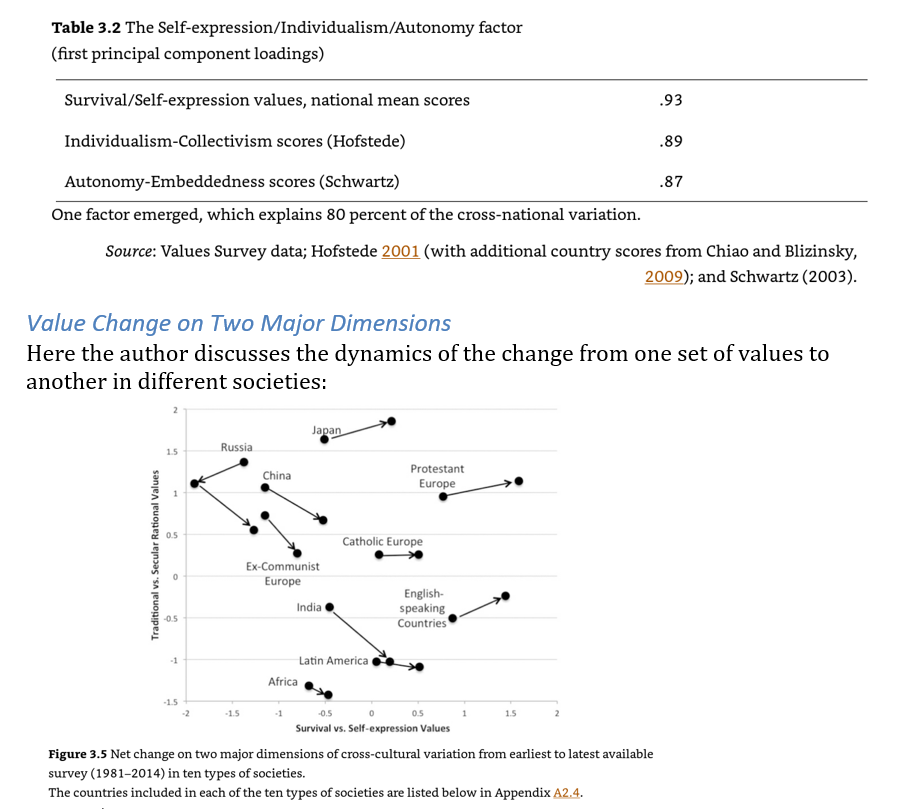
Conclusion
The conclusion is that society’s values are predictable based on the economic and overall security position, with individualism characteristic of a wealthy and secure community. That movement nearly always occurs with successful development, and that change is path-dependent.
4 The End of Secularization?
In the first part of this chapter author traces emergence of need in moral god depending on the primary method of production:
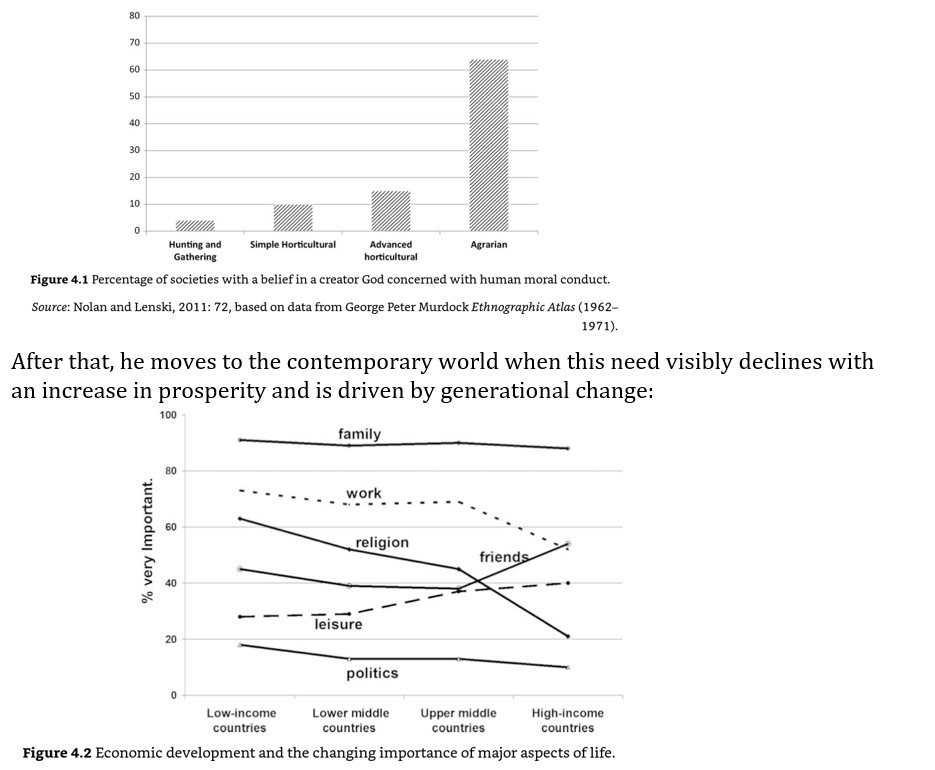
However, the author also notes counter-secularization trends: low fertility of secular population vs. high fertility of religious people, the substitution of hierarchically organized religion of agricultural and industrial ages with mixed bag of religious ideas and DIY spirituality of information age.
5 Cultural Change, Slow and Fast: The Distinctive Trajectory of Norms Governing Gender Equality and Sexual Orientation
In this chapter author discusses characteristics of the process of change and attempts to demonstrate these points:
1) These value changes involve very long time-lags between the onset of the conditions leading to them, and the societal changes they produce. There was a time-lag of 40–50 years between when Western societies first attained high levels of economic and physical security after World War II, and the occurrence of such relevant societal changes as legalization of same-sex marriage.
2) One distinctive set of norms concerning gender equality, divorce, abortion and homosexuality supports a pro-fertility strategy that was essential to the survival of pre-industrial societies but eventually became superfluous. This set of norms is now moving on a trajectory that is distinct from that of other cultural changes.
3) Although basic values normally change at the pace of intergenerational population replacement, the shift from Pro-fertility norms to Individual-choice norms has reached a tipping-point where conformist pressures have reversed polarity and are now accelerating value changes they once resisted, bringing major societal changes such as legalization of same-sex marriage.
The author presents a formal statement for Hypotheses of his Evolutionary Modernization Theory and then empirical data and analysis supporting these hypotheses. For example, here is one of his data sets for Income/Tolerance correlation:

In conclusion, the author notes that slow change in attitudes to sexuality and fertility seems to reach the tipping point when the conformist majority finds it detrimental to maintain old norms of sexuality, which leads to acceleration of changes. For some reason, the author also refers here to xenophobia, noting that high-income countries somehow become not less xenophobic and explain it by very high levels of immigration and terrorism. The author also cannot help but complain about Trump’s victory in 2016.
6 The Feminization of Society and Declining Willingness to Fight for One’s Country: The Individual-Level Component of the Long Peace
Here the author offers four Hypotheses:
(1) Cross-sectionally, the publics of more developed societies will place more emphasis on Individual-choice values and be less willing to risk their lives in war.
(2) Longitudinally, in societies in which Individual-choice values are most widespread, people’s willingness to risk lives in war will fall most sharply.
(3) In multi-level perspective, individuals who live in societies with widespread Individual-choice values will be less willing to risk their lives in war.
Since historical learning is also an influence on cultural evolution, this adds a fourth hypothesis:
(4) Historically, the former Axis powers’ devastating defeat in World War II sharply diminished their people’s willingness to fight for their country; while the exceptionally strong prevalence of Self-expression values in the Nordic countries led to the emergence of a military primarily geared to peace-keeping missions and developmental aid; this, in turn, led to the emergence of a distinctive and positive view of the role of the military among the Nordic publics, making them more willing to fight for their country.
The author provides some graphs demonstrating changes in willingness to fight generally supportive of presented Hypotheses. However, he is justifiably cautious because of the dynamic character of the issue. He even provides a very relevant point:” These trends are reversible. Russia’s seizure of Crimea and intervention in the Eastern Ukraine evoked widespread concern, bringing economic sanctions, capital flight from Russia and impelling Nordic political leaders to reassess the role of their countries’ military forces. But so far, no influential Western leaders – not even the Hawks – have advocated military action against Russia. The norms of the Long Peace continue to prevail for now.”
7 Development and Democracy
The author begins this chapter with the discussion of “democratic recession,” noting that it is not unusual for long-term development. – one should recall 1930-40 and the tidal wave of fascism and communism. Then he discusses the link between democracy and development and concentrates on the connection between self-expression and effective democracy:

The author also provides a detailed explanation of the graph:” The incongruence between the institutional supply of democracy and the cultural demand for democracy is calculated by subtracting the demand from the supply. In order to measure the incongruence that was present before the Third Wave transition, we use the pre-transition levels of democracy, as measured during 1981–1986, to indicate the supply. To calculate the cultural demand for democracy, we use Self-expression values measured around 1990 as an indication of how strong these values were before the transition.
The more Self-expression values surpass a society’s level of democracy, the greater the unmet demand. In the analysis shown on Figure 7.2, a score of –1 indicates the strongest possible lack of demand for more democracy, while a score of +1 indicates the maximum demand for more democracy. Our sample includes a number of stable Western democracies in which the levels of democracy have been constant since measurement began. These 16 democracies are in an equilibrium where supply and demand for democracy are in balance; accordingly, they are at the zero-point on the incongruence scale. They also are at the zero-point on the vertical dimension, which measures how much change a country experienced in its level of effective democracy from the early 1980s to the late 1990s: since the supply and demand for democracy were in balance, they experienced no change.”
After discussing supply and demand for democracy based on the level of development of society, the author makes an important point that general movement is in the direction of congruence between these two:
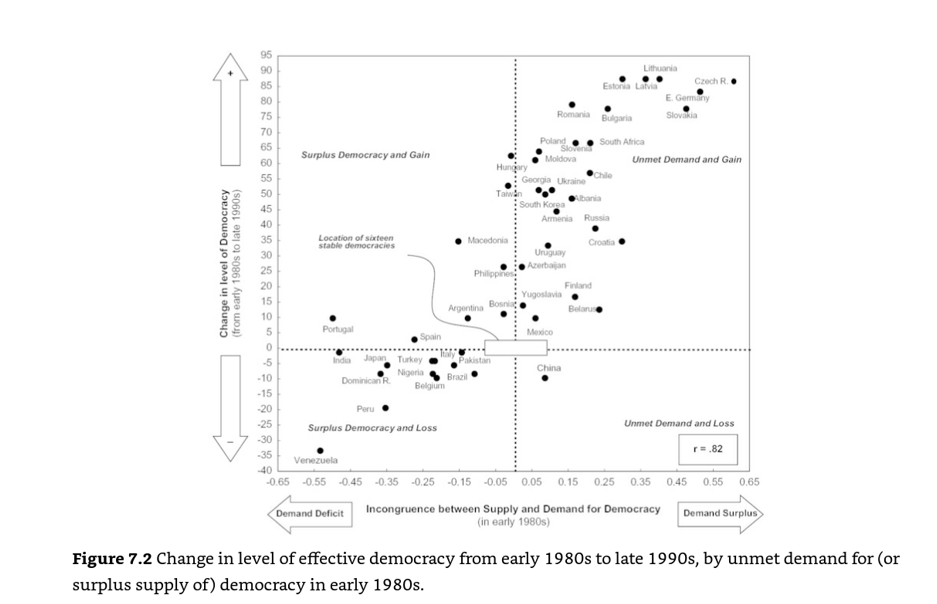
The author ends this chapter with a brief discussion of China as an outlier: economic development, in the author’s opinion, created unmet demand for democracy, that in the long run would somehow lead to the democratization of Chinese society, although he admits that there is no sign that it is happening and that he does not believe it could happen while communist party controls security forces.
8 The Changing Roots of Happiness
Here the author discusses happiness and points out that it is not a set value, maybe even genetic, as usually thought but rather an improvable parameter. His justification:” Extensive empirical evidence indicates that the extent to which a society allows free choice has a major impact on happiness. From 1981 to 2007, economic development, democratization and rising social tolerance increased the extent to which the people of most countries had free choice in economic, political and social life – leading to higher levels of happiness and life satisfaction.” The author presents a graphic expression of empirical results:

The author also discusses the correlation between religiosity and life satisfaction, which is generally between 0 and 0.15, with a significant outlier in China, where the correlation is negative.
In the end, the author provides a summary of the results of path analysis for causal sequences for perceived well-being:
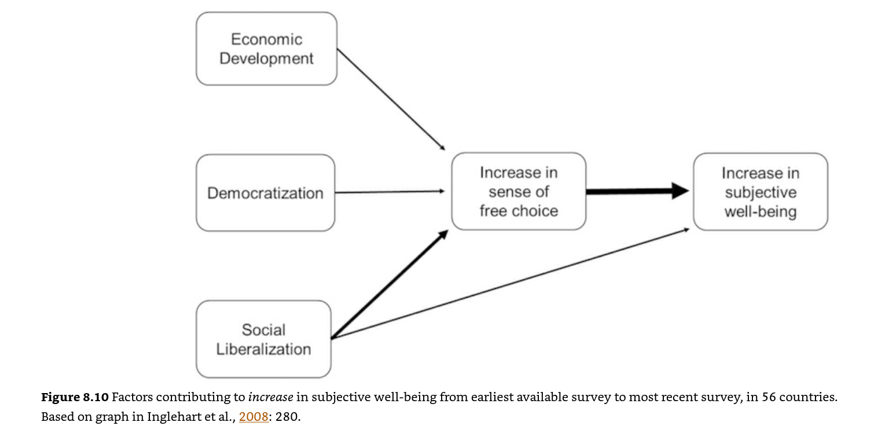
9 The Silent Revolution in Reverse: The Rise of Trump and the Authoritarian Populist Parties
This chapter discusses the rise of populism in the USA and Europe and what the author calls xenophobic and authoritarian movements. The author provides some interesting data demonstrating that Trump’s support is growing with age but limited by class with low- and high-income groups aligning against Trump, while middle-income group supporting:
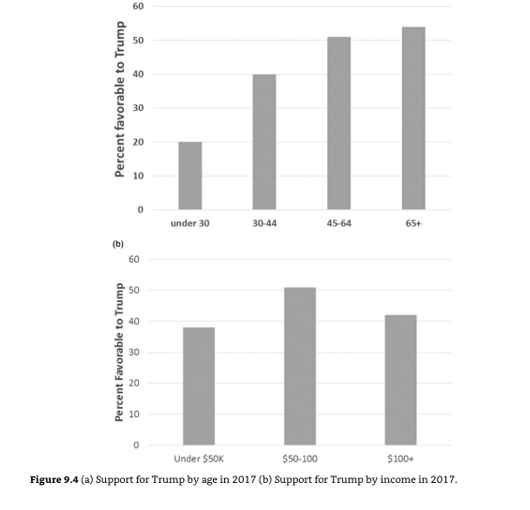
The author also discusses the shift from economic to non-economic issues in political discourse in western democracies:
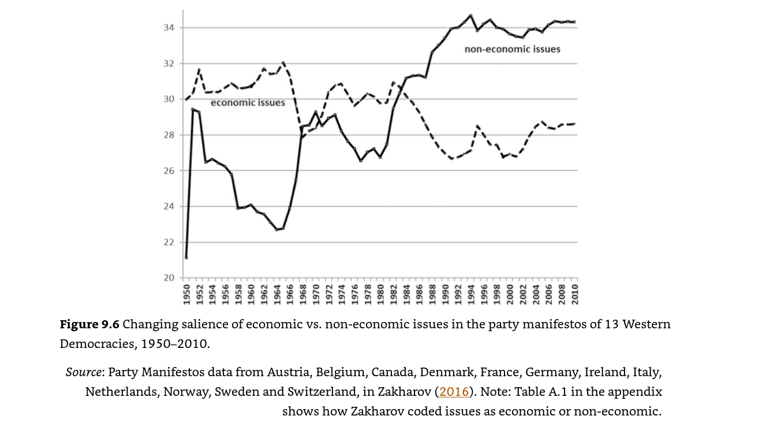
At the end of the chapter, the author allocates quite a bit of space to discuss growing inequality and political influence of the upper class, concluding that:” Rising inequality and economic insecurity are already generating powerful political dissatisfaction.”
10 The Coming of Artificial Intelligence Society
In this last chapter, the author looks at the future impact of mass implementation of AI and sees quite a bleak picture of increased inequality and practical destruction of the middle class. Here is the graph of trends that point in this direction:
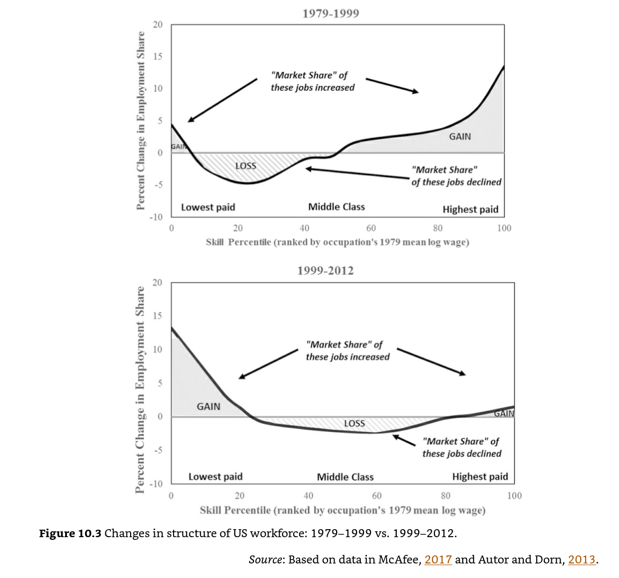
All this looks very scary to the author, and he sees signs of impending danger in such events as the Trump election and presidency. So, he is looking for a political solution to substitute the old New Deal Democratic coalition with the new incarnation of an ever bigger government that will reallocate income more fairly. The author believes that it could be done by converting stupid middle- and lower-class people who voted in mass for Trump into believing that they will be much better off if they vote for democrats. The foundation of this conversion and the goal of big benevolent government supported by unchallengeable majority will be increased recognition of unfair distribution of wealth when most wealth goes to already rich with consequent mass demand for redistribution, and by “Developing well-designed programs to attain this goal will be a crucial task for social scientists and policy-makers during the next 20 years.”
MY TAKE ON IT:
This book is fascinating, with a significant amount of interesting empirical data. I agree that values change with the increase in wealth and security. Still, I think that author underestimates to what extent the parameters of wealth and security are relative to the wealth and safety of others. For example, an American who lost a good job and had to live on handouts because the company shipped this job to China or hired an illegal immigrant may drop his values of tolerance and openness to others.
Despite this underestimation, the author clearly understands that shifting the population of Western democracies from wealth and security to poverty and insecurity that will hugely accelerate by implementing AI does not sound suitable for continuing the status quo. However, the author’s suggested solution: an ever bigger government that redistributes more wealth according to the wise advice of social scientists is not workable. It is because of the relative character of wealth and security. The people who cannot act on their own and achieve what they want will not accept some Universal Basic Income that makes them equal in poverty. It is especially true when the top levels of the society, from government-made billionaires to well-paid social scientists, time after time waste resources on implementing costly and non-working social programs. Obviously, nobody knows what lies ahead, but I am afraid that it could be as funny and entertaining as the Russian or French revolutions.
20210918 – The Revolt of the Public
MAIN IDEA:
The main idea is that developments of the information age broke government and elite stronghold on information flow. It resulted in the dissolution of trust in authority and the ability of people to organize by using the social network, sometimes so effectively that the popular revolt with no straightforward program or effective organization could overthrow established authoritarian governments. The author supports this idea by presenting details of such processes as they occurred in the Arab revolution and then provides a warning that it could also happen in established western democracies in which authorities and the elite are currently losing the support of the public. The author also provides recommendations on preventing the unraveling of democracy, which comes down to protecting the private sphere, increasing government transparency, and avoiding big unrealistic projects that usually fail, undermining whatever is left of public trust in government.
DETAILS:
1 PRELUDE TO A TURBULENT AGE
The author begins by making a connection between online universities and Arab insurgencies. He then links it to the crisis of governments, financial systems, and overall cultures in developed countries. He also concludes that the present is turbulent, and the future is unknown and unpredictable. The explanation for all this was in information explosion when its abundance deprived it of authoritativeness that it used to have. Here is an excellent illustration:

And here is the author’s formulation:” Uncertainty is an acid, corrosive to authority. Once the monopoly on information is lost, so too is our trust. Every presidential statement, every CIA assessment, every investigative report by a great newspaper, suddenly acquired an arbitrary aspect, and seemed grounded in moral predilection rather than intellectual rigor. When proof for and against approaches infinity, a cloud of suspicion about cherry-picking data will hang over every authoritative judgment.”
In short, the author sees the dissolution of authority and fears that it would crash everything he holds dear, which are institutions of the contemporary western world.
2 HODER AND WAEL GHONIM
In this chapter author looks at two Internet personalities: Hoder – a very popular Iranian blogger who caused the wrath of Iranian ayatollahs, ran away, but then unreasonably came back to Iran and winded up in prison with 20 years sentence. Another one Ghonim – the Facebook executive who provided effective media support for Arab Revolution that removed Mubarak in Egypt and a few other dictators in other places from power. The author uses these examples to observe the strange embrace between information and power when information and disinformation could be saturated to such an extent that it changes people’s minds not only on the side of the oppressed but also on the side of oppressors. Hence, tanks and guns are not enough to keep power if people who sit inside and hold these guns stop complying with orders because their minds are changed.
3 MY THESIS
Here is how the author defines his main point:” My thesis is a simple one. We are caught between an old world which is decreasingly able to sustain us intellectually and spiritually, maybe even materially, and a new world that has not yet been born. Given the character of the forces of change, we may be stuck for decades in this ungainly posture. You who are young today may not live to see its resolution.”
And here is how the author defines forces fighting in this conflict:” Each side in the struggle has a standard-bearer: authority for the old industrial scheme that has dominated globally for a century and a half, the public for the uncertain dispensation striving to become manifest. The two protagonists share little in common, other than humanity—and each probably doubts the humanity of the other. They have arrayed themselves in contrary modes of organization which require mutually hostile ideals of right behavior. The conflict is so asymmetrical that it seems impossible for the two sides actually to engage. But they do engage, and the battlefield is everywhere.”
The author then describes methods and tools used in this fight, mainly in information and networks. He also discusses polarization, the weakening of the Center, and the resulting threat to democracy:” That democracy became hierarchical, organizational, an institution of the Center, is less a paradox or a conspiracy theory than a historical accident. The consequences are beyond dispute. Many aspects of representative democracy have become less democratic, and are so perceived by the public. The defection of citizens from the voting booth and party membership give evidence to a souring mood with the established structures. Many have been moved to a sectarian condemnation of the entire system as ungodly and unjust. The more assertive political networks today proclaim our current procedures to be the tyranny of Big Government or a farce manipulated by Big Business.”
The author then reviews the positions and ideas of some well-known theorists of the information age and generally finds them lacking. The last part of the chapter demonstrates how people in control of information flow between individual and political regimes mediate this flow and how this process is changing. The author presents it in a series of graphs, starting with individuals accepting status quo situations mainly based on exclusive control over information by the political regime. Then, increasingly doubting the validity of status quo based on additional information from other sources and ending with the rejection of status quo based on acceptance of some alternative source as more valid than existing political regime:

At the end of the chapter author presents his position as believing that control over information flow can influence political power and offers his hypothesis in the form of three specific claims:

4 WHAT THE PUBLIC IS NOT
In this chapter, the author discusses the nature of the public by using the method of exclusion in analyzing complex questions. Here are the author’s points:
- The public is not the people but likes to pretend that it is
The public is not, and never can be, identical to the people: this is true in all circumstances, everywhere. Since, on any given question, the public is composed of those self-selected persons interested in the affair, it possesses no legitimate authority whatever, and lacks the structure to enforce any authority that might fall its way. The public has no executive, no law, no jails. It can only express an opinion, in words and in actions—in its own flesh and blood.
- The public is not the masses but was once buried alive under them
It seems to the author that the public is at least somewhat educated, informed, and definitely thinking part of the population that has constantly been increasing from the beginning of the industrial age and had been applying democratic political forms. Eventually, the small numbers of members of the Republic of Letters back in the XVIII century turned into millions. These people wanted control over their lives, and political regimes had to manage this via controlling information, propaganda, and public relations. If these tools failed, the public could become so upset and unsettled that it would incite the masses to action.
- The public is not the crowd, but the two are in a relationship (it’s complicated)
Here are the author’s definitions:
“The relationship between the public and the crowd is not transparent. Though closely associated with one another, the two are never identical. The public, we know, is composed of private persons welded together by a shared point of reference: what Lippmann called an interest in an affair, which can mean a love of computer games or a political disposition. Members of the public tend to be dispersed, and typically influence events from a distance only, by means of “soft” persuasion: by voicing and communicating an opinion.
A crowd, on the contrary, is always manifest, and capable of great physical destructiveness and ferocity. It is a form of action which submerges the desires of many individuals under a single rough-hewn will. In direct democracies like ancient Athens, it could be said to represent the will of the sovereign people. Everywhere else, the crowd can represent nothing but itself. Yet the persons who integrate a crowd invariably make larger claims of identity: with political crowds, such claims often reflect the more emotive aspects of the public’s agenda. A crowd can thus perceive itself, and be perceived by others, as the public in the flesh, “the people” or “the proletariat” or “the community” in action.”
At the end of the chapter author characterizes the current situation in such a way:” In the worldwide political collision between the new public and established authority, the image of the crowd has assumed a decisive importance. A willingness to face down power, even to die, in front of cell phone cameras, has equalized the asymmetry of this conflict to a surprising extent. A government can respond with old-fashioned brute force, as it did in Syria, but at the cost of tearing to shreds the social contract and becoming a global pariah. Every beating and every shooting will be recorded on video and displayed to the world. Every young man killed will rise again on the information sphere, transformed, in the manner of Mohamed Bouazizi and Khaled Said, into a potent argument for revolt.”
5 PHASE CHANGE 2011
The author begins this chapter with a discussion of distrust and fear that increasingly dominates the public and the elite relationship. Then, he specifically reviewed events of 2011 when mass demonstrations occurred in many western countries. Finally, he describes events in Spain, UK, Israel, and the USA and notices how little is needed to initiate mass protests against the elite.
6 A CRISIS OF AUTHORITY
The author begins with defining the meaning of authority:” authority, as I use the term, flows from legitimacy, derived from monopoly. To some indeterminate degree, the public must trust and heed authority, or it is no authority at all. An important social function of authority is to deliver certainty in an uncertain world. It explains reality in the context of the shared story of the group. For this it must rely on persuasion rather than compulsion, since naked force is a destroyer of trust and faith. The need to persuade in turn explains the institutional propensity for visible symbols of authority—the patrician’s toga, the doctor’s white frock, the financier’s Armani suit. Authority being an intangible quality, those who wield it wish to be recognized for what they are.”
Then he describes how various branches of authority in western societies: science, experts, financiers, and politicians, lost the public’s trust by overpromising and underdelivering in a great many areas of life, consistently being caught lying just about everything and distorting reality. He then describes symptoms of life without authority: uncertainty and impermanence.
7 THE FAILURE OF GOVERNMENT
In this chapter, the author extends the discussion of loss of authority to the government. He compares public attitudes to many failures of JFK, which the press covered up and quickly forgave and forgot, with the mass movement of Tea Parties against Obama for his Obamacare. Here is the author’s point:” The claims of competence made by the government over which Barack Obama presided were as extraordinary and improbable as those asserted in JFK’s time. Everything had been diminished except the talk. The radical disconnect between the rhetoric and the reality of government was apparent to anyone with eyes to see, and, amplified by the information sphere, was itself a major vector for the contagion of distrust.”
The author retells the story of the city of Brasilia: an excellent example of the disconnect between government experts and reality, which typically cost a lot of lives and treasure to the public. The author completes the chapter with a discussion of “why most things fail.” The last part of the chapter is about the negativity of Obama and his attempts to be on the side of the public against out-of-control authority despite the simple fact that he, Obama, was this authority.
8 NIHILISM AND DEMOCRACY
Here, the author discusses what could substitute for the declining grand hierarchy of the industrial age and could find nothing except for nihilism. Everything around is getting worse: climate, economy, and international politics. He concludes that:” The crisis of authority was a crisis of democracy. The public’s assault on the institutions was often an assault on the democratic process.” And it is not only a loss of belief in democracy, and it is even a loss of faith in revolution. It looks like the massive rise of nihilism caused by obsolesces of industrial mode, and the author is afraid that:” To the extent that the institutions of democracy remain lashed to the industrial mode of organization, they risk becoming part of an immense cultural extinction event.”
9 CHOICES AND SYSTEMS
In this chapter author moves from analysis to recommendations, which are: Protect the personal sphere from political interference and use the diversity of available options for everything. “The failure of government isn’t a failure of democracy, but a consequence of the heroic claims of modern government, and of the constantly frustrated expectations these claims have aroused. Industrial organization, with its cult of the expert and top-down interventionism, stands far removed from the democratic spirit, and has proven disastrous to the actual practice of representative democracy. It has failed in its own terms, and has been seen to fail, and it has infected democratic governments with a paralyzing fear of the public and with the despair of decadence.” The author then discusses that a great many people do just that: ignore the government. He even presents a nice graph demonstrating that cute cats beat government hands down as an object of the public interest:
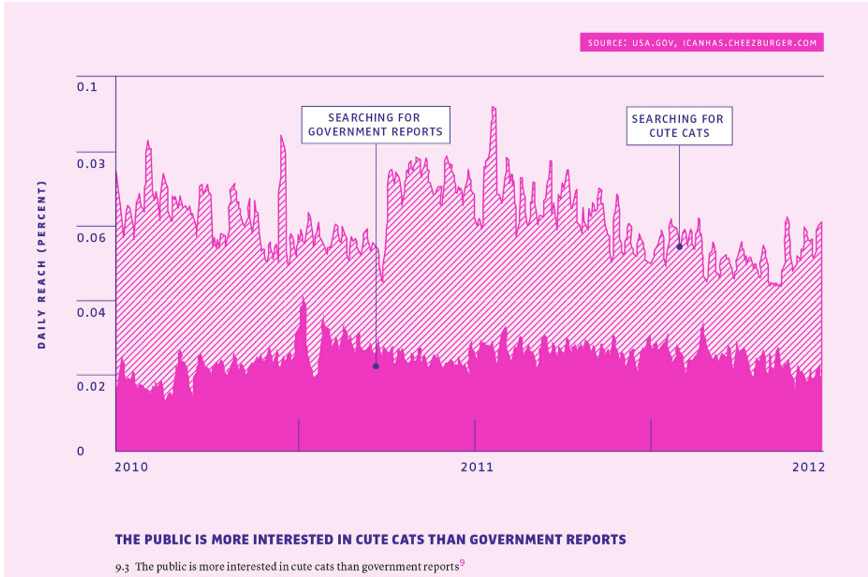
The author’s to-do list then has the requirement to change that by improving government transparency and a more realistic approach to claims and objectives. The author seems to believe this is imperative because:” Tremendous energies have been released by people from nowhere, networked, self-assembled, from below. That is the structural destiny of the Fifth Wave—the central theme of my story. Democratic government in societies of distrust can choose to ride the tsunami or to be swamped by it. The latter choice will leave government mired in failure and drained of legitimacy. It will leave democracy, I fear, at the mercy of the first persuasive political alternative.
10 FINALE FOR SKEPTICS
The author begins here with another precise formulation of his central thesis:” My thesis, again, is a simple one. The information technologies of the twenty-first century have enabled the public, composed of amateurs, people from nowhere, to break the power of the political hierarchies of the industrial age. The result hasn’t been a completed revolution in the manner of 1789 and 1917, or utter collapse as in 1991, but more like the prolonged period of instability that preceded the settlement of Westphalia in 1648. Neither side can wipe out the other. A resolution, when it comes, may well defy the terms of the struggle. None is remotely visible as I write these lines.”
After that author discusses failures of democracy in various places such as Venezuela, Ukraine, and Turkey, then makes the point that history demonstrated unpredictability of the future. Therefore, the author ends with this:” The failure of democracy plays no part in the null hypothesis, but becomes a possibility in the framework of my thesis. A rebellious public, sectarian in temper and utopian in expectations, collides everywhere with institutions that rule by default and blunder, it seems, by habit. Industrial hierarchies are no longer able to govern successfully in a world swept to the horizon by a tsunami of information. An egalitarian public is unwilling to assume responsibility under any terms. The muddled half-steps and compromises necessary to democracy may become untenable under the pressure applied by these irreconcilable forces.
Democracy isn’t doomed. As an analyst, I have rejected prophecy and destiny as tools of the trade. I see the future with no greater clarity than you, reader. But processes at play today, right now, if continued, could well lead to the crumbling of what has always been a fragile system of government.”
— TRUMP, BREXIT, AND FAREWELL TO ALL THAT
The original book was published in 2014 before Brexit and Trump, a supplement for the new edition. The author is bitching about this authentic expression of populism and, while clearly understanding the decay of the elite, he has a tough time accepting this reality. It shows in his description of events of 2017.
MY TAKE ON IT:
I agree with the author that new information technology opened access to the public forum to all kinds of amateurs. It undermined and practically destroyed old forms of authoritarian governments based on limited access to information. It also seriously damaged traditional forms of democracy when the elite controls narrative and consequently obtains legitimacy in the ballot box mainly by minimizing access to alternative narratives and, if needed, just falsifying election results. However, I think that this does not mean that either authoritarianism or democracy became unviable. On the contrary, they will have to change and include new information processing functionality in their corresponding systems. For example, AI and networks would allow authoritarian governments much stronger control over people’s behavior and thoughts than had ever been possible before.
In contrast, applying such technology in a real democracy would allow the removal of intermediary information repackaging by the elite and open direct and unlimited flows of data to support the interests of non-elite members of society. So, in the short run, the authoritarian regime could become more stable, while democracy less so because the reconciliation of many often conflicting interests without elite control would become more complex. However, the authoritarian regime could become increasingly unstable in the long run due to the fights for power at the top with periodic massive leaks in the interests of one faction or another, made possible by the instant distribution of information to the population. The traditional solid beliefs in the god-given legitimacy of top leaders are gone and will never come back. So one bunch of authoritarian crooks could use a sudden leak of negative news to push the currently incumbent bunch of crooks out of power.
Democracy, on the other hand, could become much more robust because massive access to information from a multitude of sources would disqualify anybody who would pretend to be the Demos and will eliminate the ability of the elite to make large-scale decisions for all. The massive distrust of the elite would eventually push most decisions down to the private sphere, leaving for the government a minimal role as envisioned in the American Constitution.
20210911 – Who we are and How we got here

MAIN IDEA:
The main idea of this book is to present the latest discoveries based on the newly obtained ability to read ancient DNA, even DNA from bones of Neanderthals that were dead for 30,000 years. This ability allowed drastically reassess the history of human migrations, expansion of humans all over the globe, and formation of different human populations. It is also allowed to reassess, at least to some extent role of interbreeding between humans and other humanoids. In addition, other areas of research are presented: the historical narrative that could be extracted from the DNA of currently living people, for example, male/female interactions over time-based on wars and conquests. Another, not precisely, the scientific objective of this book is to protect the author and his research against political correctness attacks because the research results clearly demonstrate that human populations are genetically diverse in many essential areas.
DETAILS:
Introduction
The author begins with reference to “Luca Cavalli-Sforza, the founder of genetic studies of our past.” Then, he describes ideas of past genetic research and provides an original model of historical human movements based on primitive technology of 1993. Finally, the author presents a map based on the technology of 2015:
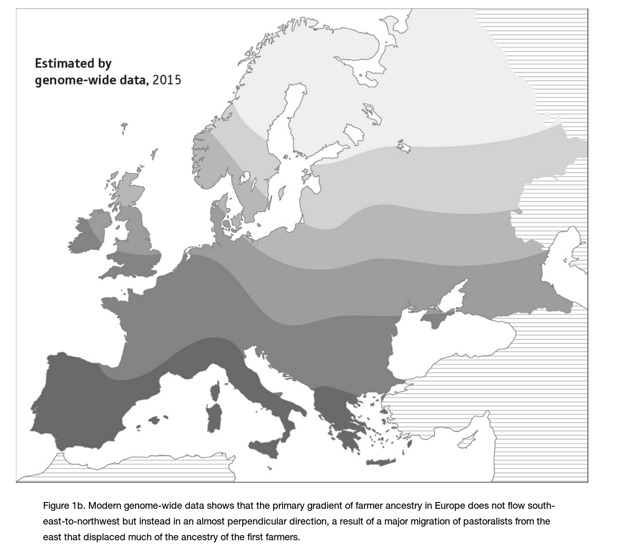
After that author provides an estimate of accumulated genetic data and discusses how it is massively used:” This book is about the genome revolution in the study of the human past. This revolution consists of the avalanche of discoveries based on data taken from the whole genome—meaning, the entire genome analyzed at once instead of just small stretches of it such as mitochondrial DNA. The revolution has been made far more powerful by the new technologies for extracting whole genomes’ worth of DNA from ancient humans.” The author also describes some key results:” A great surprise that emerges from the genome revolution is that in the relatively recent past, human populations were just as different from each other as they are today, but that the fault lines across populations were almost unrecognizably different from today. DNA extracted from remains of people who lived, say, ten thousand years ago shows that the structure of human populations at that time was qualitatively different. Present-day populations are blends of past populations, which were blends themselves. The African American and Latino populations of the Americas are only the latest in a long line of major population mixtures.”
The author also describes in introduction structure of the book and the objectives that he targets to achieve in each chapter.
Part l: The Deep History of Our Species
This part:” describes how the human genome not only provides all the information that a fertilized human egg needs to develop, but also contains within it the history of our species.”

1: How the Genome Explains Who We Are
This chapter:” argues that the genome revolution has taught us about who we are as humans not by revealing the distinctive features of our biology compared to other animals but by uncovering the history of migrations and population mixtures that formed us.”

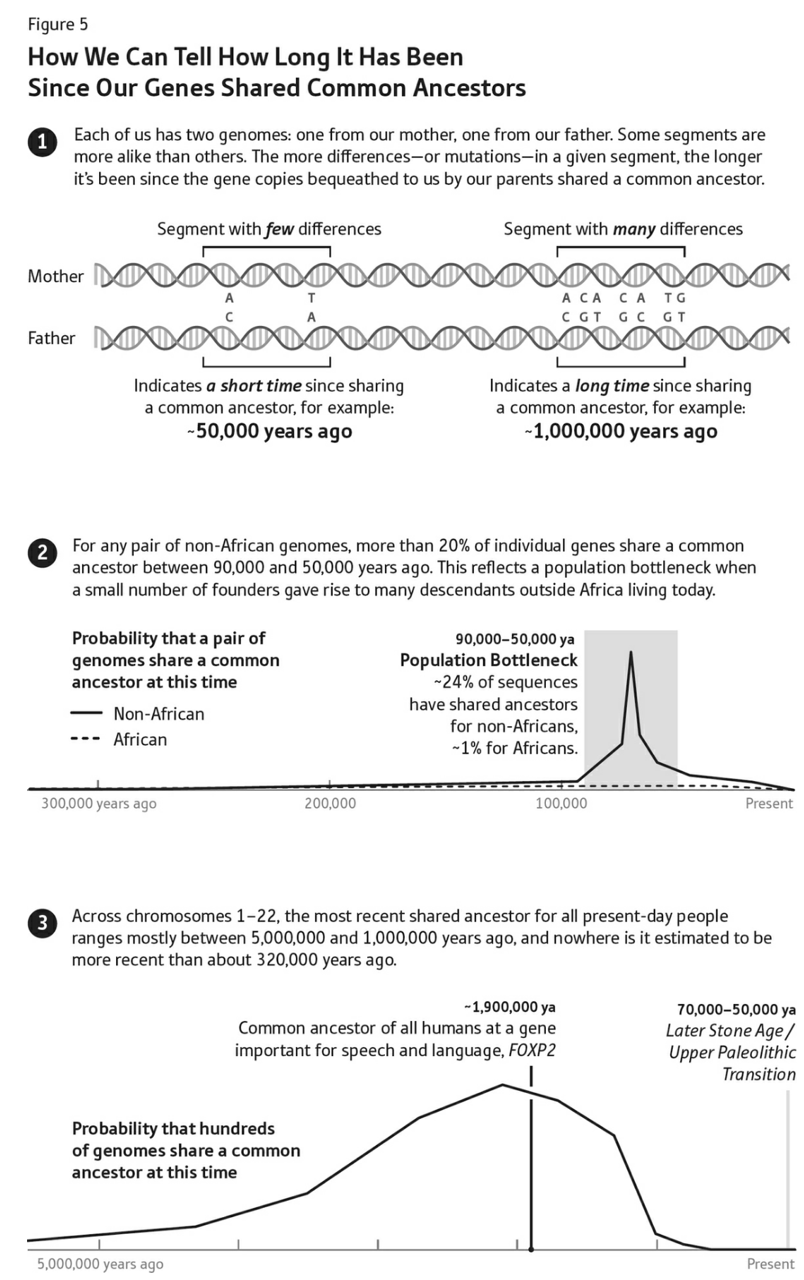

2: Encounters with Neanderthals
This chapter:” reveals how the breakthrough technology of ancient DNA provided data from Neanderthals, our big-brained cousins, and showed how they interbred with the ancestors of all modern humans living outside of Africa. The chapter also explains how genetic data can be used to prove that ancient mixture between populations occurred.”

3: Ancient DNA Opens the Floodgates
This chapter:” highlights how ancient DNA can reveal features of the past that no one had anticipated, starting with the discovery of the Denisovans, a previously unknown archaic population that had not been predicted by archaeologists and that mixed with the ancestors of present-day New Guineans. The sequencing of the Denisovan genome unleashed a cavalcade of discoveries of additional archaic populations and mixtures, and demonstrated unequivocally that population mixture is central to human nature.”
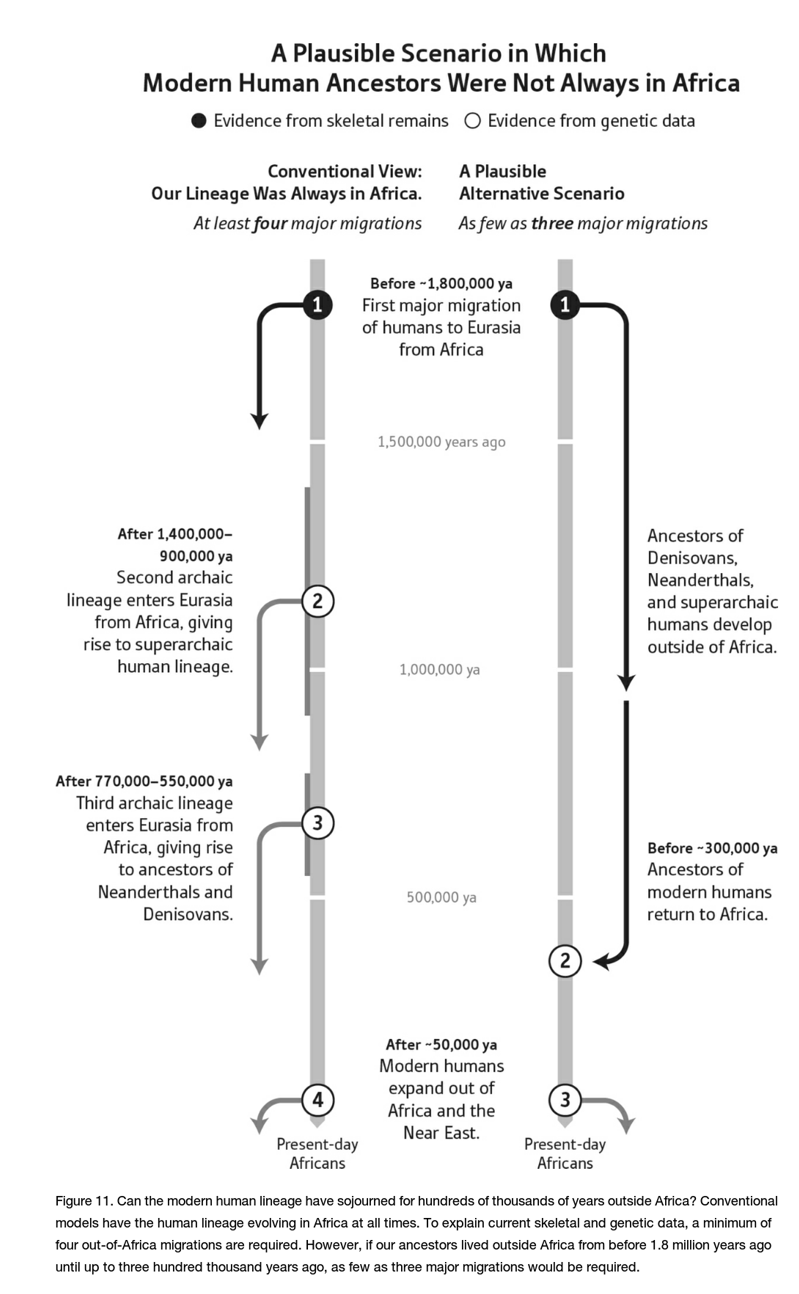
Part II: How We Got to Where We Are Today
This part:” is about how the genome revolution and ancient DNA have transformed our understanding of our own particular lineage of modern humans, and it takes readers on a tour around the world with population mixture as a unifying theme.”

4: Humanity’s Ghosts
This chapter:” introduces the idea that we can reconstruct populations that no longer exist in unmixed form based on the bits of genetic material they have left behind in present-day people.”
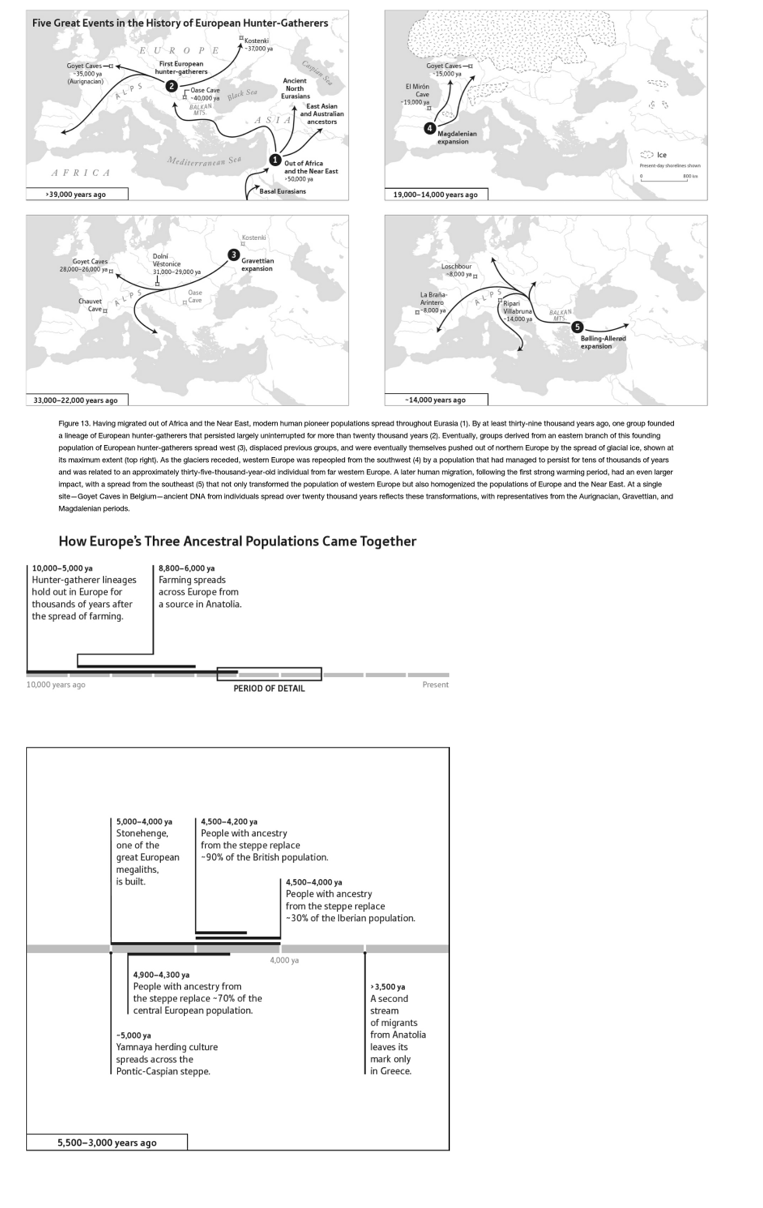
5: The Making of Modern Europe
This chapter:” explains how Europeans today descend from three highly divergent populations, which came together over the last nine thousand years in a way that archaeologists never anticipated before ancient DNA became available.”

6: The Collision That Formed India
This chapter:” explains how the formation of South Asian populations parallels that of Europeans. In both cases, a mass migration of farmers from the Near East after nine thousand years ago mixed with previously established hunter-gatherers, and then a second mass migration from the Eurasian steppe after five thousand years ago brought a different kind of ancestry and probably Indo-European languages as well.”
Here is the general picture of agricultural expansion:
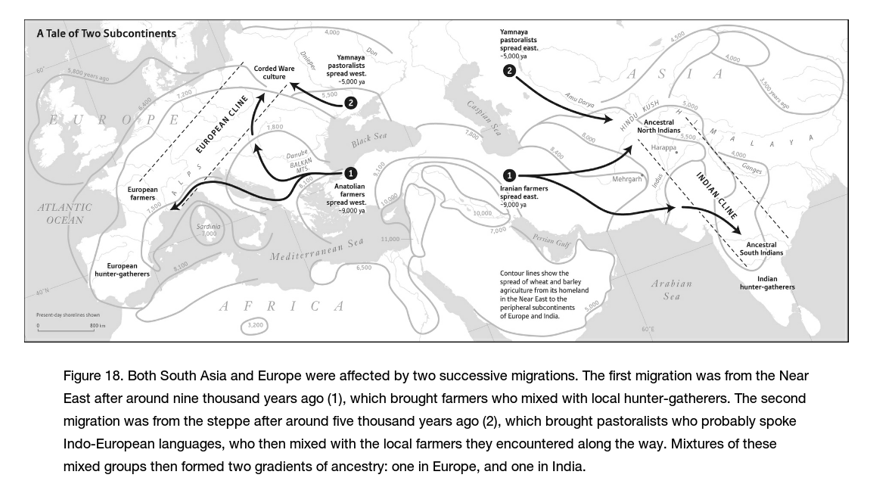
7: In Search of Native American Ancestors
This chapter:” shows how the analysis of modern and ancient DNA has demonstrated that Native American populations prior to the arrival of Europeans derive ancestry from multiple major pulses of migration from Asia.”
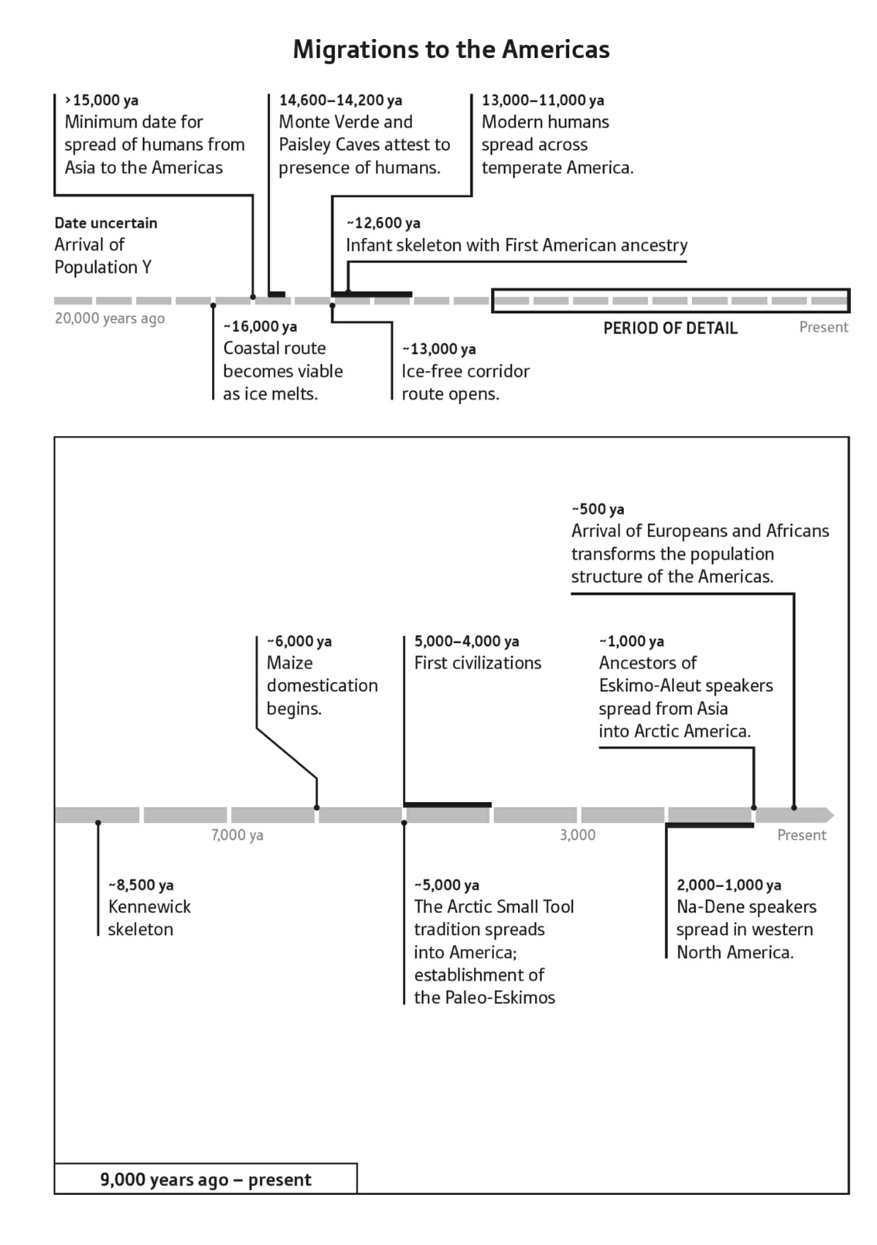
8: The Genomic Origins of East Asians
This chapter:” describes how much of East Asian ancestry derives from major expansions of populations from the Chinese agricultural heartland.”
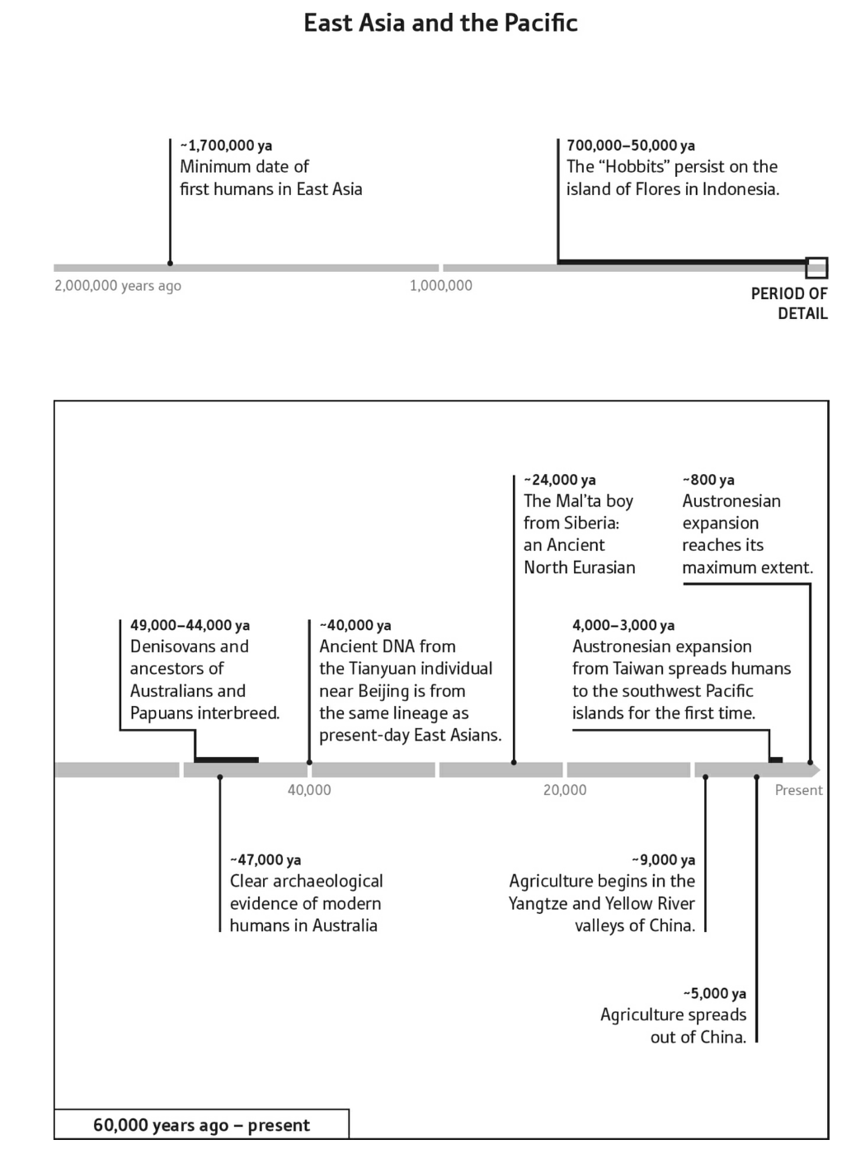
9: Rejoining Africa to the Human Story
This chapter:” highlights how ancient DNA studies are beginning to peel back the veil on the deep history of the African continent drawn by the great expansions of farmers in the last few thousand years that overran or mixed with previously resident populations.”
Part III: The Disruptive Genome
The last part:” focuses on the implications of the genome revolution for society. It offers some suggestions for how to conceive of our personal place in the world, our connection to the more than seven billion people who live on earth with us, and the even larger numbers of people who inhabit our past and future.”
10: The Genomics of Inequality
This chapter:” shows how ancient DNA studies have revealed the deep history of inequality in social power among populations, between the sexes, and among individuals within a population, based on how that inequality determined success or failure of reproduction.”
The discussion here is mainly about the typical process of mixing of populations when winners-male killed out losers-male and enslaved losers-female, resulting in different levels of genetic diversity between mitochondrial DNA and Y Chromosome:
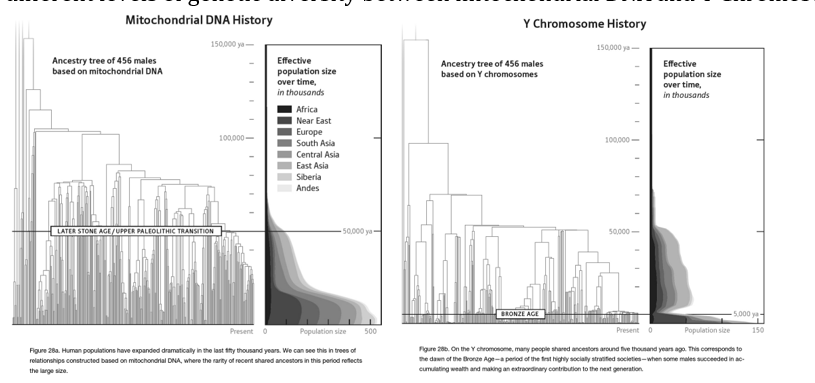
Based on the genetic evidence, the author concludes that inequality has deep, maybe even biological roots. He expresses hope that:” Evidence of the antiquity of inequality should motivate us to deal in a more sophisticated way with it today, and to behave a little better in our own time.”
11: The Genomics of Race and Identity
Here author:” argues that the orthodoxy that has emerged over the last century—the idea that human populations are all too closely related to each other for there to be substantial average biological differences among them—is no longer sustainable, while also showing that racist pictures of the world that have long been offered as alternatives are even more in conflict with the lessons of the genetic data. The chapter suggests a new way of conceiving the differences among human populations—a way informed by the genome revolution.”
The author basically agrees that there are DNA-based differences between populations and then spends quite a bit of time debating Nicolas Wade’s work that highlights these differences and explains them by different evolutionary paths of these populations. The author accuses Wade of racism, but then states:” So how should we prepare for the likelihood that in the coming years, genetic studies will show that behavioral or cognitive traits are influenced by genetic variation, and that these traits will differ on average across human populations, both with regard to their average and their variation within populations? Even if we do not yet know what those differences will be, we need to come up with a new way of thinking that can accommodate such differences, rather than deny categorically that differences can exist and so find ourselves caught without a strategy once they are found.” The author very reasonably calls to get over racial differences and look at individuals, but then praises racist organizations specializing in African ancestry. The author also hilariously complains that his own population – Ashkenazi Jews are too smart and overstudied, so he announces that he would not spend his lab resources to learn about his own DNA.
12: The Future of Ancient DNA
This chapter:” is a discussion of what comes next in the genome revolution. It argues that the genome revolution, with the help of ancient DNA, has realized Luca Cavalli-Sforza’s dream, emerging as a tool for investigating past populations that is no less useful than the traditional tools of archaeology and historical linguistics. Ancient DNA and the genome revolution can now answer a previously unresolvable question about the deep past: the question of what happened—how ancient peoples related to each other and how migrations contributed to the changes evident in the archaeological record. Ancient DNA should be liberating to archaeologists because with answers to these questions in reach, archaeologists can get on with investigating what they have always been at least as interested in, which is why the changes occurred”.
MY TAKE ON IT:
It is an excellent book with lots of valuable data presented in very nice and clear form. I agree with the author that the future of history would include a significant amount of information derived from DNA that could create lots of knowledge of who we humans are, where we came from, and what kind of evolutionary history we have. Moreover, it could be done not only at the population level but also at the level of individuals. I am also with the author in his belief that new tools and obtained data would help drive one last nail in the coffin of racism, but unlike the author, I hope that this would happen to all forms of racism: anti-black, anti-white, and anti-whatever. I also hope that all this staff about inequality would also be put to rest. As far as I am concerned, we all are different, and we all should be equal before the law and in the eyes of others regardless of our ancestry, race, good or bad luck of our ancestors, or whatever. One final thing that I would like to say is about stereotypes. Attempts to forbid and suppress stereotype use are unrealistic and bound to fail because it is a necessary evolutionary tool for survival. The normal process of thinking while encountering somebody else is to use stereotypes for external presentations of individuals and then discard this stereotype as soon as individuals become more familiar. We just need to speed up and automate data extraction for this process as much as possible, so using stereotypes would become redundant
20210904 – Freedom an Unruly History

MAIN IDEA:
The main idea of this book is to reject the usual understanding of freedom as a combination of individual rights and the ability of individuals to live free from interference from coercive government and convince the reader that it is entirely different: the ability to participate in government decisions and election of individuals to the government. To achieve this author provides a nice historical review of the appearance and expressions of the idea of freedom in history from ancient Greeks to our time.
DETAILS:
Introduction: An Elusive Concept
The author begins by posing the question that she intends to answer in this book: “TODAY MOST PEOPLE TEND TO equate freedom with the possession of inalienable individual rights, rights that demarcate a private sphere no government may infringe on. But has this always been the case? Does this definition, whereby freedom depends on the limitation of state power, really offer the only—or even the most—natural way of thinking about what it means to be free in a society or as a society? And if not, how and why did our understanding of freedom change?”
The author answers that the current understanding of freedom is wrong and offers a different understanding:” For centuries, Western thinkers and political actors identified freedom not with being left alone by the state but with exercising control over the way one is governed. Theirs was a democratic conception of freedom: a free state was one in which the people ruled itself, even if it lacked a bill of rights, an independent judiciary, and other mechanisms to patrol the boundaries of legitimate state power.”
The author then proceeds to define the understanding of freedom as individual freedom as a counterrevolutionary concept. The author also goes into some “Nuts and Bolts” of the historical development of the notion of Freedom. She apologies that this book is based on Western history, presents some references to existence of such notion in other cultures and seeks excuse for this transgression in her limitations of her own expertise.
Part l: The Long History of Freedom
1. Slaves to No Man: Freedom in Ancient Greece
Autor begins this chapter in 480 BC when Spartans refused to submit to Xerxes’ power, even if submission meant protection and economic benefits and rejection could mean annihilation. The reason for this rejection was high value of freedom in Hellenic culture. Author then discusses notion of freedom as opposite of slavery, specifically personal freedom from bondage, rather than political freedom. However right away she switched it to something different when referring to Spartans’ rejection:” They had, in other words, a democratic conception of freedom: in their view, a free state was a state in which the people controlled the way it was governed; it was not a state in which government interference was limited as much as possible.” author then discusses “invention of political freedom by Greeks and their celebration of tyrant-killers Harmodius and Aristogeiton. After retelling a bit of Herodotus’s history, the author poses the question whether Greek freedom was mirage or reality. She answers that Greek understanding of freedom was political and meant democratic form of government and rule of law: features that differentiated Greeks from anybody else. Author then compares conditions of Persians, which despite being formally completely submissive to the king, in reality had quite a bit of freedom of possessions and actions, while Greek formal freedoms were quite limited not only by being extended only to a small share of population – free male citizens, but also by variety of political actions available for individuals in power. Author then discusses ancient critics of freedom: Oligarchs, Sophists, Plato, and many others. The final part of chapter deals with the raise of Macedon that brought all Greeks under power of king Philip and then Alexander, but with a special feature when local powers in many places still were selected democratically and maintained the rule of low. The establishment of kings power in Hellenic world brought change to debates about freedom:” While many Greek intellectuals continued to extol the importance of democratic freedom, others came to argue for a very different understanding of the term. Freedom, they argued, did not necessarily depend on the political institutions under which one lived. Rather, whether one could live a free life or not had more to do with the one’s strength of character or self-control. A person could be free even when he was ruled by a tyrant, as long as he had the appropriate moral strength. Thus, Hellenistic thinkers came to propagate a wholly personal, inner kind of freedom, mirroring the growing disempowerment of ordinary citizens in Greek political life.”
2. The Rise and Fall of Roman Liberty
Author begins this chapter with the story of Lucretia that led to revolt and establishment of republic: res public or “public thing”. Obviously in reality it was rule of patricians, but plebeians managed to establish some participation in power via Tribunal Assembly. Author then discusses validity of various sources of Roman history and notes that Romans pretty much accepted Greek notions of freedom. Author then allocates quite a bit of space to discussion of struggle for power distribution between different parts of Roman society men vs. women, patrician vs plebeians, and rich vs. poor. All this struggle was for control of political power via control such institutions such as the senate, which lasted for a long time in multiple incarnations and had various levels of impact on individual freedom of Roman citizens. Eventually republic was substituted by Empire, in which power struggle become more concentrated at the top. Author describes an interesting approach when Emperor strictly avoided formal designation as the king in order to maintain perception of freedom, just a bit better managed than in old Republic. For example, coins and other image carrying artifacts normally included goddess of Liberty. Author then describes some intellectual works such as Livy and Plutarch nostalgic for Republic. Another writer that author reviewed in details is Tacitus. Overall these writers maintained kind of Cult of Freedom, which eventually was demised during later imperial period when Christianity shifted top level control to the god, consequently promoting externally submission to power that is, while remaining internally submissive to God only. At the end of chapter, the author describes Middle Ages when power of kings and queens was established everywhere in Europe and notion of freedom was mainly moved into personal domain as spiritual pursuit. Any remnants of political power of population slowly disappeared remaining only partially in some urban areas.
Part II: Freedom’s Revival
3. The Renaissance of Freedom
This chapter begins with reference to Dante who placed tyrannicides Brutus and Cassius into the Hell – direct opposite of Greek’s attitude, indicating that the only legitimate form of government is monarchy. The author describes how Renaissance undermined this approach in Italy, how this process was reflected in arts, and how after reviving ancient cult of freedom in XIV-XVI centuries it faded away. However. it did not disappear, but rather moved across Alps, where Gutenberg’s invention prompted expansion of freedom in Northern Europe, especially in such places and Switzerland, Netherlands, and others. Author describes in some detail events related to search of freedom and personalities that were driving these events in France and England. After that author looks at Reformation and notes that while fighting papal authoritarianism this movement was also authoritarian. However, this struggle between two quite intolerant religious movements opened gate for breakthrough to tolerance and freedom that was demanded by both these movement in places where they were not strong enough to suppress others. Eventually it produced a curious result: appearance of ideas of natural rights. Here is how author describes this result: “By the late seventeenth century, the notion that one could be free only if one did not depend on the will of another—meaning that individual freedom could exist only amid collective freedom—was so well established that dictionaries confirmed it.”. All this led to English Glorious Revolution and penetration of ideas of freedom into culture of European aristocracy, creating ideological foundation for revolutions.
4. Freedom in the Atlantic Revolutions
In this chapter the author describes revolutions that came at the end of XVIII century on both sides of Atlantic: American and French. Author mostly concerned with ideological and artistic representation of ideas of freedom, which was understood in variety of ways. Author defines and discusses in details one specific understanding presented by Richard Price as widely shared among American and other revolutionaries:” In Price’s view, being free in a society or as a society had nothing to do with the extent to which government interfered with one’s life. Rather, one was free as long as one had a say in the direction of one’s country. This was not because the act of governing in and of itself set one free. Price carefully avoided such claims. Rather, in Price’s view, self-government was necessary for the robust enjoyment of Liberty. Under a despotic government, private men “might be allowed the exercise of liberty; … but it would be an indulgence or connivance derived from the spirit of the times, or from an accidental mildness in the administration.” Author also discusses inconsistencies of American revolution when American freedom was perceived at least somewhat consistent with slavery. By the end of XVIII century Cult of freedom triumphed at least as ideal if not as reality of everyday lives of great many people. Author allocates lots of space to ideas of natural rights and various declarations of individual rights, but somehow at the end of chapter she managed to conclude that these individual rights are not intrinsic part of freedom and democracy, but contradict these ideas:” Yet, the late eighteenth century was not just a crucial time for the dissemination of the democratic theory of freedom; the outbreak of the Atlantic Revolutions also sparked a powerful backlash against democracy. This backlash led to the conceptualization of a wholly new way of thinking about freedom, in which Liberty had nothing to do with establishing popular control over government. Rather, a person was free if they could peacefully enjoy their lives and goods—and that condition was, if anything, threatened rather than secured by the introduction of democracy. Thus, as we shall see, the concept of freedom was gradually transformed from being a weapon to fight for democracy into an instrument that could be used to battle against it.”
Part III: Rethinking Freedom
5. Inventing Modern Liberty
Author begins this chapter with reference to work of Johann Eberhard who presented the new understanding that:” when talking about “the liberty of the citizen,” one should distinguish between two very different kinds of Liberty: civil Liberty and political Liberty. A people had political Liberty when it participated in government. Hence political Liberty existed only in republics, and it was most extensive in democratic republics. In contrast, individuals who had the right to act as they wished, insofar as such acts were not restricted by law, enjoyed civil Liberty. This type of Liberty did not depend on the form of government; it could exist as easily in a monarchy as in a republic.” Author then describes polemics about these ideas and designate the ideas of individual freedom as counterrevolutionary and directed against democracy. This way she puts Burke who supported American revolution and opposed French revolution on the same side as loyalists who were against both. Actually, author does not hide unpleasant features of French revolution such as terror, she even provides some illustrations of the period contrasting these two revolutions:
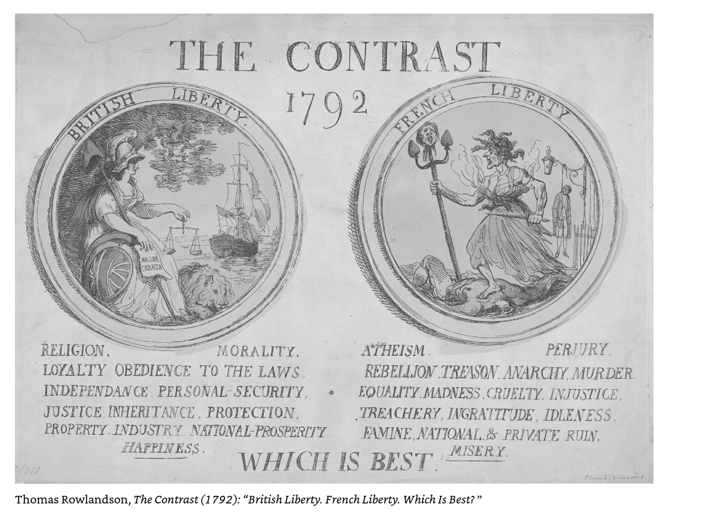
However, she clearly expresses her position:” In short, in the decades after the outbreak of the Atlantic Revolutions, counterrevolutionary thinkers rejected the democratic theory of freedom again and again, arguing that freedom, or at least civil Liberty, should be understood as the ability to peacefully enjoy one’s life and possessions. It might be tempting to dismiss these arguments as self-serving and empty of meaning; and indeed, some counterrevolutionary publicists seemed to claim that any kind of government—as long as it was not democratic—was capable of guaranteeing Liberty. But other counterrevolutionary thinkers developed more sophisticated arguments, reviving a number of claims already put forward by ancient critics of freedom while also developing new views. Some ideas developed by counterrevolutionary thinkers proved so powerful that they would continue to be echoed in the debate about freedom for decades to come.”
Author then provides historical review of ideological struggle between the two notions of freedom in West European countries and America, consistently stressing that individual freedom is counterrevolutionary concept that complicates achievement of “true freedom” of democratic self-government.
6. The Triumph of Modern Liberty
In this chapter the author continues her historical review of the period after failed revolutions of 1848. She describes how ideas of individual freedom became strongly linked to America where there were no army, police, and little bureaucracy. The America was considered a crazy place, which somehow provided the best living conditions in the world without anybody actually directing society from the top. Author then describes the Modern Liberty in America (1848-1914):” Around the turn of the century, in short, the counterrevolutionary conception of Liberty had become more widely accepted in the United States than ever before. While, for most of the nineteenth century, this way of thinking had been defended in public debate by relatively few, most of whom were disgruntled members of the elite, this changed in the wake of a backlash against democracy provoked by the Civil War and mass migration. Doubts about the political abilities of blacks and new migrants led Gilded Age liberals to claim that Liberty needed protection from democracy. That protection was secured by limiting state power, instituting countermajoritarian institutions, and restricting the suffrage.” After that author describes powerful movements against Modern Liberty in Europe (1880-1945) that led to Soviet communism that author describes with some sympathy and fascism that author just briefly mentions. The last part of this chapter is description of reincarnation of individual freedom ideas as “negative freedom”, strongly supported in America after WWII despite massive expansion of “positive freedom” of the New Deal and strong support of government expansion from intellectuals.
Epilogue: Freedom in the Twenty-First Century
Here author repeats her central thesis that traditional historical understanding of freedom is popular self-governance, but the new understanding of freedom as freedom of individual in society is result of reactionary reaction to Atlantic revolutions: American and French. Once again, she summarizes the ideological struggle of the last two centuries as “democratic freedom” vs. “modern freedom” and laments that the former often considered thread to latter and the modern – individual freedom remain dominant ideal:” In virtually every American political camp, the idea that freedom should be identified with personal security and individual rights predominates. But perhaps we would do well to remember that there is another side to the story of freedom. After all, for centuries freedom was seen as a compelling ideal because it called for the establishment of greater popular control over government, including the use of state power to enhance the collective well-being. In particular, we might do well to remember that, for the founders of our modern democracies, freedom, democracy, and equality were not in tension but were inherently intertwined.”
MY TAKE ON IT:
This book is an excellent example of sophisticated leftist-academical thinking that would make Orwell proud of his foresight. The idea of juxtaposing democracy/self-governance and individual freedom, one as the traditional and noble understanding of the notion of freedom and another one as reactionary, counterrevolutionary, and therefore somewhat illegitimate, strikes me as an excellent articulation of the contemporary divide of dominant American ideologies. However, the most interesting here is the author’s continuing lament that everybody, even leftist commentators on big government propaganda media such as CNN and MSNBC, continues to pretend that they kind of support individual Liberty. She would rather have them announce, clearly and unequivocally, that the “real freedom” going back to ancient Greeks is the unrestricted ability of elected or unelected politicians and bureaucrats to suppress “counterrevolutionary” individual freedom. It seems that for the author, an individual’s ability to own and control one’s own body and property is subject to limitations in the name of “enhance collective well-being.”
The author’s obvious frustration with Americans provides hope that America is still healthy enough society to reject the thesis of “slavery is freedom” that the author promotes as soon as this thesis is expressed clearly enough. As to the core of author’s argument of “freedom is democracy/self-government”, it is hardly deserving serious consideration due to the simple fact that there is no Demos or collective Self as thinking, feeling, and acting entity. Democracy and self-government are nothing more than the method of selection of individuals to wield coercive power of the state in hope, usually futile, that they would do it in some vaguely defined “common interest” instead of clearly defined, albeit always hidden, their own interests. It is clearly better than selection of individual into such position by birthright as in Aristocratic societies or by who kill whom first, as in autocratic societies, but really not by that much. Even such clear advantage of Democracy as ability of people remove unpopular leaders is usually overestimated if one look at reality of senators not capable to speak and in diapers due to fragility of old age as Strom Thurmond or FDR who become president for life for all practical purposes. The prosperity of America and high quality of live that is still the norm in areas not under leftist control, comes from individual freedom to do what people want and private property to do it with. If this individual freedom is lost, the prosperity and high quality of live will be lost too.
20210828 – Last Best Hope America in Crisis

MAIN IDEA:
The main idea of author – convinced socialist, is to express his hate and contempt to Trump, uneasiness with his supporters, and most important, to convince readers, whom he expects to be strongly on his side, that removing Trump, imposing high-tech censorship, and taking over the main institutions is not yet a victory. Author describes four main political forces in America that he defines this way: Free America, Real America, Smart America, and Just America with the first two loosely aligned with republicans and the second two strongly aligned with democrats. This division is so strong and get stronger every day that author afraid it could lead to another Civil War.
DETAILS:
Prologue
Author begins with an interesting statement that he does not want pity for being born American and that many American want to leave this country because it is in decline. He then expresses challenge of remaining civil upon learning that people in rural area, to which he moved to recently, are supporting Trump. After stating his believe in decline of the country and deep political division of its population author tries to provide diagnosis of what went wrong:” Self-government is democracy in action—not just rights, laws, and institutions, but what free people do together, the habits and skills that enable us to run our own affairs. Tocqueville described self-government as an “art” that needs to be learned. It’s what Americans no longer know how to do, or even want to do together. It’s hard work, for it needs not just ballots and newspapers and official documents, which we still have, but also trust, which we’ve lost. It depends on the ability to argue, persuade, and compromise in order to achieve things for the common good, like the suppression of a catastrophic pandemic. It requires you to imagine the experience of others, to recognize their autonomy, and yet to think for yourself.” He then continues list of signs of decline from deteriorating roads to souring attitudes, but ends up with statement that:” No one is going to save us. We are our last best hope.”
Strange Defeat
Author begins this chapter by repeating typical democratic invective against the Donald as authoritarian and source of all bad:” all-American flimflam man and demagogue, a traditional character of our way of life.” Then he follows with description of COVID pandemic as disaster, which is all Trump’s fault. After that, interestingly enough, author actually demonstrates some understanding of reality and reason for Trumps popularity:” Populism is the politics of “the people” turned against “the elites.” It’s inherent in democracies, always lurking, and it grows out of control when citizens feel that their needs are going unmet or their voices unheard. Then they will revolt against the class above them that claims to rule by right of superior knowledge and seems to do so for its own benefit. The experts—civil servants, trade negotiators, think tank analysts, scientists, professors, journalists—have a tenuous hold on their status, if not their jobs. No one elected them. They’re unaccountable to the mass public. The same credentials and special language that make them recognizable and admirable to one another render them suspect in the eyes of the noncredentialed.” Author ends this chapter by expressing his believe that removal of Trump from presidency was saving of democracy, but he also is pretty clear about the problem:” We are two countries—that was the real message of the 158 million votes. But we still have to live together. We’re stuck with one another. That fact poses a supreme problem, one that will take even more urgency, intelligence, and cooperation than the remarkable achievement of a vaccine in less than a year”.
Four Americas
Here author moves to a bit more interesting staff than repeating democratic invectives: analyzing logic of current ideological division of Americans. He identifies four groups each supporting different narrative:
“Call the first narrative Free America. In the past half century, it’s been the most politically powerful of the four. Free America draws on libertarian ideas, which it installs in the high-powered engine of consumer capitalism. The freedom it champions is very different from Tocqueville’s art of self-government. It’s personal freedom, without other people—the negative liberty of “Don’t tread on me.” Author links free America to republican party, Reagan and generally antigovernmental movement.
The second is “Smart America – a new class of Americans: men and women with college degrees (at the very least), skilled with symbols and numbers, salaried professionals in information technology, scientific research, design, management consulting, the upper civil service, financial analysis, medicine, law, journalism, the arts, higher education.” This America is America of top 10% in income, it is cosmopolitan, supports meritocracy, accepts affirmative actions and redistribution, but only to some extent, and generally realigned with democrats. It is somewhat contemptuous to lower middle and working classes and uneasy with patriotism.
The third is “Real America”:” Real America is a very old place. The idea that the authentic heart of democracy beats hardest in common people who work with their hands goes back to the eighteenth century. It was embryonic in the founding creed of equality. “State a moral case to a ploughman and a professor,” Jefferson wrote in 1787. “The former will decide it as well, and often better than the latter, because he has not been led astray by artificial rules.” Moral equality was the basis for political equality. As the new republic became a more egalitarian society in the first decades of the nineteenth century, the democratic creed turned openly populist. Andrew Jackson came to power and governed as champion of “the humble members of society—the farmers, mechanics, and laborers,” the Real Americans of that age.”
It used to be backbone of democratic party, but it is now strongly republican. This America is hard working, religious, and very patriotic. Somewhat unexpectedly author denies that Trump is fascist, but still repeats lots of standard democratic BS about him.
The final narrative is “Just America”. This America came from campuses and based not on real life experiences, but rather on massive indoctrination into identity politics and anti-white racism under pretense of fight against anti-black racism. Author obviously feels very close to this America, but seems to be a bit scared by its totalitarian inclinations, while also being scared that it would raise a serious resistance.
Equal America
After defining 4 different types of America author presents his view of current political divide with Smart and Just America on one side and Free and Real America on the another. He follows with discussion of potential secession and eventually concludes that it is not realistic. In discussion of political competition between these four forces author clearly puts himself on the side of Smart and Just (democrats) against Free and Real (republicans) and accuse republicans in attempt to obtain and hold power by undemocratic means. Despite all this author then talks about global character of America as no other country and unique features of American culture that differentiate all Americans from others and one of the most important features of this difference is an American’s disconnect from his/her roots whether these are European, African, Asian, or whatever, from which follows strong and in author’s opinion incorrect, believe that all humans are basically the same in their hopes and strives. Another key feature:” Equality is the hidden American code, the unspoken feeling that everyone shares, even if it’s not articulated or fulfilled: the desire to be everyone’s equal—which is not the same thing as the desire for everyone to be equal. Equality is the first truth of our founding document, the one that leads to all the others.” Author then goes through other American features: Loudness, Bluntness, Violence, Anti-Intellectualism, and unwillingness accommodate to other cultures. At the end of chapter author comes to this conclusion:” National characteristics don’t create national unity. Civil wars have been fought in countries with a common culture, including ours. The qualities I’ve sketched out—you might have others to add or put in their place—don’t make us a nation. They just show the contours of concealed ligaments that would be torn if we continue pulling apart.”
Equalizers
In this chapter author reviews equalizing movements on American history and a few prominent personalities of these movements: Horace Greely of The New York – tribune against slavery, Francis Perkins of Roosevelt administration – fighter for women rights, and black labor leader A. Philip Randolph I fighter for Civil Rights for blacks.
Make America Again
In the beginning of chapter author attempts to be optimistic: “We’ve been here before. These stories should sound familiar: a house divided, monopoly and corruption, fixed classes of rich and poor, racial injustice…The same kinds of things were said in 1861, in 1893, in 1933, and in 1968. The sickness, the death, is always a moral condition.” Then author expresses believe that this will be overcome and American democracy will survive. This follows by another round of bitching against Trump, his voters, and 1776. However, interestingly enough, author understands that his side has difficulties to overcome:” Americans won’t accept the leveling hand of government in every corner of our lives. Socialism that proclaims itself enters any election with a debilitating handicap. Having spent a decade in a socialist organization, I’m acquainted with the hairsplitting futility that these long odds impose.” After that author proposes a bunch of quasi-socialist measures in line of typical approach: more taxes, more anti-white racism to confront anti-black racism, expand very visible government monopolies to confront “invisible monopolies” of private business, and so on. Author also writes against high tech censorship, even if it supports his side, probably because he understands that it is not sustainable. He also provides as example brief story of one of Trump’s supporters that protested on January 6th and is very typical white working-class man that actually represent if not majority, then clear plurality of population that could not be ignored.
Epilogue
Here author describes his feeling that 2021 looks like 1861 and then resides letter of Bayard Rustin to children of Cleveland from 1969 calling on them to believe in Democracy, Equality, and America. Author ends his book this way:” Rustin didn’t assure the children that their country had already reached this promised land, or warn them that it could never get there. Democracy is a continuing experiment with no end point of perfection, no eternal truths outside human action. Those truths that we hold to be self-evident, the ones that Rustin explained to the children of Cleveland, will survive only if we can realize them through our own efforts. Self-government puts all the responsibility in our hands. No strongman or expert or privileged class or algorithm can do it for us. As soon as we abandon the task, the common skeleton unknits and collapses in a heap of bones. All of this asks us to place more faith in ourselves and one another than we can bear. On some days the project seems preposterous and the effort exhausting. But I am an American and there’s no escape. We’ve never known any other way of life. We have to make this one.”
MY TAKE ON IT:
It is an interesting analysis of situation from relatively far left by author who is not completely brain dead and therefore scared. I think that his analysis of political forces is close to reality, but somewhat screwed. What he calls “Smart America” I would characterize as “Credentialed America” because people of this group may have PhDs, but are not necessarily smart and make their living not by doing smart things, but rather by getting spoils of big government either as lawyers, or government supported enterprises, or government supported “non-profits”. Similarly, “Free America” of libertarianism is actually smarter, than “Smart America” because these people understand how economics really works, but have hard time understanding that people who do not have property would not accept sanctity of property of others. Also, it is ridiculous to call brainwashed young Americans in colleges, their professors, and assorted race hustlers “Just America”. There is nothing just in racial quotas, segregation by race, refusal of due process in case of sexual harassment, rioting in order to suppress free speech of others, and similar antics of this part of population. Finally, the “Real America” is meaningless for two reasons: the first is that all Americas in all political groups are real, and the second, more important reason is that this part of population is divided between productive and parasitic ways of live. The productive way means producing goods and services that others would voluntarily buy, the parasitic way is to receive goods and services paid for by others via taxes and other forms of governmental coercion. This division is not even between people, but often within each individual when part of individual’s consumption paid for by earned money and part by handouts.
What seems to be bother author is that while “Smart America” controls economy, institutions and “Just America” controls narrative, both areas show signs of degeneration while igniting discontent among majority of people belonging to all groups. New censorship suddenly hits lifelong liberals and libertarians who still want to express their thoughts and ideas without fear. Sexual harassment accusations without prove or even reasonable possibility hit everybody around spoiling normal interactions between sexes. Anti-White racism by becoming more visible and harmful to 70% of population causes people to ask simple question:” Do I want to be a second- or third-class citizen? Do I want my children denied access to top level of various institution because of color of their skin? Do I want to be deprived of tools of self-defense when criminals are roaming around untouchable to police?”.
These are all dangerous questions for democrats in power and author rightly afraid that it is not just that answer will be “No”, but that this answer would be expressed via actions. He also rightly afraid that these auctions may not be expressed just by voting one way or another – this works when people believe that vote is fair, secret, and correctly counted. What author seems fail to understand is that when he talks about 74 million for Trump and 81 million against, great many of people do not agree with him. Nobody seems to be disputing 74 million, but lots of people believe that the 81 million is imaginary number. It should not be surprising taking into account all irregularities, struggle against auditing, and simple fact that results counted and investigations of complains were conducted or not conducted by government employees: people whose wellbeing clearly depended on defeating Trump. So, I agree with author that situation is dangerous, it will have to be resolved one way or another, and we’ll probably have to live in “interesting times” for a while until this resolution will be completed.
20210821 – The Science of Consequences

MAIN IDEA:
The main idea of this book is somewhat trivial: actions have consequences, which define conditions of actor’s existence and consequently lead to the new set of actions based on this conditioning. Generally, it is just restatement of the notion of feedback, albeit with deeper look at mechanics: nurture/nature and somewhat valuable presentation of experiments and research demonstrating various aspect of this simple notion.
DETAILS:
PART 1: Consequences and How Nature-Nurture Really Works
Chapter 1. Consequences Everywhere: Origins and Definitions; Waltzing Pigeons and Roller-Coaster Fish: Consequences across Species; Getting Stimulated: Sensory Consequences; The Spice of Life: Variety as a Consequence; The Creative Consequence; Taking Advantage of Variety; The Positive Side of Problems; Taking Control
In this chapter author defines the notion of consequences similarly to the notion of positive or negative feedback that either amplify or suppresses some behavior:” …research illustrates what reinforcers are: By definition, reinforcers both depend on behaviors and sustain them. If a behavior gets going and keeps going because of a consequence, that consequence is a reinforcer. If a behavior declines because of a consequence, that consequence is a negative (a punisher). Things that seem like rewards sometimes aren’t: what matters is what actually happens, not the intention.”
After that author presents examples from variety of experiments with animals that demonstrates how it works and defines what happens when there are no consequences either negative or positive: the awful condition of Boredom. Then she discusses the Variety, Sensory stimulation, and Taking control as conditions necessary for well-being not only humans, but also other animals.
Chapter 2. Consequences and Evolution: The Cause That Works Backward: Dance of the Balloons; Flexible Instincts; Songbirds; Bugs That Learn; Which Came First? The Evolution of Consequences; Bird Beaks Pointing the Way: How Consequences Lead Evolution; The Cause That Works Backward
Here author discusses interplay between instincts and learned behavior using several examples from research on bugs and birds, eventually concluding that “consequences lead evolution” that basically means recording into genetic code effective response to specific and consistently occurring environmental signals, resulting in positive consequences.
Chapter 3. Genes and Consequences: Meet Your Genome; Getting Turned on; The Genetics of Consequences; Interactions Everywhere; What’s Inherited—and What Isn’t; Epigenetics: New Kid in the Neighborhood
In this chapter author moves to discuss the recently acquired understanding of flexibility of genetic mechanisms when not only genes get switched on and off by environmental signals, but also epigenetics could modify genes expression and consequently condition of organism. Author also refers to research, which demonstrated that “DNA methylation patterns—and behavior patterns—could be reversed when disadvantaged rat pups were given extra licking and grooming by adult females (regardless of genetic relationship”.
Chapter 4. Neuroscience and Consequences: Enrichment on the Brain; Neurons and Connections; Rewarding Chemicals: Dopamine and Its Cousins; Pleasure Centers; The Sky’s the Limit: Neuroplasticity and Real-Life Applications
In this chapter author discusses:” the neurophysiological flexibility that plays with all this genetics/epigenetics/nature-and-nurture flexibility—and the cavalry-to-the-rescue role of consequences to take full advantage of it.” She reviews structure and some electro-chemical processes in the brain that support this flexibility. Author also describes experiments demonstrating this flexibility: for example, long time blindfolded person’s brain switching visual cortex to process touch and sounds.
Here is how author summarizes Part one:” The chapters in part 1 illuminate how essential a systems approach is to understanding nature-and-nurture: genes, past history, behavior, environmental factors of all sorts, “pleasure centers,” neurotransmitters, long-term potentiation, synaptogenesis, neurogenesis, epigenetics, and other biological factors—everything working together. Newly revealed are reserves of tremendous flexibility previously undreamt of.”
Part 2: There’s a Science of Consequences?
Chapter 5. Consequences on Schedule: simple Principles with Surprising Outcomes: False Consequences; Consequences on Schedule; Work-Based Schedules and the Power of Unpredictability; Consequences on Time; Progress and Perseverance; Making the Most of Schedules; Schedules Everywhere
This chapter is about earning consequences or in other words planning and implementing some actions with expectation that some specific consequences will follow. Initially author discusses widely occurring situation when consequences incorrectly linked to previous, but inconsequential actions. Then she discusses schedules that supposed to produce specific consequences, but rarely do it completely and therefore require perseverance to achieve intendent consequences.
Chapter 6. The Dark Side of Consequences: Shades of Gray; Feelings; Choosing Pain; Aggression; Making Negatives Work—Positively
Here author moves to discuss unpredictable negative consequences. Author discusses “gray” or mixed consequences: something good and bad, both coming from complex actions. She refers to research that demonstrates that ratio 5 to 1 for complex actions such as marriage to be perceived generally positive. She then looks at feelings that paint consequences as either positive or negative or mixed. Author then moves to talk about range of consequences for example more or less pain and how sometimes lower-level negative is willingly accepted to avoid higher level negative, as in case of surgery. Another interesting point is to look at aggression as an attempt to avoid negative consequences by inflicting high levels of negative consequences on somebody or something that perceived as cause of this negatives. The final part of the chapter is about handling negatives. Overall author concludes:” Negatives can be downers, there’s no escaping that. But we’ve seen how lifesaving they can be—how grateful we should feel for evolution’s painful solution. And let’s not forget that positives have a negative side, even when good feelings abound.”
Chapter 7. Choices and Signals: The Matching Game; So, What Can the Matching Law Do? Winning Matches; Getting the Signal; A Smorgasbord of Signals; Of Signal Importance
This chapter starts with Frost’s “less travelled road” and talks about choices. Author describes matching law:” The matching law was originally derived from animal research in the lab, where conditions can be precise. In its full technical form, the equation gets complicated, covering a host of factors and parameters: bias between the behavior choices (an SO who really dislikes baseball), different levels of effort (someone lost the remote, so you have to get up and change channels manually), different types and values of the consequences, delays, schedules, signals, and so forth.”
The author discusses what this law does, which matches are winning, getting correct signal out of multitude of signals and noise, and, finally how important signals are.
Chapter 8. Pavlov and Consequences: An Essential Partnership: Compensating Reactions and Drug Tolerance; Not All in Your Head: The Placebo Effect and Other Mind-Body Surprises; Getting Emotional; Value, Anticipation, and Learned Consequences; Learned and Unlearned
This chapter is about Pavlov’s conditioning and its implication in drugs’ use, and other interactions between mind and body that lead to such things as placebo effect, link between emotions and bodily reactions. Author also discusses habituation of emotions to levels of signals such as use to violence in entertainment. At the end of chapter author moves to discuss learned and unlearned consequences, meaning some unlearned consequences that results from intrinsic qualities of organism like perception of tase or reaction to alcohol and learned consequences as result of signals transferred via language.
Chapter 9. Observing and Attending: The Many Roles of Attention; Not-So-Simple Observations; Beneath the Radar: Consequences without Awareness; It’s Automatic; Observing Others; The Ultimate in Observing: Imitation
In this chapter author discusses role of attention and it starts with the famous “not seeing gorilla” experiment. Author points out link between attention and learning as in case of driving in the new place with attention and in well familiar place without. It is also about human need for attention of other that sometime achieves pathological levels. Author then discusses methods to attract attention as in experiment with animals. In humans paying attention or not is also dependent on expectation of positive or negative consequences as for example, when investors check portfolio more often when market goes up. Author also describes some interesting experiments with consequences without awareness, for example, when people rewarded for something unrelated to the task there are doing, but linked to their behavior. The result was subconscious adjustment of behavior to maximize award, even if there is no conscious understanding of what is rewarded. Author also discusses automated behavior and interaction with others, including imitation.
Chapter 10. Thinking and Communicating: Categories Large and Small; Simple Communication; The Understanding Animal: Simple Language; Human Language and Its Consequences; Same Word, Different Consequence; Babble On; Language Learning in Real Life; Strictly Private; Making Up the Rules; Language and Biology
In this chapter author looks at communications and language in animals and humans from point of view of consequences of designating categories, transmitting and receiving signals via language, process of language development and learning, and use of all this to create rules to support effective communication and interactions between individuals.
Part 3: Shaping Destinies
Chapter 11. Everyday Consequences: Creating Rewards; How We Treat Each Other; Altruism; Shaping the Future; The Challenging Side of Parenting; What Marriage Can Be; Real Self-Esteem
Here author looks even deeper into human communications, interactions, and how much they are based on consequences, meaning creating awards and punishments, that is consequences for variety of different actions. It is also about internal consequences such as taking responsibility or avoiding it and how raise children to be able dealing effectively with life’s challenges. Finally, author discusses use of consequences in long term relationships such as marriage that could be stable and effective if ratio 5:1 positive to negative successfully maintained. The chapter ends with an interesting take on validity of consequences in relation to building self-esteem. Turned out that undeserved rewards or, in other words, false positive consequences, do not help, mainly because it distorts signal about effectiveness of action, resulting in absence of valid feedback that is necessary to fix errors and mistakes.
Chapter 12. Fighting the Impulse: Self-Control, Anyone? Detecting Delays; The Disappearing Reward; The Marshmallow and the Kid Fighting the Impulse: Using What We Know; Taking Charge of Weight
This chapter is about self-control or lack thereof that usually leads to a bunch of negative consequences. Author describes a number of research experiments, including famous “marshmallow test” demonstrating this link. She also provides some technics of fighting impulse and achieving difficult objectives such as weight loss.
Chapter 13. Endangered Species, undercover Crows, and the Family Dog: Applications for Animals: Animal Companions; At the Zoo: Animal Care the Easy Way; Life at the Zoo; From Endangered Species to Farm Animals; Animals That Save Our Lives;
This chapter describes how better understanding of animal and human processing of consequences of their actions and ability to manipulate such consequences allowed completely new way of interaction and training of animals without cruelty and excessive punishments. Author describes how this approach is used in variety of environments from Zoos to Farms to Schools for animals used for direct support to humans.
Chapter 14. The Rewards of Education and Work There Are No Shortcuts; Consequences in Classroom Management; Maximizing Potential; Successful Programs; More on Motivation Consequences at Work;
In this chapter author expands the same way of using consequences to train animals to training humans. She describes how it is done in LA school so it opened potential of poor children. She even claims that:” It is well established, for example, that simply rewarding disadvantaged children for trying hard on intelligence tests can immediately raise their IQ scores by ten points or more. (Without some source of motivation, why strive to do their best?) A recent meta-analysis assessed the findings of many such experiments, including over 2,000 participants altogether—children of all sorts, not just disadvantaged children. Overall, rewarding youngsters for trying harder significantly raised IQ scores, and larger incentives consistently produced larger effects. The effects were greatest when the original IQ scores were lower (not surprising).” Then author discusses motivation and claims that if paying kids real money to learn the improve their results is real possibility, with a very important caveat that payment should be applied as reward for behavior, not results and applied immediately. The positive results occurred in due time as consequence of improved behavior and motivation. Same applies to adults in their work activities.
Chapter 15. Help for Addiction, Autism, and Other Conditions Churchill’s “Black Dog”: Depression; Anxiety and Fear; Getting Unhooked: Addiction; Autism; Attention Deficit Hyperactivity Disorder: Drugs or Consequences? Brief Notes;
In this chapter author discusses application of the same methods to people with variety of mental disorders from depression to dementia. Author reviewing some examples of application of consequences-based method and claims that sometimes there is clear success story.
Chapter 16. Consequences on a Grand Scale: Society, the Long Term, and the Planet Obedience and Disobedience; Overcoming Prejudice; Politics: The Art of the Possible Meets the Science of Consequences; The Short Term versus the Long Term: Having It All?
The final chapter is about using method of consequences in politics and controlling of people within society. Here author discusses Milgram’s experiments, My Lai massacre, Gandhi’s disobedience, prejudice, group loyalty to “us” and hostility to “them”, and so on. Finally, she also discusses political implication of consequences from MAD strategy to zero/non-zero games. The final part of the chapter is about solutions, which author defines as adding and subtracting consequences in order to achieve targeted behavior. She also presents list of technics such as control over schedules, checklists, commitments, and role models.
MY TAKE ON IT:
The approach of trying understand actions of living things via understanding of their perception of consequences of such actions in my opinion is highly productive, providing it is done seriously, with open mind and scientifically valid protocols, rather than cherry-picking process with predefined objective to prove some point or achieve some result. Too bad that it is often applied in latter way rather than in former, especially when in the area of politics. One thing that I’d like to add to all this is that consequences in real life are always unpredictable and could be easily predefined only in case of simple and repetitive actions. Consequently, in real world any complex action plan should be build not only on expectations of specific consequences based on previous experience, but also on incorporating as much flexibility as possible in action plan so one could achieve effective dynamic process leading to the same objectives via variety of different ways that would allow to handle inevitable occurrence of unexpected intermediate consequences popping up elsewhere due to complexity of rial live.
20210815 – The Social Consequences of Preference Falcification

MAIN IDEA:
The main idea of this book is that in any society there are two different opinions: Private Opinion within mind of each individual based on this individual’s Preferences and Public Opinion that may or may not coincide with Preferences of any individual, but is generally accepted as dominant and therefore supported by variety of tools of coercion from very soft disagreement to secret police executing on the spot any defiant. As result at least some share population uses Preference Falsification: openly and often loudly expressing different and even opposite opinions than ones this person really has. The result is in the mild case inefficient functioning of the society when actions somewhat deviate from pronounces, but in the severe case it could be sudden revolutionary explosion with massive restructuring of the society. The mild case is typical for Democracies where suppression of defiant opinions is moderate, while the revolutionary explosion often happens in totalitarian and/or autocratic societies where suppression is quite hard.
DETAILS:
I. Living a Lie
1. The Significance of Preference Falsification
In the first chapter of this book author defines the meaning of key notion of this book: “preference falsification, the act of misrepresenting one’s genuine wants under perceived social pressures… Preference falsification aims specifically at manipulating the perceptions others hold about one’s motivations or dispositions”. In other words, it is a form of lying under social pressure and/or threat of negative impact on one’s wellbeing as punishment for being honest.
After defining the main notion, author then presents objective of this book:” to classify, connect, and explicate the unintended consequences of preference falsification. How, precisely, does preference falsification affect the mechanics of politics? How does it influence the evolution of public opinion? What are its implications for the efficiency of social policies and institutions? To what extent and by what mechanisms does it transform beliefs, ideologies, and worldviews? Finally, does it facilitate or hinder efforts to predict and control the social order?” After that author provides a number of real-life examples:
- Religious dissimilation
- Veiling in Turkey
- Gay officials outing by gay rights movement in USA in 1990s
Author also discusses various technics applied either to make sure that expressed preference would not hurt expressor:
- Leaks and Trial Balloons
- The Secret Ballot, Blind Refereeing, and Secluded Negotiations
At the end of chapter author discusses the social effects of Preference Falsification and presents overview of the book:
- Chapters 2–5 explore how public opinion emerges from the interdependent public preference choices of individuals.
- Chapters 6–9 explore collective conservatism: widespread public support for policies that would be rejected in a vote taken by secret ballot
- Chapters 10–14 explore how preference falsification affects private preferences.
- Chapters 15–18 explore how preference falsification shapes patterns of social change.
2. Private and Public Preferences
Here author starts by defining private and public preferences, noting that it is highly dependent on culture and state power which is which. His example: pork chops is private preference in USA, but public preference in Saudi Arabia.
Author then discusses mechanics of public preference and defines notion of Intrinsic Utility as some point among continuum of choices that makes individual happiest:
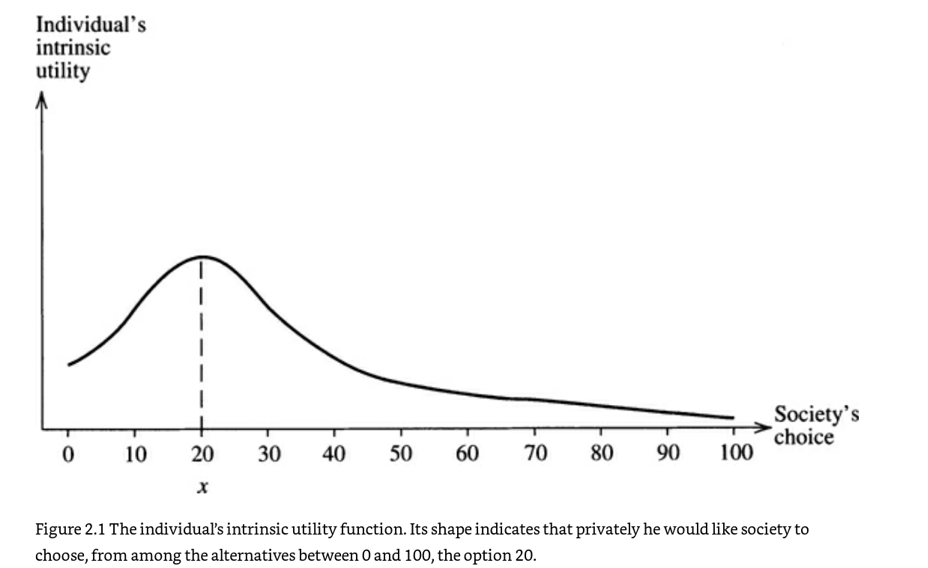
Then author defines Reputational and Expressive Utilities, the former maximizes individual’s reputation among others, while latter individual’s self-respect: the necessary condition for psychological well-being.
Here is the graphic representation:

Author then discusses possibility and even necessity of Preference falsification for individual to maximize total utility. Author also provides a beautiful example of multifaceted Preference Falsification:” In 1989, a Soviet citizen admitted to having worn “six faces” under communist repression: “one for my wife; one, less candid, for my children, just in case they blurted out things heard at home; one for close friends; one for acquaintances; one for colleagues at work; and one for public display.”
Author also discusses how Intrinsic Utility often manipulated by limiting access to information or providing false information, especially in totalitarian and authoritarian societies. At the end of chapter author looks at social sciences that look at individual’s utility from different angles often ignoring reality that everything is intertwined:” The foregoing model depicts the individual as having multiple sources of happiness: economic, social, and psychological. These three sources have tended to be studied within separate disciplines that differ in their conceptions of the individual. Homo economicus is a self-controlled, calculating utility machine, who is immune to social pressure and a stranger to inner turmoil. Homo sociologicus, his very identity the product of social stimuli, is ruled by social demands. And a common conception of homo psychologicus is as an impulsive and tormented soul, struggling, seldom successfully, to escape the dictates of his conscience. However simplistic, these constructs provide valuable insights into human behavior. Yet they obscure as much as they enlighten. A more composite construct allows glimpses, we shall see, into phenomena that its unidisciplinary rivals oblige us to ignore.”
3. Private Opinion, Public Opinion
Author begins this chapter by providing definition:” An activity forms a political issue if it is a matter of social concern, a nonissue if it is widely considered a matter of personal choice.” He then discusses limitations on public issues and paradox of people getting involved with public issues even if these issues have little impact on their lives, Author then links this phenomenon to Expressive needs of individuals that causes them to become activists. The next point of discussion is formation of the pressure groups that separates public and private opinion by creating cultural pressure to join one position or other that results in polarization of public opinion even if private opinion distributed evenly:
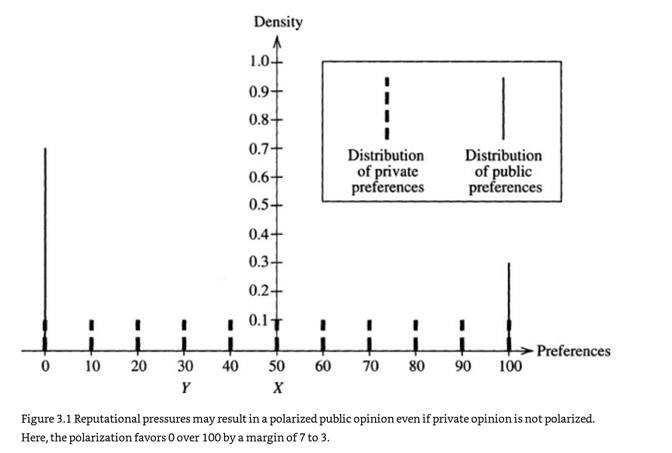
4. The Dynamics of Public Opinion
In this chapter author discuss the process of formation of public opinion via enforced Preference Falsification necessary to maintain belonging to a group in which some public opinion becomes dominant. As result population is initially divided into groups around different opinions based on individual threshold. Author provide graphic and explanation of movement of public opinion to position when it is dominant, even if it represents minority opinion:” Remaining focused on Figure 4.3, imagine that the expected public opinion somehow starts out at 20. The propagation curve indicates that 35 percent of the population has a threshold at or below 20. So, this share of the population will give its public support to 100 and the remaining 65 percent will support 0. An expectation of 20 has thus generated a public opinion of 35. Having turned out to be an underestimate, the initial expectation will be revised upward. According to the figure, any expectation below 40 will fall short of the corresponding realization and generate further revisions. To become self-fulfilling, and thus self-reproducing, the expected public opinion must rise to 40. The figure shows Ye = 40 to lie at the only intersection between the propagation curve and the diagonal. So there is a single self-fulfilling expectation, a unique equilibrium.7 Only when individuals base their public preferences on the expectation of a public opinion of 40 does actual public opinion match the expectation that generated it. Panel B of Figure 4.3 uses a topographic metaphor to capture the movements of public opinion. It depicts a valley whose lowest point is at 40. If a ball is placed at 40, it will remain at rest indefinitely. Placed anywhere else, it will roll toward 40.”
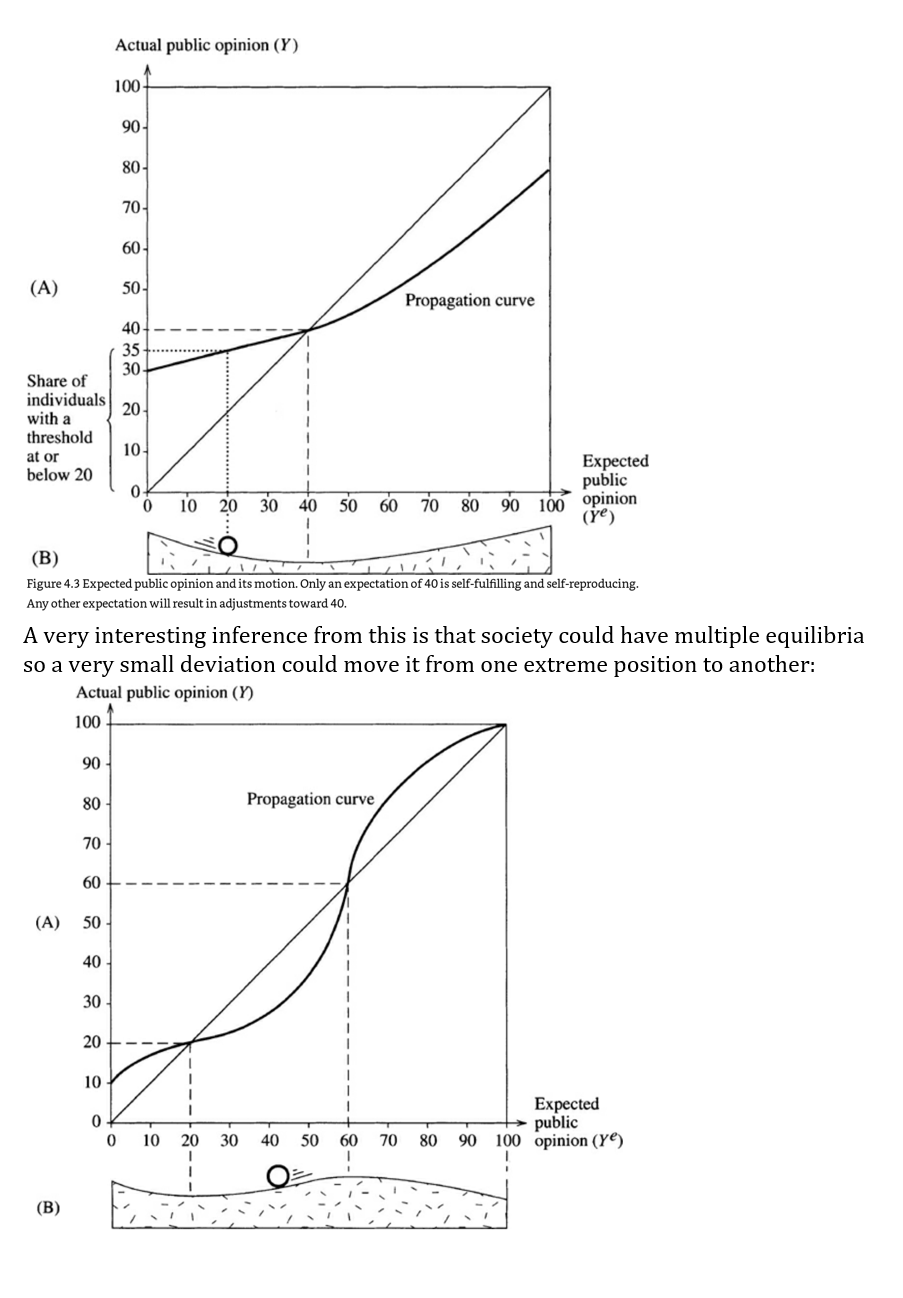
Author then discusses details of this process and expresses caution against incorrect perception of public opinion:” The human tendency to underemphasize the external determinants of human choices and overemphasize the internal determinants is known as the fundamental attribution error. The normatively correct principle of attribution calls for caution in ascribing an act to the actor’s personal disposition insofar as that act is typical.”
5. Institutional Sources of Preference Falsification
Author begins this chapter by pointing out institutional difference in imposing Preference Falsification between democratic and totalitarian countries: relatively soft pressure in former and deadly violence in latter. After that author discusses Expressive constrains from Athenians ostracizing individuals with unpopular opinions to McCarthyism in USA and Official responses to Public and Private opinion, which is very different in democracies when leaders have a lot less tools to form opinions via disinformation and suppress challenging opinion carriers by force. Nevertheless, even in democracies Preference Falsification is widely used and author discusses remedies that could minimize damage caused by this phenomenon. Such remedies include first of all the Secret Ballot and traditions of Tolerance to different opinions. The real practical use of these remedies is rarity that happens only in democracies and even in this case they are very fragile. Author refers here to American constitution and intention of its framers to use clash of ambitions to save democracy, but he also notes that maintaining democracy requires general agreement on fundamentals, which is often just not possible.
II. Inhibiting Change:
6. Collective Conservatism; 7. The Obstinacy of Communism; 8. The Ominous; Perseverance of the Caste System; 9. The Unwanted Spread of Affirmative Action
In this part author discusses situation when Public Opinion remains stable for a long time after Private Opinion had changed, sometimes dramatically. The main reasons for this usually established historical narrative, spiral of prudence when individuals disenchanted with status quo believe that they are small minority when in fact the majority of people unhappy, but remain silent or falsify their preference. There is also unequal distribution of opinions among generations and other processes that impact willingness of individuals to support or resist change such as Conservatism, Traditionalism, Persistence, and Rigidity. Here is graphic representation of this process:
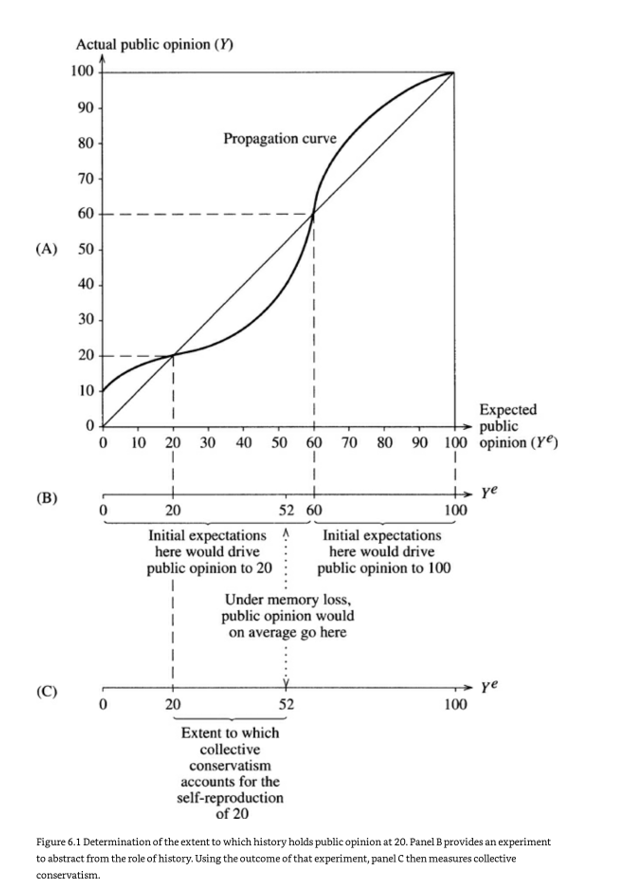
Then author reviews real life examples of such processes: Communism in Soviet Block, Caste system in India, and Affirmative actions in USA.
III. Distorting Knowledge:
10. Public Discourse and Private Knowledge
In this part author discusses impact of Preference Falsification not only on Public Discourse, but also on Private knowledge and opinion. Here is authors formulation:” …preference falsification can alter the appearance of one’s personality without modifying its essence. Yet in practice preference falsification does affect private preferences. It distorts public discourse—the corpus of assertions, arguments, and opinions in the public domain. In turn, the distortion of public discourse transforms private knowledge—the understandings that individuals carry in their own heads. The transformation of private knowledge ends up reshaping private preferences.” Author then discusses human cognitive processes that are susceptible to external influences via such processes as framing or accepting externally imposed overall model of reality, but only to the extent that this model possesses at least somewhat effective predictable power and help individual achieve his/her objectives. Author discusses in some details the role of deception, censorship, and general political illiteracy resulting from dependency of individuals on information provided by society. In this context author discusses Heuristics of social proof and its use in politics of Persuasion. Author also applies notions of hard and soft knowledge:” Hard knowledge is grounded in substantive facts and systematic reasoning. By contrast, soft knowledge is grounded in one or more forms of social proof. Either type of knowledge may be erroneous, of course. Just as the causes of a social phenomenon may be misperceived, perceptions of public opinion may be substantially off. In practice, moreover, “hardness” and “softness” form a continuum. Beliefs concerning social phenomena are ordinarily based both on personal observation and on perceptions of what others think.” Author also discusses Believe Perseverance. That is tendency of people to fit new information into existing framework of believes, even if this information completely contradictory to these believes. Overall author rejects idea of individual autonomy and objective interests noting impact of the Public opinion imposed by powers that are on individuals believes, even if they are hidden from external control.
11. The Unthinkable and the Unthought;
Here author discusses cognitive limitations and provides definitions:” An unthinkable belief is a thought that one cannot admit having, or even characterize as worth entertaining, without raising doubts about one’s civility, morality, loyalty, practicality, or sanity. An unthought belief is an idea that is not even entertained.”
After that author discusses technics of using Knowledge falsification so the Public Discourse could be distorted, consequently leading to reshaping Soft Knowledge of individuals. From here comes Cognitive dissonance. Which is basically conflict in the mind of individual between Soft and Hard Knowledge this individual possess. Here is how author presents this:” The distortion of public discourse thus affects both hard and soft knowledge, but through different mechanisms. Soft knowledge changes readily because its mobility is constrained only by difficulties in ascertaining the course of public opinion. And in any case, perceptual obstacles lose significance where public opinion shifts massively. In contrast to soft knowledge, hard knowledge does not necessarily move with perceived shifts in public opinion. Someone with information favorable to a certain program will not lose faith in it merely because public opinion now favors an alternative. His faith in the program may be shaken, however, and he may be unable to discover new justifications for rejecting the alternative.”
Author however rejects idea of Cognitive dissonance because he believes that people can easily entertain multiple contradictory ideas at the same time. Here is his position:” When a person’s beliefs change this happens not through his own personal efforts but, rather, through a social process in which he is just one of many participants. If public discourse treats two issues as unrelated, he is apt to do the same, because he cannot explore all possible connections. He may well remain unaware of important connections without feeling any discomfort. In a vast array of contexts, the linkages individuals make among events, outcomes, and phenomena are governed largely by public discourse. Where public discourse is itself inconsistent—as when it promotes the literal accuracy of the Bible while also celebrating the explanatory power of modern biology—people may not even notice the contradiction. Many will do so, however, if the inconsistency begins to receive public attention.”
Author also reviews process of shifting some ideas from unthinkable to unthought, creating ideological gap between generations with shifting of Private Preferences. Author then review this process in details with graphs and theoretical example.
12. The Caste Ethic of Submission; 13. The Blind Spots of Communism; 14. The Unfading Specter of White Racism
In these chapters author reviews actual examples of developments in various societies to demonstrate how it all works in reality.
IV. Generating Surprise: 15. Unforeseen Political Revolutions;
This part is very interesting because it demonstrates how seemingly invincible totalitarian or authoritarian society with powerful police, mass indoctrination, and routine Preference Falsification could suddenly explode and change nearly overnight. Author defines simplified forces within society this way:” The dual preference model of this book posits a predefined issue on which there is a political struggle between two pressure groups. For this chapter and the next, the issue is the incumbent political regime’s legitimacy. The two pressure groups are the government, which recognizes its own right to govern, and the opposition, which does not. Within this particular context, Y, our measure of public opinion, represents the size of the public opposition to the government. As usual, it is expressed as a percentage of the population. At the start of our story Y is near 0, indicating that the government commands almost unanimous public support. A revolution would take the form of a sudden and enormous jump in Y that makes it impossible for the government to continue governing. By this definition, revolution entails a mass-supported shift in political power. It is immaterial whether the transfer of power brings about meaningful change in people’s lives. All that matters is that the transfer be swift and extensive.”
Author provides very interesting graphic presentation of how small society of 10 people either explodes into revolution and moves from equilibrium Y=30 to equilibrium Y=90 or it remains in the same state depending on threshold of one individual c:
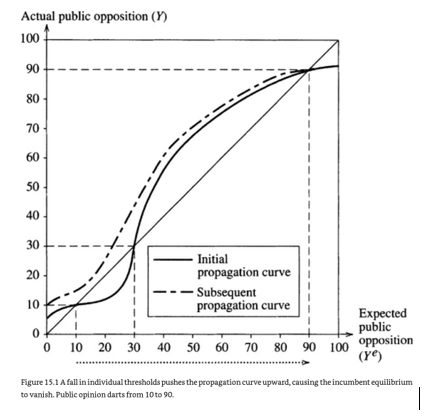
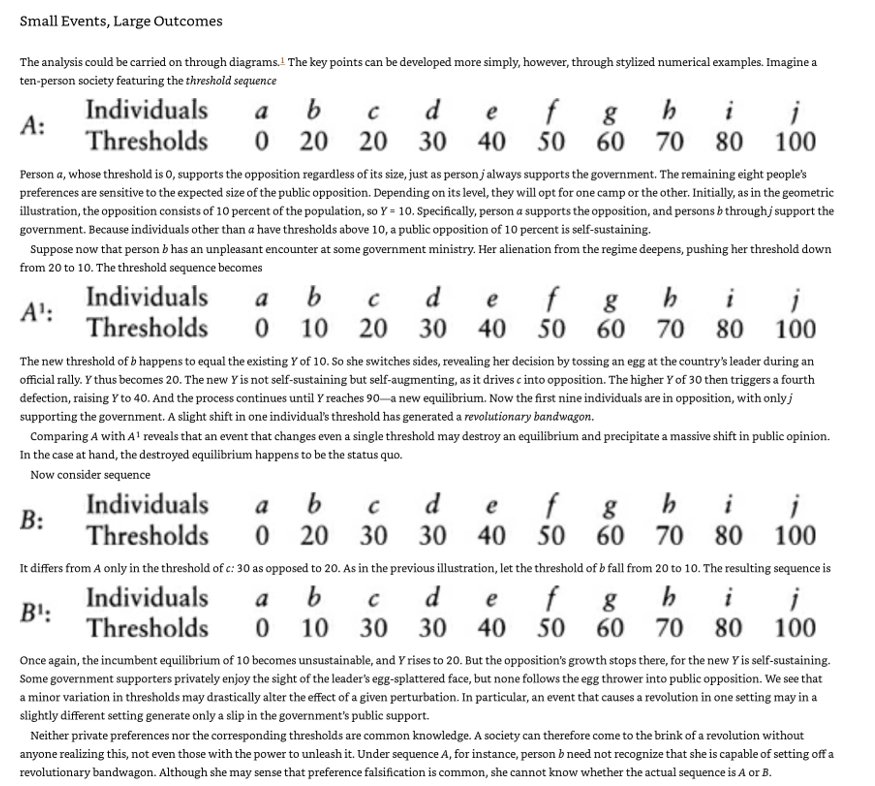
Author then discusses inessentiality of mass discontent, the role of political structure, and inevitability of combination of poor Foresight with Excellent Hindsight.
16. The Fall of Communism and Other Sudden Overturns;
In this chapter author provides real life examples of sudden revolutions.
17. The Hidden Complexities of Social Evolution;
This chapter expand discussion and here is how author defines it: “The purpose of this chapter is to extend and knit together the evolutionary themes of past chapters with an eye to generating further lessons for historical interpretation and social forecasting. I first introduce several complications into the basic framework, highlighting factors that make private preferences somewhat autonomous from public discourse, and actual public policies somewhat autonomous from public opinion. As in earlier contexts, it turns out that changes in one variable may have disproportionate effects on other variables. Turning attention to the circularities of the model, I explore the inefficiencies they produce and the added difficulties they pose for prediction and control. Among my key points is that discontinuities, unintended outcomes, and inefficiencies flow from a coherent social process. The whole chapter demonstrates, from a broader perspective than earlier chapters, that one can understand the complexities of social evolution without being able to pinpoint the causes of particular historical outcomes.”
He also provides graphic representation:

18. From Slavery to Affirmative Action
Here author applies his ideas to historical development of American race relations and Indian Caste system.
19. Preference Falsification and Social Analysis
In this final chapter author provides detailed description of his objectives:”
First, it highlights the ways in which the dual preference model serves to integrate disciplines and scholarly traditions often viewed as mutually incompatible paths to social understanding. I show how the model links traditions that focus on social structure with ones that emphasize individual choice. Drawing on properties of the model, I stress that structuralist and individualistic traditions should be viewed as complementary components of social analysis.
The second point of the chapter is that in illuminating past events and delineating future possibilities, the dual preference model also identifies certain limitations of scientific analysis. In particular, the model proposes that on sensitive issues pressures that breed preference falsification inevitably constrain what can be explained and predicted.
The chapter’s third task is to explore the measurability of preference falsification. To this end, it presents techniques for identifying and quantifying hidden perceptions, resentments, fears, and aspirations—some developed by anthropologists, others by opinion scholars. I argue that the techniques can be put to new uses in improving—up to a point, of course—our capacity to explain and predict social evolution.
Finally, I address the matter of refutability. Can the arguments be disproved? What tests may be used to establish their significance or insignificance? Because concepts such as concealment, cognitive limitations, small events, complexity, and unpredictability have played essential roles, the last task should be of special interest to readers inclined to deny scientific status to theories that involve poorly observable variables.”
At the end author lists multiple movements around various issues that all strive to achieve position of dominance when their opponents would have to use Preference Falsification in order to survive, therefore opening road for society’s change in whatever direction leaders of these movements want.
MY TAKE ON IT:
I think this is one of the most insightful books on human interactions in society that I ever read. It explains a lot of human behavior that I observed growing up in totalitarian Soviet Union when Preference Falsification was at the highest conceivable level. At the same time, it was Soviet Union of 1950s and 60s in which telling joke about leadership and discussing real condition of the country did not mean death sentence or even serious negative consequences for career, providing discussion was non-public. It was a very interesting society in which history was mainly false with great many factual events never mentioned, formerly great leaders’ images removed from photos, and official party papers and materials published just a few years ago not available in libraries except per special permission. In this society practically nobody believed that future is bright despite mass indoctrination and general believe that ideas of socialism and communism are great, and only general incompetence of leadership stands between people and prosperity. Eventually the moment when true believers such as Gorbachev, which naively accepted massive Preference Falsification as expression of true Preferences and opened gates for open expression of the Private Preferences, become the moment when system fall apart because it turned out that real socialism and communism were true Preference only of miniscule part of population. Interestingly enough this opening came from country leadership’s correct understanding that without valid information the competent management of economy and country is not possible combined with the lack of understanding that false information was foundation of socialist society without which it could not stand. We are now in the middle of a very interesting experiment when American elite intelligentsia and bureaucracy attempt to change society into some weird combination of economic capitalism and political socialism with pretention of being a democracy by using so far mainly non-violent coercive measures to push everybody into Preference Falsification to support this monstrosity. Nobody really knows what will happen, but my guess is that this attempt will fail and it will fail with such thunder that there will be no place for communism and socialism on this planet any more.
20210808 – The Coming of Neo Feudalism

MAIN IDEA:
The main idea of this book is that current political development leads America to the new form of Feudalism – society based on permanent aristocracy at the top and all other population situated in hierarchical structures below. To support this idea author provides data about dynamics of ownership of land and other resources, increasing substitution of meritocracy with birth rights to places at the top, decline of liberal capitalism that used to provide more or less equal opportunity. Author also reviews emerging class structure of the Neo Feudalism, its geographical distribution with California being the most prominent example, and its potential to ignite class war similar to peasant rebellions of the Old Feudalism.
DETAILS:
PART I. HOW FEUDALISM CAME BACK
- The Feudal Revival
In this chapter author defines current situation as comeback of Feudalism – stratified society with very limited upward mobility and strict class differentiation with privileges assigned to individuals based mainly on the class belonging. He briefly describes historic feudalism as a system, notes that history could regress and then recounts signs of such regression:
- Concentration of land ownership and overall wealth at the top
- Power nexus between Clerisy and Oligarchy
- Loss of faith in Liberal Democracy among population
- Emergence of periodic rebellions of lower strata of population against existing order
At the end of chapter author points out that course of history is never inevitable, therefore whether Feudalism will fully come back or not depends of people.
- The Enduring Allure of Feudalism
Here author discusses ideological nature of Feudalism in the Christian world where spiritual area was important and included equality of people before God, while unequal and strictly hierarchical structure of this world provided somewhat comfortable and secure society of mutual obligations when everybody know his/her place. Author then discusses multiple countries such as Russia and China where this ordered arrangement always had been and is preferrable to chaotic nature of Liberal Capitalism. Author also refers to several Western well-known intellectuals who also expressed similar preferences.
- The Rise and Decline of Liberal Capitalism
In this chapter author briefly retells the story of the raise of Liberal Capitalism and then jumps to contemporary world when Western countries fell into stagnation and China raised to the point of presenting challenge with its Antiliberal Capitalism based on totalitarian control of communist party over society. However, author points out China’s demographic problems, which are also becoming typical for other countries. At the end of chapter author suggests that rapid development of technology creates gap between high tech professionals and all others similar to Feudal gap between knights in undefeatable armor at the top and peasants and others at the bottom of society.
After discussing emerging New-feudal hierarchy of society, author moves to reviewing class structure of such society allocating one part of the book to each layer: Oligarchy, Clerisy, Yeomanry, and New Serfs.
PART II. THE OLIGARCHS
- High-Tech Feudalism
Here author identifies the new class at the top of New-Feudal Hierarchy as Oligarchs who control most of the real property, and, even more important, they control technology. Author describes birth of this New Oligarchy as similar to raise of knights only instead of superior arms it is based on superior technology that allowed creation of huge corporation such as Apple or Amazon that control technology of society. Author describes how such process merges new power with Communist party’s political control in China and how formerly “meritocratic entrepreneurs” of the Western world transform themselves into evil plutocrats.
- The Belief system of the New Oligarchs
This chapter is about oligarch’s ideology. Author describes their understanding of themselves as purely meritocratic high achievers and relate with contempt to others as underachievers. Author describes their preferred organization of society in such way:” This model could best be described as oligarchical socialism. The redistribution of resources would meet the material needs of the working class and the declining middle class, but it would not promote upward mobility or threaten the dominance of the oligarchs.” Author then discusses methods that oligarchs use to take control over society: initially via Cultural revolution that would establish their preferable set of believes and attitudes and then via establishment of mass surveillance that would make any deviation from this believes practically impossible.
- Feudalism in California, Harbinger of the Future
In this chapter author describes the real place where oligarchs’ objectives pretty much achieved – state of California. It is one party state, which is simultaneously the richest state by amount of wealth at the top and the poorest state by the number of destitute people at the bottom: the number one state in USA for inequality. Author also refer to this type of society as “Feudalism with Better Marketing”.
PART III. THE CLERISY
- The New Legitimizers
Author begins this chapter with reference to Orwell, Atwood, and Huxley – Sci fi about future societies run by elite and links it to ideology based on the notion of cognitive elite that in American culture turned into notion of professional, non-interested, non-political experts who know how to run things to everybody’s benefit. He then describes as credentialed upper class of just a few percent of population that he calls Clerisy, which are in reality often not very knowledgeable, very political and class conscious, and run everything for their own benefit, often at the expense of others. Author also refers to similarities with communist and fascist bureaucracy that ran totalitarian states of XX century.
- The Control Tower
In this chapter author analyses how members of Clerisy developed via process of higher education in American Universities controlled by ideologues of this class, which slowly took control by demanding freedom for themselves when they were minority and then start suppressing everybody else when they become dominant. A very important part of this suppression is their so far successful attempt eliminate Western culture and especially original American ideology from educational process.
- New Religions
Here author briefly reviews ideologies that are becoming new religions in service of Clerisy:
- The Church of “Social Justice”
- The Green Faith
- Transhumanism: the search for eternal life through technology.
PART IV. THE EMBATTLED YEOMANRY
- The Rise and Decline of Upward Mobility
The part about middle class that author calls Yeomanry starts with discussion of declining opportunities for its members after author briefly retells the story of their raise. Author measure this decline by increased gap between the middle and the top:” The wealth differential between middle-income and upper-income households had reached unprecedented levels by 2015. Data from the Census Bureau show that the share of national income going to the middle 60 percent of households has fallen to a record low. Wealth gains in recent decades have gone overwhelmingly to the top 1 percent of households, and especially the top 0.5 percent.” Author notes that such gaps were typical for feudal societies, especially those based on “meritocratic” mandarin class controlling overall wealth of society as in China, but atypical for European democracies where wealth was widely distributed.
- A Lost Generation?
This chapter is about loss of opportunity for young generation. Author specifically analyses decrease in home ownership due to overpriced housing, so the young generation increasingly dependent on inheritance in order to achieve home ownership. It leads to typical for feudalism economic stagnation.
- Culture and Capitalism
In this chapter author looks at alliance of wealthy oligarchs and clerisy, especially the part of Clerisy in control of key areas of culture: media, education, and science. He looks at attempts to distract people from setting up economic goals and substituting them with some ideological constructs, promotion of green agenda in order to scare people into forfeiting strive to achieve high levels of material wellbeing. The massive attack of this cultural Clerisy against middle class is also directed against institution of nuclear family, which is foundation of middle-class way of life.
PART V. THE NEW SERFS
- Beyond the Ring Road
The ring road here is metaphor for line dividing privileged dwellers of big cities living within Ring Road surrounding these cities over others living outside, typical for totalitarian countries with dominance of bureaucracy such as Chine or former Soviet Union. After discussing these inequalities author looks at history of development of serfdom on the remnants of Roman empire, its slow conversion to capitalism and transformation of serfs into working class. Then raise of big part of working class into the Middle class in USA in the middle of XX century, and its decline by the end of this century.
- The Future of the Working Class
In this chapter author follows on describing loss of labor power and another transformation from proletariat to “precariat” – people with limited control over conditions of their work and low levels of compensation due to change from industrial mode of production to post-industrial with lots of contract work, individualization of working processes that limit unionization, cultural erosion of working class, and its abandonment by the Left, which moved to another promising power: combination of intellectuals at the top and underclass at the bottom, both living off government transfer of resources to them at the expense of others.
- Peasant Rebellions
In this chapter author compares contemporary political situation with peasant rebellions of Feudalism, equating them with contemporary wave of election of populist leaders such as the Donald. Author discusses such important part of this rebellion as movement against mass migration that swells welfare dependent part of population, greatly increasing support for government transfers. Intellectuals that are dependent on such transfers support mass migration even if it brings people with strong religion believes and intolerant culture that from time to time express itself in murderous eruptions. Author end this chapter by asking if “Is There Mass Insurrection in Making?”
PART VI. THE NEW GEOGRAPHY OF FEUDALISM
- The New Gated City
Here author looks at the new landscape of America when cities become divided into areas of gated communities, slums of non-working people, areas of rich international business and disappearing local commercial centers, densification and gentrification of city centers, all this combined with exodus of middle class to suborns and exurbs.
- The Soul of the Neo-feudal City
Here author discusses ideas of the Global City where elite is concentrating and develops common attitudes and approaches that are outside and even above cultural landscape of their societies, simultaneously pushing non-elite of their countries into subservient positions. Author also discusses such dramatic cultural changes as destruction of family and childless way of life. Such attitude and objective of elite are clearly on collision course with Middle class suburban way of life. Author provides a very interesting reference linking elitists hate of suburb and strive to increase density to Soviet ideas and practice of exemplary communist city where people packed into cheap small flats.
- The Totalitarian Urban Future
The final chapter of this part discusses in more details ideals that elite wants to implement by creating “Totalitarian Urban Future” with central control of everything, including China style surveillance and control over individual behavior. Author question whether it would be possible to resist these ideals.
PART VII A MANIFESTO FOR THE THIRD ESTATE
The Technological Challenge
Author describes here the new feudal elite, which seeks to exercise their power via experts and their control over communications and media, especially social media that allow them dumb down general population to such level that they willingly accept their status as inferiors, while using biotechnology to enhance their own intellectual and physiological abilities.
- The Shaping of Neo-feudal Society
In this chapter author goes into details if shaping Neo-feudal society by undermining institution of family, scaring people with Global warming and other forms of environmental alarmism and so on. Author then advocates response by investing in resilience similarly to dikes in Netherlands in area of technology and resisting power of oligarchy in the area of politics.
21. Can We Challenge Neo-feudalism?
In the final chapter author asks if it is possible to challenge Neo-feudalism and suggests promotion and support of the Third estate – middle and working classes as bulwark against oligarchy. Author also expresses expectation that alliance of leftists and oligarchs is unreliable and could fall apart rather quickly. In any case author believes that solution is in reinforcement of values of Western civilization and adjustment to new landscape of automated production, probably via application of UBI, that has increasing support of people.
MY TAKE ON IT:
I do not think that there is any need to apply old political and class structure of Feudalism to the newest incarnation of the strict hierarchical system with all important parameters such as methods of production, system of believes, norms of behavior, and technology very different from this old Feudalism. The key difference is that old Feudalism was based on need for manual production by peasants and military capabilities of aristocrats creating mutually dependent society united by religious believes in propriety of hierarchical order of things with God at the top and proper places for everybody all the way down. The current incarnation is much weaker because hardly anybody believes in God and clearly nobody believes in the proper hierarchical order. The current situation is result of increasing disappearance of need for mass of peasants toiling at the bottom of society providing food and other goods and services. Similarly disappeared the need for aristocratic warriors to provide protection of society against hostile powers, this function actually firmly resides with professional military mainly recruited from the middle and working class. The new society that existing bureaucratic hierarchy of America is trying to establish is just finalization of the process that was under way for nearly two hundred years of expansion of this hierarchy. At the end it divides population into two categories: minority of population: credentialed bureaucrats and members of establishment enjoying power and control over all resources, while majority of population deprived of traditional American freedoms of speech, ability for self-defense, and opportunity to achieve material independence from others, will meekly accept its boring lives of quiet despair in exchange for some leftovers in form of basic income or low salaries at the bottom of hierarchy. I do not think that this attempt would be successful just because boring lives of despair are not consistent with human nature that requires actions and achievements, making such society unsustainable.
20210801 – Deaths of Despair

MAIN IDEA:
The main idea of this book is to recognize serous problems of American society that expressed by decrease in life expectancy of one part of population – low educated white men due to increase in suicide, drug overdose, and alcoholism among this population. It is also to analyze reasons for these “Deaths of Despair” and recommend measures, mainly in form of government intervention to handle this problem.
DETAILS:
Introduction: Death in the Afternoon
Authors start introduction by describing their thoughts upon discovery that suicide rates of white middle age males is rapidly growing. Then they added to these other categories: deaths from drugs and alcohol combining all into one category – deaths of despair. They linked it to failure to pass tests of meritocracy, which they associate with education that divide prosperous and poor parts of population. Authors then compare white and black uneducated people and somehow conclude that blacks have it harder, but whites suffer more because of loss of white privilege. Finally, they link it to stagnant wages and loss of jobs, specifying that:” Jobs are not just the source of money; they are the basis for the rituals, customs, and routines of working-class life. Destroy work and, in the end, working-class life cannot survive. It is the loss of meaning, of dignity, of pride, and of self-respect that comes with the loss of marriage and of community that brings on despair, not just or even primarily the loss of money.”
Authors also discuss causes: globalization, increase of corporate power versus unions, and even healthcare. Finely, they express concern that all these combined with loss of believe in Democracy that perceived to be captured and corrupted by elite could lead to serious push back and they see signs if it in election of Trump.
Part l. Past as Prologue
1. The Calm before the Storm
In this chapter authors look at statistical history of mortality in USA and the great progress that occurred until last decade. They discuss mortality causes that moved away from contagious diseases to illnesses of old age and self-inflicting damage such as drugs and alcohol. They present a graphic support for these ideas:
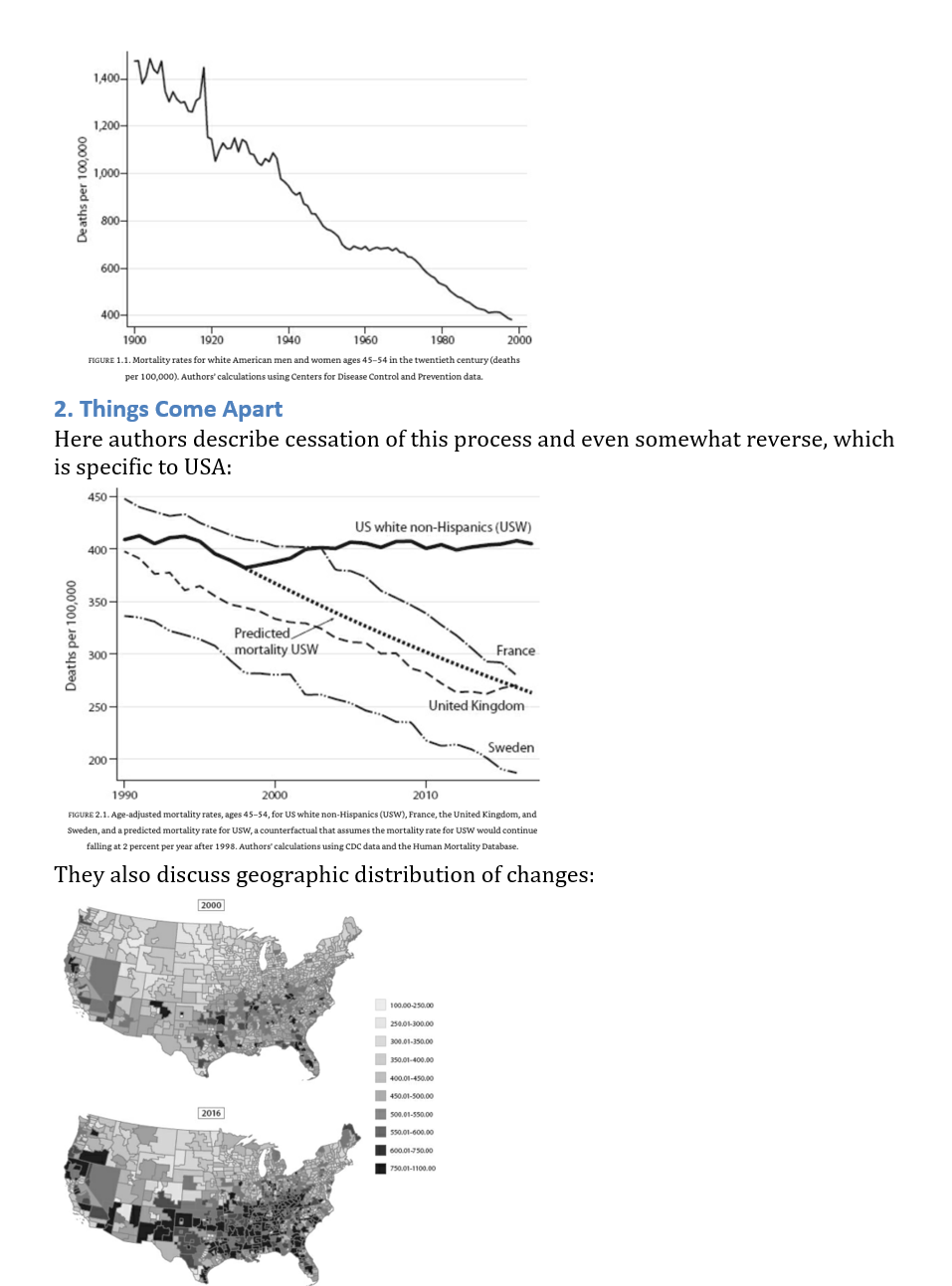
At the end of the chapter, they describe the range of the problem they are trying to understand in such way:” There are two stories, often seen as competing, though they need not be. One, the “external” or circumstantial account, emphasizes what happened to people, the opportunities that they had, the kind of education, occupation, or social environment that was available to them. The alternative, “internal” account emphasizes what people did to themselves, not their opportunities but their choices among those opportunities, or their own preferences. It is a debate between worsening opportunities, on the one hand, and worsening preferences, or declining values or even virtues, on the other.”
3. Deaths of Despair
Here authors discuss the specific causes of deaths of despair and present a few anecdotes describing how it happens and how sometimes it is difficult to differentiate suicide form unintentional drug overdose.
Part ll. The Anatomy of the Battlefield
4. The Lives and Deaths of the More (and Less) Educated
Here authors move to compare circumstances of different parts of population that are inflicted by deaths of despair to very different degrees. First of all, they discuss difference in education and how it impacts human life in environment of “meritocracy”:


They describe an interesting dynamic in Black community when success of civil rights movement opened gates for talented and hard-working individuals and the first thing that they did was to run away from Black community, “denuding” it from their talents and role models. Authors link it to earlier epidemic of use of crack cocaine in inner city and corresponding mortality. They also critic Murray thesis that in both cases welfare states suppressed industriousness and morality of people leading to all these negative consequences.
6. The Health of the Living
Here authors move from deaths of despair to general and mental health conditions of population and link it to education:

8. Suicide, Drugs, and Alcohol; 9. Opioids
These two chapters overview final causes of increase in mortality, also demonstrating that this is quite recent phenomenon inflicting uneducated population:
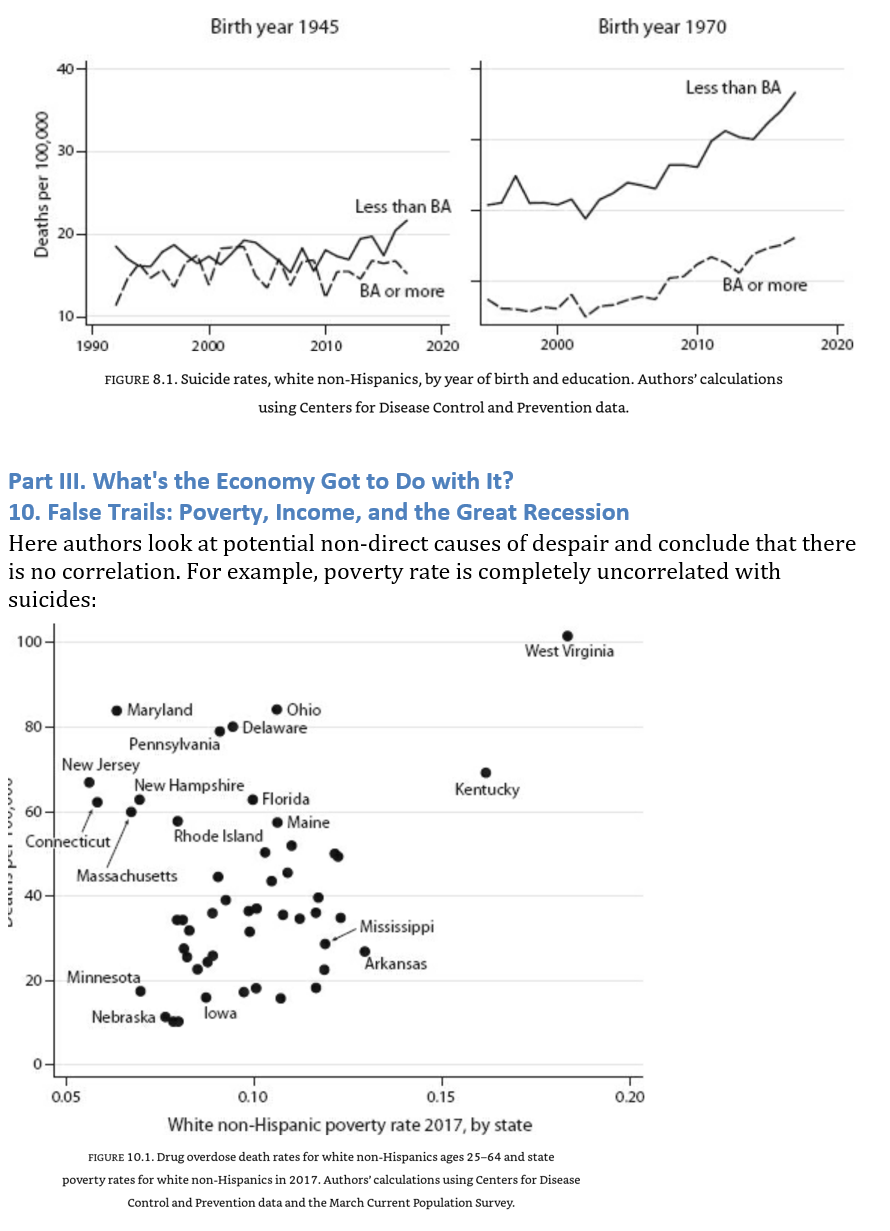
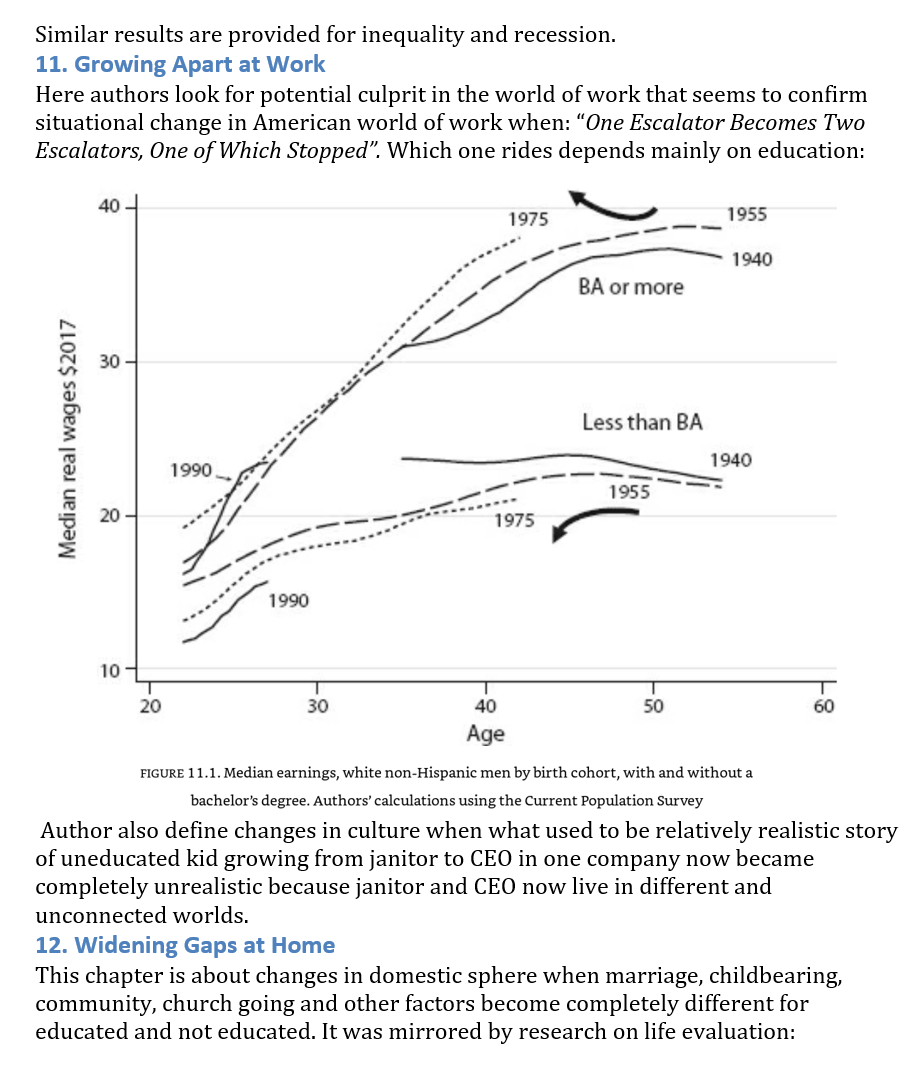

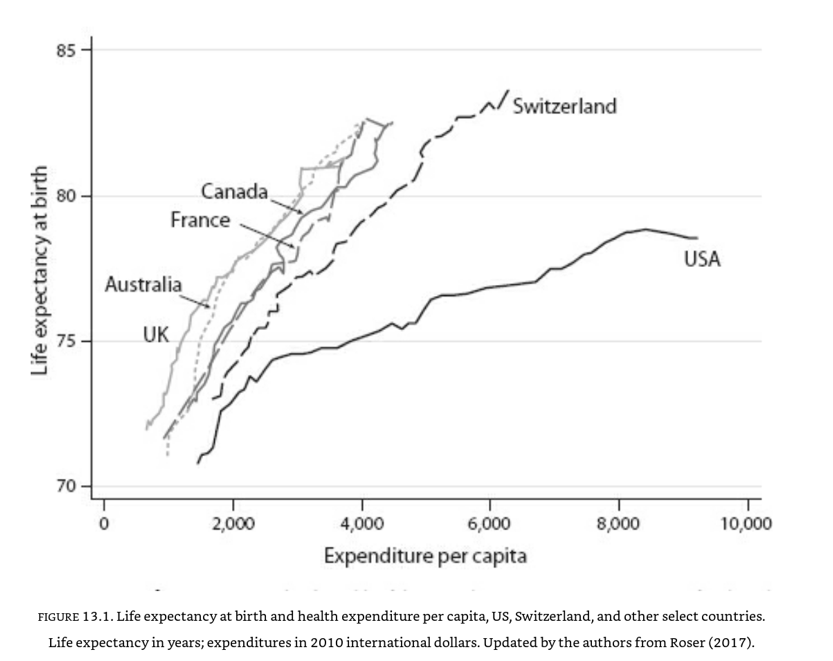
Authors also provide an interesting breakdown of costs:” American physicians pay more for malpractice insurance, although the total cost of around 2.4 percent of total healthcare expenditures is small compared with the expenditures on hospitals (33 percent), physicians (20 percent), and prescription drugs (10 percent). Compared with those in other rich countries, American hospitals and doctors make more intensive use of “high margin, high volume” procedures, such as imaging, joint replacements, coronary artery bypass graft surgery, angioplasty, and cesarean deliveries.” Authors discuss some typical tricks such as use by companies and charitable foundations to pay inflated prices of their medical products.
14. Capitalism, Immigrants, Robots, and China; 15. Firms, Consumers, and Workers
These chapters are about other features of contemporary American capitalism that devalue American labor, eventually causing deprivations and deaths of despair.
16. What to Do?
These chapter is about authors’ prescription for what to do:
Opioids – create new government agency
Healthcare – Increase government expenditures and create Cost Control Board
Corporate governance – more power to unions with representation on company board
Tax and benefits policy – UBI, but not now, rather sometime in the future.
Antitrust – limit mergers and force payment for monetizable information provided to companies.
Wage Policies – raise minimum wage and provide subsidies for jobs.
Rent-Seeking – limit use of patents and curtail protection of small business. Per authors the main cause of inequality are not CEOs, but rather owners of “small” businesses with 20M in sales and 100 employees. Also impose restrictions on lobbying.
Education – modify the systemin in such way as to remove sharp cut off at bachelor degree, maybe via expansion of apprentice system.
The final advice – to learn more from Europe.
At the end authors profess their optimism and believes that Democracy in America and Capitalism could do much better job that they do now and remove causes of death of Despair.
MY TAKE ON IT:
It is the great collection of statistical data demonstrating beyond reasonable doubt that white men with low levels of education are under serious stress due to their redundancy for contemporary production process that causes loss of meaning of life and escapism to drugs, alcohol, or even suicide. I am fully in agreement with authors’ presentation of the problem, but in complete disagreement with their analysis of reasons and suggested solution for the problem. The reasons that authors present: Healthcare high cost and low quality, Immigration, Robots, China, and loss of labor power to oppose management – all of this in my opinion result of massive and constantly increasing intervention of government into areas of economy and overall lives of regular people. There is tendency to refer to government as some kind of superior being either good or bad, but I completely reject this approach because government is nothing more then hierarchically organized group of individuals in possession of coercive power that allow them make decisions and enforce implementation of these decisions without any responsibility whatsoever. Any area in which these individuals interfere: Healthcare, Education, Financial markets demonstrate dramatic deterioration in their functionality and similarly dramatic increase in costs. Consequently, authors’ suggestions to increase power of these individuals and their interference in all areas of life is bound to be ineffective. In my opinion, for example, Healthcare could be improved not by implementation of National system as had been done in many socialist and semi-socialist countries, but rather expulsion of government interference in health insurance and delivery of services, obviously with exception of prosecution of criminal deception and misrepresentation of information.
20210725 – The Hungry Mind
MAIN IDEA:
The main idea of this book is to present curiosity as a very important natural phenomenon specific for humans, review vast range of experiments that supports specific understanding of curiosity development in human children, demonstrate vulnerability of this process and negative impact on educational and consequent wellbeing success if this curiosity suppressed. It is also to provide some recommendations on methods to support curiosity in children.
DETAILS:
1. Capturing Curiosity
Author begins with her childhood recollection of all kinds of experimentation as free child in 1960s and how much it was driven by the plain curiosity, which then decreased over time. Then she refers to research demonstrating that curiosity decreases between ages 7 and 12. She refers to work of Daniel Berlyne who identify the human specific feature: curiosity without immediate utilitarian application, which is mainly prompted by need to resolve uncertainty. Author also discusses research related to development of curiosity that led to conclusion that sometime between ages 3 and 11 children either develop appetite for knowledge or they don’t. At the end of chapter author discusses in some detail individual differences in curiosity, needs for knowledge acquisition, and formulates her objective this way:” there are several sources of individual variation, and each has its developmental moment. Attachment in toddlerhood, language in the three-year-old, and a succession of environmental limitations and open doors all contribute to a person’s particular kind and intensity of curiosity. The twenty-two-year-old bears the imprint of all these experiences, which act as a series of layers on which each exploration or question in adulthood rests. This book is about why some children remain curious and others do not, and how we can encourage more curiosity in everyone.”
2. Safe Havens and Expeditions
In this chapter author looks at different periods of human development starting with curiosity of baby, which is universal and practically insatiable, but only to the point of familiarity. Author discusses several experimental works related to genetical equipment necessary for human specific need to know:” At a surprisingly early age human babies show how different they are from the young of other species by attending to differences beyond the bare necessities—novelty that helps them simply survive. They have what is called epistemic curiosity—an interest not only in what, who, when, and where, but why and how. Not only are children between the ages of nine months and thirty-six months eagerly absorbing information about what objects look like, taste like, sound like, can do, and can be done to, they are beginning to try to figure out why things happen the way that they do. They don’t always know that they are looking for reasons and explanations, but their behaviors tell us they are.” After that author discusses what quells curiosity in toddlers, confirming once again that it is familiarity, but also stating that it is highly personal and depends on temperament of a child. She refers here to works of Jerome Kagan on individual development, Nachman Stern and Best on novelty, and Simon Baron-Cohen of autism. Author also goes beyond individual internal process, stressing:” equally important idea that emerges from the work: human relationships are a key ingredient in the child’s ability to investigate the physical environment. Indeed, a series of experiments has shown that children with greater emotional and self-governing resources do in fact exhibit more curiosity as they get older.”
3. The Conversationalist
This chapter is about the next step in human development: use of language to obtain information from others. Author discusses the process of development of ability to ask questions that begins with pointing and then normally develops into highly intensive process of questioning. She looks at works of William Labov and his wife who traced in minute detail linguistic development of their child and questions this research asked. Author also present another interesting research:” Using the CHILDES database, Michelle Chouinard analyzed the questions of four children from the time they were fourteen months old until they were five years and one month of age. The recordings provided a total corpus of 24,741 questions and represent 229.5 hours of conversation. The children in this study asked an average of 107 questions per hour—an extraordinary volume of questions” Obviously all this is highly individual, but among consistent findings is strong correlation between levels of language acquisition in early childhood and future success in learning or lack thereof. Author also refers to cross cultural studies looking not only at quantity, but also quality of questions and type of information a child is trying to obtain.
4. Invitations and Prohibitions
In this chapter author moves to discuss exploratory behavior of child that starts with ability to move independently. However, this independence is generally limited by adults, which encourage some behavior and limit other. Author reviews this process by comparing environment and limits on exploration of city vs. rural children. Author also looks at methods that adults use to control children behavior and especially curiosity. It turned out that adult attitude has huge impact on development and curious and innovative people usually grew in permissive and supportive environment where they were encouraged exploring whatever they were interested in and supported in this exploration.
5. Curiosity Goes to School
In this chapter author discusses process of encounter of developing child with formal educational system. Author presents research in which incidents of curiosity in class were observed, counted, and analyzed. General finding is that formal education generally causes curiosity level drop over time. Here is author’s explanation of this process:” So what might explain the drop? When you look at children’s sensitivity to social clues, and their increasing selectivity about what makes them curious, and you put this together with teachers’ reluctance to deviate from a plan, the pressure they are under to meet certain goals (goals that are not consonant with sating one’s curiosity), and the general neglect toward providing young learners with the materials that speak to their particular curiosity, one begins to see why children seem so incurious in schools.”
6. What Fuels Learning
Here author discusses drivers of learning referring to specific experimental work:” We’ve had experimental evidence for at least the past fifty years to support the idea that children’s intrinsic interest is the most powerful ingredient for learning. Daniel Berlyne’s experiments were premised on the idea that curiosity was a drive, much like hunger or sexual desire. And much like other kinds of arousal, it can be negative or positive. Either way, it motivates the person feeling it to reduce the arousal. The reduction of such arousal feels temporarily rewarding. The greater the arousal and its reduction, the greater the sense of reward.” She also discusses role of attention in learning process and experiments demonstrating how it works. Finally, author looks at variances in individual curiosity and approach to learning and presents some experimental evidence that it could be improved via interactions with other children and adults:” To sum up, from an early age, some children are more curious than others. But there is also great fluctuation from one setting to another. A child who is usually timid about opening things or asking questions can be beckoned into inquiry. Children who are ordinarily inquisitive can be hushed into a kind of intellectual listlessness. The characteristics that fuel curiosity are not mysterious. Adults who use words and facial expressions to encourage children to explore; access to unexpected, opaque, and complex materials and topics; a chance to inquire with others; and plenty of suspense … these turn out to be the potent ingredients.”
7. The Gossip
In this chapter author moves from the processes of curiosity and learning to object of these processes, which is for the gossip is live of other people. Author discusses how gossip is naturally developing in children from the early age, forming foundation of ability to learn from words of others about something not directly accessible or observable by individual. Finally, author discusses how the process of gossiping used as social weapon applied to manipulate people and obtain some objectives of gossiping individual. She also uses her childhood memories about Truman Capote, who was close friend of author’s mother, to discuss how gossip in its highest form could produce literature.
8. The Uses of Time and Solitude
In this chapter author expands the discussion of gossip as precursor of literature by moving to books and human:” ability to understand the world as a series of stories (hence the primacy of scripts in early cognitive development). Anthropologists and cross-cultural psychologists have found that though every culture uses stories, cultures vary greatly in how frequently they tell stories, how they form their narratives, and why they tell stories. But one thing everyone everywhere seems to have in common is the ability to follow a plot. And therein lies the first reason reading satisfies curiosity”. She then connects this with solitude and discusses unappreciated importance of this process:” Solitude plays an important and often underrecognized role in a child’s chance to pursue her questions and interests. In recent years there has been such focus on the importance of peer relations, and on the value of good instruction and good schooling, we may have lost track of an equally vital strand of childhood experience—free time and time alone. The bulk of contemporary developmental research has emphasized the perils of time alone, which tends to be cast as loneliness rather than solitude. Research has focused on children who have trouble making friends, or who are alone because of adverse life circumstances (weak family structure, poverty, and so on). It’s no wonder then that a relationship emerges between solitude and various kinds of problems—depression, and difficulty in social situations, to name two. The link, once established, leads to research that frames solitude in its most extreme or persistent forms—children who unwillingly spend time alone, or spend copious amounts of time alone.
This is reflected in society at large, where sociability is valued so highly. When children report on how they feel when they are by themselves, they may unconsciously see such time as the absence of companionship, rather than the opportunity to think, garner one’s personal resources, or experience things without the noise or dilution of others. The bias toward sociability overlooks the importance of unstructured solitude when it comes to developing one’s interest and feeding one’s curiosity in specific domains. A look at the lives of many of our greatest minds suggests that time spent daydreaming and exploring while alone, free of responsibilities, is crucial to the acquisition of knowledge—in other words, crucial for the curious mind.”
In the second part of chapter author discusses an importance of time available for free and unstructured research and experimentation, which is necessary for developing some area of deep interest and curiosity. Author discusses relevant research with use of internet and some implications of overzealous use of SWIBAT (for “students will be able to.…”) that leads to time limitation on free search. Here is how author summarizes the finding of research presented in this chapter:” Curiosity is an internal phenomenon—a feeling like a tickle, or an itch. But it’s a feeling that leads to action (including the act of thinking). This book for the most part has not focused on fleeting moments of curiosity, but the kind of curiosity that persists, unfolding over time and leading to sustained action (inquiry, discovery, tinkering, question asking, observation, research, reflection). Such sustained inquiry may be more likely to blossom when children have free time, and some time alone. This chapter began with a book—because reading is one of the most accessible and richest ways for people to satisfy all kinds of intellectual appetites. But books require time alone, and the kind of reading that satisfies curiosity depends on freedom to read what you want.”
9. Cultivating Curiosity
The final chapter is about methods of cultivating curiosity, which includes embracing ambiguity and promote a free search to satisfy curiosity, rather than formal data acquisition directed at success in testing. Author then discusses various methods used to cultivate curiosity, and concludes with the following statement:” Einstein was only partly right when he said, “Curiosity is a delicate little plant which, aside from stimulation, stands mainly in need of freedom.” It turns out that like many delicate plants, in order to flourish, curiosity needs to be cultivated.”
MY TAKE ON IT:
I find that lots of experimental data presented in this book pretty much consistent with my believes based on what I know from both books and my own life experiences. I generally agree that methods of cultivating curiosity presented in this book are valid and do work, but I am afraid that their implementation is not realistic in settings of formal educational system that treats individuals as machine parts on conveyor to be filled with some knowledge and indoctrinate into some set of believes. The cultivating of curiosity and development of individual’s routine ability to use scientific method in knowledge acquisition could be achieved only outside of formal educational system. Some lucky individuals have time, ability, and supportive adults around so they are able to develop the precious ability to maintain lifelong curiosity, but great many others do not, the circumstance that makes some lives much more satisfactory than others. I believe that this complex process could be implemented only in one-on-one individual unstructured interactions between competent adult and child. It could not be achieved in factorylike settings of contemporary educational system. This could occur only after full completion of restructuring of society from industrial method of production to AI method, which would probably take a few decades.
20210711 – The Nurture Effect
MAIN IDEA:
The main idea of this book is to provide information on the latest research in behavioral science that demonstrated human need for support and nurturing throughout the life. Based on this information author provides suggestion of how this support should be provided, what results author expect from this support / nurturing, and how it should overcome deficiencies of contemporary society caused by poorly regulated capitalism.
DETAILS:
Introduction: The Way Forward
Author begins introduction with the statement that he believes that:” we have the knowledge to achieve a healthier, happier, and more prosperous society than has ever been seen in human history.” He then presents his work history and qualifications as scientist to demonstrate that he knows what he is talking about. Author uses example of successful movement against smoking and expresses his believe that similar movement could be started:” This book is about how we can create such a movement. Nearly all problems of human behavior stem from our failure to ensure that people live in environments that nurture their well-being.” Author declares that evolution, even cultural evolution is too slow to notice change within lifetime, but behavioral sciences now developed knowledge and practical program that would allow create nurturing environment for everybody and everything. Author then provides overview of the book and graphic representation of various interventions that he believes are necessary:
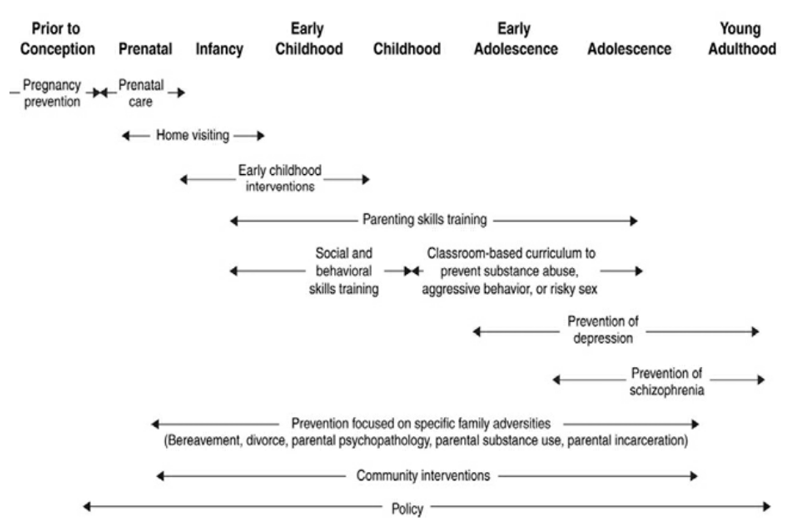
Part 1: Science Equal to the Challenge of the Human Condition
In this part author discusses scientific principles developed over the last 50 years that if implemented would provide:” proven benefit in preventing multiple problems and nurturing successful development.”
- A Pragmatic Science of Human Behavior: Evolution and Pragmatism; Humans: The Cooperative Species; Nurturing Environments; Building a Nurturing Society
Here author discusses progress in understanding and treatment of mental disorders, something that was impossible in 1960s when author started, but is more or less reality now. Author them discusses evolution as model of causation when features selected by consequences. Here is author’s definition:” An evolutionary analysis starts by studying the phenomenon of interest and its context and seeks to explain the phenomenon as a function of its context. This is true for behavioral explanations as much as it is for the study of species and genes.” Author then proceeds to analyze humans as “the cooperative species” and describes various experiments supporting such ideas as “helpful babies”. The next stop is description of nurturing environments and requirements for interventions to achieve this:” All successful interventions make environments more nurturing in at least three of four ways:
- Promoting and reinforcing prosocial behavior
- Minimizing socially and biologically toxic conditions such as coercion
- Monitoring and setting limits on influences and opportunities to engage in problem behavior
- Promoting the mindful, flexible, and pragmatic pursuit of prosocial values
Part 2: A Wealth of Knowledge About How to Help People Thrive
In this part author describes how scientific principles:” helped in the development of interventions that assist families, schools, and peer groups to become environments that nurture human development and well-being.”
- Nurturing Families: Nurturing Development During Pregnancy and the first two Years of Life; Nurturing Young Children; Thriving in Childhood; Keeping Early Adolescents Out of Trouble; Helping Delinquent Adolescents; Action Implications
Here author provides a number of anecdotes describing effective and ineffective approach to raising children and discusses importance of this process to future behavior of individuals. The bottom line is developing ability for emotional regulation and habits of prosocial behavior. Author also expresses strong support for “evidence-based” and cost-effective programs.
- Nurturing Schools: Nurturing Prosocial Behavior; Teaching Children Well: The Importance of an Evidence-Based Approach; Action Implications
Here author stresses need to minimize coercion and use positive reinforcement of prosocial behavior in schools. As example author describes “good behavior game” that really improved behavioral patterns of students. Author also stresses need for close monitoring of behavior and progress.
- Peers and Problems: Deviancy Training; The Pathway to Deviance; Preventing Deviant Peer Influences; Action Implications
This chapter about causes of deviant behavior. Author points out that it is often result of peer pressure based around antisocial values instilled as result of nonnurturing environment. Author discusses variety of measures used to prevent peer influences, substitution of peers with others who could provide pro-social influence. Important point author makes is necessity to isolate deviant individuals in order to prevent them from congregating in self-referencing community. Closely monitor troubled individuals and provide strong positive feedback for pro-social behavior.
- The Behavioral Revolution in Clinical Psychology: My Own Journey; The Schism in Behavior Therapy; Psychological Flexibility and the Third Wave of Behavior Therapy; Implications of the Progress in Clinical Psychology; Action Implications
In this chapter author moves from behavior problems of children and adolescents to adults. He retells his own story of disappointment in social psychology and change of specialization to clinical psychology that eventually led him to establishing Behavior Change Center in middle 1970s treating anxiety and depression. He then narrates the history of development of behavioral treatments and provides reference to relevant several books:
Cultivate psychological flexibility, perhaps using one or more of the many recent ACT books for the general public:
To develop more psychological flexibility, The Happiness Trap (Harris 2007)
For overcoming psychological problems in general, Get Out of Your Mind and Into Your Life (Hayes 2005)
For depression, The Mindfulness and Acceptance Workbook for Depression (Robinson and Strosahl 2008)
For anxiety, Acceptance and Commitment Therapy for Anxiety Disorders (Eifert and Forsyth 2005)
For strengthening partner relationships, ACT on Love (Harris 2009b)
Part 3: The Larger Social Context Affecting Well-Being
In this part author:” explore how the public health framework can guide such efforts, describing the major, society-wide factors that undermine well-being and showing how we can understand most of these factors in terms of the influence of recent developments in the evolution of corporate capitalism.”
- From People to Populations: Targeting Incidence and Prevalence; Epidemiology; Good Surveillance; Programs, Policies, and Practices; Advocacy; Action Implications
In this chapter author discusses public health and suggests that there are five key practices that should be targeted to improve populations well-being:

Author provides recommendation on wide range of interventions and examples of research that show that doubling of tax on alcohol leads to great many wonderful things.
- Harmful Corporate Marketing Practices: Marketing; Free Speech and Corporate Marketing; Guidelines for Restrictions of Marketing Practices; Action Implications
In this chapter author shifts his attention to evil corporations that market all kinds of bad staff such as cigarettes to innocent people using behavior science to make this marketing more and more effective. As usual author’s action recommendations mainly come down to more government spending on research and increase in regulations. On interesting point that author makes here is suggestion that advertisement should be evaluated not merely on “literal truth”, but on “functional effects of ads on unhealthful behavior”
- Poverty and Economic Inequality: Imagining Being Poor; The Damage Done by Poverty; The Damage Done by Economic Inequality; The Benefits of Improving Families’ Economic Well-Being; Policies That Have Increased Poverty and Economic Inequality; Action Implications
This chapter is kind of funny because it is dedicated to explaining that poverty is bad and how all kinds of negative consequences for health and well-being comes from being poor. As usual for these discussions author provides comparison of USA with smaller, homogeneous, and rich countries:
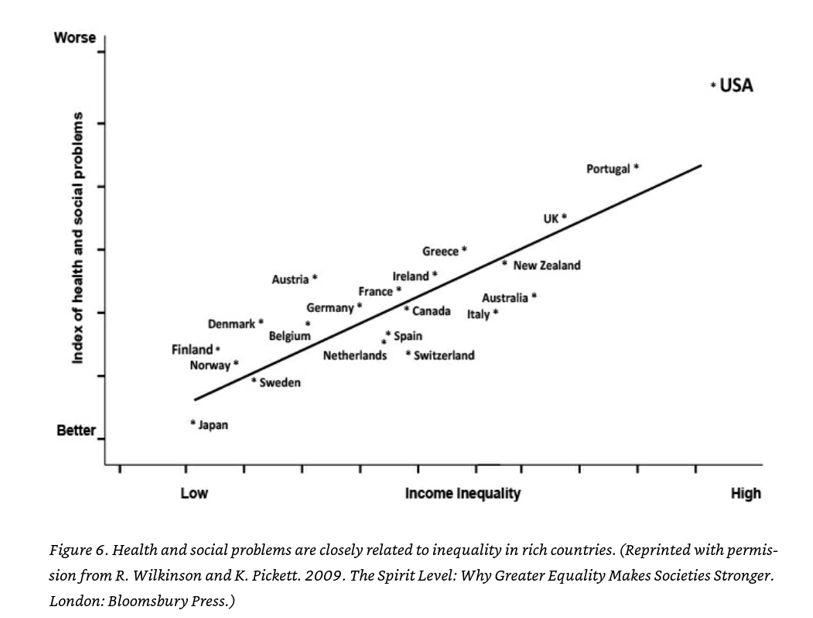
Author provides graphs demonstrating how poverty levels changes in USA over years, but somehow fails to note that it demonstrates dramatic decrease of poverty before the beginning of war on poverty after which poverty levels stop falling and mainly stabilized. Author also fails to note that the only age group for which poverty raised a bit in 1980s were people under 18 – those who become victims of family destruction, minimal wage limitations on their entry level employment, and war on drugs that often make them into unemployable criminals. Author’s suggested actions pretty much the same: more taxes, more regulation, more limitation on business.
- The Recent Evolution of Corporate Capitalism: A Contextual Approach to Policy Making; The Powell Memo; Capitalism from an Evolutionary Perspective; Increasing Materialism; Changing the Consequences for Corporate Practices; The Critical Role of Advocacy Organizations; A Comprehensive Strategy; Action Implications
Author’s discussion of evolution of corporate capitalism brings in somewhat famous Powell memo, which called for capitalists fight back against attacks by intelligentsia and bureaucracy on free markets and capitalism. Interestingly author admits that Powell’s concerns were well justified and business did become more active in self-defense resulting in cultural and psychological change in late 1980s and 90s in support of capitalism. Author also noted that evolution of capitalism in USA moved away from market to lobbying. Here how he defines his overall position:” I want to stress that this is not a critique of capitalism per se. The benefits of the evolutionary process that is capitalism are evident in all of the products and services that have evolved in the last two hundred years, including the computer on which I am writing this book. However, we need to evolve a system that retains the benefits of capitalism while also restraining its worst excesses.” Author also discusses and even somewhat laments increasing prevalence of materialism that he perceives as negative and somehow links it to conservatives and market rather than to leftists and government. The Action Implications per author are needs for more and better regulated advocacy groups.
Part 4: Evolving the Nurturing Society
In the last part of the book author:” pull all of this together to describe how we can use our accumulated scientific knowledge about human behavior to produce improvements in human well-being that go beyond anything ever achieved in human history. If that seems like hyperbole, remember how long it took to communicate with someone on the other side of the world in 1850—before science created telephone networks and the Internet.”
- In Caring Relationships with Others: Coercion: The Main Obstacle to Caring; Cultivating Forbearance and Forgiveness; Action Implications
In this chapter author links nurturing with caring relationships and then discusses what prevents or impedes caring relationships. Obviously, the main obstacle is coercion that author defines as:” There is no shortage of types of conflict and coercion: war, genocide, murder, harassment, bullying, cheating, child abuse, marital conflict, discriminatory behavior; the list goes on.” Somehow the type of coercion that author constantly calls for – government regulation and taxation did not make the list, which is kind of funny. Author then discusses evolutionary reasons for coercion and cooperation as tools of interaction and looks at costs of coercion for health and overall well-being of people. At the end of chapter author suggest measures to decrease levels of coercion in society.
- Evolving the Society, We Want: A Compelling Vision; Creative Epidemiology; Disseminating Evidence-Based Programs, Policies, and Practices; Creating a New Breed of Advocacy Organizations; Evolving a More Beneficial Form of Capitalism; Changing Popular Culture; Empowering Dramatic Cultural Change;
Author begins this chapter with somewhat utopian vision of 2042 and statement that such future is not only possible, but inevitable. He then proceeds describe how it could happen. The key words each subchapter are “WE”, “SHOULD”, and “POLICY”.
MY TAKE ON IT:
It is a very nice book by obviously a very nice person. It is also based on seemingly solid research in human behavior and dependency of individual behavior and well-being on surrounding environment, most importantly other humans and their attitudes to the individual. The book leaves no doubt that it would be much better if everybody were surrounded by nurturing environment from birth to death with no gaps in between. The only small problem that I have with all this is that it is kind of obvious. It is like saying that “Better to be healthy and wealthy than sick and poor”. To the author’s credit he is clearly trying to move beyond trivialities and provide recommendations as “Action implications” at the end of each chapter, but these implications mainly come down to similar points for everything:
- Coerce everybody to give us, scientists more money for research and experimentation(taxation)
- Coerce everybody to comply with our recommendations (regulation)
I just do not think that this is much helpful because there is no such thinking and feeling entity as government or corporations or businesses, but there are feeling and thinking human beings: politicians, bureaucrats, both governmental and corporate, seeking to maximize their material and psychological well-being, rich who are struggling to invest money for best returns and not to lose them in process, poor straggling to get more resources whether by working, getting benefits, stealing, or whatever. The mindset of putting all human individuals on one side and calling them “WE” is not productive and could not possibly lead to solution of any problem. The solution could come only from recognizing that all resource flows are between humans and all humans are self-interested, even if self-interest could be non-material feeling good about self. The simple example would be welfare bureaucrat. Would anybody think that giving magic wand to instantly eliminate all poverty a professional welfare bureaucrat would use it, making him/herself unemployed and pretty much unemployable since his/her decades of experience instantly devalued to null? I don’t think so. The solution could come only from restructuring system in such way that maximum of individuals would benefit from the change and minimum would be hurt, which pretty much exclude solutions based overwhelmingly on coercion, which actually means government regulations and interventions.
20210704 – On Deep History and the Brain

MAIN IDEA:
The main idea of this book is that traditional approach to history that includes accumulation of historical artifacts, their analysis, and consequential synthesis of the narrative of the past is not sufficient and should be supplemented, or maybe even supplanted by neurohistory that would be based on genetic, neurological, and biological analysis that would allow going back much deeper than any historical artifacts allow: not just a few thousand years, but millions of years, which would allow better understanding of humanity than ever before.
DETAILS:
Introduction: Toward Reunion in History
In introduction author defines meaning of deep history as history of humanity going back not just a few thousand years of known civilization, but way further back:” A deep history of humankind is any history that straddles this buffer zone, bundling the Paleolithic and the Neolithic together with the Postlithic-that is, with everything that has happened since the emergence of metal technology, writing, and cities some 5,500 years ago. The result is a seamless narrative that acknowledges edges the full chronology of the human past.” Author stresses that unlike other histories it would be based not only on archeological artifacts and written documents, but on everything that could be used including human DNA, traces of human impact on environment, human neurophysiology, but not evolutionary psychology that author consider not useful for understanding history. Author also stresses that history should start in Africa where contemporary humans came from.
1. The Grip of Sacred History
This chapter is pretty much dedicated to rejection of traditional history that explicitly or more often implicitly driven by biblical narrative, compressing history to narrow timeframe of a few thousand years and author diligently narrate how this was slowly rejected by emerging scientific evidence incorporated into the new ways of thinking developed by Enlightenment. Nevertheless, author believes that remnants of “sacred history” still remain and limit amounts of resources allocated to research of Paleolithic, the period of real beginning of human history.
2. Resistance
This chapter describes resistance to expansion of history deeper into the past and here is how author describes the problem of resistance:” What this genealogy indicates is that it was not the inertia of sacred history and the problems of plotting alone that have delayed the reception of humanity’s deep history. There was a certain degree of resistance, a lingering unwillingness to contemplate the dark abyss of time. Historians no longer think this way.’ But when resistance was active-when, in the late nineteenth and early twentieth centuries, some historians were alive to the implications of that abyss-the exclusion of the deep past was motivated by genuine intellectual doubts and uncertainties. Their resistance absolved solved historians of the need to read deeply in the paleoanthropological evidence. This resistance is now dormant, but its legacy-a few dutiful pages on the Paleolithic, a sense that this is not the province of history-continues to shape our texts and our curricula.” Author reviews discussion of deep past inclusion into history and how proceed about it when there are no traditional evidences such as texts or sufficient levels of artifacts going all the way back deep enough.
3. Between Darwin and Lamarck
Author starts here with another critic of “Whiggish histories” and its writers going back mainly to XIX century. He allocates quite a bit of space to metaphorical “seeds of civilization” then jumping from this to ontogeny and phylogeny, positing that “in the potential confusion between ontogeny and phylogeny, that a deep history has to take a stand in favor of phylogeny. An ontogeny necessarily begins at a point of conception or germination: in the narrative of sacred history, the Garden of Eden. In contrast, the deep history of humanity has no particular beginning and is certainly driving toward no particular end.” He then reviews history of Lamarck’s and Darwin’s ideas, noting that cultural evolution works pretty much on Lamarckian pattern and provides huge acceleration of human development. He then discusses literature on this subject and various theories of adaptation or maladaptation to environment resulting from interaction of random Darwinian change and directed Lamarckian change. Both these processes applied not only in human evolution, but also in evolution of animals that also have cultures. The huge difference, however, is that humans developed ability accumulate information outside of an individual brain via complex language and later variety of methods for information processing and accumulation from telling the stories, to using writing and computers with their infinite memory either in form of books or silicon chips. Author summarizes all this by saying that:” Examples discussed in this chapter suggest how some of the most important cultural achievements of the Postlithic era have been shaped by blind variation and selective retention.”
4. The New Neurohistory
Author begins this chapter by rejecting duality of mind and body often supported by argument that human mind is huge overkill for what is needed for relatively simple tasks of hunting and gathering. He makes very good point that there is no overkill if one considers complexity created by the need for survival in human group with its complex communications and relationships conducted using language and other complex signaling systems. Author then discusses emotions, their role and human interactions and their complex nature that combine universality of basic emotions with culture dependent specifics. Here how author applies idea of Neurohistory in this area:” A neurohistorical perspective on human history is built around the plasticity of the synapses that link a universal emotion, such as disgust, to a particular object or stimulus, a plasticity that allows culture to embed itself in physiology. By the same token, the universal capacity to feel disgust can be exploited in ways that are unique to a given culture.” Author also discusses here sociobiology and its use and/or misuse by many researchers that brought in their political attitude to support or reject ideas of combined evolutionary process with intertwining of genes and culture. Author completes this chapter by once again juxtaposing Neurohistory with traditional history:” Nevertheless, the perspectives of Neurohistory matter in the context of this book because they make it possible to see the brain as the narrative focus for a history that begins with early hominins and balances on the Neolithic era. This focus means we can construct a different historical narrative, one that does not have to depend on the framework of political organization, including the rise of the nation-state, that undergirds the grand narratives of general history. A neurohistory is a deep cultural history, offering a way out of the increasingly sterile presentism that constrains the historical imagination and contributes to the growing marginalization of early history in the curriculum. Our feet planted firmly in the deep past, we can look ahead with wonder at the ramifying cultural patterns, the wonderful life, that emerged as human neurophysiology interacted with the rapidly changing ecologies of the Postlithic era”.
5. Civilization and Psychotropy
Author begins this chapter by discussing neurochemicals, their functions, and how these functions could be impacting deep history. He then moves to cultural moderation of moods and behaviors referring to them as psychotropic mechanisms. He also expands it to consumer behavior. Author brings in dominance hierarchies, which he links to phylogeny based on their presence in behavior of our close relatives. Interestingly enough author discusses ideas of reverse hierarchy of hunter gathering societies when majority of weak easily suppressed a few strong. This was later turned around in agricultural societies and continues in form of variety of political dominance hierarchies to the present day. Author also discusses in details teletropic mechanisms used to influence behavior of people. These mechanisms include everything from drags to novels, gossip, and propaganda. He comes up with quite an interesting idea:” From the perspective of neurohistory, the progress of civilization is an illusion of Psychotropy. This argument is a deliberate rejoinder to other models of general or universal history that seek to offer explanations for history’s apparent direction.”
Epilogue: Looking Ahead
Author concludes this book by restating his believe that traditional history that he somewhat contemptuously refers as Western Civ is outdated and the new one should be developed. So here is the point:” I have suggested, in this book, that we add a neurohistorical perspective, with sets of tools and concepts that allow us to think about the historical implications of recent developments in neuroscience and human biology. This history is necessarily a deep one, since the genes responsible for building the autonomic nervous system are themselves of considerable antiquity. This history is also a world history, since the equipment is shared by all humans, though it is built, manipulated, and tweaked in different ways by different cultures. Finally, it is a history to which many of us can connect.”
MY TAKE ON IT:
I like idea of deep history a lot and I think that it already happening, but in forms quite different from what author presents in this book. I believe that recent developments in decoding DNA of fossils provides the great foundation for analysis of dynamic development of hominins and early humans as it was expressed in DNA changes over time and in different environments. DNA provides for understanding organism’s potential, but it is just a foundation. We now know that over lifetime of organism the process of living creates epigenetic changes, so it is not impossible that these changes also could be learned from the fossils. In short, I think that deep history probably has a great future, but we are at the very beginning of the road that may or may not lead to development of such deep history.
20210627 -Heaven on Earth

MAIN IDEA:
The main idea of this book is to review ideas of socialism and communism in their contemporary form starting with Gracchus Babeuf during French revolution, their implementation in various forms during XX century, their massive crash by the end of this century, and finally their partial resurrection in our time. The important and very interesting feature of this book is allocation of lots of space to individuals who created and promoted these ideas, their background, psychology, and behavior, all of which helps understand reasons for these ideas’ genesis and their attractiveness for some people.
DETAILS:
BEGINNINGS
1 Conspiracy of Equals: Babeuf plots a revolution
Author begins the story o socialism by describing celebration in 1911 the 151th anniversary of the birth of François-Noël Babeuf, who called himself Gracchus – the first murderer and martyr of contemporary socialist idea. Author notes that Babeuf was a natural product of the French revolution, which added to ideas of Enlightenment as they were imbedded in American revolution the idea of use government violence to enforce “equality”. Author retells the story of Babeuf’s conspiracy that included plans for mass terror even more expansive than Jacobins, failure of this conspiracy, and notes a very interesting feature of consequences: despite execution of Babeuf himself, other conspirators were treated with unusual compassion and get away much easier than other, non-ideological and non-socialist murderers. For the next two century this specific treatment of ideological killers was demonstrated great many times in various countries and circumstances. Practically all muss murdering dictators earlier in their careers were caught in treasonous and often murderous acts, tried in courts of law, lightly sentenced and later freed, only to kill huge numbers of people in the name of socialism when they got to power. The names are well known: Lenin, Stalin, Hitler, Castro, and quite a few of others.
2 New Harmony: Owen conducts an experiment
In this chapter author describes in details the history of attempt to implement socialism on voluntary basis as superior economic system that would provide much better returns on labor and assure prosperity for community founded on socialist principles. This attempt was conducted in America by rich British manufacturer Robert Owen who provided ideological and practical directions supported by generous financing. This experiment demonstrated, and very clearly indeed, that socialism, as economic system and foundation of society, fails miserably and could not be sustained on voluntary basis.
3 Scientific Socialism: Engels interprets the oracle
This chapter is about Marx and Engels, their somewhat host / parasite type of cooperation, and successful attempt to present ideas of socialism as science. Author describes their lives, activities, and the most important works. Author goes in a bit of details into Marx’s anti-Semitism and Engels’ business history, but concentrates mainly on their relationship as leader and sidekick, even if Engels was somewhat more effective writer and capable individual, albeit self-denigrated in relation to Marx. Author then describes a very interesting phenomenon of Marx work, especially Das Kapital becoming “scientific” foundation of revolutionary movement, even if hardly anybody actually read it, and those who did were unimpressed. Author then reviews history of this movement’s organizational forms from its inception as International in 1860 to transformation into national Social-Democratic parties all over the Europe by the end of XIX century. Unlike typical approach, author stress role of Engels:” But it was Engels who formulated and popularized Marxism and who launched the Marxist movement. He was Moses to Marx’s God, Mohammed to Marx’s Allah. He was the High Priest and Marx the Oracle. “Marx stood higher, saw farther,” said Engels. Perhaps he did. But it was Engels who told the world what Marx saw, spreading the message that shaped the history of the dawning century.”
4 What Is to Be Done? Bernstein develops doubts
In this chapter author completes history of socialism as at least somewhat legitimate scientific theory by reviewing history of early XX century when it became quite obvious that no socialist revolution in in the most developed countries is forthcoming, mainly because instead of pauperization of working class, predicted by Marx, that would lead to social explosion something quite opposite happened: formation of middle class that included most of high and middle qualified workers that enjoyed increasing prosperity consumption levels more and more comparable with consumption levels of business owners. This led to ideological crisis of socialism expressed in work of Bernstein. It divided socialist movement into 3 different ways: evolutionary socialism of social democrats that become dominant in democracies of Western Europe seeking political power via election in order move society to socialism by slowly shifting production to government-controlled hierarchies that would demonstrate socialism’s superiority over capitalism, unionist movement that become dominant in America seeking higher levels of redistribution of wealth generated within capitalist economy, and communist movement, which later become dominant in Russia, China, and Eastern Europe, seeking power by all means necessary in order to use this power without any ethical, moral, or humane considerations to impose socialism on people, in process physically eliminating everybody who happens to be on the way.
TRIUMPHS
In this part author reviews four cases of real-life implementation of socialist ideas during XX century all of them failing after causing tens of millions of deaths and unaccountable amount of pain and suffering.
5 Real Existing Socialism: Lenin seizes power
This chapter is about the most cruel and bloody form of socialism implemented by Lenin and Communist party on territory of Russian Empire that featured mass executions, concentration camps, mass starvation, and elimination of all and any individual freedoms developed during Enlightenment period of European history. It was probably the most consistent and logical implementation of ideas of public property on means of production when “public” meant the hierarchy of communist party functionaries, while “means of production” included just about everything, including bodies of individuals.
6 Fascism: Mussolini becomes a heretic
This chapter describes another and generally more humane form of socialism – fascism as it was implemented in Italy by Mussolini. The “taking overall control over means of production” in fascistic system is pretty much limited to subordination of businesses to direction from government without expropriation of private property. Fascism was generally satisfied with unchallenged political power via mass indoctrination and violent suppression of dissent, control over direction of country development usually meaning military development and aggression, and generally not interfered with day-to-day business activities, while promoting extensive welfare state. Author also briefly discusses another more virulent form of fascism – Nazis in Germany whose contribution was extreme form of racism and especially murderous anti-Semitism, but other than that it was not very different from Italian fascism in organization of society and its productive activities.
7 Social Democracy: Attlee takes the slow road
This chapter presents history of partial implementation of socialism in highly developed democratic state – UK. Unlike communism and fascism this form of socialism retained individual freedoms and democratic elections of leadership, limited by governmental interferes into great many areas of life. The key leader of this implementation was Clement Attlee and author allocates quite a bit of space to this personality. Author also discusses philosophical underpinning of this form of socialism that came from works of Sidney and Beatrice Webb and their movement: Fabians. Unlike fascism and communism, this form of socialism deprived of ability to use mass violence to stay in power, was very vulnerable to public opinion and consequently subject to defeat in democratic elections, which duly happened just five years after socialists took power.
8 Ujamaa: Nyerere forges a synthesis
The final example of implementation of socialism reviewed in this book is Ujamaa – authoritarian socialism implemented in Tanzania in 1960-70s by unusually uncorrupt African product of western educational system – Nyerere. As usual economically this form socialism as any other before it led to disaster, even if it received unusually high level of financial support from all sides of Cold War: Western government bureaucracies, Soviet, and Chinese communists. Here how author characterizes this support: “Never before had all the varieties of socialists—Swedish, Israeli, Chinese, East German, American, Cuban, British, Indian—converged so hopefully around a single national experiment. Yet such were the vicissitudes of the Cold War that the capitalist world did not turn its back on Tanzania either. Not only did the World Bank single out Tanzania for special generosity, but the flow of aid from the major Western powers—the United States, the United Kingdom, West Germany—resumed sooner or later after each rupture in relations. In all, Tanzania emerged from its declaration of self-reliance as Africa’s largest per capita recipient of foreign assistance.”
It is hard to imagine more beneficial opportunities for development, but socialism did what it does best: destroyed economy and made people poor and miserable.
COLLAPSE
9 Union Card: Gompers and Meany hear a different drummer
In this chapter author retells the story of American union movement, its leaders such as Samuel Gompers and George Meany, and their successful struggle against communism. These people correctly understood that communism means enslavement of working class rather than liberation. Author also looks at one of the most effective union fighters against communism – former socialist Jay Lovestone. Not all of American Union leaders were against communism and, with help of CIO leader John Lewis, communists did play a significant role in unions, but they had never been able to take unions completely over. At the end, even if by 1970s most of humanity lived under some form of socialism, it never took hold in America and as consequence eventually failed in most other countries.
10 Perestroika and Modernization: Deng and Gorbachev repeal communism
This chapter is about fall of communism in Soviet Union and its survival in greatly modified form in China. The key difference was in leadership, which in the Soviet Union consistent of men who grow up within communist system and somehow managed to believe its own propaganda about this system economic superiority and inherently humane character. Gorbachev and his team saw system saturated with lies and corruption, but believed that it was deviation from the true nature of the socialism and impediment to its effective working, so if one removes suppression and propaganda, the socialism’s advantages would become evident and their country hugely prosperous. Dan Xiaoping had no such illusions. He understood the true character of communism as corrupted system based on violence and had no hesitation in using massive violence to sustain this system. Dan also understood that economically socialism is complete failure, so political socialism needed economic capitalism to survive. Consequently, Dan masterly used the same policy as Lenin’s NEP on the international level and huge scale, assuring continuation of the system for another 50 years.
11 The Party of Business: Blair redefines social democracy
In this chapter author reviews the same period of “end of history” when socialism, as economic system, was discredited and pretty much abandoned, based on developments in Western Europe where old democratic socialist parties pretty much moved on to the welfare system, away from their old objective of government taking over means of production to objective of government taking bigger part of wealth produced by capitalist economy and partially controlling this economy via massive regulatory interference.
12 The Kibbutz Goes to Market
In this chapter author reviews the story of one and only known temporary successful socialist experiment – Israeli kibbutz. There are some very unique features that made it possible: strong socialist ideology of founders, external deadly thread, and urgent need for survival. Even so, this lasted at most for two generations after which economic inefficiency of socialism and its inhumanity expressed in constant subjugation of individual to collective made kibbutz economically uncompetitive and psychologically unacceptable for children and grandchildren of founders.
AFTERLIFE
13 Epilogue: Rising from the Ashes
The epilogue discusses current resurrection of socialism partially based on success of Chinese communist party in exploiting Western capitalist economies by providing cheap and politically suppressed labor combined with ecological neglect in exchange for technology and investment. It was hugely supported by ideological fervor developed within educational and intellectual areas of Western world when new generation deprived of knowledge of history became victims of government supported, highly credentialled, and parasitic elite promoting socialism.
MY TAKE ON IT:
This book is one of the most complete and detailed works on history of socialism as ideology and as expression of ideology of great many intellectuals of the last 200 years who developed this ideology as counterweight to capitalist system that they considered inhumane and exploratory. From my point of view, it is the natural development of humanity similar to development of other religious movement and based mainly on achievement of level of productivity when significant number of people could obtain resources from others without doing anything productive themselves. The wealth redistribution away from these others could be based only on combination of violence and propaganda that would support such organization of society that would suppress any resistance to redistribution.
The way it is done features convincing people that it is the most efficient way to proceed economically and eliminating or at least suppressing those who are not convincible enough. It is obviously quite effective ideology and its previous success proves this. However, the downside of this system’s being unworkable is unsurmountable barrier, which was demonstrated many times over. I think current resurrection is temporary and will go down crashing with failure of Chinese socialism that is going to happen as soon as western elite recognize that continuation of their support for China’s parasitic success could lead to their subordination to Chinese elite – the future they will definitely find unacceptable. The coming cutting off China from western investment, technology, and markets would probably cause elimination of communist rule and, with it the final nail in the coffin of “public ownership of means of production”. However, it would not eliminate idea of massive redistribution of wealth because with increase automatization fewer and fewer humans needed to produce all goods and services required so intellectuals who do not produce anything really required by anybody would continue coming up with variety of ideas justifying such redistribution.
20210620 – Mindset
MAIN IDEA:
The main idea of this book is that there are two different mindsets that people use in their lives that author calls Fixed and Growth. The fixed mindset means acceptance of one’s ability and options as given, unchangeable parameters, so one could achieve something only by using these abilities to maximum extent and even exaggerate them as needed to obtain something of value. The growth mindset means perceiving one’s abilities and options as work in process so one would take on the problems and challenges not only to resolve them, but to learn new staff, obtain new experiences and, consequently, expand both abilities and options. The idea is also includes convincing people that it is quite possible to change one’s mindset and use it to get better results in live.
DETAILS:
Chapter 1: The Mindset
Author starts with example of two different approaches to challenge: one is to work hard on it and learn, even if failed to overcome this challenge and another one is to look for confirmation of one’s ability to overcome or at least pretend overcoming challenge, with learning not even being included into consideration. She refers this difference to different attitudes to abilities, especially intellectual. The first one is result of believe that abilities are flexible enough to be developed via challenges and another one result of believe that it is rigidly given, could not be changed, and so challenge is just test of static abilities. Author then discusses nature/nurture and currently established understanding that it is both and any ability could be expanded continuously through lifetime. She then refers to 30 years of her research to define growth mindset:” growth mindset is based on the belief that your basic qualities are things you can cultivate through your efforts, your strategies, and help from others. Although people may differ in every which way—in their initial talents and aptitudes, interests, or temperaments—everyone can change and grow through application and experience.” Author then compares it with fixed mindset, which causes people direct efforts to defend their perceived ability rather than expand the real one.
Chapter 2: Inside the Mindsets
Here author defines mindset as individual’s approach to his/her ability with one of:” two meanings to ability, not one: a fixed ability that needs to be proven, and a changeable ability that can be developed through learning.” Author then describes a number of experiments demonstrating different mindsets in action:” People with both mindsets came into our brain-wave lab at Columbia. As they answered hard questions and got feedback, we were curious about when their brain waves would show them to be interested and attentive. People with a fixed mindset were only interested when the feedback reflected on their ability. Their brain waves showed them paying close attention when they were told whether their answers were right or wrong. But when they were presented with information that could help them learn, there was no sign of interest. Even when they’d gotten an answer wrong, they were not interested in learning what the right answer was. Only people with a growth mindset paid close attention to information that could stretch their knowledge. Only for them was learning a priority. What’s Your Priority?” Author then provides a number of anecdotes illustrating her points. She also uses them to demonstrate that mindset itself is flexible and could be changed. She then discusses how mindset changes meaning of effort, and link to depression. At the end of chapter author summarizes it all in specific advice.
Chapter 3: The Truth About Ability and Accomplishment
In this chapter author links mindset to success in education, overall achievement and provides this summary:” The fixed mindset limits achievement. It fills people’s minds with interfering thoughts, it makes effort disagreeable, and it leads to inferior learning strategies. What’s more, it makes other people into judges instead of allies. Whether we’re talking about Darwin or college students, important achievements require a clear focus, all-out effort, and a bottomless trunk full of strategies. Plus, allies in learning. This is what the growth mindset gives people, and that’s why it helps their abilities grow and bear fruit.” Author also discusses danger of undeserved praise and talent recognition instead of effort recognition. One interesting finding is about extent to which people with fixed mindset would go to defend their status:” almost 40 percent of the ability-praised students lied about their scores? And always in one direction. In the fixed mindset, imperfections are shameful—especially if you’re talented—so they lied them away.”
Chapter 4: Sports: The Mindset of a Champion
Here author applies her ideas about mindset to sports. Unsurprisingly she concludes that ideas of “natural” could not stand scrutiny. She also discusses idea of character, that she believes mainly related to mindset, the same as everything else. She presents a number of stories about sport and then defines her sport related findings:”
Finding #1: Those with the growth mindset found success in doing their best, in learning and improving. And this is exactly what we find in the champions.
Finding #2: Those with the growth mindset found setbacks motivating. They’re informative. They’re a wake-up call.
Finding #3: People with the growth mindset in sports (as in pre-med chemistry) took charge of the processes that bring success—and that maintain it.
Chapter 5: Business: Mindset and Leadership
Here author applies the same approach to business revieing Enron, successful companies per book “Good to Great”, and a bunch of other cases and studies with final inference that one should applies point of view of growth mindset to be successful.
Chapter 6: Relationships: Mindsets in Love (or Not)
This is similar application of mindset approach to area of personal relationships and love with similar call to use growth mindset in order to be happy.
Chapter 7: Parents, Teachers, and Coaches: Where Do Mindsets Come From?
This chapter a bit different from the previous three, it not that much promotes growth mindset as discusses how to get it either individually or transfer it to children. The outcome depends on key message and that’s how author defines it:” It can be a fixed-mindset message that says: You have permanent traits and I’m judging them. Or it can be a growth-mindset message that says: You are a developing person and I am committed to your development.” Author goes into great many specifics and also provides an interesting point about potential misunderstandings:
Misunderstanding #1. Many people take what they like about themselves and call it a “growth mindset.”
Misunderstanding #2. Many people believe that a growth mindset is only about effort, especially praising effort.
Misunderstanding #3. A growth mindset equals telling kids they can do anything.
She then explains in details why it is so and at the end provides recommendations on how to handle this.
Chapter 8: Changing Mindsets
The final chapter provides recommendations on how to change one’s own mindset. It starts with discussion on difficulty of change. Author specifically mentions the cognitive therapy as tool that could be used to achieve change in mindset and then suggests other approaches: lectures and workshops. She also discusses various barriers to change, both internal and external. Finally, author provides graphic representation of mindsets:

MY TAKE ON IT:
This is an interesting combination of psychological observations, research, and self-help that nevertheless demonstrates an interesting point – high level of dependency of life’s outcomes on internal condition of individual’s mind – mindset. I pretty much agree that it makes lots of sense to have “growth” approach, embrace challenges and learn from failures. Actually, it is the only way if one wants to get out of some situation and improve one’s lot. However, it is not that simple to act this way in real world. In this world people are highly dependent on external estimates of their abilities rather than on real abilities, leave alone potential level of these abilities, so lots of effort has to be directed at improvement of presentation, rather that improvement of intrinsic qualities. I think that in reality growth mindset is only possible when external pressures are minimized and whatever actions one applies are driven by internal motivation. In this case the failure becomes impossibility because as long as one progresses the success is guaranteed. It is not the case when there are external pressures and competition that shift motivation from progressing to winning. In this case the fixed mindset could work better because it would help avoid overreach resulting in failure. In competition one should only be better than competitors, not the best one can be. Similarly for external evaluation one should only meet evaluation criteria, however meaningless it could be, rather than strive for real achievement.
20210613 – Qestioning Collapse

MAIN IDEA:
The main idea of this book is to give voice to real specialists and scientists working in ecology, archeology, and history to respond to popular, but often unfounded and speculative narratives that twist history so to scare people out of their wits by future ecological, climate, population, and other disasters that will be inevitable if people not immediately change their ways. The title of this book refers to Jared Diamond’s book “Collapse” – a very popular representation of genre: “you and your children are going to die tomorrow from hunger / overpopulation / global cooling / global warming / climate change… if you would not agree to live in misery without energy and transportation right now because such catastrophes happened before.” These real scientists and specialists explain what they know about events in the past used currently to scare people and generally present much more reasonable and realistic picture that demonstrate human ability to handle successfully all kinds of potential dangers either ecological, or climatic, or societal.
DETAILS:
1 Why We Question Collapse and Study Human Resilience, Ecological
Vulnerability, and the Aftermath of Empire
This is very nice explanation of reasons for this book and here is authors’ summary:” When closely examined, the overriding human story is one of survival and regeneration. Certainly, crises existed, political forms changed, and landscapes were altered, but rarely did societies collapse in an absolute and apocalyptic sense. Even the examples of societal collapse often touted in the media – Rapa Nui (Easter Island), Norse Greenland, Puebloan U.S. Southwest, and the Maya Lowlands – are also cases of societal resilience when examined carefully, as authors do in the chapters in this book. Popular writers’ tendency to approach the past in terms of a series of societal failures or collapses – while understandable in terms of providing drama and mystery – falls apart in light of the information and fresh perspectives presented in this book.” … “The notion of resilience, instead of collapse, is relevant to the chapters of this book because, on close inspection of archaeological evidence, documentary records, or both, it becomes clear that human resilience is the rule rather than the exception.
They also provide map of areas under discussion in this book:”

Part I. Human Resilience and Ecological Vulnerability
2 Ecological Catastrophe, Collapse, and the Myth of “Ecocide” on Rapa Nui
(Easter Island)
This chapter is about “Collapse” of generally isolated society supposedly due to stupidity of its people who used all trees to manufacture and transport idols leading to ecological disaster. Here is how author characterize what really happened:” It is essential to disentangle environmental changes in Rapa Nui from a population collapse that resulted from European contact. Such contact brought Old World diseases and slave trading. Contrary to today’s popular narratives, ancient deforestation was not the cause of population collapse. If we are to apply a modern term to the tragedy of Rapa Nui, it is not ecocide, but genocide.”
Authors proceed to discuss real ecology of the island, types of trees that exists, reasons for deforestation that in reality linked not to the human stupidity, but rather to rat’s population that arrived around 1200 and changed ecology by feeding on palm seeds. The deforestation led to expansion of grasslands and humans successfully adjusted and seems to be doing well. They could not however adjust to conquest by other humans, which did cause humanitarian disaster. Here is quite explanatory population graph:

3 Did the Medieval Norse Society in Greenland Really Fail?
This chapter is about small society on the island with very unfriendly climate that nevertheless lasted from 982 c.e. until the end of fifteen century. Author of this chapter points out very obvious, but somehow missed point that society that endured for more than 500 years could not be called failed. Author discusses in details relations between Norse and Inuit, which sometimes were hostile and sometimes cooperative. Author then describes evidence of successful adjustment to environment, but notes that eventual cooling was a factor, but not exclusive for Norse moving away. Since Norse maintained active connection with Europe, the emigration was a viable solution for increasing difficulties. Therefore, it was not collapse, but rather relocation to better pastures away from cold Island.
4 Calamities without Collapse: Environment, Economy, and Society in
China, ca. 1800-1949
This chapter is about China’s 100 years of humiliation, but it could not be called collapse by any means. It was rather lack of advancement that put China into position far behind European countries in XIX and XX centuries. The chapter reviews both geographical and institutional situation and finds that part of the problem was fast growth of population that was not handled well because none of 4 measures that could help handle this were successfully applied. These measures are:
- Deliberate population control
- Increased rural nonagricultural employment
- Urbanization
- Increasing cultivated area, either through conquest or by reclaiming unfarmed land within current borders.
The biggest civil war in history – Taiping Rebellion that killed around 20 million people did not help to solve these problems, but rather delayed return to normalcy. Similarly foreign invasion of WWII and following on communist takeover were not helpful either. China obviously did not collapse and it is not going to, but, despite rapid development over the last 30 years based on some limited openness to capitalism, massive Western wealth and knowledge transfer resulting in China’s economic growth the disastrous problems could reoccur as long as communists are in power and therefore country’s economy and overall life is still subject to catastrophic top-down decisions by functionaries isolated from consequences of their decisions. Specifically, author concentrates on environmental impact of massive industrial development.
Part II. Surviving Collapse: Studies of Societal Regeneration
5 Marketing Conquest and the Vanishing Indian: An Indigenous Response
to Jared Diamond’s Archaeology of the American Southwest
This chapter is presented by writer of Amerindian descent who quite convincingly demonstrates that local population had been successful in managing ecology of its environment and, contrary to opinion of “collapse” promoters, it did not fail until conquest by Europeans who had no clue about local environment, but had plenty of power to impose unworkable solutions. Here is the main point of argument:” My criticisms are not simply of Jared Diamond himself, but of those who explain global inequalities and poverty among the have-nots – who have no cargo – as inevitable and portray have-nots as powerless victims of impersonal forces. As a reader, I cannot be held responsible for military encounters 500 years ago. But as an archaeologist I am responsible for understanding how the work I create can take on a life of its own and be interpreted as a collective explanation for Indigenous “failures” – failures that seem to justify colonization and the replacement and removal of Indian Peoples.”
6 Bellicose Rulers and Climatological Peril? Retrofitting Twenty-First-Century Woes on Eighth-Century Maya Society
Authors of this chapter systematically reviewed all scenarios that supposedly led to “collapse” of Maya society:
- Escalating warfare
- Out-of-control population growth
- Environmental degradation
- Drought
- Effectiveness of divine rulership
- Changes in spheres of trade and influence.
They pretty much conclude that none of this was something extraordinary and anywhere beyond similar events in European or Asian history. They make important point that there is no evidence of sudden collapse and plenty of evidence of slow history change not that different from changes that occurred elsewhere and that Maya people still around in their millions. They also warn that:” The past can inform us and often guide us toward a better future, but the mirror of ancient Maya society should not be refracted in hopes of inducing change in the contemporary world, no matter how badly change might be needed.”
7 Collapse in Ancient Mesopotamia: What Happened, What Didn’t
This chapter is direct response to Jared Diamond three claims about Mesopotamia:
- Collapse due to the drought cycles
- Salinization
- Soil nutrient exhaustion
As others in this book author of this chapter states:” Let me anticipate my conclusion: if collapse, in Diamond’s words, is “a dramatic decrease in human population and/or political/economic/social complexity, over a considerable area, for an extended time,” we can’t find any such collapse in Mesopotamia or, indeed, anywhere else among ancient states!” Author then proceeds to describe Assyrian history, which does not show any sudden collapse, and notes that this people, as great many other ancient people are still around.
Part III. Societies in the Aftermath of Empire
8 Advanced Andeans and Backward Europeans: Structure and Agency in
the Collapse of the Inca Empire
This chapter is about Spanish conquest of Inca Empire. As usual the legend of a few hundred conquistadors overcoming an Empire with millions of people is greatly inaccurate. In reality there was an ongoing civil war and Spaniards just benefited from it by aligning with some groups against others. Moreover, conquest was not a momentous event, but the process lasting for decades when areas under control of different powers changed hands. A very interesting fact is that during this process the mixing of people occurred, so by the time of complete establishment of Spanish rule lots of people were descendants of both: Incas and Spaniards. Author goes into great many details of what Diamond got wrong with one of them being highly representative: believe that Incas were illiterate. By now it is well established fact that they had knotted cord recording of information, meaning they just had different technology, which does not mean it was inferior. Even germs were not as devastating as usually perceived:” Germs also cut a swathe through highland populations, though demographic recovery there came sooner. Be that as it may, indigenous population numbers did not recover until the eighteenth century, in contrast to Mexico, where indigenous populations had recovered by the early sixteenth century despite epidemic-driven demographic decline having been even more devastating than in the Andes. In both Mexico and the Andes, the invasion of germs had run its course by 1600, or at least swept aside European and native Andean alike.” The final and very important point author makes in his verdict, which provides much more realistic picture than usually presented:” colonial hegemony depends on collaborating elites in order to control and exploit indigenous underclasses. During the three centuries after Cajamarca, an Inca nobility in the old capital of Cuzco provided unconditional support for the Crown of Castile.”
9 Rwandan Genocide: Toward an Explanation in Which History and
Culture Matter
This chapter is about contemporary event of genocide, which Diamond presented as consequence of Malthusian fight for arable land. Author of this chapter spent decades in Rwanda and presents somewhat different picture of cultural, ethnic, and political struggle for dominance. True it had roots in colonial politics when Tutsi were elite collaborating with colonial powers and then after being overthrown by Hutu revolution in 1962 become persecuted minority. The genocide in Rwanda was result of these complex politico-cultural developments not that different from developments in Germany in 1930s or Russia in 1920s that produced similar mass murder, but in none of these cases it was result of Malthusian food fight.
10 “Failed” States, Societal “Collapse,” and Ecological “Disaster”: A Haitian
Lesson on Grand Theory
This chapter is provided by specialist in Haiti and once again demonstrates inapplicability of environmental determinism to real live developments. Similarly to Diamond author uses comparison of Haiti and Dominican Republic to “illustrate the pitfalls of privileging grand theory as “the” way to encompass social scientific knowledge about and understanding of some facet of the human spectacle. Doing so denies anthropologists, as well as policymakers and the general public, an opportunity to explore connections among culture, history, and ecology.” Here is framework for comparison:

Author then goes through each point demonstrating that:” Diamond’s comparison deploys questionable descriptive and analytical maneuvers. Factual errors about historical events, cultural attributes, or socioeconomic and political processes, although numerous and alarming to specialists, need not detain us. More important is Diamond’s penchant for reporting decontextualized facts and extrapolating their significance.”
At the end of article author concludes:” “Failed” state, societal “collapse,” and ecological “disaster” may be serviceable concepts for grand theory as well as catchy terms for media coverage. Are they useful for understanding Haiti’s compound crisis, its many and many-sided problems? No, if one considers failure, collapse, and disaster fixed and incontrovertible end points. No, if one contends that Haitians, leaders and followers, “chose” crisis and problems. No, if the concepts and terms are deemed self-explanatory and treated as rationales for inaction or for humanitarian assistance as the only form that action may take. But yes, if the concepts and terms prompt careful, methodologically sound investigation of Haitian realities, present and past. In Haiti, as elsewhere, these realities include how the facts about one nation-state are forged in the crucible of struggles, within that nation-state and in its relations with other nation-states, over the proper uses of power to achieve and sustain prosperity.”
11 The Power of the Past: Environment, Aborigines, Archaeology, and a
Sustainable Australian Society
This chapter about Australia mostly corroborate criticism of previous chapters. Probably the most interesting part is about Tasmania where according to Diamond’s narrative based on colonial records isolated people lost knowledge and skills they possessed before and where on the brink of extinction. Author claims that:” Fortunately our stock of both archaeological and historical evidence about the first forty-five years of European occupation of Tasmania further strengthens the argument against regression, which was a provocative idea about the consequences of isolation that had flowed from early research in the 1970s. These ideas have now been comprehensively refuted or at the very least seriously questioned.”
12 Excusing the Haves and Blaming the Have-Nots in the Telling of
History
Authors of this chapter also reject Diamond’s approach and stress that:” Anthropology urges us – and helps us – to examine our own taken-for-granted ideas about why and how people act: our ideas about human nature, about the causes and objectives of human action, about the ways people intend one thing to follow from another, about how and why people engage in collective action. We must recognize that not everyone in the world has the same objectives as (many) contemporary Americans, wanting and seeking the same sorts of things as we do. This is to say, we must be aware of historical and cultural context.” They dig a bit into history of Papua New Guinea and specifically people who prompted Diamond’s book and stress difference in values and approaches to the problems of people with different cultural background, which makes great many of assumptions invalid.
Part IV. Reflections on Sustainability
13 Sustainable Survival
The final chapter kind of summarizes Jared Diamond’s thesis of projecting variety of historical “collapses” into our current situation in search of support for alarmist movements whether they are “climate change”, “population bomb” or whatever else people come up with to get money and power by scaring others out of their wits. Author also very briefly summarizes responses to this thesis from real scientists, which studied history and in some cases actually observed referred “collapses”, demonstrating quite clearly that in reality it was quite different and in most cases “collapses” where just “changes” with which humans normally quite capable of handling. Here is conclusion, stated around fossil fuels, that I think very appropriate:” Fossil fuels function as an Ethiopian highland for the modern world: they represent an enormous subsidy, not from a distant place, but from a distant time, the carboniferous era. They make it possible for 6.5 billion people to eat. Fossil fuels are the fertilizer of modern agriculture. They pump up groundwater and power tractors. They serve as the feedstocks for pesticides and herbicides. They make nitrogenous fertilizers practical. And they power the vehicles that move crops to kitchens. They sustain us. ..
Our ways are radically unsustainable. Diamond is right to be concerned by that. He is right to prefer hope to despair, and admirable in that he has used his fame to draw attention to issues of sustainability. But he is, as often as not, wrong in his judgments about successes and failures among societies of the past.”
MY TAKE ON IT:
I am really glad that a number of real scientists and historians found courage to publish this book convincingly demonstrating something that I strongly believe in: humans are quite capable to handle infinite variety of challenges by accommodating to changing environment using their big brains. They do it not by creating religions and making sacrifices but rather finding technological solutions and sometimes making accommodations such as relocation from places with deteriorating ecology to places better fit for human life. There is huge number of such changes in human history from invention of clothing and use of fire to creating sewer systems that allow huge number of people to live in very limited city spaces and inventing elevators that allow situate people on the top of each other on hundreds of floors. The change is inevitable and will probably never stop, but it should be done calmly with effective cost/benefit analysis, and without panic, hysterical pronunciations, and massive use of government power. One should always be aware that there are con people and politicians who try to create panic and fear in order to increase their wealth and power to extent that would be absolutely impossible to achieve without scaring people.
20210606 – Intelligence Trap

MAIN IDEA:
Author defines the main idea of this book as to look at and find answers for the following questions:” Why do smart people act stupidly? What skills and dispositions are they missing that can explain these mistakes? And how can we cultivate those qualities to protect us from those errors? “
DETAILS:
Introduction
Author begins his introduction with the story of Kary Mullis Nobel prized scientist who promotes all kind of crazy staff on internet. From here author goes to his discovery that:” Intelligent and educated people are less likely to learn from their mistakes, for instance, or take advice from others. And when they do err, they are better able to build elaborate arguments to justify their reasoning, meaning that they become more and more dogmatic in their views. Worse still, they appear to have a bigger “bias blind spot,” meaning they are less able to recognize the holes in their logic.” Author believe that it is result of what he calls “Intelligence Trap” – tendency of highly intelligent people to overestimate their knowledge and understanding.
Part I-The downsides of intelligence: How a high IQ. education. and expertise can fuel stupidity
This Part “defines the problem. It explores the flaws in our understanding of intelligence and the ways that even the brightest minds can backfire—from Arthur Conan Doyle’s dogged beliefs in fairies to the FBI’s flawed investigation into the Madrid bombings of 2004—and the reasons that knowledge and expertise only exaggerate those errors.”
1: The rise and fall of the Termites: What intelligence is—and what it is not
Author begins this chapter with the story of Termites – the group of children selected for observation and study because of their exceptionally high IQ by Lewis Terman. Author then discusses IQ tests, types of questions used, theory of general intelligence and multitude of its use. After that author refer to high IQ study results that demonstrated relatively high, but not especially outstanding life achievements of extremely high IQ individuals. Author also discusses Flynn Effect that demonstrated changes in average population IQ over the time. Author also discusses here “Triarchic Theory of Successful Intelligence, which examines three particular types of intelligence—practical, analytical, and creative—that can together influence decision making in a diverse range of cultures and situations.”. Author then provides an interesting definition of intelligence by Sternberg: “the ability to achieve success in life, according to one’s personal standards, within one’s sociocultural context.” Author describes results of Steinberg’s research, some of which demonstrated ability to predict outcome of business projects based on tests of participants. Author also discusses later addition of Cultural Intelligence that allow people with different backgrounds to cooperate.
2: Entangled arguments: The dangers of “dysrationalia”
Author begins this chapter with another story of highly intelligent person falling into irrational exuberance: Artur Conan Doyle and spiritualism. Author also refers to sceptic Harry Houdini who: “intuitively understood the vulnerability of the intelligent mind. “As a rule, I have found that the greater brain a man has, and the better he is educated, the easier it has been to mystify him”. Author then proceeds to discuss work of Kahneman and Tversky on cognition and then defines term “dysrationalia” – mix of biases and heuristics that causes people make illogical decisions. This follows by discussion of some statistical notions and formal logic tools. Author presents some very interesting examples of lower practical abilities of high IQ individuals such as:” Around 14 percent of people with an IQ of 140 had reached their credit limit, compared to 8.3 percent of people with an average IQ of 100. Nor were they any more likely to put money away in long-term investments or savings; their accumulated wealth each year was just a tiny fraction greater.” Another very interesting point author makes about biases is that higher level of knowledge and education actually increases bias because it provides more ammunition to defend them. Here is nice illustration:
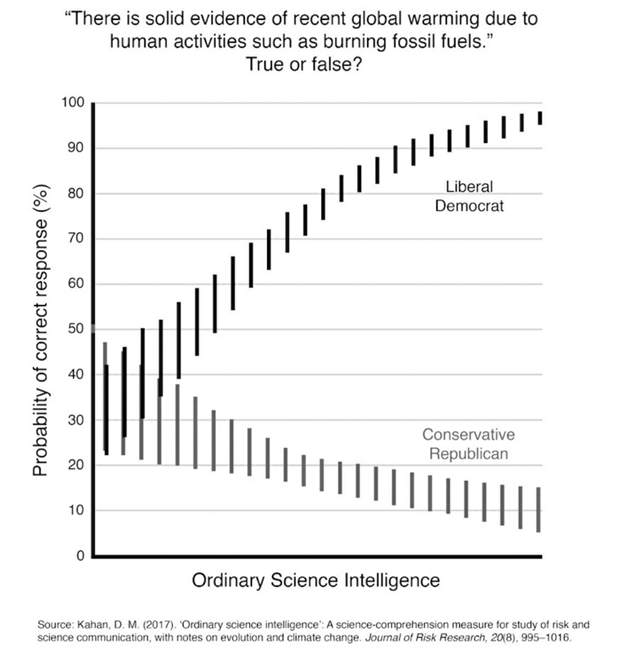
Author concludes this chapter by sumarizing: “We have now seen three broad reasons why an intelligent person may act stupidly. They may lack elements of creative or practical intelligence that are essential for dealing with life’s challenges; they may suffer from “dysrationalia,” using biased intuitive judgments to make decisions; and they may use their intelligence to dismiss any evidence that contradicts their views thanks to motivated reasoning.”
3: The curse of knowledge: The beauty and fragility of the expert mind
Here author retells the story of false identification individual as terrorist based on poorly analyzed partial fingerprint. Based on this story author presents his list of potential intelligence trap forms:

Part 2 – Escaping the intelligence trap: A toolkit for reasoning and decision making
This Part “presents solutions to these problems by introducing the new discipline of “evidence-based wisdom,” which outlines those other thinking dispositions and cognitive abilities that are crucial for good reasoning, while also offering some practical techniques to cultivate them. Along the way, we will discover why our intuitions often fail and the ways we can correct those errors to fine-tune our instincts. We will also explore strategies to avoid misinformation and fake news, so that we can be sure that our choices are based on solid evidence rather than wishful thinking.”
4: Moral algebra: Toward the science of evidence-based wisdom
In this chapter author refers to Ben Franklin to demonstrate workings of specific type of mindset that author calls “evidence-based wisdom”. He provides as example this idea:” The idea that “I am wise because I know that I know nothing” may have become something of a cliché, but it is still rather remarkable that qualities such as your intellectual humility and capacity to understand other people’s points of view may predict your well-being better than your actual intelligence.” After that author makes point that this mindset is not given, but rather could be developed and describes results of supporting experiments. Author also refer to works of Tetlock and his “Good Judgement project”. At the end of chapter author discusses cultural differences between West and East – one tending overestimate and another underestimate own ability and even height.
5: Your emotional compass: The power of self-reflection
Here author looks at another specific problem:” The problem is that most people—including those with high general intelligence, education, and professional expertise—lack the adequate self-reflection to interpret the valuable signals correctly and identify the cues that are going to lead them astray. According to the research, bias doesn’t come from intuitions and emotions per se, but from an inability to recognize those feelings for what they really are and override them when necessary; we then use our intelligence and knowledge to justify erroneous judgments made on the basis of them”.
Author then refers to work of Damasio and Barrett on unity of intellectual and emotional processing that demonstrate how much more complex is human behavior and achievement that could be expected from IQ driven approach. At the end of chapter author provides a very interesting graph of expertise levels:
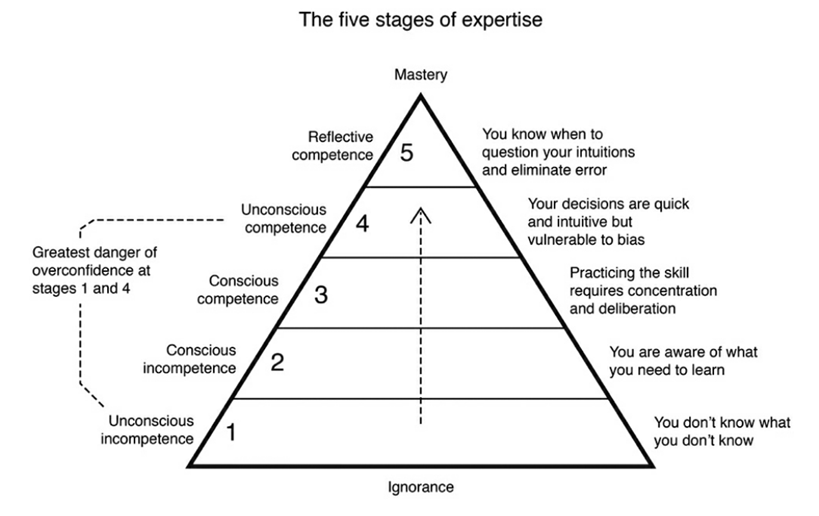
6: A bullshit detection kit: How to recognize lies and misinformation
Here author presents quite a few examples of BS and then provides a nice compilation of BS indicators:

Part 3—The art of successful learning: How evidence-based wisdom can improve your memory
This Part:” turns to the science of learning and memory. Despite their brainpower, intelligent people sometimes struggle to learn well, reaching a kind of plateau in their abilities that fails to reflect their potential. Evidence-based wisdom can help to break that vicious cycle, offering three rules for deep learning. Besides helping us to meet our own personal goals, this cutting-edge research also explains why East Asian education systems are already so successful at applying these principles, and the lessons that Western schooling can learn from them to produce better learners and wiser thinkers.
7: Tortoises and hares: Why smart people fail to learn
In this chapter author returns to super high IQ Termites and compares them with Richard Feynman who had decent but not outstanding IQ of 120, but achieved a lot more that Termites with IQ 190 and discusses reasons for such occurrence. He then presents rules of behavior that lead to scientific success:
- I actively seek as much new information as I can in new situations.
- Everywhere I go, I am out looking for new things or experiences.
- I am the kind of person who embraces unfamiliar people, events and places.
He also provides a list of believes that impede success:
- A failure to perform well at the task at hand will reflect your overall self-worth?
- Learning a new, unfamiliar task puts you at risk of embarrassment?
- Effort is only for the incompetent?
- You are too smart to try hard?
8: The benefits of eating bitter: East Asian education and the three principles of deep learning
Author begins this chapter by contrasting Western and Eastern approach to education as demonstrated by teacher’s choice of the student for interaction before class. Former approach calls for choosing the best student in order to demonstrate how easy it is, while latter would choose the one who is falling behind in order to demonstrate that with hard work result the positive result is achievable. Author then presents three stages of good teaching as defined by research into the process:

Author also present similarly developed effective approaches to learning:
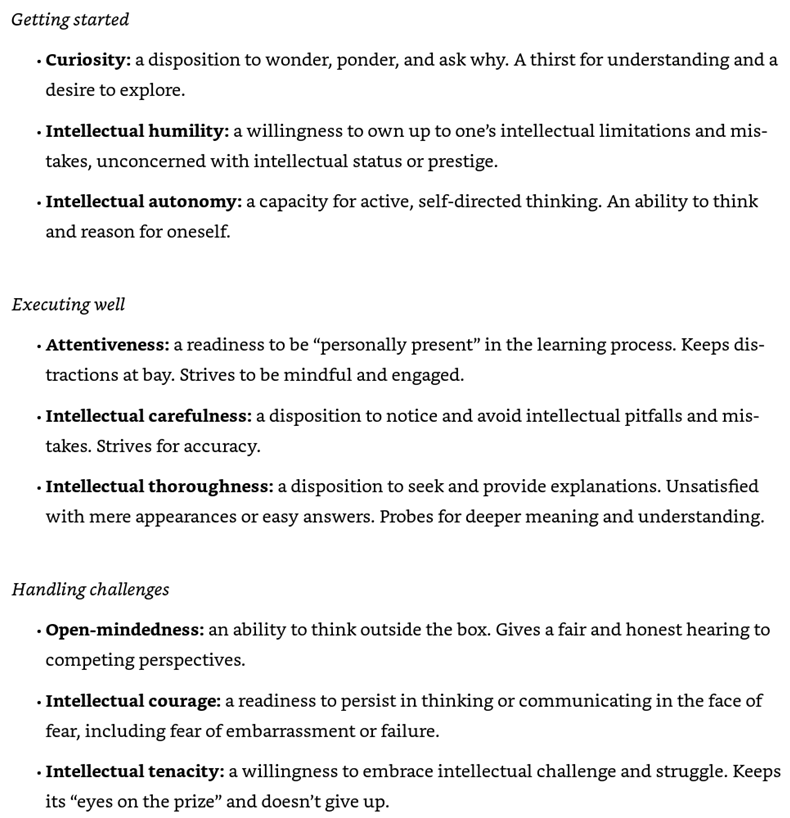
Part 4—The folly and wisdom of the crowd: How teams and organizations can avoid the intelligence trap
“Finally, Part 4 expands our focus beyond the individual, to explore the reasons that talented groups act stupidly—from the failings of the England football team to the crises of huge organizations like BP, Nokia, and NASA.”
9: The makings of a “dream team”: How to build a supergroup
This chapter begins with a few stories of failure of seemingly superior sports teams and then expanded to political and business teams. From there author moves to describing the latest research on group dynamics. This research concentrated on 4 tasks:” generating new ideas; choosing a solution based on sound judgment; negotiating to reach compromise; and finally, general ability at task execution (such as coordinating movements and activities).” The interesting findings were that quality of thinking was correlated across the tasks, and not that much correlated with IQ of group members. The most important was member’s social sensitivity and most destructive intragroup competition. Author expands on it and concludes that the team of stars oftentimes fail. Here is the graph based on sports example:
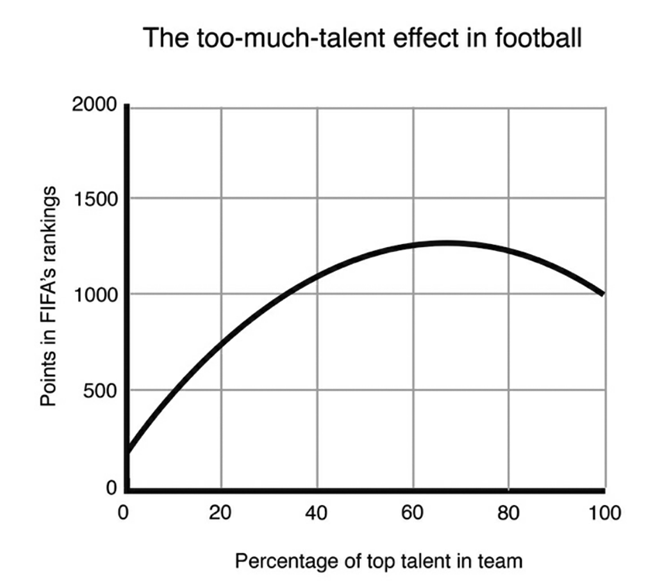
10: Stupidity spreading like wildfire: Why disasters occur—and how to stop them
In the last chapter author analyses large scale disasters, which in reality do not really happen without warning. The typical sequence is: large number of near disaster accidents that were ignored until some unlucky circumstances made it happen. After that author looks at internal dynamics and refer to “functional stupidity” ideas when group dynamics make it beneficial for highly intelligent people behave stupidly. Author retells some stories of real disasters and then provides the list of characteristics of high-reliability organizations:
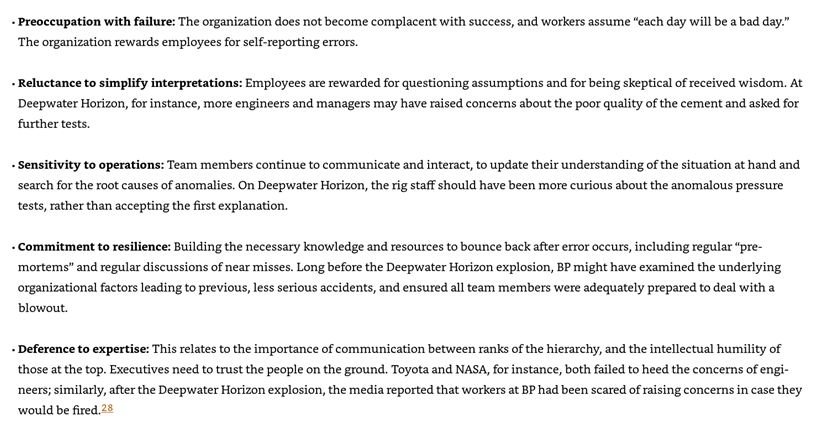
Epilogue
At the end author returns to Flynn and his discovery of consistent IQ increase and stresses that it is not really that important. Much more important is wisdom and author refer to work of Chicago Center for Practical Wisdom which is doing research to find out how it really works.
MY TAKE ON IT:
It is quite interesting compilation of research descriptions and real-life cases demonstrating how much IQ and other similar testing procedures are overestimated as tools for predicting future performance of individuals and groups. I very much agree with this conclusion, but I always wonder why people so often forget reasons for existence of all this staff. It is not a coincidence that it was developed at the end of XIX century when traditional believes in God directed birthright selection of leaders and rulers became painfully obvious as being ineffective and increasingly pushed aside by pressure from raising middle and upper classes of capitalist society’s members self-selected for top positions via talent, hard work, and luck. This self-selection worked wonderfully at the business level, but was deemed inappropriate and cumbersome for government and big corporation. IQ, other testing, and credentialing was the response to demand to find methods quickly and cheaply identify who is good for what. I think it is time to outgrow this primitive approach for two important reasons: first it does not really work, and the second it is not really needed because AI driven computers would beat any human being hands down in this game similarly to century ago when the earliest steam engine would beat hands down any human runner. It would probably not be possible to remove until humanity still continue to be organized mainly in hierarchical order of big government and big corporation, but if humanity eventually moves away from hierarchy to different forms of organization of society, for instance as conglomeration of free agents in possession of clearly defined and sufficient resources (ownership society) voluntary coordinating their efforts in achieving some objectives, then testing and credentialing would become obsolete and takes its place in museum somewhere between Zeus worshipping paraphernalia and socialist/communist tractates on future society organization.
The last thing I want to note is author’s hilarious demonstration of the same high IQ stupidity when using global warming QA:
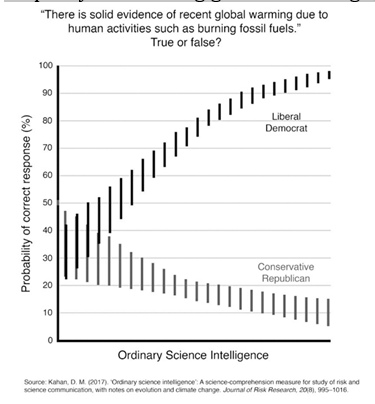
Here are problems with this picture that author seems to be missing:
- Global warming is controversial issue, which means that correct answer could not be possibly known. Science normally does not provide true/false answers to anything without also providing detailed description of area of application. Trivial example: Newton’s mechanics vs. Einstein relativity vs Quantum mechanics.
- Over concentration on human activities and neglect of other factors such as solar activity and about a dozen others that identified by real climatologist.
- Huge politization of the issue and complete control of government and universities by climate alarmists. If instead of democrats and republicans author used “career dependent” vs “career independent”, the result would be the same. I guess it a bit better than in Giordano Bruno times so nobody will be burned alive, but any contradiction to global warming would mean the end of scientific career. That’s probably why only retired climatologists and other STEM scientists dare to express skepticism about validity of alarm.
- It would be interesting to know what percentage of responders actually listened to congressional hearing when alarmists debated sceptics with sceptics presenting logic and factual data, while alarmists mainly emotional demonstrations.
In short, the high IQ stupidity is so prevalent that even the book about this phenomenon demonstrates high levels of high IQ stupidity of global warming / cooling / change alarmism.
20210530 – Rationalism, Pluralism, and Freedom

MAIN IDEA:
The main idea of this book is that there are two approaches within liberalism to interaction between the state and various groups that occupy intermediate position between state and individuals: rationalism and pluralism, which could not be possibly completely reconciled. It is also designed to demonstrate that pluralism is preferable approach and provide critic of multiple philosophers who either ignore such groups or trying to find some synthesis of these two approaches.
DETAILS:
Introduction
Here author first defines what he believes to be two different mindsets in relation to state power and authority om one side and power and authority of intermediate groups on another. He designates these mindsets as rationalism and pluralism and then presents this book to be “about these two mindsets, these ways of looking at the triadic relationship among individual persons, intermediate groups, and states.” Author sees these two mindsets situated within liberalism and differentiated by what they consider bigger threat to liberty: the state or organized groups between individual and state such as family and variety of association either voluntary or non-voluntary such as locality. Here is how author defines the issue and his own position:” I argue not only that the tension between rationalism and pluralism within liberal thought is longstanding, but also that it is to a large degree irresolvable. We can try to be open to reasons and arguments of both sorts; we can try to reach case-by-case judgments in particular times and places. But there is no systematic way to combine all of the virtues and none of the vices of the two mindsets, and no secure middle way that would allow us to know for sure which are virtues and which are vices. I generally favor pluralist liberalism;”
Author then discusses organization and scope of the book.
Part I
I. Freedom, Associations, and Uniformity
The Setting
It starts with recognition of state’s law as an important subject matter of liberal analysis of freedom, but then proceeds to discuss various infringements of individual freedom routinely applied by various groups. In process author defines what he means by rationalism and pluralism: “Rationalist liberalism is sometimes associated with a kind of demand that rational accounts be given to justify customs, norms, and beliefs, demands that can perhaps never be wholly satisfied. This is obviously connected to the more abstract sense of rational knowledge and belief; but it is a demand that is made in a particular institutional context, i. e. states demanding justification of the practices of non-state groups. Pluralism is meant to evoke associational, cultural, religious, and jurisdictional pluralism. In the first instance, pluralism should suggest allowing a plurality of associations, cultures, religions, and so on, to follow their own various norms. As a secondary matter, it is tied to a claim of descriptive sociology: that the sources of social organization are many, not one.”
Some Sources of Disagreement
Autonomy and Toleration
The discussion here moves to the intragroup dynamics when autonomy of individual is constantly violated by rules of the group. These rules may or may not accepted voluntarily, as in the case of children who are born into the group. Consequently, the issue emerges if tolerance from the state offered to the group should include tolerance of intolerance directed from the group to individual.
Whose Freedom?
Here author moves to discuss complexity of freedom, which could mean to restrain oneself from doing something and it also could mean freedom to restrain a group member by group leaders the same member choose to represent the group. The normal approach to this problem is to assure option to exit the group at will.
The Sources of Law and Social Order
Here author discusses the issue of who makes the rules and how these rules could be contradictory at different levels: religious group could not possibly be tolerant to different religions among its members, even if they are citizens of liberal state highly tolerant of any religious believes. Author also discusses how internal group norms could impact individuals situated outside the group such as when people living nearby of university town are impacted by rules established for students. The author moves to sources of rules: whether they come from coercion by whoever is in power or they are evolutionally developed via spontaneous order. Author refer to works of Hayek and Ostrom who articulated and empirically researched the rules emergence in various situations. The latter are pluralist claims and here how author dissect them:” There are thus at least three in-principle distinct pluralist claims here. First, social orders can emerge and survive pluralistically, making effective use of localized knowledge to evolve local norms that are locally functional. Second, law can emerge pluralistically, whether as the internal norms of such groups or as the norms that regulate relations among them. And third, such orders are normatively attractive: perhaps they are absolutely attractive, because they are the sites for our pursuits of ethical conceptions of the good and substantive life plans thicker than the formal rules of justice, perhaps they are attractive relative to the social or legal orders enacted by deliberate state planning. The normative claim and the legal claim in particular are logically independent: whether a group’s internal rules count as law is fundamentally unrelated to whether they are unjust or oppressive. But there is a strong affinity among them all.”
Discrimination and Diversity
Here author looks at the problem of outsiders, usually liberal interfering into group’s business by demanding compliance with whatever rules they believe are fair: diversity, inclusion and so on”. Author provide a charming example of British authorities claiming right to define who is or is not Jewish and eligible to be admitted into Jewish school.
2. Two Approaches
Here author looks at the two approaches to argumentation for pluralism and/or rationalism.
The Pure Liberal Theory of Freedom of Association
Here is how author defines it: “The pure theory holds that, what individual persons are free to do singly, they ought to be free to do in association with one another; and rights that they are free to waive, they ought to be free to waive as against groups of which they are members.” He then discusses some limitations such as not allowing consent to slavery and some others.
Why the Pure Theory is Not Satisfactory
Here author makes argument that:” Insofar as the pure theory stands apart from impure predictions and probabilities, it must be able to survive the analysis of mere possibilities. And that means that the pure theory, by itself, has the potential to be self-undermining.” He then discusses equality of opportunity vs. results, split inheritance problems, idea of consent derived indirectly from failure to exit, and limitations imposed on internal rules of the group by external legal requirements.
Congruence
This section:” will describe an idea that might be taken as the pure theory’s counterpart, an attempt to build up thoroughly rationalistic, individualistic, group-skeptical conclusions from simple premises: congruence.” The congruence here is between a group and the “just liberal state” restricted by moral and ethical constrains.
Why Congruence is Not Satisfactory
As with Pure theory author finds it unsatisfactory. This time it is because:” The doctrine of congruence, treated seriously, prohibits persons acting together from making any choices that would constrain their own future choices—which means that they may not make any choices of promise or commitment at all, and indeed few non-trivial choices of any sort.”
3. Reunderstanding Intermediate Groups
Treating Groups as Groups
The point author makes is that:” the pure theory treats groups as if they were individual persons, while congruence treats groups as if they were states.” Author’s approach is that since groups are neither, they have to be treated differently, more like intermediaries between individual and state providing some more or less strong shelter protecting some specificities common for the members of the group against state intrusion.
Tendencies toward State Excess
Property and Wealth; Secrecy and Privacy; Transnationality; The Centralizing; Temperament and the Man of System; Congruence Again
Here author reviews a variety of areas where state intrusion into group’s affairs typically occurs, from deprivation of resources, to violation of privacy and imposition of state control. Author also discusses problems of international group when various states attempt imposition of control from different cultural, technological, linguistic, and other perspectives.
Tendencies toward Group Excess
Authority Generates Power
Author expresses his approach to this area in such way:” Associations and groups that are substantial enough to fulfill needs for belonging and meaning, powerful enough to check the power of the state or to organize democratic life, or institutionally complete enough to offer authoritative norm-generation for their members, are also substantial, powerful, and authoritative enough to potentially threaten the freedom of their members. From this point of view the group could provide isolation of individual from the state strong enough to establish complete control over behavior and activities of individuals. In order to demonstrate this author refers to various religious movements in USA.
Pluralism Generates Power;
Here author makes case that pluralistic society could limit the group’s power by providing easy opportunities for schism, or even simple exit. He the proceeds discussing in details how exactly it could happen.
Interested and Invasive Power
Finally, here author looks at mechanics of group power that similarly to the state include law giving and enforcing as usually in interests of individuals being forced to do something good for themselves that they for some reason unwilling to do voluntary. Actually, this kind of tyranny could be the most oppressive because tyrants are way closer to individual and more interested in controlling than the state could ever be.
Overall author concludes:” Our freedom can be threatened by states and by groups—and by each directly in response to the other. Understanding which threats are more important where and when is not a formal or philosophical exercise. And a vision of the social world that emphasizes the threat from states isn’t contradicted by one that emphasizes the threat from groups, even when the legal and political actions the two recommend do contradict one another. “
Part II
4. Antecedents and Foundations
The Birth of Intermediacy; The Roman Law; Facts and Norms
Here author looks at antecedents of liberal ideas crystalized sometime after 1700. He includes into these antecedent formation of habeas corpus, formation of legal system, self-governing organizations such as church, and variety of others: universities, guilds, and so on. Author then discusses formation of such self-governing organizations that he places in period of 150-200 years after 1050 CE and traces this process in some detail. After that author looks at Roman Law as foundation of legal system and how it reconciled canon and civil systems in process moving somewhat away from foundation. Finally, author discusses struggle between state and variety of such organizations – most important Church and concludes that:” Medieval corporate pluralism was both a fact and a norm. The norm that these institutions ought to be understood as intermediate, of course, only took shape much later. It took a long time for uneasy de facto balances of power to be rationalized as desirable orders in their own right.”
5. The Ancient Constitution, the Social Contract, and the Modern State
The Emergence of the State; Peers, Provinces, and Parlements; The Ancient Constitution; Corporatism and Parliaments; The Theorists of the Ancient Constitution; Ancient Constitutionalism and its Neighbors
In this chapter author reviews history of a state in Europe, tracing it from XVI century to present: how it was formed in France, England, and other European countries, how their Parlements functioned, and how a number of myths about ancient freedoms and other such staff actually developed. Author pays special attention for forms of rule, and various documents defining European attitudes such as Magna Carta and various constitutions.
6. Montesquieu and Voltaire, Philosophes and Parlements
The Early Eighteenth Century; Montesquieu; Voltaire
In this chapter author reviews work of pre-revolutionary authors that during early XVIII century developed foundation of enlightenment and future revolutions.
7. The Age of Revolutions
Smith, Burke, and Paine; Tracy and Constant; The United States; The Society of the Cincinnati
This chapter is pretty much logical continuation of the previous, moving into period of American revolution and describing works of authors of this period, practical implementation of these ideas in USA, and finally, failed attempt to establish some form of aristocracy by Cincinnati society that included officers – veterans of revolutionary war.
8. Centralization in a Democratic Age: Tocqueville and Mill
Tocqueville on Associations and Corps; Mill on Centralization and Local Despotism
Here author continue his review of development of European thinking on the state, society, and proper ways of organizing all this into XIX century. Author is looking specifically at relationships between the state and variety of intermediate groups from organized church to variety of associations. As elsewhere in the book, author’s main concern is interplay between centralization around more or less tolerant state and local despotism.
9. From Liberal Constitutionalism to Pluralism
The British Pluralists; Lord Acton; Acton and the Pluralists; The Pluralist Theory of Group Life
The final chapter of this part completes author’s review with thinkers of XX century that formed pluralist tradition. In this light author brings in Lord Acton and his support of state rights as bulwark against absolutism of federal powers. Finally, in his discussion of Pluralist theory author brings in its most persuasive account by Maitland: “If the law allows men to form permanently organized groups, those groups will be for common opinion right-and-duty-bearing units; and if the law-giver will not openly treat them as such he will misrepresent, or, as the French say, he will ‘denature ‘the facts: in other word he will make a mess and call it law. Group personality is no purely legal phenomenon. The law-giver may say that it does not exist, where, as a matter of moral sentiment, it does exist. When that happens, he incurs the penalty ordained for those who ignorantly or willfully say the thing that is not. If he wishes to smash a group, let him smash it, send the policeman, raid the rooms, impound the minute-book, fine, and imprison; but if he is going to tolerate the group, he must recognize its personality, for otherwise he will be dealing wild blows which may fall on those who stand outside the group as well as those who stand within it. For the morality of common sense, the group is person, is right and-duty-bearing unit. Let the moral philosopher explain this, let him explain it as illusion, let him explain it away; but he ought not to leave it unexplained, nor, I think, will he be able to say that it is an illusion which is losing power, for, on the contrary, it seems to me to be persistently and progressively triumphing over certain philosophical and theological prejudices.
Part III
10. The Constitution of Group Life
In this chapter author moves to discuss specifics of groups’ organization, management, their impact on society, and how liberal theory of freedom should take into account both rationalism and pluralism.
Intermediacy Affects Politics; Faction; The Illiberal Majority; Minority Group Capture; The Majoritarian State; Territory and Government; Politics and Balance
Here author looks at various aspects of groups internal politics and relations with the state. It is important because:” Intermediate groups are rarely only inward facing associations, and the state never only acts under neutral bureaucratic imperatives or as the neutral agent of liberal justice. One idea we saw many times among the pluralists”. He makes the point that groups had to be at least somewhat oppositional, generate some external power via participation in voting and other political activities and so on. He then reviews problems of faction when either minority or majority group capture the sate machinery and often suppress or at least limit other groups.
11. Associations are Not States
Complex Associations; Universities and Liberal Justice; State Action
The final chapter is about limitations on group imposed by the fact that they normally could not use tools of the the state and had to be more pluralistic and tolerant to both internal subgroups and other external groups. Another important limitation is permanent need to avoid conflict between group’s rules and objectives with the state and population outside the group. As example author discusses Universities and their rules and policies that often generate all kinds of controversies. Finally. author discusses action that state can and does use to resolve such controversies.
Conclusion: Against Synthesis
In conclusion author says:” I have argued that a liberal understanding of freedom is constitutively torn between a rationalist distrust of the local, the particular, and power embedded within group life, and a pluralist emphasis on the freedom found within and protected by group life against the power of the state. I have criticized various attempts to settle definitively for one or the other, or to redefine the distinction away.”
Then he proceeds to review some of such attempts:
Taylor and the “Long March”; Rawls and the Morality of Association; Hegel, Ethical Life, and Corporate Forms
MY TAKE ON IT:
I find all this quite interesting and mostly agree with author that pluralist approach is the best. I would leave the state one and only role in relation to intermediate groups: assure that individual rights and protections accepted by society’s laws and rules of behavior, are not violated in any way, shape, and form. However, I think that groups not only should not be put under pressure unless they violate laws, but also that they should not be supported by government in any way, shape, or form. For example, Universities should be free to promote whatever ideology they wish short of direct subversion and calls for violence, but they should have no material support from the state. Actually, the only material support to any group whatsoever should be provided only in case of national security necessity, while everything else should be supported voluntary. Otherwise, the pretty bad outcome for diverse society is pretty much guaranteed: continuing fight between groups for state’s support and resources that could lead to such high level of infighting that could undermine the very existence of the state. I guess that current support by “liberals” organized in Universities, Non-government organizations (NGO) heavily supported by government, Unions of government employees, and other similar groups to various forms of anti-White racism, anti-Asian quotes, and massive redistribution of wealth from middle class to plutocracy and bureaucracy will provide for an interesting spectacle over the next few 10-20 years.
20210523 – Emergent Warfare

MAIN IDEA:
The main idea of this book is to use the latest anthropological and historical research to demonstrate that war as the method of human interaction most probably goes all the way back to the beginning of humanity, but it is not genetically predefined behavior. Believes, either in genetical inclination to fight based on comparison with chimpanzees or in natural peacefulness of humans, both are not founded on hard proves, but rather on little more than wishful thinking, so authors attempt to present actual state of knowledge without falling into one or another set off believes.
DETAILS:
1 Peering into the Abyss
Authors start with definition:” By warfare, we are referring to myriad forms of organized violence, whether they are massed armies on a battlefield, revenge killings between smaller-scale societies, or intervillage raiding related to feuding communities. With this sort of inclusive definition, one not biased toward modern forms of war, we believe researchers are much better equipped to give the topic fuller scrutiny.” After that they define their story as “In the end, this is not simply a story about how, when, and why human warfare emerged, but is also a larger narrative about us, about humanity. In other words, the emergence of warfare is intimately connected to the emergence of human nature.” After that authors briefly review relevant literature and then define specifics of human warfare as complex activity highly dependent on specificity of circumstances when it occurs.
Authors also clearly specify what they disagree with about warfare – that it is:
1) a relatively recent, modern, or historic phenomenon;
2) a product or byproduct of the political interactions associated with large-scale states or civilizations; and/or
3) a phenomenon largely created by shifts to sedentary or agriculturally lifeways.
Authors also specify their definition of warfare, so they are:
1) recognize the potential for it to have been a significant part of modern human behavior, whether within the past 12,000 years or even earlier; and
2) are open to the possibility that certain forms or facets of emergent warfare may have appeared at different points throughout the evolutionary history of hominin lineages.
They also specifically identify their key argument that both warfare and peacefare are specific modes of behavior, both being optional and used depending on circumstances and believes on which one of these modes would work best for survival.
2 Dropping into the Rabbit Hole
Here authors once again provide some definitions and refer to literature in regard to human cultures mostly to their variety and flexibility. They also discuss inseparable character of human cultural and biological evolution, which is based on huge role that communications, data collection, processing and intergenerational transfer play in everything human. Author then discuss archeological evidence of human evolution with the first traces of stone tolls going back 2.5 million years and such cultural artifacts as bodies disposal dating to 300,000 years indicating that cultural development occurred even before biological establishment of contemporary type of human species. Authors then review aggression and violence in natural world with special interest to our close relatives: chimps and bonobos. They also review human patterns of organized violence and warfare and conclude that:” Conflict, competition, and violence are integral parts of the natural world, past and present, and we accept the assumption that our earliest hominin ancestors would have been capable of engaging in analogous forms of conflict, aggression, and violence. However, the larger, fundamental question to be addressed revolves around the notion of human emergent warfare and emergent peacefare. And, for us, this coincides with a human ability to perceive, symbolize, and convey intercommunity differences in complex ways. To us, that sort of cognition would be the key to elucidating the timing of emergent warfare and peacefare. In order to address these questions, we have to explore various strands of evidence from the Pleistocene, from fossils to artifacts to genes. But before we do that, we must first turn our attention to how archaeologists and paleoanthropologists actually see violence and warfare in the remote past, beyond the purview of written records.”
3 The Recent, the Ancient, and the Very Ancient Past
In this chapter authors discuss variety of evidence of warfare that could be obtained from archeology. They first review literature and conclude that there is no controversy about recent past, meaning the last 12,000 years – there plenty of evidence that warfare was quite a popular method of interaction between human communities. It is more difficult to look deeper in the past when specialization of humans and their tools was not that developed. However, the stones, bones, and other manifestations such as fortification goes back all the way to Pleistocene. Here is classification of warfare markers:
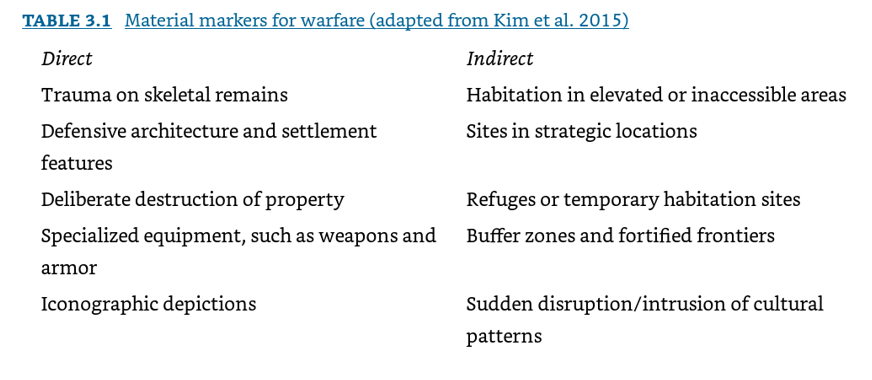
Authors then review current evidence for each of these markers. They also discuss such forms of violence that could not possibly provide any markers such as structural violence and magical assault.
4 The Ice Age World
Authors begin this chapter by expanding the very notion of warfare:” Our journey continues, and hopefully by now we have convinced our readers to consider a few key points about warfare. The first is a full appreciation of all of its cultural facets. Warfare, broadly defined, is not simply organized violence, it is not restricted to large-scale social groups, it is not restricted to young males, it does not result solely in direct physical trauma to bodies, and it is not a recent phenomenon. People in many different societies participate in various aspects of warfare, separated by vast differences in attitudes, perceptions, and cultural logics about violence. We have seen that warfare is not restricted to those eras of humanity where we had written records, with archaeological clues suggesting a deeper antiquity.” Then they look at early social organization and paleoanthropological record, noting that there is plenty of research and evidence of violence, but little clear evidence of its organized collective character. Authors also provide timeline of development:
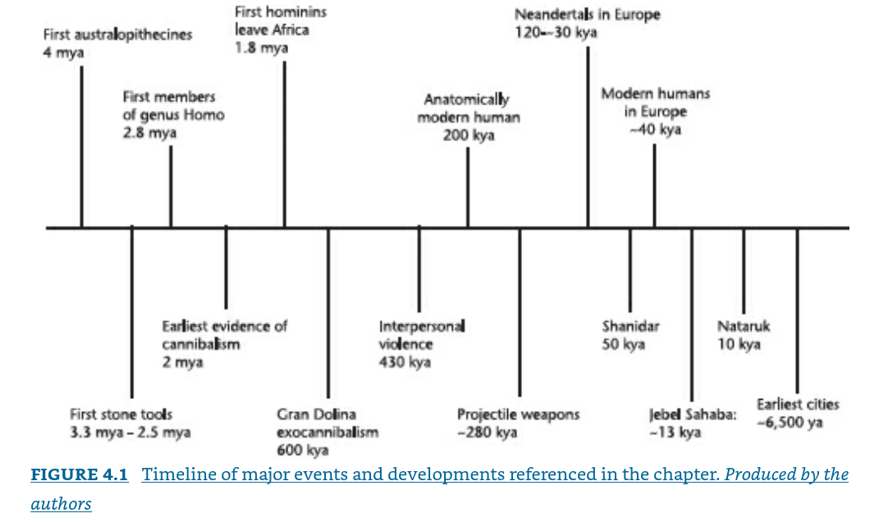
5 Insights from Genomic Research
In this chapter authors discuss individual violent behavior and conclude that there is no clear genetic determinant of such behavior. They specifically discuss MAOA deficiency, but still conclude that any link to violent behavior is far from being deterministic:” Given the uncertainties and the complexities involved in shaping behavior, we can safely say at the moment that there is simply no conclusive evidence for a specific gene or hormone which will make someone more aggressive.”
6 The Onset of Human Variability and Emergent Warfare
Author’s approach in this chapter is to look for evidence of components of complex human behavior that is required to support warfare activities. They look at cooperation during hunting, development of language, kingship recognition and development of the group identity. Finally, they provide timetable for emergence of relevant behaviors:

7 The Durability of Peace
This chapter is somewhat unusual because authors here move from discussion of warfare to discussion of peaceware – human abilities to resolve conflict and accommodate each other peacefully. First, they look at conflict mitigation in the Animal world and then at much more complicated human peacemaking. Obviously, humans as the most sociable and flexible animals do a lot of this and authors’ main point is that both warfare and peacefare are just tools in human tool kit generally used pragmatically on “as needed” basis according to circumstances with neither one being absolutely dominant.
8 There and Back Again
Here authors summarize all this in the following way:” The present evidence suggests that warfare, in various cultural forms, has fairly deep roots, deeper than a general shift in subsistence patterns from more mobile, foraging lifeways to more sedentary and agricultural ones. After all, warfare encompasses a very wide range of cultural behaviors, views, values, and practices, and is not restricted to categories of societies. It is a human phenomenon, and one need not live in a settled, agricultural society to be capable of organizing with fellow community members to perform violence. But, recognizing a deeper antiquity for the “invention” of warfare, or of its various bits, does not mean we are biologically hardwired to fight, that we are forever doomed to live in a world where war will always be of constant significance. As sobering as the reality might be when considering deeper origins of warfare, the narrative tells but one small part of the story of becoming human.”
After that they discuss significance of understanding of emerging warfare and emerging peacefare and different approaches to understanding of historical evidence from “Hawkish Doves to Dovish Hawks”. They conclude:” What makes us human is the power to transcend our genes, our evolutionary history, and our recent past. Not only can we transcend them, but we are capable of fathoming the ability to even do so. Tracing the origins of these distinctive human abilities is at the heart of anthropological research and will prove to be an infinitely fascinating field of study for many years to come. We did not become human because of war, and we did not evolve to make war. Through human evolution, we became capable of conceiving of and engaging in both warmaking and peacemaking.”
MY TAKE ON IT:
Unlike great many books about such hot button issues as war and humanity authors managed to keep in check their ideological inclination and provide quite honest review of relevant archeological and anthropological evidence. I think that any attempt to find causes of war or peace in inherent human nature bound to fail because either one is just a tool used to achieve desired parameters of life, which is used as needed according to circumstances, personality of decision makers, and psychological conditioning of decision executors. The only thing strongly connecting human nature and warmaking is human ability effectively communicate, plan, and synchronize actions of many individuals, without which no warmaking would be possible. The circumstances pretty much define cost/benefit analysis that prompts decision makers, that is individuals at the top of society’s hierarchy direct their effort to warmaking or peacemaking or anything in between. One can easily find multitude of examples when such calculation was incorrect and initiator of a war was defeated, but one could not find any example of war initiated without strong believe that whatever outcome occur it would be better than outcome of non-action. I’d like use two quite extreme examples: one is uprising in Warsaw Ghetto in 1943 when the amazing outcome was higher percentage of survivors among fighters vs. non fighters. Sure, numbers are something like 98% dead for fighters vs. 100% for non-combatants, but it is still advantage. Another example on much larger scale is non-occurring of World War III, that I think was direct result of invention of nuclear weapons that led to situation when no decision maker from Stalin at the top to low level officer on duty at nuclear site could estimate potential outcome of nuclear war as preferred choice. In both cases cost/benefit analysis was decisive for decision initiate or not coordinated violence – war.
20210516 – The New Class War

MAIN IDEA:
The main idea of this book is that contemporary Western societies are in the middle of increasingly bitter Class War between Technological and Managerial elite and variety of populist movements representing working and lower middle classes that are hit hard by globalization, unrestricted immigration, free trade, have difficult time maintaining their place in society, and are continuously insulted by attacks against their culture, values, and religious believes. The outcome of this war could be either rule of oligarchy or demagoguery, either one highly detrimental to prosperity of population. However, author believes that there is an alternative: Democratic Pluralism, that would provide much better solution to all difficult problems.
DETAILS:
Introduction
It starts with characterization of events of 2016: British exit and Trump election as revolution. Author then proceeds to define revolution as change in three realms: government, the economy, and the culture. He then characterizes the 1st Class War in the West as result of industrialization some 150 years ago and pretty much ended with WWII when new relations in all three realms became established in form that author defines as democratic pluralism. Now globalization, outsourcing, and cultural changes destroyed this existing arrangement, alienated lower middle and working classes, so the new populist and its mainly demagogic leaders initiated new class war to change this. Author thus characterizes the current situation:” Demagogic populism is a symptom. Technocratic neoliberalism is the disease. Democratic pluralism is the cure.”
Chapter One: The New Class War
In this chapter author presents his understanding of the New Class War. First of all, it is not Marxists – because it has not cosmopolitan “Proletariat of the World”, but rather national: Americans, Brits, and others. Author then reviews intellectual history of class analysis: James Burnham, George Orwell, and John Galbraith. Author also refers to his own work to define what he calls overclass: managers and professionals, which started as meritocracy, but now increasingly turn into hereditary aristocracy. Author discusses the global character of this new class and contrasts it with national character of working and low middle classes.
Chapter Two: Hubs and Heartlands: The Battleground of The New Class War
In this chapter author looks at geographic battleground in USA. It is mainly division between coasts habituated by elite and parasitic classes living off the government either very well from huge handouts to elite “education”,” science”, and other form of political redistribution, or very poorly living miserably in inner cities on welfare and charity handouts. Author then analyses comparative level of productivity of coasts and heartland and concludes that much promoted high productivity of coasts is mainly illusion. He then discusses one interesting point – environmental regulations that provide coast elite with costless satisfaction from “saving the earth”, but cost a lot to people who actually use this earth to produce material staff that everybody needs from food to energy to everything else. Another point of contention – low skill immigration that provides cheap services and feeling of being noble humanitarians for elite, but represents price damping competitors for working class. Finally, author looks at numbers that demonstrate significant majority of non-elite comparing with elite and at rhetoric that demonstrate that drivers of conflict are not racism and/or bigotry, but rather material class interests.
Chapter Three: World Wars and New Deals
Here author turns to history of XX century with its national and class conflicts and discusses various class ideologies of this period: producerism, socialism in its various forms, corporatism, and general conflict between free market and statist ideas. Author discusses political methods of class wars expression such as mass parties, bureaucratic capture of government, and resulting from all this temporary settlement between classes achieved after WWII.
Chapter Four: The Neoliberal Revolution from Above
Here author looks at one of the most important causes of contemporary class war – Neoliberalism, which he defines this way:” Neoliberalism is a synthesis of the free market economic liberalism of the libertarian right and the cultural liberalism of the bohemian/academic left. Its economic model, based on global tax, regulatory, and labor arbitrage, weakens both democratic nation-states and national working-class majorities. Its preferred model of government is apolitical, anti-majoritarian, elitist, and technocratic.” He then reviews works of several writers that promoted this ideology beginning in 1970s, consequences of adaption of this ideology by ruling class, and concludes that it all amounted to the revolution from above resulting in “The triumph of technocratic neoliberalism over democratic pluralism”
Chapter Five: The Populist Counterrevolution from Below
Here author reviews attempt of counterrevolution from below to which he assigns anti-immigration movement in Germany, Ross Perot and Trump movements in America, Brexit movement in UK, and other similar movements. Author also provides here multiple polling results that shows change in demographics of working class, political parties realignment, for example free trade used to be republican issue and now is democratic one. Immigration used to be rejected by unions and now is supported by them. Author then discusses nature of populism as political movement and notes that it is inherently reactionary and therefore weak. Similarly, in culture populism became counterculture fighting against establishment, while old antiestablishment types became establishment themselves. The final part of the chapter is about history that demonstrated that in wars between oligarchy and populism oligarchy usually wins. Author’s conclusion is this chapter is that:” Populism is a symptom of a sick body politic, not a cure. In a formally democratic oligarchy, a nepotistic elite runs things for the benefit of its members most of the time. On the rare occasions when a demagogue is elected to office, he or she will be less likely to reform the system than to join the establishment or build a corrupt personal political machine, steering government patronage to supporters.”
Chapter Six: Russian Puppets and Nazis: How the Managerial Elite Demonizes Populist Voters
In this chapter author looks at demonization of populism by elite and reviews specific themes such as Russian collusion and other propagandist efforts by oligarchy. He reviews in some details tendency to see fascism everywhere and bring in pop-psychology of authoritarian personalities and such to explain populism. Author also refers, albeit briefly, to harmful populist demagogy, but concludes that fears of both sides exaggerated even if consequences of either side’s propaganda harmful. He makes the point that:” Only a new democratic pluralism that compels managerial elites to share power with the multiracial, religiously pluralistic working class in the economy, politics, and the culture can end the cycle of oscillation between oppressive technocracy and destructive populism.
Chapter Seven: The Workerless Paradise: The Inadequacy of Neoliberal Reform
Here author discusses various attempts to resolve this problem. Specifically, he looks at the theory of Skill-Based Technological Change (SBTC) and promoted by this theory expansion of STEM education, hopes to use relocation to high labor demand areas, even democratic socialism and such, but finds all of them lacking.
Chapter Eight: Countervailing Power: Toward a New Democratic Pluralism
In this chapter author moves to positive approach discussing real alternative – democratic pluralism:” The essential insight of democratic pluralism is that electoral democracy is a necessary but not sufficient condition for democracy. Because the wealthy and educated inevitably tend to dominate all parties, if only through their personnel, “territorial” representation must be supplemented (not replaced) by occupational or communal “social federalism” (to use the language of the English pluralists of a century ago). To this end, substantial areas of policy should be delegated to rule-making institutions, which must represent particular portions of the community, like organized labor and business in wage-setting sectoral bodies, or representatives of religious and secular creeds in bodies charged with oversight of education and the media. The territorial state, as the only entity with coercive authority, should exercise oversight of all institutions and intervene if necessary, to protect individual rights or other state interests. But in the democratic pluralist vision of democracy, the government in many areas should reign, not rule.”
After defining Democratic Pluralism author looks at various power centers of contemporary society that cold initiate movement away from Neoliberalism / Populism fight to the better solution.
Chapter Nine: Making the World Safe for Democratic Pluralism
Here author defines the New World order that he believes would be appropriate solution: “The democratic pluralist vision of a democratic world order is quite different from the technocratic neoliberal vision, with its powerful transnational rules combined with weak nation-states and legislatures.
For democratic pluralists, free and fair elections are a necessary but not sufficient condition for genuine democracy. A country run by an aristocracy or oligarchy is a democracy in name only, even if citizens are free to vote for competing aristocratic or oligarchic factions. According to democratic pluralism, electoral democracy in the political realm, narrowly defined, must be accompanied by power-sharing arrangements among classes and subcultures in the realms of the economy and the culture. These power-sharing institutions, like tripartite labor-business-government wage-setting institutions, need not resemble one-person, one-vote political democracy. But there must be social checks and balances in addition to political checks and balances. And decisions should be based as much as possible on hard-won and lasting consensus among negotiating parties, classes and creeds, not on fluctuating numerical majorities.
The democratic pluralist version of democracy necessarily puts great emphasis on national sovereignty—external sovereignty, not internal sovereignty. All of the various schools of thought that inform the democratic pluralist tradition—English pluralists, French solidarists, Catholic corporatists, and New Deal defenders of countervailing power in the broker state—reject the eighteenth-century idea of unlimited popular sovereignty shared by the American and French revolutions. For democratic pluralists, the state—usually a nation-state, but sometimes a multinational state or independent city-state—is not a mass of individuals to whom a general will can be attributed, but a community made up of smaller communities.
But while democratic pluralism rejects the idea of the unlimited internal sovereignty of any group, including “the People” as a whole, external sovereignty is indispensable. The reason is that the negotiations and compromises among communities that are the essence of democratic pluralism can only occur within the fixed boundaries of a political community with fixed membership. Cross-class compromises among labor and business, for example, are pointless if businesses can unilaterally annul the contracts at any time by transferring operations to foreign workers or bringing foreign workers into the country to weaken or replace organized labor. The various cross-class settlements in the US and Europe from the 1940s to the 1970s would not have been possible if employers had been able to use large-scale tax and regulatory arbitrage and offshoring and access to high amounts of low-wage, non-union immigrant labor to escape the constraints imposed on them by “new deals” with organized labor and democratic national governments.
For this reason, a world order that can support many countries organized along democratic pluralist lines will be quite different from a neoliberal world order in which most decision-making has been transferred from nation-states to supranational institutions or from national legislatures to national executive bureaucracies and judiciaries. Rejecting neoliberalism at the national level requires the rejection of neoliberalism at the global level as well. A world safe for democratic pluralism will not be a neoliberal world order.”
Epilogue:
At the end author summarizes it this way:” MANAGERIAL ELITES ARE destined to dominate the economy and society of every modern nation. But if they are not checked, they will overreach and produce a destructive populist backlash in proportion to their excess. If there is not to be perpetual conflict among the two permanent classes of technological society, the new class war must come to an end in one of two ways. One possibility is that there will be a new cross-class compromise embodied in a new democratic pluralist order, providing the working-class majorities in Western nations with far greater countervailing power in politics, the economy, and the culture than they possess today. The alternative—the triumph of one class over the other, be it the overclass led by neoliberal technocrats or the working class led by populist demagogues—would be calamitous. A West dominated by technocratic neoliberalism would be a high-tech caste society. A West dominated by demagogic populism would be stagnant and corrupt.”
MY TAKE ON IT:
I generally agree with author’s definition of the problem as government capture by technocratic elite that followed by regulations of all other institutions of society in the interest of elite at the expense of outsiders who are not only poor or lower middle-class members, but also upper middle-class and even rich such as Trump whose wealth was obtained by working in non-elite activities often over several generations of a family. I also agree that it could lead to serious backlash in form of populist movement led by demagogs. I even think that it could lead to violent revolution if government suppression in all its form, especially anti-white racism and elimination of the 1st and 2nd Amendments prove to be materially detrimental to wellbeing of non-elite majority. However, I do not find what author calls “Democratic Pluralism” to be effective remedy for the problem mainly because breakdown of society into functional communities that negotiate cross-class compromises would lead to situations when these compromises will be obtained at the expense of others not included into these communities. I do not think it would be possible, for example, return to big business/union negotiated settlement expanded across multiple countries just because countries are very different. Besides the automation is rapidly becoming much more important factor in pushing people out of jobs than cheap foreign labor. In my opinion the real solution could be found in pushing all interactions and cooperation down from the level of groups to individual level via use of government power to assure that resources material and intellectual accumulated over generations were available for individual control on equal basis for all, while resources created by individuals of current generation would be controlled by individual who created them. I guess author’s democratic pluralism means promotion of freedom on the level of groups smaller than government, while my solution would be promotion of freedom at individual level, when freedom includes availability of resources that would make this freedom applicable in real life.
20210509 – Range
MAIN IDEA:
The main idea of this book is to convince reader that narrow and early specialization is not necessarily lead to success in all areas, but rather only in very specific, human designed fields, which are subject to formal rules such as chess or some sports. The wider and more complex problems could be better resolved by people with wider experience in multiple areas of activities with approach based on wide range of ideas and knowledge. This diversity of experience, ideas, and attitudes could help looking at the problem out of box and find non-trivial solution.
DETAILS:
INTRODUCTION: Roger vs. Tiger
Author starts with comparison between two sportsmen: Tiger Woods and Roger Federer, one intentionally trained from early childhood and another one coming to the sport in which he achieved the top level relatively late. Author analyses how it happened and unexpectedly finds that the near elite who eventually failed practiced more than those who succeeded in becoming elite.

Another finding was:” an enormous and too often ignored body of work demonstrating that learning itself is best done slowly to accumulate lasting knowledge, even when that means performing poorly on tests of immediate progress. That is, the most effective learning looks inefficient; it looks like falling behind.”
The key inference from these and other findings was that success comes from diverse experience and relatively late specialization that better support new approaches leading to high achievement.
CHAPTER 1: The Cult of the Head Start
This chapter tells another story of very successful early training for high achievement – Laszlo Polgar’s daughters and chess. Then comes discussion of Kahneman and Klein work demonstrating that:” Whether or not experience inevitably led to expertise, they agreed, depended entirely on the domain in question. Narrow experience made for better chess and poker players and firefighters, but not for better predictors of financial or political trends, or of how employees or patients would perform. … In wicked domains, the rules of the game are often unclear or incomplete, there may or may not be repetitive patterns and they may not be obvious, and feedback is often delayed, inaccurate, or both.”
Then author provides multiple examples from chess and other formalized domains, which he counters with example of Steve Jobs and his class in calligraphy that eventually led to multiple fonts for Mac computers and Claude Shannon who generated theory of information from Boolean logic and experience with communication networks.
CHAPTER 2: How the Wicked World Was Made The next came look at Flynn effect in IQ testing. The improvement came from increase in experience with abstract thinking typical for literate people in city environment, but not very usable in agricultural villages. Author illustrates this idea by results of research conducted back in 1930s in Uzbekistan. Here is nice illustration when illusion works for educated people, but not for illiterates:

Author then discusses difference between narrow and broad thinking and its higher usability and value in the constantly changing world that requires quick and effective adjustment rather that deep drilling into narrow field, if one wants to succeed.
CHAPTER 3: When Less of the Same Is More
This chapter narrates the story of Vivaldi’s figlie del coros, Jack Cecchini, and their non-trivial, but outstanding musical careers.
CHAPTER 4: Learning, Fast and Slow
Here author moves to the process of learning and how it often comes down to getting the right answer to the test without really understanding underlying logic. It is done with algorithmically defined process – “blocked” practice and author rejects it as ineffective and presents ideas of “mixed” practice when student generate solution based on previous experience, free search, and some directional hints from teacher – the process much more difficult and time consuming, but also much more effective in developing problem resolution skills.
CHAPTER 5: Thinking Outside Experience
This chapter begins with the story of thinking outside the box in astronomy: Kepler and Copernicus and then discusses some typical non-trivial problems and solutions. After that author proceeds to review experiments by Kahneman and Lovallo demonstrating that familiarity with details of subsystem causes people to make logical mistakes of missing complexity of total. Author then discusses use and misuse of analogical thinking and concludes that wide range knowledge, even if not very deep, helps to solve problems by finding applicable analogies. Experiments demonstrate that this method produces better results than approach based on deep and very precise knowledge that often limits search of solution to very narrow range of possibilities.
CHAPTER 6: The Trouble with Too Much Grit
In this chapter author brings the story of Van Gogh to discuss “match quality” – degree of fit between individual and work he/she does by using research of Ofer Malamud related to early vs. late specialization of students that demonstrated superiority of later choice. Author links it to ideas of “Grit” as explanation of success and pretty much rejects it by stating that match is more important and good match could be achieved only via experience. Therefore one should be ready to give up on something that is not working and move on to something that has better chance of working.
CHAPTER 7: Flirting with Your Possible Selves
The next story is about Frances Hesselbein who found her true call as CEO of Girl scouts at rather late age and mostly serendipitously. Author also discusses works of David Gilbert on “Predictors” and “Reflectors”, Walter Mischel’s “Marshmallow test”, Herminia Ibarra’s “plan-and-implement” vs. “test-and-learn” models, and a few typical stories concluding once again that flexibility is better fit to generate success than dogged rigidity of pursuit of preset objective.
CHAPTER 8: The Outsider Advantage
This is a set of other examples of specialists not able to resolve problems and helped by amateurs with wider scope of knowledge. These examples are for website inviting everybody participate that generate solutions, Exxon Valdez sill handling, Swanson ideas about “Undiscovered public knowledge, and so on. Here is author’s general conclusion for this chapter: “The more information specialists create, the more opportunity exists for curious dilettantes to contribute by merging strands of widely available but disparate information—undiscovered public knowledge, as Don Swanson called it. The larger and more easily accessible the library of human knowledge, the more chances for inquisitive patrons to make connections at the cutting edge. An operation like InnoCentive, which at first blush seems totally counterintuitive, should become even more fruitful as specialization accelerates. It isn’t just the increase in new knowledge that generates opportunities for nonspecialists, though. In a race to the forefront, a lot of useful knowledge is simply left behind to molder. That presents another kind of opportunity for those who want to create and invent but who cannot or simply do not want to work at the cutting edge. They can push forward by looking back; they can excavate old knowledge but wield it in a new way.”
CHAPTER 9: Lateral Thinking with Withered Technology
This chapter starts with the stories of non-trivial approach to various “wicked” problems such as computer games that produced Nintendo, 3M that produced stickers, and others concluding:” Facing uncertain environments and wicked problems, breadth of experience is invaluable. Facing kind problems, narrow specialization can be remarkably efficient. The problem is that we often expect the hyperspecialist, because of their expertise in a narrow area, to magically be able to extend their skill to wicked problems. The results can be disastrous.”
CHAPTER 10: Fooled by Expertise
In this chapter author moves from non-specialists who solve problems to experts who create problems. He uses wonderful example of Paul Ehrlich and his prophecies and then moves to discuss Tetlock’s research and results, both original and recent, about more effective methods of predictions of the future.
CHAPTER 11: Learning to Drop Your Familiar Tools
This is about use and misuse of statistical analysis for which author uses business case of car race decision making and real case of causes of Challenger incident, which also was converted into business case. From this author moves to firefighters who were not able to change their typical MO in non-typical situation resulting in their death. Author presents here the problem of overspecialization that narrows scope of search for solution resulting in failure and suggest different approach:” Even now, even in endeavors that engender specialization unprecedented in history, there are beacons of breadth. Individuals who live by historian Arnold Toynbee’s words that “no tool is omnicompetent. There is no such thing as a master-key that will unlock all doors.” Rather than wielding a single tool, they have managed to collect and protect an entire toolshed, and they show the power of range in a hyperspecialized world.”
CHAPTER 12: Deliberate Amateurs
The final chapter is about successful amateurs who actually solve problems because they do not know that these problems are not solvable. Author uses here example of Oliver Smithies who worked in various areas getting Nobel level results and then discusses work of Casadevall who analyzed current situation in science and research and concluded that its stress on deep specialization and publishing rather than application of results to technology is not really that productive.
CONCLUSION: Expanding Your Range
In conclusion author pretty much comes up with recommendation to expand one’s range, not to be afraid that it is too late, and try to use this range to pursue whatever objective is desired.
MY TAKE ON IT:
It is nice book that provides lots of examples for such views at various problems’ solution and approach to learning that I believed for a very long time, ever since I was deciding what to do after the school. Back then I choose less specialization and wider approach to education and training and this choice served me well. I did a lot of various staff: computer hardware, software, management, business consulting, and a few others in two very different countries and cultures, so I can confirm based on my experience that it did helped with complex problems to use analogies and tools from unrelated fields. So, ideas of this books are not new, but narrative is quite entertaining.
20210502 Turchin, Peter – Ages of Discord
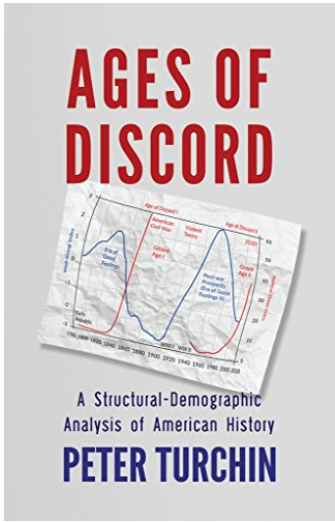
MAIN IDEA:
The main idea of this book is to use variation of specific parameters such as state power, population wellbeing, and elite internal conflict to demonstrate cyclical character of society development when periods of stability follow by periods of disintegration and back to stability and prosperity. Then these ideas applied to specific case of USA, which is currently seems to be moving now into period of discord.
DETAILS:
PART ONE A Theoretical Introduction
1: Multi-Secular Cycles in Historical and Modern Societies
Author starts by using American Civil war as an example of fragility of human societies, the example that is currently nearly forgotten. Then he discusses new approach to history – Cliodynamics, which evaluates historic events based on measurable parameters and using this evaluation to predict future events. Author provides example for use of such parameters to calculate Index of Political Instability as applied to history:
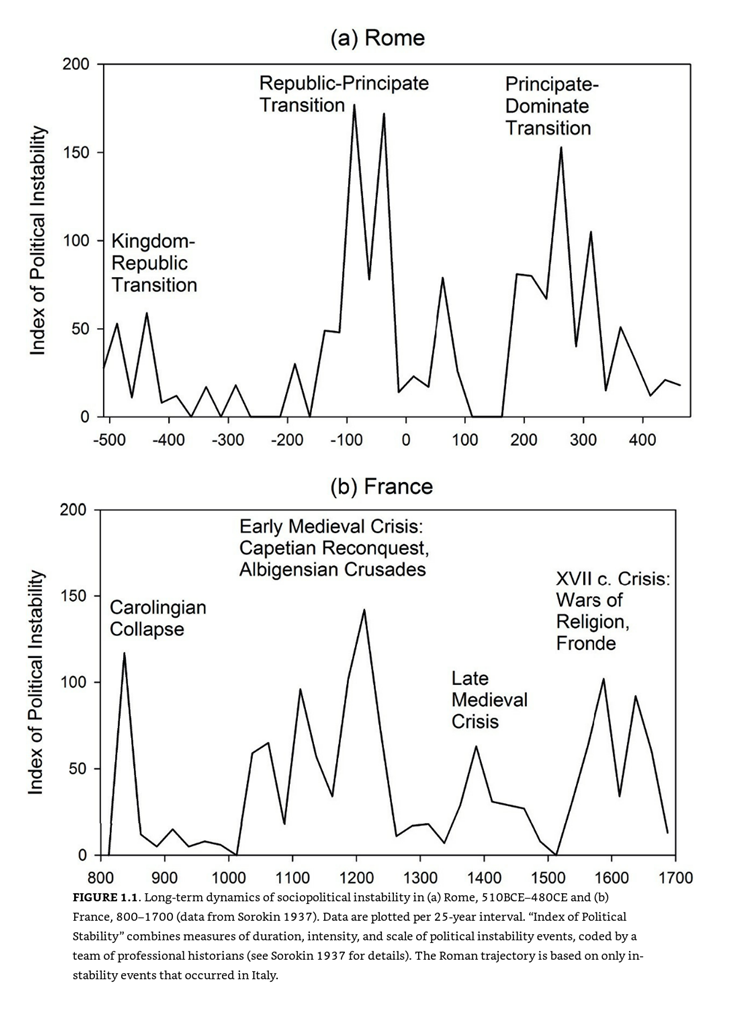
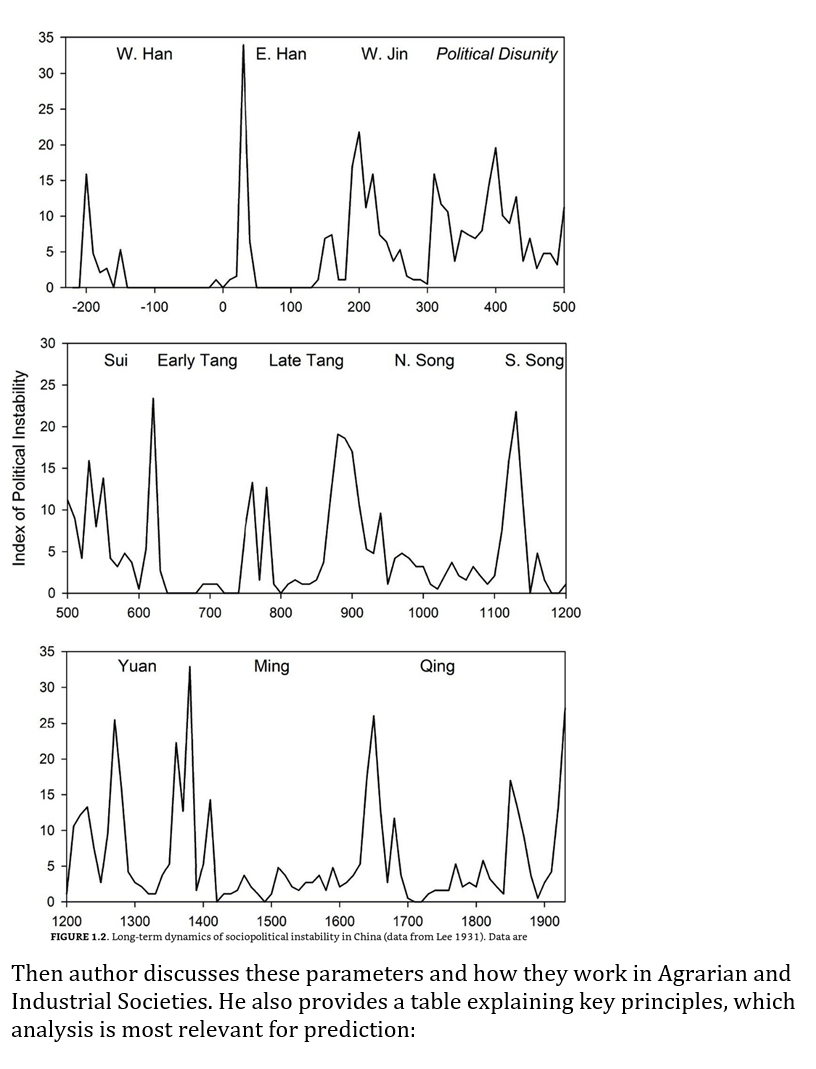

PART TWO Overview of Structural Demographic Variables: 1780-2010
Part II presents a systematic survey of time-series data on the overall dynamics of the fundamental variables of the structural-demographic model over the entire history of the United States.
3: Demography and Wellbeing
In this chapter author discusses demographical parameters that have impact of societies development such as Labor supply, Economic Wellbeing as it is expressed via real wages, physical stature of population as function of of food availability and environmental conditions, life expectancy, and age at first marriage as a proxy for Social mood. The author synthetizes it for United States as it is presented in a graph:

4: Elite Dynamics
Here author analyses the second component – American elite. Author defines it as combination of bureaucratic elite and wealth elite, the division specific for USA because in great many other countries like Russia or Chine, the bureaucracy runs supreme. Author then discusses number of elite members and their proportion in population mainly on the basis of wealth. Here is the relevant graph:

For purposes of estimation of society’s stability it is important to analyze intraelite data, which are not normally available, so author uses proxies such as data for law and business students. He then analyses levels of elite fragmentation by using as proxy levels of political fragmentation. Here is graph of polarization based on the US House data:

Overall author concludes that there is clear elite overproduction:” The empirical survey in this chapter, thus, suggests that between 1780 and 2010 the factors reflecting elite overproduction moved cyclically and were positively (if imperfectly) correlated. What is particularly interesting is that the overall curve reflecting elite overproduction was negatively correlated with the average wellbeing curve. Over the course of American history elite overproduction and popular wellbeing have moved in opposite directions…” Here is the graph:
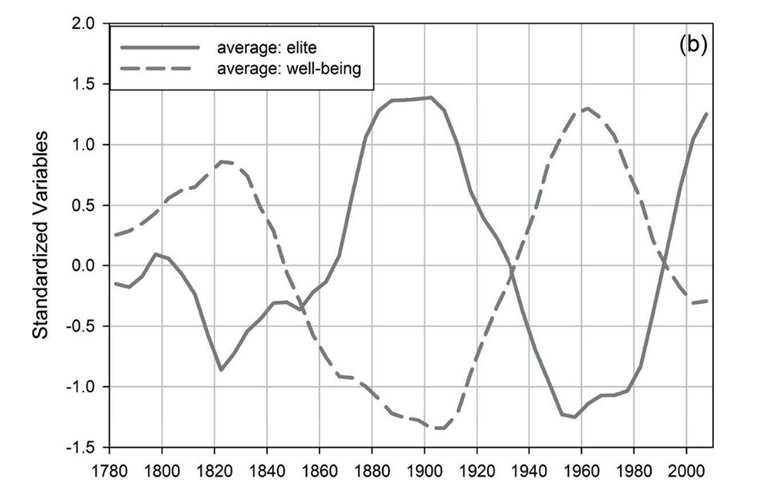
5: The State
Here author discusses the growth of state power in USA as force parallel to elite, and while intermixing with elite, but not exactly the same. Here is his synthesis of growth of the state combined with cyclical character of support for the state:” The history of the American state in the longue durée is characterized by two trends. The first was the shift from a minimalist role of the state that prevailed in the nineteenth century to a more activist state of today. The second trend was a cyclic one that conforms quite well with the pattern predicted the Structural-Demographic Theory. Integrative periods (with peaks in 1820 and 1960) were periods of national consolidation and patriotism, territorial expansion, and high state legitimacy. In contrast, disintegrative periods—or Ages of Discord—were characterized by particularistic mood, an inward rather than expansionist focus, and low state legitimacy.”
6: Dynamics of Sociopolitical Instability
In this chapter author reviews patterns of political instability and violence in USA based on number of event and fatalities:
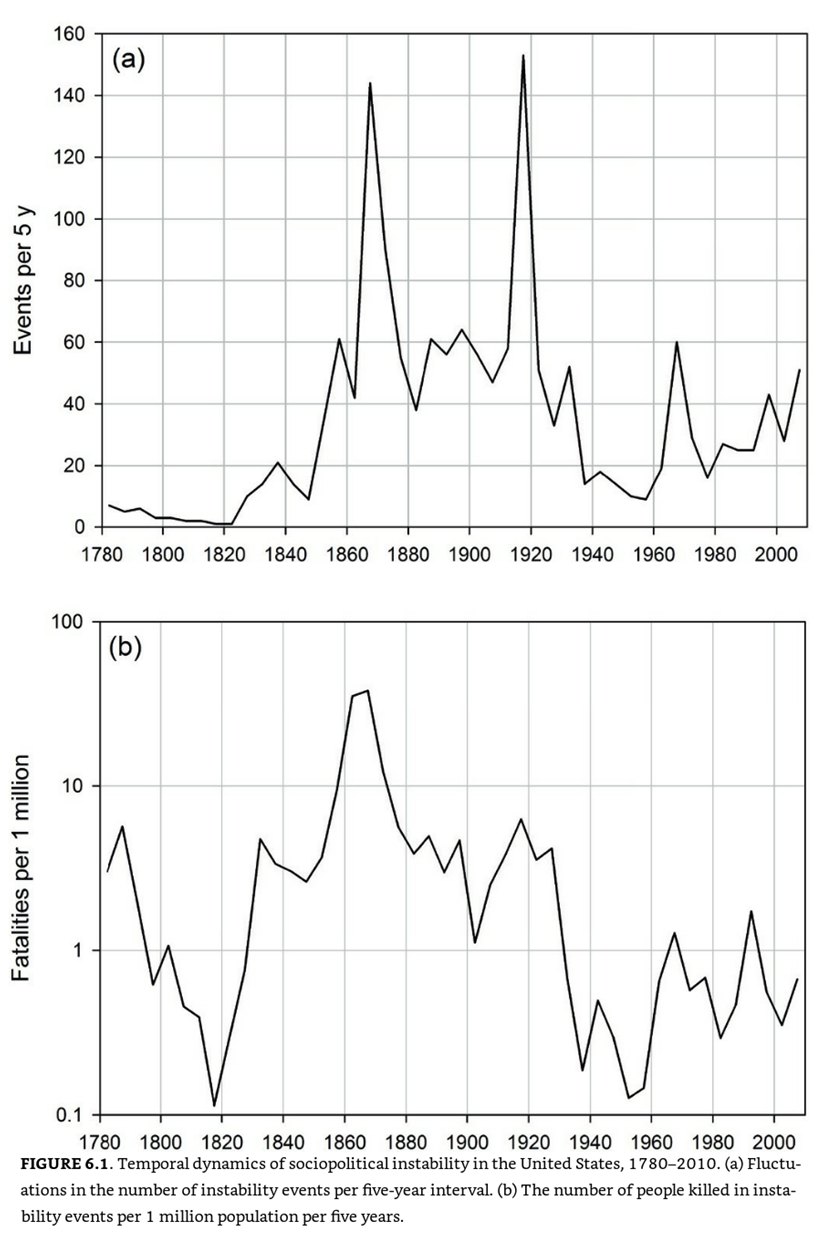

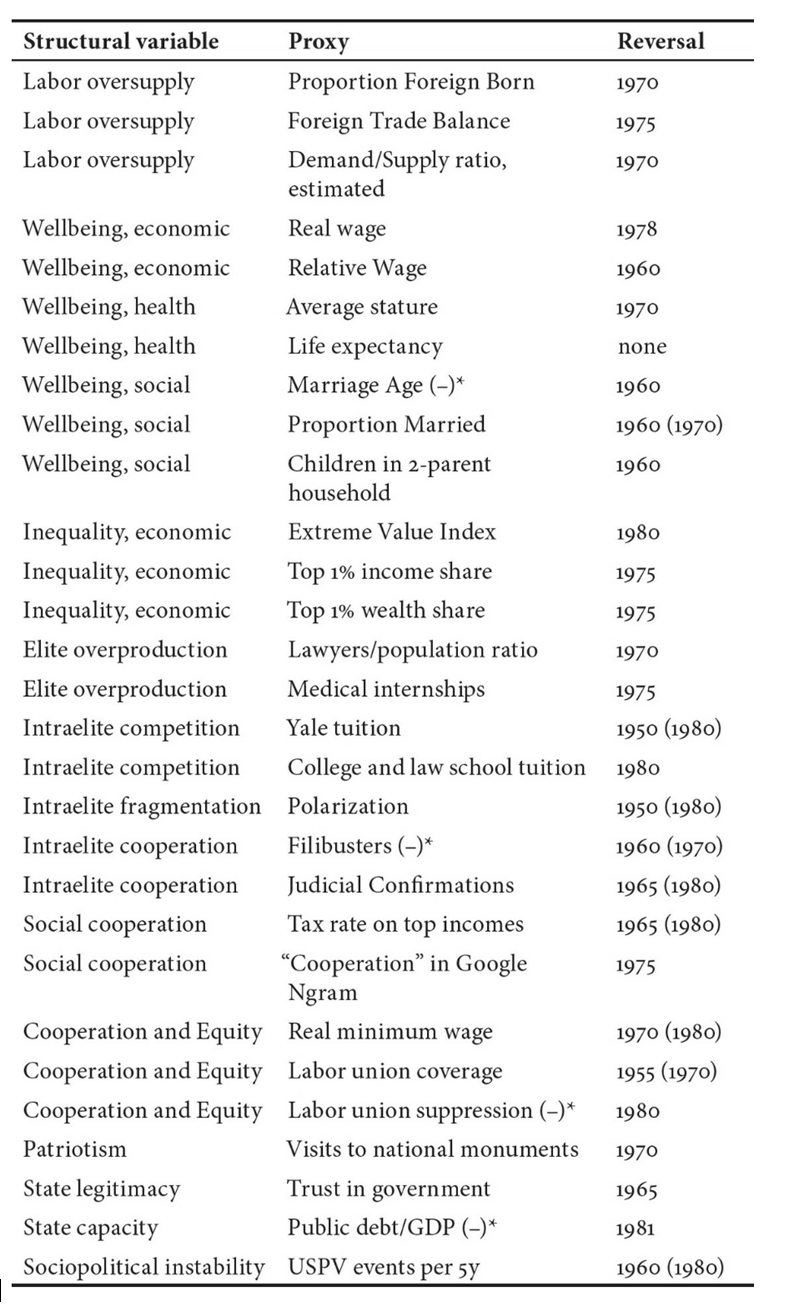
12. From the New Deal to the Reagan Revolution: A Dynamical Model
In this chapter author:” will follow in the footsteps of Chapter 9 by developing a quantitative model (using the conceptual framework of Chapter 2). A major focus will be the dynamics of general population and wellbeing since 1930 and why real wages stopped growing in the 1970s.”
13. Social Pressures towards Instability: From the Reagan Revolution to the Troubles of Our Times
Here author:” focus on elite overproduction, intensified intraelite competition and conflict during the 1990s. I combine the trends in wellbeing and elite overproduction with state variables (public debt and trust in the state institutions) and bring the three major structural-demographic components (population–elites–state) together in a single measure of the Political Stress Indicator”
14: Conclusion: Two Ages of Discord
In conclusion author summarizes content of the book and provides prediction of increase instability of American society in near future, which will continue for quite a few years ahead before it would arrive to the next period of stability and prosperity. Here is the summary graph for secular cycles:

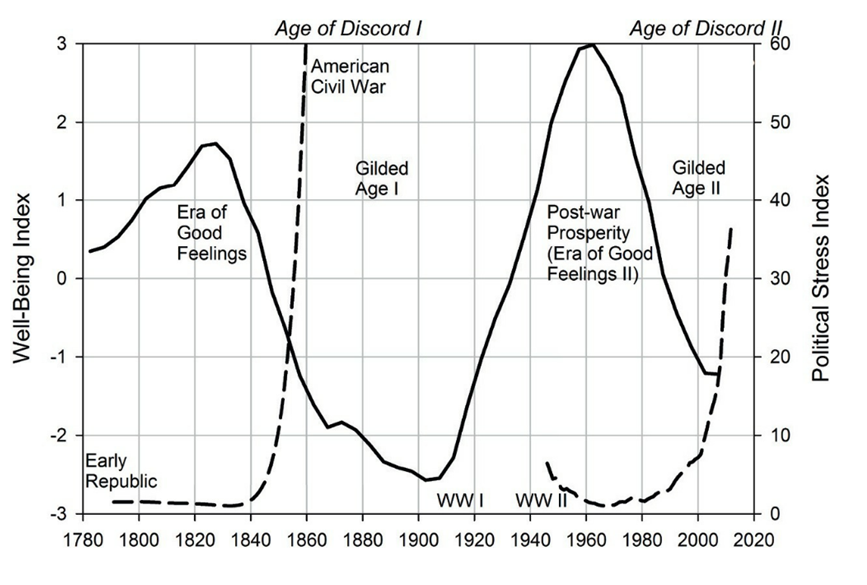
MY TAKE ON IT:
This is one more book that looks at cyclical character of previous development and predicts period of trouble for American Society in 2020s. So far, these prophesies proved to be correct based on events of year 2020. I actually completely agree with these predictions, but not because of cyclical character of history. I think that period of trouble comes from society’s outgrowing existing methods of human interactions, exchange of goods and services, and cooperation. We are not any more in agrarian society when 90% of population had to work on land to produce food or even in industrial society when 90% of population had to work in industries selling their labor to produce goods and services. We are quickly moving into automated production society when only small minority would be actually busy controlling production of goods and services by machines. So, neither agrarian models of independent farmers or plantations with slaves, nor industrial model of managers and worker would do. Sure, automated production would produce more than enough of goods and services, but it could not possibly produce psychological satisfaction for majority of population. I think this problem could be resolved by changing of method of resource allocation and exchange rules, but it would still take quite a bit of time to overcome Age of Discord II.
20210425 – Capitalism A short History
MAIN IDEA:
The main idea here is to review classic analysis of capitalism as presented in works of Marx, Weber, and Schumpeter, history of this economic system as it was developing in the few key representative societies, its current variety of forms, and trends such as globalization, financialization, and symbiosis with government that to significant extent defines contemporary life.
DETAILS:
I. What Does Capitalism Mean?
The Emergence of a Controversial Concept
Author begins by discussing origins and history of term capitalism and concludes by stating:” Individualized property rights; commodification on markets for goods, labor, land and capital; the price mechanism and competition; investment, capital, and profit; the distinction between power-holding proprietors and dependent propertyless wage workers; tensions between capital and labor; rising inequality; the factory system and industrialized production—these were, in varying combinations, major characteristics of the concept of capitalism as it emerged in the period leading up to World War I.”
Three Classics: Marx, Weber, and Schumpeter
Here author reviews ideas of three economists of XIX – early XX century that had big impact on understanding of capitalism.
He summarizes Marxian concept of capitalism in four points:
- Market with division of labor and money economy
- Accumulation of capital
- The core of mode of production – tension between owners of means of production and labor
- Dynamism of the capitalist system that constantly destroys old and creates new
Then author reviews ideas of Max Weber who treated capitalism as part of modernization with:” economic action was characterized by competition and exchange, orientation to market prices, the deployment of capital, and the search for profit.” Weber also went beyond pure economics linking capitalism to Protestant ethics.
Finally. author discusses ideas of Joseph A. Schumpeter, who defined capitalism this way:” “Capitalism is that form of private property economy in which innovations are carried out by means of borrowed money, which in general, though not by logical necessity, implies credit creation.” He also stressed capitalism’s dynamic development that leads to creative destruction.
Other Voices and a Working Definition
In this last part of the chapter author briefly reviews ideas of Keynes, Polanyi, Braudel, and a few others, and concludes with his own definition:” I propose a working definition of capitalism that emphasizes decentralization, commodification, and accumulation as basic characteristics. First, it is essential that individual and collective actors have rights, usually property rights, that enable them to make economic decisions in a relatively autonomous and decentralized way. Second, markets serve as the main mechanisms of allocation and coordination; commodification permeates capitalism in many ways, including labor. Third, capital is central, which means utilizing resources for present investment in expectation of future higher gains, accepting credit in addition to savings and earnings as sources of investment funds, dealing with uncertainty and risk, and maintaining profit and accumulation as goals. Change, growth, and expansion are inscribed.”
2. Merchant Capitalism
In this chapter author discusses early forms of economy with at least some capitalist characteristics:” economy and commercialization of everyday life in the big cities reached a high level, long-distance trade in foodstuffs and luxury goods flourished, the large latifundia produced for the market at a profit, and economic transactions like the sale or lease of land took place on a contractual basis aided by precise calculations. There was also no lack of more or less free wage workers. Yet on the whole the subsistence economy was predominant, slave labor was widespread, and “the strong drive to acquire wealth was not translated into a drive to create capital” (Moses Finley). The orientation toward secure rents was more widespread than the drive for profit. Productivity growth and macroeconomic growth were kept within limits, and the orientation toward war and booty was still stronger than the orientation toward long-term market success.
China and Arabia
Here author reviews early Chinese form of capitalism under dominance of Confucian ideology: “The Confucianism practiced by the civil servants who exercised political power included such elements as a rejection of pronounced inequality and hence of too much independent wealth, the promotion of agriculture, and state controls over money, the credit system, and trade. These controls extended as far as a willingness to operate estates, supply depots, and workshops under state management. Buddhism, which started in India and spread out from there to places in Asia where it was practiced above all by traders and merchants, had a more positive attitude toward commercial activity.”
Somewhat different development occurred in Arabia, when early form of capitalism was based mainly on the long-distance trade. The trade was encouraged by Islam but hampered by limitation on credit.
Europe: Dynamic Latecomer
Development in Europe was similar to Arabia with main form being long-distance trade, but often in more complex and capital demanding form of maritime trade, which caused development of port cities and variety of financial tools such as insurance. It also prompted creation of trade alliances such as Hanse League. Author discusses European development in more detail, stressing that unlike other places traders were somewhat more interconnected with states:” State formation and the origins of financial capitalism were closely connected, and the nexus provided a way for prosperous urban citizens in high finance, a small elite, to establish their influence on politics while simultaneously making their entrepreneurial success dependent on powerful rulers and their shifting political fortunes.”
Interim Findings around 1500
Here author summarizes his views on developments before 1500 AD and states that:” The merchants who supported capitalism in Europe, or at least their leading representatives, exercised direct influence on politics—in part via a symbiosis with rulers in the city-states and free cities that had civic rule, in part through close ties to those exercising political power and in need of financial support, in part through formal self-organization (guilds). By contrast, merchants in China, as well as in Arabia and India, were confined to the antechamber of power and were much less engaged in financing state formation than was the case in Europe. This explains how, in the final analysis and in spite of many countervailing trends, politics in Europe was decisive for promoting mercantile dynamism and a capitalistic kind of accumulation. By contrast, Chinese politics, although it initially allowed and supported commercial dynamism and major developments in accumulating large amounts of capital to inch forward a bit, then became strong enough and mistrustful enough to restrain both of these trends so that finally, when both domestic and foreign policy changed, these economic forces were ultimately thwarted.”
3. Expansion
The point author makes here is:” The rise of capitalism, the development of powerful territorial states, and the expansion of Europe that led to colonialism were all contingent on each other.”
Business and Violence: Colonialism and World Trade
This is about a very interesting and unusual form of European expansion and colonialism when use of military superiority led to expansion of trade by corporations and individuals, rather than to just plain robbery by the state as was historically the case. Author briefly reviews types of goods traded and geography of goods flow.
Joint-Stock Company and Finance Capitalism
This is about corporate forms and financing of this trade expansion and author uses Dutch United East India Company as representative example. Author also discusses here development of banking as tool necessary to support increasing long-distance trade.
Plantation Economy and Slavery
In his discussion of slavery and plantation author mercifully avoids idiotic claim that western wealth and economies are created by slave labor and provides more or less reasonable point:” Slavery has a long tradition in many regions of the world. In the eighteenth century there were as many slaves in Africa itself as in America. But under the influence of capitalism, slavery not only increased enormously in scope; it also, in connection with the harsh work discipline typically appertaining to this economic system, took on a special brutality. One cannot say that capitalism would not have developed further without its centuries-long connection to slavery. Nor is it a tenable thesis to claim that industrialization since the late eighteenth century was fed by the gigantic profits of the slave trade, as incontestable as the multiplier effects are that emanated from it into other branches of trade, the textile business, shipbuilding, and other sectors of the economy in western European countries. But if one wants to understand what it means to say that capitalism came into the world bloody and dirty, it is necessary to keep an eye on its relationship to slavery and other forms of unfree labor.”
Agrarian Capitalism, Mining, and Proto-Industrialization
Here author discusses initial development of capitalism into agriculture when production shifted away from subsistence level to market oriented monetarized forms, which author traces based of history of Europe when industrialization of England and later Germany was supported by agricultural specialization of East European countries like Poland and Russia. Author limits this by time frame of initial development that he calls proto-capitalism and proto-industrial period.
Capitalism, Culture, and Enlightenment: Adam Smith in Context
This chapter is quite interesting because it connects culture and its change with typical capitalistic development such as freedom of individual movements, speech, property rights, contracts, and foundation of all this – enlightenment ideas and literacy and numeracy necessary for effective functioning of society based on trade and industrial production. From this cultural development author expresses his attitude to ideas of “Great Diversion” between Western Europe and others:
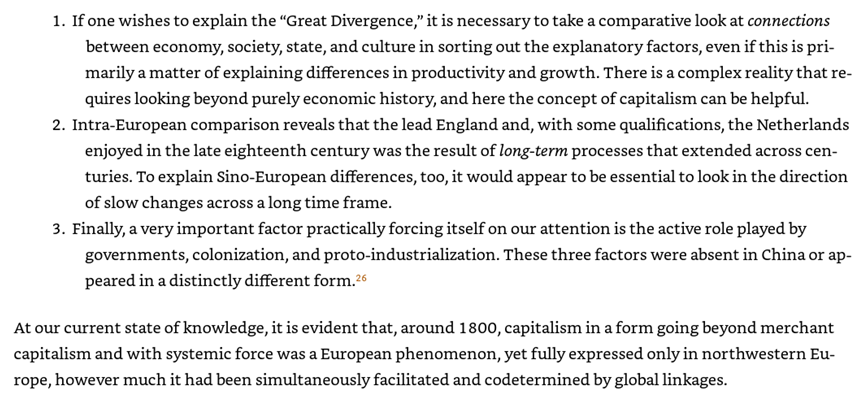
4. The Capitalist Era
This part is about contemporary capitalism and attitudes to it, which fluctuates between acceptance and criticism all the way to rejection.
The Contours of Industrialization and Globalization since 1800
Here is how author characterizes changes inflicted on capitalism by industrialization:
1. Wage labor on a contractual basis turned into a mass phenomenon.
2. With factories, mines, and new transportation systems, with mechanization and the expansion of manufacturing plant, the accumulation of fixed capital reached a scale like nothing before. Alongside the numerically dominant small and medium-size businesses, large concerns and mergers came into being.
3. Technological and organizational innovations became incomparably more important than they had been in preindustrial varieties of capitalism. There was now a faster pace of innovation. In Schumpeter’s analysis, “creative destruction” has been the core component of the capitalist production method… “constant revolutionizing of production, uninterrupted disturbance of all social conditions, everlasting uncertainty and agitation distinguish the bourgeois epoch from all earlier ones.” This contributed to the unpopularity of capitalism, and certainly to its continually renewed delegitimization, most apparent during capitalism’s big, recurring crises, such as the ones that broke out in 1873, 1929, and 2008.
4. These crises usually arose out of excessive speculation and erroneous trends in the financial sector, yet they also affected the “real economy.” They imperiled not only a few speculators but also the life chances of broad sections of the population, and they could lead to profound social and political disruptions. Crises thus brought home another thing that distinguished capitalism in the age of industrialization from previous variants: namely, that it had become the economy’s dominant regulatory mechanism, intensively influencing society, culture, and politics all at the same time.
From Ownership to Managerial Capitalism
Here author reviews consequences of enterprise growth to such extent that they are owned by the multitude of stockholders and run by professional management, rather than owners, consequently completely changing structure of business and motivation of people in control.
Financialization
Here author discusses financial side changes specifically in three respects:
- Globalization of finance and cross border capital flows and currencies exchanges
- Huge growth in outstanding credit, including government debts all over the world
- Shift of power away from business managers to financial managers
Work in Capitalism
Author expresses his view on wage labor as the central form of work in capitalism and these reasons for this:
1. For one thing, the trend toward comprehensive commodification represents a key component of the capitalist system, and wage labor is the most consistent application of this principle to human labor (although not the only one).
2. For another, in spite of numerous exceptions and countervailing tendencies, in the long run wage labor has become and is becoming more extensive and widespread, and not just in the course of capitalist industrialization in the West but (in the meantime) worldwide. As capitalism, industrial capitalism in particular, has widened and deepened, wage labor became, and is still becoming, step by step, the prevailing form of work, although it appears in many forms and combinations. This had, and still has, something to do with the fact that free wage labor on a contractual basis corresponds best, in principle, to the particular kind of instrumental rationality inherent in capitalist enterprises. For, unlike workers who perform bonded labor with their entire person over long periods of time (such as slaves), wage workers who are contractually obligated to perform certain services temporarily but are otherwise free as well as terminable—wage workers like this allow businesses and employers to recruit, shift, and if need be also quickly dismiss employees with a view toward entrepreneurial objectives. This is advantageous to the company’s interest. Under conditions of developed, differentiated labor markets, and in the face of rapid economic change as capitalist normality, it was and is in the interest of capitalist actors to prefer wage labor to unfree labor.
3. Finally, it should be taken into consideration that an employment relationship under wage labor can be terminated by the worker as well as by the employer. The employment relationship may subjugate the worker’s labor power, but not his or her entire person, to the employer’s order-giving authority and the constraints of the enterprise. This is an important and coveted element of freedom. The transition to wage work could and can have a liberating effect, even though entry into such an exchange relationship of work for wages is frequently a matter of urgency for the worker on sheer grounds of survival, and although the employment relationship, once accepted, is usually characterized by much control and discipline. This social and legal quality distinguished and still distinguishes wage labor, in principle, from the different forms of unfree labor, and this distinction needs to be taken seriously from the standpoint of life histories and historiography.
He then discusses changes in the nature of labor that occur now due to increases in productivity, massive government intervention combined with labor movement fighting business that led to constant vacillation between periods of increasing cost of labor at the expense of business leading to decrease in business activity, and periods of government retreat and weakening of labor movement resulting in increase of business activity. All this also includes new form of employment on “as needed” basis and globalization that allowed foreign cheap labor shifting supply chains away from developed Western countries.
Market and State
Here author looks at love-hate relationship between market and state and gives three reasons why state intervention will continue to grow:
- Markets, which make capitalistic conduct possible in the first place, presuppose framework conditions that can only be established by political means. Markets cannot do the job of removing barriers to commerce (e.g., feudal obstacles such as guild regulations, trade monopolies and privileges, fines and tolls on travel) that fragment and constrain, of guaranteeing a minimum of peaceful order, and of providing rules to conclude and implement contracts or contract-like agreements. Without the use of political power, capitalism would never have taken off, nor can it take off in the future. Often the preconditions for the existence of supraregional markets resulted from the use of force—in war, for example, or in the course of colonization.
2. A growing instability of capitalist processes can be discerned, to the extent that these processes have become detached over the last several decades from the restrictive but also stabilizing grounds in which they were once embedded and have, moreover, become internally differentiated. This was illustrated above in the case of two different transitions, first from ownership to managerial capitalism, and then with the shift to capitalism’s current phase of financialization. In the second transition, the investment function has been so powerfully detached from its ties to other functions (such as management of the enterprise or personnel policy) that it has become an independent force, carried away to the point of self-destruction unless the investment function can be recaptured and reembedded. In the search for new ways of embedding finance, state guidelines and controls need not play the only role. Civil society-based arrangements become increasingly relevant, but strong and effective government intervention remains indispensable. (The problem is posed in a somewhat different way, however, outside the North Atlantic area, where widespread clientelism, patronage, and corruption—in other words, special ways of “embedding” economic institutions in community, society, and politics—lead to features of the system that have been characterized and criticized with such catchwords as “patrimonial capitalism” and “crony capitalism.”)
3. Capitalism, even in its advanced stages, develops in a way that has disruptive and destructive effects on its social, cultural, and political environment and can call into question its social acceptance. Here one need only recall the profound crises, repeated with a certain inevitability, that have a habit of starting out as financial crises, as in 1873, 1929–1930 und 2007–2008, yet leave in their wake serious repercussions for the “real economy,” impair the welfare of broad sectors of the population, and possibly lead to social and political disruptions. In equal measure, though, attention must be drawn to the long-term polarizing effects of capitalism when it has been successful. By this I do not mean only the well-known connection between industrialization, wage labor, and worker protest, which leads to social polarization when not counteracted by welfare state measures. Rather, it is also important to mention what is demonstrated by certain findings from the early modern Netherlands, from the process of industrialization in the nineteenth century, and from experiences over the last several decades. These different findings all show that capitalist growth, if not counteracted with compensatory measures, does not necessarily lead to massive impoverishment—quite the contrary! —but does go hand in hand with increasing income and wealth inequality. Exorbitantly high managerial earnings, whose lead over average incomes in the last several decades has reached dizzying heights, are just a tiny, though quite visible and especially irritating, aspect of an increase in inequality that is quite complex. Especially in democratic political cultures, this surge in inequality is perceived as unjust, and over the long run it can call into question the legitimacy of the system.
5. Analysis and Critique
Here author discusses the very concept of capitalism, which acquired mainly negative meaning in English and German languages but is perceived as positive by many economists and ideologues. Author also reviews how it changed overtime becoming mainly linked to inequality. He completes the book by noting that:” Capitalism lives off its social, cultural, and political embedding, as much as it simultaneously threatens and corrodes these moorings. It can be influenced by political means and those of civil society when and if these are strong and decisive enough. Seen from this perspective, one could say that, every era, every region, and every civilization gets the capitalism it deserves. Currently, considered alternatives to capitalism are hard to identify. But within capitalism, very different variants and alternatives can be observed, and even more of them can be imagined. It is their development that matters. The reform of capitalism is a permanent task. In this, the critique of capitalism plays a central role.”
MY TAKE ON IT:
It’s a nice and concise review of history and meaning of capitalism as economic system. I find this approach interesting, but I think that the very use of term capitalism is so muddled that it is becoming impossible to communicate between people because everybody has very complex and diverse understanding of the term. I think that this term outlived its usefulness and one should talk about economic relation between individuals in different positions in relation to resources allocation, production and distribution processes rather than between classes in order to understand economic relationships, develop meaningful course of actions, and predict economic outcomes a bit better then demonstrated by previous track record of economists. There is movement in this direction in form of behavioral economics, evolutionary economics, and others but it is still far away from ability of predicting economic outcomes based on analysis of current conditions and expected actions. One big problem that I have is that capitalism often treated with no regard to realities of life, in which it practically never occurs in its theoretical neatness. There is always interference of state and other violent organizations that distort normal processes of market economy, only later to blame this abstraction – capitalism on their failure. Another big problem is treating humans as if they were independent from need for necessities of life and moral pressure by others and therefore could, for example, participate in free labor exchange. Or ideas of using aggregate demand and aggregate supply to control economy via monetary and fiscal policy. These also have colorful and painful history of failure, but still serve as foundation of infinite number of “economic research” papers. Instead of these I’d like to see specific country/time research when economic and extra-economic factors treated as part of one integrated process of resource production and allocation to individual and/or small group levels. I understand that it would be much more complicated process, than current primitive and mainly meaningless analysis of abstract aggregates, but it is the only way to obtain something close to scientific level of understanding for these processes. I believe that with advance of AI processing and increase in computer power it could become reality, but I do not expect it happen very soon.
20210418 – The Strange Order of Things

MAIN IDEA:
The main idea of this book is that humans evolutionary developed as one integrated biological entity, with all its qualities: feelings, reason, and consciousness being undividable and necessary for survival. Only understanding of this integrity could lead to understanding of human cultures built on this biological foundation. The difficulties and even crises of contemporary humanity come from emergence of contemporary technologies that are not necessarily compatible with human nature, so the way should be found to reconcile all of this or problems could become unsurmountable.
DETAILS:
Part l: About Life and Its Regulation (Homeostasis)
1: On the Human Condition
Author begins with discussing situations when feelings process inputs and prompt actions better than mind. Here is author’s reasoning:” feelings would succeed where plain ideas fail has to do with the unique nature of feelings. Feelings are not an independent fabrication of the brain. They are the result of a cooperative partnership of body and brain, interacting by way of free-ranging chemical molecules and nerve pathways. This particular and overlooked arrangement guarantees that feelings disturb what might otherwise be an indifferent mental flow. The source of feeling is life on the wire, balancing its act between flourishing and death. As a result, feelings are mental stirrings, troubling or glorious, gentle or intense.”
After that he moves to human origins and its key component – culture. Here is how author looks at connection between feelings and culture:
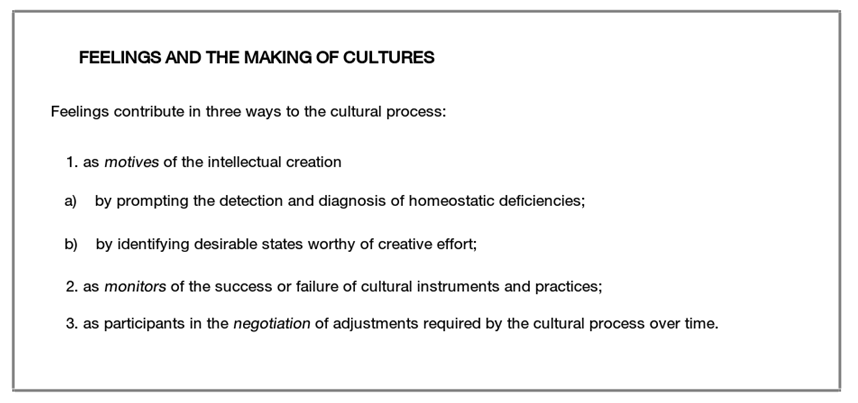
Author then provides comparison with other animals, especially bacteria and social incects and find a common ground for all in the notion of Homeostasis: “The part of homeostasis that concerns “prevailing” is more subtle and rarely acknowledged. It ensures that life is regulated within a range that is not just compatible with survival but also conducive to flourishing, to a projection of life into the future of an organism or a species.” Author then links it all together: “Feelings, as deputies of homeostasis, are the catalysts for the responses that began human cultures. Is this reasonable? Is it conceivable that feelings could have motivated the intellectual inventions that gave humans (1) the arts, (2) philosophical inquiry, (3) religious beliefs, (4) moral rules, (5) justice, (6) political governance systems and economic institutions, (7) technology, and (8) science”
At the end of chapter author links into one continuum early organisms, genes, nervous system, feelings and mind – all supporting human homeostasis:” Eventually, each feeling-driven, conscious mind could mentally represent, with an explicit reference to the experiencer subject, two critical sets of facts and events: (1) the conditions in the inner world of its own organism; and (2) the conditions of its organism’s environment.” Author then moves to problems of derailing of homeostasis and resulting pain and suffering. He suggests that reason for these problems to occur: “is that cultural instruments first developed in relation to the homeostatic needs of individuals and of groups as small as nuclear families and tribes. The extension to wider human circles was not and could not have been contemplated. Within wider human circles, cultural groups, countries, even geopolitical blocs, often operate as individual organisms, not as parts of one larger organism, subject to a single homeostatic control.”
2. In a Region of Unlikeness
Here author moves back to origin of life some 3.8 billion years ago, traces its development and presents summary table:
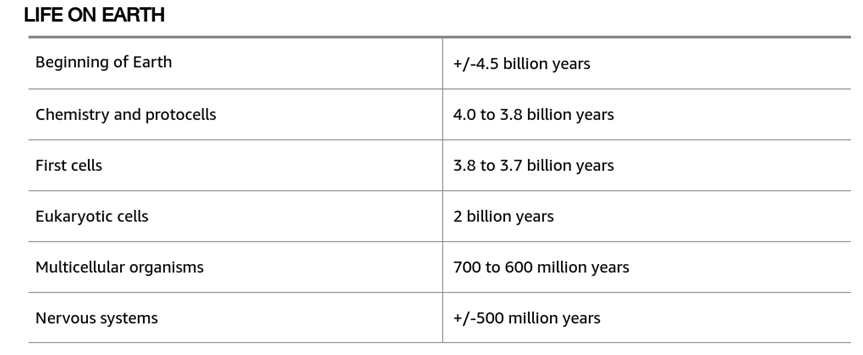
3: Varieties of Homeostasis
In this chapter author provides an interesting review of the very notion of Homeostasis, its work, history, and varieties. He also expresses preference for another term that would better communicate dynamic character of this notion in living organisms: Homeodynamics.
4. From Single Cells to Nervous Systems and Minds
In this chapter author reviews biological history of development of increasingly complex objects, combining it for nervous system in such way:

At the end of chapter author links it to human brain and calls attention to the fact that:” That the nervous system is the enabler of our mental life is not in doubt. What is missing from the traditional neuro-centric, brain-centric, and even cerebral-cortex-centric accounts is the fact that nervous systems began their existence as assistants to the body, as coordinators of the life process in bodies complex and diversified enough that the functional articulation of tissues, organs, and systems as well as their relation to the environment required a dedicated system to accomplish the coordination. Nervous systems were the means to achieve that coordination and thus became an indispensable feature of complex multicellular life.”
Part II: Assembling the Cultural Mind
5: The Origin of Minds
The point of this chapter is to sketch biological nature of mind and its role as instrument of human cultural mind. Author characterizes here minded life from the point of view of images processing not only in the brain, but also by totality of nervous system. Here is author characteristics of evolutionary steps that led to this:” the steps that must have followed in evolution are fairly clear. First, using images made from the oldest components of the organism’s interior—the processes of metabolic chemistry largely carried out in viscera and in the blood circulation and the movements they generated—nature gradually fashioned feelings. Second, using images from a less ancient component of the interior—the skeletal frame and the muscles attached to it—nature generated a representation of the encasement of each life, a literal representation of the house inhabited by each life. The eventual combination of these two sets of representations opened the way for consciousness. Third, using the same image-making devices and an inherent power of images—the power to stand for and symbolize something else—nature developed verbal languages.
Author then explains why images require nervous systems and how they are processed depending on the source: world outside of organism and world inside of organism.
6: Expanding Minds
Here author uses analogy of hidden orchestra within the mind that makes images:” The signals with which images are constructed originate from three sources: the world around the organism, from where data are collected by specific organs located in the skin and some mucosae; and two distinct components of the world inside the organism, the old chemical/visceral compartment and the not so old musculoskeletal frame and its sensory portals.” He then analyzes process of making memories and enriching minds, summarizing results this way:

7: Affect
Here author moves to handling of feelings for which he introduces the notion of affect:” Affect is thus a wide tent under which I place not only all possible feelings but also the situations and mechanisms responsible for producing them, responsible, that is, for producing the actions whose experiences become feelings.”
He then discusses what feelings are, valence of experience, kinds of feeling that he divides into Emotive Response Process, Stereotypes, Drives, Motivations, and Conventional emotions. He also defines notion of Layered Feelings.
8: The Construction of Feelings
In this chapter author connects feelings with Homeostasis:” To understand the origin and construction of feelings, and to appreciate the contribution they make to the human mind, we need to set them in the panorama of homeostasis. The alignment of pleasant and unpleasant feelings with, respectively, positive and negative ranges of homeostasis is a verified fact. Homeostasis in good or even optimal ranges expresses itself as well-being and even joy, while the happiness caused by love and friendship contributes to more efficient homeostasis and promotes health. The negative examples are just as clear. The stress associated with sadness is caused by calling into action the hypothalamus and the pituitary gland and by releasing molecules whose consequence is reducing homeostasis and actually damaging countless body parts such as blood vessels and muscular structures. Interestingly, the homeostatic burden of physical disease can activate the same hypothalamic-pituitary axis and cause release of dynorphin, a molecule that induces dysphoria.”
Author then proceeds to discuss relevant processes in some details:
- Where do Feelings come from
- How they assembled
- The Continuity of Bodies and Nervous Systems
- The Role of the Peripheral Nervous System
- Peculiarities of the Body-Brain Relationship
- Role of the Gut
- Where are Feeling Experiences Located
- Remembrances of Feelings Past.
9: Consciousness
In the last chapter of this Part author defines Consciousness:” The term “consciousness” applies to the very natural but distinctive kind of mental state described by the above traits. That mental state allows its owner to be the private experiencer of the world around and, just as important, to experience aspects of his or her own being. For practical purposes, the universe of knowledge, current and past, that can be conjured up in a private mind only materializes to its owner when the owner’s mind is in a conscious state, able to survey the contents of that mind, in his or her own subjective perspective.”
Author then discusses observation of consciousness, subjectivity, as its first and indispensable component and Integrated experiences as the second component. Finally, he links Sensing and Feeling to Consciousness and defines:” The hard problem is about the fact that if minds emerge from organic tissue, it may be hard or impossible to explain how mental experiences, in effect, felt mental states, are produced.”
Part III: The Cultural Mind at Work
10: On Cultures
This chapter is about biological roots of human cultures. It starts with discussion of link between cultures and Homeostasis, then proceeds to distinctive human cultures, which achieve the same objective – homeostasis in great many different ways. Then author going through discussion of various manifestations of the “cultural mind”, and completes with very detailed summary:
First, the mind had to be capable of representing, in the form of images, two distinct sets of data: the world exterior to the individual organism, where the others that are part of the social fabric loom prominently and interactively; and the state of the individual organism’s interior, which is experienced as feelings. This capability draws on an innovation of central nervous systems: the possibility of making, within their neural circuitries, maps of objects and events that are located outside the neural circuitries. Such maps capture “resemblances” of those objects and events.
Second, the individual mind had to create a mental perspective for the whole organism relative to those two sets of representations—the representations of the organism’s interior and of the world around it. This perspective is made up of images of the organism during the acts of perceiving itself and its surround, in reference to the organism’s overall frame. This is a critical ingredient of subjectivity that I regard as the decisive component of consciousness. The fabrication of cultures, which requires social, collective intentions, is inconceivable without the presence of multiple individual subjectivities working, to begin with, for their own advantage—their own interests—and eventually, as the circle of interests enlarges, promoting the good of a group.
Third, once mind had begun but before it could become the cultural mind we can recognize today, it was necessary to enrich it by adding impressive new features. Among them were a powerful, image-based memory function capable of learning, recalling, and interrelating unique facts and events; an expansion of the imagination, reasoning, and symbolic thought capabilities such that nonverbal narratives could be generated; and the ability to translate nonverbal images and symbols into coded languages. The latter opened the way for a decisive tool in the construction of cultures: a parallel line of verbal narratives. Alphabets and grammars were the “genetic” tools of this latter and enabling development. The eventual invention of writing was the crowning entry into the toolbox of creative intelligence, an intelligence capable of being moved by feeling to respond to homeostatic challenges and possibilities.
Fourth, a critical instrument of the cultural mind resides with a largely unsung function: play, the desire to engage in seemingly useless operations that includes the moving about of actual pieces of the world, real or in toy form; the moving of our own bodies in that world, as in dancing or playing an instrument; the moving of images in the mind, real or invented. Imagination is a close partner of this endeavor, of course, but imagination does not fully capture the spontaneity, the range and reach of PLAY, to use the capitalized form that Jaak Panksepp prefers when he talks about this function. Think of play when you think about what can be done with the infinity of sounds, colors, shapes, or with pieces in Erector or Legos sets or computer games; think of play when you think of the infinitely possible combinations of word meanings and sounds; think of play as you plan an experiment or ponder different designs for whatever it is that you are planning to do.
Fifth, the ability, especially developed in humans, to work cooperatively with others to achieve a discernible, shared goal. Cooperativity relies on another well-developed human ability: joint attention, a phenomenon to which Michael Tomasello has devoted pioneering studies. Play and cooperation are, in and of themselves, independently of the results of the respective activities, homeostatically favorable activities. They reward the “players/cooperators” with a slew of pleasurable feelings.
Sixth, cultural responses begin in mental representations but come into being by the grace of movement. Movement is deeply embedded in the cultural process. It is from emotion-related movements happening in the interior of our organisms that we construct the feelings that motivate cultural interventions. Cultural interventions often arise from emotion-related movements—of the hands, quite prominently, of the vocal apparatus, of the facial musculature (a critical enabler of communication), or of the whole body. Last, the march from life’s beginnings to the doors of human cultural development and cultural transmission was only possible due to another homeostasis-driven development: the genetic machinery that standardized the regulation of life inside cells and permitted the transmission of life to new generations.”
11: Medicine, Immortality, and Algorithms
Here author discusses achievements of contemporary technology, especially medicine and computers that allow to speculate about practically unlimited improvements of everything, even immortality.
12: On the Human Condition Now
This chapter discusses current condition that author finds ambiguous due to combination of achievements of technology with decline of culture and multitude of unresolved governmental and economic issues. Author looks for biological causes of the current crises that seems to be coming from conflict between affect and reason. He foresees two possible scenarios of the future in one civilizational effort will fail and with-it humanity would fail pushed away either by AI and robots or other organisms. “In another scenario, cooperation eventually comes to dominate thanks to a sustained civilizational endeavor over multiple generations.” Author predicate outcome on feelings and concludes chapter with:” A life not felt would have needed no cure. A life felt but not examined would not have been curable. Feelings launched and have helped navigate a thousand intellectual ships.”
13: The Strange Order of Things
Author here refer to the name of this book and explains that strange order of things is the very existence and development of life overall and humanity specifically with its high faculties of consciousness and feelings. He also stresses that:” neither parts of nervous systems nor whole brains are the sole manufacturers and providers of mental phenomena. It is unlikely that neural phenomena alone could produce the functional background required for so many aspects of minds, but it is certainly the case that they could not do so in regard to feelings. A close two-way interaction between nervous systems and the non-nervous structures of organisms is a requirement. Neural and non-neural structures and processes are not just contiguous but continuous partners, interactively. They are not aloof entities signaling each other like chips in a cell phone. In plain talk, brains and bodies are in the same mind-enabling soup.”
Author completes this book by noting that everything discussed about biological and evolutionary phenomena of humanity is at least somewhat tentative because:” We do not have, however, any satisfactory scientific account of the origins and meaning of the universe, in brief, no theory of everything that concerns us. This is a sobering reminder of how modest and tentative our efforts are and of how open we need to be as we confront what we do not know.”
MY TAKE ON IT:
This is a great book that presents clear thinking and good understanding of humanity that I am pretty much agree with. I am somewhat more optimistic on human ability to overcome crisis, which, I believe, is a lot less than meets the eye. Just because human tendency to overestimate problems is currently hugely amplified by communication technology, social networks, that does not mean these problems are unsurmountable. I do not think that the solution could be found in
increased abilities of governments redistribute resources from productive part of population to elite and unproductive part without causing revolts and/or revolution. I think it would rather come from opposite direction – pushing problem resolution away from handling problems via government hierarchy down to evolutionary defined proper level of individuals, families, and small groups. Consequently, I agree that humanity is on the brink of a huge change in just about any area that one can think of, but I also believe that the change will be for the better and no AI or robots or other organisms would substitute humanity whether we’ll find meaning of the universe or not. Actually, I think that the most reasonable way is to accept that the universe has no meaning whatsoever and live happily ever after.
20210411 – The China Nightmare

MAIN IDEA:
The main idea of this book is to use author’s extensive experience in China to provide information about current situation, direction of Chinese development, and threat that it increasingly presents to America and the World overall due to its ideology of Chinese supremacy. Until now this thread was ignored in hope that China would grow out of this primitive attitude, but due to its rapid economic, technological, and military growth it should be taken seriously. The idea is also providing recommendation on how to deal with this threat.
DETAILS:
Introduction
Author begins with obvious statement that USA vs. PRC is the main geopolitical rivalry of XXI century so far. He then states that China’s objective is at least:” carve out an authoritarian sphere of influence that it can control, making Asia repressive and closed.” He also points out that Chinese leadership feels insecure being surrounded by USA allies and bases:
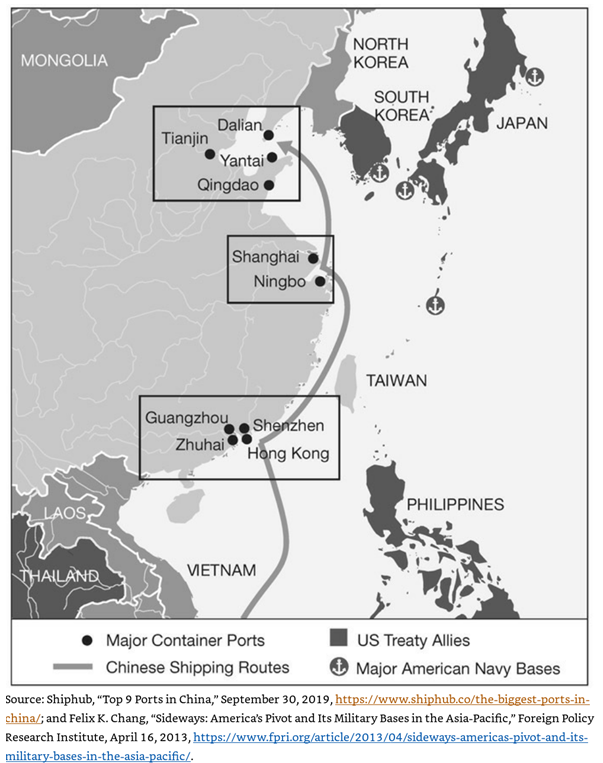
Author then discusses changes in Chinese startegy and objectives that became obvious with coming to power Xi Jin Ping. Author dicusses not only various communications by Xi and oficialdom about these objectives, but also such actions as military buidup. He also looks at Chinese insecurity and fear of potential crisis that impacts their leadership and define their actions. Finally author stresses his main point:” The theme of the book is that, while China is acting to further ever-grander ambitions, it is also facing profound internal problems and increasing rot in the party. This makes China even more dangerous than many assume. Indeed, one reason China has acted more aggressively in recent years is because the CCP is searching for legitimacy through grand schemes such as “the Chinese dream of national rejuvenation.”
1. Big Ambitions
The first chapter outlines China’s ambitions under Xi, drawing from leadership speeches and party documents.
Here is how author defines Chinese objectives based on variety of leadership statements and official documents:” in Beijing’s view, the struggle for geopolitical mastery will not be limited to Asia. Rather, China wants to lead a new world order centered around Chinese power and governed by Chinese-made rules. Beijing has now detailed a set of requirements for achieving global leadership. These include (1) building a worldwide network of strategic partnerships to expand its international influence, which it will use to shape and change the way the world is governed; (2) increasing other nations’ dependence on China through Chinese-led “integration”; (3) becoming the most technologically advanced nation in the world by leading in innovation and creating a stronger defense-industrial base; and (4) obtaining military superiority. These accomplishments will help China achieve preeminence in what the CCP calls the global “community of common destiny.” The concept of a community of common destiny has been part of Chinese strategic thought for years, but, at least regarding foreign affairs, this report was centrally focused on China’s global aspirations to build a China-friendly world order.”
Then author looks in detail on specific initiatives such as “Belt and Road”:

Another initiative is more open and aggressive technological competition. Finally a big part of everything is ideological offencive designed to present Chinese dictatorship as much better solution to all real and invented world problems than old and tired Western democracy.
2. Why Global Centrality?
Chapter 2 takes us from the Qing empire to Mao’s establishment of Communist China.
Author reviews this history and its impact on contemporary thinking of Chinese leadership about what is China territorially, what is its place in the world, and what kind of relationship with other countries it should have. This thinking is pretty much based on pseudo-history of China as super nation and state, which was temporary in decline and now is coming back to take its proper place in the word. Therefore, the answers are:
- territorially China should encompass everything previously conquered by Qing Empire
- globally it should occupy the central place in the world
- relations with other should be built as with tributaries to superior Chinese nation and culture.
3. Deng’s National Rejuvenation
Chapter 3 discusses Deng’s reforms. Here author discusses how Deng managed to get out of rigid communist ideology that put country in economic neverland and on the brink with war against top dog of communism at the time -USSR. Both objectives: revival of economy and prevention of war were achieved by moving along the same line: establishing nearly allied relations with United States, implementing market economy reforms, that removed key, but non-workable parts of communist ideology, and enforcing more than workable totalitarian part of communist ideology by all means necessary. Finally, carefully develop and maintain Western illusions about China’s future democratization, while massively implementing transfer of supply chains and production facilities from developed West to China by luring business investment with cheap labor under dictatorship that excluded possibility of unions and need to deal with labor movement. Also, the big part of the process was massive increase in Western environmental and other regulations combined with absence of this expensive staff in China.
4. Closing the Curtain
Chapter 4 explores what happened when Hu came to power and began reversing Deng’s policies.
The main point of this chapter is that China’s turn back to dictatorship, away from free market, and initiation of external aggression actually occurred during Hu’s tenure in power. Author recounts multiple incidents from undiplomatic treatment of Obama to maritime aggression against neighboring states, to internal political crises and corruption.
5. Recentralization of Dictatorship
Chapter 5 describes Xi’s bid for power and China’s techno-military buildup. Here author starts by describing Xi’s consolidation of power via campaign against corruption that helped Xi to remove whatever competition he had at the top levels of CCP. Then author describes formation of high-tech police state with implementation of the system of Social Credits in order to control population. Finally, author reviews military implications of newly expanded efforts to build powerful military based on leapfrog in technology, especially AI.
6. Expansion
Chapter 6 details China’s current geopolitical behavior, using the strategic framework implied by the 19th CCP Congress report and similar documents. In this chapter author reviews geopolitical situation of China starting with Russia, which find itself in unusual role of junior partner to another dictatorship. So far, these two dictatorships were able maintain quasi-alliance against common enemy – USA, but it is relatively shaky stability because China is expanding military, therefore removing Russia’s last remaining source of claim to be the great power. It is also fragile because China’s geopolitical expansion directed at Central Asia that used to be under firm Russian control, and it could potentially raise claims against scarcely populated Russian Far East and Siberia. Another potential rival of China is India, which just started its economy growing, has population that is increasing and soon will overtake Chinese, and finally could become very attractive place to shift supply chains to democratic state, which even if exceedingly corrupt, nevertheless has something more open legal and government system than China with its theft of intellectual property, unfair trade practices, and constant thread of confiscation. Author also goes through all other areas in Asia, Europe, and elsewhere.
7. Weak Points
Chapter 7 examines obstacles facing Xi and looks at China’s weaknesses.
In this chapter author finally gets to discuss China’s weaknesses. These include economic downside of National Security state when any economic considerations are subordinated to the need of keeping CCP in power. This means advance of state enterprises and author provides some relevant data:” These measures have produced the largest state sector in the world. In 2013, an estimated 150,000 SOEs in China held combined assets of almost $16.8 trillion, which amounted to a staggering 177 percent of GDP.4 By 2018, this figure had risen to more than 230 percent of GDP.5 Along with the resurgence of the state’s involvement in the economy, resource allocation has become severely skewed in unambiguous favor of SOEs. The most trenchant indication of this is the shift of bank loans from the private to the state sector. In 2012, the private sector accounted for 52 percent of bank credit, while the state sector received 32 percent. By 2016, this dramatically reversed, with the state sector receiving 83 percent of bank loans, while the private sector received only 11 percent.”
Another important issue is poor compatibility of technological innovation and suppression of individual freedoms. Author also provides a whole list of sources of the future problems: Shrinking Coffers, Social Problems, Capital and Human Flight, Internal Threats, Decay of population and ideology, Obsessions with Stability, and even potential emergence of currently unpredictable threats.
8. Implications for America
Chapter 8 addresses implications for long-term strategic competition and offers recommendations for future American policy. Here author contemplates on current and future American response to Chinese challenge that comes not only from raise of China, but from its potential failure, or at least stagnation. Author advocates stronger stance for USA and provides some recommendations:” A truly competitive strategy would target the Chinese weaknesses detailed in this book. Some of China’s greatest potential vulnerabilities include (1) the expanse of its empire, which includes borders with unfriendly neighbors; (2) its desire to become a maritime power even as its land borders are not pacified; (3) a stagnating economy that could become worse thanks to a demographic nightmare; (4) a potential elite split; and (5) popular blowback against repression. The CCP is struggling with legitimacy and geography, trying to deepen control over Hong Kong and spread its control to Taiwan, and seeking an order in Asia to which few would want to be subjected. It faces tremendous fiscal stresses, an aging society, and a highly indebted country.”
Author also recommends that Americans should go around CCP whenever and wherever possible: “Working with Chinese people outside the CCP has practical benefits. Something could go wrong inside the CCP, especially around 2022, as Chairman Xi has canceled succession plans. This makes it all the more important that the US has a relationship with all sectors of Chinese society and non-CCP leaders who could potentially fill a void created by an acute crisis in Beijing.”
In short – China is the threat, which is current and serious, but not overwhelming yet.
MY TAKE ON IT:
In my hamble opinion as long as China is under control of Communis party, which for all intention and purposes is pretty much National-Socialist entity ideologically pretty close to German Nazis, albeit with much less openly pronounced ethnic superiority complex. The stress should be on “less openly pronounced” with understanding that this superiority complex is as intense as Nazi’s. The reason for this difference comes down to a few issues: Chinese CCP does not have clear technological and military advantage at this point and still depends on Western investment, transfer of technology, and trade. In addition, CCP must have serious doubts in regard to loyalty of population, which does not strongly adhere to communist ideology, or any defined ideology for that matter. None of this was the case for German NSDAP in late 1930s, which had best technology and military in the world and could easily compensate for economic decline by readiness of population to suffer hardship and even war in support of revenge for Versailles and humiliation of defeat. However, these differences should not conceal ideological similarity of these two political entities, which both hellbent on domination by all means necessary, and could be stopped only by overwhelming power. The German NSDAP did not expect use of such power against them and had to be eliminated by actual hot war with tens of millions resulting deaths. Hopefully the West and especially USA find backbone to demonstrate such overwhelming power that would make continuation of aggression impossible, which in turn ideologically undermine CCP and could lead to internal change beneficial to China and the World. However, considering extremely low intellectual level of American leadership and its general corruption, it would not be surprising that aggression will not be challenged. Consequently, situation will continue deteriorating until it gets out of hand. What will happen next is everybody’s guess.
20210404 – The Problem of Political Authority

MAIN IDEA:
The main idea of this book is first of all to provide philosophical rejection of the very notion of legitimacy of Authority and the second point is to provide logical foundation for statement of feasibility of society without Authority. Finally, the third point is to present the path of movement from currently the most advanced form of society – Democracy to even more advanced form – Anarcho-Capitalism.
DETAILS:
Author provided detailed Analytical Content:



Here is how author summarizes these arguments:
13.5.1 The argument of Part I:
The modern state claims a kind of authority that obliges all other agents to obey the state’s commands and entitles the state to deploy violence and threats of violence to enforce those commands, independent of whether the commands are in themselves just, reasonable, or beneficial. The argument of the first half of this book is that that sort of authority, ‘political authority’, is an illusion. No state is legitimate, and no individual has political obligations. This leads to the conclusion that at minimum, the vast majority of government activities are unjust. Government agents should refuse to enforce unjust laws, and individuals should feel free to break such laws whenever they can safely do so.
The argument against political authority proceeded by examining the most important arguments for authority and finding each inadequate. The traditional social contract theory fails due to one salient fact: there is no actual contract. The most common theory of contemporary social contract enthusiasts – that an arrangement is rendered voluntary and contractual by the fact that one could have escaped its imposition through relocation to Antarctica – would draw scarcely more than a laugh in any other context.
The alternative of a purely hypothetical social contract fails for two reasons: first, there is no reason to think that all reasonable persons could agree, even in idealized circumstances, on even the most basic political theory. Second, a merely hypothetical contract is ethically irrelevant. However fair, reasonable, and impartial a contract might be, one is not typically thereby entitled to force others to accept it.
The democratic process fails to ground authority, as one typically does not acquire a right to coerce someone merely because those who want one to coerce the victim are more numerous than those who want one to refrain. The appeal to the ideal of deliberative democracy fails, because no actual state remotely resembles an ideal deliberative democracy, and in any case, no mere method of deliberation negates the rights of an individual. The appeal to the obligations to promote equality and to respect others’ judgment fails for several reasons, including that these obligations are not strong enough to override individuals’ rights, that they are not the sort of obligation that may typically be enforced through coercion, and that the idea of political legitimacy itself is a much clearer violation of the value of equality than the failure of individuals to obey democratically made laws.
The appeal to the good consequences of government fails to ground authority because an individual’s obedience to the law has no impact on the state’s ability to provide those benefits, and an agent’s provision of large overall benefits does not confer on the agent an entitlement to coerce others to obey the agent’s commands independent of the content of those commands. The appeal to fairness likewise cannot ground an obligation to obey harmful, unjust, or useless commands nor an ethical entitlement to deploy coercion in support of such commands.
A review of psychological and historical evidence concerning human attitudes to authority suggests two important lessons: first, most individuals have strong pro-authority biases that render their intuitions about authority untrustworthy. Second, institutions of authority are extremely dangerous, and the undermining of trust in authority is therefore highly socially beneficial.
13.5.2 The argument of Part II:
Pace Hobbes, when diverse agents have roughly equal power, it is prudentially irrational for any agent to initiate conflict. In contrast, centralization of power invites exploitation and abuse by the powerful. The democratic process inhibits the worst government abuses, but it remains imperfect due to widespread ignorance and irrationality on the part of voters. Constitutional restrictions are often impotent, since there is none but the government to enforce the constitution. The separation of powers fails because the branches of government can best promote their interests through making common cause in expanding state power rather than protecting the rights of the people.
The contention of Part II of this book is that a superior alternative exists, in which governmental functions are privatized. Police duties may be taken over by private security guards, perhaps hired by small local property owners’ associations. This system differs from governmental provision of security in that it relies on genuine contractual arrangements, and it incorporates meaningful competition among security providers. These differences would lead to higher quality, lower cost, and less potential for abuse than found in coercive monopolistic systems.
Resolution of disputes, including disputes about whether a given individual committed a crime and whether a given type of conduct ought to be tolerated, would be provided by private arbitrators. Individuals and firms in an anarchic society would choose this method of resolving disputes because it is far less costly than resolution through violence. Law would be generated chiefly by the arbitrators themselves, in the manner in which the common law has developed in the actual world. The voluntariness and competitiveness of the system, again, would lead to higher quality, lower costs, and less abuse.
The elimination of government military forces need not leave a society insecure. Under certain favorable conditions, a society can be safe from invasion despite the lack of military deterrence. In the event of invasion, guerrilla warfare or nonviolent resistance can prove surprisingly effective at expelling foreign occupiers. In some ways, having a government makes a society more rather than less likely to be involved in war – for example, because one’s government may provoke a conflict. A number of small countries have already successfully abolished their militaries without being conquered as a result. The maintenance of standing armies entails a nontrivial risk of those armies being used unjustly, as well as a risk of one’s government inventing new weapons of mass destruction that threaten the human species.
13.5.3 The argument of the last chapter:
It is reasonable to believe that anarchy may come to the world in due time. The most plausible transitional model is one in which democratic societies move gradually toward anarcho-capitalism through progressive outsourcing of governmental functions to competing businesses. No obstacle but public opinion and inertia prevents government from turning over policing, dispute resolution, or even the conduct of criminal trials to private agents. Governmental armed forces could be drawn down and ultimately eliminated through an extended ratcheting-down process in which each country repeatedly cuts back its military forces to only those needed for defense. The process of eliminating government is likely to be spearheaded by small democratic countries or cities. Larger countries could be expected to follow suit only after the success of small-scale experiments was evident to most observers.
The most important determinant of whether this process will occur is intellectual: if anarcho-capitalism is a good idea, then it will probably ultimately be recognized as such. Once it is generally recognized as desirable, it will probably eventually be implemented. Abolishing the state is more realistic than reforming it, because abolition requires people to accept only a single philosophical idea – skepticism about authority – whereas reform requires people to familiarize themselves on an ongoing basis with the myriad flaws of specific policies.
This book is an effort to help push society along towards the needed skepticism of authority. It may seem that my position is extreme – as of course it is, relative to the current spectrum of opinion. But current mainstream attitudes are also extreme, relative to the spectrum of opinion of earlier centuries. The average citizen of a modern democracy, if transported back in time 500 years, would be the most wild-eyed, radical liberal on the planet – endorsing an undreamt-of equality for both sexes and all races; free expression for the most heinous of heretics, infidels, and atheists; a complete abolition of numerous standard forms of punishment; and a radical restructuring of all existing governments. By current standards, every government of 500 years ago was illegitimate.
We have not come to the end of history (pace Fukuyama). The evolution of values can proceed further in the direction it has moved over the past two millennia. It could proceed to an even greater distaste for the resort to physical force in human interactions, a fuller respect for human dignity, and a more consistent recognition of the moral equality of persons. Once we take these values sufficiently seriously, we cannot but be skeptical of authority.
My method of pushing readers along this path has been to appeal to implicit values that I think you share. I do not rely on an abstract, theoretical account of these values; I rely on the intuitive reactions we have to relatively specific scenarios. Nor do I rely on tentative or controversial intuitions; I rely on clear, mainstream intuitions. For example, the judgment that an employer who draws up a fair and reasonable employment contract would not thereupon be entitled to force potential employees to accept it (Section 3.3.3), is not particularly dubious or controversial. It is not something that only libertarian ideologues would agree to.
Consider now the antiwar argument offered by the Chinese philosopher Mozi in the 5th century B.C.:
To kill one man is to be guilty of a capital crime, to kill ten men is to increase the guilt tenfold, to kill a hundred men is to increase it a hundredfold. This the rulers of the earth all recognize, and yet when it comes to the greatest crime – waging war on another state – they praise it! [ … ] If a man on seeing a little black were to say it is black, but on seeing a lot of black were to say it is white, it would be clear that such a man could not distinguish black and white. [ … ] So those who recognize a small crime as such, but do not recognize the wickedness of the greatest crime of all [ … ] cannot distinguish right and wrong.
Mozi’s argumentative strategy is simple and compelling: he begins from an uncontroversial ethical prohibition, applies the same principle to a particular kind of government policy, and finds that the policy is morally unacceptable. It is in the spirit of Mozi that I question the institution of government as a whole. If one individual travels to another country to kill people, coercively extracts money from members of his own society, forces others to work for him, or imposes harmful, unjust, or useless demands on others through threats of kidnapping and imprisonment, the governments of the world all condemn that individual. Yet these same governments do not shy away from undertaking the same activities on a national scale. If we find Mozi’s argument compelling, then it seems that we ought to find similarly compelling the argument that the great majority of government actions are ethically unacceptable.
MY TAKE ON IT:
For me it is something that could be called self-evident that government is nothing more and nothing less than a gang of bandits who keep population in some location under control, extract resources from productive people and then use these resources to satisfy their own physiological and psychological needs. So, it is kind of interesting intellectual exercise to read complex and very detailed philosophical argument rejecting authority of government in all and any forms of this authority. It feels like after looking at two pieces of paper and seeing that one is black and another white then listen to sophisticated explanation about why it is so.
The second argument that private businesses could effectively substitute the gang of government bandits with orderly market-based security services, including military defense, seems to be based on false assumptions. Author’s believe that military more powerful “business” would somehow accept any arbitration or any rules of game that would equalize it with less powerful “business” without some external power that could force compliance contradicts not only history, but even contemporary experience of events around the world. Being it Somali or some republics of former Soviet Union, in every place where authority of government, based on it being the biggest bandit around, failed we do not see appearance of some orderly process of private security companies peacefully competing between themselves, but rather fight between smaller gangs striving to become the biggest and more powerful one and then claim authority as government.
Another problem with author’s argument is that he assumes that contemporary western norms are kind of universal so such methods as non-violent resistance or guerilla warfare could be viable tools. It is just not correct neither technically nor historically. All kinds of resistance by military weaker group could be suppressed by physically eliminating people who resist, or in cases when it is difficult to find or recognize them, by eliminating everybody around. Unfortunately, there are plenty of mass graves in the world dating from many thousand years ago to just a few months ago that confirm that it is the case. Despite all this, I think that the final argument that author provides about future probability of actual implementation of anarcho-capitalism is reasonable and that it could eventually become reality, but only when the future technology allows sufficient power of self-defense that even at the level of individual it would become suicidal to attack anybody. In this case, joining a group to attack individual or smaller group would become unviable approach, so violent gangs would not be forming anymore. The development of morals and values will probably follow such development, but they hardly could precede it.
20210328 – America’s Revolutionary Mind
MAIN IDEA:
The main idea of this book is that American revolution first and foremost occurred in minds of people and in order to understand it one had to look at what was on their mind at the time. So, author reviews key ideas that occupied American minds as consequence of Enlightenment: Laws of Nature, Self-Evident Truths, Equality, Rights for Life, Liberty, and Pursuit of Happiness, and finally the Consent of Governed. Despite all these ideas being very familiar to everybody, their real meaning is often poorly understood. Consequently, author believes that it is necessary to clarify these ideas so they would become accessible to contemporary American Mind.
DETAILS:
Introduction
Here author clarify the purpose of writing this book and author’s characterization of its nature:” This book, however, is not simply a work of political theory or an old-fashioned intellectual history of the Revolution. It also attempts to reconcile theory and practice by examining how and why American revolutionaries guided their actions via moral principles. It is therefore concerned with motives as the mediating force between ideas and actions.”
Chapter 1 The Enlightenment and the Declaration of Independence.
In this chapter author discusses direct connection of American revolution to the Age of Enlightenment and to this end he refers to the letter in which:” Thomas Jefferson identified the “three greatest men that have ever lived, without any exception” as Francis Bacon, Isaac Newton, and John Locke. These three intellectual giants were, in Jefferson’s mind, the embodiment of the Enlightenment. Bacon was best known for his Novum Organum (1620), Newton for his Philosophiæ Naturalis Principia Mathematica (1687), and Locke for two philosophic treatises, the Essay Concerning Human Understanding (1689) and the Second Treatise of Government (1689). Jefferson credited this philosophic holy trinity with “having laid the foundation of those superstructures which have been raised in the Physical and Moral sciences.””. Author then refer to other founding fathers who provided similar evaluation: John Adams and James Wilson. Author discusses key philosophical points of Enlightenment:
- Metaphysics: Nature
- Epistemology: Reason
- Ethics: Rights
Author then discusses works of Locke in relation to three questions:
QUESTION ONE: How is certain and absolute moral knowledge capable of discovery and demonstration?
QUESTION TWO: What are the moral laws and rights of nature?
QUESTION THREE: What are the rewards and punishments associated with the moral laws of nature? At the end of chapter author discusses impact of Locke on the American Mind.
Chapter 2 Declaring the Laws of Nature
Author begins this chapter with reference to initial part of the Declaration of Independence:

Then he proceeds discussing how the Declaration supported accusation of King George III in despotism by reviewing British actions either by Parliament or by King. After analyzing presentation of reasons for separation, author moves to discussion of Nature and Nature laws, presenting at the statement published at the time under pseudonym Benevolus:

Chapter 3 Self-Evident Truths
Here author presents what was considered self-evident truth at the time of American Revolution:
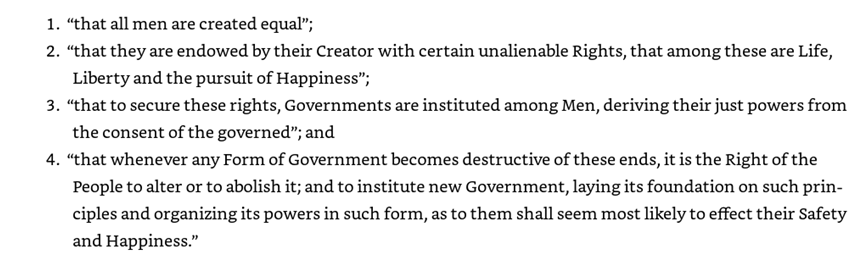
He then discusses the meaning of Self-evident as defined by Locke:” self-evident truth as a proposition whose subject and predicate necessarily relate to one another without contradiction”. Author also discusses meaning of truth, notion of self-evidence in America, and how it all was integrated into Declaration of Independence.
Chapter 4 Equality
In this chapter author takes on another issue that for some reason confuses people – Equality. He discusses development of this idea in Locke’s work as theoretical point, but also as practical issue during Imperial crisis. Far from being some naïve and unrealistic, this idea had very real meaning and to support this author provides comparison table:

Chapter 5 Equality and Slavery
This chapter seems to be designed to respond to contemporary sensitivities. Author quite convincingly demonstrates that slavery was just usual and really unexceptional institution all over the world and if there was something about it special in America, it was detesting of this institution by founding fathers, including those who were slaveowners. In order to support this approach author looks in details at “the views of five American revolutionaries—James Otis, Benjamin Rush, Richard Wells, Patrick Henry, and Thomas Jefferson—on the question of slavery, which offer a representative range of American opinions.” Author also goes beyond period of foundation to demonstrate that, even if it was delayed by nearly a century, it was ideas of American mind that put end to this institution.
Chapter 6 The Nature of Rights
Here author explores how Americans understood nature and source of rights. He looks at both the theory and practice from development of Natural rights idea during enlightenment to specific American understanding of these rights in pre-revolutionary period that turned out to be incompatible with staying under British rule. The difference was that Americans believed in rights being law of Nature to be discovered, pretty much as laws of Physics, while British approach was that rights are granted by King and/or parliament. Author even provides excerpt from George Washington’s letter to the States to demonstrate this approach:

Chapter 7 Life, Liberty, and the Pursuit of Happiness
Here author elaborates what specific rights Americans at the time believed are discovered as the laws of Nature: The Rights to Life, Liberty, Property, and Pursuit of Happiness. Author notes that notion of “Property” had quite expansive character and refers to Madison’s essay to demonstrate this:
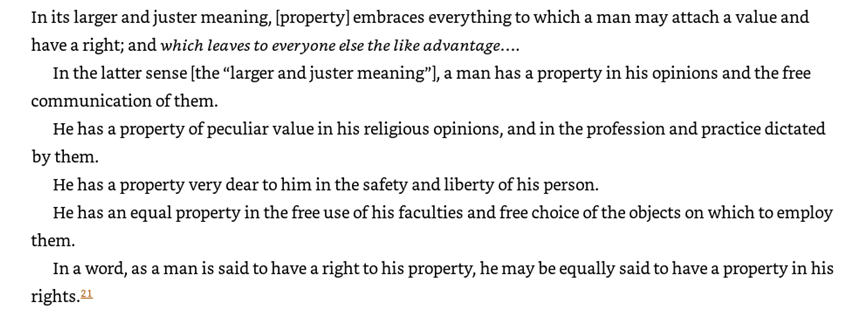
Similarly to Property the notion of “Pursuit of Happiness” was rather complex as Locke put it:

Chapter 8 The Consent of the Governed
As a lot of other things in American Mind of revolutionary generation it comes from Locke. Author discusses theoretical approach as derived from idea of natural rights only in this case some powers transferred to the government. These are:

Author then discusses actual application of these theory to American situation at the time of crisis. Basically it comes down to refusal of colonials to cede power to Parliament, which they did not consider ligitimate body for this power. It is interesting that it was not just the question of representation as part of British polity, which could be easily resolved by adding representatives from colonies to parliament but rather recognition of separate character and interests of colonies. Author also reviews literature – most important being “Common Sense” that was dfferent by declaring that government of colonies should not be derived from mother country, but rather created from the state of nature because colonials actually lived frontier lives in this state.
Chapter 9 Consent and the Just Powers of Government
In this chapter author continues discussion about state of nature and consent as applied to American colonies. He concludes the chapter this way: ” The framers of the United States Constitution created a government that limited, separated, and divided power. American constitutional republicanism meant limited government, which resulted in the creation of social and economic spheres of activity where individuals and their voluntary associations would be left free to think, act, produce, and trade. America’s revolutionary statesmen were, in other words, proponents of a free society.
Chapter 10 Revolution
After deciding that remote British power does not have consent of Americans and even does not qualified to obtain such consent, American Mind had to come with practical “to do” recommendation and it was revolution with objective to achieve independence by all means necessary. It is interesting that revolution was framed as defensive action directed to protect existing freedoms, rather than overthrow existing government to establish new freedoms. Author specifically discusses position of Thomas Paine, who rejected any possibility of compromise, as the closest to representing conditions of American Mind at the moment.
Chapter 11 Rebels with a Cause
In this last chapter author discusses necessity of Declaration of Independence as product of condition of American Mind, rather as consequence of some external forces such as British tyranny. Author reviews actual action of Parliament such as Stamp Act and concludes that there were no real oppression and economic impact of taxes would be negligible. The conflict was more philosophical and was caused by: “as Adams noted, a “radical change in the principles, opinions, sentiments, and affections of the people.” It was a revolution that advanced new moral values and virtues, new manners and mores, and a new way to think about moral character and moral action.”. Founders understood dangerous character of their actions, but they refused to give up the newly acquired Lockean principals and values. Here how Adams expressed the state of their minds:

Conclusion
In conclusion author discusses the key elements of American Mind in theory and practice. He provides two references: one is quite from Thomas Jefferson on relationship between individual self-government and political government:

Epilogue Has America Lost Its American Mind?
Here author presents a kind of lamentation on contemporary state of American Mind, which become very different from original. He demonstrates that a great many Americans now reject ideas of Declaration of Independence and look for something different: instead of eternal truths of freedom and self-government they believe in continuing progress to higher levels of rationality, which necessarily require submission of individual’s freedom to higher level of societal “freedom”. Author traces this to influence of ideas of Hegel imported from Europe and enthusiastically embraced by Southern slaveholders as justification of slavery as organization of society in most efficient way that benefit not only slaveowner, but also a slave, who is taken care off better than slave could do it for self. After Civil war it was picked up by progressives and author provides quite revealing quote:

This attitude was taught in American colleges for more than a century, but until now had limited influence. However now it is becoming very powerful in its latest incarnation as “democratic socialism”
MY TAKE ON IT:
I found this book highly educational because it explained quite a few ideas of Declaration of Independence that seems to be absolutely ridiculous on their face, such as “All men are created equal” or “Unalienable Rights”. It seems to be obvious in XXI century that all men are different and unequal, while any idiot with knife or gun can alienate people from their life and liberty. It is highly valuable, at least for me, to understand that representation of these words in American Minds of XVIII century was very much meaningful and was founded on very consistent set of philosophical ideas. Not that I agree with these ideas, but I highly appreciate final result, which made lives of billions of people, including mine, much better than it would be if practical implementation of these ideas in America had never happened. I think I understand author’s frustration with current situation when millions of people, especially young, reject ideas that produced such a wonderful result and run after proved con job of “democratic socialism”. However, I believe that it is temporary phenomenon and solution of this problem is not in going back to Enlightenment ideas, but rather go forward to generate new ideas that would explain both successes and failures of practical implementation of the ideas of American Revolutionary Mind. I personally think that the big part of this could come from look at real, rather than invented state of nature about which thanks to work of archeologists and anthropologists we now know a lot more than Locke could possible be capable imagining. I think that updated foundation should be build on evolutionary approach of multilevel selection, recognize role of availability of various resources to individuals and groups, and take into account increasing role of machines, computers, and soon AI in production, which will cause huge changes in working of human society. In short, when wonderful and beautiful Temple of American democracy start shaking because its old fundament start giving in, the action to be taken is not lament and dream about rejuvenating this fundament, but rather use the newest technology and substitute this of fundament with the new one made with the best materials available now, which did not exist way back. By the way it would not hurt to beautify the Temple a bit in the process, making it even more wonderful and beautiful, than ever.
20210321 – Biology of Desire

MAIN IDEA:
The main idea of this book is to use author knowledge as neuroscientist and experience as recovered addict to promote non-traditional view of addiction as strong habit established via process of deep learning accelerated by overwhelming desire to escape some difficult life problem in quick and easy way. Correspondingly author suggest that the way out of addiction lay not in medication or group therapy, but rather:” addiction can only be beaten by the alignment of desire with personally derived, future-oriented goals.”
DETAILS:
Introduction
Here author presents challenge to the idea that addiction is a disease:” This book makes the case that it isn’t. Addiction results, rather, from the motivated repetition of the same thoughts and behaviors until they become habitual. Thus, addiction develops—it’s learned—but it’s learned more deeply and often more quickly than most other habits, due to a narrowing tunnel of attention and attraction.” He then describes the structure of the book as combination of scientific presentation and story of ordinary people who were addicted and then were able to overcome addition. Author also presents himself as neuroscientist, professor, and former drug addict who had experienced both addiction and recovery.
Chapter One: Defining Addiction: A Battleground of Opinions
In this chapter author reviews history of different definitions of addiction and correspondingly different approaches. He presents 3 models of addiction: mental disease, lifestyle choice, and self-medication to fight depression and/or any other problems. He points out that that:” These three models of addiction overlap to some degree, but each has unique implications for research, funding, and care, from the level of government policy to that of treatment options for individual sufferers. To put it simply, the disease model calls for treatment at the hands of experts—generally medical experts (including psychiatrists) but also the burgeoning band of treatment personnel who report to them (at least in theory); the choice model advocates reviewing one’s beliefs and changing one’s perspective, often using standard psychotherapeutic techniques such as cognitive behavioral therapy and motivational interviewing; and the self-medication model stresses the need to protect children and adolescents from extreme psychosocial pressures and to diagnose and treat underlying developmental issues that may have predisposed a person to addiction.” After that author expresses dissatisfaction with these models and intention to present more viable comprehensive model. But before this presentation he allocates some space reviewing history of disease model and debating its validity, which based on discovery of biological changes in brains of addict. Author’s main argument against this is that brain is very plastic and changes all the time as result of political attitudes, falling in and out of love and similar conditions. He concludes:” Brain disease may be a useful metaphor for how addiction seems, but it’s not a sensible explanation for how addiction works.”
Chapter Two: A Brain Designed for Addiction
Here author discusses characteristics of a brain, its plasticity, process of learning, and accommodation to reality. Author them moves to habit forming and how it linked to addiction:” The brain is certainly built to make any action, repeated enough times, into a compulsion. But the emotional heart of addiction—in a word, desire—makes compulsion inevitable, because unslaked desire is the springboard to repetition, and repetition is the key to compulsion. Like all habits, addiction quite simply grows and stabilizes, in brain tissue that is designed (by evolution) to change and stabilize. Yet addiction belongs to a subset of habits: those that are most difficult to extinguish. To understand addiction, we need to see it as the outcome of a normally functioning brain, not a diseased brain.”
Author then discusses how brain is changing under impact of multitude of different feedback loops and how addiction and other nasty things could be developed:” Bad habits self-organize like any other habits. Bad habits like addiction grow more deeply and often more quickly than other bad habits, because they result from feedback fueled by intense desire, and because they crowd out the availability or appeal of alternative pursuits. But they are still, fundamentally, habits—habits of thinking, feeling, and acting. The brain continues to shape itself with each repeat of the addictive experience, until the addictive habit converges with other habits lodged within one’s personality”.
At the end of this chapter author presents the key point of his views about negative changes in the brain related to addiction:” These changes don’t result from addictive substances. They are not caused by booze or drugs. They result from having a string of similar experiences. Nice experiences. Experiences of relief. Experiences that feel good, or at least better than the rest of your boring and depressing life. These brain changes are caused by motivated repetition—repetition of something special—and how the brain responds to it. The powerful experiences that get the ball rolling are simply events that affect us deeply. Because they are engaging. Because they mean something. As they become even more meaningful, the corresponding brain changes gather more momentum, building on themselves, digging their own ruts—rainwater in the garden.”
Chapter Three: When Craving Comes to Power: Natalie’s Story
Chapter Four: The Tunnel of Attention: Brian’s Romance with Meth
Chapter Five: Donna’s Secret Identity
Chapter Six: Johnny Needs a Drink
Chapter Seven: Nothing for Alice: The Double-Edged Sword of Self-Control
In these 5 chapter author reviews stories of people, which demonstrate variety of form of addiction and how these people were able overcome it by treating addiction more as bad psychological habit that should be grown out of, than bodily disease, that should be treated with medication or surgery.
Chapter Eight: Biology, Biography, and Addiction
In this chapter author goes into detailed reasoning on why addiction is not a disease and provides summary of this reasoning:

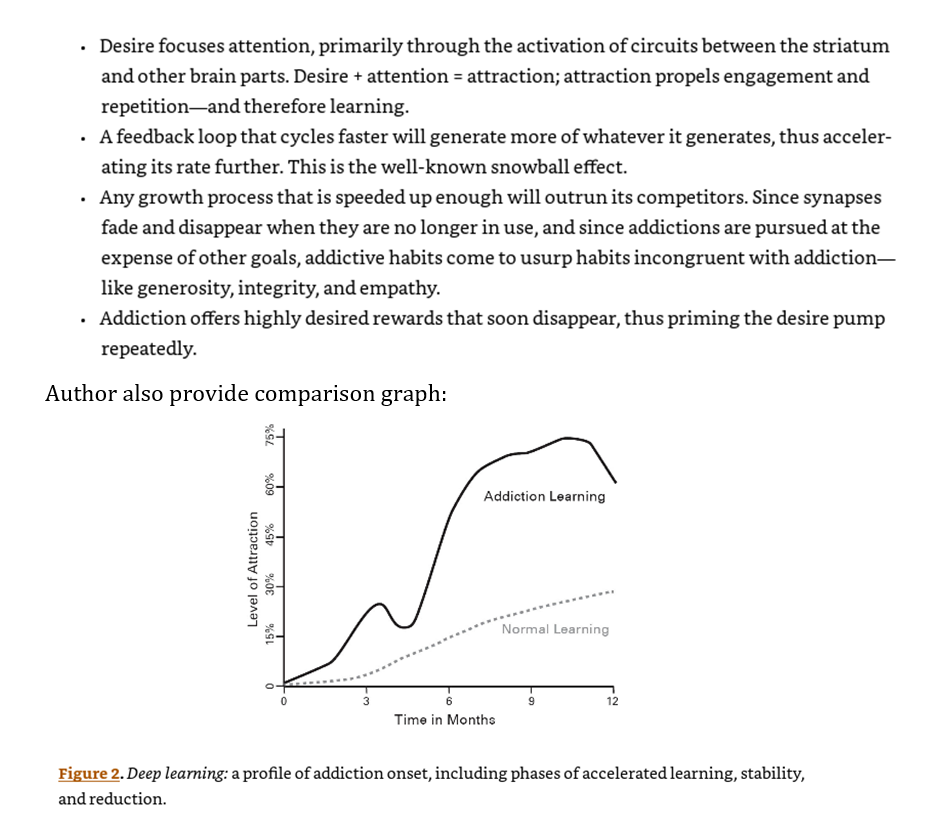
Here is authors conclusion:” So, what exactly is addiction? It’s a habit that grows and self-perpetuates relatively quickly, when we repeatedly pursue the same highly attractive goal. Or, in a phrase, motivated repetition that gives rise to deep learning. Addictive patterns grow more quickly and become more deeply entrenched than other, less compelling habits because of the intensity of the attraction that motivates us to repeat them, especially when they leave us gasping for more and other goals have lost their appeal. The neurobiological mechanics of this process involve multiple brain regions, interlaced to form a web that holds the addiction in place. Often, emotional turmoil during childhood or adolescence initiates the search for addictive rewards, which can provide relief and comfort for a while. But there are other points of entry too. Addiction is a house with many doors. However it is approached, and however it is eventually left, addiction is a condition of recurrent desire for a single goal that gouges deep ruts in the neural underpinnings of the self.”
Chapter Nine: Developing Beyond Addiction
The last chapter is about getting out of addiction and here is author’s reasoning:” I believe that getting past one’s addiction is a developmental process—in fact, a continuation of the developmental process that brought about the addiction in the first place. And the biology of neural change—the way brains transform themselves and the way habits form and reform—helps explain how that developmental process works. In fact, the importance of ongoing brain change becomes difficult to dispute when we link the neurobiology of addiction with the stories of those who have been there and moved on. That’s the insight that inspired the structure of this book.”
He then discusses biology of this process: neuroplasticity, experiential and neural paths to quitting, and how realign one’s desires to get out of the addiction.
MY TAKE ON IT:
The area of human life discussed in this book – addiction is completely unfamiliar to me, except that on two occasions I had alcoholics working for me. Both times they were very nice people who were competent professionals unless they get drunk and then become incompetent even to keep their bodies upright. In both cases it was tragic and sad. Both had been in treatment many times and both returned to addiction after a few months or even years of being sober. This book is interesting by moving the topic away from medical / chemical approach to fighting this condition to psychological / lifestyle adjustment method that worked for author and seems to be working for other people. It would be interesting to know if this new approach really works, but I would bet that even if it is working, the implementation would be difficult if not impossible because way too many interests and the whole industries depend on people struggling with addiction forever without winning and people who are running these industries would not give up without serious fight.
20210314 – This View of Life
MAIN IDEA:
The main idea of this book is to demonstrate that Darwin’s evolutionary theory fully applies to development of society and its culture and that without evolutionary approach it would not be possibly to understand how we get to this point in human development and how to move forward. Author is also trying to explain incorrect application of evolution ideas in form of social Darwinism, explain ideas of multilevel selection theory, and provide demonstration of correct application of evolutionary ideas based on work of Elinor Ostrom.
DETAILS:
Introduction: This View of Life
Author begins with brief note about meaning of science. He rejects often used sequence “observation -> theory –> experiment” because undirected, random observations are infinite, therefore theorizing should come first so scientist could know what to look for. After that author moves to Darwin and his theory of evolution:

Author briefly tells the story of his personal development and story of mass acceptance of evolution combined with mass lack of understanding that it applies to just about everything related to biology and products of biological objects such as culture. He further specifies:” It is one thing for a species to be well adapted to its environment and another for it to be adaptable to environmental change. The same goes for human cultures, and almost no existing culture is adaptable enough to keep pace with our ever-changing world. Conscious evolution requires the construction of a new system of cultural inheritance capable of operating at an unprecedented spatial and temporal scale. This will be a formidable task, but evolutionary theory does provide the tools to get the job done.”
Chapter 1: Dispelling the Myth of Social Darwinism
In this chapter author discusses ideas of social Darwinism, noting that it is pejorative term that nobody really applies to self. Moreover, people accused of Social Darwinism seldom if ever use Darwin’s theory to defend their ideas. Then author reviews stories of such people: Thomas Malthus, Herbert Spenser, Francis Galton, Thomas Huxley, Peter Kropotkin, and, obviously Darwin himself. They all discussed competition and survival, but it was from variety of ideological positions not necessarily related to evolution. Author also shows lack of any connection between Darwin’s ideas and Hitler who was philosophically adherent of Chamberlain and his racist views. Finally, author refer to American philosophy of Pragmatism, which promoters: Dewey, Holmes, Peirce, and James indeed were influenced by Darwin. Author concludes the chapter referring to damage caused by stigmatization of evolution theory via bogeyman of “Social Darwinism”:

Chapter 2: Darwin’s Toolkit
Author starts this chapter with reference to fragility of truth as demonstrated by contemporary American politics and then moves to present 4 questions of Niko Tinbergen that author considers the most important tools for evolutionary understanding:
- First, what is the function of a given trait (if any)? Why does it exist compared to many other traits that could exist?
- Second, what is the history of the trait as it evolved over multiple generations?
- Third, what is its physical mechanism? All traits, even behavioral traits, have a physical basis that must be understood in addition to their functions.
- Fourth, how does the trait develop during the lifetime of the organism?
After that author provides some examples and discusses in detail Lenski’s experiment of parallel evolution of 12 populations E-coli over 70,000 generations, with periodically frozen samples. This experiment demonstrated conceptual ability to identify direction of development, while confirming non-deterministic mechanics of this development.
Chapter 3: Policy as a Branch of Biology
Here author defines his objective this way:” The challenge of this book is to show that policy is a branch of biology. A standard definition of policy is “a course or principle of action adopted or proposed by a government, group, or individual.” Liberal and conservative politicians propose different policies to improve the economy. Many religions encourage the policy of “do unto others,” at least in some situations. A “tiger mom” might adopt a policy of strict discipline toward her children. To view policy as a branch of biology means that our proposed actions must be deeply informed by evolution. Around the world, we should be consulting evolutionary theory at least as much as we consult our constitutions, political ideologies, sacred texts, and personal philosophies.”
After that author compares two products of evolution with different design and similar functionality: octopus and human eyes. He specifically points out that in addition to being product of evolution, it is also product of organism’s individual development, for example nearsightedness of Jewish orthodox boys who spent 16 hours a day in school. Then author demonstrates complexity of such development and risks of interference in such development by referring to well researched example of immune systems compromised due to excessively clean environment and negative impact of educational overload on development of intellectual ability in children.
Chapter 4: The Problem of Goodness
In this chapter author discusses goodness, which often considered a problem for evolution because doing good for others often inflict costs on organism. Author demonstrates that it is not problem with evolution, but rather with poor understanding of evolution when people fail to see that selection occurs at multiple levels so a feature benefiting group over individual will be propagated, providing it leads to improvement in evolutionary fitness of individuals with this feature. Here is how author and E.O Wilson formulated this rule:
Selfishness beats altruism within groups. Altruistic groups beat selfish groups. Everything else is commentary.
Author provides three examples:
- selfish cancer cells kill host and stops their own propagation
- chickens’ selection for top performance resulting in crash of group performance due to exceeding competition, while selection for average performance leads to superior performance of the group.
- Finally applied to the humans:” We are evolution’s most recent major transition. Almost everything that sets us apart from other primate species can be explained as forms of cooperation that evolved by between-group selection, thanks largely to our ability to suppress disruptive within-group selection. In most primate societies, group members are cooperative to a degree but are also riven by within-group conflict. Even the cooperation that exists often takes the form of coalitions warring with other coalitions within the same groups. To the best of our current knowledge, our distant ancestors evolved the ability to suppress bullying and other disruptive self-serving behaviors within groups, like multicellular organisms evolved ways to suppress cancer cells, so that the primary way to survive and reproduce was through teamwork.”
Chapter 5: Evolution in Warp Drive
This chapter is about evolutions beyond genetic code. Author discusses here these examples: functioning of immune system, individual learning, and cultural development of groups.
Chapter 6: What All Groups Need
In this chapter author moves to discuss group selection: “Multilevel selection theory tells us that something similar to team-level selection took place in our species for thousands of generations, resulting in adaptations for teamwork that are baked into the genetic architecture of our minds. Absorbing this fact leads to the conclusion that small groups are a fundamental unit of human social organization. Individuals cannot be understood except in the context of small groups, and large-scale societies need to be seen as a kind of multicellular organism comprising small groups.”
It starts with Elinor Ostrom’s work on practical evolutionary solution for theoretical tragedy of commons. It includes 8 Core Design Principles (CDP):
CDP 1. STRONG GROUP IDENTITY AND UNDERSTANDING OF PURPOSE.
CDP 2. PROPORTIONAL EQUIVALENCE BETWEEN BENEFITS AND COSTS.
CDP 3. FAIR AND INCLUSIVE DECISION-MAKING.
CDP 4. MONITORING AGREED-UPON BEHAVIORS.
CDP 5. GRADUATED SANCTIONS.
CDP 6. FAST AND FAIR CONFLICT RESOLUTION.
CDP 7. LOCAL AUTONOMY.
CDP 8. POLYCENTRIC GOVERNANCE.
After this author reviews some specific types of groups: Schools, Neighborhoods, Religious Groups, and Business Groups. At the end of chapter author call for application of these principle from individual level up and provides reference to www. Prosocial.com, which provides support for such activity.
Chapter 7: From Groups to Individuals
In this chapter author’s focus is on “the concept of individuals as products of social interactions”. Author discusses here “Behavioral Ecology”, “Positive Parenting Program”, and “Acceptance and Commitment Therapy (ACT)”, all of which seemingly achieve success by understanding and applying approach based on “primacy of the small group as a unit of selection in human evolution.”
Chapter 8: From Groups to Multicellular Society
Here author is scaling up this understanding from small groups to huge societies and discusses usual political dichotomy: market vs. regulation and how reconcile best of both. He also provides a couple of pictures linking well-being and political stress to inequality across countries for the world and across time for America:


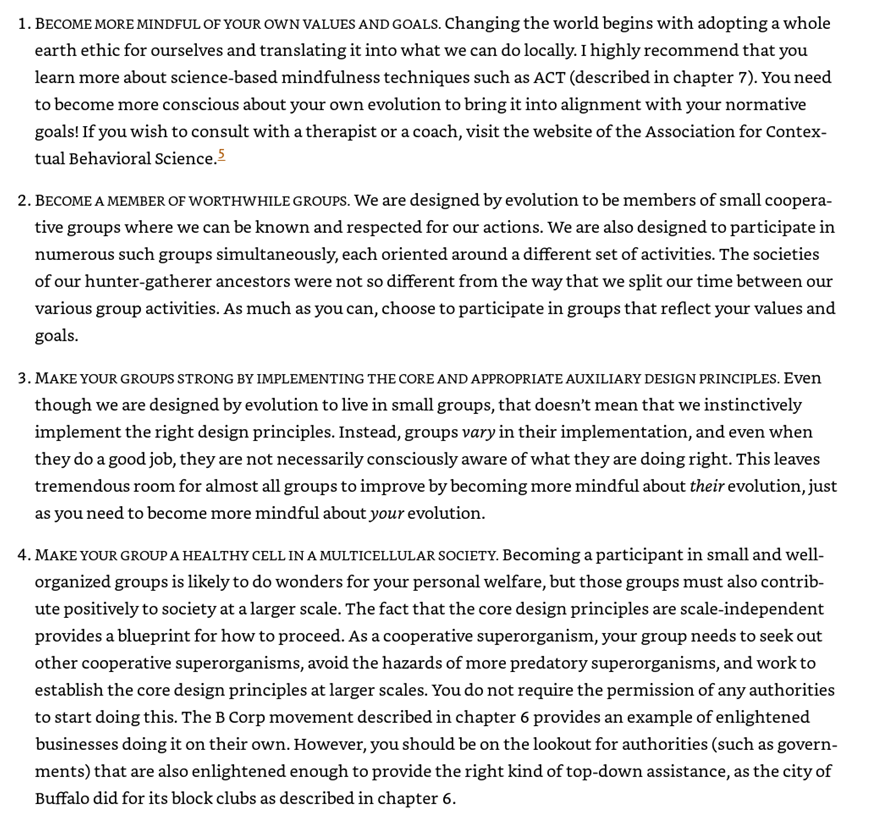
MY TAKE ON IT:
I often puzzled by inability of seemingly educated and smart people to understand simple ideas and create unnecessary complexity where there is none. It is especially plentifully demonstrated in everything related to Darwin’s theory of Evolution. It is hard to find anything as clear, easily demonstratable, and comparable with common sense as Evolution, maybe with exception of Euclid’s geometry. For example, why one needs such complex explanations for altruism between humans and other animals as kin selection or reciprocity, when full account for what helps and what hinders to survival would demonstrate that helping others is good for survival as long as the cost is low, even if one has no idea whether the favor will be returned in the future or not or is it provided to kin or not.
Such full account would demonstrate cost and individual’s perception of group interest dependency of altruism, as in case of German citizen helping old Jewish lady to cross street in 1920 with:
“cost/benefit balance = feeling good about self for being strong representative of superior humanitarian culture – extra 30 seconds spent on intersection”
versus the same German citizen in 1935 kicking old Jewish lady on the same crossing with:
“cost/benefit balance = feeling good about self for being strong representative of superior race – extra 30 seconds spent on intersection.”
In both cases this 30 seconds could be saved and directed to something beneficial for individual but were spent to support the group of German nation by demonstrating one’s belonging to the group and promoting its values. Whether the group defined as German people of superior humanitarian culture or German people of superior race is pretty much irrelevant. In both cases it is demonstration of individual expense in perceived interest of the group, driven by internal motivation.
There are infinite numbers of such examples, but they all come down to two factors: how individuals define hierarchy of groups they belong to and what are values of these groups. Therefore, the tragedy of commons in its classical theoretical representation: common pasture overgrazed because everybody maximizes own returns even if result is destroyed pasture, could occur only if some individuals perceive themselves as superior to others, which is evolutionary would be very detrimental if one does not really have demonstratable superior power. Since in real live it is seldom happening that somebody in community has such power, the accommodation between members of community about rules of use of common resource will always occur and CDPs will be operational. In short, in my opinion, multilevel selection is one and only proper understanding of Darwin’s Evolution, but one should always remember that it is not just two levels – individual and group, but rather multiple levels with various hierarchies of groups in minds of different people, which are changing all the time, creating super complex and fluid environment when actions of individuals coordinated or counteracted in unpredictable ways.
20210307 – Fraud in the Lab

MAIN IDEA:
The main idea of this book is to demonstrate how fraudulent or at least misleading information about scientific research produced and distributed throughout scientific community, which has become big business fed by huge amounts of mainly government money. The science now is very prestigious and profitable area of activities that provides huge benefits both material and in form of place in pecking order of society, therefore there are of individuals who want to obtain these benefits by all means necessary.
DETAILS:
1: Big Fraud, Little Lies
Author starts with reference to persistence of the problem going back to XIX century:” In his Reflections on the Decline of Science in England, Babbage devoted a few juicy pages to distinguishing between four categories of scientific fraud:
The First is hoaxing – reporting discovery of something that really does not exist.
The Second is forging data – reporting false information about some non-repetitive event that could not be checked.
The Third – trimming experimental data, that is slightly adjusting results by removing some of outliers to obtain more clear result.
The final Fourth category cooking data: “This is an art of various forms, the object of which is to give to ordinary observations the appearance and character of those of the highest degree of accuracy. One of its numerous processes is to make multitudes of observations, and out of these to select those only which agree, or very nearly agree. If a hundred observations are made, the cook must be very unlucky if he cannot pick out fifteen or twenty which will do for serving up.”
After providing this definition author presents some examples: Sir Cyril Burt in psychology, Mark Spector in biochemistry, John Darsee in medicine. Author then discusses definition of contemporary fraud: “In 2000 the US Office of Science and Technology Policy defined the breach of scientific integrity as the fabrication, falsification, and plagiarism of data (summed up by the acronym FFP), whether in the conception of research projects (particularly in the writing of grant proposals), their execution and publication, or the reviewing of articles by referees. The FFP definition of breaches of scientific integrity only applies to manipulations of experimental data. It does not deal with professional ethics. The second definition, which is often used in Europe, expands the scope of breaches of scientific integrity by including what international institutions such as the Organization for Economic Co-operation and Development often qualify as “questionable research practices”: conflicts of interest, a selective and biased choice of data presented in articles, “ghost” authors added to a publication in which they did not participate, refusal to communicate raw experimental data to colleagues who request it, exploitation of technical personnel whose contributions are sometimes not recognized in publications, psychological harassment of students or subordinates, and failure to follow regulations on animal testing and clinical trials.”
Author also looks at frequency of the fraud in various scientific disciplines: from none in mathematics to explosion in biology, for which he provides a nice graph:
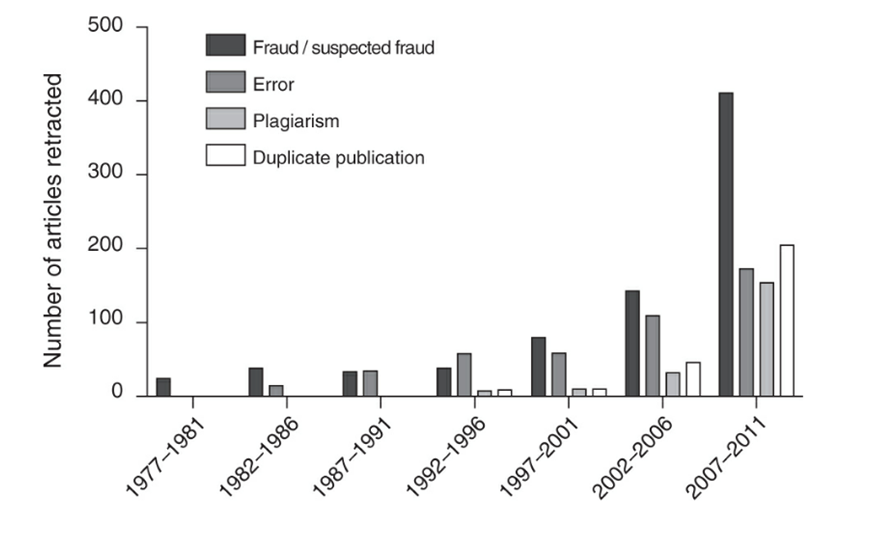
2. Serial Cheaters
Here author present some specific examples of individuals who do it again and again: Korean Cloner, Dutch Psychologist, American Neuroscientist, German Physician, and French Imposters. Author even presents record holders who had hundreds of articles retracted.
3. Storytelling and Beautification
In this chapter author discusses reasons for manipulations, which does not really amount to intentional fraud: strive to tell a good story, following intuition, even when it is not consistent with data, fudging experimental results to make them more attractive and convincing, and use of technology to make data more coherent than they really are.
4. Researching for Results
This is about the overvalued idea of statistically significant result. Here is author’s characterization:” The scientific community generally believes that a scientific result is significant if it can be calculated that there is less than one chance in twenty that it is due to chance, without truly questioning whether this practice is well founded. Scientists refer to this as probability value, or p value. Naturally, the threshold of p < 0.05 (one in twenty) is perfectly arbitrary. One could just as easily choose one in one hundred, or one in one thousand. Nonetheless, this is the accepted convention for a result to be considered worthy of interest. It should be noted that this practice automatically implies that at least one in twenty scientific studies is false or, at least, describes a phenomenon that may not be one.”
Here is nice demonstration of increasing manipulation of data depending on type of science from physics where manipulation is hard to social science where it is easy:
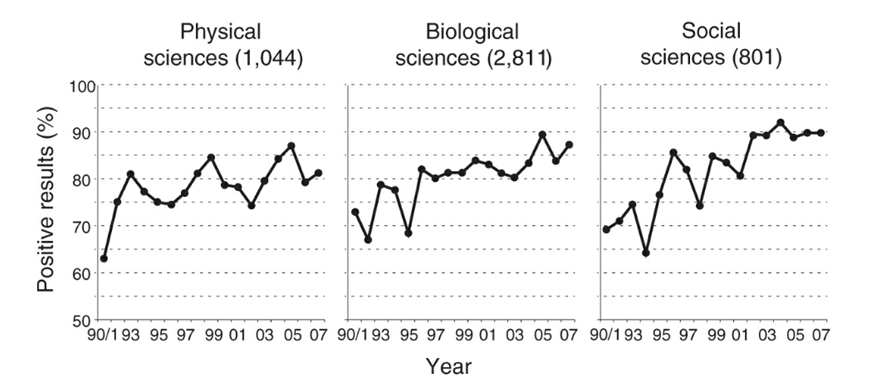
5. Corporate Cooking
This chapter is about Reproducibility crisis: “Between 75 and 90 percent of results published in the best journals in the field of biomedicine are not reproducible.” Certainly in very complex experiments related to living matter it is nearly impossible to exactly recreate environment of experiment, but it is also more than probable that lots of time experiment built in such way as to provide justification for additional funding and publishing opportunities rather than to find out something about nature. Author, however, notes:” I only aim to underline that the researchers who went to the trouble of repeating experiments with surprising results were those in the private sector, rather than those at universities or public research institutes.”
6. Skewed Competition
In this chapter author discusses reasons for his findings in previous chapters:” the ever-more-frequent discovery of massive fraud in every discipline, the huge rise in the number of articles retracted in the field of biology (Chapters 1 and 2), statistical proof that results in experimental psychology are increasingly embellished (Chapter 4), and the worrisome fact that the vast majority of experiments published in biomedicine are impossible to reproduce (Chapter 5)”
He somewhat finds it in Multicentrism – competition for recognition and patents between scientific establishment of different countries, which had increased with Chinese entry into the field. It is also rushing to publish in order not to parish and get money, the situation that produced super productive scientists. Author provides an amazing example:” …the world record for scientific productivity is held by the late chemist Alan R. Katritzky. From 1953 to 2010, Katritzky coauthored 2,215 publications, or one every ten days of a long career that began in his native Great Britain and ended at the University of Florida.”
7. Stealing Authorship
Author includes here multiple methods such as Stealing, Outsourcing, and Mechanizing and provides overall picture:

8. The Funding Effect
This chapter is about various machination around public funding of science, which became the main source of prosperity for scientists. Author uses here two stories about funding: one about tobacco and another about GMO. In both cases science was subordinated to public relations to promote interest of powerful organizations – tobacco industry and anti GMO non-profits.
9. There Is No Profile
Here author discusses attempts to profile the cheaters, but had to agree that it is not really feasible and presents Martine Bungerer statement to this effect:
10. Toxic Literature
In this chapter author discusses impact of scientific fraud on literature, which he characterizes as waste, difficulty of separating “the Wheat from Chaff”, and, finally difficulties of forcing retraction of articles based on fraud and published in respected in scientific journals.
11. Clinical Trials
This chapter is about consequences of massive fraud in science. Author provides examples of deaths caused by false results from medical research, anti-vaccination movement and other cases.
12. The Jungle of Journal Publishing
Here author moves to discuss scientific publishing industry, predatory journals, concentration and outsourcing of publishing when publisher present itself as American, while it is Chinese operation.
13. Beyond Denial
Here author refer to the original flag raised about scientific fraud: “Nearly forty years ago, the American journalists William J. Broad and Nicholas Wade published Betrayers of the Truth: Fraud and Deceit in the Halls of Science. Their book was the first to focus on scientific fraud; it remains one of the few to have done so. Looking back at it today provides an assessment of the evolution of responses to fraud in the last three decades. While fraud is no longer denied the way it was then, the scientific community is still powerless to halt its progress.” Author discusses how much worse the problem became, but also show some signs of hope by discussing emerging grass root movement to uncover fraud in scientific community.
14. Scientific Crime
Here author move slightly beyond just covering the fraud by demonstrating how investigations are conducted and describing efforts to establish some formal ethic norms to prevent scientific fraud. The point here is that it is all too little and too late. So far, the only more or less serious consequences occur in situations when external funding is involved so criminal complain could be filed for misuse of funds.
15. Slow Science
In the final chapter author discusses potential measures to fight fraud: sharing of raw data from experimental research, publishing “negative” results, stop evaluating impact factor and bibliometrics for evaluation of research, and, finally, move away from paradigm of “publish or perish” to different paradigm:” publish less, publish better”. In short, author prefer science that is slower, but of better quality.
MY TAKE ON IT:
I do not think that problems described in great details in this book are scientific problems. They are generic problems of any bureaucracy: falsification of result by lower level bureaucrats to obtain more benefits from higher level bureaucrats. That in case of science lower level bureaucrats are “scientists” and higher-level bureaucrats are funding authorities does not change anything at all. Moreover, whatever parameters would be setup for evaluation: whether it is number of citations, positive referral by reviewer, or something completely different, the fraud is unavoidable. The only method that can help, at least partially, would be return to funding by individuals and groups based on their own funds, rather than by government. In this case there would be people really interested in research results being properly obtained and interpreted so they could get whatever they hope of obtaining from research whether it is satisfaction of curiosity or potentially profitable use. This approach would for sure remove any barriers to monitoring of research and access to data by independent reviewers.
20210228 – Democracies at War

MAIN IDEA:
The main idea of this book is to use statistical analysis of historical data about wars in order to prove that democracies actually do win wars by far more often than lose, then demonstrate that usual reasons applied to this fact are often deficient, or just plain incorrect, and finally present authors’ suggested reasons for this historical phenomenon for which they want to “show that, in fact, democracies do not win wars because of some sense of international democratic community. Nor do they win because they are generally richer or typically better able to extract resources from their economies. Instead, as we shall see, the power of democracies lies not in the leaders or political elite, but instead in the people themselves—ultimately, power lies in the governed, not in the governors. “
DETAILS:
One: Democracy’s Fourth Virtue
Authors start by stating that object of this book is the fourth virtue of democracy that is rarely mentioned unlike usual 3 virtues: freedom, prosperity, and peace. This 4th virtue is the martial effectiveness of democracies. Authors then present their main thesis:” Our central argument is that democracies win wars because of the offshoots of public consent and leaders’ accountability to the voters. Regardless of the particular permutation, at the core of democracy is the notion that those who govern are accountable in some way to the consent of the people. In democracies, leaders who act without the consent of the voters do so at considerable political risk of removal from office.” After that authors identify four perspectives that from which they will be looking to analyze their central argument:
Perspective 1: Political Structures
Perspective 2: Political Culture
Perspective 3: International Community
Perspective 4: Economic Might
Authors conclude this chapter by reducing all prospective to one key conclusion. They also discuss here the statistical methods they use to test their hypothesis.
Two: Democracy, War Initiation, and Victory
This chapter reviews relation between initiation of war, type of society, and results.
Authors analyze two propositions:
Proposition 2.1: Among war initiators, the more democratic a state is, the more likely it is to win.
Proposition 2.2: Among war initiators, democracies are most likely to win, dictatorships are next most likely to win, and mixed regimes are least likely to win.
They also provide table with summary of historical outcomes:
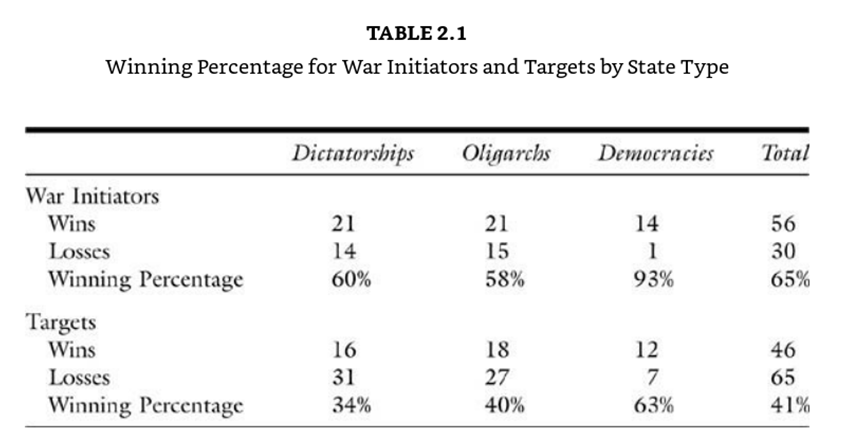
They also analyse a number of specific conflicts, which generallly support these propositions.
Three: Democracy and Battlefield Success
Here authors move from war outcomes to battles and comparative analysis of behavior of armies and soldiers depending on type of society. Here author also presents and test these propositions:
Proposition 3.1: Democratic soldiers fight with higher levels of morale than other soldiers.
Proposition 3.1a: The later in a war a battle takes place, the lower will be the morale for democratic soldiers.
Proposition 3.2: Democratic soldiers will demonstrate higher levels of initiative on the battlefield.
Proposition 3.3: Soldiers are more likely to surrender to democratic armies than to authoritarian armies.
Proposition 3.4: Democratic armies enjoy superior levels of leadership.
Authors then provide statistical analysis supporting validity of these propositions.
Four: Balancers or Bystanders? The Lack of Fraternal Democratic Assistance
In this chapter authors analyze and generally reject common misconception that democracies support each other at the time of military need. They provide tabulation for defender interventions, then analyze historical record, and conclude that type of society does not play significant role in attracting externa; support:

Five: Winning Wars on Factory Floors? The Myth of the Democratic Arsenals of Victory
In this chapter authors reject another the myth about economic and technological military advantages of democracy. Actually, they seem to accept idea that democracies are doing better in economic and technological development overall, but they demonstrate that it does not apply to resource mobilization at the time of war. Generally, whatever levels of economic and technology exist, it will be used to conduct war and non-democracies are as good or even better in mobilizing such resources.
Six: Democracy, Consent, and the Path to War
Here authors look at important parameter impacting war-time morals of population and army: consent to initiate war. This parameter is quite important for democracies because freedom of expression guaranties the expression of opposition leading to more careful approach to initiation of war and more serios analysis of potential consequences. It however does not prevent democratic elites from initiating unreasonable actions, it just makes it quite a bit more difficult than in dictatorships.
Seven: The Declining Advantages of Democracy: When Consent erodes
In this chapter authors address situations when advantages of Democracies decline. They offer these propositions:
Proposition 7.1: The longer a war continues, democracies will be more likely than autocracies to seek an end to the war.
Proposition 7.1a: Democracies will be more likely to accept draws than will autocracies, which will seek victory.
Proposition 7.2: The longer a war continues, the more likely autocracies are to win.
Proposition 7.3: Wars involving two autocracies are less likely to end in draws but last longer than wars involving democracies.
They make an interesting point that Democracies are less resilient in the case of prolonged war because consent of people tend to decay over time and so does resolve to win. Here is graph demonstrating this trend:
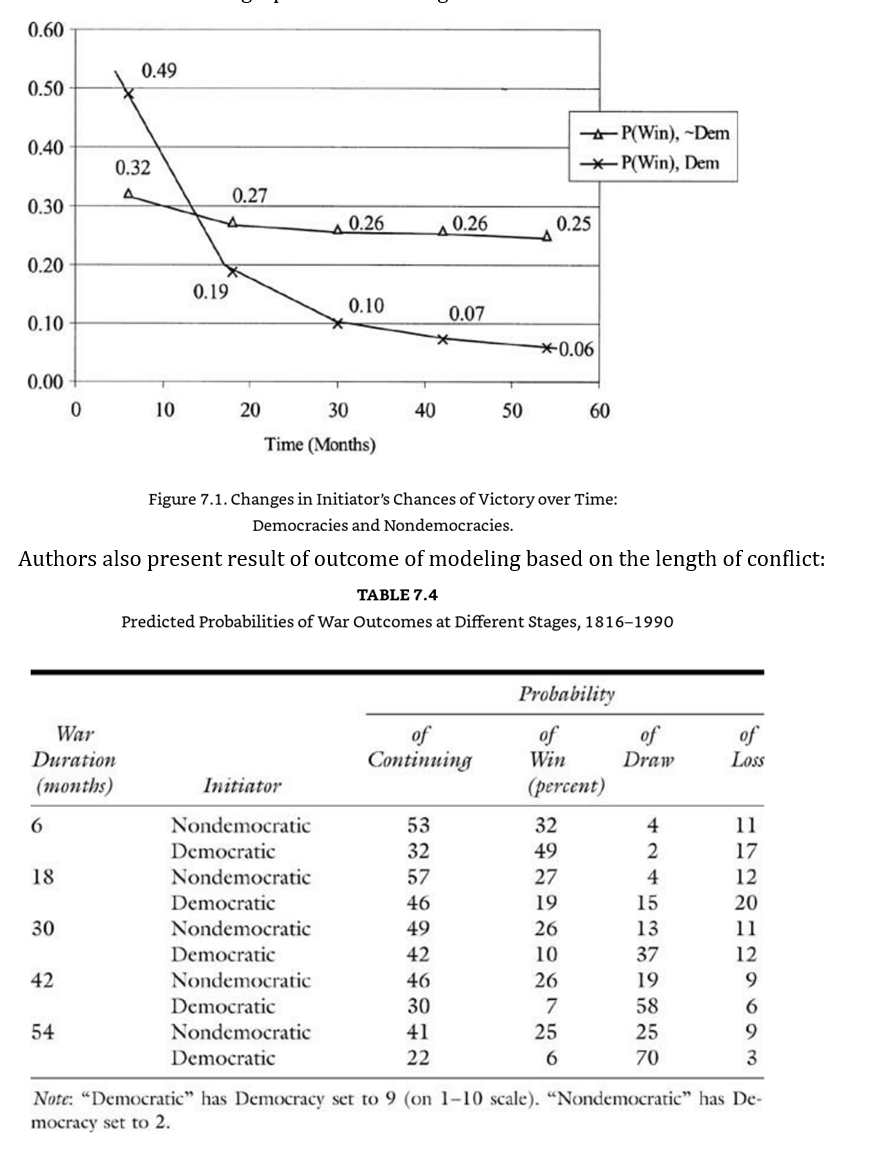
Eight: Why Democracies Win Wars
In the last chapter authors summarize their finding the following way:” WE NOW KNOW why democracies win wars. The two key dimensions of the democratic character that best explain democratic victory are the skeleton of democracy, those political institutions that hold democratic leaders accountable to the consent of the people, and the spirit of democracy, with its emphasis on the development of individual rights, responsibility, and initiative.” They also provide combined table of statements they made in this book with reference to its chapters:

MY TAKE ON IT:
I think that authors’ approach is outstanding and it provides very good support for idea that democracies are better at war than it is usually thought. Authors also provide pretty good analysis of reasons for this. I do agree with authors inferences, especially the one about high dependency of Democracy’s military advantages on continuing consent of population. In think that one thing here that is missing, it is dependency of consent on scope of democracy. In normal environment the wide scope of democratic freedoms inevitably produce opposition to any war, as well as to any other action of government. However, depending on core nature of war, whether it is perceived as existential or optional, the scope of freedom could be diminished in order to suppress opposition and assure continuity of consent. Good example would be WWII when Sir Oswald Mosley – Nazi supporter in UK was arrested in1940 and imprisoned until 1943 when victory was pretty much assured and war start losing its existential character. Similarly, in USA German American Bund – Nazi supporting organization was suppressed and its leaders arrested under various accusations, not necessarily related to politics. However, during Vietnam War, which was considered as optional by just about everybody, opponents were marching on the street under Vietnamese communist banners without slightest fear that they would be treated as enemy collaborators and put into POW camp, which would happen to similar group of young people marching under these banners in South Vietnam. I guess lesson for leaders of democracy should be: if you participate in war – make it either really quick or existential if you really want to win. Actually, American founding fathers seem to understood this well, so they included in Constitution requirement for Congress declare war. Unfortunately, even since the second half of XX century American politicians in power just ignore these requirements of Constitution, similarly to quite a few other requirements and with similarly dismal results.
20210221 – Evilicious

MAIN IDEA:
The main idea of this book is to use results of the latest research in psychology to present author’s understanding of evil: what it is, who does it, why capacity to do it exists in humans, but not in other animals, and what combination of nature and nurture leads to actualization of such capacity in some individuals, but not in others.
The key understanding is that evil means intentionally causing harm to other for the sake of it and enjoy the process.
DETAILS:
Prologue. The problem of evil
Author starts here by stating his understanding of what causes people to do evil: intentionally hurt others: “The idea I develop is that evildoers are made in much the same way that addicts are made. Both processes start with unsatisfied desires. Whether it is a taste for violence or a taste for alcohol, drugs, food, or gambling, individuals develop cravings but find the desired experience less and less rewarding — a separation between desire and reward that leads to excess. To justify the excess, the psychology of desire recruits the psychology of denial, enabling individuals to immerse themselves in a new reality that feels right.”
Author also provides quite specific definition of evil, how individuals’ personal development leads to evildoing, and why humans overall developed capacity to do evil things:
“evil arises when innocent victims are subjected to gratuitous cruelty by individuals who either directly intend such excessive harm or allow it to happen when they could have prevented it. This view of evil includes specific means (gratuitous cruelty), consequences (excessive harm), causes (intentions, desires, and goals), and potential benefits, both short- and long-term.”
“Individuals develop into evildoers when unsatisfied desires accumulate and combine with a denial of reality, causing them to see others as morally worthless or dangerous.”
“The capacity for evil originally evolved as an incidental consequence of our unique intelligence, but once in place provided significant benefits to those who expressed it as a display of power.”
Finally, author provides here plan of the book:” In Part I, we will focus on the recipe for evil, examining both the psychology of desire (chapter 1) and the psychology of denial (chapter 2). In Part II, we will look at the evolutionary history of evil. Chapter 3 examines what makes us unique relative to other animals and assesses the possible adaptive function of seemingly wasteful acts of extreme violence. Chapter 4 explains why some people are more likely to develop into evildoers than others, based on a combination of nature and nurture.”
Part l: One Recipe
Chapter 1. Runaway desire
This chapter starts with jihadi and his desire to become martyr. Then author discusses research with rat and electrons in the desire area of the brain, which would not eat or sleep – just keep pushing the button to feel happy. Similar effect was observed in humans. Author then talks about dopamine, neuro-chemical reactions and experiments that demonstrate how it all works and how it all connected with strive for power and joy of violence that some individuals experience. Actually, violent fantasies are not unusual and they often could acquire addictive qualities. However, it is exceedingly rare when such fantasies are acted upon to make them real.
Chapter 2. Ravages of denial
Author begins this chapter with Abu Ghraib and then moves to idea of moral agents and patients:” the distinction between moral agents and moral patients. Agents have responsibility for others’ wellbeing, whereas patients deserve moral consideration and care. Moral agents are potential evildoers who can cause excessive harm to moral patients, but not the other way around. Moral patients may well cause harm, but they lack the cognitive wherewithal to both reflect upon the moral consequences of their actions and the reasons why certain actions are morally forbidden.” This follows by discussion about two dimensions experience and agency:” Experience included properties such as hunger, fear, pain, pleasure, rage, desire, consciousness, pride, embarrassment, and joy. Agency included self-control, morality, memory, emotion recognition, planning, communication and thinking. Experience aligned with feelings, agency with thinking. With these dimensions, we find God at one edge, high in agency and low in experience. On the opposite side, huddled together on the landscape defined by low agency and high experience, we find fetuses, frogs, and people in a vegetative state. Clustered inside the high agency and experience space we find adult men and women, whereas robots and dead people land in the low experience and middling agency space; dogs, chimpanzees, and human kids are clustered together in the high experience and mid-level agency.” After that author presents results of experiments that incite anger against some group, which then combined with dehumanization of members of this group resulting in acceptance of idea of hurting members of this group. Author looks in details how these processes happen and how they are combined with natural propensity of humans of attach to their own group and repulse others. In doing so people deny reality of others’ humanity, which open door for aggression and evil. Author even comes up with formula for evil: E=D+D, that is desire + denial. At the end of chapter author states that it really quite complicated process that highly dependent on multiple parameters:” The idea that we are all endowed with the capacity for evil, and that this capacity requires the combination of desire and denial, in no way implies that the expression of this capacity is inevitable. Even in environments that promote a psychology of evil, some will resist. Resistance comes from individual differences in creating both unsatisfied desires and unconstrained systems of denial. Conversely, others are heavily predisposed to engage in acts of cruelty because their biology tilts them toward high risk, high reward, and low empathy. These differences originate in our biology, and with the evolutionary history of our species. “
Part II. One History
Chapter 3. Kingdom of cruelty
This chapter on cruelty begins with pretty detailed description of gruesome torture to death inflicted by Shawnee Indians on captured settlers in 1791. Author then discusses reasons for inflicting pain on others starting with non-lethal cases when it happens in process of competition for resources, which is typical for all animals. Here is how author describes resent developments in biology related to this issue:” Novel insights into the dynamics of aggressive competition emerged in the late 1970s and early 1980s due to two fundamental developments within evolutionary biology. The first was due to the evolutionary biologist John Maynard Smith who recognized that for any competitive interaction, there are different strategies, each with different payoffs. Some strategies are more costly, but return greater benefits. Others are more conservative and less costly, but return smaller benefits. How well any given strategy does depend on its frequency in the population, and thus, on whether the particular strategy is dominant or rare. This is the logic of games, and game theory developed by economists. Maynard Smith’s central insight was to see these games as evolving over long periods of time, locked into epic arms races with predators battling prey, hosts competing with parasites, and males challenging each other for access to females.” After that author discusses psychology of causing harm to others, role of testosterone and cortisol in biochemistry of this process and dopamine as its reward. After dealing with non-lethal harm author moves to lethal and notes that nearly all animals are both: predators and pray. Author then looks at war in chimpanzees, which is evaluated by some biologists as adaptation leading to similar characterization for human wars. This application of biology to humans caused push back from “humanists” and biologists whose humanity overrides their science. They created 1986 Seville statement:
Author reviews the discusion of chimpanzee vs human wars and summarises it this way: “Unlike the lethal attacks by chimpanzees that are restricted to cases where groups attack lone victims, primarily from neighboring groups, we wreak havoc on a massive scale, with one on one, many against many, and one against many, including victims within and outside our core group. Unlike chimpanzees, even our young children have an appetite for violence that can be nurtured, as evidenced by the brutality of child soldiers around the globe. Unlike chimpanzees, individuals will sacrifice themselves for an entire group as evidenced most recently by suicide bombers. Our minds also generate ideological reasons to motivate violence at extraordinary scales — again, think of suicide bombers taking their lives for a God, as well as the reward of an idyllic afterlife. And when our minds break down, or when we are afflicted with particular disorders early in life, we are capable of experiencing bizarre appetites for violence, including the joy of eating the flesh of murdered victims. These novel and unanticipated ways of harming others are the result, at least in their origins, of new hardware that evolved only once in the history of this planet: a brain wired to combine and recombine thoughts and emotions. I will explain this idea in three steps, starting with a description of our brain’s special design. I then turn to a discussion of how our brain’s design incidentally enabled our species alone to punish moral transgressors and feel good about it. I conclude with the incidental birth of version 2.0 of harming others, a form of lethal aggression that was both extreme and enjoyable — evilicious.”
3 steps author refers to are:
Creative combinations – complexities of working of human brain lead to complexities of adaptive use of violence at levels not available to other animals.
Incidental Justice – hurting others to establish and enforce some social norm that humans believe is neccasary. In this cases torture and killing serve not only to punish violator of the norm, but also prevent future violation by others.
After reviewing kind of institutional harming others, author discusses case when violence becomes the source of pleasure in itself for some specific type of individuals – psychopaths. As everythinh else author links it to biochemical process, this time including oxytocin. Author also discusses value of harming others as signalling and complete this chapter by summarising it all in response to the question “Why oh Why?”:
“Why did we evolve the capacity for gratuitous cruelty? The answer begins, so I suggest, in a special property of the human brain. Some time after we diverged from a chimpanzee-like common ancestor the human brain was remodeled to allow creative new connections between previously unconnected circuits. Our newly connected brain enabled us to explore new problems using a combination of older, but nonetheless adaptive parts. Some of these novel explorations led to highly adaptive consequences, as when we developed the ability to self-deceive in the service of pumping ourselves up to do better in the context of competition; or when we invented new technologies to solve difficult environmental problems, such as using spears to capture prey at a distance; or, when we acquired the know-how to stockpile and enhance resources such as food, water and fertile land that are critical to individual survival and reproduction; or when we evolved the richly textured social emotions of jealousy, shame, guilt, elation, and empathy, feelings that motivate individuals to recognize the importance of others’ well-being and interests and to correct prior wrongs; or, when we tapped into the rich connection between reward and aggression to punish cheaters trying to destabilize a cooperative society. But these same adaptive explorations also resulted in incidental costs that have destroyed the lives of innocent individuals. The capacity to deny others’ moral worth enabled us to justify great harms, including self-sacrifice as living bombs designed to annihilate thousands of non-believers. The capacity to create advanced weaponry enabled us to kill at a distance, thereby avoiding the aversiveness of taking out those staring back. The capacity to stockpile resources led to the growth of greed, increasing disparities among members of society, the inspiration to steal, and heightened violence both to defend and to obtain. The capacity to experience social emotions such as jealousy led to blind rage and a driving engine of homicide, including cuckolded lovers who kill their spouses and stepparents who kill their stepchildren. The capacity to feel good about harming others enabled us to recruit this elixir in the service of causing excessive harm in any number of novel contexts, from ethnic cleansings to bizarre fetishes that include self-mutilation. And the list goes on. This is the yin and yang of a combinatorial brain. This is the natural history of evil, its ancestry and adaptive significance. It is a capacity that lives within all of us, but some of us are more likely than others to deploy it. This variation is also part of human nature, a critical component in the evolutionary process.”
Chapter 4. Wicked in waiting
In the last chapter author moves to the level of individual: genetics, nurture and cultural norms, mental disorders, biochemistry of self-control, and empathy. Author also reviews phenomenon of bullying, bringing in his own childhood experience. At the end of chapter author summarizes it all this way:” The scientific evidence on individual differences suggests that we are born with different propensities for cruelty. These propensities did not evolve for cruelty, but rather, for different aspects of social life, including the important decisions we make to survive and reproduce. Individual differences in our capacity for self-control, experience of reward, willingness to take risks, response to stress, and ability to empathize have significant biological origins. Though it is difficult to pinpoint the original function of these capacities, they play an important role today in eating, mating, playing, defending, and killing. These differences are not noise in the system, but highly relevant to our evolutionary past and futures. Individuals who were impulsive, fearless, and aggressive were invaluable when fighting against enemy tribes, and they are valuable today in modern warfare. Individuals who were patient and anticipated great rewards from building up large cattle herds, were better able to provide for themselves and their families. But these same qualities were also deployed for less virtuous goals. Many of these cases, though despicable, are not difficult to explain once we look to individual desire to acquire or maintain power. Many of these cases are, however, more puzzling as the harm caused is extreme and seemingly unnecessary to achieve the targeted end. Some are cruel for cruelty’s sake. Some are cruel to intimidate the enemy. Individual differences push some of us toward gratuitous cruelty and others away from it, despite similarities in our upbringing and cultural norms.”
Epilogue. Evilightenment
Here author briefly reviews societal changes brought in with enlightenment, which led to development of laws, multiple restrictions on individual actions and on punishments for these actions often linked to individual’s age because people generally recognize that development of ability for self-control and maintaining proper behavior not in-born, but is result of development and maturation. Overall author concludes that capacity for evil is product of natural development and probably is not going away, but human development does show that realization of this capacity could be prevented or at least limited and that currently observed decrease in violence over time is real, but its continuation required serious work to be done because: “We must never give up on humanity”
MY TAKE ON IT:
My attitude to the problems of violence and overall causing is quite close to author’s. I believe that such behavior if evolutionary adaptation and is natural for all people. However, I see it as much more complex problem because in reality it is not easy to separate good from evil for any action if all consequences taken into account. One should always ask for any hurtful evil action:” Who will benefit from this?”
Take for example the biggest amount of harm caused to the greatest amount of people in the shortest amount of time – use of nuclear weapon in Hiroshima that instantly killed some and caused painful torture and slow death for others among tens of thousands of people. No amount of feel good condemnations of this action could remove the fact of its necessity because alternatives would be: millions of people both Americans and Japanese suffering and dying in case of invasion of Japan, or alternatively millions of Japanese dying from starvation and exposure if American leadership would decide to treat Japan to traditional siege warfare by preventing food and energy production to force surrender. Another solution that would be close to heart of emphatic people: leave Japan alone and just sign some kind of peace treaty leaving individuals that were in control over Japan in power. I think it is obvious that such solution would lead to nuclear explosions in American cities within as short period of time as it would require highly technologically developed Japan to create nuclear weapons.
In short, I think that existing biological predisposition to violence and causing harm to others is not going away, but could be rendered mute if every individual provided with opportunity to obtain needed resources by peaceful non-violent actions, while every act of harm caused to others, however small, would prompt immediate and slightly more than proportional retaliation. For example, a young bully that locked another kid in locker would be much less inclined to do so again if this act is inevitably followed by spending night locked in the locker. In short, I would not bet on “better angels”, but rather on obvious self-interest for vast majority of normal individuals and fast and effective elimination of very few that could not exist without hurting others.
20210214 – Fire and Light

MAIN IDEA:
The main idea of this book is to look at Enlightenment as ideological revolution that changed focus of human attitudes from the hierarchical group, either religious or national or both, with kings, assigned by the god via birth right at the top, aristocrats in the middle layers of hierarchy, and regular people at the bottom to actions by individuals regardless of their birth, that have material impact on society.
This book is not limited to ideological discussion – this is just a small part of it. It rather provides relatively details review of history of late XVIII and early XIX century, when these ideas become dominant in Western societies leading to revolutions and reforms that restructured 3 most populous and important countries of the Western civilization: Britain, France, and United States of America.
DETAILS:
Introduction: Enlightenment as Revolution
Here author presents the idea that enlightenment was a revolution, but not a usual one:” The human mind was where revolution originated. Breaking from a universe in which God was the final answer to any question, Enlightenment philosophers moved attention to human beings as the measure of all things.” Author then discusses reason as the main tool of human mind that should allow not only understand nature, but also create the new world of human society that is much better suitable for happiness than whatever existed before. Author connects this with industrial revolution in the West that created material base of contemporary society and ideological revolution of Locke that created philosophical foundation for somewhat self-governing societies in Western Europe and North America. Author also expresses believe that Enlightenment is currently in process of expanding all over the world, which will make it into much better place.
1: The Revolution in Ideas
In this chapter author reviews ideas about the state of Nature that went into foundation of Enlightenment: Hobbs with his necessity of Leviathan, Bacon with his scientific method, Descartes with his separation of reality and believes (matter and mind). Author also looks in details at specific Enlightenment idea of Freedom of thought as it was expressed in live and works of Baruch Spinoza. Finally, the last part of chapter is about John Locke whose work created foundation for practical implementation of Enlightenment ideas to transform societies to the new political forms based on equality, tolerance, and rule based on consent. Author stresses that all these thinkers of XVII century created foundation for massive move of Western societies to implement these ideas into reality in XVIII century.
2: Rule Britannia?
In this chapter author looks at the first steps in political process starting with British Glorious Revolution of 1689, even if its was just final establishment of superiority of Parliament over king, rather than anything like individual freedom. Author discusses explosive economic development of Britain in XVIII that increasingly moved power away from old landed aristocracy, which resistance was imbodied in persona and policies of king George III. Author extolls economic development in manufacturing, banking, insurance and such, but he also does not neglect fate of people at the bottom who made it happen by working hard in miserable conditions just to survive for a while. Author also briefly retells history of wars and political developments of this period; however, the most important part of this chapter is about Scottish enlightenment of Francis Hutcheson, David Hume, and Adam Smith that expanded ideological foundation of enlightenment society by explaining ideas of human happiness, human nature as it really existed, and market economy.
3: Revolutionary Americans
Author begins this chapter by describing how prosperous was America in 1760s, while its active population has been increasingly unhappy with growing interference of British officials in their lives. Then he describes events of American revolution from ideological point of view, demonstrating that ideas of Enlightenment created strong push to rule themselves, which in reality meant rule by local American elite instead of remote British elite. This push was strong enough to go through revolution and war for independence despite of hurdles and costs. Author also notes that reality for majority of population that carried these costs did not change that much except in psychological and ideological spheres:” The Revolution was a time of traumatic violence for some, small alterations in the lives of others, and of a huge potential that went unrealized. Before the Revolution, America was essentially a hierarchical society in politics and economy; despite some reshuffling in the upper reaches, it remained so. Wealth, status, and family were the great triumvirate still dominating society, even if to a lesser degree as British impositions were removed. The most common talk was of an equality of personal respect, not of money or status, or of power or condition.”
4. France: Rule or Ruin?
Here author narrates the events of the next country that embraced Enlightenment ideas – France. Once again, the great ideas of equality and freedom brought in anything but equality and freedom. The formally absolutist, but mainly benign hierarchical system with just a few political prisoners in Bastille and highly liberal aristocracy that supported philosophers and actively promoted enlightenment ideas was substituted by blood drenched revolutionaries with their guillotine. Author describes personalities of French enlightenment: Voltaire, Montesquieu, Diderot, and Rousseau, then events of revolution, and then provides conclusion about consequences:” … the sheer ferocity at every level must have originated more in psychological forces than political. This was the psychosis of fear, which can arouse savage hatreds. If a Great Fear gripped people in the early years of the Revolution, a Greater Fear rose later. To a degree it was a rational fear in response to the foreign powers threatening France from all directions, land and sea. It was also a fear based in severe economic insecurity. But above all it was a fear of the radical instability—even chaos—that was overtaking the Revolution, the lethal game politics had become, the knowledge that victors in factional struggles could propel losers to the guillotine. Distrust blanketed the land. French civil society had collapsed into a nearly Hobbesian state of nature. It was all against all; no one was safe.”
5. Transforming American Politics
Here Author moves to American society after revolution. He looks at formation of American society based on Enlightenment ideas that attempted to find perfect spot where “The Liberty of a Person” would be accommodated with “The Happiness of the People”. Author describes this process and concludes that it led to creation of two intertwined attitude – Republicanism and Liberalism the former strived to: “subordinate individual wants to the collective needs of the community or country. Self had to yield to the bonds of unity forged in families, churches, and schools”, while latter represented “competitive individualism”. Author also expresses admiration for how Madison and other fathers of Constitution handled this division.
6. Britain: The Rules of Rulership
Here author looks at parallel British developments and the end of XVIII century and the reasons it avoided revolution, concluding that it was mainly because of successful suppression:” Nothing better reflected the inability and unwillingness of British rule to adapt to emerging challenges than the old and new social and economic problems that plagued the underclass. The poor could not vote, they could gain no representation in Parliament. Their organizations were outlawed, their speech proscribed, their leaders jailed and harried. As industrialization began to gather pace, they were helpless to improve their work and living conditions. When food riots—that most primitive and elemental protest—broke out in 1800, the nation that Montesquieu and Voltaire had glorified as the model of political modernity seemingly reverted to a land that the Enlightenment had passed over.”
7. Napoleonic Rulership
In this chapter author describes how France moved from revolution to Napoleonic military dictatorship, while not only retaining many ideas of Enlightenment, but also codifying them in Napoleon code: “Millions across Europe who had been born into a world that differed little, politically, economically, intellectually, from their ancestors’ in the Middle Ages, regarded Napoleon Bonaparte as an embodiment of modernity and progress in the age of Enlightenment. In his aftermath, that grand movement of ideas and action appeared to be on the defensive, almost as beaten as the man himself. As counter-Enlightenments flourished, tradition seemed to be in the saddle. Yet even as ideas of progress were under heavy assault by ruling elites and their apologists, the force of progress was bursting through old restraints.” However, despite restoration of monarchy and dominance of reaction, the ideas of enlightenment did not completely disappear, but rather started permeate ideology of educated classes of Europe.
8. Britain: Industrializing Enlightenment
In this chapter author describes development of Britain in early XIX century when industrial revolution began changing society on the massive scale, bringing in class struggle between business owners and workers, mass implementation of machines and corresponding increase in productivity. It also led to decrease in labor value and deterioration of conditions. Author specifically discusses violent clashes such as Peterloo, which brought British society to understanding of the need for reforms.
9. France: The Crowds of July
Here once again author moves to France’s development, discussing events that led to July revolution of 1830, development ideas of socialism as potential solution for all problems of class struggle and industrialization, and attempt to have “popular throne surrounded by republican institutions, completely republican.” Here is how author describes conditions of this period:” In the almost half-century since France’s original, earthshattering revolution, the nation had swung from enlightened constitutionalism to terror to dictatorship to restoration and reaction. Now, with liberals securely within the circle of power, if not fully in charge, and radicals mobilizing on the outside, France faced a new contestation, which produced different visions and expectations of change, different conceptions of the ultimate goal of human happiness. The Enlightenment provided a framework for the pursuit of happiness. Leaders and followers—citizens—were left to fight over the meanings of happiness and the path for pursuing it.”
10. The American Experiment
Here author retells the story of formation of American system from Jefferson’s presidency to Jackson’s democratic semi revolution, ending this narrative with Tocqueville’s detailed description and analysis of this system in “Democracy in America”. Author stresses some unique features of this system and refers to multitude of foreign intellectuals that came to America at the time to learn about this practical implementation of Enlightenment ideas.
11: Britain: The Fire for Reform
Here author returns to British history to discuss reform movement of XIX century and ideas of John Stuart Mill and Bentham that eventually implemented the reform that expanded suffrage beyond propertied classes, voting rights universal for men in 1832. The process of fighting for the Reform activated previously passive masses of middle and lower classes that created hundreds of Political Unions to promote their interests. At the end it all merged into Liberal party, with its raise and fall, eventually establishing somewhat of a two-party system with Conservatives as counterpart.
12. The Negative of Liberty
Here author reviews how newly established democracy prompted movement against property in people – slavery. He writes about abolitionist movement in both Britain and then United States completing narrative by 1845 when Andrew Jackson died believing, as it turned out mistakenly, that he saved Union by preventing nullification and achieving compromise preserving Southern “peculiar institution”, while limiting its expansion.
13. The Transformation
In the final chapter author completes the narrative by discussing Triumph of Enlightenment ideas of individual freedom and democracy in Western world by mid XIX century and birth of the new anti-individualist, socialist movement that was boosted by ideas of Karl Marx. Author characterizes these ideas as both product and rejection of Enlightenment. At the end author discusses the American Enlightenment that until recently mainly avoided socialist ideology by opening opportunities of individual advancement via education. The author’s generalized evaluation of Enlightenment’s role:” The force of Enlightenment ideas was tested not only by their immediate impact on creative leaders and followers but by their persistence across generations, an extraordinary process of transmission as new generations of leaders mobilized people around the great values, and followers in turn became leaders themselves. The Enlightenment, of course, supplied no rigid or detailed program to political leaders. Rather, philosophers offered a set of transcending ideas and—equally significant—a structure of conflict. Some conflicts, as between authority and liberty and between liberty and equality, are fundamental, everlasting across a host of dimensions. Others, like that between sectarianism and secularism, ebb and flow in intensity. Still others originate through new circumstances, as between liberalism and socialism, a conflict which, because the terms of debate have themselves undergone changes without losing their Enlightenment roots, remains highly relevant today. Conflicts among values—order versus freedom, liberty versus equality, individual rights versus communal solidarity—ensure that the Enlightenment remains a work in progress. It suggests no finished state, no resting point, no culmination, no end to history. It was born in conflict and conflict renews its transformational energy. Still, the Enlightenment has been far more than an engine of conflict. It has been the realization that human beings are not slaves of the past or present and that the future is theirs to make. It has opened the minds of men and women to do the most brilliant work transforming nearly all the old ideas and assumptions about human beings, about government and economic life, about religion and nature. No field that human understanding can reach has been left untouched, and entirely new ones, like sociology, anthropology, and many of the sciences, have been invented to give wing to the hunger for knowledge. The Enlightenment has created the opportunity and freedom to take part in a mighty intellectual revolution that has changed the lives of whole peoples. Indeed, the Enlightenment has taught that change is the constant, and that the opportunity and burden for human beings is to harness it for their common benefit.”
MY TAKE ON IT:
I think it is obvious that Enlightenment ideas did change the world and not only in these countries that author looks at, but everywhere. One of interesting indicators of penetration of these ideas is that the idea of god given sovereign king – ruler at the top and aristocracy by birth is pretty much out. Nowadays every tin-pot dictator, communist general secretary, or theocratic leader claim to be in his/her place on merits and by the choice of people. Similarly, any dictatorship either moderate or totalitarian conducts elections and claims consent of ruled as necessary foundation of their legitimacy, even if this consent obtained via rigged election and suppression of opposition. However, I think that author paid too little attention to ideological causes of Enlightenment failure to support individual freedoms on the long run, succumbing either to fascist/communist dictatorship or oligarchical welfare state in which individual freedom either openly suppressed or mainly illusory. I think that the main cause of this failure is insufficient attention to property and its allocation. It is understandable because in XVII and XVIII centuries, when these ideas were mainly formed, the main form of productive property was land and/or small artisan shop. This circumstance practically guaranteed that once feudal rights of king and aristocracy removed, the productive property would be more or less available to everybody. It was especially clear in America when constantly moving frontier provided additional land and opportunities for mainly independent existence until end of XIX century. After that vast majority of population become dependent for its existence on some form of participation in business hierarchy either as employees or small business owners highly dependent on local and later national powers. As long as these powers remained divided and competed between themselves, there was some space for individual freedom, but when all powers consolidated, this space just disappear.
I think, however, that Enlightenment ideas of individual freedom are too deeply imbedded in mind of everybody, so even people who do not think twice about suppressing other people’s freedom, strongly believe that their own freedom should not be limited. Because of this we are facing some period of struggle between people trying suppress other’s freedom, while defending their own and, since Enlightenment ideas would prevent anybody from wholeheartedly accept inferior position, any victory in this struggle bound to be temporary. The only solution to end this struggle would be to find way to provide everybody with property sufficient for mainly independent existence, which would support freedoms required by Enlightenment ideas for human happiness.
20210207 – Primal Screems

MAIN IDEA:
The main idea of this book is that sexual revolution, by changing sex roles and behavior and destroying the family, pushed people into unnatural state of loneliness, isolation, and loss of identity. Without the natural identity as a member of family defined by sex, age, and status, people became vulnerable and unprotected, causing them to seek protection in grouping by sexual, racial, and ethnic identities, which are poor substitute for family. The final result is society’s falling apart because people compete for resources, recognition, and privileges based on these artificial identities, which combine multitude of people with contradictory interests. Consequently, the identity politics is an authentic primal scream of people deprived of natural habitat within the family.
DETAILS:
Introduction: The Myth of the Lone Wolf
This starts with biology: the lone wolf does not exist – in reality wolfs in wild live in families and so are many other animals, humans included. Author than makes point that contemporary American society went by the way of family destruction and it led in turn to individuals’ losing family identity, disparately looking for another, and finding it in some ideology. Author believes that this is the cause of identity politics and dramatic left-right division of the country. Here is how she characterizes situation:” For many Americans and other citizens, political desires and political agendas have become indistinguishable from the desires and agendas of the particular aggrieved faction with which they most “identify”—and the human beings outside those chosen factions are treated more and more not as fellow citizens, but as enemies to be eliminated by shame, intimidation, and, where possible, legal punishment. That is something new.” She also states:” In short, the argument of this book is that today’s clamor over identity—the authentic scream by so many for answers to questions about where they belong in the world—did not spring from nowhere. It is a squalling creature unique to our time, born of familial liquidation.” At the end of chapter author also refer to multiple other problems: economic, political, and ideological that led to divisions, but claims that the core of the problem is anthropological result of sexual revolution and change of environment from natural for individual belonging to human family to unnatural existence as the lone individual.
PART ONE: PRIMAL SCREAMS
1. The Conversation So Far and Its Limitations
Author begins this chapter with reference to classical “Closing of American mind” which back in 1987 identified growing ideological division with unusual for America refusal to argue one’s ideas, but rather attempt to force them on others. Author then goes through somewhat similar books raising alarm about direction of development of intellectual life. She also provides some statistical data about growing psychological distress:” cohorts. “Millennials Are the Therapy Generation,” as one 2019 report put it. Among other findings, this one relayed that “[according to] data from 147 colleges and universities, the number of students seeking mental-health help increased from 2011 to 2016 at five times the rate of new students starting college”; and a 2018 report from the Blue Cross Blue Shield Association found a 47 percent increase in those seeking mental health assistance between 2013 and 2016.” Author summarizes this as consequence of identity crises, but rejects typical approach to political division as competing political “tribes”, stating that tribes have familiar foundations, while current left-right division is more of individuals clinging together looking for substitute for family in racial, sexual, and/or other identities.
2. A New Theory: The Great Scattering
Here author presents theory of causes for current identity politics and strive to be a victim:” Maybe many people today are claiming to be victims because they and their societies are victims—not so much of the “isms” they point to as oppressors, but because the human animal has been selected for familial forms of socialization that for many people no longer exist.”
Author then retells story of sexual revolution that attacked family on psychological front by removing family formation as prerequisite for satisfaction of sexual drive and welfare state that attacked family on economic side by removing it as necessary condition of economic viability. Author systematically goes through different subsystems of the family as a system and discusses how they were destructed in appropriately called parts of this chapter: “GONE DADDY; GONE CHILD; GONE PARENT; GONE SIBLINGS; GOEN FAMILY; GONE GOD;”
3. Supporting Evidence, I: Understanding the “Mine!” in Identity Politics
In this chapter author states her believe that distraction of family denies people opportunity to be recognized by others according to the place in the family appropriated for age, sex, and type of relations. The consequence:” One thing that seems to happen is some people, deprived of recognition in the traditional ways, will regress to a state in which their demand for recognition becomes ever more insistent and childlike. This brings us to one of the most revealing features of identity politics: its infantilized expression and vernacular.” Author then goes through examples of such infantilism in various areas of American life when individuals seek recognition by creating tantrum for all kinds of weird reasons: politically incorrect speech or speakers, BLM, old statues, and what not. Rather that oppose it as something abnormal, author sees it as logical and necessary behavior for “those who can no longer find their selves through the usual means, it is also a survival strategy for a postrevolutionary world”
4. Supporting Evidence II: Feminism as Survival Strategy
This chapter is about feminism. Author makes point that feminism is reaction to destruction of family when women left alone without protection and support are trying compensate the loss by joining feminist groups and promoting demands for sex-based privileges.
5. Supporting Evidence III: Androgyny as Survival Strategy
This chapter discusses similar issue to feminism, only identity this time relates to mixed or confused sex identities – androgyny. The basic idea is that men should not be men and women should not be women, while everybody should be some sexually fluid part of collective.
6 Supporting Evidence, IV: How #MeToo Reveals the Breakdown of Social Learning
The main point of this chapter is that sexual revolution and follow up societal changes cause severe disruption of cultural transfers between generations. Author discusses the process of such transfer in both animals and then humans, stressing failure to transfer patters of behavior as family member with specific role, religious believes and correspondent behavior, and such. She makes important point that this failure led to decrease in quality of life. She specifically analyses in details #MeToo movement, which resulted in riskier behavior of women and correspondingly higher levels of victimization.
Conclusion: Thoughts on the Rediscovery of Self
Author begins the conclusion by reference to research on elephants and their societies, which were subjected to huge changes. Due to human hunting, lots of older bulls were eliminated, structure of society become changed, and, as result, young bull’s behavior in relation to females also changed, causing more violence and degradation. Similarly, elimination of older females led to difficulty for younger females who are not sufficiently trained in mothership causing problem in raising the next generation. She then looks at humans and finds the same destructive patters that eventually led to elimination of family as foundation of society and its substitute with naked power of elite. She makes an interesting point about who is going to be this elite:” It may someday turn out the “elites” and “nonelites” of the future, for example, are not defined as socioeconomically as they are today. Perhaps the real divide of postrevolutionary humanity lies between those who have figured out how to navigate the Great Scattering successfully and those who have not. Such might seem to be the nascent meaning, for example, of a phenomenon that sociologists W. Bradford Wilcox and Wendy Wang have documented in detail: the “class divide” over marriage, meaning that people in better-off classes are more likely to be married than are others.” Author also rejects conservative ideas that it is all just aberration and it could be fixed by some authoritarian measures. She states that:” conservatives and other nonprogressives have missed something major about identity politics: its authenticity. But the liberal-progressive side has missed something bigger. Identity politics is not so much politics as a primal scream. It’s the result of the Great Scattering—our species’ unprecedented collective retreat from our very selves.”
PART TWO: COMMENTARY
Rod Dreher; Mark Lilla; Peter Thiel; Afterword;
Here author provides comments on her ideas by some luminaries and her reply to their notes.
MY TAKE ON IT:
This is a very interesting approach that I am not completely agree with. I think that the sexual liberation, disconnect between sex and reproduction, both physical and cultural, was necessary consequence of human development when illnesses and early death of children become eliminated, causing unsustainable growth in population. The traditional family oriented to multiplication and subordination of the lives of current generation to supporting needs of the next generation became ineffective. Even militarily, when bigger family and correspondingly bigger population cease to provide society with more power and ability to conquer neighbors, the traditional family’s objectives of quantitative growth became outdated. The power now comes from a few individuals with high level of technological knowledge and skills who can easily win any battle regardless of number of warriors on each side. The shift from quantity to quality as defining factor of prosperity for both individual and any group forced dissolution of old family and old process of cultural transfer that was evolutionally developed for effective maintenance of norms, which also means technological stagnation. However, I fully agree with author that family is natural human habitat and human individual cannot be happy without stable and supportive emotional and psychological conditions that only family could provide. I just think that we are in process of change in the nature of family from reproductive unit, optimized for population increase, to quality of life supporting unit, optimized to support individual pursuit of happiness. Therefore, even if this is complex and painful process, it will eventually bring humanity to much better and happier place than were it was before.
20210131 – Neither Free nor Fair

MAIN IDEA:
Author presented his main idea in executive summary and here are the main points:
” The international community recognizes a “free and fair” election as one in which the secret ballot is “absolute”; where individuals may “express political opinions without interference”; where voters may “seek, receive and impart information”; and where candidates have “equal opportunity of access to the media.” These standards were violated by the 2020 election:
- A new system of voting, vote-by-mail, was adopted on a widespread basis at the urging of Democrats — often over the objections of Republicans.
- … political violence, carried out by Black Lives Matter and Antifa, and falsely labeled “peaceful protest.”
- censorship, imposed by Silicon Valley through the manipulation of search results, and suppression of the Hunter Biden laptop story.
- Military intervention was a factor, as retired defense and intelligence officials attacked the president, and even current officials spoke out against his efforts to calm riots.
- False claims of “Russia collusion,” hyped by the mainstream media and the Democrats
- “cancel culture” emerged from the Black Lives Matter movement, making Republicans and conservatives afraid of sharing their views for fear of losing their jobs or their lives.
- The debates were stacked against Trump.
Based on all above author claims that “elections were neither free nor fair”, regardless of actual manipulation of results of voting by counting non-existing votes, discounting existing, and changing result via data manipulation.
DETAILS:
Chapter 1 – Introduction
Here author discusses the fact that American general manner of voting does not meet criteria established by Inter-Parliamentary Union (IPU). He then provides some recent history: Florida recount, ACORN, and then he repeats the same points he made in executive summary. However, at the end he makes the following statement:” The 2020 election was neither free nor fair. We should treat the results as legitimate, for the sake of the country”
Part One:
Chapter 2 – Fear;
Here author discusses mass media complains intended to create fear of Trump dictatorship among population even if there were no indicators that Trump intends or even has any option to do anything like this. Moreover, there clearly was massive attempt to blame Trump for leftist violence, which was at least somewhat successful.
Chapter 3 – ‘Russia Collusion”;
This is about another propagandist campaign to present Trump as traitor working for Russia. Even if it was not that successful and ended in Muller fiasco, it still distracted administration and inflicted serious loses on Trump supporters such as general Flynn.
Chapter 4 – Media bias;
This part is about media bias and methods of its expression:
- Fake News of Trump doing something reprehensible that he never really did.
- Hoaxing false narratives not only about Trump, but also about everything and everybody even remotely related
- Creating propaganda tool of “Fact Checking” were propagandist pretending being independent provided “confirmation” of false narratives and rejection of truth.
Summary – Part One
Here author summarize the Part one, concluding that totality of analyzed propagandist effort:” The climate was hostile to fair and open democratic debate.”
Part Two
Chapter 5 – Impeachment
Author’s analysis of this attack concludes:” Impeaching Trump in an election year, on so flimsy a basis, with no prospect of success, had one purpose: to cast a cloud of illegitimacy over his presidency and his re-election.”
Chapter 6 – Coronavirus
The coronavirus unlike impeachment was not the product of democratic subversion, but rather biological attack by Chinese communist party that Democrats successfully used to further undermine elections integrity and overall democracy in USA by using control of mass media and local executive power in key states to grab power way beyond constitutional limits, prevent public gathering, demonstrations, except leftists, and therefore nearly completely eliminate free expression in support of Trump. Trump was reasonably successful in handling epidemiological problem, but absolutely failed to prevent democratic power grab.
Chapter 7 – Race riots
Here author retells the story of racial protest and rioting lead by enforcement branches of democratic party: Black lives matter and Antifa, former specializing in inciting racism to divide population and latter in limited violent attacks against small businesses and capitalism overall. Once again democratic party succeeded in creating environment of intimidation of their opponents, and convincing population that Trump’s frequent pronouncement of supporting law and order being completely hollow.
Chapter 8 – Big Tech
Here author provides abundant evidence that high tech companies such as Google, Twitter, and Facebook for all intendent purposes implemented censorship against Trump supporters by preventing them from effectively using contemporary electronic media, consequently providing huge political advantage to democratic party. Once again Trump failed counterattack effectively. His twits and other pronouncements came out as futile complains of powerless victim.
Summary – Part Two
Author’s conclusion from information presented in this part:” Several major events in 2020 made it nearly impossible to conduct a free and fair election.”
Part Three
Chapter 9 – Vote-by-Mail
Here author discusses in details not only deficiencies of vote by mail, which until now had very limited use, but also democratic operatives who successfully used lawfare to establish rules preferred by democrats. One charming thing about this is that these rules were different, even opposite in different times for different places and democrats managed elsewhere to established the once they preferred.
Chapter 10 – Political violence
Under political violence author listed here anti-police riots ignited by few cases of legitimate use of force against black criminals. Despite violence in form of mass looting and burning of businesses was obvious, democratic propaganda machine presented it as peaceful protests. Once again Trump failed miserably to decisively suppress rioting and looting, restricting himself to twits and tough talking.
Chapter 11 – The Military
In this chapter author discusses military or more precisely its top brass both retired and on active duty who in their public utterances and non-public actions did everything they could to undermine Trump administration, leak classified information if it could be used against Trump and even openly announced that they would refuse suppress riots even if ordered to do so. Trump as usual twitted and pronounced tough talk, but did not do anything substantial referring to need for approval from Democratic local executives.
Chapter 12 – The Polls
The final chapter of this part about polls should belong to previous part about propaganda war, rather than to the part about kinetic actions used by democrats against Trump. The majority of polls was used as propaganda tool aimed to deceive low information voters who could support Trump that they are alone in this support and it is against dominant majority’s opinion. Author also looks at more benign explanations of huge errors rate such as attempt to increase fundraising and “shy” Trump voters that prefer to hide their true believes.
Summary – Part Three
In summary author just briefly repeats the same points he made in different chapters of this part.
Part Four
Chapter 13 – The Debates
Here author briefly reviews history of presidential debates and how the process had been developing during this cycle. Author demonstrates that, as everything else, debates were used to undermine Trump’s campaign as much as possibly by moderators with somewhat interesting quirk that republican members of debate commission were as much anti-Trump as democrats leading to consistent attempt modify format to Trump’s disadvantage.
Chapter 14 – Hunter Biden’s Laptop
In this chapter author reviews history of Biden’s family wrongdoing that came up close to election despite FBI one-year log effort to hide this information from public. It is somewhat interesting because in normal circumstances with republican candidate as similar to democratic candidate by all parameters, including ideology, as were Bush and Gore, media would make lots of noise about such egregious sample of corruption. This year it made tremendous effort to hide it from the public. Based on after election polls this effort was successful and significant share of voters would vote differently if they knew about this story.
Chapter 15 – The Vote
The final chapter is about the voting process, which was highly irregular, providing lots of fuel for believes that results were corrupted and election was stolen.
Summary – Part Four
In summary, after restating presented findings about elections process, author concludes:” These conditions ensured that one side in the election operated at a constant disadvantage, and struggled to exercise basic rights to free speech, a free press, and legal representation.”
MY TAKE ON IT:
I am not sure to what extent author understand what happened over the last 4 years, but I am pretty sure that Trump failed to comprehend it and from this failure quite logically followed his inability to win this fight. I believe that real meaning of Trump’s presidency is an attempt, not quite consciously recognized, of implementing revolution from the top by using American democratic system that previously twice (Andrew Jackson and FDR) allowed such revolution based on massive popular support. This time similar attempt had clearly failed. The most important lesson of this failure is that this previously existing feature of American system is gone and no outsider, however popular outside top elite layers of American society, would be allowed to capture top executive position ever again.
Obviously, nobody knows the future, but I believe that destruction of American electoral system by democrats was overkill. Taking into account how shy, law abiding, and accommodating in his actions, if not in his twits, was Donald Trump during his presidency, his second term could be relatively easy accommodated to elite interests by providing some food to Trump’s ego. This opportunity is now gone and American elite pretty much delegitimized itself in the eyes of significant part of American society. It may not be evident right now because educated and relatively successful layers of American society consisting of people in the percentile range from 40% to 95% of median income and/or wealth would not tell whether they are pro or anti Trump now, being afraid of negative consequences for their middle level job or small business viability. However, it is extremely dangerous for the system overall that, even if they voted against Trump, Americans’ believe in fairness of elections is now gone and it could not be restored unless mass effort is implemented to assure integrity of not only vote, but also overall election process. I see no reason for leadership of democratic party, which is now in control of all formal federal power, to do anything in this direction, unless they are very smart and strategic, for which I see no compelling evidence.
Revolutions are not happening randomly – they are typically result of material deterioration of quality of life for significant share of population. When they fail, it seldom follows by reversal of this deterioration. On contrary, after the first failed attempt, the elite in power, slightly giddy from success, which makes if overconfident, usually follows by counterrevolution that accelerate this deterioration, resulting in alienation of significant share of forces that initially helped repulse the attempt in the first place, eventually leading to initiation of the second and much more serious act. In current American situation I expect democrats to implement their full program: massive increase in spending for “climate change”, massive enforcement of racist anti-white, sexist anti-male, globalist anti-American, anti-small independent business and pro big business, merged with government, regulations. Combined with massive push of burden for all this extravaganza on middle America, it would probably make people who are middle America very unhappy. I think it would take 1.5 to 3.5 years before the second act of revolution will become recognizable and I doubt that, with trust in elections fairness practically gone, it would be a nice picture.
20210124 – War: How Conflict Shaped Us
MAIN IDEA:
The main idea of this book is to look at the war as natural function of human society: what causes it, how it fought over time, what technological and psychological ways and means are used, how different parts of society from civilians to warriors participate in it and impacted by it, and how it defines or at least strongly influences various parts of culture.
DETAILS:
Introduction
Here author presents her approach to the phenomenon of war:” War is not an aberration, best forgotten as quickly as possible. Nor is it simply an absence of peace which is really the normal state of affairs. If we fail to grasp how deeply intertwined war and human society are—to the point where we cannot say that one predominates over or causes the other—we are missing an important dimension of the human story. We cannot ignore war and its impact on the development of human society if we hope to understand our world and how we reached this point in history.” She then discusses how contemporary societies were impacted by this phenomenon and how this impact defined various features of these societies from bureaucracy to language, art, social benefits, and what not.
Chapter 1: Humanity, Society and War
Author starts this with reference to Ötzi the Iceman – recently found frozen body of man who lived around 3300 BC and was clearly victim of violence. She then provides evidence from anthropological research and witnesses of hunter gatherers societies that support notion of violent conflict being a normal part of life. She then discusses connection between levels of societal organization and ability to make war, which are highly correlated. She also reviews some philosophical works related to role of violence and war in functioning of human societies from Rousseau and Hobbs to contemporary Ian Morris and Steven Pinker. Finally, she discusses what she believes are positive effects of war on society: technological advancement, bureaucratic organization, increase in scale of societies, and even increase in fairness, as in case when slaves are freed to become fighters and women get involved into production and could have careers when men are fighting.
Chapter 2: Reasons for War
In this chapter author looks at reasons for war from their description from Greek myths to contemporary world with such example as European dynastic wars, religious wars, WWI and WWII, and potential future war between USA and China. Another, and usually much more cruel type of war, are civil wars when one part of society uses violence to force another part to accept some different ideological mores than they have or just fight for resource allocation. She concludes chapter this way:” The excuses for war are many and varied, but the underlying reasons have not changed significantly over the centuries. The vocabulary may be different: where nations once talked of honor they now tend to say prestige or credibility. Yet greed, self-defense and emotions and ideas are still the midwives of war. And in its fundamentals, strategy, meaning the broad goals of war, has not changed. On land or sea, opponents seek to undermine each other’s capacity to wage war or destroy it forever.”
Chapter 3: Ways and Means
This chapters starts with discussion of how methods of war and weapons used are impacted by society’s values. Author goes through history from Peloponnesian war to New York gangs to discuss different attitudes and approaches. These approaches are very different between land warrior states like Sparta or Prussia vs sea power trading states like Athens or USA. There are also difference between concentration on decisive battle followed by some settlement and total war until complete annihilation. Author also discusses here technological advances and their impact throughout the history, information processing, control, and decision making, and drilling as precondition of success.
Chapter 4: Modern War
Here author refer to modern war as the type of war with mass mobilization such as started after French Revolution. Ideologically it became based on the Nationalism of Nation-States. Materially it became dependent on industrial capacity and technological/scientific abilities of societies. Author discusses defense vs. offence developments of XX century from trench warfare of WWI to blitzkrieg of WWII. Another big issue was development of ideologies, which made war much more cruel and costly due to mass mobilization of industries and population. All these put huge pressure on societies, which in some conditions led to explosion and revolution that changed characters of such societies. Author also digs into interesting details such as British traditional reference for Navy and contempt for Army. Author then looks at ideas that modern people have it too well and used to comfort too much, so they would not be able fight effectively, which since the beginning of XX century prompted leaders to plan for quick wars with low casualties, which is seldom the case in reality.
Chapter 5: Making the Warrior
In this chapter author discusses reasons that drive people to fighting, sometime even in cases when it is hopeless. She looks at wars of medieval England, American Civil War, Napoleonic Wars and others in search of psychological driving forces that made people to fight rather than desert. Certainly, it includes material rewards, but also satisfaction from prestige and raw power over other people. Not least is strive to avoid boring regular live of lower classes filled with lots of hard monotonous work with no fan. Author also allocates a few pages to discussion of women participation in war both in supportive and combat roles. Finally, author discusses training and drilling as necessary tool to convert thinking and feeling individuals into expendable cogs of military machine and how this process is based on innate qualities of human psyche.
Chapter 6: Fighting
Author’s discussion of the actual process of fighting obviously based on literature about experience of soldiers on land. Typically, the main characteristics of fighting is confusion because people see only what is happening next to them and even for top leaders information flow is slow and unreliable. Similarly, memoirs are unreliable because they are filled with attempt to modify real memory, usually to make it more heroic and beautify it, but sometimes make it scarier. So, author retells bits and pieces of various narratives. Author correctly notes that war is often exhilarating and liberating for some people, providing deep meaning for their lives to such extent that they go there again and again not capable to settle to routine and boring normal live.
Chapter 7: Civilians
The chapter on civilians is, as one would expect, about pain and suffering without glamour and glory. Author discusses in some detail fate of women of the losing side, using example of mass rape of German women by Soviet troops in 1945 and rapes of Muslim women by Serbian troops. Somehow, she did not find place for narrative about mass rape of Russian and Ukrainian women by fathers and brothers of these poor German women that lasted for 3 years from 1941 to 1944. Author also discusses meaning of industrial total war when civil population inevitably involved in production of war goods and deprived of consumption of normal goods, including food, sometimes to such extent that they die from starvation on mass scale as it was during siege of Leningrad. Author also points out that inflicting pain and suffering on civilian population of adversary is quite traditional way of conducting war, which is typically not involved only when war of not existential, but rather kind of negotiating tool used to settle some issues of relatively low import.
Chapter 8: Controlling the Uncontrollable
This chapter about rules making for conduct of war is somewhat curious because real existential war has no rules. The rules are applicable only when there is some area when both sides see some issue as equally beneficial for them, but since nothing is fully equal, any rules are bound to be violated. Author discusses as example American Civil War when both sides more or less adhered to some rules, specifically Lieber Code that tried to formalize rules, but this was not really existential conflict since both sides were culturally close, spoke the same language and used the same religion. Maintain or remove a peculiar institution of slavery on South was not really existential, even for vast majority of Southerners. Author also discusses in some detail Hague Conventions and various attempts to enforce rules by threatening punishment, which obviously could be applied only to losing side. The final part of the chapter discusses variety of international organizations fighting for peace or at least humane behavior during the war. Author also mentions another idea: any humanization of war makes it less threatening and therefore easier initiated and because of lasting longer it causes more pain and suffering than would occur if more powerful side won outright.
Chapter 9: War in Our Imaginations and Our Memories
The final chapter is about presentation of war in culture. It starts with Shakespeare, then goes to Goya’s pictures, Tolstoy and Remark novels. This is mainly about horrors and costs of war. There is also glorification of war and heroism, dehumanization of enemies, military music which serves both inspirational purposes to raise spirit of troops and utilitarian purpose of communications on battlefield. Author then discusses technological advances in imaging of war from photography to movies all of which opens huge opportunities for manipulation of people into supporting or opposing war, which become important part of any hostilities, especially based on ideology. At the end of chapter author discusses cultural narratives build after WWI and WWII by different participant countries.
Conclusion
In conclusion author discusses currently developed in Western societies mixed attitude to war. On one hand it is commemoration and interest to war stories and on other hand complete rejection of war as an option in conflict resolution. Author suggests that currently wars are moving away from being caused by conflict between states to being Civil wars caused by conflict within states, whether racial, ethnic, religious, or ideological. Author also points out:” It is possible at the very least to identify trends in war. The future, like the present, will hold two levels of war, the one employing professional forces and high technology, with all the power of advanced economies and organized societies behind them, and the other will be fought with loosely organized forces using low-cost weapons. And what is also sure is that the two sorts of war will overlap.” Overall author believes that wars are not going away and idea of globalization based on generally accepted rules seems to be not workable, at least for now, and that new technology that are coming on line will case huge, but unpredictable changes in military capabilities and consequently their use at war.
MY TAKE ON IT:
I think it is a nice review of the war as tool of competition between human groups from small tribes fighting for control of better hunting grounds to nation states fighting for dominance over global resources of all kinds and control over multibillion populations. I personally believe that massive industrial war between states is not coming back just because nuclear weapons eliminated illusion of invincibility for top leadership of such countries and their families. Survival in bunker someplace deep underground of radioactive desert does not seem palatable option for anybody. However, I think the war is not going away as violent conflict between groups, it just takes different form more of the ideological struggle for minds of adversary’s population which would allow transfer control over resources to aggressor without firefights and bombing. The great example of such new form of war is multidecade aggression of Chinese communist party against USA and Western world overall. It features a very effective bribing of Western elite paid for transfer of financial, industrial, and technological resources to China by providing cheap labor and shelter from environmental regulations that parts of the same Western elite imposed on their own countries. This war so far was as successful as Hitler’s blitzkrieg until fall of 1940 and it seems to be reaching the point when danger of losing its position and becoming some low-level servants in Chinese led global hierarchy is becoming increasingly clear to many in Western elite. At the point of this writing the American elite is still discounting this danger as less important than populist threat of Trump’s movement, but I think it is temporary pause. After temporarily succeeding in suppressing populist movement, elite will have to either reacquire its nationalist mantle and get at the lead of anti-China global war of independence, hopefully with minimal violence, or to be wiped out by internal civil war by resurgent populist movement much more powerful than what they’ve been dealing with so far.
20210117 – Unruly Americans

MAIN IDEA:
The main idea of this book is to demonstrate that contrary to traditional perception Constitution was created because founders believed that regular people could not rule themselves and had to be restricted by elite via strong and powerful federal government, which is, in addition to limiting states activities and resolving disputes, would be also capable to control economy via control of debt, money supply, and international trade.
DETAILS:
Introduction: “Evils Which Produced This Convention”
Author begins with the statement that real birthday of America is not 4th of July 1776, but rather 1787 – Year of Constitutional convention. He stresses that his approach is different from traditional and that real objective of constitution was to resolve the issue of revolutionary debt in such way that would stop growing insurrection against taxes that states had to impose on people to repay it. Author reviews specific writings and behavior of founders, description of events in various states, and focuses on people who opposed the Constitution.
I. THE GREAT DEBATE
1. “Bricks Without Straw” – Grievances
Here author first describes grievances created by government debt situation when debt issued during the war and forcibly imposed on supplies, soldiers, and others in lieu of payments was bought out by speculators for pittance and then required to be paid off by states governments in full. Author stresses how much founders like Madison, Adams, and others relied on such payments often needed to finance their land purchases. At this point government debt holders were mainly members of elite, who controlled policies, making the states to increase taxes to levels by far exceeding burden before revolution in order to assure payment and consequently causing growing resistance and multiple tax revolts. Author provides multiple examples of debtholders including details of Abigail Adams’ business trading in debt and land. There is also a very interesting review of methods that bondholders and politicians designed to pass through tax proceeds for debt payment directly thus eliminating opportunities for public officials to help themselves to this cash flow. However, it did not solve the problem. Here is how author describes the eventual solution:” In time Americans would embrace a radical solution to the problem of excessive taxation. The adoption of the U.S. Constitution in 1788 and of a national debt-refinancing law two years later transferred responsibility for redeeming the bonds from the thirteen states to a federal government that was better equipped to handle it and less likely to cave in to taxpayers’ demands for relief. Thus, what historians say about the American and French Revolutions was also true of the Constitution: it might never have come about if the government had not previously run up an enormous war debt.”
2. “The Fault Is All Your Own” – Rebuttals
In this chapter Author discusses resistance to states’ debt payments via excessive taxation. He starts with discussing initial rebellion against British taxation and then proceeds to discuss economic connections with British economy after independence and how it impacted internal economic distress. Author specifically looks at trade in luxury goods, which often generated backlash not only for economic, but also for puritanical reasons. Interestingly enough it was used by elite to accuse regular people in excesses, consuming more than they produced.
3. “To Relieve the Distressed” – Demands
Here author looks at demands for tax relieve that included petition to close courts temporarily, various schemes to discriminate against speculators, and issue paper money for debt payments. During the revolutionary war paper money indeed were issued at such scale that created hyperinflation and author provides multiple examples of victims from George Washington to Joseph Martin. Author makes an important point:” Thus the movement for the Constitution, which prohibited state-issued paper, was rooted partly in state-level struggles over how much property the government should convey from taxpayers to bondholders. Modern claims that pro – currency farmers were simply seeking to defraud their private creditors perpetuate the myth that the constitutional ban on paper money rescued Americans from a failed experiment in self-government.”
4. “Save the People” – Requisitions
Here author makes and interesting statement:” No piece of legislation—at either the state or federal level—did more to advance the movement for the Constitution than the virtually unknown requisition of 1785.” This was basically budget approved by congress in which 30% to be paid in hard currency to foreign landers and $2.5 million to domestic, practically quadrupling previous year payments. Author then discusses payments to military or lack thereof, moving army to the brink of mutiny. It was somewhat resolved by Commutation bonuses, but it also led to formation of Cincinnatus society, which organized former officers and made them into kind of political organization. Author then looks at impact in different states where in some cases it led to rebellion.
Il. VIRTUE AND VICE
5. “Who Will Call This Justice?” – Quarrels
Author starts here with situation of public servants who were not paid because taxes were not paid, while government bonds lost value and compares it with top level politicians, specifically Adams family who get rich buying these bonds at deep discount and then using government to redeem these bonds at full price. He points out that regular Americans understood how it worked, were unhappy about it, and created quarrels about it:” For many Americans on all sides of the dispute over whether tax relief created an injustice or remedied one, the whole question came down to how much money soldiers who had sold their securities should, in their new role as taxpayers, hand over to the speculators who had bought them. Although some of the bondholders’ advocates acknowledged that this transfer of wealth might sometimes be distasteful, they usually went on to insist that it simply could not be avoided.” Author then proceeds to review positions of all sides in these quarrels.
6. “Idle Drones” – Economics
Here author discusses shortage of gold and silver, how it hampered debtors to repay their debt and need to payoff foreign debt in order to maintain credit. Once again:” In the eyes of many of America’s most prominent citizens, the thirteen states’ frequent recourse to tax and debt relief legislation revealed that they were fundamentally flawed. Again, and again state representatives had yielded to their constituents’ most reckless demands, adopting policies that ended up harming even their intended beneficiaries. The lesson was clear: in their first flush of revolutionary enthusiasm, the Patriots had created governments that were far too sensitive to public pressure.”
Author describes situation as catch 22: without paying off debt there would be no new credit, but heavy taxation, foreclosures, and debt prison suppressed economic activity so it would not produce surplus needed to pay debt.
7. “The Fate of Republican Govt” – Redemption
Here author discusses various measures that could conceivably resolve the problem and debates about them: expanded land ownership that would create collateral and paper money. Author also discusses changes in communication method that allowed building of narratives supporting one or another position: writing novels, massive expansion of orations and debates, eventually leading to division of people into multiple groups and subgroups supporting different solutions.
III. UNRULY AMERICANS
8. “A Revolution Which Ought to Be Glorious” – Disenchantment
Here author first discusses disappointment of population in system of government when people discovered that petitions, and even elections give them too little influence on government decisions. It led to disengagement: in some cases, it was elimination of courts, in others non-election of assemblies, and so on. Author then discusses three way to resolve the problem: expansion of economy and author discusses here economic value of Caribbean goods and slave trade. The second one was shifting the debt to federal level, so it could be repaid through tariffs. Finally, the third way was to expand sales of western land, so in relation to this author discusses relations with Indians, their attempts to form unified front to repulse American expansion, which was initially successful since United States were not ready for war against Indians without which no expansion was possible.
9. “A Murmuring Underneath” – Rebellion
Here author describes multiple rebellions that occurred during this period: burning court houses in Virginia, prevention of foreclosures and auctions in New Jersey, military mutiny in Pennsylvania, court closures in Massachusetts, culminating in Shays rebellion, and similar events all over the country. Here is somewhat detailed description:” One state where the connection between fear and relief was especially clear was South Carolina, where the April 1785 Camden Riot was only the beginning of a wave of activism. During the subsequent spring and summer debtors and taxpayers throughout the state protected their property with a massive campaign of “knocking down of sheriffs.” “Americanus” emphasized that the reason backcountry property seizures had ceased was “not by the neglect of duty, or favor in the sheriff’s officers, but from a dread they stand in of their lives in attempting to serve a writ beyond such a distance from the city” of Charleston. One reason that officials backed down was that they feared that conflict among whites might provide an opening to the enslaved half of the population. Even the Camden rebels shared this concern. In the midst of their effort to shut down the civil court, they “professed an anxious Desire of supporting the Criminal Department.”
10. “Excess of Democracy”? Reform
In this chapter author reviews debates about need to adjust Democracy in America to some other level than the existing one, which led to disfunction. Author looks at groups of Americans who saw solution in expansion of Democracy and others who believe that it should be ruled in to some lower level. For example, James Madison:” wanted to “extend the sphere” of government in order to insulate lawmakers against pressure from below, they wished to make state legislators more responsive to the voters by giving them fewer constituents.” Another well-known publicist Herman Husband:” asserted that the ideal election district would be small enough to give every voter “an Opportunity to converse with the Representative.”. There was overall extensive debate about expanding or contracting electoral franchise. Author describes some suggestion that would bring changes in one direction or another.
IV. REINING IN THE REVOLUTION
11. “The House on Fire” – Credit
In this chapter author concentrates on discussion and then measures, mainly anti-democratic that were implemented in Constitution in order to prevent legislature to be responsive to popular demands such as prevention of states from printing paper money, isolation of congressmen and senator from electorate by removing term limits that existed in Confederation, and link of federal franchise to states legislatures. Another measure was veto for chief executive that allow limit legislative initiative. The final solution was to transfer debtor – creditor relation and money supply to national government.
12. “Divide et Impera” – Statecraft
This chapter is about instructions that could be provided by electorate to representatives that was more or less usual practice. Since it made representative more responsible to will of voters, it was eliminated. Author also discusses direct versus indirect elections and compromises that used 3 different methods: direct for representative, indirect via states legislature for senators, and semi-direct via electoral college for president.
13. “More Adequate to the Purposes” – Revenue
This chapter is about resolution of big gap in Article of confederation – collection of taxes exclusive via states. The new constitution created huge source of revenue completely independent from the states. Initially it was federal tariff so it was practically invisible for population. Author also discusses use of revenues – mainly military for purpose to fight Indians. The federal military would also be very useful to “maintain domestic tranquility”, in other words to be a force independent from local population’s preferences and sympathy as in case of Whiskey rebellion. It was also necessary in case of potential slave revolt, that always was a possibility in Southern states.
V. ESAU’S BARGAIN
14. “Take Up the Reins” – Ratification
In this chapter author once again stresses that necessity of Constitution came from weakness of states that were too much democratic, resulting in negative consequences for private interest: those who speculated in government debt, land, including land still under Indian control, and received proceeds from taxes either as government officials or contractors, or landers. Author describes some positive outcomes: expansion of credit, large infrastructure projects such as canals, and so on. Author also discusses some Anti-Federalist points, but not in great details.
15. “More Productive and Less Oppressive” – Taxes
Here author describes process of ratification and how much shift in taxation from direct at state level to indirect via federal tariffs helped to success of this process. It was also greatly helped by expectation that federal army would be an effective tool to suppress rebellions of farmers and Indian resistance to westward movement. At the final analysis author concludes that the New Constitution gave something of value to nearly every American and successfully eliminated Anti-federalist’s resistance by adding Bill of Rights. Author also describes propagandist effort with misleading statements and sometimes outright lies that were used to promote ratification.
16. “As If Impounded” – Consolidation
In the final chapter author first describes how states decided on method of congressmen elections – generally statewide and how objective of Constitution were in main achieved: link between people in power and popular opinion was indeed weakened, national tariff and debt transfer to federal government with eventual payment in full to speculators did occurred – the process, which author describes in some detail. One positive effect from this was that after British lenders were paid off, the gates opened for massive foreign investment into America. However, the successes of Constitution carried steep political price: decrease in democracy with elimination of one-year term limits, direct representation with instructions, and popular control of money supply.
Epilogue: The Underdogs’ Constitution
Here author reaffirms his main thesis that Founding fathers cared much more about their security from popular rebellion, value of their investments in government bonds, and opportunities for land speculation, than about expansion of democracy. Actually, per author, the whole objective of Constitution was to limit democracy of early America, which rightly or wrongly was perceived as causing economic chaos, rebellion, and weakness against Indians and other enemies. In this version the Bill of Right was not intention of founding fathers, but rather their retreat and compromise without which ratification of Constitution would not be possible. Here is how author describes the historic result: “What Americans admire most about their national charter is that it is, at its best, an underdogs’ Constitution, a document that protects even the most unpopular religions and political ideas, the most mistrusted racial and ethnic minorities—and even people accused of crimes. But this book has argued that an underdogs’ Constitution is precisely what the Framers did not intend to write. While there is no reason to question their claim that they hoped to benefit all free Americans, what they meant to give the ordinary citizen was prosperity, not power. Indeed, many of the Amendments that we most cherish today—the enfranchisement of African Americans and women, the direct election of senators, and others—do not just add to the Constitution. They directly contradict the Framers’ antidemocratic intent. For all the lip service Americans pay the authors of the Constitution, in their actions they have often shown much less respect for them than for the men and women with whom the Framers locked horns in the mid-1780s. There are people today who wish to give up their paper money and return to the gold standard, but they are generally viewed as crackpots. Few believe the wealthy possess special qualities of leadership. Most citizens expect their elected officials to do much more than clear away obstructions to private investment. That the nation’s fundamental charter is an underdogs’ Constitution is, for most Americans, a source of tremendous pride. It is richly ironic that what has arguably become history’s greatest experiment in shielding the powerless began as a slur on the capacities of ordinary citizens.”
MY TAKE ON IT:
This is a very nice history of American elite consolidating power after successful expulsion of naughty British elite from America. I think there is misunderstanding of American revolution as revolt of American patriots against British oppressive colonial rule. In reality it was in main revolt of American elite against British elite, which refused to accept these colonials as equal part of itself. A pretty good example would be colonial colonel Washington who was rejected commission as officer of British army. This book demonstrates that after British were gone, the local elite proved itself much more oppressive by imposing higher taxes, creating mess with economy, and implementing speculative scheme that allowed them obtaining government debt at rock bottom prices from regular people that then were forced under the gun to accept this debt, so elite would be paid full price by state governments they controlled. One had to admire inventiveness of American elite that managed to succeed in such daring endeavor by implementing Constitution that shifted debt payments to federal government and made it to be done via tariffs rather than direct taxes so that regular people would not see it happening. Actually, the success of this brilliant move confirmed that American economic potential was so high that it left enough space for both: enrichment of elite via debt repayment and land speculation and increased prosperity of regular people via land acquisition whether legally or by squatter rights. It clearly demonstrated that option of increasing pie, even if most of it going to elite, is by far superior than fighting for bigger share of smaller pie. The price elite paid in form of Bill of rights was mainly insignificant, since control of all powers, however divided and balanced, always remained in the hands of elite making these rights mute, except in case of elite’s internal struggles. Even if real history presented in this book is very different from typical BS about America, it is still by far superior to any other country’s arrangements and did provide some space for relative prosperity of great many regular Americans.
20210110 – The bonobo and atheist

MAIN IDEA:
The main idea of this book is to express author’s believe about natural development of morality in human societies with god(s) being invented just to support and enforce already existing norms, rather than being actually existing supreme law givers. Author uses multitude of experimental data with animals that demonstrate practically the same behavior that could be typical for moral humans even if they have no religion, no formal laws and even no language.
DETAILS:
CHAPTER 1: EARTHLY DELIGHTS
Author starts with reference to his place of birth Den Bosch and discusses triptych by Bosch “The Garden of Earthly Delight” showing humanity free of guilt that author uses to discuss sin, religiosity, and contemporary discoveries that demonstrated unexpected features of animal in natural world such as altruism and other behaviors that humans consider highly moral. Author discusses his encounter with Dalai Lama and discussion with him about animal empathy. Then author moves to discuss similarities between humans and their biological relatives:
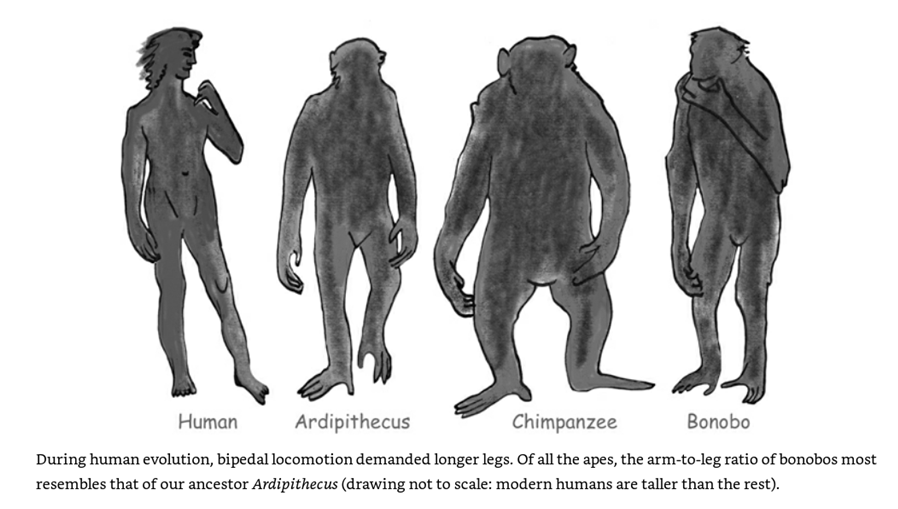
A very important point of this discussion are bonobos and their history when for long time people would not recognize them as different species from chimpanzees except for their behavior, which is much more peaceful. Finally author concentrates on explaining main points of this book: analysis morality as it relates to animals and is not necessarily depends on religion to such extent as usually thought.
CHAPTER 2: GOODNESS EXPLAINED
This chapter starts with the story of dying chip who carefully hided any sign of sickness to the end and was helped by others. Author discusses how “The incident illustrated two contrasting sides of primate social life. First, primates live in a cutthroat world, which forces a male to conceal physical impairment for as long as possible in order to keep up a tough façade. But second, they are part of a tight community, in which they can count on affection and assistance from others, including nonrelatives.” Author then discusses morality, altruism, and their costs. Whether such behavior genetic or learned, role of kin selection, and works of scientists that make contribution: Maynard Smith, Haldane, Ronald Fisher, von Neumann, and Price. The general conclusion is:” Mammals have what I call an “altruistic impulse” in that they respond to signs of distress in others and feel an urge to improve their situation. To recognize the need of others, and react appropriately, is really not the same as a preprogrammed tendency to sacrifice oneself for the genetic good.”
Author looks in detail at work and life of Thomas Henry Huxley – Darwin’s bulldog. It brings issue of morality and God, as its necessary condition. Author also mentions Veneer Theory and Darwin’s rejection of this theory:” He speculated, for example, that morality grew straight out of animal social instincts, saying that “it would be absurd to speak of these instincts as having been developed from selfishness.” Darwin saw the potential for genuine altruism, at least at the psychological level. Like most biologists, he drew a sharp line between the process of natural selection, which indeed has nothing nice about it, and its many products, which cover a wide range of tendencies. He disagreed that a nasty process ipso facto needs to produce nasty results.” Author also provided graphic representation of this theory:
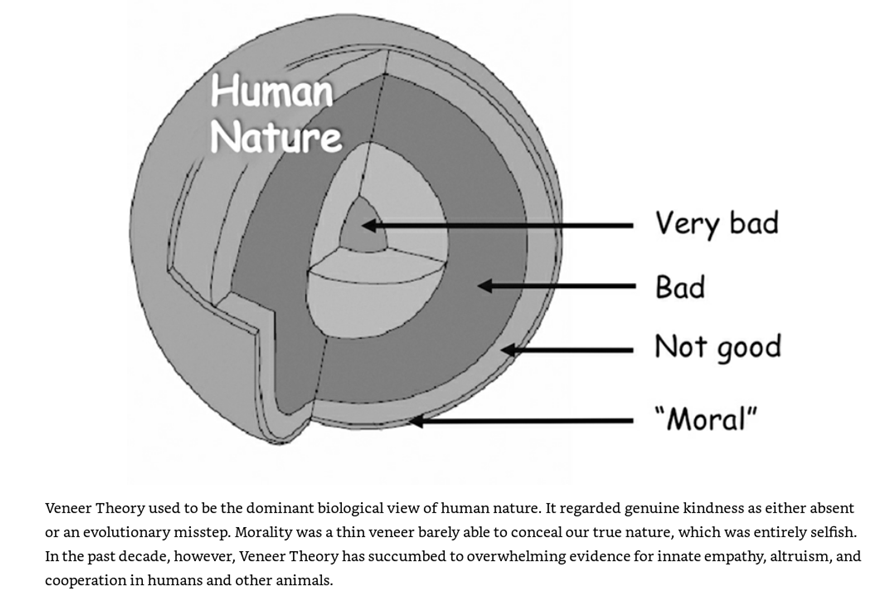
After that auithor discusses his own research and life experience that demonstrated that goodness is not just veneer, it comes naturally:” Given its intrinsic rewards, some like to label care for family and close associates “selfish,” at least at an emotional level. While not incorrect, this obviously undermines the whole distinction between selfishness and altruism.”
CHAPTER 3: BONOBOS IN THE FAMILY TREE
This is extended look at bonobos and their place in relation to humans and other apes.
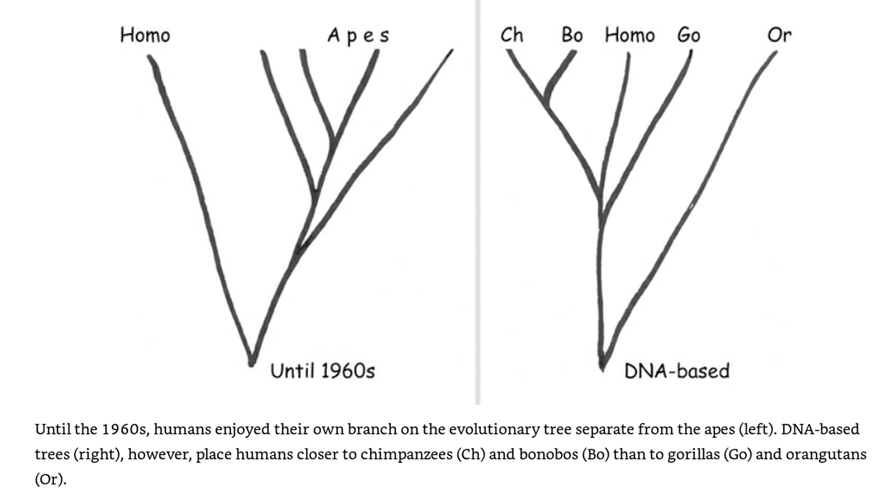
Author narrates history of bononos recognition that came late and only after long time of mixing them with chimps. Author then discusses specific of their organization and behaviours, which includes female dominance and massive use of sex as communication, interaction, and cooperation tool. At the end of chapter author concludes that bonobos and their super free love is not necessarily good example for humans to follow and that “the emphatic brain” could use other methods of expression.
CHAPTER 4: IS GOD DEAD OR JUST IN A COMA?
Author was born and raised as catholic, which was bound to create some cognitive dissonance when he became biologist. In this chapter he explores his history of coping and becoming atheist, but then coming to America and encountering this weird culture where people like guns, do not like soccer, and read Bible. Author also discusses relation between faith and science and notes that in his experience scientist often behave with huge deference to authority, denying on practice their proffered believes and demonstrating that they are not that different from believers. At the end of chapter author discusses “Somethingism”, which is probably the true believe of majority of people.
CHAPTER 5: THE PARABLE OF THE GOOD SIMIAN
Here author is using example with elephants to demonstrate how poor understanding of animals leads to poor design experiments, leading to incorrect conclusion about animals’ abilities. One such example with mirror and elephant’s ability to recognize itself is really typical. After that author discusses a number of well-designed experiments that demonstrate animals’ ability to cooperate and emphasize with others. Author uses parable of good Samaritan and shows that even rats could and do help other even if it involves opportunity cost. In this case humans not necessarily do much better as was demonstrated by this experiment:” University students were ordered to hurry from one campus building to the next while a slumping “victim” was planted in their path. Only 40 percent asked the “victim” what was wrong. Students who had to make haste helped far less than students with time on their hands. Some literally stepped over the moaning “victim.” They did so even though, ironically, the topic they were to address in their lecture was the good Samaritan.”
Here is nice graphic representation:
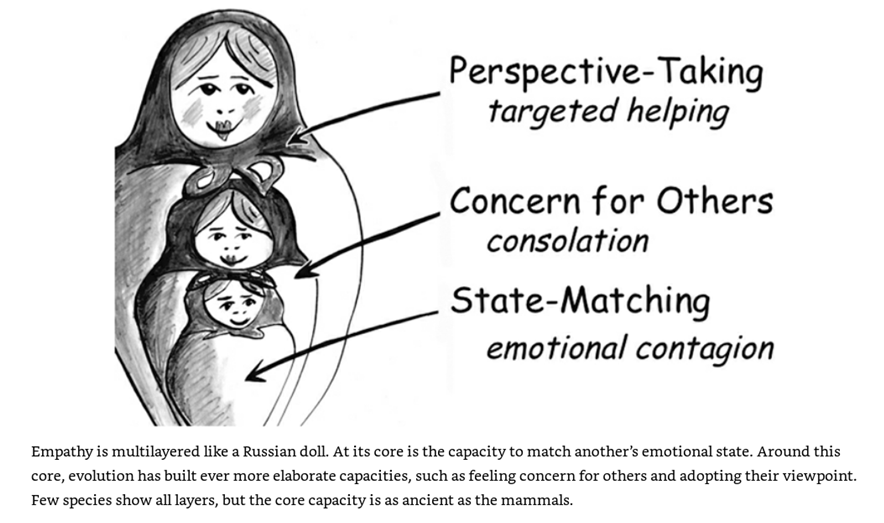
CHAPTER 6: TEN COMMANDMENTS TOO MANY
In this chapter author discusses morality and dominance using quite appropriately example of rich and powerful politician DSK and cleaning lady in hotel. Author also provides here his definition:” Morality is a system of rules concerning the two H’s of Helping or at least not Hurting fellow human beings. It addresses the well-being of others and puts the community before the individual. It does not deny self-interest, yet curbs its pursuit so as to promote a cooperative society.” He then provides multiple examples that this is completely applicable to many animals.
CHAPTER 7: THE GOD GAP
Here author moves to the issue of morality and God. After reviewing both theoretical and theological ideas and experimental data he concludes:” …my own thinking that morality predates religion, certainly the dominant religions of today. We humans were plenty moral when we still roamed the savanna in small bands. Only when the scale of society began to grow and rules of reciprocity and reputation began to falter did a moralizing God become necessary. In this view, it wasn’t God who introduced us to morality; rather, it was the other way around. God was put into place to help us live the way we felt we ought to…”
At the end of this chapter he discusses secularization of Europe and expresses believe that god is not required for morality:” a recent study compared the reasons why believers and nonbelievers assist others. It found nonbelievers to be more sensitive to the situation of others, basing their altruism on feelings of compassion. Believers, in contrast, seemed driven by a sense of obligation and how they ought to behave according to their religion. The behavioral outcome was the same, but the underlying motivations seemed different. Clearly, there are many reasons for kindness, and religion is just one of them. The secular model is currently being tried out in northern Europe, where it has progressed to the point that children naïvely ask why there are so many “plus signs” on large buildings called “churches,” and where people have no idea anymore of the biblical origin of their expressions, from “washing your hands of the matter” to “a drop in the bucket.” Civic institutions have taken over many of the functions originally fulfilled by the churches, such as care for the sick, poor, and old. Despite being largely agnostic or nonpracticing, the citizenry of these countries stands firmly behind this effort. It is a giant experiment, both economically and morally, that may tell us whether large nation-states can forge a well-functioning moral contract without religion. If one believes, as I do, that morality comes mostly from within, there is every reason to support this effort…”
CHAPTER 8: BOTTOM-UP MORALITY
This final chapter summarizes author’s understanding:” The moral law is not imposed from above or derived from well-reasoned principles; rather, it arises from ingrained values that have been there since the beginning of time. The most fundamental one derives from the survival value of group life. The desire to belong, to get along, to love and be loved, prompts us to do everything in our power to stay on good terms with those on whom we depend. Other social primates share this value and rely on the same filter between emotion and action to reach a mutually agreeable modus vivendi. “
MY TAKE ON IT:
I generally agree with this approach. Similarly, I believe that morality is natural product of evolution when survival of individual is highly dependent on behavior of other individuals in the group, creating dual evolutionary pressure to act in such way as to assure survival of both, individual and group. Such duality provides for very complex patterns of behavior when combination of internal state of individual and external circumstances lead to variety of outcomes sometimes more beneficial to individual at the expense of group, but sometimes more beneficial to the group at the expense of individual. Moreover, I do not think that it is possible to create such environment, either via religious training or secular indoctrination, that human individuals would consistently prefer interest of group over their own. Actually, I believe that if one includes into “own interest” psychological condition of individual, then it would come down to resolution of internal conflict of preference between fear of material deterioration of one’s circumstances and fear of psychological deterioration of one’s condition from acting against norms one is indoctrinated into. Since choice depends on unpredictable and highly variable combination of internal and external circumstances, the outcome would also be unpredictable. I think that the one and only way to improvement is to minimize possibilities of such conflict, so action in interest of individual survival would not conflict with group survival.
I think comparing war and business would be a good illustration of this point. In a war the group of individuals who put own survival first would always loose to the group of individuals ready to sacrifice for common cause. In this case the objective is simple and obvious – to win and it is defined by one or a few individuals that are dominant in the group, which in practice means sacrificing by individuals at the bottom of group’s hierarchy to benefit of individuals at the top. However, in much more complex situation of business when mix of goods and services produced defined via competition between multiple individuals, who believe that their offer is better, suppression of individual choices of individuals at the bottom to will of individuals at the top would lead to selection of inferior products, especially if individuals at the top are not limited to the same selection. So, my conclusion would be maximizing morality and enforcement of deference to decisions of superiors in small number of war and war-like situations and expand individual’s ability to decide for themselves in all other situations. This way the competing values of group survival vs. individual survival would be applied in situations when they most effective and efficient.
20210103 – The Parasitic Mind
MAIN IDEA:
The main idea of this book is that American culture is under siege by the Leftist barbarians who captured institutions of education, press, entertainment, and to somewhat lesser extent political power. They are in process of establishing anti-scientific, racist, and bigoted ideological framework and, if not stopped, will destroy democracy and Western civilization. Author suggests that everybody who wants to save Western civilization should participate in ideological resistance to this attack and speak out.
DETAILS:
Preface
Here author present his main thesis that:” The West is currently suffering from such a devastating pandemic, a collective malady that destroys people’s capacity to think rationally. Unlike other pandemics where biological pathogens are to blame, the current culprit is composed of a collection of bad ideas, spawned on university campuses, that chip away at our edifices of reason, freedom, and individual dignity.”
Author then briefly describes ideas and structure of the book.
Chapter One: From Civil War to the Battle of Ideas
This chapter is somewhat biographical where author presents his background and “ideals of seeking freedom and truth”. He narrates his history of growing up Jewish in Lebanon during civil war of 1970s when his family narrowly escaped annihilation. He discusses how he developed love for freedom and truth, while rejecting stifling religious traditions. Author makes a very interesting point about relations between truth and humility:” The quest for truth should always supersede one’s ego-defensive desire to be proven right. This is not an easy task because for most people it is difficult to admit to being wrong. This is precisely why science is so liberating. It offers a framework for auto-correction because scientific knowledge is always provisional. An accepted scientific fact today might be refuted tomorrow. As such, the scientific method engenders epistemic humility.”
After that author discusses quite a few contemporary ideas popular in miseducated circles of Western Universities characterizing them as “Parasites of Human Mind”, concluding that these ideas could lead to the death of the West by thousand cuts. Author provides a nice graphic representation of this process:

Chapter Two: Thinking versus Feeling, Truth versus Hurt Feelings
This chapter is about thinking versus feelings. Author actually against dichotomy approach:” The desire to divide the world into binary forms is at the root of the thinking versus feeling dichotomy, and this creates a false either-or mindset. We are both thinking and feeling animals. The challenge is to know when to activate the cognitive (thinking) versus the affective (feeling) systems.” However, he takes clear position on truth being more important than hurt feelings and provides examples when people’s behavior denies such approach: media against Trump, attempt of the left to destroy Kavanaugh, story with Larry Summers, and others.
Chapter Three: Non-Negotiable Elements of a Free and Modern Society
In this chapter author:” posit that freedom of speech, the scientific method, intellectual diversity, and a meritocratic ethos rooted in individual dignity rather than adherence to the ideology of Diversity, Inclusion, and Equity (DIE) are nonnegotiable elements of a truly enlightened society.” He then proceeds to demonstrate that these enlightenment values are under attack in contemporary western society via: Social media companies’ restriction on free speech, bullying that leads to self-censorship, promotion of identity politics in all areas of live, even rejecting science when it contradicts ideology. He also stresses that all this came from leftists capture of institution in academia, mass media, and big companies. Some examples are not just interesting, but somewhat threatening such as physician’s selection of treatment based on ideology.
Chapter Four: Anti-Science, Anti-Reason, and Illiberal Movements
Here author:” addresses several anti-science, anti-reason, and illiberal idea pathogens including postmodernism, radical feminism, and transgender activism, the latter two of which are rooted in a deeply hysterical form of biophobia (fear of biology).” He reviews specific anti-science trends and present the story of parodies accepted for publishing as serious work by pseudo-scientific publications.
Chapter Five: Campus Lunacy: The Rise of the Social Justice Warrior
In this chapter author:” examines how the mindset of social justice warriors gave rise to universities that prioritize minimizing hurt feelings over pursuing truth (a continuation of the theme first addressed in Chapter Two), the Oppression Olympics (intersectionality), Collective Munchausen and the homeostasis of victimology (I’m a victim therefore I am), and pious self-flagellating at the altar of progressivism.” Author looks at movement for safe spaces, promotion of victimhood, growing leftist bigotry, and other maladaptive trends.
Chapter Six: Departures from Reason: Ostrich Parasitic Syndrome
Here author:” explores Ostrich Parasitic Syndrome (OPS), a malady of disordered thinking that robs people of their ability to recognize truths that are as obvious as the existence of the sun. Science denialism is one manifestation of OPS but there are many others.” Author discusses here Faux-Causality when people make weird causal connection like “climate change” to Islamic terrorism, unsupported by neither by reality nor by logic ideas like “Diversity is strength”, Islamic terrorism being not connected to Islam, and other strange ideas.
Chapter Seven: How to Seek Truth: Nomological Networks of Cumulative Evidence
In this chapter author:” examines how to seek truth via the assiduous and careful erecting of nomological networks of cumulative evidence.” He refers to Dan Sperber, Hugo Mercier and their argumentative theory of reasoning, which demonstrated difficulty of changing people’s believe and suggest that it could be done via Nomological Networks of Cumulative Evidence and provides “how to” example: ”Suppose that you wish to demonstrate that men’s universal preference for the hourglass figure was shaped by evolution. How would you go about achieving such a task? The objective would be to build a network of cumulative evidence stemming from widely different sources, all of which serve to construct the final jigsaw puzzle (undoubtedly of a beautiful woman possessing the hourglass figure). Here are some compelling findings: 1) the hourglass figure has been associated with greater fertility and superior health; 2) across a broad range of cultures, online female escorts advertise the hourglass figure to prospective patrons— whether they are lying about said measurements is immaterial; 3) online escorts who possess the hourglass figure command larger fees; 4) statues and figures spanning varied cultures across several millennia exhibit the desired hourglass figure; 5) Playboy centerfolds and Miss America winners throughout the twentieth century possess the preferred hourglass figure; 6) men’s preference for the hourglass figure has been documented across diverse cultures and races using many methods including brain imaging and eye tracking; and 7) men who have never had the gift of sight are also drawn to the hourglass figure (using touch to establish the preference). This constitutes an unassailable body of evidence.” Author then provide Nomological Networks of Cumulative Evidence rejecting leftist ideas for Toy Preferences, Sex Differences, Islam and Terrorism, Infection diseases, and Anti-Semitism.
Chapter Eight Call to Action
In the final chapter author:” propose reasons that cause people to remain passive bystanders in the battle of ideas, and I suggest a course of action to turn the tide. Do not underestimate the power of your voice. Seismic changes start off as small rumbles. Get engaged in the battle for reason and freedom of thought and speech.
Author’s recommendations also include:
- Believe in power of your voice
- Do not be afraid of Judging others and giving offence
- Do not Virtue-Signal
- Be the Penalty Kicker
- Activate your Inner Honey Badger
At the end author provides recommendation on fixing Universities and calls on everybody to get engaged.
MY TAKE ON IT:
I think that author adequately describes the current situation and massive attack by leftists against all Western Values. However, he somewhat misses reasons for this attack and consequently his recommendations are not sufficient to repulse this attack. In my views it is not coincidental that after more than hundred years of socialist and national-socialist propaganda it only now seems to be achieving its objectives in English speaking Western societies. It was successful in Central and Easter Europe in early and middle of XX century after destruction of WWI and Great Depression leading to establishment of Soviet and Nazi regimes in Russian and German Empires with their traditional dominance of governmental hierarchies, but failed in more stable UK and USA where such hierarchy was relatively weak and majority of population led economic and intellectual live only slightly impacted by governments. It is not the case anymore so it is no wonder that economic destruction of Western lower middle and working classes caused by globalization would greatly weaken resistance to socialist ideology that promises if not prosperity, then at least safety and stability, however miserable because it deprives people of opportunity for independent economic live. The only way to succeed is to find a place in hierarchy and struggle for such place has to proceed around some normally meaningless ideological markers. The only way out now is to develop alternative economic safety net that would not substitute freedom with place in governmental hierarchy, then use it to regain political power, then eventually use this power to protect freedom on campus and elsewhere. Alternative is to wait until mass frustration caused by living at the bottom of hierarchy will mature enough to explode system similarly to events of 1990s in former USSR. I believe that on the long run people will choose freedom, but it could be very long run indeed.
20201227 – Mind in Motion
MAIN IDEA:
The main idea of this book is that human thinking is driven by spatial perception that defines our cognition of both our internal and external worlds. Author formulates 9 cognition laws that define this process, how it happens and eventually how it turns into actions that change the world to better fit our needs.
DETAILS:
PROLOGUE Moving in Space: The Foundation of Thought
Here author defines her vision of the link between spatial perception of humans and their thinking. She also provides preview of the structure of this book as it was designed for different special interests:
“For the fundamentals, how perception and action mold thinking about the spaces we inhabit: Chapters One (space of the body), Two (space around the body), Three (space of navigation).
For varieties and transformations of spatial thinking and spatial ability, Chapter Four. For ways gesture reflects and affects thought, Chapter Five.
For talk and thought about space and just about everything else: Chapters Five, Six, and Seven.
For designing and using cognitive tools, maps, diagrams, notation, charts, graphs, visualizations, explanations, comics, sketches, design, and art, Chapters Eight, Nine, and Ten.”
PARTI: THE WORLD THE MIND
CHAPTER ONE: The Space of the Body: Space Is for Action
The first chapter of this part is about representation of the body in the mind. It stresses that different parts of the body represented very unequally and author provides graph of such representation:

After that author discusses the method of represantation: names vs pictures and then present her conclusion:” First General Fact Worth Remembering: Associations to names are more abstract than associations to pictures.” Then she discusses how brain develops links between body parts and their uses and tradeoff it requires. Author formulates it as:“ First Law of Cognition: There are no benefits without costs.”. Finally author looks at feedback loops that integrate sensation and action into one process and posits:” Second Law of Cognition: Action molds perception.”
The remaining part of the chapter discusses mechanisms such as Mirror Newrons, Motor Resonance, Process of Coordinating Bodies and Mids.
CHAPTER TWO: The Bubble Around the Body: People, Places, and Things
Author states objectives of this chapter upfront:” learn how people recognize, categorize, and understand the people, places, and things around us. We note that many everyday categories such as chairs and dogs are bins of common features that differentiate them from the feature bins of even nearby categories, such as carpets and snakes. But not always, and then we need to think harder, about dimensions and the features shared across categories.” She then goes through multiple categories of objects and their organization looking at: Things, Hierarchical organization at basic level, and People. In process author formulates:” Third Law of Cognition: Feeling comes first.”
Next author goes into complexities of Categories and Dimensions referring to work of Hans Rosling on graphic representation of economic and other data that help overcome misconceptions. Finally, author discusses relation between reality and its mental representation, formulation:” Fourth Law of Cognition: The mind can override perception”and then, after discussing confirmation bias: “Fifth Law of Cognition: Cognition mirrors perception.”
CHAPTER THREE: Here and Now and There and Then: The Spaces Around Us
Author’s description of the chapter:” …we examine the ways that the space around the body and the space of navigation are represented in the mind and the brain, providing support for the premise of the entire book, that spatial thinking is the foundation for abstract thought.”
The main points are: “Corollary of Fifth Law of Cognition, Cognition mirrors perception: Spatial mental frameworks can organize ideas.”; “The mind can override perception”
Author then provides examples supporting main points and discusses in details how mind maps not only space around body, but also all kinds of representations including conceptual mapping. This bring us to: “Sixth Law of Cognition: Spatial thinking is the foundation of abstract thought.”
Author also discusses how mind processes these maps including rotation, alignment, setting up hierarchical organization, defining reference points and perspective. Importantly, author also presents “Seventh Law of Cognition: The mind fills in missing information.”
CHAPTER FOUR: Transforming Thought
In this chapter: “we distinguish representations of thought from transformations of thought, then analyze spatial transformations and what they are good for (plenty!) followed by spatial ability and how to get it.”
Author provides examples of mental representations of ideas and their types. Author then discusses actions that she calls transformations or operations. She also provides a shortcut for understanding these ideas:” Just as there are countless real-life actions on real objects, there are countless mental actions on ideas or transformations of representations. Recall the list, a partial one: pull together, raise, toss out, arrange, and so on. Some transformations are loosely tied to domains like arithmetic or cooking or music or language or gene splicing or chess, but many are generic. And so very many of them are based on actions by the body in space, whether actual or imagined. In fact, a useful way to think about mental transformations is as internalized actions. Just as representations can be regarded as internalized perceptions.”
After that author discusses multiple ways that human mind applies to manipulate representation such as mental rotation, switch of perspectives: insider/outsider, animation, and such. Author also looks at spatial abilities and at the end of chapter presents what she believes is meaning of all this:” Those mental gymnastics transform what we see in the world and what we imagine in our minds into countless ideas, from the elementary and mundane needed to catch a ball, cross the street, or pack a suitcase to the spectacular and arcane used to create magnificent buildings or fantastic football plays or theories of particle physics. Marvelous as they are—and they are marvelous—buildings and football plays and zooming particles have a physical presence of one sort or another. But spatial thinking has even more wonders to reveal. Spatial thinking underlies how we talk and how we think, about space to be sure but also about time, emotions, social relations, and much more.”
PART II: THE MIND IN THE WORLD
CHAPTER FIVE: The Body Speaks a Different Language
Author’s description of this chapter:” In which we consider how actions of the body, especially the hands, turn into gestures that act on thought, our own and others, and provide the social glue underlying cooperation.”
Author reviews here how gestures are drawn by hands, different kinds of gestures, how gestures reveal thoughts, and even help us think and communicate. Author also makes an interesting point that:” Second General Fact Worth Remembering: Representations created by hands and by words are wildly different.”
CHAPTER SIX Points, Lines, and Perspective: Space in Talk and Thought
Author’s description of this chapter:” In which we consider how linear language describes space, using a perspective, either an inside, body-centered perspective or an outside, world-centered perspective. For insider perspectives, we show that surprisingly taking another’s perspective is sometimes easier and more natural than taking your own.” Author makes an important note that different languages provide for different perspectives.
CHAPTER SEVEN Boxes, Lines, and Trees: Talk and Thought About Almost Everything Else
“In which we reflect on the ways simple geometric forms, dots, boxes, lines, and networks, capture thought about space, time, number, perspective, causality, and just about everything else.”
Author discusses here “geometry of minds” use of various forms:
- Boxes as containers of staff and ideas
- Trees and Networks: big ideas divided into parts
- Lines and cycles: ordering ideas and/or time in sequence
- Orders: who’s on top and who’s at bottom
- Boundaries: separation by identifying differences
- Arrows: directionality and causality
Overall, it is all about interconnection between spaces and language.
CHAPTER EIGHT Spaces We Create: Maps, Diagrams, Sketches, Explanations, Comics
“In which we show how thought has been put in the world by arranging marks in space to create meanings that transcend the here and now. We zig and zag between the historical and the contemporary to draw lessons for designing and using thinking tools for thought about space, time, number, events, causality, and stories, highlighting comics, an explosively creative zany mix of storytelling”.
Here author expands into cases when mind is too small:” The Eighth Law of Cognition: When thought overflows the mind, the mind puts it into the world”.
This means creation of maps, writing, math, diagrams, notations: either scientific or musical, dancing, instructions, and all kind of similar staff. Author reviews all these in great detail.
CHAPTER NINE Conversations with a Page: Design, Science, and Art
“In which we join art and science through drawing. We watch people put thought on a page to hold a wordless conversation involving eye and hand and marks to see, to think, to clarify, and to create. We leave the page and return to the mind to reveal the key to creativity.”
Here author expands the same ideas into area of art and design.
CHAPTER TEN The World Is a Diagram
“In which we see that our actions in space design the world, that the designs create abstract patterns that attract the eye and inform the mind, that the actions get abstracted to gestures that act on thought, and the patterns to diagrams that convey thought. Actions in space create abstractions. A spiral we call spraction.” Here author discusses impact of humans on world outside their bodies: buildings, roads, book and other artifacts. This basically means to adjust world to what we want it to be, so author formulates:” Ninth Law of Cognition: We organize the stuff in the world the way we organize the stuff in the mind.”
MY TAKE ON IT:
I find this way of thinking interesting and maybe even useful in understanding how people think and in designing of communications that would effectively impact their own and others thinking. The only small issue I would have with all this is that author seems to be missing category of non-spatial, whether it is idea or some linguistic or even material construction, which kind of imposes limitation on understanding of cognition process, which in all cases involves multiple inputs/outputs both spatial and non-spatial. As example one could use something like color, which is generally non-spatial characteristic as it is normally represented in a mind. It definitely could be converted to spatial representation as the specific part of electromagnetic specter on the graph, but normal use is non-spatial.
Putnam, Robert – The Upswing

MAIN IDEA:
The main idea of this book is to demonstrate that American society went through cycle of dominance of individualism in late XIX-early XX century’s “Gilded age” that was pushed out by collectivistic progressive movement and cultural changes that led to dominance of communitarian ideas, which picked up in 1950-60s and then returning back to dominance of individualism and inequality that hit bottom in our time. The additional idea is to find some signs that America will start moving back to communitarian future, obviously preferred by authors, sometime soon.
DETAILS:
Chapter 1: What’s Past Is Prologue
This chapter begins with Tocqueville’s observation:” the coming together of people for mutual purposes, in both the public and private spheres, and found that a multiplicity of associations formed a kind of check on unbridled individualism. Keenly aware of the dangers of individualism (a term he coined), Tocqueville was inspired by what he saw in America: Its citizens were profoundly protective of their independence, but through associating widely and deeply, they were able to overcome selfish desires, engage in collective problem solving, and work together to build a vibrant and—by comparison to Europe at that time—surprisingly egalitarian society by pursuing what he called “self-interest, rightly understood.”
Then authors move to our time and lament dissolution of associations, pointing out the huge psychological problem that developed in late XX – early XXI century America:” While industries spawned by technological advance have allowed huge corporations to produce unparalleled profits, very little of this wealth has trickled down. The poor may be better off in real terms than their predecessors, but the benefits of economic growth have remained highly concentrated at the top. Extremes of wealth and poverty are everywhere on display. Class segregation in the form of an entrenched elite and a marooned underclass is often a crippling physical, social, and psychological reality for those striving to get ahead. Young people and new immigrants enter the labor force filled with the hope that the American Dream can be theirs through persistence and hard work. But they often become disillusioned to find how great their competitive disadvantage is, and how difficult it is to make the leap to where the other half lives. American idealism increasingly gives way to cynicism about a rigged system.”
After that author moves to the main thesis of this book, which is that America over the last 100+ years went through cycle of decrease in individualism and increase of community reaching the top in 1950s and then went down into dark valley of individualism. It is presented by the general graph:”

Authors stress that community for them somehow means government with its regulations, bureaucracy, and suppression of individuals, while individualism somehow means big corporations, managerial, and financial elite. Then authors present general plan of the book: to go systematically through 6 specific areas and present suport of their main thesis for each of these.
Chapter 2: Economics: The Rise and Fall of Equality
The first such area is economics. At first authors present data on tremendous growth of American wealth:
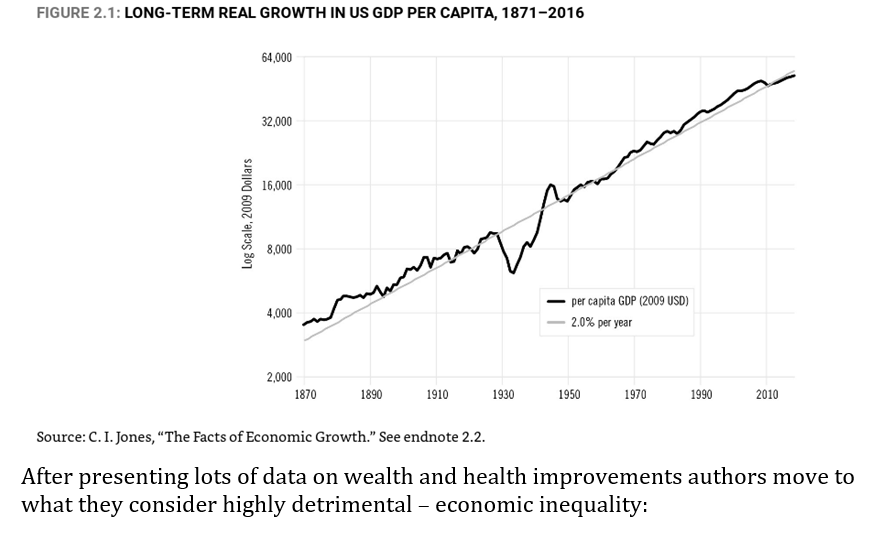
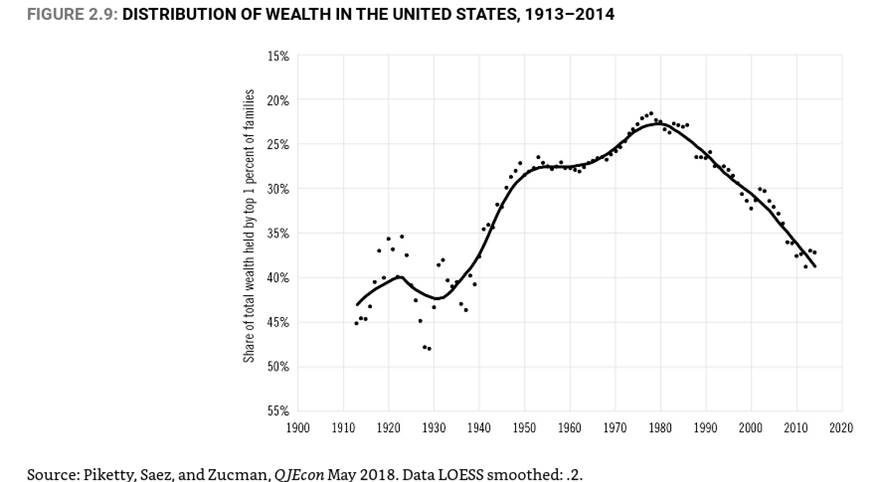
Authors provide similar graphs and discussion for Income and Wealth, review history of what they call “conversion” of the middle century that was followed by “divergence” of the end of century and beginning of current century. They also look at consequences, such as “deaths of despair”:

Finally authors analyse “how did we get there” by looking at the changes in multiple areas, trying to find causal relation:
Innovation and education – Education does not keep up with market demands
Unions – decline in support and membership
Policy – Taxing and spending, with stress on insafficient and not progressive enough taxing, not enough financial regulation, small minimum wage and so on. Authors also stress change in social norms from being too rich somewhat not nice to bragging of being rich.
Chapter 3: Politics: From Tribalism to Comity and Back Again Here authors look at political environment throughout history of the last century and find the same change: deep division during gilded age growing into unification of midcentury and moving to deep division once again. Here is representation of this process:
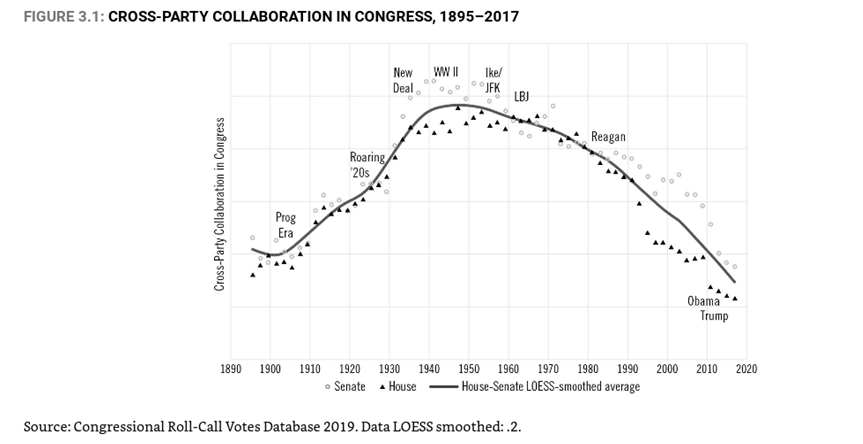
Authors look at multiple dimensions of political process and political interactions between people and generally find similar picture elsewhere. One outlier is trust in government which jumpted in 1930s – early 40s when people mistakenly saw in government savior from the great depression and correctly saw it as the driving force in winning WWII. After that it consistently went down after government demonstrated it inaptitude in all conceivable ways:

Chapter 4: Society: Between Isolation and Solidarity
Here authors look at people participation and variety of associations: civic, religious, professional, unions, and even marriage. They find the same picture elsewhere: after growing up in early XX century, dramatic decline and even atrophy for many such institutions. It could be summarized in one graph:
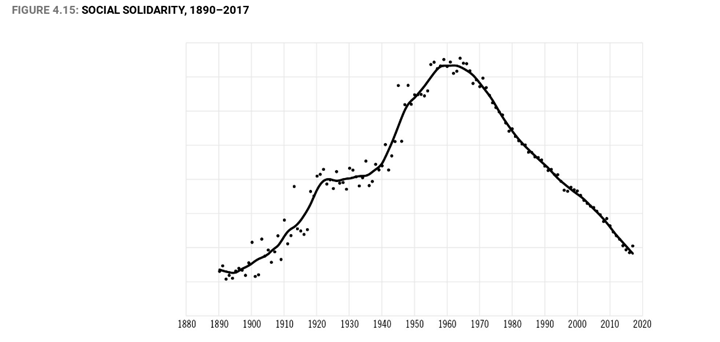
Chapter 5: Culture: Individualism vs. Community
Here authors move into special area of American culture: competition between two visions: one centered on individual and another one on the group or community. Authors base this chapter on research in Ngram, which analyses frequency of use of specific words in published texts. They look at Salience of multiple words:
- Survival of the fittest vs. Social Gospel
- “Association, Cooperation, and Socialism”
- “Common Man”
- “Agreement, Compromise, and Unity”
- “Subversion and Deviance”
- “Conformity”
- “Identity”
- “Responsibility and Rights”
The conclusion across all these multiple points of data presented in the graph:
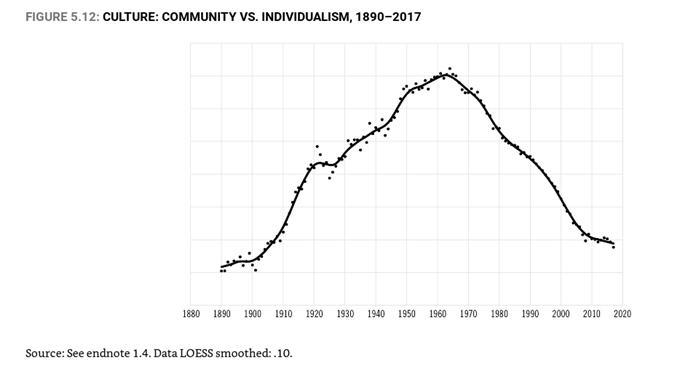
Chapter 6: Race and the American “We”
The next stop is mandatory discussion of the race relations. Authors go through various inequality parameters: health, wealth, political power, and so on. Unusually for leftists they recognize that black progress to equality was successfully terminated by leftist policies implemented in 1960-70s:
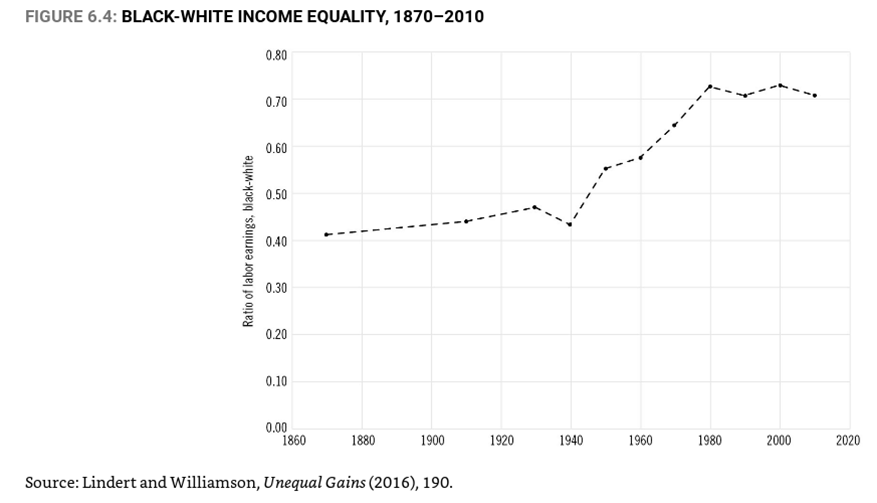
However they stress white guilt – specifically lack of enthusiasm in accepting second class citizenship for themselves among white middle and woring classes.
Chapter 7: Gender and the American “We”
In this chapter authors going through similar exercise for gender equality.
Chapter 8: The Arc of the Twentieth Century
This is kind of summary chapter:” In this chapter we aim to see the forest, not merely the trees and leaves. We begin with a summary of the broad changes that have animated the four thematic chapters—economics (Chapter 2), politics (Chapter 3), society (Chapter 4), and culture (Chapter 5). We step back from detailed narratives of specific topics, specific variables, and specific decades to ask how America changed over the last 125 years in terms of the balance between the individual and the community.”
Authors provide combined graph:

Authors then discuss their search for driver of these changes and conclude that it is cultural development, rather then economic or political. However they admit that such causial relationship has very week support in data and they have no solid explanation for I-WE-I cycles. However they note an interesting anomaly: cycle temporary interruption in 1920s when increase of movement from Gilden age “I” to massive “WE” was paused and resumed only after beginning of Great Depression. Authors also go into somewhat detailed discussion of causation in science and refer to work of Robert Shiller about narrative economics in which he claims that economic changes often preceed by changes in generally accepted narratives. Eventually authors give up on causal explanaitons reviewing a number of them and finding all of them lacking. They also look in details at 1960s as turning point period that changed direction from WE to I.
Chapter 9: Drift and Mastery
In the last chapter authors look at the overall development of last 113 years, taking as starting point Edward Bellamy’s “Looking Backward 2000-1887” and comparing predictions with reality. They go through bios of a number of personalities of Progressive Era in early XX century trying to find analogs in our time in hope to find indicator of similar movement from “I” to “WE” that occurred between 1929 and 1960. At the end they come with this conclusion:” Throughout this book we have argued that although America’s “we” had gradually become more capacious during the first half of the twentieth century, and as we continued the long historical task of redressing racial and gender inequities, we were in 1960 (and still are) very far from perfection on those dimensions. Americans could have and should have pushed further toward greater equality. Therefore the lessons of history that we glean from the I-we-I century are two-sided: We learn that once before Americans have gotten ourselves out of a mess like the one we’re in now, but we also learn that in that first Progressive Era and the decades that followed we didn’t set our sights high enough for what the “we” could really be, and we didn’t take seriously enough the challenge of full inclusion. Therefore, the question we face today is not whether we can or should turn back the tide of history, but whether we can resurrect the earlier communitarian virtues in a way that does not reverse the progress we’ve made in terms of individual liberties. Both values are American, and we require a balance and integration of both.
MY TAKE ON IT:
It is an interesting collection of data and I pretty much agree with authors’ framework of economic, cultural, and political developments of the last 100+ years. The only difference I have is that I see no problem with causal explanation of these developments. From my point of view there is always tension that arises from dual character of human nature: individualistic need to take care of self without which survival of individual is not possible and similarly strong need to take care of a group one belongs to because destruction of the group makes chances of individual survival close to nil. The early XX century for America meant practical absence of any external thread to existence of main group – nation, but multiple threads to individual subgroups – farmers, workers, small businessmen, college graduates with skills not commensurate with ambitions, and so on, all threatened by big corporation and superrich individuals that undermined these groups’ viability. The initial advancement of collectivism during the Great Depression was linked to use of political power to compensate for their market failure via political means: unions, wealth redistribution and multitude of economic support government programs, creation of multitude of sinecures in government, and so on. All this was welded into one huge communal entity by WWII, which put the very survival of group – America into question. After victory in WWII, which made America superpower for which any thread was mainly unthinkable and even individual survival pretty much assured, the other driver of human action – individualism start moving to dominance. It brought in all kind of group weakening actions from buying cheap foreign products to moving manufacturing offshore. The main focus of struggle shifted from survival of America to prospering more than neighbor, even if it means denying prosperity to this neighbor. It also included moving to gated community to separate oneself from this former neighbor. The good/bad news is that this period is coming to the end because there is real threat of external domination once again – China and its communist / expansionist direction of development. Similarly, to the past we will probably have powerful consolidation of internal interest groups and increasing dominance of collectivistic approach, at least for a while. And, since unlike mid XX century current American elite is tightly linked to global elite and it seems does not mind to be subordinate to Chinese communist leadership, the change could include destruction of the part of this elite that will fail to awake their sleeping internal patriotism. It would be interesting to watch how American collectivism of masses will clash with Socialist / Globalist / Chinese collectivism of elite.
20201213 – Plagues and People

MAIN IDEA:
Author defined very nicely and briefly the main idea this way:” This book aims to bring the history of infectious disease into the realm of historical explanation by showing how varying patterns of disease circulation have affected human affairs in ancient as well as in modern times.”
DETAILS:
Introduction
Here author describes what prompted him to write this book: the story of conquest of America when a few hundred conquistadors overcame millions of indigenous people organized in Aztec empire. Author rejects the usual explanations such as firearms, horses, mistaken identification of white Spaniards as gods, and such. He sees the key to this conquest in biological weapons unwittingly unleashed on population without immunity that not only killed millions, but also undermined morals by convincing people that gods on the side of conquistadors because they do not get inflicted by disease.
Author also defines a few key concepts such as microparasites such as bacteria and viruses that gets people sick or even kills them and macroparasites such as big predatory animals, but also great warriors and aristocrats, foreign and domestic, that rob, enslave, and kill people. Author is looking at interaction between victims and parasites as complex process with wide range of system equilibria in the range from deadly parasite, either micro and macro, which kills, consumes, and then have to find the next victim or die, all the way to coexistence parasite, which just consume some share of victim’s resources, allowing it staying alive and even being well. Author then discusses some specific microparasites and how they interact with human body.
I: Man, the Hunter
In this chapter author looks at the humans as hunters with powerful information processing tool – brain that allow practically eliminate all other large predators that could compete with humans for food and other resources. Author reviews parallel evolutionary development of humans and their parasites and how superior communication and organization skills allowed humans establish dominance over predators. Then something unusually author uses different reference point: “Looked at from the point of view of other organisms, humankind therefore resembles an acute epidemic disease, whose occasional lapses into less virulent forms of behavior have never yet sufficed to permit any really stable, chronic relationship to establish itself.” Author also makes here a very important point that coevolution of humans and their microparasites in Africa led to establishment of equilibria when human grow was limited by diseases well adjusted to humans. Author also notes that limited amount of naturally produced resources also limited human macroparasites. Finally, author discusses breakthrough that occurred between 40,000 and 10,000 BC when humans moved out of Africa, in process leaving behind their natural microparasites as limitation of their growth, and expanded all over the earth eliminating other humanoids and big predators. Once again worldwide equilibrium was established with human numbers limited by availability of resources with humans divided into huge diversity of types well-adjusted to the huge diversity of environments.
II: Breakthrough to History
Author begins this chapter with discussion of practical elimination of large-body animals that occurred everywhere where humans expanded their habitat. Only domesticated big-body animals expanded their presence. The overall impact was shortening of food chains and decrease in diversity of environment. Then came agriculture, which took out huge amount of space away from natural development into artificially limited diversity of plants and animals. Author discusses in some details agricultural processes and how their impacted various parasites, both micro and macro. Author also looks at cultural patterns that sometimes limit, but sometimes expand vulnerability, such as communal baths. Here is how author presents established equilibrium:” Eventually agricultural populations became dense enough to sustain bacterial and viral infections indefinitely, even without benefit of an intermediate nonhuman host. This cannot ordinarily happen in small communities, since unlike multicelled parasites, bacterial and viral invasions provoke immunity reactions within the human body. Immunity reactions impose drastic alternatives upon the host-parasite relationship. Whenever they dominate the interaction of host and parasite, either speedy death of the infected person or full recovery and banishment of the invading organism from the host’s body tissues ensues—at least for a period of time of months or years until the immunizing antibodies fade from the bloodstream so as to permit reinfection.”
Author then reviews transmission of infection either direct or via animals and provides this nice table for number of diseases shared with animals:

Finally, author discusses interactions within civilization, its balance between cities and rural areas that supplied constant flow of new people to compensate for losses from proximity of people – necessary condition for both high economic opportunity and high infection diseases vulnerability.
III: Confluence of the Civilized Disease Pools of Eurasia: 500 B.C. to A.D. 1200
In this chapter begins with estimate that by 500 BC macroparasitic balances were established in several civilized areas. Similarly microparasitic balances specific to agriculture were established in older cites, but author notes that:” By contrast, greater instability prevailed in fringe areas where three different natural environments—the Yellow River flood plain, the monsoon lands of the Ganges Valley, and the Mediterranean coastlands—had all become capable of supporting civilized social structures much more recently than was the case in the Middle East. Accordingly, in 500 B.C. ecological balances were still precarious in these regions, and there is reason to suppose that disease patterns were far less firmly fixed than in the Middle East.” Author methodically goes through such areas estimating microparasitic conditions around 500 B.C. After that for some 1700 years these civilized centers where preparing surrounding populations for expansion by developing their immunity via intermittent interactions. Here is how author describes this process:” The conquests and ethnic encroachments which Turks and Mongols achieved before, and more spectacularly after, A.D. 1000 simply could not have occurred had these peoples not achieved and maintained a level of immunity to civilized diseases almost equivalent to that prevailing in the major civilized centers themselves. Everything known of the trade patterns and political structures of the steppe make this seem likely, indeed all but certain. Frequent movement across long distances, and occasional assembly into large gatherings for raids or (with the Mongols) for a great annual hunt, provided ample opportunity for infectious diseases to be exchanged and propagated among the nomads, and even, as Chinese records attest, to be sometimes communicated to less mobile civilized populations.”
IV: The Impact of the Mongol Empire on Shifting Disease Balances, 1200—1500
Here is how author describes situation before development of Mongol empire: “Two systematic instabilities remained. One was the persistent and cumulatively massive growth of human population in the Far East and Far West, resulting from the way in which the Chinese and Europeans had broken through older epidemiological and technological barriers shortly before A.D. 900. Eventually this development affected the macro-balances of the Old World in emphatic fashion, making first China and then western Europe critically influential in military, economic, and cultural matters. The other source of systematic instability within the Eurasian world balance, as defined between 900 and 1200, was the possibility of further altering communications patterns, both by sea and land.”
Expansion of Mongol led to increase of communication and their shift up North. “From an epidemiological point of view, this northward extension of the caravan trade net had one very significant consequence. Wild rodents of the steppelands came into touch with carriers of new diseases, among them, in all probability, bubonic plague. In later centuries, some of these rodents became chronically infected with Pasteurella pestis. Their burrows provided a microclimate suited to the survival of the plague bacillus winter and summer, despite the severities of the Siberian and Manchurian winters. As a result, the animals and insects inhabiting such burrows came to constitute a complex community among which the plague infection could and did survive indefinitely.” Then author discusses the history of raise and fall of the most important disease that emerged from this situation – plague. After the plague other epidemic diseases became prevalent and author connects it to development of textile industries that provided warm closing in cooling European climate, creating simultaneously good conditions for lice. The final evaluation of this period goes like this:” What we see, then, as the over-all response to the changed communications pattern created in the thirteenth century by the Mongols is a recapitulation of what we saw happening in the first Christian centuries. That is to say, massive epidemics and attendant military and political upheavals in Europe and (less clearly) also in China led both in the early Christian centuries and in the fourteenth century to sharp diminution of population in the Far East and in the Far West; but in the regions between, both epidemic history and population history are difficult or impossible to discern. In the earlier instance, several diseases were probably at work, and it took a longer time for population to recover, especially in Europe. In the fourteenth century, on the contrary, a single infection was probably responsible for most of Europe’s population decay, and recovery both in Europe and in China was swifter, so that by the second half of the fifteenth century unmistakable population growth again set in at each extreme of the Old World ecumene. Even in Muscovy and the Ottoman empire, lands lying close by the steppe focus of plague infection, population growth became unmistakable in the sixteenth century, perhaps beginning even earlier.”
V: Transoceanic Exchanges, 1500—1700
This chapter is about globalization of humanity during period 1500-1700 when Euro-Asian civilization clashed wit independently developing Amerindian civilizations and crashed it do significant extent via epidemic defenselessness of the latter. It was not one sided, but European diseases were much more virulent than American. The result was forfeiture by Amerindians of their culture and believes because their gods failed, leaving them without ideological power to resist. Author, however describes not only European epidemiological conquest, but also European defeats by local microparasites in such places and Africa and Amazonia. Author also describes exchanges of plants and animals, which to significant extent changed both environment and peoples, eventually resulting in decrease of diversity. Author also discusses a parallel process when macroparasitic development led to dominance of countries with superior military equipment and tactics. Author concludes the chapter by stating that these:” … factors continue to affect the conditions of human life in the twentieth century. Indeed, the world’s biosphere may be described as still reverberating to the series of shocks inaugurated by the new permeability of ocean barriers that resulted from the manifold movement of ships across the high seas after 1492. Yet almost as soon as the initial and most drastic readjustments of the new pattern of transoceanic movements had subsided, other factors—scientific and technological for the most part—inaugurated still further and almost equally drastic changes in the world’s biological and human balance.”
VI: The Ecological Impact of Medical Science and Organization Since 1700
In the final chapter author reviews how medical development such as inoculation and then vaccination changed human interaction with microparasitic environment providing new patterns of human development all over the world. Here is how author concludes this book:” In view of the truly extraordinary record of the past few centuries, no one can say for sure that new and unexpected breakthroughs will not occur, expanding the range of the possible beyond anything easily conceived of now. Birth control may in time catch up with death control. Something like a stable balance between human numbers and resources may then begin to define itself. But for the present and short-range future, it remains obvious that humanity is in course of one of the most massive and extraordinary ecological upheavals the planet has ever known. Not stability but a sequence of sharp alterations and abrupt oscillations in existing balances between microparasitism and macroparasitism can therefore be expected in the near future as in the recent past. In any effort to understand what lies ahead, as much as what lies behind, the role of infectious disease cannot properly be left out of consideration. Ingenuity, knowledge, and organization alter but cannot cancel humanity’s vulnerability to invasion by parasitic forms of life. Infectious disease which antedated the emergence of humankind will last as long as humanity itself, and will surely remain, as it has been hitherto, one of the fundamental parameters and determinants of human history.”
MY TAKE ON IT:
I really like author’s approach of looking in parallel at micro and macro parasitic phenomenon. Usually it is separated into two different areas: epidemiological and military / state histories, but in reality it makes a lot of sense looking at them together because it is pretty obvious that epidemic deceases worked hand in hand with military endeavors sometime bringing unrealistically huge benefits to attackers as was the case with conquistadors, but sometimes protecting locals against superior military power, as was the case with Napoleon’s troops on Haiti. Granted, bioweapons were used unconsciously, but they were highly effective anyway. This brings me to recognition that what we usually consider as conscious actions leading to some expected result in reality is much more dependent on poorly understood environmental circumstances, which makes great leaders and conquerors only slightly more effectual driving force of change than some completely unconscious bacteria.
20201206 – Through the Language Glass

MAIN IDEA:
The main idea of this book is to present history and contemporary state of understanding of linguistics and language influence not only on communications between people, but also on human thinking and understanding of the world.
DETAILS:
PROLOGUE: Language, Culture, and Thought
Author starts with the statement that languages are different in their usefulness: “There are four tongues worthy of the world’s use,” says the Talmud: “Greek for song, Latin for war, Syriac for lamentation, and Hebrew for ordinary speech.” Then he proceeds to present examples of these differences for some European languages. After that author defines objective of these book:” In the pages to follow, however, I will try to convince you, probably against your initial intuition, and certainly against the fashionable academic view of today, that the answer to the questions above is—yes. In this plaidoyer for culture, I will argue that cultural differences are reflected in language in profound ways, and that a growing body of reliable scientific research provides solid evidence that our mother tongue can affect how we think and how we perceive the world.”
PART 1: THE LANGUAGE MIRROR
1. Naming the Rainbow
Here author discusses work of Gladstone on Homer and how colors were presented in Odyssey via analogies rather than via direct designation. Here are 5 main points:
The author presents Gladstone’s idea that sencitivity to color developed only recently in history. This correlates with the fact that words for different colors are created over the time and in more or less similar sequence in different languages.
2. A Long-Wave Herring
In this chapter retells the story of Lazarus Geiger who expanded on Gladstone ideas:” Mankind’s perception of color, he says, increased “according to the schema of the color spectrum”: first came the sensitivity to red, then to yellow, then to green, and only finally to blue and violet. The most remarkable thing about it all, he adds, is that this development seems to have occurred in exactly the same order in different cultures all over the world.”
This followed by discussion of reasons for that: whether it was physiological development of human vision or linguistic development. Two directions were competing: Lamarckian promoted by Hugo Magnus and Darwinian. For the letter author cites Franz Delitzsch who wrote in 1878 that “we see in essence not with two eyes but with three: with the two eyes of the body and with the eye of the mind that is behind them. And it is in this eye of the mind in which the cultural-historical progressive development of the color sense takes place.”
3. The Rude Populations Inhabiting Foreign Lands
Here author reviews result of explosion of anthropological research at the end of XIX century. He looks at research and experiments of W.H.R. Rivers who worked with tribes in New Guinea and convincingly demonstrated that local have the same color vision as Europeans, even if their languages did not have specific words for many colors.
4. Those Who Said Our Things Before Us
Here author first pontificates on development of anthropology from contempt to savages to nearly worshipping them or at least claiming that all cultures are equal. Then he discusses and important book from 1969 by Brent Berlin and Paul Kay and their finding: “What were those two amazing findings? First, Berlin and Kay discovered that color terms were not so arbitrary after all. Although there are considerable variations between the color systems of different languages, some ways of dividing the spectrum are still far more natural than others: some are adopted by many unrelated languages while others are not adopted by any. It was their second discovery, however, that left the academic community reeling. This was the revelation, which Berlin and Kay themselves termed a “totally unexpected finding,” that languages acquire the names for colors in a predictable order. To be more precise, Berlin and Kay discovered the sequence that Lazarus Geiger had postulated 101 years before and that in Magnus’s hands turned into the subject of intense and protracted debate in the last decades of the nineteenth century.”
At the end of chapter author presents his conclusion:” Different cultures certainly are not at liberty to carve up the world entirely at whim, as they are bound by the constraints set by nature—both the nature of the human brain and the nature of the world outside. The more decisive nature has been in staking out its boundaries, the less leeway there is for culture.” He also briefly discusses theory of parameters and points our that diversity of languages and methods of their use is way too wide to cover it with a few parameters.
5. Plato and the Macedonian Swineherd
In the last chapter of this part author makes a very reasonable point that there are no primitive languages as there are no primitive people. There is poor understanding of other people’s environment and consequently complexities of languages that allow survival in this environment, which makes it very difficult for outside observer to understand these complexities. However, it does not mean that all languages equally complex. As everything else languages evolutionary developed to meet communication requirements for survival. Then author provides brief comparative analysis of features of various languages: Morphology, Sound System, and Subordination. At the end of chapter author presents his conclusion:” The results of this research have already revealed some significant statistical correlations. Some of these, such as the tendency of smaller societies to have more complex word structure, may seem surprising at first sight, but look plausible on closer examination. Other connections, such as the greater reliance on subordination in complex societies, still require detailed statistical surveys, but nevertheless seem intuitively convincing. And finally, the relation between the complexity of the sound system and the structure of society awaits a satisfactory explanation.”
PART 11: THE LANGUAGE LENS
6. Crying Whorf
Here author briefly retells the story of rise and fall of theory of linguistic relativity promoted by Edward Sapir. Author starts with overall history of linguistics in Europe, specifically paying attention to work of Wilhelm Humboldt, details of Sapir’s relativity, and finally works of Franz Boas and Roman Jacobson. The main understanding is that all languages allow express any thought, but:” If different languages influence their speakers’ minds in varying ways, this is not because of what each language allows people to think but rather because of the kinds of information each language habitually obliges people to think about. When a language forces its speakers to pay attention to certain aspects of the world each time, they open their mouths or prick up their ears, such habits of speech can eventually settle into habits of mind with consequences for memory, or perception, or associations, or even practical skills.” Author provides a few very interesting examples to demonstrate this point.
7. Where the Sun Doesn’t Rise in the East
Here author presents a number of linguistic curiosities from misunderstanding of naming kangaroo to use of egocentric vs. geocentric coordinates in speech by some aboriginal tribes in Australia. Author provides interesting example of object manipulation when the same change expressed differently in different languages. This raised another question: correlation and/or causation of spatial thinking depending of linguistic coordinates.
8. Sex and Syntax
In this chapter author explores another linguistic curiosity: use of sex in designation of non-animate objects. As example author uses poem of Heine when pine tree (male) dreams about palm tree(female), which is difficult to translate into English in which trees do not have sex. Author them provides charming example of similar confusion, especially between languages with different sex designation for the same object.
9. Russian Blues
Here author returns to linguistic division of color spectrum which is different in different languages, for example Russian using 2 blue colors.
EPILOGUE: Forgive Us Our Ignorance
In summary author repeat his main point:” Language has two lives. In its public role, it is a system of conventions agreed upon by a speech community for the purpose of effective communication. But language also has another, private existence, as a system of knowledge that each speaker has internalized in his or her own mind. If language is to serve as an effective means of communication, then the private systems of knowledge in speakers’ minds must closely correspond with the public system of linguistic conventions. And it is because of this correspondence that the public conventions of language can mirror what goes on in the most fascinating and most elusive object in the entire universe, our mind. This book set out to show, through the evidence supplied by language, that fundamental aspects of our thought are influenced by the cultural conventions of our society, to a much greater extent than is fashionable to admit today.”
MY TAKE ON IT:
I like ideas presented in this book and I agree that language has serious impact on the way of person’s thinking. However, I believe that author slightly overstating this case. I think that language is only one part of overall cultural environment that has impact and not necessarily the most important. My own experience of being native Russian speaker and nearly completely switching to English in midlife definitely was accompanied by switch in way of thinking about quite a few things. It is, however, all but impossible to separate changes caused by switch of language from changes causes by behavior of surrounding people, communications with them, and overall cultural environment of America, which is quite different from USSR. Nevertheless, I would assign to language lower level of causality in thinking and behavior changes comparing to logic of interactions and methods of setting and achieving objectives, which are quite different in these different cultures.
20201129 – The Great Debate

MAIN IDEA:
The main idea of this book is to present two different types of ideas derived from enlightenment via lives and work of two individuals: Thomas Paine and Edmund Burke. Former representing the French revolutionary approach of overturning existing system and rebuilding everything from the scratch and latter representing British conservative approach of upgrading the system via incremental changes with as little disruption as possible.
DETAILS:
ONE: TWO LIVES IN THE ARENA
Author begins this chapter by describing meeting between Burke and Paine that occurred in 1788- a few years before French revolution when their differences were not that obvious as to prevent this meeting from being friendly encounter. Then author describes lives and general approach to understanding of humanity by each of these two men. The Burke’s approach was based on this:” Burke argues that human nature relies on emotional, not only rational, edification and instruction—an idea that would become crucial to his insistence that government must function in accordance with the forms and traditions of a society’s life and not only abstract principles of justice. “The influence of reason in producing our passions is nothing near so extensive as it is commonly believed,” Burke writes. We are moved by more than logic, and so politics must answer to more than cold arguments.” Paine’s approach was based on believe in all powerful reason that should allow people to consciously redesign and rebuild the system in logical and efficient way as designed by such intellectually superior individuals as himself, in process suppressing or even eliminating inferior individuals that refuse comply with demands of their betters.
Author then describes approach of each of them first to American revolution, about which both were mostly in sync and the French revolution which completely divided them. This division was expressed in their competing books: Burke’s “Reflection on the Revolution in France” and Paine’s “Rights of Man”. Author briefly describes chronology of their dispute and additional works that each of them produced in support of his ideas.
TWO: NATURE AND HISTORY
This chapter is about philosophical foundation of these two people’s views about nature of human society. Paine’s view is that history is irrelevant and one should look at human nature:” And by “nature,” he means the condition that preceded all social and political arrangements and therefore the facts regarding what every human being is, regardless of social or political circumstances. Our nature remains just as it was at the beginning of the human race, since our various social arrangements don’t change what we are by nature—what every human being always has been and will be. And so, our basic nature must remain the foundation of our political thinking—of our understanding of what human beings are and how they ought to live together.”
Correspondingly Burke’s view is historical. He thinks exactly opposite to Paine: it is that original nature is hardly relevant and current condition is more result of historical development. “The beginnings of any society, Burke writes, are almost certain to involve some form of barbarism (not to say crime). But over time, by slowly responding to circumstantial exigencies, societies develop more mature forms—a process that, as Burke puts it in the Reflections on the Revolution in France, “mellows into legality governments that were violent in their commencement.” A return to beginnings would thus not offer an opportunity to start anew on proper principles, but would rather risk a reversion to barbarism. “There is a sacred veil to be drawn over the beginnings of all governments,” Burke argues, because there is little to be learned by exposing them, and there is a very real risk of harm in the exposure itself—especially the risk of weakening the allegiance of the people to their regime by exposing its imperfect origins.”
THREE: JUSTICE AND ORDER
Here author reviews difference in approach to Justice and Order. As elsewhere it is between Paine’s main problem being the suffering of masses from traditional regimes that should be destroyed by any means necessary, while for Burke it is suffering of everybody, with individuals at the top of old regime suffering from the mob included. Author also reviewing approach of each of them to Moral Order and Morals law, Natural Equality and the Order of Society, and relevant issues.
FOUR: CHOICE AND OBLIGATION
Here author discusses their approach to the very purpose of politics:” For Paine, the natural equality of all human beings translates to complete political equality and therefore to a right to self-determination. The formation of society was itself a choice made by free individuals, so the natural rights that people bring with them into society are rights to act as one chooses, free of coercion. Each person should have the right to do as he chooses unless his choices interfere with the equal rights and freedoms of others. And when that happens—when society as a whole must act through its government to restrict the freedom of some of its members—government can only act in accordance with the wishes of the majority, aggregated through a political process. Politics, in this view, is fundamentally an arena for the exercise of choice, and our only real political obligations are to respect the freedoms and choices of others. For Burke, human nature can only be understood within society and therefore within the complex web of relations in which every person is embedded. None of us chooses the nation, community, or family into which we are born, and while we can choose to change our circumstances to some degree as we get older, we are always defined by some crucial obligations and relationships not of our own choosing. A just and healthy politics must recognize these obligations and relationships and respond to society as it exists, before politics can enable us to make changes for the better. In this view, politics must reinforce the bonds that hold people together, enabling us to be free within society rather than defining freedom to the exclusion of society and allowing us to meet our obligations to past and future generations, too. Meeting obligations is as essential to our happiness and our nature as making choices.”
FIVE: REASON AND PRESCRIPTION
This chapter is about application of reason to the management of society. Here is author’s main point:” Paine understood his own time as “The Age of Reason” (as he dubbed it in the title of his last book). He thought that the combination of new insights into the science of politics and greater freedom for citizens to exercise their own individual reason upon public questions would free liberal societies of countless ancient prejudices and open the way to a new politics of liberty. Burke thought the governing of human communities was much too complex a task to be simplified into a series of pseudoscientific questions and resolved by logical exercises. It required, in his view, a degree of knowledge and wisdom about human affairs that could only be gathered from the experience of society itself. Their views, in other words, were direct extensions of the broader worldviews presented thus far and offer a deeper understanding of the foundational political questions of modern politics. Their dispute therefore deepens as it moves from the ends to the means of political thought.”
Correspondingly Burke stresses need of careful approach and cautious change because reason is limited, causing unintended consequences. For Paine reason is unlimited so the consequences can be limited to intendent, but if bad unintended consequences happen to occur, it is a small price to pay. Author also discusses relevant difference in approach to theoretical and global and specific and particular. At the end of chapter author also discusses Meaning of America, defined differently by Burke and Paine, but in such way that each believed American experience supported his view.
SIX: REVOLUTION AND REFORM
The question of Revolution vs. Reform once again clearly demonstrate difference in approach, which later became designated as right and left. For left revolution comes with massive destruction of whatever was before to clean up field for the new beautiful construction based on superior reason. For right reason’s limitation points to preference of reform with as little destruction as possible not only because it causes suffering, but, even more important, the limited reason could not possibly create much better arrangements because of its own limitations.
SEVEN: GENERATIONS AND THE LIVING
Here author looks at Burke-Paine debate in relation to generations of people:” Paine seeks to understand man apart from his social setting, while Burke thinks man is incomprehensible apart from the circumstances into which he is born—circumstances largely the making of prior generations. Burke describes a densely layered social whole that defines the place of each of its members, while Paine thinks each person is born with an equal right to shape his destiny. Paine’s case for a politics of reason argues for direct recourse to principle in the face of long-established but unreasonable practices. Burke’s case for prescription is based on generational continuity. This argument leads Burke to prefer gradual reforms that preserve what has come down from the past, while Paine pursues a revolutionary break as the only way to escape the heavy burden of long-standing injustice. The question of the generations recurs so frequently in their discussions because the Burke-Paine debate is about Enlightenment liberalism, whose underlying worldview unavoidably raises the problem of the generations. Enlightenment liberalism emphasizes government by consent, individualism, and social equality, all of which are in tension with some rather glaring facts of the human condition: that we are born into a society that already exists, that we enter this society without consenting to it, that we enter it with social connections and not as isolated individuals, and that these connections help define our place in society and therefore often raise barriers to equality. These facts suggest either that Enlightenment liberalism is in some important ways unworkable in practice given the relations between generations or that those relations must be transformed to make such liberalism possible. Because they took up the question of Enlightenment liberalism at the moment when it was becoming a question of practice, Burke and Paine were unusually attentive to these problems and approached the matter of generational relations as a genuinely practical and open question.”
Eventually author puts it into philosophical temporal framework: Paine’s “Eternal Now” when reason allows setup perfect order after removing everything that was before vs. Burke’s “Eternal Order” when reason has limited use of carefully reforming existing order to adjust this order to new circumstances. Instead of Paine’s “destruction first”, Burke’s approach is “first do not harm what is working and change only what is not working anymore.”
MY TAKE ON IT:
I guess I am mostly on the side of Burke now since I am not that young and therefore do not have illusion that world is simple. However, I do not believe that Pain/Burke’s approaches are polar. It pretty much depends on circumstances of any given society at any given time. Probably the most important part of culture of any society is its ability of supporting effective feedback connections between individuals at the top and at the bottom of this society. Strong feedback typical for democracies lead to effective reaction to changing world via freedom of speech and fair elections when there is little lag between emerging unhappiness of population and correcting measures to resolve the issue. In this case Burke’s approach would be the most effective. However, if such feedback is lacking either due to decay of society’s institutions such as press and education, or, in extreme cases, due to dictatorship of some hierarchical organization, then Paine’s revolutionary approach could become just about impossible to avoid despite it being very inefficient and often murderous. The reason is simple: because the suppression of unhappiness does not make it disappear, but rather keeps I hidden while it accumulates explosive potential until this potential becomes more powerful than forces off suppression. At this point explosion-revolution is triggered by some relatively insignificant event, leading to period struggle before the new order, often somewhat worse than it was before, would be established.
20201122 – The Mystery of Capital
MAIN IDEA:
Here is how author defines objective of this book:” In this book I intend to demonstrate that the major stumbling block that keeps the rest of the world from benefiting from capitalism is its inability to produce capital. Capital is the force that raises the productivity of labor and creates the wealth of nations. It is the lifeblood of the capitalist system, the foundation of progress, and the one thing that the poor countries of the world cannot seem to produce for themselves, no matter how eagerly their people engage in all the other activities that characterize a capitalist economy. I will also show, with the help of facts and figures that my research team and I have collected, block by block and farm by farm in Asia, Africa, the Middle East, and Latin America, that most of the poor already possess the assets they need to make a success of capitalism. Even in the poorest countries, the poor save. The value of savings among the poor is, in fact, immense—forty times all the foreign aid received throughout the world since 1945. …. Because the rights to these possessions are not adequately documented, these assets cannot readily be turned into capital, cannot be traded outside of narrow local circles where people know and trust each other, cannot be used as collateral for a loan, and cannot be used as a share against an investment.”
DETAILS:
CHAPTER ONE: The Five Mysteries of Capital
Here author expresses his view that poor countries are poor mainly because they failed to create legal and cultural conditions necessary to use available resources as Capital, which means applying resources into process of generation of goods and services in such way that they would generate profit that would increase amount of available resources, creating eventually self-supporting process of economic growth. Author notes that it did happed in currently developed Western countries centuries ago and in Asian Tigers economies after WWII, but it did not happen in Latin America and Africa. In order to analyze why and how such process occurs or fails to occur author defines what he calls 5 mysteries of capital:
- The Mystery of the Missing Information
- The Mystery of Capital
- The Mystery of Political Awareness
- The Missing Lessons of US History
- The Mystery of Legal Failure: Why Property Law Does Not Work Outside the West
Then author dedicates one chapter of this book to each “mystery” and concludes by suggesting solution.
CHAPTER TWO: The Mystery of Missing Information
Here author discusses lack of information about savings and overall wealth of poor countries due to lack of formal property accounts. Author reviews multiple obstacles to legalization of business and real estate property such as overwhelming bureaucratization of all processes that makes it just about impossible to open legal business. Based on research of his group author developed table demonstrating amount of dead capital:

CHAPTER THREE: The Mystery of Capital
Here author discusses damages from the lack of legality:” Capital, like energy, is also a dormant value. Bringing it to life requires us to go beyond looking at our assets as they are to actively thinking about them as they could be. It requires a process for fixing an asset’s economic potential into a form that can be used to initiate additional production.” After this author enumerates specific effects that would result from obtaining ability to use potential of dormant capital, for example a house that could be used as collateral. These effects are:
Property Effect No. 1: Fixing the Economic Potential of Assets
Property Effect No. 2: Integrating Dispersed Information into One System
Property Effect No. 3: Making People Accountable
Property Effect No. 4: Making Assets Fungible
Property Effect No. 5: Networking People
Property Effect No. 6: Protecting Transactions
Author summarizes this using metaphor of Bell Jar, which makes capitalism in poor countries isolated from majority, limiting effective use of wealth concentrating in the hands of lower classes unavailable for productive use.
CHAPTER FOUR: The Mystery of Political Awareness
Author’s definition of this mystery:” If there is so much dead capital in the world, and in the hands of so many poor people, why haven’t governments tried to tap into this potential wealth? Simply because the evidence they needed has only become available in the past forty years as billions of people throughout the world have moved from life organized on a small scale to life on a large scale. This migration to the cities has rapidly divided labor and spawned in poorer countries a huge industrial-commercial revolution—one that, incredibly, has been virtually ignored.”
Author then discusses mass movement of people from rural areas to cities and industrial revolution that is occurring in poor countries. This often happens despite legal restrictions on relocations so much so that around and inside of big cities there is huge population living extralegally and this population is beginning process of self-organization, forming into political power. This is the same process that occurred in developed countries a few centuries ago during industrial revolution.
CHAPTER FIVE: The Missing Lessons of U.S. History
Author’s definition of this mystery:” What is going on in the Third World and the former communist countries has happened before, in Europe and North America. Unfortunately, we have been so mesmerized by the failure of so many nations to make the transition to capitalism that we have forgotten how the successful capitalist nations actually did it. For years I visited technocrats and politicians in advanced nations, from Alaska to Tokyo, but they had no answers. It was a mystery. I finally found the answer in their history books, the most pertinent example being that of U.S. history.”
Here author looks in details at American history, quite convincingly demonstrating that it was far from nice and clean with squatting and “tomahawk rights” being examples of extralegal acquisition of property, “shooting the sheriff” a way to protect acquired property, and political organization, with elections and legal struggle eventually resulting in formal legalization of this property and establishment of such legal system that supported effective functioning of mainly peaceful control over property rights.
CHAPTER SIX: The Mystery of Legal Failure
Author’s definition of this mystery:” Since the nineteenth century, nations have been copying the laws of the West to give their citizens the institutional framework to produce wealth. They continue to copy such laws today, and obviously it doesn’t work. Most citizens still cannot use the law to convert their savings into capital. Why this is so and what is needed to make the law work remains a mystery.”
Here author defines reasons for this failure as based on basic misconceptions:
•all people who take cover in the extralegal or underground sectors do so to avoid paying taxes;
•real estate assets are not held legally because they have not been properly surveyed, mapped, and recorded;
•enacting mandatory law on property is sufficient, and governments can ignore the costs of compliance with that law;
•existing extralegal arrangements or “social contracts” can be ignored;
•you can change something as fundamental as people’s conventions on how they can hold their assets, both legal and extralegal, without high-level political leadership.
Author then provides detailed description for how to move from extralegal to legal capital. Here is top level graphical representation:

Then author discusses challenges to this process in details, allocationg a part of the chapter to each:
Part I: The Legal Challenge
Part II: The Political Challenge
The final part of the chapter is discussion from perspective of the poor and how to coopt elite into supporting this process of legalization and conversion of resources into capital.
CHAPTER SEVEN: By Way of Conclusion
Here author suggests solution to all the mysteries reviewed in this book. In pretty much in expansion of real property rights to people outside elite, making just about everybody into capitalist. Author looks at Marx’s ideas and finds them outdated in the West, but still highly popular elsewhere. Author makes an interesting point that industrialization pretty much means that small business owners, legal or extralegal, practically deprived of their businesses by increasingly big corporations not only because of competition, but also because of government intervention. Marx’s solution was removing multitude of big corporations and substitute them with one huge super corporation: government. Author generally rejects this idea as historically failed in communist countries, leaving capitalism as “the only game in town”. He believes that the problem could be resolved if: governments are willing to accept the following:

MY TAKE ON IT:
My believes and ideas are pretty close to author’s with quite a few differences:
I do not think that term “capitalism” is meaningful because I do not think it is possible separate resources into capital owned by capitalist and resources controlled by everybody else, including ability to work, as non-capital. For me the difference in not qualitative, but quantitative. When individual who owns business (capitalist) and individual who owns only self (in Marx’s term proletary) cooperate in creation of new resources and then divide these resources unequally the problem is not ownership, but market value of input, which for non-capitalist could be so low that capitalist may decide not cooperate at all. In this case non-capitalist has no other choice as to use violence and coercion to obtain resources necessary for survival, which is usually done via political struggles forcing governmental transfers. Historically societies were capable maintain stability because non-capitalists had clear path of either becoming capitalist by acquiring business experience and some initial assets. As result any individual starting in live has option of working hard and either become small business owner or high market value specialist. Since majority of population possess physical and mental ability to use this option, it is quite realistic to achieve satisfactory level of resource acquisition usually identified by term Middle Class. The author’s stress on formalization of property rights would definitely open the way to such achievement for many people in developing countries, the same way as it did occur in developed countries before. This would allow much better use of resources leading to some economic catching up to occur. The bigger problem is that such, historically Western, road to prosperity is getting outdates because human labor is increasingly redundant for production of goods and services, but this problem is outside of the scope of this book.
20201115 -Ideological Origins of American Revolution

MAIN IDEA:
The main idea of this book is to review literary and philosophical sources of American revolution and analyze the processes by which, starting from these sources, American ideas developed and by mid 1760s become not just popular, but dominant intellectual force in the minds of colonial population. Another idea is to demonstrate how these ideas become reality of American constitution and society and how it impacted social development all over the world.
DETAILS:
I: THE LITERATURE OF REVOLUTION
Here author reviews various types of literature popular in pre-revolutionary period, being the main method of information flow and debates. First and foremost, there were brief pamphlets, produced by all sides participating in discussions after every significant event. Author reviews various types of pamphlets and notes that written discussions were conducted for 20 years leading to revolution on increasing scale. Author also discusses personalities of writers from Adams and Jefferson to quite a few of less known pamphleteers.
II SOURCES AND TRADITIONS
In this chapter author looks at sources of colonial thinking and finds it in general western culture going back to: “Homer, Sophocles, Plato, Euripides, Herodotus, Thucydides, Xenophon, Aristotle, Strabo, Lucian, Dio, Polybius, Plutarch, and Epictetus, among the Greeks; and Cicero, Horace, Vergil, Tacitus, Lucan, Seneca, Livy, Nepos, Sallust, Ovid, Lucretius, Cato, Pliny, Juvenal, Curtius, Marcus Aurelius, Petronius, Suetonius, Caesar, the lawyers Ulpian and Gaius, and Justinian, among the Romans”
However, author also points out that actual knowledge of these works was lacking and they often were cited without real understanding.
Author stresses that” More directly influential in shaping the thought of the Revolutionary generation were the ideas and attitudes associated with the writings of Enlightenment rationalism — writings that expressed not simply the rationalism of liberal reform but that of enlightened conservatism as well.” These were works of “Locke, Montesquieu, Vattel, Beccaria, Burlamaqui, Voltaire, or even Rousseau.”
The third source were “The great figures of England’s legal history, especially the seventeenth-century common lawyers, were referred to repeatedly — by the colonial lawyers above all, but by others as well. Sir Edward Coke is everywhere in the literature: “Coke upon Littleton,” “my Lord Coke’s Reports,” “Lord Coke’s 2nd Institute” — the citations are almost as frequent as, and occasionally even less precise than, those to Locke, Montesquieu, and Voltaire. The earlier commentators Bracton and Fortescue are also referred to, casually, as authorities, as are Coke’s contemporary Francis Bacon, and his successors as Lord Chief Justice, Sir Matthew Hale, Sir John Vaughan, and Sir John Holt.11 In the later years of the Revolutionary period, Blackstone’s Commentaries and the opinions of Chief Justice Camden became standard authorities.”
Another source was religious Puritanism and its link to English history that produced specific ideological strain. “The ultimate origins of this distinctive ideological strain lay in the radical social and political thought of the English Civil War and of the Commonwealth period; but its permanent form had been acquired at the turn of the seventeenth century and in the early eighteenth century, in the writings of a group of prolific opposition theorists, “country” politicians and publicists.”
After defining ideological sources, author goes into more detailed discussion of ideas and writers of the period from Glorious revolution to 1760s during which all these sources were intellectually reprocessed into more or less consistent ideology of what it means to be freeborn Englishman and what rights and duties should apply to colonials in America.
III POWER AND LIBERTY: A THEORY OF POLITICS
This chapter about power discusses its aggressiveness, meaning strive to expand and difficulty of controlling it. So, the problem was to allow legitimate use of power to protect community and limit its expansion beyond legitimate borders. Author describes the process of ideas development this way:” The clarity of the modern assumption of a tripartite division of the functions of government into legislative, executive, and judicial powers did not exist for the colonists (the term “legislative,” for example, was used to mean the whole of government as well as the lawmaking branch), and in any case the balance of the constitution was not expected to be the result of the symmetrical matching of social orders with powers of government: it was not assumed that each estate would singly dominate one of the branches or functions of government.” Author describes influence of events in states that used to be free, but then succumb to despotism like Poland or Denmark at the time. Author points out that this analysis demonstrated that “the preservation of liberty rested on the ability of the people to maintain effective checks on the wielders of power, and hence in the last analysis rested on the vigilance and moral stamina of the people. Certain forms of government made particularly heavy demands on the virtue of the people”. Author discusses in details not only influence of English constitution, but also influence of the real-life practices that were well familiar to colonists.
IV THE LOGIC OF REBELLION
The logic of rebellion actually was not revolutionary, but rather conservative: to retain traditional freedoms of Englishmen and English constitution. Here is how author puts it:” It was this — the overwhelming evidence, as they saw it, that they were faced with conspirators against liberty determined at all costs to gain ends which their words dissembled — that was signaled to the colonists after 1763, and it was this above all else that in the end propelled them into Revolution.”
Author first discusses religious aspect of this related to attempt of domination by Anglican church over religiously diverse population. Then came Stamp Act and other taxes, which, while comparatively small, nevertheless were designed to establish precedent of parliament control over colonials. Then came attempt to establish control from outside over colonial judiciary via control over salaries and undermining of jury system. The next steps were increase of power of royal governors and rejection of attempt to achieve representation in parliament (John Wilkes). In addition, the burden of standing army arrived with British troop moving to colonies in peace time. Author describes these processes and increasingly negative reaction to it by population.
Note on Conspiracy
This is detailed description of colonial perception of events as a conscious conspiracy to deprive people of their rights. Author reviews conspiracy literature and other documents and pretty much concludes that it was effective idea, which was not necessarily correct evaluation of situation.
V TRANSFORMATION
Author builds the main thesis of this chapter around John Adams evaluation:” But what do we mean by the American Revolution? Do we mean the American war? The Revolution was effected before the war commenced. The Revolution was in the minds and hearts of the people; a change in their religious sentiments, of their duties and obligations … This radical change in the principles, opinions, sentiments, and affections of the people was the real American Revolution.” He then discusses specific parts of this revolution.
1. Representation and Consent
Here author looks at processes of representation in English society and demonstrates how and why event developed in such way that Americans felt being deprived of proper representation.
2. Constitutions and Rights
Here author first discusses notion of unwritten English constitution as “assemblage of laws, customs, and institutions which form the general system according to which the several powers of the state are distributed and their respective rights are secured to the different members of the community.” In this view constitution was fixed and could be changed only organically, which it did, but differently in different places, getting eventually out of synch. Unlike organic development external intervention by distant power of English parameter was perceived as violation of constitution that could not and should not be tolerated.
3. Sovereignty
The final part of this chapter is about sovereignty. Author reviews discussion about it, but it was basically contest of sovereignty of the country as represented by parliament vs. sovereignty of the people as represented by locally elected powers.
VI THE CONTAGION OF LIBERTY
This last chapter is about consequences of American revolution that it had on various long existing institutions all over the world. Here are these institutions:
1. Slavery
2. Establishment of Religion
3. The Democracy Unleashed
4. “Whether Some Degree of Respect Be Not Always Due from Inferiors to Superiors”
POSTSCRIPT. FULFILLMENT: A COMMENTARY ON THE CONSTITUTION INDEX
Here author comments on final result of revolution: the new constitutional order unmatched to anything that existed before. Author reviews three distinct phases that led to this outcome:
“The first was the years of struggle with Britain before 1776 when, under the pressure of events and the necessity to justify resistance to constituted authority, the colonists developed from their complex heritage of political thought the set of ideas, already in scattered ways familiar to them, that was most illuminating and most appropriate to their needs. Centered on the fear of centralized power and rooted in the belief that free states are fragile and degenerate easily into tyrannies unless vigilantly protected by a free, knowledgeable, and uncorrupted electorate working through institutions that balance and distribute rather than concentrate power, their ideas were critical of, and challenging to, the legal authority they had lived under. The writings of this early period drew together the basic ideas which would flow through all subsequent stages of American political thought, and provide the permanent foundation of the nation’s political beliefs.2 The second phase saw the constructive application of these ideas and the exploration of their implications, limits, and possibilities in the writing and rewriting of the first state constitutions, from 1776 through the 1780’s. Obliged now to construct their own governments at the state level, American leaders were forced to think through the fundamentals of their beliefs, and establish republican polities that expressed the principles they had earlier endorsed. They did not work from clean slates. Constrained by institutions that had long existed and by entrenched leadership groups, they were revisers, amenders, elaborators, and conceptualizers, as they applied fresh ideas to existing structures and brought them as close as possible to their ideal. So they explored the nature of written constitutions and of constituent power; worked through the problems of separating functioning powers of government to form balances within single-order societies; and probed the nature of representation, the operative meaning of sovereignty of the people, and individual rights. Few of their conclusions were applied uniformly or in absolute and complete form. But everywhere the institutional problems of republican government at the state level and the principles on which it was based were probed in this constructive phase of the ideological revolution.3 The third phase — the writing, debating, ratifying, and amending of the national constitution — resembles the second phase in that it was constructive and concentrated on constitution writing; many of the ideas that had been developed in the writing and discussion of the state constitutions were applied to the national constitution and further refined and developed. But in its essence this phase was distinct. For in the 1780’s, under the pressure of rising social tensions, economic confusion pointing to the possible collapse of public credit, frustration in international affairs, and the threat of dissolution of the weak Confederation, the central task was reversed. Now the goal of the initiators of change was the creation, not the destruction, of national power — the construction of what could properly be seen, and feared, as a Machtstaat, a central national power that involved armed force, the aggressive management of international relations, and, potentially at least, the regulation of vital aspects of everyday life by a government dominant over all other, lesser governments.”
MY TAKE ON IT:
This book is a classic and is used as main source for teaching American revolution for decades. The important point of this book is that intellectual development of American colonials, which made the revolution possible, was developing for many decades and became engine that moved people to act. Another important point that is completely in agreement with this approach is about power, its control, and search for balance between centralized and local powers without which any country falls either into tyranny or anarchy. Not all revolutions are as beneficial for population as American revolution 1776 was. Other revolutions such as Russian of 1917, German of 1933, or Chinese of 1948 brough catastrophic consequences for population of these countries. The current American revolution of 2020 is in process so it is not possible to tell which outcome will become reality: renovation and upgrade of American revolution of 1776 that would come with victory of republicans or turn to rejection of 1776 and attempt to repeat “success” of Chinese Communist party that would come with victory of democrats. I believe that this attempt could not possibly be successful for two reasons:
- The first reason is economic success of communists did not really happen in China in the first place. The economic success was achieved not by fully implementing socialism in Chinese or any other known form, but from making China into manufacturing attachment to Western economies, leaders of which transferred technology and investment to country with no labor and environmental protections. This provided for huge competitive advantage initially based on low price of products and now increasingly on established supply chains. However, now when China has to turn inside, all-natural features of socialism such as massive corruption, waste of resources, irresponsible, centralized, and highly hierarchical management will kick in, eventually leaving Chinese model in ruins.
The second and probably more important reason is the American population, which is armed and habituated to be free in expression of their opinions, believes, and actions either personal or political or economic. Socialism in any of its forms is not compatible with freedom in any of its forms, so the clash is inevitable. Whether this clash will be relatively peaceful and brief or as bloody and long lasting as in Russia or China depends on balance of power in society between indoctrinated youths and beneficiaries of big government on one side and mass of population of mainly effective and productive people on the other.
20201108 – You will be Assimilated

MAIN IDEA:
The main idea of this book is to raise alarm about Chinese intentions, which CCP is not particularly shy to declare, to become the hegemonic power of the world with all other countries including USA being subservient to. It supposed to be achieved by obtaining and developing superior technology in a few important areas such as 5G, AI, new materials, quantum computer processing and so on. When this is achieved CCP leadership believes that real full-scale war would not be necessary. Author’s secondary objective is to propose steps that would help USA maintain its technological and military superiority. These steps are mainly modeled on American success against Soviet Union in 1980s: government support for science, high technology, and implementation of industrial policy.
DETAILS:
Introduction: Everything You’ve Heard About China is Wrong (or Not Right Enough)
In introduction author goes through pretty much complete list of current media reports on China and kind of manage to both confirm and deny them at the same time. Example would be:” You’ve been told that China has “a secret strategy to replace the US as the Global Superpower.” Author confirms that China does has strategy to overcome USA, but states that there is nothing secret about that.
Then he proceeds to present his main thesis:” we’re up against Mandarin elite, cherry-picked from the brightest university graduates of the world’s largest country. America faces something far more daunting than moth-eaten Marxism: a five-thousand-year-old empire that is pragmatic, curious, adaptive—and hungry. China’s regime is cruel, but no crueler than the Qin dynasty that buried a million conscript laborers in the Great Wall. China always was and remains utterly ruthless.” This intellectual elite is much more sophisticated and smarter than American elite and is dedicated to getting technological advantage over USA in all important areas, especially military and then dictate new order when world would be subordinate to CPP. Autor also discusses what he calls five western myths about China:
Myth #1: America’s Economy is Bigger Than China’s
Myth #2: “China is a Poor and Backward Nation”
Myth #3: “China Can’t Innovate”
Myth #4: “China’s Economy Will Be Crushed by a Mountain of Debt”
Myth #5: “China has Devalued its Currency to Gain Unfair Advantage in Trade”
Finally, he discusses and rejects both: idea of Thucydides Trap and what he calls Don Quixote charges against CPP.
Chapter One: An Empire of Emperors: What Is China, and Why You Should Worry About It
Here author discusses what he believes is true and unchangeable nature of Chinese society: social contract between population and elite when elite is, at least partially, open for best and brightest from all layers of society via formal selection process of difficult high stakes testing, This arrangement provides stability and protection by elite using all means necessary including unsurpassed cruelty. In exchange people provide loyalty to the emperor as long as conditions of bargain are met.
Author the discusses nature of Chinese society as polyglot society of many people speaking different languages, but united via written language. However, it is society where everyone can have unlimited ambition and clear way to satisfy it. Here how author characterizes one of the key differences:” China is a ruthless meritocracy. Americans say, “No child left behind”, but the Chinese say, “Only the exceptional survive”. A high school student with a top score on the Gaokao will attend Peking University, Tsinghua University, or another elite institution, with a clear path to a top career in government or business. University admission depends only on examination scores. Top officials and billionaires can buy admission to Harvard for their children, but not to Peking University.”
Author also stresses role of family in the world where one cannot expect support from anywhere else. At the end author discusses geographical and economic reasons for Chinese society to become the way it is, its tragic history, and implication of China’s turning around towards the world.
Chapter Two You Will Be Assimilated: China’s Plan to Take Over the Global Economy
Here author discusses Chinese intention to take over global economy via superior technology, specifically using example of Huawei and its 5G technology. Bottom line – who controls networks controls data in this network.
Chapter Three World Domination, One Country at a Time
This chapter is about China’s attempt to export its economic model: CCP top down control with technological and business management at the bottom. Author reviews situation in different countries of developing world, discusses China’s investments and plans of IT domination and presents graph of Global connectivity:

Chapter Four America’s Losing Tech War with China: The Biggest Strategic Disaster in US History
This is another chapter on Huawei dominance and author reviews multiple points of recent technological history and concludes that:
At the inception of the Fourth Industrial Revolution, the United States has three strikes against it.
- The US is dependent on imported chips, whose security it can’t guarantee.
- The US lacks a national champion in the critical sector of telecommunications hardware.
- The US has a regulatory system that impedes rather than encourages 5G rollout.
It’s no wonder the United States lost the first round of the tech war. Without an aggressive and comprehensive change in US policy, there may not be a second round to contest.
Author also finds American response to this challenge inadequate.
Chapter Five: The Twilight of the Spooks: Quantum Cryptography and the End of American SIGINT Hegemony
Here author moves into military area- cryptography and finds situation pretty bleak:
- China Gets to the Holy Grail of Cryptography First
- It’s Not Only That China Might Steal US Data—It Will Blind US Signals Intelligence
Chapter Six: Thucydides Claptrap: How China Plans to Win Without Firing a Shot
Here author reviews Graham Allison’s thesis that China as raising power and USA as declining power are bound to clash and even possibly military. Author rejects this idea, but not before claiming that China already has local military superiority. Author also suggest that it will increase, especially via technological advantages and eventually USA would have to retreat due to massive imbalance caused by China concentrating on high tech capabilities and USA fighting expensive and meaningless low-tech wars, while wasting resources and falling behind.
Chapter Seven: China’s Sovereignty Tripwire in Hong Kong
This chapter about China and Hong Cong was written before takeover, so it is already outdated. Author seems to expect CCP to back down a bit after massive riots in order to keep Hong Kong as example of “one country two systems”, but in reality CCP just took it over. Author also provides a bit of history on British sell-out of Hong Kong to CCP.
Chapter Eight How America Can Remain the World’s Leading Superpower
The last chapter contains author’s recommendations how to overcome this difficult situation and eventually prevent world takeover by China. It pretty much comes down to somewhat nostalgic solution to implement industrial policy with heavy government investment into fundamental science and military technology that author believes would eventually spill over into general economic performance, as it did in 1980s. Here are functional areas that author want to be paid more attention:
• Defeating the current generation of Russian air defense systems
• Enhanced use of drones in place of manned aircraft
• Hardening of satellites against prospective enemy attack
• Cyber warfare
• New physical principles in computing (e.g., quantum computing)
• Quantum communications and encryption
• Detection of ultra-quiet submarines (the present generation of Chinese diesel-electric boats are practically undetectable, and submarine drones could be used to deliver nuclear weapons to coastal cities)
• Detection and defeat of the next generation of hypersonic missiles
• Countermeasures against anti-ship missiles (rail guns, laser cannon)
MY TAKE ON IT:
I pretty much agree with author about Chinese intentions and the level of danger they represent. However, I am much more optimistic about future probably because I know how socialist economy and technological development in such economy works, which would make any amount of investment ineffective. This ineffectiveness is due to bureaucracy, fear, and lack of individual freedom, all of which are huge impediments for any effective action. Author clearly understand that Chinese economic and technological success so far is to big extent occurred because their access to Western markets, technology and people. Good example is Huawei which employs huge number of western scientists and engineers. If western governments cut off this access, Huawei would be by far more damaged than just cutting off access to chips. It is not because Chinese are any less smart, educated, or even experienced, but because they are much more stifled by communist bureaucrats, and limitations on their quality of life, which are inevitable consequence of the lack of freedom. In short, I think that as bad as western bureaucracies are, communist bureaucracies are always worse. However, I completely agree that it is time to act now because however temporary would be Chinese technological superiority, West could not have enough time to recover. One always should remember lessons of WWII when it took 2 years to match Japan power in Pacific and 4 years to match German power, even if these countries were much weaker economically than USA. We just may not have these 2 or 4 years this time.
Ridley, Matt – How Innovation Works

MAIN IDEA:
The main idea of this book is to review historical examples of innovation in various functional areas from energy to computing, to look at historical patterns of innovation from before humans become humans, to analyze societal conditions that promote or restrict innovation, and, finally, look at the future trying foresee where and how innovation will happen next.
DETAILS:
Introduction: The Infinite Improbability Drive
Here author discusses improbability of everything due to the second law of thermodynamics, then discusses nature of innovation and offer this definition:” Innovation, like evolution, is a process of constantly discovering ways of rearranging the world into forms that are unlikely to arise by chance – and that happen to be useful. The resulting entities are the opposite of entropy: they are more ordered, less random, than their ingredients were before. And innovation is potentially infinite because even if it runs out of new things to do, it can always find ways to do the same things more quickly or for less energy.” Author also links it to the individual freedom without which innovation is nearly impossible.
1. Energy
In this chapter author presents history of steam engine and overall conversion of heat into work going all the way back to 1700. He moves the narrative through all various phases of industrial energy acquisition and use: steam, electricity, internal combustion engines, turbines, nuclear, and finally oil and gas acquired via fracking technology.
2. Public health
Here author also starts in early 1700s with initial attempts to use smallpox inoculation. He than moves to the story of Pasteur and discovery of vaccination. The next he jumps to 1908 and implementation of chlorine for water supplies. Other innovations with significant impact on health of population that author discusses in this chapter are: vaccination against whooping cough, penicillin, polio vaccine, anti-malaria nets with insecticide, and prevention of tabaco use.
3. Transport
The chapter on transportation starts with steam locomotive then moves to the use of screw for ships propelling, then to various engines: from internal combustion to diesel. Author also discusses here flight and innovations by individuals with passion such as brothers Wright versus government driven fake attempts by Samuel Langley. After that author extends discussion of engines and flight to jets and completes chapter with discussion of extreme safety of air travel.
4. Food
The chapter on food starts with the story of potato and its implementation in Europe. After that author moves to implementation of ammonia production that provided practically infinite amounts of fertilizer. The addition of new dwarf genes to existing plants in the second part of XX century and development of genetical engineering technology the humanity achieved practical independence of food production from normal range variations in weather leading to very recently unimaginable situation when problems of people in poverty changed from hunger to obesity.
5. Low-technology innovation
This chapter starts with discussion of numbers notation and how Indian numbers are much more effective than Roman and how much value this added to al numerical processing. Then author moves to another innovation that he considers low tech – sewage. He obviously not familiar how hi-tech sewage processing is, but at least he understands value of this process. Other low-tech, but highly valuable inventions author discusses are: corrugated iron, containers, wheeled baggage, restaurants, and the latest business methodology – shared services.
6. Communication and computing
Probably the most innovated area over last century is communication and information processing. Author starts this chapter with telegraph and then wireless transmission that practically moves increased speed of communications to speed of light, making them instantaneous. He then moves to discussion of computer, Moor’s law, and Internet, all of which so much increased human data processing ability that new and formerly unimaginable application become a reality.
7. Prehistoric innovation
Here author discusses slow moving, but critical innovation of developing agriculture, which actually was evolution of symbiotic development between humans and domesticated plants and animals. Author then discusses domestication of dogs, development of stone tools and use of fire. Author even classifies beginning of life as innovation.
8. Innovation’s essentials
In this chapter author concentrates on essentials: Innovation being gradual, different from invention, often serendipitous, and nearly always recombinant. Author also discusses conditions and methods under which innovations occur such as use of trial and error, team of people dividing effort according to skills and abilities. It is also occurring in conditions when governance is fragmented, opening options to try, while overall technological level of society achieved some level development that is causing multiple people coming up with similar ideas and products.
9. The economics of innovation
Here author touches on unusual economic characteristics of innovations such as increasing returns, sometime dramatically, advantage of bottom up development instead of economy of scale, practical development before there is scientific or theoretical understanding of corresponding processes. Author also makes somewhat interesting claims that it does not increase unemployment because opportunity for leisure is so widely distributed, that it increases independence.
10. Fakes, frauds, fads and failures
Here author discusses specifics of contemporary world when innovation became so popular that opportunities and rewards for cheating dramatically increased. Author provides examples: fake bomb detectors, phantom game consoles, and Theranos. Author also bring in failures of innovation through diminishing returns using example of mobile telephones. The final part of the chapter is about necessity for failure as part of the process of innovation.
11. Resistance to innovation
Here author provides a few examples of resistance to innovation: coffee, which was considered a drink solicitous of subversion, GMO food, weed killer chemicals, and cell phones. Author also looks at forces that prevent innovation – government directives and law protecting monopolies, big companies suppressing competition, various requirements to obtain permission for this or that. Author also provides a brief note on successful evasion of limitations in digital domain of economy.
12. An innovation famine
In the last chapter author looks at contemporary world in which innovation in developed countries somewhat stalled, but it speeds up in China, expressing concern that West will be left behind. However, author believes that freedom is necessary condition for innovation, and China is far from being free, so he hopes that innovation will be expanding to India, which has huge and increasingly well-educated population combined with political freedom. The final word: the future is thrilling and innovation will grow.
MY TAKE ON IT:
It is an interesting review of innovation, but I think it a bit too heavy on technological history and not sufficiently concentrates on analysis of drivers of innovation in some societies, but not others. I also skeptical about author’s believe that China is the next big innovator. I think author underestimates to what extent current Chinese innovation in 5G, and what not, relies on Chinese companies’ R&D conducted in western world. Author understands value of freedom for innovation, but seems to believe that it is not completely applicable to China. Actually, I would say that Chinese people are great at innovation, but only when they are free. Corruption and suppression that are unalienable features of any socialist country, China included, would make innovation stop there as soon as decoupling with West become reality.
20201025 – Calculated Risk

MAIN IDEA:
The main idea of this book to demonstrate how often people misunderstand data and how easy it is to manipulate people who are innumerate or at least poorly understand statistics and their representation. Even more important, it is to provide people with tools that allow practical methods of problem’s representation that make it a lot easier achieve statistically valid understanding.
DETAILS:
Part l: Dare to Know
1: Uncertainty
This starts with the story of pain and suffering of women who has false positive for HIV, then discuss similar problems with Prozac, Mammograms, DNA ID for courts, and so on. Author’s main point is that reality is filled with uncertainty, while people seek certainty and, because it is often impossible, they settle for illusion of certainty. Author provides a good advice how avoid it:” When thinking and talking about risks, use frequencies rather than probabilities. Frequencies can facilitate risk communication”
2: The Illusion of Certainty
Here author start discussion of illusion of certainty by using picture:
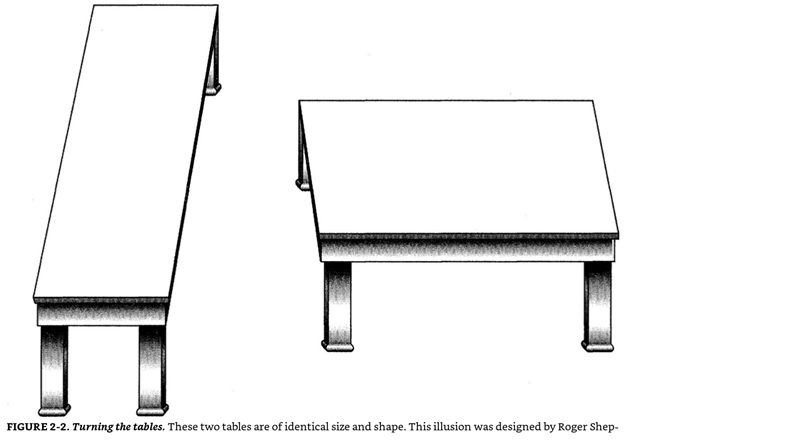
Then author discusses source of illusion: human mind does not just transmit information about reality, it actually constract internal image of reality. Important thing to understand is that evolution selected individuals not on the basis of their ability correctly represent reality, but rather on the basis of their ability to act on such perception of reality that increases their chances of procreation. Author then discusses a number of examples such as fingerprinting, believe religious and/or trivial based purely on authority, marketing, and political propaganda. He also tells the story of physisians and their relations with patients, in which they usually have problems communicating real levels of their certanty or lack thereof about diagnosis and treatment. Finally author summarizes it in such way:” Learning to live with uncertainty is a daring task for individuals as well as societies. Much of human history has been shaped by people who were absolutely certain that their kin, race, or religion was the one most valued by God or destiny, which made them believe they were entitled to get rid of conflicting ideas along with the bodies polluted with them. Modern societies have come a long way toward greater tolerance of uncertainty and diversity. Nevertheless, we are still far from being the courageous and informed citizens whom Kant envisaged—a goal that can be expressed in just two Latin words: Sapere aude. Or in three English words: “Dare to know.””
3: Innumeracy
Here author looks at reasons for difficulties that people experience in dealing with uncertainty such as inability to manage probability, misunderstanding of statistical analysis, and other forms of innumeracy. Then author discusses connection between illusion of certainty and innumeracy, providing this list:
• Illusion of certainty. Franklin’s law is a mind tool to overcome the illusion of certainty, to help make the transition from certainty to uncertainty.
• Ignorance of risk. This is an elementary form of innumeracy in which a person does not know, not even roughly, how large a personally or professionally relevant risk is. This differs from the illusion of certainty in that the person is aware that there may be uncertainties, but does not know how great these are. The major tool for overcoming the ignorance of risk consists of various forms of information search (for example, scientific literature).
• Miscommunication of risk. In this form of innumeracy, a person knows the risks but does not know how to communicate these so that others understand them. The mind tool for overcoming miscommunication is representations that facilitate understanding.
• Clouded thinking. In this form of innumeracy, a person knows the risks but not how to draw conclusions or inferences from them. For instance, physicians often know the error rates of a clinical test and the base rate of a disease, but not how to infer from this information the chances that a patient with a positive test actually has the disease
After this author moves to defining Risk and quantifiable uncertainty and reviewing three major versions of probability interpretations: Degree of believe, Propensity, and Frequencies.
Then author discusses ignorance of risk and its miscommunication. As example, author applies this approach to communicating medical benefit for a drug:
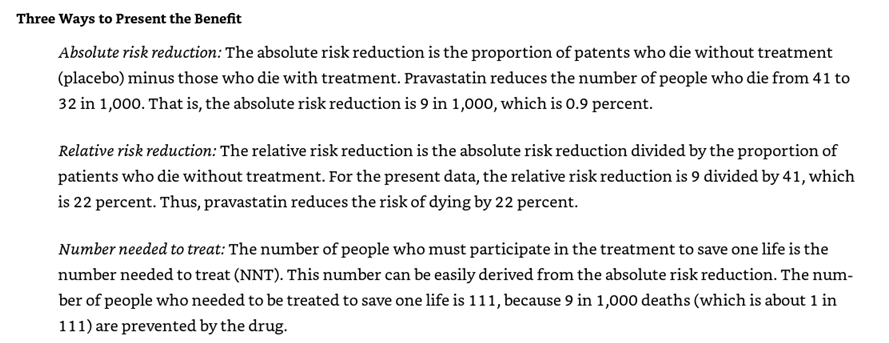
Author ends this chapter with recommendation:” Overcoming innumeracy is like completing a three-step program to statistical literacy. The first step is to defeat the illusion of certainty. The second step is to learn about the actual risks of relevant events and actions. The third step is to communicate the risks in an understandable way and to draw inferences without falling prey to clouded thinking. The general point is this: Innumeracy does not simply reside in our minds but in the representations of risk that we choose.”4: Insight
Here author describes his work with physicians on decreasing their innumeracy and ignorance. Specifically, he used technic of modelling change from probabilities to frequencies. Here is graphic example:

Part II: Understanding Uncertainties in the Real World
In this part author reviews application of his approach in the following specific areas, providing some conclusion for each:
5: Breast Cancer Screening; 6: (Un) lnformed Consent; 7: AIDS Counseling;
8: Wife Battering; 9: Experts on Trial; 10: DNA Fingerprinting; 11: Violent People
Part III: From Innumeracy to Insight
12: How Innumeracy Can Be Exploited
Here author reviews a few examples when innumeracy of people in authorities effectively used to get money. Here is graph for 2 of them:
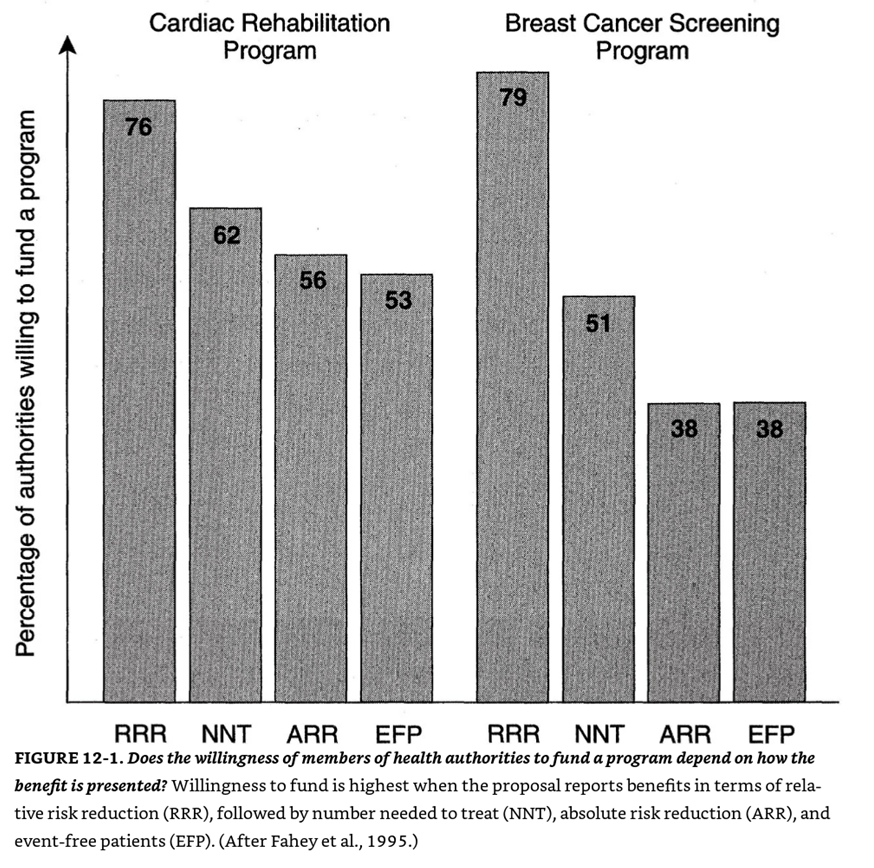
In short, effective presentation is a great tool to get whatever one wants from other people.
13: Fun Problems
This chapter presents a few funny applications and here is the one clearly demonstrating that majority does indeed could be much better than average:

14: Teaching Clear Thinking
Here author provides tips on how to improve understanding of reality:
Step 1 – Remember that everything is at least somewhat uncertain.
Step 2 – Analyze Risks
Step 3 – Analyze Communication and Representation
At the end author provides an interesting review of cultural differences in learning, but consistency of eventual ability to retain knowledge depending on training approach:

MY TAKE ON IT:
This is a very useful book that facilitates sound approach to understanding multitude of data provided by media and businesses in such form as to manipulate individual perception to achieve intendent political or business outcome. Analytical tools provided in this book make it a lot easier to see through manipulated data and therefore avoid being manipulated either into support of some party that is acting against one’s interest or buying something that one does not needs or really wants.
20201018 – The Abandonment of the West
MAIN IDEA:
The main idea of this book is to trace cultural degradation of Western civilization through its historical stages starting with period of Columbian republic from late XIX century until end of WWI when West and colonialism was pretty much glorified, then trough disappointment of the great war self-inflicted pain and suffering that caused raise of fascism, communism, and struggles of WWII, period of Cold War when Western values were undermined, but still hold, at least longer than socialist values of Soviet Union, and finally post-Cold War disintegration of Western Culture by Western elite that developed ideas of reparations for previous sins and complete rejection of Western values including equality and individual freedom.
DETAILS:
Introduction
Author begins here with recollection of 9/11 and Bush’s mentioning of Crusades, which was immediately withdrawn as incorrect historical analogy. Then he discusses overall propensity of Americans to use the notion of Crusade to just about everything from Civil War to WWII and others, noting how this changed over time and formulate the objective of this book as to answer that change and provide:” history of the West within American foreign policy, a West that is not exactly a cultural affinity or a strategic posture but some complicated, fluid combination of these two things.” Author also defines the West as “as a transatlantic idea of liberty, traces this Enlightenment idea through two forms and through a drama in four acts.” Author briefly describes these acts with 3 of them having dedicated chapter and 4th and the last 3 chapters of the Part II discussing it.
Part l: The Rise of the West
CHAPTER 1: The Columbian Republic, 1893-1919
The first act covers Columbus discovery of America, creation of USA and its development from the small republic to huge and powerful, both economically and militarily, country that could have significant impact on the world as whole, as it did in WWI. Author extensively discusses administration of Teddy Roosevelt and Wilson when this power came to forefront and become obvious for the world.
CHAPTER 2: The Case for the Wqest, 1919-1945
Author starts this chapter with discussion of Oswald Spengler and his ideas about “Decline of the West”. Author then moves to two products of Western thought: fascism and communism and how the former was destroyed by military efforts during WWII with the help of the latter.
CHAPTER 3: The Rise of the west, 1945-1963
This chapter narrates how West was consolidated by USA into effective economic and military alliance while recovering after WWII destruction and struggling in Cold War with Soviet Union to protect political and economic freedom that was slowly established in all included countries.
Part II: The Abandonment of the West
CHAPTER 4: Questions, 1963-1979
This starts with discussion of Malcolm X, black supremacy movement and support they found among intelligentsia and universities. 1950s and 60s. This followed by Vietnam war, which was successfully used by communist propaganda to undermine American society. Author then reviews various famous personalities in America that helped Soviet Union to win propagandist war against the West using anti-war and anti-black racism issue, which was later extended to support for Palestinians, South American communists, Iranian mullahs and everything else under the sun as long as it would be useful.
CHAPTER 5: The Suicide of the West? 1963-1992
This chapter looks at period before 1990s when communist block fall apart and Soviet Union disappeared. Author briefly reviews anti-communist movements in USA in 1950s, especially role of Chambers, their complex relationship with Eisenhauer, and its transformation into conservative movement that incorporated many former leftists in 1980s. Author looks at works of Buckley and especially Burnham with his “Suicide of the West”. Author ends this chapter with Fukuyama’s “The End of History” and vain hope that liberal democracy won.
CHAPTER 6: The Post-Columbian Republic, 1992-2016
The last chapter covers Clinton, Bush, and Obama administration that lasted 32 years during which anti-West movement acquired commanding position in western culture and started increasingly pushing for annihilation of Western values of individual freedom, liberal order, and democracy. Author ends this chapter with brief discussion of Trump as America’s first president who unexpectedly initiated serious counterattack in defense of the West, leading to the huge disruption of existing trends.
Conclusion
In conclusion author reviews transatlantic relationship with Europe, which came farther than USA in dismantling western culture and values, causing significant tensions between these two. Author ends with symbolic story of creation of new museum on Washington’s National mall: NMAAHC, which presents history of blacks in America as movement from slavery to freedom. In author’s view its symbolic significance is not that much denial of West as promotion of the new more inclusive West.
MY TAKE ON IT:
I only partially agree with the thesis of Western Culture disintegration, because I see it as intermediate point in formation of general whole human culture, which will be eventually build on the foundation of Western civilization just because it provides for much better quality of life than any other known culture. A number of problems, mainly economic problems connected with disappearance of Western middle jobs pushed out of existence initially by cheap foreign labor and then by automatization leaves lots of semi-educated young people without anchor in their life forcing them to seek substitution for traditional values and successful behavior. I expect these problem to be resolved within a few dozen of years, which will provide for stable and both materially and psychologically satisfactory environment, which will result in turn in formation of some global combination of best of all known civilizations with the Western Culture taking by far superior share of this combination because it provides for the best quality of live for individuals.
20201011 – The Hardhat Riot
MAIN IDEA:
The main idea of this book is to retell the story of huge backlash of working-class Americans against leftist protest movement that was shaking up America in the late 1960s and early 1970s. This backlash was expressed by massive riot of blue color workers in New York and political realignment of GOP with “silent majority”.
DETAILS:
Introduction
Here author briefly refer to events of May of 1970 when blue color workers physically clashed with antiwar demonstrators and links these events to 2016 when blue color billionaire Trump was elected on GOP ticket with mass support of blue color workers. He also states that workers won the clash but lost long struggle because of technological and demographic developments.
PART ONE Backdro
1: “Out for Blood”
Here author puts these events on time line and refers to contemporary events such as Kent University shootings.
2: The Revolutionaries of Grand Central and Columbia
This is about Yippies, who were radicalized hippies and their demonstrations and other actions against Vietnam and society’s order overall. Author describes occupation of Columbia university, clashes with police, and arrests.
3: Chicago ’68
The next stop is Chicago democratic convention of 1968 with details of events and political environment of the time.
4: Two Moratorium Days
This chapter moves to October 1969 when big demonstration in DC declared Moratorium to End the War in Vietnam. Author describes this demonstration in details, including participation of New York GOP Mayor John Lindsay who supported antiwar movement.
5: “Law and Order” and the Decline of Cities
This chapter describes response from society overall, which did not supported movements, giving opening to Nixon and his promotion of Silent Majority. It also analyses demographic and consequent political changes such as black migration from south to big cities and correspondent migration of white middle class from cities to suburbs. Here are some numbers:” Between 1940 and 1970, amid flourishing wartime industry, the black population skyrocketed—Chicago, from 8 to 33 percent; New York City, 6 to 21 percent; Los Angeles, 4 to 18 percent. Detroit’s black population rocketed from 9 to 44 percent.” Then in late 1960s started deindustrialization of America, living city dwellers without employment, creating situation when people resorted to crime on mass scales and riots. It all coincide with expansion of welfare state, destruction of black family, and initiation of leftist ideological movement to blame all these on racism. Author describes some initial occurrences such as the riot in New York, which mayor Lindsay refused to call a riot.
6: The Political Fallout of “Law and Order”
This chapter is about increase in crime in the cities. Author nicely demonstrates attitude of leftists by this quote: “With half of women in America uptight about law and order what was the liberal response? ‘Law and order,’ they said, ‘is a code word for racism.’ In other words, ‘Lady, you’re not really afraid of being mugged; you’re a bigot,” read The Real Majority (1970). “Instead of saying, ‘We are for civil rights and against crime,’ many seemed to feel that anyone against crime must also be against civil rights.”” He also provides some statistics on victims demonstrating that they are mostly blacks. Then author specifically discuss situation in New York.
7: Blue-Collar Whites Are “Rediscovered” (in Middle American Gotham)
Author begins this chapter with discussion of environment – poor air conditions in New York then moves to relationship between parts of GOP: liberal as presented by Lindsay and more conservative by Nixon. Author then stresses cultural changes that were quite negative for lower middle class:” The counterculture had inverted common values. Serving your country was now bad. The flag was denigrated. “Suckers” worked for “the Man.” Marriage was compared to “colonization.” Housewives were compared to servants. Being a workingman, once a badge of honor, was the image of the piggish and plodding yeomanry, a genus of man presumed too dumb to even recognize its ennui. And the condemnation often came from “rich kids” able to “turn on, tune in, drop out”—those who could afford to be a hippie.” All these generated a torrent of articles about blue color whites and also some cultural response.
8: Those Who Did the Fighting and Dying
In this chapter author discusses growing class division in attitudes to patriotism and service between upper and middle classes. If during WWII Hollywood celebrities and rich served in military and were proud of it, by the middle of Vietnam war it become acceptable not only avoid service, but even wave enemy flag or visit enemy military position to demonstrate support for their struggle against “American imperialism”.
9: The New Left and the “Great Test for Liberals”
In this chapter author discusses emergence of the New left. It was rejecting not only Vietnam, but also key elements of American society. Once again author uses Lindsay as example, by reviewing in details Lindsay run for reelection that demonstrated its clash between old liberals on one hand and attempts unite on the other.
10: Building the Twin Towers, Ethnic New York, and Race
Here author moves a bit away from politics to discuss massive construction projects like twin towers that brought into the city multitude of blue color construction workers. Author also discusses development of different ethnic groups.
11: Cambodia and Kent State;
By 1970 antiwar movement developed to such extent that it become source of constant conflict between state and big part of population, which culminated in Kent State shooting. Author discusses Nixon and cabinet reaction to these events.
12: Kent State Shakes New York
Here author presents narrative of impact on people in New York. He then describes beginning of demonstration on May 7, 1970.
PART TWO “Bloody Friday”
13. USA All the way! 14. Melee; 15. “About Time the Silent Majority Made Some Noise”; 16. Violence Becomes “Contagious”; 17.”We’ve Lost Control!”; 18. The Riot Spreads; 19.”I’m Not Having City Hall Taken Over on My Watch”; 20. Full Circle to Federal Hall.
The chapters of this part describe in great details the fight, who hit whom, when, and where. The general presentation is that hardhats had overwhelming advantage in numbers and passion, so they beat a lot of Yippies up. Interestingly enough when it came to the fight many of Yippies expected and demanded protection from police, which they attacked and denigrated for months. Unsurprisingly police provided such protection only in extreme cases and without any enthusiasm whatsoever.
PART THREE Afterward and Aftermath
21. The Days After: Knicks Utopia, a Fraught City, and Nixon at the Brink
Author begins this chapter with reference to another America, the one that was watching NBA games, but then returns to aftermath of rioting, describing Nixon’s reaction and his walk to Lincoln memorial and talk with students.
22.The Riot Reverberates; 23. “Workers’ Woodstock”
These two chapters describe the following days when huge numbers of workers went to the streets protest against leftist protesters and local authorities like Lindsay who supported leftists.
24. “Our People Now”: Nixon Sees a Future in an Un-Silent Majority
This brief chapter is about Nixon’s and his team reaction to these events and their actions that were designed to connect with unions and retain mass support.
25. Honor America Day
Here author moves a few months later to 4th of July when some 400,000 people came to Washington Mall for Honor America day. There were also protesters against America coming from all over the country trying to spoil celebration.
26.”Born with a Potmetal Spoon”: Nixon Launches the GOP’s Blue-Collar Strategy
Here author describes political implication and reorientation of Nixon administration away from traditional GOP relaying on educated classes to seeking mass support from blue color workers who were increasingly going under pressure from early results of open competition from recovered economies of Europe and Asia that with their cheap labor start undermining prosperity of American workers.
27.How America(s) Saw It
Here author discusses reaction and what is interesting is the leftist’s attempt to present events as racial controversy even if it was white construction workers beating up white students. Here is author’s general description of attitudes:” In the final measure, the antiwar movement was less popular than the Vietnam War. After 1968, most Americans deemed Vietnam a mistake. By 1971, six in ten lamented the war. That same year, roughly two-thirds of the public condemned antiwar protests. Meanwhile, in this era, only about five of every hundred Americans demonstrated against the Vietnam War. It was the vehemence and violence, the concentration of that protest at colleges—especially elite schools, especially as the mass media began its unending fixation on youth—that rocked American life. Americans were against both the war and the antiwar movement. In this sense, most hardhats were indicative of the wider public—not in their violence, but in their cause. Indeed, for those actually listening to Peter Brennan, he consistently stated he wanted the war ended. Ultimately, most doves didn’t even like the antiwar activists. Back in September 1968, after the Chicago convention, two-thirds of those who wanted to deescalate the Vietnam War backed Mayor Daley’s use of police “to put down the demonstrators.” Seven in ten whites, and the plurality of blacks, saw “radical troublemakers” as the cause of student unrest, rather than “deeply felt” beliefs in the “injustices in society.” Even among whites who thought the Vietnam War was a “mistake,” two-thirds thought “most student unrest” was caused by “radical troublemakers” rather than a belief in societal “injustices.”
28.The End of the Beginning
The final chapter describes what happened next: country’s turn away from liberalism and leftist movement and Nixon’s landslide victory in 1972. Author ends, however, making point that position of working class was continued deteriorating with globalization and that eventually we arrived to current point – Trump election in 2016 and raise of resistance by bureaucracy and government dependent part of society.
MY TAKE ON IT:
It is a nice example for just in time historical analysis that was more up to date than author could possibly imagine. The events of 2020 when stress on population produced by pandemic and resulted economic crises prompted explosion of somewhat strange race riots when leftist mainly white rioters in the name of “racial justice” destroyed many small, mainly black and Asian immigrant owned businesses, attacked and denigrated blue color police officers of all races, and attacked all kinds of American symbols: burning flags, pulling down monuments, and demanding destruction of American society. Somewhat similarly to GOP realigning with “silent majority” after hardhat riots, Democratic party massively moved left openly declaring intention to destroy capitalism and establish socialism, albeit in “democratic” form. As of the moment of this writing some 25 days before election of 2020 there is general feeling that country is moving to civil war. I think that the feeling is correct and civil war is just around the corner, but I believe it will be either very brief, with small number of casualties if America wins elections, democrats lose election at all levels, and socialism is defeated or it could be more protracting fight with much more casualties if America defeated, coalition of democrats, socialists, communists, and anti-white racists takes power and try to remove Bill of Rights in its entirety and turn country into vassal state to Chinese communist party. In either case I expect America of 1776 to win and initiate its own revolution to overthrow Administrative state established beginning in 1933.
20201004 – The Gunpower Age
MAIN IDEA:
The main idea of this book is that somewhat arrogant attitude that people of West have to Chinese culture and abilities based on the experiences of 1850-1945 (the century of humiliation) is misplaced. This period was an aberration and one of the main objectives of this book is to demonstrate that it is the case, especially in military area. Author uses review of historical development of gunpowder technology and its use in China to demonstrate that most of the early period China was ahead, then maintained parity in XVII and XVIII centuries, and became week only in the middle of XIX century. Now it has restored as practically equal to USA industrial power, quickly catching up as technological power, and rapidly growing as military power.
DETAILS:
INTRODUCTION: The Military Pattern of the Chinese Past
Here is how author introduces the book:” This book examines the Great Divergence between China and the West by concentrating on warfare. It suggests that there is a military pattern to the Chinese past that can help us make sense of China’s periods of strength, decline, and resurgence. But it doesn’t focus on China alone. Its aim is to bring Asian and European military history into conversation, asking not just how China diverged from the West but also how the West diverged from East Asia.” Author then presents the main thesis of the book that:” China’s modern weakness—apparent not just in its loss to Japan in 1895 but in the debilitating and nearly constant warfare that afflicted it from 1850 to 1949—may best be viewed not as a symptom of a failure to modernize but rather as the most recent variation on an ancient theme: the tumult of dynastic transition, which is invariably accompanied by frequent and intense warfare, rebels from within, invaders from without. Dynastic transitions are also associated with military, technological, and political innovation.”
PART I: CHINESE BEGINNINGS
CHAPTER 1: The Crucible: The Song Warring States Period
Author starts at the beginning of gun power age, going all the way to 1000 CE when use of gun power first recorded. At the time it was mainly in the form of incendiary devices attached to a bird. Author then traces development during Song Dynasty 960-1279, the period which included multiple wars that author uses to demonstrate that idea of Chinese not developed guns due to constant peace is just not true.
CHAPTER 2: Early Gunpowder Warfare
In this chapter author moves to discuss technology of this period and use of gunpowder in arrows, pots – something like crude bombs. He presents evidence that by 1023 these weapons were produced on industrial scale. Historically that resulted in massive use of such weapons in the war between Song and Jin circa 1115.
CHAPTER 3: The Mongol Wars and the Evolution of the Gun
Then came Mongols and use of gun powder in different weapons – fire lance that was basically a tube emitting fire. The fight against Mongols was conducted by Song and Jin separately with both using iron bombs. Author then discusses evidence that first guns made of iron appeared after Song were defeated around 1280.
CHAPTER 4: Great Martiality: The Gunpowder Emperor
This chapter is about Zhu Yuanzhang, founder of Ming Dynasty who stressed use of guns so much that by 1380 10% of troops were supplied with guns. With number of troops around 1.5 million it required significant industrial power. Author then discusses guns application in Battle of Poyang Lake in 1363. He notes that guns used were small: between 8 and 30 kilos and were mainly supplemental to traditional weapons. Author also discusses the siege of Suzhou in 1366 once again stressing that Chinese guns were small and mainly used as anti-personal weapons. One of explanations for this that author provides is Chinese tradition of building very wide walls with lots of filling between external and internal sides making them practically impenetrable by gunfire.
PART II: EUROPE GETS THE GUN
CHAPTER 5: The Medieval Gun
In this chapter author looks at European development of firearms. Interestingly enough he points out that there is no evidence of indigenous development in Europe: there are no fire arrows or fire lances. The firearms arrived from China in form of guns shooting arrows sometime around 1350 at technological level equal to China’s at the time.
CHAPTER 6: Big Guns: Why Western Europe and Not China Developed Gunpowder Artillery
Here author traces European development and finds that by 1377 big guns capable to shot 200 kilos projectiles were used in battles, mainly as siege weapons. Author’s explanation is related to different design of Chinese and European walls, with European narrow design made wall vulnerable to breach by artillery, but Chinese very wide design was not.
CHAPTER 7: The Development of the Classic Gun in Europe
Here author moves from discussion of comparative artillery use and effectiveness to technical design of gun, pointing pout that European guns by end of 1400s become long with relatively small bore with decreasing thickness at the end, making them lighter, easier to load and aim. It was also linked to development of granulated gunpower in Europe that allowed slower burning, preventing guns cracking. From this point on the gap start developing between European firearms and Chinese. Author discusses various explanation of this development, such as difference in the nature of war: in Europe it was static siege warfare in which artillery is most important, in China it was more dynamic action against various nomads; rigidity of Chinese culture, relatively low intensity of Chinese wars after Yongle Emperor’s death in 1424 and so on.
CHAPTER 8: The Gunpowder Age in Europe
This is about military revolution in Europe between 1500 and 1600 when mobile field guns were developed and extensively used in battles and sieges. However, author points out that these developments were by far not sufficient to provide material advantage for Europeans over Chinese. Author reviews unsuccessful campaign of Portuguese against China in 1536, which demonstrates this point.
CHAPTER 9: Cannibals with Cannons: The Sino-Portuguese Clashes of 1521—1522
In this chapter author reviews preceding Sino-Portuguese clashes of 1521-1522, which also were unsuccessful for Europeans.
PART III: AN AGE OF PARITY
CHAPTER 10: The Frankish Cannon
Here author looks at Chinese adaptation of Frankish cannons in the late 1400s as early example of Europe technological advance. However, author notes that Chinese were not just producing duplicate, they improved on technology so there were no lasting advantage derived.
CHAPTER 11: Drill, Discipline, and the Rise of the West
This chapter moves to training, discussing effective tactic of Volley fire that allowed troop maintain uninterrupted fire by moving soldiers through sequential steps of reloading and firing synchronized among lines. This tactic required extensive training if one to achieve its effective use in the battle. Author then discusses opinion that complexity of soldiers synchronized movement, firing, and reloading were attained via complex training through extensive drilling. However, author also notes that Chinese were used to drilling a lot more than Europeans and provides comparative review of East vs. West drills and classical heritage.
CHAPTER 12: The Musket in East Asia
This is about use of muskets and even valley fire in Japan, Korea, and China in mid 1500s. Here author looks not that much at technology and tactic as at history of Qi Jiguang- national hero of China due to his victories over pirates and others of the kind. He promoted muskets and flexible configuration of troops that required extensive drilling, so author looks at details at Qi’s actions.
CHAPTER 13: The Seventeenth Century: An Age of Parity?
In this chapter author reviews history of Dutch and Russians fights with Chinese in 1600s which they mainly lost. From these events author infers that it was period of military parity. Author presents Geoffrey Parker’s evaluation of source of European advantage as such:” According to the military revolution model, Europeans had a fourfold advantage: (1) superior guns; (2) the use of advanced infantry drilling techniques, which “permitted the defeat of far larger enemy forces”; (3) ships that dominated sea lanes by means of deadly broadsides; and (4) fortresses that allowed small garrisons to control large areas.”. Author notes, however, that all these matured only later in XVIII century.
CHAPTER 14: A European Naval Advantage
Here author discusses how Chinese managed protect their shores by adapting European design for canons, but their naval capability was limited, which author demonstrates by retelling Dutch-Chinese naval battle around Taiwan when 3 Dutch ships won battle against 60 Chinese ships in 1661.
CHAPTER 15: The Renaissance Fortress: An Agent of European Expansion?
In this chapter author discusses European invention of Artillery fortress with angled bastions. This provided ability to fight with small garrison against numerically superior enemy. Author retells siege of Fort Zeelandia 1661-1662 where small Dutch garrison was successful for a long time until a German specialist switched sides and provided know how to Chinese that allowed them to win. Similar story was with siege of Russian fort Albazin in 1685-1689.
PART IV: THE GREAT MILITARY DIVERGENCE
CHAPTER 16: The Opium War and the Great Divergence
In this final part author moves all the way to XIX century’s Opium wars that demonstrated increasing dominance of European military. Author analyses reasons for this and concludes that these were: The Great East Asian Peace, which led to Chinese swords to rust, but even more important European development of Experimental science and its massive military application.
CHAPTER 17: A Modernizing Moment: Opium War Reforms
Here author discusses Chinese attempts to catch up by adapting technology and conducting massive modernization, but it generally failed not only due to bureaucracy, which excelled in intrigues that author nicely describes, but also due to absence of industrial base.
CHAPTER 18: China’s Modernization and the End of the Gunpowder Age
This is continuation of the story of attempts to modernize which sometimes were partially successful, especially when included importing talent from the west all the way as to making some Europeans top level commanders of Chinese forces. However other countries did it more effective and author reviews Sino-Japanese war of 1894-1895 which China lost.
Conclusions: A New Warring States Period?
In conclusion author discusses our time when China became leading industrial power due to massive transfer of technology supported by massive investment in exchange for huge profit for Western businesses from cheap labor suppressed by totalitarian state. Until recently Chinese communist party was happy to maintain these processes, but at this point it decided that they strong enough to challenge USA and West overall and establish their control over the world. Author expresses hope that some kind of mutually accepted accommodation will be found, but he is clearly afraid that it would not be a case.
MY TAKE ON IT:
This book nicely demonstrate that Chinese traditions are as militant as everybody else and that idea of China’s peaceful development somehow misses previous millennium of warfare both internal and external experienced by this country. Moreover, it demonstrates that Chinese bureaucracy and Confucian culture is not that big problem as people used to think and neither of these features prevent Chinese communist leadership to aggressively pursue dominance over the world. I do not think they will succeed, but I have no doubt that they are already trying. I think that the proper response would be complete decoupling in all areas of high technology, especially anything related to military and finance. China should be deprived of any western investment and technology transfer until Communist party accept necessity not just comply with rules, but also allow western freedoms to take roots in Chinese society. The most powerful response to Chinese attempt to dominate world would be strong attack on Communist party, demand of freedom of speech, assembly, and free election for Chinese people. This should include freedom of Internet connection for Chinese people or, if CPP defines it, complete disconnection of China from access to Western Internet, especially for industrial use. It should also include disconnect of Chinese access to higher levels of scientific and technological education if there is even slight possibility of military use. In short, West could not win if game is continue to be play in such way that Chinese continue to have access to wester technology and finance.
20200927 – Apocalypse Never

MAIN IDEA:
The main idea of this book is to systematically go through all major environmental issues and controversies and demonstrate that in most cases alarmism is unwarranted, activism too often connected to corruption, and there is much better way to resolve problems than shut down industries, dramatically decrease quality of life for majority of people in developed countries, and prevent improvement for people in developing countries.
DETAILS:
1: It’s Not the End of the World
This starts with description of IPCC reports predicting moderate increase in temperature of 1.5 degrees and rise of sea level by a couple feet in 2050 which, as usual, caused panic in mass media. Author does not challenge IPCC reports, he just makes point that it is not the end of the world as AOC and other political crooks claim. After that author recounts factors that make global warming and other potential changes quite manageable: human resilience and contemporary technological achievement that allow managing raise of sea level and actually decrease number of victims of all kinds of natural disasters. After that author discusses reality of poor world of Congo and similar places where Apocalypse is occurring right now and it happens mainly due to political and cultural reasons. Author presents a narrative of his interaction with extreme environmentalists and concludes that there is what he calls “Exaggeration Rebellion” when any indication of climate change is turned into future catastrophe, which had to be prevented by some usually unreasonable measures with huge negative economic impact. The final word in this chapter is that in reality there is many reasons to believe that Apocalypse will never come and track record of all doomsayers and their ideologically driven extreme environmental predictions is nearly perfect in its failures. The following chapters present author’s findings in various specific areas where environmentalists were fighting.
2: Earth’s Lungs Aren’t Burning
This chapter is about Amazon rain forest and environmental claims that they produced most oxygen and are in danger of elimination because of industrial and agricultural development. Author provides data that it is completely incorrect – Amazon is pretty much self-contain system which does not produced more oxygen than it consumes. Net result of rich countries intervention – suppressed development for poor in Brazil.
3: Enough with the Plastic Straws
Here author looks at fight against plastic straws and everything else plastic. The results of analysis: they by far less dangerous than it is claimed. It is also about waste management and need to direct resources not to forbid use of plastic, but rather create infrastructure to manage all waste, especially human waste, which is a lot more dangerous and polluting.
4: The Sixth Extinction Is Canceled
In this chapter author first looks at claims that we are in the middle of great extinction of species and bluntly rejects this idea. He claims that:” Conservationists, it turns out, are skilled at maintaining small populations of animals, from yellow-eyed penguins of New Zealand to mountain gorillas of central Africa. The real challenge is expanding the size of their populations. It’s not the case that humankind has failed to conserve habitat. By 2019, an area of Earth larger than the whole of Africa was protected, an area that is equivalent to 15 percent of Earth’s land surface. The number of designated protected areas in the world has grown from 9,214 in 1962 to 102,102 in 2003 to 244,869 in 2020.”
After that author moves to energy, stating that lots of people in poor countries get their energy by burning wood, which is highly inefficient and should be substituted by other forms like hydroelectricity and fossils, but environmentalists prevent this. Another issue is that rich countries push to protect animals, often at the expense of people as in case of protecting gorillas even if they destroy crops of poor farmers. Author calls such approach “Colonial Conservatism”.
5: Sweatshops Save the Planet
This chapter is about sweatshops in developing countries. As usual rich and stupid people in developed world so much worried about working conditions for poor people in developing world that they prevent these poor people from improving their lives by moving from subsistence agriculture where they work hard, but starve to industries where they work as hard, but earn a lot more and do not starve.
6: Greed Saved the Whales, Not Greenpeace
This chapter about environmentalists and their fight to save whales demonstrate another typical process: whale hunting greatly decreased because much better substitutes found for its products: author specifically discusses palm oil. Author also discusses other methods and substitutes that both provide better goods and services instead of traditional and environmentally unsound methods and products and then provide examples of environmentalists using disinformation to promote their objectives. One such example are documentaries against fracking. Author points out that fracking is much more environmentally friendly because it opened opportunity for natural gas production substituting coal.
7: Have Your Steak and Eat It Too
Here author discusses similar story about meat production: reality is human bodies need proteins, meat provides them, and enviros are trying prevent it by using all kinds of ethical and environmental reasons that does not make lots of sense.
8: Saving Nature Is Bomb
This chapter is about nuclear energy, which is actually the safest, cleanest, and most effective method of energy production. Author retells the story how it was restrained and nearly annihilated by anti-nuclear movement with use of massive government regulations.
9: Destroying the Environment to Save It
Next step in this show of horrors is “renewable” energy which in reality is unreliable, inefficient, and, funniest of all, the dirtiest because production, maintenance, and decommission of equipment for this “renewables” is far from clean. Adding such small thing that it is costlier than anything else, which should also be taken into account.
10: All About the Green
This is very a interesting chapter demonstrating how “green” activism is quite profitable business. Author reviews how exactly it is done with multiple examples.
11: The Denial of Power
This chapter is about another form of satisfaction that rich people obtain via environmental activism, this time via climate alarmism. Author not only presents usual examples of hypocrisy, but more interestingly discusses the specific example of how a young man in 1976 put up fight against building infrastructure project in poor village. He lost, but when he came back many years later, he found that this project changed lives in the village a lot and to the better. After that author looks at history of ideas starting with William Godwin and Malthus ideas of late XVIII century when one side believes in human ability to solve problems and control such things as population growth, while another believing that whatever are current problems, they could only get worse and could not be resolved ever except by some violent measures directed by elite against regular people. Author also discusses here ideas of leapfrog when poor nations just jump to superior technology without going through sequential process of development. The main example would be providing telephone to everybody in poor country without building wired connections infrastructure. Unfortunately, this could not apply to great many other things, especially energy, so attempt to do it often leads to waste of resources and increased misery of the poor.
12: False Gods for Lost Souls
This chapter starts with polar bears that supposedly were under the threat, but in reality, are doing just fine. After that author proceeds to discuss persecution of scientists who do not agree with alarmists and call for reasonable approach. Finally, author analyzes quasi-religious approach to environment and fanaticism it causes.
Epilogue
Here author discusses his current activities in promotion of reasonable approach to energy, climate, and other environmental issues that is founded on science and puts humanity first. Author calls such approach Environmental Humanism.
MY TAKE ON IT:
This is a nice catalog of environmental battles of the last 50+ years when various issues were used to scare public and mobilize people to fight against various industries in order to undermine capitalist societies. Meanwhile promoters of these issues are getting rich and increasingly hope to be able eventually take political power. I think it is actually a big sign of success for democratic capitalist societies that old issues such as exploitation of working class, poor housing, poor nutrition, long working hours, dangerous working conditions, and other big items of early XX century pretty much done with and do not elicit significant excitement among population. Correspondingly the general failure of socialist revolution due to lack of demand for it led to need for another set of issues that their promoters believe to be capable igniting revolution. This book nicely demonstrate that these issues are often just make-believe provocations, and I really doubt that they would provide enough ideological power to achieve what previous set of issues failed to achieve – socialist revolution.
20200920 – Radical Uncertainly

MAIN IDEA:
The main idea of this book is to provide explanation of difference between uncertainty, radical uncertainty, probabilities, and ambiguities. It is also about communication when information transferred via narrative or statistical representations could mislead people into believing false narrative. Book also provides some tools on how to deal with different uncertainties.
DETAILS:
Part I: Introduction: The Nature of Uncertainty
1. The Unknowable Future
Authors begins by defining notion of “unknown unknowns” and provides examples such as Columbus discovery of America, Financial crisis, and so on, and then critic the idea that risk could always be measured, referring to statements of financial leaders about extremely low probability of events of 2008. Authors make this important point: “Economists (used to) distinguish risk, by which they meant unknowns which could be described with probabilities, from uncertainty, which could not. They had already adopted mathematical techniques which gave the term ‘risk’ a different meaning from that of everyday usage. In this book we will describe the considerable confusion and economic damage which has arisen as a result of the failure to recognize that the terms ‘risk’, ‘uncertainty’ and ‘rationality’ have acquired technical meanings in economics which do not correspond to the everyday use of these words. And over the last century economists have attempted to elide that historic distinction between risk and uncertainty, and to apply probabilities to every instance of our imperfect knowledge of the future.”
“We have chosen to replace the distinction between risk and uncertainty deployed by Knight and Keynes with a distinction between resolvable and radical uncertainty. Resolvable uncertainty is uncertainty which can be removed by looking something up (I am uncertain which city is the capital of Pennsylvania) or which can be represented by a known probability distribution of outcomes (the spin of a roulette wheel). With radical uncertainty, however, there is no similar means of resolving the uncertainty – we simply do not know. Radical uncertainty has many dimensions: obscurity; ignorance; vagueness; ambiguity; ill-defined problems; and a lack of information that in some cases but not all we might hope to rectify at a future date.”
Authors also define 3 main propositions of this book:
- the world of economics, business and finance is ‘non-stationary’ – it is not governed by unchanging scientific laws. Most important challenges in these worlds are unique events, so intelligent responses are inevitably judgements which reflect an interpretation of a particular situation.
- individuals cannot and do not optimize; nor are they irrational, victims of ‘biases’ which describe the ways they deviate from ‘rational’ behavior. The meaning of rational behavior depends critically on the context of the situation and there are generally many different ways of being rational. We distinguish axiomatic rationality, as used by economists, from evolutionary rationality, as practiced by people. Many so-called ‘biases’ are responses to the complex world of radical uncertainty.
- humans are social animals and communication plays an important role in decision-making. We frame our thinking in terms of narratives. And able leaders – whether in business, in politics, or in everyday life – make decisions, both personal and collective, by talking with others and being open to challenge from them.
2. Puzzles and Mysteries
Here authors compare NASA probe processes, which are based on calculations and well-known equations with processing in political or economic world where there is no stable equation that would provide framework for effective decision making. They also provide some technical language:” Engineers also distinguish between puzzles and mysteries, and give them technical names – ‘aleatory’ and ‘epistemic’ uncertainty, respectively. Meteorological records will describe the regular tides and winds to which a bridge is likely to be exposed (aleatory uncertainty), but since every bridge and every bridge location is different the effect of these conditions on the structure is never completely known (epistemic uncertainty). The tides and winds are the subject of known frequency distributions (tables showing how frequent are particular values of tide and wind speed); uncertainty remains because every complex structure is necessarily idiosyncratic. This distinction between the uncertainty which can be described probabilistically and the uncertainty which surrounds every unique project or event is important in all applications of practical knowledge and central to the argument of this book.”
Authors discuss several examples of uncertainties and them formulate another important point:” The claim of the modern science of decision theory is that most mysteries can be reduced to puzzles by the application of probabilistic reasoning. Such reasoning can provide solutions to puzzles, but not to mysteries. How to think about and cope with mysteries is the essence of managing life in the real world and is what this book is all about.”
3 Radical Uncertainty is Everywhere
In this chapter authors move to define scope of probabilistic reasoning and impossibility of its application to “unknown unknown” or “black swans.” Here is where authors defy popular ideas of behavior and mathematical economics clearly stating that:” Real households, real businesses and real governments do not optimize; they cope. They make decisions incrementally. They do not attain the highest point on the landscape, they seek only a higher place than the one they occupy now. They try to find outcomes that are better and avoid outcomes that are worse.”
Part II: The Lure of Probabilities
4 Thinking with Probabilities
Here authors discuss probabilistic approach to prediction. They start with mortality table and life insurance and then proceed to probability as frequency pointing out that one needs history of repetitive occurrences to calculate probability of event. They also discuss Bayes work and “The Bayesian dial is a visual representation of what is known as Bayesian reasoning. We deal with uncertainties by attaching ‘prior probabilities’ to uncertain events.”
The last part of chapter dedicated to the Monty hall problem, Indifference principle, and massive use of Bayesian algorithm in consulting and analysis using Gigerenzer’s analysis of breast cancer recognition technic.
5 A Forgotten Dispute
This refer to dispute between John Stuart Mill and Pierre-Simon Laplace about application of probability technic to unknowable sequences of events. Author discuss subjective probabilities and demonstrate quite convincingly that this is not a valid approach.
6 Ambiguity and Vagueness
In this chapter authors look at two notions that often mixed and provide definition for each one:” There is often vagueness or ambiguity in the description of future states of the world. Concepts are called vague when the ‘law of the excluded middle’ – either it is so, or it is not so – is not satisfied. Either it is Saturday, or it is not Saturday. But we are less confident whether it is warm, or not warm. Such vagueness is not necessarily a matter of loose or sloppy reasoning. Many descriptions are useful, but necessarily vague in this sense.” Correspondingly: “Although the term ‘ambiguity’ is often employed to describe many kinds of uncertainty, we prefer to limit its use to genuine linguistic ambiguity. The word ‘bank’ has a different meaning depending on whether the context is fishing or financial regulation.”
At the end authors review difficulties of communicating uncertainty and demonstrate it graphically:
7 Probability and Optimization
This is another problem, which is based on assigned values. Authors review use of this approach in economics with its move from values to utility. Authors also allocate significant space discussing notion of risk and its application to various problems.
Part III: Making Sense of Uncertainty
8 Rationality in a Large World
Authors start this part with discussion of what is rational and what is not. They provide useful definition for styles of reasoning:”
Deductive reasoning reaches logical conclusions from stated premises. For example, ‘Evangelical Christians are Republican. Republicans voted for Donald Trump. Evangelical Christians voted for Donald Trump.’ This syllogism is descriptive of a small world. As soon as one adds the word ‘most’ before either evangelical Christians or Republicans, the introduction of the inevitable vagueness of the larger world modifies the conclusion.
Inductive reasoning is of the form ‘analysis of election results shows that they normally favor incumbent parties in favorable economic circumstances and opposition parties in adverse economic circumstances. Since economic conditions in the United States in 2016 were neither particularly favorable nor unfavorable, we might reasonably have anticipated a close result. Inductive reasoning seeks to generalize from observations, and may be supported or refuted by subsequent experience. Abductive reasoning seeks to provide the best explanation of a unique event. For example, an abductive approach might assert that Donald Trump won the 2016 presidential election because of concerns in particular swing states over economic conditions and identity, and because his opponent was widely disliked.
After that authors provide examples of bias, discuss arrogant ideas of Nudge. Finally, they review Herbert Simon’s idea of Bounded Rationality, meaning search for “good enough” solution rather than optimal, by limiting area of search to some feasible solutions rather than all conceivable solutions.
9 Evolution and Decision-Making
This chapter challenges behavior economics by rejecting idea that people’s heuristics are illogical and inferior to mathematical approach with formal logic. The point is that evolution occurred in environment of radical uncertainty, so formal logic could not possibly work. Then authors go through specifics: Altruism, kinship, and mutuality; multilevel selection; superiority of loss aversion, value of confidence and optimism even if they could not be formally justified. At the end authors discuss Kahneman’s dual system, and human versus machine intellect.
10.The Narrative Paradigm
In this chapter authors move from analysis to communications and discuss narrative method. They look at its application in business schools, strategy sessions, and diagnosis. They also review use of historical narratives of various forms.
11.Uncertainty, Probability and the Law
Here authors discuss use of probabilities in criminal cases, review two cases one British and another O.J. Simpson to demonstrate how it could be misused. They also look at differences between probabilistic and legal reasoning:” Balance of probabilities’ means that it is more likely that the proposition is true than that it is not. The probability that it is true must exceed 50%. But to demonstrate a proposition ‘beyond reasonable doubt’ is to establish its truth to some very high degree of probability – perhaps at a level of 95% or beyond. Yet conversations with lawyers establish that things are not really like that. Indeed, when US judges were asked what probability was required to meet the requirement of ‘preponderance of the evidence’, not only did they offer a wide variety of answers, but most answers were higher – sometimes much higher – than 50%. US jurors’ estimates differed by more.”
12. Good and Bad Narratives
This is continuation of discussion about narratives. First authors look at whether narratives are true or false, then, regardless of this, at these narratives being good or bad. Authors also discuss some narrative tools such as metaphors, narratives of the future, and so on.
13. Telling Stories Through Numbers
This chapter is about numbers and statistics. Authors discuss various statistical data and then talks about power law:” The American linguist George Zipf studied word frequencies long before computers could take over such tasks, and formulated what is known as Zipf’s Law.7 When word frequency is plotted on a logarithmic scale, the result is more or less a straight line, with a stable relationship between the popularity of a word and the number of words of similar popularity. The nth most frequently used word appears with frequency 1/n times that of the most frequently used word.” After that authors move to discuss polling and specifically sample selection processes. The last part of chapter is about false information derived from statistics sometime because of statistical illiteracy, but sometimes intentionally for disinformation.
14. Telling Stories Through Models
Here authors look at models and they start with very wise observation:” All models are wrong, but some are useful.” Author discuss such examples of economic models as Adam Smith’s in “Wealth of Nations” and David Ricardo. Then they move close to our time and review efficient market theory, Akerlof’s lemons, and auction theory, eventually explaining why these theoretical constructions do not really work for real live.
15. Rationality and Communication
This chapters starts with comparison of Obama’s and Carter’s decisions to send special forces: one success and another failure. Authors suggest that in reality the difference maybe more depended on luck than on decision makers. After that they present interesting notion of Resulting – situation when evaluation of decision quality depends on result, which may or may not be driven by external circumstances and luck. They also discuss here communicative rationality and collective intelligence, which they differentiate from human intelligence.
16.Challenging Narratives
This chapter is about need for variety of models and need to challenge narratives, which author illustrate with a number of examples and a great quote from A. Sloan:” ‘Gentlemen, I take it we are all in complete agreement on the decision here. Then, I propose we postpone further discussion of this matter until the next meeting to give ourselves time to develop disagreement, and perhaps gain some understanding of what the decision is all about.’
Part IV: Economics and Uncertainty
17. The World of Finance
In this chapter authors bring another differentiation between models and reality: small-world models in a large world. The point here is that theoretical models are always include assumptions, which to significant degree restrict area of model application define its outcome. In real world there is not such restrictions. Author then provide example of failed model in finance, pension models, and others, demonstrating limits of financial theory.
18.Radical Uncertainty, Insurance and Investment;
This is another detailed look at “science” of economics, specifically in areas of insurance, pensions, and how certainty is not the same as security. Authors complete this with note that volatility is good for investors.
19. (Mis)Understanding Macroeconomics
Here authors move to discuss dangerous combination of macroeconomics with powerful computers that allowed create super complex models very good in creating illusion of understanding reality without possessing such understanding at all. Eventually authors return to important theme of need to understand that economics way too complex for engineering approach, which result in severe mismanagement of economics.
20. The Use and Misuse of Models
Here authors provide examples of failure of models’ use. It starts with prediction for UK coal usage, and quite a few others. More importantly they provided suggestion on how do it properly:”
First, deploy simple models to identify the key factors that influence an assessment. A common response to criticisms of the kind we have described above is an offer to add to the model whatever we think is missing. But this is another reflection of the mistaken belief that such models can describe ‘the world as it really is’. The useful purpose of modelling is to find ‘small world’ problems which illuminate part of the large world of radical uncertainty.
Second, having identified the parameters which are likely to make a significant difference to an assessment, undertake research to obtain evidence on the value of these parameters. For example, what value do rail passengers attach to a faster journey? Quantification can often serve as a reality check even when precise quantification is obviously spurious. The preservation of the beautiful and well-preserved Norman church at Stewkley in England (close to a proposed new high-speed rail line) is worth something, but surely not a billion pounds. Often this kind of calibration is enough to resolve some aspects of a decision.
Third, simple models provide a flexibility which makes it much easier to explore the effects of modifications and alternatives. For example, the WHO demographic model not only diverted attention from the key issue but its complexity made it harder to investigate alternative specifications of the model structure and parameters. Scenarios are always useful in conditions of radical uncertainty. How might this policy decision look in five years’ time – or fifty?
Fourth, under radical uncertainty, the options conferred by a policy may be crucial to its evaluation. Faced with a choice as to which of London’s two major airports, Gatwick or Heathrow, should be chosen for expansion, recognition that the topography of Gatwick allows piecemeal adaptation of the development of facilities in the light of uncertain future demand, while that of Heathrow does not, should be an important factor in the choice. Options may be positive or negative in value – facilitating policies not directly connected to the initial objectives, or excluding possible attractive alternatives.”
Part V: Living with Uncertainty
21. Practical Knowledge
Here authors present what they believe to be proper approach to dealing with uncertainty: treat economics as practical knowledge, meaning measuring validity of theories by practice rather that by opinion of authoritative economists. Consequently, authors discuss use of models as tools with limitations rather as final word of oracle and always apply then to resolve specific practical problems.
22. Adapting to Radical Uncertainty
In this chapter authors discuss how to adapt to prevalence of radical uncertainty in life and provide some guidance:
- Recognize that live is not stationary so no algorithm could provide valid response to all future events.
- Remember that humans are social animals and analyze at the level of groups rather than individuals
- Challenge narratives
Authors also clearly express their believe that groups are better decision makers because groups have more information than individuals.
23. Embracing Uncertainty
In this final chapter authors call to embrace uncertainty by clearly differentiating it from risk and actively hone robustness and resilience, while trying to avoid path dependency. Finally, they link uncertainty with evolution, correctly stating that latter could not exist without former. They also link uncertainty to entrepreneurship.
MY TAKE ON IT:
I think it is useful book and authors very nicely classify different risks, uncertainties, and probabilities. They also define methods of dealing with them and how to apply different approaches for it could have some practical usage. I wish more people were educated in different forms of uncertainty and how to handle it and have much better understanding of models and their use. Maybe if it were the case, we would not have to deal with great many craziness of our time from global warming to universal everything. The one point that I completely disagree with authors is their believe in superiority of group decisions over individual decisions. I believe that there is not such thing as a group decision – all decisions are made by individuals. Sure, multiple people are in possession of more information than one individual and any decision made via interaction of multiple individuals would be better if all this information is taken into account. The problem is that any group is formal or informal hierarchy and an individual at the top of hierarchy is the one who makes “group” decision. It is true that in condition of equal power of a few individuals at the top a decision could be a compromise, but it still would be individual decision of each group member whether to accept of reject somebody’s decision rather than actually participate in decision making.
20200913 – You are not Listening

MAIN IDEA:
The main idea of this book is to demonstrate importance of listening as main tool of communication much more important and effective than just talking. Author provides some neurological background of this process, but mainly tries to uncover what impedes listening and how overcome these impediments.
DETAILS:
1. The Lost Art of Listening
Author starts with recollection of her experience as interviewer and notes that even famous people she interviewed accustomed to situation when nobody listening to them. She then moves to epidemics of loneliness and links it to people inability to listen to each other. She provides example of Algonquin Round Table – group of writers who regularly meet together to kind of compete in both talking and listening and them use British parliament QA tradition as example of people not listening. She finally concludes that good listeners are difficult to come about.
2. That Syncing Feeling: The Neuroscience o Listening
This chapter starts with review of faulty listening behavior:
- Interrupting
- Responding vaguely or illogically to what was just said
- Looking at a phone, watch, around the room, or otherwise away from the speaker
- Fidgeting (tapping on the table, frequently shifting position, clicking a pen, etc.)
She then provides characteristics of good listening:
“Hearing is passive. Listening is active. The best listeners focus their attention and recruit other senses to the effort. Their brains work hard to process all that incoming information and find meaning, which opens the door to creativity, empathy, insight, and knowledge. Understanding is the goal of listening, and it takes effort.”
She also refers to research that demonstrate how good listening synchronizes brain activities of interacting individuals. Author also reviews several cases and infer: “To listen well is to figure out what’s on someone’s mind and demonstrate that you care enough to want to know. It’s what we all crave; to be understood as a person with thoughts, emotions, and intentions that are unique and valuable and deserving of attention. Listening is not about teaching, shaping, critiquing, appraising, or showing how it should be done (“Here, let me show you.” “Don’t be shy.” “That’s awesome!” “Smile for Daddy.”). Listening is about the experience of being experienced. It’s when someone takes an interest in who you are and what you are doing.”
3. Listening to Your Curiosity: What We Can Learn from Toddlers
In this chapter author brings in an experienced CIA investigator, who told her that key to interrogation is to find out what people are most concerned with, assure them that they save to express it, and listen carefully. Toddlers are brought in as example of unbounded curiosity and author stresses that such curiosity about other people is indispensable for effective listening to others.
4. I Know What You’re Going to Say: Assumptions as Earplugs
This is about one of the biggest problems of failure to listen when people convinced that they already know what other is going to say, which is very seldom, if ever, is correct. Author then refer to a number of experiments, which demonstrate this even among people intimately close such as spouses. Author discusses somewhat inverse relationship between signaling and listening and ends the chapter by calling to pay real attention to others, rather than use formalities:” “Staying in touch” or “keeping up” with someone is nothing more than listening to what’s on that person’s mind—the frequency with which you check in determining the strength and longevity of the relationship. It’s all too easy to get complacent about how well you know those closest to you, just as it’s hard not to make assumptions about strangers based on stereotypes, particularly when reinforced by that person’s own overt social signaling. But listening keeps you from falling into those traps. Listening will overturn your expectations.”
5. The Tone-Deaf Response: What People Would Rather Talk to Their Dog
Here author presents research, which “shows that people are more likely to feel understood if a listener responds not by nodding, parroting, or paraphrasing but by giving descriptive and evaluative information. Contrary to the idea that effective listening is some sort of passive exercise, Bodie’s work reveals it requires interpretation and interplay.”
It follows by discussion of mass shooters, crisis negotiations tactic, and examples of how much could be the loss from non-listening.
6. Talking Like a Tortoise, Thinking Like a Hare: The Speech-Thought Differential
Here author discusses an important reason why people are poor listeners:” speech-thought differential, which refers to the fact that we can think a lot faster than someone can talk. The average person talks at around 120–150 words per minute, which takes up a tiny fraction of our mental bandwidth powered by some eighty-six billion brain cells. So, we wander in our excess cognitive capacity, thinking about a multitude of other things, which keeps us from focusing on the speaker’s narrative”.
Consequently: “to be a good listener means using your available bandwidth not to take mental side trips but rather to double down on your efforts to understand and intuit what someone is saying. He said listening well is a matter of continually asking yourself if people’s messages are valid and what their motivations are for telling you whatever they are telling you.”
Author provides a couple simple rules: Avoid thinking about your response and make pauses before replying.
7. Listening to Opposing Views: Why It Feels Like Being Chased by a Bear
This analogy comes from fMRI research that demonstrated that the same area of brain if highlighted in both cases. Author provide a couple examples from politician’s behavior, but states that it is necessity because:” The truth is, we only become secure in our convictions by allowing them to be challenged. Confident people don’t get riled by opinions different from their own, nor do they spew bile online by way of refutation. Secure people don’t decide others are irredeemably stupid or malicious without knowing who they are as individuals. People are so much more than their labels and political positions. And effective opposition only comes from having a complete understanding of another person’s point of view and how they came to develop it.”
- Focusing on What’s Important: Listening in the Age of Big Data
Author begins this chapter by discussing conferences of Qualitative Research Consultants Association (QRCA), the organization of “professional listeners”. This is kind of opinion research mainly done for marketing purposes, but also for political and ideological sales. One of the most popular tools they use are focus groups. Author explains that quality of focus group is highly dependent on moderator’s ability to listen and extract real opinion with high levels of precision. She provides of example of such high-level professionals and discusses their technics.
- Improvisational Listening: A Funny Thing Happened on the Way to Work
Author starts this chapter with Google research on great teams, which discovered that good teams listen to each other. After that she moves to discuss improve comedy as example of improvisational listening when partners had to pick up cues from each other in order to present consistent narrative. Then she explains how this skill promotes collaborative dynamic necessary for success.
- Conversational Sensitivity: What Terry Gross, LBI, and Con Men Have Common
This chapter expands on the same topic of listening sensitivity, only this time using example of professional interviewers and con man.
- Listening to Yourself: The Voluble Inner Voice
In this chapter author changes direction of listening and talks about listening to one’s own internal voice rather than to others. To illustrate this author provides quote from Feynman: “By trying to put the points of view that we have in our head together and comparing one to the other, we make some progress in understanding and in appreciating where we are and what we are.”
- Supporting, Not Shifting, the Conversation
This chapter is about importance of control over conversation and need to focus on other not self. She provides nice example of different approach related by Churchill’s mother:” “When I left the dining room after sitting next to Gladstone, I thought he was the cleverest man in England. But when I sat next to Disraeli, I left feeling that I was the cleverest woman.”
The practical advice is to suppress impulses to:
- suggest you know how someone feels
- identify the cause of the problem
- tell someone what to do about the problem
- minimize their concerns
- bring perspective to a situation with forced positivity and platitudes
- admire the person’s strength
Author also discusses some other control technics.
- Hammers, Anvils, and Stirrups: Turning Sound Waves into Brain Waves
This is more technical chapter, discussing how sound waves turned into electrochemical conditions of neurons of brain, vulnerabilities of human hearing system, and how all inputs are always fractional and scrambled, leaving to the brain process creation of consistent representation of perceived signals. The negative result is that people often hear something that wasn’t said and do not hear something that was. Author also goes a bit beyond hearing system describing how everything else such as facial expressions, circumstances of time and space and so on influence interactions.
- Addicted to Distraction
This is about multiple things that distract people from carefully listening: everything from smoking to smart phones. To demonstrate change in psychology author refers to research that found that average attention span decreased from 12 to 8 seconds. Consequently, author promotes such activities as family dinner isolated from external interventions.
- What Words Conceal and Silences Reveal
This is about conversation being much more complex process than just talking because it includes visuals, pauses, inarticulate expressions, and other such things. She provides example of real estate broker who succeeds by not interfering into potential buyers thinking process, patiently waiting for outcome. Author uses as example of strategic use of silence and then discusses other uses for this tool. Here is her conclusion:” Silence is what allows people in. There’s a generosity in silence but also a definite advantage. People who are comfortable with silence elicit more information and don’t say too much out of discomfort. Resisting the urge to jump in makes it more likely you will leave conversations with additional insight and greater understanding. “
- The Morality of Listening: Why Gossip Is Good for You
In this chapter author discusses gossip as another useful tool:” While gossip often has a negative connotation, it actually has a positive social function. There’s a reason why as much as two-thirds of adult conversation is gossip, defined as at least two people talking about someone who is absent. Men gossip as much as women, and children are adept gossipers by age five. We all do it (although not with as much flair as my great-great-aunt) because gossip allows us to judge who is trustworthy, who we want to emulate, how much we can get away with, and who are likely allies or adversaries. In this way, listening to gossip contributes to our development as ethical, moral members of society.”
- When to Stop Listening
Here author moves from promoting listening to defining when one should stop doing this. She presents four maxims for conversational expectations without which listening is just a waste of time:
- Maxim of Quality—we expect the truth.
- Maxim of Quantity—we expect to get information we don’t already know and not so much that we feel overwhelmed.
- Maxim of Relation—we expect relevance and logical flow.
- Maxim of Manner—we expect the speaker to be reasonably brief, orderly, and unambiguous.
After that she discusses ways of withdrawing from conversation and their consequences.
Conclusion
In conclusion author provides example of Catholic priest at the Basilica of Our Lady of San Juan del Valle who is very proficient in listening to people all over the world. She uses this example to stress importance of listening not only as expression of empathy, but also as the way to strengthen relationships and develop understanding of others. Here is the final conclusion:” While listening is the epitome of graciousness, it is not a courtesy you owe everyone. That isn’t possible. It’s to your benefit to listen to as many different people, with as much curiosity as you can muster, but you ultimately get to decide when and where to draw the line. To be a good listener does not mean you must suffer fools gladly, or indefinitely, but rather helps you more easily identify fools and makes you wise to their foolishness. And perhaps most important, listening keeps you from being the fool yourself. Listening is often regarded as talking’s meek counterpart, but it is actually the more powerful position in communication. You learn when you listen. It’s how you would divine truth and detect deception. And though listening requires that you let people have their say, it doesn’t mean you remain forever”
MY TAKE ON IT:
It’s a nice collection of ideas and examples of listening as highly useful and very complex communication tool without which it is not possible achieving effective interaction with others. Description and discussion of the process is nice, but mainly trivial. Probably the most interesting part is at the end when author discusses when not to listen. I do not remember encountering this kind of advice anywhere else. It is also pretty good in reviewing various distractions and how to deal with them.
20200906 – Democracy Versus Autocracy
MAIN IDEA:
The main idea of this book is that despite persistent pessimism of elite in democratic countries, the reality of theory and history is that Democracy provides for more powerful societies in all conceivable areas: economically, military, and diplomatically. Author supports this thesis by discussion of theory, presentation of history, and review of contemporary state of affairs.
DETAILS:
Introduction
Here author makes point that American economic, political, and military dominance maybe coming to the end due to the rise of China. Author, however, cautions everybody from jumping to conclusion because America is democracy, while China is autocracy and history indicates that democracies have multiple advantages in such competition. Author briefly refer to specific advantages and disadvantages of each system and present the structure of the book.
PART I: Democracy versus Autocracy
This part lays out the central argument. It draws on ideas from the political philosophy canon and the latest social science research to advance the idea that democracies do better in long-run geopolitical competitions. It also considers and critiques the competing arguments about a possible autocratic advantage.
- The Democratic Advantages in Theory
Author begins this discussion with Machiavelli and discusses two forms of democracy: republican or representative vs. direct democracy. Then author continues with Montesquieu using as example history of Athens (direct democracy) and Rome (republic). Then author moves to discussion of modern theory of democracy: its forms, economic, diplomatic, and political advantages. At the end author provides a great graphic representation of his argument:
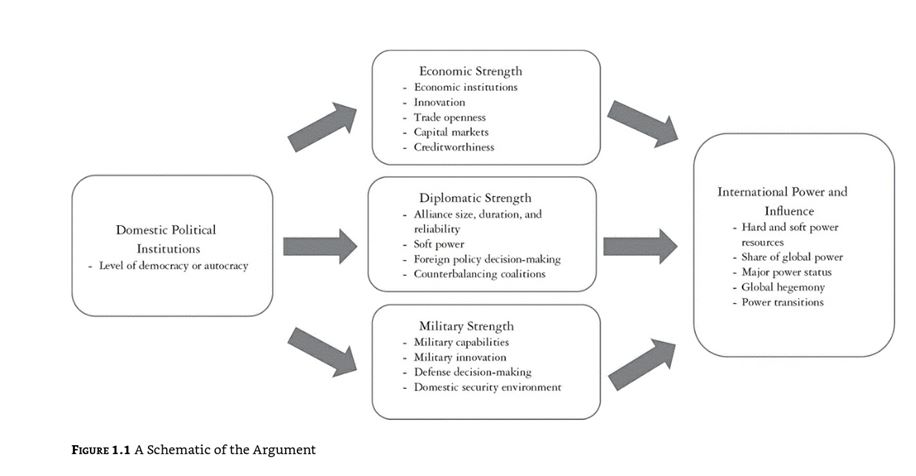
2. The Autocratic Advantage?
In this chapter author moves to discuss the Autocratic Advantage, but he marks it with big question. He starts with reference to Tocqueville’s comparison American democracy and its seemingly big deficiencies with autocratic systems. Then he moves to contemporary views and presents a number of examples of awe of contemporary western “intellectuals” before efficiency of China’s communist system. He also looks under the hood of this systems and find that there so many deficiencies there that this awe is not much more justified than their historic excitement about Soviet system. Author lists autocracies’ specific supposedly superior features such as easy decision making, independence from public opinion, uncontrolled resource allocation, and absence of individual rights, could impede pursuit of common good, and so on. For each of these specifics author convincingly demonstrate why it is not so and why democratic approach to this specific is actually much better.
PART II: The Democratic Advantage in History
The second part of the book examines the empirical basis for this idea through simple quantitative analysis and a historical study of democratic and autocratic competitors from the ancient world to the present. Specifically, the book examines the following seven cases: Athens, Sparta, and Persia; the Roman Republic, Carthage, and Macedon; the Venetian Republic, the Byzantine Empire, and the Duchy of Milan; the Dutch Republic and the Spanish Empire; Britain and France in the 18th and 19th centuries; the United Kingdom and Germany in the late 19th and early 20th centuries; and the United States and the Soviet Union during the Cold War. This section of the book does not show that democracies always achieve everlasting hegemony, but it does demonstrate that they tend to excel in great power rivalry and for the precise reasons identified by the theoretical framework
3. The Democratic Advantage by the Numbers
In this chapter author provides numbers demonstrating relative power of democracies vs. autocracies. Author notes that:” …the leading states in the international system for the past four hundred years (the timeframe of his study) have been: the Dutch Republic (1609–1713), Great Britain (1714–1945), and the United States (1945–present). These states were also among the most democratic of their time. According to this reckoning, therefore, liberal leviathans have led the world for the past four centuries and counting.” Author looks in more details at current most powerful countries specifically USA comparatively with Russia and China:
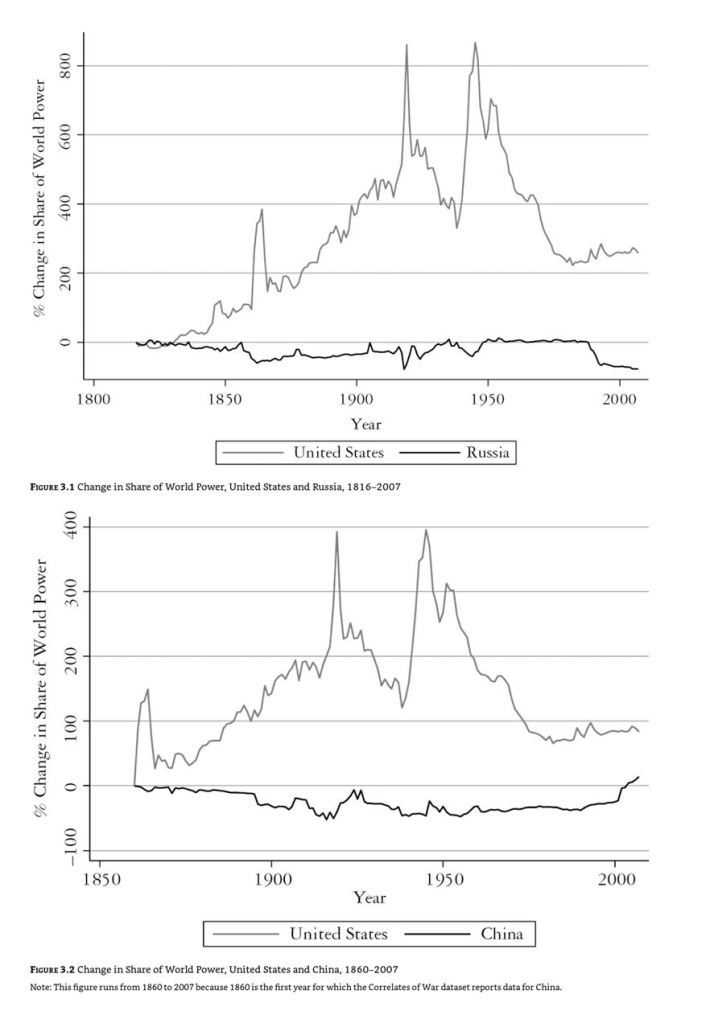
After discussion overall pattern of Democracies being more powerful, in the next 6 chapters of this part author presents history of competition between Democracies and Autocracies:
4. Athens, Sparta, and Persia; 5. The Roman Republic, Carthage, and Macedon; 6. The Venetian Republic, the Byzantine Empire, and the Duchy of Milan; 7. The Dutch Republic and the Spanish Empire; 8. Great Britain and France; 9. The United Kingdom and Germany; 10. The United States and the Soviet Union
PART III: The Democratic Advantage Today
This part is the real payoff of the book. What does all of this mean for contemporary international politics? This section examines the United States, Russia, and China. It studies how their domestic political systems prepare them for the coming competition and finds that U.S. institutions are a continuing source of strength, while Russian and Chinese institutions are dragging down their attempts to amass international wealth and power.
The next 3 chapters represent author’s summarization of contemporary key competitors:
11. The Russian Federation
“If Russia is a great power, it is barely one. Its autocratic system is undermining its economic, diplomatic, and military performance. Its economy is smaller than Italy’s. Its financial system is under serious strain. Russia lacks effective alliances and soft power and its aggressive behavior has provoked rival alliances to take countervailing measures. Its military is overly focused on domestic threats and is ill-equipped for the strategic-technological competitions of the 21st century.”
12. The People’s Republic of China
“China led by the CCP is unlikely to become the world’s leading state. Its Marxist-Leninist model is not well suited to building a world-beating, innovative economy, to winning friends and allies around the world, or to constructing a lethal military force with global power-projection capabilities. China’s autocratic system has undermined its competitiveness before, including under the Qing dynasty and Mao’s CCP. China did better when it followed Deng’s liberalizing economic guidance, but it is reverting to its old form of dysfunctional authoritarianism under President Xi.”
13. The United States of America
Here author characterizes American status as such:” In sum, America’s vibrant economy, its strong alliance relationships, and its unmatched military, all reflections of the U.S. domestic political system, will continue to provide a significant source of strategic advantage for the United States over its autocratic competitors in the years to come.”
PART IV: The Democratic Advantage in the Future
This part takes stock of what we have learned and draws out the implications for U.S. foreign policy and also looks ahead to the future. How can the United States best shore up its sources of strength? How can, or should, it seeks to exploit its opponents’ weaknesses? And, given the previous arguments, will the American era endure?
14. Implications for American Leadership
In this final chapter author discusses increasing competition between China and Russia, which accumulated significant economic and military power via massive investment and technology transfers these authoritarian regimes received from Democracies in early years of XXI century in hope that they would become full pledged Democracies – the happy outcome that did not happen. Author obviously convinced that the competition will end with victory if not for America then for Democracy:” Indeed, if or when the United States declines, it will most likely be overcome only by another democracy. Over the past four centuries, democratic hegemons have lost their positions exclusively to other democratic challengers. Autocrats have all tried and failed in their attempts. At present, a truly unified European Union, or possibly India, are the only democratic entities with enough power resources to plausibly rival the United States for global ascendance over the coming century. But a democratic transition in China would suddenly transform Beijing into a much more serious competitor.”
MY TAKE ON IT:
I absolutely agree that democracy is much better form of society than autocracy and I believe that outcome of current (summer of 2020) massive attack against democracy by leftist ideologues and their stormtroopers prompted by seemingly overwhelming opportunity provided by pandemic, will fail. The victory of Democracy in America will lead to significant upgrade of its foundational ideas to provide better immunity against similar attacks in the future. This immunity will be provided by prevention of unchallenged indoctrination into collectivistic, racist, and intolerant doctrines that currently occurs. I think that as soon as such ideas challenged at all levels starting in kindergarten, individuals who promote such ideas would have no chance to obtain such numbers of supporters as they have now inflicting mayhem on American live.
20200830 – Intelligence All that matters

MAIN IDEA:
The main idea here is to discuss meaning of IQ, how it relates to overall intelligence, how it is tested, where it comes from (nature/nurture) and, most important, how to increase it. Author also discusses controversies around IQ and its value for individual achievement and prosperity. The overall objective is to convince readers that IQ research important and should be supported.
DETAILS:
- Introducing intelligence
This starts with definition: “Intelligence is a very general mental capability that, among other things, involves the ability to reason, plan, solve problems, think abstractly, comprehend complex ideas, learn quickly, and learn from experience. It is not merely book-learning, a narrow academic skill, or test-taking smarts. Rather, it reflects a broader and deeper capability for comprehending our surroundings, ‘catching on’, ‘making sense’ of things, or ‘figuring out’ what to do.”
After that author provides a brief history of IQ starting with Francis Galton (1822-1911) and then discussing works of McKeen Cattell (1860–1944) – Sensory testing, Alfred Binet (1857–1911) – children with mental disabilities selection, Théodore Simon (1872–1961) – mental tasks for low IQ children, Lewis Terman (1877–1956)- tasks for high IQ selection, Robert Yerkes (1876–1956) – Group testing, Charles Spearman (1863-1945) – Statistical technics for analysis, and Sir Godfrey Thomson (1881–1955) – education.
2. Testing intelligence
In this chapter author is looking through a set of tasks one could expect to complete for IQ test today. How does a person’s performance on one task relate to performance on the others? To what extent was Spearman correct about ‘general intelligence’? The author responds affirmative and then discusses idea of multiple intelligences and substructure of intelligence. He also provides a few graphs for IQ distribution and substructure change with age:
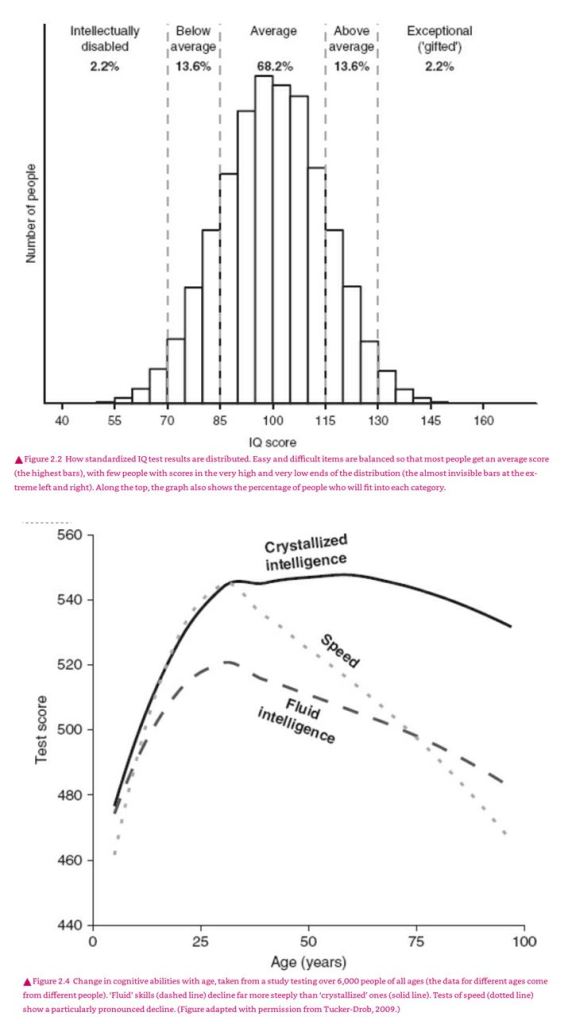
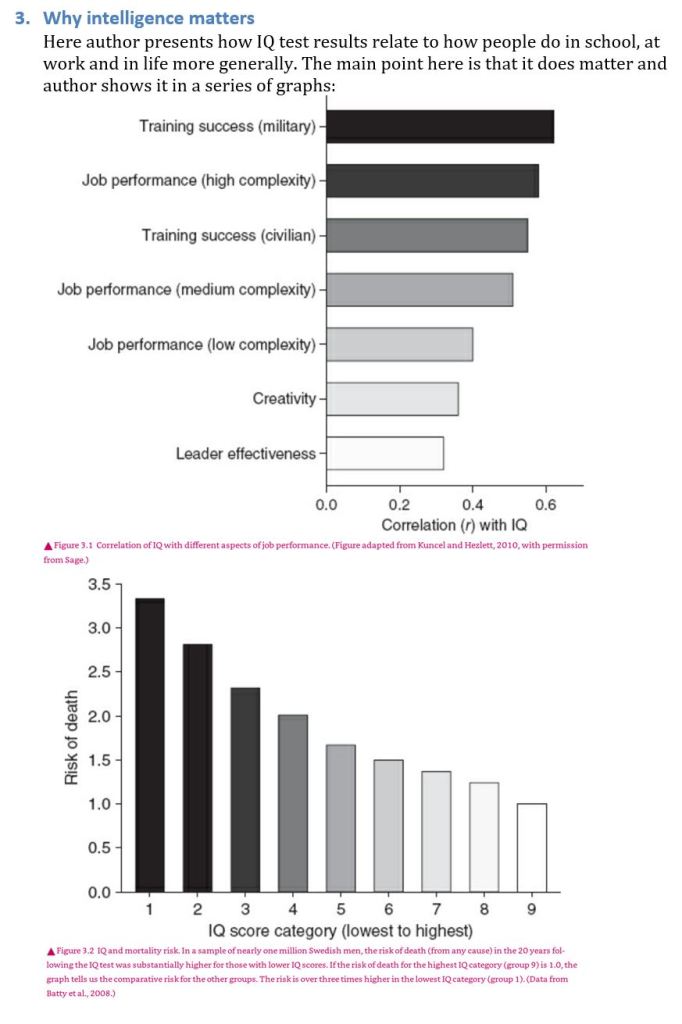

4. The biology of intelligence
Chapter 4 goes ‘under the hood’ to look at the biology of intelligence: how it might have evolved, how it relates to genetics, and what a smarter person’s brain looks like. Author discusses nature/nurture, provides some images and concludes:” A common mistake is to come away with the impression that, since intelligence is related to biology, it must be immutable. Nothing in the genetic studies (which never show 100-per-cent heritability) or the neuroimaging (which shows only neural correlates of intelligence) leads to that conclusion. Certainly, the genetic results imply that attempts to equalize outcomes in areas like education are fool’s errands: it will be extremely difficult to eradicate genetically influenced differences between children. There may be biological limits on what we can expect from some people: although intelligence is not immutable, it is unlikely to be infinitely malleable
5. The easy way to raise your IQ
Chapter 5 asks whether we might be able to improve intelligence and make people brighter. Do ‘brain training’ games work? What about education? So far there is no reason to believe that there is reliable way to get smarter either via “Mozart effect”, or breastfeeding, or brain training. However, there is well known Flynn effect that demonstrates IQ increase over generations.
6. Why is intelligence so controversial?
The final chapter, Chapter 6, asks why, if there’s all this scientific evidence backing it up, intelligence is still so controversial. In the historical sketch above, author mentioned a couple of reasons, but the discomfort with intelligence testing goes deeper than just revulsion at its history: it touches on profound political and moral issues about equality, race differences. Author briefly reviews these and other aspects of IQ debate and provides reasons for IQ studies:
a. Link between IQ and health: smart people are healthier and live longer
b. Ageing – need to maintain IQ at good level to the end
c. Societal importance of intelligence
d. Scientific curiosity
Conclusion
“The political and moral (but usually evidence-free) debate around intelligence distracts from the truly interesting questions. What causes the general factor of intelligence? Which specific genes make a person smarter? Why, exactly, do these seemingly simple tests relate to so many important things in life? What, precisely, is happening in the brain when it’s working through an IQ test? How can we make it do that more efficiently? Lately, the field of intelligence research has been buzzing with intriguing new results that begin to address these questions. We can ignore these results, and continue to pretend that intelligence tests are a discredited remnant of psychology’s past. Or we can engage with them, and uncover the science of what makes us differ in this most human of attributes.”
MY TAKE ON IT:
It is nice and brief review of IQ, its definition, meaning, value, and validity of methods of its increase. Based on my own live experience I am pretty sure that lower IQ would not only decrease quality my live, but would probably prevent its continuation on a couple occasions in the past. Obviously few people had such a wonderful opportunity to recognize its value, but everybody could see value of IQ and try to improve it as much as possible.
20200823 – The Measure of Civilization
MAIN IDEA:
The main idea of this book is to provide technical support for author’s other book “Why the West Rules – for Now” by reviewing methodology of social development processes divided into four domains: Energy Capture, Social Organization, War-Making Ability, and Information Technology.
DETAILS:
1 Introduction: Quantifying Social Development
The problem author discusses here is the one that Western intellectuals had for the last 250 years. It is difficulty of explaining why the West took over the world. Author then defines his objectives in this book and moves to provide some key definitions such as:
Social Development: “is a measure of communities’ abilities to get things done in the world; social development is the bundle of technological, subsistence, organizational, and cultural accomplishments through which people feed, clothe, house, and reproduce themselves, explain the world around them, resolve disputes within their communities, extend their power at the expense of other communities, and defend themselves against others’ attempts to extend power.”
Author also provides intellectual background for this discussion starting with Spencer’s idea of evolution increasing complexity of the systems. Author reviews Marxist approach to progress and then return to evolutionary approach. Author also reviewing various attempt to quantify progress and even provides table based on history:

Finally author looks in some detail at core conceptps of social evolution:
- Differentiation
- Complexity
- Evolution
- Progress
- Stage Theories
- Society
- Quantification
2 Methods and Assumptions
Here are assumptions author puts in the core of his ideas:
- Quantification
- Parsimony
- Here is how author defines traits using of Human Development Index (HDI):
- The Criteria of Useful Trait”: The trait must be relevant: that is, it must tell us something about social development as I defined it in chapter 1.
- The trait must be culture independent. We might, for example, think that the quality of literature and art are useful measures of social development, but judgments in these matters are notoriously culture bound.
- Traits must be independent of each other—if, for instance, we use the number of people in a state and the amount of wealth in that state as traits, we should not use per capita wealth as a third trait, because it is a product of the first two traits.
- The trait must be adequately documented. This is a real problem when we look back thousands of years because the evidence available varies so much. Especially in the distant past, we simply do not know much about some potentially useful traits.
- The trait must be reliable, meaning that experts more or less agree on what the evidence says.
- The trait must be convenient. This may be the least important criterion, but the harder it is to get evidence for something or the longer it takes to calculate results, the less useful that trait is.
- Focusing on East and West rather than the whole world
- The Meaning of East and West
- Chronological Intervals of Measurement
- Units of Analysis
- Approximation and Falsification
Author also provides notes on calculation and geographical representation of meaning of East and West:
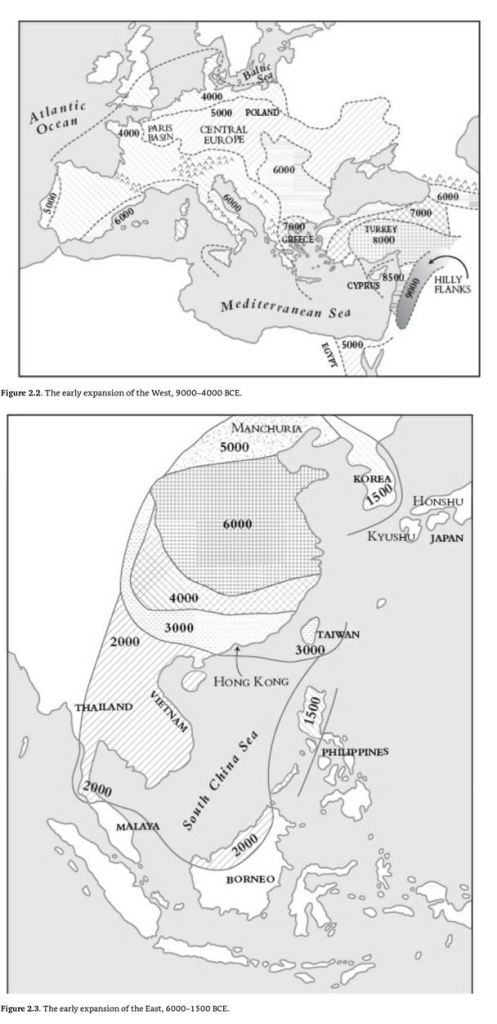

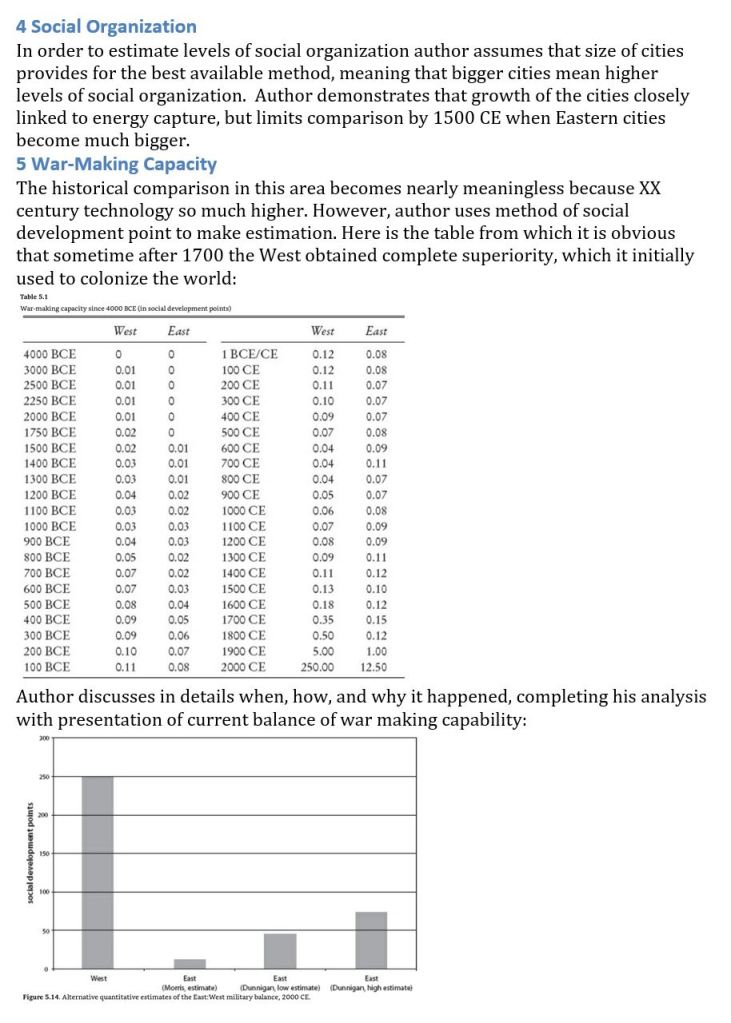


MY TAKE ON IT:
Generally, I believe the technical content of this book is valid and makes lots of sense, except for linking Social development to the size and population of the cities. The size of cities is probably more depends on density of population, which in turn depends on productivity of land: rice supports more people per acre than wheat. I think author could easily avoid it by linking Social development to share of urban population. This parameter would provide picture consistent with other domains. For example, China achieved 50-50 breakdown between urban and rural population in 2010, while USA in 1920. Probably if one makes adjustment for different levels of technology, he would find similar parity between USA of 1920 and China of 2010 in other domains.
20200816 – The Kill Chain
MAIN IDEA:
The main idea of this book is to use author’s experience as military adviser to late senator McCain to bring to light issues that in author’s opinion put future American security in jeopardy due to continuing support of outdated systems and failure to develop and stand up new systems mainly because of political and bureaucratic processes in which people are more concerned with well-being of their constituencies that US military power. This situation was developed over decades after fall of USSR when USA had no military peer and was absolutely dominant everywhere in the world. Now rise of China and somewhat revival of Russian military made these attitudes not sustainable and USA had to change or it will fall behind.
DETAILS:
INTRODUCTION: PLAYING A LOSING GAME
Author starts by presenting his credentials as close adviser to senator McCain and notes how much McCain was disturbed by military growth of China and its emerging ability to win conventional war against USA. Then author explains notion of kill chain and states that America needs in order to avoid defeat: ”It requires a sweeping redesign of the American military: from a military built around small numbers of large, expensive, exquisite, heavily manned, and hard-to-replace platforms to a military built around large numbers of smaller, lower-cost, expendable, and highly autonomous machines. Put simply, it should be a military defined less by the strength and quantities of its platforms than by the efficacy, speed, flexibility, adaptability, and overall dynamism of its kill chains”.
1. What Happened to Yoda’s Revolution
In this chapter author refer to former director of Office of Net Assessment Andrew Marshall, nicknamed Yoda, who argued that technological revolution makes existing American military based on large expensive platforms outdated and vulnerable. Yoda proposed massive change in approach to the new equipment, but he was not successful and was defeated by two forces – political preference for massive platform and war on terror that completely distracted military away from preparing to fight peers, not low grate rebels and terrorists.
2. Little Green Men and Assassin’s Mace
In this chapter author discusses wakeup call that occurred on February 27, 2014 when Russian military invaded Ukraine demonstrating the great improvement in its equipment, training, and tactical ability. American military leaders were impressed and realized that the new Russian military could be a difficult adversary and that American technological superiority was greatly diminished. Similar discovery occurred with another much more powerful adversary – China, which developed a number of effective weapons designated as Assassin Mace that would provide for ability successfully win regional war against USA. Author briefly describes these weapons and stresses that they based on the latest achievements of information technology.
3. A Tale of Two Cities
Author starts this chapter with reference to American development of intercontinental missiles and politico-bureaucratic straggle around it with air force leadership resisting. The result was successful implementation of the newest technology. Author admires what happened then, but express fear that now it is different America that is not capable for such feats of ingenuity and industry. Current leadership both political and military cares more about getting more dollars for their constituency and themselves producing expensive, but not effective systems that could fail against Russian and Chinese forces.
4. Information Revolution 2.0
In this chapter author discusses Information revolution that occurred in private sector and produced very powerful technology that could be used in military. However contemporary military procurement system and interplay of multitude of special interests made it all but impossible, so military technology is a lot less powerful than regular civil technology available over the counter. Author also describes attitude changes that make it difficult for Silicon Value companies cooperate with American military.
5. Something Worse Than Change
Here author starts with claim that the problem of loosing technological superiority did not occur because people’s failure or technological deficiencies, but rather because of incorrect strategic approach of investing in large, expensive, and eventually vulnerable platforms rather then in multitude of smaller and less expensive platforms that would be difficult to trace and destroy. Author correctly notes that it is just about impossible to keep military effectively upgraded because only actual war would demonstrate what works and what not. However, author provide examples such as Assault Breaker that were developed during Cold War and eventually proved to be effective. Author suggests that it should be done now again and stresses how important it is:” The stakes of this emerging strategic competition with the Chinese Communist Party are nothing less than what kind of future world we want to live in. This competition will require the full mobilization of our society, our economy, our diplomacy, our values, and our allies who share them. But the foundation for all of this is America’s hard power, because the only way to ensure that this competition stays peaceful is by clearly being capable of defending what is most precious to us if the Chinese Communist Party—or anyone else, for that matter—chooses to confront us through aggression or violence. And that is what most concerns me: The entire basis by which the US military understands events, makes decisions, and takes actions—how it closes the kill chain—will not withstand the future of warfare. It is too linear and inflexible, too manual and slow, too brittle and unresponsive to dynamic threats, and too incapable of scaling to confront multiple dilemmas at once. That is why there is a growing concern within our defense establishment that America could lose a future war against a great power such as China. This, to me, is something worse than change. Most Americans have lived blissfully free from the many kinds of privation, injustice, aggression, and depredation that countries through history have suffered at the hands of more powerful rivals that realized they could prevail in war if push came to shove. I have no desire to see how dangerous the future could become for Americans if we lose the ability to deter conventional war against the Chinese Communist Party or any other competitor. This situation should compel us to build different kinds of military forces that can defend Americans and our core interests in the absence of military dominance. This is possible, but it requires us to reimagine the kill chain and compete more urgently in the new strategic race over emerging technologies that is now under way.”
6. A Different Kind of Arms Race
This chapter is about new types of weapons – specifically AI controlled autonomous drones. The author’s concern is that while Western military are restricted by ethical norms, their adversaries Chinese and Russians have no moral or ethical restrictions whatsoever. Author discusses in some details shift information warfare and advances made by China. At the end of chapter author suggest that the new arms race is not possible for USA to win and the best one can hope is achievement of some sort of parity.
7. Human Command Machine Control
Author starts this chapter with discussion of aerial bombing and then moves to ethics of killing and possibility of decision-making transfer to AI. He states that in near future the only feasible use is for narrow AI and analyses how the decision breakdown between human and AI could work out in the future.
8. A Military Internet of Things
This is mainly about drones and how they would interact with each other with minimal if any human intervention via battlefield network – Internet of things. Author especially concerned that current version of it is slow, not very reliable and overall is behind of commercial development.
9. Move Shoot Communicate
Author starts this chapter with the story of Jan Bloch – the railroad magnate of early XX century who without any military experience was able to predict correctly nature of future wars. Then author discusses each component and notes that with current saturation of the world with sensors and communications both military and civilian it is nearly impossible to hide movement of big assets. Similarly, the second part also demonstrate vulnerability of such assets because they could be more readily attacked by swarm of small and relatively cheap weapons of high lethality. The same applies to communication – it is easier to find and suppress communications of big valuable target such as air career than multitude of cheap self-controlling distributed in space.
10. Defense Without Dominance
This chapter is about American loss of military dominance, which is per author reality that has to be accepted. The consequence should be change in assumptions and the new strategy: “a strategy of defense without dominance.”. Author proposes a number of various measures, but the main change is strategic objectives: instead of traditional American search for dominance the objective should be prevention of China dominance: “The United States is headed into a future that will be as unsettling as it is unfamiliar, but we do not need to fear it. We can still manage to defend the people, places, and things we care about most. Even amid the erosion of our military dominance, America can avoid a future in which a peer competitor is able to consolidate its own position of military dominance. Achieving this more limited, defensive goal requires a wide-ranging reimagination of America’s defense strategy, which is possible, but not optional. The main question is not whether the US military should change but whether we can change—and change fast enough.”
11. Bureaucracy Does Its Thing
This chapter is about workings of American military and political system with its huge bureaucracy, special interests, and stakeholders all of which makes system highly conservative, keeping investment flowing into outdated technologies that have political support and starving emerging technologies with no established special interests supporting them. Author provides a nice example for selection of the new pistol for Army, which took many years and millions of dollars to decide.
12. How the Future Can Win
Here author discusses how to overcome bureaucratic resistance and provides an example of change in old JSTARS being successfully retired despite multiple constituencies fighting against it. The key to success per author was a very sophisticated political plan of developing new constituency for the change inside existing system. At the end author expresses his optimism:” National defense will always be fundamentally different from everything else we do in the civilian and commercial worlds. But does it have to be this different? Do the men and women of America’s military really have to struggle this hard to do their jobs and get faster access to better technologies, many of which they use in their daily lives? Can’t things be better?
Yes, things can be better. There is no structural or cultural reason why not. We have the money, the technological base, and the human talent. And our leaders have all of the flexibility and authorities they need, both in law and policy, to carry off the transition from the military we have to the military we need. As I have said, it ultimately comes down to incentives. If we want different and better outcomes, we have to create different and better incentives to get them. This is hardly beyond our reach. It involves doing a lot more of the commonsense things that many within our defense establishment struggle to do every day: define problems correctly and clearly, compete over the best solutions, pick winners, and spend real money on what is most important and can make our military most effective.”
CONCLUSION: A FAILURE OF IMAGINATION
In conclusion author once again expresses his loyalty to McCain and believe in his greatness and ability to direct things to correct objectives. The final thought is that even without McCain not everything lost.
MY TAKE ON IT:
I think that author pretty much correct about both of his main statements: deadly bureaucracy and need to change from building military around few high value assets to expanding multitude of much cheaper assets that would make swarm attacks practically impossible and allow rapid expansion if and when needed, especially if they are based on AI, Internet of things, new materials, and designed consequently remove requirement to have massive human involvement. I am more optimistic than author, probably because I believe that massive changes are coming that will completely reshuffle existing politico-bureaucratic structures in all areas, making military change just one of many changes, albeit with extremely high price of failure, that I hope would never happen.
20200809 – Shaping our Nation

MAIN IDEA:
The main idea of this book is to describe history of immigration and internal migration in the United States based on racial/ethnic groups from before independence until recently. The groups authors reviews are: Northern Yankees, Southern Grandees, Scotch-Irish, Irish, Germane, Blacks, and some more recent arrivals. The point is that, while each group maintains its identity at least partially, they also go through complex process of mutual assimilation: groups to mainstream of America and its mainstream adapting at least some characteristics of groups.
DETAILS:
Preface: A Story for Our Time
This starts with description of author’s deep interest in American ethnic make up and how it was developed over the centuries. Author describes books he previously written about American and British revolutions and multiple books written by others that describe historic migrations of different population all over the world. Then he briefly describes content of this book that traces both immigration into America from different parts of the world and then internal migration to the West after Eastern part of USA was pretty much populated.
1. THE FIGHTING SCOTS-IRISH
This chapter is about the first massive non-English migration that occurred even before United States obtained independence:” During the course of the eighteenth century some 250,000 Scots-Irish migrated from the British Isles to the North American colonies, about 125,000 in the decades between 1717 and 1763, and another 125,000 in the dozen years from 1763 to 1775.” Author describes political situation in the country of origin and reasons that pushed people out. He also describes the first push of newly arrived immigrant away from coast deep into continent where they encountered not only Indian resistance, but also resistance of colonial authorities, which would prefer containment of white population at Appalachia. Author uses example of Andrew Jackson’s family to narrate the story of this movement. Here is American settlement geography in the pre-revolutionary time:

After that author describes further expansion of this group and discusses some of its cultural specificities, especially their military prowness that demonstrated itself on many occasions in all American wars, especially Civil War. Another important ferature of this groups is this:” The Scots-Irish have been the least ethnically conscious of America’s migrant groups. From Jackson’s time to the 2010 Census, they have tended to describe themselves not as being of Scots-Irish (or Scotch or Irish) ancestry but as simply being American.”
2. YANKEES AND GRANDEES
This chapter is about two ethnic groups that became the first Americans. Yankees: descendants of New England Protestants that for over 2 centuries expanded into Midwest and Grandees descendants of Virginia settlers that expanded by Southern route from Virginia, Carolinas, and Georgia. The Yankees main characteristics was hard work, religiosity, hypocrisy, and persistent attempt to force their believes on others. The Grandees were nice people with a small flaw – their particular institution of slavery. Author discusses in details how this institution that was seemingly on its last legs in early XIX centuries was revived and became highly productive due to improvements in methods of cultivating cotton. Here is a graphic illustration:

Author then discusses in detail how both these movements: Yankee’s Northern movement to the West pushing Indians out and substituting them with farmers and Grandees’ Soutehrn movement expanding slavery created America with dual sensitivities, attitudes, and believes that eventually clashed in the Civil War to decide which one of them will be dominant in one America. The Scotch -Irish during this epic clash were divided and bravely fought on the both sides of the war. The Yankees eventually won the war, but lost peace, failing to overcome resistence to reconstraction and eventually accepted division into separate development way up until civil rights movement of 1960.
3. THE IRISH AND GERMANS
This chapter is about another wave of European immigrants, which came to America in XIX century. The first were Germans coming after failed revolutions of 1848, but not far behind were masses of Irish running away from potato hunger in 1850-60s. Author uses example of Kennedys to demonstrate a success story, but there were millions of others by far less successful. Author provides two maps demonstrating results of these waves:

Author discusses in details patterns of settlement for both groups, their preferred types of business and employenment, patterns of behavior, consequences of their Catholizism, and finally, their impact on American politics.
4. INCOMPLETE CONQUEST
Author starts this chapter by characterizing Civil War and Yankees conquest of America. However, this conquest was incomplete because South managed to retain its specificity for another hundred years after it lost the war. The price paid was high: economic stagnation for the most part of this period. Author looks at reasons why it happened and why there were no mass migration from South up North despite difficulties for both Southern populations: black and white:” The conclusion one must draw is that they thought they would not be welcome—and they were surely right. White men born in the 1830s and 1840s had been shooting and killing one another in large numbers, with many suffering disabling injuries; those who survived lived on for decades, many well into the twentieth century. Confederate veterans, whose only pensions came from state governments, had an economic as well as cultural disincentive not to move to the land of their recent foes. Union veterans, conscious that the troops and officials enforcing Reconstruction until 1877 had been attacked as corrupt carpetbaggers and had been shunned by southern elites, had no desire to reenter what had been a scene of conflict after the troops were withdrawn. In 1898 officials in the War Department in Washington, dispatching troops to Tampa for embarkation to Cuba in the Spanish-American War, stationed sentries along the rail lines to prevent southern attacks, while one southern army officer in his delight at seeing the Spanish forces retreat in Cuba, yelled, “We’ve got the damn Yankees on the run.”
Author ends this chapter with discussion of mass immigration from East and South of Europe at the end XIX and beginning of XX centuries – Ellis Island immigration. Here how it changed demographics of America:

This new immighrants brough lots of good things: hard work, talents, entrepreneurship, but also not a few nasties like socialism, leading eventually to laws restricting immigration.
5. PROMISED LANDS
Author begins this chapter with discussion of Hollywood and myths creation that forged one American culture by movies, sports, books, and radio in the place multiple and only loosely linked cultures of South vs. North vs. West vs. new immigrants of different backgrounds. Then author adds the narrative of how WWII intermixed everything and everybody in one global military and mass industrial movements, including blacks from South to the North and population of California. Author extends narrative of this chapter all the way to 1960s when economic changes, Vietnam war, civil rights movement, riots, welfare state, and cultural revolution changed everything destroying old norms, breaking black family and start breaking white families the same way.
6. MIGRATIONS OF CHOICE
The final chapter reviews the most recent waves of migration mainly internal, but with huge and increasing component of international migration from Asia and Latin America, which once again is changing American racial, cultural, religious, and all other components of population. Internally it included movement from North down South away from more bureaucratic cold states to business friendlier southern states, while externally political movement of Cubans, Koreans, Vietnamese, and at the end of century East Europeans running away from communism and likes, business and professional movement of Indians and many others to better paid and more fulfilling high tech jobs in America, Mexican and later other South Americans movement to better jobs and welfare opportunities and so on and on.
MY TAKE ON IT:
It is nice description of ethnic migration / immigration process of formation of American population, but in my opinion, it does not sufficiently describe cultural conflicts / adjustments between groups. I think it would be also very interesting to trace coalitions that groups form to support or fight each other.
The very interesting example would be to trace all groups interactions during Civil War, which initially was driven by strive to save Union at any cost by Yankees with cost often paid by others on one side and strive to save Southern states sovereignty, including its particular institution of slavery with price mainly paid by people who did not own slaves. Eventually one could say that both sides won: Yankees saved the Union and their dominant place within it, while Southerners by winning asymmetric war of Reconstruction curved out a part of country in which they managed to maintain probably something like 80% of their particular institution in form of segregation and denial of rights to the blacks for another 100 years. I think another important part would be addition of class dimension, which also led to ethnic/ racial coalitions forming and falling apart as situation developed.
20200802 – Why Chimpanzees cannot learn language

MAIN IDEA:
The main idea of this book is to use author’s experience with Project Nim of teaching chimpanzee to use human language in order to present author’s views on development and use of language. Author stresses his believe that this development was natural evolutionary process, that it occurred as result of need in effective communication tool for complex scavenging support, that words came first and grammar much later, and, finally, that animals, even such close relatives as chimpanzees do not have such tools.
DETAILS:
Preface
Here author describes why and how he wrote this book and defines its topic as language evolution. He refers to ideas of Chomsky and his own participation in debates on the side of behaviorists. He also describes his William Schoff lectures that are the foundation of this book.
Prologue
The prologue is about author’s experiment (Project Nim) of teaching language to the chimp, how he come to start this project and two main contentions that rose in regard of language evolution: words vs. grammar as key foundational component of language and communications tool vs. mechanism of thinking as most important driver of evolution.
- Numberless Gradations
This chapter starts with brief discussion of evolution as the main tool for understanding everything in biology, which author applies to language, but not that much to its grammar, as to its words as key ingredient. After that author moves to discuss his background as behaviorist and reviews ideas of instrumental conditioning, presenting a nice table of examples:
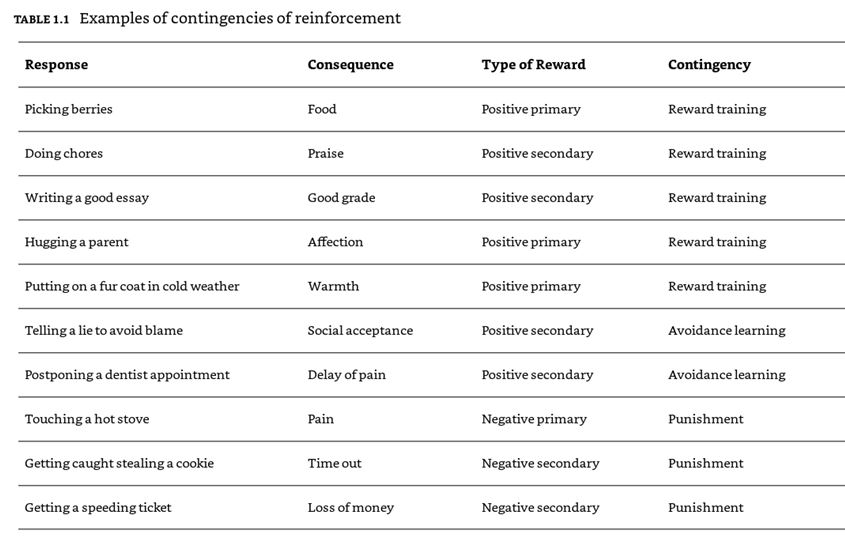
He also discusses in some details Chomsky’s critique of verbal behavior, which pretty much moved author away from pure behaviorism and his search for empirical confirmation that starting in 1960s turned him to attempt to teach chimpanseses to use language. Author also looks at evolutionary processes and controversy caused by its requirements to have long incremental process withmeaningful improvements on each increment, which seems to be inconsistent with reals speed of human development. The author review of the newest paleoanthropological data led him to conclusions that: “In sum, there are at least three reasons to consider why recent hominin ancestors provide a more realistic baseline than chimpanzees for clues about the evolution of language: bipedalism, a large brain, and a small birth canal. Although none of these differences were selected to enhance linguistic ability, the need to cradle a human infant for six months led to profound changes in maternal care.” In support of this idea author provides review of the development of nonverbal language during the first years of human life.
2. Ape Language
In this chapter author reviews in details experiments with teaching chimps to use language by trying to raise them as human children, sometime using sign language because chimps could not imitate human sounds. Author discusses his own “Project Nim” and Premack method, which uses graphic symbols. The key conclusion that author makes are based on these data:” Ape language projects have shown that chimpanzees can learn the imperative function of symbols (that is, how to use them to obtain rewards). Although children learn to use words as imperatives, imperatives are only a tiny portion of their vocabulary. Language would never develop if children were limited to learning imperatives. In that sense, the failure of these projects can be attributed to an ape’s inability to learn that things have names and that words can be used conversationally.”
3. Recent Human Ancestors and the Possible Origin of Words
Author starts this chapter with discussion of non-linearity of evolution that, contrary to Darwin believes, quite convincingly proved by recent paleoanthropological discoveries demonstrating parallel development of multiple hominin species. He then discusses fossils in some details: locations where they are found, dating methods, how changes in fossils relate to corresponding climate changes, and how increase in functional abilities of the human brain provided for much more efficient accommodation to these changes, eventually resulting in human expansion all over the world. After discussing usefulness of the big brain, author moves to hypotheticals of language development. Based on fossils that have traces of human scavenging evolution from being the last to being the first consumers of big animal’s corpse author believes that such activities necessitated development of worlds to communicate to others what and where was found and in what condition it currently is, so they could help with processing.
4. Before an Infant Learns to Speak
Here author moves from species evolution to individual, discussing how infants acquire human communication abilities: first by imitating visual and/or audio communications, including human emotions and attitudes, eventually resulting in joint attention functionality unique to humans. It results in need for words to generate joint attention to something that is not present at the moment and later on to abstractions that exist only in human imagination and are communicated via language.
5. The Origin of Language, Words in Particular
Here author moves more into origin of language and how humans pick it up from parents and other around them: “The difference between animal and human communication is also reflected in the number of signals they each produce. In animals, that number rarely exceeds twenty and it does not vary with age. Human vocabulary grows with age during the first few decades of a person’s life. A two-year-old child knows approximately 300 words; a five-year-old approximately 5,000; a minimally educated adult at least 15,000; and a college graduate at least 50,000 words.” Author then discusses Chomsky’s Universal Grammar, which he generally supports except for putting much more weight on words, their creation and use. Author then reviews various relevant to his research schools and experiments.
Epilogue
This is pretty much discussion of popularization of author’s Project Nim, which left him not very satisfied, especially about documentary by Marsh.
MY TAKE ON IT:
I am pretty much in agreement with main position of this book except for some relatively small points. I do not think that debate between what came first words or grammar makes lots of sense. I think they came in parallel. I also somewhat puzzled by controversy about liner or parallel evolution of human brains because it seems obvious that it should be both: initially with human expansion with evolutionary modifications into multiple variations of hominin living in different localities with consequent pruning out less competitive sub-species by the more effective ones, and since they all rely on the same ecological niches and were capable expand globally, the most effective – we humans, eliminated everybody else some hundreds of thousands years ago and we still continue eliminating different parts of ourselves, albeit somewhat less frequently in more recent times. I, however, hope that with advance of technology, productivity, and AI, plus clear movement of changing meaning of live from multiplication to enjoyment, we’ll find equilibrium between all types of us and between us and environment that would make our lives worth living.
20200726 – Fully Grown
MAIN IDEA:
The main idea of this book is to review various potential causes of slowdown in GDP growth over the last 20 years and evaluate which of them has more and which has less impact. Author findings are that only demographics, shift from goods to services, and decline in population mobility have significant impact. Author also divides these causes into positive and negative, concluding that positive have more impact and therefore slowdown in growth is a sign of positive development.
DETAILS:
Preface
This starts with the point that until year 2000 average growth of USA economy was 2% per years, but after in decreased, but material standards of live actually continue to increase. Author then retells how this book started and who helped him to write it.
1. Victims of Our Own Success
In this chapter author starts by providing economic statistics: “The growth rate of GDP per capita, which is what I focus on in this book, averaged 2.25% per year from 1950 to 2000. But the average growth rate of GDP per capita from 2000 to 2016 was only 1%. That difference of 1.25 percentage points of growth per year means that GDP per capita today is about 25% lower than if we had matched the twentieth-century growth rate throughout the twenty-first century. It represents a significant deceleration of economic growth, but it started well before the recession in 2009.”
Then he discusses sources of growth, especially in human capital and demonstrates that its growth slowed. He also discusses switch from goods to services and how it slows growth because increase in productivity is much more difficult to achieve in services than in manufacturing. Finally, he briefly discusses different theories of slowdown. The final point in this chapter is that slowdown could be a good thing because it demonstrates that we achieved such high levels of productivity that the growth is not important anymore.
2. What Is the Growth Slowdown?
Here author starts with meaning and provides a nice illustration.
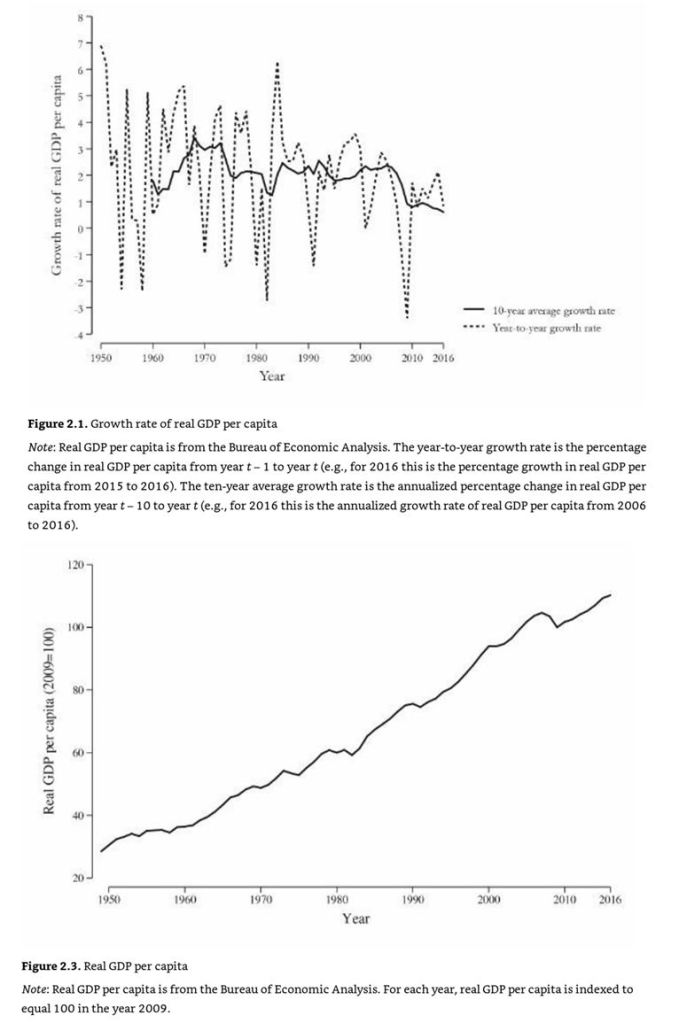
At the end of chapter author compares American data with other countries, demonstrating that it is not that different for developed European countries and Japan, but a lot less than China. Author also makes a point that growth slowdown does not mean that anything become worse than before, but rather that it does not getting better as fast as it could be.
3. The Inputs to Economic Growth
Here author discusses components of growth:
- Human capital as combination of number of employees, hours worked, and level of educations
- Physical capital as combination of structures, equipment, and intellectual property
He then explains that even if growth of all components decreased, it is not enough to explain decrease in aggregate
4 What Accounts for the Growth Slowdown?
Here author looks at data per capita and demonstrates that there is residual growth not explained by growth components and it is what slowed it down:
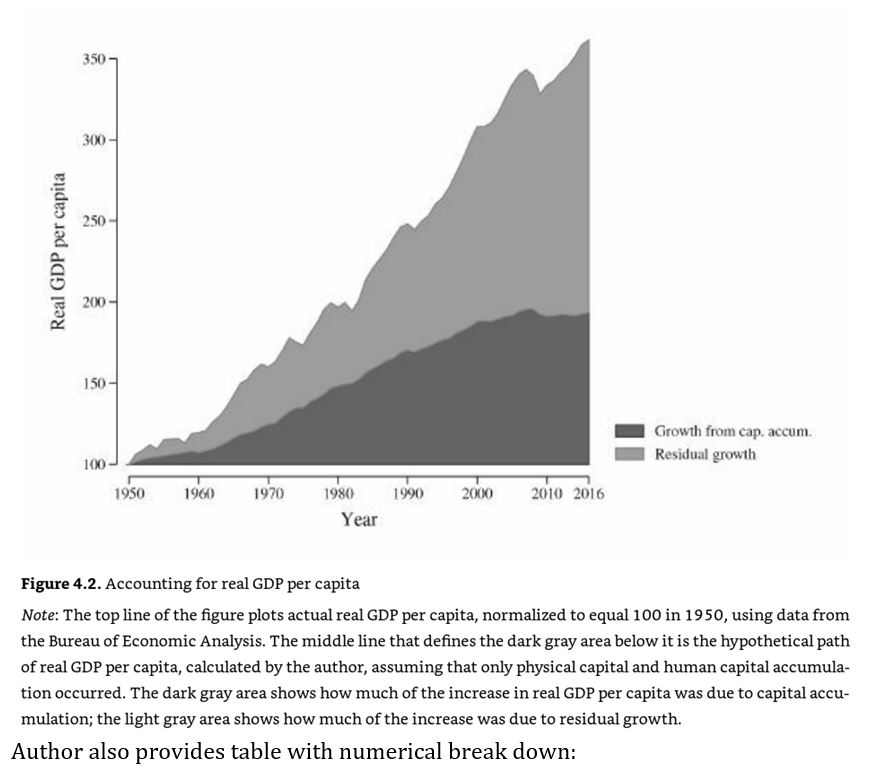

6. The Difference between Productivity and Technology
In this chapter author looks at technology and productivity and difference that could be related to both machines and processes. Author also discusses diminishing returns on R&D investment, asking if “we run out of innovations?”.
At the end of chapter author discusses potential explanations to residual:
- The first explanation involves the long-run shift in the composition of our spending away from goods and toward services.
- The second big idea for explaining slower productivity growth was the rise in market power of firms over the past few decades. The available evidence shows that the average markup—the ratio of price to marginal cost—charged by firms in the economy has increased since 1990. That rise in markups was consistent with the rise in economic profits as a share of GDP over the same time period.
- A last explanation for the slowdown in productivity growth is also a little puzzling. What I’ll document is that along a number of dimensions, the reallocation of human and physical capital between different uses has slowed down.
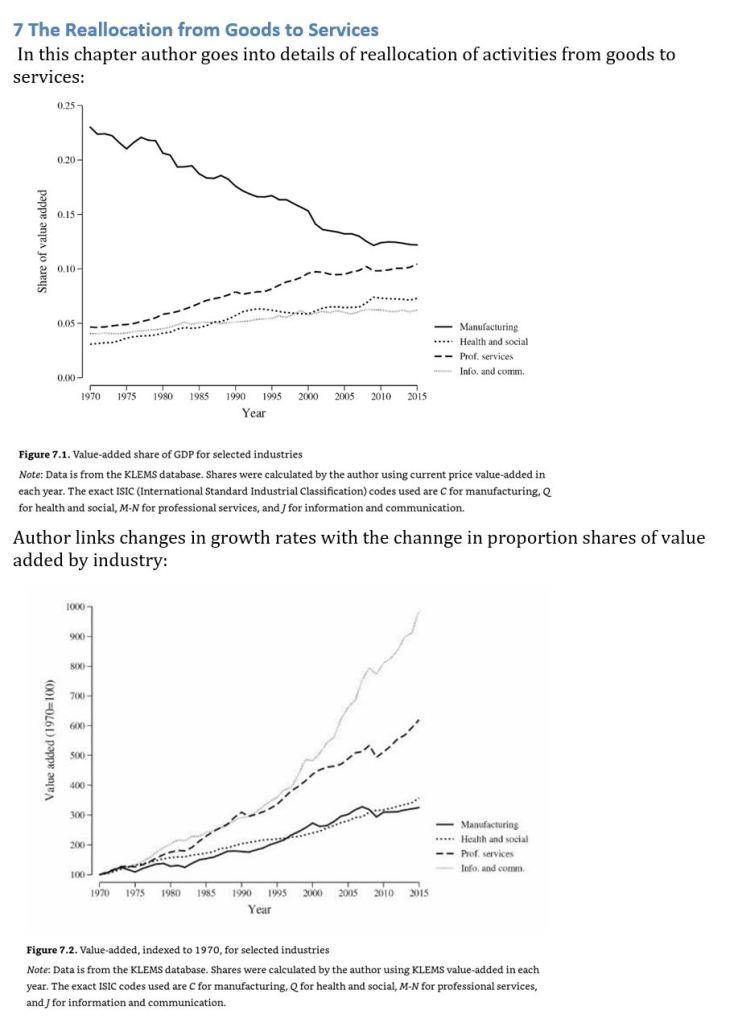

The final conclusion about market power is:” Increased market power was associated with a smaller share of GDP flowing toward labor or the providers of physical capital, and a larger share to the claimants on the economic profits market power creates. In general, that meant the owners of firms. There are reasons to be wary of that, even if, relative to changes in demographics and the long-run shift into services, it did not explain why the growth rate of real GDP per capita fell.”
12 Reallocations across Firms and Jobs; 13 The Drop in Geographic Mobility
Here author analyzes if reallocation is a source of slowdown in growth. He goes through reallocation within industries, slowing in turnover of establishments, job turnover, and geographic mobility, which also decreased. The conclusion is:” The decline in geographic mobility was not trivial, but it does not explain the growth slowdown.”
14 Did the Government Cause the Slowdown?
Here author reviews consequences of changes in taxes and other government policies and concludes: ”But the evidence indicates that taxation and regulation did not have a significant effect on the ability of firms to produce real goods and services, and specifically there was no substantial shift in government policies around 2000 that could explain the growth slowdown.”
15 Did Inequality Cause the Slowdown?
Here author discusses changes in inequality and provides graph demonstrating that top 1% became less dependent on equity and more on labor income:
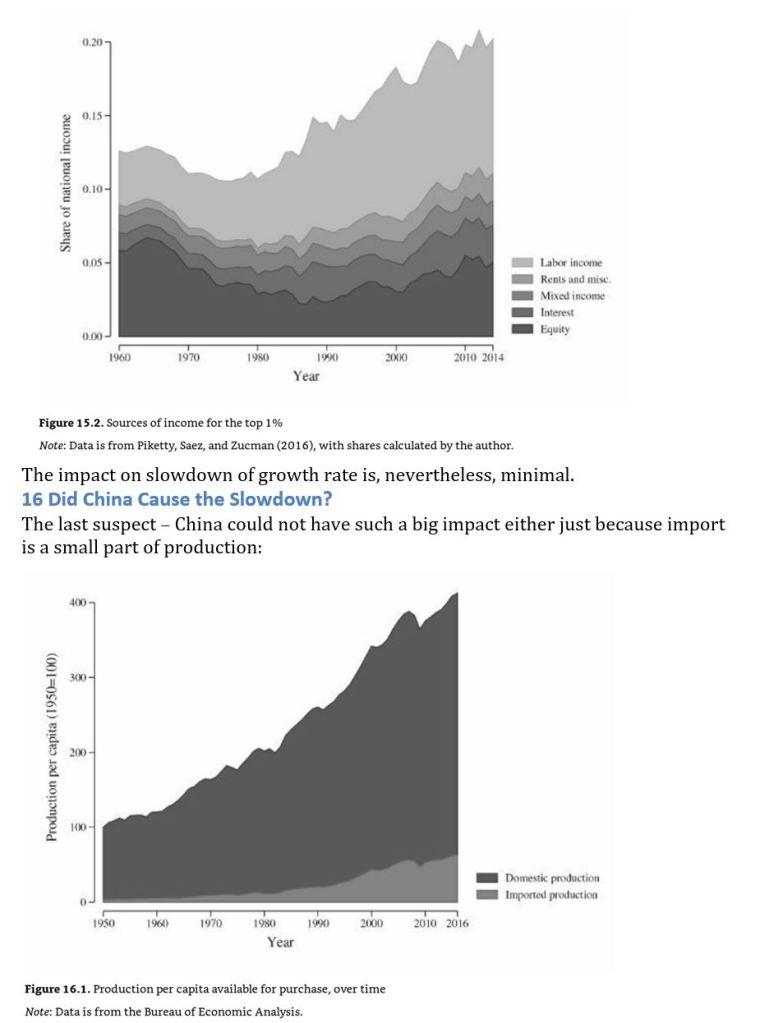
The conclusion: “Although the effect of Chinese trade was real in terms of replacing US manufacturing firms and employment—and that had real, negative impacts on those workers and their communities—in terms of the growth slowdown, the impact of Chinese trade was not large. The growth slowdown would have happened even if China had never become a major exporter, as the US was already in the middle of a long-run shift away from goods production toward services production. China accelerated this in a small way but was not responsible for it.”
17 The Future of Growth
In the final chapter author summarizes results of analysis concluding that causes of the growth slowdown are demographic and everything else has very small impact if any. Here is the summary:
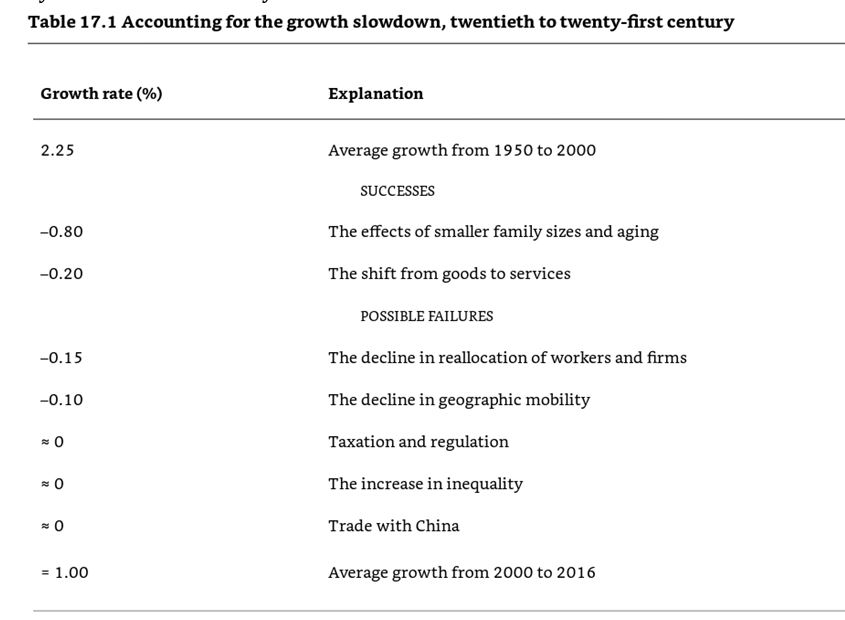
At the end author looks in the future and expresses believe that even if the growth will not accelerate, it is actually sign of success because it is result of choices that people make and achieved wealth allows to make choices less bound by material needs than ever before.
MY TAKE ON IT:
From my point of view the accounting growth of GDP is pretty much meaningless number because it does not provide any direct information on material wellbeing of people and therefore requirement for such growth. For example. if everybody who wants to have steak dinner can do it any time, what is the point in growth of beef production? It applies to everything else: houses, cars, and so on. However, leaving aside the question who needs growth and why, the author’s conclusion that slowdown caused by mainly demographics in my view is technically correct, but missing the most important part – lots of people feel big gap between what is available to them materially and want they actually want to have and this gap is not result of inability to produce enough, but rather of ineffective organization of production and distribution processes. If this organization were modified so that its main objective become to close the gap, we would probably see initially huge growth, which then drop to near 0 when human aspirations switch away from material need to something else.
20200719 – The Rise of China vs. the Logic of Strategy
MAIN IDEA:
The main idea of this book is to review consequences, problems, and future outcome of raise of China and its increasingly open claim for world dominance, which author estimates as strategically unsound, albeit practically inevitable. Author believes that it would be met with growing resistance with very adverse consequences for China that could be avoided if Chinese move to democratic form, drop its military ambition,and become normal member of peaceful community of nations.
DETAILS:
Preface
Here author describes his multiyear interest in China’s development and how it prompted writing this book to discuss strategic issues caused by China’s development and threat it generated for the world.
- The Fallacy of Unresisted Aggrandizement
In this chapter author discusses raise of China which is now moving away from peaceful development as equal member of world “community” to militant development aiming at world dominance. After that author makes point that people often tend to project previous development into the future and strategically it always leads to mistake. The change of China objectives, its militarization, and clear plans on domination inevitably cause former supporters and enablers of China’s rise turn into opponents and disablers it this rise continuation.
2. Premature Assertiveness
In this chapter author reviews signs of China leadership’s attitude change as it was demonstrated in several diplomatic encounters in 2010-11, specifically during visit to India.
3. Great-State Autism Defined
Here author discusses more general phenomenon that he calls “Great-State Autism” when leaders of raising great power tend to ignore others. Here is how author characterizes this: “Instead, decisions on foreign affairs are almost always made on the basis of highly simplified, schematic representations of unmanageably complex realities, which are thereby distorted to fit within internally generated categories, expectations, and perspectives.”. Author then looks at historic example of such behavior by British, Russians, and especially Chinese.
4. Historical Residues in Chinese Conduct
Here author look at Chinese approach to dealing with powerful adversaries expressed in these rules:
- Initially, concede all that must be conceded to the superior power, to avoid damage and obtain whatever benefits or at least forbearance that can be had from it.
- Entangle the ruler and ruling class of the superior power in webs of material dependence6 that reduce its original vitality and strength, while proffering equality in a privileged bipolarity that excludes every other power (“G-2,” at present).
- Finally, when the formerly superior power has been weakened enough, withdraw all tokens of equality and impose subordination.
The final result is imposing on former adversary “the tributary system, the Tianxia hierarchy”. Author also stresses that China is seeking bilateral relations of benevolent Emperor vs tamed barbarians, rather than participation in multilateral organization of equals. Author also presents Chinese understanding of the future world order based on their vision:” The practical value of the traditional Chinese vision of world order, or tianxia … [is that] … this vision anchors a universal authority in the moral, ritualistic, and aesthetic framework of a secular high culture, while providing social and moral criteria for assessing fair, humanitarian governance and proper social relations. Varied discourses indebted to tianxia have resurfaced in modern China in quest of moral and cultural ways of relating to and articulating an international society. We believe that the Chinese vision may prove productive … in the tension-ridden yet interconnected world.”
5. The Coming Geo-Economic Resistance to the Rise of China
In this chapter author moves to present his vision of the future when Chinese approach and strive to dominate will force other countries to resist its economic advance and impose different rules than once that until now supported China’s economic development. Author believes that these rules could go through continuously increasing economic pressure, all the way until complete embargo similar to USA – Cuba situation. Author then reviewing specific measures that USA and other countries applied to counter Chinese advancement economically.
6. China’s Aggrandizement and Global Reactions
Here author reviews how changes in China behavior impacted attitude to China and different countries, which become increasingly negative. Especially strong negative attitude is expressed everywhere to Chinese rapid military development, perceived as a serious threat.
7. The Inevitable Analogy
In this chapter author first notes that historical analogies are usual invalid because all events are unique, then proceed analyze history of raise of Germany at the end of XIX century and its competition with Britain that ended in WWI and WWII. Author pays special attention to British strategy which achieved formation of united front of British, French, and Russian empires against Germany, even if it had to pay price for this by settling all disputes even if at high cost.
8. Could China Adopt a Successful Grand Strategy?
Author clearly believes that the best strategy for China would be restrict its military development and diplomatic assertiveness and continue economic development, but he also understands that it is not going to happen:
“China’s failure at the level of grand strategy, absent political leadership of superhuman perspicacity and courage, is therefore overdetermined:
• It would be abnormal to adopt a humble foreign policy because China’s all-round power is increasing rapidly;
• it would be abnormal to reduce military expenditures because China’s rapid economic growth allows their rapid increase;
• it would be abnormal for the PLA to overcome universal bureaucratic proclivities to accept its own diminution; and
• it would be abnormal for Chinese public opinion, insofar as it counts, to support the unilateral renunciation of military strength, especially given the humiliating past of military impotence. Indeed, there is strong evidence of public support for more military expenditure, and more ambitious expenditure, notably the acquisition of one or more aircraft carriers.
9. The Strategic Unwisdom of the Ancients
Here author looks at Chinese attitudes and glorification of ancient Chinese strategic literature such as Sun Tzu’s “The Art of war”, which is widely accepted as superbly wise peace of work, which still highly influences Chinese strategic thinking. Here is how author characterizes comparing with Western strategic thought: “The undoubted merit of The Art of War is its presentation of the universal and unchanging paradoxical logic of strategy in a form less cryptic than that of the coeval epigrams of Heraclitus (the unity of opposites, and so forth), and altogether more succinct than the On War of Carl von Clausewitz. To be sure, the latter is altogether superior intellectually because Clausewitz explains his reasoning step by step, starting from first principles in a manner at once systematically philosophical and exhilarating, while The Art of War baldly presents its prescriptions in an oracular manner. On War therefore offers a systematic methodology lacking in The Art of War, but there is no doubt that it too conveys the same (paradoxical) truths, and far more expeditiously.” Author provides quite detailed review of this work and concludes that it is way two much based on Chinese intracultural norms to be universally good guide and demonstrates how it impacts current situation.
10. Strategic Competence: The Historical Record
Here author looks at record and notes that real history demonstrates that all this sophisticated thinking is hardly effective in practice, as it beautifully confirmed by history of Han Chinese, who were conquered by much smaller people on pretty regular bases so much so that they ruled themselves only 1/3 of time over the last millennium.
11. The Inevitability of Mounting Resistance
In this chapter author reviews reaction to of other countries to Chinese claim for domination and stresses not only inevitability of resistance and its actual rapid development, but also notes that balance of combined powers against China is not beneficial for China’s ability to achieve its goal of dominance.
12. Why Current Policies Will Persist
In this chapter author combines many of ideas to conclude that most probable way of development is that China will persists because of:
Great-state autism, which diminishes situational awareness
Historical residues in China’s external conduct, deriving from the tributary system and the presumption of centrality within the concentric circles of the Tianxia.
Resentment, both popular and CCP elite hostility directed at outside powers, often well concealed but strongly felt and sometimes abruptly expressed
The influence of the PLA and the military-industrial establishment on Chinese policies and conduct.
The multiplicity of other expressions of Chinese power—organizations able and willing to pursue expansionism perhaps for their own purely internal motives, which include state-owned enterprises, as well as integral parts of the state apparatus.
13. Australia: Weaving a Coalition; 14. Japan: Disengaging from Disengagement; 15. Defiant Vietnam: The Newest American Ally? 16. South Korea: A Model Tianxia Subordinate? 17. Mongolia: Northern Outpost of the Coalition? 18. Indonesia: From Ostracism to Coalition; 19. The Philippines: How to Make Enemies. 20. Norway: Norway? Norway!
Here author reviews development in surrounding China countries and demonstrates that they far away from accepting China’s dominance.
21. The Three China Policies of the United States
Here author looks at China’s relation with USA and how it developed from situation hugely beneficial for China to constantly deteriorating one. It was expressed by USA’s three policies:
The First U.S. China Policy: Vigorous Promotion of China’s Economic Growth.
The Second U.S. China Policy: The State Department Confronts China.
The Third U.S. China Policy: The Department of Defense.
22. Conclusions and Predictions
This book was published in 2015 and predictions that author made today in 2020 look pretty valid: “At this time, the rising threat emanates from an authoritarian, increasingly assertive China empowered by very rapid economic growth. The logic of strategy evokes corresponding reactions, which are diplomatic in the main but may still be warlike even in our nuclear era, though they can no longer achieve purposeful aims by actual warfare, except on the small scale allowed by escalation risks at each remove. Hence, if the economic disparity between China and the anti-China coalition were one day to reach proportions that no longer allow a tolerable military balance to be maintained, the reaction must assume economic forms, even if it is wholly strategic in content. Only a fully democratic China could advance unimpeded to global hegemony, but then the governments of a fully democratic China would undoubtedly seek to pursue quite other aims, to maximize the happiness of the population rather than their own power. In the meantime, the strategic aim of the United States and other like-minded powers cannot be to outmaneuver and defeat China, but rather to dissuade its own self-defeating pursuit of military aggrandizement in the best interests of the peoples of the world, and China’s first of all”.
MY TAKE ON IT:
Author’s analysis is pretty much in line in what I believe after reading quite a few books about China and its raise. I absolutely agree that the only way to avoid confrontation hopefully economic and political without it turning into war, is for China implement democratic reform and allow removal of Communist party from power. However, I do not believe that it would be easy. It would require complete change of Western attitude to China, which is not possible without internal transformation of Western states, especially USA, that would suppress power of internal pro-China forces such as ideologically pro-communism intelligentsia and big business that benefits highly from access to Chinese lower paid and nearly regulation free environment. I am sure it would cause quite serious struggle, but I believe that America can handle it successfully and Chinese communism will be put to rest in the dust been of history next to the Soviet developed socialism and German National-socialism.
20200712 – The Power of Bad

MAIN IDEA:
The main idea of this book per authors is to explore power of bad – how much stronger it is than power of good, how it operates in the brain, how it distorts one’s perceptions of people and risks, how one can minimize those distortions, how to use the power of bad for positive purposes, and how to deal with the particular challenges of the negativity effect in business and the online world. It is also to look at the innate human strengths and conscious strategies that can be marshaled against the modern barrage of bad.
DETAILS:
Prologue: The Negativity Effect
Authors start this with discussion of universality of negative attitudes, which on one hand is well known, but on other hand only recently become subject of serious research. Authors describe a number of experiments demonstrating that small amount of bad could spoil large amount of good and discusses this asymmetry. Another important point that authors make is that:” The negativity bias is adaptive; the term biologists use for a trait that improves the odds of survival for an individual or a group. On our ancestral savanna, the hunter-gatherers who survived were the ones who paid more attention to shunning poisonous berries than to savoring delicious ones.”
CHAPTER 1: How Bad Is Bad? Enlisting the Rational Mind
In this chapter authors refer to Baumeister who based on his own live experience developed “positivity ratio”, which is the number of good events required neutralize impact of every bad event. After that they discuss research into this ratio, its methodology and results that led to establishment of “Gottman ratio” 5/1. In other words, one needs 5 positive events to neutralize one negative. Another result related to emotional impact demonstrated that:” Research tracking workers’ moods during the day shows that a setback has between two and five times as much emotional impact as a positive event. Emotions make us less rational, and therefore more susceptible to the power of bad.” An interesting thing authors refer to is explanation of superstitions, which normally prevail because one needs several encounters with black cat when nothing negative happens to override one such encounter when something negative does. The authors discuss phenomenon of safety junkies – people who often irrationally increase their risks, for example driving instead of flying after 9-11, even if driving is much more dangerous. Finally, authors discuss ways to avoid emotional impact by developing some process and use example from the sport tactics.
CHAPTER 2: Love Lessons: Eliminate the Negative
Here authors move to discuss process of removing negatives in one’s love life. Authors use examples from classic literature for this purpose. At the end they present some specific strategies:
- Don’t overpromise.
- Don’t expect credit for going the extra mile.
- Remember that bad is in the eye of the beholder.
- Put the bad moments to good use.
- Think before you blame. Beware
- When you’re fighting, bring in an imaginary referee.
- Get a second opinion.
- Suspend judgment.
- Don’t take the bait.
- If you must respond, don’t escalate.
- Follow the Negative Golden Rule.
CHAPTER 3: The Brain’s Inner Demon: Wired for Bad
This chapter is about Felix Baumgartner who had unexpected psychological problem with long planned stratospheric jump, when he suddenly got paralyzed with fear and then had to apply significant effort with help from psychologist to be able to overcome this problem. Authors use it to discus works of fear in the brain and how to train the brain to overcome it.
CHAPTER 4: Use the Force: Constructive Criticism
This chapter starts with suggestion that bad could prompt people to act and even flourish as result. Authors reviews how slight change in the same review of a book can turn it from positive to negative and demonstrate that negative has a lot more impact than positive. After that authors discuss how to deliver bad news in the wrong and right way. Here are strategies:
- Consider your objective.
- Ask questions.
- Once you’ve gotten the criticism across, use the power of bad to your advantage.
- In doling out praise, don’t worry that it will seem overblown or insincere.
- Be creative with your praise.
CHAPTER 5: Heaven or Hell: Prizes vs. Penalties
This chapter is about preference of stick over carrot as an incentive tool. Authors start with derby when nobody ever saw a jokey with a carrot dangling before horse, but all jockeys do have whips. Then they move to religions when fear of hell is much more powerful that anticipation of paradise. Finally, they discuss effective or non-effective applications in education and workplaces.
CHAPTER 6: Business 101: Yes, We Have No Bad Apples
Here authors discuss typical American attitude to norms violation – bad apples. They make a very valid point that bad apples spoil the barrel and provide guide to different types of bad apples: The jerk, The slacker, and the downer. Author present experiments demonstrating how one bad apple decrease team performance by 35%. Finally, and most important, they provide recommendations how to deal with bad apple:
- Protect yourself
- Rearrange the barrels
- Be careful whom label
- Don’t expect bad apples to change on their own.
- Isolate the bad apples.
- Intervene early, and don’t be shy about it.
- Don’t force the good apples to adapt to bad behavior.
- Don’t hesitate to fire a jerk, but don’t be a jerk about it.
CHAPTER 7: Online Perils: The Sunshine Hotel vs. the Moon Lady
This chapter is about good and bad online reviews and how they can hurt business. Authors make a point that bad review are much more influencing that the good once and then provide recommendations on how to fight it: by providing really good service and saturating online reviewing with bad review designed in such way as to demonstrate that author is a jerk and therefore bad review should be discounted.
CHAPTER 8: The Pollyanna Principle: Our Natural Weapon Against Bad
This is another set of recommendations based on the story of Pollyanna – the girl that remained idiotically happy whatever bad things happened to her. Here is a set of recommendations of how to do it that authors provide:
- Change the narrative.
- Share your good news.
- Rejoice (or at least fake it) when you hear someone else’s good news.
- List your blessings.
- Make time for nostalgia—and make more good memories.
- Treasure the past, but don’t compare.
CHAPTER 9: The Crisis Crisis: Bad Ascending
This is another set of recommendations on how to deal with bad news. Authors recommend to start with three assumptions:
- The world will always seem to be in crisis.
- The crisis is never as bad as it sounds.
- The solution could easily make things worse.
After that they proceed to discuss that everything really got a lot better over the last few centuries and that there are lots of people who promote bad news because they believe it would be beneficial for them. Authors also provide recommendation on coping with bad news saturation.
CHAPTER 10: The Future of Good
In the final chapter authors somewhat surprisingly move to declare that despite obvious power of bad, the good’s prospects somehow improving over time: bad prophesies never realized, instead of starvation humanity had to deal with obesity, instead of nuclear war, the most peaceful time in history, and despite all the negativity in the press, everything is getting somewhat better than it used to be despite memories filtering out bad, retain everything good, and overall generate nostalgy for the past that never existed. So, the key approach should be to take everything easy and approach both good and bad in reasonable and steady way.
MY TAKE ON IT:
I find the main ideas of these book that bad staff is powerful quite convincing and very much consistent with human psychology for which multitude of experiments demonstrate that people significantly more impacted by loss, that by gain. There are even quite consistent demonstrations that quantify these differences, by estimating how much more value is provided by retaining $100 versus gaining $100. I also agree with authors’ ideas on how one should handle bad news and overall approach to the bad staff in live. The constant fear and panic would do no good if one cannot prevent bad from happening, but steady and rational approach to whatever comes, do really allow avoiding bad if there is a chance to do it.
20200705 – The Litigation Nation

MAIN IDEA:
The main idea of this book is to demonstrate that American Exceptionalism very much expresses itself in the way Americans use litigation not only to settle disputes between themselves, but also move ahead legal and moral advancement of the country and demonstrate history of this process moving from defamation of neighbors and witch-hunt of early America all the way to contemporary successful class action lawsuit industry.
DETAILS:
Introduction: Litigation and Honor
This starts with one of the first sexual harassment cases from which author using multiple other data infers that progress of American society moves from one litigation case to another, whether it refers to civil rights, consumer protection, and what not. Author also provides brief review of American legal structure to demonstrate how it all works and some historical data on number of lawyers to demonstrate consistency of America as litigation country throughout the history.
Part I: Litigation Defines a Nation
Here author states that litigation was prominently present in American life from the very beginning and it is to significant extent defined character of America as a nation.
- Defamation
The first chapter tracks an explosion of defamation suits in the seventeenth-century colonies, wherein servants, mistresses, and masters who had in England known and more or less accepted their place in the social order, in the New World accused one another of all manner of mischief. East Hampton Township on Long Island was one focal point of this miniature status uprising. The ruckus would lead to the first colonial witchcraft scare. The coda shows how defamation of public figures today demonstrated changing notions of right and wrong.
- Land-Grabbing and Money-Grubbing
The second chapter follows a major shift (phase change) in the way the American colonists did business, focusing in particular on land disputes in eighteenth-century New Jersey. Real estate transactions whose principals did not know one another partially supplanted older customs of face-to-face exchanges of plots. The former involved documents that ordinary people did not understand. Plaintiff and defendant had to hire trained lawyers to carry on the litigation. A coda returns to litigation over mortgages, descendants of lawsuits over title.
- Slavery and Honor
The third chapter turns to slave sales and estate disputes in the ante-bellum South, tracing a striking rise in suits for fraudulent sales and contested wills. This spike in litigation reflected the southern slave society’s shift from vigorous self-confidence to defensive anxiety. The courts were a cockpit of these often bitterly contested cases. The coda returns to the issue of reparations for slavery.
- Free Labor?
Chapter 4 turns to the rise of free labor, focusing on suits for back pay, the appearance of craft unions, and damage awards for accidents. It closes with the most important of the modern version of these lawsuits—guest worker suits.
Part II: Litigation Defends Democracy
In this part author is moving to America after Civil war and all the way until present, discussing various types of litigation from business and matrimonial disputes between individuals to civil rights and tort litigation between large groups, corporations, and governments.
- Stock Swindles and Swindlers
In the Gilded Age, railroads were the leading edge of these new kinds of corporate entities, and the creation of the Northern Securities trust became the nation’s great test of the tactics of the owners. The coda returns to the Regional Rail Reorganization Act Cases (1974) and a foreboding omen of corporate malfeasance for which the shareholders paid, the Enron scandal.
- Divorce
Chapter 6 follows a rise in divorce suits in the first years of the twentieth century, as changing views of marriage and gender roles worked themselves out in the courts. Among the most reform minded of all the states’ tribunals, the New York courts experienced this shift in attitudes in telling fashion. New York was also the origin of U.S. v. Windsor (2013), the case striking down the Defense of Marriage Act (1996).
- Civil Rights and Wrongs
Chapter 7 turns to the civil rights suits of the second half of the twentieth century, surveying how a gradual change in race relations spurred litigation over school segregation and public accommodations. The key cases are Briggs v. Elliot (1953) and Bell v. Maryland (1963).
- Product Liability and Mass Tort Litigation
The final chapter examines an explosion in consumer tort cases, showing how the world of consumption habits in everyday life had become at the same time more faceless and more deeply personal. Called mass products liability, these involved some of the wealthiest corporations and thousands of the most ordinary Americans. The Dalkon Shield class action suit of the 1970s and 1980s captured all of these elements.
Conclusion: The Value of Litigation in America
A conclusion returns us to the themes of honor and phase change in values, featuring Boy Scouts of America v. Dale (2000).
MY TAKE ON IT:
This book demonstrates, and pretty convincingly at that, that America as a country of litigation is not a recent phenomenon, but rather an inherent feature of American culture. From my point of view, it is actually a pretty good feature, especially comparing with other cultures when disputes are resolved either by authoritarian rulers or by violent struggles. However, as any other goods thing when there is too much of this it is getting to be a lot less good. In case of litigation, its current level in America went way beyond reasonable levels. It created the whole industry with some 3 million lawyers busy with making money by preventing businesses from working effectively, spouses separating peacefully, and extracting money from public funds for imaginary civil rights violations with active cooperation from “public servants” who are eager to help and share in proceeds. In short, peaceful character of dispute resolution became deleterious due to massive instigating of disputes to generate profits for legal industry. Moreover, top level members of judicial branch routinely interfere with political process subverting democracy and, by doing so, paving way for suppression of resolution of many very important disputes that could potentially explode the whole system. I think that this situation calls for legal reforms, very big and very soon for such explosion to be prevented.
 Equal Rights Libertarian