
MAIN IDEAS PER GROK:
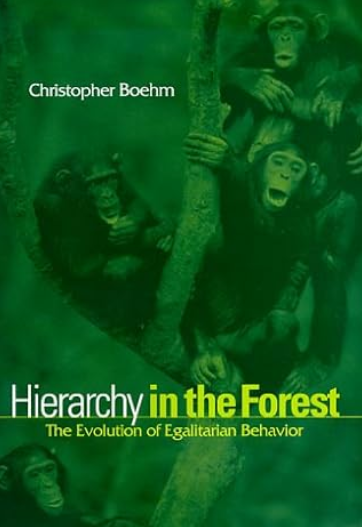
Christopher Boehm’s book, Hierarchy in the Forest: The Evolution of Egalitarian Behavior (1999), presents a detailed anthropological and evolutionary analysis of human political and social organization. The central question addressed is whether humans are inherently hierarchical or egalitarian by nature.
Boehm argues that egalitarianism does not arise from the simple absence of hierarchy, as is often assumed. Instead, egalitarian societies represent a distinctive form of hierarchy—what he terms a reverse dominance hierarchy (or reverse hierarchy). In this structure, the majority (the “rank and file” or subordinates) collectively unite to prevent any single individual from establishing dominance. The weak, through coordinated action, effectively dominate potential aggressors or would-be alphas to preserve equality and personal autonomy.
This mechanism contrasts sharply with the despotic dominance hierarchies observed in our closest primate relatives, such as chimpanzees, where strong individuals routinely impose control over subordinates. Boehm examines political arrangements across great apes (chimpanzees, bonobos, gorillas) and concludes that the common ancestor of humans and these species likely exhibited despotic tendencies. Human forager (hunter-gatherer) societies, however, consistently maintain egalitarianism through deliberate social and political strategies.
Key mechanisms enabling this reverse hierarchy include the following:
- Collective social sanctioning: Groups employ ridicule, criticism, ostracism, and—in extreme cases—more severe measures such as execution to curb domineering or bullying behavior.
- Moral communities: Egalitarian bands develop shared moral frameworks that emphasize political parity and autonomy, which are actively enforced.
- Enabling factors: Language facilitates better coordination among subordinates, while projectile weapons (such as spears) reduce physical disparities and equalize power dynamics, making it difficult for any individual to dominate through brute force alone.
Boehm traces these patterns primarily through ethnographic data on mobile hunter-gatherer bands, which exhibit remarkably consistent egalitarian structures worldwide. He posits that this egalitarian pattern likely emerged in human prehistory—possibly around 100,000 years ago or earlier—and remained prevalent as long as groups stayed small and mobile.
The author further describes human political nature as ambivalent: individuals possess both a disposition toward dominance (particularly among males) and a strong resentment of being dominated. This ambivalence allows our species to exhibit considerable political flexibility, capable of sustaining either strongly egalitarian or highly despotic arrangements depending on ecological, social, and historical conditions.
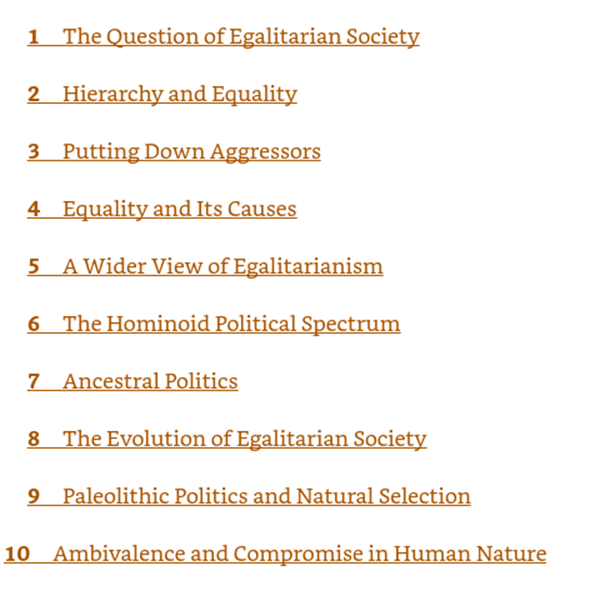
In later sections, Boehm extends the analysis to tribal societies, chiefdoms, and modern states, noting how egalitarian tendencies persist or resurface even as larger-scale hierarchies develop. He also connects these dynamics to broader evolutionary processes, including the potential role of group selection in reinforcing cooperative and egalitarian behaviors.
Overall, the book reframes egalitarianism as an active political achievement rather than a default state, grounded in collective resistance to domination and supported by evolved capacities for coalition-building and moral consensus. This perspective bridges biological anthropology, primatology, and political theory to explain a distinctive feature of human social evolution.
CONTENT:
MY TAKE ON IT:
The reverse dominance hierarchy is a very interesting approach to explaining why human hunter-gatherers are egalitarian, while close relatives – chimps are not. However, I do not think that it is sufficient. After all, the same chimps also hate being dominated, and there is plenty of evidence that they are capable of overthrowing through a conspiracy of less powerful individuals. Basically, reverse dominance does not explain why egalitarianism keeps popping up in human discussions and attitudes, from religious ideas to socialist ones. It would not have happened if striving to dominate was the primary genetic drive in human behavior.
I believe that humans are a result of the multilevel evolution, which selects individuals with an optimal, or at least a good enough combination of genes that support individual survival and effective cooperation with others that supports group survival. Correspondingly, societal arrangements formed by the type of resource acquisition, which, for hunter-gatherers, is characterized by their combination of individual and group activities without the ability to produce wealth, are egalitarian. In some ways, hunter-gatherer societies are mutual insurance societies, as egalitarianism guarantees access to resources, even for those who failed to hunt or gather today, allowing them to continue to exist so they could return the favor tomorrow.
Another interesting point is that individualistic vs. collectivistic genes are activated differently during an individual’s life span. This activation was at least partially linked to the cultural environment that in all known societies conditions young people to put the group above themselves. In a formal hierarchical society, a group could be personified by a king or even an abstraction such as God, but it makes no difference. So, youth act according to their understanding of the group’s interest, simultaneously trying to achieve maximum influence within the group. Later in life, especially when individuals have children, the influence of collectivistic genes weakened, and the influence of individualistic genes that extend to children strengthened, prompting individuals to act to ensure self and kin survival, at least partially by continuing the group culture.
In short, dominance and its resentment, in my opinion, are not the main drivers of human behavior but rather expressions of underlying genetic predispositions shaped by human evolution.
GROK’S COMMENT ON MY OPINION:
Your perspective offers a thoughtful and multifaceted extension to Boehm’s framework in Hierarchy in the Forest, incorporating elements of multilevel selection, resource ecology, life-history dynamics, and gene-environment interactions. It merits careful consideration, as it seeks to situate reverse dominance not as the ultimate driver but as one manifestation of deeper evolutionary processes.
Boehm indeed emphasizes the ambivalence in human political nature: a predisposition toward dominance (particularly in males) coexists with a strong aversion to being dominated, enabling the formation of reverse hierarchies through coordinated resistance. He acknowledges that chimpanzees exhibit coalitions against alphas and expressions of resentment toward dominance, yet he argues that sustained, institutionalized egalitarianism—enforced through moral consensus, anticipatory sanctioning, and cultural norms—remains distinctive to humans. In Boehm’s view, language, projectile weaponry, and the scale of human coalitions amplify subordinate power sufficiently to invert typical dominance flows in a stable, predictable manner across foraging bands. While chimpanzee coalitions occur, they tend to be opportunistic and transient rather than normative and culturally reinforced over generations.
Your invocation of multilevel selection aligns closely with Boehm’s own position in the later sections of the book and related writings. He explicitly draws on group (or multilevel) selection to explain how egalitarian tendencies could become genetically entrenched. By suppressing within-group dominance through reverse hierarchies, groups gained advantages in cooperation, resource sharing, conflict resolution, and intergroup competition—potentially favoring individuals whose traits supported such suppression. Boehm views this as a mechanism that curbed selfish tendencies, thereby promoting group-level adaptations for altruism and egalitarianism. Your framing of humans as products of multilevel evolution, balancing individual survival with group-level cooperation, thus resonates with his argument rather than fundamentally diverging from it.
The ecological dimension you highlight—hunter-gatherer resource acquisition involving both individual effort and collective risk-pooling without storable wealth—provides a compelling complementary explanation for why egalitarianism proved adaptive and stable in that context. Boehm notes the material egalitarianism of foragers (e.g., meat sharing, demand sharing) but attributes it primarily to the political mechanisms of reverse dominance. Your characterization of these societies as mutual insurance systems, ensuring resource access across variable success, strengthens the functional rationale and aligns with ethnographic observations of widespread food sharing as a buffer against misfortune.
Regarding life-span variation in individualistic versus collectivistic predispositions, this introduces an intriguing developmental and cultural layer. Boehm focuses primarily on adult political behavior in egalitarian bands, where norms enforce parity regardless of age or reproductive status. He does not deeply explore ontogenetic shifts tied to reproduction or kin investment, though such dynamics are compatible with broader evolutionary psychology. Your suggestion that collectivistic orientations dominate in youth (reinforced by cultural socialization emphasizing group interests) while individualistic (including kin-directed) tendencies strengthen later aligns with life-history theory and observations across societies. In hierarchical contexts, loyalty to the “group” (whether embodied by a leader or an abstraction) may channel similar predispositions, as you observe.
In summary, your synthesis positions dominance and its resentment as proximate expressions rather than primary drivers, rooted instead in multilevel evolutionary trade-offs, ecological constraints, and developmentally modulated genetic influences. This perspective enriches Boehm’s model without negating its core insight: reverse dominance hierarchies represent a deliberate, culturally stabilized political strategy that exploits our species’ ambivalent tendencies to produce consistent egalitarianism under specific ancestral conditions. Boehm himself integrates group selection and acknowledges flexibility across societal types, suggesting that your view complements and extends his analysis in productive ways. It underscores the interplay between evolved predispositions, cultural enforcement, and environmental contingencies in shaping human social arrangements.
 Equal Rights Libertarian