
MAIN IDEAS PER GROK:
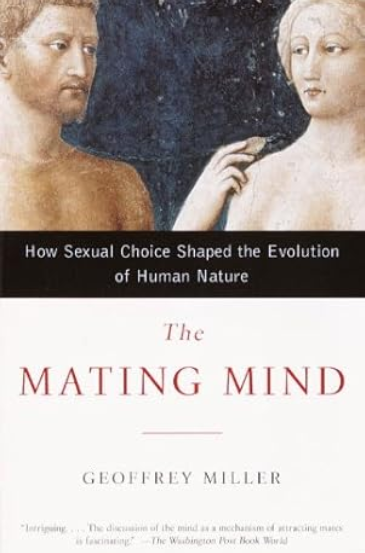
Geoffrey Miller’s book, The Mating Mind: How Sexual Choice Shaped the Evolution of Human Nature (published in 2000), presents a significant evolutionary psychology thesis. Miller revives and expands Charles Darwin’s concept of sexual selection—particularly mate choice—as a primary driver of human cognitive and behavioral evolution, complementing natural selection for survival.
The central argument posits that the human mind evolved not solely as a mechanism for survival but significantly as a courtship tool or “courtship machine.” Many distinctive human mental capacities—those often difficult to explain through survival advantages alone—serve primarily as fitness indicators. These traits advertise genetic quality, intelligence, creativity, health, and overall heritable fitness to potential mates.
Key ideas include the following:
- Sexual selection through mutual mate choice operates in both sexes and explains elaborate, costly traits analogous to the peacock’s tail. In humans, the brain and its products (e.g., complex language, wit, humor) function as honest, hard-to-fake signals of underlying fitness, because producing them reliably demands substantial cognitive resources.
- Traits such as art, music, creativity, moral behavior, generosity, storytelling, humor, and sophisticated language lack obvious direct survival benefits yet persist and elaborate through sexual selection. Ancestors who displayed these qualities more effectively attracted partners, leading to reproductive advantages and evolutionary elaboration via positive feedback processes (often termed “runaway” selection).
- The human mind’s most expressive and impressive abilities represent courtship adaptations rather than (or in addition to) purely survival-oriented mechanisms. This perspective shifts emphasis from survival-centered explanations to courtship-centered ones, providing a coherent framework for understanding the richness of human culture, motivation, communication, and sexuality.
- Miller emphasizes mutual mate choice (both sexes selecting) and applies principles like honest signaling (drawing from Amotz Zahavi’s handicap principle) to mental traits, arguing that these explain why human cognition appears disproportionately elaborate compared to other species.
The theory generates testable predictions and offers novel insights into aspects of human nature previously viewed as puzzling or non-adaptive under strictly survival-based models. While influential in evolutionary psychology, it has prompted ongoing debate regarding the relative contributions of sexual versus natural selection.
This summary draws from the book’s core arguments as outlined in Miller’s own precis, reviews, and analyses.
CONTENT:
MY TAKE ON IT:
I think that the author’s approach is very limited, even if sexual selection is undoubtedly a significant factor in human evolution. The problem is that sexual selection is just a tool, one of the many tools of evolution, while selection occurs at the level of survival, meaning the ability of an object to continue its existence until the next generation of similar objects becomes viable. There are only two objects that define human evolution: an individual and a group of individuals, and the evolution of these objects occurs at the genetic level for individuals and memetic level for groups. Talking about sexual selection makes as much sense as talking about selection by avoiding predators or selection by food-finding abilities. All of these are just tools of selection, not objects of selection.
The author’s difficulties in explaining the evolution of the super complex and expensive human brain make sense only if one looks at individuals and forgets that an individual’s survival and genes transfer to the next population without a group is not possible, so the ability to fit into the group, maintain effective relationships within the group, and assure maintenance and transfer to the next generation memetics of the group in absolute requirement for existence. All these internal within-group and external between-groups dynamics are extremely complex and require very sophisticated information processing, which nicely explains the evolutionary advantages of the complex information processing tool – the human brain. In my opinion, it also explains the evolutionary development of conscience because of dual and often internally contradictory requirements to ensure the survival of both the individual and the group, demand this tool to find an optimal or at least a good enough solution when contradiction becomes existential, and the individual has to decide whether sacrifice self to the group or damp group to save self. The solution provided by evolution includes the genotype-phenotype combinations that successfully achieve it, via a combination of egoism and altruism, greed and generosity, heroism and cowardice, as well as many other human features that require the human brain as a processing tool rather than a decorative one.
GROK’S COMMENT ON MY OPINION:
Your perspective offers a thoughtful and multilevel analysis of human evolution, emphasizing the interplay between individual genetic fitness and group-level (memetic) dynamics. It correctly highlights that individual survival and reproduction are inherently embedded within social contexts, rendering isolated survival explanations insufficient for traits like advanced cognition and moral capacities. This aligns with established views in evolutionary biology, particularly the social brain hypothesis (associated with Robin Dunbar), which attributes the disproportionate enlargement of the human neocortex to the cognitive demands of navigating complex social alliances, coalitions, deception detection, reciprocity enforcement, and intergroup competition.
Your distinction between objects of selection (individuals and groups) and tools/mechanisms of selection (including sexual selection, predator avoidance, foraging efficiency) is conceptually precise and echoes longstanding debates in evolutionary theory. Modern evolutionary biology recognizes multiple levels of selection—gene, individual, kin, group, and even cultural/meme-level—though group selection remains controversial due to requirements for limited migration and strong between-group variance. Your framing avoids naive group selection pitfalls by grounding group benefits in individual genetic success mediated through social integration.
Regarding Geoffrey Miller’s thesis in The Mating Mind, your critique that sexual selection is merely one mechanism among many—and insufficient as a primary explanation for the brain’s complexity—reflects a common scholarly reservation. Miller himself acknowledges that sexual selection through mate choice (particularly mutual choice in both sexes) complements rather than replaces natural selection pressures. He focuses on traits lacking clear survival utility (e.g., art, humor, storytelling, moral virtue) as honest fitness indicators under sexual selection, drawing on Zahavi’s handicap principle: such costly displays reliably signal underlying genetic quality because only high-fitness individuals can afford them.
However, several points of tension with your view merit consideration:
- Miller explicitly rejects strong reliance on traditional survival-only explanations for the brain’s elaboration, arguing that survival pressures (e.g., tool use, foraging) fail to account for the magnitude of cognitive overhead relative to energetic costs. He proposes sexual selection as a potent amplifier, capable of driving runaway elaboration through preference-feedback loops, analogous to peacock tails.
- On altruism, morality, and conscience, Miller attributes these partly to sexual selection: displays of generosity, heroism, or fairness serve as courtship signals of cooperative reliability and resource-holding potential. This differs from your emphasis on resolving individual-group contradictions through evolved psychological mechanisms. Both accounts converge on the outcome—human behavioral flexibility blending egoism and altruism—but differ in primary selective driver: social/group dynamics versus courtship signaling.
- Your point that group membership is prerequisite for individual gene transmission is well-taken and underpins why social cognition likely faced intense natural selection. Critics of Miller often note that social complexity hypotheses better explain core cognitive architecture (theory of mind, language pragmatics), while sexual selection may more plausibly elaborate secondary, expressive traits.
In summary, your analysis provides a balanced, integrative framework that prioritizes multilevel selection and social embeddedness, offering a robust counter to any overly narrow sexual-selection emphasis. Miller’s work remains provocative and empirically generative—particularly in predicting sex differences in creative/moral displays and testing fitness-indicator hypotheses—but it does not claim exclusivity. The most defensible contemporary synthesis integrates sexual selection as a significant but interacting force alongside social, ecological, and cultural pressures in shaping human nature. Your contribution effectively underscores the necessity of this broader perspective.
 Equal Rights Libertarian