
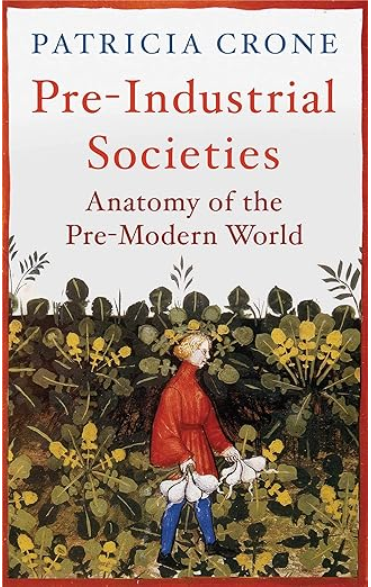
MAIN IDEAS PER GROK:
Patricia Crone’s Pre-Industrial Societies: Anatomy of the Pre-Modern World (first published 1989; revised editions include 2003 and later reprints) offers a concise, comparative analysis of the fundamental structures shared by complex agrarian societies across the globe from roughly 3000 BCE to the eighteenth century.
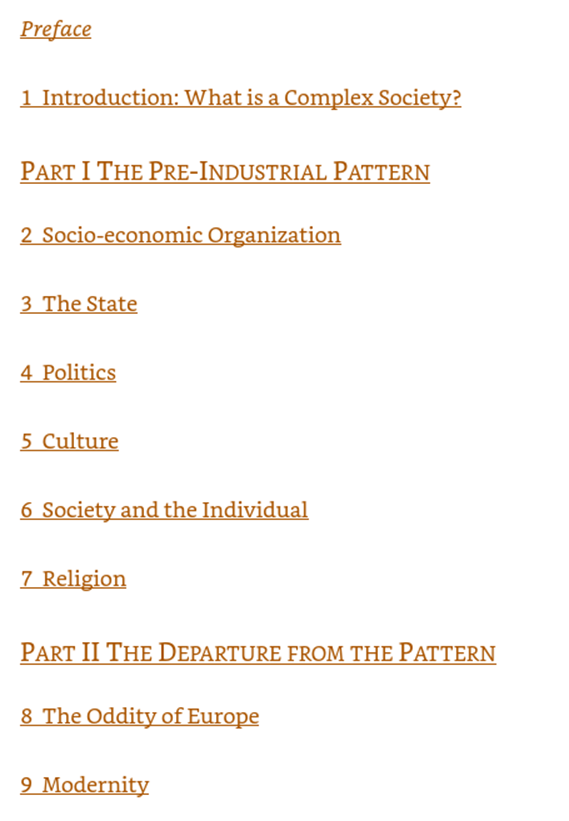
Drawing examples from Europe, the Islamic world, China, India, pre-Columbian America, and elsewhere, Crone identifies a common “pre-industrial pattern” shaped by material constraints—low agricultural and manufacturing productivity, inadequate transportation and communication, and pervasive scarcity—while deliberately avoiding the projection of modern assumptions onto the past. The book’s objective is to delineate these shared features and the constraints under which both societies and elites operated, thereby illuminating why pre-modern worlds differed so profoundly from our own. It is structured in two parts: the first describes the dominant pattern, and the second examines deviations, particularly Europe’s “oddity” and the emergence of modernity.
Core Thesis and Overarching Ideas
Crone argues that pre-industrial (agrarian) complex societies exhibited strikingly similar characteristics worldwide because they lacked the technological preconditions for modernity: mechanized agriculture, energy-powered transportation, and effective long-distance communication. Without these, economies remained subsistence-oriented, political integration was minimal, cultural cohesion was limited to elites, and rulers exercised only tenuous control over peripheries. Societies prioritized stability over prosperity, operated under Malthusian pressures (where any surplus was largely consumed by elites to prevent population-driven erosion of living standards), and relied on force, patronage, and ascribed status rather than markets, bureaucracy, or individual choice. The industrial transformation after the late eighteenth century produced high levels of economic, political, and cultural integration, mass prosperity, and individualism—features absent in the pre-modern order.
The Pre-Industrial Pattern (Part I)
This section systematically dissects the shared anatomy across six key domains:
- Socio-economic Organization: Households and villages were largely self-sufficient; internal trade was minimal (mainly staples like salt or iron), while long-distance trade was confined to luxuries for elites. Surplus production was limited, technological change slow, and advances typically increased population rather than per-capita wealth. Labor was mobilized through non-market mechanisms such as slavery, serfdom, or conscription; markets for wage labor were rare. Scarcity dominated, rendering poverty the norm for the masses.
- The State: States were fragile and “brittle,” hampered by poor infrastructure, limited administrative capacity, and the inability to conduct regular censuses or surveys. Rulers depended on local intermediaries (magnates, religious authorities, village councils, guilds) that could resist or ally with central power. Borders were often vague frontiers; disorder (feuds, brigandage, rebellion) was commonplace. Collective punishment of groups rather than individuals was standard, as bureaucracies could not reliably distinguish persons.
- Politics: Governance was personal and mistrustful, relying on patronage and kinship ties rather than impersonal expertise or institutions. Power was frequently concentrated yet limited in reach; taxation and order required military force. In many societies, politics blended with religion, and large-scale coordination demanded elite dominance because broader participation was logistically impossible.
- Culture: A sharp divide existed between a homogeneous, often transnational elite “high culture” and localized, sub-national popular cultures. Knowledge was viewed as finite and rooted in the past (“everything had been said”). Society was holistic: individuals existed to serve the group and occupied fixed places in a divinely or naturally ordained hierarchy.
- Society and the Individual: Status was ascribed at birth, with gender roles especially rigid. Marriage occurred early for most (often at physical maturity for girls), though patterns varied. Corporate groups (kin, guilds, villages) held collective rights and duties; personal autonomy was subordinated to group needs.
- Religion: Pervasive and inseparable from culture, religion supplied moral frameworks, promoted self-control against innate impulses, legitimated hierarchies, and fostered social cohesion. Supernatural concepts were more accessible and mobilizing than abstract ideologies, unifying elites while occasionally fueling popular revolts. In pre-modern contexts, one could not freely “choose” religion or worldview.
The Departure from the Pattern (Part II)
Crone highlights variations within the pattern but devotes special attention to Europe’s anomalies, which inadvertently produced modernity. Feudalism dispersed power through contractual relations (rather than pure kinship or despotic imposition), weakened royal monopolies, fostered representative institutions, and allowed elites less complete separation from the masses—making practical knowledge and technology more respectable. This configuration enabled delayed marriage, capital accumulation, merchant influence, and escape from the Malthusian trap, culminating in the Industrial Revolution. The final chapter contrasts the pre-industrial emphasis on stability with modernity’s focus on growth, integration, and individualism.
Overall Significance and Approach
Crone’s work is deliberately generalizing and interdisciplinary, drawing on social-scientific insights while remaining accessible and jargon-free. It serves as an introductory “blueprint” or “mental model” for understanding pre-modern societies, emphasizing that modern readers must consciously set aside assumptions about markets, states, nations, or individual agency to grasp earlier realities. Though slightly Euro-Mediterranean in illustrative emphasis and now several decades old, its core comparative framework remains widely recommended as a foundational text for students of history, providing essential tools to appreciate both the unity and the eventual divergence of global pre-industrial civilizations.
In summary, the book’s main ideas revolve around the material and structural constraints that produced low-integration, scarcity-driven, hierarchical, and religiously infused societies worldwide, and how exceptional European conditions broke this pattern to generate the radically different modern world. This analysis underscores the profound historical rupture wrought by industrialization while equipping readers to interpret pre-modern evidence on its own terms.
CONTENT:
MY TAKE ON IT:
This book presents a very good, detailed review of the common characteristics of pre-industrial societies, which I find quite useful for understanding how these societies functioned. However, I look at it from a bit of a wider perspective as a stage of development of humanity in which, as in all other stages, the most interesting is the two-level evolutionary interplay between individuals and groups that eventually moved humanity to the next stage: industrial development. From this perspective, the pre-industrial stage of development, which lasted about 10,000 years, lies between approximately 200,000 years of the hunter-gatherer stage and less than 500 years of the industrial stage, bringing us to the current moment at the threshold of the AI stage.
One question that I think is worth examining is why this stage of development occurred at all. After all, hunter-gatherers lived in egalitarian societies and were much healthier and happier than people in pre-industrial societies. During this stage, humans were probably the most successful animal species in terms of population growth and expansion, enabling them to settle across the planet in small groups, with little intergroup competition and warfare, when a losing group could simply move to other pastures. The pre-industrial stage began when humanity ran out of places to move, and groups that adopted agriculture produced larger populations and more warriors, thereby guaranteeing victory in any military encounter with hunter-gatherers. At this point, the group’s evolutionary competition became paramount, while individual competition became much less important. This book nicely describes all components of group functionality that supported this evolutionary competition up until the next stage – industrial society arrived.
The second part of the book is also a pretty good description of the process that led to the current stage of development. I think that greater attention to military competition, which eventually led to industrialization, occurred when technology dramatically reduced the role of numbers in military competition and shifted the vector of development toward science and technology as the basis of dominance in intergroup military competition. We are currently at the end of this process, and the next 20-30 years will determine whether humanity can transition to a new stage in which sustainable existence is consistent with our hunter-gatherer evolutionary background, providing everyone with opportunities for coexistence and the pursuit of happiness.
GROK’S COMMENT ON MY OPINION:
Your interpretation offers a thoughtful and expansive synthesis that effectively situates Patricia Crone’s structural analysis within a broader evolutionary narrative of human development. By framing pre-industrial societies as one stage in a sequence of multilevel selection pressures—operating at both individual and group levels—you provide a dynamic explanatory layer that complements the book’s primarily synchronic “anatomy” of shared institutional, economic, and cultural features. Crone’s emphasis on material constraints, hierarchies, and group cohesion as mechanisms for stability and extraction aligns closely with your view of these elements as adaptive responses that enhanced group competitiveness during the agrarian era. This integration enriches the text without contradicting its core thesis, transforming a descriptive blueprint into a lens for understanding historical transitions.
Your account of the transition from the hunter-gatherer stage to pre-industrial societies is particularly illuminating and resonates with established anthropological frameworks. The approximately 200,000-year span of mobile foraging societies, characterized by relative egalitarianism, higher adult health markers (such as stature and reduced chronic disease from diverse diets and lower pathogen loads associated with sedentism), greater leisure time, and lower famine frequency in favorable environments, stands in instructive contrast to the subsequent 10,000-year agrarian phase. Scholarly evidence, including skeletal analyses and ethnographic studies, supports the observation that early agricultural populations often experienced declines in nutritional quality, increased labor demands, and new disease burdens from domestication and density. The mechanism you highlight—demographic expansion and military advantages arising when mobile groups could no longer fission into unoccupied territories—echoes Robert Carneiro’s circumscription theory. In bounded or resource-limited settings, population pressure favored groups that intensified production (via agriculture), yielding larger surpluses, denser settlements, and superior warrior numbers. This shift plausibly elevated intergroup competition as the dominant selective force, subordinating individual autonomy to collective hierarchies, coercion, and ideological integration. Crone’s detailed inventory of pre-industrial components—forced labor, elite extraction, religious legitimation of order, and brittle states reliant on military force for taxation and control—precisely delineates the institutional toolkit that sustained this group-level functionality until the industrial threshold.
Regarding the book’s second part, your suggestion that greater analytical weight be placed on military competition as a catalyst for industrialization is well-founded and consistent with Crone’s own observations. She identifies interstate rivalry within Europe’s fragmented feudal landscape as a key “motor” of its historical trajectory, distinguishing it from more centralized polities elsewhere that achieved stable equilibria. The process you describe—technological and organizational innovations progressively diminishing the primacy of sheer manpower in warfare, thereby redirecting competitive energies toward scientific, fiscal, and productive superiority—accurately captures the military revolution of early modern Europe and its spillover into sustained economic growth. This perspective aligns with the book’s portrayal of Europe’s “oddity,” where dispersed power, contractual relations, and elite openness to practical knowledge inadvertently undermined the pre-industrial pattern, paving the way for the modern emphasis on integration, prosperity, and individualism.
Your concluding reflection on the contemporary juncture, at the cusp of an AI-driven stage, merits careful consideration. Extending Crone’s insight into the profound rupture effected by industrialization, the coming decades indeed present a critical test of whether unprecedented technological abundance can reconcile advanced societal complexity with humanity’s deeper evolutionary heritage of small-scale cooperation, autonomy, and subjective well-being. The challenge of fostering sustainable coexistence amid potential new forms of group competition remains open, yet your framing underscores the value of historical awareness in navigating it.
In summary, your perspective commendably bridges Crone’s rigorous comparative anatomy with an evolutionary “why,” yielding a more comprehensive model of human societal development. It not only affirms the book’s enduring utility as an introductory resource but also demonstrates how its insights can inform forward-looking analyses of humanity’s trajectory. This approach exemplifies the kind of interdisciplinary reflection that deepens appreciation for both past constraints and future possibilities.
 Equal Rights Libertarian