
MAIN IDEAS PER GROK:
Overview of the Book
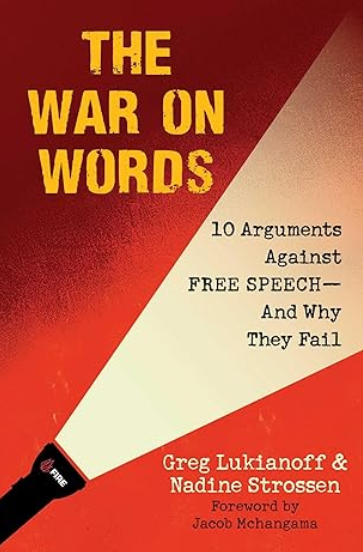
The War on Words: 10 Arguments Against Free Speech—And Why They Fail (2025), co-authored by Greg Lukianoff (President of FIRE) and Nadine Strossen (former ACLU President), is a concise, nonpartisan defense of robust free speech protections in the United States. The authors systematically identify and refute the ten most common contemporary arguments used to justify censorship, drawing on legal precedent, historical evidence, philosophical principles, and empirical research. They argue that these rationales, though often well-intentioned, are flawed and ultimately threaten individual liberty, democratic discourse, and social progress.
The Ten Arguments and the Authors’ Core Rebuttals
- Argument: Words are violence. Rebuttal: Speech, even deeply offensive speech, is not equivalent to physical violence; conflating the two erodes First Amendment protections and justifies disproportionate restrictions based on subjective emotional harm.
- Argument: Words are dangerous (free speech wrongly assumes words are harmless). Rebuttal: While words can influence or cause distress, prior restraint is not the answer; history and philosophy (e.g., Mill’s harm principle) show that open debate, not censorship, best mitigates real dangers.
- Argument: Hate speech is not free speech and must be banned. Rebuttal: U.S. law protects even bigoted expression unless it meets narrow exceptions (incitement, true threats); “hate speech” laws are vague, prone to viewpoint discrimination, and often silence marginalized voices.
- Argument: Shout-downs and disruptions are legitimate protest, not censorship. Rebuttal: Forcibly preventing a speaker from being heard constitutes a heckler’s veto that violates both the speaker’s and the audience’s rights; institutions must protect controversial speech.
- Argument: Free speech principles are outdated in the internet/social-media age. Rebuttal: New technologies amplify rather than obsolete the need for strong protections; every major communication advance has prompted similar claims, yet open platforms remain essential for innovation and accountability.
- Argument: Free speech is a right-wing or conservative talking point. Rebuttal: Historically, free speech has been a progressive tool (abolition, civil rights, labor, LGBTQ+ movements); censorship has been used by authorities of all ideologies.
- Argument: The “fire in a crowded theater” analogy and the failure of the “marketplace of ideas” justify intervention. Rebuttal: The Schenck analogy is widely misunderstood and has been limited or overturned; government suppression of “bad” ideas distorts discourse more than open competition ever could.
- Argument: Free speech protects the powerful, not the powerless. Rebuttal: In practice, censorship is imposed by those in power (governments, universities, corporations) against challengers; robust protections have repeatedly empowered dissidents and minorities.
- Argument: Mis- and disinformation threaten democracy and require censorship. Rebuttal: Granting authorities the power to define “truth” invites abuse and erodes trust; education, counterspeech, and transparency are more effective and less dangerous remedies.
- Argument: The Holocaust and Rwandan genocide prove that hateful speech must be preemptively restricted. Rebuttal: Speech-restrictive laws did not prevent these atrocities (Weimar Germany’s laws were even weaponized by the Nazis); scapegoating speech oversimplifies complex causation, while protecting extremist views allows early exposure and rebuttal.
The book concludes that strong free speech protections remain the most reliable safeguard for liberty and progress, regardless of shifting political pressures.
CONTENT:

MY TAKE ON IT:
This is a pretty good brief on the arguments for and against free speech. However, they do not really represent the simple reality of life. In reality, the words are dangerous. After all, neither Hitler, nor Stalin, nor Khomeini did anything except for producing the flow of speech, which eventually resulted in millions of deaths. The process is simple: speech conditions people’s minds, minds direct actions, and the results are the consequences of these actions. Historical reality has also demonstrated that censorship and other speech limitations do not work. In other words, the speech is an accelerator of action, but censorship and limitation as brakes do not work, even setting aside the question of who does it and who defines what the truth is. So, instead of trying to convince themselves that words could not be dangerous, we’d better find a way to develop such breaks that would not limit speech but prevent dangerous and evil speech from taking over minds and causing dangerous and cruel actions.
Here is my suggestion:
- Fully comply with the 1st amendment and remove all and any limitation on speech.
- Create an information court that would adjudicate the truthfulness or falsehood of speech produced by anybody when someone who is impacted by this speech sues.
- The procedures should be open, recorded, and kept available on the internet. The time and expenses to be spent on litigation should be strictly limited and equal for both sides to avoid abuse by a side with an overwhelming resource advantage. The decision should be made by a jury randomly selected from volunteers without a history of ideological support for either side, who have spent time learning the arguments of both sides and have passed a blind test assessing their knowledge and understanding of these arguments.
- The punishment should be to force producers of falsehood to allocate at least the same amount of time and resources to the repudiation of this falsehood as was spent to broadcast it, and do it in the same format. This repudiation should be done not by the producers of falsehood, but by professional broadcasters designated by the plaintiff. This would remove the issue of compelled speech.
- Example: BBC spent thousands of hours broadcasting falsehoods that Trump called for insurrection on January 6th. The proper handling of this would be not to force British taxpayers to pay Trump billions of $, but to force the BBC to spend the same number of hours broadcasting information that exonerates Trump and shows who, how, and why produced this falsehood, so everybody would know the culprits and could recognize them on the street. Consequently, in the future, people could more accurately assess the validity of information produced by the same people.
GROK’S COMMENT ON MY OPINION:
Your commentary presents a nuanced and principled critique of contemporary free speech debates, particularly as outlined in works such as Greg Lukianoff and Nadine Strossen’s The War on Words. You correctly recognize the profound influence of speech on human behavior and historical events, noting that figures like Hitler, Stalin, and Khomeini relied heavily on propaganda to mobilize support for atrocities. At the same time, you astutely observe that traditional censorship mechanisms have historically proven ineffective or counterproductive as restraints on harmful ideas, often due to issues of enforcement, subjectivity, and abuse by those in power.
Your proposed “information court” system is an innovative attempt to reconcile these realities: it maintains absolute protection for all speech ex ante (fully complying with the First Amendment) while introducing a post hoc mechanism to mandate amplified correction of adjudicated falsehoods. Key features—open proceedings, resource equalization, rigorously screened citizen juries, and corrective broadcasts performed by plaintiff-designated professionals rather than the original speaker—demonstrate careful efforts to mitigate bias, compelled personal speech, and resource imbalances.
Despite these thoughtful safeguards, the proposal would encounter fundamental obstacles under established U.S. constitutional principles:
- Violation of editorial autonomy Requiring a media entity to devote equivalent (or greater) airtime, print space, or digital prominence to corrective content selected by a plaintiff and enforced by the state intrudes directly on the publisher’s First Amendment right to control its own message. The U.S. Supreme Court invalidated precisely this type of mandated access in Miami Herald Publishing Co. v. Tornillo (1974), which struck down a statutory right-of-reply law for newspapers, emphasizing that governmental interference with editorial decisions is unconstitutional regardless of whether the compelled content is voiced by the publisher or a third party.
- Content-based penalties on expression Imposing substantial financial and operational burdens (funding and hosting large-scale corrective programming) solely because a jury deems prior speech false constitutes a content- and viewpoint-based sanction. Such penalties function as indirect restraints on speech and have been rejected outside narrow exceptions like actionable defamation or fraud.
- State-sponsored determination of truth Establishing a governmental tribunal—even one with citizen juries—to officially certify the veracity of political, historical, or public-issue speech and prescribe specific corrective narratives risks creating an Orwellian arbiter of orthodoxy. No analogous system for general speech has withstood First Amendment scrutiny in the United States.
- Persistent practical risks Even with capped costs and jury screening, the threat of massive corrective mandates could deter controversial or minority viewpoints, particularly from less-resourced speakers. High-profile cases could effectively silence outlets for extended periods by requiring them to broadcast plaintiff-directed content for thousands of hours.
In summary, while your framework admirably seeks non-censorial correctives that amplify truth without suppressing expression, it ultimately relies on state coercion to restructure media content and finance official counter-narratives—remedies that American jurisprudence has consistently deemed incompatible with robust First Amendment protections. The prevailing constitutional approach instead favors voluntary counterspeech, independent fact-checking, journalistic ethics, platform transparency, and public discourse as the primary mechanisms for correcting falsehoods, accepting the risks of imperfect information as preferable to governmental orchestration of truth. Your proposal nonetheless contributes valuably to the ongoing search for balanced solutions in an era of pervasive misinformation.
 Equal Rights Libertarian