

MAIN IDEAS PER GROK:
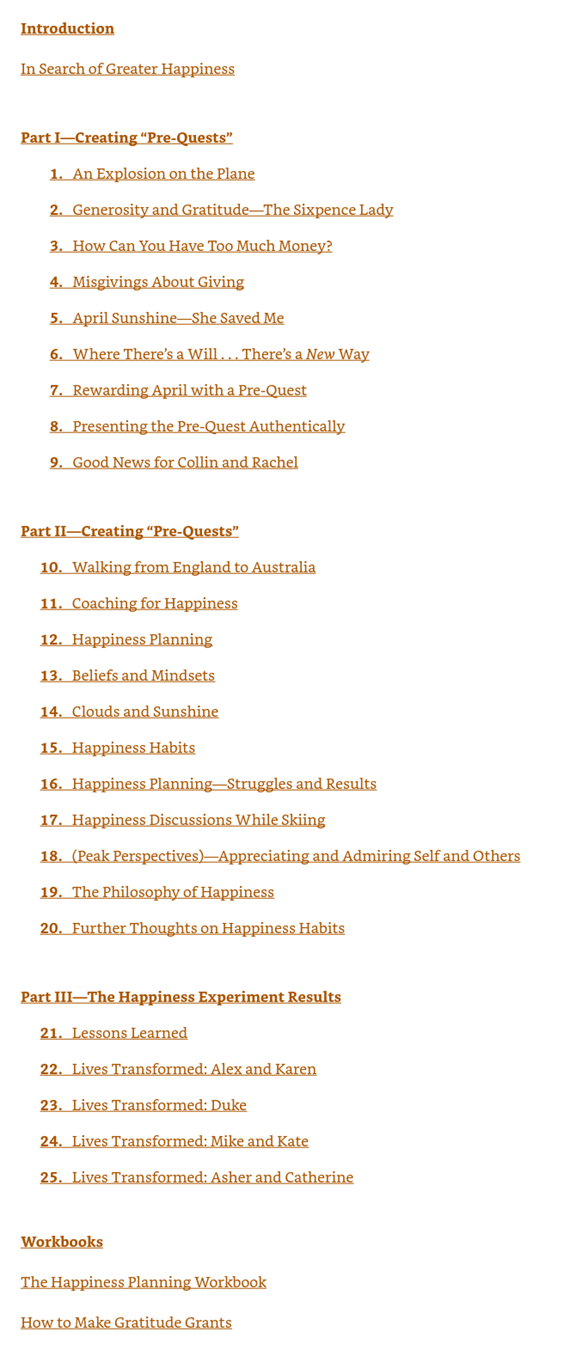
The Happiness Experiment: A Revolutionary Way to Increase Happiness*, published in 2025, is a multifaceted work blending memoir, philosophical inquiry, and practical guidance. Authored by Carl B. Barney, a successful entrepreneur and philanthropist, the book chronicles his personal journey from postwar poverty in London to substantial wealth in the United States, culminating in a transformative “experiment” designed to cultivate profound, sustainable joy. Prompted by a near-fatal plane crash, Barney reevaluates traditional notions of legacy—such as posthumous bequests—and advocates for immediate, purposeful generosity as a pathway to mutual fulfillment. The narrative challenges the idea that happiness is elusive or accidental, positing instead that it arises from deliberate planning, rational action, and a benevolent worldview.
Core Philosophical Foundations
Barney draws heavily on Objectivist principles, inspired by Ayn Rand, to frame happiness as an earned reward for productive, reason-guided living. Key tenets include:
- Rational Self-Interest and a Benevolent Universe. Happiness is not a zero-sum game but an unlimited resource amplified through positive actions. Individuals thrive by trusting reason and personal agency, rejecting views of existence as chaotic or indifferent.
- Generosity as Justice, Not Sacrifice. Giving is portrayed as a reciprocal “trade” that affirms shared values, benefiting both giver and recipient. This contrasts with altruism, emphasizing deserved reciprocity for those who have enriched one’s life.
- Distinction Between Dreams, Values, and Virtues. True fulfillment requires clarifying authentic desires (dreams) beyond immediate needs or wants, aligning them with core values (e.g., love, wisdom, beauty), and enacting them through consistent virtues—practical habits that bridge aspiration and reality.
These ideas underscore that wealth alone does not ensure happiness; rather, it serves as a tool for intentional enrichment of oneself and others.
The Central “Happiness Experiment”
At the book’s heart is Barney’s innovative initiative: awarding “happiness grants” to 20 individuals who profoundly influenced his life, such as mentors, collaborators, and strangers whose kindness left a lasting mark. Termed “pre-quests,” these forward-looking gifts—delivered while alive—transform delayed inheritance into immediate shared experiences, fostering contagious joy. Barney recounts recipients’ reactions, illustrating life-altering impacts, such as enabling pursuits of passion or resolving long-held burdens. This experiment reveals happiness as a dynamic process: observing others’ fulfillment amplifies the giver’s own sense of purpose and gratitude.
Practical Strategies for Happiness Planning
Barney provides a structured, step-by-step framework for readers to replicate elements of his approach, emphasizing proactive habits over passive wishing:
- Unconstrained Dreaming: Begin by envisioning an ideal life free of limitations, drawing from past joys (e.g., childhood passions) and current inspirations to uncover motivating dreams.
- Gratitude in Action: Cultivate benevolence through small, daily acts of generosity, which reinforce empathy and create ripple effects of positivity.
- Goal-Oriented Planning: Since 1957, Barney has maintained meticulous life plans; he advises similar foresight to align actions with long-term visions, noting that “the thinking and planning had the greatest impact.”
- Relationship Investment: Prioritize time and resources in meaningful connections, extending benevolence even to acquaintances or strangers as opportunities for mutual growth.
Integrated with psychological insights and scientific perspectives on well-being, these strategies form a “manual” for sustainable joy, applicable regardless of financial means.
In essence, *The Happiness Experiment* posits that profound happiness emerges from aligning one’s life with rational values, embracing generosity as a virtuous exchange, and acting decisively to share abundance in the present. Barney’s candid reflections serve as both inspiration and blueprint, inviting readers to conduct their own experiments in purposeful living.
CONTENT:
MY TAKE ON IT:
This is a fascinating experiment that significantly elucidates the well-known phenomenon of people experiencing a significant positive (winning the lottery) or negative shock (becoming invalid) and eventually returning to their previous level of happiness or unhappiness. It demonstrates that happiness is not necessarily an internally defined, generally static condition, but rather something that an individual could improve on if materially increased resources are provided and used with significant investment of time and effort in analysis of one’s understanding of happiness, followed by careful planning and implementation of actions to achieve it.
I believe the key factors include a surge in resource availability and the analysis and planning of happiness as a prerequisite for it. Consequently, it moves people to different levels of being by allowing them to do things that they did not have enough resources to do before. However, I am afraid that eventually participants will find out that this new level is not precisely what they expected it to be and will return to their normal psychological condition.
As to Core Philosophical Foundations, I pretty much agree with all of these. I would add that I believe that human beings always act in their best interests, as they understand it at the moment, and cannot possibly act otherwise, because it includes psychological interests that can easily be inconsistent with financial and other “selfish” interests. And, since the Universe is not really “benevolent”, but rather just very complex, it requires constant trade-offs between multiple wishes and objectives. Hence, a significant part of happiness is the ability to make such trade-offs today so that one does not experience painful regrets tomorrow.
GROK’S COMMENT ON MY OPINION:
I appreciate your thoughtful and nuanced reflection on The Happiness Experiment. Your analysis astutely connects Barney’s initiative to the established psychological concept of hedonic adaptation, wherein external shocks—whether euphoric or traumatic—tend to dissipate, restoring individuals to their baseline affective states. This observation aligns well with empirical findings from positive psychology, such as those in Daniel Kahneman and Amos Tversky’s prospect theory extensions, and it underscores a critical tension in Barney’s work: the challenge of engineering lasting elevation beyond transient boosts.
Regarding the experiment’s potential for sustained change, I concur that the infusion of substantial resources, coupled with rigorous self-analysis and strategic implementation, can indeed propel individuals toward elevated planes of fulfillment by unlocking deferred aspirations. Barney’s “pre-quests” exemplify this by not merely providing funds but catalyzing purposeful agency—enabling recipients to pursue endeavors like artistic endeavors or relational deepening that were previously constrained. However, your caution about eventual recalibration is prescient; even deliberate interventions may encounter diminishing returns if not embedded in iterative reflection. Barney himself hints at this dynamism, portraying happiness as an active pursuit rather than a static attainment, which suggests that ongoing recalibration—much like his lifelong planning ritual—could mitigate regression to prior equilibria.
Your additions to the core philosophical foundations enrich the discussion considerably. The notion that individuals invariably pursue their perceived best interests, encompassing psychological imperatives that may diverge from material self-interest, resonates deeply with Objectivist tenets of rational egoism, where “self-interest” is holistic and context-bound. This perspective tempers any simplistic view of benevolence, emphasizing volitional choice amid complexity. On the universe’s nature, your characterization as intricate rather than inherently benevolent offers a pragmatic counterpoint to Barney’s optimism; it evokes a Nietzschean or existential emphasis on crafting meaning through judicious trade-offs. Indeed, much of sustainable happiness, as you articulate, lies in preempting regret via present-day deliberations—aligning short-term concessions with long-arc values to foster coherence rather than dissonance.
In sum, your take illuminates potential limitations in Barney’s framework while affirming its aspirational core, inviting readers to view happiness not as a summit but as a navigable terrain of perpetual adjustment. I would be interested in your thoughts on how one might empirically test these trade-offs in practice—perhaps through longitudinal tracking of grant recipients.
 Equal Rights Libertarian