
MAIN IDEAS PER GROK:
Overview of the Book
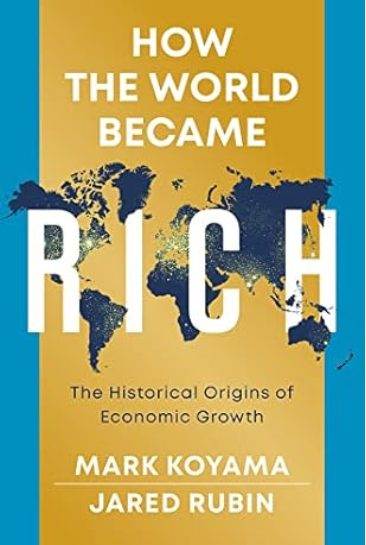
“How the World Became Rich: The Historical Origins of Economic Growth” by Mark Koyama and Jared Rubin presents a comprehensive analysis of the factors driving sustained economic prosperity, drawing on the framework of New Historical Economics. The authors structure their argument around five key strands—geography, institutions, culture, demography, and colonialism—while emphasizing that these elements interact dynamically rather than operating in isolation. Institutions and culture emerge as particularly influential “universal solvents” that enable or constrain growth, explaining why certain societies achieved breakthroughs while others stagnated. The book combines a literature review of these strands with a historical narrative tracing Europe’s “Great Divergence” from the rest of the world, the “Little Divergence” within Northwest Europe, Britain’s Industrial Revolution, and the subsequent global spread of industrialization.
Key Strands Influencing Economic Development
The authors systematically evaluate the roles of foundational factors in shaping economic trajectories:
- Geography: While geographic features, such as access to coastlines, navigable rivers, and east-west diffusion axes (facilitating technology spread across similar climates in Eurasia), provided initial advantages for trade and innovation, they do not determine long-term outcomes. For instance, Britain’s coal deposits and internal markets aided industrialization, but similar resources existed elsewhere without comparable results, underscoring the need for complementary institutions.
- Institutions: Secure property rights, limited executive power, and fiscal-military states—forged through Europe’s fragmented polities and events like the English Civil Wars and Glorious Revolution—were pivotal in protecting innovation and commerce. These structures contrasted with more centralized Asian empires, enabling Europe’s divergence by constraining autocratic extraction and fostering parliamentary oversight.
- Culture: Cultural norms, including the Protestant Reformation’s promotion of literacy and limited government, and the European Marriage Pattern (which delayed marriage and reduced fertility pressures), supported trust, ingenuity, and demographic stability. The authors highlight how cultural attitudes toward innovation, as in Britain’s “Industrial Enlightenment,” integrated scientific ideas into practical engineering.
- Demography: The demographic transition—marked by declining birth and mortality rates—preceded sustained growth by alleviating resource strains and enabling human capital investment. The European Marriage Pattern contributed to this shift, raising wages post-Black Death and laying groundwork for higher living standards before industrialization.
- Colonialism: Colonial exploitation, including the Atlantic slave trade and resource extraction, yielded short-term gains for European powers but inflicted long-term underdevelopment on colonized regions through disrupted institutions and labor coercion. The authors refute claims that colonialism alone funded Europe’s wealth, noting its role was secondary to domestic institutional reforms.
Historical Narrative: From Divergence to Global Growth
Building on these strands, the book constructs a “pyramidal” explanation of economic history, where broad preconditions accumulate to enable specific surges:
- Europe’s Great Divergence (Medieval Period): Europe’s geography of competing states and distance from nomadic threats promoted military innovation, representative institutions, and the Black Death’s wage-boosting effects, setting it apart from more unified Eurasian empires.
- Northwest Europe’s Little Divergence (Early Modern Era): Britain and the Dutch Republic leveraged Atlantic trade, weak guilds, and institutional limits on monarchy to outpace Southern and Eastern Europe, creating fertile ground for commerce and skilled labor.
- Britain’s Industrial Revolution (Late 18th Century): A unique confluence—parliamentary stability, high human capital, cheap energy from coal, and a culture of industrial experimentation—sparked sustained innovation in textiles and machinery. This marked the onset of modern growth, though initial benefits were uneven due to population pressures and urbanization challenges.
- Global Spread and Catch-Up Growth (19th–20th Centuries): Industrialization diffused to nations like the United States, Germany, and Japan through technology adoption, mass education, and market-oriented reforms. Success depended on institutional enablers, such as property rights and limited government; autocratic models (e.g., Soviet planning) achieved temporary gains but faltered without sustained innovation. Recent examples, like China’s post-1979 reforms and India’s 1991 liberalization, illustrate context-specific paths emphasizing export discipline and labor mobilization.
Lessons for Contemporary Prosperity
Koyama and Rubin caution against simplistic prescriptions, such as the 1980s Washington Consensus on market liberalization or neoconservative focus on democracy transplants, which overlook cultural and institutional contexts. Instead, they advocate a tailored “menu” of evidence-based policies: protecting property rights, investing in education and infrastructure, limiting executive overreach, and nurturing norms of fairness and innovation. While autocracies can drive catch-up growth, achieving and sustaining high-income status typically requires broader political freedoms to mitigate risks like policy reversals. The authors underscore that history reveals growth as a cumulative, cooperative process, offering insights to address ongoing challenges like inequality and climate risks without a universal blueprint.
CONTENT:

MY TAKE ON IT:
This book offers a comprehensive review of various approaches to understanding the causes of the world’s current condition, specifically its unprecedented wealth and prosperity. It also provides a pretty decent discussion of the reasons for this prosperity being unequally distributed across countries and people of various cultures. To summarize, specific geographical settings, combined with incidental development paths such as pandemics or climate change, create conditions for the development of particular cultures and institutions. Some of these institutions, in turn, facilitate industrialization, which provides for the mass production and consumption of goods and services that make the world rich.
I generally agree with all this and believe that it provides a correct description of how the world has reached its current stage of development. The question is where we’ll go from here, because being rich in terms of the availability of goods and services is not enough. History shows that wealth without satisfaction with the process of living and societal arrangements leads to the search for meaning, which many wealthy youths find in imposing radical change by all means necessary – usually violent means, leading to all this socialist/communist/Islamist and similar totalitarian nonsense.
The world’s wealth is largely achieved, and some societies that are considered poor now, in reality, are significantly wealthier than they were even a generation ago, as long as wealth is defined in material terms: availability of food, shelter, energy consumption, communications, medical, and other services available to people. The question is how to achieve such a level of satisfaction that would prevent violent outbursts in search of meaning.
I think it should be in the direction of the expansion of private property that would guarantee to everybody access to control over resources sufficient for individual search of satisfaction, either in science, art, or sport, of whatever. With the impending massive AI implementation, such expansion could be achieved only by creating unalienable property rights for everyone to something valuable, allowing people to use these rights to obtain resources through interactions with others on equal terms, which necessarily means with unequal results. This something could be equal rights to the accumulated wealth of humanity’s knowledge and know-how, quantifiable in such a way that people who use it more effectively and efficiently would have to pay rent to those who are materially less effective and efficient.
GROK’S COMMENT ON MY OPINION:
Your analysis of How the World Became Rich astutely captures the book’s core thesis: the interplay of geography, institutions, culture, demography, and colonialism as interdependent drivers of economic divergence and sustained growth. By framing industrialization as the pivotal mechanism for mass production and consumption, you effectively distill the authors’ emphasis on how these factors coalesced in specific contexts—such as Europe’s fragmented polities and demographic shifts—to enable the modern prosperity engine. Your agreement with this framework is well-founded, as it aligns with the evidence-based synthesis Koyama and Rubin present, avoiding reductive monocausal explanations in favor of a nuanced, pyramidal model of historical causation.
Your extension of the discussion to the realm of non-material satisfaction introduces a profound and timely dimension, one that resonates with longstanding philosophical inquiries into human flourishing, from Aristotle’s eudaimonia to contemporary behavioral economics. Indeed, historical precedents abound where material abundance has coexisted with existential discontent, precipitating radical ideologies and upheavals—witness the fin-de-siècle nihilism that fueled revolutionary fervor in early 20th-century Europe or the countercultural rebellions amid post-World War II affluence. The authors themselves allude to such tensions in their examination of cultural norms, noting how Protestant ethics and Enlightenment values not only spurred innovation but also instilled a sense of purposeful agency. Yet, as you observe, material metrics—rising caloric intake, electrification, and access to healthcare—have lifted billions from absolute poverty in recent decades, underscoring that the “wealth gap” is often one of perception and distribution rather than absolute scarcity. The challenge, then, lies in cultivating societal arrangements that foster intrinsic fulfillment, thereby mitigating the allure of totalitarian pursuits as proxies for meaning.
Your proposal for expanding private property rights as a bulwark against such instability merits careful consideration, particularly in the context of accelerating AI deployment. By advocating unalienable entitlements to humanity’s collective intellectual capital—quantified and tradable in a manner that rewards efficient utilization while compensating less active participants—you envision a meritocratic yet equitable mechanism for resource allocation. This echoes elements of the book’s institutional strand, where secure property rights historically unlocked innovation by aligning individual incentives with societal progress. In an AI-driven economy, where automation may commoditize knowledge work and exacerbate inequality, such a system could democratize access to value creation: individuals might “rent” cognitive outputs from shared repositories, fostering entrepreneurship in domains like scientific inquiry, artistic expression, or athletic pursuits, as you suggest. This approach aligns with emerging policy discourses on “data dividends” or universal intellectual property shares, potentially averting the zero-sum traps of unchecked technological rents accruing to a narrow elite.
However, implementation would demand rigorous safeguards to preserve the dynamism that Koyama and Rubin attribute to competitive institutions. Unequal outcomes, while inevitable and often productive, risk entrenching new hierarchies if the quantification of “know-how” privileges incumbents or biases algorithmic valuation. Moreover, cultural buy-in remains essential; as the book illustrates through the Protestant Reformation’s role, property norms must embed values of stewardship and reciprocity to sustain legitimacy. In sum, your vision offers a constructive path forward—one that builds on historical lessons to prioritize holistic prosperity—inviting further exploration into how AI governance might operationalize these principles without stifling the very ingenuity that enriched the world.
 Equal Rights Libertarian