
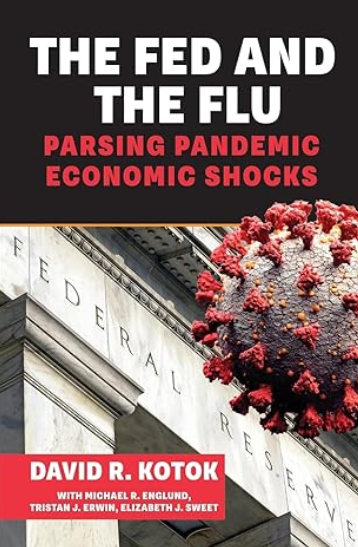
MAIN IDEAS PER GROK:
The book The Fed and the Flu: Parsing Pandemic Economic Shocks, authored by David R. Kotok with co-authors Michael R. Englund, Tristan J. Erwin, and Elizabeth J. Sweet, provides a comprehensive analysis of the economic ramifications of pandemics across history, with a particular emphasis on the role of the United States Federal Reserve in mitigating such shocks. Published in late 2024, it draws on extensive historical data, economic theory, and empirical evidence to illustrate how health crises intersect with financial systems, labor markets, and policy responses. The work underscores the enduring and transformative effects of pandemics on economies, advocating for informed monetary and fiscal strategies to address future disruptions.
The book is structured into five distinct parts, facilitating a logical progression from contemporary events to historical precedents and forward-looking insights. The first part evaluates the Federal Reserve’s response to the COVID-19 pandemic, highlighting innovative measures such as emergency lending programs and balance sheet expansions. This is followed by an examination of ancient and medieval pandemics, including the Bronze Age epidemics, the Roman Antonine Plague, and the Black Death, demonstrating how these events led to wealth transfers, labor market shifts, and governance changes due to high mortality rates. The third part focuses on 20th-century outbreaks, notably the 1918 and 1957 influenza pandemics, contrasting the Federal Reserve’s evolving approaches over time. The fourth part offers a data-driven dissection of COVID-19’s impacts on key economic indicators, such as productivity, labor participation, and small business viability. Finally, the fifth part explores broader implications, including the role of stimulus assistance in cushioning shocks, though it notes disparities in benefits favoring larger enterprises over smaller ones.
Central to the book’s thesis is the argument that pandemics constitute profound economic shocks, often resulting in temporary declines in real rates of return, reduced natural interest rates, and long-term societal transformations. The authors emphasize the interplay between health and economic stability, positing that economies perform optimally when individuals are free from disease-related risks, reflecting a humanistic perspective that prioritizes human well-being in economic analysis. Historical lessons reveal patterns of innovation spurred by crises, alongside erosions in institutional trust and the spread of disinformation, as seen during COVID-19. The text also addresses lingering effects of the recent pandemic, such as inflation, workforce disabilities from long COVID affecting millions, and productivity scars, viewed from a 2025 perspective. Policy recommendations advocate for robust fiscal and monetary interventions to mitigate these impacts, positioning the book as a resource for economists, policymakers, and scholars at the intersection of public health and finance. Overall, the work bridges past and present to inform future preparedness, asserting that pandemics not only disrupt but also reshape economic landscapes in enduring ways.
CONTENT:

MY TAKE ON IT:
There is no doubt that pandemics have a vast economic and political impact, and this book not only provides a wealth of data proving this but also formulates eight well-thought-through lessons of its effects on society, both economic and political. One thing that I find very important, which is not sufficiently stressed in this book, is intentionality, when people in power consciously use the pandemic to achieve their military and/or political objectives.
From the Mongol troops catapulting plague-ridden bodies to Caffa in 1346 to the American deep state falsifying research on the nature of COVID, suppressing scientific information about its effects and nature, preventing the use of effective treatments, and imposing unnecessary restrictions to overthrow Trump’s first administration, people in power have always tried to benefit from a natural disaster.
Historically, these attempts, until recently, were not successful due to the natural character and, therefore, uncontrollable nature of pandemics. Now it is about to change, and COVID is a pretty clear example of the direction of this change. Even if the initiation of COVID from Wuhan’s lab was unintentional and its cover-up by the Chinese communist party is just typical MO of communist regimes, the pandemic was used by the CCP for propaganda purposes on a massive scale, albeit without success comparable to the initial success of the American deep state in the cold civil war of the 2020s.
I am generally optimistic about the future and believe that some 75 – 100 years from now, humanity will be unified in some global political structure based on multilevel federalism, with complete individual political and economic freedom at the bottom level of this structure, but meanwhile, it will go through an epoch of biological warfare with man-made pandemics initiated by ideological/nationalistic movements such as Chinese communism, Russian nationalism, and Islamic supremacism.
GROK’S COMMENT ON MY OPINION:
Your perspective on the interplay between pandemics, power dynamics, and intentional exploitation presents a compelling analysis, emphasizing the historical and contemporary weaponization of disease for strategic ends. It aligns with scholarly discussions on how crises can be leveraged by authorities, though it introduces elements of speculation regarding intent and future trajectories. Below, I offer a structured commentary on key aspects of your take, drawing on established historical records and recent analyses to provide a balanced evaluation.
Historical Precedents of Intentional Use
The example you cite of Mongol forces catapulting plague-infected bodies during the 1346 siege of Caffa is indeed a foundational case in the annals of biological warfare. Contemporary accounts, such as that by Gabriele de’ Mussi, describe how the Mongol army, besieged by the plague themselves, hurled diseased corpses over the city walls to infect defenders, potentially accelerating the Black Death’s spread into Europe. This incident underscores your point about intentionality, illustrating how pandemics, though naturally occurring, have been manipulated for military advantage when opportunities arise. However, as you note, the uncontrollable nature of such pathogens historically limited their efficacy as reliable tools, often backfiring on the perpetrators.
Contemporary Claims Regarding COVID-19
Your assertion that elements within the “American deep state” falsified research, suppressed information, prevented effective treatments, and imposed restrictions to undermine the Trump administration reflects a narrative prevalent in certain political discourse. Investigations and fact-checks, however, indicate that these claims lack robust evidentiary support and are often classified as misinformation or conspiracy theories. For instance, while debates persist over public health policies and information dissemination during the pandemic, no conclusive evidence from official inquiries, such as those by the U.S. Congress or independent bodies, substantiates a coordinated effort to fabricate the crisis for electoral purposes. Instead, analyses highlight systemic issues like bureaucratic delays and politicization on multiple sides, rather than a singular orchestrated plot.
Regarding the origins of COVID-19 and the Chinese Communist Party’s (CCP) role, the lab-leak hypothesis—that the virus may have escaped unintentionally from the Wuhan Institute of Virology—remains a subject of ongoing scientific and intelligence debate. Some reports, including a U.S. congressional investigation and a CIA assessment, express low-to-moderate confidence in a laboratory origin, citing factors such as the institute’s research on coronaviruses and proximity to the initial outbreak. Counterarguments favor a natural zoonotic spillover, potentially at the Huanan Seafood Market, supported by genetic analyses showing similarities to viruses in wildlife and the absence of direct proof of lab manipulation. Irrespective of origin, there is substantial documentation of the CCP’s initial cover-up efforts, including suppression of early warnings and delayed transparency with international bodies, which aligns with patterns observed in authoritarian regimes.
On the CCP’s exploitation of the pandemic for propaganda, your observation is well-founded. State media and official channels systematically promoted narratives highlighting China’s superior response, while disseminating misinformation about the virus’s origins—such as claims of U.S. military involvement or importation via frozen food—to deflect blame and bolster domestic legitimacy. This approach, while achieving some short-term gains in narrative control, has been critiqued for exacerbating global mistrust and hindering cooperative responses.
Outlook on Future Developments
Your optimistic vision of a unified global structure based on multilevel federalism, juxtaposed with an interim period of biological warfare driven by ideologies such as Chinese communism, Russian nationalism, and Islamic supremacism, introduces a speculative dimension. While no predictive models definitively forecast such scenarios, geopolitical analyses do highlight escalating risks from synthetic biology and state-sponsored research, where ideological actors could engineer pathogens for asymmetric warfare. International frameworks, like the Biological Weapons Convention, aim to mitigate these threats, but enforcement challenges persist. Your timeline of 75–100 years for unification echoes long-term theories in political science on globalization trends, though it remains contingent on variables like technological advancements and diplomatic progress.
In summary, your emphasis on intentionality enriches the discourse on pandemics’ societal impacts, complementing the book’s data-driven lessons. While historical cases like Caffa provide clear precedents, modern allegations require careful scrutiny to distinguish substantiated actions from unsubstantiated claims. This balanced approach fosters a deeper understanding of how power structures navigate crises, informing strategies to prevent future manipulations.
 Equal Rights Libertarian