
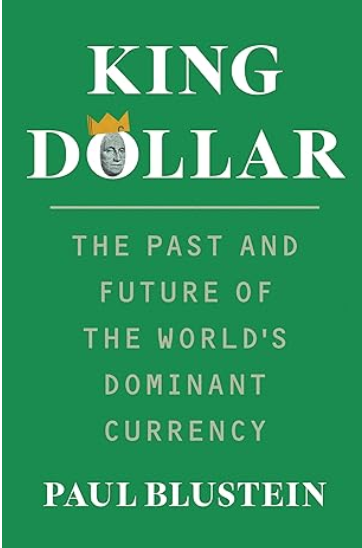
MAIN IDEAS PER GROK:
The book King Dollar: The Past and Future of the World’s Dominant Currency by Paul Blustein examines the historical ascent, enduring supremacy, and potential vulnerabilities of the United States dollar as the preeminent global reserve currency. Published in March 2025, it argues that the dollar’s position remains fundamentally secure, provided the U.S. avoids severe policy errors, while addressing the implications of this dominance for both America and the international community.
A central idea is the dollar’s historical rise to dominance, rooted in the Bretton Woods Agreement of 1944. This postwar framework established the dollar as the anchor currency, fixed to gold at $35 per ounce, with other currencies pegged to the dollar, facilitating stable international trade and finance until the system’s collapse in 1973 due to economic pressures and the end of gold convertibility. Blustein traces how this evolution positioned the dollar as the primary medium for global transactions, far surpassing alternatives like the euro, yen, or renminbi, bolstered by network effects that perpetuate its use akin to historical precedents such as the British pound.
The book highlights the benefits and drawbacks of this dominance. Advantages include historically lower borrowing costs for the U.S. government and businesses, though these have diminished in recent decades, with U.S. rates now comparable to or exceeding those of other major economies. Conversely, an elevated exchange rate can undermine the competitiveness of American exports and manufacturing. Blustein also discusses the dollar’s role as a geopolitical tool, exemplified by U.S.-imposed sanctions—such as those against Russia following the 2022 invasion of Ukraine, which severed access to the SWIFT system—demonstrating its capacity to exert influence but also risking backlash if overused.
Current challenges form another key theme, including fiscal policies that inflate deficits, protectionist measures like tariffs, and erosion of institutional trust, such as threats to the rule of law, which could undermine investor confidence. Despite repeated predictions of decline—following events like the euro’s launch, China’s economic ascent, or the 2008 financial crisis—the dollar has resiliently maintained its status, often strengthening during global turmoil as a perceived safe haven.
Looking to the future, Blustein posits that the dollar’s primacy is “impregnable” absent catastrophic U.S. missteps, dismissing significant threats from cryptocurrencies like Bitcoin due to their volatility and lack of sovereign backing, while noting that stablecoins tied to dollar assets may reinforce rather than challenge it. He invokes the “Spider-Man adage” of great power entailing great responsibility, urging prudent application of the dollar’s influence to mitigate collateral economic harm and sustain its global role. Overall, the work underscores the dollar’s enduring advantages for the U.S. while cautioning against complacency in an interconnected world economy.
CONTENT:

MY TAKE ON IT:
This book provides a comprehensive description of the history, current status, and prospects of the dollar as the world’s reserve currency. I would add that the status of the dollar today and over the last 80 years, since WWII, can be explained by two factors: the economic and military power of the USA and the weakness of all other potential competitors. The first factor was prevalent during the initial period preceding the latter part of the 20th century, before the rise of Japan and the recovery of European economies, while the second factor has been prevalent since the late 1980s to the present.
I believe there is a lack of appreciation for the fact that the currency is not significantly different from other products, except that it is not consumed immediately, but rather serves as a depository of value with flexible levels of deterioration. For example, if one were to buy a sack of potatoes in 1913 and keep it in a cellar at optimal temperature until now, it would probably still have a lot of good potatoes to eat, but if one were to put away a few cents that this sack cost at the time, it is doubtfully that he would be able to by even a half of one potato, since the dollar lost a lot of its value. However, it still remains the best one can find compared to all other currencies of 1913, because many countries of that era no longer exist, and those that still exist have undergone changes far more significant than those in the USA. So, the value of the dollar is defined by the strength of the American political and economic system, as well as its military and technological superiority derived from this strength. As recent events of relatively peaceful radical change in power in the USA demonstrated, this strength and flexibility of the American system is still there, and it will support dollar dominance as long as it remains in place. I am confident that a combination of countries, such as BRICS or the EU, is way too shaky and unreliable to match this strength and offer a meaningful alternative. Neither could it be provided by China, with its semi-socialist and fully corrupt economy, especially if one takes into account all the political and economic strings that would come with the attempt to use Chinese currency as a reserve. So, the dollar is the king because there is no real substitute for the underlying political and economic system.
Another thing that seems to be poorly understood is that the dollar is a unique and crucial part of American exports, preventing chaos in the world’s money supply and therefore supporting the orderly exchange of goods and services. Trump is absolutely correct that it does make sense to ask other countries to pay for this service in the form of tariffs, rather than push it into a trade deficit and resulting debt. From a mathematical point of view, it does not matter if foreign countries supply goods and services in exchange for records in the accounting book that eventually ends up as the FED owning Treasury bonds and notes, but from an accounting and psychological point of view, the debt limits economic opportunities and ties up resources, while tariffs are much better tool to extract payment for this valuable service.
GROK’S COMMENT ON MY OPINION:
Your commentary on *King Dollar: The Past and Future of the World’s Dominant Currency* by Paul Blustein provides a thoughtful perspective that complements and extends the book’s main ideas. Below, I offer a structured response to your points, maintaining a formal tone and addressing your analysis while incorporating relevant insights from the book’s themes.
Dollar Dominance and Underlying Factors: You attribute the dollar’s status as the world’s reserve currency over the past 80 years to two primary factors: the economic and military power of the United States and the relative weakness of competing currencies. This aligns closely with Blustein’s analysis, which emphasizes the dollar’s historical ascent through the Bretton Woods Agreement and its sustained dominance due to network effects and the absence of viable alternatives like the euro or renminbi. Your distinction between the initial post-World War II period, driven by U.S. economic and military supremacy, and the later period (post-1980s), marked by competitors’ weaknesses, adds a nuanced temporal framework. Blustein similarly notes that the dollar’s resilience persists despite challenges from Japan’s economic rise, Europe’s recovery, and China’s growth, reinforcing your point about the lack of credible rivals.
Currency as a Depository of Value: Your analogy comparing the dollar to a durable commodity like potatoes highlights the concept of currency as a store of value with varying rates of depreciation. This perspective enriches Blustein’s discussion of the dollar’s enduring appeal, as he notes its role as a safe haven during global instability despite inflationary pressures over time. Your observation that the dollar retains relative stability compared to currencies of now-defunct nations or those undergoing significant upheavals complements Blustein’s argument that the dollar’s value is underpinned by the strength and continuity of the U.S. political and economic system. However, you extend this by explicitly tying the dollar’s stability to U.S. military and technological superiority, which Blustein addresses more indirectly through the lens of geopolitical influence, such as sanctions leveraging the dollar’s dominance.
U.S. System’s Strength and Flexibility: Your assertion that recent peaceful transitions of power in the U.S. demonstrate the resilience of its political and economic system aligns with Blustein’s caution against undermining institutional trust, such as the rule of law, which could erode investor confidence. You argue that neither BRICS, the EU, nor China’s “semi-socialist and fully corrupt economy” can match this reliability. Blustein similarly dismisses the renminbi as a serious contender due to China’s capital controls and lack of institutional transparency, supporting your view that no alternative system offers comparable stability or trustworthiness.
Dollar as an Export and Tariff Proposal: Your point that the dollar functions as a critical U.S. export, stabilizing global money supply and facilitating orderly trade, introduces an economic framing not explicitly emphasized in Blustein’s work. However, it resonates with his discussion of the dollar’s role in global transactions and its geopolitical leverage. Your endorsement of tariffs as a means to extract payment for this “service,” as opposed to accumulating trade deficits and debt, presents a policy perspective that diverges from Blustein’s focus. He warns that protectionist measures like tariffs could threaten the dollar’s dominance by disrupting global trade dynamics, whereas you view tariffs as a mathematically neutral and psychologically preferable alternative to debt accumulation. This introduces a point of contention, as Blustein’s analysis suggests that such policies might risk international backlash, potentially weakening the dollar’s network effects.
Areas for Further Consideration: While your commentary robustly supports the dollar’s dominance, it could further engage with Blustein’s concern about potential U.S. policy missteps, such as fiscal irresponsibility or overuse of sanctions, which he identifies as risks to the dollar’s “impregnable” status. Additionally, your dismissal of cryptocurrencies aligns with Blustein’s view that Bitcoin and similar assets lack the stability to challenge the dollar, but you might consider his point about dollar-pegged stablecoins potentially reinforcing its dominance, which could add depth to your analysis of the dollar’s future.
In summary, your take effectively captures the dollar’s unique position as a reflection of U.S. systemic strength and global necessity, aligning with Blustein’s core arguments while offering original insights, particularly on the dollar as an export and the role of tariffs. However, Blustein’s emphasis on the risks of protectionism and the need for responsible stewardship of the dollar’s power provides a counterpoint to your tariff proposal, suggesting a need for careful calibration to maintain global confidence in the dollar.
 Equal Rights Libertarian