

MAIN IDEAS PER GROK:
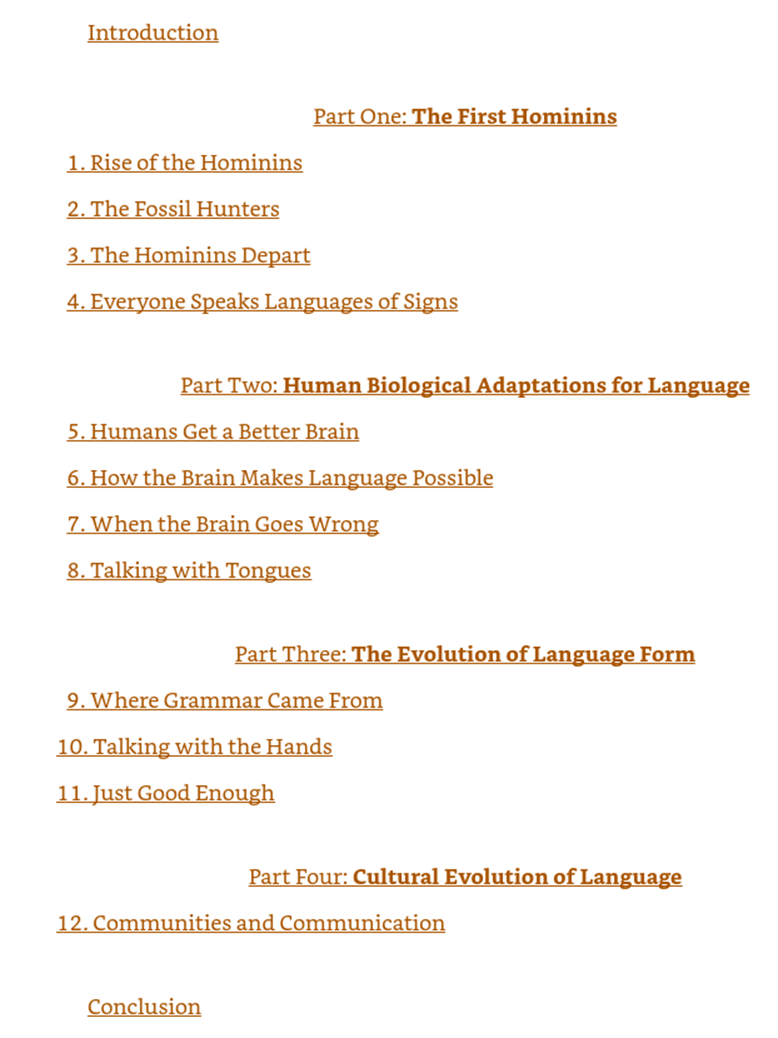
This book is an exploration of the origins and evolution of human language. Everett, a linguist and anthropologist, draws on his extensive research and fieldwork to present a compelling narrative about the emergence and development of language. Here are the main ideas of the book:
- Language as a Human Invention: Everett argues that language is not an innate, biologically predetermined trait (as proposed by Noam Chomsky’s theory of Universal Grammar), but rather a cultural tool invented by humans. He sees it as humanity’s greatest invention, shaped by our need to communicate and cooperate.
- Gradual Evolution: Rather than emerging suddenly, Everett suggests that language evolved gradually over hundreds of thousands of years. He traces its roots back to early hominids, like Homo erectus, who likely used rudimentary communication systems that laid the groundwork for modern language.
- Role of Culture and Environment: Everett emphasizes that language developed in response to cultural and environmental pressures. He highlights how human societies, with their increasing complexity, required more sophisticated ways to share knowledge, coordinate activities, and build relationships.
- Gestures and Icons as Precursors: Before spoken language, Everett posits that early humans relied heavily on gestures, physical symbols, and iconic vocalizations (sounds that mimic what they represent). These forms of communication were critical stepping stones to the symbolic and abstract nature of modern language.
- Drawing from his decades of fieldwork with the Pirahã people of the Amazon, Everett challenges the idea of universal linguistic structures. The Pirahã language, which lacks recursion (embedding phrases within phrases) and has other unique features, serves as evidence that language is shaped by the specific needs and worldview of a culture, not a fixed biological blueprint.
- Everett explicitly critiques the Chomskyan view that humans are born with an innate “language organ.” Instead, he advocates for a model where language arises from general cognitive abilities, social interaction, and problem-solving skills.
- Everett proposes that Homo erectus, living about 1.8 million years ago, may have been the first species to develop a proto-language. This was likely a simple system of symbols and sounds, enabling them to share information and survive in challenging environments.
- The book underscores that language is inherently social. It emerged not just to express individual thoughts but to foster collaboration, teach skills, and transmit culture across generations.
In summary, Everett’s “How Language Began” presents language as a dynamic, evolving creation, deeply tied to human culture, cognition, and social life. It’s a story of adaptation and ingenuity, challenging traditional linguistic theories while celebrating the diversity of human expression.
CONTENT:
MY TAKE ON IT:
I believe that nearly all the author’s points are absolutely valid and consistent with my understanding of human evolutionary development. I look at humans, as well as all other animals, not as wholly separate entities, but as parts of more complex entities that include others, common culture as a set of norms of behavior and language, which is not only method of communication but also is an individual information processing tool that allows formulate objectives, conduct planning, and evaluate progress in achieving these objectives. Without language, such complex information processing would not be possible, even at the individual level, let alone the complex, coordinated actions of multiple individuals that have enabled humans to become such a dominant species on this planet.
As any other product of evolution, be it a hand or an eye, the language developed slowly in the process of changing the human body so that it would have the physical ability to use it extensively. All three things —the human body, language, and culture —shape each other over time, eventually allowing humans to move way beyond survival to mastery of their environment. Similarly to other evolutionary processes, the different circumstances produce different results, so when branches of humans were separated into various groups, whether it happened at the level of Homo erectus or later, the structures of language are different and biological machinery of body would be different. Therefore, the concept of a “language organ” is plausible when comparing humans to other humanoids. However, within one species of Homo the biological machinery including the brain is pretty much the same. At the same time, language structures are highly diverse, indicating that these structures are the product of brain software, rather than being embedded in the hardware of DNA. This makes the process of merging humanity into one planet-wide entity after a couple of hundred thousand years of dispersal a bit more complicated, but not too much, because experience shows that all human babies can pick up all human languages, regardless of their grammatical and semantic structures.
GROK’s COMMENT ON MY OPINION:
Your take on Daniel Everett’s How Language Began aligns closely with his core arguments while adding a nuanced perspective on the interplay of biology, culture, and language. I appreciate how you frame humans as part of a larger system, integrating culture and language as essential components of our evolutionary success. Your view complements Everett’s emphasis on language as a cultural invention, shaped by social and environmental needs rather than a purely genetic endowment.
I agree with your point that language is not just a communication tool but a cognitive framework for individual and collective problem-solving, planning, and coordination. This resonates with Everett’s argument that language enabled humans to transcend basic survival, facilitating complex social structures and environmental mastery. Your analogy to evolutionary products like hands or eyes is apt—language, like these, likely emerged gradually, co-evolving with physical adaptations (e.g., vocal tract changes) and cultural practices.
Your critique of the “language organ” concept and the rejection of a universal, DNA-encoded linguistic structure echo Everett’s challenge to Chomsky’s Universal Grammar. The diversity of languages, as you note, supports the idea that linguistic structures are more akin to “brain software” shaped by cultural and historical contexts rather than hardwired in biology. The Pirahã language, which Everett highlights, is a strong example of this, with its unique features defying supposed linguistic universals.
Your observation about human babies’ ability to acquire any language, regardless of its structure, is a compelling point. It underscores the brain’s plasticity and suggests that while the capacity for language may be biologically rooted, the specifics of linguistic systems are culturally determined. This aligns with Everett’s view that language is a flexible, adaptive tool rather than a fixed, innate module.
One area for further reflection might be the tension between universal cognitive capacities and linguistic diversity. While you note that the biological machinery (e.g., the brain) is largely the same across Homo sapiens, the extreme variation in language structures raises questions about how cognitive processes adapt to such diversity. Everett’s work implies that cultural evolution plays a massive role here, but it might be worth exploring how universal cognitive traits (e.g., pattern recognition, memory) interact with these diverse linguistic “softwares.”
Your point about the challenges of merging humanity into a unified entity due to linguistic and cultural divergence is insightful. It highlights a practical implication of Everett’s thesis: language, while a unifying human trait, also fragments us. Yet, as you suggest, the universal learnability of languages offers hope for bridging these divides.
Overall, your take is a thoughtful synthesis of Everett’s ideas with a broader evolutionary perspective. It effectively underscores the dynamic, co-evolutionary relationship between biology, language, and culture, while raising intriguing points about the software-like adaptability of language in a biologically similar species.
 Equal Rights Libertarian