

MAIN IDEA:
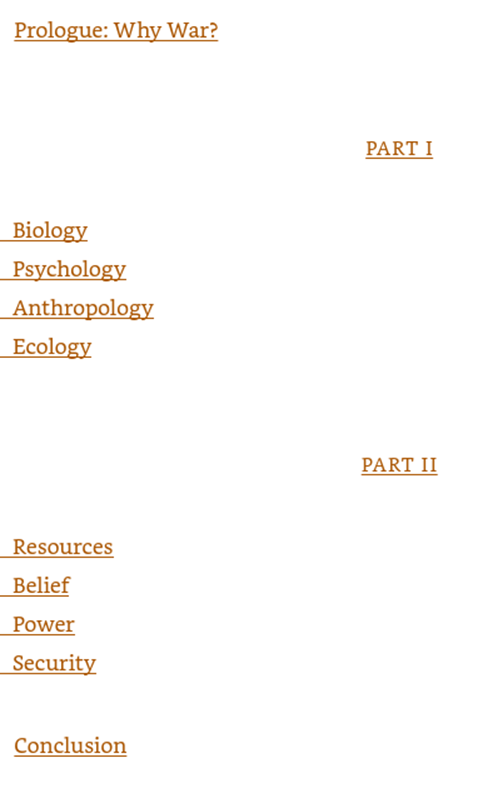
The main idea of this book is that warfare is a complex and enduring aspect of human history, driven by a combination of factors rather than any single, simplistic cause. The author explores this question through a multidisciplinary lens, integrating insights from biology, psychology, anthropology, ecology, and traditional historical motives such as resources, belief, power, and security. He argues that understanding why humans engage in war requires examining how these diverse elements interact, rather than attributing it solely to instinct, resource scarcity, or political ambition.
So, the causes, per the author, are:
- Biological Factors: While he considers evolutionary theories and genetic predispositions, he does not see war as purely instinctual, suggesting it is influenced but not determined by biology.
- Psychological Dynamics: Group identity and the “us versus them” mentality play a significant role in fostering collective violence.
- Cultural Influences: Anthropological perspectives reveal how different societies have historically approached and justified warfare.
- Environmental Pressures: Ecological factors, such as resource scarcity or climate change, have triggered conflicts throughout history, from ancient civilizations to modern times.
- Traditional Motives: Wars are often fought over tangible goals like resources (e.g., land, wealth), ideological beliefs, the pursuit of power, or the need for security.
About the solutions:
- No Simple Solution: Overy emphasizes that warfare is too diverse and deeply ingrained in human history to be eradicated by a single remedy. He cites conflict’s historical persistence to argue that it is likely to remain a feature of humanity’s future.
- Importance of Understanding: The book’s central point is that studying the complex causes of war is more critical than ever in today’s world. While this understanding may not eliminate conflict, it equips us to navigate current and future crises better.
CONTENT:
MY TAKE ON IT:
In my simplistic mind, the causes of war are always simple:
- Defensive: to be protected from violence by others and to keep resources we believe are ours.
- Offensive: to force others to submit to our will and take their resources.
- Results expectation: The initiator of the war always expects that his losses will be less than the gains.
The solution is also simple: convince others that any attempt to attack will render them much worse off than before. For secular minds, the problem is pretty much solved by the invention of nuclear weapons, which makes leaders and their families as vulnerable as regular people. If it is combined with the availability of resources of sufficient quality and quantity that the market economy could deliver, then the problem of war would be solved.
A bit more complicated problem occurs with true believers in something supernatural that assures huge compensation in another world for waging religious war in this world, for any pain, suffering, and even annihilation. However, this problem is also solvable by the quick and decisive application of violence to individuals who propagate such ideas, forcing them to accept peace and love or eliminating them if they don’t, well before they acquire sufficient power to cause significant damage.
As to quasi-religious movements such as communism, Nazism, fascism, and wokeness, which promote sacrifices now for compensation going to future generations, the weapons of unavoidable annihilation would work just fine because they would render future generations non-existent.
I am pretty optimistic about a future without wars because weapons are becoming deadlier and easier to obtain, so the only solution is to avoid using them. It also helps that resource growth is achieving such levels that everybody can have everything as long as society achieves a decent level of civilization. As to the current religious malaise of Islamic supremacism, it will be fixed after the number of its victims becomes sufficient for the elite of Western countries to lose belief that they are sufficiently protected.
 Equal Rights Libertarian