
MAIN IDEA:
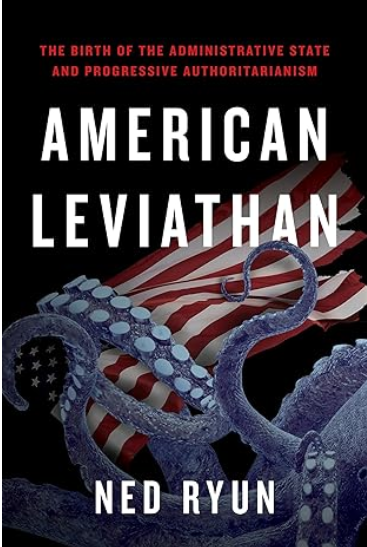
Ned Ryun’s American Leviathan: The Birth of the Administrative State and Progressive Authoritarianism explores the historical and ideological roots of what Ryun terms the “Administrative State”—a sprawling, unelected bureaucracy that he argues has come to dominate American governance, fundamentally altering the nation’s founding principles. The central thesis of the book is that this shift represents a quiet but profound regime change, moving away from the constitutional republic designed by the Founding Fathers toward a form of progressive authoritarianism. Ryun asserts that this transformation, driven by a self-anointed class of intellectual elites and technocrats, has eroded representative democracy and individual liberties, replacing them with a centralized, unaccountable system of control.
The book traces the origins of this “Leviathan” back to the Progressive Era at the turn of the 20th century, when influential thinkers and politicians began advocating for a more active federal government staffed by experts to address societal challenges. Ryun highlights pivotal moments in this evolution, such as Franklin D. Roosevelt’s New Deal in the 1930s, which massively expanded federal agencies and their reach, and Lyndon B. Johnson’s Great Society programs in the 1960s, which further entrenched bureaucratic power. These developments, he argues, shifted authority away from elected officials accountable to the people and into the hands of a permanent administrative class, insulated from democratic oversight. Ryun frames this as a betrayal of the Founders’ vision, where sovereignty was meant to reside with citizens through their chosen representatives.
Ryun’s critique is not merely historical; he presents the Administrative State as an ongoing threat to American liberty, describing it as a self-perpetuating entity that prioritizes its own power over the public good. He warns that this system has grown so pervasive that it now touches nearly every aspect of daily life, from regulations on business to personal freedoms, often without the consent of the governed. The book poses a stark choice for modern Americans: either reclaim the republic by dismantling this bureaucratic behemoth or resign themselves to its expanding dominance, which he sees as a form of soft tyranny masked as benevolent governance.
In terms of solutions, Ryun suggests that the path forward lies in bold executive action. He posits that a reform-minded president, wielding constitutional authority, could take decisive steps to dismantle the Administrative State, restoring power to elected bodies and the people. This call to action reflects his belief that the original framework of limited government and self-governance remains viable, but only if citizens and leaders actively resist the progressive authoritarianism embedded in the current system. American Leviathan thus serves as both a historical analysis and a rallying cry, urging a return to the principles of liberty and accountability that Ryun sees as the bedrock of the American experiment.
MY TAKE ON IT:
It is one of those rare books that was published just in time for the massive reforms that began with Donald Trump’s second presidency. I fully agree with the author’s assessment of the current state of American society and completely support the impending massive change.
However, I think that the majority of people, probably even the author, are missing the global scale of this development. The American administrative state established as a result of the revolution of 1932 (FDR) was just a part of an intellectual and popular movement that resulted in the establishment of societies based on a bureaucratic hierarchical power that substituted previously dominant aristocratic hierarchical power. In different countries, it came in various forms: fascism in Italy, Nazism in Germany, communism in Russia and China, the New Deal in America, and a variety of socialism implementations in countries all over the world. The extreme forms of Bureaucracy, which demonstrated their inefficiency and ineffectiveness everywhere, were somewhat softened by the end of the 20th century, but they remain dominant.
An interesting part of the development of Bureaucracy was that it seemed to be a perfect fit with the computerization of society. Initially, it was believed to allow perfect planning and management of production processes and all other necessary activities, such as education, science, healthcare, and so on. However, the processes in all these areas are too complex to be centrally controlled. After initial improvements, when regulations limited the extremes of the unlimited free market corrupted by limited government interference when various externalities and monopolies caused harm to a significant part of the population, the Bureaucracy moved into the area of diminishing returns. Currently, excessive regulation is restricting productivity improvements and even reducing productivity. Indeed, as with Aristocracy, which outlived its usefulness as protectors and conquerors with the development of mass armies, Bureaucrats and their regulations are becoming redundant with the development of mass data processing. This brings us to the necessity of using revolutionary measures to drastically reduce it before completely substituting it with AI-controlled, minimalist regulations. It is this revolutionary movement that we are observing now in the USA and will continue to observe further all over the world.
 Equal Rights Libertarian