
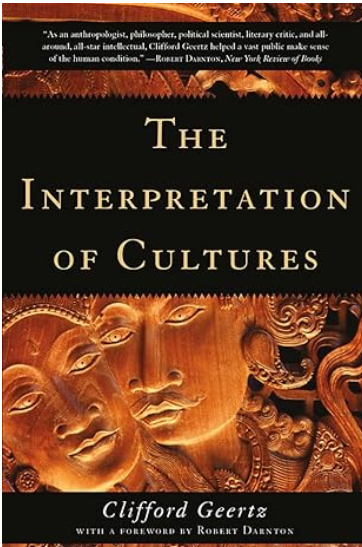
MAIN IDEA:
This is an anthropologist’s book about culture, and here is how he defines it: “Culture is the fabric of meaning in terms of which human beings interpret their experience and guide their action; culture is the context within which they define their world, express their feelings, and make their judgements; culture is the form of things that people have in mind, their models for perceiving, relating, and otherwise interpreting them.”
The main idea is the concept of “thick description” in anthropology. The author argues that understanding human cultures involves interpreting the meanings that people attach to their actions, symbols, and social structures.
Here are some key points:
- Thick Description: Geertz emphasizes the need for deep, contextual analysis rather than just surface-level observations. He contrasts “thin description” (merely describing what happens) with “thick description” (explaining the cultural context and meanings behind actions).
- Symbolic Anthropology: Geertz advocates for an interpretive approach where culture is seen as a set of symbols and meanings. He suggests that anthropologists should act like literary critics, interpreting these symbols to understand cultural practices.
- Cultural Systems: Cultures are portrayed as systems of meaning where rituals, beliefs, and practices are interlinked. The book includes famous case studies like the Balinese cockfight, where Geertz shows how such events reveal deep cultural insights.
- Human Nature: Geertz challenges the notion of a universal human nature by showing how culture shapes and is shaped by human behavior in diverse ways.
- Semiotic Approach: He views culture as a semiotic system, where actions, artifacts, and institutions are signs that need to be deciphered to understand cultural meaning.

MY TAKE ON IT:
In my opinion, culture is a set of symbols and rules that define how people use these symbols to plan and implement their actions and interactions with others. It is like epigenetics in that humans develop on top of their DNA inheritance through environmental interaction. From this point of view, the same or very similar DNA, which is typical for all humans, produces very different human beings depending on the environment of their formative period. Since the human needs for food, shelter, procreation, and belonging are common for all humans, human nature at the core is the same for everybody. However, different environments produce individuals who are culturally optimized to different methods of satisfying these needs.
Correspondingly, it is difficult for Western anthropologists who satisfy their needs via Ph.D. programs and scientific careers to understand people of other cultures with entirely different methods of doing the same. The complexity levels of both cultures are necessarily close because DNA defines them, and all humans have very similar DNA. Therefore, “Thick Description” is a necessity without which any attempt to understand another culture would be shallow, if not impossible.
The deep understanding of others’ cultures is not a purely abstract question. We live in a rapidly globalized world where people of different cultures increasingly mix, and the lack of understanding leads to sometimes deadly clashes. We can see it just about every day when individuals brought up in the militant, violent, and conquering culture of 7th-century Islam encounter individuals brought up in the contemporary peaceful, democratic, less-violent, but politically manipulative 21st-century West. It will probably take a few decades and millions of violent deaths before the much more technologically advanced West will return to its traditionally violent inheritance and force most Muslims to develop a peaceful and tolerant form of Islam while physically eliminating an uncompromising minority.
 Equal Rights Libertarian