

MAIN IDEA:
The main idea of this book is to explore the concept of genetic archaeology. The key points are:
- DNA is a Historical Record, so one can study its sequences to trace the lineage of species back through time. This includes the functional parts of DNA and “dead” or non-coding DNA, remnants of past evolutionary events.
- Pseudogenes and Fossils: Some DNA sequences that once had a function but have since become inactive can tell us about extinct species or ancient functions that are no longer needed.
- Reconstructing Evolutionary History: These sequences show when certain traits appeared or disappeared, like chapters in the “Book of the Dead,” detailing the story of life.
- The Concept of Universal Ancestry: the author also uses this genetic evidence to support the idea that all living organisms on Earth have a common ancestry. He explores how far back we can trace this lineage, essentially looking at the “deep time” of biological history.
- Educational and Philosophical Insights: In addition to reviewing the scientific aspect, the author discusses the philosophical implications of understanding our genetic heritage, providing a sense of connection to all life forms and a deeper understanding of our place in the natural world.
CONTENT:
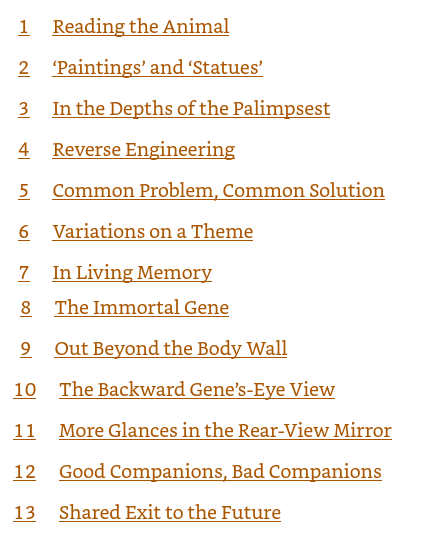
MY TAKE ON IT:
DNA is just a code of living objects, either plants or animals, that has evolved over millions of years. As such, it is not that different from the staff that I am very familiar with – computer code consciously developed over the last 80 years. It contains bits and pieces of stuff developed long ago; some are still active and some dormant, but they are still there because cleaning them up is difficult and meaningless. In both cases, it is useful for analyzing the history of development. Still, it is far from complete history because lots of DNA that used to be active just disappeared together with organisms that had it when these organisms were discontinued by evolution. All this creates a great opportunity for curious individuals to model history by using existing DNA and a multitude of data points derived from the history of environmental changes. The results will always remain speculative, but they could provide a very interesting outcome. Since we are getting closer to being capable of modifying DNA, including our DNA, the results of modeling historical development could generate not just a better understanding but also some good ideas of how to rebuild our DNA to help humans in their pursuit of happiness. It would require the massive application of AI, but unlike the current use of human labor that AI will completely substitute in the near future, this application will always remain just supplementary to human activities because only humans can judge their level of happiness, and no AI could do it for them.
 Equal Rights Libertarian