
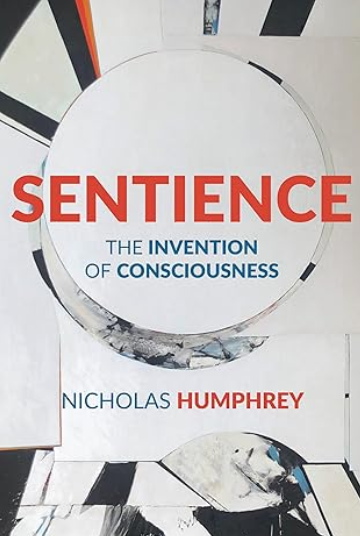
MAIN IDEA:
This book is about conscience, sentience, the relationship between these two notions, and the evolutionary meaning of their development. The author defines these notions thus:
“The adjective ‘sentient’ came into use in the early seventeenth century to describe any creature—human or otherwise—that responds to sensory stimuli. But the meaning subsequently narrowed to put emphasis on the inner quality of the experience: what sensations feel like to the subject.”
“Consciousness means having knowledge of what’s in your mind. Your conscious mental states comprise just those states to which at any one time you have introspective access and of which you are the subject.”
After that, the author presents the results of the research on monkeys with different parts of the brain disabled and some unexpected results that it produced. The author also discusses sensations and perceptions using such framework:” “Sensations are about what’s happening to you at your sense organs. Perceptions are about the state of the world.”
Finally, the author allocates much space to discussing non-human sentience and conscience. Eventually, he concludes:” While we needn’t doubt that there are many other life forms out there in the universe, we’ve come to see that the evolution of life, even intelligent life, will not necessarily have entailed the evolution of phenomenal consciousness. On Earth, it has so happened that a sequence of ‘lucky’ breaks paved the way for it to evolve as it has done in mammals and birds. On Earth, if the same local conditions were to hold, it’s quite possible that the sequence could be repeated. But outside the Earthly environment all bets are off. The chances of phenomenal consciousness having evolved somewhere else in the universe could be vanishingly small.
MY TAKE ON IT:
I think that sentience is a common feature of any object, whether living creatures or automata, capable of changing its condition in time and space due to interacting with the surrounding environment to achieve whatever objective this object has. Obviously, a more complex system, especially if it is biological, possesses much more complex internals and, therefore, has less predictability of change in internal conditions in response to stimuli. At some point, these internals include conscience as a tool that allows individuals to cooperate with others at high levels of sophistication and to handle a rapidly changing environment with success impossible at the lower levels. A big part of this cooperation is a highly developed language that allows conscientious creatures not just to transfer complex information but also to save it in distributed form so a group can do something that nobody can do alone. Moreover, it allows intergenerational cumulative transfer, leading to eventual progress in dealing with the environment from generation to generation. In other words, expanding sentience into conscience is not inevitable, but if it happens, it provides a huge evolutionary advantage.
 Equal Rights Libertarian