
MAIN IDEA:
The author claims that humans generally poorly understand themselves and their environment, analogous to fish that do not know what water is. So, here is the general description of the book per author:” This book is about the species called Homo sapiens…. From ancient bacteria-like life forms, humans have evolved through various laws that we shall explore in this book. But the forces that shape our thinking, our economies, and our societies have become invisible to us. And this leaves us with a deep, potentially existential problem. If we do not know who we are and how we got here, we cannot choose where we go next. If we cannot perceive the forces that shape us, we are impotent to shape these forces.”
Correspondingly, the author’s objective is to suggest what to do next:” It is about the future of humanity; about how each of our actions contributes to a collective brain. It’s about how Homo sapiens can reach the next level of abundance that leads to a better life for everyone and perhaps one day a civilization that spans the galaxy. And it’s about the things that stand in the way of getting where we need to be and what we can do to overcome them. Because today we stand on the shore of a sea of possibilities. We must be careful in how we address the coming waves ahead of us; waves that threaten our now precarious fossil-fueled civilizations.”
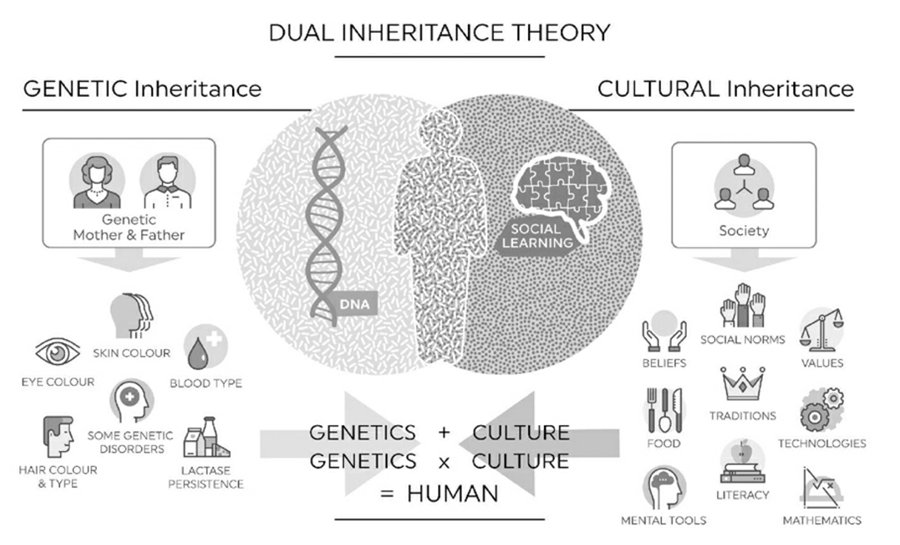
Here Is a nice graph presenting the author’s understanding of humanity:
The author concludes with this:” I hope this book has provided tools for how to advocate and what to advocate for. Not proximate solutions that patch problems and polarize groups, creating more problems, but instead permanent systematic ultimate solutions. I hope I have helped you realize that our problems and their answers don’t lie with any particular leader, any particular person, or any particular group. They require us to consider the rules of the system and what they inevitably lead to. Often, we cannot design the right rules, but we can create conditions for the right rules to evolve.
We have laws of life and a theory of everyone. We have a periodic table for people.
I hope you now know the answer to what Wallace’s older fish asked. I hope you can now see the water. We have the power to shape our societies, to influence our systems, and to determine our future. We can crack the next energy revolution to create a world that is not just sustainable, but thriving; not just efficient, but just; not just innovative, but transformative. The laws of life will go ever onwards. If we make the right decisions, so too will we”.
CONTENT:

MY TAKE ON IT:
I agree with the author’s characterization of humanity, except for the idea of the “collective brain.” I think that the most harmful mistake in human thinking is the neglect of human individuality and the attempt to simplify humans by grouping them into cultural, ethnic, religious, and other groups. In reality, every human being could be represented by a multidimensional Venn diagram of genotypic and phenotypic features changing dynamically and unpredictably. Technological development makes all humans increasingly powerful, so the only way to prevent using this power against others is to ensure maximal freedom of individuals supported by resource availability and combined with the strict cultural upbringing that makes any attempt to force one’s own will on others psychologically impossible. It is also necessary to ensure the development of such attitudes to interhuman interactions that any attempt to do so would prompt resistance. In other words, we should move as close as possible to the psychological environment consistent with humanity’s background as hunter-gatherers when resources are available to everybody more or less equally, cooperation is voluntary, and leadership is based on competence rather than some formal hierarchical structure. Since different people are competent in various areas, the leadership would be fluid depending on which area requires cooperative efforts. I would guess that with the development of AI tools, the need for cooperation in the way when one individual must be a tool for achieving the objectives of another, such as a general/soldier or an entrepreneur/hired hand, will be diminished all the way to non-existence. In this case, voluntary cooperation would be directed mainly at achieving happiness via interaction rather than survival via sacrifice.
 Equal Rights Libertarian