

MAIN IDEA:
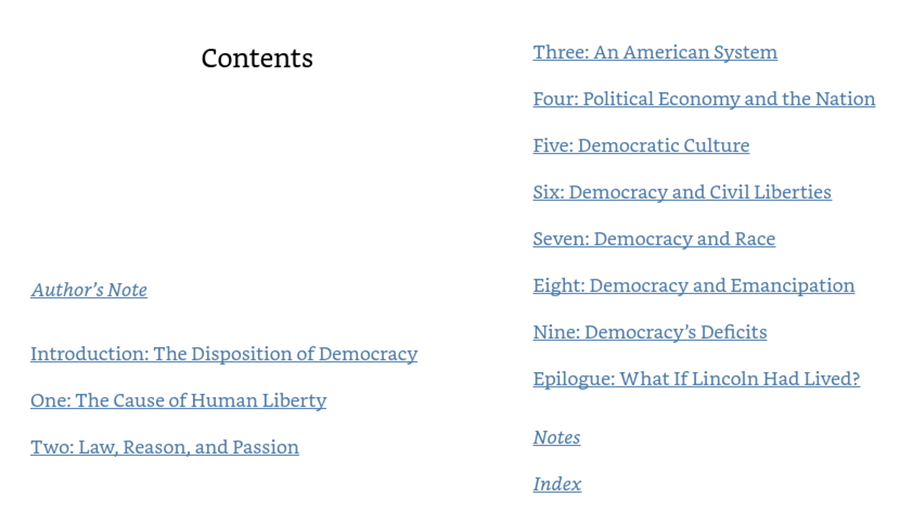
This book is about democracy, examined through the prism of American history, more specifically, through the words and actions of Abraham Lincoln—the man who managed to retain the democratic political system in the United States by fending off the challenge of the Southern slavery-based aristocratic republic to this system. The author meticulously goes through different aspects of democracy and how it was reflected in Lincoln’s attitudes, noting:” One more thing: a Lincolnian democracy is a democracy which embodies Lincoln’s own virtues—resilience, humility, persistence, work, and dignity. Through the example of Lincoln, democracy can claim to offer people, not only order, but decency, even a kind of quiet and unostentatious grandeur.”
The author also discusses what it looks like from a contemporary point of view when we know what happened over the next 160 years after Lincoln’s death.
MY TAKE ON IT:
I do not think that people have a choice in the political system under which they live. It is mainly defined by the system’s fitness to maintain the society it controls and protect it from challenges, both economic and violent, from external and internal enemies. Democracy in America is the result of a unique environment where a relatively small number of technologically advanced people obtained access to practically unlimited amounts of resources in the form of agricultural land, so nearly everyone could become self-sufficient, and nobody would have enough power to suppress others. This ability to survive on one’s own, albeit in cooperation with others, and the inability to suppress and exploit others forced people to seek peaceful accommodation with others. Only the Democratic political system could provide such accommodations. Correspondingly, the slave-owning aristocracy was incompatible with such Democracy and had to be aggressive against it to survive. The Civil War was not really a civil war between members of one society but rather a war between two societies for political dominance.
We are now in a similar situation when it is becoming increasingly obvious that the Democratic political system is incompatible with the Administrative state because top-down control of everything is incompatible with individual freedom based on arrangement when resources are distributed between people via private property. The Civil Conflict between these two systems is inevitable and is actually ongoing. One can only hope that this conflict will not grow into a war. The possible outcomes are clear: either diminishing the Administrative state or eliminating whatever is left of the Democratic political system. The diminishing of the Administrative state would lead to the expansion of prosperity and freedom because free people who own distributed resources are much more productive than people in any other economic arrangement. Alternatively, the triumph of the Administrative state would lead to misery, if not necessarily material, then definitely to psychological misery because the life of quasi-slaves of the administrative hierarchy working under the direction of bureaucrats whose main competency is the ability to move up within this hierarchy is always miserable.
 Equal Rights Libertarian