

MAIN IDEA:
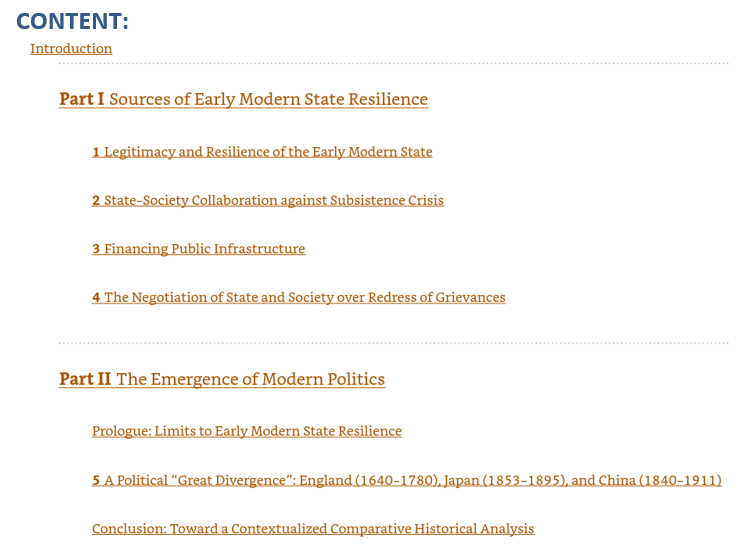
The author expressed the main idea of this book as a theory:” …this theory of state formation in which a public interest-based discourse of state legitimation serves as a common basis for state–society collaboration in public goods provision…” To support this theory, the author reviews specific periods in history:” One was the intensive collaboration between state and society over infrastructural facilities and even defense in England between 1600 and 1640, Japan between 1820 and 1853, and China between 1820 and 1840, periods when each state was encountering sustained fiscal difficulties. Such state–society collaboration in public goods provision such as famine relief, water control projects, and even national defense contributed significantly to the resilience of these early modern states with limited fiscal capacities.” This collaboration eventually led to the contemporary world due to the emergence of the conception of public interest:” This conception of public interest shared by both state and social actors thence constituted a common normative platform upon which state and society could interact over how to deliver concrete public goods to safeguard the public interest in specific circumstances. In this way, the obligation of the state to protect the public interest opened up a space for political participation as it entailed certain rights to the subordinates; most importantly, a right to petition the authorities for redressing welfare grievances so as to safeguard public interest. Such rights were, however, passive, as they were derived from the obligation of the state to protect the public interest. In contrast, active rights, at the level either of the local community or of the individual, are conceived as independent of the state. While passive rights are derived from obligation, active rights are often held to be entitlements of individuals. Examples of such inalienable rights include absolute private property rights or human rights, or freedom of conscience in religion.”
MY TAKE ON IT:
I do not believe in the validity of the notions around which this book’s discussion is built. Neither the public, the state, nor society exists as thinking, feeling, and acting entities; only individuals do. All this comes down to the interaction between the better-armed and better-organized violent groups of individuals – the state with unarmed or poorly armed, poorly organized, and less violent, much bigger groups of individuals – society. Whatever legitimacy, meaning voluntary compliance of the society’s individuals with commands of the state’s individuals, exists based exclusively on an internalized ideological framework established via education, indoctrination, and propaganda. The well-being of the state’s individuals is guaranteed by their ability to extract resources from individuals outside the state. When, for whatever reason, the totality of resources decreases, it impacts, first and foremost, members of society outside of the state hierarchy, undermining their well-being. If the impact is so big that it overrides the existing ideological framework, the society falls apart, leading to some form of rebellion or civil war. The new arrangement comes to life after eliminating either members of the old state hierarchy or those who challenged their rule. If the reason for resource depletion is removed or sufficiently diminished, either because fewer people are still alive to need resources or a better harvest of whatever, the new order strengthens, and the cycle repeats. It used to be that a very strong religious, ideological framework supported order up until the only choice of individuals at the bottom of the hierarchy left was between rebellion with probable violent death and assured death from starvation, providing relative stability of existing arrangements. With such a framework practically disappearing, the stability is decreasing. Still, thanks to contemporary science and technology, the availability of resources has increased so much that most people prefer to tolerate the rule of individuals (politicians) they despise via institutions they contempt rather than rebel. However, at some point, the psychological pain of this compliance could become too much, so the rebellion still could come.
 Equal Rights Libertarian