

MAIN IDEA:
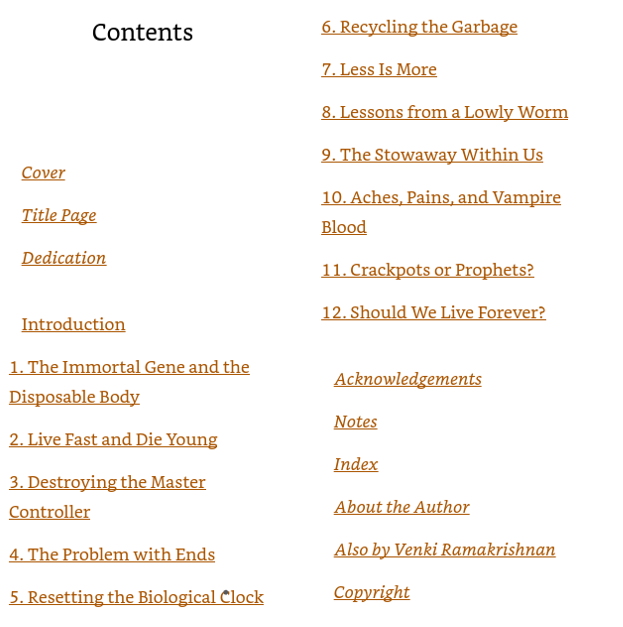
At the beginning of this book, the author discusses various ideas that humans came up with in search of immortality or at least longevity:” The first, or Plan A, is simply to try to live forever or as long as possible. If that fails, then Plan B is to be reborn physically after you die. In Plan C, even if our body decays and cannot be resurrected, our essence continues as an immortal soul. And finally, Plan D means living on through our legacy, whether that consists of works and monuments or biological offspring.” After that, the author defines the content of this book in the following way:” Because aging is connected intimately with so many biological processes, this book is also something of a romp through a lot of modern molecular biology. It will take us on a journey through the major advances that have led to our current understanding of why we age and die. Along the way, we will explore the program of life governed by our genes, and how it is disrupted as we age. We will look at the consequences of that disruption for our cells and tissues and ultimately ourselves as individual beings. We will examine the fascinating question of why even though all living creatures are subject to the same laws of biology, some species live so much longer than even closely related ones, and what this might mean for us humans. We will take a dispassionate look at the most recent efforts being made to extend life span and whether they live up to their hype.”
MY TAKE ON IT:
I found the idea of comparing an unchangeable and practically immortal gene with a disposable body quite interesting. Similarly, the idea of death as the desynchronization of various parts of an organism nicely describes the process of cessation of the system’s existence, even if its various parts are still functional. After reading through all the technical details presented in this book, I am pretty much convinced that there is technical potential to increase both lifespan and health span, maybe even without limit. However, what is puzzling to me is why people would want to do it beyond natural limits. Human life has nicely defined natural periods, and each of these periods has its positives and negatives. The only constant thing is the change and constant acquisition of new life features and the disappearance of old ones. Every 50-year-old is a very different person than he was at five years old, as well as the person he’d be if he lived to be 100. So, basically, life extension would lead to the substitution of the normal process of population change by substituting old, exhausted organisms with newly created individuals by the new process of adding additional life phases for the same old organism. I do not think it is a good idea because it would slow down progress in all areas by prolonging the existence of outdated and poorly working paradigms. It was said that science progresses from funeral to funeral, so no funeral means at least stagnation. Still, it would probably lead to violent eruptions because the status quo forever would not be acceptable to most people.
 Equal Rights Libertarian