
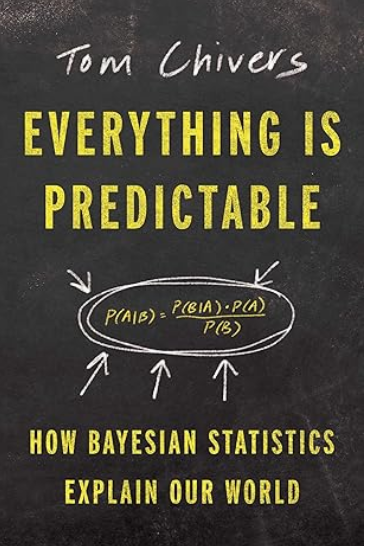
MAIN IDEA:
This book is about the history, philosophical, and practical aspects of the Bayesian theorem of conditional probability:

This formula defines the probability of A if B already occurred. The applications of this formula are unlimited because A and B could be any events, real or imaginative. Here is the author’s definition of its meaning:” …all decision-making under uncertainty is Bayesian—or to put it more accurately, Bayes’ theorem represents ideal decision-making, and the extent to which an agent is obeying Bayes is the extent to which it’s making good decisions. Logic itself, all that stuff you may remember about “All men are mortal; Socrates is a man; ergo Socrates is mortal” is just a special case of Bayesian reasoning where you’re only allowed to use probabilities of one and zero. We appear to be Bayesian machines. That’s true at a fairly high level: humans are rubbish at working out Bayes’ theorem formally, but the decisions we make in everyday life are pretty comparable to those that an ideal Bayesian reasoner would make. Which, unfortunately, doesn’t mean we all end up agreeing—if my prior beliefs are very different from yours, then the same evidence can lead us to entirely different conclusions. Which is how we can end up with profound, but sincere, disagreements on apparently well-evidenced questions about the climate, or vaccines, or any number of other questions. And we’re Bayesian at a deeper level too. Our brains, our perception, seem to work by predicting the world—prior probabilities—and updating those predictions with information from our senses: new data. Our conscious experience of the world can be best described as our priors. I predict, therefore I am.”

MY TAKE ON IT:
I first encountered Bayes’s theorem some 50 years ago while taking a university course on probability theory, but I never thought of it as anything other than a mathematical tool with some practical application. This book demonstrated, and quite convincingly, that conditional probability is everywhere, and it is how people make decisions, whether they realize it or not. It is obviously the foundation of AI because AI is nothing more than a prediction of the future based on probabilities of past events accumulated during the training. So, I have to agree with the idea that we humans base our existence on predictions of the future based on the past, whether it relates to language and image-based communications, decision-making, or working on some project to achieve desirable results. I think that we’ll have to learn to apply Bayesian thinking and processes in a much more formalized and effective way by using AI if we want to have a bright future rather than go into a very unpleasant decline or even possible self-annihilation.
 Equal Rights Libertarian