

MAIN IDEA:
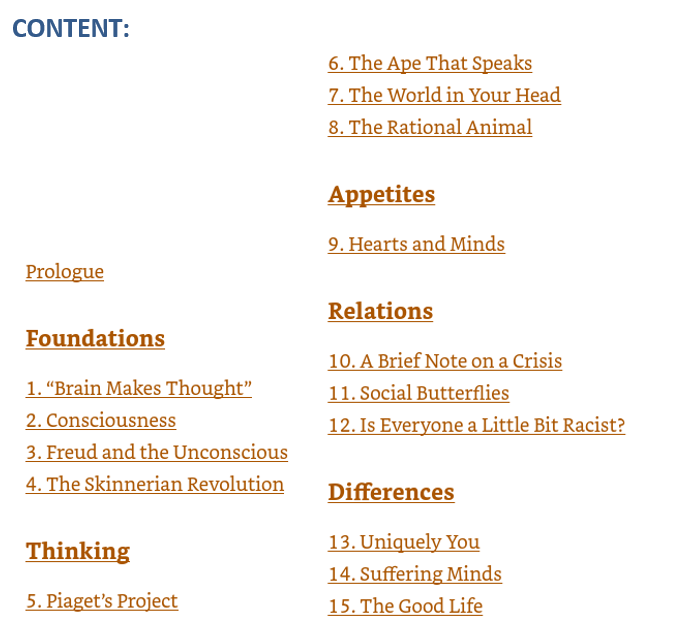
This book was built from the Introduction to Psychology course at Yale. Here is how the author defines his approach:” We’ll see that modern psychology accepts a mechanistic conception of mental life, one that is materialist (seeing the mind as a physical thing), evolutionary (seeing our psychologies as the product of biological evolution, shaped to a large extent by natural selection), and causal (seeing our thoughts and actions as the product of the forces of genes, culture, and individual experience).” However, the author also adds a qualifier:” I think the scientific perspective at the core of modern psychology is fully compatible with the existence of choice and morality and responsibility. Yes, we are, in the end, soft machines—but not just soft machines.”
MY TAKE ON IT:
I think it is a pretty good review of psychology’s history and contemporary condition. I agree with the author’s main positions: materialistic, evolutionary, and causal. From my point of view, what is usually called the mind is the product not only of a specific organ called the brain but also of the totality of the human body in which lots of necessary informational processing occurs at the peripheral level. The signals from peripheral subsystems have a huge impact on the functioning of the brain, as described by psychology methods. The most important thing, which is somehow poorly understood, is that the mind is the communication and information integration system that evolution developed to reconcile two levels of multilevel selection: individual survival and survival of the group that individual belongs to. There is a constant tension between the goals of these two levels, sometimes even direct contradiction, so the hugely complicated and biologically very costly brain is not a luxury but a necessity for survival. The human consciousness is also a necessary product of the brain because the complex system designed to solve complex problems has to have some top-level organizational and co-ordinational tool to synchronize multiple processes occurring in both conscious and unconscious parts of the system and even externally at the level of group and overall environment. The complexity also requires flexibility and delegation of controls to the levels where such control is most effective. This is seldom at the top when our conscious self perceives existing conditions and makes actionable decisions. Contemporary Psychology provides some level of understanding of how these processes work, but a lot less than is needed to obtain a good practical understanding, even if some bits and pieces of such understanding are applied immediately to the manipulation of people to achieve the objectives of others. Humanity is now in the process of moving from a multigroup environment with competition for resources to the formation of one group with a general abundance of resources when the focus will turn to the achievement of individual happiness when the most challenging part would be to assure such changes in human psychology that would make it inconceivable attempting to achieve it at the expense of others. I believe we’ll get there eventually, but it will take lots of time, pain, and suffering before it happens.
 Equal Rights Libertarian