
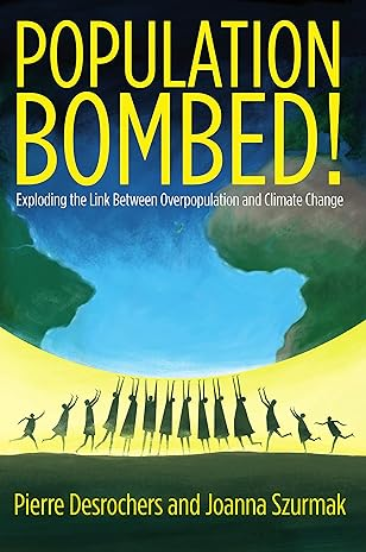
MAIN IDEA:
Unlike a great number of authors, the author of this book clearly identified its objectives and specific contributions that it intends to make. Here they are:
“This book is an attempt to present a relatively concise case for the environmental benefits of economic development, population growth and the use of carbon fuels.
- It explains how, paradoxically, economic prosperity and a cleaner environment are the direct results of both population growth and humanity’s increased use of fossil fuels. Today’s positive outcomes would have been impossible without them.
- It argues that while the predicted catastrophic impacts of climate change remain still largely uncertain, and in need of open scholarly debate instead of rigid consensus, the ongoing campaigns to reduce or constrain the development of fossil fuel use in the absence of truly affordable and electric-grid-friendly alternatives guarantee several negative outcomes:
- a large death toll in developing economies;
- a growing number of economically vulnerable people being pushed into energy poverty in advanced economies;
- an alarming trend of replacing products ultimately extracted from underground (for instance, synthetic products derived from fossil fuels) with resources that are produced on the ground (for instance, “renewable” but unsustainable products made from plants and animals), a process that can result in widespread damage to ecosystems.
The distinctive features of this book are:
- Its comprehensive historical coverage of:
- the long-standing debate between people who fear the economic and environmental impacts of population growth and those who believe that, in the context of market economies, more people are more hands to work and more brains to innovate, not merely more mouths to feed;
- how fossil-fuel-derived products alleviate environmental pressures by replacing resources extracted from the biosphere by resources extracted from below the ground.
- Its insight into why looking at human population growth as though it were similar to that of any other species (for instance, bacteria in a test tube full of food) is profoundly misleading and mistaken. In the book, we highlight that, unique among other species, modern humans transmit information and knowledge between individuals and through time, innovate by combining existing things in new ways, and engage in long-distance trade, thus achieving, to a degree, a decoupling from local limits.
- Its detailed discussion of why, even after two centuries of evidence refuting the pessimistic narrative on population growth, resource availability and environmental impact, that viewpoint still dominates academic and popular debates. The issues the book examines range from financial incentives among academics and activists to behavioural insights into why well-meaning people are unable to change their mind when confronted by contrary evidence.”

MY TAKE ON IT:
I think that from the scientific point of view, there is no reason for hype and alarmism surrounding the issues of climate change, population growth, and economic growth consuming finite resources.
- Climate change is occurring within the normal range for this planet and even within a narrow range of temperatures of the last few centuries after the Little Ice Age. It is quite obvious for anybody who looks at temperature charts and records.
- It is somewhat strange that there are still people worrying about unsustainable population growth when, by now, every culture in the world has convincingly demonstrated that when children turn from a critical source of resources in old age into a hugely expensive luxury, there are a lot less people willing to produce a lot of them. To satisfy the need for parenting, 2.1 children per woman is more than enough, and it is just a maintenance level with 0 population growth.
- Similarly, fear of the constantly growing consumption of material resources is overblown because new technologies constantly decrease the need for input per unit of output. Finally, human interaction with the environment constantly decreases in volume and improves in quality. As an example, one should only look at the land use in North America in the XIX and XXI centuries. In the XIX century, humans converted huge amounts of land into low-intensity agricultural production assets; in the XXI century, a lot of this land turned back into forests because the need for land for agriculture decreased due to productivity.
The real causes of environmental alarmism are not one or all of the above. The cause is the will for power and striving to obtain control over the lives of other people. All this alarmism is just a substitute for what used to be sold as the will of God(s) demanding the people to subordinate their lives to the wishes of the elite. The proper remedy is not an explanation of scientific facts and a search for accommodation. It is a forceful imposition of consequences of environmental craziness on people who promote it. For example, individuals who demand to substitute fossil fuel with wind and solar power must be forced to use only such power and pay full price for such use. For individuals who demand to stop regular people’s travel, it should be illegal to use private planes unless these planes use only wind or solar power. Somehow, I am pretty sure that if alarmists get to pay the price of alarmism instead of getting power over regular people, all these mainly fictitious alarms will calm down, and children with mental problems like Greta Thunberg could sleep tight at night.
 Equal Rights Libertarian