
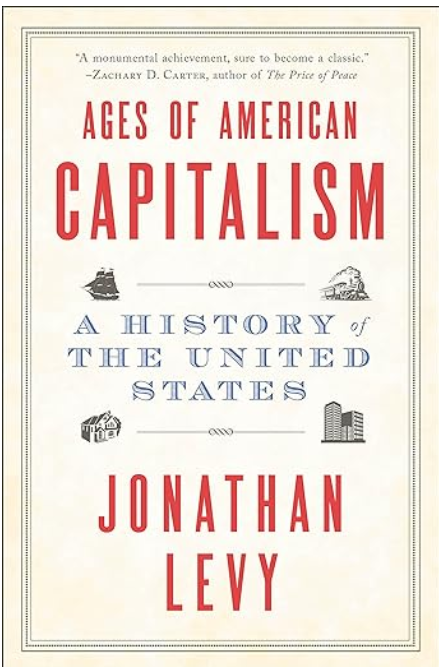
MAIN IDEA:
This book is about the history of the American economy, which developed via various forms of capitalism. Unlike the usual approach, the author clearly defines what he means by capitalism and presents three theses that express the book’s main ideas, around which the author builds logical, historical, and statistical support. These theses are:
Thesis #1: Rather than a physical factor of production, a thing, capital is a process. Specifically, capital is the process through which a legal asset is invested with pecuniary value, in light of its capacity to yield a future pecuniary profit.
Thesis #2: Capital is defined by the quest for a future pecuniary profit. Without capital’s habitual quest for pecuniary gain, there is no capitalism. But the profit motive of capitalists has never been enough to drive economic history, not even the history of capitalism.
Thesis #3: The history of capitalism is a never-ending conflict between the short-term propensity to hoard and the long-term ability and inducement to invest. This conflict holds the key to explaining many of the dynamics of capitalism over time, including its periods of long-term economic development and growth, and its repeating booms and busts.
MY TAKE ON IT:
As much as I appreciate the huge amount of information collected for this book and the presentation of historical data, the author’s approach seems to me not sufficiently explanatory. In my opinion, not only capitalism but any economic system is not just an abstract process when something happens with “legal assets.” It is rather the process of relationship between people that includes resource allocation to individuals, the establishment of the lines of control and subordination between these individuals, and actions of individuals directed at the satisfaction of their psychological needs via the application of these resources. The pecuniary gain does not differentiate capitalism from other systems. After all, a bureaucrat in a socialist system clearly obtains pecuniary gains while moving up the hierarchy when each higher position provides better living conditions and more power over others than any super capitalist could ever obtain. The key feature of capitalism that differentiates it from all other systems is the formal resource allocation to individuals and clearly defined entities as property protected by the state. The distributed resources allow for independent decision-making and resource application via a competitive market, which results in the superior economic performance of such a society. This superiority was demonstrated by American society during its existence both internally in economic, political, and, eventually, military competition within the United States between North and South when the Northern society with a higher level of resource distribution outcompeted the South where a significant part of the population – slaves were deprived of agency and used by masters just as other resources. Such superiority was also demonstrated via external competition with multiple socialist and semi-socialist societies in which resources were concentrated in the hands of a bureaucratic hierarchy with top-down decision-making, and the majority of the population was deprived of agency, sometimes to the same level as slaves.
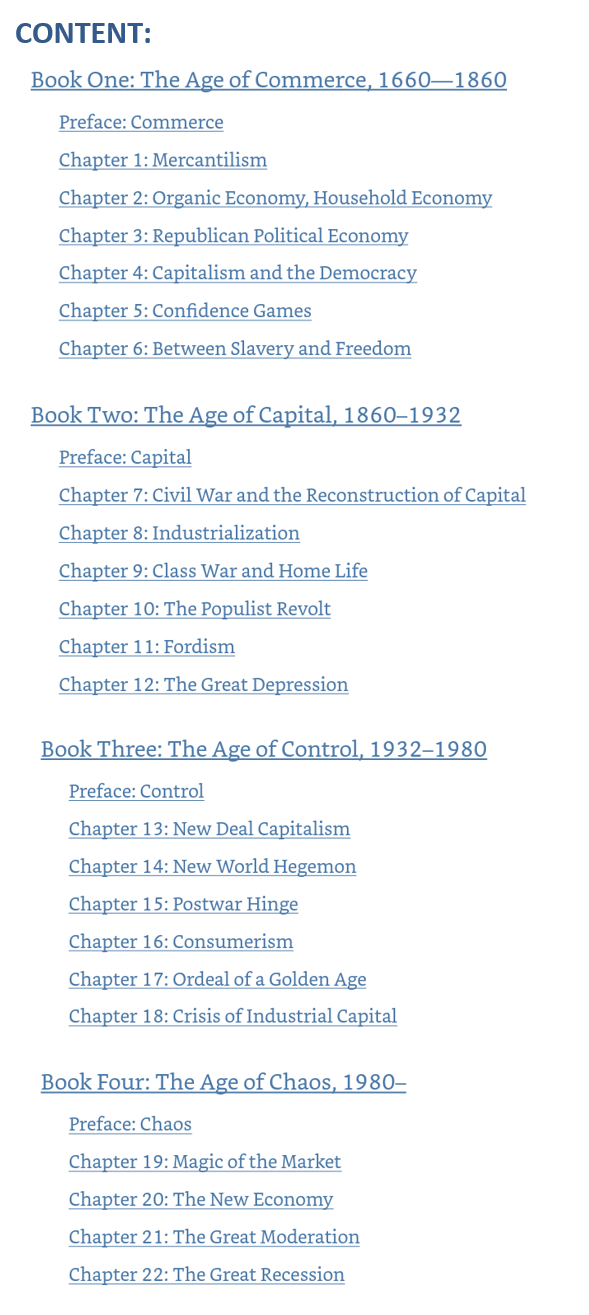
I would suggest looking at the history of economic development of the United States from the point of view of what kind of resources were used, how they were allocated to individuals, and how economic performance was impacted by the ability of individuals to use their agency applying these resources in their own interest. From this point of view, I would look at the following stages of development:
- The main resource is land, which is pretty much available to everybody, creating a country of farmers and small business owners who were dominant in the North and plantation masters and slaves who were dominant in the South. This period lasted from the 1600s to the early 1900s. It did not end at the end of the Civil War, which just somewhat changed the relations between slaves and masters in the South, but not core economic processes. It lasted until the end of the frontier and mass industrialization, when farmers’ productivity became too high, pushing the population out of this economic activity.
- During the second stage, the main resource is human capital. This stage started in the late 1800s and is still ongoing. During this stage, the majority of the population can obtain sufficient resources via small businesses producing goods and services or as highly qualified, productive individuals capable of moving between big businesses as valuable self-controlled resources. However, a small but growing share of the population that possessed too little human capital to obtain sufficient resources on the open market had to resort to violent means to obtain such resources. For the uneducated and unconnected part of this population, such means were unionization and support of political parties that promoted welfare, meaning resource transfer from productive individuals to non-productive with the use of government violence. For the educated and connected part of this population, such means were the growth of government and the transfer of as many goods and services from the market to government control. The growth of government meant the increase of bureaucracy, which provided highly profitable places for educated and connected individuals.
- We are now moving into the third stage when the share of the population with high levels of human capital is decreasing due to automatization. With the implementation of Artificial Intelligence, this share could eventually get very close to 0. The future offers one of two possible developments: one is the bureaucratization of society when people fight for places in the hierarchy and do make-believe work that nobody needs. The other one would be to recognize the common immaterial inheritance of humanity: knowledge, know-how, and such as equally belonging to everybody. Consequently, it could be recognized as individual unalienable property, subject to regular compensation in the form of periodic trade of rights between owners of automated material productive resources and individuals who have little to no such material resources. The first method – complete bureaucratization of society would lead to misery due to the loss of agency and the constant fight for a place in the hierarchy. The second method – complete proprietization would lead to everybody having independent means and therefore free to use the agency in pursuit of happiness.
 Equal Rights Libertarian