
MAIN IDEA:
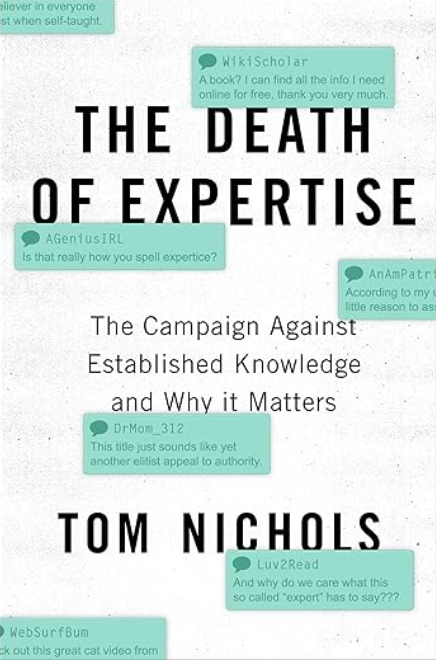
This book is about a very important cultural development: loss of trust in experts, their knowledge, the validity of their advice, and the honesty of their intentions. Here is the author’s description of this development: “Never have so many people had so much access to so much knowledge and yet have been so resistant to learning anything. In the United States and other developed nations, otherwise intelligent people denigrate intellectual achievement and reject the advice of experts. Not only do increasing numbers of laypeople lack basic knowledge, they reject fundamental rules of evidence and refuse to learn how to make a logical argument. In doing so, they risk throwing away centuries of accumulated knowledge and undermining the practices and habits that allow us to develop new knowledge.”
Consequently, the nature of this book the author describes in this way:” Americans now believe that having equal rights in a political system also means that each person’s opinion about anything must be accepted as equal to anyone else’s. This is the credo of a fair number of people despite being obvious nonsense. It is a flat assertion of actual equality that is always illogical, sometimes funny, and often dangerous. This book, then, is about expertise. Or, more accurately, it is about the relationship between experts and citizens in a democracy, why that relationship is collapsing, and what all of us, citizens and experts, might do about it.”
The author concludes, “The relationship between experts and citizens, like almost all relationships in a democracy, is built on trust. When that trust collapses, experts and laypeople become warring factions. And when that happens, democracy itself can enter a death spiral that presents an immediate danger of decay either into rule by the mob or toward elitist technocracy. Both are authoritarian outcomes, and both threaten the United States today. This is why the collapse of the relationship between experts and citizens is a dysfunction of democracy itself. The abysmal literacy, both political and general, of the American public is the foundation for all of these problems.”
At the end of the book, the author discusses the “revolt of the experts” and offers his advice:” Experts need to remember, always, that they are the servants and not the masters of a democratic society and a republican government. If citizens, however, are to be the masters, they must equip themselves not just with education, but with the kind of civic virtue that keeps them involved in the running of their own country. Laypeople cannot do without experts, and they must accept this reality without rancor. Experts, likewise, must accept that their advice, which might seem obvious and right to them, will not always be taken in a democracy that may not value the same things they do. Otherwise, when democracy is understood as an unending demand for unearned respect for unfounded opinions, anything and everything becomes possible, including the end of democracy and republican government itself.”

MY TAKE ON IT:
There are many reasons that trust in experts, and their advice is at its lowest level ever. For more knowledgeable people, it could be the research results of Philip Tetlock that clearly demonstrated a deficiency of expert advice in politics and international relations. For less knowledgeable but thinking people, it is probably an amazingly consistent failure of the “experts in economics” to predict recessions or “climate scientists” to predict next year’s weather. Finally, massive operations to extract resources from the population under the false pretense of “Global Warming,” the moniker which had to be changed to “Climate Change” since no significant warming occurred if one looks at the temperature charts instead of experts provided BS. I do not think that the loss of trust could be possibly restored without significant changes in the process of obtaining and evaluating expertise. If instead of defining expertise as the accumulation of degrees and peer-reviewed publications, expertise is defined by a track record of correct predictions of future events, then and only then will the trust in expert advice be restored. It would also help if instead of financing by the government that violently extracts resources from taxpayers, the financing would be provided by individuals and businesses that are interested in expert opinions. If such entities depend for their well-being on the correctness of the experts’ advice, they will find many ways to make sure that experts are selected based on real expertise, not formalities.
 Equal Rights Libertarian